
Search this book
Search results link directly to the matching source page.
CHAPTER SIX OATH OF THE BENT CROSS AND LATER DEVELOPMENTS
AD 1653
The oppressive rule of the Portuguese padroado provoked a violent reaction on the part of the St. Thomas Christian community.
In 1652, the Persian Catholicos sent Metropolitan Mar Ahatallah from Syria to India. He was however
taken prisoner by the Jesuits at Mylapore and handed over to the Portuguese padroado who put him in a
ship at Madras bound to Goa. Enroute the ship stopped by Cochin. Some how the news reached the
Thomas Christians who hearing this marched down in protest to the Cochin Harbout with a band of
25000 strong. However hearing this the Portuguese urged the ship off to Goa. No one knows what
happenned to this bishop. It was rumored that under the Goan Inquisition he was drowned. This
sparked off a massive movement of protest against Rome. This shaking away of the yoke of Roman Catholicism was accelerated by the fact that Portuguese
supremacy in the Indian Ocean was broken by the Dutch. The first solemn protest took place in 1653. Under the leadership of Malankara Mooppen Thomas,
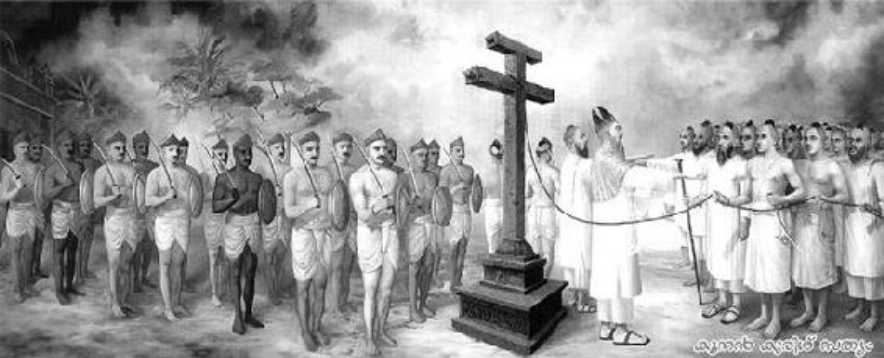
Nazranis around Cochin gathered at Mattancherry church on Friday, January 24, 1653 (M.E. 828
Makaram 3) and made an oath that is known as the Great Oath of Bent Cross. The following oath was
read aloud and the people touching a stone-cross repeated it loudly.
"By the Father, Son and Holy Ghost that henceforth we would not adhere to the Franks, nor accept the faith of the Pope of Rome."
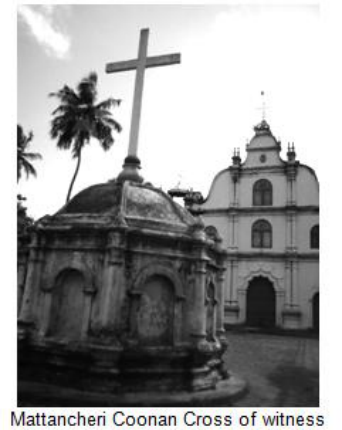
Those who were not able to touch the cross tied ropes on the cross, held the rope in their hands and made the oath. Because of the weight it is said that the cross bent a little and so it is known as ‘'Oath of the bent cross (Koonen Kurisu Sathyam)''
Those who kept away from the Synod of Diamper continued as a small separate church in Trichur and were called the Chaldean Church. In 1653, the Nestorian church in Persia sent a bishop to Kerala. Knowing this the Portuguese authorities captured the bishop before he could land in Cochin and was imprisoned there where he died in duress. As soon as this was known, the enraged Christians in Malankara gathered under the leadership of Thomas Archdeacon and a Knanaya priest, Anjilimmoottil Ittythomman Kathanar (Rev. Itty Thomas)at Mattanchery Church in Kochi and the nearby market on 1653 3rd January (Makaram 3rd, Friday). They took an oath proclaiming that "We or our children and their children to all generations to come will have nothing to do with the Roman Catholic Church nor the Pope of Rome from now on." There were over 25,000 Saint Thomas Christians and 633 clergy at the (Church compound. They took the oath touching the cross in the front yard of the Church. Since all the people could not touch the cross, they tied ropes from the church and every one of the 2000 held the rope or touched the cross to take the oath. Since the cross had a slight bent, this historic oath came to be known as the Koonan Kurisu Sathyam. Thus ended the five decades of supremacy of the Roman church in Malabar.
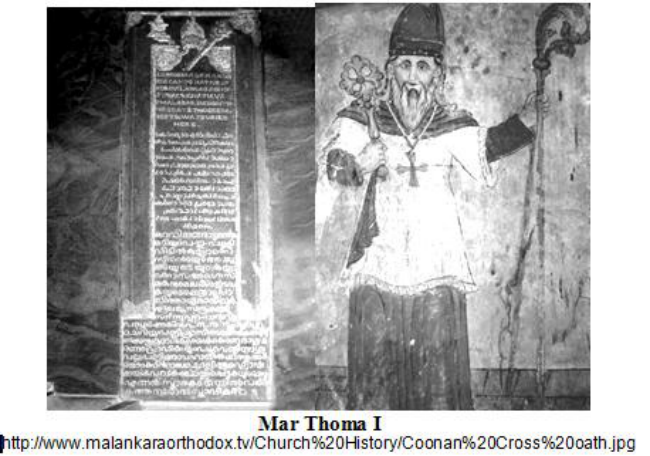
Four months after Coonan Kurisu Sathyam, they assembled at Alangatt, and in accordance with tradition of the church, twelve elders of the Syrian Church community laid hands on the Malankara Mooppen Archdecon Thomas of Pakalomattom family and consecrated him the episcopa of Malankara, giving him the name Mar Thoma I (1653 - 1670), the first in the long line up to Mar Thoma bishops. He was thus the first indigenous bishop of Malankara church. (The Catholics considered this illegitimate, because this was not their practice.) They also appointed a four-member council of priests to assist Mar Thoma. They were Anjilimootil Fr. Itty Thoman, Fr Kadavil Chandy, Fr Vengoor Geevarghese and Fr Parampil Chandy. The seat of Mor Thoma I was at Ankamaly. And once again, Malankara Church became the integral part of the Syrian Orthodox Church, adopting its rituals, rites and liturgy as before.
The result of the synod was unfortunate. As the Catholic Encyclopedia (1913) explains:
"The only case in which an ancient Eastern rite has been wilfully romanized is that of the Uniat Malabar Christians, where it was not Roman authority but the misguided zeal of Alexius de Menezes, Archbishop of Goa, and his Portuguese advisers at the Synod of Diamper (1599) which spoiled the old Malabar Rite."
This revolt which was essentially a freedom struggle as far as the Indian church is concerned from the foreign domination. The Kerala Churches which was monolithic until that time.
Latin rite After the Coonan Cross Oath, Rome realized the extreme stand they took under a weakened political environement incapable of executing inquisition power and began to take steps to get back the confidence. Having realized that the Thomas Christians lost their confidence in the Jesuits, they sent in the Carmelites (another group of monks) in an attempt of reconciliation. Malankara Syrian Christians were new to the politics of the churches. They always relied on foreign clergy to read and interpret Bible. So it was easy for the Carmalites to make them feel that Churches needed Bishops and Bishops are to be ordained only by some form of Apostolic succession and laying on of hands by some Apostolic Authority of the status of Bishop. The Pope erected the Vicariate of Malabar in Cranganore and appointed Fr. Joseph Sebastiani of St.Mary with the Carmelite order, as Apostolic Administrator of the Roman
Catholics (Latin rite) of Malabar in 1659 which was renamed as Verapoly in 1709. In 1662, after a papal delegation visited Malabar, many of the confused Syrian Christians returned to Roman Church. Fr. Kadavil Chandy and Fr. Chandy Parampil who were with the Arkadiyokan until then also defected. While Bishop Joseph administered the Roman Catholic followers with their headquarters at Udayamperoor church, Thomas Arakadiyokan and Itty Thommen Kathanar led the Malankara Syrian Church staying at the Mulanthuruthy MarThoman church. In 1663 when Sebastiani left for Goa under instruction from the Dutch, Fr. Chandy Parambil (Mar Alexander) was made the first Vicar Apostolic of Malabar for the section of Syrian Christians who adorned the Roman Catholic faith. After the demise of Mar Alexander, no indigenous Syrian bishop was appointed to succeed him.
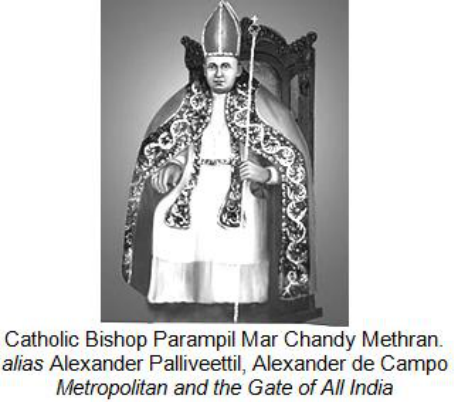
Among the Catholics, the first known indigenous Bishop of whole India, Mar Parampil Chandy was the son of Kuravilangadu Alexander. He was the Vicar Apostolic of Malabar and was called the " Metropolitan of All India".
This caused confusion and many faithful deserted the Jacobite Church and re-joined Romans.
The Pope sent Bishop Joseph Sebastiani to lure Mar Thoma which Mar Thoma devoutly resisted. The enraged bishop Joseph influenced the king of Cochin and put in a false case on Mor Thoma in Oct 1961. Mar Thoma I took asylum in Mulanthuruthy church along with Fr. Itty Thomman. Because the Portugal was still in control of the state, King of Cochin arrested him and kept him in the palace prison to hand over to Portuguese. However they were able to escape the prison in lay clothes which confused the guards.
Contribtions of Portuguese Apart from their colonial dictatorship, the Portuguese were instrumental in several contributions to the Malabar Society. They were the first to introduce the following agricultural products: Cashew Nut (it is still called Parangi Andi = Portuguese Nut), Tobacco, the custard apple, guava, the pineapple, the pappaya and many others. They also started several schools and colleges in Cochin, Cranganore, Ankamally and Vaipicotta and also one printing press each in Cochin and Vaipicotta. The dance drama known as Chavittu Natakam ('Stamping Drama' = Dance Drama) was introduced as a morality play in the churches.
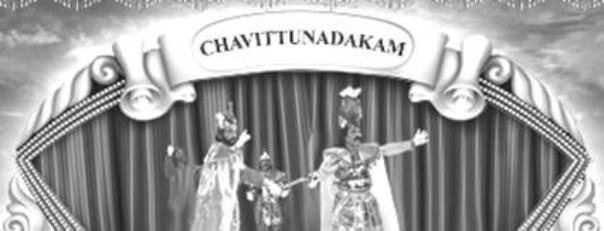
"In Chavittu Nadakam there are large number of characters all in glittering medieval dress. They sing their lines loudly and with exaggerated gestures and they stamp their feet with great force on the wooden stage. It is the form of traditional musical dance drama, which symbolizes the martial tradition of Keralites. Dance and instrumental music are combined in these art forms. The actor themselves sing and act. Great stress is laid on the step, which goes in harmony with the songs. In these art forms there is a great importance for dance and art. Foot stamping dance, fighting and Kalaripayatu are the essential part of Chavittunadakam. Royal dresses and ornamental costumes are necessary. Training is obtained from the Guru Kula form of education. Historical incidents, the life and adventure of heroes like Charlemagne; stories of Napolean were the themes of Chavittunadakam in the 16th century. In the 18th century,spiritual themes like "Allesu-Natakam", "Cathareena Natakam",the victory of the Isaac etc were the themes. In 19th century moral themes like "Sathyapalan";"Njanasundhari","Komala Chandrika"were handled"
"The stories are mostly the heroic episodes of Bible or great Christian warriors. The performers wear glittering Greco-Roman costumes. The bell and drum are two instruments used as background score. The language is Malayalam with some mix of Tamil."
http://www.chavittunadakam.com/about_chavittunadakam.html
Dutch and the Protestants Dutch were Protestants and gave their full support to this change over from Portuguese Catholicism. The Malankara Church appealed to several Eastern Christian Centres for help in restoring its episcopal succession. By 1665, Cochin was under Dutch control. The Antiochene Syrian Patriarch responded and sent to India a Bishop, Metropolitan Mar Gregorios of Jerusalem was able to come to Kerala. As a result Thomas Archdeacon was ordained as the Bishop of Malabar under the name of Mar Thoma I by Mar Gregoroius the Patriarch of Jerusalem on May 22, 1653 on the Day of Pentecost. (The Patriarchate of Jerusalem was part of the Patriarchate of Antioch. Mar Gregorious was the last of the Non- Chalchedonian Patriarchs of Jerusalem. He came to Malankara for this ordination. This was a new beginning in the history of the modern Malankara Church; the Western Syrian language and Antiochene liturgy was adopted in their church; those who accepted Mar Gregory became known as the New Party (Puthankuttukar); thus started the connection with the Syrian Orthodox Church of Antioch, in 1665.
He is still remembered in the first dyptsych of the Orthodox Liturgy along with Mar Ignatius, the Patriarch of Antioch, and Mar Baselius the Catholicos of the East. Since the Antiochian Patriarchate was known to have believed the theology of Jacob Burdhana, the church came to be known as the Jacobite Church of Malabar. A good faction still remained faithful to the Roman pontiff. And during the next 12 years 84 Syrian congregations returned to communion with Rome while 32 congregations remained with the "Bishop" Thomas.
Mar Gregorios Abdul Jaleel
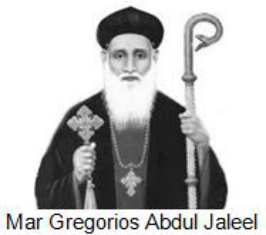
Mar Gregorius Abdul Jaleel of Jerusalem was associated with the Jacobite Patriarchate of Antioch. Thus began the relation of the Syrian Church with the Antiochene Jacobites. Antiochians followed the St. James Liturgy used by the West Syrian Orthodox Church and hence
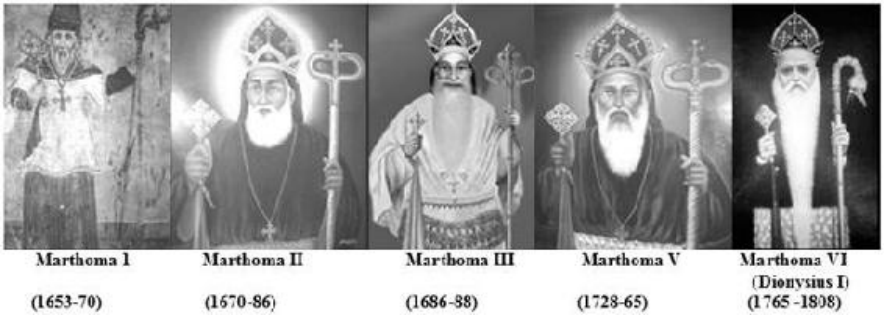
replaced the liturgy of the Apostles Addai and Mari which were in use in Malankara. The Church came to be known as Malankara Jacobite Syrian Orthodox Church. From 1665 to 1816,'Mar Thoma' Metropolitans from the Pakalomattom family ruled over the Malankara Church as Metropolitans. In 1670 Mor Thoma I and Mor Gregorious of Jerusalem both jointly consecrated Mar Thoma II. Mor Thoma IV became head of the church in 1688 and administered the Church for 40 odd years.
Mar Gregorious Abdul Jaleel stayed back in India. He was instrumental in the removal of the enforcement of celebacy of priests. Since such rules invariably led to audulterous practices as St.Paul himself pointed out, he encouraged those who aspire for priesthood to get married before the ordination as Kaseesa. He also led an inconoclastic movement agaisnt the idols which the Portuguese brought into the Church. Apparently no idols were in existence before the coming of Portugal. However Orthodox Churches itself had its own theology of iconography. Mar Gregorios consecrated two Bishops in Malankara.
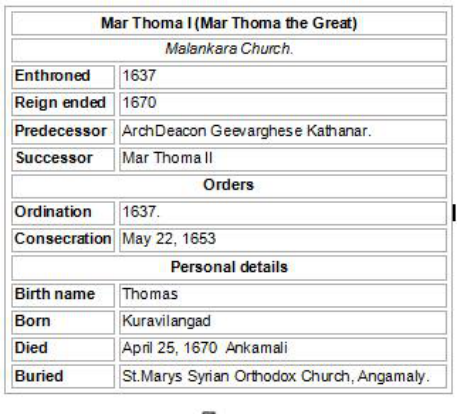
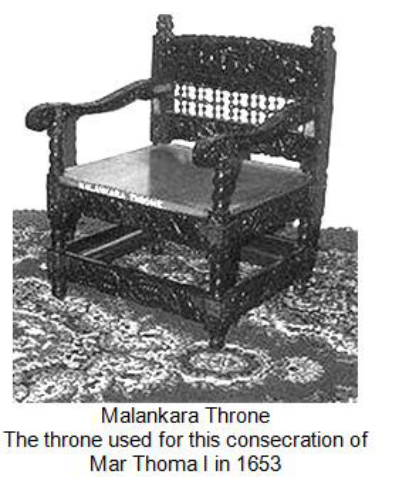
This throne is now with the Mar Thoma Syrian Church. After the great swearing in 1653 it became necessary to appoint a bishop. For this purpose a special chair was made and Mar Thoma I the first bishop of Malankara church was enthroned. This throne, used for the consecration of Mar Thoma I, is in the possession of the Mar Thoma Church and is kept at Tiruvalla. It has been used in the installation of every Mar Thoma Metropolitan, to this day, so that the continuity of the throne of Mar Thoma is ensured.
Four very efficient trustworthy and responsible priests, Kalliseril Anjilimoottil Itty Thomman Kathanar, Kaduthuruthy Kadavil Chandy Kathanar, Angamaly Vengoor Geevarghese Kathanar and Kuravilangad
Palliveettil Parampil Chandy Kathanar were selected as his advisors. Mar Thoma I died around 1670-1673 AD. The hereditary line of Bishops continued in Malankara Syriac Orthodox Church from 1653 until 1815 and all were from the Pakalomattam family of Kuravilanagdu.
In 1665, Mar Gregorios Abdul Jaleel, a Bishop send by the Syriac Orthodox Patriarch of Antioch arrived in India. This visit established ties between Thomas churches of Malankara and the Syriac Orthodox Patriarch, and introduced the West Syrian Rite (later known as the Malankara Rite in India). Morthoma I until his death in 1670 remained faithful and loyal to Antioch.
However, the Syrian Christians around Angamaly who did not accept Mar Gregorius Abdul Jaleel remained as a separate group and waited for East Syrian bishops as before.
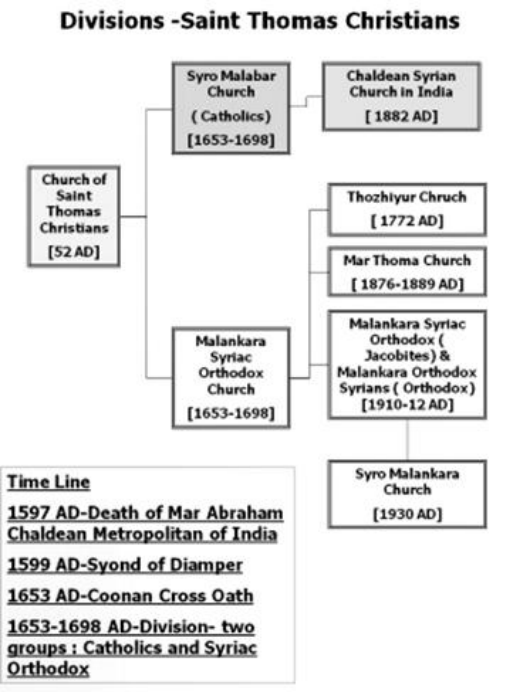
Those who accepted the West Syrian theological and liturgical tradition of Mar Gregorios became known as Jacobites. Those who continued with East Syrian theological and liturgical tradition and stayed faithful to the Synod of Diamper are known as the Syro-Malabar Catholic Church in communion with the Catholic Church. They got their own Syro- Malabar Hierarchy on 21 December 1923 with the Metropolitan Mar Augustine
Malankara Independent Syrian Church of Thozhiyur
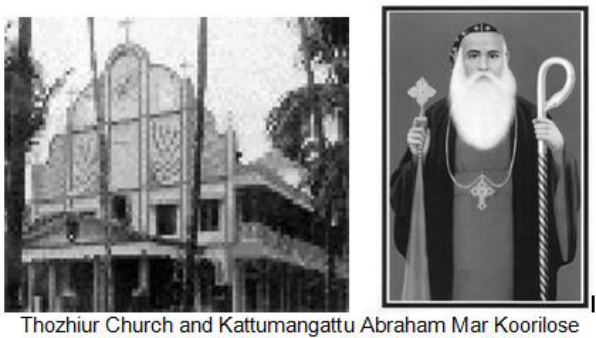
In 1772 Mar Gregorios consecrated Abraham Mar Koorilose as bishop. This was not appreciated by his fellow bishop, who hindered his ministry. Mar Koorilose eventually retired to Thozhiyur where he led a life of prayer. This church continued as an independent church since then. Three times during its life time the main Malankara Syrian Church found themselves without a bishop. The Thoziyur Independent Church
provided bishops for it to maintain its apostolic succession. Later it also provided a bishop for Mar Thoma Church when it found itself without a bishop even though the doctrines of Mar Thoma Church and the Thozhiyur Church are different. In return when the Thozhiyur Church was without a bishop, Mar Thoma Church provided a bishop for it. Thus Thozhiyur church became an instrument of maintianing the apostolic succession without break within the sister Malankara churches.
Until recently Thozhiyur was the only church under this Bishopric. With the increased membership additional churches are being built. Cochin currently has a new church.
Traditions, rituals and social life among Syrian Christians
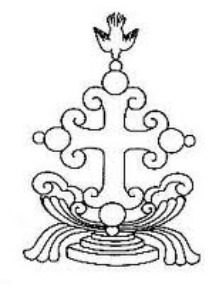
The symbol of the Nasranis is the flowery Persian cross, also called Mar Thoma Sleeba in Malayalam. It is unknown when this cross began to be used. According to J Raulin, up to 16th century, the Saint Thomas Christians did not use any other image except the Saint Thomas Cross in their Churches.
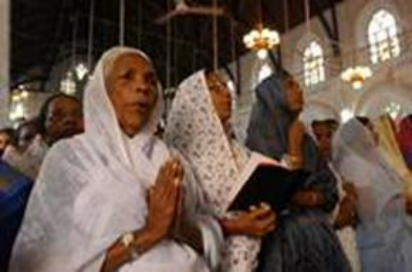
Women cover their heads during worship, even outside the church. This is the tradition among the Jewish descendants of Abrahamic religion.
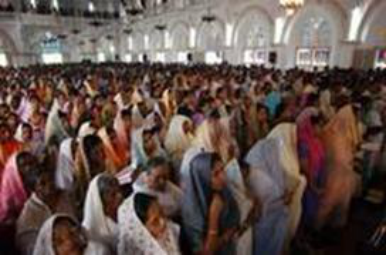
The ritual services (liturgy) is called the Holy Qurbana (or "Kurbana"), which is derived from the Hebrew Korban (çèÑß), meaning "Sacrifice".
Some parts of the Nasrani Qurbana are sung in the Suryani (Syriac) language. Until 1970s most of the churches followed Syriac liturgy almost completely.
The architecture of the early church reflected a blend of Jewish and Kerala styles. Pesaha, the ritual supper which is the narration of the Paschal event is celebrated among Saint Thomas Christians. The observance of Pesaha at home is an unbroken tradition which is unique to the Saint Thomas Christians among Christians in India. It is the real Paschal catechesis in the families.
The Churches have a separate seating arrangement for men and women.
Many of the tunes of the Syrian- Christian worship in Kerala are remnants of ancient Syriac tunes of antiquity. The "Holy of Holies" is divided by a red curtain for most of the time and is opened during the central part of the Qurbana. Baptism is still called by the Hebrew-Syriac term Mamodisa and follows many of the ancient rituals of the ceremony. It is referred to in Malayalam as Njana Snanam (Bath of Wisdom). Most of the Nasranis even today use Biblical given names like Jews. Biblical names along with Greek, Armenian, and Syrian given names have been popular names in the Nasrani Community. They prefix and suffix Kerala names to these traditional names. The naming convention is also seen among the Sephardic Jews, whose customs may have been absorbed by the Syrian Christians in Kerala. Immediately after a Child is born, a priest or male relative shouts in the child's ear ‘ Maron Yesu Mishiha' (Jesus Christ is the Messiah) and the child would be fed with three drops of honey in which a little gold had been rubbed. Another surviving tradition is the use of "Muthukoda" (ornamental umbrella) for church celebrations, marriages and other festivals. Traditional drums and Arch decorations and ornamental umbrella
are part of the church celebrations. Its use have become popular all over Kerala.
Boundaries between Christians and Hindus are blurred in some cultural sphere such us house building, astrology, birth and marriage (use of sandalwood paste, milk, rice and areca nut) The spiritual life of Nasranis is ordered by liturgical obligations and by its specifically Christian ethics. Death rituals express Christian canonical themes very distantly especially in the ideas concerning life after death and the anticipation of final judgment. Christians were given honorific titles. "Tharakan" is a word derived from the word for tariff. "Panikkar" denotes proficiency in military training. The most common name of the Christians was Nasrani Mappila. The Church of Saint Thomas Christians accepted the East Syriac liturgy from an early period and along with the liturgy, the systems of ecclesial government, such as Metropolitan, Archdeacon and Yogams had their organic development in relation with East Syriac Churches. Syriac Christians are not allowed to marry into other religions. Syriac Christians are not to Marry any of his Relations upto for 5 generations.
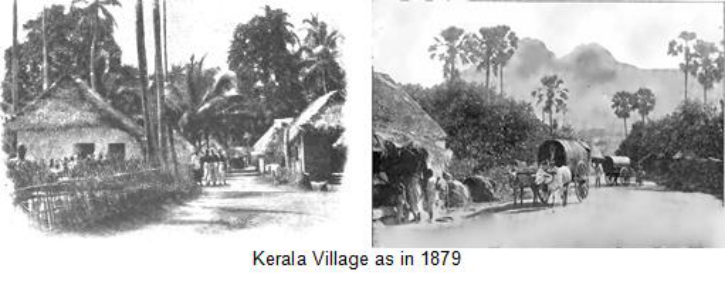
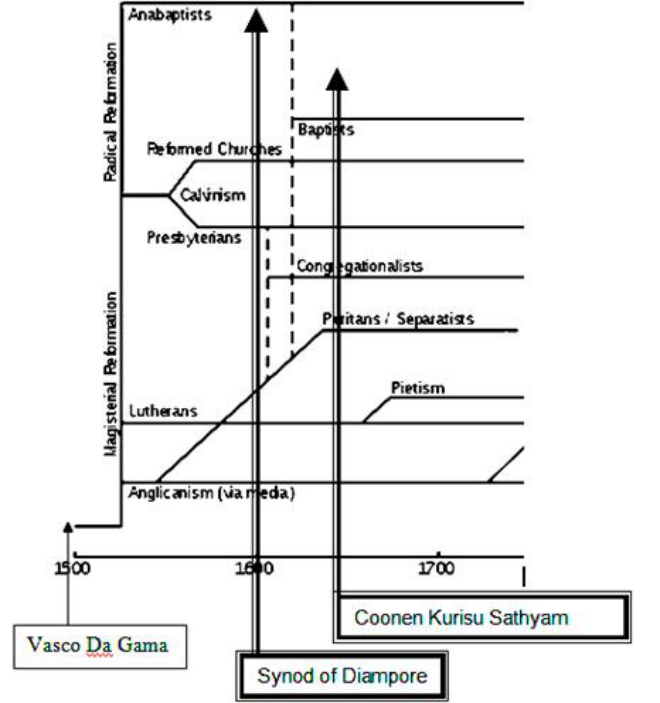
The Church Missionary Atlas published 1879 summarizes their perception as follows page 98
"When Vasco de Gama, the great Portuguese navigator reached India by sea round the Cape in 1498, he was received with open arms by the Christians of Malabar; but the connexion with Portugal brought sad trouble upon them. Just century later, the Church, which had successfully resisted the persuasions of the Jesuits, became subject to the jurisdiction of the Pope; the work of subjugation being effected, partly by force and partly by fraus, by Alexius Menezes, Archbishop of Goa. All married priests were deposed; the doctrine of transubstantiation and the worship of Virgin were enforced; the Inquisition was established; and the worship of the Virgin were enforced; was burnt alive at Goa as a heretic. In 1661, however, the ports of Quilon and Cochin were captured by the Dutch, who expelled all the Romish priests, and thus made way for another Syrian Metropolitan, who arrived from Antioch in 1665, and was welcomed as a liberator by the majority of the Christians. The Malabar Church has from that time been free from Papal domination, but has acknowledged the supremacy of the Jacobite Partiarch. Many, however,
remained in connexion with the Church of Rome, and became the progenitors of the numerous body of Romanist now in the country."
Angamaly Padiyola The difficulties experienced by the St. Thomas Christians of Catholic persuation under the foreign missionaries resulted in a number of protest meetings in Angamali and other places. In one such major convention held in 1778 it was decided to send a delegation to Rome, directly to the Pope. Two Priests Fr. Joseph Kariattil and Fr. Thomas Paremmakal were sent to Pope to get an Archbishop to the See of Kodungalloor. Kariattil was consecrated as the Archbishop of Kodungalloor in 1782 at Lisbon, but on his way back, before reaching Kerala, he died in 1786 at Goa. There were ugly rumors about death of Archbishop Kariattil and the bitterness consumed the hearts of the expectant crowd gathered at Cochin to welcome their own first ever archbishop. In 1787, representatives from 84 churches assembled in Angamaly and drew up a document called Angamaly Padiyola which made a strong demand to Rome for native bishops, in the hope that this might heal the rift. But Rome was undecided. However, it did not change the situation much for a long time to come. In 1930 the matter was settled to some extent with the formation of the Syro-Malankara Church, which enabled the Syrian Christians and Latin Christians to follow their own practices under the jurisdiction of Rome.
Decline of Jesuit Mission In the seventeenth century the Jesuit order had had over 8,500 missionaries operating in twenty-three countries, including Brazil, India, Malaya, the Congo, Japan, Ethiopia and China. By the eighteenth century, the Jesuits lost favour in the courts of Catholic Europe, which grew suspicious of their power.
· In 1759 they were thrown out of Portugal.
· In 1767 5,000 Jesuits were ejected from Spain and its dominions. · In 1773 the Vatican ended all Jesuit power. The Catholic Church's most prolific missionary movement came to an end.