
Search this book
Search results link directly to the matching source page.
CHAPTER FOUR
PERSIAN IMMIGRATION
AD 325 The Council of Nicea Indian representation through Bishop Johannes
At this time the Christological discourse and controversies were raging in the West. The Council of Nicea was held to draw up the Nicean Creed in order to establish the cannon of faith. 318 bishops attended it among them was a Bishop Johannes, the Persian, for the churches of the whole of Persia and Greater India.
The Indian Church had ties with the Persian Churches right from early period. It is assumed that Indian Churches invited Persian priests to teach the Bible. The earliest bibles translated from Greek are found in Syriac. Malayalam did not have bible until recently. So it was necessary to have priests from Syria to publicly read, teach and explain the Bible to the believers. However the church administrations were completely controlled by the local elders while the clergy who were brought into the country provided the ecclesiastical services and doctrinal teachings.
Persian Immigrations
In AD 340 the Suraya Christians from Persia (now known as Syrian Christians) came to Malabar Coast under the leadership of a bishop by name Dawood. Later a group of immigrants under the leadership of Thomman from Persia landed in Cranganoor in AD
345. They included about 400 persons of seventy-two families of seven clans.
A bishop named Mar Joseph, four priests and a few deacons were also with them. It is assumed that they came because of the Persian persecution under Zoroastrianism. There are scholars who believe that at least some of them were actually Mani followers (60) who came as a result of persecution. Other sources indicate that they were sent by the Catholicos of Jerusalem to get information about the state of the Church in Malabar. Whatever is the reason, they were received kindly by the Cheraman Perumal who gave him permission to buy land and settle down. The King also offered special privileges to him and his group. This group kept their social identity and forms the Kananaya Christians. Thomas is said to have married a local woman and hence had two groups - known as Eastern Group and the Western Group.
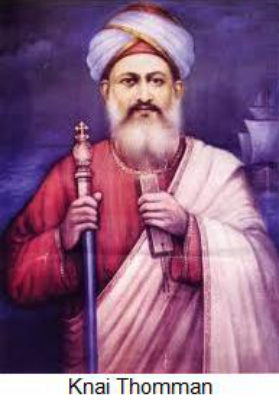
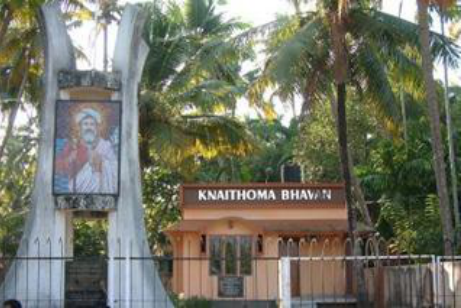
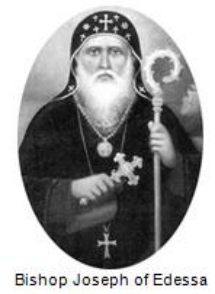
These Royal grants given by Cheraman Perumal, who was the ruler of Malabar, were inscribed on copper plates (Knai Thomman Cheppedu), giving Knai Thomman and his descendants seventy-two royal privileges, in AD 345 In some places they are referred to as "Manigrama Nivasikal". These privileges are all Royal privileges indicating equal status of the Knai Thomman with the Kings of Chera. They include: Royal robes, Royal Crown and head dress and other ornaments, authority to exact all types of taxes and act as judges over several groups of people.
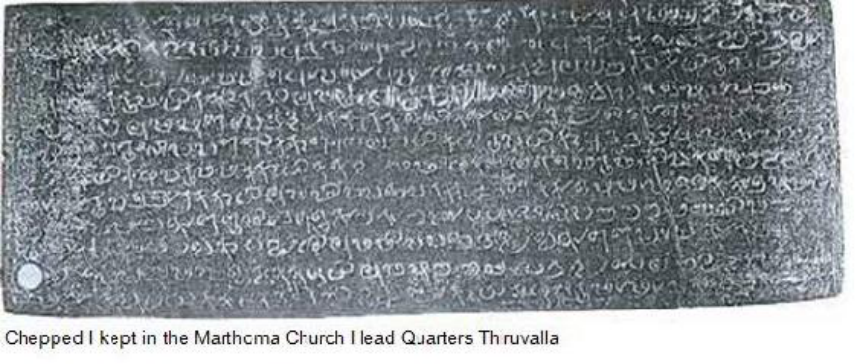
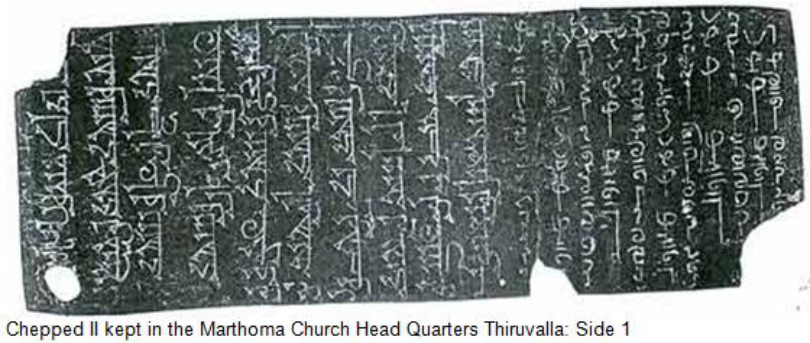
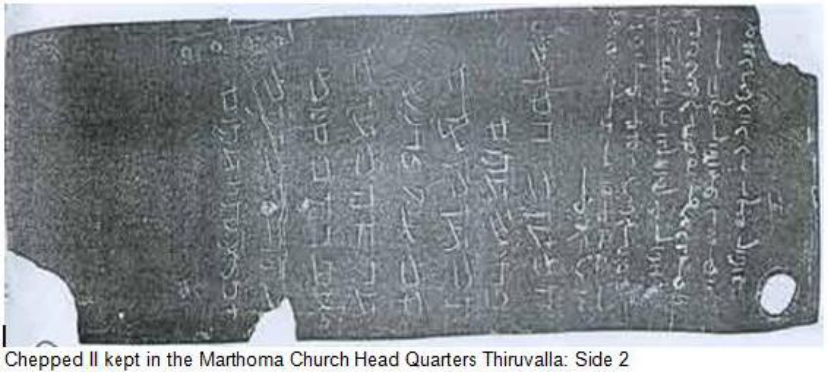
This was followed by several other immigrations from Persia
The presence and the powers of the new comers from Persia added a new dimension to the local Christians who were already in contact with their counterparts in Persia. These ties were now strengthened. The Aryan Brahminic elements within the church itself got a privilieged status within the caste system which began to appear. They now began to exchange priests, who brought with them the documents known as the bible, which were only available in Greek and Syriac. They soon incorporated the Persian way of church institution, worship and other ritualism. This gave them a unique culture,- under the influence of the Syrian Church - which came to be known as Syrian Christian culture. Kerala Christians came to be known as Syrian Christians- not because they are from Syria, but because they followed the liturgy and customs of the Syrian Churches.
Theophilus, The Indian
Theophilus was a native of Maldive Islands, off Kerala coast. Emperor Constantine took him as a hostage so that the Maldive people will not plunder Roman ships as it passed that way. In Rome he became a Christian and became a Bishop. He visited India in AD 354 and noted that their worship practices differed considerably from those of other parts of the world. Particularly he noticed that Indians sang, heard the gospel and worshipped sitting down. He thought they were outrageous and ordered it changed. Probably the practice of worship standing was introduced from that time onwards.
AD 425 Daniel, The Priest, Indian
It may be assumed that Indians sent their priests for training and studies to Syria. There was one Daniel who translated the
commentary on the Epistle to the Romans from Greek to Syriac in Edessa. He signed it as Daniel, the priest, the Indian. Ecclesiastical language of India was probably Greek and Syriac as the teaching of Bible came from there. Greek inscriptions are found on the bells of several churches.
Cosmos Indicopleustes and Universal Christian Topology
Around AD 522, Cosmos a rich Christian merchant from Alexandria, visited India and wrote a book called Universal Christian Topology. He describes his visit thus:
"We have found the church not destroyed, but very widely diffused and the whole world filled with the doctrine of Christ, which is being day by day propagated and the Gospel preached over the whole earth. This I have seen with my own eyes in many places and have heard narrated by others. I as a witness of truth relate: In the land of Taprobane (Srilanka), Inner India, where the Indian sea is, there is a church of Christians, with clergy and congregation of believers, though I know not if there be any Christians further in this direction. And such also is the case in the land called Male (Malabar), where the pepper grows. And in the place called Kallia (Kollam) there is a bishop appointed from Persia, as well as in the island called Dioscores (Socotra) in the same Indian Sea. The inhabitants of that island speak Greek, having been originally settled there by Ptolemies, who ruled after Alexander of Macedonia. There are clergy there also ordained and sent from Persia to minister among the people of the island, and the multitude of Christians..."
A.D. 431 Council of Ephesus A.D. 451 Council of Chalcedon: Nestorian Schism
Soon after the formation of the Church, heresy and variations in teachings were in existence in one form or other, all over the world. During the Apostolic Period, they were settled with the mediation of the Apostles and Apostolic Synods and Councils. The first of the council was the council of Jerusalem where the question of gentile inclusion in the church was discussed. However after the apostolic period this continued. Even today we have large number of theological systems varying ever so slightly. These movements arose powerfully around 400 A.D when Christianity became free from oppression and when being a Christian became a prestige. In the year AD 425 Nestorius, a presbyter of the Church of Antioch became the Patriarch of Constantinople. He legitimately objected to the epithet of "Theokotos" or "Mother of God" as applied to Mary; since Mary was only the mother of the incarnation and not the mother who produced a God. This would imply that Mary was a Goddess. In this sense he was indeed right. However he was understood (or so defined by some then theological schools) to have propounded the concept that the Logos of God indwelt Jesus the man. Thus there were two natures in Jesus at the same time. If we are to judge by the Nestorian churches of today this was a misunderstanding.
Cyril the Patriarch of Alexandria opposed this dual nature concept and insisted on the unity that Jesus was perfect man and perfect God without inconsistency. The controversy reached a climax when these Patriarchs excommunicated each other. However the conduct of the Ephesus council was totally deplorable that Nestorius was not even given a hearing. By the time Nestorius arrived at Ephesus the council had voted against him and he was excommunicated and exiled. Its decision though universally accepted, the way the issue was treated is still considered deplorable. Nestorius, a genius theologian of the time was derided without even giving him a hearing.
The fight went on and in AD 451 the Nestorians claimed a victory in the council of Chaldeons. In this council it was declared that in Christ the two natures were hypostatically united, without mixture, confusion and divisibility. Cyril the Patriarch of Alexandria and John the Patriarch of Antioch finally reconciled. Nestorians adopted the name Chaldeon Church and the Patriarch took the title of Patriarch of Babylon. These in fights in the Middle East and Europe had its repercussions in India too. There exists a Chaldean church with few followings even today, though majority of the Christian churches remained faithful to the declarations of Nicea and Ephesus. A copy of the pre-Diampur liturgy shows that Thomas churches considered Nestorius as one of their bishops and revered him.
TIME LINE
AD 40 Apostle Thomas is brought before King Gondophares, in Takshasila in North India (Pakistan). St. Thomas preached there for some years, after which, becoming aware of the Dormition of the Blessed Virgin Mary, he went back to Jerusalem; on his second journey, the Apostle came to Malabar, established the Church and preached there for many years; then he went to the Coromandel Coast, where he died a martyr at Calamina (Mylapore) by the order of Masdai, king of that place
AD 51 On the way he was shipwrecked into the island of Socatra near Yemen where he established a Church and proceded to South India.
AD 52 Arrival of St. Thomas the Apostle in Muziris (near Kodungalloor) in the Indian state of Kerala. The Greeks called this place Mousiris and
the Jews, Muzirikode, Muchiri in Tamil means cleft palate indicating the biforcation of the river into two and then joining the sea.
AD 52-72 St. Thomas converted and baptized many caste Hindus including thirty-two Namboori (Brahmin) families and certain members of the royal family, Namely, Bana Varma Perumal and his nephew who later became Kepa, the first Archbishop of Kerala; St Thomas established 7 churches at: Kodungalloor; Palayoor; Paravur; Kokkamangalam; Chayal; Niranam; and Kollam. According to a very ancient tradition, Thomas had ordained two bishops, four rambans, seven priests and twenty-one deacons -that priesthood continued in unbroken succession from generation to generation in the families of Pakalomattam and Sankarapuri. Historians are of the opinion that Thomas established the early liturgy here in Aramaic (Syriac), since in those days, Greek was the chief language of the West, and Syriac, that of the East; also, on account of their close contact with the Jews, Aramaic was not unfamiliar to the Keralites. (Nirappel, Rev. Dr. Antony (Syro-Malabar Catholic Diocese of Kanjirappally). The Kerala Church. Changanacherry Kerala, India.).
AD 72 Martyrdom of St. Thomas the Apostle, in the neighborhood of Mylapore, city of Chennai, state of Tamil Nadu. The body of the Apostle was buried near the Mylapore beach where the San Thome Cathedral now stands. The relics were taken to Edessa in the third or early fourth century. When that place fell into the hands of the Mohammedans, they were moved to Island of Chios in 1141, and from there to Ortona in Italy in 1257, where they remain under the main altar of the St. Thomas Cathedral. In 1952, immediately after the "All Kerala Celebrations of the 19th Century of the Landing of St. Thomas in India," Cardinal Tisserant brought a part of the relics back to this land; its main portion is enshrined at
Kodungalloor where the Apostle first set foot in India and the other portion at Mylapore where he died.
AD 105 Church established at Kuravilangad (St. Mary's Forane Church). AD 189 Arrival of Stoic Philosopher Pantaenus from Alexandria, who visited the Malankara Church. The original liturgical language used in the Malankara Church was Aramaic and Hebrew; later this was replaced by Syriac. at the request of the Malankara Christians (reported by Eusebius of Caesarea and Jerome); according to Eusebius, Pantaenus was for a time a missionary preacher, traveling as far as India, where it was reported that he found Christians who were using the Gospel of Matthew in Hebrew. A Brahmin conjurer named Manickavachakar went around the country decrying Christianity. He was able to arouse the feelings of the Hindus against Christianity, to obstruct further spread of the religion and even to draw
some converts back to Hinduism. Alarmed at this, the Kerala Christians sent a deputation to Demitrius, Bishop of Alexandria, requesting him to send a learned doctor to refute the arguments of Manickavachakar and to confirm the Christians in faith. Consequently, Pantaenus, the learned professor of the famous seminary of Alexandria, came to Kerala in 190. He defeated Manickavachakar in debate, brought back most of the apostatized to Christianity and gave a new awakening and spirit to the Kerala Church. (Nirappel, Rev. Dr. Antony (Syro-Malabar Catholic Diocese of Kanjirappally). The Kerala Church. Changanacherry Kerala, India.).
AD 196 Bardaisan writes of Christians amongst the Parthians, Bactrians (Kushans) and other peoples in the Persian Empire.
AD 230 Veera Raghava Chakravarthy, the King Emperor of Kerala, who had his capital at Kodungallor, granted to the Nazaranis a series of royal honors, by a proclamation engraved on copper plate called "cheped."
AD 290 Brief persecution of Persian Christians under Bahram II. AD 300 ca.300 Bp. David of Basra undertook missionary work in India, among the earliest documented Christian missionaries in India.
AD 325 First Ecumenical Council in Nicaea; St. Jacob of Nisibis, Bp. of Nisibis in Mesopotamia and spiritual father of Ephrem the Syrian, attended the First Ecumenical Council, as did Persian Bp. John (Mar Yohannan) presiding over the churches "in Persia and India". From the later half of the third century, the Kerala Church had relations with Persia; it seems that their Bishops came from Persia during that period. Mar John, Metropolitan of Persia and India, subscribed his name and signature to the decrees of the Synod of Nicaea in 325. (Nirappel, Rev. Dr. Antony (Syro-Malabar Catholic Diocese of Kanjirappally). The Kerala Church. Changanacherry Kerala, India.).
AD 4th -6th C ca.4th-6th c. Severe persecution of Christians in Persia (Sassanid Empire).
AD 337 -379 The Persian Church faced several severe persecutions, notably during the reign of Shapur II (309-79), from the Zoroastrian majority who accused it of Roman leanings. In 337 Shapur sent his forces across the Tigris River, the uneasy frontier, to recover Armenia and Mesopotamia, which his predecessors had lost to the Romans. Until 350 the conflict raged in northern Mesopotamia, with neither side a clear-cut victor. Shortly after 337, Shapur took an important policy decision. Although the state religion of the Sasanian Empire was Mazdaism (Zoroastrianism), Christianity flourished within its boundaries. The Roman emperor Constantine the Great had granted
toleration to Christians in 313. With the subsequent Christianization of the empire, Shapur, mistrustful of a potential force of a fifth column at home while he was engaged abroad, ordered the persecution and forcible conversion of the Christians; this policy was in force throughout his reign.
AD 340-360 The Nasranis were granted special rights and privileges by the edict Thazhekad Sasanam; the edict was written on stone and provides proof of the early existence of St. Thomas Christians in Kerala.
AD 345 A small group of K'nanaim merchants travelled to the Jewish trade posts at Kodungallur in Kerala and settled there; their descendants are today known in Kerala as Knanaya Nasranis (Saint Thomas Christians); they were under the leadership of Thomas of Cana (Thomas of Kynai), with Bishop Joseph of Edessa (Bp. Uraha Mar Yausef), four priests, several deacons, and 72 Syro-Aramaic Jewish families who migrated from Edessa (about 400 people).
AD 354 Theophilos the Indian was sent by Emperor Constantius II on a mission to south Asia via Arabia, where he is said to have converted the Himyarites and built three churches in southwest Arabia; he is also said to have found Christians in India, along the Malabar Coast, as recorded by the Anomoean (Arian) Church historian Philostorgius.
AD 363 St. Ephrem the Syrian at Edessa, writes about St. Thomas as the Apostle of India.
AD 379-402 Continuation of the Great Persecution of the Persian church.
AD 380 St. Gregory the Theologian writes about St. Thomas as the Apostle of India.
AD 390 St. Ambrose of Milan writes about St. Thomas as the Apostle of India.
AD 400 St. Jerome writes about St. Thomas as the Apostle of India. AD 409 Permission was formally given by the Zoroastrian King Yezdegerd to Christians to worship openly and rebuild destroyed churches, though they were not allowed to proselytize (some historians call this decree the Edict of Milan for the Assyrian Christian church).
AD 410 The Council of Seleucia-Ctesiphon, also called the Council of Mar Isaac, met in AD 410 in Seleucia-Ctesiphon, capitol of the Sassanid Empire of Persia, extending official recognition to the Empire's Christian community, (known as the Church of the East after 431 AD), and established the Bishop of Seleucia-Ctesiphon as its Catholicos, or leader, declaring him to be supreme among the Bishops of the East; this established a hierarchical Christian Church in Iran, with a patriarchate at Ctesiphon and metropolitans in the capitals of five Persian provinces; it also declared its adherence to the decisions of the Council of Nicea and subscribed to the Nicene Creed.
AD 434 Schism begun: Formal separation of the Assyrian Church of the East ("East Syrian Church", "Persian Church", "Chaldean Syrian Church", or "Nestorian Church"), from the See of Antioch: the Synod of
Dadyeshu met in Markabata of the Arabs, under the presidency of Mar Dadyeshu, proclaiming the independence of the Iranian Church from Byzantium, deciding that the Catholicos should be the sole head of the Church of the East and that no ecclesiastical authority should be acknowledged above him, referring to him for the first time as Patriarch, answerable to God alone (thus also reassuring the Sassandid monarchy that Persian Christians were not influenced by the Roman enemy).
A.D 510 - 1439 The Christian Dynasty of Villarvattom By this period, the great Empire of the Chera Kingdom came to ruins and an immense number of small independent Kingdoms came into existence. Thus those areas where Christians were in prominence established themselves into Kingdoms. Christians were traditionally good statesmen and warriors. One such Kingdom was the Villarvattom Pana. This Kingdom Villarvattom Pana extended from the coastal islands of Chennamangalam, Maliankara and others to the north of and south of Udayamperoor. The capital of this kingdom was at Mahadevarpattanam (Maha Thevar = Great God = El Elyon) in the island of Chennamangalam and later it was shifted to Udayamperoor when the Arab invaders attacked the island. The Udayamperror Church -which stands even today -was built by Raja of Villarvottam in A.D
510. The Udayamperor Church was built by in A.D 510 during the time of Mor Abor and Prodh. There are several inscriptions in this church that supports this including the mention of one Raja Thomas who ruled in AD 900. In A.D 1330, Pope John XXII in a letter sent with Friar Jordan to the king of Vellar Vattom, address him as the successor of Raja Thomas. Pope Eugene IV addresses a Raja Thomas in A.D 1439. The papal record mentions "that there is a Kingdom twenty days journey from Cathay, of which the king and all the inhabitants are Christians, but heretics, being said to be Nestorians." "Historia de Variatate Fortunae, liv. IV, Poggi Bracciolini, Secretary to Pope Eugenius IV). The apostolic letter through his legates to Thomas, the Villarvattom king begins in the following manner: "To our dearest son in Jesus the great king Thomas of India happiness and apostolic benediction. We have been often told that you and your subjects are true and faithful Christians" Udayamperoor was the capital of this
kingdom. It all indicates that Kerala was predominantly Christian in the First Century and was ruled by
Christian Kings. This Christian dynasty lasted till about the close of the 15th century. The last ruler of the Swaroopam died without a male heir. His surviving daughter was married by a prince of the Cochin royal family who was converted to Christianity. This marriage was not blessed with any children. So the territories of the Villarvattom came to be absorbed in the Kingdom of Cochin. The Malabar Christians however preserved the royal emblems of the Villarvattom and presented this to Vasco de Gamma, when he arrived in Cochin. This was done to show their homage to the Christian King of Portugal.
Reformation and Revival attempts in Inner Indian Churches In the 8th c A.D, Sankara a Brahmin born of an itinerant Aryan priest, from Kerala became the champion of the philosophical system known as Advaita which became the core of Gnostic Hindu thesis. As Gnosticism took its grip on Indian Christianity, saints from both the Vaishanavite and Saivite sects made several attempts to thwart all syncretization and to bring the God of incarnation and sacrifice back in the culture. In fact it was Sankara who defined the religion which we know today as Hinduism as a distinct religion based entirely on Gnostic theology without any relation to Historical Revelation of God in History as Isa of Nazarene.
Adi Sankara, Ramanujam and Madhava The theology presented by Ramanujam (Vishista Advaita - Modified Monism) (1011-1137 AD), Madhava (Dvaita Vada - Dualistic theism)((1197-1273 AD) and all the works of saints of the 7th to 12th century were bold attempts in reformation opposing Sankara. All the sixty three Nayanmars of Saivite persuation, and twelve Alwars of Vaishnavite persuation came from the Dravids. But the coming in of the Theosophical Society in the wake of Independence Movement practically took over Hinduism away from the reach of redemption.
However we can still see the worship of Jesus embedded in the temple worship and symbolisms. One such Namavali, worships the one who was born of a virgin, circumcised, died on a cross and resurrected.
Om Sri Brahmaputra, Namaha O God, Son of God, We worship you. Om Sri Umathaya, Namaha O God, the Holy Spirit, We worship you. Om Sri Kannisuthaya, Namaha O God, born of a virgin, We worship you. Om Sri Vrishtaya, Namaha O God, who is circumcised, We worship you. Om Sri Panchakaya, Namaha O God, who has five wounds, We worship you. Om Shri Vritchsula Arul Daya, Namaha O God, who was crucified to provide mercy, We worship you. Om Sri Mritumjaya, Namaha Oh God, who overcame death, We worship you. Om Sri Dakshinamurthy, Namaha O God, who sits on the right hand, We worship you. It was this faith that the Tamil saints were trying to revive. (58) For other embedded mythological
symbolism and theological expressions see Deivanayagam and Devakala (59)
Mar Sabor and Mar Proth This was the time of intense debate in theology within the original Indian Churches of Saivite ans Vaishnavite denominations. Among
them was the issue of Trinity within the Godhead in the conext of Advaita.
Mar Sabor and Mar Proth
This was the time of intense debate in theology within the original Indian Churches of Saivite ans Vaishnavite denominations. Among them was the issue of Trinity within the Godhead in the conext of Advaita.
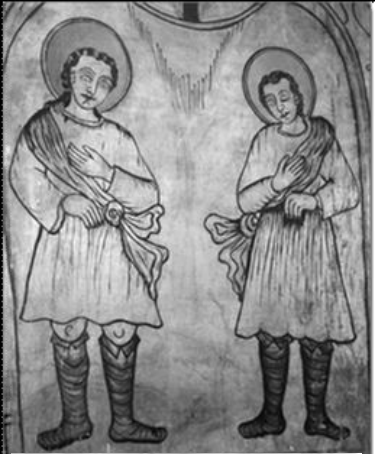
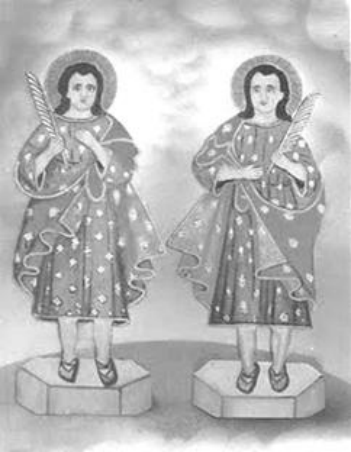
Mar Sabor and Mar Proth a pair of Twins were invited to Venad from Middle East on invitation of Kollam King Kuleshakara as an Authority for the Doctrine of Trinity on the background of a Shivate Revival of Advaita Vedanta propounded by Adi Shankara and were also instrumental in developing Christian faith as an independent Religion once and for all seperating it from the heresy of Gnosticism. As part of the redefinition of Christian Church the Vedic like Chants in Sanskrit, and modes of worship following the Saivite and Vaishnavite and their icons were abandoned. We may therefore consider Mar Sabor as the person who defined the Modern Malakara Churches. Thus the Church came to be Nestorian and reemphasized the declaration of Thomas.
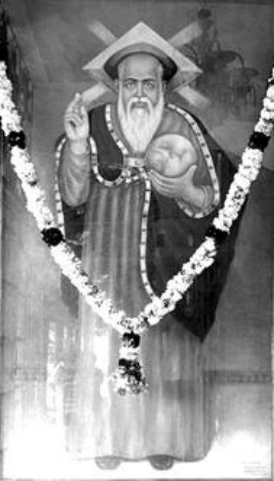
Painting of Mar Sabor, as seen in the church at Thevallakara,
Kerala t was around 825 AD, that Maruvan Sapir Eso from Persia came with the twins, Mar Aproth and Mar Sapor, two bishops representing the Persian Catholicos. They were Nestorians. The then ruling monarch Iyyanadikal Thiruvadikal (849 AD) welcomed them and showered them with special privileges and honours. This is found in the ‘Tharisa Pally cheppedu'(QLN, Copper plates, Trav: Arch, Vol, 11, PP 60- 85)
King transferred the Tarasa Church and Vaishnavite Nambuthiri community at Devalokakara (Thevalakara-Tarsish) in Quilon, and all the lands near the city with hereditament of low caste sevicess to Mar Sabor to establish the faith in firm ecuminical basis. (Reference Travancore Manual page 244). The two monks were instrumental in founding Christian churches with Syrian liturgy in the Malabar coast area distinct from the Indian Vaishnavite and Saivite form.
Mar sabor moved to Kadamattom, Akapparambu, Niranam, Kayamkulam then finally to Thevalakkara where he died and was buried. He ordained the famous magician with extraordinary powers
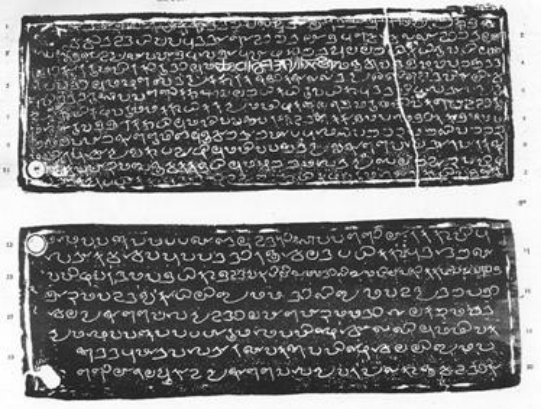
There were two sets of plates as part of this document, but we have
only parts of these plates. The signatories signed the document in
Hebrew, Pahlavi, and Kufic
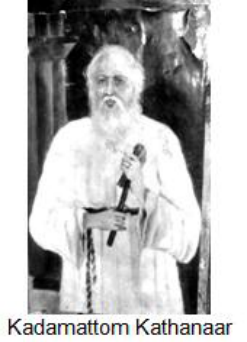
Rev. Fr. Paulose Kathanar popularly known as Kadamattathu kathanar.
Kolla Varsham (Malayalam Era)
The importance of the period is seen in the start of an era called Kolla Varsham - Quilon era (today known as Malabar Era ME) by these Asyriac Saints who settled in Korukeni kollam, near to the present Kollam. The origin of Kollam Era has been dated as 825 AD when the great convention in Kollam was held at the behest of King Kulashekhara defining the faith Malayalam Era is called'Kolla Varsham' possibly as a result of the Tarish-a-palli sassnam.
It also signified the independence of Malabar from the Cheraman Perumals. (Reference Travancore Manual page 244).
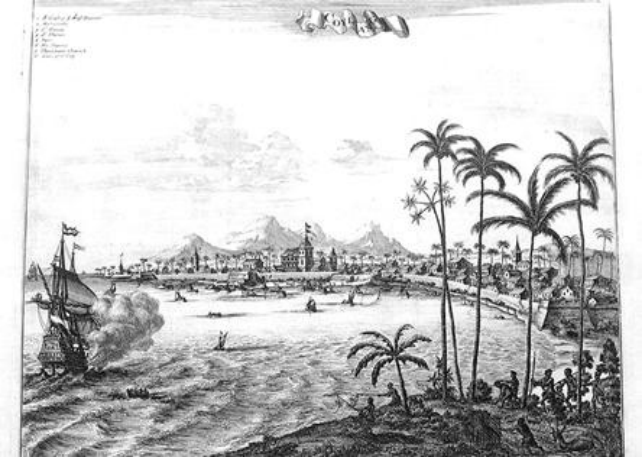
Port Kollam Kollam sea port was founded by Mar Abo at Thangasseri in 825 AD with sanction from Udayamarthandavarma the Tamil king from Venad otherwise called Ay kingdom, instead of re opening the inland sea port (kore-ke-ni kollam) near Backare (Thevalakara) also known as Nelcynda and Tyndis to the Romans and The Greeks and Thondi to the Taamils and is also the foundation of the new city
Sociopolitical Situation in the Malankara Area
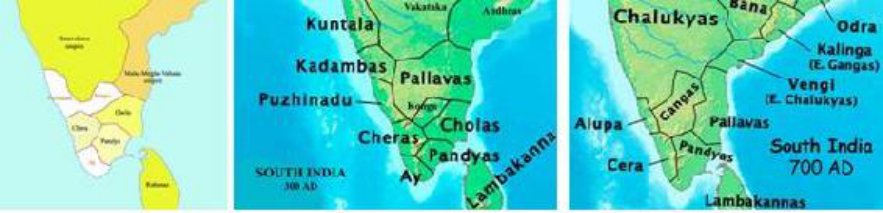
Soon after the dissolution of the Second Chera Empire the Kerala was fragmented into a large number of smaller states. These included Venad (Tavancore), Perumpadappu Swarupam (Cochin), Nediyirippu Swarupam (Zamorins of Calicut), Desinganad, Attingal, Karunagappally, Karthikappally, Kayamkulam, Purakkad, Pantalam, Tekkumkur, Vadakkumkur, Punjar, Karappuram, Anchi, Kaimal, Edappally, Parur, Alangad, Cranganore, Airur, Talappilly, Valluvanad,Palghar, Kollengode, Kavalappara, Parappamad, Kurumpranad, Kottayam, Cannanore, Nileswaram, Kumbla.
Venad in those days had Kollam as its capital. It was Marthanda Varma (1729 -1758) who moved the capital to Trivandrum and declared Vaishnavism as his religion. British came into power during this period and they had a Resident in Travancore.until the time of Indian Independence.
Cochin was the stronghold of the Portuguese. When the British Resident Col. Monroe took over Saktan Tampuran (1790-1805) restructured its administration.
"Syrian Christian Families in Central Kerala
An examination of the family histories of some of the oldest families in central Travencore ie Kollam, Kottayam, Niranam etc could very well establish their link to various places like Kuravilangadu, Palayur, Kodungallur, Nilackal etc. The family histories of Vadakkadathu in Thumpamon,Thazhamon and Thengumthottathil in Ayroor, Manjooran in Ernakulam,trace their origin in Kuravilangadu.The tradition of Kizhakkethalackal, Vadakkethalackal, Padinjarethalackal in Puthenkavu and Mavelikara claim 50 to 56 generations of continuous priesthood.
The Plathanam and Kanikunnam in Ranny, Polachirackal in Mavelikara, Illampally and Polackal in Edathua,Thalakod in Chenganoor,(refer: Alackal.com) trace their common origin to Chiraikal Royal family in Kodungallur. The tradition of Kelaparampil family in Niranam traces their origin from Nilackal; they had escaped through River Pampa to Niranam when Nilackal was plundered by Vikkram Puli Thevar and Paraya Pattam during AD1253 to 1299 after the Chera, Chola, war of 100 years came to an end in AD1085. The Vel (kings) of Ayr who ruled Nilackal area was completely displaced or destroyed with nobody to defend the place from enemy attack after the Chera -Chola war.
Migration of Syrian Christians
When the Chera kingdom was attacked by other kingdoms including the Arabs around 300AD the people in Kodungallure mostly Christians, and Jews migrated to other areas. Traditional families like Pakalomattom, Sankarapuri, (Chiraikal), etc settled down in Kuravilangad, Kurichi, Changanacherry Niranam etc. The Rulers honoured those who migrated to Changanacherry by giving them the title of "Tharakan". The same family people again moved further to Champakulam, Pullad, Chengannoor, Mavelikara,Niranam, Ranny etc at different periods.During those times water transport was the only means of travel, hence the people had settled down mostly on the coastal areas of Arabian Sea, Kayal or rivers like Periyar, Pampa etc." Who are Nazarani and Syrian Christians? and who ruled kerala when St.Thomas came? D.N.Jha
Mulsim presence was essentially in the Calicut area where the trade with Arabs flourished. With the large prosperity the Zamorins (Samutiri) were able to annexe most of the neighboring smaller states like Beypore, Parappanad, Vettat, Valluvanad, Nilambut, Manger, Malappuram etc. In 1800 British crushed the Zamorins and annexed it with Madras Province.
"Forcible Conversion of Syrian Christians by Tippu Sultan.