Search this book
Search results link directly to the matching source page.
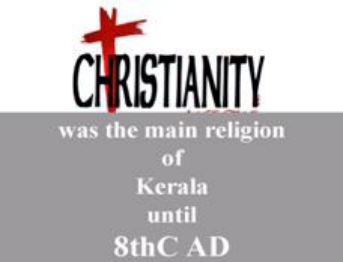
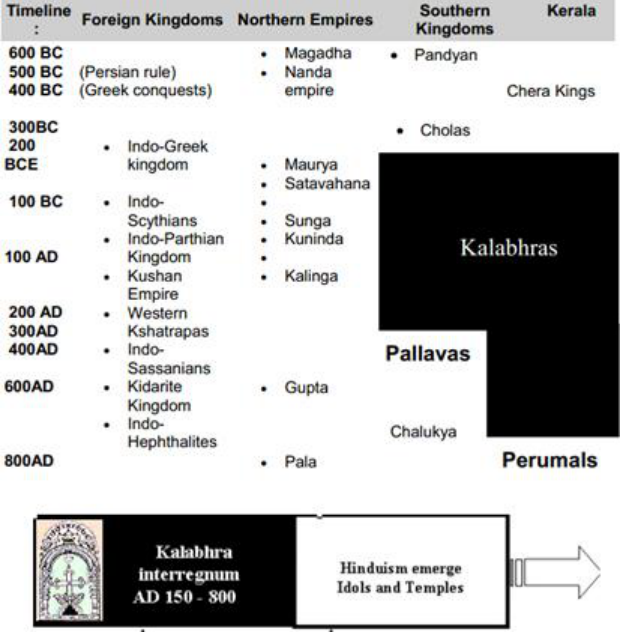
CHAPTER THREE The Story of Kerala. As mentioned earlier Malabar Churches developed independent of the rest of the Indian Churches. Kerala remained unconquered by any outside forces because of its geographical position. Recent Archeological and documentary studies by Prof. George Menacheril, indicates that Aryans came to prominence in Kerala, only by 6th century or later and Hinduism only by 8th century. (46)
"It may even be that the Syriac script and liturgy -surely the Pahlavi script -were in Kerala much before the Devanagari and the Vedas found their foothold here.
In spite of the many statements in Keralolpathy (47) most historians today believe that the Parasurama story is only a legend and Brahmins arrived in Kerala for all practical purposes only in the 4th century or later, and the Brahmins or Namboodiris established dominance only around the end of the first millennium C.E"
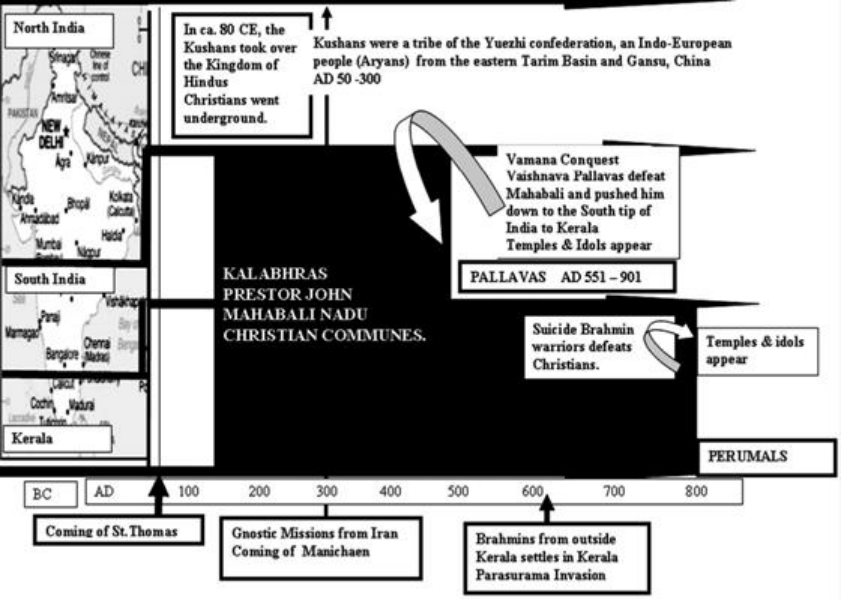
After the conversion of the Brahmins to Christianity there were no Brahminic presence in Kerala until the 6th century. None of the Namboodiri families according to the Namboodiri website can trace their origin in Kerala beyond 6th century AD.
Parasurama legend says that the seventh incarnation of Vishnu rose up the land of Kerala from
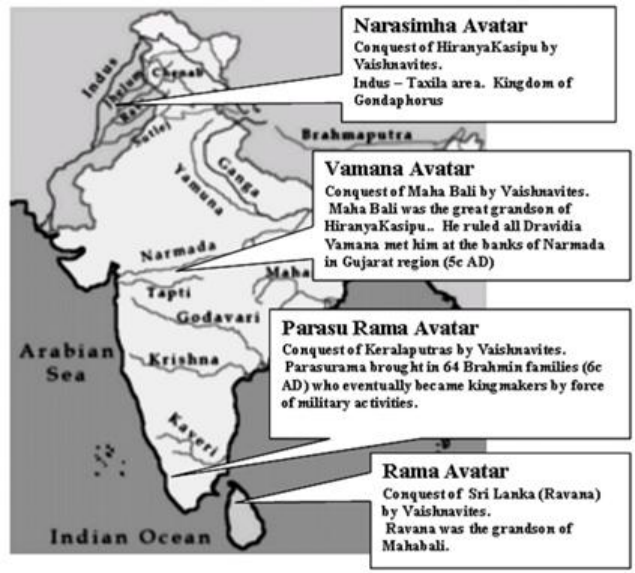
Gokarnam to Kanya Kumari and gave them to Sixty-four Brahmin families. This must have been around the 4th century or even later, if the Namboodiri traditions can be trusted. This legend therefore speaks only of the historical situation of the later centuries how the Aryan Brahmins came to dominate Kerala probably as advisers to the Kings of Chera, from the Tulunad. Who were the Kings of Chera is difficult to ascertain. Until the first century till the coming of Thomas, it is certain that Buddhist Kings ruled Chera.
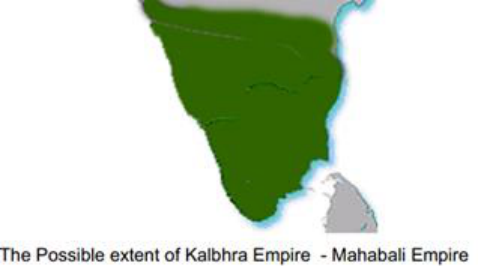
But Buddhism disappeared from the Kerala scene altogether. Vaishanavites or Aryan Brahmins came into power only by the 6th century. Islam came into existence only by the 6th century and was never a power in Kerala. Then what was the religion of the Chera Kings? The only alternative is that they were Christians. It points to the possibility that Mahabali whom the fifth avatar of Vishnu defeated by cheating was none other than the Christian Dravidian King "The Great Sacrifice". This name evidently fits only Christ and Christians.. His Kingdom evidently extended over three regions of India (the three worlds).
Most probably the name is a generic name for Christian Kings. (The Chera King Kuru Varman-1 also known as Vyakrasenan who ruled Kerala from 40 AD to 55 AD was a Christian.) It is interesting to note that Mahabali was the grandson of Prahalada who was a staunch Vaishnavite (Brahmin?). Prahalada was the son of King Hiranyakashipu a Dravidian. Hiranyakashipu was killed by the fourth incarnation of Vishnu the Lion-Man. His brother Hiranyaksha was killed by the earlier incarnation of Vishnu, the Boar. Vishnu threw both these brothers out of the heavens where they were the gate keepers of Heaven. We know for certain that Mahabalipuram was Mahabali's resort since every other attempt to explain the name fails. Mahabalikkara - Mavelikkara is traditionally associated with Mahabali. Incidentally Onam is the only festival, which is celebrated both by the Christians and the Hindus. If the Onam songs handed down to us from the 8th century are true, there was an egalitarian
society - virtual Kingdom of God fashioned out of the early Christian Fellowship Community experiment Jerusalem. The Jerusalem experiment failed with the deceit of Aninias and Saphira and the Kerala experiment with the deceit of Vamana. With the long period of innocence Mahabali could not discern the deceit of Vamana. Kerala, during the Tamil Sangam Age (1-500 AD) was a very egalitarian society. (48) Untouchability was unknown, manual labor was respected and women held in high esteem.
The first Brahmin missionaries moved into Kerala through Tulu- naadu (Mangalore area). Thus Chera Kingdom continued as a Christian Kigdom from the first century onwards until the sixth century.
Gradually the influence of the Hinduism from Chola and Pandya dislocated the Christian dynasties of Chera. With the cunningness of the Brahmin dominated Vaishnava advisors of other Kingdoms, Chera Kingdom was taken over by the Vaishnava cult finally. However one Christian Dynasty continued till the 15th century - the Villar Vattom Pana.
Even today Christians are respectfully addressed as "Nazarani mappilas", "sons of kings who follow the Nazarene" or "of the first Christian kings" (49) (50) It is actually a direct translation of the word "Israel". If this is the intent, it means the idea of Kingdom of Priests was introduced most probably by St.Thomas himself. Alternately, such a position came into existence because Christians were Kings in early period.
The special position of Nazrani in relation to Hindu temples itself speak of the origins. Even today as a tradition, some old temples cannot open their gates, or open the holy of holies or raise the flag to start a festival without the physical presence of a Nazrani in the temple ground.
The Mahabali myth
The Mahabali myth had created sensation even in the West, during the Middle Ages, as the myth of the Prestor John - a Priest King who ruled a powerful vast kingdom in India.-ruling over 72 countries in three Indias. (51) (52) (53) (54). This legend says that St. Thomas travelled to India and there established a Christian community that retained many of the ideals of the original church, and which blossomed into an almost perfect Christian kingdom, ruled over by this legendary king, Prester John. A second century Peutinger Map (11) indicates a temple not far from Muziris as "Temple Augusti" or "Temple of the Great King". Around the middle of the 12th century, a series of letters (forged?) found their way to the court of Pope Alexander III. These letters were from the Prester himself. Apparently an emissary was sent to the King Prestor John, but he was never seen again. This mythical (mystical?) figure certainly came from Chera Kingdom as Meir Bar-Ilan (55) points out. India is mentioned several times in these letters and the city of Kalicut is mentioned in one of the letters specifically. It specifies that
he was in the land of India where the body of St. Thomas the Apostle was buried and they celebrated the memorial of Thomas on July 3rd. The letter also mentions that it is the land of the pepper and elephants.
Apart from the migration stories and the copper plates we have not much to go for in reconstructing the Christian Church, the Christian Society and the Kingdom of God established by the Christian communes of Kerala. These were all intentionally wiped clean by the Aryan invasion from North India. The only oral tradition lie in the story of Mahabali and his time which is celebrated by the Christians in memory of the Golden Age of the Thomas Christianity.
When history finally opens, it was with Kulasekara Alwar who ruled Kerala in the 8th century. He became a devotional Vaishnavite poet. The earliest document, which tells us about the Onam festival, comes from this period. A last Perumal, Cheraman Perumal abdicated his throne in 825 AD, (some documents give it as 642-643 AD) converted to Islam and went to Mecca and died in Yemen. (56) He divided the kingdom and gave it to his Nephews.
The ten incarnations of Vishnu as recounted in Hindu Puranas probably describes the defeat of Thomas Christians (The Asuras = the people born of the breath of God = Born again Christians) Historically it starts from the city of Taxila.