
Search this book
Search results link directly to the matching source page.
CHAPTER TWO Enter Thomas
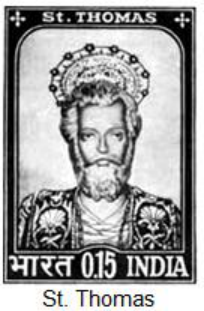
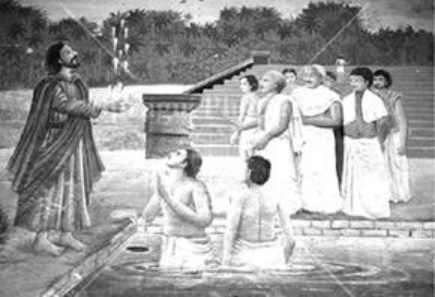
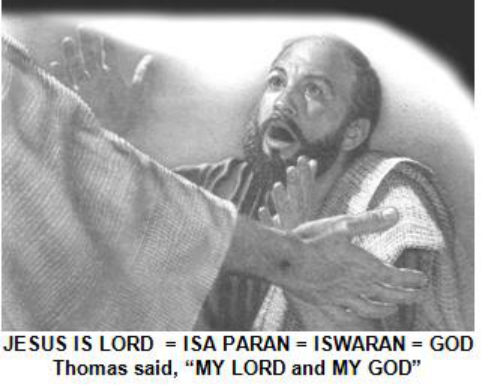
Judas Thomas was one of the disciples of Jesus. He is also known as Didymus, which means the Twin. Thomas means Twin in Aramaic and Didymus means Twin in Greek. He is generally known as the Doubting Thomas since he refused to believe the resurrection unless he has verified it himself. If we apply the criteria of Rom. 10:10 Thomas was the first Christian, since he was the first person to confess that Jesus was indeed God.
His acts are not found in the Acts of the Apostles. But an apocryphal book written around 300 AD called "Acts of Thomas", describes it with embellishments and exaggerations. It was probably written in Greek and was translated in to Syriac. (16). It is also found in Latin, Armenian, Ethiopic (Coptic), and Arabic. These were written by Gnostic writers in Edessa and some scholars ascribe it to Bardaisan (155-223 AD) of Syria. Apart from embellishments and exaggerations typical of these types of writings, the context and historical facts are true. Archeology and Indian traditions substantiate the basic historic and geographic context in this book.
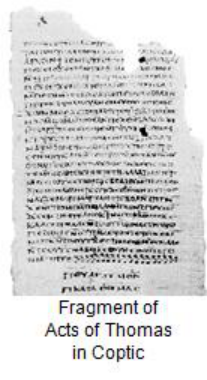
"This Pseudepigraphic text relates the adventures of the apostle Judas Thomas as he preaches an ascetical or encratite form of Christianity on the way to and from India. Like other apocryphal acts combining popular legend and religious propaganda, the work attempts to entertain and instruct. In addition to narratives of Thomas' adventures, its poetic and liturgical elements provide important evidence for early Syrian Christian traditions." (17)
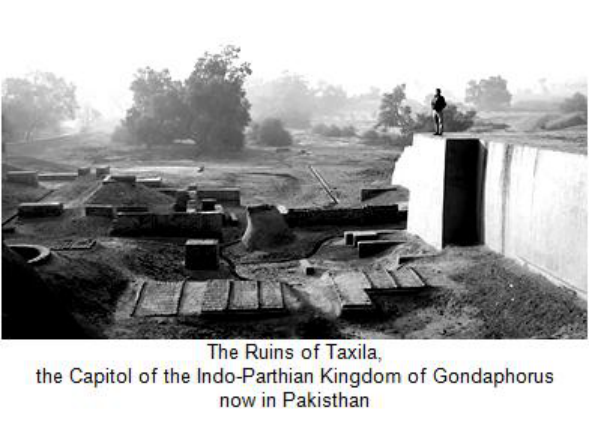
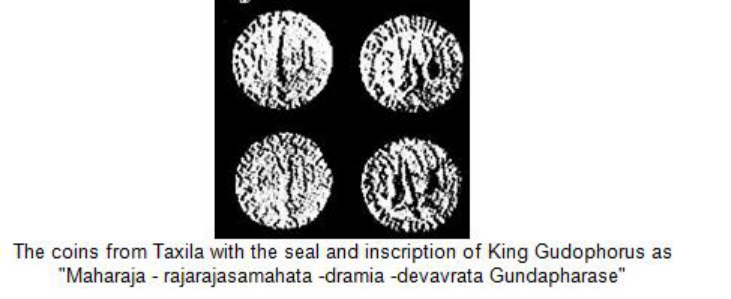
One of the reasons for doubting the story was the absence of any King by the name of Gondophores in India. During the last few decades a large deposit of coins turned up which clearly showed Gondophores as the Indo- Parthian King with a
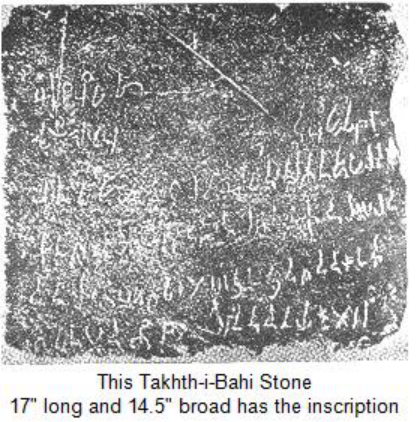
brother whose name was Gad as mentioned in the Acts of Thomas. The coins from Taxila with the seal and inscription of King Gundophorus read: "Maharaja - rajarajasamahata -dramia - devavrata Gundapharase". Rock stone called Takhth-i-Bahi Stone of size 17" long and 14.5" broad has this inscription: "In the twenty- sixth year of the great King Gudaphara in the year three and one hundred, in the month of Vaishakh, on the fifth day" (18)
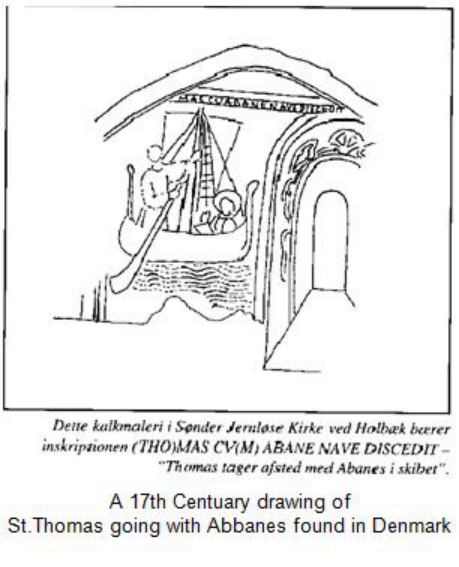
Kerala traditions are encoded in oral traditions handed down through generations as folklore, music and drama.
· Rambaan Paattu or Thomma Parvom is a song about the Acts of Thomas written around 1600 by Rambaan Thomas. Rambaan Thomas of Malyakal Family descends from the first Bishop whom St. Thomas is said to have ordained. The poem is the oral tradition handed down through generations. It is said to have been originally written by the Rambaan Thomas, the Bishop.
· Margom Kali (Drama about the Way) and Mappila Paattu (The Songs of the Children of the King) are series of songs of the Acts of Thomas and the history of the Malabar Church. They are sung in consonance with dance forms that are typical of the Syrian Christians. Some of them are dance dramas performed in the open as part of the festivals of the church. These have no specific origin, but grew up in the course of history.
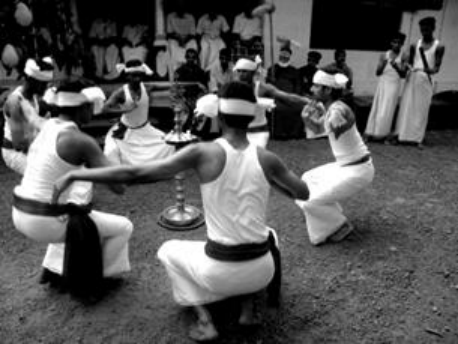
· Veeradian Paattu is sung by a local Hindu group (called Veeradians) in accompaniment of Villu - a local instrument (a stringed instrument like the bow) - during Christian festivals. This form of art also dates back to unknown period handed down through generations and modified in that process.
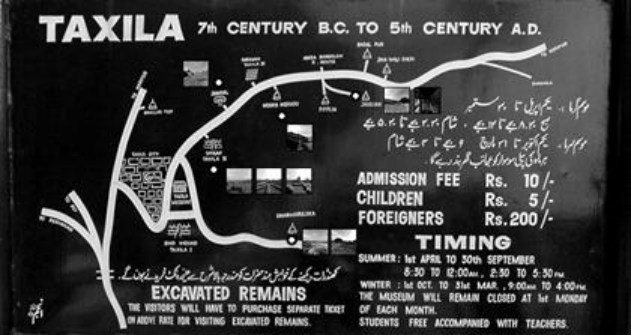
According to Kerala tradition Thomas landed in Cranganore in Mali Island on the present Alwaye coast in Malabar Coast, in 52 AD. It is also called Muchiri - three lips - cleft lips - as the River Periyar splits into three braches before reaching the Sea to form this island. This came to be known Muziris to the seafarers. The ruler of the Chera kingdom at that time was Udayan Cheran Athen I (page 44 of Cochin State Manual). Other names of this port are Kodungaloor, Cranganore and Maliankara.. There were Jewish colonies in Malabar in the first century. Here he preached to a Jewish community who accepted Jesus as mesia and their synagogue became a Christian church. It is said that Thomas ordained one Prince Peter to be the head of the church of the Jews and left for Takshasila, (Taxila, a University City in the Indus Valley) the capital of Gondaphorus Kingdom. He established a church in that region before he traveled to other areas of India.
These churches were annihilated during the invasion of Kushan and Moghal dynasty and the Christians went underground.
He returned to Kerala where he established seven and half churches with 12 Brahmin families as teachers and over 3000 converts from Kshatriyas, Nairs and Chettiars. These new converts were called St: Thomas Christians. This church is one of the most ancient churches in Christendom. The seven churches are at Malankara, Palayur, Paravoor, Kokkamangalam, Niranam, Chayal and Kollam. Apostle Thomas was martyred in Mylapore near Madras. (Tradition calls this place Kalloor - the place of rock) in Tamilnadu State, India.
"There are other facts which seem to indicate a northern locus for St. Thomas's work. Bardaisan in his Book of Fate (AD 196) speaks of Parthian Christians living among pagans, which might be a result of the destruction of the Indian Parthian empire by Kushan invaders about AD 50. There are also said to be Christian tribes still living in north India, but holding their faith a secret from all others. For example, at Tatta in Sind (the ancient port of Pattiala at the mouth of Indus), there is a fakir community which calls itself by an Aramaic name, something like ‘Bartolmai'(Beth Thuma), and claims to have been descended from St. Thomas's converts and to have books and relics to prove it. Unfortunately no outsider has ever been allowed to see this alleged proof." (19)
The Problem of Brahmin presence in Kerala
One of objections of this traditional story raised recently is the problem of the presence of Brahmins in Kerala who were converted and were given the responsibility of teaching the gospel. The Namboodiri traditions of the present day traces their origins back
only to the sixth century AD. That does not mean, there were no Brahmins in the first century in Kerala region. We know for certain that the Aryan conquest reached as far as Sri Lanka long before the Christian era. However the Aryans were never a controlling force economically or even intellectually until eighth century AD. There must have been a few Brahmin families, (as is true even today in the central Travancore area where Christians are concentrated) who were probably small businessmen in various parts of South India. As in all countries, it was the poor and the persecuted communities that came to faith first. I would assume that the Brahminic community of that time accepted Christianity en masse in Kerala. Conversion in early days was in community groups and families. Thus if 12 Brahmin families accepted Christianity in Malabar it cannot be an exaggeration or an impossibility.
The tradition says that Thomas met these Brahmins while they were worshipping the Sun in their traditional way. Other than that it does not directly or indirectly ascribe power or prestige to these people. By the third century when the Syrian immigration took place, since Aryans are also of the same ethnicity, their status became more pronounced. Notice that they were not the only people who were converted. The majority of the converts were Dravidians with a Dravid to Aryan ratio of 3000 to 12.
They were known as Nazaranikal (those who follow the Nazarene) or Issanu Vadikal (the disciples of Isa). (The Chera King Kuru Varman-1 also known as Vyakrasenan who ruled Kerala from 40 AD to 55 AD was a Christian).
Other References to Thomas Christian Tradition
There are several references to Thomas' acts in India, which corroborates the general validity of the story.
A Syriac document "Doctrines of the Apostles", (2nd Century AD) states, "India and all its own countries and those bordering on it, even to the farthest sea, received the Apostle's Hand of Priesthood from Judas Thomas, who was the Guide and Ruler in the Church which he built there and ministered there."
St. Gregory of Nazianzen (AD 329-390) refers to Thomas along with other Apostles work in Contra Aranos et de Seipso Oratio Ambrose of Milan (AD 333-397) wrote thus: "Even to those Kingdoms which were shout out by rugged mountains became accessible to them as India to Thomas, Persia to Mathew...." Ambrose De Moribus. Brach.
Jerome (AD 342-420) wrote thus: "Jesus dwelt in all places; with Thomas in India, with Peter in Rome, with Paul in Illyricum, with Titus in Crete with Andrew in Achaia, with each apostolic man in each and all countries." epistles of Jerome. He mentions the mission of Pantaenus, a Christian philosopher sent by bishop Demetrius of Alexandria, "to preach Christ to the Brahmins and to the philosophers of India" in A.D. 190. Born a Jew, thoroughly trained in Greek philosophy, Pantaenus converted to Christianity, and was the most outstanding Christian scholar of his time. He probably was the first head of the theological college of Alexandria. He was the teacher of the great Clement. (20) Jacob of Sarug (451 - 521) was a Syriac ecclesiastical writer. He was educated at Edessa and became bishop of Batnae in the year 519. He wrote hymns, - but his principal writing is a series of metrical homilies and his contemporaries gave him the name of honour: "The flute of the Holy Ghost". Two homilies are on the Ministry of Thomas in India and repeats the evangelization of Thomas as in Acts of Thomas.(21) Gregory, the Bishop of Tours (AD 538-593) in his In Gloria Martyrdom writes: "Thomas, the Apostle, according to the history of passion, is declared to have suffered in India. After a long time his body was taken into a city which they called Edessa in Syria and there buried. Therefore, in that Indian place where he firs rested there is a monastery and a church of wonderful size, and carefully adorned and arrayed." Mar Solomon in 13th C wrote in his Book of the Bee as follows: Thomas was from Jerusalem of the tribe of Juda. He taught the Persians, Medes and the Indians; and
because he baptized the daughter of the King of the Indians he stabbed him with a spear and died. Habban the merchant brought his body and laid it in Edessa, the blessed city of our Lord. Others say that he was buried in Mahluph (Mylapore) a city in the land of Indians.
Enter Barthelomew
There is also a tradition that the Apostle Barthemew came to India in AD 55 and preached the Gospel in the area near Kalyan, Bombay and was martyred in AD 62. (22)(23)(24)
Bar Thalomew is not really a full name. Most people think it is Nathaniel bar Thalomew - Nathaniel son of Thalmoi. Tradition makes North India his missionary field and Armenia the place of his martyrdom by flaying. The only references to this effect is found in the writings of Eusebius and Jerome (340-420 AD) where they say that Pantaenus the Philosopher of Alexandrian School was asked to go to India as a teacher in the Third Century and found in India some Christians. They showed him a copy of St. Matthew's Gospel in Hebrew, which had been brought there by St. Bartholomew.
Some scholars strongly believe that the reference of India in terms of Pantaneus is to the generic use of India, which could mean any where between Arabia Felix to Armenia. (25)
Dr. Miguana says: "… the India they refer to is without doubt Arabia Felix. The fact has been recognized by all historians since Assemani and Tillemont, and has been considered as established even by such conservative writer as Medlycott."
However the second reference of Jerome says:
"Pantaenus, on account of the rumor of his excellent learning, was sent by Demetrius into India, that he might preach Christ among the Brahmins and philosophers of that nation" (26) (27)
The mention of Brahmins certainly settles the place as India as we know today including Pakistan. Arabia Felix or Ethiopia or any other place in the world were never inhabited by the Brahmins.
The area of his work is thought to be in Konkan in Maharastra. Research Historian Mascarenhas in ‘Konkanachem Christaunponn'-1929 - [Apostolic Christianity in Konkan] says: "In Tulunadu, in South Kanara, there is Kallianpur. Here Bartholomew, then popularly known as Bhethal, preached the Gospel…….….. There are many names and places, words and usages in the coastal Konkan region going up to Bombay and beyond which have originated from his name Bhethal and his preaching and that Barkur which is close to Kallianpur sprung after his name Bartholomew i.e. Bar + Thulami + Ooru = and so BARKURU" (28)
"Christianity has been long established in South Kanara and its adherents are more numerous here, than any other district of India. It is certain that, foreign Christian merchants were visiting the coastal town of Kanara and during that period of commerce some priests
also might have accompanied them for evangelical work. According to tradition Kanara had its first missionary the Apostle St.Barthelomew, who landed on the shores of river Swarna at Colombian or Colombo village an ancient maritime port adjacent to Kallianpur, stayed there to preach. He was popularly called Bethel and so the origin of the place Barkur…….." (29) Barkur is located in Udupi Taluk of Karnataka, India.
Bar Thalomew's ministry extended over several regions including Mesopotamia, Persia, Egypt, Armenia, Lycaonia, Phrygia, and on the shores of the Black Sea. He was martyred in Armenia. So it is possible that Barthelomew's work was only for a limited time in the Konkan region.
The alternate possibility is that the name of Bar Tholomai is simply an intonational corruption of the tribal memory of Mar Thoma. This is supported by the presence of the fakir community in Sind which calls itself ‘Bartolmai' and claims to have been descended from St. Thomas's converts. (30) I would think this is a real possibility.
Possible Route of Thomas.
Dr. Farquahar gives a probable route: " Apostle St. Thomas, one of the 12 disciples of Jesus sailed from Alexadria to the Indus and reached the Kings capital'Taxila' (Presently known as Punjab) about A.D 48-49. He left Taxila when the Punjab and its capital were seized by the'Indo-Scythian Kushans' from China about A.D 50 and went from there to "Muziri' (Presently known as Kodungallur in Kerala) on the Malabar coast via Socotra, reaching Muziri in AD 51-52."
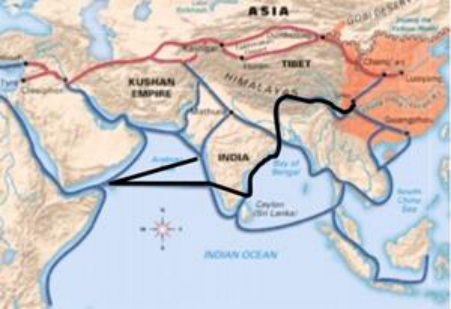
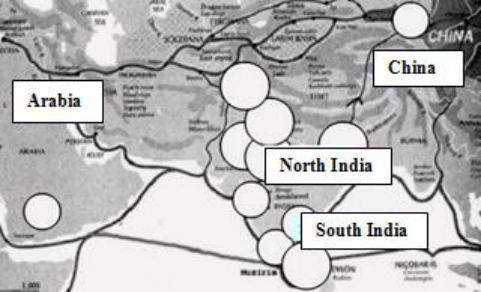
Taking all the traditions and documents into account we can vaguely trace the route of Thomas in India. It covers almost all areas of India as far as China. Thomas must have traveled from Jerusalem to Yemen and must have taken a ship to Taxila. By the time of the destruction of the kingdom of Taxila around 51 AD left for Malabar Coast. However he was shipwrecked and landed in the Isaland of Soccotra where he built a Church and then left for Muziris in Malabar Coast. He arrived in Muziris in 52 AD.
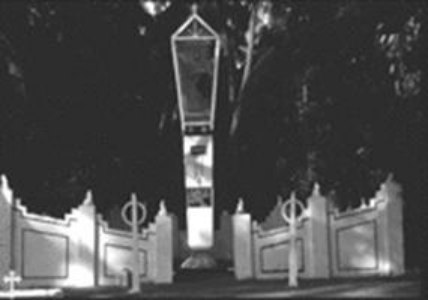
Traditional site where St. Thomas landed - Cranganore in Malabar
coast in 52 AD. Here he preached to a jewish community who accepted mesia and their synagogue became a Christian church.
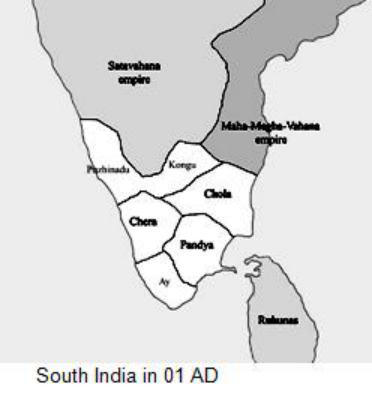
The Chera, Chola and Pandya are traditional Tamil siblings and descendants of the Kings of ancient Tamilakam, Chera and Pandya meaning old country, Chola meaning new country. The Cholas ruled in the eastern Coromandel Coast and the Pandyas in the South Central Peninsula. There were also numerous small vassal kingdoms and city-states in South India like Kongu Nadu, Ay kingdom, Mushika Kingdom, Malainadu (the Anaimalai Range in Kerala), Kuttuvanadu and Cherapayalmalai (Both in northern
Malabar). Chera rulers engaged in frequent intermarriage as well as warfare with the Pandyas and Cholas.
In early Tamil literature the great Chera rulers are referred to as Cheral, Kuttuvan, Irumporai, Kollipurai and Athan. Chera rulers were also called Kothai or Makothai. The nobility among the Cheras were called Cheraman in general. The word Kerala, of possible Prakrit origins, does not appear in Sangam Literature. Pathirruppaththu, the fourth book in the Ettuthokai anthology, mentions a number of Kings of the Chera dynasty. Each King is praised in ten songs sung by the Court Poet and the Kings are in the following order:
1. Imayavaramban Kudako Nedum Cheralathan 2. Palyane Chel Kezhu Kuttuvan 3. Kalankai Kanni Narmudi Cheral (son of Nedum Cheralathan) 4. Chenkuttuvan Cheran or Kadal Pirakottiya Vel Kezhu Kuttuvan (son of Nedum Cheralathan)
5. Attu Kottu Pattu Cheralathan (son of Nedum Cheralathan) 6. Chelva Kadunko Azhi Athan 7. Thakadur Erintha Perum Cheral Irumporai 8. Kudako Ilam Cheral Irumporai The first recorded King was Uthiyan Cheralathan with capital at Kuzhumur in Kuttanad (present day Idukki district). Uthiyan Cheralathan is also regarded as the founder of the dynasty, and was contemporary to Karikala Chola. His queen was Veliyan Nallini. Their son Imayavaramban Kudako Nedum Cheralathan is praised in the Second Ten of Pathirruppaththu, the pathikam (poet) of this decade refers to his parents, though they are not praised in the First Ten which is blank. Nedum Cheralathan consolidated the Chera kingdom, and literature and art developed highly during his period. Kannanar was Nedum Cheralathan's court poet.
The third, fourth and fifth kings were sons of Nedum Cheralathan, while the mother of fourth King (also known as Kadal Pirakottiya Vel Kezhu Kuttuvan Seran Chenkuttuvan or simply Chenkuttuvan) was Chola Princess Manikilli. Chelva Kadunko Vazhiyathan was the son
of Anthuvan Cheral Irumporai and Porayan Perumthevi. Perum Cheral Irumporai was the son of Aazhiyathan and Ilam Cheral Irumporai was the son of a Chera ruler Kuttuvan Irumporai, son of Mantharan Cheral Irumporai, the celebrated ancestor of ninth King Ilam Cheral Irumporai.
Illango Atikal wrote the legendary epic Silapathikararam sitting at a Jain monastery in Trikkanamathilakam. Silapathikararam describes the Chera king Senguttuvan's decision to propitiate a temple (Veerakallu) for the Goddess Pattini.'Purananuru' refers to a certain Udiyan Cheral. It is said that he fed the rival armies during the Kurukshetra war. Imayavaramban Neduncheralathan, another Sangam Age King claimed to have conquered Bharatavarsha up to the Himalayas and to have inscribed his emblem on the face of the mountains. Senguttuvan was another famous Chera, whose contemporary Gajabahu I of Sri Lanka of Lanka according to Mahavamsa visited the Chera country.[14]. Manimekalai written by Chathanar describes the city of Vanchi as Buddhist centre
"The capital of Chera was Vanji or Tiruvanchikulam and the most important port was Muchiri (Musiris). The capital of Chola Kingdom was Urayur and the most important port was Kaveri, where as the Pandian kingdom had Madurai as its capital and the most important port was Korkai. The area from Gokarnam (now in Carnataka towards Goa) to CapeComerin was ruled by the Chera kings and Kerala derived the name from Cheram, the traditional Dravida kings who ruled this area from 5th century BC to 11th century AD. Tamil and its adapted version was the language used till Malayalam evolved around 13th century AD. There was also another ancient kingdom known as Ayr ruled by Vel (kings) in the High Ranges south of Pampa River (Baris) where Nilackal, one of the churches founded by St.Thomas, existed. They ruled this area more than 1000years from first centuryAD. When St. Thomas landed in Nilackal they were possibly the rulers. 3 Ptolemy in his writings in the second century recorded this place as Aioi.
Venadu is derived from Vel Nadu. It seems that the name Ayroor and AyurVeda had its root from this kingdom."
Who are Nasrani and Syrian Christians? and who ruled Kerala when St. Thomas came? D.N.Jha
+++++++++++++++++++++++++
Here he must have stayed for at least a year and proceded to serve the rest of India. During the first visit to Kerala Thomas established a church among the Jews of Cochin and ordained one Prince Kepha and left for the rest of India. We have no details of this ministry which might have included Southern and Northern regions even unto China. He seems to have returned from there to the North India along Ganges area to the Kaveri River area and to Coromandels - the land of Cholas. The capital of Chola Kingdom was Urayar with its port Kaveri and the Capital of Pandian Kingdom was Madurai with its port Korkai. It is during the second visit Thomas converted the local Brahmins and Dravidians and established seven and a half churches in Chera (Kerala). There was also another minor kingdom known as Ayr (probably the present Ayroor) ruled by Vel (from which we get the word Venad.) where Thomas established his church at Nilackel. Ptolemy mentions this Kingdom as Aioi in the second century. Ayr Kingdom lasted for over a thousand years from the time of Thomas. Even today most people in this area are Christians. (59) He then returned to Coromandel Area which was probably his head quarters. We have evidence to show that he made trips between Chera, Chola and Pandya regions during this time.
Evidently Thomas' ministry covered the entire land of India over twenty years until his martyrdom in Mylapore. In AD 72 he was speared at Mylapore, Madras. The legend has that spear was inflicted on his side. He did not die instantly but crawled while bleeding through a tunnel and reached Chinnamalai and died there.
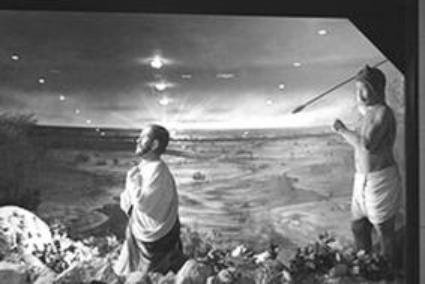
His followers took his body and buried him in the tombs of the Chiefs. A merchant from Edessa in Syria who visited that region exhumed his body and took it to Syria where it was entombed in about AD 200. We could see these tombs in Mylapore and in Edessa. They were later translated from Edessa to the island of Khios in the Aegean, and from there to Ortona in Italy, where they are now.
What form of Church did Thomas Institute?
The question now is, what happened to these churches? Looking at the story of Thomas as a rationalist doubter turned believer, who unhesitatingly declared Jesus as "My Lord, and My God ", we should have no doubt about the theology of the churches he established. He certainly emphasized the God incarnate as the Jesus ben Joseph, the Carpenter, his Lord and Master. He was no Gnostic. Jesus of Nazareth was indeed God and Lord.
The first Council of the Churches at Jerusalem (49 AD) under James set the standards for gentile churches. It was Paul of Tarsus who proposed the model for Gentile Churches. The Council decided that the central core of the Gospel is not to be confused with the cultural forms of worship and life of the Christians. The Church was to interpret the Gospel, which was revealed in the Jewish cultural context to the other cultures in a culturally relevant manner. Paul illustrated the working of the model in transferring the gospel in Greco-Roman culture. This was already in process before Thomas left Jerusalem and Middle East. Thomas therefore knew the Apostolic mission and must have established norms and standards, which were culturally relevant to the Indian context. Hence we should not expect Thomas Churches of India to have the ritualism and structures of Greco-Roman or Asia Minor. There would be no church building with a cross on the top, no altars nor candles and candle stands. We should expect a replication of the events of the early Christian Churches in Jerusalem soon after the resurrection. These emphasized communal living, fellowship, sharing, singing, worship, common meals and symbolic Prasadams as Holy Communion with God and Man. For a very long time Christianity left no artifacts. Institutionalization came most probably after a century of Christian existence. Symbols and temples came into existence as a means of communication. By AD 150 we can see abstract
symbols - Siva Lingam and Omkhara etc. Sanskrit came into existence as a liturgical language.
+
The Vedic language is wrongly called Vedic Sanskrit because it is just the Avestan - A Persian language as adopted by the Aryans who came from Persia. Panini is wrongly dated as 4th C BC which is made as a convenience. However the fact remains that ealiest Sanskrit found is dated only by 150 AD
"The first epigraphic evidence of Sanskrit is seen in 150 AD and this inscription is in the Brahmi script. (Encyclopedia Britannica, 1982). From the fifth century A.D. classical Sanskrit is seen to be the dominant language in the inscriptions.
The use of Sanskrit as a language was first observed in the ramayana (Sundarakanda, 30/17-18).
It is evident that there was no Sanskrit before 150 AD. Chandasa was renamed as Sanskrit inorder to claim predating Sanskrit writings.
See my book on "Development of Hinduism" http://www.oration.com/~mm9n/articles/dev/04Sanskrit.htm See also Anti-Sanskrit Scripture' by Shyam Rao, published by Sudrastan Books, Jabalpur, 1999
++++
Thomas found a people who were very similar to the Hebrews in the Dravidians who were at that time concentrated in the Southern States. We have reason to believe that at least a part of the blood of Dravidans came from Abraham through his second wife Keturah. They worshipped a God of love who was willing to die for his creation and practiced animal sacrifice for the propitiation of sins. So
it was easy for Thomas to preach to the Dravidian population rather than to the Aryans. There are some who believe that one of the wise men who visited baby Jesus was from these people. Compared to the Dravids, Aryans were still pagans, worshipping the elementary forces of nature and involved deep in magic and witchcraft. This shows why Thomas had greater success in supplanting the Buddhism, Jainism and Vedism in the South rather than in the North.
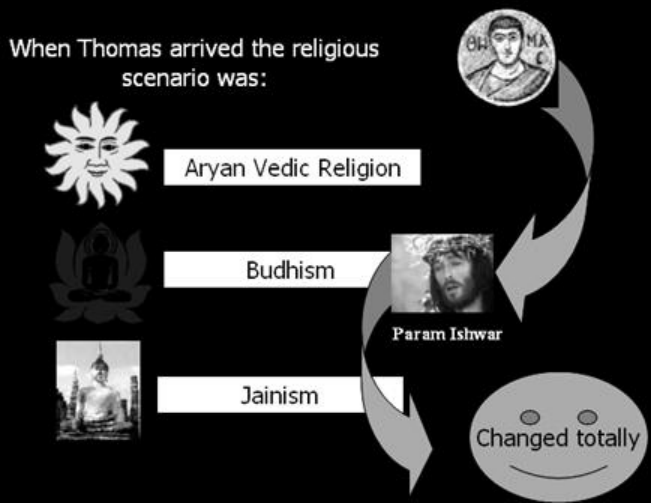
The introduction of Christianity in the Indian religious arena brought forth an explosion of change, which can be easily seen by comparing the religious theology and practice before and after the arrival of St.Thomas. For some strange reason the history of religion is totally erased for the first three centuries except for few stray documents, reports of travelers, archeological and architectural evidences, artifacts and traditions. We have a lot of mythological stories in that place. History then starts only after 3rd century in Chola and Pandya regions and only after 8th century in Chera
region. We can check up on any time line and see silence for this period.
Original Thomas Christians of Dravids
In Kerala itself the first Christian Church was established among the Jews. Hence at least for these Jewish Christians, historians are of the opinion, that Thomas established the early liturgy in Aramaic (Syriac) the language spoken by Jesus and the Jews of that period. But for the Churches that he established in his second visit among the Indians he must have used local cultural modes of worship.God and Trinity in Indian terHow would you translate the concept of God and incarnation into Indian context which never had that concept defined? Except for Dravids, there probably was no name for God. For Dravids the word translated as Isa or Maheswara - El Elyon. That was exactly the experience of Thomas when he said "My God". How would the Apostle translate the holy Trinity, Father, Spirit and the Son in Dravidian language? Father is evidently Appan. The Aramaic female gender Holy Spirit that gives life is best translated as Amma, and Son evidently as Makan. And the original true Saiva Siddhantha was born. The Christians at the time of St Thomas were called Nazaranikal.They were also referred to as "Issanis" in the epic poem of Manimekalai in Tamil by Mani around 3rd century AD. The other name for the followers of Jesus of Nazareth in India was "Issanuvadikal" which means those who follow Isa (Jesus). Just as the name used in Greek came to be Jesus, the name used in India is Isa for the historical "Yeshua" of Nazareth. This is the word used in the "Bhavishya Purana" where it speaks of Isa Masih when it refers to Jesus.
The word Isa which is the name of Jesus as seen in the Bhavishya Purana and other Indian Puranas and appears for the first time only after the Christian era indicating clearly the change in the religious arena of India. Since then Iswaran came to mean God in India. This evidently a Thomasian implication following the exclamation of Thomas on the realization of resurrection of Jesus as "My Lord (Paran) and My God"
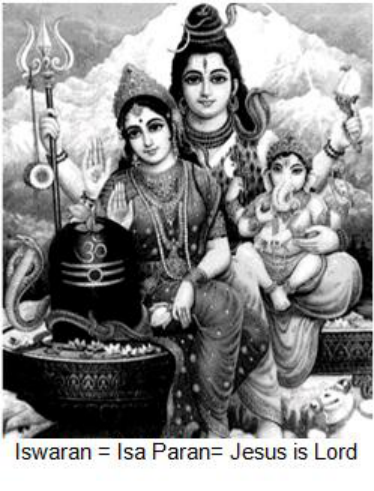
The correlation goes much deeper.
The Theology is further developed in the Isavasya Upanishad
which is one of the first Upanishads. Even today every Hindu confess that Jesus is Lord every
day without knowing.
See my commentary on Isavasya Upanishad which was one of the
earliest Upanishads written (Obviously after 150 AD being in
Sanskrit)
Siva Kovils - Early Indian Christian Churches
Those of us who have been collaborating closely with the Bible Translators in Africa know the innuendos of the translation. There are occasional traps in translation. It can go at a tangent and the concept can be misconstrued and misinterpreted. All the places associated with Thomas are Saivite Temples. Those who place "Hinduism" - whatever that means - to have been in existence millions of years has it that this indicate the destruction of Temples and take over of temple sites by Christians. One such series is elaborated in "The Myth of Saint Thomas and the Mylapore Shiva Temple" (31). Mylapore Shiva Temple was most probably one of the Kovils established by Thomas and was probably his seat in the Southern India. For all probability the Saivite temples were really the original Christian Churches. They flourished for at least three centuries when Gnostics and Brahmins took over these temples and converted them to "Hindu" temples.
In the same way it is not difficult to see the distribution of the Jyotirlingas all over India fall on the route of Thomas and its density more centered around the period Thomas' ministry early in his Indian ministry viz, around Taxila. All along the route of Thomas schools of theologies developed and major teachers arose from these schools in the years that followed as attempts in revival of original Christian theology.
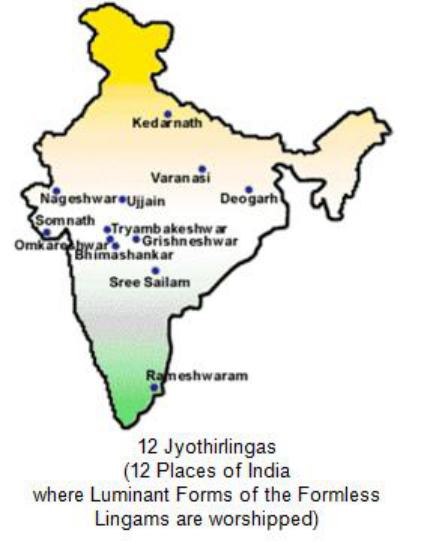
Saurashtre Somanaatham Cha Sree Saile Mallikarjunam Ujjayinyaam Mahaakaalam Omkaare Mamaleswaram Himalaye to Kedaram Daakinyaam Bhimashankaram Vaaranaasyaam cha Viswesam Trayambakam Gowtameethate Paralyaam Vaidyanaatham cha Naagesam Daarukaavane Setubandhe Ramesham Grushnesam cha Shivaalaye ||
We notice that there are no lingam representation in Malbar coast as they were directly influenced by the Persian and Greek Christology.
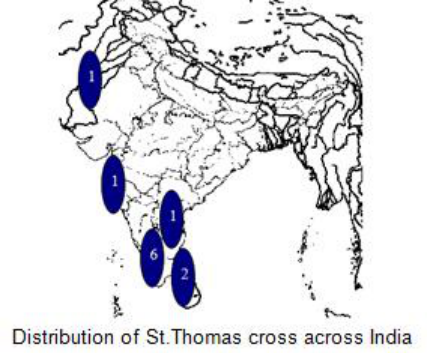
Kerala Christians of St Thomas did not have anything other than their Cross in their churches. The only archaeological evidence left about the antiquity of St Thomas Christians is the number of Persian Crosses found scattered in South Asia. There are 6 such crosses found in Kerala. They are:
1. Kadamattam, Kerala. This Cross is at St. George Syrian Church of the Malankara Jacobite Syrian Orthodox Church. This Cross was found at the southern wall of the Madbaha. The Cross is dated between 6-8th Century.
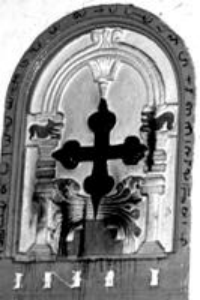
2. Muttuchira, Kerala. This Cross is at Holy Ghost Church under the diocese of Palai of the Syro Malabar Church. This Cross was
discovered this century during church renovation. The Cross is dated between 6-8th Century.
3. Kottayam, Kerala. (two crosses) One at St. Mary's Church under the Southist diocese of the Syriac Orthodox Church which is considered of late origin (Ca 10th century) and the other dated between 6-8th century.
4. Kothanalloor, Kerala. This Cross is at St.Gervasis and Prothasis church under the diocese of Palai of the Syro Malabar Church. The Cross was discovered during renovation at 1895. This Cross is dated between 6-8th century.
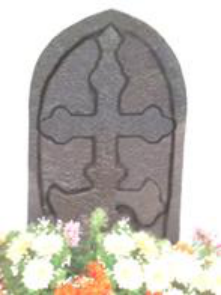
5. Alangad, Kerala. This Cross is at St. Mary's church under the diocese of Ernakulam- Angamaly of the Syro Malabar Church. This is discovered in recent years by late Panjikaran.
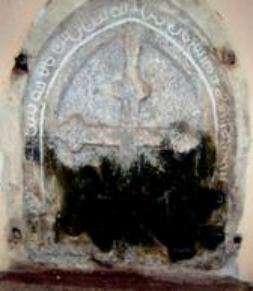
There are other crosses outside of Kerala: 6. Agasaim, Goa. The Cross is now kept at Pilar Seminary Museum. This Cross is dated of 6th Century. The cross has been discovered by Fr. Cosme Costa S.F.X near River Zuari at Agasaim in 2001.
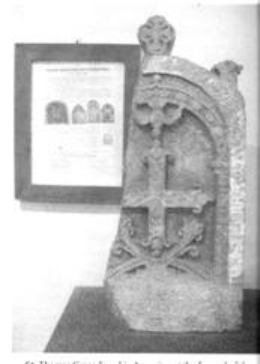
7. Anuradhapura, Sri Lanka. The cross is kept at Anuradhapura museum. It was found during excavations in 1912 Anuradhapura [ 2 nos ]. Anuradhapura, was one-time capital of Sri Lanka. Based on the available studies on this cross, it seems to be identical to Indian crosses. There is also a baptismal fonts dating 5th century discovered from Anuradhapura. This Cross is considered as the oldest Cross.
1. St. Thomas Mount, Tamil Nadu- The Cross is at Our Lady of Expectations Church under the Latin Catholic diocese of Chingelpet (Madras-Mylapore). This Cross is considered as the oldest cross in India.
9. Taxila, Pakistan. The cross is kept at Anglican cathedral at Lahore. It was found in 1935 in a field near the site of the ancient city of Sirkap. The Taxila cross is similar in shape with a common characteristic that they are more or less equilateral. Some Pakistani scholars have pointed out similarity between Taxila cross which are dated (ca 2-6 century) and St. Thomas cross.
At any rate after a "million years" of "Hindu" existence in India, (as is claimed) something happened in Indian religions that drastically changed its content and form during the first century. The concept of God changed completely.
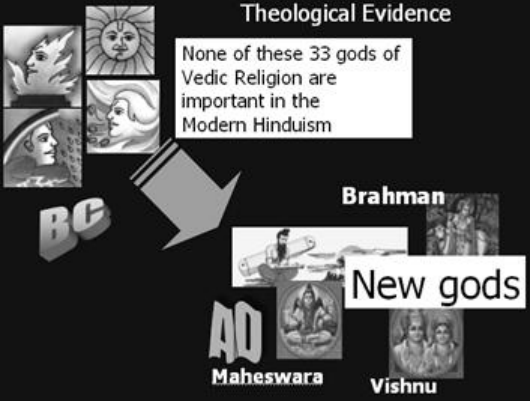
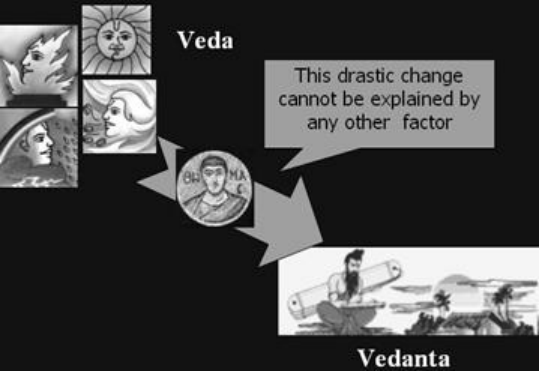
The lower nature gods and their worship were replaced with the concept of Nirguna Brahman and Saguna Brahman. Nirguna Brahman is the ultimate God who cannot be comprehended, who resides in the darkness, cannot be seen or known. This God revealed himself as Saguna Brahman, who can be comprehended, seen, heard and touched and is a person, not just a force of nature. He is a person with a purpose and so created the cosmos. The concept of Trinity and the concept of Om - the Logos as the creative force of universe became part of the later Upanishadic theology. Kovils with tripartite separations of Outer Court, Inner Court and the Holies came to be prevalent. It took only two to three generations
after the advent of Thomas for these to appear all over India. All these were alien concepts to Indian soil. There can be no doubt that these are the results of efforts of Thomas.
Dr. M. Deivanayagam and Dr. Devakala in their studies on "Hinduism - Dravidian Religion" - The Revival Movement of Dravidian Religion (32) mentions five new doctrines that appeared all of a sudden in the Indian religious scenario in the first century:
"Doctrine of Avatar - God becoming a man in order to redeem human beings. (Unborn Prime God was born in order to give us eternal pleasure) Trinity or Triune doctrine - God in triune stage - Appan, Ammai, Makan (Saivism); Siva, Vishnu, Brahma (Vaishnavism) Doctrine of fulfillment of sacrifice - The offering of sacrifice has ceased even though there is sacrificial altar in the temple. People do not offer sacrifice while they worship God. Doctrine of forgiveness of sin - There is forgiveness for the sins of human beings by the grace of God and this doctrine is totally controversial to the saying that ‘the actions of one person would definitely yield its fruits'. Doctrine of bhakthi - Appreciating the bhakthi which is in ones heart irrespective of one's appearance, color, culture etc. (Kannappa Nayanar)
The five doctrines mentioned above are the basic doctrines for the religion of the Tamils or the religion of the Dravidians or for the Hindu religion. These doctrines are the Taproots for Hindu religion (Saivism, Vaishnavism)."
These form the back bone of the St.Thomas Christianity or Hindu Sanadhana Dharma, the Indian Catholic Church. Thus just as Roman Catholic Church developed in the cultural context of Greco- Roman culture, Indian Catholic Church was developed in the Indian cultural context just as Thomas expected it to be. Just for the fun of it, if you remove Jesus from the Roman Catholic Church, you will probably be surprised to see the modern Hindu Sanadhana Dharama. Dr. Alexander Harris puts this as follows: (33)
"In its section on the history of the Indian Subcontinent, the Encyclopedia Britannica (1982 edition) describes major changes in the religions of India. For instance the Vedic religion underwent changes with the gradual fading out of some of the Vedic deities, and further they state that,
"The two major gods were Visnu and Siva, around whom there emerged a monotheistic trend perhaps best expressed in the Bhagavad Gita..."
"Sacrificial ritual was beginning to be replaced by the practice of bhakti (personal devotion), positing a personal relationship between the individual and the deity"
Thus we see a new religion arise based on a monotheistic doctrine, and God who is first called Isa.
"The cult of Siva or Saivism emerged first, and the Vishnu- Krishna cult or Vaishnavism came afterwards as an imitation or duplication. The earlier appearance of Siva is indicated in the first instance by the fact that it is he alone who is called Isa or Isvara."
and
"This peculiar character of the cult makes it permissible to infer that Siva was probably the first and only god of the monotheistic Hinduism which replaced Vedic polytheism as the highest expression of the religious sentiment of the Hindus. That is to say, originally the monotheism was unitary. In fact, even in recent times the Saivas of the south maintained that Siva was the only supreme deity." "
Just as various theological stands produced various denominations and sects in the Western World in the later period, various sects were also developed in India emphasizing one or the other aspect of God and or ritual.
Saivism and Vaishnavism developed as a Bhakti movement around 6th, 7th c. A.D. in South Indian Thomas Churches. Yet in years to come these were disfigured and manipulated by Gnostics and the Aryans from Persia under the influence of Mani. Thus the modern Hinduism is an outgrowth of the Gnostic Christianity, and is a heresy of Christianity.
We can only make guesses regarding the original form of Indian Catholic Church prior to the 3rd century.

Sivlinga - Form of the Formless: "Aruvam" (formless) "Uruvam" (form)
The development of the symbols of Sivlinga and the development of Makan as Ganapathy are interesting studies in the concept developments. They also show how symbols can be misinterpreted by later generations and an edifice of myths and legends can come out of something very simple and direct. Today Sivlinga has been given a sexual interpretation assuming that it represents the penis. However any Saivite will be horrified by such a reference and will tell you that this is a misrepresentation of the concept by people who wanted to denigrate the Saivites. Since the God of creation do not have a form, the best visible representation of Invisible formless form is a formless form - the lingam. All symbols are meant to convey some deep mental and spiritual concept. These may be in sound as in languages and music, or form as in icons, idols and artifacts and architecture.
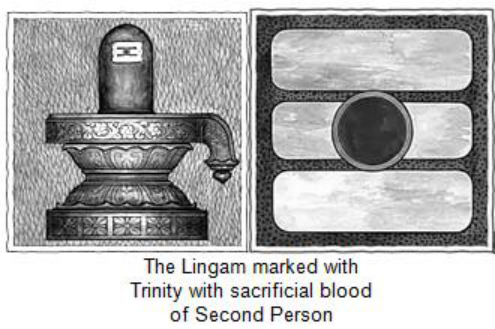
Tripundra Tripundra is a Saivite's great mark, three stripes of white vibhuti on the brow. This holy ash signifies purity and the burning away of
anava, karma and maya. The bindu, or dot, at the third eye quickens spiritual insight.
Later in order to represent that this incomprehensible God incarnated in human form a face was added to the lingam. The earliest Ekmukh lingams (Udayagiri, Madhya Pradesh) are still in existence. (34)
Later another interesting representation was the placement of the Tamil Om on top of the lingam, which later led to the form of Ganapathy, the elephant faced. None of these symbolisms are found earlier than the first century AD.
Om as Logos
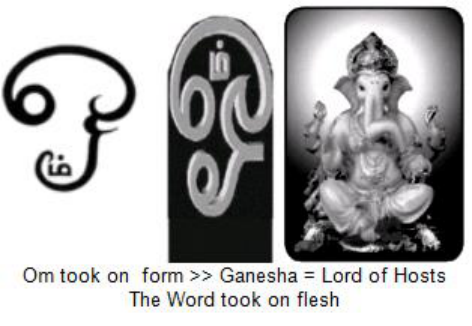
Aum, is the root mantra and primal sound from which all creation issues forth. It is associated with Lord Ganesha
The study of the sacred sound Om indicates that it is the representation of the Logos concept. In fact John 1:1 is replicated in exact form in the later Indian scriptures. Surprisingly the Om is not found directly or indirectly in any document or Vedas before the advent of Thomas. The earliest direct references are found in Prashna Upanishad and in Mandukya Upanishad which were written after 150 AD.. On the other hand Om is inscribed in all Kerala Christian Churches of antiquity at the entrance.
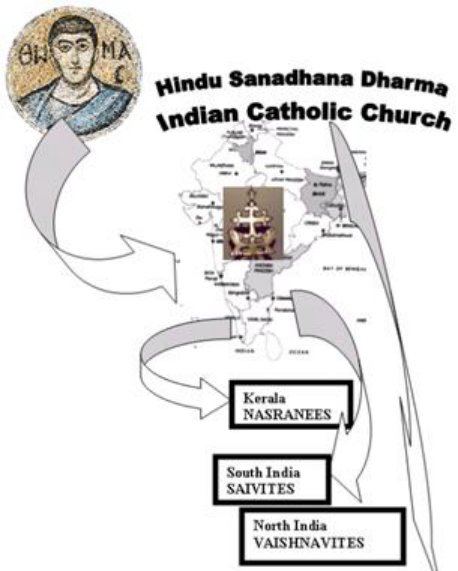
Development of Sects and Gnostic infiltration - Enter Mani
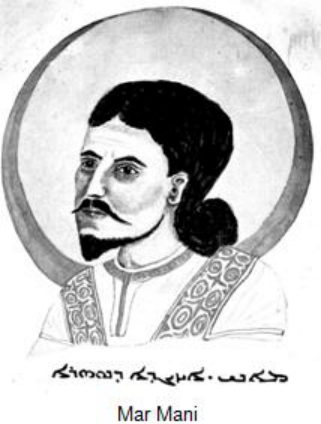
THE ENLIGHTENED MASTER MAR MANI, … entered the world on the 8th day of the 1st Babylonian month of Nissanu (April 14) 216 A.D.. He was born in Mardin, Iraq and raised in an Elkasite monastery on a floating reed island in the mashlands of near Basra, Iraq.
Mani claimed to be the restorer and synthesizer of Gnostic Nazorean Christianity, Zurvan Zoroasterism, and Mahayana Buddhism.
He created a worldwide vegan church which lasted over a thousand years. At one point Manichaeism was as big, or bigger, than the Catholic Church and its teachings have significantly influenced significantly influenced Bon, Buddhist, Sufi, Shia Islam, and Taoist traditions.
Mani's mystical teachings have profoundly enriched the Nazorean Way. His name means the "Vessel of Life" and he came to be regarded by his Christian disciples as the Paraclete, by his Persian followers as the Zoroastrian redeemer Saoshyant, and by his Buddhist adherents as the Avatar Maitreya.
He was also known as a reincarnation of both Lao Tzu and Buddha. He was a gifted writer, teacher, artist, physician, astrologer, musician and a miracle-worker. He personally illuminated and illustrated many of his original scriptures, and could draw a fine line on silk and then erase it by removing one thin thread.
http://magdelene.wordpress.com/2007/08/31/
As time went on evidently new thought patterns and theologies brought in varying sects emphasizing the various aspects and rituals of the Church. This resulted in competing and practically opposing groups. Gnostic infiltration into Christianity started early - even during the Apostolic era. Simon Magnus who is revered as a saint in the Gnostic Church is referred to in the Acts of the Apostles (Acts 8:9ff.). While they were thwarted off by collective churches that emphasized the historical Jesus, the Gnostics thrived in many countries, especially in Persia.
Gnosticism is a philosophical and religious movement, which started in pre-Christian times. The term is derived from the Greek word gnosis, which means "knowledge". It introduced novel beliefs and new gods and goddesses who exist in "divine dimension". They insisted on universal revelation and insisted on considering all religions as equal and the ultimate salvation being achieved through the inner knowledge or enlightenment.
Some of the early Gnostics include, Simon Magnus and Simonians, Nicolaitans, Cerinthus, Marcion, Basilides, (130-150 AD), Theodotus (140-160 AD), Valentinus, (140-160 AD), Heracleon, (170-180AD), and The Sethians. All these were dealt with by the early church. However the idea that Man can become God had always been a tender spot and temptation for man from the beginning with Adam and Eve. The Gnosticism always revived.
The land route to India brought in Gnosticism into India from its home land of Persia and impacted it to the utmost. It transformed Buddhism and Christian Churches of Inner India. Even though Gnosticism practically died out in Persia it still survives in China and India.
Gnostic Saints
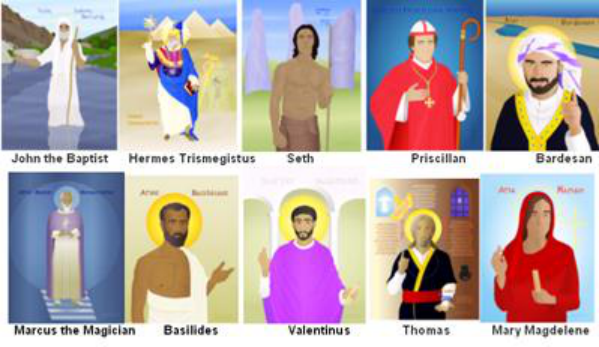
It is told that Bardaisan came to Kerala during AD 154 - 222. (35). We have no details about this visit. But there are evidences that indicate that Bardesan met Mani in Kerala. It was after this visit he wrote the Acts of Thomas to present Thomas as a Gnostic.
Apparently his labors were not fruitful in Kerala. Since at the end of his life Bardaisan returned to Christian faith, his followers probably returned to faith or merged with Manicheans.
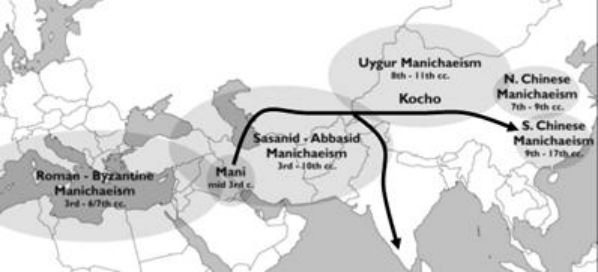
Mission of Bardesai was followed by the ministry of Manichean (Mani or Manes) (c.216-300 AD). "About the year 242, he undertook an extensive journey as an itinerant preacher, proclaiming himself as the "Messenger of Truth," the Paraclete promised by Christ. Traveling throughout the Persian Empire and as far as India, he gathered a considerable following." (36). Manicheanism was centralized in Kanchipuram Pallava Dynasty of Dravidia with its capital in Kanchi is known to be of the Persian race. Mani is associated with peacock and he is said to have had the ability to fly as a peacock. Probably the city of Mylapore was the headquarters of Mani also. He practically took over Thomas Churches. Some people think that it is probably this concept of Mani the Ambasador of Light, that crystallized later in the Subramaniam myth associated with Saivism.
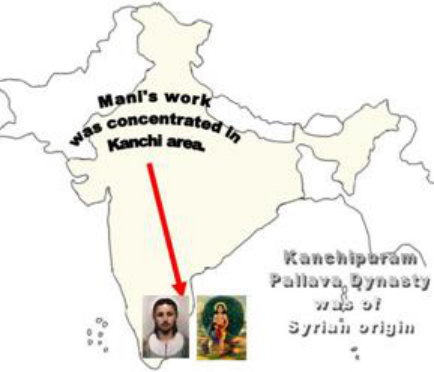
He called himself the Prophet of Jesus and Jesus was one of the first emanations from godhead. In Mani's own words: "At the close of King Ardashir's years I set out to preach. I sailed to the land of the Indians. I preached to them the hope of life and I chose there a good selection." And what did Mani teach? "The Bride is the Church, the Bride Groom is the Light Mind; the Bride is the soul and Jesus is the bridegroom! If he rise in us, we too shall live in him, if we believe in him, we shall transcend death and come to Life" (37). Mani's work were in Chola region where he had a great following. He removed the Jesus of Nazareth as an incarnation and replaced him with a teacher who showed the inner path to realization. (38) As a result the historical Jesus was of no consequence nor his life and death and resurrection. Gnostics differentiated Jesus from the Christ. The experience of the divine within each person was only important. As a result Inner Indian Churches became Gnostic Churches and dropped off Jesus as a whole. After returning to Persia, Mani sent his Father and one of his disciples called Thomas to India to continue to evangelize the nation. Mani was executed for heresy in Persia and all his followers in Persia went to the East - to India and China. All his apostles and his mother Mary were buried in Kashmir in a place called Barmulla. It is this last Aryan Brahminic migration that made a great difference in Indian Religious scenario. Mani's version of the Christianity is still seen in the Gnostic Churches of America and the Church of the East which presents the Yoga of
Jesus. Thus Indian Christian Churches took a new form. - the form of Sanadhana Dharma, meaning Eternal Religion - Religion that started even before Man. In the process of historic growth it became the "Hinduism" as we know today following the British categorization.
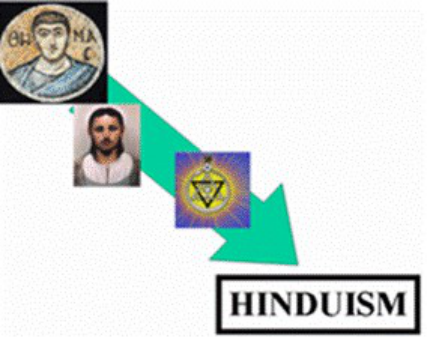
The early Gnostic Hidutva unleashed a war on historic Christianity - ideological, social and physical.. In the North India the believers went underground as a group of Fakirs, who were sworn in secrecy as to their true identity. These Fakirs surface occasionally. Sadhu Sunder Singh report to have seen them on his journey to the Himalayas. When the poor Indian missionaries need help, they always appear from nowhere. Among the Sindhi's of the North India there is a group called Tatanagar Fakirs, who venerate Thomas as Thuma Bhagat. (39) It was probably during this time Pantaneus was sent to India from the School of Alexandria to counter the teachings of Mani. The Manigramakkar, a sect of Hindu Nairs found in Quilon and Mavelikara, still preserve certain Christian customs. They are said to be the descendants of those apostatized early Christians.(40)
When the cloud clears off we have a large number of sects of varying faith and practices all over India. The Inner India Churches became Gnostic ("Hinduism") since they had little or no contact with the Christian Churches elsewhere. The Malabar Churches however because of its geographic position was in constant contact with other churches in Alexandria, Ethiopia, Rome and Antioch through the sea route. Because of this they remained within the Apostolic traditions - the faith that was handed over once and for all at the shores of India by Apostle Thomas - as was practiced in the rest of the world especially in Alexandria, Ethiopia, Rome and Syria. By the third century while the rest of India became Hindu, Hinduism came to stay in Malabar Coast only by the eighth century. Malabar remained a safe haven for Christians for several centuries.
We should remember that both the Christians and Gnostics who migrated for various reasons were from Persia or Syria who were in essence from the same Aryan stock.
As a result when the Gnostic (Hindu) persecution broke out in the Chola and Pandya region, many believers fled to Malabar. One such mention is seen in the Palm Leaf documents.
"AD 293. The Vallala converts to Christianity in Kavery poopattanam were persecuted by their King. So 72 families embarked on a ship and came to Korakkeni (Kollam, Quilon) where there were Christians at that time." (41)
This is followed by another citation, which says:
" AD 315 A certain sorcerer called Manikka Vachakar came (to Kollam) and converted back to Hinduism 116 persons belonging to eight of the 72 families from Puhur"
This story is also cited by other historians such as Moraes (42), White House (43), and Ittup (44).
Another Palm Leaf says:
"A certain sorcerer called Manikka Vachakar came to Kollam and converted back to Hinduism 116 persons belonging to 72 families from Puhur, 4 of about half a dozen families subsequently came from Coromandel Coast (perhaps from Puhur itself) and 20 families of local Christians (presumably from Quilon)". Pam-leaf quotation.
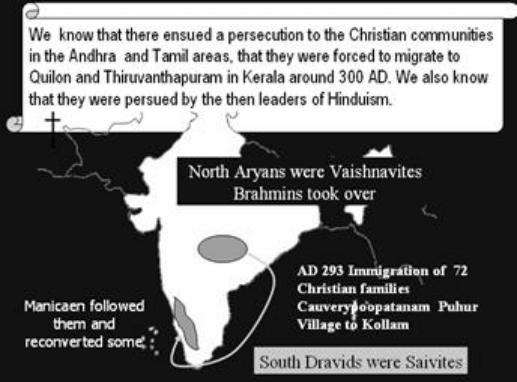
We are not sure who this Manikka Vachakar is. The mention of the term Sorcerer and the name Manikka leads us to identify this person as Gnostic.
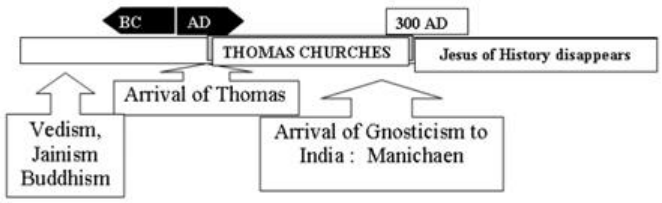
The impact of this Persian Gnosticism is seen in the appearance of idols and temples and an endless system of myths and legends and visions. By the end of third century most of the region beyond the Sahya Mountains became "Hindu". It took at least three centuries more for it to reach Kerala.
Conquest over Christians from Taxila to Srilanka
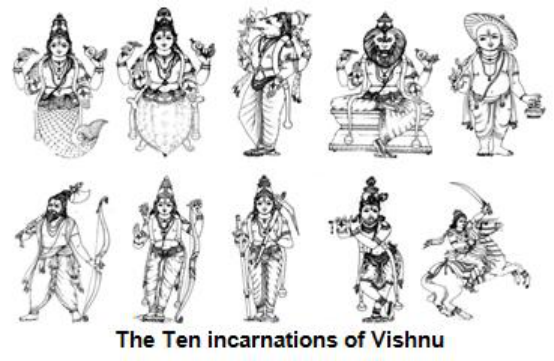
Maatsya, Kurma, Varaha; Narasimham, Vamana (Parasu)Rama, (Sri)Rama, (Bala)Rama, Krishna, and the tenth incarnation as Kalki is yet to come. This list is included in the Garuda Purana (1.86.10"11)
The first four are said to have appeared in the Satya Yuga (the first of the four Yugas or ages in the time cycle described within Hinduism). The next three avatars appeared in the Treta Yuga, the eighth descent in the Dwapara Yuga and the ninth in the Kali Yuga. The tenth, Kalki, is predicted to appear at the end of the Kali Yuga.
1. Matsya, the fish-avatar who saved Manu - the progeniter of mankind from the great deluge and rescued the Vedic scriptures by killing a demon. Story can be found in the Matsya Purana. This Purana is the story of the Matsya Avatar (incarnation) of Lord Vishnu, Manu who was the King of Dravidadesa, and the first Mahapralaya (Great Deluge). In the end, Manu and all those he saves are safe in a large ship that he builds, atop the high Malaya Mountains.
These mountains are believed to have formed the Southernmost part (Southwards starting from the Mangalore region) of the Western Ghats, between Kerala and Tamil Nadu, while the Northern part of the same was called the Sahya Mountains. The peaks of these Malaya mountains are higher than those of the Sahya Mountains. The Anaimalai and Nilgiri form some of its higher ranges. Obviously this is a retelling of the Noah story. Noah is identified with Satyavrata a Dravidian King
2. Kurma, the tortoise-avatar, who helped in the Samudra manthan - the churning of the ocean. Story can be found in the Kurma Purana.
3. Varaha, the boar-avatar, who rescued the earth from the ocean, by killing her kidnapper-demon Hiranyaksha. Story can be found in the Varaha Purana.
4. Narasimha, the half man-half lion avatar, who killed the tyrant demon-king Hiranyakashipu, to rescue the demon's son Prahlada, who was a Vishnu-devotee
5. Vamana, the dwarf-avatar, who subdued the king Maha Bali. Story can be found in the Vamana Purana.
6. Parashurama, sage with the axe who killed the thousand- armed king Kartavirya Arjuna
7. Rama, the king of Ayodhya and the hero of the Hindu epic Ramayana
8. Balarama, Balarama was born as a son of Vasudeva. Kansa, the brother of Devaki and an evil king, was intent upon killing all the children of his sister because of a prediction that he would die at the hands of her eighth son. Kansa thus threw his sister Devaki and her husband Vasudeva into prison, and proceeded to kill each of their children as they were born. However, the seventh child was transferred miraculously from Devaki's womb to the womb of Vasudeva's other wife Rohini, who desired a child of her own. Thus Balarama's other name is also Sakar[1]a
a which describes the transfer of the child from the womb. Rohini gave birth to Balarama and raised him.
The child was formally named Rama, but because of his great strength he was called Balarama
(Strong Rama), Baladeva or Balabhadra. He was born under Shravana nakshatra on Shraavana Purnima or Raksha bandhan
9. Krishna, the king of Dwarka, a central character in the Bhagavata Purana and the Mahabharata and reciter of Bhagavad Gita. In the original Dasavatara stotra, Balarama, the elder brother of Krishna, is stated as the eight incarnation, while Krishna (Lord Kesava) is the source of all the incarnation.[20]
10. Kalki ("Eternity", or "time", or "The Destroyer of foulness"), who is expected to appear at the end of Kali Yuga. Story can be found in the Kalki Purana.
We skip the first two avatars which pictures a war in the sea and the sea-shore and start only with the Boar avatar.. The story starts with the two sons of Kasyapa and Aditi. The eldest son Hiranyakshu was killed by the Boar Avatar.
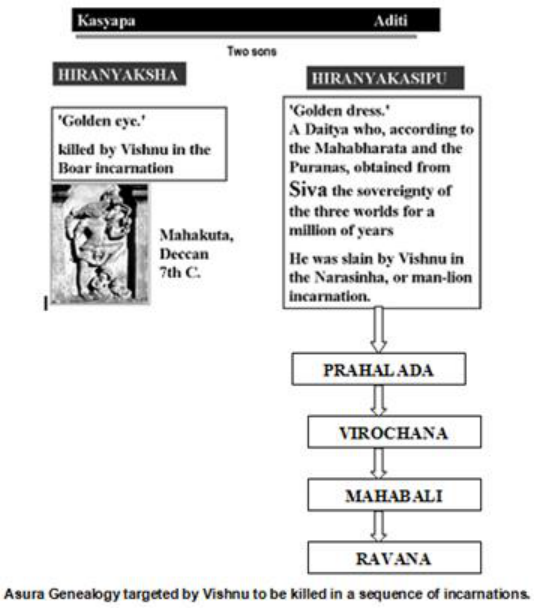
In the sequence of 10 avatars, the middle four incarnations are historically and geographically traces how the Asura Kings were defeated by trickery from the Northern most Kingdom of Taxila to the end of the Indian Peninsula upto Sri Lanka. as shown below.
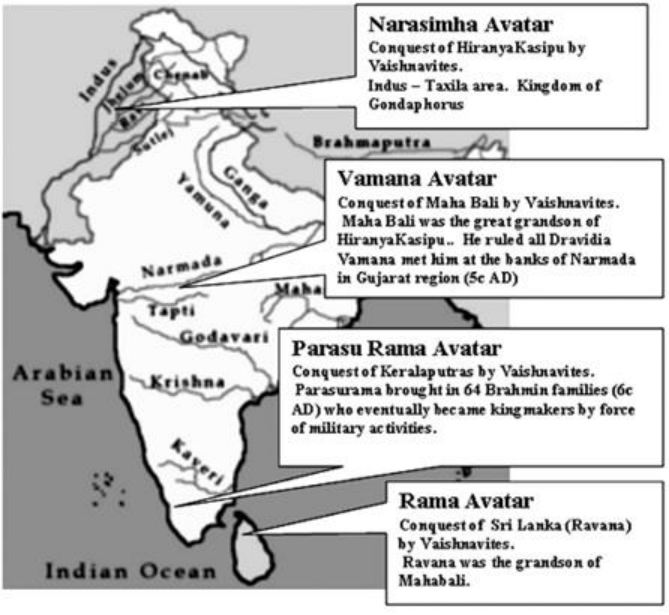
It will all fall in place when we realize that the word "Asura" is a derivation of Asu ra (Asu = Breathe ra= born) which means "Born of the Spirit" as explained by Madam Balvatsky the greatest proponent of Theosophy
The Secret Doctrine: The Synthesis of Science, Religion, and Philosophy (page 93) By H. P. Blavatsky
"This is very plainly shown in various texts of the Rig Veda - the highest authority for a Hindu in any sect whatever. Therein Asura means "spiritual divine", and the word is used as synonym for Supreme Spirit, while in the sense of "God," the term "Asura" is applied to Varuna and Indra and pre-eminently to Agni - the three having been in days of old the three highest gods, befor Brahminical Theo-Mythology distorted the true meaning of almost everything in the Archaic Scriptures. But, as the key is now lost, the Asuras are hardly mentioned.
"In the Zendavesta the same is found. In the Mazdean, or Magian, religion, "Asura" is the lord Asura Visvavedas, the "all knowing" or "Omniscient Lord"; and Asura-Mazdha, became later Ahura-Mazdha, is, as Benfet shows, "the Lord who bestows Intelligence"- Asura -Medha, and Ahura - Mazdao. Elsewhere in this work it is shown, on equally good authority, that the Indo-Iranian Asura was always regarded as sevenfold. This fact, combined with the name Mazdha, as above, which makes of the the sevenfold Asura the "Lord", or "Lords" collectively "who bestow Intelligence," connects the Amshapends with the Asuras and with our incarnating Dhyan Chohans, as well as with the Elohim, and the seven informing gods of Egypt, Chaldeam and every other country."
Isis Unveiled by H. P. Blavatsky Theosophical University Press Online Edition
CHAPTER VII. Vol. 2, Page 299 IAO, THE TRILATERAL NAME.
"IAO, in such a case, would - etymologically considered - mean the "Breath of Life," generated or springing forth between an upright male and an egg-shaped female principle of nature; for, in Sanscrit, as means "to be," "to live or exist"; and originally it meant "to breathe." "From it," says Max Muller, "in its original sense of breathing, the Hindus formed'asu,' breath, and'asura,' the name of God, whether it meant the breathing one or the giver of breath."*** It certainly meant the latter."
Hindu Mythology, Vedic and Puranic, by W.J. Wilkins, [1900], 438-441
"CHAPTER VI.
"THE ASURAS.
"In the Purnas and other of the later writings of the Hindus, and also in the popular mind, the asuras are powerful evil beings; in translations the word is represented by such terms as demons, giants, etc. As the suras * were the gods, the asuras were not-gods, and therefore the enemies or opponents of the gods. In the Vedas the name asura is applied more frequently to the gods themselves than to their enemies, whilst it is also used very much in the same manner as in the later writings. In the Rig-Veda, Varuna is accosted as follows: "King Varuna has made a highway for the sun to go over. O thou wise asura and king, loosen our sins!" Again: "The all- knowing asura established the heavens, and fixed the limits of the earth. He sat as the supreme ruler of all worlds. These are the works of Varuna." "Asura stands for the Supreme Spirit," in another verse, and "also as an appellative for Prajpati or creation's lord." † Again and again Varuna alone, and also in conjunction with Mitra, is called an asura. "All the Vedic gods have shared the same title, not excepting even goddesses." "Varuna was the all-knowing asura,
Prajpati the Supreme Being; Indra, the Maruts, Tvastri, Mitra, Rudra, Agni, Vyu, Pushan, Savitri, Parjanya, the sacrificial priests, were all asuras. In fine, Deva (god) and asura were synonymous expressions in a multitude of texts." *
On the other hand, in the Rig-Veda, Indra is the destroyer of asuras. "The same Veda which speaks of the asuras as celestial beings supplies its readers also with the Mantras, by means of which devas overcame asuras. The texts which are condemnatory of the suras as impure and ungodly are far less in number than those which recognize the term as applicable to gods and priests." Dr. Banerjea, in the most interesting and ingenious article from which the above extracts are made, suggests a means of reconciling these contradictory uses of the word "asura." Before the Indo-Aryans arrived in India, they had lived in close proximity to the Persians, the original worshippers of fire. "What could be more natural," he asks, "than that the Asura-Pracheta, or Asura-Viswaveda of the one branch, was but the translation of the Ahura-Mazda (the Wise Lord, according to the'Zend-Avesta') of the other branch; and that the word'Ahura,' which the one used in a divine sense, would become a household word in the other branch, in the same sense?" the word "Ahura" being changed into "Asura," in a way common to many other words. He then goes on to say, that as "Assur" was the term used in Assyria for the Supreme Lord, and the Assyrians were for some time the rulers of the Persians, it was natural that this word should find its way into Persia; the only change being this, that the Persians added Mazda (wise or good) to the term "Assur," and the Indo-Aryans received it from them. So much for the good use of the term "Asura."
"But the word "Assur" was not only used for the Supreme Lord, it also represented the Assyrian nation, his worshippers, who were most cruel in their treatment of their foes; and as, later on, the bitterest hatred is known to have existed between the Indo-Aryans and the Persians, the followers of Ahura-Mazda, Dr. Banerjea concludes that owing to the cruelties perpetrated by the Assyrians on the one hand, and the hatred cherished towards them by the Persians on the other, the branch of the Aryan family that migrated into India brought with them very bitter feelings towards Assur (the Assyrian people) and Ahuri (the belongings of Ahura); and thus the
term "Asura," which at one time was considered a becoming epithet for the Supreme Being, became descriptive only of those who were the enemies of the gods. In order to afford sanction for this altered sense of a word, a new derivation has been given to it. The word was originally derived from the root as, through asu, "breath," and means a spirit, or "the Great Spirit." Now, however, it is explained to be simply a compound of a privative, and sura, "god," meaning a non-god: therefore a demon.
Whatever be the cause of it, there is no doubt that at the present day, and throughout the later writings of the Hindus, the term "asura" is used only for the enemies of the gods. In the "Taittirya Sanhita" * we read "that the gods and asuras contended together, and that the former, being less numerous than the latter, took some bricks, and placing them in a proper position to receive the sacrificial fire, with the formula, Thou art a multiplier,' they became numerous." In the "Satapatha Brhmana" * it is said that "the gods and asuras, both descendants of Prajpati, † obtained their father's inheritance, truth and falsehood. The gods, abandoning falsehood, adopted truth; the asuras, abandoning truth, adopted falsehood. Speaking truth exclusively, the gods became weaker, but in the end became prosperous; the asuras, speaking falsehood exclusively, became rich, but in the end succumbed." The gods tried to sacrifice, but though interrupted at first by the asuras, at length succeeded, and so became superior to their foes. Another legend in the same book teaches that the asuras, when offering sacrifices, placed the oblations in their own mouths, whilst the gods gave their oblations to each other; at length Prajpati giving himself to them, the sacrifices, which supply the gods with food, were henceforth enjoyed by them.
"Although there were frequent wars between the gods and asuras, the suras were not averse to receive the aid of their foes at the churning of the ocean; and some of them were not inferior in power and skill to the gods. Bli, one of their number, is worshipped by the Hindus on their birthday; and Jalandhara conquered in battle even Vishnu himself; Indra and the other gods fled before him, and Siva, unaided, could not destroy him. Rhu is an asura, and it was to destroy some of these mighty beings who distressed the gods, that Durg and Kli had to put forth their strength. In the constant wars
between these rivals, Sukra, the preceptor of the asuras, was frequently called to resuscitate the fallen. The following story of Jalandhara from the Uttara Khnda of the "Padma Purna" * will illustrate the teaching of the later Hindu Scriptures respecting the asuras.
Asura Bowker, John, The Oxford Dictionary of World Religions, New York, Oxford University Press, 1997, p. 103
"Asura, from Sanskrit meaning a "power-seeking" and "power- hungry" being, is similar to a Titan, often, but somewhat misleading, described as a "demon"; or anaya (non-Aryan) people of ancient India. The term's derivation is uncertain. Some scholars derive it from Ashur, the Assyrian god, or from the breath (asu) of Prajapati, or from the root as (to be). According to a Hindu myth, a-sura is the negation of sura, an Indo-Aryan liquor, and refers to non-Aryan abstainers. In Hindu mythology sura came to mean a minor godin contrast to a-sura, "not-god" or "demon," but this is believed to be a false etymology.
In older part of the Rg Veda, asura refers to the supreme spirit, like the Zoroastrian Ahura Mazdah, or to Vedic deities (devas) such as Varuna, Agni, Mitra, and Indra. In younger Vedic texts and Hindu mythology asuras become demons or titans who war against the devas (gods). (cf., in the Iranian tradition ahura came to mean "god" while dacva came to mean "demon")
According to Satapathe Brahmana the devas and asuras both came from Prajapati, but the former chose true speech while the latter chose the lie. Aitarcya Brahmana relates that devas hold power by day and asuras hold equal power by night.
The non-Aryan Danavas and Laityas were called asuras. These may have been peoples who were opponents of the non-Aryans and who were mythologically equated with titans and demons.
Asuras are not necessarily evil while devas are not necessarily good. They are consubstantial, distinguished only by their mutual opposition, which is not conceived as an absolute ethical dualism. A.G.H.
Zorastrianism on the other hand reverses the terms Daiva (Sura) and Asura.
2. Daeva or Deva Worship
In the chapter 32 of the Gathas, Zarathushtra speaks about the daeva, evil and the lie, a concept he introduces in Y.30.6.
In Yasna 32.3 Zarathushtra states: "At yush deava vispaongha akat manangho sta chithrem." translated as: But all you daeva Are the progeny of wicked thoughts (thinking).
Zarathushtra refers to the daeva as a group who collectively chose evil. He does not name the daeva in his hymns. However, some of the negative qualities he speaks about - such as aeshma, wrath, and achistem mano, evil mind,(Y.30.6) became named as daeva elsewhere in the Avesta.
In the Avesta's Aban (Avan) Yasht (5.94), we read of the Daevayasni, the daeva worshippers. In the Vendidad's chapter 19, the Daevayasni are juxtaposed against the Mazdayasni.
Further, a book of the Avesta, is Vi-daevo-data (the Vendidad). Daeva or Deva Worship
[Note: The words deva (Vedic Sanskrit), daeva (Avestan Old Iranian) and div (Middle and Modern Persian) are commonly considered to be variations of the same word, div being the more modern (Middle Persian) word. While the different words may at times be applied in a similar fashion, there are times when they have different connotations.]
Thus Asura refers to those born again in Spirit people of God who were opposed to the Suras in Sanskrit. Later the word Asuras were given the interpretation A-Sura = those not Suras.
References (16) M.R. James,"The Apocryphal New Testament" Oxford: Clarendon Press, 1924 http://www.earlychristianwritings.com/text/actsthomas.html
(17) http://www.earlychristianwritings.com/actsthomas.html (18) http://www.earlychristianwritings.com/html/chap4/chapter4a.ht m
(19) (Lawrence E. Browne, The Eclipse of Christianity in Asia. New York: Cambridge University Press, 1933, p.47. The information about the Bartolmai tribe is given by R. A. Trotter in a paper presented at a conference in Sind in 1947.
(20) Clement of Alexandria, Stromata, Ante-Nicene Fathers, vol.1. p. 301.
(21) A. Mingana, Early Spread of Christianity in India, Manchestor University, `926 p 71
(22). Rev Henry Heras, The Two Apostles of India (Trichinopoly 1844) (23) Quoted in C.V Cherian, Kerala Historical Society. CMS Press 1973 (24) The Church History of Eusebius. Book V, Chapter X http://www.ccel.org/fathers2/NPNF2-01/Npnf2-01 10.htm
(25) A. Mingana, Early Spread of Christianity in India, Manchestor University, `926 p 71
(26) Jerome, Liber de viris Illustribus as quoted by Dr. Berchmans Kodackal in http://members.tripod.com/~Berchmans/apostle.html
(27) http://www.ccel.org/w/wace/biodict/htm/iii.xvi.vi.htm (28). Quoted from http://www.barkuronline.com/Abtbkr/Abtbkr5.html
(29) William Pais and Vincent Mendonca, ‘The land called South Kanara'-2000, - Image flex Publishers
(30) R. A. Trotter in a paper presented at a conference in Sind in 1947 (31) "The Myth of Saint Thomas and the Mylapore Shiva Temple" http://hamsa.org
(32) Dr. M. Deivanayagam, Dr. D. Devakala, The Revival Movement of Dravidian Religion, Hinduism - Dravidian Religion http://www.geocities.com/Athens/Ithaca/1412/hindudravid.html
(33) Alexander Harris, The Development of Civilization and Religion in India and its influence in World Society. Chennai p 58 ff http://www.geocities.com/Athens/Parthenon/2104/hinduism.html
(34) http://indiatemple.blogspot.com/2004/11/lingam-phallic- symbol-of-lord-shiva.html