
Search this book
Search results link directly to the matching source page.
CHAPTER ELEVEN Mar Thoma Church
AD 1876
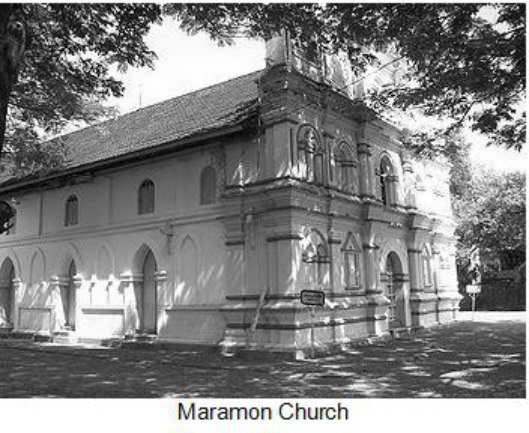
Finally Palakunnathu Abraham Malpaan and Kaithayil Geevarghese Malpaan and and his parishioners at Maramon were dismissed from the Orthodox-Jacobite church.
Palakunnathu Abraham Malpan sent his 23 year old nephew who was at that time a deacon, to Syria in 1843 and got him ordained as Bishop of the Malankara Church under the title Mathews Mar Athanasius by the Patriarch of Antioch. In 1852, and a royal proclamation was issued recognizing Mathews Mar Athanasius as "Malankara Metropolitan".
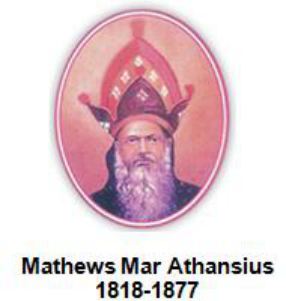
Immediately on return, he was declared the Malankara Metropolitan by the decree of the King. Following this Pulikottil Joseph Ramban of the orthodox tradition went to Antioch and got himself consecrated as bishop with the name Joseph Mar Dionysios. However because of the presence of the Resident of Britain who supported reformed theology he could not get an order to the position of Metropolitan of Malankara.
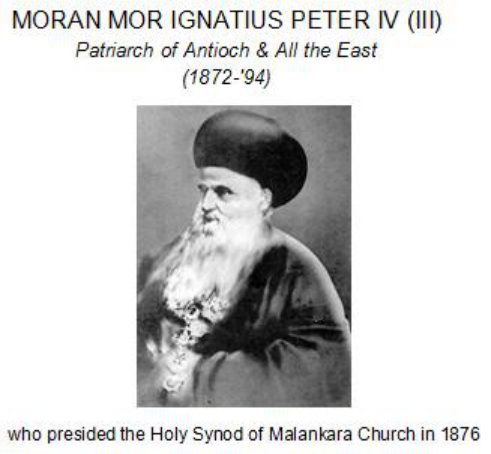
Patriarch of Antioch Ignatius Peter III himself came down in 1875 and convened the synod of Mulamthuruthy in 1876. During this synod the church accepted the spiritual supremacy of the Patriarch of Antioch. The Patriarch who stayed in Malankara for almost a year attempted to establish his authority here by hook or by crook. But he could not succeed in it; and he believed that Mar Dionysius was standing in his way in achieving this aim. Hence the Patriarch devised schemes to curtail the authority and influence of Mar Dionysius. He divided the Church into seven dioceses and consecrated six Metropolitans over the six sections leaving only one to Dionysius Before consecrating them the patriarch obtained registered agreements from them declaring the acceptance of the authority of the Patriarch.
The Church Fathers who convened the historic association
of Syrian Christians (Mulanthuruthy Synod) at the
Mulunthuruthy Mar Thoman Church in AD 1876
Ordained six metropolitans for the Malankara Church including ST. GREGORIOS CHATHURUTHY (Parumala Thirumeni) and Consecrated the Holy MOORON on 27 August
1876 at the Mar Thoman Church, Mulunthuruthy
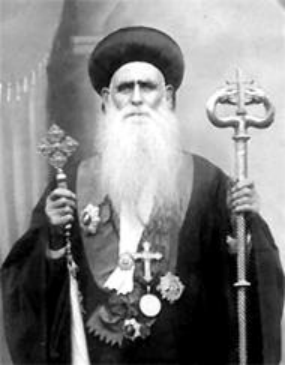
MOR GREGORIOS ABDED'ALOHO Metropolitan of Jerusalem
Participated in the historic Holy Synod at Mulunthuruthy in 1876 when he was the Metropolitan of Jerusalem and assisted the Patriarch. Later elevated as Patriarch Mor Ignatius Abded'Aloho (Abdulla II) in 1906
MULANTHURUTHY PADIYOLA (Agreement signed and submitted to Moran Ignatius Peter III, H.H Patriarch of Antioch by the
Malankara Jacobite Syrian Church in 1876) Obeying your Holiness' Kalpana, dated 19th Edavom 1051 (1876) to all Churches, we have assembled on the 15th Midunam in this Church at Mulunthuruthy, built in the name of Mor Thoma Sleeha (Apostle) and we heard of our Holiness" Circular Kalpana, read publicly on the occasion of the inauguration of the Synod, asking us to codify measures to the effect that we may be firm in the Orthodox faith and in the obedience to the commands from the Throne of Antioch. As it is essentially necessary to show that our Church in Malayalam (Malankara), had been continually watered and nurtured by the presence of Antioch, we submit a brief history of this Church, from the time it was guided by St.Thomas and we submit also measures to be taken, so that this Church, may not hereafter, be robbed by the enemies and it might always remain
firm in the faith and obedience. And we do most humbly request, that our prayers may be read and measures confirmed by Your Holiness. In the 52nd year of our Lord, St.Thomas arrived in Malayalam and preached the faith to our forefathers, established the Church and founded churches and appointed priests and they adhered to the true faith and in course of time, when the Church was in distress owing to the scarcity of priests, the honourable Knai Thoma came to Malayalam in 345 and learning the pitiable condition of the Church and the possibility of its total extinction if immediate help is not rendered, he again came with Metran, priests and deacons and laymen from the Land of Syria under the jurisdiction of the Patriarch of Antioch, with a big amount of money - and for the progress of our community, he obtained privileges and caused to consecrate Metrans from this land and the Church was thriving in high honour, upto 825 when the merchant Iyob and Syrian Prelates arrived in Malyalam and the Church progressed in honour and esteem. And at that period, ‘Paramkikal' (Portuguese Roman Catholics) came and proselytised our forefathers by force into their slavery and again in 1600, a Synod was convened at Udayaperror by Allesu (Alexis) Paranki Metran who burnt all our Syriac books and made changes in the true faith. And when prelates from the traditional Pakalomattom family were ruling over us the Moran Patriarchis Bava arrived in Malayalam in 1653 and he was done away with, brutally and we assembled at Cochin Mattancherry and took the Oath, that we would never have any relation with the Parankies: and they gradually succeeded in taking by deceit a portion of our people. In 1665 came Mor Gregorios Bava of Jerusalem at the order of the Holy Throne and he consecrated the Archdeacon who had been administering the Church at that period. And in 1686 Baselios Bava and Ivanious Episcopa reached Malabar and since it was a period of decline of the Paranki power, Ivanious Episcopa expelled all the Paranki practices, and everything in accordance with the Jacobite Syrian practise was re-established during his
life here for 30 years. Then in 1751 came Baselios Maphrian and Metrans Gregorious and Ivanious and others and regularised the consecration of Mor Thoma Episcopa, giving him the title ‘Mor Divanyasious' and giving him Staticon and other privileges. And in 1815 Pulikottil Youseph Divanyasious Metropolitan of the line of Kattumangatt Metran, founded the Kottayam Seminary and earned properties for the same and made arrangements for instruction - in a laudable manner. Then came English Missionaries and stayed with us deceitfully influenced some to feel that their ancient practices were not desirable. Consequently, the Church, through the then ruling Metropolitan Mor Divanyasious (III) appealed to the Throne of Antioch; as a result of which, Mor Athanasius Abdul Masih and Sabor Remban came in 1825 and the missionaries, influencing the ruling Kidangan (Philoxenous) metropolitan, succeeded in sending them back and since we could not concede to the behests of the missionaries, that we should follow practices contrary to our faith and canons the representatives of all churches assembled at Mavelikara Church on 5th Makarom 1011 and drew up a Padiyola, which convinced them that they could never overturn us or our faith through deceit and hence they caused a split and as a consequence they sold out much of our properties and in addition, they sent Deacon Mathai of Palakunnath, of the parish of Maramon, who had been expelled from our Church, to Madras for education and Protestant orders and from there too he was expelled by the authorities for misconduct. And he, fabricating letters as those of certain churches, belied before the Holy Throne that he was a ‘Kasseeso' (Priest) and through such crooked means got himself consecrated Metran, and returned to Malayalam where- upon all the churches were called together at Kandanad by Philipose Mor Divanyasious Metropolitan, and as a result of scrutiny of his ‘Sthathikon', his crookedness and deceit came to light and he with some members from the South went to Kallumkathra church and there a Padiyola with his signature and seal was drawn up, in which he promised that he would never deviate from the Orthodox faith and from the submission to the
Holy see of Antioch and from the Canons promulgated by the 3 General Councils; and those few church members promised that so long as he follows that path, they would accept him as Metran. The records brought by Mor Yooyakim Kurillos Metropolitan, who had been deputed by the Patriarch as a result of the report of the Kandanadu Yogam (assembly) were found by the Quilon committee, as fabricated, and the Royal Proclamation was obtained by the Metran, who with government support unjustly ruled us and over churches and ruined all our resources - this man called ‘Beliar' with crookedness together with power tried to overturn our faith and thus embrace Anglican faith has brought about schism and heresy; and repudiated the excommunication orders, firstly of our Holy Father, Patriarch Elias and secondly of Patriarch Yakub and now lastly of Your Holiness and despotically continues in his wicked actions, siding with the missionaries. Our oft-repeated grievances to the Holy See, describing his efforts to mar our faith, we had been preserving from the times of our forefathers were not redressed. Your Holiness, after your installation felt compassion on us and for solving our grievances, left your Throne and travelled to Constantinople, and London and met the authorities there and in Madras in Nilgiri, Trivandrum and Cochin and succeeded in revoking the Royal proclamation, which he had obtained on the plea that he was having the Patriarchal Bull with him. We have assembled here to confirm the aforesaid faith, submission and Church administration. Holy Father, from the Origin of this Church, we are under the jurisdiction of the Holy See of Antioch, which, in order to help and deliver us, on every occasion of our depression had offered us much riches and the Holy Anointing Oil - ‘Mooron' through the prelates and confirmed us in faith and built many churches - and now the hardships Your Holiness suffered during the crisis - all these facts would never depart from our minds and from our posterity's minds. From the earliest ages, the Syrians in Malankara and their churches are under the spiritual authority of the Patriarch of Antioch. Nobody else has any kind of authority. Since our Metrans and Priests receive Holy "laying on of hands"
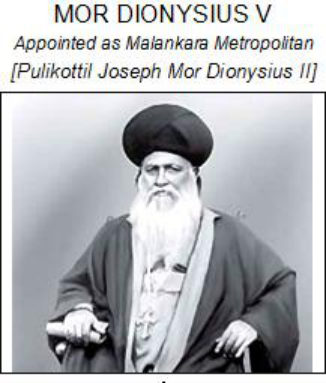
from the Holy See, the power to appoint and remove them rests with the Holy See. The spiritual administration over the Syrian Community and of their churches and the authority to appoint and remove metrans rest with Your Holiness. Now Your Holiness has come to Malankara, aware of our deplorable situation, to administer spiritually, our community and churches and by the grace of God suppress the enemies of the faith. We, hereby declare before the High priesthood of Your Holiness that from the Faith of the three Holy Synods handed over to the Holy Church, and from commandments of your Holiness, the Head of our religion and Faith, neither we nor our children would depart either to the right or to the left - up to our death. And we, take this Solemn Oath, holding Sleeba (Cross) and Evangelion (the Gospels) before God and in the presence of your Holiness, that there would be no departing from this until the last moment of our death. Mathews Mar Athanasious died in 1877, and was succeeded by, Thomas Mar Athanasious (1879-1889). The Theological center of the Church, the Old Seminary was still controlled by the reforminsts group. To counter this Mar Dionysius V with the support of Patriarch, filed suit against the reformists on March 4, 1879 and the Church plunged into a prolonged litigation (1879- 1889) known as the'Seminary Case'.
During the course of a litigation answering a question Thomas Mar Athanasius Metropolitan affirmed that
" The Episcopal throne of Patriarch is the throne of St. Peter, while the throne of Malankara Church is that of St. Thomas. Malankara Church is as old as the Church in Antioch, equal in status, and both are independent." During a meeting convened by the Maharaja of Travancore, before the final verdit was given, Mar Athanasius testified that,
"Malankara Church was never under any foreign rule and that he was unwilling to move away from the teachings or give the authority and Church possessions to a foreign Patriarch."
However the final verdict of 1889 went against the Reformation Group. This resulted in the refomist group seperating themselves from the Orthodox Theology and starting a new Reformed Church as the Malankara Mar Thoma Syrian Christian Church as an independent church without any affiliation with any foreign patriarchate.
There was litigation between reformed group and original group for many years for the possession of individual churches. The reformed group got only Maramon and Kozhenchery churches by court verdict and Kottrakara church without contest. Five churches both parties to use on alternate Sundays. Reformed group put up small sheds in other places for worship. Though the reformed group lost their property; they influenced the people to spiritual revival and experienced greater joy and fellowship
Kozhencheri Marthoma Church today where I was baptised and got
married. Since the Bible was in the hands of the common man due to the technology of Printing in Malayalam and with large number of theologically trained clergy, it was no more necessary to have any Syrian affilliation as it used to be in the previous eras. The liturgy was translated into Malayalam with necessary changes to reflect the reformation theology.
The changes made by Abraham Malpan in the liturgy of the Holy Communion were as follows:
1. All invocations to the saints were removed. 2. All prayers for the dead were removed. 3. In the prayer of consecration of the bread in Holy communion the prayer, "Thee who holdest the extremities of the universe, I hold in my hand; Thee, who rulest the depths, I grasp with my hand", and the statement at the time of partaking of the bread, "Thee, who are God, I put into my mouth", were deleted. 4. Instead of the prayer: "We offer into Thee, O Lord, this bloodless sacrifice (referring to the Eucharist) on behalf of Thy Holy Church which is in all the world", the following prayer was inserted: "We offer into Thee, O Lord, this prayer on behalf of
Thy Holy Church which is in all the world", leaving out the words "bloodless sacrifice" and inserting instead "this prayer". 5. The declaration that "Living Sacrifice is offered" (the reference is again to the Eucharist), was changed into: "living sacrifice, which is the sacrifice of grace, peace, and praise". 6. The declaration: "this Eucharist is sacrifice and praise" was deleted. 7. The declaration that "the Holy Spirit is the sanctifier of the censor" was deleted. 8. The note that the censor should be sanctified was taken away. 9. The prayer: "Let Him (Holy Spirit) make this bread the life-giving and saving body of Jesus Christ", was replaced by: "Let Him (Holy Spirit) come upon and make this bread to those who partake of it, the body of Jesus Christ for the remission of sins and life everlasting". (This clearly teaches the Receptionist Theory.) 10. The prayer: "Thou are the hard rock which was set against the tomb of our Redeemer" (referring to the Eucharist bread), was replaced by: "Thou art that tested and precious hard rock rejected by the builders" (converted it into a reference to Christ).
The following changes were made to the practices of the Church:
It was decided that the Eucharist should be administered in both kinds. The practice of auricular confession and obtaining absolution from the priests was abolished. The practice of celebrating the Eucharist when there was nobody to partake of it was abolished
Thomas Mar Athanasius died suddenly in 1893 without consecrating a successor. Another son of Abraham Malpan by name Titus agreed to accept the responsibility. The Metropolitan of the Independent Church of Thozhiyoor consecrated him in 1893 as Titus I.
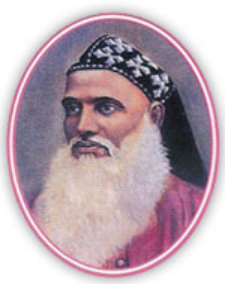
In the place of the Old Seminary, which was lost to the Jacobites, a new site was bought for the Seminary in Kottayam itself and a school was started. The Marthoma Church which expanded initially in and around Kozhencherry, Ayroor, Ranny etc later spread all over world. The Church that started with three Churches has today 1062 parishes, 11 dioceses and 680 priests in different parts of the world, including West Asia, Africa, North America and Western Europe.
The missionary oriented Marthomite Church though started as a small church grew strong in time. The Sunday school Samajam (The institution of Sunday School) and the Suvisesha Sangham (evangelism board) have played a big role in this reformation. Punchamannil Mammen Upadeshi, Edayaranmula Sadhu Kochu Kunju Upadeshi, Pennamma Sanyasini and several preachers led the revival in Marthoma Church at the dawn of the 20th century, In 1895, the Maramon Convention was started in the sands of Pampa, which became the biggest convention in the world.
The Mar Thoma Church defines itself as "Apostolic in origin, Catholic in nature, Biblical in faith, Evangelical in principle, Ecumenical in outlook, Oriental in worship, Democratic in function, Episcopal in character and is a Reformed Church."
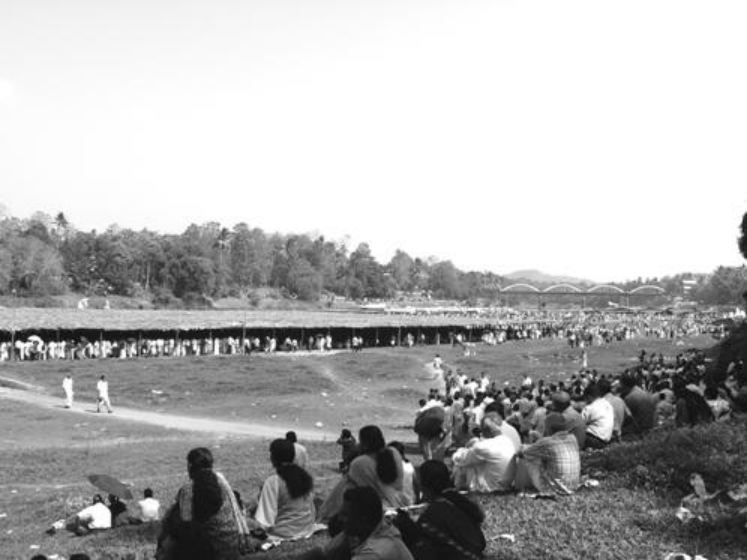
The Maramon Convention was started in 1896, by the St.
Thomas church. It is held in Feb-March every year on the dry river bed of river
Pamba.
Moothampackal Sadhu Kochunju Upadesi [1883-1945]
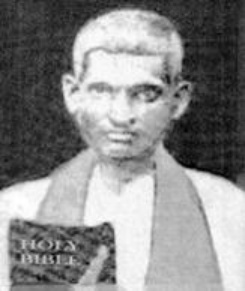
Kochunju Upadesi, the Evangelist in the Marthoma church stand apart from all others in his impact on the spirituality of Kerala Christians.. Kochoonju Upadesi was the General Secretary of the Mar Thoma Voluntary Evangelists' Association from 1924 to 1945. His songs struck deep chords in the daily lives of families in Kerala and had inspired many into placing their trust in Jesus. Thus he was probably instrumental in the conversion of several Pentecostal and Brothren Mission leaders in Kerala. He was a prolific hymn writer and his songs are sung even today in almost all Malayalam congregations and Christian homes. They include:
1. Krushinmel krushinmel kaanhunnath- aaritha! (Whom do I see on the cross?) 2. Ente sampaththennu cholluvann-verreyillonnum (The only wealth I have is Jesus) 3. Ente Daivam swargga simhassanam thannil (Why am I in poverty when my God is sitting on the throne in heaven?) 4. Ponneshu thampuraan nalloru rakshakan (Lord Jesus is a great savior) 5. Aaru sahaayikkum? Lokam thunhakkyumo? (Who will help? will the world help?) 6. Aashwaasame enikkerre thingeedunnu (My confort is heavy on me) 7. Baalar- aakunna njaangalhe yeshu thampuraan (Lord Jesus loves the children) 8. Dukhaththinte panapaathrram karththavente kayyil (Even if the Lord give me the cup of sorrow into my hands, I will drink it with
joy)
TIME LINE
AD 1665
Mar Gregorios Abdul Jaleel, a Bishop send by the Syriac Orthodox Patriarch of Antioch arrived in India.
The Syrian Christians around Angamaly who did not accept Mar Gregorius Abdul Jaleel remained as a
separate group and waited for East Syrian bishops as before. Those who accepted the West Syrian
theological and liturgical tradition of Mar Gregorios became known as Jacobites.
AD 1670
Mor Thoma I and Mor Gregorious of Jerusalem both jointly consecrated Mar Thoma II.
AD 1688 Mor Thoma IV became head of the church and administered the
Church for 40 years.
AD 1772 Mar Gregorios consecrated Abraham Mar Koorilose as bishop. Mar Koorilose eventually retired to Thozhiyur where he led a life of prayer. This church continued as an independent church since then.
AD 1605 and 1825. Merchants of the The Dutch East India Company (Vereenigde Oost-Indische Compagnie, VOC) formed
AD 1787 Representatives from 84 churches assembled in Angamaly and drew up a document called Angamaly Padiyola which made a strong
demand to Rome for native bishops
AD 1816 Col. Colin Macaulay resident representative of British in
Travancore (1800-1810). Arrival of the British Missionaries
AD 1806 The Malayalam Bible Claudius Buchanan vice principal of Calcutta College and Anglican Church Bishop Benjamin Bialy reached to Kerala during 1806. Mar Divanyous I translated the gospels into Malayalam which Buchanan got printed in Bombay. In 1807 he translated four Gospels into Malayalam.
AD 1810 Col. John Munro resident representative of British in Travancore
(1810-1819).
AD 1821 Benjamin Bailey and the CMS Press
AD 1836-1857 Dr. Hermen Gundort He came to Kerala as a private tutor in 1836. He was appointed
School Inspector of Kanara and Malabar by the British colonial
administration in 1857. Joining as a missionary with the Basel Mission in 1838, Gundert worked in Kerala for 23 years. Gundert
lived in Tellicherry, now named Thalassery
AD 1836 Formation of the C.M.S Church excommunication of Malankara Metropolitan Vattasseril Dionysius VI by Patriarch Abdulla II, division and strife arose in the church, leading to the creation of two rival Malankara Metropolitans
AD 1876 Mar Thoma Church
Abraham Malpan on Sunday, August 27, 1837 conducted the Holy Communion service in Malayalam at his home parish at Maramon. Palakunnathu Abraham Malpaan and Kaithayil
Geevarghese Malpaan and and his parishioners at Maramon were dismissed from the Orthodox-Jacobite church.
Palakunnathu Abraham Malpan sent his 23 year old nephew who was at that time a deacon, to Syria in 1843 and got him ordained as Bishop of the Malankara Church under the title Mathews Mar Athanasius by the Patriarch of Antioch.
In 1852, and a royal proclamation was issued recognizing Mathews Mar Athanasius as "Malankara Metropolitan".
Patriarch of Antioch Ignatius Peter III himself came down in 1875 and convened the synod of Mulamthuruthy in 1876. During this synod the church accepted the spiritual supremacy of the Patriarch of Antioch.