
71. The Seventh Age, and the Eighth Age of the world to come
THE RECKONING OF TIME
of the Psalmist: ''Before Him is a devouring ¢re, round about Him a mightly tempest.''33 Tempest and ¢re accompany the chastisement of such great justice, for the tempest interrogates those whom the ¢re burns.34 But if the ¢re of the furnace which surrounded them failed to touch the mortal bodies of the three children,35 then it is amply plain that the world-wide con£agration will not harm His perfect servants who are caught up at the sound of the trumpet to meet the Lord in the air. Indeed, in all these matters it is more expedient that one present oneself chaste before the eyes of the chastening Judge, than debate where or how that Judgement will take place.
Although the Apostle rightly states, We will be caught up together with them in the clouds to meet the Lord in the air, and adds, and so we shall always /542/ be with the Lord,36 this should not be interpreted to mean that he says that we shall always remain with the Lord in the air in this way. For [the Lord] Himself will certainly not remain there, because in coming, He will continue onwards. Indeed, one meets someone who is approaching, not someone who is standing in place. But we will be with the Lord in this manner: namely, wheresoever we are with Him, we will be there with everlasting bodies.
71. THE SEVENTH AGE, AND THE EIGHTH AGE OF THE
WORLD TO COME
And this is that Eighth Age which is ever to be loved, hoped for, sighed for by the faithful, when Christ shall convey their souls, endowed with the gift of incorruptible bodies, into the possession of the kingdom of heaven and into the contemplation of His divine majesty. He will not take from them the glory which they, released from their bodies, receive in blessed peace from the moment of their departure [from this life], but will heap upon them the even greater glory of their restored bodies. As a foreshadowing of this continuous and uninterrupted beatitude, Moses, although he said that the six days in which the world was made began at light and morning and ended at evening,37 [in the case of] the seventh day, when God rested from His labours, mentioned only the morning,
33 Psalm 50.3 (49.3).
34 Gregory, Hom. in Evang. I, 1.6 (PL 76.1081).
35 Cf. Daniel 3.19 sqq.
36 I Thessalonians 4.16.
37 Genesis 2.2; cf. Bede, In Gen. 1.2 (32.975^34.1049).
TRANSLATION
and not the evening. Everything which He thought worthy to be commemorated concerning [the seventh day], He comprised in the light of eternal rest and beatitude. For as we observed earlier,38 all the Six Ages of this world, in which the just apply themselves to good works in cooperation with God, are so disposed by heavenly arrangement that, while they each began with some element of joy, they ended in many shadows of trouble and constriction. However, the repose of the souls, which they will receive in the world to come for the sake of their good works, will not be brought to a close by the eruption of any time of fearful anxiety. Rather, when the time of Judgement and resurrection comes, it will be ful¢lled in the more glorious perfection of eternal bliss.
The sacrosanct time of our Lord's Passion, burial and Resurrection can be compared to these Ages.39 For we read in the Gospel of John that Jesus came to Bethany six days before the Passover,40 where Judas, o¡ended at the service performed by the devout woman, betrayed Him to the chief priests. On the following day, [Jesus] entered into Jerusalem upon an ass, with a crowd of people singing praises to God. For the next
¢ve days He was assailed by their insidious questions, /543/ and ¢nally on the sixth day He was cruci¢ed. On the seventh day He lay in the tomb, but on the eighth, that is, on the ¢rst day of the week, He rose from the dead. For in the Five Ages of this world that are passed and gone, the saints never had respite from the hatred and treachery of the reprobate.
But in the Sixth [Age], which the Lord deigned to establish in faith by His Incarnation, redeemed from hell by His Passion, and ¢red with hope and love for the heavenly kingdom by His Resurrection and Ascension, the loftier virtue of the blessed martyrs has borne with more atrocious con£icts of persecution at the hands of the in¢del. But the more assured they are that they su¡er for Him who promised to the one who died with Him, ¢rst as a thief and then as a confessor, Today you shall be with me in paradise,41 the more resolutely they confront these things.
This blessed repose of paradise has no end other than the beginning of the glori¢ed Resurrection. The evangelist Matthew wishes to indicate this, and after writing that the Lord died on the sixth day and was
38 See above, ch. 10.
39 Cf. Bede's Hom. 1.23 (167.209^227) and 2.7 (225.17^226.26), where the triduum paschale is compared to the Six Ages.
40 John 12.1.
41 Luke 23.43.
THE RECKONING OF TIME
buried on the seventh, he begins to speak of the Resurrection thus: At the evening of the sabbath, as it began to dawn towards the ¢rst day of the week, came Mary Magdalene and the other Mary to see the sepulchre.42
He says that the evening of the sabbath, in which the Lord rested in the tomb, did not darken into night, but brightened into the ¢rst day of the week. For indeed His sepulchre was not to be de¢led by the corruption of the body it received, but as Isaiah says, His grave shall be glorious,43 and exalted by the power of His swift Resurrection. Likewise the repose of our souls after we have put o¡ our bodies will not be darkened by any shadows of anxiety, but in the end will be taken up and enhanced by the gifts of the true Sun and everlasting light.44
This is that great and unique octave for which the sixth and the eleventh Psalms were written, whose words commemorate the day as follows: And Mattithiah and Elipheleh and the other Levites sung a song of victory [epinicion] for the octave,45 that is, they sung the praises of the victoryof God and His judgement in the endless ogdoad, for epinicion means song of triumph and palm.46 Or they prophesied the mystery of the Resurrection of Christ, which deservedly is called the great and unique octave. For every eighth day of this faltering age is an eighth day following a sabbath, so that it is likewise the ¢rst day of the following week. But just as the ¢rst day of the world was ''¢rst'' in such a way that it did not have seven other days preceding it, of which it was the eighth, and so was ''¢rst'' in a unique manner, so also the day of the future resurrection is not only uniquely great, but also eighth in a unique way, because this eighth day will so follow upon the preceding seven, /544/ that it will not have other days following it of which it will be the ¢rst, but it alone will abide, one and unending, in the eternal light. Hence the prophet, thirsting for the vision of that day, rightly called it ''one'', saying, Better is one day in thy courts than a thousand.47
42 Matthew 28.1. Cf. Hom. 2.7, and ch. 5 above.
43 Isaiah 11.10.
44 Cf. Augustine, DCD 22.30 passim.
45 I Chronicles 15.21.
46 Ambrose, Explanatio super psalmos 38.1.2, ed. M. Petschenig, CSEL 64 (1919):183.21^184.6.
47 Psalm 84.10 (83.11); cf. Augustine, Enarrationes in Psalmos 83.14 (1159.5^10):
. . . contemnant milia dierum, desiderent unum diem, diem sempiternum, cui non cedit hesternus, quem non urget crastinus. (''Let them scorn these thousands of days, let them long for the one day,the everlasting day, for which no yesterday makes way, and which no tomorrow urges on.'')
TRANSLATION
Therefore when we read of the octave in Scripture, we know that it can be understood symbolically of both the day and the age. For the Lord rose from the dead on the eighth day, that is after the seventh day of the sabbath; and we also shall rise again, not only after the seven
£eeting days of this World-Age, but also after the aforementioned Seven Ages, at once in the Eighth Age and upon the eighth day. To be sure, the day of this life has always abided, abides, and will abide, eternal in itself.
But for us it will begin when we deserve to enter into it in order to see it, where the saints, renewed in the blessed immortality of £esh and spirit, are occupied in doing what the Psalmist invokes, who sings to God in praise of His love: Blessed are they who inhabit your house; they shall praise you, world without end.48 He then tells of the vision which shall delight them; for He who gave the law will give blessing, and they will go from strength to strength, and the God of Gods will be seen in Zion.49 The Lord himself, who is ''the way, the truth and the life''50 declares what sort of men will be able to come thither: Blessed are the pure in heart, for they shall see God.51
And so our little book concerning the £eeting and wave-tossed course of time comes to a ¢tting end in eternal stability and stable eternity. And should those who read it deem it worthy, I ask that they commend me in their prayers to the Lord, and that they behave with pious zeal towards
God and their neighbour, to the best of their ability, so that after temporal exertions in heavenly deeds, we may all deserve to receive the palm of heavenly reward.
48 Psalm 84.5 (83.4).
49 Psalm 84.8 (83.7).
50 John 14.6.
51 Matthew 5.8.
COMMENTARY
Preface Bede's preface to The Reckoning of Time, addressed to Abbot Hwtbert (also known as Eusebius) of Wearmouth and Jarrow, is by no means a straightforward introduction to a didactic work. To begin with, its account of the reason why the book was written is somewhat ambiguous.
On the one hand, Bede tells a conventional tale of a request from his brother-monks to produce a fuller and more detailed account of computus than On Time and The Nature of Things. The brethren were especially perplexed by the details of Paschal reckoning, and so Bede obliged with a longer treatment of ''certain matters concerning the nature, course and end of time''.
Most of the preface, however, is occupied, not with the Paschal dispute, but with a somewhat defensive apology for the scheme for dating biblical events employed in ch. 66, ''The Six Ages of the world'', also known as the ''Great Chronicle''. This excursus summarizes the arguments laid out at length by Bede in his Letter to Plegwin, where he answered charges that this same scheme, as published in the chronicle in On Times, was heretical, because it dates Christ's birth to annus mundi
3952. If each World-Age is 1,000 years long ^ for this is implied in II Peter 3.8, which states that for God, a thousand years is as a day ^ this would mean that Christ's Incarnation did not take place at the beginning of the Sixth Age. Bede counters that his chronology is based on the Vulgate translation of the Bible, which he likes to call ''the Hebrew
Truth'', and he invokes the authority of Jerome, Augustine, Eusebius and even Josephus to justify his preference, while disclaiming any intention of denigrating the Septuagint. That Bede had this particular controversy in mind is indicated by the fact that he speci¢cally summons his patristic authorities to witness that the Vulgate ''contains a shorter span of time than is commonly conveyed in the edition of the Seventy''.
But why is Bede reiterating the arguments of the Letter to Plegwin in The Reckoning of Time? and why in the preface, rather than in chapter
66? Jones asserts that Bede's chronology ''challenged the orthodox'',1 but this is something of an overstatement. The position taken by Bede in
1 BOT 329.
THE RECKONING OF TIME
the Letter to Plegwin, far from ''challenging the orthodox'', was entirely in line with orthodox refutations of chiliasm.2 It is interesting that no objection to Bede's chronology is ever voiced in the glosses to the preface; all the glossators pass over his apology in silence, as if they cannot understand why he should be apologizing. Nor indeed could they know why, unless they had access to the Letter to Plegwin, since
Bede does not recount the circumstances of the original controversy in the preface to The Reckoning of Time. Nonetheless, it is plain that Bede wished to ensure that the substance of the Letter to Plegwin was incorporated into his new book on computus, probably to secure its survival and di¡usion. But to argue, as Jones does, that this incident underlies the entire structure and content of The Reckoning of Time is excessive and unnecessary.3 On the contrary, it would seem that Bede incorporated this summary of the Letter to Plegwin into the preface precisely because he did not wish to make an issue of it in chapter 66.
Chapter 1:
The ¢rst four chapters of The Reckoning of Time are a technical preparation for the study of computus. They deal with ways of representing number, modes of discussing time, and divisions of time smaller than the day, which is the basic unit of calendar-reckoning. These divisions and fractions will be important later for understanding such issues as the leap year and the saltus lunae. Computus manuscripts, re£ecting this fact, often reproduce one or more of these chapters as a detached excerpt or paraphrase.4
Chapter 1 is really about representing numbers for the purpose of calculation. Roman numerals are all but impossible to use for ciphered arithmetic. Although they obey an overall place system (like ours, starting with units on the right and reading to the left with tens, hundreds, thousands and so forth), the individual numbers are
2 This is discussed at greater length in the Commentary to ch. 66.
3 See Introduction, pp. xxx^xxxi.
4 E.g. the treatise beginning Leva manus totum . . . in Paris, B.N. lat. 8429A, fol. 1, or the summary of ¢nger-reckoning in London, British Library Harley 3017, fols. 117v^
118r. Chapter 1 is frequently excerpted in computus anthologies, e.g. Bern 110 (s. X) (with ch. 4); Bern 207 (779^797); Bern 417 (s. IX), as a marginal gloss in fols. 18v^19r. It is also found in non-computistical manuscript contexts: for examples see Jones, BOT 330. See also
Introduction, section 6.
COMMENTARY
compounded of separate sigla, sometimes by addition to the right of a base number (e.g. the number 8 ^ VIII ^ is made by adding III to V) and sometimes by subtraction from the left (e.g. 9 ^ IX ^ which is formed by putting I before X). Moreover, the Roman composite method of notation muddles the place system and makes it impossible to use for written calculations. In the number 876 (DCCCLXXVI), for instance, the units place has two characters (VI), the tens place three (LXX) and the hundreds place four (DCCC). Trying to write the number 120 (CXX) under 876 so that the ranks align will readily demonstrate that in the Roman system, numbers cannot easily be computed by visual juxtaposition of their notated forms.
The early Middle Ages inherited two systems for coping with this de¢ciency: ¢nger-calculation and Greek letter-numerals. Bede describes them both in this chapter.
Roman ¢nger notation5 used both hands, the left for units and tens, the right for hundreds and thousands, and it formed the individual numbers in two ways: (a) by bending the last three ¢ngers to various degrees, and in varying combinations, and (b) by forming di¡erent
¢gures with the thumb and index ¢nger. As the positions are sometimes di⁄cult to visualize from Bede's text, an illustration is provided (¢g. 1), based on MS Vatican City, Urb. lat. 290 (s. XI) fol. 31r.
With these ¢nger signs, one could form integers up to 9,999, and perform arithmetical calculations with them. The system incorporated an implicit concept of ''place'' in that the integers were formed on the last three ¢ngers of the left hand (hence the technical term for the integers was digiti, ''¢ngers''), the tens with the index and thumb of the left hand
(hence these numbers were called articuli, ''joints''), the hundreds with the index and thumb of the right hand, and the thousands with the last three digits of the right hand.
As Bede describes it, the hands alone are used for numbers up to 9,999, while other parts of the body are called into play to represent numbers beyond 10,000. In one of his sermons, however, Bede implies that ¢nger-calculation is only performed up to the thousands place, so 5 The most recent treatment of Roman ¢nger-reckoning is Burma P.Williams and Richard S. Williams, ''Finger Numbers in the Greco-Roman World and the Early Middle
Ages'', Isis 86 (1995):587^608. This article includes an extensive anthology of classical and early medieval references to ¢nger-reckoning, including a translation of this chapter of The Reckoning of Time, as well as a thorough survey of the older literature.
THE RECKONING OF TIME
Fig.1. Illustration of ¢nger positions for numbers 1^9000, based on MS Vatican City, Biblioteca ApostolicaVaticana, Urb. lat.
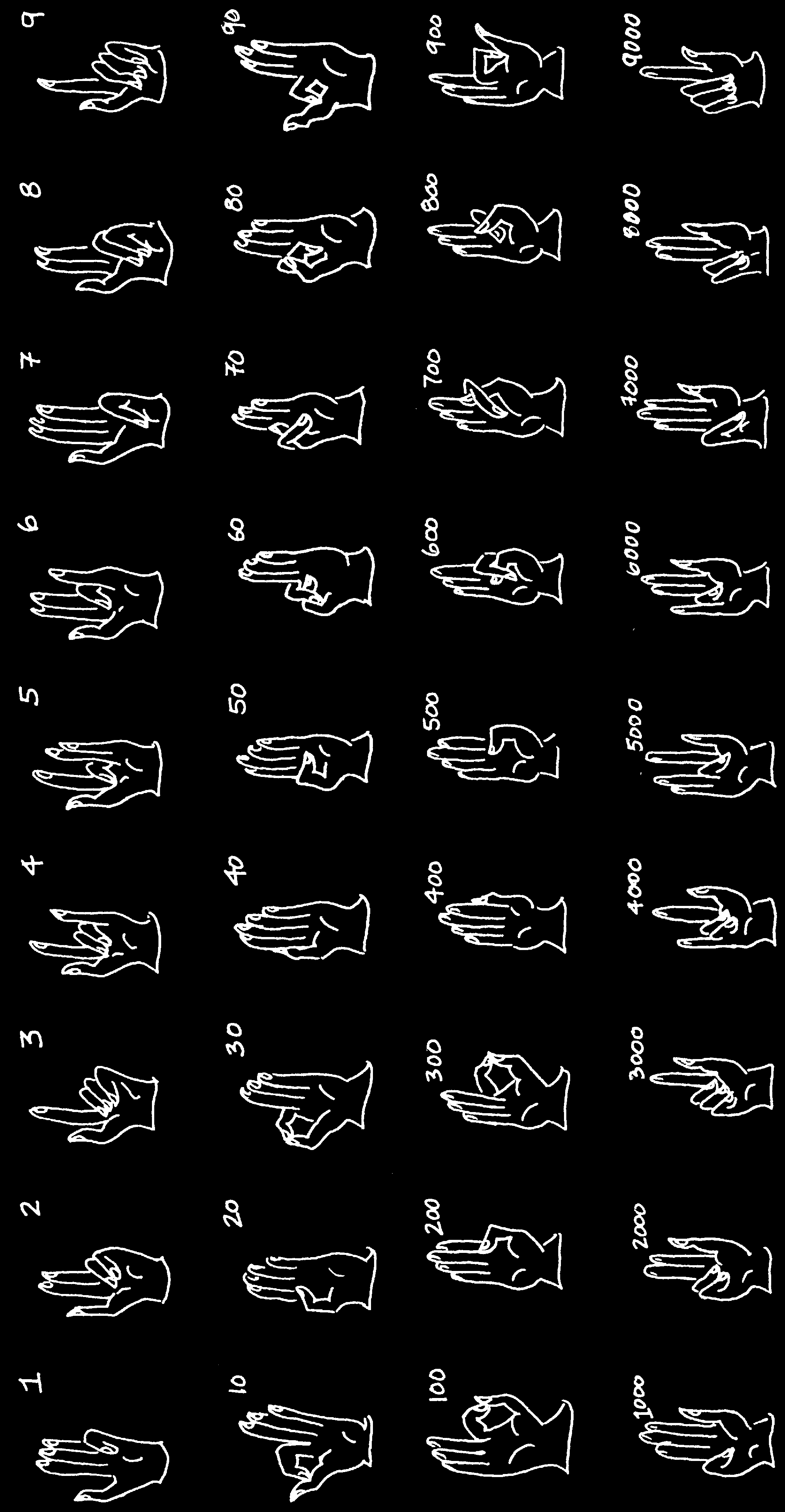
290, fol. 31r. The perspective is that of the calculator looking down at his own hands.
COMMENTARY
the larger numbers must have been employed only for representation.6
Exactly how calculations could have been performed using computus digitorum is not explained in ch. 1, but elsewhere in The Reckoning of Time, Bede gives us some clues. First, Bede knew how to make composite numbers: that is, he could represent numbers in two ranks on the same hand. His code for secret communication translates letters into numbervalues based on alphabetical position (A=1, B=2, etc.), with which one could literally cipher messages to a friend across a crowded room without anyone overhearing, by making number-signs for the coded letters upon the hands. One has to use composite numbers to do this, because there are 23 letters in the Latin alphabet, and indeed Bede's example uses composite numbers. This game, if such it is, may also have deep antique roots: in Martianus Capella's De nuptiis Philologiae et
Mercurii (a text not known to Bede), Lady Arithmetic salutes Jupiter by making the number 717 on her ¢ngers, which is the numerical value of the letters in his title Z\ a'rwZ¤ , ''The First''.7 The Roman counters or tesserae studied by Elisabeth Alfo« ldi-Rosenbaum likewise depict composite numbers.8 The number 12, for instance is made by forming 2 with the last ¢ngers, and 10 with the thumb and fore¢nger.
But if Bede used composite numbers, he must also have been aware of another feature of ¢nger-reckoning: its place-system. Each rank of numbers has a ¢xed ¢eld: units on the last three ¢ngers (digiti) of the left hand, tens on the joints (articuli) of the left thumb and index ¢nger; hundreds formed by analogy with the tens on the right hand, thousands by analogy with the units.9 Moreover, it also has an implicit zero. If in any rank the ¢ngers are simply held upright and relaxed, no numbers are to be read in that rank.
6 In Hom. 2.2, Bede is explaining the mystical signi¢cance of the 5000 who were fed with the loaves and ¢shes: Millenariusautemnumerusultraquemnullanostraconputatio succrescit plenitudinem rerum de quibus agitur indicare consueuit . . . (''The number one thousand, beyond which no calculation of ours extends, customarily indicates the fulness of the things which are under consideration . . .'': 168.259^264). The conputatio alluded to here must be ¢nger-reckoning, since Bede could certainly count, and compute, numbers beyond 9999; cf. ch. 65, where he calculates the number of days in the 532-year Paschal cycle as 194,313.
7 7.729, ed. J. Willis (Leipzig: Teubner, 1983):261.11^13.
8 ''The Finger Calculus in Antiquity and in the Middle Ages. Studies in Roman Game Counters I'', Fru« hmittelalterliche Studien 5 (1971):1^9.
9 Karl Menninger, Number Words and Number Symbols: A Cultural History of Numbers, tr. Paul Broneer (Cambridge, Mass.: M.I.T. Press, 1969):205.
THE RECKONING OF TIME
But how were calculations actually performed? No ancient source reveals the secret, nor has any convincing modern reconstruction been advanced. The most ambitious attempt at a hypothesis is that of Karl
Menninger. His analysis is based on St Augustine's sermon on the miraculous draught of ¢shes, where Augustine says:
Count for yourselves and ¢gure as follows: 10 and 7 make 153, for if you count from one to seventeen and add together all the numbers ^ 1, 2, 3: 1 and 2 and 3 are 6; 6 and 4 and 5 are 15 ^ you
¢nally arrive at 17 and carry 153 on your ¢ngers.10
Menninger comments: ''Thus as one counts up to 17, the ¢ngers constantly join together the previous numbers until they ¢nally 'carry'
153. This example is very important, for it reveals the main purpose of ¢nger-counting: to record temporarily the intermediate sums in mental arithmetic . . .''.11 It is true that the procedure for calculation involves
''constantly joining together'' a sequence of numbers and then ''reading'' the results in the hand, but it seems probable that this involves something more than ''temporarily recording the intermediate sums in mental arithmetic''. Computation with the Roman system must have exploited the place-value inherent in the calculating hand, for while mentally adding together 1, 2 and 3 seems simple, how wouldAugustine's parishioner have performed the last operation in the exercise, namely adding 17 and 136? It is doubtful that he did it in his head. Rather, the ¢ngers must have been used to actually tabulate the addition, rank by rank.
I would propose the following reconstruction of the process. To add 17 to 136, begin by showing 136 on one's hands. Then add 7 to the 6 already on the digiti of the left hand. One might know by heart that 7 and 6 make 13, but even if one did not, one had simply to count forward
7 places on one's ¢ngers, tally-fashion. When one reaches 10 on the digiti (i.e. after counting forward four steps), one carries the 10 over to the articuli, and adds this 10 to the 30 already shown on the articuli by 10 Apudvosnumerate;siccomputate. Decem etseptemfaciuntcentum quinquagintatres:siverocomputes ab unoad decemetseptemetaddas numerosomnes^unum, duo,tria: sicut unum et duo et tres faciunt sex; sex, quattuor et quinque faciunt quindecim: sic pervenes usque ad decem et septem, potans in digitis centum quinquaginta tres. Sermo 270.7 (PL
38.1245).
11 Menninger 210; he is repeating here the judgement of Moritz Cantor, Vorlesungen u« ber Geschichte der Mathematik, 3rd ed. (Leipzig: Teubner, 1907):1.829.
COMMENTARY
moving the articuli up one notch, raising the total on the articuli to 40.
One then ¢nishes the count to 7 on the digiti, for a total of 3. Finally, one adds the 10 of 17 to the articuli by moving the articuli forward one notch, raising the total to 50. The computation being ¢nished, one looks at one's hands, as Augustine says, and reads the ''digital display'': 153.
All you need to know in order to ''add'' is the sequence of the ¢nger positions ^ in short, how to count on your ¢ngers. With the ¢ngers recording one's count, one can temporarily ''forget'' the ¢rst number and concentrate on keeping a running total on the ¢ngers. It is rather like pressing
''+1'' over and over again on a modern electronic calculator, and then reading the result on the liquid crystal display. Subtraction can be done by reversing the addition method, and one can even multiply, provided multiplication is performed as a series of additions: i.e. 763 is performed as 7 + 7 + 7. This is of course a very laborious way of multiplying, but the only alternatives were memorizing the multiplication table or consulting a multiplication table in a book.12 If one was incapable of the one and had no access to the other, multiplication by additions was still possible by ¢nger-reckoning. Division would be carried out by analogous procedures. For the computist, division usually meant dividing the AD ^ a threeor four-digit number ^ by 19, 28 or 15, to ¢nd the position of any given year within the lunar, solar or indictional cycle.
Elsewhere in The Reckoning of Time, Bede furnishes verbal descriptions of the calculating process which reveal something of how ¢ngercomputation might have functioned for medieval computists. In chapter 22, he gives the following formula for ¢nding the age of the Moon:
If you wish to know how old the Moon is on this or that day, count the days from the beginning of January up to the day you want, and when you know this, add in the age of the Moon on the kalends of January. Divide the total by 59, and if more than 30 remain, subtract 30. What is left over is the day of the Moon you are seeking . . . So, for example, if you wish to know what the Moon is on the kalends of May in a year in which the Moon is nine days old on the kalends of January, say ''May: 121 on the kalends''. Subtract the [day of the] kalends, and 120 remains;
12 Edward Bechtel suggested that the Romans multiplied by successive addition even on the counting-board: ''Finger-Counting Among the Romans in the Fourth
Century'', Classical Philology 4 (1909):31.
THE RECKONING OF TIME
add 9, and that makes 129. Divide by 59: 59 times 2 is 118. Subtract 118 and 11 remain. The Moon is 11 days old on the kalends of May . . . In using this formula, it is helpful if the calculator commits the products of the ¢fty-nine-times table to memory . . .
Helpful indeed, but not strictly speaking necessary. Notice the terms in which Bede describes the process of division. First one ''says'' the dividend out loud because one cannot show it on the hands, so one will have to ¢x it in the memory. It will be recalled that in describing the ¢nger positions, Bede likewise instructs his pupils to ''say'' the numbers as they form them, so that they can engrave the connection between the number and the symbol in their memory. The next step is the actual process of division, which takes place as a sequence of multiplications up to a point where the next multiplication would produce a product in excess of the dividend: Bede ''divides'' by multiplying 59 by 2, and when he realizes he cannot go any further, subtracting the product from the dividend to ¢nd the remainder. Hence he recommends memorizing the 59times table. However, this can even be done by successive additions should one not know the 59-times table by heart. Once you have this product, you can subtract it from your memorized ¢gure for the number of days between 1 January and your date.
If computusdigitorum was indeed used for calculations, why did Bede not tell his students how to perform it? One answer may be that he was constrained by his sources. Finger-reckoning is nowhere expounded in ancient scienti¢c literature, because it is a technique of practical reckoning, without relevance to mathematics as a science;13 nonetheless, literary allusions to its practice abound.14 The earliest Latin description is found in the Irish computus anthology used by Bede, the so-called
''Sirmond manuscript''. This Romana computatio15 merely describes 13 Jones (''Bede's Place'', 279, n. 29) notes that it is for this very reason that ¢ngerreckoning and later, abacus texts appear in computus manuscripts. Computus was ''vocational'', not discipine-based: c.f. Introduction, section 2.
14 See anthology assembled by Williams and Williams.
15 Edited by Jones in Bedae pseudepigrapha: Scienti¢c Works Falsely Attributed toBede (Ithaca and London: Cornell University Press,1939):106^108,and in BOD 671^672.
For English translation, see Williams and Williams 605^606. Two other versions of this early text survive in the ''Bobbio computus'', Milan Ambrosiana D.150 inf. (Bobbio, s. IX) and in London, British Library Cotton Caligula A.XV (n. France, s. VIII), from which latter MS the text was transcribed and discussed by Alfred Cordoliani, ''A propos du premier chapitre du De temporum ratione de Be' de'', Le moyen a" ge, 54 (1948):209^223. For
COMMENTARY
the positions representing the various numbers, and says nothing about operations. For this reason, Bede may have felt unsure about how to put the operations into words. Bede claims that he often found it di⁄cult to reduce mathematical procedures to prose,16 but his silence is also evidence that he expected that many people knew how to do ¢nger-calculation, and how to teach others to do it. Perhaps as well, the technique of calculation was only taught to some advanced and dedicated students.
At the very outset of chapter 1, Bede admits that there was some resistance to learning ¢nger-calculation, and elsewhere in The Reckoning of Time, he half-heartedly provides alternative methods for students who cannot, or will not, learn to calculate. Had he subjected all his readers to a full-dress explanation of ¢nger-reckoning in ch. 1 of The Reckoning of Time, few would have had the courage to go on to ch. 2.
The usefulness of the system had ultimately to be justi¢ed, not in mathematical terms, but by invoking patristic exegetical authority. For this reason, Bede paraphrases Jerome's exegesis of the Parable of the Sower. The thirty-, sixtyand hundredfold yield of the seed which falls on good ground is interpreted as three states of life ^ marriage, widowhood, and virginity ^ and each state of life is symbolized by the ¢ngerposition representing its number.17 Having convinced his students that knowledge of ¢nger-reckoning is not only relevant, but endorsed by patristic authority, Bede can proceed to at least indoctrinate the basic positions.
The second system described in chapter 1 is that of the Greek letternumerals. Bede refers to this system as computus Graecorum, possibly the numbers above 9,999, the London manuscript di¡ers from the Milan and ''Sirmond'' codices, and Bede's text agrees with the London version. There is also a tabular depiction of ¢nger-reckoning reproduced in PL 90.693. Abbe¤ Lejay, in an important study of this chapter (Compte rendu du quatrie' me congre' s scienti¢que international des catholiques
[1897], vi sect., sc. philol. [Fribourg, 1989], pp. 129^136), believed that this form was created by Hrabanus Maurus (cf. PL 107.673^674). But as Jones points out, there are numerous manuscripts of this table dating from the early 9th century (BOT 329^330). All the manuscripts listed by Jones have Insular links, so this version, like the Romana computatio itself, may also have originated in the British Isles.
16 See Introduction, n. 40.
17 Jones, ''Some Introductory Remarks on Bede's Commentary on Genesis,'' particularly his remarks on the symbolism of 30 (172) and 100 (173). This allegory certainly caught the attention of Bede's readers: see Brian Stock and Edward Synan, ''A TenthCentury Preface to Bede's De temporum ratione'', Manuscripta 23 (1979):113^115.
THE RECKONING OF TIME
to distinguish it from Romana computatio. It consists in assigning a single letter of the Greek alphabet to each digit from one to ten, then to each of the tens to 90, and of the hundreds to 900. Since this requires 27 symbols, and the Greek alphabet contains only 24 letters, the symbol called e'pi¤Zsmon or stigma was used to represent 6, the archaic letter koppa stood for 90, and a symbol which Latin-speakers called ennacosi was employed for 900: this last term is actually the Greek word for 900, e'nako¤ sioi. The advantage of this system, as Bede himself declares, is that it employs a single and distinct siglum for each number within each rank. Therefore when compound numbers are written vertically, the place columns will align, which permits one to add each column and carry the excess to the next column. Curiously, however, Bede presents the Greek letter-numbers, not as a system for ciphered computation, but as a substitution-code. Like the substitution-code described in connection with ¢nger-reckoning, the position of the letter within the alphabet determines its numerical value. Once again, the modern reader will be taken aback by what seems a rather irrelevant and frivolous application of an arithmetical technique ^ all the more so in this case, in that no arithmetical application is o¡ered.
Indeed, Bede and his contemporaries would probably have encountered the Greek letter-numbers only as a code, in the so-called litterae formatae. These were o⁄cial documents ^ in the early Middle Ages, usually papal or episcopal ''passports'' for travelling clergy ^ which were protected from forgery by a special numerical cryptogram. If the numbers of the cryptogram were resolved according to the computus
Graecorum, they would yield the initial letters of the sender, recipient, place of origin, and date.18 The regula formatorum actually ascribed the system to the 318 Fathers of the Council of Nicaea ^ the same 318 who, according to Dionysius, legislated the 19-year Paschal cycle.19
18 Clara Fabricius, ''Die litterae formatae im Fru« hmittelalter'', Archiv fu« r Urkundenforschung 9 (1926):168^194.
19 Until recently, it was believed that some Irish ecclesiastical centres, notably
Bangor, converted to the Dionysian reckoning as early as 610, the year when Mo-Sinnu moccu Min, abbot of Bangor, died. According to a note in an 8th-century Irish manuscript of the Gospel of Matthew, now Wu« rzburg Universita« tsbibliothek M. p. th. fol. 61, he was
''the ¢rst of the Irish who learned the Computus by heart from a certain Greek''. His disciple, Mo-Chuaro¤ c later ''committed this knowledge in writing, lest it should lapse from memory''. Jones and others concluded that this Greek computus was Alexandrian reckoning,but this hypothesis has been refuted by O¤ Cro¤ in|¤n,whowas the ¢rst totranscribe the full
COMMENTARY
Strictly speaking, computus Graecorum has nothing to do with the calendar, or even with calculation: Bede states that it is useful for cryptography, not computation.20 Nonetheless, Bede's inclusion of the Greek numerals in The Reckoning of Time did result in their being used by computists, albeit neither as a mode of calculation nor as a substitutioncode. Until the early twelfth century, Greek letter-numbers were not uncommonly used in computus tables, in preference to, or in parallel to,
Roman numerals. Why the designers of these tables preferred Greek numerals is not altogether clear. A plausible explanation is that they are more compact, and therefore easier to inscribe into the restricted and inelastic spaces of a grid, than are Roman numerals. They could also be read more quickly and easily, and mistakes in transcription were less likely.21 But some computists, such as Abbo of Fleury (d. 1004) designed parallel versions of tables in both Greek and Roman notation.22 This would suggest that their use was regarded as a kind of esoteric technique or quasi-secret knowledge, even when the intent was not cryptographic. text of the Wu« rzburg note. The ¢nal sentence of the note identi¢es the ''computus'' which Mo-sinnu learned as nothing more or less than the Greek system of letter-numerals described by Bede's computus Graecorum, for it closes with an explanation of the three additional symbols of episinon (e'pi¤ sZmon, i.e. stigma), koppa, and enacosse (e'nako¤ sioi),
''which the Greeks insert in amongst the letters, lest the order of the numbers be disturbed''.
(Sed tamen inseruntur apud Grecos inter literas, ne turbetur ordo numerorum): ''Mo-Sinnu moccu Min and the Computus of Bangor'', Peritia 1 (1982):290.
20 O¤ Cro¤ in|¤n (ibid.) argues that these Greek letter-symbols were an adjunct to ¢nger-computation and learned as part of that system. But there is no functional link between the two at all. Finger-computation, indeed, would be unnecessary if Greek letternumerals were actually used for arithmetic. Moreover, tracts describing the two systems are rarely fused in the MSS: in Bede's own ''Sirmond'' compilation, for instance, the Greek letter-numerals are found on fol. 61v, and the Romana computatio on fols. 97v^98r.
21 These advantages are signalled by the Laon-Metz glossator: Facilius enim cognoscunt Greci numerum ex suis literis quam nos ex nostris, quia unusquisque numerus apud illos habet suam propriam literam per quam intelligatur. Latini autem no intelligunt numeros nisi paucis literis isdemque etiam geminatis. (''The Greeks learn number[s] more readily from their letters, than we do from ours. For with them, each number has its own proper letter, through which it is recognized. The Latins do not recognize numbers save by means of a very few letters, but these doubled'': 272 ad lineam 80).
22 See tables from his computus reproduced by Migne amongst the works of Bede in PL 90.735^736, 741^742.
THE RECKONING OF TIME
Chapter 2:
In ch. 2, Bede introduces a second propaedeutic theme: the various modes in which one can speak about time. Though the chapter as a whole follows Bede's Irish source De divisionibus temporum (PL 90.653 sqq.), the distinction between natural, customary (or conventional), and authoritative time-reckoning is original to Bede, and one which is critical to his understanding of computus. Some divisions of time are imposed by the natural movements of astronomical time-markers, such as the solar year of 365ˆ~˘ days; others derive from convention (Bede's example of the 30-day ''month'' is a good one); and others are legislated by human or divine authority, such as the Olympiad or the Jubilee. Terms like ''year'' or ''month'' can therefore have di¡erent meanings, depending on the mode of time-reckoning to which they refer.
What is noteworthy in this chapter is Bede's consciousness of ''nature'' as a separate, autonomous, yet God-created system of laws for the natural universe. There is, so to speak, a whole ''natural system'' of time, separate from the system legislated by religious law. Indeed,
Bede almost personi¢es nature when he says that ''with nature as our guide'' (natura ducente) we learn a di¡erent value for the length of the year from that which calendrical computation dictates. This distinction, already enunciated in On Times 1, and reiterated in Letter to Wicthed
7,23 was appreciated by Bede's readers.Commenting on Bede's statement in the preface that he intends to discuss ''the nature, course and end of time'', the Laon-Metz glossator remarks:
All that is contained in this book concerns time. For the status of times is contained in the natural order of hours, days, weeks, months, years and cycles, which ever return upon themselves when the natural circle is completed. For it is according to nature that the day has 24 hours, the week seven days, and so forth. Thus the day returns after 24 hours, and so forth. But the course of time, that is, the various actions of men, are contained in the chronicles which are in the second part of this book [i.e.
The Reckoning of Time ch. 66]. And the end of time is contained 23 In the case of the Letter to Wicthed, the issue is the leap-year increment, which secundum naturam accrues at the end of the solar year (i.e. at the spring equinox) but which ''human custom'' inserts at arbitrary and varying dates.
COMMENTARY
in the end of this book, where [Bede] treats of the Seventh and Eighth Ages.24
There is a distinction to be drawn, then, between the ''nature'' of time, its ''course'' (which is human history) and its ''end''. Nature obeys immutable, repeatable laws, and natural time £ows in predictable cycles; historical time, on the other hand, is linear, and frames the distinct, irreproducible actions of men.
The early medieval period is not generally credited with such an understanding of nature. Studies like Charles Radding's A World Made by Men,25 or Giselle de Nie's Views from a Many-Windowed Tower26 argue that the early Middle Ages did not conceive nature as a category apart from divine intervention, or as a system characterized by regular and repeatable laws. Their conclusions are certainly not entirely mistaken. However, as Bede's text demonstrates, a concept of autonomous and regular nature was never ''lost''. Indeed, it was to some degree consciously resisted by a new Christian ideology of the physical world. The main concern of this ideology was that acknowledging the autonomy of nature was an invitation to divinizing her. This threatened the idea of divine providence and omnipotence, particularly as manifested in miracles,27 and might even suggest the validity of magic. For this reason, Bede explicitly denies the divinity of nature. As far as time goes, ''nature'' is what God created on the fourth day, namely the planets and stars that he made to be the signs of seasons, days and years. ''It is not,'' he adds, ''as the folly of the pagans asserts, a creating goddess, one amongst many.''
24 Quae omnia continentur in isto libro qui est de tempore. Status temporum autem continetur in naturali ordine horarum, dierum, ebdomadarum, mensium, annorum, ciclorum, qui in se semper peracto naturali circulo reuertitur. Natura estenim ut dies habetxxiiii horas, ebdomada vii dies, reliqua. Ergopostxxiiii horas reuertiturdies, sic et reliqua. Cursus autem, id est diuersi actus hominum, in chronicis continetur quae sunt secunda pars huius libri. Finis uero temporum in ¢ne istius libri, ubi de viia et viiia aetate tractauit, continetur. (263, ad lineam 7).
25 Chapel Hill: University of North Carolina Press, 1985.
26 Amsterdam: Rodopi, 1987.
27 On the early medieval debate over ''nature'' in the context of medicine, see Faith Wallis, ''The Experience of the Book: Manuscripts, Texts, and the Role of Epistemology in Early Medieval Medicine'', in Knowledge and the Scholarly Medical Traditions, ed.
Don G. Bates (Cambridge: Cambridge University Press,1995):117^124, and literature cited therein.
THE RECKONING OF TIME
Yet at the same time, Bede follows the lead of the Irish cosmographers of the seventh century in carving out a new role for nature. No longer the governing deity of the lower world, nature is now God's law and instruction to His creation. Natural time was ''hard-wired'' into the heavens on the fourth day of Creation; even the miracles of the Sun standing still on Gibeon (Joshua 10.12^14), or the shadow moving backwards up the Temple steps for King Hezekiah (II Kings 20.1^11) cannot stop time's course. Indeed, when God came to the aid of Joshua's troops, he took care to stop the Moon, as well as the Sun, precisely so as not to dislocate the rhythm of natural time.28 Dethroned from the pantheon, deprived of a name and identity, nature resurfaces as, if anything, more powerful and unshakable than before. Indeed, Marina
Smyth suggests that the very orderliness of computus may have reinforced the belief that the celestial world was one of absolute order.29
The Reckoning of Time shows how computus furnished a setting for a discussion (however circumscribed and cautious) of ''nature'' in the early
Middle Ages. Though Bede's contemporaries certainly understood what he was talking about, it was the computists of a later age who re£ected most deeply on this theme. Virtually every major treatise written after 1100 begins with an explanation of the distinction between ''natural'' and ''authoritative'' computus.30 By then, however, with the arrival of new texts on astronomy through the Arab world, and in particular with the discovery of astrology, it had become plain that the kind of reckoning required for the Church's calendar was substantially di¡erent from that demanded by astronomical measurement or astrological calculations.
In particular, the former dealt only in whole days; the latter, in fractions of days.
This is not to suggest that Bede shows no interest in divisions of time smaller than a day, or in fractions; indeed, the remainder of the technical propaedeutic of The Reckoning of Time is devoted to these subjects.
28 Smyth 160^165, 169; cf. Bede, In Regum librum XXX Quaestiones 25, ed. D.
Hurst, CCSL 119 (1972):316^317.
29 Smyth 171.
30 The outstanding example is the Computus of Sacrobosco, but it is found in 11thand 12th-century antecedents, such as the unpublished treatises of Gerlandus and of ''Magister Cunestabulus''. I am preparing an edition of Gerlandus, and Dr Jennifer
Moreton one of Cunestabulus.
COMMENTARY
Chapter 3:
Chapter 3 discusses intervals of time smaller than the day, the basic unit of computus. These include the hour, de¢ned in both its sundial sense and its astronomical sense. Ancient sundials were divided into twelve equal segments, so that the entire span of daylight, be it long or short, was divided into twelve hours. These were called ''arti¢cal'' hours, because they were de¢ned by the arti¢ce of the sundial. Of course, an ''hour'' in winter would be shorter than an ''hour'' in summer.
''Natural'' hours, or as Bede terms them, ''equinoctial'' hours, are of a constant length, namely 1 24 of a day. There are more equinoctial hours of sunlight in summer, fewer in winter.
Bede assumes that his reader is familiar with both kinds of hour.
While monks may have used sundial hours for managing their daily round,31 the calendars in their computus manuscripts would have made them aware of equinoctial hours, for one of the conventional addenda to the monthly calendar page was a note on the number of equinoctial hours of daylight and night in that month.32 Another common feature of computus manuscripts, the horologium, showed this variation in diagrammatic form.33 Certainly, whatever convention was used for daily life, the student of computus needed to know about equinoctial hours, for they were the basis of all smaller divisions of time. It is also noteworthy that in his discussion of the hours of moonlight through the course of the lunar month (ch. 24), Bede uses only equinoctial hours.34
The intervals of time described in this chapter include the punctus 31 But see J.D. North, ''Monasticism and the First Mechanical Clocks'', in The Study of Time, Proceedings of the Second Conference of the International Society for the Study of Time, 1973 (New York: Springer, 1973):381^398. North argues that monks were pioneers in the development of mechanical clocks precisely because they preferred both to conceive of and to manage time in terms of ''equinoctial'' hours.
32 Every calendar included by Francis Wormald in his English Kalendars Before A.D. 1100 contains such an addendum stating, e.g., that night in May is 8 hours long, and day 16 hours long.
33 E.g. PL 90.953^954.
34 Max Lejbowicz argues that by using the term ''equinoctial hours'', Bede reveals the essentially unquantitative cast of his thinking, for ''equinoctial hours'' invokes a concrete experience of time on a certain day, the equinox, not an abstract unit of measurement:
''Poste¤ rite¤ '', 6^7. However, the fact that Bede not only described the equinoctial hour but used it in calculations would seem to contradict this hypothesis. The ''equinoctial hour'' is precisely the abstraction used for computation, while the unequal hour is the lived experience of time.
THE RECKONING OF TIME
(one-quarter of an hour), the minutum ( 1 10 of an hour, i.e. six minutes of our time), the pars ( 1 15 of an hour, i.e. 4 minutes of our time), the momentum ( 1 40 of an hour, or 1.5 minutes).35 Signi¢cantly, Bede points out that these divisions are conventional rather than natural; they were invented out of the necessity to divide the hour into segments of various lengths for the purposes of calculation, and the names are arbitrary.
After explaining the etymology of these terms (following Isidore), Bede reinforces his point about their conventional character by pointing out that astrologers (mathematici) use virtually the same terms, but with rather di¡erent meanings. For example, an astrological punctus is 1
12 of an astrological pars, which is 1 30 of a zodiac sign, or in other words, one day; hence an astrological punctus is two equinoctial hours.36
It should be pointed out that Bede evidently understood what ancient technical astrology purported to do, and rather ostentatiously disclaimed it. Like the notion of nature, technical astrology may not have been as unknown to the early Middle Ages as is sometimes asserted, and Bede's denunciation seems more than mere convention.37 His
35 On the ancient background to these divisions, see P. Tannery, ''Sur les subdivisions de l'heure durant l'Antiquite¤ '', Revue arche¤ ologique 26 (1895), rep. in his Me¤ moires scienti¢ques, vol. 2 (Toulouse: Privat, 1912):517^526; Grumel, Chronologie 164^165; on the momentum, see F. de Gandt, ''E¤ bauche d'une notice sur momentum'', Documents pour l'histoire du vocabulaire scienti¢que, no. 1 (Paris: Editions du CNRS, 1980):1^20; Robert
Steele, Compotus fratris Rogeri, Opera hactenus inedita fratris Rogeri Baconi, fasc. 6
(Oxford: Clarendon Press, 1926):290^291.
36 Jones asserts that Bede's use of the term punctus is ''confusing'', because it means something di¡erent in this passage from its meaning in his enumeration of the computistical divisions of the day given above. But that is precisely Bede's point: these terms are conventional, not natural, and can be arbitrarily de¢ned according to any system. As Bede states with reference to the atomus, it means something di¡erent to a grammarian and a computist. Bede also points out that punctus means ˆ~˙, not ˆ~˘ of an hour when it is the Moon which is being reckoned (cf. ch. 17), a variation which did, indeed, sow some confusion amongst computistical writers: see BOT 333.
37 Lejbowicz, ''Poste¤ rite¤ '' 17^19, argues that Bede objects to the mathematici primarily because they spatialize divisions of time by assigning them to the zodiac and ecliptic, and because they claim to be able to measure in¢nitesimally small units. While such arguments appear in patristic literature, I do not think they are exactly Bede's. Bede after all claims that the computists (calculatores) make strict distinctions between momentum, punctus and atomus, though ordinary usage treats them as synonyms. It is the astrologers' claim to deduce the fate of the newborn from the position of the stars that draws his criticism, not the division of the zodiac per se. The conventional argument that technical astrology was unknown in the early Middle Ages is represented by J. Tester, A History of Western Astrology (New York: Ballantine, 1987):ch. 3, and McCluskey, Astronomies 145^
COMMENTARY
concern about astrology will re-emerge in chs. 11 and 16, when he discusses the signs of the zodiac. What is noteworthy here is that while
Bede decries the pretensions of astrologers to predict fate from the stars, he does not mention the classical argument that man's free will transcends celestial determinacy. Possibly he felt nervous about the associations of this idea with Pelagianism.38
What is the purpose of learning these divisions? Bede does not answer this question directly, but his response is implicit. Computists have to resolve their cycles into whole days in order to establish a calendar. On the other hand, arriving at the correct number of whole days will involve calculating not only fractions of days, but even fractions of hours, as is the case with the saltus lunae, the calendrical correction in lunar reckoning at the end of the 19-year Easter cycle.39 The evidence of the computus manuscripts suggests that teachers drilled their students in these terms.40 Certainly, the fact that these units were studied and discussed is of the utmost importance for the history of computus, and perhaps even for the history of science. The critique of conventional computus launched in the eleventh century most notably by Gerlandus
Compotista rested on the idea that the problems in lunar reckoning which were causing the Church's calendar to become embarrassingly out of phase with astronomical reality could only be detected and corrected by calculating lunar and solar periodicity at a very minute level. That Bede furnished and sanctioned the tools for such a calculus allowed Gerlandus to claim that his new computus was quite conventional. In fact, Gerlandus was moving towards a new de¢nition of timereckoning as a scienti¢c problem, concerned not with the calculation of Easter, but with the calculation of eclipses.41
149; for a revisionist perspective, see Valerie I.J. Flint, The Rise of Magic in Early Medieval
Europe (Princeton: Princeton University Press, 1991):esp. ch. 6. Astrology, however, seems entirely absent from Bede's Irish source-material: see Smyth 172.
38 Lejbowicz, ''Poste¤ rite¤ '', 22.
39 Cf. The Reckoning of Time, ch. 42.
40 For examples, see Jones, BOT 331^332.
41 The content and signi¢cance of Gerlandus' treatise will be discussed more fully in my forthcoming edition. Note that Alfred Cordoliani, ''Notes sur un auteur peu connu:
Gerland de Besanon'', Revue du moyen a" ge latin 1 (1945):411^419, and ''Le comput de
Gerland de Besanon'', Revue du moyen a" ge latin 2 (1946):309^313, are to be used with caution, as he confuses Gerlandus the computist with Gerlandus of Besanon, a 12thcentury scholasticus.
THE RECKONING OF TIME
Chapter 4:
The ¢nal section of the technical propaedeutic concerns duodecimal fractions. Such fractions would be used in much the same context as the smaller divisions discussed above, i.e. in the calculations designed to resolve varying cycles into whole days, or in explanations of how such cycles work.42 Bede's purpose here is essentially to clarify terminology, especially since (as he points out) young pupils tend to misuse the terms.
The terminology is fairly complex, as Romans had separate words for the fraction itself, and for the remainder of the unit, e.g. uncia =
12, deunx = 11 12, quadrans = 1 4, dodrans = 3 4.
A unique feature of Bede's discussion is the number of synonyms he knows for di¡erent kinds of fractions, e.g. libra, as and assis for ''pound''. This suggests that he drew on a number of sources for this chapter.43 Like ch. 1, ch. 4 frequently circulated separately in computus anthologies.44 The fractions took on a new lease on life in the eleventh century, when they were revived by Abbo of Fleury (cf. Bern MS 250, fol. 11v) and Gerlandus Compotista to calculate lunar periods. An editor of On Times, quite possibly Abbo, actually inserted them into Bede's text (cf. British Library Egerton 3088, fol. 79r, and Cotton Tib.
E. IV, fols. 134v^135r).
Noteworthy as well is Bede's concern to make the study of numbers relevant to the reading of Scripture, while at the same time turning his reading of Scripture commentaries into material for his scienti¢c interests. The coherence of Bede's interests illustrates doctrina christiana in practice: reading Philip's commentary on Job, he discovers information on tides; commenting on the word semis, he recalls its appearance in the description of the Mosaic tabernacle.
Chapter 5:
The Julian calendar is essentially a list of days, and computists do not commonly deal with units of time smaller than a day. Nonetheless ch. 5,
42 Bede in fact uses these fractions rather seldom inTheReckoningofTime, e.g the bisse (˜~¯) in ch.16, or the quadrans in ch. 38. Jones (BOT 334) judged this chapter to be a relic of computi produced for the Roman 84-year cycle,which lent itself especially to duodecimal division, especially as the saltus fell in the 12th year of the cycle.
43 The synonyms suggest a grammatical source, perhaps a lexicon: cf. Florence Yeldham, ''Notation of Fractions in the Earlier Middle Ages'', Archeion 8 (1927):313^329.
44 Cf. Jones, ''Byrhtferth Glosses'', 85^86.
COMMENTARY
''The Day'', follows logically from the preceding chapters in that itbegins by focusing on terminology, and particularly on the distinction between conventional and specialized usage. Both the ordinary de¢nition of ''day'' as ''period of daylight'' and the scienti¢c meaning of ''period of 24 hours'' are sanctioned by Scripture. This is not only an important issue for Bede personally, but a premiss of Christian learning, as de¢ned by the Fathers, and especially Augustine: all knowledge, human and divine, is a unity, and apparent disparities ¢nd their resolution in revealed authority. Nonetheless, it is interesting that in ch. 3, Bede reminds his readers that Christ himself used ''unequal hours'', before demoting them to the rank of mere human convention; later, in ch. 24, he will imply that thinking in terms of unequal hours is vulgar, and something which computists should avoid as ''unprofessional''. In this chapter as well, scienti¢c usage is promoted at the expense of the ordinary de¢nitions.
Scripture is also the framework in which scienti¢c curiosity and erudition comes into play. Bede provides an excellent illustration of this in his discussion of what ''day'' means in those passages of Genesis referring to the time before the creation of the Sun. The problem really lies in the ¢rst few verses of the Creation account. The narrative opens by stating that God ''created heaven and Earth'', and then goes on to state that the Earth was unformed and chaotic. Are the initial verses a summary of the entire Creation story, or do they form a temporal sequence with the statement about the Earth's chaotic form? Like Augustine in De doctrina christiana, Bede feels that there are a number of legitimate and orthodox ways of interpreting these passages.45 One of them, adopted by Augustine himself in De Genesi ad litteram, was allegorical.
Augustine's premiss is that the initial verses are recapitulatory. Since there is as yet no division between heaven and Earth on the ¢rst day, there is no ''place'' for the primal light to come from or go to, so it cannot have behaved like the Sun and produced a conventional ''day''.
Bede reports this opinion, which indicates that he valued it.46 But he seems to prefer, or think his pupils will understand better, the more straightforward approach of ps.-Clement, Basil, Ambrose and Jerome: namely that the ¢rst verses denote temporal sequence, and that the 45 De doctrina christiana 3.27.38 (99^100).
46 I disagree with Jones (BOT 335^336) who thinks that Bede is challenging Augustine here. Bede normally avoids disagreements with his authorities by passing over contentious matters in silence. That he cited Augustine at all indicates that he approved of him.
THE RECKONING OF TIME
heavens, Earth and ''abyss'' were separated at the very outset of Creation. The angels were created before man, and therefore heaven must have already existed as their home, as well as a place from which Lucifer could be cast out. There is thus a ''place'' through which the primal light can move, to ''make'' a day.
Bede then o¡ers his own contribution to the patristic dialogue. The primal light on the ¢rst day rose in the east, between heaven and Earth, and illuminated every corner of the Creation, even the depths of the sea.
This last is not as improbable as it may seem, Bede avers, for one can see into the depths of the ocean if one pours oil on the waters to create a smooth surface; moreover, at the beginning of Creation, when the primal waters had not been compacted together into seas, they would have been more limpid, and more permeable to light. And in the end, God's power can make light shine anywhere. What is noteworthy here is how Bede combines natural and supernatural explanations, without feeling obliged to choose or rank or compare them. The primal light orbited, and ¢nally set, just like the Sun; the only di¡erence was that it produced no heat, and because the stars were not yet created, it left absolute darkness in its wake. The idea of the ''primal light'' implies that the ''heavens'' created on the second day revolved once each day around the Earth, as they do now, and that they shone with the light created on the ¢rst day.
The ensuing discussion of the various starting-points of the day is not merely an antiquarian exercise but relates directly to computus. Like all historic peoples, Christians have their own starting-point for the day, de¢ned by Christ's Resurrection. Since this took place on the night between Holy Saturday and Easter Sunday, that night is counted into the following day, and so Easter is deemed to begin at sundown on Holy
Saturday. Since the Moon also changes its age at evening, a Moon 14 days old on Saturday will by 15 days old by Saturday evening, and the following day can be celebrated as Easter. Bede may also here be silently correcting a troubling statement in the Liber Anatolii. This text claims that the computistical lunar day begins at half past the sixth hour, i.e. about 12:30 p.m.47 Therefore if the Moon is 13 days old on Saturday, it will be well into its 14th day by the time Easter services begin on Saturday evening.48 Many genuine primitive Alexandrian texts ^ including the authentic statements of Anatolius incorporated into the Liber Anatolii ^
47 Ed. Krusch, Studien I, 320.
48 Ibid.; cf. Cordoliani, ''Computistes insulaires'', 12.
COMMENTARY
condoned celebrating on the 14th Moon. Bede was prepared to rationalize this,49 but had to draw the line at celebrating on the 13th day. Hence, perhaps, his concern to locate the change ¢rmly in the evening.
The new Christian de¢nition of day involves a synecdoche, or reading of the whole in the part. Christ spent three days in the tomb if one counts
Friday evening as comprising all of Friday, and Saturday night as part of Sunday. The manner in which Bede weaves a little lesson on ''schemes and tropes'' into this discussion is a good example of how
Bede understands the unitary quality of doctrina christiana, and how he borrows from exegesis to illuminate computus, and vice versa. But this digression also has implications for the theology that Bede is endeavouring to articulate. Christ's Resurrection changed time in every respect. It ushered in a new age of history; but it also changed the time when the day began. At Creation, the day began at dawn; but the last
Age of Earth was inaugurated by a mutatio temporis that, signi¢cantly, shifted the beginning of the day to the evening, so that time £ows from darkness into light, not from light into darkness.50
Chapter 6:
Chapter 6 may seem like a digression, but in fact it is integral to Bede's defence of the Alexandrian computus. Its computistical signi¢cance revolves around the equinox as terminus for the Paschal full Moon, and the consequences for the calendar limits of Easter.51 Bede's resolution of this problem, interestingly, rested on a natural rather than an authoritative argument.
Behind Bede's argument lies an ancient allegory: the week of the Passion replicates the week of Creation. Just as man was created on the sixth day of the ¢rst week, so was he re-created in the sacri¢ce of the Son of Man on Good Friday.52 Since Passover, the time of the historic Good
Friday, falls in the spring, it follows that the world was created in the 49 At the Synod of Whitby (HE 3.25 [304]), Wilfred explains away Anatolius' lower lunar limit of 14 by claiming that Anatolius really meant that Easter celebrations could begin on the evening of the 14th day, when the Moon turned 15 days old. Cf. ch. 43 below.
50 This theme is discussed by Bede again in The Reckoning of Time 71, and also in Hom. 2.7. This typology hangs, of course, on Bede's curious notion that the Jewish day ran from dawn to dawn: see ch. 5.
51 See Introduction, section 3.
52 Cf. The Reckoning of Time, chs. 10, 66 (introduction) and 71.
THE RECKONING OF TIME
spring.53 Ps.-Anatolius and others argued that the ¢rst day of Creation was the equinox itself, but Bede asserts otherwise. Day and night can only be said to be equal when there are hours by which they can be measured. The equinox occurred on the ¢rst day when there was a Sun and stars to mark those hours; this was the fourth day of Creation, when the heavenly bodies were made. The world, therefore, was created on 18 March, but the equinox was created on 21 March. But because the Moon was also created on 21 March, and God would not have made it in any other state than full, this ''¢rst day of time'' was also the very day when both the criteria for the Easter terminus were present: the equinox, and the full Moon. Since the full Moon will not rise until evening, the earliest date of Easter will be the following day, 22 March.
Bede goes on to clinch his argument by answering the objection that the ''days'' before the ¢rst ''day of time'' (the fourth day of Creation) were indeed days in the natural sense of the term ^ but days without hours.
Bede's sources for this argument are di⁄cult to trace. The closest parallel is the De pascha computus composed about 243, and falsely attributed to Cyprian of Carthage.54 ''Cyprian's'' theological explanation convinced the Romans, who clung for some time thereafter to 18
March as the earliest possible date of 14 Nisan: this is, in fact, Victorius' de¢nition of Nisan, which Bede will refute in ch. 51.
However, Bede's interest in demonstrating this point is also passionately theological. The correct computation of the date of Easter is, in his view, sacramental. It is the union of a sign with the reality it e¡ects:
''Observing the Paschal season is not meaningless, for it is ¢tting that by means of it the world's salvation both be symbolized, and actually come to pass.'' The equinox itself, which began with the rising of the Sun at dawn, was not su⁄cient; it required also the rising of the full Moon at evening. In this way, Bede elevates the criteria for Paschal computus, and particularly his own argument for the Alexandrian Easter limits, to the level of a theology of time. Celebrating Easter at a full Moon before the dawn of the equinoctial day, as Victorius proposed, reverses an 53 Bede would certainly have encountered this theme in Ambrose, Hexaemeron
1.4.13 (11 sq.), and Victor of Capua, De pascha 6 (298); cf. P. Siniscalco, ''Le eta' del mondo in Beda'', Romanobarbarica 3 (1978):310^320, and T. Halton, ''The Coming of Spring: A Patristic Motif'', Classical Folia 30 (1976):150^164. The motif has ancient pagan roots: cf. Vergil, Georgics 2.316 sqq.
54 See Introduction, section 3, p. xxxvii for an explanation of ''Cyprian's'' argument.
COMMENTARY
order inscribed at the beginning of Creation, and dissolves the symbolic relationship of grace which exists between Christ and his Church. It is, in short, a kind of calendrical Pelagianism.55
A theological perspective on computus also underpins Bede's championing of Abraham as the true father of astronomy. His immediate source for the story of how Abraham brought astrologia to Egypt is probably Isidore's Etym. 3.25, for though the Irish De computo dialogus also relates the tale, it is scientia numeri, not astronomy, that the patriarch invents. Both sources cite Josephus. The modi¢cations which Bede introduces, however, are very telling. Isidore states that the Egyptians invented astronomia (astronomical theory) and the Chaldeans astrologia
(applied astronomy), and that Abraham was the intermediary between the two. He also relates the Greek legend that Atlas invented astronomy.
Bede excises the references to Atlas, and transforms Abraham from mere intermediary into a creative scientist who improved on Chaldean astrologia, and taught it to the Egyptians, who apparently had no knowledge of the stars before his arrival.56
At every step of his exposition, Bede is determined to weave natural science and theological truth into a single seamless fabric. But he is also concerned to circumscribe certain elements which might endanger this harmonious relationship, such as the zodiac. He stresses that the zodiac and its signs are conventional divisions of the Sun's annual course. ''As far as nature is concerned'', the zodiac is simply the track that course takes, a by-product of God's Creation, and not its governor. As if to anticipate possible objections to any reference to the zodiac whatsoever
^ for Bede, like Isidore, is always conscious of the spectre of judicial astrology ^ he adds that the zodiac was known to the Old Testament patriarchs, and is not the property of pagans or philosophers. Here once again we see how Bede's natura, while a system or force in its own right, always serves Her maker, and teaches His truth.57
55 Cf. The Reckoning of Time, ch. 59.
56 Lejbowicz, ''Poste¤ rite¤ '', 2^3.
57 Cf. C.W. Jones' remark on Bede's approach to nature in his commentary on Genesis: ''[Bede's] exegetical aim is not a philosophic Order, but a law which is natural because it is divine'': ''Some Introductory Remarks'', 117.
THE RECKONING OF TIME
Chapter 7:
Though this chapter on night begins with an Isidorean etymology, Bede's development of this theme has a rather Augustinian £avour: like evil, night has no existence in itself, but rather is the privation of light, the shadow cast by the Earth as the Sun moves around to its far side. This shadow is the dominant theme of the chapter, and it allows Bede to summon up a number of related themes from his scienti¢c encyclopaedia: eclipses, the relative size of Sun and Earth, and how season and latitude contrive to produce variations in the length of the night. The result is an excellent illustration of how computus served as an organizing principle for a broad range of scienti¢c knowledge in the early medieval world.
Night is a sinister time, and especially so for the computist, because there is no instrument comparable to a sundial with which one can measure it in precise and uniform units. Bede describes its divisions, not as hours (equal or unequal) but as seven partes, each with a distinctive name. These names evoke an image of the night as a time without light
(crepusculum) or sound (conticinium), a time without time (intempestum). Time, as Bede observed in ch. 2, is only what can be separated out into units (spatia) and measured (temperatum). The night contrasts with the day in that its time is qualitative, not quantitative.58
Yet it would be well to bear in mind that for Bede and his contemporaries, day and night could only be subdivided in a very approximate and contingent way. Whether one used a sundial or the passage of the stars, one was dependent on the weather for one's success in reading the time.
The very word tempus means both time and weather (cf. modern French temps), but the wayward e¡ect of weather on time-keeping is perhaps the reason why Bede does not discuss meteorology in The Reckoning of Time, though it occupies an important place in The Nature of Things.59
By contrast to the day, calendar-time, in which the day was the smallest unit, was independent of accidental interference; it was pure ratio.
This chapter also furnishes a typical example of Bede's talent for inventing concrete examples to demonstrate scienti¢c truths. Bede's
58 It is noteworthy that Bede does not discuss the rising and setting of constellations as a form of nocturnal clock. He may not have known Gregory of Tours' De cursu stellarum, or if he did, may have been anxious about its possible astrological implications: cf. McCluskey, Astronomies, ch. 6.
59 Lejbowicz, ''Poste¤ rite¤ '', 11.
COMMENTARY
sources ^ Ambrose, Isidore, Pliny ^ teach that the stars are never eclipsed, because they lie beyond the cone of the Earth's shadow, which terminates at the Moon; beyond the Moon there is perpetual light, either from the Sun or from the stars. Bede anticipates scepticism on the part of his students: if this is so, why then is the night sky black? Bede invokes a picture of distant torches, which not only shine of themselves, but illuminate some of the surrounding area. The stars evidently behave in the same way, and if we can see only a little of this di¡used light, it is because of the thick atmosphere which shrouds the Earth. Incidently, an implicit assumption here is that the stars are simply natural ¢res, like their earthly counterparts: another unobtrusive blow against any divinization or astrological mysti¢cation of the heavens.60
One cannot help but be struck by Bede's casual assumption that the heavens are really ¢lled with boundless light. The darkness which we experience at night, pierced only by the light of the stars, is nothing but an atmospheric e¡ect of our planet. Few passages convey in a more striking manner the immense di¡erence between the medieval view of the universe ^ all brightness and order, with Earth as the one dark spot ^ and our modern perceptions.
Chapter 8:
Because the Julian calendar was a generic or perpetual one, it did not indicate weeks. The calendar had to be customized for each year by using formulae or systems of key letters to determine the weekdays of speci¢c calendar dates. Bede therefore reserves his discussion of this matter for his section on the month (ch. 20.), since both the formulae and the key letters function in relation to particular months.
Though it is invisible in the Julian calendar itself, the week is nonetheless of great importance for Bede and for his readers. From the very earliest days of the Church, Christians have ordered their common worship according to its seven-day rhythm. The medieval attitude to the week was not only compounded of Biblical and Jewish concepts, but was also coloured by ancient astrological and numerical symbolism.
Both elements combined to transform the week into a trope for time 60 The Fathers were not entirely agreed as to the nature of the stars: see Alan
Scott, Origen and the Life of the Stars: A History of an Idea (Oxford: Clarendon Press,
1991).
THE RECKONING OF TIME
itself, linear in its progress, cyclical in its rhythmic return. Sunday, the ¢rst day of the week, the day on which the Lord's Resurrection was commemorated, was for Christians both a day of rest and a symbol of new beginnings, of eternity, heaven, and the consummation of all things at the end of time. It was both the ¢rst day and the eighth, a renewal of time and a consummation beyond time.61 It is for this reason that Bede devotes three chapters to the week, chapters which underscore its status as the privileged symbol of sacred time.
Bede draws heavily on his Irish sources for the etymological and philological material in chapter 8, but in many respects he goes considerably beyond what his sources had to o¡er. While De divisionibus temporum, for instance, enumerated the ancient planetary names for the weekdays, Bede lends his own characteristic stamp to this material in two ways with which we have already become familiar. First, he takes a robustly no-nonsense approach to pagan mythology, a combination of rationalization and dismissal; secondly, he salvages from his disparaging account of the astrological names the opportunity to discuss the order of the planets and the interval each requires to traverse the zodiac, a typically Bedan ''encyclopaedic'' digression.
Bede also elaborates a theme found in Irish computi, and ultimately derived from a hint in Isidore's De natura rerum 3. This is the notion that the ''week'' is not a univocal category; rather there are eight
(clearly not an insigni¢cant number) di¡erent kinds of weeks. The message is that whereas human authority restricts the meaning of time, the divine authority of Scripture expands and diversi¢es that meaning.62
These Scriptural weeks include:
61 Cf. The Reckoning of Time, ch. 71. On the Christian symbolism of the week, see
F.H. Colson, The Week: An Essay on the Origin and Development of the Seven-Day Cycle
(Cambridge: Cambridge University Press, 1926); Charles Pietri, ''Le temps de la semaine a'
Rome et dans l'Italie chre¤ tienne (IV^VIe s.)'', in Le temps chre¤ tien de la ¢n de l'Antiquite¤ au
Moyen Age IIIe^XIIIe sie' cles, Colloques internationaux du Centre national de la recherche scienti¢que 604 (Paris: E¤ ditions de CNRS, 1984):63^79.
62 Paolo Siniscalco, ''Le eta' del mondo in Beda'', 313 sqq. Bede may be taking his cue here from Augustine's De Genesi ad litteram 2.13.29. Here Augustine, the enemy of astrology, is concerned to demote the heavenly bodies to mere signs of the passage of time. But Augustine goes on to point out that even the divisions of time are relative and conventional: a year, for example, could mean a solar siderial year, or the period of any other planet's passage throught the zodiac. In short, ''year'' could mean whatever Scripture wanted it to mean: cf. Eileen Reeves, ''Augustine and Galileo on Reading the Heavens'', Journal of the History of Ideas 52 (1991):563^579, esp. 567^573.
COMMENTARY
1. the divine week of Creation 2. the conventional 7-day week 3. Pentecost or the ''feast of weeks'', i.e. the 50 days after Easter
(767 + 1 days) 4. the Jewish seventh month, during which the feast of the Atonement was celebrated
5. The sabbath of the land in the seventh year 6. the Jubilee, the annual analogy of Pentecost (767 + 1 years)
7. the ''prophetic week'' of the Old Testament, looking forward to the coming of Christ (to be discussed in ch. 9)
8. the week of the World-Ages, which like Sunday, both encompasses all time and reaches beyond time to eternity (to be discussed in ch. 10).
Like Russian dolls, these weeks of ever-increasing dimensions nest one inside the other, and closely resemble on another. They are, or course, all formed of sevens, but they also re£ect a consistent pattern of religious themes of ful¢lment, rest, and restoration.63 Here again, Bede ¢lls out the skeletal allusions of his immediate sources with the £esh and blood of patristic theology.
Chapter 9:
Of particular interest to medieval readers was chapter 9, on the ''seventy prophetic weeks'' of the book of Daniel, in which Bede unravels the dark number imagery of the prophecies using computus as his guide.64
His purpose in so doing is not immediately evident, but it is essentially chronological.The ''seventy weeks'' provided the only ¢rm dating framework for the events of the Fifth World-Age, from the Babylonian
Captivity to the birth of Christ,65 and Bede has much to say about his 63 These themes, as applied to the 767 weeks of Pentecost, are expounded in Bede's Hom. 2.16 (154, 159^160).
64 On Bede's sources, see Jones, BOT 341^342. Bede's immediate source is Jerome's In Danielem, and through Jerome, the chronographical writings of Julius Africanus
(ca.220). Bede repeats the substance of this section in The Reckoning of Time, ch. 66 (s.a.
3529) and in In Ezram et Nehemiam 3, ed. D. Hurst, CCSL 119A (1969):342.132^343.157.
It should be noted that Bede wrote a commentary, now lost, on the Book of Daniel: cf. HE
5.25.
65 Croke, ''The Origins of the ChristianWorld Chronicle'',121.One of the earliest computists, Hippolytus of Rome, was also deeply interested in this question, for he sought
THE RECKONING OF TIME
own particular reading of the chronological data in ch. 66. Here he simply notes that since the ''seventy weeks''of Daniel 9.24 must evidently refer toyears, and since Daniel says (intheVulgate translation) that these week are ''diminished'', Bede argues that they are lunar, not solar years, since 12 lunar months are shorter than a solar year by 11 days. From this basic premiss, Bede produces calculations that demonstrate that the Prophet accurately anticipated the Passion of Christ. Though not an original argument ^ Bede found it in a quotation from Julius Africanus embedded in Jerome's commentary on Daniel ^ it seems to have impressed medieval readers, for ch. 9 was sometimes copied as a separate extract in non-computistical manuscripts,66 and was eventually incorporated into the Glossa ordinaria.
Chapter 10:
Bede also knits computus and exegesis together in his brief allusion to the World-Ages,67 a subject which he will develop further in ch. 66. Here he emphasizes the analogy between the events of history in each of the six
World-Ages, and the events of the day of Creation (in the ''primal week'') to which each corresponds. This picks up on a theme implicitly enunciated in ch. 6, where the sixth day of Creation is compared to the Friday of Christ's Passion, for the Sixth Age is inaugurated by the coming of Christ. Though utterly traditional,68 this allegory reveals
Bede's holistic approach to sacred erudition, and to the place of computus within that learning. Scripture justi¢es and enobles computus by endorsing the sacred character of time itself; computus, in return, joins the philological and encyclopaedic sciences which Augustine, in De doctrina christiana, approved as worthy handmaids to the Christian scholar's sublime task of unfolding the meaning of the Bible. to test the accuracy of his 112-year Paschal table by comparing it to the recorded dates of Passovers in Biblical times. Hence the establishment of an accurate chronology for the postexilic period was important: see Marcel Richard, ''Comput et chronologie chez saint Hippolyte [part 1]'', Me¤ langes de sciences religieuses 7 (1950):237^268, esp. section 2; ibid. [part
2], Me¤ langes de sciences religieuses 8 (1951):19^50, esp. 25 sqq.
66 E.g. in Paris, Bibl. nat. lat. 579 (s. XII), in Cambridge, Trinity College B.3.5
(233) (Christ Church, Canterbury, s. XII), both theological miscellanies.
67 For discussion of this chapter, see Siniscalco 299^303.
68 See Siniscalco 316^318 and Landes 143, nn. 20^22 for references to patristic tradition in general; cf. Tristram 22^24, on Augustine.
COMMENTARY
Chapter 11:
The largest block of chapters in the ¢rst part of The Reckoning of Time (11^29) concerns the month. This is because the solar calendar itself, whose structure and contents underpin this section, is articulated as twelve distinctively titled units called ''months''. Within these months, individual days are named in numerical sequence. The months of the Julian calendar are not natural months in either the lunar or the solar sense: that is, they represent neither lunations, nor divisions of the zodiac. Instead, they form an arti¢cial grid against which the true months of the Sun and Moon must be plotted for any given year. The pattern of weekdays is also independent of the division of the year into months. For this reason, formulae are necessary to transform the ''generic'' month of the calendar page into this month, with its distinctive pattern of weekdays and lunar phases. Therefore, introducing the months of the Julian calendar meant explaining the entire system of lunar reckoning, at least in so far as this involved locating the Moon in the heavens and determining its phase. Understanding this lunar reckoning raised further issues, such as the number of hours of moonlight associated with each phase (ch. 24); why the tilt or angle of the waxing or waning Moon varies (ch. 25); why the Moon, though closer to Earth than the Sun, sometimes rides higher in the sky (ch. 26); how eclipses occur (ch. 27); the e¡ect of the lunar cycle on life on Earth (ch. 28), and the mechanism of the tides (ch. 29).
The calendar itself, as a graphic document, is very present in this section. Every month of the Roman calendar is unique, not only in name, but also with respect to length, to the position of its internal divisions (kalends, nones and ides), and to the location of the point where the Sun enters each zodiac sign. The latter is especially important, as the zodiac signs provide a point of reference for locating and determining the age of the Moon on any given day. While Bede would prefer that his students learn to ''customize'' the calendar through mathematical formulae, he also describes systems of key-letters attached to the individual months, which accomplish the same thing, and invites his students to consult them in annali (in the calendar).
But the relationship between the calendar and TheReckoningofTime also went in the reverse direction. Medieval calendars came to incorporate onto their pages much of the information discussed by Bede in these chapters, such as his concordance of the Roman months with
THE RECKONING OF TIME
those of the Jews, Egyptians, Macedonians and Anglo-Saxons, or his enumeration of the lunar and ferial regulars. The relation of textbook to reference document was a constantly evolving and complex one, and in some respects de¢nes the ambivalent status of computus itself, as neither exactly a disciplina conveyed through authoritative texts, nor yet purely a technique.
Chapters 11^15 constitute a subsection on the structure of the month.
This section weaves together two rather complex themes: the relation of calendar months to natural months (lunar or solar), and the concordance of the Roman months with those of other ancient peoples. The second theme serves two purposes: it illustrates the ¢rst, in that the Jewish calendar serves as an example of a purely lunar calendar, and the Egyptian of a purely solar one; and it also enables Bede to prove an important point concerning the claims put forward by the Celtic computists about the patristic authority of their system.
The Roman calendar might be solar, but the month, for Bede, was grounded in the natural phenomenon of the lunation, as his etymology makes plain. The ancient Jewish calendar, pre-eminent both historically and theologically, was lunar. Just as in the case of the week, Bede puts biblical categories of time into the foreground to demonstrate both their
''natural'' truth, and their role as types and exemplars of all other systems.
The names of the Hebrew months, like those of the Egyptian and ''Greek'' months which Bede will discuss later, are drawn from the prologue to the calendar of Polemius Silvius,69 a fourth-century ecclesiastical adaptation of the Roman civic calendar. This prologue was known to Bede in the form of an anonymous treatise Deanno.70 Polemius
Silvius did not attempt a concordance of these various national monthly systems, but Bede did. In chapter 11, he argues that Nisan, the ¢rst
Jewish month, should be considered the equivalent of April, because it ''either begins, ends, or is totally included within it'' ^ or at least will do so if the computist is following the ''orthodox'' rule and designating
Nisan as the ¢rst lunar month with a full Moon after the equinox.
Moving Nisan to April was an innovation on Bede's part, in that Nisan 69 For a full discussion of Bede's use of this document, see C.W. Jones, ''Polemius
Silvius, Bede, and the Names of the Months'', Speculum 9 (1934):50^56.
70 J.F. Mountford, ''De mensium nominibus'', Journal of Hellenic Studies 43 (1923):102^116.
COMMENTARY
had traditionally been associated with March (and was so by Polemius Silvius); but it was adopted almost universally thereafter.71
The lunar character of the Jewish month did, however, pose some di⁄culty to exegetes unaccustomed to reckoning time in this way. Bede takes the opportunity to prove once again the value of computus to Christian learning, by unravelling problems associated with the timing of the Hebrew Pentecost, and the sojourn of Noah in the Ark. It is not always clear, Bede says, that a lunar month is a lunation, or synodic month, and not the period of time required for the Moon to return to the same position in the zodiac (a siderial lunar month). The synodic month is 29ˆ~˜ days, but the inconvenience of dealing with half-days led to distributing the lunations into alternating months of 29 and 30 days.
This distibution, combined with the variable times chosen for intercalating additional lunar months in order to bring the lunar and solar years back into phase (cf. The Reckoning of Time, ch. 43), meant that no two calculators could agree on what the exact age of the Moon on any particular day was. When it comes to computus, says Bede,
''custom or authority or at least convenience of calculation prevails over nature''.
It is worth our while to pause over this sentence, and try to capture Bede's tone of voice. On the one hand, he is exasperated that human arbitrariness is allowed to override logic: the embolisms should be inserted at the end of the lunar year, not in the middle, where they will upset the lunar reckoning. On the other hand, he is aware that the arti¢ce of the calculated Moon is an unavoidable necessity: calendars deal in days, so the Moon's course must be reduced to a whole number of solar days, even in de¢ance of appearances. How far can time be schematized before the calendar ceases to be an instrument of order, and becomes instead the victim of human wilfulness? Of course, Bede does not pose the question in quite this way, let alone answer it, but it lies close beneath the surface of his text, and informs his concept of ratio ^ a creative yet orderly dialogue between God's Creation and man's divinelyinspired quest for order.
Faced with the confusion engendered by luni-solar calendars and the chaos of embolisms, the Egyptians jettisoned lunar reckoning completely, and adopted a solar year, divided into equal, if arbitrary, months of 30 days, with 5 ^ or in leap years, 6 ^ extra days at the end. Bede now
71 Jones, ''Polemius Silvius'', 52^53.
THE RECKONING OF TIME
pauses to establish a precise concordance of the Egyptian months to the Roman calendar months ^ an exercise of considerable signi¢cance to the broader argument underlying The Reckoning of Time.
Chapter 12:
The ¢rst thing which Bede's students would have remarked in examining their annale is that the Roman months are neither natural months, like the Hebrew ones, nor uniform, like the Egyptian. Bede's chapter on the Roman months sets out to explain why.
Bede's main point is that the eccentric structure of the Roman calendar is based on historical happenstance (''custom or authority'') rather than on a scienti¢c rationale (''the logic of nature''). But for all its peculiarities, the Julian calendar was the o⁄cial calendar of the Western
Church, and the Christian faith had done much to redeem its vagaries.
February, once the morbid month of fevers and propitiatory sacri¢ces to the subterranean gods, was now a feast of light and heavenly Puri¢cation. This apparent digression serves a number of purposes. It is not unlikely that Bede was a little embarrassed at tra⁄cking in so much pagan mythology and religion through his long quotations from Macrobius; underscoring the contrast between the gruesome rites of the Roman month of the dead and the Puri¢cation allowed him to distance himself from this material. But Bede goes beyond the moralizing contrast between paganism and Christianity to stress that February's rituals now commemorate a di¡erent kind of time: not the repetitive cycles of worldly empires, but the eternal ful¢lment of the heavenly kingdom. In this way, he evokes the larger themes of time and eternity which underpin the structure of The Reckoning of Time.
Chapter 13:
Chapter 13, on the divisions of the Roman months, steers the reader into the safer waters of rationalizing etymology. Bede's English pupils, of course, would have counted the days of the month as we do, sequentially.
The Roman divisions had to be learned, not only in order to read the Julian calendar, but also to be able to add and subtract days within the Julian calendar. A practical application will be demonstrated in chapter
22.
COMMENTARY
Chapter 14:
Here Bede presents a complex and important argument for which the preceding chapters have set the stage. His interest in the ''Greek'' (really
Macedonian) month names is focussed on one of the central documents of the Celtic Paschal reckoning, the Liber Anatolii. The crucial passage is the one which Bede discusses here, in which Anatolius identi¢es the starting point of the 19-year Paschal cycle according to the Egyptian,
Macedonian and Roman calendars. The Celtic recension of the text rendered the Julian date as 8 kalends of April, or 25 March, while the Romanversiongaveitas11kalendsofApril,or22March.Thedistinction was, of course, a crucial one, because the Nicene Council, in Bede's view, had con¢rmed that the equinox fell on 21 March, and no longer on the date established in the Julian calendar at its inception, 25 March. Now it becomes plain why Bede was so concerned to establish a concordance of the Roman months with those of the Greeks and Egyptians: Anatolius'
Egyptian date (26 Phamenoth) and his Greek one (22 Dystros) could onlycorrespondtothe11thkalendsofApril,andnottothe8th.Therefore the Celtic computists were working with a corrupt text of Anatolius.72
Chapter 15:
Bede was not interested in ancient month-names for purely antiquarian reasons: indeed, he omitted completely Polemius Silvius' list of Athenian month-names, as they had no bearing on computus. It is an interesting irony, however, that later readers of The Reckoning of Time, to whom the controversy with the Irish was opaque, appreciated the discussion of the month-names precisely for their antiquarian value. They incorporated the names onto the pages of calendars,73 expanded the repertoire
72 To make matters more complicated, the version of Anatolius found in Ru¢nus' translation of Eusebius says that Anatolius dated the equinox to 22 March. Bede, to avoid confusing his students, reserves this problem for his LettertoWicthed, where he also revisits the issue of textual corruption of the Liber Anatolii: see translation in Appendix 3.3.
73 Concordances of Greek, Egyptian and Hebrew months are found in the calendars in PL 90.759^784 and of numerous medieval manuscripts, e.g. H.A. Wilson, The Missal of Robert of Jumie' ges, Henry Bradshaw Society Publications 11 (London: Harrison,
1896):9sqq. ; London, British Library,CottonTiberius E.IV (Winchcombe,s. XII); Oxford,
St John's College 17 (Thorney, ca.1110) fols. 16^22v; Cambridge, Trinity College R.15.32
(Winchester? s. X^XI). Partial concordances, and sometimes only the Greek or Hebrew month-names, are also found. Concordances could also be copied apart from the calendar,
THE RECKONING OF TIME
with other month-names of regional interest,74 and incorporated Bede's material into new tractates on the origins of the month-names.75 In a sense, Bede is responsible for this development, for he indulges in a bit of patriotic antiquarianism himself in chapter 15, ''The English
Months''. This chapter furnishes a unique record of the pagan AngloSaxon calendar. The calendar was evidently luni-solar, and operated on a ¢xed system of embolismic intercalation, though Bede does not say whether his ancestors used an 8or 19-year cycle.76 He essentially surveys the names of the months, and their meanings.
What delights the modern historian might have seemed merely trivial information to non-Englishmen contemporary with Bede, and even dangerous in the eyes of Englishmen anxious to set aside the pagan past. For Bede himself though, this account of the ancestral calendar was bound up with his larger concern to de¢ne the English as one of the gentes of Christendom. Chapter 15 also carries echoes of Bede's interest in Gregory the Great's policy of conversion: the pagan heritage of the English has been ''translated'' into Christian practice, not obliterated.
Though Bede is generally taciturn about English paganism, he makes an exception for the months precisely because they illustrate the triumph of the conversion process. As Meaney observes:
. . . we have to take into account that Bede here, for once, is setting up a deliberate contrast between the old times and the new: between the old pagan immolation of cattle and the new sacri¢ce of praise to Jesus; between the night of ceremonies for the Mother Goddesses and the celebration of the birth of the Lord.
For once he does not wish to keep quiet about paganism, but to glory in its replacement.77 as in St Gall MS 251, p. 13, and Vatican City, Reg. Lat. 1260, fol. 107. This phenomenon is noted by Jones, BOT 136.
74 E.g. Vatican Library, Reg. lat. 123 (AD 1056, Ripoll) fol. 21, which gives the ''Saracen'' names for the months, and on fol. 22r, in a rota, lists Hebrew, Greek, Egyptian,
English, and Saracen months.
75 E.g. the post-Bedan material of De divisionibus temporum (PL 90, 659^663), and the texts in Vatican Library, Pal. lat. 834 (Lorsch? ca.836), fols. 34r^35v, and Bamberg, Staatsbibliothek Msc. lit. 160 (Bamberg, s. XII) fols. 30v^33v.
76 For discussion, see Harrison, Framework, ch. 1.
77 A.L.Meaney, ''Bede and Anglo-Saxon Paganism'', Parergon n.s. 3 (1985):7.Cf.
Bede, HE 1.30 (106^108).
COMMENTARY
The manner in which Bede records and explains these ancient Germanic month-names for an English audience indicates that they were already falling out of use in Bede's own day. As he himself points out, the word
''Eostre'' no longer denoted either a month or a goddess for the English, but rather the Christian feast of Easter.78 Yet the subsequent use to which The Reckoning of Time was put lends an ironic twist to this story.
While many Continental manuscripts dropped chapter 15 as irrelevant,79 the old English month-names, like those of the Egyptians and Macedonians, did ¢nd a place on the pages of calendars, even outside the British
Isles. Bede's antiquarian gesture (perhaps with Alcuin as the vector?) may lie behind Charlemagne's attempt to legislate native Frankish names for the months.80 In short, the local and controversial material in The Reckoning of Time could be readily recycled as doctrina, shielded from accusations of being vain curiositas by the authority of the master.
This is a parable of the history of computus as a whole. What begins as a highly focussed and practical exercise to devise a workable and theologically defensible Christian calendar comes eventually to include a broader spectrum of scienti¢c information. When the polemics are over, the scienti¢c information remains, and can be safely and innocently studied for its own sake because computus has been recognized as a branch of ecclesiastical learning.
Chapter 16:
The block of chapters on the zodiac signs (16^19) has no cognate in On Times, though elements of it can be found in The Nature of Things, chs.
17 and 21. Jones argues that it was inserted into The Reckoning of Time 78 On the problems surrounding the identi¢cation of the goddess Eostre as well as the ''Hretha'' of ''Hrethmonath'', and Bede's etymology of ''Solmonath'', see Meaney 6^7.
Meaney thinks that Bede's knowledge of the pagan feasts' cycle was solid, but already a little remote; on the other hand, Harrison (Framework, ch.1) argues that the circumstantial character of Bede's account is evidence for the persistence of the pagan calendar and religious practices in Bede's day.
79 This happened at a fairly early stage, e.g. Paris, Bibliothe' que nationale lat. 7296
(s. IX1). Some manuscripts, however, reveal that the loss was recognized, and an attempt made to repair it: London, British Library Royal 15.B.19 (Reims s. IX2) inserts ch. 15 on a £y leaf (Jones, BOT 147); in Paris, Bibliothe' que nationale 13403 (Corbie s. IX) ch. 15 is missing in the capitula, but included in the text, though from a di¡erent exemplar than the rest of the treatise: ibid. 148.
80 Einhard, Vita Caroli 29.
THE RECKONING OF TIME
not for its computistical relevance, but because ''the zodiac and planets fascinated early medieval students''.81 While early medieval students often indulged their curiosity about the zodiac and planets with impunity in the margins of the computus (and the evidence of computus-manuscripts con¢rms this), it seems very doubtful that this is what Bede is doing here, at least consciously. In the ¢rst place, he limits his discussion to the Sun and Moon, and barely alludes to the existence of the other planets.82 Secondly, his discussion of the zodiac is clearly a means to an end. Bede's ultimate goal is to explain various ways of determining the age of the Moon, a topic with considerable direct relevance to computus.
What Bede wants his students to grasp is that what we call the ''age'' of the Moon is its visible phase, which in turn is a function of its angular distance from the Sun along the ecliptic. This distance is compounded of the Moon's daily advance through the zodiac, minus the Sun's daily reduction of that advance. Bede devotes chs. 16^17 to an astronomical and mathematical explanation of the relationship between the Sun's position and progress along the ecliptic, the Moon's position and progress, and the lunar phase. The relationship between the Moon's phase and its position in the zodiac can be reduced to a crude mathematical formula (ch. 18), or for those who do not know how to calculate, read o¡ a chart (ch. 19).
The formulae presented by Bede, albeit original, are highly approximate, even by medieval standards.83 However, there was no need for Bede's students to know with extreme precision exactly which sign, and which degree of which sign, the Moon was in. What they did need to grasp, in order to comprehend how lunar computation works with respect to the Julian calendar, was roughly what is happening in the heavens: how the Moon's faster journey through the zodiac relates to the Sun's slower course. Were they merely curious about the speed of the Moon's passage, they could read The Nature of Things 21; but this was not enough for computistical purposes. To understand the relationship of lunar phase (synodic month) to celestial position (siderial month), the student had to be able to conceive of (if not calculate with exceptional
81 BOT 351.
82 In fact, he only alludes to them in ch. 16 in the form of a brief cross-reference to ch. 8, where he mentions the relative speed of the other planets through the zodiac in order to explain the discrepancy between their natural order, and the order of the weekdays named after them.
83 Jones, BOT 353^354.
COMMENTARY
precision) the amount of zodiacal distance the Moon puts between itself and the Sun on each day of its lunation. Bede needs nothing more than an approximate formula here ^ indeed, if ch. 19 gives any indication, most of his readers could probably not cope with anything more complex ^ because his purpose is to demonstrate a principle.84
The originality of Bede's strategy in including this material in The Reckoning of Time is revealed by the di⁄culty of identifying his sources.85 Much of the information can be traced back to Macrobius,
Martianus Capella, Hyginus and the Aratea, but Bede seems to have known none of these works directly. He must, therefore, have used anonymous extracts and short texts in computus anthologies, but these can only be detected for the information on the zodiac in ch. 16.86 The remaining material, including the formulae and possibly the table in ch.
19,87 seem to be original to Bede.
Two main themes run through this group of chapters: Bede's concern to stress that the zodiac is a convention of measurement, and his paedagogical technique.
Introducing the zodiac in ch. 16, Bede is careful to describe it as an arti¢ce of astronomical measurement. He is unconcerned with the mythology of the zodiac signs, and quotes Ausonius' poem only because it ¢xes the relationship between the signs and the months of the solar calendar.88 The signs of the zodiac are each divided into 30 segments, representing a solar day; but the representation is only approximate, because the Sun actually passes through a sign in 30 days, 10ˆ~˜ hours.
The equinoxes and solstices have no meaningful relationship to the divisions of the zodiac, and indeed, di¡erent traditions locate these celestial events at di¡erent points (though Bede clearly favours the ''Alexandrian'' system).89 Later in ch. 18, he de¢nes a pars of a zodiac sign as 84 As usual, though, later generations interpreted Bede's inclusion of this material as an endorsement to study it for its own sake: see for exampleAlcuin's correspondence with Charlemagne (Introduction, n. 245) and the ''Bobbio computus'' (PL 129.1325).
85 Jones, BOT 351.
86 See The Reckoning of Time, ch. 16, n. 163.
87 See below, n. 91.
88 Ausonius' verses and others of the same type were frequently inscribed on the pages of the Julian calendar in computus manuscripts: see Wallis, ''MS Oxford St John's
College 17'', 310^312, and John Henning, ''Versus de mensibus'', Traditio 11 (1955):65^90.
89 It is noteworthy that in ch.16, Bede gives the conventional Roman dates for the solstices and equinoxes, mentioning that the Alexandrian date falls ''a few days earlier''.
Only in the case of the spring equinox does he mention the precise Alexandrian date,
THE RECKONING OF TIME
''nothing but the daily advance of the Sun in the heavens'', as if to stress that these signs and their divisions have no natural existence or signi¢cance.
This emphasis is, I think, signi¢cant, for Bede plainly felt that in discussing the zodiac at all, he was handling something potentially dangerous.His reduction of the zodiac to a mere arti¢ce of measurement, and his studious avoidance of any allusion to celestial in£uences or mythological connotations suggests a certain sensitivity to the threat of astrology. Indeed, one might ask whether his formulae for ¢nding the Moon in the zodiac are deliberately crude and approximate to avoid their being used for any divinatory purpose.90
Chapters 17 and 18:
This section on the zodiac is also remarkable for Bede's display of his talents as a teacher. Indeed, one senses that he has inserted this entire section because students complained that they could not understand why the formulae for ¢nding the age of the Moon were supposed to work. Hence Bede seems more than usually frustrated at the loss of face-to-face contact and feedback. In ch. 16, for example, he apostrophizes the lector frequently, and observes that ''much can be said about [the Sun's passage through the zodiac], but it can be done to better e¡ect by someone speaking than through the written word''. We see him pause to explain terms like bisse in context (ch. 16), a good strategy for ensuring that the explanation will be retained; and in ch. 18, he will keep his students on their toes by reversing the equation, shifting at day ¢ve from correlating the Moon's position to the Sun's, to correlating the Sun's to the Moon's.
But most importantly, Bede undertakes throughout this section to provide numerous worked examples of the formulae he presents. The because it is the only one of computistical signi¢cance: see Commentaryon ch.14. Bede may prefer the ''scienti¢c'' dating of equinoxes and solstices to the traditional one, but he also recognizes that the calendar is a convention, and that it can tolerate inaccuracies as long as no essential computistical calculation is a¡ected. This is the same practical logic which allows Bede to adopt an approximate but simple formula for the ratio of lunar and solar months in the interests of paedagogical clarity.
90 See remarks on Bede's knowledge of astrology in Commentary on chs. 3 and 7 above.
COMMENTARY
design of these worked examples is revealing: Bede begins with simple applications, then introduces more complex examples, and ¢nally adds a reverse corroboration which works backwards from an incontestable axiom to demonstrate the soundness of the method. In ch. 17, his ¢rst example uses simple division without remainder: to ¢nd the position of the Moon on day 5, multiply by 4, which makes 20, and divide by 10.
The quotient 2 means that the Moon and Sun are separated by two signs. He then proceeds to a slightly more complex example. This one involves a remainder, but a remainder expressed as a single unit of timemeasurement: the quotient for the 8th day is 3, with 2 remaining: ''Therefore the eighth Moon is separated from the Sun by three signs and two puncti. You know that two puncti equal six partes, that is, the distance covered by the Sun in its journey through the zodiac in six days.'' Level three of di⁄culty involves a remainder grouped into two registers of units: on day 19, the quotient will be 7, with 6 remaining: ''Therefore, on the journey which it began away from the Sun, the Moon has parted company with it by seven signs, plus one hour, which is half a sign and a punctus, that is, three partes.'' Finally, there is the reverse corroboration.
Everyone knows that the full Moon on day 15 is exactly opposite the Sun. Since there are 12 zodiac signs, this means it must be 6 signs away from the Sun, and 1564 = 60 7 10 = 6.
Chapter 19:
Bede is also willing, albeit somewhat grudgingly, to provide for the student who does not have enough mathematics to be convinced by any formula. In ch. 19, he introduces a system of key-letters attached to the dates in the Julian calendar. These key-letters refer to a table, the pagina regularis, which locates the Moon's position in the zodiac, and correlates this to the month in which the Sun will occupy the same position.91 Bede's
91 Bede himself probably devised this table. It is modelled on an earlier version ascribed to Aldhelm, which was based on the synodic and not the siderial month: see
Jones, Bedae pseudepigrapha 70. For discussion of the table and its history, see von Sickel,
''Die Lunarbuchstaben'',181. Bede's interest in such tables was probably derived from Irish computus anthologies, which in turn inherited, through Spain, a strong north African tradition of computistical tables. Krusch (Studien I, 178^183) has reconstructed some tables based on the Carthaginian computus of 455, including a cycle of Dominical letters, a lunar-regular and lunar-letter table, and a table of Easters by ferial numbers ^ all types of calculation unknown to either Victorius or Dionysius; cf. Jones, BOT 76.
THE RECKONING OF TIME
patronizing disdain for those who ''do not know how to calculate'' may be a bit of strategic sarcasm, designed to shame his students into making a greater e¡ort. If so, it back¢red miserably, for the pagina regularis enjoyed an enormous success in medieval computus collections and anthologies. Ironically, what Bede reluctantly included as a crutch for the mathematically challenged became the mainstay of computus pedagogy.92
Both Bede's reluctance and the subsequent popularity of the table are re£ected in some peculiarities of the table itself, and the questions these peculiarities raised. The table translates the A^O letter series a⁄xed to the solar calendar (see Appendix 1) into a position of the Moon within the zodiac. In the calendar, the letters A^O are separated by a single space, but there is no space after O. The letters and their spaces therefore account for 27 days, approximately the length of the siderial lunar month (the time it takes the Moon to return to the same position in the zodiac as it started from at last conjunction). As Bede explains in ch. 16, it takes the Moon 2 days, 6 hours and ˜~¯ of one hour to traverse each sign: multiplying 2 days and 6 hours by 12 signs yields 27 days. But what about the extra ˜~¯ of an hour? Multiplied by 12, this excess produces an additional 8 hours, or over three months, a whole extra day. For this reason, every third A^O sequence in the calendar adds a space after O.
If we turn to the pagina regularis, however, we ¢nd no space after any O. On the other hand, we discover that every fourth zodiac sign is given an additional space ^ three instead of two.
That Bede does not bother to explain these oddities indicates his disinclination to spend much time and attention on tables. The readers of The Reckoningof Time, however, would not rest content.The Carolingian computist who compiled the so-called ''Byrhtferth Glosses''93 answered their perplexity by pointing out that the space following the third O represents the extra day cumulated by the extra ˜~¯ hour, and that the extended space accorded to every fourth zodiac sign is due to the fact that each line of the table is supposed to represent a day. It takes 2ˆ~˘ days for the Moon to actually move through a zodiac sign, but the quarter-day cannot be represented in the table, and so it is cumulated and added to every fourth zodiac sign. But why, the students ask, is the 92 For examples of the pagina, both illustrating The Reckoning of Time and as a separate item, see Jones, Bedae pseudepigrapha 62^63, 68^70 and BOT 354.
93 See Introduction, section 6.
COMMENTARY
extra blank after the third O found in the calendar, but not in the table?
One might answer that because each annual column must serve for all months in that year, the anomaly must be omitted. ''Byrhtferth'', however, takes a slightly di¡erent tack: ''That constellation [i.e the zodiacal position of the Moon] between O and A can be known after the manner of the bissextus [i.e. leap-year day], for which no space is left blank in the calendar, but it is inserted between two solar days, that is, between the 7th and 6th kalends of March, in the place [assigned to] the 6th kalends of March.''94
In short, the relationship between calendar and table is a complex one, involving adjustments in both directions, and an understanding of the notional character of the spatial strategies employed.We may conjecture that Bede felt that a student who was so weak as to require the use of a table would hardly be competent to handle such abstractions, and therefore omitted them.
Chapter 20:
Bede is now prepared to present his system for ¢nding the age of the Moon on any given day of the Julian calendar. Since the system for ¢nding the weekday is analogous, this will also be covered in this block of chapters on lunar and solar coordinates for every day of the month
(20^23). Both are discussed in the context of the month because the computistical apparatus used to solve these problems is geared to the kalends or ¢rst day of each month, from which other dates are derived by counting.
94 Ad hoc breviter respondere possumus, quod inter o et a illud sidus cognoscitur similitudine bissexti, cui nullus locus est vacuus in annali serie, sed inseritur inter duos dies solares, id est inter septimum et sextum Kalend. Mart., in loco VI Kalend. Mart. (PL
90.391D). Similar questions about the table are addressed in the Old Welsh ''Computus fragment'', composed in the 10th century, and preserved in Cambridge University Library
Add.4543.The fragment was edited by E.C.Quiggan in Zeitschrift fu« rceltische Philologie 8
(1911):407^410, and re-edited with annotations (including the ''Byrhtferth'' gloss) by Ifor
Williams, ''The Computus Fragment'', Bulletin of the Board of Celtic Studies 3 (1927):245^272. The general computistical background to the fragment is presented by John Armstrong III, ''The Old Welsh Computus Fragment and Bede's Pagina regularis
[Part 1]'', Proceedings of the Harvard Celtic Colloquium 2 (1982):187^273. The second part,which would have addressed the fragment itself,appears never to have been published.
Armstrong's essay does not discuss the adjustment of table and calendar, and contains some misunderstandings and errors.
THE RECKONING OF TIME
The problem of locating the age of the Moon, however, is certainly the more di⁄cult of the two, and the more fraught with consequences for the Paschal reckoning. What made the business of calculating the Moon so di⁄cult was the attempt to compromise between the customs of Rome and Alexandria ^ politically wise, perhaps, but computistically very confusing. Bede's system presupposes a 19-year cycle of lunations, beginning in a year when the Moon is new on a key date. The age of the Moon on that date in subsequent years is known as the annual epact.
For the Alexandrians, the 19-year cycle began in the year when the epact was 0 on 22 March (c.f ch. 14). Bede adopted this system of epacts, but he was working with a Julian calendar which began on 1
January. This introduces an additional step: translating the epact into the age of the Moon on 1 January, so that the Moons of the other eleven months can be calculated in relation to it. Confusingly, another system of epacts beginning in years when the Moon was new on 1 January, also survived in the Middle Ages, and is enshrined in the cyclus lunaris column of the Paschal table (cf. discussion of ch. 56).
Since the Moon advances eleven days with respect to the Sun each solar year, the epacts increase by eleven, year by year, until a full lunar month of 30 days has accumulated, at which point this additional or embolismic lunar month is inserted into the reckoning. In the 19-year cycle, these embolisms are inserted in the third, sixth, eighth, eleventh, fourteenth, seventeenth, and nineteenth years. As Bede observed, it would make sense to insert the embolismic months at the end of the year, so as to cause minimal disturbance to the normal reckoning of the Moon, but in three years (8, 11 and 19), they are inserted in the spring, which necessitates additional adjustments for the other months. The saltus lunae in year 19 poses a similar problem. Bede will discuss both embolismic years and the saltus in greater detail in the context of the Paschal reckoning in chs. 42 and 45. At this point, he simply wants to alert his students to these exceptions to his rule.
The formula Bede presents for ¢nding the Moon in ch. 20 seems to have been of his own devising, and proved so popular that it was adopted even by proponents of the Victorian computus which The Reckoning of Time would soon render obsolete.95 It involves a relatively simple mathematical operation, plus some undemanding memorization.
First, one should know the epact, or age of the Moon on 22 March, in 95 Jones, BOT 354.
COMMENTARY
the year in question: this can be calculated according to the formula presented in The Reckoning of Time, ch. 50, or simply looked up in the Paschal table. Secondly, one should memorize the monthly lunar ''regulars''. These regulars are numbers which represent the age of the Moon on the ¢rst day of each month, on a year when the epact is 0, i.e. year 1 of the cycle. Bede recommends simply memorizing them, but it is worth explaining how they are derived.
It will be recalled that medieval computists, to avoid working with fractions, alternated lunations of 29 and 30 days. The lunation of January (i.e. the one terminating in January) is calculated as ''full'' (30 days), the lunation of February as ''hollow'' (29 days) and so on through the year. In year 1, the Moon on 22 March is 0; counting backward, you will discover that the Moon on 1 January will be 9; this is
January's ''regular''. January has 30 lunar days but 31 calendar days, so the Moon on 1 February will be one day older than it was on 1 January, or 10 days. The ''regular'' for February is therefore 10. February has 29 lunar days but 28 calendar days, so the Moon for 1 March will be one day younger than for 1 February, i.e. 9. The regular for March is, therefore, 9. The regulars for the other months are calculated in the same way. Add the annual epact to the monthly lunar regular, and you will have the age of the Moon on the ¢rst of the month.
Bede is conscious of the limitations of his system. It does not work, for example, in years 8 and 19, when the embolism is inserted in March, the same month when the epact changes, thereby pushing the lunar count in all subsequent months forward by one day (the embolismic month is always 30 days long, and thus interrupts the 29/30 day alternation of the lunar months). It also does not work in year 11, when the embolism is inserted exceptionally late in the month, on 5 December.
This means that the embolismic month cannot end within the calendar month of December, as it ideally should: in fact, it ends on 3 January.
The 30-day lunation proper to January does not end until 1 February, and February's 29-day lunation does not end until 2 March. That is why, as Bede observes, the Moon on 1 March in year 11 is 28 days old, when according to the formula, it ought to be 29 (epact 20 + lunar regular 9).
Bede also admits that the formula must be abandoned for the ¢nal months of the 19th year of the cycle, because of the saltus lunae. His system of monthly lunar regulars is adapted to the Julian calendar, and therefore begins in January. The saltus lunae (the shortening of one
THE RECKONING OF TIME
lunar month by one day,tobring the lunar and solar cycles together at the end of 19 years) is placed as close to the end of the cycle as possible, so as not to disturb calculations such as those explained in this chapter. That means that Bede's Roman system puts it in the penultimate month of the cycle, November of year 19. The Egyptian calendar began in September, and the Egyptians also inserted the saltus in the penultimate
Egyptian month, i.e. July. Bede points out that if users of the Julian calendar follow this Alexandrian system, the epact-and-regular formula will not work for the last ¢ve months of the cycle.
The Alexandrian system of lunar regulars was also adapted to a calendar beginning in September; nonetheless, it had great authority and was in widespread use in the Middle Ages. Bede's system, though more ''e⁄cient'' (as he himself remarks) for a Julian calendar, only slowly supplanted it, though it was certainly an advance over previous formulae, such as the one ascribed to Dionysius.96 Though later computists preferred to work with the ''Egyptian'' regulars enumerated by Bede at the close of chapter 20, they retained the principles of his formula.
Chapter 21:
Bede now explains a cognate system for locating the weekday of any given calendar date. The solar regulars are analogous to the lunar regulars introduced in ch. 20, and the concurrents correspond to the epacts.
The solar year of 365 days totals 52 weeks and one day. Hence a calendar date which this year falls upon a Sunday, will next year fall on a Monday, in the following year on a Tuesday, and so forth. However, the addition of an extra day at the end of February in leap year means that this sequence of weekdays ''leaps'' forward by one place after the leapyear day; e.g. if 1 March in the year preceding a leap year falls upon a Monday, it will fall on a Wednesday in leap year. The annual concurrent is a number representing the weekday of 24 March, a date chosen because it fell on the same weekday as 24 February, when the leap-year day was inserted, but within the period of the Easter reckoning; it was therefore a computistically handy reference point. The monthly regular represents the constant distance between the weekday of 24 March and the weekday of the ¢rst of each month. For example, the eight days
96 Ibid. 355.
COMMENTARY
between 24 March and 1 April are reduced to a week and one day, so the interval or regular for April is one; the thirty-eight days to 1 May are reduced to ¢ve weeks and ¢ve days, so the regular for May is ¢ve. Hence by adding the annual concurrent to the monthly regular, one can ¢nd the weekday of the ¢rst day of any month. Any weekday within the month may then be derived by simple counting.
Though the opening phrase of chapter 21 suggests that this system was not of Bede's invention, The Reckoning of Time certainly contributed to its well-deserved popularity. The solar regulars, like the lunar ones, were fairly simple to memorize, especially with the assistance of one of a number of mnemonic poems devised for this purpose.97 Of course, both the monthly lunar ages and the weekdays could also be ^ and quickly were ^ reduced to a handy table.98
Chapter 22:
Bede somewhat di⁄dently presents a second method for ¢nding the Moon or the weekday. Add up the number of days that have elapsed since 1 January, add in the age of the Moon on 1 January, and divide by 59 (one full plus one hollow lunar month). If the remainder is greater than 30, subtract 30. The result is the age of the Moon. To ¢nd the weekday, calculate the number of days elapsed since 1 January, add the number of the weekday of 1 January, and divide by 7. The remainder is the weekday.
97 The major collections of computistical verse are those edited by Paul deWinter- ¢eld in MGH Poetae 4.1 (1899):667^702, by Karl Strecker in MGH Poetae 6.1 (1951):186^
208, and in P. Baehrens, Poetae latini minores (Leipzig: Teubner, 1883):5.349^356 and A.
Riese, Anthologia latina (Leipzig: Teubner, 1870):1.258^259, 2.38, 91^92, 122^123, 140.
The genre is discussed by John Hennig, ''Versus de mensibus''; Strecker, ''Zu den computistischen Rhythmen'', Neues Archiv 36 (1911):317^342; and Gunter Berny, Das lateinischen
Epigramm in U« bergang von der Spa« tantike zum fru« hen Mittelalter, Mu« nchner Beitra« ge zur
Media« vistik und Renaissance-Forschung 2 (Munich: Arbeo-Gesellschaft, 1968):286^294.
The most popular verse for solar regulars begins ''Ianus et octimber binis regulantur . . .'': see Dieter Schaller and Ehwald Ko« ngsen, Initia carminum latinorum saeculoundecimoantiquorum (Go« ttingen: Vandenhoek & Ruprecht, 1977):341; Lynn Thorndike and Pearl Kibre,
Incipits of Medieval Scienti¢c Writings in Latin, 2nd ed. (Cambridge, Mass.: Mediaeval
Academy of America, 1963):654.
98 E.g. Jones, BOT 356; lunar table in PL 90.753^754 (top); cf. Leofric Missal fol.
46r, ed. Robert Warren, The Leofric Missal as Used in the Cathedral of Exeter . . . (Oxford:
Clarendon Press, 1883):37, and Wilson, Missal of Robert of Jumie' ges fol. 13v (p. 24); weekday table in ibid. fol. 14r (25).
THE RECKONING OF TIME
To our modern eyes, this method might, at least at ¢rst glance, seem very much simpler than formulae involving epacts, concurrents and regulars; but in fact, this second method would have been much more challenging to Bede's students. Two factors contributed to its di⁄culty.
The ¢rst is the di⁄culty of doing division with large numbers (up to 365), which we discussed in connection with The Reckoning of Time, ch.
1. In order to reduce the total number of days to a lunation, one must divide this ¢gure by the length of a lunation, namely twenty-nine and one half days. However, division where the divisor is an integer and a fraction is very di⁄cult, especially when the operation is done in one's head, or on one's ¢ngers. Hence the reduction is e¡ected by dividing
¢rst by a double lunation of ¢fty-nine days, and then reducing this double to a single lunation, if necessary, by subtracting thirty from the remainder. Bede suggests that the easiest expedient would be to memorize the products of 59 to 365. He does not explicitly advise memorizing the 7 times table (presumably because multiplication tables up to ten were memorized as a part of elementary education?),99 but it seems that neither came easily to medieval students, for 59and 7-times tables are commonly included in computus anthologies.
The second problem is the Roman calendar itself. Our method of designating dates by sequential count from the ¢rst of the month makes it fairly easy, assuming you know the length of each month, to add up the number of days since the beginning of the year. Roman dates, however, are numbered backwards from the kalends, nones and ides.
Therefore one has to memorize the numerical position vis-a' -vis 1 January of each of these ¢xed days for each month, and then subtract the number of days by which the date in question precedes the ¢xed day.
All in all, epacts and concurrents were easier.
Why, then, did Bede include this second method? He claims to be doing so as a concession to tradition, but I think there is something more here. This old formula may be hard to apply in practice, but it o¡ers a very clear illustration of the orderly progression of lunations and weekdays through the months. Since the Julian calendar in and of itself recorded neither lunations nor weekdays, these patterns were not as self-evident to the medieval student as they are to us. We are accustomed to calendars which are graphically organized as overlapping week-long strips; almost without thinking about it, we know that 1
99 This is Jones' explanation: BOT 358.
COMMENTARY
June, 8 June, and 15 June will all fall on the same day. Simply as a mental exercise, Bede's second formula would have impressed on the medieval student the fact that the Julian calendar can be conceived as successive blocks of seven days ^ an insight which his ordinary experience of the calendar as a document, and of the peculiar Roman method of naming dates, would not immediately suggest.
Chapter 23:
After a suitable display of schoolmasterly indignation, Bede once again furnishes a table for those ''so lazy or slow-witted'' that they cannot calculate the age of the Moon. Like the one described in ch. 19, it is based on a system of key-letters pre¢xed to each day of the solar calendar. The letters cover the 59 days of a full plus a hollow lunar month by using three sequential alphabets: the ¢rst alphabet has no distinguishing mark, the second has a dot following each letter, and the third has a dot preceding each letter. Hence these were commonly known as litterae punctatae. The third alphabet also ends with ''t'' rather than ''u'', so that the total number of letters in 59. The table translates these letters into the age of the Moon for every day of every year of the 19-year cycle. All one needs to know is what year of the cycle it is.100
Interestingly, Bede does not bother to explain that this table will also have to be tinkered with in years 8, 11 and 19 of the cycle. It is a crutch for dullards, who probably could not grasp the complexities of embolisms anyway. Bede may well have had other reasons for disapproving of tables, for this particular table was, surprisingly, often copied inaccurately in medieval computus manuscripts. Dots were omitted, letters skipped, or the scribe forgot that the third alphabet was shorter than the others. Rather than give up on tables, though, later computists tried other expedients to reduce the chances of scribal error, such as using a single alphabet with intervening spaces (as in the table in chapter 19) or re-ordering the tables to that the same letters were lined up in a row ^ proof against miscopying, but di⁄cult to use.101
100 See the formula given in The Reckoningof Time, ch. 47. On the litterae punctatae, see von Sickel 159 sqq.
101 These tables were the specialty of the 10th-century computist Abbo of Fleury.
For examples, see PL 90.802C^D and 805^806. I am presently preparing an article on this subject.
THE RECKONING OF TIME
Chapter 24:
Bede closes his section on the month by examining a number of issues concerning the relationship of the Moon with the Sun, apart from the calendar. Chapters 24 to 29 are of exceptional interest, for they reveal
Bede's qualities as an original scienti¢c thinker and teacher. This block of chapters has no cognates in prior computus literature, and constitutes a genuine digression from the computus. Its purpose is very di¡erent, namely to set the record straight on a number of confusions and misconceptions about the behaviour of the Moon. It is, in fact, pure astronomy, with no connection to the calendar, save that a discussion of the month, which is etymologically and historically connected to the Moon, seems a logical place to ''¢le'' this material. This is an excellent illustration of how the computus could function as an occasion for scienti¢c re£ection as well as problem-solving,and as a haven for purely scienti¢c knowledge with no ¢xed address in the clerical educational curriculum.
But Bede is usually restrained in the amount of extraneous encyclopaedic material he will admit to The Reckoning of Time. Why did he abandon this policy and permit himself this extensive digression? There are a number of reasons, which become clear as we proceed from chapter to chapter. In chapter 25, he wants to refute a commonplace error, found on the pages of virtually every ancient authority, and particularly in Isidore of Seville. In chapters 26 and 27, he seems to be responding to his students' demands for clari¢cation. In chapters 28 and 29, he sets out the results of his own original researches into the relationship of the tides to the lunar month. Nowhere else in The Reckoning of Time do we have such a vivid picture of Bede's critical scienti¢c mind, its pedagogical inventiveness, and spirit of rational inquiry. Terms like natura, naturalis ratio, naturae ordo are thickly strewn through these chapters, and the accent is on the con£ict of reason with ignorance or superstition. These chapters, more than any other part of The Reckoning of Time, gave a scienti¢c tone to the study of computus. Their importance for the history of science in the West is seriously underestimated. Bede's vision of what computus could encompass allowed monks like Gerbert and Abbo of Fleury, well before the arrival of Greek and Arabic astronomical texts, at least to pose questions and ponder problems which were purely scienti¢c in character, independent of their applicability to the calendar.
Chapter 24 discusses the number of hours of moonlight, using a
COMMENTARY
formula which, as Bede admits, will only really work at the equinoxes.
This is, of course, not without computistical interest, given the symbolism of the Sun and Moon £ooding the world with light at Easter (cf.
Reckoning of Time, ch. 6), and the debate over the lunar limits of Easter.
However, Bede does not bring up this computistical angle. The formula is, by his own admission, fairly useless for calculatory purposes.102 But it is certainly not without its scienti¢c and heuristic virtues, for a knowledge of the mathematics of the lunation, however crude, permits an understanding of the phenomenon of tides. In fact, Bede will invoke this formula in chapter 29, to support his explanation of the timing of tides.
Chapter 25:
Bede now turns his critical acumen upon a time-honoured superstition.
The nightly variations in the Moon's shape and position are highly conspicuous, and in almost every culture and age have given rise to forms of prognostication, especially about weather. One common belief, enshrined in the works of a number of classical authorities, is that when the horns of the crescent Moon point upwards from the horizon, the weather will be stormy; when the Moon seems to be standing erect, it will be fair. Isidore of Seville recounts much in this vein in De natura rerum 38. This is typical of the kind of ''untruths'' that Bede did not want his spiritual sons to learn from the pages of Isidore, so he took this opportunity to explain why the tilt of the crescent Moon varies with the seasons.
Bede's explanation might be clearer if a short astronomical exegesis were provided, expressed in the geocentric terms he would have understood.
Once every day, the entire heavenly sphere appears to rotate around 102 Jones (BOT 359) argues that this formula should have been computistically embarrassing to Bede, as it would have supported the Irish claim, enunciated in ps.-Anatolius 4 (319^320), that Easter cannot be celebrated on the 21st day of the Moon, because at that point ''darkness has overcome light''. Jones interprets this phrase as meaning that on the 21st day of the lunation, the Moon will rise after midnight. But Bede's formula assigns 7 hours and 1 punctus to the 21st Moon (30^21=9x4=3675=7, with a remainder of 1) which means that it rises before midnight; in fact, even the 22nd Moon, at 6 hours and 2 puncti, is still within the limits by this criterion. Moreover, ''darkness'' has in a sense already overcome ''light'' by day 16, when there is already a gap of 4 puncti between sunset and moonrise.
THE RECKONING OF TIME
Earth on an axis running through the north and south poles. That means that all the heavenly bodies travel across the sky in lines parallel to the celestial equator, which is a projection of the Earth's equator onto the celestial sphere. Wherever we stand on Earth, the celestial equator intersects our horizon at due east and due west. However, the angle at which it intersects varies with latitude. That angle is constant, and in northern latitudes, slants to the south.
The ecliptic, however, is set at a 23ˆ~˜ degree angle to the celestial equator. Along with the rest of the heavens, it is carried around the Earth once each day, but its tilt to the equator means that the angle it forms with our horizon will vary throughout the day, as various parts of the ecliptic to the south and north of the equator come into view. If we could darken the sky for 24 hours so that we could actually see the constellations along the ecliptic, and set up a camera facing due west so that it would take a photograph at six-hour intervals, we would see the ecliptic in the following positions in succession: a. parallel to the equator to the north b. crossing the horizon at due west, but slanting to the south c. parallel to the equator to the south d. crossing the horizon at due west, but slanting to the north
This is illustrated in ¢gure a.
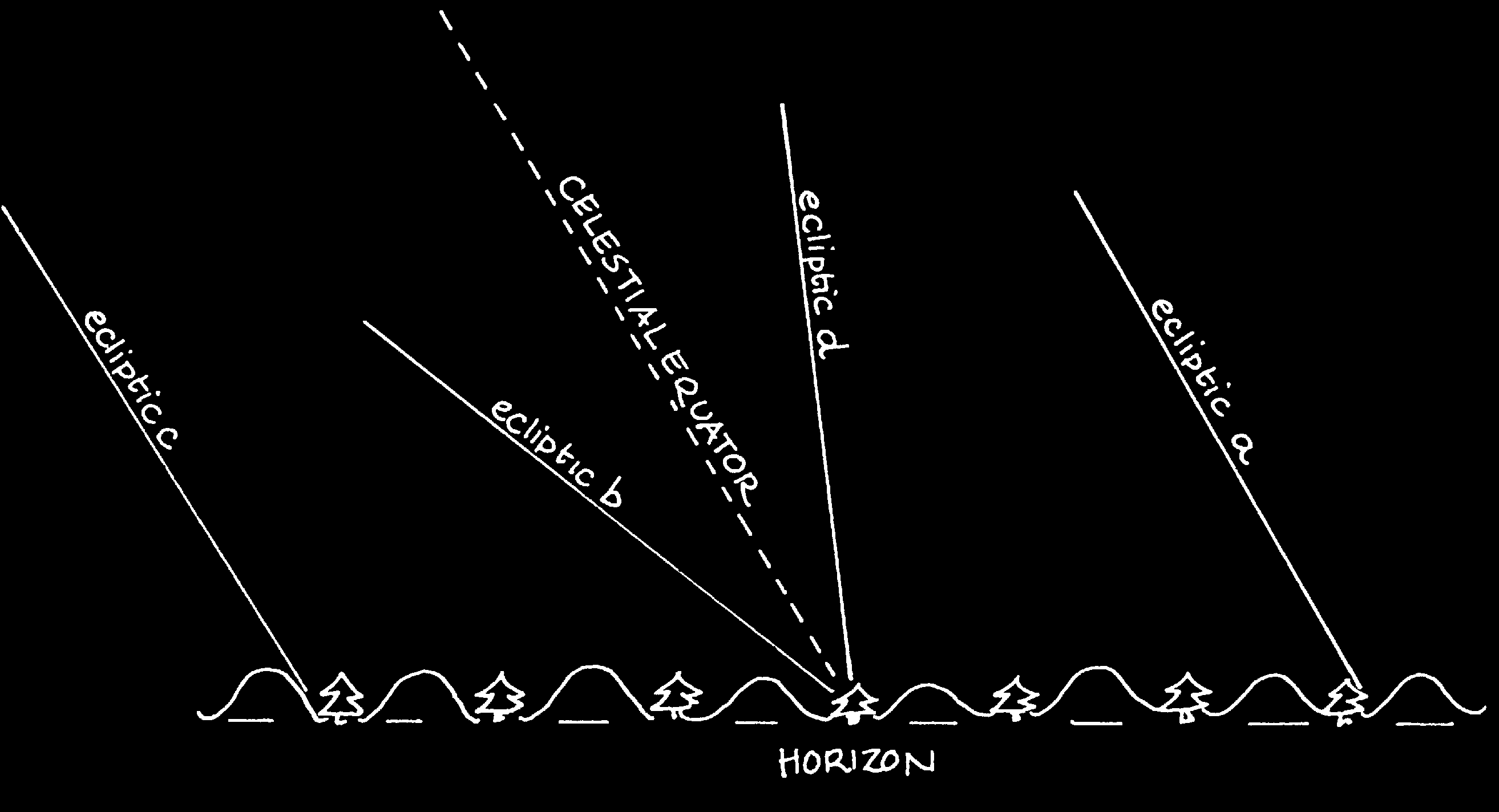
a. Positions of ecliptic with respect to celestial equator and horizon at six-hour intervals, looking west.
COMMENTARY
The ecliptic, then, seems to weave up and down the sky, to the north and south of the equator, and the angle it forms with the horizon changes hour by hour.
However, the daily timing of these angular changes varies throughout the year. In spring, the ecliptic at sunset will be crossing the equator and inclined at its maximum angle to the north. In northern latitudes, this means that the angle it forms with the horizon is very steep.
The Moon, like the Sun, travels along the ecliptic.103 Therefore the new Moon at sunset will appear high up in the sky towards the north, plunging almost straight down into the west. The setting Sun will illuminate the Moon from ''below'', producing two horns pointing away from the horizon, and up into the sky. Likewise at sunset at the autumn equinox, the ecliptic is at its maximum southward slant with respect to the equator. In northern latitudes, this means that the angle formed with the horizon is very shallow. Therefore the waxing crescent Moon, setting just after the Sun, and hugging the horizon, will appear to be
''beside'' rather than ''above'' the Sun (to borrow Bede's terms). The setting Sun will illuminate its northern £ank, so that the Moon will seem to be standing upright, with its horns pointing south. At midwinter and midsummer on the other hand, the ecliptic is parallel to the celestial equator at sunrise and sunset, and as Bede observes, when new or very old the Moon is high in the north in the summer and low in the south in winter, because it is close to the Sun at these points in its monthly cycle.
Therefore the waxing crescents at these seasons will be tilted midway between their spring and autumn extremes. These positions are illustrated in ¢gure b.
Bede drives home his point with some force at the close of this chapter: the angle of the Moon is ''natural and ¢xed''; it cannot portend anything. People have jumped to this conclusion simply because the season when the Moon is supine at sunset, i.e. spring, tends to have more unsettled weather than the season when the Moon is erect at sunset, autumn. There is a legitimate kind of weather prognostication based on the Moon, but it is based on atmospheric, not astronomical conditions.
103 It can, of course, be as much as 5 degrees to the north or south of the ecliptic, but this will not materially a¡ect the phenomenon described here.
THE RECKONING OF TIME
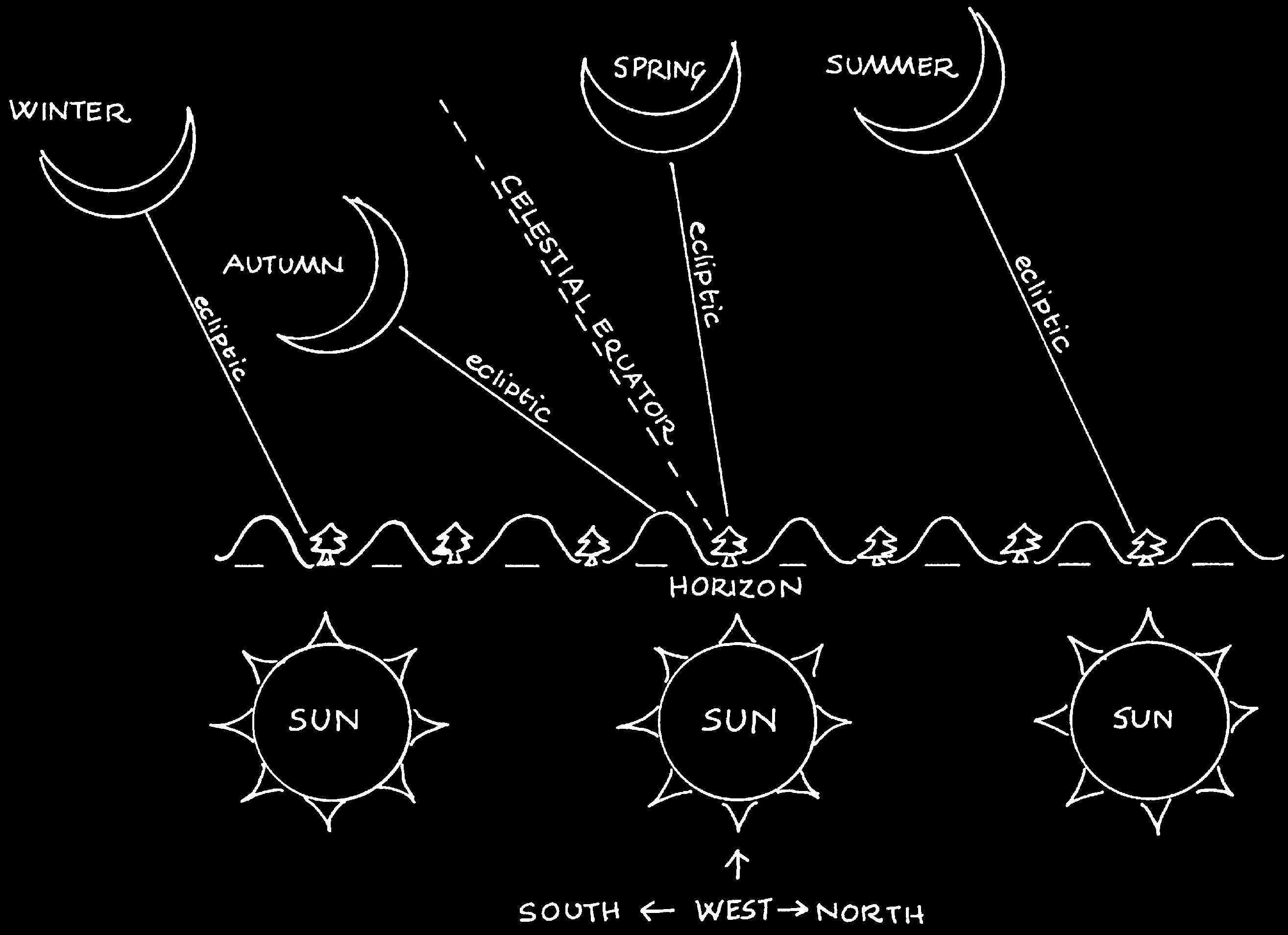
b. Angle and visible segment of crescent Moon at sunset in west, at solstices and equinoxes.104
Chapter 26:
Bede is atpains tocorrect another kind of false impression in ch.26.A full Moonatmidwinterwillappearveryfartothenorth^thatis,itwillbehigh up in the sky, towards the zenith ^ while the midwinter Sun remains in the south ^ low in the sky, close to the horizon. Apparently some of Bede's students confused the elevation of the Moon with its distance from Earth, as if ''higher than the Sun in the sky'' meant ''above the Sun in the heavens''. Bede seeks to eliminate this confusion by an ingenious experiment, using the hanging sanctuary lamps in a darkened church.
Jones claimed that this experiment could not have been actually tried by Bede, as it would require a church of far greater dimensions than any in Anglo-Saxon England.105 But it hardly makes sense for Bede to o¡er
104 Figures a and b are adapted from Norman Davidson, Astronomyand theImagination (London: Routledge and Kegan Paul, 1985):38, 73.
105 BOT 127; Jones does not actually cite the dimensions of Anglo-Saxon churches, nor explain how big a building he thinks would be required for the experiment, and why.
COMMENTARY
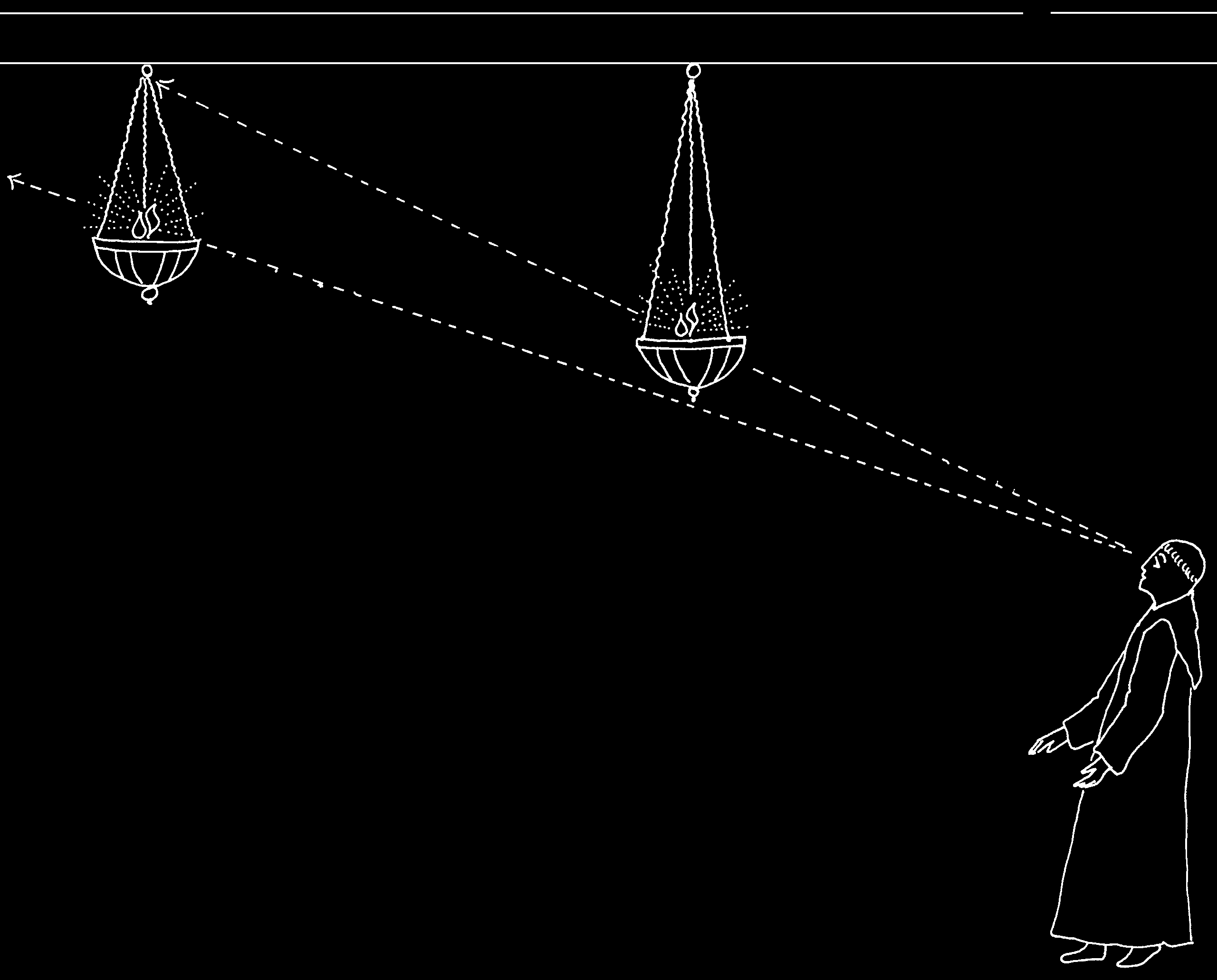
The above illustration may assistin visualizing Bede'sexperiment.Rememberthat thelampsthemselvescannotbeseen, butonlythe£ames,forthechurchisdark.The nearer £ame (the ''Moon'') will appear to be higher than the ''Sun'' £ame. such a concrete and circumstantial experiment if it could not be veri¢ed by his readers. In fact, the experiment does not require a large room at all. It is undoubtedly more evident in a large room, particularly as one can (as Bede indicates) more readily ignore the vessels and chains, and what they tell us about the true position of the lamps. Such a large space could very well have been available to Bede's readers.106 But the principle of the relative apparent position of two lights, placed on the same plane as the viewer's advance, but at unequal heights, can be tested in a modern living room with two candles, or can even be successfully
106 Peter Hunter Blair, The World of Bede, 271, n. 18, discounts Jones' view that Northumbrian churches were too small for this experiment, though he does not explain why the experiment should work, or indeed, the fact that it can work even in a small room. As Bertram Colgrave observes, Anglo-Saxon churches may have been narrow, but they were also characteristically tall, which of course would suit this experiment perfectly: ''Bede and His Times'' (Jarrow Lecture 1958):16.
THE RECKONING OF TIME
carried out with twolit matches, one held out at arm's length and high up, and the other closer to one's eyes, but lower down. The £ame of the lower match can easily be made to appear above the farther, higher £ame, as this ¢gure shows.
Chapter 27:
Bede's concern to establish a natural explanation for eclipses is reinforced by a rather ostentatious array of authorities, both pagan and Christian. Undoubtedly many of Bede's contemporaries in England regarded eclipses as uncanny omens of doom.107 Nor was it only the uneducated who held these opinions; some within the Church probably thought the ''darkness'' at the time of Christ's Cruci¢xion was an eclipse. Hence Bede quotes Jerome to the e¡ect that this darkness was a miracle, and not an eclipse. Christ was cruci¢ed at Passover, when the Moon is full and in opposition, and solar eclipses can only occur at conjunction. But Bede the scientist is also interested in what eclipses can reveal about the relative size of Sun, Moon and Earth. His source, Pliny, is unfortunately quite out of line with prevailing ancient opinion, which estimated the size of the Moon at one-sixth to one-half that of Earth.108
But the fact that Bede saw ¢t to discuss this implication of eclipses bespeaks the range of his curiosity.
Chapter 28:
No ancient philosopher doubted for a moment that the heavenly bodies exert a natural in£uence upon life on earth, though they explained the physics of that in£uence in various ways. Medieval thinkers did not doubt it either, although to a greater degree than their ancient counterparts they were careful to distinguish this natural or ''environmental'' in£uence from astrological determinism.109 However in this chapter,
107 Cf. The Reckoning of Time, ch. 66, s.a. 664, and HE 3.27.
108 Jones, BOT 361.
109 For two balanced and sensible overviews of this subject, see Edward Grant, ''Medieval and Renaissance Scholastic Conceptions of the In£uence of the Celestial
Region on the Terrestrial'', The Journal of Medieval and Renaissance Studies 17 (1987):1^
23 and J.D. North, ''Medieval Concepts of Celestial In£uence: A Survey'', in Astrology,
Science and Society: Historical Essays, ed. Patrick Curry (Woodbridge, Su¡olk: Boydell,
1987):5^17.
COMMENTARY
Bede is not interested in the question of celestial in£uence in general. His focus is strictly on the Moon, for even in the midst of this scienti¢c digression, Bede has not lost sight of his essentially computistical project.
As if to apologize for divesting the Moon of its control over the weather, Bede sets out to demonstrate that the Moon exerts a natural in£uence on growth and decay comparable to the Sun's. This in£uence is particularly marked in moist environments; as Ambrose observes, while the Sun dries out terrestrial moisture by day, the Moon replenishes it in the form of dew by night. Bede follows up Ambrose's statements with a corroborative passage from Basil, which leads him directly to the subject of the Moon's in£uence over channels and currents of open water. In short, this chapter is designed to set the stage for the following one, in which Bede will conclusively demonstrate that tides follow the course of the Moon.
Chapter 29:
This chapter on ''The Harmony of the Moon and the Sea'' has excited considerable admiration for its originality and critical clarity.110 Here
Bede digests, evaluates and o¡ers signi¢cant corrections to previous information about tides, speci¢cally the statements by Pliny in the Historia naturalis, and the more sophisticated discussions found in Philippus Presbyter and the Irish cosmographies of the seventh century.
Bede's sources were neither clear nor consistent on the subject of tides. The ancient texts came from the Mediterranean region, where the tides are not conspicuous. Only a few, for example, mention that there are two tides every day, or that the tides exhibit semi-monthly variations, which are especially marked at the equinoxes.111 Most, however, mentioned a correlation between the tides and the phases of the Moon, and an attempt to coordinate tides with an 8-year calendar is reported
110 E.g.Wesley Stevens, ''Bede's Scienti¢c Achievement'', 655^662,and T.R. Eckenrode, ''Original Aspects in Venerable Bede's Tidal Theories with Relation to Prior Tidal
Observations'' (PhD dissertation, St. Louis University, 1970) and ''Venerable Bede's
Theory of Ocean Tides'', American Benedictine Review 25 (1974):56^74.
111 In the sixth century Priscian of Lydus, in his Solutionum ad Chosroem described tidal action on the coasts of both the western Mediterranean and the Atlantic ocean, including spring and neap tides at conjunction and opposition; however, the only
Latin translation of his treatise is rather later (though possibly derived from a Carolingian exemplar), and was not known to Bede: Stevens, ''Bede's Scienti¢c Achievement'', 656.
THE RECKONING OF TIME
by Pliny in Historia naturalis 2.99.215. Patristic exegesis, especially the commentary on Job by Philippus Presbyter, a disciple of Jerome, preserved the essence of classical learning on this subject.
Dwellers on the Atlantic coast, on the other hand, were much better situated to observe and calculate the times of tides, and it is in the realm of tide-lore that we ¢nd, for the ¢rst time, original contributions to Latin natural science coming from peoples and regions outside the con¢nes of the old Roman empire.112 These contributions were incorporated into two anonymous seventh-century tracts written in Ireland, both of which were known to Bede: the Liber de mirabilibus sacrae scripturae of ps.-Augustine, and the Liber de ordine creaturarum of ps.Isidore.113 To assess Bede's achievement in this chapter, we must examine ¢rst what his sources said ^ and did not say ^ about the tides.
Job 38.8 says that God ''shut up the sea with doors, when it brake forth, as if it had issued out of the womb''. This slants the exegesis of Philippus Presbyter towards the problem of the origin and cause of tides, and only incidentally to their periodicity or intensity. Neither he nor any ancient writer understood that tides were produced by the gravitational pull of the Moon, even though they recognized a correlation between lunar phases and the intensity of tides. Philippus knew that tides arrived twice each 24 hours, and was even aware that each tide was about ¯~˘ of an hour later than the corresponding tide on the previous day (Bede quotes this passage in ch. 4), and yet he did not connect this to the fact that the Moon rises each day about ¯~˘ of an hour later than the previous day. Philippus was more concerned with debates over whether the increase of water is due to an outpouring of waters from some sub-oceanic geyser, ''the springs of the great abyss''.114 The alternative theory, explained though not endorsed by ps.-Augustine and ps.-Isidore, was that the actual quantity of ocean water increased under the in£uence of the Moon ^ a special case of the kind of power
Bede described in ch. 28.115 Both these theories rest on, or rather, encou112 See the illuminating discussion of Irish tide-lore in Smyth 241 sq.
113 See Introduction, section 2.
114 Philippus Presbyter, Commentarium in Job 38 (PL 26.752D^753A); see also critical edition of this passage by Dom Ire¤ ne¤ e Fransen, quoted by A.K. Brown, ''Bede, a Hisperic Etymology, and Early Sea Poetry'', Mediaeval Studies 37 (1975):423^424; cf.
Smyth 247^248.
115 Cf. De mirabilibus sacrae scripturae 2.23 (2184), De ordine creaturarum 9.4^6
(148^150); Smyth 244^245.
COMMENTARY
rage the assumption that tides occur at the same time all over the world.116
Neither De mirabilibus sacrae scripturae nor De ordine creaturarum link the timing of the tides to the passage of the Moon. Indeed, though they both used Philippus, they did not repeat his information about the daily retardation of the tides. Both texts, however, connect the monthly variations in the intensity of tides to the phases of the Moon. They call these phases ledo and malina.117 Ledo is customarily translated ''neap tide'' and malina ''spring tide'', but this is not exactly the meaning of the Irish sources. Ps.-Augustine says that each malina begins 3ˆ~˜ days before new Moon and full Moon, and each ledo 3ˆ~˜ days before the quarters. In short, they cover intervals of a week straddling the spring and neap tides; they denote, then, the peak above, and the trough below, the ''average'' tide,respectively.118Bothauthorsstatethatledonesandmalinaearecharacterized by speci¢c durations: ledones £ood and ebb for six hours, while malinae £ood for ¢ve hours and ebb for seven.119 De mirabilibus sacrae scripturae adds that there are six malinae in each season, and that a common lunar year of twelve lunar months has 24 malinae, while an embolismic year of thirteen lunar months has 26.120 Both texts state that the tides at the equinoxes and solstices are especially high.121
Bede used all these texts, ¢rst in The Nature of Things and then in The Reckoning of Time, but in the later work he made numerous corrections.
The ¢rst of these corrections involved clarifying the link between the daily passage of the Moon and the tide. For the ¢rst time, he connected lunar retardation to the daily period of tidal retardation, and he corrected the ¢gures for the latter. Philippus Presbyter said that the retar116 There were other theories as well, such as the one recorded by Isidore of Seville, DNR 40.1, that the Ocean is an animal which breathes in and out.
117 The term malina appears in the work of the 4th-century medical writer Marcellus of Bordeaux to designate a phase of the Moon suitable for collecting herbs: Marcelli de medicamentis liber 36.49, ed. Max Niedermann and Eduard Leichtenhan, Corpus medicorum latinorum 5 (Berlin: Akademie Verlag, 1968): 612.3. He does not use the term ledo.
The use of these terms to designate tidal phases was evidently quite current in 7th-century
Ireland: see Michael Herren, ed. and trans., Hisperica famina I^II [the A-text]:399^411
(Toronto: Ponti¢cal Institute of Mediaeval Studies, 1974^1987):1.94^97; Smyth 255.
118 Smyth 252^253.
119 Demirabilibussacrae scripturae 1.7 (2159); Deordinecreaturarum 9.4^6 (148^ 150).
120 1.7 (2159).
121 Ibid. 1.7 (2159); De ordine creaturarum 9.6 (150).
THE RECKONING OF TIME
dation was a dodrans or ¯~˘ of an hour. In Pliny, Bede found a more precise ¢gure for the daily retardation of the Moon: a dodrans plus a semiuncia, or ¯~˘ plus 1 24 of an hour, or as we would say, 47ˆ~˜ minutes,122 and he reported that ¢gure in The Nature of Things, ch. 39. In The Reckoning of Time, he revised that ¢gure to 4 puncti or 48 minutes ^ still short of the correct
¢gure of 50 minutes, but showing evidence of continuous re£ection and research on this subject.
Secondly, Bede o¡ered a new causal model for the tides in place of the ''swelling'' or ''geyser'' theories. The link between the passage of the Moon and the timing of the tides suggested to him that the Moon
''drags'' the waters of the ocean around the world with it. Bede borrows the word protrahitur from Ambrose, but gives it a new and literal meaning. He points out that in 59 days (2 synodic months), the Moon actually goes around the Earth 57 times, and there are twice this number of tides. He then scales this down to 29-day and 15-day periods, to show how a new Moon could appear at sunset in the west, and 15 days later appear at sunset in the east. Likewise, the tides, pulled around the Earth by the in£uence of the Moon, will appear at di¡erent times of day, but in a consistent pattern throughout the lunar month. In pointing out the exact correlation between lunar passage and tide, Bede also modi¢es and corrects ps.-Augustine's account of the number of malina tides each year. Since the Moon produces the tides, the number of times it circles the earth will equal the number of tides. In a common year of 354 days, the Moon actually circles the earth 342 times, so there are actually fewer tides than days. Needless to say, ps.-Augustine's statements about the number of tides in each season are based on a confusion of solar cycles (the seasons), with lunar ones; Bede does not allude to this at all.
Thirdly, Bede reproduces the Irish theory of ledo and malina, but corrects the notion that ledo and malina last exactly seven days each.
Their periods are not equal, nor are they consistent, as strong winds or other forces can modify their course. Fourthly, Bede corrects a misunderstanding about the annual patterns of tides. This is something of a retractatio for Bede, because in his own The Nature of Things, he had copied the Irish cosmographers' statement that unusually high tides occur at the equinoxes and solstices. Here, he cites Pliny's statement that these exceptional tides occur at the equinoxes only.
122 HN 2.10.58 (206).
COMMENTARY
Finally, by linking the rise and fall of tides to the passage of the Moon around the earth, Bede refuted the assumption supported by the older theories that tides occurred all over the world at the same time. In showing that this was not the case, he enunciated for the ¢rst time the idea of a ''rule of port''. Dwellers along the North Sea coastline know, he says, that tides arrive earlier in some places than others.
How did Bede arrive at these ideas? Wesley Stevens suggests that he enlisted the aid of monastic and clerical friends up and down the coast of Britain as research assistants. Bede mentions the tides at Lindesfarne at HE 3.3. It stands to reason that the monks there would have had a good empirical notion of the tide-schedule, since the timing of visits and deliveries to their tidal island would depend on this. Bede certainly knew priests at Lindesfarne, and probably visited there in the course of preparing his versions of the life of St Cuthbert. Stevens also argues, albeit somewhat more speculatively, that Bede gathered information from Whithorn and the Isle of Wight (Bede does mention currents in the Solent at HE 9.16), and elsewhere. His intriguing reconstruction of a method for methodically measuring and timing tides over a signi¢cant period of time is attractive, but perhaps not totally convincing, given the demands of Bede's monastic schedule.123
So far, what Bede has presented is remarkable for its critical acumen and originality, but withal in harmony with his overall vision of nature as a sublimely regular system of laws, laws which are universal and reducible to physical and mathematical explanations. One has but to glance again at ch. 25 to understand afresh what he means by naturalis ordo. It is a vision of nature entirely consonant with Bede's aim as a computist, which was to submit time itself to a universal and mathematical regula.
It is therefore all the more remarkable ^ and does credit to Bede's intellectual honesty ^ that his chapter on tides refuses to stop at this regularity, but rather, admits that no general theory can totally account for tidal phenomena.124 The tides arrive sooner in the north than in the south, but Bede also recognized that every region had a regula societatis of the Moon and the tides, what we would now call a ''rule of port''. All of these rules might be upset by chance conditions such as weather. In short, though the tides are driven by the Moon, whose sway is exercised over all the Earth, their ultimate expression is eccentrically local. That a 123 Stevens, ''Bede's Scienti¢c Achievement'', 657^660.
124 Stevens 662.
THE RECKONING OF TIME
man of Bede's systematic mind, so passionately concerned with regularitas and uniformity, should conduct such researches and express the results in this way is testimony to his critical spirit and freedom from dogmatism. The Irish cosmographers were likewise enchanted with the order of the universe, but that spell made them complacent about the information they found in their sources, particularly about the supposed simultaneity of tides and their precisely mathematical schedule.125
Perhaps, however, Bede's vision was not so much at odds with his world-view as might at ¢rst seem to be the case. The unity of the Church never meant for him a mechanical uniformity of custom or observance, though variations which endangered community (such as divergent
Easter reckoning) could not be tolerated. But every monastery had its particular customs and local ways of expressing the universal vision of the catholic Church, just as every place on the coast of England had its own tidal ''rule'', established at Creation, and which it follows faithfully every since. Unity of obedience could coexist with diversity of practice.
Chapter 30:
The ¢nal section of the ¢rst part of The Reckoning of Time (chs. 30^42) steps back to consider the solar year as a whole. The Moon names, shapes, and pervades the month; but the year is the Sun's domain. Its annual tour up and down the heavens de¢nes the length of the year, and marks o¡ its major phases, the seasons. Unlike lunar phases, these solar vicissitudes are slow and inconspicuous; it is easier to mark them by monitoring shadows cast by a pole stuck into the earth than by looking up at the Sun itself. Moreover, if the Moon's journey shifts the waters all over the globe, the Sun's advance and retreat is best read in the land ^ the seasons, and the latitudes which feel the Sun's power at di¡erent times and to di¡erent degrees. However, the natural course of both the Moon and the Sun is not readily reduced to the full days with which computists prefer to work. The leap year and the saltus lunae are devices to bring the conventional calendars of human society back into some kind of harmony with the transcendent calendar of the two great luminaries.
Much of the power and beauty of The Reckoning of Time as a theological vision of time ^ and indeed, much of the impulse medieval people
125 Smyth 262.
COMMENTARY
felt to study computus, even when there were no more problems left for it to solve ^ rests on Bede's artistry. His picture of the heavens is not only orderly, comprehensible and convincing, but full of life and meaning.
The harmonious contrast of the swift, changeable, conspicuous course of the Moon to the stately, unvarying but more inscrutable motion of the Sun, suggests a dynamic balance between stability and change, swifter and slower rhythms of time.
The ¢rst subsection of this discussion of the solar year concerns the seasons (chs. 30^35). It is dominated by the theme of the distinction between natural time and calendar time. The seasons do not coincide with the divisions of the Julian solar calendar, which as Bede has been at pains to show, are to a large degree the result of Roman convention. On the other hand, they are the terrestrial manifestations of the Sun's annual journey north and south along the ecliptic. They are, therefore, linked to the solstices and equinoxes.
The section on the year therefore opens with this chapter on the solstices and equinoxes. It immediately lands Bede in the midst of a potentially troublesome problem, which he resolves in a manner both typical and instructive. At the time of the inception of the Julian calendar, the spring equinox fell on 25 March, the autumn equinox on 24 September, and the two solstices on 24 June and 25 December respectively. Much classical science and Christian symbolism came to be attached to those dates on the understanding that they represented the true dates of the equinoxes and solstices. Bede himself, at the time he wrote On Times ch. 7, still thought of them as such, and he opens ch. 30 of The Reckoning of Time by citing some ancient scienti¢c and medical authorities who match the seasons to these dates. The ps.-Hippocratic citation is particularly interesting for what it reveals about Bede's medical reading,126 but he may also have selected this passage because it highlights the relationship between the solstices and equinoxes on the one hand, and the seasons on the other; it also points out how the seasons vary in length. Bede then goes on to observe that the symbolism of many Christian feasts ^ including Christmas, coinciding with the old winter solstice ^ is based on an allegorization of the solstices and equinoxes.
126 Cf. M.L. Cameron, Anglo-Saxon Medicine, Cambridge Studies in AngloSaxon England 7 (Cambridge: Cambridge University Press, 1993): passim. Another side of Bede's medical interests will be explored in the context of ch. 35 below.
THE RECKONING OF TIME
However, while avoiding any disparagement of either ancient learning or ecclesiastical traditions, Bede must assert that these conventional dates are not the true dates of the solstices and equinoxes. He invokes both scienti¢c authority (the astronomical expertise of the Egyptians, since this is an Alexandrian doctrine) and ecclesiastical sanction, namely the decrees of the Council of Nicaea. According to both, the spring equinox must be on 21 March.127 Though Bede claims that this date is supported by the evidence of the sundial (horologica consideratione) as well as conciliar authority, it is doubtful that he understood why the Alexandrians had moved the equinox back to 21 March.128
What is noteworthy about this chapter, however, is what it reveals about Bede's attitude toward fact and custom in matters relating to the calendar. Why does it not matter that the Lord's Nativity is not celebrated at the true winter solstice,129 while the true spring equinox does matter in relation to his Resurrection? Though Bede does not pose this question, he does furnish its answer: the Mosaic Law (in his view) forbids the celebration of Passover before the equinox. Therefore the date of the equinox must be established with as much precision as possible. But the Bible furnishes only a general indication of when Jesus was born, and no injunctions are laid down as to when this event should be celebrated. The Church has assigned the Nativity to the conventional calendar date of the solstice for symbolic reasons, but no Biblical principle or precept is jeopardized if the date is o¡ by a few days. Moreover, as far as Bede is concerned, there is only one date where the distinction between scienti¢c and conventional dating of the equinoxes and solstices is signi¢cant, and that is the spring equinox, because of Easter. He is fairly casual about the others, merely pointing out that the true date falls before the conventional one by the same interval as applies in the case of the spring equinox.130
127 Anatolius, however, states that the equinox is on 22 March: Bede's solution to this problem is contained in the Letter to Wicthed (see Appendix 3.3).
128 See Introduction, section 3, and remarks on Bede's use of sundials in the Commentary to ch. 31.
129 Cf. Bede, In Lucam 1.26, ed. D. Hurst, CCSL 120 (1960):439^454, where Bede adds that it does not matter if Christ was born a little after the true solstice, because John's preaching of the Kingdom before Christ's o⁄cial ministry began, constitutes the beginning of that ministry.
130 For the exception which proves this rule, see Letter to Wicthed 6, Appendix 3.3.
COMMENTARY
Whether dealing with tidal anomalies, dates for the solstices and equinoxes, or the discrepancy between the natural and computed age of the Moon, Bede is sensitive to the distinction between the idealized regularity of the calendar, the truth of nature, and the compromises of human society. Within certain limits, these divergences can be tolerated without scandal. But as Bede will later demonstrate, the religious signi¢cance of computus lies in its quasi-liturgical character as a model of heavenly regularity; if it contrasts with, instead of conforms to, the realities of nature, this may have its theological advantages. Through most of the Middle Ages, this sense that the calendar had to depart from nature in order to proclaim the triumph of eternity was understood; only in the waning centuries of that period did this anomaly become intolerable, and the call go out to reform the calendar to conform to nature, even if it meant the loss of its cyclical quality, and the symbolic values attached thereto.131
Chapter 31:
There is no disputing that the days are longer in summer than in winter, but one can imagine Bede's students asking him how one could be sure that today's daylight is longer or shorter than yesterday's. In other words, how would you actually know that the solstice had come? To answer questions like these, Bede composed four chapters (31^34) on the measurement of sunlight by sundial: they cover how the sundial registers time, and why the shadow of the gnomon on the same day is longer in some places than others.
Bede's familiarity with the sundial has been the subject of some controversy. He clearly invokes the evidence of the sundial in favour of revising the traditional date of the equinox in ch. 30, and in the Letter to Wicthed; in the letter of Abbot Ceolfrith to King Nechtan of the Picts in HE 5.21 ^ a letter commonly assumed to have been written by Bede himself ^ it is claimed that ''we can con¢rm'' that 21 March is the equinox ''by consulting a sundial''.132 Bede does not describe in detail what this observation entailed, but it can be reconstructed fairly easily.
Ancient and medieval sundials were circular or semicircular devices, usually mounted vertically on a wall, with a gnomon perpendicular to 131 Cf. Ze¤ linsky, ''Le calendrier''.
132 ut etiam ipsi horologica inspectione probamus: HE 5.21 (542).
THE RECKONING OF TIME
the support.The dial was marked like a fan with eightor twelve divisions, representing the hours.133 As the solstices are relatively easy to observe
(the Sun seems to ''stand still'' for several days at solstice) the outer edge of the semicircle could be marked with a line corresponding to the sweep of the gnomon's shadow on the longest day of the year; a smaller semicircle incised much closer to the gnomon would mark its path on the shortest day of the year. A line halfway between these two would mark the shadow's path at equinox.
But Jones argues that even had Bede made such an observation, it could not have produced the stated result, for the spring equinox in his day was falling around 17/18 March; if it did, it was because the sundials used in Anglo-Saxon England were very crude.134 Harrison and Wesley
Stevens, on the other hand, argue that Bede meant what he said. But even had he used a well-calibrated sundial, or improvised a more sophisticated experiment of his own ^ as he very well might have done, given that Pliny (HN 2.69) describes a way of con¢rming the equinox by means of ''sights'' (dioptrae), i.e. stakes or poles aligned with the rising and setting sun ^ the problems of local terrain and visibility would still have permitted a margin of error of more than one day. Hence Bede could at least prove that the old Roman equinox was not correct, even had his equipment and expertise not been su⁄cient to prove that the Alexandrian one was.135 To put it another way, the sundial proved that the old Roman sources followed by the Celtic computists were wrong; therefore the Alexandrians authorities promoted by Bede must be right.
In short, Bede was familiar with sundials136 and expected his readers tobe as well, but there were limits toboth the e¡ectiveness of these instruments, and Bede's own motivation to press his researches much further.
Nonetheless it is interesting to see how here, in the Letter to Wicthed, and in the letter of Ceolfrith to Nechtan, Bede insists that the sundial provides evident proof that so many ancient authorities were wrong about the equinox. Of course, he had other authorities ^ the Alexandrian
133 On Anglo-Saxon sundials, see Arthur Robert Green, Sundials, Incised Dials or Mass-Clocks (London: SPCK, 1926): ch. 2, and ''Anglo-Saxon Sundials'', Antiquaries
Journal 8 (1928):489^516.
134 BOT 87.
135 Harrison, ''Easter Cycles and the Equinox in the British Isles''; Stevens, ''Bede's Scienti¢c Achievement'', 16 and nn. 48^49.
136 He alludes to them, for instance, in his In Regum librum XXX quaestiones, ed.
D. Hurst, CCSL 119 (1962):316; cf. Harrison, ''Easter Cycles'', 5, n. 3.
COMMENTARY
computists ^ whom he was anxious to prove more reliable than Pliny or Isidore. But the implication that the contest of authorities can be settled by observations carried out with an instrument is unquestionably a bold one, and worthy of the name of science.
In chapter 31, Bede follows his policy of parallel quotations from classical and Christian writers to demonstrate that even though the length of the equinoctial day is the same everywhere on the globe, the shadow cast at noon will be much shorter in the tropics, where the sun is overhead, than in the north, where it is always to the south of the zenith.
As Pliny points out, this means that sundials have to be calibrated to latitude. Moreover, on any day other than equinox, the length of the day itself will vary with latitude. The further north one goes, the longer the days will be at summer solstice, and the shorter they will be at midwinter.
Chapter 32:
In the previous chapter, Bede explained that the further north one is, the longer are the summer days. Here he explains why. The Earth is a sphere set in the middle of the universe. Once each day, the Sun revolves around the Earth from east to west. But from day to day, this orbit will shift southwards or northwards, depending on the time of year. Latitude determines length of day because the winter Sun in the southern sky is
''blocked by the mass of the Earth'' just as certain southern constellations cannot be seen by the inhabitants of a village on the northern slopes of a large mountain. But all locations at the same latitude (or as Bede puts it, ''all who are placed facing one another in the same line under a northern or southern clime'') will experience the same amount of sunlight on any given day.
Chapter 33:
All this is very well (we may imagine Bede's students replying), but how do you know what places ''face one another'' on the same parallel of latitude? Bede's response in ch. 33 is a long quotation from Pliny, showing how sundial readings at solstice, gathered from various locations, could be used to determine which places lie along the same latitude.137
137 Pliny named cities and prominent locations within the Roman Empire, and tried to assemble data about the hours of sunlight at solstice in each, to establish their relative latitude. Bede used some of this material in The Nature of Things 47^48. It is not, by our
THE RECKONING OF TIME
Chapter 34:
Hitherto Bede's students have been looking downwards, so to speak, at the shadow cast by the Sun in a particular location. In ch. 34, he asks them to do something di¡erent: to stand outside the universe in their imagination, and visualize why the diurnal and annual motions of the universe produce these patterns of light and darkness on Earth, from east to west during the day, and from south to north to south again through the year. As Jones observes, this exposition of the world-zones and their climates is a very original and sophisticated piece of scienti¢c writing for the early Middle Ages.138 But what is particularly remarkable is the concrete, homely example with which Bede brings his students literally back down to earth again at the end. Imagine a rectangular open-air ¢repit on a cold night, with people sitting on either side.
Nobody can sit right in the middle of the ¢re, because it is too hot; on the other hand, if you are too far away, you will freeze. If you are close, but not too close to the ¢re, you will be comfortable, no matter which side of the hearth you are on. Now imagine the rectangular ¢repit wrapped around the earth like a belt.139 The two ''comfort zones'' represent the two habitable areas to the north and south of the equator, while the distant reaches stand for the Arctic and Antarctic polar zones. Both
''comfort zones'' are habitable, but Bede denies that both are actually inhabited. Pliny, after all, says that no one can cross the torrid zone. The missing minor premiss here is that mankind is descended from a single person, Adam, who began life in the northern hemisphere; hence none of his progeny could have ever reached the south. Note that the issue for Bede is not the possibility of life in the southern hemisphere, but the impossibility of travel to the southern hemisphere through the blazing equitorial zone. This means that if people lived there, the message of standards, completely accurate: Meroe and Syene are too far south, the size of Sicily has been considerably in£ated, and Narbonne is too far north: cf. Wesley Stevens, ''Bede's
Scienti¢c Achievement'', 652^653.
138 BOT 367^8.
139 This image suggests that Bede may have seen a zone-map, like the one illustrating Macrobius' Commentary on the Dream of Scipio. This showed the ¢ve climatic zones laid out across a disk-like earth. Such a map was sometimes imported into The Reckoning of Time as an illustration: see J.B. Harley and David Woodward, eds. The History of Cartography. Volume 1: Cartography in Prehistoric, Ancient and Medieval Europe and the Mediterranean (Chicago: University of Chicago Press, 1987):300^303.
COMMENTARY
salvation could never reach them, and there would be human beings for whom Christ had died in vain.140
Chapter 35:
Chapter 35, on the analogy of the four seasons, elements and humours, links the preceding chapters on the variable length of days to the following section on the year. But it is a linking chapter in other ways as well. At the exact mid-point of The Reckoning of Time, Bede pauses to re£ect on the way in which time joins man to the universe. This connection is mediated by number, for the elements which compose the physical universe, the humours which constitute the human body, and the seasons of the natural year, are all four in number. The connection is also grounded in an ancient theory explaining the coincidence of stability and change in the cosmos. Four qualities ^ hot, cold, wet and dry ^ combine in pairs to make the elements and the humours; at each of the four seasons, one of these pairs dominates the world. Time, then, makes change rhythmic, not chaotic. This syzygia of mundus, annus and homo is derived from Isidore of Seville, De natura rerum 7, where it is illustrated by a much-copied and much-imitated diagram. Bede's language in describing the connection of the elements one to another suggests that he had seen the Isidorean diagram: he speaks, for instance, of each element ''embracing what is on either side of it'', and of the ensemble of elements looking like a sphere.141
The general scheme was a commonplace, but the exact dates when the seasons began was matter for debate. Bede's argument about these dates is a complex one, and since it has engendered some misunderstanding, it seems worthwhile to dissect it in detail.
Bede arranges the various opinions on this issue in an ascending hierarchy of authority. First, he reports the dates found in Isidore of Seville, but he plainly thinks little of them. Isidore's dates are certainly arbitrary
140 The patristic locus classicus is Augustine, DCD 16.9. The question was of considerable interest to Bede's Irish forerunners, who were sometimes a little uncertain as to whether the antipodeans dwelt on the far side of a spherical earth, or simply underground.
The outrage expressed by Boniface at the Irish Bishop Virgil of Salzburg's suggestion that people might live ''below the earth'' shows how shocking the religious implications of the doctrine were felt to be, at least by some: see Smyth 285^290; J. Carey, ''Ireland and the Antipodes: the Heterodoxy of Virgil of Salzburg'', Speculum 64 (1989):1^10.
141 See ch. 35, n. 316.
THE RECKONING OF TIME
and without scienti¢c foundation, but Bede's criterion for dismissing them is that they are provincial, a local Spanish reckoning. This is not exactly the case, but the fact that Bede makes this point is, as we shall shortly demonstrate, of some signi¢cance.
The Greek and Roman dates rate higher in his estimation, and Bede does take note of their astronomical foundation. However, he passes over these dates as well, though without comment. The reason for doing so, however, can be deduced from what follows. Bede, as we shall see, has a special interest, for computistical reasons, in determining the beginning of spring. The Greco-Roman system furnishes clear criteria for the beginning of summer and winter (the heliacal rising and setting of the Pleiades), but spring and summer are only vaguely marked by their rising and setting ''about midnight''.
Ranking very much higher in Bede's estimation is the method of ps.Anatolius, which takes the solstices and equinoxes as the mid-points of the seasons. There is a serious problem here, however. The passage from ps.-Anatolius does not actually date the spring equinox, but the dates provided for the autumn equinox and the solstices indicate that he was using the old Roman dates, and that his spring equinox would be on 25
March. Bede is once again using the Celtic recension of this text. If spring has 90 days (cf. ch. 33) and the mid-point is 25 March, it will begin on 8 February. Most medieval computus texts which date the seasons according to this method use either 8 February or 6 February as the beginning of spring.
Jones states that Bede approved, adopted, and popularized this system, but ''moved the seasons back from v id. [9 February] to vii id. [7
February]'' to adjust for the 21 March equinox.142 But careful reading of this chapter will reveal that Bede never explicitly states when the seasons actually begin. Moreover, moving the beginning of spring from 9 February to 7 February would by no means adjust for the four-day interval between 25 March and 21 March; spring, using Anatolius' system but Bede's equinox, would come on 5 February.
Bede adds yet another rung to his hierarchy of authorities on the dates of the seasons: the Bible. The quotation from Deuteronomy indicates that spring begins in the Passover month; this is a lunar month, but determined by the equinox. The most orthodox computistical autho-
142 BOT 369.
COMMENTARY
rities, the Egyptians (represented here by Proterius), also use this criterion.
Bede in fact at no point ¢xes calendar dates for the beginnings of the seasons. Rather, he sets out in ascending order of authority the various schemes of which he knew, ending with the Hebrew/Egyptian method.
Given Bede's reverence for both biblical authority and Egyptian computistical expertise, this is clearly the formula of choice. It is also the only one of any computistical consequence, and as we have seen earlier,
Bede's interest in taking sides on these contentious questions is only roused by computistical consequences. Moreover, even if he did think
Anatolius' system plausible, to have committed himself to it would have confused his students, since Anatolius used Roman dates for the equinoxes, and his spring began before the earliest acceptable calendar date for the Passover month, Nisan.
Finally, Bede makes the interesting observation that the etymologies of the Latin names for the seasons only make sense in terms of the climate Latin-speaking peoples know. Unlike solstices and equinoxes, which are astronomical phenomena, seasons (like hours of daylight) are local conditions, di¡erent in India, Egypt and England. They are sublunary and terrestrial, and hence widely variable and inconsistent.
This may be another reason why Bede refrained from any dogmatic statement about their starting dates.
Chapter 36:
Chapters 36^43 of The Reckoning of Time, devoted to the year, are also dominated by the theme of the distinction between natural and computed time. The ''year'' which the student sees laid out before him in the annalis libellus is not precisely equivalent to the natural ''year'', for it is six hours shorter than the time the Sun actually takes to make a complete circuit of the zodiac. Since calendars have to the constructed out of whole days, the six extra hours can only be ''counted'' when they have cumulated into a full day of 24 hours; this happens every four years. For somewhat analogous reasons, the calculated Moon will occasionally not quite match the visible Moon in the sky.
This distinction was an importantone for Bede, and one which he was at pains to impress upon his students. Its implications are complex, for though time-reckoning was an activity steeped in theological signi¢cance, the Julian calendar itself was only a human convention, one of
THE RECKONING OF TIME
the many calendars employed by mankind through the centuries, and in fact, a pagan invention. God's time was the time marked by the Sun and Moon themselves, the exemplar-time which good calendars strove to replicate as closely as possible. Though all calendars ultimately had to sacri¢ce scienti¢c perfection to the human need for simplicity and convenience, there is a sort of felix culpa here: the mathematical cycles by which the calendar compensated for its loss of natural accuracy transformed it into a symbol of eternity.
Signi¢cantly, Bede begins ch. 36 by destabilizing his readers' notions of what the word ''year'' means.143 Annus denotes merely a ''circuit''.
Therefore the length of the ''year'' depends on what is making the circuit: the Sun, the Moon, the planets, or even all of the above. When applied to the Moon, this ''circuit'' can have no fewer than four meanings: a siderial lunar month, a synodic lunar month, a ''common'' year of 12 lunar months, or an embolismic year of 13. Where the latter two begin and end also varies, depending on whether one is following the ''Hebrew'' or Roman system. The Sun's year is the length of time required for it to return to the same point in the zodiac, and planetary years are de¢ned in the same way. A Great Year is the length of time it takes for all the planets to resume the same position in relation to one another. It is interesting to note that this de¢nition is rather vague. Bede seems not to have known much about the ancient debates concerning the length of the Great Year, the nature of the grand planetary conjunction, the notion that all the events of previous Great Years would be repeated, or the theories of alternating £oods and con£agrations. This information was conveyed to the Middle Ages largely by Macrobius'
Commentary on the Dream of Scipio,144 a book which Bede apparently did not know. Hence the only clue that his library yielded as to the length of the Great Year was the quotation from Josephus. Josephus'
''Great Year'' is actually the Babylonian naros, a cycle designed to 143 Jones speculates (BOT 371) that Bede's source for this chapter was a short tract in his ''Irish computus'', whose incipit reads Quot modis soleat annus nominari.
Primus modus est de luna . . . (''The number of ways in which one can designate a year. The ¢rst way is according to the Moon . . .''): see Introduction, section 5. It survives in a number of Carolingian computus manuscripts, e.g. Berlin Staatsbibliothek 128, fol. 117r; Besanon
186, fol. 40r; Geneva 50, fols. 165v^166r; Rouen 26, fol. 150; Paris, B.N. lat. 2341, fol. 6r;
Paris, B.N. nouv. acq. lat. 1613, fol. 3v; and Munich, CLM 210, fols. 72v^73r. Analogous passages appear in the ''Bobbio computus'', PL 129.1306.
144 2.11.8^17, ed. J. Willis (Stuttgart and Leipzig: Teubner, 1994):128.31^129.20.
COMMENTARY
predict eclipses. It is far too short a period tobring all the planets together in the fourth degree of Aries, which is the de¢nition of the grand conjunction Bede proposes in ch. 6.145
Chapter 37:
Not only do natural years vary in length, but so the conventional years of human time-reckoning. Bede illustrates this fact in ch. 37 with an apt quotation from St Augustine. Augustine's point is that ancient pagan peoples used the term ''year'' to denote a number of di¡erent measures of time. Anti-Christian polemicists exploit this fact to cast doubt on the Old Testament's statements about the lifespans of the patriarchs. What
Bede omits, and presumably was con¢dent his readers would understand, is that Augustine goes on to argue that the ''years'' of Genesis are true years, and not synonyms for shorter periods of time.
Chapter 38:
Leap-year day was a subject of perennial and seemingly inexhaustable interest for computists, both in Bede's day and later. One 11th-century anthology, Vatican Reg. lat. 123, contains no fewer than 14 tracts on leap year, and it is far from unique. Chapters 38 and 39 of The Reckoning of Time in fact were originally composed as a separate treatise on leap year in the form of a letter to a certain Helmwald.146 It was in turn excerpted in whole or in part into later computus anthologies.
Bede's goal in these two chapters is to explain leap-year day without overcomplicating the issue. For the sake of students with little scienti¢c background or mathematical aptitude, he omits elaborate calculations of the leap-year increment,147 and focusses on more basic issues: why an extra day accumulates over four years, and why it is important to intercalate it accurately.
145 Godefroid de Callata« y, Annus platonicus: A Study of World Cycles in Greek,
Latin and Arabic Sources (Louvain-la-Neuve: Universite¤ Catholique de Louvain, Institut
Orientaliste, 1996):98^99. Bede's remarks on the Great Year elaborate on his statements in On Times 9. The Macrobian tradition about the Great Year was certainly known to Carolingian computists, e.g. Paris, B.N. nouv. acq. lat.1615, fols.166v^167v: cf. Jones, BOT 371.
146 The part of the letter which is not reproduced in The Reckoning of Time, is translated in Appendix 3.2.
147 Bede reserves some of these more subtle details for his Letter toWicthed 7 (see
Appendix 3.3).
THE RECKONING OF TIME
Chapter 39:
Here is a concrete illustration of why Bede wanted to keep his exposition of the leap-year day as simple and clear as possible. In Bede's day, there was a misconception abroad that the bissexile increment was 3 hours per year. Apparently, many thought that the ''quarter-day'' was onefourth of a conventional day of 12 hours, rather than of a full day of 24 hours.148 Typical of the numerology used to justify this ''fact'' is an argument found in ch. 34 of the ''Bobbio computus''. The world was created in 7 days, but the Bible does not say that the seventh day had an evening. This is why the year is a little longer than expected. 365 days624 hours = 8,760 hours in the year. 8,760 divided by the 7 days of the week = 1,251, with a remainder of three; these three hours were the annual leap-year increment.149
That this error was so deeply entrenched, and furnished with arguments such as these, explains both Bede's monotonous insistence that the true length of the annual increment is six hours, and his production of a lengthy quotation from Augustine's De Trinitate, which discusses the leap-year increment in the context of the symbolic perfection of the number six.
Chapter 40:
Since much of Augustine's disquisition on the number six in relation to leap year alludes to the day on which the extra day is intercalated ^ the 148 Jones, BOT 372^374, argued that this was an ''Irish'' error which arose through a confusion between the three unciae accumulated every year by the Sun ( 3
12 or 1 4 of a day), and three hours. The perpetrator, in his view, was an addendum, which he identi¢es as Celtic in origin,to the PrologusCyrilli (see Introduction, p. lxxiv).The Celtic characterof this addendum is proven by elimination. Since the text invokes unciae or duodecimal fractions, which were of no computistical use to the proponents of the 19-year cycle, it must have come from an 84-year cycle environment. The Irish are certainly not immune to this mistake, for it appears in MS Vatican Reg. lat. 39, as an appendix to the spurious Acts ofthe
Synod of Caesarea (ed.Wilmart, 27), a ''Celtic forgery'' (see Introduction, section 5); it also surfaces in the ''Bobbio computus'' (see n.149 below). However, Krusch found this identical error in some texts rather remote from Celtic sphere, e.g. Merovingian Gaul (''Das a« lteste fra« nkische Lehrbuch der dionysianischen Zeitrechnung'', Me¤ langes o¡erts a' Emile Cha" telain (Paris: Champion, 1910): 235), and a Victorian computus dating from 727 found in MS
Bern 611 (ed. Krusch, Studien II, 55^56). Indeed, the same mistake is found in ps.-Cyprian,
De pascha computo 19, so it must be much older.
149 ''Bobbio computus'', ch. 43 (PL 129.1296C). Cf. Jones, BOT 374.
COMMENTARY
6th kalends of March (24 February) ^ Bede was probably asked by his students to explain why this date was chosen. Macrobius' Saturnalia furnishes the answer, but one senses that Bede is uncomfortable with this account, since the reason for the choice was pure pagan superstition.
Hence he follows up his quotation with a somewhat moralizing tirade.
This e¡ort todistance himselfabruptly fromthe pagan contentof Macrobius might be compared with Bede's remarks on February in ch.12.
Chapter 41:
This is a very original explanation of a subject which had received no recorded notice before Bede's time: the e¡ect of the leap-year day on the calculation of the age of the Moon. The leap-year day may not appear as a marked place in the Julian calendar (the way 29 February is a marked place in our calendars) but it is a real day in the real world, and its e¡ect is to make the Moon one day older that it was before the intercalation. This will a¡ect the date of the Easter full Moon.
But it is the ¢nal, somewhat cryptic paragraph in this chapter which is the most intriguing. Although he does not enter into the details, Bede is acknowledging here that thanks to the leap years, the 19-year cycle is not exactly cyclic. The 19-year lunar cycle is incommensurable with a fourth-year leap-year intercalation. Each 19-year cycle will accumulate
4.75 leap-year days for both the Sun and Moon (.25619), which means that cycle will not contain a whole number of days. Therefore the lunar phases may be slightly o¡ their computed calendar dates from one 19year cycle to the next.
The total number of lunar and solar days in a 19-year cycle is actually 6,939.75, computed as follows:
Solar years:
19 solar years 6,939.75 days (365.25619) Lunar years:
12 common years 4,248 days (354612) 7 embolismic years 2,688 days (38467) Bissextile lunar days 4.75 days (.25619) Total lunar days 6,940.75
Subtract saltus
6,939.75
THE RECKONING OF TIME
So from a computistical perspective some 19-year cycles will be ''hollow'' and contain 6,939 lunar days, while others will be ''full'' and contain
6,940. The variation will be regularized over the course of the great Paschal cycle of 532 years, which is the product of the 19 years of the lunar cycle, and the 28 years it takes to move the leap-year days through each of the days of the week.150 This means that the computist must be careful to track the course of the Moon each leap year, so that he can ascertain its correct age on the critical date of the spring equinox.
Computists before Bede hardly noticed the problem, because they calculated the age of the Moon with annual epacts and lunar regulars. It only surfaces when the issue becomes the establishing and demonstration of a cycle; indeed, the unique pre-Bedan allusion comes from a critique of Victorius of Aquitaine's cycle by a Spanish writer named Leo.151 It had little impact on the computus as a whole, but it illustrates how profoundly
Bede had grasped the problem of constructing a luni-solar cycle.
Chapter 42:
This chapter and the next concern anomalies of lunar reckoning. They constitute a kind of appendix to the section of The Reckoning of Time devoted to the solar calendar, and serve as a bridge to the Paschal table.
In plotting the phases of the Moon against the grid of the solar calendar, anomalies are bound to occur due to the fundamental incommensurability of lunar and solar cycles. Over 19 solar years, the calculated Moon will gradually build up an advance of one day, which will have to be deducted at some stage of the cycle to bring the cycle back into phase with reality. Thus the Moon will have to ''jump over'' one day. But the issue of this saltus lunae also raises broader questions about natural and calculated time ^ between what things are and how they are named. For in fact, Bede was aware that calendrical discrepancies were occuring fairlyoften, and not only in connection with the saltus.
As Bede points out in the opening sentences of ch. 42, the lunar saltus is the leap-year problem turned on its head. In the latter case, the calendar has to ''slow down'' every four years by adding a day to ''let the Sun catch up''; in the case of the Moon, the planet starts to run ahead of the calendar, and eventually ''jumps over'' a day in the count
150 BOT 374.
151 Ed. Krusch, Studien I, 299. Cf. Jones, BOT 374^375.
COMMENTARY
of lunar days. Bede admits that it is not easy to see this happening, since the advance amounts to only one day over 19 years; but it is not hard to measure it.
Bede's calculation of the annual increment which eventually produces the saltus modi¢es the one given in On Times 12, which was in turn a critique of a persistent misconception, namely that the saltus accumulated at the rate of 1
12 of a day per year. In OnTimes, Bede rendered the mensura as 1 hour, 10 momenta, ˆ~˜ of a momentum, and
19 of ˆ~˜ of a momentum. In The Reckoningof Time, this statement has been simpli¢ed by grouping the 10 momenta into one punctus.152
But where should the ''leap'' take place? Bede argues that it should properly take place at its ''natural'' time, which is the spring equinox.
What Bede means by ''natural'' is the will of God as expressed in the act of Creation.153 Since God created the Moon and Sun at the spring equinox (cf. ch. 6), then their cycles begin and end at that point, and it would be logical to correct the lunar anomaly there before starting a fresh cycle. But Bede acknowledges that the conventions of the calendar tend to outweigh the claims of ''nature'', and that computists prefer to insert the saltus at the end of the calendar year ^ November in the case of the Roman calendar, July for the Egyptians ^ so that the anomaly can be absorbed by the ¢nal lunation of the year.
Bede himself declares no rule, and does not tell us which system he uses,154 though he seems to favour the practice of inserting the saltus at 152 Cf. Jones, BOT 377, who mistakenly asserts that Bede is here correcting an error in the DT version of the mensura. I am grateful to Professor John Contreni for drawing my attention to this problem. The sources for chapter 42 as a whole are fairly obscure, and Jones lists a number of anonymous saltus tracts which Bede might have used.
The most important is the one whose incipit is De saltu lunae pauca dicimus (i.e. ps.-Alcuin,
De saltu lunae 1, PL 101.984^989), and which appears in the ''Sirmond manuscript'' and its cognates; Jones argues that it is a displaced chapter of the Irish computus textbook found in this MS: BOT 375^6. Bede's approach to the calculation of the saltus increment resembles somewhat that found in ps.-Columbanus, De saltu lunae, ed. Walker, Sancti Columbani opera 212^214.
153 Cf. Augustine, DCD 21.8 (773.104 sq.) where he argues that portents are not ''contrary to nature'' because they happen by the will of God, which is ''the nature of every created thing''.
154 Dionysius himself laid down no rule for positioning the saltus. Ps.-Alcuin, De saltu lunae (see n.152 above) lists several possibilities: Victorius and the ''Latins'' place it on 25 November, the Greeks on 22 March, the Egyptians on 26 September, and Dionysius on 17 April: cf. van Wijk 19^22. It is little wonder that Bede, normally quite clear and decisive on matters computistical, refused to declare his position on the saltus.
THE RECKONING OF TIME
the very end of the 19-year cycle, or rather, at the beginning of the new cycle, on 21 March, so that the epacts on 22 March change from 18
(year 19) to 0 (year 1), and not to 29. This is why Bede refers to the saltus as happening in the ¢rst year of the 19-year cycle. Normally the ''year'' in this sense means the period between the Easter new Moon of year 19, and the Easter new Moon of year 1 (cf. ch. 45), but in this case it means ''on 22 March'' since the new epact of year 1 comes into e¡ect on that date. This is also why he claims that the saltus produces a lunar year of 353 days; year 19 of the cycle is embolismic, and has 384 days, but year 1 is common.155
Chapter 43:
Chapter 43, ''Why the Moon sometimes appears older than its computed age'', is one of the most complex and revealing passages in The Reckoning of Time. It shows Bede attempting to account for a discrepancy in the computistical system made evident by the direct observation of nature. The explanation, although purely computistical, cannot win assent unless it is shored up by authority. But the authorities are not as convincing as they might be.
Bede admits from the outset that the observed Moon in the sky is sometimes older than its computed age. There are four reasons for this.
First, the gradually accruing saltus increment will mean that by the end of the 19-year cycle, a discrepancy of about a day will be fairly normal.
Secondly, we may be fooled into thinking the Moon is older than its calculated day if we mistakenly count a crescent Moon appearing just
155 The question of the saltus seems to have been a matter of some confusion in Bede's day: cf. the rather obscure riddle by ''Eusebius'' (i.e. Bede's abbot Hwtbert) on this subject. De aetate et saltu. Rite uicenis cum quadragies octies una/Quaeque sororum formaturdemoremearum/Nempemomentis;tunc egosolaperactauidebor,/Ciclinondecimuscum de¢cit extimus annus. (''Of the age [of the Moon] and the leap [of the Moon]. According to rite, of exactly twenty times forty-eight / momenta each one of my sisters is habitually / formed: but I, the unique, apparently [have already] run my course / the moment the cycle's nineteenth and last year ends.'') Ed. and trans. Maria Di Marco,Variae Collectiones
Aenigmatum Merovingicae Aetatis, CCSL 133 (1968):239. The ''sisters'' are the lunar days, each of which is 24 hours long (20648 momenta = 960 momenta, divided by 40 momenta per hour = 24. But the ¢nal lunar day of the 19-year cycle is in fact already over by the time the ¢nal calendar day of the cycle rolls around, since it represents the advance which the Moon has accumulated throughout 19 years.That is why it is dropped out of the reckoning, or ''leaped over''.
COMMENTARY
after sunset as the ¢rst Moon: lunar count begins at sunset (c.f. ch. 5), so only a Moon visible by sunset counts as the ¢rst. Thirdly, a Moon visible at sunset may actually be a new Moon, i.e. in day 30 of its previous lunation, not in day 1 of its new lunation. It can happen that we see the thin crescent of the old Moon in the eastern sky at dawn, and the thin crescent of the new Moon in the western sky at sunset on the same day ^ i.e. day 30 of the old lunar month. Such sightings are unusual, but they can happen, and especially in the spring, for reasons explained by Bede in ch. 25. Due to the shifting angle formed by the ecliptic and the horizon, the old Moon in spring will rise at dawn ''beside'' the Sun, and will be visible as a faint arc. Conjunction will take place during the daytime. By sunset, however, the Moon will be plunging almost straight downwards towards the horizon along the ecliptic; hence the setting
Sun will light up a thin arc of the Moon from beneath.156 But the Moon is still technically in day 30.
The fourth reason for anomaly is the most complex and interesting case of all. Bede evokes an imaginary observer ^ not a lone individual, but one who can summon witnesses to a⁄rm what he has seen. This observer claims that on 4 April in year 19, when the table says that the Moon will be new, he has seen a Moon two days old in the sky. One day might be accounted for by any of the three reasons given above. But how to account for two?
We now know, though Bede did not, what has caused this gap. Nineteen solar years total 6,939 days and 18 hours, but the 235 lunations which computists consider the equivalent of 19 solar years actually total
6,939 days, 16 hours and 31 minutes (235629.530588 days). Therefore, every 19 years the Moon gets about 1 hour and 29 minutes ahead of its computed age. After 308 years, the discrepancy amounts to one day, so by Bede's day, assuming the calibration was correct at the time of the Council of Nicaea, the slippage was about 1ˆ~˜ days.157
Since this discrepancy would be visible any night of the year, Jones assumes that Bede's case involving the new Moon in April of year 19 is not an instance of ¢rst-hand observation, but an echo of a controversy which had occurred in 550. In that year, the 19th of the Alexandrian cycle, the Victorian and Alexandrian tables disagreed, and it looked as though the Victorian tables were more accurate. Victorius ¢xed Easter
156 See ¢gure b in Commentary to ch. 25.
157 Jones, BOT 378.
THE RECKONING OF TIME
on 17 April, the 15th day of the Moon, while the Alexandrian table declared it to be 24 April, the 21st day of the Moon. Therefore Victorius' lunation began on 3 April and the Alexandrian on 4 April. In his defence of the Alexandrian reckoning, Victor of Capua indicates that the Victorian camp pointed out that the new Moon was indeed visible on 3 April; he responds by invoking the ¢rst reason rehearsed above, namely the accumulation of the saltus increment. But ''whether in 550 or 725, the discussion is highly academic. Bede shows no knowledge of the actual observed Moon''.158
This argument can be contested on the following grounds. First, Victor is actually discussing the generic issue of the calendrical terminus ad quem of Easter. The date in question is not 24 April, but 25 April, and Victor nowhere alludes to the saltus.159 Secondly, Bede's explanation for this anomaly is completely di¡erent from the one which Jones ascribes to Victor. He points out that in year 19, the last lunation before the Easter Moon is not a hollow one of 29 days, as is usual, but a full one of 30 days, because an embolismic month is inserted in March in year 19. It begins on 5 March, and ends 3 April. Therefore to the day accumulated by the saltus increment, one must add an additional day to the lunar reckoning because of the embolism.160 For this reason, all the arguments invoked by Bede focus on the authority of the 19-year cycle, and particularly on its pattern of common and embolismic years (see
Commentary on ch. 46, below).
He begins with a common-sense assumption. Given that the Council of Nicaea (in Bede's view) approved the 19-year cycle, they must have approved its sequence of common and embolismic years. Surely the Fathers at Nicaea observed this discrepancy; but they chose to subordinate nature to the higher goal of maintaining the proper sequence of 158 Jones, BOT 378.
159 Victor of Capua, De pascha 11 (300).
160 See commentary on ch. 45 below. Because the embolismic lunation is 30 days long, it temporarily ^ but only temporarily ^ pushes the calculated Moon ahead of astronomical reality, as the following comparison of calculated and true new Moons for AD 664
(see n. 163 below) shows:
CALCULATED
TRUE March (''full'') 3 Feb.
3 Feb.
Embolism (''full'') 5 March 3 March April (''hollow'') 4 April 2 April May (''full'') 3 May 1 May June (''hollow'') 31 May 31 May
COMMENTARY
common and embolismic years, so that the cycles of Moon and Sun would coincide over a period of 19 years (cf. ch. 46). But as there is no documentation for such an assumption, Bede feels obliged to back it up with further evidence. The evidence is certainly colourful, but not exactly Bede-like, being a string of wonder-tales and religious legends, none of them with impeccable credentials.
The ¢rst is the legend that St Pachomius, the founder of cenobitic monasticism, had received the rule for the 19-year cycle from an angel.
This story was to have a long medieval career,161 but it is noteworthy that Bede emphasizes that the saint established the sequence of the common and embolismic years.
Reinforcements are still required, so Bede invokes a rather elliptical reference from the Epistola Cyrilli. It is in fact not much of a proof, since it is a negative hypothesis: had the Council of Nicaea not established the proper Easter cycle, the true new Moons could have been tested by observing the selenite stone, which changes colour with the waxing and waning Moon (c.f. ch. 28). This is a £amboyant rhetorical defence of the absolute accuracy of the Nicene system, not a laboratory test, but Bede at this stage is ready to take all the help he can get. He then cites a passage from Paschasinus of Lilybaeum which tells of how a miraculous font settled a dispute over the date of Easter in the 19th year of a cycle ^ a dispute occasioned by failing to account for the embolismic
Moon of March.162 Finally, Bede hints in a somewhat vague way that the Pope had sanctioned the Alexandrian system.
Bede is intent on proving, almost at any cost, that the 19-year cycle, and especially its sequence of common and embolismic years, is sanctioned by natural, ecclesiastical and divine authority. Given the shakiness of the case, Bede must have had very pressing reasons for wanting to discuss the issue of this lunar anomaly in the ¢rst place. A number of people in Bede's circle must have actually observed the discrepancy; if not, why bring it to the attention of his readers and risk confusing them?
The answer lies buried elsewhere in The Reckoning of Time, namely in the chronicle in ch. 66, under the year 4622, or in AD reckoning, 664.
161 Jones, ''A Legend of St Pachomius''.
162 Miraculous fonts are frequently resorted to in such cases; see Gregory of Tours, History of the Franks 10.23, ed. B. Krusch and W. Levison, MGH SS Rer. Mer. 1
(1951):514.22^515.6, where he describes how in 590, a year when Victorius' tables o¡ered both a ''Latin'' and a ''Greek'' Easter, a miraculous spring con¢rmed that Gregory's choice of the ''Latin'' date was correct; for another example from 577, see 5.16 (215.4^8).
THE RECKONING OF TIME
664 happens to be year 19 of the Alexandrian cycle. It was also the year in which the synod of Whitby took place, though Bede does not mention this fact in the chronicle. In that year, a solar eclipse took place on 1
May, which is recorded in various contemporary chronicles, notably Irish ones. However, according to Dionysius' table, the new Moon would not have appeared until 3 May, for the full Moon of Easter fell on 17 April. Bede dates the eclipse to 3 May. In short, the situation in 664 was exactly the one described in this chapter: the Moon on 3 May was two days older in the tables than it was in the heavens. If Bede was aware of the true date of the eclipse, then his position would have been extremely delicate. If he referred explicitly to this observed anomaly ^ one which cast doubt on the accuracy of the very table endorsed by the synod of Whitby ^ he jeopardized the still fragile allegiance of the Insular Churches to the Dionysian system. He also risked putting himself in opposition to men like Victor of Capua and Paschasinus of Lilybaeum, who had fought for the acceptance of the late Alexandrian
Easters of year 19 against the traditional Roman calendar limit of 21 April. But he had to explain to his own satisfaction, and to the satisfaction of his more astute and well-informed readers, how a two-day gap could have transpired. So he recorded the Dionysian date for the eclipse in the chronicle, where it would do no computistical harm, and devoted this singular and di⁄cult chapter to elucidating such discrepancies in lunar reckoning. It is always possible that Bede was in fact not aware of the true date of the 664 eclipse ^ it might not have been dated in his sources, and he himself might have extrapolated the 3 May date from a Dionysian table ^ but in any event, his admission that the true new
Moon in April of year 19 appears on 2 April wittingly or unwittingly hinted at the true date of the 664 eclipse.163
163 In her article ''Doubts About the Calendar. Bede and the Eclipse of 664'', Isis
89 (1998):50^65, Jennifer Moreton also argues that ch. 43 is implicitly about the 664 eclipse.
However, she does not attend to Bede's argument about how the embolism, in conjunction with the saltus contributes to a two-day anomaly. Rather, she claims that Bede changed the date of the eclipse to cloak his dissatisfaction with Dionysius'AD reckoning, particularly in regard to the date of the historic Resurrection. While I agree that Bede had doubts about Dionysius'chronology ^ doubts which he scarcely disguises in chs.47 and 61 ^ it seems plain that Bede does o¡er a purely computistical solution to the problem of the 664 eclipse in this chapter.
COMMENTARY
Chapter 44:
Having completed his exposition of the solar calendar, its adnexa and problems, Bede now turns to the second major graphic document of computus, the Paschal table. He will expound this table column by column, from left to right.164 As the Laon-Metz glossator remarks, the backbone of the Paschal table is the 19-year cycle; this is a list of the full
Moons of Easter which will repeat in a cycle of 19 years, and the rest of the table ^ its indictions, lunar cycle, concurrents, etc. ^ was simply added on by Dionysius.165 Hence, though the 19-year cycle proper does not appear until column six of the Dionysian Paschal table, Bede begins his expositionwithan introductory section onthe cycle itself (chs.44^46).
Chapter 44 is therefore of signal importance, for Bede's task was as much to establish the credibility of the cycle as to demonstrate its workings. Its architect, Dionysius Exiguus, was unfortunately not an ''authority'', but a mere monk, an Eastern refugee in Rome about whom little was known. For his computistical system to gain a hearing, it needed a patristic pedigree, the patina of antiquity, and above all, the sanction of the Apostolic See. Furnishing such credentials was not an easy task.
Bede begins by diverting attention from the obscure Dionysius to a recognized patristic ¢gure, Eusebius of Caesarea.166 He adds that the system underlying the table is even older, and was well known and widely accepted throughout the Eastern Church. But using this system to calculate Easter year by year was a cumbersome business, causing delays in communication of the date of Easter to the Churches, and occa164 Bede's Paschal table is reproduced in Appendix 2. This form of exposition seems to have become standard in the medieval schools, as witness a mnemonic jingle on the order and content of the several columns, beginning Linea Christi . . ., ed. P. de Winterfeld, MGH Poetae 4 (1899):153.
165 Per decennouenalem ciclum inuenitur XIIIIa luna, et dies paschae, et praeter hos inueniuntur anni incarnationis domini, et indictiones, reliqua. Hoc tamen addidit Dionisius ad ipsum ciclum. (''The 14th Moon, and the date of Easter, are found by means of the 19-year cycle. In addition, one can ¢nd the years of Our Lord's Incarnation, the indictions, and so on. However, Dionysius added this to the cycle''; 418, ad lineam 3).
166 Jones argues that though medieval writers only knew of this Eusebian cycle through Jerome's De uiris illustribus, it is likely that Eusebius did indeed compose such a table, copies ^ or reconstructions ^ of which can be found in a few Carolingian computus manuscripts (Jones, BOT 24, n. 2). However, since the di¡erences between these tables and the one of Dionysius are minimal, it is more probable that the Carolingian compilers were ascribing the Dionysian table to Eusebius on the strength of Bede's implication.
THE RECKONING OF TIME
sioning disputes. A cycle was both easier to learn, and less contentious.
Bede claims that the responsibility in this matter was delegated by the Pope to the bishop of Alexandria; the bishop reported back to Rome, who issued an announcement to the Churches. Most of the rest of this chapter is devoted to a⁄rming Rome's control over the calendar. Even when Pope Leo the Great referred the Paschal dispute of 454 to Alexandria,167 he pronounced his judgement in advance; and when the response was received from Bishop Proterius, Leo congratulated the Egyptians on their ¢delity to the doctrine which Peter, founder of the Roman
Church, taught to his disciple Mark, the ¢rst bishop of Alexandria. No more impressive imprimatur for the 19-year cycle could be found.
This apostolic sanction is, unfortunately, a fabrication, though probably not a deliberate one. The particular letter of Leo to Proterius which Bede quotes here concerns a dispute about the theology of the Incarnation, not the Paschal question. Krusch thought the mistake unintentional,168 MacCarthy, deliberate.169 Jones judged it both honest, and in a sense, intelligent. The letter from Proterius to Leo in Bede's ''Sirmond manuscript'' is undated, but Leo's letter is dated 10 March, 454, so close to Easter that Bede could easily have jumped to the conclusion that its opening sentence (the passage cited here) referred to the receipt of a response to the Paschal question.170
Chapter 45:
Before launching into the separate columns of the Paschal table, Bede wants to clarify two structural elements of the 19-year cycle: the sequence of common and embolismic years, and the division of the cycle into eightyear and eleven-year segments (ogdoas and hendecas). The common and embolismic years is the theme of chapter 45, and has been discussed at some length above.171 Here again, Bede's aim is to justify as much as to explain. He insists on the point that the insertion of embolismic months was a Hebrew practice, enshrined in their ''natural'' lunar calendar.
They inserted embolisms as needed, but the Romans, with their ¢xed solar months, preferred to insert them in locations where the extra
167 See Introduction, section 3.
168 Studien I, 136.
169 Annals of Ulster 4.cxlv.
170 BOT 379^80.
171 See Introduction, section 3, and Commentary on ch. 43.
COMMENTARY
month could be absorbed in its entirety within a calendar month. This makes the embolismic lunation ''invisible'', a lunation which belongs to no month.
However, in years 8 and 19 of the cycle (third and seventh embolisms), it is impossible to ¢nd a suitable month for an ''invisible'' embolism. The embolism in both instances is inserted in early March (cf. commentary on ch. 43, above), but ends after the ¢rst of April. Hence in years 8 and 19, the Paschal reckoning must be closely monitored, because the lunation beginning 5 March and ending 3 April will, contrary to normal practice, be a ''full'' one ^ the embolismic one.172
Chapter 46:
The ogdoas (8-year period) and hendecas (11-year period) have little signi¢cance for computation, but they were frequently marked on Paschal tables, and are directly linked to the embolisms. Notably, they serve to remind the computist that in years 8 and 19 (the last years of the ogdoas and hendecas respectively) the embolism follows upon a single common year, not two, as is otherwise the case. But Bede ¢nds the subject interesting for more than mnemonic reasons. Ogdoas and hendecas demonstrate the truly cyclical character of the 19-year period.
Though it was commonly assumed by many ancient peoples that eight solar years equal eight lunar years, this was eventually proved not to be the case; an additional 11 years were necessary for a proper luni-solar cycle. But it is the way in which Bede demonstrates this that catches our attention, with its concrete, even violent language, and interactive classroom manner. Students ''hit upon'' the answer and ''gut the bowels'' of the problem; the Sun is a debtor imploring the help of his friends; and ¢nally, Bede makes clever tactical use of a red herring, the leap-year day.
If leap year is left out of the reckoning, the Moon will be two days ahead of the Sun at the end of eight years. How can the Sun catch up?
Can he ''call in'' the extra leap-year days? If we turn to the hendecas, though, we ¢nd exactly the inverse situation. The Sun has gained two
172 Jones (BOT 380) seriously misinterprets this passage, and claims that the embolisms are shifted from their prescribed places in these two years. This is not the case, and Bede's source, the tract De ratione embolismorum (printed in BOD 685^689) has been misread at this point: it is only by inserting an embolismic month of 30 days in March that one can bring about a situation where the Moon of 1 April and the Moon of 1 May are the same age (688.10^689.19).
THE RECKONING OF TIME
days over the Moon in this period. What about the leap-year days then?
In fact, the Sun does not need them, for the two days won in the hendecas compensate for the two days lost in the ogdoas. Over 19 years, the number of lunar and solar days, setting aside leap-year days, is equal.
And it is right to set aside leap-year days: they are irrelevant, a red herring. As Bede proved in ch. 41, they a¡ect both Moon and Sun, so they cannot be used to even up either planet's score ^ a point which Bede will raise again to discom¢t Victorius in ch. 51. Secondly, the number of leap years in any 19-year cycle will vary between four and ¢ve, but the overall synchronicity of the lunar and solar cycles will not be a¡ected (cf. ch. 41).
Chapter 47:
From this point onwards, Bede follows the order of the eight columns of the Dionysian Paschal table. He explicitly situates each column (uersus, linea, ordo . . .) in numerical sequence, from left to right. One is always conscious of the physical presence of the table in this section, and this is reinforced by Bede's literary ¢nger, so to speak, pointing to the graphic page. In this chapter, for example, he indicates the Paschal data for the year of Christ's Incarnation ''here'', and later invites the reader, ''with the cycles of Dionysius open before you'', to look for the traditional date for Easter in Dionysius' year of the Passion. The irony is that he won't ¢nd it there ^ but to appreciate the irony, the reader must actually be looking at the table.
Bede's relationship to annus Domini reckoning, and the reasons for his use of the more conventional annus mundi era in his chronicle of world history, have been discussed in the Introduction to this volume
(section 4, ''Computus and history''), and will be considered again in the Commentary to ch. 66 below. But it is essential to consider his historiographical choices in the light of this very curious chapter of The Reckoning of Time. If ch. 43 was designed to confront an observed anomaly in the Dionysian system and show how it was an exception which proved the rule, ch. 47, in an extraordinary turnabout, seems to do just the opposite. Here Bede, brandishing his weapons against Victorius and the 84-year Celtic cycle, grounds the accuracy of the Dionysian computus in its chronology, and then apparently without even noticing it, shows that chronology to be completely untenable.
Bede begins by clarifying the relationship between the great Paschal
COMMENTARY
cycle of 532 years (the product of the 19 years of the lunar cycle and the 28 years of the cycle of weekdays) and the year of the Incarnation. Since
Dionysius began his table in AD 532, it follows that a similar cycle began in BC 1,173 and that Christ was born in the second year of this
Great Cycle. This is implied by Dionysius' computistical formulae or argumenta; for example, to ¢nd the year of the 19-year cycle, take the AD year and add 1 before dividing by 19. That being established, Bede now turns to the year of Christ's Passion, which is his real interest. The Gospels seem to agree that Christ had passed this 33rd birthday when he died, or to put it another way, the year of the Passion was AD 34.
Bede anticipates some resistance here, as most people were unfamiliar with the Dionysian era. He recounts the voyage of the Wearmouth monks to Rome in 701. There the pilgrims saw candles inscribed with the annus Passionis 668, i.e 701. The year of the Passion was therefore
AD 34, which holds the same position within this ¢rst great Cycle as does the year 566 within the second cycle, beginning in 532. Now, says
Bede, just look in your Dionysian tables for Easter in 566, and if you can ¢nd the traditional date of the Resurrection, 27 March ^ well, good for you!
As the Laon-Metz glossator remarks, Bede is being heavily ironic here, because the date for Easter in Dionysius' table for AD 34/566 is
28 March.174 Bede's target here is the ide¤ e ¢xe that the historic date of the Resurrection must have been 27 March.175 Nor will the statement of ps.-Theophilus that the Resurrection occurred on 25 March pass muster. The only year of the Dionysian cycle which produces an Easter on that date is AD 31, which was, as Bede observes, the beginning and not the end of Jesus' ministry. But he has unwittingly let an embarrassing
173 See ch. 47, n. 22,and cf.Harrison, Framework,37.It should be noted that Bede nowhere states when the year begins. R.L. Poole claims that The Reckoning of Time favours
Christmas, but there is no evidence for this: ''The Beginning of the Year in the Middle
Ages'', in Studies in Chronology and History (Oxford: Clarendon Press, 1934):8. Indeed
Bede at several junctures indicates that 1 January is the beginning of the year (e.g. ch. 22).
However, the Church throughout the early Middle Ages strove to ¢x the beginning of the year at Christmas, to counter the traditional Roman revelries of 1 January. Cf. Harrison,
Framework, 38, and ''The Beginning of the Year in England'', Anglo-Saxon England 2
(1963):51^71.
174 Laon-Metz glossator: AGE. Sc. hironice dixit hoc, dum nullo modo inuenitur.
(''GIVE THANKS. He is speaking ironically here, because it cannot be found at all.'' BOD
432, ad lineam 89).
175 See Commentary on ch. 61 below.
THE RECKONING OF TIME
cat out of the bag. The Paschal data in Dionysius' table for AD 34 not only does not conform to tradition, but it does not even match the facts recounted in the Gospel. If Christ was cruci¢ed on the 15th day of the Moon, a Friday, he would have risen on Sunday, the 17th day of the Moon. But the Easter Moon of AD 34/566 is unmistakably 21 days old.
Dionysius, of course, never noticed this problem, because unlike Hippolytus or ps.-Cyprian, it never occured to him to test the validity of his computational system by chronology. Chronology was of incidental interest to him, and he borrowed his Passion chronology from traditional
Roman sources.176 But the fact that Bede did not notice this problem is startling, especially since he thrusts it in his reader's face, so to speak, by telling him to check out the data in Dionysius' table. Certainly his successors remarked it, and from the Carolingian period onwards, began to propose various alternative solutions; by the 11th century, a veritable chronological reform movement was under way.177
How can we interpret this paradox? There seem to be only two possibilities. Either Bede was focussing so myopically on the date of Easter
Sunday in AD 34 that he ignored completely the issue of the age of the Moon, which £atly contradicted the biblical data; or he did indeed notice the problem, and used sarcasm to divert attention away from it.
But perhaps there is a third possibility, and that is that Bede himself doubted the historical foundation of Dionysius' AD chronology. His admonition that the reader should be sceptical about chronography, but place absolute faith in the Gospel, reveals his own dilemma. Dionysius' chronology was wrong, but in the end the error was negligible, for AD
36 produces an Easter on the 17th day of the Moon. Had Bede pointed out the error and proposed a correction, he would have put at risk his main project of securing acceptance for the computistical system to which this chronology was attached. Dionysius' system was this table, and if there was a small mistake in a computistically irrelevant part of the table, that would have to be tolerated for the sake of promoting orthodox Easter reckoning. Chronology had no bearing on salvation and the order of the Church; the Paschal computus most de¢nitely did.
176 Dionysius' dating of the Passion corresponds, for example, to that of the Chronograph of 354. Victorius dates it to AD 28, but it appears that his chronology never found favour: Jones, BOT 63.
177 See Introduction, section 6, ''Use by Later Computists''.
COMMENTARY
Chapter 48:
The second column of the Paschal table records the indictional year. The indictions were a Roman bureaucratic cycle of 15 years, instituted in the reign of Diocletian and Constantine for taxation purposes.178 From the time of Constantine, the cycle began on 1 September, which became the beginning of the Byzantine ¢scal year; under Justinian, the indiction became a compulsory feature of o⁄cial dating. Indictions were included in the Alexandrian Paschal tables, from whence they were taken over by Dionysius Exiguus.179 Though familiar to men like Ambrose who were connected with imperial administration (see below), they were not in common use in the West; Isidore of Seville, for instance, does not mention them. The earliest Latin computist to mention them is Dionysius Exiguus, and though the Papal chancery was using them in dating clauses by 584180 this was probably because it was using Dionysius' tables.
For this reason, Bede was at somewhat of a loss to explain what indictions were, or why they were important. He guessed (wrongly) that their purpose was to help historians ¢x dates in the past, as it had helped him to con¢rm the date on the Paschal candle his brothers had seen in Rome.181 But his lack of direct experience of indictions also led him to date the beginning of the cycle to 24 September, rather than the correct date of 1 September. Jones argued that this error stemmed from a statement Bede encountered in Ambrose's De Noe et Arca 17.60. Ambrose's point is that the year really has its beginning at the spring equinox, the time of the Hebrew ''¢rst month'', even though ''as our use of indictions shows'', we tend to think of September as the ¢rst month. Ambrose's parallel encouraged Bede to conclude that the indictional cycle began at the analogous point of the year to the ''¢rst month'', i.e. at the autumn equinox.182 Harrison doubts that Bede made this discovery on the pages of Ambrose, but he agrees that the autumn equinox may have attracted
Bede to this date. Harrison also points out that the age of the Moon on 178 A.H.M. Jones, The Later Roman Empire A.D. 284^602 (Baltimore: Johns
Hopkins University Press, 1986):1.448 sqq.
179 Jones, BOT 384.
180 Franz Ru« hl, Chronologie des Mittelalters und der Neuzeit (Berlin: Reuter &
Reichard, 1897):171.
181 But see ch. 47, n. 31.
182 Jones, BOT 383^384.
THE RECKONING OF TIME
24 September will match that at 1 January in ordinary years,183 though it is not clear of what possible computistical use this could be. But if the autumn equinox was indeed the attraction, the fact that Bede ¢xed the start of the indictional cycle at 24 September is further evidence of his relative indi¡erence to the dates of the solstices and equinoxes, apart from the spring equinox.
Indictions continued to be used in dating formulae throughout the Middle Ages, but by the beginning of the ninth century, the indictional year was assumed to overlap with the calendar year, suggesting that the indictions were simply being copied out of a Paschal table. Bede's eccentric indiction of 24 September was never used by chanceries.184
Chapter 50:
Bede spends little time on the mechanics of lunar epacts, since they have already been explained in ch. 20. Instead, he takes the opportunity they a¡ord to launch a full-scale attack against the computus of Victorius of Aquitaine. He loads his ammunition in ch. 50, and discharges it with stunning e¤ clat in ch. 51.
The real theme of ch. 50 is not epacts at all, but the calendar limits for the Paschal lunation. The lunar epact is the age of the Moon on 22
March; as Bede insistently points out, this is the earliest possible date for Easter. The epact is therefore a handy index for locating the Paschal lunation: if it is 16 or less, 22 March is within the Paschal lunation, but if it exceeds 16, the Paschal lunation will be the following lunar month.
This is because the Paschal full Moon must not precede the equinox, for the Moon was created on the evening of the equinox (cf. ch. 6). But this is exactly the error of Victorius, who held the equinox to be the terminus a quo of Easter itself, not of the Easter full Moon. Bede sets his sights on his target when he criticizes those computists who begin the Paschal lunation on 5 March, for this is precisely the doctrine of Victorius.
Chapter 51:
In this chapter, Bede removes the gloves and starts naming names. The casus belli would seem to have been the Easter coming up in 729. In 183 Framework, 43^44.
184 Ibid. 115^119.
COMMENTARY
Victorius' table, AD 729 and 976 share the same data, save that 729 is an ordinary year, and 976 a leap year. In both years,1 January is a Saturday, and the Moon is 27 days old. However, Easter in 729 is scheduled for 24
April, the 21st Moon, while Easter in 976 is on 23 April, because of the leap year. In his preface to his table, Victorius notes that years like 729 present a problem for Roman traditionalists, because 24 April was outside the ancient Roman calendar limits for Easter. The only alternative would be to move Easter back to the previous lunation, but there was simply no available Sunday in this lunation. The closest one was
Sunday, 27 March, but 27 March fell on the 23rd day of the Moon, which was outside everyone's lunar limits. Moving the ''Latin'' date back a week to 20 March will not help, even though the Moon agrees (it will be 16 days old on that date), because 20 March precedes the equinox. According to Victorius, the equinox is the terminus a quo for Easter, so he advises celebrating later with the Alexandrians.185
What touched o¡ Bede's wrath was Victorius' claim that a Moon 16 days old on 20 March was a ''true'' Paschal Moon, even though it produced a manifestly uncanonical date for Easter.Obviously,Victorius'
''Latin'' Paschal lunation begins too early: a full Moon before the equinox is not the full Moon of Easter. Victorius has not grasped that it is Passover, i.e. the Paschal full Moon, which is linked to the equinox, for astronomical reasons; Easter follows Passover for historical reasons.
Finally, Victorius is guilty of bad faith. In leap years like 976, when the 16th Moon falls on Monday, 20 March, Victorius' ''Latin'' system should allow him to celebrate on Sunday, 26 March; yet even in this case, his table postpones Easter to 23 April, even though 26 March is within Victorius' own lunar limits of 16^22. So Victorius tacitly admits that the Alexandrian system is the correct one; why then does he not follow it?
By citing Victor of Capua's critique of Victorius, Bede hopes to demolish the major defence of the Victorian system. As was pointed out earlier,186 Victorius' tables, for all their evident £aws, seemed to carry papal sanction because they were commissioned by a man who later became pope, at the request of the then Pope, Leo. In Bede's view, support from Victor, who was a bishop writing at papal behest, trumps
Victorius, who is demoted to quidam ^ ''a certain person''.
185 This will only work, of course, if the computist has remembered to add an extra day to the February lunation, to include the leap-year day: see ch. 41 above.
186 Introduction, section 3.
THE RECKONING OF TIME
Chapter 53:
Solar epacts or concurrents, like lunar epacts, have already been introduced in connection with customizing the Julian calendar to the shifting pattern of weekdays (ch. 21). In this chapter, Bede elects to focus on the 28-year weekday cycle itself, because in conjunction with the 19-year cycle, it creates the Great Paschal Cycle of 532 years.
The solar epact or concurrent is the weekday of 24 March, a date chosen, as Bede remarks rather casually, because it is ''quite close to the Paschal festivity''. No further reason is given for this choice, which has puzzledmanycommentators,andprovokedanumberofingeniousexplanations. Jones, however, o¡ers the most sensible reading. 24 March falls on the same weekday as 24 February, the leap-year day, but it falls within the Paschal lunation. Hence it furnishes a useful reference point for locating the weekday of the Paschal full Moon, in ordinary or in leap years.187 Notice that Bede advises his pupils to memorize the other four dates within the Paschal period which share this same weekday. This operation is hardly necessary for us, or for the Alexandrian computists, since we both number the days of the month sequentially, and can therefore just keep adding seven to ¢nd the next corresponding date. But the non-sequential Roman dates, based on reverse counting from kalends, nones and ideas, made it obligatory for Bede and his readers.
Chapter 55:
The remainder of this section is devoted to expounding the cyclical character of the solar epact cycle, and how it can be used to determine these data for any year in the past or future. There are basically only three numbers one needs to know: 5, 6 and 11. Any given year will share the same solar epact with years in the past or future according to this pattern:
PAST FUTURE leap year
+6 year 1
+6 year 2
+11 year 3
+5 But what if you want to ¢nd the concurrent for a year much further in the pastorfuture?Bede'sexampleis300years.Dividethisby30,andmultiply
187 Jones, BOT 387^388.
COMMENTARY
the quotient (10) by 2: the result is 20.Therefore the solar epacts 300 years from now will be the same as they will be 20 years from now. Since 20 is a small number, it can easily be reckoned up using the pattern given above.
Lunar epacts can also be projected into the past or future, but much more simply, since every 20th year will have the same lunar epact.
Bede then decribes how to use the human hand as a form of modular table for the 19-year lunar cycle and the 28-year weekday cycle. If we include the ¢ngertips, the hand contains nineteen joints, on which the 19 epacts of the 19-year cycle can be inscribed in sequence, from the base to the tip of each ¢nger. One can then count o¡ the number of years in the past or future which one wishes, and ¢nd its position within the cycle. The joints of the ¢ngers of both hands, excluding ¢ngertips this time, number 28, and are therefore suitable as a grid for the solar cycle.
But here the numbering is not sequential, because what you will be looking for is the position of the year within the four-year leap-year sequence. Therefore the ¢rst six leap-year cycles are inscribed in rows horizontally across the joints, so that the little ¢nger contains all the leap years, the ring ¢nger all the years immediately following leap years, and so forth. The seventh leap-year sequence of the 28-year cycle is consigned to the four joints of the thumbs.
To understand how this portable modular table would have worked, it is helpful to visualize it. An illustration inserted into the margin of this chapter in the 11th-century manuscript Oxford St John's College 17, fol.
98r^v has been adapted here to make this clearer (see ¢gs. 1 and 2).
The lunar epact hand is fairly unproblematic, as the epacts rise steadily by 11 each year. It is the solar epact hands that shows the system's real worth. No memorization is required. If you know the position of the present year within the four-year leap-year cycle, and its solar epact, you can ¢nd where it belongs on your hand by continuously adding 5 to the base number on the lowest rank of joints on the left hand, numbered
1^4. For example, suppose the present year is a leap year with solar epact 2. Begin with the leap-year ¢nger of the left hand. The lowest joint is solar epact 1. To ¢nd the epact of the joint above, add 5 (4 days for each year of the cycle + extra day for leap year). The solar epact corresponding to this joint is 6 (1+5); that for the topmost joint of the little
¢nger is 4 (6+5=11^7=4). Then shift to the little ¢nger of the right hand.
The bottom joint yields 4+5=9^7=2: this is the year you are looking for.
You can then count forward or backward any number of years you wish, and read o¡ the solar epact in the same way. Forward counting
THE RECKONING OF TIME
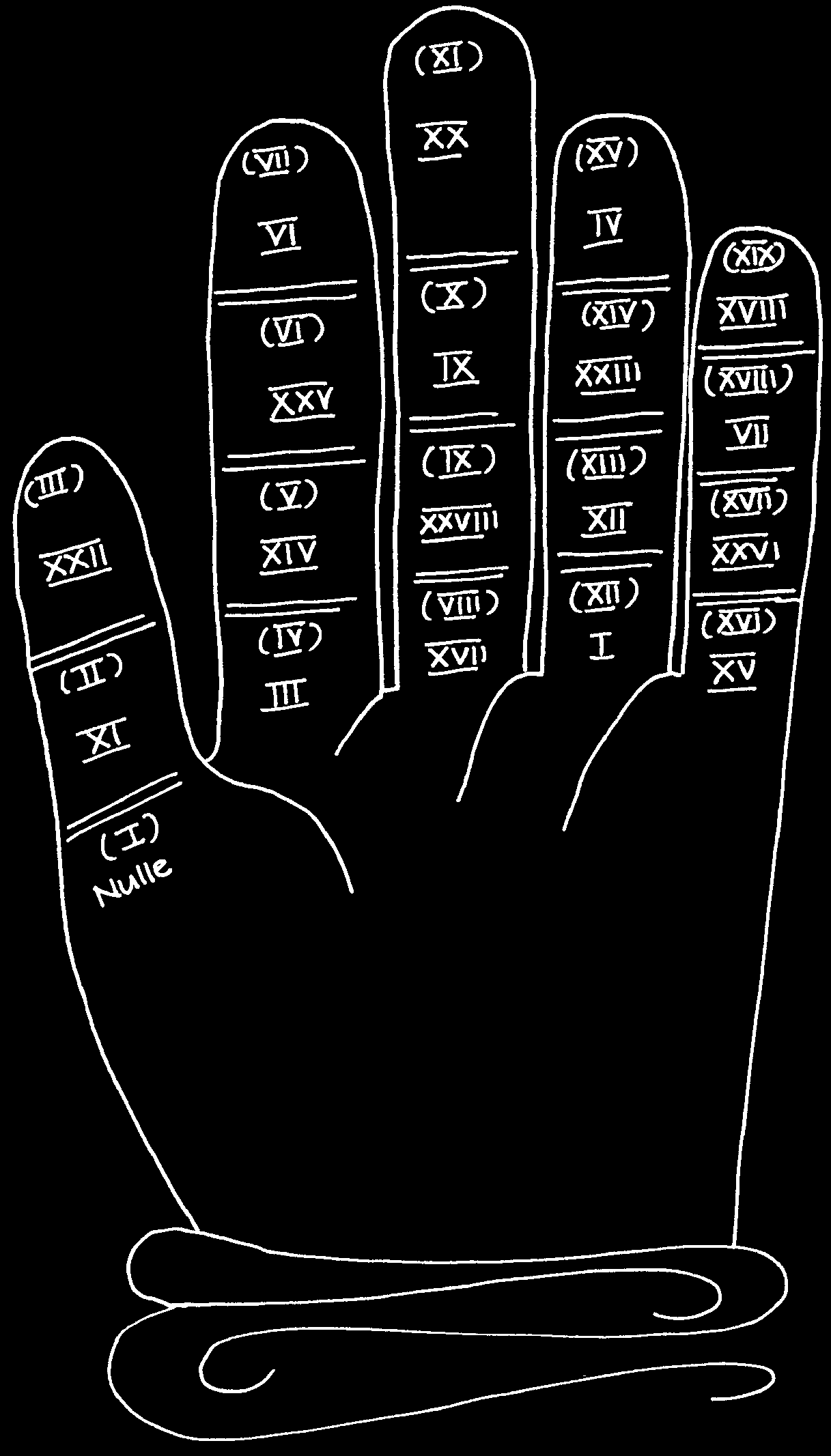
Fig. 1. Lunar cycle hand, showing lunar epacts for each year of the 19-year cycle.
The year of the cycle is noted in parentheses above. moves horizontally in ascending rows, backward counting proceeds in descending rows. To continue our example: suppose you want to know what the solar epact will be 25 years from now. Count forward twenty- ¢ve places from your ''present year'', that is, starting from the bottom joint of the right hand. Remember to include the four joints of the left and right thumbs in your count, when you have ¢nished with the ¢ngers of the right hand. You will land on the topmost joint of the middle
¢nger of the left hand, i.e. the second year after the leap year. The bottom joint of this ¢nger has the concurrent of 3. The middle joint of this ¢nger therefore represents 8 (3+5), and the top joint ^ the year you are looking for ^ will have a solar epact of 6 (8+5=13^7=6). In short, once you have counted forward or backward to the year you want, you can ''read o¡'' its solar epact by adding up from the base of the ''table'', i.e. the bottom joints of the left hand.
COMMENTARY
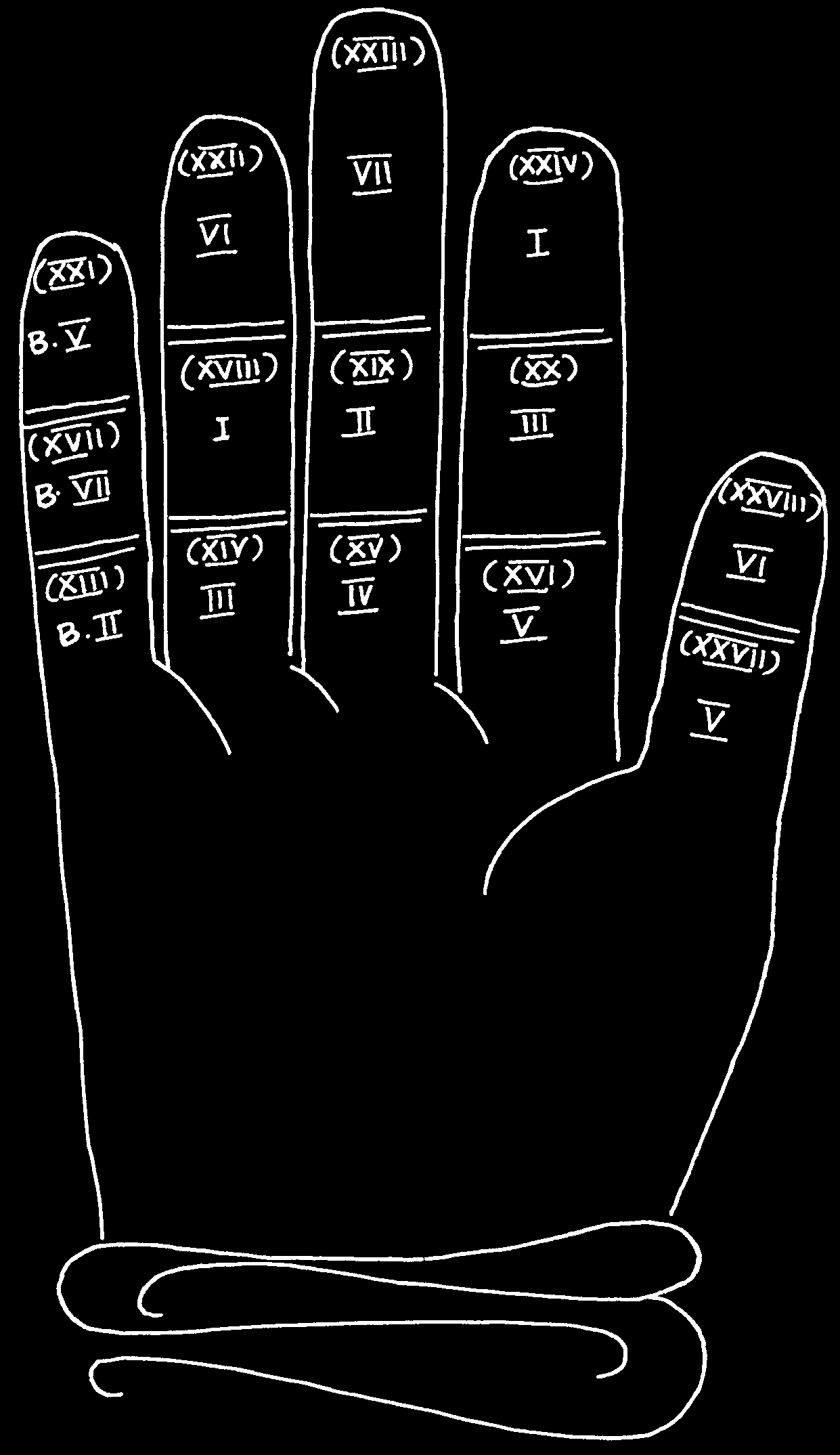
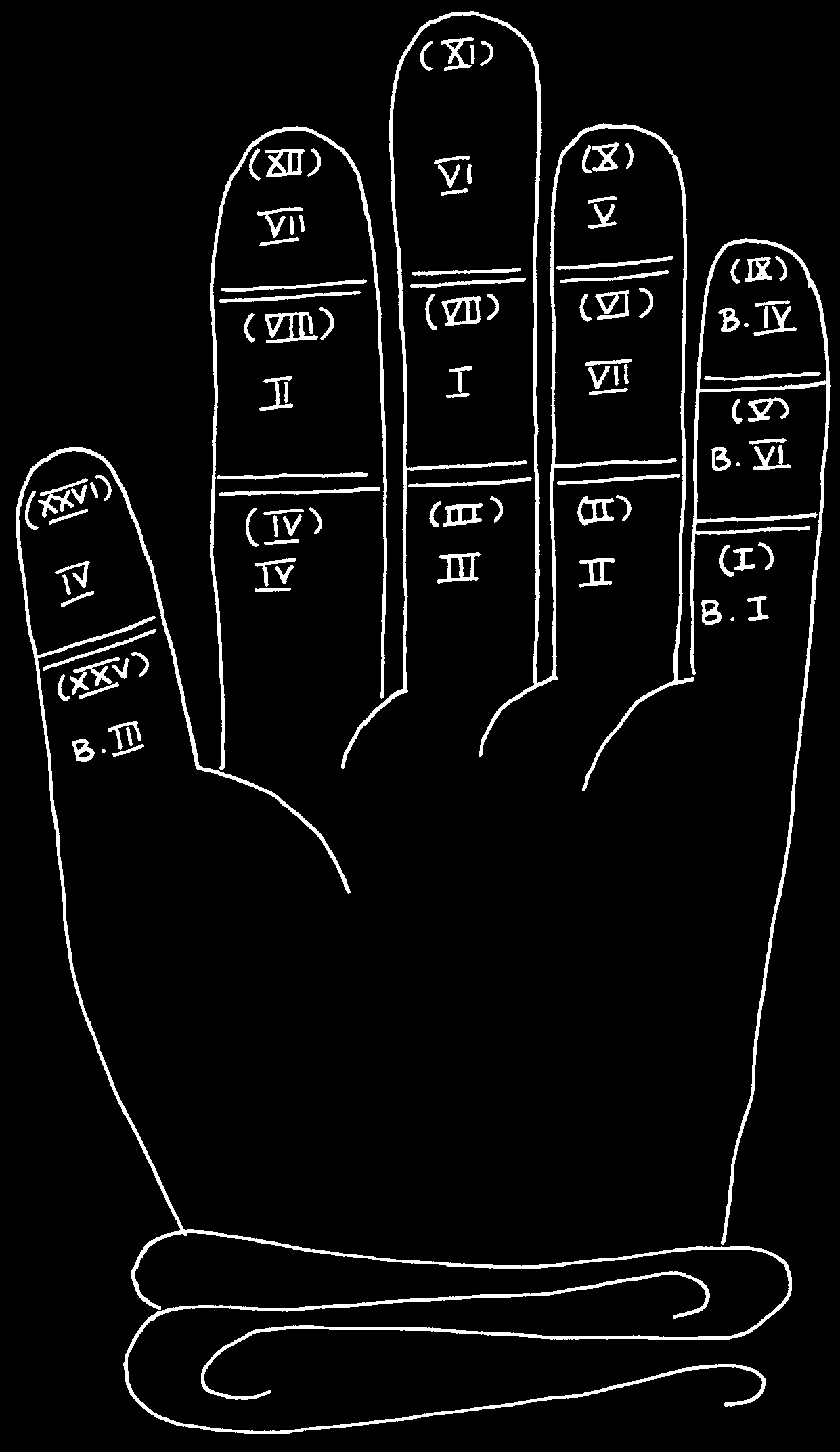
Fig. 2. Solar cycle hands, showing concurrents (solar epacts) for each year of the 28-year weekday cycle. The year of the cycle is noted in parentheses.
Bede lays no claim to inventing this device, but he is almost the only computist to describe it.188 It certainly needs an illustration to explain it, and St John's 17 is, as far as I am aware, the only manuscript of The Reckoning of Time to contain such an illustration. Nonetheless, it is the ¢rst in a long line of ingenious mnemonic and calculating systems for the calendar based on the hand, known generically as computus manualis or computus chirometralis. The history of this intriguing genre of computus-literature awaits a fuller exposition, but the fact that a 188 The only contemporary analogue is in the ''Bobbio computus'', PL 129.1322.
Ch. 76 of Rabanus Maurus' De computo is copied directly from Bede: see Florence Yeldham, ''An Early Method of Determining Calendar Dates by Finger-Reckoning'', Archeion 9 (1928):325^326.
THE RECKONING OF TIME
13th-century version in Bodleian Digby 56 fol. 165v bears the legend manus bede indicates that Bede's paternity was acknowledged.189
Chapter 56:
The lunar cycle in column 5 must have been something of a puzzle to Bede, as it plays no role at all in the computation of Easter. It replicates the structure of the 19-year cycle, but begins in year 3 of the 19-year cycle, when the Moon is new on 1 January. Because of this 1 January epact, Bede took a guess that it was a Roman lunar cycle. This is not the case, but its true origin remains obscure. It arrived in the West with the ps.-Cyrillan Paschal table, and it was obviously meant to serve as a concordance to some other form of reckoning.190 Based on his guess,
Bede therefore created a table patterned after the one Dionysius made for the 19-year cycle. The lunar cycle does have one use, however; it makes it easy to locate the age of the Moon on 1 January (ch. 57).
Chapter 59:
Column 6 of the Paschal table contains the marrow of the DionysianAlexandrian reckoning: the dates, recurring over 19 years, of the 14th
Moon of ''the ¢rst month''. The terminus a quo is the spring equinox, and the last possible date is 29 days later (because April's lunar month is
''hollow''). For Bede, this is the only scheme which ful¢ls the criteria both of the Old Testament Passover, and of the history of Christ's
Passion and Resurrection. He makes a careful distinction (to be developed more thoroughly in ch. 63) between the Passover proper, and the Feast of Unleavened Bread. The former begins at sundown on the day of the 14th Moon, and symbolizes Christ's sacri¢cial death. That is why the rite of baptism, a symbolic inclusion in that death, is celebrated at the great vigil of Easter on this night. Easter proper corresponds to the Feast of Unleavened Bread, from the 15th to the 21st Moon. Because
Christ historically rose on a Sunday, Christians celebrate on whichever Sunday falls within this period.
These dates for the 14th Moon are also the crux of the controversy 189 Illustrated in John E. Murdoch, Album of Science: Antiquity and the Middle
Ages (New York: Charles Scribner's Sons, 1984):80, no. 75.
190 Jones (BOT 388) suggests that the system was Byzantine, but furnishes no evidence.
COMMENTARY
between the Dionysian reckoning and its rival systems (to be explained in ch. 60). The Celtic Churches which celebrate Easter Day on the 14th
Moon must sometimes break their fast on the 13th, which is too early; at the same time, they reject the 21st Moon, which Moses includes within the time of Unleavened Bread. Victorius on the other hand rejects the 15th Moon, which is also within this Feast of Unleavened
Bread, while including the 22nd, which is manifestly outside it. The passage from Theophilus which Bede quotes particularly addresses the Celtic reckoning. If the 14th Moon falls on a Sunday,we cannot celebrate
Easter then, for that would mean either breaking our fast on the 13th, or (to avoid this) fasting until sundown on Sunday, both of which are prohibited.
Chapter 60:
The formula for ¢nding these 14th Moons deserves our close attention for the insight it a¡ords into Bede's pedagogy. If the pupil has the Dionysian table before him ^ and the whole latter half of Reckoning of Time is structured on the assumption that this is the case ^ why learn a formula for what can be seen plainly on the page? No table, however, explains how or why the pattern of the full Moons unfolds as it does, nor can it bring home, as does this formula, the crucial link between the full Moon and the equinox. In Bede's hierarchy of certitude, memory is the most reliable; formulae are less so, because people make mistakes in calculation especially when doing mental arithmetic; tables are the least reliable of all, since it is easy to introduce mistakes when copying them.
But only the formula has a heuristic value.
Chapter 61:
The culminating point of the Dionysian Paschal table is the seventh column, containing the dates for Easter Sunday. Bede sees this as an opportunity to recapitulate the criteria for determining this date: it must be after the equinox, in the ''¢rst [lunar] month'', in the third week, i.e. between the 15th and 21st day of the Moon, and on a Sunday. The last criterion was an innovation of the New Law, and Bede felt it was necessary, through the words of Theophilus, to emphasize that varying the age of the Moon to accommodate Sunday did not violate the Old Testament rules. After all, even the ¢rst Easter fell on the 17th Moon.
THE RECKONING OF TIME
This last point obliges Bede to venture out once more onto the thin ice of the debate over the historic calendar date of the Resurrection, ¢rst raised in ch. 47. The traditional possibilities are 25, 27 or 28 March, but if one follows the Dionysian system, none of these dates will match years within the historic period of Christ's ministry. Resurrection on 25 March needs a 14th Moon on 22 March, which will happen in AD 42, but no earlier: 25 March is the date of Easter in AD 31, but the 14th Moon falls on March 24 that year, or Holy Saturday. 27 March requires a 14th
Moon on 24 March, and the closest one falls in AD 12,191 while an Easter on 28 March with 14th Moon on 25 March will not happen until AD 191!
It should be noted, however, that Bede implies, but does not explicitly state, the signal criterion of any historic date for Easter, namely that it would have to fall on the 17th day of the Moon. He avoids drawing attention to this issue by expressing his data in terms of the date of the 14th
Moon, and the concurrent. This subtle ellipsis veils the fact that Dionysius' table itself cannot produce an Easter on the 17th Moon for any year close to the traditional year of the Resurrection. The closest years with Easters on the 17th Moon are AD 26 and AD 36. However, the Easters in these years are not on the traditional calendar dates. So Bede must reject the traditional dates, without drawing too much attention to the fact that Dionysius himself o¡ers nothing better.This is evidently embarrassing, for ever since Hippolytus and ps.-Cyprian, congruence of a Paschal table with the data of known Easters had been invoked as a foolproof test of validity. Bede's ploy is to distract the reader's attention by changing the subject to a critique of certain computists who argued that the historic Resurrection fell on the 16th Moon.
Chapter 62:
The ¢nal column of the Paschal table records the age of the Moon on Easter Day, ranging from 15 to 21. Here Bede takes the opportunity to revisit the arguments against Victorius' computus enunciated in ch. 51.
Jones found it curious that Bede should do so, given that the examples 191 Considering Bede's dismissal of 25 March, it is strange that he seems to accept this date in ch.66,where in the preface to the chronicle of the First Age, he dates the creation of Adam and the Passion to 23 March. But he only does so very tentatively, ''unless some stronger argument should prevail''. For a similar endorsement of 27 March, see Letter to Wicthed 12. On Bede's ambivalence regarding the date of the historic Resurrection, see
Moreton, ''Doubts'', 62^64.
COMMENTARY
of erroneous calculation discussed in ch. 62 would not be applicable to any year in the near future from 725, and therefore could hardly have been raising any immediate concern. Hence he speculates that what
Bede is actually doing in this chapter is recounting the con£ict between Pope Leo and the Alexandrians over the Easter of 444, which hinged on a similar issue.192
But The Reckoning of Time is neither an occasional polemic nor an antiquarian essay: it is a textbook, and the atmosphere of ch. 62 is that of Bede's class-room. First, our teacher asks the class a riddle, adopting the persona of a Victorian straw man. What after all is wrong with celebrating Easter on 26 March when the Moon is 20 days old? Is not 26
March a legitimate date? Is not a Moon 20 days old within the legal limits? The answer, of course, is that a Moon 20 days old on 26 March would have been full before the equinox. The crucial error of the Victorians is to base their calculation on the relationship of Easter to the equinox, when it is the relationship of the full Moon to the equinox which counts. By the same token, we cannot have an Easter on 22
March with a Moon 16 days old, or one on 23 March with a Moon 17 days old, etc. To be sure, some of the inspiration and ammunition for ch. 62 may indeed have come from the disputes of AD 444, but Bede's aim here is to help his students grasp the relationship of the Moon on Easter Day to the lunation of the ¢rst month, not to resurrect forgotten battles. In any event, Bede thought that Leo endorsed the Alexandrian system;193 his real target here is Victorius.
Chapter 63:
How does one ''prove'' the correctness of a system of Paschal computation? Nature does not furnish a complete answer; on the other hand, authority is malleable and Scripture open to interpretation. In the case of Scripture, it is not enough to cite the Old Testament regulations for Passover, or the New Testament records of the Resurrection. It is also necessary to determine how these two are related to one another, historically and theologically. This is Bede's task in chapters 63 and 64 of The Reckoning of Time. Bede adopts a very di¡erent approach and tone here, one strongly redolent of his biblical commentaries and homilies. These are
192 BOT 389^390.
193 Cf. ch. 44.
THE RECKONING OF TIME
the most personal chapters of the treatise, and also the ones which reveal most clearly the character of computus as doctrina christiana.
Ch. 63 draws on ancient Christian traditions194 to weave a uniquely subtle argument about the relationship between the Old Testament type and its New Testament antitype. The ancient Hebrew feast comprises two elements: the Passover proper, celebrated on a single night, and the Feast of Unleavened Bread, spread over seven days. As we have seen, this fact was a crucial weapon in Bede's contest with the Celtic computus, which con£ated the two feasts by celebrating on the 14th Moon. But it is noteworthy that Bede does not want to endorse a strong dichotomy between Passover/Passion and Unleavened Bread/Resurrection, for that would play into the hands of the Victorians, who rejected the 15th
Moon because it belonged to the Passion, not the Resurrection. Bede's argument is, in fact, more subtle and profound. The Christian Easter incorporates both Passover and Unleavened Bread, without e¡acing the distinction between the two. The single night of Passover typi¢es both
Christ's sacri¢ce as the Lamb of God, and his Resurrection or ''passing over'' from death to life. As the Gospels bear out, Passover and the Unleavened Bread are in fact a single entity: the disciples in Mark 14.12 speak of the Passover on the 14th Moon as if it were the Unleavened
Bread, while John 18.28 refers to Good Friday on the 15th Moon as ''Passover''. Each contains the other ^ an argument already invoked by the quotations from Theophilus in the preceding chapters, justifying the celebration of Easter on any Sunday from the 15th to the 21st Moon.
Sliding into homiletic mode, Bede draws a moral lesson: just as Easter is both a moment in time, and an event unfolding over time, so also our individual experience of Easter is both a discrete moment ^ our baptism
^ and a grace which unfolds ''for the whole time of our pilgrimage'' through the seven ''days'' of our life.
194 Though Bede does not cite these directly, his predecessors include Gaudentius,
Tractatus paschales 1.9^10, ed. Ambrosius Glueck, CSEL 58.20 (1886):20.50^62, and Origen, whose Homily 9.5 on Leviticus on the subject of Passover and Unleavened Bread is quoted by ps.-Anatolius (317) and Cummian (62^64): Origines Werke 6: Homilien zum
Hexateuch in Ru¢ns U« bersetzung, ed.Wilhelm Baehrens, Griechischen christlichen Schriftsteller 29 (Leipzig, 1920):426. The older opinion that ''Origen'' was a lost or spurious authority, represented by Jones (BOT 390), has been refuted by O¤ Cro¤ in|¤n, Cummian's
Letter, 62^63, n. 52. Jerome's Greek nickname for Origen, chalcenterus (''bronze entrails''
^ apparently a compliment on his indefatigable scholarship!), came to mean ''computist'' in 7th-c. Ireland: see D. O¤ Cro¤ in|¤n, ''Hiberno-Latin calcenterus'', Peritia 1 (1982):296^297.
COMMENTARY
The idea, then, is that the Christian computist acknowledges both the distinction between Passover and Unleavened Bread, and their reciprocity. As Bede says, we must ''eat unleavened bread in the Passover season, and in the days of Unleavened Bread . . . make a spiritual passover''. The Celts fail to honour the distinction; the Victorians, to acknowledge the reciprocity.
Chapter 64:
Ch. 64 is another highly original ''sermon'' whose ''text'' is the four computistical criteria for Easter enunciated in ch. 61. Though it draws heavily on Augustine's Letter 55 to Januarius, its structure and aim are very di¡erent. Augustine is concerned to defend the Church against the charge that by observing the astronomical criteria for Easter, it in fact worships the Sun and Moon; Bede, on the other hand, takes the Sun and Moon as his ''scripture''. The parallels between this chapter and the letter of Ceolfrid to King Nechtan included in HE 5.21 are very striking.
We celebrate Easter at the vernal equinox because Christ, the Sun of Righteousness, has won His victory over darkness; because He has
''made all things new'', we celebrate in the ¢rst month; because His Resurrection inaugurated a third age of grace (succeeding the ages of natural and written Law), Easter falls on the third week of this ¢rst month. We are like the Moon, shining in His borrowed light. After the 15th day of the lunation, the Moon turns its illuminated side away from Earth and towards the heavens; so also Easter, falling on the 15th day or later, teaches us to spurn earthly things for the sake of heavenly ones.
But the Moon is also Christ himself, increasing in visibility to earthly eyes up until the time of His Passion at the full Moon, and then returning to heaven after the Resurrection. Finally, we celebrate on Sunday, the ¢rst day of the week, in honour of Creation, re-made in Christ's triumph. Easter Sunday can fall on any one of seven days of the lunar month; this symbolizes the universality of the Church, just as John in his Apocalypse addressed the same admonition to each of the seven
Churches of Asia. Bede then returns to the beginning of his theme, and rewrites the entire allegory in a moral mode, admonishing his readers to ''pass over'' from sin to virtue, bring forth the ''¢rst fruits'' of redemption, shine like the Moon both for others and for God alone, and ¢nally, trust in the sevenfold gifts of the single Spirit.
In treating computus as ¢gura, Bede has followed much the same
THE RECKONING OF TIME
method as he used in his highly original expositions of the Tabernacle and Temple, where he turned the nuts and bolts of architectural detail into theological signs. But within the economy of The Reckoning of Time, this homily also serves a strategic purpose. By colouring the Alexandrian rules with mystical meaning, Bede has raised them above the sordid plane of computistical controversy, and transformed them into a kind of sacred text. In his exposition of the Paschal table, he had to defend and justify the Alexandrian reckoning line by line; now he can celebrate its apotheosis. But Bede has done more than simply close the books on the Paschal question. He has engraved the Alexandrian computus on his pupils' memory, not just as a bodyof rules to be followed
^ or contested ^ but as theological truth and moral imperative.
Chapter 65:
The note of sublimity struck in ch. 64 sets the stage for the ¢nal topics of The Reckoning of Time, namely the relationship of computus to time as a whole, and in its largest sense. Three motifs articulate this theme: the Great Cycle by which the Easters will repeat over 532 years; how computus structures all of past time, right back to Creation; and how it illuminates future time, carrying it over the threshold into eternity.
Bede was the ¢rst computistical writer to expound the cyclical character of the Alexandrian reckoning correctly. Ps.-Cyril believed, incorrectly, that his Paschal data would repeat after 95 years. Victorius noticed that his data began to repeat after 532 years, but did not know why. Dionysius knew that Cyril was mistaken, but apparently either did not know, or did not appreciate, the signi¢cance of Victorius' discovery.
Bede does not claim to have discovered the 532-year cycle, and he does not seem to expect his readers to be struck with its novelty.195 But there
195 Ceolfrith's letter to Nechtan (HE 5.21 [546]) claims that many in England were capable of producing Easter cycles, but whether he meant Great Cycles or not is unclear.
Since the extension to Dionysius' table expired in 721, someone would have had to project them further into the future, but this does not necessarily imply the creation of a Great
Cycle. However, it should be noted that the author of De mirabilibus sacrae scripturae realized that the Victorian 532-year cycle was the product of the 19-year lunar cycle and the 28year solar cycle (2.4, 2176); cf. Smyth 151^152; O¤ Cro¤ in|¤n, ''Early Irish Annals from Easter
Tables: a Case Re-Stated'', Peritia 2 (1983):74^86. Cummian drew the same conclusion
(88.225^226), and De ratione conputandi 14 applies the same logic within the context of the Dionysian system (124.1^6). It is therefore more than likely that a Dionysian Great Cycle was in circulation before The Reckoning of Time was composed.
COMMENTARY
is no question that he was amongst the ¢rst to explain why the data recurred after 532 years, and de¢nitely the ¢rst to publish a Great
Cycle. Bede indicates that his exemplar of The Reckoning of Time contained such a cycle; we also have included it, as an appendix to the present translation.
At a stroke, the Great Cycle solved the problem of computus forever.
All the elaborate explanations, formulae and arguments of The Reckoning of Time are in a sense totally unnecessary, for by means of this table, true Easters can be found for as long as the world lasts. Bede's table would run out in 1063, but the data could then simply be recycled for the next 532 years. All that would need to be adjusted were the indictions (an arbitrary count of years, without astronomical basis or computational signi¢cance) and the years of the Incarnation.
The years of the Incarnation are, of course, not cyclic, but linear, and their steady, objective march into the future serves to identify and label all time to come. But it is not this possibility which primarily intrigues
Bede here. It is rather the potential of the table, and its count of years, to plot past time. It can be used to ''clarify an ancient text'' and ''clearly identify all the years''; in short, it can be a framework for history. Bede's computus has hitherto been exclusively prospective in its intentions. Its object was to determine dates for Easter, and the only such dates of interest were future ones. The link between annus Domini and the Paschal table, however, gives it an alternative, retrospective orientation.
Bede is, of course, justly famous for the way in which he used annus Domini in his own historical writings. When he looks at past time in his computus treatise, however, he adopts a rather di¡erent approach.
Chapter 66:
As we have seen, one of Bede's most remarkable innovations was to solemnize the link between chronology and computus. In his hands, chronology became applied computus.196 The initial inspiration for this came from Isidore and the Irish, who suggested a framework for a treatise on computus based on an ascending hierarchy of units of time. In De natura rerum and the Etymologiae, Isidore stops at the year; his next category is mundus (''world'' or ''universe''), which bridges time into 196 Jones, ''Bede as Early Medieval Historian'', 32; von den Brinken 102^108;
Tristram 26. See Introduction, section 4.
THE RECKONING OF TIME
cosmos. The Irish De computo dialogus goes from the year to the cycle, from the cycle to the aetas (''age''), thence to the saeculum (literally
''generation'', but here used in its extended sense of ''era''), and ¢nally to mundus.197 Bede followed the Irish lead by adding the Great Cycle and the World-Age to the divisions of time. On Times chs. 1^9 follows the conventional Isidorean divisions up to the year; chs. 10^15 deal with the Paschal cycle; and ¢nally, chs. 16^22 describe the Six World-Ages through the medium of a chronicle. This format was retained and expanded in The Reckoning of Time. But in his later work, Bede chose to treat the World-Ages twice: once as a type of week (ch. 10) and a second time as the extension of the Great Paschal Cycle (ch. 66).
Bede's two world chronicles are unusual in a number of respects. Not only are they embedded in computus treatises, but they propose a radical revision of the received chronology of world history. To understand the form, content and role of ch. 66 within The Reckoning of Time, we must therefore ¢rst situate it with respect to its major sources.
The Christian concept of time is remarkable for its linear focus, its boundedness, and its exclusivity. Time began at Creation, and will end at the Last Judgement. It goes in only one direction, forwards: before Christ, its goal was Christ himself; after Christ, its goal is the Parousia.
Finally, there is no time outside this sacred time of God's Creation: there is only one God, only one world, and only one history for all peoples. These three characteristics underpin the unique Christian genre of universal history. God's plan of salvation embraces all nations, whether they are aware of it or not. He foreordained that the Romans would rule the world at the time of the Incarnation, just as He chose the Jews as His special people. The single thread of divine purpose draws all particular histories into one continuum of time.
The linear direction and unity of this world-history is secured by chronology, the precise establishing and synchronizing of all historical dates within one time-frame. The father of Christian chronology was
Eusebius of Caesarea (263^339).198 Basing himself on the pioneering Christian chronology of Julius Africanus (£. 221), and the Hellenistic
197 De divisonibus temporum 633B.
198 Croke; Tristram 19^22; Alden A. Mosshammer, The Chronicle of Eusebius and Greek Chronographic Tradition (Lewisburg: Bucknell University Press and London:
Associated University Presses, 1979); Molly Miller, ''The Chronological Structure of the Sixth Age in the Rawlinson Fragment of the 'Irish World Chronicle''', Celtica 22
(1991):79^83.
COMMENTARY
tradition of synchronized histories of the Mediterranean world, Eusebius contructed a pair of seminal chronological works, the Chronographia and the Chronikoi Kanones. The former survives only in a doubtful
Armenian translation and a Syriac fragment, and seems to have had little in£uence. The impact of the latter, however, was enormous. The Kanones is a time-line chronicle, beginning with Abraham. Its chronological backbone is the regnal lists of the world-empires of Assyria,
Persia, Macedonia and Rome, supplemented after 776 BC by the Olympiads. As peoples and empires appear on the stage of world history, they are granted their own parallel columns within the table; as they are absorbed into the world-empires, these columns gradually disappear, until the Roman empire occupies the entire frame. This unusual format stresses the coincidence of the histories of various peoples, and the key role of chronology in tying these stories together. Indeed, Eusebius' signal achievement was to synchronize the dates and events of the Bible with those of the pagan kingdoms within a format that furnished continuity, parallelism, and chronological exactitude.199 The Kanones had an extraordinary career, particularly in the West, where they were translated and edited by Jerome.The original Kanones ended at AD 303; Jerome's continuation went until 378, that of Prosper (ca.390^463) to 445, and that of Marcellinus Comes to 534. Bede had access to this full edition of the Kanones.
Eusebius' Kanones synchronizes eras, but does not synthesize them, save in the form of a running total of years since the birth of Abraham in the outer margin. In the preface of the work, however, Eusebius discusses the periodization of world-history before Christ. He divides the time between Abraham and the beginning of Jesus' ministry into four periods ^ (1) Abraham^Moses (2) Moses^First Temple (3) First
Temple^Second Temple (4) Second Temple^Ministry ^ and adds that the time prior to Abraham can be divided into two periods, namely (1)
Adam^Flood, and (2) Flood^Abraham.200 The dates for the period after Abraham are established by the regnal lists, for Abraham was born in the 43rd year of King Nilus. The ¢rst two Ages are much more problematic,because the years and generations in the Septuagint translation of the Old Testament are quite di¡erent from those in the Hebrew text. Eusebius preferred the Septuagint version, on the grounds that 199 Tristram 20; Miller 80.
200 Helm's introduction to his ed. of Jerome's Chronicon, 14^17.
THE RECKONING OF TIME
modern Hebrew codices are more likely to be corrupt than the ancient exemplars used by the Seventy Translators, but he probably began his chronicle with Abraham precisely to avoid this controversy.201 Eusebius dated the beginning of Christ's ministry to AM 5228. If Christ was 30 years of age at this time, he would have been born in 5197 or 5198;
Jerome preferred 5199, which was the conventional date in the West.
Augustine was enormously dependent on Eusebius, and it was through Augustine's eyes that Bede read the Greek chronographer.
Augustine was less interested in exact chronology than in the mystical signi¢cance of the World-Ages, whose allegory and number symbolism he explored in many of his works.202 He reduced Eusebius' six preChristian Ages to ¢ve, which with the addition of the Christian era, made six. He also reordered the last three Ages before Christ to match the three periods of fourteen generations enunciated in Matthew 1.17:
Abraham to David, David to the Babylonian Captivity, Babylonian Captivity to Christ.
The number six was highly signi¢cant for Augustine, because it linked the Ages of the world to the days of Creation. This analogy was commonplace in patristic literature,203 but Augustine elaborated it considerably: each Age, like a day, had a morning, a noontide, and an evening ^ in other words, a bright beginning, a zenith, and a troubled period of decline. Bede, as we have seen, borrowed this model for his exposition of the World-Ages in ch.10 of The Reckoningof Time. Augustine also proposed a second analogy between the Six Ages of the world and the six ages of human life: indeed, he deliberately selected aetas as his term for the six eras or epochs of world-history, by analogy with the ages (aetates) of human life. The key text here is De Genesi contra Manichaeos 1.23.35 sqq., a work which Bede certainly knew,204 but the analogy is also found in other Augustinian works, notably De civitate
Dei 16.43. The First Age is like infancy, for the world emerged into the 201 Miller 80.
202 For a survey of these, see Tristram 23; cf. Luneau pt. 4.
203 Siniscalco 316^317. As Siniscalco later observes, this analogy has the advantage of contrasting the linearity of historic time with the cycles of nature and the calendar; history, like Creation, is unrepeatable: ibid. 327.
204 He mentions it as a source for his own commentary on Genesis, composed in 720: In Gen., praef. (1). Bede's much more skeletal treatment of the analogy between the World-Ages and the ages of man in On Times seems to be based on Isidore, Etym. 5.38; cf.
Siniscalco 323.
COMMENTARY
light of Creation just as man emerges into the light of life. The Second Age corresponds to childhood, the Third to adolescentia, the Fourth to juventus, and the Fifth to ''a decline from youth into old age''.205 Bede borrowed this scheme for his prologue to ch. 66,but with some signi¢cant changes, as we shall see.206
Augustine was interested in the Six Ages as a theology of history, not as a chronological framework. Indeed, when he touched on the length of the World-Ages at all, he tended to employ generations rather than years, vacillated between the Incarnation and the Ministry as the starting point for the Sixth Age, and confessed agnosticism or lack of interest with regard to the discrepancies between Septuagint and Hebrew chronologies.207 Signi¢cantly, his prote¤ ge¤ Orosius did not use the Six Ages scheme in his own Historia.
A di¡erent approach was taken by Isidore of Seville, one which had a formativee¡ectonBede.Isidore tookthemomentousstepoffusing Eusebius' chronology to Augustine's division of the Six Ages, to produce the ¢rst world chronicle dated according to annus mundi.208 In other words, he abandoned Eusebius'parallel eras for a single chronologicalbackbone based on the date of Creation. His ¢gures, however, were derived entirely from the Septuagint chronology outlined in Eusebius' prologue. Isidore organized the history of the ¢rst three Ages according to the generations of the Hebrew patriarchs, and then according to the reigns of the Judges and kings. After the fall of the Jewish kingdom, the chronological frame was furnished by the heathen empires which ruled Judaea: Macedon,
Ptolemaic Egypt, and ¢nally Rome. Isidore dated reigns according to their closing year, not their inception.209 Finally, he also innovated by ¢xing the beginning of the Sixth Age de¢nitively at Christ's birth.210 All these features were taken over by Bede. Indeed Bede's debt to Isidore for 205 declinatio a juventate ad senectutem: Augustine, De Genesi Contra Manichaeos 1.23.40 (PL 35.191).
206 On this theme in general, see Elizabeth Sears, The Ages of Man, ch. 3, ''The Ages of Man and the Ages of World History''; Paul Archambault, ''The Ages of Man and the Ages of the World: a Study of Two Traditions'', Revue des e¤ tudes augustiniennes 12
(1966):193^228.
207 DCD 18.43 (639.22^28). Cf. Tristram 24.
208 Eusubius and Jerome, it will be recalled, used the ''era of Abraham''; Prosper used the annus Passionis.
209 This policy is also followed by the Chronicon Paschale.
210 Tristram 24^25.
THE RECKONING OF TIME
the substance as well as the form of the chronicle in On Times is very signi¢cant, and if Isidore is somewhat eclipsed by Eusebius in The Reckoningof Time, the formal in£uence remains.
To summarize the argument thus far, Bede was the heir to a complex tradition of world-chronicles, based on Eusebius' synchronization of biblical and secular time, and overlaid with a particularly Augustinian reading of the World-Ages. His immediate source was Isidore's chronicle in Etymologiae 5.29, but he reached back to Augustine for the analogy with the six days of Creation, and with the six ages of man. However, he introduced a fundamental modi¢cation of this tradition. In On Times,
Bede replaced the Eusebian-Septuagint chronology of the ¢rst two World-Ages with a new chronology based on Jerome's translation of the Hebrew text of the Old Testament. As had been recognized long since, even by Eusebius himself,the two vary considerably in their chronology of the ¢rst two Ages. Where the Septuagint assigns 2,242 years to the First Age and 942 to the Second, Bede, following the Vulgate, gives
1,656 years to the First Age and 292 to the Second Age. The upshot is that the birth of Christ, which Isidore, following Eusebius, dated to AM
5197, is dated by Bede to AM 3952. This revised chronology drew down accusations of nothing less than heresy, for there was a common conception that each of the Six Ages was 1,000 years in length; Bede's new chronology, therefore, did not place the birth of Christ in the Sixth Age.
Bede refuted these accusations in his Letter to Plegwin, and devoted ch.
66 of The Reckoning of Time to restating and elaborating his case.
Central to his argument is the idea that not all the World-Ages are of equal length, and by implication, the duration of the Sixth Age cannot be known, a point he will expand upon in chs. 67 and 68. At the outset of ch. 66, Bede sets the stage for this larger argument by recasting slightly
Augustine's analogy between the Six World-Ages and the six ages of man's life. Though Augustine explores this theme in De Genesi contra
Manichaeos, Bede's text corresponds more closely to De vera religione 26.48: for example, the First Age is likened to childhood because childhood is a time which is lost in oblivion, as the First Age was wiped out by the Flood.211 But what is particularly signi¢cant is Bede's comment on the Sixth Age, where he steps outside the Augustinian framework
211 De vera religione, ed. J. Martin, CCSL 32 (1961):217. Contrast De Genesi contra Manichaeos (PL 35.190) which simply connects the Creation in the First Age to human birth.
COMMENTARY
completely. The sixth age of human life is characterized not only by decline, but by the fact that we do not know the time of death. Unlike the other ¢ve ages of life, it has no predetermined end-point. Similarly the Sixth Age, unlike the other ¢ve, has no ¢xed number of years, for its end ^ and hence the end of the world ^ is known to God alone. Isidore, to be sure, closed his chronicle by averring that ''the rest of the Sixth
Age is known to God alone'',212 and Augustine noted in De civitate Dei 23 that there is no number of generations to be assigned to the Sixth
Age, but Bede's integration of this warning into Augustine's anthropological analogy is quite original. It reinforces the whole message of the world-chronicle, which is a polemic against chiliasm.
The choice of a Six Ages scheme and an AM reckoning for the chronicle in ch. 66 has puzzled some scholars, who wonder why Bede discarded both in his Ecclesiastical History.213 It might also be remarked that the AM reckoning is a little unexpected in the context of the Reckoning of Time itself, since the chronicle is a kind of gloss on the Paschal table, in which years are numbered according to Dionysius' AD scheme.
Why did Bede take this route? A second question is related to this ¢rst one: why did Bede revise the standard chronology of the annus mundi so radically in On Times, shaving nearly 1200 years o¡ the conventional age of the world, and why, when this new chronology provoked criticism, did he proclaim it afresh, and in even more emphatic terms, in The Reckoning of Time?
These questions are linked to the issue of the relationship between computus, history, chronology, and the end of time. In a recent and very penetrating essay, Richard Landes has pointed out that the fusion of world-chronicle and the scheme of the Six Ages is not only unique to the West, but fraught with theological and pastoral implications.
Though subject to variation, most AM chronologies dated the Incarnation to the ¢fth millenium: Julius Africanus to 5500, and Eusebius to 5197/8 (or in Jerome's version, 5199). When the schema of the Six Ages is laid over this chronology, it immediately suggests that each of the six
World-Ages is about 1,000 years long, for Christ's Incarnation inaugurated the Sixth Age. This chronological coincidence tapped into an 212 Residuum sextae aetatis tempus Deo soli est cognitum, Etym. 5.29.42; cf.
Chron. 418 (ed. Th. Mommsen, p. 481): residuum saeculi tempus humanae inuestigationis incertum est.
213 Introduction, section 4.
THE RECKONING OF TIME
ancient piece of Christian eschatological folklore, namely that there are six Ages, each Age one thousand years in length. The cue here is II Peter
3.8 ''. . . one day is with the Lord as a thousand years, and a thousand years as one day'' (cf. Psalm 90.4/89.4). This notion of the divine thousand-year day, when joined to the analogy between the World-Ages and the days of Creation, produced the idea of the thousand-year WorldAge. The logical conclusion is that the world will end in annus mundi
6000, but if that is the case, it means that one can predict the time of the end of the world if one knows the date of its beginning. And if each of the Six Ages is 1,000 years long, then the thousand-year reign of the saints after the general resurrection (Apoc. 20.4) must be a seventh
World-Age, a cosmic sabbath corresponding to the seventh day of the Creation week, but still within historic time. Chronology, then, becomes unwittingly the accomplice of a both a heretical chiliasm and an explosive millenarianism.214 Millenarianism was the target of Augustine's rede¢nition of the Seventh Age as the duration of the Church Expectant, from the time of Abel until the Last Judgement, a position which Bede will expound in ch. 71. Chiliasm, however, was less easy to uproot.
The reaction of the Church to chiliasm was paradoxical, for though it strenuously condemned it, it hesitated to take the obvious measure to uproot it, namely jettisoning the notion of the Six World-Ages. Moreover, the nature of Christian historiography prevented the Church from downplaying chronology in the hopes of avoiding speculation about the date of the Last Judgement. The result was that Western writers revised the annus mundi chronology at regular intervals to ''rejuvenate'' the world and postpone the millenium, without abandoning the basic framework of the Six World-Ages. As Landes has observed, these revisions always took place in the ¢nal century leading up to the year 6000, and usually rejuvenated the world by only a few hundred years: enough to allay apocalyptic terrors, but not enough to push the end over the horizon of visibility. First, Julius Africanus' chronology was replaced by Eusebius' in the late fourth century, and as Eusebius' year 6000 approached in the middle of the eighth century, fresh revisions of the AM reckoning were aired. Bede's radical revision of AM was one of these. Jerome's Vulgate inadvertently o¡ered Bede a way of eluding the impending Eusebian deadline.215
214 Landes 142^149; von den Brincken 50^60.
215 Cf. Landes 176; von den Brinken 110.
COMMENTARY
Bede's new chronology drew ¢re because unlike previous revisions, it postponed the Last Judgement for a very long time ^ almost 1,200 years. The captious critics at Bishop Wilfred's table were not ''rustics''
(to borrow Bede's scornful epithet in the letter to Plegwin) but ordinary educated clerics, and their reaction reveals the problems engendered by the Western Church's ambivalence with regard to chiliasm. Deeply as it deplored these speculations, the Church could not abandon the Six
Ages chronology or the equation of age and millenium sanctioned by so many authoritative texts. Instead, it elected, in Landes' phrase, to ''mortgage the future'' for the sake of peace and good order in the present, by continually pushing the Parousia a little bit ahead, but not so far ahead as to rupture the implicit connection between millenia and World-Ages.
We may hypothesize, then, that in On Times Bede revised Eusebius' chronology in the interests of what he saw as historic accuracy. But after the Plegwin a¡air, he defended his innovation for a new reason: because it o¡ered a radical challenge to the chronic heresy of chiliasm.216 As Landes points out, chiliasm was far from moribund in Bede's day, nor was it merely a feature of ''popular religion''. The Plegwin episode shows that a purely chiliastic reading of the Six Ages of the world could be aired in the presence of an English bishop without any hue and cry of heresy being raised. On the contrary, it was Bede, whose revised chronology was radically anti-chiliastic, who was called a heretic. Bede may also have been responding to the aberrant chronology of the Byzantine writer John
Malalas, introduced into England by Archbishop Theodore of Canterbury, and promulgated through his Laterculus Malalianus, a historical exegesis of the life of Christ. In the Laterculus, Theodore complains about the stupidly and quarrelsomeness of the Irish, who insist on rejecting what Theodore regards as the orthodox and accepted chronology of Christ's life. That chronology actually dated the Cruci¢xion to AM 6000, which meant the world was already into its seventh millenium.
The peevish Irish were probably defending the standard Eusebian chronology, but they were also demonstrating the force of chiliasm, which continued to regard the year 6000 as the scheduled end of the Age.217
216 Cf. Siniscalco 309^311, who cites evidence of Bede's increasing use of this motif in the biblical commentaries written between On Times and The Reckoning of Time.
217 See the Irish text of AD 645 on this subject edited by O¤ Cro¤ in|¤n in ''Early Irish
Annals from Easter Tables: a Case Re-Stated'', Peritia 2 (1983):79^81; ibid., ''Irish Provenance'', 235; and the anonymous 7th-century Irish commentary on the First Epistle of John, ed. Robert E. McNally, Scriptores Hiberniae minores, CCCM (1973):1.40; cf. Smyth 107.
THE RECKONING OF TIME
Certainly the Laterculus is frank about its belief that each Age of the world lasts one thousand years ^ a position Bede deplores.218 For all these reasons, Bede saw ¢t to reassert his position in The Reckoning of Time.219
Ironically, Bede unwittingly solved the problem of chiliasm by popularizing annus Domini reckoning, both through his Ecclesiastical
History, and through his Dionysian Paschal tables.220 Taken up by the Carolingians, the annus Domini era eventually ended the reign of the Creation era in the West, and drew the millennial sting out of the schema of the Six World-Ages.221
Landes argues that Bede's new annus mundi chronology was almost universally rejected, but von den Brinken shows that many Carolingian
218 On the Laterculus Malalianus see Jane Stevenson, The Laterculus Malalianus and the School of Archbishop Theodore, Cambridge Studies in Anglo-Saxon England 14
(Cambridge: Cambridge University Press, 1995): esp. ch. 3 of text (p. 124), and idem,
''Theodore and the Laterculus Malalianus'', in Michael Lapidge, ed., Archbishop Theodore: Commemorative Studies on his Life and In£uence, Cambridge Studies in AngloSaxon England 11 (Cambridge: Cambridge University Press, 1995):204^221. There is no evidence that Bede knew the Laterculus Malalianus directly, but he certainly had access to other literature from the school of Theodore and Hadrian. Benedict Biscop, after all, had guided the newly consecrated archbishop and his deacon to England, and had lived in close proximity to them as abbot of St Augustine's for several years after. Bede revised the Passio
S. Anastasii which Theodore probably brought to England: see Carmela Vircillo Franklin,
''Theodore and the Passio S. Anastasii'', in Archbishop Theodore, 175^203. Bede also had access to another rare Greek text associated with the Canterbury mission, the lapidary of Epiphanius: see Peter Kitson, ''Lapidary Traditions in Anglo-Saxon England: Part II,
Bede's Explanatio Apocalypsis and Related Works''. Had Bede known of the Laterculus, he might not necessarily have associated it with Theodore, as he seems to have known little about Theodore's career and learning. In The Reckoning of Time, ch. 66, s.a. 4591, he mentions the Roman monastery of ''Ad Aquas Salvias'',but does not remark thatTheodore was the abbot of this house: cf. Franklin 203.
219 Jones also argues that the doctrine of the Six Ages was of minimal importance to Bede, a mere ''teaching device'' without connection to historical reality. Indeed, he claims that the Plegwin episode made Bede almost embarrassed by the concept: ''Bede as Early
Medieval Historian'', 31^32. This position is untenable, and Jones seems to have modi¢ed his views in later life: see the section on the Six Ages in ''Some Introductory Remarks'',191^
198. Not only does Bede invoke the concept of the Six Ages with great enthusiasm in many of his works (for a list of these, see Plummer xli^xlii, n. 6, and Siniscalco 311, n. 30), but the Plegwin a¡air made him bolder than ever in asserting its relevence, for he wanted, above all, to detach it from the pernicious notion that each Age is one thousand years long.This is why he devotes the ¢nal seven chapters of The Reckoningof Time to the issue of the World-Ages.
220 Landes 178.
221 Ibid. 140^141.
COMMENTARY
and post-Carolingian historians used it without demur,222 and Tristram argues that the later success of the Six Ages doctrine was largely due to Bede.223 Indeed, Bede's eccentric annus mundi reckoning was taken up by some for exactly the reason that Bede devised it. MS Leiden Scaliger
28 is a 9th-century computus manuscript from Autun, with Bedan Easter cycles extending from AD 1 to AD 1006.The closing date is significant: the tables should have gone to 1063, the end of the second 532-year cycle. Did the scribe imagine that the world might end in AD 1000, and terminate his table at the completion of the 19-year cycle closest to the fatal year? Certainly one of the readers of Scaliger 28 entertained analogous apocalyptic anxieties. He collated the AD years to their AM equivalent. He used both the Eusebian and the Bedan chronology, but discontinued the Eusebian one after AD 789, the year 5990 in the Eusebian scheme. Thereafter, he continued up to his own time (AD 806) only with Bede's chronology, for the other chronology had already put him over the frontier of annus mundi 6000.224
The Great Chronicle of ch. 66,and indeed the whole block of chapters 66^71, forms a thematically distinct section within The Reckoning of Time, but its position within the work has often seemed somewhat tenuous, even to the ¢rst generations of its readers. While Bede's extension of the divisions of time to the cycle and the age might seem logical, the somewhat controversial tone and the predominantly historical and theological content of these chapters sets them apart from the rest of The Reckoning of Time. As a result, from very early on in the manuscript tradition, there was a tendency to detach this section from the rest of the book. One very early codex, the Reichenau manuscript Karlsruhe, Aug.
167 (s. IX1),225 drops the chronicle completely. So do other Carolingian manuscripts like Munich CLM 14725 (Regensberg? s. IX1) and Paris,
Bibliothe' que nationale n.a.l. 1632 (prov. Orle¤ ans, s. IX2). Dropping the chronicle sometimes led to dropping everything after the chronicle, e.g. in Berlin, Staatsbibliothek lat. 130 (Phill. 1832) (Metz, 873?).226
222 Cf. von den Brincken 113^120 and Appendix, Table IV. For its use by Irish chroniclers, see Miller, and O¤ Cro¤ in|¤n, The Irish 'Sex Aetates Mundi' (Dublin: Institute for Advanced Sciences,1983). For use by Freculf of Lisieux and by St Gall historians, see Allen,
''Bede and Freculf'', 78^80.
223 Tristram 30.
224 Landes 188^189.
225 See Introduction, section 6.
226 Other examples include Brussels 9932^9934 (Lie' ge,s. XI),Cambrai 925 (prov.
Cambrai Cathedral, s. IX); Ivrea 42 (813?); St Gall 248 (St Gall, s. IX);Vat. lat. 644 (St Gall,
THE RECKONING OF TIME
Occasionally one encounters a curiously exclusive interest in the chronicle and closing chapters. Rome, Biblioteca Vallicelliana E 26
(Lyon, s. IX1) fols. 43v^71v is ''possibly a half of DTR rearranged in an accurate and careful text'',227 followed (fols. 91r^136v) by the full text of the chronicle and closing chapters. Troyes 1071 (s. X) fols. 46r^62 is an example of a manuscript where the chronicle and last chapters (incomplete) are included as a separate work.228 Some codices bear witness to e¡orts to repair a truncated text from another exemplar: Vatican Pal. lat. 1449 (Mainz s. IX), for example, contains chs. 1^65 on fols. 27v^
104r, and the rest on fols. 121r^145v; Vatican Reg. lat. 1038 (s. X) also contains chs. 1^65, but with chs. 69^72 added later.
It is hard to pinpoint any single reason for these amputations. The chronicle is certainly a long chapter which would consume much parchment and not be very useful, since its dating scheme was eccentric; the closing chapters on the last days probably seemed of little practical use to Carolingian schoolmasters bent on using The Reckoning of Time as a classroom text. But it is not beyond possibility that a more overt hostility may lie behind this phenomenon. Bede's radical postponing of AM 6000 and his impeccably Augustinian policy on the unpredictability of the last days would be unwelcome both to millenarians and to anti-millenarians. Millenarians would object to the explicit message, anti-millenarians to the implicit one, namely that by harping so insistently on the dangers of forecasting the Last Day, Bede was admitting that the Church's war against such speculation was still far from won.229 On Times had already been compromised in some eyes by this new chronology, and The Reckoning of Time was far too useful to place at risk.
The content of Bede's world-chronicle has until recently not inspired much admiration. It has generally been assumed that Bede assembled information from prior chronicles without any conscious plan or s. X); Paris lat. 5239 (Limoges, s. X); lat. 5543 (Fleury s. IX2); lat. 7297 (Blois, s. X); St Gall
459 (St Gall, s. X1); also later MSS like Oxford Rawlinson C 308 (prov. Hereford, s. XIII).
227 Jones, BOT 156.
228 Ibid. 157.
229 Landes comments on the ¢nal chapters of The Reckoning of Time that ''[o]ne could not ask for less ambiguous testimony to the survival of the most dangerous kind of sabbatical millenarianism in the early 8th century'' (177).
COMMENTARY
overarching purpose.230 Jones remarked that Bede ''selected items for his chronicle which illustrated the generalizations about time recorded in the theoretical part of the volume'',231 by which he seems to mean that he selected events more or less at random to ¢ll out the designated periods of each Age. Bede wants to demonstrate the theory of the Six Ages, not write a history.
More recent studies of the tradition of the Christian world-chronicle, however, provide evidence that Bede was following a coherent tradition in selecting material for ch. 66. In selecting the Eusebian model, and dating by annus mundi, Bede was consciously choosing a genre which conveyed a speci¢c message to his readers.232 Jones argues that Bede was constrained to use AM by his source, Eusebius; when he came to write the Historia ecclesiastica, his sources were annals in Paschal tables, and he could therefore use AD.233 This argument founders on the fact that ch. 66 contains much of the same material found in the Historia ecclesiastica, but dated according to AM. The choice, it would seem, was deliberate, not compulsory. Bede's purpose in ch. 66 is to demonstrate the sequence and articulation of the World-Ages, and also to refute the claims of chiliasm. To have begun the count of years afresh at the birth of Christ ^ in other words, to have introduced a separate count for the Sixth Age ^ would have interrupted this sequence and worked against Bede's purpose.
As we noted above,Bede's main chronological ''policies'' in ch. 66 are largely derived from Isidore: the continuous annus mundi chronology, the articulation of Hebrew history according to patriarchs, judges and kings, the dating of reigns at their close rather than their inception, and the choice of the Incarnation as the beginning of the Sixth Age.
In the ¢rst ¢ve Ages and the beginning of the Sixth, the guiding thread is essentially the biblical narrative. It is only in the Sixth Age where we see Bede selecting certain themes for inclusion. His choices were limited by the basic formula for the world-chronicle established in Hellenistic
230 The only major study of the chronicle, Georg Wetzel, Die Chronicen des Baeda Venerabilis (Halle: Plo« tz'sche Buckdruckerei, 1878), opens by describing the chronicles in On Times and The Reckoning of Time as ''an sich unbedeutend und Compilationen''
(3). Wilhelm Levison dismissed the chronicle as ''a compressed Jerome'': ''Bede as Historian'', in Bede: His Life, Times and Writings, 121.
231 ''Bede's Place'', 32.
232 See Introduction, section 4.
233 ''Bede's Place'', 50.
THE RECKONING OF TIME
Alexandria, notably by Eratosthenes: a world-chronicle should include battles, victories, political events, games and festivals, literary ¢gures, and natural phenomena.234 For ''literary ¢gures'', Bede could substitute
Church Fathers and ecclesiastical writers, culled from the collective biographies of Jerome and Gennadius. Political events were expanded to include heresies, a subject of intense importance to Bede. The capacity of the world-chronicle to absorb the histories of new peoples as they appear on the global scene235 permits Bede to include much material about Britain, derived largely from Gildas. But there are two kinds of information which seem to be peculiar to Bede, and not accounted for by his sources and models: architecture and computus. Bede combed the Liber ponti¢calis for items of general ecclesiastical interest, but building projects exercised a disproportionate fascination for him. Constantine's churches are listed in loving detail, while the Council of Nicaea is dismissed in a mere sentence (s.a. 4290); the building projects of Damasus (s.a. 4328), Innocent (s.a. 4362) Sixtus (s.a. 4403) and others are carefully chronicled. So are the milestones in the history of computus: the writings of Theophilus (s.a. 4338), Paschasinus of Lilybaeum (s.a.
4403), Victorius (s.a. 4427), and Dionysius and Victor of Capua (s.a.
4518). Above all, Bede marks out the bounds of the Paschal controversy in the British Isles: the detection of the Celtic error (s.a. 4591), and the conversion of Iona by Egbert (s.a. 4670) ^ the latter event, signi¢cantly, is also dated according to annus Domini.236 In short, Bede stretched the conventions of world history to accommodate some very personal interests, such as the history of his own nation, and some subjects especially pertinent to The Reckoning of Time: computus itself, and architecture, whose permanence and order made it an allegory of computus.237
234 Croke 119.
235 Miller 81.
236 Cf. HE 5.22 (552^554). What Bede omitted from ch. 66 may also have been conditioned by his focus on computus. Thacker argues that Aidan and Oswald are not mentioned in the chronicle because Bede was reluctant ''to give prominence to two saints who, however much esteemed, nevertheless celebrated Easter incorrectly, in a work designed to illustrate the proper reckoning of time and the triumph of its orthodox exponents'' (57).
237 Cf. Faith Wallis, ''Images of Order in the Medieval Computus'', in ACTA XIV: Ideas of Order in the Middle Ages, edited by Warren Ginsberg (Binghamton: State
University of New York Press, 1990):45^67.
COMMENTARY
Chapter 67:
In On Times, Bede did not discuss future time, or the end of time, or the notion of the Seventh and Eighth Ages, nor did his model, Isidore, in Etymologiae 5.238 Why did he deem it essential to do so in The Reckoning of Time? In one respect, this coda, and particularly chaper 67 on ''the remainder of the Sixth Age'', is a natural extension of the chronicle of the Six Ages. These Six Ages articulate the time of this £eeting world: they are sex aetates . . . mundi labentis. Labens in a temporal context means ''passing away'', but in fact its primary meaning is spatial: gliding, sliding, slipping in a gentle and almost insensible manner. The £avour of the word is slightly sinister, as of the silent beginnings of an avalanche, or the ¢rst careless footstep into quicksand: hence the extended meanings ''to sink into ruin'', ''to fall into error''. To Bede, the saeculum began with the Fall, and the ''passage'' of time describes a decline, a decline which will be played out to the end of the Age.
But the closing chapters of The Reckoning of Time are also a continuation of the argument against chiliasm begun in ch. 66. These pages may contain little of the burning outrage of the Letter to Plegwin, but the episode is still present en ¢ligrane. At the outset of ch. 67, Bede strikes a pose of cool detachment: there may be those who object to his chronology, but if so, they are under no obligation to read it, or they can use the same sources to construct one that pleases them better. Details of chronology are not matters of principle,and it is to matters of principle that Bede wishes to direct his reader's attention.These are three. First, no matter what chronology one proposes, it is not licit to use it to speculate about the timing of the end of the Age, for that is known to God alone.
Bede may well have regretted not following the example of Isidore's Chronicle by ending his On Times chronicle with an admonition against calculating the remainder of the Age. If so, he made up for it in The Reckoning of Time by a lengthy demonstration of the impossibility and inadvisibility of such computations. The problem was all the more acute in that the widespread availability of Paschal tables equipped with an era
(Victorius' annus Passionis or Dionysius' annus Domini) made it very easy to track the progress of the sixth millenium: all one had to know was the annus mundi of the initial year of the era, and one could ¢nd out
238 Isidore does, however, bring up the Seventh Age in Quaestiones in Vetus Testamentum (PL 83.213); cf. Tristram 25.
THE RECKONING OF TIME
readily where one stood with respect to the end. Computus, ironically, helped undermine the o⁄cial anti-chiliasm of the Church.239
Secondly, Bede wishes to remind his reader that the belief that each of the Six World-Ages is one thousand years long has no biblical or patristic authority. This is the burden of his dialogue with the millenarians, where he takes his revenge for the Plegwin episode by concluding that their chiliasm is heretical. Thirdly, Bede attacks millenarianism, the belief that there will be a post-Judgement seventh historical World-Age, in which the saints will reign with Christ on Earth. Like the chiliasts, proponents of this view based their contention on an analogy between the World-Ages and the week of Creation. Bede, on the other hand, is the spokesman for Augustine's concept of the Seventh Age, enunciated principally in De civitate Dei, as the ''sabbath rest'' of the souls of the righteous in heaven. This sabbath runs in parallel to the World-Ages. It began with the division of humanity into two ''cities'' when Cain murdered his brother Abel.
Bede's conception of the end of time and the Seventh and Eighth Ages is deeply rooted in this Augustinian model of time, and is reiterated in many of his other homiletic and exegetical writings. It is announced in various passages of The Reckoning of Time as well, notably in his comment in the Chronicle about the construction of Solomon's Temple:
''[The Temple] was ¢nished in seven years, and dedicated in the seventh month of the eighth year, as a symbol of the totality of time in which the Church of Christ, which is made perfect in the future [Age], is built up in this world.'' Seven is the number of this Age, eight of the Age to come.
Millenarianism, the heretical twin of chiliasm, is also a target of patristic arguments. But at the same time as they were trying to sti£e millenarianism, the Fathers developed the idea of the ''sabbatical millenium'', where the millenium predicted in John's Apocalypse becomes a seventh World-Age. All this did, of course, was encourage the persistence of the notion that the other six Ages would likewise be
1,000 years in length.240 To save the idea of the ''sabbatical millenium'' while avoiding this invidious corollary, Augustine devised an ingenious interpretation: the Seventh Age was not an Age like the others, but a way of designating the duration of the Church Expectant, the totality of the elect from the time of Abel to the end of the world. It is, then, simulta239 Landes 168^169.
240 Landes 144.
COMMENTARY
neous with the Six World-Ages, and lasts far longer than one thousand years. Bede's resistance to millenarianism is measured by his enthusiasm for this Augustinian Seventh Age, which he not only unfolds in The Reckoning of Time,241 but discusses in other theological and homiletic writings.242
Bede, then, is the heir to a complex and paradoxical situation: like Jerome and Augustine, he is intent on pressing home the gospel message that no one can calculate the Second Coming, but at the same time, he is shackled to the concept of the Six Ages. This scheme was not only approved by generations of Fathers, and notably Augustine, but had a special appeal for Bede as a computist. The concept of the World-Age as a ''week'' evidently held considerable charm for Bede, who plays with it not only in The Reckoning of Time, but in other works: though potentially dangerous, it also demonstrated the applicability of computus to biblical exegesis.
Chapter 68:
Bede also draws upon Augustine in this chapter to disarm any notion that we can speculate about the time of the end. Augustine's Letter 199, itself a miniature treatise on the Day of Judgement, is the moral high ground from which Bede will reproach potential critics. Our ¢rst consideration in speaking about the end of time should be the ethical implications of such discourse. If we say that the Lord will come soon, we risk, however sincere our motives, bringing discredit upon the faith if we are wrong. But if we remain agnostic, or acknowledge that His coming may be delayed, we can only be pleasantly surprised if we are wrong, and we put no one's faith in peril.
Chapter 69:
There are, indeed, only two certain signs that the end is coming, though even these do not tell us precisely when it will come. These are
241 Cf. The Reckoning of Time, ch. 10 and ch. 71.
242 E.g. Hom. 2.19 (Vigil of St John the Baptist) describes the Seventh Age as a time of tranquillity for the soul in the next life (320.86.92); Hom. 1.24 tells how the Trans¢guration occurs ''after six days'', which Bede interprets as a ¢gure of the beati¢c vision after the Six Ages of the world (172.82^88); Hom. 2.6 (Easter) describes Christ's repose in the tomb on Holy Saturday as representing the sabbath rest of the saints in heaven (225.17^
226.26).
THE RECKONING OF TIME
the appearance of Antichrist, and the conversion of the Jews. The subject of the Antichrist, and indeed the entire prospective or prophetic dimension of the Apocalypse, is not one with which Bede was sympathetic. His own commentary on the Apocalypse, albeit written many decades before The Reckoning of Time, takes a strongly Augustinian approach to this work, interpreting it not as a blueprint of time to come, but as an allegory of the continuous troubles of the Church in this world.243
The ''biography'' of Antichrist in ch. 69 ¢nds no analogue in Bede's commentary on the Apocalypse, and draws on a source which Bede did not use in this work, namely Jerome's commentary on Daniel. On the whole, Bede is not interested in Antichrist's character or career. He only brings him up because the prophet Daniel, the evangelist John and their patristic interpreters seem to have provided a precise chronological framework for his reign. But as Bede points out, these ¢gures are highly ambivalent. Daniel says that Antichrist's reign will be 1290 days, and yet he also says that the faithful will have to wait 45 days more. So even the appearance of Antichrist does not give us licence to speculate on the exact timing of the Last Judgement.
Chapter 70:
This chapter seems like a curious, even eccentric digression. Its sole point is to refute the idea that the ''new heavens'' which will appear at the Last Judgement will entail the destruction of the present heavens, with their planets and stars. Drawing on Augustine, Bede argues that the ''heavens'' to be destroyed at the Judgement are only those which were destroyed at the Flood, namely the lower heavens or atmosphere.
The darkening of the heavenly bodies foretold by Christ is nothing more than the occultation of their light by the overwhelming splendour of the Lord's advent; it does not mean that they will be annihilated.
Even if the stars fell, their ''place'', the upper heaven itself, would have to remain, or there would be no place for them to fall from. The ''new heavens'' are ''renewed by ¢re and glori¢ed by a certain power of resurrection'', not annihilated. Bede evidently thought much of this argument, for it is substantially repeated in his commentary on II Peter
243 See Gerald Bonner, ''Saint Bede and the Tradition of Western Apocalyptic Commentary'' (Jarrow Lecture, 1966).
COMMENTARY
3.5^6 and 10.244 Though not formally developed in his early Explanatio Apocalypsis, it is already implicitly present, for Bede asserts that the 244 'Perquaeilletuncmundusaquainundatusperiit'.'Perquae',percaelosetterram dicit quae prius nominauerat. Per haec enim perdita mundus qui in hisconstiterat periit. Nam superiores mundi partes diluuium minime tangit . . . Perieruntetcaeli 'secundum quantitatem etspatiaaeris huius.Excreuitenim aqua',ut sanctus Augustinusait,'ettotam istamcapacitatem ubi aues uolitant occupauit; ac si utique caeli perierunt propinqui terris secundum quod dicuntur aues caeli. Sunt autem', inquit,'et caeli caelorum superiores in ¢rmamento'et utrum etipsiperiturisuntigni,anhisoliquietiamdiluuioperierunt,disceptatioestaliquantoscrupulosiorinterdoctos:277.35^48.(''Throughoutthesethenthatworldwasdelugedwithwaterand perished. Throughout these, he means the heavens and the land which he [had] just named.
For it was throughout these [things which perished] that the world which was made up of them perished. For the Flood did not touch the upper parts of the world at all . . . The heavens also perished, as Saint Augustine said, according to the extent and breadth of this air. For the water increased and occupied the entire space where the birds £y. And so the heavensthat are neartheland, which people refer to when theysay''The birds of heaven'',certainly perished. There are, however (he says) also the higher heavens of heavens in the ¢rmament. But as to whether these also will perish by ¢re or only those that also perished in the Flood is a question that is somewhat more carefully disputed among the learned'': trans.
David Hurst, The Commentaryonthe SevenCatholic Epistlesof BedetheVenerable, CistercianStudies82(Kalamazoo:CistercianPublications,1985):147^148).Also:'Advenietautem dies domini ut fur in quo caelo magno impetu transiet.' Illos proculdubio caelos dicit qui in diluuio transierunt, hoc est aerem hunc terrae proximum qui igni perdendus est, tantum, ut rectecreditur,spatiitenentemquantumaquatenebatdiluuii.Alioquinsiquiscaelossuperiores ubi sol et luna et astra sunt posita transituros asseruerat, quomodo uult illam domini sententiam intelligere qua dicitur tunc'sol obscuratur etluna non dabit lumen suum et stellae cadent de caelo'; si enim locus siderum transierit, id est caelum, qua ratione potest dici in eodem die domini et sidera uel obscurari uel cadere et ipsorum siderum loca quo ¢xa tenentur igne absumentetransisse?'Elementauerocaloresoluentur.'Quattuorsuntelementaquibusmundusiste consistit, ignis, aer, aqua, etterra, quaecuncta ignis ille maximus absumet. Nec tamen cuncta in tantum consumet, duo uero in meliorem restituet faciem: 279.110^125. (''For the day of the Lord will come as a thief; on it the heavens will pass away with great violence. He is undoubtedly speaking of those heavens that passed away with the Flood, that is, this air nearest the earth which is to be destroyed by ¢re, and which occupies only so much space, as is properly believed, as the water of the Flood occupied. Otherwise, if anyone maintains that the upper heavens where the Sun and the Moon and the stars are located will pass away, how does he wish to understand that thought of the Lord wherein it is said that then the Sun will be darkenedandtheMoonwillnotgiveitslightandthestarswillfallfromheaven? For if the place of the constellations, that is, the heaven, has passed away, by what reason can it be said that on the same day of the Lord constellations are either darkened or fall and that the place of these constellations where they are held in place has passed away because of the consuming ¢re?
Theelementsinfactwillbedissolvedbyheat.Therearefourelementsfromwhichthisworldis formed, ¢re, air, water, and earth. That very great ¢re will lay waste all these. But yet it will not consume them that they will completely cease to exist, but it will consume two entirely, two in fact it will restore to a better appearance'': trans. Hurst 150^151.)
THE RECKONING OF TIME
new heavens and earth will be a transformation of the old world, not its destruction;245 moreover, when he comes to comment on Apoc. 21.23
(''And the city had no need of the Sun, neither of the Moon . . .''), he allegorizes the verse rather than comment on the fate of the physical
Sun and Moon.246
Bede's concern with this detail ^ it is a mere polemical aside in Augustine's De civitate Dei ^ is indeed curious. In his commentary on Genesis,
Bede explains that the Sun and Moon belong to ''our heaven'', as distinct from the ''upper heaven'' of God and his angels, created on the ¢rst day.247 ''Our heaven'' is the ¢rmament, which ''God called . . . heaven'',
(Gen.1.8), and in which the heavenly bodies are stationed.248 The world of the elements, the Earth and lower atmosphere will be transmuted by ¢re; the Sun, Moon and stars will remain unscathed, but not because they are outside the world of time.
Since the Sun and Moon are within the world of time, and essentially the reckoners of time, Bede's insistence on their survival must say something about the relationship of time to eternity. If the Sun and Moon were destroyed, the reckoning of time would be destroyed as well, for these are the Creator's signs of times and seasons. Indeed, the Irish De mirabilibus sacrae scripturae deduced that because time was not destroyed in the Deluge, the waters of the Flood could not have reached
245 Tunc ¢gura hujus mundi supernorum ignium con£agratione praeteribit, ut, caelo et terra in melius commutatis, incorruptioni et immortalitati sanctorum corporum congrua utriusque commutationis qualitas conveniat: PL 93.194C on Apoc. 21.1. (''Then the fashion of this world will pass away in the con£agration of the heavenly ¢res so that, when heaven and Earth have been changed into something better, the ¢tting quality of this double transformation may accord with the incorruption and immortality of the bodies of the saints.'') 246 Quia non lumine aut elementis mundi regitur Ecclesia, sed Christo aeterno sole deducitur per mundi tenebras: PL 93.203C. (''Because the Church is not ruled by the light or the elements of the world, but she is led through the shadows of the world by Christ the eternal Sun.'') 247 Ipsum est enim caelum superius quod, ab omni huius mundi uolubilis statu secretum, diuinae gloria praesentiae manet semper quietum (nam de nostro caelo, in quo sunt posita luminaria huic saeculo necessaria, in sequentibus scriptura uel quomodo uel quando sit factum declarat): In Gen. 1.1 (4.37^41). (''For the heaven [created on the ¢rst day] is that upper heaven which, hidden from the condition of this £eeting world, remains ever at peace in the glory of the divine presence (for Scripture relates in what follows how and when our heaven, in which are placed the luminaries needful for this world, was made.'') 248 In Gen. 1.1.6^8 (10.247^248).
COMMENTARY
the heavenly bodies.249 Bede's concern, I believe, derives its meaning from the chapter which follows, the closing one of The Reckoning of Time, and its religious capstone. The meaning of Resurrection ^ Christ's at Easter, our own at the end of the Age ^ is not annihilation but trans¢guration. Christ who is the same yesterday and today, is also the same forever. So also the Creation, and even time, are caught up into eternity, not destroyed by it.250
Chapter 71:
Easter is the ¢gura of both the Seventh and the Eighth Ages, the sabbath restofthesaints,andthenewAgeoftheworldtocome.251Bedereinforces thisbyself-consciously using abitofcomputus jargontodescribe this new ageas''theendlessogdoad tocome''.252Here,onceagain,Bederevealshis deep indebtedness to the Irish cosmographers of the seventh century.The author of the Liber de ordine creaturarum envisages the new heaven and new Earth as an improved version of the old.They will share in the glori¢cation of man at the resurrection, transformed and perfected, but not destroyed. The new Earth will have a spiritual nature, impervious to change; the Sun and Moon will shine at all times.253 In short, what is now
249 1.8 (2160); cf. Smyth 164^165.
250 Cf. Bede's commentary on II Peter 3.11:'Praeterit enim ¢gura huius mundi', [I Cor. 8.31] non substantia, sicut et carnis nostrae non substantia perit sed ¢gura immutabitur quando quod 'seminatur corpus animale surgit corpus spiritale'[I Cor. 15.44]: 280.134^136
(''For the shape of this world passes away not its substance, just as with our bodies too, the shape will be changed, [but] the substance [will] not perish when what is sowed as a physical body rises as a spiritual body'': trans. Hurst 151.)
251 On the patristic tradition of the analogy between Holy Week and the Six Ages, see Siniscalco 319^320; A. Quacquarelli, L'ogdoade patristica e suoi re£essi nella liturgia et nei monumenti (Bari: Adriatica, 1973): W. Rordorf, Sabbat et dimanche dans l'Eglise ancienne (Neucha" tel: Delachaux & Niestle, 1972).
252 Jerome also refers to the Eighth Age as the ogdoad in Ep. 140.8 (PL 22.1172).
The computistical context of The Reckoning of Time, however, lends a di¡erent dimension to the allusion.
253 De ordine creaturarum 5.4 (114) and 11.4^7 (170^172); Smyth 292^3 and 307.
Cf. De ordinecreaturarum 5.5^7 (114^116),where the author invokes the prophecy of Isaiah
30.25^26 and 65.17 that inthe newAgethe Moonwill outshine the Sun,and the Sunbe seven times brighter than it now is, to prove that the luminaries will not be destroyed, but restored to the brilliance they lost at Adam's fall: cf. Smyth 174. The cosmographers' emphasis on transformation and glori¢cation is in strong contrast to the images of annihilation conveyed by other Irish depictions of the end-time, such as the Altus Prosator, or ps.-Hilary,
THE RECKONING OF TIME
experiencedastime,willthenbeexperiencedaseternity.TheEighthAgeis still an age, but it is an age without end, an age which, unlike those of this mundus labens, will never decline and fall. Time will not cease to exist, but it will cease to run out, and the ''£eeting and wave-tossed'' course of the ages will be redeemed in ''eternal stability and stable eternity''.
Bede's library contained many works by Augustine, the Father closest to Bede himself in his interest in time. We do not know whether it also contained the Soliloquies ^ Bede never cites this work ^ but Bede would surely have embraced the image of the reckoning of time expressed therein:
O God, by whose laws the poles revolve, the stars follow their courses, the Sun rules the day, and the Moon presides over the night; and all the world maintains, as far as this world of sense allows, the wondrous stability of things by means of the orders and recurrences of the seasons: through the days by the changing of light and darkness, through the months by the Moon's progressions and declines, through the years by the succession of spring, summer, autumn and winter, through the cycles by the completion of the Sun's course, through the great eras of time by the return of the stars to their starting-points.
O God, . . . by whose ever enduring laws the varying movement of movable things is not su¡ered to be disturbed, and is always restored to a relative stability by the controls of the encompassing ages . . .254 or even by Bede's own De diejudicii: see the critical edition of this poem in Operarhythmica, ed. J. Fraipont, CCSL 122 (1955):439^444, and discussion by L. Whitbread, ''A Study of Bede's Versus de die iudicii'', Philological Quarterly 23 (1944):193^221; ''The Old English
Poem Judgement Day II and its Latin Source'', ibid. 45 (1966):635^656; and ''Bede's Verses on Doomsday: A Supplementary Note'', ibid. 51 (1972):485^486.
254 Deus cui serviunt omnia, quae serviunt; cui obtemperat omnis bona anima.
Cujus legibus rotantur poli, cursus suos sidera peragunt, sol exercet diem, luna temperat noctem: omnisque mundus per dies, vicissitudine lucis et noctis: per menses, incrementis decrementisque lunaribus; per annos, veris, aestatis, autumni et hiemis successionibus; per lustra, perfectione cursus solaris; per magnos orbes, recursu in ortos suos siderum, magnam rerumconstantiam, quantum sensibilismateria patitur, temporum ordinibus replicationibusque custodit. Deus cujus legibus in aevo stantibus, motus instabilis rerum mutabilium perturbatus esse non sinitur, frenisque circumeuntium saeculorum semper ad similitudinem stabilitatis revocatur. . .: Soliloquies 1.1.4 (PL 32.871); trans. Thomas F. Gilligan, Fathers of the Church 5 (New York: Cima, 1948):347^348.
COMMENTARY
Computus anticipates the Eighth Age of eternal stability and stable eternity through a hierarchy of units of temporal measurement, and an order based on rhythm and reiteration. Its ultimate product is the £awless mechanism of the Paschal table, which weaves the erratic courses of Sun and Moon into a perfectly paced ballet, whose ¢gures never jar, and which can be repeated without variation or error until the end of the Age. The Paschal table embraces all time to come, and all time past, on which it bestows unambiguous dates. Within that system, the histories of all the peoples of the Earth are synchronized, and subordinated to the truth of Scripture and the Church. In the tables and formulae of the computus, time ''moves'' but ''is not su¡ered to be disturbed''; the stability it achieves is ''relative'' and yet it is grounded in ''enduring laws''.
Computus-time is, in short, a sacrament of eternity: not merely the shadow or symbol, but the pledge and foretaste of the everlasting Age to come.
APPENDICES
1. Bede's solar calendar 2. Bede's Paschal table 3. Bede's letters on computus 3.1 Letter to Plegwin 3.2 Letter to Helmwald 3.3 Letter to Wicthed 4. A note on the term computus 5. Brief glossary of computistical terms
APPENDIX 1: BEDE'S SOLAR CALENDAR
This appendix contains a reconstruction in English of the solar calendar described by Bede in The Reckoning of Time. Its format is that of the standard ancient and medieval Julian calendar. The days are arranged in a vertical column, with the key letters to the left, and the martyrology and other notes to the right.
This reconstruction is based on Jones' in BOT 567 sq., except that I have omitted the martyrology, and corrected the dates for the entry of the Sun into the various zodiac signs, to agree with Bede's main source,
De causis quibus nomina acceperunt duodecim signa (see ch. 16). Bede himself only states that the Sun enters each zodiac sign ''in the middle'' of the month (ch. 16). The month-names are taken from chs. 11^15, the beginnings of the seasons from ch. 35, the lunar-zodiac letters from ch.
19, and the litterae punctatae from ch. 23.
THE RECKONING OF TIME
JANUARY The Hebrew month Tevet; the Egyptian month Tybi; the Greek month Eudymios; the English month Giuli. a a [1] kalends b [2] 4 nones b c [3] 3 nones d [4] 2 nones c e [5] nones f [6] 8 ides d g [7] 7 ides h [8] 6 ides e i [9] 5 ides k [10] 4 ides f l [11] 3 ides m [12] 2 ides g n [13] ides o [14] 19 kalends of February h p [15] 18 kalends q [16] 17 kalends i r [17] 16 kalends SUN IN AQUARIUS s [18] 15 kalends k t [19] 14 kalends u [20] 13 kalends l a.
[21] 12 kalends b.
[22] 11 kalends m c.
[23] 10 kalends d.
[24] 9 kalends n e.
[25] 8 kalends f.
[26] 7 kalends o g.
[27] 6 kalends a h.
[28] 5 kalends i.
[29] 4 kalends b k.
[30] 3 kalends l.
[31] 2 kalends
APPENDIX ONE
FEBRUARY The Hebrew month Shevat; the Egyptian month Mecheir; the Greek month Peritios; the English month Solmonath. c m. [1] kalends n.
[2] 3 nones d o.
[3] 2 nones p.
[4] nones e q.
[5] 9 ides r.
[6] 8 ides f s.
[7] 7 ides
SPRING BEGINS ACCORDING TO
GREEKS AND ROMANS
[8] 6 ides g u.
[9] 5 ides .a [10] 4 ides h .b [11] 3 ides .c [12] 2 ides i .d [13] ides .e [14] 16 kalends of March k .f [15] 15 kalends .g [16] 14 kalends SUN IN PISCES l .h [17] 13 kalends .i [18] 12 kalends m .k [19] 11 kalends .l [20] 10 kalends n .m [21] 9 kalends .n [22] 8 kalends
SPRING BEGINS ACCORDING TO
ISIDORE o .o [23] 7 kalends a .p [24] 6 kalends
LOCATION OF LEAP-YEAR DAY
.q [25] 5 kalends b .r [26] 4 kalends .s [27] 3 kalends c .t [28] 2 kalends Remember in leap year to compute the Moon of February as one of 30 days, so that the Moon of March will still be one of 30 days, as usual, lest the Easter reckoning waver. [cf. ch. 41]
THE RECKONING OF TIME
MARCH The Hebrew month Adar; the Egyptian month Phamenoth; the Greek month Dystros; the English month Hrethmonath. a [1] kalends d b [2] 6 nones c [3] 5 nones e d [4] 4 nones e [5] 3 nones f f [6] 2 nones g [7] nones g h [8] 8 ides i [9] 7 ides h k [10] 6 ides l [11] 5 ides i m [12] 4 ides n [13] 3 ides k o [14] 2 ides p [15] ides l q [16] 17 kalends of April r [17] 16 kalends m s [18] 15 kalends SUN IN ARIES. FIRST DAY OF CREATION t [19] 14 kalends (cf. ch. 6) n u [20] 13 kalends a.
[21] 12 kalends EQUINOX ACCORDING TO THE EGYPTIANS (chs. 6, 30, 38) o b.
[22] 11 kalends LOCATION OF EPACTS (cf. chs. 20, 41) c.
[23] 10 kalends a d.
[24] 9 kalends LOCATION OF CONCURRENTS (cf. ch. 53) e.
[25] 8 kalends
EQUINOX ACCORDING TO THE
ROMANS (cf. ch. 30) b f.
[26] 7 kalends g.
[27] 6 kalends c h.
[28] 5 kalends i.
[29] 4 kalends d k.
[30] 3 kalends l.
[31] 2 kalends
APPENDIX ONE
APRIL The Hebrew month Nisan; the Egyptian month Pharmouthi; the Greek month Xanthicos; the English month Eosturmonath. e m. [1] kalends n.
[2] 4 nones f o.
[3] 3 nones p.
[4] 2 nones g q.
[5] nones r.
[6] 8 ides h s.
[7] 7 ides t.
[8] 6 ides i u.
[9] 5 ides .a [10] 4 ides k .b [11] 3 ides .c [12] 2 ides l .d [13] ides .e [14] 18 kalends of May m .f [15] 17 kalends .g [16] 16 kalends n .h [17] 15 kalends SUN IN TAURUS .i [18] 14 kalends o .k [19] 13 kalends a .l [20] 12 kalends .m [21] 11 kalends b .n [22] 10 kalends .o [23] 9 kalends c .p [24] 8 kalends .q [25] 7 kalends d .r [26] 6 kalends .s [27] 5 kalends e .t [28] 4 kalends a [29] 3 kalends f b [30] 2 kalends
THE RECKONING OF TIME
MAY The Hebrew month Iyyar; the Egyptian month Pachons; the Greek month Artemisios; the English month Thrimilchi. c [1] kalends g d [2] 6 nones e [3] 5 nones h f [4] 4 nones g [5] 3 nones i h [6] 2 nones i [7] nones k k [8] 8 ides l [9] 7 ides
SUMMER BEGINS ACCORDING TO
GREEKS AND ROMANS
l m [10] 6 ides n [11] 5 ides m o [12] 4 ides p [13] 3 ides n q [14] 2 ides r [15] ides o s [16] 17 kalends of June a t [17] 16 kalends u [18] 15 kalends SUN IN GEMINI b a.
[19] 14 kalends b.
[20] 13 kalends c c.
[21] 12 kalends d.
[22] 11 kalends d e.
[23] 10 kalends f.
[24] 9 kalends
SUMMER BEGINS ACCORDING TO
ISIDORE e g.
[25] 8 kalends h.
[26] 7 kalends f i.
[27] 6 kalends k.
[28] 5 kalends g l.
[29] 4 kalends m. [30] 3 kalends h n.
[31] 2 kalends
APPENDIX ONE
JUNE The Hebrew month Sivan; the Egyptian month Payni; the Greek month Daisios; the English month Litha. o.
[1] kalends i p.
[2] 4 nones q.
[3] 3 nones k r.
[4] 2 nones s.
[5] nones l t.
[6] 8 ides u.
[7] 7 ides m .a [8] 6 ides .b [9] 5 ides n .c [10] 4 ides .d [11] 3 ides o .e [12] 2 ides .f [13] ides a .g [14] 18 kalends of July .h [15] 17 kalends b .i [16] 16 kalends .k [17] 15 kalends SUN IN CANCER c .l [18] 14 kalends .m [19] 13 kalends d .n [20] 12 kalends .o [21] 11 kalends e .p [22] 10 kalends .q [23] 9 kalends f .r [24] 8 kalends
SOLSTICE ACCORDING TO ANATOLIUS
(ch. 35) AND ROMANS (ch. 30) .s [25] 7 kalends g .t [26] 6 kalends a [27] 5 kalends h b [28] 4 kalends c [29] 3 kalends i d [30] 2 kalends
THE RECKONING OF TIME
JULY The Hebrew month Tammuz; the Egyptian month Epieph; the Greek month Panemos; the English month Litha. e [1] kalends k f [2] 6 nones g [3] 5 nones l h [4] 4 nones i [5] 3 nones m k [6] 2 nones l [7] nones n m [8] 8 ides n [9] 7 ides o o [10] 6 ides a p [11] 5 ides q [12] 4 ides b r [13] 3 ides s [14] 2 ides c t [15] ides u [16] 17 kalends of August d a.
[17] 16 kalends b.
[18] 15 kalends SUN IN LEO e c.
[19] 14 kalends d.
[20] 13 kalends f e.
[21] 12 kalends f.
[22] 11 kalends g g.
[23] 10 kalends h.
[24] 9 kalends h i.
[25] 8 kalends k.
[26] 7 kalends i l.
[27] 6 kalends m. [28] 5 kalends k n.
[29] 4 kalends o.
[30] 3 kalends l p.
[31] 2 kalends
APPENDIX ONE
AUGUST The Hebrew month Av; the Egyptian month Mesore; the Greek month Loios; the English month Weodmonath. q.
[1] kalends m r.
[2] 4 nones s.
[3] 3 nones n t.
[4] 2 nones u.
[5] nones o .a [6] 8 ides a .b [7] 7 ides
AUTUMN BEGINS ACCORDING TO
GREEKS AND ROMANS
.c [8] 6 ides b .d [9] 5 ides .e [10] 4 ides c .f [11] 3 ides .g [12] 2 ides d .h [13] ides .i [14] 19 kalends of September e .k [15] 18 kalends .l [16] 17 kalends f .m [17] 16 kalends .n [18] 15 kalends SUN IN VIRGO g .o [19] 14 kalends .p [20] 13 kalends h .q [21] 12 kalends .r [22] 11 kalends i .s [23] 10 kalends AUTUMN BEGINS ACCORDING TO ISIDORE .t [24] 9 kalends k a [25] 8 kalends b [26] 7 kalends l c [27] 6 kalends d [28] 5 kalends m e [29] 4 kalends f [30] 3 kalends n g [31] 2 kalends
THE RECKONING OF TIME
SEPTEMBER
The Hebrew month Elul; the Egyptian month Thoth; the Greek month Gorpiaios; the English month Halegmonath. h [1] kalends o i [2] 4 nones k [3] 3 nones a l [4] 2 nones m [5] nones b n [6] 8 ides o [7] 7 ides c p [8] 6 ides q [9] 5 ides d r [10] 4 ides s [11] 3 ides e t [12] 2 ides u [13] ides f a.
[14] 18 kalends of October b.
[15] 17 kalends g c.
[16] 16 kalends d.
[17] 15 kalends SUN IN LIBRA h e.
[18] 14 kalends f.
[19] 13 kalends i g.
[20] 12 kalends h.
[21] 11 kalends k i.
[22] 10 kalends k.
[23] 9 kalends l l.
[24] 8 kalends
EQUINOX ACCORDING TO ROMANS
(ch. 30) AND ANATOLIUS (ch. 35).
INDICTIONS BEGIN (ch. 48)
m. [25] 7 kalends m n.
[26] 6 kalends o.
[27] 5 kalends n p.
[28] 4 kalends q.
[29] 3 kalends o r.
[30] 2 kalends
APPENDIX ONE
OCTOBER The Hebrew month Tishri; the Egyptian month Phaophi; the Greek month Hyperberetaios; the English month Winter¢lleth. a s.
[1] kalends t.
[2] 6 nones b u.
[3] 5 nones .a [4] 4 nones c .b [5] 3 nones .c [6] 2 nones d .d [7] nones .e [8] 8 ides e .f [9] 7 ides .g [10] 6 ides f .h [11] 5 ides .i [12] 4 ides g .k [13] 3 ides .l [14] 2 ides h .m [15] ides .n [16] 17 kalends of November i .o [17] 16 kalends .p [18] 15 kalends SUN IN SCORPIO k .q [19] 14 kalends .r [20] 13 kalends l .s [21] 12 kalends .t [22] 11 kalends m a [23] 10 kalends b [24] 9 kalends n c [25] 8 kalends d [26] 7 kalends o e [27] 6 kalends a f [28] 5 kalends g [29] 4 kalends b h [30] 3 kalends i [31] 2 kalends
THE RECKONING OF TIME
NOVEMBER The Hebrew month Marheshvan; the Egyptian month Hathyr; the Greek month Dios; the English month Blodmonath. c k [1] kalends l [2] 4 nones d m [3] 3 nones n [4] 2 nones e o [5] nones p [6] 8 ides f q [7] 7 ides
WINTER BEGINS ACCORDING TO
GREEKS AND ROMANS
r [8] 6 ides g s [9] 5 ides t [10] 4 ides h u [11] 3 ides a.
[12] 2 ides i b.
[13] ides c.
[14] 18 kalends of December k d.
[15] 17 kalends e.
[16] 16 kalends l f.
[17] 15 kalends SUN IN SAGITTARIUS g.
[18] 14 kalends m h.
[19] 13 kalends i.
[20] 12 kalends n k.
[21] 11 kalends l.
[22] 10 kalends o m. [23] 9 kalends
WINTER BEGINS ACCORDING TO
ISIDORE n.
[24] 8 kalends a o.
[25] 7 kalends p.
[26] 6 kalends b q.
[27] 5 kalends r.
[28] 4 kalends c s.
[29] 3 kalends t.
[30] 2 kalends
APPENDIX ONE
DECEMBER The Hebrew month Kislev; the Egyptian month Choiac; the Greek month Apellaios; the English month Giuli. d u.
[1] kalends .a [2] 4 nones e .b [3] 3 nones .c [4] 2 nones f .d [5] nones .e [6] 8 ides g .f [7] 7 ides .g [8] 6 ides h .h [9] 5 ides .i [10] 4 ides i .k [11] 3 ides .l [12] 2 ides k .m [13] ides .n [14] 19 kalends of January l .o [15] 18 kalends .p [16] 17 kalends m .q [17] 16 kalends .r [18] 15 kalends SUN IN CAPRICORN n .s [19] 14 kalends .t [20] 13 kalends o a [21] 12 kalends a b [22] 11 kalends c [23] 10 kalends b d [24] 9 kalends e [25] 8 kalends
SOLSTICE ACCORDING TO THE
ROMANS (ch. 30) AND ANATOLIUS
(ch. 35) c f [26] 7 kalends g [27] 6 kalends d h [28] 5 kalends i [29] 4 kalends e k [30] 3 kalends l [31] 2 kalends
APPENDIX 2: BEDE'S 532-YEAR PASCHAL TABLE
[A.D.] [Indiction] [lunar [concurrent] [lunar [14th Moon] [Easter] [Moon on Easter Day] epact] cycle] [-1] 532
5 April 11 April
[1] 533
25 March 27 March
[2] 534
13 April 16 April
[3] 535
2 April 8 April
[4] 536
22 March 23 March
[5] 537
10 April 12 April
[6] 538
30 March 4 April
[7] 539
18 April 24 April
[8] 540
7 April 8 April
[9] 541
27 March 31 March
[10] 542
15 April 20 April
[11] 543
4 April 5 April
[12] 544
24 March 27 March
[13] 545
12 April 16 April
[14] 546
1 April 8 April
[15] 547
21 March 24 March
[16] 548
9 April 12 April
[17] 549
29 March 4 April
[18] 550
17 April 24 April
[19] 551
5 April 9 April
[20] 552
25 March 31 March
[21] 553
13 April 20 April
[22] 554
2 April 5 April
[23] 555
22 March 28 March
[24] 556
10 April 16 April
[25] 557
30 March 1 April
[26] 558
18 April 21 April
[27] 559
7 April 13 April
[28] 560
27 March 28 March
[29] 561
15 April 17 April
[30] 562
4 April 9 April
[31] 563
24 March 25 March
[32] 564
12 April 13 April
[33] 565
1 April 5 April
[34] 566
21 March 28 March
[35] 567
9 April 10 April
[36] 568
29 March 1 April
[37] 569
17 April 21 April
APPENDIX TWO
[A.D.] [Indiction] [lunar [concurrent] [lunar [14th Moon] [Easter] [Moon on Easter Day] epact] cycle] [38] 570
5 April 6 April
[39] 571
25 March 29 March
[40] 572
13 April 17 April
[41] 573
2 April 9 April
[42] 574
22 March 25 March
[43] 575
10 April 14 April
[44] 576
30 March 5 April
[45] 577
18 April 25 April
[46] 578
7 April 10 April
[47] 579
27 March 2 April
[48] 580
15 April 21 April
[49] 581
4 April 6 April
[50] 582
24 March 29 March
[51] 583
12 April 18 April
[52] 584
1 April 2 April
[53] 585
21 March 25 March
[54] 586
9 April 14 April
[55] 587
29 March 30 March
[56] 588
17 April 18 April
[57] 589
5 April 10 April
[58] 590
25 March 26 March
[59] 591
13 April 15 April
[60] 592
2 April 6 April
[61] 593
22 March 29 March
[62] 594
10 April 11 April
[63] 595
30 March 3 April
[64] 596
18 April 22 April
[65] 597
7 April 14 April
[66] 598
27 March 30 March
[67] 599
15 April 19 April
[68] 600
4 April 10 April
[69] 601
24 March 26 March
[70] 602
12 April 15 April
[71] 603
1 April 7 April
[72] 604
21 March 22 March
[73] 605
9 April 11 April
[74] 606
29 March 3 April
[75] 607
17 April 23 April
[76] 608
5 April 7 April
[77] 609
25 March 30 March
[78] 610
13 April 19 April
[79] 611
2 April 4 April
[80] 612
22 March 26 March
THE RECKONING OF TIME
[A.D.] [Indiction] [lunar [concurrent] [lunar [14th Moon] [Easter] [Moon on Easter Day] epact] cycle] [81] 613
10 April 15 April
[82] 614
30 March 31 March
[83] 615
18 April 20 April
[84] 616
7 April 11 April
[85] 617
27 March 3 April
[86] 618
15 April 16 April
[87] 619
4 April 8 April
[88] 620
24 March 30 March
[89] 621
12 April 19 April
[90] 622
1 April 4 April
[91] 623
21 March 27 March
[92] 624
9 April 15 April
[93] 625
29 March 31 March
[94] 626
17 April 20 April
[95] 627
5 April 12 April
[96] 628
25 March 27 March
[97] 629
13 April 16 April
[98] 630
2 April 8 April
[99] 631
22 March 24 March
[100] 632
10 April 12 April
[101] 633
30 March 4 April
[102] 634
18 April 24 April
[103] 635
7 April 9 April
[104] 636
27 March 31 March
[105] 637
15 April 20 April
[106] 638
4 April 5 April
[107] 639
24 March 28 March
[108] 640
12 April 16 April
[109] 641
1 April 8 April
[110] 642
21 March 24 March
[111] 643
9 April 13 April
[112] 644
29 March 4 April
[113] 645
17 April 24 April
[114] 646
5 April 9 April
[115] 647
25 March 1 April
[116] 648
13 April 20 April
[117] 649
2 April 5 April
[118] 650
22 March 28 March
[119] 651
10 April 17 April
[120] 652
30 March 1 April
[121] 653
18 April 21 April
[122] 654
7 April 13 April
[123] 655
27 March 29 March
APPENDIX TWO
[A.D.] [Indiction] [lunar [concurrent] [lunar [14th Moon] [Easter] [Moon on Easter Day] epact] cycle] [124] 656
15 April 17 April
[125] 657
4 April 9 April
[126] 658
24 March 25 March
[127] 659
12 April 14 April
[128] 660
1 April 5 April
[129] 661
21 March 28 March
[130] 662
9 April 10 April
[131] 663
29 March 2 April
[132] 664
17 April 21 April
[133] 665
5 April 6 April
[134] 666
25 March 29 March
[135] 667
13 April 18 April
[136] 668
2 April 9 April
[137] 669
22 March 25 March
[138] 670
10 April 14 April
[139] 671
30 March 6 April
[140] 672
18 April 25 April
[141] 673
7 April 10 April
[142] 674
27 March 2 April
[143] 675
15 April 22 April
[144] 676
4 April 6 April
[145] 677
24 March 29 March
[146] 678
12 April 18 April
[147] 679
1 April 3 April
[148] 680
21 March 25 March
[149] 681
9 April 14 April
[150] 682
29 March 30 March
[151] 683
17 April 19 April
[152] 684
5 April 10 April
[153] 685
25 March 26 March
[154] 686
13 April 15 April
[155] 687
2 April 7 April
[156] 688
22 March 29 March
[157] 689
10 April 11 April
[158] 690
30 March 3 April
[159] 691
18 April 23 April
[160] 692
7 April 14 April
[161] 693
27 March 30 March
[162] 694
15 April 19 April
[163] 695
4 April 11 April
[164] 696
24 March 26 March
[165] 697
12 April 15 April
[166] 698
1 April 7 April
THE RECKONING OF TIME
[A.D.] [Indiction] [lunar [concurrent] [lunar [14th Moon] [Easter] [Moon on Easter Day] epact] cycle] [167] 699
21 March 23 March
[168] 700
9 April 11 April
[169] 701
29 March 3 April
[170] 702
17 April 23 April
[171] 703
5 April 8 April
[172] 704
25 March 30 March
[173] 705
13 April 19 April
[174] 706
2 April 4 April
[175] 707
22 March 27 March
[176] 708
10 April 15 April
[177] 709
30 March 31 March
[178] 710
18 April 20 April
[179] 711
7 April 12 April
[180] 712
27 March 3 April
[181] 713
15 April 16 April
[182] 714
4 April 8 April
[183] 715
24 March 31 March
[184] 716
12 April 19 April
[185] 717
1 April 4 April
[186] 718
21 March 27 March
[187] 719
9 April 16 April
[188] 720
29 March 31 March
[189] 721
17 April 20 April
[190] 722
5 April 12 April
[191] 723
25 March 28 March
[192] 724
13 April 16 April
[193] 725
2 April 8 April
[194] 726
22 March 24 March
[195] 727
10 April 13 April
[196] 728
30 March 4 April
[197] 729
18 April 24 April
[198] 730
7 April 9 April
[199] 731
27 March 1 April
[200] 732
15 April 20 April
[201] 733
4 April 5 April
[202] 734
24 March 28 March
[203] 735
12 April 17 April
[204] 736
1 April 8 April
[205] 737
21 March 24 March
[206] 738
9 April 13 April
[207] 739
29 March 5 April
[208] 740
17 April 24 April
APPENDIX TWO
[A.D.] [Indiction] [lunar [concurrent] [lunar [14th Moon] [Easter] [Moon on Easter Day] epact] cycle] [209] 741
5 April 9 April
[210] 742
25 March 1 April
[211] 743
13 April 14 April
[212] 744
2 April 5 April
[213] 745
22 March 28 March
[214] 746
10 April 17 April
[215] 747
30 March 2 April
[216] 748
18 April 21 April
[217] 749
7 April 13 April
[218] 750
27 March 29 March
[219] 751
15 April 18 April
[220] 752
4 April 9 April
[221] 753
24 March 25 March
[222] 754
12 April 14 April
[223] 755
1 April 6 April
[224] 756
21 March 28 March
[225] 757
9 April 10 April
[226] 758
29 March 2 April
[227] 759
17 April 22 April
[228] 760
5 April 6 April
[229] 761
25 March 29 March
[230] 762
13 April 18 April
[231] 763
2 April 3 April
[232] 764
22 March 25 March
[233] 765
10 April 14 April
[234] 766
30 March 6 April
[235] 767
18 April 19 April
[236] 768
7 April 10 April
[237] 769
27 March 2 April
[238] 770
15 April 22 April
[239] 771
4 April 7 April
[240] 772
24 March 29 March
[241] 773
12 April 18 April
[242] 774
1 April 3 April
[243] 775
21 March 26 March
[244] 776
9 April 14 April
[245] 777
29 March 30 March
[246] 778
17 April 19 April
[247] 779
5 April 11 April
[248] 780
25 March 26 March
[249] 781
13 April 15 April
[250] 782
2 April 7 April
[251] 783
22 March 23 March
THE RECKONING OF TIME
[A.D.] [Indiction] [lunar [concurrent] [lunar [14th Moon] [Easter] [Moon on Easter Day] epact] cycle] [252] 784
10 April 11 April
[253] 785
30 March 3 April
[254] 786
18 April 23 April
[255] 787
7 April 8 April
[256] 788
27 March 30 March
[257] 789
15 April 19 April
[258] 790
4 April 11 April
[259] 791
24 March 27 March
[260] 792
12 April 15 April
[261] 793
1 April 7 April
[262] 794
21 March 23 March
[263] 795
9 April 12 April
[264] 796
29 March 3 April
[265] 797
17 April 23 April
[266] 798
5 April 8 April
[267] 799
25 March 31 March
[268] 800
13 April 19 April
[269] 801
2 April 4 April
[270] 802
22 March 27 March
[271] 803
10 April 16 April
[272] 804
30 March 31 March
[273] 805
18 April 20 April
[274] 806
7 April 12 April
[275] 807
27 March 28 March
[276] 808
15 April 16 April
[277] 809
4 April 8 April
[278] 810
24 March 31 March
[279] 811
12 April 13 April
[280] 812
1 April 4 April
[281] 813
21 March 27 March
[282] 814
9 April 16 April
[283] 815
29 March 1 April
[284] 816
17 April 20 April
[285] 817
5 April 12 April
[286] 818
25 March 28 March
[287] 819
13 April 17 April
[288] 820
2 April 8 April
[289] 821
22 March 24 March
[290] 822
10 April 13 April
[291] 823
30 March 5 April
[292] 824
18 April 24 April
[293] 825
7 April 9 April
[294] 826
27 March 1 April
APPENDIX TWO
[A.D.] [Indiction] [lunar [concurrent] [lunar [14th Moon] [Easter] [Moon on Easter Day] epact] cycle] [295] 827
15 April 21 April
[296] 828
4 April 5 April
[297] 829
24 March 28 March
[298] 830
12 April 17 April
[299] 831
1 April 2 April
[300] 832
21 March 24 March
[301] 833
9 April 13 April
[302] 834
29 March 5 April
[303] 835
17 April 18 April
[304] 836
5 April 9 April
[305] 837
25 March 1 April
[306] 838
13 April 14 April
[307] 839
2 April 6 April
[308] 840
22 March 28 March
[309] 841
10 April 17 April
[310] 842
30 March 2 April
[311] 843
18 April 22 April
[312] 844
7 April 13 April
[313] 845
27 March 29 March
[314] 846
15 April 18 April
[315] 847
4 April 10 April
[316] 848
24 March 25 March
[317] 849
12 April 14 April
[318] 850
1 April 6 April
[319] 851
21 March 22 March
[320] 852
9 April 10 April
[321] 853
29 March 2 April
[322] 854
17 April 22 April
[323] 855
5 April 7 April
[324] 856
25 March 29 March
[325] 857
13 April 18 April
[326] 858
2 April 3 April
[327] 859
22 March 26 March
[328] 860
10 April 14 April
[329] 861
30 March 6 April
[330] 862
18 April 19 April
[331] 863
7 April 11 April
[332] 864
27 March 2 April
[333] 865
15 April 22 April
[334] 866
4 April 7 April
[335] 867
24 March 30 March
[336] 868
12 April 18 April
[337] 869
1 April 3 April
THE RECKONING OF TIME
[A.D.] [Indiction] [lunar [concurrent] [lunar [14th Moon] [Easter] [Moon on Easter Day] epact] cycle] [338] 870
21 March 26 March
[339] 871
9 April 15 April
[340] 872
29 March 30 March
[341] 873
17 April 19 April
[342] 874
5 April 11 April
[343] 875
25 March 27 March
[344] 876
13 April 15 April
[345] 877
2 April 7 April
[346] 878
22 March 23 March
[347] 879
10 April 12 April
[348] 880
30 March 3 April
[349] 881
18 April 23 April
[350] 882
7 April 8 April
[351] 883
27 March 31 March
[352] 884
15 April 19 April
[353] 885
4 April 11 April
[354] 886
24 March 27 March
[355] 887
12 April 16 April
[356] 888
1 April 7 April
[357] 889
21 March 23 March
[358] 890
9 April 12 April
[359] 891
29 March 4 April
[360] 892
17 April 23 April
[361] 893
5 April 8 April
[362] 894
25 March 31 March
[363] 895
13 April 20 April
[364] 896
2 April 4 April
[365] 897
22 March 27 March
[366] 898
10 April 16 April
[367] 899
30 March 1 April
[368] 900
18 April 20 April
[369] 901
7 April 12 April
[370] 902
27 March 28 March
[371] 903
15 April 17 April
[372] 904
4 April 8 April
[373] 905
24 March 31 March
[374] 906
12 April 13 April
[375] 907
1 April 5 April
[376] 908
21 March 27 March
[377] 909
9 April 16 April
[378] 910
29 March 1 April
[379] 911
17 April 21 April
APPENDIX TWO
[A.D.] [Indiction] [lunar [concurrent] [lunar [14th Moon] [Easter] [Moon on Easter Day] epact] cycle] [380] 912
5 April 12 April
[381] 913
25 March 28 March
[382] 914
13 April 17 April
[383] 915
2 April 9 April
[384] 916
22 March 24 March
[385] 917
10 April 13 April
[386] 918
30 March 5 April
[387] 919
18 April 25 April
[388] 920
7 April 9 April
[389] 921
27 March 1 April
[390] 922
15 April 21 April
[391] 923
4 April 6 April
[392] 924
24 March 28 March
[393] 925
12 April 17 April
[394] 926
1 April 2 April
[395] 927
21 March 25 March
[396] 928
9 April 13 April
[397] 929
29 March 5 April
[398] 930
17 April 18 April
[399] 931
5 April 10 April
[400] 932
25 March 1 April
[401] 933
13 April 14 April
[402] 934
2 April 6 April
[403] 935
22 March 29 March
[404] 936
10 April 17 April
[405] 937
30 March 2 April
[406] 938
18 April 22 April
[407] 939
7 April 14 April
[408] 940
27 March 29 March
[409] 941
15 April 18 April
[410] 942
4 April 10 April
[411] 943
24 March 26 March
[412] 944
12 April 14 April
[413] 945
1 April 6 April
[414] 946
21 March 22 March
[415] 947
9 April 11 April
[416] 948
29 March 2 April
[417] 949
17 April 22 April
[418] 950
5 April 7 April
[419] 951
25 March 30 March
[420] 952
13 April 18 April
[421] 953
2 April 3 April
[422] 954
22 March 26 March
THE RECKONING OF TIME
[A.D.] [Indiction] [lunar [concurrent] [lunar [14th Moon] [Easter] [Moon on Easter Day] epact] cycle] [423] 955
10 April 15 April
[424] 956
30 March 6 April
[425] 957
18 April 19 April
[426] 958
7 April 11 April
[427] 959
27 March 3 April
[428] 960
15 April 22 April
[429] 961
4 April 7 April
[430] 962
24 March 30 March
[431] 963
12 April 19 April
[432] 964
1 April 3 April
[433] 965
21 March 26 March
[434] 966
9 April 15 April
[435] 967
29 March 31 March
[436] 968
17 April 19 April
[437] 969
5 April 11 April
[438] 970
25 March 27 March
[439] 971
13 April 16 April
[440] 972
2 April 7 April
[441] 973
22 March 23 March
[442] 974
10 April 12 April
[443] 975
30 March 4 April
[444] 976
18 April 23 April
[445] 977
7 April 8 April
[446] 978
27 March 31 March
[447] 979
15 April 20 April
[448] 980
4 April 11 April
[449] 981
24 March 27 March
[450] 982
12 April 16 April
[451] 983
1 April 8 April
[452] 984
21 March 23 March
[453] 985
9 April 12 April
[454] 986
29 March 4 April
[455] 987
17 April 24 April
[456] 988
5 April 8 April
[457] 989
25 March 31 March
[458] 990
13 April 20 March
[459] 991
2 April 5 April
[460] 992
22 March 27 March
[461] 993
10 April 16 April
[462] 994
30 March 1 April
[463] 995
18 April 21 April
[464] 996
7 April 12 April
[465] 997
27 March 28 March
APPENDIX TWO
[A.D.] [Indiction] [lunar [concurrent] [lunar [14th Moon] [Easter] [Moon on Easter Day] epact] cycle] [466] 998
15 April 17 April
[467] 999
4 April 9 April
[468] 1000 13
24 March 31 March
[469] 1001 14
12 April 13 April
[470] 1002 15
1 April 5 April
[471] 1003
21 March 28 March
[472] 1004
9 April 16 April
[473] 1005
29 March 1 April
[474] 1006
17 April 21 April
[475] 1007
5 April 6 April
[476] 1008
25 March 28 March
[477] 1009
13 April 17 April
[478] 1010
2 April 9 April
[479] 1011
22 March 25 March
[480] 1012 10
10 April 13 April
[481] 1013 11
30 March 5 April
[482] 1014 12
18 April 25 April
[483] 1015 13
7 April 10 April
[484] 1016 14
27 March 1 April
[485] 1017 15
15 April 21 April
[486] 1018
4 April 6 April
[487] 1019
24 March 29 March
[488] 1020
12 April 17 April
[489] 1021
1 April 2 April
[490] 1022
21 March 25 March
[491] 1023
9 April 14 April
[492] 1024
29 March 5 April
[493] 1025
17 April 18 April
[494] 1026
5 April 10 April
[495] 1027 10
25 March 26 March
[496] 1028 11
13 April 14 April
[497] 1029 12
2 April 6 April
[498] 1030 13
22 March 29 March
[499] 1031 14
10 April 11 April
[500] 1032 15
30 March 2 April
[501] 1033
18 April 22 April
[502] 1034
7 April 14 April
[503] 1035
27 March 30 March
[504] 1036
15 April 18 April
[505] 1037
4 April 10 April
[506] 1038
24 March 26 March
[507] 1039
12 April 15 April
[508] 1040
1 April 6 April
THE RECKONING OF TIME
[A.D.] [Indiction] [lunar [concurrent] [lunar [14th Moon] [Easter] [Moon on Easter Day] epact] cycle] [509] 1041
21 March 22 March
[510] 1042 10
9 April 11 April
[511] 1043 11
29 March 3 April
[512] 1044 12
17 April 22 April
[513] 1045 13
5 April 7 April
[514] 1046 14
25 March 30 March
[515] 1047 15
13 April 19 April
[516] 1048
2 April 3 April
[516] 1049
22 March 26 March
[518] 1050
10 April 15 April
[519] 1051
30 March 31 March
[520] 1052
18 April 19 April
[521] 1053
7 April 11 April
[522] 1054
27 March 3 April
[523] 1055
15 April 16 April
[524] 1056
4 April 7 April
[525] 1057 10
24 March 30 March
[526] 1058 11
12 April 19 April
[527] 1059 12
1 April 4 April
[528] 1060 13
21 March 26 March
[529] 1061 14
9 April 15 April
[530] 1062 15
29 March 31 March
[531] 1063
17 April 20 April