
1. Calculating or speaking with the fingers
[I. TECHNICAL PREPARATION (CHS. 1^4)]
1. CALCULATING OR SPEAKING WITH THE FINGERS
/268/ Before discussing the basics of the calculation of time, we have decided to demonstrate a few things, with God's help, about that very useful and easy skill of £exing the ¢ngers, so that when we have conveyed maximum facility in calculation, we may then, with our readers' understanding better prepared, attain equal facility in investigating and explaining the sequence of time through calculation. For one ought not to despise or treat lightly that rule with which almost all the exegetes of Holy Scripture have shown themselves well acquainted, no less than they are with verbal expressions. Many have said other things [on this topic], and even Jerome, that translator of the sacred narrative, says in his treatise on the evangelical precept1 (and [Jerome] did not hesitate to take up the aid of its discipline): The thirty-fold, sixty-fold and hundredfold fruit, though born /269/of one earth and one seed, nevertheless di¡er vastly as to number. Thirty refers to marriage, for this conjunction of ¢ngers depicts husband and wife, wrapped and linked (as it were) in a tenderkiss. Sixty refers to widows, becausetheir position is one of con¢nement and tribulation; hence they are pressed down against the upper
¢nger, for the more the will of a [sexually] experienced person su¡ers in abstaining from sin, the greater the reward. Finally the hundred-fold number (pay careful attention, reader, I pray!) is transferred from the left hand to the right, and symbolizes the crown of virginity by making a 1 Jones argues that this phrase (evangelicae tractatus sententiae) shows that Bede was unaware that the passage from Jerome he is about to cite comes from Adversus Jovinianum, and confused it with one of Jerome's commentaries on the Gospels. He speculates that Bede may, in fact, have used a £orilegium of excerpts from Jerome (BOT 330^331). Such a conclusion is unnecessary. The manner in which Bede proceeds to qualify this phrase (''and [Jerome] did not hesitate to take up the aid of its discipline'') indicates that evangelica sententia is not a synonym for ''Gospels'', but an allusion to the ''counsels of perfection'' in Matthew 19. Here, Christ describes a more perfect way, for those with a special calling: a way particularly characterized by the renunciation of worldly goods, and of marriage and sexual relations, in order to follow Christ more single-heartedly. Adversus Jovinianum, being a radical argument against marriage, can be seen as an exposition of one such counsel. As Bede observes, Jerome followed his own advice, and never married.
THE RECKONING OF TIME
circle with the same ¢ngers, but not on the same hand, by which marriage and widowhood are signi¢ed on the left hand.2
So when you say ''one'', bend the little ¢nger of the left hand and ¢x it on the middle of the palm. When you say ''two'', bend the second from the smallest ¢nger and ¢x it on the same place. When you say ''three'', bend the third one in the same way. When you say ''four'', lift up the little
¢nger again. When you say ''¢ve'', lift up the second from the smallest in the same way. When you say ''six'', you lift up the third ¢nger, while only the ¢nger in between, which is called medicus,3 is ¢xed in the middle of the palm. When you say ''seven'', place the little ¢nger only
(the others being meanwhile raised), on the base of the palm. When you say ''eight'', put the medicus beside it. When you say /270/ ''nine'', add the middle ¢nger. When you say ''ten'', touch the nail of the index ¢nger to the middle joint of the thumb. When you say ''twenty'', you insert the tip of the thumb between the middle joints of the index and middle
¢ngers. When you say ''thirty'', you join the tips of the index and middle ¢ngers in a gentle embrace. When you say ''forty'', you pass the under side of the thumb over the side or top of the index ¢nger while holding both erect. When you say ''¢fty'', you rest the thumb, bent at the last joint into the shape of the Greek letter gamma, against the palm. When you say ''sixty'', you carefully encircle the thumb, bent as before, by curving the index ¢nger forward. When you say ''seventy'', you ¢ll the index ¢nger, bent as before, by inserting the thumb, with its nail upright, through the middle joint of the index ¢nger. When you say ''eighty'', you ¢ll the index ¢nger, curved as before, with the thumb extended full length and its tip placed against the middle joint of the index ¢nger.
When you say ''ninety'', you place the tip of your bent index ¢nger against the base of your upright thumb. So much for the left hand. You make one hundred on the right hand the way you make ten on the left, two hundred on the right the way you make twenty on the left, three hundred on the right the way you make thirty on the left, and the rest in the same manner up to nine hundred. You make one thousand on the right hand the way you make one on the left, two thousand on the right hand the way you make two on the left, three thousand on the right hand
2 Jerome, Adversus Jovinianum 1 (PL 23.213B^214A); cf. Ep. 48, ed. I. Hilberg, 2nd ed., CSEL 54.1 (1996):353.15^354.9; In Evangelium Matthaei 2.13, ed. D. Hurst and M. Adriaen, CCSL 77 (1959):106.805^814.
3 The ring ¢nger.
TRANSLATION
the way you make three on the left, and so forth up to nine thousand. Then when you say ''ten thousand'', you place your left hand £at on the middle of your chest, /271/ but with the ¢ngers pointing upwards to the neck.
When you say ''twenty thousand'', place the same hand, spread out sideways, on your chest. When you say ''thirty thousand'', place it £at but upright withthethumbonthebreastbone.Whenyousay''fortythousand'', turnitonitsbackuprightagainstthebelly.Whenyousay''¢ftythousand'', lay it £at but upright, with your thumb against your belly. When you say
''sixty thousand'', grasp your left thigh with your £attened hand. When you say ''seventy thousand'', turn [your hand] on its back on your thigh.
When you say ''eighty thousand'', lay it £at on your thigh. When you say ''ninety thousand'', grasp your hip with your thumb turned towards the groin. One hundred thousand, two hundred thousand and so forth up to nine hundred thousand, you perform in the same manner as we said, but on the right side of the body. When you say ''one million'', cross your two hands, linking your thumbs together.4
There is also a second type of computation worked on the joints of the ¢ngers which, since it pertains to the reckoning of Easter, will be more conveniently explained when we have arrived at that point.5
From the kind of computation I have just described, one can represent a sort of manual language, whether for the sake of exercising one's wits, or as a game. /272/ By this means one can, by forming one letter at a time, transmit the words contained by those letters to another person who knows this procedure, so that he can read and understand them even at a distance. Thus one may either signify necessary information by secret intimation, or else fool the uninitiated as if by magic. The method of this game or language is as follows. When you wish to show the ¢rst letter of the alphabet, hold up ''one'' with your hand; for the second, ''two''; for the third, ''three'' and so on in that order. For example, if you wish to warn a friend who is among traitors to act cautiously, show with your ¢ngers 3, 1, 20, 19, 5 and 1, 7, 5; in this order, the letters signify caute age [''act cautiously'']. It can be written down in this manner, if greater secrecy is demanded. But this can be more easily learned and manipulated using the letters and numbers of the Greeks, who do not, like the Latins, express numbers by a few
4 Romana computatio, ed. Jones, BOD 671^672. On the history of this text, see Commentary.
5 See below, ch. 55.
THE RECKONING OF TIME
letters and their duplicated forms;6 rather, they depict the ¢gures of numbers with individual signs, by means of all the letters of the alphabet, plus three additional numbers,7 /273/ as follows:

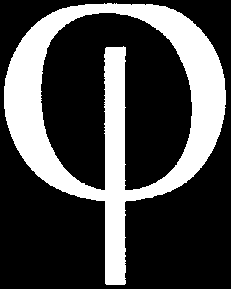
Thus whoever has learned to signify numbers with his ¢ngers knows without hesitation how to shape letters with them as well. So much for 6 That is, the Latins use multiples and combinations of the letters I, V, X, L, C, D, and M to form their numbers.
7 These ''three additional numbers'' are 6, represented by the stigma; 90, represented by the archaic Greek letter koppa; and 900, represented by a symbol called ennacosi
(i.e. e'nawo¤ sioi, 900) by the Laon-Metz glossator (297, ad lineam 101).