
The last year
The last year The situation in Switzerland in 1530 had become one that called for great forbearance, restraint and statesmanship if the Confederation was to survive at all. The intensification of religious strife, the complex legal situation arising out of the St Gall differences, the exclusion of the Swiss evangelicals from the Schmalkaldic League and the inability to secure the integration of Constance, all put a special responsibility on Zurich.
Powerful though Zwingli was there after his return from Marburg, he was far from being dictator or even prime minister. Many books have repeated the unguarded statement of Hans Salat, the ill-informed, prejudiced
Catholic chronicler from Lucerne - ' in Zurich Zwingli is mayor, council and gilds rolled into one'.1 Final authority remained, as it always had, with the great council, the Two Hundred, meeting weekly. Executive authority and church affairs were dealt with by the small council, both bodies having by 1529 become, in spite of some resistance by the 'Constables', exclusively evangelical. There was also a kind of standing advisory sub-committee, geheime Rat or heimlichen Seeks of leading citizens - a Biirgermeister, representatives of the chief gilds, and Zwingli - entrusted with external negotiations. Its terms of reference were never precisely defined, and the council need not, and often did not, follow its advice. For it
Zwingli wrote numerous memoranda which have made his influence appear even greater than it was. His popularity in the pulpit, his numerous friends, vast industry, facility with pen and tongue, ensured attention, most obviously of all in matters of worship and of social conduct. There was also, however, an appreciable minority of anti-clericals, crypto-Catholics and displaced aristocrats, who formed a kind of opposition although
1 'Vnd was Zwingli in disem handel schon Zurich biirgermeister, schryber, raat ijc, rums, tantz vnd der gantz gwallt.' Archivfiir die schrpeizerische Reformationsgeschichte Bd. I. hg. Th.
Scherer-Boccardetc. (Freiburg, 1869)43.Handbuch, 5i6n. 663. Eschcr^Glaubensparteien, 88-9 mistakenly accepted this at its face value and was followed by later writers. What considerable qualifications are now required has been shown by Hauswirth, Philippe 230-50; Jacob, 14,
100; Haas, Kappelerkrieg 14-25, 183-4; a n^ E. Fabian,'Zwingli und der Geheime Rat, 152931', in lGottesreich und Menschenreich\ Ernst Staehelin zum 80. Geburtstag (Basle/Stuttgart,
1969) 151-95. ZWA XIII (1970) 234-44, XII (1964) 35-68.
The last year lacking any obvious leader. In some very important matters affecting external relations, even peace and war, Zwingli's advice was received but not followed; indeed Bullinger later rightly complained that Zwingli was sometimes blamed for policies that were not his own.l
The events that followed the first peace of Kappel, itself a watered-down version of Zwingli's requirements, exhibited compromises that were not entirely acceptable to the 'prophet'. They also led to successful resistance to Zurich's expansionist plans and hence, in a measure, were a set-back to Zwinglian evangelism. The extension of the Christian Civic Union beyond the Confederation, the projected alliance with Philip of Hesse and the German Protestants, the controversial outcome of the action against the abbot and monastery of St Gall, and impediments to the Gospel in eastern Switzerland, were all disappointing. There were some who were prepared to tolerate the pensioners and even to come to terms with Lucerne. Zwingli had one of his rare bouts of depression on 26 July 1531, when he appeared before the great council and, with tears in his eyes, offered his resignation. For eleven years, he said, he had preached the Gospel there, confident that it would triumph. He was now willing to leave his post at the Great Minster and go elsewhere. A high-powered delegation persuaded him to withdraw his resignation, but his power was slipping, and he knew it.2 One relatively minor episode had already illustrated this. After the Marburg conference and the rejection of the Hessian alliance by Berne, another setback to Zwinglian hopes of expansiDn had taken place. At Marburg there had been mention of the possibility of an approach to Venice so that the Republic of St Mark might become the southern end of the chain of allies associated with the cities of the Christian
Civic Union against the Emperor. Philip of Hesse was not impressed but seems to have hoped that a friendly Venice could be induced to provide a loan to hire mercenaries who, supported by Tyrol peasants, would help the cause of the restoration of Ulrich.3 Zwingli had for some time been in touch with the Reformed peasant agitator, Michael Gaismair, who had been leading the opposition to the Austrian regime in the Tyrol.4 In the adjoining Graublinden evangelical preaching had made good progress, and the northern group, the League of God's House, had repudiated the authority of the Bishop of Chur. Through the south of the Graublinden ran the river highway of the Valtelline, the northern bracket of the frontiers of Venice, and Milan, and the route from north Italy to Austria.
If Venice, already in touch with Gaismair, could be induced to oppose the 1 Bullinger Ref. I, 308.
2 Bullinger Ref in, 45; Stumpf/, 166; Spriingli, 20; ZWA in, 50-4.
3 Lenz, 221-4; Z vi ii, 590, 633; Hauswirth Philipp, 156, 166-71.
4 Vasella 4; Z vi ii, 633-7, 720-32; EA 4, ib, 489-90; J. Macek (trans. E. Ullmann), Der
Tiroler Bauernkrieg und Michael Gaismair (Berlin, 1965) 364, 370, 405.
ZWINGLI Emperor, it could be made much more difficult for the latter to join forces with Ferdinand. Venice, too, as the ally of France, had been anti-imperialist, as Zurich had now become. The plan was not entirely unreasonable, but the timing of the embassy was disastrous. The envoy sent by Zurich in December 1529 with a letter of introduction1 written by Zwingli, was the young artisan turned humanist, Rudolf Collin.2 His instructions were to seek Venetian friendship with Zurich by emphasising earlier amiable contacts and the common interests of city republics (like the Christian Civic Union) and free peoples in resistance to monarchs and tyrants. Quite apart from the fact that Venetian policy was not likely to be moved by such considerations or impressed by a sectional Swiss approach, the whole scheme was misconceived and ill-timed. Five days before Collin was received in audience by Doge Andrea Gritti on 28 December, Venice had made its peace with Charles V at Bologna.3 Any useful alliance was therefore out of the question; Collin's oration4 was heard with suitable gravity, a few leading questions were asked and compliments exchanged before he was dismissed with a trifling present that was almost a calculated insult. There was no Venetian alliance and Gaismair soon proved to be an ineffectual supporter who became a discredited refugee and was murdered in 1532. Zwingli was now more convinced than ever of direct danger to Zurich and its neighbours from the mischief-making Emperor.
None the less, his first purpose in life remained to preach the Gospel as he knew and read it-this in turn implied government support and brought additional problems with consequent political implications. How all this involved using worldly weapons for spiritual ends has been seen in connection with St Gall and Philip of Hesse: in 1530-1 France, Venice and North Italy were involved, in each instance unsatisfactorily for Zurich. The Catholic states, likewise, expected to rely upon supports other than simple persuasion. For the defence of the faith, men and money could be expected from Pope and Emperor and from Catholic states outside the Confederation. The vital north-south road to Italy from the Austrian territories at, and north of, Waldshut through Baden and the Freie Aemter to Zug, Lucerne and the St Gotthard, had to be kept under Catholic control for strategic and political as well as religious reasons.
In all these matters Berne was much concerned. There were Catholic 1 Z vi ii, 633(638)-4O.
2 Z vii, 339-40; Z x, 374. Known as Clivanus (Ambiihl), a ropemaker, soldier, priest and Greek scholar who later married and taught Greek in Zurich. K. Furrer, Rudolf Collin. Ein Characterbild aus der Schweizerischen Reformationsgeschichte. Zeitschrift fiir wissenschaftliche Theologie
5 (Halle, 1862) 337-99.
3 H. Kretschmayr, Geschichte von Venedig (Stuttgart, 1934) m, 19, 20.
• EA 4 ib, 487-8.
The last year neighbours on all sides, Solothurn, Fribourg, Savoy, Valais, Uri, Unterwalden, Lucerne; and while more than a match for any of these individually,
Berne must, and did, take care that they did not combine against her.
Although the state had deliberately accepted Zwinglian Protestantism in 1528, and this with characteristic slowness, even reluctance, it had still not been easy, as events proved, to convince its herdsmen-subjects in remote valleys of the necessity for the change. Berne did not willingly alienate its subjects even while expecting obedience from them. She wished above all to maintain the Confederation. Moreover, the rulers knew very well that the other members of the Christian Civic Union, Basle, Biel, Zurich,
Schaffhausen, St Gall, Constance, made up an invaluable defensive alliance, but defensive it must remain. They should fight to maintain their way of life but not to impose it on others.
Zurich's active evangelisation of Mandated Territories in the Freie Aemter, monastic St Gall and, with much help from Constance, in Thurgau, was not entirely welcome. It caused discontent and disruption; in so far as it was successful it meant that Zurich gained considerably in wealth and manpower and thus would outmatch the rest. There were disadvantages in having a too-powerful neighbour, however friendly, particularly when the expansionist eyes of this neighbour were turned eastwards and northwards to Germany.
In 1530 Zwingli attempted to secure a special relationship with France.
Fearing the danger from a united Catholic front which he had learnt 'uss der rechten Kunstkamer' when on his way to Marburg,1 he hoped now at least to detach France from the other side. This was not an easy decision.
France had close relations with the Swiss,2 but Zurich had not been associated with the alliance and Zwingli had consistently opposed the payment of rewards and pensions to influential citizens and the recruitment of Swiss soldiers to fight French battles. Now, however, Berne and Zurich were working together and the Habsburg menace seemed to require some revision of policy. The French pensions had in any case gone mostly to the catholic states and had been condemned in principle by the first peace of Kappel. The patricians of Berne were not prepared to leave entirely to the other side such pecuniary advantages as were offered, and Zwingli was obliged to agree that pensions might be accepted by a group or community, although not by individuals.3
France was Berne's traditional ally, and there was still hope that its monarch might accept the Reformation.4 It was not yet apparent that the 1 See above, 323.
2 See above, 41.
3 Z xi, 319.
4 Imbart de la Tour, Les origines de la reforme (Paris, 1914) HI, 258-72; R. J. Knecht, 'The early Reformation in England and France: a comparison', History 57 (1972) 10-12; Z xi,
36, 104.
ZWINGLI efforts of Lefevre d'Etaples, Britjonnet, Farel, Roussel and Margaret of Navarre were of no avail. Francis I would not, indeed, declare himself until his two sons, left as hostages with Spain, were returned, which was not until July 1530, but Zwingli was ever hopeful. The French king was anxious to retain his Swiss allies and to maintain complete freedom of action.l Through his agents in Switzerland, Hans Kaltschmid of Kaiserstuhl and Hans Junker of Rapperswil,2 he insisted that the treaty of Cambrai was not directed against the Swiss3 and he was ready to discuss closer cooperation. These cautious advances were received with reserve,4 but as the situation seemed to grow more dangerous, Zwingli and his supporters became more amenable to suggestions. The French did not want a religious civil war in Switzerland which might strengthen Austria and interfere with recruiting plans; and their two representatives in Fribourg,
Lambert Meigret and Louis Boisrigault (Daugerant), were instructed to keep the matter open as long as possible.5
Zwingli was at first suspicious, particularly since Zurich had rejected the French alliance in 1521. But now that the Swiss Catholics were switching allegiance to the Emperor might not Zurich change its tune ?
He recognised the worth of a powerful ally with abundance of money and the ability to offer horses and guns to be used for defence against aggression and for upholding the Gospel. A French-Swiss force securing Strassburg, Constance and Wlirttemberg could ensure the safety of Switzerland from Habsburg attack, the more so if support could be secured from John
Zapolya in Hungary or from Venice. Freedom for evangelical preaching in France was assumed. An alliance would be of limited duration6 and acceptable because the emergency, an imperial-Catholic onslaught, was real. For the sake of this he was now prepared to countenance the recruitment of mercenaries in Zurich-controlled territory. Mercenary service was evil and deplorable, but if necessary for the defence of the evangelical cause it could be accepted. The King of France was resisting, as the Swiss had always done, the tyranny of the Holy Roman Empire. Charles V 1 Lenz, 232-4.
2 Z x, 404-7.
3 Z x, 405; Z xi, 104 (September 1530): 'Nunquam inducetur rex, ut per se vel per alios arma capiat pro imperatore contra urbes Christiani fe^deris etc. Euangelium enim mire crescit inter nobiles in curia regis.'
4 Z x, 459-60, 474 n. 3. s Meigret (or Maigret) was 'controleur general des guerres' and is sometimes called 'general'.
The two were frequently employed on missions in western Switzerland, always trying to keep the peace. Meigret was described as ' the French orator in Switzerland... holding frequent conferences with.. .ZuinghV (Calendar of State Papers Spanish, 1531-3 no. 755). E. Rott,
Histoire de la Representation diplomatique de la France aupres des cantons suisses, 1 (Berne,
1900) 269-81, 380-7. P. Briischweiler, Les rapports de Zwingli avec la France (Paris, 1894)
70-3. Farner, Zwingli iv, 448-50. Hauswirth, Philipp, 185-7. Koehler, Zwinglis franzosischen
Bundnispldnen, ZWA IV, 302-11.
6 E. Kobelt, Die Bedeutung der Eidgenossenschaft fiir Huldrych Zwingli MAGZ 45 (1970),
88-91.
The last year threatened Swiss and French equally, but together, relying on God's help, they could thwart his ambitious schemes.1 Once again, the argument was coming close to making the end justify the means, and in this case the concession was worthless. A renewed attempt by Collin to obtain active
French help at Solothurn failed,2 and there was no alliance, to the relief, perhaps, of Berne, which might otherwise have had to change its neutral course.
All this caused Zwingli to send to Francis I, to whom he had dedicated his Commentary on the true and false religion in 1525, a fresh defence of his purpose and teachings. This was Fidei exposition the last pamphlet from his pen.3 Optimistic to the end, he seriously thought that the King of France, about whom he knew singularly little, or his sister, Margaret of Navarre, could be brought over to the evangelical side by the perusal of a treatise, almost a tract. It was an explanation, a defence and an appeal. It opens with a short passage on the Deity, the incarnation, salvation through Christ alone, the ascension and resurrection. The writer's undoubted orthodoxy on the Trinity and his careful exposition of the two natures of Christ are intended to demonstrate that he was no sectary and that every word of his teaching was based on holy writ. Truth daily moves further forward to triumph; the visible church consists of those who accept Christ and is not limited to the Pope and the Catholic bishops.
The little treatise was adroitly constructed. The familiar interpretation of the Last Supper as a symbolical memorial was re-expounded. The bread and wine, ordained and used by Christ at the institution of the eucharist, precious, holy, honourable, signifying Christ as the bread of life, analogous with the one body of the church of which Christ is the head, strengthen and refresh the soul as bread and wine do the human frame and remind the recipient of the death of the Lord.
There is special insistence upon the perpetual virginity of Mary, emphasised the more in a French context, and an indication of aristocracy as the 'best' adjunct of government and of the duty of obedience to constituted authority as incumbent upon all citizens. Taxes must be paid and customary obligations met. The disorderly and disobedient Anabaptists are thoroughly castigated and emphasis is laid on the sanctity of contract as a cement of society. The prophets are there to warn and advise monarchs,
1 Lenz, 235; Koehler, Buck, 313-16.
2 Z XI, 444-5; EA 4, ib, 1117-18; Fabian, £ , 96.
3 S IV, 44-78, translated in ZH, Zwingli der Theologe in. Teil (Zurich, 1948), 300-54; for a summary see Wernle, 328-54. The manuscript copy now in the Bibliotheque Nationale, MS.
Lat. 3673A, was taken to Paris by Collin. It was not printed until 1536, with an explanatory preface by Bullinger, who called it Zwingli's swan song (ZWA xm, 463-71). It was translated into German by Leo Jud as Eyn kurtze klare sum und erkldrung des Christenen gloubes / von Huldrychen Zwinglin gepredigt / und unlang vor synem tod zu eynem Christenen Kiinig geschriben.
ZWINGLI for which plentiful biblical examples, from Saul and David to Herod, were ready at hand. Purgatory had no biblical sanction, and the king might expect to find alongside the saints in the Paradise which he would surely attain, his own predecessors, together with pious heathens including Cato,
Scipio, Socrates, Aristides, Antigonus, Numa Pompilius, Camillus, Theseus and Hercules.1 The inclusion of this latter figure was to be the occasion of some ribald humour from Zwingli's critics later, but the thought behind it was serious. It ends with an appeal to the 'Most Christian King' to allow the Gospel to be preached freely in his dominions. There is no evidence that Francis I ever read it, and it had no influence on the course of events, but it remains the author's last, and not least impressive, apology.
Francis I could not fail to be interested in the course of events in north Italy. There, while he was negotiating with the Emperor, external peace had allowed a local situation of considerable concern to the Swiss to develop. On the ill-defined northern frontier of the duchy of Milan a local adventurer on Lake Como, no longer an ally of France, was seeking to establish himself as an independent prince. This was Gian Giacomo de'
Medici,2 known as 'il Medeghino'. He had obtained possession of the powerful castle - its ruins are still impressive - of Musso, from whence he could threaten communications over the Spliigen pass, terrorise the countryside and interfere with traders and travellers. No opportunity to strengthen his position during the warfare in northern Italy was ever missed. Swiss soldiers had been hired or threatened as occasion demanded.
One of his brothers, arch-priest of Mazzo, was intriguing to become Bishop of Chur, and his sister Clara was betrothed to Wolf Dietrich of Hohenems, son of the powerful and aggressive Catholic, Marx Sittich.3 On 14 November 1528' Musso', as Gian Giacomo was commonly called, asked the Graubiinden for safe conduct for his sister through their territory. Fearing that 1 Cf. R. Pfister, Die Seligkeit erwdhlter Heiden bei Zwingli (Zollikon-Zurich, 1952) 45ff, 86ff;
ZWA XIII, 471. G. H. Williams in Essays in memory of E.H. Harbison (Princeton, 1969)
358-60.
2 1495-1555. He was not connected with the Medici of Florence in spite of the family name.
His younger brother Giovanni (Gian) Angelo de' Medici became Pope Pius IV (1559-65), and Charles Borromeo was his nephew. H. Zeller-Werdmiiller, Der Krieggegen den Tyrannen von Musso am Comersee in denjfahren 1531-1532. Nbl. Lxxvm. der Feuerwerker Gesellschaft in Zurich (Zurich, 1883); F. Bertoliatti, La guerra di Musso e suoi riflessi sui baliaggi (Como,
1947) and Ulrico Zwingli e la guerra di Mussoy Svizzera italiana, 64 (Locarno, 1947) 299-309.
E. Weiss, Basels Anteil am Kriege gegen Giangiacomo de Medici, den Kastellan von Musso
1531-1532 (Basle, 1902) and Vasella / add interesting detail.
3 Marx was a good and experienced general much respected by the Austrian administration whose agent (Vogt) he was in Bregenz and Vorarlberg. Z x, 179 n. 4; Z xi, 15 n. 4, 411 n. 2;
Vasella 2, 73; Weiss, 125; L. Welti, Geschichte der Reichsgrafschaft Hohenems und des Reichshofes Lustenau (Forschungen zur Geschichte Vorarlbergs u. Liechtensteins, 4. Innsbruck,
!93°) 63-82; Do., Marx Sittich und Wolf Dietrich von Ems (Schriften zur Vorarlberger
Landeskunde, hg. v. B. Bilgeri u. M. TiefFenthaler, 4. Dornbirn, 1952).
The last year this would be used to restore a Catholic bishop to the cathedral of Chur, the Biindner refused, and the bride-to-be had to go to Feldkirch through the central Swiss states.1 This, of course, did not please the Zwinglians.
According to popular belief, all this was part of an elaborate scheme by which Ferdinand of Austria, with the help of the Inner States, could advance against the Swiss Protestants while the Elector of Saxony was neutralised by his rival, Duke George. There was, in fact, little substance in this; Ferdinand was in real danger from the Turks, money was short, and Habsburg policies ranged far beyond Swiss internal disputes. 'Musso' was too insignificant to be a trustworthy ally, and such Austrian encouragement as he received was negligible.
Local castle-building, threats and terrorism, which had been going on for some time, came to a head on 9 March 1531, when two peace emissaries from the Graublinden were killed by Musso's men while on their way from Milan.2 That this was no accident became apparent when compensation and apology were refused and when it was followed by an invasion of the Valtelline, then unquestionably Graubiinden territory. As allies, the Swiss were obliged to protect this area, and the occupation of Morbengo, the key to the Adda, made things worse. Help was now urgently requested3 and received. Forces from all the Swiss states,4 with the significant exception of the Catholic Five, came willingly with guns and ammunition t3 the assistance of their ally. The expedition was entirely within the framework of the Confederation, and volunteers, perhaps hoping for easy loot, were readily forthcoming. It was also part of Zurich's policy of protecting its reformed neighbours against Catholic aggression. In this, and in other ways, it was entirely successful; but the absence of contingents from the five Catholic states was much resented, the more so because of persistent reports that they were helping the other side.5
'Musso' found himself almost deserted. Not one of the 8,000 men promised by Wolf Dietrich appeared, nor did any of the 300 landsknechts expected from Ferdinand, nor any Spaniards under Antonio de Leiva; no help came from Venice6 and only a little money from the Pope. For the Swiss it was almost a parade. The Valtelline was easily reoccupied, fortresses, Morbengo in particular, on Lake Como were taken, and finally the castle of Musso itself surrendered to the Zurich artillery which was
1 Vasella /, 21 iff. F. Jecklin, Materialen zur Standesund Landesgeschichte gem. III. Biinde
(Graubiinden) 1464-1803 (Basle, 1907) 1, 95 (No. 1528).
2 Bullinger, Ref. 11, 355; Hauswirth, Philipp, 237.
3 EA 4, ib, 932; Fabian, X>, 85; Strickler in, 135-6 (No. 304).
4 At least 5,000 in number (Zeller-Werdmiiller 3, 6-8; Stumpf 2, 119) including 1,200 from Berne (Feller 11, 215) and 1,000 from Zurich under Jorg Goldli (Z xi, 365 n. 10, 394 n. 4,
407 n. 10).
5 Strickler in, 170-6 (No. 395).
6 Z xi, 402 n. 1, 417-18.
ZWINGLI directed by one 'Master Michael', one of two experts lent by Philip of Hesse.1 On 7 May Francesco Maria Sforza, Duke of Milan, to the annoyance of the Emperor, arranged terms - an indemnity of 30,000 gulden, destruction of the castle, ahd security against further attack guaranteed by 1,200 Swiss soldiers who were taken into Milanese pay while a further 800 remained at the cost of their own states.2 The duke could provide some warships for the lakes, and the final overthrow of the 'tyrant' proved a relatively simple matter. The repute of the Swiss soldiers remained as high as ever, with Zurich suitably represented, facts noted by Zwingli with satisfaction. A final settlement, which did not come until after his death, ensured the safety of the Swiss Mandated Territories in the south, together with the Graubiinden.
The episode happened when internal tension was at its height, and each side drew from it the conclusions it wished. Zurich had encouraged the expedition in order to unite the cities of the Christian Civic Union against the Catholics and had been disappointed when the other cities refused to help the Graubiinden by an attack on Austria.3 Zwingli was convinced that other Catholic attacks would follow; in the north, Ferdinand of Austria was preparing to advance from Innsbruck and Ensisheim in support of Marx Sittich of Hohenems and in the south Valais and Savoy were menacing. He also felt certain that the Inner States had deliberately refused to fulfil their obligations in order that they might be in a position to attack Zurich when the latter's best troops were away in the south. It was one of the reasons for calling for a renewal of the blockade.
The Inner States, in fact, found themselves isolated and drew the conclusion that they must fight for survival and could not rely upon help from others. The fears of both sides were not entirely justified, but they were real enough. Zwingli returned to his demand that the Inner States must be taught that they could not repudiate obligations with impunity. If they could be coerced into submission a united evangelical Swiss confederation might come into being. Philip of Hesse could then hope to restore Ulrich of Wiirttemberg with the aid of Swiss Protestants for whose services he would pay. In 1530 Philip had been reluctantly forced to recognise that there was not to be a united Protestant front and that he was the link between Lutherans and Zwinglians whom he would use impartially and to his best advantage.4 Hence his continued correspondence with Zwingli.
Meanwhile what the first peace of Kappel might mean in practice was 1 Stumpf 2, 11, 125; Bullinger, Ref. 11, 360; Zeller-Werdmiiller 3, 9-11; Fabian, jQ., 93.
2 EA 4, ib, 977,1563-5; Z xi, 461 n. 3; Bertoliatti, La guerra di Musso, 117. As often happened, the pay was soon in arrears. Zeller-Werdmiiller 3, 19; Jacklin, 1, 102 (No. 486).
3 Schmid, 46.
4 Hauswirth, Philippe 201-208.
The last year being made abundantly clear in Thurgau. There civil administration rested, as had long been the case, with the responsible powers - Zurich,
Glarus, Schwyz, Unterwalden, Zug, Uri and Lucerne. The inhabitants, however, were anxious to secure independent control of church affairs, a large majority of parishes having accepted evangelical teaching, itself the result of considerable efforts at proselytising by determined and forceful preachers. In Appenzell and Rheintal also, local assemblies called for evangelical pastors, and on 13-17 December 1529, in May 1530, in December 1530, and again in May 1531, synods of up to five hundred ministers were addressed at Frauenfeld, by Zwick, Blaurer, Pellican, Collin and Zwingli.1 In Constance, Diessenhofen and Stein, Zwingli preached to large numbers.2 When, as in the latter half of 1530, the governor, Philip
Brunner, was himself an evangelical from Glarus, the position was such that Zurich reformation decrees were declared operative throughout
Thurgau in spite of opposition by the Inner States.3 All this made it increasingly apparent to these latter that they were being deprived of traditional and accepted rights for the retention of which they might have to fight. Throughout eastern Switzerland evangelisation was accompanied by the same difficulties as earlier in Zurich. The Anabaptists had been active as well, and there were some ministers, such as Fortmiiller of Altstatten and the indefatigable Zili of St Gall who objected on biblical grounds to taking an oath to teach and preach according to the Gospel. Others demanded for the local community the right to exclude notorious sinners, the 'ban' so dear to the Anabaptist teaching. In December 1530 there was a considerable gathering of clergy and laity from Rheintal, Toggenburg and Appenzell at St Gall, where they were met in argument by Zwingli and Joner on questions of church discipline.4 Excommunication was neither necessary nor desirable since the punishment of evil-doers was the province of the police, not of the minister of religion. The texts about the taking of oaths did not exclude their proper administration by the civil authority, a familiar exegesis which brought an accusation that Zwingli twisted texts to make them suit his own views of the relations of church and state.5 It is pleasant to add that after the debate there was an evening vocal and instrumental concert in the St Gall monastic cloisters at which Zwingli was a performer. A little later, as further evidence that the reformer was still also the humanist, Zwingli patronised a performance of the Plutus
1 Z vi ii, 641-6; Knittel 1, 271-2, 347; Egli 4, 1, 83-92 (Zurich, 1899); Kessler, 229; G. R.
Potter, 'Zwinglian synods in Eastern Switzerland', journal of Ecclesiastical History 16
(1975).
2 Farner iv, 415-16.
3 Knittel 1, 294-303.
4 Egli 4,1, 92; Z xi, 267-8; Sabbata, 275-82.
5 *Du heisst nicht allein der Zwingli, sondern auch der Ringli, denn du ringlest und renglest die Schrift, wie Dich gut diinkt.' Morikofer 11, 314. See above, 191.
ZWINGLI of Aristophanes in the original Greek. Collin wrote a Latin prologue referring to Zurich as the Athens of the north, George Binder was the producer and Zwingli composed the music. The cast included Hospinian,
Wirth, Konrad Meyer von Knonau and Konrad Gessner, then only fifteen, who played the part of Penia (Poverty).1 It can indeed have been little more than a play-reading on New Year's Day, 1531, before a small and select audience, but it is significant of Zwingli's continued breadth of interest.
The last day of 1530 had seen a further sign of Zurich's ambitions.
A force of 600 armed men from St Gall territory occupied Oberriet2 on 31 December 1530 and obliged the inhabitants to accept orders from Zurich, an action which brought a renewed protest from the Inner States.
On 9 January 1531, representatives of the Abbot of St Gall, who was still recognised by the Catholics, appeared at a Federal Diet to complain of unlawful occupation of monastic territory.3
This provoked further altercation. The evangelicals complained that their opponents were still in communication with Ferdinand, that they continued to impede the free preaching of God's word, that they were ready to accept foreign gold and that they had failed to fulfil the peace agreement that required them to suppress criticism and slander. There was continued resentment at the manner in which Murner had been allowed to get away in spite of promises to bring him to trial. It was because of their indifference that the Castellan of Musso was a continuing menace.
To all this, one Catholic spokesman, Landammann Troger of Uri, rejoined that Zurich was attacking the political independence of Catholic subjects upon whom it was forcing an alien regime and hated heresy. The war of words, if anything, intensified. Catholic priests denounced their opponents as heretical soul-thieves and soul-murderers; the evangelicals retorted with epithets such as flesh-sellers, blood-suckers, mass-men, image-slaves, money guzzlers and idolaters,4 all this in defiance of the peace terms, which prohibited slander.
If this situation was unacceptable, so too was that in regard to the monastery of St Gall. It had been agreed at Kappel that the protector
(Schirmhauptmann) of the monastic territories should be a competent, brave, God-fearing man who would uphold the Bible, evangelical doctrine and truth. What this meant to Zurich was well known, and this was to be
1 Z vii, 197; ZWA 1, 11-13; Bullinger, Ref. 11, 182; Egli 1, 664-5; A. Hug, Auffiihrung einer griechischen Komodie in Zurich am i.Januar 755/ (Zurich, 1874); H. Fischer, Conrad Gessner.
Njbl. der Naturforschenden Gesellschaft in Zurich auf das Jahr 1966 (Zurich, 1966) 11.
2 E. Gagliardi, Geschichte der Schweiz, 3 Bde. (Zurich/Leipzig, 1938) 11, 567.
3 EA 4, ib, 875, 883-4.
4 Salat 232, 280. 'Tanngrotzli, kuokemen, milchbengel, knobelbart, zigerclozen, bluothiind... katzer, bapstler, gottlos, sodomiter'.
4OO
The last year guaranteed to the inhabitants by the protector appointed, Jacob Frei.
This had been done on the assumption that Zurich and Glarus had taken over the territorial rights of the abbot while not depriving Schwyz and Lucerne of their legal participating privileges. The Inner States, however, had never agreed to any such interpretation; for them there was a lawful prince-abbot and the tenants were his serfs or subjects. The revised constitution of May 1530 and the new administrative arrangements under it were rejected. When Frei's term of office came to its end on 25 November
1530, it became the turn of Lucerne to nominate his successor. Since he would not be an evangelical like his predecessor and since Lucerne recognised the legitimacy of the abbot Kilian and the new protector refused to take an oath to uphold the revised constitution, Zurich argued that Frei must remain in control and upheld the refusal of the monastic tenants to take an oath of obedience to the Lucerne nominee. Lucerne then accused Zurich of breaking the federal constitution, and Zurich invoked the clauses of the peace treaty. Here was another discord that could be resolved only by war.
In April and again in May 1531 representatives of the Swiss reformed cities met to discuss the whole situation. From Zurich came the call to attack the central states while it was yet feasible and thus to strike at the arch-enemy Charles V. Berne again opposed war in spite of Catholic provocation by their refusal to join against Musso and by continued public criticism. Instead, Berne suggested pressure by the economic sanctions that had been envisaged in the first peace of Kappel. The northern markets should be closed to Catholic traders, and suppliers of grain, meat, salt, iron and other necessities should be prevented from going south.
This should be enough; Berne was all for legality and diplomatic pressure but was utterly opposed to aggression and a preventive war. Zwingli pointed out that a blockade would merely intensify Catholic hostility while at the same time enabling their enemies to strike only when they were ready.In the Lord's cause it was better for soldiers to meet in battle than for children to die of starvation.
Nor could a blockade be effectively fully applied without the help of Glarus, Gaster, Weesen and the Freie Aemter, all most unwilling to participate. From the Catholic side there even came promises to suppress future verbal and written slander, but without guarantees this meant little.
Negotiations continued amid growing suspicion and hostility, but efforts at mediation were of little avail.
Zwingli now proposed, to the alarm of the traditionalists of Berne, the creation of what amounted to a new Switzerland. Instead of a loose confederation there should be dyarchy: Zurich and Berne should join to dominate their neighbours. Together they would be the two oxen which
4OI PZI
ZWINGLI should draw the federal cart behind them.1 Almost certainly it was between 17 and 22 August 1531 that Zwingli wrote the notorious memorandum 'Was Zurich und Bern not ze betrachten sye im fiinfortischen handel'.2
This sketch or project may have been no more than a paper written for his own clarification and guidance, but it clearly represents the policy for which he now stood and which implied armed coercion. The Five States, it was argued, had shown, in regard to St Gall in particular, unwillingness to carry out their treaty obligations. They expected to use the numerical majority of Catholic states in the Federation to prevent the spread of the Reformation, and they refused to reject mercenary service and the acceptance of foreign pensions. By their corrupt and intolerant administration and by their intrigues with Austria, they had forfeited their federal rights.
The Stanser Verkommnis implying equal votes in the management of the Mandated Territories must be denounced and withdrawn. It was absurd that Zurich and Berne, controlling two-thirds of the territory of the Confederation (six sevenths with the Mandated Territories), should have their voting power thus restricted. On the principle that contra iusticiam non est ins Zwingli maintained that by their own actions the Inner States had severed their bond with the Federation. They had sold governorships to the highest bidder and the governors appointed had fleeced their subjects. To negotiate was no longer possible; an attack was the only way to lower their insufferable pride. They must be reduced to submission as Carthage had been when destroyed by Rome. Since wars are now decided by guns, which they lack, an onslaught must be successful and a new constitution could then be forcibly imposed. It would be a righteous war.
The new Swiss Confederation was seen as a sovereign evangelical republic under the joint control of the equal partners, Zurich and Berne acting in harmony and to the public advantage - the other members to be subordinates, consulted and humoured, but also dominated.3 Implied, although not worked out, was a denial of the sovereignty of the separate states; the will of the majority, who were also the wealthiest and the most powerful, must prevail and a strong state emerge. It was a revolutionary proposal, a fanciful and unworkable scheme with which Berne was never likely to consider association,4 the more so after Zurich had practically annexed Thurgau, Toggenburg, the Rheintal and the monastic estates of St Gall. Berne, indeed, was later to balance this by the occupation of the 1 ' So werdend sy an der Eidgnoschafft sin glych wie zwen ochsen vor dem wagen, die an einem joch ziehend.' EA 4, ib, 1043.
2 S 11, 3, I O I - 7 ; E A 4 , ib, io4i-5;Koehler, Buck 318-26. ZWAvin, 535-54; ZWAxn, 222-33
(where the first week in August is suggested as the date).
3 S 11, 3, 107; EA 4, ib, 1045. 'Summa summarum, wer nit ein herr kann sin, ist billich dass er knecht sye.'
4 J. Courvoisier, Zwingli (Geneva, 1947) 184-5.
The last year Vaud, and more successfully so in that this area remained Bernese until the end of the eighteenth century whereas Zurich could not hold on to its gains; but this was to be in the future.
The immediate cause of the second Kappel war was the blockade economic sanctions by which grain, wine, iron and salt were prevented from reaching Lucerne and its associates.l The pretext for the conflict was failure to fulfil the conditions of the first peace of Kappel; the reality was that the north fought to preserve its reformed faith while the central states were determined to maintain their independence and their adherence to Rome and the Pope. Zwingli never doubted that war must be renewed and that fundamental differences could be settled only on the battlefield.
Berne hoped that war could be avoided and only reluctantly agreed to blockade as a compromise measure. It was a cruel weapon which hurt the weak more than the strong, and it was in fact rather ineffectively applied by Berne but with greater efficiency by Zurich and its immediate neighbours. Bad harvests in 1529 and 1530 combined to bring it about that little material came north from Lombardy.2 The central peasantry, unable to sell their beasts, milk and cheese, and unable to buy the salt and grain necessary for their existence, were in real danger of destitution. The people had to secure supplies somehow and would attack in desperation.
Zwingli recognised that to do nothing but apply 'sanctions' was to hand over the initiative to the enemy, who would choose the time and the place for attack.3 If there was a case for a blockade there was a stronger case for open war by force in, the battlefield against men, rather than by starving women and children. Hence, in part, his opposition to a policy favoured by Berne and the other evangelical cities. There were mediators ready and willing; France, Graubiinden, Valais, Appenzell, Glarus, Fribourg,
Solothurn, again and again tried this unsuccessfully.4 Berne again insisted on negative action - an expedition against the central states, it feared, would alienate the Duke of Milan, whose goodwill had been sought.
Zwingli had kept up the pressure from the pulpit: in his Whitsunday sermon on 28 May he had declared:' If someone is called a liar to his face, he must defend himself. Not to attack is to invite defeat.'5 In June Zurich again urged Berne to insist upon the fulfilment of the Kappel peace terms.
In July Schwyz retaliated with complaints that it was intolerable that its own subjects in Weesen and Gaster were being forced to support the blockade against them.6 The war drums were reverberating.
1 R. Bosch, Der Kornhandel der Nord-y Ost-Innerschweiz und der ennetbirgischen Vogteien im 75. und 16. Jahrhundert (Zurich, 1913) 109.
2 Wyss, I5of; Z xi, 193 n. 7.
3 Bullinger, Ref. 11, 388; Farner iv, 467.
4 E.g. at Bremgarten 12-13 June 1531. Feller n, 220; Morikofer 11, 377.
5 Bullinger, Ref 11, 383-8; Farner iv, 467; Schmid, 46ff.
6 Z xi, 531, EA. 4, ib, 1070.
14-2
ZWINGLI In August the Protestant cause seemed more encouraging. Rapperswil and Appenzell declared for the Reformation; in Augsburg Zwingli's teaching was making advances, and Henry VIII consulted with him about his matrimonial problem.1 The Duke of Milan was asked through Giovanni Domenico Panizzone about the possibilities of an alliance, and a cordial, if non-committal, reply was received from him.2 It was hardly likely that Catholic Milan and Zwinglian Zurich could work together, but, as with France, Zwingli was ever hopeful. His ebullient self-confidence was restored. The efforts made by Berne to maintain the status quo while relinquishing none of its demands, combined with Zurich's determination to interpret the peace of Kappel to its own advantage, led to a conflict which Zwingli wanted and welcomed.3 The failure of the arbitrators, the continued Catholic hope of Habsburg and papal help, and the determination of the Inner States to fight rather than allow freedom of preaching, all widened the gap.4 It was certain that the inhabitants of the Catholic states would not become Zwinglian; they were determined to maintain their traditional federal rights and in this they were supported by the growing suspicion or jealousy of Zurich felt elsewhere. At the same time the cold war of economic blockade was, to Zwingli's dislike, being stepped up. Food sanctions were applied from Bremgarten, Mellingen, Thurgau,
Rheingau, Rheintal, Toggenburg, Weesen, Gaster, Sargans, St Gall and the reformed Gemeinden of the Freie Aemter. The Graubiinden did not directly intervene but their passes were, so far as practicable, closed to traffic5 and the Duke of Milan also cooperated. Glarus, Fribourg, Appenzell, Solothurn and Strassburg and even France persisted in their efforts at mediation, but both sides continued to ignore them.
Nothing had come of Zurich complaints to a meeting of the Swiss Protestant cities at Aarau of an intensified campaign of denigration,6 and when Zwingli again drew attention to the persistent attacks on his honour
1 This was done through Grynaeus. Zwingli's letters, in which he apparently accepted the necessity for a divorce from Catherine, have been lost. They were seen by Gilbert Burnet
(History of the Reformation of the Church of England ed. N. Pocock, Oxford, 1865 1, 160-1) but the library of Richard Smith, in which they were, went to the auction room and was dispersed. The letters may still exist. Z xi, 579-80, 603.
Z xi, 604, 622; Farner iv, 456-8.
3 Stumpf 2, 11, 157-8.
4 Schmid 50-8; Hauswirth, Philipp, 232. Writing to friends in Ulm on 4 June 1531, Zwingli had insisted that the only obstacle to peace was the unwillingness of the Five States to allow evangelical preaching.' Quinquepagici verbi praedicationem nolunt admittere... Hie senatus respondit: si sperent fore, ut Quinquepagici verbum dei pr^dicari patiantur et hanc pacis legem servent, qua cavetur, ne fidem nostram persequantur neque apud suos neque apud nostros, iam fore, ut de pace ac conciliatione tractari feramus.' Z xi, 460-2.
5 Bosch, Kornhandel n o ; Bucher, 143, 145. Zurich complained that there were leakages via
Berne-controlled Lenzburg, while the peasants of the countryside sometimes helped the Catholics to smuggle food from Baden by pretending that it was for home consumption, but these evasions were insignificant.
6 Z xi, 447; EA 4, ib, 980-3.
The last year and threats to his person made by Catholic authorities,1 he was not at all mollified to be reminded that similar charges were often brought against their opponents by Protestants and were just as much abuse and slander as when uttered by Catholics.2 On a lower level, the Zurich millers and bakers were complaining that the blockade was ruining their trade with central Switzerland, and the fact that mass was being secretly heard by Catholic sympathisers from Zurich in or near to its territories was regarded as deliberately provocative.3
On 10 August Zwingli, Collin and Werner Steiner travelled to Bremgarten to impress, not entirely successfully, on a party of influential councillors from Berne the urgent need for action. Berne, in fact, was silently displacing its rival as the chief pov/er among the protestant states, but this was hardly realised. The appearance of a comet4 in the sky north west of St Gall just after sunset on 12 August was regarded in many quarters as a portent of war, and special prayers were said in the churches.
By less apprehensive ministers of religion it was declared to be a sign of divine displeasure at the dancing and drinking that had accompanied some fashionable weddings. A renewal of hostilities was beginning to be taken for granted, and on 10 September a kind of war council of Lavater,
Johann Schwyzer and Wilhelm Tonig was formed. They could summon men to arms, but decisions about their use and about war or peace lay as always with the Great Council. Yet no active steps were taken either for defence or for offence, in spite of warning from Basle that the Five States were arming and would yield only to force.5 A curious semi-paralysis, an unwillingness to fight, was all too apparent and yet every attempt at mediation was fruitless. This was the more serious in that, in fact, on 26 September representatives of the Five States had resolved in desperation that an attack on Zurich was their only hope. They must either fight or starve; they had the advantage of favourable terrain, they could choose their time, and their soldiers were ready and united.
Exactly the opposite was true of their opponents. Rather vague reports of possible hostile action reached Zurich and Berne; some attention was given to them by the latter, but in Zurich, and by Zwingli hmiself, they were discounted or ignored.6 There were reports of the arrival of Catholic volunteers from Valais, Eschental and even Lombardy,7 but this, for 1 Konrad Hiltbrand of Einsiedeln was specially violent in his denunciation of Zwingli and his friends. Z xi, 361 n. 3.
2 Feller 11, 218.
3 Staehelin 11, 480-1; Morikofer 11, 348-9.
4 Halley, who gave his name to the comet, used Kessler's detailed account to establish its orbit.
5 Bosshart, 274-5 n35 Z xi, 582; Staehelin 11, 484.
6 Bucher, 151-2; Sprungli, 25; Luthi, 67; ZWA xm, 302.
7 Escher, Glaubensparteien 276-80, 293. A few (at first 200, later more) Italian soldiers of fortune claiming papal approbation came too late to be of any practical assistance. They proved far more of an embarrassment to their friends by looting en route and threatening to return home if not paid than a danger to the other side.
ZWINGLI Zwingli, was simply further convincing evidence of a great imperialpapal conspiracy against the adherents of the true religion. By the beginning of October the Catholics knew that they would only lose by delay, and prepared for action, while as late as 3 October the other reformed cities were still urging Zurich to hold back.1 The preparations indicated, as a contemporary realised, 'the beginning of our downfall'.2 Glarus declared at once for neutrality; the Graubiinden likewise declined to move against Uri or to take any action except to watch and wait; the communities of Valais, for their part, similarly showed no serious signs of an attack on Berne. In Zurich, in spite of Zwingli's warnings and pleadings, no precautions were taken, partly from a desire not to offend Berne by precipitate action, partly from wanton carelessness.
Direct initiative was taken by the Inner States with a move against Ober Freiamt, close to the borders of Lucerne. The district was a commandery of the Teutonic Order, and the local commander was Hans Albrecht von
Miilinen, son-in-law of Biirgermeister Diethelm Roist of Zurich and a personal friend of Zwingli.3 He had cautiously but successfully promoted the evangelical cause in his district, thereby incurring the wrath of Lucerne, which shared the Federal rights over the district and objected to its evangelisation. When hostile forces appeared, occupying (on 8-9 October)
Hitzkirch,4 a reformed house of the Teutonic Order, and pillaging the countryside, he retired to Bremgarten, as directed, in order to avoid a confrontation. News of this was accompanied on 8 October by a report5 that a considerable force was being concentrated near Baar, and that another body, numbering about 600 men, was gathering in Zug ready to invade the Freie Aemter, where they expected help from sympathisers in Bremgarten.6 A formal preliminary notification of intention to open hostilities (Absagbrief)had been prepared at Lucerne on 4 October.7 Their x aEA4, ib, 1178.
2' Spriingli, 25; Schmid, 58.
3 Z ix, 622 n. 1.
4 Beside being of some strategic importance and housing the French representatives, Meigret and Daugerant (Boisrigault), Hitzkirch had religious significance as well. In May 1529 it had been reported to Lucerne that a majority of the parish wished to remain Catholic but also wanted to hear the word of God. They had, however, only one priest (presented by the Teutonic knights) instead of three. After the first peace of Kappel, the parish decided by a majority in favour of the Reformation, but after 1531 it was re-Catholicised. Th. v. Liebenau,
Reformation und Gegenreformation in Hitzkirch (Lucerne, 1867).
5 This was received in Zurich at 4 a.m. on 10 October. P. Schweizer, Die Schlacht bei Kappel am 11. Oktober 1531, JSG 41 (1916), 14.
6 Bucher, 152.
7 Almost certainly this was not sent. Bullinger, Ref. 111, 88, is very vague. It, or another which had been agreed at Lucerne (EA 4, ib, 1179-83,1188-9; Steck & Tobler (No. 3095), 1397;
Stumpf 2, 11, 163) arrived on 9 October and included a demand for the exclusion of Zurich from the Confederation.
The last year appeal was to God to decide: their quarrel, they insisted, was with Zurich alone whose exclusion from the Confederation had already been recommended by the Inner States. Zurich had broken the peace by the blockade and had brought foreigners (i.e. Constance and Strassburg) into the affairs of the Confederation.1 The attackers were at once desperate, enthusiastic and confident of help from Austria.
There was, however, no direct formal violation of Zurich territory. The only force that Zurich had close to the frontier was a small garrison, less than 300 in all, based on Kappel2 and manifestly no threat to its neighbours. The Zurich Great Council was hurriedly summoned, and the military men were asked for their professional advice. This was, apparently, neither clear nor convincing. They continued to treat the reports they received as either alarmist or exaggerated, and it was not until
7 October that Berne, which reasonably complained of having received no information for three days, was belatedly informed about the situation.3
Relations were not improved by allegations, not entirely without foundation, that Berne was allowing food supplies to filter across its frontiers and was opposed to a war. The Zurich government was now ready to risk war and resolved to fight, but its ally, Berne, was understandably unwilling to come to its support as long as there was no attack - i.e. no armed violation of Zurich territory. Both sides were' right', if the word' right' is a meaningful one on the context. War had been planned by the evangelicals but entered on by the Catholics, driven to desperation by economic pressure and hopeful of powerful external aid. For Zwingli's religious aims and Zurich's political objectives to be attained, the Inner States must be manifestly defeated in battle and their offensive potential eliminated; thus and thus alone, could the evangelical cause triumph. Yet to advance without Bernese support was hazardous and could have been successful only with a disciplined and enthusiastic army. This was exactly what Zurich did not have. They chose the wrong commander, they agreed on impracticable strategy, the tactics were deplorable and the Zurchers who took the field were few in number and unwilling to fight for survival.
The most remarkable fact of all is that Zurich, which had been clamouring for a reopening of hostilities, was now completely unprepared for them.
Its army, which in 1529 had been a model of discipline, had deteriorated rapidly after a civilian overhaul.4 In September, during Zwingli's absence,
1 There was also included an allegation that Zurich had forced the nuns of Hermetswil to reform. Koehler, Zwingli, 259; Schmid, 59; Bucher, 153.
2 Where Joner, as administrator, was living in die monastic buildings and could advise the council on what was happening, He now called for reinforcements.
3 Anshelm vi, 88.
4 J. Hane, Ziircher Militdr und Politik im ziveiten Kappelerkrieg (Zurich, 1913) 26-32 for the text of the Kriegsordnung.
ZWINGLI the number of experienced officers had been reduced,1 partly to save money, but also to eliminate any opponents of the government by retaining only those regarded as God-fearing lovers of truth acceptable to the new establishment.2 Rates of pay had been lowered to discourage volunteers. Civilian interference in military affairs, especially by members of the socially rather low Kambel gild, was resented by many officers to whom the new set-up was distasteful. The normal parades and inspections had not been held, and there was in circulation a certain amount of antiwar or pacifist propaganda attributed to Anabaptist sympathisers. There was little enthusiasm among the soldiers for a war against their own Swiss neighbours with whom they had fought side by side at Marignano and elsewhere.
Inadequate 'intelligence' was added to military confusion: the over-all situation was not understood from Zurich. It was known that hostile
Catholic forces were gathering at Zug, but what their intentions were and where the attack would come were matters for conjecture. To secure communications with Berne, some 600 men and four guns were sent to Bremgarten3 under Heinrich Werdmliller, reasonably enough since the Freie
Aemter were menaced. Felix Manz secured the route to Sarmensdorf, and other contingents were sent to Mellingen, Wadenswil (under Jacob Frei) and Gaster.4 More than this is might have been inadvisable to do since
Zurich had agreed with its allies that there should be no fighting unless its territory was actually attacked.
This indeed was what the Five States had decided upon. On 4 October armed men had already converged on Zug, but no notice was taken of this; even when word came from Kappel of what was happening, it was assumed that any attack would be on the Freie Aemter against the lines of communication with Berne. It was also assumed that the local militia would defend the monastery of Kappel if this were attacked, but singularly little attention was paid to hostile troop movements. By 9 October, when reasons for renewing the war were restated at Lucerne, the forces gathering between Zug and Baar were obviously too large to be ignored. The company from Lucerne which had occupied Hitzkirch also threatened Blinzen, while their opponents under Felix Manz fell back on Sarmensdorf.5 There was still no sense of urgency in Zurich, although it had already been agreed to appoint Hans Rudolf Lavater as commander-in-chief {Oberster
1 Including Hans Escher and Jorg Berger, a competent general.
2 A new council of war, 23 in number, too large to be effective, was set up. ZWA x, 541-5;
XII, 311; Schaufelberger, 36-53.
3 Mellingen and Bremgarten on the Reuss commanding the road to Baden had declared for the reformers in 1529. They were Mandated Territories ruled by Zurich, Lucerne, Schwyz,
Unterwalden and Glarus (not including Uri or Berne).
4 Bucher, 155-7; Bosshart, 275 n.; Schweizer, 15-16. s Egli 2, 24; Spriingli, 25.
The last year Hauptmann).1 Forty years old, strikingly handsome, active, eloquent, affable, he had been in papal military service in 1521 and accepted the Zwinglian reform which he forwarded in Thurgau as governor of Kiburg
(from 1525) where he was popular.
The serious nature of the threat from the south was not realised until the afternoon of 10 October when the Great Council ordered Jorg Goldli of Tiefenau to advance to the defence of Kappel with fewer than 1,000 men mostly collected en route.2 Goldli, wealthy and well-connected, now forty-five, with a record of service in the Italian campaigns and against 'Musso', was one of the few experienced commanders immediately available.3 His duties and responsibilities were not defined, and the choice turned out to be unfortunate. As many knew, his younger brother Kaspar, a supporter of mercenary service, had refused to accept the Reformation, had left Zurich in 1523 and was now with the other side. There was even a story in circulation that the brothers met secretly and exchanged information about the disposition of their forces.4
Goldli, who had received explicit instructions to avoid an engagement until reinforcements arrived, at once set off with his advance force. Behind him came Peter Fuessli5 with six guns for which horses had been found
1 Egli 4, 150-64; Z xi, 458 n. 3; Wyss, 122 n. 5; Liithi, 67; Schweizer, 49-50; Spriingli, 25;
NblW no. 86 (1864); Morikofer, 11, 392-3; Bullinger, Ref in, 56-7. He was much more a politician than a soldier: a subsequent investigation into his conduct (Schweizer, 49-50) cleared him of charges of incompetence and neglect, and he was later several times Biirgermeister of Zurich.
2 Schweizer, 15; Liithi, 70; Hane, 44; Stumpf 2 11, 165. A considerable literature has gathered round the battle of Kappel. Egli 2 analysed all the contemporary accounts (by Fiissli, Huber,
Goldli, von Hertenstein, Schonbrunner and Blattler) known to him and criticised the narratives of Salat, Aegidius Tschudi and Bullinger. Bullinger, Ref. in, 103-81 was written some thirty years after the event and was chiefly concerned to magnify the achievement of his revered predecessor, but his detailed account was carefully compiled. Other contemporary accounts are in Stumpf 2; Stumpf/; Bosshart; Spriingli; L. Weisz, Unbekannte ausldndische
Quellen zur Geschichte der Kapellerkriege, Geschichtsfreund 86 (Stans, 1931) 1-133; Do.,
Die Geschichte der Kappelerkriege nach Hans Edlibach, ZSK xxvi (1932) 81-108, 270-87.
As with the battle of Waterloo, argument about detail continues. There is useful matter in Th. von Liebenau, Beschreibung des II. Cappelerkrieges von Werner Steiner von Zug> ASG
NF 4 (1884), 305-41; P. Schweizer, Die Schlacht bei Kappel am 11. Oktober 753/, JSG 41
(1916), 3-50; W. Schaufelberger, 'Kappel-die Hintergriinde einer militarischen Katastrophe', SAV 51 (1955), 34-61 (Festschrift fur Hans Georg Wackernagel); R. Braun, Zur
Milita'rpolitik Zurichs im Zeitalter der Kappeler Kriege ZWA x (1958) 537-73; E. Egli,
Zwinglis Tod und seiner Bedeutung fur Kirche und Vaterland (Zurich, 1893).
3 Wyss, 122; Z xi, 407 n. 10.
4 Egli 2, 25; Schweizer, 28-9; Farner iv, 427; Jacob, 167-70; ZWA x, 552. There is no positive evidence for this inherently improbable meeting, but it is significant that the story was repeated and believed.
5 Fuessli, together with his father (both believed to have Catholic sympathies) had cast 162 guns for Zurich, and he later wrote a short but revealing narrative of the engagement. He was related by marriage to Zwingli's colleague Hans Engelhard, third stipendiary priest in Zurich and an opponent of the war. Egli 2, 11; Schweizer, 4. Mbrikofer's useful narrative
(Morikofer, 11, 366) relies too heavily on the facts collected by Aegidius Tschudi in 1560.
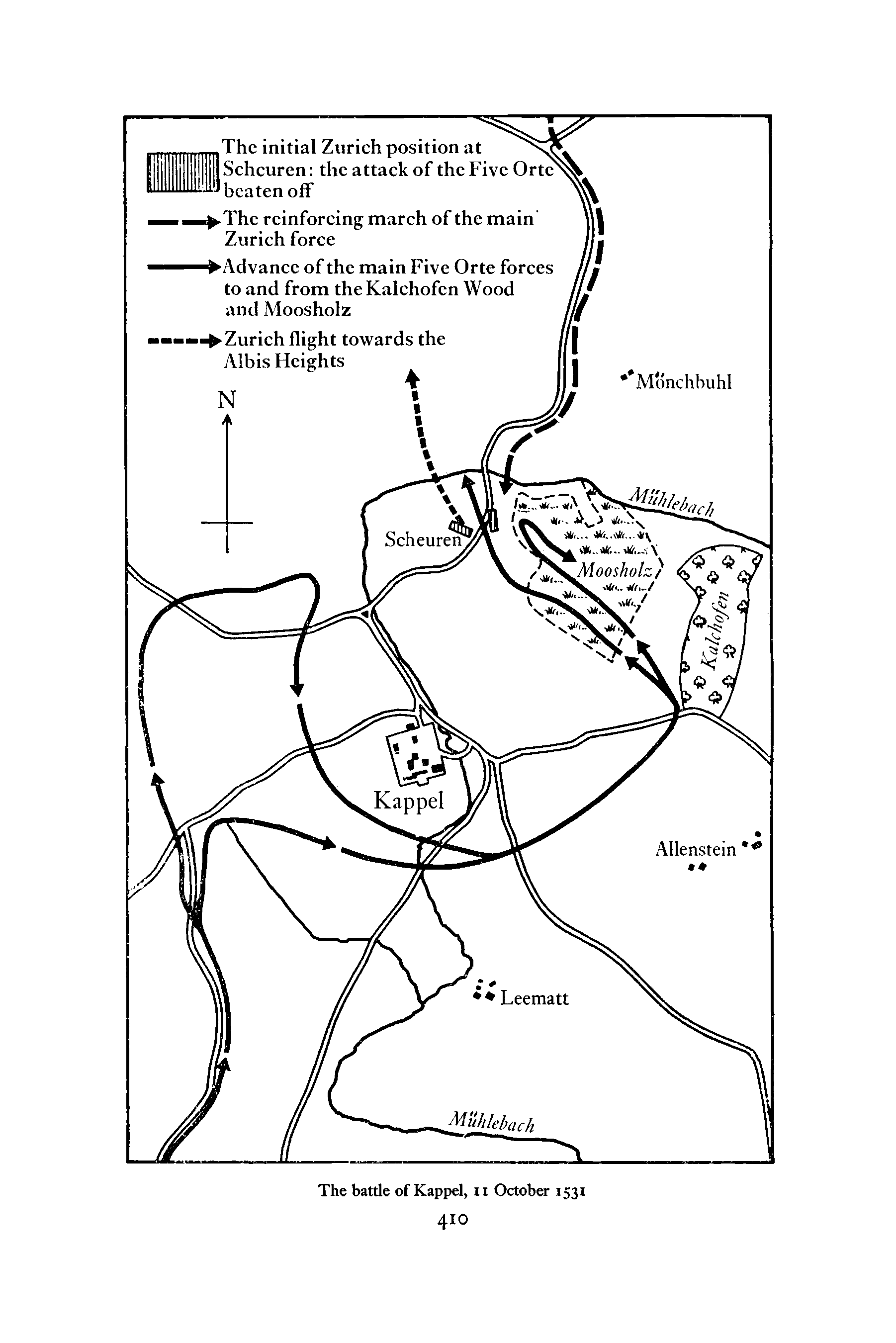
The initial Zurich position at I Schcuren: the attack of the Five Orte^ i beaten off The reinforcing march of the main Zurich force Advance of the main Five Orte forces to and from the Kalchofen Wood and Moosholz • Zurich flight towards the Albis Heights N The battle of Kappel, n October 1531
The last year only after some difficulty and delay. There were two possible positions within sight of Kappel, both on a hill, one at Scheuren, and the other, a little to its rear, at Monchbiihl. Fuessli advised against Scheuren as unsuitable for his guns, but Goldli decided in its favour. It is easy to argue with hindsight that this was wrong; Monchbiihl, although better adapted for defence, or for a retreat, was further from Kappel, was even more marshy, and provided a much inferior view of the opposing forces coming up from Baar. Since Goldli cannot have known the size of the opposition, this was an important consideration. His decision was not necessarily the wrong one, for he could have fallen back on Monchbiihl if necessary; but having taken up a position, he did nothing to improve it, and he neglected to make sure of a possible retreat. He apparently also ignored the existence of a beech wood at Kalchofen on his left which could provide cover for the enemy.1 Once in place he obstinately refused to change his dispositions - cIch will dieser Platz und keinen andern'.2 Between Scheuren and Monchbiihl ran a little stream, the Miihlebach, crossed by a simple bridge but surrounded by a good deal of sodden, marshy ground across which armoured soldiers could struggle only with much difficulty. Goldli also neglected to send forward scouts to bring information about the enemy, discipline was not very good, he failed to protect his flank, and he accepted battle when his instructions were to avoid it.3 To apply, however, terms of military tactics to a short fight in which only about 5,000 men were involved in all (as compared with more than ten times this number at Marignano or Mohacs), is a little excessive. Kappel, although decisive, was only a skirmish in which but a fraction of the Zurich forces were engaged.
While Goldli's men {das Fdhnlein) thus moved uncomfortably to the frontier on 10 October, there was some confusion, but still no sense of urgency, in Zurich. The Great Council, some of whose members should have read Zwingli's earlier advice4 on strategy and could consult him easily enough, spent much of the day in debate. The delay had serious consequences. The challenge, it was agreed, had to be taken up; invasion of Zurich territory would bring help from Berne; men must be sent to Bremgarten, Rapperswil and Gasterland, as well as to meet the threat at Kappel. Lavater wanted to assemble the main force {das Banner) at once, but the summons, or call-up, was proclaimed, by tradition, in Ober1 Protection could have been obtained, as Ulrich Bonder suggested, by simple trenches or by cutting down trees in the wood. Axes and men were available, but the order was not given.
2 Egli 2, 24. Egli's account is still unsurpassed, but he loses no opportunity to show his disapproval of Goldli.
3 Egli 2, 25. * Seine Aufgabe hiess aber offenbar: "Gewinne Zeit, damit wir uns sammeln vermeide es, dich schlagen zu lassen".'
4 See above, 210-12.
ZWINGLI winterthur,1 only in the evening. Many did not know where to report, many more stayed away, and it was not until first light on 11 October that a few hundred men2 gathered round the colours in Zurich without commissariat or rations, some having walked in overnight. In what was almost a disorderly mob, with Zwingli dressed in green, armed and on horseback among them, they streamed out of the city gate heading for the Albis, with Schwyzer as standard-bearer (Pannerherr) and Tonig in charge of the guns (Schutzenhaupttnann).
Goldli had meanwhile had his men out at 4 a.m. before it was light, with hoar-frost on the ground, expecting an attack.3 When it was possible to see the enemy movements there was a discussion at which Rudolf Ziegler called for a retreat to the greater security of Monchbiihl covered by a party on the left flank guarding the wood,4 but this was not accepted. At about 9 a.m. the well-rested enemy could be seen approaching Kappel under Markwart Zelger of Unterwalden and Golder of Lucerne, the latter bringing the formal defiance or declaration of war. Their advance force, some 700 strong with some guns, approached the Zurich right wing to seek an open field for attack, and were beaten off by fire from Fuessli's artillery, apparently against Goldli's orders.5 The attackers then turned back to join the main body, some 7,000 strong, which moved eastwards past Kappel towards Ebertsweilerhohe and the undefended beech wood of Kalchofen. This right wheel was a hazardous operation. Rudolf Gallmann and Rudolf Schinz begged Goldli to attack - 'Now they are ours; if we attack now they are defeated; if we let them form up and attack us we shall be overwhelmed.'6 Goldli, however, refused; expecting immediate reinforcement, hoping perhaps to keep the peace in accordance with his original instructions, and it being now too late to withdraw, he awaited the onset of the enemy.7
The Zurich main force (Banner), such as it was, was indeed on its way.
By midday the motley crowd, including some thirty ministers of religion, had reached Hausen where Tonig asked for a rest for the famished and exhausted men. Lavater, Schwyzer and Zwingli insisted on moving forward, and by 3 p.m. the forces joined. There was a hurried discussion about the next move, at which it was agreed, too late in any case, to draw back to Monchbiihl. This involved traversing marshy land, dragging guns
1 T. Miiller-Wolfer, Das Jahrhundert der Glaubenstrennung (Berne, 1925), 31.
2 Lavater had expected over 1,000 - estimates vary between 200 and 700.
3 A story was current (Stumpf 2, 167) that a traitor from Zurich, Hans Andress, in return for money from Heini Schonbrunner of Zug, had reported on the precise size and composition of the Zurich force. It is not incredible, but it made little difference since there was almost no possibility of, or attempt at, concealment.
4 Egli 2, 27. Rudolf Gallmann flatly refused to move. l Da, da muoss min kylchhoff sin. Gott lasse mich den tag nimmerme leben, das ich deren lutcn ein tritt wychen wolle.' Bullinger,
Ref. in, 118. s Egli 2, 28.
6 Egli 2, 29.
1 Bullinger, Ref. in, 121.
The last year across the Miihlebach stream, in the face of a largely superior force. The enemy was already in possession of the beechwood and out of range of such guns as there were, but at 4 p.m. it was growing dusk and their men were not drawn up in battle order. The leaders were prepared to hold their ground and fight the next day, but Hans Jauch, governor of Uri, supported by about 100 eager warriors, called for an immediate advance through the wood. This small force, with some crossbowmen, threw themselves on the Zurich flank. The few opposing guns were useless, the lead was immediately followed up by a general advance, and within half an hour what could have been a considered withdrawal had become a disgraceful rout.
There were no clear orders, no heroics, no suggestion, as at St Jakob an der Birs, of holding out to the last man. The cowardly Zurchers, who had invited the unnecessary combat, broke and fled, knowing that their short daggers were of little use against the long swords of their opponents.
Lavater,1 Goldli and Fuessli, none of whom was hurt, led the flight. The guns were abandoned, some of the fugitives, impeded by their armour, were drowned in the Miihlebach, and darkness fell on small groups which held out, as Swiss thrust and hacked at Swiss with swords and halberds.2
One group, which included Zwingli, some officers and some brother clerics, resisted manfully under a hedge or tree, but in vain. Zwingli himself, severely wounded, was recognised by torchlight, refused the ministrations of a confessor, and was killed by Vokinger of Unterwalden.3 His body was quartered and burnt by Hans Schwendinan of Lucerne, and mixed with dung, to show the intensity of the feeling against the arch-heretic and to prevent his ashes being collected as relics.4 According to some later reports, he said before dying, 'You may kill the body but you cannot kill the soul', and if this is what his friends thought he should have said, it certainly represented his attitude.5 There is good reason to believe that Hans
Schonbrunner, the Catholic priest who had gone from the Fraumlinster to Zug, looked upon him and said, 'Had you but been a Catholic I am sure
1 There was a false report of his death. H. Dommann, Die Korrespondenz der V Orte im zweiten
Kappelerkriege, Geschichtsfreunde (Stans, 1931), 249, Doc. 12.
2 Bullinger, Ref. in, 126-8; Salat, 308.
3 Egli 2, 42-3.
4 As with Joan of Arc, there was a story that Zwingli's heart escaped the flames. ZWA ix (1953), 563-76.
5 Myconius gave currency to this story. 'Prostratum, aiebam, prementiu multitudine iam tertio, sed in pedes semper restitisse; quarto fixum cuspide sub mento, & in genua prolapsum dixisse: Ecquid hoc infortunii: Age, corpus quide occidere possunt, animam no possunt.
Atqz his dictis mox obdormiuisse in Domino.' DD. Ioannis Oecolampadii et Huldrichi
Zuinglii epistolarum libri quatuor. (Basileae, MDXXXVI) Sig. 6 2. Bullinger took care to collect all the testimony he could later, and his narrative {Ref. in, 136-7, 166-8) is to be preferred to the partial account of Salat, 310-12, who minimises Zwingli's wounds and his courage, and those of Tschudi (ASR 1, 44-55) and Kessler (Sabbata, 367-8). A. Erichson,
Zwinglis Tod und dessen Beurtheilung durch Zeitgenossen (Strassburg, 1883) makes good use of the evidence from contemporary letters.
4J3
ZWINGLI you would have been a good Confederate.'1 It was profoundly true:
Zwingli was a Christian first and foremost, prepared to be Christ's soldier and to live and die according to his interpretation of the Bible text. Next he was devoted to his country and countrymen, more sincerely and passionately perhaps than most. Zurich, where his ideas triumphed, came third; yet it was for Zurich, rather than for Christ or the Confederation, that he died.
Before midnight, the survivors were trailing into Zurich to tell Zwingli's widow that she had lost as well a son, brother, brother-in-law and other relatives. Among the score or more of clergymen who lay dead on the field were the bodies of Wolfgang Joner of Kappel, Wolfgang Riibli of Einsiedeln, Commander Schmid of Kiissnacht, Canon Anton Walder from the Great Minster, and the ministers from Embrach, Egg, Biilach, Buchs,
Ottenbach and elsewhere. Were they all, like Zwingli, armed combatants ?
If not, was their presence entirely necessary or desirable ?2 The confident negative of the twentieth century did not come at all naturally to the sixteenth, which took warfare for granted and expected the clergy to be with the fighting men. Even so, their numbers, considering how few parishioners can have accompanied some of them, are remarkably large. Luther had no doubt that Zwingli was mistaken as usual - ' all who take the sword die by the sword', was his comment3 on hearing the news. With these men, the chief intellectual and spiritual leaders of the Zwinglian reform were eliminated, and Oecolampadius was soon to follow.
The battle of Kappel was a minor engagement which had enduring and disastrous consequences. With Zwingli there perished some 500 of his own side and perhaps 100 of the enemy. The killing, however, was, perhaps purposely, selective. Of the 500 dead,4 many were from old Zurich families, including Thumysen (father and two sons), Bluntschli, Meyer,
Pfeiffer, Ochsner, Frei, Wyss, Wirz, Walder, Werdmiiller, Escher, Funk, Usteri.5 The former leaders of the Zurich council were seen in the Rathaus no more.
1 Egli 2, 43. L. v. Muralt thought this very probable. Vasella SKG 38 Jg. (1944), 156 discounted Schonbrunner's story.
2 Cf. L. Weisz, Nach der Schlacht von Kappel, 137 Nbl. hg. von der Hiilfsgesellschaft in Zurich,
1937, 16-25 ~ ' Klageschrift eines unbekannten gegen die Predikanten.'
3 'Gott hat schon zweimal gestraft; erstlich unter dem Miinzer, jetzt unter dem Zwinglin.'
WA Br. 6. 244, several times repeated e.g. 246 and WA Tischreden 1. 220,11. 3, 103. A. Erichson, Zwinglis Tod und dessen Beurteilung durch Zeitgenossen (Strassburg, 1883), 27-8, 80-1;
O. Farner, Das Zwinglibild Luthers (Tubingen, 1931) 24. Vadian expressed similar sentiments. Naf, Vadian 11, 339.
4 Farner, ZWA x (1955) 201, following Bullinger, Ref. 111, 142, makes the number killed 383.
A greatly exaggerated report reached the Emperor. Calendar of State Papers Spanish 1531-3 ed. P. de Gayangos (London, 1882) 201 (No. 755) 282 (No. 428).
5 A. Bernoulli, Eine zurcherische Verlustliste von der Schlacht Kappel (Anzeiger fur schweizerische Geschichte IV. Bern, 1899) 200-1.
The last year When darkness fell and further pursuit was impossible, the victorious
Catholics returned to the battlefield to say five Aves, five paternosters and the creed. They lit campfires and collected their wounded together with three standards, eighteen guns and any valuables left behind by the enemy.
They then remained two nights on the battlefield as custom demanded.
Their forces were not strong enough to attack the almost impregnable city of Zurich, whose rulers now called in soldiers from Thurgau and Rheintal to join with those of Berne under Sebastian von Diesbach at Bremgarten.
These now pushed south with superior numbers. There was, however, little enthusiasm for the campaign. Berne and its friends fulfilled their obligations to help an ally when attacked and to uphold the Zwinglian faith, but this was all.1 Glarus withdrew from the conflict, and Philip of Hesse regretted that no help could come from his side. There was a general desire for a speedy end to the war, and as the Protestant forces approached Zug, Bernese reluctance to advance further became obvious.
Many Bernese returned home, but the remaining Protestant states maintained their forces reasonably adequately.
The army of the Inner States now established itself near Zug in a strongly fortified position on the Zugerberg where it could defy attack, while Berne refused to countenance an advance against Lucerne. Instead,
4,000 men from Zurich, Basle, Schaffhausen and St Gall were sent round the mountain to take the Catholics in the rear. They looted and burnt mercilessly en route before establishing themselves on the heights near
Gubel in careless disorder. There they were suddenly attacked just after midnight on 24 October by local inhabitants who joined some Zug soldiers, all making themselves recognisable by white shirts. Surprise was followed by panic, nearly a thousand Protestants were killed, including Jacob Frei,2 the rest fled in disorder or were captured, leaving their guns and equipment to the enemy.3 It was Kappel over again. Basle now joined Berne in the search for peace terms, and enemy territory was evacuated. An expeditionary force from the Inner States even made a raid along the shore of the lake of Zurich to within five miles of the city, causing the country people to clamour for peace, while Berne steadfastly refused to advance.
On all sides the 'clerics' war' was unpopular.
On 16 November therefore the Zurich council accepted at Deinikon a settlement which guaranteed its political and ecclesiastical independence, and deserted its allies in the Mandated Territories and in St Gall. The Bernese army left the Freie Aemter, and the Catholics promptly compelled all to hear mass once more, while on 24 November Berne and its sup1 Liithi, 76-7.
2 Stumpf 2, 11, 228.
3 A. Miiller, Die Schlacht aufdem Gubel. Mit besonderer Benutzung der neuentdeckten Quellen,
ZSK 17 (1923) 1-28, 81-104, 182-200.
ZWINGLI porters agreed to the second peace of Kappel.1 Each side accepted the principle later expressed as cuius regio, eius religio; the Ort chose its own form of worship, either the new one (i.e. Zwinglian) or 'our true undoubted Christian faith' (Catholicism). In states where there was a Catholic majority this was to be the sole permitted religion.
In the relevant Mandated Territories, communities which had accepted the evangelical creed were free to continue so to worship; individuals, as well as groups, were free to return to Catholicism, and in a parish with an evangelical majority the Catholic minority were guaranteed freedom of worship and a proportionate share of the church property. Thus, in a grudging and limited way the principle of parity was now accepted in a public treaty, and thus the political unity of a religiously divided Switzerland was made possible. The provision, however, did not apply where there was a Catholic majority, and Mandated Territories administered by Catholic states only were not allowed toleration nor were Rapperswil,
Gaster, Weesen, Sargans, Bremgarten, Mellingen and the Freie Aemter (which had been occupied by Catholic forces). The first peace of Kappel was cancelled, and there was to be no further discussion of the Unterwalden incursion, outstanding debts were to be liquidated and Zurich repaid its share of the war indemnity. Civic alliances (Burgrechte) contracted outside the Confederation (i.e. the hessische Bundniss) were abrogated, including that with Constance, which meant, ultimately, the return of Catholicism there. The abbot of St Gall was restored to his monastery with his territorial jurisdiction and his alliance (Landrecht) with Glarus and Schwyz reaffirmed. In his demesne {Alte Landschaft) Catholicism was reimposed, but in Toggcnburg the principle of parity was accepted. The city of St Gall remained reformed and independent, with Vadian as its leading figure. In Thurgau, where Zwinglian missionary activity had been intense and effective and the parishes were allowed to choose their own form of religion, the Catholic church regained a good deal of ground.
In Zurich itself the exclusive triumph of Zwinglianism was confirmed by the choice on 9 December of Bullinger - who had opposed the war - as Zwingli's successor. He and the other ministers were, however, bidden to keep their sermons to the exposition of the Gospel and to cease to become involved in politics. This applied also to the countryside, where the preachers were chosen by the council, but it was agreed that any one locally objectionable should be withdrawn. There was to be closer consultation with the Gemeinden and war was not to be made without their
1 EA 4, ib, 1567-77; Bullinger, Ref. in, 2471*. There were separate, but practically identical, agreements between the Inner Five and Zurich (20 Nov.), Berne (24 Nov.), Basle (22 Dec.) and Schaffhausen (31 Jan. 1532). For the literature see E. Walder, Religionsvergleiche des 16. jfahrhufiderts 1, 3-14 Quellen zur neueren Geschichte2 hg. v. historischen Seminar der
Universitat Bern. 7 (Berne, i960).
The last year knowledge and consent. The aristocratic 'constables' regained influence in the Zurich Council which for the time being withdraw from intervention in federal affairs. The second peace left Switzerland a deeply divided confederation and externally weak for this reason. Neither side was entirely satisfied, but further civil war was averted for a long while.
The death of Zwingli meant the rejection of his external policies. Zurich lost control of Thurgau and thus of eastern Switzerland which reverted to the joint administration as before 1529. The Rhine became Switzerland's permanent northern frontier, community of action between Protestant
Switzerland and Lutheran Germany was at an end and Zurich no longer had an effective foreign policy. Basle, Berne, Biel, Schaffhausen, St Gall and Chur remained evangelical, but after 1531 they were on the defensive.
Constance had to be relinquished to Austria, the Christian Civic Union was at an end, and Swiss influence in south Germany was greatly diminished. The alliance with Philip of Hesse1 evaporated, and the Lutheran
League of Schmalkalden went its own way to partial failure. Five years after the battle of Kappel, John Calvin was persuaded to stay in Geneva, and Swiss Protestantism ultimately found common ground in the first
{Consensus Tigurinus^ 1549) and in the second Helvetic Confessions (1566).
This, however, was the achievement of Zwingli's worthy successors, Bullinger and Leo Jud, and opened a new chapter in Swiss history.
Humanly speaking, the death of Zwingli in October 1531 was unexpected, unnecessary and easily avoidable. There need have been no war, because the forces making for peace were strong, and if the food-blockade had been called off the Catholic forces could readily have been persuaded to go home. A compromise about preaching the Gospel might have been arranged, the entirely minor dispute about war reparations was practically settled already, and although the hard words of slander and abuse that came from both sides undoubtedly aroused resentment, the age was only too accustomed to hearing them.
Having urged war for the sake of religion all through 1530, Zwingli could, perhaps, hardly have absented himself from the column which marched to defeat at Kappel. He fought as a volunteer and against his own countrymen, having spent much of his life deploring warfare and emphasising Swiss solidarity. He was 47 when he died, and he had been in Zurich less than twelve years; had he returned alive from Kappel to continue his work, much must have been very different. His activity was stupendous: to a wide correspondence was added pastoral care, frequent sermons, theological exposition and unceasing controversy. Humanist, divine, and statesman, he became more and more involved in affairs and was often on the move. He could advise the ruler of Hesse as confidently
1 For whose tribute to Zwingli see Morikofer n, 420, corrected by Fabian jg_, 101.
ZWINGLI as he could lead the ordinary man from the pulpit, and he was convinced that all Switzerland could be united behind his teaching, and in alliance with the Hessians and the King of France all western Europe might follow. More even than Luther, he was the arch-enemy of Rome and utterly uncompromisingly so. The false religion of the Catholics must be exchanged for his own which was that of the Bible.
A man of prayer and supremely God-fearing, he humbly sought the guidance of the Holy Spirit through God's word in the Scriptures or directly from above. Biblical quotations, texts and phrases permeate every page of his letters and treatises. He was a renowned scholar and he had devoted friends and disciples. His faith was irresistible, unclouded by doubt, utterly submissive to the Divine will. He seriously believed that Pope and Emperor could be overthrown and a new era, almost a reign of the saints, begin. In Switzerland, united and a great power, men would show by hard work, by contentment with a life of agriculture and cattle rearing, and by lives in which religion was predominant, what Christians could offer the world.
Scholar, musician, orator, a loving father and husband, entirely without personal ambition, lacking Calvin's logical mind and Calvin's vanity, far more conscious of social obligations than Luther, he was the prophet of Switzerland. In his republicanism, in his belief in government by discussion in which the ignorant and illiterate would accept the leadership of the educated, all working towards the establishment of God's kingdom on earth, he was Swiss to the core. For all we know, he never travelled further north than Aachen or further south than Milan, and he spoke no language but German and Latin. His thought was moulded by the university scholasticism which he despised, by the rhetoricians of classical Rome whom he imitated, and by the narrow biblicism by which he was enchained. He was a man of action in the best sense: what he had learnt from his books he must use to exhort, advise and implore. The stream of visitors was endless. He was always approachable, always ready to help the unfortunate, constantly encouraging the hesistant, yet prepared to come to terms with the world if Christ's kingdom could be brought nearer or the Gospel message proclaimed for all to hear. Fearless, self-confident, selfreliant, he had the strength that comes to the man who knows that God speaks through him and that he has a message to deliver. From humanist to theologian, from theologian to politician and thence to compromise with secularism in order that his way might triumph, it is a story of conviction that failed. The Catholics were as wrong as Lutherans, Anabaptists and Socinians. Zurich had got things right and was the model polity for the world, and through it, and the religion of its chief pastor, lay the way to the kingdom of God.
The last year Zwingli was right in one assertion - without war there could not have been a Switzerland united in religion. Even before the counter-Reformation, the Catholics were so firmly entrenched in the Inner States, and religion was so closely bound up with the regional interests and independence of the mountain-dwellers that a complete conversion by persuasion alone was most unlikely. The religion of the individual was the religion of the state and a change of religion meant a change of government, a revolution. The Catholics were quite determined to exclude heresy and heretical preachers, while even parity, two religions operating within one state, was a long way off. Zwingli certainly never thought of it save as a possibly unavoidable evil until the forces of righteousness should have finally triumphed.
For him life on earth was a preparation-time for the life to come, the chosen few showing the world by their example how the true Christian should live. He was at one with his religious opponents about the force of prayer, but prayer directly to God and not through an intermediary, the Virgin or the saints; prayer, too, that was spontaneous, unprescribed, and personal rather than corporate. For the true Christian, Christ was an ever-present reality, and it was in certain faith in the love of God, shown through his son, revealed in the New Testament, that the Swiss reformer lived and died. Teacher, scholar, advocate, leader of men, the prophet through whose mouth God spoke to his hearers, Zwingli established his reformed teaching in central Europe with a secure permanence that endured across the ages. In an oecumenical world which accepts few of his premises, his teaching and memory remain an inspiration as well as a fact of history.

Index Aachen, 25, 42, 71, 95 Aar, River, 8, 55, 179, 349 Aarau, 26, 354, 404 Aargau, 8, 201, 212, 239, 374 Aberli, Heinrich, 176 abuse (and slander), 359, 400, 404 Adacker, Anton, 360, 364 Adelphus, J., Ludus Novus, 3jn Adige, River, 212 Adrian VI, Pope (1522-3), 76, 90, 91,118, 227
Aebli, Hans, 367, 372 Alber, Matthew, 156, 158 Albis, 412 Alessandria, 38 Alexander, I, Pope, (121-32), 151 Alexander VI, Pope (1492-1503), 10 Alexander of Villa Dei, Doctrinale of, 7, 221
Alliance, Christian (catholic) (die Christliche arts, Zwingli and the, 114 Asperg, 381 Athanasius, St, 65 Augsburg, 180, 188, 30m; Confession of (Augustand), 334, 335, 388, Catholic confutation of, 335; Diet of (1530), 333, 335,
Augustine, St, 19, 40, 64, 79, 81,83,196,325 Augustinians, 55, 71, 92, 143 Austin Canons, 55 Austria, Austrian, 4, 179, 210, 211, 212, 225,
229, 241, 244, 277, 279, 351, 354, 355, 407; unreliable ally, 376 Baar, 408 Baden, 4, 5, 53, 59, 315; Diet at, 129, 148,
154-5; conference at, 155, 187, 212, 230-9 Bar, Ludwig, 235, 256 Balerna, 33 Baptism, 104, no, 125, 181-93; infant, 167Vereinigung), 319, 354-5, 362, 372; dissolved, 376
Alloeosis, 43, 305, 312, 313, 336 Alsace, 18, 377 Althamer, Andreas, 256n Am Griit, Joachim, 153, 208, 227-8, 241, 296
Ambrose, St, 64 Amerbach, John, 15, 44 Anabaptist(s): rise of, 167; tenets, 171; non70, Grebel's view of, 178, debate on, 185; as sacrament, 188, 337, Zwingli's views on,
189-90; and New Testament, 190-2; see also Anabaptists, Sacrament Barbara, St, 113, 246 Basle: Zwingli's connections with, 14-20,
24, 90, i n ; printing at, 62, 64, 71, see also, Amerbach, Froben; and Anabaptism, 179, 185, 188, 201; cooperation with Zurich, 142, 239, 285, 287; University of, cooperation of, 174,206; as spiritualists, 175; and communism, 176; death penalty for, in Zurich, 187; claims of sinlessness, 194; use of term, 195; in St Gall, 190, 275, 277,
Chapter VII Anastasius II, Pope (496-8), 83 Andelfingen, 53 Andress, Hans (traitor at Kappel), 4i2n Anshelm, Valerius, 248, 249n Anwyl, Ritter Fritz Jakob von, ioin Apocalypse, Zwingli's dislike of, 64, 113, 173,
14-15, 17, 19, 131, 177 Battmann, Erhart, Canon, 45 Baur, A. ioin, 206 Bavaria, 59; Albert IV, Duke of, 380; Louis and William, Dukes of, 379-80 Bayard, Chevalier, 138 Beckenried: Diet at (1524), 138, 209 Beerenberg: monastery at, 55 Bellinzona, 5, 30, 32, 41 Benken, 357 Berger, Georg, 269 Bernard, St, 94 Berne: regulates religious observances, 250-2;
25811 Apocrypha, 64; Zwingli's view of, 113 Appenzell, 28, 33, 60, 135,142, 185, 188, 201,
209, 212, 276n Appenzeller, Lorenz, 284n Aquinas, St Thomas, 13, 15, 65, 86 Aristophanes, Plutus of, 399-400 Aristotle, Aristotelian, 15, 17, 19, 27, 65
Arius, Arian, 83 Arona, 30 adopts reformation, 262; relations with Zurich, 355, 364-5, 372, 385; characteristics of, 20, 244, 364; conference at (1528),
253-62; minutes of, 255, 257; St Vincent, minister, 245, 247
Index Brunner, Philip, 399 Bubikon, 55, 199 Bucer, (Butzer), Martin, 152, 241, 256, 258,
Besancon, Archbishop of, 55 Bible, 91-2,94,104,106-7,113,122-4,127-8, 130,144,149,155, 201; authority of, 63,72,
84, 87-8, 130, 154, 168, 172-3; Baruch (Apocrypha), 113; exegesis, 85, 87, 98, 190-1, 294-5, 300, 307-8, 38911; inspiration of, 64, 175, 287, 359; New Testament, 91,
93, 95, i°5> 107, 118, 122, 131, 140, 152, 162,172,176,183,190,419; Old Testament 118, 131-3, 135, 140, 162, 172, 190; St Luke and, 20, 83, 118, 358-9; Septuagint,
294, 302, 319, 325, 328-9, 333, 377 Buchs, 414 Buchstab, Johann, 256, 259 Budaeus, (Bude), Guillaume, 43 Biilach, 59, 414 Biinzen, 408 Biinzli, Gregory, 8, 14, 22, 153 Biitschwil, Johann Steiger von, abbot, 356
Bugenhagen, Johann, (Pomeranus), 298 Bullinger, Heinrich, 7n, 64, 357, 416-17 Bulls, Papal: EtsiRomanipontifices, y]\Decet
222; translations of,62,128-9,173,223,295; Zwingli's use of, 62-4, i n , 135, 173, 295
Bicocca, 90 Biel, 38 Biel, Gabriel, 162 Billican, Theobald, 300 Binder, Georg, 75n, 400 BischofF, Anton, 364, 368 Bischofszell, 144 Black Forest (Schwarzwald), 59, 377 Blansch (Plank), Dr Martin, ioin Blarer, Diethelm, von Wartensee, Abbot of Romanum, 7m, 82n; Exsurge Domine, 82n Bundschuh, 120, 200 Burg bei Stein, 145, 146 Burgauer, Benedict, 236n, 259n, 274 Burgrecht, 344, 353 Burgrecht, das christliche, see Union, Christian
Civic Burgundy, Free County of, 3, 30 Burgundy, Duchy of, 3, 8, 37 Burgundy, Charles the Rash, Duke of, 3, 28,
St Gall, 285-6 Blaurer (Blarer), Ambrose and Thomas, 26on, 346, 376 Butzbach, Johann, n 287, 297, 353, 397, 399 Blaurock, Georg vom Haus Jakob, (Cajakob),
Cajetan, Cardinal (Tommaso de Vio), 71 Calvin, John, 62, 66, 85, 167, 324-5, 417-18
Cambrai, League of (1508), 3; Peace of (1529), i77n, 181-2, 185-6, 188, 199, 275 Blenio, 30 Bleuler, Leonhard, 181, 184 Blockade: of Inner States (1530-1), 372,
Cambridge, 39 Campeggio, Lorenzo, Cardinal, 154, 225, 335 Capito, Wolfgang Fabricius (Kopfel) 43, 334,
374, 401, 403, 404, 405 Boisrigault, Louis (Daugerant), 394 Bologna, 31, 32, 41, 392; concordat of (1516),
Bombasius, Paul, Cardinal, 42n Bormio, 33 Bosshart, Max, 181, 184 Bourbon, Charles, Duke of, 127, 138 Brandenburg, Georg, Margrave of, 315 Brandenburg, Joachim I, Elector of, 379 Brant, Sebastian, 15, 16, 17 Breitenmoser, Hans, 269 Breitinger, 184 Bremgarten, 5, 67, 357, 363, 365-6, 405, 411,
Castelberger, Andreas (auf den Stulzen), 176, 181, 183, 200 Castiglione, 33 Cato, Distichs of, 7 Celtes, Conrad, 12, 217 Ceporinus (Jakob Wiesendanger of Dynhard),
2i7n, 222 Cham, Jakob von, 56 Charlemagne, Emperor (St), 47, 56, 115 Charles the Rash, see Burgundy, Duke of Charles III, of Savoy, see Savoy Charles V, Holy Roman Emperor, 71,90,118,
415-6 Brennwald, 184 Brenz, Johannes, 298n, 317, 323n Brethren of the Common Life, 61-2 Brethren, Swiss, 173 Briconnet, Guillaume, 394 Brieffer, Niklaus, 255 Brotli, Johann, 181, 183-5 Bruggbach, (Brubach), 184 Brun, Rudolf, 48-50, 56 Brunner, Jorg, 248 318, 350, 379, 388, 392, 401 Charles VIII, King of France, 30 Chiasso expedition (1510), 32, 33 Chiavenna, 33 Chieregati, Francesco, Cardinal, 90 Christ, Jesus, 40, 61, 65-6, 87, 105, 108-9,
111-12, 121, 149-150, 196-7, 205, chapters XII, XIII, 299, 314, 308, 312; body of, in heaven, 289,338; glorified body of, 297,325;
Index consubstantiation, Lutheran view of, 155,288, Christ, Jesus (cont.) real presence in Eucharist, 328-9, 337; representations of, 130; two natures of, 197n,
261, 288, 395; ubiquity of, 305, 308, 312, 325, 338 Christian II, King of Denmark, 127, 379 Christopher, St, 93, 112 Christus renascens, 76, 8411, 224 Chrodegang, St, 55 Chrysoloras, Manuel, 25 Chrysostom, St, 26, 43 Chur, 36, 79, 90, 185, 231; bishop of, 131,
Cotsforde, Thomas, 335n Councils of the church, 68, 84, 124, 137, 166, 256; Chalcedon, 167; Constantinople, Third 141; Ephesus, 167; Gangra, (Synod of), 81; Lateran, Fourth, 122, 150; Fifth,
197; Nicaea, 65, 103, 167; Toledo, 81; Trent, 22, 68, 102, 168, 180 Cranmer, Thomas, Archbishop, 66, 167,
Creeds, Apostles', 260-1; Athanasian, 336; Nicene, 336, Zwingli's acceptance of, 65
Cuspinian, Johann, 13 Cyril of Alexandria, St, 26, 43 396-7 Church, 106, 116, 204, 215; authority of,
258; Roman Catholic, 116, 133; visible, 136, 168, 188^9, 336-7, 395 Cicero, Marcus Tullius, 17, 26 circumcision, 191 Clauser, Felix, Abbot of Riiti, 269 Clement VII, Pope (1523-34), 91, 153, 226 clergy, clerical, celibacy, 68, 78-9, 138, 166; debates, public, 97; difficulties of, 226, 228-9
Deinikon, 415 Denck, Hans, 180, 188 Devil's bridge, 2 Diesbach, Sebastian von, 226, 366, 415 Diessenhofen, 144, 212, 399 Dignauer, John, 18 Dijon, 37 Districts, Protected (Schirmorte), 5 divorce, regulation at Zurich, 216; see also concubinage, 11; immunities, 8, 118; marriage, 81, 94, 97, 103, 116, 126-7, 136,
166, 179, 260, 322, 358 Cloten, peasant demonstration at, 202 Cochlaeus, Johannes, 137 Col d'Argentiere, 38 Collimitius, (Dannstetter), 125 Colet, John, 26 Collin, Rudolf (Ambuhl), 221, 392, 399, 400, marriage Doring, Johannes, 356 Dominicans, 9, 20, 55, 58, 86-7, 143, 246
Domodossola, 33, 38 Donatus, Ars Minor of, 7, 221
Cologne, city of, 14, 25; university of, 102 comet (Halley's), 405 Communion, Holy, Anabaptist celebration of,
Ebendorfer, Thomas, 12 Ebertsweilerhohe, 412 Ebertswil, 367 Eck, Johann, 44, 137, 153-5, 179, 209, 228,
183-4; m DOtn kinds, 132-3, 150, 289-90; service, Zurich version, 208-9 communism, Anabaptist (alleged), 176; Zwingli's rejection of, 163 Como, Lake, 28, 396 Compostella, pilgrimages to, 42 Confederation, Swiss, 4-6, 14, 23, 31, 33,
231, 234, 256, 358; seven propositions (Baden), 236; 404 theses (Augsburg), 333 Edlibach, Gerold and Hans, 52, 58, 363, 365 education: in Zurich, 216; of girls, neglected,
219; purpose of, 219-20, 224 Egg, 414 Eglisau, 53, 59 Einsiedeln, Benedictine abbey, 19, 26, 27, 40,
34, 38, 48, 55, 59-6o, 67, 95, 98, 104, 117, 118, 121, 131, 137, 140, 142,144, 146, 148,
149, 174, 201, 213, 233, 238, 250, 252-3, 265, 272, 348, 366-7, 374, 376, 385, 402,
414, 416; Diets of, 59n, 272, 346, 408 Confessions, Helvetic, First and Second, 417 confirmation, n o , 125 Constance, 6, 8,11,14, 20,44, 55-6,66-7,7941,42,44, 63, 76, 93, i n , 144, 151, 176,
212, 369 Embrach, 55, 143, 414 Emmental, 201 Emser, Jerome, 153-4 Engelberg, Benedictine abbey, 5 Engelhard, Heinrich, 52, 130, 181, 208, 2i5n
Ensisheim, 179, 350, 398 Epistolae Obscurorum Virorum, 43 Erasmus, Desiderius, 13, 15, 25-7, 31, 36,
82, 98, 137, 139, 178, 185-6,188, 212, 214, 228, 265, 352, 376, 385, 399, 410, 417 ;Burgrecht with Berne, 265; Bishops of, 77, 86,
92, 96, 98-9, 104, 117, 131, 137, 140, 142, 145, 160, 179, 231, 254 Constantine, Donation of, 114 Constantinople, 167 39, 40, 43, 60, 64-5, 76, 80, 91-2, 94,11314, 126-7, 152, 154, 158, 172, 176-7, 238,
Index Francis I, King of France, 34,38,41, 90, 104, Erasmus (cont.) 118, 127, 128, 138, 142, 204, 206, 211, 251,
394, 395-6 Franciscans, 13, 55, 143, 246 Frankenhausen, 203 Frankfurt a.M., book fair at, 75 Frauenfeld, 129, 144, 145, 147, 210, 399
Fraumiinster (Zurich), 47, 55, 57, 73, 130, 294, 296, controversy with Luther, 294; writings: Adagia, 43, Enchiridion militis
Christiani, 43, Novum Instrumentum, 39, 128, Paraphrases, 43, 128, Praise of Folly
(1511), 43 Erfurt, university of, 16, 155 Erotemata, 20 Eschental, 405 Eschenz, 145 Escher, Hans, 52, 242, 366, 369, 414 eucharist, 104, no, 125, 132, 149, 155, 157,
143, 180; school at, 220 Frederick I, King of Denmark, Duke of Schleswig-Holstein, 127, 379 Frederick III, Holy Roman Emperor, 1 Frei, Felix, Canon, 45, 58 Frei, Jacob, 278,279, 285, 357,401, 408, 414,
183, 205, 228, 240, 258-9, 312, Chapters XII and XIII passim; Karlstadt and, 156; see also communion, mass, consubstantiation, transubstantiation
Eugenius IV, Pope (1431-47), 16 excommunication (ban), 116, 292, 399; Anabaptist use of, 176 Exuperantius, St, 55 4.15
Freiamt, Upper and Lower, 360 Freiburg-im-Breisgau, 12, 48, 201; university of, 179, 231 Freie Aemter, 5, 244, 364, 401, 408, 416; nature of, 360; meaning of, 357n Fribourg, 32, 38, 142, 256, 355, 368, 383, 385,
Fabri (Faber), Johannes, 44, 67, 78, 82, 99, 394, 399, 403-4 Fridolin, St, 23 Fries, Hans, 26 Froben, Johan, 15, 39, 43, 64 Froschauer, Christopher, 74, 75, 99, 102, ioin, 103-4, X37, l8o> 225, 229, 231-4,
Faenza, 31 Falck, Peter, 27, 44 Falconer, William, (de Falconibus), 242 Farel, Guillaume, 26on, 30m, 394 fasting, 97, 114, 126, 138, 161, 179; criticism
297, 3ii, 322 Frutigen, 263 Fiirstenberg, Frederick, Count of, 355 Fuessli, Peter, 4O9n, 411, 412, 413 Funk, Ulrich, 2i5n, 322, 414 of, 75-8; neglect of, 74-5 Fattli(n), Melchior, 82 Feige, Johann, 325 Feldkirch, 279, 354, 355, 397 Felix and Regula, Sts, 55, n5n Ferdinand, of Austria, later Emperor Ferdinand I, 38, 90, 101, 154, 225, 239,
350, 355, 362, 379, 381, 397, 400 Ferrara, Duke of, 32 Filonardi, Ennio, Papal nuncio, 34, 76, 227-8
Fischingen, Benedictine monastery at, 88,144 Fisher, John, Bishop of Rochester, 154, 306,
Gaisberg (Geissberg), Franz, abbot, 278-9, 28on Gaismair, Michael, 391-2 Gallarate, 33, 38 Gallmann, Rudolf, 412 Gansfort, Wessel, 17 Gassner, Thomas, 26on Gaster, Gasterland, 212, 362, 364, 403, 408,
411, 416 Gebwiler, John, 18 Gellius, Aulus, 26 Gemeinde(n\ significance of, 10, 31, 58, 106,
Fislisbach, see Wyss, Hans Urban of Five States (Orte), The, see Inner States Florence, 17, 388 Flue, Niklaus von der, St, 29 Flums, 376, 384n Fluntern, 55 Foix, Gaston de, 33 Forrer, Joseph, 13 Fortmiiller (of Altstatten), 399 France, 3,10,16,18, 28, 29, 30, 31, 32, 33, 34,
348^9 Geneva, 28, 227, 265, 364, 417 Gengenbach, Matthias of, 16 Genoa, 32, 38 Germany, 3, 9, 12, 15-17, 26, 34, 36, 47, 59,
60, 67, 69,70, 72, 80-1, 84,91,98,102,104, 126-8, 142, 147, 151, 154, 201, 381-2, 385-6, 418 Gessner, Konrad, 400 Giger, Gabriel, 275n Glanzenberg, 59 Glarean, see Loriti
35, 36, 37, 38, 39, 45, 72, 90, 113, 142, 385, 388, 392, 404; 'Perpetual Peace' with (1516), 41, 118, 138, 247 France, Kings of, 4, 90, 91, 118, 251, 418
Index Hebrew, knowledge and teaching of, 15, 27, Glarus, 2, 4, 5, 6, 11, 20, 22-4, 26-31, 34,
43, 64, 92, 100, 102-3, 123, 172, 196; Zwingli's knowledge of, 192, 223 Hedio, Caspar, 19, 42n, 323 Hegenwald, Erhard, ioin Heiligenberg, monastery at, 55 Hell, Zwingli's acceptance of, 339-40 Helvidius, 89 Hemmerli, Felix, Canon, 56 Henry VIII, King of England, 31-2, 38, 90,
37-9,41,49,60,76,104, i n , 129,142,176, 209, 212, 280, 399, 403 Goldli, Heinrich, 22 Goldli, Jorg (of Tiefenau), 409, 411-13 Goldli, Kaspar, 409 Golder, Hans, Schultheiss of Lucerne, 412
Gospel, see also Bible, 91-2, 102, 105, 108, 120, 122-3, 125, 128, 133, 135-7, i44> i46>
156, 173, 240-1 Gospel, propagation of: in St Gall, 275; in 100, 129, 137, 317, 403; Assertio sept em sacramentorum, 303; consults Zwingli about divorce, 303, 404 Hercules, 396 heresy, heretics, 71, 103, 126, 148, 166, 180, south Germany, 240; in northern Switzerland, 226
Gottlieben castle, 96, 137 Government, 117-20, 133, 135, 137, 143, 153, 187, 209, 225, 227, 230, 250, 266, 329, 335, 345, 348, 362, 375; Zwingli accused of,
83, 228, 238, 413 Hermann, Konrad, 156 Hesse, 354, 377, 386; Christian alliance of 165, 202-3, 206-7, 241, 250, 315, 339, 358-9, 375; and worship, 107, 207, 375; aristocratic, approved, 395; Godless, Godfearing, 205
Governors (Vogte), 347; in Freie Aemter, 360 Grandson, battle of (1476), 4, 38 Grat, Alexius, 256, 258 Graubiinden (Grisons), 28, 33,212,391,397-8
Great Minster (Grossmiinster), Zurich, 26, 45, (christliche Verstand), 386-7, 391, 418,
Berne's rejection of, 387; Philip the Magnanimous, Landgrave of, 262, 266, 309, 312, 316-17, 319, 320, 335, 378-81, 388,
391, 398, 415, 417 Heynlin, of Stein, John, 15, 16, 18, 65n Hilary, St, 23 Hildegard, Abbess (of Fraumiinster), 47 Hiltbrand, Konrad, 4O5n Hitzkirch, 406, 408 Hochriitiner, Lorenz, 176, 275 Hoen, (Honius), Cornelisz, 158, 292-3 Hongg, 55, 130, 177 Hofmann, Conrad, Canon, 66, 76, 131-2, 220
Hofmeister, Sebastian (Oeconomus), 13in, 48, 55, 57-8, 60, 65, 73, 76, 78-9, 81, 92-3,
95,106-7, I X5, I 29, J44, *62,171,178,185,
220; and Zurich, 55; canons of, 56; school at, 220, reform of, 220 Grebel, Conrad, 18, 27, 52, 58, 132, 177-9,
181-3, 185-6, 194, 196, 199, 200, 275 Grebel, James (Jakob), 58, 242-3 Grebel, Peter, 58 Greek, study and teaching of, 17, 19, 20, 25,
27, 39,40,43, 62, 64-5,92,100,102-3,123, 172-3 Gregory of Nazianzen, St, 26 Gregory I, Pope (590-604), 64, 151 Greifensee, 53, 59 Griesenberg, 144 Gritti, Andrea, Doge of Venice, 392 Grossman, Caspar (Megander), 18, 60, 80,
155, 180, 186, 2i2n, 263 Hohenems, Marx Sittich of, 264^ 286, 366,
Hohenems, Wolf Dietrich of, 396-7 Hohengeroldseck, Diebold (Theobald) von, administrator of Einsiedeln, 42, 151 Hohenklingen, castle of, 146 Hohenlandenberg, Hugo of, Bishop of Con184-5, 208, 263 Griiningen, 53, 59, 185, 199, 202, 269 Gubel, battle of the, 415 Guicciardini, Francesco, 29 stance, 20, 67, 77, 86, 95, 98-9, 131, 207,
225, 228, 231, 254, 256 Hohenrechberg, Conrad of, Abbot of EinsieHabsburg, house of, 1, 2, 4, 24, 34, 35, 60, deln, 41-2 Hohensaxe, Gerald of, Abbot of Einsiedeln, 41
Hohentwiel, 381 Hospinian, Rudolf, 400 Hospitallers, $^y 199 Hospitals, 57-9 Hottinger, Hans, 185 Hottinger, Jacob, 183-4 Hottinger, Klaus, 130-1, 176 Huber, Hans, <I8I, 237 143, 210, 238, 379, 388; Zwingli's fear of,
Habsburg, Rudolf I of, 48 Hatzer, Ludwig, 178, 179, 182-3, 188 Haller, Berchtold, 62, 236, 239, 249, 254
Haller, Johannes, 249n Hasler, Peter, Untervogt, 362 Haslital, 264, 351 Hausen, 412
Index Hubmaier, Balthasar (Pacimontanus), 132-3, 406-11, unpopularity of, 401, 408, 415; battle of, 409-15; second peace of (1531),
Karlstadt, Andrew, of Bodenstein, 152,154-6, 156, 179, 180, 185-6, 192 Hug, Heinrich, 24011 Hus, John, Hussites, 63, 80, 96,109,138,167,
158, 170, 176, 179, 196, 200 Katzenelnbogen, county of, 321, 381 Keller, Michael (Cellarius), 297 Kempten, 388 Kessler, John, 221, 236, 274 keys, discussion of, 108, 122, 258 Kiburg, 53, 144, 202, 364, 409 Kilchmeyer, Jodocus (Jost), 80 Kilian (German or Kouffi), Abbot of St 230, 238 Huter, Diebold, 256 Hutten, Ludwig von, 380 Hutten, Ulrich von, gon, 127-8 images, 127, 130, 132-4, 139, 140, 144-5,
205, 212, 254, 259, 261-2; in churches, attacks on, 130, 141, 356, 362; crucifix,
Zwingli's views on, 112-13, ll$-> 14°'-> removed at St Gall, 277; veneration of, 42,
92-5, 260, limitations to, 115 Imhag, 368 indulgences, 19, 44, 66-7, 94, 126, 136 Infralapsarian: Zwingli as, 336 Ingolstadt, 12, 154, 179, 217 Ininger, Wolfgang, 13 on Inner States (Five Orte), 23, 30, 67, 138, 210,
Gall, 280-5; election, validity of, 280-1 Kleinbasel, 8, 14 Knonau, 53 Knonau, Gerold Meyer von, 218 Knonau, Hans Meyer von, 79 Knonau, Konrad Meyer von, 400 Kolb, Franz, 254 Kontoblatas, Andronicus, 17 Krowl (Chroil), Wolfgang, 270 Kiinzli, Bernard, of Brunnadern, 356 Kussnacht, 55, 268 Kunz, Peter, 236 226, 228, 232, 256, 286, 347, 350, 353-4,
372, 399, 408, 415, 4J9
Innsbruck, 350, 398 Interlaken, monastery at, 263-4 Inzel, zur, monastery at, 258 Italy, Italian 3, 10, 12-13, 17, 28-34, 37, 54,
Lactantius, 26, 43 Lambert, Francis, of Avignon, 82n, 248 Landenberg, Caspar von, Abbot of St Gall,
60, 65, 68, 102, 118, 138, 251, 388, 409 Ittingen (Carthusian monastery): attack on,
Landfriede, see Kappel, peace of Langenstein, Heinrich von, 12 Latin, Latinity, 6-8, 12-13, 15-20, 24, 26-7,
144; burnt, 147; rebuilt, 148-9 Jauch, Hans, of Uri, 413 Jerome, St, 19, 26, 43, 64-5, 113, 122 Jetzer, Hans, Dominican at Berne, 246 John, St, the Baptist, 52, 114, 133, 190, 192
Jonas, Justus, 323n Joner, Wolfgang, Abbot of Kappel, 135, 148, 35-6, 40, 57, 65-6, 81, 86, 98, 100, 102-3, 106, 109, 121, 132-3, 154, 418 La Tremoille, Louis de, 37 Lausanne, diocese and bishops of, 8,137, 227,
231, 234, 245, 256 Lavater, Hans Rudolf, 52, 202, 366, 405, 408, 186, 367, 399, 414 Josephus, 122 Jud, Leo (Keller), 18, 60, 80-1, 87, 92, 128,
411-13 Law, Canon (Corpus Juris Canonici\ 77, 130, 132-3, 143, 151, 180-1, 184-6, 208,
274, 295, 303, 417 Juterbog, 44 Julius II, Pope (1503-13), 3i, 34 Junker, Hans, of Rapperswil, 394 97, 107, 207, 214, 28m Law, Mosaic, 133, 134, 162, 308 Leiden, John of, 169 Leipzig, 71, 155 Lenzburg, 263, 287 Leo II, Pope (682-3), 151 Leo X, Pope (1513-21), 34, 37, 90 letter-writing, 25, 27 Leu, Heinrich, 242 Leutpriester, meaning of, 4on, 45 n libellum, anonymous, Von der Kindertaufe, 193
Lichtensteig, 356 Liebenfels, Lanz von, 357 Limmat, river, 44, 47, 57 Lindau, 212, 334
Kaiser, Jacob (Schlosser), 362-3, 372 Kaisersberg, Geiler of, 16, 167 Kaiserstuhl, 212, 363 Kalchofen, 411 Kalchrain, monastery at, 144 Kaltschmid, Hans, 394 Kappel, Cistercian monastery, 55, 143, 221,
222n, 268, 367-9; milk soup of, 367-8; first war of, 365-8; first peace of (1529),
285, 368-9, 37J~5, 4°3; second war of,
Index Manz, Felix, 408 Marburg, Conference at (1529): Chapters Lindenhof (Zurich), 48, 57, 138, 369 Linth, river, 364 XII, XIII; final articles of, 329, 330; literature relating to, 32i-2n; political significance of, 322; Zwingli, journey to,
321, sermon at, 323, uncompromising attitude, 328 Marcion, 83 Mariazell, 42 Marignano, 38, 39, 41 marriage: regulations, at Zurich, 214-16, at liturgy, 152, 207-8, 262; Ambrosian, 37,
15011 Locarno, 5, 30, 33, 41 Lombard, Peter, 2011, 65; Sentences of, i6n, 2on, 39 Lombardy, 34, 36, 405 Lommenschwil, 281 Loreto, 42, 195 Loriti, Heinrich (Glarean), 19, 25, 27, 36, 44,
Berne, 263 Mary, the Blessed Virgin, 92,93,95,103,112, 19011, 273 Louis XII, King of France, 28, 29, 30, 32, 38
Lou vain, 16, 102 Lucerne, 2, 4-6, 30, 32,47,49, 60, 67-8,137114,129,190, 204, 253, 261, 395; Zwingli's reverence of, 88-90 Maschwanden, 59 mass, 104-5, iO9> I23> 126-7, 131-4, *36,
8, 142, 209-10, 234, 250-1, 255, 272, 276, 278, 281, 285-6, 345, 358, 360, 376, 390,
401, 408, 413 Luchsinger, Conrad, 27on Lucian, 43, 65 Luder, Peter, 17 Liithi, Heinrich, 73, 164 Lugano, Lake, 5, 28, 30, 32-3, 41 Lupulus, see Wolfflin Luther, Martin, Lutheran(s), 9,16, 40,44, 60140, 151-2, 154-5, 160, 179, 181, 207, 2512; and sacrifice, 112,124,132, 149-50,160,
179, 207-8, 251-2; Canon of, 152; abolished in Basle (1529), 337, in Berne (1528),
262-3, in St Gall (1528), 275, in Strassburg (1529), 377, in Zurich (1525), 206 Matthys, Jan, 169 Maurer, of Rapperswil, 256 Maximilian I, Emperor, 1, 27-8, 30-3, 38,
4,66-7,71-3,79,81, 85-6,90-2,95,97,104, no, 120, 126, 138, 140, 152, 154-5, 158,
167-8, 170-1, 173-4, X7^ 180, 196, 203,
240-1, Chapters XII, XIII, 358, 388, 418; absolutist sympathies of, 331; condemns peasants' war, 203; distrust of reason, 175,
302; renewed hostility to Zwingli, 340; writings, known in Berne, 248, On the Babylonish Captivity', 71, To the Christian
Nobility, 71, 108, Vom Abendmahl Christi, 310-11 Lycisca, 35
Medici, Gian Angelo de\ 363 Medici, Gian Giacomo de', 396 Meersburg, 275, 281-2, 283 Megander, Caspar, see Grossmann Meigret (Maigret), Lambert, 379n, 394 Meilen, 55 Meiringen, 264 Melanchthon, Philip, 170, 176, 188, 237, 325,
334, 379 Mellingen, 5, 363, 374, 404, 408, 416 Memmingen, 131, 256, 333-4, 378 Mendrisio, 33 mercenaries, mercenary service, 3, 30-4,
Maccabaeus, Judas, 122 Mar (Mor), Laurence, 45 Maggia, 28 Maggiore, Lake, 28, 30 Maienfeld, 194 Mainz, 12, 15, 55 majority, meaning and use of, 346-7,371,373,
38-9, 72, 132, 137, 139, 227-8, 263, 347, 372, 394-5 Meyer von Knonau, see Knonau Meyer, Peter, 365, 414 Meyer, Sebastian, 248 Michael, St, 113 Milan, city and duchy of, 28, 30, 32-4, 37-8,
Maler, Rudolf, 181 Mandated Territories (Gemeine Herrschaften), 118, 128, 142, 396; Francesco Maria Sforza, Duke of, 398; Maximilian, Duke of, 38, 318, 403-4 Minotaur, 37 Mirandola, Pico della, 25-6, 43, 97 Monchbiihl, 411-12 Mollis, service book at, 109 Monza, 38 Morat, battle of (1466), 4, 30, 38, 54 5,44,144,146, 238, 265-6, 346-7, 352, 354,
357", 375, 398 Manichaeus, 83 Mannhart, Martin, 376, 384 Mantz, Felix, 177, 181, 184-8, 199, 200 Mantz, Johannes, 56 Manuel, Niklaus (Deutsch), 239, 248, 364,
368, 384
Index organs, in church, 262, 339 Origen, 26, 43, 64, 152, 196 original sin, 189, 311, 320, 336 Osiander, 320 Ottenbach, 414 Ovid, Publius, Metamorphoses, 43 Morbengo, 397 More, Sir Thomas, 31, 43, 65, 78, 129 Morgarten, battle of (1315), 2 Moses, 43, 87, 112 Miihlebach, stream, 411, 413 Mulhausen, 161, 236, 241, 256 Miilinen, Hans Albrecht von, 406 Miilinen, Kaspar von, 366 Miilinen, Niklaus von, 253n Miiller, Johann, of Konigsberg (RegiomonPack, Otto von, 262, 309, 315
Papacy, Popes, 83, 84, 97, 106, 108, 119, 166, 205, 226-7, 229 Paris, University of, 1-2,12, 14, 16, 17, 65, 97
Pavia, 17, 33; expedition (1513), 34, 36; tanus), 13 Miinster (Westphalia), 169 Miinsterlingen, monastery at, 144 Miintzer, Thomas, 179, 192, 200, 305; Anabattle (1525), 251 peasants, 36, 59, 198, 201-3, 264; and Anabaptist letter to, 2oon
Muri, Benedictine monastery, 364-5 Murner, Thomas, 234, 358, 369, 372-3, 400 Musso: castle of, 396; Gian Giacomo de' baptism, 179, 198, 203; and Ittingen riot,
147; Twelve articles of, 37, 179, 200-1; War, 199, 203, 251; see also Luther, tithes
Pellican, Conrad, 19, 43, 64, 222, 399 pensions, pensioners, 38, 242, 263, 351, 368,
Medici known as, 397; 400-1, 409 Myconius, Oswald, 40, 44, 65, 67, 70, 180-1, 372, 393; see also mercenaries pericopes, 60 Peter, St, 83, 93, 103, 114, 122, 204 Petri, Adam, 15, 26, 62 Peuerbach, Georg, 12 Pfaffikon, 364 Pfister, Huldrych (Pistoris), 80 Piacenza, 118, 227 Piccolomini, Aeneas Sylvius, Pope Pius II, 12,
186, 208, Nafels, battle of (1388), 2, 24 Nancy, battle of (1477), 4, 30 Nesen, William, 27, 44 Neuchatel, 38 Nicholas I, Pope (858-67), 81 Nicolsburg (Mikulov), 180 Niessli, John, 220 Nithart, Heinrich, 56 Nithart, Matthew, 56 nominalism, 15, 16, 158,291 Novara, 30, 34, 37-8, 251 Nuremberg: Diets of, 90, 91, 102, 154;
pilgrimages, 25,40,42, 55n, 105,195,245,259,
Pindar, 43 plague: at Marburg, 330; at Zurich (1519), 69 Platina, Bartolommeo, 151 Platter, Thomas, n , i3on, 235, 372 Pliny, C. Plinius Secundus, 26 Plutarch, Lives, 26 Poggio, Bracciolini, 16, 17 Ponte Tresa, 33 prayer(s), 84, i n , 113-14, 121, 136, 152 preaching, 60, 92, 103-4, I23> i28-9, 339; conferences at, 319, 334, 379 Nussbaumen, 145, 147 oaths, no, 174, 195; Anabaptist rejection of,
174; to Confederation, 252-3 Oberkirch, 357, 362 Oberland, Bernese, 5, 142, 350-1, 354; disturbances in, 263-5
Oberriet, 400 Obersimmental, 263 Ockenfuss, Hans (Oggenfuss), 130,176,183-4 Oechsli, Hans (Johann Ulrich), 42n, 144-8
Oecolampadius, Johannes (Hans Husschin), evangelical, 126, 129, 144, 166, 265, 359 predestination, 189, 205, 336-7; Zwingli's sermon on (Marburg), 323-5 prelates, 137; arrogance of, 165 printing: significance of, 15, 68, 217, 234,
295; see also Amerbach, Froben, Froschauer property: church, 117, 212, 214; monastic,
60, 99, 152, 156, 178-9, 180, 228, 234, 236, 238-9, 254, 260, 265, 293, 295, 298, 305,
307, 310-11, 319, 320, 323, 334, 338, 342, 381, 414; at Baden, 234-5; a t Marburg, 325-6, 352 263, 270-1; see also Anabaptists, communism prophets, Prophezei, 221-4, 3^9 psalms, and singing, 105, 121, 136 Psychopannychism, 123, 196, 261 Ptolemy, 25 Pucci, Antonio, papal legate, 4T Pur, Bartlime, 176
Oetenbach, Dominican nunnery, 55, 86, 143,
Ofner, Hans, of Rapperswil, 376 orders, ordination, 23, no, 123
Index Saints, as mediators, 112-13, 154, 259; days, purgatory, 44, 103, 112, 122, 132, 150, 152, work on, 77 St Blasien, monastery, looted, 202 St Gall (St Gallen), 4-6, 13, 29, 60, 88, 131,
154, 179, 205, 259, 339-40, 396 Rahn, Heinrich, 242, 365 Rapperswil, 5, 23, 209, 212, 376, 411, 416
Ravenna, 31, 33 Ravensburg, 355 realism, 13, 15, 16, 158, 291 Regensberg, 53, 59 Regensburg (Ratisbon), 179; Convention of,
142, 185, 188, 190, 201, 212, 230, 266, Chapter XI, 399; city of, see also Vadina,
216, 271, 275, 277, 349, 374, 416-17; and Christian Civic Union, 282; church of St Lawrence, 274; monastery at, 5, 271-3, 275, 282-3, 373, relations with city, 272-5,
282, property of, 277, 279, 281, 283-6, 349, 400,416, abbots of, 4, 28, 85, 416, (election of, 279-81), see also Blarer, Kilian, Roist,
Rosch St Gotthard, 2, 4 St Jakob an der Birs, battle (1448), 30 St John, Benedictine abbey (Alt St Johann im
225, 238; Diet of (1528), 255 registers, marriage/baptism, 193, 215-16 Reinhart, Anna, 79-80, 218, 322 relics, 23, 24, 138, 141, 245 Reuchlin, John, 15-17, 217; Rudiment a Hebraica, 26, 43
Reutlingen, 156, 380 Rhaetia, see Graubiinden Rhegius, Urbanus (Rieger), 294, 301-2 Rheinau, 59 Rheinfelden, 212 Rheintal, 5, 201,362,365-6,372,384,399,415
Rhellikan, John, 263, 271 Rhenanus, Beatus (Beat Bild), 19, 44, 179 Rhine, river, 14, 59, 179, 201; as frontier,
Thurtal), 356; see also Zwingli, uncle of St Julien, peace of, 385 St Luzi, monastery, 363 St Vitus and St Modestus, Mandate of, 249
Salat, Hans, 390 Salzburg, 355 Sam, Conrad, 260, 296, 302 Sanson, Bernhardin, 44, 66, 67 Sargans, 5, 212, 349, 384, 404, 416 Sarmensdorf, 408 Sarnen, 362 Sattler, Michael, 186, i94n Savoy: Duchy of, 3, 9, 245, 364, 398; Dukes
2-4, 417 Rhodes, island of, 118 Rieden, 55 Riedlingen, 131 Rivoli, 38 Rode, John (Hinne), 158 Roist, Diethelm, 153, 254 Roist, Marx, 38,44, 52, 58,100,183, 278, 406
Rosch, Ulrich, Abbot of St Gall, 6, 273 Roubli, William (Reublin), 52, 178, 180-1, of, 4, 8, 211, 385, 398 (Charles III) Sax-Forstegg, 349 Saxony, Electorate of, 47, 63, 72, 108, 387;
John the Steadfast, Elector of, 72,104,309, 312, 317, 319, 379, 396; Duchy of, 397, Duke George of, 397 Schad, 184 Schanis, 357 Schaffhausen,4,38,98,131,138,142,185,201,
183-5 Roggenacker, 184 Rome, 3, 10, 17, 22, 31, 34, 39, 40, 41-2, 44, 55, 65, 67-8, 72, 76, 78, 91-2, 94, 98, 104,
106, 227; see also Papacy Rorschach, 212, 272, 278-9, 283 Rotach, 319 Roussel, Gerard, 394 Rudolfzell, 271 Rubli, Wolfgang, 414 Riifers, 55 Riischlikon, 55 Rtiti, monastery at, 55, 143, 199, 221, 268;
209, 212, 239, 267, 275, 366, 374, 382,
Schappeler, Christopher (Sertorius), 131, 374 Schatzgeyer, Caspar, 137 Scheuren, 411 Schilling, Conrad, Abbot of Gottstadt, 255
Schindler, Hans, of Weesen, 357, 376 Schiner, Matthias, Cardinal, 32, 33n, 39, 56,
118,227,247 Schinz, Rudolf, 412 Schlegel, Theodore (Theodul), 363 Schleitheim, Convention and Confession of reformed regulations for, 269-70 Riitimann, Burkhart, Untervogt, 147-8 Ruppel, Berthold, 15 (1527), 193 Schleiz, Conference at, 319 Schlieren, i07n Schmalkalden, Conference at, 319, 333; Sabina, Duchess of Wiirttemberg, 380 sacrament(s), 109-10, 290, 337; see also baptism, eucharist safe conduct(s), 230, 255 League of, 386-8, 390, 417
Index Schmid, Conrad (Commander), of Kiissnacht, Steinach, 281 Steiner, Werner, 8o, 405 Steinhausen, 368 Steinli(n), Martin, 132 Stoll, Ulrich, 365 Strassburg, 8, 44, 56, 60, 212, 241, 319, 323,
18, 52, 132, 135, 186, 255, 414 Schmid, Erasmus (Fabricius), 80, 144, 147 Schmid, Johann (Faber), Canon, 80 Schonbrunner, Hans, 413 Schools, 7, 8, 24, 57, 220-1 Schugger (Schinker), Thomas, fratricide of,
353, 376-7, 379, 382,387 Strauss, Jacob, 302 Strub, Arbogast, 13 Stucki, Johann, 20 Stiihlingen, 179 Stumpf, Simon, 80, 132, 163, 164, 177, i99n
Sturm, Jacob, 323, 334, 367, 377 Stuttgart, 381 Suetonius, 43 Suidas, Lexicon Graecum^ 26 Suleiman I, 118 Summenhart, Conrad, 162 Surgant, Johannes Ulrich, ign Swabia, 45, 59, 153, 185, 201, 380 Syngramma, Swabian, 298, 303 Synods, Zwinglian, 399 Schumacher, Fridli, 183-4 Schurtanner, Jacob (Ceraunelateus), 135 Schwabach: Conference at (1529), 319, 333; articles of, 320 Schwamendingen, 55 Schwenckfeld, Schwenckfeldians, 168, 313,
316, 325 Schwendinan, Hans (Lucerne), 413 Schwyz see also Inner States, 2, 4-6, 8, 28, 30,
32, 38, 48-9, 60, 67, 129, 138, 142, 212, 267, 278, 281-3, 285, 344, 358, 360, 362-3,
367, 376 Schwyzer, Johann, 405, 412 Scotus, Duns, Scotists, 13, 25, 26, 65, 86, 158
Sebastian, St, 112 Selnau (Seldenau), nunnery of, 55, 268 Sempach, battle (1315), 2 Sergius, I, Pope (687-701), 151 sermons: aims of, 121, 135-6; at Berne, 260;
Taufbiichlein (Hubmaier), 192 Tell, William, 198 Tertullian, 43, 103, i57n testament, meaning of, 290 Tetrapolitana, 334, 335, 387 Tetzel, John, 44 Teufen, 135 Teutonic Order, 406 Thaler, Peter, Prior at Ittingen, 147 theocracy, in Zurich, 88n, 377 Theseus, 37 Thomann, 181, 184 Thomists, 15, 39, 158 Thumysen, 52, 414 Thur, river, 147 Thurgau, 5, 44, 53,142--6,148, 185, 201, 212, high esteem of, 223, 389,403; interruptions of, 92, 181; Zwingli's in Zurich, 60-2, 6566, 83, 127, 162 Sforza, Francesco Maria; Maximilian, see
Milan, dukes of Sickingen, Franz von, 379 Sindelfingen, 203 Sinonoys, 87n, i35n, 335n Sion (Sitten), diocese and bishops of, 8, 32,
231, 254 Sixtus IV, Pope (1471-84), 56 Socrates, 396 Solothurn, 38, 142, 201, 209, 212, 383, 349, 356-7, 362, 365, 374, 385, 399, 402,
409, 415-17 Ticino, 28, 30 tithes, 125, 134, 161-6, 175, 197-8, 200-3,
Spain, Spaniards, 32, 33, 38, 102, 113 Speier, Diets of: (1526), 316, 318, 353, 358,
250, 264, 373 Tobel, 144 Tonig, Wilhelm, 405, 412 Toss, 55, 143, 202 Toggenburg, Toggenburger, 4, 6, 9, 27, 41,
379; (1529), 3i8, 381 Stadelhofen, crucifix of, 130 Staehelin, Georg, 73, 80 Stammheim, 145-8; St Anne's Chapel at, 145
Stanser Verkommnis^ 252, 351, 402 States of the Church, 28, 31, 32, 142 Steckborn, 144 Steffan, Konrad, Biirgermeister, 147 Steiger, Johann, von Biitschwil, Abbot of 49, 56, 129, 212, 355, 362, 399, 402, 416
Trachsel, Balthasar, 80 Trager, (Treyer), Konrad, 256, 258 transubstantiation, 109, 149, 150,158, 225-6,
261, 288-^0, 299, 300-306, 329, 338 Tre Pievi, 33 Tremp, Lienhard, 7n, 249, 257, 368 Trier, 12 Alt St Johann, 356 Stein, Albrecht vom, 38 Stein am Rhein, 144, 145, 146, 147, 221, 270,
Index Walder, Hans, 143 Walder, Heinrich, 153, 202 Waldkirch, 278n Waldmann, Hans, 45, 50, 52 Waldshut, 179, 180, 185, 201, 210, 354; see
Troger, Landamann of Uri, 400 Tschudi: Aegidius (Gilg), 24, 38411; Ludwig, 366; Peter, 27, Valentin, 41 Tubingen, 12, 14, 16, 18, 231 Tyrol, 212 also Alliance, Christian Walen, Lake of, 7 Waltalingen, 145 Wangen, 6, 355 War, Burgundian, 3; Knights', 127; Swabian
Oberlingen, 281, 355 Ulm, 56, 334 unction, extreme, n o Union, Christian Civic, (Christliche Burgrecht\
335, 352, 354, 362, 368, 376-7, 383-7, 391, 398, 417; and Basle, Berne, 386; and Constance, 352; and Strassburg, 319 Union, Lower (die niedere Vereinigung), 377 universities, 99; obscurantist, 224 Unterwalden, 2, 10, 28, 30, 49, 67, 138, 142,
13, 28, 54, 116; First Kappel, 365-8; Second Kappel, 407-15 Wartburg, 71, 73 Wattenwil, Niklaus von, Provost, 249 Weesen (Wesen) (Walensee), 7, 8, 22, 212,
364, 387, 403, 416 Wehrli, Marx, 347 Wellenberg (prison), 180, 184, 186 Wentz, Johannes, 14 Werdenberg, Count of, 355 Werdmuller, Jacob, 366, 414 Wettingen, Abbot, of, 177 Wil, 42n, 212, 283-4, 366 Wildhaus, 1, 4-6, 8-9, 12, 23 Wimpfeling, James, 40 Winkelsheim, David von, Abbot, 270 Winterthur, 18, 44, 55, 59, 132, 144, 221,
231, 264-5, 360, 369, 372, 416 Uri, 2, 8, 28, 30, 32, 48, 49, 60, 67, 138, 142,
Urzach, 365 Usteri, 414 usury, 125, 161, 164-5 Utenheim, Christopher, Bishop of Constance,
Uznach, 362, 364, 366 Vadian (Joachim von Watt), 13,27,40,43,131,
Wirth, Hans, sen., 145-6,148, 230; Hans jun., 135, 177-8, 186, 190, 257, 273-5, 279, 297,
374, 4 ^ Valais, 9, 28, 212, 355, 364, 385, 393, 398, 145, 147-8, 230 Wirz, Heinrich, of Obwalden, 357, 414 Wittenbach, Thomas, ofBiel, 18,19, i n , 150,
Valerius Maximus, 26 Valla, Laurentius, 26, 63 Valtelline, 33, 391, 397 Varro, 43 Vasa, Gustav, king of Sweden, 127 Vaud, 8, 28, 385, 403 Vellini, Giovanni Ricuzzi, 13 Venice, 25, 28, 31-9, 74, 388, 391-2 Vergenhaus, Georg, canon, ioin Verona, 33 vestments, clerical, 106, 115, 132, 152 via antique i6n via moderna, 25 Vienna, n-13, 15, 16, 27, 39, 97, 177, 180,
304, 379 Wittenberg, 12, 62, 67, 155, 160 Wolffiin, Heinrich (Lupulus), 8, 9, 248, 263
Wollerau, 364 Worms, 71, 73, 82n, 238; Edictof (1521), 318 Wiilflingen, 55 Wiirttemberg, 4, 59, 354; Ulrich, duke of,
71, 320, 323, 335, 380-1, 388, 391, 398 Wyclif, John, 63, 167, 238, 29on Wyss, Hans Urban, of Fislisbach, 52, 95,
114,414 Wytikon, 66, 178, 181 Zabern, 203 Zahringen, Berthold, Count of, 8; Counts of,
273, 3i8 Vigilantius, 113 Virgil, 17, 26 Vogeli, Georg, 353
Zapolya, John I, Woivode of Transylvania, Vogteien, 53 Vokinger, of Unterwalden, 413 Voliman, 275 309, 394 Zelger, Markwart of Unterwalden, 412 Zell, Matthew, 323; Wilhelm von, 307 Ziegler, Paul, Bishop of Chur, 363 Ziegler, Rudolf, 412 Zili, Dominic, 274, 275^ 399 Zimmern, Katharina von, abbess, 5/
Wadenswil, 53, 55, 366, 408 Waldenburg, Werner von, 56 Walder, Anton, Canon, 414
Index Zink, Franz, 4211 Zollikon, 66, 14m, 178, 181-4 Zug, 2, 4, 23, 30, 55, 60, 67, 138, 142, 146,
De gestis inter Gallos et Helevetios relatio (1512), 36 Deprovidentia Dei Anamnema (1530), 324 De vera et falsa religione (1525), 204-6,
Der Hirt (1524), 135 Der Labyrinth, (1516), 37 Eine Antwort, Valentin Compar gegeben (1525), 93 408, 415 Zugerberg, 415 Zurich: army, neglected, 407-8, council, 390;
Bible, 223; Catholic sympathisers at, 153; Councils, Great, Privy or Secret, Small,
98, 99, 107, 109, 125, 128, 130, 158, 202, 229, 405, 407, 409, 411, 417; disputations at, (first), 99,100-3,1 J4> I 26, (second),
Eine freundliche Bitte und Ermahnung (1522), 80 131, 178, 183-6; gilds of, 48, 49n, 52, 195,
241, 253, Constaffel (Ruden), 49, 50-2, 241, 417, Kambel, 408, Meisen, 50, 52, Saffran, 50, 52, Schenken, 256, Schmiden, 50; isolation of, 187, 209-10, 226, 238, 250; population of, 53; schools at, 216, 221; St Martin, Ziirichberg
(Austin Canons), 55; St Maurice, hospital of, 58; St Peter, church, 55, 81, 130; St Verena, nuns (Beguines), 55 Zwick, Conrad, 19 Zwick, Johannes, 131, 399 Zwingli: Andrew, 7n, 69; Anna, wife, see
Eine freundliche Schrift (1526), 232 Eine klare Unterrichtung vom Nachtmahl Christi (1526), 299 Eine kurze christliche Einleitung (1523),
Eine treue und ernstliche Vermahnung (1524), 139 Fidei ratio (1530), 335 Freundliche Verglimpfung (1527), 306 Gutachten betrejfend Taufe (1526), 190 In Catabaptistarum strophas elenchus (1527), 190, 194 Pestlied (1519), 69-70 Plan zu einem Feldzug (1526?), 210-14 Quo pacto ingenui adolescentes formandi sint (1523), 217 Reinhart; Bartholomew, of Weesen, 7, 22;
Family, 7n, 20, 79n, 88, 218, 3o6n, 414; see also Tremp, Lienhard; Ulrich, sen., 6
Zwingli: writings, Ratschlag iiber den Krieg (1529), 363-4 Schlussreden (1523), 99, 104, no, 114-15,
125, 176, 205, 295 Subsidium sive coronis de eucharistia (1525), 296-7 Adloannis Bugenhagii Pomerani epistolam responsio (1525), 298 Ad Matthaeum Alberum... epistola (1524),
156-8 Ad Theobaldi Billicani et Urbani Rhegii responsio (1526), 300 Supplicatio ad Hugonem episcopum (1522),
Uber D. Martin Luthers Buch, Bekenntis genannt (1528), 311-5 Adversus Hieronymum Emserum epistolas antibolon (1524), 205 Von dem Predigtamt (1525), 190 Von der ewig reinen Magd Maria (1522),
Von der Taufe, von der Wiedertaufe und von der Kindertaufe (1525), 190 Arnica exegesis (1527), 303, 382 *Anbringen* (1530), 282n Antwort iiber Balthasar Hubmaiers Taufbuchlein (1525), 190, 192-3
Antwort iiber Straussens Buchlein (1527),
Apologeticus Archeteles (1522), 81-6 Auslegen und Griinde der Schlussreden (1523), 93, 104 Von Erkiesen und Freiheit der Speisen (1522), 75-6 Von gottlicher und menschlicher Gerechtigkeit (1523), 250
Von Klarheit und Gewissheit des Wortes Gottes (1522), 87 Christianaefidei ... expositio (1531), 206,
395-6 Das Fabelgedicht vom Ochsen (1510), 35 Dass diese Worte (1527), 307 De canone missae epichiresis (1523), 1512, 207 Was Zurich und Bern not ze betrachen sye (1531), 402 Wer Ursache gebe zu Aufruhr (1524),