
Zwingli and Luther
Zwingli and Luther Capito, writing to his friend Blaurer at the end of 1525, said, 'Future generations will laugh at the pleasure our age takes in quarrelling when we raise such disturbance about the very signs that should unite us.'1 The modern world has in general been as unsympathetic to the eucharistic controversies of the sixteenth century2 as Gibbon was to those of the sixth - ' the profane of every age have derided the furious contests which the difference of a single diphthong excited between the Homoousians and the Homoiousians'.3 Yet most of the Christian churches have embodied the orthodox view of the Trinity in their creeds, as Zwingli himself did, accepting the Nicean rejection of the Arian alternative. So, too, public controversy about transubstantiation, the real presence and even the forms of service accompanying mass, eucharist, holy communion, the Last
Supper, or the breaking of the bread - every word and phrase with its own undertones - has been singularly muted in the twentieth century, in some measure, no doubt, because organised religion itself has come to a position of defensive alliance against massive public indifference, if not rejection.
Just as convictions of verbal inspiration of the Bible have given way before textual criticism and a proliferation of varying renderings and translations of the Divine Word, so too reliance upon individual proof texts and their hidden meaning has greatly diminished even among theological controversialists. For the sixteenth century it was different: eternal salvation turned upon understanding and agreeing on the meaning of the words of the Bible, and above all on those spoken by Christ himself of himself. This meant that a right attitude to the mass, or its replacement, was indispensable. We can hardly hope, without a strong exercise of imagination, to recapture the intensity and vitality of the sixteenthcentury approach to revealed religion. The issue about the eucharist was
1 Briefwechsel der Briider Atnbrosius und Thomas Blaurer, 1509-1548 bearbeitet von Traugott
Schiess, Bd. 1 (Freiburg i.B., 1908), 125.
2 E.g. A. L. Rowse: 'The sixteenth century is full of the useless fooleries of disputes about doctrine...' The England of Elizabeth (London, 1950) 387.
3 Gibbon, Decline (5 Fall ed. J. B. Bury (London, 1913) 11, 352.
ZWINGLI central; to be right about it was to be right with God, and power in this secular world was involved as well.
Every textbook sets out the Catholic belief that at the words of consecration the accidents or perceptible qualities of the bread and wine remain unchanged while the substance miraculously becomes the body and blood of Christ. Similarly, it is well known that Luther rejected this transubstantiation and substituted what came to be loosely called 'consubstantiation'
-a word Luther never used-no change in substance, but an addition to the elements of the body and blood of Christ. Zwingli, it has been said, made the elements symbolical only and rejected the real presence altogether. If the differences were as simple as this, many volumes need not have been written and endless hours of dispute would be rendered superfluous.
In fact, however, we are taken into realms of faith and conviction that are beyond ratiocination and into metaphysical problems of accidents and substance, of genera and species, of appearance and reality, into 'the most momentous questions to which the human intellect can address itself... but which "common sense" will undertake to clear up in five minutes'.1
Although at times individuals battled about words and seemingly about words only, and there were inevitably clashes of personalities as well as of intellects, basically, within an agreed Christian framework, the protagonists sought truth, and through truth God himself. They were desperately in earnest, for all eternity depended upon a true faith.
God the son, it was agreed, had two natures, the divine, which was ubiquitous and eternal, and the human, which appeared among men in time and took on human limitations. This was accepted by all parties2 - so too was the absolute need for faith, the special gift of the Holy Spirit, inexplicable in its workings. In this sphere, as in others, there were many scholars who, like Erasmus, when forced to make a reluctant stand, took refuge in the existence of divine mysteries beyond the comprehension of the human intellect; most ordinary people, likewise, were content enough to accept, in obedience and simplicity, what they were taught by Catholic priest, Protestant minister or government authority.
In regard to the dual nature of Christ, both Luther and Zwingli proceeded sufficiently warily to avoid falling into a position held as heretical by the early Church. It was not easy - as the condemnation of Marcion
(c. A.D. 144) had demonstrated - but although many attempts were made by Catholic controversialists to show that certain Lutheran or Zwinglian phrases were heterodox, these were not successful. None the less, there
1 H. Rashdall, The Universities of Europe in the Middle Ages, ed. F. M. Powicke and A. B.
Emden, 1 (Oxford, 1936), 40.
2 Except those who, like Servetus, became the nucleus of the later Socinians or Unitarians.
Williams, 6056°, 630*!*.
Zwingli and Luther was much room for manoeuvre, and in some sense this went on all the time and has continued ever since. Even so acute a theologian as Koehler was unable to find a secure and permanent foothold in the shifting sands and manifold implications of the dual nature. Zwingli was perhaps more worried than he allowed to become apparent by the narratives of Christ's appearances on earth after the resurrection, for then his body was ' glorified '; it was not the same as that which had suffered once and for all upon the cross, bearing and atoning for the sins of the human race. The human nature of Christ died upon the cross; the post-crucifixion appearances were 'supernatural', and, like the Resurrection and Ascension, miraculous.
To deny resurrection and ascension was to deny Christianity, to be numbered among the infidels and, unless silent, to suffer death as heretic or blasphemer.
In this body Christ ascended to heaven, and Zwingli made no difficulty about this Ascension; the fact was clearly described in the Acts of the Apostles: the ascended Christ was in Heaven on the right hand of the Father until the Day of Judgement. Both Luther and Zwingli were
'spiritualists' in the sense that neither ever forgot the eternity and the omnipresence of God.1 Zwingli once cried out in indignation against those for whom 'sitting' was anthropomorphically visualised 'like a bird sitting on a tree'2 - he was also perfectly well aware that words applicable to the human frame were commonly applied to God ' everlasting, without body, parts or passions, of infinite power, wisdom and goodness'. He also knew that the heaven to which Christ ascended was no finite 'place' but the home of the Father, the glory of God.
While these concepts remained fixed, Zwingli's thought about the nature of the eucharist developed continuously. While priest at Glarus and Einsiedeln, and for his first three years at Zurich, Zwingli accepted, perhaps without deep thought, the transubstantiation miracle of the mass which he celebrated daily. Luther had first explicitly set out his rejection of transubstantiation in 15203 while Zwingli equally clearly implied in April
1522/ and even later, that he accepted the teaching of the church, although he already had scruples about the administration of the sacrament to the laity in one kind only. This latter issue, which had bulked so large in fifteenth-century Bohemia, was widely accepted in the sixteenth as a matter of indifference theologically (adiaphoron) although not of insignificance.
Switzerland for many purposes had been in a kind of imperial back1 C. Gestrich, Zwingli ah Theologe, Glaube und Geist beim Zurcher Reformator (Zurich/Stuttgart,
1967) 20-1.
2 Koehler, Z ^ L i , 497, 11, 73.
3 In De captivitate Babylonica ecclesiae praeludium. 1320. WA 6, 497-573, which followed Eyn
Sermon von dent Hochwirdigen Sacrament des Heyligen War en Leychnams Christi (1519) WA 2,
742-54. J. Mackinnon, Luther and the Reformation (London, 1928) 11, 252.
4 In Von Erkiesen undFreiheit der Speisen. Z1,126. Koehler, Z & L1,16-18. See above, 75-78.
ZWINGLI water. Distant metropolitans ignored the practices of remote rural parishes.
Hence communion in both kinds had been not unknown until almost within living memory (which was long) and the issue aroused little discussion.
Even in January 1523 when he was rejecting the notion of the mass as a sacrifice, Zwingli had not openly declared himself on the transubstantiation issue, although by June of that year he confessed that his view had now become a different one.1 How different was not yet made clear, but he had now made the faith of the recipient an indispensable part of the sacrament.
Faith, intention, and the Word, had each its part to play; a physical object could not bring faith; this must be there already. To this conviction he constantly returned. This was very far removed from the Catholic belief that transubstantiation happened when the priest said the operative words irrespective of the presence or the convictions of anyone else. Both
Lutherans and Zwinglians rejected opus operatum.
They were agreed, however, that for the believer the elements had the body and blood of Christ within them; exactly how, how far, and for how long, being left undefined. It was the straining for ever closer definition that exacerbated, if it did not cause, the controversies of the next decade.
Yet closer definition was essential if there was to be a constructive alternative to transubstantiation and not merely the crude denials of c common sense', disbelief and infidelity.2 Zwingli was thinking out some of these implications in 1521. He was early not very happy about the word sacramentum, which his classical training made him think of in military and juridical rather than ecclesiastical terms.3 Equally difficult was the word
'testament', which for Zwingli meant the inheritance actually received by the legal heir, while to Luther it implied simply the formal confirmation of a property already entered upon.
When the same words mean different things to different people the 1 Koehler, Z & L I, 23. See above, 150.
2 Zwingli's opponents, Eck in particular, constantly accused him of being a follower of Wyclif.
In fact this was untrue since he had not even read Wyclif's writings, which in any case were more favourable to Luther and were highly metaphysical. H. B. Workman, John Wyclif
(Oxford, 1926) 11, 30-41; K. B. McFarlane, John Wy cliffe and the Beginnings of English Nonconformity (London, 1952). The reference in Z ill, 795 'Viclevum olim et Valdenses etiam hodie in hac esse sententia' is best referred to Zwingli's acquaintance with Luther's Von
Anbeten des Sakraments des heiligen Leichnams Christi. WA 11, 431-56. A. W. Dieckhoff, Die
Waldenser im Mittelalter (Gottingen, 1851) 996°. (Wyclif's Trialogus was printed at Basle in ) 3 For St Augustine it was a sign or a token (Ep. 138. '[Signal quae cum ad res divinas pertinent, sacramenta appellantur.') (MPL 33. 527) a notion repeated by Peter Lombard - 'Quid est sacramentum? Sacramentum est sacrae rei signum' - and constantly quoted later. It appears in the Vulgate Eph. 5, 32.' Sacramentum hoc magnum est',' It is a great truth that is hidden here', and, meaning a secret, 'Et enim sacramentum regis abscondere bonum est', 'A king's secret ought to be kept'. Tob. 12. 7. See above, 109-110.
Zwingli and Luther possibilities of a compromise are sometimes present so long as definitions are not called for. In this case, however, definitions were more and more emphatically demanded.
This situation confronted two religious leaders almost exactly of the same age. They were both accomplished scholars, ornaments of their respective universities, and both had received holy orders at the hands of Catholic bishops. They both came of peasant stock but of relatively well-to-do parents, and they both spoke German as their mother tongue.
Luther's Saxon dialect, however, was very different from Zwingli's Toggenburg-acquired pronunciation and vocabulary;1 the University of Erfurt was unlike that of Basle, Luther's philosophical background and training was nominalist, Zwingli's realist; Luther was very much 'Herr
Doktor', a university professor who had been destined to become a canonist, Zwingli was one of the relatively small group of German humanists for whom the universities found a place and livelihood only with very great difficulty and in his case not at all. It is also almost possible to think of Luther as a monarchist and a conservative, of Zwingli as a radical and a republican, and while both had been ordained, Luther had been a member of a Regular order and Zwingli was always a secular priest. Germans tended to despise Swiss, and Swiss resented German patronage.
Both men were convinced that the truth was on their side and that their opponents were wrong; to be wrong was also to be dangerous; and, being wrong, they were therefore enemies. Each was manifestly a little jealous of the other, and Luther, in particular, believed that Zwingli was personally ambitious and anxious to spread his reputation. That there was a touch of vanity about both accentuated their mutual opposition. When Zwingli gently smiled at the serenity (Durchlauchtigkeit) of the Lutheran princes, this was proof to Luther that he lacked respect, part of his besetting sin of pride.2 According to Luther, he had made himself out to be the great giant of Zurich.' We Zwingel, by the Grace of God Giant and Roland, hero and conqueror in foreign and in German territory, in France and Spain,
Apostle of Apostles, Prophet of Prophets, teacher of teachers, master of masters, Scholar of scholars, Lord of Lords, Spirit of Spirits, and so on.'3
When they met at Marburg Luther commented that his rival had been anxious to show off, to parade his Greek and Hebrew from the pulpit while in fact his German was bad, he was ignorant of grammar and dialectic, his Bible translations were faulty, he had not realised that Luther had
1 Cf. Luther's Works, vol. 37. Word and Sacrament in, ed. R. H. Fischer (Philadelphia, 1961),
180 'his clumsy, atrocious German'.
2 Later, Luther said that because of his pride God had taken the spirit of truth away from Zwingli and had given him an envious, proud, lying spirit. Koehler, Z ^ L i , 276.
3 WA 23. 283; 26. 342, 371-2.
ZWINGLI breached the papal fortress unaided. Not even Zwingli's death at Kappel appeased his opponent: it was merely the removal of another fanatic.
Zwingli resorted to the sword and received his just reward.1 Worst of all, Luther proclaimed, Zwingli was no fellow Christian.
While never failing to assert his own independence of judgement, Zwingli was much more generous in his dealings with his rival; again and again he pays tribute both of admiration and respect, but with no apparent effect.
It was while Zwingli was stipendiary priest at the Great Minster that Luther was excommunicated by name, along with his followers, and was publicly outlawed. No similar bull of excommunication was prepared against Zwingli, who, for his part, always insisted that it was the followers of the Pope who were deviationists while he adhered to the one church.
Papal agents were as gentle as possible in their dealings in Switzerland while there was any hope of military support for Rome being forthcoming from Zurich, and Zurich men had good commercial reasons for not wishing to be identified as Lutherans. Later, when the church of Zurich was manifestly hostile to the church of Rome, there arose an unjustified fear lest the Lutherans might come to terms with the common enemy. If Luther was unsound upon the doctrine of the eucharist, his followers might be allies of the Catholics.
It is easy to overlook the many major matters upon which Luther and Zwingli were in agreement. Both emphatically rejected the authority of the Pope. Both were agreed upon the principle of sola scriptura, and of justification by faith, upon communion in both kinds, upon the rejection of the 'seven' sacraments and tradition, upon the desirability that ministers should marry, upon the irresistible power of the Word. Basically they stood for the same objectives, and they knew it: this was appreciated by the advisers of Charles V, by Philip of Hesse, the most intelligent of the Protestant Princes, and by the clerics of Lucerne, who were at the heart of Swiss Catholicism.
Zwingli undoubtedly formed his opinions by his own independent study of the Bible, and particularly of Erasmus' edition of the New Testament with his notes and paraphrases, before reading any of Luther's writings.
Erasmus himself initially went a long way along the symbolical path until he realised that it might lead him into an uncomfortable wilderness instead of the green pastures that he enjoyed, whereupon he professed Catholic orthodoxy. Zwingli pushed things further but by no means fast.
It was, apparently, to Erasmus' fellow-countryman, Cornelisz Hoen 1 WA Tischreden I, 94, 11, 103, cited O. Farner, Das Zwinglibild Luthers (Tubingen, 1931) 22.
Farner hardly faced the difficult problem of the historical value of 'Table talk' -speech reported long after the event.
Zwingli and Luther (Honius), that Zwingli early in 1524 owed the first suggestion that the 'is' in the institution words 'This is my body' meant 'signifies'.1 This is what he himself stated,2 his attention having been drawn to this exegesis by Rode and Saganus.3 There was no moment of sudden revelation, no Turmerlebnis; a great deal of reflection led to the acceptance and formulation of conclusions. With 'is' glossed as 'signifies', it was possible to differentiate between the bread eaten by the communicant and the Christ received by faith. All that followed was a development, elaboration, ripening and justification of this decision. He could not accept the Lutheran analogy that Christ was in the consecrated bread as heat is in red-hot iron; he now regarded the eucharist as a commemorative meal and something more. What the something more was emerged slowly.
Before 1524 was out, he had started discussions with Oecolampadius on Hoen's letter and on the pamphlets on the eucharist recently issued by Luther's rival, Karlstadt.4 In these it was urged that in saying 'this is my body' Christ had pointed to his own body and not to the bread of the Last
Supper. Zwingli did not follow him on this point,5 and later diverged further from the turbulent enthusiast of Wittenberg, but he recognised that Karlstadt's 'spiritual' approach to the eucharist had commendable elements in it. This was one of the causes of the trouble with Luther.
Karlstadt was a rival who had to be dealt with if Luther was to succeed, and it was Karlstadt who was reluctantly forced to give way. He remained, however, the Prince of Sectaries, and Luther early grouped Zwingli with him. In spite of the fact that Zwingli plainly indicated his own divergence from Karlstadt in the open letter to Alber,6 in November 1524, the suspicion was never eliminated.
That participation in the eucharist did not forgive sin was easily agreed; so, too, that Christ had given his life for mankind upon the cross, and thus, and only thus, his body, but there Karlstadt seemed to stop, and there was more behind. Luther had reacted defensively against the dangerous sectary, Karlstadt, whom he had nourished within his bosom - he accused his opponent of twisting Christ's words to suit his argument, ' making a wax nose of them', as he put it. It is of some importance that Luther faced
'spiritualist' opposition first at home in Wittenberg and, partly perhaps because his vanity was stung, he at once launched into denunciation of 1 Koehler, Z & L 1, 4, 61, 69; Z v, 738-40, 797; Allen v, 276-7 n. 26, vi, 183 n. 18.
2 Z iv, 560.
3 Hoen's letter on the subject was later printed in Zurich in 1525, by which time it had become a commonplace of Zwinglian exposition. Z iv, 512-19, translated in H. A, Oberman, Forerunners of the Reformation (New York, 1966) 268-76.
4 Koehler, Z ^ L i , 67-9; Allen v, 590-9 (nos. 1522, 1523). See above 156 n. 3.
5 Z in, 330; H. Barge, Andreas Bodenstein von Karlstadt 2 Bde. (Leipzig, 1905) II, 1698*.
6 Z in, 322(335)-3=54. Luther's comments (WA 19, 114-25) came in January, 1526.
ZWINGLI sectaries and fanatics - Schwdrmerei. The word 'is', Luther insisted from the outset, could not be altered or interpreted; it imposed itself in its simplicity: it was Christ's natural and not his spiritual body that was present in the sacrament. From this it followed that the consecrated bread might even be worthy of adoration. All this Zwingli could not reconcile with the Johannine ' The spirit alone gives life, the flesh is of no avail', caro non prodest quicquam (John 6. 63 (Vulg. 64)), four words which recur with monotonous frequency in the controversy.
Zwingli's view, with slight differences of emphasis, became that of Oecolampadius also, but Erasmus, whose original tendencies had been in very much the same direction, refused to be drawn into controversy and was finally forced into a guarded confession of Catholic orthodoxy. This was early in 1525: for all his rich correspondence and the dispute with Luther over Free Will, the remaining ten years of Erasmus' life were those of a former captain now without a team and unable to obtain a post as manager. In 1526 Leo Jud quoted enough from earlier Erasmian writings to show that Erasmus had directed his readers to a 'spiritual' view and then had retreated.1 Bucer, Urbanus Rhegius and Erasmus were three prolific writers who raised difficulties rather than solved them, whose constant changes of front and manipulation of language left many bewildered, but who also illustrated the fact that, even in Catholic circles, eucharistic thought had not settled into the neatly labelled compartments that could be distinguished at the end of the century. They, Bucer most of all, were more anxious to arrange a compromise than to explore the depths of the issue. Neither Zwingli nor Luther was prepared to meet truth halfway.
In addition to the metaphysical complexities of abstract notions such as eternity, reality, ubiquity, goodness and truth, there were other difficulties about interpretation of the Bible which posed further problems. All sides recognised that there were agreed Greek and Hebrew texts of the Scriptures. They also fully and almost eagerly accepted the actuality of biblical miracles without seeking for any 'explanation' of them. Generally, too, but with less unanimity, there was also agreement that understanding of the Scriptures could be a direct divine gift, that their inward meaning could be revealed to individuals without literary or philosophical training.
The Word could effect this in its own way, and the recipient knew that truth had been revealed to him by the operation of the Holy Spirit. This must indeed be tested to eliminate self-deception or the working of the devil, but it could not be rejected.
1 Koehler, Z & L 1, 143 - 'Des Hochgelerten Erasmi von Roterdam und Doctor Luthers maynung vom Nachtmal unsers Herren Jesu Christi, neuerlich aussgangen auff den XVIII. Tag
Aprellens'.
Zwingli and Luther There was, in addition, the medieval inheritance of the fourfold interpretation of the Scriptures - literal or historical, allegorical, anagogical
(mystical) and tropological.1 Although Zwingli, like other reformers, reverted to the conviction that the literal interpretation was alone of decisive significance, he was reared in this tradition, and knew perfectly well that there was much poetic imagery and much emblematic writing in the Bible. Any seeming contradiction must be reconcilable, difficult passages were to be interpreted by the aid of less difficult ones, and by these alone. Fundamentalist in a sense sola scriptura certainly was, but it was also intellectualist. Even Luther, who regarded reason as dangerous and indignantly rejected rationalist explanations of the miraculous or supernatural, accepted the factual accuracy and reconcilability of every episode in the Bible;2 for him, as for Zwingli, scripture was its own interpreter. Every chapter of the Old Testament foreshadowed the coming of Christ; the poetry of the Psalms contained Christian doctrine. Luther, who translated Erasmus' edition of the Greek New Testament into German in 1522 and completed that of the whole Bible from the Septuagint and Vulgate in 1534, knew it all with the later intimacy of John Bunyan.
Zwingli, with his powerful memory and determination that the Bible should be available in Swiss-German to all who could read, was equally acquainted with its every part. Through the Bible, and even through a healthy acceptance of it as a whole, with their respective reservations about certain parts, it came about that the measure of agreement between Luther and Zwingli was far greater than the differences. If, as was undoubtedly the case, Zwingli was further from Rome than the German Reformer, he was also, in many respects, nearer to more modern views of Bible interpretation. None the less he remained a convinced biblicist; the whole of the Bible was literally the word of God.
Between 1523, when Zwingli first made his position clear, and 1525, when the Roman mass ceased to be said in Zurich, discussions about the Last Supper multiplied. In the letter to Alber he had taken up a position between Karlstadt and Luther which was still a little ambiguous.3 In 1525, however, he explicitly retracted article 18 of his Schlussreden* and set out his position in the commentary on the true and false religion.5 He found independent supporters in Oecolampadius and Leo Jud, and he also
1 M. Deanesly, The Lollard Bible (Cambridge, 1920) 166; B. Smalley, The Study of the Bible in the Middle Ages (Oxford, 1952) 87ff; The Cambridge History of the Bible ed. G. W. H.
Lampe (Cambridge, 1969) 2i4ff; H. Caplan, The four senses of Scripture, Speculum vol. 4
(1929), 282-90.
2 Cf. A. Skevington Wood, Captive to the Word (Exeter, 1969) 84, 135, 141, 149-55.
3 Koehler, Marburg, 14.
4 Z 11, 111-57.
5 Z in, 774: 'Retractamus igitur hie, quae illic diximus, tali lege, ut quae hie damus, anno aetatis nostrae quadragesimo secundo, propendeant eis, quae quadragesimo dederamus.' See below, 304, and above, 205.
ZWINGLI recognised that Erasmus was against him. Catholic opposition and condemnation came from Cajetan, Fabri, Eck and Murner, while the divergence of Lutheran and Zwinglian views steadily became more apparent.
Luther thought that Zwingli was echoing Karstadt,1 which was unfair; and Zwingli was unduly suspicious of Luther's supopsedly catholicising tendencies2 and perhaps over-anxious to assert his own originality.
When Zwingli answered his Zurich-based opponent, Joachim am Griit, in Subsidium sive coronis de eucharistia^ this was treated in Wittenberg as anti-Lutheran. All through 1526 the breach widened. The German reformer was now in a specially confident mood: he was secure in the support of his Prince and of other rulers, he was clearly on the side of authority as against rural malcontents or anti-social Anabaptists. Rivalry and opposition he began to resent. Both Luther and Zwingli were anxious to assure the world that they had not read all one another's writings Zwingli could have echoed Luther's words,' I have never read one of the pamphlets of my opponents right through... since I could see from the start that they were vague and lacking in precision of speech.'3
These opponents were multiplying in 1525 and 1526 when scores of writers were trying to fill the vacuum left by the elimination of transubstantiation. Karlstadt, Oecolampadius, Bucer, Schwenckfeld, Althamer,
Billican, Stigler, Bugenhagen, Brenz, Sam, and many more were coming forward in print with explanations, amplifications and analyses of the growing field of controversy. It slowly became apparent that Wittenberg and Zurich were competing for the spiritual (and practical) allegiance of the South German cities - Basle and Strassburg most obviously, but also
Augsburg, Nordlingen, Biberach, Memmingen, Ulm, Isny, Kempten, Lindau and Constance. Without them, and particularly while Berne remained officially Catholic, Zurich would be isolated; with their help much of Germany might be won over. With their allegiance went power, and with power also the triumph of truth itself. To personify the differences into Luther-Zwingli rivalry is to oversimplify.
While allies were needed and eagerly sought, concessions were not readily made. Zwingli could easily have obtained a great deal of 'Anabaptist' support had he been willing to abate his hostility to rebaptism, while Luther could have done likewise by concessions to the Catholics.
It is to the credit of both that each steadfastly maintained his position.
They believed that all Christendom was involved, that one side or the other must be right, and that their differences must be proclaimed rather than resolved by compromise. Zwingli could, indeed, have pressed his
1 'Zwinglius Turegensis cum Leone Iude in Heluetiis cum Carstadio eadem sentiunt; ita late serpit hoc malum.' (Luther to Nicolaus Hausmann, 17 November 1524). WA Br. 3. 373-4
(No. 793).
2 Koehler, Z & L 1, 175, 179.
3 WA 25. 27 (18 November 1527).
Zwingli and Luther Lutheran opponents much harder on their 'Romanizing' tendencies than he did, but he was too conscious of the value of Luther's early stand against the Pope to do this during the critical years 1525-9. It was then that Zurich became a reformed powerhouse for South Germany; from it came the teachers and preachers, well equipped with biblical knowledge and exegesis, missionaries of simplicity and congregational participation in church services, active married men for the most part. These showed by their lives that faith implied the duty to spread the Gospel and to set an example by conduct based on its precepts.
They were supported by the steady flow of books and pamphlets from the busy presses of Basle and Zurich. Tribute must be paid to the indefatigable exertions of the printers at the Froschauer printing-works. Again and again, at very short notice they had to set up a treatise or a long memorandum from Zwingli, matter for and from the Zurich council, as well as the Bibles and theological works needed by the ministers. Zwingli complained with reason when he found his books prohibited in Saxony, but there were always supplies ready for the Frankfurt book fair, from whence they spread far and wide.1 Zwingli had valuable supporters - the ever-faithful Leo Jud, active especially within the city walls of Zurich;
Pellican, Bibliander, Bullinger, Blarer at Constance, Vadian at St Gall, Oecolampadius at Basle, Haller at Berne, and in Lutheran Augsburg itself the invaluable Michael Keller. They were for him what Melanchthon,
Justus Jonas, Amsdorf, Bugenhagen, Billican, Cruciger, Osiander and John Agricola were for Luther, but there were no defined 'parties' and many, like Bucer, who maintained an independent line.
Zwingli's first full re-statement of his case was made in August 1525, Subsidium she coronis de eucharistia2 (an addition to, or a summary of, the Eucharist). In it he developed his distinction between the 'natural' body of Christ before the crucifixion, the 'glorified' body which ascended to heaven, and the mystical body which is the church. Only the recognition of the frequent use in the Bible of the trope or figurative use of words, and in particular the metaphorical explanation of the Last Supper, made scripture plain, simple, reasonable and humanly intelligible.3 Zwingli never failed to insist that faith in Christ, not any action or material, could alone bring salvation; Christ's own words were intelligible if the bread and wine were symbols, to which the recipient brought faith and hope in God.
1 Koehler, Z & L I, 454; G. R. Potter, 'Zwingli and his publisher', The Library Chronicle
(Philadelphia, 1974) XL, 108-117, 110-16.
2 Z iv, 44o(458)-5O4.
3 A good deal was rightly made of the analogy between the Last Supper and the Passover.
Unfortunately, perhaps, Zwingli gave publicity to the reinforcement of his thought by a dream on the night of 12-13 April 1525, which brought some scorn and mockery from his opponents. It was the more unfortunate in that the Anabaptists made much of revelation through dreams. Z iv, 442-6, 483; Baur 1, 491-2; Koehler, Z 5 L i , 110-11.
ZWINGLI At this date, August 1525, as in his earlier (March 1525) commentary on the true and false religion,1 he was stating his case for his immediate
Zurich followers, but his writings were spreading and were bringing answers and refutations from both Catholics and Lutherans. Among these latter was Bugenhagen (Pomeranus), who, with an eye on Strassburg and Swabia, had restated the Lutheran position as opposed to that of Oecolampadius.2 'We eat bread', he said, 'and in the bread the true body of Christ'.3 No symbolism was necessary. Zwingli's answer4 was brief, and, with a slightly contemptuous satirical glance at the 'schoolmaster' approach of his opponent, repeated his exposition of the biblical use of figures of speech and claimed that not only the Fourth Gospel but also
St Augustine, St Chrysostom and St Cyril, together with much early tradition, were on his side. A little intelligence, a little logic and closer attention to the rules of grammar would clinch the matter.5
In 1526 Zwingli and Luther were brought into slightly closer, but still indirect, contact. Luther's violent polemic against the peasants had been ill received in northern Switzerland6 where trouble had been largely avoided. At the same time, the Wittenberg sacramental position had been more positively re-stated in a new version of the Swabian Syngramma1 which was arousing some attention. Zwinglian books and pamphlets were spreading rapidly in spite of attempts to prevent8 their doing so, and it was becoming clear that it was not just another sectarian movement that had appeared but a challenge to Rome as serious as that of the ninety-five theses. For Luther the devil was manifesting himself in three ways, in the 1 See above, 204-6.
2 Koehler, Z & L I, 194-202; G. Geisenhof, Bibliotheca Bugenhagiana (Leipzig, 1908) (Bugenhagiana. Quellen zur Lebensgeschichte des jfoh. Bugenhagen).
3 Z iv, 550, 564 n. 1.
4 Ad Ioannis Bugenhagii Pomerani epistolam responsio. There were slight differences from his earlier discussions. Z iv, 546(558)—76 (23 October 1525); Koehler, Z & L 1, 287-8.
5 Z iv, 567. 'Nam quae hactenus a grammaticis didicimus, non possunt iure haec verba Christi:
"Hoc est corpus meum" in ista transformare: "In isto pane editur corpus Christi." Oportet te indubie vehementer grammaticum esse, si neges panem esse corpus aut carnem; attamen credas in pane te carnem edere, cum Christus nullatenus dixerit: "Edite panem hunc!; nam in eo edetis corpus meum"; sed: "Hoc", quod scilicet praebebat, "est corpus meum".
Magister bone, ostendite nobis consimiles locos in scripturis sacris!'
6 F. Martini, Das Bauerntum im deutschen Schrifttum von den Anfdngen bis zum i6.Jfahrhundert
(Halle, 1944) 330-6. See above, 200-3.
7 Fourteen Swabian Lutheran ministers meeting at Schwabisch-Hall on 21 October 1525 had subscribed a basically Lutheran confession, Syngramma Suevicum, written by Johannes
Brenz. This circulated at first in manuscript, then in print, and was translated by Agricola with an introduction by Luther (WA 19, 457-61) and answered by Oecolampadius as Antisyngramma. Questions concerning the publication came from Strassburg and Reutlingen. In a letter of 4 January 1526 to the Reutlingers (WA 19, 118-25), not intended for publication but none the less printed, Luther declared the Zwinglian views to be the work of Satan.
Koehler, Z & L 1, 126-7, 293, 299; Z iv, 928-9 n.
8 Particularly in Silesia (Koehler, Z & Li, 274) and in Nuremberg (Z iv, 773).
Zwingli and Luther rebellious spirit of the peasants, in the recalcitrance of the Anabaptists and in the Zwinglian sacramental teaching.I Zwingli now decided to state his case again explicitly for a much wider public, this time in German and answering Eck, Fabri and am Griit among the Catholics, as well as Luther and Bugenhagen.2 With some skill, he accentuated the division between his opponents. Luther's unalterable case to the end was that he took his stand on the very words of Christ himself.
'Simple words'-of them, Zwingli insisted, Luther had made up an interpretation that could not be more obscure or more incomprehensible.3
Or, if words were to be taken at their face value only, the church was really built on the Petrine rock, and the most extreme papal claims were thereby valid.
Transubstantiation was written off in a few lines: it rested upon a miracle, and an unconscious miracle is no miracle: the distinction between substance and accidents was brushed on one side with a remark that if the species alone is broken then the substance is not there, and hence transubstantiation becomes untenable. So far there was no divergence between Zwingli and Luther. He then turned to his favourite spiritus est qui vivicat, to repeat the indispensable conjunction of faith and the Word: just as bread feeds the body so Christ's body feeds the soul.4 After this 'spiritual' exegesis, he directed his attention to a consideration which Luther had so far hardly mentioned but which was henceforward to become almost a central theme, that of the ubiquity of Christ. Of Christ's two natures the divine nature never left heaven, for being one with God the Father the divine nature could not ascend to heaven, as his human nature did.5 The divinity of Christ is and always has been everywhere, the bodily Christ, seen on earth after the resurrection, remains in heaven until the Last Day.
Nor does this limit in any way God's omnipotence - God's word itself made it so.6 Further, those who would have it that Christ's body was eaten in the Last Supper invisibly and insensibly must also believe (with the heretic Marcion) that Christ was not sensible of his sufferings on the cross or that the disciples did not eat in human fashion since Christ had not yet risen when he instituted this thanksgiving.7 And so, with singular
1 WA 19. 484, 494, 495, 498, 501, 503, 508, 512.
2 Ein klare underrichtung vom nachtmal Christi durch Huldrychen Zuingli ttitsch (ah vormal nie) umb der einvaltigen willen, damit sy mit nietnans spytzfiindiheit hindergangen mogind werden, beschriben. Z iv, 773(789)-862.
3 Z IV, 799: 'aller tuncklest und unverstendligost'.
4 Z iv, 816. 'Das wirt die sel spysen, glych wie s' brot den lychnam spyst.' A notion later adopted by Bucer ' while the bread is eaten by the teeth, the body of Christ is eaten by the mind'. W. P. Stephens, The Holy Spirit in the theology of Martin Bucer (Cambridge, 1970) 246.
Cf. ARG 64 (1973), 178-9.
5 Z iv, 778, 827-8; Koehler, Z & L 1, 306-7.
6 It is a measure of the difference between the approach of the sixteenth century and the twentieth that, for Zwingli, Psalm 89. 34, ' I will not renounce my covenant nor change my promised purpose' was decisive evidence.
7 Z iv, 778, 837.
ZWINGLI clarity and a wealth of illustrative quotations from the Bible and the Fathers, he returns to the initial theme: 'this is' means 'this signifies'.
When this was written, in February 1526, the preliminaries for the Baden Conference were already in hand: Zwingli's followers were united his opponents were divided between those who upheld transubstantiation at its crudest, the Erasmians who accepted it as inexplicable, and the Lutherans who would have it that it was the body of the risen Christ that was eaten in and along with the sacramental bread.1 After Eck's triumph at Baden Fabri published a refutation of much of Zwingli's teaching, and, allowing for the inevitable exaggerations of the controversialist, did so rather well. Altogether in 1526 the Catholics were engaged in an exercise tending to show that where, very frequently, Zwingli and Luther differed, it was Luther who was on the side of the Catholic angels.2
Among the South German unconvinced Lutherans whom Zwingli hoped to win over, was Theobald Billican,3 previously of Augsburg and now minis'er at Nordlingen, who firmly rejected the mass as a sacrifice, who emphasised the indispensability of faith on the part of the recipient of the consecrated elements, all of which suited Zwingli admirably, but who also obstinately insisted that there was no metaphor in Christ's words
- the bread and wine were also his body. In a letter4 dated 1 March 1526 and intended for publication, Zwingli reminded him of their common conviction that the Bible must be interpreted by the Bible alone. If Billican's exegesis was correct some explanation was clearly needed why the disciples, who made so much of the miracle of the draught of fishes (John
21. 6-9), had not marvelled at the far greater miracle of the Last Supper.
He then plunges into his own exposition, this time in Latin and in terms suitable to a scholar such as he slightly patronisingly, slightly flatteringly, assumes his correspondent to be. It is a very adroitly constructed argument, theological and philosophical, yet insisting upon its demonstrable reasonableness.5 To an omnipotent God all things indeed are possible, but God does act against his own words. We are back to the 1 The treatise ends with a jingle and a challenge:
Sag mir an, ob du's weist, Das vatter, sun und geist, Fleisch und blut, brot und wyn Als sampt ein got mog sin ? Z iv, 862.
2 Koehler, Z ^ I i , 346-51.
3 Theobald Gernolt or Gerlacher (c. 1498-1554) studied and taught for a time at Heidelberg, was tutor to J. Brenz, minister at Weil and Nordlingen, and Professor at Marburg. Koehler,
Z ^ L i ,
822; Z VIII, 391.
4 Ad Theobaldi Billicani et Urbani Rhegii epistolas responsio, Z iv, 88o(893)~94i; Kohler, Z & L
1, 62, 248-51, 315-20.
5 Z iv, 897. Non de istis loquor, quae a sophistis sunt in theologiam inducta, sed quae sacris literis constant quaeque ex iis recte intellects colliguntur; nam nulla iusta oratio sine argumentis recte constare potest.
Zwingli and Luther two natures, to the body in heaven, to the impossibility that a creature, unlike God, can be everywhere. In the midst of grammatical argument, accompanied by a solemn assurance that this is no dispute about words only, the writer tells us that he is short-sighted,1 and reminds his reader that divisions do not lead to peace and tranquillity.
In a kind of appendix addressed to Urban Rhegius,2 then preacher at St Anne's Church, Augsburg, restating the argument in yet other fashion,
Zwingli insists that he is no follower of the Englishman Wyclif (' Viclephus Anglicus') and no 'Lutheranus' either. Nor was he responsible for the phrases 'the edible God, the body in the bread'- esculentus deus, impanatus deus.3
It was all moderate, learned and attractive. Billican and Rhegius were not completely convinced, but after it Nordlingen at least could not be reckoned as an entirely Lutheran city. With Luther the clash was yet to come, especially after the Baden Conference, at which Zwingli's teaching was condemned in his absence and he himself was designated excommunicate by the customary law of the church. There, Fabri had adroitly succeeded in widening the gap between Lutherans, Zwinglians and Catholics, and in making further trouble all round. In October of the same year, Zwingli emphasised, in letters to Esslingen, his divergence from Karlstadt and the pure 'spiritualists' by agreeing that there was a real presence of Christ in the eucharist provided the meaning was properly understood.4 For Luther, unfortunately, any opponent who was not a Catholic was a sectary, enthusiast or fanatic (Schwarmer). Those who disagreed with him on the fundamental matter of the eucharist were even worse, the devil's servants, with whom there could be no compromise.
They were 'outside the faith' and he was not prepared to argue with them.
All too soon he placed Zwingli with Karlstadt, Miintzer and Schwenckfeld, and in 1526 he again repeated, to his own satisfaction, a refutation of their views.5 But Zwingli was too acute to be caught this way. He knew that his teaching was his own, independent and different.
Throughout this year a great deal of discussion went on, leading to a growing perception of the need for even greater clarification of the issues
1 Z iv, 914 'lusciosus'.
2 Urbanus Rhegius (Urban Rieger, 1489-1541) was educated at Freiburg, lectured on poetry at Ingolstadt, was Cathedral preacher at Augsburg, and a prominent Lutheran from 1524 onwards.
3 Farel, when minister to the French colony in Strassburg, may have been the first to use these unlikeable terms. Z iv, 933 n. 5; Koehler, Z & L 1, 225, 319.
4 Koehler Z & L 1, 353 n. 8. 'Also kann auch Zwingli das "substantive" der Realprasenz zugeben, wenn es richtig verstanden wird.' G. W. Locher, ZWA xni (1970), 281-304 esp.
288, 'Die reale Gegenwart Christi bei der Sakramentsfeier wurde von niemand bestritten.'
5 In Sermon von dem Sakrament des Leibes und Blutes Christie wider die Schwarmgeistery 1526.
WA 19, 474-523; Koehler Z ^ L i , 383-96.
3OI PZI
ZWINGLI involved. Hence, after a brief controversy with Jacob Strauss,1 a Lutheran preacher in Schwabisch Hall whom he arraigned with some justice for ignorance, confusion and megalomania, and further urged on by Capito,
Oecolampadius and the indefatigable Bucer,2 Zwingli offered the hand of qualified friendship and reconciliation to Luther. At the beginning of 1527 active discussion and controversy about the nature of the eucharist was going on in the south German cities. The Lutherans, led by Johannes
Brenz, were positively aggressive, almost spoiling for a fight, but there were many who were not satisfied with the Lutheran appeal to semi-magic and acquiescence. Sam at Ulm, for example, pleaded quite independently what amounted to the Zwinglian case,3 and Urbanus Rhegius at Augsburg discussed the matter in a way that did not quite satisfy either Zwingli or Luther, but came near to both and very far from transubstantiation. In Italy, south Germany and the Low Countries, men were seeking for guidance, and this made a confrontation of the two leaders unavoidable.
'Our opponents', Bucer wrote, 'call us rationalists because we follow our reason and the evidence of the Fathers.'4 Quite deliberately Luther would not listen to reason. In matters that pertained to God, the supernatural and eternity, human ratiocination broke down; it was enough that God had revealed himself in his son and that the holy scriptures were the sure guide to salvation. Even for Melanchthon, who did so much to systematise Lutheran teaching, there were things that were unknowable. Luther, with his customary violence of language, would speak of 'the whore, reason' while Zwingli would insist that God had endowed men with brains in order that these might be used. To speak of Zwingli the rationalist is as crude as to refer to Luther as the mystic, but there is an element of truth behind both epithets.
Although he was far from avoiding controversy, Zwingli regretted having to dispute with Luther, whereas the latter, conscious of priority and 1 Antivort uber Straussens Buchkin, das Nachtmahl Christi betreffend (January 1527) Z v, 464547, which repeated the now familiar arguments but added nothing new. In a vigorous and effective statement Zwingli described his critic as a mere bundle of words - ' ein grossere compophaceloremon der anderhalbschuehiger worten' (Z v, 473-4), but this was unfair.
Strauss had been a preacher at Eisenach and a follower of Karlstadt; he later moved to Nuremberg, Hall and Baden-Baden, arguing against the Zwinglians in general and Oecolampadius in particular (Barge 11, 72). He was, in fact, a serious opponent who strongly supported the Lutheran preference of faith to reason. He insisted more emphatically than did
Luther that Christ's body was of a miraculous nature and therefore its presence after the repetition of the words of consecration was acceptable. He was not far from asserting the Catholic case for transubstantiation, and this made a refutation of his statements the more necessary. There was more in his case than Zwingli's rather superficial treatment of it suggests. Koehler Z i$ L 1, 400-23; H. Barge, Jakob Strauss (Leipzig, 1937).
2 Bucer's letter of 8 July 1526 (Z vin, 646-50) exists (StaA Z E 11. 349 fol. 208) in a copy made by Pellican. Staehelin, Briefe I, 560 mistakes both the pagination of the printed text and the foliation of the manuscript.
3 Koehler, Z C L i , 446-8.
4 Z vin, 649 - quod rationem sequamur et patres homines.
Zwingli and Luther enormously self-confident, neither expected nor desired any rapprochement. In February 1527 Zwingli completed his Arnica exegesis^ 'friendly exposition', one of the most revealing of his many writings, in which he genuinely tried to combine manly independence with reconciliation but found the task impossible.l He tried to be tolerant and brotherly but was in too much of a hurry to understand fully the developing subtlety and conviction of Luther's thought. He bases some of his discussion, for example, on the Lutheran reply to the notorious Assertio septem sacramentorum written, or at any rate inspired, by Henry VIII in 1521.2 Since this rejoinder contained more abuse than argument, it was hardly worth powder and shot five years later. Further, the Arnica exegesis is not based on any close study of Luther's writings, not all of which were in any case available in Zurich, and there was the distraction of the appearance of a new edition of the Swabian Syngramma with a commendatory introduction by Luther,3 and the need to defend Leo Jud against attackers.4 None the less it is one of Zwingli's most serious and most characteristic writings, appearing at the very height of his powers. In one sense a harmonious note was struck at the outset - justification by faith was willingly conceded.
Without faith, discussion was vain -pro veritate exfidepugnamus. Without faith, scripture could not be understood; faith was greater than the biblical words. Having enunciated this convincing sentiment, Zwingli proceeded to concentrate narrowly upon the question of any physical consumption of the body of Christ in the bread of the Communion. Luther, he thought, was making the issue, as he was making the eucharist itself, too prominent.5 The human spirit could not be strengthened by eating a 'body' (corpus) nor could this bring forgiveness of sins or reality to the Gospel. Powerful, essential though the word was, and Zwingli never wavered in his conviction of its power, the word did not bring the body of Christ with it to the bread or make it present therein. Faith could not be confirmed by a physical act, even eating the body of Christ: if it were so, then he who administered the sacrament would be more important than he who received it. Above all, it was faith, trusting belief, that was supremely necessary. Hence it was that the eucharistic bread and wine signified
Christ's body and blood. Corpus Christi was the community of the servants of God, the one body corporate of those who worship Christ united
1 Arnica exegesis, id est: expositio eucharistiae et negocii, ad Martinum Lutherum. Z v, 548(562)- 75. The printing was completed in time for a copy to be sent to Luther on 1 April. Z vm, 78.
Koehler was right in treating this as the great divide in an unfortunate but necessary controversy. Koehler Z Z$ L\, 464-72; ZWA xm, 285-9.
2 Contra Henricum Regent Angliae, 1522 (WA 10. 2, 175(18o)-222) E. Doernberg, Henry VIII and Luther (London, 1961) 21-3. Zwingli insisted that while Luther had called transubstantiation a blasphemous assertion he had put forward an equally untenable view of his own.
3 Zweite Vorrede zum Schwabischen Syngramm (1526) WA 19, 524-28; see above, 298 n. 7.
4 Z v, 549, 552, Koehler, Z # L 1, 470-1. s z v, 553.
«-*
ZWINGLI in this common meal of thanksgiving and remembrance. Hence, and this was the point upon which Lutherans and Zwinglians remained divided across the ages, unbelievers did not receive the body and blood of Christ spiritually in the sacrament. For Luther, the impiiy the godless, coming to the Lord's table, received the body of Christ with the bread to their own damnation; for Zwingli, this was utterly wrong. It was for the believer only that Christ was really present,1 spiritually, not physically, but assuredly present - dum fides adest homini, habet deum praesentem.2 It was therefore perfectly reasonable to describe the symbolical bread as the body of the Lord. Lutheran 'consubstantiation' was shown to approach perilously close to Catholic transubstantiation, while the Zwinglians managed to escape, narrowly perhaps, from the purely 'spiritualist' preachers like the now discredited Karlstadt and the fanciful Schwenckfeld. But, if possible, the Arnica exegesis pleaded, let there be an end of conflict: 'we return never the better for argument'.3 He publicly acclaimed
Luther as one of the first upholders of the Gospel4 who, for all his severity and even harshness, was the David and the Jonathan, the Hercules, and the Diomedes, of the Reformation.5 Mistaken on occasion, as he should recognise, he was yet one through whom the Lord had worked.6
This was greater magnanimity than Luther ever showed, but it would leave a false impression to emphasise unduly the friendly tone of the whole
Expositio.
At the same time, Zwingli strenuously insisted upon the independence of his own thought. Long before he had heard of Luther, he had derived the essentials of his teaching from Thomas Wittenbach at Basle, from Erasmus who had, in his earlier days,7 taught what Luther was later to preach, from the New Testament, copying and learning by heart many of its pages, and from St Augustine. Above all, it was biblical research, careful Bible study in the three languages, that brought him conviction.8
It was when he came to study Luther's books on the adoration of the sacrament9 and the answer to Henry VIII that he perceived that Luther's view of the presence of Christ in the sacrament was untenable.10 It was the 1 Koehler, Z ^ L i , 483-4, 489.
2 Z v, 553, 586.
3 Z v, 567. ' Vides, ut a contentione nunquam redeamus meliores.' Cf. F. Blanke - 'Zu Zwinglis
Vorrede an Luther in der Schrift "Arnica Exegesis", 1527', ZWA, v (1930) 185-92.
4 Z v, 613. The words were chosen with care.
5 Z v, 722-3.
6 Z v, 750-2.
7 Especially in 1515-16. Z v, 713 nn. 1, 2, 718, 721 n. 4.
8 There is revealingly little reference to Hoen in the Arnica exegesis.
9 Von Anbeten des Sakraments des heiligen Leichnams Christi (1523), WA 11, 417-56; Z v, 647 n. 1; see above 303.
10 Z v, 652-4. In order to expound his own view, Zwingli tends to exaggerate Luther's acceptance of 'concomitance', the co-existence of Christ's body and blood with the elements.
Luther in fact was at once too cautious and too well trained in scholastic philosophy to describe exactly the indescribable, the nature and manner of the presence of Christ in the Last Supper. Both Luther and Zwingli were in agreement (although with varying emphasis)
Zwingli and Luther interpretation of Christ's words, not what was said but what was meant, that constituted the whole central issue. The implications of Christ's
'ubiquity' occupy many pages since for Zwingli the ascended Christ was in heaven until the Last Day, as St Stephen had seen before his death; hence his 'body' could not be everywhere.
Figures of speech, alloeosis, metonomy, catachresis and the rest are fully paraded; miracles, the Passover, circumcision, baptism, are all called in, along with sometimes singularly inappropriate classical allusions to reinforce the insistence that 'this bread' is a figure, a signification, a representation, and a commemoration of Christ's body. If only Luther, through whom a valuable work had been performed, would recognise his mistakes,1 the future might well be bright. With 'again, farewell most learned Luther' the treatise ends.
The only effect it had upon Luther was to arouse his wrath still further against 'this insolent Swiss', but it advanced the Zwinglian cause in South Germany, soon to be strengthened further when Berne (January
1528) and Basle (April 1529) finally fully accepted the Reformation.
Lutheran books and pamphlets circulated freely and openly in Zurich and Basle, but in Saxony, by contrast, Zwingli's writings were suppressed.
The plea that it should be otherwise seemed presumptuous in Wittenberg where priority and leadership in the Protestant world should rest. When in April 1527 Luther, disturbed by the apparent harmony of Zurich,
Strassburg and Basle, answered both Oecolampadius and the Arnica exegesis^ it was with all too familiar abuse and violent assertion.2 His opponents were both crazy and possessed of the devil; their teaching was blasphemous, their appeal to reason and common sense was inadequate and objectionable.3 They were the living representatives of the peasant leader Thomas Miintzer who had been tortured to death at Frankenhausen nearly two years previously - ' Miintzer is dead but his spirit is far from eliminated'.4 Apart, however, from invective, Luther tried to restate about the hypostatic union of Christ's humanity and divinity; but Luther, in allowing a measure of'adoration' of the sacrament, got himself into a difficulty which Zwingli was quick to seize upon: ' If the eucharist is to be adored, it is to be adored because Christ is there as God and man, and this is to concede victory to the Pope.. .But God alone is to be adored, not flesh and blood.' Z v, 658.
1 Four were set out as a kind of conclusion: i. Corpus Christi naturaliter commanducatum in hoc sacramento, fidem confirmat. ii. Corpus Christi naturaliter commanducatum peccata remittit. iii. Corpus Christi naturaliter adfertur vehiculo verborum prolatorum. iv. Corpus Christi cum ad manducandum naturaliter pr^beo, euangelium familiare facio ei, cui pre,beo, et corpus sanguinemque dono.
(zv.754) 2 iDass Diese wort Christi, "Das ist mein Leib" nochfest stehen, wider die Schwarmgeister.' WA
23, 38-283.
3 Koehler, Z & L I, 491, 495^ 4 WA 23, 283; Koehler Z & L 1, 501.
ZWINGLI his eucharistic beliefs to avoid the charge of simple capernatism or acceptance of transubstantiation. He repeated that on this issue he was impervious to simple reason-'It is written', and that is enough. From this position he refused to move. From such opponents he feared the Judaskiss of reconciliation, but none the less, after 1526, each side came a little closer to the other. Both rejected transubstantiation and the mass as sacrifice. For all his insistence upon the commemorative nature of the Last
Supper and of the bread remaining bread as an outward and visible sign only, Zwingli also accepted a spiritual real presence in the heart of the believer which sublimated the meal and its participants. Similarly, Luther, while holding firmly on to the reality of the presence of Christ, recognised the need for amplifying, explaining and accepting this as involving more than 'bread plus'. There were supporters like Burgauer to be encouraged, and cities like Lindau to be won over. He was also subjected to pressure from Strassburg and from Bucer whose constant revisions of phraseology and introduction of mystical notions could not be so brusquely brushed aside as Zwingli's arguments had been. He was also, possibly, too affected by Bishop Fisher who, in controversy with Oecolampadius, almost claimed Luther as an ally.1 One result of this interesting controversy was that Luther had to give more thought to the spiritual aspect of the eucharist; and Zwingli, perhaps, had to consider more carefully its concomitants. In any case both sides needed to think out the problem of what was received at the communion by a disbeliever.2
In March 1527 Zwingli offered a tiny piece of olive branch to Luther in a 'friendly answer' addressed to Wilhelm von Zell and intended to be a summary of his views.3 There was no attempt to answer abuse by abuse, but since the answer also contained the view that it was only through faith that the Bible could be understood4 and that Luther had read the scriptures wrongly, conceding far too much to Rome, it was hardly conciliatory.
Luther's view of the sacrament was neither biblically nor philosophically 1 John Fisher (c. 1459-1535), Bishop of Rochester, provides an interesting early link between England and Switzerland. His treatise De veritate corporis et sanguinis Christi in Encharistia... adversusJohanneniOecolampadium^ Cologne, 1527 (also in Opera Joannis Fischerii (Wiirzburg,
1597)), repeats some of the points made by Henry VIII five years previously. Fisher knew the work of the continental theologians better than most English divines - his treatise was translated into German by Cochlaeus (Koehler Z ^ L i , 241 n. 6) and was a serious defence of transubstantiation, using sixteenth century terminology. Discordia Concors: 11, 393400.
2 KoehlerZS'Li, 541-3.
3 Z v, 763 (77i)~94. Friintlich verglimpfung und ableynung tiber die predig des treffenlichen
Martini Luthers wider die schwermer, zu Wittemberg gethon unnd beschriben zu schirm des rvasenlichen lychnams und bluts Christi im sacrament. Zu guter bewarung von Huldrychen
Zuingli ylends und kurtz begriffen. Wilhelm von Zell was godfather to Zwingli's younger son
Wilhelm, born 29 January 1526.
4 Z v, 773: 'die gschrifft muss allein durch den glouben verstanden wcrden*.
Zwingli and Luther tenable, and in this essential matter God had not revealed to him the secret of his meaning.
To this Luther reacted with characteristic violence in a letter to Spalatin in which he mentioned a letter from Zwingli that was filled with pride, obstinacy, slander, hatred and sheer wickedness.1 Zwingli, who had tried conciliation without concession, and had, with some care, set out his case which he was convinced was scriptural, was greatly hurt by this unreasonable reply. From Oecolampadius came the call for an answer to the Lutheran Dass diese Worte..., a reply that should enlighten and encourage their supporters in Basle and Strassburg. Hence the Zwinglian
That these words2 became a plain challenge to the Lutheran Goliath. It was written in some heat by a man determined that the world should see and know 'what was black and what was white' plainly fashioned out of God's own words. Again Zwingli emphasised the independence and originality of his own thought, again he firmly restated the implications of Christ's dual nature about which he insisted that his opponent was wretchedly confused.
This involved some deep philosophy and theology, from which the writer did not shrink, inflicting the whole (written in German) by dedication upon the Elector, John the Steadfast of Saxony, the Lutheran brother and successor of Frederick 'the Wise'. There was no mistaking the violence of the onslaught - his critic was all too ready to introduce Satan, he was under the illusion that he knew everything whereas in fact he knew little, his logic was weak, he darkened the light and truth of the Gospel, he behaved as if he still wore the monk's cowl. He treated four important points - absolution, purgatory, the intercession of saints and the adoration of images - as if they were matters of indifference, which they were not.3
Lutheran language was that of the huckster and the horse-dealer, making everything much larger than reality, and this, too often, to the ultimate advantage of the papists. Zwingli himself was always open to conviction from the Bible, of course - whereas Luther, like the High Priest, was immovable, making God's word almighty in one issue and of no account in others. From internal evidence Zwingli thought that the Gospel according to St Luke was later than those of MatthewT and Mark (who were writing primarily for Jews who understood the symbolism of the Passover) and added explanatory matter about the institution of the Last Supper which they had not thought it necessary to insert, an obvious factor which Luther had overlooked. Nor had Luther fully recognised that while Scripture was an infallible complete unity in which no word was unconsidered,
1 WA Br. 4, 197; Z v, 795; Z ix, 78 n. 1.
2 Das dise wort Iesu Christi: "Das ist min lychnam, derfiir iich hinggeben wirt", ewiglich den alt en eynigen sinn haben tverdend, und M. Luter mit sinem letsten buck sinen und des bapsts sinn gar nit gelert noch bewd'rt hat. Huhlrych Zuinglis christenlich antwurt. Z v, 795 (8o5)~977.
3 Z v, 823.
ZWINGLI no fact or opinion irreconcilable or contradictory, there were apparently divergent statements which can and must be reconciled; failure to understand is the fault, not of the Word, but of the dullness and inadequacy of his - or our - own intellect. At the same time, each side appealed confidently to particular texts, Zwingli, however, even more than
Luther, being prepared to emphasise the need for comprehension of the scriptures as a whole, with, of course, recognition that the law of the Old
Testament was superseded by the teaching of the New Testament. In this treatise there were, in accordance with this conviction, long passages about the Passover, the Paschal Lamb, unleavened bread, the various biblical applications of stone, rock, water and the rest.
A good part of the discussion turned on the two natures of Christ, with much illustrative comment, consideration of' sitting on the right hand of God' and 'ubiquity', all treated possibly too much as matters of dialectic and not doing full justice to the depth of Lutheran theology. Debating points are made freely, but the full implications of God's revelation of himself through his son are glossed over. Instead there is an almost distressing comparison of Luther with a strolling jester visiting fairs, celebrations and consecrations, or a cheapjack who when challenged can cry only
'sectaries' {Schwdrmer). Having gone so far, and, having even accused Luther of falsifying Scripture, in ignorance and not of malice, he could yet recall the earlier Luther whose teaching had been so profitable and whose initial inspiration so admirable - the Elijah of the Reformation.1 At the end comes an appeal that God may grant Luther both knowledge and truth and avoidance of six manifest errors2 about the Last Supper.
Having launched this thunderbolt, Zwingli turned once again to Anabaptist opponents, whom he hoped to deal with finally and still more crushingly, and then to the great Berne disputation (6 January 1528), the outcome of which altered the whole political position of Protestantism, and led to the intervention of Philip of Hesse.3
After the end of the Peasants' War, the German Catholic princes, led by Duke George of Saxony, planned at Dessau to eliminate the Lutherans, with whom the Zwinglians were linked. The Landgrave of Hesse and the 1 Apparently Zwingli was the first to use this later much-used analogy. Gussmann n, 241-2.
Z v, 965 n. 3 and Zwingli's letter to Myconius 4 January 1520, Z vn, 250-2. Zwingli added,
'You are a man, as I am. God forgive and enlighten us all.' Z v, 957.
2 Z v, 976-7. These are: i. The body (lychnam) of Christ, like Christ's divine nature, is everywhere. ii. Christ shows himself to us in this sacrament so that we can know where we may find him. iii. Christ's body (lyb), bodily eaten, takes away sin. iv. Christ's body (fleischi) is an entirely spiritual body. v. Christ's body bodily eaten preserves our body to the Resurrection (zur urstende). vi. Christ's body {lyb) bodily eaten gives or increases faith.
3 See below 317.
Zwingli and Luther Elector of Saxony replied by a defensive alliance for security, and the eucharistic controversy from then onwards became closely interwoven with German and Swiss politics. The Catholics soon realised that Zwingli and Luther should be kept apart, Zwingli annihilated first, and then what they regarded as his German counterpart. Strangely the situation was rendered more acute by the Pack affair involving all parties. Early in 1528,
Dr Otto von Pack, self-styled Canon of Meissen and an official in the Chancery of the Catholic Duke George of Saxony, the rival of the Elector, visited the Prince of Hesse at Kassel. There he informed Philip that a league had been formed of the Archbishops of Mainz and Salzburg, the Bishops of Bamberg and Wiirzburg, the Elector of Brandenburg and the Dukes of Saxony and Bavaria, with Ferdinand of Austria, to attack the protestant heretics through the Elector of Saxony first, then the Margrave of Hesse, and finally Magdeburg.1 For all this, he produced documentary evidence and was handsomely rewarded. Philip decided at once that attack was the only effective form of defence, renewed the alliance with the Elector of Saxony, and sent Pack on a mission to Cracow, where he arranged an interview with the Woivode of Transylvania, John I. Zapolya, who was claiming the crown of Hungary (mostly in Turkish occupation in any case) in opposition to Ferdinand. Apparently far exceeding any instructions, Pack negotiated an alliance between Hesse and Transylvania, also to include the Catholic Duke William of Bavaria and a promise by Zapolya to secure 100,000 gulden from his brother-in-law the King of Poland, to be used to hire mercenaries to attack Austria.
The Elector of Saxony, however, was readily persuaded by Luther and Melanchthon not to be an aggressor, and Philip of Hesse was informed of his refusal to move. Philip thereupon produced a copy of the SaxonyBrandenburg treaty. This was at once denounced as an impudent forgery, whereupon Pack was arrested and a full-scale investigation mounted, which entirely confirmed that the whole story was a fabrication. The coalition against the Protestants did not exist, and Philip of Hesse had to reconsider his position. Politically it was a Catholic and imperial triumph and a Protestant setback.2
It was almost exactly at this juncture that Luther published his restatement of his sacramental theories in Vom Abendmahl Christie Bekenntnis*
1 Hauswirth, Philipp, 26, 27-8; Fabian 1, 338-42. ARG 1 (1903) i73ff. H. Schwarz, Landgraf
Philipp von Hessen und die Pack'schen Handel) Leipzig, 1884) 19-29.
2 K. Diilfer, Die Packschen Handel, Darstellung und Quellen (Marburg, 1958) 36-129 has valuable documentation but no index. Cf. Fabian, 338-9. J. Kiihn, * Landgraf Philipp von
Hessen. Der politische Sinn der sogenannten Packschen Handel (1528-1928)' in Statt und
Personlichkeit. Erich Brandenburg...dargebracht (Leipzig, 1928) 107-29.
3 WA 26, 241-509 often called "Grosses Bekenntnis vom Abendmahl" (cf. Koehler Z & L 1.
619-729) and considered by some his masterpiece.
ZWINGLI (March 1528), refuting at one and the same time, without serious differentiation, Wyclif, Oecolampadius, Schwenckfeld and Zwingli. In fact Wyclif, with whose writings Luther was very superficially acquainted, was a stalking-horse for Zwingli, and readers well understood this.
What with the plurality of antagonists and Luther's manifest wrath, it is distinctly difficult to disentangle serious argument from mere denunciation. Once again for him the divisions among his opponents are evidence of error;1 Zwingli was quite as bad as Miintzer, a notorious heretic to be avoided as such, seven times worse than a papist, doomed to an early and violent death, an enthusiast, an ignorant fanatic who did not understand the plain words of scripture.2 'For my own part', he said, 'I insist that I cannot regard Zwingli and all his teaching as Christian at all. He neither holds nor teaches any part of the Christian faith rightly and he is seven times more dangerous than when he was a Papist... I publicly maintain before God and the whole world that I neither am nor ever will be connected with Zwingli's doctrine.'
Then, over many pages, for it was a long and serious treatise, came the flat contradiction of the Zwinglian exegesis. 'Is' did not and could not mean 'signifies';3 there was no need to resort to tropes and metaphors;
Christ was a rock, and a new one at that. There was much scholastic concern with definitions, accidents and substance,4 the occupation of space localiter, circumscriptive, diffinitive^ repletive - all furthered by abundant analogies and illustrations. For Luther, flesh and spirit were not separable; flesh and spirit were both equally substances and indivisible. In the light of Zwingli's abandonment of the substantial presence of Christ in the sacrament, Luther was, perhaps reluctantly, forced into the Catholic position of a special miracle in which, in this unique bread and in inexplicable fashion, there was a sacramental union of body and bread. From this he went on to build up the inevitable argument: without the word there could be no eucharistic bread and wine; without bread and wine there could be no body and blood of Christ; without the body and blood of Christ there could rbe no New Testament; without the New Testament, no forgiveness of sins, eternal life and blessedness could not be.5
1 WA 26, 263-4; Koehler Z ^ I i , 623 acutely remarks that there would not be much difficulty in demonstrating equally distinct differences between Luther, Melanchthon, Brent, Billican and Rhegius.
2 WA 26, 281-2; Koehler, Z & L 1, 561-2, 620-1.
3 WA 26, 271.
4 With, however, a built-in denial of transubstantiation: 'accidens est substantia nee potest abesse suo subiecto' (WA 26, 282). Luther may have been nearer to the Catholics than to the Zwinglians, but he never recrossed this Rubicon. Equally, he rejected the necessity of administration of the sacrament by an ordained priest - if he leaned very slightly towards opus operatuniy he rejected ex opere operantis.
5 WA. 26, 478-9. 'Die wort sind das erste, Denn on die wort were der becher und brod nichts,
Weiter, on brod und becher were der leib und hint Christi nicht da, On leib und blut Christi
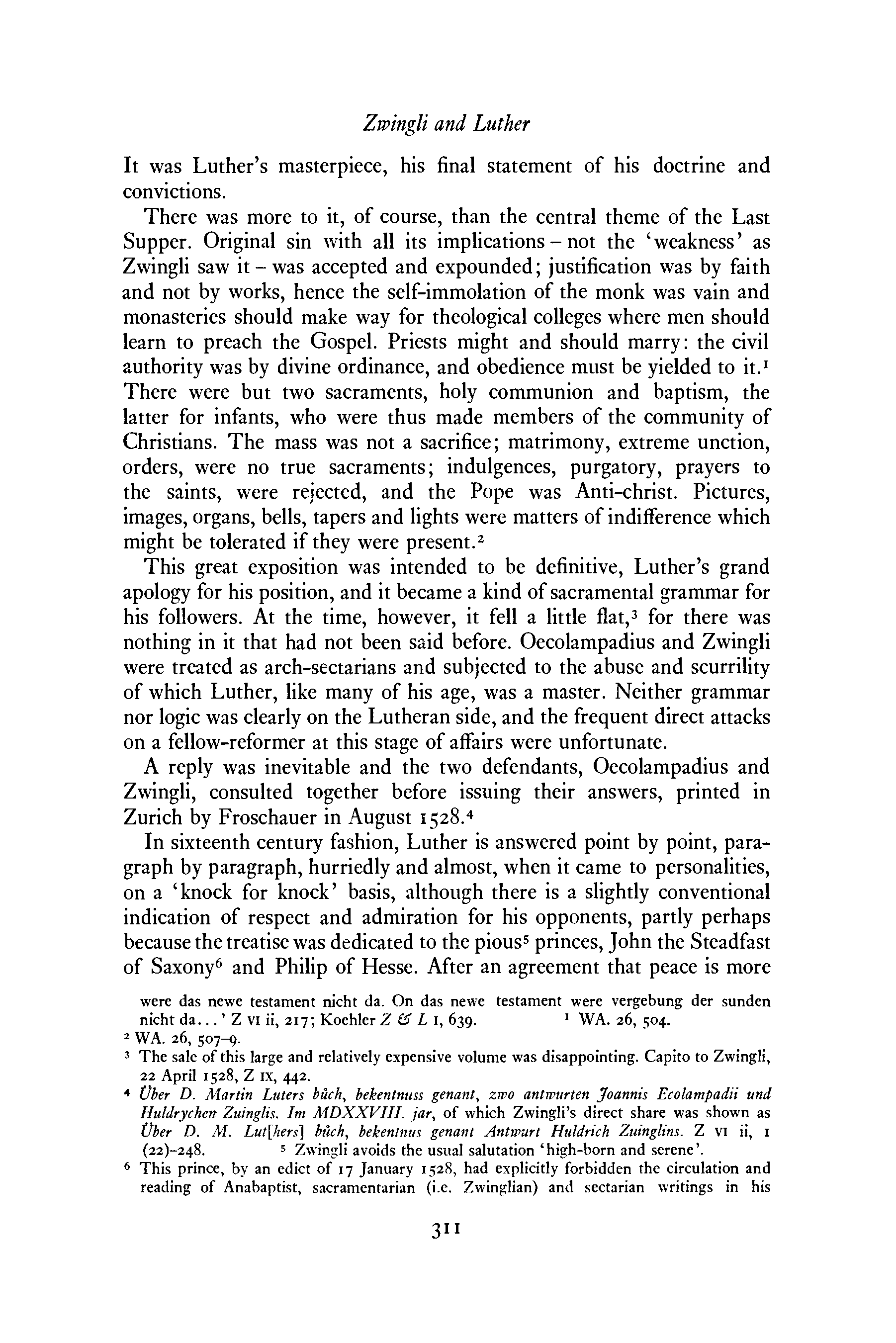
Zwingli and Luther It was Luther's masterpiece, his final statement of his doctrine and convictions.
There was more to it, of course, than the central theme of the Last Supper. Original sin with all its implications - not the 'weakness' as Zwingli saw it - was accepted and expounded; justification was by faith and not by works, hence the self-immolation of the monk was vain and monasteries should make way for theological colleges where men should learn to preach the Gospel. Priests might and should marry: the civil authority was by divine ordinance, and obedience must be yielded to it.1
There were but two sacraments, holy communion and baptism, the latter for infants, who were thus made members of the community of Christians. The mass was not a sacrifice; matrimony, extreme unction, orders, were no true sacraments; indulgences, purgatory, prayers to the saints, were rejected, and the Pope was Anti-christ. Pictures, images, organs, bells, tapers and lights were matters of indifference which might be tolerated if they were present.2
This great exposition was intended to be definitive, Luther's grand apology for his position, and it became a kind of sacramental grammar for his followers. At the time, however, it fell a little flat,3 for there was nothing in it that had not been said before. Oecolampadius and Zwingli were treated as arch-sectarians and subjected to the abuse and scurrility of which Luther, like many of his age, was a master. Neither grammar nor logic was clearly on the Lutheran side, and the frequent direct attacks on a fellow-reformer at this stage of affairs were unfortunate.
A reply was inevitable and the two defendants, Oecolampadius and Zwingli, consulted together before issuing their answers, printed in Zurich by Froschauer in August 1528.4
In sixteenth century fashion, Luther is answered point by point, paragraph by paragraph, hurriedly and almost, when it came to personalities, on a 'knock for knock' basis, although there is a slightly conventional indication of respect and admiration for his opponents, partly perhaps because the treatise was dedicated to the pious5 princes, John the Steadfast of Saxony6 and Philip of Hesse. After an agreement that peace is more were das newe testament nicht da. On das newe testament were vergebung der sunden nicht da...' Z vi ii, 217; Koehler Z ^ L i , 639. x WA. 26, 504.
2 WA. 26, 507-9.
3 The sale of this large and relatively expensive volume was disappointing. Capito to Zwingli,
22 April 1528, Z ix, 442.
4 Vber D. Martin Luters buck, bekentnuss genant, zwo antwurten Joannis Ecolampadii und
Huldrychen Zuinglis. Im MDXXVIIL jar, of which Zwingli's direct share was shown as Vber D. M. Lut[hers\ buck, bekentnus genant Antwurt Huldrich Zuinglins. Z VI ii, I (22)-248.
5 Zwingli avoids the usual salutation * high-born and serene'.
6 This prince, by an edict of 17 January 1528, had explicitly forbidden the circulation and reading of Anabaptist, sacramentarian (i.e. Zwinglian) and sectarian writings in his
3 "
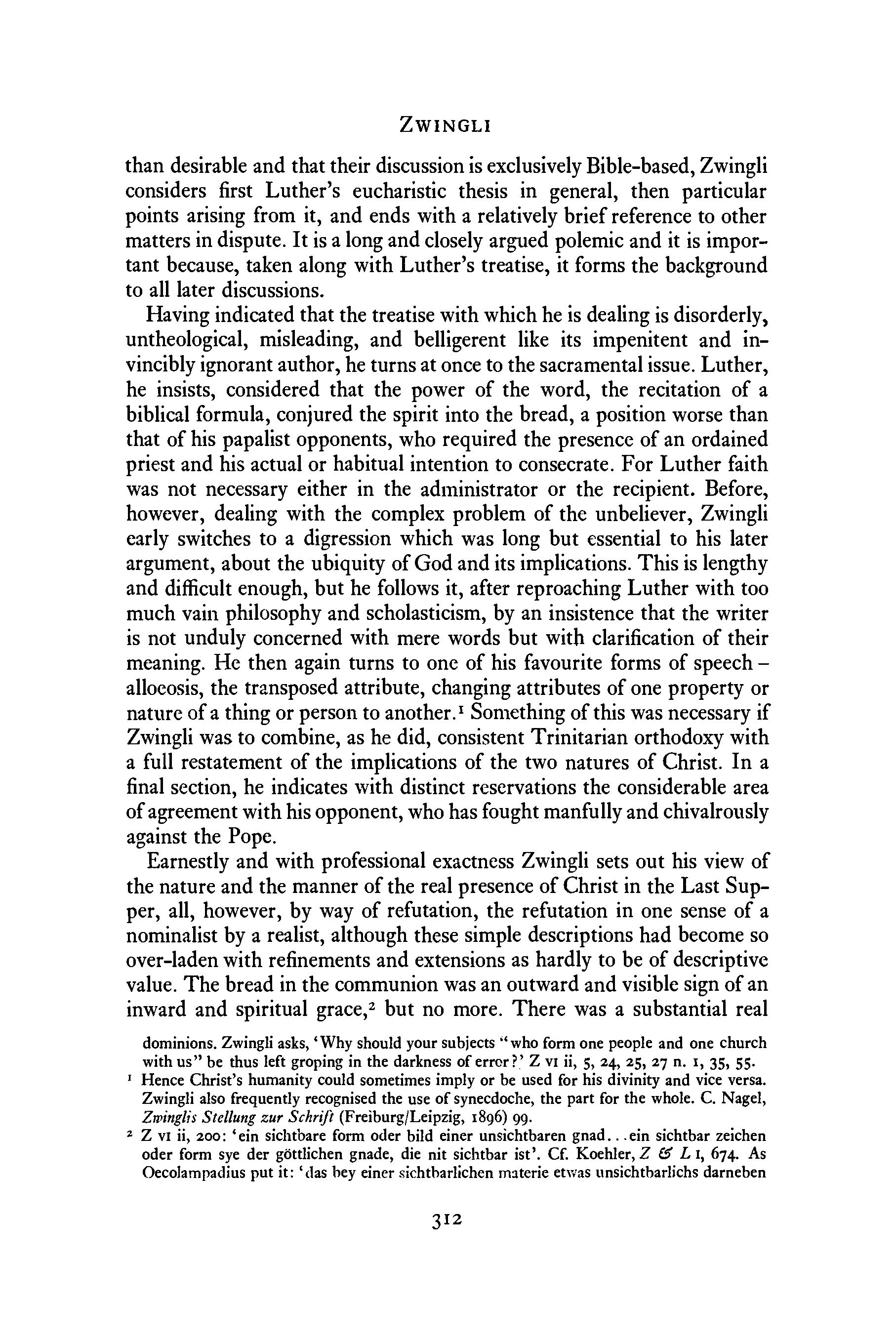
ZWINGLI than desirable and that their discussion is exclusively Bible-based, Zwingli considers first Luther's eucharistic thesis in general, then particular points arising from it, and ends with a relatively brief reference to other matters in dispute. It is a long and closely argued polemic and it is important because, taken along with Luther's treatise, it forms the background to all later discussions.
Having indicated that the treatise with which he is dealing is disorderly, untheological, misleading, and belligerent like its impenitent and invincibly ignorant author, he turns at once to the sacramental issue. Luther, he insists, considered that the power of the word, the recitation of a biblical formula, conjured the spirit into the bread, a position worse than that of his papalist opponents, who required the presence of an ordained priest and his actual or habitual intention to consecrate. For Luther faith was not necessary either in the administrator or the recipient. Before, however, dealing with the complex problem of the unbeliever, Zwingli early switches to a digression which was long but essential to his later argument, about the ubiquity of God and its implications. This is lengthy and difficult enough, but he follows it, after reproaching Luther with too much vain philosophy and scholasticism, by an insistence that the writer is not unduly concerned with mere words but with clarification of their meaning. He then again turns to one of his favourite forms of speech alloeosis, the transposed attribute, changing attributes of one property or nature of a thing or person to another.1 Something of this was necessary if Zv/ingli was to combine, as he did, consistent Trinitarian orthodoxy with a full restatement of the implications of the two natures of Christ. In a final section, he indicates with distinct reservations the considerable area of agreement with his opponent, who has fought manfully and chivalrously against the Pope.
Earnestly and with professional exactness Zwingli sets out his view of the nature and the manner of the real presence of Christ in the Last Supper, all, however, by way of refutation, the refutation in one sense of a nominalist by a realist, although these simple descriptions had become so over-laden with refinements and extensions as hardly to be of descriptive value. The bread in the communion was an outward and visible sign of an inward and spiritual grace,2 but no more. There was a substantial real dominions. Zwingli asks, 'Why should your subjects "who form one people and one church with us" be thus left groping in the darkness of error?' Z vi ii, 5, 24, 25, 27 n. 1, 35, 55.
1 Hence Christ's humanity could sometimes imply or be used for his divinity and vice versa.
Zwingli also frequently recognised the use of synecdoche, the part for the whole. C. Nagel,
Zwinglis Stellung zur Schrift (Freiburg/Leipzig, 1896) 99.
2 Z vi ii, 200: * ein sichtbare form oder bild einer unsichtbaren gnad... ein sichtbar zeichen oder form sye der gottlichen gnade, die nit sichtbar ist\ Cf. Koehler, Z & L 1, 674. As Oecolampadius put it: 'das bey einer sichtbarlichen materie etwas unsichtbarlichs darneben
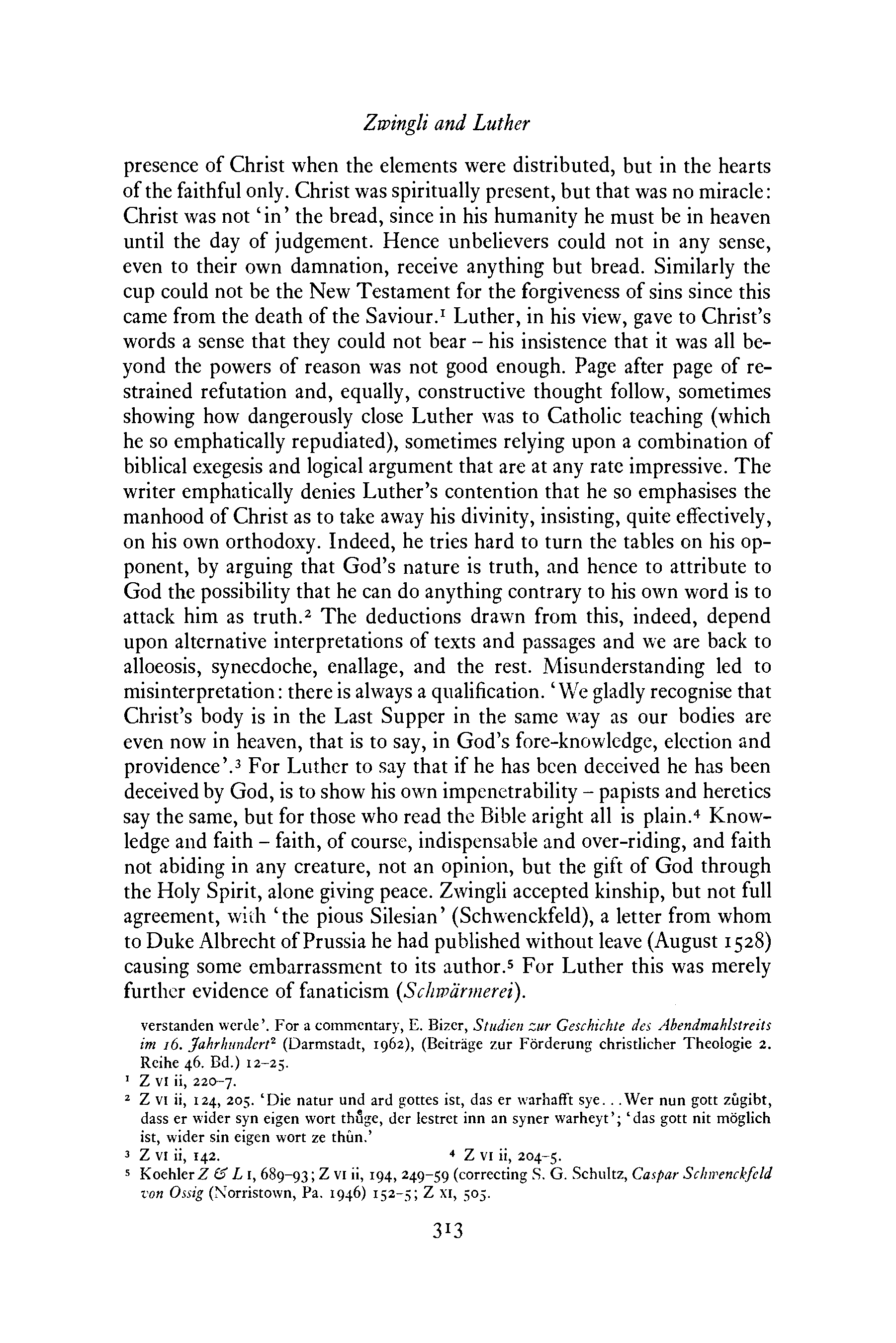
Zwingli and Luther presence of Christ when the elements were distributed, but in the hearts of the faithful only. Christ was spiritually present, but that was no miracle:
Christ was not 'in' the bread, since in his humanity he must be in heaven until the day of judgement. Hence unbelievers could not in any sense, even to their own damnation, receive anything but bread. Similarly the cup could not be the New Testament for the forgiveness of sins since this came from the death of the Saviour.1 Luther, in his view, gave to Christ's words a sense that they could not bear - his insistence that it was all beyond the powers of reason was not good enough. Page after page of restrained refutation and, equally, constructive thought follow, sometimes showing how dangerously close Luther was to Catholic teaching (which he so emphatically repudiated), sometimes relying upon a combination of biblical exegesis and logical argument that are at any rate impressive. The writer emphatically denies Luther's contention that he so emphasises the manhood of Christ as to take away his divinity, insisting, quite effectively, on his own orthodoxy. Indeed, he tries hard to turn the tables on his opponent, by arguing that God's nature is truth, and hence to attribute to God the possibility that he can do anything contrary to his own word is to attack him as truth.2 The deductions drawn from this, indeed, depend upon alternative interpretations of texts and passages and we are back to alloeosis, synecdoche, enallage, and the rest. Misunderstanding led to misinterpretation: there is always a qualification.' We gladly recognise that Christ's body is in the Last Supper in the same way as our bodies are even now in heaven, that is to say, in God's fore-knowledge, election and providence'.3 For Luther to say that if he has been deceived he has been deceived by God, is to show his own impenetrability - papists and heretics say the same, but for those who read the Bible aright all is plain.4 Knowledge and faith - faith, of course, indispensable and over-riding, and faith not abiding in any creature, not an opinion, but the gift of God through the Holy Spirit, alone giving peace. Zwingli accepted kinship, but not full agreement, with cthe pious Silesian' (Schwenckfeld), a letter from whom to Duke Albrecht of Prussia he had published without leave (August 1528) causing some embarrassment to its author.5 For Luther this was merely further evidence of fanaticism (Scliwarmerei). verstanden wcrde'. For a commentary, E. Bizer, Studien zur Geschichte des Abendmahhtreits im 16. Jahrhundcrt2 (Darmstadt, 1962), (Beitrage zur Forderung christlicher Theologie 2.
Reihe 46. Bd.) 12-25.
1 Z vi ii, 220-7.
2 Z vi ii, 124, 205. 'Die natur und ard gottes ist, das er warhafft sye. . .Wer nun gott zugibt, dass er wider syn eigen wort thuge, der lestret inn an syner warheyt'; 'das gott nit moglich ist, wider sin eigen wort ze thun.'
3 Z vi ii, 142.
4 Z vi ii, 204-5.
5 KoehlerZ & L 1, 689-93; Z vi ii, 194, 249-59 (correcting S. G. Schultz, Caspar Schwenckfeld von Ossig (Norristown, Pa. 1946) 152-5; Z xi, 505.
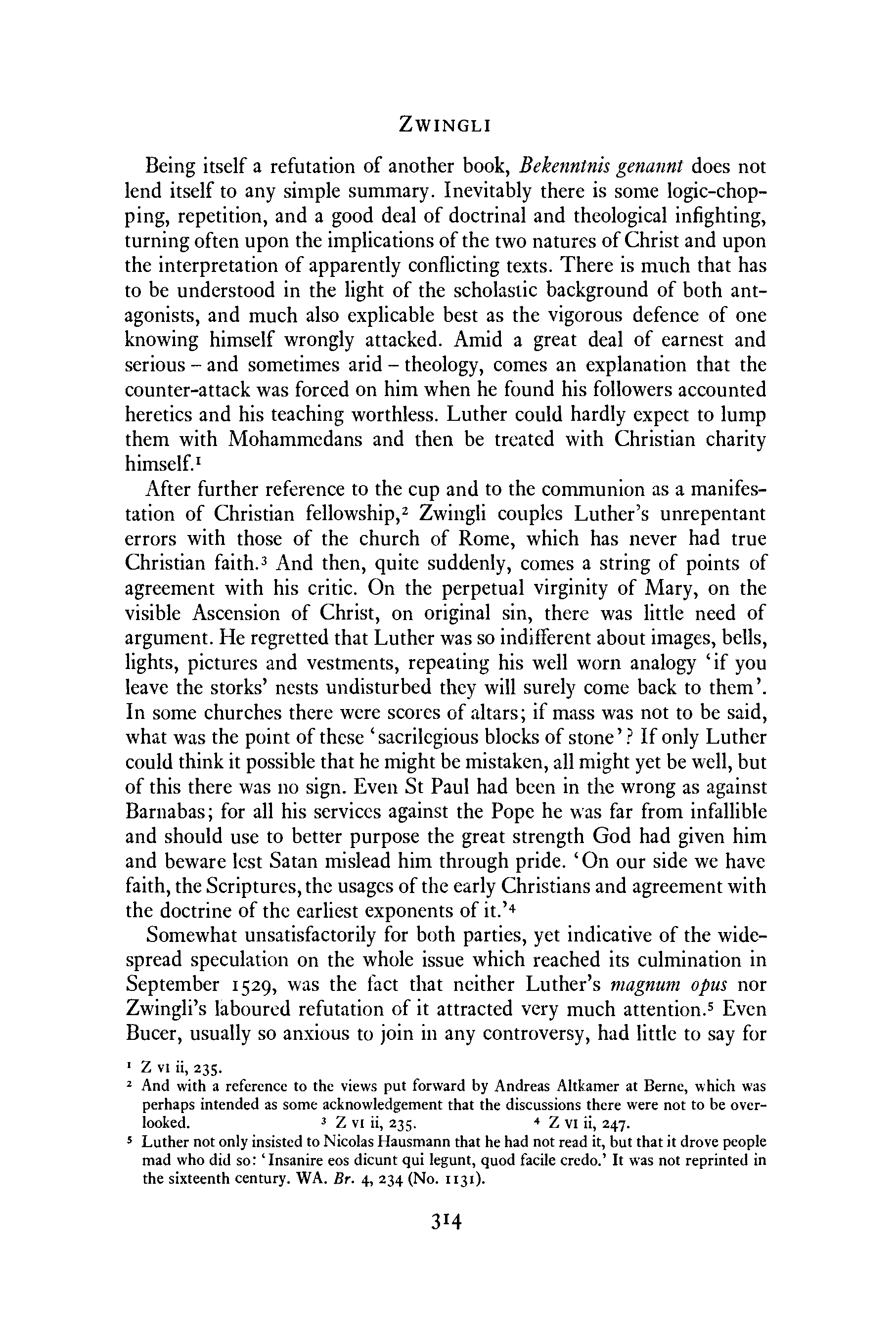
ZWINGLI Being itself a refutation of another book, Bekenntnis genannt does not lend itself to any simple summary. Inevitably there is some logic-chopping, repetition, and a good deal of doctrinal and theological infighting, turning often upon the implications of the two natures of Christ and upon the interpretation of apparently conflicting texts. There is much that has to be understood in the light of the scholastic background of both antagonists, and much also explicable best as the vigorous defence of one knowing himself wrongly attacked. Amid a great deal of earnest and serious - and sometimes arid - theology, comes an explanation that the counter-attack was forced on him when he found his followers accounted heretics and his teaching worthless. Luther could hardly expect to lump them with Mohammedans and then be treated with Christian charity himself.1
After further reference to the cup and to the communion as a manifestation of Christian fellowship,2 Zwingli couples Luther's unrepentant errors with those of the church of Rome, which has never had true
Christian faith.3 And then, quite suddenly, comes a string of points of agreement with his critic. On the perpetual virginity of Mary, on the visible Ascension of Christ, on original sin, there was little need of argument. He regretted that Luther was so indifferent about images, bells, lights, pictures and vestments, repeating his well worn analogy ' if you leave the storks' nests undisturbed they will surely come back to them'.
In some churches there were scores of altars; if mass was not to be said, what was the point of these 'sacrilegious blocks of stone' ? If only Luther could think it possible that he might be mistaken, all might yet be well, but of this there was no sign. Even St Paul had been in the wrong as against Barnabas; for all his services against the Pope he was far from infallible and should use to better purpose the great strength God had given him and beware lest Satan mislead him through pride. ' On our side we have faith, the Scriptures, the usages of the early Christians and agreement with the doctrine of the earliest exponents of it.'4
Somewhat unsatisfactorily for both parties, yet indicative of the widespread speculation on the whole issue which reached its culmination in September 1529, was the fact that neither Luther's magnum opus nor Zwingli's laboured refutation of it attracted very much attention.5 Even
Bucer, usually so anxious to join in any controversy, had little to say for 1 Z vi ii, 235.
2 And with a reference to the views put forward by Andreas Altkamer at Berne, which was perhaps intended as some acknowledgement that the discussions there were not to be overlooked.
3 Z vi ii, 235.
4 Z vi ii, 247.
5 Luther not only insisted to Nicolas Hausmann that he had not read it, but that it drove people mad who did so: 'Insanire eos dicunt qui legunt, quod facile credo.' It was not reprinted in the sixteenth century. WA. Br. 4, 234 (No. 1131).
Zwingli and Luther the remainder of 1528, when, it seemed, the Catholics were preparing once more to take the offensive.
It was not yet clear where Strassburg stood in the north, or how many south-German cities had fully accepted the Zwinglian view, or what was to be expected from eastern Switzerland.1 Little wonder that Margrave
George of Brandenburg confessed himself puzzled or that Philip of Hesse, having survived the Pack scandal, began to show renewed signs of restlessness.
Obviously there was not going to be agreement by writing. Might discussion be more successful? Might a religious summit-conference do what exchanges of letters and treatises could not ? A danger of a biographical approach to history is, very obviously, that of over-emphasising the part played by particular individuals. Luther and Zwingli were impelled powerfully by their environment and the people with whom they were in contact. Luther was a secure and honoured figure in the Electorate of Saxony and more than happy to find civil affairs in the hands of a godly prince whose authority could be exalted. He thus felt that he could to a considerable degree separate religion and politics; he would lead men to the city of God above while others cared for the protection and welfare of the living. Protestantism was safe in Saxony, and in a sense Luther was content that it should be so.
This, however, was impossible elsewhere. Zwingli had been involved in Swiss politics from his youth up, and he could hardly think of government save in terms of that of a Christian community. In Zurich, Berne, Basle,
Schaffhausen, Constance and Strassburg, the governing councils must be constantly reminded of their duty, which was to protect the reformed faith.
Incessant vigilance was necessary. The Catholic forces were very close to Zurich all the time; Baden and Zug, in Catholic hands, were only twenty miles away, and behind them was the whole weight of the Catholic cause.
In fighting for his faith, Zwingli was also fighting to secure a united Protestant Switzerland with allies powerful enough to cover further expansion.2 He had to fight the crypto-Catholics in his own city and state, and at the same time refute the radical Baptists and the misguided
Lutherans. After the triumphant disputation at Berne, Zwingli knew that he could not join forces with Luther. Both Erasmus and Eck had demonstrated that Luther was nearer to them on the central issue of the mass than he was to Zwingli. This had, in fact, important implications.
1 Hauswirth, Philipp 90-1.
2 Cf. Oechsli 3 c. 133-4.