
Gathering storm
The gathering storm It is difficult for the twentieth century to comprehend the violence and the deep feelings aroused by the controversies of the sixteenth. Anyone living after 1900 is aware of a mainly secularised and materially oriented world in which varied religious beliefs and gradations of disbelief are universal.
Since Zwingli's day the Council of Trent and the wars of religion have been followed by eighteenth-century Enlightenment and nineteenthcentury Evolution, Marxism and modernism. Zwingli and Luther were trained in the scholasticism of the later Middle Ages and could no more cast it off than even a comparable religious leader of today can escape from an education in which scientific criticism however superficial, and historical perspective however slight, have had their part. In 1529 the protagonists had all the world to gain: there were possibilities of Protestant union and of a compromise with Rome. The infidel Turk could be expelled and the light of the Gospel brought to Mohammedans, Hindus, Chinese and the Indians of the New World. If, and it was far from unthinkable, all
Switzerland was united in a reformed faith to which Lutherans and Anabaptists could adhere, in alliance with a Protestant France and England,
Europe might well be of one evangelical conviction.
The Marburg religious summit of 1529, important as it in the history of religion, was nevertheless also conditioned by the state of central European politics and the situation that year in Switzerland. For four years at least Zurich had been the focus of divisions which were political as well as religious. These now came to a head in a series of alliances and groupings which themselves had a considerable history behind them and which greatly enhanced the influence of the new evangelical city-states.
A fifteenth-century Swiss or south German city was at once a fortress, a market arid an administrative and judicial centre. It managed its own affairs and usually controlled the countryside around; sometimes, as with Zurich, Basle and Berne, it did so as actual ruler; sometimes, as at Constance and St Gall, there was no outside territory to rule; while such authority as was exercised by smaller places like Bremgarten, Zofingen,
Burgdorf and Payerne, was subject to limitations of treaties or custom.
ZWINGLI German cities had long since learned to cooperate for trade and protection so that, ever since the thirteenth century, civic alliances - a Lombard
League, a Hanseatic League, a Swabian League - were almost commonplaces. In Switzerland such local arrangements, known as Burgrecht^ involved something closely approaching co-citizenship. An independent city had exclusive jurisdiction over its own citizens, one of whose most valued privileges was that they could not be forced to plead before foreign tribunals; reciprocity in this between different cities brought commercial and legal advantages without any loss of internal authority. What was good for trade was also good politics, and, with the steady weakening of imperial or aristocratic authority, much of Switzerland and South Germany was covered with networks of inter-city cooperative agreements. The Swiss Confederation itself was a kind of loose extension of the same principle.
The spread of the Reformation enhanced the authority of the cities where it was accepted, in that they now no longer recognised any concomitant jurisdiction of bishop, abbot or pope, and were able to insist that clerics were just as much subject to their laws and customs as were other inhabitants. At the same time growth of power and wealth tended to intensify the age-long traditional rivalry of town and country; either you were a resident citizen with voting rights, inherited or acquired; or you were a villager, subject to city-made orders which had to be obeyed. In the chief'civic' states, Basle, Berne, Schaffhausen, Zurich, there were, on the one hand, the nobles and citizens, with voting rights and status, inherited or acquired; on the other, the subjects, whether unfranchised residents or the farmers and labourers in the fields, who had to submit to the directions of the governing council. Contrasted with these civic states were their rural counterparts, Glarus, Uri, Schwyz, Nid-und-Ob-Walden and Zug most obviously, the homes of herdsmen and agriculturalists as distinct from artisans and traders. To this can be added the inevitable rivalry of the mountain-dwellers and those of the plains. In one respect, however, they all agreed. It was everywhere the recognised duty of every government, whether civic or rural, to secure the obedience of all its subjects. In this there was little difference between them. It is important to realise what self-government meant in sixteenth-century Switzerland. If the citizens chose the councils which governed them, so, too, in the country states, every male adult had a nominal voice in the choice of his masters; but, in practice, in town and country alike, a small minority of members of wellknown families dominated all administrations. Government, without a police force, over men accusomed to self-help, was not always an easy matter when dealing with obstinate, illiterate and prejudiced country folk
1 Bender, Ref., esp. n-38.
Gathering storm whose main aim was to obtain good prices for their produce which the city-dwellers wanted to buy as cheaply as possible.
Divergent as the city-states were from the rural communities, prior to the Reformation the divergences were less in practice than in theory. Both were involved in the intricate network of alliances, treaties, agreements and understandings which held together the Swiss Confederation, with its allies and associates; but the structure was radically changed by the religious controversies of the 1520s. Cooperation became much more difficult when heresy intervened.
It is difficult for an age which finds even profound religious differences hard to understand, while being only too well aware of the passions aroused by race and ideology, to appreciate the detestation with which the heretic was regarded in the sixteenth century by good Catholics. His mistaken views made him a positive danger to society, for he could imperil the souls of his hearers; he was a rotten bough to be cut off, an anti-social figure to be shunned, a limb of Satan, the enemy of God.
What applied to an individual applied also to a community; there must be no association with those who had removed themselves from the church, outside which there was no salvation. If the Evil One was powerful enough to protect them from the extermination which was right and just, so much the worse, but at any rate there was no call to be associated with them in civic alliances or federal pact. Later, these feelings were transferred to the other side, and good Protestants, convinced that the Pope was Antichrist and his followers perverse idolaters, could not consider them as fellow-Christians. To misinterpret revealed religion was worse than to reject it; there was hope for the non-believer, but none for the misbeliever. Hence, a league between a wholly Catholic city such as Lucerne and a Zwinglian St Gall or semi-Lutheran Schaffhausen became increasingly impossible. None the less, there was also a strong consciousness of common Swiss interests, pride in past successes and a recognition of the need for easy exchange of commodities and for protection by mutual defence. These advantages had been painfully acquired; to lose them might mean falling under foreign (i.e. French, Italian or Imperial) domination.
Hence there was a strong reluctance to depart from long tried agreements and understandings. If, however, religion were to force the break up of these, then compensation might well be sought elsewhere.
The Swiss Reformation started in the city of Zurich, was adopted by and for the whole state and spread to other cities, St Gall, Berne, Basle,
Biel, Schaffhausen. The continuously Catholic states were the naturally conservative country areas which therefore felt an increasing sense of isolation and that the gap between them and the cities was widening.
Hence the search for external support. Religious convictions slowly in-
ZWINGLI tensified, and thus cooperation between communities which had much to offer one another, such as Fribourg and Berne, when one was Catholic and the other Zwinglian, became increasingly difficult and rare, if not impossible. By 1528 the Catholics were manifestly determined to boycott the Zwinglians, who were becoming more apprehensive of the implications of outlawry as Lutherans, and even of a possible imperial armed attack upon themselves. Consequently both sides sought to defend themselves by renewed or original inter-city agreements, out of which grew a league of civic co-religionists. This extension, being also an assurance of wider
Gospel preaching, Zwingli eagerly fostered and forwarded.
The Swiss Confederation was far from forming a coherent entity - it was rather a loose alliance of separate communities. The Swiss Diet consisted of thirteen states the majority of which remained Catholic; if therefore decisions were to depend upon the votes of a majority of states,
Catholic control would have been continuously assured. Majority rule, however, had not yet come into fashion. Unanimity was expected if common action was to be taken; otherwise, no decision was reached.
Further, the sovereign states were in no sense equal; Berne and Zurich compared with Zug and Uri were like California and Texas compared with Rhode Island and Delaware, equal only in name. Members attended
Federal Diets as delegates only, and decisions about actions to be taken was a matter for their masters. No state could be 'expelled from' the Diet, but if Catholic and Protestant delegates could not meet because Catholics would not sit in the same chamber as heretics, then the Confederation would practically be dissolved. How close it came to this after 1530 is a theme upon which Swiss historians do not like to dwell.
The Confederation had come into being as a defensive alliance against a common Habsburg enemy; slowly its members learned the value of limited common action, and this, in turn, not only had enabled the Burgundian threat from Charles the Rash to be beaten, but also demonstrated that, acting together, the states possessed very great military advantages. Defence led inevitably to aggression and to territorial expansion north and south. At different times and under varied conditions Thurgau,
Baden, Rapperswil, the Freie Aemter, Uznach, Gaster, Sargans, the Rheintal, the Ultramontane districts, Livinental, Eschantal, Maiental,
Locarno, Riviera, Blenio, Bellinzona, Lugano, with the western fragments of Grasburg, Echallens and the county of Neuchatel (Neuenburg), had passed into common possession. Of these Mandated Territories (Gemeine
Herrschaften), those in the north-east, Thurgau, Rheintal, Uznach, Gaster and Sargans, offered special problems, the more so since they were all geographically linked with the considerable possessions of the Prince Abbot of St Gall, whose peculiar position has already received some consideration.
Gathering storm It is convenient, and not entirely inaccurate, to speak of the Swiss Confederation as the 'ruler' of these Mandated Territories, although, in fact, this meant certain groups of Confederates at the time of annexation and thus Basle, Schaffhausen and Appenzell, as late arrivals, were nonparticipants here. To these territories the governing states (meeting in Diet) appointed Vbgte (Lords Lieutenant, governors or 'bailiffs'), an office taken in turn by nominees of the trustee powers, these officers having dignity, authority and a handsome salary.* In addition they could, and did, recruit mercenary soldiers and were appropriately rewarded for this. A Mandated Territory, such as Thurgau, was thus a valued possession. The Five Inner States esteemed their share in these conquests the more highly because of their own relative poverty; they also were insistent that the Catholic faith should prevail there.
After the triumph of Lutheranism in Saxony, it became the custom in Germany for subjects to accept and follow the religion of their rulers, and this, after 1525, slowly came to be the practice in Switzerland as well. Thus when the governments of Berne and Basle decided for Protestantism, the Catholics had to conform, or, like Erasmus, to leave. What, however, if the rulers were themselves divided? Were the inhabitants to change their faith with a change of governor ?
A governorship brought both personal prestige and wealth. It was therefore particularly highly coveted in the poor Inner States as eminently desirable. In Zurich and Berne this was only slightly less attractive, for in them other opportunities for enrichment by trade and commerce existed.
Hence in any rivalry over the Mandated Territories the Inner States were likely to be more tenacious of their rights of nomination of governors than their rivals, and peculiarly unwilling to relinquish them. If, because the Catholics controlled a majority of states, they could establish the principle that only a Catholic governor could be appointed to control Catholic territory, they would hope for financial as well as political gain. But how far were the northern Mandated Territories one hundred per cent Catholic ?
Were their inhabitants to be allowed to hear the ' pure word of God' read and expounded ?
Zurich after 1525 was certainly not willing to accept any arrangement that prevented the Gospel from being preached freely in any area over which its jurisdiction, even partially or temporarily, stretched. It now seemed deplorable that mass was said at all in an area like Thurgau, and its cessation was called for. Equally, Zurich had consistently opposed mercenary service and was therefore most unwilling that recruiting should go on in such districts. Apart from military aid either for defence or offence, the Swiss Confederates recognised no obligations one to another. Religious
1 EA 4, ib, 1601-2.
ZWINGLI affairs were matters for the individual governments, not for the Confederation.1 Therefore there neither need be, nor should be, a combined religious policy in the Mandated Territories. This principle had been acceptable enough when unity of belief was taken for granted, but after Zurich had rejected communion with Rome, the picture changed. Zwingli now again maintained that in these districts reformed preaching and worship should be allowed freely, and that if any community (i.e. the adult males) called for a change it should be permitted for its own particular parish (Gemeinde).
When a majority of these were so converted, the whole district might follow.2
There was one important difference of approach between the Zwinglian and the Catholic states. Zwingli did not believe in compulsion in matters of faith - 'der Glaub liess sich nicht mit Gewalt eingehen' - and coercion was not recommended.3 He was completely convinced that the Gospel had only to be preached for it to prevail, such was the power of the Word.
There might, indeed, be a kind of saturation preaching, for there could never be too much of a good thing, but actual physical force was never to be used to bring about conversion. Direct public opposition to the Bible, of course, was a different matter and not to be tolerated. Only too often it was the pensioners, recipients of money from foreign Catholic powers, who were, in Zwingli's view, the chief opponents of the evangelicals. He was therefore the more anxious to secure their elimination as they also represented the mercenary service of which he so much disapproved.
These notions were quite unacceptable to his opponents. They were accustomed to the Inquisition; heretics had always been burnt out. Where they shared a joint responsibility for Mandated Territories they could not connive at the admission of heresy. They insisted that the Confederation had accepted, on occasion, in disputed issues, the prevalence of the wishes of the majority of independent states.4 Normally the state whose turn it
1 The principle, so congenial to Berne (see above 249,251, below 375), was re-stated in February
1527. 'Weil die Biinde, laut des Buchstabens, sich nicht auf den Glauben, sondern allein auf ausserliche Dinge beziehen.. .ohne Rucksicht auf den Glauben'; 'nit uf den glouben und seel, sonders uf beschirmung land, liit, witwen, weisen, bewarung der eren, handhabung des rechten, beschiitzung vor gewalt und der glichen iisserlich sachen belangend'. EA 4, ia,
1050 (No. 420), 1063 (No. 426), cf. G. Meyer von Knonau, Aus der schweizerischen Geschichte in der Zeit der Reformation und Gegenreformation HZ 40 (1878) 127.
2 Berne and Zurich agreed in 1528 (EA 4, ia, 1521-5, esp. 1524) that where an evangelical preacher was invited by the local Gemeinde, he should in the first instance be safe from expulsion, and people who listened to him and heard the Bible read should not be punished.
3 Haas, Kappelerkrieg, 80.
4 F. Elsener, Zur Geschichte des Majoritdtsprinzips (Pars major und Pars sanior) insbesondere nach schweizerischen Quellen. ZRG, KA 42 (1956), 73-116, 560-70; 55 (1969) 238-81; P.
Briischweiler, Die landfriedlichen Simultanverhaltnisse im Thurgau (Frauenfeld, 1932); Vasella
2, 45-8; M. Kopp, Die Geltung der Mehrheitsprinzips in eidgenossischen Angelegenheiten vom
13. Jahrhundert bis 1848 in seiner Bedeutungfiir die alte Eidgenossenschaft (Winterthur, 1959).
Gathering storm was to administer the area undertook all duties and responsibilities. In the event of a conflict of significance all the protecting states should be consulted and, failing unanimity, the wishes of the majority of them should prevail. The application of this principle obviously might be used to prevent any change of religious allegiance. It was far from being a simple matter. Rules acceptable for secular civil affairs were not transferable to matters religious. While the Catholics hoped that a majority opinion in the Diet could be held to prevail, they were not prepared to extend this principle to localities. Zurich argued for majority decisions in the Gemeinden of the Mandated Territories to be decisive locally, a view totally unacceptable to its opponents.1 There was, of course, no freedom for the Gemeinden within any state, Catholic or Protestant, to exercise religious local option.2
The reformation movement made steady, even rapid, progress in Thurgau.3 By April 1529 it was reported that a majority of the parishes were in its favour, most spontaneously, some perhaps responding to pressure from Zurich emissaries. Similar, but slower, results were obtained in Toggenburg, Gaster, Sargans, the county of Werdenberg and in the Lordship (Herrschaft) of Sax-Forstegg where the local Freiherr was well disposed.
A Zwinglian Thurgau, reinforced by other eastern territories including the lands of the monastery of St Gall - the city of St Gall was increasingly
Zwinglian from 1524-would readily accept Zurich's guidance in other matters, and this in turn would give Zurich control of an area equal in size to, but much more valuable than, the Bernese Oberland. This would mean that Zurich, traditionally the leading state, would be doubled in size, wealth and warrior population. In alliance with Berne and supported by Oecolampadian Basle, the combination would be irresistible. The rest of Switzerland, it would seem, must follow. Zurich would be the pacemaker, then become the dominant partner and finally the controlling force in a Protestant Switzerland.
The implications of this did not escape the keen perception of the cautious councillors of Berne. It would mean that the Aar would become, as it were, a tributary of the Limmat; Saints Felix and Regula would displace the bear. Swiss interests would thus be almost wholly Germanorientated, possibilities of expansion westward into French-speaking areas such as Franche-Comte or the Vaud would be at a discount and Bernese soldiers would be used to further the interests of Zurich. Further, since there was no serious hope that Central Switzerland would become
Protestant otherwise than by coercion, it might well mean that Berne 1 EA 4, ia, 1372 (August 1529).
2 Kagi, 83-6.
3 Knittel 1, 169-245; Kagi, 63-70.
ZWINGLI would be engaged in hostilities with Lucerne, Schwyz, Uri, Nidwalden and Obwalden, its immediate neighbours, and probably with Savoy and Valais as well, and this to make Zurich stronger.
On its eastern frontier Berne had a special problem. Keeping a tight hold on the peasants of the comparatively recently acquired Bernese Oberland was not easy at any time; these isolated backward communities constituted a kind of Bernese La Vendee, where bucolic conservatism resisted religious change all the more when it was apparent that the removal of mass-priests and the suppression of monasteries did not bring any relaxation of services, tithe or rent-charge payments.1 At the same time, clandestine attendance at mass might involve a heavy fine.2 They very reasonably expected help from across the border and they knew that there were a number of crypto-Catholic well-wishers in the city of Berne itself.
Behind the Inner States lay the enigmatic figure of Ferdinand, Archduke of Austria, brother of Charles V and from 1526 onwards King of Bohemia and Hungary. As ruler of the Tyrol, the Black Forest, Breisgau,
Sundgau, Upper and Lower Alsace (Vorderoesterreich), with administrative centres at Innsbruck, Ensisheim and Landshut, he represented an immediate Catholic menace on the frontier. Although the Inner States had come into being to resist Habsburg external interference and had become allies of the King of France, they could now increasingly feel that they must turn to this Catholic dynasty for help. Without external aid they might not survive. Ferdinand, too, was in regular communication with the Emperor Charles V.
This latter became more and more the Catholic ogre for Zwingli, although the Zurich tradition had formerly been one of relatively good relations with him. He was also now coming to be regarded by Lucerne and its friends, traditionally so anti-Habsburg, as a supporter, the more so when in 1529 the Pope had learnt the lesson of the sack of Rome (1527) and had accepted the consequence of the defeat of the French in north Italy.
The hopes and fears of Catholics and Protestants alike were in fact unnecessary ones, but they influenced events. Charles V neither could nor would waste man-power and resources against recalcitrant Swiss republicans. He had yet to secure his position in Milan, arrange his coronation, deal with the Diet of Speier and keep both the Turks, and events in the New World, in view. The advisers of Ferdinand at Innsbruck were indeed anxious to urge their master to take advantage of any opportunity to forward the Catholic cause, but their physical and financial resources were woefully inadequate. This was what Zurich failed to appreciate.
1 Feller, n, 166-70. H. Speaker, Die Reformationswirren im Berner Oberlandi528. IhreGeschichte und ihre Folgen (Fribourg 1951). (SKG 1952 Beiheft 9), 22 Tardent, 127.
2 Vasella /, 308.
Gathering storm Berne was avowedly and publicly a Zwinglian state after the disputation of January 1528, an event that may have saved the Protestant faith in Europe. It was not, however, easy for Berne to bring the new teaching to all its subjects, particularly to the coarse and stupid farmers of the more distant and remote valleys. Enforcement of the new worship was carried out slowly, with caution, mildness and thoroughness, all, as has been seen,1 characteristic features of Bernese administration. There had indeed been discontent in Haslital accompanied by intervention from Unterwalden, but this had proved abortive.2 Berne, with an anxious eye on its southern neighbours, had no intention of dropping its demand for an admission of guilty responsibility and suitable reparations from Unterwalden for incitement to revolt. By helping the rebels, Unterwalden had undoubtedly broken Federal agreements, the PfaffenbrieJ'(1370) and the Stanser Verkommniss (1481), so that Berne, supported by Zurich, could now demand the exclusion of Unterwalden from meetings of the Federal Diet for ten years and from any share in the control of the Mandated Territories.3 The Unterwaldner administration retaliated by accusing Berne of wanting to destroy the old Confederation, a charge easily answered by a reminder that the issue was secular, not religious, and by an agreement to submit the matter to conventional arbitration. The arbitrators,4 after long deliberation, agreed that the attackers had been in the wrong but also that it had been a local spontaneous movement rather than a government sponsored one, and Unterwalden agreed to consider the Bernese as 'pious and honourable Confederates'. Berne was not willing to let the matter rest there. It was indispensable in the conditions of 1528-9 that Berne and Zurich remain united, and therefore Berne would not agree to any arrangement that was unacceptable to Zurich. Zurich was not prepared for any unsatisfactory compromise - as a minimum, rebels who had fled to Unterwalden territory must be returned, defamation of Berne must cease and proper compensation be paid. Zwingli personally in more than one memorandum5 strongly urged that wider matters involving the spread of the Gospel must be taken into account, including the intrigues of the Five
Inner States with Austria. An easy peace would encourage the Catholics to persecute in Gaster, Weesen, Toggenburg and Glarus. The pensioners would strengthen the ties with Ferdinand.6 Therefore he insisted that Unterwalden must explicitly admit that it had broken the Federal Pact and ask for forgiveness, and there must be no more defamation of reformers.
Unterwalden must also drop its alliance with the other Inner States against 1 See above, 245.
2 See above, 264.
3 Feller 11, 191. Strictly, Nidwalden alone was involved. Z vi ii, 319-20.
4 Basle, Schaflfhausen, Appenzell and Graubiinden. EA 4, ib, 40; EA 4, ia, 1467; Z x, 147;
Z vi ii, 331, 343; Schmid 9-11.
5 Z vi ii, 318-44, 361-71.
6 Z vi ii, 362-3.
ZWINGLI Zurich and Berne, stop negotiating with Austria, forbid pension-taking and abandon one turn in appointing to office in the Mandated Territories
(specifically in the Freie Aemter) and pay costs. If, as it seems, Zwingli's advice was intended to prevent peace1 and keep the matter open until a settlement was reached over the Mandated Territories, then it was successful, and the Unterwalden incursion proved to be the first link in the chain that led to war. There was also a growing suspicion amounting to conviction2 that the Five Orte were negotiating an extra-Federal and contra-Federal alliance with Austria; and something like this was indeed the case.
The varied civic alliances in which Zurich was involved, originally made for trade and mutual protection, had, with the expansion of evangelical teaching, become more coherent as religious interests and fears had been added to the other unifying forces. Already, as early as January 1525,
Zurich, Berne, St Gall, Biel, Miilhausen, Basle, Schaffhausen, Solothurn and Strassburg were prepared to work together to resist the enforcement of the Edict of Worms3 in their territories, and, with the growing strength of the reform movement, others were willing to join. In 1527 Zwingli was canvassing the potentialities of an alliance of the reformed cities.4 Now that Berne had become officially Protestant and Oecolampadius was clearly succeeding in his efforts in Basle,5 the evangelical cities constituted themselves into a formidable and possibly aggressive group, a Christian
Civic Union.6 There had been many such unions during the previous half century for trade, protection and war. In general they involved economic and legal reciprocity for the citizens included and were either indefinite
(ewige) or for a fixed term of years.
Constance held one of the keys to the Christian Civic Union. This free imperial city had succeeded in throwing off its dependence upon its bishop and from 1500 had wanted nothing better than to become a Swiss state
(gleichberechtigter Ort). Only thus could its reformed religion be secure and the city avoid absorption into the Habsburg family possessions, which 1 Haas, Kappelerkrieg, 68-75; Feller 11, 181; Hauswirth, Philippe 124.
2 EA 4, ib, 102.
3 EA 4, ia, 529 (No. 224), 553 (No. 235); HZ 40 (1878) 131; Bender, Reformationsbundnisse,
162-4.
Z vi i, 197-201; Hauswirth, Philipp, 88.
5 The final decisive date is 10 February 1529, when images were removed and the mass forbidden. P. Roth, Durchbruch und Festsetzung der Reformation in Basel (Basle, 1942) 30.
6 Das Christliche Burgrecht. Basle, Miilhausen, Biel, Berne, Zurich, St Gall, and from December 1527 Constance, were included. The first meeting of what became the Christian Civic
Union was held in Berne between representatives of Berne, Zurich and Constance on 5 and 6
January, immediately after the Berne disputation. The acceptance of exclusively evangelical preaching was implied in the title which does not appear until the agreement of 25 June between Zurich and Berne. Later, meetings of representatives of some or all of the cities were held, often in Aarau, as needed. Z vi ii, 670; EA 4, ia, 1345, 1521-5; Vasella, 2, 59-61.
Gathering storm in fact happened in 1548. The bishop naturally tended to favour an Austrian alliance, thus securing his own position, while the city council as an evangelical body was anxious to escape from his jurisdiction. At the same time a city without any territory (as was also the case with St Gall) was in no strong military or economic position. If, however, the city could secure the areas under episcopal control, just as if the city of St Gall could embrace the monastic possessions, the situation would be altered, but not entirely to the advantage of Zurich.
The efforts of the brothers Ambrose and Thomas Blaurer from 1523 onwards had secured the acceptance of the Zwinglian reform and Zwingli looked thither for support; the bishop's authority was repudiated, and in 1528 Constance was deprived of imperial protection. In so far as the German cities were Lutheran, Constance was not an acceptable ally to them; and in so far as Constance hoped to absorb Thurgau, it was suspected by Zurich. The Five (Catholic) States were in any event opposed to the admission of an additional' Civic' member to the Confederation, a veto which included Strassburg as well as Constance, and religion settled the matter.
Zwingli for his part needed support from and in Constance, especially after the setback at Baden.1 On 18-23 May 1527, men from Zurich,
Lindau and Constance met in St Gall at a shooting-match (Schiitzenfest), which was also a social occasion. In August Zwingli advocated an alliance.2
The outcome, seven months later, was the alliance (Burgrecht) of Zurich and Constance, dated 25 December 1527,3 the text of which was drawn up by Georg Vogeli, town clerk of Constance. The document stated that the alliance was concluded for the honour, advantage and welfare of the Holy
Roman Empire. Each party was to act in matters of belief as they would answer to God and his holy word - the formula of the Speier Recess of 1526. If either party were attacked the other would come in arms to its help. Zurich thus had its northern flank covered and, in fact, the alliance was not merely defensive. The defence of the Reformation called for action, and Zurich with Constance could hope to advance further. Any territory occupied or annexed was to be held in common by both sides. Corresponding treaties with Berne, Basle, Schaffhausen, St Gall, Biel and Miilhausen followed.4 Zurich and Berne insisted that the Gospel was truly
1 F. Blanke, Zwingli mit Ambrosius Blarer im Gesprdch. Der Konstanzer Reformator Ambrosius
Blarer I4g2-i$64, hg. v. B. Moeller (Constance, 1964) 81-6.
2 EA 4, ib, 309; Z vi i, 200-1; Z TX, 187-8.
3 EA. 4, la, 1510-16; Bullinger Ref. 1, 419-25; HZ 40 (1876), 134-51 and H. C. Rublack, Die
Einfuhrung der Reformation in Konstanz (Giitersloh, 1971), 121-4 analyse the negotiations well.
4 The main Zwinglian alliances (Burgrecht) were:
Berne and Fribourg with Lausanne, 7 December 1525 for 25 years.
Berne and Fribourg with Geneva, 8 February 1526 for 25 years.
ZWINGLI preached by them, and they were always willing to be better instructed from the Bible. The eight Catholic states had tried to seduce the subjects of the cities from their allegiance. Hence there was to be full co-citizenship between the reformed associates; they would defend their religion and aid one another if attacked. No subject in the Mandated Territories who accepted the Apostles creed and the Bible was to be punished. Monks might leave their monasteries freely and parishes which voted by a majority for the Reformation were not to be prevented from accepting it.
Federal alliances were to be retained.
Together these inter-civic alliances involved ever closer cooperation. In January 1529 delegates from Berne, Zurich and Constance inaugurated a series of meetings for the discussion of common interests, and these soon became assemblies or diets of all the cities involved, which were now regularly referred to as the Christian Civic Union (das Christliche Burgrecht), particularly after the accession of Basle in March. Aarau became the usual meeting place for these diets, and its choice, apart from geographical convenience, is significant. Berne was determined from the outset not to be involved in any expansive south German alliance which should include Wlirttemberg and Hesse, and to keep the meeting place of the union close at hand.
All this had not escaped the notice of the Inner States, who felt themselves isolated and threatened with exclusion from their federal rights in the Mandated Territories. Hence they were already considering in great secrecy what counter-measures could be taken, and in 1528-9 the possibility of Austrian support was discussed at Lucerne.1 With Fabri's encouragement, negotiations with Austrian officials, alarmed by Basle's entry into the Christian Civic Union, were opened at Feldkirch on 14 February,2 and the terms were embodied in a treaty at Waldshut on 22 April 1529, the later notorious 'Christian Alliance' (die Christliche
Zurich with Constance, 25 December 1527 for 10 years.
Berne with Constance, 31 January 1528 for 10 years.
Zurich with Berne, 25 June 1528. (This followed the acceptance of the Zwinglian faith by Berne, future alliances being designated * Christian* -'das christliche Burgrecht* - and these extended more widely.) Zurich and Berne with St Gall (city), 3 November 1528.
Zurich and Berne with Biel, 28 January 1529.
Zurich and Berne with Miilhausen, 17 February 1529.
Zurich and Berne with Basle, 3 March 1529.
Basle with Miilhausen, 17 February 1529.
Basle with Biel, 8 May 1529.
Zurich, Berne and Basle with Schaffhausen, 15 October 1529.
Zurich, Berne and Basle with Strassburg, 5 January 1530.
The documents are in EA 4, ia, 1505-27; EA 4, ib, 1463-93.
1 Escher, Glaubensparteien 62-3. Lucerne was actively in favour of this, Uri much less so.
2 EA 4, ib, 49-59. Rudolf Collin was able to send a report of the proceedings to Zwingli.
Vasella 2, 107; HZ 40 (1878) 150-1.
Gathering storm Vereinigung).1 The union agreed at Waldshut was superficially entirely defensive in character. The contracting parties undertook to give no offence or occasion for war, and to defend themselves and their faith only in the event of a direct attack. They would support one another in the punishment of heretics, and Austria would assist its allies (but with advice only) in the maintenance of their rights in the Mandated Territories and as co-protectors of St Gall.
If the Catholic states should be attacked, Ferdinand promised to put in the field 6,000 infantry, 400 cavalry and some guns, and to send food supplies. Soldiers might be hired by the Austrian administration at the standard rates, but Austrian poverty made this highly improbable. No conquests were directly envisaged, but it was agreed that any territory within the bounds of the Confederation or its allies that was occupied should become the responsibility of the Five. Any gains made outside the Confederation with the aid of hired Swiss soldiers would fall to Austria, a provision aimed at the city of Constance. The Austrian advisers recognised that the Five States were greatly inferior in effective military power to their rivals but hoped to overcome this, since the adhesion of Valais, Fribourg and Solothurn was anticipated, and there were expectations of assistance from the Bishop of Constance, Count Frederick of Fiirstenberg, the Count of Werdenberg, together with Oberlingen, Wangen, Ravensburg and Salzburg. The expectations did not materialise and served only to alarm the other side. At the end of April a meeting of representatives of Berne, Glarus, Basle, Solothurn, Schaffhausen, Appenzell, St Gall, Biel,
Chur and Constance protested2 against the Feldkirch treaty, but in vain.
The protest could have been serious, but in fact it was ineffective from the start. There was some genuine fear. News that the Emperor was assembling forces against the Turks was taken to mean that these were really intended to be used against the Swiss; men were gathering in Lorraine, a force of 8,000 in Valais was ready to invade Berne, a force of 1,000 could come from the south against the Graubiinden. The alliance was, in fact, a rather irresponsible arrangement, but rumour greatly exaggerated its implications3 and helped on a kind of war fever. Significantly, perhaps, the formation of the 'Christian Alliance' coincided with the renewed activity from the side of St Gall which has already been described4 and with growing expectations of conflict.
The Gospel-preaching in the Toggenburg district had gone forward 1 EA 4, ib, 123, and Beilage v, 1467-75; Archiv fur die schweizerische Reformationsgeschichte
(Piusvereins, Solothurn, 1876) in, 573-80; Spillmann /, 31; Vasella 2, 108.
2 EA 4, ib, 139-45.
3 Valais made an alliance with Savoy, accompanied by somevunnecessary publicity: * wir geben nit ein pfifferling um die Ziircher, Berner, die evangelischen sackpfifer'. Escher, Glaubensparteien 71; Oechsli 3, c. 139; EA 4, ib, 73.
4 See above, 279-283.
ZWINGLI remarkably well1 in spite of opposition. Those who were won over wanted evangelical ministers and feared prosecution for heresy, from which Zurich alone could save them. The efforts of Johannes Doring and Bernard Kiinzli of Brunnadern had been successful enough to cause the abbot to complain both to the federal Diet and to the Protecting Powers and in 1528 there had also been a number of cases of iconoclasm, notably at Lichtensteig, and of civil disobedience as well.2
In particular there had been trouble in 1528 over the Benedictine monastery of St John (Alt St Johann im Thurtal), a few miles west of Wildhaus and well known to Zwingli, his uncle and his younger brother
James having been monks there. The abbot, Johann Steiger von Biitschwil, was notorious for his hostility to the evangelicals around him, and had appealed to Schwyz and Glarus for support against them. When this was not forthcoming, he took the precaution of removing the more valuable of the church ornaments to Feldkirch in order to save them from destruction on 14 September 1528, when the abbey church was wrecked by religious enthusiasts. When punishment of these vandals was demanded by Schwyz, which could in fact involve proceedings against all Zwinglian supporters in Toggenburg, Berne and Zurich refused to countenance it.3 There this matter rested until after the second Kappel war when the monastery was restored with support from the Abbot of St Gall, and the efforts by Schwyz to extend its authority thither were thwarted. It was not, however, an isolated event.
To cast down graven images had biblical commendation and had been accepted by Zurich as a godly action to be carried out with restraint and deliberation. This was less easy to secure in areas under joint control, and it was difficult to prevent the 'cleansing of the churches' from being used by looters, anxious to steal articles of value, or by enthusiastic youths for whom wanton destruction, easily extending beyond the offending objects, was good sport.4 Pious Catholics, of course, were deeply offended by the destruction of revered buildings and their contents.
There were other events which exacerbated feelings on both sides.
Thurgau was a key area; hence the attention it received from the evangelicals. From the point of view of Zurich, annexation or incorporation would be highly advantageous. If, however, this should prove entirely unaccept1 Z ix, 534-6; Miiller, 77-00; G. Egli, Die Reformation im Toggenburg (Schaffhausen, 1955)
115-18.
2 Miiller, 85-7; Kagi, 94.
3 G. Egli, Die Reformation in Toggenburg, 119; Sabbat a, 289; Salat, 186; Z vi ii, 268-71;
Escher, Glaubensparteien, 47-8; Strickler I, 666-7 (No. 2105); EA 4, ia, 1404;" Kagi, 20-2,
75-6, 88.
4 The rough and unrestrained violence of the age receives ample illustration in the sketches that accompany Diebold Schilling. Lnzerner Bilderchronik, 1513, bearbeitet v. R. Durrer u. P.
Hilber (Geneva, 1932). J. Zemp, Die schweizerischen Bilderchroniken und ihre ArchiteckturDarstellungen (Zurich, 1897) 3°^-
Gathering storm able, as in fact it did, then the next best thing for the reformers would be for it to secure independence and self-government (Rechtsgleichheit) thus escaping Catholic control. Better still, it might become a full state (Ort) of the Confederation, but this the opponents were determined, as with Constance, to prevent. Nor would a Zurich-controlled Thurgau be welcome to Berne.1 The evangelicals in Thurgau had long complained of oppression by the local administrator {Landweibel) Marx Wehrli, an aggressive
Catholic whose actions caused great resentment in Zurich and increased the determination there to help their oppressed brethren. In May 1528, in the company of the governor, Heinrich Wirz of Obwalden, Wehrli stayed in the Zurich inn Zum Roten Schwert. There he was arrested, found guilty of violence against his evangelical subordinates, and beheaded.2
Further outbreaks of iconoclasm occurred in a number of towns and villages of Thurgau,3 images were quietly removed at Constance, and there was a serious religious riot at Weesen at the end of January 1529.4 Here the attackers were led by their active minister, Hans Schindler (probably one of Zwingli's former pupils at Glarus), who successfully appealed to Zwingli and Zurich for support. Such encouragement led to further outrages, in Benken, Schanis and Oberkirch, for example, in February.5 In May a Thurgau peasant was killed in a squabble by an officer of the law,
Lanz von Liebenfels, which led to further rioting, and it was with difficulty that Jakob Frei was prevented by Bernese intervention from retaliating in force.6 In Bremgarten, chief city of the Freie Aemter1 and strategically important, where the Dean had been recently superseded as leading minister by his son, Henry Bullinger, there were similar incidents.8 All
1 Knittel, 1, 152.
2 Knittel I, 155; Haas, Kappelerkrieg, 87; Spillmann j , 61; EA 4, ia, 1315.
3 Vasella /, 308; Knittel 1, 177-8, 183. The legal and other implications are studied in Kagi,
127-50 and K. Straub, Rechtsgeschichte der evangelischen Kirchgemeinden der Landschaft
Thurgau unter den eidgenb'ssischen Landfrieden (Frauenfeld, 1902).
4 ZWA VII, 231; Z x, 39, 47. Schwyz feared lest the whole of the adjoining * March' might follow. Valentin Tschudi in his Chronicle (Chronik, 55-7) deplored the rapidity of the success of the reformed teaching in Gasterland, in which Weesen was. Zurich did not share in the administration of Gaster or Uznach. W. Ammann, Die Reformation im Gaster, ZWA vu
(1940), 209-50. s ZWA vii (1940); 233.
6 Z x, 134; Strickler 11, 168 (No. 404); Haas, Kappelerkrieg, 88.
7 The Mandatory Powers in 'die gemeineidgenossischen Vogteien in den Freien Amtern in Aargau' were Zurich, Lucerne, Zug, Schwyz, Glarus and Unterwalden. Berne and Uri were not directly involved, but Berne could not be oblivious to the future of Bremgarten.
The Freie Aemter with the adjoining county of Baden were of special interest to the Inner
States as providing a Catholic access to Waldshut and Austrian Alsace. The literal translation of Freie Aemter as 'free offices' is almost meaningless. 'Independent districts' might be better.
8 Bremgarten, the largest town in the district and a key position strategically, had been secured for the evangelicals by Bullinger's preaching. A holocaust of images took place on 17 May
1529, and the mass was abolished there from 26 April. A. Bucher, Die Reformation in den
ZWINGLI this, in the spring of 1529, served to increase the determination of the Catholics to maintain and defend their rights. They knew that there were hard realities behind these events, and that Zwingli and others seriously hoped that both Schwyz and Lucerne could become evangelised. This never happened, and it is convenient to group the central states as solidly
Catholic, but the complete polarisation of the opposing sides can be exaggerated.1
The urge to violence was intensified by active propaganda. In Lucerne the support of the mass and the attacks on the vernacular Bible by Thomas
Murner2 were so violent as to arouse special resentment in Berne and Zurich, the more so in that he had not confined himself to theology. He was urging a fight: long spears and good halberds were ready to defend the faith.3 When an attempt was made from both Berne and Zurich to persuade the Lucerne authorities to suppress these inflammatory writings it was rejected on the ground that the administration was not concerned with a personal statement by a cleric.4 In Basle local manifestations of anti-clericalism, particularly by the gildsmen, were serious, and violence was anticipated.5 At the same time, February 1529, the truce with the Protestants in Germany came to an end. After the Diet of Speier,6 Luther remained an outlaw and Eck succeeded in securing the explicit condemnation of the Zwinglians, who had so far secured a precarious legal immunity for themselves by their insistence that they were not Lutherans. The persecuting spirit was abroad.
As the war of pamphlets and speeches intensified, complaints became louder. Somewhat curiously, in an age of unbridled scurrility, sixteenthcentury governments could on occasion be as sensitive about abuse and denigration as any twentieth-century dictator. A great deal of mud was thrown about, and some of it stuck. Why some epithets should have been considered as especially derogatory it is sometimes hard, across the centuries, to appreciate. Thus the five Catholic states were strangely annoyed by being labelled 'the five little cow sheds or cowpats'.7
At the same time, there was no more suggestion of freedom of the press Freien Aemtern und in der Stadt Bremgarten (bis 1531) (Sarnen, 1949-50) 95-6; E. Schulz,
Reformation und Gegenreformation in den Freien-Amtern (Ziirich, 1899) 12-28; F. Blanke, Der junge Bullinger (Zurich, 1942) 119; Haas, Kappellerkrieg 89-94.
1 ZWA VII, 229.
2 Feller, Bern 11, 190.
3 EA 4, ib, 72-3.
4 Haas, Kappelerkrieg, 28-9, 44. s P. Roth, Durchbruch und Festsetzung der Reformation in Basel (Basle, 1942), 17-18, 27-8.
There was image-breaking on 10 February followed by the departure of the Cathedral
Chapter to Neuchatel and Freiburg, a revision of the state constitution on 18 February, and full adoption of the Reformation on 1 April.
6 Above, 318.
7 Die fiinf Sennhiittli, die fiinf Kuhdrackli (= Kuhdreckli) EA 4, ib, 959; Salat, 280;
Farner IV, 302; Bullinger, Ref 11, 129.
Gathering storm than there was of freedom of religion. It was taken for granted that a government could, and should, exercise control over statements made by its own subjects whether verbally or in writing. To allow verbal violence to pass unrebuked was to accept responsibility for it. What was disliked intensely in 1529 was the indiscriminate and local abuse which spread from the streets to the pulpits, and thus into the sphere of religion.1 Were there to be no limits to what the evangelical preachers, or their opponents, addressed to their congregations ? The dispute about sermonising in the Mandated Territories made bad feeling even worse. Preaching could scarcely be differentiated from Bible-reading when Zwinglian evangelists were expressly enjoined to preach nothing else.
Zwingli, like other Reformers, remained utterly sincere and immovable in his conviction that the power of the word was such that if proclaimed in its purest biblical simplicity it must necessarily prevail. All that was required was that its propagation should not be impeded. Nothing would have surprised him more, could he have envisaged a completely literate society, than that there would be avowed disbelievers, or even papists, in lands where all were free and able to read the Bible in the vernacular. The Bible, of course, was wholly inspired by the Holy Spirit. All parties were agreed on this point; to doubt it was to deny Christ, and this was blasphemy. That the mouth of the blasphemer must be stopped (Leviticus 24.
13-16), again all were agreed. A further deduction was that, provided the evangelical doctrine was freely expounded in the Mandated Territories, the inhabitants would be certain gladly and willingly to accept the new teaching. It could not be otherwise. From this it was assumed to follow that unrestricted access to the undiluted Bible text would convince all its readers that certain Catholic convictions such as the mass as sacrifice, the value of prayers to the saints, monastic vows, clerical celibacy and so forth, were not compatible with it. Therefore they must not be practised where any non-Catholic government was in control, and this without reciprocity. The argument further implied that Protestants must be free to evangelise among Catholic communities but Catholics could not be allowed to celebrate mass for their followers in a Protestant area. On the opposite side, the Catholic states, equally wedded to ancient and accepted church tradition, would not willingly tolerate the presence, let alone the teaching and preaching, of heretics. In such an atmosphere of conflict, it was by no means easy to decide where legitimate preaching began and slander ended. It was particularly in the districts where dual control,
Catholic and Protestant, was statutorily involved, that there was no obvious way out. These problems of joint responsibility for administra1 F. Straub, Zurich und die Bewdhrung des ersten Landfriedens (i529-1530) (Zurich, 1970), 158—
67, provides numerous examples of this.
ZWINGLI tion, freedom of preaching, and prevention of slander, became particularly acute in 1529-30 in the area of the Freie Aemter.
The appointment of the chief administrative officer or governor (Vogt) in any division of the Mandated Territories rested with the governments of the occupying powers in rotation. One of the reasons for which Zurich had wanted Unterwalden to be condemned to exclusion from the Federal
Diet for ten years after 1528 was that it was the turn of the Unterwalden government to nominate the local governor of the Freie Aemter and the county of Baden in the summer of 1529.1 It was known that he would inevitably be a Catholic, who would insist upon orthodoxy within his bailiwick and it would be his duty to eliminate heresy and heretics. The Gospel would thus no longer be preached freely there after having made remarkable progress in the previous year. Since the immediate origins of the first Kappel war are to be found in these Freie Aemter, and since the second war followed almost inevitably from the first and led to Zwingli's death and to the collapse of his plans for a united Protestant Switzerland, they deserve a little attention.
The Upper and the Lower Freiamt were small areas of formerly Habsburg territory now ruled by the six states, Zurich, Lucerne, Zug, Glarus,
Unterwalden and Schwyz.2 Berne and Uri were not directly concerned.
This little narrow tongue of land between Zurich and Berne was the Silesia of sixteenth-century Switzerland. It was relatively thinly populated by small communities of peasant farmers and graziers, a majority of whom in 1529 had hearkened to the voice of the preachers and had accepted the form of religion favoured by their two mighty neighbours. A minority remained convinced Catholics. If the Freie Aemter were Catholic, Lucerne might hope to add them to its dominions, thus securing an all-Catholic corridor from the Rhine and Habsburg-owned territory to north Italy, thus also separating their opponents. If they remained Protestant, they might well be absorbed between Zurich and Berne or possibly by Berne alone, Zurich being allowed a free hand in the East. When, therefore, it was known in May that Unterwalden intended to nominate a Catholic,
Anton Adacker, as local governor,3 tension grew. Unterwalden had not yet fulfilled its financial and other obligations to Berne, and, it was argued, it could not validly exercise its prerogative until it had done so.4 In any
1 See above, 5 and the list in EA 4, ib, Anhang iv, 1601-2.
2 Z vi ii, 370 n. 7. There were 13 districts in all. The area was sometimes known as Das Freiamt, sometimes as Aemter im Waggenthal. For a further account of the various names see Oechsli
/ , 212-15.
3 The Landvogt did not reside in the district. He usually appeared twice a year at Muri and Hitzkirch. (Oechsli /, 216). He was represented in each local administrative area by a resident
Untervogt.
4 Berne insisted (HZ 40 (1878) 141) that Unterwalden had not kept the oath to the Bund and so had no legal rights within it.
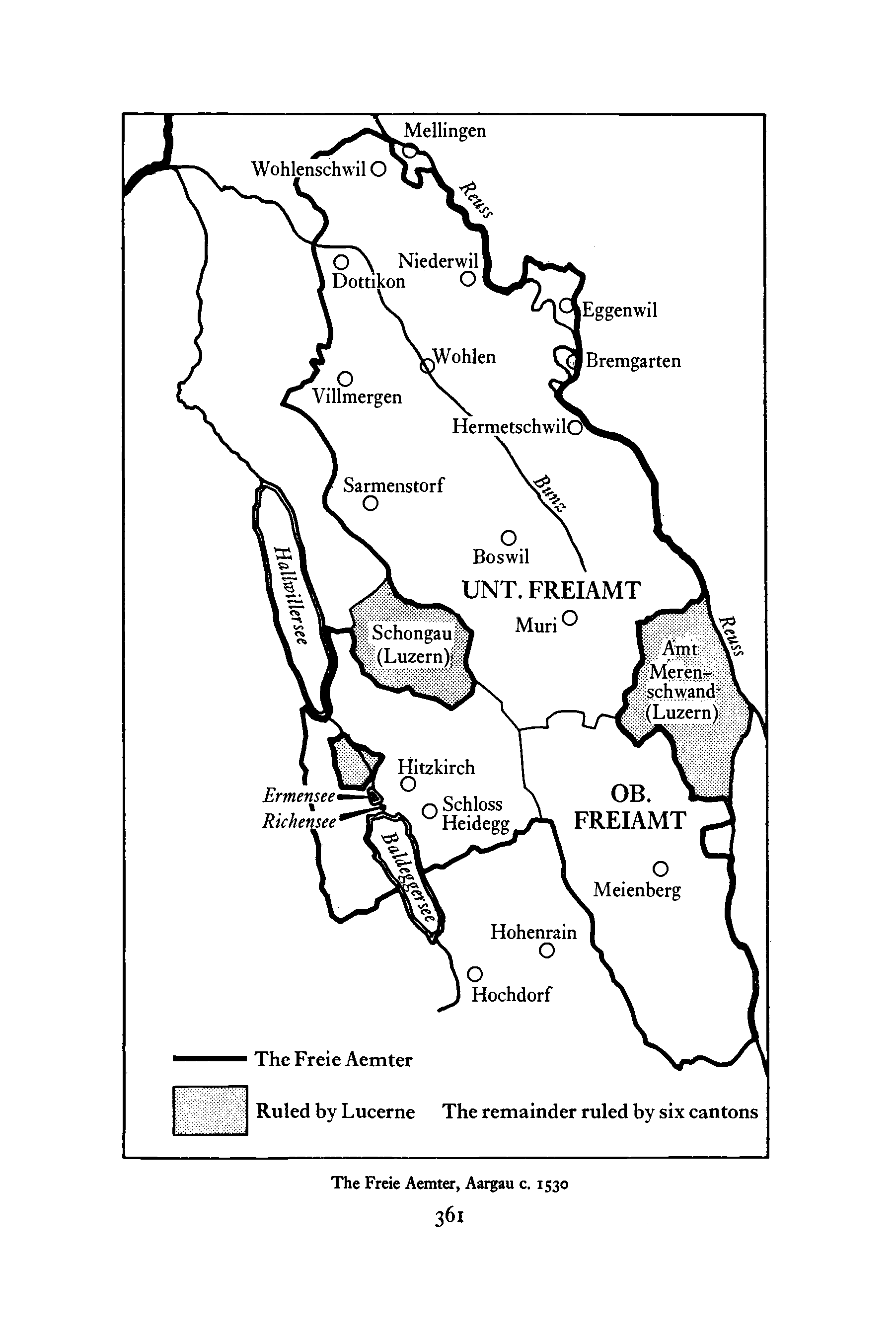
Mellingen Eggenwil Bremgarten Amt Merenschwand"
(Luzern) Hitzkirch O Ermensee Richensee Q Schloss Heidegg Hohenrain O O Hochdorf The Freie Aemter Ruled by Lucerne The remainder ruled by six cantons The Freie Aemter, Aargau c. 1530
ZWINGLI case Zurich, advised by Zwingli, was determined to protect its co-religionists and keep the Unterwalden nominee away. In the phrase of the time, he must be forcibly prevented from 'riding by the interposition of armed guards.1 This was a high-handed and possibly illegal threat and was probably intended to be a reply to the Catholic-Austrian alliance of Waldshut.
Already, on 22 April, the reformed and uncommitted states (except Fribourg) had met at Zurich. There2 they had emphasised the need for federal unity and had deplored the indications of an alliance between Ferdinand and the Inner States. An embassy was sent to ask that this be renounced, but it met only with a decisive refusal.3 The alliance with Ferdinand, they said, was only to counterbalance the Christian Civic
Union; it was Zurich that had failed to abide by its federal obligations in Toggenburg and Gaster and was trying to impose minority rule on Thurgau and Rheintal. Grievances soon multiplied from both sides. The familiar objections to the acceptance of foreign pensions and mercenary service were again brought forward. At Sarnen, capital of Obwalden, the coats of arms of Zurich, Berne, Basle and Strassburg were depicted in April 1529 for all to see on the house of the Landschreiber ('clerk to the county council') with four gallows beside them.4 This, in an illiterate age, was well understood to be a calculated'insult to the flag', and people were exceedingly sensitive about these things.
The most infuriating action of all, however, was undoubtedly the burning of Jacob Kaiser as a heretic.5 This fiery preacher, a native of Uznach, otherwise known as Jacob Schlosser, had attracted a good deal of attention by his active promotion of reform in Schwerzenbach, where he had married and presided over the removal of images from the church.
He was present at the Berne disputation,6 and in the spring of 1529 was chosen, possibly irregularly, as parish priest of Oberkirch near Kaltbrunn.7 As soon as it was known that he had left Zurich territory to take up his new duties, on his way through a wood within the jurisdiction of Uznach, he was arrested by Untervogt Peter Hasler, an agent from Schwyz, almost certainly illegally. Zurich at once protested8 to the Uznach
1 Schmid, 16; Liithi, 44. Berne was anxious to exclude an Unterwalden governor, but had no rights in the Freie Aemter. Bullinger, Ref. 11, 149-51.
2 EA 4, ib, 139-5.
3 Tardent, 143.
4 Feller 11, 196; Z vi ii, 408, 411; R. Thommen, Urkundenbuch der Stadt Basel (Basle, 1908) x, 102; Bullinger, Ref. 11, 142; Schmid 16; Stumpf 2 II, 40. Brandly, 91 seems wrong in placing the episode in Stans.
5 EA 4, ib, 195-6, 202-3. Bullinger, Ref. 11, 148-9 is the basis for most subsequent accounts.
Tschudi, Chronik 24 (1888) 69-71 (Nos. 148-52); W. Ammann, Die Reformation itn Gaster,
ZWA VII (1940) 240-3.
6 Steck & Tobler, 600 (No. 1466).
7 Oberkirch was in Gasterland which was ruled by Schwyz and Glarus.
8 EA 4, ib, 194-6, 202-3; Stumpf 2, 11, 49.
Gathering storm authorities, who disclaimed responsibility. This was followed by a visit to Schwyz by Junker Hans Edlibach to demand Kaiser's release, otherwise there would be war. There were threats of reprisals, a formal demand from Glarus that Kaiser should be passed back for trial in Uznach, and further requests for clemency, but on 29 May Kaiser was burnt to death in Schwyz as a heretic. This action aroused immense public indignation. It raised serious issues of jurisdiction, since the rights of the court of Uznach to deal with its own citizens had been flouted1 and the preacher was carrying out the wishes of his masters, the Zurich Council. The legal right of Schwyz to intervene was very dubious except that it was a Catholic commonplace that heretics should be burnt if apprehended. It was a kind of test-case. If it went unchallenged, it might imply both the exclusion of reformation from a Mandated Territory and a serious check to Zurich's hopes of territorial expansion.
The Catholics, somewhat less effectively, on their side, too, could complain of the treatment meted out to Theodore (Theodul) Schlegel in the previous January. He was abbot of the Premonstratensian house of St Luzi,
Chur, and was put to death there on 23 January because of his refusal to refrain from saying mass but nominally for having persuaded Bishop Paul
Ziegler of Chur to retire in favour of Gian Angelo de Medici and for supposedly stealing the valuables of the monastery which in fact he had carried to Feldkirch for safety.2 An outbreak of hostility seemed imminent in spite of the furious diplomatic activity of the last days of May 1529.3
Uncommitted states and individuals were trying to maintain the exiguous bridge between the northern states and their southern antagonists, but little could be achieved by negotiation. Berne, immovable now in religion, was politically all for moderation, patience and restraint. From Zurich came increasingly urgent calls for action. The threat from the enemy must be met by a short preventive war before the opposed forces could gather.4
Zug, Schwyz and Unterwalden should be dealt with at once in a way that would ensure the safety of the faithful and the progress of the evangel.
It was to encourage this project that Zwingli produced (25-9 May) his plan for a frontal advance on three fronts which should be conclusive.5 He had already urged6 that the occupation of Mellingen and Bremgarten could seriously interfere with food supplies to the south. Similarly, the communications with Austria could be blocked by a garrison at Kaiserstuhl. Berne was to be kept closely informed since her cooperation was indispensable whether their ends were accomplished by negotiation or by force.
1 Z vi ii, 434.
2 Vasella /, 263, 272; Z x, 45-6; Sabbata, 303.
3 Schmid, 18-20.
4 Steck & Tobler, 1046-47 (No. 2315, 2316, 2317); Feller, 11, 195-8; Escher, Glaubensparteien, 89-90; Haas, Kappelerkrieg, 134-41; Tardent, 240; Liithi, 44-7.
5 Ratschlag tiber den Krieg, Z vi ii, 424(433)-4o; EA 4, ib, 197-9.
6 Z vi ii, 419-22.
ZWINGLI The plan now was that a' warning' to Lucerne and Uri should announce the opening of hostilities, and at the same time precautions should be taken against an attack on the Freie Aemter by Unterwalden. Toggenburg would support Zurich with 1,500 men who would occupy Uznach and liberate it from the tyranny of Schwyz and the Abbot of St Gall. A further contingent from Riiti would join in the occupation and then secure oaths of allegiance from the men of Gasterland and Weesen (Walensee). Preparations should likewise be made to secure the crossing of the river Linth 'in the March' and to blockade Pfaffikon and Wollerau, in the occupation of Schwyz but formerly controlled by Zurich. There was also some good but gratuitous advice about the use of guns and the choice of a suitable commander. Alternatively an attack could be made on Pfaffikon and Wollerau
('die Hofe') and the March; the Toggenburger would take Gaster and Uznacht and effect a junction at Steiner with a party from Zurich. At the same time, the governor at Kiburg should occupy Kaiserstuhl. It was all set out with the detailed confidence of the amateur strategist, but how much of it was practical was fortunately not put to the test.
The immediate implementation of Zwingli's plans by the Zurich Council was prevented, to his obvious mortification, by the arrival on 3 June of a delegation from Berne led by the statesman-like Niklaus
Manuel and Anton Bischoff.* The almost proverbial caution of Berne had reason behind it in the summer of 1529. In addition to the continued dispute with Unterwalden about the Oberland invasion and the alliance of the Catholic states with Ferdinand, the possibility of attack from Valais,
Savoy, Geneva and the Austrian Vorderldnde threatened Berne with encirclement. Hence Berne insisted on correct and legal behaviour, and, above all, that there should be no precipitate action. Its representatives urged that the threat by Unterwalden to send Anton Adacker to the monastery of Muri en route for the Freie Aemter, protected by 20 horse with 300 Lucerne infantry to follow, was not an adequate reason for a declaration of war to which Berne was opposed. In this, almost his last, speech, after touching on the danger to Berne of an attack on its south flank from Valais and Savoy, Manuel concluded, ' God's word calls only for peace and unity. You cannot really bring faith by means of spears and halberds'.2
1 Feller 11, 196; Tardent 242-55; Z VI ii, 428; EA 4, ib, 212-13 (No. 114); Schmid 19; Haas,
Kappelerkrieg, 138; Stumpf 2 11, 5if; ZWA xn (1968), 701-11; Steck & Tobler, 1047
(No. 2317).
2 'Warlich man mag mit spiess und halbarten den glouben nit ingeben.' These words have often been quoted with approval: they were, however, as much out of harmony with the current feeling of the early sixteenth century as they suit the temper of the twentieth. War, for most Swiss, was a normal state of affairs. EA 4, ib, 212. Feller, 11, 196 .ZWA xm (1971),
403 n. 10 quotes a slightly different version from StA. B XLIV.
Gathering storm Zurich, however, was determined that a southern Catholic deputy should not reach Baden and put into effect the avowed policy of halting evangelisation.1 Rather than have this happening, Zurich would take action alone, knowing that Berne would thus be obliged reluctantly to acquiesce. On the evening of 4 June, after Zwingli had said that otherwise he would leave
Zurich, the fatal decision to risk war was taken.2 Fighting men had already been enrolled. A contingent under Ulrich Stoll and Heinrich Rahn marched to Bremgarten, and another under Hans Edlibach and Peter
Meyer moved into the Freiamt and occupied Muri on 6 June.3 These actions, technically merely strengthening garrisons already there, were both provocative and precautionary but not illegal.4 Berne reluctantly acquiesced, but there were no signs of any local enthusiasm for a campaign.
Zurich insisted ' We are forced to save the honour of God and his holy word as well as our own and with God's help will overthrow the forces of evil and punish and take reparations for the wrong that has been done.'5
Relying on the assumption that there was no lawful Abbot of St Gall, and ignoring delaying tactics from Berne, Zurich forces moved towards the monastic estates, Urzach, Thurgau and Rheintal. The blocking of the road to Muri meant that Unterwalden recalled its agent, who thus did not 'ride' after all, but it was too late to affect the situation, and the occupation went forward as planned.6 This withdrawal was promptly reported to Zurich by Berne with some pleasure; there was now no cause for war, and Bernese help would be forthcoming only if Zurich territory was actually attacked. It made no difference. Zurich was convinced that there was just cause for intervention and that a combined Catholic operation against the evangelicals must be anticipated. Men had started to move and could not be recalled. The Zurich declaration of war on 8 June was accompanied by a carefully worded printed statement of their case.7
The evangelical superiority in manpower was manifest - Zurich with her supporters could put 30,000 men into the field, while the Catholics had at best only a third of that number. The latter were taken by surprise, were short of supplies, ill-equipped, and left in the lurch by their allies;
1 Steck & Tobler, 1045 (No. 2313), 1052 (No. 2326); Tardent, 242-3.
2 Z vi ii, 430-1; Haas, Kappelerkrieg, 142; EA 4, ib, 216; Miiller, no. 'Tund umb gotzwillen etwas dapfers' was Zwingli's advice on 16 June. Z x, 165.
3 Haas, Kappelerkrieg 144; E. Schultz, Reformation und Gegenreformation in den Freien-Amtern
(Zurich, 1899).
4 Tardent 259; Liithi 47; ZWA vn, 245.
5 EA 4, ib, 225.
6 Schultz 32-3.
7 EA4, ib, 224-7; Haas, Kappelerkrieg, 147; ZWA vn, 244; Bullinger, Ref 11, 167-9. Basle followed suit on 13 June. R. Wackernagel, etc., Urkundenbuch der Stadt Basel (Basle, 1910) x, 101-2 (No. 88); E. Diirr u. P. Roth, Aktensammlung zur Geschichte der Easier Reformation
(Basle, 1937) 3; 566-7.
PZI
ZWINGLI such men as they could gather were at Baar waiting on events. Not a man or a gun came from Austria. The Innsbruck administration was bankrupt, the Austrian governor of Bregenz and the Vorarlberg, Marx Sittich of Hohenems, did not move, although his threats caused momentary alarm in Winterthur. A force of 600 men from Zurich under the governor of Kiburg, Hans Rudolf Lavater, rapidly overran Thurgau, Rheintal and St Gall territory, met with no resistance, and by 11 June oaths of allegiance were being received from all sides. Wil and Uznach were occupied easily on 9 and 10 June by Jacob Werdmiiller and Ludwig Tschudi of Glarus, but they found it more difficult to secure firm guarantees of obedience from all the inhabitants.1 A third contingent under Hans Escher occupied
Wadenswil, while the main force of 4,000, with guns, marched from Zurich to Kappel at mid-day on 9 June to threaten the Catholic states with invasion.2 With them rode Zwingli on a horse, as volunteer and not as army chaplain, with a fine but very unclerical halberd over his shoulder.
He wanted a permanent settlement. To a friend he wrote: 'The peace, which so many strive for, means war; the war that we call for means peace, for we thirst for no man's blood but are determined that the effective force of the Oligarchs shall be cut off. If that does not happen neither the truths of the Bible nor the lives of its servants are safe. Our intentions are not cruel ones for what we seek is friendship and the true interests of our country. We hope to save it when, through ignorance, it is in danger of being overthrown. With all our might we strive to secure freedom.'3
The Bernese movements are interesting. A strong force of 6,000 men under Sebastian von Diesbach and Kaspar von Miilinen left Berne on 10 June and, halting en route at Langental and Aarau, reached Bremgarten only on 16 June. Although there was no action, the existence of this army was important. Berne was disturbed by the rapidity of Zurich's eastward advance and was not in favour of breaking up the Confederation; Diesbach was believed to have Catholic sympathies, the war was not popular,4 and the men were anxious to be home for the hay harvest. The small supporting force from Basle was equally unenthusiastic.
Solothurn, Schaffhausen, St Gall, Glarus and other states offered to mediate, and almost as soon as the Zurich force arrived at Kappel the 1 ZWA vii, 245-6; Stumpf, 2, 11, 56-8; Haas, Kappelerkrieg 153.
2 The commander of the contingent was Jorg Berger, who soon succeeded Jacob Werdmiiller as city treasurer (Seckelmeister). For the campaign, Miiller, 112-20; Wyss, 118-22; Z x,
149-50; Muralt, Berger.
3 Z x, 147-8; Schmid 17-18. This report (from Myconius) deserves attention. Was Zwingli right ?
Would not action in 1529 have prevented the war of 1531, with a very different outcome?
4 'Wir liegen mit schweren Kosten im Feld, die Ziircher nehmen den Nutzen.' Oechsli 3, cc. 141-2; Z x, 152-8; Feller 11, 197; Haas, Kappelerkrieg 158-64. 'Der gmein man ist zuo beder syt me frid begirig dann hitzig und lustig zuo kriegen.' Strickler 11, 241 (No. 617).
Gathering storm Landammann of Glarus, Hans Aebli, a relative of Zwingli, asked on behalf of Schwyz for an armistice. Next morning he appeared again, renewing his appeal for peace with tears in his eyes. He urged the distress to widows and families of the slain, and at the same time appealed to the unity of the Confederation which had resisted the common enemy in the past so successfully. The soldiers agreed to consider the position, and Zwingli parted from Aebli with the words, 'You must render account of this to God.
While the enemy are weak and ill-equipped they speak fair words which you believe and call for peace. But if they are able to rearm they will have no pity on us and there will be no one to make peace.'1
Zwingli, who was spoiling for a fight, was now obliged to state the terms on which he would agree to an armistice if this must come, although personally he was opposed to it.2 First of all, he insisted, they must require that the Bible should be freely preached in the Catholic states, Catholic services, of course, continuing there as usual and the mass remaining forbidden in Zurich-controlled territory. Foreign pensions were to be renounced and those who had received them were to be punished. Reparations must be paid to Zurich for the costs of putting men on a war footing, with compensation to the children of Jacob Kaiser, and no one was to be molested for any part taken in such activities-'no victimisation'.
There must be an end to insults, abuse and mockery, with punishment for those responsible, Thomas Murner being later singled out by name. Alliances with foreign powers (i.e. Ferdinand) must be publicly denounced.
While these suggestions, or requirements, were being considered, the armed men stopped at the frontier.3 Those from the Catholic states were short of solid food because Zurich had deliberately prevented grain from reaching the mountain inhabitants in order to build up pressure for peace.
They had, naturally, ample supplies of milk. At the armistice, the hostile forces confronted each other at Ebertswil on the border near Kappel - to cross it would be an act cf hostility. While the commanders were being entertained by Joner in the secularised buildings of the Abbey of Kappel, the southerners, as we may call them, on 10 June placed a huge barrel or vat of milk oh the demarcation line, explaining they had no bread to go with it. The northerners produced bread, of which they had plenty, and meat, so that milk soup resulted, each side dipping into the pot in turn. If, however, anyone stretched too far, he got his knuckles cracked, with the words 'eat on your own territory'. Jacob Sturm from Strassburg was
1 Bullinger, Ref. n, 170.
2 Haas, Kappelerkrieg, 169; Schmid, 25; Z vi ii, 448 (45i)~3; Z x, 153-4.
3 There was thus no invasion. Solothurn, the ally of Berne, must otherwise have supported
Zurich, but instead was able to help to mediate.
13-2
ZWINGLI present and was heard to remark: 'You Swiss are wonderful people.
Divided, you are yet united and do not forget ancient friendships.'1
It took two weeks of hard bargaining in a tent at Kappel, helped along by the mediators, to produce agreement about the terms to be embodied in the 'First Territorial Peace' (Landfriede).
The negotiations took place in three stages between 16 June and 25 June.2
On 16 June Manuel, Imhag, Bischoff and Tremp had preliminary discussions in Zurich before riding to Kappel on the following day. There, further arbitrators from Glarus, Fribourg, Appenzell and Graubiinden had arrived to meet the delegates from the Five Inner States, the Christian
Civic Union and the army commanders. The preliminary discussions (16-18 June) took place at Steinhausen between the representatives of Berne, Basle, Zurich and the city of St Gall to agree on their demands.
Berne was not there prepared to uphold the Zurich condition that pensions and mercenary service should be permanently renounced and that past pensioners should be punished. Manuel further insisted that the Zurich unconditional requirement of freedom of preaching should be modified to a request. The Zurich plea for war damages of 30,000 crowns with continued occupation of Thurgau, Rheintal and St Gall territory until these were paid was left to the decision of the mediators. These latter also agreed with Manuel that the requirement for the abandonment of pensions should be changed into an urgent suggestion, at which point
Zwingli intervened in person to insist that this clause should remain mandatory. Zurich and Berne were thus out of step.
Manuel thereupon asked for further instructions from Berne, knowing that his resistance to punishment of the leading pensioners would please his masters. He also indicated that he had reservations about the question of the continuation of the French alliance and about the renunciation of mercenary service and of foreign presents. He further reported that there was likely to be agreement about occupation costs. The answer was to leave him a free hand to negotiate but with no authority to make any binding contract.
Berne was not ready to insist upon freedom of preaching or the punishment of pensioners, and it was in the light of these instructions that the reformed allies discussed the terms to be demanded with the mediators at Kappel. Zwingli now tried to secure agreement with Berne about pensions by an appeal to the people, and was so far successful that the clause about the renunciations of pensions was agreed, although without any mention
1 Bullinger, Ref. n, 182-3 (cf. Salat, 229-30) seems to be the original of this story proudly repeated in every Swiss text-book. It seems likely that fraternisation was confined to the 4 other ranks' and that the official attitude was one of disapproval. The same men were ruthlessly killing one another two years later, also at Kappel.
2 For what follows, Tardent 261-77; EA 4, ib, 265-74.
Gathering storm of punishment for past offenders. General discussions re-opened at Kappel on 20 June when the possibility that the egregious Murner might manage to escape trial by leaving the country was considered. This was all that could be arranged then, and the situation became serious. If the armistice came to an end, fighting was sure to start. There were further discussions between Zurich and Berne, particularly about Unterwalden,
Berne insisting upon its submission. Finally at a third round of negotiations from 22 to 25 June, the terms of the first peace of Kappel were reduced to writing.1 Up to the last moment it seemed as if hostilities must re-open, which was what Zwingli hoped for, because the Catholics were most reluctant to produce the treaty of Waldshut for public destruction, but in the end they gave way.2
During the interval the soldiers, armed and prepared for battle, maintained exemplary discipline on each side. The Catholics heard mass, walked in processions and organised a pilgrimage to Einsiedeln; among the Zurich contingent there were sermons and prayer-meetings as in the English 'Model Army' a century later, and there was singularly little of the countryside pilfering which was usually a feature of armies on campaign. The men from Zurich returned home on 26 June to an elaborate public welcome at the Lindenhof arranged by the city gilds, and by the end of the month all the contingents, with banners flying, had marched in triumph or contentment to their respective dispersing points.3
Zwingli was bitterly disappointed at the outcome, which also marked a decline in his political influence.4 Agreement had been the work of the soldiers rather than the politicians, and the compromise reflected the common sense of Berne, guided by Hans Escher, rather than Zurich religious idealism and political ambition. With the peace, in fact, vanished
Zwingli's dream of an all-Protestant united Confederation. There was no sign that the people of the Catholic states were ready to turn against either their rulers or their religion, and in 1529 neither side visualised the possibility of a viable Swiss state embracing irreconcilable religious faiths. By then, everything connected with the Roman Catholic church had become wholly evil in Zwingli's eyes so that he thought of its overthrow as necessary, inevitable and even imminent. This conviction clouded his usually acute political judgement.
It is easy to think of Zwingli in the light of his advocacy of a preventive war in 1529 and of his death in action in 1531 with battle-axe and breast
1 Probably the terms were verbally agreed on 24 June, written out on 25 June, and formally sealed on 26 June. For fuller details see below, 371-4.
2 Feller, 11, 198-9; EA 4, ib, 1478-83; Escher, Glaubensparteien, 91; Schmid 32-5.
3 ZWA x, 537-73 with a good review of the literature; ZWA xn, 257; Stumpf 2,11, 64; Wyss,
128-9; Bullinger, Ref. 11, 193.
* ZWA XII, 254-80, 309-29 esp. 312-13; z x> *11-
13-3
ZWINGLI plate, as a 'hawk' or militarist. This, however, is a superficial view. His early experiences in Italy had convinced him of the horrors of warfare, and his reading of the Erasmian literature on war had intensified this conviction. Peace was a desirable state to be sought at all times. There were, none the less, two important qualifications to this end. Armed combat was the affair of the secular state, and it was the duty of a citizen to obey his government and therefore to fight if called upon to do so. A war could be both just and necessary: just, if it was in defence of the word of God or to resist an unprovoked attack; necessary, if by God's will his kingdom could be secured by the sword. In this latter event Zwingli obviously welcomed the prospect of a favourable decision and was prepared to continue to fight until favourable terms had been obtained. Hence his dissatisfaction with the Bernese reluctance to continue in the field in 1529. In 1531 the aggression came from the Catholic camp; Zurich was attacked, and the second war was one of legitimate self-defence in which he could take part as a loyal citizen.
He was right in thinking that for there to be a powerful Switzerland it must be united, but even on this supposition he thought in terms of an earlier generation and miscalculated the real strength of a small confederation. None the less, if everything had gone as Zwingli wished and planned in 1529, the central states must have submitted and the possibility of an effective and strong confoederatio Helvetic'a, enlarged and guided by its cities, could have become a reality. It was a remote chance, but, as it turned out, the only one.