The Seaman's Return
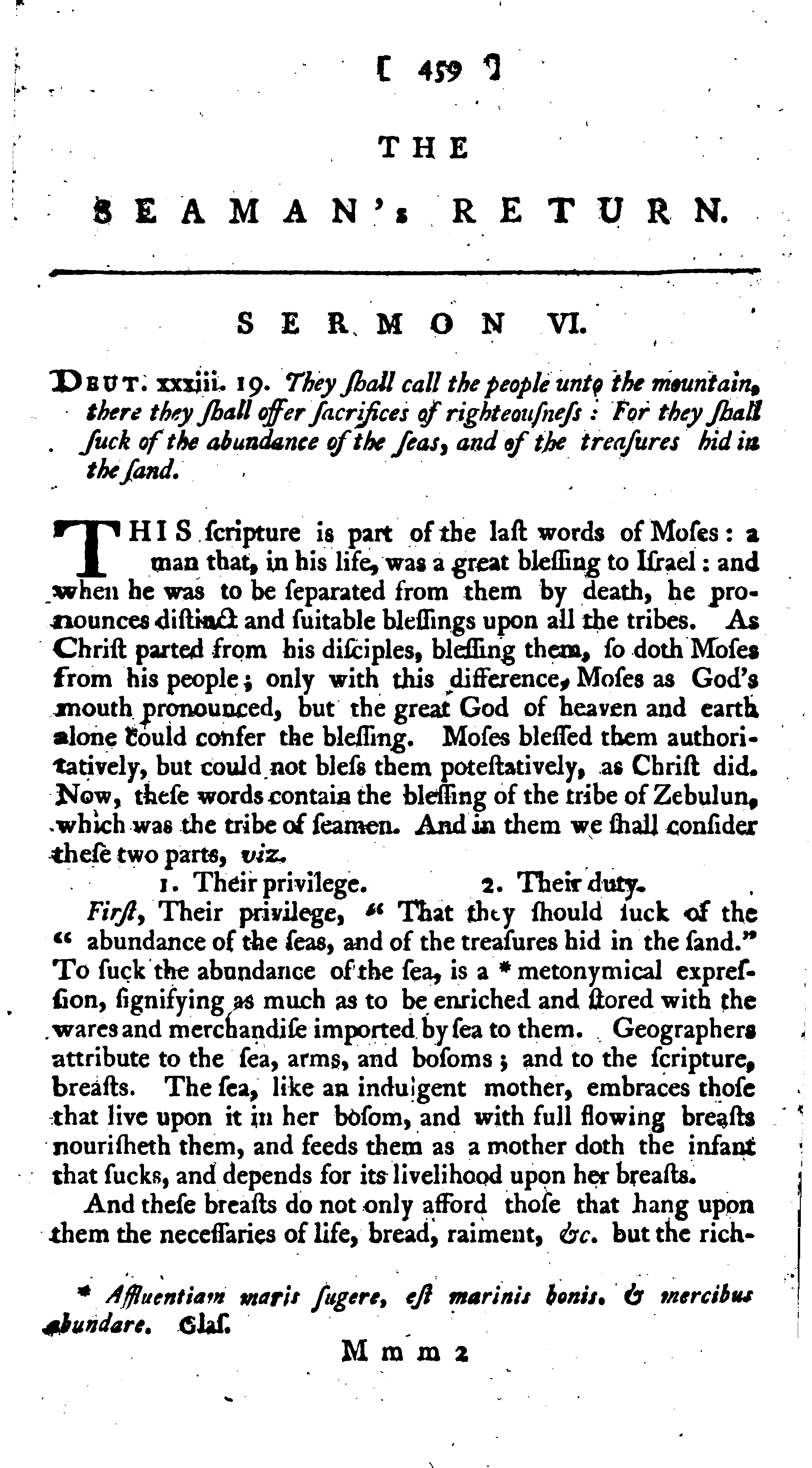
[ 459 ] THE SEAMAN'S RETURN.
SERMON VI.
DEUT. xxxiii. 19. They shall call thepeopleunto the mountain, there they shall offerfacrifices of righteousness : For they shall fuck of the abundance of these as, and of the treasures hid in the sand.
T : a HIS scripture is part of the last words of Moses : man that, in his life,was a great blessing to Israel : and when he was to be separated from them by death, he pronounces distinct and suitable blessings upon all the tribes. As Chriftparted from his disciples, blessing them, so dothMofes from his people; only with this difference, Moses as God's mouth pronounced, but the great God of heaven and earth alone could confer the blessing.
Moses blessed them authoritatively,but could not bless them poteftatively, as Christ did.
Now, these words contain the blessing of the tribe ofZebulun, which was the tribe of seamen. And in them we shall confider these two parts, viz.
1. Their privilege.
2. Their duty.
First, Their privilege, " That they should fuck of the " abundance of the seas, and of the treasures hid in the sand."
To fuck the abundance of the sea, is a * metonymical expression, signifying as much as to be enriched and stored with the waresandmerchandise importedbysea to them. Geographers attribute to the sea, arms, and bosoms ; and to the scripture, breasts.
The sea, like an indulgent mother, embraces those that live upon it in her bosom, and with full flowing breasts nourisheth them, and feeds them as a mother doth the infant that fucks, and depends for its livelihood upon her breasts.
And these breasts do not only afford those that hang upon them the neceffaries of life, bread, raiment, &c. but the rich- * Affluent i am maris fugere, est marinis bonis. & mercibus abundare.
Glaf.
Mmm2
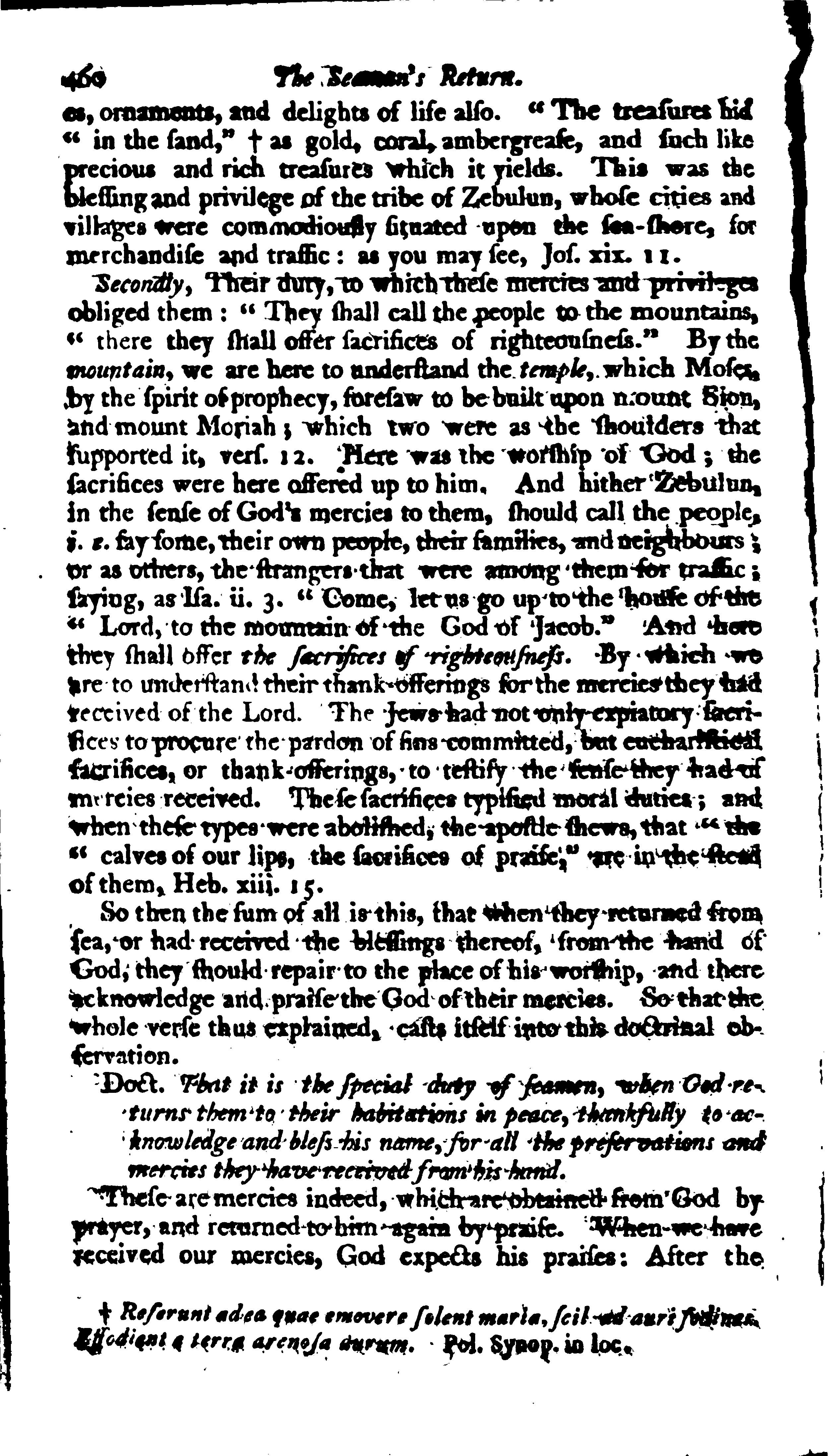
The Seaman's Return. es, ornaments, and delights of life also. "The treasures hid
" in the sand," † as gold, coral, ambergrease, and such like precious and rich treasures which it yields. This was the bleffingandprivilege of the tribe ofZebulun,whose cities and villages were commodiously situated upon the sea-shore, for merchandise and traffic : as you may fee, Jof. xix. 11 .
Secondly, Their duty,to which these mercies and privileges obliged them : " They shall call the people to the mountains,
" there they shall offer sacrifices of righteousness." By the mountain,we are here to understand the temple, which Moses, by the spirit of prophecy, foresaw to bebuiltuponn.ount Sion, andmountMoriah ; which two were as the shoulders that supported it, verf. 12. Here was the worship of God; the sacrifices were here offered up to him. And hither Zebulun, in the sense of God's mercies to them, should call the people, i. e. fayfome, theirownpeople,their families,andneighbours ; or as others, the strangers that were among them for traffic; saying, as Ifa. ii. 3. " Come, let us go up to the house of the
" Lord, to the mountain of the God of Jacob." And here they shall offer the sacrifices of righteousness. By which we are to understandtheirthank-offerings for the merciestheyhad received of the Lord.
TheJewshadnot only expiatory sacrifices to procure the pardon offins committed, but euchariftical sacrifices, or thank-offerings, to testify the sense they had of mercies received.
These sacrifices typified moral duties; and when these types were abolished,the apostle shews,that "the " calves of our lips, the sacrifices of praise," are in the stead
of them, Heb. xiij. 15 .
So then the fumofall is this, thatwhenthey returned from sea, or had received the blessings thereof, from the hand of God,they should repair to the place of his worthip, and there acknowledge and praise the God of their mercies. So that the whole verse thus explained, casts itself into thisdoctrinal observation.
Doct. That it is the special duty offeamen, when God-returns them to their habitations in peace, thankfully to acknowledge and bless his name,for all theprefervationsand mercies they have receivedfromhishand.
These are mercies indeed,whichareobtainedfromGod by prayer,and returned to him again by praise. When we have received our mercies, God expects his praises: After the +Referuntadea quae emoverefolentmaria,fcil adaurifodinas. fodient&terra arenoja durum.
Pol. Synop. in loc.
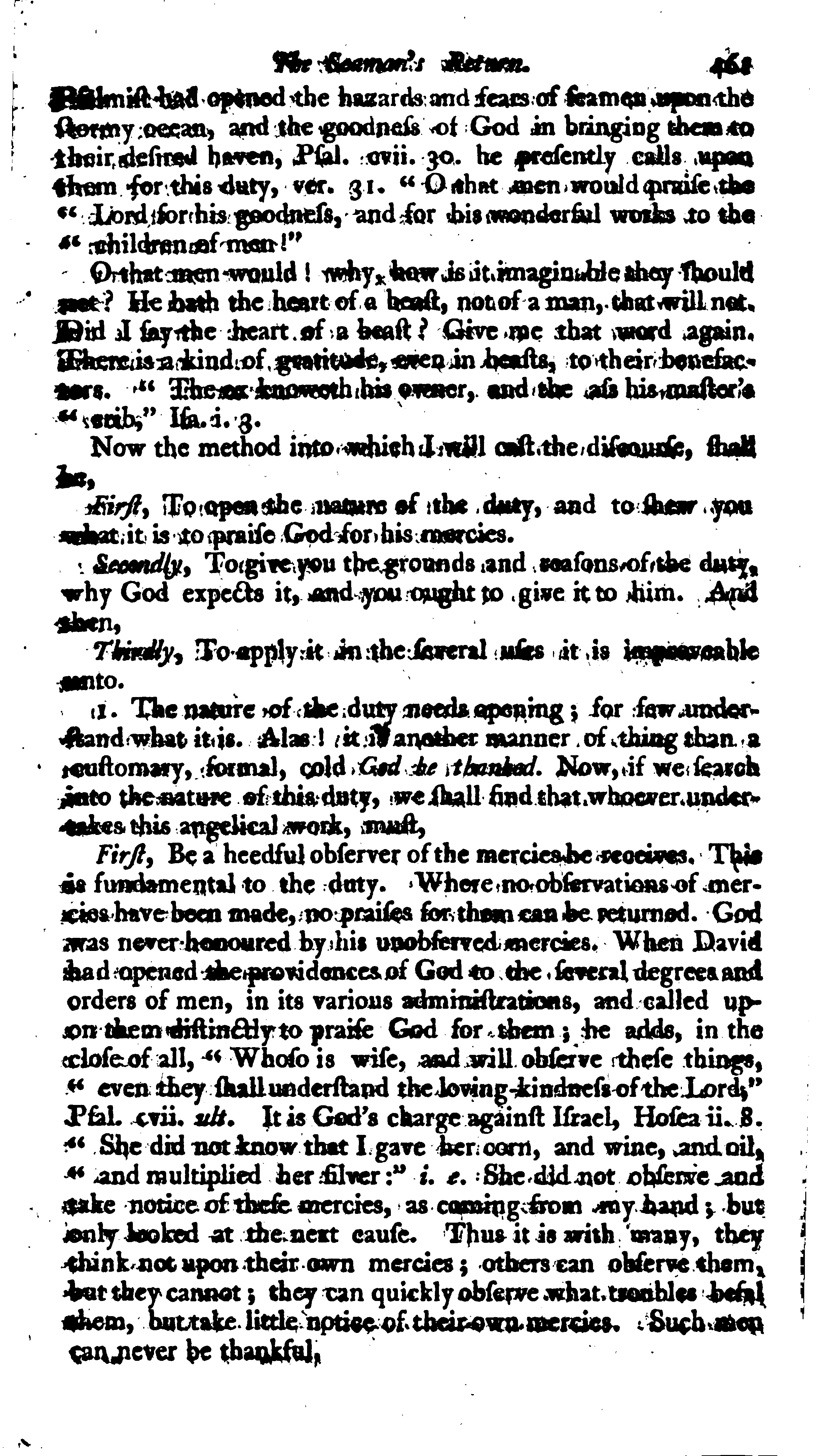
The Seaman's Return.
Plalmisthad opened the hazards and fears offeamen upon the Stormy ocean, and the goodness of God in bringing them to theirdefired haven, Psal. cvii. 30. he presently calls upon them for this duty, ver. 31. "Othat men would praise the "Lord for his goodness, and for his wonderful works to the
"childrenofmen!"
Othat men would ! why, how isitimaginabletheyshould not? He hath the heart of a beast, not of a man, that will not.
Did I faythe heart of a beast? Give me that word again.
There is a kind of gratitude, even in beasts, to their benefactors. " Theox knoweth his owner, and the ass his master's
"scrib," Ifa.i.g.
Now the method into which I will cast the discourse, shall be, First, To open the nature of the duty, and to thew you what it is to praise God for his mercies.
Secondly, Togiveyou the grounds and reasons of the duty, why God expects it, and you ought to give it to him. And then, Thirdly, To apply it in the several uses it is improve able an to.
1. The nature of the duty needs opening ; for saw understand what it is. Alas ! it is another manner of thing than a customary, formal, cold God be thanked. Now, if we search intothenature of this duty, we shall findthatwhoever.undertakes this angelical work, must,
First, Bea heedfulobserverofthemercieshe receives. This is fundamental to the duty.
Where no observations of mercieshavebeenmade, no praises forthemcanbe returned. God was neverhonouredby his unobserved mercies. When David shad opened the providencesofGod to the several degrees and orders of men, in its various administrations, and called upon them distinctly to praise God for them; he adds, in the <close of all, " Whoso is wife, and will observe these things,
" even they shall understand the loving-kindnessoftheLord,"
Psal. cvii. ult.
It is God's charge against Israel, Hofea ii. 8.
" She didnotknowthat I gave her corn, and wine, and oil, "and multiplied her silver:" i. e. She did not observe and take notice of these mercies, as coming from my hand ; but only looked at the next cause.
Thus it is with many, they think not upon their own mercies; others can observe them, but they cannot; they can quickly observe what troubles befal them, but take little notice of their own mercies.
Such men canneverbe thankful,
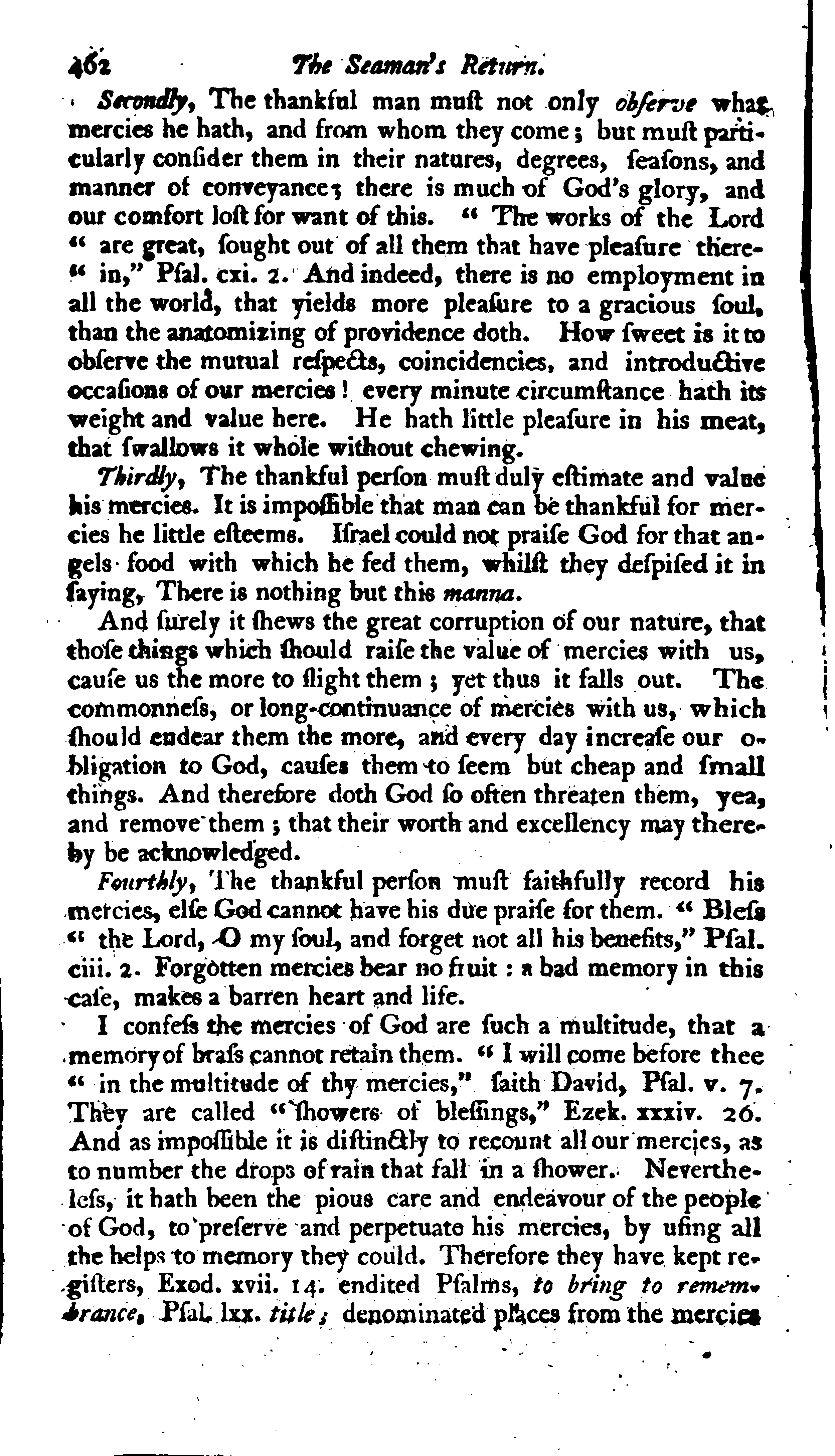
The Seaman's Return.
Secondly, The thankful man must not only observe what mercies he hath, and from whom they come ; butmustparticularlyconfiderthem in their natures, degrees, seasons, and manner of conveyance; there is much of God's glory, and our comfort loftfor want of this. " The works of the Lord
" are great, fought out of all them that have pleasure there- " in," Psal. cxi. 2. And indeed, there is no employment in all the world, that yields more pleasure to a gracious foul, than the anatomizing of providence doth. How sweet is it to observe the mutual respects, coincidencies, and introductive occasions of our mercies ! every minute circumstance hath its weight and value here. He hath little pleasure in his meat, that swallows it whole without chewing.
Thirdly, The thankful person mustduly estimate and value his mercies. It is impossible that mancanbe thankful for mercies he little esteems.
Israel could not praise God for that angels food with which he fed them, whilst they despised it in saying, There is nothing but this manna.
The And surely it shews the great corruption of our nature, that those things which should raise the value of mercies with us, cause us the more to flight them; yet thus it falls out. commonness, or long-continuance of mercies with us, which
should endear them the more, and every day increase our obligation to God, causes them to seem but cheap and small things. And therefore doth God so often threaten them, yea, and remove them;that their worth and excellencymaythereby be acknowledged.
Fourthly, The thankful person must faithfully record his mercies, elseGodcannot have his due praise for them. " Bless
" the Lord, Omy foul, and forget not all his benefits," Psal. ciii. 2. Forgottenmerciesbearno fruit : abadmemory in this case, makes a barren heart and life.
I confess the mercies of God are such a multitude, that a memory of brass cannot retain them. " I will come before thee
" in the multitude of thy mercies," saith David, Psal. v. 7.
They are called " showers of blessings," Ezek. xxxiv. 26.
And as impossible it is distinctly to recount all our mercies, as to number the drops of rain that fall in a shower.
Nevertheless, it hath been the pious care and endeavourofthepeople of God, to preserve and perpetuate his mercies, by using all the helps to memory they could. Therefore they have kept gifters, Exod. xvii. 14. endited Psalms, to bring to remembrance, Psal. lxx. title; denominated places from the mercies re-
The Seaman's Return.
received there. Thus Jacob called the place where he found so much mercy, Beth-el.
Hagar named the well, where God unexpectedly relieved her, Beer-lahai-roi, the wellofhim that liveth and looketh upon me, Gen. xvi. 13 , 14.
They have flampedthe mercies upon the days in which they received them.
Thus the Jews called those days in which God wrought their deliverance, Purim, after the name Pur, signifying the lot Hamanhadcast for their lives ; Efth. ix. 26.
Yea, they have called their mercies upon their children, Sam. i. 20. Thus thankful fouls have striven to recognise their mercies, thatGodmight not lose the praise, nor themselves the comfort of them .
Fifthly, The thankful person must be suitably affected with the mercies he receives. It is notafpeculative, but an affectionate remembrance that becomes us: then God hath his glory, when the sense of his mercies melts our hearts intoholyjoy, love, and admiration.
Thus,David fits down before the Lord like am an astonished at his goodness to him ; 2 Sam. vii. 20.
" And what canDavidsaymore ? For thou Lordknowestthy " servant." The mercies of God have made the saints hearts leapforjoywithinthem:Psal.xcii. 4."Thou, Lord, hast made
" me glad, through thy works ; therefore will I triumph in " the works of thy hands." Mercies are not mercies, deliverances are no deliverances to us, if we that receive them, are not glad of them.
Sixthly, The thankful person must order his conversation suitably to the engagements that his mercies have put him under. When we have said all, it is the life of the thankful, that is the very life ofthankfulness. Obedience and service are the onlyrealmanifestations of gratitude. " He that offereth praise,
" glorifieth me: and to him that ordereth his conversation a- " right, will I shew the salvation of God," Psal. 1. 23.
Set down this for an everlasting truth, That God was neverpraifed and honoured by an abused mercy. God took it ill from Hezekiah, " That he rendered not again according to the be- " nefitdoneuntohim," 2 Chron. xxxii. 25. He that is truly thankful, will say as David, Psal. cxvi. 12. " What shall I " render to the Lord for all his benefits ?" We then glorify
God with his mercies, when we employ them to right ends, when we thankfully take our own share ofcomfortfromthem, receiving them with thanksgiving, as from the hand ofa father. Mr. Swinnock * tells of a young man,who,lying upon * Swinnock's ChristianMan's Calling, page 409. t
The Seaman's Return. his fickbed, was always calling for meat; but as soon as it was brought him, he shook and trembled dreadfully at the fight of it, andfo continued till it was taken away ; and be forehis death, acknowledged God's justice, for that in his health he ordinarily received his meat without thanksgiving.
Use all God's mercies with thankfulness ; God will remem berthem in fury, who forget him in his favours.
And think notwhatGod bestows upon you, is wholly for yourownufe: but honourGodwith your mercies, bycloath ingthe naked, and feeding the hungry, especially such as are godly.
This is a due improvement of your estates ; thus you may make toy ourselves friends ofthemammonofunrighteoufness. Ah,how little do we consider what praise, what glory wemayoccafion, this way, from others, to the name of God! it is storied of * Dionyfius the Syracufian tyrant, that when hefawwhatheaps of gold and silver his fonhoardedup in his closet,he asked him what he meant to let it lythere, and not to make friends with it,togetthekingdom after his death ?O son(faidhe)thou hast not a spirit capable of a kingdom. Thus honourthe Lord with your substance; look upon all you have as your Master's talents, for which you must give an account i and so use and employ them for God,thatyoumaygive up your account with joy; and then you will fhew yourselves thankful indeed.
Thus you see what is included in realthankfulness .
O, it is another matter than we take it to be.
2. Next I promised to give you the grounds and reasons of this duty; why you are obliged after the receptionofmercies, tofucha thankful return of praises. And, among many, I willonlyfingle out these three, and briefly open them.
First,God requires and expects it.
It is so special and pe culiar a part of his glory, a she will never part with it. As great landlords oblige their tenants to a homage and service, when they inake over their estates to them, and reserveaquitrenttothemselves,which they value at ahighrate; so God, whenhebestows deliverances of mercies upon us, still reserves an acknowledgment to himself: and this is dear to him, he will not endure to be defrauded of it; much less, that it be giventoanother.
You find this reservationofpraife expressly made by him inPfalm 1. 15. "Call upon me in the day of
" trouble, I will deliver thee, and thou shalt glorify me."
Where you have the request, the grant,and the reservation in the grant, q. d. When I have grantedtheethydefire, fee thou
† Julin, lib. 5t,
The Seaman's Return.
do not defraud me of my glory.
There be three things in every mercy, the matter of it, the comfort of it, and the glory of it.
The two first God makes over freely to us, he gives the mercies themselves, he allows us to fuck out all the lawful pleasure and delight that is in them; but the third he reserves to himself, and will never part with to any other.
If anHezekiah himselfrendernottoGoddue acknowledgments, as well as God loves him, there shall be great wrathuponhim, andJudah, for the default, 2 Chron. xxxii. 26.
Secondly, You are under manifold engagements to render it to the Lord.
(1.) Common ingenuity obliges to a due acknowledgment of favours freely received; andunthankfulness on that score, is the odium of mankind.
Ingratum fi dicas, omnia dixeris.
You Cannot give am an a more odious character among men, than to fay, He is an ungrateful man.
(2.) The examples of the very heathens will condemn you.
They praised their gods, which yet were no gods, when they received any deliverance, Judges xvi. 24.. Shall idols, dunghill-deities, receive their sacrifices and praises, whilst the true
Godisforgotten ?
Nay, (3.) Many of you have formally and exprefslyobliged your souls to it, by folemnvows and promises in the day of your distress : and yet will you deal perfidiously withGed?
Will you not pay the vows which your lips have uttered?
Certainly, you can never free your fouls from the guilt of perfidiousness against God, whilst you give him not the glory due to his name.
3. Lastly, Your ingratitude is the ready way to deprive you of the mercies you have, and to with hold from you the mercies you might have in your future distresses and wants. He that is ungrateful for mercies received, provokes God to remove them.
Thus it fell out with ungrateful Israel, Hofea ii.
5,8, 9. " She did not know, (i.e. the did not with confidera- "tion andthanksduly acknowledge) that I gave her corn, and "wine, and oil.
Therefore will I return, and take away my "corninthetime thereof, and my wine in the season thereof;
" and will recover mywooland my flax."
Thus they suffered their mercies to lapse into the Lord'shand for non-payment of their duties.
If you are weary of your mercies, and willing to be rid of them, you cannot take a more effectual course, thantoforget from whom you had them, and with-hold his praiseforthem.
VOL. VI.
Non
The Seaman's Return.
And then, for future mercies and deliverances, you have no ground to expect any more from God, whom you have thus requited for former favours. He that gives no thanks for one mercy, hath little ground to expect another. It was a fadword which God Ipake upon this very provocation, Judg. x. 11, 12,
13. when a new distress befel Israel bytheAmmonites, and they cried to the Lord for help, he tells them, that he had many times delivered them from their enemies : " Yet(faith he)
"have you forsaken me, and served other gods.
Wherefore I " will deliver you no more ; go and cry to the gods which ye " have chosen, and let them deliver you in the time of your
" tribulation." 2.d. With what facecanyoucometo me for new mercies and deliverances, when yourselves know how former mercies have been abused!
Think ye that I am weary of my mercies, to cast them away upon such unthankfulwretches ?
No, no, expect no more mercies from me, " I will deliver you " no more." One of the fathers calls ingratitude, Obex infernal is, An hellish top ; which interrupts the course and current of all God's mercies. Mercy is not only a precious thing, too good to be cast away, but it is averytender thing, and God deeply resents the abuses of it.
Thus you fee the grounds and reasons of your duty; itnowremains that we apply it.
Use 1. Is it your unquestionable duty toreturnpraises upon every receipt of mercies ? Then, in the first place, bear your shame and just reproof for your manifest unthankfulness.
You darenotdeny, but you have received many signal and eminent mercies from the hands of God.
If you should deny that, I needgo no farther to prove you prodigiously ungrateful. But it is too manifest to be denied: youhavefoundGod a veryprefenthelp in trouble : his mercy hath often rescued you out of the jaws of death.
Some of you have been in dangers in the deeps; in deaths oft : you have been put to your wits end ; all visible hope and help failed. You might have said, with the Pfalmist, Psal. cxiii. 4. " I looked uponmyrighthand, and " there was none; and upon the left, but refuge failed." You have seen your companions intombed before your eyes in the seas, and concluded in your own thoughts, your turn was next.
Youhavebeen indangerbybarbarousenemies, that havechasedyouuponthe sea, tomakeyou a prey : yea, it may be you havebeenapreytothem, and never thought to have seen the land of your nativity, your houses, wives, and children, any more.
You have languished under dangerous diseases, and that remote from friends, and necessary accommodations ; you have lost your estates, and been reduced to a low ebb, and never
The Seaman's Return.
thought tohaveseena day of prosperity any more : yet hath the Lord delivered you out of all your troubles. He hath provided unexpected means of preservation, when the proud waters were ready to go over your souls. And though others went down before your eyes ; you were marked out for deliverance,
God spake to the raging waves, saying, touch not this man, I will not deliver him up,though I have done to by others. When cruel enemies chased you, he delivered you, causing the darkness of the night to interpose seasonably betwixt you and them; as the dark side of the cloud shadowed Israel from the Egyptians that pursued them, Exod. xiv. 20. sometimes giving you a favourable gale, which blew mercy and deliverance to you : sometimes by strengthening you to resist their furious attacks, and delivering you from their rage : or, if he delivered you into their hands, yet there he preserved you, enabling you to endure their severities, or causing the enemy to treat you well; and finding out a way which you knew not, to bring you at last out of the house of bondage.
He pitied you under your dangerous diseases ; and though necessary accommodations and means might be wanting, he was your physician, and healed you ; he recovered you immediately without means, or blessed weak and small means to
your good.
When you were reduced by losses and captivities to a low ebb, so that you might say as the church, Lam. iii. 17.
I forgat prosperity; he hath not only recruited thy strength, but thy estate also : and when both thy body and estate, like an old leaky ship, have been ready to fink, he hath stopped the leaks in both, careened, repaired, and launched thee into the world again, as whole, as found, and as strong as ever.
And now, reader, suffer me to account and expostulate a little with thy conscience; what hath the fruit of all these mercies been to thee ?
And how hast thou carried it since those days, towards the God of thy mercies ? Hast thouindeedbeen melted by the sense of all this kindness, into love, thankfulness, and new obedience ? Have these favours engaged thee to more strictness in thy duties, and greater watchfuiness against fin ? Haft thou said, with that good man, Ezra ix. 13, 14. "And now,
"my God, seeing thou hast punished me less than mine iniqui- " ties deserve, and hast given me sich deliverances as these,
" should I again break thy commandments ?" If it be fo, surely mercy and goodness shall follow thee all the days of thy life.
The Lord then reckons all these mercies well bestowed, and will never repent that he hath done thee good.
Naa2
The Seaman's Return.
But I fear this is not thy case.
Sure I am, there are some among you that have quickly forgotten theGodthatdelivered you.
Some that have abused him to his face,byafcribing his mercies to good luck, chance, and fortune; not once owning him as your deliverer. And some that have made his mercies weapons of fin, to wound him withal,wasting your estates by prodigality, whichweregiven to refresh your families, and God's poor; yea, abusing them to drunkenness and luxury.
And is this the thanks you return him ? For which of all mygoodworks (faith Christ to the Jews)do you stone me ? So say I, for which of all God's kindnesses to you, do youth us difhonour, and abuse him ? Olet shame cover your faces this day!Go, reader, fold down this leaf, andgetthee to thy knees, and say, I am the man to whom this reproof is sent.
I have abused the God of my mercies, I have turned his grace into wantonness, Smite with Ephraim upon thy thigh, and fay,
What have I done ? Mourn heartily for thy unkindness to thy best friend,"The God that hath done thee goodallthy life
" long, and deserves other returns from thee than these."
Use 2. Lastly,It calls upon you all to be thankful for your mercies .
Chyfoftom once wished for a voice like thunder, that all men might hear him. O that I could so call you to this duty, that some of you mighteffectuallyhearGod's call in this exhortation !
Will you own the hand that delivers you,that feeds, clothes, and heals you ? Will you resolve to live the life of praise, and render to the Lord according to the benefits you have received?
Will you indeed walk humbly, and thankfully, under all your deliverances, and successes, and glorifyGodbythatwherewith he hath comforted and refreshed you ? If there be any saving knowledge of God, and spiritual sense of his love in your fouls, methinks I should prevail with you, for do but weigh these following arguments seriously, and they will engage you to it,
Argument 1. How freely have all your mercies streamed to you from the fountain of grace? There was nothing in you to engage it.
The very notion of mercy includes freeness; they are all bestowed upon us, not only as we are immerentes, but male merentes, undeserving, but ill deserving creatures ; not only without our merits, but against our merits. And what though there be a concurrence of your abilities, head-work and hand-work in the procurement of some of your mercies, yet still those mercies are the pure effects of free-grace: for all those endeavours of yours had signified nothing to their pros curement, without God's blefling ; yea,and that wisdom and
The Seaman's Return.
industry which you have used, were themselves the free gifts of God.
You know there are thousands in the world as industrious and wife as you, and such as never provokedGodby such fins as you have ; who yet are denied the mercies you en joy. Ohow should this endear you to God!
Argument 2. How seasonably your mercies have been be. stoweduponyou, in the very point of extremity, and danger!
Godhathon purpose suffered it to grow to an extremity, that thereby he might commend his mercy to you with greater advantage.
"Inthemountofthe Lord it hathbeenfeen,"Gen. xxii. 14. without this,God saw his mercies wouldhavebeen slighted, and low prized by you : But God hath watched the opportunityofbestowing his goodnessuponyou, for no other end, but to magnify his mercies in your eyes, and make the deeper and more lasting impressions uponyourhearts.
Shall fuchmercies, which at first were so amazing, and overwhelming to you, at the reception whereof, you were like men that dreamed, as the Pfalmist speaks,Psalm cxxvi. 1. so soon grow stale, and common ? God forbid !
Argument 3. How special and distinguishing have some of your mercies been? God hath not dealt with everyone as he hath with you. Are not some that went outwith you found wanting at your return ? They are amongthedead, it maybe among the damned, and you among the living,yet enjoying the capacity, and the means of salvation. God hath prospered your voyage, and returned you with success ; you have fucked the abundance of the sea, and the treasures hid in the sand, as the text speaks ; but others may say as Naomi, Ruth i. 21.
" Iwentout full, and am come back empty."
I went out full of hopes, and am come back with faddisappointments. And is not this a strong tie to thanksgiving ?
Argument 4. Did not your mercies find you under great guilt ? You know what your own transgressions against the
Lord were, and yet such was the strength of mercy, that it brake through all your great provocations, and made its way to you through a multitude of iniquities.
It came triumphing over all your great unworthiness ; and is not such mercy worthy to be admired, and recorded for ever! O what will affect and melt your hearts, if this will not ? Surely such mercies have a constraining power in them, upon all sensible fouls.
Argument 5.To conclude ; ifallthegoodnessofGod,which hath passed before your eyes, does indeed prevail upon you to love the Lord, and fear to offend him; if it really constrains you to giveupyourselves, and all you have, to be his ; then all
The Seaman's Return. this is but the beginning of mercies, and you shall fee yet greaterthingsthan these. God hath more mercies yet behind, and those of a higher kind, and more excellent nature than these temporal mercies are. You are now delivered from the dangers of the sea,and have escaped those perils : Obut what is this to deliverance from wrath to come? Youhavebeenpreserved from, or delivered out of Turkish slavery ; but what is that to a deliverance from the curse of the law, the bondage of your lusts, and the power of Sat an ? Happy fouls, ifthesedeliverances do, inanymeasure,proveintroductivetothe great salvation.
The CONCLUSION.
Thus I have, as the Lord hath enabled me, endeavoured to chuseand improve proper subjects for your meditation in every condition that befals you.
I cannot carry these truths one degree farther, it is the Lord only that can make them effectual to your souls. But it is my earnest request to you, masters, that have the over-fight, and must give an account for your companies, that you will not only read, and confider these things yourselves, but thatyouwillat fit seasons,especially upon the Lord's day, read and inculcatethem upon your servants and company; and that, as those who must give an account.
Will not this be a better expence of that precious and hallowed time, than to spend it in sleeping in your cabins, or drinking in tipling-houses ? All that fin of theirs which you may prevent, and do not, becomes your own fin. And have you not personal fins enough already, but you must draw the guilt of their fins upon you also ? I beseech you, and it is my last request, that you will faithfully labour, that you and your companies may serve the Lord.
The End of the Sixth Volume.





UNIVERSITY OF MICHIGAN
3 9015 065344684