
Mr Caryl to the Christian Reader,
To the Christian Reader.
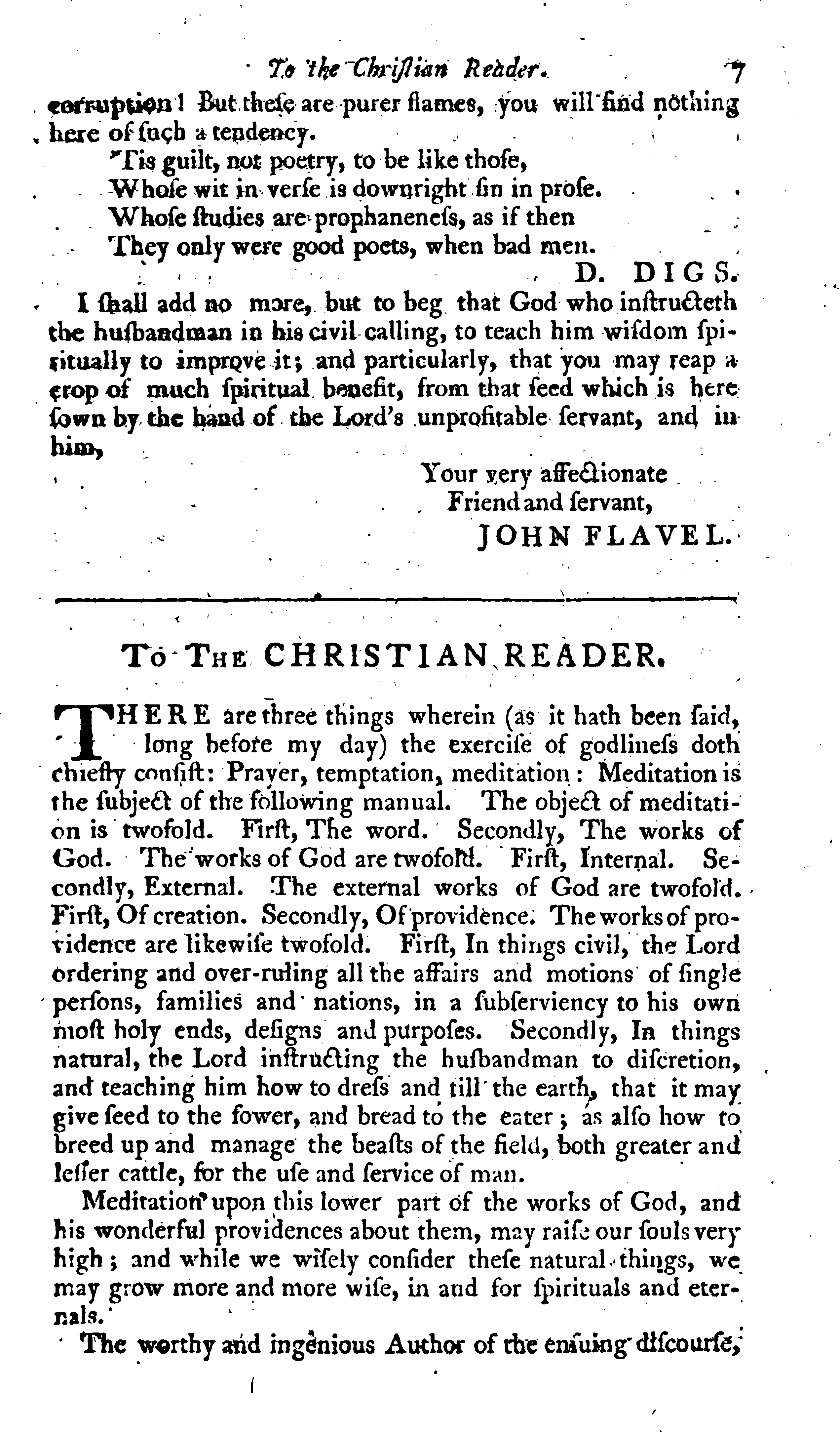
corruption! But these are purer flames, you will find nothing here offuch a tendency.
"Tis guilt, not poetry, to be like those, Who sew it in verse is downright fin inprofe.
Whose studies are prophaneness, as if then They only were good poets, when bad men. t D.
DIG S.
I shall add no more, but to beg that God who instructeth thehusbandman in his civil calling, to teach him wisdom spiritually to improve it; and particularly, that you may reap a crop of much spiritual benefit, from that feed which is here sownby the hand of the Lord's unprofitable servant, and in him, Your very affectionate
Friend and servant,
JOHN FLAVEL.
TO THE CHRISTIAN READER.
Trong three thereof its ch HERE are three things wherein (as it hath been said, chiefly consist: Prayer, temptation, meditation : Meditation is the subject of the following manual.
The object of meditation is twofold.
First, The word.
Secondly, The works of God.
The works of God are twofold.
First, Internal.
Secondly, External.
The external works of God are twofold.
First,Of creation. Secondly,Of providence. The works of providence are likewise twofold.
First, In things civil, the Lord ordering and over-ruling all the affairs and motions of single persons, families and nations, in a subserviency to his own most holy ends, designs and purposes.
Secondly, In things natural, the Lord instructing the husbandman to discretion, and teaching him howtodress and till the earth, that it may give feed to the fower, and bread to the eater; as also how to breed up and manage the beasts of the field, both greater and lesser cattle, for the use and service of man.
Meditation uponthislower part of the works of God, and his wonderful providences about them, may raise our foulsvery high ; and while we wifely confider these natural things, we may grow moreandmore wife,in and for fpirituals andeternals.
The worthy and ingenious Author of the ensuing discourse,
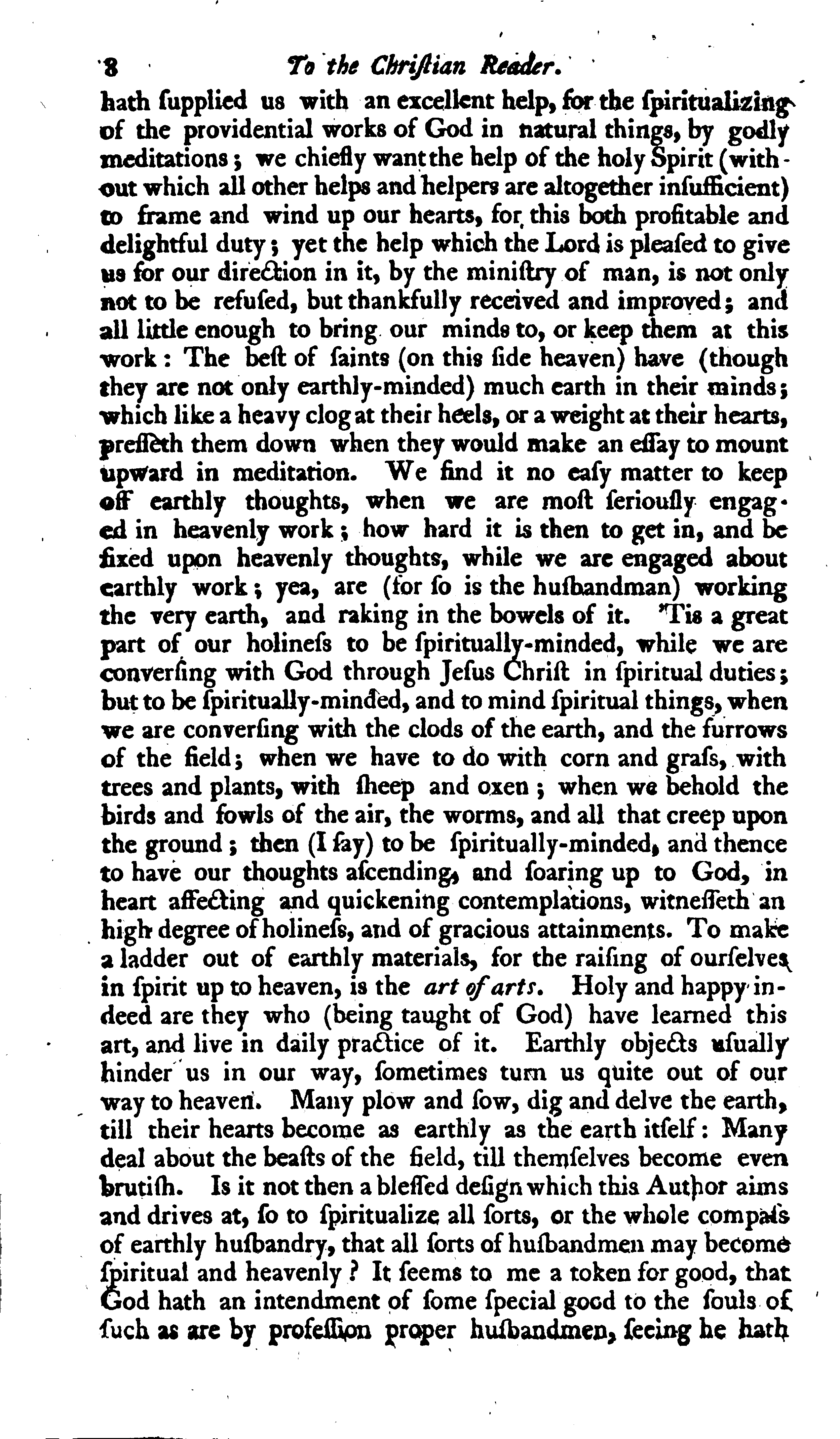
To the Christian Reader. hath supplied us with an excellent help, for the spiritualizing of the providential works of God in natural things,by godly meditations ; we chieflywantthe help of the holy Spirit(without which all other helps and helpers are altogether insufficient) to frame and windup our hearts, for this both profitable and delightful duty ; yet the help which the Lord is pleased to give us for our direction in it,by the ministry of man, is not only not to be refused, but thankfully received and improved; and all little enough to bring our minds to, or keep them at this work: The best of saints (on this side heaven) have (though they are not only earthly-minded)much earth in their minds; which likeaheavyclogat their heels, or a weight at their hearts, presseth them down whentheywould make an essay to mount upward in meditation. We find it no easy matter to keep off earthly thoughts, when we are most seriously engag. ed in heavenly work ; how hard it is then to get in, and be fixed upon heavenly thoughts, while we are engaged about earthly work ; yea, are (for so is the husbandman) working the very earth, and raking in the bowels of it.
"Tis a great part of our holiness to be spiritually-minded, while we are conversing with God through Jesus Christ in spiritual duties; but to be spiritually-minded,and to mind spiritual things,when we are conversing with the clods of the earth, and the furrows of the field; when we have to do with corn and grass, with trees and plants, with sheep and oxen ; when we behold the birds and fowls of the air, the worms, and all that creep upon the ground ; then (I say) to be spiritually-minded, and thence to have our thoughts ascending, and foaringup to God, in heart affecting and quickening contemplations, witnesseth an high degree of holiness, and of gracious attainments. To make a ladder out of earthly materials, for the raising of ourselves in spirit up to heaven, is the art of arts.
Holy and happy indeed are they who (being taught of God) have learned this art, and live in daily practice of it.
Earthly objects usually hinder us in our way, sometimes turn us quite out of our waytoheaven.
Manyplow and sow, dig anddelve the earth, till their hearts become as earthly as the earth itself : Many deal about the beasts of the field,till themselves become even brutish.
Is it not then ablesseddesignwhichthisAuthor aims and drives at, so to spiritualize all forts, or the whole compass of earthly husbandry, that all forts ofhusbandmenmaybecome spiritual and heavenly ? It seems to me a token for good, that God hath an intendment of some special good to the souls of such as are by profession proper husbandmen,seeing he hath
To Mr. John Flavel, &c.
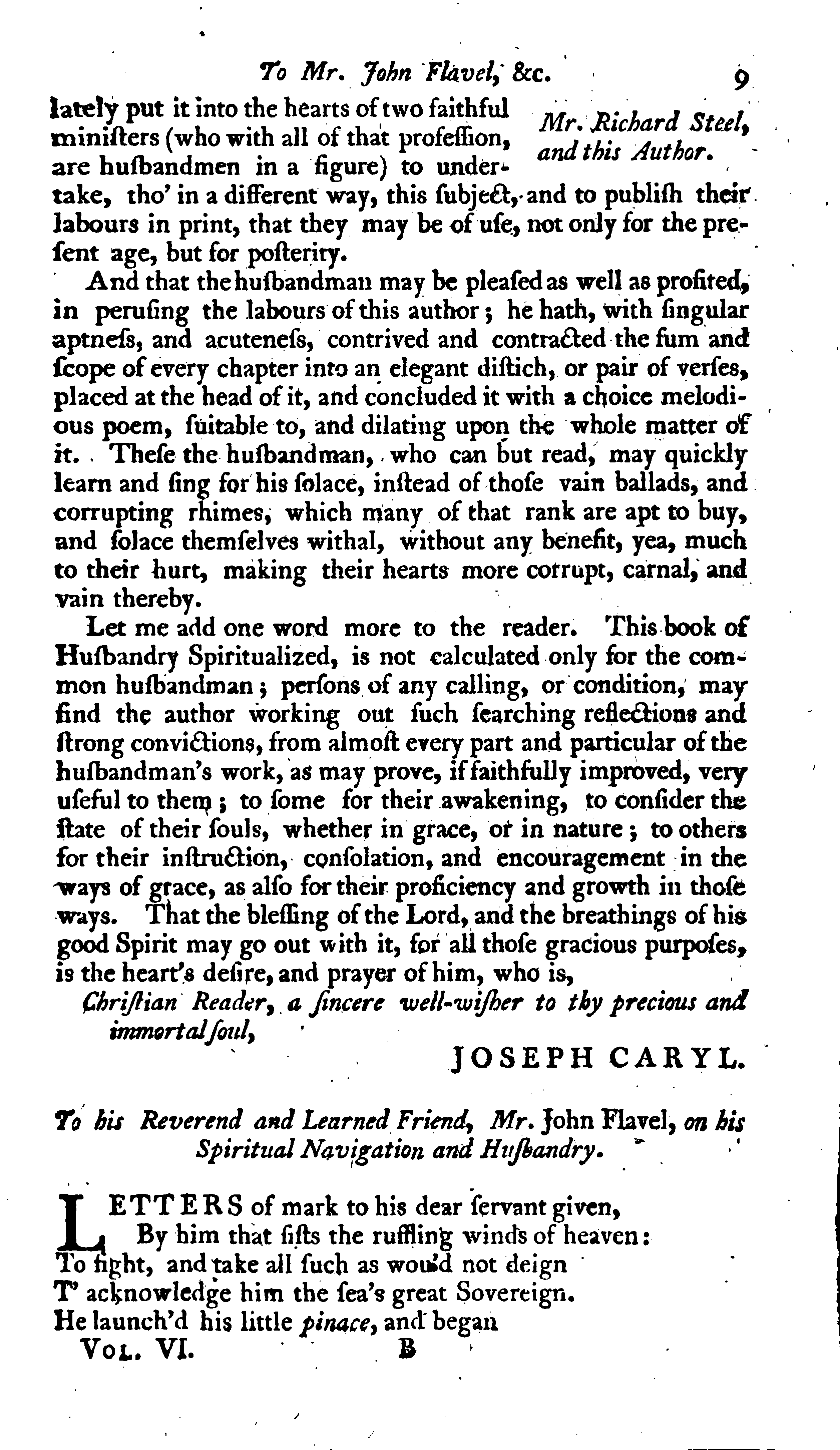
Mr. Richard Steel, and this Author. lately put it into the hearts of two faithful ministers (who with all of that profession, arehusbandmen in a figure) to undertake, tho' in a different way, this subject, and to publish their labours in print, that they maybe of use, not only for the present age, but for posterity.
Andthatthehusbandman maybe pleased as well as profited, in perusing the labours of this author ; he hath, with singular aptness, and acuteness, contrived and contracted the sum and scope of every chapter into an elegant distich, or pair of verses, placed at the head of it, and concluded it with a choice melodious poem, suitable to, anddilating upon the whole matter of it.
These the husbandman, who can but read, may quickly learn and sing for his solace, instead of those vain ballads, and corrupting rhimes, which many of that rank are apt to buy, and solace themselves withal, without any benefit, yea, much to their hurt, making their hearts more corrupt, carnal, and vain thereby.
Let me add one word more to the reader.
This book of Husbandry Spiritualized, is not calculated only for the common husbandman ; persons of any calling, or condition, may find the author working out such searching reflections and strong convictions, from almost every part and particular of the husbandman's work, as may prove, if faithfully improved, very useful to them ; to some for their awakening, to confider the state of their souls, whether in grace, or in nature; to others for their instruction, consolation, and encouragement in the ways of grace, as also for their proficiency and growth in those ways.
That the blessing of the Lord, and the breathings of his good Spirit maygo out with it, for all those gracious purposes, is the heart's desire,and prayer of him, who is,
Christian Reader, afincere well-wisher to thy precious and immortal foul,
JOSEPH CARYL .
To his Reverend and Learned Friend, Mr. John Flavel, on his Spiritual Navigation and Husbandry.
L ETTERS of mark to his dear servant given, By him that sists the ruffling winds of heaven :
To fight, and take all such as wou'd notdeign T' acknowledge him the sea's great Sovereign .
He launch'd his littlepinace, and began VOL. VI.
In Author is Opera.
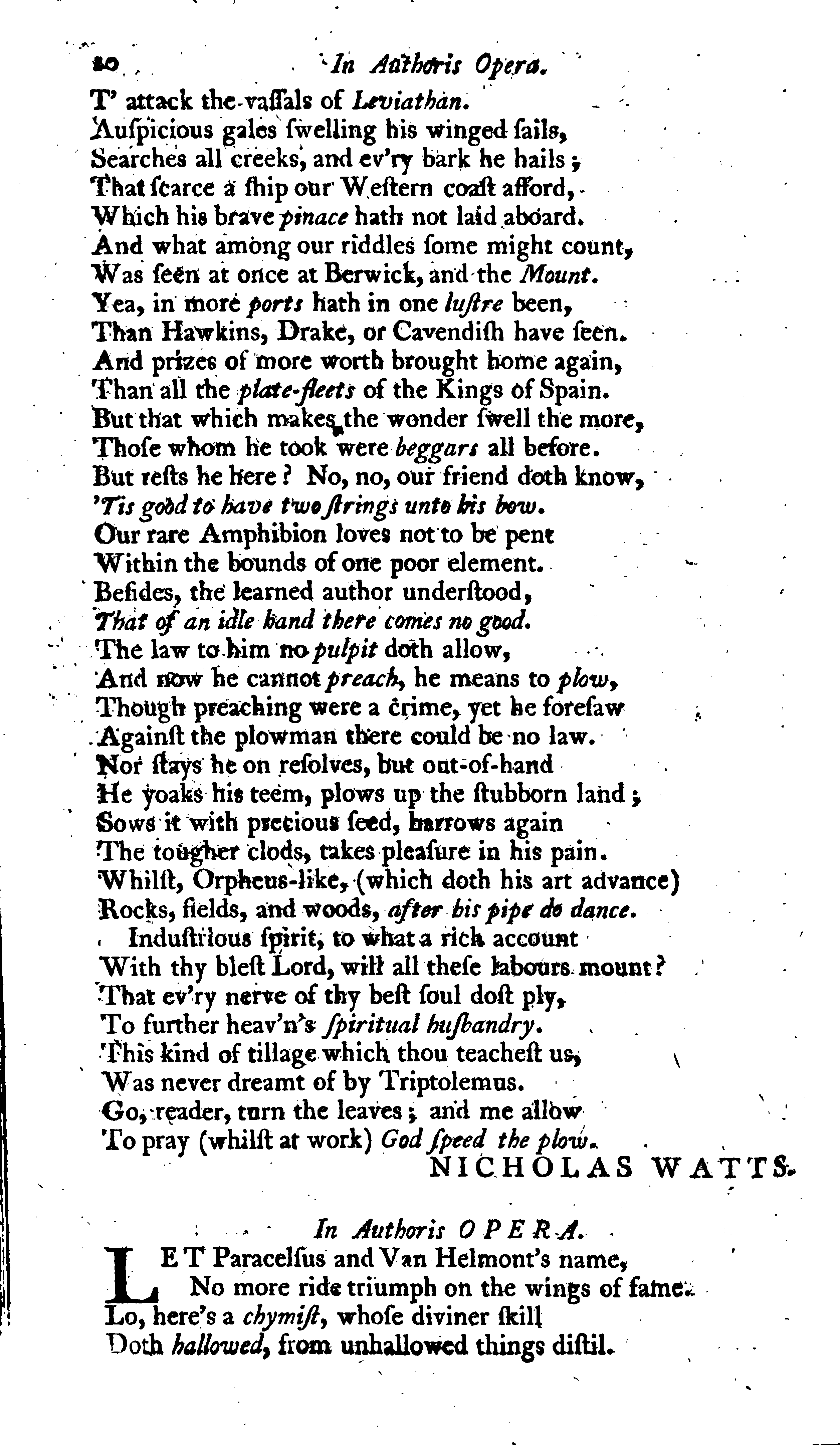
T' attack the vassals of Leviathan.
Auspicious gales swelling his winged fails, Searches all creeks, and ev'ry bark he hails ;
That searce a ship our Western coast afford, Which his bravepinacehath not laid aboard.
And what among our riddles some might count, Was seen at once atBerwick, and the Mount.
Yea, in moréports hath in one lustre been, Than Hawkins,Drake, or Cavendish have seen.
And prizes of more worth brought home again, Than all the plate-fleets of the Kings of Spa in .
But that which makes the wonder swell the more, Thosewhomhe took were beggars all before.
But rests he here ? No, no, our friend doth know, 'Tisgoodto have two strings unto his bow.
Our rare Amphibion loves not to be pent Withinthebounds of one poor element.
Besides, the learned author understood, That of an idle hand there comesnogood.
The law to him no pulpit doth allow, And now hecannotpreach, he means to plow, Though preaching were a crime, yet he foresaw
Against the plowmanthere could be no law.
Nor stays he on resolves,but out-of-hand He yoaks his teem, plows up the stubborn land ;
Sows it with precious feed,harrows again The tougher clods, takes pleasure in his pain.
Whilst, Orpheus-like, (which doth his art advance) Rocks, fields, and woods, after bispipedo dance.
Industrious spirit, to what a rich account With thy blest Lord,will all these labours mount?
That ev'ry nerve of thy best foul dost ply, To further heav'n's spiritual husbandry.
'This kind of tillagewhich thou tea chest us, Was never dreamt of by Triptolemus.
Go, reader, turn the leaves ; and me allow To pray (whilst at work)Godspeed the plow.
NICHOLAS WATTS.
In Author is OPERA.
ET Paracelsus and Van Helmont's name, L :
No more ride triumph on the wings of fame.
Lo, here's a chymist, whose diviner skill Doth hallowed, from unhallowed things distil.
To Mr. John Flavel, &c.
Spiritualizeth sea-affairs; again, Makes the rude ground turn tutor unto men.
Shews Mariners, as by a compass, how They may unto the port of glory row.
Teacheththeplowman, from their work, to know What duties unto God, and man they owe.
Rare artist ! who, when many tongues are mute, Mak'st things, that are inanimate, confute
The age's fins: by preaching unto eyes, Truths, which, in other modes, their ears despise.
Prosper his pious labours, Lord ! howe'er Do not forget to crown the labourer.
Sic raptim can it,
DAN. COND Ye
To his Reverend and Invaluable Friend, Mr. J. F. upon his Husbandry Spiritualized.
I now!
NGENIOUS Sir, What do I see ? What no Areyoucomefrom the pulpit to the plow ?
It fo, then pardon me, if I profefss, The plow deserves to be sent to the press.
Tis not long sinceyouwent to sea,they say, Compos'da compass, which directs the way,
And steers the course to heaven ; O blest art !
Andbravelydonethatyou did that impart To us, who take it kindly at your hand, And bless the Lord that you are come to land,
To be an husbandman, wherein your skill, With admiration doth your readers fill.
One grain will yield increase, it's ten times ten, When the earth's manur'd by such husbandmen.
We may expect rich harvests, and full crops, Whenheav'nlydewdescendeth in such drops Of spiritual rain, to water ev'ry field,
That it full heaps of grace toGodmay yield.
I must adore the wisdom of that God Thatmakesmen wife, who, even from a clod Of earth, can raise such heavenly meditation
Unto a pitch of highest elevation .
Besides,I mark the goodness of the Lord, Performing unto us his faithful word, That all should work for good unto the faints,
B 2
To Mr. John Flavel, &c.
Which, in some measure,lessens our complaints.
For though our Pulpit mercies be grown less, We have fomegracious helps yet from the press.
And herein all the world may plainly fee, That faithful servants will not idle be.
We have some bricks, although the straw be gone, The church, at last, shall be of polish'd stone.
Whatever men or devils act, or fay, Sion, at last, will have a glorious day.
The wretched muck-worm, that from morn to night Labours, as if 'twere for anheav'nly weight ;
And, when he hath got all he can, the most Amounts to little more than a poor crust,
To feed his tired carcass : If himself Have, by his carking, got a littlepelf, Leave i the must, to oneheknows not whom, And then must come to an eternal doom ; And hear his poor neglected wretched foul
Tell him at last,that he hath play'd the fool.
But here he's taught, how he, before he die, May lay up treasure for eternity ; Wherein he maybe rich, yea, much much more,
Than they that do possess whole mines of ore.
When earth's more worth than heav'n, and gold than grace, Then let the worldling run his brutish race;
But not before, unless he do intend To meet with foul-destruction in the end.
But I must leave him,and return again To gratulate the author for his pain.
And here I can't forbear to let my pen To tell the world of all the hufbandmen, That e'er I met, he,he hath hit the vein
To recompence the labourer's hard pain, And taughthimhow to get the greatest gain.
Wherein he treads a path not trode before ; By which, indeed, his skill appears the more.
I might encomiums give him, great and true, And yet come very short of what's his due :
ButImustnot walk in forbidden ways, For, thereby, I am sure, I should displease His piousmind, who doth, and freely can Give all the praise to the great husbandman ,
Who will his graces in his servants own, But doth expecthimselfto wear the crown.