
An Epistle to the intelligent Country Reader,
The Epistle, &c.
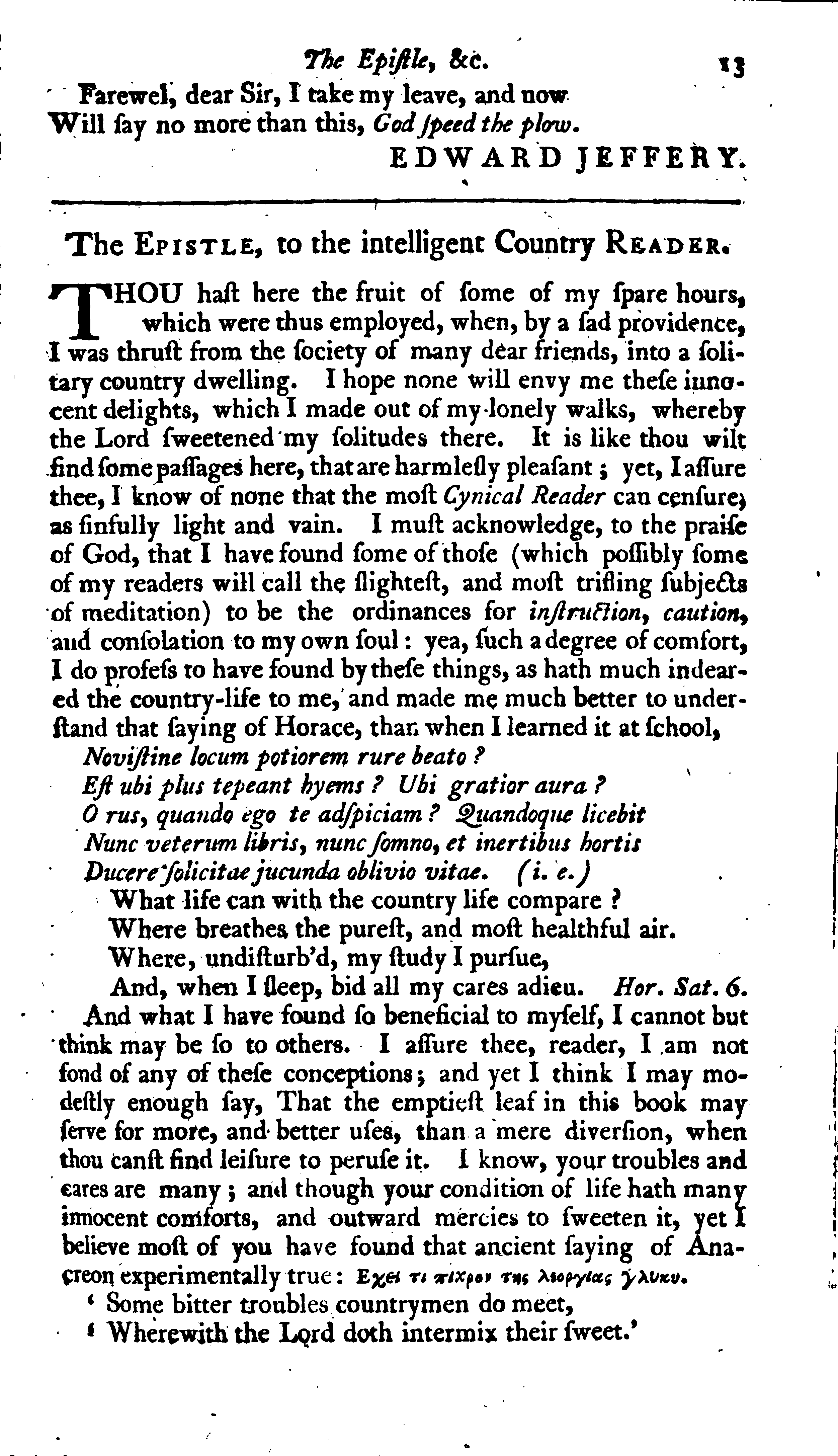
Farewel, dear Sir, I take my leave, and now Willsaynomorethan this, Godspeed the plow.
EDWARD JEFFERY.
The EPISTLE, to the intelligent Country READER.
THOU haft here the fruit of some of my spare hours, whichwerethus employed, when,bya fadprovidence,
I was thrust from the society of many dear friends, into a folitarycountry dwelling. Ihopenone will envy me these innocent delights, which I made out of my lonely walks, whereby the Lord sweetened my folitudes there.
It is like thou wilt findsomepassages here, thatareharmleslypleasant ; yet, Iaffure thee, I know of none that the most Cynical Reader can censure, as finfully light and vain. I must acknowledge, to the praise of God, that I have found some of those (which possibly some of my readers will call the slightest, and most trifling subjects of meditation) to be the ordinances for instruction, caution, and consolation to my own foul : yea, such a degree of comfort,
I do profess to have found by these things, as hath much indearedthecountry-life to me, and made me much better to understand that saying of Horace, than when I learned it at school,
Novistine locum potiorem rure be a to ?
Eft ubi plus tepeant hyems ? Ubi gratior aura ?
O rus, quando ego te adfpiciam ? Quandoque licebit Nunc veterum libris, nuncfomno, et inertibus hortis
Ducerefolicitaejucunda oblivio vitae.
(i. e.) What life can with the country life compare ?
Where breathes the purest, and most healthful air.
Where, undisturb'd, my study I pursue, And, when I sleep, bid all my cares adieu.
Hor. Sat. 6.
And what I have found so beneficial to myself, I cannot but think may be fo to others.
I assure thee, reader, I am not fondofany of these conceptions; and yet I think I may modestly enough say, That the emptiest leaf in this book may serve for more, and better uses, than a mere diversion, when thou canst find leisure to peruse it.
I know, your troubles and cares are many ; and though your condition of life hath many innocent comforts, and outward mercies to sweeten it, yet I believe most of you have found that ancient saying of Anacreonexperimentally true : Έχει τι πίχρον της λεοργίας γλυκύ.
' Some bitter troubles countrymen do meet, Wherewith the Lord doth intermix their sweet.'
TheEpistle, &c.
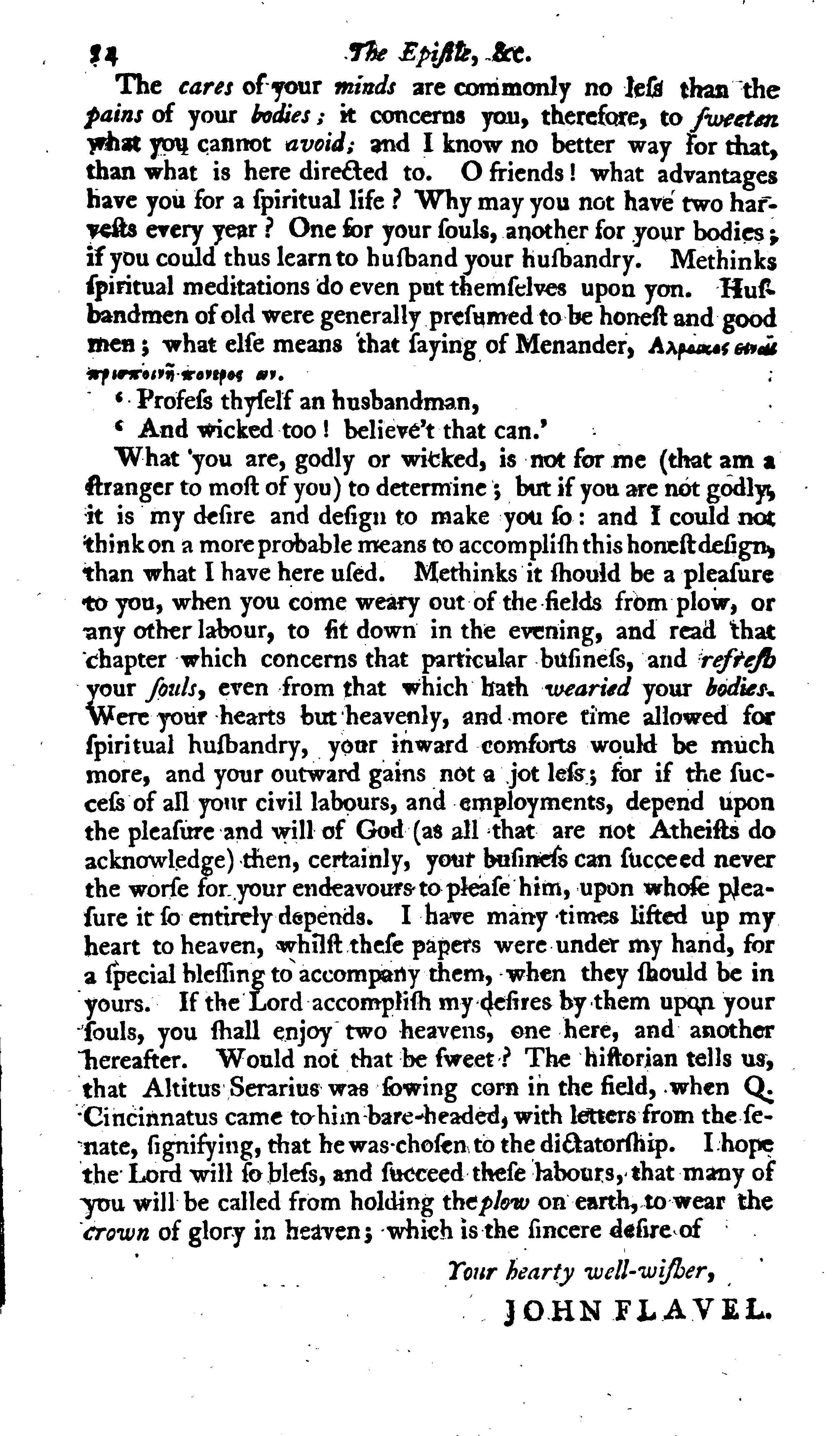
The cares of your minds are commonly no less than the pains of your bodies ; it concerns you, therefore, tofweeten what you cannot avoid; and I know no better way for that, than what is here directed to. Ofriends ! what advantages have you for a spiritual life ? Whymayyou not have two harvests every year ? One for your souls, another for your bodies ; ifyoucould thus learn to husband your husbandry.
Methinks spiritual meditationsdo even put themselves uponyon. Huf bandmenofoldwere generally presumedtobehonest and good men; what else means that saying ofMenander, Αλραικος είναι πρισποινή πονερος ων .
•Profess thyselfanhusbandman, And wicked too ! believe't that can.'
What you are, godly or wicked, is not for me (that am a stranger to most of you) to determine ; but if you arenotgodly, it is mydefire and design to make you so: and I could not think on amoreprobable means to accomplish this honest design, than what I have here used.
Methinks it should be a pleasure to you, when you come weary out of the fields from plow, or any other labour, to fit down in the evening, and read that chapter which concerns that particular business, and refresh your souls, even from that which hath wearied your bodies.
Were your hearts but heavenly, and more time allowed for spiritual husbandry, your inward comforts would be much more, and your outward gains not a jot less; for if the success of all your civil labours, and employments, depend upon the pleasure and will of God (as all that are not Atheists do acknowledge) then, certainly, your business can succeed never the worse for your endeavours to please him, upon whose pleasure it so entirely depends. I have many times lifted up my heart to heaven, whilst these papers were under my hand, for a special blessing to accompany them, when they should be in yours.
If the Lord accomplish mydefires by them upon your souls, you shall enjoy two heavens, one here, and another hereafter.
Would not that be sweet ? The historian tells us, that Altitus Serarius was sowing corn in the field, when Q.
Cincinnatus came to him bare-headed,with letters from the senate, signifying, that he was chosen to the dictatorship.
I hope the Lord will fobless,and succeed these labours, that many of youwillbecalled from holding the plow on earth, to wear the crown of glory in heaven; which is the sincere desire of Your hearty well-wisher,
JOHN FLAVEL.
The Proem.
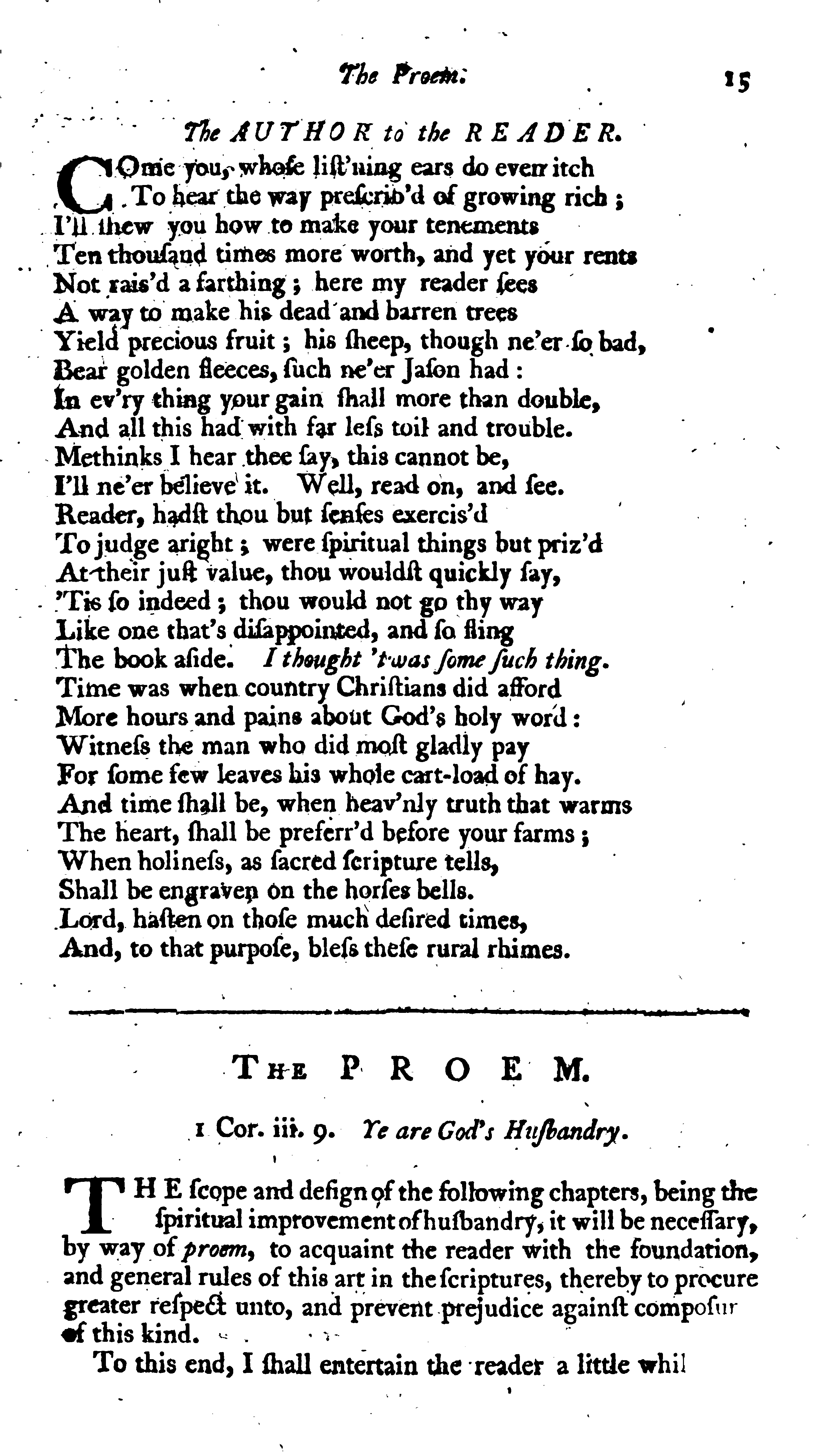
C The AUTHOR to the READER.
Ome you,whose lift'ning ears do even itch To hear the way prescrib'd of growing rich ;
I'll thew you how to make your tenements Ten thousand times more worth, and yet your rents
Not rais'd a farthing ; here my reader sees Away to make his dead and barren trees Yield precious fruit; his sheep, though ne'er so bad,
Bear golden fleeces,such ne'erJason had :
In ev'ry thing your gain shall more than double, And all this had with far less toil and trouble.
Methinks I hear thee say, this cannot be, I'll ne'er believe it.
Well, read on, and fee.
Reader, hadst thou but senses exercis'd To judge aright ; were spiritual things butpriz'd
At their just value, thou wouldst quickly say, "Tis so indeed ; thou would not go thy way
Like one that's disappointed, andfo fling The book aside. I thought 't'wassomefuch thing.
Time was when country Christians did afford More hours and pains about God's holy word :
Witness the man who did most gladly pay For some few leaves his whole cart-load of hay.
And time shall be, when heav'nly truth that warms The heart, shall be preferr'dbefore your farms ;
When holiness, as sacred scripture tells, Shall be engraven on the horses bells.
Lord,hasten on those much desired times, And, to that purpose,bless these rural rhimes.
THE PROEM.
1.Cor. iii. 9.
Ye are God's Husbandry.
HE scope anddefignofthe following chapters,being the T spiritual improvementofhusbandry, it will be necessary, byway ofproem, to acquaint the reader with the foundation, and general rules of this art in the scriptures,therebytoprocure greater respect unto, and prevent prejudice against compofur of this kind.
To this end, I shall entertain the reader a little whil
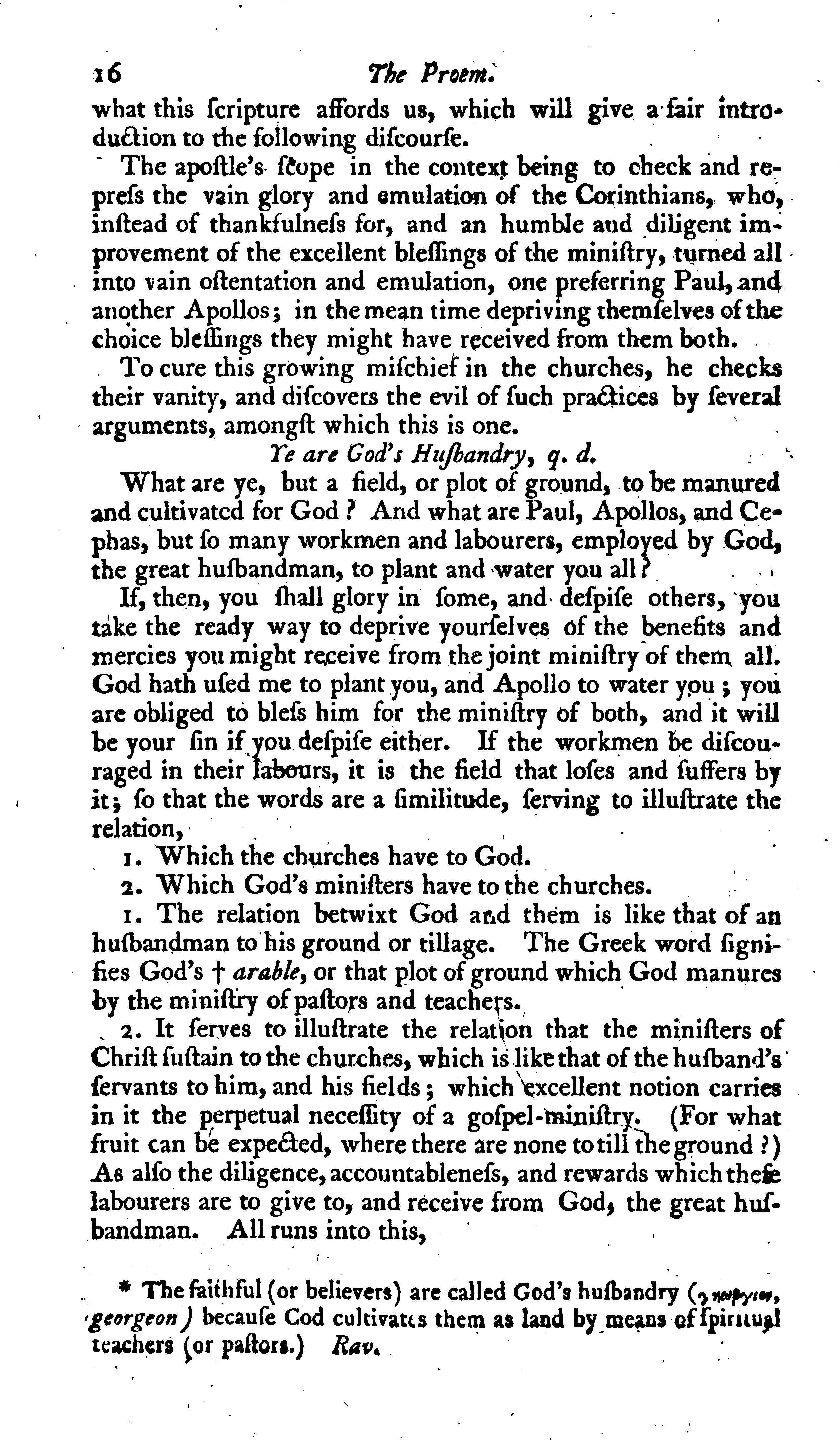
The Proem. what this scripture affords us, which will give a fair introduction to the following discourse.
The apostle's scope in the context being to check and repress the vainglory and emulation of the Corinthians, who, instead of thankfulness for, and an humble and diligent improvement of the excellent blessings of the ministry, turned all into vain oftentation and emulation, one preferring Paul,and another Apollos; inthemeantimedepriving themselves of the choice blessings they might have received from them both.
To cure this growing mischief in the churches, he checks their vanity, and discovers the evil of such practices by several arguments, amongst which this is one.
Ye are God's Husbandry, q. d.
What are ye, but a field, or plot of ground, to be manured and cultivateded for God ? And what arePaul,Apollos, andCephas, but fo many workmen and labourers, employed by God, the great husbandman, to plant and water you all?
If, then, you shall glory in some, and despise others, you take the ready way to deprive yourselves of the benefits and mercies you might receive from the joint ministry of them all.
God hath used me to plant you, and Apollo to water you ; you are obliged to bless him for the ministry of both, and it will be your fin ifyoudespise either.
If the workmen be discouraged in their labours, it is the field that loses and suffers by it; so that the words are a fimilitude, serving to illustrate the relation, 1. Which the churches have to God.
2. Which God's ministers have to the churches .
1. The relation betwixt God and them is like that of an husbandman to his ground or tillage.
The Greek word signifies God's † arable, or that plot of ground which God manures by the ministry ofpaftors and teachers.
2. It serves to illustrate the relation that the ministers of Christ sustain to the churches, which is like that of the husband's servants to him, and his fields ; which excellent notion carries in it the perpetual necessity of a gospel-ministry.
(For what fruit can be expected, where there are none totilltheground?) As also the diligence, accountableness, and rewards which these labourers are to give to, and receive from God, the greathufbandman.
All runs into this, * The faithful (or believers) are called God's husbandry (γκωργιου, george on)becauseCodcultivates them as landbymeans of spiritual teachers (or pastors.) Rav.
The Proem.
That the life and employment ofanhusbandman, excellently shadows forth the relation betwixt God and his church, and the relative duties betwixt its ministers and members.
Or more briefly thus :
The church is God's husbandry, about which his ministers are employed.
I shall not here observe my usual method, (intending no more but a preface to the following discourse) but only open the particulars wherein the resemblance consists ; andthendraw some Corollaries from the whole.
The first I shall dispatch in these twenty particulars following :
1. Prop. The husbandman purchases his fields, and gives a valuable consideration for them, Jer. xxxii. 9, 10.
Reddit. So hath God purchased his church with a full va Juable price, even the precious blood of his own Son, Acts xx.
28. " Feed the church of God, which he hath purchased, or, " acquired with his own blood." O dear-bought inheritance, how much doth this bespeak its worth ? Or rather, the high esteemGodhath of it, to pay down blood, and such blood for it ; never was any inheritance bought at such a rate : every particular elect person, and none but such, are comprehended in this purchase; the rest still remain in the devil's right.
Sin made a forfeiture of all to justice, upon which Satan entered, and took possession, and, as a strong man armed, still keeps it in them, Lukexi. 21. but upon payment of this sum to justice, the elect (who only are intended in this purchase) pass over into God's right and property, and now are neither Satan's,
Acts xxvi. 18. nor their own, 1 Cor. vi. 19. but the Lord's peculiar, 1 Pet. ii. 6. And to shew how much they are his
: own, you have two possessives in one verse, Cant. viii. 12.
My vineyard,which is mine, is before me, mine, which is "
" mine."
2. Prop. Husbandmendivide and separate their own lands from other men's, they have their land-marks and boundaries, by which propriety is preserved, Deut. xxvii. 17. Prov. xxii.
28 .
Reddit. So are the people of God wonderfully separated and distinguished from all the people of the earth. Psal. iv. 3. " The " Lord hath set apart him that isgodlyfor himself.
And the " Lord knoweth who are his," 2 Tim. ii. 19. It is a special act of grace, to be inclofedby God out of the waste howhng wilderness of the world, Deut. xxxiii. 16. This did God inVOL. VI.
The Proem. tentionally,in the decree before the world was ; which decree is executed in their fanctification and adoption.
3. Prop. Corn-fields are carefully fenced by the husbandman with hedges and ditches, to preserve their fruits from beasts that would otherwise over-run anddestroythem
Non minor est virtus quam quaerere part a tueri.
It is as goodhufbandryto keep what we have, as to acquire morethanwe had.
Reddit. " My well-beloved hath a vineyard in a very fruit- " ful hill, and he fenced it," Ifa. v. 1, 2. No inheritance is better defended and secured, than the Lord's inheritance, Psal.
CXXV. 2. "As the mountains are round about Jerusalem, so the " Lord is round about his people."
So careful is he for their safety, " that he createth upon every dwelling-place of mount
" Sion, and upon her assemblies, a cloud and smoke by day, " and the shining ofa flaming fire by night: for upon all
" the glory shall be a defence," Ifa. iv. 5. Not a particular faint, but is hedged about and inclosed in arms of power and love, Job i. 10. " Thou hast made ahedge about him."
The devil fainwould,but by his own confeffioncouldnot,break over thathedge to touch Job, till God's permission made a gap for him : yea,he not only makes anhedge,but a wall about them, and that of fire, Zech. ii. 5. Sets a guard of angels "to en- "camp roundabout them that fear him," Psal. xxxiv. 7. And will not trust them with a single guard of angels neither, though their power be great, and love to the faints as great ; but watches over them himself also, Ifa. xxvii. 2, 3. " Sing
66 yeunto her,a vineyard of red wine, I the Lord do keep it, " I will water it every moment ; lest any hurt it, I will keep
" it night and day."
4. Prop. Husbandmen carry out their compost; to fertilize their arable ground,theydung it, dress it, and keep it in heart ; and in these western parts are at great charges to bring lime, and salt-water sand to quicken their thin and cold foil.
Reddit. " Lord, let it alone this year also,till I shall dig a- " bout it, and dung it; and if it bear fruit, well, if not, cut it
"down," Luke xiii. 8. O the richdressingwhichGodbestows upon his churches ! they are costly fields indeed, dreft and fertilized, not only by precious ordinances andprovidences, but also by the sweat, yea, blood of the dispensers of them.
• You Londoners (faith Mr. Lockier in Colof. p. 552.) are trees watered choicely indeed ; it is storied of the palm-tree, that at its first transplanting into Italy, it was watered with ' wine.
I cannot say(faith he) that you have been so watered by me,I dare not ; but this I can humbly and truly say,that
The Proem.
* if our choicest strength and spirits maybe named instead of water, wine ; or if the blessing which hath gone along with these waters, at any time, hath turned them into wine, in *vigour upon your souls, thenhathGod by me, watered your
' roots with wine.'
5. Prop. The husbandman builds his house, where he makes his purchase, dwells upon his land, and frequently visits it; he knows that such as dwell far from their lands, are not far from loss.
Reddit. SodothGod; where-ever he plants a church, there dothhefixhishabitation, intending there to dwell,Psalm xlvi .
5- " God is in the midst of her," she shall not be moved.
Thus God came to dwell upon his own fee and inheritance, in Judea, Lev. xxvi. 11, 12. "And I willfet my tabernacle a- { mongst you, and will be your God, and ye shall be my
" people."
Which promise is again renewed to his churches of the New Testament, 2 Cor. vi. 16. And when the churches shall be in their greatest flourish, and purity, then shall there bethe fullest and most glorious manifestation of the divine prefenceamongthem,Rev. xxi. 3. "And I heard a great voice
" out of heaven, saying, behold the tabernacle of God is with " men, and he will dwell with them, and be their God."
Hence the assemblies are called, the places of his feet-And there they "behold the beauty of the Lord," Psalm xxvii.
6. Prop. Husbandmen grudge not at the cost they are at for their tillage; but as they lay outvastsums upon it, so they do itchearfully.
Reddit. " And now, O inhabitants ofJerufalem, and men " ofJudah,judge, I pray you, betwixt me and my vineyard;
" whatcouldhave been done more to my vineyard, that I have " not done in it?" And as he bestows upon his heritage the choicest mercies, so he doth it with the greatest chearfulness; for he faith, Jer. xxxii. 41. " I will rejoice over them, to do
*" them good; and I will plant them in this land assuredly, " with mywholeheart, and with my whole foul."
It is not thegivingoutofmercy (faith one) thatgrievethGod, but the recoiling of his mercy back againuponhimbythe creatures ingratitude.
7. Prop. Whenhusbandmen have been at cost and pains about theirhusbandry, they expect fruit from it, answerable to their pains and expences about it: " Behold(faith James) the " husbandman waiteth for the precious fruits of the earth,"
Jam. v. 7.
The Proem.
Reddit. "And he looked that it should bring forth fruit,"
Ifa. v. 2.
This heavenly Husbandman waits for the fruits of his fields also; never did anyhusbandmanlong for the desired harvest, more thanGoddothfor the fruits of holiness from his saints : Great are the expectations of God from his people :
"And when the time of the fruit drew near, he sent his fer- " vants to thehusbandmen, that they might receive the fruits
" of it."
8. Prop. Husbandmen are much delighted, to see the success of their labours, it comforts them over all theirhardpains, andmanyweary days, to fee a good increase.
Reddit. Much more is God delighted in be holding the flourishing graces of his people ; it pleases him to fee his plants laden with fruit, and his valleys sing with corn, Cant. vi. 2 .
" My beloved is gonedownto the garden, into his beds of " spices, to feed in the gardens, and to gather lillies."
These beds of spices (fay * expofitors) are the particular churches, the companies of believers ; he goes to feed in these gardens, like as men go to their gardens to make merry, or to gather fruit, Cant. iv. 16. " He eats his pleasant fruit," viz. His peoples holy performances, sweeter to him than any ambrosia ; thus he feeds in the gardens, and he gathers lillieswhenhe translates good fouls into his kingdom above; " For the Lord
" takethpleasure in his saints,andwillbeautify themeek with "salvation."
9. Prop. The husbandman is exceedingly grieved,when he fees the hopes of a good crop disappointed, and his fields prove barren, or blasted.
Reddit . So the Lord expresses his grief for, and anger against his people, when they bring forth no fruits, or wild fruits,worse than none, Hofea ix. 16. "Ephraim is smitten,
" their root is dried up."
Christ was exceedingly displeased with the fig-tree, and cursed it for its barrenness ; it grieves him to the heart when his servants return to him with such complaints as these, "We have laboured in vain, we have spent
" our strength for nought."
10. Prop. Husbandmen employ many labourers to work in their fields, there is needofmany hands for such amultiplicityofbusiness.
Reddit. God hath diversityofworkmen also in the churches, * Christ is fed when he fees the graces of his people ; he gathers lillieswhen he translates any good foul out of this life, Trap.on *he place.
The Proem.
whom he sends forth to labour in his spiritual fields, Eph. iv.
2. " He gave some apostles, some prophets, and fomeevange " lifts; and some pastors and teachers, for the perfecting of "the saints, for the work of the ministry," Amos iii. 7. I have sent[myfervants] the prophets.
It is usual with the apostles toplacethistitle ofa servant among their honourary titles, tho a profane mouth once called it, probrofum artificium,a sordid artifice.
Christ hath stampt a great deal of dignity upon his ministers, in retaining them for the nearest service to him- : self, 1 Cor. iv. 1. " Let a man so account of us, as the mini- " sters of Christ ;" they are workers together with God: The husbandmanworks in the field among his labourers, and the great Goddisdaineth not to work in, and with his poor servants, intheworkofthe ministry.
11. Prop. The work about whichhusbandmen employ their servants in the field, is toilsome and spending, you fee they come home at night as weary as they can draw their legs after them.
Reddit. But God's workmen have a much harder task than they; hence are they set forth in fcriptureby the laborious ox,
1 Cor. ix. 9. Rev. iv. 7. Some derive the word διακονος, deacon, from zows, which signifies dust, to shew the laboriousness of their employment, labouring till even choaked withduft and sweat. "Tls said ofEpaphroditus, Phil. ii. 13. "That for the
" work of Christ he was sick, and nigh unto death; not re- " gardinghis life, to supply their lack of service."
The apostle'sexpreffion, Col. i. ult. is very emphatical, " whereunto " I also labour, striving, according to his working ; which "worketh in me mightily."
The word ἀδωνιζωμενος, signifies such spending labour as puts a man into anagony; and blessed is that servant, whom his Lord, when he cometh, shall find fodoing.
12. Prop. The immediate end ofthehusbandman's labour, and his servants labour, is for the improvement of his land, to make it more flourishingandfruitful.
Reddit. The scope and end of the ministry is for the church's benefitandadvantage. They must not lord it over God's heritage, as if the church were for them, and not they for the church; nor serve themselves of it, but be the church's ferwants for Jesus sake, 2Cor. iv. 6. The power they have received being for edification, and not for destruction, 2 Cor. x. 8.
Christ hath giventhemto the churches; their gifts, their time, their strength, and all their ministerial talents, are not their own,but the church's stockandtreasure.
The Proem.
13. Prop. The workmen that labour in the fields are accountable for their work to him that employed them.
Reddit. Church-officers are also accountable to God for all thefouls committed to them.
They are stewards of the mysteries of God, 1 Cor. iv. 1. and stewards are accountable. "We
" watch foryourfouls (faith the apostle)as they that must give " an account," Heb. xiii. 7. If these servants be unfaithful in their work and trust, the blood offouls shall be required at their hands, Ezek. iii. 17, 18. which are fulmina, non verba,
(faith Erasmus)thunderbolts, rather than words.
The guilt of blood is the greatest guilt ; and of all blood, the blood offouls.
14. Prop. Those that spend their time and strength all their days, inmanuring and plowing the fields, do maintain themselves and their families by their labours; their hands are sufficient for themselves and theirs .
Reddit. " Even so hath God ordained, that they which " preach the gospel,should live of the gospel," 1 Cor. ix. 14.
" The workman is worthy of his meat," Mat. x. 10. 'Tis a sad thing, if those who break the bread of life tofouls, should be fufferedto want bread themselves. God would not have the mouth of an ox muzzled that treads out the corn,but have liberty to eat as well as work: Yet if any pretender to the ministry be like the heifer that loves to tread out the corn,(i. e.) cares to do no work,but such as brings in present pay ; he therein fufficientlydiscovers his beast-like disposition. Ministers must be faithful in their master's work, and if men do not, God will reward them .
For " he is not unrighteous to forget their " work, and labour of love," Heb. vi. 10.
15. Prop. It is a great trouble to husbandmen in abusytime, to be put off from their labours by stormy weather, which drives them out of the fields, and makes them let all lie,till it clear up again ; yet, mean while, they are not idle,but employ themselves in home-work.
Reddit. Even so in God's husbandry, it is an unspeakable affliction to God's workmen to be rendered useless and unferviceabletothechurches,by those storms of trouble, which drive them from their public ministerial work,
With what a heavy heart did Paul go off from his work atEphefus, Acts xx.
It spends a minister to preach, but more tobefilent.
'Tis a loud speaking judgment, when God shall say to them as to Ezekiel, " Son of man, I will make thy tongue cleave to the roofofthy
" mouth, and thou shalt be dumb," Ezek. iii. 26.
Such silencing providences, speaking thundring language to gracious hearts ; yet, even then, the keepers of the vineyardhaveapri
The Proem.
vatevineyardoftheirownto look after,they have much homework, when no out-work.
16. Prop. There is a vast differencebetwixtthose fields which havebeenwellhusbanded,and dressed by a skilful and diligent husbandman; andthosethathave been long out ofhusbandry.
How fragrant is the one ? How dry and barren the other ? when you pass by a field welldressedand fenced, every thing prosperous, and in exquisite order, you may know, without farther enquiry,that a good husbandman lives there.
Reddit. Thus stands the case betwixt those places which God hath blessed with a faithful painful ministry, and such as have none, or worse than none : for as the husbandman's cost and pains appear in the verdant, and fragrant hue of his fields ; so a minister'spains and diligence are(ordinarily) seen in the heavenly lives, and flourishing graces of the people. The churchesofCorinth and Theffalonica,where Paul, and other holy instruments, spent much of their time and pains, became famous and flourishing churches, 2 Cor. ix. 2. Aspecialbleffing comes along with a godly minister, to the place where special providence assigns him.
Such places, like Gideon's fleece, have the dew of heaven lying on them, whilst others round about are dry and barren.
17. Prop. The husbandman is not discouraged, though the feed lie long under the clods; he knows it will spring up at last, and reward him, or those that come after him, for their pains and patience in waiting for it.
Reddit. Ministers should not be presently discouraged in their work, because they fee but little or no appearance of all the feedtheyhave sown amongthepeople. The " servant
" of the Lord must be patient towards all, waiting if at any "time God will give them repentance," 2 Tim. ii. 24,25.
And if it never spring up in his time, it may after his death ; and if fo, he shall not fail of his reward, John iv. 36, 37.
" And he that reapeth, receiveth wages, and gathereth fruit " unto life eternal,that both he that foweth, and he that reap- " eth,mayrejoicetogether; and herein is that saying true, one
"soweth, andanotherreapeth."
Though ministers die, yet their words live ; yea, their words take hold ofmenwhenthey are in the dust, Zech. i. 6.
18. Prop. Husbandmenfind low grounds, and valleys, most fertile; hills, how loftysoeverthey overtop the lower grounds, yet answer not the husbandman's pains, as the valleys do : these are best watered and secured from the scorching heat of the fun.
The Proem.
Reddit. Experience shews us, that the humblest saints are most fruitful under the gospel ; " These are they that receive
" with meekness the ingraffed word," Jam. i. 21. whose influences abide in them, as the rain doth in the low valleys.
Happy is that minister, whose lot falls in such a pleasant valley. "Blessed are they that sow beside all such waters, that " fend forth thither the feet of the ox and the ass," Ifa. xxxii.
20. among these valleys run the pleasant springs, and purling brooks, which fertilize the neighbouring ground.
Heavenly ordinances there, leave fruitful influences.
19. Prop. The first crop is usually the best, and the longer thehusbandman tills his ground,the less it produces ; after a few years its vigour and strength is spent.
Reddit. The first entertainment of the gospel is commonly the best ; and what good is done by the ministry is often done at its first entrance. New things are pretty, and very taking.
" John at first was to the Jews a burning and shining light, " and they were willing, [for a season] to rejoice in his light,"
Johu v. 35. Paul was highly valued among the Galatians at first ; such was their zeal, that theycouldhave plucked out their eyes, and have given them to him ; but how quickly did this full tide ebb again ? For he complains, Gal. iv. 15.
" Where then is the blessedness ye spake of?"
20. Prop. Lastly, When fields prove barren, and will not quit the husbandman's cost, nor answer the feed he sows in them, he plucks up the hedges, and lays it waste.
Reddit. So when churches grow formal, and fruitless, the Lord removes his gospel-presence from them, plucks up the hedge of his protection from about them, and lays them open, as waste ground, to be over-run by their enemies. Jer. vii. 12.
" Go to Shiloh, and fee what I did unto it." What is become of those once famous and flourishing churches ofAfia ? Are they not laid waste, and trodden down by infidels ? And now go to, faith the great Husbandman, " I will tell you what I " will do to my vineyard ; I will pull up the hedge thereof,
" and it shall be laid waste," Ifa. v. 5.
Thus you fee the allegory opened in its particulars : from the whole, I shall present you with these five ensuing corollaries.
The first Corollary.
How great then are the dignities and privileges of the churches of Jesus Christ whom he hath appropriated to himself, above all the people of the earth, to be his peculiar inheritance ? The reft of the world is a waste wilderness; all other places, how
The Proem.
25. pleasantfoever,inrespectoftheir natural amenityanddelights, are truly enough called the dark places of the earth ; dismal, solitary, cells, where Ziim and lim, Bitterns, Cormorants, and everydoleful creature dwells. But the church is the paradise of the earth, a garden inclosed, Cant. iv. 12. in whose hedges the gospel birds chirp and sing melodiously, Cant. ii. 12. Its beds are beds of spices, Cant. vi. 2. and betwixt its pleasant banks, a crystal river of living water runs, Rev. xxii. 1. the streams whereofmakeglad the cityofGod,in the midstwhereofthe Lord himself delights to walk. O Sion, with what pleasures dost thou abound ? If Bernard was so ravished with the delights of his monastery, because of its green banks, and shady bowers, and herbs, and trees, and various objects to feed his eyes, and fragrant smells, and sweet and various tunes of birds, together with the opportunities of devout contemplation, that he cried out admiringly, Lord ! what delight dost thou provide, even for the poor! How much more should we be ravished with Sion's glory ? For, beautifulforfituation is mount
Zion. Of whom it may much more truly be said, what a * chronicler of our own oncefaid of England, That it is the fortunate island,theparadifeofpleafure,thegardenofGod, whose valleys are likeEden,whose hills are as Lebanon,whose springs are as Pisgah, whose rivers areas Jordan, whose wall is the ocean, and whose defence is the Lord Jehovah.
Happy art thou, O Israel; who is like unto thee ? Who can count the privileges wherewithChrist hath invested his churches ? O let it never seem a light thing in our eyes, that we grow within his blessed inclosure. How sweet a promise is that, Exod. xix. 5.
" Ye shall be to me a peculiar treasure, above all people ; for " all the earth is mine."
ThefecondCorollary.
Hence it follows,Thatspiritualbarrenness is a great reproach andshametoChristians. Shall God's husbandry,which is planted, watered, fenced, filled with favours and mercies, be like thebarrenheath in the desart ? Surely it should be said of every soul that grows here, as the historian faith of Spa in, that there is nihil infructuofum, nihilfterile ; nothing barren, or unfruitful in it.
God's vineyard is planted in avery fruitful hill.
Ifa. v. 1. " And surely they that are planted in the house of " the Lord, should flourish in the courts of our God; they
" should bring forth fruit, even in old age, to shewthatGod * Speed's Chronicle.
VOL . VI.
The Proent.
" is upright," Psal. xcii. 13, 14. " They are created in Christ " Jesus unto good works, which God hath ordained they
" should walk in," Eph. ii. 10. " They are married unto " Christ, that they might bring forth fruit to God," Rom . vii.
4. An empty branch is a dish on our to the root that bears it, a barren field to the husbandman that owns it ; God cannot endure that in his fields,which he suffers in the wilderness.
The third Corollary.
If the church be God's husbandry, then there is such a special, gracious presence of the Lord in his churches, as is not to be found in all theworldbeside. Where may you expect to find the husbandman, but in his own fields ? There lies his business, and there he delights to be.
And where may we expect to find God, but in the assemblies of his saints? "He " walks among the golden candlesticks," Rev. ii. 1.
I will walk among you, (faith he)and be your God, 2 Cor. vi. 16.
Upon this account the church is called Jehovah Shammab, the Lord is there, Ezek. xlviii. ult. You may fee the footsteps of God in the creatures, but the face of God is only to be seen in his ordinances.
Hence, Psal. xxvii. 4. "David longed for " the temple, that he might fee the beauty of the Lord." Now what is beauty,but asymmetry and proportion of parts? In the works of creation, you fee one attribute manifested in one thing, and another in anotherthing : but in the sanctuary you may see beauty, even in all the attributes of God displayed there:
And, indeed, we find in Scripture such astonishing expressions about the visions of God in his church, that in reading them, am an can fee little difference betwixt it and heaven ; for as the church is called heaven, Mat. xxv. 1. so it's description is like that of heaven. Heb. xii. 22, 23. "You are come to the hea- " venly Jerusalem, and to an innumerable companyofangels," c. And Rev. xxii. 4. " They shall fee his face, and his name
" shall be written in their foreheads ." And ver. 6. The saints are represented " standing nearer to the throne of God, than the " angels themselves." Hence also ordinances are called galIeries, in which both faints and angels walk, beholding the gloryofhim that fits upon the throne. Zech. iii. 7. " If you
" will keep my ways, I will give you galleries to walk in, a66 mongthem that standby."
The fourth Corollary.
If the church be God's husbandry, then those that be employed in ministerial work ought to bemen ofgreatjudgment, and experience in foul-affairs; for these are the labourers whom
God, the mystical Husbandman, employs, and intrusts about
The Proem.
his spiritualhusbandry.
Should husbandmen employ ignorant persons, that neither understand the rules, nor proper seasons ofhusbandry; how much would such workmen damnify andprejudicehim ? He will not employ such to weed his fields , as know not wheat from tares ; or to prune his trees,that thin midsummer as fit for that work as December : much less will
God. He qualifies all that he sends, with wisdom for their work.
" His workmen approve themselves workmen indeed, such as " need not be ashamed, rightly dividing the word of truth,"
2Tim. ii. 15. As Bezaleel was furnished with wisdom, before he was employed in tabernacle-work ; fo Christ instructs his servants, with skill and insight, before they are employed in ministerial work. He gives them a mouth and wisdom, Luke xxi. 15. enduesthem with power from on high ; as Christ was filled abundantly with the Spirit for his work, fo, according to proportion, are those that are fentby him. John xx. 21, 22 .
" As my Father hath sent me, so send I you."
And as for those that run before they are sent, and understand not the mysteries of the gospel; I shallfay no more of them but this; " Father, forgive them, for they know not what they do."
The fifth Corollary.
To conclude, If the church be God's husbandry, that is, if husbandryhave so many resemblances of God's works about the church in it; then how inexcusable is the ignorance of hufbandmen in the things of God, who,besides the word of the gospel,have the teaching of the creatures ; and can hardly turn their hands to any part of their work, but the Spirit hints one spiritual use or other from it totheirfouls? How do the Scriptures abound with parables, and lively fimilitudes taken from husbandry? From the field, the feed, the plow, the barn, from threshing andwinnowing; fimilitudes also from planting, graffing, and pruning of trees ; and not a few from the ordering of cattle.
So that to what business soever you turn your hands, in any part of your calling, stillGodmeets you with one heavenly instruction or other.
But alas ! How few are able to improve their civil employments to such excellent ends ! These things are but briefly hinted in the Scriptures, and those hints scattered up and down, that they know not where to find them ; and if they could, yet would it be difficult so to methodize them, as it is neceflary they should be, in order to their due improvement by meditation.
And therefore I judged it necessary to collect and prepare them for their use; and in this manner to present them to D 2