
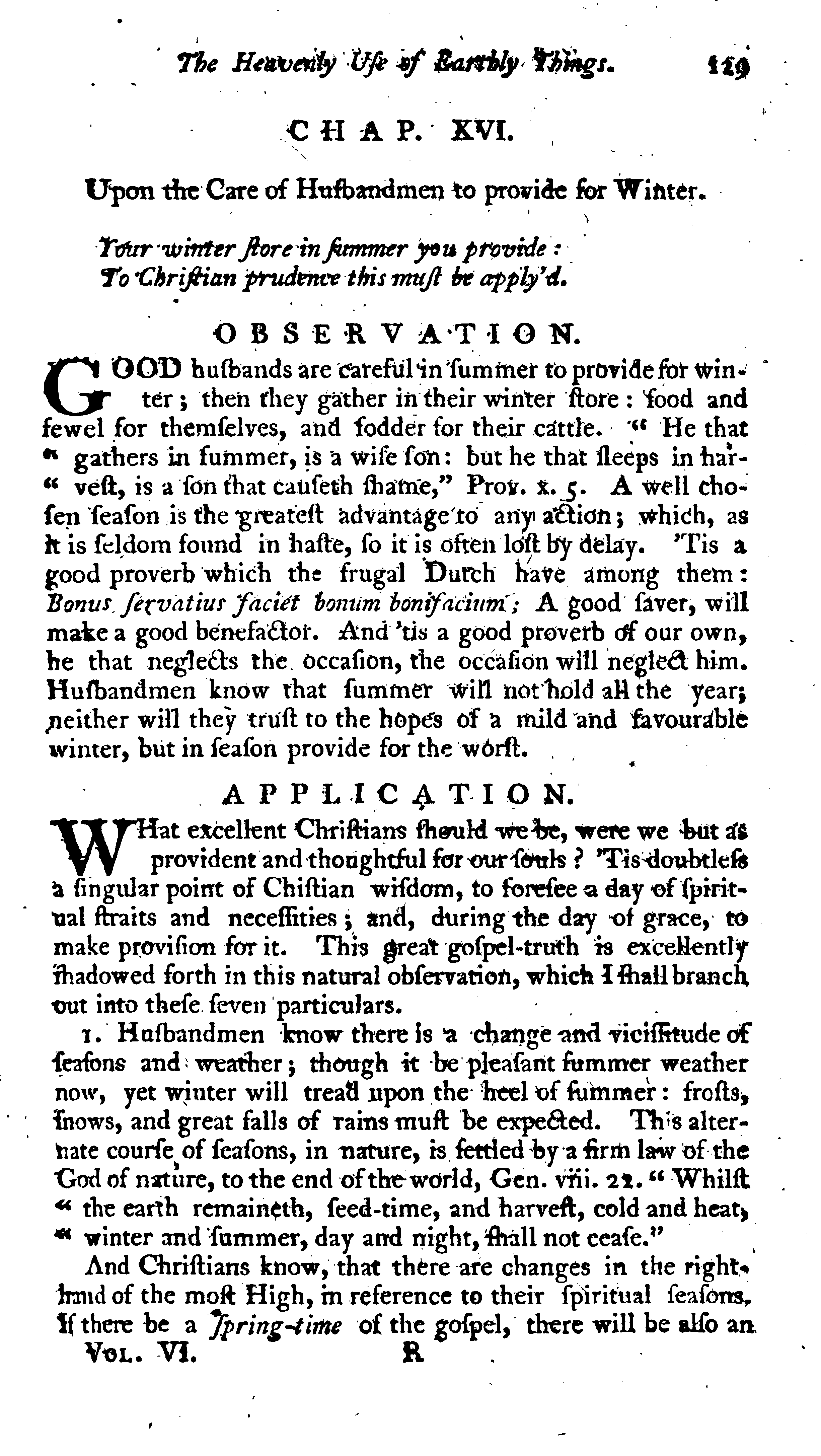
Upon the care of husbandmen to provide
The Heavenly Use of Earthly Things.
CHAP.
XVI .
Upon theCareofHufbandmen to provide for Winter.
Your winter store infummeryou provide:
To Christian prudence this must be apply'd.
OBSERVATIΟΝ.
OOD husbands are careful in summer toprovideforwinter ; then they gather in their winter store: food and fewel for themselves, and fodder for their cattle. " He that gathers in summer, is a wife son: but he that sleeps in har- " vest, is a son that causeth shame," Prov. x. 5. A well chosen season is the greatest advantage to any action; which, as it is seldom found in haste, so it is often loftby delay. "Tis a good proverb which the frugal Dutch have among them :
Bonus fervatius faciet bonum bonifacium; A good saver, will make a good benefactor. And 'tis a good proverb of our own, he that neglects the occasion, the occafionwill neglect him.
Husbandmen know that summer will not hold all the year; neither will they trust to the hopes of a mild and favourable winter,but in season provide for the worst.
APPLICATIΟΝ.
Hat excellent Christians should we be,were we but as What providentandthoughtful for ourfouls ? 'Tis doubtless a fingularpoint of Chistian wisdom, to foresee a day of spiritual straits and necessities ; and, during the day of grace, to make provision for it.
This great gospel-truth is excellently shadowed forth in this natural observation,which I shall branch out into these seven particulars.
1. Husbandmen know there is a change and vicissitude of seasons and weather; though it be pleasant summer weather now, yet winter will tread upon the heel offummer: frofts,
Inows, and great falls of rains must be expected.
This alternate course offeafons, in nature, is settled by a firmlawofthe Godofnature, to the end of the world,Gen. viii. 22." Whilst
"the earth remaineth, feed-time, and harvest, coldandheat, "winter and summer,day and night, shall not cease."
And Christians know, that there are changes in the right. hand of the most High,in reference to their spiritual seasons.
If there be a spring-time of the gospel, there will be also an
VOL . VI.
R :
$30 Husbandry Spiritualized; or,
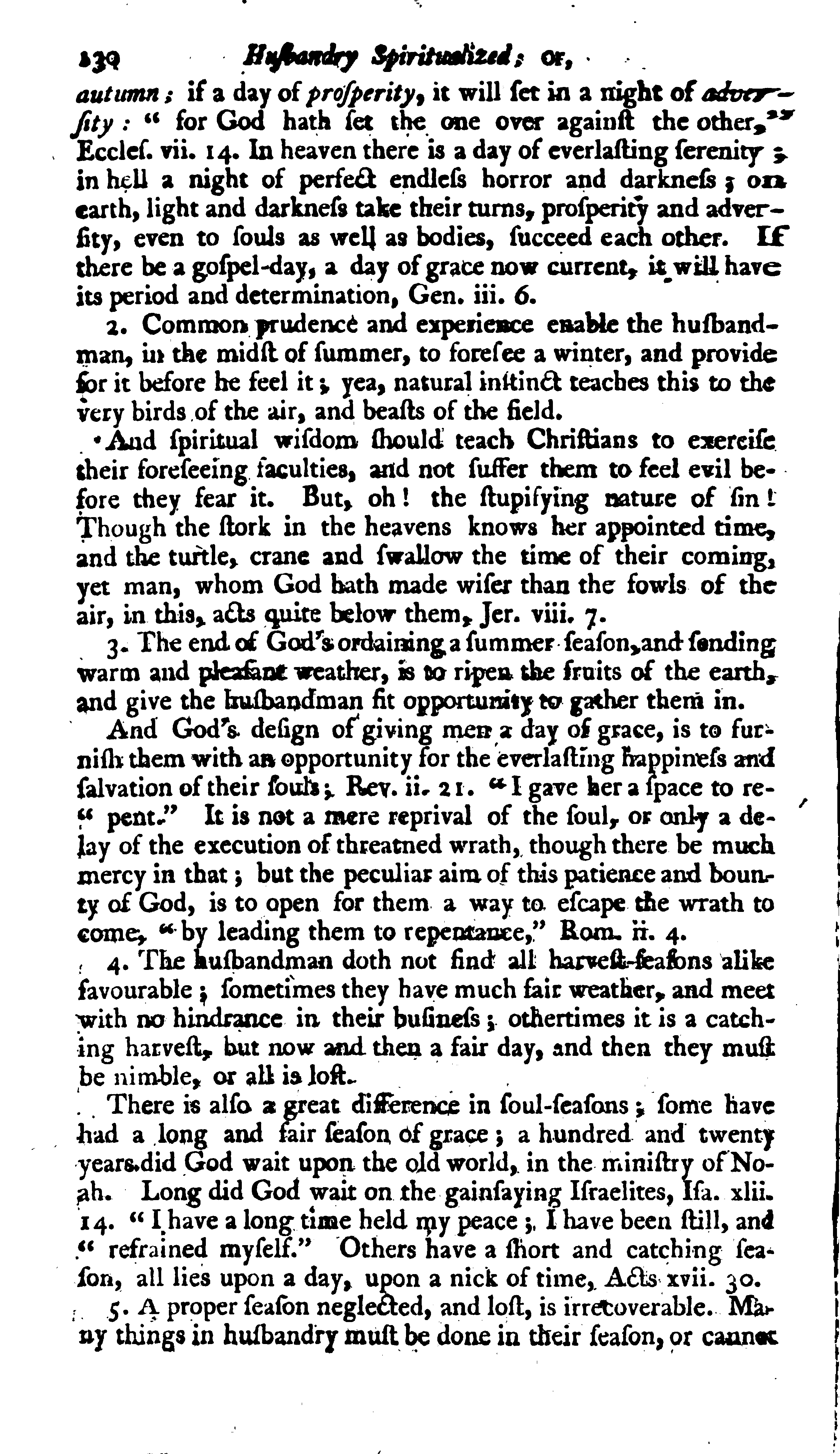
autumn; if a day of prosperity, it will set in a night ofadverfity : " for God hath set the one over against the other,
Eccles. vii. 14. Inheaventhere is a day of everlasting serenity; in hell a night of perfect endless horror and darkness ; on earth, lightanddarkness take their turns,prosperity andadverfity, even to fouls as well as bodies, succeed each other.
If there be a gospel-day, a day ofgracenow current, it will have its period and determination, Gen. iii. 6.
2. Common prudence and experience enable the husbandman, in the midst of summer, to foresee a winter, and provide for it before he feel it; yea, natural instinct teaches this to the very birds of the air, and beasts of the field.
•And spiritual wisdom should teach Christians to exercise their foreseeing faculties, and not suffer them to feel evil before they fear it.
But, oh! the stupifying nature of fin !
Though the stork in the heavens knows her appointed time, and the turtle, crane and swallow the time of their coming, yet man, whom God hath made wiserthanthe fowls of the air, in this, acts quite below them, Jer. viii. 7.
3. The end of God's ordaining afummer season,and fending warm and pleasant weather, is toripenthe fruits of the earth, and give the husbandman fit opportunity togatherthem in.
And God's design of giving men a day of grace, is to furnish them with an opportunity for the everlasting happiness and falvationoftheir fouls; Rev. ii. 21. " I gave hera space to re- " pent."
It is not a mere reprival of the soul, or only a delay of the execution ofthreatned wrath, thought here be much mercy in that; but the peculiar aim of this patience and bounty of God, is to open for them a way to escape the wrath to come, "by leading them to repentance," Rom. ii. 4.
4. The husbandman doth not find all harvest-seasons alike favourable ; sometimes they have much fair weather, and meet with no hindrance in their business ; other times it is a catching harvest, but now and then a fair day, and then they must be nimble, or all is loft..
There is also a great difference in soul-seasons ; some have had a long and fair season of grace ; a hundred and twenty years.didGodwait upon the old world, in the ministry ofNoah.
Long did God wait on the gainsaying Ifraelites, Ifa. xlii.
14. " I have a longtime heldmypeace;, I have been still, and " refrained myself."
Others have a short and catching season, all lies upon a day, upon a nick of time, Acts xvii . 30.
5.A proper season neglected, and loft, is irrecoverable. Many things inhusbandrymustbedone in their season, or cannec f.
TheHeavenlyUfe of Earthly Things.
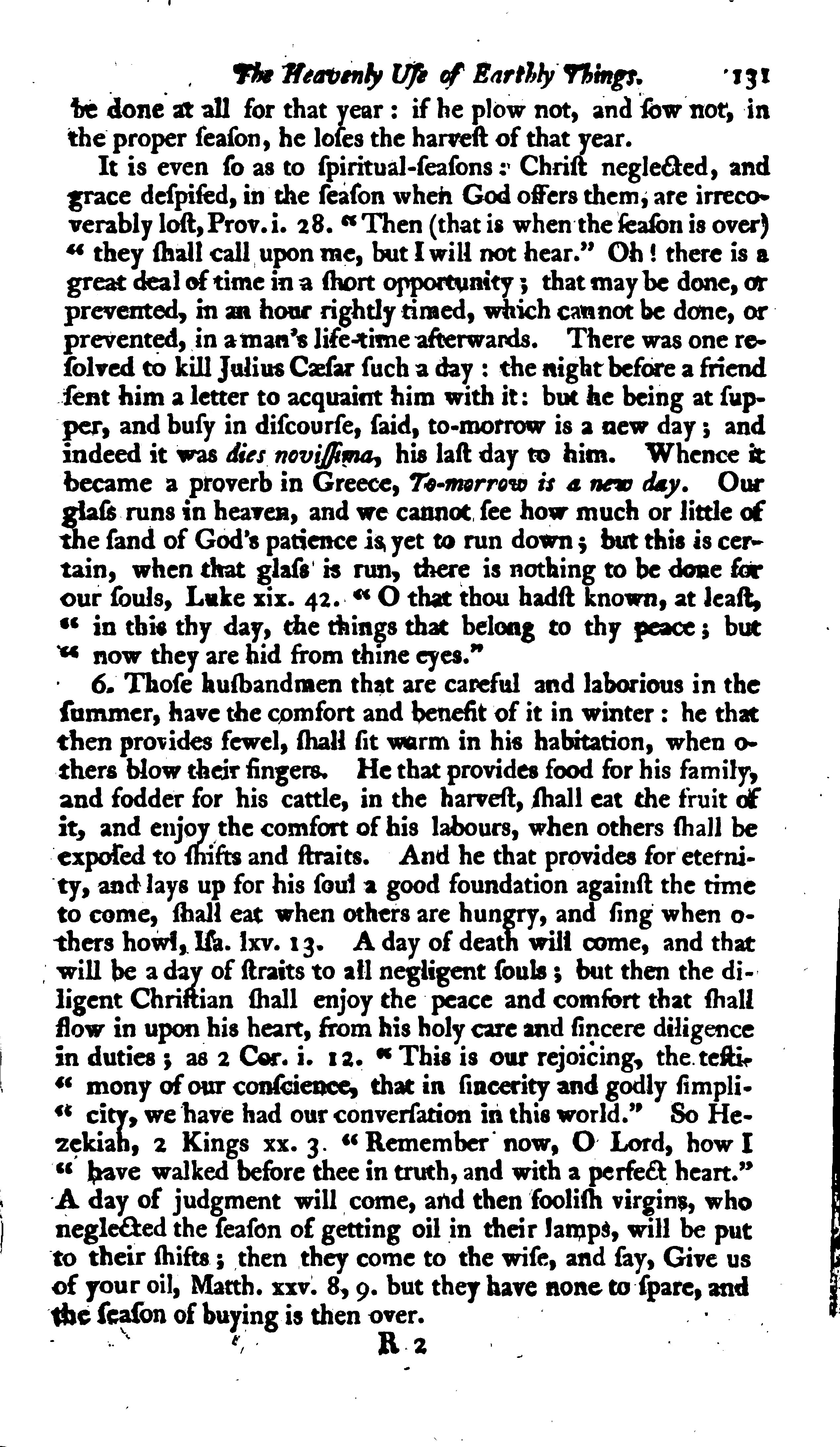
be done at all for that year: if he plow not, and sow not, in the proper season, he loses the harvest of that year.
It is even so as to spiritual-seasons : Christ neglected, and grace despised, in the seasonwhenGod offers them, are irrecoverably loft,Prov.i. 28. " Then (that is whentheseason is over)
"they shall call upon me,but I will not hear." Oh ! there is a great deal oftimeina short opportunity ; that maybe done, or prevented, in an hour rightlytimed, which cannotbedone,or prevented, in am an's life-timeafterwards.
There was one resolved to kill Julius Cæfar such a day : the night before a friend sent him a letter to acquaint him with it: but he being at supper, and busy in discourse, said, to-morrow is a new day; and indeed it was dies novissima, his last day to him.
Whence it became a proverb inGreece,To-morrow is anew day.
Our glass runs in heaven, and we cannot seehowmuch or little of thefandofGod's patience is yet to rundown; but this is certain, when that glass is run, there is nothing to be done for our souls, Luke xix. 42. "O that thou hadst known, at least,
" in this thy day, the things that belong to thy peace; but "now theyarehid fromthineeyes."
6. Those husbandmen that are careful and laborious in the summer, have the comfort and benefit of it in winter: he that then provides fewel, shall fit warm in his habitation, when others blow their fingers. He that provides food for his family, and fodder for his cattle, in the harvest, shall eat the fruit of it, andenjoythecomfort of his labours, when others shall be exposed to shifts and straits. And he that provides for eternity, and lays up for his soul a good foundation against the time to come, shall eat when others are hungry, and fingwhen othershowl, Ifa. lxv. 13. A day of death will come, and that will be a day of straits to all negligent souls; but then the diligent Christian shall enjoy the peace and comfort that shall flow inuponhisheart, fromhisholycare and sincere diligence in duties ; as 2 Cor. i. 12. " This is our rejoicing, the test i
"monyofourconfcience, that in sincerityandgodly simph- " city, we have had our conversation in this world."
So Hezekiah, 2 Kings xx. 3. "Remember now, O Lord, how I " have walked before thee in truth, and with a perfect heart."
A day of judgment will come, and then foolish virgins, who neglected the season of getting oil in their lamps, will be put to their shifts ; then they come to the wife, and say, Give us of your oil, Matth. xxv. 8, 9. but they have none to spare, and theseasonofbuying is then over.
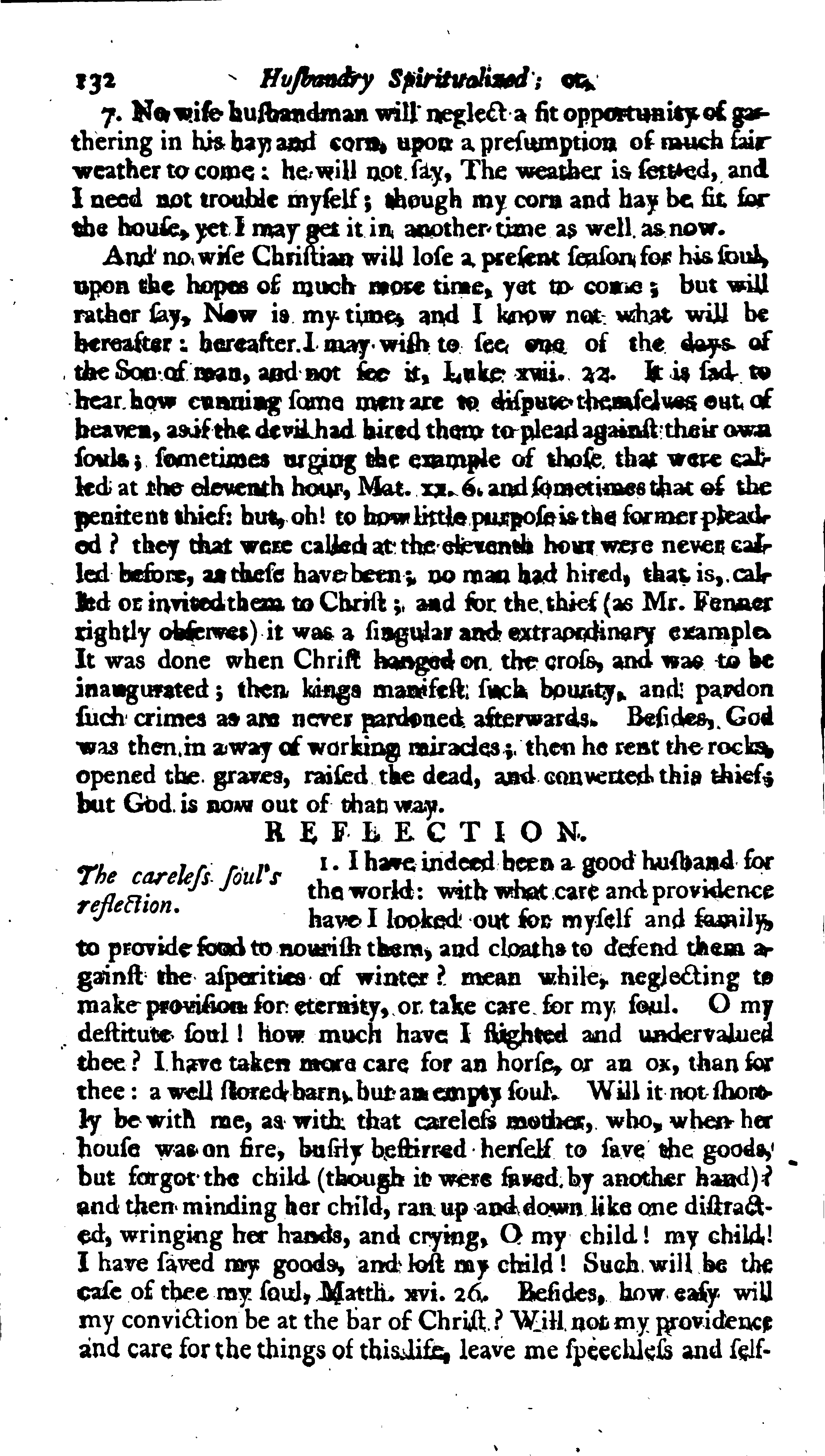
Husbandry Spiritualized ; or, 7. Nowifehusbandmanwill neglect a fit opportunityofgarthering inhishayand corn, upon a presumption ofmuchfair weather to come : he will not say, The weather is fettted, and I need not trouble myself; though my corn and hay be fit for the house,yet Imayget it in another time as well as now.
And no wife Christian will lose a present season for his foul, upon the hopes of much more time,yet to come ; but will rather say, Now is my time, and I know not what will be hereafter : hereafter. I may wish to fee one of the days of theSonofman, and not fee it, Luke xvii. 22.
It is fad to hear how cunning some men are to dispute themselves out of heaven, as if the devil had hired them topleadagainst their own fouls; sometimes urging the example of those that were called at the eleventh hour,Mat. xx. 6. and sometimes that of the penitent thief: but,oh! tohowhttle purpose is the former pleaded? they that were called at the eleventh hour were never called before, as these have been; noman had hired, that is, cal led or invited them to Christ ; and for the thief(as Mr. Fenner rightly observes) it was a singular and extraordinary example.
It was done when Christ hanged on the cross,and was to be inaugurated; then kings manifest such bounty, and pardon such crimes as are never pardoned afterwards.
Besides,God was then in awayofworking miracles; then he rent the rocks, opened the graves, raised the dead, and converted this thief; but God is now out of that way.
REFLECTION.
1. I have indeedbeenagoodhusband for The careless foul's the world:with what careandprovidence reflection. have I looked out for myself and family, to provide food to nourish them, and cloathsto defend them against the asperities of winter ? mean while, neglecting to make provision for eternity, or take care for my soul. O my destitute foul ! how much have I flighted and undervalued thee ? I have taken more care for an horse, or an ox, than for thee: a well stored barn,but an empty foul.
Will it not shortly be with me, as with that careless mother, who,when her house was on fire, busilybestirred herself to save the goods, but forgot the child(though it were favedby another hand)?
andthenminding her child,ran up and down like one distracted,wringingherhands, and crying, O my child! my child!
I have favedmy goods, and lost my child! Such will be the cafeoftheemy foul, Matth. xvi. 26.
Besides, how easy will my conviction be at the bar of Christ ? Willnotmyprovidence and care for the things of this life, leave me speechless and self-
TheHeavenlyUse of Earthly Things.
condemned in that day? What shall I answer, when the Lord shall say, Thou couldest foresee a winter, and seasonablyprovide for it ; yea, thou hadst so much care of thy very beasts, to provide for their necessities : and why tookeft thou no care for thy soul ? Was that only not worth the caring for ?
2. Is it so dangerous to neglect a present. proper season of grace ? What then have I. done, who have fufferedmany such seasons to die away in my hand, upon a groundless hope of future opportunities ? Ab deluded wretch ! what if that supposition fail ? Where am I then ? I The prefumptuousjoul's reflection. am not the lord of time, neither am I sure, that he who is, willever vouchsafe an hour of grace in old age, to him that hath neglected many such hours in youth ; neither indeed is it ordinary for God so to do.
It is storied ofCaius MariusVictorious, who lived about three hundred years after Christ, and to his old age continued a Pagan; but at last being convinced of the Christiar. verity, he came to Simplicianus, and told him, he would be a Christian; but neither he, nor the church could believe it, it being so rare an example for anytobeconverted at his age: but at last, seeing it was real, there was a shouting and gladness, and singing ofpfalms in all churches ; the people crying, Caius Marius Victor i us is become a Christian ! This was written for a wonder: and what ground have I to think, that God will work such wonders for me,who have neglected his ordinary means of salvation ?
3. Bless the Lord,O my soul ! who gave The industrious thee a season, a day for eternal life, which is foul's reflection. more than he hath afforded for thousands ; yea,bless the Lord forgiving thee an heart to understand and improve that season. I confess I have not improved it as I ought; yet this I can (through mercy) fay, that however it fare in future times with my outward man, though I have no treasures or stores laid up on earth, or if I have, they are but corruptible, yet I have a blessed hope laid up in heaven, Col. i.
5I have bags that wax not old.
Whilst worldlings rejoice in their stores and heaps, I rejoice in these eternal treasures.
The POEM.
Ο Bserve in summer's sultry heat, How in the hottest day The husbandmandoth toil and sweat About his corn and hay :
If then he should not reap and mow, And gather in his store,
Husbandry Spiritualized; or, How should he live, when, for the snow, He can't move out of door ?
The little ants, and painful bees, By nature's instinct led, These have their summer granaries For winter furnished.
But thou, my soul, whose summer'sday Is almost past and gone; What foul-provisiondost thou lay In stock tospendupon ?
If nature teaches to prepare For temporal life, much rather Grace should provoke to greater care, Soul-food in time to gather.
Days of affliction and distress Arehafting on apace ; If now I live in carelesness, How sad will be my case !
Unworthyofthename of man, Who for that foul of thine, Wilt not do that which others can Do for their very kine.
Think, frugal farmers, when you fee Your mows of corn and hay, What a conviction this will be To you another day :
Who ne'erwere up before the sun, Nor break an hour's rest For your poor souls, as you have done So often for a beast.
Learn once to see the difference Betwixt eternal things, And those poortranfient things of sense, That fly with eagle's wings.
CHAP .
XVII.
Upon reaping the same we sow.
When from tare-feeds you fee choice wheat to grow, Then from your lusts may joy and comfort flow .
OBSERVATION.
OD gives to every feed its ownbody, 1 Cor. xv. 38. At firsthecreatedevery treeandherbofthe field,having
The Heavenly Use ofEarthlyThings.
its feedinitself, for the conservation of their species, and they all inviolablyobserve the law of their creation.
All fruits naturally rise out of the feeds and roots proper to them : "Men " do not gather grapes of thorns, nor figs ofthistles :" such productions would be monstrous in nature ; and although the juice or fapofthe earth be the common matter of all kind of fruits,yet it is specificated according to the different forts of plantsandfeeds it nourishes. Where wheat is sown, it isturnedintowheat ; in an apple-tree, it becomes an apple; and fo in every fort of plants or feeds, it is concocted into fruit proper to the kind.
APPLICATION.
Ranslate this into spirituals, and the proposition shadowT ed forth by it, is fully expressed by the apostle,Gal. vi.
What a man sows, that shall he reap : They that sow to " the flesh, shall of the flesh reap corruption ; and they that " sow to the spirit, shall of the spirit reap life everlasting."
And as sure as the harvest follows the feed-time, so sure shall such fruits and effects result from the feeds of such actions .
" He that foweth iniquity, shall reap vanity," Prov. xxii. 8.
" And they that now go forth weeping, and bearing precious " feed, shall doubtless come again rejoicing, bringing their
" sheaves with them," Psalm cxxvi. 6. The sum of all this is, that our present actions have the same respect and relation to future rewards and punishments, as the feed we sow in our fields hath to the harvest we reap from it.
Every gracious action is the feed of joy; and every sinful action, the feed of anguish and forrowtothefoulthat soweth it. Two things are sensibly presented to us in this similitude.
1. That as the feed sown is presently covered from our fight under the clods, and for some time after we seenomore of it, and yet at last it appears again ; by which it is evident to us,that it is not finally lost : So our present actions, though physically transient, and perhaps forgotten, yet are not lost, butafteratime shall appear again, in order to a retribution.
If this were not so, all good and holy actions would be to the loss of him that performed them. All the self-denial, spending duties and sharp fufferingsofthepeopleofGod,would turn to their damage, though not in point of honesty, yet in pointofperfonalutility; and then also,whatdifferencewould there be betwixt the actions of am an and a beast, with respect tofuturegoodor evil ? Yea, man would then be more feared and obeyed than God, and all foulsbe swayed in their motions, onlybytheinfluenceofpresentthings : Andwherethenwould
Husbandry Spiritualized ; or, religion be found in the world? It is an excellent note of * Drexellius ; Our works (faith he) do not pass away as soon
⚫astheyaredone,but as feed sown, shall, after a time, rise up ⚫to all eternity : Whatever we think, speak, or do, once
• spoken, thought, or done, is eternal, and abides for ever."
What Zeuxes, the famous limner said of his work, maybe trulyfaidofall our works ; Aeternitatipingo,I paint for eternity. O, how carefulshouldmen be of what they speak and do whilst they are commanded so to speak and so to do, as those thatshallbejudgedby the perfect law of liberty ! James ii. 12.
What more tranfientthanavain word?And yet for fuchwords, men shall give an account in the dayofjudgment, Matth. xii.
36.
That's the first thing : Actions, like feed, shall rise and appear again in order to a retribution.
2.The other thing held forth in this fimilitude is, that according to the nature of our actions now, will bethe fruit and rewardofthem then. Though the fruit or consequence of holy actions, for the present may seem bitter, and the fruit of sinful actions, sweet and pleasant ; yet there is nothing more certain, than that their future fruits shall be according to their present nature and quality, 2 Cor. v. 10. ThenDionyfius shall retract that saying, Ecce quam profpera navigatioa Deo datur facrilegis, BeholdhowGod favours ourfacrileges ! Sometimes indeed(though but rarely)God causes sinners to reap, in this world, the fame that they have sown ; as hath been their fin, fuchhath beentheirpunishment.
It was openly confefsedby Adonibezek,Judg. i. 7."As I have done, sohathGodrequit "ed me."
Socrates, in his church history, furnishes us with a pertinent passage to this purpose, concerning Valens the Emperor, who was anArian, and a bitter perfecutor of the Christians :
Thisman,when eighty of the orthodox Christians failed from ConstantinopletoNicomedia,totreatwithhim aboutthepoints ofArianism, and to fettle the matter by way of dispute; the Emperor hearing of their arrival, while they were yet in the harbour, and not a man landed, caused the ships to be fired wherein they were,and fo confumedthem all.
Not long after, in his wars against the Goths, he was overthrown ; and hiding himself ina little cottage,the enemy coming by, burnt it and him together.
Thus this wretch reaped what he sowed, burning for burning, the very fame in kind paid him again.
It is not always fo in this world; but so it shall be in * Drexellius de aeternitatepropefinem.
The Heavenly Use of Earthly Things.
that to'come : The tables shall then be turned, and the Scene altered; for shall not the Judgeofalltheworlddorighteoufly?
* Diogenes was tempted to think, that God had cast off the government of the world,when he saw the wickedprofper in their wickedness. On the fame ground many have been tempted to Atheism ; but then the world shall fee distributive justiceshiningoutin its glory, "Tribulation, anguish and wrath
" to every soul of manthatdoth evil ; but glory, honour and " peace to every man thatworketh good," Rom. ii. 9, 10.
Then 'twill appear what feed we sowed,what lives we lived ; " For God shall bring every work into judgment,with every secret thing, whether itbegoodor evil," Ecclef. xii. 14.
REFLECTION S.
1. This meditation maybe tomewhatthe hand-writing uponthewall was tothatproThe profane faneprince,Dan. v. 5, 6. and a like effect it person's reflec fhouldhaveuponme; for if all the actions of this lifebefeedfown for the next, Lord, what a crop,what a dreadful_harvest am I like to have! How many oaths and curses,lies andvainwords,have I sownwith my tongue !How have I wronged, oppressed, and over-reached in my dealings !
Rushed into all profaneness,drunkenness,uncleanness, sabbathtion. breaking, &c. " as the horse rusheth into the battle !" And whatthall Ireapfromfuch feed as this,butvengeanceandfury?
These fins seemed pleasant in the commission, but, oh! how. bitter will it be in their account ? " What shall I do when
" God riseth up; and when he visiteth, what shall I answer " him ?" Job xxxi. 14. Is it not reasonable and just, O my soul! that thou shouldest eat the fruit of thine own planting, and reapwhat thou hast sown ? I thought nothing but profit and pleasure would spring from my lust ; but now I fee it is a root bearing gall andwormwood,Deut. xxix. 18.
Wretched foul! what shall I do ? By these actions am I undone.
I have been the author of mine own ruin, twisted an halter with mine own fingers for the executionofmine own foulO! let me rather taftethebitterness off in,by repentance now, than enjoy its present pleasures, which betray the foul to endless wrath !
2. How have Ialfo been deceived in this Themoralman's matter ? I verily thought that glory and imreflection. mortalitywouldhavebeenthe fruit and pro- * Cum video mala fat a bonis, ignoscite quæfo :
Sollicitor nulle, effe putareDeos. Ovid.
VOL . VE S
Husbandry Spiritualized; or, duct of my moral honesty and righteousness ; that joy and peacehadbeen feminallycontained in those actions ; but now
I see suchfruitcanspring from no other root but special grace.
Glory isdisclofedfrom no other bud but holiness. Alas ! all my planting and sowing was to little purpose, because I sowed not the rightkindoffeed; the best fruit I can expect from this, is but a lesser degree of damnation.
Deluded foul! thy feed is no better than what the moral heathens sowed: And do I expect. better fruit than what they reaped ? Civility without Christ,, is but a freer slavery ; and Satanholds me as fast in captivity by this, as he doth the prophaneby the pleasure of their lusts : Either I must sow better feed, or look to reap bitter fruit.
3.Mean while, bless the Lord,Omy foul!
The holy foul's who enabled thee to sow better feed; who reflection. kept thee watching, humbling thyself, and praying, whilst others have been swearing,drinking and blafpheming: This willyieldthee fruit of joy in the world to come, yea, it already yields present peace to thy conscience : These revenues arebetterthan gold, sweeter than the honey, and the honey-comb; not that such fruits are meritorioufly contained in these actions ; I sowto myself in righteousness, but I reap in mercy, Hos. x. 12.
This is the way in which God will fave and glorify me. O then, let me be ever abounding in the work of the Lord,knowing that my labour shall not be in vain in the Lord.
T The POEM.
Would be a strange and monstrous thing, to fee Cherries orplumbs grow on. an apple-tree.
Who ever gather'd from the thistle,figs?
Or fruitful grapes from off the worthless twigs Of pricking thorns ? In nature still we find
All its productions answering to their kind.
As are the plants we set, or feeds we sow, Such is the fruit we shake, and corn we mow :
And canst thou think, that from corruption's root Thy soul shall pluck the sweet and pleasant fruit
Of spiritual peace ! Whoever, that was wife, A bus'dhimself with such absurdities ?
Look what you sow, the very fame you'll reap, The fruitofwhat you plant, be sure you'll eat.
How are they baffled by a fubtile devil, Who hope for heaven, whilst their ways are evil?