
SERMON VIII.
SERM. VIII.
The Fountain of Life.
SERMON VIII.
Gives an Account of the NATURE OF CHRIST's
MEDIATION.
I TIM. ii. 5. And one Mediator betwixt God and Man, the man Christ Jesus.
GREAT REAT and long preparations bespeak Godisismostholy, Man a lump of iniquity. tremes meet not but by their middle ; sinful man can never have communion with, or enjoyment of the solemnity and greatness of the work for which they are designed: A man that had but seen the heaps of gold, silver and brass, which David amassed in his time, for the building of the temple, might easily conclude before one stone of it was laid, that it would be a magnificent structure.
But lo, here is a design of God as far transcending that, as the substance doth the shadow.
For, indeed, that glorious temple was but the ExGod, but in, and by a Mediator. type and figure of Jesus Christ, John ii. 19,
21. and a weak adumbrationofthat living, spiritualtemplewhich he was to build,cementing the lively stones thereoftogetherwith his own blood, I Pet. ii. 5, 6. that the great God might dwell and walk inf it, 2 Cor. vi. 16.
The preparations for that temple were but of few years, but the consultations and preparations for this were from eternity, Prov. viii. 31. And as there were preparations for this work (which Christ dispatch'd in a few years) before the world began; so it will be matter of eternal admiration and praise, when this world shall be dissolved.
What this astonishing glorious work is, this text will inform you, as to the general nature of it : it is the work of mediation betwixt God and man, managed by the sole hand of the man
Christ Jesus.
In this scripture (for I shall not spend time to examine the words in their contexture) you have a description of Jesus the Mediator ; and he is here described four ways, viz. by his work or office, a Mediator ; by the singularity of his mediation, one Mediator ; and by the nature and quality of his person, imployedin this singular way of mediation, the man'; and lastly, his name, Jesus Christ.
1. He is described by the work, or office he is imployed aVOL . 1.
The Fountain of Life.
SERM. VIII.
bout, Μεσίτες, a Mediator, a middle person. So the word imports a fit, indifferent, and equal person, that comes between two persons that are at variance, to compose the difference and make peace.
Such a middle, equal, indifferent person is Christ; a day's-man, to lay his hand upon both ; to arbitrate and award justly, andgiveGod his due,and that without ruintopoor man.
2. He is described by the singularity of his mediation, one Mediator, and but one.
Though there be many mediators of reconciliation among men, and many intercessors in a petitionary way, betwixt God and man; yet but εις Μεσίτες, one only mediator of reconciliation betwixt God and man : and 'tis as needless and impious to make more mediators than one, as to make more God'sthan one. There is one God, and one Mediator betwixt God and men.
3. He is described by that nature and quality of his person, ανθρωπος χρισος, &c. the man Christ Jesus.
This description of him by one nature, and that the human nature also (wherein, as you shall fee anon, the Lord especially consulted our encouragement and comfort) ; I say, his being so described to us, hath through the corruption of men, been improved to the great dish on our of Jesus Christ, both by theArians and Papists *.
The former took occasion from hence to affirm, that he was butψλος ανθρωπος, a mere man . The latter allow him to be the true God, but on this weak ground affirm, that he performed not the work of mediation as God, but only as man. Thus what the Spirit ordered for our comfort, is wickedly retorted to Christ's dish on our: for I doubt not but he is described by his human nature in this place; notonlybecause in this nature he paid that ransom (which he speaks of in the words immediately following) but especially for the drawing of sinners to him ; feeinghe is the manChrift Jesus, one that cloathed himself in their own flesh ; and to encourage the faith of believers, that he tenderly resents all their wants and miseries, and that they may safely trust him with all their concerns, as one that will carefully mind them'as his own, and will be for them a merciful and faithful High Priest, in things pertaining to God.
4. He is described by his names; by his appellative name Christ, and his proper name Jesus .
The name Jesus, notes his work about which he came; and Christ, the offices to which he
* Wherefore, think ye, has he added the term, man ; but to express that nature, whereby Christ is mediator. Bellarmineon the Mediation of Christ, book V. chap. 3. vol. 2.
SERM. VIII.
The Fountain of Life. was anointed; and in the execution of which he is our Jesus t.
" In the name Jesus, the whole gospel is hid; it is the light, " the food, the medicine of the soul," as one speaks. The note from hence is, Doct . That Jesus Christ is the true and only Mediator betwixt
Godandmen.
"Ye are come to Jesus the Mediator of the new covenant,"
Heb. xii. 24. " And for this cause he is the Mediator of the new " Testament," &c. Heb. ix. 14.
I might shew you a whole vein of scriptures running this way; but to keep a profitable and clear method, I shall shew, First, What is the sense of this word Μεσιτες, a Mediator ‡.
Secondly, What it implies, as it is applied to Christ .
Thirdly, How it appears that he is the true andonlyMediator betwixt God and men .
Fourthly, In what capacity he performed his mediatory work .
First, What is the sense and import of this word μεσιτες, a Mediator ? The true sense and importance of it, is a middlePerfon, or one that interposes betwixt two parties at variance, to make peace betwixt them.
So that as Satan is medium disjungens, a medium ofdifcord; so Christ is medium conjungens, a medium ofconcord and peace. And he is such a Mediator, both in respect of his person, and office: in respect of his person, he is a Mediator; that is, one that hath the same nature both with God and us, true God, and true man; and in respect of his Office or work, which is to interpose to transact the business ofreconciliationbetweenus and God. Theformerforme callhisfubftantial, the latter his energetical, or operative mediation.
Though I rather conceive that which is calledhissubstantial mediation, is but the aptitude of his person to execute the mediatorial function; and that it doth not constitute two kinds of mediation.
+ In no mine JESU totum latet Evangelium ; hoc nomen eft lux, cibus, et medicina animae.
S. Glass i us.
† We call one, a Mediator, who interposes either between parties at variance, or in some degree only united, so as to reconcile the one, and unite the other more strictly by a new covenant. The name of Mediator, in its proper signification, is not the name ofa substance, but the name of an office or employment; wherefore, the substance and execution of the office do not constitute two kinds of mediation, butone and the fame. Ames. Bell arm. Enerv. lib.V.
P. 117.
The Fountain of Life.
SERM.VIH His being a middle person, fits and capacitates him to stand in the midst betwixt God and us . This, Hay, is the proper sense of the word; though μεσιτες, a Mediator is rendered variously ; sometimes an umpire or arbitrator ; sometimes a messenger that goes betwixt two persons ; sometimes an interpreter, imparting the mind of one to another ; sometimes a reconciler or peace-maker. And in all these senses Christ is the Mεσιτες, themiddleperson in his mediation of reconciliation or interceffion; that is, either in his mediating, by suffering to make peace, as he did on earth ; or to continue, and maintain peace, as he doth in heaven,by meritorious interceffion. Both these ways he is the only
Mediator.
And he manageth this his mediation .
1. As an umpire or arbitrator ; one that layeth his hands upon both parties, as Job speaks, chap ix. 33. so doth Christ,he layeth his hands (speaking after the manner of men) upon God, and faith, Father, wilt thou be at peace with them, and re-admit them into thy favour ? if thou wilt, thou shalt be fully satisfied for all that they have done against thee. And then he layeth his hand upon man, and faith, Poor sinner, be notdifcouraged, thou shaltbejustified and saved.
2. As a messenger or ambafsfador, so he came to impart the mind of God to us, and fo he presents our desires to God; and in this sense only Socinus would allow Christ to be Media tor .
But therein he endeavours to undermine the found a. tion, and to exclude him from being Mediator by a furetiship;
Which is, 3. The third way of his mediation. So the apostle speaks, Heb. vii. he is syfuos †, the surety, or pledge. Which, as the lear nedDavidPareus well expresseth it, is one that engageth to fatisfyanother, or gives caution or security by a pledge in the hand for it.
And indeed, both these ways, Christ is our mediator by furetiship, viz in away of satisfaction, coming under our obligation to answer the law ; this he did on the cross and in away of caution, a surety for the peace, or goodbehaviour. But to be more explicate and clear, I shall, * Christ is called a Mediator, both as he is a middle person, and ashe is one who mediates ; he is middle in person ; he mediates,by office.
Trelcat. Instit . p. 98 .
† Μεσίτης, An Umpire, Arbitrator, amidsman, areconciler.
* Ἔγδυος [Egguos] is a surety, one that engages for another, by pledge in hand.
From ", [guion] which signifies hand, and v [en] in, as if it were, εν γυιοις, in hand ; or, as Suidas would have it, from yun. [guo] οι γαια [gaia] the earth, which is firm, stable, immoveable.
SERM. VIII.
The Fountain of Life.
Secondly, In the next place enquire, what it implies and carries in it, for Christ to be a Mediator betwixt God and us. And there are, mainly, these five things in it.
: 1. At the first fight, it carries in it a most dreadful breach and jarbetwixtGodand men ; else no need of a Mediator of reconciliation. There was indeed a sweet league ofamity once between them, but it was quickly diffolvedby fin ; the wrath of the Lord was kindled against man, pursuing him to destruction, Psal. v.
5. "Thou hateft all the workers of iniquity."
And man was filled with unnatural enmity against his God, Rom. i. 30. θεουSas, haters of God; this put an end to all friendly commerce and intercourse between him and God.
Reader, faynot in thy heart, that it is much, one fin, andthatseeminglysosmall, should make such a breach as this, and cause the God of mercy and goodness so to abhor the works of his hands, and that as soon ashe had made man : for it was a heinous and aggravated evil.
It was upright, perfect man, created in the Image of God, that thus finned: he finnedwhen his mind was most bright, clear and apprehensive; his conscience pure and active; his will free, and able to withstand any temptation; his conscience pure and undefiled ; he was a public as well as a perfect man, and well knew that the happiness or misery of his numberless offspring was involved in him.
The condition he was placed in, was exceeding happy : no necessity or want could arm and edge temptation : he lived amidst all natural and spiritual pleasures and delights, the Lord most delightfully converfingwithhim; yea, he sinned while as yet his creation-mercy was fresh upon him; and in this sin was most horrible ingratitude; yea, a casting off the yoke of obedience almost as soon as God had put it on. God now saw the work of his hands spoiled, a race of rebels now to be propagated, who in their successive generations would be fighting against God: he saw it, and his just indignation sparkled against man, and resolves to pursue him to the bottom of hell.
2. It implies, a necessity offatisfaction and reparation to the justice of God : For the very design and end of this mediation was to make peace, by giving full satisfaction to the party that was wronged.
The Photinians, and some others, have dreamed of a reconciliation with God, founded, not upon satisfaction, but upon the absolute mercy, goodness, and free will of God.
" But concerning that absolute goodness and mercy of God, " reconciling sinners to himself, there is a deep silence through-
The Fountain of Life.
SERM. VIIL
" out the scriptures *:" and whatever is spoken of it, upon that account, is as it works to us through Christ, Eph . i. 3, 4,
5. Acts iv. 12. John vi. 40. And we cannot imagine, either how God could exercise mercy to the prejudice of his justice, which must be, if we must be reconciled without full satisfaction † ; or how such a full satisfaction should be made by any other than Christ.
Mercy, indeed, moved in the heart of God to poor man ; but from his heart it found no way to vent itself for us, but through the heart-blood of Jesus Christ : and in him the justice of God was fully satisfied, and the misery of the creature fully cured. And so, as † Augustine speaks, "God
" neitherloft the severity of his justice in the goodness of mercy, " nor the goodness of his mercyintheexactness of his severity."
But if it had been possibleGodcould have found out away to reconcile us without satisfaction, yet it is past doubt now, that he hath pitched and fixed on this way. And for any now to imagine to reconcile themselves to God by jany thing but faith inthebloodofthis Mediator, is not only most vain in itself, and destructive to the soul, but most insolently derogatory to the wisdom and grace of God.
And to such I would say, as § Tertullian to Marcion, whom hecallsthemurderer of truth, " spare the only hope of the whole
" world,Othou who destroyest the most necessary glory of our " faith !" All that we hope for is but a phantasm without this.
Peace of conscience can be rationally settled on no other foundation but this: for God having made a law to govern man, and this law violated by man; either the penalty must be levied on the delinquent, or satisfaction made by his surety. As good no law, as no penalty for disobedience; and as good no penalty, as no execution. He therefore that will be a media. tor of reconciliation betwixt God and man, must bring God a price in his hand, and that adequate to the offence and wrong done him, else he will not treat about peace; and so did our
Mediator.
* De abfoluta enim bonitate, et voluntatesalvandi, fcriptura magis muta eft quam piscis.
Dieteric.
† From these positions, it follows, that neither the perfect nature nor perfect justice of God can allow any transgression of the law to pass without full satisfaction.
Bradshaw on Justification, p. 68.
‡ Nec in bonitate mifericordiae perdit judiciiseveritatem ; nec in judicando cum feveritate amittit mifericordiae benitatem.
Aug. in Psal. 100.
§ Parce unicae spei totius orbis, O tu qui destruis neceffarium decusfidei.
Tertul. lib. de Carne Chrifti.
SERM. VIII.
The Fountain of Life.
3. Christ beingaMediator of reconciliationandinterceffion, implies the infinite value of his blood and sufferings, as that which in itself was sufficient to stop the course of God's Justice, and render him not only placable, but abundantly satisfied and well pleased, even with those that before were enemies. And so much is said of it, Col. i. 21, 22. " And ye that were sometimes a lie- " nated, and enemies in your minds by wicked works,yet now
" hath he reconciled, in the body of his flesh through death, to present you holy, andunblameable, and unreproveable in his
fight ."
Surely, that which can cause the holy God, justly incented against sinners, to lay aside all his wrath, and take an enemyintohis bosom, and establish such an amity as can never more be broken, but to rest in his love, and to joy over him with singing, as it is, Zeph. iii. 17. this must be a most excellent
" and efficacious thing.
4. Christ's being a Mediator of reconciliation, implies the ardent love and large pity that filled his heart towards poorfinners.
For he doth not only mediatebyway of in treaty, going betwixt both, and persuading and begging peace ; but he mediates (as you have heard) in the capacity ofa surety, by putting himself under an obligation to satisfy our debts. O how compaffionately did his heart work towards us, that when he saw the arm of Justice lifted up to destroy us, would interpose himself, and receive the stroke, though he knew it would smite him dead! Our Mediator, like Jonah his type,seeing the stormy sea of God's wrathworkingtempestuously, and ready to swallow us up, cast in himself to appease the storm.
I remember how much that noble act of Marcus Curtius is celebrated in the Roman story, who being informed by the oracle, that the great breach made by theearthquakecould not be closed, except something of worth were cast into it, heated with love to the commonwealth, he went and cast in himself. This was looked upon as a bold and brave adventure.
But what was this to Christ ?
5. Christ being a Mediator betwixt God and man, implies as the fitness of his person,so his authoritative call to undertake it .
And indeed the Father, who was the wronged person, called him tobetheumpire and arbitrator, trusting his honour in his hands.
Now Christ was invested with this office and power virtually, soon after the breach was made by Adam's fall; for we have the early promise of it, Gen. iii. 15. Ever since, till his incarnation, he was a virtual and effectual Mediator ; and, on that account, he is called " the Lamb slain from the beginning of the world,"
Rev. xiii. 8. And actually, from the time of his incarnation.
But having discussed this more largely in a former discourse, I
$20
SERM. VIII.
The Fountain of Life. shall dismiss it here,and apply myself to thethirdthingproposed, which is, Thirdly, How it appears that Jesus Christ is the true and only Mediator betwixt God and men.
I reply, it is manifest he is so, 1. Because he, and no other, is revealed to us by God : And if God reveal him, and no other, we must receive him, and no other as such.
Take but two scriptures at present, that in t Cor. viii. 5. " The heathen have many gods,and many lords," i. e. many great gods, supreme powers and ultimate objects of their worship ; and left these great gods should be defiled by their immediate and unhallowed approaches to them, they there fore invented heroes, deini gods, intermediate powers *, that were to be as agents, or lord-mediators betwixt the gods and them, to convey their prayers to the gods, and the blessings of the gods back again to them. "But unto us(faith he) there is
" but one God, the Father, of whom are all things, and we by " him," i. e. one supreme essence, the first spring and fountain of blessings, and one Lord, i. e. one Mediator, " by whom are
" all things, and we by him." By whom are all things which come from the Father to us, and by whom are all our addresses to the Father: So Acts iv. 12. " Neither is their salvation in "
66 any other ; for there is none other name under heaven given among men, whereby we must be saved."
No other name t. i. e. no other authority, or rather, no other person authorized under Heaven, i. e. the whole world for heaven is not here opposed to earth, as though there were other intercessors in hea venbesides Christ ; no, no, in heaven and earth God hath given him, and none but him, to be our Mediator.
One fun is sufficient for the whole world; and one Mediator for all men in the world.
So that the scriptures affirm this is he, and exclude all others .
2. Because he, and no other, is fit for, and capable of this office.
Who but he that hath the divine and human nature united in his single person, can be a fit day's-man to lay his hand
All the intercourse and communion between the Gods and men is by means ofdemi-gods.
Plut .
+Ὄνομα ἕτερον, [Onoma heteron] Other name, i. e. Other power, or authority of any whatever.
By name, the thing itself is un derstood, even Christ himself; ὑπο τον έρανον [hupo ton our an on] under heaven, that is, any where ; for heaven is not here opposed to earth, as if there were other saviours besides Christ in heaven, but not on earth : but in the Hebrew the expression is apleonafm.
Beza on this place.
SERM. VIIN.
The Fountain of Life.
upon both ? who but he that was God, could support under such sufferings as were, bydivinejustice, exacted for satisfaction! Take a person of the greatest spirit, and put him but an hour in the case Christ was in, when he sweat blood in the garden, or uttered that heart rending cry upon the cross, and he had melted under it as a moth .
3. Because he is alone iufficient to reconcile the world to God by his blood, without accessions from any other.
The virtue of his blood reached back as far as Adam, and reaches forward to the end of the world ; and will be as fresh, vigorous, and efficacious then, as the first moment it was shed.
The fun inakesday before it actually rises , and continues day to us sometimes after it is set: so doth Christ, who is the same yesterday, to day, and for ever; so that he is the true and only Mediator betwixt God and men: no other is revealed in scripture; no other sufficient for it; no other needed beside him.
Fourthly, The last thing to be explained is, in what capacity he executed his mediatory work.
About which we affirm, according to scripture, that he performs that work as God-man, in both natures||.
Papifts, in denying Christ to act as Mediator, according to his divine nature, do at once spoil the whole mediation of Christ of all its efficacy, dignity and value, which arise from that nature, which they deny toco operate, and exert its virtue in his active and passive obedience.
They say, the apostle, in my text, diftinguithestheMediator from God, in saying" thereisoneGod,
" and one Mediator." We aptly reply, that the same apostlediAinguishes Christ from man,Gal. i. 1. " Not by man, but by
" Jesus Christ ."
Doth it thence follow that Christ is not true man? Or that according to his divine nature only, he called
Paul ? Butwhatneed I stay my reader here ? Had notChrift, as Mediator, power to lay down his life, and power to take it up again? John x. 17, 18.
Had he not, as Mediator, all power in heavenandearth to institute ordinances, and appoint officers
Mat. xxviii . 18. tobaptizemenwith theHolyGhostandfire ?Mat.
‡ The fun, before he is seen, illuminates the world.
The divine, without the human nature, or the human nature withoutthedivine, is not mediatorial ; but between the divine alone, andthehumannature alone, the human divinity, and divine humanity is mediatorial. Aug. Hom . 2.
The appellations respecting his office, are due to Christ accordingtoboth natures. Ames. Bell am. chap.5.
VOL. I.
The Fountain of Life.
SERM . VIII.
iii. 11. to keep those his Father gave him in this world ? John xvii. 12. to raise up the saints again in the last day ? Johnvi.
54.
Are these with many more I might name, the effects of 'the mere human nature ? Or, were they not performed by him as God man and besides, how could he, as Mediator, be the object of our faith, and religious adoration, if we are not to respect him as God-man ? But I longnowto be at the application of this: and the first inference from it, is this,
-Inference 1.
That it is a dangerous thing to reject Jesus Christ, the only Mediator betwixt God and man.
Alas! there is no other to interpose and skreen thee from the devouring fire, the everlasting burnings ! O it is a fearful thing tofallinto the hands of the living God! And into his hands you must needs fall, without an interest in the only Mediator. Which of us candwellwith devouring fire ? Who can endure the everlasting burnings ? Ifa. xxxiii. 14. You know how they singed and scorched the green tree, but what would they do to the dry tree ? Luke xxiii. 31.
Indeed, if there were another plankto save after the shipwreck ; any other way to be reconciled to God, beside Jesus the Mediator, fomewhatmight be said to excuse this folly; but you are hut up to the faith of Christ, as to your last remedy, Gal , iii. 23 .
You are like starving beggars, that are come at the last door. O take heed of despising, or neglecting Christ ! if so, there's none to intercede with God for you; the breach betwixt him and you can never be composed.
I remember, here, the words of Eli, to his prophane sons,who caused men to abhor the offerings of the Lord, I Sam il. 25. " If oneman finagainst another, the " Judge shall judge him ; but ifa man sin against the Lord,
" who shall intreat for him ?" the meaning is, commontrefpafses betwixtmen, the civil magistrate takes cognizance of it, and decides the controvesy by his authority, so that there is an end of that strife; butifman fin against the Lord, who shall intreat or abitrate in that case ? Eli's sons had despised the Lord's sacrifices *, which were the sacred types of Christ, and the stated way thatmen had then to act faith on the Mediator in. Now (faith he) if am an thus fin against the Lord, by despising Christ shadowedoutinthat way, who shall intreat for him ? what hope, what remedy, remains ?
I remember, it was the saying of Luther, and he spake it with * They had trampled on sacrifices, and all the laws of God : and thus, as far as in them lay, had taken away all relief and means of safety.
S. Grotius on this place.
SERM . VIII.
The Fountain of Life.
deep resentment, Nolo Deum abfolutum, " I will have nothing to " do with an absolute God," i. e. with God without a Mediator.
Thus the Devils have to do with God: but will ye, in whose nature Christ is come, put yourselves into their state and case? God forbid!
Inference 2.
Hence also be informed,how great an evil it is tojoinany other Mediators, eitherofreconciliation, or meritorious interceffion, with Jesus Christ .
O this is a horrid fin, and that which both pours the greatest contempt upon Christ, and brings the surest and forest destruction upon the sinner ! I am ashamed my pen should english what mine eyes have seen in the writings of Papists, ascribing as much, yea, more to the mediation of Mary than to Christ, with no less than blasphemous impudence, thus commenting upon scripture : "What is that which the Lord faith, I " have trod the wine-press alone, and of the people there was
" no man with me ? True Lord, there was no man with thee, " but there was a woman with thee, who received all these
" wounds in her heart which thou receivedst in thy body. "
I will not blot my paper with more of this, but refer the learned reader as under *, wherehemay (if he have a mind to see more) be informed, not only whatblafphemy hath dropped from finglepens, but even from councils, to the reproachofJesus Christ, and his blood..
How do they stamp their own sordid works with the peculiar dignity and value of Christ's blood; and therein seek to enter at the gate which God hath shut to all the world, because Jesus
Christ the prince entered in thereby, Ezek. xliv. 2, 3. He entered into heaven in a direct immediate way, even in his own name, and for his own sake ; this gate, faith the Lord, shall be hutto all others : and I wish men wouldconfider it, and fear, left while they seek entrance into heaven at the wrong door, they do not for ever shut against themselves the true and only door of happiness.
Inference 3.
If Jesus Christ be the only Mediator of reconciliation betwixt God and men ; then reconciledfoulsshould thankfully aScribe all the peace, favour, and comforts they have from God,
* Mariale Argentinense, lib. I. chap. 4. sol. 13.
Vincent.
Brun. in meditat. fest. B. Virgin is, Colon. 1559. p. 11.
Liber Cantionum Dilinga, An no 1573. Concil. Trident. Seff. 25. Pfalt.
Maria, An no 1573. ρ. 29.
The Fountain of Life.
SERM. VIII.
to their Lord Jesus Christ.
Whenever you have had free admission, and sweet entertainment with God in the more public ordinances, or private duties of his worship ; when you have had his smiles, his seals, and with hearts warmed with comfort, are returning from those duties, say, O my toul, thou mayeftthank thy good Lord Jesus Christ for all this ! had no the interpoled as a Mediator of reconcilation, I could never have had access to, or friendly communion with God to all e ternity.
Immediately uponAdam's sin the door of communion with God was locked, yea, chained up, and no more coming nigh the Lord: not a soul could have any access to him, either in away of communion in this world, or of enjoyment in that to come.
It was Jesus the Mediator that opened that door again, and in him it is that we have boldness, and access with confidence,
Eph. iii. 12. " We can now come to God by anew and living " way, consecrated for us through the vail, that is to fay, his
" flesh," Heb. x. 20.
The vail had a double use, as Christ's Aesh antwerablyhath: it hid the glory of the Sanctum Sanciorum, and altogave entrance into it. Christ's incarnation rebates the edge of thedivineglory and brightness,that we maybe able to bear it and converse with it; anditgivesadmission into it also. O thank your dear Lord Jesus for your present and future heaven ! these are mercies which daily emerge out of the ocean of Christ'sblood, and come swimming in ittoourdoors. BieffedbeGod for Jesus Christ!
Inference4.
If Jesus Christ be the true and only Mediator,both of reconciliation and meritorious interceffionbetwixtGod and men, how fafeandfecure then is the condition and state of believers ? Surely,as his mediation,by sufferings,hath fully reconciled, fo his mediation, byinterceffion,will everlastingly maintain that state of peace betwixt them and God, and prevent all future breaches.
" Beingjuftified by faith, we havepeacewithGod,through our " Lord Jesus Christ," Rom v. 1.: it is a firm andlaftingpeace, and the Mediator that made it, is now in heaven to maintain it for ever, and preventnewjars; Heb. ix. 24. " There to appear
" in the presence of God for us;" according to the custom of princes and states,who,being confederated, have their agents residing in each others courts , who upon all occasions appear in theprefenceofthe prince, in the name and behalfofthosewhom they represent, and negotiate for.
And here it is proper to reflect upon the profound, and incomprehensible wisdom of God, who hath made an advantage
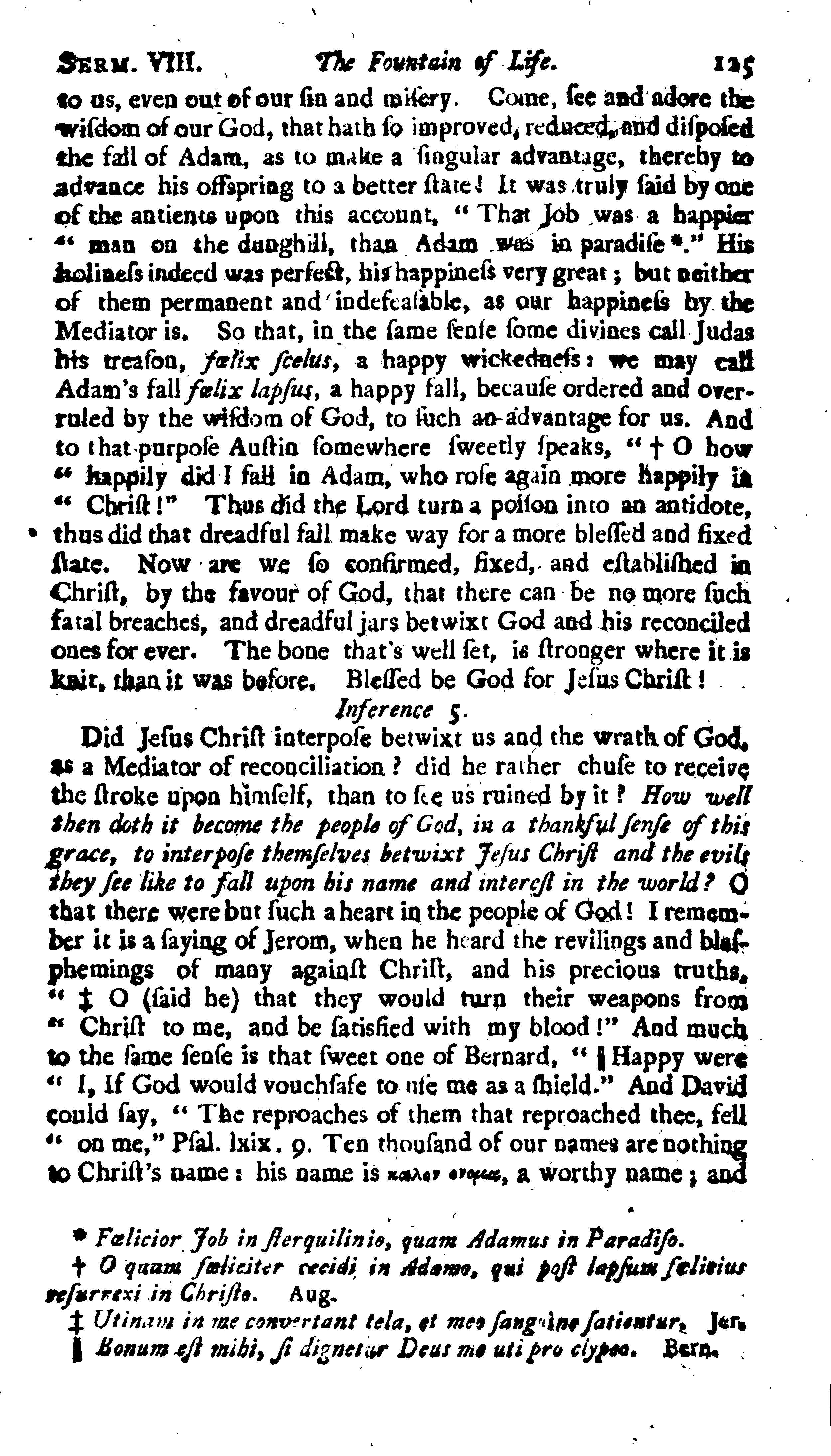
SERM. VIII.
The Fountain of Life.
to us, evenoutofour fin and misery.
Come, see and adore the wisdomofourGod, that hath so improved, reduced,and disposed the fall of Adam, as to make a singular advantage, thereby to advance his offspring to a better state! It was truly faidbyone of the antients upon this account, "That Job was a happier man on the dunghill, than Adam was in paradise *." His holiness indeed was perfect, his happiness very great; but neither of them permanent and indefeasable, as our happiness by the Mediator is .
So that, in the same sense some divines call Judas his treason, fælix fcelus, a happy wickedness : we may call
Adam's fallsælix lapfus, a happy fall, because ordered and overruled by the wisdom of God, to such an advantage for us. And to that purpose Austin somewhere sweetly speaks, " to how
"happily did I fall in Adam,who rose again more happily in " Christ !"
Thus did the Lord turnapoison into an antidote, ⚫thusdidthat dreadful fall make way for a more blessed and fixed state.
Now are we so confirmed, fixed, and established in Christ, by the favour of God, that there can be no more such fatal breaches, anddreadfuljars betwixt God and his reconciled ones forever. The bone that's well set, is stronger where it is knit, than it was before.
Blessed be God for Jesus Christ!
Inference 5.
Did Jesus Christ interpose betwixt us and the wrathofGod, as a Mediator of reconciliation ? did he rather chuse to receive the stroke upon himself, than to see us ruined by it ? How well then doth it become the people of God, in a thankfulfense of this grace, to interpose themselves betwixt Jesus Christ and the evils they fee like to fall upon his name and interest in the world? O that there werebutsuch a heart in the people of God ! I remember it is a saying ofJerom,when he heard the revilings andblafphemings of many against Christ, and his precious truths,
" ‡ O (said he) that they would turn their weapons from " Christ to me, and be satisfied with my blood!" And much to the same sense is that sweet one of Bernard, "|| Happy were
I,If God would vouchsafe tonie me as a shield." And David could say, " The reproaches of them that reproached thee, fell on me," Psal. lxix. 9. Ten thousand of our names are nothing to Christ's name : his name is καλον όνομα, a worthy name; and * Felicior Job infterquilinio, quam A dam us inParadifo.
+ O quam fœliciter cecidi in Adamo, qui post lapfumfelicius refurrexi in Chrifto.
Aug.
†Utinam in me convert ant tela, et merfanguinefatientur. Jer.
Bonum est mihi,fidignetur Deusme utipro clypea.
Bern.