
SERMON XV.
SERM . XV
The Fountain of Life.
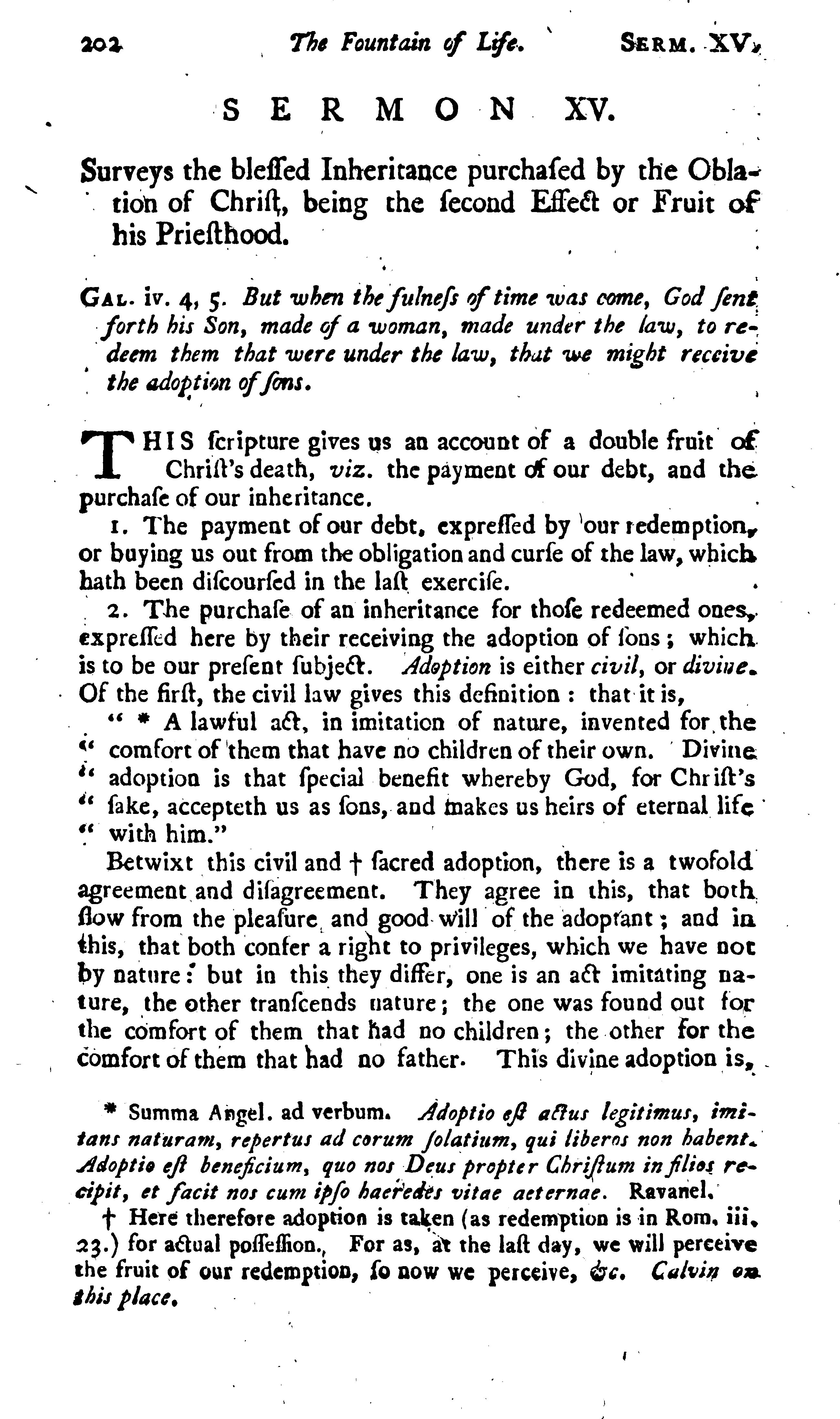
SERMON XV.
Surveys the blessed Inheritance purchased by the Oblation of Christ, being the second Effect or Fruit of his Priesthood.
GAL. iv. 4, 5. But when thefulness of time was come, Godfent forth his Son, made of a woman, made under the law, to redeem them that were under the law, that we might receive the adoption offons.
THIS scripture gives us an account of a double fruit of Christ's death, viz. the payment of our debt, and the purchase of our inheritance.
1. The payment of our debt, expressed by our redemption, or buying us out from the obligation and curse of the law,which hath been difcoursed in the last exercise .
: 2. The purchase of an inheritance for those redeemed ones, expressed here by their receiving the adoption of sons ; which is to be our present subject.
Adoption is either civil, or divine.
Of the first, the civil law gives this definition: that it is, " * A lawful act, in imitation of nature, invented for the " comfort of them that have no children of their own.
Divine " adoption is that special benefit whereby God, for Christ's " fake, accepteth us as sons, and makes us heirs of eternal life
" with him."
Betwixt this civil and † sacred adoption, there is a twofold agreement and disagreement.
They agree in this, that both flow from the pleasure and good will of the adopt ant ; and in this, that both confer aright to privileges, which we have not by nature : but in this they differ, one is an act imitating nature, the other transcends nature; the one was found out for the comfort of them that had no children ; the other for the comfortofthem that had no father.
This divine adoption is, * Summa Angel. adverbum.
Adoptio eft act us legitimus, imitans naturam, repertus ad corum folatium, qui liberos non habent.
Adoptio eft beneficium, quo nos Deus propter Chriftum infilios recipit, et facit nos cum ipso haeredes vitae aeternae.
Ravanel.
† Here therefore adoption is taken (as redemption is inRom, iii, 23.) for actual possession., For as, at the last day, we will perceive the fruit of our redemption, so now we perceive, &c.
Calvin o3. this place.
SERM. XV.
The Fountain of Life.
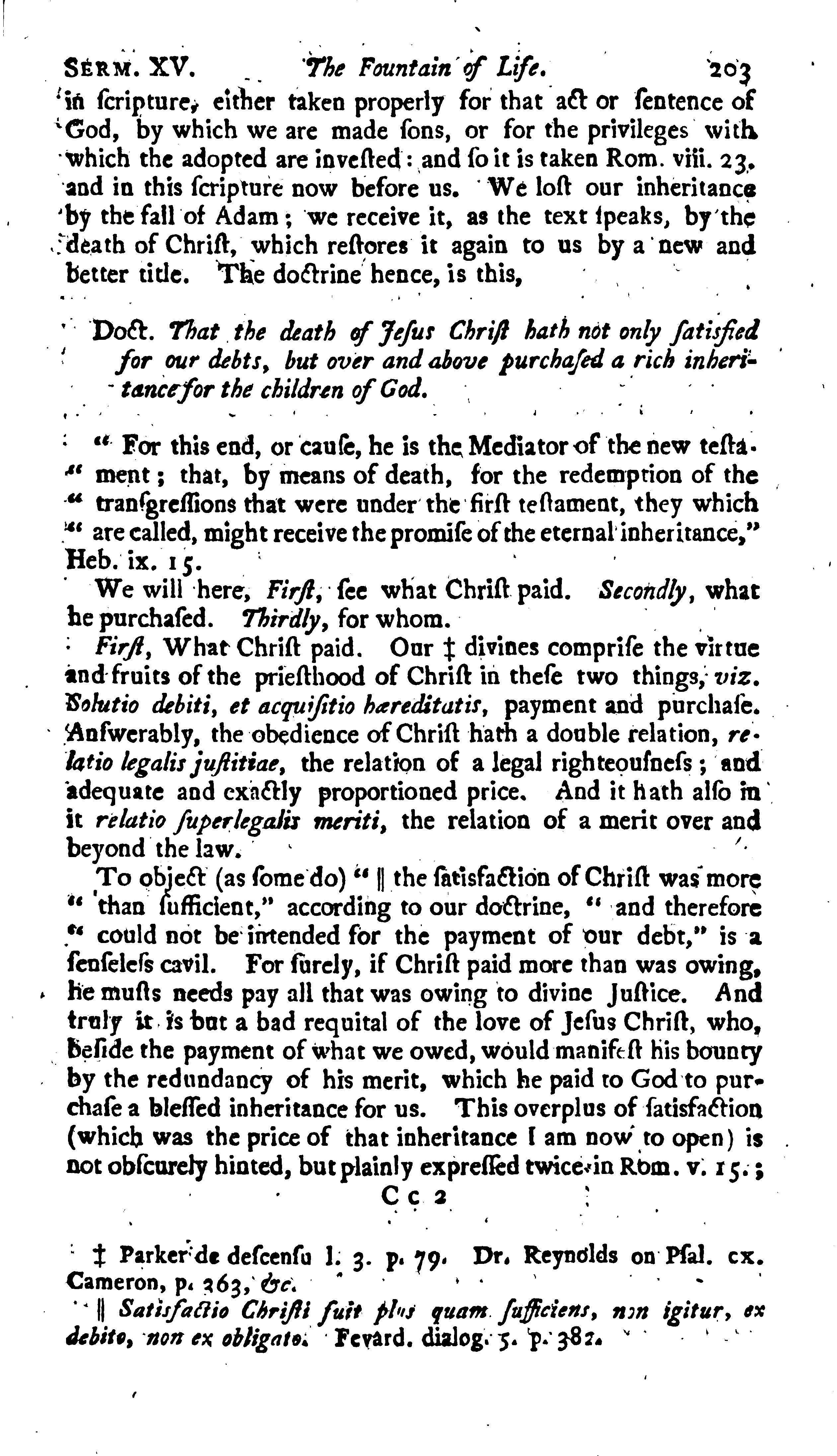
in scripture, either taken properly for that act or sentence of God, by which we are made sons, or for the privileges with which the adopted are invested: and so it is taken Rom. viii. 23. and in this scripture now before us. We lost our inheritance by the fall of Adam ; we receive it, as the text speaks, by the death of Christ, which restores it again to us by a new and better title.
The doctrine hence, is this, Doct. That the death of Jesus Christ hath not only satisfied for our debts, but over and above purchased a rich inheritance for the children of God.
" For this end, or cause,he is the Mediator of the new testa.
" ment; that, by means of death, for the redemption of the " transgressions that were under the first testament, they which " are called, might receivethepromise of the eternal inheritance,"
Heb. ix. 15.
We will here, First, see what Christ paid.
Secondly, what he purchased.
Thirdly, for whom.
First, What Christ paid.
Our ‡ divines comprise the virtue and fruits of the priesthood of Christ in these two things, viz.
Solutio debiti, et acquifitio hæreditatis, payment and purchase.
Answerably, the obedience of Christ hath a double relation, re.
: latio legalisjuftitiae, the relation of a legal righteousness ; and adequate and exactly proportioned price. And it hath also in it relatiofuperlegalis meriti, the relation of a merit over and beyond the law.
To object (as some do) "|| the satisfaction of Christ was more " than sufficient," according to our doctrine, " and therefore
" could not be intended for the payment of our debt," is a senseless cavil.
For surely, if Christ paid more than was owing, hemufts needs pay all that was owing to divine Justice. And truly it is but a bad requital of the love of Jesus Christ, who, beside the payment of what we owed, would manifest his bounty by the redundancy of his merit, which he paid to God to purchase a blessed inheritance for us.
This overplus of satisfaction (which was the price of that inheritance I am now to open) is not obfcurely hinted,but plainly expressed twice inRom. v. 15.;
Cc2 ‡ Parker dedescensu 1. 3. p. 79. Dr. Reynolds on Psal. cx.
Cameron, p . 363, c.
Satisfactio Chrifti suit plus quam fufficiens, non igitur, ex debito, non ex obligato.
Fevard. dialog. 5. p. 382.
SERM. XV.
The Fountain of Life.
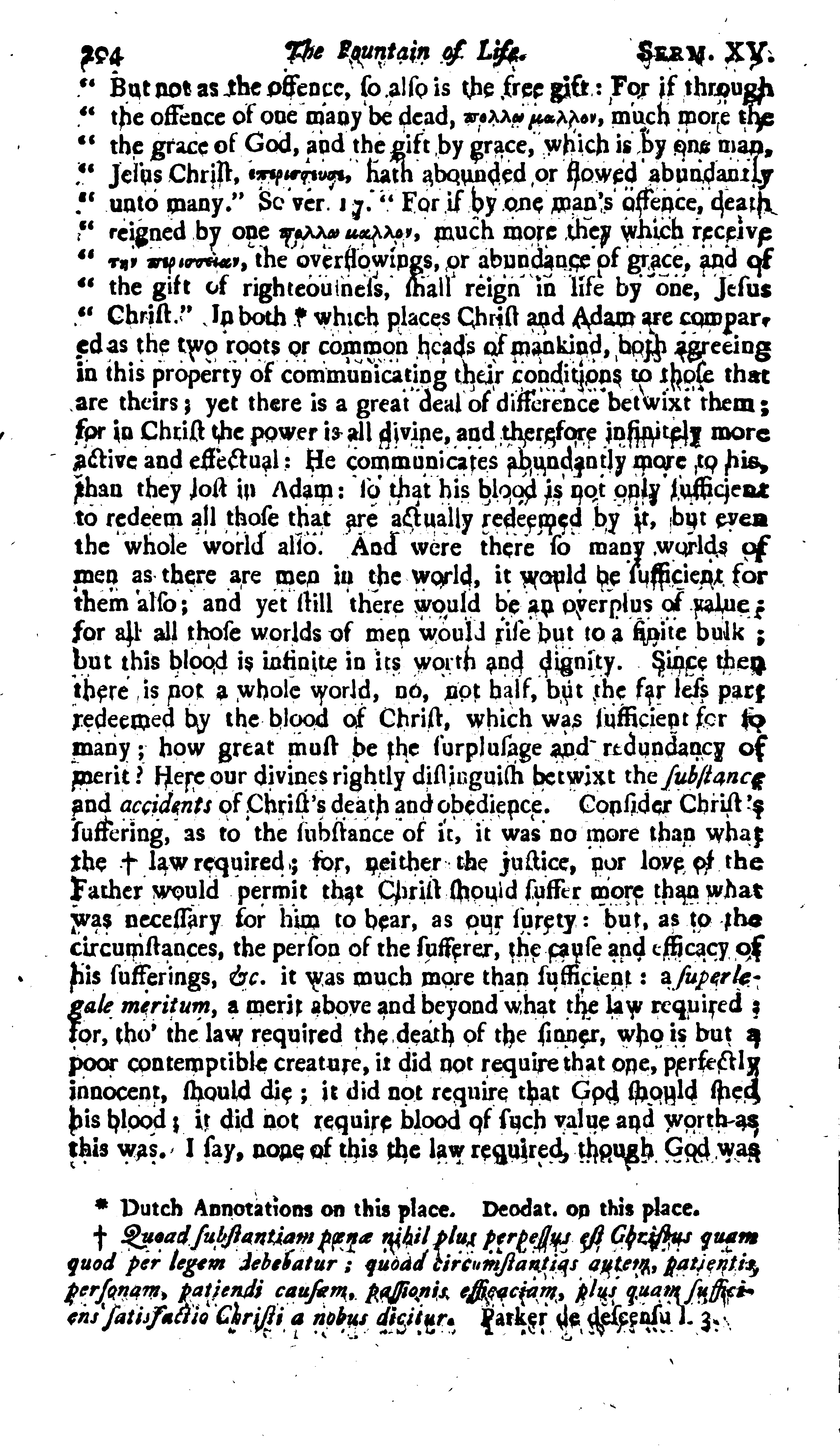
"" But not as the offence, so also is the free gift: For if through the of fence of one many be dead, πολλω μαλλον, much more the the grace of God, and the gift by grace, which is by one man,
" JesusChrift, επερισσευσε, hath abounded or flowed abundantly "
86 unto many." Se ver. 17. " For if by one man's offence,death " reigned by one πολλώ μάλλον, much more they which receive
την περισσειαν, the overflowings, or abundance of grace, and of " the gift of righteouiness, shall reign in life by one, Jesus
" Christ." In both which places Christ and Adam are compar edas the two roots or common heads of mankind, both agreeing in this property of communicating their conditions to those that are theirs; yet there is agreatdeal of difference betwixt them; for in Christ the power is all divine, and therefore infinitely more active and effectual : He communicates abundantly more to his, than they lost in Adam: to that his blood is not only sufficient to redeem all those that are actually redeemed by it, but even the whole world alto. And were there so many worlds of men as there are men in the world, it would be sufficient for them also; and yet still there would be an overplus of value : for all all those worlds of men would rifebut to a finite bulk ; but this blood is infinite in its worth and dignity.
Since then there is not a whole world, no, not half, but the far less part redeemed by the blood of Christ, which was sufficient for fo many; how great must be the furplusage and redundancy of merit ? Hereourdivinesrightly distinguish betwixt the substance and accidents of Christ'sdeath and obedience.
Confider Christ's suffering, as to the substance of it, it was no more than what the law required; for, neither the justice, nor love of the Father would permit that Christ should suffer more than what was necessary for him to bear, as our surety : but, as to the circumstances, the person of the sufferer, the cause and efficacy of his sufferings, &c. it was much more than sufficient : afuperlegalemeritum, a merit above andbeyondwhat the law required : for, tho' the law required the death of the sinner, who is but a poor contemptible creature, it did not require that one, perfectly innocent, should die; it did not require that God should shed his blood ; it did not require blood of such value and worth-as this was. I say, none of this the law required, though God was
*Dutch Annotationsonthisplace.
Deodat. on this place.
+ Quoadfubftantiampænæ nihilplus perpessus eft Ghristus quam quod per legem debebatur ; quoad circumstantias autem, patient is, perfonam, patiendi caufam, passion is efficaciam, plus quamfuffici ensfatisfactio Christi a no bus dicitur.
Parker de descensu 1. 3.
SERM. XV.
The Fountain of Life.
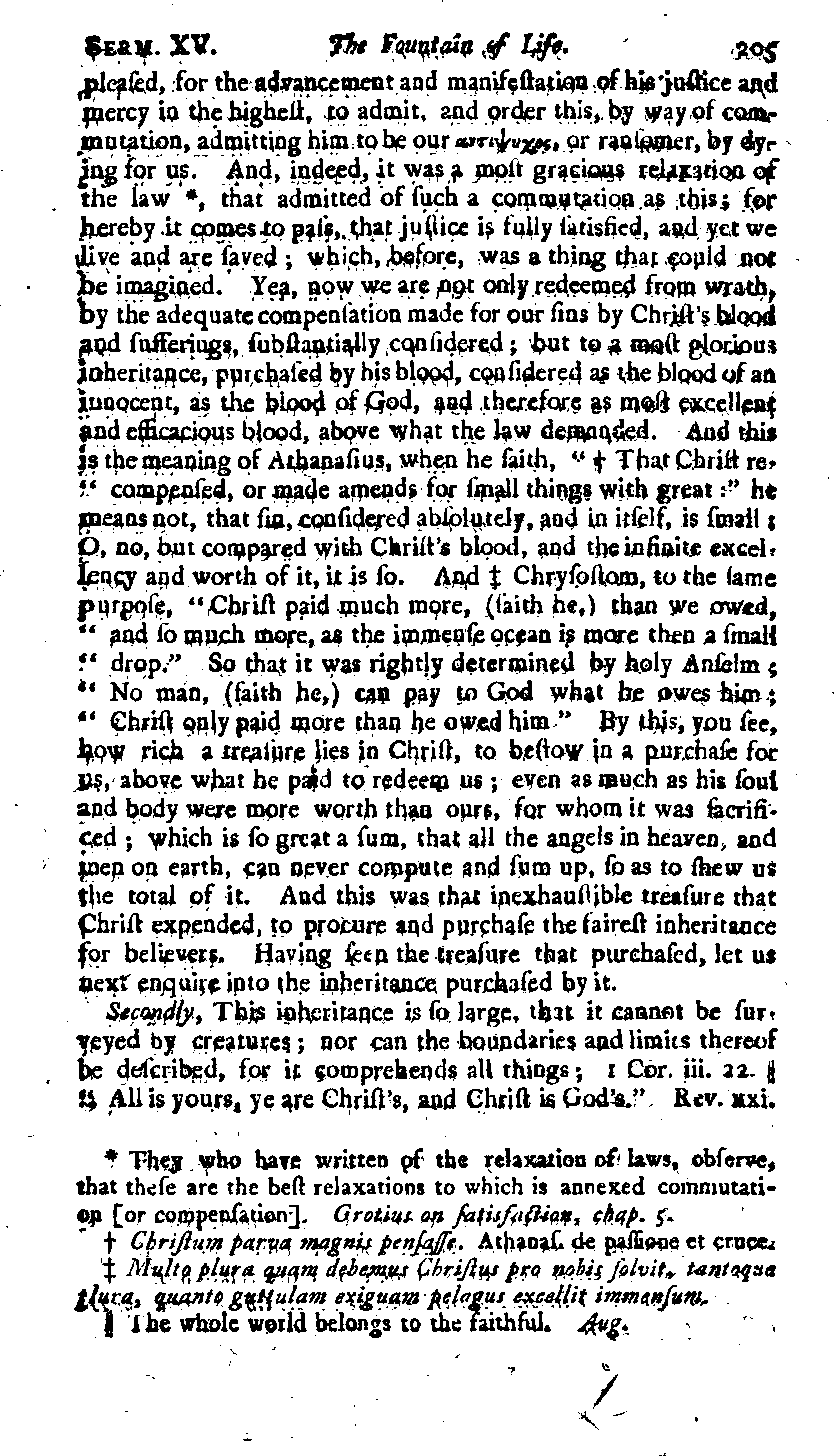
pleased, for the advancement and manifestation of his justice and mercy in the highest, to admit, and order this, by wayofcommutation, admitting him to be our αντιψυχος, or ransomer, by dyr ingforus. And, indeed, it was a most gracious relaxation of the law , that admitted of such a commutation as this ; for hereby it comes to pass, that justice is fully satisfied, and yet we live and are saved ; which, before, was a thing that could not be imagined.
Yea, now we are not only redeemed from wrath, by the adequatecompenfationmade for our fins by Christ'sblood andfufferings, substantially considered ; but to a most glorious inheritance, purchased by his blood, considered as thebloodofan innocent, as the blood of God, and therefore as most excellent and efficaciousblood, above what the law demanded. And this isthemeaningofAthanafius, when he faith, " † ThatChrift re.
" compenfed, or made amends for small things with great :" he means not, that fin,considered absolutely, and in itself, is small ;
O, no, but compared with Christ's blood, and the infinite excel. lencyandworth of it, it is so. And † Chryfoftom, to the same purpose, " Christ paid much more, (faith he,) than we owed, and fomuch more, as the immenseoceanis more then a small
" drop."
So that it was rightly determined by holy Anfelm ; " No man, (faith he,) can pay to God what he owes him;
" Christ only paid more than he owed him " By this, you fee, how rich a treature lies in Christ, to bestow in a purchase for us, abovewhathe paid to redeem us ; even as much as his soul andbodywere more worth than ours, for whom it was sacrificed; which is so great a sum, that all the angels in heaven, and $ nenon earth, can never compute and sum up, so as to shew us the total of it.
And this was that inexhaustible treasure that Christ expended, to procure and purchase the fairest inheritance for believers.
Having seen the treasure that purchased, let us next enquire into the inheritance purchased by it.
Secondly, This inheritance is so large, that it cannot be fur. veyedby creatures ; nor can the boundaries and limits thereof be described, for it comprehends all things ;
1 Cor. iii. 22.|| "All is yours, ye are Christ's, and Christ is God's."
Rev. xxi.
* They who have written of the relaxation of laws, observe, that these are the best relaxations to which is annexed commutation [or compensation].
Grotius on satisfaction, chap. 5- + Chriftum parva magnis penfaffe. Athanaf. de passione et cruce.
†Multo plura quam debemus Christ us pro nobisfolvit, tantoque thura, quantotogut!! guttulam exiguam pelagus excellit immenfum.
The whole world belongs to the faithful. Aug.
The Fountain of Life.
SERM. XV.
7. "He that overcomes shall inherit all things."
And yetI do not think, or say, thatDominiumfundatur ingratia, that temporal dominion is founded in grace: no, that is at the cast and dispose of Providence.
But Christ, by his death, hath restored a right to all things to his people.
But, to be more particular, I shall distribute the saints inheritance, purchased by Christ, into three heads ; all temporal good things, all/piritualgood things, and all eternalgoodthings are theirs.
1. All temporal good things.
I Tim vi. 7. " He hath given " us all things richly to enjoy." ‡ Not that they have the possession, but the comfort and benefit of all things : Others have i the sting, gall, wormwood, baits and snares of the creature ; faints only have the blessing and comfort of it.
So that this little that a righteous man hath, is (in this among other respects) better than the treasures of many wicked : which is the true key to open that dark saying of the apostle, 2 Cor . vi. 10. "As " having nothing, and yet possessing all things :" They only possess, others are possessed by the world.
The saints do uti mundo, et frui deo, " use the world, and enjoy God" in the use of it.
Others are deceived, defiled, and destroyed by the world; but these are refreshed and furthered by it.
2. All spiritual good things are purchased by the blood of Christ for them; as Justification, which comprises remission of fins and acceptance of our personsbyGod: Rom. iii. 24. "Be- " ingjustified freely by his grace, through the redemption that " is in Christ."
Sanctification is also purchased for them ; yea, both initial and progressive sanctification: for of " God, he is
" made unto us, not only wisdom and righteousness, but sancti- " ficationalso," 1 Cor. i. 30.
These two, viz. our justification and fanctification, are two of the most rich and shining robes in the ward-robe of free-grace. How glorious and lovely do they render the soul that wears them ! These are like the bracelets, and jewels Isaac sent to Rebecca.
Adoption into the family of God, is purchased for us by his blood; " Forye are all the chil- " drenofGodbyfaith in Jesus Christ," Gal. iii. 26.
Christ, as he is the Son, is haeres natus, "the heir by nature;" as he is Mediator, he is hacres conftitutus, "theheirbyappointment,"
† Christ merited for us all supernatural good things, and all aids, whether preventing, or subsequent and all those things, though they are things extrinfical to us, which bear the relation of means to our salvation.
Vincent. Auftricens. dehabit. Christ. grat. praelect. q. 5.p. 259
SERM . XV.
The Fountain of Life.
appointed heir of all things, as it is, Heb. i. 2.
By the Sons hip of Christ, we being united to him by faith, become sons ; and if sons, then heirs.
" O what manner of love is this, that " we should be called the sons of God ! " 1 John iii . 1. That a poor beggar should be made an heir, yea, an heir of God, and joint heir with Christ ! Yea, that very faith, which is the bond of union, and consequently, the ground of all our communion with Christ, is the purchase of his blood also : 2 Pet. i. 1. " Το
" them that have obtained like precious faith with us, through " the righteousness of God,and our SaviourJesusChrist.
This most precious grace is the dear purchase of our Lord Jesus Christ: yea, all that peace,joy, andspiritualcomfort, which are sweet fruits of faith, are with it purchased for us by this blood.
So speaks the apostle in Rom. v. 1, 2, 3. " Being justified " by faith, we have peace with God, through our Lord Jesus
" Christ ," &c.
Moreover the Spirit himself, who is the author, fountain, and spring of all these graces and comforts, is procured for us by his death and resurrection : Gal. iii. 13, 14. " Christ
" hath redeemed us from the curse of the law, being made a " Curse for us; for it is written, cursed is every one that hang- " eth on a tree: that the blessing of Abraham might come upon the Gentiles through Jesus Christ, that we might " receive the promise of the Spirit through faith."
That Spirit that first sanctified, and since hath so often sealed, comforted, directed, resolved, guided, and quickned your souls, had not come to perform any of these blessed offices upon your hearts, if Christ had not died.
3. All eternal good things are the purchase of his blood.
Heaven, and all the glory thereof, is purchased for you that are believers, with this price. Hence that glory, whatever it be, is called" an inheritance incorruptible, undefiled, and that fadeth
" not away, reserved in heaven for you :""To the lively hope whereof you are begotten again, " by the resurrection of Christ
" from the dead," I Pet. i. 3, 4.
Not only present mercies are purchased for us, but things to come also, as it is 1 Cor. iii . 22.
Man is a prudent and prospecting creature, and is not satisfied that it is wellwithhim for the present, unless he have fomeaffurance it shall be well with him for time to come. His mind is taken up about what shall be hereafter; and from the good or evil things to come, he raisethup to himself vast hopes or fears.
Therefore to compleat our happiness, and fill up the uttermost capacity of our souls, all the good of eternity is put into the account and inventory of the saints estate and inheritance.
This happiness is ineffable; it is usually distinguished into
SERM. XV.
The Fountain of Life. what is essential, and what is accessory to it. The essentials of it, as we in our embodied estate can conceive, is either the objective, subjective or formal happiness to be enjoyed in heaven.
The objective happiness is God himself, Psal. lxxiii. 25.
" Whom have I in heaven but thee?"
If it could be supposed (faithone) that God should withdraw from the faintsinheaven, and say, Take heaven, and divide it among you ; but as for me, I will withdraw from you; the faintswouldfall weeping in heaven, and say, Lord, take heaven, and give it to whom thou wilt; it is no heaven to us, except thou be there : Heaven would be very Bokim to the saints without God.
In this, our glory in heaven consists, to be ever with the Lord, 1 Theff. iv.
17. God himself is the chief part ofa faint's inheritance; in which sense, as some will understand, Rom. viii. 1. they are called heirs of God.
Thesubjectiveglory and happiness is the attemperation and suiting of the soul and body to God.
This is begun in fanctification, and perfected in glorification. It consists in removing from both all that is indecent, and inconsistent with a state offuch compleat glory and happiness,and infuperinducing and cloathing it with all heavenly qualities .
The immunities of the body are its freedom from all natural infirmities ; which as they come in, so they go out with fin.
Thenceforth there shall be no diseases, deformities, pains, flaws, monftrofities; their good physician death hath cured all this, and their vile bodies shall be made like unto Christ's glorious body, Phil. iii. 21. and be made a spiritual body,
1 Cor. xv.
44.
For agility, like the chariots of Aminadab ; for beauty, as the top of Lebanon ; for incorruptibility, as if they were pure spirits.
The soul also is discharged and freed from all darkness and ignorance of mind, being now able to discern all truths in God, thatchristal ocean of truth.
The leaks of the memory stoptfor ever ; the roving of its fancy perfectly cured; the stubbornness and reluctancy of the will for ever subdued, and retained indue and fullfubjection to God.
So that the saints in glory thall be free from all that now troubles them; they shall never fin more, nor be once tempted so to do, for no serpent hisses in that paradise; they shall never grieve or groan more, for God shall wipe away all tears from their eyes : They shall never be troubled more; for God will then recompense tribulation to their troublers, and to them that are troubled, rest; they shall neverdoubtmore, for fruition excludes doubting.
SERM. XV.
The Fountain of Life.
The formal happiness is the fulness of satisfaction resulting from the blessed sight and enjoyment of God, by a soul fo attempered to him, Psal. xvii. 15. " When I awake I shall be fa- " tisfiedwith thy likeness."
This fight of God, in glory, called the beatifical vision, mustneedsyield ineffable satisfaction to the beholding foul, inasmuch as it will be an intuitive vision.
The intellectual or mental eye, shall fee God, 1 John iii. 2.
The corporeal glorified eye shall fee Christ, Job xix. 26, 27.
What a ravishing vision will this be ! and how much will it exceed all reports and apprehenfions we had here of it ! Surely the one half was not told us. It will be a transformative vision, it will change the beholder into its own image and likeness.
" Weshallbelikehim, for we shall see him ashe is," 1John iii.2.
Asironputintothe fire, becomes all fiery; to the soul,by conversing with God, is changed into his very fimilitude.
It will bean appropriative vision ; " Whom I shall fee for myself," Job xix. 26, 27.
In heaven interest is clear and undoubted; fear is cast out : no need of marks and signs there ; for what a man sees and enjoys, how can he doubt of ? It will be a ravishing vision; these we have by faith are so, how much more those in glory ? How was Paul transported, when he was in a visional waywraptup into the third heaven, and heard the unutterable things, though he was not admitted into the blessed society, but was with them, as the angels are in our assemblies, a stander-by, a looker on, If a spark do so inflame, what is it to lie down like a Phoenix in her bed of spices ! Like a Salamander to live and move in the fire of love! It will also be an eternal vision; vacabimus et videbimus, (as August in said) we shall then be at leisure for this imployment, and have no diversions from it for ever. No evening is mentioned to the seventh day's sabbath; no night in the new Jerusalem. And therefore,
Lastly,It will be a fully satisfying vision : God will then be all in all, Etiam ipfa curiofitas fatietur, " Curiosity itself will
" be latisfied."
The blessed soul will feel itself blessed, filled, satisfied ineverypart.
Ah , what a happiness is here ! to look and love, to drink and sing, and drink again at the fountain head of the highest glory! And if at any time its eye be turned from a direct to a reflex fight upon what it once was, how it was wrought on, how fitted for this glory, how wonderfully distinguished by special grace from them that are howhng in flames, whilst himself is shoutingalouduponhis bed of everlasting rest; all this will enhance the glory.
Andfo also will the accessories of this blessedness; The place VOL. I.
The Fountain of Life.
SERM. XV.
where God is enjoyed, the empyrean heaven, the city of God, whither Christ ascended, where the great assembly are met.
Paradise and Canaan were but the types of it ; more excelling and transcending the royal palaces of earthly princes, than they do a pigeon-hole. The company also with whom he is enjoyed, adds to the glory. A blissful society indeed! store of good neighbours in that city.
There we shall have familiar converse with angels, whose appearances now are insupportable by poor mortals: There will be sweet and full clofings also betwixt the saints; Luther and Zuinglius are there agreed. Here they could not fully close withone another, and no wonder, for they could not fully close with themselves. But there is perfect harmony and unity; all meeting and closing in God, as lines in the center.
This is a blessed glimpse of your inheitance..
Thirdly, All this is purchatedfor believers: hence it is called, " the inheritance of the faints in light,"Col. i. 12. "All is yours, for ye are Christ's," that is the tenure, I Cor. iii. 23.
So Rom. viii 30. " Whomhedid predeftinate,them he also called; " and whom he called, them he also justified; andwhomheju- " stified, them he also glorified."
Only those that are sons, are heirs, Rom. viii. 17. The unrighteous shall not inherit, 1 Cor. vi. 9. " It is the Father's good pleasure to give the kingdom to " the little flock," Luke xii. 32 .
Inference 1. Hath Christ not only redeemed you from wrath, but purchased such an eternal inheritance also by the overplus of his merit for you ? O how well content should believers then be with their lot of providence in this life, be it what it will !
Content did I fay ? I speak too low ; overcome, ravished, filled with praises and thanksgivings; how low, how poor, how afflicted soever for thepresentthey are. O let not such things as grumbling, repining, fretting at providence be found, or once named among the expect ants of this inheritance ! Sup . pose you had taken a beggar from your door, and adopted him to be your son, and made him heir ofa large inheritance, and after this he should contest and quarrel with you for a trifle ; could you bear it ? How to work the spirit ofa faint into contentment with a low condition here, I have laid down several rules in another discourse *, to which, for the present I refer the reader.
Inference 2. With what weaned affections should the people of God walk up and down this world, content to live, and willing to die ? For things present are theirs if they live, and * A Saint indeed.
SERM. XV.
The Fountain of Life.
things to come are theirs iftheydie.
Paul expresses himself in a frame of holy indifferency, Phil. i. 23." Which to chute I " know not. "
Many of them that are now in fruition of their inheritance above, had vitam inpatientia, mortem indefiderio,
" Life in patience,and death in desire," while they tabernacled with us. " O (cried one) what would I give to have abed
" made to my wearied ioul in Christ's bosom ?-I cannot tell " you what sweet pain and delightful torments are in his love ;
" I often challenge time for holding us asunder; I profess to " you, I have no rest tillIbeoverhead and ears in love'socean.
" If Christ's love (that fountain of delights) were laid open to " me as I would with,O how overcome would this my soul be !
" I half call his absence cruel; and the mask and vailon his face " a cruel covering,thathideth such a fair, fair face from a sick
" foul. I dare not challenge himself, but his absence is amoun- " tainof iron upon my heavy heart. Owhen shall we meet!
"Howlongis thedawningofthe marriage-day ! O sweet Lord " Jesus, take wide steps ! O my Lord, come over mountains
" atone stride! Omy beloved, flee like a roe, or young hart 66 upon the mountains of separation ! O if he would fold the " heavens together like anoldcloak, and shovel time and days
" outoftheway, and make ready in haste the Lamb's wife for " her husband ! Since he looked upon me, my heart is not " mine own."
Who can be blamed for desiring to see that fair inheritance which is purchased for him ! But, truly, should God holdup the foul by the power of faith, from day to day, to such fights as these, who would be content to live adaymore on earth !
How should we be ready to pull down the prison walls, and not have patiencetowaittillGodopen the door! As the Heathen said, Vičturosque dii celant, ut vivere durant.
And truly the wisdomofGodis in this specially remarkable, in giving the new creature such an admirable crafis, and even temper, as that scripture, 2 Theff. iii. 5. expresses, " The Lord
" direct your hearts into the loveofGodand patient waiting for " Christ."
Love inflames withdefire, patience allays that fer vor.
So that fervent desires (asonehappily expresses it) are al layed with meekfubmiffion ; mighty love with strong patience.
And had not God twisted together these two principles in the Dd2
The Fountain of Life.
SERM. XV.
Christian's constitution,he had framed a creature to be a torment
to itself, to live upon avery rack.
Inference 3. Hence we infer the impossibility of their salvation that know not Christ, nor have interest in his blood.
Neither Heathens,nor merely nominal Christians, can inherit heaven.
I know some are very indulgent to the Heathen, and many formal Christians are but too much so to themselves : but union by faith with Jesus Christ, is the onlywayrevealedinscripture,by which we hope to come to the heavenly inheritance.
I know it seems hard, that such brave men, as some of the Heathens were, shouldbedamned: but the scripture knows nootherway to glory, but Christ put on, and applied by faith. And it is the common suffrage of modern found divines, thatnoman, by
the sole conduct of nature, without the knowledge of Christ, canbesaved.
There is but onewayto glory for all the world, John xiv. 6. " No man cometh to the Father but by me."
Gal. iii. 14. " The blessing ofAbrahamcomes upon theGentiles " through faith."
Scripture asserts the impossibility of being or doing, any thing that is truly evangelicallygood, out of Christ,
John xv. 5. " Without meye can do nothing."
And Heb. xi.
6. "Without faith it is impossible to please God."
: Scripture everywhere connects and chains salvation with vocation, Rom. viii. 30. and vocation with the gospel, Rom . x. 14.
To those that plead for the salvation of Heathens, and profane Christians, wemayapply thattart rebuke of Bernard, that while some labour to make Plato a Christian, he feared they therein did prove themselves to be Heathens.
Inference 4. How greatly are we all concerned to clear up our title to the heavenly inheritance ! It is horrible to see how industrious many are for an inheritance on earth, and how careless for heaven.
By which we may plainly see how vilely the noble foul is depressed by sin, and funk down into flesh, minding only the concernments of the flesh.
Hear me, ye that labour for the world, as if heaven were in it ; what will yedowhen at death you shall look back over your thoulder, and feewhatyou have spent your time and strength for, shrinking and vanishing away from you ? When you shall look forward, and see vast eternity opening its mouth to swallow you up; Othenwhat would you give for a well-grounded assurance of an eternal inheritance !٢٠
O, therefore, if you have any concernment for your poor souls ; if it be not indifferent to you what becomes of them, whether they be saved, or whether they be damned, " give all diligence tomakeyourcallingandelectionsure," 2Pet. 1. 10.