
SERMON XIX.
SERM. XIX.
The Fountain of Life.
XIX.
SERMON Treats of CHRIST'S Humiliation in his Life.
PHIL. ii . 8. And being found in fashion as a man, he humbled himself, and became obedient to death, even the death of the cross.
THIS scripture hath been once already under consideration, and, indeed, can never be enough considered : It holds forth the humbled state of the Lord Jesus, during the time of his abode on earth.
The sum of it was delivered you before in this point; Doct. That the state of Christ, from his conception to his resurrection, was a state of deep abasement and humiliation.
The humiliation of Christ was proposed to you under these three general heads or branches; of his humiliation in his incarnation ; his humiliation in his life : and his humiliation in his death.
How he was humbled by incarnation, hath been opened above in the 18th sermon. How he was humbled in his life, is the design of this sermon: yet expect not that I should give you here an exact history of the life of Christ. The scriptures speak but little of the private part of his life, and it is not my design todilateupon all the memorable passages that theevangelists (those faithfulnarratorsofthe life of Christ) have preserved for us; but only toobserveandimprovethose more observable particulars in his life, wherein especially he was humbled : and such are these that follow.
First, The Lord Jesus was humbled in his very infancy, by his circumcision according to the law.
For being of the stock of Israel, he was to undergo the ceremonies, and submit to the ordinances belonging to that people, and thereby to put an end to them; forfoitbecame him to fulfil all righteousness.
Luke ii. 21. " And when eight days were accomplished for the " circumcisingofthechild, hisnamewascalledJesus." Hereby the Son ofGodwasgreatlyhumbled, especially inthesetwo re spects.
SERM. XIX.
The Fountain of Life.
1. In that hereby he obliged himself to keep the whole law *, though he was the Law-maker ; Gal. v. 3. " For I testify again
" to every man that is circumcised, that he isadebtor to do the " whole law."
The apostle's meaning is, he is a debtor in regard of duty, because he that thinks himself bound to keep onepartofthe ceremonial law, doth thereby bind himself to keep it all ; for where all the parts are inseparably united, (as they are in the law of God)we pull all upon us, by engaging or meddling with any one. And he that is a debtor in duty to keepthewholelaw, quickly becomes adebtorin regard of penalty, not being able to keep any part of it.
Christ therefore coming as our surety,to pay both those debts, the debt of duty, and thedebtofpenalty to the law; he, by his circumcision, obliges himself to pay the whole debt of duty, by fulfilling allrighteoufness: and though his obedience to it was so exact and perfect, that he contracted no debt of penalty for any transgression of his own ; yet he obliges himself to pay that debt of penalty which we had contracted,by suffering all the painsdueto tranfgreffors.
This was that intolerable yoke that none were able to bear but Christ, Acts xv. 10. And it was no small abafure of Christ to bind himself to the law, as a subject made under it: For he was the Law-giver, above all law: and herein that sovereignty of a God(one of the choice flowers in the crown of heaven) was obscured and veiled by his fubjection.
2. Hereby he was represented to the worldnotonly as afubject, but also asafinner for though he was pure and holy, yet this ordinance passing upon him, seemed to imply as if corruption had indeed been in him, which must be cut off by mortification.
For this was the mystery principally intended by circumcision †: it served to mindandadmonish Abraham, and his feed, of the natural guiltiness, uncleanness, and corruption of their hearts and nature.
SoJer. iv. 4. " Circumcise " yourselves unto the Lord, and take away the forefkins of your
66 hearts, ye men ofJudah ;" i. e. the finfulness and corruption of them. Hence the rebellious and unmortified are called " tiff- "neckedanduncircumcisedinheart," as it is Acts vii. 51. And *Christ was circumcised and presented, (Luke ii. 22.), because he became subject, not only to the eternal and moral law, but also to the ceremonial and every other divine law.
Ames. Meditat.
+Such ceremonial observations were so manyacknowledgements of fin ; therefore Christ, who was made fin for us, conformed to themveryfuitably. Ames. Med. p. 101. i
SERM. XIX.
The Fountain of Life.
as it servedtoconvince ofnaturaluncleanness, so it signifiedand and sealed" the putting off the body of the finsof the flesh," as the apostle phraseth it, Col. ii. 11. Now, this being the end of
God in the institution of this ordinance for Abraham and his ordinary feed, Christ, in his infancy,by submitting to it, did not only veil his sovereignty by subjection, but was also represented as a sinner to the world, though most holy and pure in himself.
Secondly, Christ was humbled by persecution, and that in the verymorningofhis life : he was banished almost asfoonasborn.
Matth. ii. 13.
Flee into Egypt (faith the angel to Joseph) and " be thou there until I bring thee word, for Herod will seek
" theyoungchild to destroy him." Ungrateful Herod ! was this entertainment for a Saviour ? what, raise a country against him, as ifa destroyer, rather than a Saviour, had landed upon the coast ? what, denyhimthe protection ofthoselaws, under which he was born, and that before he had broken the least punctilio of them ? The child of a beggar may claim the benefit and pro. tection of law, as his birth-right; and must the Son of God be denied it ! But hereinHerodfulfilled the scriptures, whilst venting his own lusts ; for so it was foretold, Jer. xxxi . 15.
And this early persecution was not obscurelyhinted in the title of the 22d Plalm, that psalmwhich looks rather like a history of the New, than a prophecy of the Old Testament ; for as it contains a most exact description of Christ's sufferings, so it is fitted with a most suitable title, To the chief musician upon Aijeleth
Shabar, which signifies the Hind of the morning, or that deer, which the hunter rouzesbetimes in the morning, and singles out tohuntdown that day; and so they did by him, as the 16th verse will tell you ; for, (faith he)," Dogs have compassedme,
" the assembly of the wicked have enclosed me."
Upon which Musculus sweetly and ingeniously descants : " † O what sweet 66 venison," (faith he), " is the flesn of Christ ! abundantly
" sweeter to the believing foul, than that which the nobles of " this world esteem most delicate : and left it should want the " highestandrichest savour toa delicate palate,Christ, our hart,
- ‡ O vere cervinam Christi carnem, animæ fideli longefapidioremea, quam hujus mundi nobiles in deliciis habent. Ac ne quid
Sapori ac gustui delicato deeffet, nonfimpliciter occisa est nostra cerva,fed an tea bene agitata : quemadmodum folent magnates, venando et agitando, antequam capiantet occidant, carnem cervinam fuaviorem, molliorem, ac delicatiorem reddere.
Mufc, in Loc.
SERM . XIX .
The Fountain of Life.
" was not only killedbuthunted to the purpose before he was " killed; even as great men use,by hunting and chafing, before " they cut the throat of the deer, to render its flesh more sweet, tender, and delicate :" Thus was Christ hunted betimes out of the country he was born in.
And, no doubt, but where fuchdogs scent and wind the Spirit of Christ in any, they would pursue them also to destruction, did not a gracious Providence rate them off.
But to return, howgreata humiliation is this to the Son of God, not only to become an infant, but in his in . fancy, to be hurried up and down, and driven out of his own land as a vagabond !
Thirdly, Our Lord Jesus Christ was yet more humbled in his life, by that poverty and outward meanness which all along attended his condition: he lived poor and low all his days, fo speaks the apostle, 2 Cor. viii. 9.
Though he was rich, yet " for our fakes he became poor ;" so poor, that he was never
owner of a house to dwell in, but lived all his days in other mens houses, or lay in the open air.
His outward condition was more neglected anddestitutethan that of the birds of the air, or beasts of the earth; fo he told that scribe, who professed such readiness and resolution to follow him, but was soon cooled, when Christ told him, Matth. viii. 20. " The foxes
" have holes , and the birds of the air have nests; but the Son " of man hath not where to lay his head."
It was a common saying among the Jews, when the Messiah comes, he will not find. a place to fit down in *.
Sometimes he feeds upon barley-bread and broiled fish; and sometimes he was hungry, and had nothing to eat, Mark xi. 12.
As for money, he was much a stranger to it ; when the tribute-money was demanded of him, he and Peter were not so well furnished to make half a crown betwixt them to pay it †, but must work a miracle for it, Mat. xvii. ult.
He came not to be ministred unto, but to minister, Mat. xx. 28. not to amass earthly treasures, but to bestow heavenly ones . His great and heavenly foul neglected and despised those things, that too many of his own too much admire and prosecute. He spent not a careful thought about those things
* This passage is manifestly taken from among these which the Jews, even then, carried about as traditions of the fathers, concerning the coming of the Messiah ; and is applied accordingly : such was the saying of the Gemarifts, that when he came, there would not be a place for him to fit down, or to rest hisbody on.
Heinfius on this passage.
† The word Στατηρ, which in Matth. xvii. 27. is rendered a piece ofmomcy, contained twodrachmas, and was in value 2s. 61
SERM . XIX.
The Fountain of Life.
that eat up thousands and ten thousands of our thoughts.
Indeed he came to be humbled, and to teach men by his example the vanity of this world, and pour contempt upon the ensnaringglory of it ; and therefore went before us in a ‡ chosen and voluntary poverty : yet he lived not a mendicant life neither ; but was sometimes fed by ordinary, and sometimes by miraculous and extraordinary ways.
He had wherewith to support that precious body of his, till the time was came to offer it up to God ; but would not indulge and pamper that flesh, which he purposely assumed to be humbled in.
Fourthly, Our dear Jesus was yet further humbled in his life, by the horrid temptations wherewith Satan assaulted him, than whichnothingcould be more grievous to his holy heart || . The Evangelist gives us an account of this in Luke iv. from the first to the fourteen verse : in which context you find how the bold and envious spirit meets the Captain of our salvation in the field, comes up with him in the wilderness, when he was solitary, and had not a second with him, ver. 1. there he keeps him fasting forty days and forty nights, to prepare him to close with his temptation: all this while Satan was pointing and edging that temptation, with which at last he resolves to try the breast of Christ by a home thrust, verse 2. By this time he supposes
Christ was hungry (as indeed he was) and now he thought it was time to make his assault, which he doth in a very suitable temp. tation at first, and with variety of temptations, trying several weapons upon him afterwards.
But when he had made a thrust at him with that first weapon, in which he especially trusted " command that these stones may be made bread," ver.
3. and saw how Christ had put it by, ver. 4.then he changes postures, and assaults him with temptations toblafphemy, even
" to fall down and worship the Devil."
But when he saw he could fasten nothing on him, that he was aspurefountain water in a christal phial, how much soever agitated and shaken, no dregs, or filthy sediment would rise, but he remained pure still :
Ifay, seeing this, he makes a politic retreat, quitsthe field for a season, ver. 13. yet leaves it cum animo revertendi, with a reso- † Christ's poverty was not in consequence of any singular vow, or like that of a mendicant.
Ames. Med. p. 104.
|| It is the fullest and most ordinary season for Satan to tempt, when he fees men hungering and thirsting after temporal things ; as the fowler prepares his net especially in the winter season, when the birds have nothing to eat.
Stapletonisprompt. p. 418.
VOL . I.
The Fountain of Life .
SERM. XIX.
lution to return to him again. And thus was our blessed Lord Jesus humbled by the temptations of Satan: and what can you imagine more burdensome to him that was brought up from eternitywithGod, delighting in the holy Father, to be now shut into a wilderness with a Devil, there to be baited so many days, and have his ears filled, though not defiled, with horrid blasphemy ; quantum mutatus ah illo ? O how was the case altered with
Christ! from what, to what was he now come ? A chafste woman would account it no common misery to be dogged up and down, and solicited by some vile ruffian, though there were no danger ofdefilement.
Am an would account it no small unhappiness to be shut up five or fix weeks together with the Devil, though appearing in a human shape, and to hear no language but that of hell spoken all that time, and the more holy the man is, the more would he be afflicted to hear such blafphemies malignantly spat upon the holy and reverend name of God ; much more to be soli. citedby the Devil to join with him in it : This I say would be accounted no small misery for a man to undergo. How great a humiliation then must it be to the great God, to be humbled to this ! to see a slave of his house, setting upon himfelfthe Lord! His jailor coming to take him prisoner, if he can ! Abase apostate spirit, daring to attempt such things as these upon him ! Surely this was a deep abasement to the Son of God.
Fifthly, Our blessed Lord Jesus was yet more humbled in his life than all this, and that by his own Sympathy with others, under all the burdens that made them groan.
For he, much more than Paul, could say, who is afflicted, and I burn not ? He lij all his time as it were in an hospital among the sick and wounded. And so tender was his heart, that every groan for fin, or under the effects off in, pierced him fo, that it was truly said, " himself bare our ficknesses, and took our infirmities,"
Mat. viii. 16. 17. It was spokenuponthe occasion offome poor creatures that were poffefsedby the Devil, and brought to him to be difpoffefsed.
Itisfaid of him, John xi. 33. " That when " he saw Mary weeping, and the Jews also weeping which came
" with her, he groaned in the Spirit, and was troubled."
And ver. 35. Jesus wept : yea, his heart flowed with pity for them thathadnotonedrop of pity for themselves.
Witness his tears spent upon Jerusalem, Luke xix. 41, 42. He foresaw the misery that was coming, though they never foresaw, nor feared it.
O how it pierced him to think of the calamities hanging over that great city ! Yea, he mourned for them that could not
SERM. XIX.
The Fountain of Life.
mourn for their own fins.
Therefore it is said Mark iii. 5.
" He was grieved for the hardness of the peoples hearts."
So that the commendation ofa good physician, that he doth as it were die with every patient, was most applicable to our tender. hearted physician.
This was one of those things that made him " am an offorrows, and acquainted with griefs."
For the more holy any is, the more he is grieved and afflicted for the fins of others ; and the more tender any man is, the more he is pierced with beholding the miseries that lie upon others. And it is sure, never any heart more holy, or more sensible tender and compassionate than Christ's.
Sixthly, Lastly, That which yet helped to humble him lower, was the ungrateful, and most base and unworthy entertainment the world gave him.
He was not received or treated like a Saviour, but as the vilest of men. One would think that he who came from heaven, " to give his life a ransom for many,"
Mat. xx. 28.
He that was, " not sent to condemn the world, "
but that the world through him might be saved," John iii.
17.
He that came " to dissolve the works of the Devil,"
I John iii . 8. knock off the chains , open the prison-doors, proclaim liberty to the captives," Ifa. lxi. 1.
I fay, when such a Saviour arrived, O with what acclamations of joy, and demonstrations ofthankfulness, should he have been received ?
One would have thought they should even kiss the ground he
trodupon: but instead of this, he was hated, John xv. 18. He was despised by them, Mat. xiii. 55.
So reproached, that he became " the reproach of men," as who should say, a corner for everyone to spit in; a butt for every base tongue to shoot at,
Psal. xxii . 6.
Accused of working his miracles by the power of the Devil, Mat. xii. 24.
He was trod upon as a worm, Psal. xxii . 6.
They buffetted him, Mat. xxvi. 67. smote him on the head, Mat. xxvii. 30. arrayed him asa fool, ver. 20. spat in his face, ver. 30. despised him as the basest of men, " this fellow
" said," Mat. xxvi. 61.
One of his own followers fold him, another forfwarehim, and all forsookhiminhisgreatest troubles.
All this was a great abasement to the Son of God, who was not thus treated for a day, or in one place, but all his days, and in all places. " He endured the contradiction of sinners a- " gainst himself."
In these particulars I have pointed out to you something of the humble life Christ lived in the world.
From all these particulars some useful inferences will be noted.
Inference 1. From the first degree of Christ's humiliation, in submitting to be circumcised, and thereby obliging himself
Kk2
The Fountain of Life.
SERM . XIX.
tofulfilthewholelaw, it followed, that justice itselfmayfet both band and seal to the acquittances and discharges of believers .
Chrifthereby obliged himself to be the law's pay-master, to pay its utmost demand; to bear that yoke of obedience that never any before him could bear. And as his circumcision obliged himtokeep thewholelaw ; so he was most precise and punctual in the observation of it * : so exact, that the sharp eye of divine justice cannot espy the the least flaw in it; but acknowledges full payment, and stands ready to sign the believer a full acquittance. Rom. iii. 25. " That God may be just, and the jufti- " fier of him that believes in Jesus." Had not Christ been thus obliged, we had never been discharged. Had not his obedience been an in tire, compleat and perfect thing, our justification could not have been so. He that hath a precious treasure, will be loath to adventure it in a leaky vessel : wo to the holiest man on earth, if the safety of his precious soul were to be adventured on the bottom of the best duty that ever he performed.
But Christ's obedience and righteousness is firm and found; a bottom that we may safely adventure all in.
Inference 2. From the early flight of Christ into Egypt, we infer, That the greatest innocency andpiety cannot exempt from persecution and injury. Who more innocent than Christ ? And who more persecuted ? The world is the world still. "I have
" given them thy word, and the world hath hated them," John xvii. 14.
The world lies in wait as a thief for them that carry this treasure; they who are empty of it may sing before him, heneverstopsthem: but persecution follows piety, as the shadow doth the body.
2 Tim. iii. 12. "All that will live godly in " Christ Jesus, must suffer persecution."
Whosoever resolves to live holily, must never expect to live quietly. It is godliness, andgodliness in Christ Jesus, i. e. such as is derived from Christ, true godliness ; and it is true godliness as it is manifested in practice. All that will live godly, that will exertholinessintheir lives, which convinces and gallsthe consciences of the ungodly.
It is this enrages, for there is an enmity and antipathy betwixt them: and this enmity runs ina blood; and it is transmitted with it from generation to generation, Gal. iv. 29. "As then,
" he that wasbornafterthe flesh, persecuted him that was born " after the Spirit; even so it is now." Mark, so it was, and * Justification is one individual perfect act, of which all, who are interested in it, partake equally.
Woleba
SERM . XIX .
The Fountain of Life. so still it is. " * Cain's club is still carried up and down redded
" with the blood ofAbel," said Bucholtzer ; but thus it must be, to conform us unto Christ : and O that your spirits, as well as your conditions, may better harmonize with Christ. He suffered meekly, quietly,and self-denyingly ; be ye like him.
Let it not be said of you, as it is of the hypocrite, whose lusts are only hid, but not mortified by his duties, that he is likeaflint, which seems cold; but if you strike him, he is all fiery. To do well, and suffer ill, is Christ-like.
Inference 3. From the third particular of Christ's humiliation, I infer, that such as are full of grace and holiness, may be destitute and empty of creature comforts. What an overflowing fulness of grace was there in Christ ? and yet to what a low ebb did his outward comforts sometimes fall ? and as it fared with him, so with many others now in glory with him, whilst they were in the way to that glory ; 1 Cor. iv. 11. " Even to this
" present hour, we both hunger, and thirst, and are naked, and " buffetted, and have no certain dwelling place."
Their souls were richly cloathedwith robes of righteousness, their bodies naked or meanly clad.
Theirfouls fed high, even on hidden manna, their bodies hungry.
Let us be content (faith Luther) with our hard fare; for do we not feast with angels upon that bread of life ? Remember when wants pinch hard, that these fix no marks of God's hatred upon you. He hath dealt no worse with you than he did with his own Son.
Nay, which of you is not better accomodated than Christ was ? If you be hungry or thrifty, you have some refreshments; you have beds to lie on; the Son of man had not were to lay his head; the heir of all things had sometimes nothing to eat. And remember you are going to a plentiful country, where all your wants will be supplied; " poor in the world, rich in faith, and heirs of " the kingdom which God hath promised," James ii. 5. The meanness of your present, will add to the luftre of your future condition.
Inference4. From the fourth particular of Christ's humiliation in his life, by Satan's temptations, we infer, That those in whom Satan hath no interest, may have most trouble from him in this world, John xiv. 30. " The Prince of this world cometh,
" and hath nothing in me."
Where he knows he cannot be a conqueror, he will not cease to be a troubler.
This bold and daring spirit adventures upon Christ himself; for doubtless he * Multi adhuc funt, qui clavemfanguine Abelis rubentem cira cumferunt.
Bucholtz .
SERM . XIX.
The Fountain of Life.
1 was filled with envy at the fight of him, and would do what he could, though to no purpose, to obstruct the blessed design in his hand.
And it was the wisdom and love of Christ to admit him to come as near him as might be, and try all his darts upon him; that by this experience he might be filled with pity to faccour them that are tempted. And as he set on Christ, so much more will he adventure upon us; and but too oft comes offaconqueror. Sometimes he shoots the fiery darts ofblafphemous injections.
These fall as flashes of lightning on the dry thatch, which instantly sets all in a combustion. And justfo it is attended with an after thunder-clap of inward horror, that shivers the very heart, and strikes all into confufionwithin.
Divers rules are prescribed in this case to relieve poor distrefsedones. One adviseth to think seriously on that which is darted suddenly, and to do by your hearts as men used to do with young horses, that are apt to start and boggle at every thing in the way; we bring them close to the things they fright at, make them look on them, and smell to them, that time and better acquaintance with such things, may teach them not to start.
Others advise to diversions of the thoughts, as much as maybe, to think quite another way.
These rules are contrary to one another, and I think signify but little to the relief ofa poor soul fodistressed.
The best rule, doubtless, is that of the apostle Eph. vi. 16.
" Above all, taking the shield of faith, wherewith ye shall be " able to quench all the fierydarts of the wicked."
Act your faith, my friends, upon your tempted Saviour, who passed through temptations before you:and particularly exercise faith onthreethingin Christ's temptations.
1. Believingly confider, how great variety of temptations were tried upon Christ; and of what a horridblafphemous nature that was, fall down and worship me.
2. Believingly confider, that Christ came off a perfect conqueror in the day of his trial, beat Satan out of the field.
For he fawwhathe attempted on Christ was as impossible as to batter the body of the fun with snow-balls.
3. Lastly, Believe that the benefits of those his victories and conquests are for you; and that for your fakes he permitted the tempter to come so near him : as you find, Heb. ii, 18.
Object. Heb. iv. 15. If you fay, true, Christ was tempted as well as I; but there is avast difference betwixt his temptations and mine: for the prince of this world came, and foundnothinginhim, John xiv. 13. He was not internally defiled, tho'
SERM . XIX.
The Fountain of Life. externally assaulted; but I am defiled by them as well as troubled.
Sol. This is a different case.
True, it is so, and must be fo, or else it had signified nothing to your relief.
For had Christ been internally defiled, he had not been a fit Mediator for you; nor could you have had any benefit, either by his temptations, or sufferings for you.
But he being tempted, and yet still escaping the defilement of fin, hath not only satisfied for the fins you commit when tempted, but also got an experimental sense of the misery of your condition, which is in him (though now in glory) as a spring of pity and tender compassion to you.
Remember, poor tempted Christian, "the God of peace shall " shortly tread Satan under thy feet," Rom. xvi. 20.
Thou shaltfet thy foot on the neck of that enemy : and as soon as both thy feet are over the threshold of glory, thou shalt caftback a smiling look, and fay, now, Satan, do thy worst ; now I am there where thou canst not come.
Mean while, till thou be out of his reach, let me advise thee togo to Jesus Christ, and open the matter to him; tell him how that base spirit falls upon thee, yea, sets upon thee, even in his presence : intreat him to rebukeandcommandhimoff: beg him to consider thy case, and say, Lord, dost thou remember how thy own heart was once grieved, though not defiled, by his assaults ? I have grief and guilt together upon me. Ah Lord; I expect pity and heip from thee ; thou knowest the heart ofa stranger, the heart of a poor and tempted one.
This is singular relief in this case. O try it!
Inference 5. Was Christ yet more humbled,by his own sympathy with others in their distresses ? Hence we learn, that a compassionate spirit, towards such as labour under burdens of fin, or affliction, is Christ-like, and truly excellent: this was the Spirit of Christ : O be like him ! Put on as the elect of God, bowels of mercy, Col. iii. 12.
Weep with them that weep, " and rejoice with them that rejoice," Rom. xii. 15.
It was Cainthatfaid, " am I my brother's keeper ?" Blessed Paul was
ofa contrary temper, 2 Cor. xi . 29. " Who is weak, and I am " not weak ? Who is offended, and I burn not ?" Three things promote sympathy in Christians, one is the Lord's pityforthem ; he doth as it were suffer with them; " in all their afflictions he
1 was afflicted †; " Ifa. lxiii. 9.
Another is, the relation we fu- + In all the afflictions, losses, and troubles that befal believers,
Christ faith, Half mine yea, he not only bears half, but all the burden,
The Fountain of Life.
SERM. XIX.
stain to God's afflicted people: they are members with us in one body, and the members should have the same careofone another,
1 Cor. xii. 25.
The last is, we know not how soon ourselves may need from others, what others now need from us . "Restore
" him with the spiritofmeekness, considering thyself, lest thou " also be tempted," Gal. vi . 1.
Inference 6. Did the world help on humiliation of Christ by their base and vile usage of him? Learn hence, that the judgment the world gives of persons, and their worth, is little to be regarded.
Surely it dispenses its smiles and honours very preposterouslyand unduly. In this respect, among others, the saints are stiled persons, " of whom the world is not worthy," Heb . xi. 38. i. e. it doth not deserve to have such choice spirits as these are, left in it, since it knows not how to use or treat them .
It was the complaint of * Salvian, above eleven hundred years ago; " if any of the nobility (faith he) do but begin to turn
" to God, presently he loseth the honour of nobility ! O in " how little honour is Christ among Christian people, when
" religion shall make am an ignoble ! "
So that (as he adds) " many are compelled to be evil, left they should be esteem- " ed vile."
And indeed, if the world gives us any help to discover the true worth and excellency of men by, it is by the rule ofcontraries, for the most part.
Where it fixes its marks of hatred, we may usually find that which invites our respect and love.
It should trouble us the less to be under the flights and disrespects of a blind world. " I could be even proud upon it,"
(faith + Luther) " that I see I have an ill name from the world."
" And ‡ Jerom blessed God thatcountedhim worth to be hated " of the world."
Labour to stand right in the judgment of God, and trouble not thyself for the rash and headlongcensures of men.
Letwickedmen, faith one, cut the throat of my credit, and do as they like best with it; when the wind of their calumnies hath blown away my good name from me in the way to burden, and more than all; for he bears us and our burdens too.
O that more of his Spirit dwelt in his people. We are, or have been, or may be what he is.
* Si quis ex nobilitate convert i ad Deum cæper it, statim bonorem nobilitatis amittit.
O quantulus in Chriftiano populo bonor Christi est ubi religio ignobilitatem facit !
Salv. lib. 4. deGub.
Dei.
+ Superb us fio, quod video nomen pessimum mihi crefcere; gaudeo rebellis dici.
Luth .
† Gratias ago Deo meo, quod dignus sum, quem mundus oderit.
Hieron,
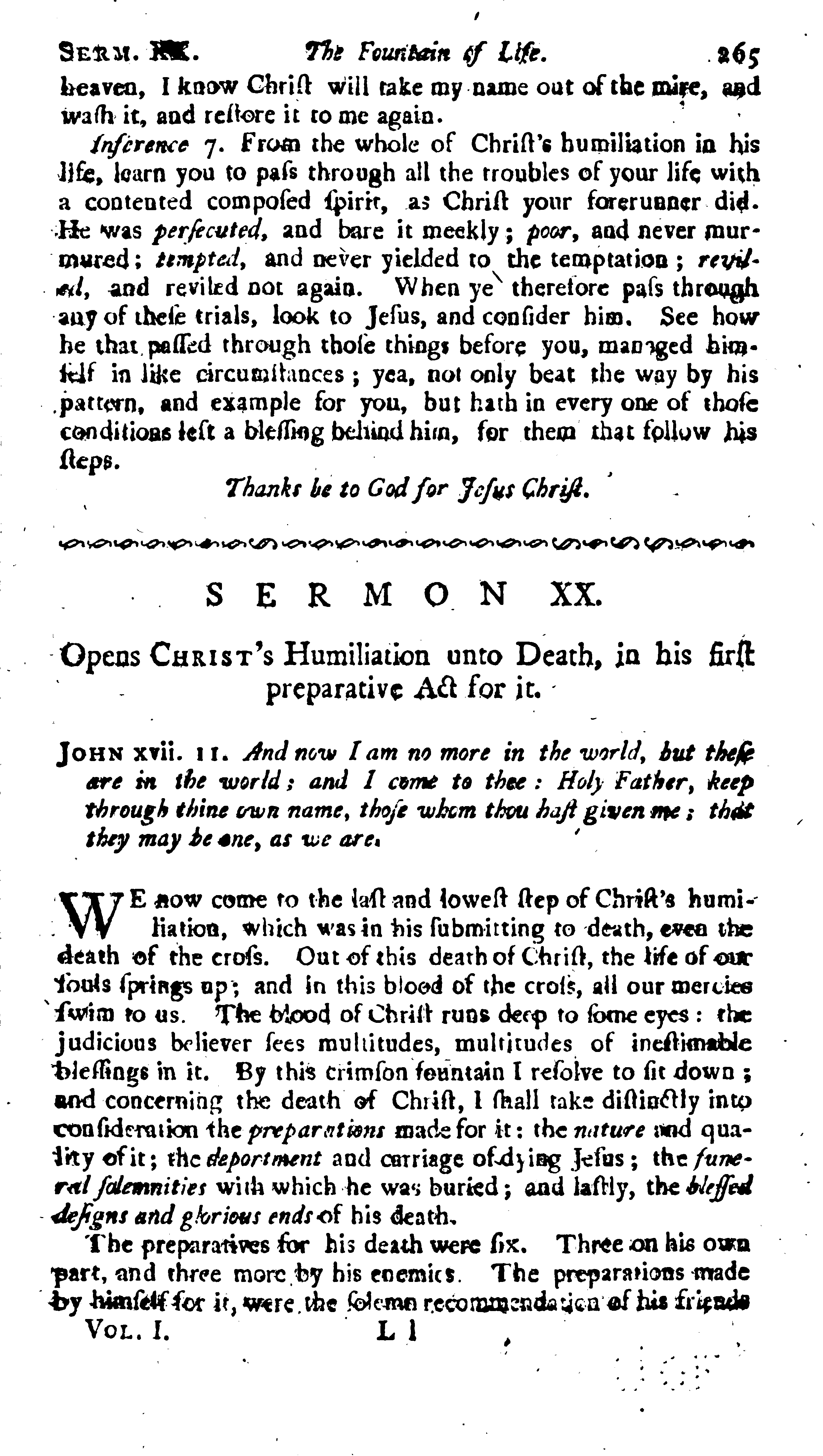
SERM. XX.
The Fountain of Life. heaven, I know Christ will take my name out of the mire, and wash it, and restore it tome again .
Inference 7. From the whole of Christ's humiliation in his life, learn you to pass through all the troubles of your life with a contented composed spirit, as Christ your forerunner did .
He was persecuted, and bare it meekly; poor, and never murmured; tempted, and never yielded to the temptation; reviled, and reviled not again. Whenye therefore pass through any of these trials, look to Jesus, and confider him.
See how he that passed through those things before you, managed him. self in like circumitances ; yea, not only beat the way by his pattern, and example for you, but hath in every one of those
conditions lest a blessing behind him, for them that follow his steps.
Thanks be to God for Jesus Christ.
9999999999999
SERMONXX.
Opens CHRIST's Humiliation unto Death, in his first preparative Act for it.
JOHN xvii . 11. And now I am no more in the world, but these are in the world ; and I come to thee : Holy Father, keep through thine own name, those whom thou hast given me ; that they may be one, as we are.
E now come the last and lowest step of Christ's humiW liation,which was inhisfubmittingtodeath,even the death of the cross. Out of this deathofChrift, the life of our souls springs up; and in this blood of the cross, all our mercies fwimtous. The blood of Christ runs deep to fomeeyes: the judicious believer fees multitudes, multitudes of inestimable blessings in it. By this crimson fountain I resolve to fit down ; and concerning the death of Christ, I shall take distinctly into consideration the preparations made for it: the nature and quality of it; the deportment and carriage of dying Jesus; thefuneralfolemnities with which he was buried; and lastly, the blessed designs and glorious ends of his death.
The preparatives for his death were fix.
Three on his own part,and three more by his enemics.
The preparations made by himself for it, were,the solemn recommendation of his friends
VOL . I.
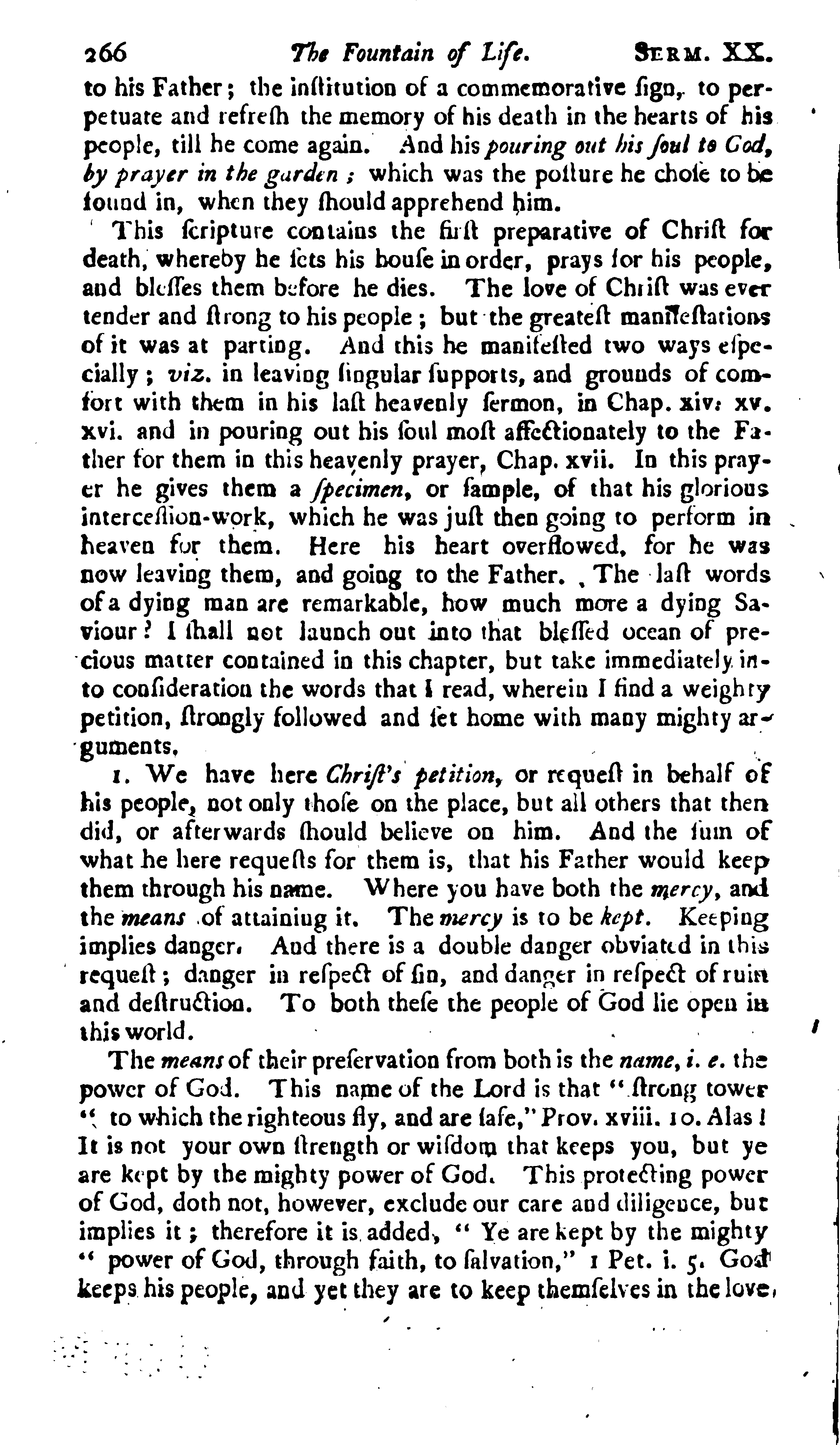
The Fountain of Life.
SERM. XX.
to his Father; the institution ofa commemorative sign, to perpetuate and refresh the memory of his death in the hearts of his people, till he come again. And his pouring out his foul to God, by prayer in the garden ; which was the posture he chose to be found in, when they should apprehend him.
This scripture contains the first preparative of Christ for death, whereby he sets his house in order, prays for his people, and blesses them before he dies.
The love of Christ was ever tender and strong to his people; but the greatest manifestations of it was at parting. And this he manifested two ways especially ; viz. in leaving fingularsupports, and grounds of comfort with them in his last heavenly sermon, in Chap. xiv: xv. xvi. and in pouring out his soul most affectionately to the Father for them in this heavenly prayer, Chap. xvii. In this prayer he gives them a specimen, or sample, of that his glorious interceffion-work, which he was just then going to perform in heaven for them.
Here his heart overflowed, for he was now leaving them, and going to the Father.
The last words ofa dying man are remarkable, how much more a dying Saviour ? I shall not launch out into that blessed ocean of precious matter contained in this chapter, but take immediately into confiderationthe words that I read, wherein I find a weighty petition, strongly followed and set home with many mighty arguments,
1. We have here Christ's petition, or request in behalf of his people, not only those on the place,but all others that then did, or afterwards should believe on him.
And the sum of what he here requests for them is, that his Father would keep them through his name.
Where you have both the mercy, and the means of attaining it.
The mercy is to be kept.
Keeping implies danger. And there is a double danger obviated in this request ; danger in respect off in, and danger in respect of ruin and destruction. To both these the people of God lie open in this world.
Themeansoftheir preservation from both is the name, i. e. the power of God.
This name of the Lord is that " strong tower " to which the righteous fly, and are safe," Prov. xviii . 10. Alas !
It is not your own strength or wisdom that keeps you, but ye are kept by the mighty power of God.
This protecting power of God, doth not, however, exclude our care and diligence, but implies it ; therefore it is added, " Ye are kept by the mighty
" power of God, through faith, to salvation," I Pet. i. 5. God keeps his people, andyetthey are to keep themselves in the love
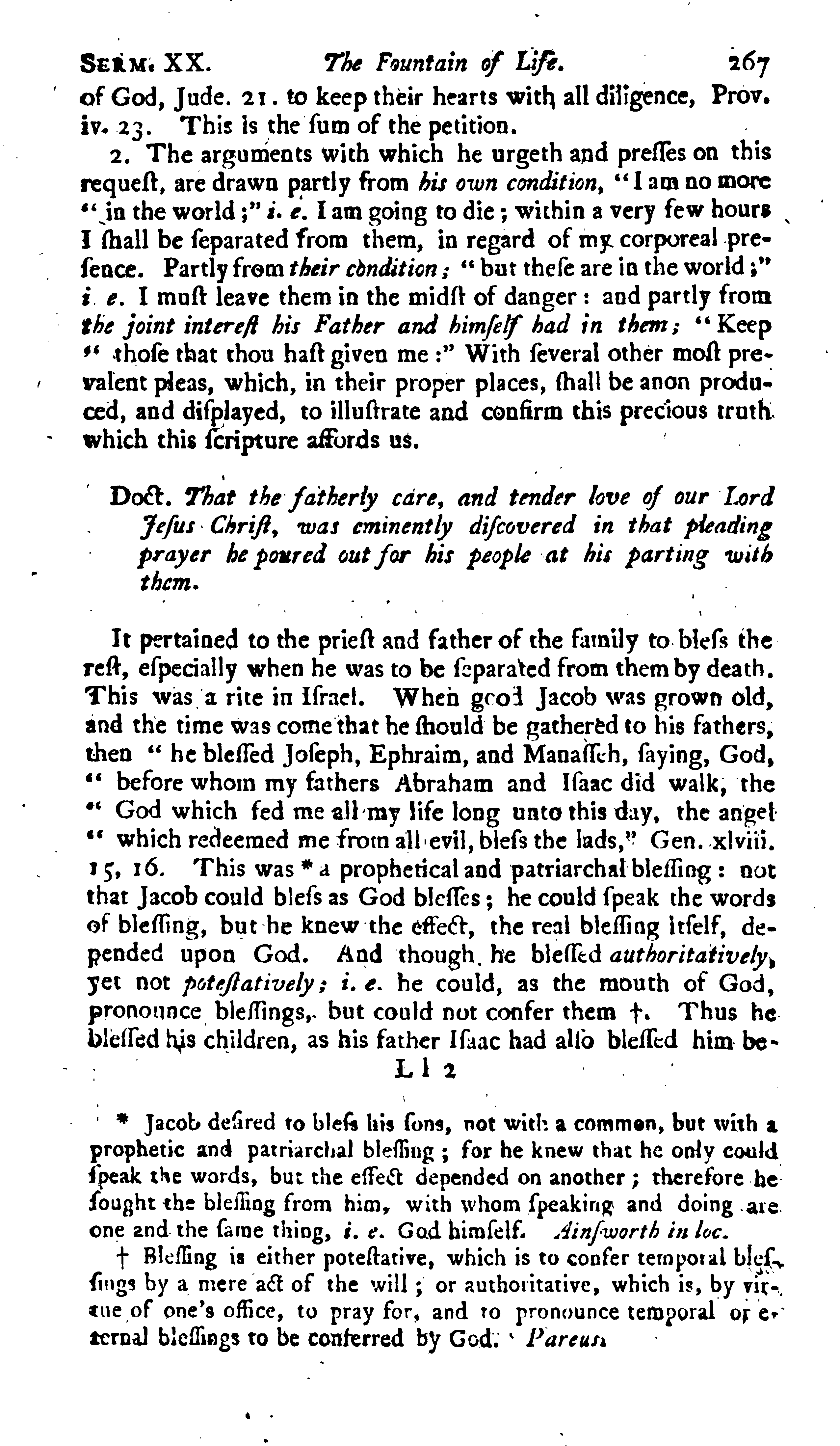
SERM. XX.
The Fountain of Life.
of God, Jude. 21. to keep their hearts with all diligence, Prov. iv. 23.
This is the sum of the petition .
2. The arguments with which he urgeth and presses on this request, are drawn partly from his own condition, " I am no more
"in the world;" i. e. I am going to die ; within avery few hours I shall be separated from them, in regard of my corporeal presence. Partly from their condition; " but these are in the world;" i. e. I must leave them in the midst of danger : and partly from the joint interest his Father and himself had in them; " Keep
" those that thou hast given me:" With several other most prevalent pleas, which, in their proper places, shall be anon produced, and displayed, to illustrate and confirm this precious truth which this scripture affords us.
Doct. That the fatherly care, and tender love of our Lord Jesus Christ, was eminently discovered in that pleading prayer he poured out for his people at his parting with them.
It pertained to the priest and father of the family to bless the reft, especially when he was to be separated from thembydeath .
This was a rite in Israel. When good Jacob was grown old, and the time was come that he should be gathered to his fathers, then " he blessed Joseph, Ephraim, and Manasseh, saying, God,
" before whom my fathers Abraham and Isaac did walk, the " God which fed me all my lifelong untothisday, the angel
" which redeemed me from all evil, bless the lads," Gen. xlviii.
15, 16.
This was * a propheticaland patriarchal blessing : not thatJacob could bless as God blesses; he could speak the words of blessing, but he knew the effect, the real blessing itself, depended upon God. And though,he blessed authoritatively, yet not poteftatively; i. e. he could, as the mouth of God, pronounce blessings, but could not confer them t.
Thus he bleffedhis children, as his father Ifaachad also blessed him be- :
L12 * Jacob desared to bless his sons,notwithacommon, but with a prophetic and patriarchal blessing; for he knew that he only could speak the words, but the effect depended on another; therefore he fought the blessing from him, with whom speaking and doing are one and the same thing, i. e. God himself.
Ainsworth in loc.
+ Blefling is either potestative, which is to confer temporalblef. sings by a mere act of the will; or authoritative, which is, by virtue of one's office, to pray for, and to pronounce temporal or e ternal blessings to be conferred by God.
Pareusa
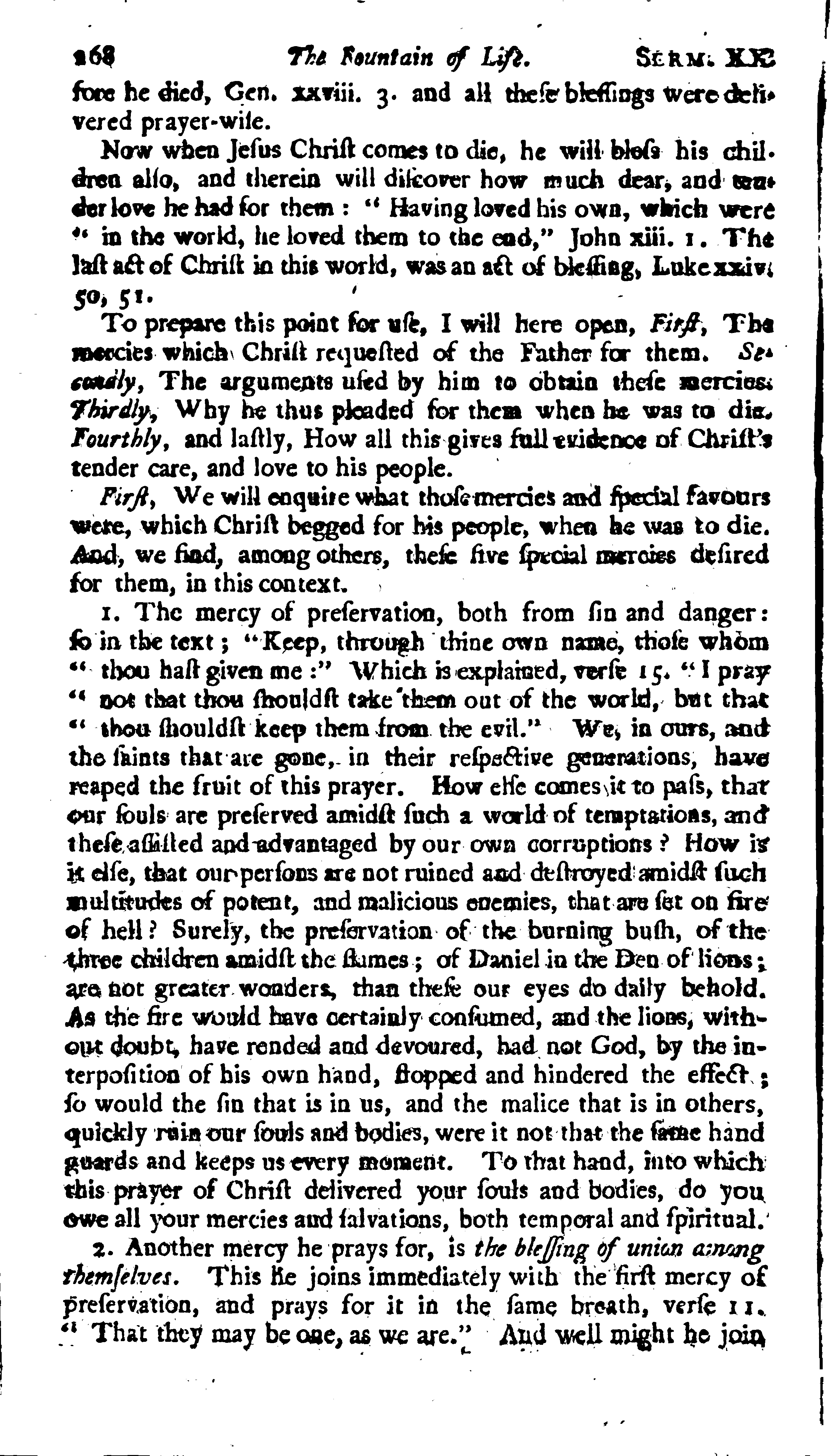
The Fountain of Life.
SERM. XX fore he died, Gen. xxviii. 3. and all these blessings weredeli vered prayer-wile.
NowwhenJesus Christ comestodie, he will bless his chil. drenalso, and therein will discover how much dear, and ten derlovehehadfor them : " Havinglovedhis own, which were
* in the world,he loved them to the end," John xiii. 1. The last act of Christ in this world, was an act of blessing, Lukexxiv.
50,51.
To prepare this point for use, I will here open, First, The mercies which Christ requested of the Father for them.
Se condly, The arguments used by him to obtain these mercies.
Thirdly, Why he thus pleaded for them when he was to die.
Fourthly, and lastly,How all this gives full evidence of Christ's tender care, and love to his people.
First, We will enquire what those mercies and special favours were,which Christ begged for his people, when he was to die.
And, we find, among others, these five special mercies desired for them, in this context.
1. The mercy of preservation, both from fin and danger : fo in the text ; "Keep, through thine own name, those whom
" thou haftgiven me :" Which is explained,verse 15. " I pray " not that thou shouldst take them out of the world, but that " thou shouldst keep them from the evil."
We, in ours, and the saints that are gone, in their respective generations, have reaped the fruit of this prayer. How else comes it to pass, that our souls are preserved amidst such aworldoftemptations, and these affilled andadvantaged by our own corruptions ? How is it else, that our persons are not ruinedanddestroyed amidst such multitudes of potent, and malicious enemies, that are set on fire of hell? Surely, the preservation of the burning bush, of the three children amidst the flames; of Daniel intheDenoflions; are not greater wonders, than these our eyes do daily behold.
As the firewouldhave certainly consumed, and the lions, without doubt, have rended and devoured, had not God,by the interpofitionofhis own hand, stopped and hindered the effect ; so would the sin that is in us, and the malice that is in others, quickly ruin our fouls and bodies,were it not that thefamehand guards and keeps us every moment. To that hand, into which this prayer of Christ delivered your souls and bodies, do you owe all your mercies and falvations, both temporal and spiritual.
2. Another mercy he prays for, is the blessing of union among themselves.
This he joins immediately with the first mercy of preservation, and prays for it in the same breath, verse 11.
"That they maybeone, as we are." Andwellmight he join
SERMAXX The Fountain of Life.
them together inonebreath; for this union is notonlyachoice mercy in itself,but a special means of that preservation he had prayed for before: their union one with another, is a special means to preserve them all.
3. A third desirable mercy that Christ earnestly prayed for, was, that his " Joy might be fulfilled in them," ver. 13. He would provide for their joy, even when the hour of his greatest sorrow was at hand; yea, he would not only obtain joy for them, butafulljoy : "That myjoymightbe fulfilledinthem."
It is as if he had said, O my Father, I am to leave these dear ones inaworldoftroubles andperplexities; I know their hearts will be subject to frequent despondencies ; O let me obtain the cordials ofdivinejoy for them before I go: i would not only have them live, buthvejoyfully; provide for theirfaintinghours reviving cordials.
4. And as a continued spring to maintain all the forementioned mercies, he prays " they all may be sanctified through the " word of truth," ver. 17. i. e. more abundantly fanctifiedthan yet they were, by a deeper radication of gracious habits and principles in their heart.
This is a singular mercy in itself, to have holiness spreading itself over and through their souls, as the light of the morning. Nothing is in itself more desirable.
And it is also a singular help to their perseverance, union, and spiritual joy, which he had prayed for before, and are all advanced by their increasing sanctification.
5. And lastly, as the complement and perfection of allde firable mercies, he prays, " that they maybe with him, where
" he is, to behold his glory," ver. 24.
This is the best and ultimate privilege they are capable of.
The end of his coming down from heaven, and returning thither again, all runs into this, to bring many sons and daughters unto glory.
You fee Christ asks no trifles, no small things for his people; no mercies, but the best that both worlds afford, will suffice him on their behalf.
Secondly, Let us fee how he follows his requests, and with what arguments he pleads with the Father for these things : and, among others, I small single out fix choice ones, which are urged in this text, or the immediate context.
The first argument is drawn from the joint interest, that both himself, and his Father, have intheirperfons, for whom he prays, "All mine are thine, and thine are mine," ver. 10.
As if he should say, Father,behold, and confider the persons I pray for, they are not aliens, but Christians: yea, they are thy childrenaswell as mine; the very fame on whom thou hast set.
The Fountain of Life .
SERM . XX.
thy eternal love, and in that love hast given them to me ; fo that theyareboththine, and mine: great is our interest in them, and interest draws care and tenderness.
Every one cares for his own, provides for, and secures his own.
Propriety, (even among it creatures) is fundamental to our labour, care, and watchtulness ; they would not so much prize life,health, estates, or children, if they were not their own.
Lord, these thine own bymanyties and titles : O therefore keep, comfort, sanctify, and save them, for they are thine.
What a mighty plea is this? Surely, Christians, your interceffor is skilful in his are work, your advocate wants no eloquence or ability to plead for you.
The second argument, and that a powerful one, treads , as I may say, upon the very heel of the former, in the next words,
" And I am glorified in them:" q. d. my glory and honour are infinitely dear to thee ; I know thy heart is entirely upon the exalting andglorifyingofthy Son.
Now, what glory have I in the world, but what comes from my people ? Others neither can,norwillglorify me ; nay, Iamdailyblafphemed and dishonouredby them: these are they from whom my active glory and praise in the world must rife.
'Tis true, both thou and I have glory from other creatures objectively ; the works that we have made, and imprest our power, wisdom, and goodness upon, do foglorify us and honour we have from our very enemies accidentally ; their very wrath shall praise us: but for active and voluntary praise, whence comes this but from the people that were formed for that very purpose ? Should these thenmiscarry and perish, where shall my manifestative and activeglorybe ? and from whom shall I expect it? So that here his propriety and glory are pleaded with the Father, to prevail for those mercies ; and they are both great, and valuable things with God.
What dearer, what nearer to the heart of God ?
Arg. 3. And yet, to make all fast and sure, he adds, in the beginning of this, verse 11. a third argument, in these words,
"And now I am no more in the world."
Where we must confiderthe sense of it, as a proposition, and the force of it, as an argument.
This proposition, " I am no more in the world," is not to be taken simply anduniverfally,as if, in no sense, Christ thouldbe any more in this world : but only respectively, as to his corporal presence ; this was, in a little time, to be removed from his people, which had been a sweet spring of comfort to them, in all their troubles.
But now it might have been said to the pensive disciples, as the sons of the prophets said toElisha, a little before Elijah's translation, " Knowye not that your ma-
SERM . XX.
The Fountain of Life .
" stershall be taken from your heads to day ?" This comfortable enjoyment must be taken from them; this is the sense. And here lies the argument ; Father, confider the sadness and trouble I shall leave my poor children under.
Whilst I was with them, I was a sweet relief to their souls, whatever troubles they met with : in all doubts, fears, and dangers, they could repair
to me ; in all their straits and wants I still supplied them : they had my counsels to direct them,my reproofs to reduce them,my comforts to support them ; yea, the very fight of me was an unspeakable joy, and refreshment to their souls: but now the hour is come, and I must be gone.
All the comfort, and benefit they had, from my presence amongst them, is cut off: and, except thou do make up all this to them another way, what will become of these children, when their Father is gone ? What will be the cafeof the poor sheep, and tender lambs, when the shepherd is smitten ? Therefore, O my Father, look thou after them, fee to them, for they are thine as well as mine : I am glorified in them, and now leaving them, and removing out of this world from them.
Arg.4. And yet, to move and engage the Father's care and love for them, he fubjoins another great consideration, in the very next words, drawn from the danger he leaves them in :
" But these are in the world." The world is a sinful, infecting, and unquiet place ; it lies in wickedness : And a hard thing it will be for such poor, weak, imperfect creatures to escape the pollutions of it ; or, if they do, yet the troubles, perfecutions, and strong oppositions of it they cannot escape. Seeing therefore
I must leave thine own dear children, as well as mine,and those from whom the glory is to rise, in the midst of a sinful troublesome, dangerous world, where they can neither move backward nor forward, without danger of fin or ruin : O, since the case stands fo, look after them, provide for them, and take special care for them all.
Confiderwho they are, and where I leave them.
They are thy children, to be left in a strange country ; thy soldiers, in the enemies quarters; thy theep, in the midst of wolves; thy precious treasure, among thieves.
Arg. 5. And yet he hath not done, for he resolves to strive hard for the mercies he had asked, and will not come off with a denial ; and therefore adds another argument in the next words, And I come to thee. As his leaving them was an argument, fo his coming to the Father is a mighty argument also.
There is much in these words, I come to thee.
[1, ] thy beloved Son, in which thy soul delighteth ; I, to whom thou never deniedst any thing. 'Tis not a stranger, butafon; not an a
SERM. XX.
The Fountain of Life. dopted,but thineonlybegottenSon.
'Tis I that [come.] I am now coming to thee apace, my Father. I come, to thee swimming through a bloody ocean.
I come, treading every step of my waytothee in blood,and unspeakable sufferings; and all this for the sake of those dear ones I now pray for; yea the design and end of my coming to thee, is for them.
I am coming to heaven in the capacity of an advocate, to plead with thee for them. And I come to [Thee] my Father, and their Father ; my God, and their God, Now then, since I, that am so dear, come through such bitterpangs, to thee, so dear, fo tender-heartedaFather ; andallthison their score and account: Since I do but now, as it were, begin, orgivethema little tasteofthatinterceffion work, which I shall live for ever to perform for them in heaven; Father, hear, Father,grant what I request. O give a comfortable earnest of those good things which I am coming to thee for, and which Iknowthou wiltnotdeny me.
Arg. 6. And, to close up all, he tells the Father how careful he had been to observe, and perform that trust which was committed to him ; " While I was with them in the world, I kept
*" them in thy name; those that thou gavest me, I have kept, " and none of them is lost, but the Son ofperdition," verse 12 .
And thus lies the argument: Thou committed'st to me a certain number of elect fouls, to be redeemed by me ; I undertook the trust, and said, if any ofthesebeloft, at my hand let them be required, I will answer for them everyone to thee.
In pursuance to which trust, I am nowhere on the earth, ina body of flesh.
I have been faithful toa point.
I have redeemed them(for he speaks of that as finishedanddone, which was now ready to be done) I have kept also, and confirmed them hitherto: and now, Father, I commit them to thy care. Lo, here they are, no tone is lost, but the Son ofperdition, who was never given.
With how great care have I been careful for them ! O let them not fail now; let not one of them perith .
Thus you fee what a nervous, argumentative, pleadingprayerChrift poured out to the Father for them at parting.
Thirdly, The next enquiry is, why he thus prayed, and pleadedwithGod for them, when he was to die ?
And certainly it was, not because the Father was unwilling to grant the mercies he desired for them: No, they came not with difficulty, nor were they wrested by mere importunity, out of the hand of an unwilling and backward person.
For, he tells us, John vi. 27. " The Father himselflovethyou," i. e. theispropente enough of his own accord to do you good.
But the reasons of this exceeding importunity, are,
SERM . XX .
The Fountain of Life .
1. He foresaw a great trial then at hand; yea, and all the after-trials of his people, as well as that. He knew how much they would be sifted, and put to, in that hour, and power of darkness, that was coming. He knew their faith would be shaken, and greatly staggered by the approaching difficulties, when they should fee their Shepherd smitten, and themselves scattered, the Son of man delivered into the hands of sinners, and the Lord of life hang dead upon the tree, yea, sealed up in the grave.
He foresaw what straits his poor people would fall into, betwixt a busy devil, and a bad heart ; therefore he prays and pleads with such importunity and ardency for them, that they might not miscarry.
2. He was now entering upon his intercession-work in heaven, and he was desirous in this prayer to give us a specimen , or sample, of that part of his work, before he left us ; that by this we might understand what he would do for us, when he should be out of fight.
For this being his last prayer on earth, it shews us what affections and dispositions he carried hence with him, and satisfies us, that he who was so earnest with God on our behalf, such a mighty pleader here, will not forget us, or neglect our concerns in the other world.
Yet, reader, I would have thee always remember, that the interceffion of Christ in heaven is carried much higher than this ; it is performed in a way more suitable to that state ofhonour to which he is now exalted.
Here he used prostrations of body, cries and tears in his prayers: there, his intercession is carried in a more majestic way, and with more state, becoming an exalted Jesus.
But yet in this he hath left us a special assistance, to discover much of the frame, temper, and working of his heart now in heaven towards us .
3. And lastly, he would leave this as a standing monument of his father-like care, and love to his people, to the end of the world.
And for this it is conceived Christ delivered this prayer so publicly, not withdrawing from the disciples to be private with God, as he did in the garden; but he delivers it in their presence, " These things which I speak in the world," verse 13 .
This ιλαλησα, with the circumstances of place, [in the world], doth plainly speak it to be a public prayer. And not only was it publicly delivered, but it was also, by a singular providence, recorded at large by John, though omitted by the other evangelifts; that so it might stand to all generations, fora testimony of Christ's tender care and love to his people..
Fourthly, If you ask, how this gives evidence of Christ's tenVOL . I.
The Fountain of Life.
SERM . XX.
der care and love to his people ? which is the last enquiry ; I answer, in few words, for the thing is plain and obvious ; it appears in these two particulars.
1. His love and care was manifested in the choice of mercies for them. He doth not pray for health, honour, long life, riches, &c. but for their preservation from fin, spiritual joy in God, fanctification, and eternal glory.
No mercies but the very best in God's treasure will content him.
He was resolved to get all the best mercies for his people; the reft he is content should be dispensed promiscuously by Providence : but these he willfettle as an heritage upon his children. O fee the love of Christ! look over all your spiritual inheritance in Christ, compare it with the richest, fairest, sweetest inheritance on earth ; and fee what poor things these are to yours.
O the care of a dear father ! O the love ofa tender Saviour !
2. Besides, what an evidence of his tenderness to you, and great care for you, was this, that he should to intently, and so affectionately mind, and plead your concerns with God, at such a time as this was, even when a world of sorrow encompassed him on every side ; a cup of wrath mixed, and ready to be delivered into his hand: at that very time when the clouds of wrath grew black, a storm coming, and such as he never felt before; when one would have thought, all his care, thoughts, and diligence, should have been employed on his own account, to mind his own sufferings ? No, he doth as it were forget his own sorrows, to mind our peace and comfort. O love unspeakable.
Corollary 1. If this be so, that Christ so eminently discovered his care and love for his people,in this his parting hour ; then hence we conclude, The perseverance of the saints is unquestionable*. Do you hearhowhe pleads ! how hebegs ! how he fills his mouth with arguments ! how he chufeth his words, and sets them in order, how he winds up his spirit to the veryhigheftpitch of zeal and fervency ? and can you doubt of success ?
Can such a Father deny the importunity, and strong reasonings and pleadings of such a Son ? O, it can never be ! he cannot deny him: Christ hath the art and skill of prevailing with God : he hath (as in this appears) the tongue of the learned.
If the heart or hand of God were hard to be opened, yet this would open them; but when the Father himself loves us, and is in- * By this , that observation is crossed; Nem diu tutus, periculo proximus : None can be long safe, that dwells near to danger : for hereby they are safe in the midst of danger.
SERM . XX.
The Fountain of Life. clined to do us good,who can doubt of Christ's success ? "That " which is in motion, is the more easily moved *."
The cause Christ manageth in heaven for us is just and righteous.
The manner in which he pleads is powerful, and therefore the success of his suit is unquestionable .
The apostle professeth, 2 Cor. i. 3., " We can do nothing " against the truth."
He means it in regard of the bent of his heart ; he could not move against truth and righteousness.
And if a holyman cannot, much less will a holy God.
If Christ undertake to plead the cause of his people with the Father, and use his oratory with him, there is no doubt of his prevailing.
Every word in this prayer is a chosen shaft, drawn to the head by a strong and skilful hand; you need not question but it goes home to the white, and hits the mark ained at. Doth he pray,
" Father, keep, through thineownname, those thou hast given " me ?"
Sure they shall be kept, if all the power in heaven can keep them. O think on this, when dangers surround your souls or bodies, when fears and doubts are multiplied within : when thou art ready to say in thy haste, All men are liars, I shall one day perish by the hand of fin or Satan ; think on that encouragement Christ gave to Peter, Luke xxii. 31. " I have
" prayed for thee."
Corollary 2. Again, hence we learn, that argumentative prayers are excellent prayers.
The strength of every thing is in its joints ; there lies much of the strength of prayer also : how strongly jointed, how nervous and argumentative was this prayer of Christ ? Some there are indeed, that think we need not argue and plead in prayer with God, but only present the matter of our prayers to him, and let Christ alone (whose office it is) to plead with the Father ; as if Christ did not present our pleas and arguments, as well as simple desires to God ; as if the choicest part of our prayers must be kept back, because Christ presents our prayers to God.
No, no Christ's pleading is one thing, ours another : " ‡ His and ours are not opposed, but " subordinate ;" his pleading doth not destroy, but makes ours successful.
God calls us to plead with him, Ifa. i. 18. "Come 66 now let us reason together,"
"God (as one|| observes) rea- " foneth with us by his word and providences outwardly, and by the motions of his Spirit inwardly : but we reason with Mm 2 * Quicquid eft in motu, facile movetur.
† We can do that, which we can do justly.
† Subordinata nonpugnant.
Mr. Corbet, of Prayer.
The Fountain of Life.
SERM . XX.
" him by framing (through the help of his Spirit) certain holy arguments, grounded upon allowed principles, drawn from " his nature, name, word, or works."
And it is condemned as avery sinful defect in professors, that they did not plead the church's cause with God ; Jer. xxx. 13. " There is none to 66 plead thy cause, that thou mayest be bound up."
What was Jacob's wresthng with the angel, but his holy pleading and importunity with God ? And how well it pleased God, let the event speak, Gen. xxxii. 24.
Hos. xii. 4. "As a prince he " prevailed, and had power with God."
On which instance, a Worthy * thus glosseth : " Let God frown, smite or wound, " Jacob is at a point, a blessing he came for, and a blessing he
" will have ; " I will not let thee go, (faith he) unless thou " bless me."
His limbs, his life might go, but there is nogo- " ing for Christ without a pawn, without a blessing."
This is the man, now what is his speed ? The Lord admires him, and
honours him to all generations.
"What is thy name ?" faith he ; q. d. I never met with such a man, titles of honour are not worthy of thee : thou shall be called, not Jacob a shepherd withmen, but Jacob a prince with God.
Nazianzen said of his sister Gorgonia, That she was modestly impudent with God ; there was no putting her off with a denial.
The Lord, on this account, hath honoured his saints with the title of, His recorders †, men fit to plead with him, as that word [mazkir] signifies :
Isa . lxii . 6. " Ye that make mention of the Lord, keep not 66 silence, give him no rest."
It notes the office of him that recorded all the memorable matters of the king, and used to suggest seasonable items and memorandums of things to be done.
By these holy pleadings, " the King is held in his galleries," as it is Cant. vii. 5.
I know we are not heard, either for our much speaking, or our excellent speaking ; it is Christ's pleading in heaven, that makes our pleading on earth available : but yet surely, when the Spirit of the Lord shall suggest proper arguments in prayer, and help the humble supplianttopress them home believingly and affectionately ; ‡when he helps us to weep and plead, to groan and plead,God is greatly delighted in such prayers.
" Thou saidst, I willfurelydo thee good," saidJacob, Gen. xxxii, 12.
It is thine own free promise ; I did not go *Dr. Harris, in his sermon on Luke xviii. 6, 7, 8 .
+ םירובזמח Rememorantes, vel, qui reminisci facit resDomini. Mont.
‡ The heart cries to God more by groans than bywords, and more by tears than by speaking. Aug. Mr. R.A. vind.
SERM . XX.
The Fountain of Life. on mine own head, but thou bidst mego, and encouragedst me with this promise. O this is pleasing to God,when by the spirit of adoption we can come to God, crying, AbbaFather ; Father, hear, forgive, pity, and help me . Am I not thy child, thy son, or daughter ?
To whom may a child be bold to go, with whommayachild have hope to speed, if not with his father?
Father, hear me.
The fathers of our flesh are full of bowels, and pity their children, and know how to give good things to them, when they ask them : When they ask bread or cloaths, will they deny them ? And is not the Father of spirits more full of bowels, more full of pity ? Father, hear me .
This is that kind of prayer, which is melody in the ears of God.
Corollary 3. What an excellent pattern is here, for all that have the charge and government of others committed to them, whether magistrates, ministers, or parents, to teach them how to acquit themselves towards their relations, when they come to die?
LookupondyingJesus, see how his care and love to his people flamed out, when the time of his departure was at hand.
Surely, as we are bound to remember our relations every day, and to lay up a stock of prayers for them in the time of our health, fo it becomes us to imitate Christ in our earnestness with God for them, when we die.
Tho' we die, our prayers die not with us: they out-live us, and those we leave behind us in the world, may reap the benefit of them, when we are turned to dust.
For my own part, I must profess before the world, that I have a high value for this mercy, and do from the bottom of my heart, bless the Lord, who gave me a religious and tender father *, who often poured out his foultoGod for me : he was one that was inwardly acquainted with God ; and being full of bowels to his children, often carried them before the Lord, prayed and pleaded with God for them, weptand made fupplications for them.
This stock of prayers and blessings left by him before the Lord, I cannot but esteem above the fairest in. heritance on earth. O it is no small mercy to have thousands of fervent prayers lying before the Lord, filed up in heaven for
And O that we would all be faithful to this duty! surely our love, especially to the souls of our relations, should not grow cold when our breath doth.
O that we would remember this duty in our lives, and ifGodgive opportunity and ability, us .
* Mr. Richard Flavel, a faithful and laborious preacher of the gospel, at Hafeler in Warwickshire, and afterwards in Willerfay in Gloucestershire, now with God.
The Fountain of Life.
SERM. XX.
fully discharge it when we die; considering, as Christ did, we shall be no more, but they are in this world, in the midst ofa defiled, tempting, troublesome world : it is the last office of love that ever we shall do for them .
After a little while we shall be no longer sensible how it is with them; for (as the church speaks lla. Ixiii. 16. "Abraham is ignorant of us, and " Israel acknowledge thus not") what temptations and troubles may befal them, we do not know. O imitate Christ your pattern.
Corollary4. To conclude; Hence ye may fee, what a high esteem and precious value Christ bath of believers ; this was the treasure which he could not quit, he could not die till he had secured it in a safe hand : " I come unto thee,holy Father, keep
" through thine own name those whom thou haftgivenme."
Surely believers are dear to Jesus Christ; and good reason, for he hath paiddearfor them : let his dying language, this last farewel, speak for him,how he prized them. " The Lord's por- " tion is his people, Jacob is the lot of his inheritance," Deut. xxxii. 9. " They are a peculiar treasure to him, above all the people of the earth," Exod. xix. 5.
What is much upon our hearts when we die, is dear to us indeed. O how precious, how dear should Jesus Christ be to us ! Were we first and last upon his heart; did he mind us, did he pray for us, did he so wrestle withGodabout us, when the sorrows of death compassed him about ? How much are we engaged, not only to love him, and esteem him, whilftwe live, but to beinpangs of love for him, when we feel the pangs of death upon us ! to be eying him, when our eye-strings break! To have hot affections for Christ, when our hands and feet grow cold ! The very last whisper of our departing fouls should be this, Blessed be God for Jesus Christ.
SERM . XXI .
The Fountain of Life.
SERMON XXI.
Opens the second preparative Act of CHRIST for his own Death.
COR. xi . 23 , 24, 25. -The Lord Jesus, thefamenight in which he was betrayed, took bread : and when he had given thanks, he brake it, and said, Take, eat ; this is my body, which is broken for you : this do in remembrance of me.
After the same manner also he took the cup, when he hadfupped, saying, This cup is the New Testament in my blood : this do ye, as oft as ye drink it, i remembrance of me.
CHRIST had nofooner recommended his dear charge to the Father, but (the time of his deathhafing on) he institutes his last supper, to be the lasting memorial of his death, in all the churches, until his second coming; therein graciously providing for the comfort of his people, when he should be removed out of their fight.
And this was the second preparative Act of Christ, in order to his death : he willfethishouse in order, and then die.
This his second act manifests no less love than the former; It is like the plucking off the ring from his finger, when ready to lay his neck upon the block, and delivering it to his dearest friends, to keep that as a memorial of him : " Take this, &c.
" in remembrance of me. "
In the words read, are four things noted by the apostle, about this last and lovely act of Christ, viz. the Author, Time, Institution, and End of this holy, solemn ordinance.
1. The author of it *, The Lord Jesus : It is an effect of his lordly power, and royal authority ; Mat. xxviii. 18. "And Jesus came, and spake unto them, saying, All power is given unto me in heaven and earth : Goye therefore.
The government is upon his shoulder." Ha. ix. 6. He shall bear the glory, Zech. vi. 13. Who but he that came out of the bosom
" of the Father, and is acquainted with all the counsels that are there, knows what will be acceptable to God ? And who but hecangive creatures, by his blessing, their sacramental efficacy and virtue ? Bread and wine are naturally fit to refresh and * The authority of him who gives the precept, is the reason of the precept.
The Fountain of Life.
SERM . XXI.
nourish our bodies ; but what fitness have they to nourish fouls ?
Surely none, butwhatthey receive from the blessing of Christ that institutes them.
2. The Time when the Lord Jesus appointed this ordinance " In the fame night in which he was betrayed :" it could not be sooner, because the passover must first be celebrated; nor later, for that night he was apprehended.
It is therefore emphatically expressed εν τη νυκτι, in that fame night, that night for ever to be remembred.
He gives, that night, a cordial draught to his disciples before the conflict: he settles, that night, an ordinance in the church, for the confirmation and confolationofhis people, in all generations, to the end of the world. Byinstitutingitthat night, he gives abundant evidence of his care for his people, in spending so much of that little, very little, time he had left, on their account.
3. The Institution itself; in which we have the memorative fignificative, instructive signs, and they are bread and wine ; and the glorious mysteries represented and shadowed forth by them, viz. Jesus Christ crucified ; the proper New Testament nourishment of believers.
Bread and wine are choice creatures, and do excellently shadow forth the flesh and blood of crucified Jesus ; and that both, in their natural usefulness, and manner of preparation.
Their usefulness is very great ; bread is a creature necessary to uphold and maintain our natural life ; therefore it is called the staff of bread, Ifa. iii. 1. because as a feeble man depends and leans upon his staff, so doth our feeble spirits upon bread, Wine was made to chearthe heart of man, Judg. xi. 13 .
They are both useful and excellent creatures ; their preparations, to become so useful to us, are also remarkable.
The corn must be ground in the mill, the grapes torn and squeezed to pieces in the wine-press, before we can either have bread or wine. And when all this is done, they must be received into the body, or they nourish not. So that these were very fit creatures to be set apart for this use and end.
If any object, It is true, they are good creatures, but not precious enough to be the signs of such profound and glorious my. steries : It was worth the creating anewcreature, to bethe sign of the new covenant.
Let him that thus objects, ask himself, whether nothing be precious without pomp? The preciousness of these elements is not so much from their own natures, as their use and end; and that makes them precious indeed. A Loadftone at sea is much more excellent than a Diamond, because more useful.
A penny worthofwax applied to the label ofa deed, and sealed,
SERM . XXI .
The Fountain of Life.
may in a minute have it's value raised to thousands of pounds.
These creatures receive their value and estimation on a like account .
Nor should it at all remain a wonder to thee, why Christ should represent himself by such mean and common things, when thou hast well considered that the excellency of the picture, is it's fimilitude and conformity to the original ; and that Christ was in alow, sad, and very abased state, when
⚫this picture of him was drawn ; he was then a man offorrows.
These then, as lively signs, shadow forth a crucified Jesus, represent him to us in his red garments.
This precious ordinance may much more than Paul, say to us, " I always bear about in 66 my body, the dying of the Lord Jesus :" That is the thing it signifies.
4. Lastly, Take notice of the use, design, and end of this institution.
Εις την εμην αναμνησιν, in remembrance, or for amemorialofme. Othere is much in this : Christ knew how apt our base hearts would be to lose him, amidst such a throng of sensible objects as we here converse with; and how much that forgetfuiness of him, and of his sufferings, would turn to our prejudice and loss; therefore doth he appoint a sign to be remembredby : " As oft as you do this, ye shewforth the Lord's death
" till he come."
Hence we observe, suitable to the design of this discourse, Doct. That the sacramental memorial Christ left with his people, is aspecialmark of his care and love for them *.
What ! To order his picture (as it were) to be drawn when he was dying, to be left with his spouse ! To rend his own flesh, and set abroach his own blood to be meat and drink for our souls ! O what manner of love was this ! It is true, his picture in the sacrament isfulloffears and wounds ; but these are honourable scars, and highly grace and commend it to his tpouse, for whose dear fake he here received them ,
"They are marks of love and honour †."
And he would be so drawn, or rather he so drew himself, that as oft as his people looked upon that portraiture of him, they might remember, and be deeply affected with those things he here endured for their fakes .
These are the wounds my dear husband Jesus re-
* Our Lord, while in life, for commemorating his death, ordere edthe celebrating ofa representation of his sacrifice.
Aug.
† Hæcfunt insignia laudis .
VOL . I.
The Fountain of Life.
SERM. XXI.
ceived for me.
These are the marks of that love which passes the love of creatures.
O fee the love ofa Saviour ! This is that heavenly Pelican that feeds his young with his own blood. We have read of pitiful and tender women that have eaten the flesh of their own children, Lam. iv. 10. But where is that women recorded, that gave her own flesh and blood to be meat and drink to her children ? Surely the spouse may say of the love of Christ, what Davidin his lamentations, faidof the love of Jonathan, " Thy love to me was wonderful, passing the love of " women."
But to prepare the point to be meat indeed, and drink indeed to thy soul, I shall discuss briefly these three things, andhaften to the application.
First, What it is to remember the Lord Jesus in the sacrament.
Secondly, What aptitude there is in that ordinance, so to bring him to our remembrance.
Thirdly, How the care and love of Christ is discovered by leavingsucha memorial of himself with us.
† Remembrance, properly, is the return of the mind to an object, about which it hath been formerly converfant : and it may so return toa thing, it hath conversed with before, two ways ; speculatively and tranfiently ; or affectingly, and permanently . A speculative remembrance, is only to call to mind the history of such a person, and his sufferings ; that Christ was once put to death in the flesh.
An affectionate remembrance, is when we so call Christ and his death to our minds, as to feel the powerful impressions thereof upon our hearts .
Thus, Mat. xxvi . 75. " Peter remembered the word of the Lord, and 66 went out, and wept bitterly."
His very heart was melted with that remembrance ; his bowels were pained, he could not hold, but went out and wept abundantly.
Thus Joseph, when he saw his brother Benjamin,whose sight refreshed the memory of former days and endearments, was greatly affected, Gen. xliii. 29, 30. "And he lift up his eyes, and saw his brother
" Benjamin, his mother's son ; and said, Is this your younger " brother, of whom ye spake to me ? and he said,God be gra- "cious to thee my son. And Joseph made haste, for his bow- " els did yern upon his brother, and he fought where to weep;
" and he entred into his chamber, and wept there."
Such a ‡ Memory is a power of renewing and recollecting these ideas, which formerly were impressed; but afterwards, vanished, it is called by one name, Remenibrance.
Keckerman. Synt. Phyf. l. 4. c.
6. p. [mihi] 536 .
SERM. XXI .
The Fountain of Life.
remembrance of Christ is that which is here intended.
This is indeed a gracious remembrance of Christ; the former hath nothing of grace in it.
The time shall come when Judas that betrayed him, and the Jews that pierced him, shall historically remember what was done ; Rev. i. 7. "Behold he cometh with " clouds, and every eye shall fee him; and they also which " pierced him; and all kindreds of the earth shall wail becaule
" of him."
Then, I say, Judas shall remember ; This is he whom I perfidiously betrayed.
Pilate shall remember ; This is he whom I sentenced to be hanged on the tree, though I was convincedofhisinnocency.
Then the soldiers shall remember ; This is that face we spit upon, that head we crowned with thorns: Lo, this is he whose side we pierced, whose hands and feet we once nailed to the cross.
But this remembrance will be their torment, not their benefit.
It is not therefore a bare historical, speculative, but a gracious, affectionate, impressive remembrance of Christ, that is here intended: and such a remembrance of Christ supposes and includes,
1. The saving knowledge of him. We cannot be said to remember what we never knew ; nor to remember, savingly, what we never knewsavingly.
There have beenmanyprevious, sweet, and gracious transactions, dealings, and intimaciesbetwixt Christ and his people, from the time of their first happy acquaintance with him: much of that sweetness they have had in,former considerations of him, and hours of communion with him, is lost and gone; for nothing is more volatile, hazardous, and in constant, than our spiritual comforts: but now at the Lord's table, there our old acquaintance is renewed, and the remembrance of his goodness and love refreshed and revived:
Wewillrememberthylovemore than wine; the upright love " thee," Cant. i. 4.
2. Such a remembrance of Christ includes faith in it.
Withoutdifcerning Christ at a sacrament, there is no remembrance of him ; and, without faith,nodifcerning Christ there.
But when the precious eye of faith hath spied Christ, under that vail, it presently calls up the affections, saying, " Come fee the Lord."
These are the wounds he received from me.
This i she that loved me, and gave himself for me.
This is his flesh, and that his blood ; sic oculus, sic illemanus, &c. fo his arms were stretchedoutupon the cross to embrace me: so his blessed head hung down to kiss me.
Awake my love, rouze up my hope, flame out mydefires ; Come forth, O all ye powers and affections of my soul; come, see the Lord. No sooner doth Christ by his
Nn2
The Fountain of Life.
SERM . XXI.
Spirit call to the believer but faith hears; and discerning the voice, turns about, like Mary, saying, Rabboni, my Lord, my
Master.
3. This remembrance of Christ includes suitable impressions made upon the affections, by such a fight and remembrance of him: and therein lies the nature of that precious thing which we call communion with God.
Various representations of Christ are made at his table.
Sometimes the soul there calls to mind the infinite wisdom, that so contrived and laid the glorious and mysterious design and project of redemption : the effect of this is wonder and admiration .
O the manifold wisdom of God!
Eph . iii. 10. O the depths, the heights, the length, the breadth of this wisdom ! I can as easily spanthe heavens, as take the just dimensions of it.
Sometimes a representation ofthefeverity of God is made to the soul at that ordinance.
O how inflexible and severe is the justice of God ! What no abatements ! no sparing mercy ; no, not to his own Son ? This begets a double impression on the heart.
(1.) Just and deep indignation against sin *.
Ah cursed sin!
It was thou usedst my dear Lord fo ; for thy sake he underwent all this.
If thy vileness had not been so great, his sufferings had not been so many.
Cursed sin! thou was the knife that stabbed him : thou the sword that pierced him. Ah what revenge it works ! I remember that it is storied of one of the kings of France, that hearing the bishop (as I remember it was
Remigius) read the history of Christ's trial and execution, and hearing how barbaroufly they had used him, he was moved, with so tragical and pathetical a history, to great indignation against Pilate, the Jews, and the rude and bloody soldiers, and could not contain himself, but cried out, as the bishop was
reading, " O that I had been there with my Frenchmen, I " would have cut all their throats who so barbaroufly used my
" Saviour."
To allude to this : when the believer considers and remembers, that fin put Christ to all that shaine and ignominy, and that he was wounded for our transgressions, he is filled with hatred of fin, and cries out, O fin, I will revenge the blood of Christ upon thee ! thou shalt never live a quiet hour in my heart.
And, (2.) It produces an humble adoration of the goodness and mercy of God, to exact satisfaction for our fins, by such bloody
*Great is the bitterness of fin, which caused so much bitterness offuffering. Aug.
SERM. XXI.
The Fountain of Life.
stripes, from our surety. Lord, if this wrath had seized on me, as it did on Christ, what had been my condition then ! If these things were done in the green tree, what had been the case of the dry tree ?
Sometimes representations †, (and not common ones), are made of the love of Christ, who assumed abody and foul, on purpose to bear the wrath of God for our fins. And when that surpassing love breaks out in its glory upon the soul, how is the soul transported and ravished with it ! crying out, what manner of love is this ! here is a love large enough togo round the heavens, and the heaven of heavens ! Who ever loved after this rate, to lay down his life for enemies ! O love inutterable and unconceivable ! How glorious is my love in his red garments ! Sometimes the fruits of his death are there gloriously displayed; even his satisfaction for fin, and the purchase his blood made of the eternal inheritance: And this begets thankE fulness and confidence in the soul.
Christ is dead, and his death hath satisfied for my fin.
Christ is dead, therefore my soul shall never die. Who shall separate me from the love of God? These are the fruits, and this is the nature of that remembrance of Christ here spoken of.
Secondly, What aptitude or conducency is there in this ordinance, to bring Christ so to remembrance ?
Much every way $ ; for it is a sign, by him appointed to that end, and hath (asdivines well observe)a threefold useandconfideration, viz, as it is memorative,fignificative, and instructive.
1. As it is memorative, and so it hath the nature and use ofa pledge or token of love, left by a dying to a dear surviving friend. And so the sacrament, as was said before, is like a ring pluckt off from Christ's finger, or a bracelet from his arm ; or rather his picture from his breast, delivered to us with such words as these ; " As oft as you look on this, remember me :
" let this help to keep me alive in your remembrance when I am gone, and out of your fight."
It induces to it also, 2. As it is afignificative sign, most aptly signifying both his bitter sufferings for us, and our strict and intimate union with him; both which have an excellent usefulness to move the heart,
† When you look to the Lord, do you think yourself conversant among mortals, and not rather transported, as it were, instantly into heaven.
Chryfoft. hom. l. 3.
A soft as this supper is celebrated, so oft Christ, as it were, dies [in the view of faith] ; and we fee him hanging on the cross.
Aug. in Psal. xxi .
The Fountain of Life.
SERM . XXI.
Anditsdeepest affections, at the remembrance of it.
The breaking of the bread, and shedding forth the wine, signify the former ; our eating, drinking, and incorporating them, is a lively fignification of the other.
3. Moreover, this ordinance hath an excellent use and advantage for this affectionate remembrance of Christ, as it is an inAructive lign. And it many ways instructs us, and enlightens our mind, particularly in these truths, which are very affecting things.
1. That Christ is thebreadonwhich our souls live, proper meat and drink for believers, the most excellent New-Testament-food.
It is said, Psal. lxxviii. 25., "Man did eat angels " food:" he means the manna that fellfromheaven,which was foexcellent, that if angels, who are the noblest creatures, did liveuponmaterial food, they wouldchuse this above all to feed on. And yet this was but a type and weak shadow of Christ, on whom believers feed.
Christ makes a royal feast of his own flesh and blood, Ifa. xxv. 6., allourdelicates are in him.
2. It instructs us that the New Testament is now in its full force, and no substantial alterationcanbe made in it, since the testator is dead, and by his death hath ratified it.
So that all theexcellentpromises and blessings of it are now fully confirmed to the believing foul, Heb. ix. 16, 17.
All these, and many more choice truths, are we instructed in by this sign : And all these ways it remembers us of Christ, and helps powerfully to raise, warm, and effect our hearts with that remembrance of him.
Thirdly, The last enquiry is, How Christ hath, hereby, left suchaspecial mark of his care for, and love to his people. And that will evidently appear, if you confider these five particulars.
1. This is a special mark of the care and love of Christ, in as much as hereby he hath made abundant provision for the confirmation and establishment of the faith of his people, to the endoftheworld.
For this being an evident proof that the New Testament is in its full force, (Matth. xxvi. 28. " This is
" the cup of the New Testamentinmyblood") it tends as much to our satisfaction, as the legal execution of a deed, by which weholdandenjoy our estate. So that when he faith, Take, eat, it is as much as if God should stand before you at the table with Christ, and all the promises in his hand; and say, I deliver this to thee as my deed.
What think you, doth this promote and confirm the faith of a believer ? if it doth not, what doth?
SERM . XXI.
The Fountain of Life.
2. This is a special mark of Christ's care and love, inasmuch as by this he hath made like abundant provision for the enlargement of the joy and comfort of his people.
Believers are at this ordinance, as Mary was at the fepulchre, with fear and great joy, Matth. xxviii. 3.
Come, reader, speak thy heart, if thou be one that heartily lovest Jesus Christ, andhaftgonemany days, possibly years mourning and lamenting because of the in evidence and cloudinessof thine interest in him;who hat fought him for rowing, in this ordinance, and in that, in one daty, and and another : if at last Christ should take off that malk, that cruel covering(as one calls it)from his face, and be knownofthee in breaking of bread: suppose he should,by his Spirit, whisper thus in thine ear as thou fittest at his table,Dost thou indeedfo prize, esteem, and value me ? Will nothing but Christ and his love content and satisfy thee? then, as sweet, lovely, and desirable as I am, know that I am thine ; take thine own Christ into the arms of thy faith this day : Would not this create in thy soul, a joy transcend ant to allthejoys and pleasures in this world ? What thinkest thou of it ?
3.Here is a signal mark of Christ's care and love; in as much as this is one of the highest, and best helps for the mortificationof the corruption of his people. Nothing tends more to the killing of fin, than this doth.
Christ's blood, as it is food to faith, to it is poison to our lusts. O what a pill is wrapt up in that bread ! what an excellent potion is in that cup to purge the soul ? One calls that table, an altar, on which our corrup .
tions are sacrificed and slain before the Lord.
For how can they that there see what Christ suffered for fin, live any longer therein?
4. Moreover his care and love appear in providing an ordinance so excellently adapted, to excite and blow up his people's love into a lively flame. When Joseph made himself known to his brethren, " I am Joseph your brother, whom ye
66 fold, be not grieved;" O! what shower of tears and dear affections was there ? how did theyfalluponeach others necks ! so that the Egyptians wondered at the matter.
How doth the soul (if I may so speak) passionately love Jesus Christ at such a time? Owhat a Christ is my Christ ! "The fairest among ten
" thousand."
What hath he done, what hath he suffered for me! whatgreatthingshath my Jesus given, andwhatgreat things hath he forgiven me ! A world, a thousand worlds cannot shew fuchanother.
Here the foul is melteddownby love at his feet; it is pained with love.
5. To conclude; Christ's care and love are further manifef-
SERM . XXI.
The Fountain of Life. ted to his people, in this ordinance, as itisone of the strongest bondsofunion betwixtthemthat can be : 1 Cor. &. 17.
"We being many, are one bread, and one body; for we are all "partakers of that one bread." And though, through our corruptions, it falls out, that what was intended for a bondofunion, proves a bond of contention ; yet, in as much as by this it appears how dearly Christ loved them; for as much also as here they are sealed up to the fame inheritance, their dividing corruptions here slain, their love to Christ, and consequently to each other, here improved ; it is certainly one of the strongest ties in the world, to wrap up gracious hearts in a bundle of love.
And thus I have dispatched the doctrinal part of this point.
The improvement of it is in the following inferences.
Inference 1. Did Christ leave this ordinance with his church to preserve his remembrance among his people ? Then surely
Christ foresaw, that, notwithstanding what he is, hath done,suffered, andpromisedyet to do for his people, they will for all this be
tillapt to forget him .
A man would think that such a Christ should never be one whole hour together out of his people's thoughts and affections: that wherever they go, they should carry him up and down with them, in their thoughts, desires, and delights : that they should let their thoughts work towards Christ as the longing thoughts of her that is with child do work after that the longs for: that they should lie down with Christ in their thoughts at night, and when they awake be still with him : that their very dreams in the night should be sweet visions of Christ, and all their words favour of Christ.
But O the baseness of these hearts ! Here we live and converse in a world of sensible objects, which, like a company of thieves, rob us of our Christ, and lay the dead child in his room. Wo is me, that it should be so with me, who am fo obliged to love him ! Though he be in the highest glory in heaven, he doth not forget us; he hathgraven us upon the palms of his hands ; we are continually before him. He thinks onus, when we forget him. The whole honour and glory paid him in heaven by the angels, cannot divert his thoughts one moment from us'; but every trifle that meets us in the way, is enough to divert our thoughts from him.
Why do we not abhor and loath ourselves for this ? What ! Is ita pain, a burden, to carry
Christ in our thoughts about the world ? As much a burden, if thy heart be spiritual, as a bird is burdened by carrying his own wings.
SERM . XXIL
The Fountain of Life.
Willfuch thoughts intrude unseasonably, and thrust greater things than Christ out of our minds ? For shame, Christian, for shame, let not thy heart play the wanton, and gad from Christ after every vanity.
Inheavennothingelse takes up the thoughts of saints to eternity; and yet there is no tiring, no satiety. O learn to live nearer that heavenly life. Never leave praying and striving, till thou canstsayas it is, Psal. Ixiii. 5.
" My foul " shall be satisfied as with marrow and fatness, and my mouth " shall praise thee with joyful lips ; whilst I remember thee on my bed, and meditate on thee in the night-watches."
Inference 2. Hence also we infer, that Sacramentfeafons are be art-melting seasons ; because therein the most affecting and heart melting recognitions and representations of Christ are made.
As the Gospel offers him to the ear, in the most sweet affecting sounds of grace; so the sacrament to the eye, in the most pleasing visions that are on this side heaven.
There, hearts that will not yield a tear under other ordinances, can pour out floods : Zech. xii. 10. " They shall look
66 upon me whom they have pierced, and mourn."
Yet I dare not affirm, that every one whose heart is broken by the believing fight of Christ there, can evidence that it is so by a dropping eye. No, we may say of tears, as it is said of love, Cant. viii.
7. If some Christians would give all the treasures of their house for them, they cannot be purchased: Yet they are truly humbled for fin, andseriouflyaffectedwith the grace of Christ.
For the support offuch, I would distinguish, and have the into do so also, betwixt what is essential to spiritual sorrow, and what is contingent. Deepdispleasurewith thyself for fin, hearty resolutions and desires of the complete mortification of it, this is essential to all spiritual sorrow; but tears are accidental, and in some constitutions rarely found.
Ifthouhast the former, trouble not thyself for want of the latter, tho' it is a mercy when they kindly and undissembledly flow from a heart truly broken.
And surely, to fee who it is that thy sins have pierced, how great, how glorious, how wonderful a person that was, that was so humbled, abased, and brought to the dust, for such a wretched thing as thou art, cannot but tenderly affect the considering foul.
I fit was for alamentation in the captivity, " that princes were " hanged up by the hands, and the faces of the elders not reverenced," Lam. v. 12. And if at the death ofAbner, David could lament, and fay, " a prince, and agreatman is fallen in Israel this day," 2 Sam. iii. 38.
If he could pathetically lament the death of Saul and Jonathan, saying, " Daughters of VOL . I.
The Fountain of Life.
SERM. XXI.
"" Israel, weep over Saul, who cloathed you in scarlet ; the beauty ofIfrael is slain upon the high places!", Ah! how muchmoreshould it affect us, to fee thebeautyofheaven fallen, the prince of life hang dead upon a tree ! O let the place where you assemble to fee this fight of your crucified Jesus, be a Bokin, a place oflamentation.
Inference 3. Moreover hence it is evident, that the believing and affectionate remembrance of Christ, is offingular advantage at all times to the people of God.
For it is the immediate end of one of the greatest ordinances that ever Christ appointed to the church.
To have frequent recognitions of Christ, will appear to be singularly efficacious and useful to believers, if you confider,
1. If at any time the heart be dead and hard, this is the likelieftmeans in the world to dissolve, melt, and quicken it.
Look hither hard heart; hard indeed if this hammer will not break it.
Behold the blood of Jesus.
2. Art thou easily overcome by temptations to fin ? This is the most powerful restraint in the world from fin : Rom. vi. 2.
" How shall we that are dead to fin, live any longer therein ?"
We are crucified with Christ, what have we to do with fin ?
Have such a thought as this, when thy heart is yielding to temptation.
How can I do this, and crucify the Son of God afresh ! Hath he not suffered enough already on earth, shall I yet make him groan as it were for me in heaven ! Look as David poured the water, brought from the well of Bethlehem, on the ground, though he was athirst, for he said, it is the blood of the men; i. e. they eminently hazarded their lives to fetch it; much more should achriftian pour out upon the ground, yea, despise and trample under foot, the greatest profit or pleasure of fin ; saying, Nay, I will have nothing to do with it, I will on no terms touch it, for it is the blood of Christ: it cost blood, infinite, precious blood to expiate it.
If there were a knife in your house that had been thrust to the heart of your Father, you would not take pleasure to see that knife, much less to use it.
3. Are you afraid your fins are not pardoned, but still stand upon account before the Lord ? What more relieving,what more satisfying, than to fee the cup in the New Testament in the blood of Christ, which is "thedfor many for the remission of fius ?
"Who shall lay any thing to the charge of God's elect ? It is " Christ that died."
4.Are you staggered at your sufferings, and hard things you must endure for Christ in this world? Doth the flesh shrink back
SERM . XXI .
The Fountain of Life.
from these things, and cry, spare thyself ? Wha,there in the world more likely to steel and fortify thy spirit th resolution and courage, than such a fight as this ? Did Christe the wrath of men, and the wrath of God too? Did he stand a pillar of brass, with unbroken patience, and stedfast resolion, under such troubles as never met in the like height uponanmerecreature, till death beat the last breath out of his nostrils And shall
I shrink for a trifle ? Ah, he did notferve me so ! I wil arm my. self with the like mind, Pet. ii. 2 .
5. Is thy faith staggered at the promises ? canst thou not reft upon a promise ? Here is what will help thee against hope to believe in hope, giving glory to God.
For this is God's seal added to his covenant, which ratifies and binds fast all that God hath spoken.
6. Dost thou idle away precious time vainly, and live unusefully to Christ in thy generation ? What more aptboth to convince and cure thee, than such remembrance of Christ as this?
Owhen thou considerest thou art not thine own, thy time, thy talents are not thine own, but Christ's ; when thou shalt see thou art bought with a price (a great price indeed) and so art strictly obliged to glorify God, with thy foulandbody, which are his,
2Cor. v. 14.
This will powerfully awake a dull, sluggish, and lazy spirit.
In a word, what grace is there, this remembrance of Christ cannot quicken ? What fincannot it mortify? What duty cannot it animate ? O it is offingular use in allcafes to the people of God!
Inference 4. Lastly we infer ; Though all other things do,yct Christ neither doth, nor cangrowftale.
Here is an ordinance to preserve his remembrance fresh to the end of the world.
The blood of Christ doth never dry up.
The beauty of this rose of Sharon is never lost or withered. He is the fame yesterday, to day, and for ever.
As his body in the grave saw no corruption, so neither can his love, or any of his excellencies.
When the saints shall have fed their eyes upon him in heaven, thousands and millions of years, he shall be as fresh, beautiful, and orient as at the beginning. Other beauties have their prime, and their fading time; but Christ abides eternally. Our delight in creatures is often most at first acquaintance ; when we come nearer to them, and fee more of them, the edge of our delight is abated: but the longer you know Christ, and the nearer you come to him, still the more do you fee of his glory.
Every farther prospect of Christ entertains the mind with a freshde-
SERM. XXII
The Fountain of Life. light. He is as it were a new Christ every day, and yet the same
Christ still.
Bleffedbe God for Jesus Christ.
999999999 SERMON XXII.
Opens the third preparative Act of CHRIST for his own Death.
LUKE xxii. 41, 42, 43, 44. And he was withdrawn from them about as tones cast, and kneeled down, and prayed, saying, Father, If thou be willing, remove this cup from me : nevertheless, not my will, but thine be done.
And there appeared an angel unto him from heaven, strengthening him And being in an agony he prayed more earnestly : and his sweat was as itweregreat drops ofbloodfalling down to the ground.
T HE hour is now almost come, even that hour of for row, which Christ had so often spoken of.
Yet a little, a very little while, and the Son of man is betrayed into the hands of sinners . He hath affectionately recommended his children to his Father.
He hath set his house in order, and ordained a memorial of his death to be left with his people, as you have heard.
There is but one thing more to do, and then the tragedy begins.
He recommended us,he must also recommend himself by prayer to the Father ; and when that is done, he is ready, let Judas with the black-guard come when they will.
This last act of Christ's preparation for his own death, is contained in this scripture: wherein we have an account, 1. Of his prayer. 2.Of the agony attending it. 3. His reliefinthatagony, by an angel that came and comforted him.
1. The prayer of Christ; in a praying posture he will be found when the enemy comes ; he will be taken upon his knees: he was pleading hard with God in prayer, for strength to carry him through this heavy trial, when they came to take him.
And this prayer was a very remarkable prayer, both for thefolitariness of it, he withdrew about a stone's cast, ver. 41. from his dearest intimates, no ear but his Father's shall hear what he had now to say : and for the vehemency and importunityofit: these were those ικετηριας, Heb. v. 7. strong cries that hepouredout to God in the days of his flesh.
And for thehu. milityexpressed in it; he fell upon the ground, he rolled him-
SERM . XXII.
The Fountain of Life .
self is it were in the dust, at his Father's feet. And in divers other respects it was a very remarkable prayer, as you will hear anon.
2. This scripture gives you also an account of the agony of Christ, as well as of his prayer, and that a most strangeone ; such as in all respects never was known before in nature.
It was a sweat as it had been blood, which [as] is neither anhyperbole, as some would make it ; nor yet a fimilitude of blood, as others fancy, but a real bloody sweat. For fo [as] is sometimes taken for the very thing itself, as John i. 14.
And as a * worthy divine of our own well notes, that if the Holy Ghost had only in. tended it for a similitude or resemblance, he would rather have expressed it, as it were drops of water, than as it weredropsof blood, for sweat more resembles water than blood.
3. You have here his relief in this his agony, and that by an angel dispatchedpoft from heaven to comfort him. The Lord of angels now needed the comfort of an angel.
It was time to have a little refreshment when his face and body too stood as full of drops of blood, as the drops of dew are upon the grass. Hence we note, :
Doct. That our Lord Jesus Christ was praying to his Father in an extraordinary agony, when they came to apprehend him in the garden.
To open and prepare this last act of preparation on Christ's part for our use, I shall at this time speak to these particulars.
First, The place where he prayed.
Secondly, The time when he prayed. Thirdly, The matter of his prayer. And lastly, The manner how he prayed.
First, For the circumstance of place †, where was this last and reinarkable prayer poured out to God ? It was in the garden ;
St. Matthew tells us it was calledGethsemane, which signifies (asPareaus on the place observes) " the valley of fatness, viz.
" of olives, which grew in that valley or garden most plenti-
" fully."
This garden lay very near to the city of Jerusalem.
The city had twelve gates, five of which were on the east side of it, among which the most remarkable were the fountain gate, fo called of the fountain Siloe.
Through this gate Christ rode * Mr. Ambrose, looking to Jesus.
+In locum Gethsemane,Gr. χωριον ; redduntvillam, velprædium dictumGethsemane,Heb.
םינמשאיכ quod fort vallem pinguium, nempe olearum, que nimirum iftic uberius proveniebant. Par.
The Fountain of Life .
SERM XXII .
into the cityintriumph,when he came from Bethany. The other was the sheep-gate, to called from the multitude of sheep driven in at it for the sacrifice, for it stood close by the temple ; and close by this gate was the garden calledGethsemane, where they apprehended Christ. andledhim through this gate, as a sheep to the slaughter.
Betwixt this garden and the city, ran the brook Cedron,which rose from a hill uponthefouth, and ranuponthe east part of the city,betweenJerufalem and the mountofolives : and over this brook Christ passed into the garden, John xviii. 1.
To which the Pfalmist alludes in Psal. cx. 7. " He shall drink of " thebrook in the way, therefore shall he lift up the head." For thisbrook running through the valley ofJehofaphat, that fertile foil, together with the filth of the city, which it washed away, gave the waters a black tincture, and so fitly resembled those grievous sufferings of Christ, in which he tasted both the wrath of God and men.
Now, Christ went not into this garden to hide, or shelter himself from his enemies. No, that was not his end; for if so, it had been the most improper place he could have chosen, it being the accustomed place where he was wont to pray, and a place well known to Judas, who was now coming to seek him, as you may fee, John xviii. 2. " And Judas, which betrayed
" him, knew the place, for Jesus oft times resorted thither with " his disciples.
So that he repairs thither, not to shun, but to meet, the enemy; to offer himself as a prey to the wolves, which there found him, and laid hold upon him.
He also resorted thither for an hour or two of privacy before they came, that he might there freely pour out his foul to God.
So much for the circumstances of place where he prayed.
Secondly, We thall consider the time when heentred into this garden to pray : and it was in the shutting in of the evening: for it was after the passover and the supper were ended.
Then (as Matthew hath it, Chap. xxvi. 36.) Jesus went over the brook into the garden, betwixt the hours of nine and ten in the evening, as it is conjectured; and fo he had betwixt two and three hours time to pour out his soul to God.
For it was ⚫aboutmidnightthatJudas and the soldiers came and apprehended him there.
So that it being immediately before his apprehension, it shews us in what frame and posture Christ desired to be found: and by it he left us an excellent pattern, what we ought
† At that time, viz. at the approach of the evening, after the celebration of the passover and Eucharift, having given thanks, they fang ahymn.
Par. in locum.
SERM . XXII .
The Fountain of Life. to do, wheneminentdangers are near us, even at the door.
It becomes a soldier to die fighting, " and a minister to die preach८८ing||," and a Christian to die praying.
If they come, they find Christ upon his knees, wresthng mightily with God by prayer. He never spent one moment of the time of this life idly; but these were the last moinents he had to live in the world, and here you may fee how they were filled up and employed.
Thirdly, Next let us confider the matter of his prayer, or the things about which he poured out his soul to God in the garden, that evening. And ver. 42. informs us what that was : he prayed, saying, " Father, ifthoubewilling, remove this cup
" from me; nevertheless, not my will, but thine be done."
These words are involved in many difficulties, as Christ himself was when he uttered them.
By the cup, understand that portion of sorrows, then to be distributed to him by his Father.
Great afflictions and bitter trials are frequently expressed, in scripture, under the metaphor ofa cup.
So, that dreadful storm of wrathuponthe wicked in Psal. xi. 6.
Upon the wicked he " shall rain snares, fire, and brimstone, and a horrible tempest ;
this thall be the portion of their cup," i, e. the punishment allotted to them by God for their wickedness. And an exceeding great misery, by a large or deep cup.
SoEzek. xxiii. 32, 33. " Thou shalt drink of thy fifterscupdeep and large : thou
" shalt be laughed toscorn, and had inderifion; itcontaineth " much.
Thou shalt be filled with drunkenness and sorrow, with the cup of astonishment and desolation, with the cup of thy sister Samaria." And when an affliction is compounded ofmanybitter ingredients, stinging and aggravating considerations and circumstances, then it is said to be mixed. "In the
" hand of the Lord there is a cup, and the wine is red," (noting a bloody trial) " it is full of mixture, and he poureth out
" the fame, but the dregs thereof all the wicked of the earth **" shallwring them out, and drink them:" i. e they shall have the worst partofthejudgmentfor their share.
Thus, afflictions and calamities are expressed by the metaphor of a cup ; great calamities by a deep and large cup; afflictions compounded of many aggravating circumstances, by a mixed cup. And froin the effect it hath on those that must drink it, is called a cup of trembling, Ifa. lvii. 17. " Thou hast drunken at the hand of " the Lord, the cup of his fury, the dregs of the cup of trembling."
Such a cup now was Christ's cup ; a cup of wrath ; *a large and deep cup,that contained more wrath than ever was
|| Oportet theologum concionantem mori.
The Fountain of Life .
SERM. XXII,
drunk by any creature, even the wrath of an infinite God. A mixed cup, mixed with God's wrath and man's in the extremity.
And all the bitter aggravating circumstances that ever could be imagined; great consternation and amazement; this was the portion of his cup.
By the passing of the cup from him, understand his exemption from suffering that dreadful and horrid wrath of God, which he foresaw to be now at hand.
For as the coming of the cup to a man, doth, in scripture phrase, note his bearing and suffering of evil, as you find it, Lam. iv-21. " Rejoice and be glad, Odaughter ofEdom, thatdwellest in the land of Uz; the cup also
" shall pass through unto thee; thou shalt be drunken, and " make thyself naked;" which is an ironical reproof of the Idumeans, thedeadlyenemies of the Jews, who wickedly insulted over them, when the cup was at their mouths : as if the Lord had said, you have laughed andjeered at my people, when my hand was on them ; you rejoiced to see their calamities : well, make yourselves merry still ifyoucan,the cup snall pass through unto thee; thy turn is coming, then laugh if thou canst.
So, on the contrary, the passing away of the cup, notes freedom from, or our escaping of those miseries. And so Christ's meaning, in this conditional request, is, Father, if it be thy will, excuse me from this dreadful wrath; my soul is amazed at it.
Is there no way to shun it ? Cannot I be excused ? Or if it be possible, spare me.
This is the meaning of it.
But then here is the difficulty, how Christ, who knew God had from everlasting determined he should drink it, who had compacted and agreed with him in the covenant of redemption so to do, who came (as himself acknowledges) for that end into the world,
John xviii. 37. who foresaw this hour all along, and professed when he spake of this bloody baptism with which he was to be baptized, that he was " ftraitned till it was accomplished," Luke xii. 50. How (I say) to reconcile all this with such a petition, that now when the cup was delivered to him, it might pass, or he excused from suffering; this is the knot, this is the difficulty.
What! did he now repent of his engagement ? Was all he said before but a flourish, before he saw the enemy ?" Doth he now begin to wish to be disengaged, and that he had never undertaken such a work ? Is that the meaning of it ? No, no, Christ never repented of his engagement to the Father, never was willing to let the burden lie on us, rather than on himself; there was not such a thought in his holy and faithful heart;
SERM . XXII .
The Fountain of Life.
but the refolutionofthisdoubt depends upon another distinction, which will clear his meaning in it.
1st. You must distinguish of prayers.
Some are absolute and peremptory ; and foto have prayed that the cup might pass, wouldhavebeen chargeablewith such abfurdities, as were but now mentioned: others are conditional and submissive prayers,
" If it may be, if the Lord please." And such was this, if thou be willing; if not, I will drink it.
But you will fay, Christ knew what was the mind of God in that case; he knew what transactions had of old been betwixt his Father and him ; and therefore though he did not pray absolutely, yet it is straugehe would pray conditionally it might pass.
Therefore in the
2d, Place, you must distinguish of the natures according to which Christ acted.
He acted sometimes as God, and sometime's Here he acted according to his human nature; simply expressing and manifesting in this request the reluctancy it had at such sufferings: wherein he shewed himself at rue man, in shunning that which is destructive to his nature. as man.
As Chrifthad twodistinctnatures, to two distinct wills. And (as one well observes) in the life of Christ, there was an intermixture of power and weakness, of the divine glory, and human frailty. At his birth a star shone, but he was laid in a manger.
The Devil tempted him in the wilderness, but there angels miniftred to him. As man he was deceived in the figtree, butasGodhe blasted it. He was caught by the soldiers in the garden, but first made them fallback.
So here, as man he feared and hunneddeath ; but as God-man he willingly submitted to it.
" It was (as * Deodatus well expresses it) apurelynaturalde- " fire, mere man, by which for a shortmomenthe apprehended
" andshunneddeath and torments; but quickly recalled himself " to obedience, by a deliberate will, to submit himselftoGod.
" And besides that, this desire was but conditional, under the " will of God, accepted by Christ ; but from the contemplati- " on of which he was a while diverted by the extremity of horrors : therefore there was no fin in it, but only a short conflict of nature, presently overcome by reason, and a firm will; or a small suspension, quickly overcome by a most
strong resolution.
Finally, this sacred deliberation in Jesus " was not made simply, orin an instant,but with a short time,
* Deodati An not, on Mat. xxvi. 39.
VOL. L.
The Fountain of Life.
SERM . XXII.
" and with a counterpoise, which is the natural property of the " foul in its motions, and voluntary actions."
In a word, as there was nothing of sin in it, it being a pure and finless affection of nature; so there was much good in it, and that both as it was a part of his satisfaction for our fin, to suffer inwardly such fears, tremblings, and confternations : and as it was a clear evidence, that he was in all things made like unto his brethren, except fin. And lastly, as it serves notably to express the grievousness and extremity of Christ's sufferings, whose very prospect and appearance, at some distance, was so dreadful to him .
If the learned reader desire to see what is further said on this point, let him read what the judicious and learned Parker, in his excellent book de defcenfu †, hath collected upon that case.
Fourthly, Let us confider the manner how he prayed, and that.was, 1. Solitarily. He doth not here pray in the audience of his disciples, as he had done before, but went at a distance from them.
He had nowprivatebusiness to transact with God. He left some of them at the entring into the garden ; and for Peter, James, and John, that went farther with him than the reft, hebids them remain there, while he went and prayed ‡.
He did not desire them to pray with him, or for him; no, he must tread the wine-press alone. Nor will he have them with him, possibly left it should discourage them to fee and hear how he groaned, sweat, trembled, and cried, as one in an agony, to his
Father.
Reader, there are times and cases,when a Christianwouldnot be willing, the dearest and most intimate friend, he hath in the world, should be privy towhatpasses betwixt him and his God.
2. It was an humble prayer, that is evident by the postures into which he cast himself: sometimes kneeling, and sometimes prostrate upon his face. He creeps in the very dust, lower he cannot fall; and his heart was as low as his body. He is meek and lowly indeed.
3. It was areiterated prayer he prays, and then returns to the disciples, as a man in extremity turns every way for comfort: fo Christ prays, " Father, let this cup pass," but in that the Father hears him not ; though as to support he was heard.
Being denied deliverance by his Father, he goes and bemoans † Parker de defcenfu, lib . 3. p. 192, &c.
† He seeks relief to grief, by prayer in which, that he might be more at liberty, he retires a little.
SERM . XXI .
The Fountain of Life.
himself to his pensive friends, and complains bitterly to them, " my soul is exceeding sorrowful even unto death." He would ease himself a little, by opening his condition to them; but alas, they rather increase than ease his burden.
For he finds themafleep, which occasioned that gentlereprehenfion from him,Mat. xxvi . 40.
What, could you not watch with me one hour ?"
What, not watch with me ? Who may expect it from you more than I ? Could you not watch ? I am going to die for you, and " cannotyouwatch with me ? What ! cannot you watch with me one hour ? Alas ! what ifI had required great matters from you ?
What! not an hour, and that the parting hour too ! Christ finds no ease from them, and back again he goes to that fad place, which he had stainedandpurpledwith abloodysweat, andprays to the fame purpose again. O how he returns upon God over and over, as if he resolved to take no denial ! But however, considering it must be so, he sweetly falls in with his Father's will,
Thy will be done.
4.And lastly, It was a prayer accompanied with a strange and wonderful agony: so faith ver.44. " and being in an agony, he
" prayed more earnestly; and his sweat was as it were great drops ofbloodfallingdown to the ground." Now he was red indeed in his apparel, as one that trod the wine press .
" not a faint thin dew, but a clotted sweat||, θρυμβοι αιματος,"
Clodders of blood falling upon the ground.
It isdisputedwhether, this sweat was natural orpreter-natural. That some in extremity have sweat a kind of bloody thindew, is affirmed.
I remember * Thuanus gives us two instances that come nearest "
" It was to this, of any thing I ever observed or heard of. " The one " was a captain, who by a cowardly and unworthy fear of death was so overwhelmed with anguish, that a kind ofbloodydew or sweat stood on all his body.
+ The other is of a young man condemned for a small matter to die by SixtusV, who
" poured out tears of blood from his eyes, and sweat blood from " his wholebody."
These are rare and strange instances, and the truth of them depends upon the credit of the relator ; but certainly for Christ, whosebodyhad the most excellent crasis and temperament, to Pp 2 || Non suit fudor diaphoreticus, fed craffus et grumofus.
* Dux quidem in dig no mortis motu adeo concuffus in animofuit, utfanguineumfudorem toto corporefudit.
Thuan. lib. 11.
† Juvenis ob levem caufam, a Six to V. ad mortem damn at us, præ doloris vehementia, lacrymas cruentas fudiffe, etfanguinem profudore e toto corpore mittere vifus eft.
Thuan. lib. 80.
The Fountain of Life.
SERM . XXI .
sweatclottedblood, or globes of blood, as some render it ; and that ina cold night,when others needed a fire withindoors to keep them warm, John xviii. 18.
I fay, for him to sweat such streams through his garments, falling to the ground on which he lay, must be concluded a preternatural thing. And indeed, is was not wonderful that such a preternatural sweat should stream from all parts of his body, if you do but confider what an extraordinary load pressed his foul at that time, even such as no mere man felt, or was able to stand under,even the wrath of a great and terrible God, intheextremityofit. "Who(faith
" the prophetNahum, chap. i. 6.) " can stand before his in dig- " nation ? And who can abide in the fierceness of his anger?
" His fury is poured out like fire, and the rocks are thrown " down by him."
The effects of this wrath, as it fell at this time upon the soul of Christ in the garden, are largely and veryemphatially expressed by the several Evangelists who wrote this tragedy.Matthew tells us, his soul was "exceeding sorrowful, even unto
" death," Matth. xxvi. 38. " The word * signifies beset with " grief round about." And it is well expressed by that phrase of the Pfalmist, " The sorrows of death compaffed me about, the " painsofhell gotholduponme."
Mark varies the expression, and gives it us in another word no less significant and full,Mark xiv. 33. "He began to be fore amazed and very heavy," + " Sore
" amazed, it imports so high a degree ofconfternation and amazement, as when the hairofthehead stands up through " fear." Lukehath another expression for it in the text; he was εν αγωνια, in an agony. An agony is thelabouring and striving of nature in extremity. And John gives it us in another expression,
Johnxii. 27. "Now is my foul troubled."
The original word is a very full word. And it is conceived the Latins derive that word which signifies hell, from this, by which Christ's troubles are here expressed .
This was the load which oppressed his soul, and so straitned it with fear and grief, that his eyes could not vent or ease it sufficiently by tears; but the innumerable pores of his body are set open, to give vent by letting out streams of blood. And yet all this while, no hand of man was upon him.
This was but a prelude, as it were, to the conflict that was at hand.
This bloody sweat in which he prayed, was * Περιλυπος, undequaque triftis.
Beza.
† Εκθαριβείσθαι, medici vocant horripilationem : και αδημονειν, graviffime angebatur.
Beza.
‡ Τετρακται , unde Tartarus, quia terret omnia.
SERM. XXII.
The Fountain of Life. but as the giving or sweating of the stones before a great rain.
Now he stood, as it were, arraigned at God's bar, and had to do immediately with him. Andyouknow " it is a fearful
" thing to fall into the hands of the living God."
The uses of this follow in this order.
Inference 1. Did Christ pour out his soul to God so ardently in the garden, when the hour of his trouble was at hand ?
Hence we infer, That prayer is afingular preparativefor, and relief under, the greatest troubles .
It is sweet, when troubles find us in the way of our duty.
The best posture we can wrestle with afflictions io, is to engage them upon our knees.
The Naturalist tells us, if a lion tind am an prostrate, he will do him no harm.
Christ hastened to the garden to pray, when Judas and the soldiers were haftening thither to apprehend him. O ! when we are nigh to danger, it is good for us to draw nigh to our God.
Then should we be urging that seasonable request to God, Psal. xxii. 11. " Be
not far from me, for trouble is near; for there is none to " help."
Wo be to him, whom death or trouble finds afar offfromGod.
And as prayer is the best preparative for troubles, so the choicest relief under them.
Griefs are eased by groans.
The heart is cooled and disburdened by spiritualevaporations.
You know it is some relief if am an can pour out his complaint into the bosom of a faithful friend, though he can but pity him : how much more to pour out our complaints into the bosom of a faithful God, who can both pity and help us! Luther was wont to call prayers the leeches of his cares and sorrows ; they fuck out thebadblood.
It is the title of Psal. cii. A prayer for the afflicted, when he is overwhelmed, and poureth out his complaint before the Lord.
It is no small ease to open our hearts to God.
When we are as full of grief, as Elihuwas of matter, let us say as he did, Job xxxii. 19.
"Be- " hold, Lord, my heart is as wine which hath no vent, it is
ready to burst as new bottles. I will speak that I maybe re- " freshed."
To go to God when thou art full of for row,when thy heart is ready to burst within thee, as it was with Christ in this day of his trouble ; and say, Father, thus and thus the case stands with thy poor child ; and so and so it is with me ; I will not go up and down complaining from one creature to another, it is to no purpose to do fo; nor yet will I leave mycomplaintuponmy. self: but I will tell thee, Father,how the case stands with me; for to whom should children make their moan, but to their Father? Lord, I am oppressed, undertake for me. What thinkest
The Fountain of Life.
SERM . XXII .
thou, reader, of this ? Is it relieving to afad foul ? Yes, yes ; if thou be a Christian that haft had any experience this way, thou wilt say there is nothing like it; thou wilt bless God for appointing such an ordinance as prayer, and say, BlessedbeGod for prayer : I know not what I should have done, nor how in all the world I should have waded through the troubles I have passed, if it had not been for the help of prayer.
Inference 2. Did Christ withdraw from the disciples to seek God by prayer ? Thence it follows, That the company of the best men is not always seasonable.
Peter, James, and John, were three excellent men, and yet Christ saith to them, Tarry ye here, while I go andprayyonder.
The society of men is beautiful in its season, and no better thana burden out offeafon. have read of a good man, that when his stated time for closet I prayer was come, he would say to the company that were with him, whatever they were, Friends, I must beg your excuse for a while, there is afriendwaits to speak with me. The company of a good man is good, but it ceases to be so, when it hinders the enjoyment of better company. One hour with God is to be preferred to a thousand days enjoyment of the best men on earth.
If thy dearest friends in the world intrude unseasonably betwixt thee and thy God, it is neither rude nor unmannerly to bid them give place to better company; I mean, to withdraw from them, as Christ did from the disciples, to enjoy an hour with God alone.
In public and private duties we may admit of the company of others to join with us; and if they be fiuch as fear God, the more the better : but in secret duties, Christ and thee must whisper it over betwixt yourselves ; and then the company of the wife of thy bosom, or thy friend, that is as thine own soul, would not be welcome. " When thou pray. eft, enter into thy closet; and when thou hast shut thy door, pray to thy Father which is in secret," Mat. vi. 6. It is as much as if Christ had said, See all clear; be sure to retire in as great privacy as may be ; let no ear but God's hearwhatthou hast to fay to him.
This is at once a good note of sincerity, and a great help to spiritual liberty and freedom with God.
Inference 3. Did Christ go to God thrice upon the fame account? Thence learn, That Christians should not be discouraged, though they have fought God once and again, and no answer of peace comes.
Christ was not heard the first time, and he goes a second ; he was not answered the second, he goes the third and last time, yet was not answered in the thing he desired, viz . that the cupmightpass from him ; and yet he hath no hard thoughts of God, but resolves his will into his Father's.
IfGoddeny you
SERM . XXII.
The Fountain of Life.
in the things you ask, he deals no otherwise with you than he did with Christ .
" O my God (faith he) I cry in the day-time, " but thou he a rest not; and in the night, and am not silent."
Yet he justifies God, "but thou art holy," Psal. xxii. 2. Christ was not heard in the thing he desired, and yet heard in that he feared, Heb . v. 7.
The cup did not pass as he desired, but God upheld him, and enabled him to drink it. He was heard as to support, he was not heard as to exemption from suffering : his will was expressed conditionally; and therefore though he had not the thing he so desired, yet his will was not crossed by the denial. But now, when we have a suit depending before the throneofgrace, and cry to God once and again, and no answer comes; how do our hands hang down, and our spirits wax feeble !
Then we complain with the church, Lam. iii. 8. " When I cry and shout, he shutteth out my prayers ; thou covereft
" thyself with a cloud, that our prayers cannot pass through."
Then, with Jonah, we conclude " we are cast out of his fight."
Alas! we judge by sense according to what we fee and feel; and cannot live by faith on God, when he seems to hide himself, put us off, and refuse our requests.
It calls for an Abraham's faith, to " believe against hope, giving glory to God."
If we cry,and no anfwercomes presently, our carnal reason draws a headlong hasty conclusion.
Sure I must expect no answer :
God is angry with my prayers : The feed of prayer hath lain fo long under the clods, and it appears not; surely it is loft, I shall hear no more of it.
Our prayers may be heard, tho' their answer be for the present suspended.
As David acknowledged,when he coolly considered the matter, Psal. xxxi. 22. " I said in my haste, I am
" cut off from before thine eyes ; nevertheless thou heardeft the " voice of my supplication, when I cried unto thee." No, no,
-christian; a prayer sent up in faith, according to the will of God, cannot be loft, tho' it be delayed.
We may say of it as David said of Saul's sword, and Jonathan'sbow, that they never returned empty.
Inference 4. Was Christ so earnest in prayer, that he prayed himself into a very agony ? Let the people of God blush to think how unlike their spirits are to Christ, as to their prayer frames.
Owhat lively, sensible, quick, deep, and tender apprehensions and sense of those things about which he prayed, had
Christ ? Though he saw his very blood starting out from his hands, and his clothes dyed in it; yet being in an agony, he
The Fountain of Life.
SERM . XXI.
prayed the more earnestly.
I do not fayChrist is imitable in this; no, but his fervour in prayer is a pattern for us, and serves severely to rebuke the laziness, dulness, torpor, formality, and stupidity, that is in our prayers .
Howoftendowe bring the sacrifice of the dead before the Lord! howoftendoour lips move, and our hearts stand still ! Ohow unlike Christ are we ! his prayers were pleading prayers, fullofmighty arguments and fervent affections. O that his people were in this more like him!
Inference 5. Was Christ in such an agony before any hand of man was upon him, merely from the apprehenfions of the wrath of God, with which he now contested ? "Thenfurely it
" is a dreadfulthingtofallintothehands of the living God; for our God is a consuming fire."
Ah, what is divine wrath ? that Christ staggered when the cup came to him.
Could not he bear, and dostthou think to bear it? Did Christ sweat clots of blood at it, and dost thou make light of it? Poor wretch, if it staggered him, it will confound thee.
If itmadehim groan, it will make thee howl, and that eternally.
Come,sinner,come; dost thou make light of the threatnings of the wrath ofGodagainst fin? Dost thou thinkthereisno such matter in it, as these zealous preachers make of it? Come lookhereuponmytext, which shews thee the face of the Son of God standing asfullpurple drops under the sense and apprehension of it, as the drops of dew that hang upon the grass.
Harkhowhe cries," Father if it be possible, letthiscup 66 pass , " O anything of punishment ratherthanthis. Hear what he tells the disciples; " My soul,(faith he,) is sorrowful even to " death: amazed very heavy."
Fools make a mock at fin, and the threarnings that lie against it.
Inference 6. Did Christ meet death with such a heavy heart?
Let the hearts of Christians be the lighter for this,when they comie to die.
The bitterness of death was all squeezed into Christ's cup. He was made to drink up the very dregs of it, that so our death might be the sweeter to us. Alas! there is nothing now left in death that is frightful or troublesome, beside the pain ofdiffolution, that natural evil of it.
I remember it is floriedofone of the martyrs, that being observed to be exceeding joeund and merry when he came to the stake, one afkedhim,
What was the reason his heart was so light, when death, (and that in such aterribleform too) was before him ? O said he, my heart is so light at my death, because Christ's was foheavyat his dearh.
Luference7.To conclude, what cause haveallthefaintstolove
SERM . XXII.
The Fountain of Life.
their dear Lord Jesus with an abounding love ? Christian, open the eyes of thy faith, and fix them upon Christ, in the posture he lay in the garden, drenched in his own blood; and see whether he be not lovely in these his dyedgarments. He that suffered for us more than any creature could or did, maywellchallenge more love than all the creatures in the world.
O what hath he suffered, and suffered upon thy account! it was thy pride, earthliness, sensuality, unbelief, hardness of heart, that laid on more weight in that day that he sweat blood.
SERMON XXIII.
Discovers the first Preparation for CHRIST'S Death, on his Enemies Part, by the Treason ofJudas.
MATTH . xxvi . 47, 48, 49. And while he yet spake, lo, Judas one of the twelve came, and with him a great multitude, with swords andstaves, from the chief priests and elders of the people.
Now he that betrayed him gave themafign, saying, Whomfoever I shall kiss, that fame i she, hold him fast.
And forthwith he came to Jesus, and said, Hail master ; and kissed him.
Termove country hig HE former sermons give you an account how Christ imto make himself ready for his death. He hath commended his charge to the Father, instituted the blessed memorial of his death, poured out his soul to God in the garden, with respect to the grievous sufferings he should undergo; and now he is ready, and waits for the coming of the enemies,being first in the field.
And think you that they were idle on their parts ? No, no, their malice made them restless. They had agreed with Judas to betray him.
Under his conduct, abandoffoldiers was sent to apprehend him.
The hour, so long expected, is come. For " while he yet spake," faith the text, " lo Judas, one of the " twelve, came, and with him a great multitude, with swords
" and staves."
These words contain the first preparative act, on their part, for the death of Christ, even to betray him, and that by one of his own disciples. Now they execute what they had plotted,
VOL. I.
The Fountain of Life.
SERM . XXIII .
ver.14, 15. And in this paragraph you have an account, 1.
Of the traitor, who he was.
2. Of the treason, what he did.
3. Of the manner of its execution, how it was contrived and effected.
Lastly, Of the time, whentheyput this hellish plot in execution.
1. We have here a description of the traitor: and it is remarkable how carefully the several evangelists have described him, both by his name, sir name, and office, " Judas, Judas If.
" cariot, Judas Iscariot one of the twelve;" that he might not be mistaken for Jude or Judas the apostle. God is tender of the names and reputations of his upright-hearted servants.
His office, " one of the twelve," is added to aggravate the fact, and to shew how that prophecy was accomplished in him, Psal. xli.
9. " Yea, mine own familiar friend, in whom I trusted, which "did eat of my bread, hath lift up his heel against me."
Lo, this was the traitor, and this was his name and office.
2. You have a description of the treason, or an account what this man did. He led an armed multitude to the place where
Christ was, gave them a signal to discover him, and encouraged them tolayhands on him, and hold him fast.
This was that hellish design, which the devil put into his heart, working upon that principle, or lust of covetousness, which was predominant there. What will not a carnal heart attempt, if the devil suit a temptation to the predominant lust, and God withhold restraining grace !
3. You have here the way and manner in which this hellish plot was executed.
It was managed both with force and with fraud. He comes with a multitude, armed with swords and staves, in case he should meet with any resistance. And he comes to him with a kiss, which was their signal, left they should mistake the man.
For they aimed reither at small nor great, save only, at the King of Israel, the King of glory *.
Here was much a do, you fee, to take a harmless Lamb, that did not once start from them, but freely offered himself to them.
4. And lastly, When this treasonable design was executed upon Christ. And it was executed upon him while he stood among his disciples,exhortingthem to prayer and watchfulness, dropping heavenly and most seasonable counsels upon them.
" While he yetspake, loJudas, andwithhimamultitude, came * What need was there of arms against one who was unarmed ? who, if he had pleased to exerthis power, could not be overcome byanyarms. To what purpose was a sign ? to prevent mistaking the person, because it was night. D.Pareus in loc.
SERM . XXIII.
The Fountain of Life.
" with swords and staves." Surely, it isnobetterthan a Judas's trick, to disturb and afflict the servants of God in the discharge of their duties .
This was the traitor and his treason; thus it was executed, and at this time.
Hence we observe, Doct. That it was the lot of our Lord Jesus Christ, to be hetrayedintothe hands of his mortal enemies, by the assistance ofafalfe anddiffemblingfriend.
Look, as Joseph was betrayed and fold by his brethren; David by Achitophel, his old friend; Sampsonby Dalilah, that lay in his bosom; so Christ by Judas, one of the twelve ; a man, his friend, his familiar, that had been so long conversant with him: hethatbyprofession had lifted up his hand to Christ,now by treason liftsup his heel against him ; he bids the soldiers bind those blessed hands, that not long before had washed the traitor's feet.
In the point before us, we will, First, Consider Judas, according to that eminent station and place he had under Christ.
Secondly, We will consider his treason, according to the several aggravationsof it.
Thirdly, We will enquire intothecause or motives that put him upon such a dreadful, hellish design as this was.
Fourthly, and lastly, We will view the issue,and fee the event of this treason, both as to Christ and as to himself.
And then apply it.
First,As for the person that did this, he was very eminent by reason of that dignity Christ had raised him to.
For, 1. He was one of the twelve; one retained not ina more general, and common, but in the nearest, and most intimate and honourable relation and service to Jesus Christ.
There were in Christ's time several forts and ranks of persons that had relation to him.
There were secret disciples ; men that believed, but kept their stations, and abode with their relations in their callings .
There were seventy also who Christ sent forth : but none of these were so much with Christ or fo eminent in
respect of their place, as the twelve ; they were Christ's family, day and night converfant with him : it was the highest dignity that was conferred upon any and of this number was Judas. The ancients have much extolled the apoftolical dignity.
Some stiled these twelvepedes Chrifti, the feet of Christ ; because they, as it were, carried Christ up and down the world.
The Fountain of Life.
SERM . XXIII.
Others, oculi Dei, the very eyes of God; they were his watchmen, that took care for the concernments of his name and gospel in the world.
Others, mammae ecclefiae, the breasts of the church; they fed and nourished the children of God by their doctrine. Now, to be one of this number, one of the twelve, what a dignity was this.
2. Yea, he beingoneofthe twelve, was dailyconversantwith Christ : often joined with him in prayer, often fat at his feet, hearing the gracious words that came out of his mouth.
It was one of Austin's three wishes, that he had seen Christ in the flesh :
Judas not only saw him butdwelt with him, travelled with him, and eat and drank with him. And during the whole time of his abodewith him, all Christ's carriages towards him were very obliging and winning; yea, such was the condescension of Christ to this wretched man, that he washed his feet, and that but a littlebeforehe betrayed him .
3. He was a man of unsuspected integrity among the apostles.
When Christ told them, One of you shall betray me; none thought on him, but every one rather suspected himself; Lord, is it I ? faith one, and so said they all; but none pointedatJudas, saying, Thou art he.
4. To conclude, in some respect, he was preferred to the reft.
For he had not only a joint commission with them to preach the gospel to others, (though, poor unhappy wretch, himself became a cast away) , but he had a peculiar office,he bare the bag, i. e. he was Almoner, or the steward of the family, to take care to provide for the necessary accommodations of Christ and them.
Now who could ever have suspected, that such a man as this should have fold the blood of Christ for a little money ? that ever he should have proved a perfidious traitor to his Lord, who had called him, honoured him, and carried himself so tenderly towards him ? And yet so it was ; " LoJudas, one of the twelve,
" came, and with him a multitude :" O whither will not a busy devil and a bad heart carry a man !
Secondly, But what did this man do and what are the just aggravations of his fact ? Why, he most basely and unworthily fold and delivered Christ into his enemies hands, to be butchered and destroyed ; and all this for thirty pieces of silver .
Blush,O heavens, and be astonished, O Earth, at this ! In this fact, most black and horrid aggravations appear.
1. Judas had seen the majesty of a God on him whom he betrayed. He had seen the miracles that Christ wrought, which none but Christ could do. He knew that by the finger of God he had raised the dead, cast out devils, healed the sick. He
SERM. XXIII .
The Fountain of Life.
could not chusebut observe and see the rays and awful beams of divine majesty shining in his very face, in his doctrine, and in his life; to betray a man, to fell the blood of the poorest innocent in the world, is horrid; but to fell the blood of God,
O what is this ! Here is a wickedness that no epithet can match !
Yea, 2. This wickedness he committed after personal warnings and premonitions given him by Christ. He had often told them in general, that one of them should betray him, Mark xiv. 20.
He also denounced a dreadful woeupon him that should do it, ver. 21. " The Son ofmangoethindeed, as it iswrittenofhim ;
" but wo to that man by whom the Son of man is betrayed ; " good had it been for that man if he had never been born."
This was spoken in Judas's presence. And one would have thought so dreadful a doom as Christ passed upon the man that should attempt this, should have affrighted him far enough from the thoughts offuch a wickedness. Nay, Christ comes nearer to him than this, and told him he was the man : For when Judas
(who was the last that put the question to Christ) asked him, Master, is it I ? " Christ's answer imports as much as a plain affirmation, " Thou hast said," Mat. xxvi . 25.
Moreover.
3. He doth it not out of a blind zeal against Christ, as many of his other enemies did ; ofwhomitissaid, 1 Cor. ii. 8. " That " had they known him, they would not have crucified the Lord
" of glory :" but he did it for money, to make his market of Christ.
He fold Christ as a man would fell anox, or a sheep to the butcher for profit.
He was fully of the mind of the pope, whose motto was, " *The smell or favour of gain is sweet, let
" it arise out of what it will."
If he can get any thing by Christ's blood, it shall be a vendible commodity with him.
" What will ye give me, (faith he), and I will betray him ?"
Matth. xxvi. 15 .
4. He fells him, and he fells him at alow rate too ; which shewed how vile an esteem he had of Christ.
He is content to part with him for thirty pieces of silver.
If these pieces, or shekels, were the shekels of the sanctuary, they amounted but tothreepoundsfifteen shillings †.
But it is supposed they were the common shekels, which were mostly used in buying and selling; and then his price,that he put upon the Saviour of the world, was but one pound seventeen shillings and sixpence. A goodly price (as the prophet calls it) that he was valued at !
* Suavis odor lucri ex re qualibet.
†Godw. Antiq. lib. 6. p.205.
The Fountain of Life.
SERM . XXIII.
Zech. xi. 12, 13.
I confess, it is a wonder, he asked no more ; knowing how much they longed for his blood; and that they offered no more for him: but how then should the scriptures havebeenfulfilled ? O what a sale was this ! to fell that blood, which all the gold and silver in the world is not worth one drop of, for a trifle ! still the wickedness of the fact rises higher and higher.
5. He left Christ in most heavenlyandexcellent employment, when he went to make this foul-undoing bargain.
For if he went away from the table, as some think, then he left Christ instituting and administring those heavenly signs ofhisbody and blood: there he saw, or might have seen, the bloody work he was going about, acted as in a figure before him.
If he sat out that ordinance, as others suppose he did, then he left Christ singing an heavenly hymn, and preparing to go whereJudas was preparing to ineet him.
When the Lord Jesus was in the most serious and heavenly exercise, the wretch flinked awayfromhim into the city, or else went under pretence to buy some neceffaries I.
But his design was not to buy, but to fell, whatever his pretences were. Nay, 6. What he did, was not done by the perfuafions of any.
The high priest sent not for him, and, without doubt, was furprisedwhen he came to him on such an errand. For it could never enter into any of their hearts, that any of his own disciples couldever be drawn into a confederacy against him, No, he went as a volunteer, offering himself to this work : which stillheightens the fin, and makes it out of measure sinful.
7. The manner in which he executes his treasonabledefign adds further malignity to the fact. He comes to Christ with fawning words and carriages, " Hail, Master, and kissed him."
Here is honey in the tongue, and poison in the heart.
Here is hatred hid under lying lips.
This was the man, and this was his fact.
Let us enquire, Thirdly, The cause and motives of this wickedness, how he came to attempt and perpetrate such a villany.
Maldonate the Jefuit criminates the Protestant divines, for affirming that God had a hand in ordering and over ruling this fact||.
But we say, † Without doubt he went from Bethany, where the Lord then was, and either withdrew privately, or under pretence of buying neceffaries .
Pareus .
In,so far as it was προδοσις, i. e. a betraying, it was the deed ofJudas, tempted by Satan; in so far as it was παραδοσις, i. e. a delivering
SERM . XXIII.
The Fountain of Life. that Satan and his own lust was the impulsive cause of it: that God, as it was a wicked treason, permitted it; and as it was a delivering Christ to death, was not only the permitter, but the wife and holy director and orderer of it, and by the wisdom of his providence over-ruled it, to the great good and advantage of the church ; in respect of which happy issue, Judas's treason is called foelix fcelus, " a happy wickedness."
Satan inspired the motion, Luke xxiii. 3, 4. " Then entered Satan into Judas " firnamed Iscariot, and he went his way," &c. his own lusts, likedrytinder, kindled presently: his heartwascovetous ; there was predisposed matter enough for the devil to work on, so that itwasbuttouch and take. Ver. 25. They covenanted to give him money, and he promised, c.
The holy God disposed and ordered all this to the singular benefit and good of his people : Acts iv. 28. they did whatsoever " his hand and counsel had before determined to be done."
Andbythisdeterminate counsel of God, he was taken and slain, Acts ii. 23.
Yet this no ways excuses the wickedness of the instruments: for what they did, was done from the power of their own lusts, most wickedly ; what he did, was done in the unsearchabledepth of his own wifsdom, most holy. God knows how to serve his own ends by the very fins of men, and yet have no communion at all in the sin he so over-rules.
If a man let a dog out of his hand in pursuit ofahare, the dog hunts merely for a prey; but he that lethimgo, uses the fagacity and nimbleness of the dog to serve his own ends by it.
Judas minded nothing but his own advantage to get money: God permitted that lust to work, but over-ruled the issue'to his own eternal glory, and the salvation of our souls.
Fourthly and lastly, But what was the end and issue of this fact ? As to Christ, it was his death ; for the hour being come, he doth not meditate an escape, nor put forth the power of his
Godhead to deliver himself out of their hands.
Indeed he shewedwhathe could do,when he made themgo back and stagger with a word.
He could have obtained more than twelve legions of angels to have been his life-guard; one of whom had beenfufficient to have coped with all the Roman legions : but how then should the scriptures have been fulfilled, or our salvadelivering up, it was the effect of God's secret purpose, relating to the redemption of the church.
SurelyGodwas not a careless permitter of that whole work, but a most wife orderer and director of it.
Pareus.
The Fountain of Life.
SERM XXIII .
tionaccomplished ? No, he resists not,butJudas,delivering him into their hands at that time, was his death .
And what got be as a reward of his wickedness ? It ended in the ruin both of his soul and body.
For immediately adeathpang of despair seized his conscience ; which was so intolerable, that her an to the haltar for a remedy ; and so falling headlong he burst asunder, and all his bowels gushed out, Acts i. 18. And now he that had no bowels for Christ, hath none for himself.
As for his soul, it went to its own place, ver. 25. even the place appointed for the son of perdition, as Christ calls him, John xvii . 12.
His name retains an odious stench to this day, and shall to all generations : it is aby-word, a proverb of reproach.
This was his end ; we will next improve it.
Corollary 1. Hence in the first place we learn, That the greatestprofeffors had need to be jealous of their own hearts, and look well to the grounds and principles of their professions.
One of the ancients would have had this epitaph engraven upon Judas's tomb-stone, εις εμε τις οραων ευσεβης εσω, i. e. " Let every one that " beholds me, learn to be godly indeed, to be sincere in his
" profession, and love Christ more unfeignedly than I did. " O professors, looktoyourfoundation,and build not upon the sand,
as this poor creature did.
That is found advice, indeed, which the apostle gives, 1 Cor. x. 12. " Let him that thinks he stand- " eth, take heed left he fall." O beware of a loose foundation *.
If you begin your profession asJudas did, no wonder if it shall end as his did.
1. Beware therefore that you hold not the truth in unrighteousness : judas did so ; he knew much, but lived not up to what he knew, for he was still of a worldly spirit in the height of his profession.
His knowledge never had any saving influence upon his heart. He preached to others, but he himself was a cast away. He had much light, but still walked in darkness. He had no knowledge to do himself good.
2. Beware you live not in a course of secret sin.
Judas did fo, and that was his ruin. He made a profession indeed, and carried it smoothly, but he was a thief, John xii. 6.
He made no conscience of committing the fin, so he could but cover and hide itfrommen.
This helped on his ruin, and so it will thine, reader, if thou be guilty herein. A secret way of sinning, under a covert of profession,will either break out at last to the observation of men, or else slide thee down insensibly to hell, and * Debile fundamentumfallit opus.
SERM . XXIII .
The Fountain of Life.
leave there only this comfort, that no body shall know thou art there.
3. Beware of hypocritical pretences of religion to accommodate self-ends.
Judas was a man that had notable skill this way.
He had a mind to fill his own purse,by the sale of that costly ointment which Mary bestowed upon our Saviour's feet.
And what a neat cover had he fitted for it, to do his business clearly ; Why, faith he, "This might have been fold for three hundred
" pence, and given to the poor." Here was charity to the poor, or rather poor charity ; for this was only a blind to his base self ends . O Christian, be plain-hearted, take heed of craft and cunning in matters of religion : This spoiled Judas.
4. Beware of self-confidence.
Judas was a very confident man of himself. " Last of all, Judas said, Master, is it I ?" Mat. xxvi. 25.
But he that was last in the suspicion was first in the transgression.
"He that trusteth in his own heart, is a fool," faith Solomon, Prov.xxviii. 26. Such a fool was this great professor.
It will be your wisdom to keep a jealous eye upon your own hearts , and still suspect their fairest pretences.
5. If you will not do as Judasdid, nor come to such an end as he did, take heed you live not unprofitably under the means of grace.
Judas had the best means of grace that everman enjoyed. He heard Christ himself preach, he joined often with him in prayer, but he was never the better for it all ; it was but as the watering of a dead stick, which will never make it grow, but rot it the sooner.
Never was there a rotten branch fo richly watered as he was.
Oit is a fad fin, and a sad sign too, whenmen and women live under the gospel from year to year, and are never the better.
I warn you to beware of these evils, allye that profess religion.
Let these footsteps by which Judas went down to his own place, terrify you from following him in them.
Corollary 2. Learn hence also, That eminent knowledge and profession puts a special and eminent aggravation uponfint.
Judas Iscariot, one of the twelve.
Poor wretch ! better had it been for him, if he had never been numbered with them, nor enlightned with so much knowledge as he was endowed with : for this rent his confciencetopieces,when he reflected on what he had done, and presently run into the gulph of despair.
To fin against clear light, is to sin with a high hand.
It is that which makes afadwaste of the conscience. That, without doubt, which now
/ † The least violation of conscience is avery great fin. Ames.
VOL. I.
The Fountain of Life.
SERM . XXIII.
torments this poor soul in hell, is, that he shouldgo against his light, against his profession, to gratifyabase lust to his eternal ruin.
Had he known no better, it had been more excufable.
Those that had a hand in the death of Christ, through mistake and ignorance, were capable to receive the pardon of their sin by that blood they so shed, Acts iii. 17, 19.compared.
Take heed therefore of abusing knowledge, and putting a force upon conscience.
Corollary 3. Learn hence in the third place,Thatunprincipled professors willfooneror laterbecomeshameful apoftates. Judaswas an unprincipled professor, and fee what he came to ; ambition invited Simon Magus to the profession of Christ, he would be
" some great one," and how quickly did the rottenness of his principles discover themselves in the ruin of his profession ?
That which wants a root, must needs wither, as Christ speaks, Matth . xiii . 20, 21.
That which is the predominant interest, will prevail, and sway with us in the day of our trial.
Hear me, all you that profess religion, and have given your names to Christ; if that profession be not built upon afolid and real work τις μέγας, of grace upon your hearts, you shall never honour religion, nor fave your souls by it. O it is your union with Christ, that, like a spring, maintains your profession .
" So much as you are united to Christ, so much constancy, steadiness, and evenness, you
" will manifest in the duties of religion, and no more †. "
O brethren, when he that professes Christ for company, shall be left alone as Paul was : when he that made religion a stirrup to help him into the saddle ofpreferment andhonour, shall see that he is so advanced to be drawn forth into Christ's camp, and endure the heat of the day, and not to take his pleasure ; in a word, when he shall fee all things about him discouraging and threatning,his dearest interest on earth exposed for religion's fake, and he hath no faith to balance his present losses with his future hopes ; I say, when it comes to this, you shall then fee the rottenness of many hearts discovered ; and Judas may have many fellows, who will part with Christ for the world as he did. O therefore look well to your foundation.
Corollary 4. Moreover in thisexampleofJudas you may read this truth ; That men and women are never in more imminent danger, thanwhenthey meet with temptations exactlyfuited to their master-lusts, to their own iniquity. O pray, pray, that ye may be kept from a violent suitable temptation.
Satan knows that when a man is tried here, he falls by the root.
The love † Munimur quatenus unimur.
SERM . XXIII .
The Fountain of Life.
of this world was all along Judas's master-fin, and some conjecture he was a married man, and had a great charge ; but that is conjectural : this was his predoininant lust.
The devil found out this, and suited it with a temptation which fully hit his humour, and it carries him immediately.
This is the dangerous crisis of the soul. Now you shall fee what it is, and what it will do.
Put money before Judas, and presently you shall fee what the man is .
Corollary 5. Hence, in like manner, we are instructed, That noman knows whereheshallstop, when he first engages himself in away off in||.
Wickedness, as well as holiness, is not born in its full strength, but grows up to it by insensibledegrees. So did the wickedness ofJudas.
I believe, he himself never thought he should have done what he did: and if any should have told him, in the first beginning of his profession, Thou shalt fell the blood of Christ for money, thou shalt deliver him most perfidiously into their hands that seek his life; he would have answered as Hazael did to Elisha, " But what, is thy servant a dog, that he should do
" this great thing?" 2 Kings viii. 13. His wickedness first discovered itself in murmuring and discontent, taking a pique at some small matters against Christ, as you may find, by comparing John vi. from ver. 60, to 70. with John xii. from ver.
3. to 9. but see to what it grows at last.
That lust or temptation that at first is but a little cloud as big as a man's hand, may quickly overspread the whole heaven.
It is our engaging in fin, as in the motion of a slone down the hill, vires acquirit eundo,
" it strengthens itself by going;" and the longer it runs, the more violent.
Beware of thefinallest beginnings of temptations.
No wise man will neglect or flight the smallest spark of fire, especially if he see it among many barrels of gun-powder. You carry gun-powder about you, O take heed of sparks .
Corollary 6. DidJudas fell Christ for money ? What a potent conqueror is the love of this world! How many hath it cast down wounded ? What great professors have been dragged at its chariot wheels as its captives ? Hymenaeus and Philetus, Ananias and Sapphira, Demas and Judas, with thousands and ten thousands, since their days, led away in triumph.
It " drowns men " in perdition," t Tim. vi. 9.
In that pit of perdition, this son of perdition fell, and never rose more. O you that so court
Rr2 || Nemo repente fit turpissimus. i. e. No person suddenly becomes most wicked.
The Fountain of Life .
SERM . XXIII.
'and prosecute it; that so love and admire it; make a stand here ; pause a little upon this example; consider to what it brought this poor wretch, whom I have presented to you dead, eternally dead, by the mortal wound that the love of this world gave him: it destroyed both foul and body.
Pliny tells us, that the Mermaids delight to be in green meadows, into which they drawmenby their enchanting voices; but, saith he, there always lie heaps of dead mens bones by them. A lively emblem of a bewitching world! Good had it been for many professors of religion, if they had never known what the riches, andhonours, and pleasures of this world meant.
Corollary 7. DidJudas fancy so much happiness in a little money, that he would fell Christ to get it ? Learn then, That whichmen promise themselves much pleasure and contentment in, in the way off in, may prove the greatest curse and misery to them that ever befelthem in the world.
Judas thought it was a brave thing to get money! he fancied much happiness in it : but how sick was his conscience as soon ashe had swallowed it !
Otake it again, faith he! Itgripedhimto the heart. He knows not what to do, to rid himself of that money.
Give me children, faith Rachel, or I die she hath children, and they prove her death. O mortify your fancies to the world ; put no necessity upon riches.
"They that will be rich fall into temptations, and many hurtful lusts, which drown men in perdition,"
1 Tim. vi. 9.
You may have your desires with a curse.
He that brings home a pack of fine cloaths infected with the plague, has no such great bargain of it, how cheap fo- "
everhebought them.
Corollary 8. Was there one, andbutone of the twelve, that proved a Judas, a traitor to Christ ? Learn thence, That it is a most unreasonable thing to be prejudiced at religion, and the sincere professors of it, because some that profess it prove naught and vile.
Should the eleven suffer for one Judas ? Alas, they abhorred both the traitor and his treason.
As well might the high-priest and his servants have condemned Peter, John, and all the rest, whose souls abhorred the wickedness.
If Judas proved a vile wretch, yet there was eleven to one that remained upright :
A if Judas proved naught, it was not his profession made him so, but his hypocrisy ; he never learned it from Christ.
If religion must be charged with all the miscarriages of its professors, then there is no pure religion in the world. Name that religion, among the professors whereof there is not one Judas.
Take heed, reader, of prejudices against godliness on this account.
The design of the Devil, without doubt, is to undo thee eter-
SERM . XXIII .
The Fountain of Life: nallyby them. " Wo to the world because of offences," Mat. xviii . 7.
And what if God do permit these things to fallout, that thou mayest be hardened in iniquity, confirmed in finby such occasions, and so thy destruction brought about this way :
Blessed is he that is not offended at Christ .
Corollary 9. Did Judas, one of the twelve, do so ? Learn thence, That a drop of grace, is better than a sea of gifts .
Gifts have some excellency in them, but the way of grace is the more excellent way, 1 Cor. xii. 31.
Gifts, as one faith, are dead graces, but graces are living gifts.
There is manyalearnedhead in hell.
These are not the things that accompany salvation.
Gifts are the gold that beautifies the temple ; but grace is as the temple which sanctifies the gold.
One tear, one groan, one breathing of an upright heart, is more than the tongues of angels .
Poor Christian, thou art troubled that thou canst not speak and pray so neatly, so handsomely, as some others can ; but canst
thou go intoacorner, and there pour out thy soul affectionately, though not rhetorically, to thy Father ? trouble not thyself.
It is better for thee to fee lone divine impression fromGodupon thy heart, than to have tenthousandfine notions floating in thy head : Judas was a man of parts; but what good did they do him?
コ Corollary 10. Did the Devil win the consent ofJudas to such a design as this ? Could he get no other but the hand of an apostle to assist him ? Learn hence, That the policy of Satan lies much in the choice of his instruments he works by. No bird, (faith one) like a living bird to tempt others into the net.
Pelagius, Socinus, &c. were fit for that work the Devil put them upon,
* Austin told an ingenious young scholar, " The Devil coveted him for an ornament,"
He knows he hath a soul cause to manage, and therefore will get the fairest hand he can to maitwith the less suspicion.
Corollary 11. Did Judas, one of the twelve,do this ? Then certainly, Chriftiansmay approveandjoin withfuchmen on earth, whose faces they shall never fee in heaven,
The apostles held communion along time with this man, and did not suspect him.
O please not yourselves therefore, that you have communion with the saints here, and that they think and speak charitably of you. " All the churches shall know, (faith the Lord), that I 66 am he that fearcheth the heart and reins, and will give to every
" manas his work shall be," Rev. ii. 23.
In heaven we shall * Cup it abs te ornari Diabolus.
The Fountain of Life.
SERM . XXIV.
meet many that we never thought to meet there, and miss many we were confident we should fee there.
Corollary, 12. Lastly, Did Judas, one of the twelve, a man so obliged, raised and honoured by Christ, do this? Geafe then fromman,benottooconfident,but beware of men . " Trust ye
" not in a friend, put no confidence in a guide, keep the door " ofthylips from herthatheth in thy bosom," Mic. vii . 5. Not that there is no sincerity in any man, but because there is fo muchhypocrifyin manymen,and so much corruption in the best of men, that we may not be too confident, nor lay too great a stress upon any man .
Peter's modest expression ofSylvanus is a pattern for us ; " Sylvanus, a faithful brother unto you (as I " suppose") 1 Pet. v. 12. The time shall come,faith Christ , that Your " brother shall betray brother to death," Mat. x. 11 . charity for others may be your duty, but your too great confidence may be your snare. Fear what others may do, but fear thyfelfmore.
SERMON XXIV.
Opens the Enemies second and third Preparatives for the Death of CHRIST, by their illegal Trial and Condemnation.
LUKE Xxiii . 23, 24. And they were instant with loud voices, requiring that he might be crucified ; and the voices of them, and of the chief priests prevailed. And Pilate gave sentence that it should be as they required.
JUDAS has made good his promise to the high priest, and delivered Jesus a prisoner into their hands.
These wolves / of the evening, no sooner seize the Lamb of God, but they thirst and long tothefuckinghis precious innocent blood; their revenge and malice admit no delay, as fearing a rescue by the people.
" WhenHerod had takenPeter, he committed him to prison, intending afterEastertobringhim forth to the people *, " Acts
* In so great a mixed multitude it was easy to raise a tumult, if the people had thought so great a prophet was murdered, contiary to all law and justice.
Par. on Matth. xxvi. 5.
SERM . XXIV.
The Fountain of Life.
xii. 4. But these men cannot sleep till they have his blood, and therefore the preparation of the passover being come, they resolve in all haste to destroy him ; yet left it should look like a downright murder, it shall be formalized with a trial.
This his trial and condemnation are the two last acts by which they prepared for his death, and are both contained in this context; inwhichwemayobserve, 1. The indictment.
2. The Sentence to which the judge proceeded.
1. The indictment drawn up against Christ, wherein they accuse him of many things, but can prove nothing.
They charge him with sedition andblafphemy, but falter shamefully in the proof.
However, what is wanting in evidence, shall be supplied with clamour and importunity. For faith the text,
" They were instant with loud voices, requiring that he might " be crucified; and their voices prevailed:" When they can neither prove the sedition or blasphemy they charged him with, then Crucify him, Crucify him, must serve the turn, instead of all witnesses and proofs .
The sentence pronounced upon him ; Pilate gave sentence, that it should be as they required ; i. e. he sentenced Christ to be nailed to the cross, and there to hang till he was dead.
From both these we may observe, these two doctrinal conclusions.
Doct.
1. That the trial of Christ for his life, was managed most maliciously and illegally against him, by his unrighteous judges.
Doct. 2. Though nothing could be proved against our Lord Jesus Christ worthy of death, or of bonds ; yet he was condemned to be nailed to the cross, and there to hang till he died.
I shall handle these two points distinctly in their order, beginning with the first, namely,
Doct. 1. That the trial of Christ for his life, was managed most maliciously and illegally against him, by his unrighteousjudges.
Reader, here thou mayest see the Judge of all the world standing himself to be judged; he that thalljudge the world in righteousness, judged most unrighteously ; he that shalloneday come to the throne of judgment, attended with thousands, and ten thousands of angels and faints, standing as a prisoner atman's
The Fountain of Life.
SERM . XXIV.
bar, and there denied the common right which a thief or murderer might claim, and is commonly given them .
To manifest the illegality of Christ's trial, let the following particulars be heedfully weighed.
1. That he was inhumanly abused, both in words and actions, before the court met, or any examination was taken of the fact : for as soon as they had taken him, they forthwith bound him, and led him away to the High-priest's house, Luke xxii. 54.
And there they that held him, mocked him, smote him, blindfolded him , struck him on the face, and bid him prophesy who smote him; and many other things blafphemoufly spake they against him, ver . 63, 64, 65.
How illegal and barbarous a thing was this ? When they werebutbinding Paul with thongs, he thought himself abused contrary to law, and asked the centurion that stood by, " Is it lawful for you to scourge a man
" that is a Roman, and uncondemned ?" q. d. Is this legal ?
What, punish a man first, and judge him afterwards ! But Christ was not only bound, but horribly abused by them all that night, dealing with him as the lords of the Philistines did with Sampson, to whom it was sport to abuse him.
No rest had Jesus that night ; no more sleep for him now in this world : O it was a fad night to him and this under Caiaphas's own roof.
2. As he was inhumanly abused before he was tried, fo he was examined and judged by a court that had no authority to try him.
Luke xxii. 66. " As soon as it was day, the elders " of the people, and the chief priests, and the scribes came to66 get her, and led him into their council."
This was the ecclesiastical court, the great Sanhedrim, which, according to its first constitution, should consist of seventy grave, honourable, and learned men ; to whom were to be referred all doubtful matters, too hard for inferior courts to decide.
And these were to judge impartially and uprightly for God, as men in whom was the Spirit of God, according to God's counsel to Moses,
Numb. xi. 16, &c.
In this court the righteous and innocent might expect relief and protection. And that is conceived to be the meaningofChrist's words, Luke xiii. 33. " It cannot be
" that a prophet perish out ofJerufalem;" that is, their righteousness andinnocencymay expect protection. But now, contrary to the first constitution, it consisted of a pack of malicious scribes and pharisees, men full of revenge, malice,and all unrighteousness : and over these Caiaphas (a head fit for fucha body) at this time presided. And thought here was still some face of a court among them, yet their power was fo abridged by the Romans, that they couldnothearanddetermine,judge and con
SERM . XXIV.
The Fountain of Life.
demnincapital matters, as formerly.
For as * Josephus their own historian informs us, Herod in the beginning of his reign took away this power from them; and that scripture seems to confirm it, John xviii. 31. " It is not lawful for us to put any
" man to death; " and therefore they bring him to Pilate's bar.
He also understood him to be a Galilean; and Herod beingTetrarch ofGalilee, and at that time in Jerusalem, he is senttohim, and by him remitted to Pilate.
3.As he was at first heard and judged by a court that had no authority to judge him ; fo when he stood at Pilate's bar, he was accused of perverting the nation,and denying tribute to Caesar, than which nothing was more notoriously false.
For as all his doctrine was pure and heavenly, and malice ittelf could not find a flaw in it ; fo he was always observant of the laws under which he lived, and scrupulous of giving the least just offence to the civil powers.
Yea, he not only paid the tribute himself, though he might have pleaded exemption, but charged it upon others as their duty so to do, Mat. xxii. 24. " Give unto Caesar the things that are Caesar's."
And yet with such palpable untruths is Christ charged.
4. Yea, and what is more abominable and unparalleled ; to compass their malicious designs,they industriously labour to sue born false witnesses to take way his life, not sticking at the groftest perjury, and manifest injustice, so they might destroy him.
So you read, Mat. xxvi. 59. " Now the chief priests and elders, " and all the council, fought false witnesses against Jesus to put
" him to death."
Abominable wickedness ! for such men, and so many, tocomplot to thed thebloodofthe innocent, by known and studied perjury ! What will not malice against Christ tranfportmen to ?
5. Moreover, the carriage of the court was most insolent and base towards him during the trial: for whilst he stood before them as a prisoner, yet uncondemned, sometimes they are angry at him for his silence; and when he speaks and that pertinently to the point,they smite him on the mouth for speaking, and scoffat what he speaks †.
" To some of their light, frivo- "
" lous and ensnaring questions, he is silent, not for want of an answer, but because he heard nothing worthy of one."
And to fulfil what the prophet Ifaiahhadlong before predictedofhim :
* Antiq. lib. 14. cap. 205.
† Quia indignam refponfo judicat manifeftamfalfitatem ; non defenfione deftitutus, fed ut impleretur prophetae oraculum.
Par.
VOL . I. st
The Fountain of Life.
SERM . XXIV.
" He was oppressed, and he was afflicted, yet he opened not " his mouth: he is brought as a lamb to the slaughter, and as " a sheep before her shearers is dumb, so he opened not his
" mouth," Ifa. v. 3, 7.
As also to leave us a precedent when to speak, and when to be silent, when we for his name sake shall be brought before governors: for such reasons as these he sometimes answers not a word, and then they are ready to condemn him for a mute.
" Anfwereft thou nothing ? (faith the high-priest) what is it that these witness against thee ?" Mat. xxvi . 62 , "He a rest thou not how many things they witness
" against thee ?" faith Pilate, Mat. xxvii. 13 .
And when he makes his defencein words of truth and foberness, they smitehim for speaking, John xviii. 22. " And when
" he had thus spoken, one of the officers which stood by, struck Jesus with the palm of his hand, saying, answerest thou the
high priest so?" And what had he spoken to exasperate them ? Had he spoken impertinently ? Not at all ; what he said was but this, when they would have had him ensnare himself with his own lips : " Jesus answered, I spake openly in the world,
I ever taught in the synagogue, and in the temple, whither " the Jews always resort, and in secret have I said nothing.
" Why askest thou me ? Ask them that heard me, behold they " know what I said :" q. d. I am not obliged to accuse and ensnare myself, but you ought to proceedfecundum allegata et probata, according to what is alledgedandproved.
Did he deserve a blow on his mouth for this ? O who but himself could have so patiently digefsted such abuses ! Under all this he stands in perfect innocency and patience, making no other return to that wretch that smote him, but this, " If I have spoken evil,
" bear witness of the evil : but if well, why smitest thou me ?"
6. Lastly, To instance in no more: he is condemned to die by that very mouth whichhadonceand again professed he found no fault in him .
He had heard all that could be alledged against him, and saw it was a perfect pieceofmaliceand envy.
When they urge Pilate to proceed to sentence him; why, faith he, " what evil hath he done ?" Mat. xxvii. 23. Nay, in the preface to the very sentence itself, he acknowledges him to be a just person, Mat. xxvii. 24. " When Pilate saw he could prevail no- " thing, but that rather a tumultwas made, he took water, and " washed his hands before the multitude, and said, I am in no- " cent of the blood of this just person, see ye to it."
Here the innocency of Christ brake out like the fun wading out ofa cloud, convincing the conscience ofhisjudgethat he was just ; and yet he must give sentence on him, for all that, to please the people.
SERM . XXIV.
The Fountain of Life.
Inference 1. Was Christ thus used when he stood before the great council, the scribes and elders of Israel ? Then surely
" great men are not always wife, neither do the aged understand " judgment," Job xxxii. 9. Here were many great men, many aged men, many politic men in council; but not one wife or goodmanamong them. In this council were men of parts and learning, men of great abilities, and by fo much the more pernicious, and able to do mischief.
Wickedness in a great or learned man, is like poison given in wine, the more operative and deadly.
Christ's greatest enemies were such as these.
Heathen Pilatehad more pityforhim thanfuperftitious Caiaphas. Luther tells us, that his greatest adversaries did not rise out of the alehouses or brothel-houses, but out of monasteries, convents, and religious houses.
Inference 2. Hence also we learn, That though we are not obliged to answer every captious, idle, or ensnaring question, yet we are bound faithfully to own and confess the truth, when we are solemnly called thereunto.
It is true Christ was sometimes silent, and as adeafman that heard not ; but when the question was solemnly put, "Art
" thou the Christ, the Son of the blessed? Jesus said, I am,"
Mark xiv. 61 , 62.
He knew that answer would cost his life, and yet he durst not deny it.
On this account the apostle faith, " he witnessedagood confession before Pontius Pilate," 1 Tim . vi. 13.
Herein Christ hath ruled out the way of our duty, and by his own example, as well as precept, obliged us to a sincere confession of him, and his truth, when we are required lawfully fo to do, i. e. when we are before a lawful magistrate, and the questions are not curious or captious ; when we cannot hold our peace, but our silence will be interpretatively a denying of the truth; finally, when the glory of God, honour of his truth , and edification of others, are more attainable by our open confession, thantheycan be by our silence: then must we with Christ, give direct, plain, sincere answers.
It was the old Prifcillian error, to allow men to deny or difsemble their profession, when an open confession would infer danger.
But you know what Christ hath said, Mat. x. 33 .
" Whosoever shall deny me before men, him will I deny be- " fore my Father which is in heaven."
Christ will repay him in his own coin.
It was a noble saying of couragious * ZuinSf2 * Quas non oportet mortes præligere? Quod nonfupplicium pot its
SERM . XXIV.
The Fountain of Life. glius, "What deaths would I not chuse ? What punishment would I not undergo? Yea, into what vault of hell would E not rather chuse to be thrown, than to witness against my
" conscience ?"
Truth can never be bought dear, nor fold cheap.
The Lord Jesus, you fee, owns truth with the eminent and instant hazard of his life.
The whole Cloud of witnesses have followed him therein, Rev. xiv. Ι .
We ourselves once openly owned the ways of fin: and shall we not do as much for Christ, as we then did for the Devil ? Did we then glory in our sname, and shall we now be ashamed of our glory? Do not we hope Christ will own us at the great day ?
Why, if we confess him, he also will confess us. O think on the reasonableness of this duty.
Inference 3. Once more, hence it follows, That to bear the revilings, contradictions, and abuses of men, with a meek composed, and even spirit, is excellent and Christ-like. He stood before them as a lamb ; he rendred not railing for railing; he endured the contradictions of sinners against himself.
Imitate Christ in his meekness. He calls you so to do, Mat. xi. 28.
This will be convincing to your enemies, comfortable toy ourselves, and honourable for religion : and as for your innocency,
God will clear it up as Christ's was.
You have heard the illegal trial of Christ, how insolently it was managed against him; well, right or wrong, innocent or guilty, his blood is resolved upon : it is bought and fold beforehand ; and if nothing else will do it, menaces and clamours thall constrain Pilate to condemn him.
Whence our second note was, Doct. 2. That though nothing could be proved against our
Lord Jesus Christ worthy of death or of bonds ; yet was he condemned to be nailed to the cross, and there to hang till he died.
For the explication of this, I shall open the following particulars.
First, Who gave the sentence.
Secondly, Upon whom he gave it.
Thirdly, What sentence was it that was given.
Fourthly, In what manner Christ received it.
First, Who, and what was he, that durst attempt such a thing as this ? Why, this was Pilate, who succeeded Valerius Gratus in the presidentship ofJudea, (as † Jofephus tells us) in which pot i us ferre ? Imo in on am profundam inferni abyssum non intra re, quam contra confcientiam atteftare?
Zuing.
† Jofephus, lib. 18. Ant. Judaeae, quarto ad cap. 7.
SERM . XXIV.
The Fountain of Life.
trust he continued about ten years.
This cruel, cursed act of his against Christ was in the eighth year of his government.
Two years after, he was removed from his place and office by Vitellius, president ofSyria, for his inhuman murdering of the innocent Samarians.
This neceffitated him to go to Rome to 1. clear himself before Caesar; but before he came to Rome,
Tiberius was dead, andCaius in his room.
Under him, faith ‡ Eufebius, Pilatekilledhimself.
|| "He was a man not very friendly or benevolent to the Jewish nation, but still suspicious of their rebellions and insurrections: this jealous humour the " priests and scribes observed, and wrought upon it to compass
" their design against Christ."
Therefore they tell him so often of Christ's sedition, and stirring up the people ; and that if he let him go, he is none of Caesar's friend; which very considerations prevailed with him to do what he did.
But how durst he attempt such a wickedness as this, though he had stood in the opinion of Caesar ? What ! give judgment against the Son of God ? for it is evident, by many circumstances in this trial, that he had many inward fears and convictions upon him,that he was the Son of God * : By these he was scared, and fought
" to release him, John xix. 8, 12. the fear of a Deity fell upon him ; his mind was greatly perplexed, and dubious about this prisoner, whether he was a God or a man. And yet the fear of Caesar prevailed more than the fear ofa Deity ; he proceeds to give sentence.
O Pilate ! thou wast not afraid to judge and sentence an innocent, a known innocent, and one whom thou thyself fufpectest, at least to be more than man ! But see in this predominancy of self-interest, what man will not attempt, and perpetrate, to secure and accommodate self.
レ Secondly, Against whom doth Pilate give sentence ? against a malefactor ? No, his own mouth once and again acknowleged him innocent.
Against a common prisoner ? No, but one whose fame no doubt had often reached Pilate's ears, even the wonderful things wrought by him, which none but God could do : one that stood before him as the picture, or rather as the body,
† Eufeb. hist . Ecclef. lib. 2. cap. 7 .
|| Non admodum amicus Judaeorum genti, propterea quod eam Suspect am haberet animo erga Caefarem ; hunc put ant facerdotes commodum fore ipforumpropofito, &c.
Bucer. in Mat. xxvii.
* Having heard the name of the Son of God, his mind was smitten with a religious awe ; and being struck with the fear of a Deity, he was perplexed and in suspense, thinking himself in present danger as at the brink of a pit,
Marlor. in loc.
The Fountain of Life.
SERM. XXIV.
of innocencyand meekness.
Ye have condemned and killed the just , and he resisteth you not, Jam. v. 6. Now was that word made good, Flal. xciv. 21. " They gather themselves together
" blood." against the soul of the righteous, and condemn the innocent Thirdly, But what was the sentence that Pilate gave ? We have it not in the form in which it was delivered: but the sum of it was, that it should be as they required. Now whatdidthey require ? why, crucify him, crucify him.
So that in what formalities soever it was delivered, this was the substance and effect of it, Iadjudge Jesus of Nazareth to be nailed to the cross, and there to hang till he be dead.
Which sentence against Christ was, 1.A most unjust and unrighteoussentence : the greatest perversionofjudgmentand equity that was ever known to the civilized world, since feats ofjudicature were first set up. What ! to condemn him before one accusation was proved against him ? And if what they accused him of(that he said he was the Son of God) hadbeenproved, it had been no crime, for he really was fo ; and therefore no blasphemy in him to say he was .
Pilate should rather have comedownfromhis feat of judgment, and adored him, than fat there to judge him. O it was the highest piece of injustice, that ever our ears heard of !
2. As it was an unrighteous, so it was a cruelfentenee, delivering up Christ to their wills. This was that misery which David so earnestlydeprecated, Píaļ. xxvii. 12. " Odeliver me not " over to the will of mine enemies ." But Pilate delivers Christ over to the will of his enemies, men full of enmity, rage, and malice,whose greatest pleasure it was toglut themselves with his blood, and satiate theirrevengeful hearts with such a spectacle of misery.
For lo, as foonas these wolves hadgriped their prey, theywerenotfatisfied with that cursed, cruel,and ignominious death of the cross, to which Pilate had adjudged him, but they are resolved he shall die over and over; they will contrive many deaths in one: now they say as a tyrant did once, moriatur, utfentiatsemori ; " let him die, so as he may feel himself
" to die. " To this end they presently strip him naked ; scourge him cruelly ; array him in scarlet, and mock him ; crown him with a bush of platted thorns; fasten that crown upon his head by a blow with a cane, which set them deep into his sacred temples ; sceptered him with a reed, spat in his face, ftriptoffhis mock-robes again; put the cross upon his back, and compelled him to bear it. All this, and much more, they express their cruel-
SERM . XXIV.
The Fountain of Life.
ty by, as soon as they had him delivered over to their will.
So that this was a cruel sentence.
3. As it was a cruel, so it was a rash and hasty sentence.
The Jews are all in haste; consulting all night, and early up by the break of day in the morning, to get him to his trial.
They spur on Pilate, with all arguments they can, to give sentence.
His trial took up but one morning, and agreatpart of that was spent in fending him from Caiaphas to Pilate, and from Pilate to Herod, and then back again to Pilate; so that it was ahasty and headlong sentence that Pilate gave. He did not fist and examine the matter, but handles it very slightly.
The trial of many a mean man hath taken up ten times more debates and time, than was spent about Christ. " * They that look but " lightly into the cause, easily pronounce and give sentence."
But that which was then done in haste, they have had time enough to repent for since.
4. As it was a rash and hasty, so it was an extortedforcedfentence .
They squeeze it out of Pilatebymere clamour, importunity, and suggestions of danger. In courts ofjudicature, such arguments should signify but little; not importunity, but proof, should carry it : but timorous Pilate bends like a willow at this breath of the people: he had neither such a sense of justice, nor spirit of courage, as to withstand it.
5. As it was an extorted, so it was a hypocritical sentence, masking horrid murder under a pretence and formality of law.
It must look like a legal procedure to palliate the business.
Loth he was to condemn him, lest innocent blood should clamour in his conscience; but fincehe must do it, he will transfer the guilt upon them, and they take it; " his blood be on us, and on our
" children for ever," say they.
Pilate calls for water, washes his hands before them, and tells them, " I am free from the " blood of this just person."
But stay; free from his blood, and yet condemn a known innocent person ? Free from his blood, because he washed his hands in water? No, no, he could never be free, except his soul had been washed in that blood he shed.
Othe hypocrifyof Pilate! Such juggling as this will not serve his turn, when he shall stand as a prisoner before him, who now stood arraigned at his bar.
6. And lastly, As it was a hypocritical, so it was an unrevokedfentence: it admitted not of a reprieve, no, not for a day ;
* Qui ad pauca refpiciant, facilepronunciant.
‡ By minaces they extort from him the condemnation of Christ.
Calvine
The Fountain of Life.
SERM . XXIV.
nor doth Christ appeal to any other judicature, or once desire the least delay ; but away he is hurried in haste to the execution.
Blush, O ye heavens ! and tremble, O earth ! at such a sentence as this ! Now is Christ dead in law; now he knows whither he must be carried, and that presently.
His soul and body must feel that, the very fight of which put him into an agony but the night before .
Fourthly, and lastly, In what manner did Christ receive this cruel and unrighteous sentence? He received it like himself, with admirable meekness and patience. He doth as it were wrap himself up in his own innocency, and obedience to his
Father's will, and stands at the bar with invincible patience, and meek submission. He doth not at once desire the judge to defer the sentence, much less fall down and beg for his life, as other prisoners use to do at such times. No, but as a theep he goes to the slaughter, not opening his mouth.
Some apply that expression to Christ, Jam. v. 6. " Ye have condemned and " killed the Just, and he resisteth you not."
From the time that Pilate gave sentence, till he was nailed to the cross, we do not read that ever he said any thing, save only to the women that followed him out of the city to Golgotha : and what he faidthere, rather manifested his pity to them, than any discontent at what was now come upon him; " Daughters ofJerufa- " lem, (faith he) weep not for me, but weep for yourselves,
" and for your children," Luke xxiii. 28 , &c.
O the perfect patience and meekness of Christ : The inferences from hence are:
Inference 1. Do you see what was here done against Christ, under pretence of law ? What cause have we to pray for good laws, and righteous executioners of them ?
O! it is a singular mercy to live under good laws, which protect the innocent from injury.
Laws are hedges about our lives, liberties, estates, and all the comforts we enjoy in this world.
Times will be evil enough, when iniquity is not dis countenancedand punished by law; but how evil are those times like to prove when iniquity is established by law ! As the Píal mist complains, Psal. xciv. 20.
" It was the complaint ofph- " ny to Trajan, that whereas crimes were wont to be the bur.
" den of the age, now laws were so; and that he feared the " commonwealth which was established, would be fubvertedby
" laws *."
It is not likely that virtue will much flourish, when * Olim criminibus, jam legibus laboratur ; et metuendum eft, ne refpublica fun data, fit legibus eversa.
Plin. adTrajan.
SERM . XXIV.
The Fountain of Life.
" judgment springs up as hemlock in the furrows of the field,"
Hos. x. 4. How much therefore is it our concernment to pray, that "judgment may rundown as a mighty stream ?" Amos v.
24.
" That our officers may be peace, and our exactors righ- " teousness ?" Ifa. lx. 17.
It was not therefore without great reason, that the apostle exhorted, that " fupplications, prayers,
" intercessions, and giving of thanks be made for all men ; for 66 kings, and all that are in authority, that we may lead a quiet
" and peaceable life in all godliness and honesty,"
1 Tim . ii.
1,2.
Great is the interest of the church of God in them ; they are instruments of much good or much evil.
Inference 2. Was Christ condemned in a court ofjudicature ?
How evident then is it, that there is a judgment to come after this life ? Surely things will not be always carried as they are in this world.
When you fee Jesus condemned, and Barabbas released, conclude, that a time will come when innocency shall be vindicated, and wickedness shamed. On this very ground,
Solomon concludes, and very rationally, that God will call over things hereafter at a more righteous tribunal : " And moreover,
" I saw under the fun the place of judgment, that wickedness " was there; and the place of righteousness, that iniquity was
" there.
I said in my heart, God shall judge the righteous, " and the wicked: for there is a time there for every purpose
" and for every work," Ecclef. iii. 16, 17.
Some indeed, on this ground, have denied the divine providence ; but Solomon draws a quite contrary conclusion, Godshalljudge : Surely, he will take the matter into his own hand, he will bring forth the righteousness of his people as the light, and their just dealing as the noon-day.
It is a mercy, if we be wronged in one court, that we can appeal to another, where we shall be sure to be ret lieved by a just impartial judge.
" Be patient therefore, my " brethren (faith the apostle) until the coming of the Lord,"
James v. 6, 7, 8 .
Inference 3. Again, here you see how conscience may be over born and run down by aflesbly interest.
Pilate's conscience bid him beware, and forbear; his interest bid him act : his fear of Caesar was more than the fear of God.
But O ! what a dreadful thing is it for conscience to be ensnared by the fear of man ?
Prov. xxix. 25.
To guard thy soul, reader, against this mischief, let such considerations as these be ever with thee.
1. Confider how dear those profits, or pleasures cost, which are purchased with the loss of inward peace ! There is nothing in this world good enough to recompense such a loss, orbalVOL . I.
The Fountain of Life.
SERM . XXIV.
lance the misery of a tormenting conscience.
If you violate it, and prostitute it for a fleshly lust, it will remember the injury you did it many years after ; Gen. xlii. 21. Job xiii. 26.
It will not only retain the memory of what you did, but it will accuse you for it ; Mat. xxvii. 4.
It will not fear to tell you that plainly, which others dare not whisper.
It will not only accuse, but it will also condemn you for what you have done.
This condemning voice of conscience is a very terrible voice.
You may fee the horror of it in Cain, the vigour of it inJudas, the doleful effects of it in Spira.
It will, from all these its offices, produce shame, fear, and despair, ifGodgive Lot repentance to life.
The shame it works will to confound you, that you will not be able to lock up; Job xxxi. 14. Psal. i. 5 .
The fear it works will make you with for a hole in the rock to hide you ; Ifa. ii. 9, 10, 15, 19.
And its despair is adeathpang.
The cutting off of hope, is the greatest cut in the world, O ! who can stand under such a load as this ? Prov. xvii. 14.
2. Confider the nature of your present actions ; they are feed sown for eternity, and will spring up again in suitable effects, rewards , and punishments, when you that did them are turned to dust.
Gal. vi. 7. " What a man sows, that shall he 66 reap: " And as sure as the harvest follows the feed-time, fo sure shall shame, fear, and horror follow fin, Dan. xii. 2.
What Zeuxis, the famous Limner, said of his work, may much more truly be said of ours, aeternitati pingo, I paint for eternity, faidhe, when one asked him why he was so curious in his work.
Ah! how bitter will those things be in the account and reckoning, which were pleasant in the acting and committing ? It is true, our actions, physically considered, are transient ; how soon is a word or action spoken or done, and there is an end of it ? But morally considered, they are permanent, being put upon God's book of account. O ! therefore take heed what you do: so speak, and so act, as they that must give an account.
3. Confider, how by these things men do but prepare for their own torment in a dying hour.
There is bitterness enough in death, you need not add more gall and wormwood to add to the bitterness of it.
What is the violencing and wounding of conscience now, but the stickingtomany pins or needles in your death-bed, against you come to lie down on it ? This makes death bitter indeed. How many have wished in a dying hour, theyhadrather lived poor and lowalltheirdays, than, to have
SERM. XXIV.
The Fountain of Life.
strained their consciences for the world ? Ah ! how is the face and aspect of things altered in such an hour.
No fuchconfiderations as these had any place inPilate's heart ; for iffo, he would never have been courted, or scared in such an act as this.
Inference 4. Did Christ stand arraigned and condemned at Pilate's bar ? Then the believershallnever be arraigned and condemned at God's bar.
This sentence that Pilate pronounced on Christ, gives evidence that God will never pronounce sentence against such : for had he intended to have arraigned them, he would never have suffered Christ, their surety, to be arraigned and condemned for them.
Christ stood at this time before a higher judge than Pilate; he stood at God's bar as well as his.
Pilate did but that which God's own hand and counsel had before determined to be done, and what God himself, at the same time, did; though God did it justly and holily, dealing with Christ as a creditor with a surety; Pilate most wickedly and bafely, dealing with Christ as a corrupt judge, that shed the bloodofaknown innocent to pacify the people. But certain it is, that out of his condemnation flows our justification : and had not sentence been given against him, it must have been given against us.
Owhat a melting consideration is this! that out of his agony comes our victory ; out of his condemnation, ourjuftification ; out of his pain, our ease; out of his stripes, our healing ; out of his gall and vinegar, our honey ; out of his curse, our blessing; out of his crown of thorns, our crown of glory ; out of his death, our life: if he could not be released, it was that you might.
If Pilate gave sentence against him, it was that the great God might never give sentence against you.
If he yielded that it should be with Christ as they required, it was that it might be with our souls as well as we can desire. And therefore, Thanks be to God for his unspeakable gifts.
Tt2
SERM . XXV.
The Fountain of Life.
SERMON XXV Remarks a memorable Passage of CHRIST, in his Way to the Place of his Execution.
LUKE Xxiii . 27, 28, &c. And there followed him a great company of people, and of women, which also bewailed and lamented him.
But Jesus turning unto them, said, Daughters ofJerufalem weep not for me, but weep for yourselves, and for your children .
THE sentence of death once given against Christ, the execution quickly follows. Away they lead him fromGabbatha to Golgotha, longing as much to be nailing him to the cross, and feeding their eyes with his torments, as the eagle doth to be tearing the flesh, and drinking the blood of that Jamb the hath seized in her talons, and is carrying away to the top of some rock to devour.
The Evangelist here observes a memorable passage that fell out in their way to the place of execution ; and that is, the lamentations and wailing of some that followed him out of the city, who expressed their pity and sorrow for him most tenderly andcompaffionately : all hearts were not hard, all eyes were not dry.
" There followed him a great company of people, and " of women, which also bewailed and lamented him ," &c.
In this paragraph we have two parts, viz. the lamentation of the daughters of Jerusalem for Christ, and Christ's reply to them.
1. Thelamentation of the daughters ofJerusalem for Christ, Concerning them, we briefly enquire who they were, and why they mourned.
(1.) Who they were ? The text call them " * daughters, " i. e. Inhabitants ofJerufalem; for it is a Hebraism ; as daugh८८ters ofZion, daughters of Israel." And it is like the greatest part of them were women ; and they were many of them, a troop of mourners, that followed Christ out of the city towards the place of his execution, with lamentations and wailings .
(2.) What the principle, or ground of these their lamentationswas, is not agreed by those that have pondered the story.
* Θυγατέρες Ιερκσαλεμ, i. e. mulieres Hierofolymitanae : Hebraifmus ; ficfiliae TSionis,
Pifcat, in loc.
SERM . XXV.
The Fountain of Life.
+ Some are of opinion their tears and lamentations were but the effects and fruits of their more tender and ingenuous natures, which were moved and melted with so tragical and sad a spectacle as was now before them.
It is well observed by a ‡ judicious author, " That the tragical story of some great and no- " ble personage, full of heroical virtue and ingenuity (yet in- " humanely and ungratefully used) will thus work upon inge- " nuous spirits who read or hear of it, which when it reach- " es no higher, is so far from being faith, that it is but a carnal
" and fleshly devotion, springing from fancy, which is pleased " with such a story and the principles of ingenuity stirred to- " wards one, who is of a noble spirit, and yet abused.
Such " stories use to stir up a principle of humanity in men unto a " compassionate love ; which Christ himself at his suffering
" found fault with, as being not spiritual, nor raised enough in " those women that went weeping to fee the Messiah so hand- "led. " Weep not for me," (faith he) that is, weep not fo
" much for this, to fee me so unworthily handled by those for " whom I die."
This is the principle from which some conceive those tears to flow.
But|| Calvin attributes it to their faith, " looking upon these " mourners as a remnant reserved by the Lord in that miserable dispersion ; and though their faith was but weak, yet he judges it credible that there was a secret feed ofGodliness in "
" them, which afterwards grew to a maturity, and brought " forth fruit." And to the same sense others give their opinion also.
66 2. Let us confider Christ's replytothem; " weep not forme, ye daughters ofJerufalem," &c.
Strange, that Christ should forbid them to weep for him, yea for him under such unparalleled sufferings and miseries.
If ever there was a heart-melting object in the world, it was here. O, who could hold, whose heart was not petrified, and more obdure than the senseless rocks ? This reply therefore of Christ undergoes a double sense and interpretation, suitable to the different construction of their sorrows.
Those that look upon their sorrows as mere-
+ Mr. Anthony Burgess, Spiritual refining, p. 120.
Dr. Thomas Goodwin, in his Triumph of Faith, p. 38.
|| Videmas quofdam non fuisse doctrinae et miraculorum Chrifti.
Sic inmifera ill a dissipatione exiguasfibi reliquiasfervavit Deus.
Quamvis autem imbecilla suit iftarum mulierum fides, credibile tamen eft, occultum fuiffepietatisfemen, unde poftea germen prodiit.
Calvin.
The Fountain of Life.
SERM . XXV.
lynatural, take Christ's reply in a negative sense, prohibiting such tears as those.
They that expound their sorrows as the fruit of faith, tell us, though the form of Christ's expression be negative,yet the sense is comparative,as Mat. ix. 13. " I will have mercy, and not sacrifice," i e. mercy rather than sacrifice.
So here, weep rather upon your own account, than mine; reserve your sorrows for the calamities coming upon yourselves and your children.
You are greatly affected, I see, with the misery that is upon me; but mine will be quickly over, yours will lie long.
In which he shews his merciful and compaffionatedisposition, who was still more mindful of the troubles and burdens of others than of his own.
And indeed the daysofcalamitycoming upon them and their children, were dolefuldays.
What direful and unprecedented miseriesbefelthemat the breaking up and devastation of the city, who hath not read or heard ? And who can refrain from tears that hears or reads it ?
Now, if we take the words in the first sense, asa prohibition of their merely natural and carnal affections, expressed in tears and lamentations for him, no otherwise than they would have been upon any other like tragical story; then the observation from it will be this, Doct. 1. That melting affections and sorrows, even from the fenfeand consideration of the sufferings of Christ, are no infalliblefigns of grace.
If you take it in the latter sense, as the fruit of their faith, as tears flowing from a gracious principle; then the observation will be this, Doct. 2. That the believing meditation of what Chriftfuffered for us, is of great force and efficacy to melt and break the heart.
I shall rather chuse to prosecute both these branches, than to decide the controversy; especially since the notes gathered from either may be useful to us. And therefore I shall begin with the first, viz.
Doct. 1. That melting affections and sorrows, even from the sense of Christ'sfufferings, are no infallible marks of grace.
SERM . XXV.
The Fountain of Life.
In this point I have two things to do, to prepare it for use.
First, To shew, what the melting of the affections by way of griefandforrow is.
Secondly, That they maybe so melted, even upon the account of Christ, and yet the heart remain unrenewed.
First, What the melting of the affections, byway of grief and sorrow, is.
Tears are nothing else but the juice of amindoppressed, and squeezed with grief.
Grief compresses the heart; the heartfo compressed and squeezed, vents itselffometimes in tears, sighs, groans, c. and this is two-fold; gracious, and wholly supernatural ; or common, and altogether natural . The gracious melting or sorrow of the soul, is likewise two-fold; habitual or actual.
Habitual godly sorrow is that gracious disposition, inclination, or tendency of the renewed heart to mouruand melt, when any just occasion is presented to the soul that calls for such sorrow.
It is expressed, Ezek. xxxvi. 26. " By taking away the heart of " stone, and giving a heart of flesh;" that is, a heart impressive, and yielding to such arguments and considerations as move it to mourning.
Actual sorrow is the expression and manifestation of that its inclination upon just occasions ; and it is expressed two ways, either by the internal effects of it, which are the heaviness, shame, loathing, resolution, and holy revenge begotten in the soul upon the account of fin ; or also by more external and visible effects, as sighs, groans, tears, &c. the former is essential to godly sorrow, the latter contingent, and accidental, much depending upon the natural temperature and constitution of the body.
Natural and common meltings are nothing else but the ef sects of a better temper, and the fruit of a more ingenuous spirit, andeatier constitution, which shews itself on any other, as well as upon spiritual occasions : as Aulin taid, he could weep plentifully when he read the story of Dido.
The history of Christ is a very tragical and pathetical history, and may melt an ingenuous nature, where there is no renewed principles at all.
So that, Secondly, our affections maybe melted, even upon the score and account of Christ ; and yet that is no infallible evidence of a gracious heart. And the reasons for it are,
1. Because we find all forts of affections discovered by such as have been no better than temporary believers.
The stonyground hearers, in Mat. xii. 20. " received the word with joy ;" and so did John's hearers also, who for " a season rejoiced in
The Fountain of Life.
SERM . XXV.
" his light," John, iii. 35. Now, if the affections of joy under the word may be exercised,why not of sorrow also ? If the comfortable things revealed in the gospel may stir up the one, by a parity of reason, the fad things it reveals may answerably work upon the other.
Even those Ifraelites whom Moses told they should fall by the sword, and not prosper, for the Lord would not be with them, because they were turned away from him; yet when Moses rehearsed the message of the Lord in their ears, they mourned greatly, Numb. xiv. 39.
I know the Lord pardoned many of them their iniquities, though he took vengeance on their inventions; and yet it is as true, that with many of them God was not well pleased, 1 Cor. x. 5.
Many instances of their weeping and mourning before the Lord we find in this sacred story; and yet their hearts were not stedfast with God.
2. Because though the object about which our affections and passions are moved, may be spiritual; yet the motives and principles that set them on work, may be but carnal and naturalones.
When I see a person affected in the hearing of the word, or prayer, even unto tears, I cannot presently conclude, surely this is the effect of grace: for it is possible, the pathetical quality of the subject-matter, the rhetoric of the speaker, the very affecting tone, and modulation of the voice, may draw tears as well as faith working upon the spirituality, and deep concernment the thefoulhath in those things.
Whilst Austin was aManichee, he sometimes heard Ambrose ; and, faith he, " I was greatly affected inhearinghim, even, unto tears many times :" howbeit, it was not the heavenly nature of the subject, but the abilities and rare parts of the speaker that so affected him.
And this was the case of Ezekiel's hearers, chap xxxiii. 32 .
Again, 3. These motions of the affections may rather be a fit and mood, than the very frame and temper of the foul. Now there is a vast difference betwixt these: there are times and seasons when the roughest and most obdure hearts may be pensive and tender *; but that is not its temper and frame, but only a fit, a pang, a transient passion. So the Lord complains of them,Hos. vi. 4. " O Ephraim, what shall I do unto thee? O Judah, what
" shall I do unto thee? for your goodness is as a morning cloud, " and as the early dew, it goeth away." And so he complains
* Ill a tantum dicuntur inesse anima, que infunt per modum quiet is, i. e. These things alone are said to be in the soul, which are in it habitually.
SERM . XXV.
The Fountain of Life.
*Psal. lxxviii. 34, 35, 36. "When he flew them, then they fought " him; and they returned and enquired after God.
And they " remembred that God was their rock, and the most high God " their redeemer; nevertheless they did flatter him with their
" lips, and lied unto him with their tongues."
For had this remembrance of God been the gracious temper of their souls, it would have continued with them; they would not have been thus wavering ; thus hot and cold with God, as they were.
Therefore we conclude, that we cannot infer a work of grace upon the heart, simply and merely from the meltings and thaws that are sometimes upon it. And hence,for your use, I shall infer, that,
Inference 1. Iffuch as sometimes feel their hearts thawed and melted with the consideration of the sufferings of Christ, may yet be deceived: What cause have they to fear and tremble, whose hearts are as unrelenting as the rocks, yielding to nothing that is proposed, or not urgedupon them ? How many such are there, of whom we may fay, as Christ speaks of the inflexible
Jews, " We have piped unto you, but yehave not danced ; we
" have mourned unto you, but you have not lamented ?" Mat. xi . 17. They must inevitably come short of heaven, who come so short of those that do come short of heaven.
If those perish that have rejoiced under the promises, and mourned under the threats of the word ; what shall become of them that are as unconcerned, and untouched, by what they hear, as the feats they sit on, or the dead that lie under their feet ? Who are given up to such hardness of heart, that nothing can touch or affect them ? One would think, the consideration of the sixth chapter to the Hebrews should startle such men and women, and make them cry out, Lord, what will become of such a senseless, stupid, dead creature as I am ? If they that have been enlightened, and have tasted of the heavenly gift, and were made partakers of the Holy Ghost, and have tasted the good word of God, and the powers of the world to come, may, notwithstanding such high raised affections as these, so fall away, that it shall be impossible to renew them again by repentance ; what mall we then say, or think of his estate, to whom the most penetrating and awakening truths are no more than a tale that is told?
The fire and hammer of the gospel can neither melt nor break
! them; they are iron and brass, Jer. vi, 28, 29.
Inference 2. If such as these may eternally miscarry ; then let all look carefully to their foundation, and fee that they do not bless themselves ina thing of nought.
It is manifest from 1 Cor.
VOL. I.
The Fountain of Life.
SERM . XXV.
x. 12. that many fouls stand exceeding dangerously, who are yet strongly conceited of their own safety.
And if you please to consult those scriptures in the margin †, you shall find vain confidence to be a ruling folly over the greatest part of men; and that which is the utter overthrow, andundoingofmultitudes of professors.
Now there is nothing moreapt to be get and breed this vain foul-undoing confidence, than the stirrings and meltings of our affections about spiritual things, whilst the heart remains unrenewed all the while.
For (as a grave divine hath well observed) such a man seems to have all that is required of a Chri. stian, and herein to have attained the very end of all knowledge; which is operation and influence upon the heart and affect i ons .
Indeed (thinks such a poor deluded soul) if I did hear, read, or pray, without any inward affections, with a dead, cold, and unconcerned heart; or if I did make shew ofzeal and affection in duties, and had it not, well might I suspect myself to be a self-cozeninghypocrite: but it is not fo with me,
I feel my heart really melted many times, when I read the sufferings of Christ; I feel my heart raised, and ravished with strange joss and comforts, when I hear the glory of heaven opened in the gospel: Indeed if it were not fo with me, I might doubt the root of the matter is wanting; but if to my knowledge, af. sections be added; a melting heart joined with a knowing head, then I maybe confident all is well.
I have often heard mini fers cautioning and warning their people not toreft satisfied with idle andunpracticalnotions in theirunderstandings, but
tolabourfor impressions upontheirhearts ; this I have attained, and therefore what danger of me ? I have often heard it given as a mark of a hypocrite, that he hath light in his head, but it sheds not down its influence upon the heart; whereas in thok that are sincere, it works on their heart and affections : So I find it with me, therefore I am in a most safe estate. O foul ! of all the false signs of grace,nonemoredangerousthan those that most resemble true ones ; and never doth the Devil more surely and incurably dostroy, than when transformed into an angel of light.
What if these meltings of thy heart be but a flower of nature ? What if thou art more beholden to a good temper of body, than a gracious change of spirit for these things!
Well,so it maybe. Thereforebenotsecure,but fear, and watch.
†Gal. vi. 3, 4.
John viii. 54. Rom. ii. 18, 19, 21.
Mat.
XXV. 11 , 12 ,
Mat. vii. 22.
Mr. Anthony Burgess...
SERM. XXV.
The Fountain of Life Possibly, if thou wouldst but search thineownheart in this matter, thou mayest find, that any other pathetical, moving story, will have the like effects upon thee.
Possibly too, thou mayeit find, that, notwithstanding all thy raptures and joys at the hearing of heaven, and its glory, yet after that pang is over, thy heart is habitually earthly, and thy conversation is not there.
For all thou canst mourn at the relations of Christ's sufferings, thou art not so affected with fin, that was the meritorious cause of the sufferings of Christ, as to crucify one corruption, or deny the next temptation, or part with anywayoffin that is gainful, or pleasurable to thee for his sake.
F Why now, reader, if it be so with thee, what art thou the better for the fluency of thy affections ? Dost thou think in earnest, that Christ hath the better thoughts of thee, because thou canst shed tears for him, when notwithstanding thou everyday piercest and woundest him ? O ! be not deceived.
Nay, for ought I know, thou mayest find, upon a narrow search, that thou put test thy tears in the room of Christ's blood, and givest the confidence and dependance of thy soul to them ; and if fo,
they thall never do thee any good.
Otherefore search thy heart, reader, be not too confident; take not up too easily upon such poor weak grounds as these, a soul-undoing confidence. Always remember the wheat and tares resemble each other in their first springing up; that an egg is not liker to an egg, than hypocrisy, in some shapes and
forms into which it cancaft itself, is like a genuine work of grace. O remember that among the ten virgins, that is, the reformed professors of religion, that have cast off and separated themselves from the worship and defilements of Antichrist, five of them were foolish.
There be first, that shall be last; and last, that shall be first, Mat. xix. 30.
Great is the deceitfulness of our hearts, Jer. xvii. 9. And many are the subtleties and devices of Satan,
2 Cor. xi. 3. Many also are the astonishing examples of self. deceiving fouls recorded in the world.
Remember what you lately read ofJudas.
Great also will be the exactness of the last judgment. And how confident soever you be, that you shall speed well in that day, yet fill remember that trial is not yet past.
Your final sentence is not yet come from the mouth of your judge. This I speak not to affright and trouble, but excite and warn you. The loss of a foul is no small loss, and, upon such grounds as these, they are every day cast away.
This may suffice to be spoken to the first observation, built Uu2
The Fountain of Life.
SERM . XXV.
on this supposition, that it was but a pang of mere natural affection in them. But if it were the effect of a better principle, the fruit of their faith, as some judge; then I told you, the observation from it would be this,
Doct. 2. That the believing meditation of what Christ fufferedfor us, is ofgreatforce and efficacy to melt and break the heart.
It is promised, Zech. xii. 10. that " they shall lookuponhim " whom they have pierced, and mourn for him, as one mour- " neth for his only Son, and shall be in bitterness for him, as 66 one that is in bitterness for his first-born."
Ponder seriously, here, the spring and motive, They shall look upon me ; it is the eye of faith that melts and breaks the heart.
The effect offuch a fight of Christ ; they shall look and mourn; be in bitterness and sorrow.
True repentance is a drop out of the eye of faith; and the measure or degree of that forrowcaused by a believing view of Christ. To express which, two of the fullest instances of grief we read of, are borrowed; that ofa tender Father, mourning over a dear and only son; that of the people ofIfrael, mourning over Jofiah, that peerless prince, in the valley ofMegiddo.
Now to shew you how the believing meditation of Christ, and his sufferings,come kindly and savingly to break and melt down the gracious heart, I shall propound these four considerations of the heart-breaking efficacy of faith, eying a crucified Jesus.
First, The very realizing of Christ and his sufferings by faith, is a most affecting and melting thing.
Faith is a true glass that represents all those his sufferings and agonies to the life.
It presents then not as a fiction, or idle tale, but as a true and faithful narrative.
This (faith faith) is a true and faithful saying, that Christ was not onlycloathed in our flesh ; even he that is over all,God blessed for ever, the only Lord, the prince of the kings of the earth, became a man ; but it is also most certain, that in this body of his flesh, he grappledwith the infinite wrath of God, which filled his soul with horror and amazement; that the Lord of life did hang dead upon the tree ; that he went as a lamb to the slaughter, and was as a sheep dumb before the shearer ; that he endured all this, and more than any finite understanding can comprehend, in my room and stead ; for my fake he there groanedandbled; for my pride, earthliness, lust, unbelief, hardness of heart,he endured all this. I say, to realize the sufferings of Christ
thus, is of great power to affect the coldest, dullest heart.
You cannot imagine the difference there is in presenting things as realities, with convincing and satisfying evidences, and our looking on them as a fiction or uncertainty.
SERM . XXV.
The Fountain of Life.
Secondly, But faith can apply as well as realize; and if it do so, it must needs overcome the heart.
Ah ! Christian, canst thou look upon Jesus as standing in thy room, to bear the wrath of a Deity for thee ? Canst thou think on it, and not melt ? That when thou, like Haac, waft bound to the altar, to be offered up to justice, Christ, like the ram, wascaughtinthethicket, and offered in thy room .
When thy sins had raised a fearful tempest, that threatened every mo. ment toentomb thee in a sea of wrath, Jesus Christ was thrown over to appease that storm ! Say, reader,'can thy heart dwell one hour upon such a subject as this ? Canst thou with faith, present Christ to thyself, as he was taken down from the cross, drenched in his own blood, and say, These were the wounds that he received for me; this is he that loved me, and gave himself for ine; out of these wounds comes that balm that healsmy foul; out of these stripes my peace: When he hanged upon the cross, he bore mynameupon his breast, like the high-priest.
It was love, pure love, strong love, to my poor soul ; to the soul of an enemy that drew him down from heaven, and all the glory he had there, to endure these sorrows in foul and body forme.
Oyoucannotholdupyourheartslongto the piercing thoughts of this, but your bowels will be pained, and, like Joseph, you
will seek a place to vent your hearts in.
Thirdly, Faith cannot only realize and apply Christ, and his death, but it can reason and conclude such things from his death, as will fill the soul with affection to him, and break the heart in pieces, in his presence.
When it views Christ as dead, it infers, Is Christ dead for me ? then was I dead in law, sentenced and condemned to die eternally; 2 Cor. v. 14. " If one died for " all, then were all dead."
How woful was mycafe when the law had passed sentence on me ? I could not be sure when I lay down, but thatitmightbe executed before I rose ; nothing but apuffofbreath betwixt my soul and hell.
Again, Is Chriftdead for me ? then I shall never die. If he be condemned, I am acquitted.
"Who shall lay any thing to the " charge of God's elect ? It is God that justifieth, it is Christ
" that died," Rom. viii. 34.
My soul is escaped as a bird out of the snareofthe fowler : I was condemned, but am now cleared ;
The Fountain of Life.
SERM. XXV.
I was dead, but am now alive; O the unsearchable riches of grace ! O love past finding out !
Again, Did God give up Christ to such miseries and sufferings for me ? * How shall he with-hold anything from me? " He that " spared no this ownS on, will doubtless withhimfreely give me
" all things," Rom. viii. 32. Now I may restonhim for pardon, peace, acceptance, and glory for my soul. Now I may rely upon him safely for provision,protection,and all supplies for mybody.
Christ is the root of all these mercies; he is more than all these, he is nearer and dearer to God thananyother gift. O what a blessed, happy, comfortable statehathhe now brought my soul into!
To conclude, Did Christ endure all these things for me ? then it is past doubt, he will never leave nor torsakeme : It cannot be, that after he has endured alt this, he will cast off the souls for whomheendured it. Here the foul is evangelically broken, considering the mercies that emerge and flowtoitoutof the sea of Christ'sblood.
Fourthly, and Lastly, Faith cannotonlyrealize, apply, and infer,but it can also compare the love of Christ in all this, both with his dealings with others, and with the soul's dealing with Christ, whoso loved it. To compare Christ's dealings with others, is most affecting; he hath not dealt with every one, as with me ; nay, few there are that can speak of such mercies as I have from him: How many are there that have no part nor portion in his blood ? That must bear that wrath in their own persons, that he bare himself for me! He espied me out, and singled me forth to be the object of his love, leaving thousands and millions still unreconciled; not that I was better than they, for I was the greatest of sinners, far from righteousness, as unlikely as any to be the object of such grace,and love: my companions in fin are left, and I am taken. Now the soul is full, the heart grows big, too bigtocontain itself.
Yea, Faith helps the soul to compare the love of Christ to it, with the returns it hath made to him for that love.
And what, my soul! hath thy carriage to Christ been, since, this grace that wants a name, appeared to thee? Hast thou returned love for love ? Love suitable to such love? Hast thou prized, valued, and esteemed this Christ, according to his own worth in himself, or his kindness to thee ? Ah no, I have grieved, pierced, woundedhisheart a thousand times since that, by my ingratitude ; [
* He who sent his Son,hath sent down the Spirit, and promised his favour; Is there anything sogreatthathe will refuse ? Profp.
SERM . XXV.
The Fountain of Life. havefufferedevery trifle to jostle him out of my heart ? I have. neglected him athousandtimes, and made him say, Is this thy kindness to thy friend ? Is this the reward I shall have for all that I have done, and suffered for thee ? Wretch that I am, how have
Irequited the Lord! This shames, humbles, and breaks the heart.
And when from such fights of faith, and considerations as these,the heart is thus affected, it affords a good argument, indeed, that thou art gone beyond all the attainments of temporary believers ; flesh and blood hath not revealed this.
Inference 1. Have the believing meditations of Christ, and his sufferings, such heart-melting influences ? Thenfure there is but little faith among men. Our dry eyes and hard hearts, are evidences against us, that we are strangers to the fights of faith.
God be merciful to the hardness of your hearts.
How is Christ and his love flighted amongmen ! How shallow doth his blood run to some eyes ! O that myheadwerewaters, and mine eyes fountains of tears for this! What monsters are carnal hearts ?
We are as if God had made us without affections, as if all ingenuity and tenderness were dried up.
Our ears are so accuftomedtothe founds of Christ, and his blood, that now they are become as common things. If a child die, we can mourn over our dead; but who mourns for Christ as for an only son ? We may fay of faith,when men and women fit so unaffected under the gospel, as Martha said of Christ concerning her brother Lazarus, If thou (precious faith) hadstbeen here, so many hearts hadnotbeendead this day, and in this duty. Faith is that burn-
ing-glafswhich contracts the beams of the grace, and love, and wisdom, and power of Jelus Christ together, reflects these on the heart, and makes it barn ; but without it, we feel nothing favingly.
Inference 2. Have the believing meditations of Christ, and hisfufferings, such heart-melting influences ? Thenfurely, the proper order of raising the affections, is to begin at the exercise of faith. It grieves me to fee how many poor Christians
Arive with their own dead hearts, endeavouring to raise and affect them, but cannot: they complain and strive, strive and complain, but can discover no love to the Lord, no brokenness of heart; they go to this ordinance and that, to one duty and another, hoping that now the Lord will affect it, and fill the fails; but comeback disappointed, and ashamed, like the troops of Tema.
Poor Christian, hear me one word; possibly it may do thy business, and stand thee in more stead, than all the me
The Fountain of Life.
SERM . XXV.
thods thou hast yet used.
If thou wouldst indeed get a heart evangelically melted for fin, and broken with the kindly sense of the grace and love of Christ, thy way is not to force thy affections, nor to vex thyself, and go about complaining of a hard heart, but set thyselftobelieve, realize, apply, infer, and compare by faith as you have been directed ; and see what this will do: " They shall look on me whom they have pierced, and mourn."
This is the way, and proper method to raise the heart, and break it.
Inference 3. Is this the way to get a truly broken heart ?
Then let those that have attained brokenness of heart this way, bless the Lord whilst they live, forfo choice a mercy ; and that upon a double account.
1. For as much as a heart so affected and melted, is not attainable by any natural or unrenewed person; if they would give all they have in the world, it cannot purchase one such tear, or groan over Christ ; mark, what characters of special grace it bears, in the description that is made of it, in that forementioned place, Zech. xii. 10.
Such a frame as this is not born with us, or to be acquired by us ; for it is there said to be poured out by the Lord upon us, " I will pour upon them," &c.
There is no hypocrisy or diffimulation in these nournings, they being compared to the mourning of a man for his only son; and sure parents hearts are not untouched when they behold such sights.
Nature is not the principle of it, but faith ; for it is there said, they shall look on me ; i. e. believe and mourn.
Self is not the end and centre of these sorrows; it is not so much for damning ourselves, as for piercing Christ : " They shall look on 66 me whom they have pierced, and shall mourn;" so that this is sorrow after God, and not a flath of nature, as discoursed in the former point.
Therefore you have cause to bless the Lord, whilst you live for such a special mercy as this is. And,
2. As it is the right, so it is the choicest, and most precious gift that can be given you ; for it is ranked among the prime mercies of the new covenant, Ezek. xxxvi. 26.
This shall be the covenant ; " A new heart also will I give you, and a new
" spirit will I put within you ; and I will take away the stony heart out of your flesh, and I will give you a heart of flesh. "
What wouldst thou have given sometimes for such a heart as now thou hast, though it be not yet as thou wouldst have it ?
And however you value and esteem it,God himselffets no common value on it : for mark what he faith of it, Psal. ii. 17.
66 The sacrifices of God are a broken heart : a broken and a
SERM. XXVI.
The Fountain of Life.
" contrite spirit, OGod, thou wiltnot despise;" i. e. God is more delighted with such a heart, than with all the sacrifices in the world; one groan, one tear, flowing from faith, and the spirit of adoption, are more to him, than the cattle upon a thousand hills. And to the same sense he speaks again, Ifa lxvi.
1, 2. "Thus faith the Lord, The heaven is my throne, and " the earth is my footstool : Where is the house that ye build
" to me ? And where is the place of my rest ?--But to this 66 man will I look, even to him that is poor, and ofa contrite spirit, and trembleth at my word ;" q. d. All the magnificent temples, and glorious structures in the world, give me no pleasure, in comparison of such a broken heart as this.
O then, for ever bless the Lord, that hath done that for you, which none else could do, and which he has done but for few besides you.
SERMON XXVI.
Opens the Nature and Quality of the Death CHRIST died upon the Cross.
ACTS ii. 23. Him being delivered by the determinate counsel andfore-knowledge of God, ye have taken, and by wicked hands have crucified and slain.
HAVING considered, in order, the preparative acts for the death of Christ, both on his own part, and on his enemies part; we now come to confider the * death of Christ itself, which was the principal part of his humiliation, and the chief pillar of our consolation. Here we shall in order confider,
First, The kind and nature of the death he died.
Secondly, The manner in which he bare it, viz. patiently, folitarily, and instructively ; dropping divers holy and instructivelefsons upon all that wereabouthim, in his seven last words uponthecross.
Thirdly, The funeral folemnities at his burial.
* The death of Christ was the last step of his humiliation; by which he underwent the most grievous, the most dreadful, and the greatest punishment for the fins of men. Ames.
VOL. I.
The Fountain of Life.
SERM . XXVI .
Fourthly, and lastly, The weighty ends and great designs of his death. In all which particulars, as we proceed to discuss and open them, you will have an account of the deep abasement and humiliation of the Son of God.
In this text, we have an account of the kind, and nature of that death which Christ died: as also of the causes of it, both principal and instrumental.
First, The kind and nature of the death Christ died, which is here described more generally, as a violent death, Ye haveflain him : and more particularly, asamolt ignominious, cursed, difhonourable death; yehave crucified him.
Secondly, The causes of it are here likewise expressed : and that both principal and instrumental. The principal cause, permitting, ordering, and disposing all things about it, was the determinate counsel and fore-knowledge of God.
There was not an action or circumstance, but came under this most wise and holy counsel and determination of God.
The instruments effecting it, were their wicked hands. +This fore-knowledge and counsel of God, as it did noway necessitate or enforce them to it; so neither doth it excuse their fact from the least aggravation of its finfulness.
It did no more compel or force their wicked hands to do what they did, than the mariner's hoisting up his fails, to take the wind to serve his design, compels the wind. And it cannot excuse their action from one circumstance of fin; because God's end and manner of acting was onething; their end and manner of acting another.
His, most pure and holy; theirs, most malicious and daringly wicked.
Idem quoddue faciunt, non est idem. To this purpose a grave divine well expresses it.
In respect of God, Christ's death was justice and mercy.
In respect of man, it was murder and cruelty.
In respect of himself, it was obedience and humility† .
Hence our note is, Doct. That our Lord Jesus Christ was not only put to death, but to the worst of deaths, even the death of the cross.
To this the apostle gives a plain testimony, Phil. ii. 8. " He " became obedient to death, even thedeathofthe cross ;" where
+ The Jews cannot be excusable, for they acted not in obedience to the secret purpose of God, but being excited by hatred and corrupt affections they flew the innocent Jesus, contrary to the law.
Pareus.
† Morning exercise at St. Giles's, p. 289.
SERM. XXVI.
The Fountain of Life.
his humiliation is both specified; he was humbled to death; and aggravated by a most emphatical reduplication, even the deathofthecrofs.
So Acts v. 30. " Jesus whom ye flew and " hanged on a tree:" q. d. it did not fufficeyou to put him to a violent death, but you also put him to the most base, vile and ignominious death; you " hanged him on a tree."
Inthispointwe will discuss these three particulars, viz. The nature or kind, the manner, and reasons of Christ's death upon the tree.
I. I shall open the kind or nature of his death, by shewing you that it was a violent, painful, shameful, cursed, flow, and fuccourless death.
First, It was a violent death, that Christ died.
Violent in itself, though voluntary on his part. "He was cut offoutof " the land of the living," Isa. liii. 8.
And yet " he laid down " his life of himself; no man took it from him," Johnx. 17.
I call his death violent, because he died not a natural death, i. e. he lived not till nature was consumed with age, as it is in many who live till their balfamum radicale, " radical moisture," like the oil in the lamp,be quite consumed, and then go out like an expiring lamp.
It was not so with Christ: for he was but in the flower and prime of his timewhenhedied. And indeed, he must either die a violent death, or not die at all; partly, because there was no fin in him, toopenadoor to natural death; as it doth in all others.
Partly, because else his death had not been a sacrifice acceptable and as satisfactory to God for us. That. which died of itself was never offered up to God; but that which was slain, when it was in its full strength and health.
The temple was atypeofthebodyofChrist,John ii. 19. Now, when the temple was destroyed, it did not drop down as an
ancient structure decayed by time, but was pulled down by violence, when it was standing in its full strength.
Therefore he is said to suffer death, and to be put to death for us in the flesh, 1 Pet. iii. 18.
That is the first thing.
It was a violent, though a voluntary death, For violent is not opposed to voluntary, but to natural.
Secondly, The death of the cross was a most painful death.
Indeed in this death were many deaths,contrived in one. The cross was a rack as well as a gibbet.
The pains which Christ fufferedupon the cross, are by the apostle emphatically stiled τας ωδίνας τε θανατε, Acts ii. 24., " The pains of death:" but properly they signify the pangs oftravail : yea, the birth-pangs, the most acute sorrows of a travailing woman. His soul was
Xx 2 :
The Fountain of Life.
SERM. XXVI.
in travail, Ifa. liii.: his body in bitterpangs; and being as Aquinas speaks, optime complectionatus, of the most excellent crafis, exact and just temperament; his senses were more acute and delicate than ordinary ; and, all the time of his suffering, fo they continued; not in the least blunted,dulled, or rebated, by the pains he suffered.
" The deathofChrist, doubtless,contained the greatest and " acutest pains imaginable * : because these pains of Christ a- " lone, were intended to equalize all that misery which the fin
" of men deserved," all that pain which the damned shall, and the elect deserve to feel. Now, to have pains meeting at once upon one person, equivalent to all the pains of the damned; judgeyouwhat a plight Christ was in.
Thirdly, The death of the cross was a shameful death :
Not only because the crucified were stripped quite naked, and fo exposed as spectacles of shame; but mainly, because it was a kind of death which was appointed for the basest, and vilest of men.
The free-menwhenthey committed capital crimes, were not condemned to the cross.
No, that was looked upon as the death appointed for slaves†.
Tacitus calls itfervile fupplicium, the punishment ofa slave: And to the same sense Juvenal speaks, pone crucemfervo, put the cross upon the back ofa slave.
As they had a great esteem of a free-man,so they manifested it, even when they had forfeited their lives, incuttingthem off by morehonourable kinds of death. This,by hanging on the tree, was always accounted most ignominious. To this day we say of him that is hanged, He dies the death of a dog: and yet it is faidofour Lord Jesus, Heb. xii. 21, He not only endured the cross, but also despised the shame.
Obedience to his Father's will, and zeal for your salvation, made him digest the shame of it, and despise the baseness that was in it.
Fourthly, The death of the cross, was acurseddeath. Upon that account he is said to be " made κατάρα, a curse for us; For " it is written, Cursed is every one that hangeth on a tree,"
Gal. iii . 13.
This refers to Deut. xxi. 23. " His body shall not " remain allnightupon the tree,but thou shalt in anywifebury
* Continebatpænas maximas, quia miferiam ill am totam æquabat, qua hominum peccata merebantur.
Amef. meditat.
+ Vide Lypfium de cruce. l. 1. c. 11.
Ingenui hominis nulla eft eftimatio.
Homer in his 21st Odysse, calls this death μη καθαρον, i. e. impure ; and Euftathius μιαρον, i. e. bafé.
SERM . XXVI.
The Fountain of Life.
" him that day; for he that is hanged is accursed of God ‡."
The very symbol of lifting them up betwixt heaven and earth carried much shame in it.
For it implieth this in it, that the person to used, was so execrable, base, and vile, that he deserved not to tread upon the earth or touch the surface of the ground anymore. And the command for burying themthatday, doth not at all mitigate, but rather aggravates this curse: speaking the person to be so abominable, that as he is lifted up into the air, andhangingbetween heaven and earth, as unworthy ever to set foot more upon the earth; so when dead, they were to hasten toburyhim, that such an abominable fight might be removed as soon as might be, from before the eyes of men; and that the earth might not be defiled, by his lying on the surface of it, when taken down.
However, as the learned Junius hath judiciously observed, this curse is only a ceremonial curse: for otherwise it is neither in itself, nor by the law of nature, or by civil law, more execrable than any other death. And the main reason why the ceremonial law affixed the curse to this, rather than to any other death, was principally with respect to the death Christ was to die. And therefore, reader, fee and admire the providence of God, that Christ should die by a Roman and not by a Judaic law.
For crucifying, or hanging ona tree, was a Roman punishment, and not in use among the Jews. But the scriptures cannotbebroken.
Fifthly, The death of the cross was a very flow and lingering death.
They died leisurely. Which still increaseth and aggravateth the misery of it.
Ifa man must die a violent death, it is afavour to be dispatched: as they that are pressed to death, beg for more weight. And it is a favour to those that are hanged, to be smitten on the breast, or plucked by the heels by their friends .
On the contrary, to hang long in the midst of tortures, to have death coming upon us with a flow pace, that we may feel every tread of it, as it comes on, is a misery.
The tyrant that heard the poor martyr was dead under his first torments, said, as one disappointed, Evasit,
He hath e- " scaped me."
For he intended tohavekepthim much longer under torments.
And it was the cruel counsel of another to his executioner; " Let him die so as hemayfeel himself how
‡ This is appointed,not inhonour of the burial ofthedeadbody, but to the end that such abody, which was accursed, might be quickly removed from the surface of the earth, that so the earth might not be defiled. Thus Bonfrerius,
The Fountain of Life.
SERM . XXVI.
" he dies *." Andsurelyinthis respect it was worse for Christ, than any other that ever was nailed to the tree.
For all the whilehehanged there, heremainedfulloflife and acute sense.
His life departed not gradually,but was whole in him to the last.
Othermendie gradually, and, towards their end, their sense of painismuchblunted. They faulter, and expire by degrees, but Christ stood under the pains of death, in his full strength.
+ His life was whole in him.
This was evident by the mighty out-cry he made, when he gave up the ghost.
Which argued him then to be full of strength, contrary to the experience of all other men .
Which made the centurion when he heard it, to conclude, " Surely this was the Son of God," Mark. xv. 37,
39.
Sixthly, It was a fuccourless and helpless death to Christ.
Sometimes they gave to malefactors amidst their torments, vinegar and myrrh, to blunt, dull, and stupify their senses. And if they hanged long, would break their bones to dispatch them out of their pains.
Christ had none of this favour.
Instead of vinegar and myrrh, they gave him vinegarandgall to drink, to aggravate his torments. And for the breaking of his bones he prevented it, bydyingbeforetheycame to break his legs.
For the scriptures must be fulfilled,which say, Not a bone of him Shall be broken.
This now was the kind and nature of that death he died. Even the violent, painful, shameful, cursed, flow, and fuccourless deathofthecross. An ancient punishmentbothamongtheRomans and Carthaginians †. But inhonour of Christ, who died this death, Constantine the Great abrogateditbylaw, ordaining that none should ever be crucified anymore,because Christ died that death .
Secondly, As to the manner of the execution. They that were condemned to the death of the cross, (faith § a learned Antiquary of our own) bare their cross upon their own shoulders, to the place of execution.
They were stripped of all their cloaths, for they suffered naked. And then were fastned to the cross with nails .
The manner how that was done , one gives us in these * Moriatur, utfentiatse mori.
† Christ retained life and strength so long as he pleased, and laid them downwhenhepleased. Ames.
‡ Sozom, lib. 1. cap. 8.
Godwin's Antiq. 1. 3. sect. 3. p. 192.
Herles contemplat. of Christ's passion.
SERM . XXVI .
The Fountain of Life.
words, They stretched him out (meaning Christ) like another Ifaacupon his own burden, the cross; that so they might take measure of the holes. And though the print of his blood upon it, gave them the true length of his body; yet how strictly do they take it longer than the truth. Thereby at once to crucify and rack him .
Then being nailed, like as Moses lifted up the serpent, so was the Son of man lifted up. And when the cross, with the Lord fastned on it, fell into its socket, or basis, it jerked the whole and every part of his sacred body. And the whole weight hanging upon his nailed hands, the woundsbydegrees grewwider and wider : till at last he expired in the midst of those tortures .
Andthattheequity of their proceedings might the better appear to the people, the cause of the punishment was written in capital letters, and fixed to the tree over the head of themalefac- *tor. Of this appendant to this kindofdeath, I shall speak distinctly in the next sermon, before I come to handle the manner of his death: there being so much of providence in that circumstance, as invites us to spend more thanafew transient thoughts upon it.
Meanwhile, in the next place, Thirdly, We will enquire briefly into the reasons why Christ died this, rather thananyotherkind of death. And amongst others, these three are obvious.
First, Because Christ must bear the curse in his death, and a cursebylaw was affixed to no other kind of death, as it was to this.
The learned Mafius upon Joshua ii. 29., commenting upon the death of King Ai, who was hanged upon the tree until the evening, tells us, " * That the principal reason of the ma
" lediction andexecrableness of his death was, becausethedeath " of Christ was prefigured in that mystery."
Christ came to take away the curse from us by this death ; and fomust be made a curse.
On him must all the curses of the moral law lie, which were due to us. And that nothing might be wanting to make it a full curse, the very death he died, must also have a ceremonial curse upon it.
Secondly, Christ died this, rather than any other kind of death; to fulfil the types, and prefigurations that of old were made with respect to it.
All the sacrifices were lifted up from the earth, upon the altar.
But especially the brazen serpent prefigured this death, Numb. xix. 9.
Moses made a serpent of brass, and put ituponapole. And, faith Christ, John iii.
* Potissima caufa maledictionis hujus eft quia Christ us in mysteriopræfignabatur.
Mafius.
SERM . XXVI .
14. " As Moses lifted up the serpent in the wilderness, so must " the Son of man be lifted up," that so he might correspond with that lively type, made of him in the wilderness.
The Fountain of Life.
Thirdly, Christ died this, rather than any other death,because it was predicted of him, and in him must all the predictions, as well as types, be fully accomplished.
The psalmist spake in the person of Christ, of this death, as plainly as if he had rather been writing the history of what was done, than a prophecy of what was to be done, to many years afterwards, Psal. xxii. 16,
17. " For dogs have compassed me about, the afssembly of the " wicked have inclosed me: they pierced my hands and feet, I " may tell all my bones, they look and stare upon me." Which hath a manifest reference to the distension of all his members upon the tree, which was a rack to him.
So Zech. xii. 10.
" They shall look upon me, whom theyhavepierced."
Yea, Christ himself had foretold the death he should die, in the forecited, John iii. 14., laying, " He must be lifted up," (i. e.) hanged between heaven and earth. And the scriptures must be fulfilled.
Thus you have a brief account both of the kind, manner, and reasons of this death of Christ.
The improvement of it, you have in the following inferences of truth, deducible from it.
Inference 1. Is Christ dead? and did he die the violent, painful, shameful, cursed, flow, and fuccourless death of the cross ? Then surely there is forgiveness with God, andplenteous redemption for the greatest offinners, that by faith apply
A demonstration of pardon for the greatest off in the blood of the cross to theirpoorguilty fouls. ners.
So speaks the apostle, Col. i. 14., "In whom "we have redemption through his blood, even the forgiveness
"of fins."
And 1 John i. 7 , " The blood of Christ cleanseth us from all fin."
Two things will make this demonftrable.
First, That there is a sufficient efficacy in this blood of the cross to expiate the greatest sins.
Secondly, That the efficacy of it is designed and intended by God for believing sinners. How clearly do both thesepropofitions lie in the word ?
First, That there is sufficient efficacy in the blood of the cross, toexpiate and wash away the greatest sins.
This is manifest, for it is precious blood, as it is called, 1 Pet. i. 18. " Ye were
" not redeemed with corruptible things, as silver and gold ; " but with the precious blood of the SonofGod."
This preciousness of the blood of Christ rises from the union it hath
SERM XXVI.
The Fountain of Life.
And with that person, who is over all, God blessed for ever.
-on that account is stiled the blood of God, Acts xx. 28.; and so it becomes royal, princely blood: Yea, such for the dignity, and efficacy of it, as never was created, or shall ever run in any other veins but his,
The blood of all the creatures in the world, even a sea of human blood bears no more proportion to the precious and excellent blood of Christ, than a dish of common water, to a river of liquid Gold. On the account of its invaluable preciousness, it becomes satisfying and reconciling blood to God. So the apostle speaks, Col. i. 20.," And (having
" made peace through the blood of his cross) by him to recon- " cile all things to himself; by him, I say, whether they be things
" inearth, or things in heaven "
The same blood which is redemption to them that dwell on earth, is confirmation to them that dwell in heaven.
Before the efficacy of this blood, guilt vanishes, and shrinks away as the shadow before the glorious fun.
Every drop of it hath a voice, and speaks to the soul that fits trembling under its guilt, better things than the blood ofAbel, Heb. xii. 24. It sprinkles us from an evil, (i. e.) an unquiet, and accusing conscience, Heb. x. 22.
For having enough in it to satisfy God, it must needs have enough in ittofatisfy con. science.
Conscience can demand no more for its satisfaction, nor will it take less than God demands for his satisfaction.
And in this blood is enough to give both satisfaction .
Secondly, As there is sufficient efficacy in this blood to expiate the greatest guilt; so it is as manifest, that the virtue and efficacy of it, is intended and designed by God fortheuseofbelieving sinners Such blood as this was shed, without doubt, for some weighty end, that some might be the better for it.
Who they are for whom it is intended, is plain enough from Acts xiii. 39.
And by him all that believe, are justified from all things, from which they could not be justified by the law of " Moses."
That the remiffionofthe finsofbelievers was the greatthing designed in the pouring out of this precious blood of Christ, appears from all the sacrifices that figured it to the ancient church.
The shedding of that typical blood, spake a design of pardon.
And the putting of their hands upon the head of the sacrifice, spake the way and method of believing, by which that blood was then applied to them in that way; and is still applied to us in amoreexcellent way. Had nopardonbeen intended, no facrificeshadbeenappointed.
VOL. I.
SERM . XXVI.
The Fountain of Life.
Moreover, let it be considered, this blood of the cross is the blood of a surety ; that came under the fame obligations with us, and in our name or stead shed it: and so of course frees and discharges the principal offender, or debtor, Heb. vii. 22. Can
God exact satisfaction from the blood and death of his own Son, the surety of believers, and yet still demand it from believers ?
It cannot be.
" Who (faith the apofile) shall lay any thing to
" the charge of God's elect? It is God that justifieth. Who " shall condemn ? It is Christ that died," Rom. viii. 33, 34And why are faith and repentance prescribed as the means of pardon ? Why doth God every where in his word, call upon sinners to repent, and believe in this blood? encouraging them fo to do, by fo many precious promises of remission ; and declaring the inevitable and eternal ruin of all impenitent, and unbelieving ones, who despise and reject this blood ? What, I fay, doth all this speak, but the possibility ofa pardon for the greatest of sinners ; and the certainty of a free, full, and final pardon for all believing sinners ? O what a joyful found is this !
What ravishing voices of peace, pardon, grace, and acceptance, come to our ears from the blood of the cross ?
The greatest guilt thatever was contracted upon a trembling shaking conscience, can stand before the efficacy of the blood of Christ no more, than the sinner himself can standbeforethejustice of the Lord, with all the guilt upon him .
Reader, The word assures thee, whatever thou hast been, or art, that fins of as deep a dye as thine, have been washed away in this blood.
" I was a blafphemer, a perfecutor, injurious ; " but I obtained mercy," faith Paul, 1 Tim i. 13. But it may be thou wilt object; this was a rare and singular instance, and it is a great question whether any other sinner shall find the like grace that he did. No question of it at all, if you believe in Christ, as he did: for he tells us, ver . 16. " For this cause I " obtained mercy, that in me first, Jesus Christ might shewforth
" all long-suffering, for a pattern to them which should here- " after believe on him to life everlasting."
So that upon the fame grounds he obtained mercy, you may obtain it also.
Those very men who had a hand in the shedding of Christ's blood, had the benefit of that blood afterwards pardoningthem,
Acts ii. 36.
There is nothing but unbeliefand impenitency of heart, bars thy foul from the blessings of this blood.
Inference 2. Did Christ die the cursed death of the cross for believers, then though there be much of pain, there is nothing of curse in the death of the faints.
It still wears its dart, by which it strikes ; but hath lost its sting,by which it hurts and destroys.
SERM. XXVI .
The Fountain of Life.
Aferpent that hath no sting, may hiss and affright, but we may take him in our hand, without danger.
Death poured out all its poison, and lost its sting in Christ's side, when he became a curse for us.
But what speak I of the innocency and harmlessness of death to believers ? It is certainly their friend, and great benefactor.
As there is no curse, so there are many blessings in it.
" Death " is yours,"
1 Cor. iii. 22.
Yours as a special privilege and favour.
Christ hath not only conquered it, but is more than a conqueror ; for he hath made it beneficial, and very serviceable to the saints.
When Christ was nailed to the tree, then he said as it were to death, which came to grapple with him there,
" O death, I will be thy plague ; O grave, I will be thyde- " struction:" and so he was ; for he swallowed up death in victory, spoiled it of its power.
So that, though it may now affright some weak believers, yet cannot hurt them at all.
Inference 3. If Christ died the cursed death of the cross for us, how cheerfully should we submit to, and bear any cross for
Jesus Christ ? He had his cross, and we have ours * ; but what feathers are ours compared with his? His cross was a heavy cross indeed, yet how patiently and meekly did he support it !
" he endured his cross," we cannot endure or bear ours, though they be not to be named with his.
Three things would marvelloufly strengthen us to bear the cross of Christ, and bring up a good report upon it in the world.
First, That we shall carry it but a little way.
Secondly, Christ bears the heaviest end of it.
Thirdly , Innumerable blessings and mercies grow upon the cross of Christ .
First, We shall bear it but a little way.
It should be enough tome (faith † a holy one) that Christ will have joy and sorrow halfers of the life of the saints.
And that each of them should have a share of our days, as the night and day are kindly partners of time, and take it up betwixt them.
But if sorrow be the greedieft halfer of our days here, I know joy's day shall dawn, and do more thanrecompenfe all our fad hours .
Let my Lord Jesus (since he will do fo) weave my bit-andYy 2 * Omnis Chriftianus eft crucianus. i. e. Every Christian is a cross-bearer.
+ If twenty crosses be written for you in God's book, they will come at last to nineteen, and after that to nothing.
Put your head betwixt Christ's breasts for evermore, and his own soft hand shall dry your face, and wipe away your tears.
The Fountain of Life.
SERM . XXVI.
spanlength oftimewithwhite and black; welland woe. Let the rose be neighbour with the thorn-" When we are over " the water, Christ shall cry, down crosses, and up heaven for " evermore ; down hell, and down death, and down fin, and " down sorrow; and up glory, up life, up joy for evermore.
" It is true, Christ and his cross are not feparable in this life; " howbeit Christ and his cross part at heaven'sdoor: for there
" is no house-room for crosses in heaven. One tear, one sigh, " one fad heart, one fear, one loss. one thought of trouble
" cannot find lodging there.-" Sorrow and the saints are not married together ; or suppose it was so, heaven shall make a divorce.
Life is but short, and therefore crossescannotbe long.
Our sufferings are but for a while, 1 Pet. V. 10.
They are but the sufferings of the present time, Rom. viii. 18.
Secondly,As we shall carry the cross of Christ butalittleway, so Christ himself bears the heaviest end of it. And as one happily expresses, he faith of their crosses, half mine.
He divideth sufferings with them, and takes the largest share to himself.
" O how sweet a fight (faith one sweetly) is it to fee a cross " betwixt Christ and us.
To hear our Redeemer say, at eve66 ry sigh, at every blow, and every loss ofa believer, half mine.
" For they are called the sufferings of Christ, and the reproach " of Christ, Col. ii. 24. Heb . xi. 26.
As when two are part-
" ners and owners of a ship, half of the gain, and half of " the loss, belongeth to either of the two.
So Christ in our sufferings, is half gainer, and half loser, with us: yea, the " heaviest end of the black tree lieth on your Lord.
It falleth " first upon him, and but rebounds from him upon you :"
" The reproaches of them that reproached thee, are fallen up.
" on me," Psal. Ixiv. 9. Nay, to speak as the thing is, Christ doth not only bear half, or the better part, but the whole of our cross and burden, Yea, he bears all, and more than all; for he bears us, and our burden too, or else we would quickly fink, and faint under it .
Thirdly, As we have not far to carry it, and Christ carries the heaviest part ; yea, all the burden for us ; yea, us and ourburdentoo: so, in the last place, it is reviving to think what an innumerable multitude of blessings and mercies are the fruit and offspring of a sanctified cross. Since that tree was sorichlywatcred with the blood of Christ; what store of choice, and rich fruits doth it bear to believers ?
Our sufferings (faith one) are washed in the blood of Christ, as well as our souls.
" For Christ's merits bought a blessing to ** the crosses of the Sons of God. Our troubles owe us a free
SERM. XXVI .
The Fountain of Life.
" passage through him.
Devils, and men, and crosses, are our " debtors ; and death, and all storms are our debtors, to blow
" our poor tossed bark over the water freight-free : and to set " the travellers in their own known ground.
Therefore we " shall die, and yet live.-I know no man hath a velvet cross, " but the cross is made of what God will have it; but verily,
" howbeit, it be no warrantable market,to buy a cross, yet I " dare not say, O that I had liberty to fell Christ's cross, left
" therewith also I should fell joy, comfort, sense of love, pa- " tience, and the kind visits of a bridegroom. I have but " small experience of sufferings for Christ, but let my judge
" and witness in heaven, lay my soul intheballance of justice ; " if I find not a young heaven, and a little paradise of glorious
" comforts, and foul-delighting love-kisses of Christ, in suffer- " ingforhim, and his truth.-My prison is my palace, my for row
" is with child of joy; my losses are rich losses, my pain easy 66 pain, myheavydays are holy days, andhappydays.
I may " tell a new tale of Christ to my friends.-what owe I to " the file, and to the hammer, and to the furnace of my Lord
Jesus !who hath now let me seehowgood the wheat of Christ " is, that goesthroughhis mill, and his oven, to be made bread
" for his own table. Grace tried, isbetterthan grace, and more " than grace.
It is glory in the infancy.
" Who knows the truth of grace without a trial ?--...O how " littlegetteth Christ of us, but what he winneth (to speak fo)
" with much toil and pains ? And how soon would faith freeze " without a cross.
Bear your cross therefore with joy."
Inference4. DidChrift die the death, yea, the worst of deaths for us? Then it follows, that our mercies are brought forth with great difficulty ; and that which is sweet to us in the fruition, was cofily, and hard to Christ in the acquisition.
Surely, upon every mercy we have this motto written, The price of blood, Col. i. 14. " In whom we have redemption through " his blood:" Upon which a late neat * writer delivers himfelfthus. " The way of grace is here considerable; life comes through death ; God comes in Christ ; and Christ comes in " blood: the choicest mercies come through the greatest mife- " ries; prime favours come swimming in blood to us. Through " a red sea, Israel came to Canaan.
Many a man loft his life, " and much blood shed; the very land flowing with milk and " honey, was first made to flow with blood,'ere Israel could in- " her it the promise.
Seven nations were destroyed, 'ere the * Locker on Col.
The Fountain of Life.
SERM. XXVI.
" land ofCanaan was divided to the Ifraelites, Acts xiii.
19,- " Sin makes mercy to deadly hard to bring forth . To christen every precious child, every Benjamin, Benoni, every son of " God's right-hand, afon of sorrow and death to her that " brings him forth.
Adam's sweets had no bitter till he tranf- " greffedGod's will : one mercy did not die to bring forth ano- " ther, till he died.
But oh ! how should this raise the value " of our mercies ? What, the price of blood, the price ofpre- " ciousblood, the blood of the cross ! Owhat an esteem should
" this raise !
Things (as the fame ingenious author adds) are prized ra- " ther as they come, than as they are.
Far fetched and dear bought makes all the price, and gives all the worth with us
" weak creatures. Uponthisgroundthe scripture, when it speaks " of our great fortune, tells the great price it cost, as eying our
" weakness, who look more at what things cost, than at what they are. And as knowing if any thing will take with us, this
" will, " To him that loved us, and washed us from our fins in " his own blood," Rev. i. 5 .
Man is a legal creature, and looks much at what is given " for a thing.
What did this cost ? Why, it cost Christ's own " blood.
Colour is more than the cloth with us, and scarlet " colour is a general takingcolour, with us : and therefore is
" Christ's garment dipped in blood, and he admired in this ha- " bit." " Who is this that comethfrom Edom, with garments'
" dyed red from Bozra ? "
Beware then you abuse not any of the mercies that Christ brought forth with so many bitter pangs and throws. And let all this endear Christ more than ever to you, and make you in a deep sense of his grace and love, to say,
Thanks be to God for Jesus Christ.
SERM . XXVII .
The Fountain of Life.
i SERMON XXVII.
Opens and improves that signal Providence, which directed and ordered the Title affixed to the Cross of CHRIST.
LUKE Xxiii. 38. And a Superscription also was written over him in letters of Greek, and Latin, and Hebrew ; This is the King of the Jews .
BEFORE EFORE I pass on to the manner of Christ's death, I shall confider the title affixed to the cross ; in which very much of the wisdom of Providence was discoved.
It was the manner of the Romans, that the equity of their proceedings might the more clearly appear to the people, when they crucified anyman, to publish the cause of his death, in a table written in capital letters, and placed over the head of the crucified.
And that theremightbe at least, a shew and face of justice in Christ's death, he also shall have his title or fuperscription.
The worst and most unrighteous actions labour to cover and shroud themselves under pretension of equity.
Sin is so shameful a thing, that it cares not to own its name.
Christ shall have a table written for him also.
This writing one evangelifts calls the accusation, αιτια, Matth. xxvii. 37.
Another calls it the Title, τιτλος, John xix. 19.
Another the Inscription or Superscription, επιγραφη, so the text. And another the Super.
Jcription of his Accusation, επιγραφη της αιτιας, Mark. xv. 26.
In short, it was a fair legible writing, intended to express the fact or crime, for which the person died.
This was their usual manner, though sometimes we find it was published by the voice of the common cryer.
As in the cafeof * Attalus the martyr, who was led about the amphitheatre, one' proclaiming before him, This is Attalus the Christian .
But it was customary and usual to express the crime in a written table, as the text expresses it.
Wherein these three things offer themselves to your consideration.
First, The character or description of Christ, contained in that writing.
And he is described by his kingly dignity : † This is * Eufeb . Ecclef. Hist. lib . 5. c. I.
† The full title was, This is Jesus ofNazareth the King of the Jews.
Par.
The Fountain of Life.
SERM . XXVII .
the King of the Jews.
That very office, which but a little before, they had reproached and derided, bowing the knee to him in mockery, saying, Hail King of the Jews : the Providence of God so orders, it, that therein he shall be vindicated and honoured.
This is the King of the Jews : Or, as the other evan. gelifts complete it, This is Jesus of Nazareth the King of the Jews.
Secondly, The person that drew his character or title.
It wasPilate; he that but now condemned him: he that was his judge, shall be his herald, to proclaim his glory.
For the title ishonourable.
Surely, this was not from himself, for he was Christ's enemy; but rather than Christ should want a tongue to clear him, the tongue of an enemy shall do it.
Thirdly, The time when this honour was done him: It was when he was at the lowest ebb of his glory ; when thame and reproach were heaped on him by all hands. When all the disciples had forsaken him, and were fled.
Not one left to proclaim his innocency, or speak a word in his vindication.
Then doth the providence of God as strangely, as powerfully, overrule the heart and pen of Pilate *, to draw this title for him , and affix it to his cross.
Surely we must look higher than Pilate in this thing, and fee-how Providence serves itself by the hands of Christ's adversaries.
Pilate writes in honour of Christ, and stifflydefends it too. Hence our observation is,
Doct. 1. That the dignity of Christ was openly proclaimed, and defended by an enemy ; and that, in the time of his greatest reproaches andfufferings .
To open this mystery of providence to you, that you may not stand idly gazing upon Christ's title, as many then did; we must, First, Confider the nature and quality of this title.
Secondly, What hand the providence of God had in this matter.
Thirdly, And then draw forth the proper uses and improvements of it.
First, To open the nature and quality of Christ's title or inscription ; let it be thoroughly considered, and we shall find,
First, That it was an extraordinary title, varying from all examples of that kind; anddirectlycroffing the main design and * Perhaps the title was written according to custom, but our thoughts must rise higher, even to the purpose of God, who would, by the writing of Pilate, have Christ publicly proclaimed King of the church .
Par.
SERM. XXVII.
The Fountain of Life. end of their own custom.
For, as I hinted before, the end of it was to clear the equity of their proceedings, and thew the people how justly they suffered those punishments inflicted on them for such crimes.
But lo, here is a title expressing no crime at all, and sovindicating Christ's innocency *.
This some ofthemperceived, and moved Pilate to change it, not, This is, but, This i she that said, I am the King of the Jews. In that, as they conceived, lay his crime. O how strange and wonderful a thing was this ! But what shall we say! it was a day of wonders and extraordinary things. As there was never such a personcrucifiedbefore, so there was never such a title affixed to the cross before .
Secondly, As it was an extraordinary, fo it was apublictitle, both written and published with the greatest advantages of spreading itself far and near, among all people, that could be,
" for it was written in three languages †, and to those most " known in the world at that time."
The Greek tongue was then known in most parts of the world. The Hebrew was the Jews native language. And the Latin the language of the Gentiles. So that itbeingwritten both inHebrew, Greek, and Latin, it was easy to be understoodbothby Jews andGentiles.
And indeed, unto this the providence of God had a special eye, to make it notorious and evident to all the world; for even fo all things designed for public view, and knowledge were written.
Josephus tells us of certain pillars, on which was engraven in letters of Greek, and Latin, " It is a wickedness for stran- " gers to enter into the holy place ."
So the soldiers ofGordian, the third emperor, when he was slain upon the borders of Persia, they raised a monument for him, and engraved his memorial upon it, in Greek, Latin, Perfic, Judaic, and Egyptiac letters, that all people might read the fame. And as it was written in three learned languages, so it was exposed to view in apublicplace ; and at that time,when multitudes of strangers, as well as Jews, were atJerufalem ? it was at the time of the pafsover ; so that all things concurred to spread and divulge the innocency of Christ, vindicated in this title.
Thirdly, as it was a public, fo it was an honourabletitle.
* This was very remarkable, that a title was affixed which imported no ignominy.
Calvin.
† Tribus linguis toto or be tunc vulgatissimis, fcribi voluit ; ut ab omnibus leg i, et intelligi potuit Pareus.
‡ In locumfanctum ingredi alienigenisnefas eft.
VOL. I.
The Fountain of Life.
SERM . XXVII.
Such was the nature of it, faith * Bucer; that in the midst of death, Christ began to triumph by it. And by reason thereof, the cross began to change its own nature, and infstead ofa rack, orengineoftorture, it became a throne of majesty. Yea, it might be called now, as the church itself is, The pillar and ground of truth; for it held out much of the gospel, much of the glory of Christ ; as that pillar doth, to which a royal proclamation is affixed.
Fourthly, It was a vindicating title: it cleared up the honour, dignity, and innocency of Christ, against all the false imputations, calumnies, andblafphemies, which were cast upon him before, by the wicked tongues, both of Jews andGentiles.
They had called him a deceiver, an usurper, a blafphemer, they rent their cloaths, in token of their detestation of his blasphemy; because he made himself the Son of God, and King of Israel.
But now in this, they acknowledged him to be both Lord and Saviour. Not a mock king, as they had made him before:
So that herein the honour of Christ was fully vindicated.
Fifthly, Moreover it was a predicting and prefaging title †.
Evidently foreshewing the propagation of Christ's kingdom, and the spreading of his name and glory among all kindreds, nations, tongues, and languages.
As Christ hath right to enter into all the kingdoms of the earth,by his gospel, and setup his throne in every nation : so it was presagedby this title that he should do so. And that both Hebrews, Greeks, and Latins, should be called to the knowledgeofhim.
Nor is it a wonder, that this should be predicted by wicked Pilate, when Caiaphas himself, a man every way as wicked as he, had prophesied to the same purpose, John xi. 51, 52.
For being High-priest that year, he prophesied, That Jesus should die for that nation, and not for that nation only, but that also he should gather together in one, the children of God that were scattered abroad.
Yea, many have prophesied in Christ's name, who, for all that, shall never be owned by him, Matth. vii. 22.
Sixthly, And lastly, It was an immutable title.
The Jews endeavoured, but could not persuade Pilate to alter it. To all their importunities, he returns this resolute answer, " What I " have written, I have written;" as if he should say, Urge me
* Bucer in loc.
† He would have it written in three languages, that this might be a presage of the future calling, not only of all the Hebrews, but also of all the Gentiles to the kingdom of Christ. Par.
SERM . XXVII.
The Fountain of Life.
no more, I have written his title, I cannot, I will not, alter a letter, a point, thereof.
" Surely the constancy of Pilate at " this time, can be attributed to nothing but divine special
" Providence *." Most wonderful ! that he, who before was asunconstant as areed shaken by the wind, is now as fixed as a pillar of brass.
And yet more wonderful, that he should write down that very particular in the title of Christ, This is the King of the Jews, which was the very thing that so scared him but a little before, and was the very consideration that moved him to give sentence.
What was now become of the fear of Caesar ? that Pilate dares to be Christ's herald, and publicly to proclaim him,
The King of the Jews.
This was the title.
Secondly, We shall next enquire what hand the Divine providence had in this business.
And indeed, the providence of God in this hour, acted gloriously, and wonderfully,these five ways.
First, In over-ruling the heart and hand of Pilate in the draught and stile of it, and that contrary to his own inclination.
I doubt not, but Pilate himself was ignorant of, and far enough from designing that which the wisdom of providence aimed at in this matter †.
He was a wicked man, had no love to Christ.
He had given sentence of death against him ; yet this is he that proclaimedhimtobe, Jesus, King of the Jews.
It so over-ruled his pen, that he could not write what was in his own heart and intention, but the quite contrary ; even a fair and public testimony of the kingly office of the Son of God, This is the King of the Jews.
Secondly, Herein the wisdom of Providence was gloriously displayed, in applying a present, proper, public remedy to the reproaches andblafphemieswhich Christ had then newly received in his name and honour.
The superstitious Jews wound him, and Heathen Pilate prepares aplaister to heal him : They reproach, he vindicates; they throw the dirt, he washes it off.
O, the profound and inscrutable wisdom of Providence !
Thirdly, Moreover, Providence eminently appeared at this time in keeping so timorous a person, am an offo base a spirit, that would not stick at any thing to please the people, from receding, or giving ground in the least to their importunities.
Is Pilate Zz2 * Hac Pilati constantia divinæ providentiæ tribuenda eft. Calv.
+ The Divine Providence which over-ruled the pen of Pilate, had farhigherviews.
I bid.
The Fountain of Life.
SERM . XXVII.
becomeamanofsuchresolution andconstancy? whence is this ? but from the God of the spirits of all flesh, who now flowed in sopowerfullyuponhis spirit, that he could not chuse but write ; and when he had written,had no more power to alter what he had written, thanhehadto refuse to write it.
Fourthly, Herein also much of the wisdom of Providence appeared, in casting the ignominy of the death of Christ, upon those very men, who ought to bear it.
Pilate was moved by divine instinct, at once to clear Christ, and accuse them.
For it is as if he had said, you have moved me to crucify your king, I have crucified him, and now let the ignominy of his death reft upon your heads, who have extorted this from me. He is righteous, the crime is nothisbutyours.
Fifthly, and lastly, The providence of God wonderfully discovered itself (as before was noted) in fixing this title to the cross of Christ, when there was so great a confluence of all forts of people, to take notice of it.
So that it could never have been more advantageously published, than it was at this time.
So that we may say, How wonderful are the works of God!
" His ways are in the sea, his paths in the great deeps; his " footsteps are not known :" His providence hath a prospect beyond the understandings of all creatures.
Inference 1. Hence it follows, That the Providence of our God can, and often doth over-rule the counsels and actions of the worst of men to his own glory.
It can serve itself by them that oppose it, and bring about the gloryandhonourofChrist,by thoseverymen, and means,which are designed to lay it in the dust.
" Surely the wrath of man " shall praise thee," Psalm lxxvi. 10. The Jews thought when they crowned Christ with thorns,bowedthe knee, and mocked him, led him toGolgotha and crucified him; thatnowtheyhad utterly despoiled him of all his kingly dignities : and yet even there, he is proclaimed a king.
Thus the dispersion of the Jews upon the death of Stephen, spread the gospel far and near,
" For theywenteverywherepreaching the word," Acts viii. 4.
ThusPaul'sbonds for the gospel, sellout to the furtherance of the gospel, Phil. i. 12. O, the depth of Divine Wisdom ! to propagate and establish the interest of Jesus Christ,by those very means that seem to import its destruction: That extracts a medicine out of poison! How great a support should this be to the faith of God's people !
When all things seem to run cross to their hopes and happiness ! " Let Israel therefore hope in the
" Lord, for with the Lord there is mercy, and with him is
SERM. XXVII.
The Fountain of Life.
" plenteous redemption," Psal. cxxx. 7. (i. e.) He is never at a loss for means, to promote and serve his own ends .
Inference 2. Hence likewise it follows, That the greatestfervices performed to Christ accidentally, and undefignedly; shall never be accepted nor rewarded of God.
Pilate did Christ an eminent piece of service. He did that for Christ, that not one of his own disciples at that time durst do ; and yet this service was not accepted of God, because he did it not designedly for his glory, but from the mere over-rulings of providence.
If there be first a willing mind, it is accepted, according to what am an hath, faith the apostle, 2 Cor. viii. 12. The eye of God is first and mainly upon the will ; if that be sincere and right for God, small things will be accepted; and if not, the greatest shall be abhorred. So I Cor. ix. 17.
If Ido this thing (i. e.) (preach the gospel) willingly, I have a reward ; but if against my will, a dispensation is committed to me, q.d. If I upon pure principles of faith and love, from my heart, designing the glory of God, and delighting to promote it by my ministry, do chearfully and willingly apply myself to the preaching of the gospel, I shall have acceptance and reward with God : but if my work be a burden to me, and the service of God esteemed as a bondage, why then providence may use me for the dispensing of the gospel to others, but I myself shall lose both reward and comfort. As it doth not excuse my fin, that God can bring glory to himself out of it; so neither doth it justify an action that God hath praise and honour accidentally by it.
Paul knew that even the strife and envy in which some preached Christ, should turn to his salvation; and yet he was not at all beholden to them for promoting his salvation that way.
So Pilatehere promotes the honour of Jesus Christ to whom he had no love, and whose glory he did not at all design in this thing; and therefore hath neither acceptance nor reward with God.
O therefore, whatever you do for Christ, do it heartily, designedly, for his glory; of a ready and willing mind; with pure and sincere aims at his glory : for this is that the Lord more respects, than the greatest services by accident.
Inference 3. Would not Pilate recede from what he had written on Christ's behalf? How Shameful a thing is it for Chrifti ans to retract what they havefaid or done on Christ's behalf ?
When Pilate had asserted him to be king of the Jews, he maintains his assertion, and all the importunity of Christ's enemies shall not move him an hair's breadth from it. " What I have
" written, I have written," q.d. I have said it, and I will not
The Fountain of Life.
SERM . XXVII.
"revoke it.
Did Pilate say, " What I have written, I have written :" And shall not we say, What we have believed, we have believed : and what we have professed,we have professed.
What we have engaged to Christ, we have engaged. We will fstand to what we have done for him ; we will never recant our former ownings of, and appearances for, Christ.
As God's election, so your profession must be irrevocable.
O let him that is holy be holy still.
That counsel given by a reverend divine in this case, is both safe and good . "Be sure
" (faith he) you stand on good ground, and then resolve to " stand your ground against all the world.
Follow God, and " fear not men .
Art thou godly! repent not whatsoever thy " religion cost thee.
Let sinners repent, but let not faints re- " pent. Let saints repent of their faults, but not of their faith :
" Of their iniquities, but not of their righteousness .
Repent " not of your righteousness, lest you afterward repent of your repentance.
Repent not of your zeal, or your forwardness, " or activity in the holy ways of the Lord. With not your- " selves a step farther back, or a cubit lower in your stature,
" in the grace of God.
Wish not any thing undone, concern- " ingwhich God will say, Well done,"
InGalen's time it was a proverbial expression, when any one wouldthew the impossibility of a thing ; you may as soon turn a Christian from Christ as do it.
A true heart-choice of Christ is without reserves, and what is without reserves, will be without repentance.
There is a stiffness and stoutness of spirit which is our fin . But this is our glory, in the matters of God, faith Luther, I assume this title, Cedo nulli, " I yield to none:" If ye be hot and cold, off and on ; profess,and retract your profession.
He that condemned Christ with his lips, will condemn you by his example.
Resolute Pilate shallbeyourjudge.
Inference 4. DidPilate affix such anhonourable, vindicating title to the cross ? Then the cross of Christ is a dignified cross.
Then the cross and sufferings of Christ are attended with glory andhonour.
Remember when your hearts begin to startle at thefufferings and reproaches of Christ, there is an honourable title upon the cross of Christ.
And as it was upon his, so it will beuponyourcross also, ifye suffer for Christ. Moses saw it, which made him esteem the very reproaches of Christ, above all the treasures of Egypt, Heb. xi. 26. How did the martyrs glory in their sufferings for Christ! calling their chainsofiron, chains of gold; and their manacles, bracelets ?
SERM . XXVII.
The Fountain of Life.
I remember it is storied of * Ludovicus Marsacus, a knight of France, that when he, with divers other Christians of an inferior rank and degree in the world, were condemned to die for religion, and thejaylorhad bound them with chains, but did not bind him, being a more honourable person than the rest : he was offended greatly by that omission, and said, " Why do not you
" honour me with a chain for Christ also, and create me a " knight of that illustrious order ?"
" To you (faith the apostle) it is given in the behalfofChrift, not only to believe, but also to suffer for his sake," Phil.i. 29.
There is a two-fold honour attending the cross of Christ : one in the very sufferings themselves ; another, as the reward and fruit of them.
To be called out to suffer for Christ, is a great honour.
Yea, anhonour peculiar to the saints.
The damned suffer from Christ, the wicked suffer for their sins.
The angels glorify Christ by their active, but not by their passive obediThis is reserved as a special honour for saints. ence .
And as there is a great deal of honour in being called forth to suffer on Christ's account; so Christ will confer special honour upon his suffering faints, in the day of their reward, Mat. x.
32. "He that confesses me before men, him will I confess also " before my Father which is in heaven."
O Sirs, one of these days the Lord will break outofheaven, with a shout, accompanied with myriads of angels, and ten thousands of his saints, those glittering courtiers of heaven. The heavens and earth shall flame and melt before him ; and it shall be very tempestuous round about him; the graves shall open, the sea and earth shall yield up their dead. You shall see him ascending the awful throne of judgment, and all flesh gathered before his face ; even multitudes, multitudes that no man can number.
And then to be brought forth by Christ before that great assembly of angels and saints: and there to have anhonourable mention and remembrance made of your labours, and sufferings, your pains, patience, and self-denial, of all your sufferings, and losses for Christ ; and to hear from his mouth, Well done, good and faithfulfervant : O what honour is this ! Yet this shall be done to the man that now chuses sufferings for Christ, rather than fin :
That esteems his reproaches greater riches than the treasures of Egypt.
I tell you, it is an honour the angels have not.
I make no doubt, buttheywould be glad,(had they bodies of flesh as we * Cur me non quoque torque donas, et illuftris ill i us ordinis militem non creas ?
Thuan. Hift.
The Fountain of Life.
SERM . XXVII.
have), to lay their necks on the block for Christ.
But this is the saints peculiar privilege.
The apostles went away from the council rejoicing, that they were honoured to be dishonoured for Christ : Or, as we translate it†, " counted worthy to suffer shame
-" for him," Acts v. 41.
Surely, if there be anystigmata laudis, " marks ofhonour," they are such as we receive for Christ's fake.
If there be any shame that hath glory in it, it is the reproach of Christ, and the shame you suffer for his name.
Inference 5. Did Pilate so stiffly assert and defend the honour of Christ ? What doubt can then be made of the success of Christ's interest, and the prosperity of his cause; when the very enemies thereof are made to serve it ?
Rather than Christ shall want honour, Pilate the man that condemned him, shall do him houour.
And as it fared with his person, just so with his interest also. How often have the people of God received mercies, from the hands of their enemies ?
Rev. xii . 16. " The earth helped the woman," i. e.wicked men did the church service.
So that this may singularly relieve us against allourdefpondencies and fears of the miscarriage of the interest of Christ .
That people can never be ruined, who thrive by their losses ; conquer by being conquered; multiply by being diminished :
Whose worst enemies are made to do that for them, which friends cannot or dare not do.
See you a Heathen Pilate proclaiming the honour and innocency of Christ ; God will not want instruments to honour Christ by.
If others cannot, his very enemies shall.
Inference 6. Did Pilate vindicate Christ in drawing up such a title to be affixed to his cross ? then hence it follows, That God will,sooner or later, clear up the innocency and integrity of his people, who commit their cause to him.
Christ's name was clouded with many reproaches ; wounded through and through, bytheblafphemous tongues of his malicious enemies. He committed himself to him that judgeth righteously, 1 Pet. ii. 23., and fee how foonGod vindicates him.
That is sweet and feafonable counsel for us, when our names are clouded with unjust cenfures, Píal. xxxvii. 5, 6. " Commit thy way unto the Lord ;
" trust also in him, and he shall bring it to pass. He shall " bring forth thy righteousness as the light, and thy judgment as the noon day."
Joseph was accused ofincontinency ; D1vid of treason; Daniel of disobedience ; Elijah of troubling If rael ; Jeremiah of revolting ; Amos of preaching against the † Οτι υπερ τα ονομαλος αῆς καληξιωθησαν ατιμασθήναι .
SERM . XXVII.
The Fountain of Life.
king; the Apostles off edition,rebellion, and alterationoflaws; Christ himself of gluttony, sorcery, blasphemy, sedition : but how did all these honourable nameswade out of their reproaches, as the fun out of a cloud! God cleared up their honour for them even in this world. "Slanders (faith one) are but as ** soap, which though it foils and daubs for the present, yet it
"helps to make the garment more cleanandshining."
** hair is shaven, it comes the thicker, and with anew increase:
"so when the razor of censure hath (faith * one) made your *"heads bare, and brought on the baldness of reproach, be not **discouraged, God hath a time to bring forth your righteous- " ness as the light, by an apparent conviction, to dazzle and "When discourage your adversaries."
The world was well changed, when Constantine kissed the hollow ofPaphnutius's eye, which was ere while put out for Christ.
Scornand reproach is but a little cloud, that is soon blown over. But suppose ye should not be vindicated in this world, but die under a cloud upon your names ; be sure God will clear it up, and that to purpose, in that great day.
Then shall the righteous, (even in this respect), shine forth as the fun, inthekingdomoftheir father. Then everydetracting mouth shall be stopped, and no more cruel arrows of reproach shot at thewhiteofyour reputation.
Lord.
Be patient therefore, my brethren, unto the coming of the " The Lord cometh with ten thousands of his saints, to executejudgmentupon all; and to convince all thatareungod-
ly, of all their ungodly deeds, which theyhaveungodlycom- " mitted.
And of all their hard speeches which ungodly sinners have spoken against him," Jude 14, 15.
Then shall they retract their cenfures, and alter their opinions of the saints.
If Christ will be our compurgator, we need not fear who are our accufers.
If your names, for his sake, be cast out as evil, and spurned in the dirt ; Christ will deliver it you again in that day whiter than the snow in Salmon.
Inference 7. Did Pilate give this title to cast the reproach of hisdeathupon the Jews, and clear himself of it ? How natural is it to men to transfer the fault of their own actions from themselves to others ? For when he writes, This is the King of the Jews, he wholly charges them with the crime of crucifying their king† : and it is as if he had said, Hereafter let the blame
*Man ton on James, p. 227 .
↑Because you desired that I should crucify your king, I have VOL. I. crucified Aaa
The Fountain of Life.
SERM . XXVIII.
and fault of this action lie wholly upon your heads, who have brought the guilt of his blood upon yourselves and children .
I am clear, you have extorted it from me. Owhere shall we find a spirit so ingenuous, to take home to itself the shame of its own actions, and charge itself freely with its own guilt‡ ?
Indeed it is the property of renewed, gracious hearts to remember, confess, and freely bewail their own evils, to the glory of God: and that is a gracious heart indeed, which in this case judgeth, that the glory, which by confession,goeth to the name of his God, is not so much glory lost to his own name, but it is the power of grace moulding our proud natures into another thing, that must bring them to his.
SERMON XXVIII.
Opens the Manner of CHRIST's Death, in respect of the folitariness thereof.
ZECH. xiii. 7. Awake, O.sword against my shepherd, and against the man that is my fellow, faith the Lord of hosts ;
Smite the shepherd, and the Sheep shall be scattered ; and I will turn mine hand upon the little ones.
IN the former sermons, we have opened the nature and kind of the death Christ died;even the cursed death of the cross.
Wherein, nevertheless his innocency was vindicated, by that honourable title providentially affixed to his cross.
Method now requires that we take into consideration the manner in which he endured the cross, and that was folitarily, meekly, and instructively.
His solitude in suffering is plainly expressed in this scripture now before us, it cannot be doubted, but the prophet in this
⚫place speaks of Christ, if you confider Mat. xxvi. 31. where you faallfind these words applied to Christ by his own accommodation of them. " ThenfaidJesusunto them,allye shall be offencrucified him ; the ignominy shall henceforth be yours, who extorted this from me.
Calv. on Matth. xxvii. 27 .
† For saints when their hearts are renewed, are not ashamed, by repentance, to acknowledge their ignominious faults and ignominy, to the glory of God: nothing is loft to us, which redounds to his honour.
Brightman on Cant.
SERM . XXVIII .
The Fountain of Life.
" dedbecause of me this night, for it is written, I willsmite the shepherd, and the sheep shall be scattered." Besides, the title here given [God's fellow] is too big for any creature in heaven or earth besides Christ.
Inthesewords we have four things particularly toconfider.
First, The commission given to the sword by the Lord of hosts.
Secondly, The person against whom it is commiffionated. Thirdly, The dismal effect of that stroke.
Fourthly, and lastly, The gracious mitigation of it.
" First, Thecommissiongiventothe sword by the Lord of hosts, Awake, O sword and smite, faith the Lord of hosts. "
The Lord of hosts, at whose beck and command all the creatures are. Who, with a word of his mouth, canopenall the armories in the world, andcommandwhat weapons and instruments of death he pleaseth, calls here for the sword; not the rod, gently to chasten; but the sword to destroy. The rod breaks no bones, but the sword opens the door to death and destruction.
The strokes and thrusts of the sword are mortal : and he bids it awake.
It signifies both " to rouze up," as one that awakes out of sleep, and " to rouze or awake with triumph and re- " joicing."
So the fame word is rendred,Job xxxi. 29.
Yea, he commands it " to awake and smite *." And it is as if the Lord had said, come forth of thy scabbard, O sword of justice, thou hast been hid there along time, and hast, as it were, been asleep in thy scabbard, now awake and glitter, thou shalt drink royal blood, such as thou never shed'st before.
Secondly, The person against whom it is commissionated, " my shepherd, and the man that is my fellow†."
This shepherd can be no other than Christ, who is often in scripture stiled" a Shepherd, yea, the chief Shepherd, the Prince of pa- " stors." Who redeemed, feeds,guides, and preserves the flock of God's elect, 1 Pet. v. 4. Johnx. 11.
This is he whom he also stiles the man his fellow ‡.
Or his neighbour, as some render it. And so Christ is, in respect of his equality and unitywith the Father, both in essence and will. His next neigh bour.
His other self.
You have the sense of it in Phil. ii. 6.
He was in the form of God, and thought it no robbery to be equal with God.
Aaa 2 רכנ * Evigilavit, fufcitavit.
Buxtorf.
+ Paftoram vocat Chriftum, αρχιπομενα, animarum noftrarum.
D. Par, לעב יתימע Etfuper virum proximum meum. Montanus.
SERM. XXVIII.
The Fountain of Life.
Against Christ his fellow, his next neighbour, the delight of his soul, the sword here receives its commission.
Thirdly, You have here the dismal confequent of this deadly stroke upon the shepherd. And that is the scattering of the sheep.
By the sheep understand, here, that little flock, the disciples,which followed this shepherd tillhewassmitten, (i. e.) apprehended by his enemies, and they were scattered, (i. e.) dispersed, they allforsook him and fled.
And fo Christ was left alone, amidst his enemies. Not one durst make a stand for him, or own him in that hour of his danger.
Fourthly, and lastly, Here is a gracious mitigationofthis sad dispersion, " I will turn myhandupon the little ones ." By little ones he means the fame that before he called sheep; but the expression is designedly varied, to thew their feebleness and weakness, which appeared in their relapsefromChrift.
And by turning his hand upon them, understand God's gracious reduction, and gathering of them again after their fad dispersion, fo that they shall not be loft, though scattered for the present.
For after the Lord was risen,he went before them intoGalilee, as he promised, Mat. xxvi. 31.
And gathered themagainby a gracious hand, fo that not one of them was loft but the fonof perdition.
The words thus opened, I shall observe, suitably to the method I have proposed.
Doct. That Christ's dearest friends forsook and left him alone, in the time of his greatest distress and danger.
This doctrine containing onlymatteroffact, and that also sa plainlydeliveredby the pens ofthefeveral faithful Evangelifts,
I need spend no longer time in the proof of it, than to refer you to the several testimonies they have given to it.
But I shail rather chuse to fit and prepare it for use, by explaining these four questions.
1 First, Who were the sheep that were scattered from their shepherd, and left him alone?
Secondly, Whatevilwas there in this their scattering?
Thirdly, What were the grounds and causes of it ?
Fourthly, and lastly, What was the issue and event of it?
First, Who were these sheep that were dispersed and scattered from their shepherd when he was smitten.
It is evident they werethoseprecious elect fouls that he bad gathered to himself, who had long followed him, and dearly loved him, and were dearlybelovedofhim. They wereperfons that had left all and
SERM . XXVIII.
The Fountain of Life,
followed him, and, till that time, faithfully continued with him in his temptations, Luke xxii. 28. And were allrefolved soto do, though they should die with him, Mat. xxvi. 35.
These were the persons.
Secondly, But were they as good as their word ? Did they indeed stick faithfully to him ? No, they all forsook him and fled.
These sheep were scattered.
This was notindeedatotal and final apostacy, that is the fall proper to the hypocrite, the temporary believer, who, like a comet,expireswhenthatearthly matter is spent that maintained the blaze for a time.
These were stars fixed in their orb, though clouded and overcast for a time.
This was but a mist or fog, which over-spreads the earth in the morning till the fun be risen, and then it clears up and proves a fair day. But though it was not a total and final apostacy; yet it was a veryfinful andfad relapsefromJesus
Christ, as will appear by considering the following aggravations and circumstances of it.
For, First, This relapse of theirs was against the very articles of agreement, which they had sealed to Christ at their first admif sion into his service; he had told them, in the beginning, what they must resolve upon, Luke xiv. 26, 27.
" If any man come " to me, and hate not his father and mother, and wife, and " children, and brethren, and sisters, yea, and his own life also,
" he cannot be my disciple. And whosoever doth not bear his " cross, and come after me, cannot be my disciple." Accordingly they submitted to these terms, and told him they had left all and followed him, Mark x. 28.
Against this engagement made to Christ, they now fin.
Here was unfaithfulness.
Secondly, As it was against the very terms of their admission, so it was against the very principles of grace implanted by Christ in their hearts.
They were holy sanctified persons, in whom dwelt the love and fear of God. By these they were strongly inclined to adhere to Christ, in the time of his sufferings, as appears by those honest resolves they had made in the case.
Their grace strongly inclined them to their duty, their corruptions swayed them the contrary way. Grace bid them stand, corruption bid them fly. Grace told them it was their duty, to share in the sufferings, as well as in the glory of Christ .
Cor. ruption represented these sufferings as intolerable, and bid them shift for themselves whilst they might.
So that here must needs bea force and violence offered to their light, and the loving constraints thereof; which is no small evil.
For though I grant it was a sudden, surprizing temptation, yet it cannot be imagined that this fact was wholly deliberate,
The Fountain of Life.
SERM . XXVIII.
nor that, for fo long time, they were without any debate or reasonings about their duty.
Thirdly, As it was against their own principles, so it was much against the honour of their Lord and master.
By this their sinful flight they exposed the Lord Jesus to the contempt and scorn of his enemies.
This some conceive is imported in that question which the high-priest asked him, John xviii. 19.
" The high-priest then asked Jesus of his disciples, and of his " doctrine." He asked him of his disciples, how many he had, and what was become of them now ? And what was the reason they forsook their master, and left him to shift for himself when danger appeared ? But to those questions Christ made no reply.
He would not accuse them to their enemies, though they had deserted him.
But, doubtless, it did not a little reflect upon Christ, that there was not one of all his friends that durst own their relation to him, ina time of danger .
Fourthly, As it was against Christ's honour, so it was against their own folemnpromise made to him before his apprehension, to live and die with him.
They had passed their word, and giventheirpromise that they would not flinch from him, Mat. xxvi .
35- " Peter said to him, though I should die with thee, yet will " I not deny thee.
Likewise also said all the disciples. "
This made it a perfidious relapse.
Here they break promise with Christ who never did so with them. He might have told them when he met them afterwards in Galilee, as the Roman soldier told his general, when he refused his petition after the war was ended, I did notferveyou fo at the battle ofActium.
Fifthly, As it was against their solemn promise to Christ, so it was against Christ's heart-melting expostulations with them ; which thould have abode upon their hearts while they lived.
For when others that followed him went back, and walked no more with him, Jesus said to these very men, that now forsook him at last, willye alsogo away ? There is an emphasis in [ye] q. d. What, ye that from eternity were given to me ! Ye whom
I have called, loved, andhonoured above others, for whose sakes I am ready and resolved to die.
Will ye also forsake me ?"
John vi. 67.
Whatever others do, I expect other things from you.
Sixthly, As it was against Christ'she art-meltingexpoftulations with them, so it was against a late direful example presented to them in the fall ofJudas.
In him, as in a glass, they might fee how fearful a thing it is to apoltatize from Christ.
They had heardChrift's dreadful threats against him.
They were present when he called him the son ofperdition, John xviii. 11.
They
SERM . XXVIII.
The Fountain of Life.
had heard Christ to say of him," Good had it been if he had ne- " ver been born. " An expression able to scare the deadest heart.
They saw he had left Christ the evening before. And that very day, in which they fled, he hanged himself. And yet they fly.
For all this they for take Christ.
Seventhly, As it was against the dreadful warning given them in the fall ofJudas, so it was against the lawoflove, which should have knit them closer to Christ, and one another.
If to avoid the present shock of persecution, they had fled, yet furelythey should have kept together, praying, watching, encouraging, and strengthning one another.
This had made it a lesser evil: but as they all forfookChrist, so they forsook one another also ; for it is said, John xvi. 32. " They shall go every man to his own, and leave Christ alone," (i. e. faith Beza) everyman to his own house, and to his own business. They forsook each other, as well as Christ. O what an houroftemptationwas this !
Eightly, And lastly, this their departure from Christ, was accompanied with some offence at Christ.
For fo he tells them, Mat. xxvi. 31. " Allye shall be offendedbecauseofmethis night."
The word is, σκανδαλιθησεσθε, you shall be scandalized at me, or in me *. Some think the scandal they took at Christ was this, that when they saw he was fallen into his enemies hands, and couldnolongerdefendhimself; they then begantoquestionwhether he were the Christ or no, fincehecould not defend himself from his enemies.
Others, more rightly, understand it of their shameful flight from Christ, seeing it was not now safe to abide longer with him.
Thatfeeing he gavehimselfinto their hands, they thought it advise able to provide as well as they could for themselves, and, somewhere or other, to take refuge from the present storm, which had overtaken him.
This was the nature and quality of the fact. We enquire, Thirdly, Into the grounds and reasons of it.
Which were three.
First, God's suspending wonted influences and aids of grace from them.
Thy were not wont to do so.
They never did so afterwards.
They would not have done so now, had there been influences of power, zeal, and lovefromheavenupon them.
But how then should Christ have borne the heat and bur- * They thought, either that he was not the Christ, as they had hitherto believed, because he could not defend himself from his enemies, or that it was not advise able, for his sake, to expose them selves to the hazard of death.
Pareus.
The Fountain of Life.
SERM . XXVIII.
den of the day ? How should he tread the wine-press alone!
How should his sorrows have been extreme, unmixed, fuccourlefs (as it behoved them to be) if they had stuck faithfully to him in his troubles ? No, no, it must not be ; Christ must not have the least relief or comfort from any creature; and therefore, that he might be left alone, to grapple hand to hand with the wrath of God,andofmen; the Lord fora time with-holds his encouraging, strengthning influences from them ; and then, like Sanpfon, when he had loft his locks, they were weak as oother men.
" Be strong in the Lord, and in the power of his might," faith the apostle, Eph. vi. 10. Ifthatbewith-held, our refolutionsand purposes meltawaybefore a tempation, as snow before the fun.
Secondly, As God permitted it,and with-held usual aid from them; so the efficacy of that temptation was great, yea, much greater than ordinary. As they were weaker than they were uf edto be, so the temptation was stronger than any they had yet met withal.
It is called, Luke xxii. 53. " Their hour and the power of darkness." A lifting winnowing hour, ver. 46. Oit was a black and cloudy day. Never had the disciples met with such a whirl-wind,fuchafurious storm before.
The Devildefiredbuttohavethewinnowingofthem in that day, andfowould have sifted andwinnowedthem, that their faith had utterly failed,had not Christ secured it by his prayer for them. So that it was an extraordinary trial that was upon them.
Thirdly, and lastly, That which concurred to their shameful relapse, as a special cause of it, was the remaining corruptions that were in their hearts yet unmortified.
Their knowledge was but little, and their faith not much.
Upon the account of their weakness in grace, they were called little ones in the text. And as their graces were weak, so their corruptionswere strong.
Their unbelief, and carnal fears, grew powerfully upon them.
Do not censure them, reader, in thy thoughts, nor despise them for this their weakness.
Neither say in thy heart, Had I been there as they were, I would never have done as they did.
They thought as littleofdoingwhattheydid, as you, or any of the faints do; and as much did their souls detest and abhor it : but here thou mayest see, whither a soul that fears God may be carried, if his corruptions be irritated by strong temptations, and God with-holds usual influences .
Fourthly, and Lastly, Let us view the issue of this fad apoftacy of theirs. And you shall find it ended far better than it began.
SERM . XXVIII .
The Fountain of Life.
Though these sheepwerescatteredforatime,yet theLordmade good his promise, in turning his hand upon these little ones, to gather them.
The morning was over-cast, but the evening was clear.
Peter repents of his perfidious denial of Christ, and never denied him more.
All the rest likewise returned to Christ, and never forsook him any more. He that was afraid at the voice of a damiel, afterwards feared not the frowns of the mighty.
And they that durst not own Christ now, afterward confefsfed him openly before councils, and rejoiced that they were counted worthy to suffer for his sake, Acts v. 41.
They that were now as timorous as hares, and started at every found, afterwards became as bold as lions, and feared not any danger, but sealed their confession of Christ with their blood.
For though, at this time, they forsook him, it was not voluntarily, but furprizal.
Though they forsook him, they still loved him ; tho' they fled from him, there still remained a gracious principle in them ; the root of the matter was still in them, which recovered them a. gain.
To conclude : Though they forsook Christ, yet Christ never forsook them : he loved them still: "Go tell the disciples, and " tell Peter, that he goeth before intoGalilee," Mark xvi. 7. q.d. Let them not think that I fo remember their unkindness, as to own them no more: No, I love them still.
The use of this, is contained in the following inferences.
Inference 1. Did the disciples forsake Christ, though they had such strong perfuafions and resolutions never to do it ? Then we fee, Thatself-confidence is afin too incident to the best of men,
They little thought their hearts would have proved so base and deceitful, as they found them to be when they were tried.
66 Though all men forsake thee (faith Peter) yet will not I."
Goodmanhe resolved honestly, but he knew not what a feather
should be in the wind of temptation, if God once left him to his own fears.
Little reason have the best of saints todependupon their inherent grace, let their stock be as large as it will.
The angels left to themselves, quickly left their own habitations, Jude 6.
Upon which, *one well observes, That the best of created perfections, are of themselves defectible.
Every excellency, with out the prop ofdivinepreservation, is but a weight which tend a to a fall.
The angels in their innocency, were but frail, with- *Mr. Jenkin, inloc.
VOL. I
The Fountain of Life."
SERM . XXVIII.
out God's fuftentation; even grace itself is but a creature, and therefore purely dependant.
It is not from its being and nature, but from the afsistanceof fomethingwithout it, that it is kept from annihilation.
What becomes of the stream, if the fountain supply it not ? What continuance hath the reflection in the glass, if the man that looks into it, turn away his face ?
The constant supplies of the spirit of Jesus Christ, are the food and fewel of all our graces.
The best men will shew themselves but men if God leave them. He who hath set them up, must also keep them.
It is safer to be humble with one talent, than proud with ten; yea, better to be an humble worm, than a proud angel, Adam had more advantage to maintain his station, than any of you.
For though he were left to the liberty of his own mutable and self-determining will, yet he was created upright, and had no inherent corruption to endanger him, yet he fell.
And shall we be self-confident, after such instances of human frailty ! Alas, Christian ! What match art thou for principalities and powers, and spiritual wickedness ! "Be not high.
" minded, but fear."
When you have considered well the example of † Noah, Lot, David, andHezekiah, men famous and renowned in their generations, who all fell by temptations ; yea, andthatwhenonewould think they hadneverbeenbetterprovided to cope with them.
Lot fell after, yea, presently after the Lord had thrust him out ofSodom, and his eyes had seen the direful punishment of fin.
Hell, as it were, rained upon them out of heaven.
Noah, in like manner, immediatelyafterGod's wonderful, and astonishing preservation of him in the ark ; when he saw a world of men and women, perishing in the floods, for their fins.
David, after the Lord had settled the kingdom on him, which for sin he rent from Saul, and given him rest in his house.
Hezekiah was but just up from a great sickness, wherein the Lord wrought a wonderful salvation for him. Did such men, and at such times, when one would think no temptations should have prevailed, fall; and that so foully ? Then
" let him that thinks he standeth, take heed lest he fall." Obe not high-minded, but fear.
Inference 2. Did Christ stand his ground, and go through with his suffering-work, when all that had followed him, for. fook him ?
Then a resolved adherance to God, and duty, though left alone, without company or encouragement, is Christ-like, and truly excellent. You shall not want better company, than
† Gen. ix. 21, 22. andxix. 36, 2 Sam. xi. 2. 2 Kingsxx. 12.
SERM . XXVIII.
The Fountain of Life .
that which hath forsaken you in the way of God.
Elijah complains, I Kings xix. 10.
They have forsaken thy covenant, 66 thrown down thine altars, and slain thy prophets with the
" sword ; and I, even I only, am left, and they leek my life, to " take it away. "
And yet all this did notdamp or discourage him in following the Lord; for still he was very jealous for the Lord God of Hests .
Paul complains, 2 Tim. iv. 16. "At my first answer noman " stood by me, all men forsookme : nevertheless the Lord stood
" with me." And as the Lord stood by him, fo he stood by his God alone, without any aids or support from men. great an argument of integrity is this ! He that professes Christ
How for company, will also leave him for company. But to be faithful to God, when forsaken of men ; to be a Lot, in Sodom ; a Noah, in a corrupted generation; oh, how excellent is it ! It is sweet to travel over this earth to heaven, in the company of the saints, that are bound thither with us, if we can ; but if we can meet no company, we must not be discouraged to go on.
It is not unlike, but before you have gone many steps farther, you may have cause to say, as one did once, Never less alone, than when alone.
Inference 3. Did the disciples thus forsake Christ, and yet were all recovered at last ? Then, though believers are not privileged from backslidings, yet they aresecuredfromfinal apostacy and ruin.
The new creature maybe sick, itcannotdie.
Saints may fall, but they shall rise again, Micah vii. 8.
The highest flood, of natural zeal and resolution, may ebb, and be wholly dried up; but saving grace is " a well of water, still springing
" up into everlasting life," John iv. 14. God's unchangeable election, the frame and constitution of the New Covenant, the meritorious and prevalent intercession of Jesus Christ, do give the believer abundant security against the danger of a total and final apostacy. " My Father, whichgavethemme, faith Christ,
" is greater than all: and none is able to pluck them out of my " Father's hand," John x. 29.
And again, " The foundation of God standeth sure, having " this feal; the Lord knoweth who are his," 2 Tim. ii. 19.
Everypersoncommitted to Christ by the Father, shall be brought by him to the Father, and not one wanting.
God hath also so framed and ordered the new covenant, that none of those souls, who are within the blessed clasp and bond of it can possibly be lost.
It is settled upon immutable things : and we know all things are as their foundations be, Heb. vi. 18,
Bbb 2
The Fountain of Life.
SERM. XXVIII.
19. Among the manygloriouspromisescontainedinthebundle of promises, this is one, " I will turn away from them, to do
" them good: but I willputmyfear in their hearts, that they " shall not depart from me. "
And as the fear of God in our hearts, pleads in us against fin, so our potent interceffor in the heavens, pleads for us with the Father; and by reason thereof, we cannot finally miscarry,
Rom. viii . 34, 35.
Upon these grounds, we may (as theapoftle in the place last citeddoth) triumph in that full tecuritywhich
Godhathgiven us ; and fay, What " shall separate us from the " love of God?" Understand it either of God's to us, as Calvin,
Beza, and Martyr do; or of our love to God, as Ambrose and Augustinedo : it is true in both senses,andamostcomfortable truth.
Inference 4. Did the theep fly,when the shepherd was smitten; such men, and so many forsake Christ in the trial ? Then learn howfad a thing it is for the best of men to be left to their own carnal fears in a day of temptation : This was it that made thosegoodmen shrink away so shamefully from Christ in that trial: " The fear of man brings a snare," Prov. xxix. 25.
In that snare these good fouls were taken, and for a time held fast.
Oh what work will this unruly passion make, if the fear of God do not over-rule it! Is it not a shame to a Christian,a man of faith, to fee himself out-done by an Heathen ? Shall natural confcienceandcourage make them stand and keep their places in times of danger ; when we shamefully turn our backs upon duty, because we see dutyanddanger together?
When the emperor Vefpafianhad commandedFluidius Prifcus not to come to the senate; or, if he did, to speak nothing but what he would have him; the senator returned this brave and noble answer, " * That as he was a senator, it was fit he
" shouldbeatthesenate; and if, being there, he were required " to give his advice, he would speak freely, that which his con- " science commanded him."
The emperor threatning that then he should die; he returned thus, " Did I ever tell you
" that I was immortal ? Do you what you will, and I will do " what I ought.
It is in your power to put me to death un- "justly, and in me to die constantly." O think, what mifchiefsyour fear may do yourselves, and the discovery of them to others. O learn to trust God with your lives, liberties, and comforts, in the way of your duty; and at what time you are
* Charron, of wisdom, p. 358 .
SERM . XXVIII .
The Fountain of Life.
afraid, trust in him: and do not magnify poor dust and ashes, as to be scared, by their threats, from your God and duty.
The politic design ofSatanherein, is toaffrightyou out of your coverts, where you are safe, into the net.
I will enlarge on this no farther: I have + elsewhere laid down fourteen rules for the cure of this,in what of mine is public.
Inference 5. Learn hence, how much a man may differ from himself, according as the Lord is with him, or withdrawn from him.
Christians do not only always differ from other men, but sometimes from themselves also: yea, so great is the difference betwixt himself and himself, as if he were not the sameman.
And where is hethatdothnot so experience it ? Sometimes bold andcouragious, despising dangers,bearing down all discouragementsinthe strength of zeal, and love to God : at another time faint, feeble, and discouraged at every petty thing.
Whence is this but from the different administrations of the Spirit, who sometimes gives forth more, and sometimes less, of his gracious influence.
These very men that flinched now, when the Spirit was more abundantly shed forth upon them, could boldly own Christ before the council, and despised all dangers for his sake.
Alittledog, if his master be by, andencouragehim, will venture upon a greater beast than himself.
Peter stood at the door without, when the other disciple, (or one of the other disciples, as the Syriac turns it, and ‡ Grotius a proves it as the best), that is, one of the private disciples that lived at Jerusalem, went in fo boldly, John xviii. 16, 17.
We are strong or weak, according to the degrees of assisting grace. So that as you cannot take the just measure of a Christian by one act, so neither must they judge of themselves, by what they sometimes feel in themselves.
But when their spirits are low, and their heartsdifcouraged, they should rather say to their souls, " Hope in God, for I " shall yet praise him:" It is low with me now, but it will be better.
Inference 6. Was the sword drawn against the shepherd, and he left alone to receive the mortal strokes of it ? How should all adore both the justice, and mercy of God, so illustriously displayed berein!
Here is the triumph of divine justice, and the highest ↑A Saint indeed.
† One of the other disciples, not any one of the twelve, but some other, an inhabitant ofJerufalem, not sowellknown to be a favourer of Jesus.
Grotius.
The Fountain of Life.
SERM . XXVIII.
triumph thateverithad,to single forth the chief Shepherd, the man that is God's fellow, and sheathe its word in his breast for satisfaction.
No wonder it is drawn and brandished with such a triumph ; awake rejoicingly, O sword, against my Shepherd, oc.
For in this blood shed by it, it hath more glory than if the blood of all the men and women in the world had been shed.
And no less is the mercy and goodness ofGodherein signalized, in giving the sword a commission against the Man his fellow, rather than against us. Why had he not rather said,Awake,
O sword, against the men that are mine enemies; shed the blood of them that have finnedagainst me, than smite the Shepherd, and only scatter the sheep.
BlessedbeGod, the dreadful sword was not drawn and brandished against our souls ; that God did not set it to our breasts; that he had not made it fat with our flesh, and bathed it in our blood ; that his fellow was smitten, that his enemies might be spared. O what manner of love was this ! BlessedbeGod therefore for Jesus Christ, who received the fatal stroke himself; and hath now so sheathed that sword in its scabbard, that it shall never be drawn anymore against any that believe in him.
Inference 7. Were the sheep scattered, when the Shepherd was smitten ? Learn hence, That the best of men know not their own strength, till they come to the trial.
Little did these holy men imagine such a cowardly spirithadbeen in them, till temptation put it to the proof.
Let this therefore be a caution for ever to the people of God.
You resolve never to forsakeChrift, you do well ; but so did these, and yet were scattered from him.
You can never take a just measure of your own strength, tilltemptationhave tried it.
It is said, Deut. viii. 2., that God led the people so many years in the wilderness, to prove them; and to know, (i. e. to makethemknow) what was in their hearts.
Little did they think such unbelief, murmurings, discontents, and a spirit bent to backslidings, had been in them ; until their traits in the wilderness gave them the fad experience of these things.
Inference 8.Did the dreadful sword ofdivinejusticesmitethe Shepherd, God's own fellow ; and at the same time the flock, from whom all its outward comforts arose, were scattered from him ?Then learn, That the holiest of men have no reason, either to repine ordefpond; though Godshouldat oncestripthem of all their outward and inward comforts together. He that did this by the man his fellow, may much rather do it by the man his friend.
Smite my Shepherd; there is all comfort gone from the inward man ; Scatter the sheep, there is all comfort gone from the out.
SERM . XXVIII .
The Fountain of Life. ward man.
What refreshments had Christ in this world; but such as came immediately from his Father, or those holy ones now scattered from him ? I none day he loseth both heavenly and earthly comforts. Now, as God dealt by Christ, he may, at onetimeorother, deal with his people. You have your comforts from heaven ; fso had Christ, in a fuller measure than ever you had, or can have. He had comforts from his little flock ; you have your comforts from the society of the faints, the ordinances of God, comfortable relations,&c. Yetnoneofthese are so firmly settled upon you, but you may be left destitute of them all in one day. God did take all comfort from Christ, both outward and inward ; and are you greater than he ?God sometimes takes outward, and leaves inward comfort; sometimes he takes inward, and leaves outward comfort : but the time may come, when God may strip you of both.
This was the cafeofJob, a favourite of God,who was blessed with outward and inward comforts : yet a time camewhenGod stripped him of all, and made him poor to a proverb, as to all outward comfort ; and the venomofhis arrows drank up his spirit, and the inward comfors thereof.
Should the Lord deal thus with any of you, how seasonable and relieving will the following considerations be ?
First, Though the Lord deal thuswithyou, yet this is no new thing ; he hath so dealt with others, yea, with Jesus Christ that was his fellow.
If these things were done in the green tree, in him that never deserved it for any fin of his own, how little reason have we to complain ? Nay, Secondly, Therefore did thisbefalJesus Christ before you, that the like condition might be sanctified to you, when you shall be brought into it.
For therefore did Jesus Christ pass through such varieties of conditions, on purpose that he might take away the curse, and leave a blessing in those conditions, against the time that you should come into them.
Moreover, Thirdly, Though inward comforts and outward comforts were both removed from Christ, in one day, yet he wanted not support in the absence of both. How relieving a consideration is this ! John xvi. 32." Behold,(faith he) the hour cometh , yea,
" is now come, that ye shall be scattered, every man to his own, " and shall leave me alone; and yet I am not alone,because the
" Father is with me."
With me by way of support, when not by way of comfort.
Thy God, Christian, can in like manner support thee, when all sensible comforts shrink away together from thy soul and body in one day.
Lastly, It deserves are mark, that this comfortless forsaken con
The Fountain of Life.
SERM . XXIX,
ditionofChrift, immediately preceded the day of his greatest glory and comfort.
Naturalifts observe, the greatest darkness is a little before thedawningofthe morning. It was so with Christ, it may be fo with thee.
It was but a little while and he had better company than theirs that forsook him. Act therefore your faith upon this, that the most glorious light usually follows the thickest darkness.
The louder your groans are now, the louder your triumphs hereafter will be. The horror of your present, will but add to the luftre of your future state.
SERMON XXIX.
Opens the Manner of CHRIST's Death, in respect of the Patience thereof.
ISA. liii. 7. He was oppressed, and he was afflicted, yetheopenednot his mouth : he is brought as a lamb to the slaughter, and as a sheep before herShearers is dumb, so he opened not his mouth.
HOW ourLordJesus Christ carried on the work of our redemption in his humble state, both in his incarnation, life, and death, hath in part been discovered in the former sermons.
I have shewed you the kind or nature of that death he died ; and am now engaged, by the method proposed, to open the manner of his death.
The folitariness or loneliness of Christ in his sufferings, was the subject of the last sermon.
The patience and meekness of Christ in his sufferings comes, in order, to be opened in this.
This chapter treats wholly of the sufferings of Christ, and the blessed fruits thereof.
Hornbeck * tells us of a learned Jew, " thatingenuously confessed, this very chapter converted him to " the Christian faith. Andfuchdelighthe had in it, that he read
" it more than a thousand times over."
Such is the clearness of this prophecy, that he who penned it, is deservedly stiled the evangelical prophet.
I cannot allow time to annalize the chapter; but my work lying in the seventh verse, I shall speak to * Ingenue profiteor illud ipfum caput adfidem Chriftianam me adduxiffe, nam plus millies illud caput perlegi, Hornbeck contra
Jud. lib. 6. cap. 1. p, 408.
SERM . XXIX.
The Fountain of Life.
these two branches or parts of it, viz. The grievous sufferings of Christ, and the glorious ornament he put upon them.
First, Christ's grievous sufferings ; " he was afflicted, and " he was oppressed, brought to the slaughter, and shorn as a " sheep," i, e. he lost both fleece and blood, life, and comforts of life. "He was oppressed ;" the † word signifies both " to " answer and oppress, humble or depress."
The other word, rendered afflicted, signifies "to exact and afflict," and so implies Christ to standbeforeGod, as a furetybefore the creditor; who exacts the utmost satisfaction from him, by causing him to suffer according to the utmost rigour and severity of the law.
It did not suffice that he was shorn as a sheep, i. e. that he was stripped and deprived of his riches,ornaments, and comforts ; but his blood and life must go for it also. He is brought to the slaughter.
These were his grievous sufferings .
Secondly, Here is the glorious ornament he put upon those grievous sufferings, even the ornament of ameek and patient spirit. He opened not his mouth ; but went as a sheep tobeshorn, or a lamb to the slaughter.
The lamb goes as quiet to the slaughter-house, as to the fold. By this lively and lovely fimilitude, the patience of Christ is here expressed to us ‡.
Yet Christ's dumbness and silence is not to be understood simply, but universally; as though he spakenothing at all when he suffered; for he uttered manyexcellentandweighty words upon the cross, as you shall hear inthefollowingdiscourses; but it must be understood respectively, i. e. he never opened his mouth repiningly, passionately, or revengefully, under his greatest tortures and highest provocations.
Whence the note is, Doct. That Jesus Christ supported the burden ofhisfufferings, with admirable patience and meekness, of spirit .
It is a true observation, that meekness inviteth injury, but always to its own cost. And it was evidently verified in the sufferings of Christ.
Christ's meekness triumphed over the affronts and injuries of his enemies, much more than they tri- + הנצ Refpondit. Humanavit. Demifit. Depreffit.
Exegit.
Buxtorf.
‡ That he may the more commend Christ's patience andmeekness, as his glorious ornament, he compares him to atheep and a lamb.
Marlor, in loc.
VOL. I.
Ccc
The Fountain of Life.
SERM . XXΙΧ.
umphed over him.
Patience never had a more glorious triumph, than it had upon the cross .
The meekness and patience of his spirit, amidst injuries and provocations, is excellently set forth in 1 Pet. ii. 22, 23. "Who " did no fin, neither was guile found in his mouth : who when
" he was reviled, reviled not again; when he suffered, he " threatned not, but committed himself to him that judgeth righteously."
In this point we have these three things to open doctrinally.
1. The burden of sufferings, and provocations that Jesus Christ was oppressed with.
2. The meekness and admirable patience with which he supported that burden.
3. The causes and grounds of that perfect patience which he then exercised.
First, The burden of sufferings andprovocationswhich Christ supported, was very great : For on him met all forts and kinds of trouble at once, and those in their highest degrees and fullest strength .
Troubles in his soul, and these were the soul of his troubles. His soul was laden with spiritual horrors and troubles, as deep as it could swim, Mark xiv. 33."He began to be fore
" amazed and very heavy."
The wrath of an infinite dreadful God beat him down to the dust.
His body full of pain and exquisite tortures in every part.
Not a member of sense but was the feat and subject of torment.
His name and honour suffered the vilest indignities, blafphemies, and horrid reproaches that the malignity of Satan and wicked men could belchout against it. He was called a blafphemer, seditious, one that had a devil, a glutton, a wine-bibber, a friend of publicans and harlots, the carpenter's son, this fellow.
He that was God's fellow, as you heard lately, now this fellow.
Contempt was poured upon all his offices.
Upon his Kingly office, when they crowned him with thorns, arrayed him with purple, bowed the knee in mockery to him, and cried,
" Hail king of the Jews."
His Prophetical office, when they blinded him, and then bid him " prophesy who finote him. "
His Priestly office, when they reviled him on the cross, saying, " Не " saved others, himself he cannot fave."
They scourged him, spit in his face; and (motehim on the head and face.
Besides, the very kind of death they put him to, was reproachful and ignominious ; as you heard before .
Now all this, and much more than this, meetingatonce upon an innocent and dignified person; one that was greater than all ; that lay in the bosom of God; and from eternity had his smiles
SERM XXΙΧ.
The Fountain of Life.
andhonours : upononethat could have crushed all his enemies asa moth; I say, for him to bear all this, without the least difcompofureofspirit, or breach of patience, is the highest triumph of patience that ever was in the world.
It was one of the greatest wonders of that wonderful day.
Secondly, And that is the nextthingwe have to consider, even this almighty patience andunpatterned meekness of Christ, supporting such a burden with such evenness and steadiness of spirit.
Christian patience, or the grace of patience, is an ability or power tofufferhard and heavy things, according to the will of God.
It is a power, and a glorious power, that strengthens the suffering foul to bear.
It is our passive fortitude, Col. i. 11., " Strengthned with all might, according to his glorious power,
" unto all patience, and long-suffering with joyfulness ;" i. e. strengthned with a might or power of God himself.
Or such as might appear to be the proper impress and image of that divine power, which is both its principle and pattern. For the patience which God exercises towards sinners, that daily wrong and load
"Let him, is called power, and great power, Num. xiv. 17 .
" the power of my Lord be great, as thou hast spoken, saying, " The Lord is long-suffering, forgiving," &c.
Hence it is obved, Prov. xxiv. 10. That the loss or breaking of our patience under adversity, argues a decay of strength in the soul.
" If " thou faint in the day of adversity, thy strength is small."
It is a power or ability in the soul, to bear hard, heavy, and difficult things||.
Such only are the objects of patience. God hath several forts of burdens to impose upon his people.
Some heavier, others lighter ; some to be carried but a few hours, others many days ; others all our days: some more spiritual, bearing upon the soul; some more external, touching or punithing the flesh immediately ; and the spirit by way of sympathy: and sometimes both forts are laid together.
So they were at this time on Christ.
His soul burdened as deep as it could swim; full of the sense, the bitter sense andapprehenfion of the wrath of God : his body filled with tortures : in every member and sense grief took up his lodging.
Here was the highest exercise of patience.
It is a power to bear hard and heavy things, according to the Ccc 2 || These two virtues, viz. υπομονη, i. e. patience, and μακροθυμια, i. e. meekness, are inseparable concomitants of that strength and fortitude, which the Spirit bestows on us.
Daven.
The Fountain of Life.
SERM. XXIX.
will of God.
Considering it in that respect, it differs from patience, the Christian grace, from patience the moral virtue.
So theapoftle describes it, I Pet. iv. 19. " Let them that suffer ac- " cording to the will of God," &c. i. e. who exercise patience graciously, as God would have them.
And then our patience is, as Christ's most exactly was, according to the will of God ; when it is as extensive, as intensive, and as protenfive as God requires it to be.
First, When it is as extensiveasGod would have it.
So was Christ's patience.
It was a patience that stretchedandextended itself to all, and every trouble and affliction, thatcameupon him.
Troubles came upon him in troops, in multitudes.
It is said, Psal. xl. 12.
Innumerable evils have compassed me about."
Yet he found patience enough to receive them all.
It is not with us.
Our patience is often worn out. And like sick people, we fancy, if we were in another chamber, or bed, it would be better.
I fit were any other trouble than this, we could bear it.
Christ had no exceptions at any burden his Fatherwouldlay on. His patience was as large as his trouble, and that was large indeed.
Secondly, It is then according to the will of God, when it is as intensive as God requires it to be, i. e. in the apostle's phrase, Jam. i. 4.
When it hath its perfect work, or exercise; when it is not only extended to all kinds of troubles ; but when it works in the highest and most perfect degree. Andthenmay patience be said to be perfect (as it was in Christ) when it is plenumfui, etprohibens alien i, full of itself, and exclusive of its opposites.
Christ's patience was full of itself, (i. e.) it included all that belonged to it.
It was full of submission, peace and serenity ; full ofobedienceandcomplacency in his Father's will.
He was in a perfect calm.
As a lamb or sheep, (faith the text) thathowls not, opposes not, but is dumb and quiet. And as his external behaviour, so his internal frame and temper of foul was most serene and calm. Not one repining thought against God. Not one revengeful thought againstman once ruffled his
Spirit. " Father forgive them, for they know not what they " do," was all the hurt he wished his worst enemies. And as it included all that belonged to it, so his perfect patience excluded all its opposites. Nodiscontents, murmurings, despondencieshadplace in his heart.
So that his patience was a most intensive, perfect patience. And as it was as extensive, and as intensive, so it was,
Thirdly, As protenfive as God required it to be, (i. e.) it held out to the end of his trial.
He did not faint at last.
His
SERM . XXIX.
The Fountain of Life. troubles did not out-live his patience. He indeed was strengthened with all might unto all patience, and long-suffering.
This was the patience of Christ our perfect pattern. He had not only patience, but longanimity.
Thirdly, In the last place, let us inquire into the grounds and reasons of this his most perfect patience. And if you do so, you shall find perfect holiness, wisdom, fore-knowledge, faith, heavenly-mindedness, and obedience, at the root of this perfect patience.
First, This admirable patience and meekness of Christ, was the fruit and offspring of his perfect holiness.
His nature was free from those corruptions, that oursgroan and labour under; otherwise he could never have carried it at this rate.
Take the meekMofes who excelled all others in that grace, and let him be tried inthatverygrace,wherein he excels, and see how " un- " advisedly he mayipeak with his lips," Psal. cvi . 33. Take a Job, whose famous patience is trumpeted and refounded over all the world; ye have heard of the patience of Job .
And let him be tried by outward and inward troubles, meeting upon him inoneday ; and even a Job may curse the day wherein he was born. Envy, revenge,discontent, despondencies, areweeds naturally springing up in the corrupt foil of our sinful natures.
" I saw a little child grow pale with envy, said Austin *." And the spirit that is in us lusteth unto envy, (faith the apostle)
Jam. iv. 5.
The principles of all these evilsbeing in our na tures, they will shew themselves in time of trial.
The old man is fretful and passionate. But it was otherwise with Christ.
His nature was, like a pure chrystal glass, full of pure fountain water; which though shaken and agitated never so much, cannot snew, because it hath no dregs .
"The prince of this world " cometh, and hath nothing in me," John xiv. 30.
No principleofcorruption fora handle to temptation.
Our high-priest was holy, harınless, undefiled, separate from sinners, Heb. vii.26.
Secondly, The meekness and patience of Christ proceeded from the infinite wisdom with which he was filled.
The wiser anyman is, the more patient he is.
Hence meekness, the fruit, isdenominatedfrom patience, the root that bears it, Jam. iii.
13. " The meekness of wisdom."
And anger is lodged in folly, as its proper cause, Ecclef. vii. 9. " Angerresteth in the bosom
" of fools."
Seneca † would allow noplace for passion in a * Vide Zelantem parvulum.
Aug.
+ Ifwebelive that neither great, nor frequent anger, takes place in
The Fountain of Life.
SERM . XXIX .
wife man's breast.
Wife men use to ponder, confider, and weigh things deliberately in their judgments, before they suffer their affections and passions to be stirred and enraged.
Hence comes the constancy and serenity of their spirits. As wife Solomon hath observed, Prov. xvii. 27. "Am an of understanding
" is of an excellent (or as the Hebrew is) a cool, spirit."
Now wisdom filled the soul of Christ.
He is wisdom in the abstract, Prov.viii.
In him are hid all the treasuresofwisdom, Col. ii. 3.
Hence it was that he was no otherwise moved with the revilings and abuses of his enemies, than a wise physician is with the impertinencies of his distempered, andcrafypatient.
Thirdly, And as his patience flowed from that his perfect wisdom and knowledge, so also from his fore-knowledge. He had a perfect prospect of all those things from eternity, which befel him afterwards. They came not upon him by way of furprizal.
And therefore he wondered not at them when they came, as if some strange thing had happened. He foresaw all these things long before, Mark viii. 31. " And he began to teach
" them, that the Son of man must suffermanythings, and berejectedofthe elders, and chief priests, and scribes, and be kil- " led."
Yea, he had compacted and agreed with his Father to endure all this for our fakes,before he assumed our flesh. Hence,
Ifa. 1. 6. " I gave my back to the smiters, and my cheeks to them "
" that pulled off the hair.
I hid not my face from shame and spitting."
Now look as Christ in John xvi. 4. obviates all future offences his disciples might take at suffering for his sake, by telling them before-hand what they must expect.
" These things (faith he) " I told you, that when the time shall come,ye may remember that I told you of them." So he fore-knowing what himself must suffer, and had agreed so to do, he bare those fufferingswith singular patience. "Jesusthereforeknowingallthings that should come upon him, went forth and said unto them, whom seek ye ?" John xviii. 4 .
Fourthly,As his patience sprang from his fore-knowledge of his sufferings ; so from his faith which he exercised under all that he fufferedin this world. His faith looked,through all those black and dismal clouds, to the joy proposed, Heb. xii. 2 . knew that though Pilate condemned, God would justify him .
Ha. 1.4, 5, 6, 7, 8. And he set one over-against the other : he balanced the glory, into which he was to enter, with the fufferHe in the mind of the wife man; why may we not free him from the whole of this passion.
Seneca on passion.
SERM . XXIX .
The Fountain of Life.
ings, through which he was to enter into it. He acted faith upon God for divine support and assistance under suffering, as well as for glory, the fruit and reward of them, Psal. xvi. 7, 8,
9, 10, 11. Ihavefet (or as the apostle varies it) " I foresaw the " Lord always before me ; because he is at my right-hand I " shall not be moved . Therefore my heart is glad, and my glory
" rejoiceth ." There's faith acted by Christ,for strength to carry him through. And then it follows, " My flesh also shall rest in " hope ; for thouwiltnotleave my soulinhell,neither wilt thou
" suffer thine holy one to fee corruption. Thou wilt shew me " the path of life.
In thy presence is fulness of joy ; at thy " right-hand there are pleasures for evermore .
There's his faith acting upon the glory into which he was to enter, after he had suffered these things: this filled him with peace.
Fifthly, As his faith, eying the glory into which he was passing, made him endure all things ; so the heavenliness of his Spirit also filled him with a heavenly tranquillity and calmness of spirit under all his abuses and injuries.
It is a certain truth, that the more heavenly any man's spirit is, the morefedate, composed and peaceful. " As the higher heavens (faith ‡ Seneca) are more or- " dinate and tranquil; there are neither clouds nor winds,
" storms, nortempests; they are the inferior heavens that ligh- " ten and thunder : the nearer the earth, the more tempestuous
" andunquiet: even fo the sublime andheavenlymind placed " in a calm and quiet station."
Certainly that heart which is sweetned frequently with heavenly delightful communion with God, is not very apt to be imbittered with wrath, or soured with revenge against men.
The peace of God doth Βραβεύειν, appease and end all strifes and differences, as an umpire: fo much that word, Col. iii. 15. imports.
The heavenly Spirit marvellously affects a sedate, and quiet breast.
Now, never was there such a heavenly foul on earth, since man inhabited it, as Christ was he had most sweet and wonderful communion with God : he had meat to eat, which others, yea, and those his greatest intimates, knew not of.
The Son of man was in heaven upon earth, John iii. 13. Even in respect of that blessed heavenly communion he had with God, as + Pars superior mundi est ordinatior, acpropinqua fyderibus, nec in nubem cogitur, nec in tempestatem impellitur, nec verfatur in turbinem ; omni tumultu caret ; inferior a fulminant.
Eodem modofublimis animus quietussemperet in statione tranquilla collocatur.
Seneca .
The Fountain of Life.
SERM. XXIX.
well as in respect of his immense Deity: and that his heart was in heaven when he so patiently endured and digested the pain and shame of the cross isevidentfromHeb. xii. 2. " For the joy
" set before him, he endured the cross,despised the shame." See where his eye and heart were, when he went as a lamb to the Naughter, Sixthly, and lastly,As his meekness and patience sprang from the heavenliness and fublimity of his spirit; so likewise, from the compleat and absolute obedience of it to his Father's will and pleasure: he could most quietly submit to all the will of God, and never regret at any part oftheworkassigned him by his Father.
For you must know, that Christ's death in him was an act of obedience, he all along eying his Father's command and counsel in what he suffered, Phil. ii. 7, 8. John xviii. 11. Psal. xl. 6, 7, 8. Now look, as the eying and considering the hand of
God in an affliction, presently becalms and quiets a gracious foul ; as you fee in David, 2Sam. xvi. 11. " Let him alone, it may be
" God hath bid him curse David:" So much more it quieted Jesus Christ,who wasprivy to the design and end of his Father, with whose will he alllongcomplied; looking on Jews andGentilesbut as the instruments ignorantlyfulfilling God'spleasure, and serving that greatdesignof his Father : this was his patience, and these the grounds of it.
Use. I might variouslyimprovethis point; but the direct and main use of it is, to press us to a Christ-like patience in all our sufferings and troubles, Andfeeinginnothingwe aremoregenerally defective, and that defects of Christians herein, are fo prejudicial to religion, and uncomfortable to themselves; I refolvetowaveall other uses, and spend the remaining timewhollyupon this branch; even aperfuafive to Christians unto all patience, in tribulations; to imitate their lamb-like Saviour.
Unto this (Christians) you are expressly called, 1 Pet. ii. 21, 22.
" Because Christ also suffered for us, leaving us an example, " that we should follow his steps. Who did no fin, neither
"was guile found in his mouth; who when he was revil.
" ed, reviled not again; when he suffered,hethreatned not; " but committed himself to him that judgeth righteously."
Here is your pattern; a perfect pattern ! a lovely and excellent pattern ! Wil: you be persuaded to the imitation of Christ herein?Methinks I should perfuadeyou to it: yea, every thing about you persuades to patience in your sufferings, as well as 1 : look whichwayyou will, upward or downward, inward or outward, backward or forward, to the right-hand, or to the left, you shall
SERM. XXIX .
The Fountain of Life.
find all things persuading and urging the doctrine ofpatienceuponyou.
First, Look upwards, when tribulations come upon you : look to that sovereign Lord,that commiffionates and fends them upon you . You know troubles do not rife out of the dust, nor fpringout of the ground, but are framed in heaven, Jer. xvili.
11. " Behold I frame evil, and devise a device against you."
Troubles and afflictions are of the Lord's framing and devising, to reduce his wandering people to himself: much like that device ofAbfalom, in setting Joab's field ofcornonfire, to bring
Joab to him, 2 Sam. xiv. 30.
In the frame of your afflictions, you may observe much of divine wisdom in the choice, measure, and season of your troubles : sovereignty, in electing the instruments of your affliction; in making them as afflictive ashe pleas- 'eth; and inmakingthem obedient both to his call, in coming and
going, when he pleaseth. Now, could you in times of trouble look up to this sovereign hand, in which your souls, bodies, and all their comforts and mercies are; how quiet would your hearts be ! Psal. xxxix. 9. " I was dumb, and opened not my mouth,
" because it is thy doing." I Sam. iii. 18. " It is the Lord, let "'him do what seemeth him good."
Oh, when we have to do with men, and look no higher, how do ourfpirits swellandrife with revenge andimpatiency! But if you once come to fee, that man as a rod in your Father's hand, you will be quiet ; Psal. xlvi. 10. " Be still, and know that I am God ;" q . d. confider withwhomyou have to do ; not with your fellow, but with your
God,who can puffyou to destruction with oneblastofhismouth ; in whose hand you are, as the clay in the potter's hand. It is for want of looking up to God in our troubles, that we fret, murmur, and despond at the rate we do.
Secondly, Look downward, and fee what is below you, as well as up to that which is above you.
You are afflicted, and you cannot bear it. Oh ! no trouble like your trouble ! never man in such a case as you are ! Well, well, cast the eye of your mind downward, and see those who lie much lower than you.
Can you fee none on earth in a more miserable state than yourselves ?
Are you at the very bottom, and not a man below you ? sure there are thousands in afadder case than you on earth.
What is your affliction? Have you lost a relation ? others have lost all.
Have you loft an estate, and are become poor ? Well, but there are some you read of, Job xxx. 4, 5, 6, 7. "Who cut up mal- " lows by the bushes, and juniper-roots for their meat.
They " are driven forth from among men, they cried after them as VOL. I.
Ddd
SERM . XXIX .
The Fountain of Life.
" after a thief. They dwell in the cliffs of the vallies, in caves " of the earth, and in the rocks. Among the bushes theybray- " ed, under the nettles they were gathered together."
What difference, as to manner of life, do you find between the persons here described, and the wild beasts, that herdtogetherin a desolate place ? Are you persecuted and afflicted for Christ's fake ? What think you of their sufferings,Heb. xi. 36, 37. "Who " had trial of cruel mockings ; yea, moreover of bonds and im- " prifonments : they were stoned ; they were fawn asunder, were
" tempted, were slain with the sword, they wandred about in " heep-skins and goat-skins,being destitute, afflicted tormented."
And are you better than they ? I know not what you are ; but I am sure, these were such " of whom the world was not wor- " thy," ver. 38.
Or are your afflictions more spiritual and inward ? Say not the Lord never dealt more bitterly with the soul of any, than he hath with yours.
What think you of the case of David, Heman, Job, Afaph,whose doleful cries,by reason of the terrors of the Almighty, are able to melt the ftonieft heart that reads their stories ? the Almighty was a terror to them : the arrows of God were within them ; they roared by reason of the disquietness of their hearts .
Or are your afflictions outward and inward together ; an afflicted foul, in an afflicted body ? Are you fallen, like the ship in which Paul failed, into a place where two seas meet ?
Well, so it was with Paul, Job, and many other of those worthies, gone before you.
Sure you may see many on earth who have been, or are in far lower and sadder states than yourfelves.
Or if not on earth, doubtless, you will yield there are many in hell, who would be glad to change conditions with you, as bad as you think yours to be. And were not all these moulded out of the same lump with you ? Surely, if you can fee any creature below you, especially any reasonable being, you have no reason to return so ungratefully upon your God, and accule your Maker of severity; or charge God foolishly.
Look down, and you shall fee grounds enough to be quiet. r Thirdly, Look inward, you discontented spirits, and fee if you can find nothing there to quiet you.
Cast your eye into your own hearts : consider either the corruptions, or the graces that are there.
Cannot you find weeds enough there, that need such winter-weather as this to rot them ? Hath not that proud heart need enough of all this to humble it ? That carnal heart need of such things as these to mortify it ? That backslid
SERM . XXIX .
The Fountain of Life.
ing, wandering heart, need of all this, to reduce, and to recover it to its God ? " If need be, ye are in heaviness,"
I Pet. i.
O Christian ! did'st thou not fee need of this before thou camest into trouble ? Or hath not God shewn thee the need of it since thou wast under the rod ?
'Tis much thou shouldst not fee it ; but be afssured, if thou dost not, thy God doth; he knows thou wouldst be ruined for ever, if he should not take this course with thee.
Thy corruptions require all this to kill them.
Thy lusts will take all this, it may be more than this, and all little enough .
And as your corruptions call for it, so do your graces too.
Wherefore think ye the Lord planted the principles of faith, humility, patience, &c. in your souls ? What, were they put there for nothing ? Did the Lord intend they should lie sleeping in their drowsy habits ? Or were they not planted there in order to exercise ? And how shall they be exercised, without tribulations ? Can you tell ? Doth not " tribulations work pat i- " ence, and patience experience, and experience hope ?" Rom. v. 3, 4.
Is not " the trial of your faith much more precious, " than ofgoldthatperishes," I Pet. i. 7. O look inward, and you will be quiet.
Fourthly, Look outward, and fee who stands by and observes your carriage under trouble.
Are there not many eyes upon you ? yea, many envious observers round about you.
It was David's request, Psalm v. 8. " Lead me, O Lord, in thyrighte- " ousness, because of mine enemies;" or, as the Hebrew word there might be rendered, because of mine observers or watchers.
There is many an envious eye upon you.
To the wicked there can scarcely be an higher gratification and pleasure, than to fee your carriage under trouble so like their own : for thereby they are confirmed in their prejudices against religion, and in their good opinion of themselves.
These may talk and profess more than we; but when they are tried, and put to it, it appears plainly enough, their religion enables them to do no more than we do: they talkofheaven's glory, and theirfutureexpectances ; but it is but talk, for 'tis apparent enough their hopes cannot balance a small affliction, with all the happiness they talk of.
Oh, how do you dish on our Christ before his enemies, when you make them think all your religion lies in talking of it ! Confider who looks on .
Fifthly, Look backward, and fee if there be nothing behind you that may hush and quiet your impatient spirits : confultthe multitude of experiences past and gone; both your own and Ddd 2
The Fountain of Life.
SERM . XXIX.
others.
Is this the first strait that ever you were in ? If so, you have reason to be quiet, yet to bless God that hath spared you fo long, when others have had their days filled up with sorrow.
But if you have been in troubles formerly, and the Lord hath helped you ; if you have past through the fire, and not been burnt ; through the waters, and not drowned ; if God hath stood by you, and hitherto helped you. Owhat cause have you to be quiet now, and patiently wait for the salvation of God!
Didhehelpyou then, and cannot he do so now ? Did he give waters, and cannot he give bread also ? Is he the God of the hills only, and not the God of the vallies also ? O call to mind the days of old, the years of the right-hand of the Most High,
" These things I recal to mind, therefore I have hope," Lam. iii. 21. Haveyoukept no records of past experiences ? How uns grateful then have you been to your God, and how injurious to yourselves, if you have not read them over in such a day as this ? for to that end they were given you.
O when you shali consider what a God he hath been to you, at a pinch; how faithfully Jehovah-jireh hath stood by you; that this is not the first time your hearts and hopes have been low, as well as your condition, and yet God hath raised you again; surely you will find your present troubles made light, by a glance back upon your past experiences.
Sixthly, Look forward, to the end of your troubles ; yea, look to a double end of them, the end of their duration, and the end of their operation.
Look ye to the end of their duration, and that's just by you: they shall not be everlasting troubles, if you be such as fear the Lord. "The God of all
" grace, who hath called us unto his eternal glory by Jesus Christ, after thatye have [suffered a while] make you perfect,"
1 Pet. v. 10. " These light afflictions, are but fora moment,"
2 Cor. iv. 18.
They are no more comparatively, with that vast eternity that is before you.
Alas ! what are a few days and nights of sorrows, when they are past ? Are they not swallowed up as a spoonful of water in the vast ocean ? But more especially look to the end of their operation.
What do all these afflictions tend to, and effect ? Dotheynotwork out an exceeding weight of glory ? Are you not by them made partakers " of his holiness ?" Heb. xii.
Is not this all the fruit, to take away your fins ? What ! and be impatient at this ; fret and " repine, because God is, this way, perfecting your happiness ? ungrateful foul ! Is this a due requital of that love that difdains not to stoop to so low an employment, as to scour and
SERM . XXX .
The Fountain of Life. cleanse your fouls, that they might be shining vessels ofhonour to all eternity ?
O look forward to the end of your troubles : the end of their duration and operation.
Seventhly, Look to the right-hand, and see how you are ashamed, convinced and silenced by other Christians; and it may be such too, as never made that profession you have done ; and yet cannot only patiently bear the afflicting hand of God, but are blessing, prailing, and admiring God under their troubles ; whilst you are sinning against, and dishonouring him under smaller ones.
It may be you will find some poor Christians that know not where to have their next bread, and yet are speakingofthebounty of their God ; while you are repining in the midst of plenty. Ah! if there be any ingenuity in you, let this shame you.
If this will not, then, Eightly, Look to your left-hand, and there you will fee a fad fight, andwhatone would think should quiet you.
There you may fee a company of wicked, graceless wretches, carrying themselves under their troubles, but too much like yourselves.
What do they more,than fret and murmur, despond and fink ; mix finwith their afflictions, when the rod of God is upon them?
'Tis time for thee to leave off, when thouseesthow near thou art come to them, whom thou hopest thou shalt never be ranked and numbered with.
Reader, such considerations as these, I am persuaded, would be of singular use to thy soul at such a time, but above all, thine eying the great pattern of patience,
Jesus Christ ; whose Lamb like carriage, under a trial, with which thine is not to be named the fame day, is here recommended to thee. Ohow should this transform thee into a lamb, for meekness also !
99595 SERMON XXX.
Opens the Instructiveness of the Death of CHRIST, in his seven last Words; the first of which is here opened.
LUKE Xxiii. 34. Then said Jesus, Father, forgive them, for. they know not what they do.
HE manner in which Christ died, hath already been o the he
The Fountain of Life.
SERM . XXX .
third, to wit, the instructiveness of his death, now follows, in these seven excellent and weighty sayings, which dropped from his blessed lips upon the tree, whilst his sacred blood dropped on the earth from hiswoundedhands and feet; so that on the cross he exercised both his priestly and prophetical office together, redeeming us by his blood, and instructing us by his words.
These seven words of Christ upon the cross are his last words, with which he breathed out his soul.
The last words of a dying man are remarkable ; the scripture puts a remark upon them, 2 Sam. xxiii. 1. "Now these be the last words of Da- " vid" How remarkable are the last words of Christ !
These words are seven in number ; three directed to his Father, and four more to those about him.
Of the former fort this is one, Father, forgive them, &c.
In which we have, First, The mercy desired by Christ, and that is forgiveness.
Secondly, The persons for whom it is desired, [Them,] that is, those cruel and wicked persons that were now imbruing their hands in his blood. And, thirdly, The motive or argument urged to procure that mercy from his Father, for they know not what they do.
First, The mercy prayed for, that is, forgiveness ; Father,forgive.
Forgiveness is not only a mercy, a spiritual mercy, but oneofthegreatest mercies a foul can obtain from God, that without it, whatever else we have from God, is no mercy to us *.
So great a mercy is forgiveness, that David calls him Blessed, or rather admires the blessedness of him " whose transgression is for66 given, whose sin is covered." This mercy, this best of mercies,
'he requests for them, Father, forgive them .
Secondly, The persons for whom he requests forgiveness, are the fame that with wicked hands crucified him. Their fact was the most horrid that ever was committed by men : they not on. ly shed innocent blood,but the blood of God; the best of mercies is by him desired for the worst of sinners.
Thirdly, The motive or argument urged to procure this mercy for them, is this,for they know not what they do.
As if he should say, Lord, what these poor creatures do, is not so much out of malice to me as the Son God; but it is from their ignoance. Did they know who, and what I am, they would rather be nailed to the cross themselves, than do it.
To the fame purpose the apostle faith, 1 Cor. ii. 8. " Whom none of the princes " of this world knew; for had they known it, they would not ירשא םדא Felicitates hominis, i. e. The happiness of men.
Montanus.
SERM . XXX .
The Fountain of Life.
" have crucified the Lord of glory."
Yet this is not to be extended to all that had an hand in the death of Christ, but to the ignorant multitude ; among whom, some of God's elect were, who afterwards believed in him, whose blood they spilt, Acts iii . 17. " And now, brethren, I wot that through ignorance ye
" did it." For them this prayer of Christ was heard. Hence the notes are, Doct. 1. That ignorance is the usual cause of enmity to Christ.
Doct. 2. That there is forgiveness with God, for such as oppose Christ out of ignorance.
Doct. 3. That to forgive enemies, and beg forgivenness for them, is the true character and property of the Christian
Spirit.
These observations contain so much practical truth, that it would be worth our time to open and apply them distinctly ;
Doct. 1. That ignorance is the usual cause of enmity to Christ.
"These things(faith the Lord)will they do,because they have not known the Father, nor me," John xvi. 3.
What thing doth he mean ? Why, kill and destroy the people of God, and therein suppose they do God good service, (i. e.) think to oblige and gratify the Father, by their butchering his children. So Jer. ix. 3. " They proceed from evil to evil ; and have not known me,
" faith the Lord," q. d. Had they the knowledge of God, this would check and stop them in their ways of wickedness ? and fo
Psal. lxxiv. 20. " The dark places of the earth are full of the ha- " bitations of cruelty."
Three things must be inquired into,fc. What their ignorance of Christ was.
Whence it was. And how it disposed them to such enmity against him.
First, What was their ignorance, who crucified Christ ? Ignorance is two-fold, simple, or respective †.
Simple ignorance is not supposable in these persons, for in many things they were a knowing people.
But it was respective particular ignorance, Rom. xi . 25. " Blindness in part is happened to Israel."
They knew many other truths, but did not know Jesus Christ : in that their eyes were held.
Natural light they had; yea, and † απλως vel κιτα τα.
The Fountain of Life.
SERM . XXX.
scripture light they had; but in this particular, that this was the Son of God, the Saviour of the world, therein they were blind and ignorant, But how could that be ! Had they not heard at least of his miraculous works ? Did they not see how his birth, life and death, squared with the prophecies, both in time, place, and manner ?
Whence should this their ignorance be when they saw, or at least might have seen, the scriptures fulfilled in him ; and that he came among them in a time when they were big with expectations of the Messiah ?
'Tis true, indeed, they knew the scriptures ; and it cannot but be supposed the fame of his mighty works had reached their ears: But yet, First, Though they had the scriptures among them, they misunderstood them ; and did not rightly measure Christ by that right rule.
You find, John vii. 52. how they reason with Nicodemus against Christ ; "Art thou also of Galilee ? Search,
" and fee ; for out of Galilee arifeth no prophet."
Here is a double mistake : First, They supposed Christ to arise out of Galilee, whereas he was of Bethlehem, though much converfant in the parts of Galilee : And, Secondly, They thought, because they could find no prophet had arisen out ofGalilee, therefore none should.
Another mistake that blinded them about Christ , was from their conceit that Christ should not die, but live for ever, John xii. 34. " We have heard out of the law, that Christ abideth
" for ever : and how fayeft thou, the Son of man must be lift- " ed up ? Who is the Son of man ?" That scripture which probably they urge against the mortality of Christ, is Ifa. ix. 7.
"Of the increase of his government and peace, there shall be 66 no end, upon the throne of David," &c.
In like manner, John vii. 27. we find them in another mistake ; " We know " this man whence he is ; but when Christ cometh, nó man
" knoweth whence he is. "
This, likely, proceeded from their misunderstanding of Micah v. 2. " His goings forth have been
" from of old, from everlasting."
Thus were they blinded about the person of Christ, by misinterpretations of fcriptureprophecies.
Secondly, Anotherthing occasioning their mistake of Christ, was the outward meanness anddespicableness of his condition.
They expected a pompous Messiah, one that should come with stare and glory, becoming the king of Israel.
But when they fawhim in the form ofa servant, coming in poverty, not to be miniftred unto, but to minister, they utterly rejected him :
SERM . XXX .
The Fountain of Life.
66 We hid, as it were, our faces from him ; he was despised, " and we esteemed him not," Ifa. liii. 3.
Nor is it any great wonder these should be fcandalized at his poverty, when the disciples themselves had such carnal apprehenfions of his kingdom, Mark x. 37, 38 .
Thirdly, Add to this, their implicit faith in the learned rabbies and doctors, who utterly misled them in this matter, and greatly prejudiced them against Christ.
" Lo (fay they) he speaketh boldly, and they say nothing to him. Do the rulers know indeed that this is the very Christ ?" They pinned their faith upon the rulers sleeves, and suffered them to carry it whither they would.
This was their ignorance, and these its causes:
Thirdly, Let us fee, in the next place, how this disposed them to such enmity against Christ. And this it doth three ways ; First, Ignorance disposes men to enmity and opposition to Christ, by removing those hinderances that would otherwise keep them from it: as checks and rebukes of conscience, by which they are restrained from evil; but conscience binding and reproving in the authority and virtue of the law of God ; where that law is not known, there can be no reproofs ; and therefore we truly say, That ignorance is virtually every fin .
Secondly, Ignorance enslaves and subjects the soul to the lusts of Satan ; he is " the ruler of the darkness of this world,"
Eph . vi. 12.
There is no work so base and vile, but an ignorantman will undertake it.
Thirdly, Nay, which is more, if a man be ignorant of Christ, his truths, or people ; he will not only oppose, and persecute, but he will also do itconfcientiausly, (i. e.) he will look upon it as his duty so to do, John xvi . 3.
Before the Lord opened Paul's eyes, " he verily thought that he ought to do many things
66 contrary to the name of Christ." Thus you have a brief account what, and whence their ignorance was, and how it disposed and prepared them for this dreadful work.
Hence we learn, Inference 1. How falsely is the gospel charged as the cause of discord and trouble in the world.
It is not light, but darkness, that makes men fierce and cruel : as light increases, fo doth peace, Isa. xi. 6, 9.
" The wolf also shall dwell with the " lamb, and the leopard lie down with the kid ; and the calf
" and theyounglion,and thefathng together ; and a little child " shall lead them; they shall not hurt nor destroy in all my holy
' mountain; for the earth shall be full of the knowledge of the VOL . I.
Ece
The Fountain of Life.
SERM . XXX.
" Lord, as the waters cover the sea."
What a fad condition would the world be in without gospel-light! all places would be dens of rapine, and mountains of prey.
Certainly, we owe much of our civil liberty, and outward tranquillity to gospel light.
If a sword, and variance, at any time, follow the gospel, 'tis but an accidental, not a direct and proper effect of it.
Inference 2. How dreadful is it to oppose Christ and his truths knowingly, and with open eyes? Christ pleads their ignorance as an argument to procure their pardon.
Paul himself was once filled with rage and madness against Christ and his truths : it was well for him he did it ignorantly: had he gone against his light and knowledge, there had been little hope of him, I Tim. i. 13. " I was a blafphemer, a perfecutor, and injurious ;
" but I obtained mercy,because I did it ignorantly, and in unbe- " lief." I do not say, it is simply imponible for one that know. ingly, and maliciously opposes and perfecutes Christ and hispeo. ple, to be forgiven,but it is not usual, Heb. vi. 4, 5. There are few instances of it.
Inference 3 What an awfulmajestyfits upon the brow of holiness, that few dare to oppose it that fee it ! There are few or none fodaringly wicked, to fight against it with open eyes ; 1 Pet. iii. 13. " Who will harm you whilst ye are followers of that " which is good ;" q d. who dare be fohardy to set upon known godliness, or afflict andwrongtheknown friends of it ? The true reason why many Christians speed so bad, is not because they are godly, but because they do not manifest the power ofgodliness more than they do: their lives are so like the lives of others, that they are often mistaken for others.
Cyprian brings in the wicked of his time, thus scoffing at professors. "Behold, they
" that boast themselves to be redeemed from the tyranny ofSa- " tan, and to be dead to the world, how are they overcome by " the lusts of it, as well as other men * : " Look as the poverty and meanness of Christ's outward condition was aground of their mistake of him then, so the poverty and meanness of our love to God, heavenly-mindedness, and mortification to this world, is a disguise to professors, and a cause why they are not more owned andhonouredin the consciences of men at this day.
For holiness, manifested in its power, is so awfully glorious, that the consciences of the vilest cannot but honour it, and do
* Ecce qui jactantse redemptos a tyrannide Satanae, qui pradicant fe mortuos mundo nihilominus cupiditatibus vincunturs
SERM . XXX .
The Fountain of Life. obeysance to it; Mark vi. 20." Herod feared John, for he was a justman"
Inference 4. The enemies of Christ are objects of pity.
Alas, they are blind, and know not what they do.
'Tis pity that any other affection than pity, should stir in our hearts towards them: Were their eyes but open, they would never do as they do: We should look upon them as the physician doth upon his fickdiftempered patient †. Did they but fee with the fame light you do, they would be as far from hating Christ, or his ways, as you are, Simulacdefinunt ignorare, definunt odiffe ; as foonas they cease to be ignorant, they cease to hate, faithTertullian.
Inference 5. How needful is it before we engage ourselves agaist any person or way, to be wellfatisfied and resolved that it is a wicked person or practice that we oppose ? You see the world generally runs upon a mistake in this matter. O beware of doing you know not what ! for though you do you know not what, Satan knows what he is doing by you : he blinds your eyes, and then sets you to work, knowing that if you should but fee what you are doing, you would rather die than do-it: you may now do you know not what ; but you may afterwards have time enough to reflect on, and lament what you have done : you may now do you know not what, and hereafter you may not know what to do. O beware what you do!
Doct. 2. That there is forgiveness with God,for such as oppose Christ out of ignorance.
Ifallmannerof fin andblafphemy shall be forgiven to men, then this, as well as others,Mat.xii . 31. We are not, with Theophilact, to understand that place of the certainty of pardon; much less, with Origen, of the desert of it; nor yet, with Janfenius, of the facility of it, but rather of the possibility of forgiveness: it shall be so to some; it may be so to you ; even those whose wicked hands had crucified Christ, may receive remission by that blood they shed, Acts ii. 23, 38. compared.
I have two things here to do: First, To open the nature of Eee 2 † I meet with many given to wine, lust, and ingratitude, and many distracted with furious ambition, on all these the wife man will look with as much compassion asa physician does on his patient.
Seneca on Anger.
The Fountain of Life.
SERM . XXX.
the forgiveness, and thew you what it is. the possibility of it, for such as, mistakingly, oppose Christ.
Secondly, To evince For the First, Forgiveness is God's gracious discharge ofa believing penitent sinner,from the guilt of all bisfin, for Christ's fake.
It is God's discharge : there is indeedfraternalforgiveness, by which one man forgives another; fo far as he is interested in the wrong, Luke vi. 37.
There is also a ministerial forgiveness, whereby the minister of Christ, as his mouth, and in his name, declares the pardon, or ministerially applies the promises of pardontopenitent offenders, John xx. 23. But none can absolutely and properly forgive fin,butGodonly, Mark ii. 7. The primery, and principal wrong is done to him; Pial. li. 4." Against thee, thee only" (i.c.) thee mainly or especially, " have I sinned."
Hence fins are metonymically called debts , debts to God,Mat. vi. 12. Not that we owe them to God, or ought to fin against him; but as pecuniary debt obliges him that owes it, to the penalty, if he satisfy not for it; fodo our fins. And who candif charge the debtor, but the creditor ?
It is a gracious act to discharge.
" I, even I, am he that " blotteth out thy transgression for mine own name sake," Ifa. xliii. 25. And yet fin is not so forgiven, as that God expects no satisfaction at all ; but as expecting none from us, because God hath provided a surety for us, from whom he is satisfied, Eph . i. 7. " In whom we have redemption through his blood, the forgiveness of fins, according to the riches of his grace."
It is a gracious discharge from the guilt off in.
Guilt is that which pardon properly deals with, Guilt is an obligation to punishment.
Pardon is thediffolving that obligation.
Guilt isa chain with which sinners are bound and fetteredby the law.
Pardon is that Aquafortis that eats it asunder, and makes the prisoner a freeman. The pardoned foul is a discharged foul,
Rom. viii. 33. " Who shall lay any thing to the chargeofGod's " elect? It is God that justifieth, who shall condemn ? It is
" Christ that died."
It is God's discharge ofa believing penitent sinner.
Infidelity and impenitency, are not only fins in themselves, but such fins as bind fast all other fins upon the soul.
" By him, all that " believe are justified from all things,"
Acts x. 43. So Acts iii. 19. " Repent therefore, that your fins may be blotted out."
This is the method in which God difpenfeth pardon to sinners, Lastly, It is for Christ's fake we are discharged ; he is the meritorious cause of our remission. "As God, for Christ's fake,
SERM . XXX.
The Fountain of Life.
" hath forgiven you," Eph . iv. 32.
It is his blood alone that meritorioufly procures our discharge.
This is a brief and true account of the nature of forgiveness.
Secondly, Now, to evince the possibility of forgiveness, for such as ignorantly oppose Christ, let these things be weighed:
First, Why should any poor soul, that is now humbled for its enmity to Christ in the days of ignorance, question the possibility of forgiveness, when this effect doth not exceed the power of the cause; nay, when there is more efficacy in the blood of Christ, the meritorious cause, than is in this effect of it? There is power enough in that blood, not only to pardon thy sins, but the fins of the whole world, were it actually applied, 1 John ii. 2.
There is not only a fufficiency, but also a redundancy of merit, in that precious blood.
Surely then thy enmity to Christ, especially, before thou knowest him, may not look like an unpardonable iniquity in thine eyes.
Secondly, And as this sin exceeds not the power of the meritorious cause of forgiveness; so neither is it any where excluded from pardon, by any word of God. Nay, such is the extensiveness of the promise to believing penitents, that this case is manifestly included, and forgiveness tendered to thee in the promises, Ifa. Iv. 7. " Let the wicked forsake his way, and " the unrighteousman his thoughts; and let him return unto
" the Lord, and he will have mercy on him,and to our God, for " he will abundantly pardon."
Many such extensive promises there are in the scriptures : and there is no tone parenthesis in all these blessed pages, in which this case is excepted.
Thirdly, And 'tisyet more satisfactory ; that God hath already actually forgiven such sinners; and that which he hath done, he may again do : yea, therefore he hath done it to some, and those eminent for their enmity to Christ, that others may be encouraged to hope for the same mercy, when they also shall be, in thefamemanner, humbled for it.
Take one famous instance of many; it is that of Paul in Tim. i. 13 , 16. " Who was before 66 ablafphemer, aperfecutor, and injurious. But I obtained mer- " cy, because I did it ignorantly in unbelief.-Howbeit for this
" cause I obtained mercy, that in me first Jesus Christ might " shew forth all long-suffering, for a pattern to them which
" should hereafter believe on him to everlasting life."
It is no small encouragement to a sick man, to hear of some that have been recovered out of the fame disease, and that prevailing in an higher degree, than in himself.
Fourthly, Moreover, it is encouraging, to confider, That
The Fountain of Life.
SERM . XXX.
whenGodhathcut off others inthewayoftheir fin, he hath hitherto spared thee.
What speaks this but a purpose of mercy to the soul ? Thou shouldst account the long-suffering of God thy salvation, 2 Pet. iii. 15. Had he smitten thee in the way of thy sin and emnity to Christ, what hope had remained ! But in that he hath not only spared thee, but also given thee a heart ingenuously ashamed, and humbled for thy evils: doth not this speak mercy for thee; surely it looks like a gracious design of love tothyfoul.
Inference 1. And is there forgiveness with God for such as have been enemies to Christ, his truths, and people ? Then certainly there ispardonandmercyfor the friends of God, who involuntarilyfallintofin, by the furprizals of temptation, and are broken for it, as ingenuous children for offending agoodFather.
Can any doubt, if God have pardon for such enemies, he hath none for children? If he have forgiveness for such as shed the blood of Christ with wicked hands, hath he not much more mercy and forgiveness for such as love Christ, and are more afflicted for their fin against him, than all other troubles they have in the world ? Doubt it not, but he that receives enemies into his bosom, will much more receive and embrace children, though offending ones.
How pensive do the dear children of God sometimes fit, after their lapse into fin? Will God ever pardon this ? will he be reconciled again ? May I hope his face shall be to me, as in for. mer times ? Pensive foul! if thou didst but know the largeness, tenderness, freeness of that grace, which yearns over enemies, andhathgiven forth thousands, and ten thousands of pardons to the worst of sinners, thou wouldst not fink at that rate.
Inference 2. Is there pardon with God for enemies ? How inexcusable then are all they that persist and perish in their enmity to Christ ! sure their destruction is of themselves. Mercy is offered to them, if they will receive it, Isa, lv. 7.
Proclamation is made in the gospel, that if there be any among the enemies of Christ, who repent of what they have been, and done against him, and are now unfeignedly willing to be reconciled, upon the word ofa King, they shall find mercy : But "God shall wound the head of the enemies, and the hairy scalp
" offuch a one as goeth on still in his trespasses," Psal . Ixviii.
21 . " If he turn not, he will whet his sword ; he hath bent " his bow, and made it ready; he hath also prepared for him
" the instruments of death : He ordaineth his arrows against " the perfecutors," Psal. vii. 12.
This lays the blood of every man that perishes in his enmity
SERM . XXX .
The Fountain of Life. to Christ, at his own door ; and vindicates the righteousness of God, in the severest strokes of wrath upon them : This also will be a cutting thought to their hearts eternally : I might once have had pardon, and I refused it: the gospel trumpet founded a parley: fair and gracious terms were offered, but I rejected them.
Inference 3. Is there mercy with God and forgiveness, even for his worst enemies, upon their submission ; How unlike to God then gre all implacable Spirits ! Some there are that cannot bring their hearts to forgive an enemy ; " to whom revenge
" is sweeter than life * ."
1 Sam. xxiv . 16. "If am an-find his " enemy, will he let him go?" This is hell-fire, a fire that nevergoeth out.
How little do such poor creatures confider, if Godshoulddeal by them, as they do by others, what words could express the misery of their condition ! It is a sad fin, and afad sign, a character of a wretched state, wherever it appears.
Those that have found mercy, thould be ready toshew mercy : and they that expect mercy themselves, should not deny it others.
This brings us upon the third and last observation, viz.
Doct. 3. That to forgive enemies, and beg forgiveness for them, is the true character and property of the Christian
Spirit.
Thus did Christ : " Father forgive them." And thus did Stephen, in imitation of Christ, Acts vii. 59, 60. " And they
" stoned Stephen, calling upon God, and saying, Lord Jesus " receive my spirit. And he kneeled down, and cried with a " loud voice, Lord, lay not this fin to their charge."
This suits with the rule of Christ, Mat. v. 44, 45. " But I say unto " you, love your enemies ; bless them that curse you, do good to them that hate you, and pray for them which despite fully
" use you and persecute you; that ye may be the children of " God your Father which is in heaven."
Here I shall first open the nature of this duty, and shew you what a forgiving spirit is; and then the excellency of it, how well it becomes all that call themselves Christians .
First, Let us enquire what this Christian forgiveness is. And that the nature of it may the better appear, I shall shew you both what it is not, and what it is.
First, It consists not in a Stoical insensibility of wrongs and * Et vindicta bonum vita jucundius ipfa.
The Fountain of Life.
SERM . XXX .
injuries. God hath not made men as insensible, stupid blocks, that have no sense or feeling of what is done to them.
Nor hath he made a law inconsistent with their very natures that are to be governed by it: but allows us a tender sense of natural evils, though he will not allow us to revenge them by moral evils : nay, the more deep and tender our resentments of wrongs and injuries are, the more excellent is our forgiveness of them : so that a forgiving spirit doth not exclude sense of injuries, but the sense of injuries graces the forgiveness of them.
Secondly, Christian forgiveness is not a politic concealment of our wrath and revenge, because it will be a reproach to discover it; or, because we want opportunity to vent it.
This is carnal policy, not Christian meeknefs. So far from being the mark of a gracious spirit, that it is apparently the sign ofa vile nature.
It is not Christianity to repose †, but depose injuries .
Thirdly, Nor is it that moral virtue, for which we are beholden to an easier and better nature, and the help of moral rules and documents.
There are certain virtues attainable without the change of nature, which they call homilitical virtues , because they greatly adorn and beautify nature; such as temperance, patience, justice, &c.
These are of singular use to conserve peace and order in the world : and without them, (as one aptly speaks)the world would soon break up, and its civil societies disband.
But yet, though these are the ornaments of nature, they do not argue the change of nature.
All graces , in the exercises of them, involve a respect to God: And for the being of them, they are not by natural acquisition, but supernatural in fusion.
Fourthly, and lastly, Christian forgiveness is not an injurious giving up of our rights and properties to the lust of every one that hath a mind to invade them.
No ; these we may lawfully defend and preserve, and are bound so to do ; though, if we cannot defend them legally, we must not avenge our wrongs unchriftianly : This is not Christian forgiveness. But, then positively, It is a Christian lenity, or gentleness of mind, not retaining, but freely passing by the injuries done to us, in obedience to the command of God.
It is a lenity, or gentleness of mind.
The grace ofGoddemulces the angry stomach ; calms the tumultuous passions ; new-moulds our four spirits, and makes them benign, gentle,
† Manet alta mente repostum.
Virg. Eneid. lib. 1.
Deepgraven in her heart the doom remain'd.
Dryden.
SERM . XXX .
The Fountain of Life .
and easy to be in treated ; Gal. v. 22. " The fruit of the Spirit " is love, 'joy, peace, long-suffering, gentleness," &c.
This gracious lenity inclines the Christian to pass by injuries ; fo to pass them by, as neither to retain them revengefully in the mind, or requite them when we have opportunity with the hand :
Yea, and that freely, not by constraint, because we cannot 2venge ounselves, but willingly. We abhor to do it when we can..
So that as a carnal heart thinks revenge its glory, the gracious heart is content that forgiveness should be his glory.
I will be even with him, faith nature: I will be above him, faith grace; it is his glory to pass over transgression, Prov. xix. 11 .
And this it doth in obedience to the command of God: Their own nature inclines them another way.
"The spirit that is in " us lufteth to envy ; but he giveth more grace," James iv. 5.
It lusteth to revenge, but the fear of God represseth those motions .
Such considerations as these God hath forbidden me ; yea, and God hath forgiven me, as well as forbidden me : they prevail upon him, when nature urges to revenge the wrong.
Be kind one to another, tender-hearted, forgiving one another, even as God for Christ's fake hath,forgiven you, " Eph. iv. 32.
This is forgivenets in a Christian sense .
Secondly, And that this is excellent, and fingularlybecoming the profession of Christ, is evident ; inasmuch as,
This speaks your religion excellent, that can mould your hearts into that heavenly frame, to which they are so averse, yea, contrarily disposed by nature.
It is the glory of Pagan morality, that it can abfcondere vitia, hide and cover mens lusts and passions. But the glory of Christianity lies in this, that it can abJoindere vitia, not hide, but destroy and really mortify the lusts of nature .
Would Christians but live up to the excellent principles of their religion, Christianity shall be no more outvied by heathenish morality.
The greatest Christian shall be no more challenged to imitate Socrates, if he can. We shall utterly spoil that proud boast, " That the faith of Christians is out-done by the infidelity of Heathens *."
O Christians, yield not to-day to Heathens ! Let all the world fee the true greatness, heavenliness, and excellency of our represented pattern ; and by true mortification of your corrupt natures, enforce an acknowledgement from the world, that a greater than
* Non praftat fides, quodpræftitit infidel it as.
Cecilius in Minucius.
VOL . I.
Fff
SERM . XXX.
The Fountain of Life.
Socrates is here t.
He that is really a meek, humble, patient, heavenly Christian, wins this glory to his religion, that it can do more than all other principles and rules in the world.
In nothing were the most accomplished Heathens more defective than this forgiving of injuries: It was a thing they could not understand, or, if they did, could never bring their hearts to it ; witness that rule of their great Tully : " It is the first of- " fice of justice, (faith he), to hurt no man, except first pro- " voked by an injury."
The addition of that exception spoil, edhis excellent rule †.
But now Christianity teaches, and some Christians have attained it, to receive evil, and return good, 1 Cor. iv. 12, 13.
" Being reviled, we bless; being persecuted, we suffer it; be- " ing defamed, we intreat."
This certainly is that meekness wrought in us by the wisdom that is from above, James iii. 17.
This makes a man sit sure in the consciences of others, who, with Saul, must acknowledge, when they fee themselves fo outdone, "Thou art more righteous than 1," 1Sam xxiv. 16,
17. Had we been so much injured, and had such opportunities to revenge them, we should never have passed them by, as these men did .
This impresses and stamps the very image of God upon the creature, and makes us like our heavenly Father, who doth good to his enemies, and sends down showers ofoutwardbleffingupon them, that pour out floods of wickedness daily to provoke him, Mat, v. 44, 45.
In a word, this Christian temper of spirit gives a man the true possession and enjoyment of hinfeif.
So that our breasts shall be as the Pacific-lea, smooth and pleasant, when others are as the raging sea, foaming and casting up mire and dirt.
Inference 1. Hence we clearly infer, That the Christian religion, exalted in its power, is the greatest friend to the peace and tranquillity of states and kingdoms.
Nothing is more opposite to the true Christian spirit, than implacable fierceness, strife, revenge, tumults and uproars.
It teaches men to do good and receive evil: to receive evil, and return good. "The wisdom
" that is from above, is first pure, then peaceable, gentle, and " easy to be in treated; full of mercy and good fruits ; with- " out partiality, and without hypocrisy : and the fruit of righ- + Veritas Chriftianorum pulchrior eftHelenaGræcorum.
† On which rule Lactantius thus speaks, " O what a simple and " beautiful sentence did he spoil by the addition of two words!"
SERM. XXX .
Π The Fountain of Life. teousness is sown in peace of them that make peace," James iii. 17, 18 .
The church is adove for meekness, Cant. vi. 9.
When the world grows full of strife, Christians then grow weary of the world; and sigh out the pfalmist's request, "O that I had the 66 wings of a dove ! that I might fly away and be at reft"
Strigelius desired to die, that he might be freed ab implacabilibus odiis theologorum,"from the implacable strife ofcontending
" divines ."
The rule by which they are to walk, is, " If it be possible, as " much as lieth in you, live peaceably with all men.
Dearly beloved, avenge not yourselves, but rather give place unto " wrath; for it is written, Vengeance is mine, I will repay it,
" faith the Lord," Rom. xii. 18, 19.
It is not religion, but lusts that make the world so unquiet, James iv. 1. 2. Not godliness, but wickedness, that makes men bite and devour one another.
One of the first effects of the gospel, is to civilize those places where it comes, and settle order and peace among men.
How great a mistake and evil then isittocryout, when atheism and irreligion have broken the civil peace ; this is the fruit of religion! this is the effect of the gospel ! Happy would it be, if religion did more obtain in all nations.
It is the greatest friend in the world to their tranquillity and prosperity.
Inference 2. How dangerous a thing is it to abuse and wrong meek and forgiving Christians ? Their patience and easiness to forgive, often invites injury, and encourages vile spirits to insult and trample upon them: but ifmen would seriously confider it, there's nothing in the world should more scare and affright them from such practices than this : You may abuse and wrong them, they must not avenge themselves, nor repay evil for evil : true, but because they do not,the Lord will; even the Lord to whom theycommitthematter ; and he will do it to purpose, exceptye repent.
"Be patient therefore, brethren,untothecomingofthe Lord,"
James v. 7.
Willye stand to that issue ? had you rather indeed have to do with God than with men ?
When the Jews put Christ to death, "he commited himself to him thatjudgeth " righteously, "
Pet. ii. 22, 23. And did that people get any thing by that ? did not the Lord severely avengetheblood of Christ on them and their children ? yea, do not they and their childrengroan under the dolefuleffects of it to this day ? If God undertakes, (as he always doth), the cause of his abused, meck and peaceable people, he will be sure to avenge it seven-fold
Fff2
The Fountain of Life.
SERM.XXΧΙ.
more than they could.
His little finger will be heavier than their loins.
You will get nothing by that.
Inference 3. Lastly, Let us all imitate our pattern Christ, and lab our for meekfargiving spirits.
I shall only propose two inducements to it: the Honour of Christ, and your own peace : two dear things indeed toa Christian.
His glory is more than your life, and all that you enjoy in this world. O do not expose it to the scorn and derision of his enemies.
Let them not say, How is Christ a lamb, when his followers are lions ? how is the church adove,that smites and scratches like a bird of prey ?
Consult also the quiet of your own spirits. What is life worth, without the comfort of life ? what comfort can you have in all that you do possess in the world, as long as you have not the possession of your own souls ? If your spirits be full of tumult and revenge, the spirit of Christ will grow a stranger to you : That dove delights in clean and quiet breasts. O then imitate Christ in this excellency also !
SERMON 1 XXXI.
Opens the second excellent Word of CHRIST upon the Cross.
JOHN xix. 27. Then faith he to his disciple, Behold thy mother.
WE now pass to the consideration of the second memorable and instructive word of our Lord Jesus Christ upon the cross, contained in this scripture.
Wherein he hath left us an excellent pattern for the discharge of our relative duties.
It may be well said, the gospel makes the best husbands and wives, the best parents and children, the best masters and servants in the world ; seeing it furnishes them with the most excellent precepts, and proposes the best patterns.
Here we have the pattern of Jesus Christ presented to all gracious children for their imitation, teaching them how to acquit themselves towards their parents, according to the laws of nature and grace.
Christ was not only subject and obedient to his parents whilst he lived, but manifested his tender care even whilst he hanged in the torments of death upon the cross. "Then faith he to " the disciple, behold thy mother."
The words contain an affectionate recommendationofhisdi-
SERM. XXΧΙ .
The Fountain of Life.
stressed mother to the care of a dear disciple, a bosom friend; wherein let us confider the design, manner, and season of this recommendation.
First, The design and end of it, which, doubtless, was to manifest his tender respect and care for his mother, who was now in a most distressed comfortless state.
For now was Simeon's prophecy, Luke ii. 35.fulfilled, in the trouble and auguish that filled her foul, yea, a sword also shall pierce through thine own soul, that the thoughts of many hearts may be revealed.
Her soul was pierced for him, both as the was his mother, and as the was a mystical member of him, her head, her Lord: and therefore he commends her to the beloved disciple that lay in his bosom, saying, " Behold thy mother," (i. e.) let her be to thee as thine own mother.
Let thy love to me be now manifested in thy tender care for her.
Secondly, The manner of his recommending her, is both affectionate and mutual.
It is very affectionate and moving, Behold thy mother , q. d. John, I am now dying, leaving all human society and relations, and entering into a new state, where neither the duties of natural relations are exercised, nor the pleasures and comforts of them enjoyed.
It is a state of dominion over angels and men, not of fubjection and obedience ; this I now leave to thee.
Upon thee do I devolve both the honour and duty of being in my stead and room to her, as to all dear and tender care over her .
John, " Behold thy mother ;" and as it is affectionate, so it is mutual, verse 26.
And to his mother he said, "Woman, be- " hold thy son;" not mother, but woman, intimatingnotonly thechangeoffrate and conditions with him,but also the bequest he was making for her to the disciple with whom she was to live, as a mother with a son .
And all this he designs asa pattern to others.
Thirdly, The leason or time when his care for his mother fo eminently manifested itself, was when his departure was at hand, and he could no longer be a comfort to her, by his bodily pre. fence ; yea, his love and care then manifested themselves, when he was full of anguish, to the very brim, both in his soul and body; yet all this makes him not in the least unmindful of fo dear a relation.
Hence the doctrinalnote is, Doct. That Christ's tender care of his mother, even in the time of his greatest distress ; is an excellent pattern for all gracious children to the end of the world.
The Fountain of Life.
SERM. XXXI.
" There are three great foundations *, or bonds of relation, "on which all family government depends."
Husbands and wives, parents and children, masters and servants. The Lord hath planted in in the souls of men, affections suitable to these relations, and to his people he hathgivengrace to regulate those affections, appointed duties to exercise those graces, and seasons to discharge those duties.
So that, as in the motion of a wheel every spoke takes its turn, and bears a stress; in like manner, in the whole round ofa Christians conversation,every affection, grace, and duty, atone season or other, comes to be exercised.
But yet grace hath not fo far prevailed in the sanctification ofanymans affections, but that there will be excesses or defects in the exercise.of them towards our relations ; yea, and in this the mosteminentfaintshave been eminently defective.
But the pattern I set before you this day, is a perfect pattern. As the church finds him the best of husbands, so to his parents he was the best of sons ; " and being the best, and most perfect, is
" therefore the rule and meature of all others t."
Christ knew how those corruptions we draw from our parents, are returned in their bitter fruits upon them again, to the wounding of their very hearts; and therefore it pleased him to commend obedience and love to parents, in his own example to us.
It was anciently a proverb among the heathen, infola Sparta, expeditfenefcere.
It is good to be an old man, or woman, only in Sparta.
The ground of it was the strict laws that were among the Spartans, to punish the rebellions and disobedience of children to their aged parents. And shall it not be good to bean old father and mother in England, where the gospel of Christ is preached, and fuchan argument as this row set before you urged; an argument which the Heathen world was never acquainted with ? Shall parents here be forced to complain with the eagle in the fable, that they are smittentotheheart, by an arrowwingedwith their own feathers ? Or, as a tree cleft in pieces by the wedges that were made of its own body ? God forbid.
To prevent such fad occasions of complaints as these, I de. fire all that sustain the relation of children, into whose hands providence shall cast this discourse, seriously to ponder this ex ample of Christ. proposed for their imitation in this point..
Wherein we shall first confider what dutics belong to the rela- * Τρεις συζύξεις εξ αν οικια συν ισααι.
Arift.
† Optimus in unoquoque genere est regula et menfura cætero-
SERM . XXXI.
The Fountain of Life.
tionofchildren: secondly, how Christ's example enforces thote duties, and then suitably apply it.
First, Let us examine what duties pertain to the relation of children : and they are as truly, as commonly, branched out into the following particulars .
First, Fear and reverence are due from children to their parents, by the express command of God, Lev. xix. 3. Ye shall fear every man his mother and his father. The HolyGhoft purposely inverts the order, and puts the mother first, because the, by reason of her blandithments, and fond indulgence, is most subject to the irreverence and contempt of children. God hath cloathed parents with his authority.
They are in trusted by God with them, and are accountable to him for the souls and bodies of their children : and he expects that you reverence them, although, in respect of outward estate, or honour, you be never fomuch above them.
Joseph, though lord of Egypt, bowed down before his aged father, with his face to the earth,
Gen. xlviii . 12. Solomon, the most magnificentandglorious king that ever swayed a scepter, when his mother came to speak with him. for Adonijah, he rose up to meet her, and bowed himself to her, and caused a feat to be set up for the king's mother, and set her upon his right hand, 2 Kings ii. 19.
Secondly, Dear and tender love is due from children to their parents: and to thew how strong and dear that love ought to be, it is joined with the love you have for your own lives ; as appears in that injunction, to deny both for Christ's fake, Mat. x. 37. The bonds of nature are strong and direct betwixt parents and children. What is the child, but apiece of the parent wrapped up in another skin ? O the care, the cost, the pity, the tenderness, the pains, the fears they have expressed for you.
It is worse than Heathenith ingratitude, not to return love for love.
This filial love is not only in itselfaduty, but should be the root or spring of all your duties to them.
Thirdly, Obedience to their commands is due to them, by the Lord's strict and special command, Eph. vi. 1. " Children obey your parents in the Lord, for this is right; honour thy father and thy mother, which is the first commandment with promise."
Filial obedience is not only founded upon the positive law of God, but also upon the law of nature: for, though the subjection of children to parents is due to them by natural right; therefore, faith the apostle, this is right, (i. e.) right both according to natural and positive law.
However, this fubjection and obedience is not absolute and universal. God has notdivested himself of his own authority, to cloath a parent with it.
The Fountain of Life.
SERM . XXΧΙ.
Your obedience to them must be "in the Lord," (i.e.) in such things as they require you to do in the Lord's authority. In things confonant to that divine and holy will, to which they, as well as you, must be subject; and therein you must obey them .
Yea, even the wickedness ofa parent exempts not from obedience, where his command is not fo. Nor, on the other side, must the holiness of a parent sway you, where his commands and God's are opposite. In the former case, the Canonifts * have determined, " that the command must be distinguished from the person."
In the latter, it is a good rule, " My parents must " be loved, but my God must be preferred."
Yield yourselves, therefore, chearfully to obey all that which they lawfully enjoin, and take heed of that black character, fixed on the Heathens, who know not God, be not found upon you,
" disobedience to parents," Rom. i. 30. Remember , your disobedience to their just commands rises higher, much higher, than an affront to their persons authority; it is disobedience to God himself, whose commands second, and strengthen theirs upon you.
Fourthly, Submission to their discipline, and rebukes, is also your duty,Heb. xii. 9. " We had fathers of our own fleth that " corrected us, and we gave them reverence."
Parents ought not to abuse their authority. " Cruelty & in them is a great fin, " wrath and rebellion, in a child, against his parents, is mon.
" strous." It is storied of Elian, thathavingbeen abroad, at his return, his father afsked him what he had learned since he went from him; he answered, you will know shortly. I have learned to bear your anger quietly, and submit to what you please to inflict.
Two considerations should especially mould others into the like frame, especially to their godly parents.
The end for which, and the manner in which they manifest their anger to their children. Their end is tofave yourfouls from hell. They judge it better for you to hear the voice of their anger, than the terrible voice of the wrath of God: to feel their hand than his. They know, if you fall into the hands of the living God, will be handled in another manner.
And for the manner in which they rebuke and chaften, it is with grief in their hearts, and tears in their eyes.
Alas, it is no delight to them to cross, vex, or afflict you.
Were it not mere * Officium a persona difcernendum.
Am and us geniter, fedpræponendus Creator.
† Savitiapatris infiliosgravepeccatum,fed irafilii in patrem, grave monirum.
SERM. XXXI.
The Fountain of Life. conscience of their duty to God, and tender love to your souls, they would neither chide nor smite : and when they do, how do they afflict themselves, in afflictingyou ! When their faces are fullofanger their bowels arefullofcompaffionfor you; and you have no more reason to blame them for what they do, than if theycryout,andviolentlysnatchatyou,whentheyfeeyouready to fall from thetopofarock.
Fifthly, Faithfulness to all theirinterestsisdue to them, by the natural and positive lawofGod. What in you lies, you are bound to promote, not to waste and scatter their substance : tớ assist, not to defrandthem.
Whoso robbeth his father or mother, and faith, it is no transgression, the same isacompanionof adeftroyer, Prov. xxviii. 24. This, faith one, as far excels your wronging another, as parricide is a greater crime than manslaughter, or as Reuben's incest was beyond common fornication.
Godnevermeant you should grow up about your parents, as fuckers about a tree, to impoverish the root 1.
But for a child, out ofa covetousness after what his parents have, secretly to with their death is as in so monstrous, as should not be once named,much less found, amongperfons professing Christianity.
To desire their death, fromwhomyou had your life, is unnatural wickedness; to dispose of their goods, much more of your selves, without their consent, is (ordinarily) the greatest injustice to them.
Children are obligedtodefend the estate and persons of their parents with the hazard of their own. As arrows are in the hand of a mighty man, so are children of the youth. Happy is the man that hath his quiver full of them. They shall not be ashamed, but they shall speak with the enemy in the gates.
Plal. cxxvii. 5.
Sixthly, And more especially, requital of all that love, care, and pains they have been at for you, is your duty fo far as God enables you, and those things are requitable, 1 Tim. v. 4. " Let
" them learn to shew piety at home, andrequite their parents."
The word is αντιπίλαργειν, and signifies to play the stork, to imitate that creature of whom it is said, that the young do tenderly feedtheoldones, when they are no longer able to fly abroad, and provide for themselves. Hence those that want bowels of natural affection to their relations, are said tobearoργοι, Rom. i.
30.worse than storks. Oh, it is a shame that birds and beasts
† Filius ante diem patrios inquirit in annos.
Ovid. Met am. lib.r.
The son impatientenquires intohisfather'syears.
VOL .L.
Ggg
The Fountain of Life.
SERM . XXXI .
should shew more tenderness totheirdams,than children to their parents.
It is a saying frequent among the Jews *, "A child should " rather labour at the mill than suffer his parents to want †. "
And to the same sense is that other saying, " Your parents must " be supplied by you, if you have it ; if not, you ought to beg
" for them, rather than fee them perish."
It was both the comfort and honour of Joseph, that God made him an instrument of so much fuccour and comfort to his aged father, and distressed family, Gen. xlvii. 13.
And you are also to know, that what you do for them, is not in the way of an alms, or common charity.
For the apostle faith, it is but your requiting them, and that is justice, not charity. And it can never be a full requital.
Indeed the apostle tells us, 2 Cor. xii. 14.
That parents lay up for their children, and not children for their parents, and so they ought; but, sure, if providence blast them, and bless you, an honourable maintenance is their due.
Even Christ himself took care for his mother.
Secondly, You have had a brief account of the duties of this relation ; next, let us confider how Christ's example, who was so subject to them in his life, Luke ii. 51. and so careful to provide at his death, enforces all those duties upon children, especially upon gracious children. And this it doth two ways, both as it hath the obliging power of a law ; and, as he himself will one day fit in judgment to take an account how we have imitated him in these things.
First, Christ's example in this hath the force and power of a law, yea, a law of love, or a law lovingly conftraining you to an imitation of him.
If Christ himself will be your pattern, if God will be pleased to take relations like yours, and gobefore you in the discharge of relative duties ; Oh, how much are you obliged to imitate him, and tread in all his footsteps ! This was by him intended as a president, or pattern, to facilitate and direct your duties.
Secondly, He will come to take an account how you have answered the pattern of obedience, and tender care he set before you in the days of his flesh.
What will the disobedient plead in that day ? He that heard the groans of an afflicted father or mother, will now come to reckon with the disobedient child for them : and, the glorious example of Christ's own obedience to, and tenderness of his relations, will, in that day, condemn and * Vel in pistrino laboratefilium debere, ut parentibusfubveniat.
+Honor and i parentesfihabes,finonhabespotius mendicandum.
SERM . XXXI.
The Fountain of Life.
aggravate, silence and shame such wretched children as shall stand guilty before his bar.
Inference 1. Hath Jesus Christ given such a famous pattern of obedience, and tenderness to parents ? Then there can be nothing of Christ in stubborn, rebellious, and careless children, that regard not the good or comfort of their parents. The children of disobedience cannot be the children of God.
If providence directs this to the hands of any that are so, my hearts desire and prayer for them is, that the Lord would search their souls by it, and discover their evils to them, whilst they shall read the following queries.
First Query, Have you not been guilty off lighting your parents by irreverent words or carriages ; the old man or woman ?
To such I commend the consideration of that scripture, Prov. xxx. 17. which, methinks, should be to them as the hand-writing that appeared upon the plaifter of the wall to Belteshazar.
" The eye that mocketh at his father, and despiseth to obey his " mother, the ravens of the valley shall pick it out, and the " young eagles shall eat it." That is, they shall be brought to an untimely end, and the birds of the air shall eat that eye, that had never seen but for that parent that was despised by it.
It may be you are vigorous and young, they decayed and wrinkled with age : but, faith the Holy Ghost, " Despise not
" thy mother when she is old," Prov. xxiii. 22. Or when the is wrinkled, as the Hebrew signifies.
It maybe you are rich, they poor ; own, and honour them in their poverty, and despise them not. God will requite it with his hand if you do.
Second Query, Have you not been disobedient to the commands of parents ? a son of Belial is a son of wrath, if God give not repentance to life.
Is not this the black brand set upon the Heathens, Rom. i. 30 ? Have not many repented this upon a ladder, with a halter about their necks ? Wo to him that makes a father or mother complain, as the tree in the fable, that they are cleft asunder with the wedges that are cut out of their own bodies .
Third Query, Have you not risen up rebelliously against, and hated your parents for chaftening your bodies, to save your souls from hell ? Some children (faith one) will not take that from a parent, which beasts, yea, and savage beasts too, bears and lions , will take from their keepers.
What is this but to resist an ordinance of God for your good ? and, in rebelling against them, to rebel against the Lord ? Well, if they do not,
Ggg 2
The Fountain of Life.
SERM. XXXI.
God will take the rod into his own hand, and him you shall not resist.
FourthQuery, Have you not been unjust to your parents, and defrauded them ? first, help to make them poor, and then despise them because they are poor. O horrid wickedness !
What a complicated evil is this ! Thou art, in the language of the scripture, a companion with destroyers, Prov. xxviii. 24.
This is the worst of theft, in God's account.
You think you may make bold with them, but how bold do you make with conscience, and the command of God?
Fifth Query, Are you not, or have you notbeenungrateful to parents ? Leaving them to shift for themselves, in those straits you have helped to bring them into. O consider it, children, this is an evil which God will surely avenge, except ye repent, What ! to be hardened against thine own flesh ! to be cruel to thine own parents, that with so much tenderness fed thee, when else thou hadst perished ! I remember Luther gives us a story of one, (and oh that it might be a warning to all that hear it), who having made over all that he had to his son, reserving only a maintenance for himself; at last his son despised him, and grudged him theverymeathe eat ; and one day the father coming in, when the son and his wife were at dinner upon a goose, they shuffled the meat under the table : but fee the remarkable vengeance of God, upon this ungracious, unnatural son: the goose was turned into a monstrous toad, which seized upon this vile wretch, and killed him.
If any of you be guilty of these evils, to humble you for them, and reclaim you from them, I desire these six considerations maybe laid to heart.
First, That the effects of your obedience, or disobedience, will stick upon you and yours tomanygenerations.
If you be obedient children in the Lord, both you and yours may reap the fruits of that your obedience, in multitudes of sweet mercies, for many generations. So runs the promise, Eph. vi. 22.
" Honour thy father and mother, which is the first command.
" mentwith promise, that it may be well with thee, and thou " mayest live long on the earth."
You know what an eye of favour God cast upon the Recabites for this, Jer. xxxv. 8 . from the 14th to the 20th verse: and as his blessings are, by promise entailed on the obedient, so his curse upon the disobedient, Prov. xx. 20. " Whoso curseth his father or his mo- " ther, his lamp shall be put out in obscure darkness;" i. e. thelampofhis life quench'd by death, yea, fayothers, and his soul also by the blackness of darkness in hell.
SERM. XXXI.
The Fountain of Life.
42F Secondly, Though other fins do, this sin seldom escapes examplary punishment, even in this world.
Our English history tells us of a yeoman of Leicester-shire, who had made over all he had to his son, topreferhim in marriage, reserving only a bare maintenance at his son's table: afterward, upon formedifcontent, the son bid his father get out of his house.
The next dayMr. Goodman,the minister of the parish, meeting the young man, walking about his ground, asked him, How he did? He answered, Very well; but before the minister was gone far from him, his bowels fell out, which he carried in his hands, got to his house, sent for Mr. Goodman. bitterlybewailed his
Tinagainsthis father, and so died. And Dr. Taylor, in his great exemplar, tells us of another, that, upon discontent with his father, wished the house might be on fire, if ever he came any more into his father's house: afterwards, coming in, it was fired indeed, and this wicked son only consumed. I could multiply instances of this nature, (for indeed the righteous judgment of God hath multiplied them), but this only for a taste.
Thirdly, Heathens will rise up in judgment against you, and condemn you .
They never had such precepts nor precedents as you, and yet some of the better natured Heathens would have rather chosen death, than to do as you do.
You remember the story of Croefus his dumb son, whose dear affections couldmakehim speak when he saw Croesus in danger ; though he never spake before, yet then he could cry out, " Odo not " kill my father !" But what speak I of Heathens ! the stork in the heavens, yea, the beasts of the earth, will condemn the dilobedience of children.
Fourthly, These are fins inconsistent with the true fear of God, in whomsoever they are found.
That a man is indeed, which he is in his family, and among his relations. He that is a bad child, can never be a good Christian.
Either bring testimonies of your godliness from your relations, or it maybe well suspected to be no better than counterfeit. Never talk of your obedience to God, whilst your disobedience to the just commands of parents gives you the lie.
Fifthly, A parting time is coming, when death will breakup the family ; and when that time cones, oh,how bitter will the remembrance of these things be ! when you shall fee a father or a mother lying by the wall, what a cut will it be to remember your miscarriages and evils ! They are gone out of your reach, youcannotnow, if you would, givethemany satisfaction for what youhavedone against them ; but,oh, howbitterwill the remembrance of these things be, at such a time ! Surely, this will be
SERM . XXXI.
The Fountain of Life . moreunsupportable to you thantheirdeath,if the Lordopenyour eyes, and give you repentance ; and if not, then,
Sixthly, What a terriblethingwill it be, to have a father or mother come in as witnesses against you at Christ's bar ? As well as they loved you, and as dear as you were to them in this world, they must give evidence e against you then. Now, what a fearful thing is it for you but to imagine your parents to come before the Lord, and say, Lord, I have given this child many hundred reproofs for fin; I have counselled, persuaded, and ufedall means to reclaim him, but in vain; he was a child of disobedience, nothing could work upon him : What think you of this?
Inference2, Have you such a pattern of obedience, and tender love to parents ? Then, Children, imitateyourpattern, as it becomes Christians, and take Christ for your example. Whatsoever your parents be, see that you carry it towards them becoming such as profess Christ .
First, If your parents be godly, O beware of grieving them by any unbecoming carriage.
Art thou a Christian indeed ? thou wilt then reckon thyself obliged in a double bond, both of grace and nature, to them : O what a mercy would some children esteem it, if they had parents that feared the Lord, as you have !
Secondly, If they be carnal, walk circumspectly, in the most precise and punctual discharge of your duties ? for how knowest thou, O child, but hereby thou mayest win thy parents ? Wouldst thou but humbly, and seriously intreat, and persuade them to mind the ways of holiness, speaking to them at fit seasons,with all imaginable humility and reverence, infinuatingyour advice to duties, or trouble for their evils, rather by relating some pertinent history, or proposing some excellent example, leaving their own conscience to draw the conclusion, and make application, than to do it yourselves; it is possible they may ponder your words in their hearts, as Mary did Christ's, Luke ii. 49, 51. And would you but back all this with your earnest cries to heaven for them, and your own daily example, that they may have nothing from yourselves to retort upon you ; and thus wait with patience for the desired effect : O what blessed instruments might you be of their everlastiug good !
Inference 3. To conclude, Let those that havefuch children as fear the Lord, and endeavonr to imitate Christ in those duties, account them a singular treasure and heritage from the Lord, and give them all due encouragement to their duties.
How many have no children at all, but are as a dry-tree !
SERM . XXXI .
The Fountain of Life. and how many have such as are worse than none ? The very reproach and heart-breaking of their parents, that bring down their hoary heads with sorrow to the grave.
If God have given you the blessing ofgodly children, you can never be sufficiently sensible of, or thankful for such a favour. O that ever God shouldhonour you to bring forth children for heaven ! what a comfort must this be to you, whatever other troubles you meet with abroad, when you come home among godly relations, that are careful to sweeten your own family to you by their obedience ! especially, what a comfort is it, when you come to die, that you leave them within the covenant, entitled to Christ, and so need not be anxious how it shall be with them when you are gone ? Take heed of discouraging or damping such children from whom so much glory is like to rife to God, and fomuch comfort to yourselves.
Thus let Christ's pattern be improved, who went before you in such eminent holiness, in all his relations, and left you an example that you should follow his steps.
SERMONXXXII.
Opens the thirdofCHRIST'S last Wordsuponthe Cross.
LUKE xxiii . 43. And Jesus said unto him, Verily I say unto thee, to-day thou shalt be with me in paradise.
IN this scripture you have the third excellent sayingofChrist upon the cross, expressing the riches of free grace to the penitent thief : a man that had spent his life in wickedness, and for his wickedness was now to lose his life.
His practice had been vile and prophane, but now his heart was broken for it ; he proves a convert, yea, the first fruits of the blood of the cross.
In the former verse he manifests his faith, " Lord, re- " member me, when thou comeft into thy kingdom."
In this Christ manifests his pardon and gracious acceptance of him ;
" Verily I say unto thee, to-day shalt thou be with me in pa- " radise."
In which promise are considerable, the matter of it, the person to whom it is made, the time set for its performance, and the confirmation of it for his full satisfaction.
First, The matter or substance of the promise made by Christ, viz. That he shall be with him in paradise. By paradise he means heaven itself, which is here shadowed to us by a place of
The Fountain of Life.
SERM. XXXII.
delight and pleasure.
This is the receptacleofgracious fouls, when separated from their bodies. And that paradise signifies heaven itself, and not a third place, as some of the fathers fondly imagine, is evident from 2 Cor. xii. 2, 4. where the apoftlecallsthe same place by the names of the third heaven, and the paradise.
This is the place of bleffednessdefigned for the people of God.
So you find, Rev. ii . 7. "To him that over.
" cometh will I give to eat of the tree of life, which is in the " midst oftheparadife of God;" i.e. to have the fulleftandmoft intimate communion with Jesus Christ in heaven. And this is the substance of Christ's promise to the thief: Thou, i. e. thou in spirit, or thou in the noblest part, thy soul which here bears the image of the whole person, "Thou shalt be with me inpa- " radife."
Secondly,The person towhomChrist makes this excellent and glorious promise: it was to one that had lived lewdly and prophanely ; a very vile andwretchedman, in all the former part of his time, and, for his wickedness, nowjustlyundercondemnation; yea, to one that had reviled Christ, after that sentence was executedonhim. However,now at last the Lordgavehimapenitentbelievingheart. Now, almost at the lastgasp,he is soundly, in an extraordinary way converted; and,being converted, he owns and professes Christ amidst all the shame and reproach of his death ; vindicates his innocency, and humbly fupplicates for mercy ; " Lord, remember me, when thou comest into thy
" kingdom."
Thirdly, The set time for the performance of this gracious promise to him : To-day, this very day, shalt thou be with me in glory : Not after the resurrection, but immediately from the time of thy dissolution, thou shalt enjoyblessedness. And here I cannot but detect the cheatofthosethatdeny an immediate state of glory to believers after death; who, (to the end this scripture might not stand infullopposition to their, as uncomfortable, as unsound opinion), lose the whole frame of it, by drawing one pin, yea, by transposing butacomuna, putting it at the word day, which should be at the word thee ; and so reading it thus, "Verily I say unto thee to-day," referring the word day to the time that Christ made the promise, and not to the time of its performance.
But iffuch a liberty as this be yielded, what may not men make the scriptures speak ? There can be no doubt, but Christ, in this expression, fixes the time for his happiness ; " To-day thou shalt be with me ."
Fourthly, and lastly, You have here the confirmation andfeal of this most comfortable promise to him, with Christ's solemn
SERM . XXXII.
The Fountain of Life .
afseveration ; " Verily I say unto thee."
Higher security cannot be given.
I that am able to perform what I promise, and have not out-promised myself; for heaven and the glory thereof, are mine : I that am faithful and true to my promises, and have never forfeited my credit with any ; I fay it, I solemnly confirm it ; " Verily I say unto thee, to-day thou shalt be with 66 me in paradise."
Hence we have three plain obvious truths, for our instruction and consolation.
Doct.
1. That there is a future eternal state, into whichfouls pass at death.
Doct. 2. That all believers are, at their death, immediately received into a state of glory, and eternal happiness.
Doct. 3. That God may, though hefeldom doth, prepare men for this glory, immediately before theirdiffolution by death.
These are the useful truths resulting from this remarkable word of Christ to the penitent thief.
We will confider and improve them in the order proposed.
Doct.
1. That there is a future eternal state, into whichfouls pass at death.
This is a principal foundation-stone to the hopes and happiness of fouls.
And seeing our hopes must needs be as their foundation and ground-work is, I shall briefly establish this truth by these five arguments.
The being of a God evinces it The scriptures of truth plainly reveal it.
Theconfciences ofallmen have resentments of it.
The incarnation and death of Christ is but a vanity without it; and the immortality of human fouls plainly discovers it .
Argu.
1. The being of a God undeniably evinces a future ftatefor bumanfouls after this life.
For, it there be a God who rules the world which he hath made, he must rule it by rewards and punishments, equally and righteously distributed to good and bad; putting a difference betwixt the obedient and disobedient, the righteous and the wicked.
To make a species of creatures capable of a moral government, and not to rule them at all, is to make them in vain, and is inconsistent with his glory, which is the last end of all things To rule them, but not suitably to their natures, consists not with that infinite wisdom from which their beings proceeded, and by which their workings are ruled and ordered.
To rule them, in a way suitably to their natures, VOL . I.
Hhh
The Fountain of Life .
SERM. XXΧΙΙ.
viz. by rewards and punishments, and not to perform, or execute them at all, is utterly incongruous with the veracity and truth of him that cannot lie : this were to impose the greatest
.. cheat in the world upon men; and can never proceed from the holy and true God.
So then, as he hath made a rational fort of creatures, capable of moral government by rewards and punishments; so he rules them in that way which is suitable to their natures, promising " it shall be well with the righteous, and ill
" with the wicked."
These promises and threatnings can be no cheat, merely intended to scare and fright, where there is no danger, or encourage, where there is no real benefit; but what he promises, or threatens, must be accomplished, and every word of God take place, and be fulfilled.
But 'tis evident that no such distinction is made by the providence of God (at least ordinarily and generally) in this lite; but all things come alike to all; and as with the righteous, fo with the wicked. Yea, here it goes ill with them that fear God ; they are opprefled ; they receive their evil things, and wicked men their good; therefore we conclude, the righteous judge of the whole earth, will, in another world, recompense to everyone according as his work shall be.
Arg. 2. Secondly, And as the very being of God evinces it, fo the scriptures of truth plainly reveal it.
These scriptures are the pandect, or system of the laws, for the government of men; which the wife and holy Ruler of the world hath enacted and ordained for that purpose. And in them we find promises made to the righteous, of a full reward for all their obedience, patience and sufferings, in the next life, or world to come ; andthreatnings, made against the wicked, of eternal wrath and anguish, as the just recompence of their fin, in hell for ever,
Rom. ii. 5, 6, 7, 8 , 9, 10. " Thou treasurest up to thyself " wrath against the dayofwrath ; and revelation of the righte- " ous judgment of God; who shall render to every man according to his deeds: to them, who by patient continuance in " well-doing, seek for glory, and honour, and immortality,
" eternal life : but unto them that are contentious, and obey " not the truth, but obey unrighteousness, indignation and " wrath, tribulation and anguish upon every soul of man that " doth evil, &c."
So 2 Theff. i. 4, 5, 6, 7. " So that we " ourselves glory in you, in the churches of God, for your pa- " tience and faith in all your perfecutions and tribulations that 66 ye endure : which is (a manifest token) of the righteous judgment of God, that ye may be counted worthy of the "kingdom of God, for which ye also suffer: seeing it is arighte-
SERM . XXXI.
The Fountain of Life.
" ous thing with God to recompense tribulation to them that " trouble you : and to you who are troubled rest with us,
" when the Lord Jesus shall be revealed from heaven in flaming " fire, &c."
To these plain testimonies, multitudes might be added, if it were needful. Heaven and earth shallpaís away, but these words shall never pass away.
Arg. 3. Thirdly, As the scriptures reveal it, sotheconfciences of all men, have some resentments of it.
Where is the man whose conscience never felt any impressions of hope, or fear, from a future world ? I fit is said, these may be but the effects and force of discourse, or education ; we have read such things in the scriptures, or have heard it by preachers; and so raise up to ourselves hopes and fears about it.
I demand, how the consciences of the Heathens, who have neither scriptures nor preachers, came to be imprest with these things ? Doth not the apostle tell us, Rom. ii. 15. " That their consciences in the " mean while work upon these things ?" their thoughts, with reference to a future state, accuse, or else excuse, (i. e. ) their hearts are cheared and encouraged by the good they do, and terrified with fears about the evils they commit.
Whereas, if there were no such things, confciencewould neither accuse nor excuse for good or evil done in this world.
Arg. 4. Fourthly, The incarnation and death of Christ, is but a vanity without it.
What did he propose to himself, or what benefit have we by his coming, if there be no such future state?
Did he take our nature, and suffer such terrible things in it for nothing ! If you fay, Christians have much comfort from it in this life: I answer, the comforts they have are raised by faith and expectation of the happiness to be enjoyed, as the purchase of his blood, in heaven.
And if there be no such heaven to which they are appointed,no hell from which they are redeemed, they do but comfort themselves with a fable, and bless themselves with a thing of nought: their comfort is no greater than the comfort of a beggar, that dreams he is a king, and when he awakes, finds himselfabeggar still.
Surely the ends of Christ's death were to deliver us from the wrath to come, I Theff. i. 10. not from an imaginary, but a real hell,to bring us to God, I Pet. iii. 18. to be the author of eternal salvation to them that obey him, Heb. v. 9.
Arg. 5. Fifthly and lastly, The immortality of humanfouls, puts it beyond all doubt.
The soul of man, vailly differs from that of a beast, which is but a material form, and so wholly depending on, that it must need perish with the matter. But it
Hhh2
The Fountain of Life.
SERM. XXXII.
is not so with us : Ours are reasonable spirits, that can live and act in a separated state from the body, Ecclef. iii. 21. " Who " knoweth the spirit of man, thatgoth upward ; and the spirit
" ofa beast, that goeth downward to the earth?" For ifa man difputewhetherman be rational, this his very disputing it proves him to be so: so our disputes, hopes, fears and apprehenfions of eternity, prove our souls immortal, and capable of that state.
Inference 1. Is there an eternal state into which fouls pass after this life ? How precious then is present time, upon the improvement whereof that state depends. O what a huge weight hath God hanged upon a small wire? God hath set us here in a state of trial : " According as we improve these few hours,
" so will it fare with us to all eternity *."
Everyday, every hour, nay, every moment of your present time hath an influence into your eternity.
Do you believe this ? What ! and yet iquander away precious time fo carelessly, so vainly !How do these things consist ? When Seneca heard one promise to spend a week with a friend that invited him, to recreate himself with him; he told him, he admired he should make such a rash promise ! What (said he) cast away so considerable a part of your life ! How can you do it ? Surely, our prodigality in the expence of time, argues we have but little senie of great eternity.
Inference 2. How rational are all the difficulties, andfeverities of religion, which serve to promote andjecure a future eternal happiness ? So vast is the disproportion betwixt time and eternity, things seen, and not seen as yet, the present vanishing, and future permanent state, that he can never be justly reputed a wise man, that will not let go the best enjoyment he hath on earth, if it stand in the way of his eternal happiness.
Nor can that man ever escape the just censure of notorious folly, who, for the gratifying of his appetite and present accomodation of his flesh, lets go an eternal glory in heaven.
Darius repented heartily that he lost a kingdom for a draught of water, O, said he, " for how short a pleasure have I fold a king.
" dom!"
It was Moses's choice, and his choice argued his wisdom; he chose rather " to suffer afflictions with the people
" of God, than to enjoy the pleasures of fin, which are but " for a season," Heb. xi 25. Men do not account him a fool, that will adventure a penny, upon a probability to gain ten
* Abhoc momentopendet æternitas.
SERM . XXXII .
The Fountain of Life.
thousand pounds.
But sure the disproportion betwixt time and eternity is much greater.
Inference 3. If there certainly be such an eternal state into which fouls pass immediately after death ; How great a change then doth death make upon every man and woman ? O what a serious thing is it to die ! 'Tis your passage out of the swift river of time, into the boundless and bottomless ocean of eternity.
You that now converse with sensible objects, with men and women like yourselves, enter then into the world of spirits.
You that now see the continual revolutions of days and nights, passing away one after another, will then be fixed in a perpetual NOW.
O what a serious thing is death! You throw a cast for eternity, when you die.
If you were to cast a dye for your natural life, O ! how would your hand thake with fear, how it would fall ? But what is that to this ?
The souls of men are, as it were, asleep now in their bodies ; at death they awake, and find themselves in the world of realities.
Let this teach you, both how to carry yourselves toward dying persons when you visit them; and to make everyday some provision for that hour yourselves. Be serious, be plain, be faithful with others that are stepping into eternity ; be fo with your own souls every day. O remember what a long word, what an amazing thing eternity is ! especially considering,
Doct. 2. That all believers are at their death, immediately received into a state of glory and eternal happiness.
This daySoalt thou be with me.
This the Atheist denies : He thinks he shall die, and therefore resolves to live as the beasts that perish.
Beryllus, and some others after him, taught, that there was indeed a future state of happiness and misery for fouls, but that they pass not into it immediately upon death and separation from the body, but shall sleep till the resurrection, and then awake and enter into it.
But is not that foul asleep, or worse, that dreams of a sleeping foul 'till the resurrection ? Are fouls so wounded and prejudiced by their separation from the body, that they cannot subsist or act separate from it? Or have they found any such conceit in the scriptures ? Not at all.
The scriptures takes notice of no such interval; but plainly enough denies it, 2 Cor, v. 8. " We are confident, I say, and willing rather to be absent
" from the body, and present with the Lord."
Mark it, no sooner parted from the body, but present with the Lord.
The Fountain of Life.
SERM . XXхл.
Phil. i. 23. " Idefire to be dissolved, and to be with Christ, "which is far better."
If his soul was to sleep till the resurrection, how was it far better to be dissolved, than to live?
Sure Paul's state in the body had been far better than his state efterdeath, if this were fo; for here he enjoyed much sweet communion with God by faith, but then he should enjoy nothing.
IfIgo As To confirm this dream, they urge, John xiv. 3 . away, I will come again, and receive you to my self." if the time of Christ's receiving his people to himself, thould not come, until his second coming at the end of the world.
But tho' he will then collect all believers into one body, and present them solemnly to his Father; yet that hinders nor, but he may, as indeed he doth, receive every particular believing foul to himself at death, by the ministry of angels. And if not, how is it that when Christ comes to judgment, he is attended with ten thousand of his saints, that shall follow him when he comes from heaven ? Jude 14.
You see then the scripture puts no interval betwixt the dissolution ofa faint, and his glorification : It speaks of the saints that are dead, as already with the Lord: And the wicked that are dead, as already in hell, calling them spirits in prison, 1 Pet. iii. 19, 20. assuring us, that Judas went presently to his own place, Acts i. 25. And to that sense, is the parable of Dives and Lazarus, Luke xvi. 22 .
But let us weigh these four things more particularly, for our full satisfaction in this point.
Arg. 1. First, Why should the happiness of believers be deferred, since they are immediately capable of enjoying it, as soon as separated from the body ? Alas, the soul is so far from being assisted by the body (as it is now)for the enjoyment of God; that 'tis either clogg'd or hindered by it: So speaks the apostle, 2 Cor. v. 6, 8. " Whilst we are at home in the body,we
" are absent from the Lord;" (i. e.) our bodies prejudice our souls, obstruct and hinder the fulness and freedom of their communion : When we part from the body, we go home to the Lord; then the soul is escaped as a bird out ofa cage or snare.
Here I am prevented by an excellent pen, * which hath judiciouily opened this point : To whose excellent observations I only add this ; That if the entanglements, snares, and prejudices of the soul are so great and many in its embodied estate, that it cannot fo freely dilate itself, and take in the comforts of God by communion with him, then surely the laying aside of * Mr. Shaw in his Farewel to Life.
SERM . XXΧΙΙ .
The Fountain of Life.
that clog, or the freeing of the soul from that burden, can be no bar to its greater happiness, which it enjoys in its separated state.
Arg. 2. Secondly, Why should the happiness and glory of the soul be deferred, unless God had some farther preparative work to do upon it, before it be fit to be admitted into glory ? But, surely, there is no such work wrought upon it after its separation by death: All that is done of that kind, is done here.
When the compofitum is dissolved, all means, duties, and ordinances are ceased.
The working day is then ended, and night come,when no man can work, John ix. 3. To that purpose are those words of Solomon, Ecclet, ix. 10. "Whatsoever thy hand
" findeth to do, do it with all thy might; for there is no wif- " dom, nor knowledge, nor device in the grave whither thou
" goeft." So that our glorification is not deferred, in order to our fuller preparation for glory : If we are not fit when we die, we can never be fit : All is done upon us that ever was intended to be done ; for they are called, Heb. xii. 23. the spirits of the just made perfect .
Arg. 3. Thirdly ; Again, Why should our salvation slumber, when the damnation of the wicked doth not fslumber ? God defers not their misery; and surely he will not defeat our glory. If hebe quick with his enemies,he will not be flow and dilatory with his friends.
It cannot be imagined,but he is as much inclined to acts offavour to his children, as to acts of justice to his enemies ; these are presently damned, Jude 7. Acts i. 25. 1.
Pet. iii. 19, 20. And what reason why believers, yea every believer, as well as this in the text, should not be, that very day in which they die, with Christ in glory ?
Arg. 4. Fourthly, and lastly ; How do such delays consist with Christ's ardent desires to have his people with him where he is, and with the vehement longings of their souls to be with Christ ? You may fee those reflected flames of love and desire of mutual enjoyment betwixt the bridegroom and his spouse in Rev. xxii. 17, 20. Delays make their hearts sick : The expectation and faith in which the saints die, is to be satisfied then :
And, surely, God will not deceive them.
I deny not but their glory will be more compleatwhen the body, their absent friend, is re-united, and made to share with them in their happiness :
Yet that hinders not, but mean while the soul may enjoy its glory, whilst the body takes its rest,and fleepsin the dust.
Inference 1. Are believers immediately with God after their dissolution ? Then how furprizingly glorious will heaven be to believers ! Not that they are in it before they think of it, or
The Fountain of Life.
SERM . XXXII .
are fitted for it; no, they have spent many thoughts upon it before, and been long preparing for it; but the fudenness and greatness of the change is amazing to our thoughts.
For a soul to be now here in the body, conversing withmen, living among sensible objects, and within a few moments to be with the Lord; this hour on earth, the next in the third heaven ; now viewing this world, and anon standing among an innumerable company of angels, and the spirits of the just made perfect : O what a change is this ! What ! but wink , and fee God ! Commend thy thy soul to Christ, and be transferr'd in the arms of angels into the invisible world, the world of spirits ! To live as angels of God! To live without eating,drinking, sleeping ! To be lifted up from a bed of sickness toa throne of glory ! To leave a sinful, troublesome world, a sick and painedbody, and be in a moment perfectly cured, and feel thy self perfectly well, and free from all troubles and distempers ! You cannot think what this will be ! Who can tell what fights, what apprehenfions, what thoughts, what frames believing fouls have,before the bodies, they left, are removed from the eyes of their dear surviving friends!
Inference 2. Are believers immediately with God after their dissolution ? where then shall the unbelievers be, and in what state will they find themselves immediately after death hath closed. their eyes ? Ah ! what will the case of them be that go the other way ?
To be pluck'd out of house and body, from among friends and comforts , and thrust into endless miseries, into the dark vault of hell ; never to fee the light of this world any more ; never to fee a comfortable fight; never to hear a joyful found ; never to know the meaning of rest, peace, or delight any more. what a change is here ! To exchange the smiles and honours of men, for the frowns aud fury of God: To be cloathed with flames, and drink the pure unmixed wrath of God, who was but a few days since cloathed in silks, and filled with the sweet of the creature ? How is the state of things altered with thee ! It was the lamentable cry of poor Adrian, when he felt death approaching : " Omy poorwandringfoul ! alas ! whither art thou going!
Where must thou lodge this night ! Thou shalt never jest more, never be merry more ! "
Your term in your houses and bodies is out, and there is another habitation provided for you ; but 'tis a dismal one ! When a faint dies , heaven above is as it were moved to receive and entertain him ; at his coming, he is received into everlasting habitations, into the inheritance of the saints in light.
When an unbe- :
SERM . XXXII.
The Fountain of Life. liever dies, we may fay of him, alluding to Ifa. xiv. 9. " Hell
"from beneath is moved for him, to meet him at his coming; " it stirreth up the dead for him." No more sports, nor plays, no cups of wine nor beds of pleasure : The more of these you enjoy'd here, the more intolerable will this change be to you.
If faints are immediately with God, others must be immediately with Satan.
Inference 3. How little cause have they to fear death, who So all he with Godsosoon after their death ? Some there are that tremble at the thoughts of death ; that cannot endure to hear its name mentioned; that would rather stoop to any misery here, yea, to any fin, than die, because they are afraid of the exchange.
But you that are interested in Christ, need not do fo; you can lose nothing by the exchange the words Death, Grave, and Eternity, should have another kind of found in your ears, and make contrary impressions upon your hearts.
If your earthly tabernacles cast you out, you shall not be found naked ; you have " a building of God, an house not made
66 with hands, eternal in the heavens ;" and it is but a step out of this into that. O what fair, sweet, and lovely thoughts should you have of that great and last change ! But what speak
I of your fearlesness of death? Yourdutylies much higher than that far.
Inference 4. If believers are immediately with God, after their dissolution, then 'tis their duty to long for their dissolution, andcaftmany a longing look towards their graves. So did Paul,
Idefire to be dissolved, and to be with Christ, which is far better.
The advantages of this exchange are unspeakable : You have gold for brass ; wine for water ; substance for shadow; solid glory for very vanity.
Oh ! if the dust of this earth were but once blown out of your eyes, that you might fee the divine glory, how weary would you be to live ? How willing to die ? But then be sure your title be found and good: Leave not so great aconcernment to the last: For, though it is confessed, God may do that in an hour, that never was done all your days, yer it is not common : Which brings to our third and last observatiρη,
Doct. 3. That God may, though be seldom doth, prepare Men for glory immediately before their dissolution by death.
There is one parable, and no more, that speaks of some that were called at the last hour,Matt.xx. 9, 10. And there is this
VOL. I.
Lii
The Fountain of Life.
SERM . XXXII.
one instance in the text, and no more, that gives us an account ofa person so called. We acknowledge God may do it, his grace is his own, he may dispense it how and where he pleaseth :
We must always salve divine prerogative.
Who shall fix bounds, or put limits to free grace, but God himself, whose it is ? If he do not ordinarily shew such mercies to dying sinners
(as indeed he doth not) ; yet it is not because he cannot, but because he will not; not because their hearts are so hardened by long custom in fin, that his grace cannot break them, butbecautehe most justly withholds that grace from them.
When blessedMr. Bilney, the martyr, heard a minister preaching thus :
O thou old sinner, that hast lain these fifty years rotting in thy fin, dost thou think now to be saved ? That the blood of Christ shall save thee ? O, said Mr. Bilney, what preaching of Christ is this ! if I had heard no other preaching than this, what had become of me ? No, no, old sinners, or young sinners, great or small sinners, are not to be beaten off from Christ, but encouraged to repentance and faith : For who knows but the bowels of mercy may yearn at last upon one that hath all along rejected it ? This thief was as unlikely ever to receive mercy,but a few hours before he died, as any person in the world could be.
But surely this is no encouragement to neglect the present seasons of mercy, because God may shew mercy hereafter : Or to neglect the ordinary, because God sometimes manifests his grace in ways extraordinary.
Many I know, have hardened themselves in ways of fin, by this example of mercy.
But what Goddidatthis time, for this man, cannot be expected to be done ordinarily for us : And the reasons thereof are.
Reason 1. First, Because God hath vouchsafed us the ordinary and standing means of grace, which this sinner had not; and therefore we cannot expect such extraordinary and unusual converfions as he had.
This poor creature never heard in all likelihood, one fermonpreached by Christ, or any of his apostles :
He lived the life of ahighwayman, and concerned not himself about religion : But we have Christ preached freely, and constantly in our afssemblies : We have line upon line, precept upon precept : And when God affords the ordinary preaching of the gospel, he doth not use to work wonders.
When Israel was in the wilderness, then God gave them bread from heaven, and clave the rocks to give them drink ; but when they came to Canaan, where they had the ordinary means ofsubsistence, the Manna ceased .
Reason 2. Secondly, Such a conversion as this, may not be
SERM . XXXI .
The Fountain of Life.
ordinarily expected by any man, because such a time as that will never come again : it is possible, if Christ were to die again, and thou to be crucified with him, thou mightest receive thy conversion in such a miraculous and extraordinary way ; but Christ dies no more; such a day as that will never come again Mr. Fenner, in his excellent discourse upon this point, tells us, That as this was an extraordinary time, Christ being now to be installed in his kingdom, and crowned with glory and honours ; so extraordinary things were now done ; as when kings are crowned, the streets are richly hanged, the conduits run with wine, great malefactors are then pardoned, for then they shew their munificence and bounty ; it is the day of the gladness of their hearts.
But let a man come at another time to the conduits, he shall find no wine, but ordinary water there.
Let am an be in the jail at another time, and he may be hanged ; yea, and have no reason but to expect and prepare for it.
What Christ did now for this man, was at an extraordinary time.
Reason 3. Thirdly, Such a conversion as this may not ordinarily be expected; for as such a time will never come again, fo there will never be the like reason for such a conversion any more : Christ converted him upon the cross, to give an instance of his divine power at that time, when it was almost wholly clouded : Look, as in that day the divinity of Christ brake forth in several miracles, as the preternatural eclipse of the fun, the great earthquake, the rending of the rocks and vail of the temple; so in the converfionofthisman in such an extraordinary way, and all, to give evidence of the divinity of Christ, and -
prove him to be the Son of God whom they crucified: but that is now sufficiently confirmed, and there will be no more occasion for miracles to evidence it.
Reason 4. Fourthly, None hath reason to expect the like conversion, that enjoys the ordinary means ; because, though in this convert we have a pattern of what free grace can do, yet, as divines pertinently observe, it is a pattern without a promise; God hath not added any promise to it, that ever he will do fo for any other : and where we have not a promise to encourage our hope, our hope can signify but little to us.
Inference 1. Let those that have found mercy in the evening of their life, admire the extraordinary grace that therein hath appeared to them. O that ever God should accept the bran, when Satanhath had the flour of thy days ! The fore-mentiLii 2
The Fountain of Life.
ŠERM. XXXII.
oned reverend author telisus of one Marcus Caius Victor i us, avery aged man in the primitive times, who was converted fromHeathenismto Christianity in his old age.
This man came to Simplicianus, a minister, and told him, he heartily owned and embraced the Christian faith .
But neither he nor the church would trust him for a long time; and the reason was, the un usualness ofa conversion at such a age.
But after he had given them good evidence of the reality thereof, there were acclama tions and singing of plalms, the people every where crying
Marcus Caius Victor i us is become a Christian, This was written for a wonder ! Oh ! if God have wrought such wondrous falvations for any of you , what cause have you to do more for hím than others ! What ! to pluck you out of hell whenone foot was in ! To appear to you at last, when fo hardned by long custom in fin, that one might say, " Can the Ethiopian
" change his skin, or the leopard his spots ?" Oh ! what riches of mercy have appeared to you !
Inference 2. Let this convince andtartlefuch, as even to their gray hairs, remain in an unconvertedstate, who are where they were when they first came into the world, yea, rather farther off by much.
Bethink yourselves, ye that are fullofdays, and fulloffin, whole time is almost done, and your great work not begun : who have but a few sands more in the upper part of the glass ta rundown, and then your conversion will be impossible : your fun is setting ; your night is coming ; the shadows of the even ing are stretched out upon you ; you have one foot in the grave, and the other in hell : O think, if all sense and tenderness be hot withered up as well as natural verdure ; think with yourselves, how fad acafeyou are in: God may do wonders, but they are not seen every day, then they would cease to be wondered at: O strive, strive, while you have a little time, and a few helps and means moré strive to get that work accomplished now that was never done yet; defer it no longer, you bavedone so too much already.
It maybe (to use * Seneca's expression) you have been these sixty, seventy, or eighty years, beginning to live, about to change your practice ; but hitherto you still continue the fame.
Do not you fee how Satan hath gulled, and cheated you with vain purposes, 'till he hath brought you to the very brinks of the grave and hell ? O it is time how to make a stand, and pause a littlewhereyou are, and to what hehathbrought you.
* Semper vilturi.
SERM . XXXIÍ.
The Fountain of Life.
The Lord at last give you an eye to fee, and anhearttoconfider.
Inference 3. Lastly, Let this be a call and caution to all young ones to begin with God be time, and take heed of delays till the last, so as many thousands have done before them to their eternal ruin.
Now is your time, if you desire to be in Christ ; if you have any sense of the weight and worth of eternal things upon your hearts : I know your age is voluptuous, and delights not in the serious thoughts of death and eternity: you are more inclined to mind your pleasures, and leave these grave and serious matters to old age : but let me persuade you against that, by these considerations.
First, O set to the business of religion now, because this is the moulding age . Now your hearts are tender, and your affections
Howing : now is the time when you are most likely to be wrought upon.
Secondly, Now, because this is the freest part of your time.
It is in the morning of your life, as in the morning of the day : if am an have any business to be done, let him take the morning for it; for, in the after-part of the day a hurry ofbutiness comes on, so that you either forget it, or want opportunity for it:
Thirdly, Now,because your life is immediately uncertain ; you are not certain that ever you shall attain the years of your fathers: there are graves in the church-yard just of your length ; and skulls of all forts and sizes inGolgotha, as the Jews proverb is.
Fourthly, Now, because God willnotspareyou because you are but young sinners, little sinners, if you die Christless.
If you are not, as you think, old enough to mind Christ, surely, if you die Christless, you are old enough to be damned ; there is the small spray, as well as great logs in the fire of hell.
Fifthly, Now, because your life will be the more eminently useful, and serviceable to God, when you know him be time, and begin with him early.
Austin repented, and to have many thousands since him, that he began so late, and knew God nofooner.
Sixthly, Now, because your life will be the sweeter to you, when the morning of it is dedicated to the Lord.
The first fruits sanctify the whole harvest : this will have a sweet influence into all your days, whatever changes, straits, or troubles youmayafterwards meet with.
The Fountain of Life.
SERM XXXIII.
SERMONXXXIII.
Opens the fourth excellent Saying of CHRIST upon the Cross.
MAT. xxvii. 46. And about the ninth hour Jesus cried with a loud voice, saying, Eli,Eli, lama sabachthani ; that is to say,
My God, my God, why hast thou forsaken me ?
T HIS verse contains the fourth memorable saying of Christ upon the cross ; words able torend the hardest heart in the world: it is the voice of the Son of God in an agony * : his sufferings were great, very great before, but never in that extremity as now; when this heaven-rending and heart-melting out-cry brake from him upon the cross, Eli, Eli, lamafabachthani? In which are considerable, the time, matter, and manner of this his sad complaint.
First, Thetimewhenit was uttered, " about the ninth hour,"
(i. e.) about three of the clock after noon.
For as the Jew's divided the night into four quarters, or watches ; so they divided the day, in like manner, into four quarters, or greater hours : which had their names from that hour of the day that closed the quarter.
So that beginning their account of their lesser hours from fix in the morning, which with them was the first, their ninth hour answered to our third after noon. this isheedfully marked by the evangelists, on purpose to shew
And
us how long Christ hanged in distress upon the cross, both in foul and body, which at least was full three hours : towards the end whereof his soul was so filled, distressed, and overwhelmed, that this doleful cry brake from his soul, in bitter, anguish,
My God, my God ," &c.
Secondly, The matter of the complaint.
It is not of the cruel torture she felt in hisbody, nor of the scoffs and reproaches of his name; he mentions not a word of these, they were all swallowed up in the sufferings within, as the river is fwalowed up in the sea, or the lesser flame in the greater.
He seems to neglect all these, and only complains of what was more burdensome than ten thousand crosses : even his Father's deserting him, " My God, my God, whyhaft thou forsaken me ?"
* I know these are the words of one in agony, and in the utmost anguish of foul.
Heinfius on the place.
SERM . XXΧΙΙΙ .
The Fountain of Life.
It is a more inward trouble that burdens him, darkness upon his spirit, the hidings of God's face from him, an affliction he was totally a stranger to till now ; here he lays his hand in this complaint.
This was the pained place, to which he points in this dolorous outcry.
Thirdly, The manner in which he utters his fad complaint, and that was with a remarkable vehemency, " he cried with a " loud voice," not like a dying man, inwhomnaturewas spent, but as one full ofvigour, life, and sense. He gathered all his spirits together, stirred up the whole power of nature, when he made this grievous outcry.
There is in it also an emphatical reduplication, which shews with what vehemency it was uttered; not singly, my God, but he doubles it, " My God, my
" God," as distressed persons use to do.
So Elisha, when Elijah was separated from him by the chariots and horses of fire, cries out, My father, my father."
Nay, moreover, to increase the force and vehemency of this complaint, here is an affectionate interrogation,
Why haft " thou forsaken me ?" Questions, especially such as this, are full offpirits.
It is as if he were surprized by the strangeness of this affliction: and rousing up himself with an unusual vehemency, turns himself to the Father, and cries, Why so, my
Father? O what dost thou mean by this ? What ! hide that face from me that was never hid before ! What ! and hide it from me now, in the depth of my other torments and troubles !
O what new, what strange things are these! Lastly, here is an observable variation of the language in which this astonishing complaint was uttered; for he speaks both Hebrew and Syriac in one breath, Eli, Eli, lama, are all Hebrew, fabachthani is a Syriac word, used here for emphasis sake.
Hence we observe.
Doct. That God in design to heighten the sufferings of Christ to the uttermost, forsook him in the time of his greatest distress ; to the unspeakable affliction and anguish of his soul.
This proposition shall be considered in three parts : The desertion itself; the design or end of it ; the effect and influence it had on Christ .
First, The desertion itself.
Divine desertion generally considered, is God's withdrawing himself from any, not as to his essence, that fills heaven and earth, and constantly remains the same; but 'tis the withdrawment of his favour, grace, and
The Fountain of Life.
SERM. XXXIII.
love; when these are gone God is said to be gone.
And this is done two ways, either absolutely, and wholly, or respectively, and only as to manifestation.
In the first sente, devils are forsaken of God.
They once were in his favour and love, but they have utterly and finally lost it.
God is so withdrawn from them, as that he will never take them into favour any more.
In the other sense he sometimes forfakes his dearest children, (i. e.)he removes all sweet manifestations of his favour and love for a time, and carries it to them as a firanger, though his love be still the fame.
And this kind of desertion, which is respective, temporary, and only in regard of manifestation, is justly distinguished from the various ends and designs of it, into probational, cautional, caftigatory, and penal.
Probational desertions are only for the proof and trial of grace.
Cautional desertions are designed to prevent fin.
Caftigatory desertions are God's rods to chastise his people for fin.
Penal desertions are such as are inflicted as the just reward of fin, for the reparation of that wrong sinners have done by their fins.
Of this fort was Christ's desertion.
Apart of the curse, and a special part. And his bearing it was no small part of the reparation, or satisfaction he made for our fins.
More particularly, to open the nature of this desertion of Christ by his Father, there being much of intricacy and difficulty in it ; I shall proceed in the explication of it negatively, and positively.
First, Negatively. When Christ cries out of God's forsaking him, he doth not mean, that he haddiffolved the perfonat union of the two natures.
Not as if the marriage-knot which united our nature to the person of Christ was looted, or a divorce made betwixt them : No, for when he was forsaken of God, he was still true and real God-man in one person.
Secondly, When Christ bewails the Father's forsaking him, he doth not mean, that he pulled away the prop ofdivinefupport from him, by which he had till then endured the tortures and sufferings that oppressed him : no, though the Father deserted, yet he still supported him. And so much is intimated in these words of Christ, Eli, Eli, which signifies my strong One, my strong One.
God was with him by way of support, when withdrawn as to manifestations of love andfavour.
In respect of God'sfupporting presence which was with Christ at this time, 'tis said, Ifa . xlii. 1 . behold my servant, whom I uphold ;" and John xvi . 32.
I am not alone, but my father is with
" ne."
So that this cannot be the meaning of it.
SERM . XXXIII .
The Fountain of Life.
Thirdly, Much less is itbis meaning, that God had left him, as to inherent grace and fanctification ; recalling that spirit of holiness which had anointed him above his fellows : no, no ; when he was forsaken, he remained as holy as ever: he had indeed less comfort, but not less holiness than before.
Such a desertion had irritated and made void the very end of his death.
And his facrificecould never have yielded such a fragrant odour to God as it did, Eph. v. 2.
Fourthly, The love of God was not so withdrawn from Christ, as that the Father had now no love for him, nor delight in him .
That is impossible; he can no more cease to love Christ, than to love himself.
His love was not turned into wrath ; though his wrath only was now manifested to him as our surety; and hid his love from him, as his beloved Son .
Fifthly, Nor was Christ forsaken by his Father finally, upon what account soever it was that he was forsaken : no, it was but for a few hours that the dark clouddweltupon his soul; it soon passed away, and the bright and glorious face ofGodshone forth again as bright as ever, Psal. xxii. 1, 24. compared.
Sixthly, and lastly, It was not a mutual desertion, or a desertion on both parts; the Father forsook him, but he forsook not his Father.
When God withdrew, he followed him, cry ing, "My God, my God."
Yet to speak positively of it; though it did not dissolve the personal union, nor cut off divine supports, nor remove his inherent grace, nor turn his Father's love into hatred, nor continue for ever, nor yet was it on both parts, Christ's forsaking
God, as well as God forsaking Christ: yet I say it was, First, A very fad desertion, the like unto which in all respects never was experienced by any, nor can be to the end of the world.
All his other things were but small things to this they bore upon hisbody, this upon his soul; they came from the hands of vile men, this from the hands of a dear Father.
He fufferedboth in body and foul; but the sufferings of his soul were the very foul of his sufferings.
Under all his other sufferings he opened not his mouth ; but this touched the quick, that he could not but cry out, My God, my God, why hast " thou forsaken me ?"
Secondly, As it was sad, so it was a penaldesertion, inflicted on him for satisfaction for those fins of ours, which deserved that God should forsake us for ever, as the damned are forsaken by him.
So that this cry (as one observes) was like the perpetualforiek of them that are cast away for ever: this was that VOL. I.
Kkk
SERM . XXXIIE.
The Fountain of Life. hell, and the torments of it, which Christ, our surety, luffered for us.
For look, as there lies a twofold misery upon the damned,in hell, viz. pain offense, and pain of loss ; so upon Christ anfwerably there was not only an impression of wrath, but also a Subtraction or withdrawment of all jenfible favour and love.
Hence it is said by himself, John xii. 27. And now my soul, τελαρακται , is troubled.
The word signifies, troubled as they that are in hell are troubled.
Though God did not leave his soul in hell, as others are, he having enough to pay the debt which they have not, yet in the torments thereof, at this time, he was; yea, in sufferings at this time in his soul, equivalent to all that, which our souls should have suffered there to all eternity.
Thirdly, It was a desertion that was real, and not fictitious *.
He doth not personate adeferted foul, and speak as if God had withdrawn the comfortable sense and influence of his love from him; but the thing was so indeed. The Godhead restrained and kept back, for this time, all its joys, conforts, and sense of love from the manhood, yielding it nothing but support.
This bitter doleful outcry of Christ gives evidence enough of the reality of it: he did notfeign, but feel the burdensomeness of it.
Fourthly, Thisdefertion sellout in the time of Christ's greatest needofcomfort that ever he had in all the time of his life on earth.
His father forsook him at that time, when all earthly comforts had forsaken him, and all outward evils had broken in together upon him ; when men, yea, the best of men stood afar off, and none but barbarous enemies were about him.
When pains and shame, and all miseries even weighed him down : then, even then, to compleat and fill up his sufferings, God stands afar off too.
Fifthly, and lastly, It was such a desertion as left him only to the supports of his faith.
He had nothing else now but his Father's covenant and promise to hang upon. And indeed, as a judicious † author pertinently observes, the faith of Christ did several ways act and manifest itself, in these very words of complaint in the text.
For though all comfortable fights of God, and sense of love * It is not in a fictitious and theatrical manner, that he laments his being deserted of the Father ; and what some maintain, that he spoke thus, according to the opinion of the vulgar, is a foolish cavil.
Calvin.
† Mr. Case's Correction, instruction, p. 51, 52.
SERM . XXXIII.
The Fountain of Life.
were obstructed, yet you fee his soul cleavesfiducially to God for all that : My God, &c Though sense and feeling speak as well as faith, yetfaithspeaks first, My God, before tente speaks a word of his forsaking. His faith prevented the complaint of sense; and tho' tente comes in afterwards with a word of complaint, yet here are two words of Faith to one of Sense: it is, " My God, my God," and but one word of forsaking. As his faith spake first, so it spake twice,when sense and feeling spake but once : yea, and as faith spake firit, and twice as much as sense, so it spake more confidentlythansensedid. He lays a confident claim to God as his God; " My God, my God," and only queries about his forsaking of him, " Why haft thou forsaken me ?" This is spoken moredubiously, the former more confidently.
To be shorr, his faith laid hold on God, under a most suitable title, or attribute, Eli, Eli, " my strong One, my strong
" One." q. d. O thou, with whom is infinite and everlasting strength ; thou that haft hitherto supported my manhood, and according to thy promise upheld thy servant ; what! wilt thou now forsake me? My strong One, I lean upon thee.
To these supports and refuges of faith this desertion shut up Christ : By these things he stood, when all other visible and sensible comforts shrunk away, both from his soul and body.
This is the true, though brief account of the nature and quality of Christ's desertion.
Secondly, In the next place, let us consider the designs and ends of it ; which were principallyfatisfaction andfanctification:
Satisfaction for those sins of ours which deserved that we should be totally and everlastingly forsaken of God.
This is the desert of every fin, and the damned do feel it, and shall to all eternity :
God is gone from them for ever, not essentially; the just God is with them till, the God of power is still with them, the avenging God is ever with them; but the merciful God is gone, and gone for ever. And thus would he have withdrawn himfelffrom every soul that finned, had not Christ bornethatpunishment for us in his own soul : If he had not cried, " My God,
" my God, whyhaft thou forsaken me ?" we must have howled out this hideous complaint in the lowest hell forever , O righteous
God! Odreadful ! O terrible God! thou hast for ever forsaken me!
And as satisfaction was designed in this desertion of Christ,fo also was the fanctificationof all the desertions of the faints designed in it. For he having been forsaken before us, and for us, whenever God forfakes us, that very forsaking of his is sanctified, and Kkk 2
The Fountain of Life.
SERM . XXXIII .
thereby turned into a mercy to believers.
Hence are all the precious fruits and effects of ourdefertions : such are the earnest excitations of the soul to prayer, Píal, lxxvii . 2.
Psal. lxxxviii.
1, 9.
The antidoting the tempted foul against fin.
The reviving of ancient experiences, Pial. Ixxvii. 5. Enhancing the value of the divine presence with the soul, and teaching it to hold Christ faster than ever before, Cant. iii. 1, 2, 3, 4, 5.
These, and many more, are the precious effects of sanctified desertion; but how many, or how good soever these effects are, they all owe themselves to Jesus Christ, as the authorofthem ; who, for our fakes, would pass through this fad and dark state, that we might find those blessings in it.
So then, theGodhead's suspending of all the effects of joy and comfortfromthehumanity of Christ at this time, which had not ceased to flow into it, in an ineffable measure and manner, till now, must needs be, both a spécial part of Christ's satisfaction for us, and, consequently, that which makes all our temporary desertions rather mercies, and blessings, than curses to us.
Thirdly, Let us, in the next place, confider the effects and influence this desertion had upon the spirit of Christ .
And though it did not drive him to despair, as the Papists falsly charge Mr. Calvin to have affirmed ; yet it even amazed him, and almost swallowed up his soul in the deeps of trouble and consternation.
This cry is a cry from the deeps, from a soul oppressed eventodeath. Never was the Lord Jesus so put to it before : it is a most astonishing outcry.
Let but five particulars be weighed, and you will fay, never was there any darkness like this; no sorrow like Christ's sorrow, in his deserted state: For, First, Apprehend, reader, this was a new thing to Christ, and that which he never was acquainted with before, From all eternity, until now, there had been constant and wonderful outlets. of love, delight, and joy, from the bosom of the Father, into his bosom. He never missed his Father before: never saw a frown, ora vail, upon that blessed face before.
This made it an heavy burden indeed, the words are words of admiration and astonithment; " My God, my God, why hast thou forsaken me ?" thou that never didst so before, haft forsaken me now.
Secondly, As it was a new thing to Christ, and therefore the more amazing,fo it was a great thing to Christ , so great, that he scarce knew how to support it. Had it not been a great trial indeed, so great a spirit as Christ's was, would never have sodrooped under it, and made so sad a complaint of it. It was so sharp, foheavyan affliction to his soul, that it caused
SERM . XXΧΙΙΙ.
The Fountain of Life . him, who was meek under all other sufferings as a lamb, to roar under this like a lion for fo much those words of Christ signify,
Pial . xxii. 1. " My God, my God, why haft thou forsaken me ?
66 Why art thou fofar from the voice of my roaring ?" It comes from a root, that signifies " to howl, or roar as a lion and ra- " ther signifies the noise made by a wild beast, than the voice of 66 am an *."
And it is as much as if Christ had said, O my God, no words can express my anguish: I will not speak, but roar, howl out my complaint ; pour it out in vollies of groans : I roar as a lion .
It is no i mall matter will make that majestic creature to roar ; and, sure, fo great a spirit as Christ's would not have roared under a flight burden.
Thirdly, As it was agreatburdento Christ, so it was a burden laid on in the time of his greatest distress. When his body was in tortures, and all about him was black. dismal, and fullofhorror and darkness. He fell into this desertion at a time when he never had the like need of divine supports and comforts, and that aggravated it.
Fourthly, It was a burden that layuponhim long, even from the time his soul began to be sorrowful,and fore amazed, in the garden, till his very death.
If you were but to hold your finger in the fire for two minutes, you would not be able to bear it.
But what is the finger of a man to the soul of Christ ? Or what is material fire to the wrath of the great God!
Fifthly, So heavy was this pressure upon Christ's foul, that in all probability,ithastned his death ; for it was not usual for crucified persons to expire fofoon; and those that were crucified with him, were both alive after Christ was gone.
Some have hanged more than a day and a night, some two full days and nights, in those torments, alive ; but never did any feel inwardly what Christ felt.
He bare it till the ninth hour, and then makes a fearful outcry, and dies.
The uses follow .
Inference 1. Did God forsake Christ upon the cross, as a punishment to him for our fins ? Then it follows, That as often aswehavefinned, so oft have we deserved to be forsaken of God.
This is the just recompense and demerit of fin. And, indeed, here lies the principal evil of fin, that it separates betwixt God and the soul.
This separation is both the moral evil that is in it, and the penal evil infiicted by the righteous God for it.
By finwe depart from God, and, as a due punishment of it, God * Id quod rugitum vocat, non human am, fed leoninam vocem fignificat.
Bucer. in loc.
The Fountain of Life .
SERM . XXΧΙΙΙ.
departs from us.
This will be the dismal sentence in the last day, Mat. xxv. " Depart from me, ye cursed " Thenceforth there will be a gulph fixed betwixt God and them, Luke xix.
20. No more friendly intercourses with the blessed God for ever.
The eternal shriek of the damned is, Wo and alas, God hathforfaken us forevermore.
Ten thousand worlds can nowise recompense the loss of one God. Beware sinners, how you lay to God now, Depart from us, we desire not the knowledge of thy ways, left he say, Depart from me, you shall never fee my face.
Inference 2. Did Christ never make such a fad complaint and outcry, till God hid his face from him ? Then the hiding of God'sface is certainly the greatest misery that canpoffibly befal a gracious foul in this world.
When they fcourged, buffeted, and smote Christ, yea, when they nailed him to the tree, he opened not his mouth ; but, when his Father hid his face from him, then he cried out ; yea, his voicewasthevoice of roaring : this was more tohimthan a thousand crucifyings. And, surely, as it was to Christ, so it is to all gracious fouls,the saddest stroke, the heaviest burden that ever they felt.
When David forbad Abfalom to come to Jerusalem, to see his father, he complains in 2 Sam . xiv. 32. " Wherefore, (faith he), am I come from " Geshur, if I may not fee the king's face ?"
So doth the gracious foul bemoan itself; Wherefore am I redeemed, called, and reconciled, ifI may not fee the face of my God ?
It it is said of Tully, when he was banished from Italy, and ofDemofthenes, when he was banished from Athens, that they wept every time they looked towards their own country : and,
Is it strange that a poor deserted believer should mourn every time he looks heaven-ward ? Say, Christian, did the tears never trickle down thy cheeks, when thou lookest towards hea ven, and couldst not fee the face of thy God, as at other times ?
If two dear friends cannot part, though it be but for a season, but that parting must be in a shower ; blame not the saints, if they sigh and mourn bitterly when the Lord, who is the life of their life, depart, though but for a season, from them ; for if God depart, their sweetest enjoyment on earth, the very crown of all their comforts is gone, and what will a king take in exchange for his crown ? What can recompense a faint for the loss of his God! Indeed, if they had never seen the Lord, or tasted the incomparable sweetness of his presence, it were another matter ; but the darkness which follows the sweetest light of his countenance, is double darkness.
And that which doth not a little increase the horror of this darkness is, that when their souls are thus benighted, and the
SERM . XXXIII .
The Fountain of Life.
fun of their comfort is set; then doth Satan, like the wild beasts of the defart, creep out of his den, and roars upon them with hideous temptations.
Surely this is a fad state, and deserves tender pity ! Pity is a due debt to the distressed, and the world shews not a greater distress than this.
If ever you have been in troubles of this kindyourselves, you will never flight others in the same case : nay, one endofGod's exercising you with troubles of this nature, is to teach you compassion towards others in the fame case. Do they not cry to you, as Job xix. 21.
" Have pity, have pity upon me, O ye my friends, for the " hand of God hath touched me."
Draw forth bowels of mercy and tender compassion to them; for, either you have been, or are, or may be in the fame case yourselves : however, ifmen do not, to be sure Christ, that hath felt it before them, and for them, will pity them.
Inference 3. Did God really forsake Jesus Christ upon the cross ? Then from the desertion of Christ's, singular consolation
Springs up to the people of God ; yea, manifold consolation : Principally it is a support in these two respects, as it is preventive of your final desertion and a comfortable pattern to you in your present fad desertions .
First, Christ's desertion is preventive of your final desertion : because he was forsaken for a time, you shall not be forsaken for ever: for, he was forsaken for you : and God's forsaking him, though but for a few hours, is equivalent to his forsaking you for ever.
It is every way as much for the dear Son of God, the darling delight of his soul, to be forsaken of God for a time; as if such a poor in considerable thing as thou art, should be cast off to eternity.
Now this being equivalent, and borne in thy room, must needs give thee the highest security in the world, that God will never finally withdraw from thee : had he intended to have done so, Christ had never made such a fad outcry as you hear this day, " My God, my God, why haft
" thou forsaken me ?"
Secondly, Moreover, this sad desertion of Christ becomes a comfortable pattern to poor deserted fouls in divers respects : and the proper business of such fouls, at such times, is to eye it believingly, in these six respects .
First, Though God deserted Christ, yet at the same time he powerfully supported him : his omnipotent arms were under him, though his pleased face was hid from him : he had not indeed his smiles, but he had his supports
So, Christian, just so shall it be with thee: thy God may turn away his face, but he will not pluck away his arm, When one asked holyMr.
The Fountain of Life.
SERM . XXXI.
Baineshow the case stood with his soul, he answered ; supports I have, tho' fuavities I want.
Our father, in this, deals with us, as we ourselves sometimes do with a child that is stubborn and rebellious.
We turn him out of doors, and bid him be gone out of our fight; and there he sighs andweeps ; but, however, for the humbling of him, we will not presently take him into house and favour: yet we order, at least, permit the servants to carry him meat and drink.
Here his fatherly care, and support, though no former smiles, or manifested delights.
Secondly, Though God deserted Christ, yet he deserted not God: his father forsook him, but he could not forsake his father, but followed him with this cry, "My God, my God, why haft thou forsaken me ?"
And is it not evenfo with you ?God goes off from your fouls, but you cannot go off from him.
No, your hearts are mourning after the Lord, seeking him carefully with tears : complaining of his absence, as the greatest evil in this world.
This is Christ-like:so it was with the spouse, Cant. iii. 1, 2. Her beloved had withdrawn himself, and was gone ; but was she con rent to part with him fo ? No such thing.
" By night, on my " bed, I fought him whom ny foul loveth ; I fought him, but " I found him not : I will arise now, and go about the city," &c.
Thirdly, Though God forsook Christ, yet he returned to him again.
It was but for a time, not for ever.
In this also doth his desertion parallel yours. God may, for several wife and holy reasons, hide his face from you, but not so as it is bid from the damned, who shall never fee it again.
This cloud will pass away; this night thall have a bright morning : " For (faith thy
" God) I will not contend for ever, neither will I be always " wroth ; for the spirit shall fail before me, and the foulswhich
" I have made." As if he should fay, I may contend with him for a time, to humble him, but not for ever, left, instead of a 1ad child, I should have a dead child. Oh the tenderness even ofa displeased father !
Fourthly, Though God forsook Christ, yet, at that time, he could justify God.
So you read, Psal. xxii. 2, 3. "O my God (faith he) I cry in the day-time, but thou heareftnot; and in
" the night-season, and am not silent: but thou art holy."
Is not thy spirit, according to the measure, framed like Christ's in this; canst thou not fay, even when he writes bitter things against thee, he is a holy, faithful, and good God for all this ? I amdefertedbut not wronged.
There is not one drop of injustice in all the sea of my sorrows. Though he condemn me, I must,and will justify him; this also is Christ-like.
SERM . XXXIII.
The Fountain of Life.
Fifthly, Though God took from Christ all visible and sensible comforts, inward as well as outward ; yet Christ fubfifted, by faith, in the ablence of them all : his desertion put him upon the acting of his faith. My God, my God, are words of faith ; the words of one that wholly depends upon his God : and is it not fo with you too ? Sente of love is gone, sweet fights of Godfhut up in a dark cloud; well, what then ? must thy hands presently hang down, and thy soul give up all its hopes ? what ! is there no faith to relieve in this case ? Yes, yes, and biessedbe God for faith . "Who is among you that feareth
"the Lord, and obeyeth the voice of his servants, that walk- " eth in darkness, and hath no light ; let him trust in the name
" of the Lord, and stayhimselfuponhisGod," Ifa. I. 10. Το conclude, Sixthly, Christ was deserted, a little before the glorious morning of light and joy dawned upon him.
It was a little, a verylittlewhile, after this fadcry, before he triumphed gloriously; and so it may be with you : heaviness may endure for a night, but joy and gladness will come in the morning.
You know how Mr. Glover was transported with joy, and cried out, as am an in a rapture, O Austin ! he is come, he is come, he is come, meaning the comforter, who for some time had been absent from his soul .
But, I fear I am absolutely and finally forsaken.
Why so ? Do you find the characters of such a defertionupon your soul ? Be righteous judges, and tell me, whether you find an heart willing to forsake God ? Is it indifferent to you whether God ever return again or no ? Are there no mournings, meltings, orthirstings after the Lord ? Indeed, if you forsake him, he will cast you off for ever ; but can you do fo ?
Oh, no, let him do what he will, I am resolved to wait for him, cleave to him, mourn after him, though I have no present comfort from him, no assurance of my interest in him ; yet will ( not exchangemypoor weak hopes for all the good in this world.
Again, you say God hath forsaken you, but hath he let loose the bridle before you ? To allude to Job xxx . 11. Hath he taken away from your souls all conscientious tenderness of fin, fo that now you can fin freely, and without any regret ? If so, it is afadtoken indeed: tell me foul, if thou, indeed, judgest
God will never return in loving-kindness to thee any more ; why dost thou notthengive thyself over to the pleasures off in, and fetchthycomfortsthatway, from the creature, since thou canst have no comfort fromthyGod? Oh, no, I cannot do so ; ifI die
VOL. I.
LIN
SERM . XXXIII.
The Fountain of Life. in darkness and sorrow, I will never do fo: my soul is as full of fear and hatred off in as ever, though empty of joy and comfort.
Surely, these are no tokens of afoul finally abandoned by its God.
Inference 4. Did God forsake his ownS on upon the cross ?
Then the dearest of God's people may,for a time, be forsaken of their God.
Think it not strange, when you, that are the children of light, meet with darkness,yea, and walk in it ; neither charge
God foolishly; nor say he deals hardly with you .
You fee what befel Jesus Christ, whom his soul delighted in : It is doubtless your concernment to expect and prepare for days of darkness.
You have heard the doleful cry of Christ, " My God, " my God, why hast thou forsaken me ?" Youknowhow it was with Job, David, Heman, Afaph, and many others, the dear servants of God, what heart-melting lamentations they have made upon this account; and are you better than they ? Oh, prepare for spiritual troubles ; I am sure you do enough every day to involve you in darkness. Now, if at any time this trial befal you, mind these two seasonable admonitions, and lay them up for such a time.
Admonition 1. First, Exercise the faith of adherence, when you have lost the faith of evidence.
When God takes away that, he leaves this : that is necessary to the comfort, this to the life of his people.
It is sweet to live in views of your interest, but if they be gone, believe and rely on God for an interest.
Stay yourselves on your God when you have no light, Ifa. 1. 10.
Drop this anchor in the dark, and do not reckon all gone when evidence is gone : never reckonyourselves undone whilst you can adhere to your God.
Direct acts are noble acts of faith, as well as reflexive ones ; yea, and in some respects to be preferred to them.
For, First, As your comfort depends on the evidencing acts of faith, so your salvation upon the adhering act of faith . Evidence comforts, affiance faves you; and, sure, salvation is more than comfort.
Secondly, Your faith of evidence hath more sensible sweetness, but your faith of adherence is of more constancy and continuance: the former is as a flower in its month, the latter sticks by you all the year.
Thirdly, Faith of evidence brings more joy to you, but faith of adherence brings more glory to God: for, thereby you trust him when you cannot see him ; yea, you believe not only without, but against sense and feeling ; and, doubtless, that which brings glory to God, is better than that which brings comfort to you. O then exercise this, when you have loft that.
SERM . XXXIV.
The Fountain of Life:
Admonition 2. Secondly, Take the right method to recover the sweet light which you have finned away from your souls.
Do not go about from one to another complaining ; nor yet fit down desponding under your burden.
But, First, Search diligently after the cause of God's withdrawment : urge him hard, by prayer, to tell thee wherefore he contends with thee, Job. x. 2.
Say, Lord, what have I done that so offends thy spirit ?
What evil is it which thou so rebukest ?
I beseech thee shew me the cause of thine anger : have I grieved thy spirit in this thing, or in that ? Was it my neglect of duty, or my formality in duties ? Was I not thankful for the sense of thy love, when it was shed abroad in my heart ? O Lord, why is it thus with me ?
Secondly, Humble your souls before the Lord for every evil you shall be convinced of: tell him, it pierces your hearts that you have so displeased him, and that it shall be a caution to you, whilst you live, never to return again tofolly: invite him again to your souls, and mourn after the Lord till you have found him :
If you seek him, he will be found of you, 2Cor. xv. 2.
It may be you shall have a thousand comforters come about your fad fouls, in such a time, to comfort them : this will be to you instead of God, and that will repair your loss of Christ : despise them all, and say, I am resolved to fit as a widow till Christ return; he, or none, shall have my love.
Thirdly, Wait on the use of means till Christ return. O be not discouraged, though he tarry, wait you for him; for, blessed are all they that wait for him.
SERMON XXXIV.
Opens the fifth excellent Saying of CHRIST upon the Cross.
JOHN xix. 28. After this, Jesus knowing all things were now accomplished, that thefcripturemightbefulfilled,faith, I thirst.
ITT is as truly, as commonly said, death is dry : Christ found it so, when he died.
When his spiritlaboured in the agonies of death, then he said, I thirst .
This is the fifth word of Christ upon the cross, spoken a little beforehebowed the head and yielded up the ghost.
It is only L112
The Fountain of Life.
SERM . XXXIV.
recorded by this evangelist; and, there are four things remarkable in this complaint of Christ, viz . The person complaining : the complain the made. The time when, and the reason why he so complained.
First, The person complaining.
Fefus said I thirst.
This is a clear evidence, that it was no con monfuftering : great and resolute spirits will not complain for small matters.
The spirit ofa commonman will endure much, before it utters any complaint.
Let us therefore see, Secondly, The affliction, or suffering, he complains of; and that is thirst.
There are two forts of thirst, one natural and proper, another spiritual and figurative : Christ feltbothat this time. His soul thirsted, in vehementdefires andlongings, to accomplish and finish that great and difficult work he was now about; and his body thirsted, by reason of those unparalleled agonies it laboured under, for the accomplishing thereof: but it was the proper natural thirst he here intends, when he said,
I thirst.
Now, " this natural thirst," of which he complains, " is the raging of the appetite for moist nourishment, ariling
" from scorching up of the parts of the body for want of moi- " sture *." And, amongst all the pains and afflictions of the body, there can scarcely be named a greater, and more intolerableone, than extreme thirst.
The most mighty and valiant have stooped under it.
Mighty Samson, after all his conquests and victories complains thus, Judges xv. 18. "And he was fore a- " thirst, and called on the Lord, and said, thou hast given this
" great deliverance into the handofthy servant, and now shall " I die for thirst, and fall into the hands of the uncircumcised ? "
Great Darius drank filthy water, defiled with the bodies of the slain, to relieve his thirst, " and protested, never any drink was ει more pleasant to him †."
Hence, Ifa. xli. 17. thirst is put to express the most afflicted state. "When the poorandneedy
" seek water, and there is none, and their tongue faileth for " thirst, I the Lord will hear them;" (i. e.)when my people are in extreme necessities, under any extraordinary pressures and distresses, I will be with them, to supply and relieve them.
Thirst causes a most painful compression of the heart, when the body, like a spunge, sucks and draws for moisture, and there is none. And this maybe occasioned, either by long abstinence
* Sit is eft cupiditas nutrimenti, potissimumhumidi orta ex arefactione partium corporis animal is, quæ irrigatione egent.
Kerkerm Phyf. p. 404.
Gujufmodi voluptatis hactenus inexpertusfui?
Plut.
SERM . XXXIV.
The Fountain of Life.
from drink, or by thelabouringand expenceofthe spirits, under grievous agonies, and extreme tortures ; which, like a fire withe in, soon scorch up the very radical moisture.
Now, though we find not that Christ tasted a drop since he fat with his disciples at the table; after that, no more refreshments for him in this world : yet, that was not the cause of this raging thirst; but it is to be ascribed to the extreme sufferings which he so long had conflicted with, both in his soul and body.
These preyed upon him, and drank up his very spirits. Hence came this sad complaint, 1 thirst.
Thirdly, Let us consider the time when he thus complained.
" When all things were now accomplished," faith the text; (i. e.) when all things were even ready to be accomplished in his death. A little, a very little while before his expiration, when the pangs of death began to be strong upon him : And so itwasbotha fignofdeath at hand, and of his love to us, which was strongerthandeath, that would not complain sooner, because he would admit of no relief, nor take the least refreshment, 'till he had done his work .
Fourthly, and lastly, Take notice of the design and end of his complaint : " that the scripture might be fulfilled, he faith,
I thirst ;" (i. e.) that it might appear, for the satisfaction of our faith, that whatsoever had been predicted by the prophets, was exactly accomplished, even to a circumstanceinhim. Now it was foretold of him, Psal lxix. 21. " They gave me gall
" for my meat, and in my thirst, they gave me vinegar, to drink;" and herein it was verified.
Hence the note is, Doct. Thatsuchwere the agonies and extremefufferings of our Lord Jesus Christ upon the Cross, as drank up his very
Spirits, and made him cry, I thirst.
" If I, (said * one) should live a thousand years, and every " day die a thousand times the fame death for Christ that he once died for me, yet all this would be nothing to the for- "
" rows Christ endured in his death."
At this time, the bridegroom Christ, might have borrowed the words of his spouse, the church, Lam. i. 12. " Is it nothing to you, all ye that pass by ? See and behold, if there be any sorrow like unto my
" sorrow which is done unto me,wherewith the Lord hath af- " flicted me in the day of his fierce anger."
* Si possem vivere mille annos, et qualibet die milles mori pro eo, eadem morte qua ille pro me mortuus eftfemel ; nihil effet ad dolorem quem habuit inse. Edmundde speculo. Ecclet. c. 23.
The Fountain of Life.
SERM . XXXIV.
Here we are to enquire into, and confider the extremities and agonies Christ laboured under upon the cross, which occafionedthis fadcomplaint of thirst; and then make application, in the several inferences of truth deducible from it.
Now the sufferings of our Lord Jesus Christ upon the cross were two-fold ; viz. His corporeal, and spiritual sufferings :
We shall open them distinctly, and then shew how both these meeting together upon him in their fulness and extremity, must needs consume his very radical moisture, and make him cry, I thirst.
To begin with the first.
First, His corporeal and more external sufferings were exceeding great, acute, and extreme sufferings , for they were sharp, universal, continual, andunrelievedbyany inward comforts
First, They were sharp sufferings ; for his body was racked ordigged in those parts where sensemoreeminently dwells : In the hands and feet the veins and sinews meet, and their pain and anguish meet with them; Psal. xxii. 16. " They digged my
"hands and my feet †." Now Christ, by reason of his exact and excellent temper of body, had doubtless more quick, tender and delicate senses than other men: His body was so formed, that it might be a capacious vessel, to take in more sufferings than any other body could.
Sense is, in some, more delicate and tender, and in others, dull and blunt, according to the temperament and vivacity of the body and spirits ; but in none as it was in Christ, whose body was miraculously formed on purpose to suffer unparalleled miseries and sorrows in: "Abody
" haft thou fitted me," Heb. x. 5.
Neither fin nor sickness had anyway enfeebled or dulled it.
Secondly, As his pains were sharp, so they were universal, not affecting one, but every part ; they seized every member ; from head to foot, no member was free from torture : For as his head was wounded with thorns, his back with bloody lashes, his fidewith afpear, his hands and feet with nails, so every other part was stretched and distended beyond its natural length, by hanging upon that cruel engine of torment, the cross: And as every member, so every particular sense, was afflicted; his fight with vile wretches, cruel murderers that stood about him ; his hearing with horrid blafphemies, belch'd out against him; his taste with vinegar and gall, which they gave to aggravate his misery; his smell with that filthy Golgothawhere he was crucified, and his feeling with exquisite pains
+ His body was of a molt excellent contexture when it was miraculously formed. Aquin. parstertia.
Art. 6.
SERM . XXXIV.
The Fountain of Life.
in every part ; so that he was not only sharply, but universally tormented, Thirdly, These universal pains were continual, not by fits, but without any intermission : He had not a moment's ease by the cessation of pains ; wave came upon wave, onegriefdriving on another, till all God's waves and billows had gone over him.
To be in extremity of pain, and that without a moment's intermission, will quickly pull down the stouteft nature in the world.
Fourthly and Lastly, As his pains were sharp, universal, and continual, so they were altogether unrelieved by his understanding part.
If a man have sweet comforts flowing into his soul from God, they will sweetly demulce and allay the pains of the body : This made the martyrs shout amidst the flames.
Yes, even inferior comforts and delights of the mind, will greatly relieve the oppressed body.
'Tis said of * Possidonius, that in a great fit of the stone; he folaced himself with difcourses of moral virtue, and when thepaintwinged him, he would say, " O pain thou do'st no- " thing, tho thou art a little troublesome, I will never confess
" thee to be evil."
And Epicurus in the fits of the cholic, refreshed himself, ob memoriam inventorum, (i. e.) by his invention in philosophy.
But now Christ had no relief this way in the least ; not a drop. of comfort came from heaven into his foul to relieve it, and the body by it: But on the contrary, his soul was filled up with grief, and had an heavier burden of its own to bear than that ofthebody; so that instead of relieving, it increased unspeakably, the burden of its outward man.
For, Secondly, Let us consider these inward sufferings of his soul, how great they were, and how quickly they spent his natural strength, and turned his moisture into the drought of summer.
And, First, His soul felt the wrath of an angry God, which was terribly impress'dupon it.
The wrath of a king is as the roaring of a lion ; but what is that to the wrath of a Deity ? See what a description is given of it in Nahum i. 6. " Who can
" stand before his indignation : And who can abide in the " fierceness of his anger ? His fury is poured out like fire, and " the rocks are thrown down by him."
Had not the strength * Nihil agis dolor, quamvis sic molest us, nunquam confitebor effemalum.
The Fountain of Life.
SERM . XXXIV.
that supported Christ beengreaterthanthatofrocks,this wrath hadcertainlyoverwhelmed, and ground him to powder.
Secondly, As it was the wrath ofGodthatlayuponhis foul, so it was the pure wrath of God, without any allayor mixture:
Not one drop ofcomfortcame from heaven, or earth ; all the ingredients in his cup were bitter ones : There was wrath without mercy ; yea, wrath without the leastdegreeofsparingmerсу; " for God spared not his own son," Rom. viii. 32. Had
Christ been abated or spared, we had not ? If our mercies must be pure mercies, and our glory in heaven pure andunmixed glory, then the wrath which he suffered must be pure and unmixed wrath.
Yea, Thirdly, As the wrath, the pure unmixed wrath of God, lay upon his foul, so all the wrath of God was poured out upon him, even to the last drop : So that there is not one drop reserved for the elect to feel.
Christ's cup was deep and large, it contained all the fury and wrath ofaninfiniteGod in it! and yet he drank it up: He bare it all, so that to believing fouls, who come to make peace with God through Christ, he faith,
Ifa. xxvii . 4.
Fury is not in me."
In all the chastisements God inflicts upon his people, there is no vindictive wrath ;
Christ bore it all in his own soul and body on the tree.
Fourthly, As it was all the wrath of God that lay upon Christ, so it was wrath aggravated, in divers respects, beyond that which the damned themselves do suffer.
That's strange, you will fay; cantherebe any sufferings worse than those the damned suffer, upon whom the wrath of an infinite God is immediately transacted, who holds them up with the arm of his power, while the arm of his justice lies on eternally ? Can any sorrows be greater than these ? Yes ; Christ's sufferings were beyond theirs in divers particulars.
First, None of the damned were ever so near and dear to God as Christ was : They were estranged from the womb ; but Christ lay in his bosom. When he smote Christ, he smote " the " man that was his fellow," Zech. xiii. 7. But in smiting them, be smites his enemies. When he had to do, in a way of satisfaction, with Christ, he is said not to spare his own son, Rom. viii. 32.
Never was the furyofGodpoured out upon such a perfonbefore.
Secondly, None of the damned had ever so large a capacity to take in the full sense of the wrath of God, as Christ had.
The larger any one's capacity is to understand and weigh his troubles fully, the more grievous and heavy is his burden.
If am an casts vessels of greater and lesser quantity into the sea,
SERM . XXXIV.
The Fountain of Life. tho' all will be full, yet the greater the vessel is, the more wa. ter it contains. Now Christ had. a capacity beyond all mere creatures to take in the wrath of his father : And what deep and large apprehenfions he had of it, may be judged by his bloody sweat in the garden, which was the effect of his mere apprehenfions, of the wrath of God.
Christ was a large vessel indeed : As he is capable of more glory, so of more sense and misery than any other person in the world.
Thirdly, The damned suffer not so innocently as Christ suffered; they suffer the just demerit and recompence of their fin :
They have deserved all that wrath of God which they feel, and must feel for ever : It is but that recompence which was meet ; but Christ was altogether innocent : He had done no iniquity, neither was guilefound in his mouth, yet it pleased the Lord to bruise him.
When Christ suffered, he suffered not for what he had done ; but his sufferings were the sufferings ofa surety, paying the debts of others.
" The Messiah was cut off, but " not for himself," Dan. ix. 26.
Thus you see what his external sufferings in his body, and his internal sufferings in his soul, were.
Thirdly, In the last place, it is evident, that such extreme sufferings as these, meeting together upon him, must needs exhaust his very spirits, and make him cry, I thirst.
For let us confider, First, What mere external pains, and outward afflictions can do: These prey upon and consume otur spirits. * So David complains, Psal. xxxix. 11. " When thou with rebukes, correct- "
" eft man for iniquity; thou makeft his beauty to consume away as a moth," (i. e.) look, as a moth frets and consumes the most strong and well wrought garment, and makes it feary and rotten without any noise, so afflictions waste and wear out the strongest bodies : They make bodies of the firmest constitution like an old rotten garment : They shrivel and dry up the most vigorous and flourishingbody, and make it like a bottle in the smoak, Psal. cxix. 83 .
Secondly, Confider what mere internal troubles of the soul can do upon the strongest body : These spend its strength, and devour the spirits.
So Solomon speaks, Prov. xvii. 22.
" broken spirit drieth the bones," (i. e.) it consumes the very A * For as a bottle is scorched and wasted in smoak, so the spirit by continual pains and the constant violent heat of grief is spent and cousumed.
Mol. on the place.
VOL. I.
Mmm
The Fountain of Life.
SERM . XXXIV.
marrow with which they are moistned.
So Psal. xxxii. 3, 4.
" My bones waxed old, and through my roaring all the day " long: For day and night thy hand was heavy on me : My
" moisture" (or chief sap) " is turned into the drought of sum66 mer."
What a spectacle of pity was Francis Spira become, merely through the anguish of his spirit ? a spirit sharpened with such troubles, like a keen knife, cut through the theath.
Certainly, whoever hath had any acquaintance with troubles of foul, knows, by sad exprrience, how like an internal flame, it feeds and preys upon the very spirits, so that the strongest stoop and fink under it.
But, Thirdly, When outward bodily pains shall meet with inward spiritual troubles, and both in extremity thall come in one day; how soon must the firmest body fail and waste away like a candle lighted at both ends ? Now strength fails a-pace, and nature must fall flat under this load. When the ship in which Paul failed, fell into a place where two seas met, it was quickly wrecked; and fo will the best constituted body in the world, if it fallunderboth these troubles together: the soul and body sympathize with each other, under trouble, and mutually relieve each other.
If the body be sick and full of pain, the spirit supports, chears, and relieves it by reason and resolution all that it can :
And if the spirit be afflicted, the body fympathizes, and helps to bear up the spirit; but, now, if the one be over-laden with strong pains, more than it can bear, and calls for aid from the other, and the other be oppressed with intolerable anguish, and cries out under a burden greater than itcanbear, fo that it can contribute no help, but instead thereof adds to its burden, which before was above strength to bear; then nature must needs fail, and the friendly union betwixt foul and body suffer a dissolution by such an extraordinary pressure as this.
So it was with Christ, when outward and inward sorrows met, in one day, in their extremity upon him: Hence the bitter cry, I thirst .
Inference 1. How horrid a thing is fin! How great is that evil ofevils, which deserves that all this should be inflicted and fufferedfor the expiation of it !
The sufferings of Christ for fin, give us the true account, and fullest representation of its evil.
" The law (faith + one) " is a bright glass, wherein we may fee the evil of fin ; but there is the red glass of the sufferings of Christ, and in that † Mr. J. B, in his evil ofevils, p. 124.
SERM . XXXII .
The Fountain of Life .
" we may fee more of the evil of fin, than if God should let us "down to hell, and there we should fee all the tortures and " torments of the damned.
If we should fee them how they lie sweltering under God's wrath there, it were not fo much as the beholding off in through the red glass of the sufferings
"of Christ."
Suppose the bars of the bottomless pit were broken up, and damned Spirits should ascend from thence, and come up among us, with the chains of darkness ratthng at their heels, and we should hear the groans, and fee the ghastly paleness and trembling of those poor creatures, upon whom the righteous God hath impressed his fury and indignation; if we could hear how their consciences are lashed by the fearful scourge of guilt, and how they shriek at every lash the arm of justice gives them.
If we should fee and hear all this, it is not so much as what we may fee in this text, where the Son of God, under his sufferings for it, cries out, I thirst.
For, as I shewed you before, Christ's sufferings, in divers respects , were beyond theirs. O then, let not thy vain heart flight fin, as if it were but a small thing! I fever God shew thee the face off in in this glass, thou wilt say, there is not such another horrid representation to be made to a man in all the world.
Fools make a mock at fin, but wife men tremble at it.
Inference 2. How afflictive and intolerable are inward troubles.
Did Christ complain so sadly under them, and cry, I thirst? Surely then they are no such light matters as many are apt to make of them.
If they so scorched the very heart of Christ, dried up the green tree, preyed upon his very spirits, and turned his moisture into the drought offummer, they deserve not to be flighted, as they are by some.
The Lord Jesus was fitted to bear and suffer as strong troubles as ever befel the nature of man, and he did bear all other troubles with admirable patience; but when it came to this, when the flames of God'swrath scorched his soul, then he cries, 1thirst.
David's heart was, for courage, as the heart of a lion ; but when God exercised him with inward troubles for fin, then he roars out undertheanguish of it, " I am feeble, and forebroken;
" I have roared, by reason of the disquietnessofmyheart. My " heart panteth, my strength faileth me: As for the light of " mine eyes, it is also gone from me," Psal. xxxviii. 8, 10 .
" A wounded spirit who can bear ! " Many have professed that all the torments in the world are but toys to it: the racking fits of the gout, the grinding tortures of the stone, are nothing to Mmm 2
The Fountain of Life.
SERM . XXXIV.
the wrath of God upon the conscience.
What is the worm that never dies, but the efficacy of a guilty conscience ? This worms feeds upon, andgnaws the very inwards, the tender and most sensible part of man ; and is the principal part of hell's horror.
In bodily pains, a man may be relieved by proper medicines ; here nothing but the blood of sprinkling relieves.
Iu outward pains, the body may be supported by the resolution and courage of the mind; here the mind itself is wounded. O let none despise these troubles,they are dreadful things !
Inference 3. How dreadful a place is hell, where this cry is beard for ever, I thirst ! There the wrath of the great and terrible God flames upon the damned for ever, in which they thirst, and none relieves them.
If Christ complained, I thirst, when he had conflicted but a few hours with the wrath of God ; what is their state then, that are to grapple with it for ever?
When millions of years are past and gone, ten thousand millions more are coming on.
There is an everlasting thirst in hell, and it admits of no relief ‡.
There are no full cups in hell, but an eternal, unrelieved thirst.
Think on this ye that now add drunkenness to thirst, who wallow in all sensual pleasures, and drown nature in an excess of luxury.
Remember what Dives said in Luke xvi . 24. "And he cried and said, Father " Abraham, have mercy on me, and send Lazarus that he may
66 dip the tip of his finger in water, and cool my tongue ; for I " am tormented in this flame." No cups of water, no bowls of wine in hell.
There, that throat will be parched with thirst, which is now drowned with excess.
The songs of the drunkard turned into howhngs.
If thirst in the extremity of it be now so unfufferable, what is that thirst which is infinitely beyond this in measure, and never shall be relieved ? Say not it is hard that God shall deal thus with his poor creatures. will not think it so, if you confider what he exposed his own
You dear Son to, when fin was but imputed to him.
And what thatmandeserves to feel, that hath not only merited hell, but, by refusing Christ, the remedy, the hottest place in hell *.
† For then the devouring flame burns up those whom carnal pleasure pollutes.
Then they are cast into the infinite open gulph of hell.
Greg.
† An English merchant living at Dantzic, related this story toa godly minister, that a friend of his (a merchant also) went to a convent, and dined with the friers there ; their entertainment was very poble.
After he had dined and seen all, the merchant commended their pleasant lives; yea, said one of the friers to him, we live gallantly
SERM. XXXIV.
The Fountain of Life.
In this thirst of Christ we have the liveliest emblem of the state of the damned, that ever was presented to men in this world.
Here you fee a person labouring in extremity, under the infinite wrath of the great and terrible God lying upon his
foul and body at once, and caufinghim to utter this doleful cry, I thirst.
Ouly Christ endured this but a little while, the damned must endure it for ever: in that they differ, as also in the innocency and ability of the persons suffering, and in the end for which they suffer.
But, surely, such as this will the cry of those fouls be that are cast away for ever. O terrible thirst !
Inference 4. How much do nice and wanton appetites deserve to be reproved? The Son of God wanted adraught of cold water to relieve him, and could not have it. God hath given us variety of refreshing creatures to relieve us, and we despise them.
We have better things than a cup of water to refresh and delight us when we are thirsty, and yet are not pleased.
Othat this complaint of Christ on the cross, I thirst, were but believingly considered, it would make you bless God for what ye now despise, and be get contentment in you for the meanest mercies, and most common favours in this world.
Did the Lord of all things cry, I thirst, and had nothing in his extremity to comfort him; and dost thou, who hast, a thousand times over, forfeited all temporal as well as spiritual inercies, contemn and flight the good creatures of God ! What, despise a cup of water, whodeferveft nothing but a cup of wrath from the hand of the Lord ! O lay it to heart, and hence learn contentment with any thing .
Inference 5. Did Jesus Christ upon the cross cry, I thirst ?
Then believers shall never thirst eternally .
Their thirst shall be certainlyfatisfied.
There is a threefold thirst, gracious, natural, and penal.
The gracious thirst is the vehement desire of a spiritual heart after God.
Of this David speaks, Psal. xlii. 1, 2. " As the hart panteth after the water-brooks, so panteth my soul after " thee, O God.
My soul thirsteth for God, for the living " God: When shall I come and appear before God ?" And this is indeed, a vehement thirst ; it makes the soul break with the longings it hath after God, Psal. cxix.
'Tis a thirst proper to believers, who have tasted that the Lord is gracious.
いい Natural thirst is (as before was noted) adefire of refreshment byhumid nourishment, and it is common both to believers and lantly indeed, had we any body to go to hell for us when we die.
Mr. Firm in's Real Christian.
The Fountain of Life.
SERM . XXXIV.
unbelievers in this world.
God's dear saints have been driven to such extremities in this life, that their tongues have even failed for thirst.
" When the poor and needy seek water, and there " is none, and their tongue faileth for thirst," Ifa. xli. 17 .
And of the people of God in their captivity, it is said, Lam. iv. 4. " The tongue of the fucking child cleaveth to the roof of
" his mouth for thirst.
The young children ask bread, and no " man breaketh it unto them.
They that feed delicately are " desolate in the streets; they that were brought up in scarlet
" embrace dunghils."
To this many that fear the Lord have been reduced.
A penal thirst, is God's just denying of all refreshments or relief to sinners in their extremities, and that as a due punishment for their fin.
This believers shall never feel, because when Christ thitsled upon the cross, he made full satisfaction to God in their room .
These sufferings of Christ, as they were ordained for them, fo the benefits of them are truly imputed to them.
And for the natural thirst, that shall be satisfied : for in heaven we shall live without these necessities and dependencie's upon the creature ; we shall be equal with the angels in the way and manner of living and fubfifting, ισαγγελοι Βιοντες, Luke xx .
36.
And for the gracious thirsting of their souls for God, it shall be fully satisfied.
So it is promised, Mat. v. 6. "Blessed 66 are theywhichhunger and thirst after righteousness, for they
" shall be filled:" They shall then depend no more upon the stream, but drink from the overflowing fountain itself, Psal. xxxvi . 8. " They shall be abundantly satisfied with the fatness
" of thy house, and thou shalt make them drink of the river of "
" thy pleasures: for with thee is the fountain of life, and in thy light shall we fee light:" There they shall drink and praise, and praise and drink for evermore: all their thirsty desires shall be filled with compleat satisfaction. O how desirable a state is heaven upon this account! and how should we be restless 'till we come thither; as the thirsty traveller is until he meet that cool, refreshing spring he wants and seeks for.
This present state is a state, ofthiriting, that to come of refreshment and satisfaction.
Some drops indeed come from that fountain by faith, but they quench not the believer's thirst ; rather like water sprinkled on the fire, they make it burn the more: but there the thirsty foul hath enough .
Obless God, that Jesus Christ thirsted under the heat of his wrath once, that you might not be scorched with it for ever.
If he had not cried, I thirst, you must have cried out of thirst eternally, and never be satisfied.
SERM . XXXIV.
The Fountain of Life.
Inference 6. Lastly ; Did Christ in the extremity of his sufferings cry, I thirst ? Then how great, beyond all compare, is the love of God to sinners, who for theirfakes exposed the Son of his love to such extremefufferings ?
Three considerations marvellously heighten that love of the Father.
First, His putting the Lord Jesus into such a condition.
There is none of us would endure to fee a child of our own lye panting, and thirsting in the extremity of torments, for the fairest inheritance on earth ; much less, to have the soul of a chil. conflicting with the wrath of God, and making such heartrending complaints as Christ made upon the cross, if we might have the largest empire in the world for it yet, such was the strength of the love of God to us, that he willingly gave Jesus
Christ to all this misery and torture for us. What shall we call this love ? O the height, length, depth and breadth of that love which passeth knowledge ! The love of God to Jesus
Christ was infinitely beyond all the love we have for our children, as the sea is more than a spoonful of water : and yet, as dearly as he loved him, he was content to expose him to all this, rather than we should perish eternally.
Secondly, As God the Father was content to expose Christ to this extremity, fo in that extremity to hear his bitter cries, and dolorous complaints, and yet not relieve him with the least refreshment 'till he fainted, and died under it.
He heard the cries of his Son : that voice, I thirst, pierced heaven, and reached the Father's ear ; but yet he will not refresh him in his agonies, nor abate him any thing of the debt he was now paying, and all this for the love he had to poor sinners. Had
Christ been relieved in his sufferings, and spared, then God could not have pitied or spared us.
The extremity of Christ's sufferings was an act of justice to him ; and the greatest mercy to us that ever could be manifested. Nor indeed (though Christ fo bitterly complains of his thirst) was he willing to be relieved,
'till he had finished his work. O love unspeakable ! He doth not complain, that he might be relieved, but to manifest how great that sorrow was which his soul now felt upon our account.
Thirdly, And it should never be forgotten, that Jesus Christ was exposed to these extremities of sorrow for sinners, the greatest of sinners, who deserved not one drop of mercy from God.
This commends the love of God singularly to us, in that " whilst we were yet sinners, Christ died for us," Rom . v. 8.
Thus the love of God in Jesus Christ till rises higher
The Fountain of Life.
SERM . XXXV.
and higher in every discovery of it.
Admire, adore, and be ravished with the thoughts of this love !
Thanks be to God for his unspeakable gift.
SERMON XXXV.
Opens the sixth excellent Saying of CHRIST upon the Cross.
JOHN xix . 30. When Jesus therefore had received the vinegar, hefaid, [It isfinisbed] ; and he bowed his head, and gave up the ghost.
IT is finished.
This is the sixth remarkable word of our Lord Jesus Christ upon the cross, uttered as a triumphant shout when he saw the glorious issue of all his sufferings now at hand.
It is but one word in the original; but in that one word is contained the sum of all joy; the very spirits of all divine consolation.
The ancient Greeks reckoned it their excellency to speak much in a little; " to give a sea of matter in a drop of " language."
What they only fought, is here found.
I find some variety, (and indeed variety rather than contrariety), among expofitors about the relation of these words.
Some are of opinion, that the antecedentisthe legal types and ceremonies ; and so make this to be the meaning † ; It is finished : that is, all the types and prefigurations that shadowed forth the redemption of fouls, by the blood of Christ, are now fulfilled, and accomplished.
And, doubtless, as this is itself a truth, fo it is such a truth as may not be excluded, as foreign to the true scope and sense of this place. And though it be objected, that many types and prefigurations remained at this time unsatisfied, even all that looked to the actual death of Christ, his continuance in the state of the dead, and his resurrection; yet it is easily removed, "by considering that they are said to be finish- " ed, because they were just finishing, or ready to be finished :
" and it is as if Christ had said, I am now putting the last hand to it ‡," a few moments of time more will compleat and 4- "
Cypr. Sect. 568.
+He teaches us that the full accomplishment of our salvation, and every part thereof, was contained in his death : the cancelling all the legal ceremonies is connected with this doctrine.
Calvin .
†Factum dicit, quodjam in eo suit, et penefactum effet. Cam.
SERM XXXV.
The Fountain of Life.
nish it; I have the sum now in my hand, which will fully satisfy and pay God the whole debt.
It is now, but bow the head, and the work is done, and all the types therein fulfilled.
So that this cannot exclude the ful- • filling of the types, in the death of Christ, from their just claim to the sense of this place. But yet, though we cannot here exclude this sense, we cannot allow it to be the whole, or principal sense: for lo ! afar greater truth is contained herein, even the finishing, or compleating of the whole design and project of our redemption, and therein of all the types that prefigured it. Both these judicious Calvin conjoins, making the compleating of redemption the principal; and the fulfilling of all the types, the collateral and less principal sense of it.
Yet it must be observed, when we say, Christ finished redemption-work by his death, the meaning is not that his death alone did finish it ; for his abode in the grave, resurrection, and ascension, had all of them their joint influence therein; but these being shortly to follow, are all included in the scope of this place. According then to the principal scope of the place, we observe, Doct. That Jesus Christ hath perfected, and completelyfinishedthegreat work of redemption, committed to him by God the Father.
To this great truth the apostle gives a full testimony,Heb.
Χ. 1.4.
By one offering he hath perfected for ever them that "
" are sanctified." And to the same purpose speaks Christ, John xvii. 4. " I have glorified thee on earth ! I have finished the " work thou gavest me to do."
Concerning this work, and the finishing thereof by Jesus Christ upon the cross, we shall enquire what this work was, how Christ finished it, and what evidence can be produced for the finishing of it .
/ First, What was the work which Christ finished by his death ?
It was the fulfilling the whole law of God in our room, and for our redemption, as a sponsor or surety for us. The law is a glorious thing ; the holiness of God, that fiery attribute, is engraven or stamped upon every part of it ; Deut. xxxiii. 2.
" From his right hand went a fiery law."
The jealousy of the Lord watched over every point and title of it, for his dreadful and glorious name was upon it, it cursed every one that continued not in all things contained therein, Gal. iii. 1o. Two things, therefore, were necessarily required in him that should
VOL. I.
Naa
SERM . XXXV.
The Fountain of Life. perfectly fulfil it, and both found in our surety, and in him only, viz. a subjective, and effective perfection.
First, A subjective perfection. He that wanted this, could never fay, It is finished.
Perfect working always follows a perfect Being.
That he might therefore finish this great work of obedience, and therein the glorious design of our redemption ; lo! in what shining and perfect holiness was he produced !
Luke i. 35.
That holy thing that shall be born of thee, " thallbe called the Son of God."
And indeed, " such an "
" high-prieftbecame us, who is holy, harmless, undefiled, separate from sinners," Heb . vii. 26.
So that the law could have no exception against his person; nay, it was never fo honoured since its first promulgation, as it was by having such a perfect and excellent person, as Christ, to stand at its bar, and give it due reparation.
Secondly, There must be also an effective perfection, or a perfection of working, and obeying, before it could be said, It
'is finished.
This Christ had; for he continued in all things written in the law, to do them: He fulfilled all righteousness, as it behoved him to do, Matth. iii. 15.
He did all that was required to be done; and suffered all that was requisite to be suffered ; he did and suffered all that was commanded, or threatned, in such perfection of obedience, both active and passive, that the pure eye ofdivinejustice could not find a flaw in it ; and so finished the work his Father gave him to do :
And this work finished by our Lord Jesus Christ, was both a necessary, difficult, and precious work.
First, It was a necessary work which Christ finished upon the cross : necessary, upon a threefold account.
Opus neceffarium ex parte Patris ; It was necessary on the Father's account : I do not mean that God was under any ne ceffity, from his nature, of redeeming us this, or any other way ; for our redemption is opus liberi concilii, an act of the free counsel of God: but when God had once decreed and determined to redeem and fave poor sinners by Jesus Christ, then it became necessary that the counsel of God should be fulfilled ;
Acts iv. 28. " To do whatsoever thy hand and counsel had be - " fore determined to be done."
Secondly,Exparte Filii; It was neceffarywith respect to Christ, upon the account of that previous compact that was betwixt the Father and him about it.
Therefore it is said by Christ himself, Luke xxii. 22. " Truly the Son of man goeth as it was determined," i. e, as it was fore-agreed, andcovenanted ; under the necessity of fulfilling his engagement to the Father, he
SERM . XXXV.
The Fountain of Life.
came into the world; and being come, he still minds his engagement, John ix. 3. " I must work the works of him that sent me. "
Thirdly, Ex parte noftri.
Yea, and it was no less necessary upon our account that this work should be finished: for, had not Christ finished this work, fin had quickly finished all our lives, comforts, and hopes.
Without the finishing this work, not a son, or daughter of Adam could ever have seen the face of God.
Therefore it is said, John iii. 14, 15. " As Moses lifted " up the ferpentin the wilderness, so [must] the Son of man be
" lifted up; that whosoever believeth in him mould not perish, " but have everlasting life." On all these accounts the finishing of this work was necessary.
Secondly, As it was necessary this work should be finished, fo the finishing of it was exceeding difficult: It cost many a cry, many a groan, and many a tear, before Christ could say, It is finished.
All the angels in heaven were not able, by their united strength, to lift that burden one inch from the ground, which Christ bare upon his shoulders, yea, and bare it away.
But how heavy a burden this was, may in part appear by his agony in the garden, and the bitter outcries he made upon the cross, which in their proper places have been opened.
Thirdly, and lastly, It was a most precious work which Christ finished by his death : That work was dispatched and finished in few hours, which will be the matter of everlasting songs and triumphs to the angels and faints to all eternity. O it was a precious work ! The mercies that now flow out of this fountain, viz . justification, sanctification, adoption, &c. are not to be valued; besides the endless happiness and glory of the world to come, which cannot enter into the heart of man to conceive.
If the angels fang when the foundation-stone was laid, what shouts, what triumphs should there be among the saints, when this voice is heard, It is finished !
Secondly, Let us next inform ourselves how, and in what manner Jesus Christ finished this glorious work : and if you search the scriptures upon that account, you will find that he finished it obediently, freely, diligently, and fully.
First, This blessed work was finished by Jesus Christ most obediently, Phil. ii. 8. " He became obedient to death, even the " death of the cross :" " His obedience was the obedience of a " servant, though not servile obedience||."
So it was foretold of him, before he touched this work, Ifa. 1. 5. " The Lord God Nnn 2 Obedientiafervi, non fervilis.
The Fountain of Life.
SERM . XXXV.
" hath opened mine ear, and I was not rebellious, neither turn- " ed away my back ;" i. e. My Father told me the very worst of it: he told me what hard and heavy things I must undergo, if ever I finished this design of redemption; and I was not rebellious, i. e. I heartily submitted to, and accepted all those difficulties : for there is a Meiosis in the words ; I was content to stoop to the hardest, and most ignominious part of it, rather than not finish it .
Secondly, As Christ finished it obediently, so he finished it freely.
Freedom and obedience in acting are not at all opposite to, or exclusive of each other.
Moses's mother nursed him in obedience to the command of Pharaoh's daughter, yet most freely with respect to her own delight and contentment in that work.
So it is said of Christ, and that by his own mouth, John Χ. 17, 18. " Therefore doth my Father love me, because I lay
" down my life, that I might take it again. No man taketh it " from me, but I lay it down of myself: I have power to lay it
" down, and I have power to take it again.
This command66 ment have I received of my Father."
He liked the work for the end's fake.
When he had a prospect of it from eternity, then were his delights with the sons of men: then he rejoiced in the habitable parts of the earth, Prov. viii. 30, 31.
And when he came into the world about it, with what a full and free con. sent did his heart echo to the voice of his Father calling him to it ; just as you shall sometimes hear an echo answering your voice two or three times over, Psal. xl. " Lo, I come : I delight
66 to do thy will: thy law is within my heart."
He finished the work freely.
Thirdly, As he finished it freely, so he finished it diligently; he wrought hard from the morning of his life, to the end of it ; he was never idle wherever he was, but " went about doing
" good." Acts x. 38.
Sometimes he was so intent upon his work, that " he forgat to eat bread," John iv. 30, 31.
As the life of some men is but a diversion from one trifle to another, from one pleasure to another; so the whole life of Christ was spent, and taken up betwixt one work or another : never was a life fo filled up with labour: the very moments of his time were all employed for God, to finish this work.
Fourthly and lastly, He finished it compleatly and fully.
All that was to be done by way ofimpetration, and meritorious redemption, is fully done: no hand can come after his ; angels can add nothing to it *. "That is perfected to which *Perfectum est, cui nihil deeft, et cui nihiladdi poteft.
SERM . XXXV.
The Fountain of Life.
" nothing is wanting, and to which nothing can be added."
Such is the work Christ finished.
Whatever the law demanded, is perfectly paid; whatever a sinner needs, is perfectly obtained, and purchased: nothing can be added to whatChrift hath done; he put the last hand to it, when he said, It is finished.
Thus you fee what the work was, and how Christ finished it.
Thirdly, In the last place, let us consider what affsurance or evidence we have that Christ hath so finished redemption-work : and if you pursue that inquiry, you will find these, among other plain evidences of it .
First, When Christ died, redemption-work must needs be finished, inasmuch as the blood, as well as the obedience of Christ, was ofinfinitevalue and efficacy, sufficiently able to accomplish all the ends for which it was thed; " and that not by divine ac- " ceptation, but upon the account of its proper value *." This effect, viz. the finishing redemption-work meritorioufly by Christ, doth not exceed the power of the cause to which we assign it, viz the death of Christ. And if there be a sole sufficient cause in act, what hinders but the effect should follow ?
There was certainly enough in Christ's blood to satisfy the ut. most demand of justice : when that therefore is actually shed, justice is fully paid, and, consequently, the souls for whom, and in whose names it is paid, fully redeemed from the curse by the merit thereof.
Secondly, It is apparent that Christ finished the work, by the discharge or acquittance God the father gave him, when he raised him from the dead, and set him at his own right hand.
If Christ, the sinners surety, be, as such, discharged by God the creditor, then the debt is fully paid. Now Christ was justified, and cleared at his resurrection, from all charges and demand of justice: therefore it is said, 1 Tim. iii. 16. that he was justified in the spirit, (i. e.) openly discharged, by that very act of the Godhead, his raising him from the dead.
For when the grave was opened, and Christ arose, it was to him as the opening of the prison doors, and setting a surety at liberty, who was confined for another man's debt.
To the same sense Christ speaks of his ascension, John xvi. 10. " The spirit (faith he)
" shall convince the world of ighteousness," (i. e.) of acompleat and perfect righteousness in me, imputable to sinners for their perfect justification. And whereby shall he convince and fatisfythem that it is so ? Why, by this, " Because I go to the Fa- " ther and ye see me no more."
There is a great deal of force * Non ex divina acceptatione, fed ex propriovalore.
The Fountain of Life.
SERM. XXXV.
and weight in those words, " because you see me no more ?" for it amounts to this much; by this you shall be satisfied I have fully, and compleatly, performed all righteousness, and that, by my active, and passive obedience; I have fo fully fatisfiedGod for you , as that you shall never be charged or condemned ; because, when I go to heaven, I shall abide there in glory with my Father, and not be sent back again, as I should, if any thing had been omitted by me. And this the apostle gives you also in fomany plain words, Heb. x. 12, 13, 14. " After he had
" offered one sacrifice for fins, for ever fat down on the right " hand of God."
And what doth he infer from that, but the very truth before us, verse 14. that by one offering he hath " perfected for ever them that are sanctified ?"
Thirdly, It is evident Christ hath finished the work, by the blessed effects of it upon all that believe in him: for by virtue of the compleatness of Christ's work, finished by his death, their consciences are now rationally pacified, and their souls, at death, actually receivedintoglory; neitherofwhichcould be, ifChrift had not in this world finished the work.
If Christ had done his work imperfectly,he could not have given rest, and tranquillity to the labouring and burdened souls that come to him, as now he doth, Mat. xi. 28.
Confciencewould stillbehesitating, trembling, and unsatisfied; and had he not finished his work, he could not have entrance through the vail of his fleshintoheaven, as all that believe in him have, Heb. x. 19, 20.
If he had but ahneft done that work, we had been but almost saved, that is, certainly damned. And thus you fee breiflythe evidences that the work is finished.
Inference 1. Hath Christ perfected and compleatly finished all his work for us ? how sweet a relief is this to us that believe in him, against all the defects and imperfections of all the works of God, that are wrought by us.
There's nothing finished that we do: all our duties are imperfect duties ; they come off lamely, and defectively from our hands.
It is Christ's charge against the church of Sardis, Rev. iii. 2. I have not found thy works πεπληρομένα, perfect, or filled up before God. O there is much emptiness, and vanity in the best of our duties : but here is the grand relief, and that which answers to all the grounds of our doubts and fears upon that account; Jesus Christ hath finished all his work, though we can finish none of ours : and fo, though we be defective, poor, imperfect creatures, in ourselves, yet, notwithstanding, we are " compleat in him," Col. ii.
9.10.
Though we cannot perfectly obey, or fulfil one comnand of the law, yet is " the righteousness of the law fulfilled
SERM . XXXV.
The Fountain of Life.
" in us that believe," Rom. viii. 4. Christ's compleat obedience being imputed to us, makes us compleat, and without faultbeforeGod.
It is true, we ought to be humbled for our defects, and troubled for every failing in obedience; but we should not be discouraged, though multitudes of weaknesses be upon us, and many infirmities compass us about, in every duty we put our hand to: though we have no righteousness of our own; yet of God, Christ is made unto us righteousness: and that righteousness of his is infinitely better than our own : instead of our own we have his. O blessed be God for Christ's perfect righteousness !
Inference 2. Did Christ finish his work with his own hand ?
How dangerous and dishonourable a thing is it, to join any thing of our own to the righteousness of Christ, in point ofjuftification before God. Jet us Christ will never endure this; it reflects upon his work dishonourably; he doth not(in this case) affectfocial glory: not I, and my God; I, and my Christ, did this; he will be all, or none, in your justification.
If he have finished the work, what need of our additions ? And if not, to what purpose are they ? Can we finish that which Christ himself could not ? But we wouldfain be sharing with him in this honour, which he will never endure.
Did he finish the work by himself, and will he ever divide the glory and praise of it with us ?
No, no, Christ is no half Saviour. O it is an hard thing to bring these proud hearts to live upon Christ for righteousness : we would fain add our penny to make up Christ's sum.
But if you will have it so, or have nothing to do with Christ, you and your penny must perish together, Ifa. 1. ult. God gives us the righteousness of Christ, as he gavemanna to the Ifraelites in the wilderness.
It is said, Deut. viii. 16. " That he fed them " with manna in the wilderness, that he might humble them."
The quality of the food was not humbling, for it was angels food, but the manner of giving it was so: they must live by faith upon God for it, from day to day.
This was not like other food, produced by their own labour. Certainly God takes the right way to humble proud nature, in calling sinners wholly from their own righteousness to Christ's for their justification.
Inference 3. Did Christ finish his work for us ; Then there can be no doubt, but he will also finish his work in us . Ashe begun the work of our redemption, and finished it ; fo he that hath begun the good work in you, will also finish it upon your fouls. And of this the apostle faith, "He is confident," Phil .
The Fountain of Life.
SERM . XXXV .
i. 6. Jesus Christ is notonlycalled the author, but also thefinisher of our faith, Heb. xii. 2.
If he begin it, no doubt but he will finish it.
And indeed the finishing of his own work of redemption without us, gives full evidence that he will finish his work of fanctification within us; and that because these two works of Christ have a respect and relation to each other ; and such a relation, that the work he finished by his own death, resurrection, and ascension, would be in vain to us, if the work of sanctification in us should not in like manner be finished.
Therefore, as he presented a perfect sacrifice to God, and finished redemption-work; so will he present everyman perfect, and compleat, for whom he offered up himself; for he will not lose theendofallhissufferings at last. To what purpose would his meritorious impetration be, without compleat and full application? Be not therefore discouraged at the defects and imperfections of your inherent grace: be humbled for them, but be not dejected by them: this is Christ's work, as well as that : that work is finished, and fo will this.
Inference 4. Is Christ's work of redemption a compleat and finished work ? How excellent and comfortable beyond all compare, is the method and way of faith ! Surely the way of believing is the most excellent way in which a poor sinner can approach God; for it brings before him a compleat, in tire, perfect righteousness ; and this must needs be most honourable to God, most comfortable to the soul that draws nigh to God . O what a compleat, finished, perfect thing is the righteousness of Christ! The searching eye of the holy andjealousGod cannot find the least flaw or defect in it.
Let God or conscience look upon it ; turn it every way ; view it on every side; thoroughly weigh and examine it, it will appear a pure, a perfect piece, containing in it whatsoever is necessary for the reconciling of an angry God, or pacifying of a distressed and perplexed foul.
How pleasing, therefore, and acceptable to God must be that faith, which presents so compleat and excellent an atonement to him! Hence the acting of our faith upon Christ for righteousiness, the approaches of faith to God with such an acceptable present, is called the work of God; that is, the most grateful, acceptable, and well pleasing work to God that a creature can perform ; John vi. 29. "This is the work of God, thatyebe- " lieve." One act of faith pleases him more,than if you should toil all your lives at a task of obedience to the law. As it is more for God's honour and thy comfort, to pay all thou owest him at one payment, in one full sum, than to be paying by very small degrees, and never be able to make full payment, or
SERM . XXXV.
The Fountain of Life.
feethebond cancelled; so this perfect work only produces perfect peace.
Inference 5. Did Christ work, and work out all that God gave him to do, till he had finished his work ? How necessary then is a laborious working life to all that call themselves Christians ? The life of Christ, you fee, was a laborious life.
Shall he work, and we play ? Shall a zealous, active, working Christ be reproached with idle, negligent and lazy followers ? O work, and work out your own salvation with fear and trembling,
Phil. ii. 12 .
Object. But if Christ wrought so hard, we may fit still.
If he finished the work, nothing remains for us to do.
Solut. Nothing of that work which Christ did, remains for you to do.
It is your commendation and duty to leave all that to Christ : but there is other work for you to do ; yea, store of work lying upon your hands. You must work as well as Christ, though not for the same ends Christ did. He wrought hard to satisfy the law, by fulfilling all righteousness. He wrought all his life long, to work out a righteousness tojustifyyoubefore
God.
This work falls to no hand but Christ's : but you must work, to obey the commands of Christ into whose right ye are come by redemption : you must work, to testify your thankfulnefs to Christ, for the work finished for you : you must work, to glorify God by your obedience : let your light so shine before men.
For these, and divers other such ends and reasons, your life must be a working life. God preserve all his people from the gross and vile opinions of Antinomian libertines, who cry up grace, and decry obedience who under specious pretences ofexalting a naked Christ upon the throne, do indeed I trip him naked of a great part of his glory, and vilely dethrone him.
My pen shall not english what mine eyes have read *.
Tell it not in Gath.
But for thee, reader, be thou a follower of Christ : imitate thy pattern : yea, let me persuade thee, as ever thou hopest to clear up thine interest in him, imitate him in such particulars as these that follow .
First, Christ began early to work for God: he took the morning of his life, even the very beginning of it, to work for * Da mihi Christum, non quæro dona gratiæ, fed Chriftum.
Non quero promissiones, fed Christum.
Non quæro fanctificationem, fed Chriftum.
Ne mihi narrafabulam de media tore, et of ficio; narra mibi de Chrifto.
Commentariusde statu Ecclef. Brit.
P. 45.
VOL . I.
The Fountain of Life.
SERM . XXXV.
God. " How is it (said he to his parents, when he was but a " child of about twelve years) that ye sought me ? Wift ye not " that I must be about my Father's business ?" Reader, if the morning of thy life be not gone, O devote it to the work of God, as Christ did: if it be, ply thy work the closer in the afternoon of thy life.
Ifa man have any great and necessary business to do, it is good doing it in the morning ; afterwards a hurry of business and diversion comes on.
Secondly, As Christ began be time, fo he followed his work close: he was early up, and he wrought hard, to hard, that " he forgat to eat bread," John iv. 31, 32.
So zealous was he in his Father's work, that his friends " thought that he had " been besides himself," Mark iii . 21.
So zealous, that " the " zeal of God's house eat him up." He flew like a seraphim, in a flame of zeal, about the work of God.
O be not ye like snails .
What † Augustus said of the young Roman, well becomes the true Christian , " whatsoever he doth, he doth it to " purpose."
Thirdly, Christ often thought upon the shortness of his time, and wrought hard because he knew his working-time would be but little.
So you find it John ix. 4. " I must work the works " of him that sent me, whilst it is day ; the night cometh,
" when no man can work ."
O in this be like Christ : rouze your hearts to diligence with this consideration.
If a man have much to write, and be almost come to the end of his paper, he will write close, and thereby much matter ina little room .
Fourthly, He did much work for God, in a very silent manner : He wrought hard, but did not spoil his work, when he had wrought it, by vain oftentation. When he had expressed his charity, in his acts of mercy and bounty to men, he would humbly feal up the glory of it, with this charge ; " fee ye tell
" no man of it," Mat. viii. 4.
He affected no popular air.
All the angels in heaven could not do what Christ did, and yet he called himself a worm, for all that, Psal. xxii. 6. O imitate your pattern : Work hard for God, and let not pride blow upon it, when you have done : 'Tis hard for a man to do much, and not value himself for it too much.
Fifthly, Christ carried on his work for God refolvedly : No discouragements would beat him off, though never any work met with more from first to last.
How did Scribes and Pharifees , Jews, Gentiles, yea, Devils set upon him, by perfecutions, and reproaches, violentoppositions, andfubtiltemptations;but + Quicquid vult, valdevult.
SERM . XXXV.
The Fountain of Life.
yet, he goes on with his Father's work for all that : He is deaf toalldiscouragements ‡. So it was foretold of him, Ifa. xlii. 4,
" He shall not fail, nor be discouraged." O that more of this spirit of Christ were in his people :O that, in the strength of love to Christ, and zeal for the glory of God, you would pour out your hearts in service, and like a river, sweep down all discouragements before you.
Sixthly, He continued working, whilst he continued living :
His life and lab our ended together: He fainted not in his work:
Nay, the greatest work he did in this world, was his last work.
O be like Christ in this, be not weary of well-doing : Give not over the work of God, while you can move hand and tongue to promote it, and see that your last works be more than your first.
O let the motions of your soul after God be, as all natural motions are, swift when nearest the centre||. Say not it is enough, whilst there is any capacity of doing more for God.
In these things, Christians, be like your Saviour.
Inference 6. Did Christ finish his work ? Look to it Christians, that yealfofinishyour workwhichGodhathgivenyou to do : That youmaywith comfort say, when death approaches, as Christ said,
John xvii. 4. " I have glorified thee on earth, I have finished " the work thou gavest me to do; and now, O Father, glorify
" thou me with thine own self."
Christ had a work committed to him, and he finished it ; you have a work also committed to you: O fee that you may be able to say, 'tis finished when your time is so : O work out your own salvation with fear and trembling: And, that I may persuade you to it, I beseech you lay these considerations close to heart.
First, If your work be not done before you die, it can never bedonewhenyou are dead .
" There's no work nor knowledge, " nor device in the grave, whither thou goest," Ecclef. ix. 5,
10. They that godownto the pit,cannot celebrate the name of God, Isa. xxxviii. 18. Death binds up the hand from working anymore : strikes dumb the tongue that it can speak no more; for then the composition is dissolved.
The body, which is the soul's instrument to work by, is broken, and thrown aside : the soul itself presented immediately before the Lord, to give an account of all its works. O therefore, seeing the night cometh,
† Savior, ab obice i bit. i. e. He shall proceed the more resolutely becaute of obstacles.
Si dixiftifufficit, periisti. Ifthouonce say it is enough, thou artloft.
The Fountain of Life .
SERM . XXXVI .
whennomancan work, as Christ speaks, John ix. 4. make haste and finish your work.
Secondly, If you finish not your work, as the season of working, so the season of mercy will be over at death.
Do not think, you that have neglected Christ all your lives, you that could never be persuaded to a laborious holy life, that ever your cries and in treaties shall prevail with God for mercy, when your season is past : No, no, 'tis too late ; Will God hear his cry, when " troubles comeuponhim ? " Job xxvii. 9.
The season of mercy is then over ; as the treefulis,so it lies : Then he that is holy shall be holy still, and he that is filthy shall be filthy still.
Alas, poor souls, you come too late : " The master of the house is risen
up, and the doors are shut," Luke xix. 42. The season is over :
Happy had it been, ifye had known the day of your visitation.
Lastly, If your work be not finished when you come to die, you can never finish your lives with comfort.
He that hath'not finished his work with care, can never finish his course with joy.
O what a dismal case is that foul in, that finds itself furprizedby death in an unready posture ! To lie shivering upon the brink of the grave, saying, Lord what will become of me ! O I cannot,
I dare not die ! For the poor soul to shrink back into the body, and cry, Oh, it were better for me to do any thing than die.
Why what's the matter ? Oh, I am in a Christless state, and dare not go beforethatawfuljudgment-feat.
IfI had in season made Christ sure, I could then die with peace.
Lord, what shall I do? How dost thou like this, reader ? Will this be a comfortable close ! When one asked a christian that constantly spent fix hours everyday in prayer, why he did fo ? He answered, O I must die, 1 must die.
Well, then, look to it that you finish your work as Christ also did his.
++++ SERMON XXXVI.
Opens the seventh and last Word with which CHRIST breathed out his Soul.
LUKE Xxiii . 46. And when Jesus had cried with a loud voice, he said, Father, into thy handsIcommend my spirit ; andhavingfaid thus, he gave up the ghost.
T HESE are the last of the last words of our Lord Jesus Christ upon the cross, with which he breathed out his
SERM . XXXVI .
The Fountain of Life. foul : They were David's words before him, Psal. xxxi. 5. and for substance, Stephen's after him, Acts vii. 27.
They are words full, both of faith and comfort; fit to be the last breathings of every gracious foul in this world.
They are resolved into these five particulars ; First, The person depositing, or committing: The Lord Jesus
Christ, who in this, as well as in other things, acted as a common person, as the head of the church *.
This must be remarked carefully, for therein lies no small part of a believer's consolation : When Christ commends his soul to God, he doth as it were bind up all the fouls of the elect in one bundle with it, and solemnly presents them all with his, to his Father's acceptance: To this purpose oneaptly renders it.
" This commendation made by Christ, turns to the singular " profit and advantage of our souls ; inasmuch as Christ, by this very prayer, hath delivered them into his Father's hand, as a precious treasure, whenever the time comes that they are to be loosed from the bodies which they now inhabit.+"
Jesus Christ neither lived nor died for himself, but for believers ; what he did in this very act, refers to them as well as to his
" own soul : You must look therefore upon Christ, in this last and solemn act of his life, as gathering all the souls of the elect together, and making a solemn tender of them all, with his own. foul to God.
Secondly, The depository, or person to whom he commits this precious treasure, and that was to his own Father : " Father,
" into thy hands I commit my spirit."
Father is a sweet encouraging, assuring title : Well may afon commit any concernment, how dear soever, into the hands ofa father ; especially such a son into the hands of such a father. "By the hands of " the Father into which he commits his soul, we are not toun- " derstand the naked or mere power, but the fatherly accept at i- " on and protection of God ‡."
Thirdly, The depofitum, or thing committed into this hand, * He commends not his soul to the Father on his own personal account, but the souls of all the faithful bound up as it were in one bundle, that they might be kept in safety together with his own.
D. Pareus.
+ Hac Chrifli commendatio, in animarum noftrarum commodum cedebat .
Quippe quas ille a corpore quod inhabitaverant abfolutas, quafi quoddam depofitum, in Dei viventis manu, ex oratione trade bat.
Vict. Antioch. in Mark ix.
‡ Man us hæc patris alias Dei potent i am significant, hic vero paternum Dei præfidium, &c.
Pareus.
The Fountain of Life.
SERM . XXXVI
[myfpirit] (i. e.) my soul, now instantly departing,upon the very point offeparation from mybody.
The soul is the most precious of all treasures, 'tis called the darling, Plalm. xxxv. 17 . or, " the only one *," i.e. that which is most excellent, and therefore most dear and precious : A whole world is but a trifle, if weighed, for the price of one soul,Mat. xvi. 26.
This inestimable treasure he now commits into his Father's hands.
Fourthly, The Act by which he puts it into that faithful hand of the Father, παραθησομαι, I commend t.
We rightly render it inthepresenttense, though the word be future : For, with these words he breathed out his soul.
This word is of the same im. port with συνισnus, I present, or tender it into thy hands ; It was in Christ an act of Faith, a most special and excellent act intended as a president for all his people.
Fifthly, and Lastly, The last thing observable is, the manner in which he uttered these words, and that was with a loud voice; he spake it that all might hear it, and that his enemies, who judgedhimnowdestitute and forsaken of God,mightbeconvinced that he was not so, but that he was dear to his Father still, and could put his soul confidently into his hands : " Father into thy
" hands I commend my spirit."
Taking then these words, not only as spoken by Christ, the head of all believers, and socommending their souls to God with his own, but also as a pattern, teaching them what they ought to do themselves, when they come to die.
We observe, Doct. That dying believers are both warned, and encouraged, by Christ's example, believingly to commend their precious fouls into the hands of God.
Thus the apostle directs the faith of Christians, to commit their souls to God's tuition and fatherly protection, when they are either going into prisons, or to the stake for Christ,
1 Pet. iv. 9. " Let them (faith he) that suffer according to the will of "
God, commit the keeping of their souls to him in well-doing, as unto a faithful creator."
This proposition we will consider in these two main branchsof it, viz. what is implied and carried in the soul's commende
* Unicam me am .
Erasmus observes that the word here used, signifies I will commend, for even in Psalm xxxi. 6 . whence these words of Christ are taken, the word is read in the fuיתדיהי ture tense.
Bez .
SERM . XXXVI,
The Fountain of Life.
ing itself to God by faith, when the time offeparation is come :
And what warrant or encouragement gracious fouls have for fo doing.
First, What is implied in this act of a believer, his commending, or committing, his soul into the hands of God at death?
And if it be throughly weighed, you will find these fix things, at least, carried in it.
First, It implies this evidently in it †, That the soul outhves the body, and fails not, as to its being, when its body fails ; it feels the house in which it dwelt, dropping into ruins, and looks out for a new habitation with God.
" Father into thy " hands I commend my spirit."
The soul understands itself a more noble being than that corruptible body, to which it was united, and is now to leave it in the dust: it understands its relation to the Father of spirits, and from him it expects protection and provision in its unbodied state; and therefore into his hands it puts itself.
If it vanished, or breathed into air, and did not survive the body; if it were annihilated at death, it were but a mocking of God to say, when we die, " Father,
" into thy hands I commend my spirit."
Secondly, It implies the soul's true rest to be in God.
See which way its motions and tendencies are, not only in life, but in death also.
It bends to its God: Itreposes, it even puts itfelfupon its God and Father ; " Father, into thy hands." God is the centre of all gracious spirits. While they tabernacle here, they have no rest but in the bosom of their God: When they . gohence, their expectation and earnest desires are to be with him ‡.
It had been working afterGodby gracious desires before, it had cast many a longing look to heaven-ward before; but when the gracious foul comes near its God (as it doth in a dying hour) " then it even throws itself into his arms" ; as a river, that after many turnings and windings, at last is arrived to the ocean; it pours itself with a central force into the bosom of the ocean, and there finishes its weary course. "Nothing
"but God can please it in this world, and nothingbutGod " can give it content when it goes hence ||."
It is not the + Whoever believes in Christ, will not at his death, breathe out his foul into the air, but fly to the faithful keeper of fouls, who keeps in safety whatever is committed to him.
Cal.
$ Ruere in amplexus.
The place avails nothing, neither does the verypleasantness of heaven itself increase the happiness of blessed spirits, but only as it is God's dwelling place.
Parkerdedecenfu, lib. 2.p. 132.
The Fountain of Life .
SERM . XXXVI.
amoenityof the place, whither the gracious foul is going, but the bosom of the blessed God, who dwells there, that it so vehemently pants after ; not the Father's house, but the Father's arms and bosom :
Father, into thy hands I commend my "
spirit : Whom have I in heaven but thee ? And on earth is none that I desire in comparison of thee," Psal. lxxiii. 24, 25.
Thirdly, It also implies the great value believers have for their souls.
That's the precious treasure; and their main folicitude and chief care, is to fee it secured in a safe hand: " Father,
" intothyhands I commit my spirit: " They are words speaking the believer's care for his soul, that it may be safe, whatever becomes of the vile body. A believer when he comes nigh to death, spends but few thoughts about his body, where it shall be laid, or how it thall be disposed of: He trusts that in the hands of friends ; but as his great care all along was for his
" foul, fo he expresses it in these his very last breathings, in which he commends it into the hands of God :
It is not, Lord Jesus receive my body, take care of my dust, but receive my spirit : Lord, secure the jewel, when the casket is broken.
Fourthly, These words imply the deep sense that dying believers have of the great change that is coming upon them by death ; when all visible and sensible things areshrinkingawayfrom them, and failing.
They feel the world and the best comforts in it failing: Every creature and creature-comfort failing : For, at death we arefaid to fail, Luke xvi. 9. Hereupon the soul clasps the closer about its God, cleaves more close than ever to him :
" Father into thy hands I commend my spirit".
Not that a mere necessity puts the soul upon God; or that it cleaves to God, because ithaththen nothing else to take hold on : No, no, it chose God for its portion when it was in the midst of all its outward enjoyments, and had as good security as other men have for the long enjoymentofthem: but my meaning is, that although gracious fouls have chosen God for their portion, and do truly prefer him to the best of their comfort ; yet, in this compounded state, it lives not wholly upon its God, but partly by faith, and partly by sense; partly upon things seen, and partly upon things not seen.
The creatures had some interest in their hearts ; alas, too much ; but now all these are vanithing, and it fees they are so.
I shall see man no more, with the inhabitants of the world, (said sick Hezekiah ;) hereupon it turns itself from them all, and casts itselfuponGod for all its subsistence, expecting how to live upon its God intirely, as the blessed angels do; and so, in faith, they throw them-
: selves into his arms : " Father, into thy hands I commend my "spirit."
Fifthly, It implies the attonement of God, and his full reconciliation to believers, by the blood of the great sacrifice; else they durst never commit their souls into his hands : " For, it is a fearful thing to fall into the hands of the living God," Heb. xii. 29. (i. e.) of an absolute God, a God unattoned by the offering up of Christ. The soul dare no more cast itself into the hand of God, without such an attoning sacrifice, thanitdares approach toa consuming fire: And, indeed, the reconciliation ofGodbyJesus Christ, as it is the ground of all our acceptance with God; for we are made accepted in the beloved: So 'tis
plainly carried in the order or manner of the reconciled foul's committing itself to him : For, it first casts itself into the hands of Christ, then into the hands of God by him.
So Stephen, when dying, " Lord Jesus receive my spirit: " And by that hand it would be putintothe Father's hands .
Sixthly, and lastly, It implies both the efficacy and excellency of faith, in supporting and relieving the soul at a time when nothing else is able to do it : Faith is its conduct, when it is at the greatest loss and distress thatever it met with : itfecures the soul when it is turned out of the body : when heart and flesh fail, this leads it to the rock that fails not: it sticks by that foul till it fees it safe through all the territories of Sat an, and safe landed upon the shore of glory ; and then is swallowed up in vision : many a favour it hath shewn the soul while itdweltin its body.
The great service it did for the soul was in the timeofits efponfals to Christ .
This is the marriage-knot, the blessed bond of union betwixt the soul and Christ.
Many a relieving fight, fecretand sweet support it hath received from its faith since that ; but, surely, its first and last works are its most glorious works .
By faith it first ventured itself upon Christ; threw itself upon himinthedeepest sense of its own vileness, and utter unworthiness, when sense, reason, and multitudes of temptations stood by, contradicting and discouraging the soul : by faith it now casts itself into his arms, when it is launching out into vast eternitv.
They are both noble acts of faith; but the first, no doubt, is the greatest and most difficult : for, when once the soul is interested in Christ, it is no such difficulty to commit itself into his hands, as when it had no interest at all in him.
It is easier for a child to cast himself into the arms of his own father, in distress, than for one that hathbeenboth a stranger and an enemy
VOL. I.
Ppp
The Fountain of Life.
SERM . XXXVI .
to Christ, to cast itself upon him,that he may be a father, and a friend to it.
And this brings us upon the second enquiry I promised to satisfy, viz.
Secondly, What warrant or encouragement have gracious fouls to commit themselves, at death, into the hands of God ?
I answer, Much every way ; all things encourage and warrant its so doing :
For, First, This God, to whom the believer commits himself at death, is its Creator; the father of its being : he created and inspired it, and so it hath relation ofa creature to a Creator ; yea, ofa creature now in distress, to a faithful Creator, 1 Pet. iv. 19. " Let them that suffer according to the will of God, com- " mit the keeping of their souls to him in well-doing ; as to a " [faithful Creator] ."
It is very true, this single relation, in itself, gives little ground of encouragement, unless the creature had conferved that integrity in which it was originally created* .
And they that have no more to plead with God for acceptance, by their relation to him as creatures to a Creator, will, doubtless, find that word made good to their little comfort, Ifa. xxvii.
11. " It is a people of no understanding, therefore he that made
" them, will not have mercy on them ; and he that formed them, will shew them no favour."
But now, grace brings thatrelationinto repute: holiness ingratiates us again,and revives the remembrance of this relation; fo that believers only can plead this.
Secondly, As the gracious foul is his creature, so it is his redeemed creature: one that he hath bought, and that with a great price, even with the precious blood of Jesus Christ, 1 Pet.i.
18.
This greatly encourages the departing foul, to commit itself into the hands of God; God; fo you find, Pial. xxxi. 5. " Into thy
" hands do I commend my spirit, thou hast redeemed it,O Lord " God of truth."
Surely, this is mighty encouragement, to put itself upon God in a dying hour : Lord, I am not only thy creature, but thy redeemed creature; one that thou haft bought with a great price : OI have cost thee dear; for my sake Christ came from thy bosom, and is it imaginable, that after that thou haft in such a costly way, even by the expence of the precious blood of Christ , redeemed me, thou shouldst at last exclude me ?
Shall the ends both of creation and redemption of this foul be lost together ? will God form such an excellent creature as my soul is, in which are so many wonders of the wisdom and power
*Haustus ex divino origine. i. e. Descended of a divine original.
SERM . XXXVI .
The Fountain of Life.
of its Creator ? will he be content, when sin has marred the frame, and defaced the glory of it, to recover it to himself again, by the death of his own dear son, and after all this, cast it way, as if there were nothing in all this ? " Father, into thy
" hands I commend my spirit : " I know thou wilt have a respect to the work of thy hands ; especially to a redeemed creature, upon which thou hast expended so great sums of love, which thou haft bought at so dear a rate.
Thirdly, Nay, that is not all ; the gracious foul may confidently and securely commit itself into the hands of God when it parts with its body at death; not only because it is his creature, his redeemed creature, but because it is his renewed creature also : and this lays a firm ground for the believer's confidenceandacceptance; not that it is the proper cause, or reason of its acceptance, but as it is the soul's best evidence, that it is accepted with God, and shall not be refused by him, when it comes to him at death : for, in such a soul there is a double workmanship of God, both glorious pieces, though the last exceeds in glory : A natural workmanship, in the excellent frame of that noble creature the soul ; and a gracious workmanship upon that again ; anew creation upon the old; glory upon glory : " We are his workmanship, created in Christ Jesus," Eph . ii . 10.
The Holy Ghost came down from heaven on purpose to create this new workmanship ; to frame this new creature ; and, indeed, it is the top and glory of all God's works of wonder in this world; and must needs give the believer encouragement to commit itself to God, whether at such a time, it shall reflect either upon the end of the work, or upon the end of the workman ; both which meet in the salvation of the soul fo wrought upon, the end of the work is our glory : By this " we
66 are made meet to be partakers of the inheritance of the faints " in light," Col. i. 12.
It is also the design and end of him that wrought it, 2 Cor. v. 5. "Now he that hath wrought us
" for the selffome thing, is God."
Had he not designed thy soul for glory, the Spirit should never have come upon such a fanctifying design as this : furelyit shall not fail of a reception into glory, when it is cast out of this tabernacle : such a work was not wrought in vain, neither can it ever perish : when once fanctification comes uponafoul, it so roots itself in the soul, that where the soul goes, it goes ; gifts indeed, they die : all natural excellency and beauty, that goes away at death, Job iv. ult . but grace ascends with the soul ; it is a sanctified, when a separate_foul : And can God thut the door of glory upon fuck.
Ppp 2
The Fountain of Life.
SERM . XXXVI.
২. a soul, that by grace is made meet for the inheritance ? O it cannot be!
Fourthly, As the gracious soul is a renewed foul, so it is also a sealed foul ; God hath sealed it in this world for that glory, into which it is now to enter at death.
All gracious fouls are sealed objectively, i. e. they have those works of grace wrought on their souls, which do, (as but now was said), ascertain and evidence their title to glory; and many are sealed formally; that is, the Spirit helps them clearly to discern their interest, in Christ, and all the promises.
This both secures heaven to the soul in itself, and becomes also an earnest or pledge of that. glory in the unspeakablejoys and comforts that it produces in. the soul : So you find, 2Cor. i. 22. " Who hath fealedus, and " given us the earnest of the Spirit in our hearts." God sealingusgiveshigh security; his objective seal makes it sure in itself, his formal seal makes it so to us; but, if over and above all this, he will please, as a fruit of that his sealing, to give us those heavenly inexpressible joys and comforts which are the fruit of his formal sealing-work, to be an earnest, a foretaste andhanfel of that glory, how can the soul that hath found all this, doubt in the least ofa rejection by its God, when at death it comes to him ? Surely, if God have sealed, he will not refuse you; if he have given his earnest, he will not shut you out ;
God's earnest is not given injest .
Fifthly, Moreover, every gracious foul may confidently cast itself into the arms ofitsGod,when itgoeshence, with" Father,
" into thy hands I commit my spirit."
Forasmuch aseverygracious foul, is a soul in covenant with God; and God stands obliged, by his covenant and promise to such, not to cast them out, when they come unto him. As soon as ever thou became his, by regeneration, that promise became thine, Heb. xiii. 5.
" I will never leave you, nor forsake you ." And will he leave the soul at a time,when it never had more need of a God to stand by it, than it hath then ? Every gracious foul is entituled to that promise, John xiv. 3. " I will come again, and receive you
" to myself." And will he fail to make it good, when the time of the promise is come, as at death it is ? It cannot be.
Multitudes of promises; the whole covenant of promises, give security to the soul against the fears of rejection, or neglect by God. And the souls dependance upon God and his promise ; its very casting itself upon him, from the encouragement the word gives it, add to the encouragement upon God.
When he fees a poor foul that he hath made, redeemed, sanctified, sealed, and by solemn promise engaged himself to receive, coming
SERM. XXXVI.
The Fountain of Life.
to him at death, firmly depending upon his faithfulness that hath promised, saying, as David, 2 Sam. xxiii. 5.
Though Lord, there be many defects in me, "yet thou haft made a covenant with me, well ordered in all things, and sure ; and " this is all my salvation, and all my hope."
Lord, I am resolved to send out my soul in an act of faith : I will venture it upon the credit of thy promise. How can God refuse such a soul ? How can he put it off, when it so puts itselfuponhim ?
Sixthly, But this is not all ; the gracious foulfustains many intimate and dear relations to that God into whose hands it commends itself at death. It is his spouse, and the consideration of such a day of espousals, maywellencourage it to cast itself into the bosom of Christ, its head and husband; it is a member of his body, flesh and bones, Eph. v. 30. It is his child, and he its everlasting Father, Ifa. ix. 6.
It is his friend.
Henceforth, "
(faith Christ, ) I call you not servants, but friends," John xv..
15. What confidence may these, and all other the dear relations Christ owns to the renewed foul, beget, in such an hour as this is ! What husband can throw off the dear wife of his bosom, who in distresses casts herself into his arms ! What father can shut the door upon a dear child that comes to him for refuge, saying, father, into thy hands I commit myself!
Seventhly, and Lastly, The unchangeableness of God's love to his people, gives confidence they shall in no wise be cast out.
They know Christ is the fame to them at last ashe was at first : the fame in the pangs of death, ashewasinthecomforts of life : having loved his own which were in the world, he loved them to the end, John xiii. 1. He doth not love as the world loves, only in prosperity; but they are as dear to him when their beauty and strength are gone, as when they were in the greatest flourishing.
If we live, we live to the Lord; and if we die, we die to the Lord: so then, whether we live or die, we are the Lord's, Rom. xiv. 8.
Take in all these things, and weigh them both apart, and together, and see whether they amount not to a full evidence of the truth of this point, that dying believers are both warranted and encouraged to commend their souls into the hands of God : whether they have not every one of them cause to say as the apostle did, 2Tim. i. 12.
I know " whom I have believed, and am persuaded that he is able to " keep that which I have committed to him against that day."
The improvements of all this you have in the following practi- " cal deductions.
Deduction 1. Are dying believers, only, warranted and encouraged thus to commend theirfouls into the hands of God? What
The Fountain of Life.
SERM . XXXVI
afadftrait then must all dying unbelievers be in about theirfouls ?
Sach fouls will fall into the hands of God, but that is their misery, not their privilege : they are not put by faith into the hands of mercy, but fall by fin into the hands of justice : not God, but the devil is their father, John viii. 4.
Whither should the child gobut to its own father ? They have not one of those forementioned encouragements to cast themselves into the hands of God, except the naked relation they have to God as their Creator, and that is as good as none, without the new creation.
If they have nothing but this to plead for their salvation, the devil hath as much to plead as they.
'Tis the new creature that brings the first creation into repute again with God.
O dismal ! O deplorable case ! A poor soul is turning out of house and home, and knows not where to go : it departs, and
immediately falls into the hands of justice.
The devil stands by, waiting for such a soul (as a dog for a crust) whom God will throw to him.
Little ! ah little, do the friends offuch a one think, whilst they are honouring his dust by a splendid. and honourable funeral, what a case that poor soul is in that latelydwelt there; and what fearful straits and extremities it is now exposed to ! He may cry, indeed, Lord ! Lord ! open to me, as in Mat. vii. 22.
But to how little purpose are these vain cries ! Will God hear him when he cries ? Job xxvii. 9.
It is a lamentable case !
Deduction 2. Will God graciously accept, and faithfully keep what the faints commit to him at death ? How careful then should they be to keep what God commits to them, to be kept for him while they live ? You have a great trust to commit toGodwhen you die, and God hath a great trust to commit to you whilst you live : you expect that he should faithfully keep what then you shall commit to his keeping, and he expects you should faithfully keep what he now commits to your keeping. O keep what God commits to you, as you expect he should keep your foulswhenyou commit them unto him.
If you keep his truths, he will keep your souls .
Because thou hast kept the word " of my patience, I also will keep thee, &c." Rev. iii. 10. Be faithful to your God, and you shall find him faithful to you.
None can pluck you out of his hand ; fee that nothing wrests " his truths out of your hands. " If we deny him, he also will
" deny us," 2 Tim. ii. 12.
Take heed left those estates you have gotten as a blessing, attending the gospel, prove a temptation to you to betray the gospel.
Religion (faith * one) * Religio peperit divitias, fed filia devoravit matrem.
SERM . XXXVI.
The Fountain of Life.
" brings forth riches, but the daughter devours the mother. "
How can you expect acceptance with God, who have betrayed his truth, and dealt perfidiously with him ?
Deduction 3. If believers may safely commit their souls into the hands of God, how confidently may they commit Ul lesser interests, and lower concernments into the fame hand? Shall we trust him with our souls, and not with our lives, liberties or comforts ? Can we commit the treasure to him and not a trifle ? Whatever you enjoy in this world, is but a trifle to your souls.
Sure, if you can trust him for eternal life for your souls, you may much more trust him for the daily bread for your bodies.
I know it is objected, that God hath made over temporal things to his people upon conditional promises, and an absolute faith can never be grounded upon conditional promites.
But what means this objection ? Let your faith be but suitable to these conditional promises, that is, believe they saall be made good to you so far asGodsees them good for you: do you but labour to come up to those conditions required in you, and thereby God will have more glory, and you more comfort : if your prayers for these things proceed from pure ends, the glory of God, not the satisfaction and gratification of your lusts: If your desires after them be moderate as to the measure, content with that proportion the infinite wisdom fees fittest for you : If you take God's way to obtain them, and dare not strain conscience, or commit a fin, though you should perish for want: if you can patientlywaitGod'stime for enlargements from your straits, and not make any sinful haste, you shall be surely supplied: and he that remembers your souls, will
not forget your bodies.
But we live by sense, and not by faith : present things strike our affections more powerfully than the invisible things that are to come.
The Lord humble his people for this .
Deduction 4. Is this the privilege of believers, that they can commit their souls to God in a dying hour ? Then how precious, how useful a grace is faith to the people of God, both living and dying?
All the graces have done excellently, but faith excels them all: faith is the Phaenix grace, the queen of graces : deservedly it is stiled precious faith, 2 Pet. i. 1. The benefits and privileges of it in this life are unspeakable : and as there is no comfortable living, so no comfortable dying without it.
First, While we live and converse here in the world,all our comfort and safety is from it; for all our union with Christ, the :
The Fountain of Life.
SERM . XXXVI .
fountainofmercies and blessings, is by faith, Eph. iii. 17. " that " Christ may dwell in your hearts by faith."
No faith, no Christ: all our communion with Christ is by it: he that cometh to God must believe, Heb. xi. 6. The soul's life is wrapt up in this communion with God, and that communion in faith.
All communications from Christ depend upon faith; for look as all communion is founded in union, fo from our union, and communion are all our communications.
All communications of quicknings, comforts,joy, strength, and whatsoever serves to the well-being of the life of grace, are all through that faith which first knits us to Christ, and still maintains our communion with Christ ; believing we rejoice, 1 Pet. i. 8.
The innermanis renewed, whilst we look to the things that are notfeen, 2 Cor. iv.
18.
Secondly, And as our life, and all the supports and comforts of it, here, are dependant on faith, so you feeourdeath, as to the safety and comfort of our souls then depends upon our faith : he that hath no faith, cannot commit his soul to God, but rather thrinks from God.
Faith can do many sweet offices for your souls upon a death-bed, when the light of this world is gone, and all joy ceases on earth : it can give us fights of things invisible in ⚫the other world, and those sights will breathe life into your souls, amidst the very pangs of death .
Reader, do but think what a comfortable foresight of God, and the joys of salvation, will be to thee, when thine eye-strings are breaking: faith can not only fee that beyond the grave, which will comfort, but it can cleave toitsGod, and clasp Christ in apromife, when it feels the ground of all sensible comforts trembling, and sinking under thy feet: "My heart and my fleth
" faileth, but God is the strength (or rock) of my heart, and :" my portion for ever." Reeds fail, buttherockis firm footing; yea, and when the soul can no longer tabernacle here, it can carrythefoul to God, cast it upon him,with " Father into thy
" hands I commend my spirit." O precious faith !
Deduction 5. Do thefouls of dying believers commend themselves intothehands of God ? Then let not the surviving rela tionsoffuch, sorrow as men that have no hope. A husband, a wife, a child, is rent by death out of your arms : well, but ** confider into what arms, into what bosom they are commended: Is it not better for them to be in the bosom of God, than in yours ? Could they be spared so long from heaven, as to come back again to you but an hour, how would they be displeased to fee your tears, and hear your cries and fighsfor them :
They would say to you as Christsaidtothedaughters of, "Jeru-
SERM . XXXVII.
The Fountain of Life.
66 salem, Weep not for me, but weep foryourselves, and for your " children."
I am in a safe hand, I am out of the reach of all storms and troubles. O did you but know what their state is, who are with God, you would be more than satisfied about them.
Deduction 6. Lastly , I will close all, with a word of counsel.
Is this the privilege of dying believers, to commend their souls into the hands of God ? Then as ever you hope for comfort, or peace in your last hour,feethatyourfouls befuch, as may be then fit to be commended into the hands of an holy and just God : See that they be holy fouls ; God will never accept them if they be not holy, "Without holiness no man shall see God," Heb. xii.
24. "He that hath this hope, (viz. to fee God)purifieth himself, even as he is pure," I John iii. 3.
Endeavours after holiness are inseparably connected with all rational expectations of blessedness.
Will you put an unclean, filthy, defiled thing into the pure hand of the most holy God ? O fee they be holy, and already accepted in the beloved,or woe to them when they take their leaves of those tabernacles they now dwell in.
The gracious foulmayconfidently say then, Lord Jesus ! into thy hand I commend my spirit. O let all that can say to then, now fay, Thanks be toGodforJesus Christ.
SERMON XXXVII.
Treats of CHRIST's Funeral, opening the MANNER, REASONS, and excellent ENDS thereof.
JOHN xix. 40, 41, 42. Then took they the body of Jesus, and wound it in linen cloaths, with the spices, as the manner of the Jews is to bury.
Now in the place where he was crucified, there was a garden, and in the garden a newfepulchre, wherein was nevermanyet laid. There laid they Jesus therefore, because of the Jews preparation-day, for thefepulchre was nigh at hand.
YOU have heard the last words of dying Jesus commending his spirit into his Father's hands. the world hangs dead upon a tree.
The for a time, muffled up ina dismal cloud.
And now the life of light of the world, The Sun ofRighVOL.I.
The Fountain of Life.
SERM . XXXVII.
teousness set in the region and shadow of death.
The Lord is dead, and he that wears the keys of the grave at his girdle, is now himself to be locked up in the grave.
All you that are the friends and lovers of Jesus, are this day invited to his funeral : such a funeral as never was fincegraves were first digged. " Come, see the placewhere the Lord lay."
There are fix remarkable particulars, about this funeral, in these three verses .
1. The preparations that were made for it, and that was mainly in two particulars, viz . the begging, and perfuming of the body.
His body could not be buried, 'till, by begging, his friends had obtained it as a favour from his judge.
The dead body was, by law, in the power of Pilate, who adjudged it to death, as the bodies of those that are hanged, are in the power of the judge to dispose of them as he pleases. And when they had gotten it from Pilate, they wind it in fine linen cloaths with spices.
But what need of spices to perfume that blessed body? His own love was perfume enough, to keep it sweet in the remembrance of his people to all generations : however, by this they will manifest, as far as they are able, the dear affection they have for him.
2. The Bearers that carried his body to its grave, Joseph of Arimathea, and Nicodemus, two fecretdisciples: they were both menofestate and honour ; none could imagine that these would have appeared at a time of so much danger, with such boldness. for Christ ; that ever they would have gone openly, and boldly to manifest their love to Christ, when dead, who were afraid to come to him (except by night) when he was living. But now a spirit of zeal and courage is come upon them, when those that made greater, and more open confessions of him are gone.
3. The Attendants who followed the hearse, were the women that followed him out ofGalilee: among whom the two
Mary's and the mother ofZebedee's children (whom Mark calis Salome) are only named.
4. The grave, or fepulchre, where they laid him : It was in Joseph's new tomb, which he had prepared in the garden near unto Golgotha, where our Lord died. Two things are remarkable about this tomb : it was another's tomb, and it was anew tomb.
It was another's; for he had not an house of his own to lay his body in when dead. As he lived in other mens houses, so he lay in another man's tomb: and it was a new tomb, wherein never man was yet laid.
Doubtless there was much of providence in this; for had any other been laid
SERM. XXXVII.
The Fountain of Life: there before him, it might have provedanoccafion, both to shake the credit, and slur the glory of his resurrection, by pretending it was some former body, and not the Lord's, that rose out of it.
In this also divine Providence had a respect to that prophecy, Ifa. liii. 9. which was to be fulfilled at his funeral :
" He made his grave with the rich, because he had done no vio- " lence," &c.
5. The disposition of the body in that tomb. 'Tis true, there is no mention made of the groans and tears with which they laid him in his fepulchre ; yet we may well presume, they were not wanting inplentifulexpressions of their sorrow that way; for as they wept, and smote their breasts when he died,
Luke xxiii . 48. so, no doubt, they laid him with melting hearts, and flowing eyes in his tomb, when dead.
6. And lastly, The last remarkable particular in the text, is the solemnity with which his funeral rites were performed, and they were all suitable to his humbled state: it was, indeed, a funeral as decently ordered, as the straits of time, and state of things would then permit; but there was nothing of pomp or outward state at all observed : few marks ofhonour set by men upon it ; only the heavens adorned it with divers miraculous works, wich in their proper place willbespokento. Thus was helaidinhisgrave, wherehecontinuedfor three incompleat days and nights in the territories of death, in the land of darkness and forgetfulness: partlytocorrespondwithJonah his type, and partly to ascertain the world of the reality of his death.
Whence our observation is, Doct. That the deadbody of our Lord Jesus Christ was decently interred by as mall number of his own disciples, and continued in the state of the dead for a time.
This observationcontainingmatteroffact, and that so plainly and faithfully delivered to us by the pens of the several evangelists, weneeddonomore, to prepare it for our use,than to satisfy these two enquiries : why had Christ any funeral at all, since his resurrection was so soon to follow his death ? And what manner of funeral Christ had ?
First, Why had Christ any funeral at all, since he was torife again from the dead, within that space of time that other men commonly have to lye by the wall before their interment; and haditcontinuedlonger unburied,itcouldfee no corruption, havingneverbeen tainted by fin ? Why,though there was no need
The Fountain of Life.
SERM . XXXVII.
of it at all upon that account that a funeral is needful for other bodies, yet there were these four weighty ends and reasons for it.
Reason 1. First, It was necessary Christ should be buried, to ascertain his death; else it might have been looked upon as a cheat: for, as they were ready enough to impose so gross a cheat upon the world at his resurrection, " That the disciples
" camebynight, and stole him away;" much more would they have denied at once the reality, both of his death, and resurrection, had he not been so perfumed and interred.
But this cut off all pretensions ; for in their kind of embalming, his mouth ears and nostrils were all filled with their spices and odours; bound up in linen, and laidlongenough in the tomb to give full assurance to the world of the certainty of his death ; so that there could be no latent principle of life in him. Now, since our eternal life iswrapt up in Christ's death, it can never be too firmly established.
To this, therefore, we may well suppose Providence had special respect in his burial, and the manner of it.
Reaton 2.
Secondly, He must be buried, to fulfil the types and prophecies that went before.
His abode in the grave was prefigured by Jonah's abode three days and nights in the belly of the whale, Matt. xii . 40. So must the Son of man be three days and three nights in the heart of the earth. Yea, the prophet had described the very manner of his funeral, and, long before he was born, foretold in what kind of tomb hisbody should be laid, Ifa. liii. 9 " He made his grave with the wicked,
" and with the rich in his death :" pointing, by that expression, at this tomb of Joseph, who was a rich man; and the scriptures cannot be broken .
Reason 3. Thirdly, He must be buried, to compleat his humiliation ; this being the lowest step he could possibly descend to in his abased state.
They have brought me to the dust of death : lower he could not be laid ; and fo low he must lay his blessed head, else he had not been humbled to the lowest.
Reason 4. Fourthly, But the great end and reason of his intermentwas the conquering of death in its own dominion and territories , which victory over the grave furnisheth the saints with that triumphant επινίκιον song of deliverance,
1 Cor. xv. 55 .
" O death ! where is thy sting? Ograve ! where is thy deftruc- " tion ?" Our graves would not be so sweet and comfortable to us, when we come to lie down in them, if Jesus had not lain there before us, and for us. Death is a dragon, the grave its den; a place of dread and terror: but Christ goes into its
SERM . XXXVII.
The Fountain of Life.
den, there grapples with it, and for ever overcomes it ; difarms it of all its terror; and not only makes it cease to be inimical, but to become exceeding beneficial to the saints; abed of reft, and a perfumed bed: they do but go into Christ's bed, where he lay before them.
For these ends he must be buried.
Secondly, Next let us enquire what manner of funeral Christ had ?
And if we intently observe it, we shall find many remarkable properties in it.
First, We shall find it to be a very obscure, and private funeral. Here was no external pomp or gallantry : Christ affected it not in his life, and it was no way suitable to the ends and manner of his death.
Humiliation was designed in his death ; and state is inconsistent with such an end: besides, hediedupon the tree; and persons so dying, do not use to have much ceremony and state at their funerals.
Three things thew it to be avery humble and obscure funeral, as to what concerned outward glory, with which the great ones of the earth are usually interred.
For, 1. The dead body-of the Lord was not brought from his own house, as other mens commonly are, but from the tree.
They begged it of his judge.
Had they not obtained this favour from Pilate, it must have been buried inGolgotha; it had been tumbled into a pitdigged under the cross.
2. As it was first begged, then buried, so it was attended with a very poor train: a few sorrowful women followed the bier.
Other men are accompanied to their graves by their relations and friends : The disciples were all scattered from him ; afraid to own him dying, and dead.
3. And these few that were resolved to give him a funeral, are forced, by reason of the straits of time, to do it in great haste.
Time was short; they take the next fepulchre they can get, and hurry him away that evening into it; for the preparation for the passover was at hand.
This was the obscure funeral which the body of the Lord had.
Thus was the Prince of the kings of the earth, who has the keys of death and hell, laid
-intohisgrave.
Secondly, Yet though men could bestow little honour upon it, the heavens bestowed several marks ofhonour upon it; adorned it with diverse miracles,which wiped offthereproach of his death from him.
These miracles were antecedent to his interment, or concomitants of it .
1. There was that extraordinary and preternatural eclispe of the fun; fuchan eclipse as was never seen since it first shone in
The Fountain of Life.
SERM. XXXVII.
heaven: the fun fainted at the fight of such a rueful spectacle, and cloathed the whole heaven in black. The fight of this caufedagreat philosopher, who was then far from the placewhere this unparalleled tragedy was acting, to cry out upon the fight of it, " * Either the God of nature now suffers, or the frame of the
"world is now dissolved."
The fame Dionyfius, writing to Apollophanes a philosopher,who would not embrace the Christian faith, thus goes about to convince him.
" + What thinkest thou, (faith he),of the eclipse when Christ was crucified ?were we not both of us atHeliopolis,andstandinginthe fame place ? Did we not fee the moon in anewmanner following
" the fun; and not in the conjunction, but from the ninth hour " until the evening, by a reason unknown in nature, directly
" oppofitetothe fun? didstthou not then, being greatly terri- *fied, say unto me,O myDionyfius, what strange communica- " tions of the heavenly bodies are these ?"
Such apreternatural eclipse is remembredinnoother hifto. ry; for it was not in time of conjunction, but opposition, the moon being then at full. From the sixth, to the ninth hour, the fun and moon were together in the midst of heaven ; but in the evening the appeared in the east, her own place, opposite to the fun; and then miraculously returning from east to west, did not pass by the fun, and set in the west before it, but kept it company for the space of three hours, and then returned to theealtagain. And whereas in all other natural eclipses, the eclipse always "begins on the western parts of the body of the fun, and that part is also first cleared, it was quite contrary in this; for though the moon was opposite to the fun, and distant from it the whole breadth of heaven, yet with a miraculous fwiftness it overtook the fun, anddarkned first the eastern part of it, and soon prevailed over its whole body; which caused darkness over all the land; that is, fay some, over the whole earth; or, as others, over the whole landofJewry ; or, as others, over the whole horizon, and all places of the fame altitude and latitude, which is most probable.
Secondly, And as Christ'sfuneralwas adorned with such a miraculous eclipse, which put the heavens and earth into mourn- * Aut Deus naturæ patitur, aut mundi machina dissolvitur
Dionyfius Areopag.
† Τι γελεις περί της εν σωτηρίω σαυρω εκγείψεως' αμφοτεροι λάρ το τε κατα ηλιόπολιν άμα παρόντες, και συνέσωτες παραδόξεως την σεληνην εμπιπλάσαν εωρακαμεν, 8 γαρ ην συνοδε καιρος, &c.
Theod. Metochit Hift. Rom. p. 39
SERM . XXXVII.
The Fountain of Life.
ing; so the rocks didrend; the vail of the temple rent in twain from top to bottom; the graves opened, and the dead bodies of many faints arose and went into the holy city, and were seen of many.
The rending of the rocks was a sign of God's fierce indignation, Nahum i. 6.; and a discovery of the greatness of his power; shewing them what they deserved, and what he coulddotothem that had committed this horrid fact; though he rather chose at this time to shew the dreadful effects of it upon inanimate rocks, than rocky-hearted sinners; but especially it served to convince the world, that it was none other but the Son of God that died; which was farther manifested by these concomitant miracles .
As for the rending in twain of the vail, it was a notable miracle, plainly shewing that all ceremonies were now accomplishedandabolished; no more vails now: as also that believers have now most free access into heaven.
At that very instantwhenthe vail rent, the high-priest was officiating in the most holy place, and the vailwhich hid him from the rest of the people, being rent, they might freely see him about his work in the holy ofholies : a lively emblem of our High-priest, whom now we fee by faith in the heavens, there performing his interceffion-work for us.
The opening of the graves, plainly shewedthedesignand end of Christ's going into it; that it might not have dominion over the bodies of the saints, but being vanquished and destroyed by Christ, lets go all that are his, whom he ranfomed from the grave, as a prey out of its paws: a specimen whereof was given in those holy ones that rose at that time, and appeared to many in the holy city.
Thus was the funeral of our Lord performed by men : Thus was it adorned by miracles from heaven.
Use. And now we have seen Jesus interred; he that wears at his girdle the keys of hell and death, himself locked up in the grave. What shall I fay of him whom they now laid in the grave? shall I undertake to tell you what he was, what he did, suffered, and deserved ? Alas ! thetonguesofangels must pause and stammer in such a work.
I may truly say, as Nazianzen said of Basil, " No tongue but his own can sufficiently com- " mend and praise him." He is a fun of righteousness ; a fountain of life ; a bundle of love.
Of him it might be said in that day, Here lies lovely Jesus, in whom is treasured up whatsoever an angry God can require for his satisfaction, or an empty creature for his perfection: beforehimwas none like him, and after, shall none arise comparable to him.
If every leaf and
The Fountain of Life.
SERM . XXXVII .
spire of grass, (faith ‡ one), nay, all the stars, sands, and atoms, were fo many fouls and feraphims, whose love should double in them every moment to all eternity, yet would it fall infinitely short of what is due to his worth and excellency.
Suppose a creature composed of all the choice endowments that ever dwelt in the best of men since the creation of the world, in whom you find a meek Moses, a strong Sampson, a faithful
Jonathan, a beautiful Abfalom, a rich and wife Solomon ; nay, and add to this, the understanding, strength, agility, splendor, and holiness of all the angels; it would all amount but toa dark shadow of this incomparable Jesus.
Who ever weighed Christ in a pair of balances ? faith another.
Who hath seen the foldings and plaits, the heights and depths of that glory that is in him ? Of or such a heaven, as but to stand afar off and fee, and love, and long for him, while time's thread be cut, and this great work of creation dissolved !
-O if I could yoke in among the throng of angels, and seraphims, and now glorified saints, and could raise a new lovefong of Christ, before all the world ! I am pained with wondring at new opened treasures in Christ.
If every finger, member, bone and joint, were a torch burning in the hottest fire in hell, I would they could all send out love-praises, high songs of praise for evermore, to that plant of renown, to that royal and high Prince, Jesus my Lord. But, alas ! his love swelleth in me, and finds no vent.--I.mar his praises, nay, I know no comparison of what Christ is, and what he is worth.
All the angels, and all the glorified, praise him not so much as in halves. Who can advance him, or utter all his praise ?--O if I could praise him, I would rest content to die of love for him. O I would to God I could send in my praises to my incomparable Well-beloved, or cast my love-songs of that matchless Lord Jesus over the walls, that they might light in his lap before men and angels !---But when I have spoken of him till my head rive, I have said just nothing; I may begin again. AGodhead, aGodhead, is a world's wonder ! Set ten thousand thousand new-made worlds of angels and elect men, and double them in number ten thousand thousand thousand times : let their hearts and tongues betenthousand times more agile and large than the hearts and tongues of the seraphims, that stand with fix wings before him; when they have said all for the glorifying and praising of the Lord Jesus, they have fpo. kenlittle or nothing. O that I could even wear out this tongue
‡ Mr. Jenkin.
SERM . XXXVII.
The Fountain of Life . inextolling his highness ! But it is my daily admiration, and I am confounded with his incomparable love:
Thus have his enamoured friends faintly expressed his excellencies; and if they have therein done any thing, they have shewn the impossibility of his due praises.
Come and fee, believing fouls, look upon dead Jesus in his winding-theet by faith, and say, Lo, this is he, of whom the church said, " My beloved is white and ruddy;" his ruddiness is now gone, and a death-pale hath prevailed over all his body, but still as lovely as ever, yea, altogether lovely.
IfDavid, lamenting the death of Saul and Jonathan, said, Daughters ofJerufalem, weepoverSaul, who cloathedyou in "
" scarlet, with other delights ; who put on ornaments of gold uponyourapparel;" Much rather may I say,Children ofZion, weep over Jesus, who cloathedyou with righteousness, and garments offalvation.
This is he whoquitted thethroneofglory; left the bosom of unspeakable delights; came in abody of flesh, produced in perfect holiness; brake through many and great impediments, (thy greatunworthiness, the wrath of God and man), by the strength of love, tobringsalvation home to thy soul. Can he thatbelievingly confiders this, do less than faint at the sense of that love that brought him to the dust of death, andcryoutwith that father, " My Lord was crucified !" But I will infost no longer upon generals ; butdrawdownthe particulars of Christ's funeral to your use, in the following corollaries.
Corollary 1. Was Christ buried in this manner ? Then a decent andmournfulfuneral, where it can be had, isverylaudableamong
Christians.
I know the souls of the saints have no concernment for their bodies; nor are they folicitous how the body is treated here ; yet there is a respect due to them, as they are the temples wherein God hath been served, and honouredby those holy fouls that. once dwelt in them; as also upon the account of their relation to Christ, even when theylieby the walls; and the glory that will be onedayputupon them, when they shall be changed, and made like unto Christ's glorious body. Upon such special accounts as these, their bodies deserve an honourable treatment, as well as upon the account of humanity, which owes this honour to the bodies of all men.
To have no funeral, is accounted a judgment, Ecclef. vii. 4. ; or to be tumbled into a pit without any to lament us, is as lamentable. We read ofmanyfolemn and mournful funerals
VOL. I.
Rrr
The Fountain of Life.
SERM . XXXVII.
in scripture *, wherein the people of God have affectionately paid their respects, and honours to the dust of the saints, as men that were deeply sensible of their worth , and how great a loss the world sustains by their remove.
Christ's funeral had as much of decency, and solemnity in it, as the time would permit ; though he was a stranger to all pomp, both in life and death.
Corol. 2. Did Joseph and Nicodemus so boldly appear, at a timeofsomuchdanger, to beg the body, and give it a funeral ?
Let it be for ever a caution to strong Christians, not to despise or glory overtheweak.
You see here a couple of poor, low-spirited, and timerous persons, that were afraid to be seen in Christ's company, when the other disciples professed their readiness to die with him: yet those flee, and these appear for him, when the trial comes indeed.
If God desert the strong, and assist the weak, the feeble shall be as David, and the strong, as Tow.
I speak not this to discourage any man from striving to improve inherent graces to the utmost; for it is ordinarily found, in experience,that the degrees ofassistinggrace, are given out according to the measures of inherent grace: but I speak it to prevent a fin incident to strong Christians,which is to despise the weak, which God corrects by such instances and examples as this before us.
Corol. 3. Hence we may be assisted in discerning the depths of Christ's humiliation for us : And fee from what, to what this love brought him.
It was not enough, that he who was in the form of God, became a creature ; which was an infinite stoop, nay, to be made aM an, an inferior order of creatures ; nay, to be a poor man, to spend his days in poverty and contempt; but also to be a dead corpse for our sake.
O what manner of love is this!
Now, the deeper the humiliation of the Son of God was, the more satisfactory to us it must needs be: for as it shews us the heinousness of fin, that deserves all this, so the fulness of Christ's satisfaction, whereby he makes up that breach. O it was deep humiliation indeed! how unlike himself is henowbecome! doth he look like the Son of God ? What ! the Son of God,whom all the angels adore, to be hurried by three or four persons into his grave in an evening ! to be carried from Golgotha to the grave in this manner, and there lie, as a captive to ...
* Gen. xxііі. 2 .
2-Chron. xxxv. 24.
Gen. xxxv. 19.
Gen. 1. 10. Numb. xx. 29.
John xi. 31.
Acts viii. 2.
SERM . XXXVII.
The Fountain of Life.
death, for a time ! Never was the like change of conditions; never such an abasement heard of in the world.
Corol. 4. From this funeral of Christ results the purest, and trongest consolation and encouragement to believers, against the fears of death and the grave.
If this be so, that Jesus hath lain in the grave before you ; let me say then to you, as the Lord spake to Jacob, Gen. xlvi. 2, 3. " Fear not to go down into E- " gypt, for Iwillgo down with thee, and I will also surely bring
" thee up again." So here, fear not, believer, togodown to the grave, forGodwillbe with thee there, and will surely bring thee up thence.
This consideration that Jesus Christ hath lain in the grave himself, gives manifold encouragements to the people of God, against the terrorsofthegrave.
First, The grave received, but could not destroyJesusChrist : death swallowed him, as the whale did Jonah his type, but could not digest him when it had swallowed him, but quickly delivered him up again. Now Christ'slying in the grave, as the common head and representative of believers, what comfort should this inspire into their hearts : for, as it fared with Christ's body personal, so it shall with Christ's body myssical: it could not retain him; it shall not for ever retain them.
This refurrectionofChrist out of his grave, is the very ground of our hope for a resurrection out of our graves .
" Christ is risen from the " dead, and become the first-fruits of them that slept," 1 Cor.
XV . 20.
Secondly, As the union betwixt the body of Christ ; and the divine nature was not dissolved,when that body was laid in the grave, so the union betwixt Christ and believers is not, cannot, be dissolved, when their bodies shall be laid in their graves. It is true, the natural union betwixt his soul and body was diffsolved for a time; but the hypostaticalunion was not dissolved, no, not for a moment : that body, was the body of the Son of God, when it was in the sepulchre.
In like manner, the natural union betwixt our souls and bodies is dissolvedbydeath ; but the mysticalunionbetwixtus and Christ, yea, betwixt our veryduft and Christ can never be dissolved .
Thirdly, As Christ's body, when it was in the grave,did there rest in hope, and wasaffuredlya partaker of that hope ; so it shall fare with the dead bodies of the saints, when they lay them down also in the dust: " My flesh also shall rest in hope," faith Christ,
Psal. xvi. 9, 10, 11.
In like manner the saints commit their bodies to the dust in hope: " The righteous hath hope in his
Rrr 2
The Fountain of Life.
SERM. XXXVII.
" death," Prov. xiv. 32.
And as Christ's hope was not a vain hope, so neither shall their hope be vain.
Fourthly, and lastly, Christ'slying in the grave before us, hath quite changed, and altered the nature of the grave; so that it is not what it was: it was once a part of the curse. "Dust thou
" art, and unto dust thou shalt return," was apart of the threatning, and curse for fin.
The grave had the nature and use ofa prison, to keep the bodies of sinners against the great afsizes, and then deliver them up into the hands ofa great and terrible God; but now it is no prison, but abed of rest: yea, and a perfumed bed, where Christ lay before us. Which is a sweet consideration of the grave indeed;" They shall enter into peace, they shall
" rest in their beds," Ifa. lvii. 2. O then let not believers stand in fear of the grave.
He that hath one footinheaven, need not fear to put the other into the grave.
" Though I walk through " the valley of the shadowofdeath, I will fear no evil, for thou
" art with me," Psal. xxiii. 4.
Indeed, the grave is a terrible place to them that are out of Christ: death is the Lord's serjeant to arrest them ; the grave is the Lord's prison to secure them.
When death draws them into the grave, it draws them thither as a lion doth his prey, into the den to devour it.
So you read, Psal. xlix. 14. " Death " shall feed (or prey) upon them."
Death there reigns over theminits full power, Rom. v. 14.
And though at latt it shall render them again to God, yet it were better for them to lie everlastingly where they were, than torisetosuch an end ; for they are brought out of their graves, as a condemned prisoner out of the prison, togotoexecution. But the case of the saints is not fo; the grave (thanks be to our Lord Jesus Christ !) is a privileged place to them, whilst they sleep there ; and when they awake, it will be with singing. When they awake, they shall be satisfied with his likeness .
Corollary 5. Lafstly, Since Christ was laid in his grave, and his people reap such privileges by it ; as ever you expect rest or comfort in your graves, fee that you get union with Christ now.
It was an ancient custom of the Jews, to put rich treasures into the graves with their friends, as well as to bestow much upon their fepulchres.
It is said,Hicarnus opened David's fepulchre, and took out of it three thousand talents of gold and silver. And to this sense many interpret that act of the Chaldeans, Jer. viii. 1. "At that time, faith the Lord, they shall
" bring out the bones of the kings ofJudah, and the bones of " his princes, &c. And they shall spread them before the fun
SERM . XXXVI.
The Fountain of Life.
" and moon," &c.
This is rather conceived to be an act of covetousness than cruelty: they shallransacttheirgraves for the treasure that is hid there among their bones.
It is possible the case so stands with many of you, that you have no great matter to bestow upon your funerals, nor are they like to be splendid; no stately monuments; no hidden treasure; but if Christ be yours, you carry that with you to your graves, which is better than all the gold and silver in the world. What would you be the better, if your coffin were made of beaten gold, or your grave-stone set thick with glittering diamonds? But if you die in the Lord, i. e. interested in, and united to the Lord, you shall carry fix grounds of comfort with you to your graves, the least of which is not to be purchased with the wealth of both the Indies.
First, The first ground of comfort which a believer-carries with him to the grave, is, that the covenant of God holds firmly with his very dust, all the days of its appointed time in the grave.
So much Christ tells us, Mat. xxii. 31, 32. " I am the " God of Abraham, and the God of Isaac, and the God ofJa- " cob: God is not the God of the dead,but of the living ;" q. d. Abraham, Isaac, and Jacob are naturally dead ; but inasmuch as God, long after their deaths, proclaimed himself their
God still, therefore they are all alive, foederally alive, to God : they live, that is,their covenant-relation lives still. "Whether we live, or whether we die, (faith the apostle) we are the Lord's," Rom. xiv. 7, 8, 9. Now, what an encouragement is here! I am as much the Lord's in the state of the dead, as I was in the state of the living: death puts an end to all other re- "
" lations and bonds, but the bond of the covenant rots not in the grave: that dust is still the Lord's.
Secondly, As God's covenant with our very bodies is indifsolvable, fo God's love to our very dust, is inseparable. "I am
" the God of Abraham ."
God looks down from heaven into the graves of his saints with delight, and looks on that pile of dust with complacency, which those that once loved it, cannot behold without loathing. The apostle is express, Rom. viii.
33. that death separates not the believer from the love of God.
As at first it was not our natural comliness, or beauty that drew, or engaged his love to us; so neither will he cease to love us when that beauty is gone, and we become objects of loathing to all flesh.
When a husband cannot endure to see a wife, or a wife her husband; but faith of them that were once dear and pleasant, as Abraham of his beloved Sarah, " Bury my dead out
The Fountain of Life.
SERM . XXXVII.
" of my fight;" yetthenthe Lord delights in it as much as ever.
Thegoldsmith does not value the dustofhisgold,as God values the dust of his faints, for all these precious particles are united to Christ .
Thirdly, As God's love will be with you in the grave, so God's providence shall take order about your graves, when they shall be digged for you. And, be sure, he will not dig your graves, 'till you are fit to be put into them: he will bring you thither in the best time; Job.v. 26. " Thou shalt come to thy grave asa shock ofcorninits season:" you shall be ripe and ready before God house you there. It is faidof David, that " after he had served his generation by the will of God, he fell
" asleep," Acts xiii. 36. O what a holy and wife will is that will of God, that so orders our death ! And how equal is it, that our will shall be concluded by it?
Fourthly, If you be in Christ, as God's covenant holds with you in the grave, his love is inseparable from your dust, his providence shall give order when it shallbedigged for you, fo, in the next place, his pardons have loosed all the bonds of guilt from you, before you lie down in the grave : so that you shall not die in your sins. Ah, friends, what a comfort is this! that you are the Lord's free-men in the grave ! fin is abadbedfellow, and a worse grave-fellow.
It is a grievous threatning, Johnviii. 24. " Ye shall die in your fins."
Better be cast alive into a pit among dragons and serpents,thandeadin your graves among your sins. O what a terrible word is that, Job xx. 11 .
" His bones are full of the finsofhis youth, which shall lie down " with him in the dust !" But from the company of fin, in the grave, all the saints are delivered.
God's full, free, and final pardons have shut guilt out of your graves.
Fifthly, When ever you come to your graves, you shall find the enmity of the grave slain by Christ : it is no enemy; nay, you will find it friendly, a privileged place to you : it will be as sweet to you that are in Christ, asa soft bed in a still quiet chamber is to one that is weary and sleepy.
Therefore, it is said, I Cor. iii . 21 , 22. "Death is yours ;" yours as a privilege ; your friend: there you shall find sweet rest in Jesus ; be hurried, pained,troubled no more.
; Sixthly, To conclude: if in Christ, know this for your comfort, that your own Lord Jesus Christ keeps the keys of all the chambers of death : and as he unlocks the door of death, when he lets you in, fo he will open it again foryouwhenyou awake, to let you out; and from the time he opens to let you in, 'till

SERM . XXXVI .
The Fountain of Life.
the time he opens to let you out, he himself wakes and watches by you while you sleep there. " I (faith he) have the keys of " death," Rev. i. 18. O then, as you expect peaceorrestinthe chambersofdeath, get union with Christ. A grave with Christ, is acomfortableplace.
The End of the First Volume.




UNIVERSITY OF MICHIGAN
3 9015 04990 5022 ட