
SERMON XIV.
SERM. XIV.
The Fountain of Life.
ness he is there employed about, which is his priesthood; he is passed into the heavens, as our great high priest, to intercede, and therefore we cannot miscarry.
3. Let it encourage you to constancy and prayer : O do not neglect that excellent duty, seeing Christ is there to present all your petitions to God; yea, to perfume as well as present them.
So the apostle, Heb. iv. 16. infers from Christ's interceffion ; " Let us therefore come boldly unto the throne of grace, that we may obtain mercy, and find grace to help in time of need."
4. Hence be encouraged to plead for Christ on earth, who continuallypleadsforyouin heaven.
If any accuse you, he is there to plead for you : and if any dish on our him on earth, see that you plead his interest, and defend his honour.
Thus you have heard what his interceffion is, and what benefits we receive by it.
BleffedbeGod for Jesus Christ.
SERMON XIV.
Asserts and Vindicates the Satisfaction of Christ, being the first principal Effect or Fruit of his Priesthood.
GAL . iii . 13.
Christ hath redeemed us from the curse of the law, being made a curse for us.
YOU have seen the general nature, necessity, and parts of Christ's priesthood, viz . oblation and interceffion.
Before you part from this office, it is necessary you should farther take intoconfideration the principal fruits and effects of his priesthood; which are, compleat satisfaction and the acquisition or purchase of an eternal inheritance. The former, viz. The satisfaction made by his blood, is manifestly contained in this excellent scripture before us, wherein the apostle (having shewn before, at verse 10. that whosoever " continues not in all " things written in the law, to do them, are cursed)" declares how, notwithstanding the threats of the law, a believer comes to be freed from the curse of it, namely, by Christ's bearing that curse for him, and so satisfying God's justice, and discharging the believer from all obligations to punihment.
More particularly, in these words you have the believer's
1go The Fountain of Life.
SERM . XIV.
discharge from the curse of the law, and the way and manner thereof opened.
1. The believer's discharge ; Christ hath redeemed us from the curse of the law.
The law of God hath three parts, commands, promises, and threatnings or curses.
The curse of the law is its condemning sentence, whereby a sinner is bound over to death, even the death of foul and body.
The chain, by which it binds him, is the guilt of fin; and from which none can loose the soul but Christ.
This curse of the law is the most dreadful thing imaginable; it strikes at the life of a sinner, yea, his best life, the eternal life of the soul; and when it hath condemned, it is inexorable, no cries nor tears, no reformations or repentance can loose the guilty sinner; for it requires for its reparation that which no mere creature can give, even an infinite satisfaction.
Now from this curse Christ frees the believer; that is,hediffolves the obligation to punishment, cancels the hand-writing, loofes all the bonds and chains of guilt, fo that the curse of the law hath nothing to do with him for ever.
2. We have here the way and manner in and by which this is done; and that is by a full price paid down, and that price paid in the room of the sinner *, both making up a compleat and fullfatisfaction.
He pays a full price, every way adequate and proportionable to the wrong.
So much this word, ημας εξηγυρασεν, which we translate redeemed, imports ; he hath bought ns out, or fully bought us; that is, by a full price.
This price with which he fo fully bought or purchased our freedom from the curse, is not only called λυθρον, Mat. xx. 28. or ransom, but more emphatically αντιλυθρον, in 1 Tim. ii. 5, 6. which might be translated an adequate or fully answerable ransom.
Andfo his freeing us by this price, is not only expressed by ηγορασας τω Θεω ημας, "Thou hast bought us to God by thy blood," Rev. v. 9. but εξηγορασεν ημας, he hath fully, perfectly, bought us out.
( And as the price or ransom paid was full, perfect, and suf. ficient in itself; so it was paid in our room, and upon our account: fo faith the text, † " By his being made a curse for us,"
* As he who is free, redeems a captive by substituting himself in his room, and by putting on the chains , the other puts them off : fo Christ was willing to be obnoxious to the fulfilling of the law that he might acquire immunity to us.
Calv. on Gal. iv.
+He is said to be made a curse and to be made sin : but he is not made the curse itself, to wit, formally, but our curse was imputed to him.
Cyrif.
SERM. XIV.
The Fountain of Life.
the meaning is not, that Christ was made the very curse itself, changed into a curte; no more than when the word is said to be made flesh, the divine nature was converted into flesh, but it assumed or took flesh ; and so Christ he took the curse upon himself ; therefore it is said,2Cor. v. 21. " He was made fin for " us who knew no sin;" that is, our fin was imputed to our surety, and laid upon him for satisfaction. And so this word υπ
[for] implies a substitution of one, in the place and stead of a not her. Now the price being full, and paid in lieu of our ins, and thereupon we fully redeemed or delivered from the curse, it follows, as a fair and just deduction, that,
Doct. The death of Christ hath made a fullfatisfaction to God for all thefins of his elect.
" He(to wit our surety, Christ) was oppressed, and he was " afflicted," faith the prophet, Ifa. lii. 7. it may be fitly rendred,
(and the words will bear it without the least force) it was exac ted, and answered.
But how, being either way translated, it establisheth the satisfaction of Christ, may be seen in our learned
Annotations on that place.
So Col. i. 14." In whom we have απολυτρωσιν δια το αιματος redemption through his blood, even the forgiveness of fin."
Here we have the benefit, viz . redemptioninterpretedby way of opposition,"even the remission
" of fins;" and the matchless price that was laid down to purchase it, the blood of Christ.
So again, Heb. ix. 12. " By " his own blood he entered once into the holy place, having
" obtained αιωνιαν λυτρωσιν, eternal redemption for us. " Here is eternal redemption, the mercy purchased; his own blood, the price that procured it.
Now forafmuch as this doctrine of Christ's satisfaction is fo necessary, weighty, and comfortable in itself, and yet so much oppoled and intricated by several enemies to it; the method I shall take for the clearing, establishing, and preparing it for use, shall be, First, To open the nature of Christ's satisfaction, and shew what it is.
Secondly, To establish the truth of it, and prove that he made full satisfaction to God for all the fins of the elect.
Thirdly, To answer the most considerable objections made a against it.
And Lastly, To apply it.
First, What is the satisfaction of Christ, and what doth it
The Fountain of Life.
SERM XIV.
What divine imply? I answer,satisfaction is the act of Christ, Satisfaction is .
God man, presenting himself as our surety in obedience to God, and love to us ; to do and to suffer all that the law required of us ; thereby freeing us from
the wrath and curse due to usforfins.
1. It is the act of God man * ; no other was capable of giving satisfaction for an infinite wrong done to God.
But by reason of the union of the two natures in his wonderful person, he could do it, and hath done it for us.
The human nature did what was necessary in its kind; it gave the matter of the sacrifice: the divine nature stamptthedignityand value upon it, which made it an adequate compensation: so that it was opus θεανδρικον, the act of God-man; yet so, that each nature retained its own properties, notwithstanding their joint influence into the effect.
If the angels in heaven had laid down their lives, or if the blood of all the men in the world had been poured out by justice, this couldneverhavefatisfied;because that αξίωσις,worth and value which this sacrifice hath, would have still been wanting. " It wasGodthatredeemed the church with his own blood,"
Acts xx. 18.
If God redeem with his own blood,he redeems as God-man, without any dispute .
2. If he fatisfyGod for us, he must present himself before God, as our surety, in our stead, as well as for our good ; else his obedience had signified nothing to us; to this end he was
" made under the law," Gal. iv. 4. comes under the fame obligation with us, and that as afurety,for fo he is called, Heb. vii.
22.
Indeed his obedience and sufferings could be exacted from him upon no other account.
It was not for any thing he had done, that he became a curse.
It was prophesied of him Dan. ix. 26. " The Messiah shall be cut off, but not for himself : " and being dead,the scriptures plainly assert it was for our fins, and upon our account : fo 1 Cor. xv. 3. " Christ died for our
" sins, according to the scriptures."
And it is well observed by our divines, who assert the vicegerency and substitution of Christ in his sufferings, that all those
Greek particles which we translate (for) when applied to the sufferings of Christ, do note the meritorious, deserving, procur- * This satisfaction had in it sufficient and in some respect infinite
2. In value.
1. In respect of the person offering it who was God. respect of what he offered ; for he offered himself,God and man.
3. In respect of the manner of offering, in which there was a certain divineperfectionin regard of the hypoftatical (orperfonalunion).
Ames. medul. p. 98.
SERM. XIV.
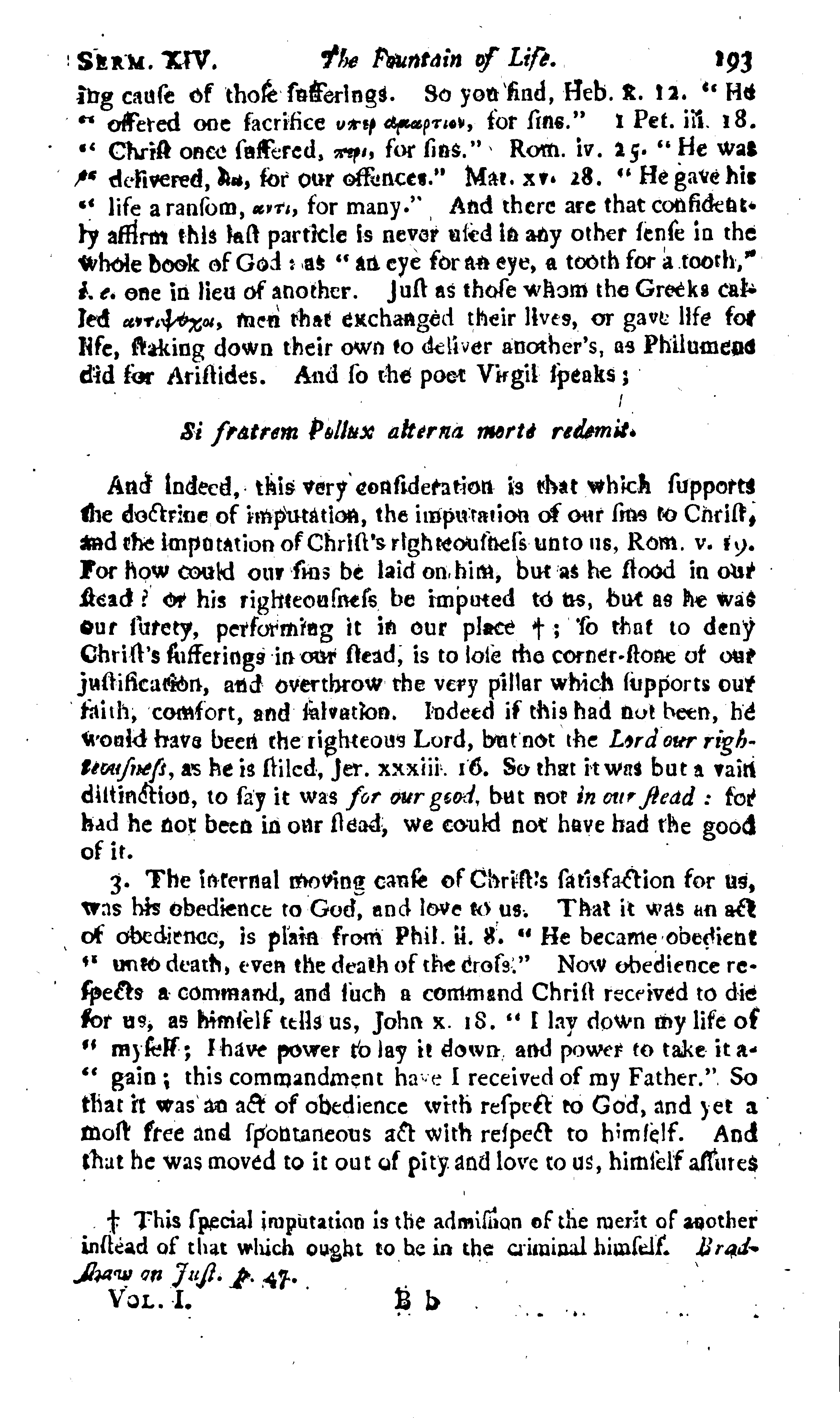
The Fountain of Life. ingcause of those sufferings. So you find, Heb. x. 12. " He
"offered one sacrifice υπερ άμαρτιον, for fins."
1Pet. ii. 18 .
" Christ once suffered, w , for fins. "
Rom. iv. 25. " He was delivered, δια, for our offences." Mat.xv. 28. " He gave his
" life a ransom, αντι, for many."
And there are that confident. lyaffirm this last particle is never usedinany other sense in the whole book of God : as " an eye for an eye, a tooth for a tooth," i.e. one in lieu of another.
Just as those whom the Greeks cal led αντιψύχοι, men that exchanged their lives, or gave life for life, ftakingdown their own to deliver another's, as Philumene did for Ariftides. And so the poet Virgil speaks ;
Si fratrem Pollux alterna morte redemit.
And indeed, this very consideration is that which supports the doctrine of imputation, the imputation of our fins to Christ, andtheimputation of Christ's righteousness unto us, Rom . v. fy.
For how could our fins be laid on him, but ashe flood in our stead? or his righteousness be imputed to us, but as he was our surety, performing it in our place †; so that to deny
Christ'sfufferings in our stead,is to lose the corner-stone of our justification, and overthrow the very pillar which supports our faith, comfort, and salvation.
Indeed if this had not been, he would have been the righteous Lord,but not the Lord our righteousness, a she is stiled,Jer. xxxiii . 16. So that it was but a vain dittinction, to say it was for our good, but not in ourftead : for had he not been in our stead, we could not have had the good of it.
3. The internal moving cause of Christ's satisfaction for us, was his obedience to God, and love to us.
That it was an act of obedience, is plain from Phil. ii. 8. " He became obedient
" unto death, even the death of the cross."
Now obedience respects a command, and such a command Christ received to die for us, as himself tells us, John x. 18. " I lay down my life of " myself; I have power to lay it down, and power to take ita- " gain; this commandment have I received of my Father." So that it was an act of obedience with respect to God, and yet a most free and spontaneous act with respect to himself.
And that he was moved to it out ofpityandlove to us, himselfaffures + This special imputation is the admission of the merit of another instead of that which ought to be in the criminal himself. Bradhaw on Just. K.47 .
VOL. I. вь
SERM. XIV.
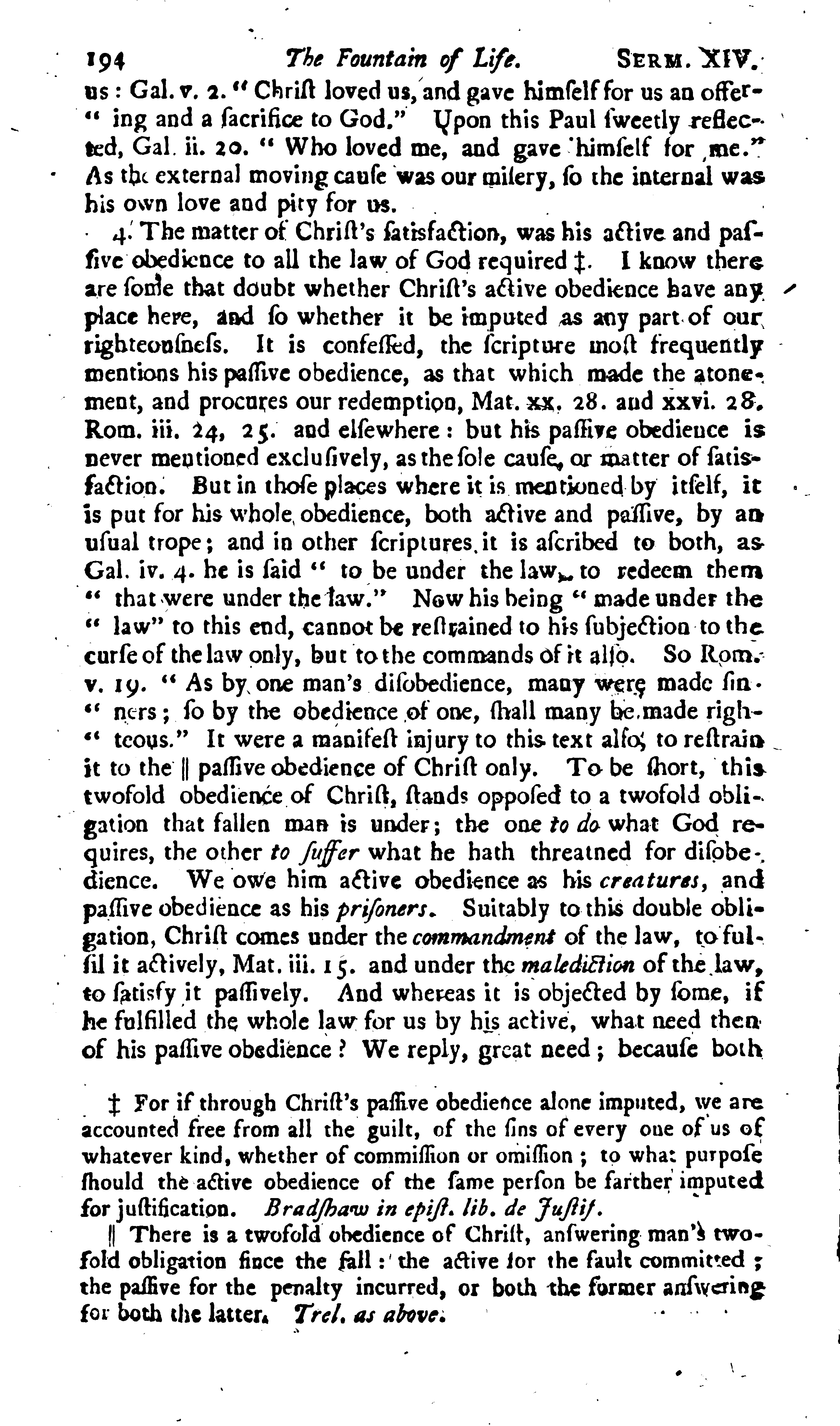
The Fountain of Life. us : Gal. v. 2." Christ loved us,and gave himself for us an offer- " ing and a sacrifice to God."
Upon this Paul sweetly reflected, Gal. ii. 20. " Who loved me, and gave himself for me."
As the external moving cause was our milery, so the internal was his own love and pity for us.
4. The matter of Christ's satisfaction, was his active and passive obedience to all the law of God required
I know there are some that doubt whether Christ's active obedience have any place here, and so whether it be imputed as any part of our righteousness.
It is confessed, the scripture most frequently mentions his passive obedience, as that which made the atone. ment, and procures our redemption, Mat.xx. 28. and xxvi. 28.
Rom. iii. 24, 25. and elsewhere : but his passive obedience is never mentioned exclusively, asthefole cause, or matter offatisfaction. But in those places where it is mentioned by itself, it is put for his whole obedience, both active and passive, by an usual trope ; and in other scriptures,it is ascribed to both, as Gal. iv. 4. he is said " to be under the law, to redeem them
" that were underthelaw." Now his being " made under the " law" to this end, cannot be restrained to his subjection to the curseofthelaw only, but to the commands of it also. SoRom. v. 19. " As by one man's disobedience, many were made fin .
" ners ; fo by the obedience of one, shall many be made righteous." It were a manifest injury to this text also, to restrain it to the|| paffiveobedience of Christ only.
To be short, this twofold obedience of Christ, stands opposed to a twofold obligation that fallen man is under; the one to do what God requires, the other to suffer what he hath threatned for disobedience.
We owe him active obedience as his creatures, and passive obedience as his prisoners.
Suitably to this double obligation, Christ comes under the commandment of the law, toful.
" fil it actively, Mat. iii. 15. and under the malediction of the law, to satisfy it passively. And whereas it is objected by some, if he fulfilled the whole law for us by his active, what need then of his passive obedience ? We reply, great need; because both
† For if through Christ's passive obedience alone imputed, we are accounted free from all the guilt, of the fins of every one of us of whatever kind, whether of commission or omission ; to what purpose should the active obedience of the fame person be farther imputed for justification .
Bradshaw in epist. lib . de Just if .
There is a twofold obedience of Christ, answering man's twofold obligation since the fall : the active for the fault committed ; the passive for the penalty incurred, or both the former answering for both the latter.
Trel. as above.
SERM . XIV.
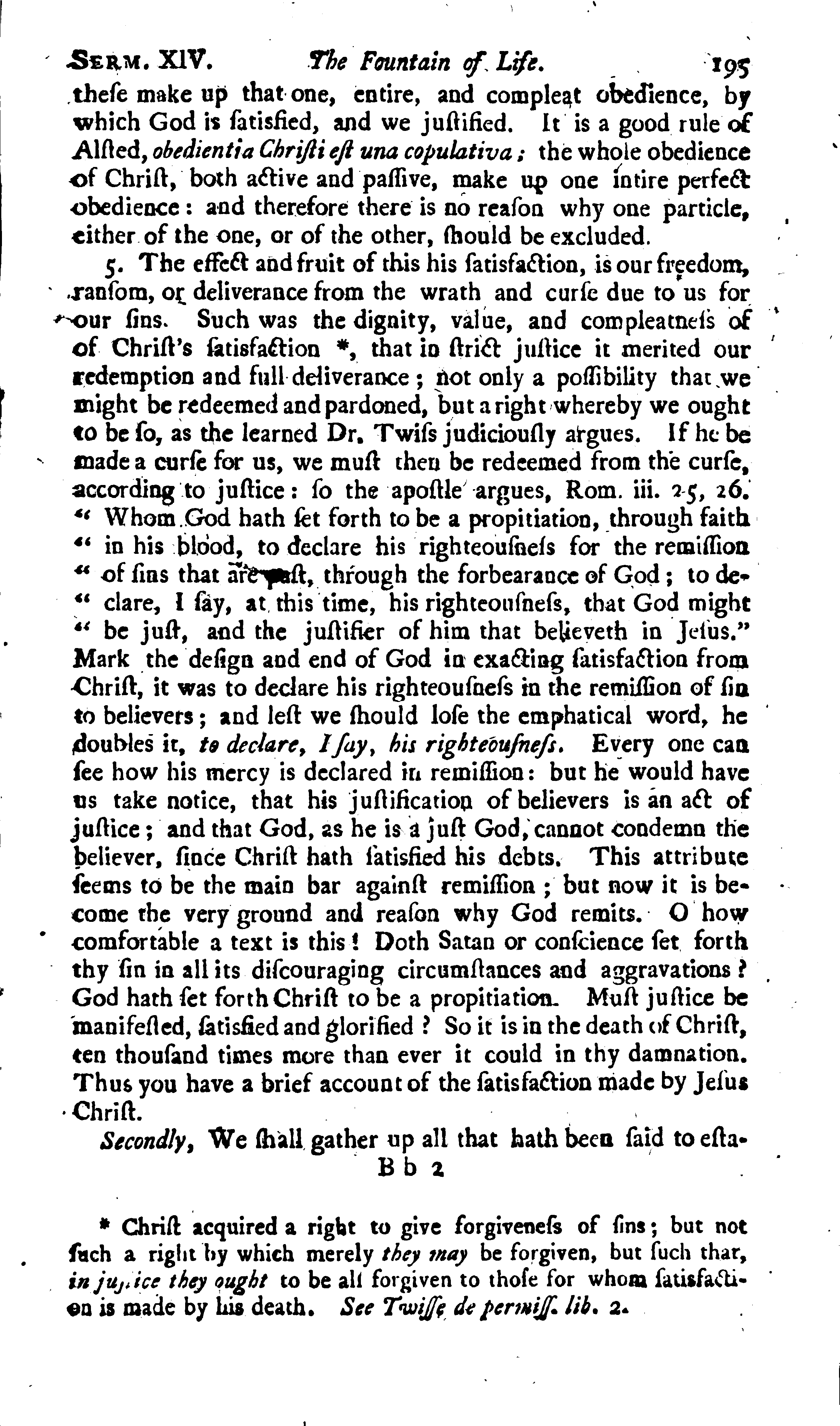
The Fountain of Life. these make up that one, entire, and compleat obedience, by which God is satisfied, and we justified.
It is a good rule of Alfted, obedient i a Christiest una copulativa ; the whole obedience of Christ, both active and passive, make up one in tire perfect obedience : and therefore there is no reason why one particle, either of the one, or of the other, should be excluded.
5. The effect and fruit of this his satisfaction, is our freedom, ransom, or deliverance from the wrath and curse due to us for our fins.
Such was the dignity, value, and compleatness of of Christ's satisfaction *, that in strict justice it merited our redemption and full deliverance; not only a possibility that we might be redeemed and pardoned, but a right whereby we ought to be so, as the learned Dr. Twiss judiciously argues.
If he be made a curse for us, we must then be redeemed from the curse, according to justice: so the apostle argues, Rom. iii. 25, 26.
" Whom God hath set forth to be a propitiation, through faith " in his blood, to declare his righteousness for the remission
" of fins that are ast, through the forbearance of God ; to de- " clare, I say, at this time, his righteousness, that God might
" be just, and the justifier of him that believeth in Jesus."
Mark the design and end of God in exacting satisfaction from Christ, it was to declare his righteousness in the remission off in to believers ; and lest we should lose the emphatical word, he doubles it, to declare, I say, his righteousness .
Every one can fee how his mercy is declared in remission: but he would have us take notice, that his justification of believers is an act of justice; and that God, as he is a just God,cannot condemn the believer, since Christ hath satisfied his debts.
This attribute seems to be the main bar against remission; but now it is become the very ground and reason why God remits. O how comfortable a text is this ! Doth Satan or conscience set forth thy fin in all its discouraging circumstances and aggravations ?
God hath set forth Christ to be a propitiation.
Must justice be manifested, satisfiedandglorified ? So it is in the death of Christ, ten thousand times more than ever it could in thy damnation.
Thus you have a brief account of the fatisfactionmadeby Jesus • Christ.
Secondly, We shall gather up all that hath been said toestaBb 2 * Christ acquired a right to give forgiveness of fins; but not such a right by which merely they may be forgiven, but such that, injustice they ought to be all forgiven to those for whom satisfaction is made by his death.
See Twisse depermiff. lib. 2.
The Fountain of Life.
SERM. XIV.
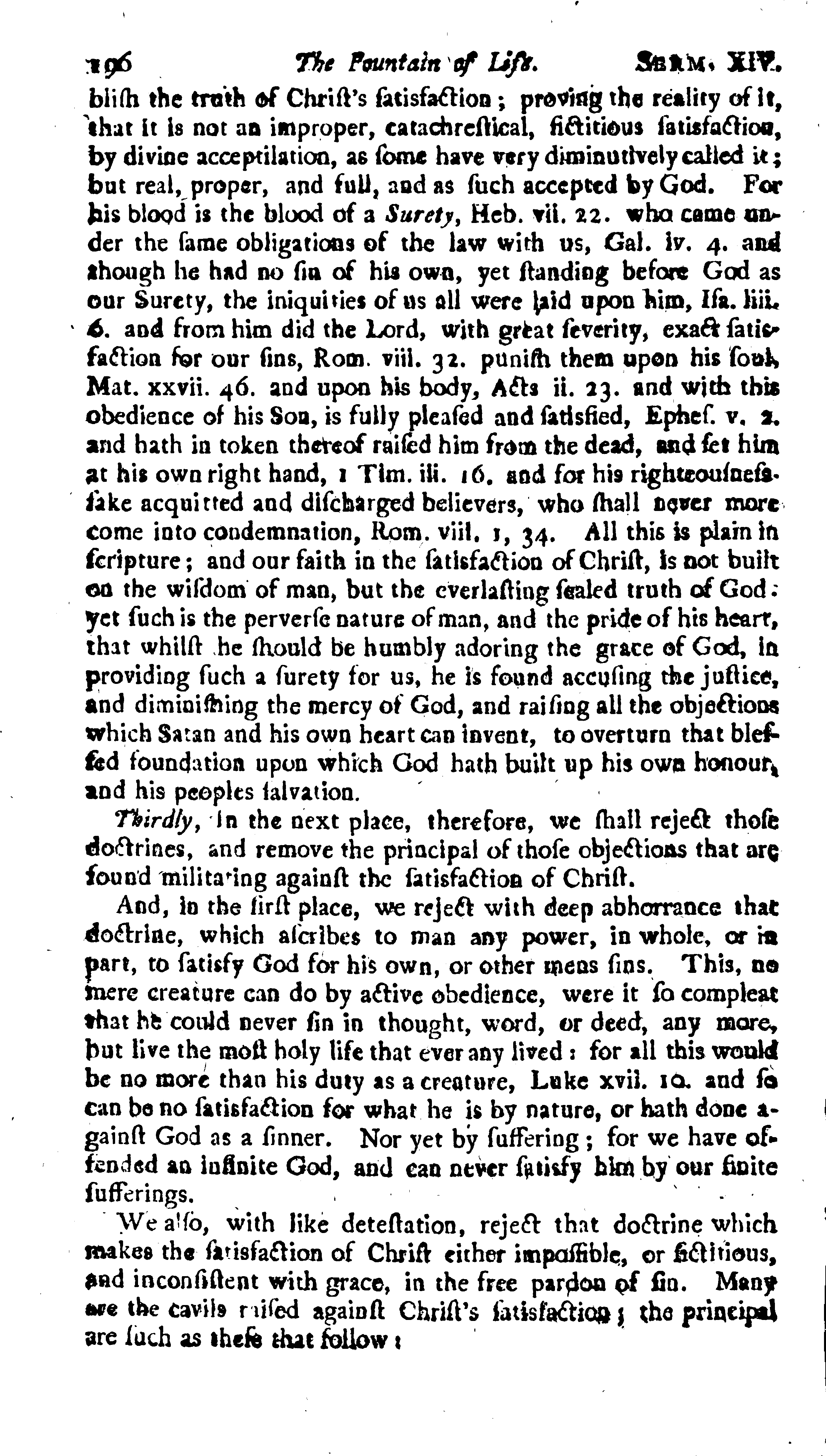
blish the truthofChrist's satisfaction; proving the reality of it, that it is not an improper, catachrestical, fictitious satisfaction, by divine acceptilation,as some have verydiminutivelycalled it; but real, proper, and full, and as such acceptedbyGod.
For his blood is the blood ofa Surety, Heb. vii. 22. whocameunder the fame obligations of the law with us, Gal. iv. 4. and though he had no fin of his own, yet standing before God as our Surety, the iniquities of us all were laid upon him, Ifa. liii.
6. and from him did the Lord, with great severity, exact fat is faction for our fins, Rom. viii. 32. punish them upon his soul,
Mat. xxvii. 46. and upon his body, Acts ii. 23. and with this obedience of his Son,is fully pleased and satisfied, Ephef. v. 2. and hath in token thereofraisedhim from the dead, and set him at his own right hand, 1 Tim. iii. 16. and for his righteousness. fake acquitted anddischargedbelievers, who shall never more comeintocondemnation,Rom. viii. 1, 34.
All this is plain in scripture; and our faith in the satisfaction of Christ, is not built on the wisdom of man,but the everlasting sealed truth of God. yet fuchis the perverse nature of man, and the prideofhisheart, that whilst he should be humbly adoring the grace of God, in providing such a surety for us, he is found accusing the justice, and diminishing the mercy of God, and raising all the objections which Sat an and his own heart can invent, to overturn that blessed foundation upon which God hath built up hisownhonour, and his peoples salvation.
Thirdly, in the next place, therefore, we shall reject those doctrines, and remove the principal of those objections that are found militating against the satisfaction of Christ .
And, in the first place, we reject with deep abhorrance that doctrine, which ascribes to man any power, in whole, or in part, to fatisfyGod for his own, or other mens fins.
This, no mere creaturecandoby active obedience, were it so compleat that he could never fin in thought, word, or deed, any more, but live the most holy life thateverany lived: for all this would be no more than his duty asa creature, Luke xvii. 10. and fo can be no satisfaction for what he is by nature, or hath done against God as a sinner.
Nor yet by suffering; for we have offended an infinite God, and can never satisfy him by our finite sufferings.
We also, with like detestation, reject that doctrine which makes the satisfaction of Christ either impossible, or fictitious, and inconsistent with grace, in the free pardon of fin. Many are the cavils raised against Christ's satisfaction; the principal are such as these that follow :
SERM. XIV.
The Fountain of Life.
Object. The doctrine of Christ's satisfaction is absurd, for Christ (lay we) is God ; if so then, God satisfies bimself, than which what can be more absurd to imagine ?
Sol. I answer, God cannot properly be said to satisfy himself; for that would be the fame thing as to pardon, simply, without any satisfaction. But there is a twofold consideration of Christ *; one in respect of his Essence and Divine Nature, in which sense he is the object both of the offence, and of the satisfaction made for it. Another in respect of his person and oeconomy, or office; in which sense he properly fatisfiesGod, being in respect of his manhood another, and inferior to God,
John xiv. 28.
The blood of them an Christ Jesus is the matter of the satisfaction ; the Divine Nature dignifies it, and makes it of infinite value †. A certain family hath committed treason against the king, and are all under the condemnation of the law for it; the king's son, moved with pity and love, resolves to satisfy the law, and yet fave the family; in order whereuntohe marries a daughter of the family, where by her blood becomes royal blood, and worth the blood of the whole family whence she sprang ; this princess is by herhusbandexecuted in the room of the rest.
In this case the king satisfies not himself for the wrong, but is satisfied by the death of another, equivalent in worthtotheblood of them all.
This fimilitude answers not to all the particulars, as indeed nothing in nature doth, or can ; but it only thews what it was that fatisfiedGod, and how it became so satisfactory.
Object. If Christ satisfied by paying our debt, then he should have endured eternal torments ; forsoweshould, and the damned
Shall.
Sol. We must distinguish betwixt what is essential, and what is accidentalinpunishment. The primary intent of the law is reparationand satisfaction; he that can make it at one in tire payment (as Christ couldanddid)ought to be discharged. He that cannot (as no mere creature can)ought to lie for ever, as the damned do, under sufferings.
Object. If God will be satisfied for ourfins before he pardon them, how then is pardon an act of grace ?
* It is one thing to treat of Christ's divinity according to its nature, confidereddiftinctlyby itself: another thing to treat of it as in his person.
Trelcat.
+Christ, according tohisdivinenature,isone with God; as man he is one with us: on the other part, as God, he is at a distance from us: as man, or by voluntary oeconomy, at a distance from God. Idem i bid. SeeDavon.on. Col. 103. and Cameron.p. 361 .
SERM. XIV.
The Fountain of Life.
Sol. Pardoncouldnot be an act ofpuregrace, if God received satisfaction from us ; but if he pardon us upon the satisfaction received from Christ, though it be of debt to him, it is of grace to us : for it was grace to admit a Surety to satisfy, more grace to provide him, and most of all to apply his satisfaction to us,by uniting us to Christ, as he hath done .
Object. But God loved us before Christ died for us ; for it was the love of God to the world that moved him to give his only begotten Son.
Could God love us, and yet not be reconciled and satisfied?
Sol.God's complacential love is indeed inconsistent with an unreconciled state : He is reconciled to every one he so loves. But his benevolent love, consisting in his purpose of good, may be before actual reconciliation and satisfaction.
Object. Temporal death, as well as eternal, is a part of the curse if Christ have fully satisfied by bearing the curse for us, how is it, that those for whom he bare it, die as well as o. thers?
Sol. As temporal death is apenal evil, and part of the curse, foGod inflicts it not upon believers; but they must die for other ends, viz . to be made perfectly happy in a more full and immediate enjoymentofGod, than they can have in the body : and so death is theirs byway of privilege, 1 Cor. iii. 22. They are not death's by way of punishment.
The fame may be said of all the afflictions with which God, for gracious ends, now exercises his reconciled ones .
Thus much may suffice to establish this great truth.
Inference 1. If the death of Christ was that which satisfied God for all the sins of the elect, then certainly there is an infinite evilinfin,finceit cannot beexpiated, but by an infinitefatisfaction .
Fools make a mock at sin, and there are but few fouls in the world that are duly sensible of, and affected with its evil ; but certainly, if God should damn thee to all eternity, thy eternal sufferings could not satisfy for the evil that is in one vain thought ‡.
It may be you may think this is harsh and severe, that God should hold his creatures under everlasting suf. ferings for fin, and never be satisfied with them anymore. But † By this death of Christ we are greatly excited both to caution, and to detestation off in.
For it must surely be a deadly evil which could not be otherwise cured than by Christ's death.
What man therefore, seriously considering that his fins were no other way expiatedthanby the blood of the very Son of God, will not tremble at the thoughts of trampling, as it were, on that most precious blood by daily sinning ?
Daven, on Col. chap. 1. V. 20.
SERM . XIV.
The Fountain of Life. when you have well considered, that the object against whom you fin, is the infinite blessed God, which derives an infinite evil to the sin committed against him; and when you confider how God dealt with the angels that fell, for one fin, and that butofthemind; (for having no bodily organs, they could commit nothing externally against God:) you will alter your minds about it.
O the depth of the evil of fin! If ever you will fee how great and horrid an evil sin is, measure it in your thoughts, either by the infinite holiness and excellency of God, who is wrong'd by it ; or by the infinite sufferings of Christ, who died to satisfy for it ; and then you will have deeper apprehenfions of the evil off in .
Inference 2. If the death of Christ satisfied God, and thereby redeemed the elect from the curse : then the redemption offouls is costly ; fouls are dear things, and of great value with God.
" Yeknow, (says the apostle,) thatye were not redeemed with " corruptible things, as silver and gold, from your vain conversation, received by tradition; but with the precious blood of the Son of God, as of a lamb without spot," I Pet. i. 18, 19.
Onlytheblood of God is found an equivalent price for the redemption offouls.
Gold and silver may redeem from Turkish, but not from hellish bondage.
The whole creation fold to the utmost worth of it, is not a value for the redemption of one soul.
Souls are very dear ; he that paid for them found them. fo: yet how cheaply do sinners fell their souls, as if they were but low prized commodities! but you that fell your souls cheap, will buy repentance dear.
Inference 3. If Christ's death satisfied God for our fins, how unparalleled is the love of Christ topoorfinners! It is much to pay
" a pecuniarydebt to free another, but who will payhisown blood for another ? We have a noted instance of || Zaleucus, that famous Locrenfian lawgiver, who decreed, that whoever was convicted of adultery, should have both his eyes put out.
It fo fell out, that his own Son was brought before him for that crime; hereuponthe people interpofing, made suit for his pardon. At length, the Father, partly overcome by their impor-
tunities, and not unwilling to shew what lawful favour he might to his Son,he first put out one of his own eyes, and then one of his son's; and so shewed himself both a merciful father, and a just lawgiver; so temperingmercywithjustice, that both the Law was satisfied, and his Son spared.
This is written by the Historian as an instance offingularlove in his Father, to pay
|| Valerius, book vi chap. 5.
The Fountain of Life.
SERM . XIV.
onehalfofthe penalty for his Son.
But Chriftdid not divide, and share in the penalty with us, but bare it all.
Zaleucusdid it for his Son, who was dear to him ; Christ did it for ene. mies, that were fighting and rebelling against him : Rom. v. 8.
" While we were yet sinners, Chriftdied for us." "O would " to God(faidaholy one) I could cause paper and ink to speak
" the worth and excellency, the high and loud praises of our " brother ransomer ! O the ransomer needs not my report; but " O if he would take it, and make use of it! I should be
" happy if I had an errand to this world but for some few years, to spread proclamations, and out-cries, and love-let- « "
" ters of the highness [the highness evermore] of the ransom. er, whose cloaths were wet, and dyed in blood ; howbeit,
" that after that my soul and body should goback to their mo- " ther nothing."
Inference4. If Christ, by dying, hath made full satisfaction, then God is no loser in pardoning the greatest offinners that believe in Jesus ; and confequentlyhis justice can be no bar to their justification and salvation. He is just to forgive us our sins, 1 John i. 9.
What an argument is here for a poor believer topleadwithGod ! Lord, if thou save me by Jesus Christ, thy justice will be fully satisfied atone full payment ; but if thou damn me, and require satisfaction at my hands, thou canst never receive it: I shall make but a dribbling payment, though I lie in hell to eternity, and shall still be infinitely behind with thee.
Is it not more for thy glory to receive it from Christ's hand, than to require it at mine ? One drop of his blood is more worth than all my polluted blood. O how satisfying a thing is this to the confcienceofapoor sinner that is objecting the multitude, aggravations, and amazing circumstances, of fins, against the possibility of their being pardoned !
Can such a sinner as I be forgiven ? Yes, if thou believest in Jesus, thou mayeft; for foGod will lose nothing in pardoning the greatest tranfgreffors: " Let Ifraelhope in the Lord ; for " with the Lord there is mercy, and with him is plenteous re- " demption," Psal. cxxx. 7. i. e. a large stock of merit lying by him in the blood of Christ, to pay him for all that you have done against him .
Inference 5. Lastly, IfChrift hath made such a full satisfaction as youhaveheard, How much is it the concernment of every soul,toabandonallthoughts offatisfyingGodforhisownfins,and betake himself to the blood of Christ, the ransomer, by faith, that in that blood they may be pardoned ? It would grieve one's heart to fee how many poor creatures are drudging and tugging ata1
SERM. XIV.
The Fountain of Life.
task of repentance, and revenge upon themselves, and reformation, and obedience, to fatisfyGod for what they have done against him: And alas ! it cannot be, they do but lose their labour ; could they swelter their very hearts out, weep till they can weep no more, cry till their throats be parched, alas, they canneverrecompenfeGod for onevainthought; for such is the severity of the law, that when it is once offended, it will never be made amends again by all that we can do; it will not discharge the sinner, for all the sorrow in the world.
Indeed, ifa man be in Christ, sorrow for fin is something, and renewed obedience is foinething; God looks upon them favourably, and accepts them graciouflyin Christ : butoutofhim they signify no more than the in treaties and cries of a condemned malefactor, to reverse the legal sentence of the judge.
You may toil all the days of your life, and at night go to bed without a candle. To that sense that scripture sounds, Isa. 1. 1 г. " Behold, all ye that kin- "dle a fire, that compassyourselves about with sparks ; walk
" in the light of your fire, and in the sparks that you have " kindled: This small ye have of mine hand, ye shall lie down
" in sorrow."
By fire, and the light of it, some understand the sparkling pleasures of this life, and the fenfitivejoys of the creatures : but generally it is taken for our own natural righteousness, and all acts of duties, in order to our justification by them before God. And so it stands opposed to that faith of recumbencyspoken of in the verse before. By their compaffing themjelves about with these sparks, understand their dependance on these their duties,andglorying in them. But fee the fatal issue,
Yes hall lie down in sorrow : that shall be your recompence from the hand of the Lord'; that is all the thanks and rewardyoumust expect from him, for flightingChrist's, and preferring your own righteousness before his.
Reader, be convinced, that one act of faith in the Lord Jesus pleases God more than all the obedience, repentance, and strivings to obey the law, through thy whole life, can do.
And thus you have the first special fruits of Christ's priesthood, in the full satisfaction of God, for all the fins of believers.
VOL. I.