
Proslogion
PR O SL O GION
P R E F A C E
ST. ANSELM begins the Preface to the Proslogion by mentioning his earlier work, the Monologion (written one year before the Proslogion) , where he had attempted to prove the existence of a being which is 'the best and greatest and highest of all things'. 1
We can, he says, prove this by reason alone ('sola ratione') and in many different ways. St. Anselm, however, offers to present the most easily understood proof based on the fact that there are many good things, a fact evident from sense experience and from intellectual apprehension. Things may, as compared with each other, be equally good or more or less good, but the fact that they are good means that they are nevertheless the same in this respect. Now, that diverse things are the same in being good implies that they are good 'through something' . 2 In a later chapter Anselm explains that for a thing to be 'through some thing' means that it has come to be through an efficient cause or a material cause or through an instrumental cause.3
It seems proper, then, to interpret St. Anselm's argument here as meaning that diverse things that are the same in some
respect are caused to be the same in that respect by something extrinsic to them, and this cause possesses the characteristic in question 'through itself' ('per se') . Thus there is something good 'through itself', and all the other diverse things that are good are good through it. There is, then, so Anselm concludes, a being that is in the highest degree good and great, and that is the most supreme being.4
This proof, Anselm says, began from the fact that there are many good things, but the concept of goodness is not at all necessary to the proof, which may be generalized to prove
1 i ; Schmitt, i. 1 3. On the Monologion see the interesting, but debatable, study by P. Vignaux, 'Structure et sens du Monologion', in Revue des sciences philo sophiques et thiologiques, xxxi, I 947, 1 92-2 12. See also F. S. Schmitt, 'Les Corrections de saint Anselme a son Monologion', in Revue Benedictine, 1, 1 938, 1 94-205.
2 i ; 14.
3 vi; 19. 'Quod enim dicitur esse per aliquid, videtur esse aut per efficiens aut per materiam aut per aliquod aliud adiumentum, velut per instrumentum.' See also ch. vii, where it is made clear that things exist 'through' God by way of
creation 'ex nihilo'.
+ i; 15.
826610 E
C O M MENTARY
that whatever exists, exists through some one thing. Anselm apparently treats existence as an ordinary characteristic so that all the diverse things that exist, though they exist in
different ways, are the same in this respect, namely, that they
exist. And that they are the same must be explained by positing the existence of some one thing which, existing through itself,
is the cause of existence in other things. As Anselm puts it :
'Everything which exists exists either through something or
through nothing. But nothing exists through nothing. For it cannot be thought that something should not exist through something. Whatever exists, therefore, does not exist save
through something.' 1
Now this being through which all other beings exist must be either one or more than one. If more than one then they would be the same in respect of existing through themselves or being existents 'per se', and we should have to postulate some one being through which these existents 'per se' would derive their
same existence 'per se' . Therefore we must postulate the exis tence of one being which, existing through itself, is the ground of the existence of all other things. And, finally, since what exists 'through itself' is greater than what exists 'through another' (or, as we might put it, whatever exists independently is greater than what exists dependently) , this being is greater than all others ('maxime omnium est') and hence 'the best
and greatest and highest of all things' .z In the following chapter of the Monologion Anselm sets out a further argument (though it is difficult to see whether he intends it as an independent proof, or simply as a fuller explica tion of the reasoning behind the proof just considered) , namely
that, if diverse things are the same in some respect, they must be caused to be the same in that respect by something extrinsic to them. When we inspect the things in the world, Anselm says, and compare them with each other we see that there are grades
of excellence among them. For example, a horse is intrinsically
more excellent than a tree, and a man intrinsically more excellent than a horse.3 We can, then, arrange things in a
1 iii; 1 5-1 6. 'Omne namque quod est aut est per aliquid aut per nihil. Sed nihil est per nihil. Non enim vel cogitari potest, ut sit aliquid non per aliquid. Quidquid est igitur, non nisi per aliquid est.'
2 iii; 1 6.
J iv; 16-1 7.
P R O S L O G I O N : P R E F A C E
5 1
hierarchical series according to their degree of excellence.
Now, if there were no thing of the highest grade of excellence
(such that it had nothing higher than it) , then the series would be infinite ; in other words, no grade of excellence would be so superior that it itself had no superior. But this would mean that there would be an infinity of natural things. But this is absurd.
Therefore there must necessarily exist a thing of such a superior grade of excellence that nothing could be superior to it. The conclusion of this proof might suggest that the most exccllcn t thing must itself be a member (albeit the highest member) of the hierarchical series. However, in a later chapter1 Anselm remarks that relative expressions do not apply properly to the supreme being, so that when we say that God is the 'highest' of
all things or 'greater' than others, we do not mean 'highest' or 'greater' to be taken relatively to other things. As he puts it :
'If none of those things existed, in relation to which it (the supreme being) is called supreme or greater, it would not be conceived as either supreme or greater, yet it would not, there fore, be less good or suffer detriment to its essential greatness in any degree.'1 God, therefore, does not exist as the highest member of the hierarchical series, but rather outside the series.
However, the difficulty for Anselm then is that the positing of a thing so superior to all others that it itself has no superior will not suffice to stop the series of things going on ad infinitum ; for the only thing that would stop this would be for the series to have a last or highest member within the series.
One can see in this Monologion argument, with its notion of a being so superior to all others that a superior to it cannot exist, how close Anselm is to the definition that he exploits in the Proslogion, namely, 'that than which a greater cannot be thought'. The Monologion formula, however, is the conclusion of the proof and gets its sense and meaning from the proof, whereas in the Proslogion the definition is rather assumed as a premiss.
Again, as we shall see, the Proslogion formula is much more sophisticated and subtle than that used in the Monologion.

These, then, are the arguments which Anselm sets out in the Monologion. Interesting as they are, and illuminating as they are for the interpretation of the Proslogion arguments, it is obvious enough that they are only as valid as the naive
I XV; 28.
COMM ENTARY
Platonic thesis on which they hinge, namely, that if diverse things are the same in some respect they must be caused to be

the same in that respect by something extrinsic to them, which latter must have the property in question 'through itself', or in a pure form, or to an absolute degree. For St. Anselm, however, the only drawback of the arguments is their complexity, in that they depend upon a number of premisses which in turn need explanation and justification. In themselves, St. Anselm con siders, they are quite valid and conclusive. 1
We may return now to the Proslogion. Anselm goes on to
describe how he began to speculate on the possibility of a single and self-sufficient argument to establish the same con clusion as was reached by the more complex Monologion arguments.2
'Argument' ('argumentum') for St. Anselm can mean both a single premiss in a train of reasoning or the train of reasoning considered as a whole. However, it seems clear that here St.
Anselm means it in the latter sense for, as we shall see, the proo f he develops in the Proslogion is a formal deductive argument
with a number of premisses. St. Anselm nowhere pretends, as is sometimes alleged, that the existence of God is self-evident in
the strict sense, that is, in the sense that the proposition 'God (that than which nothing greater can be thought) exists', is
seen immediately to be self-evident in that its denial would be self-contradictory.
Anselm also intimates here that the beauty of his new proof is that it serves to prove the attributes of God as well as His existence, whereas in the Monologion the attributes had to be
proved by invoking the additional principle that we must
attribute to the 'supreme nature' whatever it is better to be rather than not be.J In the Proslogion this principle is seen to be a corollary of the definition 'God is that than which nothing
greater can be thought' .
1 Barth alleges that the Monologion proofs are not meant to be independent rational proofs of the existence of God : 'My view is then that even in the Mono logion we are confronted by a very pronounced rejection of speculation that does
not respect the incomprehensibility of the reality of the objects of faith; by a recognition of the indirectness of all knowledge of God, and also, though more clearly than in the Proslogion, by the reference to the Pattern of faith which is the basis of everything.' Fides Quaerens lntellectum, p. 57.
2 'Unum argumentum, quod nullo alio ad se probandum quam se solo indigeret' :
Preface, p. 102.
J Mono/. xv; 28.
PRO S L O G I ON: PREFACE
Anselm goes on to describe the obsessive hold that his project came to have upon his mind. And Eadmer relates that while he was reflecting upon the problem he gave up 'food, drink and sleep' and became so exercised by it that it even began to inter fere with his religious duties. Anselm had, indeed, begun to wonder if the whole pursuit were not a temptation of the Devil when, 'to his great joy and jubilation', the solution dawned upon him one evening between the night offices.1 Eadmer also tells a curious story that St. Anselm wrote the argument down quickly on wax tablets and gave them to one of the monks in the monastery to mind for him. The monk, however, lost the tablets, but, fortunately, Anselm was able to remember his text and to write it down again. Very trustingly he gave the tablets again to the same monk, who this time found them broken.
Anselm then decided, for safety's sake, to write the argument down on parchment.
The title of the work, Anselm says, is 'Faith in Search of Understanding' ('fides quaerens intellectum') , which is, of course, an Augustinian echo. The name 'Proslogion', which means 'an allocution', is merely a short and convenient title.
Since we have already examined at some length what Anselm means by 'faith in search of understanding' we need not con sider it further here.
Anselm dedicates the Proslogion to Archbishop Hugh of Lyons, a close friend with whom he stayed while he was in exile after his quarrel with William Rufus. From what we know of Hugh, or Hugh de Die, it appears that he was a rela tive of the Duke of Burgundy; he was appointed papal legate in
1 075 and Archbishop of Lyons in 1 083. A fervent supporter of the Gregorian reforms, he also seems to have been a man of extreme rigidity since Gregory VII had to overrule some of his decisions.2
C H A P T E R I
St. Anselm begins the Proslogion proper with a prayer-like introduction. \'\Tritten in a heightened oratorical style,J it is
1 Vita, I. xix; Southern, p. 30.
2 See A. l<'liche, La Rijorme Gregorierme, in Histoire de l' Eglise, viii. 205-6 ; Rule in his introduction to Eadmer's De Vita Sancti Anselmi .
• . has a fanciful account of the relations between Hugh and Anselm.
3 'Un style un peu abondant', as Dom v\Tilmart says of St. Anselm's prayers, A1tfditations et prieres de saint Anselme, p. lxi.
C O MMENTARY
closely modelled upon St. Augustine ; indeed, the introduction
is largely a tesselation of themes from the Psalms and St.
Augustine. Man seeks to know God, but God is inaccessible to
him, both because of God' s transcendence, and because the human mind has been weakened by the effects of the Fall. We must pray to God then, if we are to come to know God. Echoing
St. Augustine, St. Anselm addresses God : 'Teach me to seek You, and show Yourself to him who seeks You, because I can neither seek You ifYou do not teach me how, nor find You unless
You show Yourself.' And he ends with the Augustinian formula which we have already discussed at some length : 'I do not seek to understand so that I may believe ; but I believe so that I may understand.'1
As we suggested before, it would be misleading to place too much stress upon these Augustinian commonplaces and to exaggerate the 'fideist' tendency of what Anselm says here. It
has been alleged, for example, that St. Anselm means that the Proslogion proof, in contrast with the A1onologion proofa, is based upon faith, or 'Christian experience', which presupposes
God's grace.2 However, for Anselm himself the only difference between the Monologion proofs and the Proslogion argument is that the latter is not as logically complex as the former. Where as the Monologion proofs were 'composed of a chain of many
arguments', the Proslogion argument is intended to be 'one single argumnt which for its proof requires no other save itsclf' .3
St. Anselm says nothing at all about the Proslogion proof having a radically different point de depart from that of the Monologion
arguments.
C H A P T E R I I
We believe by faith that God exists and that He has a certain
nature. In other words, we believe, as theists and Christians,
that God is a being so great that no greater being than He can be thought of or conceived. Now, can we show by rational
1 p. 1 1 5. Cf. St. Augustine, De Libera A.rbitrio, I I . ii ; P.L. xxxii. 1242.
2 'This (Proslogion) proof differed from the three of the Monologion in starting
from faith ; and it mnst be understood as deriving from Christian experience. Its
validity, from Anselm's point of view, did not rest upon its verification by objective tests, but solely upon the knowledge which came through God's illumination . . . .
Such knowledge of God, therefore, presupposes grace.' G. Leff, Medieval Thought, p. I O I .
3 p. 103.
P R O S L O G I O N I I
means that what we believe by faith can be understood ? That is to say, can we show by rational means that God, defined as 'something than which nothing greater can be thought' , really exists ? There is no doubt that St. Anselm has in mind here
St. Augustine's discussion of the existence of God in his De Libero Arbitrio, and it will help to illuminate St. Anselm's meaning if we examine what Augustine has to say.
In the De Libero Arbitrio Augustine is engaged in a discussion with Evodius and he asks him whether he is certain that God exists. Evodius answers that he does not directly know that
God exists, but rather believe< it, and Augustine remarks : 'If then one of those fools of whom Scripture writes, "The fool said in his heart : there is no God", should say this to you, and should refuse to believe with you what you believe, but wished to know whether your belief is true, would you have nothing to do with this man, or would you think he ought to be convinced in some way of what you hold firmly-especially if he should seriously wish to know it and not obstinately to oppose it ? ' 1
Evodius replies that i t i s sufficient t o appeal t o the testimony of 'all those writers who have testified that they lived with the Son of God' . Augustine agrees that, in a sense, we must believe in God in order to understand Him, but he then proceeds to develop a purely rational and independent proof of the existence of God which is apparently meant to be convincing to the
unbeliever. Reason, he argues, is the supreme element in man, but reason apprehends the existence of eternal and unchange able truth. Now, if there is anything higher than eternal truth it is God ; but if there is not, then truth itself is God. Augustine concludes his argument by saying to Evodius, 'If I showed there was something above our minds, you conceded you would confess it to be God, provided there was nothing still higher.
Accepting your admission I said it was enough that I should show this. For if there is something more excellent, it is this
which is God, but, if there is nothing more excellent, then truth itself is God. Whichever is the case, you cannot deny that God exists. '2 In other words, God is defined as the 'highest' and ' most excellent' thing that we can conceive, so that to prove the existence of a highest and most excellent conceivable thing
1 De Lib. Arbit. rr. ii, sec. 5; trans. M. Pontifex, The Problem of Free Choice,
London, 1 955, pp. 77-78.
2 Ibid. rr. xv ; Pontifex, p. 1 20.
C O M M ENTARY
(eternal truth) is precisely to prove the existence of God. 1
Augustine concludes that, even though we know God only in a very tenuous way by rational means, we still do know Him.
'God exists, and He exists truly and supremely. We not only
hold this, I think, by our undoubted faith, but we also attain to
it by a sure, though very tenuous, kind of knowledge.'2
St. Augustine, then, clearly admits the possibility of a
rational justification of belief in God and, since St. Anselm professes to follow Augustine so closely, we may conclude that his intention in the Proslogion is precisely the same as that of his
master in the De Libero Arbitrio. In other words Anselm's
intention is to prove that God, defined as that than which nothing greater can be thought, can be shown by rational means (appreciable by the unbeliever) to exist.
'\Ve believe', says St. Anselm addressing God, 'that you are something than which nothing greater can be thought' ('aliquid
quo nihil maius cogitari potest') .3 There is no doubt that the
immediate source of this formula is, as we have just seen, to be found in St. Augustine, though of course the general notion of God as a being so supremely great that there cannot conceivably be a greater than He is part and parcel of Judaeo-Christian theism.4 But, we may ask, what is the basis of this definition of
God as 'that than which nothing greater can be thought' ?
St. Anselm says that we 'believe' that God is definable in this
1 Pontifex, p. 262, expresses the difference between St. Augustine and St.
Anselm thus : 'St. Anselm argues that we can conceive of that than which nothing greater can be conceived ; that than which nothing greater can be conceived must have existence or it would have something still greater than itself, and therefore that God must exist. St. Augustine, it is true, agrees that God must be greater than anything we can conceive, but he does not argue that therefore God must exist : he sets out to show that such a being must exist because we are aware of truth.' Again, we might add, St. Augustine's argument is a causal argument of a kind, whereas, as we shall see later, St. Anselm's argument is non-causal in form.

2 Ibid. u. xv; Pontifex, p. 1 20.
3 Anselm uses several variants of this formula : 'id quo maius cogitari ncquit' ;
'aliquid quo maius cogitari non valet', &c.
4 See St. Augustine, Confessions, vu, c. iv: 'Neque enim ulla anima umquam potuit poteritve cogitarc aliquid, quod sit te melius, qui summum et optimum bonum es' (P.L. xxxii. 735) . Also see De Moribus Manichaeorum, r. ii, c. xi, where
God is defined as a being 'quo esse aut cogitari melius nihil possit' (P.L. xxxii.
1 355) . For other references see Schmitt, i. p. 1 02. Schmitt also remarks an interest ing anticipation of the formula in Seneca, Natura/es quaestiones, r, Praef. 1 3 :
'Quid est deus? mens universi, quod vides totum et quod non vides totum, sic demum magnitudo illi sua redditur, qua nihil maius cogitari potest, si solus est omnia, si opus suum et intra et extra tenet.'
PRO S L OG I O N I I
way, but he cannot mean, as it has sometimes been claimed, that the definition is only appreciable by one who has faith, so that the whole Proslogion argument, which of course hinges upon the definition, would only be persuasive for those who already believed in God. There is, in fact, enough historical evidence to show that St. Anselm would have been well aware of the position of the philosophical atheist. Thus, as we have

seen, his English disciple Rodulfus has a dialogue where 'Ne sciens', representing the unbeliever, declares that he refuses to believe anything that he cannot see with his eyes.1 And another disciple, Gilbert Crispin, begins one of his works by saying that it is aimed at 'those who do not believe to exist what they do not see to be capable of existing'.:z
We do, then, believe that God is 'that than which nothing greater can be thought' and we can assume that, for the believer, this formula is meaningful ; but, as Anselm shows later in his reply to Gaunilo, a rational or philosophical sense can be given to the definition so that it is meaningful also to the unbeliever.J
Here, in Chapter II, however, St. Anselm supposes that the formula is quasi-self-evident and needs no special justification.
His argument is indeed directed at the unbeliever, but at the kind of unbeliever who, while admitting that he knows what it would be like for God to exist, denies that God does in fact exist. In other words, Anselm's argument, at least in Chapter
II of the Proslogion, is directed against what we might call the 'factual atheist', rather than against the 'logical atheist' who argues that the very notion of God, no matter how defined, is a strictly meaningless one, so that we do not even know what it would be like for God to exist.

Anselm comments later4 that the exact formula 'that than which nothing greater can be thought' is important if his
1 Libel/us primus de nesciente et sciente, cited Webb, in MAR.s, iii, 1954, 59: 'Sunt autem multi homines etiam Christiani moribus et vita fcre similes bestiis qui etiam hoc ipsum utrum deus sit dubitant, nee aliud quam qui oculis videntur esse existimant.'
2 Cited by R. W. Southern, 'St. Anselm and his English Pupils', in MARS, i, 1941 , 20. Southern comments as follows : 'It is not without significance that Anselm's pupils were so much concerned with the problem of unbelief . . . . Gilbert
Crispin, by the strenuousness and scrupulousness of his discussion, best reveals the gravity of the conflict and shows that the enemy was not an imaginary being from whom there was nothing to fear.'
3 The Author's Reply, p. 1 87.
4 Ibid., pp. 1 79-81.
C O M MENTARY
argument is to work. 'That than which nothing greater can be
thought' , he says, is not equivalent to the notion of the 'greater than all' ('maius omnibus' ) , for we cannot show that the proposition 'the greater than all does not exist' is self-con
tradictory as evidently as we can with the proposition 'that than which nothing greater can be thought does not exist'.
However, reserving a closer examination of the formula until
later, let us briefly expose the argument which Anselm con structs around it.
The notion of God, defined as 'that than which nothing greater can be thought', is understandable or meaningful, and in this sense it exists 'in the mind' ('in intellectu') . Now, what exists in actual reality ('in re') is distinct from what merely exists in the mind. It is one thing for a picture to be thought of or
be in the mind of the painter, and another thing for it actually
to exist after the painter has painted it. And, more importantly,
what exists in actual reality is 'greater' than what exists in the mind alone. God defined as 'that than which nothing greater can be thought' must therefore exist in actual reality, for if He
did not so exist, but merely existed in the mind, He would not be precisely 'that than which nothing greater can be thought', since it would be possible to think of a greater, namely, some thing than which nothing greater can be thought existing in
actual reality as well as in the mind.
It is important to notice that this is an argument or train of

reasoning involving several premisses and that St. Anselm is not pretending that the proposition 'that than which nothing
greater can be thought actually exists' is an analytic proposition such that its denial would be immediately self-contradictory.
The denial of this proposition only becomes self-contradic
tory on the supposition that what actually exists is greater than what merely exists in the mind. Unless we suppose this latter premiss there is no self-contradiction involved in the proposition 'that than which nothing greater can be thought
does not actually exist' .
Aquinas is plainly wrong, then, when he interprets St.
Anselm as claiming that the proposition 'God exists' is self
evident ( 'per se notum') .1 It has been claimed that Aquinas was 1 Sum. Cont. Gent. I. x. Aquinas refers to those 'qui asserunt quod Deum esse per se notum est, ita quod eius contrarium cogitari non possit, et sic Deum esse
P R O S L O G I O N I I
not considering Anselm's proof as such but rather later formula
tions of it. However, Aquinas obviously knew of Anselm's Proslogion argument at first hand and he nowhere bothers to
distinguish the formulation of it that he rejects from St. Anselm's
own formulation. \Ve may suppose, then, that he thought that his criticisms of it were fatal to St. Anselm's proof as such. 1
If, however, the Proslogion argument is a real argument, there is no doubt that for Anselm the premisses of it were so evident that it would be impossible not to be convinced by it. If one
admits that God is definable as that than which nothing
greater can be thought, and if one admits the obvious premiss that what exists in actual reality is greater than what exists in the mind alone, then, under pain of self-contradiction, one cannot but conclude that God must actually exist. Or, put in another way, the proposition 'God docs not actually exist'
is seen to be self-contradictory on the assumption that God is defined as 'that than which nothing greater can be thought' and on the further assumption that it is greater to exist in reality than in the mind alone. Or, again, if the notion of 'God' defined as 'that than which nothing greater can be thought'
is a meaningful one then, granted that it is greater to exist in reality than to exist in the mind alone, it must be true or in stantiated ; or, ifit is possible that God ('that than which nothing
greater can be thought') exists, then, granted that it is is greater to exist actually than merely possibly, God actually exists.
This, then, is the extremely elegant and ingenious argument that Anselm proposes, and we must now examine more closely the clements from which it is composed. ·what, first of all, is
demonstrari non potest', and he goes on to give a summarized version of the proofs in Chapters II and III of the Proslogion. Gilson admits that the Proslogion argument is not the analytic proposition that Aquinas makes it out to be, but the reason he gives for this is that the proof presupposes 'purification of the heart, faith, an appeal to God, illumination of thought by grace' (Etudes sur le role de la jm1see medievale dans la formation du systeme cartesien, Paris, 1930, p. 2 1 8) . This 'fidcist'
interpretation of St. Anselm, as we have seen, cannot be maintained. In anv case, it is principally because the Proslogion argument is formally and logica.lly an argument that the proposition 'God exists' is not for Anselm 'per se notum' or analytic or self-evident.
1 St. Thomas mentions St. Anselm by name in two earlier discussions : De Veritate, q. r o, art. 12 ; Comm. in Sent. l. i, dist. 3, q. I, art. 2. For an interesting comparison of Anselm's argument with Aquinas's 'fiye ways' see E. L. Mascall,
'Faith and Reason : Anselm and Aquinas', in Journal of Theological Studies, xiv,
1 963, 67--90.
COMMENTARY
to be said of the definition of God as 'that than which nothing greater can be thought' ? As we have seen, St. Anselm supposes that we are able to conceive of a being so great that nothing greater than it could be conceived. Of course we cannot have a determinate or positive conception of such a being, but we can, for all that, still form some conception of the greatest con ceivable being.1 Now, what is the sense of 'greater' as it is used in the Anselmian formula? It is obvious that it is not being used in any quantitative sense, but rather as meaning
'more perfect' in the neo-Platonic sense, that is to say, having a higher level or 'degree' of existence. In his reply to Gaunilo
Anselm uses 'greater' interchangeably with 'better' ; for example, supra-temporal things are said to be metaphysically
'greater' and 'better' than temporal things.2 And, as we have already seen in the Monologion, St. Anselm claims that a horse is 'more perfect' than a tree and that a man is 'more perfect' than a horse. For St. Anselm this whole neo-Platonic notion of metaphysical 'perfections' was so familiar and so seemingly self-evident that it needed no justification. However, for the modern thinker the notion of a 'perfection' is a puzzling one and not at all self-evident. We can obviously compare things in particular respects; for example, we can say that in respect of


strength a horse is greater or more perfect than a man, but that in respect of intelligence a man is greater or better or more perfect than a horse. But can we say that absolutefy speaking a man is greater or better or more perfect than a horse, in that he has a 'higher degree' of being or existence ? Of course, if there were a relation of causal dependence between the things compared, then perhaps it would be possible to give a meaning to the notion of 'greater' or 'more perfect' used in this metaphysical sense. For example, if we established that things of finite
1 The Author's Reply, p. 189. As Koyre notes, St. Anselm does not suppose, as Descartes does, that we have a 'clear and distinct' idea of the essence of God. 'It is only in seeing the impossibility of denying this existence (of God) that we come

to posit it. That, in our view, is the great difference between the Anselmian proof and that of Descartes' (L' !dee de Dieu dans la philosophie de saint Anselme, p. 20 r).
2 p . 187. Wyclif has a n interesting variation of Anselm's argument based upon the scholastic doctrine of the 'convertibility' of being and goodness. Because God is 'summe ens' He is also 'summe bonum' ('since anything has as much goodness as it has being and vice versa'), and since it is 'more good' to exist ' in re et in intellectu', than merely 'in intellectu', God must, because He is the 'summe bonum', exist 'in re et in intellectu'. See Johannes Wyclif.· Summa de Ente, ed. Thomson, pp. 78-79.
P R O S L O G I O N I I
temporal duration were causally dependent upon things of infinite temporal duration (as in Aristotle's Physics sub-lunar things are dependent upon the movers of the spheres) ; or that temporal things (whether finite or infinite) were dependent upon supra-temporal things (as in Aristotle's universe the temporal universe is causally dependent upon the the supra-tem poral Prime Mover) ; or again that contingent existents were causally dependent upon a necessary existent-then we could perhaps compare these things in an absolute sense and speak of one being 'greater' or 'more perfect' than another.' In other words, if we had first proved the existence of God as the ultimate cause of the existents in the world, then we could certainly say
that God was the greatest conceivable being.
The notion of 'greater' or 'more perfect' may, then, be given some sense in the context of causal dependency. However, the notion of causal dependency plays no part at all in the Pros logion argument. Indeed, one might even say that St. Anselm's whole intention in the Proslogion was to put forward a non causal proof of the existence of God. 2
The validity of the Proslogion proof depends, then, upon the possibility of comparing things as 'greater' or 'better' or 'more perfect' in an absolute sense. But, as we have seen, outside the context of causal dependency it is difficult to see exactly how such absolute comparisons can be made. Within our experience we can only make comparisons in particular respects, and it would have to be proved or demonstrated in some way that it is possible and licit to make absolute comparisons. To put it in another way, we can say that, within our experience, no being can ever be so great that no greater can be thought. Of course a being can be de facto the greatest in some respect; for example, the
1 Cf. Malcolm, 'Anselm's Ontological Arguments', p. 47. 'There is a definite connection in common language between the notions of dependency and in feriority, and independence and superiority. To say that something which was
dependent on nothingwhateverwas superior to ("greater than") anything that was dependent in any way upon anything is quite in keeping with the everyday use of the terms "superior" and "greater".'

2 Cf. Gilson, 'Le Sens et la nature de !'argument de S. Anselme', p. 18. See also
A. Forest, Le mouvement doctrinal du 1xe au XIVe siecle, in the series Histoire de l' Eglise, ed. Fliche et Jarry, xxiii, p. 6 1 . 'The novelty of the argument is emphasized in the Proslogion. In effect it cannot be reduced to a proof by way of causality such as is found, under very different guises, in St. Augustine and St. Thomas. Its originality consists in using the very idea of God within which we can, as it were, read the necessity of His existence.'
C O M M E NTARY
velocity of light is, as a matter of fact, the greatest velocity in our universe. But the velocity of light is also a finite velocity
and we can quite well conceive of a greater velocity ; it is not, and cannot be, that velocity than which a greater cannot be
thought. And this, of course, is true of everything else within our experience ; no thing can ever be so great that a greater cannot be thought. It would then have first to be shown that the things 'within our experience' are not the only kind of
things, if we are to give a meaning to the notion of a being so
great that no greater can be thought. \Ve should, that is, first
have to prove the existence of God before we could give a sense to the notion of a being so great that no greater could possibly
be thought. In other words, we have, in a sense, to prove that the notion is meaningful, for it is not immediately evident that it is meaningful. Of course, this means that equally it cannot be
immediately evident that it is meaningless ; for if the notion of a
being so great that no greater could be thought is only meaning ful if it is first shown that the things 'within our experience' are
not the only kind of things, then equally the notion could only be meaningless if it were first shown that the things 'within our experience' were necessarily the only kind of things. In
short, if we cannot a priori affirm the logical possibility of the existence of God, equally we cannot a priori deny the logical possibility of the existence of God.
To conclude our discussion of the formula 'that than which nothing greater can be thought' we may remark that for St.
Anselm 'being thought of' simply means being logically con ceivable. For something to be able to be thought of or conceived
means that it is logically possible ; it does not in any way mean that it is imaginable in the sense that we can conj ure up an
image of it, or that it is knowable in a positive sense, as when
we apprehend something existing in actual reality. ' Cogitare'
for St. Anselm has the connotation of entertaining something in thought, rather than the direct knowing of something existing in reality. Anselm uses the verb 'intelligere' for this latter sense of thinking or knowing and, as we shall see later in his reply to
Gaunilo, the distinction between the two senses of 'knowing' is of considerable importance to him. 1
1 See P. Michaud-Quantin, 'Notes sur le vocabulaire psychologique de saint Anselme', in Spic. Bee., pp. 23-30, cf. p. 24; 'The "cogitare" refers to reality, but it
PRO S L O G I O N I I
We must now examine the second premiss of St. Anselm's argument in Chapter II of the Proslogion, namely, that what exists in actual reality is greater than what exists in the mind alone. It is this premiss that allows us to infer from the notion of 'that than which nothing greater can be thought' to its instantiation in actual existence, and it is absolutely essential to his argument. As we have already suggested, the oqjection that St. Anselm argues directly from the conceptual or logical order to the real order, that is, from the idea of God to the actual existence of God, is simply a vulgar travesty of his argument.
To some extent the observations already made on the term 'greater' apply here also, although, as we shall see in a moment, the sense in which an actual existent is greater than a conceptual existent is not precisely the same as that implied in the formula
'that than which nothing greater can be thought'.
First of all, it is obvious enough that when St. Anselm speaks of 'that than which nothing greater can be thought' as existing in the mind ('in intellectu'), he does not mean this to be taken in any psychological sense, as though there were existents of two distinct kinds, real existents and mental existents. For some thing to exist 'in the mind' simply means, for St. Anselm, that it is thinkable, or conceivable, or intelligible, or logically possible ; in other words, we know what it would be like for that thing to exist, but we do not know whether it actually exists or not. Now in what sense can we compare something in the mind-something conceivable or logically possible-with some thing existing in reality? And again, assuming that we can compare them, in what sense can we say that for something actually to exist is greater than for that same thing merely to exist in the mind, or to exist conceivably or possibly?
First, can we really compare something in the mind with that something existing in reality; can we, for example, compare
£1 ,000 as conceived in the mind and £1 ,000 actually existing in my pocket? There certainly is a difference between
is a process which is accomplished within the mind itself in an autonomous manner ;
"intelligere" implies a confrontation, a permanent contact between the mind and external reality' ; p. 2 5 : 'The argument of the Pros logion could be expressed on the psychological level by the formula : a "cogitare" exists such that of itself it consti tutes an "intclligere'', that is to say, whose object necessarily implies and includes its reality.'
C O M M ENTARY
thinking of having £ 1 ,000 and actually having that £ 1 ,000, but simply that there is a difference does not mean that they are comparable as 'greater' and 'lesser'.
It could be obj ected at once that if we were to take this

principle at its face value we should be led to say that actually having cancer ('in re') was 'greater' or 'better' or 'more perfect'
(qua having cancer) than merely possibly having cancer or thinking about having cancer ('in intellectu') . Perhaps St.
Anselm might admit this and say that an actual evil was in fact a greater evil than a merely possible evil ; however, it would surely be paradoxical to speak of it as a 'more perfect' evil.1
But apart from this in what sense can we say that actual existents are greater absolutely than possible or conceptual
existents ? Of course it may be that something actual is greater
or better or more perfect in some particular respect; for me, poor

and in need of the money, an actual £r ,ooo is greater than £ r ,ooo merely thought of, or rather, an actual £ 1 ,000 is greater than none at all ; but how can we say that in itself the
actual £ 1 ,000 is greater or more perfect ?2 A possible £1 ,000 is the possibility of there being an actual £1 ,ooo ; it is not some
queer, ghost-like kind of (actual, real) money. A possible
£ 1 ,000 is not a sum of money, albeit of a peculiar kind ; it is
the possibility of there being a sum of money. And the fact that
I am aware of the possible £ 1 ,ooo, or the fact of its 'existing in my mind', does not make me any richer than one who is not aware of the possibility of this £ 1 ,000, or who does not have it in his mind ; nor does it make me poorer than one who has an
actual £ 1 ,000 in his pocket.
To put the point in another way, the difference between a
possible £ 1 ,000 and an actual £ 1 ,000 is not subject to com
parison in the sense that the latter has all the properties that the former has, plus the additional 'property' of actual existence.
1 Perhaps, also, the objection i s not altogether fair i n that i t supposes that evils arc autonomous existents. St. Anselm might argue that evils are 'privations' parasitic upon goods, and that actual evils are greater than possible evils simply because actual goods are greater than possible or conceivable goods.
2 As Malcolm has put it: 'It makes sense and it is true to say that my future house will be a better one if it is insulated than if it is not insulated; but what could it mean to say that it will be a better house if it exists than if it does not? My future child will be a better man if he is honest than if he is not; but who would under stand the saying that he will be a better man if he exists than if he does not?'

('Anselm's Ontological Arguments', p. 43).
P R O S L O G I O N I I
As Kant pointed out, the concept of a possible £ 1 ,000 and the concept of an actual £ 1 ,000 are exactly the same. 'By whatever
and by however many predicates we may think a thing, even if
we completely determine it-we do not make the least addition to the thing when we further declare that this thing is. Other
wise, it would not be exactly the same thing that exists, but something more than we had thought in the concept ; and we
could not, therefore, say that the exact object of my concept exists.' 1 Expressed more generally, existence is not a property
or attribute on a par with other properties and attributes of things.
The principle 'existence is not a predicate' is commonly thought to be fatal to St. Anselm's argument and also to the
form of the 'ontological argument' espoused by Descartes and
Leibniz.2 However, in the form in which it is usually proposed
'existence is not a predicate' means no more than that 'exists' is not a predicate of the same kind as other predicates, 'round' ,
'red', 'six feet tall', &c., and that it cannot be 'contained' analytically in the notion of any subject in the same way as, say, the notion of 'plane figure containing two right angles' is
contained in the notion of 'triangle' . In this form of the
principle it is clear that neither Anselm nor Descartes is touched by it, for both admit that it is only in one unique case that
' exists' can be analytically contained within the notion of a subject.J However, the principle 'existence is not a predicate' may be couched in a more rigorous form. Thus it may be said that
'exists' does not function as a true predicate in sentences in
which it is used, but is rather used to set up or posit or propose
1 Critique of Pure Reason, ed. N. Kemp Smith, London, 1 929, p. 505.
2 Cf. Malcolm, 'Anselm's Ontological Arguments', p. 44: 'Anselm's ontological proof of Proslogion 2 is fallacious because it rests on the false doctrine that existence is a real perfection (and therefore that "existence" is a "real predicate") .' Gassendi makes the same point against Descartes : see Haldane and Ross, The Philosophical
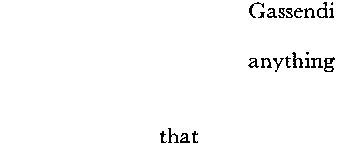
11'orks of Descartes, ii. 1 86 : 'Existence is a perfection neither in God nor in anything else ; it is rather that in the ilbsence of which there is no perfection . . . . '
3 Cf. Descartes, Meditation v: 'Being accustomed in all other things to make a dis tinction between essence and existence I easily persuade myself that existence can be separated from the essence of God, and that we can thus conceive God as not actually existing. But, nevertheless, when I think of it with more attention, I clearly see that existence can no more be separated from the essence of God than can having its three angles equal to two right angles be separated from the essence of a triangle.' For Anselm see The Author's Reply, p. I 77.
826610 F
C O M M ENTARY
a logical subject-of-predication. As such it cannot itself be a
predicate of the subject-of-predication that it sets up. In other words, 'X exists' may be translated as 'X can function as a logical subject to which predicates may be applied', so that
'exists' itself cannot be one of the predicates that may be applied to X. From this point of view it is all one whether we
say either that 'exists' is not a predicate or that it is a meta

predicate (that is to say, it predicates something of X, namely, that something may be predicated of X) . Of course, interpreted
in this way, existential statements do not say anything about anything, but merely tell us that it is possible to say something about something. And again, it is obvious that in this sense
'exists' may be used of conceptual or imaginary or fictional subjects as well as of really existing subjects. Anything used as a subj ect-of-predication in any 'realm of discourse', whether
conceptual or fictional or real, will, in this sense, be said to exist. Mr. Micawber exists in that in a piece of fiction certain predicates are applied to him ; and the dragon I dreamed of last
night also exists in that I may apply certain predicates to it.
This sense of 'exists' is, then, a purely formal or 'logical'
one and may be thought to be quite trivial. However, it is

useful to make it explicit because it helps us to discern another
function of 'exists', namely that of distinguishing conceptual and fictional and imaginary subjects-of-predication on the one hand from real subjects-of-predication on the other. Thus
'Dragons do not exist' may be translated as 'The term "dragons"
does not function as a subject-of-predication in a real realm of

discourse' ; or, more colloquially, 'You can't talk of dragons as you do of real things ; you can only talk of them in stories or as
you do of imaginary things. ' Again, 'Poltergeists exist' may be translated as 'The term "poltergeist" can function as a subject of-predication in a real realm of discourse, as contrasted with

fictional or imaginary realms of discourse ' ; or 'You can talk
of poltergeists as you do of real things.' This way of putting matters is, it is obvious, simply a circumlocution, for though we have translated talk about real and conceptual things into talk about subj ects-of-predication in real and conceptual realms ef discourse, the latter distinction is defined in terms of the former.
Thus to be a subject-of-predication in a real realm of discourse
means that we can apply predicates to it, or talk of what it
PRO S L O GION I I
refers to, as we do of real things. However, even if in one way the circumlocution gets us no further forward, it does all the same bring out in what sense 'exists' functions as a predicate and in what sense it does not ; or, to put it in another way, in what sense we can distinguish between real and conceptual existence without supposing that existence is a predicate in the ordinary sense.
Now it is clear that St. Anselm and Descartes, in their respective ways, might reformulate their arguments in terms of this account of existential statements, so as to escape the objec tion that they both supposed that 'exists' was a real predicate.
Thus Anselm might say that his premiss 'what exists in reality is greater than what exists in the mind alone' can be translated as 'to function as a subject-of-predication in a real realm of discourse is greater than to function as a subject-of-predication in a fictional or imaginary or conceptual realm of discourse '.
This translation makes it clear that 'exists' is not being used as a predicate in the ordinary sense, but that nevertheless some distinction and some comparison is being made between real and conceptual existence.
We may conclude from this, therefore, that the 'existence is not a predicate' dogma is not of itself fatal to St. Anselm's argument. Hmvever, we are still left with the problem of giving a sense to the comparison between real and conceptual existence.
It is clear from our analysis that 'exists' can function, in certain contexts, to distinguish real subjects-of-predication from fictional and conceptual subjects-of-predication, but it is also clear that it is difficult to give any sense to a comparison between real and conceptual existence.
Indeed, it might be asked whether the very possibility of comparison between the two does not presuppose that a real existent has some 'property' (namely the 'property' of real existence) that the conceptual existent lacks. For, if we admit with Kant that existence is not a real predicate, have we not thereby admitted that no comparison at all is possible, for the very notion of comparison involves, by definition, that two
similar subjects have different predicates?
However, Anselm might reply that it is, of course, obvious that any comparison between real and conceptual existents cannot be the same kind as other comparisons. What are being
C O M MENTARY
compared here are, to put it roughly, two different kinds of existents, and a comparison between different kinds of existents cannot be made in the same way as a comparison within the respective kinds of existents. We can compare a conceptual £50 with a conceptual £ 1 00 and we can compare a real £50 with a real £100, but we cannot compare in the same way a conceptual
£50 with a real £100. A conceptual £100 is greater than a conceptual £50, and a real £100 is greater than a real £50 ; but in Anselm's sense a real £50 is 'greater' than a conceptual
£100. Indeed, a real 5d is 'greater' than a conceptual £50.
What we are comparing here, Anselm might argue, are real and conceptual 'subjects-of-predication', and therefore the comparison cannot be made in terms of predicates as all other comparisons are made.
By definition, then, the comparison that Anselm is making between real and conceptual existents is not like any other kind of comparison. But does that therefore mean that no kind of comparison at all can be made ; does it necessarily exclude the possibility of any such comparison? Surely, St. Anselm might object, there is a perfectly clear sense in which the real and actual is greater than the conceptual and possible. Thus, if X really exists, X is both conceivable and real, and is thus greater than X as merely conceivable ; or, if X is actual, then X is both actual and possible and is thus greater than what is merely possible. What is real and actual, then, seems to have a certain 'priority' over what is conceptual and possible. But what sort of priority is this ? Is it not a purely logical priority?
Does it not simply mean that if I know that something actually exists then I may infer that it is possible (ab esse ad posse valet illatio) ; but that if l know that something is possible I may not infer that it actually exists (ab posse ad esse non valet illatio) ?
From this point of view we may certainly say that to exist in reality is (logically) greater than to exist conceptually or possibly or 'in the mind' alone. But then it is difficult to see that this logical sense of 'greater' is the same as the metaphysical or ontological sense of 'greater' (things being greater in respect of their 'degree of being') implied in the definition of God as 'that than which nothing greater can be thought'. However, it might be replied in turn to this that the logical priority of real and actual existence over conceptual and possible existence
PR O S L O GION I I
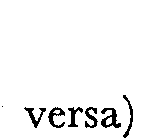
reflects an ontological priority. In other words, we may infer from real existence to conceptual existence (but not vice versa) because real existence is in some way prior to (greater than) con ceptual existence. One way of showing this perhaps would be to prove that it is self-contradictory to suppose that only possible beings should exist, and that it is necessary for at least one real and actual being to exist. That is to say, it would have to be shown that the proposition 'All existents are conceptual or possible existents' ('Nothing real or actual exists') is self contradictory, so that 'Some existents are real and actual existents' ('Something real and actual exists') is a necessary proposition. If this could be shown, then we could say that real and actual existence was ontologically prior to conceptual and possible existence. But this, of course, is precisely what is at issue between the theist and atheist, and it is precisely what can be proved only by proving or disproving the existence of God.
Part of the point of the theist's proof of the existence of God is to prove eo ipso that 'Nothing real and actual exists' is necessarily false, and likewise the point of the atheist's disproof is to prove that 'Something real and actual exists' is not and cannot be a necessary proposition. If, then, we had first proved the existence of God, we could say that real and actual existence has an ontological priority over conceptual and possible existence.
But, of course, Anselm wants to establish the priority in order to prove the existence of God.

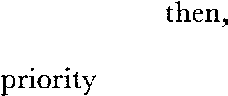

Despite all these considerations, however, St. Anselm's premiss that real and actual existents are 'greater' than con ceptual and possible existents seems to be so intuitively self evident and commonsensible that one cannot feel completely confident in rejecting it. But we may at least say that the com parison between real and conceptual existence is such a different kind of comparison from those we ordinarily make that we may reasonably place the onus on Anselm to show what sense can be given to it.
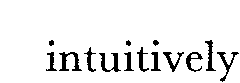
To conclude our observations on this section of St. Anselm's argument it may be worth while remarking a curious conse quence of Anselm's principle that actual existence is greater than existence in the mind alone. Presumably, if the notion of 'that than which nothing greater can be thought' is meaning ful, the notion of 'that than which nothing less great can be
COMMENTARY
thought' is equally meaningful. If we can conceive of a maxi mum we can conceive of a minimum. Now if, as Anselm holds,
to exist in actual reality is greater than existing in the mind alone, then 'that than which nothing less great can be thought'
cannot exist in actual reality, because if it did it would be 'greater' than if it existed in the mind alone and so would not
be the least great being. The least great being, therefore, must
exist in the mind alone if it is to be the least great being. 1 How
ever the 'least great being' is to be identified, this curious con sequence does at least bring out the oddity of St. Anselm' s
principle that what exists in actual reality i s greater than what exists in the mind. 1
Let us now sum up our discussion of St. Anselm's argument
in Chapter II of the Proslogion. First of all we saw that outside
the context of causal dependence it is difficult to give a sense to the notion of 'that than which nothing greater can be thought' without assuming that it is possible to compare things as greater
or more perfect in an absolute respect. Again, we saw the difficulties of comparing, as 'greater' and 'lesser', things 'in the
mind' with things in actual reality. We may obj ect, then, that for St. Anselm's proof to be valid the notion of 'that than which
nothing greater can be thought' would have first to be shown to be meaningful, for it cannot be assumed without argument that it is meaningful.2 As it stands, St. Anselm's proof will only
1 This consequence was some years ago remarked by A. A. Cock, 'The Onto logical Argument for the Existence of God', in Aristotelian Society Proceedings, xviii,
1 9 1 7-18, 363-84. Recently C. K. Grant has revived it, and, equating 'that than which nothing less great can be thought' with the Devil (on the supposition that the Devil is the contrary of God who is 'that than which nothing greater can be thought'), has argued that St. Anselm's proof of the existence of God involves a disproof of the actual existence of the Devil: 'The Ontological Disproof of the Devil', in Anarysis, 1 957. However, it is obvious that even if God is the greatest and metaphysically most perfect being, the Devil is not definable in orthodox
Christian theology as the metaphysicalry least perfect being, though he is the moralry least perfect being. Again, Anselm is aware that 'that than which nothing greater can be thought' is not itself within the hierarchical series of beings graded accord ing to their 'greatness' or 'perfection', so that we cannot think of 'that than which nothing greater can be thought' and 'that than which nothing less great can be thought' as contraries at opposite ends of a spectrum.
2 Cf. Leibniz, New Essays, Bk. IV, ch. 10. St. Anselm's argument 'is not a para logism but it is an imperfect demonstration, which assumes something that must still be proved in order to render it mathematically evident; that is, it is tacitly assumed that this idea of the all-great or all-perfect being is possible, and implies no contradiction',
P R O S L O G I O N I I
7 1 work for the sort of atheist who understands by the proposition 'God does not exist' something like the following : 'We know what it would be like for God to exist but actually He does not


exist', or 'God could possibly exist but actually does not exist',
or 'The concept "God" is meaningful but it is not instantiated',
or 'The proposition "God exists" is meaningful but false'. But it will not work against the logical atheist who denies that the concept 'God' has a meaning, or who maintains that 'God does not exist' is not logically similar to 'Unicorns do not exist', but
rather to 'Square circles do not exist'. As against the logical atheist Anselm must first show that the notion of 'that than
which nothing greater can be thought' is a meaningful one.
Anselm was not unaware of this point for in his reply to Gaunilo
he claims that it is possible to show that the notion of 'that than which nothing greater can be thought' is a meaningful one by
reflecting on the differences between temporal and supra temporal things. We shall discuss later what can be said about
this proof of the meaningfulness of 'that than which nothing greater can be thought'.
To say, however, that Anselm must first show that the notion of 'that than which nothing greater can be thought' is a mean
ingful one, implies that the onus of proof is upon him rather than upon the atheist. But there is a difficulty here that is worth
exploring because it helps to bring out the logical peculiarity
of the propositions 'God exists' and 'God does not exist'. The difficulty is this : if St. Anselm has to show that the notion of 'that than which nothing greater can be thought' is meaningful,
does not the logical atheist have equally to show, from his
point of view, that it is meaningless? Does not the logical atheist
have to say not merely that within our experience we do not com
pare things as absolutely greater or more perfect (while tacitly allowing that it might be possible to give a sense to the notion of
absolute perfection outside our experience) , but that necessarily
it is the case that things are not greater or more perfect in an absolute sense ? or that it is self-contradictory to suppose that
things can be compared as absolutely greater or more perfect ?
To put it crudely, is not the logical atheist compelled to say that the things within our experience (spatio-temporal and con tingent beings which allow only relative comparisons, so that
no such being is ever such that a greater cannot be conceived
C O M M ENTARY
than it) are necessarily the only things? Then, of course, the notion of God, defined as 'that than which nothing greater can be thought', would be meaningless by definition and the logical atheist would be committed to an 'ontological disproof' of the existence of God.
If the atheist, St. Anselm might continue, does not wish to claim that 'that than which nothing greater can be thought' is logically meaningless, then he must allow that it is meaning ful (though not in fact instantiated) . Now he is in the position of the 'factual atheist', and of course the Proslogion argument will work against him.
'Ve shall return to this question when we consider St.
Anselm's further argument in Chapter III of the Proslogion.
Meanwhile we may remark that at least these considerations show that the categories 'meaningful/meaningless' and 'true/ false' function in an eccentric way when applied to the proposi tion 'God exists', for one of the morals to be drawn from St.
Anselm's discussion is that we cannot both admit that the proposition 'God exists' is meaningful and yet at the same time
claim that it is false. From another point of view St. Anselm's discussion also shows that the 'possibility' that the theist claims is realized when he affirms that God exists, and the 'possibility' that the atheist denies or excludes when he denies that God exists is a very queer kind of possibility indeed. Again it seems to follow that the onus of proof or disproof of the existence of God lies equally on both sides.
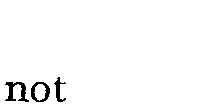
A final point : we have so far been assuming with St. Anselm that the definition of God as 'that than which nothing greater can be thought' is a distinctive and adequate one. But is this a definition that would serve adequately to distinguish God from His.creation? Is it not possible to conceive that, even if 'that than which nothing greater can be thought' actually exists, it might nevertheless exist in a contingent way? There is nothing in the definition as it stands to exclude this possibility, and to this
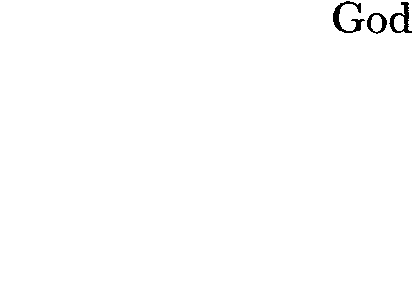
extent it is deficient as a definition of God, for we surely cannot allow that God might exist in a contingent way. St. Anselm himself seems to have realized this, for in the next chapter of the Proslogion he argues that God not only actually exists, but He exists in such a way that He cannot be thought not to exist; that is, He exists in a necessary or non-contingent way.

PROSLOGION I I I
C H A P T E R III
It is not clear whether St. Anselm means the argument in this chapter to be a complement to the argument advanced in Chapter II, or whether it represents an independent proof in its own right. St. Anselm speaks of there being 'one single argument' in the Proslogion, so that he probably regarded the argument in Chapter III as a complement to the basic argu ment in Chapter II, serving to defend it against the objection we have just considered, namely that it does not adequately exclude the possibility of God, if defined as 'that than which nothing greater can be thought', existing in a contingent way. God, argues St. Anselm here, cannot exist in a contingent way, for to exist necessarily (i.e. for a thing to exist in such a way that it cannot be thought not to exist) is greater than existing con tingently; so that if 'that than which nothing greater can be thought' were to exist contingently it would not be as great as it would be if it existed necessarily, and so would not be, precisely, that than which nothing greater can be thought.1 The argument in Chapter III shares its main premiss, the definition of God as 'that than which nothing greater can be thought', with the argument in Chapter II ; but in place of the minor premiss 'what exists in reality is greater than what exists in the mind alone' the argument in Chapter III has the premiss
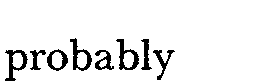
'what cannot be thought not to exist is greater than what can be thought not to exist', or 'what exists necessarily is greater than what exists contingently'. 2 So, in the minor premiss of the Chapter II argument, possible and actual existence are com pared, whereas in the Chapter III argument two kinds of actual existence, contingent and necessary, are compared.
However, if we prove that God necessarily exists, we prove eo ipso that He actually exists ; we do not need to prove first that God actually exists before proving that He exists necessarily. We cannot infer that because something actually exists it therefore necessarily exists ; but we can infer that because something necessarily exists it actually exists. From this point of view the Chapter III proof, whatever St. Anselm's intentions about
J p. 1 1 9.
2 For St. Anselm 'necessarily X' is equivalent to 'impossible that not-X' (Cur Deus Homo, u. xvii; 123), and on occasion, as in Chapter III, this latter is inter preted as 'logically impossible that not-X'.
C O M M E NTARY
it may have been, is logically independent of the proof in Chapter Il.1 In fact it is logically superior to the Chapter II proof because it concludes that God, defined as 'that than which nothing greater can be thought', both actually and necessarily exists. The notion of God to which the Chapter III proof leads is therefore a more adequate notion than that of Chapter II. In sum, not only does the Chapter III argument not presuppose the Chapter II proof but it makes the latter redundant. 2
We must see now if the premiss 'what cannot be thought not to be is greater than what can be thought not to be' falls foul of the objections that we have seen could be urged against the premiss of the Chapter II proof, namely that what exists in reality is greater than what exists in the mind alone.
The first objection that might be urged against St. Anselm's position here is that it assumes that the notion of 'necessary existence' is meaningful. But, if Kant is right, the notion cannot be meaningful, for to assert that God is a necessary existent is equivalent to asserting that the proposition 'God exists' is a logically necessary proposition, so that it would be self-con tradictory to assert the proposition 'God does not exist'. But it is not self-contradictory to assert this latter proposition, just as it is never self-contradictory to deny any existential propositions which, in Kant's terms, are always synthetic.3 Kant's criticism has been developed by certain modern thinkers and combined with the doctrine that all necessity is reducible to logical necessity, which in turn, it is claimed, is simply based upon the
1 Aquinas, Sum. Cont. Gent. r. x, supposes that it is an independent proof.
2 It is possible to reconstruct the Chapter III proof on Leibnizian lines to make it more economical, by doing away with the definition of God as 'that than which nothing greater can be thought', and more rigorous. Thus, God might be defined as 'that being which cannot be thought not to be'. Now, if that which cannot be thought not to be can be thought of, then it must actually be ; or, to put it in another way, if we can conceive of a necessary existent, then this means that it is possible, and, if it is possible, then it must actually be : if what-cannot-not-be can be, then it must actually be. Cf. Leibniz, De la demonstration cartesienne de l' existence de Dieu, par le P. Lamy, cited Domet de Vorges, Saint Anselme, Paris, r go I , p. 302 :

'By saying only that God is a primordial being, or a being existing of itself (de soi), that is to say, a being which exists by its own essence, it is easy to conclude that such a being, if it is possible, exists.' But it is very doubtful if St. Anselm would accept this reformulation, for it leaves out of account the comparison between necessary existence and contingent existence as 'greater' and 'lesser', which, as we have seen, is essential to St. Anselm's proof.
3 Critique of Pure Reason, pp. 502, 504.
P R O S L O G I O N I I I
conventions of language. From this it follows, so it is alleged, that the notion of a necessary existent is a self-contradictory one. As one writer has put it : 'If God is to satisfy religious claims and needs, He must be a being in every way inescap able, One whose existence and whose possession of certain excellences we cannot possibly conceive away.' But, he goes on,
'modern views make it self-evidently absurd (if they don't make it ungrammatical) to speak of such a Being and attribute existence to Him. It was indeed an ill day for Anselm when he hit upon his famous proof. For on that day he not only laid bare something that is of the essence of an adequate religious object, but also something that entails its necessary non existence.'1
Now Anselm might reply both to Kant and to his modern followers that their objections prove too much, for they do not simply assert that the existence of all the things within our
experience is contingent (so that all existential propositions about things within our immediate experience are synthetic), 2 but they go further and claim that it is logically necessary that all existential propositions are synthetic. Thus they are led to maintain paradoxically that it is logically impossible for the proposition 'God exists' to be a logically necessary one, and they end by espousing an 'ontological disproof' of the existence of God.
We may say, then, that if we have no right to assume that the notion of 'necessary existence' is meaningful, without further argument, equally we have no right to assume that it is meaning· less, without further argument. Merely logical analysis of the notion one way or another cannot decide whether the notion is meaningful or not, so that, if there cannot be an a priori
'ontological' proof of the existence of God, equally there cannot be an a priori 'ontological' disproof. Once again, it is difficult to see where the onus of proof lies here.3 And once
' J. N. Findlay, 'Can God's Existence Be Disproved?' in New Essays in Philo sophical Theology, ed. A. Flew and A. Macintyre, London, 1955, p. 55 ; see also the essays by J. J. C. Smart and I. Crombie in the same volume, and my discussion of these views in 'Religious Language and Language About God', in International
Philosophical Quarter(y, i, i961, 1 39-67.
2 A fact that St. Anselm admits. Cf. Proslogion, p. I 19. 'Everything there is, except You alone [God] can be thought of as not existing.'
3 Cf. Malcolm, 'Anselm's Ontological Arguments', pp. 55-56 : 'The view that logical necessity merely reflects the use of words cannot possibly have the
C O MMENTARY
again it is difficult to see what kind of possibility the theist wishes left open for the notion of 'necessary existence', and which the atheist wishes to exclude. In any case no purely logical considerations will serve to break the deadlock between theist and atheist over the meaningfulness of the notion of 'necessary existence'-the theist demanding that the atheist demonstrate that the notion is self-contradictory, and the atheist demanding that the theist demonstrate that the notion is not self-contradictory.1

It would only be possible to break this deadlock if other extra-logical considerations were brought in. Thus, for example, the theist might argue that, by reflection upon the contingent existents in the world, we are led to ask for an ultimate causal explanation of them, and are therefore constrained to postulate the existence of a 'necessary existent' as cause of the contingent existents. Here we do not presuppose that the notion of 'neces sary existence' has meaning a priori, but rather the argument forces us to postulate that the terms 'necessary' and 'existent' may be conjoined and that the notion of 'necessary existent' is meaningful, though we do not know how the terms 'necessary' and 'existent' are conjoinable (as we do, for instance, with 'triangle' and 'figure containing two right angles') nor how the
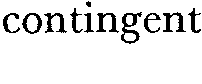
implication that every existential proposition must be contingent. That view re quires us to look at the use of words and not manufacture a priori theses about it. In the Ninetieth Psalm it is said : "Before the mountains were brought forth, or ever
Thou hadst formed the earth and the world, even from everlasting to everlasting Thou art God." Here is expressed the idea of the necessary existence and eternity of God, an idea that is essential to the Jewish and Christian religions. In those complex systems of thought, those "language-games", God has the status of a
necessary being. Who can doubt that? Here we must say with Wittgenstein, "This language-game is played." I believe we may rightly take the existence of those religious systems of thought in which God figures as a necessary being to be a
disproof of the dogma, affirmed by Hume and others, that no existential proposi tions can be necessary.'
' Malcolm, ibid. 59-60, claims that there is a presumption that the notion of necessary existence is not self-contradictory. '\Vith respect to any particular reasoning that is offered for holding that the concept of seeing a material thing, for example, is self-contradictory, one may try to show the invalidity of the reason ing and thus free the concept from the charge of being self-contradictory on that ground. But I do not understand what it would mean to demonstrate in general, and not in respect to any particular reasoning, that the concept is not self contradictory. So it is with the concept of God. I should think there is no more of a presumption that it is self-contradictory than is the concept of seeing a material thing. Both concepts have a place in the thinking and lives of human beings.'

P R O S L O G I ON I I I - I V
notion of 'necessary existent' is meaningful. 1 But this, of course, is to introduce the notion of causal dependence into the argu ment-a notion which, as we have already seen, Anselm leaves aside altogether.
In summary, then, it is difficult to see how St. Anselm's proofs, both in Chapter II and in Chapter III, can be made to work unless some kind of causal or 'cosmological' argument is presupposed, to give meaning both to the definition of God as
'that than which nothing greater can be thought' and to the premiss that 'necessary existence is greater than contingent existence'. But then, obviously, if St. Anselm's proofs presuppose a causal argument, this makes them redundant and defeats
St. Anselm's whole purpose in the Proslogion.
C H A P T E R I V
S t . Anselm, w e said before, did not consider that the existence of God was self-evident in the strict sense, but he did think that the premisses of his argument were so luminously clear and unquestionable that only a 'fool' could fail to be convinced by it.
How, then, can the Fool say that God does not exist, Anselm asks in this chapter, if he accepts the definition of God as 'that than which nothing greater can be thought' ? It is, says St.
Anselm, because the Fool does not really think of what he is saying ; he takes in the words or the verbal formula ( 'vox' ) 'that than which nothing greater can be thought', but he does not really understand what the words mean, that is to say, the reality ('res') they signify.2
It is important to notice that for St. Anselm the 'insipiens' is not just one who denies truths that are strictly self-evident.
Thus, in the Cur Deus Homo, Anselm says that the 'insipiens' is one 'who declares to be impossible something which must necessarily be, on the ground that he does not know how this is' . And he allows that it may be necessary to prove to the 'insipiens' that what he declares to be impossible may
1 As Aquinas says, Sum. Cont. Gent. I. xi, the proposition 'God does not exist' is not, for us, a self-contradictory one. However, this does not imply that God is a contingent being, but rather that God's existence must be proved or demonstrated from His effects. The necessity of God's existence is seen only as the conclusion of a demonstration. As Aquinas puts it, 'God can be thought not to be' is not a state ment about the mode of God's existence but rather about our deficient way of knowing God.
2 p. 1 2 1 .
COMMENTARY
nevertheless exist.1 Thus the fact that St. Anselm holds that it is

'insipientia' to deny the existence of God does not mean that he
therefore holds that the existence of God is self-evident and
does not need to be argued for or proved.
The remaining chapters of the Proslogion arc taken up mainly with a discussion of the various attributes (wisdom, omnipo
tence, mercifulness, justice, &c.) of God. St. Anselm always sees
what must be said and what must not be said about the divine
attributes, and he is clearly aware of the thorny problems that
the reconciliation of the various attributes raises. But for the
most part St. Anselm's discussion is on a fairly general level

and it does not have anything of the philosophical depth and sophistication of Aquinas's treatment of the divine attributes, for example. 2 We shall content ourselves, therefore, with noticing a few points of philosophical interest in these chapters.
C H A P T E R V
Anselm begins his discussion of the divine attributes by
stating the principle on which we attribute various 'perfections' to God. If God is that than which nothing greater can be thought, He must also be the supreme good or the most perfect
being, so that no good or perfection can be lacking to Him.
God must therefore be 'whatever it is better to be than not to
be', and we must predicate of Him all the perfections we find in creatures, and deny of Him all the privations and negations that we find in creatures. We can, for example, predicate of God that He is just, truthful, and happy, and these are not just
metaphorical descriptions of God. Anselm is here hinting at
the theory of analogy which Aquinas was later to develop more
fully.3
1 r. xxv; 95.
• At the same time we may agree with R. W. Southern's observation: 'It is the first stage of his argument (occupying only the first three out of twenty-six chapters of the treatise) which has given A.nselm his place in the history of philosophy; the remainder has been, from the point of view of Anselm's own thought, unduly neglected.' The Life of St. Anselm, p. 29, n. 3.
3 See also Monol. xv; 28-29, for a fuller discussion. Vaggagini, 'La Hantise des
"Rationes Necessariae" de saint Anselme . . . ', p. 1 06, says that St. Anselm's distinction between 'simple' and 'mixed' perfections was 'the first clear theoretical determination in the history of theodicy of a procedure which was afterwards called analogy of proper proportionality-in acknowledged opposition to the procedure of mere metaphor-by means of which, in philosophy, we attribute
PRO S L O G I O N VV I I
C H A P T E R V I
St. Anselm here makes the point that God is 'perceptive'
('sensibilis') in the sense that He knows all things, though since He is not corporeal He does not know through the senses as we do.
C H A P T E R V I I
St. Anselm considers the familiar puzzle : if God is omni potent and so can do all things, how is it that He cannot be corrupted, nor tell lies, nor reverse the past? Are these
'inabilities' limitations upon God's omnipotence? Anselm answers by anticipating Professor Ryle and distinguishing two senses of 'can' ('posse') . Thus, in 'God can foresee all things', 'can' is used to signify that God has a certain positive power; but in 'Material things can be corrupted', 'can' is used to signify 'lack of power or impotence', an 'ability' to suffer something rather than an ability to do something. Not being
'able' to be corrupted, then, does not signify that God lacks some positive power, but rather that He 'lacks' a lack of power.
These 'inabilities', therefore, are not really limitations upon God's omnipotence.1
Anselm notes that other verbs such as 'is' ('esse') and 'is doing' ('facere') have the same logical features. For example, running is 'doing' something, and resting is also 'doing' some thing, but the one signifies a performance and the other the cessation of a performance, and the cessation of a performance is not itself a performance.2
formally to God, conceived as the most perfect being, every simple perfection such as goodness, wisdom, and others, which we discover in the world, after having purified them from the imperfections with which they are found in creatures'.
1 For a fuller analysis of 'can' and 'able' see G. Ryle, The Concept of Mind, London, p. I 26.
2 St. Anselm seems to have been influenced here by Boethius' commentary on Aristotle's De Interpretatione. In the recently discovered Anselmian treatise (F. S.
Schmitt, Ein neues urwollendetes Werk des hl. Anselm von Canterbury, I 936) St. Anselm engages in a much more sophisticated analysis of 'facere'. Thus he distinguishes between 'doing' in the ordinary sense, e.g. killing a man, 'doing' in the sense of enabling another, and 'doing' in the sense of allowing something to be done.
Cf. D. P. Henry, 'St. Anselm on the Varieties of "Doing" ', in Theoria, xix. 3,
1953 ; 'St. Anselm on Scriptural Analysis', in Sophia, i. 3, 1962.
CO MMENTAR Y
C H A P T E R S V I I I-X I
In these chapters St. Anselm is concerned with a general dis cussion of God's justice and mercy and his analysis raises no points needing special mention.
C H A P T E R X I I
This chapter brings out the point that properties are not attributed to God in the same way in which they are attributed to creatures. When we say 'God is wise' we do not mean that God is a member of the class of things of which wisdom is a property. God rather is identical with the wisdom by which He is wise. When we say that God is 'perfectly wise' or 'supremely wise', we may think that this means that God is wise in the highest degree. But there is not merely a difference of degree between the way in which God is wise and the way in which a man is wise ; the way in which God is wise differs in kind from the way in which any creature is wise. God is not a wise being;
He is rather wisdom itself. St. Anselm, however, does not con sider in detail the difficulties that these divine attributes obviously raise.
C H A P T E R X I I I
St. Anselm discusses m what sense God is limitless and eternal. He distinguishes between (I) those things that are wholly in one place and can neither be elsewhere at the same time nor everywhere (they are, of course, material bodies) ; (II) those things that are wholly in one place but can be elsewhere at the same time, though not everywhere (these are created spirits ; for example, the soul is in all the parts of the body. When, for instance, I stub my toe or jam my finger, it is 'I' who feel the pain in the different parts of my body) ; and (III) those things that are wholly in one place and yet
exist everywhere (this is true of God alone, for God is limited neither by time nor place) .
P R O S L O G I O N V I I I-XV
8 1 Spatio-temporal limitation of the kind represented in (I) and (II) above is used later by St. Anselm as a criterion of con tingency. Thus, in his reply to Gaunilo he argues, 'What did not exist yesterday, and today exists, can thus, as it is under stood not to have existed yesterday, be supposed not to exist at any time. And that which does not exist here in this place, and does exist elsewhere can, in the same way as it does not exist here, be thought not to exist anywhere.'1
CHAPTER XV
Here, in this important discussion, St. Anselm reminds us that, even if we understand God to be 'that than which nothing greater can be thought', we do not thereby have a positive or determinate knowledge of God. God must be greater than any conception we can form of Him, though this does not mean that our knowledge of Him as 'that than which nothing greater can be thought' is false. There is a perfectly obvious sense in which we can think of something greater than we can think of, or know that there is something which we cannot know. As St. Anselm says in his Reply : '] ust as nothing prevents one from saying "ineffable'', although one cannot specify what is said to be ineffable ; and just as one can think of the "inconceivable", although one cannot think of what "inconceivable" applies to so also, when "that-than-which-a-greater-cannot-be-thought" is spoken of, there is no doubt at all that what is heard can be thought of and understood, even if the thing itself cannot be thought of or understood.'2 In the Monologion St. Anselm
discusses more explicitly the difficulties which attend the use of the terms of ordinary language to describe God who is, by definition, above and beyond every other thing. He admits that we cannot speak of God directly but only 'through some similitude or image'. 'We see and speak of God through some
other ; we do not see and speak of Him by what is proper to Him.'3 However, even if what we say about God is not the full truth it is not thereby false. To deal adequately with this whole question St. Anselm would of course need a theory of analogical predication, such as Aquinas was to develop later.
1 The Author's Reply, p. l 7 I .
2 Ibid., pp. 187 - 9.
3 Mono!. !xv; 76.
826610 G
C O M M ENTARY
C H A P T E R S X V l-X X V I
The remaining chapters of the Proslogion consider the inac cessibility and the goodness of God and the book concludes with a very beautiful prayer. ' . . . Lord, by Your Son You command, or rather, counsel us to ask, and You promise that we shall receive, so that our joy may be complete . . . . May I receive what You promise through Your truth so that my joy may be complete . . . . Let my soul hunger for it, let my flesh thirst for it, my whole being desire it until I enter into the joy of the Lord, who is God, Three in One, blessed forever.'1
I pp. 153-5.