Locus 24 — Christian Liberty
the whole church. This total liberty is the blessing of which Christ is speaking, which also here in this life must be begun. to us, on account of which we receive the remission of sins and are justified, that is, we are pronounced as accepted by God. That other thing is the Son of God, the mediator, not the Law, and not our merits. Those who have been reconciled are declared as righteous, that is, accepted by God to eternal life, even if they fall far short of the perfection of the Law, but for the sake of Christ and by faith. What a great blessing that al though the remnants of sin still cling to those who have been reconciled, and although we are weighed down by a great mountain of shameful sins, yet we are pleas ing to God for the sake of Christ, as if we had absolutely and perfectly satisfied the Law.
While we are still in subjection to the cross and mortal death, we are being exercised in great calami ties, and sins and great darkness still cling to us. We are under attack by the devil, who constantly ties us up in his evil traps. And no one is so careful, so diligent, that he does not from time to time wander into thoughts about these things. And we ourselves cannot govern the very difficult and perilous course of this life and our calling only by human actions and diligence, as Jere miah says [10:23], "I know, Lord, that the way of man is not in himself."
Paul is preaching about this degree of liberty when he says [Gal. 3:13], "Christ has redeemed us from the curse of the law, having been made a curse for us." This is a short statement, but it far surpasses the wisdom of all men and angels. The true, great, and unspeakable wrath of God against sin is signified when the Son upon whom this wrath was poured is called a curse. He was made for us a ransom and a victim. We must give thought to this blessing and this liberty every time we call upon God, and determine in faith that for the sake of our Lord Jesus Christ our sins are truly forgiven, covered, and buried, and that He truly wills to save, receive, and hear us for the sake of the mediator.
In these exercises of prayer, our understanding in creases daily regarding this liberty of which we have spoken under the first degree, which contains the doc trine of justification, which we have fully described above.
Although we see ourselves still shut up in this sad prison, yet we are free, first because it is a certainty that we, for the sake of Christ, have a God who is propitious toward us and our defender, as the first de gree of liberty teaches us. Then, because we are helped and guided by the Holy Spirit. David was caught in an evil from which he could not extricate himself when he was exiled from his kingdom, and yet in this he sustained himself with the sure comfort that he had not been cast off by God. And he remembered the word of Nathan [2 Sam. 12:13], "The Lord has taken away your sin." Then he sought the aid and guidance of the Holy Spirit, and experienced the fact that he was indeed helped by God. But Themistocles, when he was exiled from Greece, knew none of these consolations, and to the extent that he did have some place of refuge and human protection, he endured his exile with a peaceful mind.
The second degree or grade is the bestowal of the Holy Spirit, who kindles new light in our minds and new movements in our will and heart, guides us, and begins eternal life in us. Although this second degree is connected with the first, for the sake of clear teaching
All the saints have learned the second degree of liberty in times of danger, when they experienced the fact that they were helped and strengthened by God, just as Stephen in his confession and in the agony of death, Lawrence, and many others in their confession.
I am making a distinction so that as often as we speak about liberation from the Law, we may understand not only help, as Augutine says repeatedly, but also the free imputation of righteousness.
Therefore, when we consider our weakness and our dangers, we also should give thought to this second degree and we should seek the aid and guidance of the Holy Spirit, as Christ commands when He says
[John 16:24], "Ask and you shall receive." Again, [Matt.
11:28], "Come to Me, all you who labor and are heavy laden, and I will give you rest." When we call upon Him without any doubting, we are assured that we are being aided, guided with His counsel, our death protected, dangers dispelled, and our troubles alleviated.
Augustine often says that we are liberated from the Law, meaning that by the bestowal of the Holy Spirit we are helped so that we are obedient to the Law, nor do we any longer strive in vain under the coercion of the Law. He is correct when he speaks about this help, but it necessary that we also see a second benefit, namely, the free remission of sins and the imputation of righteousness which is given to us for the sake of Christ. This enormous gift must be seen, so that honor may be given to Christ and our consciences may hold on to true and firm comfort and can invoke God.
These exercises in prayer will teach us about this second degree of liberty. Now, these two grades teach us how great the blessings of God are. For they are liberations from the greatest of evils, from sin, from the wrath of God, and from eternal death. They include the giving of righteousness and eternal life, defense against the devils, guidance in all matters and dangers, with the Holy Spirit ruling our heart and kindling in us the understanding of the Word of God. Finally, they include the presence of the eternal God, who holds us in His arms for the sake of His Son, our Lord Jesus Christ.
Moreover, Christ speaks about both degrees of liberty when He says [John 8:36], "If the Son shall make you free, you will be free indeed." Indeed He is talking about the complete benefit: the Son assuages the wrath of God, takes away sin and death, gives righteousness and eternal life, and raises us to eternal glory and joy which we enjoy in the comfort of God, the angels, and
and a harsher prison than those external ceremonies.
There is nothing greater or better than these gifts.
And thus this liberty imparted to us through the blood of Christ, which offers the Gospel, is a great and immeasurable gift. It is not a mere empty word or some product of Stoic imagination, as ungodly men think.
My reply is that in regard to the ceremonial and civil laws the response is not difficult. Just as at Athens the tables of Solon or at Rome the laws of the decemviri
[councils of 10 Roman magistrates], which were changed by the Republic, were ultimately abolished, so the ceremonies and civil laws which were laid down by Nor is it difficult for sound and godly minds to see the distinction between this liberation from sin and the wrath of God on the one hand, and civil liberty or lib eration from tribute on the other. For nothing is being said about external political tranquillity or servitude in these first two degrees. Joseph had these two degrees of liberty of soul even though he had been convicted and put in prison. Daniel had them while he sat among the lions. Lawrence did too while he was lying on the gridiron. For political liberty or servitude in no way per tains to these two degrees any more than the strength or weakness of the body, as it says in Gal. 3[:26, 28],
"You are all sons of God through faith in Christ Jesus ... there is neither Jew nor Greek, slave or free man."
But it is easy for godly people to understand this: some things are a blessing for the soul, and other different things are good for the body.
Moses endured for a specific time, but when the political nation of Moses was destroyed, they were no longer binding on anyone, and now have become extinct. We have spoken above regarding the distinction of the old and new covenants, and why this civil state was established.
But in regard to the moral law, the answer which Christ and the apostles gave is more difficult, and worldly men who live without repentance do not un derstand it. For the moral law is not something change able, as the ceremonial laws or the laws of the decemviri, but the moral law is the eternal and immut able rule in the divine mind which commands that cer tain things be done and not done, and which punishes infractions against it.
Just as this proposition is eternal and immutable:
God is wise, good, and just, so these propositions are eternal and immutable: God judges that it was just or righteous for Him as the Creator to be loved by a ra tional creature and placed above all other things; God judges that the roving lusts of men are evil; God ap
The third grade or degree of liberty deals with our outward or political life, namely, that Christians are not bound to the civil order of Moses or that of any other nation, but in our various places we owe obedience to the present rulers and the laws, as long as the laws are in harmony with the law of nature and do not compel us to do something contrary to the commandments of God. Just as we observe the intervals of days and nights in other regions, so it is permitted to utilize other forms of the office of rulers, governments, and laws, so long as the laws, as I said, do not prescribe things to be done which are in conflict with the mandates of God. proves obedience which is in accord with His com mands; God is angry at refusal to obey.
Therefore, this rule always remains: both that the moral law always remains as the order of the divine mind, so that the creature is to be obedient to it; and that the entire law obligates men either to obedience or punishment.
The uneducated should be instructed in regard to this third kind of liberty, because it has often hap pened that very pernicious rebellions have been cre ated by the unlearned who have contended that Christians must be governed by the laws of Moses. This error must be opposed, for the prophets, Christ, and the apostles clearly teach that the end of the Jewish political state would come after the suffering and death of Christ. And the very ruins of Jerusalem bear witness that the political nation of the Jews was destroyed 1470 years ago. On this basis, this rule instructs us that the ceremonial laws of Moses have been abrogated and that the civil laws of Moses do not pertain to the church of Christ. These civil arrangements pertained to a par ticular race and were to continue for a specific time, but they do not pertain to other races or to other times.
These points are confirmed by many passages of Scrip ture, such as Acts 10[:35] and Gal. 3[:28] and 5[:6], "In Christ Jesus, neither circumcision or non-circumcision
Since men did not render this obedience, it was necessary either that they become subject to punish ment, or that another person pay their penalty or ran som. Thus with marvelous and indescribable wisdom the Son of God paid the ransom for us and intercedes for us and takes upon Himself God's wrath, which we were obligated to endure. Thus it was not without pay ment that God mitigated His Law, but rather He pre served His justice in requiring that the penalty be paid.
And therefore Christ says [Matt. 5:17], "I have not come to destroy the Law but to fulfill it," that is, by enduring the punishment for the human race and teaching and restoring it [the Law] in believers. It is difficult to explain this matter, but I pray the godly that they spend time considering these things which I am saying. And since
Christ has paid this ransom, we are free from the Law for His sake, that is, that we should no longer remain under the curse as long as we apply His benefit to ourselves by faith. is of value, but faith which works through love."
Therefore, Paul explicitly says that we are freed from the curse of the Law, that is, that Christ has paid the ransom. Our sins have not been remitted by some change in the will of God without cause, but a great
But this question is being asked: when we speak of the abrogation of the law, is the entire law said to be abrogated, or only two parts, namely, the ceremonial and the civil? And the moral law is a heavier burden
compensation has intervened because of the righ teousness of God. Thus the first patriarchs, even before Moses—people such as Abraham, Isaac, Jacob, and then Moses, Samuel, David, and the Baptist—all be discipline and this forcible control the righteous man, that is, the person who has been born again of the Holy
Spirit, is not to be held in check, but he is governed by the Holy Spirit, through the light of the Word of God, to whom he understands that the rational creature has been placed in subjection. And in this passage by Paul the stress is on the words "laid down." The Law does not press down or run over a righteous man. lieved that their sins were remitted to them and that they were accepted by God for the sake of the Son of God and not because of the Law. They believed that they had been reconciled (even though they were still not without sins) and were pleasing to God because they had been freed from the Law for the sake of the Son, who they knew was going to pay the ransom, just as the Baptist said [John 1:29], "Behold the Lamb of God, who takes away the sin of the world," that is, the victim who has been destined by God. This is the ab rogation of the moral law, of which Paul is speaking so clearly when he says that through Christ we have been redeemed from the curse of the Law. Thus we are lib erated, if we take to ourselves by faith this benefit of Christ.
The fourth degree or level of liberty, which the Gospel calls rites that have been developed by human authority in the church, pertains to matters of adiaphora which do not merit the remission of sins. It does not refer to the righteousness of the Gospel, and these
[rites] must not be observed out of an idea of necessity, since they can be omitted without any cause for of fense. This is clearly taught in the statements [Matt.
15:9], "In vain do they worship Me with the command ments of men," and again [Col. 2:16], "Let no one ac cuse you in matters of food, drink. ..."
This teaching instructs us about two matters— about the wrath of God against sin, which is not remitted without payment, and about the marvelous benefit of Christ. God has always hated sin, but because He has poured out His wrath upon His Son, He receives us.
For the Law requires, as I have said, that the obedience to the Law or the punishment for our disobedience be paid by the Son.
I have spoken above of the errors which the hyp ocrites add to these human traditions, errors which we must refute and which pertain to this degree or level of liberty in the church. God wills that He and His will be understood from His Word, and He does not grant to us permission to think up ideas by our own volition, as the Gentiles and idol worshipers in all ages have done.
For this is the source of many errors—when men think that it is permitted to them to devise notions about God and zealously (in their opinion) to establish worship forms concerning God. The Thebans thought that it was a godly thing to seek from God a rich grape harvest, and therefore they established the Bacchanalian ritu als. The Sicilians thought it was a godly thing to ask that there be favorable harvests, and thus they wor shiped Ceres and her daughter. The Romans thought it was a godly thing to ask for victory in wars, and there fore they worshiped Mars. And these cults piled up.
Now I shall reply to the principal question. We have been liberated from the curse of the moral law because the Son paid the ransom, and for the sake of the Son we are received by God. God's eternal and immutable order remains in force, that the creature is to render obedience to God the creator. The Law does not accuse or condemn those who have been recon ciled, but the order or arrangement remains in the mind of God and in our mind that we are to render obedience to God. In regard to this statement it is said: the Law has been abrogated as it pertains to the curse, but not as it pertains to obedience. Therefore, the Holy Spirit is given, in order that emotions may be truly kindled in our hearts which are in agreement with the Law of God, as it says in 2 Cor. 3[:18], "We with unveiled face behold the glory of the Lord and are transformed into the same image from glory to glory, just as by the Spirit of the Lord."
All these errors come from one source. Men think that they are permitted to devise for themselves of their own free choice opinions about God, and worship Him according to those opinions, just as Aaron thought when he set up the worship of the image of the calf, and as Jereboam did when he brazenly led the people of Israel away from the temple of God to his own sacrifices.
The wise men cry: what is wrong about this? Why should honest practices not be permitted? What else did the Gentiles or Aaron or Jereboam want than that the knowledge of God be kept alive, so that the people might be invited to invoke Him and become accus tomed to good spiritual exercises which lead to godly works? These specious and logical-sounding argu ments have always deceived, do so now, and always will deceive the human race.
From these points it is possible to understand the statement of Paul [Rom. 6:14], "You are not under the Law, but under grace." Because the punishment has been transferred onto Christ, believers are liberated from wrath and now for the sake of Christ are righteous and have been accepted by God, even if the remnants of sin by which they contend against the Spirit still cling to them. This is said [1 Tim. 1:9], "The Law was not laid down for a righteous person," where it is clear that Paul by this statement is speaking about discipline, and is saying that the Law was laid down for the unrigh teous, adulterers, murderers, etc., so that they might be held in check by it, accused, and punished. By this
Thus in our own time the wise men are reasoning: what is wrong with the idea that Christ is offered by many and by individuals? Or that we offer prayers for the living and the dead? Or that a part of the Sacrament
is carried around? The prayers of the people are in creased and the Sacrament given more honor. What we are not contending only about such minutia as the eating of meat and the like. I have said that the church needs to be instructed regarding the source of these errors, that is, regarding the audacity of mankind de parting from the Word of God and devising not only laws about foods (although these by themselves have spawned-a multitude of errors), but also about much more evident idolatry, such as the saying of masses for the living and the dead, the invocation of the dead, the laws of celibacy, and other things. Nor is this the end of the insanity. Now the Anabaptists are thinking up still more new opinions and rituals. Thus the doctrine of this fourth degree or level of liberty is necessary for the church, and the church must carefully consider the reason why this admonition is necessary, and why it must not depart from the Word of Go'd. "Your Word is is wrong with asking the dead, who are living in the presence of God, to intercede for us? There is surely no doubt that the entire church in heaven and on earth always joins together in prayer. These are beautiful arguments and can be ornamented with much eloquence.
But these lovely rationalizations and specious ar guments lead people away from the Word of God. In deed, games of this kind are forbidden by God. For with the same audacity they dream up their heretical er rors—some, one kind, and others, other kinds. Indeed, despite their conscience struggling over the remission of sins and the will of God in times of great calamities, they become so accustomed to following these ration alizations and opinions that they lose the true conso lations which have been given us by God. a light to my feet," says the prophet [Ps. 119:105].
It is easy to fall into this. In the beginning it is not noticed when our minds begin to depart from this light and take up human opinions which strengthen idolatry and seek compelling reasons for their actions. Paul himself says they have the appearance of wisdom, while actually they are false. What forbids, they say, the whole church in heaven and on earth from joining with us in praying to God that He would not allow the true doctrine to be snuffed out, but rather that He would gather the church for Himself and rule it, call His saints
[in heaven]—who rejoice in their happy relationship with God—together before His throne, and encourage them to join their prayers to ours. Surely they know that this is the will of pious men. They say these things very plausibly, but what great evil this idea produces!
Men in civil life tell us that conflicts which are destructive for inexperienced people are' often caused by very simple things. Discords hang on and increase by reason of the zeal and hatreds of factions. Men do not disagree with moderation. Therefore, they say, why do you stir up such sad tragedies about things like milk, eggs, and the eating of meat? Why do you not put the public peace and tranquillity ahead of these minute things?
The answer is true and solid. We are not con tending about unimportant matters, but about many very important things, namely, the true knowledge and worship of God, which must be put ahead of our very life, all our physical comforts, governments, and the public concord, so that we do not look for opinions about God and His will outside of the Word which He has given us, as the Gentiles have done and all fanatic spirits, such as Paul of Samosta, Arius, the Manichaeans, Pelagius, and Mohammed.
To hear the prayers of individuals and to behold the movements of their hearts belongs to God alone, or to His almighty nature, as is clearly stated in 2 Chron.
6[:30], "You alone know the hearts of the sons of men."
To the dead they attribute the honor of calling together the individual saints. Then they add an even greater lunacy: they dream up the notion that the dead them selves are our helpers, and they attribute different gifts to some of them, just as the Gentiles seek riches from Juno, wisdom from Pallas Athene, happy love affairs from Venus, victories from Mars, and other favors from other gods. In this way we pile up sins, when at the beginning we seem not to have departed far from the Word of God because of their very plausible line of reasoning. But it is evident that there is no example of the invocation of the dead in the writings of the prophets and apostles. We must use these rules in opposition to the beautiful excuses with which certain very astute people in our time are painting idolatry, just as in ancient times at the festivals they painted the statues: "The dwarf-elders drip with Bacchanalian blood and are red dened with wine" [Virgil, Eclog. 10.27].
This kind of uproar when people set forth these controversial matters is reprehensible, and yet it is com mon. From these same dark corners arise the Bac chanalia, the errors of Paul of Samosata, the rules of the Manichaeans regarding food, the law of the papists regarding the celibacy of priests, and the brazen te merity of the sacrificial system with its sale of masses and the invocation of the dead.
God wills that our minds be bound to His Word, and when we depart from this, unspeakable madness and idolatry follow. Thus we must contend regarding this rule so that there be no departure from the Word of God. Therefore, we need to give instruction to the church about this matter, which is most important of all and indeed is given by divine mandate. Note the state ment [Gal. 1:9], "If anyone teaches any other Gospel, let him be anathema."
I have said that we must carefully instruct the learned, so that they do not allow themselves to be carried away by these specious excuses and depart from the truth into idolatry. For if these outrageous tricks
Furthermore, the civil leaders in their wisdom se lect things which appear to be unimportant, such as the eating of meat or eggs, and they assert that the public concord ought to be placed above these matters. But
is true as it pertains to the obedience that the Gospel teaches. In those things which are matters of the divine
Law, the conscience must be obedient to the pastors [the seventy] according to the statement [Luke 10:16],
"He who rejects you rejects Me." But in regard to rites which are matters of adiaphora established for the sake of good order, the Gospel prescribes that we should not believe that these things are worship or necessary things. But it does permit us to observe them without the idea of righteousness or necessity. Human authority cannot abolish this divinely-given belief. Therefore, when the bishops give us a precept, it must call for the kind of obedience which does not destroy a belief re quired of us by God. are permitted to lead us into excusing our idolatry, what confusions there will be in our religion! I shudder to think of these tricks of the devil. And because no amount of human diligence can sufficiently guard against this witchcraft, I pray our Lord Jesus Christ, who was crucified and resurrected again for us, that He Himself will defend the purity of His Gospel and destroy every idol and guide our minds that we may teach and contend for true and salutary things.
Now to the common argument I reply to the usual objection:
We must be obedient to the necessary power.
The power of the church has instituted rites for both matters of indifference (adiaphora) and for other things.
These replies are correct and immovable, and they are not in conflict with the word of Christ [Matt.
23:2, 3], "The scribes and Pharisees sit in Moses' seat.
All things which they command you, do."
Therefore it is necessary that we observe these rituals, especially in matters of adiaphora. ,
We must respond to the major premise, which is not true when the power commands that we teach un godly things or do them. For then it is necessary to oppose these rules [Acts 5:29], "We must obey God rather than men." In the first place, therefore, when the traditions openly command those things which cannot be performed without sin, it is evident that they are the doctrines of devils and we must not be obedient to them, but come back to the commands of God. Such are many of the traditions of the pope, such as the abuses of the Lord's Supper, the invocation of the dead, and the law of celibacy. These traditions must be re jected and we must be obedient to the commandments of God. The First Commandment says [Ex. 20:3], "You shall have no other gods." Therefore do not invoke the dead, but call upon the almighty God, the creator of all things, who has revealed Himself in the giving of the Gospel and the sending of His Son, our Lord Jesus
Christ, who was crucified and raised again for us. Thus you are to invoke Him, as He Himself teaches us to pray in confidence in the Son, our mediator.
For this statement does not command that you do or believe something contrary to the commandment of God. Indeed, in another passage [Matt. 16:5] He commands, "Beware of the leaven of the Pharisees."
And in Matthew 15 human traditions which are corrup tions of the divine laws are expressly rejected. Paul says [Gal. 1:9], "If anyone teaches any other Gospel, let him be anathema." In no way were they to embrace the interpretations of the Pharisees, which had the idea that the Levitical sacrifices merited the remission of sins, or that the Messiah was not going to be a sacrifice for sins but rather would take hold of the empires of the world and would bestow the governance of them upon the Jews. They surely were not to take up such ridiculous notions. And we must not disregard the state ment of Christ concerning traditions or opinions which are in conflict with the Word of God.
But now these things are being described as some kind of detraction from the authority of ministers and pastors of the Gospel. Actually their authority is being strengthened. We affirm that of necessity we must render obedience to those teachers who teach correctly in all the matters which are matters of divine
Law, as it is said [Luke 10:16], "He who hears you hears Me." But this statement cannot be transferred to opin ions or laws which are in conflict with the Gospel, or which establish a kingdom outside of the Gospel. Then we also add this point when, for the sake of good order, they divide up the seasons of the church year and the readings, and say that these must be observed as a rite in order to avoid scandal. But especially we who are in churches which have been reformed must re member to whom the honor is owed by the ministry of the Gospel.
Then, when the traditions speak about things which by nature are matters of adiaphora, these mat ters still become the ungodly doctrines of devils be cause of the errors which are set forth and defended at the same time with them. One error is that they merit the remission of sins or are the worship of God, that is, works by which God judges that He is being honored.
Also, the error is defended that bishops have the power to establish such worship. We must attack these errors.
For example, we must oppose them in order that the church may understand that we must not depart from the Word of God nor let down the reins of human brash ness, so that men get the notion that they can devise opinions and forms of worship according to their own free choice. For these reasons Christ absolves the apostles of violating the tradition of the Pharisees in Matthew 15.
This ministry is the chief blessing of God, and it has been restored with marvelous miracles of God and defended among the human race. God wills that His
Gospel be proclaimed in the public assembly and hon orable meetings, as it is written [Ps. 149:1], "His praise in the congregation of the saints." He wills that His
This first solution to the matter is perfectly clear and plain. But we must also cling to the second solution, which is also true and well-founded. The major premise
name be invoked in that place and celebrated in regular meetings. And He adds the promise to the congregation
[Matt. 18:20], "Where two or three are gathered to gether in My name, there am I in the midst of them."
And again [v. 19], "If two of you on earth shall agree on a certain matter which you shall ask, it shall be done for you by My heavenly Father." For He wills that these public meetings themselves be public testimonies of your confessions. He also wills that we all understand the difference between the true church, which retains the Gospel, and the meetings of other sects. life—nowhere else I Therefore give thanks to the eternal
God, the Father of our Lord Jesus Christ, that He has called you to the knowledge of the Gospel and to these gatherings and meetings. And in every work of these assemblies or congregations you should give frequent help and protection. Love those pastors who teach cor rectly, and give them reverent obedience in their per formance of their office. Be kind to them, and support their bodily needs where this is necessary. Pious peo ple should think about these matters and be truly eager to perform them.
And the public gatherings of the church are nec essary for the retention of the ministry of the Gospel.
Thus in the churches which teach correctly, all must both love and support the public meetings, and be obe dient to their pastors who teach correctly, who observe the church year and the readings. As often as you come into the church building, you should think of the mar velous blessing of God, who gathers to Himself the eternal church by means of the ministry and the word of the Gospel. At the same time instruct yourself re garding the whole doctrine of the creation and re demption of the human race, and remember the promise given regarding the presence of God. In this gathering God wills to be invoked and to answer our prayers. Here you should show in your worship and in the use of the sacraments that you are a member of the people of God and a hearer of Christ. And at the same time repeat to yourself the word which I wish were inscribed on the walls of all church buildings [Rom.
8:30]: "Those whom He chose, He also called." None have been elected outside this assembly of the called.
Do not seek the people of God anywhere except among those who have been called.
Likewise, with regard to the schools in which the word of the Gospel is proclaimed, we should believe and know that God wishes that they be gatherings of those who teach and those who learn. They are a part of the church, in which many have been chosen as heirs of eternal life. Taken from this very assembly are the teachers through whom God preserves the public min istry of the Gospel. Christ reigns at the right hand of the eternal Father in order that He may give gifts to men, pastors, and teachers; therefore He is present also in this very gathering of godly scholars, and from this number He chooses and prepares by the Holy Spirit godly students, that they may serve His church and promote the spreading of the Gospel. Therefore, we should love and support these congregations and help their meetings, which truly give us instruction concern ing eternal life.
For measureless eternity will be the normal place where the church will gather to hear the wisdom of God and of our Lord Jesus Christ, and for mutual conver sation with the first patriarchs, the prophets and apos tles, and the others in whose preaching we have rejoiced. Indeed, as often as we are present in the meetings of the church or the schools, we should be hopeful that as quickly as possible that most happy day will dawn in which the Son of God, our Lord Jesus
Christ, will raise the dead and show to us this universal gathering of His church and His school.
Moreover, the called are the members (socii) of this assembly which hears the Gospel, and who through the sacraments are joined to this gathering.
What a great comfort it is for the pious mind to know that only in these assemblies are the heirs of eternal
Appendix Marriage The entire counsel of God cannot be interpreted from creation, but yet God willed that at least the cause of His workings be seen, namely, the cause of His pre cepts. It is absolutely certain that angels and men were made in order that there might be some beings to whom
He might communicate His wisdom, righteousness, other virtues, and eternal happiness (because to com municate oneself is a good thing), and also in order that He might be known. Therefore He poured into the human mind a wisdom which is in agreement with His own mind, so that there might exist in us a testimony that there is a God, what His nature is like, and that He is a judge. In this working the counsel of God is very flesh, that is, one husband and one wife are inseparably joined together. In this ordinance it is clear that all un restrained lusts are prohibited. The second ordinance is that [Gen. 2:24] "a man shall leave his father and his mother and cleave to his wife." Later on, other ordi nances are added by the voice of God concerning incest.
Therefore, lawful marriage is the indissoluble union of one man and one woman, as established by God, in order that we may understand that God has a chaste mind and that we are to serve Him in chastity.
In this way the human race is to be propagated and the eternal church gathered to God. Indeed, the first church was that first society of the two in marriage. clear.
But we must not inquire about the causes of all things, and we must reverently submit to God. He cre ated the hosts of angels at the same time, but they do not possess the power of procreation. He made man different and has willed that man increase from a few to many by propagation. He created two in the begin ning, because it was always His will that the church should be a collective entity, and He willed that in these people there shine forth an understanding of good ac tions, righteousness, truth, chastity, kindness, and other virtues, because by these signs He wills that the divine nature be distinguished from unrighteousness and unclean natures. For we do not embrace God with the arms of our body, but we must look upon Him in prayer with our mind and with faith. Since He has granted to us these virtues, we must distinguish Him from other things, and we must observe the testimonies to His revelation.
The Parts of the Definition The first term in the definition is the expression "lawful union." It involves four restrictions, about which the laws of God speak and hence also human laws, to which truly belong worthy reverence and authority. The laws deal with the persons, the consent, the conditions, and straying from these ordinances.
The First Restriction:
Concerning the Persons We should especially note Leviticus 18 in which are recorded the persons whom it is not permissible to marry. For God in His wisdom has willed that chastity be clearly understood. In order that it may be under stood, He has willed that there be no unrestrained lusts, but He has ordered the number and degrees of the persons. And in this life, by manifest penalties, He has universally punished incestuous lusts. We need to know that the laws in Leviticus which prohibit the mixing of persons, as listed there, are laws of nature and are binding on all nations, as the text expressly says that Egyptians and Canaanites are punished for incestuous lusts [v. 24]. Therefore incestuous lusts are prohibited to other nations which were outside of the political do main of Moses.
Chastity also produces a very clear distinction, because the devil and men are unclean. And in order that a person may distinguish God from devils, he must always understand in prayer that he is speaking with a chaste God.
Therefore, God has established order and pro hibited wandering lusts. He punishes them severely, and wills that men know and reverently observe the definite laws of marriage which have been given by Him, the first of which were already set forth in paradise.
The first regulation is that marriage be the indissoluble union of one man and one woman. The two will be one
Young people should learn to enumerate the de grees of consanguinity and affinity.
As the lawyers tell us, people are consangui neous or related (cognati) if they come from or are propagated from the same source. And consanguinity is a bond which connects persons who are closely joined together in a relationship of blood and nature
' This section is considered an appendix to the Loci Communes in the Corpus Reformatorum. It was included in the Loci Communes edited by Leyser in 1591-92, along with comments on it by Chemnitz. In it Melanchthon deals with several aspects of marriage. Chemnitz commented almost exclusively on the discussion of the forbidden degrees of ma trimony. The section appears only in the third editions of the Loci Communes, but not in all of them, and only as an ap pendix when it does appear. because of the fact that they have come from the same stem. These are distinguished by lines and degrees.
A line is threefold—ascending, descending and collateral.
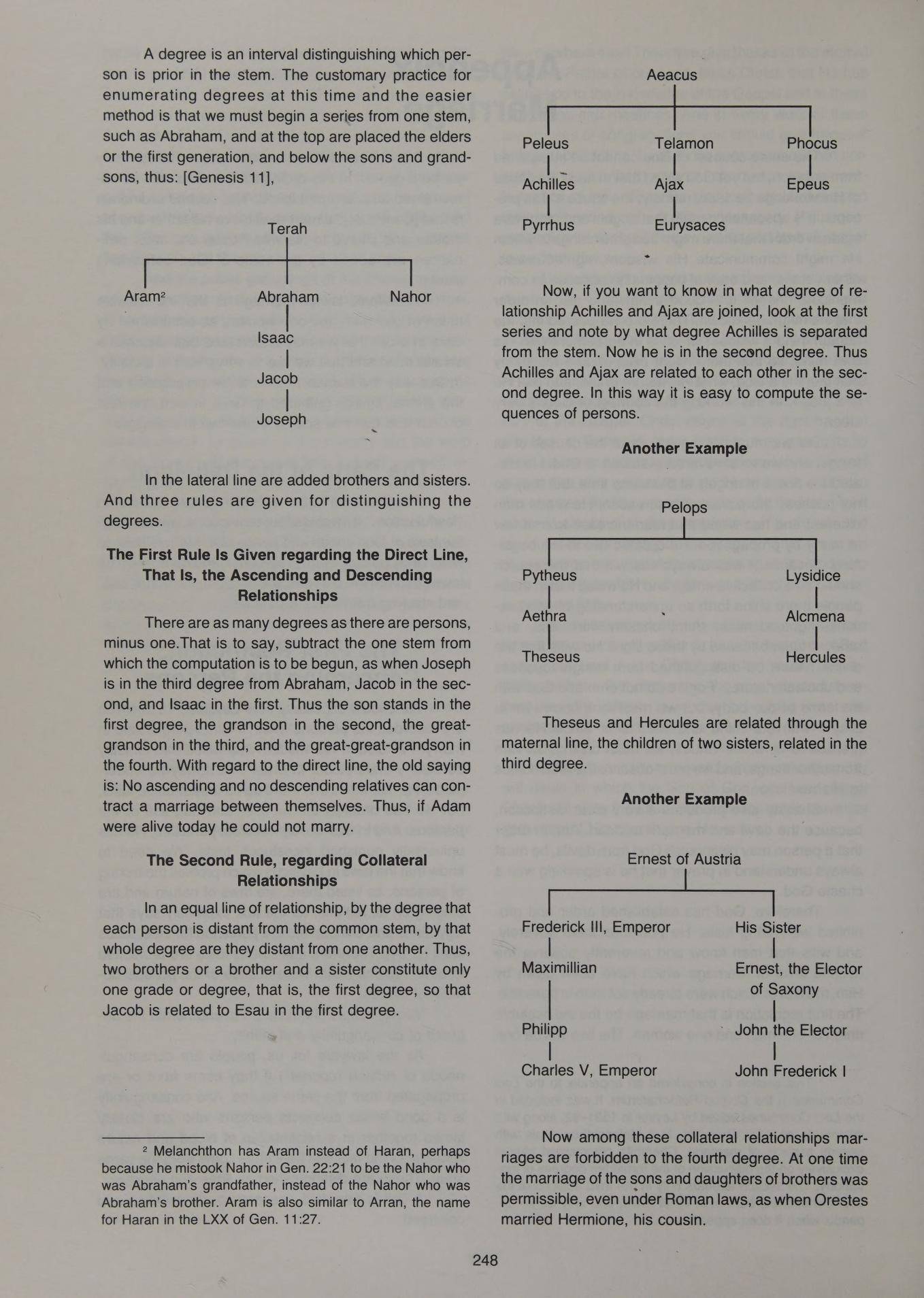
A degree is an interval distinguishing which per son is prior in the stem. The customary practice for enumerating degrees at this time and the easier method is that we must begin a series from one stem, such as Abraham, and at the top are placed the elders or the first generation, and below the sons and grand sons, thus: [Genesis 11], Aeacus Te amon Phocus Peleus I I Achilles I I Epeus Ajax I I Aram2 Abraham Nahor I I I Pyrrhus I Eurysaces Terah Now, if you want to know in what degree of re lationship Achilles and Ajax are joined, look at the first series and note by what degree Achilles is separated from the stem. Now he is in the second degree. Thus
Achilles and Ajax are related to each other in the sec ond degree. In this way it is easy to compute the se quences of persons.
Isaac I Jacob I Joseph Another Example In the lateral line are added brothers and sisters.
And three rules are given for distinguishing the degrees.
Pelops The First Rule Is Given regarding the Direct Line, That Is, the Ascending and Descending Lysidice Pytheus Relationships Aethra Alcmena There are as many degrees as there are persons, minus one.That is to say, subtract the one stem from which the computation is to be begun, as when Joseph is in the third degree from Abraham, Jacob in the sec ond, and Isaac in the first. Thus the son stands in the first degree, the grandson in the second, the greatgrandson in the third, and the great-great-grandson in the fourth. With regard to the direct line, the old saying is: No ascending and no descending relatives can con tract a marriage between themselves. Thus, if Adam were alive today he could not marry.
Theseus Hercules Theseus and Hercules are related through the maternal line, the children of two sisters, related in the third degree.
Another Example Ernest of Austria The Second Rule, regarding Collateral Relationships In an equal line of relationship, by the degree that each person is distant from the common stem, by that whole degree are they distant from one another. Thus, two brothers or a brother and a sister constitute only one grade or degree, that is, the first degree, so that Jacob is related to Esau in the first degree.
Frederick III, Emperor His Sister Maximillian Ernest, the Elector of Saxony Philipp John the Elector Charles V, Emperor John Frederick I Now among these collateral relationships mar riages are forbidden to the fourth degree. At one time the marriage of the sons and daughters of brothers was permissible, even under Roman laws, as when Orestes married Hermione, his cousin.
2 Melanchthon has Aram instead of Haran, perhaps because he mistook Nahor in Gen. 22:21 to be the Nahor who was Abraham's grandfather, instead of the Nahor who was
Abraham's brother. Aram is also similar to Arran, the name for Haran in the LXX of Gen. 11:27.
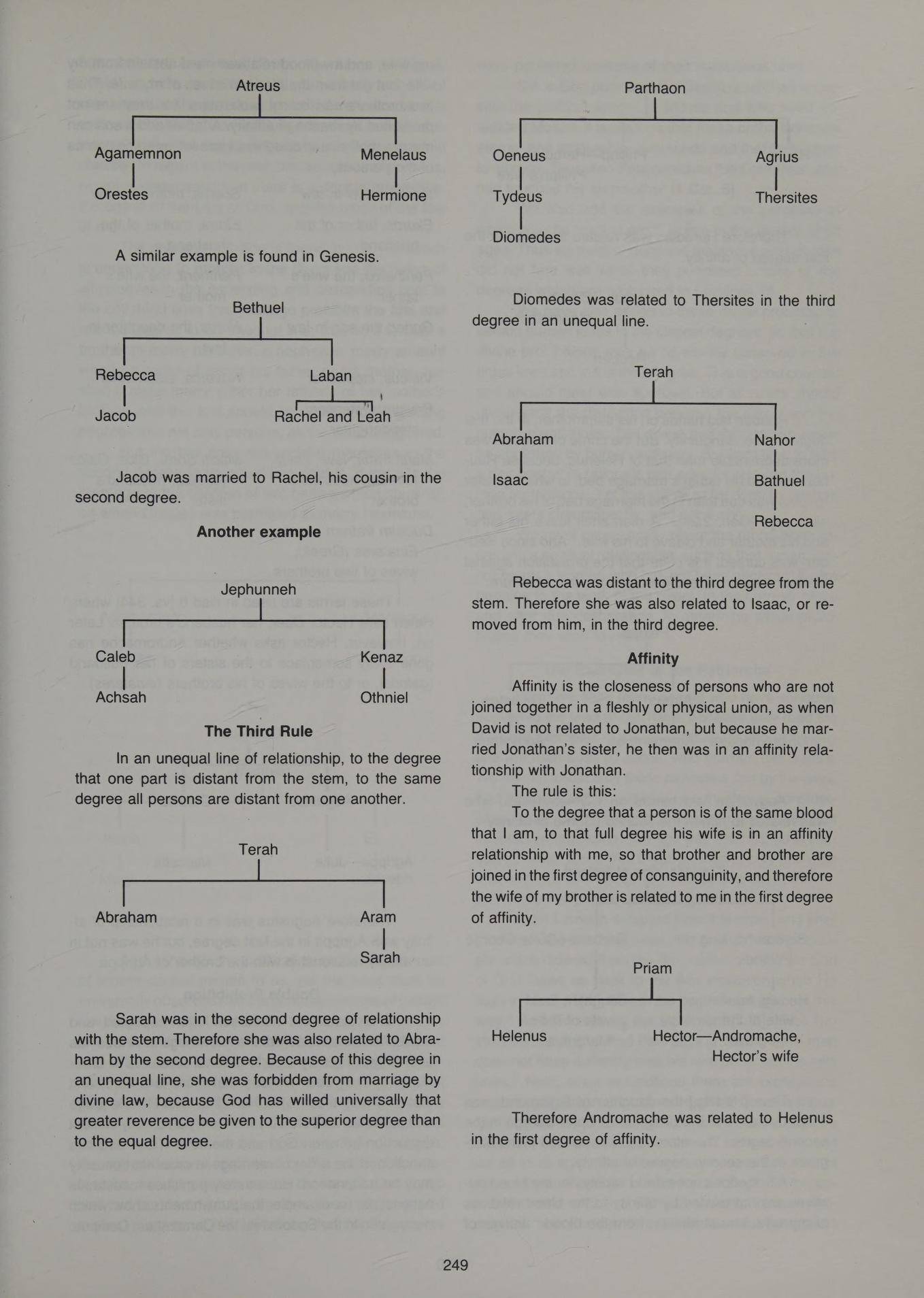
Parthaon~ I Atreus _L_ Agamemnon Menelaus Oeneus Agrius I I Orestes Hermione Tydeus Thersites I Diomedes A similar example is found in Genesis.
Diomedes was related to Thersites in the third degree in an unequal line.
Bethuel Terah
I ™---------
Rebecca Laban • I ''I Jacob Rachel and Leah Abraham Nahor Jacob was married to Rachel, his cousin in the second degree.
Isaac Bathuel Rebecca Another example Rebecca was distant to the third degree from the stem. Therefore she was also related to Isaac, or re moved from him, in the third degree.
Jephunneh Caleb Kenaz Affinity Affinity is the closeness of persons who are not joined together in a fleshly or physical union, as when
Achsah Othniel David is not related to Jonathan, but because he mar The Third Rule ried Jonathan's sister, he then was in an affinity rela tionship with Jonathan.
In an unequal line of relationship, to the degree that one part is distant from the stem, to the same degree all persons are distant from one another.
The rule is this:
To the degree that a person is of the same blood that I am, to that full degree his wife is in an affinity relationship with me, so that brother and brother are joined in the first degree of consanguinity, and therefore the wife of my brother is related to me in the first degree of affinity.
Terah Abraham Aram Sarah Priam J_ Sarah was in the second degree of relationship with the stem. Therefore she was also related to Abra ham by the second degree. Because of this degree in an unequal line, she was forbidden from marriage by divine law, because God has willed universally that greater reverence be given to the superior degree than to the equal degree.
Helenus Hector—Andromache, Hector's wife Therefore Andromache was related to Helenus in the first degree of affinity.
my wife, and my blood relatives must abstain from my wife, but not from the blood relatives of my wife. Thus two brothers can marry two sisters, for they are not prohibited by reason of affinity. A father and a son can marry a mother and daughter. Here follow some names of the persons:
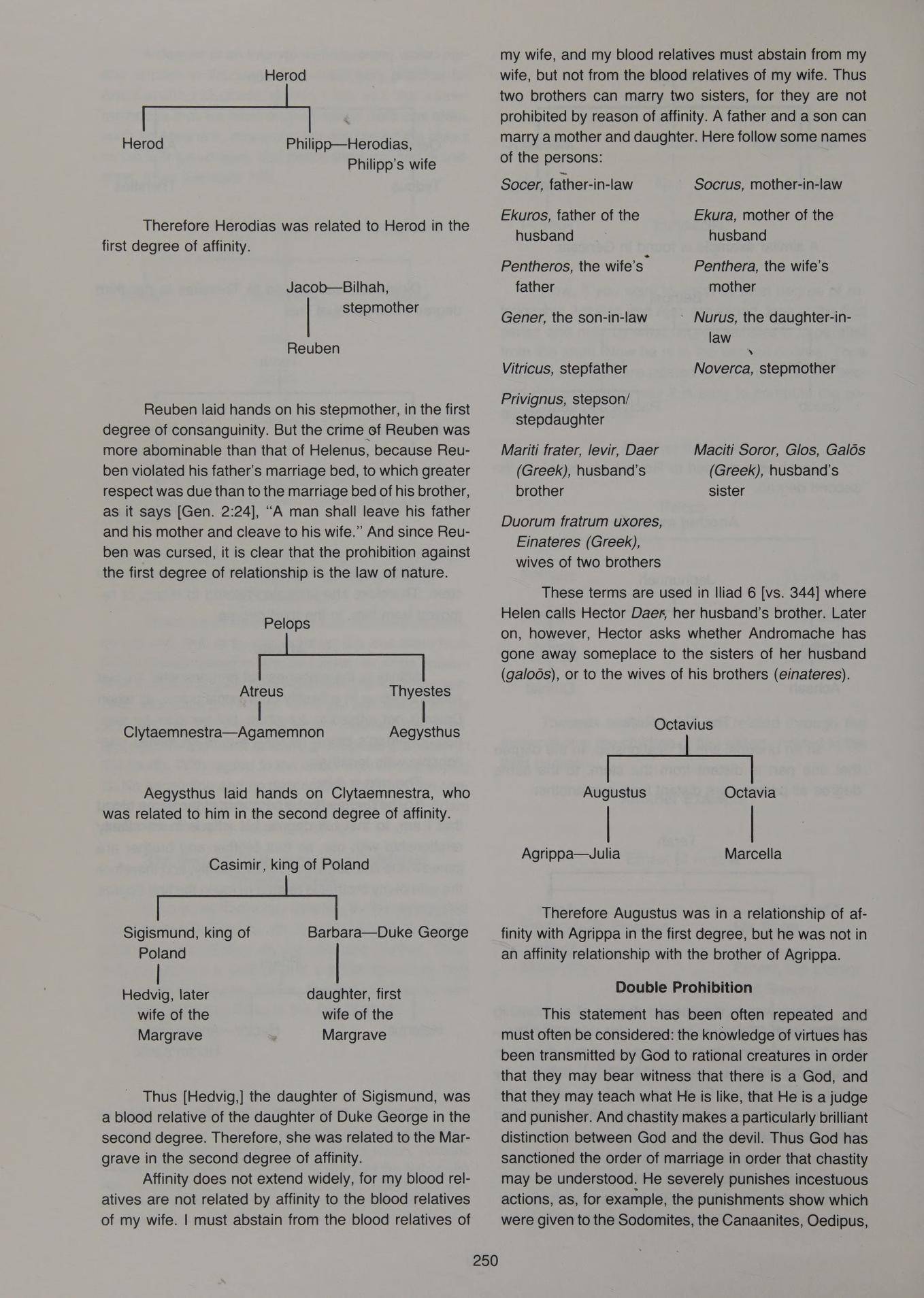
Herod Herod Philipp—Herodias, Socer, father-in-law Socrus, mother-in-law Philipp's wife Ekura, mother of the Ekuros, father of the Therefore Herodias was related to Herod in the first degree of affinity. husband husband Pentheros, the wife's Penthera, the wife's | stepmother Jacob—Bilhah, mother father Gener, the son-in-law Nurus, the daughter-inlaw Reuben Noverca, stepmother Vitricus, stepfather Privignus, stepson/ Reuben laid hands on his stepmother, in the first degree of consanguinity. But the crime of Reuben was more abominable than that of Helenus, because Reu ben violated his father's marriage bed, to which greater respect was due than to the marriage bed of his brother, as it says [Gen. 2:24], "A man shall leave his father and his mother and cleave to his wife." And since Reu ben was cursed, it is clear that the prohibition against the first degree of relationship is the law of nature. stepdaughter Maciti Soror, Glos, Galds Mariti frater, levir, Daer (Greek), husband's sister (Greek), husband's brother Duorum fratrum uxores, Einateres (Greek), wives of two brothers These terms are used in Iliad 6 [vs. 344] where
Helen calls Hector Daer, her husband's brother. Later on, however, Hector asks whether Andromache has gone away someplace to the sisters of her husband
(galods), or to the wives of his brothers (einateres).
Pelops Thyestes Atreus Octavius Clytaemnestra—Agamemnon Aegysthus Aegysthus laid hands on Clytaemnestra, who was related to him in the second degree of affinity.
Augustus Octavia Agrippa—Julia Marcella Casimir, king of Poland
r T Therefore Augustus was in a relationship of af finity with Agrippa in the first degree, but he was not in an affinity relationship with the brother of Agrippa.
Sigismund, king of Bart>ara—Duke George Poland |
Hedvig, later daucjhter, first wife of the wife of the Margrave Margrave Double Prohibition This statement has been often repeated and must often be considered: the knowledge of virtues has been transmitted by God to rational creatures in order that they may bear witness that there is a God, and that they may teach what He is like, that He is a judge and punisher. And chastity makes a particularly brilliant distinction between God and the devil. Thus God has sanctioned the order of marriage in order that chastity may be understood. He severely punishes incestuous actions, as, for example, the punishments show which were given to the Sodomites, the Canaanites, Oedipus,
Thus [Hedvig,] the daughter of Sigismund, was a blood relative of the daughter of Duke George in the second degree. Therefore, she was related to the Mar grave in the second degree of affinity.
Affinity does not extend widely, for my blood rel atives are not related by affinity to the blood relatives of my wife. I must abstain from the blood relatives of
Agamemnon, Aegisthus, Paris, the kings of Egypt, David, and the sons of David. Universally a host of calamities are the penalties for lustful behavior, as it is written Heb. 13:4, "God will judge fornicators and adul terers." Therefore we must be very careful to maintain chastity. In regard to the prohibited degrees of persons, we must understand that there is a double prohibition: the one is of the Law of God, and the other of the law of men. were punished because of their incestuous lusts.
Since God punished the Gentiles, who were out side the political sphere of Moses and who even an tedated Moses, it is obvious that these prohibitions are eternal and immutable commands and that they apply to all men. Thus also Paul punishes the Corinthian who had touched his stepmother [1 Cor. 5].
We also add the examples of the penalties of which we can read at great length in the history of all ages. Thus we must understand that those eras of man did not fare well when they permitted unions of the degrees which are prohibited in Leviticus 18.
The divine prohibition is found in Lev. 18, which is understood to prohibit in the direct line the union of all relatives in the ascending and descending line. In the collateral lines this passage prohibits the first and second degree in an unequal line, that is, it forbids a brother to marry his sister, a nephew to marry an aunt who is a sister of either his father or his mother, nor shall a niece marry either her father's or her, mother's brother. And this text should be understood regarding degrees and not only persons, as the Jews suggested.
We have also added to these divine prohibitions certain human ideas in the closest degrees, so that the divine prohibitions may be reverently observed in the equal lines and in the third degree. This is good counsel and should meet with approval. But all rulers should understand the distinction between the divine and the human prohibitions. The divine prohibitions can never be abolished by human authority. But from time to time a demonstrable rationale can arise for relaxing the hu man prohibitions. Yet this still must be done by pastors and rulers circumspectly, and not rashly.
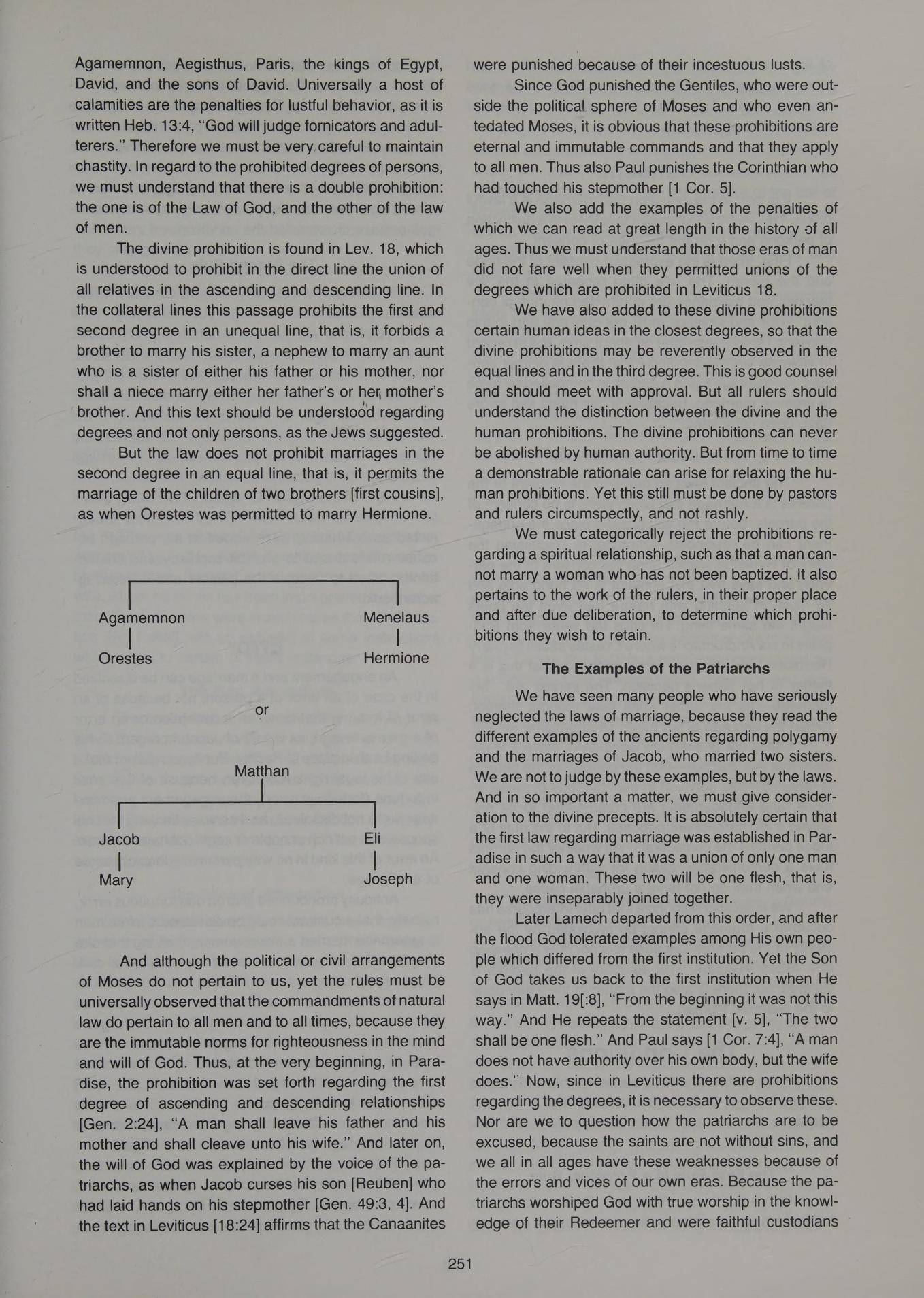
But the law does not prohibit marriages in the second degree in an equal line, that is, it permits the marriage of the children of two brothers [first cousins], as when Orestes was permitted to marry Hermione.
We must categorically reject the prohibitions re garding a spiritual relationship, such as that a man can not marry a woman who has not been baptized. It also pertains to the work of the rulers, in their proper place and after due deliberation, to determine which prohi bitions they wish to retain.
Agamemnon Menelaus I Hermione I Orestes The Examples of the Patriarchs We have seen many people who have seriously neglected the laws of marriage, because they read the different examples of the ancients regarding polygamy and the marriages of Jacob, who married two sisters.
We are not to judge by these examples, but by the laws.
And in so important a matter, we must give consider ation to the divine precepts. It is absolutely certain that the first law regarding marriage was established in Par adise in such a way that it was a union of only one man and one woman. These two will be one flesh, that is, they were inseparably joined together. or Matthan Eli Jacob I Joseph I Mary Later Lamech departed from this order, and after the flood God tolerated examples among His own peo
And although the political or civil arrangements of Moses do not pertain to us, yet the rules must be universally observed that the commandments of natural law do pertain to all men and to all times, because they are the immutable norms for righteousness in the mind and will of God. Thus, at the very beginning, in Para dise, the prohibition was set forth regarding the first degree of ascending and descending relationships
[Gen. 2:24], "A man shall leave his father and his mother and shall cleave unto his wife." And later on, the will of God was explained by the voice of the pa triarchs, as when Jacob curses his son [Reuben] who had laid hands on his stepmother [Gen. 49:3, 4]. And the text in Leviticus [18:24] affirms that the Canaanites ple which differed from the first institution. Yet the Son of God takes us back to the first institution when He says in Matt. 19[:8], "From the beginning it was not this way." And He repeats the statement [v. 5], "The two shall be one flesh." And Paul says [1 Cor. 7:4], "A man does not have authority over his own body, but the wife does." Now, since in Leviticus there are prohibitions regarding the degrees, it is necessary to observe these.
Nor are we to question how the patriarchs are to be excused, because the saints are not without sins, and we all in all ages have these weaknesses because of the errors and vices of our own eras. Because the pa triarchs worshiped God with true worship in the knowl edge of their Redeemer and were faithful custodians
of the doctrine, they also excelled in all virtues and otherwise kept a good conscience. Their faults were covered, since at that time they were the political or civil customs of their age. if there is no consumation, the contract is dissolved.
The conditions are like this: once the parents have con sented, [it follows that] if you give [my wife] to me, there will be given to you a recompense proportionate to our property. But when intercourse takes place, even if the fulfillment of the expected condition has not taken place, by this act of union we may judge that there is
Consent It is said in the definition that marriage is a lawful union. This restriction teaches that there is a distinction of persons and it orders the idea of consent. a marriage, because the persons who have come to gether have disregarded the condition.
First, there is the expressed consent of the bride and the groom. The rule often repeated in the law teaches that marriages are contracted by mutual con sent. Error and violence must not play any part in this consent. I shall speak later on about error. But in regard to violence we need to know that there is neither con sent nor marriage when a person is compelled by force to promise marriage. Because of this many sad errors
The-Second Rule But if there is truly an irrelevant condition which does not pertain to the marriage, such as saying, "I will marry you if you will give me a hundred gold pieces," where the mention of the gift is not clearly understood, this kind of condition is useless and should be pro nounced as such before the marriage should be treated as a true marriage. Or there is the condition, "I will marry you if the emperor will wage war against the Turks." It should not be pronounced as a marriage when base or impossible conditions are added, such as "If I find you a virgin." Or again, "I will marry you if you will give me Byzantium." These conditions are re jected as not having been added at all, perhaps be cause rulers desire to prohibit sophistry and shame fulness used to deceive the pitiable and weaker, ig norant sex. have been committed.
The Consent of the Parents The ancient laws so demand the consent of the parents in a marriage that when there is no consent of the parents, before the union takes place the engage ment can be rescinded. Ambrose, in discussing the story of Rebecca, insists upon the consent of the par ents, and says that this consent is so honorable and so much in keeping with nature that even the poets taught the same thing. He cites the verse from Euri pides in his Andromache where Orestes seeks to marry
Hermione, and the reply is given to him that this is a matter of her father's decision. The verses are: "My marriage—'tis my father shall take thought thereof; herein the decision is not mine" [Andromache 987-8].
Error An engagement and a marriage can be dissolved in the case of an error of a person, not because of an error of fortune, that is, when a deception or an error of a man enters in, as is told of Jacob in regard to his getting Leah in place of Rachel. But Jacob did not make use of his legal right. Moreover, because of this error in fortune (fortuitous error), the engagement and mar riage were not dissolved, as if he were thinking that his spouse was not rich or noble or could not have children.
An error of this kind in no way pertains to the substance of a marriage.
I shall not prolong the discussion, since it is ev ident that this practice—that the consent of the parents is required—has survived in the churches of these re gions, and engagements are commanded to be dis solved if the parents are opposed. But to the duty of a judge pertains the consideration of whether the parents have a demonstrable reason for withholding consent and when they do not have a probable cause.
Antiquity pronounced also on one fortuitous error, namely, that a contract could be dissolved if a free man in ignorance married a slave woman, thinking that she was free. This regulation was entirely political or civil.
We must also recognize that after intercourse has occurred a marriage cannot be rescinded by the au thority of the parents, because it is not now a question of a future marriage. The authority of the parents is violated, but there is also the matter of the injury done to the deserted woman.
In our age the ancient custom to slaves has been al most entirely abolished in Europe, so there is no need for a long discussion of this point. But in times gone by, there was reason for the regulation because those
The Conditions born of handmaids were excluded from the line of succession which belonged to the freeborn. But when a free man knowingly took a handmaid, the church would not terminate the marriage, as was the case of the true marriage between Abraham and Hagar.
Some of the conditions are honorable and pertain to the marriage. Some are irrelevant and in no way pertain to the marriage. Others are improper, and oth ers impossible.
There is another error, about which there is a rather difficult question. If a person in ignorance marries
The First Rule Is a Perpetual Rule a woman who has been seduced by another man or who is pregnant by another man, can the engagement
An honorable condition, one which does pertain to the marriage, is added in the principle of the contract:
and the marriage be dissolved, as is often requested?
This question is often brought up for judgment, but it is judged by the common law that a spouse or a groom should keep the woman who has been seduced by him or by another. Whether he knew about it or not, he should marry her. This possibly has been sanctioned in recent regulations, so that it is not easy to dissolve marriages or to give support to those who cast off their wives very freely and for any kind of excuse whenever they change their mind. else, he should keep her, especially if she is a decent woman, because many calamities often arise out of a divorce, the reason for which must be considered by the judge and the person involved. But if reconciliation cannot be achieved, a wise judge who has the matter under his authority and whose decision cannot be changed later on, can follow the example of the law of Moses, and give a decision of divorce. For it is well known that the civil laws of Moses do not pertain to our civil affairs, yet it is possible to see in them what God approves.
The present practice is well known and there are express statements about it in the canon law. But in Deut. 22[:21] there is a different idea which commands that a woman who has been guilty of adultery with an other man is to be put to death by stoning, when fol lowing her seduction she has been married to another man as if she were a virgin, if she is accused of this and the man seeks a divorce.
Therefore legislators in their own position can keep this law in mind, so that in such a case if rec onciliation does not first take place, then a divorce may follow. And an error in this area is much more intoler able than if a man marries a handmaid. And we can add other proper reasons also.
But the example of the law of Moses gives more support to our conscience than other arguments do, for lawmakers and judges are made certain by the testi mony of the divine law that they are not doing some thing contrary to the will of God.
This was the ancient severity of the divine law, which for a while other wiser nations imitated. In a play of Euripides, Ceura when pregnant is wedded to prince
Xuthur, and there was born of her Ion, whom his mother exposed as an infant. But after the thing was reported, the mother was afraid of being punished, but the boy was saved by Pallas. And in Terence in his Hecyra [The Mother-in-law], Pamphilus is unwilling to accept his wife, whom he thinks has been impregnated by another man. Thus, divorces were in such cases the usual prac tice. But I shall add an ordering of some instructions which apply to certain of these instances.
Another Case Often the question is asked concerning this case:
Can a man, such as David, who has a wife and lies with another woman, marry the second woman when she is pregnant, even before the spouses have died— while he is married to another woman or she to another man? Canon law forbids a marriage under these cir cumstances. They likewise forbid, if there is any incli nation toward it, the killing of the husband of the other woman. These decrees were drawn up with very good intention, so that adulterers might be kept away from even greater evil. But the example of David shows that in this case a marriage could be permitted and that also in our age a judge might use clemency, especially when civil rulers do not punish adultery, but these irregular unions are displeasing to God.
The First Admonition The law of Moses commands the man who has lain with a woman to marry her and give her a dowry, whether he has promised or not promised marriage.
But our laws do not compel you to marry a woman who has been made pregnant by you if you have not prom ised to marry her, but they do make mention of a dowry: either marry her or give her a dowry. This is the same as was practiced in Attica.
Another Question The Second Admonition Is it permissible for a Christian to marry a Gentile or heathen, or a dissenter of some kind?
It is possible that more recent times have de parted from the ancient custom, for our law forces a man to keep a woman who has been impregnated by another man, because if it is permissible to accuse a new bride based on suspicions or certain offenses, then innocent women might fall into danger. Often secret sins have been revealed which it is more honorable and more useful to cover up, as the saying goes [1
Peter 4:8], "Love covers all sins." Thus, magistrates have wanted to prohibit accusations. Nor is this counsel to be disparaged.
Canon laws forbid marrying a heathen or a here tic, and this has been laid down as a regulation with very good intent. For also the divine law forbade mar riage with Philistines [cf. Deut. 7:3; Neh. 13:23-7], But here it is also necessary to remember the principle rule: the Gospel does not abolish civil ordinances, but it ad monishes us about the righteousness of the heart.
Meanwhile, in our outward life, it permits us to utilize the civil laws, but not to put them in conflict with the natural laws, just as we utilize the different divisions of the days [of the week]. Therefore Paul expressly com mands that Christians are to keep their spouses who wish to remain in the same marriage, even if they have not embraced the same religion [1 Cor. 7:14], "The unbelieving husband is sanctified by the believing wife."
Now even if I am not bringing in any new regu lations, yet it is permissible to say in all humility what seems to be most beneficial. First, we must maintain the idea of reconciliation, so that if a man in error mar ries a woman who had been impregnated by someone
For the believing person, the use of marriage is pure, that is, it is not displeasing to God, even if the spouse is a dissenter in religion, as it also says [1 Tim. 4:5],
"The food is sanctified by the Word of God and prayer," that is, it is agreed that the use of this food is not dis pleasing to God. vorced should not again marry. For God detests mixing up these lusts.
Among the ancient Greeks in Attica there was the practice that cases of divorce were to be recognized in the courts, but later on among the Jews there came a great permissiveness and license, and divorces took place entirely by private and personal whim, whether there were compelling reasons or poor reasons or no Thus the Christian mother of Augustine remained in her marriage with a heathen husband, indeed a very bitter one, who later on was moved by the pleas and piety of his wife to turn to the acknowledgement of Christ. There are many such well-known accounts in the history of the church, a consideration of which is also useful in our age, so that marriages are not broken up because of religion when the people desire to remain in the marriage, since these marriages are often trag ically broken up because of the children. The Christian should be careful in his obedience to keep the good will of his wife, so that this situation does not seem to her to give an occasion for a divorce, v reasons. And women who had been divorced were al lowed to remarry, as when Cato gave his wife Marti to the powerful Hortensius, and then after the death of Hortensius, he took her back as his wife. This kind of lack of principle gave occasion for the question raised in Matthew 19. Therefore in this passage the Lord for bade divorce except for one cause, qamely, adultery, in which case a person has terminated his marriage and the evil woman must be sent away. Nor is the innocent party the cause of the break-up. Thus the voice of the Son of God frees that person as being innocent. There are also other cases, as in 1 Corin thians 7, regarding a man or woman who deserts.
Divorce The Mode of Procedure We said in the definition that marriage is the law ful and indissoluable union of husband and wife. There is no doubt that these restrictions are all in agreement with one another as it applies to the first institution of marriage. For God has willed that the human race does not wander around in irregular unions like cattle do, but that husband and wife be joined in a definite order, and that by observing this order we render to Him the obe dience which we owe to Him. And He has sanctified this order by very severe laws, and punishes with very great punishments the whole human race of all time for any overturning of this order, as shown by the deluge, the destruction of Sodom, Sybaris, Thebes, Troy, and many other nations. And the reason for this severity is that God wills that in the human race the understanding of chastity should be evident, so that we may under stand that He Himself is of a pure mind, that He loves chastity, and that by the mention of His virtue we may distinguish Him from the unclean things of nature.
Furthermore, divorces are not to take place with out the knowledge of the lawful rulers. If the innocent person wants a divorce, he or she must request that the guilty party be called before a judge. Here both parties shall come together and they shall be exhorted to return to each other in mutual favor. If reconciliation does not take place, the innocent party cannot be com pelled to overlook the guilt of the other party.
After the parties have been heard and the ac cusation established, if the accuser is a person who lives an honorable life and asks that the decision be carried out, then the judge shall pronounce thus: Since the guilty person has by his or her evil act dissolved the marriage, the judge by the authority of the Gospel pronounces the innocent person to be free, and he says expressly that the right is given to him or her to contract another marriage with good conscience and in a godly manner.
Therefore at the very beginning He sanctified marriage, so that it should not be dissolved, saying
[Gen. 2:24], "They shall be two in one flesh," that is, inseparably joined together. For in support of this po sition the Lord Himself cites this statement in Matt.
19[:5]. And to this precept the first patriarchs, Adam, Seth, and others were doubtlessly obedient and taught this doctrine to others.
The papistic canon laws make divorce nominally a non-thing, that is, they do not permit an innocent person to enter another marriage. But since the Gospel in these cases does permit divorce, this should not be understood as applying to something which does not exist, but to the kind of deliverance which divorce ac tually is, namely, in which the innocent person is not held within the marriage bonds. We note from Origen's commentary on Matthew that this was the practice in the ancient church. Likewise Eusebius in his Church
History, p. 88, cites Justin Martyr, who writes that a But later on the old discipline relaxed and divorce came to be accepted. Even before the time of Moses divorces occurred and were permitted, even by the word of the Mosaic laws. But at the beginning bound aries were set, lest simply private whim become the practice. Instead, cases first were to be handled in courts. godly woman divorced a husband who was polluted with scandalous lustful sins, and she publicly received a bill of divorce. And Jerome tells the story of a noble matron of Rome who divorced her husband because of his wickedness and married another man. It is useful
For the law, with remarkable wisdom, also sanc tioned or sanctified that a woman who had been di
settlement to the innocent person who has been de serted. Furthermore, as I have said, this should come to the knowledge of the judge. Therefore, the deserter should be called to the court. If he or she will not come, testimonies should be heard regarding the character of the innocent party, who should be pronounced as free. to keep these examples in mind to corroborate the prac tice of our judges in our churches.
If the guilty party does not come before the judge, but either stubbornly remains absent or cannot be found, and the accuser confirms his or her accusation by bringing witnesses who verify the account, then the judge shall pronounce him or her to be guiltless. The But a person is not a deserter who is absent be cause of work, as an ambassador or a soldier who is serving under lawful authority in the military, or if with the consent of his spouse a man is absent as a mer chant or in some other honorable business. innocent party may seek to be liberated, and the judge shall pronounce him or her free, as said above.
But what happens to the condemned party? Is he to be permitted to live in the same place, if he is there?
Nor does captivity give excuse to dissolve a mar riage, or deportation, as the law of Alexander Severus in the Codex [book 5, section 17, law 1] regarding the dissolution of marriages states: "A marriage is not dis solved by deportation or by a calamity from water or fire, if the accident into which the husband has fallen does not change the affection of the wife," that is, if there has not been a crime because of which in some way the marriage might be dissolved.
I reply: It is the responsibility of the civil rulers to punish adultery. Therefore the person who is con demned for this, if he is not punished more severely, should be expelled from those places where the in nocent person lives. And the second persop, that is, the guilty party, is to be regarded by the innocent party as dead. This degree of severity pertains to the civil ruler.
Moreover, in regard to a soldier, the [Institutes] of Justinian in the Authenticum states that if in past times during an entire quadrennium a soldier has made no reply to the inquiries of his wife concerning his de sires or intentions, the woman should be permitted to enter into another marriage. Justinian condemns the brevity of time involved and says that it is more heart breaking for a soldier to lose his wife at home while he is off fighting than to be captured by the enemy. There fore, he lengthened the time and required a careful inquiry regarding the desire of the man. Further, the law speaks of lawful military service and not about friv olous men who are away from home not because of their virtues or their military duty, but who claim to be soldiers so that they can wander more freely. The judge will also consider this distinction.
Who Is the Deserter?
In the question of divorce, the divine Word frees the innocent person, since the other party, by his or her adultery, has dissolved the marriage by adulterating the marriage covenant. And as I have said, when the judg ment has been completed, the innocent person is granted the right to enter into another marriage, and this is to be protected in our church consistories in this way. The same kind of protection of the person who has been unjustly deserted is to be guaranteed, for Paul in 1 Cor. 7[:15] says, "If the unbeliever departs, let him depart; and the brother or sister is not under bondage in such cases." Paul expressly pronounces that the person who has been unjustly deserted is free, that is, he or she is not compelled to chase after a wandering deserter.
The Time after Which It Is Permissible And although some people restrict this statement to a case of religion, yet it is correct to apply it in a general way to any kind of unjust desertion, since the reasoning is all the same. And in agreement with this to Remarry If a divorce has taken place because of adultery, no time is prescribed for the innocent party after the legal judgment has been made. is [the fact] that deserters are unwilling to endure the bonds of marriage and then are also unwilling to abstain from other women. But since there are various reasons for moving away, we must limit the definition of a de serter. Nor must we permit a deserted person to marry without the knowledge of the judge.
But in a question of desertion it is necessary to consider the years, in order that the person may be understood as really having been deserted, and that the desertion has not simply been deceitfully concocted out of bad faith or lack of serious intent.
A deserter is a person who leaves the marriage or is absent for too long a time when no honorable cause compels him or her to be away. Either out of a frivolous nature or an improper unwillingness to keep the marriage bond, or compelled by some other un necessary reasons, he or she goes astray.
The law in the Codex [book 5, section 1, law 2] grants a woman the right to remarry after two years.
But if the husband is not outside of the province and does not give his consent to this arrangement, then a public rite of marriage must be deferred for a longer period.
And there are many who are so lacking in natural affection, who are under the influence of devils, that they even neglect their children. This kind of deserter should be publicly punished because of faithlessness and lack of natural affection. It is right to give a property
The regulations of the papacy do not even permit remarriage for the innocent party at any time, unless it is evident that the deserting party is dead. But I have cited above the statement of Paul from Corinthians [1
Cor. 7:15] which frees the innocent person, and at the
to a frigid [impotent man], but she had never revealed this fact to anyone prior to the death of her husband. same time the deserting person becomes guilty of adul tery. Therefore, in no way are the innocent parties to be burdened with chains for wrongdoing. But we must also in this case understand that the liberation is not merely an empty word, but that the person who has been liberated from the marriage bonds is permitted to marry.
Divorce because of Cruelty, Poisoning, and Laying Traps Which Endanger Life Since the text of Matt. 19[:9] makes mention only of adultery, some people strongly contend that a di vorce cannot take place because of cruelty or laying life-threatening traps. But in the law of Theodosius
(which I believe was written with the careful deliberation of godly men so that in that age they might restrict the practice of divorce to certain cases), divorce is per mitted in these cases.
Justinian expressly permits a deserted person to remarry after ten years. In a gloss in the small chapter
"In Our Presence'' in the Decretals he says, "In cases where after seven years there is demonstrable pre sumption of the death of the husband, the woman may be excused if she remarries." The gloss is milder than the text. But when the judge has investigated the matter and determined that the complaint about desertion is not a mere pretext, and sees that the morals of the innocent person are upright, he can follow the law of Constantine regarding the four-year waiting period, or the statement concerning a five-year period which ap pears in the following section under the title "Concern ing Divorce."
And although some reject this law and contend that this is in conflict with the Gospel, yet they do not correctly understand the distinction between Law and Gospel. The Lord says expressly that in the civil gov ernment of Moses divorce was permitted because of the hardness of their hearts [Matt. 19:8]. He is signifying that there is one governance over sanctified people who are members of the church and want to obey the Gospel, and there is another governance—a civil rule— over the ungodly and the contumacious who do not wish to submit to the restraints of laws.
This moderation of the law does not seem to be unreasonable. Nor will I prescribe a definite period. But a prudent judge will consider both what he needs to teach by way of example, and that undue burdens should not be placed on the conscience of the innocent party.
If a man is the kind of husband who torments his wife and, having been admonished by the pastors, he does not cease his raging and upsets the worship of the local church in his home, and treats his wife so cruelly that her life is in danger, this man must certainly be dragged before the rulers of the civil government.
The government is obligated not only to protect the life of an innocent person, but also to consider in their own conscience whether this person, after bringing sadness and shame, may also have destroyed worship [or the spiritual life in his home] and committed some other injustice, as has been said, "Let anger be injured more often than patience." In case the cruel person does not belong to the church, the civil ruler would seem to be proper if he used the law of Theodosius.
Impotency It is a shame even to mention those who abso lutely are not suited for the married state and are called impotent [or eunuchs], whether they are this way by nature or have been castrated.
In regard to such people, we need to know that they can never marry. But when the matter of frigidity or inability is being investigated, the judge shall pro nounce in the case of such people that they are not free to marry. Nor should it be a matter of divorce, since no marriage has taken place, according to Matt. 19[:5].
But the declaration should be made so that other people may know that this involvement was not a marriage.
To the person who has the normal natural powers, le gitimate permission should be given to contract a more felicitous union. The laws have established a time for determining frigidity, if there is some doubt about the matter, so that there be no separation before the pass
God wills that civil governments be honorable to ward the good and terrifying toward the wicked. God wills that those whose behavior is good are to be pro tected. They should be given peace for worship, and for the education and raising of their children. God wills that criminals be held in check, whether they practice their criminal behavior at home or abroad. There is never a lack in governments of stubborn, unrighteous, and heartless men who vent their savagery and wicked ness on their own families—people whom the Lord in this text called hard-hearted. ing of three years.
In the same way, the judges make pronounce ments about those whose natural power is so injured or impaired by either sorcery or poison that it cannot be cured by medical science, if this condition remains for a period of at least three years and the treatments are in vain.
Can a Divorce Be Permitted because of Contagious and Incurable Diseases Such As Leprosy?
So great is the goodness of some women that they hide the weakness of their husbands. The fatherin-law of the very learned man Simon Grynaeus reports that when his first wife died, he married a widow who was a virgin. For eleven years she had been married
I reply that it is clear and evident that divorces never can be granted for the sake of diseases, nor may a sick spouse be deserted, because this rule must al ways remain firm and unmoved [Matt. 19:6]: "Whom
God has joined together, let not man put asunder."
Therefore every living person who willfully undertakes a break-up of a marriage without any doubt is com mitting a terrible sin, just as an adulterer or a deserter undertakes a break-up willfully, and is acting contrary to the order which has been sanctified by God's Word and law. Thus if a person who is entirely healthy en deavors to break up a marriage, he would be like the deserter and the adulterer, and would be guilty of a great sin. For a calamity which might befall living peo ple, even where there is no guilt, is never an excuse to dissolve a marriage contract. those promises in which a compact was made regard ing a future marriage and which were in no way the beginning of a present marriage, as when a betrothal was arranged between the youth Octavius and Servilia, who was still a little girl. In that case there was only the discussion of a marriage which was to take place some time after the words spoken at the present time.
The ancient laws speak of these betrothals and say that they can be dissolved at the will of the parties, as when Octavius did not marry Servilia. We must note carefully how antiquity spoke. A later era has created ambiguity. It speaks of some betrothals in the future sense. Others are in the present sense, when the con tract promises in express words that a marriage is a present reality or a categorical fact, and that this is now the true beginning of the present marriage.
Therefore all the things which have been said that prohibit the dissolution of a marriage should be taught to God-fearing people. For example, Gen. 2]:24] ''The two will be in one flesh," 1 Cor. 7[:4] ''A husband does not have power over his own body, but the wife does; and a wife does not have power over her body, but the husband does." Eph. 5[:25, 29], "Husbands, love your wives.... For no one ever hated his own body, but nourishes and cares for it." Since the marriage cove nant remains between people whom guilt and wicked ness has not separated, it is manifest that a sick person must not be deserted, and help and kindness is to be showed to him or her, just as a person gives it to his or her own body. The marriage covenant is the highest degree of friendship. It is absolutely immoral, therefore, to desert a friend in time of calamity who needs help and has come for the kindness and trustworthiness of his or her friend. Therefore, the desertion of one's spouse because of some calamity, in which there is no guilt, is an unjust and criminal act.
Furthermore we must prudently consider what fu ture betrothals are. We must not make judgments on the basis of arguments over words, but on the basis of many external circumstances, as to whether the parties want to establish something which cannot be changed in the future, except for a very serious reason which might at that time give cause to change things.
There are indeed betrothals for the future. All are promises, to which honorable conditions may be added which are subject to judgment, such as the expression,
"I will marry you if our parents give consent." We have said above that such promises are null and void if the condition is not satisfied.
There are also betrothals for the future, when by name a little child is promised by its parents or guard ians to be betrothed to another immature child by mar riage contract when they reach a suitable age. But since they are not old enough, or the other party is not yet of suitable age, the promise is made of a future marriage.
But some people cruelly argue that leprosy is similar to death. Under this pretext they are anxious to support the person who is in good health. But its plain heartlessness refutes this sophistry. The dead do not need the help of other people, but the sick person still needs human help. Therefore, what pertains to the duty of true friendship is not like the duty toward the dead.
There still is your flesh, there still is the divine law pro claiming to you [Eph. 5:29]: "No one hates his own flesh." A healthy person must be compelled even by the authority of the rulers not to desert the sick spouse or neglect her life, but he must take financial care of her. And even if it seems to some that this is a stern sentence, yet all honorable minds understand that it is right and just. And if a godly husband needs advice, let him ask his pastors who are learned and serious men who rightly understand the teaching of the church.
For they can answer him so that he is not caught in perplexity of conscience, and so that his faith and his worship life are not hindered while he is seeking an swers to his questions.
Betrothals of this kind can certainly be dissolved when the young people themselves do not want the marriage. Nor must a person who refuses the marriage be forced into it, if she or he has not consented to it at a proper age, when later they are of a mature enough age for marriage and can make a decision by their own judgment.
Moreover, just as men in many other respects misuse good things, so also under the shadow of mar riage there is often a pretext for foolish and selfish de sires, often because of money. Thus these marriage contracts are arranged for children, when in fact in a covenant of so great importance as a life-long marriage, the honorable judgment and the mutual good will of both parties who are being married ought to be re quired, and they should be beyond question. It is not fitting that the bodies of our children be sold for money or other greedy purposes. And God punishes the per version of this order with manifest penalties. Therefore when honorable parents consider the divine order and properly consider the salvation of their sons and daugh ters, they should not compel their sons and daughters
The Betrothal of Children before the Age of Puberty Much here involves the correct understanding of the ancient law. Antiquity spoke of betrothal only as
to enter into marriages which are contrary to the incli matters. The fourth duty is to maintain these laws with severity. nation of their nature, from which they recoil, and in which they may be moved by very serious reasons.
Where there is not mutual love on the part of the couple, discord will hurt minds, hinder the worship of God, disturbe the whole household regimen, and produce many sins. Meantime, when peoples' wills are being thwarted, and adulteries and punishments will follow in which many people will run into new wickedness and total calamities.
The ruler should consider these duties also in the protection of marriage. They should know how to gov ern with the most severe commands of God, so that they may uphold the laws of marriage and punish adul terous, witd, and incestuous lusts, and remove from among the people those dreadful monsters of evil which both arouse the wrather of God and pollute the human race with their loathsome outpourings of lust. For it is absolutely certain that*God is terribly angered at both torrents of lust and at the neglect of the governments which do not punish them and who do not remove these guilty people from the midst of the public. And because of these crimes many public penalties make their way among the human race, such as wars, devastations, destructions of people, and other great calamities, as demonstrated by the examples of the Sodomites, the Canaanites, the tribe of Benjamin, the exiles of David, the destruction of Troy, and countless others. Therefore the divine Word says in Lev. 18[:28] regarding inces tuous persons, "Beware, lest the land vomit you out if you do similar things, just as it vomited out the Ca naanites," And expressly it commands the rulers that they shall remove these evil monsters, saying [v. 29],
"Every person who commits any of these abominations shall be cut off from among their people."
Especially the parents should consider these immeasureable evils if they are in any way able to com prehend them, and they should beware that such things do not befall theirs sons and daughters. They should pray to God with ardent prayers, and then they them selves should take care so that they do not accept fool ish and ungodly ideas.
In many of their deliberations about the marriages of their children, there is nothing but neglect and indif ference on the part of the parents. Hence, afterwards there are the most tragic calamities. The families be come not the churches of God which they ought to be, but dens of devils. Many wretched people in these tra gedies fall into hatred toward God, hopelessness, and eternal destruction.
I pray God, the eternal Father or our Lord Jesus Christ, the creator of the human race and the guardian of upright society among men, that He would guide us and bring it about that our marriages and families truly are churches in the home, where they properly worship
Him and obey Him in maintaining the order which He has established, and that He not allow worship and other necessary duties to be hindered by domestic discord.
The commands are repeated many times, just as the command regarding adulterers is said again in Deut. 22[:22], "If a man sleeps with the wife or another man, both shall be killed—the adulterer and the adul teress—and you shall remove the evil from Israel." Fur thermore, it is very regretable that in many places the ruler in so important a matter is very dilatory, and this neglect stirs up the wrath of God, and thus the penalties pile up against the human race, as we see in the story of the tribe of Benjamin, which was almost entirely de stroyed because they were unwilling to punish the rape of the Levite's wife [Judges 19].
The Ruler's Duty to Uphold the Laws of Marriage It is absolutely certain that the salutary guidance of God is needed. And it is manifest that God has in stituted the arrangement among mankind that there be a ruler for the people. And to these rulers God has given four primary tasks. The first is that the ruler shall speak the word of the divine law in maintaining discipline, be cause the first and inviolate norm for living must be the law of God. The second is that he be a vigilant guardian of God's law, so that by the severity of punishments he may control and punish the disobedient and defend the obedient. God thus has sanctioned this order and it is clear that laws are despised when there are no ex amples of punishments, just as Demosthenes praises the dictum of Aeschines, "There is no help for the gov ernment which does not have bowstrings to use against evildoers." The third duty is that the ruler can add cer tain laws to the law of God which however in no way differ from the divine law but which are supports so that the divine laws may be maintained for more important
For it is most certain that God punishes all wild lusts, even when the rulers permit them, for the chastity and righteousness of God are not moved and He al ways keeps this rule [Heb. 13:4], "God will punish for nicators and adulterers." Although for the sake of His
Son He mitigates his punishments to those who repent, as when He did not allow David to die and did not kindle
His total wrath, as the Psalmist says [Ps. 78:38], yet consider how great a mountain of penalties there was.
Families were contaminated by incestuous unions, sons quarreled among themselves, and a father was driven into exile. A son and a great number of citizens were killed because of a rebellion which was created.
The royal mothers who were beloved by God were cor rupted by the crime of the sons. The hideous sins of David were even sadder than his physical death was going to be. But in both cases God showed that He was angry against wickedness and that He punishes it, and yet He snatches out of the jaws of eternal death
those who flee to His Son, the mediator, upon whom even the greatest sins have been laid, which is the price of our deliverance. in keeping with the law of God, [1 Cor. 7:2], "Let each man have his own wife for the sake of avoiding fornication."
This teaching concerning penalties and repen tance must be known by all. And rulers must be urged and entreated to remember their duty under the com mand of God, to understand that God is chaste and righteous, and that they have been put in the position of divine service so that they may be the image of God, that they may be chaste and upright, and uphold chas tity and righteousness among the people.
And since the ruler is the image and minister of God, he should love chastity, since he knows that God is of a chaste mind and most severely demands that the order of chastity be upheld for the sake of His es tablished order. The ruler must not be the image and minister of the devil, who in his hatred drives miserable men so that they are polluted with a torrent of lusts, so that the wrath of God is increased and this miserable creature lives in even greater shame, and afterwards falls into eternal destruction. The devil aids and abets
These duties are God-pleasing and salutary for both rulers and people.
In many areas the civil rulers are very negligent in upholding chastity because to a great degree they have turned this concern over to the responsibility of the bishops. But other matters which are alsg contrary to God's norm have been turned over td' the eccle siastical authorities, and their regulations hinder proper penalties, because the ecclesiastical authorities are not armed with the sword. Besides, since the judges them selves are often contaminated by unrestrained lusts, they are less angry with similar wrongdoings, as Aris totle cites from Euripides, "Evil people take pleasure in evil things, and a bad man helps another bad man." In the meantime they steal money from poor women. God holds such judges only in derision. all these frightful ravings, which augment the wandering lusts in every possible way, either by the defense of the papal law regarding celibacy, or by the neglect of punishments. In this present life the shamefulness and enormity of these crimes is not yet sufficiently recog nized, but enormous crimes have been covered up until the last judgment, when God will show to all angels and men the shamefulness of sin and the malice of the devils. But yet in this life honorable and godly rulers must consider on the basis of the situation the will of God, and direct their government according to the law of God. To the greatest degree possible they should be concerned that sins and punishments do not pile up, as is said in Isaiah 10[:1 ], "Woe to those who write unjust laws."
Therefore it is right that judicial regulations should be established regarding marriages. Civil government should call upon learned and honorable men chosen out of the whole body of the church. When these men have investigated and fully understood all these mat ters, they should pronounce judgment. In recommend ing punishments, they should be the ministers of God.
They should remove from society all those who are corrupted by being involved in things that are contrary to nature, such as incestuous men, adulterers, rapists, deserters, adulteresses, and women who desert their husbands, lest God, because of these crimes and the negligence of the rulers, destroy whole cities and nations.
I pray that the Son of God, our Lord Jesus Christ, who was crucified and raised for us and who truly loves chastity and a chaste marriage, will Himself turn the minds of all who call upon Him toward chastity. May
He defend the laws of marriage and restrain the devils, who in hatred for God try to drive wretched mankind to pollute themselves in various ways and finally perish.
The weakness of human nature increases in this world as it grows older. At the same time, the raging of the devils increases because they know that judgment stands near, when their shamefulness will be clearly revealed to all angels and men. Therefore, O Son of God, our Lord Jesus Christ, You who have been cru cified and raised for us, I pray that You will govern our youth, rule our families, guide them toward chastity and the true invocation of the eternal Father, and turn our hearts by Your Holy Spirit. Amen.
Honest rulers should also demonstrate their love for chastity in their defense of marriage. They should do away with the ungodly and diabolical laws of the bishops regarding the celibacy of priests, and permit a godly marriage to all who are suited for this kind of life,
445144