
Front matter
PHILIP
MELANCHTHON
TRANSLATED BY
J. A. O. PREUS
PHILIP MELANCHTHON
TRANSLATED BY
J. A. O. PREUS
Publishing House St. Louis

Copyright © 1992 Concordia Publishing House 3558 S. Jefferson Avenue, St. Louis, MO 63118-3968
Manufactured in the United States of America All rights reserved. No part of this publication may be reproduced, stored in a retrieval system, or transmitted, in any form or by any means, electronic, mechanical, photocopying, recording, or otherwise, without the prior written permission of Concordia Publishing House.
Library of Congress Cataloging-in-Publication Data Melanchthon, Philipp, 1497-1560.
[Loci communes rerum theologicarum. English] Loci communes I by Philip Melanchthon: translated by J.A.O. Preus. p. cm.
Translation of the third Latin edition of: Loci communes rerum theologicarum, first published 1543.
ISBN 0-570-04250-X
1. Lutheran Church—Doctrines—Early works to 1800. 2. Theology, Doctrinal—Early works to 1800. I. Preus, Jacob A.
O. (Jacob Aall Ottesen), 1920- . II. Title.
BR338.L6313 1992
230'.41—dc20 91-42285
2 3 4 5 6 7 8 9 10 VP 01
00 99 98 97 96 95 94 93 92
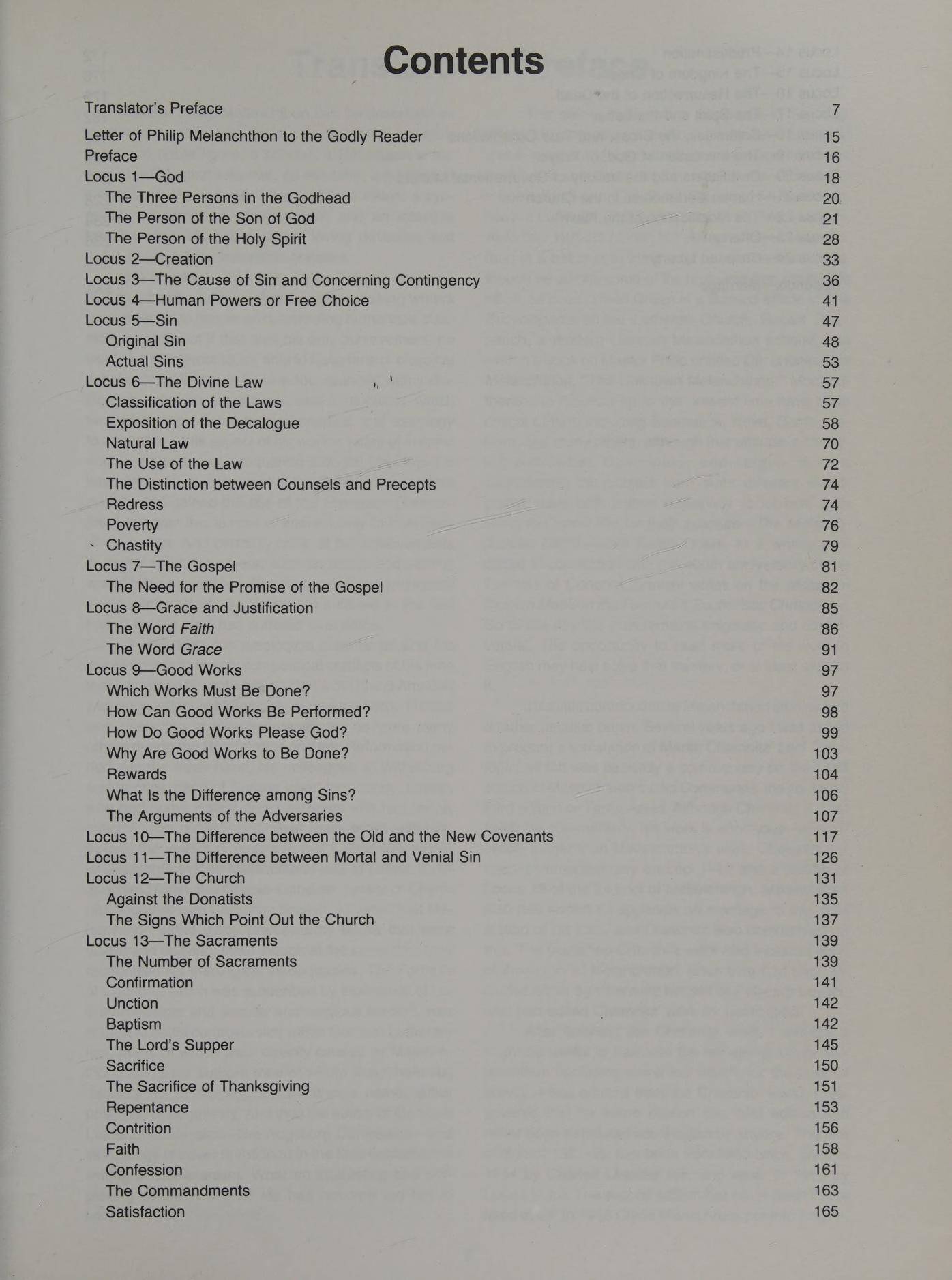
Contents Translator's Preface
Letter of Philip Melanchthon to the Godly Reader
Preface
Locus 1—God
The Three Persons in the Godhead
The Person of the Son of God
The Person of the Holy Spirit
Locus 2—Creation
Locus 3—The Cause of Sin and Concerning Contingency
Locus 4—Human Powers or Free Choice
Locus 5—Sin
Original Sin
Actual Sins
Locus 6—The Divine Law
Classification of the Laws
Exposition of the Decalogue
Natural Law
The Use of the Law
The Distinction between Counsels and Precepts
Redress
Poverty
' Chastity
Locus 7—The Gospel
The Need for the Promise of the Gospel
Locus 8—Grace and Justification
The Word Faith
The Word Grace
Locus 9—Good Works
Which Works Must Be Done?
How Can Good Works Be Performed?
How Do Good Works Please God?
Why Are Good Works to Be Done?
Rewards
What Is the Difference among Sins?
The Arguments of the Adversaries
Locus 10—The Difference between the Old and the New Covenants
Locus 11—The Difference between Mortal and Venial Sin
Locus 12—The Church
Against the Donatists
The Signs Which Point Out the Church
Locus 13—The Sacraments
The Number of Sacraments
Confirmation
Unction
Baptism
The Lord's Supper
Sacrifice
The Sacrifice of Thanksgiving
Repentance
Contrition
Faith
Confession
The Commandments
Satisfaction

Locus 14—Predestination
Locus 15—The Kingdom of Christ
Locus 16—The Resurrection of the Dead
Locus 17—The Spirit and the Letter
Locus 18—Calamities, the Cross, and True Consolations
Locus 19—The Invocation of God, or Prayer „
Locus 20—Civil Rulers and the Validity of Governmental Matters
Locus 21—Human Ceremonies in the Church
Locus 22—The Mortification of the Flesh
Locus 23—Offense .
Locus 24—Christian Liberty
Appendix—Marriage
Translator's Preface The same ambivalence continues to this day.
Clyde Manschreck, a Methodist who has produced some excellent Melanchthon studies, refers to him in the kindest and most complimentary terms, and entitled a book about him The Quiet Reformer. Michael Rogness, a Lutheran, entitled his book Philip Melanchthon:
Reformer Without Honor. He attempts to put Melanch thon in a better light than most Lutherans have done, though he admits some of the problems that attend this effort, as does Lowell Green in a learned article in The Encyclopedia of the Lutheran Church. Robert Stupperich, a modern German Melanchthon scholar, has written a book on Master Philip entitled Der unbekannte
Melanchthon, "The Unknown Melanchthon." Most Lu therans in America up to the present time have been critical of him, including Schmauck, Neve, Bente, Pelikan, and many others, although that attitude is chang ing somewhat. Caemmerer and Teigen, though approaching the subject from quite different stand points, have both written negatively about him, both using the same title for their treatises—The Melanchthonian Blight—while Ralph Quere, in a writing pro duced in connection with the 400th anniversary of the Formula of Concord, bravely writes on the Melanchthonian Motifs in the Formula's Eucharistic Christology.
So to this day the man remains enigmatic and contro versial. The opportunity to read more of his work in English may help solve that mystery, or at least explain
Master Philip Melanchthon can be described as mysterious and controversial. He has been called a great and noble figure, a scholar, a Renaissance hu manist, a Christian reformer, an educator, a gentle and loving soul. He has also been called a villain, a syn ergist, a unionist, a compromiser, and an irascible troublemaker. He had hosts of loving devotees and hosts of angry and frustrated enemies.
He is not as well known to the English-speaking world as he should be. A few English-speaking writers have referred to him as an outstanding humanistic clas sical scholar, but if that was his only achievement, he would be of interest today only to historians of classical scholarship. While his knowledge spanned many dis ciplines, and he taught courses in subjects which ranged from medicine to mathematics, and astrology to astronomy, this aspect of his work is today of interest only to historians of antiquarian thought. He played a key role in the development of the German educational system and gained the title of the Preceptor Germaniae, but again this is now of interest only to historians ofeducation. And certainly none of his achievements in these areas (or others, such as music and poetry) would bring against him the strong emotions and verbal attacks from which the poor man suffered in the last half of his life, and has suffered ever since.
It was from his theological statements and his involvements in the church-political conflicts of his time that he gained his notoriety. Luther's old friend Arnsdorf was very critical of Melanchthon, and the fierce Flacius was unstinting in his condemnations, as were many others during the Reformation and late Reformation pe riod. On the other hand, his colleagues at Wittenberg and in other parts of Europe loved him dearly. Luther, who had some violent disagreements with him, never criticized him publicly and never really broke with him.
In fact, the verdict of history is that Luther was kinder to Melanchthon than Melanchthon was to Luther. Even
Joachim Mbrlin, the Gnesio-Lutheran mentor of Chem nitz, together with Chemnitz himself, asserted that Me lanchthon wrote many praiseworthy books that were useful and edifying, even though at the same time they recognized his theological inadequacies. The Formula of Concord, which was subscribed by thousands of Lu theran pastors and secular and religious leaders, was written to settle controversies within German Lutheran ism, many of which were directly caused by Melanch thon. Yet its six authors (one of whom was Chemnitz) decided not to mention Melanchthon's name, either positively or negatively. And thus the author of the basic
Lutheran confession—the Augsburg Confession—and its Apology is never mentioned in the final confessional writing of Lutheranism. What an interesting and per plexing situation this is! He had become too hot to handle. it.
This little contribution to Melanchthon studies had a rather peculiar origin. Several years ago I was asked to prepare a translation of Martin Chemnitz' Loci Theologici, which was basically a commentary on the 1543 edition of Melanchthon's Loci Communes, the so-called third edition or Tertia Aetas. Although Chemnitz did not finish his commentary, his work is enormous—consid erably longer than Melanchthon's work. Chemnitz ac tually commented only on Loci 1-12 and a portion of Locus 13 of the 24 Loci of Melanchthon. Melanchthon also had added an appendix on marriage to this third edition of his Loci, and Chemnitz also commented on this. The published Chemnitz work also included each of these loci of Melanchthon, since they had been in cluded either by Chemnitz himself or Polycarp Leyser, who had edited Chemnitz' work for publication.
After finishing the Chemnitz work, I thought it might be useful to translate the remaining loci of Me lanchthon (including some loci which, for the sake of brevity, I had omitted from the Chemnitz work). I dis covered that for some reason this third edition had never been translated into English by anyone. The first edition of 1521-22 has been translated twice, once in 1944 by Charles Leander Hill, and again in 1969 by Lowell Satre. The second edition has never been trans lated at all. In 1965 Clyde Manschreck put into English
iletics. He received an appointment to teach at the newly established University of Wittenberg in 1518. A great stir was caused by his inaugural address as a member of the faculty, entitled De corrigendis adolescentiae studiis ("Correcting or Remodeling the Program of Studies for the Youth"). It called for a dramatic im provement in the educational system of the age, a re turn to the study of the classical languages and Hebrew, and a reform in the religious life and teaching of the time. He hoped to reform morals through a study of both ancient philosophy and Scripture. It was a revo lutionary piece that started him on his career as a hu manist, a reformer, a theologian, and an educator. the 1555 German edition of Melanchthon's Loci Com munes, which in fact is quite different from the third and last Latin edition, which was published in 1543 and republished almost up to Melanchthon's death in 1560.
A cursory examination of the tables of contents of the three English translations will show that they are quite different, both in the titles of the loci and in their content, as well as in length. Thus, counting the German edition, there are really four quite different versions of the Loci
Communes, and with the publication of this volume we will have three of them in English—all but the second edition of 1535-43, which interestingly was dedicated to King Henry VIII of England.
His thesis delivered in 1519 in connection with his reception of the Bachelor of Theojogy degree at Wittenberg were fully as revolutionary as his inaugural address in its attack on the doctrine of transubstantiation, their assertion of the principle of Sola Scriptura, and the doctrine of the imputation of Christ's righteousness.
My feeling was that since no one has translated this version of 1543 into English, and since I had al ready translated half of it with the Chemnitz work which was published in 1989, I might as well finish the job.
Concordia Publishing House has been willing to take the already-printed portions from the Chemnitz volume and add them to the remaining portions of the Melanchthon work, thus giving the English-speaking reader an opportunity to have before him or her virtually all the major versions or editions of Melanchthon's Loci Com munes, which after the Augsburg Confession and its
Apology is his greatest contribution to the theological literature both of the Lutheran church and also of the church at large.
He remained at Wittenberg the rest of his life, despite many opportunities to serve elsewhere.
He was an admirer of Luther before arriving at Wittenberg, and for the first several years the two were very close. The influence of Luther is manifest in the Augsburg Confession, its Apology, and in the 1521 edi tion of the Loci Communes. The differences appear as early as 1530, however, and become more evident as the years roll on.
A casual reading of this material will convince one that we are not dealing here with something of interest only to scientific church historians or theologians. Melanchthon wrote for the church of his day, and he has much to say to the pastor and interested lay person of our day also. For example, his appendix on marriage is particularly relevant in light of the frequent break-up of the home, rampant divorce, and the current debate about the role of women in society.
Even while a very young man at Tubingen, Me lanchthon had become a notable student of the clas sical languages. In 1516 he published an edition of the Roman comedian Terence, and before arriving at Wit tenberg he had produced an edition of Plutarch and a Greek grammar which subsequently was used for 200 years, even in Catholic schools. He also was a student of the ancient philosophers, Cicero in Latin and Aristotle in Greek. He published several of the writings of each of them, and had the intention of preparing an edition of the complete works of Aristotle before Luther dis suaded him. His teaching assignments ranged from Greek, Latin, Hebrew, astronomy, philosophy, astrol ogy, history, poetry, and medicine to theology. This range of studies does not reveal a mere dilettantism, but rather his viewpoint that all knowledge has a theo logical connection and purpose, for it all comes from God, the Creator of heaven, an orderly world, and or derly life among people, and all knowledge ultimately leads back to a knowledge of God. With such a wide range of courses and because of his popularity, he of ten had as many as 1500 students per year. Of some
A few words about Melanchthon, this unknown and mysterious Reformer, might be in order. He started out quite ordinarily. He was born in the Palatinate, near
Karlsruhe in south Germany, on February 16, 1497.
Thus he was about 14 years younger than Luther. His original name was Schwartzerd (German for ''black earth"), due to the fact that the family had been black smiths and armorers. At the suggestion of his great uncle—John Reuchlin, the great Hebrew scholar—he
Hellenized his name to Melanchthon, which means "black earth" in classical Greek. In passing we should note that Reuchlin had great influence on his brilliant nephew and urged him to go to Wittenberg, but in the final analysis Reuchlin remained a Roman Catholic.
Melanchthon was a prodigy. He entered Heidel berg University at twelve and received his bachelor's degree at 14. He moved on to Tubingen, where he earned the master's degree at 17, and remained on the faculty for four years. He never received the doctorate and was never ordained into the ministry. He never preached from the pulpit, although he had much to do with the development of the study of oratory and hom
100 courses he taught, only about 30 were in theology.
He did not regard himself as a pastor, but rather as a theologian, a philosopher, and a Christian humanist.
Luther admired him greatly for his linguistic as well as his theological skills, and virtually forced him to take up theology and teach it.
Just before leaving Tubingen in June of 1518, he
asking them to expel the Unitarian heretic Servetus, and the senate obliged. published his Greek grammar. He was 21. At that time he also received a letter of praise from Erasmus, who was impressed with his studies in humanism. He ar rived in Wittenberg in August of the same year and was the first professor of Greek. By 1522 he was working with Luther on the translation of the Bible, and he con tinued with the on-going revision of this work until Lu ther's death. He also was involved over the years in revising and reworking Luther's many commentaries on the books of the Bible—even Luther's greatest com mentary, his work on Galatians, published in 1535. In 1519 he began teaching and writing a commentary on Romans, a work which played a role in the development of his Loci Communes of 1521. He continued at Wit tenberg, teaching a wide range of subjects, advising rulers and church leaders on a variety of subjects, writ ing, publishing, administering the university!, and at tending countless meetings, many of which involved theological controversies. He married the daughter of the mayor of Wittenberg shortly after his arrival in the city, and they had two sons and two daughters. One daughter married the eminent poet and educator
George Sabinus, who was a relative and mentor of Martin Chemnitz. His other daughter married Casper
Peucer, a physician and one of the leading Crypto Calvinists at Wittenberg.
His relationship with Luther sheds light on much of the later history of Lutheranism. Luther was and re mained the dominant figure and leader. He had a much stronger personality, was fully as bright, and much more colorful and outspoken. He was also much more courageous—a true leader in any age! There never would have been a Reformation if it had been led only by Melanchthon, and with Luther it was almost impos sible that there not be one. Yet Melanchthon had qual ities which Luther lacked and which Luther admired in his younger understudy—his ability in languages, his tact, his literary talents, and his ability to articulate the ology. For example, in his Table Talks as late as the winter of 1542-43, Luther said, "If anyone wishes to become a theologian, he has a great advantage, first of all, in having the Bible. This is now so clear that he can read it without any trouble. Afterward he should read Philip's Loci Communes. This he should read dil igently and well, until he has its contents fixed in his head. If he has these two he is a theologian, and neither the devil nor a heretic can shake him ... There's no book under the sun in which the whole of theology is so compactly presented as in the Loci Communes ...
No better book has been written after the Holy Scrip tures than Philip's. He expresses himself more con cisely than I do when he argues and instructs. I'm garrulous and more rhetorical" (Luther's Works, vol. 54
[Philadelphia: Fortress, 1967] 439-40).
Melanchthon was a very moral and ethical man, abstemious in his eating and drinking, hard-working, and diligent. He had trouble handling money and was often in debt. Like many university people, including
Luther, he was generous to a fault. His home was often filled with students and young professors who boarded with him, among them Martin Chemnitz. His health was never robust, and this may in part account for his ti midity and dislike of controversy. But for a theologian of that era to avoid controversy was impossible, es pecially for Martin Luther's understudy.
Luther also admired Melanchthon's ability to state things in an orderly manner. This is evident even in Melanchthon's constant use of the word order in his writings. He wanted things to be orderly, whether he was referring to war, politics, family life, or the arrange ment of theological concepts. God is a God of order.
He created things in an orderly way, and sin and the fall disrupted this order. Note this emphasis on order in Locus 2 on creation in this volume. Christ's reign restored this order at least in part, and good order was a mark of the Christian life, the governance of the Chris tian church, and a Christian leader, be he secular or ecclesiastical.
He was a very likable person. He was especially effective in dealing with the high and the mighty. He numbered among his correspondents not only Eras mus, but King Henry VIII of England, King Francis I of France, many German rulers, and theologians of all stripes in many countries, including the Patriarch of Constantinople. Many men who later became teachers sat at his feet, thus enhancing his fame throughout cen tral Europe. The two prominent Reformed theologians,
Luther was much more bellicose than Melanch thon. For example, he was never quite happy that the Augsburg Confession was so irenic. When the two men prepared documents for the meeting held at Smalcald in 1537, Luther wrote his Smalcald Articles, and Me lanchthon his Treatise on the Power and Primacy of the Pope. Luther could not attend the meeting, and Bucer and Oecolampadius, were his schoolmates at Tubingen. This may partially explain the fact that al though Bucer ultimately joined the Reformed and Me lanchthon stayed with the Lutherans, yet both go down in history as the two men who reached farther in the direction of their friend's church and labored longer for union between their respective churches than any oth ers. Melanchthon was in constant contact with John
Calvin, with the Calvinist Hardenberg at Lutheran Bre men, and with many theologians of varying viewpoints.
He even wrote the Senate of Roman Catholic Venice, Melanchthon went around and got the delegates to ta ble Luther's document, which was never formally adopted in Lutheranism until the adoption of the Book of Concord in 1580. On the other hand, he influenced the members of the meeting to adopt his own Treatise, which was a little gentler with the pope. Both documents are now part of the Book of Concord and are treated as two parts of the Smalcald Articles. Melanchthon in
his Treatise said that he could accept living under the pope if he did not claim divine right to his office. Luther was past this kind of conciliatory language. In fact, theo
As early as his famous Baccalaureate Theses of 1519, when he received his Bachelor of Theology degree at Wittenberg, Melanchthon had stressed this doctrine, even before Luther. He said in Thesis 10, ''All our righ teousness is a gracious imputation of God." This point came up again in connection with the controversy with Osiander and was actually the main point at issue. Me lanchthon's views on this point have received virtually unanimous acceptance among Lutheran churches ever since. The Formula of Concord Articles 3 and 8 sustain
Melanchthon (and Luther) over against both Osiander and his equally erring opponent Stancar. logians and historians of almost every opinion affirm that Melanchthon's timidity and love of peace hindered the Lutheran cause at times.
On the other hand, Luther and Melanchthon stood together throughout all of their lives on many points. Both opposed John Agricola, the father of the Antinomian Controversy, and they publicly condemned him in 1537. Luther even remained silent about Me lanchthon's waffling in his 1540 revision of the Augs burg Confession—the Variata—which on the one hand condemned transubstantiation, as did Luther, of course, but on the other hand it opened the door to a Reformed understanding of the presence of the body and blood of Christ in the Lord's Supper. John Calvin could and did accept the Variata edition of the Augsburg
Confession—something that he never did with the 1530 edition.
Melanchthon was in complete agreement with Luther regarding the doctrine of Scripture, and while neither of them developed a formal statement or locus on the subject, a reading of this edition of the Loci
Communes will demonstrate their complete harmony.
Some have asserted that Melanchthon actually pre ceded Luther in affirming the doctrine of Sola Scriptura.
He certainly established the principle when he stated in his 1519 Baccalaureate Theses 16 and 17, "It is not necessary for a Catholic to believe in any other articles of faith than those to which Scripture is a witness," and "The authority of councils is below the authority of Scripture." At another time Melanchthon made the statement, "Every theologian and faithful interpreter of the heavenly doctrine must necessarily be first a gram marian, then a dialectician, and finally a witness." He strongly emphasized both the unity and the literal sense of Scripture.
Melanchthon actually strengthened and fortified Luther's theological position in certain ways. He was very strong in supporting the doctrine of justification by faith, and as the time went on and further questions arose, he not only supported Luther but actually ad vanced beyond him in the articulation of the basic Lu theran doctrine of the proper distinction between Law and Gospel, an emphasis which was continued by such theologians as C.F.W. Walther, Holsten Fagerberg, Ed mund Schlink, and many others.
There is always a great deal of debate and some acrimony over the extent to which Melanchthon, the student of Aristotle, was guilty of injecting philosophy into Lutheran theology. Especially the charge is made that the orthodox Lutheran theologians of the 17th cen tury were much influenced by Melanchthon's espousal of Aristotelianism, which in turn made its way into Lu theran theology in the Age of Orthodoxy. Often Me lanchthon is put into an adversarial position toward
Luther on this point. Obviously, this is not the place to debate this complicated and technical question. But it is interesting to note the words of Melanchthon in the Preface to this third and most compromising edition of his great Loci Communes. He seems quite anxious to avoid philosophy and its influence on theology. Note also his love of good order. He says, "Human beings are so created by God that they understand numbers and order, and in the learning process they are much aided by other numbers and order. Thus, in teaching a subject, the order of the various parts must be dem onstrated with singular care, and we must indicate the beginning, the progress, and the goal. In philosophy they call this process the 'method.' In those subjects which are taught using demonstration, this procedure has been accepted, but not in the teaching of the church. For the demonstrative method proceeds from those things which are subject to the senses and from the first understanding of the 'principals.' At this point,
Also related to the doctrine of justification and the distinction between Law and Gospel is Melanchthon's very strong emphasis on the forensic or declarative aspect of this doctrine. For example, note Locus 8 in this third edition, where he says, " 'Justification' means the remission of sins, reconciliation, or the acceptance of a person to eternal life. To the Hebrews 'to justify' is a forensic term, as if I were to say that the Roman people 'justified' Scipio ... that is, they absolved him or pronounced him to be a righteous man." This po sition became pivotal in the controversy with Osiander, which took place after Luther's death but while Me lanchthon was still alive. Melanchthon was definitely on the right side in this controversy, as the Formula of Concord so clearly asserts, and Lutheranism can be thankful that he prevailed, for Osiander, despite his claims to being the true follower of Luther, introduced innovations on justification which were definitely Ro man. That led him into the further error that Christ was mediator only according to his divine nature. In the Osiandrian Controversy, Melanchthon enjoyed the sup port of all other Lutherans, Crypto-Calvinists, GnesioLutherans, Chemnitz, Mbrlin, and Flacius (one of the few times Melanchthon was on the prevailing side).
Likewise, Melanchthon's support of Luther on the question of the imputation of Christ's righteousness (as over against some kind of inherent or essential righ teousness on man's part) was correct and appropriate.
in the teaching of the church we seek only the order but not the demonstrative method. For the teaching of the church is not derived or drawn from demonstrations, but from those statements which God has given to the human race in sure and clear testimonies, through which in His great kindness He has revealed Himself and His will. The material which follows simply cor roborates what has been said. Philosophy cannot dis cover God or describe Him. Only the Scripture can do this." to establish this point is to take a look at Luther's Cat echisms of 1529 or his Treatise on Good Works of 1520, all of which are in accord with Melanchthon's
1521 Loci. It was not only the pious Melanchthon who opposed the Antinomian John Agricola; also the roughedged Luther firmly asserted the need for the Law in the life of the Christian, as his catechisms and many other writings amply demonstrate. A reading of many portions of this third edition of Melanchthon's Loci Com munes will amply demonstrate his pious and reverent attitude and his desire for moral and upright living— something any sincere Christian should approve.
It would appear that those who are so quick to condemn the great Preceptor Germaniae for injecting philosophy into theology should carefully read the Pre face in his great treatise on Christian theology, his Loci
Communes. To this day in many circles the easiest way to discredit an opponent is to accuse him or her of being a Melanchthonian. This is particularly the case when philosophy or Aristotelianism is involved, thus in the With his moral concern and his fear that the Ref ormation doctrine of salvation by grace alone could lead to a corrupting of the morals of the common people,
Melanchthon stressed the importance of the Law for Christian living. That certainly is proper, but Melanch thon in the second edition of his Loci Communes made the unqualified assertion that "good works are neces sary for salvation and that good works are the sine qua non for salvation." Luther criticized this over-emphasis on works, as did Arnsdorf and others. After his meetings and discussions with Luther, Melanchthon finally cor rected his language, and by the time of this third edition of his Loci he had dropped the controversial words "for salvation," and simply retained the expression "good works are necessary," a face-saving expression which can be understood properly. The controversy was set tled as far as Melanchthon was concerned, but it was revived again by his disciple George Major; and the entire matter, including Arnsdorf's counter-productive remarks that good works were detrimental to salvation, was settled once and for all in Article 4 of the Formula of Concord. But Melanchthon's reputation was tar nished. age of the Enlightenment, when people had difficulty believing the literal truth of the Scripture to the extent that Luther and Melanchthon and the orthodox fathers did, it was easy to discredit the Age of Orthodoxy by accusing it of Melanchthonianism for holding to the lit eral truth of Scripture. Similarly in our era, orthodoxy is attacked by historical criticism in favor of existential subjectivism, relativism, and the idea that there are as many theologies in Scripture as there are authors. Or thodoxy is smeared with the label of Melanchthonian ism, accusing it of being too interested in order, unity of thought, clarity of expression, and logic—all of which add up to those nasty terms "Aristotelian philosophy" and "Melanchthonian blight." But in the last decades, as ecumenism has taken center stage and biblical the ology has been jettisoned in most mainline churches,
Melanchthon is once more back in favor despite Aris totle's baleful influence, because Melanchthon was the most yielding and compromising of the Lutheran reformers.
Melanchthon got into much more serious diffi culties regarding free will. In his 1521 edition he had followed Luther in every respect. But in his humanism, derived from Erasmus (with whom he belonged to a mutual admiration society, and who was Luther's old antagonist on this point), he came to the place where at least privately he agreed with Erasmus and opposed
Luther. This is the clearest departure Melanchthon ever made from the great reformer, and a point on which nearly all shades of Lutheranism oppose him to this day. Even the Reformed theologian Clyde Manschreck feels obliged to try to explain this aberration of Me lanchthon. Beginning with his second edition and con tinuing into the third, and on for the rest of his life,
Melanchthon speaks of "the three causes of conver sion": the Holy Spirit, the Word of God, and the will of man. The reader of this volume will also note under Locus 4 Melanchthon's notorious and repudiated state ment, "The free choice in man is the ability to apply oneself toward grace (facultas applicandi se ad gratiam)." This deviation from Luther's doctrine on the part of Melanchthon ultimately led to Article 1 of the Formula of Concord, by which time the matter had been argued
Because Melanchthon had a strong interest in the philosophy and theology of morality and ethics, it is not surprising that he also believed that the Law of God played an important role in the life of the Christian.
As a true believer in justification by faith alone, he as cribed no saving merit to good works and Christian virtues, or even to faith itself. Yet it is important to stress that he strongly believed that the Law of God was meant for Christians as a norm for moral conduct and a guide for their living. This is manifest in his 1521 Loci Com munes, even before the Peasants' Revolt began. Mod ern scholars have sometimes asserted that Article 6 in the Formula of Concord on "the third use of the Law" represents an intrusion of un-Lutheran Melanchthoni anism into the Formula and late Reformation
Lutheranism.
In the first place, Luther himself, despite those who aver to the contrary, certainly did believe in the use of the divine Law for Christian living and morality— the so-called third use of the Law. All one needs to do
for nearly fifty years among the Lutherans. Finally it was settled, and Lutheranism no longer talks of three causes but only of the two causes of conversion. formed church. So the most charitable Lutherans have their work cut out for them in attempting to show that Melanchthon was a genuine supporter of "Luther's doc trine pure" on this point. One cannot help recalling the old Emersonianism, "I can't hear what you say, be cause what you are sounds so loudly in my ears." At any rate, the verdict of the first two centuries of Lu theranism was that Melanchthon had sold out Luther on the Lord's Supper.
But the troubles were not ended. For a multitude of reasons which do not need full repetition here, Melanchthon found himself at odds with Luther and with his own 1530 edition of the Augsburg Confession in regard to the Lord's Supper. When we mentioned ear lier the various and conflicting opinions of Melanchthon which exist among Lutherans, we had reference par ticularly to his teaching on the Supper. Most scholars suggest that his weakness on this doctrine and his par tial defection from Luther derived from his desire to retain and improve relations with other churches, par ticularly in the later years with the Reformed. In fact, it also has been suggested that he really had no doctrine of the Supper at all but merely wanted to accommodate his position to that of others. Some suggest that he was actually cowardly and unable to take a stand. Still oth ers opine that on this doctrine he defected from Lu theranism entirely. Others, especially in more recent times, hold that he truly remained a true Lutheran all his life and died one, but used some unfortunate lan guage. It is a certainty that the next generation of Lu therans—those who produced the Formula of Concord and thus bore the heat and burden of the problem— felt that Melanchthon had misled the Lutheran church, that his vagaries had to be corrected regarding both the Supper and Christology. As proof of this position, it need only be observed that whatever Melanchthon actually believed, many of his followers stood much closer to Calvinism than to Lutheranism, and when ev erything was over, they joined the Reformed church.
Even Calvin accused him of pusillanimity in refusing to acknowledge to the world what he had repeatedly con fessed to Calvin privately, namely, that he had broken with Luther.
Locus 13 in this volume will give the reader a picture of Melanchthofi's position on this doctrine.
There is very little wrong with what he says. Much of it is laudable and edifying, but he really does not come clean on some of the issues which were of concern to both Lutheranism and the church at large, including the eating by the unworthy, and the actual reception of the body and blood by the communicants. It is almost need less to say that he avoided all reference to the doctrine of Christology, although there is a passing reference to the communication of the attributes of Christ's divine nature to the person of Christ. Thus what he does say, while good and worthwhile, avoids or downplays the points at issue. The spirit and the tone on this doctrine is not at all like Luther's. Just briefly turn, for example, to the Epitome of the Formula of Concord, Article 7, and compare the emphasis of the two documents as well as the irenic vs. the polemic handling of the matter.
He does say that "Christ is.truly present, giving through the ministry his own body and blood to him who eats and drinks," but he does not stipulate whether this is the physical or spiritual body and blood. He does refer to "the sacrament of the body and blood of Christ." He does cite 1 Cor. 11:29, "He who eats this bread and drinks this cup of the Lord unworthily is guilty of the body and blood of the Lord," and he refers to 1 Cor.
11:27, "not discerning the Lord's body," but the ques tion still remains as to what kind of body is being discussed.
Let the reader of this treatise decide for himself what the facts are. Melanchthon's position, as shown in Locus 13, represents his mature view. He tried to change the Augsburg Confession and its Apology on this point, but the framers of the Formula of Concord would not let him get by with it, and insisted that the Confession of 1530 delivered to Charles V was the official version and the official position of Lutheranism.
He tried to get his own statement of faith, the Corpus Philippicum, adopted as one of the confessional doc uments of the Lutheran church, but failed. He did suc ceed in revising his Loci Communes to reflect his changes in thinking. He did influence Hardenberg of Bremen to adopt Calvinism, and ultimately the entire city left the Lutheran Church. He did encourage Fred erick the Pious—the ruler of the Palatinate, where Me lanchthon himself was born—to leave Lutheranism and lead his territory into the Reformed camp. These facts are beyond debate. There is private correspondence to prove it. And his followers almost succeeded in taking
Saxony itself—the cradle of Lutheranism—into the Re But it is also necessary to state that Melanchthon never, at least publicly, accepted some of the Calvinistic notions, such as that the body of Christ is locked up in heaven. His emphasis was far less polemic than Lu ther's, and so was his vocabulary. He seems to be saying, "There are many wonderful things about this sacrament; let's talk about them and a little less about how Christ is present." His language was such that a fairly liberal Calvinist could accept it. Many points were settled only by citing Bible verses, but he went into no detail, and many questions were left unanswered. Lu ther had built nearly his whole case on the Words of Institution. Melanchthon stressed only the biblical ref erence in 1 Cor. 10:16 to the "communion of the body and blood of Christ."
Thus, while it is hard to convict him of false doc trine on this matter, it is easy to see that he had a different attitude on the entire subject and thus said things quite differently. In 1543 Melanchthon and Bucer jointly prepared a document to use in reforming the
electorate of Cologne. Luther strongly criticized the document because it was silent on whether the true body and blood were physically present. Luther even attacked it from the pulpit. Bucer liked to say that the body and blood were "offered" under the bread and wine. He was not so sure they were received. The use of the word "offered" is common in Melanchthon, but the words "distributed" and "received" were avoided.
Melanchthon was not totally forthright in dealing with the Supper. His role in the preparation of the Reformed
The Lutheran who together with two Roman bish ops had concocted this document was none other than
Melanchthon's old opponent, that great paragon of or thodoxy and the father of the Antinomian Controversy,
John Agricola. The document was so pro-Roman and so anti-Lutheran that even Maurice of Saxony refused to impose it on his people for fear of civil war.
So Charles ordered that certain alterations be made, and that the revised document be imposed. The document designed to accomplish this sad end was called the Augsburg Interim, and none other than our friend Melanchthon, together with several of his Wit tenberg colleagues, was ordered to prepare it. The year was 1548, in November. As it turned out, in 1553 Maur ice turned on Charles, almost defeated him in battle, and drove him out of Germany. All talk of the Interims and their theology became passe.
Heidelberg Catechism also created questions which he never answered.
But this was not yet the end of his difficulties.
After the death of Luther, Melanchthon became the tit ular head of Lutheranism, not by any formal election, but merely by common and general consent. We have mentioned Melanchthon's peace-loving disposition. In many ways he was born at the wrong time and in the wrong place. When difficulties or opposition arose, he had great problems. He was not a leader, though often he was put into a position which required a leader.
While Luther was in the Wartburg and Melanchthon was in nominal charge at Wittenberg in 1521-22, he found the Enthusiasts arrayed against him. He failed as a leader, and Luther had to come out of his place of refuge to save the situation. At Augsburg in con nection with the Diet which drew up the Augsburg
Confession, he was too prone to compromise and even to wheel and deal with the Romanists. At the meeting at Smalcald, he kept the group from adopting Luther's sturdy Smalcald Articles because he felt them too po lemical. And he constantly carried on secret corre spondence with non-Lutherans and even Roman
Catholics, and when this correspondence was revealed (as it often was), it gave him a reputation of being duplicitous.
Because of Melanchthon's participation in this tragedy and his subsequent defense of his position, he never drew another happy breath for the rest of his life.
Many years later, in 1556, he even confessed that he had sinned in this matter, but it did not help. The Leipzig
Interim compromised the central doctrine of justification by faith; it required obedience to the pope; and it brought back the bishops, the mass, the seven sac raments, the Corpus Christi festival, popish ceremo nies, and the laws of fasting. The only real concession to the Lutherans was the legalization of the marriages of priests who had married after the time of the Ref ormation, and the use of the cup in the Lord's Supper.
Melanchthon tried to pass the whole thing off as some thing that dealt only with matters of indifference (adiaphora). The injection of this unfamiliar Greek word into the controversy gave rise to a whole new controversy, the Adiaphoristic, in which he incurred the wrath of two implacable enemies, Nicolas Arnsdorf, who had dis liked him for a long time, and Matthias Flacius, a bril liant, intense, persistent, and articulate man who would never let up. It took the Formula of Concord in 1578 to rid Lutheranism of the consequences of this quarrel, but Melanchthon's good name was never restored.
Arnsdorf died soon thereafter, and Flacius himself fell into error and was condemned on all sides and also in the Formula of Concord. There were some Lutherans who refused to subscribe to the Formula of Concord because Melanchthon was not condemned in it by name. He was forever after regarded as a comprom iser, both with Rome and with the Reformed. The Ro manists regarded him as a dangerous heretic, and the Reformed as a false friend.
But the real catastrophe occurred in 1546, a few months after Luther died. The Emperor Charles V, who in many ways was more Catholic than the pope and who had tried for nearly 30 years to solve the religious problems of his empire, finally found the political situ ation calm enough to enable him to do what he had wanted to do for several years. He declared war on those portions of his empire which had gone over to the Reformation. He even had the help—temporarily— of Maurice of Saxony, a Lutheran prince. And so Charles took his Spanish soldiers and invaded Saxony.
A few months after Luther's death, Charles stood at his grave. He imprisoned Philip of Hesse and Elector John of Saxony. He imposed on his poor defeated Lutheran people a document which was called the Leipzig Interim because it was supposed to serve only in the interim until a church council could be held to settle everything permanently. While called only an interim document, it was devastating. It must be said that many parts of Lutheran Germany ignored the Interim stipulations, but wherever Charles had his troops, they were rigorously enforced.
One final note on the problems associated with him. Especially because of his constant dealings with the Reformed and his apparent desire to draw closer to them, he has always been popular with ecumeni cally-inclined churchmen. Pelikan accused him of unionism. Charles Leander Hill said, "It seems to me that no history of the Ecumenical Movement can be properly written without giving him an exalted position
ucational system, from the elementary level to the uni versity. He was consulted on the formation and reorganization of several universities. His contributions to the philosophy of Lutheran theological education re main with us even now. in the stream of this development." The notorious 17thcentury Lutheran syncretist Georg Calixtus, who went far beyond Melanchthon and even many moderns, was raised by a father who was a humanistically-inclined
Lutheran pastor and who had studied under Melanch thon and admired him greatly. These two men, Me
Living under the cloud created by the Interims and the controversies pertaining to the Lord's Supper,
Melanchthon nevertheless continued his teaching and writing, influencing hundreds of young future leaders in church and state. He remained popular and influential at Wittenberg until his'death. In March of 1560 he con tracted a cold while on a journey to Leipzig, and died shortly thereafter. He was buried in the Schlosskirche in Wittenberg next to Luther, and their graves can be seen to this day. x lanchthon and Calixtus, probably more than any others are responsible for the development of the doctrine of church fellowship and related matters within Lutheran ism, both in the direction of an over-emphasis on ecu menism by some Lutherans, and among others of a spirit of isolationism, which is manifest to this day.
Yet Melanchthon struggled on. History is still tak ing note of him, and opinions are still divided. He was in many ways an excellent theologian, and the church of today can learn much good and edifying theology from him. This will become evident to the reader of this volume.
I present this work to the church of the 21 st cen tury with the full knowledge that only a beginning has been made. It is my hope and prayer that others— younger and better scholars—will pick up this work and explore farther into the theology and life of this enig matic, pious, orderly, academic, and somewhat feck less man—the "theologian without honor"—for the verdict is still out.
On the positive side, although never ordained, in 1527 he prepared the material for the visitation of the Saxon churches which he and Luther conducted to try to give proper instruction in doctrine to the new crop of Lutheran ministers which was appearing. He was in strumental in winning Philip of Hesse for the cause of the Reformation. He virtually created the German ed
J. A. O. Preus, Sr.
St. Louis, 1991
Letter of Philip Melanchthon to the Godly Reader Philip Melanchthon gives greetings to the godly reader. great need for brevity—that from time to time something may be said which is a little unclear or less than perfect.
Therefore, I am not trying to evade the judgment of our churches. For I truly believe that they are the church of God, and with true godliness of mind I respect them, and I will not separate myself from them. I am submit ting my words, my writings, and my actions to their judgment. I have often hoped that others who excel me in learning and judgment would share their counsel and their comparison of my statements about these matters and my forms of speaking. I have hoped that by their great authority they would produce such a work as would include in proper order the chief points of Chris tian doctrine. I would suggest that this ought to be of concern to godly and wise rulers, especially in such times of great confusion. But we see that the church is not ruled by the counsels of men.
There is benefit in having firm and clear testi monies regarding the individual articles of Christian doctrine set forth in definite order, as if they were put on a table. Then when our minds are confused or in distress, certain clear statement can be kept in mind which will remove anxieties, direct our minds, and strengthen and confirm them. For these exercises of faith are necessary and not to be ignored, as the prophet says [Ps. 119:105], ''Your Word is a light to my feet."
(i i It was for this personal use that in the beginning I produced these Loci. In these troubled times, when I seemed to be in need of some explanation, I would from time to time add certain explanations or subdivi sions, since after being circulated through many hands they later needed to be enlarged and revised. I began this work and put it together not out of ambition or love of controversy or a sense of rivalry, or to spread strife, but first in order that I might increase my own knowl edge, and then that I might give help to the important and godly studies of others who were reading them.
But I do not wish to say more than that I hope this work will be approved by God, and that I may be able to express the testimony of my own conscience in the face of the accusations of Eck, Cochlaeus, Alphonsus, and the many others who support them.
Therefore, I pray to God, the everlasting Father of our Lord Jesus Christ, for the sake of His Son, our
Lord Jesus Christ, whom He willed to be a sacrifice for us, both as a mediator and our suppliant (kai mesiten kai hiketen). I pray that He would gather His church to Himself, rule and preserve it, guide the minds of those who teach and those who learn, aid their studies, and turn many to the truth and love of concord. Since Christ in His suffering prayed thus, let us join our prayers and our groanings to the prayer of our High Priest, who prayed [John 17:17], ''Father, sanctify them in the truth;
Your Word is truth." Do not allow the light of the truth to be extinguished, that is, the light of Your Gospel.
And He adds [v. 21], "That they may all be one, even as We are one," that they may first be joined with Us, and then be in harmony among themselves, and then work for the true peace of the church by performing their duties in a righteous manner.
I came to realize from this activity that the expla nation of the dogmas of the church was a most difficult work for many reasons, and although it was necessary, yet it was full of great dangers. So I listened very care fully to the learned interpreters and teachers of theol ogy. With great care and concern, I investigated the doctrine of the church and tried to state these great truths as clearly as I could. I am not creating new opin ions. Nor do I believe that any greater crime can be committed in the church than to play games by in venting new ideas, departing from the prophetic and apostolic Scripture and the true consensus of the church of God. Further, I am following and embracing the teaching of the church at Wittenberg and those ad hering to it. This teaching unquestionably is the con sensus of the universal (catholica) church of Christ, that is, of all learned men in the church of Christ.
I urge the scholarly community to give consid eration to this in the station in which they have been placed by God. May they understand that they are the seed bed (seminaria) of the church of God. For from them the Son of God draws the ministers of the church, whom He wishes to be prepared in the school, as He rules at the right hand of the eternal Father and gives
His gifts to men, namely, pastors and teachers. He wills that these men be the guardians of the prophetic and apostolic books and the true dogmas of the church.
Therefore, we must demonstrate diligence and faith fulness in this matter, which is the most important of all to God, His church, and our posterity. We must seek the truth, love it, defend it, and hand it down uncor rupted to our posterity.
St. Paul wills that there be judgments concerning (he teaching in the church in order that the truth be kept uncorrupted and that concord not be needlessly de stroyed. I recognize the meagerness and insufficiency of my own writings. Although I am anxious to speak clearly and in proper language, yet it can happen— especially in so great a mountain of things and with so Wittenberg, in the year of our Lord 1543.
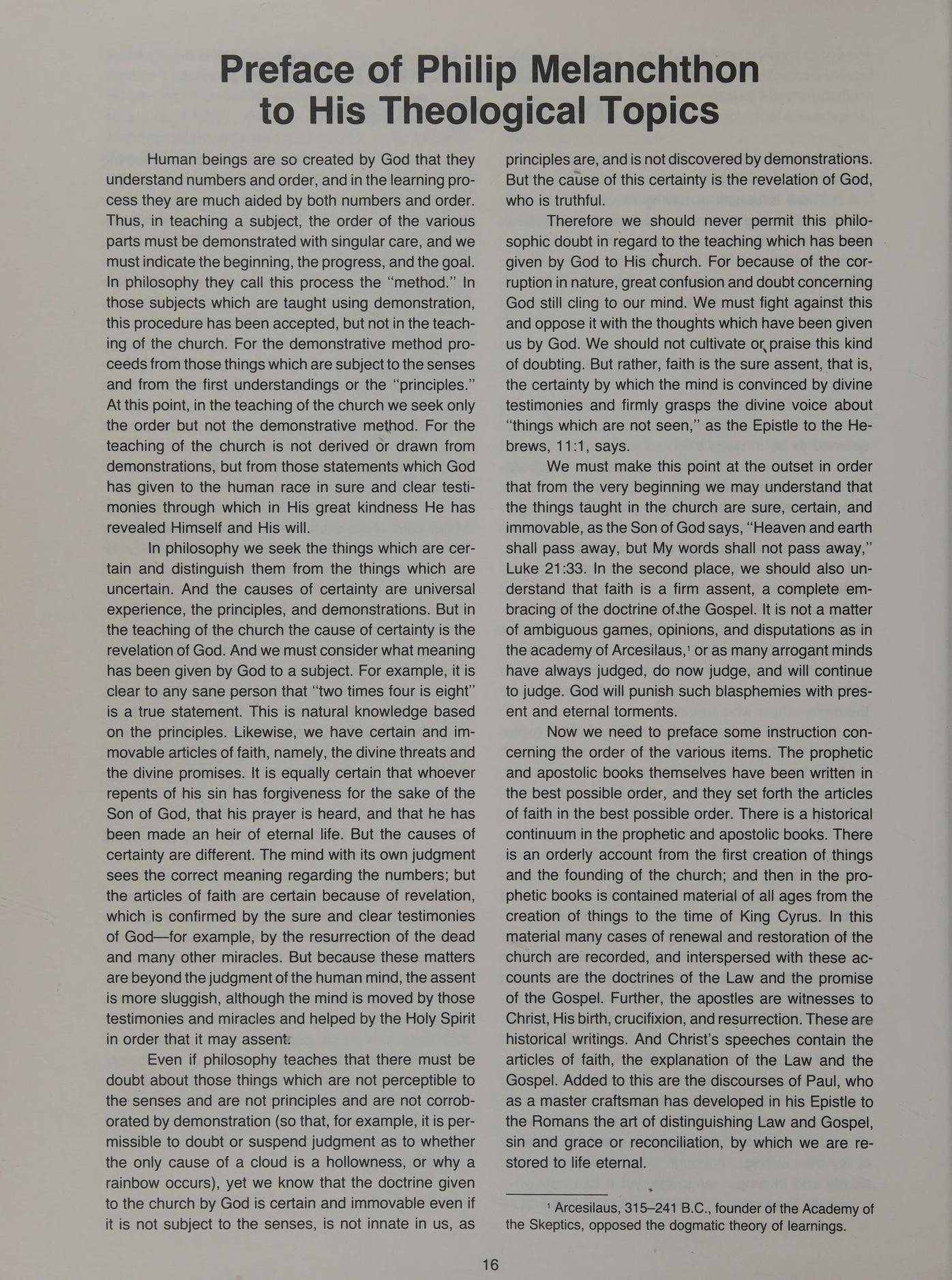
Preface of Philip Melanchthon to His Theological Topics Human beings are so created by God that they understand numbers and order, and in the learning pro cess they are much aided by both numbers and order.
Thus, in teaching a subject, the order of the various principles are, and is not discovered by demonstrations.
But the cause of this certainty is the revelation of God, who is truthful.
Therefore we should never permit this philo sophic doubt in regard to the teaching which has been given by God to His church. For because of the cor ruption in nature, great confusion and doubt concerning
God still cling to our mind. We must fight against this and oppose it with the thoughts which have been given us by God. We should not cultivate orxpraise this kind of doubting. But rather, faith is the sure assent, that is, the certainty by which the mind is convinced by divine testimonies and firmly grasps the divine voice about "things which are not seen," as the Epistle to the He brews, 11:1, says. parts must be demonstrated with singular care, and we must indicate the beginning, the progress, and the goal.
In philosophy they call this process the "method." In those subjects which are taught using demonstration, this procedure has been accepted, but not in the teach ing of the church. For the demonstrative method pro ceeds from those things which are subject to the senses and from the first understandings or the "principles."
At this point, in the teaching of the church we seek only the order but not the demonstrative method. For the teaching of the church is not derived or drawn from demonstrations, but from those statements which God has given to the human race in sure and clear testi monies through which in His great kindness He has revealed Himself and His will.
We must make this point at the outset in order that from the very beginning we may understand that the things taught in the church are sure, certain, and immovable, as the Son of God says, "Heaven and earth shall pass away, but My words shall not pass away,"
Luke 21:33. In the second place, we should also un derstand that faith is a firm assent, a complete em bracing of the doctrine of .the Gospel. It is not a matter of ambiguous games, opinions, and disputations as in the academy of Arcesilaus,1 or as many arrogant minds have always judged, do now judge, and will continue to judge. God will punish such blasphemies with pres ent and eternal torments.
In philosophy we seek the things which are cer tain and distinguish them from the things which are uncertain. And the causes of certainty are universal experience, the principles, and demonstrations. But in the teaching of the church the cause of certainty is the revelation of God. And we must consider what meaning has been given by God to a subject. For example, it is clear to any sane person that "two times four is eight" is a true statement. This is natural knowledge based on the principles. Likewise, we have certain and im movable articles of faith, namely, the divine threats and the divine promises. It is equally certain that whoever repents of his sin has forgiveness for the sake of the Son of God, that his prayer is heard, and that he has been made an heir of eternal life. But the causes of certainty are different. The mind with its own judgment sees the correct meaning regarding the numbers; but the articles of faith are certain because of revelation, which is confirmed by the sure and clear testimonies of God—for example, by the resurrection of the dead and many other miracles. But because these matters are beyond the judgment of the human mind, the assent is more sluggish, although the mind is moved by those testimonies and miracles and helped by the Holy Spirit in order that it may assent.
Now we need to preface some instruction con cerning the order of the various items. The prophetic and apostolic books themselves have been written in the best possible order, and they set forth the articles of faith in the best possible order. There is a historical continuum in the prophetic and apostolic books. There is an orderly account from the first creation of things and the founding of the church; and then in the pro phetic books is contained material of all ages from the creation of things to the time of King Cyrus. In this material many cases of renewal and restoration of the church are recorded, and interspersed with these ac counts are the doctrines of the Law and the promise of the Gospel. Further, the apostles are witnesses to Christ, His birth, crucifixion, and resurrection. These are historical writings. And Christ's speeches contain the articles of faith, the explanation of the Law and the Gospel. Added to this are the discourses of Paul, who as a master craftsman has developed in his Epistle to the Romans the art of distinguishing Law and Gospel, sin and grace or reconciliation, by which we are re stored to life eternal.
Even if philosophy teaches that there must be doubt about those things which are not perceptible to the senses and are not principles and are not corrob orated by demonstration (so that, for example, it is per missible to doubt or suspend judgment as to whether the only cause of a cloud is a hollowness, or why a rainbow occurs), yet we know that the doctrine given to the church by God is certain and immovable even if it is not subject to the senses, is not innate in us, as ' Arcesilaus, 315-241 B.C., founder of the Academy of the Skeptics, opposed the dogmatic theory of learnings.
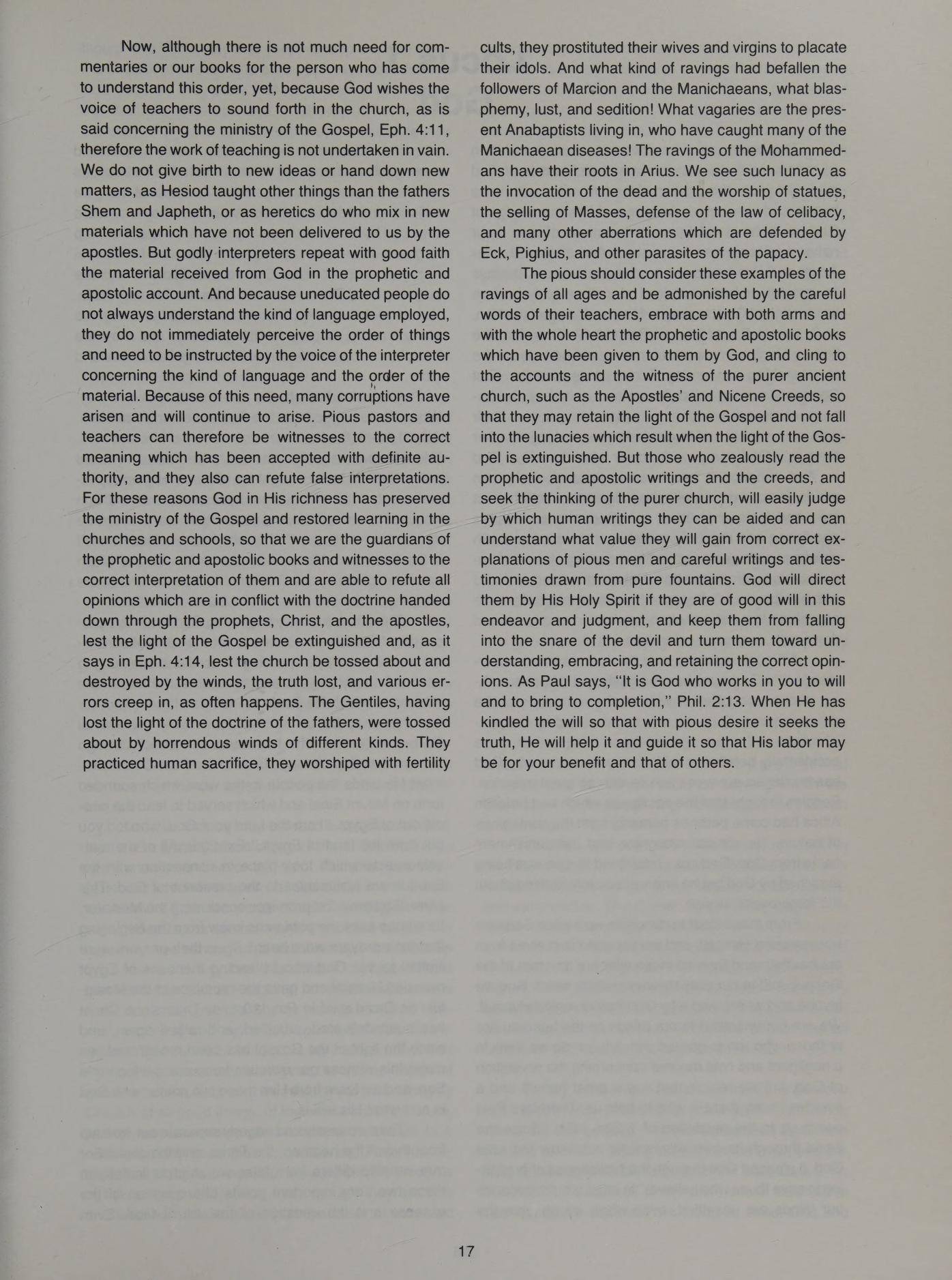
Now, although there is not much need for com mentaries or our books for the person who has come to understand this order, yet, because God wishes the voice of teachers to sound forth in the church, as is said concerning the ministry of the Gospel, Eph. 4:11, therefore the work of teaching is not undertaken in vain.
We do not give birth to new ideas or hand down new matters, as Hesiod taught other things than the fathers
Shem and Japheth, or as heretics do who mix in new materials which have not been delivered to us by the apostles. But godly interpreters repeat with good faith the material received from God in the prophetic and apostolic account. And because uneducated people do not always understand the kind of language employed, they do not immediately perceive the order of things and need to be instructed by the voice of the interpreter concerning the kind of language and the order of the material. Because of this need, many corruptions have arisen and will continue to arise. Pious pastors and teachers can therefore be witnesses to the correct meaning which has been accepted with definite au thority, and they also can refute false interpretations. cults, they prostituted their wives and virgins to placate their idols. And what kind of ravings had befallen the followers of Marcion and the Manichaeans, what blas phemy, lust, and sedition! What vagaries are the pres ent Anabaptists living in, who have caught many of the Manichaean diseases! The ravings of the Mohammed ans have their roots in Arius. We see such lunacy as the invocation of the dead and the worship of statues, the selling of Masses, defense of the law of celibacy, and many other aberrations which are defended by Eck, Pighius, and other parasites of the papacy.
The pious should consider these examples of the ravings of all ages and be admonished by the careful words of their teachers, embrace with both arms and with the whole heart the prophetic and apostolic books which have been given to them by God, and cling to the accounts and the witness of the purer ancient church, such as the Apostles' and Nicene Creeds, so that they may retain the light of the Gospel and not fall into the lunacies which result when the light of the Gos pel is extinguished. But those who zealously read the prophetic and apostolic writings and the creeds, and seek the thinking of the purer church, will easily judge by which human writings they can be aided and can understand what value they will gain from correct ex planations of pious men and careful writings and tes timonies drawn from pure fountains. God will direct them by His Holy Spirit if they are of good will in this endeavor and judgment, and keep them from falling into the snare of the devil and turn them toward un derstanding, embracing, and retaining the correct opin ions. As Paul says, "It is God who works in you to will and to bring to completion," Phil. 2:13. When He has kindled the will so that with pious desire it seeks the truth, He will help it and guide it so that His labor may be for your benefit and that of others.
For these reasons God in His richness has preserved the ministry of the Gospel and restored learning in the churches and schools, so that we are the guardians of the prophetic and apostolic books and witnesses to the correct interpretation of them and are able to refute all opinions which are in conflict with the doctrine handed down through the prophets, Christ, and the apostles, lest the light of the Gospel be extinguished and, as it says in Eph. 4:14, lest the church be tossed about and destroyed by the winds, the truth lost, and various er rors creep in, as often happens. The Gentiles, having lost the light of the doctrine of the fathers, were tossed about by horrendous winds of different kinds. They practiced human sacrifice, they worshiped with fertility
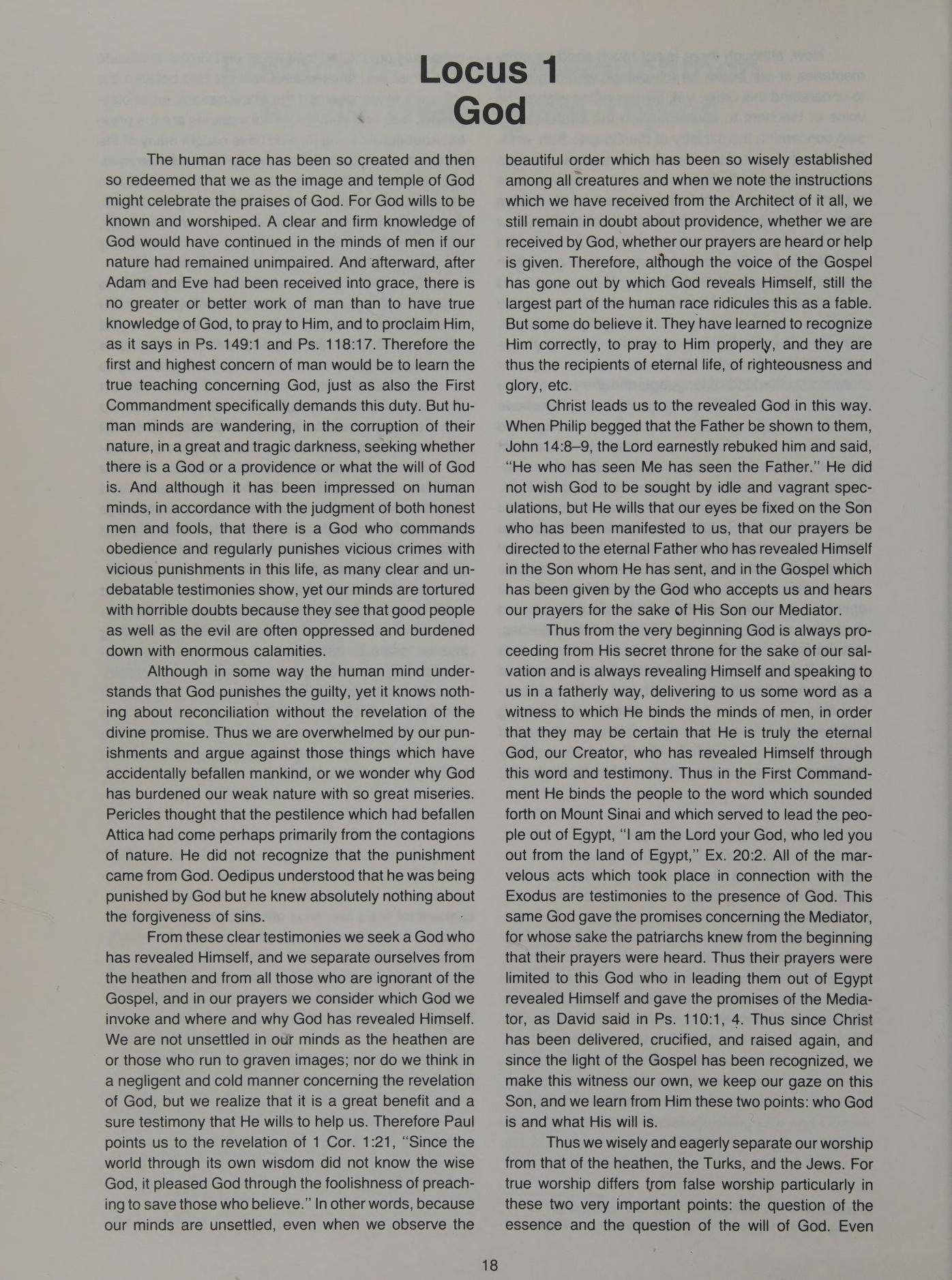
Locus 1 God beautiful order which has been so wisely established among all creatures and when we note the instructions which we have received from the Architect of it all, we still remain in doubt about providence, whether we are received by God, whether our prayers are heard or help is given. Therefore, although the voice of the Gospel has gone out by which God reveals Himself, still the largest part of the human race ridicules this as a fable.
But some do believe it. They have learned to recognize Him correctly, to pray to Him properly, and they are thus the recipients of eternal life, of righteousness and glory, etc.
The human race has been so created and then so redeemed that we as the image and temple of God might celebrate the praises of God. For God wills to be known and worshiped. A clear and firm knowledge of God would have continued in the minds of men if our nature had remained unimpaired. And afterward, after Adam and Eve had been received into grace, there is no greater or better work of man than to have true knowledge of God, to pray to Him, and to proclaim Him, as it says in Ps. 149:1 and Ps. 118:17. Therefore the first and highest concern of man would be to learn the true teaching concerning God, just as also the First
Commandment specifically demands this duty. But hu man minds are wandering, in the corruption of their nature, in a great and tragic darkness, seeking whether there is a God or a providence or what the will of God is. And although it has been impressed on human minds, in accordance with the judgment of both honest men and fools, that there is a God who commands obedience and regularly punishes vicious crimes with vicious punishments in this life, as many clear and undebatable testimonies show, yet our minds are tortured with horrible doubts because they see that good people as well as the evil are often oppressed and burdened down with enormous calamities.
Christ leads us to the revealed God in this way.
When Philip begged that the Father be shown to them, John 14:8-9, the Lord earnestly rebuked him and said,
"He who has seen Me has seen the Father." He did not wish God to be sought by idle and vagrant spec ulations, but He wills that our eyes be fixed on the Son who has been manifested to us, that our prayers be directed to the eternal Father who has revealed Himself in the Son whom He has sent, and in the Gospel which has been given by the God who accepts us and hears our prayers for the sake of His Son our Mediator.
Thus from the very beginning God is always pro ceeding from His secret throne for the sake of our sal vation and is always revealing Himself and speaking to us in a fatherly way, delivering to us some word as a witness to which He binds the minds of men, in order that they may be certain that He is truly the eternal
God, our Creator, who has revealed Himself through this word and testimony. Thus in the First Command ment He binds the people to the word which sounded forth on Mount Sinai and which served to lead the peo ple out of Egypt, "I am the Lord your God, who led you out from the land of Egypt," Ex. 20:2. All of the mar velous acts which took place in connection with the Exodus are testimonies to the presence of God. This same God gave the promises concerning the Mediator, for whose sake the patriarchs knew from the beginning that their prayers were heard. Thus their prayers were limited to this God who in leading them out of Egypt revealed Himself and gave the promises of the Media tor, as David said in Ps. 110:1, 4. Thus since Christ has been delivered, crucified, and raised again, and since the light of the Gospel has been recognized, we make this witness our own, we keep our gaze on this
Son, and we learn from Him these two points: who God is and what His will is.
Although in some way the human mind under stands that God punishes the guilty, yet it knows noth ing about reconciliation without the revelation of the divine promise. Thus we are overwhelmed by our pun ishments and argue against those things which have accidentally befallen mankind, or we wonder why God has burdened our weak nature with so great miseries.
Pericles thought that the pestilence which had befallen Attica had come perhaps primarily from the contagions of nature. He did not recognize that the punishment came from God. Oedipus understood that he was being punished by God but he knew absolutely nothing about the forgiveness of sins.
From these clear testimonies we seek a God who has revealed Himself, and we separate ourselves from the heathen and from all those who are ignorant of the Gospel, and in our prayers we consider which God we invoke and where and why God has revealed Himself.
We are not unsettled in our minds as the heathen are or those who run to graven images; nor do we think in a negligent and cold manner concerning the revelation of God, but we realize that it is a great benefit and a sure testimony that He wills to help us. Therefore Paul points us to the revelation of 1 Cor. 1:21, "Since the world through its own wisdom did not know the wise
God, it pleased God through the foolishness of preach ing to save those who believe." In other words, because our minds are unsettled, even when we observe the Thus we wisely and eagerly separate our worship from that of the heathen, the Turks, and the Jews. For true worship differs (rom false worship particularly in these two very important points: the question of the essence and the question of the will of God. Even