
The Monk Guibert to Hildegard
The Letters of Hildegard of Bingen
The Monk Guibert to Hildegard
Guibert reports having visited Hildegard in the fall. On the way back, he notes, he stopped at the abbey at Villers, where he read the letter he had received from Hildegard earlier, adding details he had learned while visiting at Mount St. Rupert.
The monks were so impressed that they wrote their own letter, along with thirtyfive questions (which Guibert appends) for Hildegard to answer.
To the holy mother and lady Hildegard, Guibert sends filial service with proper reverence.
When I returned from my visit with you last autumn, blessed lady, before returning to the chamber of my mother, that is, the church at Gembloux, I turned aside to the abbey at Villers to visit my most reverend brothers and masters. In the presence of the abbot and those brothers, I read and reread that letter I had received from you through the agency of Lord Siger. I added also that information which, from your God-given wisdom, you imparted to me during my brief stay with you, for, at that time, day and night, I hung on your every word. When they had heard all these things, their spirits were enkindled with such great ardor of learning from you that they unanimously formulated the appended questions for you to resolve for them, and directed me as your particular friend to get them to you, along with the following brief letter:
To the virgin and servant of Christ, Hildegard, the brothers of the monastery at Villers.
O most holy mother, beloved of God and men, your presence is lovely and gracious, and your memory is ever blessed, because through you and in you the Lord has done a new thing on earth. For He has illumined you miraculously with a new kind of sanctification, not with the untaught words of human wisdom but with the teaching of the Spirit, and He has filled you with the spirit of understanding [cf. Ecclus 39.8] so that through you He might open up the secrets and mysteries of His wisdom [cf. Ps 50.8] to the faithful. Casting ourselves at your feet, revered lady, we sincerely pray that, to the best of your God-given powers, you will deign to give us answers to the appended questions through the love of Jesus Christ In this way, you will "give knowledge of salvation" [Luke 1.77] to us who "sit in darkness, and the shadow of death so that we may direct our feet in the way of peace" [Luke 1.79]. Farewell.
To their petition I add my own. Your faithful servant, I join these and the many others who make supplication to you, beseeching you to gird yourself for this task we most earnestly hope you will undertake, since divinity itself has been called to our assistance, and to perform without delay this labor which will benefit the whole Church. It will, of course, be up to your judgment to sort out— and therefore touch upon only briefly—the easier questions or those already dis-
The Letters
cussed by the fathers from the more obscure ones not yet fully elucidated that will require more of your attention, such as those concerning the soul, or those that deal with the distinction between the nativity of the Son and the procession of the Holy Spirit, as well as others of this kind. By earnestly considering these matters and fully resolving them so that even the simplest soul can understand them, you will make available the goods of your house to the poor so that they may eat and be satisfied [cf. Ps 21.27]. Thus you yourself will provide them with the material for praise, and their praises to the Lord will reflect your success. So to the glory of His name, Who makes His miracles memorable and gives food to those who fear Him [cf. Ps 110.4–5], let it be said of them, "So they did eat, and were filled exceedingly, and he gave them their desire: they were not defrauded of that which they craved" [Ps 77.29–30]. Not content with just once, I advise, I pray, I beseech you again and again to knock at the door of the Lord with untiring prayer for the solution of each of these questions, until, admitted into His sanctuary, you understand all of them, and then, coming forth to us again with radiant face, you illumine the darkness of our ignorance with the splendor of God's revelations.
Sometimes holy prophets, when they are consulted, offer things out of their own spirit merely from the habit of prophesying, although they are thought to speak from the spirit of prophecy—as St. Gregory himself testifies.1 This, above all, you must beware of, lest when you are strong with the great grace of the Spirit, you have too little discernment of spirits, and whatever you see in your spirit, you immediately impute to the Holy Spirit, saying, "I heard and saw these things in the Spirit," Beware of this, unless He who scrutinizes even the high things of God indicates what you are to say by a clear manifestation. Thus in accordance with him who said, "The Lord hath hid it from me, and hath not told me"
[II Kings 4.7], it is much safer and much more praiseworthy to humbly confess one's ignorance in matters so obscure and remote from human comprehension than to ill advisedly build up something new that is not subject to proof.
If you are, by chance, aware that you have already answered some of those questions in one of your written works, would you please tell us where that answer is to be found, or, as I prefer, have it copied out for us just as it appears in the original.
Recently, after the Feast of the Purification of St. Mary,2 when I went to Villers, once again, to visit your sons Siger and Anselm, who are novices in Christ's army, the monks there demanded to know whether or not I had sent those questions to you that we have been discussing. When I tried to excuse myself on the grounds that no dependable messenger had been available to me, they rejected my every excuse and accused me of laziness, for they were greatly distressed that I had delayed so long.
In the meantime, while I was staying there, Peter, a cleric of Villa Monasterias, a man of my acquaintance, arrived on his way back from Jerusalem. And since he had passed through your region on his return, he unexpectedly brought a letter from you. In this letter you send gracious consolation to those aforementioned novices, but underlying all was the mournful sorrow of your soul at the death of Volmar, your provost.3 When we read the letter, we rejoiced at the zeal-
3 6 The Letters of Hildegard of Bingen ous kindness and diligence you have shown your friends, even though they dwell far from you. At the same time, however, we groaned in commiseration at the misfortune of your house on the loss of that staff which provided support for you.
With due observance of masses and prayers for your friend who has returned to his home in heaven, we have, however, fulfilled your request—and we continue to do so. Also, we have asked all our friends and associates to do the same.
When I returned to the monastery at Gembloux, I heard, quite unexpectedly, that our lord abbot was preparing to go to St. Quirin to pray, and that he was arranging, if possible, to return through your region. I was filled with great joy when I heard this. I immediately began to work on this letter, intending to send it to you by way of those who were accompanying him on the trip. But, although such a thing was beyond my hopes, the crown of rejoicing [cf. Ecclus
1.11], so to speak, was set on my head, because, for whatever reason, I was chosen to accompany him on the journey. Thus I could be confident that soon I would be able to hand that letter to you personally, from my hands, as they say, to yours.
The following are the questions4 which the reverend brothers are sending to you, saintly lady, for answers:
1. How is the Scripture "He that liveth for ever created all things at once"
[Ecclus 18.1] to be understood, since it is written elsewhere that God divided his works over a period of six days [cf. Gen 1]?
2. What is the meaning of the Scripture "He divided the waters that were under the firmament, from those that were above the firmament" [Gen
1.7]? Are we to believe that the waters above the firmament are physical waters?
3. How is the passage "A spring rose out of the earth, watering all the surface of the earth" [Gen 2.6] to be understood?
4. Before the first human being sinned, he saw God with his bodily eyes.
Will we also see Him with our physical eyes, although the Apostle says that in the resurrection we will be given spiritual bodies [cf. I Cor
15.44ff]?
5. What kind of speech and form did God employ when He appeared to the first human being to give him a command [cf. Gen 2.16–17], and what form did He assume when He walked in the garden after mankind's sin [cf. Gen 3.8]?
6. What sort of eyes were opened in our first parents after their sin, since they both had sight beforehand, for the Scripture says, "the woman saw the tree" [Gen 3.6]?
7. What did the Lord mean when He said, "Behold Adam is become as one of us, knowing good and evil" [Gen 3.22]?
8. What is the meaning of this passage: "Sevenfold vengeance shall be taken for Cain: but for Lamech seventy times sevenfold" [Gen 4.24]?
9. Since, as we believe, both Enoch and Elijah were bodily taken into the earthly paradise [cf. Gen 5.24; II Kings 2.11; Ecclus 44.16; Heb 11.5], are we to believe that they had need of physical food and clothing in a place of such bliss?
The Letters
10. In what part of the earth are we to believe that paradise was situated?
11. What is the meaning of the Lord's words to Noah and his sons "I will require the blood of your lives at the hand of every beast, and at the hand of man" [Gen 9.5], and again in the next verse, "Whosoever shall shed man's blood, his blood shall be shed" [Gen 9.6]?
12. What kind of bodies did those angels who appeared to Abraham have, those whom he served with the finest flour, a calf, butter, and milk [cf.
Gen IS.lff]? Do angels have physical bodies like human beings? And are they breathing creatures like men, save that they are immortal, a state which human beings have not yet achieved? Moreover, do angels alter and change their bodies into whatever shape or form they wish when they desire to be seen, by condensing and solidifying them as much as they like? Further, since in their essence they are impalpable and invisible to our sight because of their rarified nature, do they exist as an uncompounded spiritual material, taking on physical bodies when necessary and then putting them aside when their duty has been fulfilled, reverting to their original essence?
13. Why does Abraham command his servant, and, likewise, Jacob command his son to take the oath by placing their hands under the thigh
[cf. Gen 24.9; Gen 47.29]?
14. Why were the holy patriarchs so desirous of being buried in the double cave that Abraham bought from the sons of Heth [cf! Gen 23.8–9; Gen
25.9-10; Gen 49.29]?
15. Was it a real fire that Moses saw burning but not consuming the bush [cf. Ex 3.2], and, similarly of that one which blazed on Mt. Sinai [cf. Ex
19.18], or the one which fell like tongues on the disciples at Pentecost [cf. Acts 2.3], or the one which appeared on the head of St. Martin as he was celebrating the sacraments?
16. What is the meaning of the passage about the ark in the book of Kings:
"There was nothing in the ark except the tables of the covenant" [cf.
I Kings 8.9], while in the Epistle to the Hebrews, we find, "After the second veil, the tabernacle, which is called the holy of holies: having a golden censer, and the ark of the testament covered about on every part with gold, in which was a golden pot that had manna, and the rod of Aaron, that had blossomed, and the tables of the testament" [Heb 9.3–4]?
17. Are we to believe that Samuel was called back to life at the summons of the sorceress [cf. I Sam 28.7ff]? What is the meaning of the verse about Jonathan eating the honey: "His eyes were enlightened" [I Sam 14.27]?
18. What does the Apostle mean when he says that he was snatched up into the third heaven, not knowing whether he was in the body or out of it [cf. II Cor 12.2–3]? Did he go out of the body when his spirit was snatched there, or did he arrive there while still in the body, and thus vivify it?
19. And what does the Apostle mean when he says, "Every sin that a man doth, is without the body; but he that committeth fornication, sinneth against his own body" [I Cor 6.18]?
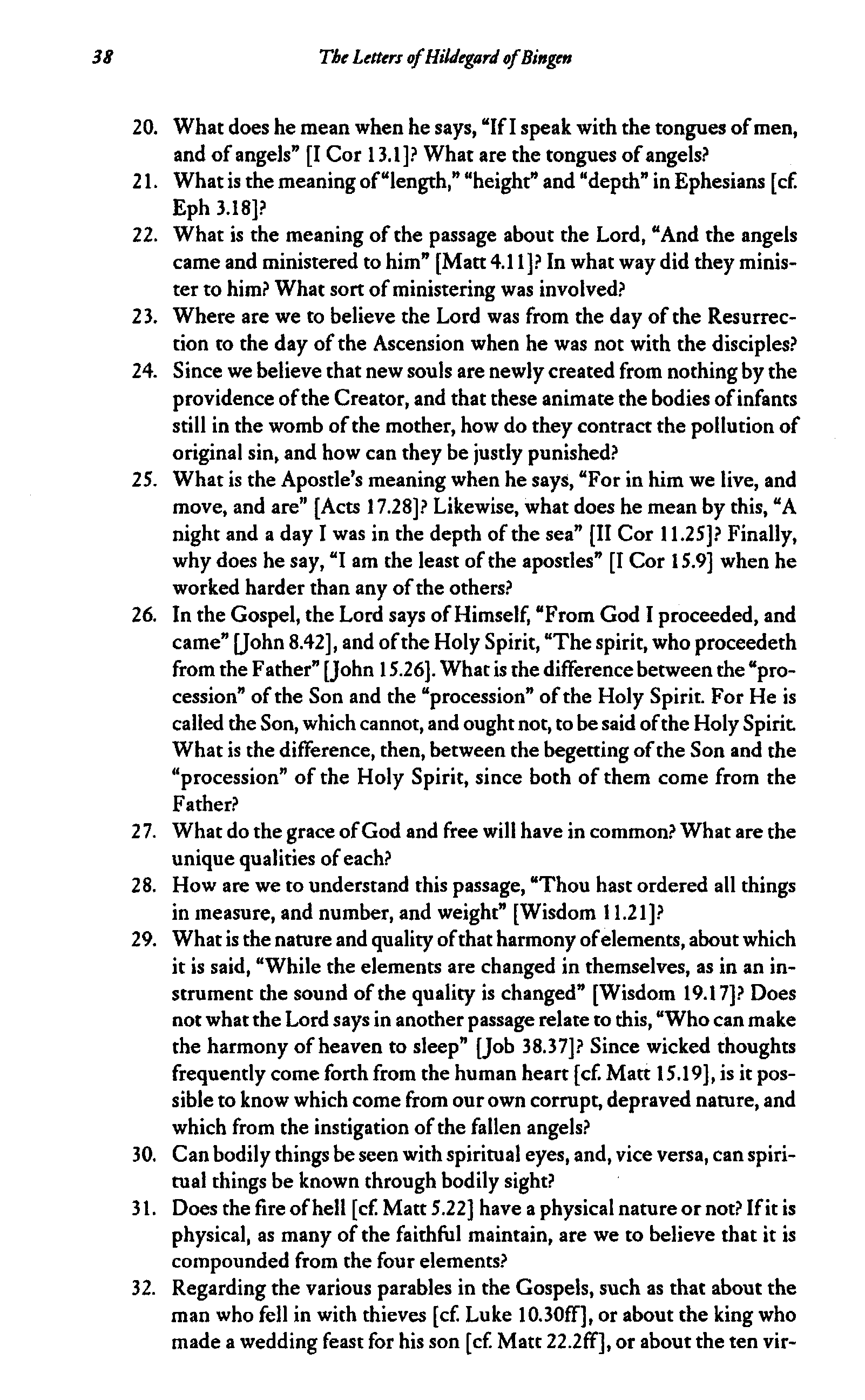
The Letters of Hildegard of Bingen 20. What does he mean when he says, "If I speak with the tongues of men, and of angels" [I Cor 13.1]? What are the tongues of angels?
21. What is the meaning of "length," "height" and "depth" in Ephesians [cf Eph 3.18]?
22. What is the meaning of the passage about the Lord, "And the angels came and ministered to him" [Matt 4.11]? In what way did they minister to him? What sort of ministering was involved?
23. Where are we to believe the Lord was from the day of the Resurrection to the day of the Ascension when he was not with the disciples?
24. Since we believe that new souls are newly created from nothing by the providence of the Creator, and that these animate the bodies of infants still in the womb of the mother, how do they contract the pollution of original sin, and how can they be justly punished?
25. What is the Apostle's meaning when he says, "For in him we live, and move, and are" [Acts 17.28]? Likewise, what does he mean by this, "A night and a day I was in the depth of the sea" [II Cor 11.25]? Finally, why does he say, "I am the least of the apostles" [I Cor 15.9] when he worked harder than any of the others?
26. In the Gospel, the Lord says of Himself, "From God I proceeded, and came" [John 8.42], and of the Holy Spirit, "The spirit, who proceedeth from the Father" [John 15.26]. What is the difference between the "procession" of the Son and the "procession" of the Holy Spirit. For He is called the Son, which cannot, and ought not, to be said of the Holy Spirit.
What is the difference, then, between the begetting of the Son and the "procession" of the Holy Spirit, since both of them come from the Father?
27. What do the grace of God and free will have in common? What are the unique qualities of each?
28. How are we to understand this passage, "Thou hast ordered all things in measure, and number, and weight" [Wisdom 11.21]?
29. What is the nature and quality of that harmony of elements, about which it is said, "While the elements are changed in themselves, as in an instrument the sound of the quality is changed" [Wisdom 19.17]? Does not what the Lord says in another passage relate to this, "Who can make the harmony of heaven to sleep" [Job 38.37]? Since wicked thoughts frequently come forth from the human heart [cf. Matt 15.19], is it possible to know which come from our own corrupt, depraved nature, and which from the instigation of the fallen angels?
30. Can bodily things be seen with spiritual eyes, and, vice versa, can spiritual things be known through bodily sight?
31. Does the fire of hell [cf. Matt 5.22] have a physical nature or not? If it is physical, as many of the faithful maintain, are we to believe that it is compounded from the four elements?
32. Regarding the various parables in the Gospels, such as that about the man who fell in with thieves [cf. Luke 10.30ff], or about the king who made a wedding feast for his son [cf. Matt 22.2ff], or about the ten vir-