
The Nun Elisabeth to Hildegard
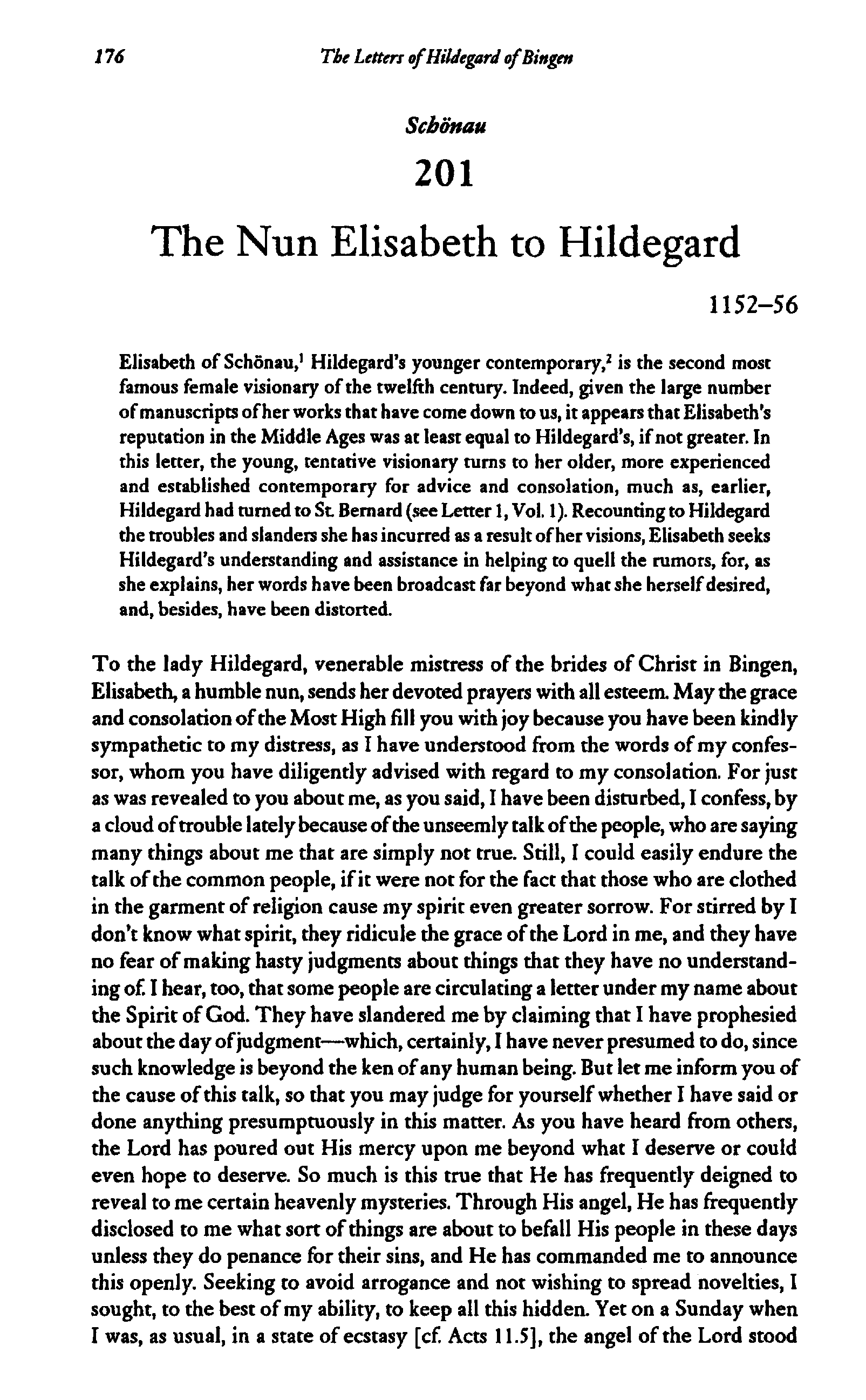
The Letters of Hildegard of Bingen Scbonau
The Nun Elisabeth to Hildegard 1152-56 Elisabeth of Schonau,1 Hildegard's younger contemporary,2 is the second most famous female visionary of the twelfth century. Indeed, given the large number of manuscripts of her works that have come down to us, it appears that Elisabeth's reputation in the Middle Ages was at least equal to Hildegard's, if not greater. In this letter, the young, tentative visionary turns to her older, more experienced and established contemporary for advice and consolation, much as, earlier,
Hildegard had turned to St. Bernard (see Letter 1, Vol. 1). Recounting to Hildegard the troubles and slanders she has incurred as a result of her visions, Elisabeth seeks
Hildegard's understanding and assistance in helping to quell the rumors, for, as she explains, her words have been broadcast far beyond what she herself desired, and, besides, have been distorted.
To the lady Hildegard, venerable mistress of the brides of Christ in Bingen, Elisabeth, a humble nun, sends her devoted prayers with all esteem. May the grace and consolation of the Most High fill you with joy because you have been kindly sympathetic to my distress, as I have understood from the words of my confessor, whom you have diligently advised with regard to my consolation. For just as was revealed to you about me, as you said, I have been disturbed, I confess, by a cloud of trouble lately because of the unseemly talk of the people, who are saying many things about me that are simply not true. Still, I could easily endure the talk of the common people, if it were not for the fact that those who are clothed in the garment of religion cause my spirit even greater sorrow. For stirred by I don't know what spirit, they ridicule the grace of the Lord in me, and they have no fear of making hasty judgments about things that they have no understanding of. I hear, too, that some people are circulating a letter under my name about the Spirit of God. They have slandered me by claiming that I have prophesied about the day of judgment—which, certainly, I have never presumed to do, since such knowledge is beyond the ken of any human being. But let me inform you of the cause of this talk, so that you may judge for yourself whether I have said or done anything presumptuously in this matter. As you have heard from others, the Lord has poured out His mercy upon me beyond what I deserve or could even hope to deserve. So much is this true that He has frequently deigned to reveal to me certain heavenly mysteries. Through His angel, He has frequently disclosed to me what sort of things are about to befall His people in these days unless they do penance for their sins, and He has commanded me to announce this openly. Seeking to avoid arrogance and not wishing to spread novelties, I sought, to the best of my ability, to keep all this hidden. Yet on a Sunday when
I was, as usual, in a state of ecstasy [cf. Acts 11.5], the angel of the Lord stood
The Letters
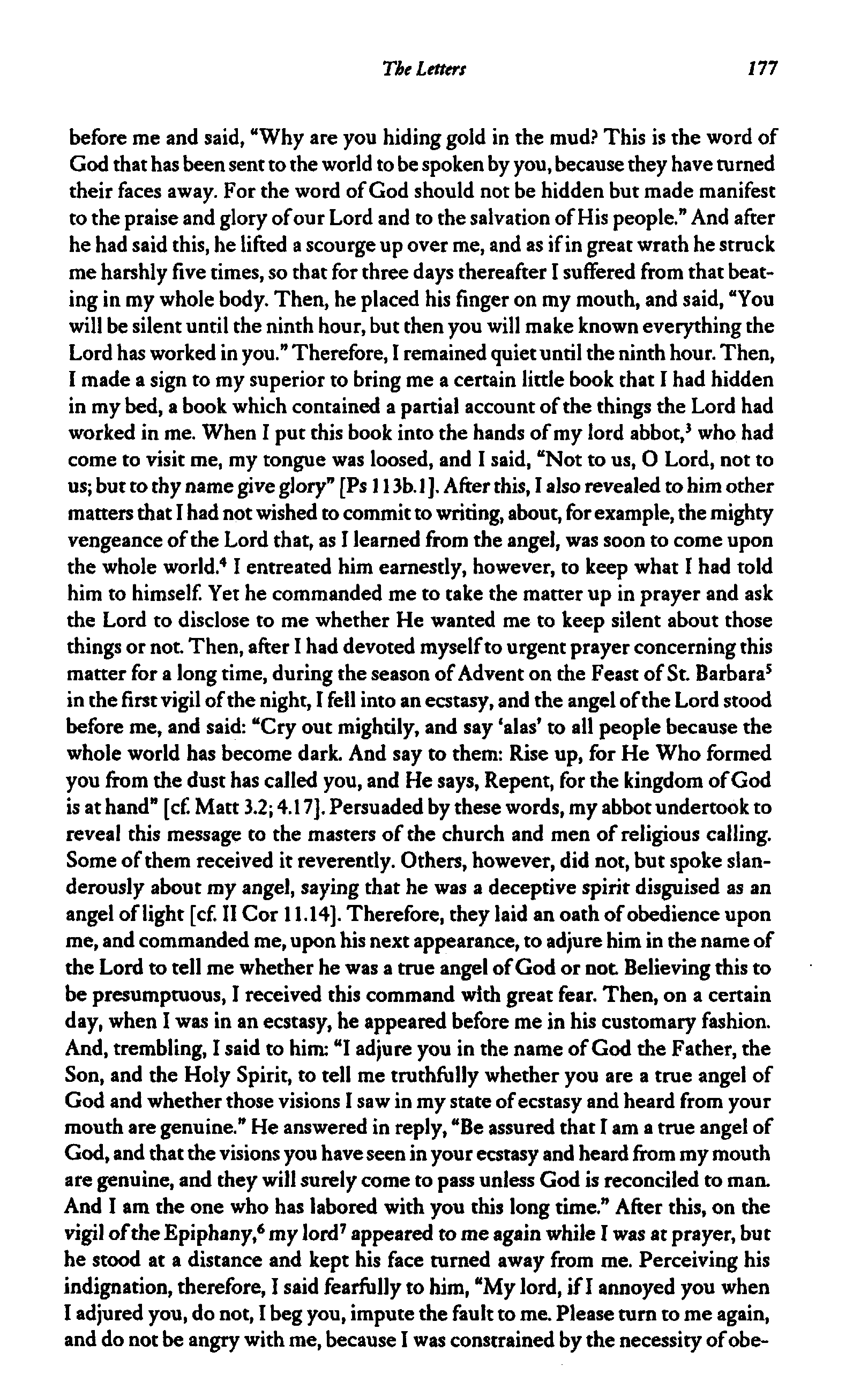
before me and said, "Why are you hiding gold in the mud? This is the word of God that has been sent to the world to be spoken by you, because they have turned their faces away. For the word of God should not be hidden but made manifest to the praise and glory of our Lord and to the salvation of His people." And after he had said this, he lifted a scourge up over me, and as if in great wrath he struck me harshly five times, so that for three days thereafter I suffered from that beating in my whole body. Then, he placed his finger on my mouth, and said, "You will be silent until the ninth hour, but then you will make known everything the Lord has worked in you." Therefore, I remained quiet until the ninth hour. Then,
I made a sign to my superior to bring me a certain little book that I had hidden in my bed, a book which contained a partial account of the things the Lord had worked in me. When I put this book into the hands of my lord abbot,' who had come to visit me, my tongue was loosed, and I said, "Not to us, O Lord, not to us; but to thy name give glory" [Ps 113b. 1 ]. After this, I also revealed to him other matters that I had not wished to commit to writing, about, for example, the mighty vengeance of the Lord that, as I learned from the angel, was soon to come upon the whole world.4 I entreated him earnestly, however, to keep what I had told him to himself. Yet he commanded me to take the matter up in prayer and ask the Lord to disclose to me whether He wanted me to keep silent about those things or not. Then, after I had devoted myself to urgent prayer concerning this matter for a long time, during the season of Advent on the Feast of St. Barbara5 in the first vigil of the night, I fell into an ecstasy, and the angel of the Lord stood before me, and said: "Cry out mightily, and say 'alas' to all people because the whole world has become dark. And say to them: Rise up, for He Who formed you from the dust has called you, and He says, Repent, for the kingdom of God is at hand" [cf. Matt 3.2; 4.17]. Persuaded by these words, my abbot undertook to reveal this message to the masters of the church and men of religious calling.
Some of them received it reverently. Others, however, did not, but spoke slanderously about my angel, saying that he was a deceptive spirit disguised as an angel of light [cf. II Cor 11.14]. Therefore, they laid an oath of obedience upon me, and commanded me, upon his next appearance, to adjure him in the name of the Lord to tell me whether he was a true angel of God or not. Believing this to be presumptuous, I received this command with great fear. Then, on a certain day, when I was in an ecstasy, he appeared before me in his customary fashion.
And, trembling, I said to him: "I adjure you in the name of God the Father, the Son, and the Holy Spirit, to tell me truthfully whether you are a true angel of God and whether those visions I saw in my state of ecstasy and heard from your mouth are genuine." He answered in reply, "Be assured that I am a true angel of God, and that the visions you have seen in your ecstasy and heard from my mouth are genuine, and they will surely come to pass unless God is reconciled to man.
And I am the one who has labored with you this long time." After this, on the vigil of the Epiphany,6 my lord7 appeared to me again while I was at prayer, but he stood at a distance and kept his face turned away from me. Perceiving his indignation, therefore, I said fearfully to him, "My lord, if I annoyed you when
I adjured you, do not, I beg you, impute the fault to me. Please turn to me again, and do not be angry with me, because I was constrained by the necessity of obe-
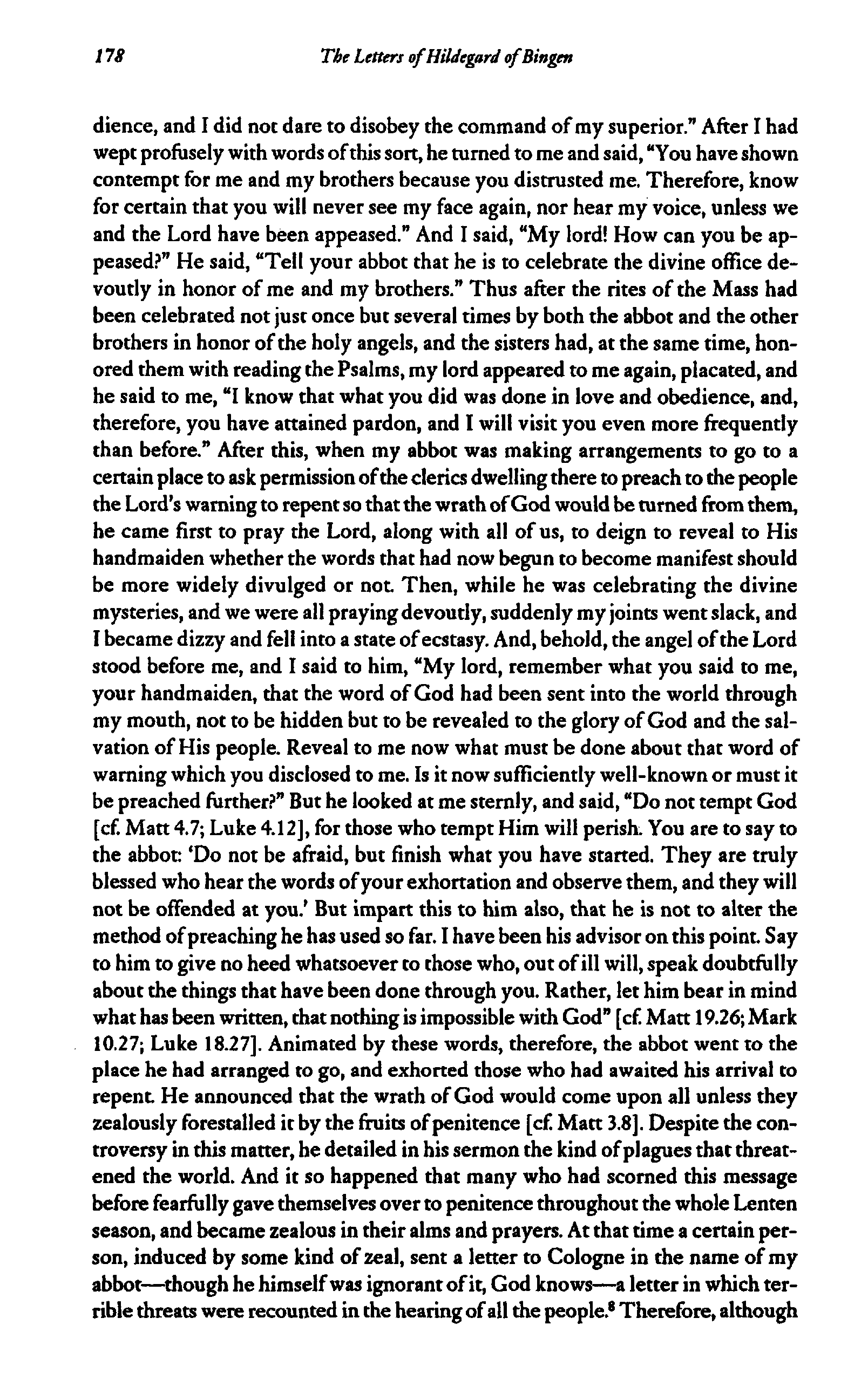
The Letters of Hildegard of Bingen dience, and I did not dare to disobey the command of my superior." After I had wept profusely with words of this sort, he turned to me and said, "You have shown contempt for me and my brothers because you distrusted me. Therefore, know for certain that you will never see my face again, nor hear my voice, unless we and the Lord have been appeased." And I said, "My lord! How can you be appeased?" He said, "Tell your abbot that he is to celebrate the divine office devoutly in honor of me and my brothers." Thus after the rites of the Mass had been celebrated not just once but several times by both the abbot and the other brothers in honor of the holy angels, and the sisters had, at the same time, honored them with reading the Psalms, my lord appeared to me again, placated, and he said to me, "I know that what you did was done in love and obedience, and, therefore, you have attained pardon, and I will visit you even more frequently than before." After this, when my abbot was making arrangements to go to a certain place to ask permission of the clerics dwelling there to preach to the people the Lord's warning to repent so that the wrath of God would be turned from them, he came first to pray the Lord, along with all of us, to deign to reveal to His handmaiden whether the words that had now begun to become manifest should be more widely divulged or not. Then, while he was celebrating the divine mysteries, and we were all praying devoutly, suddenly my joints went slack, and I became dizzy and fell into a state of ecstasy. And, behold, the angel of the Lord stood before me, and I said to him, "My lord, remember what you said to me, your handmaiden, that the word of God had been sent into the world through my mouth, not to be hidden but to be revealed to the glory of God and the salvation of His people. Reveal to me now what must be done about that word of warning which you disclosed to me. Is it now sufficiently well-known or must it be preached further?" But he looked at me sternly, and said, "Do not tempt God
[cf. Matt 4.7; Luke 4.12], for those who tempt Him will perish. You are to say to the abbot: 'Do not be afraid, but finish what you have started. They are truly blessed who hear the words of your exhortation and observe them, and they will not be offended at you.' But impart this to him also, that he is not to alter the method of preaching he has used so far. I have been his advisor on this point. Say to him to give no heed whatsoever to those who, out of ill will, speak doubtfully about the things that have been done through you. Rather, let him bear in mind what has been written, that nothing is impossible with God" [cf. Matt 19.26; Mark
10.27; Luke 18.27]. Animated by these words, therefore, the abbot went to the place he had arranged to go, and exhorted those who had awaited his arrival to repent He announced that the wrath of God would come upon all unless they zealously forestalled it by the fruits of penitence [cf. Matt 3.8]. Despite the controversy in this matter, he detailed in his sermon the kind of plagues that threatened the world. And it so happened that many who had scorned this message before fearfully gave themselves over to penitence throughout the whole Lenten season, and became zealous in their alms and prayers. At that time a certain person, induced by some kind of zeal, sent a letter to Cologne in the name of my abbot—though he himself was ignorant of it, God knows—a letter in which terrible threats were recounted in the hearing of all the people.8 Therefore, although
The Letters
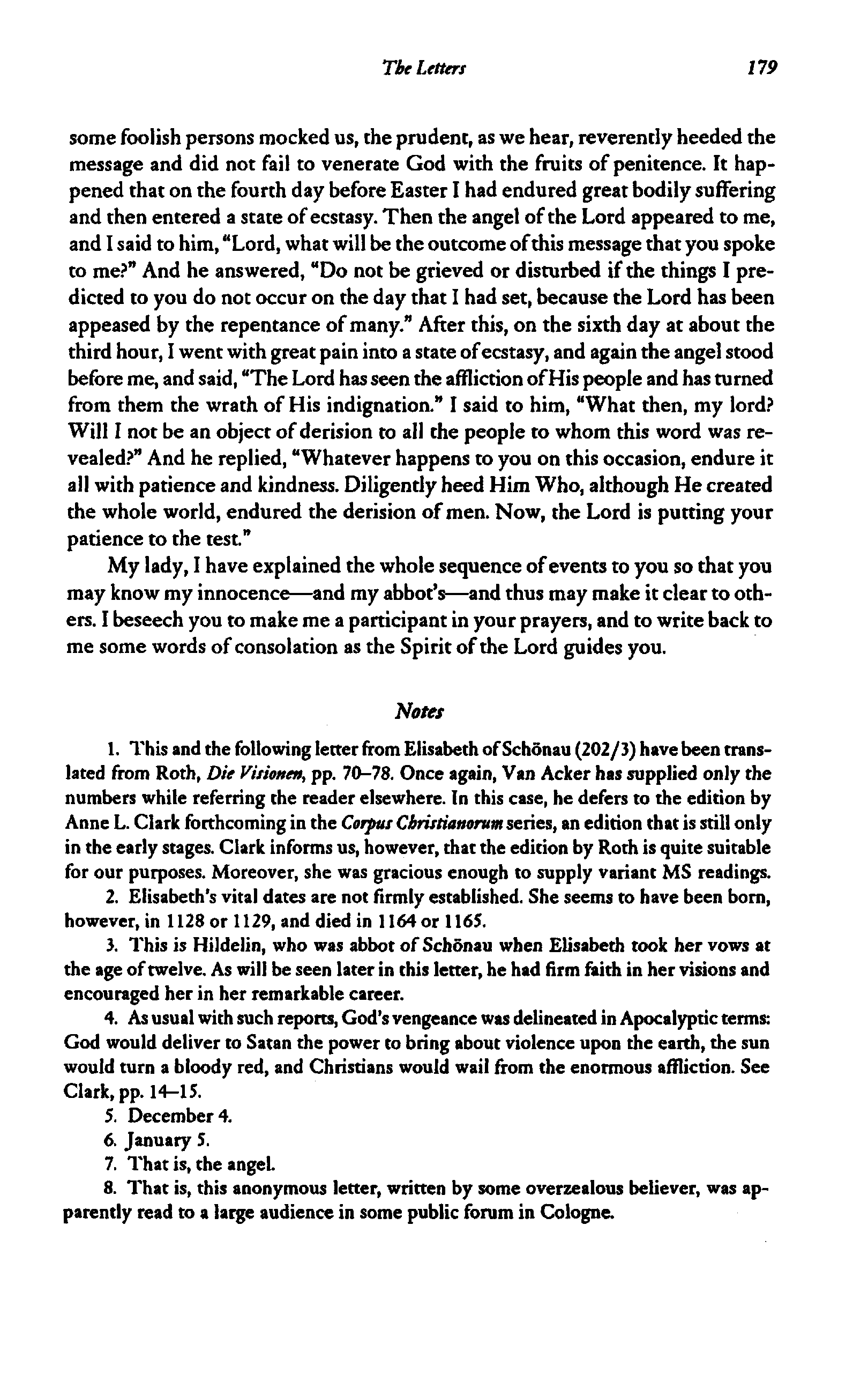
some foolish persons mocked us, the prudent, as we hear, reverently heeded the message and did not fail to venerate God with the fruits of penitence. It happened that on the fourth day before Easter I had endured great bodily suffering and then entered a state of ecstasy. Then the angel of the Lord appeared to me, and I said to him, "Lord, what will be the outcome of this message that you spoke to me?" And he answered, "Do not be grieved or disturbed if the things I predicted to you do not occur on the day that I had set, because the Lord has been appeased by the repentance of many." After this, on the sixth day at about the third hour, I went with great pain into a state of ecstasy, and again the angel stood before me, and said, "The Lord has seen the affliction of His people and has turned from them the wrath of His indignation." I said to him, "What then, my lord?
Will I not be an object of derision to all the people to whom this word was revealed?" And he replied, "Whatever happens to you on this occasion, endure it all with patience and kindness. Diligently heed Him Who, although He created the whole world, endured the derision of men. Now, the Lord is putting your patience to the test."
My lady, I have explained the whole sequence of events to you so that you may know my innocence—and my abbot's—and thus may make it clear to others. I beseech you to make me a participant in your prayers, and to write back to me some words of consolation as the Spirit of the Lord guides you.
Notes 1. This and the following letter from Elisabeth ofSchonau (202/3) have been translated from Roth, Die Vitionett, pp. 70–78. Once again, Van Acker has supplied only the numbers while referring the reader elsewhere. In this case, he defers to the edition by Anne L. Clark forthcoming in the Corpus Christianorum series, an edition that is still only in the early stages. Clark informs us, however, that the edition by Roth is quite suitable for our purposes. Moreover, she was gracious enough to supply variant MS readings.
2. Elisabeth's vital dates are not firmly established. She seems to have been born, however, in 1128 or 1129, and died in 1164 or 1165.
3. This is Hildelin, who was abbot of Schonau when Elisabeth took her vows at the age of twelve. As will be seen later in this letter, he had firm faith in her visions and encouraged her in her remarkable career.
4. As usual with such reports, God's vengeance was delineated in Apocalyptic terms:
God would deliver to Satan the power to bring about violence upon the earth, the sun would turn a bloody red, and Christians would wail from the enormous affliction. See
Clark, pp. 14–15.
5. December 4.
6. January 5.
7. That is, the angel.
8. That is, this anonymous letter, written by some overzealous believer, was apparently read to a large audience in some public forum in Cologne.