
Letter 43: Godfrey, Bishop of Utrecht, to Hildegard
The Letters
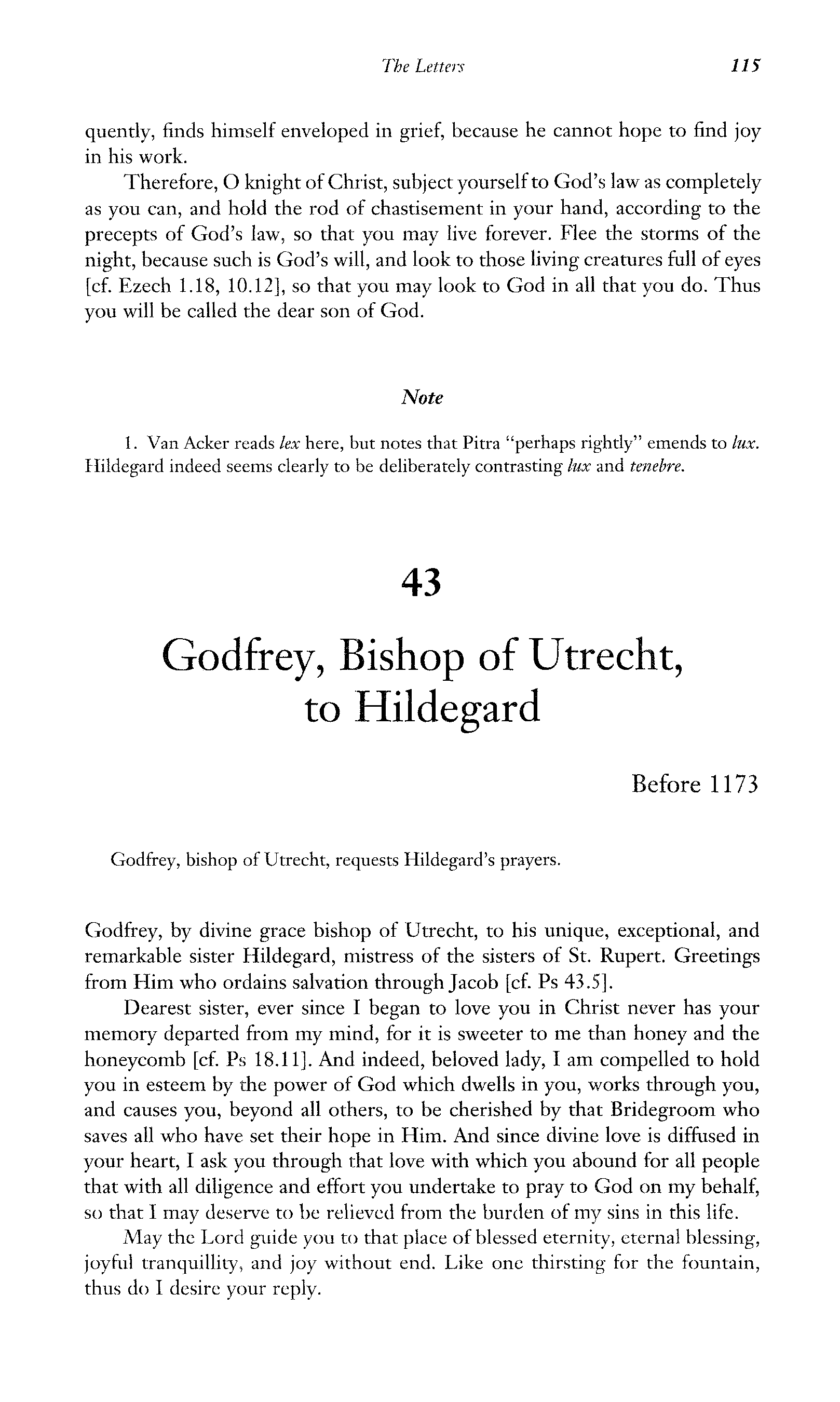
quently, finds himself enveloped in grief, because he cannot hope to find joy in his work.
Therefore, O knight of Christ, subject yourself to God's law as completely as you can, and hold the rod of chastisement in your hand, according to the precepts of God's law, so that you may live forever. Flee the storms of the night, because such is God's will, and look to those living creatures full of eyes
[cf. Ezech 1.18, 10.12], so that you may look to God in all that you do. Thus you will be called the dear son of God.
Note 1. Van Acker reads lex here, but notes that Pitra "perhaps rightly" emends to lux.
Hildegard indeed seems clearly to be deliberately contrasting lux and tenebre.
Godfrey, Bishop of Utrecht, to Hildegard Before 1173 Godfrey, bishop of Utrecht, requests Hildegard's prayers.
Godfrey, by divine grace bishop of Utrecht, to his unique, exceptional, and remarkable sister Hildegard, mistress of the sisters of St. Rupert. Greetings from Him who ordains salvation through Jacob [cf. Ps 43.5].
Dearest sister, ever since I began to love you in Christ never has your memory departed from my mind, for it is sweeter to me than honey and the honeycomb [cf. Ps 18.11]. And indeed, beloved lady, I am compelled to hold you in esteem by the power of God which dwells in you, works through you, and causes you, beyond all others, to be cherished by that Bridegroom who saves all who have set their hope in Him. And since divine love is diffused in your heart, I ask you through that love with which you abound for all people that with all diligence and effort you undertake to pray to God on my behalf, so that I may deserve to be relieved from the burden of my sins in this life.
May the Lord guide you to that place of blessed eternity, eternal blessing, joyful tranquillity, and joy without end. Like one thirsting for the fountain, thus do I desire your reply.
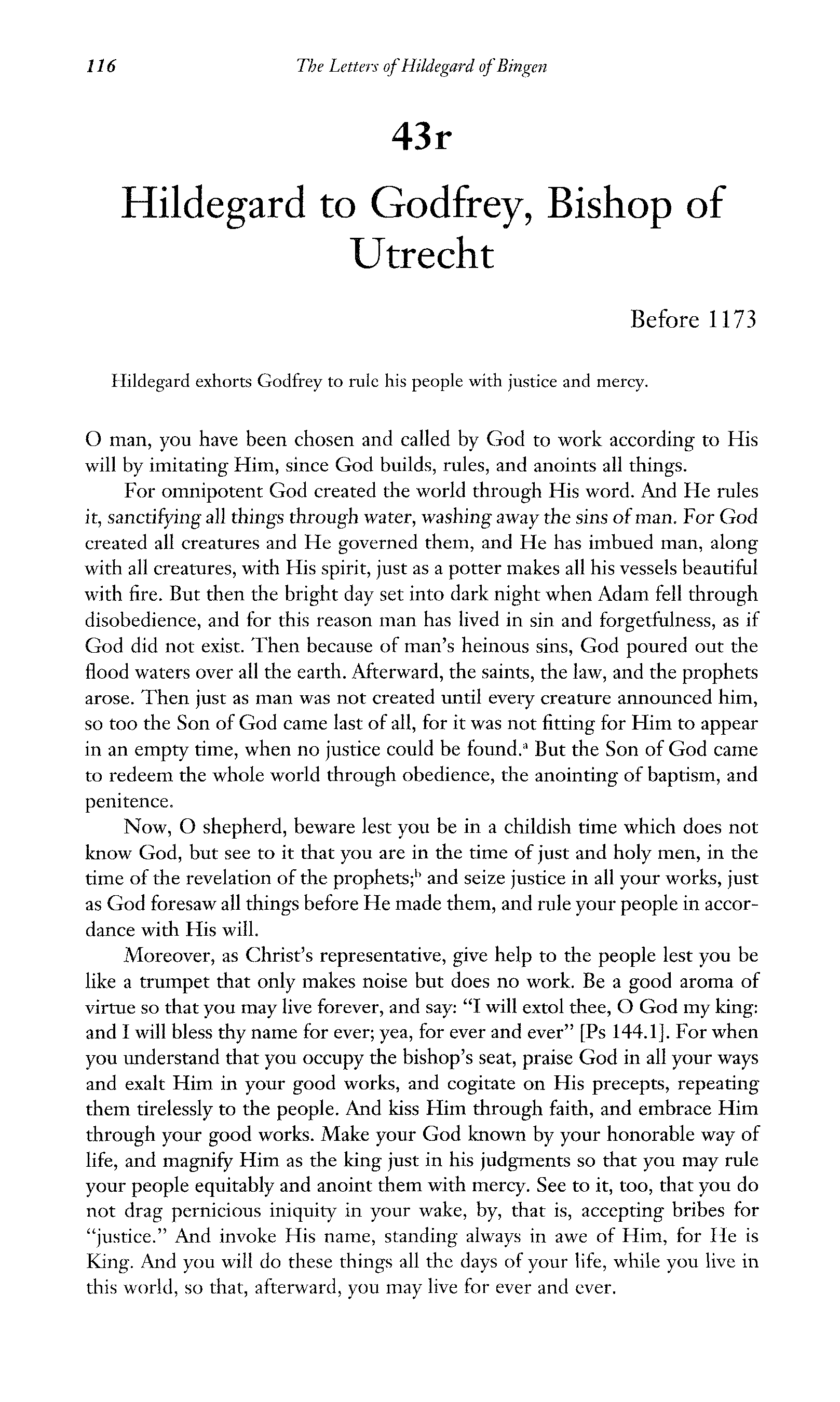
The Letters ofHildegard ofBingm 43r Hildegard to Godfrey, Bishop of Utrecht Before 1173 Hildegard exhorts Godfrey to rule his people with justice and mercy.
O man, you have been chosen and called by God to work according to His will by imitating Him, since God builds, rules, and anoints all things.
For omnipotent God created the world through His word. And He rules it, sanctifying all things through water, washing away the sins of man. For God created all creatures and He governed them, and He has imbued man, along with all creatures, with His spirit, just as a potter makes all his vessels beautiful with fire. But then the bright day set into dark night when Adam fell through disobedience, and for this reason man has lived in sin and forgetfulness, as if God did not exist. Then because of man's heinous sins, God poured out the flood waters over all the earth. Afterward, the saints, the law, and the prophets arose. Then just as man was not created until every creature announced him, so too the Son of God came last of all, for it was not fitting for Him to appear in an empty time, when no justice could be found." But the Son of God came to redeem the whole world through obedience, the anointing of baptism, and penitence.
Now, O shepherd, beware lest you be in a childish time which does not know God, but see to it that you are in the time of just and holy men, in the time of the revelation of the prophets;1' and seize justice in all your works, just as God foresaw all things before He made them, and rule your people in accordance with His will.
Moreover, as Christ's representative, give help to the people lest you be like a trumpet that only makes noise but does no work. Be a good aroma of virtue so that you may live forever, and say: "I will extol thee, O God my king: and I will bless thy name for ever; yea, for ever and ever" [Ps 144.1]. For when you understand that you occupy the bishop's seat, praise God in all your ways and exalt Him in your good works, and cogitate on His precepts, repeating them tirelessly to the people. And kiss Him through faith, and embrace Him through your good works. Make your God known by your honorable way of life, and magnify Him as the king just in his judgments so that you may rule your people equitably and anoint them with mercy. See to it, too, that you do not drag pernicious iniquity in your wake, by, that is, accepting bribes for "justice." And invoke His name, standing always in awe of Him, for He is
King. And you will do these things all the days of your life, while you live in this world, so that, afterward, you may live for ever and ever.
The Letters
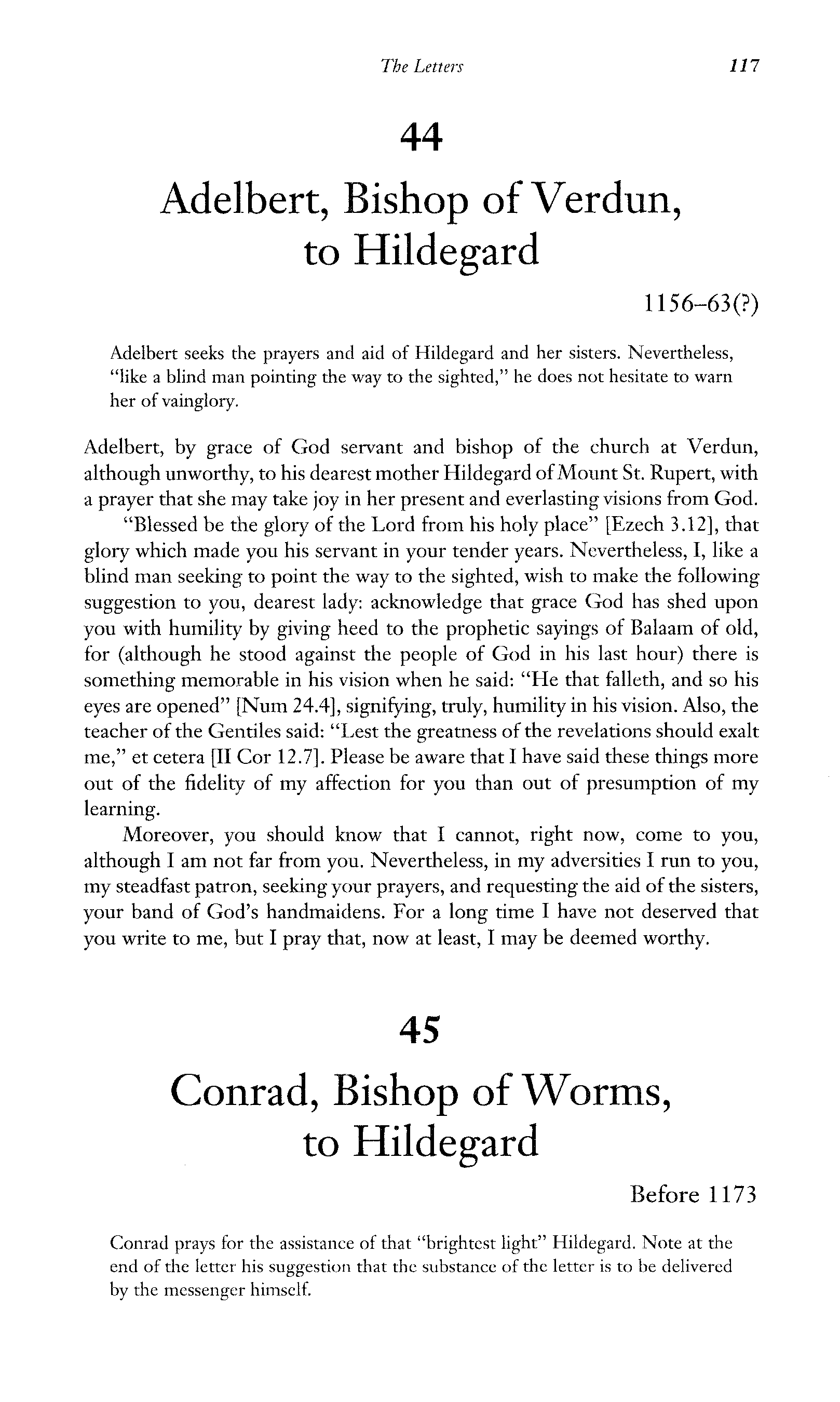
Adalbert, Bishop of Verdun, to Hildegard 1156-63(?) Adelbert seeks the prayers and aid of Hildegard and her sisters. Nevertheless,
"like a blind man pointing the way to the sighted," he does not hesitate to warn her of vainglory.
Adelbert, by grace of God servant and bishop of the church at Verdun, although unworthy, to his dearest mother Hildegard of Mount St. Rupert, with a prayer that she may take joy in her present and everlasting visions from God.
"Blessed be the glory of the Lord from his holy place" [Ezech 3.12], that glory which made you his servant in your tender years. Nevertheless, I, like a blind man seeking to point the way to the sighted, wish to make the following suggestion to you, dearest lady: acknowledge that grace God has shed upon you with humility by giving heed to the prophetic sayings of Balaam of old, for (although he stood against the people of God in his last hour) there is something memorable in his vision when he said: "He that falleth, and so his eyes are opened" [Num 24.4], signifying, truly, humility in his vision. Also, the teacher of the Gentiles said: "Lest the greatness of the revelations should exalt me," et cetera [II Cor 12.7]. Please be aware that I have said these things more out of the fidelity of my affection for you than out of presumption of my learning.
Moreover, you should know that I cannot, right now, come to you, although I am not far from you. Nevertheless, in my adversities I run to you, my steadfast patron, seeking your prayers, and requesting the aid of the sisters, your band of God's handmaidens. For a long time I have not deserved that you write to me, but I pray that, now at least, I may be deemed worthy.
Conrad, Bishop of Worms, to Hildegard Before 1173 Conrad prays for the assistance of that "brightest light" Hildegard. Note at the end of the letter his suggestion that the substance of the letter is to be delivered by the messenger himself.
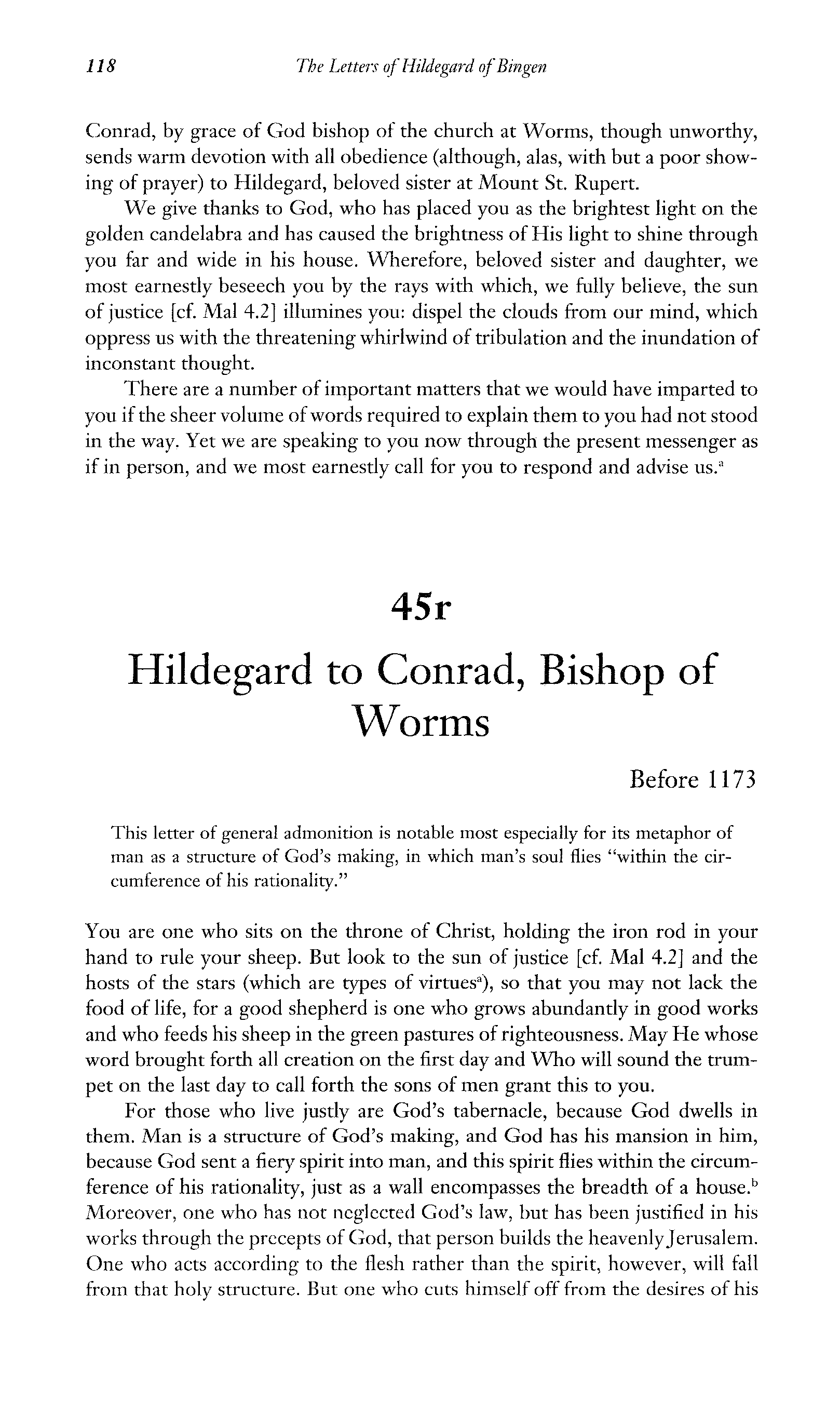
The Letters of Hildegard ofBingen Conrad, by grace of God bishop of the church at Worms, though unworthy, sends warm devotion with all obedience (although, alas, with but a poor showing of prayer) to Hildegard, beloved sister at Mount St. Rupert.
We give thanks to God, who has placed you as the brightest light on the golden candelabra and has caused the brightness of His light to shine through you far and wide in his house. Wherefore, beloved sister and daughter, we most earnestly beseech you by the rays with which, we fully believe, the sun of justice [cf. Mai 4.2] illumines you: dispel the clouds from our mind, which oppress us with the threatening whirlwind of tribulation and the inundation of inconstant thought.
There are a number of important matters that we would have imparted to you if the sheer volume of words required to explain them to you had not stood in the way. Yet we are speaking to you now through the present messenger as if in person, and we most earnestly call for you to respond and advise us."
45r Hildegard to Conrad, Bishop of Worms Before 1173 This letter of general admonition is notable most especially for its metaphor of man as a structure of God's making, in which man's soul flies "within the circumference of his rationality."
You are one who sits on the throne of Christ, holding the iron rod in your hand to rule your sheep. But look to the sun of justice [cf. Mai 4.2] and the hosts of the stars (which are types of virtues"), so that you may not lack the food of life, for a good shepherd is one who grows abundantly in good works and who feeds his sheep in the green pastures of righteousness. May He whose word brought forth all creation on the first day and Who will sound the trumpet on the last day to call forth the sons of men grant this to you.
For those who live justly are God's tabernacle, because God dwells in them. Man is a structure of God's making, and God has his mansion in him, because God sent a fiery spirit into man, and this spirit flies within the circumference of his rationality, just as a wall encompasses the breadth of a house.15
Moreover, one who has not neglected God's law, but has been justified in his works through the precepts of God, that person builds the heavenlyjerusalem.
One who acts according to the flesh rather than the spirit, however, will fall from that holy structure. But one who cuts himself off from the desires of his
The Letters
own will adorns that heavenly structure with pearls and precious stones and pure gold [cf. Apoc 21.18ff].
And so make yourself a precious stone, and you will be adorned in the heavenly Jerusalem.
Albon1
Hildegard to Abbot Wolfard 1153-54 Hildegard writes to allay Wolfard's doubts about the eucharist. Wolfard, like
Rudeger later (Letter 89), has, apparently, expressed to Hildegard his concern over his doubts with respect to the doctrine of transubstantiation, the Real Presence in the form of the bread and wine. Although not exactly new in the twelfth century, the doctrine was still novel enough to be the subject of inquiry and to raise haunting doubts, as here. In the preceding century, Berengarius of Tours had argued forcefully for a mere spiritual or symbolic presence in the eucharist.
It was in opposition to Berengarius that the Church (through the Roman Council of 1079) first put into official language the doctrine that the bread and wine were
"substantially changed" into the body and blood of Jesus Christ. And in 1139 the Second Council of the Lateran pronounced heretical all those who denied the Real Presence in the Eucharist.
The Serene Light which gives words to ruminate upon says: O man, by thinking about the Son of God, you have assurance. Still, however, you hesitate to break the bread which you really wish to eat at the prompting of your mind.
Why do you go around in circles, sifting through all manner of things and casting your gaze every which way, attempting to find out where the reality is to be found in the sacrament?" Why are you doing this? God builds his tabernacle on whatever is good and just. Rise up to the light, therefore, and you will live forever. For God has established the means through which He receives his burnt offering. Blessed is the person who clings ever to God in everything, for he will never be deceived by the devil. Live, therefore, O man, and be victorious in this shadowy world.
Note 1. At this point, Van Acker begins his second classification of letters: correspondents of minor ecclesiastical rank, for whom we know their specific location. The letters in this section are organized alphabetically by place, and, as much as possible, hierarchically by rank. From this point forward, we will list the place-name, as here, before the letter or series of letters.
The Letters of Hildegard ofBingen
Hildegard to Prior Frederick 1153-54 A general admonition to Prior Frederick to amend the instability of his ways.
He Who Is says: A king saw a ladder darkened by the changes in time of pestilence. But then the sun shone forth and dispelled the darkness. This delighted the king, and he said: This unstable ladder is tired out, because sometimes it reaches to lofty heights and sometimes is overshadowed by darkness.
And your mind is just like this, O man. For in the bright day of the quest of your soul, you ascend to me in great joy, but in the time of noxious pestilence you cultivate the "falling sickness," as if the matter of salvation were not to be inquired into. Yet ashes by their very nature are ever in motion and unstable.
Therefore—in both the brightness of the day and the darkness of the whirlwind—look to me, and always seek out the ointment which heals, and you will live forever. Cherish my perfect law, and flee doubt, and God will save you.
Alpirsbach
Godfrey the Monk to Hildegard 1152-53 A letter from one cringing before the majesty of Hildegard, who, he believes, sees all things past, present, and future.
Godfrey, unworthy priest and least among the monks of St. Benedict, sends his pledge of devout obedience with all humility to the most serene and truly blessed Hildegard, endowed with the spirit of divine revelation.
"They that trust in" the Lord, "shall understand the truth: and they that are faithful in love shall rest in him: for grace and peace is to the elect" of God
[Wis 3.9]. The truthful reports of many people have taught me and made me sure that these sacred words, uttered by divine wisdom, will be fulfilled in you.
And whatever I find verified by Holy Scripture I cling to faithfully, because no word is impossible with God [cf. Luke 1.37]. Therefore, although I have never seen your divine revelations, I have heard of your reputation, which is spreading abroad, and I have never doubted its truth. And so I know in truth that because you have placed your faith in the Lord, you have understanding of His truth, and because, faithful to Him, you have rested in His love, you have received
The Letters
the gift of divine revelation and the spirit of heavenly consolation, and therefore achieved the peace of God's elect.
Now, therefore, because the compassion of almighty God is found more abundantly in you than in any other mortal, I do not, I want you to know, make my request to you in order to tempt you, nor to be arrogant, but to seek
God's grace through you humbly. I beseech you to remember the word of the Lord: Do not despise one of my little ones [cf. Matt 18.10]. Please do not, therefore, scorn my letter on account of my insignificance, but for the love of Jesus Christ, mercifully heed my prayers, I pray. And intercede with God for my sins, and with your holy prayers lift up my life, and do not fail to chastise my negligence with a letter of admonition. For I keenly desire the rebuke of your sweetest love. Although I judge myself unworthy of a loving response from you, I desire to receive the reward of my simple trust. For I believe that all the secrets of my heart are laid bare before you by that Spirit through whom you see all things past, present, and future." Never did a day shine more brightly for me than when I came into your presence. And I would walk barefoot just to hear the sound of your voice, which would be altogether pleasant and desirable for me, if only I were worthy to hear your wondrous visions or to receive a letter from you, blessed lady.
May the almighty Father through the power of his Son, our Lord Jesus Christ, and through the accord of the Holy Spirit, deign to grant you length of days so that you may work to amend His holy Church.
48r Hildegard to the Monk Godfrey 1152-53 Hildegard writes general words of consolation to a distressed monk.
The Living Light says: O man, streams of water flow from me to invigorate your mind." But your mind has been bound up and distressed by unstable morals in the blackness of a scudding wind. And your secret thoughts deceive you sometimes, and sometimes you are led astray by the taste of your own works.b But the face of your desire turns toward me in the joyful hope of recovery, which you are not yet able to attain by your work. Very good are those desires which build a tower on the heights of the fragrance of sweet aroma. Therefore, the angels of God rejoice because of the works produced by the creature made by the finger of God, for these works taste God by destroying the food of the unrighteousness of sinners.
Now, O knight, be strong in battle as long as you live in the body, because your enemy does not grow weary, nor does he weaken in battle. Let your works
The Letters of Hildegard ofBingen be such that the gentle Father will rejoice over you, and his Word will enlighten your spirit, and the fiery Lover will shed the ointment of salvation and the invigoration of the flower of wisdom upon you.
Altena
An Abbess to Hildegard Before 1173 A very loving, intimate letter from an abbess to Hildegard.
To the lady and mother, Hildegard, beloved and venerable in Christ, intimate companion of His love, from "N,"1 abbess of Altena, although unworthy, a sinner sitting penitent with Mary at the feet of Jesus, with the hope of seeing her beloved just as He is.
Most beloved of all women, I rejoice in your blessedness, for, as is shown by your very clear delight, you have found the One whom your soul loves as much as mortal can, and even now blissfully spending time with Him in the secret chamber of your heart, you have tasted and seen "that the Lord is sweet"
[Ps 33.9].
It seems clear that I must accept with equanimity the fact that you have failed to visit me through your letters for a long time, although I am greatly devoted to you. For I believe that if, just for a second, you could turn the eye of your mind from gazing at your beloved and could set foot outside your peaceful dwelling, you would not fail to console me more frequently through your messenger, who would gladden me by informing me of your well-being, and would bear back news of me to you. For if it is not granted to me to see your beloved face again in this life—and I cannot even mention this without tears—I will always rejoice because of you, since I have determined to love you as my own soul. Therefore, I will see you in the eye of prayer, until we arrive at that place where we will be allowed to look upon each other eternally, and to contemplate our beloved, face to face [cf. I Cor 13.12], in all His glory.
Note 1. The identity of this writer is unknown. Even the initial given, presumably that of the abbess's name, varies in the MSS from N to B to H.
The Letters
49r Hildegard to the Abbess Before 1173 Hildegard's answer to the abbess is austere and brief, merely an explication of a biblical verse, a rather odd answer to such a tender, devoted letter.
O you who are a leader in the brilliant, springing waters of the fountain [cf.
John 4.14], that is to say, as Christ's representative, hear these words: "Behold the lion of the tribe of Judah, the root of David, hath prevailed" [Apoc 5.5].
The meaning of this is as follows: The Son, the brightness of holy divinity, is like a root. For He roars like a lion, when He hurls the followers of that first fallen angel into hell, so that, with mighty jaws, He casts down all injustice, and so He is the root of fortitude. But He draws to himself all those who confess Him in faith and reach out to Him with good works, and thus, like a lion, He prevails over all things. This is my admonition—heed it.
Altwick
Abbess Sophia to Hildegard 1164-70 An abbess who wishes to lay aside the burden of administrative duties seeks Hildegard's advice about the advisability of such a course of action.
Sophia, abbess of Altwick in the diocese of Utrecht—abbess in name only— sends greetings to the blessed Hildegard of St. Rupert, with a prayer that she may enter that choir which is illumined by the light of lights.
Because no one is able to renounce the lust of the flesh and pant after the heavenly country with whole heart without Christ's help, I desire to impart to you, devout lady, the idea I have conceived in my heart by the prompting of God and the grace of his Spirit. Our Lord does not wish any of His sheep to go astray, but like a good shepherd desires to call them all back to the way of eternal salvation. This same Lord has inspired me, I believe, to lay down the heavy burden of administration which I bear, and to seek the seclusion of some little cell. I would be happy to follow this way of life, but whether I can successfully fulfill it or not lies in our Lord's power.
Therefore, because you have such merit in God's eyes, I know that you can discern a person's proper course of action through the revelation of the
The Letters of Hildegard ofBingen Holy Spirit, and so with humble prayers I beseech you, pious lady, to ask the Lord if my contemplated change pleases Him. For I do not want to be among those singled out by Gregory's famous dictum: "It would have been better for them never to have known the way of truth than to have fallen away once having known it."1
Finally, farewell in the Lord, and please do not fail to address these matters of concern to me, returning your answer by way of the present messenger, along with whatever else the grace of God is pleased to reveal to you through the Holy Spirit.
Note 1. Regulapastorate 3.34. Cf. 2 Peter 2.21.
50r Hildegard to the Abbess Sophia 1164-70 Hildegard advises against the abbess's plan and warns her against the dangers of instability.
In a true vision of the mysteries of God, hear these words: O daughter born from man's side and formed by God as the type of the building up of His kingdom, why are you languishing, so that your mind is like the shifting clouds that the storms blow about, at times bright in the sunlight, at times dark in the shadows. This is true because of the cacophony of the morals of those who do not shine before God.
You say, I long to rest, to seek out a nesting place for my heart, where my soul may find peace. But, O daughter, it is not serving God to cast off your burden and to abandon God's sheepfold, when you have that light through which you may illuminate it, so that you may lead the sheep to pasture. Now then, rein yourself in, lest your mind become inflamed with the sweetness which is very harmful to you in the instability of secular life. But be true to your calling, because this is what the grace of God wishes. Beware, therefore, lest you lose that grace through the instability of your mind. May God help you to stay alert through pure knowledge.
The Letters
Amorbach
Certain Monks to Hildegard After 1159 The monks of Amorbach, gravely concerned about the schism and the general state of the times, since "almost the whole world is overwhelmed by the darkness of error," write Hildegard asking her to preach to the laity.
O., C., and V.,1 sinners and (in name only) priests, on behalf of the whole congregation of the monastery of St. N. in Amorbach, send greetings to Hildegard, superior of St. Rupert in Bingen, with a prayer that she go into the eternal wedding feast with her lamp brightly shining [cf. Matt 2 5.1 ff].
The Living Light is the worker of all good things, and every spirit, vibrantly alive [cf. Ecclus 16.31] and preordained to the tenth order,2 is its coworker. Although unchanging in its purity, this light is shared in by the blessed to different degrees according to the capacity of the recipient. For the highest orders3 of the royal hall are inflamed the more brilliantly the nearer they are to the fountain of light, and the more directly they contemplate it. The lower ranks of angels, on the other hand, reflect that primary light the more weakly the further they are from the source. So it is, too, with those earthly, embodied spirits: although they are predestined to eternal life, they acquire their luminescence from the power of the brightness ever radiating from Majesty, some more abundantly, some less, and they are elevated from their extreme remoteness to seek after that beatific source. There are certain souls so absorbed in that ocean of brightness that they seem to see nothing, to sense nothing, except the presence of that light which vivifies all things. And by their brightness, all other souls, while still weighed down by mortal darkness and buffeted about, are brought into harmony with the receptacle of that brightness, and from that light they gain a more certain self-knowledge.a Therefore, most reverend mother, because you have ascended close to that brightness, may the refulgence bursting forth from your heart enlighten our minds so that our darkness may be dispelled by the rays of admonition, of exhortation, of chastisement. For because iniquity has abounded and love has grown cold, we suffer the darkness of error brought about by the schism in the Church, and because the sun of justice [cf. Mai 4.2] is darkened by obtruding iniquity, the moon (that is, the Church) has gone astray from her original principles in many ways. Yet Christ's words do not pass away, but remain forever, as He himself testifies: "Behold, I am with you always, even to the end of the world" [Matt 28.20]. And so even though almost the whole world is overwhelmed by the darkness of error, that ray of ancient grace has shone in you, lest all the people perish. For the order of monks is going around in circles, the clerical order is limping about lamely, the order of nuns is teetering, and
The Letters ofHildegard ofBingen when the clergy abandons its calling in this way, then the laity completely neglects the law that the Lord has established for them.1' Besides other abominations, they cast God into oblivion: they abandon their lawful spouses, they delight in adultery to satisfy their lust, they commit murder; and by all these means they think to achieve importance. And any one of them who is discovered to be free from these perversions seeks to excuse himself by his own laziness.4 Therefore, the priests who ought to be speaking the truth and crying out against such wickedness now are forced to remain silent.
Now, O venerable mother, since you have frequently directed your admonitions to the clergy, as we know from your own writings, we ask as sincerely as we can that you direct them also to the laity, for it is necessary to rail with harsh and frequent chastisement against those who are not willing to endure any chastisement at all. Indeed, since they believe and, in fact, know that you speak on the authority of divine visions and commands, we hope that they will incline their hearts more attentively to your words than they have to ours, since they see that we too are unstable through our manifold sins. Farewell.
Notes 1. Presumably, the initials of the monks who are writing this letter to Hildegard.
Similarly, the initial N is used, just below, for the name of the saint to whom the monastery is dedicated.
2. That is, the elect of humankind. The reference is to the commonly held belief that mankind was created to become this tenth order of angels, that is, to assume the place vacated by the fallen Satan and his followers. See Scivias (Ill.ii. 19), "Thus in height of blessedness he [mankind] was to augment the praise of those heavenly spirits who praise God with constant devotion, and so in that same blessedness fill up the place left empty by that lost angel who fell through his pride. And so man is the full number ten, and he brings all these things to perfection by God's power. But in this proposition the number ten is multiplied to a hundred. For although man fell away from God through the temptation of the devil, yet admonished by divine mercy and inspiration, he strenuously began to acknowledge God through the law and prophecy of the Old Testament, and at last even more keenly through the sanctity and all the various means of virtuous constancy given by the Church." See also Newman, Sister of Wisdom, pp. 102—3.
3. The actual expression here is suprema organa. Clearly, the monks have in mind the heavenly choirs of angels, but the general context and the specific references that follow also make it clear that they are referring to the (with starting point at the living light) descending orders of the angels.
4. ac quisque uelut inertem se esse dicit, si his maculis immunis inuenitur. This passage is very messy. Perhaps heavy irony is being employed here to lay stress on the great sinfulness of the times.
The Letters
Andemach
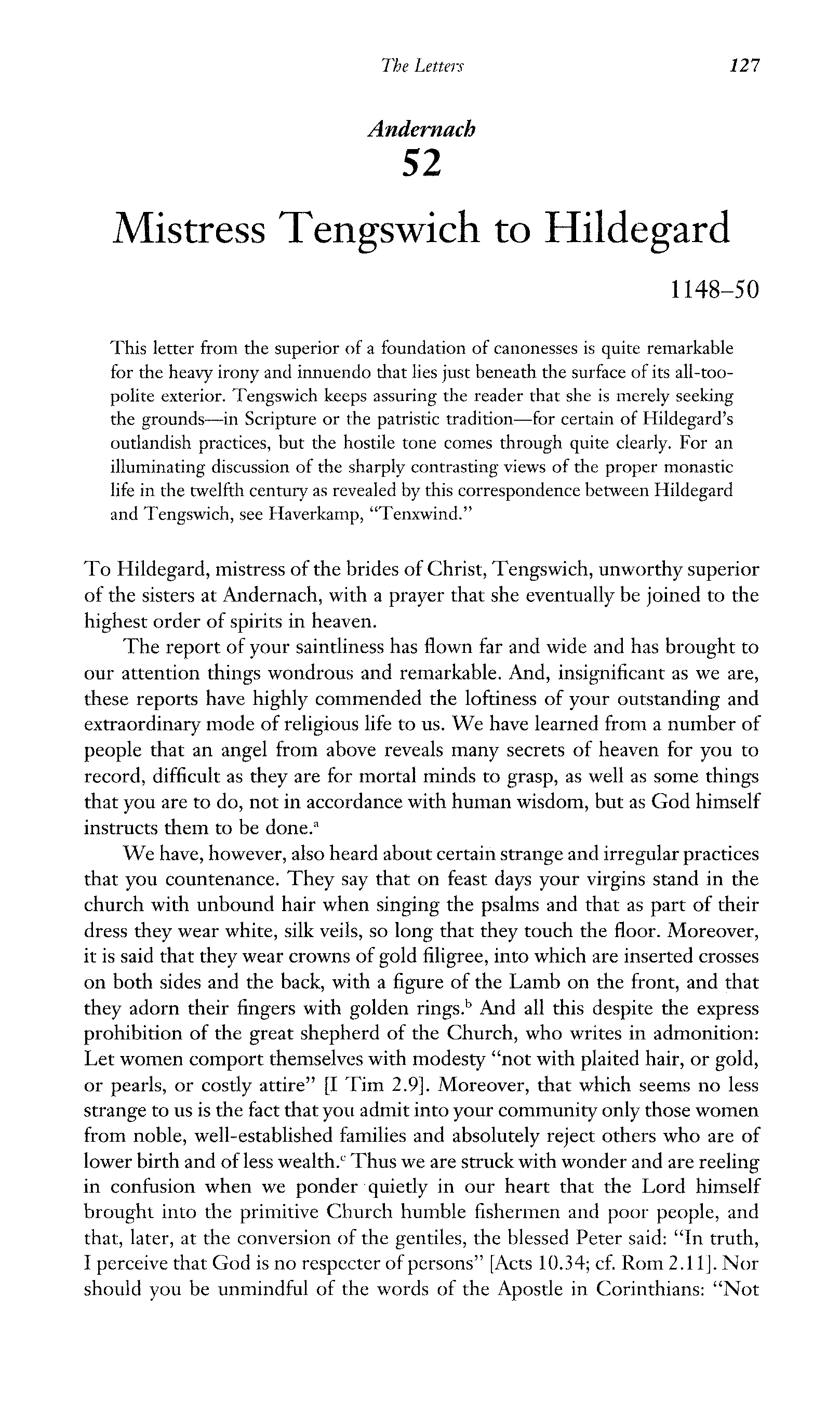
Mistress Tengswich to Hildegard 1148-50 This letter from the superior of a foundation of canonesses is quite remarkable for the heavy irony and innuendo that lies just beneath the surface of its all-toopolite exterior. Tengswich keeps assuring the reader that she is merely seeking the grounds—in Scripture or the patristic tradition—for certain of Hildegard's outlandish practices, but the hostile tone comes through quite clearly. For an illuminating discussion of the sharply contrasting views of the proper monastic life in the twelfth century as revealed by this correspondence between Hildegard and Tengswich, see Haverkamp, "Tenxwind."
To Hildegard, mistress of the brides of Christ, Tengswich, unworthy superior of the sisters at Andernach, with a prayer that she eventually be joined to the highest order of spirits in heaven.
The report of your saintliness has flown far and wide and has brought to our attention things wondrous and remarkable. And, insignificant as we are, these reports have highly commended the loftiness of your outstanding and extraordinary mode of religious life to us. We have learned from a number of people that an angel from above reveals many secrets of heaven for you to record, difficult as they are for mortal minds to grasp, as well as some things that you are to do, not in accordance with human wisdom, but as God himself instructs them to be done."
We have, however, also heard about certain strange and irregular practices that you countenance. They say that on feast days your virgins stand in the church with unbound hair when singing the psalms and that as part of their dress they wear white, silk veils, so long that they touch the floor. Moreover, it is said that they wear crowns of gold filigree, into which are inserted crosses on both sides and the back, with a figure of the Lamb on the front, and that they adorn their fingers with golden rings.b And all this despite the express prohibition of the great shepherd of the Church, who writes in admonition:
Let women comport themselves with modesty "not with plaited hair, or gold, or pearls, or costly attire" [I Tim 2.9]. Moreover, that which seems no less strange to us is the fact that you admit into your community only those women from noble, well-established families and absolutely reject others who are of lower birth and of less wealth.1 Thus we are struck with wonder and are reeling in confusion when we ponder quietly in our heart that the Lord himself brought into the primitive Church humble fishermen and poor people, and that, later, at the conversion of the gentiles, the blessed Peter said: "In truth,
I perceive that God is no respecter of persons" [Acts 10.34; cf. Rom 2.11J. Nor should you be unmindful of the words of the Apostle in Corinthians: "Not
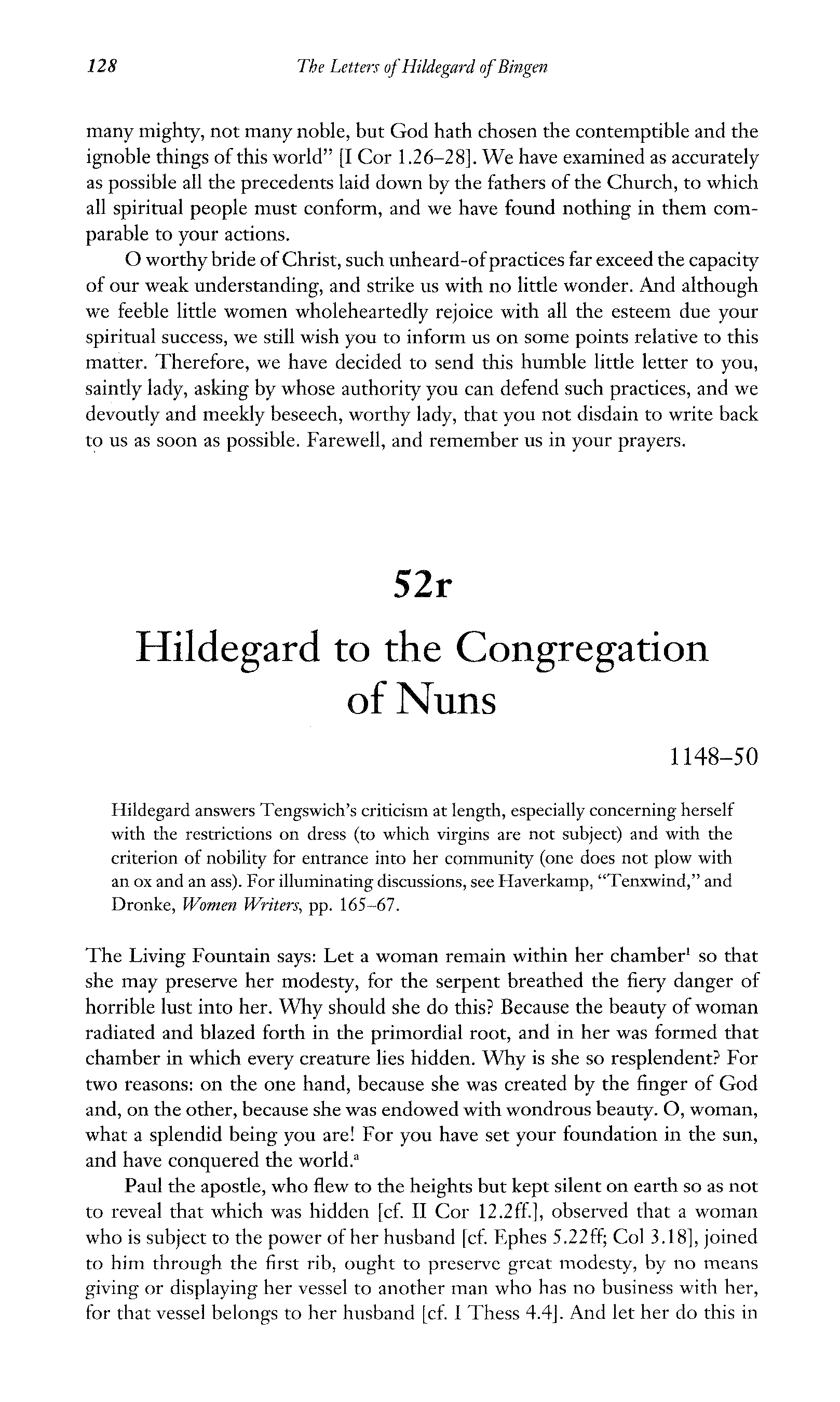
The Letters of Hildegard ofBingen many mighty, not many noble, but God hath chosen the contemptible and the ignoble things of this world" [I Cor 1.26-28]. We have examined as accurately as possible all the precedents laid down by the fathers of the Church, to which all spiritual people must conform, and we have found nothing in them comparable to your actions.
O worthy bride of Christ, such unheard-of practices far exceed the capacity of our weak understanding, and strike us with no little wonder. And although we feeble little women wholeheartedly rejoice with all the esteem due your spiritual success, we still wish you to inform us on some points relative to this matter. Therefore, we have decided to send this humble little letter to you, saintly lady, asking by whose authority you can defend such practices, and we devoutly and meekly beseech, worthy lady, that you not disdain to write back to us as soon as possible. Farewell, and remember us in your prayers.
52r Hildegard to the Congregation of Nuns 1148-50 Hildegard answers Tengswich's criticism at length, especially concerning herself with the restrictions on dress (to which virgins are not subject) and with the criterion of nobility for entrance into her community (one does not plow with an ox and an ass). For illuminating discussions, see Haverkamp, "Tenxwind," and Dronke, Women Writers, pp. 165-67.
The Living Fountain says: Let a woman remain within her chamber1 so that she may preserve her modesty, for the serpent breathed the fiery danger of horrible lust into her. Why should she do this? Because the beauty of woman radiated and blazed forth in the primordial root, and in her was formed that chamber in which every creature lies hidden. Why is she so resplendent? For two reasons: on the one hand, because she was created by the finger of God and, on the other, because she was endowed with wondrous beauty. O, woman, what a splendid being you are! For you have set your foundation in the sun, and have conquered the world."
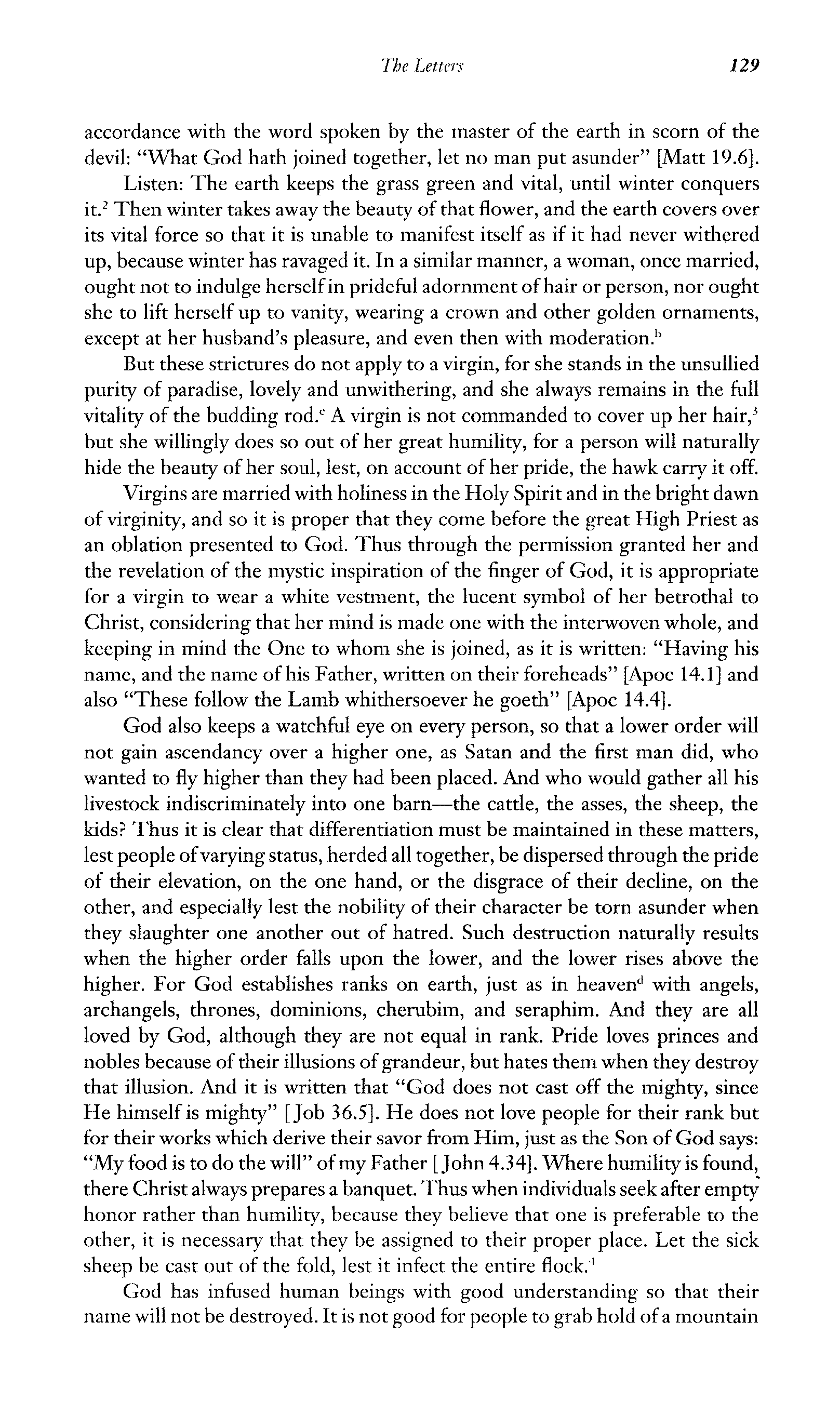
Paul the apostle, who flew to the heights but kept silent on earth so as not to reveal that which was hidden [cf. II Cor 12.2ff], observed that a woman who is subject to the power of her husband [cf. Fphes S.22ff; Col 3.18], joined to him through the first rib, ought to preserve great modesty, by no means giving or displaying her vessel to another man who has no business with her, for that vessel belongs to her husband [cf. I Thess 4.4J. And let her do this in
The Letters
accordance with the word spoken by the master of the earth in scorn of the devil: "What God hath joined together, let no man put asunder" [Matt 19.6].
Listen: The earth keeps the grass green and vital, until winter conquers it.2 Then winter takes away the beauty of that flower, and the earth covers over its vital force so that it is unable to manifest itself as if it had never withered up, because winter has ravaged it. In a similar manner, a woman, once married, ought not to indulge herself in prideful adornment of hair or person, nor ought she to lift herself up to vanity, wearing a crown and other golden ornaments, except at her husband's pleasure, and even then with moderation.1'
But these strictures do not apply to a virgin, for she stands in the unsullied purity of paradise, lovely and unwithering, and she always remains in the full vitality of the budding rod.1' A virgin is not commanded to cover up her hair,3 but she willingly does so out of her great humility, for a person will naturally hide the beauty of her soul, lest, on account of her pride, the hawk carry it off.
Virgins are married with holiness in the Holy Spirit and in the bright dawn of virginity, and so it is proper that they come before the great High Priest as an oblation presented to God. Thus through the permission granted her and the revelation of the mystic inspiration of the finger of God, it is appropriate for a virgin to wear a white vestment, the lucent symbol of her betrothal to Christ, considering that her mind is made one with the interwoven whole, and keeping in mind the One to whom she is joined, as it is written: "Having his name, and the name of his Father, written on their foreheads" [Apoc 14.1] and also "These follow the Lamb whithersoever he goeth" [Apoc 14.4].
God also keeps a watchful eye on every person, so that a lower order will not gain ascendancy over a higher one, as Satan and the first man did, who wanted to fly higher than they had been placed. And who would gather all his livestock indiscriminately into one barn—the cattle, the asses, the sheep, the kids? Thus it is clear that differentiation must be maintained in these matters, lest people of varying status, herded all together, be dispersed through the pride of their elevation, on the one hand, or the disgrace of their decline, on the other, and especially lest the nobility of their character be torn asunder when they slaughter one another out of hatred. Such destruction naturally results when the higher order falls upon the lower, and the lower rises above the higher. For God establishes ranks on earth, just as in heavend with angels, archangels, thrones, dominions, cherubim, and seraphim. And they are all loved by God, although they are not equal in rank. Pride loves princes and nobles because of their illusions of grandeur, but hates them when they destroy that illusion. And it is written that "God does not cast off the mighty, since
He himself is mighty" [Job 36.5]. He does not love people for their rank but for their works which derive their savor from Him, just as the Son of God says:
"My food is to do the will" of my Father [John 4.34]. Where humility is found, there Christ always prepares a banquet. Thus when individuals seek after empty honor rather than humility, because they believe that one is preferable to the other, it is necessary that they be assigned to their proper place. Let the sick sheep be cast out of the fold, lest it infect the entire flock.4
God has infused human beings with good understanding so that their name will not be destroyed. It is not good for people to grab hold of a mountain
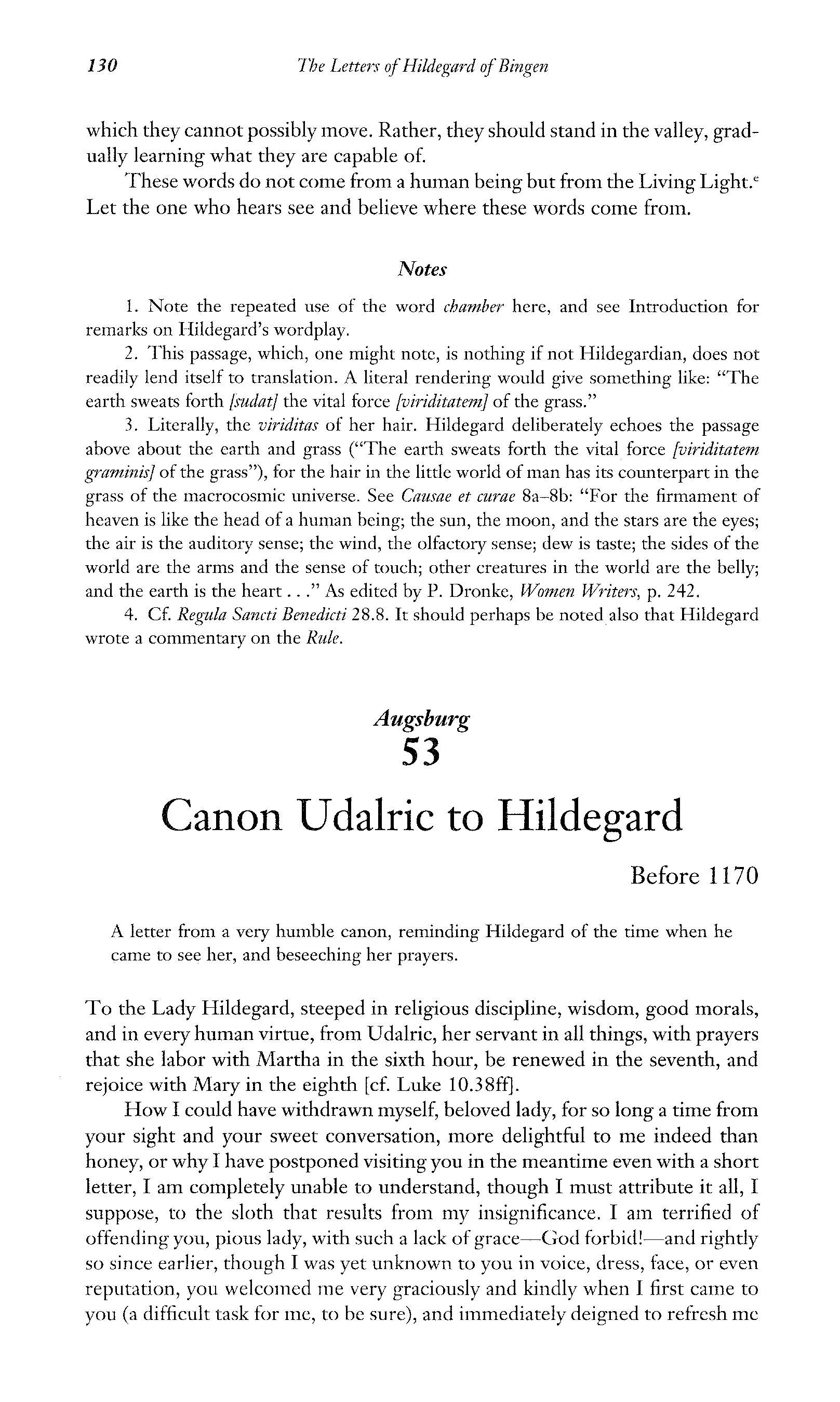
The Letters of Hildegard ofBingen which they cannot possibly move. Rather, they should stand in the valley, gradually learning what they are capable of.
These words do not come from a human being but from the Living Light.6
Let the one who hears see and believe where these words come from.
Notes 1. Note the repeated use of the word chamber here, and see Introduction for remarks on Hildegard's wordplay.
2. This passage, which, one might note, is nothing if not Hildegardian, does not readily lend itself to translation. A literal rendering would give something like: "The earth sweats forth [sudat] the vital force [viriditatem] of the grass."
3. Literally, the viriditas of her hair. Hildegard deliberately echoes the passage above about the earth and grass ("The earth sweats forth the vital force [viriditatem grammis] of the grass"), for the hair in the little world of man has its counterpart in the grass of the macrocosmic universe. See Causae et curae 8a—8b: "For the firmament of heaven is like the head of a human being; the sun, the moon, and the stars are the eyes; the air is the auditory sense; the wind, the olfactory sense; dew is taste; the sides of the world are the arms and the sense of touch; other creatures in the world are the belly; and the earth is the heart. . ." As edited by P. Dronke, Women Writers, p. 242.
4. Cf. Regula Sancti Benedicti 28.8. It should perhaps be noted also that Hildegard wrote a commentary on the Rule.
Augsburg
Canon Udalric to Hildegard Before 1170 A letter from a very humble canon, reminding Hildegard of the time when he came to see her, and beseeching her prayers.
To the Lady Hildegard, steeped in religious discipline, wisdom, good morals, and in every human virtue, from Udalric, her servant in all things, with prayers that she labor with Martha in the sixth hour, be renewed in the seventh, and rejoice with Mary in the eighth [cf. Luke 10.38ffJ.
How I could have withdrawn myself, beloved lady, for so long a time from your sight and your sweet conversation, more delightful to me indeed than honey, or why I have postponed visiting you in the meantime even with a short letter, I am completely unable to understand, though I must attribute it all, I suppose, to the sloth that results from my insignificance. I am terrified of offending you, pious lady, with such a lack of grace—God forbid!—and rightly so since earlier, though I was yet unknown to you in voice, dress, iace, or even reputation, you welcomed me very graciously and kindly when I first came to you (a difficult task for me, to be sure), and immediately deigned to refresh me
The Letters
by allowing me to partake in conversation with you—something which I consider a very great favor.
But because I am penitent, you will forgive me. For my mind has never been unwilling, but the ability was lacking. Therefore, if I am able to make a true promise, I vow to change my ways as quickly as possible, if God grants me the means. In the meantime, however, please deign to be mindful of me, a poor sinner, in your prayers before God.
53r Hildegard to Canon Udalric Before 1170 Hildegard writes very general reflections back to the canon.
He who is life has revealed these words to me, saying: O man, you are like the water which the storm makes turbulent, but which then settles down tranquilly.
Victory says to you: I would gladly come to you, but you withdraw from me when you hide the face of your mind and thus are filled with doubt, having neither the soaring wings of security nor contempt for the world.
O knight, resurrection will come to you quickly if you will shake off the dust of your ashes, saying: If I cannot stand in the sun, at least I will drag myself out of the mud and wash my garments clean of the unstable morals of this age.
Then the dove will anoint you and will wash your wounds. Arise now, and live forever.
Averbode
Hildegard to Provost Andrew Before 1166 A letter of general admonition and criticism, ending on a note of hope.
The Secret Light says: You are terrified as if by the wind, and the green tree of your mind is dormant.1 But one who has vitality in his inner heart builds on the height of the wall. Yet a shepherd who feeds his flock but who still lacks the inner fortitude to come to its aid in peril and indeed runs away weary of his duty [cf. John 10.12fJ—that one is not suited for pastoral office. Therefore, let him act the sheep, and not the shepherd.
You, O man, are like someone struggling in the water, scarcely able to
The Letters of Hildegard of Bingen rescue himself before he drowns. Thus although you see prudence all around you, you lack strength—but not will, and, therefore, the grace of God shines for you.
Note 1. Hildegard's phrase is in ligno viriditatis mentis tue, literally "in the wood of the viridity of your mind." Viridity appears again in the very next sentence, where we translate "vitality."
An Abbot to Hildegard Before 1166 This letter asking for Hildegard's prayers certainly attests to Hildegard's high reputation. Is this from a Cistercian monastery in Averbode? The writer has clearly been influenced in his choice of language and style by St. Bernard.
N.,1 humble and unworthy superior of the brothers in Averbode, sends greetings to Hildegard of Bingen, the glorious handmaiden of Christ, who has been crowned with the flowers of holy virtue, with a prayer that she may be rewarded with the penny of the gospel's day laborer [cf. Matt 20.2] because of her zeal for the life of purity.
I will not cease pouring out my great thanks to God, who has set the loftiness of your person like a brilliantly blazing lamp, not under a bushel, but on a candlestick [cf. Matt 5.15; Luke 8.16, 11.33]. For He has not left off watching over and consoling you, reverend and saintly lady, with the visitation of his angels and the grace of his spirit. And He has diffused your good name far and wide like a delicious fragrance, not only throughout Germany but also in our region and other parts of the world, so that you may justly say with the Apostle: "We are the good odour of Christ unto God in" every place [II Cor
2.15].
And rejoicing because you have advanced far in faith, we are compelled to say: How beautiful you have become in delights, daughter of the prince; We will be glad and rejoice in thee, remembering thy breasts more than wine [cf.
Cant 7.Iff; 1.3]. For in them, we, weak though we are, have put our weakness to flight, and each of us, having become strong and robust according to the wisdom God has given to you, takes solid food [cf. I Cor 3.1-2; Heb 5.12ffj, and is able to say without fear of censure: Thy "lips distill choice myrrh" [Cant
5.13] and "thy lips are like a dripping honeycomb" [Cant 4.11], O beloved bride of God. For like a city set on a mountain [cf. Matt 5.14] of virtues, you cannot be concealed, because the Lord has established you as an immovable
The Letters
and unshaken column in the middle of his Church, so that among the lamentable crises of this world, his people, redeemed with the price of his blood, may learn through you what they ought to seek and what they ought to avoid. And instructed by the example of your great virtue, they may advance day by day and ascend vigorously from virtue unto virtue to see the God of gods on Zion
[cf. Ps 83.8].
Confident, therefore, in the protection of your prayers, although I am not worthy to receive the crown for my labors, may I be granted at least to escape punishment. I commend myself wholeheartedly to your prayers, because I have often offended God by my great sins. Farewell, beloved lady, and pray to the Lord for me, unworthy though I am, and call upon Him with the words God himself gives you.
Note 1. N. has not been identified, although his monastery, as the first sentence of the letter makes clear, was in Averbode in Brabant.
55r Hildegard to the Abbot Before 1166 This answer directed against malicious gossip seems a little beside the point of the letter sent to Hildegard. Is this one of those instances where the messenger delivered additional information?
The spears of malicious words hurled by the faithless and the slanderous are like a dangerous wind, suddenly assailing a person's heart. And this is the storm aroused by the first angel when he despised God. As I frequently observe, these onslaughts often afflict even a person in felicity whom God cherishes highly, because the Enemy has learned of his bliss and seeks to oppress him with that storm so that he, too, may fall. But he is not powerful enough to snatch him from God's bosom. Although difficulties and tribulations from the elements befall him, he retains his self-restraint, because God is watching over him. Yet just as the Church received a new birth in the blood of Christ, so it was proper and fitting that water, the dowry of the Holy Spirit [cf. John 3.5], be mingled with the blood of Christ, because the blood of every human being is tainted.1
Note 1. Some MSS give the following addition to the letter: "But, O head of the household on Mt. Zion, I admonish you to become a trumpet sounding aloud among the
The Letters of Hildegard ofBingen spiritual people of your flock so that they may not lag in love and obedience. Then you will live forever. Furthermore, keep your eyes upon justice and truth with your mind ever vigilant, so that you are not hampered by the caeophony of this age."
Bamberg (St. Michael)
Hildegard to an Abbot 1169-70 Although the letter to Hildegard has not come down to us, her response to the abbot sounds as if he had written her seeking advice about giving up his administrative responsibilities for a quieter monastic life. Van Acker believes that the letter—as well as the following one—was addressed to Helmrich, abbot of St.
Michael in Bamberg, who resigned his office in 1170.
In fiery admonition it has been foreordained what the people will hear from my lips, for they will drink deep of the flood gushing from the rock in the obscure mysteries of God [cf. Ex 17.6], Sometimes I see you glowing like the dawn in your aspiration, but still the labor and difficulties which you experience, both in yourself and in others, wear you out so completely that you become blinded to your own ability.
Now listen to the great Father of the household admonishing you: Strive to keep awake and rise up in the light, so that you may bear His staff honorably while it is day. For if the outer man sometimes is worn down by God's chastisement, the inner man rises all the stronger by that mighty power which will sustain you on the turning wheel of His grace."
Hildegard to an Abbot 1169-70 Hildegard reinforces her advice to the abbot to continue to fulfill his duty by means of an allegorical vision from the Serene Light.
I heard these things in the Serene Light: Wisdom and Discernment spoke to each other, asking, Whom shall we get to help us? And they responded with one voice, Temperance. But let us do our duty, and have Mercy announce salvation to the people. And so they sat down. Then Wisdom said: What are
The Letters
we to do, for there are wars and more wars among the sons of men? And Discernment answered: When the sons of men rush at each other in the streets, seeking to kill each other, blind them with sunlight, and I, for my part, will darken their eyes with a cloud. And let us teach them that, first and foremost,
God imbued them with angelic principles, and, then, gave them bodies, like His own. And so why should they strangle their spirits when they have such great merit? You, therefore, should give them a shield formed from the sun, and I will give them armor and iron armbands from the cloud, so heavy that they will not be able to move. Then, Temperance said: And I will spread a net before their feet which will ensnare them if they seek to tread the paths of unrighteousness. And Mercy said: I declare that Wisdom has established heaven and earth in great glory, and that Discernment has made all things beautiful for the eyes to behold, and that Temperance has changed all bitter and cloyingly sweet things into nutritious food, so that they can be eaten and digested. But I have a flashing sword, and with it I destroy all things dangerous and injurious to mankind, and I flatten out all the impassable mountains so that both the meek and the mighty, the strong and the weak, are able to pass through them without harm.
Now, you, O diligent and solicitous father, understand this parable, and with energy, mercy, and great reverence, show your sons the lofty justice and judgments of God, because when they begin the wars of evil deeds and seek to fight it out to the bitter end in the streets of their will, then blind their eyes with the sun of justice [cf. Mai 4.2] and with the cloud of chastisement. For they are celestial by spirit, and they have their bodies in the image of Christ.
And so prevent them from snuffing out their spirits, which have many merits in heaven. And show them the shield of defense from the sun of justice, and from the cloud of discipline load them down with the armor and armbands of obedience, from which they can scarcely extricate themselves, because of the weight of their sins. Stretch out the net of chastisement before them and compel them to walk on the straight path, because God has established heaven and earth in great glory, and has tempered all things, both pleasant and difficult, and made them bearable. Imitate Mercy, who levels all things so that they may be overcome. But do all things in the proper time, keeping in mind the weakness of your sons' bodies, in accordance with God's words: "I will have mercy, not sacrifice" [Matt 9.13; 12.7; cf. Hosea 6.6], and as the Apostle also says:
"Who need milk, and not solid food" [Heb S.12ff; cf. I Cor 3.2]. And anoint them with oil so that they may not grow weak out of bitterness, or stray out of ignorance.
Now, therefore, O dear son of God, make your temple bright with benevolence, and do not let your mind be blown about like shifting clouds, as if by the unrest of war. Set your heart in the pure fountain, and embrace Him in sweet love.
The Letters ofHildegard ofBingen
Hildegard to Prior Dimo 1169-70 A general admonition couched in allegorical terms.
I saw and heard these words in a true vision: Life sees death and overcomes it, just as David, a mere boy, conquered Goliath. A mountain is visible because it is lofty, and a valley lies beneath it, sometimes causing flowers to bud in their vitality, but more often producing useless weeds, nettles, and thorns.
Now, understand, O man. Two men were sitting in a house, one of whom was a knight; the other, a serf.3 And two wise and beautiful girls came to that house, knocked on the door, and said to them: You have become notorious even in far distant lands, for many people allege that you have slandered the king, and the king has asked, Who are these miscreants to be saying such things about me? Therefore, you two, hear our advice, for it will bring you victory. I am Humility: I have seen life in the incarnation of the Son of God, and I have crushed Death under my heel. The works of obedience are a mountain, and benevolence is a valley lush with flowers, though frequently choked off by nettles and thorns watered by the storms of sins.
Listen, therefore, O man, for it is the house of your heart that the knight and the serf—that is, Obedience and Pride—are sitting in, and it is at the door of your mind that the two girls—that is, Divine Love and Humility1—are knocking, to prevent you from committing all the sins that you are capable of.
Now, therefore, observe that the knight defeats the serf, lest he trample the beauty of obedience beneath his feet, for Pride says, Those chains with which I bind mankind cannot be broken. But respond to him in the words of Love:
I sat unsullied in heaven, and I kissed the earth. Pride swore against me and wanted to fly higher than the stars, but I threw him into the abyss. Now, therefore, join me in trampling the serf underfoot, my son, and take your stand with me, Divine Love, and embrace Humility as your lady. Thus you will escape condemnation and eternal death.
Note 1. The texts of both Van Acker and Pitra (and, therefore, presumably, the MSS) give obedientia here as the name of the allegorical character. But since the name Obedience is already assigned the soldier sitting inside and since the allegorical figure speaking above identifies herself as humilitas, it seems reasonable to assume that the repeated obedientia here is simply the result of scribal dittography. It might be argued further that Humility is the proper virtue to stand in opposition to Pride (superhia). Observe below, too, that caritas refers to humilitas as the lady that mankind should embrace.
The Letters
Hildegard to the Congregation of Monks 1169-70 Hildegard exhorts the congregation of monks to be obedient to their superior.
The interest of the letter, however, lies in Hildegard's explication of biblical verses.
I looked into the purest fountain, and I heard these words: A certain man went into his garden to see if the flowers were blooming and if the herbs were growing. And he said: "I went down into the garden of nuts, to see the fruits of the valleys, and to look if the vineyard had flourished, and the pomegranates budded" [Cant 6.10]. "Return, return, O Sunamite1: return, return that we may behold thee" [Cant 6.12].
Here is the meaning of this passage: the Son of God descended from the heart of the Father and clothed Himself in flesh in the bitterness of human nature," and in that bitterness he endured many sorrows without any sin, and so he saw the fruits of the valley when prophecy was fulfilled in Him. After the dew descended from heaven, the apostles also budded when they heard the precept of God and fulfilled it, just as it is written: Go into the whole world and preach [cf. Mark 16.15]. And there He looked to see if the vineyard had flourished. Then also the burning sun poured into some of them, and they, in turn, poured out their blood on account of their love for God, so that they became martyrs, and thus in them the pomegranates budded. And in this way, through a life different from that which they received in the first Adam, they returned, and another, new, race of men appeared, which did not exist before the nativity of that Man, when it was said to humankind: "Return, return, O
Sunamite." And so all the ornaments, the praise of angels, have been lifted up in the Church, as if into celestial harmony, when it is said again, "Return, return that we may behold thee." For all the celestial virtues gazed in wonder at the face of the Church, which saw clearly in its virginity and heard keenly among the publicans and sinners, and spoke in true widowhood. What does this mean? When God was born, the eyes of the Church were opened in virginal nature, and it heard clearly the summons of the sinners and penitents, and in true widowhood2 exclaimed with a shout, just as it is written: "Many waters cannot quench charity, neither can the floods drown it" [Cant 8.7], because the virginal flowers left the blazing wheel of carnal nature, and, following the example of the Lamb, walked in the pathway of virginity, abandoning the pomp, riches, and secular concerns of this world.1' And none of those worldly allurements, no more than the multitude of waters, could destroy the divine love in them. Thus it is also written: "Thy heart shall be enlarged, when
The Letters ofHildegard ofBingen the multitude of the sea shall be converted to thee, the strength of the gentiles shall come to thee. The multitude of camels shall cover thee, the dromedaries of Madian and Epha" [Is 60.5-6].
O Jerusalem, your spirit will be greatly enlarged with innumerable ornaments when the mighty power in the sun of virginity will be spread abroad in you (just as the sea is greater than all other waters) and when the common people, pruned by the righteous sword of God's word and loaded like a camel, will give up this world sullied by great crimes, violations, and all the lascivious habits and vices of dromedaries.0
Now, therefore, hear and understand, O beloved sons of Jerusalem, for you have been called and sit in the recesses of the garden wall like doves [cf.
Cant 2.14]. You are dressed in Christ's robe,'1 Christ who put on that unaccustomed robe when he clothed Himself in humanity, while still remaining whole in his deity. Therefore, walk after that one who said, "Not as I will, but as thou wilt" [Matt 26.39], Father. And so being bound by the golden bond of obedience, follow His example in the mirror of your superior, for just as a man sees his face in a mirror, so you see the face of God in your superior. And bless him, saying, lord and master, we will follow the example that you have set before us.
You ought to keep firmly in your mind's eye the fate of that first lost angel, who haughtily refused to submit to his proper master, but in his own conceit raised himself over Him. And yet he was cast into the abyss by the hand of that master. Now, therefore, beware lest you be censured in that same way for your blindness and for your slander of your master. Even if your master threatens to beat you with the rod of rebuke, humble yourselves before him in meek devotion, saying: Father, father, we cannot endure this, and we beseech you to spare us. And then with bowed head, humbly seek out the advice of other masters, and carry it out with due discretion and discipline, lest you be accused before your master in heaven.
O beloved sons, observe now with what zeal you were first planted, and beware lest you lead each other astray. May God count you in the Golden
Number,3 and may the blazing sun of the Holy Spirit plant you among all good things.
Notes 1. All MSS of this letter (followed by both Pitra and Van Acker) read Sunamitis, rather than the Vulgate's Sulamitis.
2. For Hildegard on the relative virtues of widowhood and virginity, see Scivias
I.ii.595ff.
3. In the Liber divinorum operum Hildegard identifies the Golden Number as those martyrs of the primitive Church who shone like gold in the redness of their blood. And although she specifies the primitive Church, she hastens to add that the number is not yet full. Seein.x.12, TII.x.33.
The Letters
An Abbot to Hildegard 1158-61(?) The abbot of St. Michael in Bamberg requests the prayers of Hildegard.
To the Lady Hildegard, the betrothed of the High King, and mistress of the sisters of St. Rupert, B., unworthy abbot of St. Michael in Bamberg, sends whatever he can in the way of prayer and devotion.
We hear that you are aflame with love for the One who has redeemed us with his own blood, and, to the best of our ability, we earnestly beseech Him to preserve eternally the gifts He has bestowed upon you. With our whole heart we long for your presence, but because we have been ensnared by our own sins, we have been unable to gain our desire. In the name of the One you love, sweet lady, I beseech you as earnestly as I can to implore the Lord to be merciful to me, and that you pray Him to temper the lash of His mercy, with which He has scourged me, and scourges me daily. Thus may I find salvation in this world, and compassion and grace in the world to come.
But if, as I hope, divine predestination has determined to call me forth from this darkness soon, I wish to commend my soul to your hands and prayers.
Please send a letter of consolation to us by the present messenger.
Bamberg (St. Theodore and St. Maria)
An Abbess to Hildegard After 1157 The abbess requests to be received into Hildegard's community. Here is another instance of an administrator who wishes to be relieved of her responsibilities, this time, apparently, in order to join Hildegard's own community. Hildegard's answer is predictable.
To the beloved lady and mother, Hildegard, worthy of respect for her piety and dignity, L., abbess in name only in Bamberg, although unworthy, along with all the sisters entrusted to her by God, sends whatever the devout and frequent prayers of the humble can accomplish.
With all our hearts, we rejoice in Christ, blessed lady, that the Lord, who foreknew you and made you I lis elect, has illuminated you and filled you with the spirit of prophecy in our time. Christ has gladdened us especially in this:
The Letters ofHildegard ofBingen that He not only foresaw and predestined you, a woman, for this purpose, but also His grace has illumined many through your teaching. Therefore, we offer the most devout thanks to Him for you, and we humbly pray that He mercifully finish that which He began in you, until He brings you to eternal life.
Therefore, we earnestly beseech you to consider receiving us into your fellowship, commending us heartily to your holy community. Please strengthen us with letters of encouragement. Farewell, beloved lady.
61r Hildegard to the Abbess After 1157 Hildegard urges the abbess to remain in her administrative position, and impose obedience upon her subordinates.
O mother, a person who does not till a fertile field and make it fruitful is letting it run to seed, because he is not working for the good of the master. Who appointed the ox and the ass to their proper functions? God, of course, created them to serve mankind. Why then should a person not toil to fulfill his proper, useful function, since he is God's own work, and God did not establish him as a useless being? For God made man like the firmament, which bears the sun and the moon and the stars so that they may give light to all creation, and mark the times and the seasons. But if a black cloud should obscure all these things, creation would fear that its end is near.
O daughter of God, be aware that you are this field, because you hold the people in the embrace of your good will, and thus they can accept your words and works." Therefore, do not refuse to toil with the people, and do not abandon them merely because you long for leisure, for frequently harmful weeds grow in idleness. Set before yourself the vision of the firmament, lest, deceived by the devil, you obscure the light of your reason with a black cloud of sin, as if you were scarcely alive. Therefore, use discipline to keep your daughters in check, for just as a child fears to be beaten with a rod, so also the master must be feared by everyone. Do not be afraid to punish them, but rather through your will to order increase your reward in the life everlasting, so that the breath of the Holy Spirit may flow into you.
The Letters
Gertrude,1 a Nun, to Hildegard After 1161 This Gertrude is Gertrude von Stahleck, former countess. See Letter 30. A tender letter expressing her love for Hildegard and her longing to see her.
To Hildegard, her beloved mother in Christ, from her own Gertrude, with sincere prayers that God grant you what "eye hath not seen, nor ear heard, neither hath it entered into the heart of man" [I Cor 2.9].
I have absolutely no idea what I should write or say to you, for there is no one like you nor anyone so beloved in Christ, and indeed the very strength of my love has destroyed my ability to speak. Indeed, I have become drunk on the wine of the sorrow of your absence, blessed lady, and this has afflicted me so grievously that I have lost all desire to speak or even to see. I could almost believe that it would have been better for me never to have seen you at all, never to have known your kindness and maternal feeling toward me, for now separated from you by so great a distance, I grieve over you without ceasing as if you were lost to rne forever.
But I hope in my God—mine I say, because I hold nothing dearer than Him—that He will not allow me to lay aside this besmirched body of mine until He has granted me the happiness of seeing you once again and enjoying conversation with you face to face. But if this cannot be because of the weight of my sins, He will not fail (I am assured by His goodness) to fulfill my hope of seeing you there where we will never be separated from His sight.
What more can I say? I ask you, beloved mother, to please pray for me to Him, in whose embrace you remain secure and in whose shadow you rest, like a young hart, from the heat of temptation and sin. Pray that He reveal himself to me, as I wander in search of Him, but, alas, without success. May He grant me to sit forever in the shadow of the one I desire [cf. Cant 2.3]. Farewell.
Note 1. See Letter 30, Headnote. Also see Van Acker, "Der Brierwechsel der heiligen
Hildegard von Bingen," Revue benedictine 98 (1988), 148ff.
The Letters ofHildegard ofBingen 62r Hildegard to the Nun Gertrude After 1161 Hildegard rejoices with Gertrude over her religious calling, for she is like the turtledove which remains alone once it has lost its mate.
O daughter of God, in pure knowledge of faith, hear the words directed to you: "The voice of the turtledove is heard in our land" [Cant 2.12]. This passage speaks of the Son of God, who, contrary to the law of nature, was born of the unfilled earth of the flesh of the Virgin Mary. At that time, the flowers of all the virtues burgeoned forth in all their colorful glory, sweet with the fragrance of virtues. The garden of these virtues sprang up in the prodigal son, for when he came to his senses he ran to his father, that is, to the almighty
Father, to confess his sins, and the father received him with the kiss of the humanity1 of his Son.
The voice of the turtle dove is heard when, of our own free will, we give up the world for the love of God, for more than any other bird the turtle dove remains alone after it has lost its mate.2 This is what you did, O beloved daughter, when you gave up the pomp of this world. O how beautiful were your shoes, O daughter of the king [cf. Cant 7.1], when, for the love of God, you entered the strait and narrow way of spiritual life. Therefore, rejoice, O daughter of Zion [cf. Zach 2.10], because the Holy Spirit dwells at the center of your heart. Reflect that your consoler set you "as a lily among thorns" [Cant 2.2] when you chose the spiritual life, although you possessed the pomp and riches of this world, which the Son of God called thorns. And in your passion at your entry into the order, you glowed like the rosebush of Jericho [cf. Ecclus 24.18].
Now, I rejoice over you, for all the things which I have heard and desired have been fulfilled in you. So, you should rejoice with me, too. I hope with true faith that you will be a wall adorned with precious stones and pearls in the sight of God, and that you will be praised by all the heavenly host. Therefore, rejoice and be glad [cf. Lam 4.21] in your God, because you will live forever.
Notes 1. Cf. Bernard of Clairvaux on the opening words of Canticles ("Let him kiss me with the kiss of his mouth") in his Sermons on the Song of Songs: "Take note: The Word becoming incarnate is the mouth which gives the kiss, and it is the flesh assumed which receives it. The kiss itself, brought to perfection equally by Him who gives and Him who receives, is that very Person, compact of each nature, the Mediator between God and men, that is, the man Christ Jesus" (II.3).
2. The turtle dove of the bestiaries.
The Letters
Hildegard to the Congregation of Nuns 1157-70 A general letter of spiritual encouragement.
God had foreknowledge not only of good and evil, but also of disobedience.
He perfected the good, crushed the evil, and rebuked disobedience. But may God bless you with every blessing, for you have trampled secular pomp under foot. Yet avoid the sin of being unmindful of God. But let that summer be in you which causes the roses and lilies and other spices1 of the Holy Spirit to grow, so that foul weeds may not spring up in you, those perverse morals which permit pride and vanity to flourish.
Now, however, remain in that embrace which goes from virtue to virtue [cf. Ps 83.8], so that when you knock at the bridegroom's door [cf. Luke 12.36],
He will receive you joyfully.
Note 1. Cf. S«w«yIII.x.309: "I will plant roses and lilies and fine spices of virtues in that field, and I will constantly water it with the inspiration of the Holy Spirit, and, rooting out harmful weeds, I will cut off the evil in it."
Bassum
Hildegard to Abbess Richardis 1151-52 Hildegard writes to her favorite nun and cherished friend, who has deserted her.
See Letter 4, Headnote and, especially, Letter 12, Headnote. For a sensitive and insightful discussion of this letter, see P. Dronke, Women Writers, pp. 157-58.
Daughter, listen to me, your mother, speaking to you in the spirit: my grief flies up to heaven. My sorrow is destroying the great confidence and consolation that I once had in mankind. From now on I will say: "It is good to trust in the Lord, rather than to trust in princes" [Ps 117.9]. The point of this
Scripture is that a person ought to look to the living height, with vision unob-
The Letters ofHildegard of Bingen structed by earthly love and feeble faith, which the airy humor of earth renders transient and short-lived. Thus a person looking at God directs his sight to the sun like an eagle. And for this reason one should not depend on a person of high birth, for such a one inevitably withers like a flower. This was the very transgression I myself committed because of my love for a certain noble individual.
Now I say to you: As often as I sinned in this way, God revealed that sin to me, either through some sort of difficulty or some kind of grief, just as He has now done regarding you, as you well know.
Now, again I say: Woe is me, mother, woe is me, daughter, "Why have you forsaken me" [Ps 21.2; Matt 27.46; Mark 15.34] like an orphan? I so loved the nobility of your character, your wisdom, your chastity, your spirit, and indeed every aspect of your life that many people have said to me: What are you doing?
Now, let all who have grief like mine mourn with me,1 all who, in the love of God, have had such great love in their hearts and minds for a person—as I had for you—but who was snatched away from them in an instant, as you were from me. But, all the same, may the angel of God go before you, may the Son of God protect you, and may his mother watch over you. Be mindful of your poor desolate mother, Hildegard, so that your happiness may not fade.
Note 1. Cf. Lamentations 1.12. As with the "Why have you forsaken me" passage above, the allusion is startling and audacious, for this text was used in the Good Friday liturgy as the words, in figure, of the crucified Christ.
Bishopsberg
Hildegard to a Certain Monk Before 1170 A short letter of general admonition and encouragement.
The One from whom no secret is hid says: Your mind is like a breath of wind in the turbulence of your heart, like the sun that sometimes shines and sometimes vanishes in the storm. Do not take the burnt offering by theft fcf. Is
61.8], for God himself will supply it at his own pleasure.
Do not be a fugitive from God's grace, which does not want you to be lost.
The Letters
Bonn
A Certain Superior to Hildegard Before 1173 A brief general letter reciting the writer's praise and love for Hildegard.
H., superior in Bonn, though unworthy, offers his service and complete devotion to Hildegard, the bride of Christ and most worthy mistress of the sisters of St. Rupert in Bingen.
If the Lord (who alone is mighty, good, faithful, and merciful) deigns to incline the ear of His majesty to the voice of any sinner, as I firmly believe, then His ear will resound with the tireless cries of my mouth and heart in praise of you. For, truly, I bear witness that there are no secrets before God:
Ever since I first heard of your goodness, through the reports that reached us, and which I myself afterward discovered to be true, I have felt the most profound esteem for you. Ever since then, I have made you a full participant of everything I have said well or done well. Therefore, I hope for the same treatment from you; indeed I require it as if in payment of a debt, though more out of your goodness and your love for God.
Finally, neither fire nor sword nor flood nor the menace of any fear or danger, not even death itself can threaten the genuine love of my soul for you, or remove it in any way. Farewell.
66r Hildegard to the Superior Before 1173 A letter of admonition to the superior, who, as Hildegard remarks, is only limping along in good works.
O man, you who love the world and are secular in your disposition, you are like a storm in your moral character, which is seldom calm but rarely dangerous.
That is to say, you frequently refuse consolation in your daily life, and in all your affairs you are oppressed, sometimes by weariness, sometimes by sorrow, sometimes by doubt. Therefore, rise up and call on the God of Israel, saying: "Prove me, O Lord, and try me; burn my reins and my heart" [Ps 25.2 J.
The Letters of Hildegard ofBingen The meaning of the passage is this: Prove me, Lord, through faith and hope, so that my faith may be an eye to see, and my hope, a mirror of life. And try me in righteous obedience like Abraham, so that I may work not according to my own will, but may abandon it for your sake and enter into your precepts, and thus become your loving friend. And in this way, burn my reins, which overflow from the sins in which I was conceived, and see that they do not lead me astray (since I am not working in accordance with my own will) but cause me to be always aflame with the fire of the Holy Spirit, so that I may desire your justice day after day, and ascend from virtue unto virtue [cf. Ps 83.8].
But your mind, O man, is like a cloud, bearing neither hail nor rain, but a cloud which the sun breaks up. For resting secure in shallow words and morals, you do not realize that anger is like a cloud full of hail, or that quarreling is like a storm. Instead, although you desire things supernal, you limp along in your good works." Therefore, purify your desire through good works in the fear of God, and, in this way, kiss God, saying, "Incline thy ear, O Lord, and hear me: for I am needy and poor" [Ps 85.1]. When by the kiss of God's love, you do good works in order to touch God—for good works are like a word sounding in God's ear—immediately He inclines his ear to your desire and prayer, and fulfills them, since you are needy, and helpless, and exceedingly poor, and since you are insufficient in yourself to bring any good work to completion. But may God fulfill this in you.
Hildegard to the Priest Berthold Before 1170 Berthold had, apparently, written Hildegard for advice about his friend, and Hildegard responds with some little harshness toward the friend.
God foresaw all the works of his finger, living and complete, and He established them for his glory. And may God in some measure pour their light into you, so that you may flee the darkness of the shifting whirlwind.
That person whom you count as a friend is exhausted in his foolish spirit, like an ignorant infant, at one moment heeding your admonition, at the next, refusing to listen. You, therefore, who are Christ's representative, admonish him and do not spare chastisement, because his days are arid, with no animating hope of security. Now live forever and be a mirror of truth in your spirit.
The Letters
Brauweiler
Abbot Gedolphus to Hildegard1 About 1169 Abbot Gedolphus of Brauweiler writes to Hildegard to seek help for a woman possessed of a demon.
Gedolphus, abbot, although unworthy, of the monastery at Brauweiler, and his brothers in this vale of tears, offer their prayers and devoted service as best they can to the lady and mother Hildegard, bride of Christ and daughter of the most high King.
Although we have never met face to face, beloved lady, die fame of your virtues is exceedingly well known among us, and although we are distant from you in body, we are nevertheless present in spirit, and the Lord of knowledge knows how great is our affection for you. In our country indeed it is on everyone's lips what the Lord has done for you, because "he that is mighty, hath done great things "for you, and "holy is his name" [Luke 1.49]. Both the clergy and the laity know how great are the miracles that the Fountain of Living
Light manifests in you, and the outcome of events testifies to their truth. For not human but divine accomplishments shine forth in you, and grace goes before you, that mighty gift which comes not from human reason but proceeds from the bright Fountain.
But why do we delay? "It is better to weep than to speak."2 Therefore, pious lady, may your sweet sanctity not impute it to effrontery that we have, in the simplicity of our hearts, presumed to bring this matter to your attention, for indeed we are compelled by extreme necessity. And we have no doubt whatsoever that we will receive good advice from you.
A certain noble lady has been besieged for many years now by an evil spirit,3 and she was brought to us by her friends to be freed from the menacing enemy through the aid of the blessed Nicholas, our patron. But the insidious evil of this most shrewd and wicked enemy has brought so many thousands into error and doubt that we greatly fear harm to Holy Church. For all of us, along with the host of the people, have striven for three months in every conceivable way to free that woman, but it grieves us to report that, because of our own sins, we have made no progress whatsoever.
Now all our hope, next to God, rests on you. For that demon, when he was conjured one day, finally revealed to us that this possessed woman could be freed only through the strength of your contemplation and the magnitude of divine revelation.4 Does not God intend great things in her liberation?
Surely, He does. Thus, through you, the abundant benevolence of our Redeemer will deign to consummate the labor of our efforts and grief, but also of our joy and exultation, when He wipes away every error and infidelity of
The Letters ofHildegard ofBingen mankind and frees the possessed handmaiden of God. Then, we will be able to say with the prophet: "This is the Lord's doing: and it is wonderful in our eyes" [Ps 117.23]; and "the snare is broken, and we are delivered" [Ps 123.7].
Therefore, saintly lady, whatever inspiration or revelation God grants you please impart to us as soon as possible in a letter. This is our earnest and humble prayer. Farewell.
Notes 1. This and the following two letters are very important documents with respect to Hildegard's life and activity, dealing as they do with demonic possession and Hildegard's efforts at exorcism. The text of the correspondence between Gedolphus and Hildegard is from Monika Klaes's critical edition of the Vita S. Hildegardis, in Corpus
Christianomm: cmtinuatio medievalis, vol. 126 (Turnholt: Brepols, 1993), pp. 58-63. We are greatly indebted to Professor Klaes for sharing her text with us before the publication of her edition.
2. Gregory, Dialogues 3.1.
3. The woman's name was Sigewize, and according to the Vita (III.ii.46, 47), she had been demon-possessed for a full seven years.
4. In the third book of the Vita (ii.46), Hildegard herself is quoted with respect to this scene: "And when that woman had been led to a large number of saints' shrines, the possessing demon, overcome by the merits of the saints and the prayers of the people, cried out, saying that on the upper reaches of the Rhine there was a certain old woman, through whose counsel he could be expelled." And Theodoric, author of the third book, added the interesting (however questionable) detail that the demon played with Hildegard's name, derisively calling her Scrumpilgardis, "Wrinklegard" (ii.47).
68r Hildegard to Abbot Gedolphus About 1169 In response, Hildegard sends a ritual ceremony to be used in the exorcism of the evil spirit.
Hildegard to Gedolphus, abbot of Brauweiler.
Although I have been confined with a long and serious illness through the scourges of God, I have just enough strength to answer your request. What I am about to say does not come from myself, but from the One Who Is.
There are various kinds of evil spirits.1 The demon you are inquiring about has those powers which resemble the moral vices of human beings. For this reason, he gladly dwells among people, and is not bothered by the Lord's cross, the relics of saints, or all the other things pertaining to service of God. Rather, he mocks them, and stands in no awe of them. Those things certainly he does
The Letters
not love, but he pretends to run away from them, just as a heedless fool discounts the threatening words directed at him by the wise. It is for such reasons that he is more difficult to cast out than other demons, for he will not be exorcised except by fasting, scourging, prayer, alms, and the very command of God himself [cf. Matt 17.20; Mark 9.28].
Hear, then, the answer, not of a human being but of the One Who Lives.
Choose seven priests of good repute, recommended by the quality of their life, in the name and order of Abel, Noah, Abraham, Melchisedech, Jacob, and Aaron, for these offered sacrifice to the living God. The seventh priest will represent Christ, who offered his very self on the cross to God the Father. And with fasting, scourges, prayers, and oblations, let them celebrate Mass, and, then, clad in their priestly vestments and stoles, let them approach the suffering woman with their eyes averted. They are to stand around her, each one holding a rod in his hand in figure of that rod with which Moses struck Egypt, the Red
Sea, and the rock at God's command [Ex 7.8-10.23; 14.16-29; 17.6-7; Num 20.11], so that, just as, there, God revealed his miracles through the rod, so also, here, He may glorify Himself when that foul enemy has been cast out through these rods." These seven priests will represent the seven gifts of the Holy Spirit, so that the Spirit of God which in the beginning "moved over the waters" [Gen 1.2] and "breathed into his face the breath of life" [Gen 2.7] may blow away the unclean spirit from that wearied person.
And let the first one, who represents Abel, hold his rod in his hand and say, "Hear, O evil and foolish spirit, whoever you are that inhabit this person, hear these words which do not come from man but from Him Who is and Who lives, and2 flee, driven out at His command. Hear Him Who Is saying:
I Who am without beginning but from Whom all beginnings come forth, and I Who am the Ancient of Days, I say: I through Myself am the day, Who never came forth from the sun, but from Whom the sun itself was enkindled. I am also Reason, which did not sound forth from another, but from which every rationality breathes forth. Therefore, I made mirrors for die contemplation of my face, in which I gaze upon all the miracles3 of my antiquity, which never fade, and I prepared those mirrors to ring forth in praise, for I have a voice like thunder, widi which I move all the world in the living sound of all creatures.'"1
And let that same priest and the other six standing around strike her lightly with their rods upon the head and upon the back, upon the breast and upon the navel and upon the reins, upon the knees, and upon the feet, and let them say: "Now, you, O satanic and evil spirit, you who oppress and torment this person, this form of a woman, depart! Through Him Who lives and Who has revealed these words through a simple person untaught in human learning, leave this person who is here present and whom you have oppressed for a long time, and in whom you still remain. For you have been commanded, and He
Himself now commands you to begone. And so by this rod at the command of the True Beginning, that is, the Beginning Itself, you are commanded to harm her no further.4 Conjured and condemned also by the sacrifice and prayers and aid of Abel, in whose name we strike you."c
The Letters ofHildegard ofBingen And again let them strike her as above: "Conjured and condemned also by the sacrifice and prayers and aid of Noah, in whose name we strike you."
And again let them strike: "Conjured and condemned also by the sacrifice and prayers and aid of Abraham, in whose name we strike you."
And let them strike her as above: "Conjured and condemned also by the sacrifice and prayers and aid of Melchisedech, in whose name we strike you."
And again let them strike her as above: "Conjured and condemned also by the sacrifice and prayers and aid of Jacob, in whose name we strike you."
And let them strike her as above: "Conjured and condemned also by the sacrifice and prayers and aid of Aaron, in whose name we strike you."
And let them strike her as above: "Conjured and condemned also by the sacrifice and prayers and aid of the High Priest, the Son of God, to Whom all true priests have offered sacrifice and offer sacrifice still, in whose name and power we strike you."
And let them strike her again: "You, go out of this person confounded in that same confusion which was yours when you first fell from heaven like lead— and do not harm her further.
"And let the height which height never touched, and the depth which depth never plumbed, and the breadth which breadth never encompassed free her from your power and foolish iniquity and from all your arts. So, confounded, flee from her, and let her neither feel nor know you further. And just as you are cut off from heaven, may the Holy Spirit cut you off from her, and just as you are estranged from every felicity, so may you be estranged from her. And just as you never desire God, so may you never desire to return to her. Flee, therefore, flee, flee from her, devil, flee with all the evil, airy spirits, adjured through the power of eternity, which created all things and which made mankind, and through the benevolence of the Savior of humanity, which freed that same mankind, and through the fiery love that made mankind eternal.
Also, condemned through the Passion, which He endured on the wood of the holy cross, and through the resurrection of life, and through that power which cast the devil from heaven into hell and freed mankind from his power, go out from this person confounded in that same confusion which was yours when you first fell from heaven like lead, and harm her no further, neither in the soul nor in any of the members of her body, as commanded by the Omnipotent, who made and created her. Amen."
If the demon has not yet been cast out, let the second priest with all the other priests standing about follow that same order, until God helps her.5
Notes 1. The Vita (III.ii.45) quotes Hildegard specifically about demonic possession:
"And thinking about these matters and wishing to know how a diabolic form could enter a person, I saw—and heard a response—that a devil in his own form could not enter human beings, but he covers and overshadows them with the shadow and smoke of his blackness. For if his actual form should enter a person, that person's members would be dissolved more quickly than a straw is dispersed by the wind. Therefore, God does
The Letters
not permit him to enter a person in his own form. But hovering over, he brings on ill health and discomfort, and he cries out through the person as through a window. And he moves that person's members from the outside although he may not be within them in his own form, the soul all the while, as if asleep, being ignorant of what the flesh of the body is doing."
2. The remainder of the exorcism is written in the margin of the MS, and in her appendix, Klaes prints it, as edited by Dronke, "Problemata Hildegardiana," pp. 12729.
3. The entire sentence up to this point is Klaes's restoration of the text, for where
Dronke has only abissos (with a question mark), Klaes reads intuitum igitur faciei mee specula fed, in quibus omnia miracula.
4. There is a problem in the MS text at this point, but Dronke observes, quite correctly, that the formulaic quality of the ritual "allows one to reconstruct with some safety here."
5. The Vita (III.ii.48) apparently supplies the end of this letter, introduced by the words Cumque venisset lector ad locum ilium, ubi in finem scriptum est ("And when the reader had come to that place where it is written at the end"): "O blaspheming and scornful spirit, I, an untaught and poor little feminine form, say to you in that truth by which I, a poor and untaught form, saw and heard these things from the light of wisdom, and through that same wisdom I command you by the true stability and not by the whirlwind of your instability to go out of this person." The repetition of the humility formula here is not, as one might think, owing merely to scribal dittography, for the two Latin phrases are quite dissimilar: (1) ego indocta et paupercula feminea forma, (2) ego paupercula et indocta forma.
Gedolphus to Hildegard About 1169 Gedolphus writes to inform Hildegard that the demon came forth from the woman once they had performed the ritual she had sent them, but returned almost immediately, and attacked her even more grievously than before. And upon a second performance of the ceremony, the demon informed them that he could be exorcised only in the presence of the seer on the upper Rhine. Thus the abbot notifies Hildegard that he is sending the woman along to her.
Gedolphus, unworthy abbot, along with his brothers, to the venerable Hildegard with all due gratitude, with a prayer that she live, prosper, tread the world under foot, and whatever else more excellent that can be hoped for the handmaid of Christ.
The whole world now knows that the Lord has looked well upon you and filled you with His grace. Up until now, saintly lady, we have corresponded with you on behalf of the woman possessed by an evil spirit only through letters
The Letters of Hildeganl ofBingen and messengers. Now, however, we pursue the matter through the person of that same woman, for we have sent her to you with great hope, and we devoutly add prayer to prayer that the closer she is to you in body, the more propitious you will be to her in spirit.
For conjured in accordance with the letter you sent us through the inspiration of the Holy Spirit, the demon abandoned the vessel he had possessed— but only for a brief time. Alas, he has returned, we know not through what judgment of God, and he has invaded that abandoned vessel again and now oppresses her more grievously than ever before [cf. Matt 12.43ffj.' Then, when we conjured him again, mightily assailing him, at length he answered that he would not abandon his possessed vessel unless you were present in person.2
We are informing you of this for her sake, saintly lady, so that the Lord may accomplish what we, because of our sins, have not merited, and so that He
Who rules over all may be glorified in you when the ancient enemy has been cast out. Farewell, beloved mother.
Notes 1. The scene at die departure of the demon is described in meticulous detail in the Vita (III.ii.48): "That vile spirit howled and wailed so horribly that he struck great fear into all those present. Then, finally, in accordance with God's will, after he had raged so violently for about half an hour, he abandoned the vessel he had long possessed." Later, on being asked how he dared to return to the creature of God, the demon answered, "I fled terrified at the sign of the crucifix. But when I did not know where to go, I returned to my empty vessel since it had not been sealed [signatumj."
2. Once again the Vita (III.ii.49) gives the scene: "And when we conjured him once more in accordance with the instructions of that pious virgin, he cried out, with gnashing of teeth, that he would go out only in the presence of that old woman."
Burgundy (Bellevaux, Cherlieu, Clairefontaine, La Charite, Bethany)
Five Abbots to Hildegard Before 1157 The bearer of this letter is a woman that the abbots have sent with the request that, through Hildegard's prayers and sanctity, she might be made fertile again.
B. of Bellevaux, G. of Cherlieu, A. of Clairefontaine, R. of La-Charite, and G. of Bethany,1 abbots in name only, to Hildegard, the foreordained bride of Christ, with a prayer that she flourish in grace and join the canticle of praise
[cf. Fcclus 39.19].
The Letters
In the joy of our hearts we have rendered thanks to God, Who bestows every spiritual gift, and Who does not disdain to repeat the miracles of old in our time. Therefore, we readily assert that we have not been cheated at all of those promises with which He once comforted his followers when He said:
"And behold I am with you even to the consummation of the world" [Matt 28.20]. Although we ourselves may be found unworthy of those promises, we are nevertheless aware that your heart has been greatly inspired by them through the aid of the Holy Spirit. Thus although you are inexperienced at composing books and doing many other unheard-of things to the amazement of those who witness them, still, through you, celestial harmony resounds wondrously, and things previously unknown to mortal man are revealed."
And is it any wonder? Now, I say, even now, you are truly the unstained bride of Christ, leaning upon your beloved [cf. Cant 8.5]; His left hand is under your head, and His right embraces you [cf. Cant 2.6, 8.3]. He has brought you into His chamber and has graciously revealed his secrets to you [cf. Cant 2.6,
3.4, 8.3ffJ. It is our hope that the Lord strengthen you in these mysteries, and we humbly beseech you to pray for some revelation concerning our condition, so that you may make it known to us.
The woman who brings this letter to you is a noble lady, the wife of a man who loves her very much. With great devotion she comes to you, humble and afoot, although she could have come on horseback with a large company.
And she has come to you for the following reason: although she bore children early in her marriage, for a long time now she has been sterile. Those first children have died, and she has been able to bear no others, for which she and her husband are consumed with grief. That is the reason she has flown to you, the handmaiden and friend of Christ, in the firm belief that through your merits with God, and your prayers, she may become fertile and, having borne a child, present the blessed fruit of her womb to Christ. Therefore, because we have been petitioned by both her and her husband, we ask that you stand in prayer for them before God. May God grant them the desire of their hearts.
Note 1. Van Acker, "Der Briefwechsel" (1989), identifies four of these as Burchard of Bellevaux, Guido of Cherlieu, Aliprand of Clairfontaine, and Guillelmus of Bethany.
These are all Cistercian monasteries.
70r Hildegard to the Five Abbots Before 1157 Hildegard replies to the abbots with a mini-sermon on penitence and mercy.
Then at the end of the letter she addresses the subject of the infertile woman,
The Letters ofHildegard ofBingen pointing out that such matters are in the hands of God, though she will indeed pray for her.
0 you who by the grace of God have been called by the Lord to pastoral office, reflect upon God's first calling to Adam, when He said "Where art thou?"
[Gen 3.9] when he went astray through disobedience.1 Then his name was like the darkened earth, and God gave him a garment, knowing that He himself would eventually put on the robe of humanity on account of him—and for his sake." And it was in this robe that He called him back again with the clear voice of mercy, when the prodigal son came to himself, saying: "How many hired servants in my father's house abound with bread, and here I perish with hunger" [Luke 15.17], and his father received him joyfully.
Now, it is fitting that you abbots understand clearly that God called Adam back by another way, that is, through the kiss of humanity shown in the fatted calf, saying: Through disobedience man had perished, but through penitence
1 will bring him back.
Climb up the high mountain, but build your tabernacles in the valley,2 and stay in them for a long time. For when you look up to seek God, you are climbing the mountain. Then you may reflect on profound humility, for the Son of God became totally human in his humanity. Thus in all your works— that is to say, in yourselves and in others—observe humility, and persevere in it always.
Beware lest your mind be like a mountain blackened by the fires of the smithies where bronze is made. Here, filthy morals become a matter of bad habit, sometimes by thinking unwholesome things, sometimes by coveting them, sometimes by actually doing them, those things which do not move one to holiness but indeed inflict the wound of licentiousness. O knights of God, flee from those things and look to that light which you have tasted a little and rise quickly to sanctity, because you do not know when your end will come.
God endowed man with reason. For man is rational through God's word, whereas a non-rational creature is like a mere sound. Thus God established it that man embodies all creation.'5 But He gave two wings to reason: the right wing signifies good knowledge; the left, bad. And man, with these two wings, is like a bird. Man also is like the day and the night. For when day overcomes night in a person, he is called a good knight, because he conquers evil with military might. Therefore, O sons of God, serve in Christ's army day after day, and in tranquility of mind flee the cloud that overshadows the day. Moreover, turn away from nocturnal treachery, which willfully and arrogantly exhorts one to excess, but be the day which is cool and dewy in the early morning but later becomes more moderate in temperature, so that with discernment you may judge all things, and provide all good things in moderation for yourselves and others.
Therefore, dwell in the dovecotes [cf. Cant 2.14, Jcr 48.28] with pure simplicity, so that you may have the "voice of rejoicing and of salvation in the tabernacles of the just" [Ps 117.15]. For God has implanted the livingvoice of the breath of life in reason, that is, the voice of rejoicing, which by good knowl-
The Letters
edge sees and knows God by faith. That same voice is a well-sounding trumpet resonating with works of kindness, for it enjoys the embrace of divine love, and, therefore, by means of humility gathers the meek and, with mercy, anoints their wounds. Moreover, divine love flows with the gushing water of the Holy
Spirit, that is, with the peace of the goodness of God. Humility also plants a garden with every fruit-bearing tree of God's grace, which encompasses all the invigorating power of God's gifts. And mercy exudes a balm to soothe all the troubles which assail mankind. This voice of divine love resounds in the symphony of all praises of salvation. It resounds through humility on high where it sees God, and where, with victory, it fights against pride. And through mercy it cries with a voice, at once both lamentable and joyous, because it gathers unto itself the poor and the lame, and seeks the aid of the Spirit so that it may fill all these things with good works. It resounds in the tabernacles where the saints blaze throughout those structures which, while they were alive in this world, they have prepared for themselves.
As for you, O sons of God, join with the voice of the good where the just are found, and God will receive you, because He wants you, and you will live forever.
With regard to your request that I petition God to restore that woman to fertility, I am compelled to reply that that is in the will and the power of God, because He alone knows when He will grant children and when He will refuse to do so, because, unlike man, God judges by the interior state not by outward appearance. Yet because you ask, I will indeed pray to God for her. The rest is in His merciful and steadfast hands.
Notes 1. The Glossa ordinaria (I.iii) interprets the verse as, Dum vocat, significat quia ad poenitentiam revocat.
2. The image of the mountains and valleys here is very pointed since Hildegard is writing to Cistercians. The older Benedictine monasteries were usually built on mountaintops, symbolizing the contemplative ascent to God, while the Cistercians perferred to build in isolated valleys, symbolizing humility. See Newman, Symphonia, pp. 50—51,
290-91.
Bmendorf
Hildegard to an Abbot About 1150(?) A letter of encouragement to an abbot.
The Light in the Light says to you: Be a good servant in your mind, and keep watch in good desire, and be like the eagle that had rather look directly into
The Letters ofHildegard ofBingen the sun than in the shadow of shadow. And also do not grow weary of doing good works, but with firmness of mind keep your hand on the plow, and, with God's help, feed your flock as well as you can. And with all your might fly with the eagle that looks ever at the light, lest you be carried off by weariness. Also, flee the blackness of impiety, since God makes distinctions in the matter of good will. For God wants you to be dead to the things of this world. Now, live forever.
The Abbot to Hildegard About 1150(?) The abbot writes Hildegard as one seeking refuge, since, as he says, he stands in midst of danger. The letter itself is not really explicit, but, clearly, the abbot is greatly troubled about the state of things in his monastery.
W., by the grace of God abbot of Busendorf, though unworthy, to his beloved Hildegard, virgin dedicated to God, with a prayer that she receive that which is most blissful in the life to come.
The grace of God has made you a safe harbor for all who seek you out, battered by the storms of tribulation. Therefore, because we ourselves are in danger, we do not hesitate to stretch our hands in supplication to you. We are writing you with a certain sense of caution to inform you that our church, which through God's mercy was held in high esteem for many years, has, through our own sins, been besmirched by the vilest kind of rumor. For through the instigation of the devil (who always seeks the destruction of good men), certain of our number, fomenters of evil, never cease from stirring up whatever trouble they can for us and our whole monastery. Here is the gist of the matter: their unbridled pride has brought matters to such a pitch that, now, everybody is saying that this is the result of our own secret sins.
In the hope of relief we are bringing this oppressive burden to you, and we humbly beseech you to reply with some word of consolation.1 And, above all, we earnestly ask you to reconcile us to God and men through your prayers.
Farewell.
Note 1. One wonders what kind of help the abbot expects from such a vague recitation of troubles. Perhaps the bearer of the letter was more specific about the matter. The "oppressive burden" does seem to be more substantial than merely the sin of pride among the monks, since the abbot notes that he writes with some little caution.
The Letters
72r Hildegard to the Abbot About 1150(?) Hildegard addresses the troubles in the abbot's monastery, which, as she says, are like a hurricane, shaking it to die foundation. A part of die problem she locates in the abbot himself. But God will preserve the monastery for the sake of a few good souls within the community.
In the vision by which my spirit is frequently enlightened while I myself remain fully awake, I see a whirlwind in your monastery, a hurricane, as it were, filled with lightning, all black and murky, and the monastery itself is shaken to the foundations. But I see three colors in your soul: first of all, the blackness of malice and wrath; second, the smoke of the appetite for perverse things; third, the red dawn of good will and the sigh breathed to God. But I also see a glorious light rising to God from some of your congregation, and for their sake God sustains the whole place through His grace.
You, however, O worthy shepherd, look to that field which has been blessed by God with fruitfulness. Over this field a dark storm cloud comes, wounding the field and damaging the fruit. I speak of the lethargy and the malice in the heart of one who knows the good and is able to bring it to pass, but who prefers to dwell in lethargy and malice, and is thus prevented from good works.
Son of God, flee from these things, and, inspired by the fire of the Holy Spirit, work in the fruitful field, before that day comes when you can work no longer.
Clusin (St. George)
Hildegard to the Congregation of Nuns 1161-63(?) This letter is apparently not in answer to one sent to I lildegard, but was provoked by her concern for this community of nuns. She writes that she was commanded by God to admonish and correct the nuns.
The Letters of Hildegard ofBingen God's will, His dwelling place, and His greatness, I found in the sacrifices of this people. Indeed, they once had the wings of felicity and blessedness. But, now, the incurable venom of adders has infected them [cf. Deut 32.33]. And I heard the admonition of the Spirit of God, calling on me to admonish and correct them, just as it is written: "Go ye into the village that is over against you, and immediately you shall find an ass tied, and a colt with her: Loose them and bring them to me. And if any man shall say anything to you, say ye that the Lord hath need of them: and forthwith he will let them go" [Matt
21.2-3]. And again in a different way it is said: "Amen I say to you, I know you not" [Matt 25.12].
O woe to the derision and error of those who long in their hearts to say that contentious disobedience is not evil, that disruptive force that raised itself up against heaven and fell into hell, and threw all creation into utter confusion.
O you flowers of the rod,1 hear what is written: "Rejoice, thou barren, that beareth not: break forth and cry, thou that travailest not: for many are children of the desolate, more than of her that hath a husband" [Gal 4.27; cf. Isa 54.1].
And hear again what is said: "Arise and be enlightened, O Jerusalem: for thy light is come, and the glory of the Lord is risen upon thee" [Isa 60.1].
And so flee the incurable poison of adders, because walking in vanity and wallowing in poison is not proper to your chosen way of life, by which you have embraced God. Now, may you find salvation in that horn of salvation through which David ascended to the humanity of the Savior [cf. II Sam 22.3;
Ps 17.3]. For through that humanity he was admonished, so that he repented of his sins. Now, run to me quickly, and bring the sacrificial calf to me.
Note 1. O floriditates uirge. I.e., virgins, as in the flowering of Jesse's rod, a figure of the Holy Virgin.
St. Disibod
Abbot Kuno1 to Hildegard Before 1155 Abbot Kuno, who was the source of great distress to Hildegard after she left St.
Disibod and founded her community at Mount St. Rupert, writes a seemingly repentent letter to Hildegard, asking her to impart to him any revelations she has had about the patron of his monastery, St. Disibod.
The Letters
Kuno, abbot of Mount St. Disibod, though unworthy, sends such paltry blessing as he is capable of by God's grace to the lady Hildegard, his beloved mother, in Mount St. Rupert.
Because I have been impeded by the various things that I have to do, I have neglected for some time to visit with you. But now that I have the opportunity, I will say: the more aware I am that I am growing old in the increase of my sins rather than in the advancement of justice, woe is me, the more earnestly I commend myself to your prayers.
But, saintly lady, since you see through the aid of the Spirit many secrets from Him who does not deceive nor is deceived, I ask that you impart to me any revelation God has granted you concerning our patron, the blessed Disibod, so that my brothers and I may not fail to render him our devout praise.
But because I am totally unable to shake off the sloth which lies in me, I seek with all my heart your prayers and those of the other daughters of God who dwell with you. And I commend to the prayers of all of you not only my own insignificant self but also those brothers who have been entrusted to my care and indeed our entire monastery, for such is my regular custom when I am in your presence.
Note 1. Kuno, Abbot of Disibod, was the first high official of the Church to become aware of Hildegard's gift. Seeking confirmation of his own affirmative view of this remarkable matter, he consulted with Heinrich, Archbishop of Mainz, who then took the matter to the pope at the Synod of Trier. Later, at Hildegard's break with Kuno over her removal to Mount St. Rupert, Heinrich supported Hildegard in opposition to Kuno.
74r Hildegard to Abbot Kuno Before 1155 Hildegard responds to Kuno's request for her to send anything she has written about St. Disibod by sending three musical compositions. At the same time, she cannot refrain from admonishing him about the evils of his life.
O how foolish is the man who does not amend his own life, and yet delves into other people's private affairs and, with a torrent of words like rushing waters, noises abroad all the vices that he finds hidden there. Let the man who does this hear the words of the Lord: O man, once having tasted of good works, why are you deaf to their music, for they resound before God like a symphony?
Why do you not examine your own heart and reject your unabashed lascivi-
The Letters ofHildegard ofBingen ousness? I am the One who brings the lost sheep back to the fold, the One to whom you should always turn, but you fail to do so, and thereby slap me in the face, rejecting my wounded hands and feet. And so you will answer to me concerning the house of your own heart and concerning the city which I made and washed in the blood of the Lamb. Why are you not afraid to break the man that you did not create? You fail to anoint him and, therefore, neither cover nor protect him, but, rather, you afflict him too grievously with the heavy rod of correction. Now the period of your decline is at hand, but God, who created you, does not wish to lose you. Therefore, take these things to heart.
But, father, because you have asked me to send you anything that I have seen or learned about the blessed Disibod, your patron, I am writing to say that I heard some things about him in a vision of the spirit, and I saw and understood them in the following way:'
0 mirum admirandum O Wondrous Wonder That a hidden form prevails and climbs the heights of integrity where the Living Eminence pronounces His mysteries.
And so you, O Disibod, with the help of that flower on all the boughs of all the world,1' you will rise at last, as you rose in the beginning.
0 viridhas digiti Dei O invigorating power of the finger of God,b in which God planted a garden which shimmers on the heights like a steadfast column:
You are glorious in the eternal garden of God.
And you, O lofty mountain, you will never be brought low by God's judgment.
And yet you stand afar like an exile; still, you stand not in the power of the armed man who would carry you off/ You arc glorious in the eternal garden of God.
The Letters
Glory to the Father and the Son and the Holy Spirit.
You are glorious in the eternal garden of God.
0 presul vere tivitatis O prelate of the true city, you who ascend to heaven in the temple of the Cornerstone; you were laid low on earth through God's will.
You, O pilgrim, set apart from worldly seed,'1 you desired to be an exile for the love of Christ.
O mountain of the cloister of the mind," you diligently disclosed your beautiful face in the mirror of the dove/ You hid yourself in a secret place, inebriated by the fragrance of flowers, shining for God through a lattice of saints.8
O pinnacle in the cloisters of heaven, you sold this world for the resplendent life: this prize, O sustaining confessor, you have always in the Lord.
In your mind the living fountain poured forth the purest rivers in blazing light through the way to salvation.
You are a mighty tower before the altar of the most high God, and you have covered the summit of the tower with the smoke of aromatic herbs.h O Disibod, through your light with patterns of pure sound you have built a body of wondrous praise in two choirs through the Son of man.
You stand on the heights, unashamed before the living God, and with life-sustaining dew you protect those who glorify God in this song.'
The Letters of Hildegard of Bingen O sweet life and O blessed perseverance, which brought forth, ever, in celestial Jerusalem the glorious light in this blessed Disibod.
Now, praise be to God for the manly work in the form of a beautiful tonsure.
And let the heavenly citizens rejoice over those who emulate them in this manner.
And you, O father, who have asked these things of me, make your own self a poor wretched creature in the sight of God, like me, so that when the time of your death comes in this world, your felicity may be lengthened out to all eternity, and you may receive the salvation of the just.
Note 1. The following texts arc translated from Newman, Symphonia (pp. 180, 182, 186—
88), since Van Acker does not include the hymns, but refers the reader to Newman instead.
Hildegard to the Abbot About 1155(?) It is impossible to determine whether this letter was addressed to Abbot Kuno of Disibod or his successor I lelengerus. The letter details the treatment she received when she returned to negotiate over the question of property that Hildegard felt belonged properly to her own newly established institution, but that matter dragged on for a long time and was dealt with by both abbots. For the sake of simplicity, Van Acker assumes Kuno as recipient, hence his dating, "before 1155," the year of Kuno's death. One can see how embittered the monks of her former monastery were toward Hildegard by her depiction (however exaggerated) of her reception during her visit. Note, too, her apparent need still to justify her departure.
O you who are a father in your office—and how happy I am to say it—I pray that now you may be father to me in deed. I returned to the place1 where Cod has bequeathed to you the rod of his authority. But a mob of some of your monks rose up and gnashed their teeth at me, as if I were a bird of gloom or
The Letters
a horrid beast, and they bent their bows against me in order to drive me away.
But I know for a fact that God moved me from that place for His own inscrutable purposes, for my soul was so agitated by His words and miracles that I believe I would have died before my time if I had remained there."
Now, salvation and blessing upon those who received me there with devotion; as for those others who wagged their heads at me [Lam 2.15; Ps 21.8;
108.25], may God extend His grace to them, as He sees fit in His mercy.
Alas, O my mother,2 with what sorrow and grief you have received me.
Notes 1. That is, to St. Disibod 2. That is, the monastery at St. Disibod.
Abbot Helengerus1 to Hildegard About 1170 Helengerus confesses his sinfulness in this time when monastic life has fallen off, and asks Hildegard to send a letter to console him in his wretchedness.
To Hildegard, his beloved mother and more worthy to be embraced than any other precious thing, Helengerus, her son and overseer of the flock of the blessed Disibod, overseer not in deed but only in name, alas, sends whatever is better than temporal good.
Although the whole world rightly proclaims that you are enriched with the joy of the Holy Spirit, I (who should have been the first to invite others to come to you, blessed lady) have remained hidden in my sloth. But now, seized by fear and love, I have found it necessary to address you in this letter.
For I have been too concerned to establish my superiority over those I should be serving, seeking my own advantage more than theirs." But I have endured the oppressive heat of the day while working in the Lord's vineyard— although halfheartedly—and I have resolved to persevere, with God's help, until I eventually receive my penny [cf. Matt 20.1-16]. But now, O my mother, the spiritual wine at the Lord's wedding feast has completely run out [cf. John
2.2-3], because the enthusiasm for monastic life is all but dead, since the mother of Jesus is not there, nor Jesus himself, and indeed not even his disciples are invited. And, therefore, all manner of hostile forces come out against us.
There is no need for me to detain you with my prolixity, especially since I am unskilled in speech and knowledge. I know, my mother, I know that there is no goodness in me, none from head to toe. Therefore, please send a letter
The Letters ofHildegard ofBingen to console me in my wretchedness, for then your name will be inscribed in the book of eternal life on Zion. Farewell.
Note 1. Helengerus succeeded Kuno as abbot of Disibod in 1155 and remained in office until 1179.
76r Hildegard to Abbot Helengerus About 1170 Hildegard writes a harsh letter to Helengerus, whom she finds useless and unstable.
In a spiritual vision which I received from God, I heard these words: If, amidst his desires, a man wishes to find his soul, he must abandon the wicked works of the flesh and affirm that God-given knowledge of the way to conduct his life. And so let his soul be the lady1 and his flesh his handmaiden, as the Psalmist says: "Blessed is the man whom thou shalt instruct, O Lord: and shah teach him out of thy law" [Ps 93.12]. And who is this man? Why, he is the one who keeps his body under control like his handmaiden, and cherishes his soul as the lady he loves and serves. For the person who is impiously ferocious like a bear, but then renounces that ferocity and sighs in his soul for the loyal and merciful Sun of justice [cf. Mai 4.2]—that one pleases God. And God gives him charge over His precepts, placing in his hands an iron rod [cf. Ps 2.9] to teach his sheep the way to the mountain of myrrh [cf. Cant 4.6].
Now, listen and learn so that in the inwardness of your soul you will be ashamed. Sometimes you are like a bear which growls under its breath; but sometimes like an ass, not prudent in your duties, but, rather, worn down.
Indeed, in some matters you are altogether useless, so that, in your impiety, you do not even put the malice of the bear into practice. You are also like certain kinds of birds, which do not fly on the heights and yet do not hug the earth, neither excelling nor being subject to harm.2"
The great Father of the household responds to character of this kind: Ah, I do not like the shiftiness of your character, with your mind growling at my justice and failing to seek the proper solution from it, nursing instead a kind of growling inside yourself, like the growling of a bear. But when you do get a flash of insight, you pray for a little while, and then you grow wcaiy again, and you do not even bother to finish your prayer, but you take the road which your body knows well, and you never fully renounce it. But sometimes your desires rise up to me concerning some aspect which is not wholly sanctified by
The Letters
works, but resting only on your general acceptance of the faith. I sometimes have chosen people of unstable disposition like you so that I might hear the sound of their intellect, that is, what they were thinking to themselves. But when they were found to be of no use, they also fell. Therefore, do not let your mind despise the work which God does, for you do not know when He will strike you with His sword.
Poor little woman that I am, I see a black fire in you kindled against us,3 but use your good knowledge to consign it to oblivion, lest the grace and blessing of God depart from you during your time in office. Therefore, love the justice of God so that you may be loved by God, and faithfully trust in His miracles so that you may receive the eternal rewards.
Notes 1. domina. Note the play with secular and divine love in this letter.
2. Although there are problems in these first two paragraphs of this letter, the inner logic of the passage seems to demand the rendering we have given. A large part of the problem stems from the extreme grammatical looseness of the passage. See Introduction. A further problem, of course, is why she would have him bring the "malice" of the bear to fruition, unless heavy sarcasm is intended: he does not even have enough character—and note that it is that word she employs in her comparisons with bear and ass—to perfect his bear-like malice. That is, he is lukewarm, a characteristic deadly sin in Hildegard's register of sins.
3. The problems that they are having stem from Hildegard's attempt to secure property rights consequent upon her move to Mount St. Rupert.
Abbot Helengerus to Hildegard About 1170 Helengerus seeks to make peace between Mount St. Disibod and Mount St.
Rupert. He again asks Hildegard for any writing she will produce about his patron, St. Disibod.
Helengerus, by the grace of God servant on Mount St. Disibod and overseer, though unworthy, of the Lord's flock there, along with the whole congregation of brothers, sends greetings to the venerable mother, Lady Hildegard of St.
Rupert, who is fully illumined by the ray of divine splendor beyond all human understanding, as we know very well. May you abound in the gifts of the septiform Holy Spirit [cf. Apoc 1.4, 3.1], and may you offer the cup of the holy fountain to the thirsty, so that you may receive your reward in heaven.
The Letters ofHildegard ofBingen We know, beloved mother, that you recently came to us at the prompting, and indeed at the command, of the Paraclete, the holy spirit of Almighty God,
"who wishes all men to be saved and to come to the knowledge of the truth"
[I Tim 2.4]. And thus we offer our ceaseless, though unworthy, thanks to that Paraclete as best we can, because, to confess the truth, we have become fully aware of the burning power and strength of His illumination among us and indeed within us. At the same time we have, with one accord, cast off the inveterate hostility and animosity that we have nurtured for many years now, and we have come together fully into the unity of genuine divine love, as with one body and one spirit."
With earnest prayers we knock at the gate of your love, saintly lady, beseeching that you look to that brightness conferred upon you by divine grace and reveal to us whether, in fact, we are united in true love, which is the beginning of all good things, or if some root of dissension still lies unseen between us.1' For it is through this brightness that things concealed are disclosed to your love and things hidden from all other mortals are opened up to the eyes of your heart. Indeed, this is something you owe us as a debt, because you (along with your sisters) are the one who left us, admittedly not in spirit but only in body as we hope, and, indeed, know in truth. But with these minor matters out of the way—which, after all, we have already confessed—may we now request that you reveal to us in writing all the other, more important matters which you know to be contrary to the eyes of divine majesty.
In this regard, all of us in full unanimity pound upon the gate of your love, beseeching you earnestly, fervently, for a written account of the deeds, virtues, and life of our patron, the blessed Disibod1—and not only ours, of course, but yours, for you were nourished under his roof from your earliest years. And we earnestly urge you, pious lady, and, with unwearying prayers poured forth, desire that you make known to us whatever God reveals to you about him, so that die memory of your own blessedness may be preserved through this record in praise of this our father.
May the almighty Father of eternal compassion inflame your devout mind with His radiant light, and may He offer to those who so sincerely desire it the cup that rekindles to life.
Note 1. This request was fulfilled by Hildegard's life of the saint.
77r Hildegard to Abbot Helengerus About 1170 Originally published (by Pitra) as "Proem to the life of St. Disibod," this piece is more "sermon" than "letter," but a sermon with direct application to Mount
The Letters
St. Disibod since, as she makes clear in the sermon itself, it was delivered there.
Hildegard is at her most eloquent here in her disquisition on salvation history and the creation, on the active and contemplative life, et cetera.
When all of creation came forth at God's command, many stars, which were at that time innumerable in the light, fell with that one who was called Lucifer, and the night of death was prepared for those who fell. But the planets, that is, the angels of justice who are flames of fire, remained firm by God, and they served the inextinguishable fire, which is life. But the fire has a flame which the wind quickens, so that the flame becomes a blazing fire. Thus the word is in the voice and the word is heard, and the fire has a flame and it is praise to God, and the wind moves the flame and it is praise to God, and the word is in the voice and it is praise to God, and the word is heard and it is praise to God.
Therefore, all of creation is praise to God."
He who does not fear does not love, and he who does not praise does not work.1 And fear is a fire, and divine love spreads out like a flame. Thus creation is praise, and man is work. If there were no created thing, however, man would not know how to work. But creation came forth at God's command, and this was God's plan, because He made man to His image and likeness.
For when the falling stars did not praise God, nor recount His works, the night of death was written for them, because they disregarded life and had contempt for God's works, and thus they were reduced to nothing. For it was
God's great plan that those fallen angels could by no means prevail against His might, and He foresaw that through a feminine nature He would make such a work that neither angels nor man nor any other creature could themselves accomplish.b Yet after God formed man, the fallen angels came at him with false delusions—because they themselves are false—and so man became subject to death.
But God foresaw in Abel those planets who had stood firm by Him, because He is the praise of angels and of men, and He established in Abel the foundation of the sacerdotal office and of His temple, for which reason he suffered death in the body. From the time of Abel to the time of Noah, all the sons of mankind were, as it were, asleep to proper knowledge, like infants at the breast.c But at God's command Noah built the ark, through which God prefigured that He had preserved mankind, like the angels, for die purpose of praising Him. And Abraham performed a great work of obedience, which, through circumcision, wounded the head of the ancient serpent, and thus God confounded him because he had filled mankind with lust, and it was that sensuality which the Virgin ground underfoot when she gathered the unicorn into her lap.2 For it was the unicorn which, in accordance with the ancient plan, put on the robe of flesh in the Virgin's womb. Moreover, Moses wrote the Law, which obedience made clear through the mortification of the flesh.
Through this law, the seducer who had wounded mankind's flesh was confounded, and the craftiness that he used to deceive mankind through pride was brought to an end through the mortification of the flesh by the faithful.
Both Abraham and Moses were like two planets heralding the incarnation of the Son of God, just as the planets are like a flame of fire. Abraham foresaw
The Letters of Hildegard of Bingen Christ [cf. Gen 14.18ff; Heb 7.Iff], but Moses performed His deeds through animals. That is, by offering up bulls and sheep and goats—through the sacrifice of the flesh of animals—he prefigured the sacrifice of the Son of God.
This came to fruition when the Virgin captured the unicorn and when God, as was fitting, made the ivory tower [cf. Cant 7.4], which is a pure virginal work. And in this, the work of the great plan was perfected, that is, because
God is man.'1 For because the woman, who obeyed the word of the serpent, cast the whole world into darkness, death entered into her, and she became a weak infant, and every creature, although once strong and noble, became debilitated because of her weakness.
But God ordained his great plan in her, something so miraculous that neither angels nor humankind nor any creature can grasp it, a design through which a virgin in the sunlight of the ancient plan reversed the fall of woman, transforming it into good. And God did this to confound the devil, who had deceived the woman, himself totally unaware of what was to be accomplished through her, just as he did not truly know God, and, therefore, was buried in hell, deprived of all felicity.5
For God by his command made all created things to fulfill their proper function, and these preceded man in order to serve him. Then, He created mankind and bestowed all His works upon him, so that if he chooses the good,
God will help him, but if he gives in to evil, the devil lays ambushes for him from the north, because man has the two wings of reason, that is to say, the knowledge of good and evil. After all, a word does not exist apart from the voice, and a voice cannot be understood without words. Sometimes one may hear a voice, and yet be unable to make sense of it, but word and voice working together declare all things—both the useful and the useless. Thus knowledge is as indispensable to reason as internal organs are to a human being.
Now it is necessary to speak about the way a man begins to do his work.
First, he sucks his mother's milk. Then, he takes soft, mushy food, babbling with childish contentment. Afterward, in the third age he masticates with his teeth, and, with full awareness, chooses what he wishes and casts aside that which he does not want. Then, he is a young man. Finally, he enters the state of mature age, so that his brain is filled with all knowledge, with the result that he forgets the age of milk and all the other states, and his new state completely fulfills him, and he knows truth.
Thus the age of milk was before the flood, the age of pablum in the time of Noah, and the age of mastication and choice of food was the time of Abraham. But in the age of Moses all childish works came to an end, when through the offering of a sacrificial animal, he foreshadowed the truth and touched the Son of God. And in him all previous ages were completed and changed to the better, when he in the fullness of his years taught wisdom and truth.
But a girl's youth is sometimes lustful, when, that is, she runs after vanity in her wantonness, but if she is really a virgin, she shows it in many ways by her physical and moral deportment, just as, if she is not a virgin, there will be many clear signs of it. For if a virgin directs her gaze to heaven so that she truly abandons the world, she imitates the Son of God and waits upon God,
The Letters
the one who told the serpent that his head would be bruised by woman [cf.
Gen 3.15], because his beginnings were evil, so that the Virgin was destined to trample him underfoot, that is to say, she who bore the Son of God.
For a new age began with the Son of God through the water of redemption, and He gathered unto himself those two planets which adorned his incarnation, that is, virgins and monks. These planets had not appeared before His nativity, but arose with it, heralding Him, just as the morning star heralds the sun. Thus signs and miracles blazed forth more abundantly than ever before, since He touched the earth through his humanity. Therefore, that which had been declared by the voices of the prophets before, the Son of God now worked out fully in his own person, just as it is written: "Thou art beautiful above the sons of men" [Ps 44.3]. And just as the secret Son of God came secretly into the world, so, too, He gathered to Himself a foreign nature, that is, those who give up the world and the pomp of the world.4 But just as the star revealed
Him to devout people, who, in turn, illumined the whole world, so, too, virgins and monks once adorned the Church, and all people spoke of them as if they were angels, just as the prophet had exclaimed about them, "Who are these, that fly as clouds, and as doves to their windows?" [Isa 60.8]. And the same spirit that declared that also said, "Behold a virgin shall conceive, and bear a son, and his name shall be called Emmanuel" [Isa 7.14].
Thus through various signs the Son of God was gradually revealed to all creation, since wisdom does not act in haste, but looks ahead diligently to see that there is no flaw in all its arrangements. A foolish man does not act in this way, but he hastily puts into action whatever he hastily dreams up. And so frequently his work is not well thought out, as was true of the first angel, who, in the impetuous estimation of his own honor, fell into the black lake in the twinkling of an eye, where, as a result, he lost all his ornaments and gave himself up to the black and inextinguishable fire.
The aforementioned planets, however, kept running through their various signs with great honor and the reverence appropriate to their religious calling, until the time of a certain tyrant who began to embrace the counsel of the ancient serpent.5 And then a womanish time came, a time almost as grievous as the first fall, so that all justice was debilitated like to the infirmity of woman.6
And in such a manner, the time will rush along past its midpoint, but amid great calamities an elephant6 will call forth justice, causing a new time to arise, and thus a fruitful time of just wars and righteousness will come.
Now, however, all these things are spoken as a warning to the people of this place, that is, how their way of religious life began, what its status is now, and how it will be in the future. For this monastery was born in the blazing sun with such great strength of the spiritual people (as if it were dead to the things of this world) and also in such great simplicity that out of their love for the abundance lavished on them by God their guardian, they felt no compulsion to receive worldly people among them, refusing to cater to anyone because of his high station, but rather remaining steadfast in the rigor of their monastic way of life. At first, they were like a fire, but they did not spread their flame abroad, being completely indifferent to other people, because, like eagles, they
The Letters ofHildegard ofBingen were directing their gaze to heaven. Afterward, like a hart to the fountains of waters [cf. Ps 41.2], they ran to the better part [cf. Luke 10.42], ascending from virtue to virtue [cf. Ps 83.8], and in the light of divine love they shone for God and for men. And since they were inflamed with their love of God, they were therefore the praise of God among the people, just as a planet is a flame of fire.
Then many praised those people like precious stones—topaz, emerald, sapphire, and jacinth—because they had prepared themselves for the better part and arose from virtue unto virtue [cf. Ps 83.8] and spread themselves abroad in divine love for the people. For through the active life, they looked to all people with hospitality and acts of mercy and at the same time they kept their gaze fixed on Mount Zion, and for this reason everyone called them the daughters of Zion.7 For in obedience—with Abraham—they worked for the mortification of the flesh, and in the sweet odor of the Rule—with Moses— they cast aside the pomp of the world, and on account of the humility of the incarnation of Jesus Christ, they made themselves vile in the eyes of the world.
But, later, a pale cloud of vainglory and pride came over the fire of their good works, like a cloud that obscures the sun so that it is barely seen, and storms came upon them and cast them down, although they, later, did manage to struggle haltingly to their feet. But only a little, for the pale cloud of vainglory and pride rendered their fire virtually invisible, that fire which is discipline and the good conduct which is prescribed by the Rule.8 And so while attempting to maintain spiritual values, they also stooped to embrace secular mores, and have continued to do so almost to the present day. And now they are all bent over, because they have a defect in their understanding of the two sides of the disposition of wisdom. For heaven is properly ordained for praise, and earth is properly established for dispensing justice.9 Heaven and earth are like the soul and the body, and earth desires what heaven refuses to praise, so that the two of them are at continual war with one another, and yet they are both instruments of God. For because of the lust of the flesh, the body hungers after sin, while the soul, for its part, stands always in opposition to such fleshly longings, and yet they are one instrument of God.
But those to whom this sermon is directed hold that the pomp of the world and the point of their monastic life are one. But this, in all wisdom, cannot be.
They wish it to be so, but it can never be. Therefore, they are bent down to the knees like the Samaritans, who refused the rule of law and worshipped a foreign god [cf. Hosea 10.5]. Thus they are darkened in their works as by a pale cloud, so that the burning sun of the high principles of the Rule is obscured in them. And so great storms of harm befall them, because they become the servants of those whom, rightly (because of their own true service to God), they should rule.10 And yet they are their servants, servants of those who do not see the blazing sun in them. For man was made, and he has works, but his virtues are praise, and those that he performs with his right hand are done in the Holy Spirit, but those performed with the left turn, with the devilish host, to the north.
Hear, therefore: Shame, which is the enemy of virtue, walks among you on one foot, like the foot of a rain, since you are all bent over. But look to the
The Letters
honorable knight and imitate him, who defended himself with his sword although he had fallen on his knees before his enemies, and with strength renewed again and again, he, happily, stood up and continued the battle. Stand ready, therefore, and kill your enemies with your sword. For your sword is obedience and the precepts of the Rule, but your enemies are disobedience and failure to abide by the precepts of the Rule, as well as pride and neglect of your true calling. For by such lapses you have been beaten down so that you can scarcely rise to your knees.
But the time of great strain and destruction has not yet arrived, that time of immense pressure which squeezes the juice from the grape in the winepress/
Nevertheless, the present age is still a time most vile. Therefore, look to times past, consider how honorable they were, and, in this way, defend yourself from your enemies, for God will not refuse you his aid. Indeed, a time of righteousness and morality will come soon, a time which will look back to the first dawn,g and those who abandon the world out of their love of God will sigh to God and thus will persevere in good. And then the people will raise a loud cry about them in the Holy Spirit: "The voice of the turtle dove is heard in our land" [Cant 2.12], that is, the voice of the hermits and pilgrims of this world who look so assiduously to heaven that they yearn to take the strait path which leads to heaven. These look at all things past, both favorable and unfavorable, so that they may take thought how to escape the ravenous hawk, like a dove which flies away at the hawk's reflection in the water.
Listen to me once more: There is still some bright and fiery light among you, although it flickers unsteadily: bright with your good intentions, fiery with your fear of the Lord, although still flickering foolishly. Guard yourselves against that black putrescence which opposes God and men, and which indeed is the heart of the devil, because the devil, in the might of his full will, throws his spear at those who are caught in their sins.
And so, poor, wretched little woman that I am, I saw and heard these words in the mystic vision which God has used to instruct me from my infancy, and I was ordered from my sickbed to proclaim these things in person to your monastery.11 Therefore, do not despise them or reject them, lest you die on earth. But may the Holy Spirit build his tabernacle in you, and bring you to a good end, for your monastery has been blessed because the Lord gathered it from the common people for His service, just as He has done from the beginning, for He has always preserved some people as His heritage. Keep yourselves from shame, lest it walk among you on two feet,11 for if that happens God will strike you with His terrible vengeance, although this has not yet befallen you.
And so He has defended you in all your dangers. But when you work your own will to the exclusion of all else, as if you were not to look to God, then harm will befall you, and you will fall into those misfortunes which I have heretofore proclaimed.
Notes 1. See John 5.17 "But Jesus answered them: My Father worketh until now; and I work." This concept of work, divine and human, has evident significance—although
The Letters of Hildegard ofBingen Van Acker neglects to cite the reference—for this entire passage, as is made clear by the ending phrase "because He made man to His image and likeness." Fearing and loving, praising and working—these are her images for the active and contemplative lives.
2. See Letter 15r, note 22.
3. See Letter 15r, note 23.
4. See Introduction for a discussion of this passage.
5. This "certain tyrant," who marks the beginning of die "womanish age," is probably Henry IV, as Barbara Newman (Sister of Wisdom, p. 239) notes. The time frame is certainly correct, since Henry reigned as emperor of the Holy Roman Empire until
1106. In the Vita, Hildegard marks the beginning of this age at around 1100, near the date of her own birth.
6. For such beast prophecies, cf. Scivias, especially Book III.
7. The nuances of this clause—unde et ab omnibus filie Sion nominati sunt—are impossible to render into English. The subject—-filie—is clearly feminine, while the past participle—nominati—is just as clearly masculine. The use of the feminine form is dictated by theological concerns, an allusion to Cant 3.11.
8. I.e., the Rule of St. Benedict.
9. Further images of the active and contemplative lives.
10. Hildegard is speaking of the relationship between the monks and their patrons.
11. For at present Shame walks among them only on one foot, as she says earlier.
Prior Adalbert to Hildegard 1150-55 Adelbert wonders why Hildegard, who was nurtured among them, has left Mount
St. Disibod, and now ministers to other people more than to her former friends at Mount St. Disibod.
To Hildegard, truly filled with the grace of the Holy Spirit, Adelbert, monk (though unworthy) and prior at Mount St. Disibod, along with the brothers of that same monastery, sends our prayers that you may ascend from virtue unto virtue and may see the God of gods in Zion [cf. Ps 83.8].
Since you send the words of your admonition into foreign regions and cause large numbers of people to desire the paths of righteousness, we (who have known you almost from the cradle and with whom you lived for many years) wonder why you have withdrawn the words of your celestial visions from us who thirst for them.
We remember how you were educated among us, how you were taught, how you were established in the religious life. For your instruction was that appropriate only to a woman,1 and a simple psalter was your only schoolbook.
Yet without complaint you embraced the good and holy religious life. But the will of God filled you with celestial dew [cf. Gen 27.28] and opened up to you
The Letters
the magnitude of its secrets. And just as we were set to rejoice in these things with you, God took you away from us against our will, and gave you to other people. We cannot fathom why God did this, but, willy-nilly, we are suffering great distress from the deed. For we had hoped that the salvation of our monastery rested with you, but God disposed matters differently than we wished.
Now, however, since we cannot stand against the will of God, we have yielded to it and rejoice with you, for through divine revelation you make many things clear that were, before, unseen and unheard, and you open doors that were closed before. Indeed, filled, as you are, with the Holy Spirit, you write many things which you never learned from man, things that holy and learned men2 marvel at.
Wherefore, although we are far from holy (because we remain sinners), we beseech you, both for the glory of God and for old and true fellowship, to remember us and to offer us some words of consolation. We ask also that you seek God's help for us, so that that which is least in us God may deign to supplement through the merits of your prayers. Farewell.
Notes 1. Her first instruction was also only by a woman, the nun Jutta, in whose care
Hildegard was placed when she was dedicated to the religious life at the age of eight.
2. The writer makes a distinction here between mankind and men: Hildegard has not learned from homines "mankind" those things that holy and learned viri "men" marvel at.
78r Hildegard to the Congregation of Monks 1150-55 A sermon to the monks of St. Disibod.
In a true vision I heard a voice saying these things against the injuries done to justice by both spiritual and secular people: O Justice, you are a pilgrim and stranger in the city of those people who make up fables to justify their own misguided will, and although you are the purple-clad friend of the king, they long neither to learn your mysteries nor to obtain your friendship. Thus you cry out against that fate, against which no real justice can keep quiet, and you say in grief: I am so terribly ashamed that I hide my face in my cloak, lest my betrayers see me. They, however, say: Whatever we devise is good for every-
The Letters ofHildegard ofBingen one. And, therefore, O Justice, you are zealous to see to it that whoever resists you is liable to judgment.
And again, O Justice, you say in your grief: Where did I come from? From the bosom of the Father. And all the regions of the earth were my kingdom.
And when all the statutes of the nations and all the institutes of the generations were laid down, there I was present. And so the pillars of a cloud were erected upon me.1 Now, however, I have become a tedium to those who were born of my domain in the first root.2 Yet as much as I grieve for them, I sigh even more over the ignorance of the people, and, like pouring waters, so is my shrill roar like the sound of many waters [cf. Apoc 1.15; Ezech 43.2] on account of the excessiveness of foolish men in the bombast of their morals and the screeching of their dishonesty. Alas, O eagles, with my help you passed through the fire of the Holy Spirit and through the water of salvation, which is red like the dawn and flashing like a gem, but now you are asleep, and you act like dumb beasts, sometimes going forward, sometimes going backward, and sometimes mingling aimlessly with one another.
But about the mountain of the sons of God, I saw these things by mystic inspiration: I saw a lofty mountain, on whose peak a large man sat, and in both hands, like Moses, he held the law of God like a document. And under this man's feet a crowd gathered, people who had received spiritual circumcision, and they all received the documents of his law with joy and sighs, saying: O our Lord God, when will we come to thee? We will gladly obey thee. But sometimes they were tossed about by a whirlwind, and sometimes great sins were found amongst them, sins which, with many tears, they washed away in the sprinkling of the blood of Jesus Christ [cf. I Pet 1.2]. For when mankind wallowed in such great sins, because, lacking vital force, he was unable to raise himself from them by his own power, God said: I want to raise mankind up by My own power, and to plant him anew with a heart of compassion, so that he may abide in the mirror of confession. For by his own strength, he has not been able to extricate himself from the bowels of the devil.3 But, poor little woman that I am, although I saw many sins in these people, I did not see in them that pride which obstinately condemns sinners to death by stoning.
And under their feet, in turn, I saw another crowd of men with beautiful faces, enveloped in a white cloud. They gazed at heaven, but like fat bulls they sometimes grew perverse because of their meddling in all sorts of useless things.
Although they directed their gaze to heaven, they stretched their bows and fired arrows into heaven and beat against it with leaden clubs [cf. Matt 11.12], and thus "They have set their mouth against heaven: and their tongue hath passed through the earth" [Ps 72.9]. And therefore it thundered over them and hail fell upon them, and thick clouds concealed them. And they murmured in wonder why they were mired in such squalor.
And the grace of God responded to them: I chose you to be highly blessed, but you rashly reject me when you ask who is able to reach up to you or what word can overcome you or what hills or trees can strike you. You are acting just like the children of Israel who rejected God even though, through the blessing of Abraham, He lifted the horn of blessings over them and raised them
The Letters
up into His bosom. Still, they murmured against the Lord and rashly opposed God, and they gave up their sanctity through the shedding of Christ's blood.
Then their blessing departed from them and vanished completely, for they turned away and rushed headlong to death. And God has built a new city, the Church, from their sacrifices and burnt offerings, while all the waters of the wells are drawn out into the valley of the black clouds. And then all the eagles will be gathered together into one flock on the turning wheel, because, earlier, they were included in the blessing.
And under their feet I saw a third crowd of men, before whose eyes a ram hung on golden thorns, redolent with myrrh and incense, and its face was like flashing lightning. And from the hands of that large man who sat on the peak of the mountain, rivulets flowed into their hearts. And with a clear tone they shouted to the bosom of wisdom: God once gathered us together with many sacrifices, but we have fallen away in many of our obligations. And thus we have been placed on the winepress, saying with the prophet: "I have trodden the winepress alone, and of the gentiles there is not a man with me" [Isa 63.3].
And again: When they cast the net into the sea and all kinds of fish were gathered in, they chose the good ones and put them in vessels [cf. Matt 13.47—
48]. Just so the grace of God chose out for glory those who were humble of heart and devout in the fear of the Lord, not trusting to violence [see Matt
11.12].
Now may the first voice who gathered you to praise God establish you in the root of goodness, just as he did those first ones who were consecrated within the temple. But you, O mountain, hear the admonition of God: God established you like Mt. Sinai to offer unto Him the sacrifice of praise fcf. Ps 115.17].
But now turn to your God and be the king's candelabrum, so that you may not be ashamed in your first root, for the right hand of God has planted you there.
Notes 1. See Ex 33.9, where Moses, the lawgiver, speaks with God in a pillar of cloud at the door of the tabernacle.
2. Hildegard's frequently used metaphor for the generation of Adam and Eve.
3. The wordplay is difficult to render in English: "Volo hominem per memetipsum erigere ac denuo in uisceribus misericordie plantare, ita ut in specula confessionis resident qui se de uisceribus diaboli per se ipsum eripere non fotuit."
The Letters of Hildegard ofBingen
Hildegard to a Certain Monk Before 1170 A brief admonition to a monk of St. Disibod.
Your mouth is heavenly and your mind flowers forth like a cloud. Therefore, may your roots flourish. So worship your Lord God, and, putting on the breastplate of God [cf. Ephes 6.14], fight against bacchanalian vices, fleeing lust and refusing to embrace avarice. Then God, whom you pray to in secret, will receive you in His love.
Morard, Monk, to Hildegard1 Before 1173 The monk Morard reminds Hildegard of his visit to Mount St. Rupert and asks to be remembered to the sisters, whose prayers he seeks.
To Hildegard, most beloved and honorable mother and lady in Christ, Morard, monk and priest (though unworthy), sends that little that he has.
If it were fitting to boast—and indeed it is proper to boast in the Lord— I should congratulate myself, not in myself, of course, but in the Lord [cf. II Cor 11.30; 12.1], Who granted the grace of friendship with one of your sanctity to a person of such unworthiness as myself, a boon which my humility neither merited nor presumed to hope for. I give thanks from the bottom of my heart first to divine compassion and then to you, worthy lady, because you treated me well when I was in your presence and considered me worthy of your greetings in my absence. Therefore, kindly lady, I ask that you deign to greet for me all your fellow sisters, my cherished ladies, and advise them not to let the consolation of their society and their prayers (which they promised me) vanish from their memory. For my part, I, as far as the Lord has allowed me, have fully done and continue to do all those things which I promised them, as God knows. Indeed, I am confident that as long as I have life I will not cease praying for all of you, so that the grace of God, which aids you so abundantly, may follow you closely and crush Satan under your feet [cf. Rom 16.20]. Thus may
I, puny as I am, be able to obtain, with your prayers, the salvation I do not deserve.
The Letters
Concerning the other things which I conferred with you about in secret, you will, I know, inform me in writing when the time is ripe. Fare you well in the Lord, always.
Note 1. Three MSS give only the initial M. to designate this correspondent—both here and in Hildegard's response. Only one MS gives the full name Morard of Disibod, which Van Acker accepts, but has not been able to confirm.
80r Hildegard to the Monk Morard Before 1173 Hildegard gives advice to Morard in allegorical form.
Dear son, hear this parable which I saw in a true vision.
A certain noble and beautiful lady had a room ornamented all in gold, and frequently she chose two girls with lovely faces to live with her. And great multitudes saw this lady, praised her beauty, and desired to live with her. But she said to them: I will give you gifts which please you, but it would be profitable, neither to me nor to you, for us to be together. For I am unwilling to give my nobility and my beauty to wolves and dogs to be derided. But a certain wrinkled old woman, with blotched and ruddy complexion, wanted to make herself like this noble lady, and was jealous of her nobility and beauty. This wrinkled woman walks over the mountains, and runs in all sorts of regions and countries, seeking praise and honor. And nobody gives anything to her, but they all say: This disturbed and undisciplined creature is of the devil, and everybody ought to drive her away.
Also, a woman merchant collected all sorts of beautiful, eye-catching things, and she gave thought to how she could bring all kinds of unknown and marvellous things to the attention of mankind. But, later, she placed a very beautiful, pure crystal in the blazing light of the sun, and it caught fire from the sun and gave light to all people. Thenceforth, as a result, she exercised all her arts in moderation.
Now, my son, pay heed to that first woman and her virgins, but flee that wrinkled, old woman with all your might. Put your whole heart, however, with the merchant woman. For the first woman is Divine Love, with her virgins who are Benevolence and Generosity. But the wrinkled, old woman with the blotched complexion is Love of the World, that shameful longing through which lustful people become entangled with one another. But the merchant
The Letters ofHildegard ofRingen woman is Philosophy, who created every art and who found the crystal, faith, by which one conies to God.
I believe in God that you will partake of the better part, for, through the fiery crystal, you have offered up the gifts of the passion and the resurrection of the Lord to God.
Eberbach
Hildegard to the Abbot Ruthard 1153-54 General advice offered through a host of (rather mixed) metaphors. Ruthard is abbot of a Cistercian monastery.
He Who Is says: The Serene Light sees the abode and the appointed meal of each congregation, the members of which have the duty to distribute nourishment in proper moderation, lest the faithful fail to receive joy of the soul. A pastoral overseer is obliged to offer the sword in the sheath to the strongminded, and to display the arrows in the quiver to those of high moral character, and to offer medicinal herbs to those filled with benevolence." Yet evil tyrants bear the scourges of death. The brave knight fights, unwearied by derision. And Good Understanding labors to achieve sufficiency for the common good, and Morals feasting on righteousness are girt with all the virtues, and thus they hunger to bring justice to perfection. But savage men, strangers to the noble mother Mercy, slaughter the simple sheep in the king's hall. Alas, alas, such people who rage for murder will be exiled from the house of the king unless they repent, because they scatter the Lord's sheep.
But you, O shepherd, look kindly upon the miseries of those who are too weak in spirit to hold on to the plow of discipline. But surround yourself with good, benevolent people in the harmony of the Holy Spirit. Do not become torpid in the light, but let your intellect be watchful. And do not be duplicitous, so that you say one thing inwardly and quite another outwardly, for those who do this cover their faces in darkness. If, later, however, they become fearful because they do not hold in their hearts what they show in their faces, they are chastened and thus are snatched away from infidelity.
As for you, O man, your nourishment will come when you gird your loins, for in so doing you have your true desire in your possession, since then you are not neglecting the treasure of the true money. Worldly things are asleep for you, since the shipwreck of this world has not injured you.1' At the end of your clays, God will bring you back to life. For He has placed you in great honor. O good servant, you will praise Him, and He will save you in eternity.
The Letters
Abbot Eberhard to Hildegard Before 1166(?) Eberhard requests Hildegard to intercede for him with the Almighty. One can clearly discern the influence of St. Bernard on this Cistercian abbot.
To the venerable lady and mother Hildegard in Bingen, beloved of God and of men, Brother Eberhard, abbot (although unworthy) of Eberbach, sends what little he has.
Because of you, we magnify and glorify our Savior, Christ, who looks with favor on those who fear Him, and, although He is mighty, exalts the humble, and Who has done great things for you, because He is powerful. As we have heard and seen, He has chosen the shrine of your heart for His habitation. He has made divine knowledge, the unknown and hidden things of His wisdom manifest to you [cf. Ps 50.8], bringing you into His chamber, to the flowers of the rosebush and the lilies of the valley, to the flowery fields of the eternal mountains. His left hand is under your head and his right embraces you [cf.
Cant 2.6; 8.3], so that you can truly say: "My beloved is mine, and I am his"
[Cant 2.16]. In all these things your name is oil poured out [cf. Cant 1.2]. And so young women have esteemed you, and we run in the odor of your perfume
[cf. Cant 1.3], and we pray God that He deign to preserve the gifts of nature and die gifts of His grace for you—as a glory to Himself, as a crown for you, as a joy for us, as an example to many.
We pray also, and we claim it with a humble prayer, that you deign to be mindful of us, and, when your bridegroom comes, that you commend us, lowly as we are, to Him, so that, just as we rejoice and are glad at the fame of your sanctity, so through your intercession we may merit the joy and receive the exultation. If you deign to require any service of us, we gladly embrace it. We will continue just: as we have done, and we are prepared to faithfully serve all your holy will.
ISO The Letters ofHildegard ofBingen
The Congregation of Monks to Hildegard About 1165-66 A general request for admonition and consolation.
To Hildegard, whom the Lord chose as His handmaid and made partaker of His multitudinous secrets, a poor flock of brothers in Eberbach sends greetings with wishes that you be in that number of the wise virgins with the true lamp and the burning wedding torch, and that you may enter happily into the wedding feast with the Bridegroom of the faithful souls and the citizens of heaven
[cf. Matt 25.1-13].
The Spirit of the Lord has never forsaken those whom He has predestined and chosen for Himself, but rather He has nourished their thoughts with His paternal gentleness. So He chose you, happy and blessed soul, as His instrument and the vessel of His election [cf. Acts 9.15]."
Beloved in the Lord, we are bound to obey your maternal admonition, for the truth of the Lord speaks through you. We have gladly received your admonitions, and we humbly pray you not to hide anything from us which we should amend in ourselves. And since it has pleased the Lord to reveal many secrets to you, please hasten to reveal to us that which we ought to correct. May the angel of counsel and of fortitude [cf. Isa 11.2], who is always near you, preserve you and keep you healthy and unharmed.
83r Hildegard to the Congregation of Monks About 1165-66 A letter of general admonition and consolation.
The mysteries of God command me to say these things in the shadow of the vision of God: You have climbed up a very high mountain and wish to look down into the valley. Meanwhile, a fierce storm has come upon you. Alas, for the languor that is in your loins, as David, the proven servant, says: "I walked
The Letters
sorrowful all the day long. For my loins are filled with illusions; and there is no health in my flesh" [Ps 37.7-8]. And so because of your neediness, your eyes are weak.
Beware, therefore, lest you cast aside that happiness which appears in you through God's predestination; do not cast it away on account of your excessive heedlessness in spiritual battles. For when God had made the face of the first angel like an exceedingly beautiful and blazing gem, that angel became heedless, and so his glory perished, because he desired nothing good. Then God planted his brightness in another vineyard. And since God will have nothing to do with evil, see to it that the special grace of God in you be not changed by the activity of the ancient serpent, because he rejoices in himself and says:
I am delighted when I find discord among spiritual people, and I walk among them with a stiff neck.
Resist the devil, therefore, and let not the light of brightness fail in you, as it was taken from him because of his pride. For those who falter sometimes, but then rise up again, will not lose their heritage of God's grace. They will be bowed in the whirlwind of God's vengeance, and yet, afterward, God will rebuild in them the root of the first inception, the sacrifice made by God.
And I say to you, you who have been planted by God: The mysteries of God say about your monastery: I will never destroy you since you do not resist me in the evil heedlessness which refuses to be washed clean, like the heedlessness of diabolic craftiness, as I said before. But the Living Light blesses you with the blessing of Abraham.
A Prior to Hildegard1 About 1169 The prior asks Hildegard to send him her treatise on lay-brotherhood, a wellknown problem within his Order. Soon after being founded—in the very year of Hildegard's birth—the Cistercian Order began making use of lay-brothers to help with the manual labor, to deal with secular affairs, et cetera. Rather than hiring day laborers or simply renting out their land (as the Benedictines regularly did), the Cistercians brought these laymen into the Order, making them, in effect, bona fide members of the monastic community, different from the choir-monks only with respect to liturgical functions and certain legal matters. Although this system of lay-brotherhood was not created by the Cistercians, it certainly became a distinctive characteristic of the Order, and it unquestionably led to the rapid and unparalleled expansion of the Order throughout Europe. Already by the midtwelfth century, however, the lay-brothers were becoming the Order's most difficult problem. They were notorious for their unruliness and disorder, lighting among themselves (and widi the monks), and by their force of numbers beginning
The Letters ofHildegard ofBingen to influence abbatial elections, etc. The problems might well have been foreseen, because in most Cistercian monasteries at this time the lay-brothers far outnumbered the regular monks. At Eberbach in the twelfth century, for example, there were only sixty monks but some two hundred lay-brothers.
To the venerable lady Hildegard, the beloved and the elect of God, A., prior, and the whole congregation of the brothers, with a prayer that you enjoy the eternal delights in the bridechamber of the high King.
O lady most acceptable to God, we have often heard of your fragrant and delightful reputation, and, sluggish and unworthy as we are, we have rejoiced with an inexpressible happiness of spirit that the grace and mercy of almighty
God has bestowed such marvellous gifts of His generosity upon you. It is clearer than light to people who love God that the Lord loves you, for you are so worthy, so pleasing, so lovable, so venerable to all those in whom He dwells that there is no question that He dwells in you. Indeed, when such great benefits of virtue have been bestowed upon one, we cannot doubt that the gifts of sacred piety are yours also and that you do not lack a heart of divine love and compassion.
Therefore, we humbly pray for the largess of your piety, that you have mercy on us and that you deign to pray for us—for the Lord was born of the flesh of the blessed Mary (ever virgin) to redeem and to save sinners, and so we ask this in the love of that same Lord omnipotent, our Creator and most loving Redeemer. Moreover, we earnestly beseech you also to send us the treatise which we have heard that, inspired by the Holy Spirit, you wrote concerning those secular and unlearned people who have taken up the spiritual way of life, those that we call conversi.2 Please send it so that we may see the marvellous works of God and His will, and, as far as we are able, follow those things and fulfill them with the happy result of good works. Farewell.
Notes 1. The various MSS assign various names to this and the following letter, and so Van Acker has decided to stay with the ubiquitous anonymous.
2. This is the technical term for lay-brothers. In the middle of the twelfth century the book entitled Usus conversorum was produced regulating the brothers' daily routine of work and prayer. The conversi were bearded laymen, and they were assigned a distinctive dress, a habit of brown or gray darker than the customary white or light gray of the regular Cistercian monk. Their duties consisted of domestic chores or labor in the various workshops. Most, however, were sent out to work as farmers or herdsmen in the monastery's granges, where they spent most of their time, coming back to the monastery proper only on Sundays and great feast days. Those who did stay in the monastery had living quarters similar to those of the choir-monks, but separate and distinct.
The Letters
84r Hildegard to the Prior About 1169 This letter is actually an exegetical treatise interpreting the four beasts of Ezechiel in contemporary terms. The lion prefigures monks and nuns; the calf, priests.
And both these first two creatures, as Hildegard says, draw to themselves another group called lay-brothers. The creature with the face of a man signifies the righteous laity; and the eagle, penitent sinners.
I, a poor little woman lying in a sickbed more than two years, saw these things and heard a voice from heaven saying to me:
Write what you see and hear to the spiritual people [cf. Apoc 1.11, 19], whom God in His prescience foreknew and endowed with the miracles of prophecy, as it pleased Him. And begin in this way: Through the four living creatures that represent the secrets of God, the Lord foreshadowed many mighty works which He accomplished in the saints and the elect. Through those living creatures and other miracles, He reveals to mankind His hidden mysteries, just as He revealed them through those creatures to the prophet
Ezechiel and John, His beloved disciple [cf. Apoc 4; Ezech 1], because it was His wish that the spiritual people be segregated from the common people and gathered together into one body. Indeed, John says: "In the midst of the throne, and round about the throne, were four living creatures, full of eyes before and behind" [Apoc 4.6]. The meaning of the passage is this: In the mighty power of God, who is both God and man, and in every place—for His power extends everywhere—the faithful must be empowered by the four evangelists,1 pondering God's precepts and filled with virtuous prudence, so that they may see whence they came and what they will become. For God is fire
[cf. Deut 4.24; Heb 12.29], and His angels, from time to time, announce to mankind His miracles and the wonders of His throne. They are burning spirits, who shine before His face and who are so on fire in their love for Him that they desire nothing other than what He wishes.
About these angels it has been written: "Who makest thy angels spirits; and thy ministers a burning fire" [Ps 103.4; cf. Heb 1.7]. The meaning is this:
O Almighty God, You are the One who make your messengers (that is, those who are directed by You for the salvation of mankind) to be spirits, for, their task completed, they stand before Your face in life eternal. And, again, You make spirits Your messengers, since they become messengers for the fulfilling of Your precepts. For angels are messengers, since they report back to God every breath of that breath that God sent into mankind. In this way they perform their function toward mankind, because they collect human works and evaluate them, and it is on account of the works of men, which are done through the Spirit, that they are called spirits and angels, for, over and over
The Letters of Hildegard of Eingen again, the Ruler of heaven sends them to fulfill His judgments. But You make
Your ministers, who carry out Your will unfailingly, a burning fire, because they are ablaze with love for you, and in this blazing love they serve You with ceaseless praise, and never grow weary.
These ministers of God, who gaze always on His face, blaze always like a flame, and in that blazing they see His miracles, and acknowledge them, marveling and praising. And so they are a burning fire and they derive their fire from God, who is fire, and never can they be either kindled or extinguished by any other being. But blazing unquenchably with love for Him, they marvel at His new miracles with praise, and they serve Him in these too, because clothed in the mantle of humanity," He always causes them to be amazed at His miracles. For God girt Himself in the mantle of His might [cf. Ps 92.1], through which He established mankind as the mirror of His glory and of His miracles,'1 so that man could fight against the devil and overcome him, and thus would always stand firm in divine praise.
In the same way, God makes those who are His messengers spirits, those who proclaim the words of salvation to the children of the Church, when He commands them to resist the flesh and serve the spirit. And these, rendered completely spiritual in their hearts, He ordains to proclaim His commandments to His people all the more confidently. Also those who minister to Him, laboring by day and night, He makes to burn in His love, and so to become a burning fire, and those who are thus set afire sweat in His service without weariness. For in His prescience God preordained that His miracles and His mysteries (which are in the angels) should become active among men through signs, and so He caused the angels to speak to men, as happened with Abraham
[cf. Gen 12.1] and Jacob [cf. Gen 26.2-5], and even Balaam through an ass [cf.
Num 22.28-35].
He covers with His mysteries, as if with a garment, those angelic spirits ministering to Him, praising and honoring His presence, and thus they, too, are called a burning fire. Through those fiery ministers, who are covered by God's mysteries, as if by a garment, the hermits are designated, who deny themselves as if they were not human beings, living apart from all human society. For God through His work, which is man, effects the great wonders which He predestined in the angelic spirits and which flash like lightning with praise and wondrous adoration before His face.
But also, as was said before, "and round about the throne, were four livingcreatures, full of eyes before and behind," because they all are the holy works which God effects in those people who gaze upon Him and His throne. They look to the east through faith; to the south, through hope; to the west, through remembrance of the fall of the first parent; and the eyes behind are always, through God's providence, directed toward the north—lest the enemy of the north2 overthrow them with the falling sickness of pride and the searing flame of hist. With these eyes on all sides, they ought to sigh to God, lest the fire of their faith die out, and they become separated from the light, and lest they approach the north and be choked by eternal death. This, indeed, is the meaning of "round about the throne," since the east and south and west reveal God,
The Letters
but the north has been completely conquered by Him and has been made His footstool [cf. Ps 109.1; Heb 1.13, 10.13].
And it is also written: "And the first living creature was like a lion: and the second living creature like a calf: and the third living creature had the face, as it were, of a man: and the fourth living creature was like an eagle flying"
[Apoc 4.7]. The meaning is this: The first living creature represents those who have assumed the hood,3 the first ones to withdraw themselves completely from the world like a mighty lion. Thus they are like those fiery spirits who have been covered by the mysteries of God like a cloak and forever gaze upon His face. For they did not receive their dress from the world, but, miraculously, from God, just as God ordained in those who first proclaimed this garment by revelation and teaching. For this hood was prefigured by those angelic spirits who gaze, unceasingly, upon the face of God, and its breadth is like a cloud, for angels have often been seen in clouds, and the garment of Adam's innocence was like a bright cloud. And so these men cover their heads with the hood, so that, swerving neither to the left nor to the right, they walk upright before Him through the inspiration of the Spirit, looking always at God, lest they turn aside from good works [cf. Ezech 1.12].
All these things must be done in the obedience which the Son of man revealed in Himself so that the commands of superiors may be obeyed in the fear of God and so that a man may fear sin as much as he fears death at the sound of thunder. For just as a lion excels all other beasts in might, so, too, these men who took the hood excel all the rest of mankind in the might of divinity, for, although they are men, they do not live like other men.
When a man has offered himself to God by rejecting the world, he condemns the world, so that it becomes useless to him in all things, and thus he elevates his mind, just as Daniel says: "I beheld in the vision of the night, and, lo, one like the son of man came with the clouds of heaven, and he came even to the Ancient of days" [Dan 7.13]. Here is the meaning of the passage: Upon contemplating the many adversities of the world, I lifted up my mind to heavenly matters, and understood that through His Son when He was among men,
God prefigured all those heavenly and divine miracles that He had accomplished among angelic spirits. And it was in this way that the Son "came even to the Ancient of days," because the Son of God is both God and man, and so God and man are one God. For God is man, and this man is God. And also the good works of men and the praises of angels are joined together, and they become one in God.
Also, a host of virgins join themselves to these hooded men, and they give up the world and riches, and renounce the love of a husband. For just as a virgin ought to be cut off from the delights of this world, lest she suck the breasts of worldly delights, so also monastic orders ought to be cut off from the world, so they are free from performing secular functions. And just as a virgin is dissociated from a man, no longer under his care and power, and is free from him, so, too, a monk, cut off from the world, ought not to be subjected to it, but should remain free from it. Virginity also signifies the sun, which illumines the entire world, because God joined virginity to Himself, and
The Letters ofHildegard ofBingen virginity, without knowing a man, gave birth to Him Who, suffused by the rays of divinity, rules all things. For the king who rules all things is God, and virginity was joined to Him, when the One Who is both God and man was born from the Virgin. So "the queen stood on" his "right hand, in gilded clothing; surrounded with variety" [Ps 44.10], since in resisting the devil virginity stood by the power of divinity in a refulgent work, completely surrounded with a host of virtues. Indeed divinity betrothed itself to virginity when the first angel fell to the left, and, then, divinity chose for itself a people in Adam destined for salvation, and called them His right hand. And from this people, He joined virginity to Himself, which brought forth the greatest work of all, for, just as God created all things through his word, so, too, virginity bore the Son of God through the heat of holy divinity.4 And virginity is not without fertility, since the Virgin gave birth to God and man, through Whom all things have their being. And in this way all the virtues of the Old and New
Testament which God activated in his saints are like a vestment made of the finest gold, and a virgin will gladly gather all these to herself, because she is not bound by any obligation to a man.
The wheel which Ezechiel saw [cf. Ezech 1.15] prefigured virginity, because virginity was prefigured in the law before the incarnation of the Son of God. After His incarnation, it performed many wondrous miracles, since, through it, God purified all expiatory rites and properly set in order every institution. Virginity bears up the old and sustains the new, and is the very root and foundation of all good, because forever and ever it has been with Him
Who is without beginning or end. For the nature of mankind was fallen because of sin, but through virginity gained salvation and new life, for it removed sin from man through its very nature.
The second living creature, like a calf, stands for those in clerical habit5 who zealously perform the divine sacrifice, that is, those who dig a trench around the vineyard of the Lord of Sabaoth and plow the field of the precepts of God [cf. Isa 5.7; Matt 21.33; Mark 12.1; Luke 20.9]; they are those who are called the angels of the Lord of hosts, who, therefore, ought to gird themselves with chastity, so as not to fall into the vanity of carnal pleasure, but rather to spend every effort to plow the field of the Lord. They will also receive the circumcision of sobriety, since, through them, the sins of mankind are washed away, and they will do this with compassion because they are aware of their own sins.
These two types, symbolized by the lion and the calf, draw another type of person to themselves, whom they call conversi.6 Yet many of these are not truly converted, because they prefer dissension to rectitude, and in their works they resound with rashness, speaking thus about their superiors: Who are these people, and what are they; and what were we, and what are we now? And because they do this, they are like false prophets, and they misjudge how God has established His people.7
You who fear God, therefore, hear what the Spirit of the Lord says to you:
Rid yourselves of this wickedness, and cleanse yourselves so that henceforth you exercise more restraint than you have heretofore. Thus purify yourselves
The Letters
before the day of those tribulations when God's enemies, arid yours, force you to flee into your proper place of humility and poverty. Thus it is that God changed the old law into the spiritual life and cleansed every earlier institution and made them all more profitable. In the beginning of creation, God granted
Adam to till the earth, Abel to make sacrifice, and Noah to build. This dispensation lasted all the way up until that supreme priesthood which arose in the incarnation of Christ, and that priesthood was prefigured by Abraham through circumcision, and then by Moses through the law. The Son of God brought all these things to perfection in His humanity, and therefore they must all be understood to pertain to mankind. For after the fall of Adam, God prefigured His plan in men as well as angels.c
But by no means would it be proper for a priest to perform the functions of a farmer, or for a student to perform the tasks of a master, because the farmer should imitate the priest, and the pupil, the master in the fear of God and with humble patience. Almighty God is recognized in His works, just as He began to work in Adam, to whom He granted to till the earth and beget the human race, because God himself is the father of all things. And just as through the sacrifice of Abel, He prefigured His Son, who was to be sacrificed for the redemption of the world, so through Noah, the builder of the ark, He foreshadowed that masters were to be established among spiritual people.d
Now, masters, seize and correct those people I mentioned earlier, the laybrothers in your order, because day and night the greatest part of them refuses to work, failing to serve perfectly either God or the world. Rouse them out of their ignorance, just as an experienced perfumer eradicates rank weeds from his garden.6 And be provident and shrewd, as befits your rank, so that you may not make unjust judgments. And so it would be unfitting that the lion, the calf, the man, and the eagle should strive against one another in their symbolic meanings. Rather, each one of them in the figure of truth should weigh out justice to the other.
In company with the moon and the stars, the sun illumines the whole world efficiently and well. Therefore, those who are sealed by the Son of man as guardians of mankind can heal, anoint, and perform the sacrament of baptism with humble obedience. For every priest who has been anointed and named a priest by God will be able to anoint and care for the wounds of sinners with proper justice, because he has received this office from God. And so let him not fail to fulfill it.
And I, a poor little woman and an untaught feminine form,' saw a certain beast, whose face and front legs were like a bear's, but the rest of the body was like an ox, except that its hind legs were like those of an ass, and it had no tail.
And it had three horns on its head, two of which, near the ears, were like those of an ox, but the third, which was in the middle of the forehead, was like the horn of a mountain goat. The face of this beast was turned toward the east, with its hindquarters toward the west.
Here is die interpretation of the vision: This beast, whose face and front legs are like a bear's, stands for certain people who secretly have a bestial character—they utter mild words, but instead of going forward toward right-
The Letters ofHildegard ofBingen eousness, they leave telling footprints behind of perverse imprudence and hardness of heart. The rest of its body is like an ox, except that its hind feet are like those of an ass, and it has no tail, since these same people pretend that like an ox they are bearing God's yoke, but in their actions they are the ass that falls under the burden. Thus, too, in keeping with the metaphor, they are lacking a tail, because they fail to obey the Lord's injunction that a beast with a tail is to be offered up in sacrifice [cf. Levit 3.9, 7.3; Ex 29.22], since the good they had begun in humility and poverty they fail to bring to full perfection.
The fact that it has three horns on its head, two of which, near the ears, are like those of an ox, stands for the three kinds of lives that men lead, according to their principal occupation. Two of these have the appearance of those who work in the field of the Lord and of those who present what they have heard from the word of the Lord. The third, in the middle of the forehead, and like the horn of a mountain goat, represents those spiritual people, in the strength of their assurance, who, in the squalor of the mountain goat, strive with might and main to ascend to that height, on which it is by no means possible to remain. On this height they spurn the other spiritual people and despise them, just as the Pharisees despised the publicans [cf. Luke 18.11]. And they take up certain secular matters of the region, so that through them they might be regarded as better and loftier than the other two horns, and appear to have scaled to a greater height of sanctity than all others. For they involve themselves with the world and undertake to multiply their wealth, so that by their labors they might overturn the whole world, and in this way acquire greater wealth than they should. In this way, they resemble that young man whom the Son of God told to sell whatever he possessed and give it to the poor; that rich young man went away sorrowful, because he wanted to possess both the riches of the world and eternal life—and this is very difficult to attain
[cf. Matt 19.16ffJ. These people want to possess both heaven and earth at the same time, but this is impossible, for in the acquisition and possession of wealth they are by no means able to stand apart from the pride of elation and their own will, just as it would be impossible for one on the peak of the mountain to stand and not fall when shaken by tempests and strong winds. They do not possess the love and fear that a poor man has, who extends his hand to lend aid and give alms. But they make themselves as foolish as an ass, which allows itself to be loaded with great burdens until it collapses under them, for they wish to bear both the yoke of spiritual life and the troubles that come with the secular life, but they cannot stand up under their combined weight and, therefore, they collapse like an ass. And so the face of that beast looks to the east with his posterior to the west, because although such people seem to attend to spiritual life, they also cling to the secular, imitating in this the lost angels, who, trusting in themselves, fell headlong from celestial glory.
And the third living creature, with the face of a man, represents those secular individuals8 who perform their work with the proper concern for body and spirit, and therefore ascend with good intention to God, as if they were flying with wings, because all good desires come forth from the heart of the just man like the rays of the sun and thus those desires appear to have wings.
The Letters
They also hasten to observe the commands both of the law and of the priest, and they are moved by compassion to give alms, and they observe how they were born of the earth, and in the begetting of offspring they account themselves equal to the dust of the earth, calling themselves sinners. And so in secular life, they suffer the burden of the flesh more than the joy of carnal pleasure, and thus they come to their masters, that is, the priests, weeping for the sins they have tasted, and through the grace of the Holy Spirit confessing their sins in penitence. In this way they are renewed, as it is written: "Thou shalt renew the face of the earth" [Ps 103.30]. The meaning of the verse is this: O God, in a new spirit You will renew the will of man, for he is prone to sin, and thus You will divert him from his wicked pursuits and direct him to wholesome desires. For through the penitent, You will renew the face of the earth when man becomes fully aware that he is so entangled in sin that he cannot keep himself from sinning, being able to gain renewal only through penance. For if man were not a sinner, he would not need to be renewed.
Some are renewed when they flee sin because they fear the penalty of penance, and thus they are eager to refrain from sinning. And others, out of their love for virtue, avoid their latent, but potential, sins, and thus are renewed by the Holy Spirit. Just as the earth bears fruit in the verdant season, withers away in the winter, but, then again, returns to its former fertility, so, too, God placed man so that he might be renewed in his own self through his works.
For the Scripture has to be divided up properly in all the works of mankind, just as many waters are divided from the one water and just as God distributed the waters all over the earth.
Also, those secular people constantly examine themselves, pondering what they are and how they are living and how to rid themselves of their sins. Living thus in the fear of God, they are among the earthly, and yet do not let go of the heavenly [cf. John 17.15ffj. For in worshipping God, they make sacrifice in their very selves, and thus they are as radiant as the moon when they sigh to God from the bottom of their hearts. But although they wane like the moon in their sins, they rise again immediately through their penance, just as the moon, after its waning, regains its brilliance through the sun. Thus they sleep in the midst of clerics endowed with the silvered wings of the dove [cf. Ps
67.14], since sleeping in the midst of these high-flying masters, lest they sin, they maintain the simplicity of pure knowledge. And they do this when they turn aside from their nascent sins and rest from them, just as a bird tucks its head under its wing to sleep, that is, loving heavenly things and, among secular concerns, confessing their sins through penitence. Therefore, "blessed are the dead, who die in the Lord" [Apoc 14.13], because although they live a secular life according to the law, O how great a miracle is found in them, that living thus and abandoning their sins through the bitterness of penitence, they remain men! And thus they will be like the living creature with the face of a man, for when they commit earthly sins, they strive against them through penitence, and distance themselves from them, just as animal nature is distanced from human nature. And so they appear all silvered in the knowledge of good works, because they have the simple character of an infant who does not know how
The Letters ofHildegard of Bingen to sin, being unwilling either to embrace or nurture sin. And since they are eager to shine in this simplicity, then "the hinder parts of their backs" will appear "with the paleness of gold" [Ps 67.14], because their hinder parts in which they were first strong in their sins (when they were habituated to sin) now have been cast behind them, and thus they show wisdom in the fear of the Lord, since in their good deeds they are resplendent with gold.
The fourth living creature, like a flying eagle, reveals certain people who refrain from sin and, coming forth from among the aforementioned secular people, rise up to self-restraint.9 One of these was Mary Magdalene, who, regarding her sins as filth, cast them off, and thereby choosing the best part, she sat in the dawn of holiness. But in the Old Testament, many abandoned their sins on account of the weariness of this world, and many kept themselves from sin out of their love for righteousness. Now, in the new sun, that is, Christ
Jesus, however, such are called abstinent, because they have the simplicity of the infant who does not know how to sin, when they repudiate their sins and no longer will to sin. They ascend to heavenly things in two ways: since with good intention and holy desire, they esteem celestial things, and they do so far more than those people who never knew the world at all. And because like the eagle which flies higher than any other bird, they fly upward, because they are so directed to the brightness of eternal life that they cannot get their fill of it, and through the brilliance of the true sun, they trample underfoot those things they had done previously when they were enmeshed in their sins.
In the mighty power of holiness, they reflect upon what great grief and what heaviness there are in those sins which they themselves had once so fully embraced, but which now in themselves they kill as dead as a cadaver. And they bind up their bodies like a slaughtered sheep and scourge it. Thus they look into the blazing sun, casting behind them all those secular things they were caught up in before like so much worthless dust, rejecting, in their blazing love for God, all fear of hell and knowing that they are bound to persevere in faith and hope.
And in this way they follow the verse in Isaiah: "The seraphim covered their faces with two wings" [Is 6.2]. These wings stand for faith and hope, because, in faith, the faithful see God and, through hope, they desire the eternal rewards. "And with two they covered their feet" [Is 6.2]. These wings stand for the senses and the intellect, with which these men cover the nakedness of their sins, lest, from their own distorted will, they fulfill their carnal desires.
But they flew with the other two [cf. Is 6.2], and these wings stand for the love of God and neighbor, for, since they love God above all else, they stand by their neighbor in his need, and thus in God's might they fly above all things.
In this way, they pass beyond all earthly things and diligently inspect each and every sinful act they had committed, so that they might mortify themselves through abstinence from sin. And thus in their full desire they adorn the heavenly Jerusalem with the precious stones of good works [Apoc 21.19ff]. And so in the joyful life of God's commandments, they do not sleep, but, rather, they resound like a blaring trumpet in the renewed desire of their souls, because they are the ardent sighs raised to God by one born in the dark night of sin when they come to know Him in fear and love. Thus they say: Holy is the one
The Letters
who created all things, and holy is the one who has never been subject to death, and holy is the one who shattered hell and drew forth his elect. For the blessed will never in this life cease doing good works and praising God, and when they have brought their work to completion after the end of their life, they will never leave off praising their Creator.
But I, poor little woman that I am, weak and infirm from my earliest childhood, have been forced by a mystic and true vision to write this treatise, and indeed at God's command and with His help, I did write it, even though
I lay seriously ill upon my bed, so that I might reveal to the prelates and masters ordained to God's service that they are to contemplate, as if in a mirror, who they are and what they are about. And, moreover, they are to show and expound this vision to those who are subject to them through obedience. And I heard a voice from heaven saying fcf. Apoc 10.4, 11.12, 14.2, 18.4]: Let nobody despise these words, lest the vengeance of God fall upon him [cf. Apoc 22.18ffj.
Notes 1. The four creatures are traditionally the typological symbols of the evangelists:
Matthew, the man or angel; Mark, the lion; Luke, the ox; John, the eagle. In the course of this letter, Hildegard engages in extending the boundaries of those signified by the creatures.
2. The traditional seat of Satan.
3. I.e., the monks.
4. Compare "O Splendidissima gemma" in the Symphonia: "To you the father spoke again/ but this time/ the word he uttered was a man/ in your body./ Matrix of light! through you he breathed forth/ all that is good,/ as in the primal matrix he formed/ all that has life." Newman, Symphonia, p. 115.
5. I.e., priests.
6. I.e., lay-brothers. Like most writers of the twelfth and thirteenth centuries,
Hildegard has difficulty locating the conversi (who are neither laymen, nor clerics, nor monks) within her hierarchical scheme. Hence her vague "these two draw another type of person to themselves."
7. This is one of Hildegard's favorite themes: each person in his proper place in accordance with appropriate medieval hierarchy. It is a variation of this theme that she used in answer to Tengswich's criticism. See Letter 52r.
8. I.e., the righteous laity.
9. I.e., penitents. Note the reference to Mary Magdalene, the supreme image of the penitent.
Ebrach
Abbot Adam to Hildegard Before 1166 Adam writes to Hildegard in concern over his monks, seeking her prayers. He also refers to a letter he wrote on her behalf to the emperor.
The Letters ofHildegard ofBingen To his lady and mother, the beloved Hildegard, mistress of the sisters of St.
Rupert in Bingen, Adam, brother and abbot (although unworthy) of Ebrach, sends what little he has.
When I first heard of your fame, I rejoiced with great joy [cf. Matt 2.10].
Then God added to my joy when, with a gracious and marvellous command, He directed you to come into our land where you might be seen and heard,1 and, as I could not possibly have hoped, granted to me a meeting face to face with you. During this conversation, I confessed my anxiety to you (I trust that you remember), and because different people feel different things—some this, some that—I wish to know if prosperity and safety are in store for me, and if so, blessed be God. If, however, there is danger, please pray God that He grant good to me and salvation to my soul, and preserve me from all danger.3
Now I am sending a letter and messenger on your behalf to the lord Emperor, and I hope through the grace of God to be heard.2 And whenever you have need of our service, we will be prepared to serve you.
We pray also that you deign to pray for us, for truly we are in a whirlwind on account of concern for our brothers. We pray that the grace of the Holy
Spirit—which works many miracles in the spirit of prophecy through you— look also with favor on us and protect us. We ask also that you deign to write in order to console and fortify us.
Notes 1. Hildegard preached at Ebrach on her first preaching tour, which took place some time between 1158 and 1161.
2. It would be interesting to know the substance of this letter, but we are completely in the dark.
85r/a Hildegard to Abbot Adam Before 1166 Although it is not clear from his own letter to Hildegard, Adam must have expressed a desire to step down from his administrative duties, for Hildegard refers explicitly to such a wish in this letter, and advises against it. The letter is quite remarkable in its opening allegorical discourse on divine love and the creation. On this vision of Caritas as divine mother, see Newman, Sister of Wisdom, pp. 63-64.
In a true vision of the spirit, my body hilly awake, I saw, as it were, a beautiful girl of such great brightness, with so shining a face, that I could hardly gaze upon her. She had a cloak whiter than snow and brighter than the stars, and
The Letters
she had on shoes of the purest: gold. And she held the moon and the sun in her right hand, and she embraced them lovingly. On her breast there was an ivory tablet, and on this tablet there was an image of man colored like sapphire.
Every creature called this girl sovereign lady. And to the image on her breast, she said: "With thee is the beginning in the day of thy strength: in the brightness of the saints: from the womb before the day star I begot thee" [Ps 109.3].
And I heard a voice saying to me: This girl that you see is Divine Love, and she has her dwelling place in eternity. For when God wished to create the world, He bent down in sweetest love,1 and He provided for all necessary things, just as a father prepares the inheritance for his son. Thus it was that in great ardor He established all His works in order. Then all creation in its various kinds and forms acknowledged its Creator, for in the beginning divine love was the matrix from which He created all things, when He said, Let there be, and it was done [cf. Gen 1.3].a Thus every creature was formed through divine love in the twinkling of an eye.
And this figure shines with such great brightness, with so shining a face, that one can scarcely gaze upon her because she displays the fear of the Lord in such pure knowledge that mortal man will never be able to fully realize it.
And she has a cloak whiter than snow and brighter than the stars because, in pure innocence and without pretense, she embraces all things with the refulgent works of the saints. And she wears shoes of the purest gold, because her paths lead through the best part of God's election. And she holds the sun and the moon in her right hand, embracing them lovingly, because God's right hand embraces all creatures and because divine love is dispersed among the good of all nations and all realms. Whence also it is written: "The Lord said to my Lord: sit thou at my right hand" [Ps 109.1]. Moreover, the ivory tablet is on her breast because, in the knowledge of God, the land of integrity flourished always in the Virgin Mary, so that, in her, the image of man appears colored like sapphire,2 because the Son of God, in divine love, radiated forth from the ancient of days [cf. Dan 7.9, 13, 22] in divine love.
And all creatures name this girl sovereign lady because they all came forth from her—since she was the creator of all things from the beginning—just as, also, the image on her breast shows that God dressed himself in humanity for mankind's sake. For when all creation was fulfilled by God's commandment— just as He himself said: "Increase and multiply, and fill the earth" [Gen 1.28]— the heat of the true sun descended like dew into the womb of the Virgin and made man from her flesh, just as also He formed Adam's flesh and blood from the mud of the earth. And the Virgin gave birth to Him immaculately.
But it was not fitting for divine love not to have wings. For when the creature3 began circling aimlessly about in the beginning, it wished to fly, despite its earthbound nature, and so it fell, but it was the wings of divine love that lifted it up. These wings were holy humility. For when horrible misjudgment laid Adam low, divinity kept a sharp eye on him so that he might not perish utterly in the fall but that divinity itself might redeem him in the holiness of humanity. These were wings of great power, for humility—which was the humanity of the Savior—raised up mankind who was lost, for divine love ere-
The Letters of Hildegard ofBingen ated man, but humility redeemed him.1' Hope is, as it were, the eye of divine love; celestial love, its heart; and abstinence, the link between the two. But faith is, as it were, the eye of humility; obedience, its heart; and contempt for evil, the link between the two. Divine love was in eternity, and, in the beginning of all sanctity, she brought forth all creatures without any mixture of evil, and she brought forth Adam and Eve from the immaculate earth. And just as the two of them brought forth all the children of mankind, so, too, those two virtues bring forth all the other virtues.
Now, therefore, O man to whom I address these things, those virtues knock at your door, and say: O tabernacle of this man who remains with us in the morning but is now exhausted! And Divine Love says to you: O faithful friend, we do not wish for you to withdraw from the obligations of your office.
For when God in the vault of heaven wished to spread abroad all creatures, we had all His works in our embrace, and we labored with Him. But man fell, and we wept with him, but we did not give him up, even though he rejected us.
And humility speaks especially to you: Oh alas, in what great griefs I have sustained mankind. Yet you say: I wish to flee. But you have a burden to bear into the vineyard, and yet you stand still and will not walk forward. And so totally caught up in your own weariness, you look for another way. Certainly, our companion will not act like this. For since the people love you, work with them. But when the wind begins to roar with the disturbance of war and the instability of men's morals, look to me, and on the wheel of the power of my wings, I will help you.
Through a woman's folly, Samson lost his great power. Beware, therefore, lest this happen to you, if you respond merely out of your weariness. Solomon's glory was also destroyed through the folly of women.4 Watch carefully lest your God-given viridity dry up because of the instability of your thought. But pay heed to the ornaments of gold and precious stones which Divine Love and Humility possess in you. But give glory to God because of the bracelets given to you by wisdom, that jewelry for which the people run to you. And labor for the people, and you will remain forever with the sun.
Notes 1. The word here is amor, a little odd, given the general context. In this letter,
Hildegard shifts back and forth between caritas and amor. In order to keep the distinctions that are being made in this letter clear, we adhere rigidly to using "divine love" for caritas and simple "love" for amor, Cf. Newman, Sister of Wisdom, pp. 63—64. See also Peter Dronke, Medieval Latin and the Rise of European Love-Lyric, 2d ed., vol. I,
Oxford: Clarendon Press, 1968), pp. 66ff.
2. See SciviasTl.vi.6l2f: "The sapphire represents the divinity of my Son who . . . through my divine heat, miraculously became incarnate from the sweet virgin."
3. The word used here is creatura, but, as will become clear in the course of the letter, Hildegard clearly intends mankind.
4. The text is rendered properly: it is women's folly, not men's, in Hildegard's view. The Latin is quite specific: per stultitiam midieris and per stultitiam mulierum.
The Letters
85r/b Hildegard to Adam, the Abbot Before 1166 Hildegard continues her advice to Adam in the form of another elaborate allegory. With the representation of the vices and virtues presented here, compare the Ordo Virtutum.
He Who Is says: The sun shines and sends forth its rays. And a certain man, a friend of the sun, had a garden in which he desired to plant many herbs and flowers. And the sun, in the fire of its rays, sent heat upon those herbs and flowers, and the dew and rain gave the moisture of viridity to them. Then from the north a contorted figure with black hair and horrible face came to that garden, but at the same time from the east came a handsome young man with bright shining hair and a comely, pleasant face. And the contorted figure said to the young man: Where have you come from? And he answered: I come from the east to the garden of this wise man, for I greatly desired to come to him.
And the contorted figure said: Listen to me: A destructive wind and hail and fire and pestilence will come upon that garden, and will dry it out. But the young man answered: Not so, it will not be so, because I do not wish it, and I will bring forth a pure fountain and will irrigate the garden. And the contorted figure answered: Ha! That is as possible as if locusts would eat through hard rock. And so that crafty figure brought winter into that garden and sought to dry up the herbs and flowers. And that aforementioned young man, caught up in playing his harp, did not see what was happening. But when he did take notice, he called the sun back with a loud sound, and the sun came into Taurus and brought the viridity of summer back into that garden. And taking up an ivory horn and a hart horn, with them he cast that contorted figure down to the earth. And then he said to the man who owned the garden: From now on, do not rely so fully on yourself that you fail to enclose your garden with a high wall, so that the black birds in the storms will not be able to dry it up.
Now, you, O father, understand these words spoken to you, for you have the highest of all callings as Christ's representative. Listen, therefore: The grace of God shines like the sun and sends its gifts in various ways: in wisdom, in viridity, in moisture. But wisdom can degenerate into grossness, viridity can fall under great labor, and moisture can turn into harsh bitterness." But you,
O friend of the grace of God, you have a garden of people, in which as the representative of Christ you seek to plant many wholesome desires and good works. And through the power of His gifts, the grace of God pours out His dynamic good will upon those desires and those works, and causes the garden to grow green through the dew and the rain of the fountain of living water [see
Cant 4.15, Jer 2.13; cf. John 4.11, 7.38].
The Letters of Hildegard ofBingen But vices come from the devil in the turmoil of vainglory and the uproar of impertinence which fights against just governance, but the virtues, planted by God, burgeon in divine love with the full benevolence of proper discipline and complete contempt for the world, springing up for the benefit of the people. And the vices ask the virtues why they have come. And they answer that they have come from God to the people of the friend of God, because they greatly desire to build a sacrifice of praise in them. And the vices respond:
Great ruin and ire and insidious interrogations that cause great distress will fall upon this people, so that they will grow weary in their service to God. And the virtues respond: That will not happen, because we will not cease from doing good, but the fountain of living water will pour forth and will defend this people with its compassion. But, with scornful laughter, the devil's vices say that this is as possible as if fragile flesh were to remain unblemished and unwrinkled.1
Then die crafty vices bring the cold cloud of ignorance upon this people, so that their wholesome desires and their good works fail, because they have faith in themselves alone. But showing obedience in their praises to God, the virtues permit this thing to be done by the just judgment of God, so that men may understand what they are.1' And so when the people come to their senses in humility, the virtues zealously tender the grace of God to them in order to impress the passion of Christ on their minds, so that the people may be brought back to their pristine praise of God. Thus by looking to the divinity and humanity of the Son of God, they cast those vices down to contrition. And to the leader of those people, they say: Warned by these things, do not trust in your powers alone, but see to it that you flee to the grace of God, so that you may protect and admonish your people in every way, lest the treacheries of the devil turn them aside into all sorts of vices through negligence.
And you also, O father, hear us: As the morning star comes before the dawn, offer your help to us with the kiss of love which God gave to you. And God will give you that life which He looked upon on the first day.
Note 1. With this dialogue between the vices and the virtues, compare the Ordo Virtuturn.
Hildegard to Adam, Abbot Before 1166 Another allegorical presentation to Adam, in the hope of fortifying him in the faith.
The Letters
The Living Light says these things in his miracles: The first root appeared in the day and flourished in all branches, and established two paths. The one path was lined with buildings, in which eagles and other birds made their homes.
But the other path was very different, with giants running in it, who fought against those eagles and other birds, but could not prevail against them. Then the sun came out, with a golden shield on his outstretched arm, and he fought against those giants. For the first angel's fall from life had already taken place, and, afterward, Adam's fall diminished the light of paradise, and Adam, along with all his descendants, was walking in the way of the devil. But the sun shone in topaz and sapphire, that is, in mercy and divine love, which proclaimed the incarnate Word of God. And the sun continued to shine as it had done from the beginning, and continued so that absolutely no shadow of change fell upon it, as had happened to the first angel and to Adam through the instigation of the devil. And so it was written: "Thou art a priest for ever according to the order of Melchisedech" [Ps 109. 4]. For mercy is to be understood in the topaz, and divine love in the sapphire, the virtues which this priest put on like a priestly vestment for the sake of mankind."
Now you, O father, who serve as vicar for this priest, let your soul flow like the water He made to flow from the rock struck by the rod of Moses, so that your words may give the drink of salvation to unbelieving hearts, and so that the day which shines in your spirit may grow in the multitude of virtues.
I see that although you are on the way that leads to God, you are anxious in your spirit. But when your mind comes into the whirlwind on account of the instability of your labors and others', then the dove will anoint you and make you a simple tower before the face of God.
O foresightful man, on account of the concern that you had toward us, I saw and understood these things about mercy, and so may the grace of the Holy Spirit fortify you.
A Certain Monk to Hildegard1 Before 1166 A humble monk, cringing before the saintliness of Hildegard, beseeches her prayers and consolation.
To his lady and mother, Hildegard, most blessed olive branch of Christ, N., sinner of Ebrach, a worthless monk of the Cistercian order, sends wishes that she may live and die in the Lord.
I want you to know, beloved lady, that I have sent so brief a letter to you, because I thought these things scarcely worthy of your saintliness, and also
The Letters ofHildegard ofBingen because, with trembling mind, I scarcely dared to write to so high a person.
Neither did I think myself worthy to write. Similarly, if I dare, saving your grace, I, trembling and on bended knee, commit myself, filthy as I am, to your prayers in the mercy of Jesus Christ, and as far as I can, with grace amending my sloth, I will gladly be mindful in Christ of you and your sisters. And if absent in body, I am with you in heart and love, as God is my witness.
Now, therefore, keep me in your memory, and, as I believe you will, commend me assiduously to Christ and St. Mary, and take care to console me with the words of your consolation in accordance with your divine vision. May the grace of the Holy Spirit be with you.
Note 1. Van Acker puts notarius with a question mark in the title of this letter because
Hildegard's response is addressed "ad notarium." Some MSS make the title very specific:
"Abbatis nothario de Ebra," that is, "secretary of the abbot of Ebrach."
87r/a Hildegard to the Secretary Before 1166 Hildegard sends the secretary words of encouragement.
The Mystic Light says: The earth in its fertility brings forth abundant fruit, but tares and noxious weeds frequently flourish among them. But sometimes a temperate wind comes over the earth, and its power is such that it debilitates the useless plants and yet does not harm the good fruit.
Hear these things: Some people have very good qualities in the fertility of their nature, but they produce useless works because they let the lust of the flesh impinge on the plenitude of their knowledge. But sometimes the admonition of the grace of God warns them—through contrition of spirit or the sad infirmity of the foolish body or such like things—and causes them to shun evil and produce good fruit.
Understand these things in reference to yourself. May God let the dew of heaven fall upon you, and you will live forever.
The Letters
87r/b Hildegard to the Secretary Before 1166 More words of encouragement. And note the almost fortune-teller-like prediction.
I see that God does not hide his face from you, but He restrains you with his scourges, as it pleases Him. Also, I see that a great light of consolation will soon come into your soul and into the joy of your body, in God's own good time. For God lives in your tabernacle, and His grace is not overshadowed there. You will live in eternity, and your soul will be praiseworthy before God
(despite your doubt), for a victorious man is loved by his Lord.
Hildegard to a Hospitaler1 Before 1170 Hildegard sends words of great encouragement.
Your mind prays and your desires are blazing in thirst for the justice of God, and you say: Where am I, and where will I go? But with a lamentable voice you are also seeking medicine for your sins, and, on account of God's judgment, your soul is swollen and bloated by doubt and trepidation. And you do not say, rejoicing: God in His great mercy will receive me.
But He will. Believe, have faith, and hope, because God loves you and wishes you, and He will receive you. Wash yourself, therefore, in confession and in penitence, and you will live in eternity.
Note 1. Hildegard's word here is eleemosynarius, one in charge of distributing alms to the poor.
The Letters ofHildegard ofBingen
Hildegard to Rudeger, the Monk About 1153 This is a quite bizarre letter, or, at least, an answer to a bizarre letter. Rudeger apparently has had strange dreams and visions which he has shared with Hildegard and from which he seeks to divine the time of his death, and perhaps the pope's also—or perhaps the pope has appeared to him in a dream. Moreover, he has apparently expressed doubts to her about the eucharist.
A clear revelation in a true vision says: O son of God, in the creating act by which you are a man, and through the faith expressed by your good works, acknowledge that you have no power except in God and through Him. God knows all things, and He gives full knowledge to no person, save as he foresees the need. For nobody—either in prophecy, or in the inspiration of God, or in his own wisdom—knows all things, or can say anything, save as far as God will show it to him through a miracle.
That light that I saw in your spirit in a true vision is this: that you are a son of salvation, but yet you live in great tribulation—sometimes in the weariness and weakness of the flesh, and in various thoughts, which at times lift you up to the heights and, at others, cause you to wander in secular concerns, and sometimes lead you into vainglory by means of a strange revelation, as it is written: "The Lord knoweth the thoughts of men, that they are vain" [Ps
93.11]. Beware, therefore, of inquiring rashly into your thoughts and dreams about how long you will remain on this earthly journey, for God has shown me no other signs concerning Pope Eugenius.1 Yet I see you terribly bound up and hence you ought to be freed in this life. God also shows me nothing about the length (or brevity) of the days of that brother that you asked me about, neither in years nor in seasons. And yet he still has time." But let him run mightily, because he is a little tepid and a little wearied in fleshly matters, and he goes astray somewhat in his thoughts. Let him show all these things to his priest in confession.
Concerning the body of Christ, I saw also that that power which descended into the womb of the Virgin (so that the Word of God became true flesh) remains up to the present day, as it is written: "Thou art my son, this day have
I begotten thee" [Ps 2.7]. And that same power from the time that the Word of God became incarnate in the Virgin will remain even to the last day. I saw also that that same power appears like a red dawn in fire upon the altar. And that One Who made flesh and blood in the womb of the Virgin also makes the bread and wine on the altar flesh and blood.
Now, I also see that you, in the lifting up of your hands, are like a shifting cloud on account of your unstable thoughts, which cause you to doubt.2 Put such things aside and recognize who He is who works His works on the altar.
The Letters
And who is the one who can recount these marvels? When you think simply in this way, I see you pure like the sun, and your sacrifice is pleasing to God.
And He will free your soul.
Notes 1. Has Rudeger confided to her a dream or vision of his in which the spirit of Pope
Eugenius, who died in 1153, appeared to him, revealing secret and future things? Or has he had some "revelation" of the approaching death of Eugenius?
2. Rudeger, it seems, has communicated to Hildegard his concern over his doubts with respect to the Real Presence in the eucharist. See Letter 46, Headnote.
Hildegard to a Certain Monk Before 1170 A brief letter of consolation about the future.
God foresaw you and foreknows you in two parts, that is, on the one hand, a little frivolous and, on the other, full of divine love. And in your levity, your pain will subside somewhat, though you will always have anxiety in this life.
With respect to divine love, on the other hand, you have gained people's respect so that the people will never cast you aside, but indeed will love you.
And God wishes your soul.
This page intentionally left blank
Endnotes Letter 1 a. Pater, ego sum tialde sollicita de hue uisione, que apparuit mihi in spiritu mysterii, quam numquam uidi mm exteriorihis oculis carnis. Ego, misera etpltis qnam misera in nomine femineo, ab infantia mea nidi magna mirabilia, que lingua mea non potent proferre, nisi quod me docuit Spiritus Dei, ut credain. b. Scio enim in textu interiorem intelligentiam expositionis Psalterii et Euangelii et aliorum uolummum, que monstrantur mihi de hac uisione, que tangit pectus maim et animam sicut flamma comburens, docens me bee profunda expositionis. Sed tamen non docet me litteras in Teutonica lingua, quas nesdo, sed tantum scio in simplicitctte legere, non in abscisione textus.
Et de hoc responde mihi, quid tibi inde uideatur, quid homo sum indocta de ulla magistratione aim exteriori materia, sed intus in anima mea sum docta. Vnde loquor quasi dubitando. c. Bone pater et mitissime, posita sum in animam, tuam, ut mihi reticles per hum sermonem, si uelis ut bee dkam palam, aut habea-m silentium, quia magnos labores habeo in hac uisione, quatenus dicam quod uidi et audiui. d. diem iranseas per foramen anime tue.
Letter 2 a. ego paupercula forma. b. viuens lux. c. quia multi prudentes de urrenis uisceribus spargunt hec in mulalionem mentium suarum propter patiperem formam, //lie edijicala cst in costa et que est mdocta de philosophis.
The Letters ofliildeganl ofBingm Letter 5 a. Ocidus uiuens uidet, et dint: Qni sapit et discernit quamque creattiram, qui et eas omnes exsuscitat, uigilat. b. Mantes autem transiliunt daiiim uie ueritatis.
Letter 8 a. Etta, o Roma, uelutin extremisiacens, conturbaberisita, quod fortitudepedmn tuomm, super quos hactenus stetisti, languescet, quantum filiam regis, uidelicet iustitiam, mm ardente amore, sed quasi in tepore dormitionis amas, ita quod earn a te expellis. Vnde et ipsa a tefugere unit, si non reuocarueris earn. Sed tamen magni mantes maxillam adiutorii tibi adhucprebebunt, te sursum cngentes et magnis lignis magnarum arborum te fulcientes, ita quod non tota in honore tuo, uidelicet in decors desponsationis Christi omnino dissipaberis, quin aliquas alas omamenti tui habeas, usque dum ueniat nix morum diuersarum irrisionum, militant insaniain emittentiiim. Cane ergo, ne ad ritum paganomm te commiscere uelis, ne cadas. b. Sed ille qui sine defections magmis est, modo paruum habitaculum tetigit, lit illud mirac'itla uideret et ignotas litteras formaret, ac ignotam linguam sonaret. Et dictum est illi:
Hoc quod in lingua desuper tibi ostensa non seamdum formam humane consuetudinisprotuleris, qtumiam, consuetude hec tibi data non est, ille qui limam habet, ad aptmn sonum hom'mum expolire non negligat.
Letter 9 a. O homo, diram duritiam leenarum et fortem fortitudinem leopardorum patiendo sustinebis et naufragium in captura predarum senties, quoniam omnibus his datus es in fatigatione ad te curi'entibus. Habes autem intelligibilem intellectum. contra seuissimos mores hominum, in quibus estuando frenabis capillos currentium equorum, qui non desistunt currere ad semitas predarum. Sed tamen rixando contra te ipsum indinas te interdum quasi ad probitatem quorundam. hominum, ubi celas loculos aliquorum, qui mortui sunt preliari in plants uiis. Vnde patieris pugnam seuitie p'reliorum, sed destrues mobilia reliquiarum illorum, qui in foueam uadunt per asperitatem siuan. Attamen uenam babes fortissime clauis, que non uadit libenter ad azyma in forma sardii.
Letter 10 a. Omitting here Van Acker's caligine confusa, which appears to be merely a dittograph of the same phrase two lines down, where it properly belongs.
Letter lOr a. priorisse mantis sancti Roberti in Binga.
Letter 11 a. Facial etiam in te jenestras, que in celesti lerusalem lucent, que sunt pulchrti edificia in virtutibus. An interesting variation of Ilildegard's architectural imagery.
Endnotes
Letter 12 a. O laudabilis persona, que necessaria est homini, habens in altissimo Deo sitaessionem, quod est pontificate officium. b. Quia Deus sciens omnia, scit ubi pastorate cura utilis est, ideofidete homo non circueat qiierens prelationem. c. N'imc audi me, non abiciens uerba men sicut mater tun et soror tua et comes Hermamtus ea abiecerunt. Non facio tibi in'mriam sine uohmtate Dei et sine salute anime sororis tue, sed rogo lit ego consoler per earn, et ipsa per me. Quod Deus ordinauit, non contradico.
Letter 13r a. Deus earn in hoc zelo habuit, quod uoluptas seculi illam non potuit amplecti; sed semper contra earn pugnauit, quanmis ipsa uelutflos in pitkhritudine et decore et in sym.phonia hums seculi appareret.
Letter 15 a. sicuti reuera de Dei oraculo.
Letter 15r a. Firmamentum cum omnibus m~namentis suis posui, nulla ui carens. Oculos enim quasi ad uidendmn, awes ad audiendum, nans ad odorandum, os ad gustandum habet. Nam sol quasi lumen oculorum, eius est, uentus autem auditus annum eius, aer odoramentum eius, ros gustus ems 'iiiriditatem sudando lit oris spiramen. Luna quoque tempora temporum dat, et sic scientiam bominibus ostendit. Stelle autem, uelut rationales sint, sic sunt, quid circulum habent, sicut etiam rationalitas multa comprehendit. Quattuor etiam angulos orbis igne, nube et aqua firmaui, et sic omnes tenninos terre quasi uenas coniunxi. Lapides de igne et aqua sicut ossa fudi, et terram de humiditate et uiriditate quasi medullam, constitui. Abyssos uelut pedes qui corpus sustinent in fixura extendi, circa quos sudantes aque sunt ad firmamentum eorum. Sic omnia stint constituta, ne deficiant. Si nubes ignem et aquam non haberet, firma coagulatio non esset, et si terra butniditatem et uiriditatem non haberet, uelut tints esset. Et si cetera luminaria lumen de igne solis non haberent, per aquas non fulgurarent, sed ceca essent. b. Vos autem. in unaquaque uolante seculari fama iam lassati estis, ita quod interdum, milites, interdum semi, interdum etiam ludificantes cantores exsistitis, sed per fabulosa officia uestra muscas in estate aliquando abigitis. c. Nam eos per precepta legis perfundere et constringere deberetis, ne ullus eorum per fragilitatem, quasi per medullam faceret quod sibi digit, uelut terra hum,iditate et uiriditate perfusa et constricta est, ne cinis sit. Propter uos autem ut cinis sparguntur et in unaquaque causa que volunt jachmt. See Introduction for a discussion of this passage. d. That is, on Mt. Ararat? This reading apparently gave pause to the scribes of two of the MSS, which read instead "when he fulfilled the commandments of God"
(iussa Dei compleuit). The passage is very messy: Noe in tremendo iudicio suffocationis crealurarum angustiatus multum sudorem emisit, ami mortem ualde timuit, ubi super nubem stetit. c. [fildegard's word here is the German form isach. f. unfit' Ecclesia nouam generatnmem per alienam uiam genuit, qua Ena sterilis uite fuit,
IVIaria autem maiorem gratiam contulit quam Rua nocuisset. See Symphony 23.
The Letters of Hildegard ofBingen Letter 18 a. Quod sifeceris, gratiam nostrum deinceps plus quam hactenns experta fueris, senties; sin autem, eadem, tibi iterum, jortius mandabimus, nee cessabimus dum precepta nostra in hoc facto compleas.
Letter 18r a. Perspicmisfims qui non estfallax, sed iustus, dicit: He cause que de potestate huhispuelk sunt allate, apud Deum inutiles sunt, quoniam ego altus et profundus ac circuiens, qui sum inddens lux, eas nee constitui nee elegi, sedfacte sunt in coniuente audacia ignorantium cordium.
Letter 20r a. propter mystica uerba que a me non profero, sed seamdum. quod ea in uiuente famine uideo, ha quod sepe ilia que mens inea non desiderat et que etiam uoluntas men non querit, mihi ostenduntur; sed ilia multoties coacta uideo. b. N'linc autem ocuhis tuns in Deo iiiuat, et uiriditas anime tue non aresoit. c. Et quare zelum habes quasi triticum excribres, ita quod superando deicias quod tibi contrarium sit?
Letter 23 a. In uisione que anime mee, antequam nata procederem, a Deo opifice infixa est, coacta sum ad sci'ibendum ista, pro ligatura qua a magistris nostris alligate minus propter quendam mortuum, conductu sacerdotis mi apud nos sine calumnia sepultum. Quern postpaucos sepelitionis sue dies cum idem a magistris nostris nos e cimiterio eicere iussisset, ex hoc non minim-o terrors correpta, ad uerum lumen ut soleo aspexi, et uigilantibus oculis in anima mea uidi quod, si iuxta preceptum ipsorum corpus eiusdem mortui efferretur, eiectio ilia in modum magne nigredinis ingens periculum loco nostro minaretur et in similitudine atre nubis, que ante tempestates et tonitrua apparere solet, nos circumuallaret. b. Vnde et corpus eiusdem defuncti, utpote confessi, inuncti et communicati, et sine contradictione sepulti, nee effare presumpsimus, nee consilio sen precepto istud suadmtium uel iubentium acquieuimus, non consilium proborum hominum out preceptum prelatorum nostrorum. omnino pariuipendentes, sed ne sacramentis Christi, quibus Hie uiuens adhuc munitus fuerat, iniuriam seuitate feminea facere uidenmur. Sed ne ex toto inobedientes exsisteremus, a diuinarum laudum canticis hactenus secundum eorum. interdictum cessauim,us, et a participatione dominici carports, quam per singulosfere menses ex consuetudine fi-equentauimus, abstinuimus. c. sacramenta indumenti Verbi Dei, i.e., of the Incarnation. One MS, perhaps rightly as Van Acker notes, has mei in place of Dei. d. ex humana natura homo sine contagio totius lesionis nasceretur, per quern, but one
MS has per quam, which would put the stress on the incarnation. e. Qui uero in tali ligatura se esse nee conscientia nee uoluntate cognouerit, securus ad perceptionem uiuifici sacramenti accedat, mundandus sanguine Agni immaculati, qui seipsum, obediens Patri ad salutem omnibus restituendam in ara crucis immolari permisit. f. In quibus uerbis per exteriora de interioribus instruimur, scilicet quomodo, seamdum materialem compositioncm uel qualitatem mstrum,entorum, interioris bominis nostri officia ad
Creatoris maxime laudes conuertere et informare debeamus. Quibus cum diligenter intendimus, recolimus qualiter homo uocem uiuentis Spiritus requisiuit, quam Adam per inobedientiam
Endnotes
perdidit, qui ante transgressionem, adhuc innocent, non minimum societatem. cum, angelicarum laiidum uoribiis habebat. g. Similitudinem ergo uocis angelice, quam in paradise habebat, Adam perdidit, et in scientia qua ante peccatum preditus erat, ita obdoi~miuit, sicut homo a somno euigilans de his, que in somnis uiderat, inscius et incertus redditia: h. Deus uero, qui animus electorum luce ueritatis perfundens ad pristinam beatitudinem reseruat, ex suo hoc adinuenit consilio, lit qumidoque corda quamplurium, infusime prophetki
Spiritus innouaret, cuius interior? illuminatione aliqua de scientia ilia recuperarent, quam
Adam ante preuaricationis sue iiindictam habuerat. i. et que cantabant, in iuncturis digitormn, que flexionihus inclimmtur, adaptauerunt, ut et recolentes Adam digito Dei, qui Spiritus Sanctus est, for/natum, in cuius uoce sonus omnis harmonie et totius musics artis, antequam delinqueret, suauitas erat. Et si in statti quoformatus fiiit pernwnsisset, infirmitas mortalis hominis uirtutem et sonoritatem uocis illius nullatenus ferre posset.
]. Et quoniam interdum. in auditu alicuius cantionis homo sepe suspirat et gemit, naturam celestis harmanie recolens, propbeta, subtiliter profimdam. Spiritus naturam considerans, et sciens quia symphonialis est anima, hortatur in psalmo lit confiteamur Domino in cithara, et in psalterio decem, chordarum psallamus ei, citharam, que inferius sonat, ad disdplinnm carports, psalterium, quod de superius sonum reddit, ad intentionem Spiritus, decem chordas ad completionem legis referri cupiens. k. Istud tempus tempos muliebre est, quia iustitia Dei debilis est. Sed fortittido iustitie Dei exsiidat, et bellatrix contra iniustitiam exsistit, quatenus deuicta cadat.
Letter 24 a. ego ad uerum lumen, ut soleo, aspexi, et in illo Deus mihi precepit ne mnquain uoluntario consensu meo eiceretur, quem ipse a sinu Ecclesie in gloriam saluationis deputandum susceperit, quoniam nigredo inagni periculi nobis inde proueniret, eo quod contra uoluntatem eius ueritatis esset. Si enim iste timor omnipotentis Dei mihi non obstitisset, eis humiliter obedissem., et, quemcumque in nomine tuo, qui domimis et aduocatus noster es, eundem mortuum iussissent efferre, si excommunicatus non esset, seruandum. ius Ecclesie grata uoluntate concessissem. b. fidelis amicus tuus, scilicet Coloniensis archiepiscopus ad ipsos in Moguntiam uenit, et quodam milite libero homine assistente, qui mfficientibus testibus probare uoluit quod ipse et predictus mortuus, adhuc in corpore uiuens, cum. pariter in eodem excessu fuissent, pariter etiam a banno, eodem loco, eadem hora, ab eodem sacerdote soluti essent, eodem sacerdote etiam, qui eos absoluit, presente, ab eis cognita huius rei ueritate, idem presul de te presumens, licentiam celebrandi diuina usque ad reditum tuum secure et in pace obtinuit. c. in qua numquam me aliquo uerbo turbasti.
Letter 24r a. Verum. quia constabat Ecclesie, sepultum apud ecclesiam uestram defunctum in uita sua excommunicationis sententiam incumsse, dum adhuc eidem Ecclesie de ahsolutione ipsius incertum exstitit, uobis interim, propter statuta sanctorum Patrum non euitanda, clamorem cleri dedinare et scandalum Ecclesie dissimulare periculosum nimisfuit, donee id/onto testimonio bonorum uirorum in facie Ecclesie ilium absolutum fuisse comprobetur.
Letter 25 a. Quicquid la-men illud est quod rescribis, pone sub sigillo.
The Letters of Hildegard of Bingen Letter 25r a. ha quod in istis uirtutilms molendinum finis corporis tui complebis.
Letter 26 a. et contestor uiscera tua materna per sanctum caritatem, quatenus de cella ilia regis uinaria, amis uoluptatis abtmdantia etia.ru in hue uita mirabiliter debriaris, guttas aliquas ad me peccatorem per presentium latorem stittare scripto digneris.
Letter 26r a. Nunc squalidum tempus muliebris form.e est. Sec Letter 23, note 3. b. Oi, oi, Adam nouum testamentitm omnis iustitie et radix omnis seminis hominum fuit.
Postea in genere ipsius uirilis animus swrexit qui in tres turmas exiit, uelut arbor que se in tres ramos extendit. Prima turnui talis erat, quodfilii Ade elegerunt quicquidpossibility eormn habuit; seamda autem. quod homines in temeritatem homiddii surrexerunt; tertia uero quod fecerunt quicquid in idolis et similibus erroribus iioluerunt. Nunc arbor hec arida est, ita quod mundiis in multis periculis euerms est. c. Sed tamen uir plures uires habet quam nmlier perficere possit. Mulier autem est fans sapientie et fans pleni gaudii, quas panes uir ad perfection ducit.
Letter 27r a. 0 tu arbor es a Deo eonstitutus, quemadmodum Pauhs dicit: Omnispotestas a Deo est, quia secundum summimi magistrum. per inuocationem nominis sui omnis potestas nominata est, unde in ilia arbor uiriditatem. honoris nominis sui habet. b. Vnde decet, ut pauper pauperem diligat et dines diuitem cogiioscat, quia sapientia pauperi amilum dat et diuiti inaurem negat.
Letter 31 a. flagrantia according to Van Acker. But two MSS have fraglantia, and, surely, the biblical verse just cited requires "fragrance." b. In Patre manet etemitas, in Filio equalitas, in Spiritit Sancto etemitatis equalitatisque connexio.
Letter 3lr a. In Patre manet etemitas. b. Vita autem. non procedit de mo-rtalitate, sed uita est in uita. Arbor enim non floret, nisi de uiriditate, nee lapis est sine humore, nee ulla creatura sine ui sua. Ipsa etiam uiuens etemitas non est sine floriditate. Compare Symphonia 28: De te nubes fluunt, ether volat,/ lapides humorem habent,/ atque rivulos educunt,/ et ten'a viriditatem sudat. c. Can de came et bonum de eo quod bonmn est in bonafama emittitur, et in bono exemplo in alia homine augetur. d. In Filio equalitas. e. Pater enim. ordinat, Pilius autem operatur. f. Et etiam Vilius tunicam de homine induit, quern de limo formauerat, que ante corporaliter non apparuit.
Endnotes
g. Hoc nihil superbia est. Ilia mint opinio est, que in se respicit et que in mdhun confidit.
Nam ipsa milt quod Deus non uult, et semper hoc computat quod ipsa constitute, atque tenebrosa est, quia lumen ueritatis despexit et quia incepit quod perficere non potuit; unde nihil est, quia a Deo nee facta nee creata est. h. Tune Deus aliofilio suo gloriam illius dedit, qui in tarn robusta uifactus est quod omnes creature ipsi assunt, et qui etiam in tarn fort! ui constitutus est quod gloriam illam per omnia non perderet. In ilia enim maledictione qua diabolus Deum noluit, stultitia in homine Deo in honors similis esse desidenmit, scilicet ut Deus est; sed tamen ilium amorem, quod Deum esse sciuit, non amisit. Vnde materia diaboli omnino tenebrosa est, quia claritatem Dei esse nohiit.
Adam autem claritatem Dei esse noluit, sed in societate eius esse desiderauit. Vnde perfectus in materia sua est, quoniam aliquid lucidi in eo est; sed tamen plenus multis miseriis est. i. In Spiritu Sancto etemitatis equalitatisque connexio.
']. Sed quelibet causa, in qua nulla uis est, mortua est, sicut abscisum lignum ab arbore aridum est, quia uiriditatem non habet. k. Spiritus Sanctus enim est solidamentum et uiuificatio. Nam eternitas non esset etemitas sine Spiritu Sancto. Equalitas quoque non esset equalitas sine Spiritu Sancto.
1. Rationalitas etiam tres uires habet, sonum scilicet, uerbum, sufflatum. m. Nam de uiriditate flares, de floribus fructiis sunt pomorum. Nubes etiam cursum habent. Luna quoque et stelle aim igne flagrant, ligna per uiriditatem flares educunt, aqua tenuitatem et uentum inundando et riuulos educendo habet. Terra, etiam humiditatem cum sudore habet. n. Hoc est rationalitas que cum uoce sonat. Vox est corpus, rationalitas anima, calm' aeris ignis, et unum sunt. o. hide omnia uitia diaboli confunduntur et omnes celestes harmonic mirantur, quia quod in inutilitate lutum prius computabant, in principals Militate columnam nubis postea uident, quia que uilia uiderunt, postea pulchriora eligunt, quoniam omnia uitia diaboli in Militate pro nihilo computantur.
Letter 33 a. lustus enim iste hec suspiria habuit, que per speculatum oculum cherubim ad thronum
Dei ascenderunt.
Letter 35r a. Tu uero labia tua moues per magniloquos sufflatus morum cordis tui, et ad indignationem illos reducis.
Letter 39 a. calamus confractus, forma mali, esca diaboli.
Letter 40 a. Quia tu, domino, ancillam te fecisti Christi, ipse te super te eleuauit et secreta tibi uirginalis thalam.i adhiic in came posite reuelasse ex parte creditur, ut una ex his credaris de quibus canilur: Introduxit me rex in cubiculum mum. b. quoniam plurim.i contendunt quod paternitas et diuinitas Deus non sit.
The Letters of Hildegard of Bingen Letter 40r a. There are problems here of mixed metaphor, illogical comparison, or worse.
The text reads: Sol he/nine suo descendit el multas indignationes uicissitudinis loconan ilhistrat.
Et sic, o tn magister, in magistrtttione mnltos riunlos in scripturis babes t/uos inter alias interdum spargis, scilicet inter magnos et pantos. b. quid homo bane polestatem mm habet lit de Deo dicat sicut de humanitate hominis et sicut de colore fact! opens de manu hominis. c. Deusplemis est et integer et absqne principle temporum, el idea non potest diuidisermone sicut homo diuidi potest, quantum Dens totimi est et non alias, ac idcirco itti nihil abstrahendum ant addendum est. Nam etiam paternitas et diuinitas est tile "qui est," ut dictum est: "P,go sum qui sum." d. Quicumque eniin dicit quod paternitas et diuinitas non sit Deus, hie nominal punctum absqne circulo, et si punctum habere null absque circulo, ilium qui eternus est negat. e. Et quoniam (return inithtm habet, ex hoc inuenit rationalitas hominis Deum per nomina, siait et ipsa in proprietate sua plena est nominmn.
Letter 41r a. Admonitionem Spiritus Sancti que in te ascendit non abscide a te per malam amsuetudinem openim tuorum, qui a Dens requirit in te quod olini attendit perditam ouem redtuere, quando crimina hominum abstersit, tibi antiqmis illusor confusiis est, aim cum fortissimus bellator siiperauit. There are problems in Hildegard's grammar here, but despite that fact, the general sense seems to come through rather clearly.
Letter 42 a. We have adopted Pitra's [in] niff-am over Van Acker's nignim.
Letter 43r a. No'iiissime autem Filius Dei uenit, quern, non decebat ut in iiacuo tempore adesset, in quo nullam iustitiam mueniret, sicut etiam homo creatus non est, antequam cum omnis creatura ostendebat. b. Nunc tu, pastor, pro-aide ne in puerili tempore, quod Deum nescit, sis, sed esto in tempore iustorum et sanctorum et in ostensione prophetarum.
Letter 45 a. Vina autem uoce per presentem latorem tibi presentialiter loquimur, et responsum admonitionis tue toto corde exflagitam/us.
Letter 45r a. que sunt genera iiirtutiim. b. Homo enim edificium Dei esl, in quo ipse mansionem habet, quoniam igneam animam in ilium misit, que cum rationalitate in dilataiione uol/it, quemadmodnm mums latitudinem dmmis comprehendil.
Endnotes
Letter 46 a. Sed tit-men dubitas cibum ilium frangere, quern tu ipse comedere UK indictante matte tua. Q'liomodo et qitare ciraiis diuersa cribrando et nndique aspiciendo, itbi inueniatur res ilia que in cerimmia sit?
Letter 48 a. Credo enim per Spiritum, per quern aencta preterita, presentia et futura perspicis, etiam tibi patere sect-eta mei cordis.
Letter 48r a. O homo, riuiili fluunt de me ad uiriditateni mentis tue. b. Et occulte cogitationes tue in mente tua imerdtim dedpiunt te, et gustus operis tui interdum tangit te.
Letter 51 a. sic et spirittts incorporati, licet ad iiitam sint preordinati, alii abunda-ntius, alii temiius impetu claritatis a maiestate semper disairrentis irradiantur, et ad ittud beatijicum principium conseqiiendum distantissima mobilitate eleuantur. S'unt enim quedam anime in ittud pelagtis claritatis sic absorpte, lit alhid nihil uidere, aliud nihil sentire quam, presentiam illius lum'mis omnia uiuificantis sibi uideantur. Qiiarumfulgore et cetere anime, adhuc terrcstrigmues obscurhate, dum. sepius reiterberantur, ad receptacuhim ipsius claritatis aptificaiititr, quo sibi ex ea subtiliits notificantur. b. quam,uis totus iam pene orbis tenebris erroris inudutus sit, radius quidam antique gratie, ne tola genspereat, in uobis resplenduit. Ordo enim monachorum orbitat, ordo dericomm claudicat, ordo quoque uinaiinonialhan titubat, et, cum spiritales religions hoc modo excedunt, seculares institutam sibi a Domino hgem omnino negligunt.
Letter 52 a. Multormn namque testimonto dididmus, de secretis celestibusplurima mortalibus intellectu difficilia uobis per angelum diuinitus ad scribendum reuelari, et queque uobis agenda nan deliberatione humana, sed ipso edocente ordinari. b. uirgines uidelicet uestras festis diebus psallendo solutis crinibus hi ecclesia stare, ipsasque pro ornam,ento candidis ac sericis uti uelaminibus pre longitudine superficiem term tangentibns, coronas etiam, auro contextas capitibus earum desuper impositas et his utraque parte et retro cnices insertas, in fronte autem agni figitram decenter impressam, insuper et digitos eanmdem aureis decorari anulis. Most critics refer to the images of angels on the sides (see Newman,
Sister of Wisdom 221, and Dronke, Women Writers 169), but such images are from the later text of the letters. See Haverkamp, "Tenxwind." c. Preterea, et quod his omnibus nan minus mirandum nobis vuletur, in consortium tiesinim genere lanlum speclabiles et ingenuas inlroduccre, aliis uero ignobililms et minus ditatis commmisioncm uestram penitus abriuere.
The Letters of Hildegard of Bingen Letter 52r a. O quam mira res es, que in sole fundamentum postiisti et inde ten-am s'liperasti! b. Audi: Terra mdat uiridiatMem graminis, usque dum earn hiems superat. Et hiems aufert pulchritudinem illius floris, et ilia tegit uiriditatem sui floris, deinceps ntm ualens se reuelare quasi numqutim aruerit, quia hiems illam abstulit. Idea non debet midier se in crinibus suis subleuare nee ornare, nee erigere in nlla sublimitate corone et auri ullius rei, nisi in uoluntate uiri sui, secundtim quod illi in recta mensura plamerit. c. Hec non pertinent ad uirginem; sed ipsa stat in simplicitate et in integritate pukhri parodist, qui numquam aridus apparebit, sed semper permanet in plena uiriditate floris uirge.
Hildegard is playing with the words virgo/virga, a medieval commonplace. See Numbers
17.1-8 and Isaiah 11.1. d. quia Dens discernit populum in terra sicut et in celo. e. Hec dicta sunt a uiuente hnnine et non ab homine.
Letter 56 a. in circueunte rota gratis sue.
Letter 58 a. alter miles fuit, alter uernaculus.
Letter 59 a. Filius Dei de corde Patris descendit et in amaritudine nature hominis carnem induit. b. quia uirginei flares drculum ardentis rote in carnea natwra reliquerunt, post exempla
Agni in uestigio uirginitatis ambulantes atquepompam et dhiitias ac terrenas causas huius seculi relinquentes. c. et cum communis populus in uera abscisione gladii uerbi Dei seculum relinquet in magnis crim,inibus et preuaricationibus, ut camelus oneratus atque in omni lasciuia dromedario'i-um moruin et uitiorum. This is very messy. Does she mean that the common people are loaded like a camel before the sword of God's word prunes them? If so the syntax is very awkward. Or does she mean that the world, which the common people give up, is loaded like a camel? If so, the grammatical case is wrong. Besides, the camels and dromedaries of the Scripture do not seem to bear this pejorative sense. d. tunica Christi indiiti.
Letter 66r a. Sed et, o homo, mens tua nubi similis est, que grandinem et pluuiam non portat, sed qtie per solem diuiditur. Tu enim propter securitatem leuium uerborum et morum nubem cum grandine sicut iram, et litem sicut pluuiam non habes; sed per bona opera in desiderio supernorum claudicas.
Letter 68r a. Eligite septem sacerdotes boni testimonii et quos uite meritum commendat, in nomine et ordine Abel, Noe, Abrahe, Melchisedech, lacob et Aaron, qui uiuenti Deo sacrificium obtulerunt, septimiim in nomine Christi, qui se ipsum Deo patri in cruce obtulit, et iemniis, flagellis,
Endnotes
orationibus, elemosinis et missarum celebrationibus premissis humili intentione et habitn sacerdotali mm stolis ad patientem accedant, et earn circumstantes unusquisque eonim uirgam in mami tmeat in figtira uirge, qua Moyses Egyptum, mare Rubrum petramque precepto Dei percussit, at, sicut Deus ibi per uirgam. miracula ostendit, ita et hie pessimo haste uirgis eiecto se if sum glorijtcet. b. Et primus, qui in nomine Abel erit, uirgam in manu tenens dicat: Audi, maligne et stulte spiritus, quicumque in homine isto habitas, audi uerba hec non per bominem premeditata, sed per ilium qui est et qui limit manifestata et iiissu illius extritus fiige. Audi ipsum qui est dicentem: Qui sine initin sum, sed a quo omnia initiii procedunt, et qui antiquus dierum sum,, dico: Ego per memetipsum dies sum, qui a sole numquam processi, sect de quo sol accensus est.
Ego etiam ratio sum, que ab alio nan sonuit, sed ex qua omnis rationalitas spirat. Ad intuitum igiturfaciei mee specula fed, in quibus omnia miracula antiquitatis mee, que numquam deficient, considero ac eadem specula in laudibus concinentia paraui, quia uocem ut tonitruum babeo, cum qua totum orbem terrarum in uiuentibus sonis omnium creaturarum moueo. c. Et tarn idem sacerdos quam ceteri sex predict! sacerdotes astantes earn uirgis suis moderate percutiant supra caput ac supra dorsum, supra pectus et supra umbilicum et supra renes, supra genua, supra pedes et dicant: Nunc autem tit, o satanas et maligne spiritus, qui hunc bominem et formam mulieris huius fatigas et premis, per ilium qui umit et qui hec uerba per simplicem et humana doctrina indoctum ho-minem protulit et dicit, tibi preceptum est, et ipse mine tibi precipit, ut in nomine ipsius de homine isto, qui presens est et quern diufatigasti et in quo adbuc manes, abscedas; et idea uirga bac in precepto ueri prmcipii, scilicet in ipso principio, quod eum, ulterius ledas. Coniuratus et conuictus etiam sacrificio ac precibus et adiutorio Abel, in aims nomine te quoque percutimus.
Letter 70 a. quamuis idiota condendi libros aliaque mira perplura faciendi, bisque qui impresentiarum sunt stupendi, celestis mirabiliter aspiret ham,onia, et ante incognita mortalibus per uos fiant manifesta.
Letter 70r a. et Deus ipsi uestitum dedit, sciens quod propter eum tunieam bum,anitatis sumpturus esset. b. Deus enim rationalitatem homini dedit. Nam per uerbum Dei homo rationales est.
Irrationalis autem creatura uelut sonus est. Sic Deus omnem creaturam in homine constituit.
Sometimes Hildegard's connectives are quite breathtaking. Note the force of sic here.
Letter 74r a. succurrenteflore omnium ram,orum mundi. b. O viriditas digiti Dei. c. tu tam-en stas a longe ut exul, sed non est in poteste mtnMi qui te rap/at. d. a semine mundi. c. 0 mans clause mentis. f. in specula columbe.
The Letters of Hildegard of Bingen g. per cancellos sanctorum emicans Deo. h. et huius turris culmen obumbrasti per fumum aromatum. i. et protegis viridi rare latidantes Deum ista voce.
Letter 15 a. Et quidam de turba fratrum tuormn super me sicut super nigerrimam auem et ut super horribilem bestiamfi'emebant, atq'ue amis sues contra me intendebant quatenus ab ipsis fugerem.
Sed in ueritate scio quod Deus in mysteriis suis me de loco illo momiit, quoniam in uerbis et in miraculis ipsius anima meet ha commota fuisset quasi ante tempus moritura essem, si illic permansissem.
Letter 76 a. Nam quibus prodesse deberem, preesse magis studeo. This prodesse/preesse opposition is familiar from the Rule, where Benedict writes that the good abbot must know sibi oportere prodesse magis qttam praeesse flxiv]. By Hildegard's time, it has become a kind of confessional formula.
Letter 76r a. Et quis est homo iste? Scilicet ille qui cm-pus s-uum habet sicut ancillam, et animam suam sicut dilectissimam dominam. Nam qui etiam ferox est in impietate tamquam ursus, etferocitatem illam recusat atque ad solem iustitie, qui pius et clemens est, anhelat, hie Deo placet, ha quod Dem ilium super precepta ma constituit, dans uirgam ferream in manus ipsius ad erudiendum ones suas ad m-ontem myrrhe. Nunc audi et disce, ut in gustu anime tue super his erubescas, qui aliquando mores ursi babes qui sepe in semetipso occulte murmurat, et etiam interdum mores asini, ha quod non es prouidus in causis tuts, sed tediosus, sed et etiam in aliis quibusdam rebus inutilis; et idea malitiam ursi aliquando in impietate non perftcis. Item mores etiam. habes aliquorum uolatilium que nee de superioribus nee de infimis sunt, ha quod superior a ea uincunt et quod infima ilia ledere non possunt.
Letter 77 a. Quia, mater dilecta, omnipotentis Dei Sancti Paracliti Spiritus instinctu necnon et iussione, "qui uult omnes homines saluos fieri et ad agnitionem ueritatis uenire," nuper uestram sancthatem, ad nos uenisse cognouimus, eidem Paraclito prout possu-mus, licet non condigne ualeamus, gratias incessanter referimus, quia, ut ueraciter fateamur, illustrationis eius ardorem et tactum plenissime inter nos et in nobis persetisimus, dum omnis odii et inimidtiarum fomenta perplures iam annos inueterata omnes unanimi consensu abiecimus, et in uere caritatis unitatem pleniter quasi in uno corpore et anima conuenimus. The passage is problematic, but it seems to read as we have rendered it. b. si ueraciter in tiera caritate, que est initium omnium, bonorum, comienerimus, uel si qua radix alicuius dissensionis inter nos adhuc lateat manifestetis.
Endnotes
Letter 77r a. Sed planete, scilicet angeli iustitie qui flimima ignis sunt, cum Deo perstiterunt et inexstinguibili igni qui uita est, ministrabant. Ignis uero flammam habet quam uentus mouet, ita quod eadem flamma flagrando apparet. Sic in uoce uerbum est et uerbum auditur, et ignis flammam habet et Deo laus est, et uentus flammam mouet et Deo laus est, atque in uoce uerbum est et Deo laus est, atque uerbum auditur et Deo laus est. Quapropter et omnis creatura laus
Dei est. b. Tune Deus magnum hoc consilhim habuit in semetipso, quod fortitudini sue nulla aduersitas cadentium preualeret, atque preuidit quod infeminea natura opus talefacturus esset, quod nee angeli, nee homo, nee ulla alia creattira ad finem, perducere posset. c. Sed de Abel usque ad Noe omnes filii hominum quasi lac sugentes in recta scientia dormitabant. d. Sed et Abraham, et Moyses quasi duo planete incarnationis Filii Dei erant, quem.admodum et planete uelut flamma ignis sum. Abraham enim Christum preuidit, Moyses uero opera in creaturis fecit, scilicet bones et ones atque hircos offerendo et in oblatione carnis creature oblationem Filii Dei presignando. Hoc definitum est, quando Virgo unicomem cepit et quando
Deus ebumeam. turrim, sicut decuit, fecit, qtiod pitrum uirginale opus est: in qua opus magni consilii perfectum est, uidelicet quod Deus homo est. e. Et tune muliebre tempus fere primo casui simile uenit, ita quod omnis iustitia secundum infirmitatem mulieris debilitata est.
£ Attamen tempus pressure et destructionis, uidelicet ponderis illius quo uua in torculari premitur. g. Tempus enim bone intentionis atque conuersationis quandoque ueniet et ad primam auroram aspiciet. h. Itaque ego, misera et paupercula forma, in mystica uisione qua ab infantia mea edocta a Deo sum, hec uerba in magnis egritudinibus uidi et audiui, et ut ea in loco uestro uiua uoce proferrem iussa sum.
Letter 81 a. Serena lux uidet stabulum et statutum prandium cuiusque congregationis que officium in ministerio suo habet, cibum refectionis in recta moderatione distribuens, ne fidelibus sibi adherentibus letitia anime desit. Pastoralis uillicus debet fortissimis mentibus gladium in uagina dare et suauibus moribus sagittas in pharetra ostendere, et capaci beneuolentie aro-mata medicinarum tribuere. b. Tibi autem, o homo, refectiofiet in cinctura femorum tuorum, ubi habes uerum desiderium in manibus tuis, cum thesauros uere pecunie non negligis. Terra tibi dormit, quoniam naufragium mundi te non ledit.
Letter 83 a. Ita uos felicem animam et beatam elegit sibi orgamim et uas electionis sue.
Letter 84r a. pallia humanitatis circumdatus. b. per quod hominem speculum honoris sui et miraculorum suonim constituit. c. In primo enim, ortu Deus Ade concessit terram colere, Abel sacrificare, Noe edificare, et hoc usque ad S'ummum sacerdotium quod in Christi incamatione exortum est, quod prius Abra-
The Letters of Hildegard ofEingen ham per circiimcisirmem, Moyses per legislationem prefigiirabat. Sed bee omnia idem Films Dei postea in humanitate sua perjecit, nnde et ad hominem intelligenda sunt. Post ruin am enim Ade
Deus tarn in hominibus qnam in nngelis ordinationem mam recte presignaitit. d. et ut per sacrificium Abel Filium sumn pro redemptions populi saaificandum presignauit, et sicut per Noe qui arcam edificatiit, quod in spiritali populo magistri constituendi extent prefigurauit. c. Nunc uos, magistri, supradictos homines, scilicet comiersos, in online uestro conipite et corrigite, quia plurima pars eorimi nee in die nee in nocte operatur quoniam nee Deo nee seculo ad petfectum seruiant, et eos ab ignorantia ista excitate uelut bonus pigmentarius bortum mum ab inutilibus herbispurgat. On pigmentarius, "perfumer," see Introduction, and compare
Canticles 5.13. f. Et ego paupercula et indocta fern in ea forma.
Letter 85 a. Adanxit Deus gaudium meum, cum niitu benigno et mirabili direxit uos ut uideretur fades et audiretur nox uestra in terra nostra, mihique, quod nix sperare poteram, mutuam concessit colloc'utionem. De quibus mitem uobis me dixi anxium, confido uos mm immemorem esse, et quia diuersi diuersa sentiunt, alii istud, alii illnd, si bonum est et salus ap'iul Dominum, "benedictus
Deus"; sipericulum, orate Deum ut. bonum m.ihi et salutem anime tribuat et omne perieulum excludat.
Letter 85r/a a. Tune creatura in bis speciebus ac in formis suis Creatorem siium agno-uit, quoniam caritas in principio materia eiusdem creature sic fuit, ubi Deus dixit: "Fiat, et facta est." b. sed quod ipsa eum in sancta humanitate redimeret. Hoc ale magne potentie fuerunt, quia hominem qui perditus fuit humilitas eleuauit, quod humanitas Saluatoris erat, quoniam, caritas hominem creauit, humilitas autem eum redemit.
Letter 85r/b a. (Gratia enim Dei uelut sol micat et dona sua sic interdum emittit, uno uidelicet modo in sapientia, altero in uiriditate, tertio in humiditate. Sapientia autem in pinguem naturamcadit, uiriditas uero magnos labores subintrat, et humiditas in durum amaritudinem, uadit. b. Sed uinutes famulatum, in laudiha suis Deo exhibentes, hoc iusto Dei iudicio fieri permittimt, ita ut homines intettigant quid sint.
Letter 86 a. Nam in topazio misericordia, in sapphire caritas intelligenda est, quas uhtutes sacerdos iste [i.e., Christ] uelut uestimentmn sacerdotalepropter hominem induit.
Letter 89 a. Cave ergo ne de cogitationibus et somniis tuis audacter requiras, quamdiu in hoc itinere uiuis in quo jinieris, quoniam alia signa de papa FMgenio Deus mihi non ostendit. Attam.en uideo te lialde constnctum, et inde solui debes in hue uita. Deus etiam non ostendit mihi longitudinem aut breuitatem dierum jralris illius de quo me interrogas, at neque m annis neque in temporibus, sed la-men tempus illud babel quod nondum fmiet/rr.

Bibliography Editions Hildegard's Letters Migne, J.-P. Sanctae Hildegardis Abbatissae Opera Omnia. In Patrologia Latina Cursus Completus, vol. 197. Paris, 1855. Rpt. Turnhout: Brepols, 1976.
Pitra, J.-B., ed. Analecta S. Hildegardis. In Analecta Sacra, vol. 8. Monte Cassino, 1882.
Van Acker, Lieven, ed. Hildegardis Bingensis Epistolarium: Prima Pars. In Corpus Christianorum: continuatio medievalis, vol. 91. Turnhout, Belgium, 1991.
Editions of Other Works Derolez, Albert, and Peter Dronke, eds. Liber divinorum operum. In Corpus Christianorum: continuatio mediaevalis. Turnhout, Belgium. Forthcoming.
Fiihrkotter, Adelgundis, and Angela Carlevaris. eds. Hildegardis Scivias. In Corpus Christianorum: continuatio mediaevalis, vols. 43 and 43a. Turnhout, Belgium, 1978.
Haug, F. "Epistolae Sanctae Hildegardis secundum codicem Stuttgartensem," Revue benedictine^ (1931), 59-71.
Klaes, Monika, ed. Vita Hildegardis. In Corpus Christianorum: continuatio medievalis, vol.
126. Turnhout, Brepols, 1993.
McCann, Justin, ed., tr. The Rule of Saint Benedict in Latin and English, London: Burns
& Gates, 1969.
Newman, Barbara, ed. Symphonia: A Critical Edition of the Symphonia Armonie Celestium
Revelationum. Ithaca: Cornell University Press, 1988.
Biographies Flanagan, S. Hildegard ofBingen: A Visionary Life. London: Routledge, 1989.
Fiihrkotter, Adelgundis. Hildegard von Eingen. Salzburg: Otto Miiller Verlag, 1972.

The Letters of Hildegard of Bingen Gronau, Eduard. Hildegard von Bingen 1098-1179: Prophetische Lehrerin der Kirche an der
Schwelle mid am Ende der Neuzeit. Stein am Rhein: Christiana Verlag, 1991.
Translations Hildegard's Letters Fuhrkotter, Adelgundis, trans. Hildegard von Bingen: Briefivechsel. 2nd edition. Salzburg:
Otto Miillcr Verlag, 1990.
Translations of individual letters appear in many of the sources listed in this bibliography: Bowie and Davies, Mystical Writings; Dronke, Women Writers; Newman,
Sister of Wisdom; Gronau, Hildegard von Bingen; 1'lanagan, Hildegard of Bingen.
Other Works Hart, Columba, and Jane Bishop, trans. Hildegard of Bingen: Scivias. New York: Paulist
Press, 1990.
Secondmy Literature Bowie, F., and O. Davies. Hildegard of Bingen: Mystical Writings. New York: Crossroad,
1990.
Briick, Anton, ed. Hildegard von Bingen, 1179-1979: Festschrift zum 800. Todestag der
Heiligen. Mainz: Gesellsehaft fur Mittcl rheinische Kirchengeschichte, 1979. Collection of twenty-one essays.
Constable, Giles. Letters and Letter-Collections. Fasc. 17 of Typologie des Sources du May en
Age Occidental. Turnhout: Brepols, 1976.
C/.arski, C. The Prophecies of St. Hildegard of Bingen. Ph.D. dissertation, University of Kentucky, 1983.
Dronke, Peter. Medieval Latin and the Rise of European Love-Lyric. 2nd ed. 2 vols. Oxford:
Clarendon Press, 1968.
. Poetic Individuality in the Middle Ages: New Departures in Poetry 1000-1)00.
Oxford: Clarendon Press, 1970.
. "Problemata Hildegardiana," Mitellateinisches Jahrbuch 16 (1981), 97-131.
. Women Writers of the Middle Ages. Cambridge: Cambridge University Press, 1984.
Grcenaway, George William. Arnold of Brescia. Cambridge: Cambridge University Press,
1931.
Haverkamp, A. "Tenxwind von Andernach und Hildegard von Bingen: Zwei 'Weltanschauungen' in der Mitte des 12. Jahrhunderts," Institutionen, Kultur und Gesellsehaft im Mittelaker. Festschrift fur Josef Fleckenstein, eds. L. Fenske, W. Rosener, and "F.
Zotz, 515-548. Sigmaringen: J. 'Fhorbecke, 1984.
Herwcgen, Ildefons. "Les collaborateurs de Ste. Hildegarde," Revue benidictine 21
(1904), 192-203; 302-15; 381-403.
Kerby-Fulton, Kathryn. The Voice of Honest Indignation: Reformist Apocalypticismand Piers
Plowman. Cambridge: Cambridge University Press, 1989.
Kraft, Kent. The /''.ye Sees More Than the Heart Knows: The Visionary Cosmology of'Hildegard of Bingen. Ph.D. dissertation, University of Wisconsin, 1977.
. "'Fhe German Visionary: Hildegard of Bingen," Medieval Women Writers, cd.
K. Wilson, 109-130. Athens, Georgia: University of Georgia Press, 1984.

Bibliography
Lekai, LouisJ. The Cistercians: Ideals and Reality. Kent, Ohio: Kent State University Press,
1977.
Mann, I lorace K. The Lives of the Popes in the Early Middle Ages. \ 8 vols. London: Kegan
Paul, Trench, Trubner & Co., 1925.
Meier, Christel. "Die Bedeutung der Farben im Werk Hildegards von Bingen," Frtihmineralti'rliche Stndien 6 (1972), 245-355.
Newman, Barbara. Sister of Wisdom: St. Hiklegard's Theology of the Feminine. Berkeley:
University of California Press, 1987.
Petroff, E. Medieval Women's Visionary Literature. Oxford: Oxford University Press,
1986.
Runciman, Steven. The Medieval Manicbee: A Study of the Christian Dualist Heresy. New
York: The Viking Press, 1961.
Schmeidler, B. "Bcmerkungen 7,um Corpus der Briefe der hi. Hildcgard von Bingen."
Corona Quernea: Pestgabe K. Strecker zum 80. Geburtstage dargebracht, 335-366.
Stuttgart: Hicrsernann Verlag, 1952.
Scholz, B. "Hildegard von Bingen on the Nature of Women." American Benedictine Review 31 (1984), 361-383.
Schrader, Marianna, and Adelgundis Fiihrkotter. Die Echtheit des Schrifttums der hi.
Hildegard von Bingen. Cologne and Graz: Bohlau Verlag, 1956.
Van Acker, Lieven. "Der Briefwechsel der heiligen Hildegard von Bingen. Vorbemerkungen zu einer kritischen Fdition," Revue benedictine 98 (1988), 141-168; 99
(1989), 118-154.
This page intentionally left blank
Scripture Index Frequency of Scripture cited or alluded to is indicated in parentheses
Ecciesiasticus 16.31, 20.32, 24.8, Acts 9.15, 10.34
Amos 7.14
Apocalypse 1.4(2), 1.11, 1.13, 1.15, 24.18,39.19
Ephesians 1.3, 5.22ff, 6.14, 6.14ff, 6.16
Exodus 3.14, 7.8-10.23, 13.21, 1.19,2.7,3.1,3.15,4,4.6,4.7,5.5, 7.3, 10.4, 11.12, 14.1, 14.2, 14.4
(3), 14.13, 18.4, 21.18ff, 21.19ff, 21.20, 22.18ff 14.16-29, 17, 17.6, 17.6-7,28.17, 29.22,31.18
Ezechiel 1, 1.12, 1.15, 1.18,3.12, 10.12,22.27,43.2
Canticles 1.2, 1.3(2), 1.14,2.2,2.3
(2), 2.4, 2.6(3), 2.12(2), 2.14(2), 2.16, 3.4(2), 3.16, 4.1,4.6(3), 4.7, 4.11,4.15,5.2,5.13,6.10,6.12, 7.1,7.1ff, 7.4, 8.3 (2), 8.3ff, 8.5, 8.7
Colossiaiis 3.18
I Corinthians 1.26-28, 1.27, 2.9 (2), Galatians 4.22ff, 4.27
Genesis 1.2, 1.3, 1.6, 1.28, 2.7, 3.9, 3.15,9.20-25, 12.1, 14.18ff, 16, 17, 21.1-21, 22.15-18 (2), 26.2-5, 27.27-29(2), 27.28(3) 3.1-2,3.2,9.24(2), 12.11, 13.12
(2), 13.13
II Corinthians 2.15 (3), 2.16, 7.5, Hebrews 1.7, 1.13 (2), 5.6 (2), 5.12ff (2), 6.9, 6.20(2), 7.Iff, 10.13 (2), 12.22(4), 12.29
Hosea 6.6 (4), 10.5
11.30, 12.1, 12.2ff, 12.7
Daniel 4.2Iff, 7.9, 7.13 (2), 7.22, Isaiah 5.7, 6.2 (3), 7.14, 11.2, 24.16, 13.23
Deuteronomy 4.24, 9.10, 32.33
39.2-8, 54.1, 60.1, 60.5-6, 60.8 (3), 61.8,63.3
Scripture Index James 1.17, 4.6
Jeremiah 2.13, 48.28
Job 24.8, 36.5
John 1.3 (4), 1.14, 1.27,2.2-3, 3.5, I Peter 1.2, 5.5
Philippians 1.6 (2), 2.8, 3.20f Proverbs 31.30
Psalms 1.6, 2.7, 2.9 (2), 2.12, 10.7, 3.8(2), 4.10(2), 4.11,4.14(2), 4.34, 7.38, 9.4, 10.2, 10.12f, 10.34, 14.17, 15.1, 16.13, 17.15ff I John 4.8, 16 10.14, 13.2, 17.3, 17.12, 18.3, 18.5, 18.11,21.2,21.8,21.21,25.2,32.2, 33.9, 37.7-8, 39.11, 41.2 (2), 43.5, 44.3,44.8-10(2), 44.10, 50.8, 67.6, 67.14(2), 72.9, 72.27, 73.2, 73.3,81.6(3), 83.8(7), 85.1,91.4, 92.1,93.11,93.12, 103.4, 103.30
(2), 106.27, 108.25, 109.1 (3), Lamentations 1.12, 2.15, 4.21
Leviticus 3.9, 7.3
Luke 1.37, 1.49, 1.78,5.10,6.39, 7.16,8.16(2), 10.30ff(2), 10.3 8ff, 10.39, 10.42(4), 11.33 (2), 12.36, 15.17, 15.18 (2), 15.20ff (2), 15.21
(2), 16.9(2), 18.11,20.9,22.31
109.3, 109.4(4), 113.5, 113.6, 115.17, 117.9, 117.15, 117.23, 123.7, 127.5, 139.6, 140.5, 144.1, 150.3, 150.5, 150.6(2) Malachi 4.2 (6) Mark 4.21, 9.28, 12.1, 15.34, 16.15
Matthew 2.10, 5.14, 5.15 (2), 9.13
Romans 2.11, 12.8, 13.1 (2), 16.20
II Samuel 22.3
(4), 10.8, 11.12(2), 12.7(4), 12.43ff, 13.25, 13.45F, 13.46, 13.47-48, 15.14, 16.19 (4), 17.20, 18.7, 18.10, 19.6, 19.16ff, 20.1-16, 20.2, 21.2-3, 21.33, 22.14, 25.Iff, 25.1-13,25.10,25.12,25.21 (4), 25.23 (4), 26.39, 27.46, 28.20 (2) I Thessalonians 4.4
I Timothy 2.4, 2.9
Wisdom 1.7 (3), 3.9
Numbers 20.11, 22.28ff, 22.28-35, Zachariah2.10(2), 9.9
Zephaniah 3.14
24.4