
Letter 17: Hildegard to Philip, Archbishop of Cologne
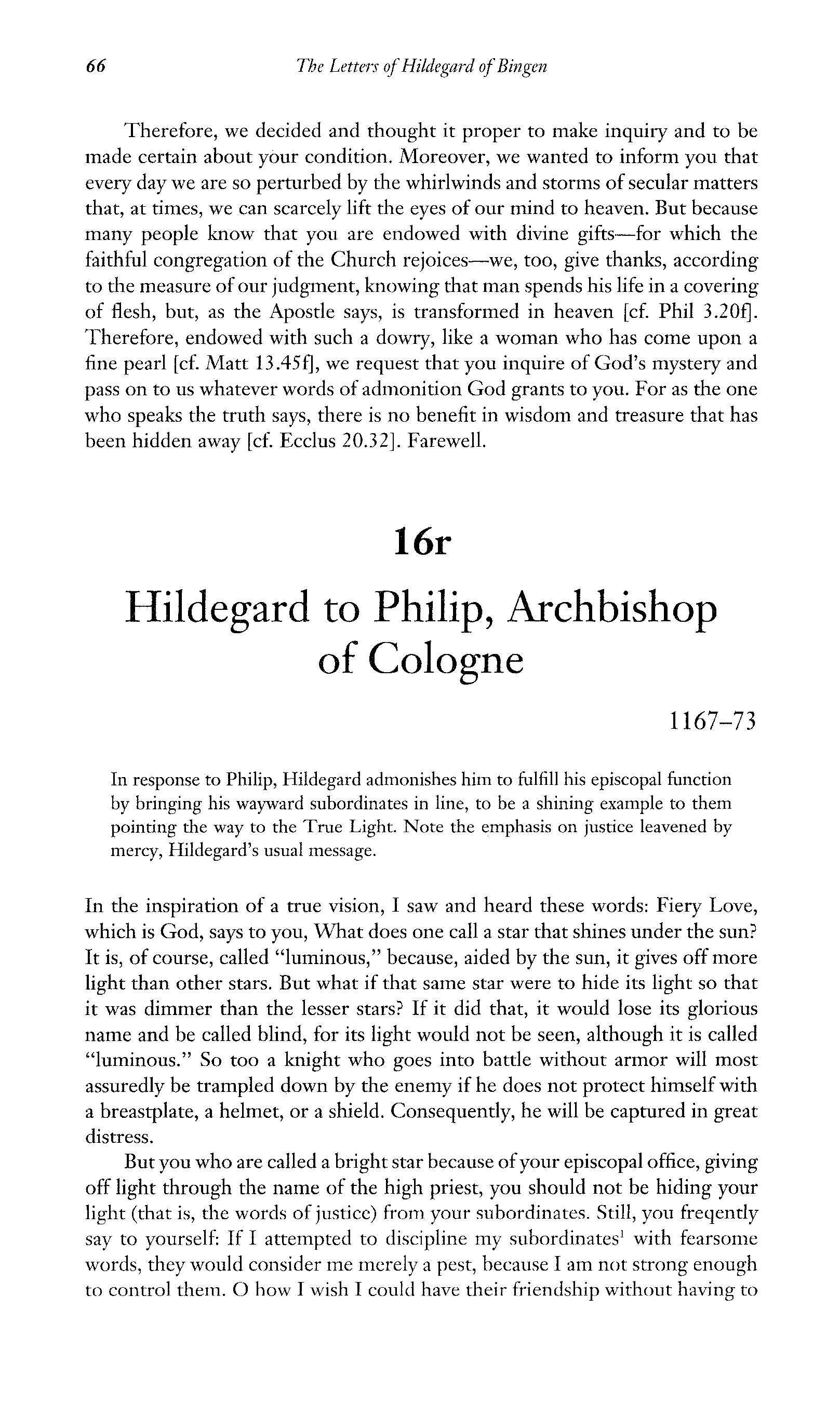
The Letters of Hildegard ofBingen Therefore, we decided and thought it proper to make inquiry and to be made certain about your condition. Moreover, we wanted to inform you that every day we are so perturbed by the whirlwinds and storms of secular matters that, at times, we can scarcely lift the eyes of our mind to heaven. But because many people know that you are endowed with divine gifts—for which the faithful congregation of the Church rejoices—we, too, give thanks, according to the measure of our judgment, knowing that man spends his life in a covering of flesh, but, as the Apostle says, is transformed in heaven [cf. Phil 3.2Of].
Therefore, endowed with such a dowry, like a woman who has come upon a fine pearl [cf. Matt 13.45fj, we request that you inquire of God's mystery and pass on to us whatever words of admonition God grants to you. For as the one who speaks the truth says, there is no benefit in wisdom and treasure that has been hidden away [cf. Ecclus 20.32]. Farewell.
16r Hildegard to Philip, Archbishop of Cologne 1167-73 In response to Philip, Hildegard admonishes him to fulfill his episcopal function by bringing his wayward subordinates in line, to be a shining example to them pointing the way to the True Light. Note the emphasis on justice leavened by mercy, Hildegard's usual message.
In the inspiration of a true vision, I saw and heard these words: Fiery Love, which is God, says to you, What does one call a star that shines under the sun?
It is, of course, called "luminous," because, aided by the sun, it gives off more light than other stars. But what if that same star were to hide its light so that it was dimmer than the lesser stars? If it did that, it would lose its glorious name and be called blind, for its light would not be seen, although it is called
"luminous." So too a knight who goes into battle without armor will most assuredly be trampled down by the enemy if he does not protect himself with a breastplate, a helmet, or a shield. Consequently, he will be captured in great distress.
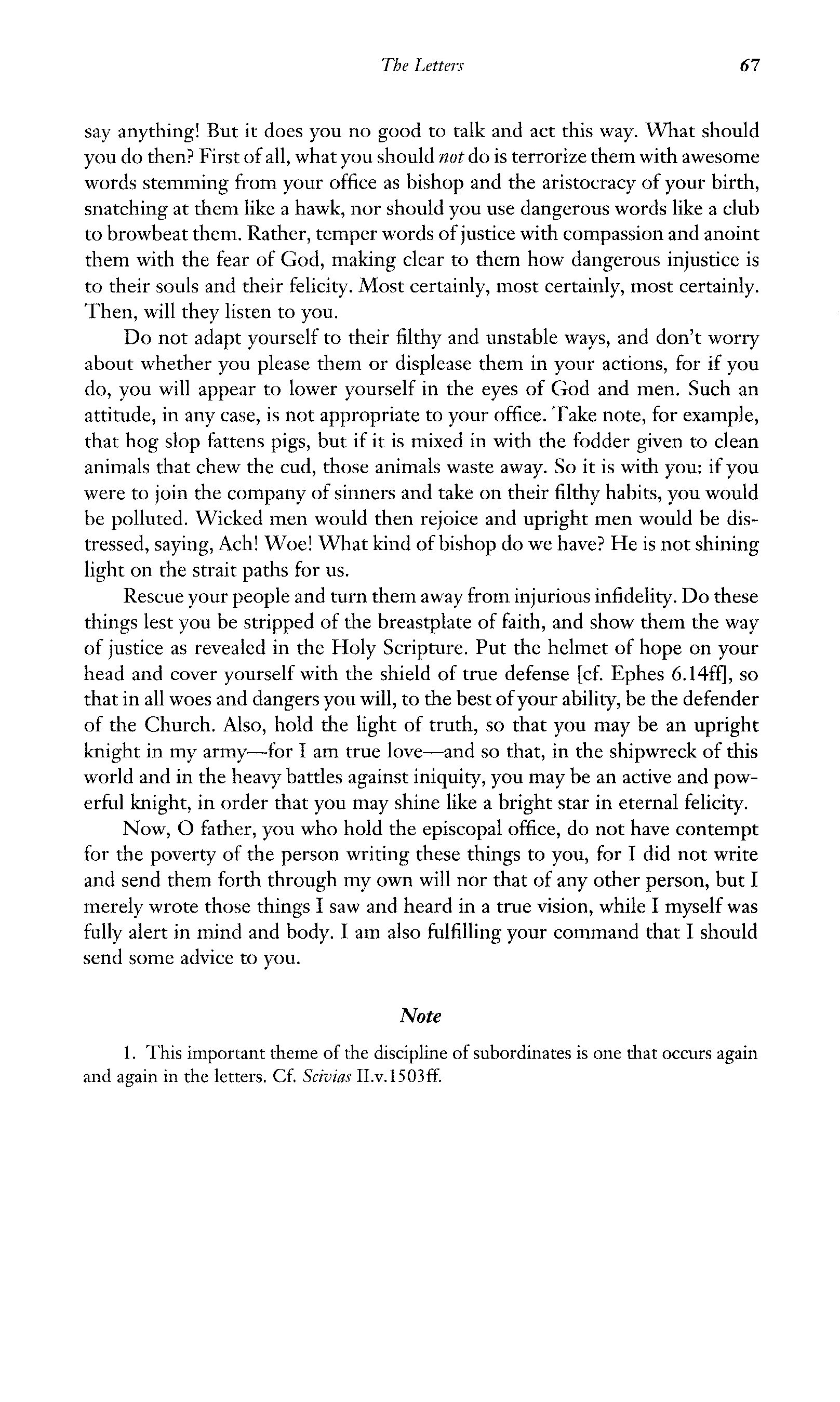
But you who are called a bright star because of your episcopal office, giving off light through the name of the high priest, you should not be hiding your light (that is, the words of justice) from your subordinates. Still, you freqently say to yourself: If I attempted to discipline my subordinates' with fearsome words, they would consider me merely a pest, because I am not strong enough to control them. O how I wish I could have their friendship without having to
The Letters
say anything! But it does you no good to talk and act this way. What should you do then? First of all, what you should not do is terrorize them with awesome words stemming from your office as bishop and the aristocracy of your birth, snatching at them like a hawk, nor should you use dangerous words like a club to browbeat them. Rather, temper words of justice with compassion and anoint them with the fear of God, making clear to them how dangerous injustice is to their souls and their felicity. Most certainly, most certainly, most certainly.
Then, will they listen to you.
Do not adapt yourself to their filthy and unstable ways, and don't worry about whether you please them or displease them in your actions, for if you do, you will appear to lower yourself in the eyes of God and men. Such an attitude, in any case, is not appropriate to your office. Take note, for example, that hog slop fattens pigs, but if it is mixed in with the fodder given to clean animals that chew the cud, those animals waste away. So it is with you: if you were to join the company of sinners and take on their filthy habits, you would be polluted. Wicked men would then rejoice and upright men would be distressed, saying, Ach! Woe! What kind of bishop do we have? He is not shining light on the strait paths for us.
Rescue your people and turn them away from injurious infidelity. Do these things lest you be stripped of the breastplate of faith, and show them the way of justice as revealed in the Holy Scripture. Put the helmet of hope on your head and cover yourself with the shield of true defense [cf. Ephes 6.14ffJ, so that in all woes and dangers you will, to the best of your ability, be the defender of the Church. Also, hold the light of truth, so that you may be an upright knight in my army—for I am true love—and so that, in the shipwreck of this world and in the heavy battles against iniquity, you may be an active and powerful knight, in order that you may shine like a bright star in eternal felicity.
Now, O father, you who hold the episcopal office, do not have contempt for the poverty of the person writing these things to you, for I did not write and send them forth through my own will nor that of any other person, but I merely wrote those things I saw and heard in a true vision, while I myself was fully alert in mind and body. I am also fulfilling your command that I should send some advice to you.
Note 1. This important theme of the discipline of subordinates is one that occurs again and again in the letters. Cf. Scivias II.v.l503ff.
The Letters ofHildegard ofBingen
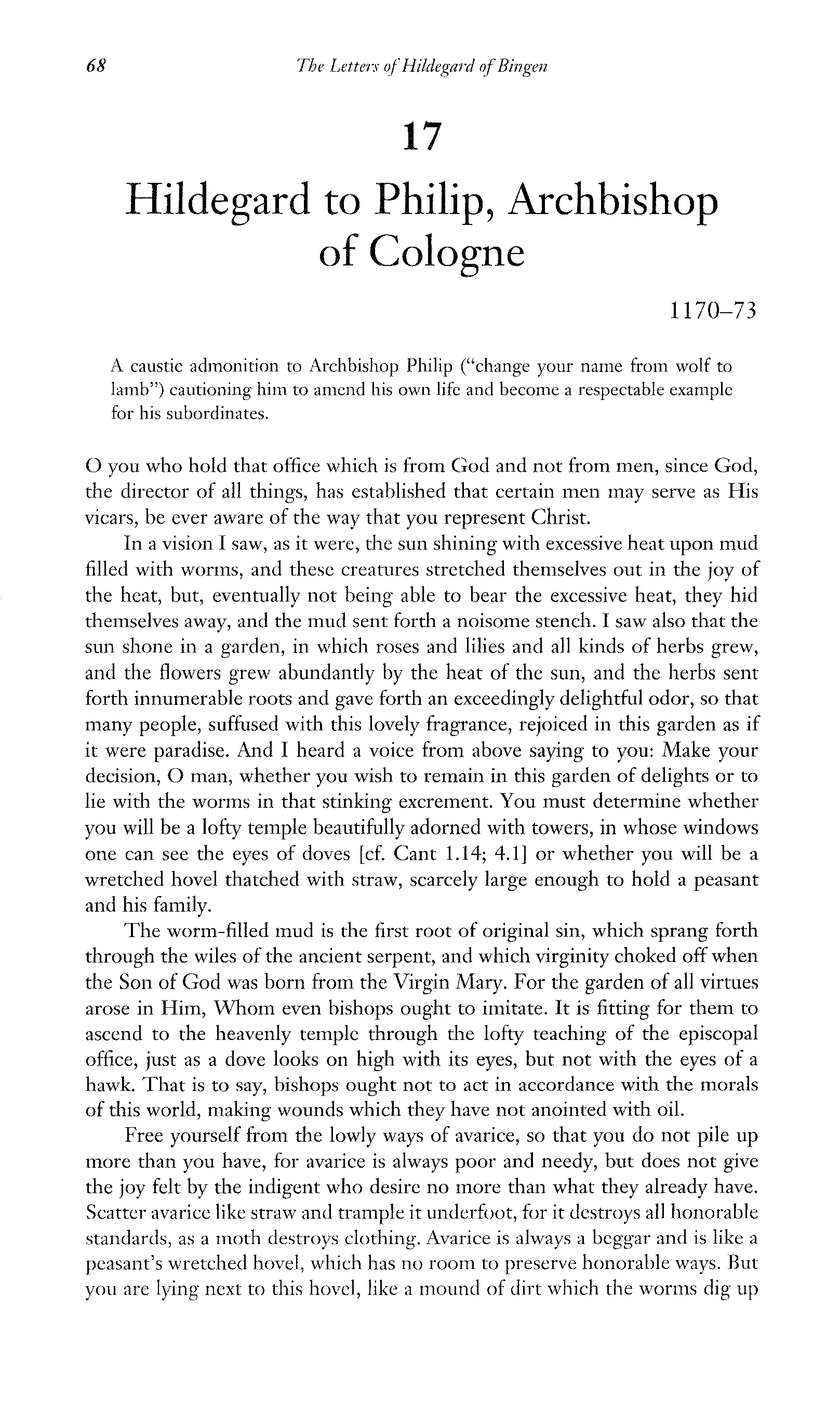
Hildegard to Philip, Archbishop of Cologne 1170-73 A caustic admonition to Archbishop Philip ("change your name from wolf to lamb") cautioning him to amend his own life and become a respectable example for his subordinates.
O you who hold that office which is from God and not from men, since God, the director of all things, has established that certain men may serve as His vicars, be ever aware of the way that you represent Christ.
In a vision I saw, as it were, the sun shining with excessive heat upon mud filled with worms, and these creatures stretched themselves out in the joy of the heat, but, eventually not being able to bear the excessive heat, they hid themselves away, and the mud sent forth a noisome stench. I saw also that the sun shone in a garden, in which roses and lilies and all kinds of herbs grew, and the flowers grew abundantly by the heat of the sun, and the herbs sent forth innumerable roots and gave forth an exceedingly delightful odor, so that many people, suffused with this lovely fragrance, rejoiced in this garden as if it were paradise. And I heard a voice from above saying to you: Make your decision, O man, whether you wish to remain in this garden of delights or to lie with the worms in that stinking excrement. You must determine whether you will be a lofty temple beautifully adorned with towers, in whose windows one can see the eyes of doves [cf. Cant 1.14; 4.1] or whether you will be a wretched hovel thatched with straw, scarcely large enough to hold a peasant and his family.
The worm-filled mud is the first root of original sin, which sprang forth through the wiles of the ancient serpent, and which virginity choked off when the Son of God was born from the Virgin Mary. For the garden of all virtues arose in Him, Whom even bishops ought to imitate. It is fitting for them to ascend to the heavenly temple through die lofty teaching of the episcopal office, just as a dove looks on high with its eyes, but not with the eyes of a hawk. That is to say, bishops ought not to act in accordance with the morals of this world, making wounds which they have not anointed with oil.
Free yourself from the lowly ways of avarice, so that you do not pile up more than you have, for avarice is always poor and needy, but does not give the joy felt by the indigent who desire no more than what they already have.
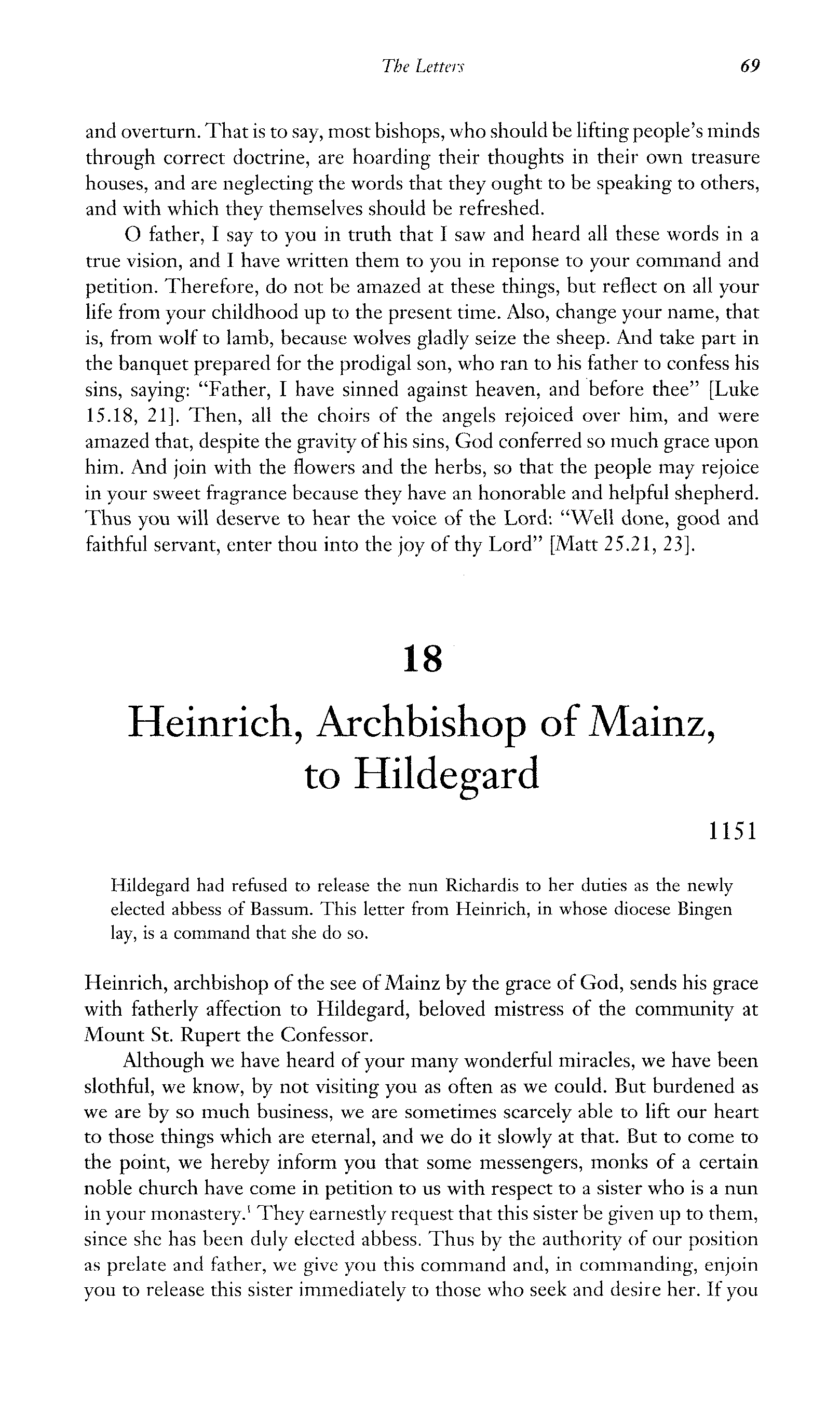
Scatter avarice like straw and trample it underfoot, for it destroys all honorable standards, as a moth destroys clothing. Avarice is always a beggar and is like a peasant's wretched hovel, which has no room to preserve honorable ways. But you are lying next to this hovel, like a mound of dirt which the worms dig up
The Letters
and overturn. That is to say, most bishops, who should be lifting people's minds through correct doctrine, are hoarding their thoughts in their own treasure houses, and are neglecting the words that they ought to be speaking to others, and with which they themselves should be refreshed.
O father, I say to you in truth that I saw and heard all these words in a true vision, and I have written them to you in reponse to your command and petition. Therefore, do not be amazed at these things, but reflect on all your life from your childhood up to the present time. Also, change your name, that is, from wolf to lamb, because wolves gladly seize the sheep. And take part in the banquet prepared for the prodigal son, who ran to his father to confess his sins, saying: "Father, I have sinned against heaven, and before thee" [Luke
15.18, 21]. Then, all the choirs of the angels rejoiced over him, and were amazed that, despite the gravity of his sins, God conferred so much grace upon him. And join with the flowers and the herbs, so that the people may rejoice in your sweet fragrance because they have an honorable and helpful shepherd.
Thus you will deserve to hear the voice of the Lord: "Well done, good and faithful servant, enter thou into the joy of thy Lord" [Matt 25.21, 23].
Heinrich, Archbishop of Mainz, to Hildegard
Hildegard had refused to release the nun Richardis to her duties as the newly elected abbess of Bassum. This letter from Heinrich, in whose diocese Bingen lay, is a command that she do so.
Heinrich, archbishop of the see of Mainz by the grace of God, sends his grace with fatherly affection to Hildegard, beloved mistress of the community at Mount St. Rupert the Confessor.
Although we have heard of your many wonderful miracles, we have been slothful, we know, by not visiting you as often as we could. But burdened as we are by so much business, we are sometimes scarcely able to lift our heart to those things which are eternal, and we do it slowly at that. But to come to the point, we hereby inform you that some messengers, monks of a certain noble church have come in petition to us with respect to a sister who is a nun in your monastery.1 They earnestly request that this sister be given up to them, since she has been duly elected abbess. Thus by the authority of our position as prelate and father, we give you this command and, in commanding, enjoin you to release this sister immediately to those who seek and desire her. If you