
Front matter

The Letters of Hildegard of Bingen
This page intentionally left blank
The Letters of Hildegard of Bingen VOLUME I Translated by Joseph L. Baird Radd K. Ehrman New York Oxford
OXFORD UNIVERSITY PRESS
Oxford University Press Oxford New York Athens Auckland Bangkok Bogota Bombay Buenos Aires Calcutta Cape Town Dar es Salaam
Delhi Florence Hong Kong Istanbul Karachi Kuala Lumpur Madras Madrid Melbourne Mexico City Nairobi Paris Singapore Taipei Tokyo Toronto Warsaw and associated companies in Berlin Ibadan Copyright © 1994 by Oxford University Press
First published in 1994 by Oxford University Press, Inc.
198 Madison Avenue, New York, New York 10016 First issued as an Oxford University Press paperback, 1998.
Oxford is a registered trademark of Oxford University Press, Inc.
All rights reserved. No part of this publication may be reproduced, stored in a retrieval system, or transmitted, in any form or by any means, electronic, mechanical, photocopying, recording, or otherwise, without the prior permission of Oxford University Press.
Library of Congress Cataloging-in-Publication Data Hildegard, Saint, 1098-1179.
[Correspondence. English] The letters of Hildegard of Bingen / translated by Joseph L. Baird, Radd K. Ehrman. p. cm. Includes bibliographical references and index.
ISBN 0-19-508937-5 (v. 1); ISBN 0-19-512117-1 (pbk.) 1. Hildegard, Saint, 1098-1179—Correspondence. 2. Christian saints—Germany—Bingen (Rhineland-Palatinate)—Correspondence.
3. Bingen (Rhineland-Palatinate, Germany)—Biography. I. Baird, Joseph L. II. Ehrman, Radd K. III. Title.
BX4700.H5A3
282'.092—dc20 [B] 93-33715 1 3 5 7 9 8 6 4 2 Printed in the United States of Americ on acid-free paper
This book is severally dedicated, to Four Extraordinary Women to my mother in memoriam Bertis Lee Baird 1909-1989 to her granddaughter Bertis Eve Baird 1966AND to my mother, Leta Ehrman and my wife, Cynthia Ehrman
This page intentionally left blank
Acknowledgments As is usual for any work of this magnitude, debts have accumulated, and it is our pleasure here to acknowledge our gratitude. First and foremost, we owe our deepest appreciation to Professor Barbara Newman of Northwestern University, without whose learned criticism and creative insight this work would never have achieved its present form. P'rom very early on when this book was still work in progress, Professor Newman answered our queries with courtesy and humanitate, and, later, she read the entire manuscript with meticulous attention. We are deeply endebted to her wisdom and experience. We would also like to thank Professor Monika Klaes for her quick response to our letter of enquiry about the letters not contained in Van Acker, and for her generous permission to use her edition of these important letters in our work. All Hildegard scholars are, of course, endebted to Lieven Van Acker for his excellent edition of the correspondence, but our debt is more specific, and we would like to express our appreciation here for his unfailing courtesy and helpfulness in all his contacts with us. Appreciation is due, too, to Timothy Reuter, who answered our electronic cry for help about a puzzling image in one of the letters with an E-mail message from Munich.
Thanks are due also to our friends and colleagues at Kent State University: to Kirk Freudenburg, who puzzled with us, on numerous occasions, over Hildegard's peculiar Latin constructions; to Harold Fry, Ron Crawford, and Emil Sattler, for their expert German assistance; to Rick Newton, for encouragement and support; to Marjorie Pagan, for photocopying, general helpfulness, and unfailing pleasantness; to Baird's informal Latin group—Andy Wilson, Filitsa and John Mullen, and Jeff Simcox—for their enthusiasm and interest in the project; and to Michael Nagy, for his Fridays.
Finally, we are grateful to the Kent State University Research Office for support in the form of photocopying funds.
This page intentionally left blank
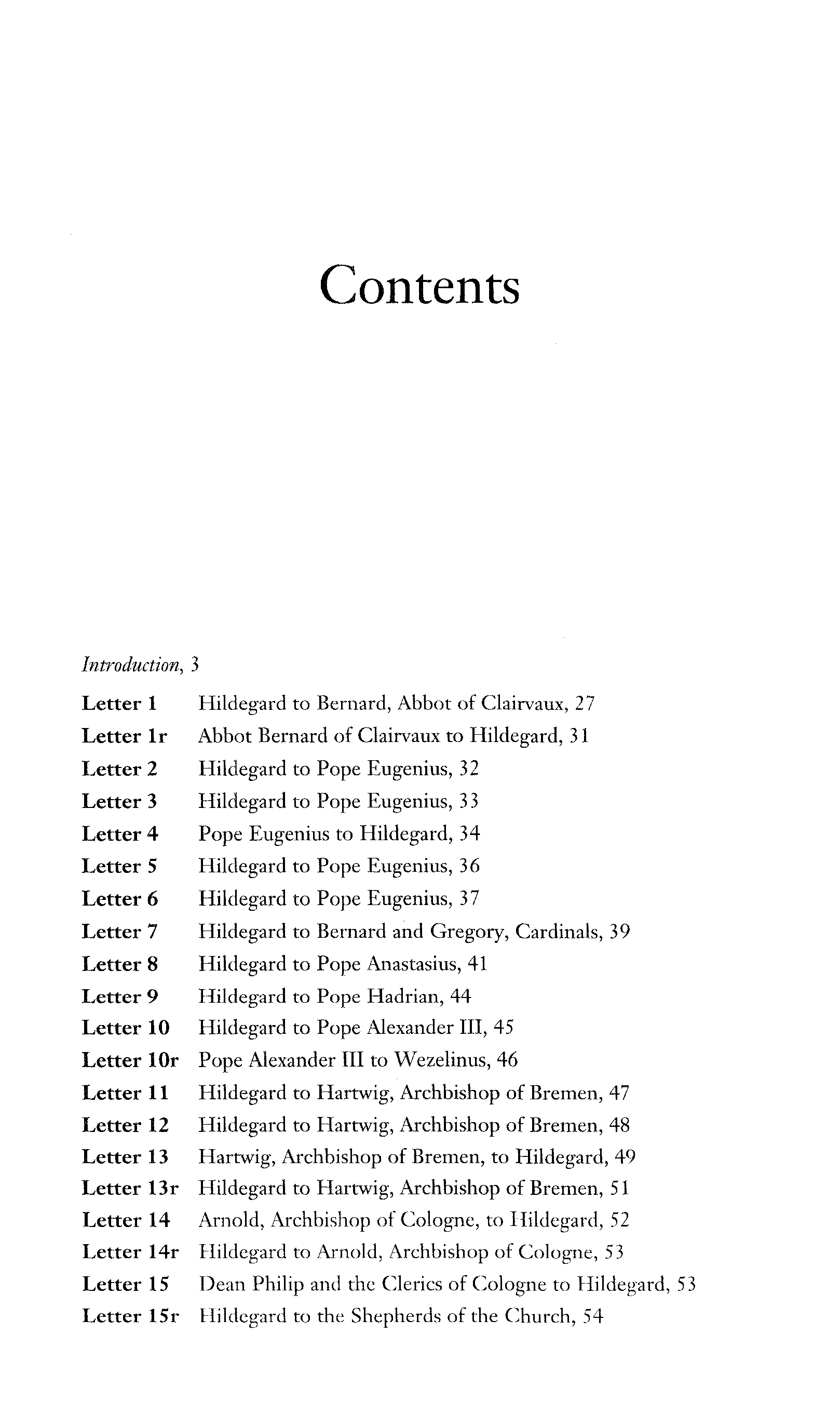
Contents Introduction, 3 Letter 1 Hildegard to Bernard, Abbot of Clairvaux, 27 Letter Ir Abbot Bernard of Clairvaux to Hildegard, 31
Letter 2 Hildegard to Pope Eugenius, 32 Letter 3 Hildegard to Pope Eugenius, 33 Letter 4 Pope Eugenius to Hildegard, 34 Letter 5 Hildegard to Pope Eugenius, 36 Letter 6 Hildegard to Pope Eugenius, 37 Letter 7 Hildegard to Bernard and Gregory, Cardinals, 39
Letter 8 Hildegard to Pope Anastasius, 41 Letter 9 Hildegard to Pope Hadrian, 44 Letter 10 Hildegard to Pope Alexander III, 45 Letter lOr Pope Alexander III to Wezelinus, 46
Letter 11 Hildegard to Hartwig, Archbishop of Bremen, 47 Letter 12 Hildegard to Hartwig, Archbishop of Bremen, 48
Letter 13 Hartwig, Archbishop of Bremen, to Hildegard, 49 Letter 13r Hildegard to Hartwig, Archbishop of Bremen, 51
Letter 14 Arnold, Archbishop of Cologne, to Hildegard, 52 Letter 14r Hildegard to Arnold, Archbishop of Cologne, 53
Letter 15 Dean Philip and the Clerics of Cologne to Hildegard, 53 Letter 15r Hildegard to the Shepherds of the Church, 54
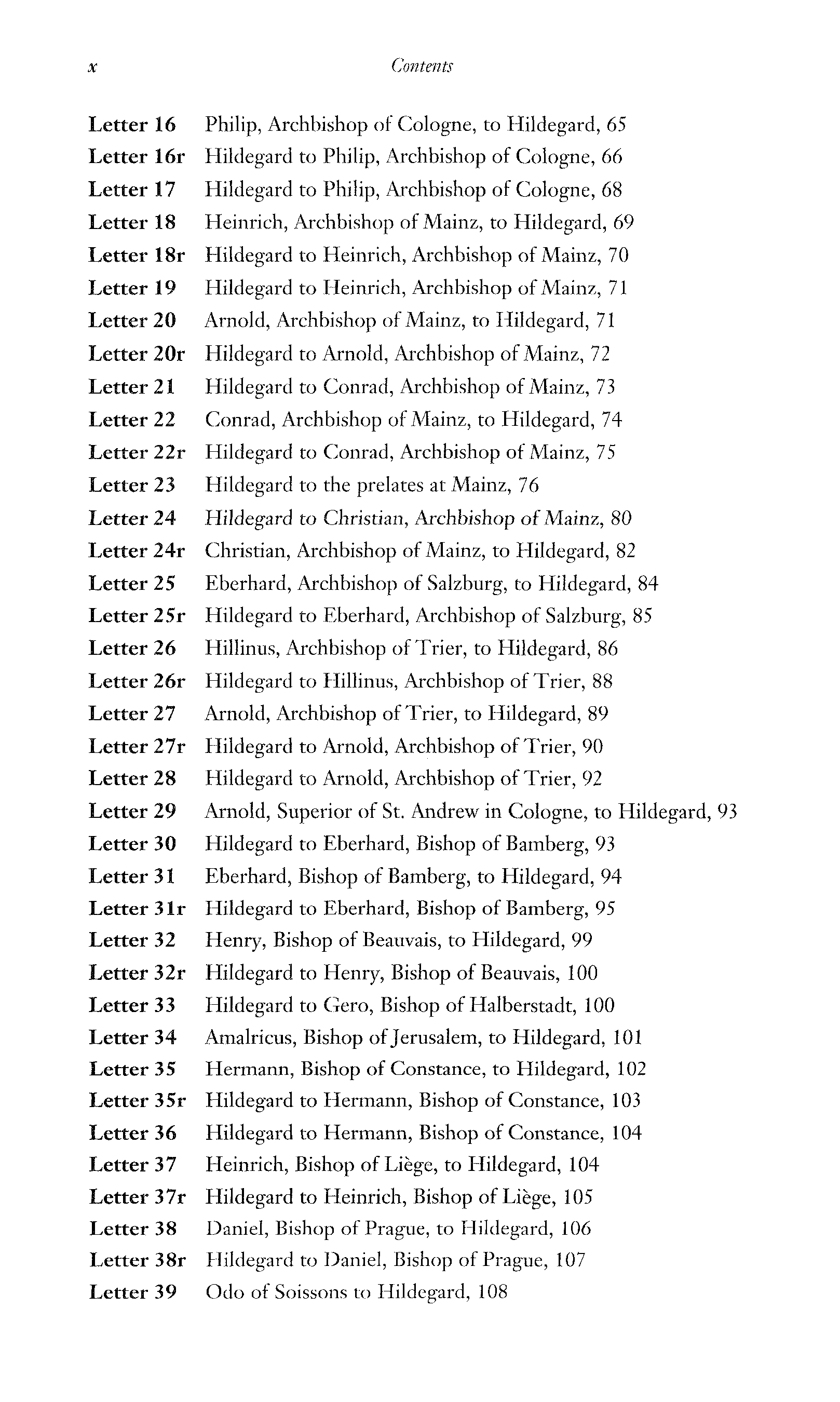
x Contents Letter 16 Philip, Archbishop of Cologne, to Hildegard, 65 Letter 16r Hildegard to Philip, Archbishop of Cologne, 66
Letter 17 Hildegard to Philip, Archbishop of Cologne, 68 Letter 18 Heinrich, Archbishop of Mainz, to Hildegard, 69
Letter 18r Hildegard to Heinrich, Archbishop of Mainz, 70 Letter 19 Hildegard to Heinrich, Archbishop of Mainz, 71
Letter 20 Arnold, Archbishop of Mainz, to Hildegard, 71 Letter 20r Hildegard to Arnold, Archbishop of Mainz, 72
Letter 21 Hildegard to Conrad, Archbishop of Mainz, 73 Letter 22 Conrad, Archbishop of Mainz, to Hildegard, 74
Letter 22r Hildegard to Conrad, Archbishop of Mainz, 75 Letter 23 Hildegard to the prelates at Mainz, 76 Letter 24 Hildegard to Christian, Archbishop of Mainz, 80
Letter 24r Christian, Archbishop of Mainz, to Hildegard, 82 Letter 25 Eberhard, Archbishop of Salzburg, to Hildegard, 84
Letter 25r Hildegard to Eberhard, Archbishop of Salzburg, 85 Letter 26 Hillinus, Archbishop of Trier, to Hildegard, 86
Letter 26r Hildegard to Hillinus, Archbishop of Trier, 88 Letter 27 Arnold, Archbishop of Trier, to Hildegard, 89
Letter 27r Hildegard to Arnold, Archbishop of Trier, 90 Letter 28 Hildegard to Arnold, Archbishop of Trier, 92
Letter 29 Arnold, Superior of St. Andrew in Cologne, to Hildegard, 93 Letter 30 Hildegard to Eberhard, Bishop of Bamberg, 93
Letter 31 Eberhard, Bishop of Bamberg, to Hildegard, 94 Letter 31r Hildegard to Eberhard, Bishop of Bamberg, 95
Letter 32 Henry, Bishop of Beauvais, to Hildegard, 99 Letter 32r Hildegard to Henry, Bishop of Beauvais, 100
Letter 33 Hildegard to Gero, Bishop of Halberstadt, 100 Letter 34 Amalricus, Bishop of Jerusalem, to Hildegard, 101
Letter 35 Hermann, Bishop of Constance, to Hildegard, 102 Letter 35r Hildegard to Hermann, Bishop of Constance, 103
Letter 36 Hildegard to Hermann, Bishop of Constance, 104 Letter 37 Heinrich, Bishop of Liege, to Hildegard, 104
Letter 37r Hildegard to Heinrich, Bishop of Liege, 105 Letter 38 Daniel, Bishop of Prague, to Hildegard, 106
Letter 38r Hildegard to Daniel, Bishop of Prague, 107 Letter 39 Odo of Soissons to Hildegard, 108
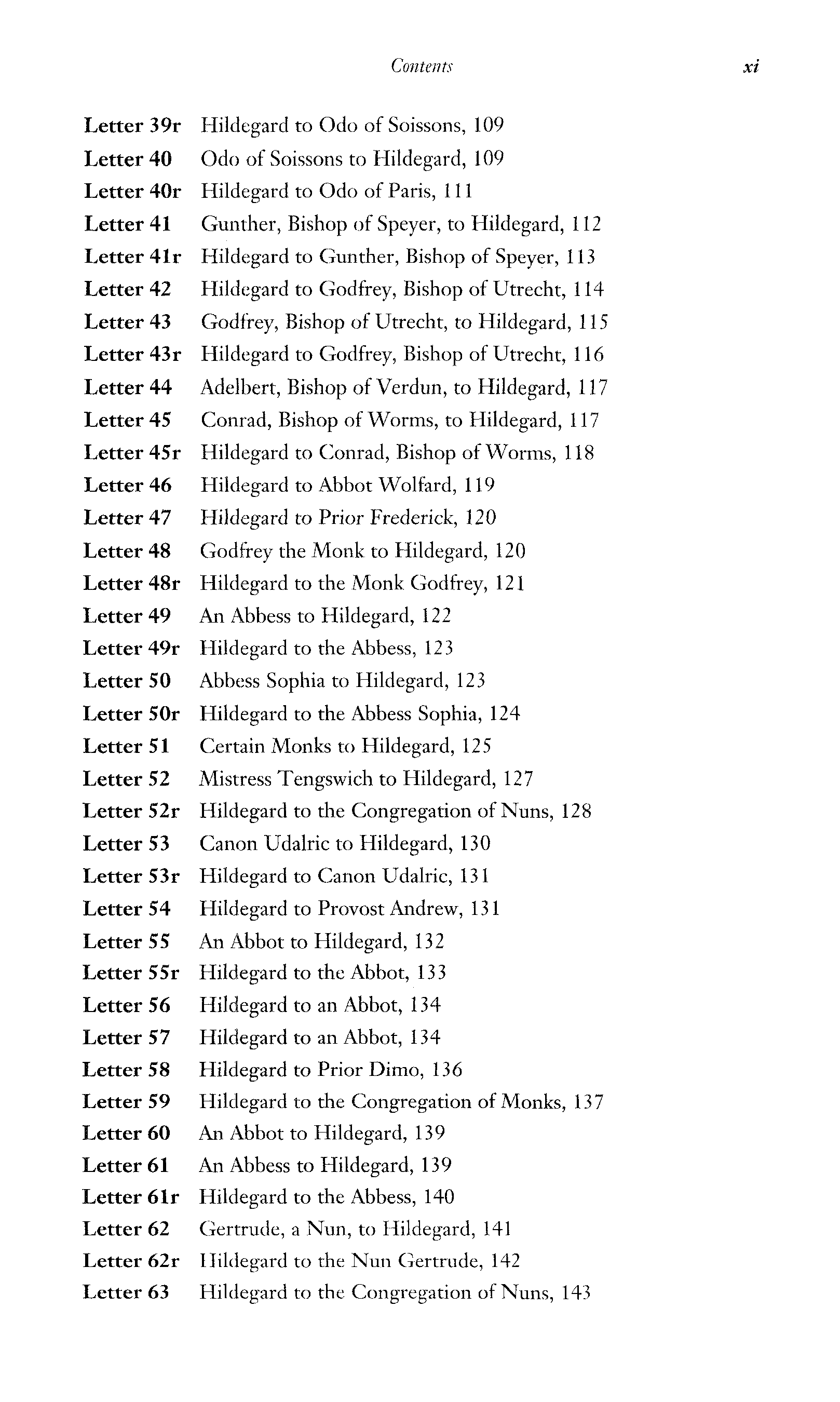
xi Contents Letter 39r Hildegard to Odo of Soissons, 109 Letter 40 Odo of Soissons to Hildegard, 109 Letter 40r Hildegard to Odo of Paris, 111
Letter 41 Gunther, Bishop of Speyer, to Hildegard, 112 Letter 41r Hildegard to Gunther, Bishop of Speyer, 113
Letter 42 Hildegard to Godfrey, Bishop of Utrecht, 114 Letter 43 Godfrey, Bishop of Utrecht, to Hildegard, 115
Letter 43r Hildegard to Godfrey, Bishop of Utrecht, 116 Letter 44 Adelbert, Bishop of Verdun, to Hildegard, 117
Letter 45 Conrad, Bishop of Worms, to Hildegard, 117 Letter 45r Hildegard to Conrad, Bishop of Worms, 118
Letter 46 Hildegard to Abbot Wolfard, 119 Letter 47 Hildegard to Prior Frederick, 120 Letter 48 Godfrey the Monk to Hildegard, 120 Letter 48r Hildegard to the Monk Godfrey, 121
Letter 49 An Abbess to Hildegard, 122 Letter 49r Hildegard to the Abbess, 123 Letter 50 Abbess Sophia to Hildegard, 123 Letter 50r Hildegard to the Abbess Sophia, 124
Letter 51 Certain Monks to Hildegard, 125 Letter 52 Mistress Tengswich to Hildegard, 127 Letter 52r Hildegard to the Congregation of Nuns, 128
Letter 53 Canon Udalric to Hildegard, 130 Letter 53r Hildegard to Canon Udalric, 131
Letter 54 Hildegard to Provost Andrew, 131 Letter 55 An Abbot to Hildegard, 132 Letter 55r Hildegard to the Abbot, 133 Letter 56 Hildegard to an Abbot, 134 Letter 57 Hildegard to an Abbot, 134 Letter 58 Hildegard to Prior Dimo, 136 Letter 59 Hildegard to the Congregation of Monks, 137
Letter 60 An Abbot to Hildegard, 139 Letter 61 An Abbess to Hildegard, 139 Letter 61r Hildegard to the Abbess, 140 Letter 62 Gertrude, a Nun, to Hildegard, 141 Letter 62r Hildegard to the Nun Gertrude, 142
Letter 63 Hildegard to the Congregation of Nuns, 143
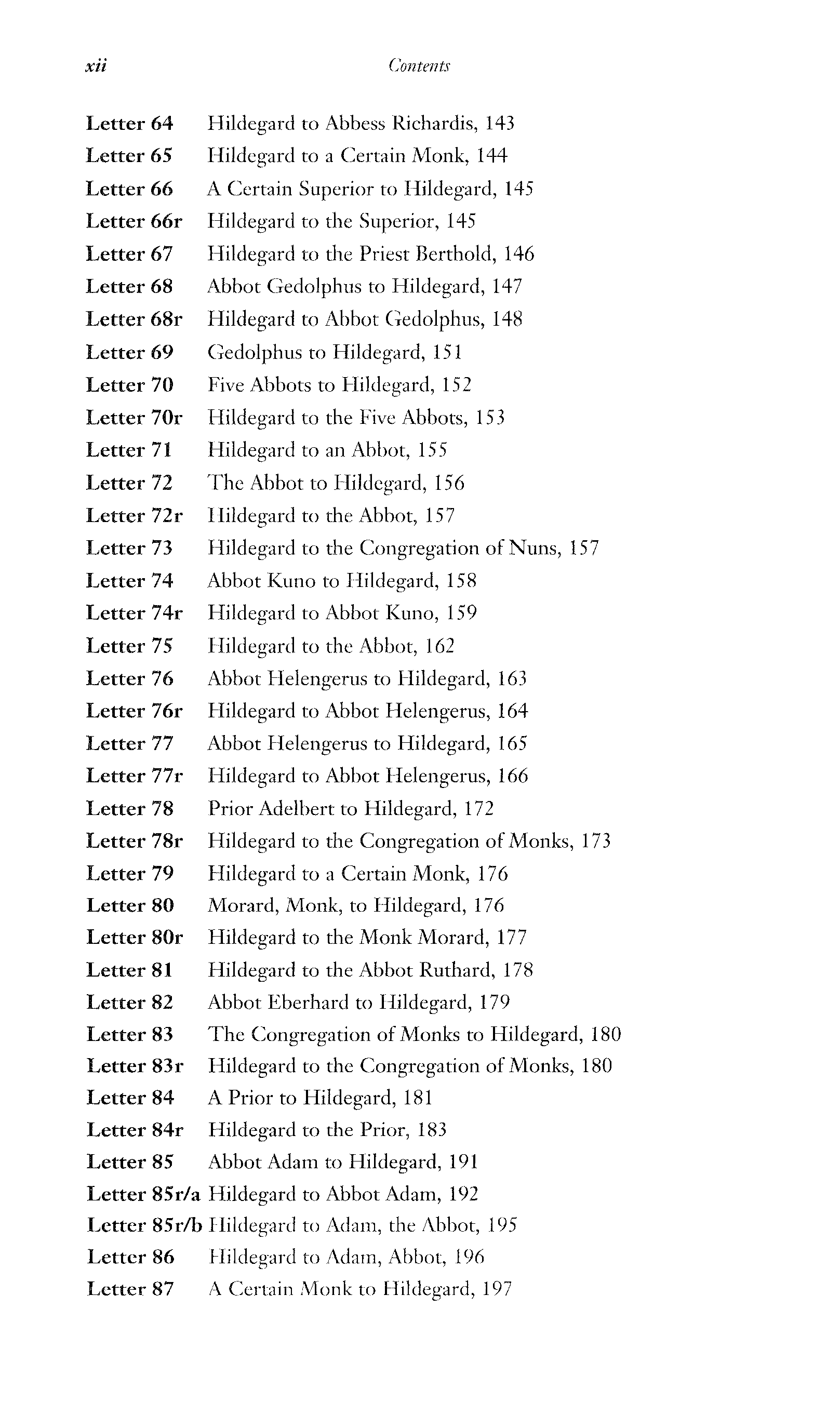
xii (Contents Letter 64 Hildegard to Abbess Richardis, 143 Letter 65 Hildegard to a Certain Monk, 144 Letter 66 A Certain Superior to Hildegard, 145 Letter 66r Hildegard to the Superior, 145 Letter 67 Hildegard to the Priest Berthold, 146 Letter 68 Abbot Gedolphus to Hildegard, 147 Letter 68r Hildegard to Abbot Gedolphus, 148 Letter 69 Gedolphus to Hildegard, 151 Letter 70 Five Abbots to Hildegard, 152 Letter 70r Hildegard to the Five Abbots, 153 Letter 71 Hildegard to an Abbot, 155 Letter 72 The Abbot to Hildegard, 156 Letter 72r Hildegard to the Abbot, 157 Letter 73 Hildegard to the Congregation of Nuns, 157
Letter 74 Abbot Kuno to Hildegard, 158 Letter 74r Hildegard to Abbot Kuno, 159 Letter 75 Hildegard to the Abbot, 162 Letter 76 Abbot Helengerus to Hildegard, 163 Letter 76r Hildegard to Abbot Helengerus, 164 Letter 77 Abbot Helengerus to Hildegard, 165 Letter 77r Hildegard to Abbot Helengerus, 166 Letter 78 Prior Adelbert to Hildegard, 172 Letter 78r Hildegard to the Congregation of Monks, 173
Letter 79 Hildegard to a Certain Monk, 176 Letter 80 Morard, Monk, to Hildegard, 176 Letter 80r Hildegard to the Monk Morard, 177 Letter 81 Hildegard to the Abbot Ruthard, 178 Letter 82 Abbot Eberhard to Hildegard, 179 Letter 83 The Congregation of Monks to Hildegard, 180
Letter 83r Hildegard to the Congregation of Monks, 180 Letter 84 A Prior to Hildegard, 181 Letter 84r Hildegard to the Prior, 183 Letter 85 Abbot Adam to Hildegard, 191 Letter 85r/a Hildegard to Abbot Adam, 192
Letter 85r/b Hildegard to Adam, the Abbot, 195 Letter 86 Hildegard to Adam, Abbot, 196 Letter 87 A Certain Monk to Hildegard, 197
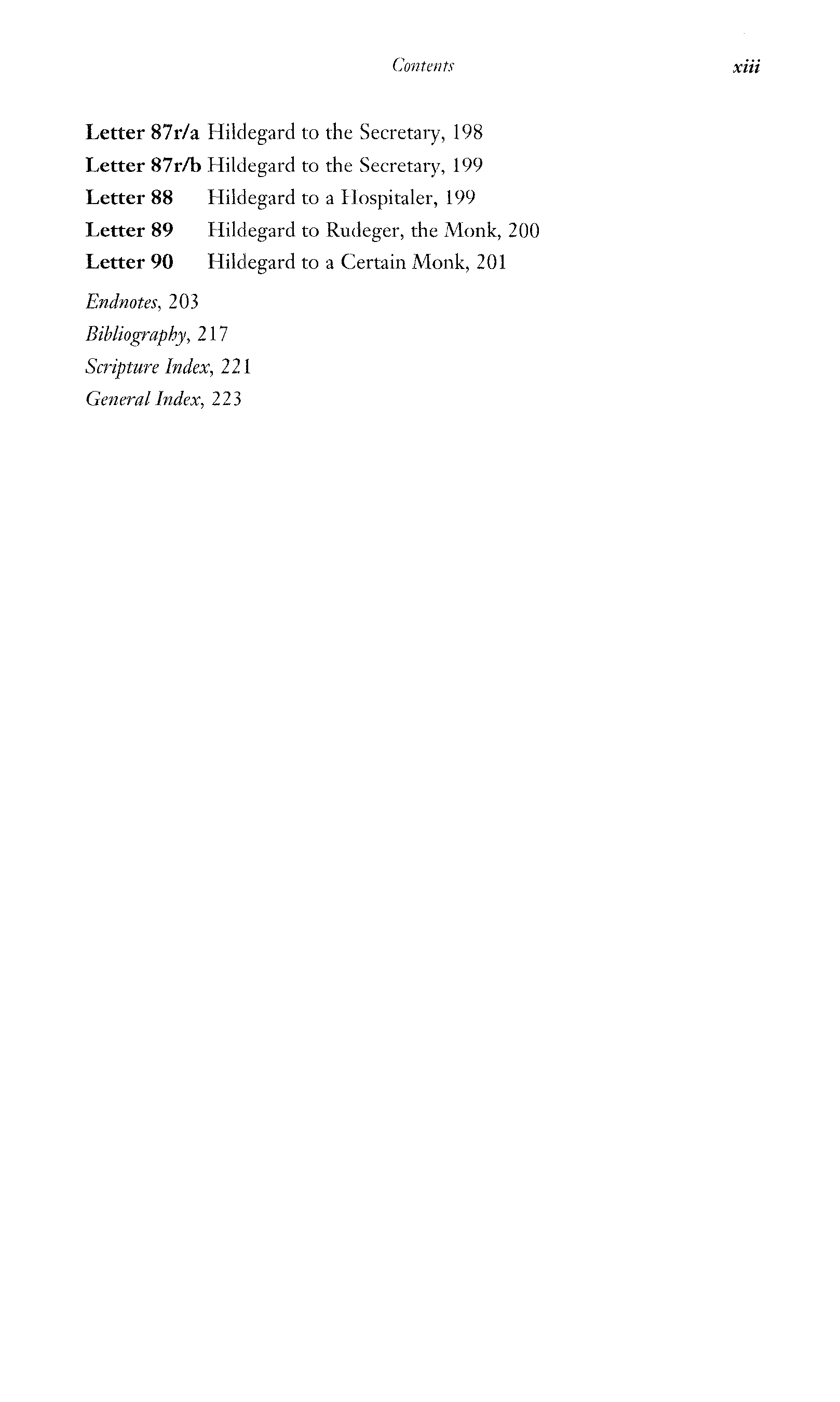
xiii Contents Letter 87r/a Hildegard to the Secretaiy, 198 Letter 87r/b Hildegard to the Secretaiy, 199
Letter 88 Hildegard to a Hospitaler, 199 Letter 89 Hildegard to Rudeger, the Monk, 200 Letter 90 Hildegard to a Certain Monk, 201 Endnotes, 203 Bibliography, 217 Scripture Index, 221 General Index, 223
This page intentionally left blank

The Letters of Hildegard of Bingen
This page intentionally left blank
Introduction It must have been an awe-inspiring sight, a truly lovely and captivating scene:
On solemn feast days the ladies of Mount St. Rupert, all of noble lineage, gathered in procession and made their way slowly to the choir, walking in splendor, clad all in white, with silk veils so long they reached to their feet and lightly touched the floor. With the grace natural to their highborn estate, they walked, with unbound, free-flowing hair, and with elegant gold rings on their fingers. They sang as they walked, their melodious voices pouring forth psalms and hymns of praise to the Divine, and on their heads they wore crowns of gold filigree that at once affirmed and belied their earthly nobility, for, emphasizing spiritual other-ness, these resplendent circlets bore figures of the cross on the sides and back, and, on the front, the confirming image of the Agnus
Dei. And all was graceful beauty, loveliness and melody, and unstinting praise, like a vision of paradise—a ceremony fit for the King, the outer splendor deliberately calculated to reflect the inward spirituality.
And yet, to some, it was a distasteful, even irreligious, ceremony, for we learn of the extraordinary activity of this extraordinary monastery under the governance of Hildegard of Bingen only from a hostile source (see Letter 52).
These charges against her—of accepting only nobility into her community, of indulging feminine vanity—Hildegard answered, in part, by what must surely be the highest paean of praise to womankind to come down to us from the Middle Ages: "O woman, what a splendid being you are! For you have set your foundation in the sun, and you have conquered the world" (Letter 52r).
Although Hildegard continues her defense by asserting that the strictures against feminine decoration do not apply to virgins, who stand "in the unsullied purity of paradise," she does not, as might have been expected, elaborate the
The Letters of Hildegard ofBingen argument by recourse to the medieval commonplace of the monastery as the hortus condusus, "the enclosed garden," the earthly paradise wherein the tranquillity and beauty of the supernal could, in part, be recaptured. Yet such an image, such a complex of ideas, must, surely, have been latent in her thought as she worked out the myriad details of this uncommon ceremony. Indeed, in another letter (23), she makes an argument of just that kind for the power and efficacy of music. Inspired by the Holy Spirit, the prophets, she asserts, were called for this purpose: not only to compose psalms and canticles (by which die hearts of listeners would be inflamed) but also to construct various kinds of musical instruments to enhance these songs of praise with melodic strains. Thereby, both through the form and quality of the instruments, as well as through the meaning of the words which accompany diem, those who hear might be taught about inward things, since they have been admonished and aroused by outward things. In such a way, these holy prophets get beyond the music of this exile and recall to mind that divine melody of praise which Adam, in company with the angels, enjoyed in God before his fall.
It is fortunate that so large a collection of the correspondence—nearly 400 of Hildegard's own letters—has been preserved, for these epistles enlarge our view of Hildegard far beyond that of the near-unapproachable seer of the Scivias and the other visionary works. In these letters, instead, we find the practical abbess, as above, concerning herself with the pragmatic details of religious ceremony, a ritual modeled, to be sure, on her ethereal visions of the celestial virtues but worked out nonetheless on an earthly plane. In this instance, too, it is significant that we are privileged to see her through the eyes—the unawed eyes at that—of a contemporary. Or we find her, as in the other letter referred to above, working toward a still inchoate philosophy of music, a theory that, one has the sense, might well have been worked out in far more systematic detail in another visionary work, if she had lived a few years longer.
None of this is to say, of course, that the seer is not present in the letters.
Far from it. Here, too, as elsewhere, there is a continual oscillation between the almost abject humility of the "poor little form of a woman" and the commanding authority of the voice of the Living Light, so much so indeed that they often merge so completely that it is difficult to determine who is Who.
Still, there is something far more personal here: the near hysteria of the woman who has recourse to the authority of the Living Light in a desperate—and futile—attempt to hold on to the beloved nun who has been taken from her; the sorrowful resignation, without recriminations, upon receiving word of the untimely death of that nun; the deep sorrow on the loss of music to her community through the edicts of excommunication; the care taken to respond to even the most trivial of requests from those who sought her out as the very oracle of God; the continuing devoted memory to those who cared for her, taught her, and loved her as a child; the stubborn refusal to compromise her principles, even in advanced old age, despite the threat and, eventually, the fact of interdict; the sheer audacity of the woman, who felt herself buoyed by the
Introduction
wings of the Divine, and called forth the strength to speak out to a weak, effeminate age; et cetera.
Hildegard of Bingen was born in 1098 in Bermersheim, a small town not far from Mainz, the tenth child of a local nobleman named Hildebert and his wife Mechthild. From earliest childhood she gave indications of unusual faculties, seeing, as she herself affirms, brilliant lights and strange visions. In her childish naivete, she thought that everybody "saw" as she did, and so she queried her nurse, but, receiving a negative, was abashed and resolved to keep her peace. It was as early as the age of three—or five, according to the prefatory remarks in the Scivias—that she began experiencing such paranormal phenomena when she saw a light so bright that anima men contremuit, "my very soul shook."1 Perhaps because she was such an unusual, other-worldly, child, or perhaps simply because, as the tenth child of her parents, she was offered up as a spiritual tithe, at the age of eight she was presented as an oblate to God.
At this time she entered a small cell attached to the Benedictine monastery of Mount St. Disibod, where she was entrusted to the care of the anchoress Jutta of Sponheim. Here she was to stay—in relative obscurity—for some thirty years. The early years she spent alone with Jutta, but the little cell of two grew as, over the years, more and more noble, young girls placed themselves under Jutta's governance, and upon Jutta's death in 1136 Hildegard herself was elected to her position as head of the community.
From Jutta, Hildegard received a rudimentary education, or, as the Vita (Li.2) puts it, she was taught the Psalter, that is, presumably, she was taught to read Latin. Beyond this early nurturing, the most significant service that Jutta performed was to put Hildegard in contact with the monk Volmar, who not only continued, and broadened, her education, but once she began her own writing career, served as her secretary, confidant, and friend for the rest of his life (and much of hers) until his death in 1173. It was Volmar who encouraged her to begin her first major work, the Scivias, exhorting her to put those things in writing "secretly," until he could determine what they were and from whence they came. And it was Volmar, who, once convinced of the divine inspiration, brought her writing to the attention of Kuno, abbot of St. Disibod.
Kuno brought the matter to the attention of Heinrich, archbishop of Mainz; and Heinrich, to Pope Eugenius, who just happened to be presiding over the Synod of Trier in 1147-48, and from that happy coincidence the career—and fame—of Hildegard took wing. The pope himself read Hildegard's work to the assembled prelates. They were all duly impressed, and impelled by their urging (along with the specific support of Bernard of Clairvaux), Eugenius gave his sanction to her work, and commanded her to continue writing. The correspondence itself began in that same eventful year of 1147, when, only a short time before the reading in Trier, Hildegard wrote to Bernard seeking his advice and approval.
At this point Hildegard is forty-nine years old! She had received the call to put her visions into writing only some six years earlier, in 1141. Thus it is startling to realize, on reviewing the facts of her history, that she did not begin
The Letters ofHildegard of'Bingen her lifework—at least her public lifework—until she was forty-three, and this despite the fact that she had been receiving visions from infancy. That longdelay was doubtless the result of the accident of gender.' What one can say, most certainly, is that from the age of forty-three forward, until her death at eighty-one (even old age seeming powerless to slow her down), Hildegard— to use an image dear to her heart—tilled the Lord's garden with great diligence.
She produced six major written works, she founded two flourishing monasteries, she wrote music, she gave birth to the earliest full-fledged morality play, she became the correspondent—and advisor—of popes, kings, emperor. It was a full life indeed.
The extent of Hildegard's education is a problem not likely ever to be solved. We know thatjutta supplied rudimentary instruction, and that Volmar built on that foundation. Beyond that, not very much. We know that her grasp of Latin syntax and structure is somewhat less than certain, and we know that she herself always claims, insists (and others insist for her), that she is indocta,
"unlearned" and untaught. Concerning this matter, the author of the Vita (Il.i. 14) writes:
It is a great and wondrous matter that she wrote with her own hand/ and uttered aloud with a pure, unsullied mind those things which she heard and saw in her spirit, using the same sense and the same words. She was content to rely on only one faithful man as her eollaborator, who undertook to arrange the cases, tenses, and genders grammatically (since she herself was unschooled in grammar). He did not, however, take it upon himself to add or subtract anything whatsoever from the sense or meaning.
And Hildegard is even more determined to deny any mere earthly learning.
She acknowledges her celestial knowledge, of course, is confident—even defiant—in her possession of it, but that knowledge came, as it were, despite her ignorance, or perhaps not despite but because of it:
I saw a great splendor in which resounded a voice from Heaven, saying to me, "O fragile human, ashes of ashes, and filth of filth! Say and write what you see and hear. But since you are timid in speaking, and simple in expounding, and untaught in writing, speak and write these things not by human mouth, and not by the understanding of human invention, and not by the requirements of human composition, but as you see and hear them on high in the heavenly places in the wonders of God. . . . " And immediately I knew the meaning of the exposition of the Scriptures, namely, the Psalter, the Gospel and the other catholic volumes of both the Old and the New Testaments, though I did not have the interpretation of the words of their texts or the division of the syllables or the knowledge of cases or tenses.4
A part of this attitude is owing, of course, to pure convention, to the omnipresent humility formula, but in this case it seems to be that and much more. The more the paupercula "the poor little form of a woman" stresses her wretchedness, her humility, her ignorance of earthly learning, the more credence is given to her otherworldly illumination. How could one lacking the very basic instruments of grammar speak with such authority, such great con-
Introduction
fidence, unless inspired by the Divine? In this respect it is interesting to note
Volmar's response on first learning of Hildegard's visions: he sought to discover what these visions were and whence they had come. For him, there was no question of the inspiration, only a matter of the direction from which that inspiration had come.
In any case, whatever weight we might feel compelled to give to her protestations of ignorance, it is certainly true that her learning and abil ity far exceed that of the acquisition of the mere rudiments of Latin, however shaky her grammar may be at times. On occasion she soars to real grandeur and eloquence, as in her learned disquisition on the wondrous properties of music
(Letter 23), or in her majestic trumpeting forth of her own divine mission (Scivias "Protestificatio"), or in her use of humble, homey images to express a divine purpose (like, for instance, her vision of herself as a helpless feather conveyed by the wind of the Holy Spirit, used again and again in the letters and elsewhere), or in her (calculated?) shift between the extreme humility of the wretched woman and the thundering, commanding voice of the Living
Light (used throughout). Moreover, she was far more widely read than her protestations would lead one to believe. Peter Dronke has argued for her acquaintance not only with the Scriptures but also with the writings of the Church Fathers (perhaps even including Origen), as wrell as with Classical texts such as Cicero's De Natura Deorum, Lucan's Pharsalia, and Seneca's Quaestiones
Naturales.s One of the greatest challenges in reading (and translating) Hildegard indeed comes not from her own difficulty with the scholarly language, but, as it were, from her very ease with it, her fecund and canny use of its creative possibilities. Perhaps the most: notable example of this is her use of viriditas, a word never far from Hildegard's reach. This viriditas, this despair of translators, this "greenness" enters into the very fabric of the universe in Hildegard's cosmic scheme of things. In Hildegard's usage it is a profound, immense, dynamically energized term. The world in the height of the spring season is filled with viriditas, God breathed the breath of viriditas into the inhabitants of the garden of Eden, even the smallest twig on the most insignificant tree is animated with viriditas, the sun brings the life of viriditas into the world; and (in the spiritual realm) the prelate who is filled with taedium (weariness) is lacking in viriditas, the garden where the virtues grow is imbued with viriditas, the neophyte must strive for viriditas, and the holy Virgin is the viridissima virga.
Hildegard can even speak with aplomb of a saint as the viriditas digiti Dei, "the viriditas of the finger of God," as she does of St. Disibod (Letter 74r).
For viriditas to flourish—in the natural world, in the spiritual realm—there must be moisture (humor, humiditas), another concept Hildegard has taken over and made wholly her own. Even the very stones have humor (Letter 3 Ir), and if earth did not have humiditatem et viriditatem, it would crumble like ashes.
"For I"—so speaks the mystic voice through Hildegard—"formed rocks from fire and water like bones, and I established earth from humiditate et viriditate like marrow" (Letter 1 5r). And this, too, is spiritual, since humiditas and viriditas are, as manifestations of God's power, qualities of the human soul, for
The Letters of Hildegard ofBingen "the grace of God shines like the sun and sends its gifts in various ways: in wisdom (sapientia), in viridity (viriditate), in moisture (humiditate)" (Letter 8Sr/ b). It is for such reasons that Hildegard continuously advises her correspondents to be on guard lest their virtues become as dry as the dust: "Watch carefully lest your God-given viridity dry up (arescat) because of the instability of your thought" (Letter 85r/a); or ends a letter with the devout reflection,
"May your eye live in God, and may the viridity of your soul never dry up (arescat)" (Letter 20r). Thought of this sort leads naturally to the garden imagery in which Hildegard's works, including the letters, abound.
And this leads to an understanding of Hildegard's enigmatic pigmentarius as a designation for bishops or priests,6 a usage that has never been satisfactorily explained. This word, which in its basic sense means "a dealer in paints or perfumes," still carries, for Hildegard, an aura of color and fragrance, for it has to do with gardens, and, as might be expected, gardens both physical and spiritual. A pigmentarius is apparently one who, by his industry, works to enhance the lovely colors and delightful odors of his flower or herb garden. In Letter 84r, for example, Hildegard exhorts a prior to rouse the members of his order "out of their ignorance, just as a good pigmentarius eradicates rank weeds from his garden." Thus the administrator or prelate, in Hildegard's special language, becomes the gardener, whose spiritual responsibility it is to dutifully tend his garden. It is for this reason that Hildegard uses the phrase vivens odor as a designation for "monk." None of this is, of course, mere frivolous quibbling or light word play. It is grounded firmly in viriditas and humor/humiditas and the thorough merging of the physical/spiritual so characteristic of Hildegard's thought.
That these ideas are habitual with Hildegard from her earliest writing can be seen in the peroration of her letter to St. Bernard, the opening missive of her correspondence, where one can also see something of the eloquence that she is sometimes capable of in her exalted mode:
On te per serenitatem Patris, etper eius Verbum admirabile, etper suauem humorem compunctionis, Spiritum veritatis, etper sanctum sonitum, per quern sfmat omnis creatura, et per if sum Verbum, de quo mtus est mundus, et per altitudinem Patris, qui in sumii uiriditate misit Verbum in Virginis uterum, unde suxit camem sicut circumedificatur melfauo.
And so I beseech your aid, through the serenity of the Father and through His wondrous Word and through the sweet moisture of compunction, the spirit of truth, and through that holy sound, which all creation echoes, and through that same Word which gave birth to the world, and through the sublimity of the Father, who sent the Word with sweet fruitfulness into the womb of the Virgin, from which He soaked up flesh, just as honey is surrounded by the honeycomb.
This present work is, of course, a collection of letters, but once that fact is acknowledged, qualifications are immediately in order. If, for example, readers bring to these letters the usual modern expectations of intimacy, self-revelation, relative brevity, or even notions of single-person-to-single-person
Introduction
communication, they are likely to be disappointed if not utterly mystified. Perhaps the most important factor to bear in mind with respect to medieval letter collections indeed is the general public-ness of the form, for the medieval letter was a far more public document than our modern predilections lead us to expect. Rarely, if ever, was an individual letter intended for a single recipient alone.7 Modes of production (secretaries, copyists, etc.), modes of transmission
(carriers, messengers), even modes of composition (copybooks containing model letters) made real privacy unlikely at best; and the mode, inevitably, helped to shape and mold the form. As a result, even in those instances where a letter addresses individual problems, it still tends to be cast in generalized, public form, laboriously working through its set formulas, agonizingly slow
(from a modern perspective) to get to the main point at issue. And—though this is less the case with Hildegard's own letters than with letters addressed to her—those formulas tended to be very rigorous and complex, as prescribed by the popular artes dictaminis. This accounts for the elaborate salutations, for which there were very precise rules with respect to class, status, et cetera, as well as for the ostentatious (and, to modern ears, fulsome) praise directed to the intended recipient.8 Yet perhaps the best evidence to confirm the public nature of the epistolary process lies in those instances where the letter that has come down to us consists wholly of formulas without any real substance at all.
For sometimes the message was so private—or perhaps so dangerous—that to commit it to writing was, to say the least, impolitic. In such cases, the nuncius or carrier himself delivered the message orally, die "letter" serving simply as an introduction or as a token of respect and friendship to the recipient.9 See, for example, Letters 11 and 45, where the point of the correspondence remains vaguely, maddeningly obscure.
The public nature of letters could also have disquieting consequences for what we like to think of as authenticity. The texts of letters, more perhaps than with other types of writing, were subject to various kinds of tampering, by recipient as well as original writer after the letter had been sent out. "The text of a letter," as Constable remarks (51), was liable to revision at any stage in its history from the original dictation up to its incorporation into the final collection or other form where it could rest secure from the hands of would-be improvers. These included not only the author but also scribes, secretaries, and even die recipients of letters, who were considered to own the texts of letters sent to them . . . and were sometimes asked by the author to make changes in the text.
The correspondence between Hildegard and Tengswich of Andernach (Letters 53, 53r), for example, was subjected to substantial revision, the form in the later collection of the letters being an edited, "cleaned up" version of that in the earlier one.10 Yet perhaps the greatest temptation for a copier or secretary was the addition of interesting, related, but non-authorial material to the text of a letter, or of merging two or even three different letters and presenting them as a single whole. A brief comparison of the Patrologia edition of the letters with Van Acker's will indicate how frequently the challenge of such
The Letters ofHildegard ofBingen temptations was taken up. Also, see Letter 15r in this collection, with its two long appendages of doubtfully authentic material, printed by Van Acker as appendices to the letter. This is, of course, a matter more pertinent to an edition than to a translation, but the reader ought to be aware of the problem.
A final factor that should be noted with respect to the medieval letterform is the wide range of subject matter that was considered appropriate to the genre. Sometimes a letter, in its brevity and singularity of purpose, is little different from what we might expect from a modern writer, as, for example,
Letter 68 in this collection, where Abbot Gedolphus of Brauweiler writes a simple request for help for a woman possessed of the devil—though even here it should be noted how delayed the request is by the necessities of form, a full paragraph of praise for the recipient of the letter. Yet this is scarcely the norm, for the medieval letter, and the letters collected here in particular, vary widely with respect to length, subject matter, and general mode of presentation. As Constable remarks (p. 14), "This concept of the letter as sermo absentium [word of the absent] opened the way to including within the epistolary genre many works—especially works like sermons and polemical treatises, in which the writer sought to appeal directly to the reader—that would not today commonly be written in the form of a letter." Thus the epistolary genre, with its openness of form, would appear to be the perfect medium for this twelfth-century seer, who had a great deal to say to the people of her time in all stations of life, and much of what she said was admonitory, edifying, and instructional. Herein, therefore, are to be found sermons and treatises, some of quite extensive length, and reports of visions and even a kind of prescribed exorcism ritual, as well as varied other subject matter. What one does not find here, at least not to speak of, is any kind of emotional self-revelation, even, for example, in those letters that deal with what we know was a great personal loss to Hildegard, the departure of her favorite nun, Richardis. This is the twelfth, not the nineteenth century.
Some knowledge of the political and religious climate of the time is also important for an understanding of the letters. The age into which Hildegard was born was a turbulent, disorderly age, a time of petty wars and fierce struggles, of unruly secular leaders and undisciplined Church officials, a time of popes and anti-popes, emperors and anti-emperors, a time, in short, of bloody conflict between Church and State. Henry IV, quixotic in disposition and thoroughly unprincipled in character, was king of Germany and putative ruler of the empire. This "worshipper of Baal," as Hildegard was later to call him, opposed the authority of the Church on all fronts, and, when he could not achieve his will through legitimate means, created his own anti-pope (Clement
III), by whom he was crowned emperor some fourteen years before Hildegard's birth, in 1084. The history of Henry's reign is one of almost constant conflict and bloodshed, the balance of power shifting erratically back and forth between Empire and Church. When Henry sought a means to his coronation, he did not lack for bishops, and even cardinals, who were all too ready to fulfill his will by excommunicating and deposing the currently sitting pope. It was indeed against just this evil—a priesthood that owed its allegiance not to the mitre
Introduction
but to the crown—that the supreme office of the Church had rallied all its awesome powers in stubborn opposition.
By the late eleventh century, the Church had become thoroughly secularized. Church offices, from archbishoprics on down, were being bought and sold with impunity, real plums carrying with them massive power and influence going to the highest bidder without the slightest nod to the spiritual qualifications of the would-be incumbent. Specific examples of egregious abuses would be easy enough to cite (such as the case of one Godfrey, an ignorant and vicious man, who bought the archbishopric of Trier for a rumored 1,100 marks of silver), but the real problem lay in how commonplace the practice was, how generally accepted as the norm. Secular princes sold bishoprics and abbacies, and the dependent offices of these were sold in turn by the new, simoniacal incumbents. Simony," with all its attendant grievances, had thoroughly infected the Church at all levels, from which scarcely any office, including the papal throne, was exempt. Compounding this problem of pure simony was the matter of lay investiture. With roots stretching as far back as the ninth century, lay investiture—the power by which a secular prince invested his own dependent with the full powers of a spiritual office without intervention by the Church—grew up slowly but, it must be acknowledged, quite naturally, for the temporalities attending such offices—lands and wealth—created, in effect, great feudal barons, little different from their secular counterparts; and, in time, kings had come to look upon these spiritual "barons" in much the same way as they did their own secular nobility. And little wonder, for these spiritual leaders reveled in worldly ambitions: they commanded immense power and influence, they were lords over vast estates, they led their own armies, they had wives and concubines.
Such was the state of things when Gregory VII became pope in 1073. And it was against such evils that Gregory, the great reforming pope, began directing all his energies. The principal target of Gregorian reform was the so-called triple threat to Christianity: clerical marriage, simony, and lay investiture. Of these three, the latter became the symbolic focus of the struggle between Church and Empire, a struggle which was destined to continue far beyond
Gregory's lifetime. It was not until 1122, with the Concordat of Worms, nearly half a century after Gregory launched his campaign, that the investiture struggle'was finally resolved. Still, the settlement was a compromise at best. The emperor retained the right to oversee elections and to invest the spiritual offices with the temporalities, and thus the power to overawe and to command the loyalties of the incumbents.
The struggles between the Empire and Church continued throughout Hildegard's lifetime. Most of her active life was spent under the reign of Fredcrick I, Barbarossa (1152-90), and, like Hildegard's own bete noir Henry IV,
Barbarossa also created anti-popes—three successive ones: Victor IV, Paschal III, and Calixtus III—in his continual efforts to achieve his imperial aims. And unless it be thought that these were mere ideological struggles, the harsh, physical reality of the conflict must be stressed: these were cruel, bloody, slaughter-filled times.12 Hildegard corresponded with prelates on both sides of
'The Letters of Hildegard of Bingen the issue, as she did, for example, with Conrad, for a short time archbishop of Mainz, and Christian de Buch, usurper of that see. When Frederick held the Diet of Wiirzburg in order to secure recognition of his anti-pope Paschal III,
Conrad fled the assemby in order to attach himself to the canonically elected Alexander III. Frederick immediately replaced him as archbishop with Christian de Buch, whom he soon afterward despatched into Italy with his anti-pope with orders to reduce the Italian cities and take over Rome. Christian, a ferocious but very able general, ensconced Paschal in Viterbo, ravaged the countryside around Rome, and would have fulfilled his command to the letter save for the timely arrival of a rescuing Sicilian army. Needless to say, these were trying, uncertain, and fearsome times for the German prelates. Some, like
Christian de Buch, attached themselves fiercely to the imperial cause; some, like Conrad, held with the pope; others were forced to choose, willy-nilly, between the two according to their conscience—or their circumstances. It is little wonder that some of Hildegard's correspondents express the need for caution in their letters.
Given these facts, the question naturally arises about Hildegard's own attitude toward the empire and toward Barbarossa in particular. The answer to that question is far fuzzier and more ambiguous than might be hoped. When
Frederick was first elected king of Germany, Hildegard wrote him a letter of congratulations and, as one would expect of Hildegard, of advice. We know, too, that she once visited him, some time probably in the mid-1150s, in the royal palace at Ingelheim, for Frederick writes to inform her that the predictions she made to him on that occasion had all come true. And despite the schism which began with the disputed papal election in 1159, a rupture that lasted for eighteen years, and despite the fact that he was excommunicated by Alexander III in 1160, Hildegard seems to have managed to maintain some kind of relationship with him. In 1163, for example—that is, after his excommunication—she accepted Frederick's charter of protection for Mount St.
Rupert. And we know that she numbered among her friends many of the German prelates who favored the emperor, one of whom was the powerful Philip of Heinsberg, quondam imperial chancellor, who was a frequent visitor at Mount St. Rupert, and who, late in her life, came loyally to Hildegard's defense when her community had been placed under interdict over the disputed burial of a man within the monastery grounds. On the other hand, when, after the death of the anti-pope Victor IV, Frederick attempted to impose his new choice upon the Church, Hildegard took him to task in no uncertain terms, calling him a "madman" and an "infant. "/^TK/we know that Hildegard came from an aristocratic background and that she continued to have aristocratic leanings."
But that is all we know, and we might well have expected more from the fearless seer on the upper Rhine.
In any case, it is this age—from the late eleventh century up to her own time (she is quite specific)—that Hildegard calls the "womanish time," not, of course, because "manly" things were not being done (violence, bloodshed, wars) but because, as she says, the justice of God has become weak. The letters make fairly clear what she means by this: the prelates of the Church, the rep-
Introduction
resentatives of God's justice on earth, have grown weak and effeminate from easy living; their love of luxury and bodily pleasures has sapped their manly fortitude; their zeal for the Lord's work has become tepid and feeble; their message to the world has become sterile and, worse, perverted and distorted.
Hence this present age, as she writes (26r) to Hillinus, archbishop of Trier, is a "squalid, womanish time." And, hence, God has, paradoxically, called forth a woman to bring virility back into the Church.
This weakness of God's justice, the pre-eminent sign of the tempus muliebre, "the womanish age," is firmly linked in Hildegard's mind with schism and heresy. She traces its beginnings, after all, to Henry IV, that great schismatic maker of anti-popes, whom Hildegard is always reluctant to name but instead labels as that iniquitous "worshipper of Baal." Her age was certainly a time rife with heresies, a time when even vicious and ignorant leaders could rise up from the masses preaching outlandish doctrines and gain a following. In fact, fear of being counted among such schismatics was, at least in part, the motivating force behind her earliest extant letter, the letter to St. Bernard seeking approval of her strange visions. Hildegard was, of course, no schismatic, and it could be argued indeed that much of her work (not just the sermons so designated) was directed against the heretical notions of her age, for, in her view, a mighty female warrior (bdlatrix) had arisen, whom God had called forth to bring virility back into the Church, and if Hildegard was not exactly that warrior herself, she was certainly her standard-bearer (see Letter 23).
Catharism was the most powerful heresy of the age, a stream of thought that the Church seemed powerless to bring under control, and which steadily gained influence over the minds of poor and powerful alike until Innocent Ill's
Albigensian Crusade of the early thirteenth century.14 Considering its gnostic origins, it is surprising that Catharism exerted such power over the popular mind, but that fact seems to owe more to the abuses within the orthodox
Church itself than to the power of the doctrine. The arrogance, sloth, and general worldliness of the prelates of the Church prepared a rich field for the seeds of heresy, as Hildegard herself makes clear in her criticism of clerics for encouraging the Cathars (Letter 15r) by their moral laxity. The Cathars themselves, by contrast, were noted for the purity of their lives.'5
As a dualist heresy, Catharism was especially repugnant to Hildegard.
Holding that the universe is divided between two all-powerful, warring principles, the Cathars believed that the material world—the domain, even the creation, of the Evil One—is itself evil, and must be rejected absolutely. One could scarcely conceive of a doctrine more distasteful to the seer who taught the essential goodness, the sanctity of all creation. In pointed contradiction to the basic tenet of Catharism, Hildegard writes that all created things are the materials for the instruction of mankind, which he comprehends by touching, kissing, and embracing, since they serve him: by touching, because a man remains in them; by kissing, because he gains knowledge through them; by embracing, because he exercises his noble power through them. Thus mankind would have no freedom of possibility if they did not exist with him. So, they with mankind, and mankind with them [Letter 15r].
The Letters of Hildegard of Eingen And whether directly addressing the Cathars or not, she soars to the heights of eloquence in expounding how the created world, the handiwork of God, declares the glory of the Lord:
But the fire has a flame which the wind quickens, so that the flame becomes a blazing fire. Thus the word is in the voice and the word is heard, and the fire has a flame and it is praise to God, and the wind moves the flame and it is praise to God, and the word is in the voice and it is praise to God, and the word is heard and it is praise to God. Therefore, all of creation is praise to God1" [Letter 7 7r].
But let us turn more directly to technique and style in the correspondence.
The distinctive quality of the letters, as of her other visionary works, is the way in which Hildegard displaces her own self from the center. Typically, a letter opens with a voucher for the verity of the message to follow, and this is true whether or not the message that follows is particularly prophetic or divine:
"The Living Light has said to me"; "In the inspiration of a true vision, I saw and heard these words"; "The Fountain of Waters cries out to you"; "He Who gives life to the living says"; "The one who was, and is, and is about to come speaks"; "In a vision I saw," et cetera. The words that follow such openings are the words of the Divine or the Living Light itself, whether quoted directly or reported indirectly from an earlier vision—though frequently mingled strangely, inextricably with Hildegard's own words. All of this is, of course, a means of gaining authenticity for her word, the bid of "the poor feminine creature" for authority in a very masculine world.17 Whatever the case, it seems certainly to be true that Hildegard is more comfortable speaking through voices other than her own. For in addition to the voice of the Living Light, the letters have quite a large cast of characters, since frequently, even here,
Hildegard strikes the chords of her other, more allegorical works by vivifying abstract concepts, giving life and voice to virtues and vices, and thereby gaining objective distance, as it were, for her own distinctive message by projecting it onto her own created beings. The method, it must be confessed, is a little odd, considering the context, and, at times, a little strained.
Sometimes, she simply personalizes the abstractions as helpers to be enlisted or as distracters to be avoided, as she does in Letter f 2 with an admonition to "be zealous to build the tower of celestial Jerusalem, and may God give you that sweetest mother Mercy as your assistant." At other times, she brings them fully on stage to enact the message of God's will teaching the proper way of life.18 Hildegard uses such scenic frameworks in a variety of ways. In some letters the personified virtues directly address the recipients in monologues, with a plea to amend their lives, or to hold firm in the way of the Lord. Thus in Letter 25r to Archbishop Eberhard, Hildegard brings on two abstractions, Divine Love (Caritas) and Obedience (Obedientia), to perform a scene that includes costuming (for the two virtues are "clad in regal garments") and dramatic action (they knock at the archbishop's door). In a pattern found in the Ordo Virtutum and in Scivias Ill.xiii, Divine Love and Obedience speak their lines in succession, here addressing Eberhard directly, and although they
Introduction
enter together and knock at the door at the same time, there is no interplay between them, the recitation being more important than the stage action. Also participating in this little vignette is a third virtue, Wisdom (Sapientia), who, after the other two abstractions have played their parts, speaks a sort of epilogue, again addressed directly to Eberhard, echoing Divine Love's speech urging the archbishop to search and cleanse wounds. Although distanced in this way from the immediate voice of the writer, this miniature drama is a strikingly effective appeal to the senses, with the virtues not only heard speaking directly to the reader, but also "seen" in their sumptuous costumes, dramatically engaged in action, drawing Eberhard into an immediate relationship with the virtues. For rather than offering a detached theological discourse, they speak personally, lovingly, in their exhortation to proper action. Under the influence of the Canticles, for example, Hildegard has Divine Love use erotic language that one might associate more with amor than with caritas, beseeching
Eberhard, as she does, to take her into his bed as his beloved. It is a very effective means to symbolize Eberhard's Christian responsibilities.
Elsewhere, Hildegard expands the dramatic action further, not just using simple monologues addressed to the recipient but staging a full miniature drama enacted by virtues and vices. In Letter 58 to Dimo of Bamberg, Divine
Love and Obedience again appear, here joined on the stage by Humility (Humilitas), and a vice, Pride (Superbia). As Barbara Newman has pointed out, there are problems of gender in the working out of the dramatic conflict here.19
Since abstractions are ordinarily feminine in Latin, Hildegard regularly portrays the personified virtues as female, in accordance with their grammatical gender. And yet here Obedientia is cast as the masculine figure of a miles
"knight" and Superbia, also feminine in gender, as a male vemaculus "serf."
One wonders why Hildegard does not here use the perfectly viable feminine noun bellatrix, which carries all the military aura while still maintaining the female-ness of the character, as she does in Letter 23, where justitia (feminine in gender) is described as a female warrior (bellatrix) "battling against injustice."20 There are also problems of class or decorum, since the highborn Pride is presented as a servile character and Obedience, contrary to the nature of the virtue personified, has to be admonished to perform his duty. "Like many of Hildegard's visions," as Newman remarks (81), "die story on a literal plane is incoherent." Yet, to Hildegard, such minor inconsistencies are unimportant.
What matters is the large sense behind the story when Pride is unmasked as Lucifer, and Divine Love is recognized as Christ. On that level the drama works very well indeed.
Sometimes the enactment of the illustrative drama and its relation to the recipient's situation is very complicated indeed. Letter 85r/b to an abbot named
Adam, for example, opens up immediately with the allegorical drama: "He Who Is says: The sun shines and sends forth its rays. And a certain man, a friend of the sun, had a garden in which he desired to plant many herbs and flowers." Then there enter into that garden, from the north and east respectively, two representatives of the forces of nature, who also somehow, strangely, represent the virtues and vices (as we learn later from Hildegard's explication
The Letters of Hildegard ofBingen of the parable): a "contorted figure" with black hair and horrible face and a handsome young man with "bright, shining hair." The contorted figure confronts the young man, and threatens the destruction of the garden, a threat which he immediately counters, saying that he will cause a fountain to spring up and irrigate the garden and keep it fresh. "Ha!" retorts the old woman in a lively rejoinder, "That is as possible as if locusts would eat through hard rock." And indeed it is so, for, on one level at least, this is a parable of the year, of the course of the seasons, and so, despite his adamant assertion, the young man idly wanders off playing his harp while winter ravages the garden. When he does finally take notice, he calls the sun back into Taurus and brings the viridity of summer into the garden again.
Then Hildegard makes the application: "Now, you, O father, understand that these words are spoken to you," for "you have a garden of people, in which as the representative of Christ you seek to plant many wholesome desires and good works." And so we wind up with the curious situation where the figurative garden is real, that is, with real vegetation subject to the ravages of winter and the rejuvenation of springtime. But the real garden, that is, Adam's
"garden," is figurative, where one plants "wholesome desires and good works."
Hildegard's explication is quite lengthy, and she brings on stage the vices and virtues (corresponding to the two figures of the original parable) to work out the meanings dramatically. The scene becomes quite lively: when the virtues, in their turn, oppose the vices, maintaining that they will cause the fountain of living water to flow and preserve the garden, the vices laugh scornfully, countering that that is as possible as fragile flesh remaining forever unblemished and unwrinkled. And so the vices win, just as, in the orginal scene, winter inevitably comes with its destructive power. Then, at length, the realization is borne in on us that this simple little drama is an explanation of the reason for evil in the world, for "the virtues permit this thing to be done by the just judgment of God, so that men may understand what they are."
Thus does Hildegard make use of her gift for dramatic presentation to the fullest measure, employing many voices to present her message to the people.
A few words about the present translation are perhaps in order:
The translator of Hildegard's letters is faced with several imposing difficulties, not least of which is the manuscript tradition and the corollary issue of the authenticity of parts of the correspondence. Until very recently, a reader of the letters was obliged either to use the manuscripts themselves, if he had access to them, or to trust the Patrologia edition (vol. 197), a text based on the Riesencodex, a manuscript which, although compiled shortly after Hildegard's death, is highly unreliable.21 The inadequacies of the Patrologia edition have been addressed by various scholars. As early as 1882, J. Pitra published 145 letters not found in the earlier edition,22 and, quite recently, Peter Dronke has published text of twelve previously unedited letters.23 Moreover, Monika Klaes has edited the text of three letters between Hildegard and Abbot Gedolphus of Brauweiler in her new critical edition of the Vita Hildegardis, shortly to be published as volume 126 of the Corpus Christianorum series.24 Still, this conies
Introduction
rather short of a definitive edition of all the letters. This deficiency began to be addressed with the publication of two prolegomena toward a new text by Lieven Van Acker in 1988 and 1989, followed shortly by the first volume of his edition of the correspondence, based upon a reassessment of the complexities of the manuscript tradition.'5 When it is completed, this latest edition will be the first genuinely critical text of the entire corpus of the correspondence, the first volume of which forms the basis for the present work, which will be continued as the volumes appear.
The arrangement of the letters will immediately strike the reader as peculiar—if not absolutely wrong-headed. That is because that arrangement is medieval, not modern, hierarchical, not chronological. In order to systematize the material in a logical order, Van Acker adapted a practice, already found in the manuscript tradition, of arranging the letters according to the rank or status of the correspondent,26 and for this purpose he established ten classifications for the 390 letters and responses. Class I (Letters l-45r) comprises correspondence with popes (in chronological order), archbishops and bishops (in hierarchical order and alphabetically according to the modern names of their sees).
There are certain exceptions to this classification: the letters between Bernard of Clairvaux and Hildegard take the primary position since, as the earliest extant, they mark the beginning of Hildegard's writing career; Letter 7, to the cardinals Bernard of St. Clement and Gregory of St. Angeli, comes immediately after the correspondence with Pope Eugenius on the grounds that they were acting on the pope's behalf.27 The second class (Letters 56-250r) includes those letters to and from ecclesiastics associated with a specific locale; these have been arranged alphabetically by place. Class III (Letters 251-310) contains letters to clergy whose names are known but who cannot be identified geographically; as with Class I, these are also arranged by hierarchy. Class IV (Letters 311-31) includes correspondence with the noble laity, such as King
Conrad III and Frederick Barbarossa. Here, too, a hierarchichal arrangement is followed. Class V (Letters 332-43) is correspondence to the laity of specific geographical sites arranged, as with Class II, in alphabetical order of place.
Class VI (Letters 344-56) comprises correspondence with laity of uncertain geographical location. Class VII (Letters 357-73) includes letters in which there is no decisive evidence of the status, lay or clergy, of the correspondents.
Class VIII (Letters 3 74-90) contains text found in the manuscripts of those letters of dubious epistolary character, such as Hildegard's sermon against the Cathars (Letter 381), and the greatest portion of AdpraelatosMoguntinenses (To the Prelates of Mainz), some of which forms the basis for Letter 23 in Class I, but most of which is, as Van Acker calls it, "a fused writing."'8 Class IX is made up of those writings traditionally enumerated with the letters, but which are not of an epistolary nature at all; examples are the Solutiones XXXVJ11
Quaestionum (Solutions to 38 Questions), which Hildegard sent in response to a request from Guibert of Gembloux, and the Explti'tiatio Regulae S. Eenedicti
(Explanation of the Ride of St. Benedict), written at the request of a monastery.
Class X, the last, contains spurious material, such as falsified letters of Pope
Eugenius III and Anastasius FW<;
The Letters of Hildegard qf'Bmgen The arrangement of the letters in descending order of importance of correspondents has a certain neatness about it, although it does, as Van Acker himself noted, present problems even for the textual editor.30 It also causes, one must candidly admit, serious difficulties for the reader, since such a classification does not allow for a smooth flow of themes. With respect to those letters that concern the controversy about Hildegard's protegee Richardis von
Stade, for example, the hierarchical arrangement leads to an awkwardly disjunctive account of the matter. Reference solely to the letters translated in the present volume makes the point abundantly clear, and the problem is exacerbated, of course, by the fact that some of the pieces in this complicated matter will appear only in subsequent volumes. We first hear of the case only obliquely in Letter 4 when Pope Eugenius agrees to hand the matter over to Archbishop
Heinrich of Mainz. After a space of eight letters, in number 12 Hildegard makes an impassioned appeal for help in the matter to Richardis's brother,
Hartwig. In 13, Hartwig informs Hildegard of his sister's death, and in 13r Hildegard expresses her magnanimous sentiments toward the deceased nun.
Five letters later (Letter 18) Archbishop Heinrich of Mainz addresses Hildegard in no uncertain terms, ordering her to release Richardis (still alive at this point, of course) to her new position, and Hildegard's response, equally intransigent, is her stubborn refusal to do so. Then there is an interval of forty-six letters before, in Letter 64, Hildegard's lament is addressed directly to the yetliving Richardis."
While the arrangement followed in the edition is not always conducive to a smoothly flowing exposition of the events in Hildegard's life, the reason that we have followed Van Acker's ordering of the text is not far to seek, since, again, his work represents the first reliable edition of the letters in modern times. The other factor to consider is that his text will appear in several volumes, of which only the first is now available.32 Since the translator is, of course, obliged to make use of the best available edition, we cannot do otherwise than follow his arrangement until such time as the critical edition is published in its entirety and another disposition of the letters, chronological or thematic, becomes practicable.
Even after the establishment of a sound text, however, there remains for the reader—and the translator—the problem of Hildegard's language: her intricately coded vocabulary and her difficulties with the learned language.33
For certainly, at times, Hildegard can be very obscure indeed, either in the content of a vision or in the way she describes it.34 An image in Letter 5 will serve to illustrate the point. Here, Hildegard writes Pope Eugenius III in oblique reference to Archbishop Heinrich of Mainz, and she takes the occasion to address one of her favorite themes, the teaching and disciplining of subordinates in the Church: "The mountains, on the other hand, leap over the key to the way of truth, and they do not prepare the way so that they might fly to the mountain of myrrh." The mountains here, as frequently in the letters, apparently represent the ecclesiastical authorities, but Hildegard is content to let the pope dwell on his own on the imagery of their leaping over a key and flying to the mountain of myrrh.'5 Such obscurity, in the words of Cebeno of
Introduction
Eberbach, is the very nature of the visionary experience, but, unlike the revelations in the Scivias and the Liber Divinorum Operum, the encoded visions are not, in the letters, uniformly supplied with exegeses to explain their enigmas.
There are exceptions, of course, such as her detailed explanation to an abbot of the garden imagery of her vision (Letter 85r/b). Still, that is not the rule. In a letter to Pope E'ugenius, for example, she gives the following advice to the pontiff in allegorical form:
A jewel lies on the road, but a bear comes along and seeing that it is very fine stretches out his paw to pick it up and carry it off. But, suddenly, an eagle swoops down and snatches the jewel, wraps it in the covering of its wings, and carries it into the palace of the king. And this jewel shines so splendidly before the king that he sets great store by it, and because of his love of this jewel, he gives the eagle golden slippers, and praises it highly for its uprightness. Now, you who sit as Christ's representative on the throne of the Church, choose the better part so that you may be the eagle who overcomes the bear; in this way, you may adorn the halls of the Church with those souls entrusted to you.
Thus you may snatch yourself from this world and enter the regions above in your golden slippers.
Sometimes she opens up a letter immediately with a vision, unexplained in itself, and then directly applies the personified image to the person addressed, as she does to a prior in Letter 47:
He Who Is says: A king saw a ladder darkened by the changes in time of pestilence. But then the sun shone forth and dispelled the darkness. This delighted the king, and he said: This unstable ladder is tired out, because sometimes it reaches to lofty heights and sometimes is overshadowed by darkness.
And your mind is just like this, o man.
With respect to Hildegard's Latinity, it should first of all be observed that there is still some question of just how much Volmar (or, late in her life,
Guibert of Gembloux) contributed toward making her Latin as readable as it is.36 Yet Newman has well observed that "although the seer was self-conscious about her 'unpolished' style, she seems to have cherished it as a mark that her inspiration must be divine because she herself scarcely knew how to write."37
There we must simply let the matter rest, and, here, merely indicate some of the problems.
A marked feature of Hildegard's style is a general looseness of sentence structure, with phrase attracting phrase, and clause, clause, all strung rather adventitiously together on the thread of the thought. This fact, in and of itself, poses no real problem for the reader, and, in fact, has its own kind of simple charm. Still, at times, this accumulation of qualifying or merely additive elements without clear or unambiguous markers of the logical relationships among the ideas results in a passage of almost impenetrable opacity. Note, for example, the difficulty of threading one's way through the forest of clauses in the following:
The Letters ofHildegard ofBingen Et quis est homo iste? Scilicet ille qui corpus suum habet sicut ancillam et animam suam sicut dilectissimam dominant. Nam qui etiam ferox est in itnpietate tamquam ursus, et ferocitatem illain recusat atque ad solem iustitie, qui pius et clemens est, anhelat, hie Deo placet, ita quod Dens ilium superprecepta sua constituit, dans uirgam fen'eam in manus ipsius ad erudiendum ones mas ad montem myrrhe. Nunc audi et disce, ut in gustu anime tue super his erubescas, qui aliquando mores ursi habes qui sepe in semetipso occulte miirmurat, et etiam interdum mores asini, ita quod non es prouidus in causis tuts, sed tediosus, sed et etiam in aliis quibusdam rebus inutilis; et idea malitiam ursi aliquando in impietate non perficis. Item mores etiam, habes aliquorum uolatilium que nee de superioribus nee de infimis stint, ita quod superiora ea tiincunt et quod infima ilia ledere non possmit.
Clearly, the problem here is that matter of the extreme grammatical looseness in the development of the ideas—loose even for Hildegard—with its large number of vague connectives (nam, et, et etiam, item etiam) and its non-logical
(or logic-defying) use of logical conjunctions (ita quod, et idea). But see Letter
76r for the translation.
A similar problem occurs because Hildegard is sometimes rather vague in her use of pronouns. In her answer to Tengswich of Andernach (52r), for example, Hildegard writes, Audi: Terra sudat uiriditatem graminis, usque dum earn hiems sitperat. Et hiems aufertpukhrititdinem illiusfloris, et ilia tegit uiriditatem mi floris, deinceps non ualens se reuelare quasi numquam aruerit, quia hiems illam abstulit. In a passage of such importance for the working out of Hildegard's argument, this imprecise use of such a large number of pronouns in so short a passage—earn, illius, ilia, sui, se, illam—does little, shall we say, to contribute to clarity.
The problem is vastly compounded, of course, when such negligence with respect to precise rules of grammar is used to express ideas which are themselves highly abstruse, as in the letter to Pope Hadrian (Letter 9), where either the imagery is so contorted as to be intelligible only to the recipient, if in fact even to him, or as to be deliberately indecipherable. In such cases, it has seemed best to translate quite literally, simply following, as faithfully as possible, the words on the page with the Latin text supplied in an endnote.
On a few occasions, on the other hand, when the nature of the material so demanded, we have followed a middle course and taken a phrase or sentence that could be made more presentable, and rendered it into more idiomatic
English, where the reader would not have been well served by a literal translation. Such a case is found in Hildegard's response to Tengswich and her congregation in the passage from Letter 52r cited just above. In very literal translation the passage would read: "Hear: the earth sweats forth the viridity of the grass up until the time that winter overcomes it. And the winter takes away the beauty of that flower and it covers the viridity of its flower, not thereafter being able to reveal itself as if it never withered, because the winter has taken it away." In our rendering, we have, we feel, managed to dispel the awkwardness, while retaining the sense and flavor of the original: "Listen: The earth keeps the grass green and vital, until winter conquers it. Then winter takes away the beauty of that flower and covers over its vital force so that it is
Introduction
unable to manifest itself as if it had never withered up, because winter has ravaged it." Still, this was a relatively uncomplicated situation, and as long as the Latin text is supplied in an endnote (as we do), the translators can, one would think, do no great harm. But compare the following passage (Letter 15r) where an understanding of the complexity of Hildegard's thought processes in die letter as a whole is required in order to grasp the full sense of the passage:
But you ought to steep them in the precepts of the law, and thereby restrain them, lest any of them, in his frailty (his marrow, as it were), do whatever he wishes, just as the earth is steeped and restrained by humidity and viridity, lest it turn to ashes. On account of you, however, they are scattered like ashes and always do whatever they wish.
Nam eos per precepta legis perfundere et constringere deberetis, ne uttus eorum per fragilitatem, quasi per medullam faceret quod si/ri digit, uehit terra h'umiditate et uiriditate perfusa et constricta est, ne cinis sit. Propter uos autem lit tints sparguntur et in unaquaque causa que volunt faciunt.
The surface meaning here seems clear enough; yet the cosmological sense of this dense passage—the interweaving of the spiritual and the natural—is nigh impossible to render. The general scheme of thought appears to be something like this: priests should so thoroughly soak (perfundere) their flocks in the precepts of the law that their very marrow (i.e., their fragility) would be penetrated and strengthened, just as the earth is soaked and strengthened by humidity and viridity, those qualities in the macrocosm—the earth's marrow, as it were, as she had explained earlier—which correspond to marrow in the little world of man.
It is this complexity of the thought process or the loss of a logical step in that process that frequently causes problems in reading Hildegard. In Letter
77r, for example, she writes, "And just as the secret Son of God came secretly into the world, so, too, He gathered to Himself a foreign nature, that is, those who give up the world and the pomp of the world." The conception here is quite breathtaking when one fully grasps the movement of the thought. Hildegard begins with a medieval commonplace and enlarges upon it in a strikingly imaginative way: at the incarnation, Christ gathered to Himself a "foreign nature," that is, the flesh of humanity, but an integral part of this divine taking on of a foreign nature is a gathering to Himself of those holy men and women who have rejected the world and the pomp of the world as foreign nature to themselves—or perhaps it is that in rejecting the world, they, like Christ, have taken on a nature (that is, a heavenly nature) foreign to themselves. The missing logical step here can be supplied by reference to the beginning of the paragraph where the Son of God is described as "gathering to Himself at His incarnation
"two planets," that is virgins and monks.
With respect to matters of style it should also be noted that Hildegard feels enough at ease with the language to engage in light wordplay and punning, as she does with auxilium/exsilium in Letter 20r, prelatus ("prelate," "chosen") in Letter 5, and -uisceribus ("bowels" of mercy, "maw" of the devil)-
The Letters of Hildegard ofBingen in Letter 78r. And note the elaborate kind of wordplay in the following passage from Letter 52r:
Let a woman remain within her chamber so that she may preserve her modesty, for the serpent breathed the fiery danger of horrible lust into her. Why should she do this? Because the beauty of woman radiated and blazed forth in the primordial root, and in her was formed that chamber in which every creature lies hidden. Why is she so resplendent? For two reasons: on the one hand, because she was created by the finger of God and, on the other, because she was endowed with wondrous beauty.
Mulier infra cubicuhim latent, ha quod magnam iierecundiam habeat, quia magnet pericula honibilis lasciuie serpens in ilium sufflaiiit. Quomodo? Fo'nna mulieris fitlminauit et radimiit in prima radice, in qua ftntnatum est hoc, in quo omnis creatura latet. Quomodo? In duabus partttnis, scilicet in altera expeite facture digiti Dei, et in altera supenie pukhritudinis.
How delightfully Hildegard plays with the word cuUculum in this passage. The word hovers teasingly between the meanings of "bedchamber" (where a woman ought to remain hidden), "woman's body" (into which can be breathed the breath of life or "the fiery danger of horrible lust"), and "womb" ("in which every creature lies hidden").
A somewhat different matter with respect to problems of translation has to do with Hildegard's title as head of a community of nuns. Although popularly referred to in modern work as "Abbess," Hildegard does not enjoy this title in the letters addressed to her, where she is normally designated praeposita, magistra, or priorissa. The first two we have rendered variously as "mistress" or "superior," and the latter, of course, as "prioress." In one letter (13), in fact, her title of magistra is pointedly juxtaposed to "abbess" used of a second person.
Only once—in a letter from Frederick Barbarossa (not included in this volume)—is she addressed as abbatissa.
It must also be noted that, aside from biblical citations, we have generally eschewed the use of quotation marks in this work, avoided, that is, the attempt to set one speaker off from another. That was a deliberate choice. For Hildegard, it seems clear, saw herself as God's mouthpiece in a time of turmoil, and therefore frequently her voice and His blend so completely that they become utterly indistinguishable. The same is true of the many other voices she employs in her writing: Divine Love, Mercy, et cetera. The following from the letter to die "Shepherds of the Church" (Letter 15r)38 will illustrate the point.
The merging here is not so absolute as in many other passages that might have been cited, but it will serve to make the point clear. For the sake of clarification, we have attempted to sort things out by placing the speaker's identity in brackets:
From Him the wind blows, saying: [God] lacking no power, I have set the firmament with all its ornaments, with eyes to see, ears to hear, a nose to smell, a mouth to taste. [Ilildegardl For the sun is like the light of His eyes, the wind like the hearing of His ears, the air like His fragrance, the dew like
His taste, exuding viridity like His mouth. The moon marks the times of the
Introduction
seasons, and reveals knowledge to men. And the stars, which seem to be rational, are indeed so, because they are circular, just as rationality embraces many things. [God] I shored up the four corners of the earth with fire, cloud, and water.
In such mystic writing, it seems a fruitless—not to say, hopeless—task to clarify by modern punctuation marks that which, apparently, was never intended to be clear.
A note about gender is in order. When Hildegard speaks of people in this world, her language tends to be quite generalized, universal. Homo, homines
("human being," "people") occur very frequently, while vir ("man"), viri ("men"), mulier ("woman"), femina ("female person") appear only rarely.
Indeed, sometimes she uses homines when viri might well have been the more natural form. Moreover, when the voice from the Living Light speaks directly to her, a pauperada—a feminine form, which we have usually rendered "poor little woman"—it: is not, as might have been expected, with 0 mulier, O femina, or even with the title made so respectable by the Holy Virgin O ancitta, but with the awesome O homo. In our work we have attempted to retain this generalized sense of mankind that Hildegard is addressing, but it must be acknowledged that such usage is much more natural to Medieval Latin than to Modern
English, and we have not hesitated to vary mankind with generic manw and sometimes to render homines with men. As long as the distinctions are clear and Hildegard's point is not smothered under, this has seemed to us the proper course. We have striven at all times for clear, well-modulated English prose uncluttered by awkward attempts to skirt around modern sensitivities.
All biblical quotations in the text are followed immediately by notation of exact source (book, chapter, verse, as needed) in brackets. Save for a few instances where the rigors of the context required a fresh translation, all such quotations are rendered by the language of the Douay version.
In conclusion, let us cite Hildegard herself, who seems to indicate the way to render her writings when she signifies the difficulty of putting mystic things into human speech:
But He who is great and without flaw has now touched a humble dwelling, so that it might see a miracle and form unknown letters and utter an unknown tongue. And this was said to that little habitation: You have written these things in a language given to you from above, rather than in ordinary human speech, since it was not revealed to you in that form, but let him who has the pumice stone not fail to polish it and make it intelligible to mankind.
In this our effort, we trust we have used the pumice stone well to present a still-living Hildegard by treating her mysteries with respect, while, as much as possible within the constraints of her visionary, admonitory genre, rendering her thoughts accurately both in her clarity and her obscurity. For in his epistolis, to paraphrase Richard de Bury on the virtue of books, mortuam quasi vivam inveniebamus, "in these letters we have found the dead woman as if still alive."
The Letters of Hildegard ofBingen Notes 1. See Vita II.i.16; Scivias, "Protestificatio."
2. See B. Newman, Sister of Wisdom.: St. Hildegard's Theology of the Feminine (Berkeley: University of California Press, 1987), esp. pp. 34-41.
3. So the text manu propria serif sit. This is extraordinary paleographical evidence of an author physically writing rather than simply dictating, as was usually the case, even with learned writers. A thirteenth-century miniature in a copy of De operatione Dei provides some corroboration: Hildegard is depicted transcribing the message from heaven onto wax tablets, while Volmar writes the finished copy in a book.
4. See C. Hart andj. Bishop, trans., Hildegard of Bingen: Scivias, (New York: Paulist
Press, 1990), p. 59.
5. "Problemata Hildegardiana," Mitellateinisches Jahrbuch 16 (1981), pp. 107-14.
6. On pigmentarius and the following vivens odor, see Hart and Bishop, trans., Scivias, "Translator's Note," p. 55. The term pigmentarius itself is from the Scripture. See
Canticles 5.13.
7. See G. Constable, Letters and Letter-Collections, fasc. 17 of Typologie des Sources du Moyen Age Occidental (Turnholt: Brepols, 1976), p. 11, "In view of the way in which letters were written and sent, and also of the standards of literacy in the Middle Ages, it is doubtful whether there were any private letters in the modern sense of the term."
8. Medieval friendship tended to be veiy profuse and lavish in its terms of expression in any case, and we should resist the propensity to view such expressions as insincere.
9. Constable, Letters, pp. 48, 53-54.
10. See A. Haverkamp, "Tenxwind von Andernach und Hildegard von Bingen:
Zwei 'Weltanschauungen' in der Mitte des 12. Jahrhunderts," Insthiitionen, Kultur und
Gesellschaft im Mittelaker. Festschrift fur Josef Flecketistein, eds. L. Fenske, W. Rosener, and T. Zotz, p. 517 and esp. pp. 543—45 for a dual-column comparison. Also L. Van
Acker, ed., Hildegardis Bingensis Epistolarium: Prima Pars, in Corpus Christianorum: contimiatio medievalis, vol. 91 (Turnholt: Brepols, 1991), p. Ix.
11. The buying and selling of Church offices, so called from Simon Magus of Acts
8.18—24, who sought to buy grace from Peter.
12. In 1167 in a famous battle, Christian de Buch, archbishop of Mainz, led the imperial forces against the Romans during their siege of Tusculum, and literally demolished their army, killing some 9,000 out of 30,000 men, and taking 5,000 prisoners. But perhaps a specific instance of senseless cruelty will make the point even better. In 1183, the Romans—who were notorious for their capricious vacillation between hatred for, and support of, whoever the reigning pontiff happened to be—captured a number of loyal adherents to the pope. First, they put out the eyes of all of the men but one. Then, they set paper mitres on their heads, labeling each with the name of a cardinal, save for the one intended for the pope, on which they inscribed "Lucius, the wicked simoniac."
Finally, they mounted them all backward on asses, and sent them off to the pope, with the only unblinded one left to guide the way.
13. See especially Haverkamp, "Tenxwind."
14. The steadily increasing intensity of the Church decrees against heresy from about mid-twelfth century on into the thirteenth is a clear signal of the growing power and influence of the various sects.
15. It is true that hostile witnesses accused them of all sorts of abuses, especially sexual irregularity and debauchery (standard fare, after all, for heretics), but Hildegard herself is a witness to the austerity of their lives.
Introduction
16. But see P. Dronke, Women Writers of the Middle Ages (Cambridge: Cambridge University Press, 1984), pp. 171-83, who sees the influence of Manichaean ideas on Hildegard's work.
17. See Newman, Sister of Wisdom, pp. 34—41.
18. See especially Dronke, "Hildegard of Bingen as Poetess and Dramatist," in his Poetic Individuality in the Middle Ages: New Departures in Poetry 1000-1500 (Oxford:
Clarendon Press, 1970), pp. 150—92. Dronke's essay also contains a critical edition of the Ordo Virmtum.
19. Sister of Wisdom, pp. 80-82.
20. See also Victoria bellatrix at Scivias III.xiii.429 and vis animae . . . contra omnem fallariam diaboli bellatrix ("the might of the soul—a female warrior against every deception of the devil") at Liber divinorum operum I.iv.91.
21. Many of the letters, for example, have been spuriously reassigned to correspondents of higher social status so as to enhance Hildegard's standing in the world, and, moreover, some letters have been conflated with others. See note 29.
22. J. B. Pitra, ed., Analecta Sanctae Hildegardis, vol. 8 of Analecta Sacra (Monte
Cassino, 1882).
23. Dronke, Women Writers, pp. 256-64. In addition, F. Haug, "Epistolae sanctae Hildegardis secundum codicem Stuttgartensem," Revue benedictine 43 (1931), 59-71, examined the texts of several letters in the Stuttgart manuscript. For further particulars on the difficulties of the manuscript tradition of Hildegard's letters, the following are of primary importance: B. Schmeidler, "Bemerkungen zum Corpus der Briefe der hi.
Hildegard von Bingen," Corona Quernea: Festgabe Karl Strecker ziim SO. Geburtstage dargebmcht (Stuttgart: Hiersemann Verlag, 1952), pp. 335-66; M. Schrader and A. Fiihrkotter, Die Echtheit des Schrifttums der heiligen Hildegard von Bingen (Cologne and Graz:
Bohlau-Verlag, 1956).
24. Van Acker elected to defer to Professor Klaes and did not include these letters in his edition. We are very grateful to Professor Klaes for her generosity in supplying us the text of the correspondence before the publication of her edition.
25. L. Van Acker, "Der Briefwechsel der heiligen Hildegard von Bingen: Vorbemerkungen zu eirier kritischen Edition," Revue benedictine 98 (1988), pp. 141-68, and 99 (1989), pp. 118-54; Van Acker, ed., Epistolarium.
26. Epistolarimn, "Einleitung," pp. Ixiii-lxviii, from which the following remarks are taken.
27. Epistolarium, "Einleitung," p. Ixiv. Other exceptions are Letter 15 to Philip of Heinsberg and Letter 29 to Arnold of St. Andreas in Cologne for they would later become archbishops. Van Acker has included Letter 23 to the prelates of Mainz in Class
I on the grounds that they represented Archbishop Christian I while he was in Rome;
Odo of Soissons finds himself here since he would later assume the title of CardinalBishop of Tusculum.
28. Epistolarium, "Einleitung," p. Ixvi; cf. Schrader and Fuhrkotter Echtheit, pp.
158f; "Vorbemerkungen" (1989), pp. 130f, 152ff.
29. See Echtheit, pp. 121f.
30. Epistolarium, "Einleitung," pp. Ixvii—Ixviii.
31. Hildegard's vehement letter to Richardis's mother falls into a different class and is not translated in the current volume.
32. Van Acker has informed us in personal correspondence that volume II will contain the remainder of the letters that make up Class II (91-250).
33. As Robert Carver has recently noted (F. Bowie and (). Davies, Hildegard of Bingen: Mystical Writings (New York: Crossroad, 1990), p. 60): "Tlildcgard is capable of
The Letters ofHildegard ofBingen writing with a simplicity and grace that are truly moving. Yet the beauty of what she is describing is often marred by the ineptitude of her expression."
34. See Dronke, Poetic Individuality, pp. 178f; Newman, Sister of Wisdom,, pp. 24f.
35. The mountain of myrrh is an image taken from Canticles 4.6, "vadam ad montem myrrhae," and represents God's presence, as opposed to the mountains representing the Church authorities. Cf. Letter 7.
36. See I. Herwegen, "Les collaborateurs de Ste. Hildegarde," Revue benedictine 21 (1904), 192-203, 302-15, 381-403; Schrader and Fiihrkotter, Echtheit, pp. 143ff,
180ff; Dronke, Women Writers, pp. 148, 307, note 11; Newman, Sister of Wisdom, pp.
22ff.
37. Sister of Wisdom, p. 23. See the remarks of Gebeno of Eberbach, the thirteenthcentury compiler of an abridgement of Hildegard's works entitled Speculum fitturorum temporum (Pitra, ed., Analecta, pp. 483-88), "Most people dislike and shrink from reading St. Hildegard's books, because she speaks obscurely and in an unusual style—not understanding that this is a proof of true prophecy" (translated by Newman, p. 22).
38. On this matter, see Newman, Sister of Wisdom, pp. 26f.
39. The real problem lies principally, of course, in the use of pronouns, a difficulty that is proportionate to the length of the passage, for there is no really appropriate pronoun to be used to refer to mankind. What does one say, it and its?