
2 Patristics and Polemic: Josias Simler's History of Early Church Christological Disputes
CHAPTER 2
Patristics and Polemic: Josias Simler's History of Early Church Christological Disputes Mark Taplin On 3 September 1571, the rector of the Chur Latin school, Johannes
Pontisella, wrote to congratulate Josias Simler on the publication of his Scripta veterum latina, a collection of patristic texts generated by the Nestorian and Eutychian controversies.1 Pontisella placed Simler in a chain of anti-heretical writers raised up to defend 'the pure and uncorrupted doctrine of the Son of God' against Satan's attempts to subvert it. The tradition was initiated, he claimed, by the apostle John, whose gospel provided the church with a 'most reliable shield' against the errors of 'Ebion' and Cerinthus. In subsequent generations, it was continued first by John's disciples Ignatius and Polycarp, then by their student Irenaeus, and, finally, by the theologians whose works were assembled in the Scripta veterum. By publishing these texts in a single volume, Simler had forged a powerful weapon to 'stop up the mouth' of blasphemers – a true 'hammer of heretics'.2
Like most of Simler's works, the Scripta veterum has received scant attention from historians, but it stands up well to comparison with other early modern patristic editions. The volume is ambitious in scope, bringing together Latin texts by nine fifth and sixth-century authors. All but one of these works is accompanied by Annotationes consisting of a biobibliographical introduction and textual commentary; in addition, the Scripta veterum incorporates a detailed history of early church Christological disputes, entitled Narratio veterum et recentium controversiarum de una persona et duabus naturis Iesu Christi Servatoris nostri. This section of the volume is of particular interest, as it demonstrates the interconnectedness of historiography and theological polemic in the late sixteenth century. For Simler and his reformed contemporaries, the history of the early church was
not just a record of distant events, but an essential point of reference in the controversies of their own day.
Background The Scripta veterum had its origins in several distinct but interlocking disputes, the best known of which pitted the Zurich church against the Württemberg reformer Johannes Brenz (1499–1570) and his followers.
Although this controversy grew out of the long-running eucharistic schism, it quickly came to focus on Brenz's distinctive Christology. Both sides insisted on their fidelity to the Chalcedonian definition of Christ as one hypostasis in two natures, human and divine, but they differed radically in their understanding of this formula. According to Zwingli and subsequent
Zurich theologians, Christ's two natures remain distinct ontologically both throughout his earthly mission and following his glorification. Although it is orthodox (and scriptural) to say that God suffered, was crucified and redeemed the world by his blood, such expressions are to be taken as a forma loquendi, the attribution to one nature of language that is properly applicable only to the other.3 For Brenz, by contrast, the unity of Christ's person necessitates a real, as opposed to merely verbal, communicatio idiomatum between his divinity and humanity: specifically, the transmission of the attribute of ubiquity to Christ's human nature by virtue of its union with the Word.4 From the reformed perspective, Brenz's conception of the incarnation entailed an unacceptable blurring of the boundary between the creator and the creaturely that threatened to turn Christ into a tertium quid, neither fully human nor truly divine. Between 1561 and 1564, the Zurich antistes Heinrich Bullinger published no less than four major works against Brenz.5 The controversy also overshadowed the final months of Peter Martyr
Vermigli, who at the time of his death in November 1562 was planning a second response to Brenz, to add to his Dialogus in utraque Christi natura of the previous year.
As a member of Bullinger's inner circle, with strong intellectual ties to Vermigli, Simler was inevitably drawn into the Zurich church's campaign against the 'ubiquitarians'. Among the many works by Bullinger that he translated into Latin was the Zurich church's official response to Brenz's theological testament, which appeared only a few months before the Scripta veterum.6 For the benefit of Theodore Beza, Simler also produced a Latin
translation of the section of the testament dealing with the Lord's Supper.7
The Scripta veterum was conceived of, in part, as a contribution to the ongoing Christological exchange between Lutherans and reformed, which had already spawned numerous editions of patristic florilegia,8 and to which Simler was later to return in his work De vera praesentia, directed against the Württemberger Jakob Andreae (1528–90). The addition of a historical section, the Narratio, to Simler's anthology reflects the terms of debate in the controversy, in which each side strove to associate its opponents with one or more ancient heresies. Thus while Brenz painted the reformed as latter-day Arians and Nestorians, who reduced Christ to the rank of a mere saint,9 he himself was charged with reviving the error of Eutyches and other monophysites. Bullinger alludes to these ancient debates frequently in his
Christological writings. In the Fundamentum firmum (1563), he reviews the history of the Nestorian and Eutychian controversies, while the Repetitio et dilucidior explicatio (1564) includes a short account of disputes concerning the incarnation from Constantine to Heraclius.10 Much of the same material is recycled in the Narratio, although Simler's work testifies to a much more intensive engagement with the ancient sources.
The next significant challenge to reformed Christology came from the Italian exile Francesco Stancaro (1501–74), whose views on the mediatorial office of Christ had provoked heated debate in Poland.11 Like Zwingli and Bullinger, Stancaro was anxious to preserve the distinction of natures within Christ's person, but from this doctrine he drew the unacceptably 'Nestorian' conclusion that Christ must have acted as mediator in his human nature alone. When the Zurich divines came down on the side of Stancaro's opponents, he publicly lambasted them as Eutychians, monotheletes and Arians. In his Responsio ad maledicum Francisci Stancari Mantuani librum
(1563), Simler endeavoured to rebut these charges. The dispute also provided him with an opportunity to clarify the Zurich church's position on the unity of Christ's person, which had at times been obscured by the need to assert the distinction of natures against Brenz. While continuing to resist any suggestion of a real communication of properties within the incarnate Christ,
Simler insisted that the Logos was not a bystander in the atonement, but the guarantor of its efficacy, as only one who was both human and divine could have reconciled God with mankind.12 Like the ubiquitarian controversy, the conflict with Stancaro was fought out on the terrain of early church history; indeed, the Responsio provides early evidence of Simler's interest in the
ancient Christological debates that he was to explore more fully in the Scripta veterum. In the final part of the work, a range of Latin and Greek authors are invoked in support of the Zurich position.13 Simler is also at pains to demonstrate the compatibility of reformed teaching with the pronouncements of the Third Council of Constantinople (680–81), which Stancaro had cited against his opponents.14
Simler's intervention in the Stancarist controversy was motivated by a concern to preserve the unity of the Polish reformed church, but this was already under threat from another quarter. During the early 1560s, the 'tritheist' views of Giorgio Biandrata (c. 1515–88) were embraced by many
Polish ministers, who formed a separate antitrinitarian synod.15 Simler quickly established himself as the leading reformed authority on antitrinitarianism. In his work De aeterno Dei filio (1568), he attempted the first systematic refutation of antitrinitarian arguments, in the process highlighting the emergence of a new and more subversive form of antitrinitarianism – labelled 'Samosatenianism', after the third-century heretic Paul of Samosata, by the orthodox – that denied not only the consubstantiality and co-equality of the three divine persons, but even the pre-existence of Christ.16 Although De aeterno was focused on the doctrine of God, Simler's defence of trinitarian orthodoxy in the work necessarily involved some consideration of Christological issues. Significantly, he relied on the Chalcedonian definition to counter many 'Arian' objections to the full divinity of the Son, on the basis that it allowed those scriptural texts that appeared to suggest Christ's inferiority to God to be referred, as was proper, to his human nature.17 The work also testifies to Simler's increasing preoccupation with the Fathers – especially Hilary and the Cappadocians – who are cited at length in support of Nicene teaching. In this he was not alone, as the antitrinitarian controversy seems to have encouraged an intensification of reformed patristic scholarship across the board. The trend is exemplified by Beza's response to the dispute, an anthology of ancient texts in defence of the Trinity published in August 1570.18
Although Simler cut his polemical teeth in conflict with opponents based primarily in Eastern Europe, the publication of the Scripta veterum was hastened by events closer to home. Over decades, the Zurich church had built up a close relationship with the reformed communities of the Rhaetian
Freestate (Graubünden). However, the area had long been a haven for religious dissidents, including both Anabaptists (in the northern, German-
speaking communes) and antitrinitarians (in the Italian-speaking 'subject lands' of Chiavenna, the Valtellina and Bormio). Matters came to a head in early 1570, when the bookseller Georg Frell was expelled from Chur for disseminating Schwenckfeldian works.19 In June that year Tobias Egli, the senior minister in Chur, persuaded the Rhaetian Diet to issue an edict requiring all inhabitants to subscribe to one of the Freestate's two recognized faiths, Catholicism and reformed Protestantism, as defined by the Rhaetic and Second Helvetic confessions. The edict was welcomed by orthodox reformed pastors in the subject lands, such as Scipione Lentolo of Chiavenna, who had lobbied for precisely such a measure,20 but it also encountered resistance. Egli's colleague in Chur, Johannes Gantner, was dismissed after advocating religious toleration from the pulpit,21 while
Bartolomeo Silvio, the minister in Monte di Sondrio, wrote to Bullinger condemning forced subscription as a return to the 'tyrannical' practices of the papacy.22 Through their correspondent Egli, the Zurich divines were already abreast of developments in Graubünden, but the reception of Silvio's tract prompted them to intervene directly in support of the Rhaetian civil and religious authorities. In the preface to his Six Sermons on the Incarnation of the Son of God, published in early 1571 and dedicated to the Bündner magistrate Stefan Willy, Rudolf Gwalther argued that it was the magistrate's duty to maintain 'unity in doctrine and faith', brushing aside arguments for toleration.23 With the Scripta veterum, Simler hoped to give a further boost to efforts to enforce the edict. In a letter dated 28 May 1571, Egli recalled discussing the projected work with Simler in Zurich and suggested that his correspondent dedicate it to the three Rhaetian Leagues, to encourage more rigorous implementation of the anti-heresy measures.24 The timing of the volume's publication was calculated to be of maximum benefit to Egli and his supporters: it followed hard on the heels of the Rhaetian synod of June
1571, at which Silvio and two other dissident ministers were suspended, and thus served to give the Zurich church's official imprimatur to these punishments.25
In his main preface to the Scripta veterum – addressed, as Egli had suggested, to the Rhaetian Leagues – and in a second, shorter dedication to the Christian reader, Simler addresses directly the crisis facing the Bündner church.26 Like Gwalther, he justifies the edict of June 1570 on the basis of the magistrate's cura religionis, citing historical precedents for such measures from the reigns of the Israelite kings and early Christian
emperors.27 If a ruler is obliged to protect his subjects from crimes against the body, he must be doubly vigilant against threats to the welfare of their immortal souls;28 toleration even of those who refrain from open profession of heresy is inadvisable, as such persons may continue to disseminate their errors in secret.29 The edict's opponents (whom Simler terms 'Academici') claim to be defending liberty of conscience against the narrow dogmatism of the reformed establishment, but their real aim is to substitute a watereddown, 'philosophical' religion for the Gospel.30 Although Bartolomeo Silvio is not mentioned by name, Simler responds to the principal arguments set out in his treatise.31 For example, Silvio had asserted that the formulation of elaborate confessions of faith detracts from the authority of Scripture, elevating human teachings over revelation. Simler retorts that profession of the Apostles' Creed, or even a general adherence to Scripture, would be sufficient 'if cunning men did not seek by fraudulent means to twist the simplicity of the faith set out in them'.32 To illustrate how the Scripture principle may be abused, Simler cites the case of Servetus and his adherents, who, while claiming to accept the biblical teaching that Christ is the son of both God and man and himself truly divine, preach a Christ who is none of those things.33
Simler finds patristic support for his position in Augustine, who in an analogous situation had advocated the use of force against the Donatists.34
He also appeals to Hilary, on the practice of subscription,35 and Irenaeus, to rebut Silvio's view that less should be demanded of 'infant' than of 'adult'
Christians.36 At the same time, he seeks to link the advocates of religious toleration in Graubünden with the heretics combated by the Fathers. He points out that arguments against creedal language have always been deployed by persons intent on sowing error in the church, notably the Arians, who opposed the introduction of the clarifying term homoousios to safeguard Christ's divinity, and the Eutychians, who refused to countenance
Chalcedon's additions to the Nicene Creed.37 The doctrinal threats facing the Rhaetian church – Germanic Anabaptism and Schwenckfeldianism, as personified by Frell, and Italian antitrinitarianism – are described not as new phenomena, but as a recrudescence of two ancient heresies: Eutychianism, which calls into question Christ's true humanity, and the teachings of Paul of Samosata, which rob him of his divinity.38 The comment helps explain
Simler's choice of a patristic edition as the vehicle for his intervention. By making the situation of the Rhaetian reformed analogous to that of the
writers whose works feature in the Scripta veterum, Simler aimed to demonstrate the transferability of the Fathers' arguments to current theological debates, just as Beza had done in his volume on the Trinity.
Although this approach wrenched the Fathers out of their historical and intellectual context, exposing them to anachronistic misreadings, it added a powerful polemical dimension to Simler's scholarship. The establishment of a typological connection between ancient and contemporary controversies authorized users of the Scripta veterum to comb through its contents in search of material that, taken in isolation, could be made to validate the reformed position on a host of contested topics.
Texts and Sources The works collected in the Scripta veterum are as follows:
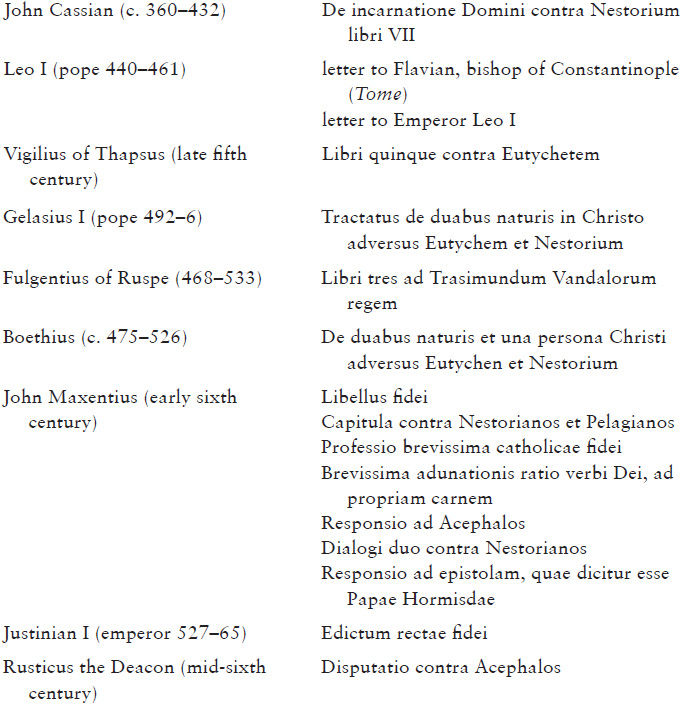
All of these texts had been published previously. Editions of the complete works of Boethius, including De duabus naturis, had appeared in Venice
(1492, 1499) and Basel (1546, 1570). Ad Trasimundum could be accessed either in the edition of Fulgentius' writings prepared by Johannes Cochlaeus and Willibald Pirckheimer (1520, 1526) or in Basilius Heroldt's
Haeresiologia (1556).39 The works of Maxentius were appended to the Cochlaeus/Pirckheimer volume; they also featured in two Basel patristic anthologies, Heroldt's Orthodoxographa (1555) and the Monumenta of
Johann Jakob Grynaeus.40 For Cassian's De incarnatione, Simler was dependent on the Basel edition prepared by Johannes Sichardus (1534).41
Stand-alone editions of Contra Eutychetem – in which its author was wrongly identified as Vigilius of Trent (c. 353–405) – had appeared in Tübingen (1528) and Zurich (1539); the work was also included in Georg
Cassander's volume of Opera of Vigilius (1555),42 and in the Haeresiologia.43 The two letters of Pope Leo were available in the Cologne editions of Leo's Opera (1546, 1561, 1569), in the Monumenta and in Peter
Crabbe's edition of acta of church councils.44 The remaining texts in the Scripta veterum were drawn from Crabbe (Justinian), Sichardus' Antidotum and Heroldt's Haeresiologia (Gelasius, Rusticus).45
Simler was not the first Zurich theologian to make use of these works. In their polemics against Brenz, Bullinger and Vermigli cite Fulgentius on the impassibility of the divine nature and as an authority for the view that Christ's humanity continues to be circumscribed physically after his glorification.46 Vigilius was a particular favourite with the Zurichers:
Bullinger prepared the Zurich edition of Contra Eutychetem,47 and both he and Vermigli refer to the work frequently when arguing against the doctrine of ubiquity.48 In the preface to his Vigilius edition, Bullinger commends several of the other texts published by Simler – Leo's Tome, Gelasius'
Tractatus, Fulgentius' Ad Trasimundum and the Dialogi duo of Maxentius – for their comprehensive refutation of the errors of Nestorius and Eutyches.49
The repeated publication of such works in reformed patristic anthologies suggests that they had begun to be viewed as constituting, loosely, a 'canon' in which the Christological teaching of the early church was summed up.
The reality, of course, was more complex than this presentation suggests, for the texts published in the Scripta veterum were products of two distinct (and, in certain respects, incompatible) Christological traditions. The writings of Leo, Gelasius, Vigilius, Fulgentius and Rusticus exemplified the strongly dyophysite approach of the western church, derived ultimately from Augustine, but the 'opuscula' of Maxentius and Justinian's Edictum were representative of the (predominantly eastern) theological tendency known as neo-Chalcedonianism, which looked back to Cyril of Alexandria (c. 378–
444).50 Whereas Justinian led the campaign against the Antiochene Christology associated with the so-called Three Chapters – Theodore of Mopsuestia, the works of Theodoret of Cyrrhus against Cyril and the letter of Ibas of Edessa to Maris – Rusticus was exiled for opposing their
anathematization at the Second Council of Constantinople (553). One of the principal challenges that Simler faced was to fashion from this diverse material a unified consensus patrum supportive of his own theological position.
In the Annotationes that accompany his chosen texts and in the Narratio, which sets them in their historical context, Simler refers to a variety of sources. The work on which he drew most heavily was the Breviarium causae Nestorianorum et Eutychianorum, by Liberatus of Carthage.
Liberatus wrote the Breviarium shortly after Constantinople II and, like his fellow-westerner Rusticus, was a defender of the Three Chapters. However,
Simler also took much material from an eastern source, the Ecclesiastical History of Evagrius (c. 535–c. 594), which reflected the rival, neoChalcedonian perspective.51 In addition, he made use of the unfinished church history of Nicephorus Callistus Xanthopoulus (fourteenth century), from which he derived his categorization of the various monophysite sects,52 and two other Byzantine works, the Compendium historiarum of George
Cedrenus (eleventh century) and the Epitome historiarum of John Zonaras (early twelfth century).53 He was able to supplement these second-hand accounts with some key primary documents, the acta of the early church councils, collections of which had been published by Jacques Merlin, Petrus
Crabbe and Laurentius Surius.54 Simler deploys conciliar material at several points in the Narratio – for example, to support his view of monotheletism as merely a modified form of Eutychianism, rather than a synthesis of orthodox and anti-Chalcedonian christologies.55 The works published in the main body of the Scripta veterum are utilized again in the Narratio, as sources for the teachings of Nestorius (Vigilius, Cassian), later Nestorianism
(Maxentius) and Eutyches (Leo, Vigilius). Other patristic texts cited include Proclus' Tome to the Armenians, Basil's Contra Eunomium, the dialogues of Ps. Athanasius, Theodoret's Eranistes and John Damascene's De haeresibus.
In his account of the Nestorian controversy, Simler makes extensive use of the correspondence and writings of Cyril of Alexandria, especially Cyril's apologies Against the Orientals and Against Theodoret;56 for the subsequent dispute with Eutyches, he is similarly reliant on the letters of Pope Leo. The Scripta veterum also includes references to the Corpus iuris civilis, the ecclesiastical histories of Sozomen and Rufinus, and works by Prosper of Aquitaine, Cassiodorus, Gennadius of Marseille, Gregory of Tours, Paul the Deacon, Ado of Vienne, Sigebert of Gembloux, Raffaele Maffei and John
Bale. The most comprehensive Protestant church history, the Magdeburg Centuries, is mentioned only occasionally but, given the general reluctance of early modern writers to acknowledge contemporary sources, Simler's dependence on the work may be greater than is apparent at first glance.
Despite its polemical motivation, the Scripta veterum is a work of serious scholarship, in the traditions of upper Rhine humanism. Two texts,
Justinian's Edictum and Vigilius' Contra Eutychetem, are presented in improved redactions, based on manuscripts that Simler had procured from the brothers Pierre and François Pithou.57 Variant readings and emendations to earlier editions are listed in the Annotationes, which, in the case of Justinian's work, also highlight textual parallels with the canons of Constantinople II and the religious edict of Justin II (571). Like Liberatus and the Greek church historians, Simler incorporates into his account the full text of important documents such as the Chalcedonian definition, the Henotikon of Zeno (482), and the conciliar decree of Constantinople III, as well as a previously unpublished anti-monothelete confession translated into Latin by 'a certain friend of ours'.58 He also takes care to correct common errors such as the designation of the Constantinopolitan synod of 536 as the Fifth Ecumenical Council and Crabbe's placing of the Lateran council of 649 in the reign of Constantine III, rather than his heretical son Constans II.59
Simler's generally respectful attitude to tradition does not preclude him from acknowledging discrepancies in his sources and, where necessary, rejecting the judgments of previous writers. He is unconvinced, for example, by Evagrius' claim that the contrasting theological positions of Justinian and his wife Theodora were part of a pragmatic strategy for managing religious tensions within the Empire, preferring to regard their differences as genuine.60 When Nicephorus suggests Arian or Eunomian influences as the source for the doctrine that Christ is ignorant of some things according to his human nature – an error associated with the monophysite group known as the Agnoetae – Simler is again sceptical, noting with characteristic doctrinal precision that the Arians denied the omniscience not of Christ's humanity but of the divine Word himself.61
In the Annotationes, Simler testifies to his interest in contemporary debates on the dating and authenticity of patristic works by rehearsing and, at times, challenging the accepted wisdom on these questions. Thus he rejects the suggestion by Giulio Marziano Rota of an early date for Boethius'
De duabus naturis, arguing the tract it is more likely to have been written
towards the end of the pontificate of Symmachus (498–514) or during that of Hormisdas (514–23).62 Sometimes, however, his conclusions betray the influence of confessional rather than purely scholarly considerations. For example, Simler follows another Zuricher, Theodor Bibliander, in rejecting as inauthentic the correspondence of Justinian with Pope John II on account of the impure doctrine that it contains.63 His summary dismissal of this material may be contrasted with his acceptance of previous editors' attribution of Contra Eutychetem to Vigilius of Trent, despite the difficulty of crediting the latter – who, as he himself acknowledges, is reported to have lived during the reigns of Arcadius and Honorius (395–408/423) – with authorship of a text that clearly postdates the Council of Chalcedon (451).64
The question was of more than academic importance: Simler's conservative conclusion allowed him to stress the particular relevance to his Rhaetian readers of Contra Eutychetem, as the work of a writer from an adjacent region.65
The theological imperative that drives Simler's work is frequently in tension with the humanist scholarly ideals to which he professes to adhere.
Like other Zurich reformers, Simler did not regard the Fathers as beyond reproach. Maxentius is described as writing in a defective style, although his opinions are termed excellent.66 The same criticism is directed at Cassian, whom Simler also rebukes for setting too much store by 'monastic study, human traditions and monkish exercises',67 and relying on a faulty Latin translation of Mal 3:8. However, Simler is keen to ensure that the Fathers' occasional lapses are not allowed to detract from their authority; although
Cassian's ignorance of Hebrew may have led him to misinterpret the abovementioned passage as a prophecy of Christ's crucifixion, Simler observes, this error was motivated by a genuine zeal to defend the true faith.68 In the same way, he excuses the paucity of citations from the Bible and earlier
Fathers in the Disputatio contra Acephalos on the grounds that Rusticus was dealing with opponents 'who buried the simplicity and purity of Christian teaching beneath sharp and complex disputations, and, when they could not defend their opinions from Scripture, took refuge in the authority of human reason'.69
Simler is at pains to iron out any apparent discrepancies between patristic and reformed teaching. This concern manifests itself with particular force in his remarks on Cassian, whose 'semi-Pelagianism' had made him suspect in the eyes of some Protestants.70 Simler is aware that Cassian had
been attacked by other ancient authorities for his stance on the relationship between grace and works, but he insists that such criticisms apply to an earlier work, the Collationes, rather than De incarnatione. Even in the Collationes, where Cassian seems more sympathetic to the errors of the Pelagians, he does not sanction 'all of their impious and crass opinions concerning the powers of the human will';71 the most that Simler will concede was that he appears to attach too much importance to free will in one passage of De incarnatione.72
Like other sixteenth-century patristic scholars, Simler is guided above all by the notion of consensus patrum. Although he acknowledges some variability in the patristic corpus, and the superiority of some writers to others on particular points, for the most part he depicts the Fathers as speaking with one voice: the works in the Scripta veterum are presented as witnesses to timeless doctrinal truths, rather than products of localized and evolving theological traditions. One of the functions of the Annotationes is to sustain this impression of continuity, by reconciling any seemingly aberrant statements by the Fathers with the settled Christological formulas of a later period. For example, when Fulgentius speaks of the Word assuming a man, instead of using the preferred term 'a human nature', by this he means
'not a separately subsisting hypostasis of a man but a nature of human flesh and soul taken up by the Word'. Simler notes that the same language is to be found in other ancient writers, 'especially those who lived before Nestorius', the obvious implication being that it has become suspect only due to its subsequent misuse by the heresiarch.73 Although he is slightly embarrassed by one passage in Cassian's De incarnatione that appears to anticipate
Eutyches (and Kaspar Schwenckfeld) by preaching the transformation of Christ's flesh into a 'spiritual substance', he is sure that the statement can interpreted on orthodox lines, as referring to the assumption of a human nature by the Word. Similarly, when Cassian attributes one power and substance to Christ, it is necessary to understand substantia as a synonym for persona, rather than natura, 'as elsewhere among the ancients', if Cassian is to be harmonized with other writers of the time and saved from condemnation by Chalcedon, Constantinople II and Constantinople III – for Simler, an unthinkable conclusion.74 This idea of a doctrinally uniform patristic corpus, set in clear and unequivocal opposition to those designated heretics in ecclesiastical tradition, is carried over from the Annotationes into
the Narratio, where it underpins Simler's account of the Nestorian and monophysite schisms.
From Nestorius to Mohammed: Church History in the Scripta veterum The Narratio veterum et recentium controversiarum covers the period 428 to 681, beginning with the appointment of Nestorius as bishop of Constantinople and ending with the Third Council of Constantinople, which condemned monotheletism. In his preface to the work, Simler gives a brief account of the heresies that afflicted the church during the first four centuries of its existence, such as Ebionitism, Docetism, Patripassianism and Arianism.75 There follow seven chapters on the Nestorian controversy, from the outbreak of Nestorius' quarrel with Cyril of Alexandria through to the late 440s. The focal points of this section are the condemnation of Nestorius at the Council of Ephesus (22 June 431); the subsequent schism between Cyril and the eastern bishops, led by John of Antioch, who contested the council's decision; and the Formula of Reunion (433), which restored communion between Alexandria and Antioch. A whole chapter is devoted to exposition of Cyril's Twelve Anathemas, which Simler views as pivotal to the controversy. The remainder of the Narratio deals with the history of Eutychianism and its offshoots, including monotheletism. This part of the work is much more diffuse, taking in three ecumenical councils (Chalcedon,
Constantinople II and Constantinople III), the reigns of 17 emperors, and more than 230 years of church history. Simler rounds off his accounts of both Nestorianism and Eutychianism with chapters on the alleged revival of these heresies in more recent times, targeted at the Zurich church's theological opponents.
Nestorianism was something of a raw nerve for the Zurichers, who from Zwingli's time had been charged with breathing new life into this ancient error. In De Conciliis, his history of church councils, and his works against Brenz, Bullinger rejected any suggestion of a link between the Zurich church and Nestorius, whom he condemned in the strongest possible terms. The antistes contrasted Nestorius' teaching that the Word is present in the man
Christ by 'partnership … or association' with the orthodox doctrine of the hypostatic union. He argued that Nestorianism, like the teachings of the earlier heretics Paul of Samosata and Photinus, amounts to a denial of
Christ's true divinity, as it erases the distinction between Christ and other holy men in whom God's presence was manifested.76 This view was shared by other reformed writers: thus Beza describes Nestorius as emerging from the same 'pit of hell' as Arius to deprive the incarnate Christ of his divinity and replace the man-God with a divinized man.77
In the Narratio, Simler provides a much more detailed and multifaceted account of Nestorianism, which nonetheless serves to reinforce the traditional characterization of Nestorius as a 'Samosatenian'. Following the Greek church historians, he denounces Nestorius as a 'frivolous, arrogant and vainglorious man', a populist preacher who curried favour with the multitude by feigning an ascetic lifestyle.78 However, he is concerned less about the heresiarch's personal shortcomings than about the damaging effects of his doctrine. Simler is aware that ancient writers differ in their assessment of Nestorius' heresy. Although some (Liberatus, Cassian) condemn Nestorius as a Samosatenian or Ebionite, others (Socrates,
Vigilius) reject this interpretation, attributing the Syrian's errors to his lack of education.79 Simler does not dismiss the second view out of hand. As an authority on antitrinitarianism, he knew that the teachings of Nestorius, who confessed the Trinity and recognized the distinct personality of the Logos, could not simply be conflated with the adoptionist monarchianism of Paul of Samosata; he was even aware of a statement by Nestorius condemning Paul.
Instead, he proposes a more subtle connection between the two heresies: namely, that both tend towards the same end, abolition of 'the true knowledge of our Saviour Jesus Christ'. Even if Nestorius did not mean to call into question Christ's divinity, that was undoubtedly Satan's intention in allowing his error to take root.80
As is well known, the initial focus of the dispute between Nestorius and Cyril was the term theotokos ('God-bearer'), for which Nestorius proposed to substitute christotokos. Yet Simler insists that it would be wrong to dismiss the controversy as merely a 'quarrel about words'. The fact that Nestorius was not received back into the church even after dropping his opposition to the theotokos title shows that far more important issues were at stake: whether Jesus Christ is truly God, or whether the Word is united to him only by association; how Christ is to be worshipped and invoked in prayer; in what way he acts as our high priest and mediator; and how we were saved by his passion and death.81 Although in his surviving writings
Nestorius appears to affirm that Christ is God and man in one person, it is
clear that he postulated the existence of two individuals (alius et alius, rather than aliud et aliud) in Christ: the divine Word, and the man Jesus, in whom the Word dwells 'as in a temple'.82 In Nestorius' theology, there is no 'special union of the Word with the flesh'; Jesus is not the true God but 'a God-bearing man', resembling the prophets. He is termed God and the Son of God only by association with the Word, just as Moses was designated
God to Pharaoh, and his worship is comparable to the honour paid to a statue of the emperor, on account of the one whom it represents.83 Nestorius' total rejection of 'theopaschite' language and the communicatio idiomatum confirms his departure from orthodoxy. If he had acknowledged the existence of a single subject in Christ truly, rather than 'in words', he would have had no difficulty accepting that birth, suffering and death can be predicated of the Word, by virtue of his assumption of a human nature.84
Instead, he reduced Christ's humanity to the status of a 'garment' donned by the second person of the Trinity.85
Simler's harsh verdict on Nestorius may be contrasted with his treatment of the wider 'Antiochene' theological tradition, which he was anxious to reclaim for orthodoxy. Whereas Nestorius is judged (and found wanting) against the exacting Christological standards established at Chalcedon and subsequent councils, his predecessor Theodore of Mopsuestia (c. 350–428) is dealt with in much more lenient fashion. Many ancient writers had denounced Theodore as 'Nestorius' teacher'; in this connection, Simler points to the comments of Maxentius and Justinian and, especially, to the acta of Constantinople II, which cite Cyril, Proclus and Hesychius of Jerusalem in opposition to the Cilician bishop.86 However, the issue was rendered problematic by the existence of numerous contrasting testimonies to Theodore's wisdom and piety, and by the fact that his orthodoxy was upheld at Chalcedon.87 Simler accepts that, if Theodore wrote the things attributed to him at Constantinople II, his theology is rightly to be condemned, but he is inclined to give credence to Liberatus' report that statements in Theodore's works were 'exaggerated', either by monophysites seeking to discredit him or by Nestorians who wished to enlist him among their supporters.88 In the end, Simler delivers a mixed verdict on Theodore, as 'a man of great learning and wisdom who was at fault here and there in his writings and sowed the seeds for Nestorianism'. In combating the errors of those who failed to recognize the distinction of natures in Christ,
Theodore 'separated [the two natures], or at least appeared to separate them
and to preach two Christs instead of one'; his status is comparable to that of another orthodox writer, Dionysius of Alexandria, whose pointed formulations against Sabellianism helped pave the way for Arius.89 Although
Simler shies away from repudiating the Fifth Ecumenical Council's condemnation of Theodore, he is clearly ill at ease with it. In his annotations to Justinian's Edictum, which defends the practice of anathematizing individuals after their deaths, he observes that this opinion was not universal among the emperor's contemporaries and commends the Council of Nicaea for condemning not Arius, but only his teachings.90 While acknowledging
Theodore's flaws, Simler goes to considerable lengths to retain him within the ranks of the Fathers, partly out of a genuine irenicism that he is keen to see imitated in his own day, and partly in order to minimize the points of difference between the Antiochene Christology championed by Theodore and the rival Alexandrian school of Cyril.
Simler is even warmer in his praise for Theodoret of Cyrrhus (393–c.
460), the most influential Antiochene theologian at the time of the Council of Ephesus.91 Theodoret was an important authority for the Zurichers on account of his strongly dyophysite Christology; in the Decades, Bullinger cites the Eranistes against ubiquitarianism and on the proper understanding of the communicatio idiomatum, while the reformed protagonist in Vermigli's Dialogus, Orothetes, makes repeated reference to the same work.92 However, Theodoret's place within the patristic canon was precarious: not only had he opposed Cyril at Ephesus, but his refutation of the Alexandrian's Twelve Anathemas had been condemned as heretical at Constantinople II. Simler's task in the Narratio was to account for the rift between Cyril – traditionally regarded as the champion of the orthodox faith against Nestorianism – and the Antiochenes in a way that allowed him to vindicate both sides and, in so doing, to preserve intact the notion of a consensus patrum on Christological issues.
In his works dealing with the subject, Bullinger puts the quarrel between Cyril and the Antiochenes down to a misunderstanding – Theodoret's belief that, in the Twelve Anathemas, Cyril was seeking to blur the boundaries between the two natures of Christ.93 Because the dispute related to words, not substance, it was quickly resolved once Cyril had had the opportunity to explain the difference between his assertion that God suffered 'in the flesh' and the views of the fourth-century heretic Apollinaris of Laodicea, who made Christ's divinity the direct subject of the passion.94 Because of his
more extensive knowledge of the sources, Simler was unable to dismiss the conflict quite so easily. In the Narratio, he acknowledges that the church was split for three years and chronicles in detail the mutual anathemas and political manoeuvrings of the rival parties both at Ephesus and thereafter, as they strove to win imperial backing for their position.95 Yet ultimately his interpretation of the episode is identical to Bullinger's. While accepting that the dispute had a doctrinal component, he argues that its main driver was personal animosity between the protagonists, which prevented them from dealing fairly with their opponents.96 Thus the Syrian bishops charged Cyril with Apollinarianism and Arianism, only to be accused in turn of preaching two Christs. While deploring the polemical tone of the controversy, Simler finds reasons to justify the stances adopted by both sides, on the basis of their respective theological concerns. The robust, even provocative, way in which Cyril asserts the unity of Christ's person was understandable, given that he was opposing the grave errors of Nestorius. By the same token,
Theodoret and the other eastern bishops could be excused for taking offence at some of the more 'exaggerated' formulations in the Twelve Anathemas, as 'they were not yet clear about Cyril's meaning' and feared – rightly – that his phraseology was susceptible to abuse by followers of Apollinaris.97
Simler argues that the specific criticisms directed by Theodoret and his fellow orientals against the Anathemas stemmed from a misreading of Cyril; essentially, they were tilting at windmills, attributing to their adversary views that he did not in fact hold. For example, they understood the statement in the first anathema that the Word was 'born or made in the flesh' to be equivalent to saying, with Apollinaris, that the Word was 'converted' into flesh, yet Cyril explicitly rules out this interpretation.98 Theodoret's opposition to the term hypostatic union (ἕνωσις καθ'ὑπόστασιν), which Cyril uses to describe the bond between Christ's divinity and humanity, is also misconceived: for Theodoret, the term signifies 'something mixed or composite', but Cyril's intention is merely to underline the closeness of the union between the Word and the human nature that he has assumed, 'without any conversion and confusion', in the incarnation.99 Similarly, when in his third anathema Cyril speaks of a 'natural union' (ἕνωσις κατὰφύσιν) between the Word and flesh in Christ, he means only that they constitute a 'true' union, like the union of body and soul in man, in which each nature retains its distinct qualities, as opposed to the affective or associational union proposed by Nestorius.100 The two sides are also in agreement on the
question of God's impassibility. Cyril's 'theopaschitism', as expressed in the twelfth anathema, differs profoundly from that of later monophysites, as he makes clear that the Word suffered 'in the flesh' and that the passion is attributed to him 'by dispensational appropriation'.101
In modern patristic scholarship, it is customary to assign Cyril and Theodoret to distinct and, in some respects, opposing Christological traditions: the 'schools' of Alexandria and Antioch. Both Theodoret and Nestorius were products of the Antiochene school, which originally posited
'two subjects' in Christ; although Theodoret modified his terminology after Ephesus to bring it more into line with Cyril's language, it has been argued that he remained a crypto-Nestorian until the end of his life.102 Similarly,
Cyril owed more to Apollinaris – including the concept of 'natural' union and the formula 'one incarnate nature of God the Word' (μία φύσις τοῦ θεοῦ λόγου σεσαρκωμένη) – than he cared to admit.103 For Simler, however, there is no Alexandrian or Antiochene tradition, only the timehonoured orthodoxy of the church and heretical divergences from it. The Fathers may use different terms – conversio, coniunctio, commixtio or compositio – to describe the ability of God's substance to assume an extraneous nature without itself being altered, but all relate to the same process.104 The quarrel between Alexandria and Antioch was a dispute about terminology, not substance, aggravated by personal rivalries. Once the channels of communication between Cyril and John of Antioch had been reopened, their schism was swiftly brought to an end, for both patriarchs realized that, fundamentally, they professed the same faith. The Formula of Reunion made clear that the true dividing line ran not between Antioch and Alexandria, but between the orthodox, both Syrian and Egyptian, and Nestorius, who asserted the unity of Christ's person 'in words' but denied its reality.
Over the next decade and a half, the unity established by the Formula came under increasing strain, especially in Syria, where the episcopate was split between Antiochenes and followers of Cyril. With the condemnation of the extreme Cyrillian Eutyches by the synod of Constantinople in 448, these tensions spilled over into renewed conflict. Traditionally, the heresies of Nestorius and Eutyches are regarded as polar opposites, but Simler perceives a deep structural similarity between the two: both positions, he argues, reflect a failure to distinguish properly between the concepts of 'person' and 'nature' as they relate to Christ, and are predicated on the mistaken
assumption that there must be an equal number of natures and hypostases in Christ.105 Eutyches and his principal backer, Dioscorus of Alexandria, sought to portray themselves as the theological heirs of Cyril, but Simler charges them with imposing a monophysite interpretation on Cyril's words.106 The true guardians of Cyril's legacy, he insists, were the dyophysite opponents of Eutyches, led by Flavian of Constantinople and Pope Leo; indeed, Flavian was able to counter Eutyches' appeals to Cyril with passages from the Alexandrian Father's writings in which the existence of two natures in Christ was clearly affirmed.107
In his account of the Eutychian controversy, Simler emphasizes the monophysites' willingness to resort to violence and fraud, where necessary, to achieve their ends. Having persuaded the emperor, Theodosius II, to convene a second council at Ephesus to settle the dispute, Dioscorus conspired with the imperial chamberlain Chrysaphius to block prominent eastern bishops such as Theodoret and Ibas of Edessa from attending. At the council itself, Dioscorus muzzled the representatives of Pope Leo, who withdrew in protest, and prevented proper investigation of Eutyches' views.
Supported by imperial troops and vast numbers of monks, he was able to intimidate dissenting bishops into signing a blank piece of paper, on which the 'decisions' of the synod were subsequently inscribed. Most shockingly of all, he participated in a personal assault on Flavian that resulted in the patriarch's death three days after the council.108 Although there are obvious similarities between the behaviour of Dioscorus at Ephesus II and that of Cyril at the First Council of Ephesus – both were prepared to make strategic use of the mob to secure the compliance of their fellow bishops – no such comparison is admissible within the theological framework of the Narratio.
In spite of its partiality and the initial refusal of the Antiochenes to recognize its decisions, Simler affirms the traditional view of Ephesus I as an authentic ecumenical council; Ephesus II, by contrast, is characterized as a pseudocouncil, presided over by an 'anti-Cyril' in the person of Dioscorus.
The monophysite ascendancy was brought to an end at Chalcedon, which provides Simler with an opposing, positive model of conciliar decisionmaking. In the Narratio the council's proceedings are presented as harmonious and well ordered – a far cry from the chaos of Ephesus II. While not excluding all references to conflict (which abounded in the council's acta), generally Simler uses his account of events at Chalcedon to reinforce the notion of the consensus patrum; of particular interest in this connection
is his recording of an incident during the second session, when Archdeacon Aetius of Constantinople and Theodoret intervened to demonstrate the orthodoxy of controverted formulations in Leo's Tome by adducing equivalent passages from Cyril.109 Whereas Ephesus II offers a warning against the dangers of fanaticism and unbridled clerical power, Chalcedon illustrates for Simler how a Christian commonwealth should function under the guidance of a godly magistrate, in this case the Emperor Marcian (450–
57). Like Bullinger,110 Simler gives Marcian much of the credit for the council's successful outcome, noting his personal endorsement of the Chalcedonian definition and subsequent promulgation of an edict giving legal force to its decisions.111
Simler's verdict on other emperors of the period is less positive.
Although Theodosius II is described as a 'lover of religion', he was also 'superstitious', lacking in judgment and, as a result, easily swayed by his officials.112 Later rulers are judged on their religious policy, which fluctuated between defence of Chalcedon, under Leo (457–74), attempts at reconciliation with the monophysites, under Zeno (474–5/476–91), and open
Eutychianism, under the usurper Basiliscus (475–6) and, eventually, Anastasius (491–518).113 Although he discerns an element of logomachia in the dispute between supporters and opponents of Chalcedon, Simler is insistent that some members of the anti-Chalcedonian party objected to the doctrine of two natures 'not in words but in substance'.114 For this reason, he does not share the enthusiasm of his colleague Bibliander for Zeno's
Henotikon, which sought to reunite the eastern patriarchates by sidelining Chalcedon in favour of the Nicene Creed.115 Far from resolving matters,
Simler argues, the vague language of the Henotikon played into the hands of the monophysites, who interpreted it as supportive of their position.116 The restoration of communion between Constantinople and the monophysitedominated see of Alexandria also had the effect of provoking a new split
(the Acacian schism) between East and West, for the papacy refused to countenance any concessions to Eutychianism.117 Even in the East, the achievement of unity was shortlived, with the Henotikon failing to satisfy the demands of more extreme monophysites such as Severus (c. 465–c. 538) for an explicit repudiation of Chalcedon.118 For Simler, the fate of Zeno's religious policy offers a general lesson with contemporary resonance:
'ambiguous doctrinal formulas' are a recipe not for unity but for 'bigger conflicts' in the future.119 When making this observation, it is likely that he
had in mind the situation of the Rhaetian magistrates to whom his work is dedicated, who found themselves under similar pressure to accommodate religious dissidents.
The most important sixth-century monarch, Justinian, is depicted by some reformed writers as a hero of orthodoxy, the Christian emperor par excellence.120 Simler follows this line in part, for instance by highlighting
Justinian's support for the condemnation of the Syrian monophysites Severus, Peter of Apamea and Zooras in 536.121 On the other hand, he finds himself unable to overlook entirely aspects of Justinian's rule that conflicted with this orthodox image, notably the monophysite sympathies of his wife
Theodora and Justinian's own support for the aphthartodocetite heresy (which proclaimed the incorruptibility of Christ's human nature) towards the end of his reign. Unlike Bibliander, who glosses over this episode,122 Simler follows the Greek church historians in chronicling Justinian's attempts to impose aphthartodocetism on the Empire, including his persecution of the orthodox patriarchs Eutychius of Constantinople and Anastasius of Antioch.123 Even the central religious event of Justinian's reign – the Fifth
Ecumenical Council – poses some difficulties for the Zuricher. As has already been noted, Simler was uneasy about Constantinople II's anathematization of the Three Chapters, which was difficult to square with his belief in the compatibility of the Antiochene and Cyrilline traditions.
While accepting the council's conclusions, as set out in its 14 articles of faith, he devotes remarkably little space to its deliberations on the Three
Chapters, focusing instead on its pronouncements against Origenism. The sense that Simler's endorsement of Constantinople II is lukewarm, at best, is reinforced by his account of the background to its convocation, which is taken almost verbatim from the hostile Liberatus.124 Like the Nestorian controversy, the sixth century confronts Simler with evidence of competing theological currents within orthodoxy – Justinian's neo-Chalcedonianism and the more pronounced dyophysitism of western writers such as Liberatus
– that sits awkwardly with the notion of a consensus patrum. He seems much more comfortable when dealing with the later monothelete controversy, which could be presented as a conflict between clearly defined doctrinal camps, culminating in a decisive victory for the 'orthodox' side at Constantinople III.125
Recent studies of Christology in the period after Chalcedon tend to downplay the differences between mainstream monophysites and their
Chalcedonian opponents. It has been pointed out that the influential monophysite bishop of Alexandria, Timothy Aelurus, affirmed the doctrine of the double consubstantiality of Christ and wrote against Eutyches;126 even
Severus, who rejected both Chalcedon and the Henotikon, was prepared to speak of two natures in respect of Christ, if only 'ἐν θεωρίᾳ'127 Both monophysites and non-Antiochene Chalcedonians took their inspiration from Cyril, disagreeing only on the extent to which his language could be reconciled with Chalcedon. In the Narratio, however, the differences between the two sides are presented in much starker terms. Lacking direct access to the works of monophysite theologians, Simler bases his assessment of their doctrines entirely on Chalcedonian sources, which focus on the more
'extreme' aspects of monophysite teaching, associated with Eutyches himself and disavowed by many later anti-Chalcedonians, such as denial of the double consubstantiality of Christ and support for the doctrine of Christ's
'heavenly flesh'.128 This emphasis suits Simler's polemical purpose, as it appears to substantiate his claims of a link between monophysitism and Reformation-era 'heretics' who professed similar doctrines.
The monophysite movement is presented as not merely theologically deviant, but seditious and anarchic in character. Simler implicates Timothy
Aelurus in two major crimes of violence, the burning alive of local magistrates and imperial troops by an anti-Chalcedonian mob in Alexandria, and the murder in 457 of the city's orthodox patriarch, Proterius.129 Such disturbances were not confined to Egypt. In Antioch, Bishop Stephen was killed by supporters of his monophysite rival Peter the Fuller,130 while in Jerusalem monks opposed to Chalcedon installed as patriarch the Eutychian
Theodosius, who unleashed a savage persecution of the orthodox.131 The failure of repeated imperial attempts to broker an agreement with the monophysites is blamed on the untrustworthiness of the movement's leaders.
Peter Mongus, who succeeded Timothy Aelurus as bishop of Alexandria, is described as a 'slippery and inconstant man, blowing hot and cold from the same mouth'.132 In letters to Acacius of Constantinople and Pope Simplicius, he protested his loyalty to Chalcedon, but at home he condemned the council and Leo's Tome, anathematizing all who refused to receive the writings of Dioscorus and Timothy.133 In the same way, Severus promised the Emperor
Anastasius that he would not denounce Chalcedon if appointed bishop of Antioch, but went back on his word as soon as he was in post.134 The duplicity of the monophysites is highlighted again in Simler's account of the
origins of monotheletism; here a key role is assigned to the Jacobite patriarch, who is said to have feigned acceptance of Chalcedon in order to lead the orthodox church astray.135
Another key feature of monophysitism, as portrayed in the Narratio, is its labile and polymorphous nature, which places it in direct opposition to the unchanging, univocal teaching of the Fathers. Simler terms Eutychianism a 'Lernaean hydra', producing new heads whenever one was cut off.136 The heresy is shown to have evolved over time: whereas Eutyches taught that the Word was literally converted into flesh at the incarnation, his later followers embraced a form of docetism, to counter the perception that they preached a passible God.137 United only by their belief in the single nature of the Word made flesh, the monophysites quickly began to fall out among themselves, splitting into numerous competing sects. Based on information from Nicephorus and, to a lesser extent, John Damascene, Simler identifies eight distinct monophysite factions: the Eutychians proper; the Acephali; the theopaschites (followers of Peter the Fuller); the Agnoetae; the Aphthartodocitae; the Tritheitae, who were themselves divided into two groups; the Theodosiani; and the monotheletes.138 This heresiological scheme is designed to illustrate a more fundamental point, applicable not just to the history of the early church but to theological disputes generally.
Elsewhere Simler ascribes to heresy an in-built propensity to change, degenerate and spawn new errors,139 a thesis for which he finds ample support in the history of monophysitism after Chalcedon. Peter the Fuller may be best known for his addition of the phrase 'who was crucified for us' to the Trisagion, but he also introduced the practice of invoking the Virgin in prayer; in this manner, the Eutychian controversy fostered the emergence of 'new forms of worship and prayers to the dead'.140 In the late sixth century, disputes between the various monophysite groupings spilled over into disagreements concerning the Trinity, with one group (the Theodosiani) being accused of Sabellianism or teaching a quaternity, while others, led by the grammarian John Philoponus, espoused forms of tritheism.141
By the time of the Sixth Ecumenical Council, a large portion of Byzantine territory had been ceded to Islam, whose rise Simler considers the most important long-term consequence of the Eutychian controversy. Unlike the authors of the Magdeburg Centuries, who classify Islam as a 'religio externa', cobbled together from elements of paganism, Judaism and Christianity,142 Simler follows John Damascene and subsequent medieval
tradition in viewing 'the Mohammedan impiety' as the last and most pernicious of the heresies of Christian antiquity.143 In the Narratio, the whirlwind Islamic conquest of Syria and Egypt is blamed on the presence within those provinces of significant numbers of Nestorians and monophysites, who accepted Muslim rule more easily because of the resemblance between their own errors and the 'madness' of the Qur'an.144 To substantiate the link that he posits between earlier heresies and Islam, Simler recounts the well-known legend of Sergius, which identified a fugitive
Nestorian monk as the source for Mohammed's errors.145 He explains Mohammed's purely humanitarian Christology by adding a subtle twist to the traditional story: although Nestorius himself affirmed the divinity and personality of the Logos, later Nestorians such as Sergius may have radicalized the sect's teachings – 'as is usually the case' with heretics – so that they conformed more closely to the doctrines of Paul of Samosata.
Simler finds support for this claim in the writings of Maxentius, who, long before the time of Mohammed, encountered Nestorians who attributed to Christ a preeminence based solely on his virgin birth and possession of grace in full measure.146
Simler's discussion of the origins of Islam in the Narratio was motivated, in part, by apologetic concerns. In spring 1570, several leading reformed churchmen in the Palatinate had been exposed as antitrinitarians; two, Johannes Sylvan and Adam Neuser, had even been caught attempting to make contact with the Ottoman sultan.147 The episode was acutely embarrassing for the Zurichers, as Sylvan was associated with the antidisciplinarian, 'Zwinglian', party in Heidelberg; unsurprisingly, it was seized on by their theological opponents as evidence of an islamizing dimension to reformed teaching. In the Scripta veterum, Simler seeks not only to limit the fallout from the affair, but to turn it to the advantage of his orthodox reformed allies in Graubünden. In his main preface to the work, he condemns 'the deceptions of the new Samosatenians, and their secret conspiracies with the Turks', while elsewhere he cites the activities of the Heidelberg antitrinitarians to illustrate the dangers of allowing Christological heresy to flourish within a state.148 This point is developed in the Narratio, where he attributes Islam's triumphant progress to the failure of the Byzantine authorities to eradicate monophysitism and its associated heresies, which left the eastern Empire divided and vulnerable to Saracen incursions.149 Simler feared a repetition of these events in his own day, given
the spread of antitrinitarianism in Eastern Europe and the theological affinities that he perceived between its 'Samosatenian' variant, in particular, and Islam.150 In the Scripta veterum, the parallel is extended to critics of the Rhaetian anti-heresy edict, who, Simler claims, would leave the church with only 'a certain general knowledge of Christ, shared with Mohammedanism'.
Just as Mohammed extended freedom of worship to all monotheists, so the 'Academici' promise salvation to all Christians who acknowledge Christ as the Son of God and judge of the world, 'regardless of what they think about the remaining doctrines of the faith'.151 By associating the dissidents in the Bündner reformed church with Christendom's most implacable foe, Simler places them in opposition to legitimate magisterial authority and highlights the subversive consequences of the 'liberty' that they advocate. In the process, he is able to distance himself and his colleagues from the recent scandal in the Palatinate and to re-emphasize the compatibility of reformed
Protestantism with established political and social structures.
Old Wine in New Wineskins? The Scripta veterum as Polemic Simler's comparison of the Rhaetian 'Academici' to Mohammed is a good example of the dual perspective that informs his work. Like other early modern controversialists, Simler sees the disputes generated by the Reformation not as unique products of the age, but as the latest episodes in an on-going struggle between truth and error, Christ and Satan, for ascendancy within the church. In this context, the history of ancient
Christianity becomes a crucial resource, providing Simler and his contemporaries with a ready-made heresiological vocabulary and interpretative framework that can be applied to the errant teaching of their own day. This approach has the advantage of both delegitimizing opponents, by attaching them to sects and individuals condemned by the early church, and vindicating the position of the writer, who is automatically cast in the role of defender of the orthodox faith. Nor is it merely a rhetorical strategy, but rather the expression of a view of Christian history as 'a static entity with substantially the same events being re-enacted by different characters'.152
Thus Beza, in the preface to his work Valentini Gentilis teterrimi haeretici … brevis explicatio, characterizes contemporary radicals as, in effect, reincarnations of earlier heretics.153 The point is reiterated in his edition of patristic works on the Trinity, which he commends to the churches 'not just
on account of their sound doctrine and erudition, but especially because of the antiquity and dignity of their authors, so that all may see that nothing propounded by these damned souls [sixteenth-century antitrinitarians] has not been refuted and condemned a thousand times by the whole pure and ancient church'.154
For Simler, too, the ancient Christological controversies are important primarily for the light that they shed on contemporary disputes. Detailed consideration of these parallels is reserved for chapters 7 and 17 of the Narratio, but the interconnectedness of ancient and contemporary doctrinal disputes is highlighted even in the more strictly historical sections of the work. Simler's use of the Henotikon episode as a warning against theological obfuscation, including in his own day, has been mentioned. In the same way, he detects a structural similarity between Nestorianism, Arianism and Eutychianism – all of which originated as responses to earlier heresies – and the more recent errors of 'the Anabaptists, Servetians and new
Samosatenians, who have changed many things, causing great offence to many, with no little harm to the church, solely on the basis that everything that is taught under the papacy is to be shunned and rejected'.155 Because of his involvement in contemporary Christological debates, Simler tends to view the disputes chronicled in the Scripta veterum through the prism of sixteenth-century theological concerns. Although the main point at issue in the Zurich church's exchange with the Württembergers – the location of Christ's glorified body – played a peripheral role in the Eutychian controversy, Simler portrays the questions at stake in the two disputes as substantially the same. In particular, he insists that Eutyches was condemned not merely for confusing the two natures of Christ on an 'essential' level but for eroding the distinction between the properties associated with those natures – precisely the error that the Zurichers attributed to Brenz.156
In the Scripta veterum, Simler confronts opponents from across the confessional spectrum. Some targets were familiar from his earlier polemical writings. Although the arguments of the Eastern European antitrinitarians are not addressed in detail in the work, at several points he suggests
Nestorianism as a source for contemporary 'Samosatenian' views. For example, the Samosatenians follow Nestorius in asserting that Christ, like
Moses, is designated God in Scripture solely in respect of his office, while their insistence that they alone possess the true knowledge of God is foreshadowed in Nestorius' criticism of his flock for their ignorance of
apostolic doctrine.157 Simler detects even stronger echoes of Nestorianism in the Christology of Francesco Stancaro; indeed, from his emphasis on the soteriological implications of Nestorius' views in the Narratio it would appear that his earlier exchange with Stancaro helped shape his understanding of the Nestorian controversy. Significantly, he argues that the principal bone of contention in the Stancarist controversy – the involvement of Christ's divinity in his mediatorial office – was also central to the quarrel between Cyril and Nestorius, citing Cyril's tenth anathema as evidence.
According to Simler, the question put to Cyril by his critics was identical to that posed by Stancaro: if the Word acts as high priest on behalf of humanity, to which God does he minister? Cyril's response, like that of the reformed, was that the Word is designated high priest not because he sacrifices to a greater God, but on account of the expiation that he performs to bring believers to faith in himself and the Father.158 Although Stancaro pays lip service to orthodox Christology and claims to repudiate Nestorius' errors, by excluding Christ's humanity from the office of mediator he, too, violates the unity of the saviour's person.159 The intellectual kinship between Nestorius and Stancaro is confirmed by the fact that both see Christ's work of mediation as comparable to that of Moses.160
While denouncing Stancaro as a Nestorian, Simler associates other dissenting groups with the opposing heresy of Eutyches. The 'fanatical' north German Anabaptist Melchior Hoffman (d. 1543) is identified as the first to revive Eutychianism in modern times, on the basis of his claim that the divine Word did not 'assume' a human nature from Mary but was instead literally 'made flesh'.161 Simler finds further proof of the connection between Anabaptism and Eutychianism in reports that some monophysite sects rejected infant baptism, which makes it 'hardly surprising that their teachings have been renewed and defended in our day by the Anabaptists, in particular'.162 However, the Zuricher reserves his harshest criticisms for Kaspar Schwenckfeld, whose allegedly Eutychian Christology had been promoted by Georg Frell in Chur. In the Annotationes to Vigilius' Contra
Eutychetem, Simler accuses Schwenckfeld and his followers of misusing anti-Arian statements by the Fathers to support their own, heretical, denial of the creatureliness of Christ's flesh, just as earlier monophysites had done.163
Schwenckfeld's labelling of the reformed as Nestorians, on the basis that they attribute different properties to Christ's two natures, is another familiar
Eutychian refrain; in the early church, the same charge was levelled against
the orthodox by the monophysites, who – like Schwenckfeld – appealed to Cyril's fourth anathema.164 Again following the ancient monophysites,
Schwenckfeld denies that Christ's two natures may be considered 'distincte' and makes Christ's whole person and both natures subject to the passion. He is able to exonerate himself of the charge of monotheletism only by (falsely) limiting the Sixth Ecumenical Council's condemnation of this error to the preaching of a single will in Christ prior to his glorification.165
In the past, Zurich reformed writers had often made use of church history to challenge the religious claims of the papacy, but the dedication of the Scripta veterum to the biconfessional Rhaetian Leagues restricted Simler's ability to attack Catholic doctrine in the work. Tobias Egli, who saw
Graubünden's Catholic magnates as key allies in his anti-radical campaign, was keen that Simler should moderate his criticisms even of ubiquitarianism, lest Catholic opinion be offended,166 and Simler himself emphasizes the common interest of reformed and Catholic Rhaetians in opposing 'heresy'.167
His stance was influenced by theological as well as political considerations.
When writing against antitrinitarianism, the Zurich divines had sought to exempt the doctrines of the Trinity and the two natures of Christ from the general corruption of apostolic doctrine under the papacy. The inclusion of texts by two popes, Leo and Gelasius, in the Scripta veterum was consistent with this position, and had the beneficial side-effect of making the work more palatable to Rhaetian Catholics. Simler's friendships with Catholic scholars and his favourable citation of Georg Cassander – a reformist
Catholic – in the Scripta veterum itself provide further evidence of his relatively irenic attitude towards Catholicism. It is striking that Catholics are the only major non-reformed group not to be charged directly with either
Nestorianism or Eutychianism in the work.
Nonetheless, the Scripta veterum contains a significant amount of covert polemic against Catholicism. In the longer of his two prefaces, Simler describes Leo and Gelasius as representating 'the ancient discipline of the church, which had not yet been corrupted to such a great extent', thereby establishing a clear distinction between these theologically trustworthy popes and their contemporary successors.168 Specific Catholic doctrinal positions are also targeted in the volume. In the annotations to Ad
Trasimundum, Simler casts doubt on the authority of the Vulgate, contrasting Fulgentius' use of alternative Latin versions of Scripture with the 'superstitious' attachment of 'some today' to Jerome's translation,169 while in
the Narratio, the condemnation of Pope Honorius I (625–38) as a monothelete by the Sixth Ecumenical Council is adduced to show that 'at that time popes were not yet exempt from all judgement and scrutiny by synods'.170 Other passages are suggestive of a link between Catholicism and Christological heresy. Catholics and Eutychians are said to resemble one another in their understanding of the Lord's Supper, with the latter comparing the divinization of Christ's humanity in the incarnation to the transubstantiation of the eucharistic elements into his body and blood. The reformed position on the sacrament, by contrast, is aligned with the uncorrupted doctrine of the primitive Roman church, as expounded by Pope
Gelasius, who opposed any suggestion of a hypostatic union between the elements and Christ's divinity.171
Simler also hints at an indirect connection between Catholicism and Nestorianism. Cyril won Rome's support for his campaign against Nestorius in part because the latter was perceived as sympathetic to Pelagianism; this association was reinforced by Cassian, whose De incarnatione includes the recantation of the former Pelagian Leporius.172 In his annotations on the text,
Simler endorses Cassian's position, despite the absence of corroborating testimony from Augustine.173 He returns to the issue in the Narratio, noting the condemnation at Ephesus of Pelagius and his follower Caelestius, who is said to have voiced support for Nestorius.174 Although the Pelagian and Nestorian heresies were superficially very different, one relating to Christ's office, the other to his being, Simler perceives a natural affinity between the two: Nestorius' doctrine of two Christs, God the Word and the divinized man Jesus, linked only 'by partnership and dignity', fits seamlessly with the Pelagian doctrine of the perfectibility of human nature. Given that 'Pelagianism' was the heresy most frequently associated with the papacy by reformed writers, the anti-Catholic significance of Simler's comments is unmistakeable. He goes on to make the point that, whereas in the East
Nestorianism was largely rooted out, in the western church its Pelagian sister heresy gained the upper hand to the extent that 'for several centuries the memory of the benefits of Christ was completely extinguished'.175
In his prefaces to the Scripta veterum, Simler emphasizes the threat posed by the Samosatenians and other radicals, but in the Narratio and Annotationes he expands the focus of his attacks to take in the 'ubiquitarian'
Christology of the Württembergers. Simler drew a clear distinction between the Lutherans and those 'heretics' against whom his previous polemical
works had been directed. He acknowledged that the German churches included many pious and orthodox Christians within their ranks and was optimistic that, with good will on both sides, the differences between Lutherans and reformed could be overcome or at least mitigated. However, this irenical attitude did not extend to Brenz or Andreae, whom Simler blamed for deepening the schism between the German and Swiss churches.
When, in the Narratio, he warns against the danger of allowing theological disputes to become poisoned by personal antipathy, it is likely that he had the Württembergers in mind.176 In his later work De vera praesentia, he attempts to drive a wedge between the 'Brentiani' and 'lovers of peace' in Germany by demonstrating the conformity of reformed teaching with the doctrines of the ancient church and the Augsburg Confession (except with regard to the sacrament).177 This strategy is foreshadowed in the Scripta veterum, where he emphasizes the 'Nestorian' and 'Eutychian' character of the ubiquitarian position. For Simler, at stake in the ubiquitarian controversy was not simply the mode of Christ's presence in the eucharist – an issue on which it might be possible to agree to differ – but the fundamental 'catholic' doctrines of God and Christ, which he saw as fatally undermined by Brenz's insistence on a real communication of attributes between the Christ's two natures. For that reason, he tended to bracket the Württembergers not with the Protestant mainstream but with more clearly 'heretical' thinkers such as Schwenckfeld.
Simler's first task was to rebut the charge of Nestorianism traditionally levelled against the Zurichers by their opponents. Once again, he finds clear precedents for this scenario in the history of the early church, which furnishes numerous examples of orthodox churchmen who were denounced as Nestorians and persecuted for upholding the faith of Chalcedon.178 Simler denies that reformed Christology serves to undermine the hypostatic union.
Although Christ's glorified flesh is 'locally' present only in heaven, his divinity fills creation 'not as the Word apart from the flesh but as the Word united to the flesh'. When the reformed deny that Christ's body is substantially present in the elements of the Lord's Supper, they 'do not separate Christ's divinity from his humanity, but the substance of his human nature from the bread'. On the other hand, it is impossible for Christ's humanity to be omnipresent or infinitely extensible, as the ubiquitarians contend, since 'a body that retains its nature cannot be present except locally and in a corporeal manner'.179 At the Colloquy of Maulbronn (1564),
Andreae himself accepted that Christ's humanity was restricted to one place during his earthly mission, so how can he now claim that reformed teaching entails a sundering of the two natures?180 Although the location of Christ's glorified flesh was a marginal issue for the Fathers, Simler is able to assemble patristic support for the Zurichers' stance from Theodoret,
Vigilius, Fulgentius and, crucially, Cyril, who teaches that Christ is present on earth following the ascension not carnally, but spiritually and through his divinity.181
Like other Zurich writers, Simler is concerned to demonstrate Zwingli's orthodoxy, a cause that had become bound up with the honour of the Zurich church. In particular, he defends his predecessor's application of the term alloiosis to the hypostatic union, claiming that this is equivalent to what
Cassian calls synecdoche and John Damascene antidosis.182 Not content with clearing Zwingli of the charge of Nestorianism, he seeks to turn this accusation back on the ubiquitarians themselves. Here Simler's patristic knowledge comes into play, as he is able to redirect a key anti-monophysite argument of the Fathers against his own opponents. In their works, Justinian,
Vigilius and others accuse those who speak of two natures before, though not after, the union of imitating Nestorius, on the basis that their position implies the existence of a separate human hypostasis of Christ prior to the incarnation. Taking his cue from these writers, Simler highlights Nestoriansounding passages in Brenz's works in which the latter speaks of the son of Mary as filled with the Son of God or of the Son of God as assuming the son of Mary.183 In the same way, Andreae is criticized for teaching that the man
Jesus is called God 'not because he is God in himself, but because in taking on his flesh [God] gave this man all power in heaven and on earth, and endowed him with all knowledge, and communicated to him every gift of the holy spirit'. In Simler's view, this is to posit two persons in Christ, subject, as in Nestorius, to a twofold worship.184 Worse still, by asserting the deification of Christ's humanity through its assumption of divine properties, the ubiquitarians give succour to the Samosatenians, who ascribe to Christ a derivative divinity on account of his miraculous conception and the power and spiritual gifts bestowed on him by God.185 Andreae's attempts to make the hypostatic union dependent on the transfusion of divine attributes to the man Jesus threaten either to undermine the distinction of persons within the Trinity or to turn Christ into 'a deified man, adorned with divine gifts, which comes close to the impiety of the Samosatenians'.186
There is an element of polemical point-scoring in Simler's claim to have detected a Nestorianizing strand in the Christology of the ubiquitarians, but he is on surer ground when seeking evidence of monophysitism in their works. In the final chapter of the Narratio, the doctrine of ubiquity is assimilated to the teachings of the 'fanatic' Schwenckfeld and his disciples, already identified as the prime representatives of contemporary
Eutychianism. Simler is not blind to the differences between the two groups.
He accepts that, unlike Schwenckfeld, Brenz and Andreae acknowledge the creatureliness of Christ's flesh, and credits them with greater subtlety than the Silesian reformer. For example, they accept that the communicatio idiomatum is to be understood 'personaliter', rather than 'essentialiter et naturaliter', a position compatible with Chalcedon. Yet their central argument – that the divine attributes, especially ubiquity, are assumed by the man Jesus – can only lead to a 'Eutychian' confusion of Christ's two natures.
The Württembergers may pay lip service to orthodoxy but, like Schwenckfeld and Eutyches, who made similar claims, they must be judged on their writings. Simler highlights statements in which the 'Brentiani' appear to assert both the passibility of Christ's divine nature and the incorporation of his humanity into the Godhead, opposing their teaching on Christ's ascension, the location of his glorified body in heaven and his second coming to that of the Fathers. Moreover, in attempting to reconcile their peculiar dogmas with formal adherence to Chalcedonian orthodoxy, the Württembergers have arrived at a position that is hopelessly incoherent and self-contradictory. Thus they concede that Christ's humanity must be circumscribed 'in itself', but seek to rescue the doctrine of ubiquity by claiming that the Saviour's glorified body is made omnipresent in a hitherto unheard-of manner, the 'modum maiestatis'.187 Simler's trump card is the former Lutheran hero Philip Melanchthon, now posthumously appropriated for the reformed cause, 'who states clearly that this physical communication of idioms is nothing other than a confusion of natures'.188
In the Scripta veterum, the full range of Simler's intellectual interests is on display, from theology and textual commentary through to history, biography and bibliography. The volume recapitulates themes from his earlier controversial writings, targeted primarily against the antitrinitarians, and anticipates his subsequent detailed refutation of ubiquitarianism, De vera praesentia, in which he makes considerable use of the texts anthologized in the Scripta veterum. The tension between scholarly and
polemical concerns that manifests itself in the work is symptomatic of the hybrid nature of Simler's role, as both a humanist-trained academic and a public representative of the Zurich church, tasked with defending Zwinglian doctrine against its enemies. Throughout his career, Simler's scholarship was interwoven with polemic against the Catholic, Lutheran, antitrinitarian,
Schwenckfeldian and Anabaptist alternatives to reformed Protestantism. In the Scripta veterum, his aim is at once to demonstrate the unanimity of the Fathers, as witnesses to the Christological teaching of the early church, and to establish the reformed as their legitimate successors. Evidence of discord within the patristic corpus – between Cyril and the Antiochenes, or between East and West – is marginalized or smoothed over, to preserve intact the illusion of a consensus patrum supportive of reformed orthodoxy. The volume testifies to the deep attachment of the Zurich reformers to what they regarded as authentic Christian tradition (as distinct from the subsequent
'innovations' of the papacy) and their rejection of the apostolic primitivism favoured by some radicals. Whereas the positions of the Zurich church's opponents are discredited by association with the Nestorian and monophysite heresies, the reformed are placed in a clear line of descent from the Fathers, whose efforts in defence of the orthodox faith provide the inspiration for Simler's own anti-heretical campaign.
1 Josias Simler, Scripta veterum latina, de una persona et duabus naturis Domini et Servatoris nostri Iesu Christi, adversus Nestorium, Eutychen et Acephalos olim aedita … (Zurich: Christoph
Froschauer the Younger, 1571). A longer version of this chapter has been published as 'Josias Simler and the Fathers: The "Scripta veterum latina" (1571)', in Zwingliana 38 (2011), pp. 67–152.
2 Zurich Zentralbibliothek, Ms. F 61, 7.
3 William P. Stephens, The Theology of Huldrych Zwingli (Oxford: Clarendon Press, 1986), pp.
113–17; Peter Opitz, Heinrich Bullinger als Theologe. Eine Studie zu den 'Dekaden' (Zurich:
Theologischer Verlag Zürich, 2004), pp. 189–91.
4 Hans Christian Brandy, Die späte Christologie des Johannes Brenz (Tübingen: Mohr, 1991)
(Beiträge zur historischen Theologie 80), pp. 175–8.
5 Brandy, Die späte Christologie, pp. 45–68.
6 Heinrich Bullinger, Ad Testamentum D. Ioannis Brentii, nuper contra Zvinglianos publicatum, responsio brevis… (Zurich: Christoph Froschauer the Younger, 1571) (Heinrich Bullinger
Bibliographie, vol. 1, ed. Joachim Staedtke [Zurich: Theologischer Verlag Zürich, 1972] [cited
HBBibl I], no. 569).
7 Fernand Aubert et al. (eds), Correspondance de Théodore de Bèze (Geneva: Droz, 1960ff.), vol.
12, p. 29 (no. 818).
8 See Paul Strawn, 'Cyril of Alexandria as a Source for Martin Chemnitz', in David C. Steinmetz
(ed.), Die Patristik in der Bibelexegese des 16. Jahrhunderts (Wiesbaden: Harrassowitz, 1999), pp.
205–30 (225–7).
9 Theodor Mahlmann (ed.), Johannes Brenz: Die christologischen Schriften (Tübingen: Mohr,
1981), pp. 212, 228, 296, 324.
10 Heinrich Bullinger, Fundamentum firmum, cui tuto fidelis quivis inniti potest, hoc praesertim difficili seculo, quo dissidiis doctorumque adversariis scriptis omnia conturbata sunt, positum ad institutionem et consolationem simplicium… (Zurich: Christoph Froschauer the Elder, 1563) (HBBibl
I, no. 425), fols 117v–21r; Heinrich Bullinger, Repetitio et dilucidior explicatio consensus veteris orthodoxae catholicaeque Christi Ecclesiae in doctrina prophetica et apostolica, de inconfusis proprietatibus naturarum Christi Domini, in una indivisa persona permanentibus… (Zurich:
Christoph Froschauer the Elder, 1564) (HBBibl I, no. 427), fols 28r–30v.
11 On this controversy, see Mark Taplin, The Italian Reformers and the Zurich Church, c. 1540–
1620 (Aldershot: Ashgate, 2003) (St Andrews Studies in Reformation History), pp. 171–81.
12 Josias Simler, Responsio ad maledicum Francisci Stancari Mantuani librum adversus
Tigurinae ecclesiae ministros, de Trinitate et Mediatore Domino nostro Iesu Christo… (Zurich:
Christoph Froschauer the Elder, 1563), fols 7r–v.
13 Simler, Responsio, fols 33v–44v.
14 Simler, Responsio, fols 10r, 29v–30r.
15 George Huntston Williams, The Radical Reformation, 3rd ed. (Kirkville, MO: The Sixteenth
Century Journal Publ., 1992), pp. 1023–50; Taplin, Italian Reformers, pp. 182–8.
16 Taplin, Italian Reformers, pp. 199–203.
17 Josias Simler, De aeterno Dei filio domino et servatore nostro Iesu Christo, et de Spiritu sancto, adversus veteres et novos Antitrinitarios, id est Arianos, Tritheitas, Samosatenianos, et
Pneumatomachos, libri quatuor… (Zurich: Christoph Froschauer the Younger, 1568), fols 278v–82r.
Simler notes that the antitrinitarianism of some 'tritheists' was coupled with a monophysite
Christology. See ibid., fols 110r, 152r–6v.
18 On this work, see Irena Backus, Historical Method and Confessional Identity in the Era of the Reformation (1378–1615) (Leiden: Brill, 2003) (Studies in Medieval and Reformation Thought 94), pp. 173–83. Initially, Beza had planned a comprehensive refutation of 'omnes adversus ipsam Christi personam excitatas haereses', but after receiving a copy of De aeterno he abandoned this project, on
the grounds that Simler had dealt satisfactorily with all such errors (Correspondance de Théodore de
Bèze, vol. 9, p. 141 [no. 631]; ibid., vol. 10, p. 226 [no. 716]; ibid., vol. 11, p. 190 [no. 782]).
19 Simon Rageth and Oskar Vasella, 'Die Autobiographie des Täufers Georg Frell von Chur', in Zwingliana 7/7 (1942), pp. 444–69; Nicole Peduzzi, 'Der Gantnerhandel im Licht des
Verfolgungsberichts des Bündner Buchbinders Georg Frell', in Zwingliana 34 (2007), pp. 61–94.
20 Emanuele Fiume, Scipione Lentolo (1525–1599): 'Quotidie laborans in evangelii causa'
(Torino: Claudiana, 2003), pp. 138–43; Taplin, Italian Reformers, pp. 227–33.
21 Erich Wenneker, 'Heinrich Bullinger und der Gantnerhandel in Chur (1570–1574)', in Zwingliana 24 (1997), pp. 95–115.
22 Zurich Zentralbibliothek, Ms. F 61, fols 343r–8r. For a fuller analysis, see Taplin, Italian
Reformers, pp. 235–7.
23 Rudolf Gwalther, Die Menschwerdung deβ waarenn ewigen und eingebornen Suns Gottes unsers Herren Jesu Christi erklärt und uβgelegt in sechs predigen, diser zyt allerley Secten nützlich zuoläsen… (Zurich: Christoph Froschauer the Younger, 1571), fols 6v–7v. See Taplin, Italian
Reformers, pp. 242–4.
24 Zurich Zentralbibliothek, Ms. F 59, fol. 410r.
25 Taplin, Italian Reformers, pp. 245–6.
26 On these prefaces, see Massimo Firpo, Antitrinitari nell'Europa orientale del '500: Nuovi testi di Szymon Budny, Niccolò Paruta e Iacopo Paleologo (Florence: La nuova Italia editrice, 1977), pp.
1–8; Taplin, Italian Reformers, pp. 195–6, 247–9.
27 Simler, Scripta veterum, fols *3r, *5v.
28 Simler, Scripta veterum, fols *5r, **6v.
29 Simler, Scripta veterum, fol. **6v.
30 Simler, Scripta veterum, fols *3v, **6v.
31 Silvio's tract may have been passed on to him by Bullinger; he also possessed a copy of Scipione Lentolo's refutation of the work, the Responsio orthodoxa (Fiume, Lentolo, pp. 171–2). In a letter to the Bürgermeisters of Chur, Ambrosius Marti and Stefan Willy, Simler describes the Scripta veterum as his riposte to complaints received 'muntlich und schrifftlich' about the edict and the 'groβe tyranny' of subscription (Zurich Zentralbibliothek, Ms. F 46, 348–51). See Taplin, Italian
Reformers, p. 248, n. 144.
32 Simler, Scripta veterum, fol. **6r.
33 Simler, Scripta veterum, fols **6r–v.
34 Simler, Scripta veterum, fols *3v–*4r. Simler refers to Augustine's work De correctione
Donatistarum (letter 185).
35 Simler, Scripta veterum, fol. **6r. Cf. Hilary of Poitiers, De synodis (Patrologiae cursus completus [Series Latina], ed. Jacques-Paul Migne [cited PL], vol. 10, 479–546) 63.
36 Simler, Scripta veterum, fol. **6r. Cf. Irenaeus of Lyon, Adversus haereses, ed. W. Wigan
Harvey, 2 vols (Cambridge 1857) (Patrologiae cursus completus [Series Graeca], ed. Jacques-Paul
Migne, [cited PG], vol. 7, 433–1225), 1:10, 1.
37 Simler, Scripta veterum, fol. **6v.
38 Simler, Scripta veterum, fol. *2v.
39 Opera B. Fulgentii Aphri, Episcopi Ruspensis, theologi antiqui. Nuper in vetustissimo codice apud Germanos inventa, obsoletis et Langobardicis literis conscripta. Antea nunquam impressa…
(Hagenau: Thomas Anshelm, 1520), fols 35r–67r; Basilius Heroldt, Haeresiologia, hoc est, opus veterum tam Graecorum quam Latinorum Theologorum, per quos omnes, quae per Catholicam
Christi Ecclesiam grassatae sunt, haereses confutantur… (Basel: Heinrich Petri, 1556), pp. 48–94.
40 Opera B. Fulgentii Aphri, fols 1r–25r (the works of Fulgentius and Maxentius are paginated separately); Monumenta S. Patrum Orthodoxographa hoc est, theologiae sacrosanctae ac syncerioris
fidei Doctores, numero circiter LXXXV…, 3 vols (Basel: Heinrich Petri, 1569), vol. 1, pp. 47–61; vol.
3, pp. 2028–63. I have not had an opportunity to inspect Heroldt's edition.
41 Ioannis Cassiani viri dissertisimi, de incarnatione Domini libri VII. iam recens aediti… (Basel:
Andreas Cratander, 1534).
42 B. Vigilii martyris et episcopi Tridentini opera… (Cologne: Arnold Birckmann the Elder, 1555).
See Backus, Historical Method, pp. 183–94.
43 Heroldt, Haeresiologia, pp. 761–98.
44 Monumenta, vol. 1, pp. 41–5; Concilia omnia, tam generalia, quam particularia, ab apostolorum temporibus in hunc usque diem a sanctissimis patribus celebrata…, 2 vols (Cologne:
Peter Quentel, 1538), vol. 1, fols 347v–9v; 388v–92v.
45 Concilia omnia, vol. 1, fols 571v–7r; Sichardus, Antidotum contra diversas omnium fere seculorum hæreses… (Basel: Heinrich Petri, 1528), fols 230v–7v, 246r–74v; Heroldt, Haeresiologia, pp. 683–97, 707–61.
46 Bullinger, Tractatio, fols 28r–v; Fundamentum firmum, fols 129v, 138r–v; Peter Martyr
Vermigli, Dialogus de utraque in Christo natura… (Zurich: Christoph Froschauer the Elder, 1561), fols 37v–38r, 16r–17r. On Bullinger's use of Fulgentius in the Decades, see Opitz, Bullinger, p. 190.
47 HBBibl I, no. 113.
48 See Emidio Campi et al. (eds), Heinrich Bullinger: Schriften, 7 vols (Zurich: Theologischer
Verlag Zürich, 2004/07), vol. 3, pp. 44, 176–7; ibid., vol. 4, pp. 534–5; Bullinger, De conciliis, fols
99r–100r; Bullinger, Tractatio, fols 25v–6r, 28r; Heinrich Bullinger, Responsio qua ostenditur sententiam de coelo… ex sancta Scriptura et beatis Patribus propositam, adversaria D. Ioannis
Brentii sententia non esse eversam… (Zurich: Christoph Froschauer the Elder, 1562) (HBBibl I, no.
422), fols 67v, 71r, 72r, 79v; Bullinger, Ad Testamentum, fols 26r, 29r–v; Vermigli, Dialogus, fols
12v, 33r–v, 42r–3v, 68v–9r, 104v–6r. The Lutheran Andreae, by contrast, mocks Vigilius as 'Dormilius' (Correspondance de Théodore de Bèze, vol. 12, p. 82, no. 13). For Simler's response, see
Scripta veterum, fol. 111r.
49 Heinrich Bullinger Briefwechsel, ed. Ulrich Gäbler et al. (Zurich: Theologischer Verlag Zürich,
1973ff.) [cited HBBW], vol. 9, pp. 167–8 (no. 1283).
50 Patrick T.R. Gray, The Defence of Chalcedon in the East (451–553) (Leiden: Brill, 1979)
(Studies in the History of Christian Thought 20); Theologische Realenzyklopädie, eds Gerhard
Krause and Gerhard Müller, 36 vols (Berlin: de Gruyter, 1977–2004), vol. 24, pp. 289–96.
51 Evagrius' work (together with the earlier ecclesiastical histories of Eusebius, Socrates,
Theodoret and Sozomen) was available to Simler in the Latin translation by Wolfgang Musculus
(Basel: Jerome Froben the Elder and Nikolaus Episcopius the Elder, 1549; reprinted 1554, 1557,
1562). For details, see Martin Wallraff, 'Die Rezeption der spätantiken Kirchengeschichtswerke im
16. Jahrhundert', in Leif Grane et al. (eds), Auctoritas Patrum II: Neue Beiträge zur Rezeption der
Kirchenväter im 15. und 16. Jahrhundert (Mainz: Zabern, 1998), pp. 223–60.
52 Excerpts from this work had been published by Beatus Rhenanus in 1535; a full Latin translation, by Johannes Lange, appeared in 1553, with further editions in 1555, 1560 and 1561. See
Günter Gentz, Die Kirchengeschichte des Nicephorus Callistus Xanthopulus und ihre Quellen:
Nachgelassene Untersuchungen, 2nd ed. (Berlin: Akademie Verlag, 1966), pp. 3, 207; Wallraff,
'Kirchengeschichtswerke', pp. 224–5, n. 10.
53 Bilingual editions of these histories had been published in 1557 (Zonaras) and 1566
(Cedrenus).
54 For details, see James V. Mehl, 'The First Printed Editions of the History of Church Councils', in Annuarium Historiae Conciliorum 18 (1986), pp. 128–43; Benjamin De Troeyer, BioBibliographia Franciscana Neerlandica Saeculi XVI, 2 vols (Nieuwkoop: de Graaf, 1969), vol. 1, pp.
163–7; vol. 2, pp. 63–8.
55 Simler, Scripta veterum, fol. 208r.
56 Latin translations of these works had been published by Wolfgang Musculus. See Operum divi
Cyrilli Alexandrini episcopi tomi quatuor, quorum postremus nunc recens accedit, ex graecis manuscriptis exemplaribus fideliter latinitate donatus, 4 vols (Basel: Johannes Herwagen the Elder,
1546), vol. 4, pp. 142–219. The full contents of Musculus' edition are listed in Simler, Bibliotheca instituta et collecta primum a Conrado Gesnero… (Zurich: Christoph Froschauer the Younger, 1574), p. 153.
57 Simler, Scripta veterum, fols 8v, 112r. Simler received the Vigilius manuscript from François
Pithou in August 1570 (Zurich Zentralbibliothek, Ms. F 60, pp. 572, 585). The following month, his correspondent promised to send a copy of Justinian's edict 'quod ex veteribus membranis descripsi'
(ibid., p. 573). On 23 March 1571, Simler wrote to thank Pithou for these texts, announcing his intention to publish them with 'quaedam alia Latinorum scripta de duabus in Christo naturis, una cum annotationibus' (Zurich Zentralbibliothek, Ms. F 46, p. 360).
58 Simler, Scripta veterum, fols 195r–6r, 199r–v, 205v–6r, 208v.
59 Simler, Scripta veterum, fols 203r, 205r.
60 Simler, Scripta veterum, fol. 8r. Cf. Joseph Bidez and Léon Parmentier (eds), The Ecclesiastical
History of Evagrius, with the Scholia (London: Methuen, 1898) (PG, vol. 86, cols 2415–885) [cited
Evag. h.e.], 4:10.
61 Simler, Scripta veterum, fols 207v–8r. Cf. Nicephorus Callistus Xanthopoulus, Historia ecclesiastica (PG, vol. 145, cols 549–1333; vol. 146; vol. 147, cols 9–448) [cited Niceph. h.e.],
18:50.
62 Simler, Scripta veterum, fol. 15v. For Rota's position, see Boethii Opera, fol. a5r. Modern scholarship is in agreement with Simler; see The Loeb Classical Library, vol. 74, pp. 72–3.
63 Simler, Scripta veterum, fol. 8v. Cf. Theodor Bibliander, De summa trinitate et fide catholica…
(Basel: Johannes Oporin, 1555), pp. 113–30.
64 Simler, Scripta veterum, fol. 111v. Cf. Cassander's treatment of the issue in Vigilii Opera, fols
†*7r–†*8r.
65 Simler, Scripta veterum, fol. *2v.
66 Simler, Scripta veterum, fol. 71v.
67 Simler, Scripta veterum, fol. 46v.
68 Simler, Scripta veterum, fol. 48v. Cf. John Cassian, De incarnatione Domini contra Nestorium libri VII (Corpus scriptorum ecclesiasticorum latinorum, vol. 17, pp. 233–391; PL, vol. 50, cols 9–
272) [cited Cassian. c. Nest.] 2:3.
69 Simler, Scripta veterum, fol. 168r–v.
70 See, for example, Ecclesiastica Historia, integram Ecclesiae Christi ideam, quantum ad
Locum, Propagationem, Persecutionem, Tranquillitatem, Doctrinam, Hæreses, Ceremonias,
Gubernationem, Schismata, Synodos, Personas, Miracula, Martyria, Religiones extra Ecclesiam, et statum Imperii politicum attinet, secundum singulas Centurias, perspicuo ordine complectens…, 13 vols (Basel: Johannes Oporin, 1559–74), vol. 5, p. 1332: 'Doctrinam de libero arbitrio corrupit, et
Pelagii sententiam amplexus est, ac propagavit'.
71 Simler, Scripta veterum, fol. 47v.
72 Simler, Scripta veterum, fol. 49v. Cf. Cassian. c. Nest. 5:4. In a letter dated 19 September 1571,
Beza chided Simler for showing excessive lenience in his treatment of Cassian (Correspondance de
Théodore de Bèze, vol. 12, p. 186 [no. 861]).
73 Simler, Scripta veterum, fol. 139v.
74 Simler, Scripta veterum, fol. 49r–v. Cf. Cassian. c. Nest. 3:3.
75 Simler, Scripta veterum, fol. 169r–v.
76 Bullinger, De conciliis, fol. 96v; Bullinger, Responsio, fol. 58r–v.
77 Correspondance de Théodore de Bèze, vol. 8, p. 236.
78 Simler, Scripta veterum, fol. 170r. Cf. Socrates, Historia ecclesiastica (ed. Günther Christian
Hansen [Berlin: Akademie Verlag, 1995]; PG, vol. 67, cols 30–842) [cited Socr. h.e.] 7:29; Niceph. h.e. 14:31.
79 Simler, Scripta veterum, fols 170v–71r. Cf. Liberatus of Carthage, Breviarium causae
Nestorianorum et Eutychianorum (Acta conciliorum oecumenicorum, ed. Eduard Schwartz et al.
[Berlin: de Gruyter, 1927–71], vol. 2/5, pp. 98–141; PL, vol. 68, cols 969–1050) [cited Liberat.] 2–4;
Cassian. c. Nest. 1:2; Socr. h.e. 7:32; Vigilius of Thapsus, Libri quinque contra Eutychetem (PL, vol.
62, cols 95–154) 5:18.
80 Simler, Scripta veterum, fol. 171r.
81 Ibid.
82 Simler, Scripta veterum, fols 171r, 186v. To support this claim, Simler quotes extensively from the collection of statements from Nestorius' sermons submitted to the Council of Ephesus by Cyril
(ibid., fols 172v–3r). These excerpts were published in Crabbe's edition of conciliar acta (Concilia omnia, fols 443r–444v; see Friedrich Loofs, Nestoriana. Die Fragmente des Nestorius [Halle:
Niemeyer, 1905], p. 13) and in the Basel Latin edition of Cyril's works (Operum divi Cyrilli, vol. 4, pp. 298–303).
83 Simler, Scripta veterum, fols 186v–7r.
84 Simler, Scripta veterum, fols 171v–2r.
85 Simler, Scripta veterum, fol. 187r.
86 Simler, Scripta veterum, fol. 171r–v.
87 Simler, Scripta veterum, fols 9v, 171v.
88 Simler, Scripta veterum, fol. 9v.
89 Simler, Scripta veterum, fol. 171v. In the Polish trinitarian controversy, the example of Dionysius was used by Simler and other Zurich divines to show how overzealous defence of one aspect of true doctrine can itself give rise to heresy. See Taplin, Italian Reformers, pp. 196–7.
90 Simler, Scripta veterum, fol. 10r. Cf. Joachim Camerarius, Chronologia secundum Graecorum rationem temporibus expositis, autore Nicephoro archiepiscopo Constantinopolis … Addita est
Narratio … de Synodo Nicaena, nunc denuo edita … (Basel: Johannes Oporin, 1561), p. 106.
91 Simler, Scripta veterum, fol. 176r: 'scripta illius ostendunt, vir fuit magnus pietate, doctrina, eloquentia, ut merito in Theologia et rebus sacris inter primos locum obtineat: quando vix alius est, e
Graecis praesertim Theologis, qui rationibus et scripturarum testimoniis fortius haereticos impugnet et prosternat: nullus vero illo totius antiquitatis cognitione instructior, et qui sua omnia tot Patrum et veteris ecclesiae testimoniis confirmet, id quod legenti dialogos ipsius adversus Eutychianos [the Eranistes], et Haereticorum fabularum compendium, aliaque eius scripta manifestum est'.
92 Campi et al., Heinrich Bullinger: Schriften, vol. 4, pp. 527–8, 537–8; Vermigli, Dialogus, fols
5r–v, 8r–9r, 32r, 36v–7r, 40r, 41r–v.
93 Bullinger, De conciliis, fol. 98r; Bergjan, 'Bullinger', pp. 152–4.
94 Bullinger, Fundamentum firmum, fol. 81v.
95 Simler, Scripta veterum, fol. 175v. Cf. Liberat. 6; Niceph. h.e. 14:35.
96 Simler, Scripta veterum, fols 175v-6r.
97 Simler, Scripta veterum, fol. 176r. Cf. HBBW, vol. 11, pp. 266-7 (no. 1550); Vermigli,
Dialogus, fols 34r-6r.
98 Simler, Scripta veterum, fol. 180r. Cf. Cyril of Alexandria, Apologeticus contra Theodoretum pro duodecim capitibus (PG, vol. 76, cols 385–452) cited Cyr. apol. Thdt., cols 394-8.
99 Simler, Scripta veterum, fol. 180v. Cf. Cyr. apol. Thdt., cols 399-402.
100 Simler, Scripta veterum, fol. 181r–v. Cf. Cyril of Alexandria, Apologeticus pro duodecim capitibus adversus orientales episcopos (PG, vol. 76, cols 315-86) cited Cyr. apol. orient., cols 32732; Cyr. apol. Thdt., cols 403-10. See also Scripta veterum, fol. 187v.
101 Simler, Scripta veterum, fol. 186r. Cf. Cyr. apol. orient., cols 379-82.
102 Paul B. Clayton, The Christology of Theodoret of Cyrus. Antiochene Christology from the Council of Ephesus (431) to the Council of Chalcedon (451) (Oxford: Oxford University Press,
2007), p. 285.
103 István Pásztori-Kupań, Theodoret of Cyrus (Abingdon: Routledge, 2006), p. 10; J.N.D. Kelly,
Early Christian Doctrines, 5th ed. (London: Black, 1977), p. 319.
104 Simler, Scripta veterum, fol. 187v.
105 Simler, Scripta veterum, fol. 192r: 'Error eius [Eutyches] ex eodem quo Nestorii fonte prolabitur, ut Boetius asserit, nam sicut Nestorius cum arbitraretur numerum naturarum et personarum sibi mutuo respondere, et unamquanque naturam suam habere hypostasim, ac videret duas esse in Christo naturas, duplicem quoque credidit esse personam: sic Eutyches cum eadem sentiret, parem esse naturarum et personarum numerum, in assumptione huius rationis a Nestorio dissensit, et quia videbat unum Christum unamque eius personam in scripturis proponi, et idem etiam nuper publica concilii Ephesii sententia confirmatum esse, unam tantum in Christo naturam esse asseruit'. Cf. Anicius Manlius Severinus Boethius, De duabus naturis et una persona Christi adversus Eutychen et Nestorium (PL, vol. 64, cols 1337-54; The Loeb Classical Library, vol. 74, pp.
72-129), 5.
106 Simler, Scripta veterum, fol. 179v.
107 Simler, Scripta veterum, fol. 192v.
108 Simler, Scripta veterum, fol. 193v. Cf. Evag. h.e. 2:2; Niceph. h.e. 14:47; Bullinger, De conciliis, fol. 101r; Camerarius, Chronologia, p. 114.
109 Simler, Scripta veterum, fol. 194v. Cf. Liberat. 13; Evag. h.e. 2:18; Niceph. h.e. 15:30.
110 Cf. Bullinger, De conciliis, fol. 102r: 'Congregatis autem his in templo, medium se inter ipsos collocavit Martianus Imperator, ut disputationes vehementiores et assertiones Episcoporum quorundam ferventiores modareretur atque compesceret'.
111 For the edict, see Paul Krueger (ed.), Codex Justinianus (Berlin: Weidmann, 1954), p. 6
(1.1.4). It is reproduced in Bibliander, De summa trinitate, pp. 32-4.
112 Simler, Scripta veterum, fols 173v, 175r, 193r.
113 See John Meyendorff, Imperial Unity and Christian Divisions: the Church 450-680 A.D. (New
York: St Vladimir's Seminary Press, 1989), pp. 187-206; R.V. Sellers, The Council of Chalcedon
(London, 1953), pp. 254-301; W.H.C. Frend, The Rise of the Monophysite Movement: Chapters in the History of the Church in the Fifth and Sixth Centuries (Cambridge: Cambridge University Press,
1972), pp. 143-220.
114 Simler, Scripta veterum, fol. 197r. Cf. Evag. h.e. 2:5; Niceph. h.e. 15:9.
115 Bibliander, De summa trinitate, pp. 7-12.
116 Simler, Scripta veterum, fol. 200v.
117 Simler, Scripta veterum, fol. 200r.
118 Simler, Scripta veterum, fol. 200v.
119 Ibid.: 'Quare si controversiae de religione existent, frustra conciliatio tentatur ambiguis formulis doctrinae in medium propositis, sed ut verus et constans sit ecclesiarum consensus, oportet ut sententiae de controversis quaestionibus dicantur et proponantur perspicue absque ulla ambiguitate et sophistica, id ni fiat consensiones fucatae tandem in maiora dissidia abeunt: idque non modo
Zenonis edicti exemplum, sed nostrae quoque aetatis non obscura exempla satis probant'.
120 See, for example, Bibliander, De summa trinitate, pp. 22-3.
121 Simler, Scripta veterum, fol. 203r. See the 'Constitutio sacra Iustiniani imperatoris contra
Anthimum, Severum, Petrum et Zoarem', in Justinian, Novellae, ed. Rudolf Schoell and Wilhelm
Kroll, 6th ed. (Berlin: Weidmann, 1954), pp. 263-9 (no. 42), reproduced in Bibliander, De summa trinitate, pp. 39-47.
122 Bibliander, De summa trinitate, p. 51.
123 Simler, Scripta veterum, fols 8v, 205r. Cf. Evag. h.e. 4:38-40; Niceph. h.e. 17:29-31.
124 Simler, Scripta veterum, fol. 204r. Cf. Liberat. 24.
125 Simler, Scripta veterum, fol. 205v.
126 Iain R. Torrance, Christology after Chalcedon: Severus of Antioch and Sergius the Monophysite (Norwich: Canterbury Press, 1988), p. 9.
127 Torrance, Christology, p. 16; Sellers, Chalcedon, p. 262; Meyendorff, Imperial Unity, pp. 2512.
128 Simler, Scripta veterum, fol. 207r-v.
129 Simler, Scripta veterum, fols 196v-7r.
130 Simler, Scripta veterum, fol. 198r.
131 Simler, Scripta veterum, fol. 196v.
132 Simler, Scripta veterum, fol. 199v.
133 Simler, Scripta veterum, fol. 200v.
134 Simler, Scripta veterum, fol. 201r.
135 Simler, Scripta veterum, fol. 205r. Cf. George Cedrenus, Compendium historiarum (PG, vol.
121, cols 23-1166; vol. 122, 9-368) [cited Cedren. c.h.] 121, col. 806; John Zonaras, Epitome historiarum (PG, vol. 134, 39-1414; vol. 135, 9-388), 14:17; Camerarius, Chronologia, pp. 119-20.
136 Simler, Scripta veterum, fol. 169v.
137 Simler, Scripta veterum, fol. 207r. Simler acknowledges that his sources differ on the precise nature of Eutyches' error. For example, Evagrius and Nicephorus attribute to Eutyches the opinion that Christ became incarnate only 'apparently', whereas Cedrenus accuses him of making the divine nature passible. Cf. Evag. h.e. 1:9; Niceph. h.e. 14:47; Cedren. c.h. 121, col. 658.
138 Simler, Scripta veterum, fols 201v-2r, 207v-8r. Cf. Niceph. h.e. 18:49-53; John Damascene, De haeresibus (PG, vol. 94, cols 677-780) [cited Jo. D. haer.], 82-5, 99. See also the descriptions of monophysite and monothelete sects in Ecclesiastica historia, vol. 5, pp. 615-20; vol. 6, pp. 303-7,
311-12; vol. 7, pp. 122-31.
139 Simler, De aeterno, fol. εr; Simler, Assertio orthodoxae doctrinae de duabus naturis Christi servatoris nostri, opposita blasphemiis et sophismatibus Simonis Budnaei nuper ab ipso in Lituania evulgatis … (Zurich: Christoph Froschauer the Younger, 1575), fols 4v-5r. See also Taplin, Italian
Reformers, pp. 202-3.
140 Simler, Scripta veterum, fol. 198r. Cf. Ecclesiastica historia, vol. 5, p. 989.
141 Simler, Scripta veterum, fol. 208r.
142 Ecclesiastica historia, vol. 7, pp. 595-653.
143 Simler, Scripta veterum, fol. 169v.
144 Simler, Scripta veterum, fol. 206v: 'haec autem Monothelitica secta postrema est earum quae impia temeritate personam et naturas Christi impugnarunt, dum enim hoc certamen fervet Sarraceni
Aegyptum et Syriam occuparunt, in quibus regionibus Eutychea impietas prorsus regnabat, et iidem mox Oriente potiti sunt, in quo Nestoriani non pauci numero erant, et simul quoque Monophysitae seu Eutychiani: atque ut utriusque sectae impietas in Alcoranici delirii sentinam confluxit, ita regiones quoque ipsae quae protulerunt aluerunt et foverunt haec monstra sub Sarracenorum et
Turcarum potestatem et tyrannidem redactae sunt'.
145 According to Muslim tradition, Mohammed's prophethood was recognized while he was still a child by a Christian monk named Baḥīra. Middle Eastern Christians developed a negative version of the tale, which ascribed authorship of the Qur'an to Baḥīra, rather than the illiterate Mohammed. See
Barbara Roggema, 'A Christian Reading of the Qur'an: the Legend of Sergius-Baḥīra and its Use of Qur'an and Sīra', in David Thomas (ed.), Syrian Christians under Islam: The First Thousand Years
(Leiden: Brill, 2001), pp. 57-73. In Damascene's De haeresibus, the monk is described as an Arian
(Jo. D. haer. 100), but the Apology of Ps. Al-Kindi – in which he is first given the name Sergius labels him a Nestorian. Other writers suggest that Mohammed was assisted by two different monks, identifying the former as a Nestorian and the latter as variously an Arian or a Jacobite. The legend became widely known in Western Europe from the twelfth century, when Peter the Venerable commissioned a Latin translation of the Qur'an and other texts relating to Islam, including the Apology. This Corpus Toletanum formed the basis for Bibliander's Qur'an edition, in which the Sergius story is cited as evidence of Nestorian influence on Mohammed. See Machumetis
Saracenorum principis, eiusque successorum vitae, ac doctrina, ipseque Alcoran … (Basel: Johannes
Oporin, 1543), fols ß1r, ß2r-v. For Simler's previous use of the legend, see Simler, De aeterno, fols
283r-v.
146 Scripta veterum, fol. 179r.
147 For details, see Christopher Burchill, The Heidelberg Antitrinitarians (Baden-Baden: Koerner,
1989) (Bibliotheca bibliographica Aureliana 120; Bibliotheca dissidentium 11).
148 Simler, Scripta veterum, fol. *5r; Zurich Zentralbibliothek, Ms. F 46, p. 350, cited in Taplin,
Italian Reformers, p. 249, n. 146.
149 See the passage cited in n. 144 above. Cf. Bullinger, De conciliis, fol. 107r: 'Horret sane animus, quoties recogito, quam funestos luctus, quam acerba iurgia, et quam pestifera schismata, et quanta scandala et vulnera ecclesiae Christi inflixerint Nestoriana (ut iam de Arianis nihil dicam)
Eutychiana ac Monothelitica monstra. Infecti fuerunt hac peste aliquot Graeci Imperatores qui
Episcopos nunc deiecerunt, mox evexerunt, atque ita turbarunt prope Orientem, ut miser populus quo se verteret aut quid crederet propemodum ignoraret. Debemus sectis illis irreconciliabilique dissidio
Machometanam illam pestem, et quod totus propemodum Oriens a Christo ad Machometum defecit'.
150 Simler, De aeterno, fols ε3r-v, fol. 283v.
151 Simler, Scripta veterum, fol. *3v.
152 Backus, Historical Method, p. 338.
153 Correspondance de Théodore de Bèze, vol. 8, p. 240.
154 Correspondance de Théodore de Bèze, vol. 11, p. 781.
155 Simler, Scripta veterum, fol. 178r.
156 Simler, Scripta veterum, fol. 207r: 'Postremo si de sententia Eutychetis ex Synodi
Chalcedoniae decreto statuendum est, cum illic asseratur unum et eundem esse Iesum Christum in duabus naturis ἀσυγχύτως, ἀτρέπτως,hoc est inconfuse et inconvertabiliter, efficitur Eutychianos docuisse mutationem et confusionem naturarum: neque tantum essentiarum sed multo maxime proprietatum, unde eodem decreto traditur naturarum differentiam non esse propter unitatem sublatam, sed magis utraque naturam suam proprietatem servare. Itaque Vigilius et caeteri qui contra
Eutychiam haeresim scripserunt, id maxime elaborarunt ut utrunque naturae proprietatem salvam in Christo ostenderent, credo enim forte illos a plerisque earum obtinere potuisse ut naturam humanam absque suis proprietatibus in Christo faterentur, primam ut ita dicam essentiam, nam Eutyches ipse agnoscebat in Christo humanum corpus, et omnes Christum Deum hominemque fatebantur, consubstantialem patri et nobis quoque consubstantialem, verum potissima controversia fuit de perfecta natura habente suas proprietates'.
157 Simler, Scripta veterum, fol. 72r.
158 Simler, Scripta veterum, fol. 191r. Cf. Cyr. apol. orient., cols 367-8.
159 Simler, Scripta veterum, fol. 191r.
160 Simler, Scripta veterum, fol. 191v.
161 Simler, Scripta veterum, fol. 209v. On Hoffman's Christology, see Klaus Depperman, Melchior
Hoffman: Social Unrest and Apocalyptic Visions in the Age of Reformation (Edinburgh: T. & T.
Clark, 1987), pp. 223-9; Williams, Radical Reformation, pp. 493-5.
162 Simler, Scripta veterum, fols 202r, 209v. Cf. Niceph. h.e. 17:9.
163 Simler, Scripta veterum, fol. 113r. On Schwenckfeld's Christology, see Paul L. Maier, Caspar
Schwenckfeld on the Person and Work of Christ: A Study of Schwenckfeldian Theology at its Core
(Assen: Van Gorcum, 1959); Williams, Radical Reformation, pp. 495-9.
164 Simler, Scripta veterum, fol. 190r.
165 Simler, Scripta veterum, fol. 210v. On this point, see Maier, Schwenckfeld, p. 79.
166 Egli to Simler, 20 August 1571 (Zurich Zentralbibliothek, Ms. F 59, fol. 413r): 'Minus autem moleste ferimus, quod in Ubiquitatis monstro depingendo breviorem te morbus iniquus fecit: sic enim Papistis nostris minori offensioni futurum speramus'.
167 Zurich Zentralbibliothek, Ms. F 46, pp. 349-50. Cited in Taplin, Italian Reformers, p. 249, n.
146.
168 Simler, Scripta veterum, fol.*2r.
169 Simler, Scripta veterum, fol. 140r. Cf. Fulgentius of Ruspe, Libri tres ad Trasimundum
Vandalorum regem (Corpus christianorum: Series Latina, vol. 91, pp. 95-195; PL, vol. 65, cols 223304) 2:15. The same point is made in the Annotationes for Maxentius; see Simler, Scripta veterum, fol. 72r.
170 Simler, Scripta veterum, fol. 206v. Cf. Ecclesiastica Historia, vol. 7, pp. 553-4, where
Honorius is classed as a monothelete. On the use of this example by Protestant writers, see Georg
Kreuzer, Die Honoriusfrage im Mittelalter und in der Neuzeit (Stuttgart: Hiersemann, 1975) (Päpste und Papsttum 8), pp. 185-90.
171 Simler, Scripta veterum, fol. 88r. Cf. Pope Gelasius I, Tractatus de duabus naturis in Christo adversus Eutychem et Nestorium (PL Supplementum vol. 3, cols 763-87) 14.
172 Cassian. c. Nest. 1:5.
173 Simler, Scripta veterum, fol. 48r.
174 Simler, Scripta veterum, fols 170v, 174v.
175 Simler, Scripta veterum, fol. 169v.
176 Simler, Scripta veterum, fols 175v-6r.
177 Josias Simler, De vera Iesu Christi Domini et Servatoris nostri secundum humanam naturam in his terris praesentia, orthodoxa et brevis expositio … (Zurich: Christoph Froschauer the Younger,
1574), fols 3r, 5v, 7r.
178 Simler, Scripta veterum, fol. 179v.
179 Simler, Scripta veterum, fol. 190r.
180 Ibid. Cf. Protocollum hoc est, Acta Colloquii inter Palatinos et Wirtebergicos Theologos, de
Ubiquitate sive Omnipraesentia corporis Christi … (Heidelberg: Michael Schirat, 1566), pp. 28, 8694, 102, 133-4, 136.
181 Simler, Scripta veterum, fol. 189v.
182 Simler, Scripta veterum, fol. 188r. Cf. Campi et al., Heinrich Bullinger: Schriften, vol. 4, p.
538.
183 Simler, Scripta veterum, fol. 190r. Cf. Johannes Brenz, Recognitio propheticae et apostolicae de vera maiestate Domini nostri Iesu Christi … (Tübingen: Ulrich Morhart the Elder, 1564), pp. 4041. Beza cites the same passages, to similar effect, in his preface to Christoph Hardesheim's Refutatio dogmatis de fictitia carnis Christi omnipraesentia (Correspondance de Théodore de Bèze, vol. 12, pp. 66–7, [no. 828]).
184 Simler, Scripta veterum, fol. 190v. See also Simler, De vera praesentia, fols 88r, 96r-7r, 98r.
185 Simler, Scripta veterum, fol. 191r.
186 Simler, Scripta veterum, fols 191r-v.
187 Simler, Scripta veterum, fols 211v-2r.
188 Simler, Scripta veterum, fol. 210v. Cf. Bullinger, Responsio, fol. 69v. For Melanchthon's opposition to ubiquitarian Christology, see Irene Dingel, 'Melanchthon und die Normierung des
Bekenntnisses', in Günter Frank (ed.), Der Theologe Melanchthon (Stuttgart: Jan Thorbecke, 2000)
(Melanchthon-Schriften der Stadt Bretten 5), pp. 195-211 (209-11).