
6 Reforming a Model: Zwingli, Bullinger, and the Virgin Mary in Sixteenth-century Zurich
CHAPTER 6
Reforming a Model: Zwingli, Bullinger, and the Virgin Mary in Sixteenth-century Zurich Rebecca A. Giselbrecht A virgin not sterile, but fertile; married to a man, but made fruitful by God; bearing a son, but knowing not a man; forever inviolate, yet not deprived of progeny. A virgin pregnant but incorrupt, and intact even in childbirth. A virgin before marriage and in marriage, a pregnant virgin, a virgin giving suck, a perpetual virgin. A virgin without concupiscence conceiving the saviour. A virgin bearing a child in the womb without hardship, giving birth to God without pain.1
Prior to the Reformation, the Virgin Mary was more than mere proof of Christ's humanity in reply to ecclesial dilemmas and recurring heretical discourse. Mary was the mater dei, and her words and deeds, including
'magnificat anima mea Dominum'2 from the Gospel of Luke, were integral to defining the incarnation. Although traditionally a biblical figure, by the high Middle Ages, her presence reached far beyond the scriptural narrative, indeed, Mary had been elevated to the position of the greatest saint in the western church, the theotokos, the mediatrix, who was to be honoured with the Ave Maria, feasts, processions, and ecclesial celebrations.3 Mary was immaculate, without sin and a perpetual virgin; some also argued that her body had ascended into heaven.4
As the Reformation gripped Zurich, the unrelenting theological arguments that had raged from the onset of the early church, concerning
Mary's role in the incarnation of God, were once again acutely relevant to theology and everyday church praxis, so much so that both Huldrych
Zwingli and Heinrich Bullinger published extensive and noteworthy sermons seeking to define Mary's place in the reformed church. The reformer's emphasis on solus Christus and the Schriftprinzip5 denied Mary, or for that matter any other saint, the power or position to intercede or represent people before the heavenly Father, because, according to the reformer's christology, there is only one mediator between God and people, that is Christ. Removing the saint's privileges was a delicate matter, and the Zurich reformers chose to
tread lightly as they gradually reduced the Virgin Mary's status in the heavenly family.6 Thus, the Mary-model underwent transformation as an integral element in the process of redefining the spiritual practices and marital relations of sixteenth-century men and women in Zurich.7 Indeed, as will be argued here, it is evident that the reformers' own traditions and veneration of God's mother challenged them personally as they refashioned the Mary-model.
The intent of this study is to investigate changes in the Mary-model during the first and second generations of the Zurich Reformation. Zwingli and Bullinger's sermons will be assessed for a reply to the larger question:
How and why was Mary shaped into a useful model for preferred female behaviour, including women's submission to male leaders, particularly their own husbands? In addition, some of the cultural and social implications of the changed Mary-model in Zurich will be considered in order to ascertain whether or not the new model reveals anything about the social and ecclesial roles that reformed women played. Did the women lose privileges and power when they modelled their lives after a reformed Mary, who came to represent submissive faith and good behaviour, but especially chastity within marriage – and without? Were the people of Zurich aware of the new attitudes – and agendas – or were these too subtle for the average citizen to notice?
Before proceeding to the reformer's work itself, it seems appropriate to provide a brief sketch of Mary's more than 1,500-year association with the historical power struggles of church politics and theology in order to realize the sweeping implications surrounding what the Zurich reformers aimed to change. Indubitably, the question of Mary's virgin birth was controversial from the start because of the miraculous nature of the event. However, precisely the biblical narrative of her virgin birth was key to confirming
Christ's divinity, when the divinity of Christ was under attack by the Arian faction at the First Ecumenical Council of Nicaea in 325.8 Indeed, Mary's virginity provided essential evidence for defending the incarnation at Nicaea.
By 431, in reply to the Nestorians who challenged Christ's divinity, Mary was once again useful. At this time, she was officially designated theotokos
– 'the one who gave birth to the one who is God'.9 With the Edict of Milan in 431, Mary's position as mater dei and theotokos became doctrine. In fact, the virgin birth served henceforth as a true cornerstone of christology.10 In 451, in the Confession of Chalcedon, Mary's virgin birth was the proof for
the Two-Nature Doctrine in Christ. The agreements at this council were meant to prove that Christ was both human and divine as well as to support
Trinitarian doctrine. Later, her position as the virgin mother of God, the semper virgo, or perpetual virginity of Mary, was adopted into church doctrine at the Second Council of Constantinople in 553. At the Lateran
Council of 649, Mary was proclaimed an ever-immaculate virgin.11
By c. 1210 at the Synod of Paris Mary had evolved into the highest model of sainthood; she was inseparable from both church doctrine proper and folk religion. Hilda Graef emphasizes Mary's position and shows just how fundamental it had grown within Christendom. If not invocated in worship, she was at least adored:
The Hail Mary was often accompanied by genuflexions or prostrations; a hermit, Aybert (d. ca. 1140) for example, said daily one hundred and fifty Hail Maries, with as many genuflexions; and in the canons of the Synod of Paris (ca.1210) the knowledge of the Hail
Mary was enjoined upon all the faithful in addition to the Our Father and the Apostles'
Creed.12
The Ave Maria had not only become tradition in liturgical settings, but became doctrine – even a staple of Christian worship.
The dawn of Renaissance Humanism was also the height of the Marian Cult. At the Council of Constance in 1416, Jean Gerson (1363–1429)
Chancellor of the University of Paris, passionately defended the immaculate conception of Mary.13 Although the 36th session of the Council of Basel was eventually denied the status of an ecumenical council, and none of the issues addressed became church doctrine, Pelikan confirms the following:
The Council of Basel, on 18 December 1439, decreed that the Immaculate Conception was
'a pious doctrine, in conformity with the worship of the church, the Catholic faith, right reason, and Holy Scripture'. It prescribed that the doctrine 'be approved, held, and progressed' by all Catholics, and it forbade any preaching or teaching contrary to it.14
As a consequence of the Reformation divided church, unified ecumenical councils became a thing of the past. Furthermore, one of the chief irreconcilable differences between the Roman church and Protestantism of today remains the contrasting liturgical appreciation of Mary. In 1854, Pope
Pius IX proclaimed the dogma of the Immaculate Conception, and in 1950 the Roman church also dogmatically defined the Assumption of Mary.15 The exkurs above is a reminder of Mary's centrality to the doctrine of the old church. Keeping this in mind, the following will examine how and why the
Zurich reformers reduced Mary's liturgical position to a female role model for chastity.
Reforming Mary in Zurich After the Supplicatio ad Hugonem episcopum Constantiensem16 was presented to the Bishop of Constance on 2 July 1522 with 12 signatures, including that of Huldrych Zwingli, a series of events, sermons and publications began to fuel confusion that would eventually necessitate that Huldrych Zwingli clarify the Virgin Mary's role in Zurich. The Supplicatio demanded the abrogation of celibacy among clerics and nuns as well as the abolition of mass, which was to be replaced by reformed worship services.17
A few months later on 6 September 1522, Zwingli published Von Klarheit und Gewissheit des Wortes Gottes,18 which he had already preached to the nuns of the Dominican Order in Oetenbach in early August.19 Zwingli's primary text on Mariology, Von der ewig reinen Magd Maria, which translates to On the Eternally Pure Maiden Mary,20 was published on 17
September 1522 as a reply to some of the concerns that people had in regard to amending their understanding of Mary.
Not everyone was able to assimilate Zwingli's ideas immediately. In summer 1522, François Lambert (1486/7–1530) took it upon himself to travel to Zurich in the middle of the ferment of the Reformation, and preached in the Fraumünster, on the subject of intercession by Mary and the saints.21 Lambert had been recommended to Zwingli by Haller of Bern to preach in Latin against the abuses of the Roman church. Notwithstanding,
Lambert advocated the worship of saints in his 'four mighty sermons'22 on the Virgin Mary held in Zurich. Zwingli interrupted one of these sermons when he shouted out, 'You err'. Afterwards, he challenged Lambert to a disputation. They met on 17 July 1522, and Zwingli convinced Lambert of his error with the words: 'All of Mary's honor is her Son'.23 Zwingli was boldly insistent that the process, which was already in motion for redefining the Mary-model in Zurich, be continued.
Roughly six months later, Zwingli presented his Sixty-Seven Articles24 to the Zurich council on 29 January 1523. As Ulrich Gäbler suggests, the Articles were put together more as a defense of Zwingli's previous sermons than a well sorted out effort to transform both church and state.25 Regardless of Zwingli's intentions, over 600 people from Zurich showed up at the
disputation. The common people turned up to witness the dispute in which the Papal representative, Johann Fabri (1478–1541),26 was unable to prove that celibacy is a scriptural principle.27
Five of Zwingli's Sixty-Seven Articles were of particular interest to the future of Mary in Zurich. Article XX and XXI concerned the intercession of the saints: that we need no mediator except for Christ, and that earthly prayer is to be spoken in faith that all things are given to us through Christ.28 In addition, Articles XXVIII and XXIX concerned the marriage of ecclesiasts: that what God allows or has not forbidden is righteous, including marriage, and that all clerics sin if they do not marry when they realize that they cannot remain chaste.29 And finally XXX: that a vow of chastity is foolish and childish, that is, too much for the pious being.30 With these demands,
Zwingli widely influenced, changed, and reformed women's roles in the church and at home.
With his insistence on relinquishing the rules of celibacy, the mass, the mediation of saints and women's roles in the church, Zwingli also altered
Mary's position in the collective conscience of Zurich. As William P.
Stephens sees it, these changes were each a product of the authority that Zwingli found in scriptural interpretation:
In its attack on celibacy it is a challenge to the authority of the church in light of scripture, and an appeal to the word of God against the ordinance of man. It is a demand for Christian liberty in the sense of scriptural liberty. Zwingli's characteristic use of a range of scriptural testimonies is both an argument from scripture and an interpretation of scripture by scripture. The writing was concerned not only with marriage, but also with the preaching of the gospel, to which – as he pointed out – Christ had appointed the bishop as well.31
As Stephen's argues, Von Klarheit und Gewissheit des Wortes Gottes emphasizes 'the authority and interpretation of Scripture, as well as the Holy
Spirit, but also Zwingli's humanism and Augustinism'.32 With Zwingli's emphasis on solus Christus and Scripture's own interpretation of Scripture,
Christ alone, not Mary, could hold the highest position as absolute mediator between God and people.
By 1523, Mary had been relinquished of official power to intercede for the people of the Zurich church. On the one hand, Zwingli perceived the necessity of keeping Mary's virginitas in partu and even virginitas post partum as doctrine, while, on the other hand, adamantly proclaiming that marriage with all of its responsibilities is desirable and appropriate for both men and women from a social and spiritual perspective. Moreover, although
many convents and monasteries in and around Zurich had been closed due to financial circumstances before the Reformation, those that were shut down in response to Zwingli's efforts were the last traces of a public ascetic lifestyle in Zurich for quite some time to come.
Changing the image of Mary could never lead to completely neglecting her. She is a prominent Bible character, whose role in the Gospel, the incarnation and as a witness to the resurrection cannot be ignored. Yet, the Virgin Mary's scriptural and cultural identity necessitated redefinition in the Zurich Reformation. The following text analyses will serve to demonstrate how Zwingli and Bullinger transformed the culture of sixteenth-century
Zurich and show how Mary the Mother of God was able to remain an eternal virgin in the early reformed tradition of Zurich.
Zwingli's Mary Sermon: On the Eternally Pure Maiden Mary Rather than present an exegesis of Zwingli's text, the following elucidates
Zwingli's efforts to modify his culture's reception of the iconic Virgin Mary.33 Zwingli's work includes a cover letter to his own brothers,34 which discloses his own motivation for writing On the Eternally Pure Maiden
Mary. The reformer's brothers had gotten wind of the gossip that Konrad Hofmann (1454–1525)35 set in motion when he maintained that Zwingli had publically dishonoured Mary. The conflict was the reason for the first paragraphs of Zwingli's reply to his own brothers. In the letter, Zwingli introduces the basic premise for his logic and argues towards a changed role model, which is, of course, Zwingli's own interpretation of Mary.
In this text, Zwingli's personal and political intentions are difficult to overlook, especially when he adds a warning to his brothers in an effort to save them from joining the lucrative Söldnerwesen (mercenary armies) common to Switzerland in the late fifteenth and early sixteenth centuries.36
Zwingli warns them that signing up for mercenary service would be their damnation.37 The letter continues with an explanation that Zwingli has only
'pure intentions' to preach scriptural truth in every case. The missive ends with a few statements about Mary: 'I do not intend to confirm the lies that are told about her, nor to say more about her than Scripture and the Holy
Gospels teach'.38 Zwingli concludes his letter with a list of ten helpful hints for his brother's continued spiritual growth and sends it attached to a copy of On The Eternally Pure Maiden Mary.
An overview of Zwingli's Mary sermon itself demonstrates how skillfully Zwingli was able to alter common understandings of celibacy, marriage, chastity and the intercession of the saints to accommodate his own reformed mariology. At the onset of his sermon, just before he declares his stated purpose, which is to discuss 'the praise of the eternally pure maiden
Mary, who bore Christ the savior for us', Zwingli declares his conviction that works do not earn righteousness.39 In the paragraphs that follow, he provides an exegesis of the incarnation and birth of Christ from Matthew 2 and Luke 1, but his focus is primarily on Joseph and God's wisdom for providing Mary with a husband for her own protection. Zwingli emphasizes that having a husband to protect her was especially important to Mary and the Christ child, who faced exile in Egypt in order to escape Herod's violence. In addition, according to Zwingli, Joseph's life purpose was to protect Mary and the baby Jesus. In Zwingl's eyes, Joseph remained a virgin husband, and marriage became a safe haven for Mary.40 The emphasis on marriage, which is highlighted in this section of Zwingli's sermon, is one of the elements of the reform, which was in direct opposition to the old church's religious practice of celibacy that Zwingli addressed in his SixtySeven Articles. The changed emphasis that Zwingli argued for became inherent to the preferred behaviour of reformed women.
At the beginning of his narrative history of the biblical Mary, Zwingli upholds the highly contentious but imperative doctrine of Christ's humanity:
'And naturally, God with us, that he took on human nature from the pure Mary and became our brother, indeed a sacrifice, paying for us'.41 Christ's humanity is not to be disputed. As proof, Zwingli underscores that Mary came from the line of David with an allegorical exegesis of Isaiah 11:1.42 He is attentive to intricate details concerning the issue that obviously took up so much of Zwingli and the church Father's thought, and which appears to be the concern of Zwingli's brothers as well as that of the people of Zurich –
Mary's eternal virginity. Zwingli continues: 'In addition, here it is to point out her absolute virginity, which was so great that the Gospel writers Luke and Matthew argue it to be so. It is so, that she was a pure and unconsumed43 virgin, during, throughout, and after the birth of Jesus, yes, remained so unto eternity'.44
Zwingli defends his conviction vehemently and brings up the classic dispute between Helvidius and Jerome over Mary's perpetual virginity.45 At this juncture of his sermon, the reformer does not seem to embrace the tenets
of Helvidius' defense and elevation of marriage to equality with celibacy. In order to secure his point about Mary's purity, Zwingli praises Jerome, who taught the virtue of celibacy and that women are inferior to men. To buttress his argument, Zwingli reminds his readers of Joseph's abstinence, which implies Mary's chastity, in order to underscore Christ's divinity.46 This particular defense is most pointed, and leaves no doubt that the old church understanding and emphasis on Mary's virginity would remain unchallenged by this reformer. Finally, Zwingli reveals his central tenet and why he chose to defend Mary's virginity so fiercely:
I have interpreted the text from the Gospel of Matthew so deeply in order that those who speak falsely and dishonestly about me, saying that I preached that Mary was a stupid woman, that she was like some sort of tramp, and that I had blemished her purity and joked about her, might realize that they thought wrongly of me.47
He then completes his initial defense by injecting that he never said anything to injure Mary.
After assuring his audience that Mary retained her virginity forever, Zwingli continues to examine who Mary actually was and what her position should be among the faithful; his narrative and her virtues are woven together in his instructions on how to properly honour Christ's mother.
Zwingli preaches that Mary's greatest honour was to give birth to Christ; Mary is to be praised above all people, and especially above all women. In this manner, Zwingli continuously and repeatedly points to Christ, who is to be the focus of worship, and away from Mary. Zwingli places Christ above
Mary as the only mediator between God and people, yet, he also elevates Mary 'above all women'.48 The Latin text from Luke 1:42: 'Benedicta tu inter mulieribus et benedictus fructus ventris tui',49 and a normal reading of the original Greek imply that the natural interpretation would be that Mary was among women. In most of Zwingli's exegesis, he uses the expression that Mary is blessed among women, not above women as he does here.
Perhaps the texts concerning Mary and those of Judith from the Apocrypha mingled in Zwingli's memory.50 Although Zwingli definitely taught that Mary was not equal to Christ, for some reason he felt it necessary to elevate
Mary above all women in the context of her virginity.
Zwingli continues with a colloquial excursus by inserting a story to illustrate his point that Mary was not the mediator between God and the faithful. In his story, some people in a restaurant ask Zwingli how to pray to Mary; he tells them: 'The Ave Maria is not a prayer, it is rather a greeting
and praise. It is a mere greeting … the Ave Maria is a greeting and no prayer request'.51 Moreover, after his aside that surely every common person understood, Zwingli begins to build his case for a new Mary-model, the model of faith for all. He alludes to Mary's virginity with an interpretation of the Annunciation in which the Angel Gabriel appears to Mary, wherein the angel is a man. Zwingli focuses once again on Mary's virginity and innocence and describes her reaction of surprise to suddenly seeing a man in her presence, although, and Zwingli wants to make this point very clear, she had never known any man in a carnal sense. For Zwingli, Mary's virginity is to remain an essential element of his new model. However, one was to dissist from praying to or through Mary – prayer must be addressed to Christ. Although he places much emphasis on her integrity, Mary's faith is the object of Zwingli's praise.
Having established Mary's virginity, he approaches her faith from various angles. By faith she was willing to bear Christ and live her life according to that decision. He proceeds with excerpts from Luke 2 and the Annunciation to prove that Mary's greatest strength was her faith – faith that believers were to emulate. According to Zwingli, she believed or placed her faith in the Angel's announcement through the Holy Spirit.52 Mary replied to the Angel Gabriel confidently: 'Ecce ancilla domini'.53
Zwingli digresses, adding some practical instructions particularly for girls to be submissive and humble as they enter matrimony.54 Afterwards, the sermon dwells for several paragraphs on the idea of what a maiden is, but in a secondary sense on the role of a faithful and humble contemporary servant modelled after Mary. Mary is a picture of poverty and faith. Finally, Zwingli takes an excursion beyond the boundaries of Scripture and explores the traditional Roman Catholic ideal of the Virgin Mary's stoic poise under the cross and her composure following Jesus' crucifixion, an image that was commonly commemorated and glorified in the iconography and worship of the Middle Ages.55 Zwingli draws an image of Mary as a faithful woman doing God's will.
A notable exception to Zwingli's complete treatment of Mary is that he bypasses the Magnificat56 in his otherwise comprehensive biblical study; although he continues to interpret the various New Testament texts that refer to Mary. In the section that follows, he does not shy from inserting expanded interpretations of her reactions to Christ on the cross,57 the 12-year-old Jesus in the temple58 and Mary's ability to humbly accept Christ's reply at the
wedding in Canaan.59 Mary is 'keeping all of the things concerning Jesus in her heart as another mark of her faith', which for Zwingli strongly emphasizes her humility toward Christ.60 Zwingli builds his case for the selfless composure of all Christians with Mary as the model of faith and behaviour. Again Zwingli insists: 'That I have never thought anything dishonorable, sinful, scandalous, or evil about the pure maiden Mary, the bearer of our salvation, much less publicly taught or spoken this'.61 His exegesis leaves no room for an interpretation of Mary who intercedes for other Christians before the throne of God, nor for his brother's criticism of his attitude towards Mary.
In conclusion, Zwingli restates his intentions for writing On the Eternally Pure Maiden Mary:
I am satisfied that I have presented my clear opinion of the Mother of God to righteous and simple Christians, that is, according to Holy Scripture, I totally believe that she remained a pure virgin. I absolutely believe that God elevated her above all other creatures, the blessed, and the angels, into the eternal joy.62
And to finalize his teaching, he restates that Mary should not receive the prayer of the people of Zurich, but rather should be honoured as a virgin and model of faith, he reiterates the text from Matthew 7:21:63
Not everyone who says to me, 'Lord, Lord' will enter the kingdom of heaven, but only the one who does the will of the Father in heaven. It will also be so that everyone who merely repeats a hundred thousand times with their mouths and breath, Ave Maria, will not enter into the kingdom of heaven, but rather those who think about the content of the Ave Maria when they repeat it.64
A few sentences later, Zwingli repeats himself again: 'And in reality our salvation began here as the angel sent by God to the pure Virgin Mary was addressed and greeted in the following manner: you are favored above all women, and favored and blessed is the fruit of your womb, or something similar'.65
Zwingli's sermon ends by pointing out the theological reason that Mariology had to be changed in sixteenth-century Zurich:
If it is falsely taught that merely blabbering a number of Ave Marias in order to receive this or that number of indulgences, I say, that this is a great and harmful mistake. Because the simple-minded have learned from this to trust their own prayers that are fulfilled in merely external words, and they have drifted away from true inner prayer, which is nothing other than an eternal alignment with God that purifies the person from day to day.66
The summary of his sermon and encouragement for the people of Zurich who had worshipped Mary for so long with such vigor is: The more honour and love that a Christian bestows upon Christ, the higher the believer holds the Virgin Mary in her role as the Mother of Christ.67 Finally, the same idea is repeated yet again with a new comparison and challenge to his audience;
Mary's position is made relative among men by listing her along side, not above, other saints: 'Mary, John, Peter, and Stephan were all the same witnesses of Christ pointing us to Christ'.68
Limited scholarship on Zwingli's sermon includes Hans Grass' discussion of the contemporary divide between Catholic and Protestant
Mariology. In his Traktat über Mariologie, he insists that the old and new church view of Mary will never merge.69 Grass emphasizes Zwingli's desire to prove his point with Scripture, but notes that Zwingli – more consciously than unconsciously – certainly oversteps this on three points. First, Zwingli defended Mary's semper virgo a bit too fervently and allowed some excesses in his narrative expression of Mary's biblical presence. Emidio Campi concurs with Grass and reminds that female chastity was a key concern for Zwingli in his moral reform: Zwingli 'suggested that the money spent on erecting towers and providing for the already rich should be invested in girls who could not retain their virginity due to their poverty'.70 Furthermore,
Grass contends that Zwingli went beyond Scripture with these words: 'I strongly believe that she (Mary) was raised by God into eternal joy above all creatures and living people or angels'.71 Grass finally makes the point that Zwingli went beyond his own principle by allowing the celebration of Mary's assumption to continue being celebrated with a Feast Day in the church.
Considering the context of Zurich in the fall of 1522, it is fair to say that Zwingli still upheld the core values of the Roman Catholic doctrine of Mary, while slowly limiting the various non-scriptural elements as his own hermeneutic advised, and that this was his considered tactic for transforming a role model. Ultimately, On the Eternal Pure Maiden Mary was one aspect of the transition from the old to a new model in the author's own changing culture where he served as an ordained agent of change.
Zurich Between 1531–58
The landscape of faith and politics in Zurich changed drastically between Zwingli's death in 1531 and the publication of Bullinger's sermon on Mary in 1558; the Magisterial-reform, the Radical-reform and the Counter-reform were exchanging blows, and Mary was once again useful to all. Heiko
Oberman nicely summarizes where Zwingli left off on his interpretation of the Mary-model:
In 1529 Zwingli defends the use of the 'Ave Maria', not as a prayer but as praise 'in order to salute and laud Mary'. He feels that the best way to honor the Mother of God is to imitate her virtues[;] resorting to the usual Medieval tendency he associates Mary and Christ to the point where he can say: 'the more honor and love for Christ, the more also the esteem and honor for Mary, since she has borne us such a great and at the same time merciful Lord and Redeemer'.72
Diarmaid MacCulloch is refering to Zwingli and Bullinger's strategies when he comments that the 'Zurich authorities were gradualists in their approach to Marian devotion; the Marian liturgical recitation of the scriptural portion of the Hail Mary remained in the Zurich preaching service right up to 1563, when Bullinger finally did away with it'.73 In the necrology of Bullinger by Josias Simler (1530–76), Simler refers to the Romans who accused the reformed of degrading Mary: 'contumeliose nos loqui de beata virgine'
('that we speak dishonorably about the blessed Virgin').74 Although Bullinger made extensive use of Marian language throughout his career, including 'pure virgin', 'the blessed virgin', 'the holy virgin', 'the holiest and most pure virgin', 'the one who bore God', 'Mother of God' and 'the eternal blessed virgin', his conception of the Virgin Mary was in some ways trapped between the Anabaptists and Romans.75 Therefore, it is not surprising that the Mary-model was once again at the centre of discourse in the debate with the Anabaptists at Munster in 1533. MacCulloch hands down a droll case in point:
One Lutheran spokesman, Hermann Busche (1468–1534), innocently let the cat out of the bag when debating with Anabaptists at Munster, while debate was still possible in 1533.
After admitting that infant baptism cannot be explicitly found in the Bible, he said that there are many things 'not mentioned in the Bible, which are still perfectly acceptable. For example, the perpetual virginity of Mary or the Bible nowhere mentions the baptism of the apostles'.76
As we will see, the fragile task of changing a role model continued to preoccupy Bullinger.
Bullinger's De beata virgine Maria matre Domini nostri Iesu Christi Christoph Froschauer in Zurich printed a compendium of Bullinger's Feast
Sermons77 in 1558 and a second edition followed in 1564. The sermon selection included De beata virgine Maria matre Domini nostri Iesu Christi, which is the fourth in a series. Walter Tappolet commented on and translated the Latin text into German in his comprehensive survey of reformed mariology in Das Marienlob der Reformatoren78 published in 1962, not too long after the Roman Catholic church confirmed the assumption of Mary.
Tappolet introduces Bullinger's sermon as a 'text-less or a thematic sermon',79 because it is not based on any particular Bible text. Bullinger published his sermon on Mary 35 years after Zwingli's On the Eternally
Pure Maiden Mary, yet, the circumstances surrounding Bullinger's sermon are surprisingly similar to those of Zwingli. For one, Bullinger's sermon is dedicated to his own brother Johannes Bullinger (1496–1570), who was a pastor in the church at Kappel-Zurich. Bullinger's sermon addresses his brother's 'pressing request for a more detailed and exact explanation of what
Holy Scripture and the Fathers tell us about the Blessed Virgin Mary'.80
As we will see, the difficulties involved in transforming the Mary-model were not completely resolved when Bullinger wrote his sermon, and although Zwingli's context was different, the fact remains that Bullinger also felt the need to argue and support his view on Mary in reply to his own brother. The old conflict and confusion over the identity of the Virgin Mary had not been completely resolved, and the people of Zurich were still looking for a satisfying reply or adequate model to explain tradition,
Scripture and contemporary practice. Just like Zwingli, Bullinger's sermon refuted false accusations that he had vituperated against the Holy Virgin, and he intended to defend his reputation against such slander.
In reformed style, Bullinger's epigraph is a reference to a Bible text, but with a peculiar twist: 'I am what I was, I was not what I am, now I am called both (God and man)'.81 At the onset of his sermon, Bullinger takes a strong position to cement his defense of both the incarnation and homoousios,82 which he insists are both essential components of Christian doctrine.
Thereafter, he provides an orderly thesis for his sermon:
I will show in particular that our Lord Jesus Christ truly took on a human body out of the flesh of his mother Mary and that she remained a virgin. I will add the following, not every
detail, but the weightier and more mentionable things, at least that Scripture has to say about her, which certainly appears to enrich her praise as the most excellent and a creature highly favored by God.83
Then Bullinger announces his intended purpose to disprove those who claim that he and his followers are Antidikomarianites84 and to set those straight who speak out against the Virgin Mary.85 Bullinger's sermon has a similar design to Zwingli's Mary sermon; beginning with the incarnation, both reformers signal that in accordance with the church Fathers, the Two-Nature
Doctrine in Christ is not negotiable. Zwingli and Bullinger both provide extensive arguments confirming Mary's eternal virginity in support of traditional incarnation theology as well as from a moral point of view.
Bullinger, however, spends more time than Zwingli did defining the new Mary-model in terms of the biblical Mary and her virtues as his own didactic method for prescribing a new role model for women.
In section one, Bullinger aspires to supply proof that to believe Christ was born in the flesh from a virgin mother is proper doctrine:
Then what else can be born of the spirit except spirit, just as flesh comes from flesh? But the Holy Spirit of God did this or accomplished with godly strength that she herself conceived and gave the son of God flesh, exclusively from the substance of her pure and therefore sanctified body, without the addition of a man. Moreover, she remained an innocent virgin.86
The reformer goes into great detail concerning the manner in which Mary conceived, telling his readers that the 'strength of the most high came over her' that is 'overshadowed her', which essentially means 'protected her', and in addition 'impregnated her', that is 'made her fruitful'.87 With an allusion to fields that 'become too hot and unable to produce, but when they have shade, do bring forth fruit', Bullinger elegantly points out that Mary is the connection between the Abrahamic and Davidic promise of a 'sprout'.88
Bullinger lays a solid foundation for his christology with his argument for Mary's part in the incarnation as the virgin mother of Christ; he does not go beyond orthodoxy.
The second section of Bullinger's sermon continues the apology for Mary's eternal virginity by discussing Mary as a biblical type, in terms of the rhetoric of naming, using allegorical interpretation, with logical argumentation, and by appealing to the authority of the church Fathers.
Again, Bullinger situates a thesis for his argument at the onset of the section:
Therefore, we pass over this here and will demonstrate with godly and human authority that Mary was and remained an eternal virgin, and we will speak of the glory of the absolutely pure child from the holiest and the totally intact virgin, and from the honor and dignity of the pure woman who gave birth – the Virgin Mother.89
Bullinger reviews the text from Genesis 3:15,90 which is missing from Zwingli's sermon, and does so with great confidence in his exegesis. For Bullinger, the traditional interpretation of 'the woman' is clear in this text: 'I will set enmity between you and the woman … between you and that woman, indeed the noble, unique and excellent woman'. Bullinger implies that the later virtues refer to the Virgin Mary here, whom he calls 'woman' in order to clearly denote her gender even explaining his addition of the word virgin to this biblical reference, because 'her child was not the child of a man, but rather, the child of the one called a virgin'.91 Leaning on Irenaeus'
Eve-Mary typology, in which Mary is the last Eve without sin, a medieval view of the relationship between sin and sexuality surfaces.92 The reformer then reasons with a reference to the prophecy from Isaiah 7:14:93 'Look, the young woman is with child and shall bear a son', and then makes it clear that the 'young woman' means 'virgin', and that she was 'untouched as an eternal virgin'.94 Bullinger pursues the foundation of his argument with an excursus on rhetorical naming, to the effect that it can be argued that 'nicknames' are serious matters. He alleges that the reason Mary is called
'the Virgin Mary' is because 'nicknames are glowing signs of virtue'.95 And he supports this in turn with a quote allegedly from Cyprian: 'It was the special privilege of Mary, that no other woman either before or afterward was worthy to obtain, that she was a mother and virgin at the same time, nor was any other distinguished with this title'.96 Bullinger's argumentative methods were not yet exhausted.
Section two ends with questions and answers that function as propositions for the logic of his argument. First, he employs the traditional allegorical interpretation of Ezekiel 44:1–3 to underscore Mary's virginity:97
Who is the 'Prince'? Who is the 'God of Israel'? When not our Lord Jesus Christ, who according to the words of the blessed Zacharias 'visited us from above'? And who is the 'gate', who 'remained closed and was not opened', if not the eternally Virgin Mary, the mother of our Lord Jesus Christ?98
Both Zwingli and Bullinger employed this text in their arguments, and Bullinger used it as a proof text in his Apodixis,99 his apology for Mary's virginity, as well.100 Bullinger takes on those who dare to question Mary's
eternal virginity with more hypothetical questions. He asks why Joseph would have stayed married to a pregnant Mary had she not indeed been a virgin. In addition, he poses a question that was certainly raised by those who read Scripture thoughtfully: why did Mary go to the temple eight days after Christ's birth to sacrifice two doves, if she was in fact pure? Bullinger replies matter-of-factly: 'rather, because she wanted to submit to the law'.101
Bullinger was aware that the entire discussion about Mary's virginity could be questioned in light of Luke 2:22–4102 and her participation in the purification ritual at the temple after the birth of Christ, yet his christology and Mary-model depended on her virginity. The discourse on the traditionally delicate and critical doctrine of Mary's eternal virginity is assessed at the end of this section of De beata virgine Maria with a list of church Fathers and bishops103 who Bullinger claims believed that Mary conceived Christ through the Holy Spirit, and, therefore, she remained a virgin.104
The first half of Bullinger's sermon is remarkably similar to that of Zwingli; however, his third section goes beyond Zwingli as an exposition of the biblical Mary and her excellence, that is, her virtues, and why she deserves praise and emulation as a model of faith and behaviour. Just as in section one and two, at the onset of his defense, Bullinger shares his plan:
Just how exceptional the piety, faith, innocence, holiness and virtue of the Virgin Mary were, so that she certainly cannot be compared to any of the other saints, that she must rightfully be preferred over all of the others, can be seen clearly in the first chapter of Matthew and Luke, especially taking her 'Magnificat' into consideration … then she spoke filled in abundance with the prophetic spirit.105
He continues by chastising 'the hypocritical Christians who rob Mary of their praise', which was unthinkable according to Bullinger, because Mary was so full of the Holy Spirit, and therefore the theotokos, 'she who bore
God and the Mother of God'.106 Although Bullinger seems to address the entire congregation beforehand, he takes care to attach the typical sixteenthcentury female attributes of obedience, humility, faith and purity to his next paragraphs.107
Bullinger writes that when Mary said: 'Here I am, the servant of the Lord' in Luke 1:38, she set a standard for obedience for the Christians of his day, and he supports this by suggesting that all Christians should memorize the Magnificat, which he proceeds to outline.108 Humility is the second female virtue that Bullinger adheres to his Mary-model: 'Although she was
filled with all mysteries, and all the hidden treasures of our salvation, and she accepted them by faith, although angels appeared to her, and she rejoiced over her friendly conversation with them, she never elevated herself in any way because of them, but always remained humble'.109 Bullinger artfully juxtaposes Mary's submissive faith with the claim that she looked only and alone to the Son and trusted him; she rejoiced in him, and exalted him in her spirit, she was obedient according to law and she was an example as she followed God's law and the tablet of purity.110 He goes so far as to claim that Mary was obedient to Christ when she 'believed and was obedient' to 'the reply of the Lord, that was really harsh enough' when the boy Jesus went into the temple without telling his parents where he was off to.111 Bullinger further develops his conclusions about Mary's humility, applying the biblical
Mary narrative at the wedding in Canaan from John 2:4. When Mary asked Jesus to turn water into wine, Christ replied: 'Woman, what concern is that to you and to me? My hour has not yet come'.112 Bullinger explains that Mary humbly said: 'Do whatever he tells you',113 then enlarges on Mary's motivation and the ultimate point for his sermon as he declared it at the onset:
Only this, so that we all worship him, call on him, and worship him. Since we have put all of our trust in him, we will certainly not say with a good conscience, nor according to the advice of the Virgin: 'Mary, Mary of Grace, Mother of Mercy, protect us from our enemies, take us up in the hour of death!' We are much more likely to call on the Son and say: 'Son of the heavenly Father and the Virgin Mary, you who suffered for the sins of the world, and are our only salvation, have mercy on us, and take our spirits up!'114
Having completed his depiction of what Scripture itself says about Mary, Bullinger reaches beyond biblical limits into the realm of conjecture. His description of Mary at the Crucifixion seems remarkably old church, as he points toward the Crucifixion rather than the Resurrection, by portraying
Mary stoically facing her son's sacrifice. While in her 'totally pure heart' the Holy Spirit comforted her, her faith did not falter in any way because 'she understood that the world would be redeemed in this manner'.115 A few sentences later, Bullinger exclaims, despite this, 'the disciples did not worship her' and 'ever since the resurrection and ascension of our Lord, she continued in faith, in humility, and modesty, while not hoping to make herself great because of her unusual or extraordinary gifts, she did not demand a teaching position in the church, and did not set herself apart as some kind of goddess'.116 Bullinger's explication of Mary's virtues, her
purity, obedience, humility and faith are supported with exegesis that goes beyond the Gospels or Acts; thus, a transitional phase between pre-reform and post-reform mariology is apparent. The role model that Bullinger develops revisits traditional elements of the ideal and virtuous woman without advancing an ascetic alternative to marriage.
At the end of section three, mostly based on Scripture, Bullinger defines Mary's ascension to heaven: 'It is certain and beyond doubt, that she herself is now living in heaven with her Son, because she has achieved eternal salvation'.117 Bullinger reveals a key patristic authority for his own doctrine of Mary's assumption in Eusebius, the Bishop of Caesarea (c. 263–339/40), an industrious researcher of antiquity who mentioned Mary in his chronicles from the year 48 after the birth of Christ. Bullinger leans on Eusebius, contending that the Virgin Mary, the mother of Jesus Christ, was taken up to her son in heaven, as many have written, and as has been revealed to them.
Section three is then summarized:
It should be enough for us to believe and to confess that the Virgin Mary, the beloved mother of our Lord Jesus Christ has been sanctified through the grace and blood of her own son and through the gift of the Holy Spirit has been richly gifted above all women, and finally as it is with angels, lives in heaven, who is declared truly blessed by all people, now lives happily with Christ in heaven; and that she is named the Eternal Virgin and also is and remains so, that is, the bearer of God, whose memorial should be celebrated in the church always and festively, that is piously and not superstitiously.118
Concluding his first three sections, Bullinger returns to the original problem defined in his thesis and adds some more reasons for defending it, along with an overview of his logic, a list of reasons why his view is correct and, finally, a summary of the reformed doctrine and Mary-model. His original intentions were to disprove his opponents. In fact, by not arguing against them, Bullinger feared that the 'enemies would count us among the Antidikomarianites. For as representatives we teach about the Virgin Mary soberly and in an orthodox manner what all of orthodox antiquity taught and believed in accordance with Holy Scripture'.119
Bullinger continues with a list of what the enemies of the Reformation are accusing reformed Zurich of ignoring. They are being accused of acting against aspects of orthodoxy, denying 'that the Virgin Mary is full of grace, that she is like the well and well water by which she is the mother of grace and mercy, and what Saint Bernhard believed of her: That she is our mediator'.120 Bullinger begins to reveal the true reason for his sermon with
the words: 'And they claim that she should be honored with worship services and other cults and because we do not do this, they call us
Antidikomarianites, or enemies and despisers of the Blessed Virgin Mary who should be counted among the Jews or godless!'.121
The reformer insists that Mary is, in fact, 'full of grace', but that Bernhard of Clairvaux 'attributed more to her than any canonical writer can prove, or than the Virgin Mother herself would have liked'.122 He presents his audience with a contrary opinion and tells them to follow the apostles in this matter, as he assures them that Augustine did: 'Even the holy Augustine wanted in the same manner, that people neither believed his writings nor the teachings of some Church Father, excepting they had tested their views against Scripture'.123 In support of this, Bullinger returns to an exegesis of Luke's text in which the angel greets Mary. Indeed, the angel surprised Mary with: 'Greetings to you who have received grace and are freely loved by God'.124 Bullinger underscores his initial remarks about Mary's grace:
She has special favor and grace with God and received the most and largest gift of grace from God, and that is why she is the most pleasing and beloved to God of all, but not in the sense that she is so 'full of grace' that she can steer and expend grace or the fullness of grace to others.125
The reformer states without mincing words: 'The Christian faith forbids seeking this by creatures, no matter how full of grace or the Holy Spirit they may be'.126 Indeed: 'The angel was certainly not too shy to greet the Virgin
Mary, but his greeting was neither a request nor prayer, nor an appellation to her, but rather the execution of a mandate from God'.127
The strands of Bullinger's thought are tied together in the denouement of his narrative when he cites Luke 2:42, 'Blessed are you among women, and blessed is the fruit of your womb'.128 He completes his recapitulation of the reformed stance:
We believe that God, who provides the only true salvation in the present and future, is the only one to be invoked. We believe, that Christ alone (because he alone is true God and human) is the true mediator between God and humans … While it is already certain, that the Virgin Mary was and is a member of the common church, and that is, its most distinguished, who would not understand, that she did not practice prayer any differently than people in the true church of God do?129
Bullinger strongly counters his opponents who 'claim that Mary should be honored with offerings, feasts, and other cults'.130 He makes his adamant
argument against praying to Mary relevant to his contemporaries in his next idea: 'We do not claim that Mary should not be venerated … as the true
Mother of God, the Blessed Virgin among all women, the eternal virgin'.131
Then Bullinger summarizes his ideas again: 'We maintain that the Virgin Mary is not to be prayed to, not to be called on as the Mother of God, nor the Mother of Grace. We will not place our trust in her, not bring offerings in her name, not celebrate any feasts for her, not set up any images, nor venerate her through any such cult!'132 Bullinger makes one final point leaning on Epiphanius, who was angry with certain women who possessed pictures of Mary and made offerings to her. In conclusion, Bullinger argues: 'Which of the prophets ordered people to worship people, much less, the woman? She is certainly a chosen vessel, but a woman, not changed in nature, honored in spirit and in mind, like the bodies of the saints'.133
Bullinger's agenda is perhaps most decisively revealed toward the end of his sermon, where he was able to redefine the Mary-model for his brother and the people of Zurich. But his intentions were actually that no one worship the Virgin Mary in an inappropriate manner, and as a result of his arguments, Bullinger took the transition of the Mary-model yet a step beyond Zwingli by redefining the church holidays and denouncing all feast days for Mary. A final statement provides the denouement of his feast-day sermon number four: 'Therefore, on this day, I do not recognize, why we cannot do without this Feast Day in preservation of our entire faith and our true salvation. Much more, if we really want to be pious and also claim to purely serve the Virgin, we will only hold religious feasts for God and his
Son Jesus Christ alone'.134
Bullinger's Mary-model Heinrich Bullinger continued what Zwingli began. Recitation of the Ave
Maria and invoking the Virgin Mary in prayer were no longer acceptable public or private worship practices; it was forbidden to venerate images of Mary, and the Feast Days that celebrated Mary were canceled.135 Pelikan neatly formulates the change:
For the Protestant reformers contended that just as their critique of what they regarded as Medieval sacramental magic had raised and restored the Lord's supper to its divinely instituted place, so taking from Mary the false honors with which she had been burdened in
the Middle Ages was in fact a liberation of her to be a supreme model of faith in the word of God.136
In Bullinger's own writing to his future bride Anna,137 his Volkommne underrichtung desz christenlichenn eestands (1527)138 and Der christlich eestand (1540),139 the same attributes that were assigned to Mary are brought to bear more generally on women. The role model for reformed women was the Virgin Mary, and reformed men had translated her according to their understanding of women and Scripture. With arguments remarkably similar to those in his Mary sermon, Bullinger wrote two handbooks for female behaviour for the women of sixteenth-century Zurich, and with them, he significantly shaped the identity of reformed women for centuries to come.140
The main difference between the women that Bullinger defined and the Virgin Mary was virginity; Bullinger encouraged women to marry, not to be nuns or ascetics, but simply mortal child-bearing women. He wrote to his future wife who was then a nun in the Convent at Oetenbach Zurich: 'Yes, you are young, and God did not give you such a body, and did not create you so that you remain an eternal maiden and do nothing so that fruit comes from you'. He tells her not to stay 'a virgin stuck between the walls of a convent'.141 The exact personal and theological challenge that the reformers faced, actually the same problem that the church Fathers wrestled with for centuries, was the association of sex and sin, chastity and motherhood, marriage and the ascetic existence, the relationship between the holy and profane and the temptation that single women were for men.
Although Mary was still a polarizing force within the various Christian factions in and around Zurich, by 1568 the official reformed teaching on the Virgin Mary in Zurich had become a transformed model of faith and female virtue. Mary's core attributes and the concept of reformed feminine virtues were now aligned with the Zurich reformer's biblical exegesis and resulted in conscious esteem for married women in Zurich.142
Culture and Praxis Although the leaders and reformers in Zurich determined the formal doctrine of Mary, the cultural transformation and praxis of the people of Zurich did not always keep step with the church.143 Nothing changed overnight. For instance, the Angel Gabriel's greeting remained a part of reformed liturgy
for 32 years after Zwingli's death, and the Ave Maria was recited in worship services until after 1563.144 Merry Wiesner informs that 'the veneration of saints was in theory prohibited, though it is clear from local records that Protestant women continued to pray to female saints, especially during childbirth, for centuries after the Reformation'.145 The following provides an engaging example of the practical and personal implications that the changed
Mary-model had on relationships in the Zurich reformer's own families and circle of friends.
Heidnischwerk is a form of picture tapestry 'used in ecclesiastical furnishings or domestic decoration'.146 The tapestries ranged from the size of a cushion cover, to large bed spreads, and wall coverings that were usually woven by women. The motives of this art form were almost exclusively biblical figures and scenes, usually of a feminine nature, typically the figures of Judith, or the Virgin Mary at the Annunciation. Artistic techniques, forms, and themes are often visual representations of specific historical contexts and expressions of socio-political as well as theological transitions within any given culture. Verena Zoller's Wirkteppich of 1545147 is just such a contextual and visual representation of Mary's metamorphosis within the culture of Zurich; it is preserved at the Benedictine Convent in Sarnen,
Switzerland. The following is based on the extensive research of Anna Rapp Buri and Monica Stucky-Schürer on Heidnischwerk in sixteenth-century
Zurich.
Buri and Stucky-Schürer examined two separate tapestries, the first dated 1480, and the second bearing the date 1554. Both of the tapestries depict hortus conclusus, a traditional scene of Mary and the Angel Gabriel at the Annunciation, a rendering of the closed garden in the Song of Solomon148 and Physiologus.149 These tapestries epitomize the same transition from the Middle Ages to the reformed conception of Mary that Zwingli and Bullinger participated in; the tapestry from 1554 was an adaptation of the older motif that conformed to the Mary-model of 1480, but also contains contemporary ideas from 1554. The tapestry corroborates the thesis that worship, or at least veneration of Mary occured well into the Zurich Reformation.
The tapestries offer numerous elements of a transition between preand post-Reformation conceptions of the Annunciation in Matthew 1 and Luke
2. Each features Old Testament figures such as Adam and Eve, Gideon and his sheepskin, the arc of the covenant and other symbolic figures. The complex landscape is portrayed using three methods: in the text band that
lies on a fence at the bottom of the picture the words ortus conclusie [sic] (the closed garden) are woven. A child stands next to this with a golden monogram 'IHS' (Iesus hominum salvator). And the New Testament words in the first text band at the far left edge of the picture read: 'Quia respexit d[omi]n[u]s humilitatem ancille sue' ('for he has looked with favour on the lowliness of his servant', Luke 1:48). These are the words that Mary spoke when she met Elizabeth and realized God's plan for salvation. Using typological representations and prefiguration, the content of the tapestry is displayed and a story told.150
The similarities between the tapestry from 1480 and 1554 are astounding. However, a number of shapes and images have been modernized, especially clothing and buildings, as well as popular plant types. Three flower bouquets are woven into both the old and new tapestries symbolizing three Christian virtues: sword lilies for charitas or brotherly love, roses for 'huminitas'151 or humility, and white lilies representing castitas or chastity.152 Some of the texts are rewritten in order to match contemporary sixteenth-century theological thought. Whereas the earlier version emphasized the sensual and mystical nature of the Song of Songs, the 1554 version emphasizes a dove that represents the Holy Spirit.153
Imagery for the Virgin Mary that associated her with the lily under the thorn bush of Cant 2:2154 and the lily that represented the Virgin Mary were left out of the later version, probably in order to distance it from the medieval interpretation of the Cant 2:2 text, which was associated with the nuns in convents, who were considered the virgin brides of Christ, sponsa Christi.155
Mary is portrayed grasping the horn of a unicorn in both tapestries, which is a symbolic act common in medieval mysticism and represents the idea of proclamation, while the face in the burning bush that appeared in the tapestry from 1480 is left out all together from the rendition of 1554.156 The redesigned aspects of the motif are particularly interesting in the context of Zwingli and Bullinger's sermons, because, as we shall see, both reformers were involved with them on a personal and theological level.
Verena Zoller's Wirkteppich is an archeological example of art history and also relevant to this discussion from a social and cultural perspective. A coat of arms from the family Zoller and Schmid of Zurich, which denotes the tapestries' origins and ownership, is weaved into the more recent tapestry from 1554. The coat of arms belonged to Hans Wilpert Zoller I (d. 1531) a close friend of Zwingli's who was killed alongside Zwingli outside of
Kappel on 11 October 1531. Zoller's widow Agnesa Schmidin (1508–57) was the daughter of Felix Schmid (1454–1524), who was the mayor of Zurich from 1510–24. After the death of Zwingli and Zoller, Heinrich
Bullinger took special interest in assisting the two widows, Agnesa Schmidin-Zoller and Anna Reinhart-Zwingli (1484–1538), who were both left alone with small children. Bullinger invested in these two families, even trying to secure a position for the young Hans Wilpert Zoller II (1528–77) with the Graf of Württemberg-Mömpelgard in 1543. The youngest daughter
Agatha Zoller from Agnesa Schmidin and Felix Zoller 'lifted the youngest Bullinger son out of the baptismal font on 31 January 1536'.157 Zoller's other daughter, Verena Zoller (d. 1558), was the artist who wove the Wirkteppich.
On 11 July 1552, she became the godmother of Bullinger's granddaughter Verena from Anna Bullinger (1530–64) and Ulrich Zwingli Jr (1528–71).158
Verena Zoller died in 1558, after only seven weeks of marriage to Hans Konrad Escher (1518–88); she left her tapestry to her sister Agatha.159
Heinrich Bullinger sent Agatha Zoller a letter on 6 July 1561 concerning the subject matter and imagery of the hortus conclusus tapestry. In fact, Agatha had requested a written confirmation of what Bullinger had verbally explained to her own mother Agnesa before she passed away concerning the picture's content. In his reply, Bullinger interpreted the unicorn hunt that Adam and Eve were participating in as a symbol for the incarnation of Christ and the redemption of humanity through Christ's sacrificial death. He also said that the old church content was no longer appropriate for public display in the church, but in private homes it could still help to form virtuous lives.
And, thus, Agatha could hang the tapestry that she had inherited from her sister Verena in her own home.160
The tapestry is a practical example of how late medieval themes and symbols that had been influenced and transformed by reformed thought were integrated into the ordinary culture of Zurich throughout the sixteenth century. Buri and Stuckey-Schürer's conclusion is that the original worship tapestry became a picture of common Christian virtues, 'while in the late
Medieval Minneallegory161 the taming of wild desires for love was in the foreground, at the beginning of modernity, the idealization of marital bonds required new representations'.162
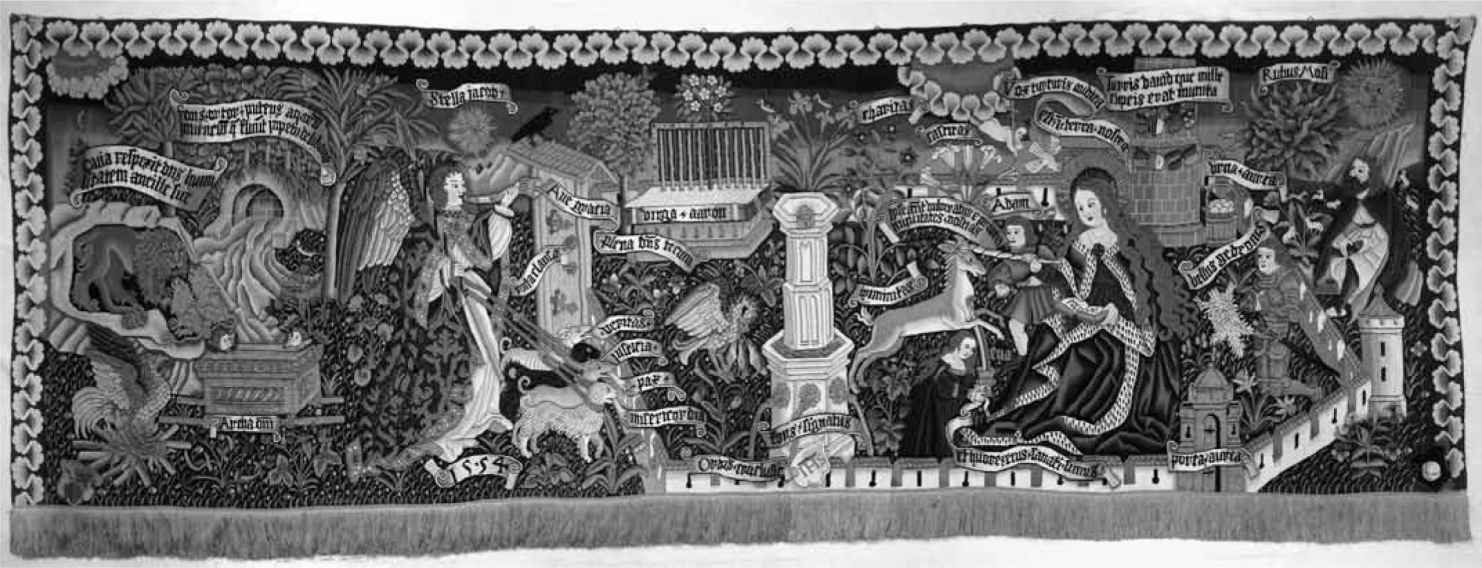
Figure 6.1 Monastery tapestry Hortus conclusus, Zurich 1554. Wool, silk, gold and silver threads.
Benedictine Convent, Sarnen, Switzerland. Picture D. Stuppan Bullinger understood the tradition of Heidnischwerk from his personal exposure to the art form as a child and adult. He wrote in his family history:
'Anna Bullinger (die Küfferin) learned how to do Heidnischwerk from her mother, and did beautiful work, and she taught it to my own Anna Zwingli, these are the three or four who were able to do it, because one of each family taught it to the other'.163 Verena Zoller's Wirkteppich took years to weave, and the process that the Bullingers, Zwinglis and the rest of Zurich were a part of also took time, not every reformed precept was adopted immediately after its conception. The transition of Heidnischwerk and the Mary motif illustrates the gradual nature of the evolution of the Mary-model. Reforming a church, culture and society were not isolated events, and both Zwingli and Bullinger were products of and participants in their own cultures. Both were also astute agents of theological and cultural change. The practical example of Verena Zoller's Wirkteppich and traditional sixteenth-century women's art depicting the Annunciation illustrates the personal relationships that influenced the Zurich reformers, which, it seems, affected their thoughts on the role model Mary.
Reforming the Mary-model in Reformation Zurich Mary's position in the power relations between men and women of the church has not been the emphasis of this chapter, but it has been mentioned that the church Fathers wrestled with Mary's role at numerous councils, and
that the questions concerning Mary were intricately linked to the incarnation and the degree of Mary's affinity with the sacred. As early as 202 AD,
Irenaeus considered Mary the last Eve, who gave birth without sexual relations as a reply to Eve's sin. He wrote that by retaining her virtue, she participated with Christ in the salvation of humanity.164 By 1554, the people of Zurich were coming to uneasy terms with a new Mary-model altered from that of the old church.
Mary traditionally served as a powerful role model in the medieval church, and for at least 35 years this model was successively and systematically reshaped through the Zurich reformer's sermons and writings.
Zwingli and Bullinger qualified the doctrine of Mary according to their exegesis of Scripture and in the process reduced her value and position in reformed worship. Both reformers were defending their own honour against accusations, Mary's honour, marriage as an honourable institution and the goodness of a virtuous woman. Zwingli and Bullinger abbreviated Mary's role in the church and sculpted a new model of faith for everyone, thereby, also shaping a motif for female moral virtues.
Zwingli and Bullinger amended the shared conception and interpretation of Mariology for the church and culture of Zurich using practical examples, biblical exegesis, stories, the church Fathers and both structured and informal polemic. Each centred his argument on the incarnation, moved to the doctrine of Two-Natures, and emphasized Mary's virginity above all else. Both concluded that Christian prayer should be Christ centred, not Marian. In addition, the Mary-model, indeed, changed at the same time that marriage trumped celibacy, which especially influenced clergy and nuns, but also the average person's conception of the relationship between holiness and sexuality. Although Mary finally served as a common model of faith for all believers, the importance of chastity, which was a key trait of the reformed Mary-model, was carefully constructed in the reformer's writings and expressly applied to women. Mary became one among many saints who served as models of faith, but her particularity lay in the new Mary-model that was a reconstructed biblical type of Mary in which she retained eternal virginity and served as a role model for the virtuous behaviour of reformed women. Thus, women who embraced their roles as mothers and wives in the new system did not, for all that, gain a role model whom they could emulate, one who experienced natural childbirth, the frustrations of mothering and real married life. The correspondence between sin and sex that made Mary's
virginity so essential to christology remained intrinsic to sixteenth-century reformed mariology. Ian Maclean's words describe the situation well:
She is, in fact, exempt from all female vice and imperfection, and thus can accede directly to heaven by assumption unlike other human beings. Far from being the glory of her sex, she is not of her sex in its malediction, tribulation, and imperfection. She incarnates certain moral virtues, which are consistent with the social, and religious role of women but does not ever become a model of behavior, so remote is she from others of her sex.165
When one of the values that a role model represents is changed, it has repercussions in other areas of culture, and this works as a catalyst for change in a system of roles. The Mary-model in Zurich had ramifications in the church, culture and gender relations. By the time Mary was finally reformed, only men of faith held positions in the church,166 and a good reformed woman was like her role model Mary – an honourable and chaste wife – a woman of the church.
1 Petrus Canisius, De Maria Virgine incomparabili (1577), cited in Ian Maclean, The Renaissance Notion of Woman: A Study in the Fortunes of Scholastic and Medical Science in European Intellectual Life (Cambridge: Cambridge University Press, 1980), p. 23.
2 Luke 1:46–55: 'My soul magnifies the Lord'. Note that all English Bible Texts are cited from The Holy Bible: New Revised Standard Version (Nashville, TN: Thomas Nelson Publishers, 1989).
3 The literature on Mary in the Middle Ages is vast, but the works of special interest for this study are Jaroslav Pelikan, Mary Through the Centuries: Her Place in the History of Culture (New
Haven, CT: Yale University Press, 1996); Beth Kreitzer, Reforming Mary: Changing Images of the Virgin Mary in Lutheran Sermons of the Sixteenth Century (Oxford: Oxford University Press, 2004),
Kreitzer's monograph of studies on Mary in sixteenth-century Lutheran sermons furnishes a review of the general literature and state of research related to Mary in her introduction, pp. 3–25; Susan
Haskins (ed.), Vittoria Colonna, Chiara Matraini, and Lucrezia Marinella – Who Is Mary?: Three
Early Modern Women on the Idea of the Virgin Mary (Chicago, IL: University of Chicago Press,
2008), especially the 'Volume Editor's Introduction', pp. 1–46, which is particularly relevant to Mary in Zurich. Emidio Campi, Zwingli und Maria: Eine reformationsgeschichtliche Studie (Zurich:
Theologischer Verlag Zürich, 1997); Bridget Heal, The Cult of the Virgin Mary in Early Modern
Germany: Protestant and Catholic Piety, 1500–1648 (Cambridge: Cambridge University Press,
2007); Hilda Graef, Mary: A History of Doctrine and Devotion (Notre Dame, IN: Ave Maria Press,
2009); Hans Grass, Traktat über Mariologie (Marburg: N.G. Elwert Verlag, 1991); Walter Tappolet,
Das Marienlob der Reformatoren (Tübingen: Katzmann Verlag, 1962).
4 Pelikan, Mary, pp. 55–65.
5 Gottfried Locher, Die Zwinglische Reformation in Rahmen der europäischen Kirchengeschichte
(Göttingen: Vandenhoeck & Ruprecht, 1979), p. 102.
6 See Pelikan, Mary, pp. 201–14. Pelikan contends that the Roman Catholic doctrine of Mary's bodily assumption was portrayed in art and was a part of folklore and faith long before the issuance of Munificentissimus Deus by Pius XII in 1950.
7 Cf. Paul A. Russell, Lay Theology in the Reformation: Popular Pamphleteers in South-West
Germany 1521–1525 (Cambridge: Cambridge University Press, 1986), pp. 189–91; Diarmaid
MacCulloch, 'Mary and Sixteenth Century Protestants', in Robert Norman Swanson (ed.), The Church and Mary (Woodbridge, Suffolk: Boydell & Brewer, 2006), p. 202.
8 Heinrich Denzinger and Peter Hünermann (eds), Kompendium der Glaubensbekenntnisse und kirchlichen Lehrentscheidungen, 37th ed. (Freiburg: Herder, 1991), no. 125.
9 Denzinger/Hünermann, Kompendium, nos 422, 427.
10 Compare Pelikan, Mary, pp. 113–22; Graef, Mary, pp. 80–87; Denzinger/Hünermann,
Kompendium, no. 431.
11 Denzinger/Hünermann, Kompendium, nos 502–4.
12 Graef, Mary, p. 181: 'since the divine Blesssed Virgin is no more than a creature and is rational, she must not be paid divine worship, but veneration known as dulia; however, since she is the Mother of God, this should be of a higher form than that given other creatures. For this reason the veneration paid her is termed hyperdulia, to indicate it is more than ordinary dulia'. See Thomas Aquinas,
Summa Theologiae IIIa q. 25 a. 5 co., in: S. Thomae Aquinatis opera omnia, ed. Roberto Busa, vol. 2
(Stuttgart-Bad Cannstatt: Frommann-Holzboog, 1980), p. 808: 'Et ideo nulli purae creaturae rationali debetur cultus latriae. Cum ergo beata Virgo sit pure creatura rationalis, non debetur ei adoratio latriae, sed solum veneratio duliae: eminentius tamen quam ceteris creaturis, inquantum ipsa est mater dei. Et ideao dicitur quod devetur ei, non qualiscumque dulia, sed hyperdulia'.
13 See Ignatius Brady, 'The Development of the Doctrine of the Immaculate Conception in the Fourteenth Century after Aureoli', in Franciscan Studies 15 (1955), p. 202; Donna Spivey Ellington,
From Sacred Body to Angelic Soul: Understanding Mary in Late and Medieval and Early Modern
Europe (Washington, DC: Catholic University Press, 2001).
14 Pelikan, Mary, pp. 198–9.
15 The dispute between catholic and reformed historians over Zwingli's doctrine of Mary were published in Swiss newspapers after 1950. Compare Gottfried W. Locher, 'Inhalt und Absicht von
Zwingli's Marienlehre', in Kirchenblatt für die reformierte Schweiz 107/3 (1951), pp. 34–7, shortly after the dogma of Mary's assumption had been canonized by Pope Pius XII in 1950, Locher defended the reformed position; also consider his opponent Karl Federer, 'Zwingli und die
Marienverehrung', in Zeitschrift für Schweizerische Kirchengeschichte 45/4 (1951), pp. 13–26.
16 Huldreich Zwinglis sämtliche Werke, eds Emil Egli et al. (Berlin et al.: Schwetschke et al.,
1905ff.) (Corpus Reformatorum 88–101) [cited as Z], vol. 1, pp. 197–209.
17 Cf. Campi, Zwingli und Maria, pp. 18–19.
18 Z, vol. 1, pp. 338–84.
19 Unlike monks, nuns at Oetenbach were forbidden to attend Zwingli's sermons in Grossmünster because of the jurisdiction of their Dominican bothers. Zwingli gained permission from the council to deliver a sermon at the Cloister, after which many of the women left their order. See: Locher, Die
Zwinglische Reformation, p. 101.
20 Z, vol. 1, pp. 391–428: Von der ewig reinen Magd Maria is hereafter cited as On the Eternally
Pure Maiden Mary.
21 Cf. MacCulloch, 'Mary', pp. 191–217; Heiko A. Oberman, 'The Virgin Mary in Evangelical
Perspective', in id., The Impact of the Reformation (Grand Rapids, MI: Eerdmans, 1994), p. 213.
MacCulloch quotes Bernhard Wyss: Die Chronik des Bernhard Wyss, 1519–1530, ed. Georg Finsler
(Basel: Basler Buchund Antiquariatshandlung, 1901) (Quellen und Abhandlungen zur schweizerichen Reformationsgeschichte 1), p. 16.
22 Locher, Die Zwinglische Reformation, p. 100.
23 Z, vol. 1, p. 426.
24 Z, vol. 2, pp. 14–457.
25 Ulrich Gäbler, Huldrych Zwingli: Leben und Werk (Zurich: Theologischer Verlag Zürich,
2004), pp. 61–8.
26 Johann Fabri was a German theologian, who due to his life-long friendship with Erasmus first sympathized with Melanchthon and Zwingli, but as the division in the church widened, he defended
Catholic Orthodoxy. The Bishop of Constance sent Faber as well as three other counsellors and judges to the dispute. Fabri did not enter the detailed theological discussion so that Zwingli's reply convinced the audience. See The Oxford Encyclopedia of the Reformation, 4 vols, ed. Hans J.
Hillerbrand (Oxford: Oxford University Press, 1996), s.v. 'Fabri, Johann' by John Patrick Donnelly.
27 Locher, Die Zwinglische Reformation, p. 113.
28 Z, vol. 2, p. 166,9–12: 'Der zwentzigst artickel. Das uns gott alle ding wil in sinem namen geben; darus entspringt, das wir usserthalb diser zyt dheins mitlers bedörffend weder sin'. Ibid., p.
222,11–14: 'Der ein und zwentzigst artickel. Das, so wir für einandren uff erden bittend, das in der gstalt thueyind, dass wir allein durch Christum uns alle ding ggeben werden vertruwind'.
29 Z, vol. 2, p. 261,14–17: 'Der acht und zwentzigst artickel. Das alles, so got erloubt oder nit verbotten hat, recht ist; dannen har die ee allen menschen zimmen erlernt wirt'. Ibid., p. 263,6–10:
'Der nün und zwentzigst artickel. Das alle, die man geistlich nennet, sündend, wenn sy, nachdem sy innen worden sind, das inen got reinigheit halten abgeschlagen hat, sich mit der ee nit verhuetend'.
30 Z, vol. 2, p. 267,23–7: 'Der dryssigest artickel. Das die, so reinigheit verheissend, sich kintlich oder närrisch ze vil übernemmend; darus erlernet, das die, so söliche gelübd innemmend, frävenlich an den frommen menschen farend'.
31 William P. Stephens, The Theology of Huldrych Zwingli (Oxford: Clarendon Press, 1986), p.
31.
32 Stephens, Theology, p. 32.
33 Emidio Campi goes into great detail examining Zwingli's sermon in his book on Zwingli and Mary; the present chapter leans on Campi's scholarly contribution, see above n. 3.
34 Z, vol. 1, pp. 391–428: Zwingli's brothers the pious Heini, Clausen, Hansen, Wolffgangen,
Bartholome Zwinglinen were farmers in the pre-Alps of Toggenburg.
35 Konrad Hofmann was a cleric who spent three years collecting material evidence against Zwingli and his Schriftprinzip. His pamphlet demanding Zwingli's resignation was filed in 1522. See
Campi, Zwingli und Maria, p. 101; Locher, Die Zwinglische Reformation, p. 84.
36 See Christian Moser and Hans Rudolf Fuhrer, Der lange Schatten Zwinglis: Zürich, das französische Soldbündnis und eidgenössische Bündnispolitik, 1500–1650 (Zürich: Verlag Neue
Zürcher Zeitung, 2009).
37 Z, vol. 1, pp. 391–8. Quote: p. 392,16–20, 'Zuo denen, so daheim ir xind verwaltend, versich ich mich aller eeren und guottes; zuo den(en), so in krieg louffen, jamers und verdamnus irer seelen.
Gott wöl inen ein recht gemuet geben, damit sy sölichs nimmer me tuegend, als sy ouch verheissend'.
38 Z, vol. 1, p. 397,7–10: 'Ich halt von iro, als ein Christenman halten sol, und so vil me von iro, das ich nit eim yeden märsager gloub, was er uff sy lügt und seit, und ouch uff sy nit lügen wil, noch sagen me, denn mich die gschrifft des heiligen euangelii wyùt'.
39 Z, vol. 1, p. 400,14–17: 'Das aber alles mit vill geschrifft lichtlich aber starck bewerdt möcht werden, wo wir nit ein anders giengind, nämlich uff das lob der ewig reinen magt Marie, die unù disen heiland Christum geborn hatt'.
40 Z, vol. 1, p. 400,20–25: 'Darinn aber die götlich wyùheit erschint, nämlich, das mitt dem vermehlen Joseph gott nit hatt wellen den eelichen bruch zwischen inen beschehen, damit kinder geborn wurdind, sunder das die tochter Maria, nachdem sy schwanger erfunden, nit versteiniget wurde nach jüdischem gesatzt, welchs gebot versteinigen die, so on ein eeman geborn hett'.
41 Z, vol. 1, p. 401,21–3: 'Ja frylich: Gott mit uns, das er menschliche natur von der reinen Maria hat sich genommen und unùer bruoder, auch ein bezalende opfer für uns worden ist'.
42 Z, vol. 1, p. 401,24–28: 'Es wirdt ein schoù oder ruot erwachsen vonn der wurtzen oder stammen Jesse – der ist Davids vatter xin – und ein bluom oder bluost wirdt ufferston von siner wurtzen. Diùes schos ist die helig Maria, die bluost ist Christus'. See Isaiah 11:1, 'A shoot shall come out from the stump of Jesse, and a branch shall grow out of his roots'.
43 The literal translation of the German word verzehrt is not consummated, but consumed or eaten.
44 Z, vol. 1, p. 401,29–402,2: 'Ouch ist hieby ze mercken die eer irer lutren reinigkeit, die so groù ist xin, das der euangelist Lucas, ouch Matheus die ir zuogebet; dann sy ein reine unverserte magt vor der geburt, in und nach der geburt, ia in ewigkeit blybt'.
45 See Hunter, Marriage, pp. 166–7, on Jerome. Jerome held that chastity and celibacy were superior to marriage and finally refuted Helvidius with his De perpetua virginitate beate Maria adversus Helvidium; see F.L. Cross and E.A. Livingstone (eds), The Oxford Dictionary of the Christian Church (Oxford: Oxford University Press, 2005), p. 753. Helvidius was a fourth-century
Latin theologian who did not believe that Mary was a perpetual virgin. He contended that marriage and celibacy were equal and that Mary had given birth to children after Christ.
46 Z, vol. 1, pp. 402–4.
47 Z, vol. 1, p. 404,18–24: 'Diù ort Mathei hab ich darumb mit sölchem fliù erklärt, das die, so mir allenthalb fürmündend unnd falsch und unerlich uff mich redend, ich habe gepredigt, Maria sye ein torecht wyb xin, wie ein andre trüll. Oder hab sy an irer reinigkeit geschmützt und geschentzelet, das aber unguetlich uber mich erdacht ist, dann ich tür und hoch dörffte schweren, das mir all mine tag sölche schnöde von der wirdigen muoter gottes in minen sinn nie ist kommen'.
48 Z, vol. 1, p. 407,7–13: 'Demnach, da wir sprechend: Gesegnet bist über alle frowen, damit nit gezwyflet werde, was das word "gesegnet" bedüte, hab ich gesprochen: Hochgelobt bistu über alle frowen, darumb, daù das griechisch wort eulogemene vil ee heisset ein hochgelobte weder ein gesegnete; doch wil ich das wort "gesegnet" darumb nit verwerffen, doch das man "gesegnet bist" verstande für "hochgelobt bistu"'.
49 Luke 1:42, 'Blessed are you among women, and blessed is the fruit of your womb'.
50 Consider Jdt 13:18–9: 'Then Uzziah said to her, "O daughter, you are blessed by the Most High
God above all other women on earth; and blessed be the Lord God, who created the heavens and the earth, who has guided you to cut off the head of the leader of our enemies"'. No such text is attributed to Mary in scripture.
51 Z, vol. 1, p. 408,21–6: 'Unnd nach vil worten hat mich ein person gefragt: Sol man aber unser frowen nit das Ave Maria bäten? Gab ich antwurt: Das Ave Maria ist nit ein gebet, sunder ein grütz unnd ein lob. Doch bedenckend die wort selbs, so findend ir nit, das man darinn ütz begere, sunder nun Marian gruotz und lobe. Ein gebet heiùt nach dem tütsch: darinnen man bittet'.
52 Z, vol. 1, p. 413,10–20: 'Demnach als die helig Maria den wordten gottes, durch den engel verkündt, wol gegloubt, hatt sy doch erfaren, wie die geburt zuogrüst mueùt werden, sidmall sy dheinen man erkannt, das ist, mit gheinem sölicher gestalt gemeinsame hette. Hat ir der engel geantwurt: Der helig geist wirdt vonn oben herab in dich kummen, und die krafft des höchsten gottes wirdt dich überschatten. Darumb wirdt das helig, so vonn dir geboren wirdt, genennet werden der sun gottes. Ist die meinung des engels: Maria, ich verkünden dir ein nüwe ardt der geburt, die nüt gemeins haben wirdt mitt der menschen sündtlicher geburt'.
53 Luke 1:38, 'Here am I, the servant of the Lord'.
54 Z, vol. 1, p. 414,22–7: 'Das Maria hie gar heiter anzeygt in dem, das sy nit nach dem bruch der mannenden wyben oder dochtren got anmuotet dise oder iene gab oder wie sy demnach sölte gehalten werden, sunder ergibt sy sich mit demuetigen worten und gmuot und nennet sich selbs nüt anderst denn ein dienerinn des herren und begert, das gott mit iren handle nach dem wort des engels'.
55 An example for Mary's perceived poise can be seen in Michelangelo's masterpiece of Renaissance sculpture La Pietà (1498–99) in which Mary is holding Christ's lifeless body in her lap.
Her face is sad, yet composed, and introspective.
56 Luke 1:46–55, 'And Mary said "My soul magnifies the Lord, and my spirit rejoices in God my
Savior, for he has looked with favor on the lowliness of his servant. Surely, from now on all generations will call me blessed; for the Mighty one has done great things for me, and holy is his name. His mercy is for those who fear him from generation to generation. He has shown strength with his arm; he has scattered the proud in the throughts of their hearts. He has brought down the powerful from their thrones, and lifted up the lowly; he has filled the hungry with good things, and sent the rich away empty. He has helped his servant Israel, in remembrance of his mercy, according to the promise he made to our ancestors, to Abraham and to his descendants forever"'.
57 Matthew 27:56; John 19:25; Mark 15:40; Luke 23:49.
58 Luke 2:41–52.
59 John 2:1–11.
60 Z, vol 1, p. 421,12–15: 'Item, das sy alle ding, so mit Christo in der jugend verhandlet wurdendt, in so ingedenckem hertzen geuebt hat, ist ein gewüù zeichen des gar vertruwten hertzzens in got, das allweg wol gewüùt hat, das alles leben, und thuon Christi uns ein byspil bieten sol'.
61 Z, vol. 1, pp. 423,27–424,1: 'Dann ich nüt unerbers, sündtliches, schantliches noch böss uff die reinen magt Marien, die gebererin unsers heils, nie gedacht hab, ich will geschwigen: offenlich glert oder geredt'.
62 Z, vol. 1, p. 424,6–12: 'Wil mich begnuegen lassen den frummen, einfaltigen Christen fürgeleg haben min lutere meinung von der muoter gottes, das ich sy vestenklich gloub nach den worten des heligen euangelii ein reine magt uns geboren haben den sun gottes un din der gburt und ouch darnach
in die ewigkeit ein reine, unverserte magt bliben. Ich vertruw ouch vestenklich sy von got erhöcht sin über alle gschopten der säligen menschen oder englen in der ewigen fröid'.
63 Matthew 7:21, 'Not everyone who says to me, "Lord, Lord", will enter the kingdom of heaven, but only the one who does the will of my Father in heaven'.
64 Z, vol. 1, p. 424,14–20: 'Nit ein ieder, so zuo mir spricht: Her, her, wirt ingan in das rich der himelen, sunder der do thuot den willen mines vatters, der wirdt ingon in das rych der himlen; also ouch nit ien ieder, so nun mit dem mund und athem spricht ioch zuo hudert tusend malen: Gegruetzt syest, Maria, gegruetzt syest, Maria, wirt ingan in das rych der himelen, sunder der den handel also bedenckt, so er ein Ave Maria sprechen wil'.
65 Z, vol. 1, p. 425,5–10: 'Und sich, das ist der anhab xin alles unsers heils, das der engel, von got gesendt, Mariam. Die reinen magt, also angeredet und gruetzt: Got gruetz dich, Maria; du bist von got gnaden erfüllt; du bist hochgeruempt über all frowen, und hochgeruempt oder gesegnet ist die frucht dines lybs etc. oder derglichen'.
66 Z, vol. 1, p. 425,20–21: 'Und ist der andacht also gstaltet, das die wort mitlouffend, wer wolt das weren? Aber, als die irrenden leerend, ia so ein sölche zal der worten Ave Maria gebladert, habe es so vil oder so vil ablas erlanget, sag ich ein grossen, schändlichen irtumb sin; denn die einvaltigen hand daby gelernet uff ir eigen gebet, das allein mit worten beschehen ist, vertruwen, unnd das inner, war gebett, das nüt anderst ist den ein ewig uffsehen zuo gott unnd reinget den menschen von tag zuo tag, hand sy verlaùen'.
67 Z, vol. 1, p. 426,19–28.
68 Z, vol. 1, pp. 427,22–428,7.
69 Grass, Traktat über Mariologie, pp. 57–8.
70 Cf. Campi, Zwingli und Maria, p. 79, and Heal, The Cult of the Virgin Mary.
71 See n. 66 above, and Grass, Traktat über Mariologie, p. 58.
72 Oberman, 'The Virgin Mary', pp. 243–4.
73 MacCulloch, 'Mary', p. 211: 'It was, however, on the perpetual virginity of Mary that the Magisterial reformers showed themselves unanimously and adamantly conservative. This was despite the fact that their stance left them ideologically vulnerable both to Roman Catholics and to radicals'.
74 Josias Simler, Narratio de ortu, vita et obitu reverendi viri d. Henrici Bullingeri (Zürich:
Christoph Froschauer the Younger, 1575), fol. 31r.
75 Tappolet, Marienlob, pp. 215–18. Tappolet's motive for writing his book was to make the words of the reformers available in order to demonstrate that Catholic and reformed mariology were not irreparably separated. Tappolet's compilation and translations of the Early Modern High German and Latin texts into contemporary High German has been consulted for the quotes selected in this section.
76 MacCulloch, 'Mary', p. 214. Compare B. Hölscher, 'Nachlese zur Geschichte die Widertäufer in Münster', in Zeitschrift für vaterländische Geschichte und Altertumskunde Westfalens 20 (1859), pp. 151–94; pp. 151–2 refer to a fragment and Latin original from Hermann Hamelmann, De paedobaptismo contra anabaptistas etc., ex Westphalico idiomate, in latinam linguam translata ab
H.H.L., 1572.
77 Heinrich Bullinger, 'De beata virgine Maria matre Domini nostri Iesu Christi', in Festorum dierum domini et servatoris nostri Iesu Christi sermones ecclesiastici (Zurich: Christoph Froschauer the Elder, 1558), pp. 21–39.
78 Tappolet, Marienlob, p. 247.
79 Ibid.
80 Bullinger, 'De beata virgine Maria', p. 21: 'Petis, imo modis omnibus efflagitas, frater chariss[ime], ut diligentius copiosiusque paulo tractem in meis illis sermonibus, quos in gratiam piorum pastorum edere institui, ea quae scriptura sacra et vetustas adhuc purior, nobis tradidit de beata Maria virgine'.
81 Compare Exodus 3:14: 'God said to Moses, "I am who I am." He said further, "Thus you shall say to the Israelites, I am has sent me to you",' and Revelations 4:8, 'Holy, holy, holy, the Lord God the Almighty, who was and is and is to come'.
82 Homoousios is a theological term for the idea that the Father and Son share the same divine nature.
83 Bullinger, 'De beata virgine Maria', p. 21: 'Ostendam enim quod dominus noster Iesus Christus ex substantia matris Mariae, veram carnem humanam assumpsit: quod eadem virgo concepit, virgo peperit, et a partu virgo permansit. Quibus deinceps subiiciam, non singula quidem, sed potiora et memorabilia saltem, quae de ipsa commemorat scriptura, quae sane ad laudem eius, ut excellentissimae deoque gratissimae creaturae pertinere videntur'.
84 Bullinger refers to both Antidikomarianites and Collyridians in his Mary sermon. Epiphanius
(d. 403) opposed both the Antidikomarianites (those who speak against Mary) and Collyridians. The Antidikomarianites were a sect in Arabia claiming that Mary had intercourse with Joseph after the birth of Christ. The Collyridians were a sect of women who offered bread to the Virgin Mary. This disturbed Epiphanius because the women were performing a priestly function. See Graef, Mary, pp.
55–7.
85 Bullinger, 'De beata virgine Maria', p. 21.
86 Bullinger, 'De beata virgine Maria', p. 23: 'Quid enim ex spiritu aliud nasci potest quam spiritus, sicuti ex carne caro? Sed illud potius in virgine operatus est vel effecit divina virtute sanctissimus dei spiritus, ut ipsa citra virilem operam conciperet, id est, virgo illibata permanens ex seipsa, et ex sola quidem corporis sui purissimi et ad hoc sanctificati substantia carnem dei filio dederit'.
87 Ibid.: 'Spiritus sanctus superveniet in te. In te, inquit, coelitus veniet: quod frustra et sine caussa poneretur si nihil sumpsisset aut datum fuisset filio dei ex utero et substantia virginis Mariae. Ac per interpretationem subiungit angelus, Et virtus altissimi obumbrabit tibi. Spiritus sanctus est virtus altissimi: et supervenire nihil aliud est quam inumbrare. Significat autem inumbrare protegere, adde et fructificare, vel foecundum reddere. Nam nimius aestus sterilitatem arvis inducit: obumbratio fructum prolicit et fovet'.
88 Ibid.: 'Sed et spiritus sanctus non erat semen Abrahae, vel germen Davidis, sed Maria virgo filia est Davidis et Abrahae, Christus autem semen mulieris'. Cf. Luke 3:23–38 for Jesus' maternal genealogy. Bullinger's covenant theology and his interest in coherence between the Old and New
Testament could be a reason for this interpretation of 'the sprout' in a sermon focused on Mary.
89 Bullinger, 'De beata virgine Maria', p. 24: 'Proinde praeteritis illis, divina pariter et humana authoritate demonstrabimus Mariam perpetuam esse manereque virginem, afferemusque et nati purissime ex sanctissima integerrimaque virgine progeniti gloriam, puraeque generantis virginis matris dignitatem et honorem'.
90 Genesis 3:15, 'I will put enmity between you and the woman, and between your offspring and hers; he will strike your head, and you will strike his heel'.
91 Bullinger, 'De beata virgine Maria', p. 24: 'Virginem enim intelligit Mariam, quam utcunque hic vocet mulierem, propter sexum, virinem tamen fore significat, cum semen eos non semen viri, sed mulieris, id est virginis appellat. Nam quae semen habet, et citra viri operam habet, paritque filium, virgo certe manet'.
92 See n. 11 above.
93 Isaiah 7:14, 'Therefore the Lord himself will give you a sign. Look, the young woman is with child and shall bear a son, and shall name him Immanuel'.
94 Bullinger, 'De beata virgine Maria', p. 24: 'Ac Isaias propheta significantius haec explicans, et signum vel miraculum futurum, praedicens, Ecce virgo, inquit, concipiet et pariet filium. Virginis vocabulum refertur et ad conceptionem et ad nativitatem'.
95 Ibid.: 'Virginis vocabulum refertur et ad conceptionem et ad nativitatem. Utruncque perficiet unica, et quidem virgo integra ac perpetua. Virginis itaque vocabulum hic a deo singulariter et cum praerogativa quadam insigni soli inter mulieres matri domini attributum legitur, ut ab omnibus et perpetua et intemerata virgo nuncupetur'.
96 Ibid.: 'Quo et illud S. Cypriani De nativitate Christi pertinere videtur: Erat Mariae, inquit, proprium privilegium, quod nulla mulierum nec ante, nec deinceps meruit obtinere, quod erat simul mater et virgo, singulis titulis insignita. Et caetera'. During Bullinger's life De nativitate Christi by Ernaldus Bonaevallis was attributed to Cyprian. Cf. Patrologia Latina, ed. Jacques-Paul Migne, vol.
189, col. 1617B: 'Eratque ei proprium privilegium, quod nulla mulierum nec ante, nec deinceps meruit obtinere, quod erat simul mater et virgo, singulis titulis insignita'. See also Girolamo Zanchi,
De religione christiana fides – Confession of Christian Religion, eds Luca Baschera and Christian
Moser (Leiden/Boston: Brill, 2007) (Studies in the History of Christian Traditions 135), p. 309, n.
272.
97 Ezekiel 44:1–3, 'Then he brought me back to the outer gate of the sanctuary, which faces east; and it was shut. The Lord said to me: This gate shall remain shut; it shall not be opened, and no one shall enter by it; for the Lord, the God of Israel, has entered by it; therefore it shall remain shut. Only the prince, because he is a prince, may sit in it to eat food before the Lord; he shall enter by the vestibule of the gate, and shall go out by the same way'.
98 Bullinger, 'De beata virgine Maria', p. 26: 'Quis vero ille princeps? Quis deus Israel? Nisi dominus nostre Iesus Christus, qui ut beatus Zacharias dixit, nos visitavit oriens ex alto? Quae vero porta illa, quae clausa manet, quae non aperietur, per quam nemo transibit, quaeve semper manebit clausa principi, nisi virgo semper benedicta ac semper virgo Maria, mater domini nostri Iesu Christi?'
99 Heinrich Bullinger, Apodixis, quod virgo mater illesa virginitate pepererit salvatorem mundi
(Zurich Zentralbibliothek, Ms. S 433), 2 February, 1529. Bullinger uses the same arguments as in 'De beata virgine Maria' with a lengthy explanation of why Mary and Joseph made a sacrifice at the temple for Mary's purity after the birth of Christ, although Mary was an eternal virigin.
100 An interesting facet of the struggle that both Zwingli and Bullinger faced as they deconstructed asceticism by promoting marriage in the reformed tradition, while their conceptions of women were influenced by 4th century patriarchs and church leaders. Cf. Hunter, Marriage, p. 200.
101 Bullinger, 'De beata virgine Maria', p. 27: 'Caeterum beata Maria domini mater virgo erat, non mulier talis, quae suscepto videlicet viri semine pepererit. Nam virgo e spiritu sancto, sine viri opera conceperat, et pepererat: ergo a lege prorsus exempta erat: nihilominus legi paruit, ut omnes doceret suo exemplo legi parere'.
102 Luke 2:22–4, 'When the time came for their purification according to the law of Moses, they brought him up to Jerusalem to present him to the Lord (as it was written in the law of the Lord,
"Every firstborn male shall be designated as holy to the Lord") and they offered a sacrifice according to what is stated in the law of the Lord, "a pair of turtledoves or two young pigeons"'.
103 Bullinger's list includes: Proclus (d. 446/7), Cyprian (200/10–258), Jerome (347–420) and Ambrose (337/40–397) as well as a number of western bishops including Bassian Bishop of Lodi
(374–c 409), Eventius the 6th Bishop of Pavia (c. 381), Maximus, Theodulus, Constantius Bishop of Milan and Pope Siricius (d. 399).
104 Bullinger, 'De beata virgine Maria', pp. 28–30; Tappolet, Marienlob, p. 284. Bullinger's text refers to the conflicts that the church Fathers had with Jovinian and Helvidius. The 'heresies' concerned the Virgin Mary, the value of celibacy and marriage as outlined at the beginning of this chapter. Bullinger's evidence and arguments for Mary's perpetual virginity and the value of marriage in 'De beata virgine Maria' in light of his conception of women in his other writings is a subject for futher research.
105 Bullinger, 'De beata virgine Maria', p. 30: 'Quam vero illustris fuerit virgo mater coram deo, pietate, fide, integritate, sanctimonia omnibusque virtutibus, ut certe nulli sanctorum conferenda,
omnibus autem merito videatur anteferenda, manifestissime licet cernere in primis evangelicae historiae beati Matthaei et Lucae capitibus, praecipue vero in carmine illo suo. Nam ut Isaias ipsam appellaverat prophetissam cap[ite] 8., ita abundantissimum prophetiae spiritum se habuisse illo carmine percelebri demonstravit'.
106 Ibid.: 'infelices sunt pseudochristiani, qui Iudaeis nihilo meliores sua laude ipsam spoliant. Si item Maria est mater domini, ut ipsam diserte appellat spiritu sancto repleta beata Elisabeth, certe rectissime appellata est a veteribus in ecclesia θεοτόκος, id est deipara, vel dei mater'. See Lee
Palmer Wandel, Voracious Idols and Violent Hands: Iconoclasm in Reformation Zurich (Cambridge,
UK: Cambridge University Press, 1995), pp. 47–8: 'The cross and images of Christ were to receive latria, because they were reverenced for what they represented and were therefore inseparable from the worship due to Christ himself. The person of Mary posed a different problem: "Since the Blessed
Virgin is no more than a creature and is rational. She must not be paid divine worship, but simply veneration known as dulia; however, since she is the Mother of God, this should be of a higher form than that given other creatures. For this reason the veneration paid her is termed hyperdulia, to indicate it is more than ordinary dulia"'. Cf. Aquinas, Summa Theologiae IIIa q. 25 a. 5 co., in:
Opera, ed. Busa, vol. 2, p. 808.
107 See Margaret L. King and Albert Rabil, 'The Other Voice in Early Modern Europe:
Introduction to the Series', in Elsie McKee, Katharina Schütz Zell (Chicago, IL: University of Chicago Press, 2006), pp. xix–xx. King and Rabil refer to Boccacio who singled out women with the virtues of chastity, silence and obedience in his work. These virtues became 'traditional' praise worthy female attributes.
108 Bullinger, 'De beata virgine Maria', pp. 30–31.
109 Bullinger, 'De beata virgine Maria', p. 31: 'Quanquam vero omnibus mysteriis esset imbuta, et arcana salutis nostrae teneret omnia, quae et firma fide amplectebatur: quanquam item visiones haberet angelorum et colloquiis eorum frueretur familiaribus: nunquam tamen insolentius propter eximia dona elata est animo: semper in humilitate perseveravit'.
110 Bullinger, 'De beata virgine Maria', pp. 31–2. Luke 2:41–52.
111 Bullinger, 'De beata virgine Maria', p. 32: 'Responsiones autem domini alicubi satis acres, adeo non tulit indigne, ut nunquam non putaverit sibi in omnibus filio reverenter esse parendum'.
112 John 2:4, 'And Jesus said to her, "Woman, what concern is that to you and to me? My hour has not yet come"'.
113 John 2:5, 'His mother said to the servant, "Do whatever he tells you"'.
114 Bullinger, 'De beata virgine Maria', p. 32: 'Non dicit, Hoc aut illud facite: sed, Quodcunque ipse dixerit, facite. An vero audient nimii illi cultores virginis virginem, dicentem? Quodcunque ille vobis dixerit, facite. Si nolunt audire virginem, cur se iactant cultores esse eius, quam aspernantur neque audire dignantur? Si autem ipsam audiunt, cur non ad Christum festinant, et a Christo petunt salutis suae omnia? Ipse enim ad se omnes vocat, omnibusque pollicetur bona omnia, quod sit vita et plenitudo, in quo fideles habent salutis et vitae omnia. Cum ergo Maria dicat, Facite quod filius facere iusserit, et hic unice mandet, ut ipsum solum adoremus, invocemus, et colamus, omni nostra in ipsum defixa fiducia: certe nulla bona virginis gratia, neque secundum virginis consilium cantillabimus, Maria mater gratiae, mater misericordiae, tu nos ab hoste protege, in hora mortis suscipe: sed clamabimus potius ad filium, et dicemus, Fili patris coelestis ac virginis matris Mariae, qui passus es pro peccatis mundi et es unica salus omnium nostrum, miserere nostri, et suscipe spiritum nostrum'.
115 Bullinger, 'De beata virgine Maria', p. 33: 'Nec dubium est quin pro excellentissima gratia sua, quam acceperat a deo, intelligeret, hac ratione vitam repararimundo. Quo nomine etiam aequanimius tolerabat animi sui moestissimi atrocia alioqui tormenta. Utinam vero sub cruce gementibus hoc salutare virginis exemplum nunquam excidat, sed hoc ipso discant patientiam, orentque dominum ipsis fidem augeat'.
116 Ibid.: 'A resurrectione ascensioneque domini in fide et humilitate modestiaque persecuerat, nihil magni aut insoliti propter eximia sua dona tentat, nihil in ecclesia magisterii sibi usurpat, neque seipsam ab ecclesia separat, multo minus pro dea quadam sese venditat. Perseverans enim cum apostolis et discipulis, et ipsa expectat adventum sancti spiritus, manensque in corpore ecclesiastico, singulare utique et praestantissimum ecclesiae membrum, non autem caput eius aut domina, accipit et ipsa cum aliis fidelibus spiritum sanctum'.
117 Bullinger, 'De beata virgine Maria', p. 34: 'Certum interim et indubitatum est, ipsam nunc vivere in coelis cum dilecto filio, in quo salutem consequuta est aeternam'.
118 Ibid.: 'Sufficiat hic nobis, simpliciter et vere sentire et profiteri, dilectissimam domini nostri
Iesu Christi matrem virginem Mariam sui ipsius filii gratia et sanguine plenissime sanctificatam, abundantissimo sancti spiritus munere donatam, mulieribusque praelatam omnibus, et ut benedictam vereque beatam ab ipsis angelis, denique ab omnibus praedicatam generationibus, nunc vivere cum
Christo felicem in coelis, eandemque et dici et esse ac permanere perpetuam virginem, deiparam, cuius memoria per ecclesiam inter fideles iugis et celeberrima, interim tamen pia, non superstitiosa, esse debeat'.
119 Ibid.: 'Ex quibus sane omnibus apparet liquido, quam nullo nostro merito (qui locus huius
Sermonis ultimus est) inter Antidicomarianitas annumeremur ab adversariis nostris. Orthodoxe enim et sobrie omnia ea credimus et docemus de beata Maria virgine, quae scripturis consona universa credidit et docuit orthodoxa vetustas'.
120 Ibid.: 'virginem matrem plenam esse gratia, ut quae sit veluti fons et scaturigo adeoque mater gratiae et misericordiae, quae et gratiam suis abundantissime conferat cultoribus et seruare etiam possit: id quod in ea et beatus Bernardus agnoverit. Addunt eandem esse et salutandan, invocandam a nobis ut mediatricem nostram'.
121 Bullinger, 'De beata virgine Maria', p. 35: 'Sed et colendam esse contendunt, sacrificiis, feriis, et id genus aliis cultibus. Quod cum nos et facere nolimus, et salua incolumique nostra religione
Christiana nos facere non posse contendamus, omnino nos inter Antidicomarianitas vel hostes et conviciatores divae virginis Mariae ceu Iudaeos et impios deputandos esse'.
122 Ibid.: 'Principio quidem agnoscimus Bernardum abbatem Clarevallensem plus tribuere virgini, quam ullis scripturis canonicis probari aut ipsi denique virgini matri placere posit'.
123 Ibid.: 'Ad quem modum et beatus Augustinus nec suis scriptis, nec ullorum patrum doctrinis credi voluit, nisi ipsi et illi denicque sua approbaverint scripturis divinis'.
124 Ibid.: 'Proinde interpres, qui ad Ephesios propius accessit ad vim verbi, paulo longius recessit a vi vocis cum salutationem angeli vertit, Ave gratia, plena pro quo ad verbum vertisset, Ave gratificata, id est, Ave gratiam consequuta gratisque deo dilecta'.
125 Ibid.: 'Interim vero non oppugnamus, si contendas virginem gratia plenam esse, eo sensu quem iam reddidimus: ipsam videlicet esse in singulari apud deum gratia, donatamque a deo pluribus maximisque charismatibus, atque adeo deo omnium gratissimam et charissimam: et non hac sententia quod ita sit gratia plena, ut gratiam hanc vel gratiae plenitudinem etiam in alios derivet atque transfundat'.
126 Bullinger, 'De beata virgine Maria', p. 36: 'Prohibet christiana religio ista quaerere apud creaturas, quantumuis gratia spirituque dei plenas: prohibet vera religio ista ab eis petere'.
127 Ibid.: 'Non puduit sane angelum salutare virginem, sed eius salutatio non fuit precatio vel oratio, non fuit invocatio, sed legationis a deo demandatae executio'.
128 Ibid.: 'Benedicta tu inter mulieres, et benedictus fructus ventris tui'.
129 Bullinger, 'De beata virgine Maria', pp. 36–7: 'Quod autem inter haec aperte dicunt adversarii,
Mariam ut mediatricem inter deum et hominem esse invocandam, aut illam patronam et advocatam nostram esse, nullo prorsus modo, vel agnoscere ut scripturis sanctis traditum, vel ullo pacto recipere ceu a deo mandatum possumus. Nam credimus solum deum esse invocandum, qui solus omnia
conferat salutaria praesentis et futuri saeculi … Iam cum constet virginem matrem fuisse et esse membrum ecclesiae catholicae, et quidem excellentissimum'.
130 Bullinger, 'De beata virgine Maria', p. 37: 'Contendunt sane adversarii nostri Mariam esse colendam, et quidem sacrisiciis, feriis, et id genus cultibus aliis'.
131 Ibid.: 'etenim honorandam omnino asserimus et honoramus ipsi, sed non cultum ei ullum praestando divinum, sed tribuendo ei honorem debitum, omniaque ea quae deus per scripturas ei tribuit, sentiendo de ipsa honorifice et magnifice, ut de vera dei genitrice, benedicta illa inter mulieres, virgine illa perpetua, quam et diligimus charitate sancta et admiramur propter ingentia dei dona, praedicamus eius virtutes, et defendimus eius gloriam contra convitiatores eius, omnes denique ad imitationem eius, quoad fiere potest, inhortamur, ac cum ipsa aliquando in conspectu dei et
Christi, promissa a deo salute, et gaudiis ineffabilibus, perfrui desideramus atque exoptamus'.
132 Bullinger, 'De beata virgine Maria', p. 38: 'Constanter ergo dicimus divam virginem non esse adorandam a nobis, non invocandam, ut mediatricem, aut gratiae matrem, non figendam in ipsam nostram fiduciam, non sacrificandum ei aut in nomine eius, non feriandum ei, non ullas ei imagines erigendas, neque colendam ullo huius generis cultu'.
133 Ibid.: 'Et mox, quis vero prophetarum praecepit hominem adorari, nedum mulierem. Eximium siquidem uas est, sed mulier, et nihil a natura immutata, verum et intellectu? sensu in honorata, velut corpora sanctorum?'
134 Bullinger, 'De beata virgine Maria', p. 39: 'Non itaque hodie video quin salva quoque et incolumi religione Christiana veraque salute nostra istis carere possimus feriis: quinimo si syncere religiosi esse voluerimus, atque adeo inservire virgini pure contenderimus, soli deo et filio eius Iesu
Christo ferias religiose persolvemus'.
135 Rosmarie Sunderland, Huldrych Zwingli's Reformation: Changes in Religious and Social
Customs in Sixteenth and Seventeenth Century Zurich and Its Environs, doctoral dissertation
(Fordham University, 2000). See also Handbuch der reformierten Schweiz, ed. Schweizerischer protestantischer Volksbund (Zurich: EVZ-Verlag, 1962), p. 87.
136 Pelikan, Mary, p. 153.
137 Heinrich Bullinger Briefwechsel, ed. Ulrich Gäbler et al. (Zurich: Theologischer Verlag
Zürich, 1973ff.) [cited as HBBW], vol. 1., no. 24, pp. 126–41; no. 26, pp. 145–9; no. 27, pp. 150–76.
138 Heinrich Bullinger, Pastoraltheologische Schriften, ed. Detlef Roth (Zurich: Theologischer
Verlag Zürich, 2009) (Heinrich Bullinger Werke III/5), pp. 1–78.
139 Ibid., pp. 79–188.
140 Bullinger, Pastoraltheologische Schriften, pp. 133–41; for Mary see, pp. 7, 115, 200. Monika
Gsell, 'Hierarchie und Gegenseitigkeit: überlegungen zur Geschlechterkonzeption in Heinrich
Bullingers Eheschrift', in Rüdiger Schnell (ed.), Geschlechterbeziehungen und Textfunktionen:
Studien zu Eheschriften der Frühen Neuzeit (Tübingen: Niemeyer, 1998), pp. 95–8.
141 HBBW, vol. 1, no. 24, pp. 138,23–139,2, Bullinger to Anna Adlischwyler.
142 See Heal, The Cult of the Virgin Mary, pp. 282–90: 'Stripped of her divine power she became a model for all Christians, though gender asymmetries continued to shape experiences of Marian devotion as they had done in the pre-Reformation period. To both men and women Mary was presented as an example of faith, obedience, and humility, but to women in particular she was also presented as a model of chastity and virtue'.
143 Cf. Carol Piper Heming, Protestants and the Cult of the Saints in German-Speaking Europe,
1517–1531 (Kirksville, MO: Truman State University Press, 2003).
144 Campi, Zwingli und Maria, pp. 117–26.
145 Merry E. Wiesner, 'Studies of Women, the Family, and Gender', in William S. Maltby (ed.),
Reformation Europe: A Guide to Research II (St. Louis: Center for Reformation Research, 1992), p.
165.
146 See McKee, Katharina Schütz Zell, p. 3; Katharina Simon-Muscheid, Die Dinge im
Schnittpunkt sozialer Beziehungsnetze: Reden und Objekte im Alltag (Göttingen: Vandenhoeck &
Ruprecht, 2004) (Veröffentlichungen des Max-Planck-Instituts für Geschichte 193), pp. 102–11;
Josef Strzygowsti, Morgenrot und Heidnischwerk in der christlichen Kunst (Berlin: Widukind, 1937).
147 Buri/Stuckey-Schürer, 'Verena Zollers Wirkteppich', pp. 137–52.
148 Canticles 4:12, 'A garden locked is my sister, my bride, a garden locked a fountain sealed'.
149 See Rainer Nickel, Lexikon der antiken Literatur (Düsseldorf: Patmos, 2006), p. 732. The Physiologos presents wonderful motives of nature. It was originally written in Greek in 2 AD in Alexandria. In the later Latin edition the animals were types for Christ, the church, people, and the devil that were enriched with Bible texts and translated into most known languages, thus greatly influencing medieval Christianity.
150 Buri/Stuckey-Schürer, 'Verena Zollers Wirkteppich', p. 140.
151 Correct spelling: humilitas, but printed in the text as cited above, see ibid.
152 Ibid.
153 Buri/Stuckey-Schürer, 'Verena Zollers Wirkteppich', p. 141.
154 Cant 2:2, 'As a lilie among brambles, so is my love among maidens'.
155 Buri/Stuckey-Schürer, 'Verena Zollers Wirkteppich', p. 141.
156 Ibid.
157 Cf. Buri/Stuckey-Schürer, 'Verena Zollers Wirkteppich', p. 143; Heinrich Bullingers Diarium
(Annales vitae) der Jahre 1504–1574, ed. Emil Egli (Basel: Basler Buchund Antiquariatshandlung,
1904), p. 43. There is a difference between the dates that Buri and Stuckey-Schürer use in their work
(1 February 1536) and those in Bullinger's Diarium (31 January 1536). I have inserted the dates according to the Diarium.
158 Heinrich Bullingers Diarium, p. 43.
159 Buri/Stuckey-Schürer, 'Verena Zollers Wirkteppich', p. 143.
160 Cf. ibid.; Robert Durrer, Die Kunstdenkmäler des Kantons Unterwalden (Zurich: Verlag des schweizerischen Landesmuseums, 1899), pp. 703–8.
161 See Lexikon des Mittelalters, eds Norbert Angermann et al., vol. 6 (München: Artemis, 1993), s.v. 'Minneallegorie'. Minneallegory is a literary genre that grew from the Royal Epic of c. 1200, which employs didactic-allegorical discussions about correct behavior for lovers or concerning the symbolism of certain places or things.
162 Buri/Stuckey-Schürer, 'Verena Zollers Wirkteppich', p. 144.
163 Heinrich Bullinger, 'Verzeichnis des Geschlechts der Bullingers', in Helvetia:
Denkwürdigkeiten für die XXII Freistaaten der Schweizerischen Eidgenossenschaft, ed. Joseph Anton
Balthasar, vol. 1 (Zürich, 1823), p. 94: 'Diese Anna Bullinger hat von ihrer Mutter, der Küfferin, heidnisch Werk wirken gelernt, und hat hübsche Arbeit gemacht, und es meine Anna Zwingli gelehrt; das sind wohl die vier oder fünf gewesen, die da wirken konnten, da je eine des Geschlechts es die andere wieder lehrte'. Bullinger is referring to his own mother Anna Bullinger here.
164 Irenaeus, Adversus Haereses 1,19,1, in Patrologia Graeca, ed. Jacques-Paul Migne, vol. 7/2, cols 1175–6: 'For just as the former was led astray by the word of an angel, so that she fled from God when she had transgressed His word; so did the latter, by an angelic communication, receive the glad tidings that she should sustain (portaret) God, being obedient to His word. And if the former did disobey God, yet the latter was persuaded to be obedient to God, in order that the Virgin Mary might become the patroness (advocata) of the virgin Eve. And thus, as the human race fell into bondage to death by means of a virgin, so is it rescued by a virgin; virginal disobedience having been balanced in the opposite scale by virginal obedience. For in the same way the sin of the first created man
(protoplasti) receives amendment by the correction of the First-begotten, and the coming of the serpent is conquered by the harmlessness of the dove, those bonds being unloosed by which we had been fast bound to death'.
165 Maclean, Renaissance, p. 23.
166 Bruce Gordon, The Swiss Reformation (Manchester: Manchester University Press, 2002), p.
266: 'Zwingli had raised the status of marriage to one of the most revered aspects of the Christian faith, but there is no doubt that the Reformation closed off to women all careers other than the household'.