
1 Peter
1 Peter
CHAPTER 1
Peter, an apostle of Jesus Christ, to the strangers scattered throughout Pontus, Galatia,
Cappadocia, Asia, and Bithynia, 2 Elect according to the foreknowledge of God the Father, through sanctification of the Spirit, to obedience and sprinkling of the blood of Jesus Christ: Grace to you, and peace, be multiplied.
3 Blessed be the God and Father of our Lord Jesus Christ, which according to his abundant mercy has begotten us again to a lively hope by the resurrection of Jesus Christ from the dead, 4 To an inheritance incorruptible, and undefiled, and that fades not away, reserved in heaven for you, 5 Who are kept by the power of God through faith to salvation ready to be revealed
in the last time.
6 Wherein you greatly rejoice, though now for a season, if need be, you are in heaviness through manifold temptations:
7 That the trial of your faith, being much more precious than of gold that perishes though it be tried with fire, might be found unto praise and honor and glory at the appearing of Jesus Christ:
8 Whom having not seen, you love; in whom, though now you see him not, yet believing, you rejoice with joy unspeakable and full of glory:
9 Receiving the end of your faith, even the salvation of your souls.
10 Of which salvation the prophets have inquired and searched diligently, who prophesied of the grace that should come to you:
11 Searching what, or what manner of time the Spirit of Christ which was in them did signify, when it testified beforehand the sufferings of Christ, and the glory that should
follow.
12 To whom it was revealed, that not to themselves, but to us they did minister the things, which are now reported to you by them that have preached the gospel to you with the Holy Spirit sent down from heaven; which things the angels desire to look into.
13 Wherefore gird up the loins of your mind, be sober, and hope to the end for the grace that is to be brought to you at the revelation of Jesus Christ; 14 As obedient children, not fashioning yourselves according to the former lusts in your ignorance:
15 But as he which has called you is holy, so be holy in all manner of conversation;
16 Because it is written, Be holy; for I am holy.
17 And if you call on the Father, who without respect of persons judges according to every man's work, pass the time of your sojourning here in fear:
18 Forasmuch as you know that you were
not redeemed with corruptible things, as silver and gold, from your vain conversation received by tradition from your fathers;
19 But with the precious blood of Christ, as of a lamb without blemish and without spot:
1:25
The Dead Sea Scrolls—"The greatest manuscript discovery of all times."
By William F. Albright The discovery of the Dead Sea Scrolls (DSS) at Qumran in 1949 had significant effects in corroborating evidence for the Scriptures. The ancient texts, found hidden in pots in cliff-top caves by a monastic religious community, confirm the reliability of the Old
Testament text. These texts, which were copied and studied by the Essenes, include one complete Old Testament book (Isaiah) and thousands of fragments, representing every Old Testament book except Esther.
The manuscripts date from the third century b.c. to the first century a.d. and give the earliest window found so far into the texts of
the Old Testament books and their predictive prophecies. The Qumran texts have become an important witness for the divine origin of the Bible, providing further evidence against the criticism of such crucial books as Daniel and Isaiah.
Dating the Manuscripts. Carbon-14 dating is a reliable form of scientific dating when applied to uncontaminated material several thousand years old. Results indicated an age of 1917 years with a 200-year (10 percent) variant.
Paleography (ancient writing forms) and orthography (spelling) indicated that some manuscripts were inscribed before 100B.C.
Albright set the date of the complete Isaiah scroll to around 100B.C.—"There can happily not be the slightest doubt in the world about the genuineness of the manuscript."
Archaeological Dating.
Collaborative evidence for an early date came from archaeology.
Pottery accompanying the manuscripts was late Hellenistic (c. 150–63
b.c.) and Early Roman (c. 63B.C. to A.D.100). Coins found in the monastery ruins proved by their inscriptions to have been minted between 135 b.c. and a.d. 135. The weave and pattern of the cloth supported an early date. There is no reasonable doubt that the Qumran manuscripts came from the century before Christ and the first century a.d.
Significance of the Dating. Previous to the DSS, the earliest known manuscript of the Old Testament was the Masoretic Text (a.d.
900) and two others (dating about a.d. 1000) from which, for example, the King James version of the Old Testament derived its translation.
Perhaps most would have considered the Masoretic text as a very late text and therefore questioned the reliability of the Old Testament wholesale. The Dead Sea
Scrolls eclipse these texts by 1,000 years and provide little reason to question their reliability, and further, present only confidence for the text. The beauty of the Dead Sea Scrolls lies in the close match they
have with the Masoretic text—demonstrable evidence of reliability and preservation of the authentic text through the centuries. So the discovery of the DSS provides evidence for the following:
1) Confirmation of the Hebrew Text 2) Support for the Masoretic Text 3) Support for the Greek translation of the Hebrew Text (the Septuagint). Since the New
Testament often quotes from the Greek Old Testament, the DSS furnish the reader with further confidence for the Masoretic texts in this area where it can be tested.
(Generated from Norman Geisler, "Dead Sea Scrolls,"
Baker Encyclopedia of Christian Apologetics)
PRINCIPLES OF GROWTH
FOR THE NEW AND
GROWING CHRISTIAN
2:2
Feeding on the Word—Daily
Nutrition A healthy baby has a healthy appetite. If you have truly been "born" of the Spirit of God, you will have a healthy appetite. The Bible says, "As newborn babes, desire the sincere milk of the word, that you may grow thereby" (1 Peter 2:2). Feed yourself daily without fail. Job said, "I have esteemed the words of His mouth more than my necessary food" (Job 23:12). The more you eat, the quicker you will grow, and the less bruising you will have. Speed up the process and save yourself some pain—vow to read God's Word every day, without fail. Say to yourself,
"No Bible, no breakfast. No read, no feed."
Be like Job, and put your Bible before your belly. If you do that, God promises that you will be like a fruitful, strong, and healthy tree
(Psalm 1). Each day, find somewhere quiet and thoroughly soak your soul in the Word of God.
There may be times when you read through its pages with great enthusiasm, and other
times when it seems dry and even boring. But food profits your body whether you enjoy it or not. As a child, you no doubt ate desserts with great enthusiasm. Perhaps vegetables weren't so exciting. If you were a normal child, you probably had to be encouraged to eat them at first. Then, as you matured in life you were taught to discipline yourself to eat vegetables, because they benefit you physically even though they may not bring pleasure to your taste buds.
For the next principle of growth, see Matthew 6:9 comment.
20 Who verily was foreordained before the foundation of the world, but was manifest in these last times for you, 21 Who by him do believe in God, that raised him up from the dead, and gave him glory; that your faith and hope might be in God.
22 Seeing you have purified your souls in obeying the truth through the Spirit to unfeigned love of the brethren, see that you
love one another with a pure heart fervently:
23 Being born again, not of corruptible seed, but of incorruptible, by the word of God, which lives and abides for ever.
2 4 For all flesh is as grass, and all the glory of man as the flower of grass. The grass withers, and the flower thereof falls away:
25 But the word of the Lord endures for ever. And this is the word which by the gospel is preached to you.
QUESTIONS & OBJECTIONS
2:15 "How should I witness to my coworkers?"
When we interact with people on a daily basis, we have many opportunities for sharing our faith.
First, be sure you are respectful to your employer and set a good example in your work ethic by working "as to the Lord"
(Colossians 3:23). When others around you grumble and complain, if you have a calm, forgiving, steadfast spirit, it will make an impression. As you respond in a Christhke way to angry coworkers and stressful circumstances, people will see a difference in your life.
Always be friendly and courteous, and show genuine interest in your coworkers' lives. Invite them out to lunch to get better acquainted. Share their joys and sorrows by congratulating them in their good times and offering to pray for them in their bad times.
Be sure you do pray for them, then follow up by asking them about the situation you prayed for. They will be moved by your concern.
If coworkers are discussing what they did during the previous weekend, you can share your excitement about attending church services or a special church event. Ask others if they have any plans for celebrating Christmas or Easter; be nonjudgmental of their answer, but be ready (if asked) to
explain why you celebrate as you do.
Displaying a favorite Scripture or a devotional calendar, or reading your Bible during lunchtime, may prompt others to inquire about your faith.
Bringing home-baked goods or leaving a small gift with a note on a coworker's desk can sometimes have a greater impact than a thousand eloquent sermons. We can show our faith by our works. Others may not like a tree of righteousness, but they cannot help but like its fruit. Pray for opportunities to share the gospel, being careful not to infringe on your boss's time.
1:3
New birth—its necessity for salvation. See 1 Peter 1:23.
1:4 The beloved son. A true story is told of a millionaire who had a portrait of his beloved son painted before the son went to war. He was tragically killed in battle, and shortly afterward, the heartbroken millionaire died.
His will stated that all his riches were to
be auctioned, specifying that the painting must sell first.
Many showed up at the auction, where a mass of the rich man's wealth was displayed.
When the painting was held up for sale, there were no bids made. It was an unknown painting by an unknown painter of the rich man's uncelebrated son, so sadly, there was little interest.
After a few moments, a butler who worked for the man remembered how much the millionaire loved his son, decided to bid for it, and purchased the portrait for a very low price.
Suddenly, to everyone's surprise the auctioneer brought down his gavel and declared the auction closed. The rich man's will had secretly specified that the person who cared enough to purchase the painting of his beloved son was also to be given all the riches of his will.
This is precisely what God has done through the gospel. He who accepts the
beloved Son of God also receives all the riches of His will—the gift of eternal life and "pleasures for evermore." They become "joint heirs" with the Son (Romans 8:16,17).
1:8 The source of joy. "Joy is not the same as pleasure or happiness. A wicked and evil man may have pleasure, while any ordinary mortal is capable of being happy.
Pleasure generally comes from things, and always through the senses; happiness comes from humans through fellowship. Joy comes from loving God and neighbor. Pleasure is quick and violent, like a flash of lightning. Joy is steady and abiding, like a fixed star.
Pleasure depends on external circumstances, such as money, food, travel, etc. Joy is independent of them, for it comes from a good conscience and love of God." Fulton J.
Sheen 1:15 "To ask that God's love should be content with us as we are is to ask that God should cease to be God: because He is what
He is, His love must, in the nature of things,
be impeded and repelled by certain stains in our present character, and because He already loves us He must labor to make us lovable."
C.S. Lewis 1:23
New birth—its necessity for salvation. If you speak to someone who professes to know God and you are not certain of their salvation, simply ask if they have been "born again" (see John 3:1–7). If you find that they are not sure (this is one sign that they haven't—1 John 5:10) or they say that they haven't, here is how you can bring focus to its importance. Tell them that the difference between believing in God and being born again is like the difference between believing in a parachute and putting it on. There's a big difference when you jump from the plane. Then say, "Do you know what convinced me that I had to be born again? It was the Ten Commandments." Then take them through the spiritual nature of the Law, which brings the knowledge of sin (Romans 7:7).
See 1 John 5:1.
CHAPTER 2
Wherefore laying aside all malice, and all guile, and hypocrisies, and envies, and all evil speakings, 2 As newborn babes, desire the sincere milk of the word, that you may grow thereby:
3 If so be you have tasted that the Lord is gracious.
4 To whom coming, as to a living stone, disallowed indeed of men, but chosen of God, and precious, 5 You also, as lively stones, are built up a spiritual house, an holy priesthood, to offer up spiritual sacrifices, acceptable to God by Jesus Christ.
6 Wherefore also it is contained in the scripture, Behold, I lay in Zion a chief corner stone, elect, precious: and he that believes on him shall not be confounded.
7 To you therefore which believe he is precious: but to them which be disobedient, the stone which the builders disallowed, the
same is made the head of the corner, 8 And a stone of stumbling, and a rock of offence, even to them which stumble at the word, being disobedient: whereunto also they were appointed.
9 But you are a chosen generation, a royal priesthood, an holy nation, a peculiar people; that you should show forth the praises of him who has called you out of darkness into his marvelous light:
10 Which in time past were not a people, but are now the people of God: which had not obtained mercy, but now have obtained mercy.
11 Dearly beloved, I beseech you as strangers and pilgrims, abstain from fleshly lusts, which war against the soul; 12 Having your conversation honest among the Gentiles: that, whereas they speak against you as evildoers, they may by your good works, which they shall behold, glorify God in the day of visitation.
13 Submit yourselves to every ordinance of
man for the Lord's sake: whether it be to the king, as supreme; 14 Or to governors, as to them that are sent by him for the punishment of evildoers, and for the praise of them that do well.
"The men who have guided the destiny of the United States have found the strength for their tasks by going to their knees."
LYNDON B. JOHNSON
15 For so is the will of God, that with well doing you may put to silence the ignorance of foolish men:
16 As free, and not using your liberty for a cloak of maliciousness, but as the servants of God.
17 Honor all men. Love the brotherhood.
Fear God. Honor the king.
18 Servants, be subject to your masters with all fear; not only to the good and gentle, but also to the froward.
19 For this is thankworthy, if a man for
conscience toward God endure grief, suffering wrongfully.
20 For what glory is it, if, when you are buffeted for your faults, you shall take it patiently? but if, when you do well, and suffer for it, you take it patiently, this is acceptable with God.
21 For even hereunto were you called: because Christ also suffered for us, leaving us an example, that you should follow his steps:
22 Who did no sin, neither was guile found in his mouth:
23 Who, when he was reviled, reviled not again; when he suffered, he threatened not; but committed himself to him that judges righteously:
24 Who his own self bare our sins in his own body on the tree, that we, being dead to sins, should live to righteousness: by whose stripes you were healed.
25 For you were as sheep going astray; but are now returned to the Shepherd and Bishop of your souls.
QUESTIONS & OBJECTIONS
3:12 "If God is a God of love, why hasn't He dealt with evil?"
In Dr. Robert Morey's book The New Atheism and the Erosion of Freedom, he talks with an atheist about this issue. The atheist assumes that everything is relative, and there are no absolutes (he is absolutely sure of that). Morey replies that the first thing an atheist must do is prove the existence of evil.
By what process can an atheist identify evil?
He must have a universal absolute to do so.
Without an absolute reference point for "good" (which only God can provide), no one can identify what is good or evil. Thus without the existence of God, there is no "evil" or "good" in an absolute sense.
Everything is relative. The problem of evil does not negate the existence of God. It actually requires it.
Many assume that because evil still exists
today, God has not dealt with it. How can atheists assume that God has not already solved the problem of evil in such a way that neither His goodness nor omnipotence is limited? On what grounds do they limit what
God can and cannot do to solve the problem?
God has already solved the problem of evil.
And He did it in a way in which He did not contradict His nature or the nature of man.
We assume God will solve the problem of evil in one single act. But why can't He deal with evil in a progressive way? Can't He deal with it throughout time as we know it, and then bring it to the climax on the Day of Judgment?
God sent His Son to die on the cross in order to solve the problem of evil. Christ atoned for evil and secured the eventual removal of all evil from the earth. One day evil will be quarantined in one spot called
"hell." Then there will be a perfect world devoid of all evil. If God declared that all evil would, at this moment, cease to exist, you
and I and all of humanity would go up in a puff of smoke. Divine judgment demands that sin be punished. Ron Meade 2:2 "Had the doctrines of Jesus been preached always as pure as they came from His lips, the whole civilized world would now have been Christians." Thomas Jefferson 2:7 Perhaps the number one fruit of salvation will be that Jesus will become precious to the believer. See 1 Corinthians
16:22.
2:15 Good works are a legitimate form of evangelism. Since the way to a man's heart is often through his taste buds, buying him a hamburger may reach him more effectively than an argument.
"Kindness has converted more sinners than zeal, eloquence, or learning." Frederick W.
Faber 2:24 Messianic prophecy fulfilled: "But he was wounded for our transgressions, he was bruised for our iniquities: the
chastisement of our peace was upon him; and with his stripes we are healed" (Isaiah 53:5).
See Matthew 13:34,35 comment.
CHAPTER 3
Likewise, you wives, be in subjection to your own husbands; that, if any obey not the word, they also may without the word be won by the conversation of the wives;
While they behold your chaste conversation coupled with fear.
3 Whose adorning let it not be that outward adorning of plaiting the hair, and of wearing of gold, or of putting on of apparel; 4 But let it be the hidden man of the heart, in that which is not corruptible, even the ornament of a meek and quiet spirit, which is in the sight of God of great price.
5 For after this manner in the old time the holy women also, who trusted in God, adorned themselves, being in subjection to their own husbands:
6 Even as Sara obeyed Abraham, calling him lord: whose daughters you are, as long as you do well, and are not afraid with any amazement.
7 Likewise, you husbands, dwell with them according to knowledge, giving honor to the wife, as to the weaker vessel, and as being heirs together of the grace of life; that your prayers be not hindered.
8 Finally, be all of one mind, having compassion one of another, love as brethren, be pitiful, be courteous:
9 Not rendering evil for evil, or railing for railing: but contrariwise blessing; knowing that you are thereunto called, that you should inherit a blessing.
10 For he that will love life, and see good days, let him refrain his tongue from evil, and his lips that they speak no guile:
11 Let him eschew evil, and do good; let him seek peace, and ensue it.
12 For the eyes of the Lord are over the righteous, and his ears are open to their
prayers: but the face of the Lord is against them that do evil.
13 And who is he that will harm you, if you be followers of that which is good?
14 But and if you suffer for righteousness' sake, happy are you: and be not afraid of their terror, neither be troubled; 15 But sanctify the Lord God in your hearts: and be ready always to give an answer to every man that asks you a reason of the hope that is in you with meekness and fear:
16 Having a good conscience; that, whereas they speak evil of you, as of evildoers, they may be ashamed that falsely accuse your good conversation in Christ.
17 For it is better, if the will of God be so, that you suffer for well doing, than for evil doing.
18 For Christ also has once suffered for sins, the just for the unjust, that he might bring us to God, being put to death in the flesh, but quickened by the Spirit:
19 By which also he went and preached to
the spirits in prison; 20 Which sometime were disobedient, when once the longsuffering of God waited in the days of Noah, while the ark was being prepared, wherein few, that is, eight souls were saved by water.
21 The like figure whereunto even baptism does also now save us (not the putting away of the filth of the flesh, but the answer of a good conscience toward God,) by the resurrection of Jesus Christ:
22 Who is gone into heaven, and is on the right hand of God; angels and authorities and powers being made subject to him.
3:1,2 Do not preach to loved ones, or express frustration or anger because they don't believe. Win them with your works rather than your words. Buy them gifts, do them favors, show them love and kindness.
Make sure that you are free from the slightest hint of hypocrisy.
3:8,9 Witnessing tips.
"When you approach a careless individual, be sure to
treat him kindly. Let him see that you are talking with him, not because you seek a quarrel with him, but because you love his soul and desire his best good in time and eternity. If you are harsh and overbearing, you will probably drive him farther away from the way of life.
"Be serious! Avoid all lightness of manner or language. Levity will produce anything but a right impression. You ought to feel that you are engaged in a very serious work, which is going to affect the character of your friend or neighbor and probably determine his destiny for eternity. Who could trifle and use levity in such circumstances if his heart were sincere?
"Be respectful. Some think it is necessary to be abrupt, rude, and coarse in their discussions with the careless and impenitent.
No mistake can be greater. The apostle Peter has given us a better rule on the subject, where he says: 'Be pitiful, be courteous: not rendering evil for evil, or railing for railing: but contrariwise blessing.'" Charles Finney
3:15 Always be ready to "earnestly contend for the faith" (Jude 3). Learn how to prove God's existence. Study the theory of evolution and the evidence for creation.
Become proficient in presenting the spiritual nature of God's Law. Say, "I can do all things through Christ who strengthens me," and thereby walk above the snare of the fear of man.
Note that this verse is not a prescription for what is commonly called "lifestyle evangelism." We are not being told to wait until we are asked about our faith—we may be waiting for a long time. As soldiers of Christ we are not only to defend the faith, but we are to advance the cause of the gospel.
The word "go" in the Great Commission means just that—go.
3:20 Peter believed the Genesis account of Noah's Flood—that is was a worldwide deluge in which only eight people were saved.
CHAPTER 4
Forasmuch then as Christ has suffered for us in the flesh, arm yourselves likewise with the same mind: for he that has suffered in the flesh has ceased from sin; 2 That he no longer should live the rest of his time in the flesh to the lusts of men, but to the will of God.
3 For the time past of our life may suffice us to have wrought the will of the Gentiles, when we walked in lasciviousness, lusts, excess of wine, revellings, banquetings, and abominable idolatries:
4 Wherein they think it strange that you run not with them to the same excess of riot, speaking evil of you:
5 Who shall give account to him that is ready to judge the quick and the dead.
6 For for this cause was the gospel preached also to them that are dead, that they might be judged according to men in the flesh, but live according to God in the spirit.
7 But the end of all things is at hand: be therefore sober, and watch to prayer.
8 And above all things have fervent charity among yourselves: for charity shall cover the multitude of sins.
9 Use hospitality one to another without grudging.
10 As every man has received the gift, even so minister the same one to another, as good stewards of the manifold grace of God.
11 If any man speak, let him speak as the oracles of God; if any man minister, let him do it as of the ability which God gives: that God in all things may be glorified through Jesus Christ, to whom be praise and dominion for ever and ever. Amen.
12 Beloved, think it not strange concerning the fiery trial which is to try you, as though some strange thing happened to you:
QUESTIONS & OBJECTIONS
4:1 "Do you sin, as a Christian?"
If a Christian sins, it is against his will.
One who is regenerate falls rather than dives into sin; he resists rather than embraces it.
Any dead fish can float downstream. It takes a live one to swim against the flow. Christians still experience temptations and can sometimes fall into sin, but they are no longer slaves to sin (Romans 6:6). They have God's
Holy Spirit within them to help them say no to temptation, and to convict their conscience of wrongdoing when they do sin.
13 But rejoice, inasmuch as you are partakers of Christ's sufferings; that, when his glory shall be revealed, you may be glad also with exceeding joy.
14 If you are reproached for the name of Christ, happy are you; for the spirit of glory and of God rests upon you: on their part he is evil spoken of, but on your part he is glorified.
15 But let none of you suffer as a murderer, or as a thief, or as an evildoer, or as a
busybody in other men's matters.
16 Yet if any man suffer as a Christian, let him not be ashamed; but let him glorify God on this behalf.
17 For the time is come that judgment must begin at the house of God: and if it first begin at us, what shall the end be of them that obey not the gospel of God?
18 And if the righteous scarcely be saved, where shall the ungodly and the sinner appear?
19 Wherefore let them that suffer according to the will of God commit the keeping of their souls to him in well doing, as to a faithful
Creator.
4:5
Daniel Webster (1782–1852), politician and diplomat, is considered one of the greatest orators in American history.
When asked, "What is the greatest thought that ever passed through your mind?" Webster responded, "My accountability to God."
4:14 "When we share our faith, we are in a win/win situation. If people accept what we
say, we win. If we plant the seed of God's Word, we win; and even if we are rejected, we win. This is because the Bible says that when that happens, the Spirit of glory and of God rests upon us. When we contend for the faith and are rejected, we are to rejoice and leap for joy, for great is our reward in heaven
(Luke 6:22,23). It is a winning situation every single time that you share your faith!" Mark
Cahill
CHAPTER 5
The elders which are among you I exhort, who am also an elder, and a witness of the sufferings of Christ, and also a partaker of the glory that shall be revealed:
2 Feed the flock of God which is among you, taking the oversight thereof, not by constraint, but willingly; not for filthy lucre, but of a ready mind; 3 Neither as being lords over God's heritage, but being ensamples to the flock.
4 And when the chief Shepherd shall appear, you shall receive a crown of glory that fades not away.
Likewise, you younger, submit yourselves to the elder. Yes, all of you be subject one to another, and be clothed with humility: for God resists the proud, and gives grace to the humble.
6 Humble yourselves therefore under the mighty hand of God, that he may exalt you in due time:
7 Casting all your care upon him; for he cares for you.
8 Be sober, be vigilant; because your adversary the devil, as a roaring lion, walks about, seeking whom he may devour:
9 Whom resist steadfast in the faith, knowing that the same afflictions are accomplished in your brethren that are in the world.
RIDDLE:
Name nine people who were saved from drowning by an ark.
ANSWER:
Eight members of Noah's family were saved by an ark in the Flood (Genesis 7:13), and the infant Moses was also saved by an ark (Exodus 2:3). (See 1 Peter 3:20.) 10 But the God of all grace, who has called us to his eternal glory by Christ Jesus, after that you have suffered a while, make you perfect, stablish, strengthen, settle you.
11 To him be glory and dominion for ever and ever. Amen.
12 By Silvanus, a faithful brother to you, as I suppose, I have written briefly, exhorting, and testifying that this is the true grace of God wherein you stand.
13 The church that is at Babylon, elected together with you, salutes you; and so does
Marcus my son.
14 Greet one another with a kiss of charity.
Peace be with you all that are in Christ Jesus.
Amen.
5:3 "A message prepared in the mind reaches a mind; a message prepared in a life
reaches a life." Bill Gothard Science Confirms the Bible
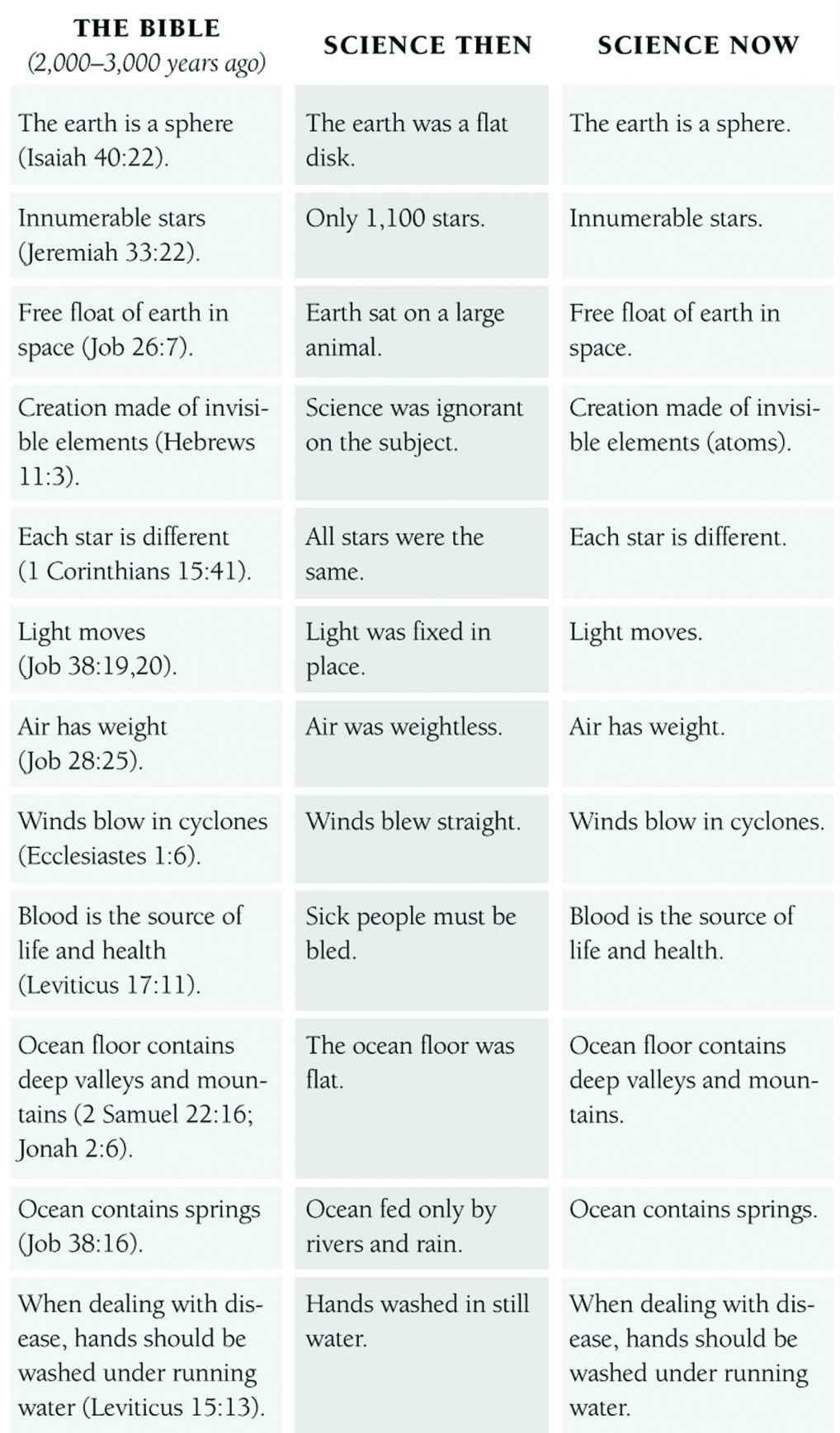
(See Hebrews 11:3 comment.)