
Hebrews
Hebrews
CHAPTER 1
GOD, who at sundry times and in divers manners spoke in time past to the fathers by the prophets, 2 Has in these last days spoken to us by his
Son, whom he has appointed heir of all things, by whom also he made the worlds; 3 Who being the brightness of his glory, and the express image of his person, and upholding all things by the word of his power, when he had by himself purged our sins, sat down on the right hand of the Majesty on high;
4 Being made so much better than the angels, as he has by inheritance obtained a more excellent name than they.
5 For to which of the angels said he at any time, You are my Son, this day have I begotten you? And again, I will be to him a Father, and he shall be to me a Son?
6 And again, when he brought in the first begotten into the world, he says, And let all the angels of God worship him.
7 And of the angels he says, Who makes his angels spirits, and his ministers a flame of fire.
8 But to the Son he says, Your throne, O God, is for ever and ever: a sceptre of righteousness is the sceptre of your kingdom.
9 You have loved righteousness, and hated iniquity; therefore God, even your God, has anointed you with the oil of gladness above your fellows.
10 And, You, Lord, in the beginning have laid the foundation of the earth; and the heavens are the works of your hands:
11 They shall perish; but you remain; and they all shall wax old as does a garment;
12 And as a vesture shall you fold them up, and they shall be changed: but you are the same, and your years shall not fail.
13 But to which of the angels said he at any time, Sit on my right hand, until I make your
enemies your footstool?
14 Are they not all ministering spirits, sent forth to minister for them who shall be heirs of salvation?
1:1 The Bible's inspiration. The Bible doesn't attempt to defend its inspiration. But here is an interesting thing: Genesis opens with the words "God said" nine times in the first chapter. The statement "Thus says the Lord" appears 23 times in the last Old Testament book, Malachi. So you have "God says" from Genesis to Malachi. "The Lord spoke" appears 560 times in the first five books of the Bible and at least 3,800 times in the whole of the Old Testament! Isaiah claims at least 40 times that his message came directly from the Lord; Ezekiel, 60 times; and Jeremiah, 100 times.
There are about 3,856 verses directly or indirectly concerned with prophecy in Scripture. God's challenge to the world is,
"Prove Me now ... I the Lord have spoken it: it shall come to pass" (see Malachi 3:10;
Ezekiel 24:14). Mormons, Buddhists, and Muslims have their own sacred writings, but the element of proven prophecy is absent in them. The destruction of Tyre, the invasion of Jerusalem, the fall of Babylon and Rome— each event was accurately predicted in the Bible and later fulfilled to the smallest detail.
See Matthew 4:4 comment.
"Defend the Bible? I would as soon defend a lion!" Charles Spurgeon 1:2,3 "There is a Being who made all things, who holds all things in His power, and is therefore to be feared." Sir Isaac Newton
1:11 See Psalm 102:25,26 comment.
CHAPTER 2
Therefore we ought to give the more earnest heed to the things which we have heard, lest at any time we should let them slip.
2 For if the word spoken by angels was
steadfast, and every transgression and disobedience received a just recompense of reward; 3 How shall we escape, if we neglect so great salvation; which at the first began to be spoken by the Lord, and was confirmed to us by them that heard him; 4 God also bearing them witness, both with signs and wonders, and with divers miracles, and gifts of the Holy Spirit, according to his own will?
5 For to the angels has he not put in subjection the world to come, whereof we speak.
6 But one in a certain place testified, saying, What is man, that you are mindful of him? or the son of man, that you visit him?
"No sinner looks to the Savior with a dry eye or a hard heart. Aim, therefore, at heart-breaking, at bringing home condemnation to the conscience and weaning the mind from sin. Be not
content till the whole mind is deeply and vitally changed in reference to sin."
CHARLES SPURGEON
7 You made him a little lower than the angels; you crowned him with glory and honor, and did set him over the works of your hands:
8 You have put all things in subjection under his feet. For in that he put all in subjection under him, he left nothing that is not put under him. But now we see not yet all things put under him.
9 But we see Jesus, who was made a little lower than the angels for the suffering of death, crowned with glory and honor; that he by the grace of God should taste death for every man.
10 For it became him, for whom are all things, and by whom are all things, in bringing many sons to glory, to make the captain of their salvation perfect through sufferings.
SPRINGBOARDS FOR
SPRINGBOARDS FOR
PREACHING AND
WITNESSING
2:10 The Titanic The story of the Titanic has incredibly close parallels to the biblical plan of salvation. Just as the great pleasure ship struck an iceberg and sank, this great world— with all its inhabitants—is slowly sinking into the cold grip of death. As with the Titanic, where only those passengers who believed that they were in impending danger looked to the lifeboats, so only those who believe that they are in mortal danger will look to the Lifeboat of the Savior, Jesus Christ. The great
"iceberg" that will take the world to an icy grave is the Moral Law—the Ten Commandments.
Here is the evidence that we are sinking:
Jesus said that if we look with lust, we commit adultery in our heart. No one who has had sex outside of marriage, or any liar, or
any thief will enter heaven. The Bible says that if we hate someone, we are guilty of murder. We fail to put God first. We make a god in our image. We break all the Commandments. If we stay with the "ship," we will perish on the Day of Judgment, when all of our sins come out as evidence of our guilt. God, however, is rich in mercy and doesn't want anyone to go to hell. He made a way for us to be saved. Jesus Christ, the One whom the Bible calls the "Captain of our salvation," gave His life so that we could have a place in the lifeboat. He took our punishment upon Himself, suffering on the cross for us. We broke God's Law, but He paid our fine. Then He rose from the dead, defeating death. The moment we repent and trust in Him alone for our eternal salvation,
God will forgive us and grant us the gift of eternal life.
Don't hesitate. You may wait until it's too late! It was reported that some of the lifeboats that left the Titanic early were only half full.
Many more on board could have been saved, but they refused to believe that the great
"unsinkable" ship was sinking. They perished because their faith was misguided. Don't be like them. Believe the gospel. Repent and trust Jesus Christ today ... and God will never let you down.
11 For both he that sanctifies and they who are sanctified are all of one: for which cause he is not ashamed to call them brethren,
12 Saying, I will declare your name to my brethren, in the midst of the church will I sing praise to you.
13 And again, I will put my trust in him.
And again, Behold I and the children which God has given me.
1 4 Forasmuch then as the children are partakers of flesh and blood, he also himself likewise took part of the same; that through death he might destroy him that had the power of death, that is, the devil;
15 And deliver them who through fear of death were all their lifetime subject to
bondage.
16 For verily he took not on him the nature of angels; but he took on him the seed of Abraham.
17 Wherefore in all things it behoved him to be made like to his brethren, that he might be a merciful and faithful high priest in things pertaining to God, to make reconciliation for the sins of the people.
18 For in that he himself has suffered being tempted, he is able to succour them that are tempted.
2:6 "Young man, the secret of my success is that at an early age I discovered I was not God." Oliver Wendell Holmes, Jr.
CHAPTER 3
Wherefore, holy brethren, partakers of the heavenly calling, consider the Apostle and High Priest of our profession, Christ Jesus;
2 Who was faithful to him that appointed
him, as also Moses was faithful in all his house.
3 For this man was counted worthy of more glory than Moses, inasmuch as he who has built the house has more honor than the house.
4 For every house is built by some man; but he that built all things is God.
5 And Moses verily was faithful in all his house, as a servant, for a testimony of those things which were to be spoken after;
THE FUNCTION OF THE
LAW 3:12 "While [every true believer] cries out, 'O what love have I unto thy Law! All the day long is my study in it;' he sees daily, in that divine mirror, more and more of his own sinfulness. He sees more and more clearly that he is fullness a sinner in all things—that neither his heart nor his ways are right before God, and that every moment sends him to
Christ.
"Therefore I cannot spare the Law one moment, no more than I can spare Christ, seeing I now want it as much to keep me to Christ, as I ever wanted it to bring me to Him.
Otherwise this 'evil heart of unbelief' would immediately 'depart from the living God.'
Indeed each is continually sending me to the other—the Law to Christ, and Christ to the Law." John Wesley 6 But Christ as a son over his own house; whose house are we, if we hold fast the confidence and the rejoicing of the hope firm to the end.
7 Wherefore (as the Holy Spirit says, Today if you will hear his voice, 8 Harden not your hearts, as in the provocation, in the day of temptation in the wilderness:
9 When your fathers tempted me, proved me, and saw my works forty years.
10 Wherefore I was grieved with that generation, and said, They do always err in
their heart; and they have not known my ways.
11 So I sware in my wrath, They shall not enter into my rest.) 12 Take heed, brethren, lest there be in any of you an evil heart of unbelief, in departing from the living God.
13 But exhort one another daily, while it is called Today; lest any of you be hardened through the deceitfulness of sin.
14 For we are made partakers of Christ, if we hold the beginning of our confidence steadfast to the end; 15 While it is said, Today if you will hear his voice, harden not your hearts, as in the provocation.
16 For some, when they had heard, did provoke: howbeit not all that came out of Egypt by Moses.
17 But with whom was he grieved forty years? was it not with them that had sinned, whose carcasses fell in the wilderness?
18 And to whom sware he that they should not enter into his rest, but to them that
believed not?
19 So we see that they could not enter in because of unbelief.
CHAPTER 4
Let us therefore fear, lest, a promise being left us of entering into his rest, any of you should seem to come short of it.
2 For to us was the gospel preached, as well as to them: but the word preached did not profit them, not being mixed with faith in them that heard it.
3 For we which have believed do enter into rest, as he said, As I have sworn in my wrath, if they shall enter into my rest: although the works were finished from the foundation of the world.
4 For he spoke in a certain place of the seventh day on this wise, And God did rest the seventh day from all his works.
5 And in this place again, If they shall enter into my rest.
6 Seeing therefore it remains that some must enter therein, and they to whom it was first preached entered not in because of unbelief:
7 Again, he limits a certain day, saying in David, Today, after so long a time; as it is said, Today if you will hear his voice, harden not your hearts.
8 For if Jesus had given them rest, then would he not afterward have spoken of another day.
THE FUNCTION OF THE
LAW 4:12 "It is the ordinary method of the Spirit of God to convict sinners by the Law. It is this which, being set home on the conscience, generally breaketh the rocks in pieces. It is more especially this part of the Word of God which is quick and powerful, full of life and energy and sharper than any two-edged
sword." John Wesley "The Law cuts into the core of the evil, it reveals the seat of the malady, and informs us that the leprosy lies deep within." Charles
Spurgeon 9 There remains therefore a rest to the people of God.
10 For he that is entered into his rest, he also has ceased from his own works, as God did from his.
11 Let us labor therefore to enter into that rest, lest any man fall after the same example of unbelief.
12 For the word of God is quick, and powerful, and sharper than any two-edged sword, piercing even to the dividing asunder of soul and spirit, and of the joints and marrow, and is a discerner of the thoughts and intents of the heart.
13 Neither is there any creature that is not manifest in his sight: but all things are naked and opened to the eyes of him with whom we have to do.
14 Seeing then that we have a great high priest, that is passed into the heavens, Jesus the Son of God, let us hold fast our profession.
15 For we have not an high priest which cannot be touched with the feeling of our infirmities; but was in all points tempted like as we are, yet without sin.
16 Let us therefore come boldly to the throne of grace, that we may obtain mercy, and find grace to help in time of need.
4:4 Creation in six days. Most theologians throughout church history agree that in using the phrase "the evening and the morning were the first day," the Scriptures are speaking of a literal 24-hour day, rather than a period of years.
"To understand the meaning of 'day' in Genesis 1, we need to determine how the Hebrew word for 'day,' yom, is used in the context of Scripture ... A number, and the phrase 'evening and morning,' are used for each of the six days of creation (Genesis
1:5,8,13,19,23,31). Outside Genesis 1, yom is used with a number 410 times, and each time it means an ordinary day—why would Genesis 1 be the exception? Outside Genesis
1, yom is used with the word 'evening' or 'morning' 23 times. 'Evening' and 'morning' appear in association, but without yom, 38 times. All 61 times the text refers to an ordinary day—why would Genesis 1 be the exception? In Genesis 1:5, yom occurs in context with the word 'night.' Outside of Genesis 1, 'night' is used with yom 53 times
—and each time it means an ordinary day.
Why would Genesis 1 be the exception? Even the usage of the word 'light' with yom in this passage determines the meaning as ordinary day." Ken Ham, et al., The Answers Book (revised and expanded) "So far as I know, there is no professor of Hebrew or Old Testament at any world-class university who does not believe that the writer(s) of Genesis 1–11 intended to convey to their readers the idea that (a) creation took
place in a series of six days which were the same as the days of 24 hours we now experience; (b) the figures contained in the Genesis genealogies provided by simple addition a chronology from the beginning of the world up to later stages in the biblical story; (c) Noah's Flood was understood to be worldwide and extinguish all human and animal life except for those in the ark." Dr.
James Barr, professor of Hebrew, Oxford University 4:4 The creation days. Some of the early church fathers believed that God created everything in only one day, or in an instant.
To counter this teaching, Martin Luther wrote:
"When Moses writes that God created Heaven and Earth and whatever is in them in six days, then let this period continue to have been six days, and do not venture to devise any comment according to which six days were one day. But, if you cannot understand how this could have been done in six days, then grant the Holy Spirit the honor of being
more learned than you are. For you are to deal with Scripture in such a way that you bear in mind that God Himself says what is written.
But since God is speaking, it is not fitting for you to wantonly turn His Word in the direction you wish it to go."
4:7 Isaiah 55:6 exhorts the lost to "seek the Lord while He may be found, call upon Him while He is near." God's offer of grace will end, so sinners are commanded to seek the Lord "while He may be found." They must then "call" upon Him. An intellectual belief in His existence is not saving faith. Romans
10:13 says "whoever calls upon the name of the Lord shall be saved."
4:12 Soldier of Christ, throw away your sheath, it is not part of your armor. Strap the two-edged sword firmly in your hand. The way to keep the sword on hand is to have it in your mouth. In Jeremiah 1:7–9, God told the prophet not to be afraid to speak. God then put His words in the mouth of Jeremiah, and in chapter 5 we are given a report of his
transformation: "Thus says the Lord God of hosts, Because you speak this word, behold, I will make my words in your mouth fire, and this people wood, and it shall devour them"
(v.14).
4:15 Some believe that because Scripture says Jesus was "in all points tempted like as we are" that He must have struggled with temptations to lie, steal, sin sexually, etc. But Scripture explains that all the attractions of this world fit into three categories: the lust of the flesh, the lust of the eyes, and the pride of life (1 John 2:16). Jesus was tempted by the devil in these three areas and, as the "second
Adam," He successfully passed the tests.
These are the same tests that the first Adam underwent and failed (Genesis 3:6). Adam and Eve saw that the tree was good for food
("lust of the flesh"; compare Luke 4:3,4), was pleasant to the eyes ("lust of the eyes"; compare Luke 4:5–8), and was desirable to make one wise ("pride of life"; compare Luke
4:9–12). We will "pass the test" and not
succumb to these temptations by following Jesus' example. He quoted the truths of the Word of God, using the sword of the Spirit to vanquish the lies of the enemy.
4:16 If you have a zeal for the lost, you will be a target for the enemy of your soul. He wants you to be beset by sin. His devious obsession is for iniquity to defile your conscience, and therefore take away your confidence before God. God forbid that we should allow that to happen. May each of us be so saturated in prayer and in the grace of God that we can boldly come before His throne with our head held high in faith and effectively stand in the gap for a dark and sinful world.
CHAPTER 5
For every high priest taken from among men is ordained for men in things pertaining to God, that he may offer both gifts and sacrifices for sins:
2 Who can have compassion on the ignorant, and on them that are out of the way; for that he himself also is compassed with infirmity.
3 And by reason hereof he ought, as for the people, so also for himself, to offer for sins.
4 And no man takes this honor to himself, but he that is called of God, as was Aaron.
5 So also Christ glorified not himself to be made an high priest; but he that said to him,
You are my Son, today have I begotten you.
6 As he said also in another place, You are a priest for ever after the order of Melchisedec.
7 Who in the days of his flesh, when he had offered up prayers and supplications with strong crying and tears to him that was able to save him from death, and was heard in that he feared; 8 Though he were a Son, yet learned he obedience by the things which he suffered;
9 And being made perfect, he became the author of eternal salvation to all them that
obey him; 10 Called of God an high priest after the order of Melchisedec.
11 Of whom we have many things to say, and hard to be uttered, seeing you are dull of hearing.
12 For when for the time you ought to be teachers, you have need that one teach you again which be the first principles of the oracles of God; and are become such as have need of milk, and not of strong meat.
13 For every one that uses milk is unskilful in the word of righteousness: for he is a babe.
14 But strong meat belongs to them that are of full age, even those who by reason of use have their senses exercised to discern both good and evil.
5:9 "I don't believe in any religion apart from doing the will of God." Catherine Booth
CHAPTER 6
Therefore leaving the principles of the doctrine of Christ, let us go on to perfection; not laying again the foundation of repentance from dead works, and of faith toward God,
2 Of the doctrine of baptisms, and of laying on of hands, and of resurrection of the dead, and of eternal judgment.
3 And this will we do, if God permit.
4 For it is impossible for those who were once enlightened, and have tasted of the heavenly gift, and were made partakers of the Holy Spirit, 5 And have tasted the good word of God, and the powers of the world to come, 6 If they shall fall away, to renew them again to repentance; seeing they crucify to themselves the Son of God afresh, and put him to an open shame.
7 For the earth which drinks in the rain that comes oft upon it, and brings forth herbs meet for them by whom it is dressed, receives blessing from God:
8 But that which bears thorns and briers is
rejected, and is near to cursing; whose end is to be burned.
9 But, beloved, we are persuaded better things of you, and things that accompany salvation, though we thus speak.
10 For God is not unrighteous to forget your work and labor of love, which you have showed toward his name, in that you have ministered to the saints, and do minister.
"To be a soul winner is the happiest thing in this world. And with every soul you bring to Jesus Christ, you seem to get a new heaven here upon earth."
CHARLES SPURGEON
11 And we desire that every one of you do show the same diligence to the full assurance of hope to the end:
12 That you be not slothful, but followers of them who through faith and patience inherit the promises.
13 For when God made promise to Abraham, because he could swear by no
greater, he sware by himself, 14 Saying, Surely blessing I will bless you, and multiplying I will multiply you.
15 And so, after he had patiently endured, he obtained the promise.
16 For men verily swear by the greater: and an oath for confirmation is to them an end of all strife.
17 Wherein God, willing more abundantly to show to the heirs of promise the immutability of his counsel, confirmed it by an oath:
18 That by two immutable things, in which it was impossible for God to lie, we might have a strong consolation, who have fled for refuge to lay hold upon the hope set before us:
19 Which hope we have as an anchor of the soul, both sure and steadfast, and which enters into that within the veil; 20 Whither the forerunner is for us entered, even Jesus, made an high priest for ever after the order of Melchisedec.
***
Check out "The Rush." See Luke 16:17 comment.
***
CHAPTER 7
For this Melchisedec, king of Salem, priest of the most high God, who met Abraham returning from the slaughter of the kings, and blessed him; 2 To whom also Abraham gave a tenth part of all; first being by interpretation King of righteousness, and after that also King of Salem, which is, King of peace; 3 Without father, without mother, without descent, having neither beginning of days, nor end of life; but made like to the Son of God; abides as a priest continually.
4 Now consider how great this man was, to whom even the patriarch Abraham gave the tenth of the spoils.
"O Lord, Almighty and everlasting God, by Thy holy Word Thou hast created the heaven, and the earth, and the sea; blessed and
glorified be Thy name, and praised be Thy majesty, which hath deigned to use us, Thy humble servants, that Thy holy name may be proclaimed in this second part of the earth."

5 And verily they that are of the sons of Levi, who receive the office of the priesthood, have a commandment to take tithes of the people according to the law, that is, of their brethren, though they come out of the loins of Abraham:
6 But he whose descent is not counted from them received tithes of Abraham, and blessed him that had the promises.
7 And without all contradiction the less is blessed of the better.
8 And here men that die receive tithes; but there he receives them, of whom it is witnessed that he lives.
9 And as I may so say, Levi also, who receives tithes, paid tithes in Abraham.
10 For he was yet in the loins of his father, when Melchisedec met him.
11 If therefore perfection were by the Levitical priesthood, (for under it the people received the law,) what further need was there that another priest should rise after the order of Melchisedec, and not be called after the order of Aaron?
12 For the priesthood being changed, there is made of necessity a change also of the law.
PRINCIPLES OF GROWTH
FOR THE NEW AND
GROWING CHRISTIAN
6:18 Faith—Elevators Can Let You Down I have heard people say, "I just find it hard to have faith in God," not realizing the implications of their words. These are the same people who often accept the daily weather forecast, believe the newspapers, and trust their lives to a pilot they have never
seen whenever they board a plane. We exercise faith every day. We rely on our car's brakes. We trust history books, medical journals, and elevators. Yet elevators can let us down. History books can be wrong. Planes can crash. How much more then should we trust the sure and true promises of Almighty
God. He will never let us down ... if we trust Him.
Cynics often argue, "You can't trust the Bible—it's full of mistakes." It is. The first mistake was when man rejected God, and the Scriptures show men and women making the same tragic mistake again and again. It's also full of what seem to be contradictions. For example, the Scriptures tell us "with God nothing shall be impossible" (Luke 1:37); there is nothing Almighty God can't do. Yet we are also told that it is "impossible for God to lie" (Hebrews 6:18). So there is something
God cannot do! Isn't that an obvious "mistake" in the Bible? No, it isn't.
Lying, deception, bearing false witness,
etc., is so repulsive to God, so disgusting to Him, so against His holy character, that the Scriptures draw on the strength of the word
"impossible" to substantiate the claim. He cannot, could not, and would not lie.
That means that in a world where we are continually let down, we can totally rely on, trust in, and count on His promises. They are sure, certain, indisputable, true, trustworthy, reliable, faithful, unfailing, dependable, steadfast, and an anchor for the soul. In other words, you can truly believe them, and because of that, you can throw yourself blindfolded and without reserve, into His mighty hands. He will never, ever let you down. Do you believe that?
For the next principle of growth, see 1 Peter 2:2 comment.
13 For he of whom these things are spoken pertains to another tribe, of which no man gave attendance at the altar.
14 For it is evident that our Lord sprang out of Judah; of which tribe Moses spoke nothing
concerning priesthood.
15 And it is yet far more evident: for that after the similitude of Melchisedec there arose another priest, 16 Who is made, not after the law of a carnal commandment, but after the power of an endless life.
17 For he testifies, You are a priest for ever after the order of Melchisedec.
18 For there is verily a disannulling of the commandment going before for the weakness and unprofitableness thereof.
19 For the law made nothing perfect, but the bringing in of a better hope did; by the which we draw near to God.
20 And inasmuch as not without an oath he was made priest:
SPRINGBOARDS FOR
PREACHING AND
WITNESSING
8:6 Solid Ice There once was a man who was traveling on foot through a snowstorm in a strange country. He had to get to a certain town by nightfall and was somewhat perturbed when he came to an ice-covered river. How thick was the ice? Could he trust it to hold him? He began crawhng on the ice on his stomach, inch-by-inch, tapping with his fingers. Sweat poured from his forehead. He was filled with the fear that at any moment he could plunge to an icy death.
An hour later, he had progressed only about 40 feet. He suddenly stopped crawhng. He could hear singing! He turned his head to see a horse and cart, laden with people. The driver was singing at the top of his voice as he drove his cart across the ice. The driver knew that lake was solid ice and his faith was such that he had total confidence, with not an ounce of fear. Such are the solid promises of God.
21 (For those priests were made without an
oath; but this with an oath by him that said to him, The Lord sware and will not repent, You are a priest for ever after the order of Melchisedec:) 22 By so much was Jesus made a surety of a better testament.
23 And they truly were many priests, because they were not suffered to continue by reason of death:
24 But this man, because he continues ever, has an unchangeable priesthood.
25 Wherefore he is able also to save them to the uttermost that come to God by him, seeing he ever lives to make intercession for them.
26 For such an high priest became us, who is holy, harmless, undefiled, separate from sinners, and made higher than the heavens;
27 Who needs not daily, as those high priests, to offer up sacrifice, first for his own sins, and then for the people's: for this he did once, when he offered up himself.
28 For the law makes men high priests
which have infirmity; but the word of the oath, which was since the law, makes the Son, who is consecrated for evermore.
CHAPTER 8
Now of the things which we have spoken this is the sum: We have such an high priest, who is set on the right hand of the throne of the Majesty in the heavens; 2 A minister of the sanctuary, and of the true tabernacle, which the Lord pitched, and not man.
3 For every high priest is ordained to offer gifts and sacrifices: wherefore it is of necessity that this man have somewhat also to offer.
4 For if he were on earth, he should not be a priest, seeing that there are priests that offer gifts according to the law:
5 Who serve to the example and shadow of heavenly things, as Moses was admonished of God when he was about to make the
tabernacle: for, See, said he, that you make all things according to the pattern showed to you in the mount.
6 But now has he obtained a more excellent ministry, by how much also he is the mediator of a better covenant, which was established upon better promises.
7 For if that first covenant had been faultless, then should no place have been sought for the second.
8 For finding fault with them, he says, Behold, the days come, says the Lord, when I will make a new covenant with the house of Israel and with the house of Judah:
9 Not according to the covenant that I made with their fathers in the day when I took them by the hand to lead them out of the land of Egypt; because they continued not in my covenant, and I regarded them not, says the Lord.
10 For this is the covenant that I will make with the house of Israel after those days, says the Lord; I will put my laws into
their mind, and write them in their hearts: and I will be to them a God, and they shall be to me a people:
11 And they shall not teach every man his neighbour, and every man his brother, saying, Know the Lord: for all shall know me, from the least to the greatest.
1 2 For I will be merciful to their unrighteousness, and their sins and their iniquities will I remember no more.
13 In that he says, A new covenant, he has made the first old. Now that which decays and waxes old is ready to vanish away.
8:5 Following the God-given pattern.
When God spoke to Moses about the tabernacle, He told him to do all things according to the pattern. He didn't say, "Do the best you can"—it had to be 100% accurate, according to the instructions God had given him. How much more then should we follow the pattern God has given us for bringing men and women into the knowledge
of eternal salvation? Our failure to use the Law lawfully, as a "schoolmaster" to bring sinners to Christ (Galatians 3:24), has resulted in the ruin of millions of souls— something which will not be fully realized until Judgment Day.
The pattern of evangelistic endeavor is made plain in the Book of Romans. To obtain
God's blessing, we must never deviate from the biblical paradigm set so clearly before us in the inspired words of the apostle Paul.
Winston Churchill noted that the nose of the bulldog is slanted backward so he can continue to breathe without letting go. Get your teeth into the importance of using the Law of God to bring the knowledge of sin, and don't let it go for any reason. Let it be said of you, "The Law of his God is in his heart; none of his steps shall slide" (Psalm
37:31). See 2 Corinthians 2:17 comment.
8:10 God puts His Law into our minds, giving us a new mind—the "mind of Christ"
(1 Corinthians 2:16), and renewing us in the
"spirit" of our minds. He gives us a "new and living way" (Hebrews 10:20). Now God's ways are our ways and God's thoughts become our thoughts. We are led by the Spirit, walking "in his ways" (Psalm 119:3).
This is the miracle of the new birth. We are completely new creatures in Christ (2 Corinthians 5:17).
CHAPTER 9
Then verily the first covenant had also ordinances of divine service, and a worldly sanctuary.
2 For there was a tabernacle made; the first, wherein was the candlestick, and the table, and the showbread; which is called the sanctuary.
3 And after the second veil, the tabernacle which is called the Holiest of all; 4 Which had the golden censer, and the ark of the covenant overlaid round about with gold, wherein was the golden pot that had
manna, and Aaron's rod that budded, and the tables of the covenant; 5 And over it the cherubims of glory shadowing the mercy-seat; of which we cannot now speak particularly.
THE FUNCTION OF THE
LAW 9:14 "You understand that the work of the Law is the revealing of sin. Furthermore, when I speak of sin, I include all kinds of sin
—external, internal, hypocrisy, unbelief, love of self, and contempt for or ignorance of God
—which are certainly the very roots of all human works. In the justification of sinners the first work of God is to reveal our sin; to confound our conscience, make us tremble, terrify us, briefly, to condemn us.
"The beginning of repentance consists of that work of the Law by which the Spirit of God terrifies and confounds consciences ...
Just as the Christian life must certainly begin with the knowledge of sin, so Christian doctrine must begin with the function of the Law." Melanchthon 6 Now when these things were thus ordained, the priests went always into the first tabernacle, accomplishing the service of God.
7 But into the second went the high priest alone once every year, not without blood, which he offered for himself, and for the errors of the people:
8 The Holy Spirit thus signifying, that the way into the holiest of all was not yet made manifest, while as the first tabernacle was yet standing:
9 Which was a figure for the time then present, in which were offered both gifts and sacrifices, that could not make him that did the service perfect, as pertaining to the conscience; 10 Which stood only in meats and drinks, and divers washings, and carnal ordinances,
imposed on them until the time of reformation.
11 But Christ being come an high priest of good things to come, by a greater and more perfect tabernacle, not made with hands, that is to say, not of this building; 12 Neither by the blood of goats and calves, but by his own blood he entered in once into the holy place, having obtained eternal redemption for us.
13 For if the blood of bulls and of goats, and the ashes of an heifer sprinkling the unclean, sanctifies to the purifying of the flesh:
14 How much more shall the blood of Christ, who through the eternal Spirit offered himself without spot to God, purge your conscience from dead works to serve the living God?
15 And for this cause he is the mediator of the new testament, that by means of death, for the redemption of the transgressions that were under the first testament, they which are called might receive the promise of eternal
inheritance.
PRINCIPLES OF GROWTH
FOR THE NEW AND
GROWING CHRISTIAN
10:25 Fellowship—Flutter by Butterfly Pray about where you should fellowship.
Make sure your church home calls sin what it is: sin. Do they believe the promises of God?
Are they loving? Does the pastor treat his wife with respect? Is he a man of the Word?
Does he have a humble heart and a gentle spirit? Listen closely to his teaching. It should glorify God, magnify Jesus, and edify the believer.
One evidence that you have been truly saved is that you will have a love for other
Christians (1 John 3:14). You will want to fellowship with them. The old saying that birds of a feather flock together is true of Christians. You gather together for the
breaking of bread (communion), for teaching from the Word, and for fellowship. You share the same inspirations, illuminations, inclinations, temptations, aspirations, motivations, and perspirations—you are working together for the same thing: the furtherance of the kingdom of God on earth.
This is why you attend church—not because you have to, but because you want to.
Don't become a "spiritual butterfly." If you are flitting from church to church, how will your pastor know what type of food you are digesting? The Bible says that your shepherd is accountable to God for you (Hebrews 13:17), so make yourself known to your pastor. Pray for him regularly. Pray also for his wife, his family, and the elders. Being a pastor is no easy task. Most people don't realize how long it takes to prepare a fresh sermon each week. They don't appreciate the time spent in prayer and in study of the Word.
If the pastor repeats a joke or a story, remember, he's human. So give him a great
deal of grace, and double honor. Never murmur about him. If you don't like something he has said, pray about it, then leave the issue with God. If that doesn't satisfy you, leave the church, rather than divide it through murmuring and complaining. God hates those who cause division among the brethren (Proverbs 6:16–19).
See Psalm 92:13 comment.
For the next principle of growth, see Ephesians 5:20 comment.
16 For where a testament is, there must also of necessity be the death of the testator.
17 For a testament is of force after men are dead: otherwise it is of no strength at all while the testator lives.
18 Whereupon neither the first testament was dedicated without blood.
19 For when Moses had spoken every precept to all the people according to the law, he took the blood of calves and of goats, with water, and scarlet wool, and hyssop, and sprinkled both the book, and all the people,
20 Saying, This is the blood of the testament which God has enjoined to you.
21 Moreover he sprinkled with blood both the tabernacle, and all the vessels of the ministry.
22 And almost all things are by the law purged with blood; and without shedding of blood is no remission.
23 It was therefore necessary that the patterns of things in the heavens should be purified with these; but the heavenly things themselves with better sacrifices than these.
24 For Christ is not entered into the holy places made with hands, which are the figures of the true; but into heaven itself, now to appear in the presence of God for us:
25 Nor yet that he should offer himself often, as the high priest enters into the holy place every year with blood of others; 26 For then must he often have suffered since the foundation of the world: but now once in the end of the world has he appeared to put away sin by the sacrifice of himself.
27 And as it is appointed to men once to die, but after this the judgment:
28 So Christ was once offered to bear the sins of many; and to them that look for him shall he appear the second time without sin to salvation.
9:22 Forgiveness of sin requires the shedding of blood: God was the first person to kill an animal, as recorded in Genesis
3:21. As Adam and Eve sinned and lost their righteousness, God shed the blood of an innocent animal to provide a covering for them. The fig leaves of self-righteousness will not cover a sinner on the Day of Judgment. God alone can provide the covering through the shed blood of the Savior
(1 John 1:7–10). See John 3:16,17 and Psalm 51:6 comments.
9:27 Judgment Day: For verses that warn of its reality, see 2 Peter 2:4,5,9.
9:27 Reincarnation. This verse shows that there is no such thing as reincarnation. It is merely wishful thinking for guilty sinners.
Many of the world's largest religions teach their adherents that if they don't "get it right" in this lifetime, they'll have multiple opportunities in future lives. That people don't need to trust in Jesus before they die is one of Satan's greatest lies. See Psalm 49:15 comment.
9:28 Second coming of Jesus: See Hebrews 10:37.
CHAPTER 10
For the law having a shadow of good things to come, and not the very image of the things, can never with those sacrifices which they offered year by year continually make the comers thereunto perfect.
2 For then would they not have ceased to be offered? because that the worshippers once purged should have had no more conscience of sins.
3 But in those sacrifices there is a remembrance again made of sins every year.
4 For it is not possible that the blood of bulls and of goats should take away sins.
5 Wherefore when he came into the world, he says, Sacrifice and offering you would not, but a body have you prepared me:
6 In burnt offerings and sacrifices for sin you have had no pleasure.
7 Then said I, Lo, I come (in the volume of the book it is written of me,) to do your will,
O God.
8 Above when he said, Sacrifice and offering and burnt offerings and offering for sin you would not, neither had pleasure therein; which are offered by the law; 9 Then said he, Lo, I come to do your will,
O God. He takes away the first, that he may establish the second.
10 By the which will we are sanctified through the offering of the body of Jesus
Christ once for all.
And every priest stands daily ministering and offering oftentimes the same sacrifices, which can never take away sins:
12 But this man, after he had offered one sacrifice for sins for ever, sat down on the right hand of God; 13 From henceforth expecting till his enemies be made his footstool.
14 For by one offering he has perfected for ever them that are sanctified.
15 Whereof the Holy Spirit also is a witness to us: for after that he had said before, 16 This is the covenant that I will make with them after those days, said the Lord, I will put my laws into their hearts, and in their minds will I write them; 1 7 And their sins and iniquities will I remember no more.
18 Now where remission of these is, there is no more offering for sin.
19 Having therefore, brethren, boldness to enter into the holiest by the blood of Jesus,
20 By a new and living way, which he has consecrated for us, through the veil, that is to say, his flesh;
21 And having an high priest over the house of God; 22 Let us draw near with a true heart in full assurance of faith, having our hearts sprinkled from an evil conscience, and our bodies washed with pure water.
23 Let us hold fast the profession of our faith without wavering; (for he is faithful that promised;) 24 And let us consider one another to provoke to love and to good works:
25 Not forsaking the assembling of ourselves together, as the manner of some is; but exhorting one another: and so much the more, as you see the day approaching.
26 For if we sin wilfully after that we have received the knowledge of the truth, there remains no more sacrifice for sins, 27 But a certain fearful looking for of judgment and fiery indignation, which shall devour the adversaries.
28 He that despised Moses' law died without mercy under two or three witnesses:
QUESTIONS & OBJECTIONS
10:31 "You are using scare tactics by talking about hell and Judgment Day."
In the late 1980s, TV commercials in the U.S. asked, "What goes through the mind of a driver who is not wearing a seat belt in a head-on collision?" Then they showed a crash dummy having its head crushed by a steering wheel in a collision, and said, "The steering wheel!" Those were scare tactics, but no one complained because they were legitimate scare tactics. That's what happens in a headon collision if you are foolish enough to not put on a seat belt.
To warn of hell is fearful, but it is absolutely legitimate, because the Bible says that it is a fearful thing for a sinner to fall into the hands of the living God.
29 Of how much sorer punishment, do you suppose, shall he be thought worthy, who has trodden under foot the Son of God, and has
counted the blood of the covenant, wherewith he was sanctified, an unholy thing, and has done despite to the Spirit of grace?
30 For we know him that has said, Vengeance belongs to me, I will recompense, says the Lord. And again, The Lord shall judge his people.
31 It is a fearful thing to fall into the hands of the living God.
32 But call to remembrance the former days, in which, after you were illuminated, you endured a great fight of afflictions;
33 Partly, whilst you were made a gazingstock both by reproaches and afflictions; and partly, whilst you became companions of them that were so used.
34 For you had compassion of me in my bonds, and took joyfully the spoiling of your goods, knowing in yourselves that you have in heaven a better and an enduring substance.
Cast not away therefore your confidence, which has great recompense of reward.
36 For you have need of patience, that, after you have done the will of God, you might receive the promise.
37 For yet a little while, and he that shall come will come, and will not tarry.
38 Now the just shall live by faith: but if any man draw back, my soul shall have no pleasure in him.
39 But we are not of them who draw back to perdition; but of them that believe to the saving of the soul.
10:16 This is the promise of the gospel of salvation. The experience of "conversion" is when God puts His Law in the heart of those who repent and trust in the Savior. He causes them to walk in His statutes (Ezekiel 36:26,27), and gives believers the desire to obey the Moral Law. The Christian no longer desires to lie, steal, covet, commit adultery, etc.; he has a new heart with new desires. He is a new creature in Christ (2 Corinthians
5:17). See Psalm 40:8,9 comment.
10:22 The sinner's conscience. "O soul!
Thou are at war with thy conscience. Thou have tried to quiet it, but it will prick you. Oh, there be some of you to whom conscience is a ghost haunting you by day and night. You know the good, though you choose the evil; you prick your fingers with the thorn of conscience when you try to pluck the rose of sin." Charles Spurgeon 10:23 "Never be afraid to trust an unknown future to a known God." Corrie ten Boom 10:37 Second coming of Jesus: See James 5:8.
CHAPTER 11
Now faith is the substance of things hoped for, the evidence of things not seen.
2 For by it the elders obtained a good report.
3 Through faith we understand that the worlds were framed by the word of God, so that things which are seen were not made of
things which do appear.
4 By faith Abel offered to God a more excellent sacrifice than Cain, by which he obtained witness that he was righteous, God testifying of his gifts: and by it he being dead yet speaks.
5 By faith Enoch was translated that he should not see death; and was not found, because God had translated him: for before his translation he had this testimony, that he pleased God.
6 But without faith it is impossible to please him: for he that comes to God must believe that he is, and that he is a rewarder of them that diligently seek him.
7 By faith Noah, being warned of God of things not seen as yet, moved with fear, prepared an ark to the saving of his house; by the which he condemned the world, and became heir of the righteousness which is by faith.
8 By faith Abraham, when he was called to go out into a place which he should after
receive for an inheritance, obeyed; and he went out, not knowing where he went.
9 By faith he sojourned in the land of promise, as in a strange country, dwelling in tabernacles with Isaac and Jacob, the heirs with him of the same promise:
10 For he looked for a city which has foundations, whose builder and maker is God.
11 Through faith also Sara herself received strength to conceive seed, and was delivered of a child when she was past age, because she judged him faithful who had promised.
12 Therefore sprang there even of one, and him as good as dead, so many as the stars of the sky in multitude, and as the sand which is by the sea shore innumerable.
11:3 Scientific Facts in the Bible 1. Only in recent years has science discovered that everything we see is composed of invisible atoms. Here, Scripture tells us that the "things which are seen were not made of things which do appear."
2. Medical science has only recently discovered that blood-clotting in a newborn reaches its peak on the eighth day, then drops.
The Bible consistently says that a baby must be circumcised on the eighth day.
3. At a time when it was believed that the earth sat on a large animal or a giant (1500B.C.), the Bible spoke of the earth's free float in space: "He ... hangs the earth upon nothing" (Job 26:7).
4. The prophet Isaiah also tells us that the earth is round: "It is he that sits upon the circle of the earth" (Isaiah 40:22). This is not a reference to a flat disk, as some skeptic maintain, but to a sphere. Secular man discovered this 2,400 years later. At a time when science believed that the earth was flat, is was the Scriptures that inspired Christopher Columbus to sail around the world (see Proverbs 3:6 comment).
5. God told Job in 1500B.C.: "Can you send lightnings, that they may go, and say to you, Here we are?" (Job 38:35). The Bible
here is making what appears to be a scientifically ludicrous statement—that light can be sent, and then manifest itself in speech.
But did you know that radio waves travel at the speed of light? This is why you can have instantaneous wireless communication with someone on the other side of the earth.
Science didn't discover this until 1864 when "British scientist James Clerk Maxwell suggested that electricity and light waves were two forms of the same thing" (Modern
Century Illustrated Encyclopedia).
6. Job 38:19 asks, "Where is the way where light dwells?" Modern man has only recently discovered that light (electromagnetic radiation) has a "way," traveling at 186,000 miles per second.
7. Science has discovered that stars emit radio waves, which are received on earth as a high pitch. God mentioned this in Job 38:7:
"When the morning stars sang together..."
8. "Most cosmologists (scientists who study the structures and evolution of the
universe) agree that the Genesis account of creation, in imagining an initial void, may be uncannily close to the truth"
(Time, Dec.1976).
9. Solomon described a "cycle" of air currents two thousand years before scientists
"discovered" them. "The wind goes toward the south, and turns about unto the north; it whirls about continually, and the wind returns again according to his circuits" (Ecclesiastes
1:6).
10. Science expresses the universe in five terms: time, space, matter, power, and motion. Genesis 1:1,2 revealed such truths to the Hebrews in 1450 b.c.: "In the beginning
[time] God created [power] the heaven [space] and the earth [matter] ... And the Spirit of God moved [motion] upon the face of the waters." The first thing God tells man is that He controls of all aspects of the universe.
11. The great biological truth concerning the importance of blood in our body's
mechanism has been fully comprehended only in recent years. Up until 120 years ago, sick people were "bled," and many died because of the practice. If you lose your blood, you lose your life. Yet Leviticus 17:11, written
3,000 years ago, declared that blood is the source of life: "For the life of the flesh is in the blood."
12. All things were made by Him (see John 1:3), including dinosaurs. Why then did the dinosaur disappear? The answer may be in Job 40:15–24. In this passage, God speaks about a great creature called "behemoth."
Some commentators think this was a hippopotamus. However, the hippo's tail isn't like a large tree, but a small twig. Following are the characteristics of this huge animal: It was the largest of all the creatures God made; was plant-eating (herbivorous); had its strength in its hips and a tail like a large tree.
It had very strong bones, lived among the trees, drank massive amounts of water, and was not disturbed by a raging river. He
appears impervious to attack because his nose could pierce through snares, but Scripture says, "He that made him can make his sword to approach unto him." In other words, God caused this, the largest of all the creatures He had made, to become extinct.
13. Encyclopedia Britannica documents that in 1845, a young doctor in Vienna named
Dr. Ignaz Semmelweis was horrified at the terrible death rate of women who gave birth in hospitals. As many as 30 percent died after giving birth. Semmelweis noted that doctors would examine the bodies of patients who died, then, without washing their hands, go straight to the next ward and examine expectant mothers. This was their normal practice, because the presence of microscopic diseases was unknown. Semmelweis insisted that doctors wash their hands before examinations, and the death rate immediately dropped to 2 percent.
Look at the specific instructions God gave His people for when they encounter disease:
"And when he that has an issue is cleansed of his issue; then he shall number to himself seven days for his cleansing, and wash his clothes, and bathe his flesh in running water, and shall be clean" (Leviticus 15:13). Until recent years, doctors washed their hands in a bowl of water, leaving invisible germs on their hands. However, the Bible says specifically to wash hands under "running water."
14. Luke 17:34–36 says the Second Coming of Jesus Christ will occur while some are asleep at night and others are working at daytime activities in the field. This is a clear indication of a revolving earth, with day and night at the same time.
15. "During the devastating Black Death of the fourteenth century, patients who were sick or dead were kept in the same rooms as the rest of the family. People often wondered why the disease was affecting so many people at one time. They attributed these epidemics to 'bad air' or 'evil spirits.' However, careful
attention to the medical commands of God as revealed in Leviticus would have saved untold millions of lives. Arturo Castiglione wrote about the overwhelming importance of this biblical medical law: 'The laws against leprosy in Leviticus 13 may be regarded as the first model of sanitary legislation' (A History of Medicine)." Grant R. Jeffery, The Signature of God With all these truths revealed in Scripture, how could a thinking person deny that the Bible is supernatural in origin? There is no other book in any of the world's religions
(Vedas, Bhagavad-Gita, Koran, Book of Mormon, etc.) that contains scientific truth. In fact, they contain statements that are clearly unscientific. Hank Hanegraaff said, "Faith in Christ is not some blind leap into a dark chasm, but a faith based on established evidence."
QUESTIONS & OBJECTIONS
11:25 "I'm doing fine. I don't need God."
Many people feel this way because of the modern gospel message. It says that Jesus will help their marriage, remove their drug problem, fill the emptiness in their heart, give them peace and joy, etc. In doing so, it restricts the gospel's field of influence. If the message of the cross is for people who have bad marriages, are lonely, and have problems, those who are happy won't see their need for the Savior.
In truth, the forgiveness of God in Jesus Christ is for people with bad marriages and people with good marriages. It is for the happy and the sad. It is for people with problems and for those without problems. It is for those who are miserable in their sins, and for those who are enjoying the pleasures of sin for a season. Those who think they are doing fine need to be confronted with a holy
Law that they have violated a multitude of times. Then they will see themselves through the eyes of the Judge of the Universe and will
flee to the Savior. See also Luke 4:18 comment.
13 These all died in faith, not having received the promises, but having seen them afar off, and were persuaded of them, and embraced them, and confessed that they were strangers and pilgrims on the earth.
14 For they that say such things declare plainly that they seek a country.
15 And truly, if they had been mindful of that country from whence they came out, they might have had opportunity to have returned.
16 But now they desire a better country, that is, an heavenly: wherefore God is not ashamed to be called their God: for he has prepared for them a city.
17 By faith Abraham, when he was tried, offered up Isaac: and he that had received the promises offered up his only begotten son,
18 Of whom it was said, That in Isaac shall your seed be called:
19 Accounting that God was able to raise him up, even from the dead; from whence also
he received him in a figure.
20 By faith Isaac blessed Jacob and Esau concerning things to come.
21 By faith Jacob, when he was dying, blessed both the sons of Joseph; and worshipped, leaning upon the top of his staff.
22 By faith Joseph, when he died, made mention of the departing of the children of Israel; and gave commandment concerning his bones.
23 By faith Moses, when he was born, was hid three months of his parents, because they saw he was a proper child; and they were not afraid of the king's commandment.
24 By faith Moses, when he was come to years, refused to be called the son of Pharaoh's daughter; 25 Choosing rather to suffer affliction with the people of God, than to enjoy the pleasures of sin for a season; 2 6 Esteeming the reproach of Christ greater riches than the treasures in Egypt:
for he had respect to the recompense of the reward.
27 By faith he forsook Egypt, not fearing the wrath of the king: for he endured, as seeing him who is invisible.
SPRINGBOARDS FOR
PREACHING AND
WITNESSING
11:29 The New Convert A new convert was reading his Bible when he called out, "Wow! Praise the Lord!" A liberal minister heard him, and asked him what the noise was about. The young Christian replied with great enthusiasm, "This is incredible. It says here that God performed a miracle of deliverance by opening up the Red Sea for the Jews to march through!"
The minister replied, "Owing to tidal patterns around that time of year, the Red Sea was a swamp that was only three-inches
deep."
Somewhat subdued, the young man continued reading, but soon exclaimed, "Wow! Praise the Lord!" "What's the matter now?" asked the minister. To which the Christian replied, "God has just drowned the whole Egyptian army in three inches of water!"
Over 3,000 times, the Bible speaks of its inspiration by God. His Word is true, and you can believe every word of it.
28 Through faith he kept the passover, and the sprinkling of blood, lest he that destroyed the firstborn should touch them.
29 By faith they passed through the Red sea as by dry land: which the Egyptians trying to do were drowned.
30 By faith the walls of Jericho fell down, after they were compassed about seven days.
31 By faith the harlot Rahab perished not with them that believed not, when she had received the spies with peace.
32 And what shall I more say? for the time
would fail me to tell of Gideon, and of Barak, and of Samson, and of Jephthae; of David also, and Samuel, and of the prophets:
33 Who through faith subdued kingdoms, wrought righteousness, obtained promises, stopped the mouths of lions, 34 Quenched the violence of fire, escaped the edge of the sword, out of weakness were made strong, waxed valiant in fight, turned to flight the armies of the aliens.
35 Women received their dead raised to life again: and others were tortured, not accepting deliverance; that they might obtain a better resurrection:
36 And others had trial of cruel mockings and scourgings, yes, moreover of bonds and imprisonment:
37 They were stoned, they were sawn asunder, were tempted, were slain with the sword: they wandered about in sheepskins and goatskins; being destitute, afflicted, tormented; 38 (Of whom the world was not worthy:)
they wandered in deserts, and in mountains, and in dens and caves of the earth.
39 And these all, having obtained a good report through faith, received not the promise:
40 God having provided some better thing for us, that they without us should not be made perfect.
11:6 The need for faith. The key that unlocks the door of salvation is faith. Without faith, we cannot please God. Try establishing any sort of friendship without faith. Walk up to a woman and introduce yourself. When she tells you her name, say, "I don't believe you."
Watch her reaction. When she tells you where she works, say that you don't believe that either. Carry on like that for a while, and before long you may be nursing a black eye.
Your lack of faith in her is a strong insinuation that she is a liar.
If she, a mere mortal, feels insulted by your lack of faith in her word, how much more do unbelievers insult Almighty God by refusing to believe His Word. In doing so, they are
saying that God isn't worth trusting—that He is a liar and a deceiver. The Bible says, "He that believes not God has made him a liar" (1
John 5:10). It also says, "Take heed, brethren, lest there be in any of you an evil heart of unbelief..." (Hebrews 3:12, emphasis added).
The command of the Scriptures is, "Have faith in God" (Mark 11:22). If a meaningful human relationship can't be established without faith, what sort of relationship could we expect to have with God, if by our unbelief we continue to call Him a liar?
11:7 The writer of the Book of Hebrews believed the Genesis account of Noah's Flood.
11:11 Scientific facts in the Bible. Genesis 3:15 reveals that a female possesses a "seed" for childbearing. This was not the common knowledge until a few centuries ago. It was widely believed that only the male possessed the "seed of life" and that the woman was nothing more than a "glorified incubator."
CHAPTER 12
Wherefore seeing we also are compassed about with so great a cloud of witnesses, let us lay aside every weight, and the sin which does so easily beset us, and let us run with patience the race that is set before us,
2 Looking to Jesus the author and finisher of our faith; who for the joy that was set before him endured the cross, despising the shame, and is set down at the right hand of the throne of God.
3 For consider him that endured such contradiction of sinners against himself, lest you be wearied and faint in your minds.
4 You have not yet resisted to blood, striving against sin.
5 And you have forgotten the exhortation which speaks to you as to children, My son, despise not the chastening of the Lord, nor faint when you are rebuked of him:
6 For whom the Lord loves he chastens, and scourges every son whom he receives.
7 If you endure chastening, God deals with you as with sons; for what son is he whom the father chastens not?
Optical Illusions: Seeing is believing?

1. Stare intently at the four dots in the center of the left image for 40 seconds. Then stare at the empty circle for 30 seconds.

2. Are there dots between the white boxes?
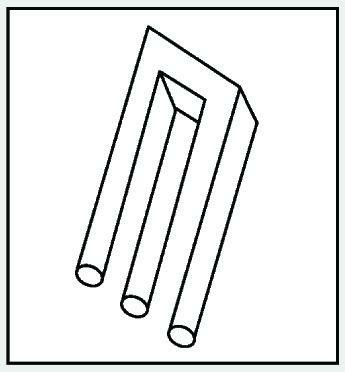
3. How many "prongs"—two or three?

4. The distance of the line to the left of the arrow is the same as the distance to the right.
The Atheist Test: Imagine a circle
represents all the knowledge in the universe (someone who had all knowledge would know every hair on every head, every thought of every heart, every grain of sand, every event in human history, etc.). Let's surmise that you know an incredible 1 percent of all knowledge. Is it possible that, in the 99 percent of the knowledge you haven't yet come across, there is ample evidence to prove that God does exist?
(See John 20:25 comment.) 8 But if you be without chastisement, whereof all are partakers, then are you bastards, and not sons.
9 Furthermore we have had fathers of our flesh which corrected us, and we gave them reverence: shall we not much rather be in subjection to the Father of spirits, and live?

For how to convince a sinner of the reasonableness of judgment, see Psalm 55:15 comment.
10 For they verily for a few days chastened us after their own pleasure; but he for our profit, that we might be partakers of his holiness.
11 Now no chastening for the present seems to be joyous, but grievous:
nevertheless afterward it yields the peaceable fruit of righteousness to them which are exercised thereby.
12 Wherefore lift up the hands which hang down, and the feeble knees; 13 And make straight paths for your feet, lest that which is lame be turned out of the way; but let it rather be healed.
14 Follow peace with all men, and holiness, without which no man shall see the Lord:
15 Looking diligently lest any man fail of the grace of God; lest any root of bitterness springing up trouble you, and thereby many be defiled; 16 Lest there be any fornicator, or profane person, as Esau, who for one morsel of meat sold his birthright.
17 For you know how that afterward, when he would have inherited the blessing, he was rejected: for he found no place of repentance, though he sought it carefully with tears.
18 For you are not come to the mount that
might be touched, and that burned with fire, nor to blackness, and darkness, and tempest,
19 And the sound of a trumpet, and the voice of words; which voice they that heard entreated that the word should not be spoken to them any more:
20 (For they could not endure that which was commanded, And if so much as a beast touch the mountain, it shall be stoned, or thrust through with a dart:
21 And so terrible was the sight, that Moses said, I exceedingly fear and quake:)
22 But you are come to mount Zion, and to the city of the living God, the heavenly
Jerusalem, and to an innumerable company of angels, 23 To the general assembly and church of the firstborn, which are written in heaven, and to God the Judge of all, and to the spirits of just men made perfect, 24 And to Jesus the mediator of the new covenant, and to the blood of sprinkling, that speaks better things than that of Abel.
2 5 See that you refuse not him that speaks. For if they escaped not who refused him that spoke on earth, much more shall not we escape, if we turn away from him that speaks from heaven:
2 6 Whose voice then shook the earth: but now he has promised, saying, Yet once more I shake not the earth only, but also heaven.
27 And this word, Yet once more, signifies the removing of those things that are shaken, as of things that are made, that those things which cannot be shaken may remain.
2 8 Wherefore we receiving a kingdom which cannot be moved, let us have grace, whereby we may serve God acceptably with reverence and godly fear:
29 For our God is a consuming fire.
12:3 Evangelistic discouragement. "One night when [Dwight L.] Moody was going home, it suddenly occurred to him that he had not spoken to a single person that day about
accepting Christ. A day lost, he thought to himself. But as he walked up the street he saw a man by a lamppost. He promptly walked up to the man and asked, 'Are you a Christian?'
"Nor did Moody find soul-winning easy. In fact, even Christians often criticized him for having 'zeal without knowledge.' Others called him 'Crazy Moody.' Once when he spoke to a perfect stranger about Christ, the man said, 'That is none of your business ... If you were not a sort of a preacher I would knock you into the gutter for your impertinence.'
"The next day, a businessman friend sent for Moody. The businessman told Moody that the stranger he had spoken to was a friend of his. 'Moody, you've got zeal without knowledge: you insulted a friend of mine on the street last night. You went up to him, a perfect stranger, and asked him if he were a Christian.'
"Moody went out of his friend's office almost brokenhearted. For some time he
worried about this. Then late one night a man pounded on the door of his home. It was the stranger he had supposedly insulted. The stranger said, 'Mr. Moody, I have not had a good night's sleep since that night you spoke to me under the lamppost, and I have come around at this unearthly hour of the night for you to tell me what I have to do to be saved.'"
Harry Albus 12:29 "Our God is a consuming fire, and we try to reduce Him to something we can handle or are comfortable with ... We are religious consumers. We want our religion to be convenient. It's the perpetual job of writers, preachers, the church and the gospel to help people respond to God as He reveals
Himself." Eugene Peterson
CHAPTER 13
Let brotherly love continue.
2 Be not forgetful to entertain strangers: for thereby some have entertained angels
unawares.
3 Remember them that are in bonds, as bound with them; and them which suffer adversity, as being yourselves also in the body.
4 Marriage is honorable in all, and the bed undefiled: but whoremongers and adulterers God will judge.
5 Let your conversation be without covetousness; and be content with such things as you have: for he has said, I will never leave you, nor forsake you.
6 So that we may boldly say, The Lord is my helper, and I will not fear what man shall do to me.
7 Remember them which have the rule over you, who have spoken to you the word of God: whose faith follow, considering the end of their conversation.
8 Jesus Christ the same yesterday, and today, and for ever.
9 Be not carried about with divers and strange doctrines. For it is a good thing that
the heart be established with grace; not with meats, which have not profited them that have been occupied therein.
10 We have an altar, whereof they have no right to eat which serve the tabernacle.
11 For the bodies of those beasts, whose blood is brought into the sanctuary by the high priest for sin, are burned without the camp.
12 Wherefore Jesus also, that he might sanctify the people with his own blood, suffered without the gate.
13 Let us go forth therefore to him without the camp, bearing his reproach.
14 For here have we no continuing city, but we seek one to come.
15 By him therefore let us offer the sacrifice of praise to God continually, that is, the fruit of our lips giving thanks to his name.
16 But to do good and to communicate forget not: for with such sacrifices God is well pleased.
17 Obey them that have the rule over you, and submit yourselves: for they watch for
your souls, as they that must give account, that they may do it with joy, and not with grief: for that is unprofitable for you.
18 Pray for us: for we trust we have a good conscience, in all things willing to live honestly.
19 But I beseech you the rather to do this, that I may be restored to you the sooner.
20 Now the God of peace, that brought again from the dead our Lord Jesus, that great shepherd of the sheep, through the blood of the everlasting covenant, "Only by imitating the spirit and manner of the Lord Jesus shall we become wise to win souls."
CHARLES SPURGEON
21 Make you perfect in every good work to do his will, working in you that which is well-pleasing in his sight, through Jesus
Christ; to whom be glory for ever and ever.
Amen.
22 And I beseech you, brethren, suffer the
word of exhortation: for I have written a letter to you in few words.
23 Know that our brother Timothy is set at liberty; with whom, if he come shortly, I will see you.
24 Salute all them that have the rule over you, and all the saints. They of Italy salute you.
25 Grace be with you all. Amen.
13:8 Jesus has never changed. He has no variableness or shadow of turning (James
1:17). Hebrews 1:12 says of Him, "You are the same, and your years shall not fail."