
Commentary on Jude
COMMENTARY ON JUDE
1 TT UDE, a servant of Jesus Christ, a brother, however, of I James, to those who are loved in God the Father and M preserved and called for Jesus Christ. The apostle Jude, whom Matthew 2 in their Gospels call Thaddaeus, writes against the same perverters of the faith whom both Peter and Paul condemn in their Letters.
and Mark 3 Dearly beloved, having every concern of writing to you concerning your common salvation. He speaks o f their com mon salvation, of that salvation which was shared by him and them. For indeed the salvation, faith, and love o f Christ are one and common to all the elect. Pleading for you to struggle hard for the faith which was once handed down to the saints, pleading for you to learn no other faith than that which was once handed down to you by the apostles and to struggle always on its behalf to death.
4 For certain wicked persons have entered in secretly, who were long ago designated for this judgment. He says, for this judgmenty for this condemnation which they deserve by act ing wickedly; as the Lord says, And those who have done what is right will go forward to the resurrection of life, but those who have behaved evilly to the resurrection of judg ment,
that is, of condemnation. Transmuting the grace of our Lord into self-indulgence. The grace of our Lord softened the harshness of the law, because when it said, 'if anyone does this or that let him be stoned, if anyone does
1. Mtl0:3
2. Mk3:18
3.Jn5:29
Commentary on Jude 4—5 this or that let him be consumed by flames', the Lord miti gated the stringency o f the law and by the grace of the gospel gave permission to cleanse by repentance and the fruits of almsgiving the acts of wickedness that had been committed. But they transmute his grace into self-indulgence who sin more permissively and freely the more they see that they are less likely to be called to account by the strictures of the law for the crimes that they have committed. And denying the only sovereign and our Lord Jesus Christ.
The only sovereign is our Lord Jesus Christ together with the Father and the Holy Spirit, as the only sovereign is the Father together with the Son and the Holy Spirit, as also the only sovereign is the Holy Spirit together with the Father and the Son, the only sovereign is the entire Trinity, Father and Son and Holy Spirit. For whichever person you name in the same holy and undivided Trinity is the only God, and when you name the entire Trinity together, you name the only true God. Hence it must be properly understood that any heretics who deny that the Father o f Christ is the good and righteous true God deny the only sovereign and our
Lord, any who deny that Jesus Christ is the true Son of God also certainly deny the only sovereign and our Lord, any who diminish the power o f the Holy Spirit also speak against the majesty of the only sovereign and our
Lord, because undoubtedly the same Father and Son and Holy Spirit is the only sovereign and our Lord.
5 But I wish to remind you who once knew all things, namely, knew all the hidden mysteries of faith, and had no need to hear novelties from new teachers as if they were more holy, that Jesus saved the people from the land of Egypt and afterward destroyed those who did not believe. He is referring not to Jesus the son of Nun[ x] but to our Lord, showing first that he did not have his beginning at his birth from the holy virgin, as the heretics have wished [to assert], but existed as the eternal God for the salvation of all believers, according
Commentary on Jude 5—6
4 then implying that he so graciously saves those who believe that he might justly con demn unbelievers. For in Egypt he first so saved the humble who cried out to him from their affliction that he might afterward bring low the proud who murmured against him in the desert. He stresses this so much that we may remember even now that he so saves believers through the-waters of baptism, which the Red Sea foreshadowed, that he demands to the mystery of his name; a humble life of us even after baptism and one separated from the filth of vices, such as the hidden way of life o f the desert quite properly pointed to. If anyone actually profanes this life either by departing from the faith or by acting evilly, being turned away in heart, as it were, to Egypt, he will deserve not to reach the promised fatherland of the kingdom but to perish among the ungodly. Alternatively:
He afterward destroyed those who did not believe, because the righteous judge both now and later strikes some persons, if their faults require it. Punishment, in truth, sets free from [paying the] penalty those alone whom it changes. For present evils lead those whom they do not correct to future ones.
6 In fact, the angels who did not maintain their place of leadership but abandoned their dwelling place has he kept in eternal chains in darkness for the judgment of the great day.
First, it must be remembered in this statement also, as in the preceding one, that Jesus our Lord punished the angels who transgressed. For he who was born of the virgin as a human being at the end o f the ages received the name of Jesus at the message of an angel, 5 having been born God o f the Father before all ages, he with the Father provided for every created being when he willed, and from the beginning so condemned the proud angels in the darkness of this air that he might keep the same for greater punishment on the day o f judgment.
4. Mt 1:21
5. Lkl:31, 2:21
Commentary on Jude 6—9 And therefore they are justifiably to be condemned who argue that Jesus Christ is not true God but was only a human being and the offspring from the two sexes. Then, there must be brought in the fact that he who did not spare the angels when they sinned does not spare proud human beings, but will condemn them also both severely before the judgment and more severely in the universal judgment when they have not maintained their place of leadership, namely, that by which they were made sons of God through the grace of adoption, but have abandoned their dwelling place, that is, the unity of the Church in which they were reborn to God, or at least their seats in the heavenly kingdom which they would have received if they kept their faith.
7 Just as Sodom and Gomorrah and the neighboring cities in like manner committed fornication, and so on. Because he had given the example of condemnation against those who denied the only sovereign and our Lord Jesus Christ by recalling the destruction first of the people who murmured and were unbelieving in the desert and then of the wicked angels who raised themselves up against their Maker, so by recalling the conflagration of the people of Sodom he gives the example of those who exchange the grace of our Lord for self-indulgence.
8 These also in like manner who indeed defile their flesh or despise the sovereignty or blaspheme the majesty, here must be understood, they also are to be condemned like the people of Sodom who defiled their flesh, like the unbelieving people who blasphemed the majesty of the divine power, like the angels who despised the sovereignty of their Creator.
9 When Michael the archangel quarreled with the devil and contended over the body of Moses, he did not dare to bring a judgment of blasphemy but said, 'May God order you.'
It is not entirely obvious from what scriptures Jude took
Commentary on Jude 9—11
this witness. But nonetheless we should know that we find something like it in the prophet Zechariah. For indeed he says that, The Lord showed me Jesus the priest standing before the angel of the Lord, and satan was standing at his right hand, that he might oppose him. And the Lord said to satan, 'May the Lord rebuke you, satan, and may the Lord
But in this place it is very easily understood that Jesus the priest desired that the people of Israel be freed from the captivity o f Babylon and return to their fatherland, but satan resisted him, unwilling for the people of God to be freed, but instead sold to the enemy, and these gentiles, and therefore the angel who was the peoples' helper, rebuked him and removed him from doing further injury to the same people, But we remain uncertain when Michael had a struggle with the devil over the body o f Moses. But nevertheless there is no lack o f those who say that the same people of God have been called the body of Moses from the fact that Moses himself was part of that people, and therefore that Jude was properly able to say that what he had read had been done to the people had been done to the body of Moses. But wherever and whenever this contention o f the angel with the devil occurred, we must carefully consider that if Michael the archangel was unwilling to bring a charge of blasphemy against the devil who op posed him, but restrained him with a mild word, how much more ought all blasphemy be avoided by human beings, and especially lest they offend by a careless word the majesty of the Creator. who chose Jerusalem rebuke you/ 11 Woe to them, because they have gone in the way of Cain and been led astray through [hope of] reward by the error of Balaam and have perished through rebellion [like that] of Korah. Those go in the way of Cain who, on account of their envy of better teachers, appropriate to themselves a name by 6. Zc 3:1-2
Commentary on Jude 11—12 which they may be honored. Those perish by the error of Balaam who for the love of earthly advantages assail the truth which they themselves know. Those perish through rebellion [like that] of Korah, who went down alive to the lower world, whoever by their yearning for an undeserved place of leadership cut themselves off from the unity o f the holy Church and, knowing and foreseeing how much evil they do, nonetheless go down to the underworld of viciousness. And the Lord indeed reproved Cain when he was thinking o f killing his brother, but his envy did not allow him to be saved.
7 The Lord forbade Balaam from making the journey against the people of God, but his love of money
8 Moses, through the Lord speaking in him, took care to soothe Korah as he was acting proudly, but the arrogance with which he seethed rendered him incurable. prevented him from obeying.
9 So, truly, so do the heretics behave, who at the reproof of the holy Church scorn being corrected, and even more, they strive, like Cain, to kill their brothers with the sword of evil teaching, like Balaam, to deceive them with evil advice, like Korah, to rise up against catholic teachers, to their own destruction.
12 These are stains in their own feasts, reveling without fear. Anyone who sins has been stained; the stain is the very viciousness which defiles the one committing it. And there fore he calls the heretics whom he is censuring stains because not only do they themselves perish in their eatings and drinkings, whether bodily or spiritual, but they also destroy and corrupt others. Clouds without water which are carried about by the winds. The clouds are the holy preachers who, having their way o f life in the heavens,
1 0 flash with miracles and drop down rain with their utterances; about 7. Gn 4:5-8 9. Nb 16:1-35 8. Nb 22:5-24:13
10. Ph 3:20
Commentary on Jude 12—13
whom it is said to God, Your truth [extends] to the clouds.
But the heretics are clouds without water who have set their mouths against heaven
through their proud words but do not irrigate with the water o f wisdom the hearts o f their hearers, which are carried about by the winds, because they are carried away at the suggestion of invisible spirits to various errors o f vices. Fruitless trees in autumn, twice dead, uprooted. It is a dead tree which does not produce good fruit; 1 3 but anyone who has also brought forth the fruit of evil work is called a twice-dead tree. And if anyone who has been unwilling to bear the fruit o f good work is said to be worthy of being cut down for his barrenness and cast into the fire, what punishment do you think the person deserves who either by acting perversely or perverting others has yielded rotten fruit? Nor is it astonishing if those who are proven to have been uprooted are said to be fruitless and twice-dead [like] trees. For it is said o f the saints,
Rooted and grounded in charity.
But those who do not fear to up root themselves from the firmness o f charity deservedly lose whatever good fruit they appear to have, such as these are deservedly compared to trees in autumn, that it may be shown that their salvation is without hope. For in autumn not only are no fruits usually formed but even those which were formed and are ripe fall off. To the condition of this time, namely, are they compared who themselves both neglect to yield the fruits of faith and are eager to root out those good things they see any other believers producing and to make culls of them.
13 Wild waves of the sea, casting up as foam the things that disconcert them. The wild waves of the sea are the perverse teachers who are both always restless and stirred up within themselves, dark and bitter, and do not stop forever assailing
11. Ps 36:5 (35:6) 13. Mt 7:17-19 12. Ps 73 (72):9
14. Eph 3:17
Commentary on Jude 13 the peace of the Church, which is like the durability and strength o f a breakwall. But of such as these is it properly said, casting up as foam the things that disconcert them, because like surging waves, the higher they raise themselves up in their pride, the more disordered they are and broken up into frothy foam and perish. Wandering stars for whom an onslaught of darkness has been kept for ever.
The wandering stars, which are seven,[ 2] never rise or set in the same place as they did the previous day but are seen now low on the horizon at the winter solstice, now high at the summer solstice, and now in an intermediate position at the two equinoxes. So, undoubtedly, so are the heretics, who promise the light of truth and never persevere in the stance they assume in their teaching, but now presenting their teach ing in this way, now in that, they themselves certainly indi cate how the manifestation of light which they promise is to be rejected. And indeed the best known of the planets, that is, the wandering stars, are the sun, the moon, the morning and evening stars. These are sometimes taken as indicating something good, as when the sun is understood as the Lord, the moon the Church, the morning star John the Baptist, who by his brith preceded the Lord who was about to be born in the flesh and gave witness to his light, but also as indicating something evil, as when we read about the Lord saying of the seed that had been sown on rocky ground,
But when the sun rose, it was scorched,
which he himself explained by adding, But when persecution arises on account of the word, he is at once scandalized.
The heat of the sun, therefore, points to the fierceness o f persecution. The moon indicates something evil, when we read, The fool is changed like the moon,
the morning star something evil in, How have you fallen from heaven, O morning star, 3] which can be understood not only of the first fall of the devil but also of his members, who by their heresy fall from the ls[ 15. Mt 13:6
16. Mt 13:21
17. Si 27:12
18. Is 14:12
Commentary on Jude 13—15
Church. The evening star indicates something evil in, And you make the evening star rise over the children of the earth
because although both the antichrist and his servants trans form themselves into angels of light, 2 0 nevertheless they do not bear witness to the divine light as the morning star does to the sun but they show instead the works of darkness to their followers, like the star which is called evening-star and which appears in the west at dusk and is the forerunner of the night that is about to follow. Wandering stars, he says, for whom an onslaught of darkness has been kept for ever.
For those who bring the darkness o f errors into the Church of God in the name o f light will properly be sent into the eternal darkness o f torments; those who disturb the peace of the faithful after the manner o f storms at sea will rightly be struck with an onslaught of tortures.
14—15 For Enoch, the seventh from Adam, prophesied of them, saying, 'Look, the Lord comes amid his holy thousands to pronounce judgment against them all.' He does not say against all human beings but against all the wicked, leaving none of them unpunished. There is appended about them,
'and to censure all the wicked.' He does well to say that Enoch who prophesied these things was the seventh from Adam in order to substantiate by an example what he said previously, that wicked persons who snuck in to undermine the faith o f the devoted had long ago been consigned to such a judgment.
2 1 'And to censure all the ungodly, he says, for all their works of godlessness which they godlessly performed and for all the harsh words which all the ungodly spoke against him.' This statement is true indeed, because when the Lord comes in judgment he will censure and judge the ungodly not only for the works of iniquity which they have performed but also for their iniquitous words. But neverthe less we must know that the book of Enoch from which he
19. Jb 38:32
20. 2 Co 11:14-15 21. Jude 4
Commentary on Jude 15—19 took this is classed by the Church among the apocryphal scriptures, 2 2 not because the sayings of so great a patriarch in any way can or ought to be thought worthy o f rejection but because that book which is presented in his name appears not to have been really written by him but published by some one else under his name. For if it were really his, it would not be contrary to sound truth. But now because it contains many incredible things, such as the statement that the giants did not have human beings for fathers but angels,
2 3 it is de servedly evident to the learned that writings tainted by a lie are not those of a truthful man. Hence this very Letter o f Jude, because it contains a witness from an apocryphal book, was rejected by a number o f people from the earliest times.
Nonetheless because of its authority and age and usefulness it has for long been counted among the holy scriptures, particularly because Jude took from an apocryphal book a witness which was not apocryphal and doubtful but out standing because o f its true light and light-giving truth.
16 These are grumblers, complainers, walking according to their own desires. The more anyone grumbles and complains of the present labors of the Church, the less he has sup pressed the desires of the flesh within himself. But on the other hand, holy Daniel and the other men with heavenly desires, 2 4 reject with greater contempt all transitory things which appear to be adverse the more steadfastly they desire only the things on high.
19 These are they who separate themselves, animals, not having the Spirit. The condemned separate themselves this way from the lot of the righteous, they are physical, that is, they follow the cravings o f their own soul, because they have not deserved to have the Spirit of unity by which the Church
22. Jer., Vir. ill. 4; TU 14:9,11/15 24. Dn 9:23
23. Enoch 6-7
Commentary on Jude 19—23
is gathered together, by which it is made spiritual. Therefore they spread apart, because they do not have the glue of charity.
20—21 But you, dearly beloved, build yourselves up on your most holy faith, pray in the Holy Spirit, keep yourselves in the love of God. We pray in the Holy Spirit when pierced by divine inspiration we request help from on high to receive the good things which we are unable [to acquire] of our selves. Blessed Jude, therefore, advises us so to build ourselves up on the foundation of our holy faith, so to join ourselves as living stones to the house of God which is the Church, so to keep ourselves in the love of God, that we may never pre sume on our own strength but may hope in the help of divine protection, lest anyone, according to the teaching of Pelagius, declare that he can be saved on his own, but all may request the coming of the Holy Spirit to us, that inspired by him we may be able to pray more earnestly, lest we perhaps be separated from the company of the holy
Church with those who do not have the Spirit and therefore persist in being physical.
22—23 And censure some, indeed, who are judged, but save others, snatching them from the fire, have mercy on others with fear. What he says, with fear, must be joined to all three that he had mentioned, because when anyone censures those who are apostates and shows that they are worthy of condemnation, he ought to act with fear, lest perhaps something of this sort happen to him or those close to him whom he loves, and also anyone who chastises another and snatches him from the fire of his vices ought to look to him self, for fear he himself may also be tempted,
2 5 and anyone who has mercy on a neighbor who repents ought of necessity to act in his case, circumspectly too, lest he be perhaps either
25. Ga6:l
Commentary on Jude 23—25 severe or devoted more than is just. Hating even that stained garment which is fleshly. He calls our body our fleshly garment. We ought not, however, to hate our body but we ought to hate it in every way it is stained and see to it, as far as we are able, that we render it stainless, so that from being fleshly it may deserve to be made spiritual. Because this must be accomplished not by the power o f our free will but by the grace o f God, there is properly added:
24 But to him who is able to keep you without sin and establish you stainless in rejoicing before the sight of his glory. He does well to say that we whom he previously advised to serve God with fear are to be established in rejoicing before the sight of his glory, because the more anxious we are about our actions in the present, the more joyful shall we be in the future about the reward we have received.
25 To the only God our saviour through Jesus Christ be glory, splendor, lordship and power before all ages both now and for ever. Amen. This summary bestows coequal and coeternal glory and the kingdom both on the Father and Son through all and before all ages and refutes the error o f those who believe that the Son is less or later than the Father, when it says that glory, splendor, lordship, and power belong to God the Father through Jesus Christ our Lord, and this not from some beginning in time but before all ages both now and for ever. Amen.
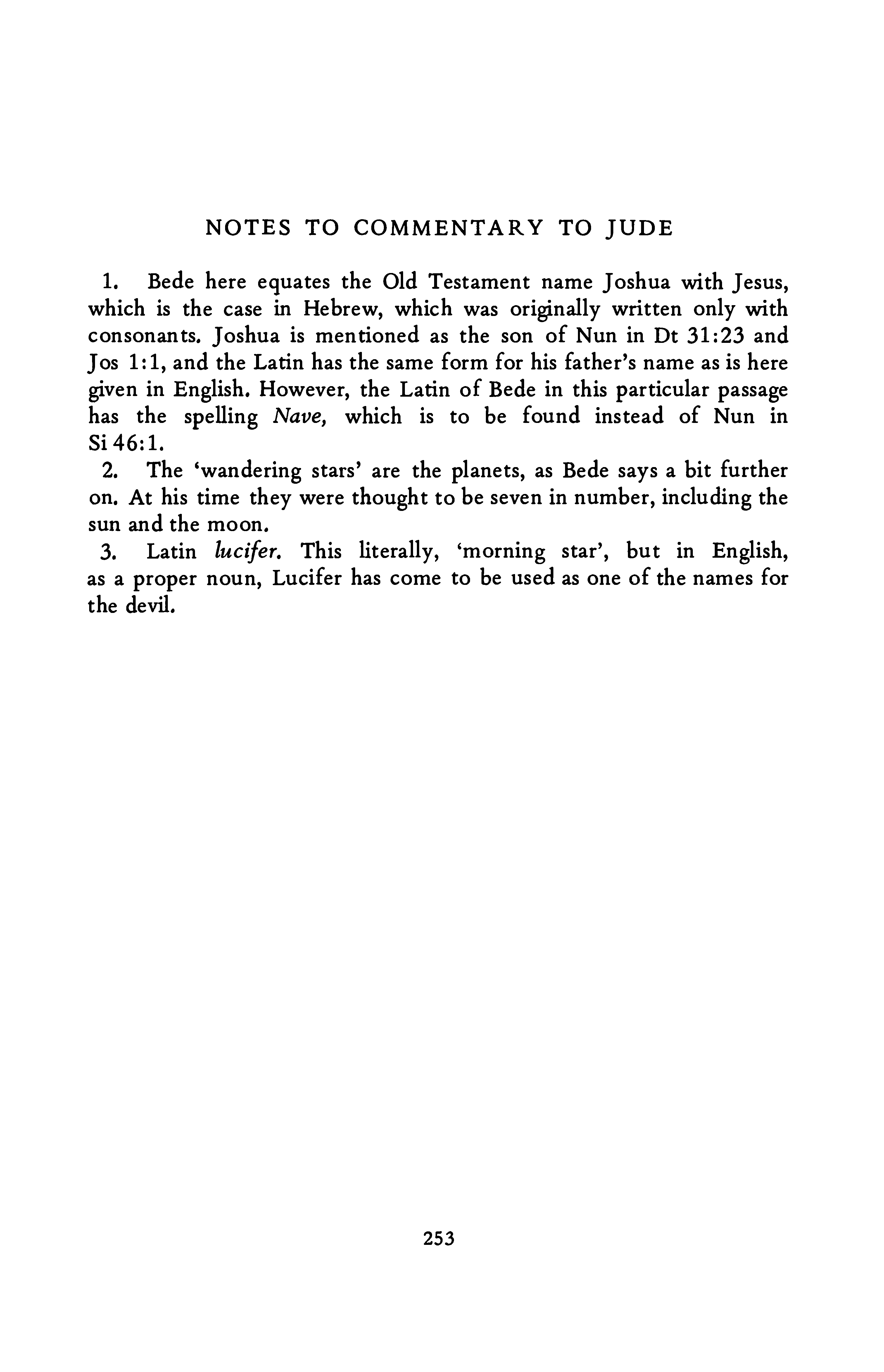
NOTES TO COMMENTARY TO JUDE
Bede here equates the Old Testament name Joshua with Jesus, which is the case in Hebrew, which was originally written only with consonants. Joshua is mentioned as the son of Nun in Dt 31:23 and Jos 1:1, and the Latin has the same form for his father's name as is here given in English. However, the Latin of Bede in this particular passage has the spelling Nave, which is to be found instead of Nun in Si 46:1.
The 'wandering stars' are the planets, as Bede says a bit further on. At his time they were thought to be seven in number, including the sun and the moon.
Latin lucifer. This literally, 'morning star', but in English, as a proper noun, Lucifer has come to be used as one of the names for the devil.

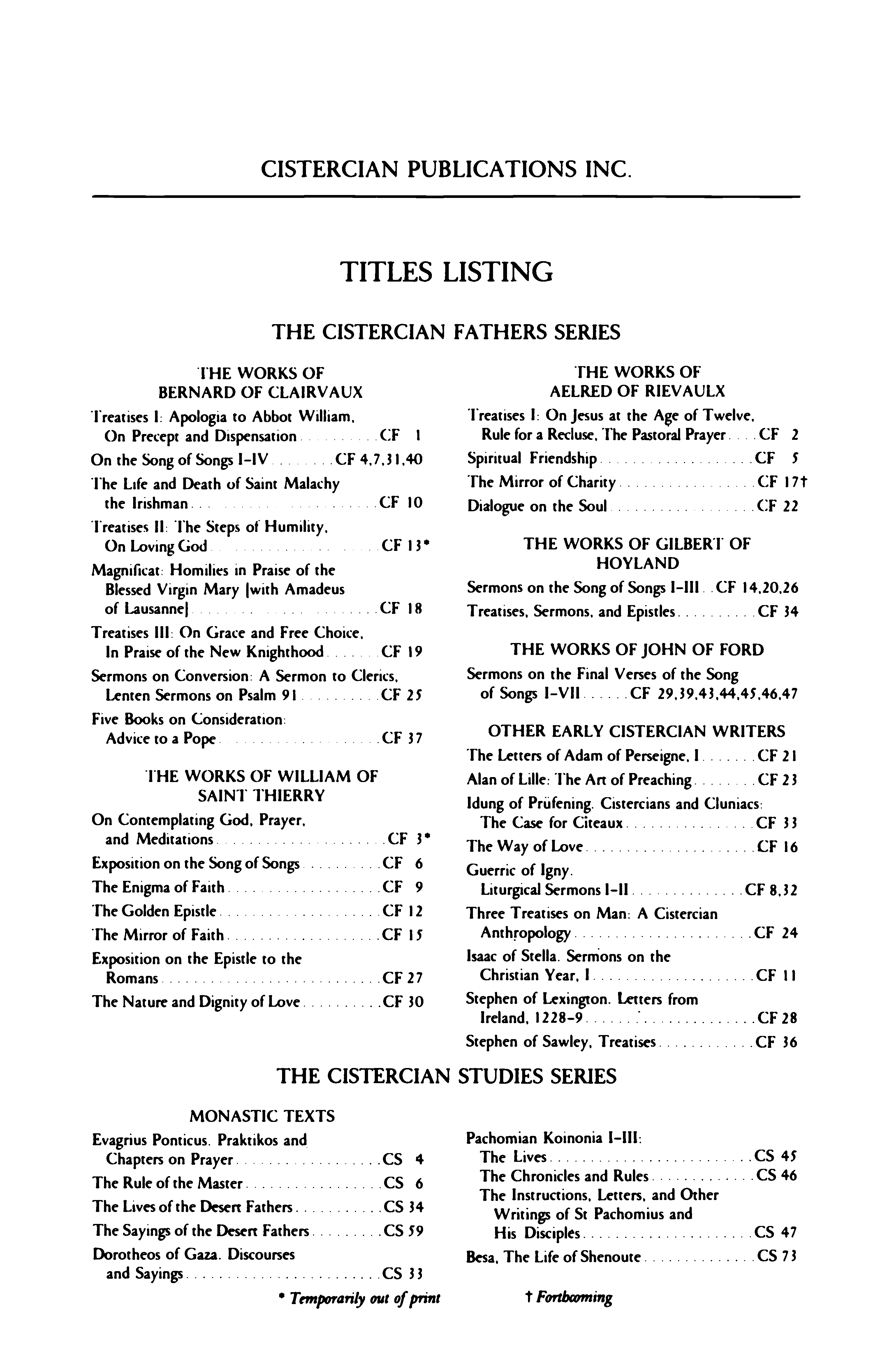
CISTERCIAN PUBLICATIONS INC.
TITLES LISTING
THE CISTERCIAN FATHERS SERIES
T H E W O R K S OF
T H E W O R K S OF
AELRED OF RIEVAULX
B E R N A R D OF C L A I R V A U X
Treatises I: On Jesus at the Age of Twelve.
Treatises I: Apologia to Abbot William.
Rule for a Recluse. The Pastoral Prayer CF 2 On Precept and Dispensation CF
Spiritual Friendship CF
On the Song of Songs l - l V
CF 4,7. J1.40
The Mirror of Charity CF 17t The Life and Death of Saint Malachy Dialogue on the Soul CF 22 the Irishman CF 10 Treatises II: The Steps of Humility.
T H E W O R K S OF GILBERT OF
On Loving G o d CF 1J *
H O Y L A N D
Magnificat: Homilies in Praise of the Sermons on the Song of Songs I—III
CF 14.20,26
Blessed Virgin Mary |with Amadeus of Lausanne| CF 18 Treatises III: On Grace and Free Choice,
Treatises, Sermons, and Epistles CF 34
T H E W O R K S OF J O H N OF F O R D
In Praise of the New Knighthood CF 19 Sermons on the Final Verses of the Song Sermons on Conversion: A Sermon to Clerics, of Songs l-VIl
CF 29.39.43,44.45.46.47
Lenten Sermons on Psalm 91 CF 2 5 Five Books on Consideration.
O T H E R EARLY CISTERCIAN W R I T E R S
Advice to a Pope CF 3 7 The Letters o f Adam of Perseigne. I CF 21
T H E W O R K S OF W I L L I A M OF
Alan of Lille: The Art of Preaching CF 2 3
SAINT T H I E R R Y
Idung o f Prufening. Cistercians and Cluniacs:
On Contemplating G o d , Prayer, The Case for Citeaux CF 3 3 and Meditations CF 3* The W a y o f Love CF 16 Exposition on the Song of Songs CF
Guerric o f Igny.
The Enigma of Faith CF
Liturgical Sermons I—II CF 8.32
The Golden Epistle CF 12 Three Treatises on Man: A Cistercian The Mirror of Faith CF 15 Anthropology CF 24 Isaac o f Stella. Sermons on the Exposition on the Epistle to the Christian Year. 1
CF 11 Romans CF 27 Stephen o f Lexington. Letters from The Nature and Dignity of Love CF 30 Ireland. 1228-9 C F 2 8 Stephen o f Sawley. Treatises CF 36
THE CISTERCIAN STUDIES SERIES
M O N A S T I C T E X T S
Pachomian Koinonia 1—III:
Evagrius Ponticus. Praktikos and The Lives CS 45 The Chronicles and Rules CS 46 The Instructions. Letters, and Other Chapters on Prayer CS
The Rule of the Master CS
The Lives o f the Desert Fathers CS 34 Writings of St Pachomius and His Disciples CS 47 The Sayings o f the Desert Fathers CS 59 Dorotheos of Gaza. Discourses Besa. The Life of Shenoute CS 7 3 and Sayings CS 3 3 • Temporarily out of print t Forthcoming
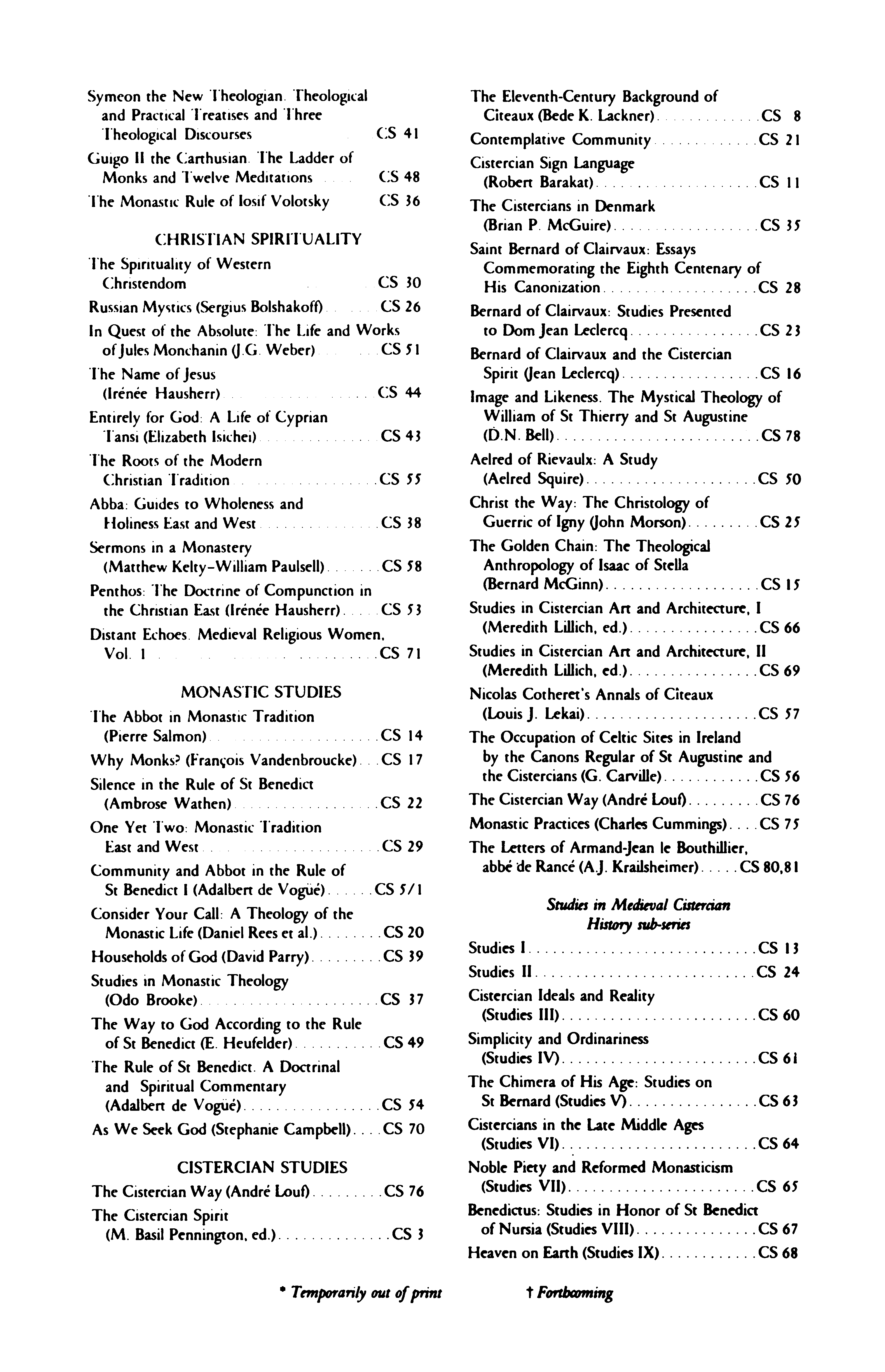
Symcon the New Theologian Theological The Eleventh-Century Background of and Practical Treatises and Three Citeaux (Bede K. Lackner) CS 8 Theological Discourses CIS 41 Contemplative Community CS 21 Guigo II the Carthusian The Ladder of Cistercian Sign Language Monks and Twelve Meditations CS 48 (Robert Barakat) CS 11 The Monastic Rule of Iosif Volotsky CS 36 The Cistercians in Denmark (Brian P McGuire) CS 35
CHRISTIAN SPIRITUALITY
Saint Bernard of Clairvaux: Essays The Spirituality of Western Commemorating the Eighth Centenary of His Canonization CS 28 Christendom CS 30 Bernard of Clairvaux: Studies Presented Russian Mystics (Sergius Bolshakoff) CS 26 to Dom Jean Leclercq CS 2 3 In Quest of the Absolute: The Life and Works
Bernard of Clairvaux and the Cistercian of Jules Monchanin (J G Weber) CS 51 Spirit (Jean Leclercq) CS 16 The Name of Jesus Image and Likeness. The Mystical Theology of (Irenee Hausherr) CS 44 William o f St Thierry and St Augustine (D.N Bell) C S 7 8 Entirely for God: A Life of Cyprian Tansi (Elizabeth Isichei) CS 43 Aelred o f Rievaulx: A Study (Aelred Squire) CS 50 The Roots of the Modern Christ the Way: The Christology of Christian Tradition CS 55 Guerric of Igny (John Morson) CS 25 Abba: Guides to Wholeness and The Golden Chain: The Theological Holiness East and West CS 38 Anthropology of Isaac o f Stella (Bernard McGinn) CS 15 Sermons in a Monastery (Matthew Kelty-William Paulsell) CS 58 Studies in Cistercian Art and Architecture, I Penthos: The Doctrine of Compunction in (Meredith Lillich, ed.) CS 66 the Christian East (Irenee Hausherr) CS 53 Studies in Cistercian A n and Architecture, II (Meredith Lillich, ed.) CS 69 Distant Echoes Medieval Religious Women.
Nicolas Cotherets Annals o f Citeaux Vol I CS 71 (Louis J. Lekai) CS 57
M O N A S T I C STUDIES
The Occupation of Celtic Sites in Ireland The Abbot in Monastic Tradition by the Canons Regular o f St Augustine and (Pierre Salmon) CS 14 the Cistercians (G. Carville) CS 56 W h y Monks? (Francois Vandenbroucke) CS 17 The Cistercian Way (Andre LouO CS 76 Silence in the Rule of St Benedict Monastic Practices (Charles Cummings). . . CS 75
(Ambrose Wathen) CS 22 The Letters o f Armand-Jean le Bouthillier, One Yet Two: Monastic Tradition abbe de Ranee (A.J. Krailsheimer) CS 80,81 East and West CS 29 Studies in Medieval Cistercian Community and Abbot in the Rule of History sub-series St Benedict I (Adalbert de Vogue) CS 5/1 Studies 1 CS 13 Consider Your Call: A Theology of the Studies II CS 24 Monastic Life (Daniel Rees et al.) CS 20 Cistercian Ideals and Reality Households of G o d (David Parry) CS 39 (Studies III) CS 60 Studies in Monastic Theology Simplicity and Ordinariness (Odo Brooke) CS 37 (Studies IV) C S 6 1 The Way to G o d According to the Rule The Chimera o f His Age: Studies on of St Benedict (E Heufelder) CS 49 St Bernard (Studies V ) CS 63 The Rule of St Benedict A Doctrinal Cistercians in the Late Middle Ages and Spiritual Commentary (Studies VI) CS 64 (Adalbert de Vogue) CS 54 Noble Piety and Reformed Monasticism As W e Seek G o d (Stephanie Campbell) CS 70
CISTERCIAN STUDIES
The Cistercian W a y (Andre LouO CS 76 The Cistercian Spirit (Studies VII) CS 65 Benedictus: Studies in Honor o f St Benedict of Nursia (Studies VIII) CS 67 (M. Basil Pennington, ed.) CS 3 Heaven on Earth (Studies IX) CS 68 * Temporarily out of print "t" Forthcoming
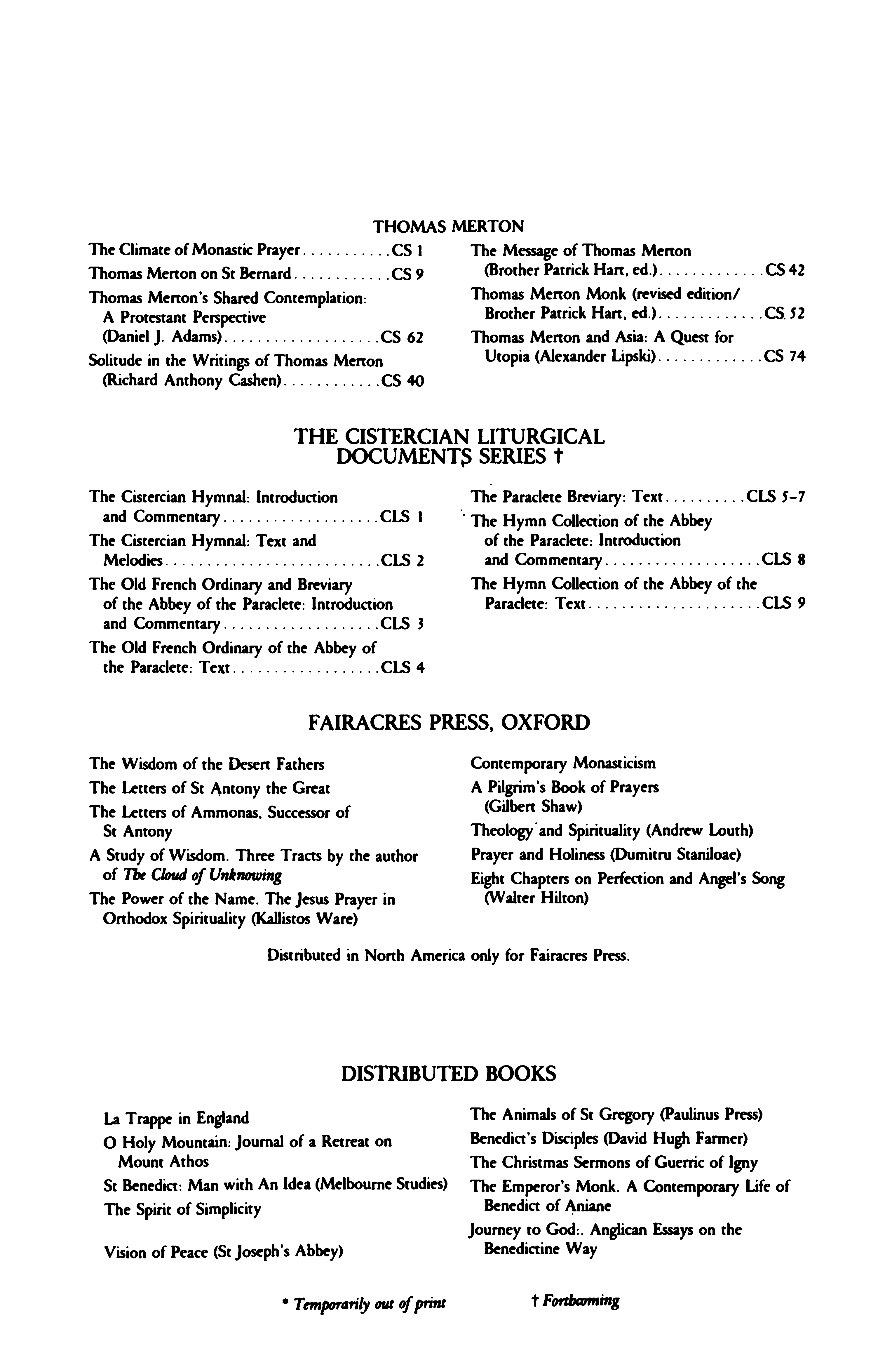
M E R T O N
T H O M A S
The Message of Thomas Merton The Climate of Monastic Prayer CS 1 (Brother Patrick Hart, ed.) CS 42 Thomas Merton on St Bernard CS 9 Thomas Merton Monk (revised edition/ Thomas Merton s Shared Contemplation:
Brother Patrick Hart, ed.) CS 52 A Protestant Perspective (Daniel J. Adams) CS 62 Thomas Merton and Asia: A Quest for Utopia (Alexander Lipski) CS 74 Solitude in the Writings of Thomas Merton
(Richard Anthony Cashen) CS 40
THE CISTERCIAN LITURGICAL
DOCUMENTS SERIES t
The Paraclete Breviary: Text CLS 5-7 The Cistercian Hymnal: Introduction and Commentary CLS 1 ' The Hymn Collection of the Abbey of the Paraclete: Introduction and Commentary CLS 8 The Cistercian Hymnal: Text and Melodies CLS 2 The Hymn Collection of the Abbey of the The Old French Ordinary and Breviary Paraclete: Text CLS 9 of the Abbey of the Paraclete: Introduction and Commentary CLS 3 The Old French Ordinary of the Abbey of the Paraclete: Text CLS 4
FAIRACRES PRESS, OXFORD
Contemporary Monasticism The Wisdom of the Desert Fathers The Letters of St Antony the Great A Pilgrim's Book of Prayers The Letters of Ammonas, Successor of (Gilbert Shaw) St Antony Theology and Spirituality (Andrew Louth)
A Study of Wisdom. Three Tracts by the author Prayer and Holiness (Dumitru Staniloae) of The Cloud of Unknowing Eight Chapters on Perfection and Angel's Song
(Walter Hilton) The Power of the Name. The Jesus Prayer in Orthodox Spirituality (Kallistos Ware) Distributed in North America only for Fairacres Press.
DISTRIBUTED BOOKS
The Animals of St Gregory (Paulinus Press) La Trappe in England Benedict's Disciples (David Hugh Farmer)
O Holy Mountain: Journal of a Retreat on The Christmas Sermons of Guerric of Igny
Mount Athos The Emperor's Monk. A Contemporary Life of St Benedict: Man with An Idea (Melbourne Studies)
Benedict of Aniane The Spirit of Simplicity Journey to God:. Anglican Essays on the Benedictine Way Vision of Peace (St Joseph's Abbey) * Temporarily out of print t Forthcoming