Commentary on 2 Peter
COMMENTARY ON 2 PETER
1:1
^ | IMON PETER, a servant and apostle of Jesus Christ, to those who have obtained a faith of equal standing to ours. It has been written in what follows of this Letter, Look, dearly beloved, I am writing this second Letter to you.
Hence it is clear that he wrote this Letter to the same ones to whom he had also sent the former Letter, to the elect newcomers of the dispersion in Pontus, Galatia, Cappadocia, Asia [Minor] and Bithynia,
whom he recognizes as of equal standing with himself, not because they had received circumcision according to the law, which he had, being by nature a Jew, but because they obtained the same faith as he himself had received from the enlightening grace of Jesus Christ. For it is not legal circum cision but gospel faith alone that joins the peoples of the gentiles to the ancient people of God. Yet, because the same faith without works is not able to save, there is properly appended: In the righteousness of our Lord and saviour,
Jesus Christ. Therefore, the apostle Peter writes a Letter to, he greets, those who have obtained a faith that is of equal standing with his and practise it through the works of righteousness, that righteousness, namely, which human prudence does not discover or legal custom teach but which our Lord and Saviour shows when, speaking through the Gospel, he says, Unless your righteousness exceeds that of the scribes and Pharisees, you shall not enter into the king dom of heaven;
and again, You have heard that it has been said to the ancients,
but I say to you.
1. 2P3:1
2. IP 1:1
3. Mt 5:20
4. Mt 5:21
5. Mt 5:22
Commentary on 2 Peter 1:2—1:3
1:2
May grace and peace be fulfilled for you in the knowl edge of our Lord Jesus Christ. In the first Letter he wrote,
May grace and peace be multiplied for you,
but in this one, May grace andpeace be fulfilled for you, because undoubtedly he wrote that Letter for beginners, this one for the more per fect. For peace and grace are multiplied for those who are advancing well in this life through faith, but they will be ful filled through sight in the other life for those who arrive.
Hence when he said, May grace andpeace be fulfilled for you, he did well to add, in the knowledge of our Lord, Jesus Christ, because this is eternal life, he says, that they may know you, the one true God, and Jesus Christ whom you have sent;
and again, / / the Son has set you free, you will be truly free,
and you will know the truth, and the truth will set you free.
1:3
In the manner in which all things of his divine power that [belong] to life and devotion have been given to us.
This statement belongs with what precedes. For the meaning is, 'May grace and peace be fulfilled for you in this, that you may know our Lord Jesus Christ perfectly, and that you may know this also through him, in what manner all things of his divine power that are sufficient for maintaining and pre serving life and devotion have been given to us through his grace.' Hence he says, Because all things, whatever I have heard from my Father, I have made known to you;
and elsewhere, I have given them the honor which you have given me.
But if there be read, as certain manuscripts have, [In the manner in which all things of his divine power] 'that has been given us for life and devotion', the meaning will be this:
'That you may know in what manner our Lord has provided for us all the gifts of his divine power according to the mea sure of our ability to receive them, and that this power, namely, has been given to us that we may attain life and
6. 1 P 1:2
9.Jn 8:32
7. Jn 17:3
10. Jn 15:15
8. Jn 8:36
11. Jn 17:22
Commentary on 2 Peter 1:3—1:4
devotion'. For indeed this manner of speaking is quite cus tomary in the scriptures and is called ellipsis by the gram marians, that is, the omission of necessary wording, as there is in the psalm, Because neither from the east nor from the west nor from the mountains of the desert, where there is understood, 'does a way of escape lie open', since God is the judge everywhere.
1 2 Through the knowledge of him who has called us by his own glory and power. This, too, belongs with what precedes, because we recognize all the mysteries o f his divinity by which we are saved through the knowledge of our
Lord and saviour who has called us by his own glory and power, because he did not send an angel or archangel for our salvation, he did not find in us anything o f good desert for which we might be saved, rather he beheld us weak and without honor and restored us by his own power and glory.
From this indeed he says, You have not chosen me but I have chosen you.
1:4
Through which he has given us very great and precious promises. Through which, he says, through the knowledge of him, because the more perfectly anyone gets to know the Lord, the more deeply he realizes the greatness o f his promises. That through these you may be made sharers in the divine nature. He suddenly changes the person, and from just having said of himself and his followers, he has given us precious promises, he immediately turns to those to whom he was speaking and says, That through these you may be made sharers in the divine nature. He does this not accidentally but with forethought. 'The Lord, therefore,' he says, 'has revealed all the secrets o f his divine power to us who by nature have been born Jews and under the law, who were entrusted with the power of teaching by him while he was alive, to us, namely, his disciples, he has given the very great and precious promises o f his spirit, for the reason that through these he
12. Ps 75:6-7 (74:7-8) 13. Jn 15:16
Commentary in 2 Peter 1:4—1:5 might give to you also who come from the gentiles, who were unable to see him while he was alive, to be sharers in his divine nature; to us, namely, teaching you what we heard from him, consecrating you through his mysteries.' Hence what he said above, May grace andpeace be fulfilled for you in the knowledge of our Lord Jesus Christ, in the manner in which all things of his divine power that [belong] to life and devotion have been given to us, can quite properly be taken as meaning, 'May grace and peace be fulfilled for you in this, that even you may thus know our Lord Jesus Christ, just as all the promises and gifts o f his divine power that lead to life and devotion have been given to us by him, that as we have either received the promised gifts from him or trust without any doubt that we shall receive them, so also by believing you may become sure o f his gifts.' Fleeing the cor ruption of that craving 1 4 which is in the world. He does well to say that the craving of the world includes corruption and therefore must be avoided, according to him who said, Flee from sin as from the appearance of a serpent,
because there is also an incorruptible craving, about which it is sung, My soul has craved and languished for the courts of the Lord.
About this also in the book of Wisdom through a figure o f speech that in Greek is called fcXt/xa^,!
1] in Latin 'proceeding by steps,'
1 7 it is most admirably related, The beginning, he says, of wisdom is the sincerest craving for discipline.
The concern for discipline, therefore, is love, and love is the keeping o f his laws; the keeping of the laws, how ever, is the completion o f incorruption; incorruption, how ever, makes one to be near God; the craving for wisdom accordingly leads to the everlasting kingdom.
1:5
Do you, however, using all care, provide virtue in your faith.
He has used virtue in this place not for courage 14. concupiscentia 15. Si 21:2
16. Ps 84:2 (83:3) 17. gradatio 18. Ws 6:17 (6:18)
Commentary on 2 Peter 1:5—1:7
or miracles but for a good way o f life which must be joined to proper faith, lest without works it be worthless and dead.
1 9 He properly admonishes us to use all care in this, because the person who is soft and profligate in his work is brother to him who destroys his works. In your virtue, however, [provide] knowledge, according to that saying of Isaiah, Learn to do what is right, seek judgment.
1:6
In your knowledge, however, [provide] self-restraint, so that when they have learned to do what is right, they may quickly restrain themselves from doing evil, lest the knowledge of heavenly things fall into a void if a person neglects to re frain from earthly allurements. In your self-restraint, however,
[provide] patience. It is necessary that patience always accom pany self-restraint, that whoever has learned to refrain from the pleasures of the world may also bear with adversities with a stout heart, being protected on the right hand and the left, namely, by the arms of righteousness.
2 1 In your patience, however, [provide] devotion, that one may also be devoted to those whom one bears with patiently, according to that saying o f the apostle Paul, Charity is patient, it is kind
1:7
In your devotion, however, [provide] love of the brotherhood, that one may bestow the works of devotion on his adversaries for no other consideration than love of the brotherhood, seeking this, namely, with his whole purpose, that by praying and doing what is right he may convert to the disposition 2 3 o f devotion those whom he is unable to [move] by teaching alone or by refuting. In your love of the brotherhood, however, [provide] charity. In this place he calls charity particularly that by which we love our creator.
This is rightly joined to love of the brotherhood for those who are progressing in the steps o f the virtues, because neither
19. Jm 2:17,20 20. Is 1:17
21. 2 Co 6:7
22. 1 Co 13:4
23. affectus
Commentary on 2 Peter 1:7-1:10 can God be loved perfectly without one's neighbor nor one's neighbor without God. And indeed the love o f God is loftier than the love of one's neighbors, because them we are ordered to love as ourselves; but God with our whole heart, our whole soul, our whole strength.
2 4 But nonetheless it is fitting for us to ascend to the love o f God by the habit o f love of the brotherhood. For he who does not love his brother whom he sees daily, how can he love God whom he does not see?
1:8
For if all these things are present with you and prevail, they will render you not ineffective and without fruit. He has said, 'if they prevail', if by their more powerful strength they prove stronger against the attacks of the vices.
1:9
For he who does not possess these things is blind and groping with his hand. The eye denotes knowledge, the hand work. He, however, is blind and groping with his hand who does not have the knowledge of proper work and does what ever appears to him to be proper, and, not knowing the light of truth, as it were reaches his hand out to a work which he does not see, steps forward, on a way which he cannot fore see, and therefore suddenly falls, wretchedly, into the ruin of destruction which he was unable to foreknow. Such is everyone who does not possess these things about which Peter is speaking, however, because it is fitting that we reach fellowship with the divinity through the increase of spiritual virtues. But on the other hand Solomon, advising the wise hearer, says, And let your eyes anticipate your footsteps
2 6 which is to declare clearly that in all our actions we should take care to foresee with earnest intent what outcome awaits us, we should examine skillfully what is done according to the will o f God, what otherwise.
1:10
Wherefore, brothers, strive all the more that through 24. Mk 12:30-31 25. Ijn4:20
26. Pr 4:25
Commentary on 2 Peter 1:10—1:11
good works you may make your calling and election definite.
Many are called, but few are chosen 21.
The calling o f all who come to the faith is definite; but those who also persis tently add good works to the sacraments of the faith which they have received also make their election together with their calling definite to those who see them; just as, on the other hand, those who return to their wicked deeds after their calling, when they depart from this life in these [deeds], already make definite to all that they are condemned.
For if you do these things you will not sin at any time.
He is speaking of more serious sins. Whoever commits these does not have an inheritance in the kingdom of Christ and God
and everyone who devotes himself to the virtues mentioned above with God's help remains free from them.
Yet there are less serious sins about which it has been written that there is not a righteous man on earth who does what is good and does not sin,
and, No living person will be made righteous in your sight.
1:11
For so there will be richly provided for you an entrance into the eternal kingdom of our Lord and Saviour,
Jesus Christ. With this place agrees that saying of Ezekiel where, speaking of the building on the appointed mountain, he says, And its ascent was in eight steps.
For here also blessed Peter enumerates eight steps o f the virtues by which, fleeing from the corruption of worldly concupiscence, we ought to ascend to the dwelling o f the heavenly kingdon, namely, faith, virtue, knowledge, self-restraint, patience, devotion, love of the brotherhood, and charity. Surely, the psalm says of these steps, He has placed ways of ascent in his heart, and so on, as far as it says, they will walk from virtue to virtue, the God of gods will be seen in Zion
ll.electi 28. Mt 20:16
29. Eph 5:5
30. Qo 7:20 (21) 31. Ps 143 (142):2
32. Ezk 40:34
33. Ps 84:5-7 (83:6-8)
Commentary on 2 Peter 1:12—1:14
1:12 Wherefore I will begin always to remind you of these things, even though you both know them and are established in the present truth. Why does he wish always to remind those whom he says have knowledge and are established about the presence of the truth concerning their good works, unless perhaps for this reason, that they practice the knowledge that they have by works and with resolute mind guard the truth by whose presence they are established, lest at any time they withdraw from the simplicity and purity of the faith under the influence of teachers of error? He says more about these teachers, namely, in the continuation of the Letter. There coincides with this, however, the statement of blessed John in which he says, We have not written to you as to those who are ignorant of the truth but as to those who
It is for this reason that the apostles write to those who know the truth and remind them to follow what they know. Hence John also in discussing these things adds a little later on, Let what you have heard from the beginning remain in you. know it.
1:13
For I think it right, as long as I am in this tent, 3 6 to stir you up by reminding you. We are accustomed to use a tent on a journey or during war, and therefore the faithful, as long as they are in the body and are straggling away from the Lord, 3 7 properly bear witness that they are in tents in which they pursue their journey of this life and wage a con test against the enemies of the truth.
1:14 Being convinced that the laying aside of my tent 3 8 is at hand. Very admirably does blessed Peter say that his departure is not death but the laying aside of his tent, be cause surely it is characteristic of perfect servants of God to put off the stays of the body in much the same way as 34. 1 Jn 2:21
35. 1 Jn 2:24
36. taberculum 37. 2 Co 5:6
38. tabernaculum
Commentary on 2 Peter 1:14—1:19
travelers exchange a tent for their own home when their journey is over or those engaged in military operations return to their fatherland when the enemy has been put to flight and conquered. For they know that their only home, their only city, their only fatherland is in heaven, about which the apostle Paul also says, We know that if our earthly home of this dwelling place should be destroyed, we have a building from God, an eternal home not made by hand, in heaven.
1:16 For we did not follow learned myths when we made known to you the power and presence of our Lord Jesus
Christ but we were made beholders of his greatness.
Here he strikes at pagans and heretics at the same time. The former have not been afraid to call gods whatever was pleas ing to them, the latter, after having received the mysteries of the true God, from then on have been inclined not to pay attention to the divine scriptures but rather to alter these to their own erroneous meaning by interpreting them wrongly.
1:18
And we heard this voice brought from heaven. There are certain persons who say that this Letter was not written by the blessed apostle Peter. But if they would pay more careful attention to this verse and the part of it that follows when we were with him on the holy mountain, they would be not at all dubious about the author of this Letter. For it is clear that the same Peter, together with his fellow apostles
James and John, heard the aforesaid voice above the Lord when he was glorified on the mountain, according to the faith of the Gospels.
4 0 1:19
And we have a surer prophetic sentence, that, namely, in which he speaks in the person o f the mediator between God and men, 4 1 saying, The Lord said to me, 'You are my
39. 2 Co 5:1
40. Mt 17:1-5 41. 1 Tm 2:5
Commentary on 2 Peter 1:19—1:20
'For if anyone at all,' he says, 'does not consider our witness worthy o f belief, the fact that we beheld in secret the divine glory of our Re deemer, that we heard the voice of the Father brought to him, at least no one will dare contradict the prophetic sentence, no one will dare to dispute this, which already long ago was incorporated in the divine scriptures and all bear witness is true.' You do well to pay attention to this as to a lamp shining in a dark place. The order of the meaning is,
'In paying attention to this as to a lamp shining in a dark place you do well'. For indeed in this world's night, filled with dark temptations, where only with difficulty is any one found who does not offend, what should we be if we did not have the lamp of the prophetic utterance? But will a lamp always be required? Definitely not. Until the day dawns, he says. For, In the morning I will stand before you and regard attentively Son, today have I begotten you'
3 It belongs meanwhile to the lamp burning during the night that we are the children of God, and it has not yet appeared what we shall fee,
44 and indeed in comparison with the wicked we are the day, as Paul says, You were formerly darkness but now light in the Lord
But if we are compared to that life in which we shall be, we are still night and need a lamp. And the morning star arises in your hearts. What is that morning star? If you say the Lord, that is too little. The morning star is our own excellent understanding. For if this arises in our hearts, it will be en lightened, it will be made clear. It will become love, such as we now wish and long for yet do not possess, and we shall see of what sort it will be in each other, just as now we see each other's faces.
1:20
Understanding this first of all, that no prophecy of scripture becomes a matter for private interpretation. This verse follows from what he said above, You do well to pay
42. Ps 2:7
43. Ps 5:3 (5:5) 44. I j n 3 : 2
45. Eph 5:8
Commentary on 2 Peter 1:20-1:21
attention to this. For those who pay attention to the words of the prophets certainly do well, that by means of these words they may be able to have the light of knowledge.
They ought to understand this first o f all, that none of the holy prophets preached the teachings of life to the people
[using] his own interpretation but they handed on what they had learned from the Lord to their hearers to be put into practice by them. And they passed on the hidden heavenly mysteries which they had comprehended in secret to the people of God simply either by speaking or by writing and not like the diviners of the gentiles who brought forth to the crowds of those who were deceived as decisions of a divine oracle what they themselves had fabricated in their own heart. Therefore, just as the prophets wrote not their own but God's words, so also the reader of them cannot use his own private interpretation, lest he deviate from the true meaning, but he ought to pay careful attention to how the writer wished his words to be understood.
1:21
For never at any time was a prophecy brought forth by the will of man, but the holy men of God spoke when inspired by the Holy Spirit. Just as it was not in the power of those who prophesied always to have the Holy Spirit, to be able always to predict the future, but the Spirit himself filled their hearts when he willed, so also it was not within their power to teach whatever they wished, but they spoke those things alone which they had learned when enlightened by the Spirit. These things are said for this reason, that no one may dare to expound the scriptures according to his own wishes. A certain person has interpreted these words of blessed Peter absurdly, saying that just as a reed-pipe receives the breath of the human mouth to make a sound but none theless cannot itself understand the sound which it provides because by nature it is insensible, so the prophets, inspired by the Spirit o f God, might bring forward in speech those things which the same Spirit wished but they themselves
Commentary on 2 Peter 1:21—2:1 would not grasp with their mind what they were saying, according to Virgil's[ 2] words, It gives forth a sound without meaning
It is clearly evident that this is a most ridiculous error. For how might they give their hearers such wise counsels about living if they themselves did not know what they were saying? Why are the prophets called seers? For what reason was it written, The word which Isaiah saw
or some other prophet [saw], except that they perceived in secret with the clearest grasp of the mind the hidden mysteries of heavenly visions which they made known out wardly to their hearers clearly in whatever words they wished?
2:1
There were in fact also false prophets among the people, just as even among you there will be deceitful teachers who will bring in destructive sects. Sects in Latin are called heresies in Greek, when some one with foolish stubbornness in no way stops always pursuing eagerly[
3] the error which he has once begun. Who is unaware that this is characteristic of heretics? Denying even the Lord who bought them, they bring upon themselves swift destruction. Paul also says about this buyer, For you have been bought with a great price; glorify and carry God in your body
4 8 For they rightly bring upon themselves swift destruction who, denying their Re deemer,[ 4] refuse to glorify him by properly confessing him and to carry him in their body by doing what is right, a thing which all the heretics do. For both Arius who says that our
Redeemer is less than the Father in his divinity, and Photinus who says, 'Christ* is a human being, he is not God', and Manicheus who says, 'Christ is only God, he is not a true human being', and Ebion who says, 'Christ did not exist before Mary, he took his beginning from her', and Apollinaris who says, 'Christ is only God with a human body, he never took for himself a rational soul', and Pelagius who 46. Virg., Aen. 10:640
47. Is 2:1
48. 1 Co 6:20
Commentary on 2 Peter 2:1—2:4
says, 'Christ is not the Redeemer of children in baptism, because, having been conceived without iniquities and having been born of their mother without crimes,
4 9 they have absolutely no sin for which they ought to be forgiven and therefore Christ is not the saviour of all the elect,' and the rest of the heretics along with them actually deny the Lord who redeemed them with the price of his blood, because they preach him not as the truth shows him but as they make up for themselves and accordingly, having become strangers to their Redeemer, they await nothing more definite than the pit of destruction.
2:2 Because of them the way of truth will be blasphemed.
The way of truth will be blasphemed because of the heretics not only in those whom they deceive and join to their heresy but also in those whom they stir up to a hatred of the christian name because of their thoroughly impure deeds and sacrifices and the detestable mysteries they per form, when the gullible think that all Christians are given up to crimes of this kind, such as the scripture says, Because of you my name is blasphemed among the gentiles
2:3 Their judgment [passed] already formerly, does not cease. How is there said already formerly it does not cease, however, is a verb in the present tense, except that the judg ment of the destruction of the wicked began already formerly and it will never cease torturing them without end always with its presence?
2:4
For if God did not spare the angels when they sinned, and so on. Here many verses have one conclusion, The Lord knows how to rescue the devout from temptation
5 1 For if God did not spare the angels when they sinned, he says, but 49. Ps 51:5 (50:7) 50. Is 52:5, Rm 2:24
51. 2 P 2:9
Commentary on 2 Peter 2:4 has handed them over to the punishments o f the lower world and keeps them for greater torments on the day o f judg ment, 5 2 if he destroyed the primordial world by the flood on account of its crimes and kept the righteous Noah safe,
5 3 if he punished the base deeds of the people of Sodom and from the unrighteous freed Lot who was devoted to righteous ness, 5 4 it is certainly clear that the Lord knows how to rescue the devout from temptation but to keep the wicked to be tormented on the day of judgment. And it must be noted in what he says about God not sparing the angels when they sinned that these evil angels were not created evil by God but became evil by sinning. But he handed them over, dragged down by the lines of the lower world into the infernal region, to be kept in torment until the judgment. Another transla tion has this verse thus, 'But thrusting them back in the prisons of the dark lower world, he handed them over to be kept for punishments in the judgment'. He shows, therefore, that the punishment o f the final judgment is still due the apostate angels; concerning it the Lord says, Go into the everlasting fire which was prepared for the devil and his angels,
although by way of punishment they have already received this lower world, that is, this lower dark atmosphere, as a prison. For insofar as the lower world can be said to be space [comparable] to the height of the sky of the present atmosphere, so also to this extent can the lower world and its depth which lies beneath be understood as land [comparable] in deepness to the same atmosphere. Yet he calls this boast ing of pride by which the angelic spirit became puffed up against its creator the lines of the lower world; in truth, the ropes by which sailors raise their sails that, when the breeze blows, they may leave the calmness of the harbor and entrust themselves to the ever uncertain waves of the sea are said to be lines. The attempts o f the unclean spirits are fittingly compared to these lines. As soon as they were driven by the 52. Jude 6 53. Gn 7:21-3 54. Gn 19:28-9 55. Mt 25:41
Commentary on 2 Peter 2:4—2:5
blast of pride and raised themselves up against their Creator they were snatched by these very attempts at loftiness into the depths of the abyss. Certain manuscripts have, 'But he handed them over, when they had been dragged down into the infernal region, to the roarings of the lower world'. This denotes the sound either of the arrogance of pride or o f the groaning in the midst of punishments. For wild beasts roar when they suffer either hunger or some other annoyance, not being able on account o f the excessiveness of their arrogance to bear it if some adversity overtakes them.
2:5 And he did not spare the primordial world. This is the very same world in which the human race now lives which those who existed before the flood inhabited but it is nonetheless properly said to be the primordial world, as if it were another, because, as is found written in the following parts of this Letter, that world [which existed] then was deluged with water and perished,
namely, both the heavens that existed formerly 5 7 (that is, all the spaces of this present stormy atmosphere) had been destroyed by the height of the increasing waters and the land, too, had been changed to another appearance by the destructive waters. For although some mountains and valleys are believed to have been in existence from the beginning, yet they were not the same size as they are now seen to be throughout the entire world. Perhaps this could be denied except even now we see the appearance of the land changed every year by the erod ing waters. This action is believed to have been all the greater then in proportion to the stronger and longer-lasting force of the waters that surged up over and washed away the land.
But he protected Noah, the herald of righteousness, as the eighth, when he brought the flood upon the world of the wicked. It is clear to all that Noah was born in the tenth generation from Adam, 5 8 but he calls him the eighth,
56. 2P3:6
57. 2P3:5
58. 2 Gn 5:3-29
Commentary on 2 Peter 2:5—2:6 because eight persons escaped the flood;
he was one of them. Yet he makes mention of the number eight for this reason, that he may secretly imply that the time of the flood denotes the critical moment of the final examination, when, after all the condemned have been rejected, all the righteous receive the glory of everlasting life. For there are six ages[ 5] of the present world; the seventh age is even now in progress in that life where the souls of the saints enjoy the happy sabbath, that is, eternal rest; the eighth age will come at the time of the resurrection of all and o f the uni versal judgment. He calls Noah, however, the herald of righteousness, because by doing righteous works he showed to all who saw him how life ought to be lived in the Lord's sight. For he is never found to have taught anyone by words, in truth not one utterance of his is found made to God or man, but what is of the greatest virtue, in the whole building of the ark, in the coming of the flood, in the beginning of the following age, to obey the heavenly orders with a silent mouth indeed but with most ready affirmation of heart.
2:6
And reducing the cities of Sodom and Gomorrah to ashes, he rejected them by their destruction. The fact that he declares the cities of the wicked reduced to ashes ought to be understood in a twofold way, because first he reduced them with the adjacent lands to ashes by fire and, when he covered the place of the fire later with the waters of the Dead Sea, he wished the surrounding region still to keep the appearance o f the previous punishment. For the most admir able fruits are produced there which cause a desire to eat them in those who see them; if you pluck them they fall apart and dissolve into ashes and produce smoke as if they are still on fire.
6 0 Hence it is said in the book of Wisdom, She [wisdom] freed the righteous as he was fleeing from the 59. Gn 6:10,8:16
60. Aug., De civ. Dei 21. 5, 8; CC 48: 765, 26/28, 773, 93/99
Commentary on 2 Peter 2:6—2:8
perishing wicked, when fire came down on the Five Cities, as a witness to whose wickedness there remains a smokeproducing deserted land and trees bearing fruit at an inde finite time,
where there is understood: these too remain, smoke-producing and deserted. And this is what is added here also, Making an example of those who are going to act wickedly. For the fire which once punished the people of Sodom also plainly shows what the wicked are going to suf fer without end. And the fact that their smoke-producing land remains, that its most admirable fruits have ashes and a bad smell within, clearly signifies to all ages that although bodily pleasure delights the minds of the foolish for the present, nevertheless in what concerns that which cannot be seen it retains for itself nothing except that the smoke of its torments rises up for ever and ever.
2:7—8 And he rescued the righteous Lot who was over whelmed by the wrongful way of life of the heinous; for he remained righteous even though living in their midst and see ing and hearing those who tormented his righteous soul from day to day by their wicked works. The wicked actions and words alike of his neighbors indeed tormented the holy man; he saw them daily without being in any way able to correct them. But nonetheless he behaved so circumspectly that he did not dim the vision of his pure mind on seeing or hearing of their misdeeds but with tireless intention pressed on with the deeds of righteousness he had begun. Or at least he was righteous in seeing and hearing because those around him neither saw anything in him except the works of righteous ness nor heard anything except the words of righteousness; no rumor was spread about him by those who were absent except what was connected with righteousness, after the example of blessed Job who says, The hearing ear called me
61. Ws 10:6-7
Commentary on 2 Peter 2:8-2:10
And it must be noted that in this place blessed Peter follows the example of the Lord's teaching. For the Lord himself also, speaking in the Gospel of the day of judgment, calls to mind the sudden coming of either the flood or the fire of Sodom, blessed, and the seeing eye gave witness to me.
6 3 when the righteous are set free, but the condemned are caught in the snare of unexpected destruction. But in another place also, when he was taking care to restrain the minds of his disciples from the arrogance of pride, he held up to them the example of the angels' fall, saying, I saw satan fall like lightning from heaven.
2:9 The Lord knows how to rescue the devout from tempta tion but to keep the wicked to be tormented on the day of judgment. He says that the wicked are to be held for torment on the day of judgment, not because they do not also pay the penalty in accord with their deserts when they are freed from the body before the day of judgment but because more serious tortures await them at the judgment, when those who are now tormented in their souls alone will also be tormented in their bodies which they will have received back. Hence the Lord also, when he was reproaching those cities that were unwilling to accept the word of the Gospel, ended thus,
The land of the people of Sodom will be forgiven more easily than you on the day of judgment.
2:10 But especially those who indulge their bodies in the concupiscence of uncleanness. He is speaking of those guilty of fornication who for the condemnation o f their detestable corruption receive greater tortures at the judgment than those who are ordinarily wicked. And those who boldly despise authority, pleasing themselves. He is speaking of the proud and arrogant who will also pay a more serious penalty than ordinary persons. Those who do not fear to 62. Jb 29:11
63. Lk 17:26-9 64. Lk 10:18
65. Mt 11:24
Commentary on 2 Peter 2:10-2:12
create sects, blaspheming. He is speaking of the heretics who, blaspheming the faith and life of true believers, bring in sects of their own name, that is, heresies. These also, together with the former, hear that fiercer torment is in store for the fiercer.
2:11 Where the angels, although they are greater in strength and power, do not carry a dreadful judgment against them selves. What he says, Where, implies insofar as they despise authority, are bold, pleasing themselves, create sects, that is, heresies, and blaspheme. For by doing these things the angels deserved to become demons and to pay the penalty for their pride. For their spiritual nature did not allow them to be defiled by the impurity of bodily concupiscence, except per haps that he implies that they are also to be judged for this when they entice human beings to it, just as also for the other evils they persuade humans to do.
2:12 But they, like irrational animals naturally [destined] for capture and destruction in things of which they are ignorant, blaspheming, they will also perish in their corrup tion. Just as it is natural for irrational animals quite often for the sake of food to fall through ignorance into capture and destruction, so the heretics, like foolish beasts,
6 6 in order to indulge their corrupt appetite blaspheme the incorrupt and wise teaching and life of the catholic Church and by their wicked rashness weave snares of everlasting destruction for themselves. Church history relates that heretics of this sort existed at the very times of the apostles, the followers of Simon [Magus], Menander, Basilides, Nicolaus, Marcion,
Cerdonius, and a number of others. When he said about them, blaspheming, they will also perish in their corruption, he properly added:
66. Ps 49:12 (48:13)
Commentary on 2 Peter 2:13
2:13 Receiving the reward of their unrighteousness. For he says that the reward of unrighteousness is a punishment that the works of unrighteousness deserve, especially in the case of those who while being slaves to the corruption of the body nonetheless blaspheme the way o f life of those who live pure lives, when they themselves are held bound by mad errors, they do not cease slandering those who savor what is wise.
Thinking of the delights of defilement and stain as pleasure of the day. Pleasure is taken both in a good and a bad sense: in a good sense, indeed, when reference is made to the garden of pleasure, 67 and when there is sung in the psalm, And you will give them to drink of the torrent of pleasure,
6* but in a bad sense when Solomon says, For youth and pleasure are useless;
but it is accepted even in a neutral sense according to what Sarah said, After I have grown old and my husband is an old man, shall I pay attention to pleasure?
Therefore, pleasure in a good sense is properly called that o f the day when all the saints take delight in the Lord, but pleasure in a bad sense is that of the night, when the condemned wrongly take delight in committing works of darkness. Therefore, it is well said of the unrighteous that they think of the delights of defilement and stains as pleasure of the day, because many persons are negligent, wrong, and shameless to such an extent that, when they devote their time to the impurest and most deplorable delights, they judge these nonetheless as the very best and, as it were, productive o f light. Certain persons join the word 'pleasure' in this verse to the preceding verse, read ing it thus, 'Receiving pleasure as the reward o f their unrighteousness', and explaining it according to the saying of the apostle Paul, God handed them over to the desires of their heart, to uncleanness, so that they brought harm upon their bodies in themselves,
and a little bit farther along, They committed base acts and received among themselves 67. Gn 2:8
70. Gn 18:12
68. Ps 36:8 (35:9) 69. Qo 11:10
71. Rm 1:24
Commentary on 2 Peter 2:13-2:16
the reward, as was fitting, for their error, and just as they did not prove to have God in mind, he handed them over, filled with all iniquity, to an unseemly realization, that they would do things that are not fitting.
But I have considered that the distinction which I found in the works o f blessed Pope
Gregory!
6] as the one that ought to be followed.
2:14 Seducing inconstant souls. Prostitutes are accustomed to be called seducers,!
7] a name that has been derived from their uncleanness or from the beauty of their skin, by which they entice the unwary. Therefore, they seduce inconstant souls who, by teaching them wrongly, subject them to the erroneous sects of various teachings as if to the debaucheries of ravishers.
2:15-16 They have followed the way of Balaam from Bosor who loved the reward of iniquity: in truth he had a reproof for his madness; a dumb beast of burden, speaking with the voice of a human being, prevented the foolishness of the prophet. Very often heretics bring forth such foolish teach ings, such detestable sacraments, that even the understanding of the slow-witted and of pagans and of those who entirely lack comprehension of divine recognition despises their mad ness and by discerning more soundly and wisely refutes their distorted ways contrary to God. And what is worse, because it is more frequent, many Catholics love the reward of ini quity to such an extent that even the learned are torn to pieces by the unlearned, clerics are deservedly treated like wise by the laity. These are justifiably likened to the prophet who was reproved by the words of an ass that spoke, contrary to its nature, but nonetheless he was not slowed down from the object of his wicked journey. The name of the city from which Balaam is related to have come ties in most appropriately with all these. For Bosor means 'bodily'
72. Rm 1:27-8
Commentary on 2 Peter 2:16-2:19
7 3 The dissolute have no other reason to corrupt the word of truth through love of money and tem poral desires than that they have given in to the concu piscences of the body. They are surely not worthy of the apostle's praise wherein he glorifies the true faithful and says,
But you, brothers, are not in the body but in the spirit. or 'in tribulation'.
Hence they are also in tribulation, not indeed that which they themselves suffer for the Lord but rather in that by which they oppress the minds of the weak by the perverse examples of their works, lest they be able to move upward to salvation and repent. But even the name of Balaam himself, which is interpreted 'useless people' or 'throwing headlong to destruc tion', 7 5 is in accord with such as these. For those who willing ly desert the recognized way o f truth, what are they but useless people, what do they do but send their hearers (to whom they preach not salvation-giving things which may correct them but wrong things which may please them) headlong to destruction? Concerning these there is well appended:
2:17—19 These are springs without water and mists stirred up by whirlwinds, for whom the cloud of darkness is reserved; for they speak proud words of boastfulness and seduce into self-indulgent desires of the flesh those who barely manage to escape those whose way of life is wrong, promising them freedom, when they themselves are servants of corruption. Saint Jerome makes use of these verses in his hook Against Jovinian and explains them thus:
7 6 Does not the utterance of the apostle appear to you to have depicted a new faction o f ignorance?
For they open, as it were, springs of knowledge, and those who have no water promise a shower of teaching, like clouds of prophecy to which the 73. Jer., Norn. Hebr.; CC 72:150, 27/28 74. Rm 8:9
75. Jer., Norn. Hebr.; CC 72:79, 20/21 76. Adv. Iov. 2.3; PL 23:287C
Commentary on 2 Peter 2:19-2:22
the truth of God may come they too are stirred up by the whirlwinds of demons and vices. They speak lofty things, and their entire utterance is pride.
'But everyone is unclean who exalts his own heart, m so that those who have just managed to escape from sins return to their own error and en gage in self-indulgence in food and delights of flesh. For who would not gladly hear, 'Let us eat and drink™ and we shall rule for ever'. They call wise and prudent those evil ones whose conversa tion is cloying.
2:22 For that [saying] of the true proverb has happened to them, The dog has returned to its own vomit,' and, 'The sow has washed itself in a wallow of mud.' He says that this is a true proverb, because he takes up a witness from the Proverbs o f Solomon which is given there with an explana tion, Like a dog who returns to its own vomit, he says, is the fool who repeats his foolishness,
and he adds on his own, and, The sow has washed itself in a wallow of mud.
Therefore, when a dog vomits, surely it spits out food that weighed heavily on its stomach, but when it returns to its vomit, it again is burdened with what it was relieved of. Those also who bewail their wicked ness by confessing surely cast forth the wickedness by which they were evilly satiated and which weighed heavily on the innermost part of their mind; but when they repeat this after confessing it, they take it up again. But when a sow washes itself in a wallow of mud, it comes out filthier still. He also who weeps for what he has committed and yet does not give it up subjects himself to the punishment for a more grievous fault. He despises
77. Pr 16:6 (LXX) 16:5 (Vulg.) 78. 1 Co 15:32
79. Pr 26:11
Commentary on 2 Peter 2:22—3:5 that pardon which he could have obtained by weeping, and wallows, as it were, in muddy water, because when he withdraws cleanness of life from his tears, he makes even his very fears filthy before the eyes of G o d .
8 0 3:1
Look, dearly beloved, I am writing this second Letter to you, in [both of] which I am stirring up your sincere mind in admonition. When he says, in which, he means either in both Letters or in those to whom he is writing the Letters.
3:3—4 Scoffers will come in the last days in deceit, scoffing, namely, at the faith and hope of Christians, because they promise in vain that the time of resurrection will come for them. Walking according to their own concupiscences, saying, 'Where is the promise of his coming?' The apostle
Paul, writing to the Thessalonians, says, I ask you by the coming of our Lord Jesus Christ and our being gathered together in him not to be shaken from your understanding or terrified either by a spirit or an utterance or a Letter sent even by us as if the day of the Lord is approaching.*
Blessed Peter, therefore, reproves and calls scoffers those who main tain that the coming of the Lord and his promises are slow,
Paul restrains those who assert that the day of the Lord is approaching. Hence it is clear to all who love his coming
that the mind must be controlled rather moderately in this conjecture so that we surmise neither that the aforesaid day of the Lord is near and will come quite quickly nor again that it is coming too slowly, but we should be diligent in seeing to this alone: that whether it comes sooner or later it may find us ready when it does come.
3:5
For it escapes the notice of those who wish for this, 80. Greg., Reg. past. 3.30; PL 77.110A-B
81. 2Th 2:1-2 82. 2Tm4:8
Commentary on 2 Peter 3:5—3:6
that by the word of God the heavens existed formerly as did the land formed from water and through water. The land was formed from water, because at the beginning of his creation
God said, Let the water be gathered together in one place and let dry land appear, and so it was done*
The same land was formed through water by the word o f God, because by divine providence the whole of it is full within of veins of water, just as we see the body of living things copiously supplied with veins of blood, lest namely it should become dry and lifeless if the supply of water failed. Accordingly, once the moisture has gone we see fields dried up by the heat of summer and soon turned into dust which the wind drives away.
8 4 Another manuscript has, The heavens existed formerly made up from water and through water'. This means that part of the air which is set and stormy. For the scripture is accustomed to call this sky also the heavens.
Hence it has been written, The hawk in the heaven knows its time.*
3:6 Throughout these then that world was deluged with water and perished. Throughout these, he means the heavens and the land which he had just named. For it was throughout these that the world which was made up of them perished.
For the flood did not touch the upper parts of the world at all. Therefore the land which was overturned and covered with water not only lost for a long time its natural condition of producing fruit but also, as we have pointed out above, in a number of places took on an appearance unlike that which it had at first had. The heavens also perished, as Saint
Augustine says, according to the extent and breadth of this air. For the water increased and occupied the entire space where the birds fly. And so the heavens that are
83. Gn 1:9
84. Ps 1:4
85. Jr 8:7
Commentary on 2 Peter 3:6—3:8 near the land, which people refer to when they say, The birds of heaven', certainly perished.
There are, however (he says) also the higher heavens of heavens in the firmament. But as to whether these also will perish by fire or only those that also perished in the flood is a question that is somewhat more carefully disputed among the learned.
8 6 3:7
But the heavens and the land which now exist have been set aside by the same word, being kept for fire on the day of judgment and destruction of wicked persons. The thought, therefore, of blessed Peter is evident, because he maintains that that land and those heavens which perished in the flood and after the flood were restored are the ones that are finally to be destroyed by fire.
3:8
Let this one thing not escape your notice, dearly be loved, that with the Lord one day is as a thousand years and a thousand years as one day. Certain persons consider that this statement must be understood to mean that the day of judgment will have the same length as the space of a thousand years. They do not advert to the fact that he does not say simply, 'One day will be as a thousand years,' but says, With the Lord a day is as a thousand years, because undoubtedly in the divine power's knowledge both past and future and present are equally present, and the move ments of time which appear long and short to us with the creator of times are certainly of equal duration, according to that saying of the psalmist, Since a thousand years in your sight are as yesterday which has passed, and their years will be as a watch in the night which is counted for nothing*
For just as it is clear that the psalmist makes a thousand years equal in the sight of the Creator not to the future day
86. Aug., Enarr. in ps. 101.2.3; CC 40:1448,6-13 87. Ps 90 (89):4-5
Commentary on 2 Peter 3:8—3:9
of judgment but to yesterday which has passed, indeed he likens all our years, that is, the entire time of this world, to a watch in the night, which is a fourth part o f the night, so blessed Peter compares each single day of the present world to a thousand years and a thousand years to a single day with the Lord; that is, he maintains that they are the same length, because namely He beholds all things both small and great equally. And indeed if Peter wished this to be understood only about the day of judgment, that it was truly of the same length as are a thousand of our years, he could certainly have expressed his thought more clearly and would have had no need to add, with the Lord, because when that final day arrived it would be evident even to all people that it was of such great length. But the apostle recounts these things in order to refute those whom he had just referred to as saying,
(Where is the promise of his coming?'** He shows that the Lord is not at all forgetful of his promise or his coming to judge the living and the dead. But when he so includes each single day of our world in his eternal memory as the passing of a thousand years, so includes a thousand years that he regards them without difficulty as the space of one day, it must be clearly understood that he most definitely also knows the end of these days and of all years, and without any doubt also knows beforehand when the glory o f his coming is to be revealed, when the promised rewards are to be given to the saints. Hence there is properly also added:
3:9
The Lord does not delay his promise but for your sake waits patiently, not wishing that anyone perish but that all turn back to repentance. Therefore, he who knows all times, the most recent and the past, 8 9 does not delay the promise of his retribution but certainly shows it in the time which he predestined before all times to be, and he still postpones it for this reason, that he may first fill up the total number of
88. 2P3:4
89. Ps 139 (138):5
Commentary on 2 Peter 3:9—3:10 the elect which he with the Father decreed before time began.
Hence too in the Apocalypse the souls of the martyrs which thirsted for the day of judgment and of the resurrection to come quickly heard, That they might rest still a little while until their fellow servants and their brothers might be com plete.
Those however who so understand the aforesaid thought of blessed Peter as if he were saying that the day of judgment will be the same length as a thousand years relate it to the necessity that those have who depart from the body with some sins and yet have been predestined to the lot of the elect of being cleansed through fire for this length of time and so finally coming to life when all their sins have been forgiven. But they do not see how shameless it is to believe that so great a multitude of the perfect and righteous, having received back their blessed and immortal bodies in the
ought to wait for the end of the judg ment in the air or on the earth for the space of a thousand years and then at last, when their comrades have been fully made ready, to hear the long-desired sentence, Come, you blessed of my Father, receive the kingdom twinkling of an eye
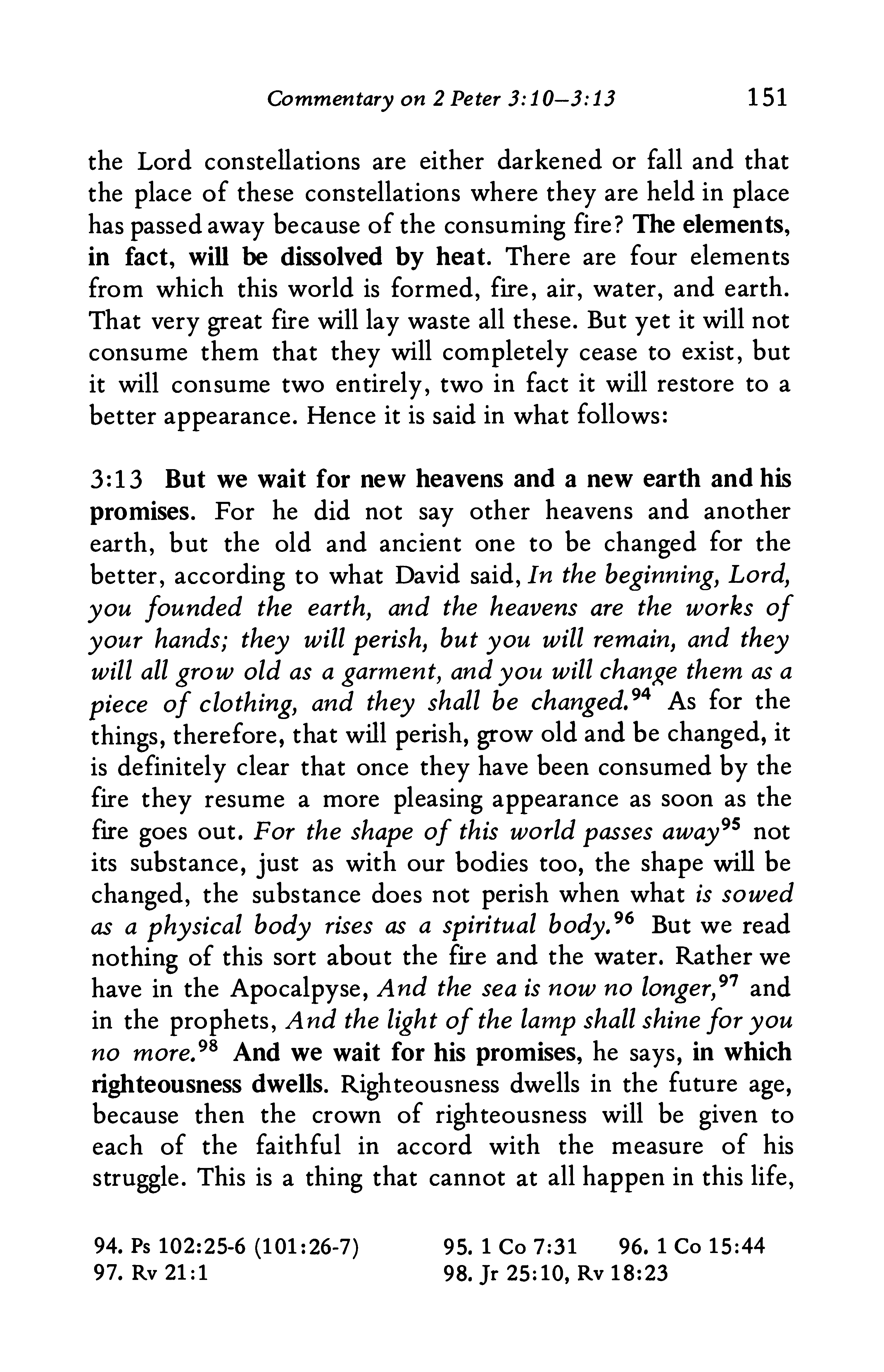
3:10 For the day of the Lord will come as a thief; on it the heavens will pass away with great violence. He is undoubtedly speaking o f those heavens that passed away in the flood, that is, this air nearest the earth which is to be destroyed by fire, and which occupies only so much space, as is properly be lieved, as the water of the flood occupied. Otherwise, if any one maintains that the upper heavens where the sun and the moon and the stars are located will pass away, how does he wish to understand that thought o f the Lord wherein it is that then the sun will be darkened and the moon will not give its light and the stars will fall from the heaven?
For if the place of the constellations, that is, the heaven, has passed away, by what reason can it be said that on the same day of 90. Rv 6:11
91. 1 Co 15:57
92. Mt 25:34
93. Mt 24:29
Commentary on 2 Peter 3:10—3:13
the Lord constellations are either darkened or fall and that the place of these constellations where they are held in place has passed away because of the consuming fire? The elements, in fact, will be dissolved by heat. There are four elements from which this world is formed, fire, air, water, and earth.
That very great fire will lay waste all these. But yet it will not consume them that they will completely cease to exist, but it will consume two entirely, two in fact it will restore to a better appearance. Hence it is said in what follows:
3:13
But we wait for new heavens and a new earth and his promises. For he did not say other heavens and another earth, but the old and ancient one to be changed for the better, according to what David said, In the beginning.
Lord, you founded the earth, and the heavens are the works of your hands; they will perish, but you will remain, and they will all grow old as a garment, and you will change them as a piece of clothing, and they shall be changed.
As for the things, therefore, that will perish, grow old and be changed, it is definitely clear that once they have been consumed by the fire they resume a more pleasing appearance as soon as the fire goes out. For the shape of this world passes away
not its substance, just as with our bodies too, the shape will be changed, the substance does not perish when what is sowed as a physical body rises as a spiritual body.
But we read nothing of this sort about the fire and the water. Rather we have in the Apocalpyse, And the sea is now no longer,
and in the prophets, And the light of the lamp shall shine for you no more.
And we wait for his promises, he says, in which righteousness dwells. Righteousness dwells in the future age, because then the crown of righteousness will be given to each of the faithful in accord with the measure of his struggle. This is a thing that cannot at all happen in this life,
94. Ps 102:25-6 (101:26-7) 95. 1 Co 7:31
96. 1 Co 15:44
97. Rv 21:1
98. Jr 25:10, Rv 18:23
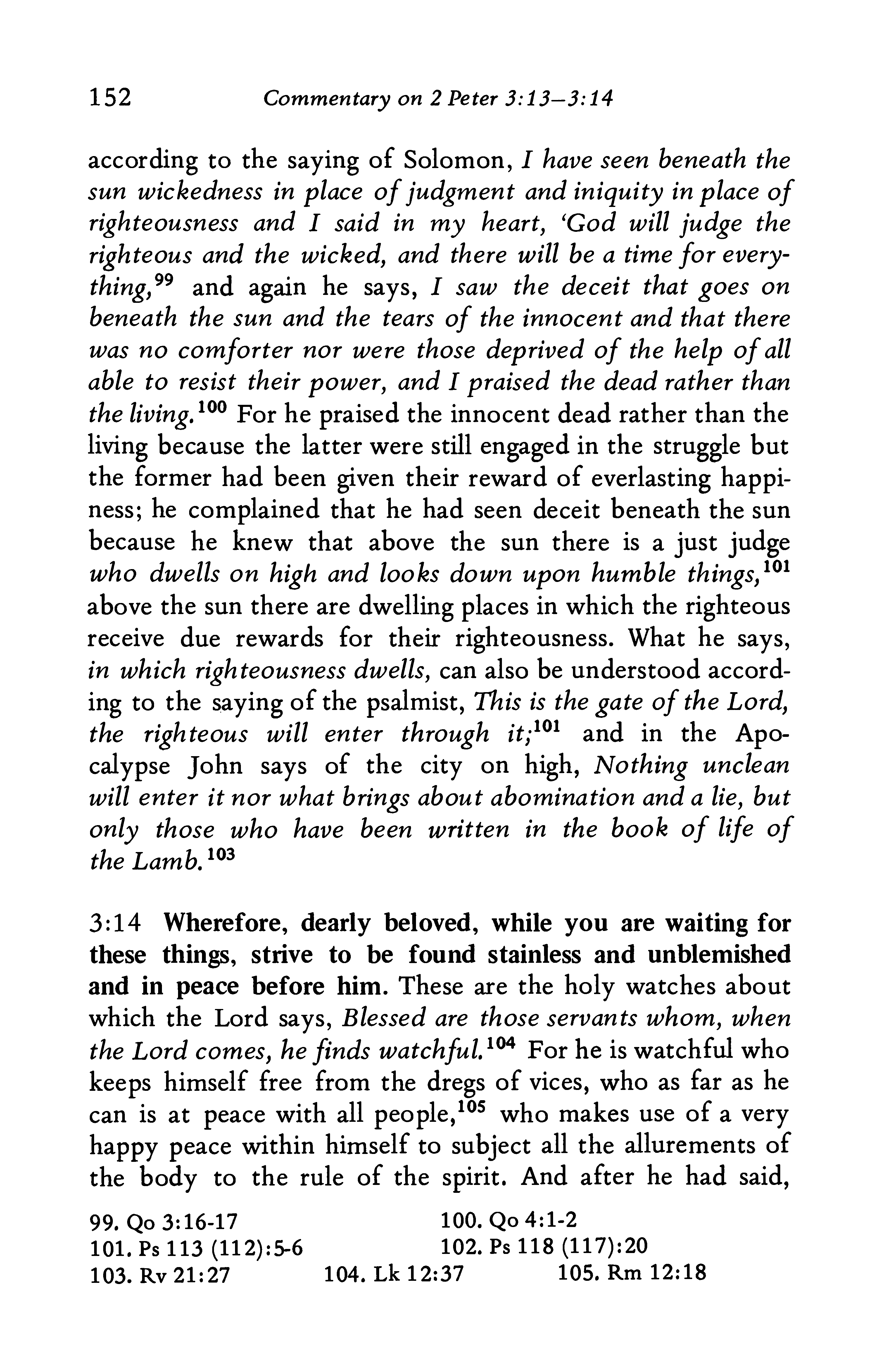
Commentary on 2 Peter 3:13—3:14 according to the saying of Solomon, / have seen beneath the sun wickedness in place of judgment and iniquity in place of righteousness and I said in my heart, 'God will judge the righteous and the wicked, and there will be a time for every thing," and again he says, J saw the deceit that goes on beneath the sun and the tears of the innocent and that there was no comforter nor were those deprived of the help of all able to resist their power, and I praised the dead rather than the living.
For he praised the innocent dead rather than the living because the latter were still engaged in the struggle but the former had been given their reward of everlasting happi ness; he complained that he had seen deceit beneath the sun because he knew that above the sun there is a just judge who dwells on high and looks down upon humble things,
above the sun there are dwelling places in which the righteous receive due rewards for their righteousness. What he says, in which righteousness dwells, can also be understood accord ing to the saying of the psalmist, This is the gate of the Lord,
and in the Apo calypse John says of the city on high, Nothing unclean will enter it nor what brings about abomination and a lie, but only those who have been written in the book of life of the Lamb. the righteous will enter through it;
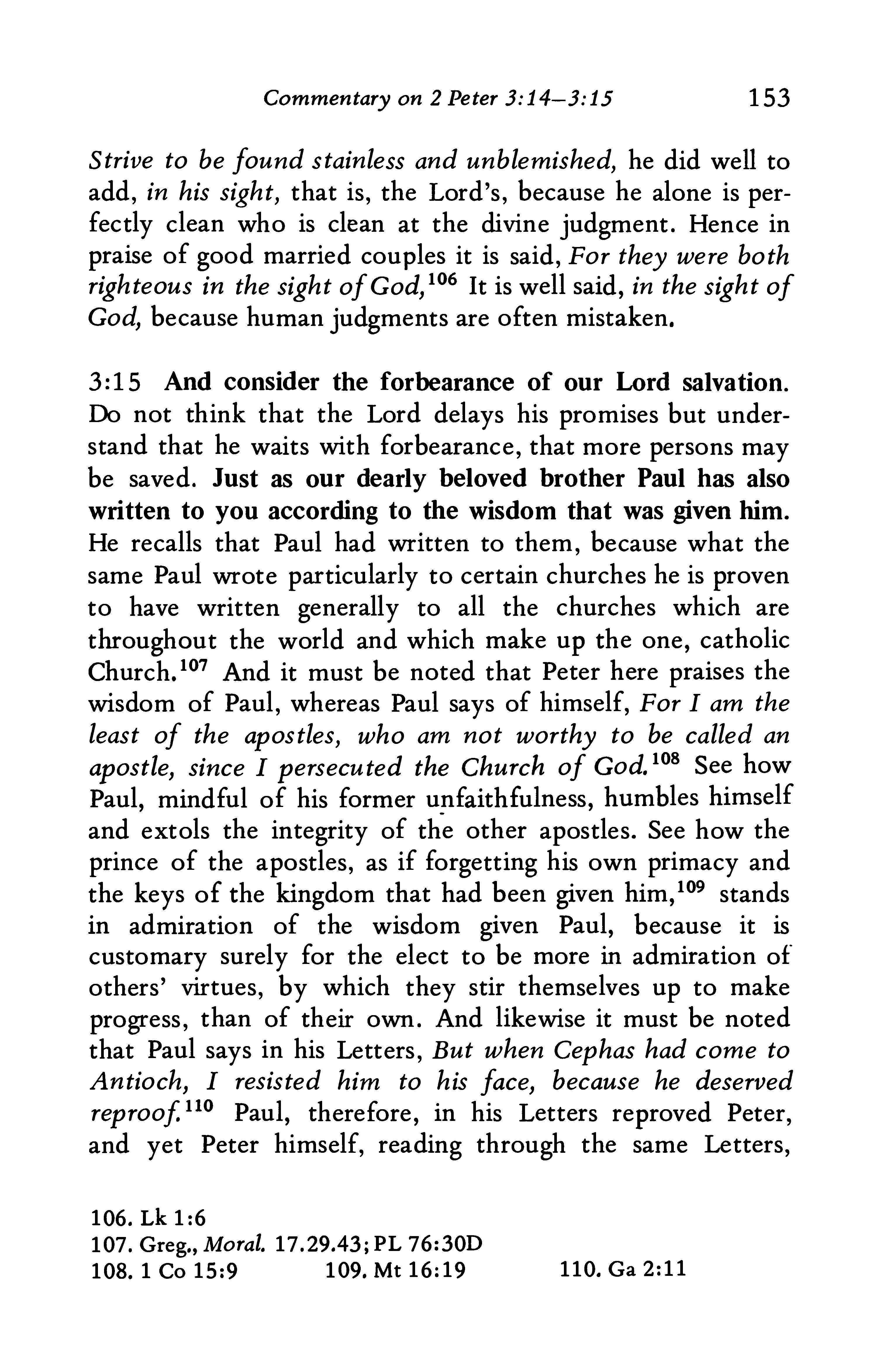
3:14 Wherefore, dearly beloved, while you are waiting for these things, strive to be found stainless and unblemished and in peace before him. These are the holy watches about which the Lord says, Blessed are those servants whom, when the Lord comes, he finds watchful.
For he is watchful who keeps himself free from the dregs of vices, who as far as he can is at peace with all people, 1 0 5 who makes use o f a very happy peace within himself to subject all the allurements of the body to the rule of the spirit. And after he had said,
99. Qo 3:16-17 100. Qo 4:1-2 101. Ps 113 (112):5-6 102. Ps 118 (117):20
103. Rv 21:27
104. Lk 12:37
105. Rm 12:18
Commentary on 2 Peter 3:14—3:15
Strive to be found stainless and unblemished, he did well to add, in his sight, that is, the Lord's, because he alone is per fectly clean who is clean at the divine judgment. Hence in praise o f good married couples it is said, For they were both righteous in the sight of God,
It is well said, in the sight of God, because human judgments are often mistaken.
3:15 And consider the forbearance of our Lord salvation.
Do not think that the Lord delays his promises but under stand that he waits with forbearance, that more persons may be saved. Just as our dearly beloved brother Paul has also written to you according to the wisdom that was given him.
He recalls that Paul had written to them, because what the same Paul wrote particularly to certain churches he is proven to have written generally to all the churches which are throughout the world and which make up the one, catholic
Church.
1 0 7 And it must be noted that Peter here praises the wisdom of Paul, whereas Paul says of himself, For I am the least of the apostles, who am not worthy to be called an apostle, since I persecuted the Church of G o d 1 0 8 See how Paul, mindful o f his former unfaithfulness, humbles himself and extols the integrity of the other apostles. See how the prince o f the apostles, as if forgetting his own primacy and the keys o f the kingdom that had been given him,
1 0 9 stands in admiration of the wisdom given Paul, because it is customary surely for the elect to be more in admiration of others' virtues, by which they stir themselves up to make progress, than of their own. And likewise it must be noted that Paul says in his Letters, But when Cephas had come to Antioch, I resisted him to his face, because he deserved reproof
Paul, therefore, in his Letters reproved Peter, and yet Peter himself, reading through the same Letters,
106. Lkl:6
107. Greg., Moral 17.29.43; PL 76:30D 108. 1 Co 15:9
109. Mt 16:19
110. Ga 2:11
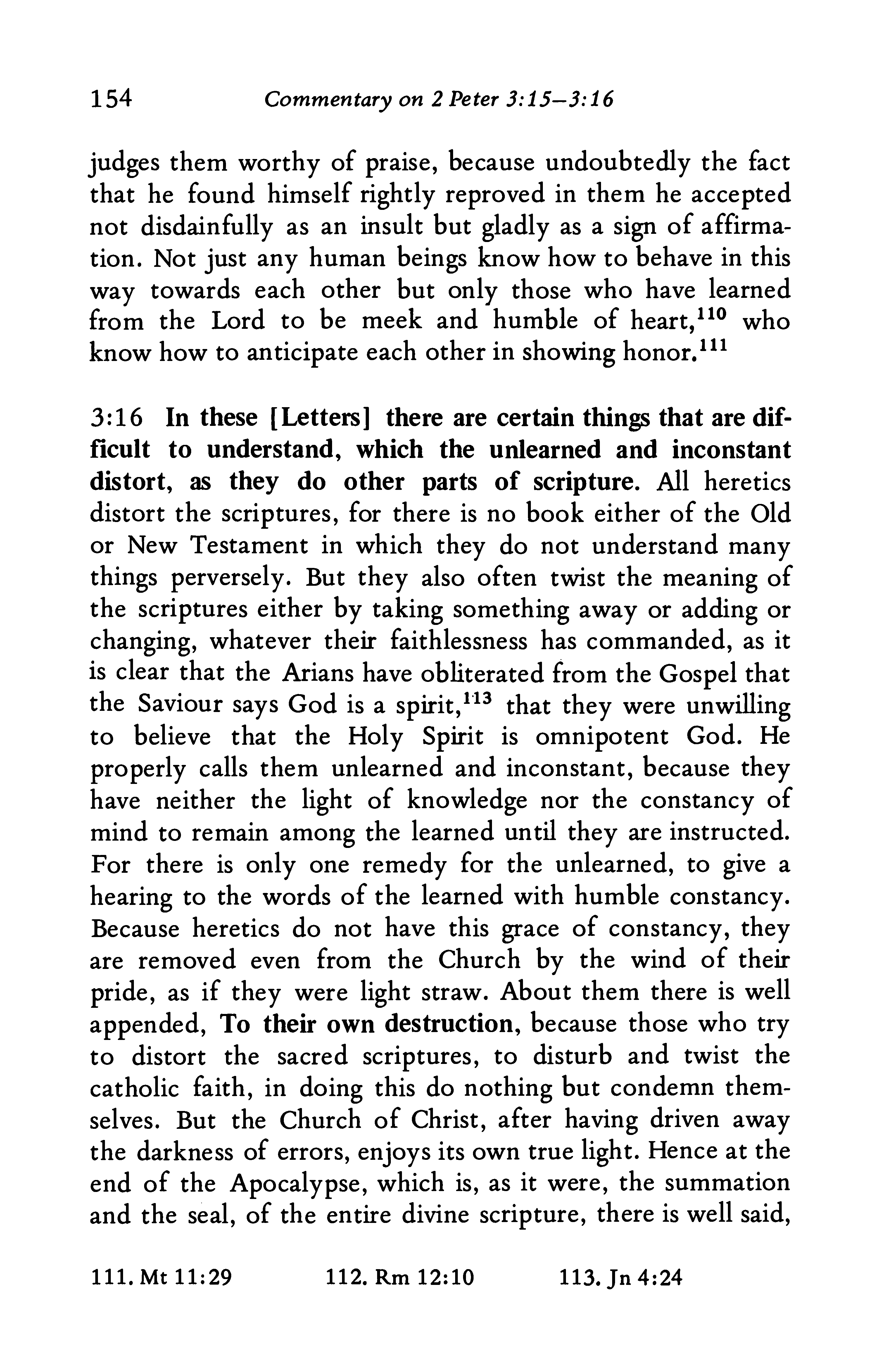
Commentary on 2 Peter 3:15—3:16 judges them worthy of praise, because undoubtedly the fact that he found himself rightly reproved in them he accepted not disdainfully as an insult but gladly as a sign of affirma tion. Not just any human beings know how to behave in this way towards each other but only those who have learned from the Lord to be meek and humble of heart,
1 1 0 who know how to anticipate each other in showing honor.
1 1 1 3:16 In these [Letters] there are certain things that are dif ficult to understand, which the unlearned and inconstant distort, as they do other parts of scripture. All heretics distort the scriptures, for there is no book either of the Old or New Testament in which they do not understand many things perversely. But they also often twist the meaning of the scriptures either by taking something away or adding or changing, whatever their faithlessness has commanded, as it is clear that the Arians have obliterated from the Gospel that the Saviour says God is a spirit, 1 1 3 that they were unwilling to believe that the Holy Spirit is omnipotent God. He properly calls them unlearned and inconstant, because they have neither the light of knowledge nor the constancy of mind to remain among the learned until they are instructed.
For there is only one remedy for the unlearned, to give a hearing to the words of the learned with humble constancy.
Because heretics do not have this grace of constancy, they are removed even from the Church by the wind o f their pride, as if they were light straw. About them there is well appended, To their own destruction, because those who try to distort the sacred scriptures, to disturb and twist the catholic faith, in doing this do nothing but condemn them selves. But the Church o f Christ, after having driven away the darkness of errors, enjoys its own true light. Hence at the end o f the Apocalypse, which is, as it were, the summation and the seal, of the entire divine scripture, there is well said, l l l . M t 11:29
112. Rm 12:10
113. Jn4:24
Commentary on 2 Peter 3:16—3:17
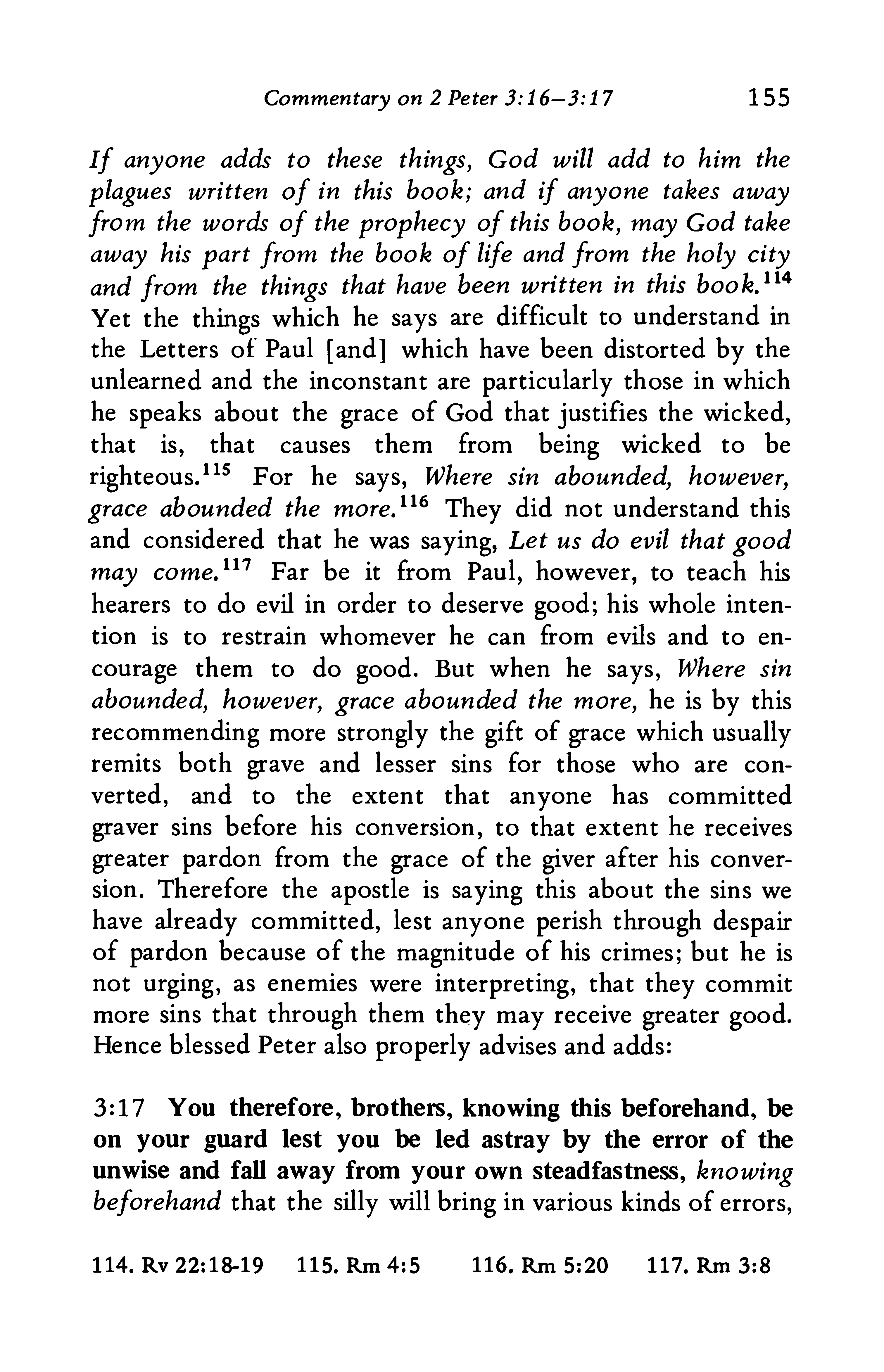
If anyone adds to these things, God will add to him the plagues written of in this book; and if anyone takes away from the words of the prophecy of this book, may God take away his part from the book of life and from the holy city and from the things that have been written in this book.
Yet the things which he says are difficult to understand in the Letters of Paul [and] which have been distorted by the unlearned and the inconstant are particularly those in which he speaks about the grace of God that justifies the wicked, that is, that causes them from being wicked to be righteous.
1 1 5 For he says, Where sin abounded, however, grace abounded the more.
They did not understand this and considered that he was saying, Let us do evil that good may come.
Far be it from Paul, however, to teach his hearers to do evil in order to deserve good; his whole inten tion is to restrain whomever he can from evils and to en courage them to do good. But when he says, Where sin abounded, however, grace abounded the more, he is by this recommending more strongly the gift of grace which usually remits both grave and lesser sins for those who are con verted, and to the extent that anyone has committed graver sins before his conversion, to that extent he receives greater pardon from the grace of the giver after his conver sion. Therefore the apostle is saying this about the sins we have already committed, lest anyone perish through despair of pardon because o f the magnitude of his crimes; but he is not urging, as enemies were interpreting, that they commit more sins that through them they may receive greater good.
Hence blessed Peter also properly advises and adds:
3:17 You therefore, brothers, knowing this beforehand, be on your guard lest you be led astray by the error of the unwise and fall away from your own steadfastness, knowing beforehand that the silly will bring in various kinds of errors,
114. Rv 22:18-19 115. Rm 4:5
116. Rm 5:20
117. Rm 3:8
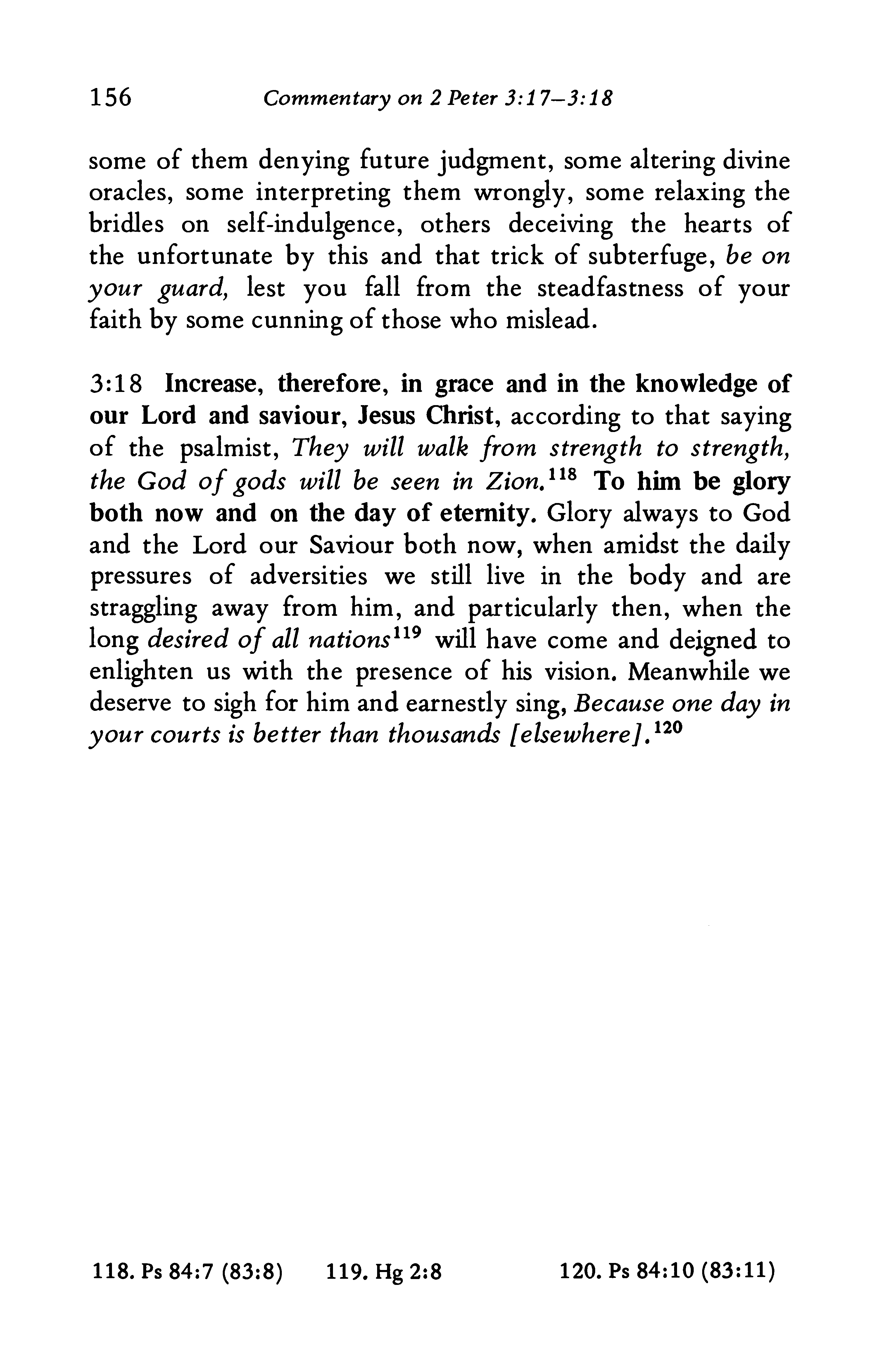
Commentary on 2 Peter 3:17-3:18 some of them denying future judgment, some altering divine oracles, some interpreting them wrongly, some relaxing the bridles on self-indulgence, others deceiving the hearts of the unfortunate by this and that trick of subterfuge, be on your guard, lest you fall from the steadfastness o f your faith by some cunning o f those who mislead.
3:18 Increase, therefore, in grace and in the knowledge of our Lord and saviour, Jesus Christ, according to that saying of the psalmist, They will walk from strength to strength, the God of gods will be seen in Zion. lls To him be glory both now and on the day of eternity. Glory always to God and the Lord our Saviour both now, when amidst the daily pressures of adversities we still live in the body and are straggling away from him, and particularly then, when the long desired of all nations
will have come and deigned to enlighten us with the presence of his vision. Meanwhile we deserve to sigh for him and earnestly sing, Because one day in your courts is better than thousands [elsewhere].
118. Ps 84:7 (83:8) 119. Hg 2:8
120. Ps 84:10(83:11)
NOTES TO COMMENTARY ON 2 PETER
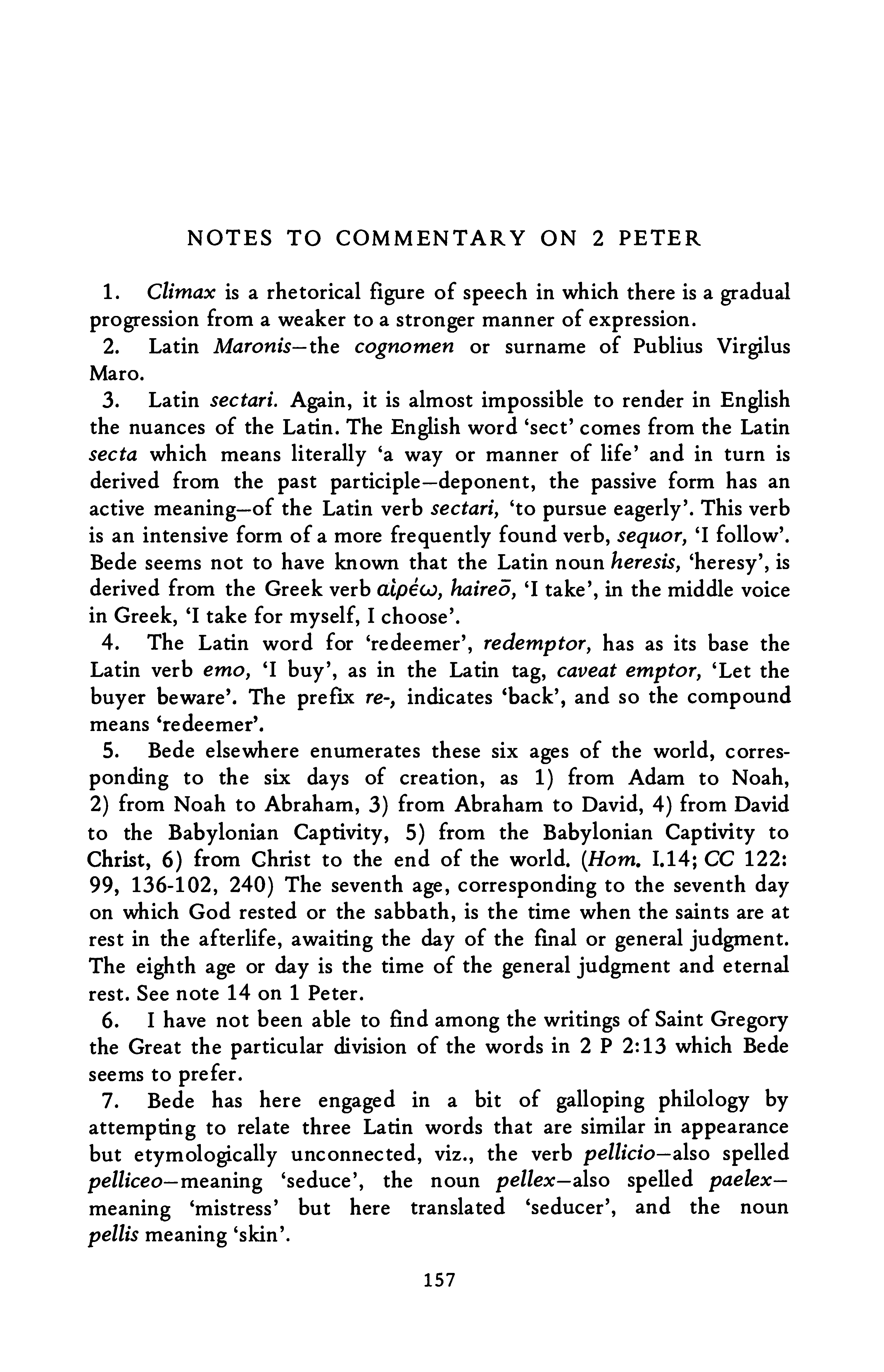
Climax is a rhetorical figure of speech in which there is a gradual progression from a weaker to a stronger manner of expression.
Latin Maronis— the cognomen or surname of Publius Virgilus Maro.
Latin sectari. Again, it is almost impossible to render in English the nuances of the Latin. The English word 'sect' comes from the Latin secta which means literally 'a way or manner of life' and in turn is derived from the past participle—deponent, the passive form has an active meaning—of the Latin verb sectari, 'to pursue eagerly'. This verb is an intensive form of a more frequently found verb, sequor, 'I follow'.
Bede seems not to have known that the Latin noun heresis, 'heresy', is derived from the Greek verb aipea), haired, 'I take', in the middle voice in Greek, 'I take for myself, I choose'.
The Latin word for 'redeemer', redemptor, has as its base the Latin verb emo, 'I buy', as in the Latin tag, caveat emptor, 'Let the buyer beware'. The prefix re-, indicates 'back', and so the compound means 'redeemer'.
Bede elsewhere enumerates these six ages of the world, corres ponding to the six days of creation, as 1) from Adam to Noah,
2) from Noah to Abraham, 3) from Abraham to David, 4) from David to the Babylonian Captivity, 5) from the Babylonian Captivity to Christ, 6) from Christ to the end of the world. (Horn. 1.14; CC 122:
99, 136-102, 240) The seventh age, corresponding to the seventh day on which God rested or the sabbath, is the time when the saints are at rest in the afterlife, awaiting the day of the final or general judgment.
The eighth age or day is the time of the general judgment and eternal rest. See note 14 on 1 Peter.
I have not been able to find among the writings of Saint Gregory the Great the particular division of the words in 2 P 2:13 which Bede seems to prefer.
Bede has here engaged in a bit of galloping philology by attempting to relate three Latin words that are similar in appearance but etymologicaliy unconnected, viz., the verb pellicio—also spelled pelliceo— meaning 'seduce', the noun pellex—also spelled paelex— meaning 'mistress' but here translated 'seducer', and the noun pellis meaning 'skin'.