
Commentary on 1 Peter
COMMENTARY ON 1 PETER
1:1
T E E T E R , an apostle of Jesus Christ, to the elect •"^newcomers of the dispersion in Pontus, Galatia,
^ m Cappadocia, Asia and Bithynia. Newcomers in Latin are called converts in Greek. The Jews called by this name those who, having been born as gentiles, wished to believe in God and, after having received circumcision according to the Jewish custom, to lead a life in compliance with the law of God. There were certain from among their number who on the holy day of Pentecost, when the apostles received the Holy Spirit under the appearance of fire, believed in Christ because of their preaching, for scripture says that Jews also and converts
were present. He calls them elect newcomers, therefore, who were worthy to progress from paganism to the recognition and undertaking of the divine law, and, having received the sacraments o f the old law, to the acceptance of the grace of faith. Hence the holy priest Jerome, speaking of them, says that
Peter, after being bishop of the church o f Antioch and preaching to the believers of the circumcision who were dispersed throughout Pontus, Galatia,
Cappadocia, Asia and Bithynia, in the second year of Claudius came to Rome to refute Simon Magus.
But we also, if we can truly say to God with the prophet that in your sight we are dwellers on earth and travelers like all our fathers, 4 ought to believe that the Letters of blessed
Peter were written to us as well and to read them as having 1. Ac 2:11
2. Jer., Vir. ill 1; TU 6, 22/27 3. Ac 8:9-24 4. Ps 39:12 (38:13)
Commentary on 1 Peter 1:1—1:2 been sent to us. Accordingly, in these Letters he advises us as if we have a fatherland elsewhere, saying, Dearly beloved, I entreat you as newcomers and strangers to keep yourselves from bodily desires.
But what is added, of the dispersion, means that they were dispersed from Jerusalem in the perse cution that followed the death of Stephen
6 or at least illtreated for their faith and often driven from their homes either by the Jews or by the gentiles, as we read in the Acts of the Apostles. But Paul also says to the Galatians, Did you suffer so greatly without a reason? Yes, it was without a reason.
Of the dispersion, he says, in Pontus, Galatia, Cappa docia, Asia, and Bithynia. These are all Greek provinces in Asia [Minor]. But there is also another Bithynia in Europe, from which the Bithynians who are in Asia [Minor] are alleged to trace their origin. That Bithynia which is in Asia
[Minor], however, is also called greater Phrygia, and the river Hiera forms the boundary between it and Galatia.
1:2
According to the foreknowledge of God the Father for the sanctification of the Spirit for obedience and the sprink ling of the blood of Jesus Christ. These verses belong with what he had said, to the elect newcomers. For they had been elected according to the foreknowledge of God the Father.
Hence Paul also says, Those whom he foreknew he also predestined to be conformed to the image of his son;
and elsewhere, As he elected us in him before the creation of the world.
They had been elected, however, for this, that they might be sanctified through the giving of the Spirit and, having been cleansed from all sins, 1 1 they who through the disobedience of the first man, Adam, had perished might begin to obey the Lord Jesus Christ, that sprinkled by his blood they might avoid the power of satan. It was in this way, through the blood o f the lamb, that Israel escaped the
5. IP 2:11
6. Ac 8:1
7. Ga 3:4
8. Isid., Etymol. 14. 3. 39; Plin., Nat. hist. 5. 41. 145, 5. 43. 149
9. Rm8:29
10. Eph 1:4 l l . l j n l : 7
Commentary on 1 Peter 1:2—1:3
sway of the Egyptians.
1 2 He says 'sprinkling', however, according to the manner of the Old Testament, where things that were to be sanctified were accustomed to be sprinkled with the blood of the sacrificial victims.
1 3 Moreover, he says clearly about himself, Unless you eat of the body of the son of man and drink his blood, you will not have life in you.
May grace and peace be multiplied in you, that you may carry through to perfection what you have begun well. It is well that he speaks first about grace and then about peace, because without the grace of Christ we cannot reach the peace of his reconciliation, indeed we can have nothing peace ful except through his grace.
1:3
Blessed be God and the Father of our Lord Jesus Christ.
He relates the praises of blessing to God the Father this way that he may show the Lord our saviour to be both God and man. For when he says, God and the Father of our Lord
Jesus Christ, he is calling [him] the God indeed of our Lord Jesus Christ, because he recalls that the very Lord Christ was made man; he calls [him] the Father, however, of our Lord
Jesus Christ, because he does not doubt that the same Lord of ours always existed as the Son of God. Who accord ing to his great mercy has granted us a new birth to living hope through the resurrection of Jesus Christ from the dead.
God is justifiably 1 5 blessed by us to whom, when because of our deserts we had been born for death, in his mercy he granted a new birth for life. And this [was accomplished] through the resurrection of his son, since he loved our life to such an extent that he saw to it that he died for it and, when the same death was destroyed through his resurrection, he showed us the hope and example of rising again. For he died that we should not be afraid of dying; he rose from the dead that we also may hope to rise again through him.
12. Ex 12:7-23 14. Jn 6:53
13. Ex 29:20-21, Lv 8:30
15. iure
Commentary on 1 Peter 1:4—1:5
1:4
For an imperishable and undefiled and unfading inheri tance, imperishable because the heavenly life is untouched by old age or disease or any sorrow, undefiled because no unclean person can enter into it, unfading because the hea venly way o f life cannot at last become worthless in the minds o f the blessed from long use, as the luxuries and delights of the present time sometimes become a cause for revulsion through daily habit and use. Reserved in the heavens in you. He says, reserved in you, instead of saying,
'reserved for you', that is, reserved now for this reason that it may be given to you at the appointed time in the heavens.
Or at least [he means] reserved in the heavens in you, be cause he who gave to believers the power of becoming sons of God
is he who gave the same persons the power of receiving an inheritance in heaven by persevering to the very end that they may be saved. And therefore he says that the inheritance is reserved in those by whose merits—with the Lord's help—he knows that inheritance must be attained, because those who have not observed the Father's discipline do not deserve to receive their inheritance from him.
1:5
We who are kept by the power of God through faith for the salvation prepared to be revealed at the end of time.
And the Lord says in the Gospel, In my Father's house there are many dwelling places;
and again, It is not mine to give, but to those for whom it has been prepared by my
Father.
Seats have been prepared therefore, in the kingdom o f God, dwelling places have been prepared in the Father's house, salvation has been prepared in the heavens; only let anyone who wishes to receive these make himself worthy. But because no one by his own effort alone can become worthy of achieving eternal salvation by his own strength, this is quite properly prefaced, We who are kept by the power of God through faith. For no one by dint of his own freedom
16. Jn 1:12
17. Jn 14:2
18. Mt 20:23, Mk 10:40
Commentary on 1 Peter 1:5—1:7
can manage to be kept in good, but in everything we must seek the help of him from whom we have received the begin ning of the good action if we are to bring it to completion.
1:6
In this you will rejoice, even if it is fitting that you be saddened for a little while now in different kinds of tempta tions. What he says, in this, means in the fact that at the end of time the prepared salvation will be revealed and given to those who are worthy. The Lord also says about this, Yet again shall I see you, and your heart will rejoice, and your joy no one shall take from you}
If now it is fitting that you be saddened for a little while. It is fitting, he says, that you be saddened, because it is only through the sadness o f the passing world and afflictions that one can reach eternal joys.
He says, for a little while, however, because when the eternal reward is given, everything that appeared hard and harsh in the midst of the tribulations of the world will appear brief and light.
1:7
So that the testing of your faith may be much more precious than gold, which is tested by fire. The Book of Wisdom also compares the sufferings of the saints to gold which is purified by fire, saying about the Lord, He tested them like gold in the furnace and received them as if they were a sacrificial victim, whole burnt offerings,
because undoubtedly in the joy of making the reward he takes as a sacrificial victim pleasing to himself those whom he has tested and proven faithful in the fire o f tribulation. And the endurance 2 1 of the saints is well likened to gold, because just as there is no metal more precious than gold, so this
[endurance] is most worthy of all praise in the sight of the Lord. For indeed from this it has been written, Precious in the sight of the Lord is the death of his saints.
For just as gold shut up in the furnace is purified by the flames but 19. Jn 16:22
20. Ws 3:6
21. patientia 22. Ps 116 (115):15
Commentary on 1 Peter 1:7—1:10 gleams when it is brought out, so the perseverance of the faithful appears contemptible and foolish indeed during the persecutions of the faithless, but when the struggle with tribulations is over and the time o f retribution is at hand, then it is clear how worthwhile their glory is, how much their virtue has produced in the flames of their sufferings.
Hence appropriately there is added: It may be found for praise and glory and honor in the revelation of Jesus Christ.
The testing of faith is found, however, for praise when the judge praises it and says, I was hungry, and you gave me
and so on. It is found for glory when he glorifies the same [testing] by prefacing, Come, you blessed of my
Father, take possession of the kingdom prepared for you from the creation of the world. to eat,
It is found for honor when as the wicked fall into eternal punishment the righteous will go into eternal life. He himself says about this [kind of person], If anyone serves me, my Father will honor him.
1:8
When you see him, you will be glad with unspeakable and glorified happiness. Paul also says, The eye has not seen nor the ear heard nor has it entered into the heart of man what things God has prepared for those who love him.
1:10
The prophets who prophesied about the grace to come in you searched and scrutinized over this salvation. Over the grace of the Gospel to come from the Lord and his angels they searched and scrutinized in secret as to the time and manner that eternal salvation would come to the world. This is found in their books. Hence also one of them, because of his great love of knowledge of salvation, deserved to be called by the angel a man of desires.
They prophesied, however, by speaking openly to mankind and explaining what they themselves had come to know in the secrecy of inward contemplation.
23. Mt 25:35
24. Mt 25:34
25. Jn 12:26
26. 1 Co 2:9
27. Dn 9:23
Commentary on 1 Peter 1:11 —1:12
1:11
They examined the time and conditions the spirit of Christ was pointing out to them when he foretold the sufferings and future glories which are in Christ. The evan gelist pointed out these glories when he said, For the Spirit had not yet been given, because Jesus had not yet been glorified.
There are two glorifications of the Lord, however, according to the human form which he took on: one when he rose from the dead, and the other when he ascended into heaven before his disciples' eyes. There is yet a third, and that in the sight of men, when he shall come in his majesty and that of his Father and of his holy angels to reward everyone according to his work.
2 9 1:12 It was revealed to them that they were serving not themselves but you in those things which have now been proclaimed to you. Among the many hidden things that were revealed to the prophets when they were carefully searching and scrutinizing over the salvation to come, even this was revealed to them, that the same salvation would come not in their days but rather in yours, who are born at the end of the ages. He says these things to warn them to take care of the salvation offered [them], which the prophets and earlier righteous persons loved all along, longing to live in the world at that time when it would be immediately possible for those taken away from the world to mount up to the heavenly kingdom. By those who preached the Gospel to you by the Holy Spirit sent from heaven. He had said previously that the spirit of Christ had foretold his sufferings and subsequent glories to the prophets, and now he says that the apostles are proclaiming the same things to them by the Holy Spirit sent from heaven. Hence it is evident that the same spirit of Christ was formerly in the prophets as was afterwards in the apostles, and therefore each was preaching the same faith in the suffering and subsequent glory of 28. Jn 7:39
29. Mt 16:27
Commentary on 1 Peter 1:12
Christ to the peoples, the [prophets] that it was still to come, the [apostles] that it had already come; and because of this
[they preached] that there is one Church, part of which pre ceded the bodily coming of the Lord, part o f which followed
[it]. On whom the angels long to gaze. It is clear that so great a glory of the man Jesus Christ who suffered for us followed that even the angelic powers in heaven, though they are perfect in their eternal happiness, rejoice always to behold not only the immortal splendor of the Godhead but also the honor of the humanity he took on. [Surely] we ought to look more carefully at what he says about the angels longing to gaze on him, since 'long' is not usually said of something we have but of something we wish to have, for no one longs for what he has. How, therefore, do they long to gaze on Christ, whose face they never cease to behold, unless the contem plation of the divine presence makes the citizens of the heavenly home so happy that in an ordering to us ineffable they are both satisfied at seeing his glory always and always insatiably hunger after his sweetness as if it were new? For, as blessed Pope Gregory admirably distinguishes between the pleasures of the heart and body and says:
When bodily pleasures are not possessed, they enkindle a serious desire for them [in us], but when they are possessed and consumed, right away through being satisfied they produce a loath ing in the one who enjoys them. But on the other hand, when spiritual pleasures are not possessed, they are loathed; on being possessed, however, they are desired, and the more hungrily they are sought after by the one who enjoys them, the more also are they enjoyed by the one who hun gers for them. In the former, appetite brings about satiety and satiety loathing; in the latter, however, appetite causes satiety and satiety appetite. For spiritual pleasures increase desire in the mind while they satisfy, because the more greatly their flavor
Commentary on 1 Peter 1:12—1:14
is apprehended, the more is it perceived that there is something greater to be loved.'
3 0 What he says, On whom the angels long to gaze, can also correctly be understood of the Holy Spirit, about whom he had prefaced, Those who preached the Gospel to you by the Holy Spirit sent from heaven. For blessed Peter relates to the grace of divine condescension the fact that [ G o d ] , for the sake of human salvation, sent to the earth his spirit, who has such great majesty and glory that the sight of him—just as that of the Father himself and of the Son, which is undoubt edly the same—is longed for by the angels in heaven, and poured him forth to enlighten the minds of the faithful.
1:13
Wherefore, having girt up the loins of your mind and being sober, perfectly hope for that grace which is being offered you in the revelation of Jesus Christ. Because this has been promised you, he says, that after this life you may see the revelation of Jesus Christ which the angels now see, the greater is the grace promised you, the more greatly take care that you are worthy to receive it. For he girds up the loins of his body who curbs dissoluteness in his disposition,
3 1 he girds up the loins of his mind who checks it as well in his thoughts. And rightly does he say, Hope for that grace which is being offered you in the revelation of Jesus Christ, for someone who, having girt up the loins of his mind, that is, being chaste both in mind and body, awaits the Lord's coming, rightly looks forward to the time of his revelation.
Yet someone who knows that he has not pleased the Lord, lacking the hope o f those who are good, deservedly fears that he will come too quickly.
1:14
As obedient children. Rightly does he wish those to be completely obedient whom at the outset he had said were
30. Greg., Horn. ev. 2. 36. 1; PL 76: 1266AB 31. ab affectu
Commentary on 1 Peter 1:14—1:23 elected for obedience and the sprinkling of the blood of Jesus Christ.
3 2 1:15 But according to the holy one who called you, be yourselves also holy in your whole way of life. This is like the saying in the Gospel, Therefore, you also be perfect, just as your heavenly Father also is perfect
1:17 And if you call upon him as Father, by saying in prayer, Our Father who are in heaven,
who judges accord ing to each one's work without showing favoritism, not like a physical father who is accustomed to spare his own sons when they sin more forbearingly than [he does] his servants.
But God is such a just and devoted father that he both changes humble and obedient servants, indeed even enemies offering him their hand, by the adoption o f sons, and again those who seem worthy o f honor by their designation as sons he utterly disinherits forever for the fault of disobedience.
Live out the time of your life here in fear, lest namely through sloth and carelessness you become unworthy of so great a father, and, while you may live out the time of your life here safely, you may not be able to reach the promised happiness of the fatherland.
1:18-19 Knowing that you have been redeemed from the useless way of life of your ancestral tradition not by perish able gold or silver but by the precious blood of, as it were a spotless and stainless lamb, Jesus Christ. The greater the price of your redemption from the corruption o f your bodily life, the more greatly ought you to fear lest, by returning perchance to the corruption of vices, you offend the sensi bilities 3 5 of your Redeemer.
1:23 Having been reborn not from perishable but from
32. IP 1:1-2
33. Mt 5:48
34. Mt 6:9
35. animus
Commentary on 1 Peter 1:23—1:25
imperishable seed through the word of God who lives and abides forever. There is a similar verse in the Gospel of John,
To these who believe in his name, who were born not of blood nor of the will of the body nor of the will of man but of God.
Just as the price of the Lord's passion, by which we were redeemed, is therefore imperishable, so also is the sacrament of the sacred font by which we were reborn imperishable. These are so interrelated to each other that the one without the other cannot confer salvation, because, namely, the Lord at the time of his incarnation so redeemed us all at the same time by his sacred blood that we also in our own time through the rebirth of baptism ought individually to attain a share in the same rebirth. It has been well said about this rebirth that it has been brought about not from perishable seed but through the word of God who lives and abides for ever, so that from this it may be gathered that just as the body which decays is born from perishable seed, so life which knows no end is granted us through water conse crated by the word of God. He appropriately also illustrates this by the witness of the prophet 3 7 when he adds:
1:24-25 Because all flesh is hay, and all its glory like the blossom of hay; the hay has dried up, and its blossom has fallen off, but the word of the Lord remains for ever.
Just as a perishable body, therefore, begets a perishable body, so also the word of the Lord which remains for ever gives eternal life in the body and soul at the same time to those whom it creates anew from water. Saint Cyprian thus recalls this witness in his book on the dress of virgins:
3 8 'Cry,' says God to Isaiah, 'All flesh is like hay, and all its honor like the blossom of hay; the hay has dried up, and its blossom has fallen off, but the word of the Lord remains for ever.' It does not 36. Jn 1:12-13 37. Is 40:6-8 38. Cypr., Hab. virg. 6;CSEL 3,1:192, 2/11
Commentary on 1 Peter 1:24—2:2 become a Christian, and it particularly does not become a virgin, to count any honor or distinction of the body but only to seek the word of God, to embrace good things which will remain for ever; or, if she must glory in her body, then clearly let it be when she is tortured in confessing the Name, when
(though but a woman) she is found braver than the men who are tormenting her, when she suffers fire or the cross or the sword or the beasts, that she may be crowned. These are the precious jewels of the body, these are the better adornments for her person.
It should not disturb the reader, however, that in this state ment from the prophet he has used the word 'honor' while ours uses the word 'glory', for both are usually translated into Latinf 1] from the single Greek word, which is 5d£a.
2 : 1 - 2 So, putting aside all malice and all deceit and hypo crisy and envy and all slander, now like newborn children desire milk that is reasonable and without deceit. Because you have been recently reborn, he says, and made sons of God through baptism, now through attention to a good way of life be like children just issued from the womb, by nature of their blameless age, namely, unacquainted with malice and deceit, inexperienced in every way with pretence, envy, slander and other vices o f this kind. Just as they naturally desire their mother's milk so that they can grow up healthily and acquire the ability to eat bread, so do you also seek first the simple basic elements o f faith from the breasts o f your mother, the Church, that is, from the teachers of the Old and New Testaments, who have either written or also preach to you orally the divine words, that by learning well you may reach the nourishment of the living bread which came down from heaven, 3 9 that is, through the sacraments of the Lord's
39. Jn 6:51
Commentary on 1 Peter 2:2—2:4
incarnation by which you have been reborn, and nourished by which you may attain the contemplation o f the divine majesty. Desire milk that is reasonable and without deceit, he says, that in it you may grow up to salvation. By his ad monition about desiring the milk of the word he touches those who come unwillingly and with contempt to listening to sacred readings, unacquainted with that thirst and hunger of which the Lord says, Blessed are they who hunger and thirst after righteousness.
And therefore they attain rather slowly the perfect growth o f salvation at which they can be fed with the solid food of the word, that is, perceive the divine secrets and accomplish greater good.
2:3
Yes, you taste that the Lord is sweet. By this stipula tion, he says, by getting rid and cleansing your heart of malice and evil, desire the life-giving food of Christ and so taste the fullness of the divine sweetness. For it is no wonder that the person does not avoid degrading his mind by earthly attrac tions who tastes nothing in it of the sweetness from on high.
For the psalmist does well to advise us to taste how sweet the Lord is, 4 1 because there are some persons who sense not how sweetly God may taste within but how he may sound when struck from without. Although they perceive certain secrets by their understanding, they cannot experience thensweetness, and if they know of their existence, they do not know, as I have said, how they taste. And since in that psalm from which he took this verse there was prefaced, Draw near to him and be enlightened
rightly blessed Peter appended, saying:
2:4 Drawing near to this living stone, rejected by men, indeed, but chosen and honored by God. He also takes the witness about this stone from the psalm in which it has been written, The stone which the builders rejected has become 40. Mt 5:6
41. Ps 34:8 (33:9) 42. Ps 34:5 (33:6)
Commentary on 1 Peter 2:4—2:5
But that no one might consider in the Jewish sense that this had been sung by the prophet about a physical stone which was being put by divine judgment in the building o f some earthly house contrary to human arrangement, he advisedly added, living, saying, Drawing near the chief cornerstone to this living stone, that he might indicate that it was said about Christ. He is rightly called a stone, because coming in the flesh he deigned to insert himself into the building of his holy Church that he might strengthen it, a living one, how ever, because he was able to say, I am the way, the truth and
He was rejected by men when they said, We have no king but Caesar, the life
chosen however by God when he him self said, But I have been established king by him,
and so on, and adorned when, after the death on the cross, God exalted him and gave him a Name which is above every Name,
and so on.
2:5
And you yourselves like living stones are to be built into the edifice, spiritual houses. He says that they are being added to the building, because without the Lord Jesus Christ, namely the living stone, no spiritual building is able to stand.
For no one can lay another foundation except
him. By being joined with him, the faithful are made into living stones, who because o f their unfaithfulness had been dead stones, namely, hard and unfeeling. To them it was rightly said, I shall take away from you your heart of stone and give you a heart of flesh
But they are fitted like living stones into the spiritual building when at the discrimination of a learned teacher they have their undesirable actions and thoughts cut off and are squared off by the blow of a ham mer, as it were. And just as some rows of stones in a wall are held up by others, so all the faithful in the Church are held up by the righteous who preceded them, they themselves
43. Ps 118 (117):22
44. Jn 14:6
45. Jn 19:15
46. Ps 2:6
47. Ph 2:9
48. 1 Co 3:11
49. Ezk 36:26
Commentary on 1 Peter 2:5
by their teaching and support hold up those who come after even to the last righteous person. He, though he is held up by those who went before, will have no one coming after him whom he ought to hold up; but he who holds up the entire building and is himself held up by no one is the Lord Christ— hence he is also called by the prophet a precious stone laid in the foundation.
5 0 He likewise calls the elect living stones that he may indicate the struggle of good intent or action in which they ought always to be engaged with the grace of God preceding and accompanying them. For when dead, that is, material, stones are being prepared or laid up on a build ing, they cannot help the builder's work in any way and can do nothing but fall; but however and wherever they are laid by the builder, they stay there in the same place without any feeling or they even slip down and fall. But blessed Peter does not wish us to imitate the hardness and lack of feeling of such stones but to be built into the building as living stones on the foundation of Christ that, with the help o f his grace, namely, by living soberly and righteously and godly,
5 1 we may work together [with him] after the example of him who said, And his grace was not without effect in me, but I labored more than all those.
For a living stone in the building of holy Church was he who strove to labor dili gently lest he have received the grace of God in vain; and lest he appear to have attributed anything of the same devoted labor to himself, he added carefully, It was not I, however,
Therefore, anyone who with his gift and help takes care to press on untiringly in his good works is being built by Christ as a living stone into his house. But anyone who, after being incorporated into holy but the grace of God with me.
Church through the grace of rebirth, has striven to do no further work towards his salvation is, like a dead stone, unworthy of the heavenly building, in a word, and therefore to be rejected by the divine judgment; and another who is
50. Is 28:16
51. Tt 2:12
52. 1 Co 15:10
53. Ibid.
Commentary on 1 Peter 2:5 worthy is to be substituted in his place—according to the command of Leviticus by which the leprous stones of houses are commanded to be inspected by a priest, and if they cannot be made clean, to be then counted as unclean and removed from the course of clean stones.
5 4 You are to be built into the edifice, he says, spiritual houses. Thus he says that they ought to become spiritual houses, although there is one house of Christ made up of all the elect angels and human beings, in the same way as although there is one catholic Church spread throughout the whole world they are frequently called 'churches' in the plural, namely, on account o f the gatherings of the faithful in many places spread over many tribes, tongues, and peoples. Hence he him self says, I, Jesus, have sent my angel to you to give witness about these things in the churches.
Nor must the fact be overlooked that certain manuscripts have in the singular, 'You are to be built a spiritual house', and others have, 'You are to be built into a spiritual house', in which the unity itself, namely, of the entire holy Church is more clearly referred to.
Yet when he had said, You are to be built into the edifice, or, 'a spiritual house', he added, A holy priesthood, in order that he may very clearly urge us, being ourselves a holy priesthood, to be built upon the foundation of Christ. Therefore, he calls the entire Church a holy priesthood, a name and office that the house of Aaron alone had under the law, because namely we are all members of the high priest, we all are signed with the oil of gladness; 5 6 there applies to all what he appends: To offer spiritual sacrificial victims acceptable to God through Jesus Christ. Yet he calls our works o f alms giving and prayers spiritual sacrificial victims to distinguish them from the bodily victims under the law. But what he says in conclusion, through Jesus Christ, applies to every thing that he had said previously, because through his grace we are both added to the building in him by wise architects,
54. Lv 14:33-45 55. Rv 22:16
56. Ps 45:7 (44:8)
Commentary on 1 Peter 2:5—2:7
that is, the ministers of the New Testament, and we are made into spiritual houses, strengthened against rains, winds, floods of temptations by his spirit, and we are able both to share in his holy priesthood and to do something good and acceptable to God only through him. For just as the branch cannot produce fruit by itself unless it remains on the vine, so neither can you, he says, unless you remain in me.
2:6 Wherefore, there is found in scripture, 'Look, in Zion I lay a cornerstone, chosen, precious'. He gives this witness from Isaiah 5 8 to strengthen what he had said previously,
Drawing near to this living stone,
expanding and asserting that the Lord saviour is called a stone by the prophets on account of his firmness. And when he adds, And everyone who believes in him will not be disturbed, he gives on ac count o f what he had said, And you like living stones to be built into the edifice.
This word of the prophet and the apostle in which it is said that those who draw near the the living stone and believe in him will not be disturbed are admirably fitting to the verse of that psalm in which, when it had been said, Draw near to him and be enlightened, at once there was added, and your faces will not be ashamed.
Like this is what John says, And now, little children, remain in him so that when he appears we may have confidence and not be confounded by him at his coming.
2:7
For you, therefore, who believe, an honor, that honor undoubtedly that we be not thrown into confusion by him at his coming, but as he himself says, If anyone serves me, my
Father will honor him.
But for those who do not believe the stone which the builders rejected, that just as they rejected him when they were building their actions by being
57. Jn 15:4
58. Is 28:16
59. 1 P 2:4
60. 1 P 2:5
61. Ps 34:5 (33:6) 62. 1 Jn 2:28
63. Jn 12:26
Commentary on 1 Peter 2:7—2:9 unwilling to lay him in the foundation of their heart, so also will they be rejected by him at his coming when he will be unwilling to accept those who rejected him into the building of his house which is in heaven. And this distinction between honor for those who believe but rejection for those who do not believe extends up to this point [of the verse]. From here on he adds likewise about those who believe, This has become the cornerstone, because namely just as a corner stone joins two walls, so the Lord has united to himself the people of the Jews and gentiles in one company of faith.
6 4 And at once he adds about unbelievers:
2:8
And a stone of offence and a rock of stumbling.
Hence Paul also says, We preach Christ crucified, to the Jews indeed a stumbling block but foolishness to the gentiles.
For those who stumble at the word and do not believe in that to which they have also been appointed. They stumble at the word who from the very fact that it behooves them to hear the word o f God, stumble in their mind by being unwilling to believe what they hear. He has exaggerated their foolishness and added, They do not believe in that to which they have also been appointed, because they have been appointed to this, that is, to this made human beings by nature, that they may believe God and obey his will, as Solomon attests when he says, Fear God and obey his commandments, for this is [the duty of] every human being,
that is, every human being has been naturally made for this purpose, that he may fear
God and obey his commandments. Certain manuscripts have, 'in which they have also been appointed', which is understood according to what Paul says in speaking about God: For in him we live and move and are.
2:9
But you are a chosen race, a royal priesthood, a holy 64. Eph 2:14-16 66. Qo 12:13
65. 1 Co 1:23
67. Ac 17:28
Commentary on 1 Peter 2:9
nation, a people whom he has gained. The apostle Peter now rightly gives to the gentiles this attestation o f praise which formerly was given by Moses to the ancient people of G o d ,
6 8 because namely they believed in Christ who like a corner stone brought the gentiles into that salvation which Israel had had for itself. He calls them a chosen race on account of their faith, that he may distinguish them from those who by rejecting the living stone have themselves become rejected, a royal priesthood, however, because they have been joined to his body who is their real king and true priest, who as king grants to his own a kingdom and as their high priest cleanses them of their sins by the sacrificial victim of his own blood.
He names them a royal priesthood that they may remember both to hope for an eternal kingdom and always to offer to God the sacrificial victims of a stainless way o f life. They are also called a holy nation and a people whom he has gained according to what Paul says, explaining the thought o f the prophet 6 9 saying, Yet my righteous one lives by faith, but if he withdraws he will not be pleasing to my soul: We are not those who withdraw to our destruction but [people] of faith to the gain of our soul;
and in the Acts o f the Apostles, The Holy Spirit has placed the bishops to rule the church of the Lord, which he has gained by his blood.
Therefore, we have become the people whom he has gained in the blood of our Redeemer, because there was once the people of Israel redeemed from Egypt by the blood of a lamb. Hence in the following [part of the] verse also he both mystically recalls the ancient history and teaches spiritually that his also is to be fulfilled in the new people of God, saying, that you may make known his mighty deeds who has called you out of darkness into his own wonderful light. For just as those who were freed by Moses from slavery in Egypt sang to the Lord a triumphant song after the crossing of the Red Sea and the 68. Ex 19:6
70. Heb 10:38-9 69. Hab 2:4
71. Ac 20:28
Commentary on 1 Peter 2:9—2:11
7 2 so it is fitting also for us to render worthy thanks for heavenly benefits after receiving the forgiveness of sins in baptism. For the Egyptians who illtreated the people of God—reasonably, too, because they are interpreted to mean 'darkness' or 'tribulations'In appropriately signify sins washed away in baptism but still troubling us. The freeing of the children o f Israel and their being brought out into the fatherland once promised them is also linked with the mystery of our redemption. By means of it we make our way to the light o f the dwelling place on high with the grace o f Christ lighting our way and guiding us. That cloud and column of fire that both protected them through out the whole of their journey from the darkness of the nights drowning of Pharoah's army, 7 3 and led them by a sure path to the promised homes of the fatherland also prefigured the light of this grace.
2:10 You who were once not a people but now are the people of God, who did not seek after mercy but now have received mercy. By these verses he indicates clearly that he has written this Letter to those who had come from the gentiles to the faith, who were once separated from the way of life of the people o f God but then through the grace of faith were joined to his people 7 4 and obtained the mercy which they did not know how to hope for. He takes them, however, from the prophet Hosea who predicted the calling of the gentiles and said, I shall call [those who were] not my people my people and [those who did] not receive mercy [a people] having received mercy, and it will be in the place where it was said, 'You are not my people/ there they will be called the sons of the living God.
2:11 Dearly beloved, I entreat you as newcomers and strangers to keep yourselves from bodily desires that fight
72. Ex 15:1-18 74. Eph 2:12-13 73. Ex 13:21-2 75. Ho 1:9 (10), 2:24, Rm 9:25-6
Commentary on 1 Peter 2:11—2:12
against the soul. Up to this point blessed Peter has been instructing the Church in general, enlarging on either the benefits by which the divine condescension deigned to call us to salvation or on the gifts with which he deigned once to honor the Jews but now us. From this point on he skillfully urges the various classes of the faithful not to show them selves unworthy of so great a grace of the spirit by living according to their bodily desires, lest any of those marked with the royal and priestly name, driven on by the wicked ness of their vices, fall away from the glory of the nobility granted or promised them. Therefore, he particularly ad dresses first those who are free and slaves, then women and men, and then after a passage of general exhortation he points out to the old and young also how they ought to conduct themselves. Appropriately, however, he teaches those who are free to keep themselves from bodily desires, because the freedom of a more relaxed life is accustomed to be exposed to the greater dangers of enticing allurements that fight against the soul, because while the body weakly gives in to pleasant concupiscences, the army of the vices is being strongly armed against the soul. He suitably calls them newcomers and strangers that they may the less subject their mind to earthly affairs the more they remember that they have a fatherland in heaven. For there is accustomed to be this difference in this life between the elect and the condemned: that the elect as strangers and exiles now look for a fatherland in the future and are less pleased with the passing joys of the present the more they hope to receive fu ture joys without end and to reign with Christ for ever; but the condemned on the other hand have their fatherland here and know how to yearn after the pleasures of this life alone, and therefore after this life they are banished into everlasting exile where, deprived of all pleasures, they suffer only adver sity in torments.
2:12 That although they may slander you as evildoers,
Commentary on 1 Peter 2:12—2:14 serving you from your good works, they may glorify God on the day of his visitation. It often happens that pagans who censure the faith of Christians for having abandoned their gods afterwards, observing their chaste way o f life and their insuperable belief in Christ, cease slandering them and begin more to glorify and praise God who because o f the goodness and righteousness of his worshippers is proved to be good and righteous. They glorify God, he says, on the day of his visitation, that is, even now unbelievers recognize how great is the glory to be given you by God at the time of retribution, once they have seen you earnestly following him amid the dangers that stand in your way.
2:13—14 Be subject to every human institution for the sake of God. To every human institution, he says, to everyone of rank, to every personage, to every governor to which divine providence wishes you to be subject. For this is what he says, for God's sake, because there is no power except from God,
and, He who resists the [civil] power resists the disposition of God
What institution he subsequently ex plains, adding, whether it be to the king as having supremacy or to the representatives sent by him. He speaks only of the king and his representatives but not of masters, because, as we have said, here he is instructing those particularly who are masters of servants; subsequently, however, he advises servants also how they should serve their masters. Therefore, he teaches the faithful subjects of the eternal king namely to be subject even to the powers of the world lest even in this the faith and the christian religion may be able to be slandered, because through [such slander] the rights o f the human condition are disturbed. For what has been said, to every human institution, can even thus be properly under stood as denoting both believing and unbelieving lords of things. For the punishment of evildoers, but the praise of the 76. Rm 13:1
77. Rm 13:2
Commentary on 1 Peter 2:14-2:17
good, not that all [rulers] because they are kings or his repre sentatives know how either to punish evildoers or praise the good, but he is simply telling what ought to be the action of a good governor, that is, that he ought to restrain evildoers and reward those who behave properly. Even if he acts unjustly, if he condemns the good, nevertheless his actions redound to their praise if they bear patiently with his wickedness and wisely resist his foolishness. Hence Paul also says, If you wish not to fear power, do good, and you will receive praise from it. ls He does not say, 'You will be praised for it', but,
You will receive praise from it, because even though the worldly power does not praise you, indeed even if it perse cutes you, if it slays you with the sword, as it did Paul, if it crucifies you, as it did Peter, you will receive praise for it from the fact that while it is acting wickedly against you who are righteous and innocent the virtue of your patience deserves the crown of praise.
7 9 For that blessed Peter also had this in mind in this context the following words show when it is said:
2:15 Because this is the will of God, that by doing what is right you put to silence the ignorance of foolish people.
Therefore, this is the praise of the good for which he says that representatives are sent by the king, when the good use the ignorance o f foolish governors for their own everlasting praise by doing what is right.
2:16—17 As free men and not as using your freedom as a cloak for maliciousness. They do what is right as free men who, the more they make use of greater freedom in the sight of men, the more narrowly, indeed the more freely, are they made subject to divine service. But then they also do well as free men who, following the example of the patriarch
Joseph, although they are held captive in the service of men, 78. Rm 13:3
79. Aug., Serm. 302.13; PL 38:1389-90
Commentary on 1 Peter 2:7—2:18
8 0 But on the other hand they use their freedom as a cloak for malicious ness who, the less they are restrained by the yoke of human service, are the more widely set free for the oppression of sins, and when they become servants of vices with impunity, they call this freedom and cover up their fault under this name. This verse can be understood in a general way, how ever, according to the thought of the apostle Paul, You have been called into freedom, brothers, only do not employ your freedom for an opportunity of the flesh are in no way forced to be servants of the vices.
8 1 For we are rightly called free because we have been set free from the bonds of sin through baptism, because we have been redeemed from the slavery of the devil, because we have been made sons of God. Yet we do not receive with the gift of freedom a better opportunity and licence to sin. Indeed if we sin we soon lose our freedom and become slaves of sin, and whoever considers that he was set free by the Lord for this reason, that he might sin more freely, changes his freedom into a cloak for maliciousness. Blessed Peter, however, wishes us to be free from the slavery to our faults so that we can remain faithful servants of our good creator. Hence he subsequently adds,
But as servants of God honor all men, love the brotherhood, fear God, respect the king. He advises us, therefore, to pay fitting honor to all and according to the Lord's command to render to Caesar what is Caesar's and to God what is
God's.
8 2 And well among other things he orders free men to love the brotherhood, that they may recall that those who by their temporal condition are subject to them have also been made their brothers in Christ, calling upon him together with them as the Father who judges without showing favoritism,
2:18 Slaves, be subject to your masters in all fear, not only to the good and restrained but also to the unrestrained.
To the unrestrained, he says, to the unlearned.[ 3] This word 80. Gn 39:1-20 81. Ga 5:13
82. Mt 22:21
83. IP 1:17
Commentary on 1 Peter 2:18—2:24
has been derived from the Greek, because in Greek a school is called a place in which young people are accustomed to apply themselves to liberal studies and to have leisure for listening to teachers. Hence a school is interpreted as [a place of] leisure. Accordingly, in the psalm where we sing,
Be at leisure and see that I am God
where we say, be at leisure, there is found in Greek oxoXdaare.
Therefore, scholars are learned, those who are unrestrained are un learned and rough. But he wishes those who are servants to obey both kinds, explaining more openly how he has ordered us to be subject to every human institution. Another reading has 'difficult' for unrestrained, and the holy bishop Fulgentius in his writings has this, 'Serving with fear not only the good and restrained but also the more difficult'.!
4] 2:20—21 But if in doing what is right and suffering you hold up, this is a grace from God. For you have been called for this, because Christ also suffered for us, leaving you an example, and so on. It must be noted most carefully how highly he glorifies the condition of servants who, in doing what is right and being beaten by cruel and wicked masters when they are blameless, he asserts are imitators of the Lord's passion. You hear, however, Christ suffered for us, and you rejoice, because Christ died for you. Pay attention to what follows, leaving you an example that you may follow in his footsteps, an example of tribulations, not of gratifications, of insults, scourgings, sorrows, taunts, thorns, the cross, wounds, death. It has been written in the psalm, On account of the words of your lips I have kept hard ways
On account of what words of the lips of God, except those in which he promises eternal life?
2:24
He himself bore our sins in his body upon the wood.
Although, above, he was addressing servants in particular, 84. Ps 46:10 (45:11) 85. Ps 17 (16):4
Commentary on 1 Peter 2:24-2:25 he now gives general advice that he may recall even to their masters' memory what the Lord God underwent for them.
Indeed he instructs the entire Church on what its founder bore for its freedom. For he does not say, 'your sins', but including himself as well he says, He himself bore our sins in his body upon the wood.
2:25 For you were like wandering sheep. How does he call them sheep and wandering ones, when those who lead thenlife in error are reckoned goats rather than sheep,
8 6 except because the Lord knows those who are his.
He bears for a long time even with many who lead bad lives whom nonethe less he foresees are to be saved in the number of his sheep.
But you have been converted now to the shepherd and searcher 8 8 of your souls. This resembles the Gospel parable where the devoted shepherd left the ninety-nine sheep in the desert and came to search for the one which had wandered off.
8 9 For what was said there, that after having found it he placed it joyfully on his shoulders,
9 0 blessed Peter anticipated by saying, He himself bore our sins in his body upon the wood, because surely he wished so much to redeem us that he would place on his shoulders the wood on which he took away our sins.
9 1 Therefore he says, to the shepherd and searcher of your souls, the shepherd, namely, because he gives us the pastures of eternal life, he provides pastures o f temporal graces in the present; the searcher for our souls, however, because the daystar from on high has searched us out, to enlighten those who sit in darkness and in the shadow of death.
He searches daily by preserving that very light which he has given us that it may not fail, indeed by helping that it may increase. Certain manuscripts have the literal Greek, 'to the shepherd and overseer[
5] of your souls'. For the Latin word 'overseer' means 'one who 86. Mt 25:33
87. 2 Tm 2:19
88. visitator 89. Lk 15:4
90. Lk 15:5
91. Jn 19:17
92. Lk 1:78-9
Commentary on 1 Peter 2:25—3:4
6] because undoubtedly the eyes of the Lord are over the righteous and his ears [are open] to their prayers, watches over',[
that he may free them from all their tribula tions.
9 4 3:1
Likewise let wives also be subject to their husbands, that if any do not believe the word they may be won over without a word through the women's way of life, and so on.
It must be noted that blessed Peter desires good and upright women to be subject to unbelieving husbands with this con dition, that not only do they do nothing evil at their com mand but also remain invincibly constant in so chaste a way of life that they may be able to be an example of chastity and faith even to these men.
3:3
Let not their external adornment be their tresses or the wearing of gold or the clothing of dresses, because, as Cyprian says, women clothed in silk or purple are not able to put on Christ, those adorned with gold and pearls
9 5 and jewels have lost the ornaments of their heart and breast.
He says:
9 6 'But if', Peter says, 'women who are accustomed to excuse their adornments because of their hus bands ought to be restrained and directed to church discipline by religious observance, how much more proper is it for a virgin to be careful to observe it; for her there is no excuse for adorning herself nor can the blame for her fault be placed on an other but she alone is guilty?'
3:4
But the person of a hidden life is one who is so in the imperishableness of a quiet and restrained spirit, which is wealth in God's sight. He is preaching chastity and the 93. Ps 34:15 (33:16) 94. Ps 34:17 (33:18) 95. 1 Tm 2:9
96. Cypr., Hab. virg. 8;CSEL 3, 1: 193,26-194,4
Commentary on 1 Peter 3:4—3:8 adornment of the inner man in the imperishability of a quiet and restrained spirit, saying, so to speak, 'Since your outward man has perished and you have ceased to have the happiness of being inviolate, which is the characteristic of virgins, imi tate the imperishability of the spirit through a continence late in coming, and show in your mind what you have not been able to show in your body; for Christ seeks these riches and these adornments of your relationship'. It is astonishing that even in [the philosophy of] Pythagoras, with only the law of natural knowledge as guide, this thought is found, that the real adornments of ladies are modesty, not clothing.
3:7
Likewise husbands living together [with their wives] according to knowledge, bestowing honor as on the weaker womanly vessel. He says, Likewise, urging husbands to imi tation, because he had above admonished them already, saying, Let husbands regard your chaste way of life;
accord ing to knowledge, however, that they may know what God desires and accord honor to the weaker womanly vessel. If we abstain from sexual relations, we accord honor; if we do not abstain, it is evident that sleeping together is contrary to honor. So that your prayers may not be hindered. Paul also says, Do not refuse one another except perhaps by agreement for a time, that you may have leisure for prayer.
He men tions, therefore, that prayers are hindered by the conjugal duty, because as often as I perform what is due my wife I am not able to pray. But if according to another statement of the apostle we must pray without ceasing," I must therefore never gratify my conjugal duty, lest I be hindered at any hour from prayer, in which I am ordered always to persevere.
3:8
All of you, however, be of one mind in faith, com passionate, and so on. Because he was previously teaching different persons, conditions, sexes, with the distinction
97. 1 P3:2
98. 1 Co 7:5
99. 1 Th 5:17
Commentary on 1 Peter 3:8—3:13
befitting each, he now advises all to have one fyeart and mind 1 0 0 in the cause of their faith in the Lord.
3:9
Because for this you have been called, that you may possess a blessing as an inheritance, because namely the judge says, Come, you blessed of my Father, receive the king dom.
The blessing of an inheritance can also be under stood as that by which the Church blesses the Lord in the future life for ever. Hence even now in the hope of things to come it sings jubilantly, / will exalt you, God, my king, and I will bless your name for ever and ever.
Everyone, there fore, tries to meditate on and do in the present what he desires to find in the future, namely, both to bless his
Creator and his neighbor with a sincere voice and to make himself also worthy of divine and fraternal blessing alike.
3:12
Because the eyes of the Lord are upon the righteous and his ears [are open] to their prayers; the face of the Lord, however, is against those who do evil. Because blessed Peter had forbidden us to render evil for evil—indeed he had ordered us to bless those who curse us 1 0 3—he properly illustrates by the witness of the prophet
1 0 4 that both the good and the wicked are always seen by the observer from on high. He wants us to remember that both our patience, with which we put up with the evil [and], our good will, by which we desire good for our persecutors, are to be rewarded with an eternal reward and our persecutors are to be visited with a worthy punishment if they are unwilling to repent; but if they repent we also will receive from the Lord a crown of due congratulation for their salvation for which we prayed.
3:13 And who is there who may harm you if you are zealous for the good? He is speaking of those things that 100. Ac 4:32
103. 1 P3:9
101. Mt 25:34
102. Ps 145 (144):1
104. Ps 34:15-16 (33:16-17)
Commentary on 1 Peter 3:13—3:14 come our way through insulting words from our adversaries, through losses of our temporal goods, through bodily afflictions. For these and all such things, when they are brought on the faithful, at least on those who are zealous for the good and this full knowingly, are in no wise able to harm them but rather provide a palm o f patience to those who bear them unruffled, and contrariwise they do very much harm to those who bring them on by heaping up eternal punishment. But if anyone is overcome by adversities of this kind and becomes disheartened, it is not he who caused the evil who has harmed him, but he has harmed himself by refusing to bear this patiently. For the house that the wise man built did not fall because it did not hold up under the violence of the storms but because it was built upon a rock, nor again did that which the foolish man foolishly erected fall because it was struck by the storms but because it had been set upon sand; 1 0 5 for adversity beat upon and tested each one equally, but the strength o f the foundation gave the crown of perseverance to the one, the foolishness of the fragile structure destroyed the other. For no disaster brought on either by the devil or by a wicked person or by the general upheaval of passing things can harm someone perfectly zealous for the good. Moreover, it is clear that very many of those who are zealous for the good have been harmed by others when they are badly instructed in the knowledge of the truth which they love. For of those yearning to believe in God according to the Catholic belief and to live righteously in the Church, how many did the madness of Arius deceive, how many the extravagance of Sabellius or other heretics when they were unaware? Read the book of John Chrysostom which he wrote about this, No one can be harmed except by himself.[ n] 3:14 But if you suffer anything for righteousness' sake, you
105. Mt 7:24-7
Commentary on 1 Peter 3:14—3:16
will be blessed. Not only does he do you no harm who brings evils upon you when you do what is right, he says, but also even when an enemy attacks you for the good he denounces he provides you with a reason for greater happi ness by testing the strength o f your patience, according to that saying of the Gospel, Blessed are they who suffer persecution for righteous' sake.
3:15 Make holy our Lord Jesus Christ in your hearts.
What is it, to make the Lord holy in our hearts, except to consider in the innermost disposition 1 0 7 of our heart how his holiness is of unimaginable glory? This is our greatest protection against the deceit and violence of a terrifying enemy, namely, to reflect always on how much courage to overcome he can give to those who hope in him whose indescribable holiness shines forth. Always ready to give a satisfactory account to him who demands from you the reason for the hope and faith that is in you. In two ways ought we to give a reason for our hope and faith to those who demand it: both by communicating the due motives for our hope and faith to all who ask, whether believers or unbelievers; and by always keeping the profession of our faith and hope unimpaired even amidst the pressures of our adver saries, showing by our patience how reasonably we have learned that they are to be kept, for whose love we fear neither to suffer adversities nor undergo death.
3:15—16 But having a good conscience with restraint and fear. He advises that in this knowledge of doctrine the trait of teaching be observed, namely, that humility 'which is the mistress and mother of all virtues'
1 0 8 be spoken of in preaching and demonstrated in living, that insofar as they slander you as evildoers, they may be put to shame who 106. Mt 5:10
107. affectus 108. Greg., Moral 23. 12. 24; PL 76:265B
Commentary on 1 Peter 3:16—3:17 who calumniate your good way of life in Christ, that those who mock in you the faith and hope in heavenly things which they cannot see may see your good deeds and be put to shame by these, which they cannot deny are overtly good. Or at least it ought to be interpreted thus, 'Take care by doing what is right that those who slander your good way of life may be put to shame when the time of the future judgment comes, seeing you crowned with Christ while they with the devil are condemned'.
3:17 For it is better to suffer for doing what is right, if that is God's will, than for doing what is wrong. This statement intentionally censures the foolishness of those who, when they are censured for their faults by their brothers or even restrained by punishment, bear it entirely patiently; but if they suffer without fault, either verbal insults or loss of pos sessions or any adversities from their neighbors they quickly give way to anger, and those who appeared blameless up to this point, by their impatience and murmuring make them selves blameworthy. However, that the far unequal gap in misfortune may be seen in unequal deserts, let us observe that Tobit, 1 0 9 Saul 1 1 0 and Elymas 1 1 1 were struck by one and the same hardship of blindness: but Tobit for the reason that the virtue of his patience might shine more widely for all as an example; Saul for the reason that Saul the persecutor might be changed into Paul the apostle; Elymas that paying the due penalty for his treachery he might cease from his attempt to confuse those who had also been on the point of believing. And if the choice were given me, I should prefer as a righteous man to be subjected to divine or human scourging with so great a father than by the force of scourg ing to be dragged from unrighteousness to the pursuit of righteousness, and again I should prefer to be dragged back from faults by misfortune than to be forced to undergo
109. Tb 1:1 ff.
110. Ac 9:1 ff.
111. Ac 13:8-11
Commentary on 1 Peter 3:17—3:18
eternal punishment for the incurable weight of sins.
3:18 Because Christ also died once for our sins, the righteous for the unrighteous. Therefore, he who is righteous and suffers, imitates Christ; he who is corrected by misfor tune imitates the thief who on the cross recognized Christ and after the cross entered paradise with Christ;
1 1 2 he who in the midst of misfortunes does not cease from his faults imitates the thief on the left who mounted the cross for his sins and after the cross went headlong to the lower world.
1 1 3 He recalls that Christ died once, however, to bring to our memory also that an eternal reward will be granted for our short-lived sufferings. That he might offer us to God, having been put to death indeed in the body but made alive in the spirit. About this being put to death in the body and made alive in the spirit which they have who labor for the Lord through patience, the apostle Paul also says, Although our outward man is wasting away, yet he who is within is being renewed from day to day.
Christ therefore offers us to God the Father when through being put to death in the body we rejoice at being sacrificed for him, that is, he shows that in the sight of the Father our life is praiseworthy. Or at least he offers us to God when he brings us, freed from the body, into the eternal kingdom. To be sure, Saint Athanasius, bishop of Alexandria, relates what is said, but made alive in the spirit, not to the spirit of man—which, when the body has been put to death, is quickened in a better way, since the prophet says of the Lord, That he may quicken the spirit of the humble and quicken the heart of the contrite
—but rather to the grace of the Holy Spirit who bestows eternal life on those who put their bodies to death. For he uses this as a witness also against the Arians who deny the equality of the Holy Trinity, explaining that by their undivided unity
112. Lk 23:33-43 113. Lk 23:33-9 114. 2 Co 4:16
115.1s 57:15
Commentary on 1 Peter 3:18-3:20 of divine operation the Father quickens, the Son quickens, the Holy Spirit quickens; the Father and Son, namely, because it has been written, For just as the Father raises up and makes the dead to live, so the Son also quickens those whom he will,[ 7] the Holy Spirit, however, as is made clear in this witness in which it is said of the Son, That he might offer us to God, having been put to death indeed in the body but quickened in the spirit, and therefore the substance or essence of those whose operation is one cannot be unequal. [
9] 3:19—20 Coming at this time in the spirit, he preached also to those who had been shut up in the body, who had for merly been unbelievers. He who coming in the body in our times preached to the world the way of life, he also coming in the spirit before the flood preached to those who had then been unbelievers and had lived for the body. For through the Holy Spirit he was in Noah and the rest of the saints who lived then and through their good way of life he preached to the wicked men of that age, that they might be converted to better things. For he calls shut up in the body those who were fiercely weighed down by bodily desires.
Hence Scripture says of them that every body had corrupted its way.
For what he says, at this time, applies to the time of which he had spoken previously, That he might offer us to God, because even then if any had wished to believe at the Lord's preaching, which he manifested through the life of the faithful, he rejoiced to offer them also to God the Father, if any, however, slandered the good as evildoers
1 1 7 these were put to shame at the coming of the flood. For what he says, at this time, that is, Coming at this time in the spirit, he preached also to those who had been shut up in the body, can also be understood o f both [classes], that through his same preaching might arise both the crown o f praise for those who believed and confusion for those who had persisted in 116. Gn 6:12
117.1 P 2:12, 3:16
Commentary on 1 Peter 3:20
their unbelief. Certain manuscripts have, 'Coming at this time in the spirit, he preached also to those who were in pris o n \ [
1 0 ] This applies to the same intent of the crooked and unbelievers who, since they have their apprehension obscured by darkness, are rightly said to have been shut up in prison even in this life. They are weighed down in this prison, namely, still in interior darkness, that is, in the blindness of their mind and in unrighteous works, until being freed from their body they are cast out into exterior darkness and into the prison of eternal damnation about which the Lord says in the Gospel, And the judge shall hand you over to the guard and you shall be sent to prison.
11* Although even the saints, when they thirst for the joy of the fatherland on high, may rightly cry out that they are placed in prison in this life, according to the saying of the psalmist, Bring my soul out of prison, that I may confess your name.
But indeed there is a great difference between each type of prison, for the con demned are in the prison of sins and ignorance, but the righteous, with their heart open to God, even though placed in the prison of tribulations, always enjoy the light of righteousness, which the apostles Paul and Barnabas showed when, although bound in the middle of the night in the innermost terror of a prison and scourged, they sang a hymn of praise to God with a very happy voice.
1 2 0 A certain person has interpreted this passage as follows, that the saints resting in the lower world longed for that consolation about which the Lord says to his apostles, Many prophets and righteous persons have longed to see what you see and did not see it and to hear what you hear and did not hear i t
1 2 1 about which the psalmist also says, My eyes have failed at your message, saying,
and that this consolation and encouragement was preached by the
(When will you comfort me/ Lord when he went down into the lower world even to those
118. Mt 5:25
119. Ps 142:7 (141:8) 120. Ac 16:25
121. Mt 13:17
122. Ps 119 (118):82
Commentary on 1 Peter 3:20-3:21 who were in prison and were once in the days o f Noah unbelievers. He may have said this. But the Catholic faith holds that when the Lord went down into the lower world and brought his own out from there, it was the faithful alone and not unbelievers whom he took with him to the heavenly kingdom; and to the souls that had put off their bodies and were condemned in the prison of the lower world he did not preach the salvation which they had neglected before their death but daily either through himself or through the example of his followers or through the words of the faithful shows the path of life to those who are shut up in the prison of their crimes in this life. It is well said about these:
3:20 Who had formerly been unbelievers, when the pa tience of God was waiting in the days of Noah, when the ark was being constructed. For that very patience of God was also his preaching, when Noah, pressing on with the work on the ark for a hundred years,[ u] showed by the daily per formance of the work what was to happen to the world.
Hence Paul says, Do you not know that the patience of God is leading you to repentance? and so o n .
1 2 3 Another transla tion has this passage as follows: 'Christ died once for our sins, the righteous for the unrighteous, that he might lead[ 1 2] us to God, being put to death in the body but made alive[ 1 3] in spirit; this spirit[ 1 4] he preached also to those who had formerly been unbelievers, when the patience of God was waiting in the days of Noah', and so on.
3:20-21 In which a few, that is, eight souls were saved through water. Baptism, of which this was the type, now saves you also. He calls the type of baptism similar to the ark and the waters of the flood, and quite properly, because the very construction of the ark from smooth planks
1 2 4 signifies also the building of the Church which comes about by the 123. Rm 2:4
124. Gn 6:14
Commentary on 1 Peter 3:20—3:21
collection of the souls of the faithful by the architects of the word. And that a few, that is, eight souls were saved through water when the entire world was perishing, indicates that the number of the elect, compared with that of the perishing gentiles, Jews, heretics and false faithful, is much smaller.
Hence o f the narrow gate and difficult way that leads to life it is said, And few are they who find it;
and again, Do not fear, little flock, because it has been pleasing to your Father to give you the kingdom.
Here also about this little flock there has appropriately been added, Not the removal of the body's dirt but as the examination of a good conscience for God. For where is a good conscience except where there is sincere faith? For the apostle Paul teaches that the purpose of the commandment is charity from a pure heart and a good conscience and unfeigned faith.
The fact, therefore, that the water of the flood did not save those outside the ark but slew them without doubt prefigured every heretic who, although having the sacrament of baptism, is to be plunged into the lower world not by other waters but by those very waters by which the ark is raised up to the heavens. The number eight itself of the souls which were saved through water also signifies that the holy Church receives the wash ing of baptism through the mystery of the Lord's resurrec tion, that just as he rose from the dead through the glory of the Father, so we also, cleansed from sins through the water of rebirth, may walk in newness of life.
12* For when the Lord rose from the dead on the eighth day,[ 1 5] that is, after the seventh day, the sabbath, he showed us both an example of the future resurrection and the mystery of the new way of life by which we, though still situated on earth, might live a heavenly life. Peter also, by way of explaining this, himself adds, saying:
3:21—22 Through the resurrection of Jesus Christ who, 125. Mt 7:14
126. Lk 12:32
127. 1 Tm 1:5
128. Rm 6:4
Commentary on 1 Peter 3:21-3:22 having gone into heaven, is at the right hand of God, swallowing up death, that we might become sharers of eternal life. For just as he rose from the dead and ascended into heaven and sits at the right hand of God, so also he signified that through baptism the way to salvation and the entrance to the heavenly kingdom was open to us. He does well, how ever, to say, swallowing up death, for what we swallow we cause by the action of our body to be assimilated that it may never perish. And the Lord swallowed up death which, rising from the dead, he so completely consumed that it would have no further power over him through the touch of any corrup tion; and while the outward appearance of his real body remained, all trace, in a word, of former frailty would be absent. It is promised that this will happen also to us in the end when the apostle says, speaking of our resurrection,
Then will come to pass the saying which has been written, 'Death is absorbed in victory/
[He does] well [to say] absorbed, because when we also have been made sharers in eternal life, the power* o f our immortal body undoubtedly removes all taint of past corruption in the same way as a flame by the power o f its heat is accustomed to consume a drop of water that is put in it. Having gone into heaven, he says, with the angels and authorities and powers and made subject to him. No one can doubt that the angels and all the authorities and powers of the heavenly fatherland were always subject to the Son of God, whom with the Father and the Holy
Spirit they praise as the one God without beginning, tremble before, and adore. But blessed Peter judged it necessary to caution that his assumed humanity in rising was lifted up to such height of glory that by an inestimable eminence it is set above all rank of angelic dignity, according to what the psalmist also, when he was speaking about the Father, You have made him a little less than the angels, immediately added, You have crowned him with glory and honor and you
129. 1 Co 15:54
*virtus
Commentary on 1 Peter 3:22-4:2
have established him above the works of your hands, you have placed all things under his feet.
4:1
Since Christ, therefore, suffered in his body, you also be armed with the same thought. After he had explained the example of the Lord's resurrection and our cleansing which comes about in baptism from the mystery of the ark and the flood, he returns to what he had started to say, that imitating the work of our Redeemer in the midst of the good that we should patiently put up with the wickedness of evildoers. It must be noted, however, how definite he is when he says,
Since Christ, therefore, suffered in his body, because as Saint Ambrose says, 1 3 1 His body suffered but his divinity was free from death; his body yielded to suffering by the law of human nature. Can the divinity, then, die, when the soul cannot? Do not fear those, he says, who slay the body but cannot slay the soul.
If, there fore, the soul cannot be slain, how can the divinity?
4:1—2 Because he who has suffered in the body has ceased from sins, that he may live now for the remaining time in the body not by human desires but by the will of God. Any of the saints who has subjected his body to the violence of the persecutors for martyrdom has without doubt kept from sinning to the end of his life, as far as this is humanly possible. For how could anyone who was affixed to wood or surrounded by the blows from stones or exposed to the nibbling o f beasts or set on flames o f fires or flayed by the excruciating lash or weakened by any other kind of punish ment think about committing sin, about bodily desires; what could he turn over in his mind except the will of God? He
130. Ps 8:5-6 (8:6-8) 131. Ambr., De fide 2. 7. 57; PL 16:571B 132. Mt 10:28
Commentary on 1 Peter 4:2—4:5 was compelled to desire this alone, when with the contest over he would receive the crown of life. Blessed Peter, there fore, wants us always to imitate the mind of such persons when, after bringing forward the example of the Lord's passion, he admonishes us to be armed with the same thought against the wickedness of evil and against the allure ments of the vices. He wants it to be understood that if we put on the garb of patience even while we are at rest [in times] when the Church is at peace, with the Lord's help we easily avoid the faults o f sins and subdue all human desires to the commands of the divine will. Accordingly, the psalmist also entreats the Lord, saying, Pierce my body with fear of you, for I have been afraid of your judgments;
and the apostle says, Those, therefore, who are Christ's, have cruci fied their body with its vices and concupiscences.
The one, therefore, who because of fear of the heavenly judgment has rid himself of bodily concupiscences in his mind, being now like the person crucified and suffering for Christ and, as it were, dead to sins, lives only for the service of God.
4:4
In this they wonder that you do not join them in the same shame of self-indulgence, blaspheming. Because you have crucified your body with its vices and concupiscences, he says, it comes about truly that, although in their perfidy they blaspheme you as separated from their companionship, yet they always see in your way of life the works of righteousness and devotion which they rightly wonder at and for which they justifiably praise and venerate the christian faith.
4:5 They will render an account to him who is ready to judge the living and the dead. Therefore, he says, be less concerned, be less sorrowful, if when you do what is right you are blasphemed by the condemned, because although
133. Ps 119 (118):120
134. Ga 5:24
Commentary on 1 Peter 4:5—4:7
you are silent, God, who is certainly a righteous judge,
nonetheless will not be silent and hold his peace.
1 3 6 He will bestow worthy rewards both on them for their blasphemy and on you for your patience.
4:6
For this is why the Gospel was preached even to the dead, that they might be judged indeed like human beings in the body but might live according to God's [ordinances] in the spirit. God has such great concern, such great love, such great desire that we be put to death in the body but quickened in the spirit, that he has commanded [us] to preach the Gospel, the word of faith, to those also who are implicated in greater crimes and justifiably must be accounted among the dead, namely, because of their self-indulgence, desires, insobriety, gluttony, drunkenness and unlawful worship of idols,
since even they, when they have passed judgment on, that is, rejected and put aside, their bodily desires, may be alive spiritually and may look for eternal life together with those whom the grace of the Gospel finds living innocently.
4:7
For the end of all things will approach. So that no one might deceive himself in thinking that the future judgement, in which he had said that the living and the dead are to be judged, is far off, he advisedly warns that, although the time of the arrival of the final judgment is indefinite, yet it is definitely clear to all that they are unable to continue fqr long in this mortal life. Accordingly, be prudent and watch ful in prayers. In the Gospel, in view o f the indefinite time of the end, the Lord has also admonished us to pray always and to be watchful. For he says, speaking o f the day of judgment,
Accordingly, be watchful at all times, praying that you may be held worthy of escaping all those things which are to come and 135. Ps 7:11 (7:12)
137. 1 P4:3
136. Ps 83:1 (82:2)
Commentary on 1 Peter 4:7—4:8 standing before the Son of Man.
It is well that we are ordered to be watchful in prayers, that when we stand for prayer all bodily and worldly thought may depart and the mind may then think of nothing else than that alone for which it is praying. For frequently the enemy creeps in and, cunningly deceiving us, draws our prayers away from God, so that we may have one thing in our heart and express another with our voice, when it is not the sound of the voice but the awareness of the mind which ought to pray to God with sin cere intention.
4:8 Above all, however, having a mutual and lasting love for one another. He does well to add, lasting, because we are al ways able to love but we are not always able to be watchful in prayers, because the frailty of our body stands in the way.
We are scarcely able constantly to perform those virtuous actions, that is, hospitality, teaching, providing ordinary or spiritual graces for our neighbors, and other things of this sort, because it is surely necessary that the doing o f these things undoubtedly depends both upon the capacity of the body and timely opportunities. But charity itself, at whose prompting these things are carried out exteriorly, because it rules over the inner man, can always be held in the same place, although it cannot always be manifested in public.
Because charity covers a multitude of sins, particularly insofar as a person says truthfully to God, And forgive us our debts as we forgive our debtors.
And indeed all the good works we perform wipe away and cover the faults which we commit, but this is said particularly about charity by which we grant to our neighbors those things which are due us, because it is most righteous in the sight of God that it be measured out to us according to the measure of devotion with which we have measured, 1 4 0 just as, on the other hand, the wise man censures the hard-hearted, saying, Does a person harbor anger for 138. Lk 21:36
139. Mt 6:12
140. Mk 4:25
Commentary on 1 Peter 4:8—4:12
another and seek healing from God?
And we must not doubt that in the case of the person who also acts through charity, as far as he can, for the correction of his neighbor by advising, rebuking, chastising, charity itself covers a multi tude of sins according to the witness of James who says,
Whoever has brought a sinner back from the error of his way will save his soul from death and covers a multitude of
sins.
4:11
If anyone speaks, [let it be] like the words of God, fearing, namely, lest he say or command anything contrary to the will o f God or to what is clearly ordered in the holy scriptures and be found as a false witness of God or sacri legious or bringing in anything foreign to the teaching of the Lord or at least abandoning or passing over any of the things pleasing to God, when he very clearly orders the preachers of the truth concerning those whom they were instructing,
Teaching them to observe everything that I have commanded you.
For he orders them to pass on to their listeners to be observed both the things which he himself commanded, not other things, and these things not in part but in their entirety. If anyone serves, [let it be] as it were from the power that God provides. Let everyone be more humble in offering his neighbor the good he can, the more clearly he knows that he cannot have of himself what he is offering.
That in all things God may be honored through Jesus Christ, according to the commandment o f Jesus Christ himself where he says, Let them see your good works and glorify your Father
God is honored in our actions, therefore, when everything we do that is right and according to his will we attribute not to our own deserts but to his grace, but on the contrary we ascribe the evils that we commit only to our own malice or sloth or ignorance. who is in heaven.
4:12 Dearly beloved, do not wonder at the fiery ordeal that 141. Si 28:3 f42.Jm 5:20
143. Mt 28:20
144. Mt 5:16
Commentary on 1 Peter 4:12—4:17 comes to you for a temptation. Certain manuscripts have,
'Do not go astray in your fiery ordeal'. The meaning o f both, however, is clear: that none of the faithful ought to wonder why he suffers the fiery ordeal of temptations in this life when he is now being tempted by tribulations for a definite reason so that after he has been tested he may be held worthy of receiving the crown of the future life;
1 4 5 nor ought anyone think that he is a straggler and stranger to the members of Christ because he is beset by the adversities of the present time, when both to the Lord belongs escape from death
and in his Church persecution at the hands of unbelievers has never ceased from the first martyr, 'Abel, to the last one o f the elect who is going to be born at the end of time'.
1 4 7 Hence, when he had said, Do not wonder at the fiery ordeal, he did well to add, as if something new were happen ing to you, because it is very ancient and constant for the elect of God to bear the adversities of the present life for eternal salvation.
4:15 For let none of you suffer as a murderer or a thief or a reviler. For he suffers as a reviler who at the time of his suffering is unrestrained even while undergoing wrong from his persecutor.
4:17 For it is time for judgment to begin from the house of God. There are two judgments of God recorded by the scrip tures, one hidden, the other manifest. The hidden judgment is the punishment by which every human being is either now being tried that he may be chastened, or cautioned, that he may be converted, or if he despises the call and discipline of God, blinded for condemnation. The manifest judgment, how ever, is when the Lord will come to judge the living and the dead. But it is said that now is the time for judgment to begin
145. Jm 1:12
146. Ps 68:20 (67:21) 147. Greg., Horn. ev. 1. 19. 1; PL 76: 1154B
Commentary on 1 Peter 4:1 7—4:18
from the Lord's house, that is, from the Church, which is being prepared for future joys by being faced with present afflictions. Yet the condemned are leading their transition life now much more securely and without any infliction of chastisement as is proportionate to the chastisement that awaits them in the future, according to the saying of blessed
Job, They spend their days in good things and in a moment
But if [it begins] first with us, what [will be] the end of those who do not believe the Gospel of God? From this is gathered with what severity the strict Judge will deal with those whom he condemns, if here he so torments those whom he loves. For if the sons are scourged, what ought the very wicked servants to hope for? they go down to the lower world.
4:18 And if the righteous person is saved with difficulty, where will the wicked and sinner appear? The Pelagians are unwilling to believe that the whole mass of the human race was corrupted and condemned in one man. It is the grace of Christ alone that cures and frees from this corruption and condemnation. For why will the righteous be saved with difficulty? Is it a labor for God to set free the righteous? Far from it. But to show that [our] nature was rightly con demned the Omnipotent himself does not wish to set [us] free easily from so great an evil, because sins are easy to slip into and righteousness is strenuous, except for those who love; but charity, which makes them lovers, is of God. It must be noted, however, that blessed Peter has taken this statement from the Proverbs of Solomon according to the ancient edition at least, in place of which in our edition, that has come from the original Hebrew source, it is written,
If the righteous receives [retribution] on earth, how much more the wicked and sinner?
This is to say clearly, 'If the frailty o f mortal life is so great that not even the righteous who are to be crowned in heaven pass through this life
148. Jb 21:13
149. Pr 11:31
Commentary on 1 Peter 4:18—5:2 without tribulations on account of the countless slips o f [our] flawed nature, how much more do those who are cut off from heavenly grace await the certain outcome o f their everlasting damnation?'
5:1
Therefore I, a fellow elder and witness o f the sufferings of Christ, entreat the elders among you, a witness, namely, insofar as he was present and stood near while He was suffer ing and saw everything as it was occurring, or at least because he himself also suffered prison, chains, and scourging for the name of Christ, as we read in the Acts o f the Apostles.
1 5 0 Who am also a sharer in his glory that is to be revealed in the future, then, undoubtedly, when he saw the heavenly glory of His countenance on the holy mountain with James and John, 1 5 1 or when he saw the power o f His resurrection and ascension with the other disciples who were present.
1 5 2 5:2 Feed the flock of God that is among you. Just as the Lord ordered blessed Peter to take care of his entire flock,
1 5 3 that is, the Church, so Peter himself justifiably commands the succeeding pastors of the Church to protect with careful government that flock that each has with him. Looking out for them not by constraint but willingly, according to God.
He feeds the flock o f God and looks out for it by constraint who, on account of his lack of temporal means, does not have the wherewithal to live and for that reason preaches the Gospel that he may be able to live from the Gospel;
1 5 4 but he [does so] willingly and according to God who preaches the word of God with an eye to no earthly consideration but only to reward from on high. The apostle Paul distinguishes each of these from the other when he says, For if I do this voluntarily, I have my reward, but if unwillingly, a com mission has been entrusted to me.
A commission, in truth, 150. Ac 5:40, 12:3-4 151. Mt 17:12
152. Mt 28:16-20, Mk 16:14-19, Lk 24:12-51, Jn 20:19-23 153. Jn 21:15-17 154. 1 Co 9:14
155. 1 Co 9:17
Commentary on 1 Peter 5:2—5:5
is said to have been entrusted to him who is commanded to have care of an external matter for a time, for example, the person who is ordered to distribute his master's grain to his fellow servants on time.
1 5 6 Anyone who preaches the Gospel not willingly but unwillingly is likened to him. Not for the sake of base gain but from choice. He looks out for the flock of God for the sake of base gain who preaches for profit and earthly advantages, when the works of religion ought all to be done willingly, in accord with that example of the build ing of the tabernacle which foreshadowed the present building of the Church. There, both all the multitude of the sons of Israel with resolute and faithful mind offered the first fruits for the Lord for carrying out the work of the taber nacle 1 5 8 and the workmen offered themselves freely for the carrying out of
providing everything of their own free will the work
5:3
Not as lording it over the [lesser] clerics but having become a pattern for the flock in your mind, that namely you yourselves may first both show in your action and preserve in your blameless mind the humility that you desire those subject to you to have both towards you and towards each other, according to that saying o f the Lord, You know that those who appear to rule over the gentiles lord it over them and their rulers have power over them; it is not so, however, with you, but whoever wishes to become greater will be your minister, and whoever among you wishes to be first will be the servant of all.
Paul, carefully exercising this kind of authority, says, For we preach not ourselves but Jesus Christ our Lord, us, however, as your servants through Jesus.
5:5 Likewise young men be subject to the elders. After he 156. Lk 12:42
157. Ex 35:20-21 158. Ex 35:26
159. Ex 36:2
160. Mk 10:42-4 161. 2 Co 4:5
Commentary on 1 Peter 5:5—5:6 taught the elders how to be in charge, it was fitting that he also instruct the younger in obeying their paternal guidance.
There was no need, however, to speak to them at length but only to give the command of submission, because surely, once he had commanded the elders to become a pattern for their subjects it was enough for the younger ones to pay attention to the example of the well-behaved elders and imitate it faithfully. But lest on hearing this those in charge might consider that the practice of due humility was to be observed only towards their subjects and not also towards their peers, he immediately added by way of general admonition:
All, however, manifest humility towards one another.
And indeed he says all, both elders and young men, who are both ordered to mani fest the virtue of humility towards each other, the former, namely, by ruling and the latter by obeying humbly.
We read that this was done for Peter himself and by him when, as he was entering Caesarea, Cornelius came to meet him and prostrated himself humbly at his feet, and he more humbly raised him up, saying, 'Arise, for indeed I am a man just like yourself;
and indeed Cornelius was not yet reborn in Christ nor yet incorporated into the Church. He teaches all, therefore, to manifest humility towards one another either by example or also by word; because undoubtedly he knew that the vice of pride which cast the angels out of heaven must be avoided by all, he wholesomely frightens and heartens all by adding a statement of Solomon and saying, Because God resists the proud but gives grace to the humble.
1 6 3 And he explains what is this grace which God bestows on the humble when he subsequently adds and advises:
5:6
Be humbled, therefore, beneath the mighty hand of God, that he may exalt you at the time of his visitation. He
162. Ac 10:26
163. Pr3:34 (LXX), Jm4:6
Commentary on 1 Peter 5:6—5:8
grants this grace, therefore, to the humble, that the more they have been humbled for his sake at the time of the contest, the more gloriously they may be exalted by him at the time of reward. Humiliation, however, can be understood in this place in several ways, that is, both as that by which everyone beginning the way of the virtues is wholesomely cleansed for the washing away of the sins he has committed, and as that which is shown with a glad affirmation of mind by those more advanced for God's and our neighbor's sake during the peace o f current circumstances, and as that with which the mind is armed and made invincible by the virtue of patience when the whirlwinds of persecution are blowing. That reward, however, follows every kind of humility faithful to God, that those who humble themselves during the time they are travelers are exalted at the time of his visitation.
5:8
Be sober, watchful, because your adversary, the devil, goes around like a roaring lion, seeking whom he may devour.
In explaining this thought let us use not our own but the words of blessed Cyprian:
1 6 4 He goes around us individually, and like an enemy besieging those shut up, he examines the walls and explores whether there may be some part of our members less firm and less trustworthy, by en trance through which a way inside may be effected.
He offers to the eyes unlawful appearances and seductive pleasures, that he may destroy purity through sight; he tempts the ears by harmonious music, that he may get rid of and weaken christian strength by the hearing of a pleasant sound; he arouses the tongue to reviling, he urges the hand to capricious murder when it is excited by injuries; he provides unjust gains, that he may make a cheat; he piles up dangerous profits, that he may ensnare the 164. Cypr., De Zelo 10.2-3; CC 3A: 75,20-76, 37
Commentary on 1 Peter 5:8—5:12 soul by money; he promises earthly honors, that he take away heavenly ones; he manifests false values, that he may steal away the true. And when he is not able to deceive secretly, he threatens clearly and openly, bringing forward the fear of a violent persecution in order to overcome the servants of God; always restless and always hostile;
[he is] cunning in peace, violent in persecution.
Wherefore, the mind ought to stand drawn up and armed against either the deceitful traps or open threats of the devil, always as ready to resist as the enemy is always ready to attack.
5:9 Stand up against him, strong in faith, knowing that the same suffering happens to those of your brotherhood who are in the world. Be so much stronger in faith, he says, have that much more confidence in your ability to overcome the wiles of the devil, the more it is clear that it is not you alone who are being tempted, but that the very suffering which wearies you is shared also by the Church of Christ which is throughout the entire world, your brotherhood, namely.
And let it be a matter of shame that you, above all, are not able to bear with what the righteous have always suffered from the creation of the world.
5:12 I have written to you briefly by Silvanus, a faithful brother, as I think, entreating and calling to witness that this is the true grace. What he says, entreating, can be both related to what has preceded, because namely he wrote to them briefly not commanding but entreating them to remain strong in their faith, and properly joined to what follows, that he may be understood as not only calling them to wit ness that this is their true grace which he preaches by writing, because undoubtedly there is salvation in no one else in which it is fitting for us to be saved,
but also as 165. Ac 4:12
Commentary on 1 Peter 5:12—5:14
entreating them to make their own this true grace in which they have been initiated in Christ. For the grace of Christ becomes the grace of those who accept it with a pure heart; for the person who rejects the grace of Christ does not lessen this grace but causes it not to be his, that is, he causes it to be of no advantage to him.
5:13 The church which is in Babylon, also elected, and my son Mark greet you. He speaks of Rome typologically as Babylon, 1 6 6 namely on account of the confusion
1 6 7 o f her many different kinds of idolatry. Holy Church shone in her midst, then now unlettered and very small, according to the example o f the people of Israel which once, being small in number and a captive, sat beside the rivers of Babylon and wept for the absence of the holy land and was not able to sing the Lord's canticle in a foreign land.
1 6 8 Blessed Peter, while he is encouraging his hearers to put up with present adversities, does well to speak also o f the church which is established with him in Babylon, that is, in the confusion of tribulations, and yet he affirms that it is also chosen, that he may show that the holy city of God cannot be immune in this life from association with and persecution from the city of the devil, which Babylon signifies. He says that Mark the Evangelist is his son, who is said to have been made his son in baptism. Hence it is evident that he wrote the Letter before sending Mark from Rome to Alexandria to preach the Gospel. Peter and Mark both came to Rome during the time of the emperor Claudius and Mark himself, having written his
Gospel at Rome, was sent to Alexandria. Hence it is gathered that when it is asked where and when Peter wrote this Letter, the place was Rome, the time that of Claudius
Caesar.
5:14 Greet one another in a holy kiss, a holy kiss, a true 166. Jer., Vir. ill 8;TU 14:12, 10/19 167. Jer., Atom. Hebr.;CC72: 62, 18 168. Ps 137 (136):l-4
Commentary on 1 Peter 5:14 kiss, a peaceful kiss, a dove's kiss, not with a hypocritical, treacherous, dishonorable one, such as Joab used to slay
Amasa, 1 6 9 such as Judas used to betray the saviour, 1 7 0 such as they use who speak peace with their neighbor, but there are evil things in their hearts.
Therefore, they greet one another with a holy kiss who love not in word or with the tongue but in deed and truth.
Grace to you all who are in Christ Jesus. He began the Letter with grace, he finished it in grace, he scattered grace throughout the middle of it, that he might condemn the error of Pelagius with every part of his speech but teach that the Church o f Christ cannot be saved except through His grace. And when he said,
Grace to you, advisedly he added, all [of you] who are in Christ Jesus, that he might show that those things which he wrote to the small churches, that is, of Pontus, Galatia, Cappadocia, Asia [Minor] and Bithynia, he wrote to all the churches of Christ throughout the world. In the same way
John, too, when in the Apocalypse he was warning the seven churches of Asia [Minor] individually, as was necessary, added to each in conclusion t^is, He who has ears, let him hear what the spirit says to the churches.
He was clearly implying that everything that he wrote to each individual church he wrote for all who had salvation-bearing hearing and that he was writing to all the churches o f the faithful.
169. 2 S 20:9-10
170. Mt 26:49
171. Ps 28 (27):3
172. 1 Jn 3:18
173. Rv 2:7,11,17,29; 3:6,13,22
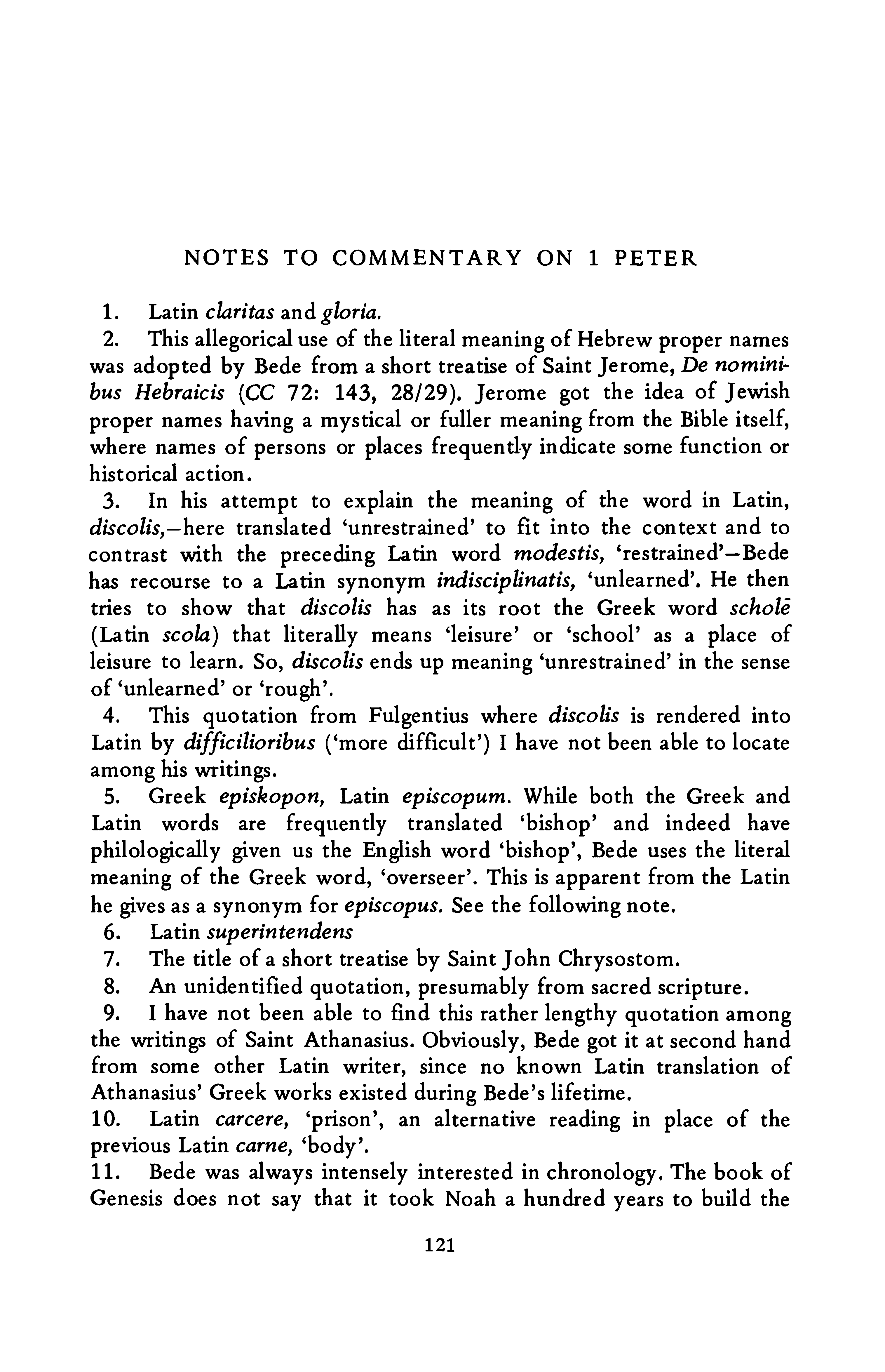
NOTES TO COMMENTARY ON 1 PETER
Latin claritas and gloria.
This allegorical use of the literal meaning of Hebrew proper names was adopted by Bede from a short treatise of Saint Jerome, De nominibus Hebraicis (CC 72: 143, 28/29). Jerome got the idea of Jewish proper names having a mystical or fuller meaning from the Bible itself, where names of persons or places frequently indicate some function or historical action.
In his attempt to explain the meaning of the word in Latin, discolis,—here translated 'unrestrained' to fit into the context and to contrast with the preceding Latin word modestis, 'restrained'—Bede has recourse to a Latin synonym indisciplinatis, 'unlearned'. He then tries to show that discolis has as its root the Greek word schole
(Latin scola) that literally means 'leisure* or 'school' as a place of leisure to learn. So, discolis ends up meaning 'unrestrained' in the sense of 'unlearned' or 'rough'.
This quotation from Fulgentius where discolis is rendered into Latin by difficilioribus ('more difficult') I have not been able to locate among his writings.
Greek episkopon, Latin episcopum. While both the Greek and Latin words are frequently translated 'bishop' and indeed have philologically given us the English word 'bishop', Bede uses the literal meaning of the Greek word, 'overseer'. This is apparent from the Latin he gives as a synonym for episcopus. See the following note.
Latin superintendent 1.
The title of a short treatise by Saint John Chrysostom.
An unidentified quotation, presumably from sacred scripture.
I have not been able to find this rather lengthy quotation among the writings of Saint Athanasius. Obviously, Bede got it at second hand from some other Latin writer, since no known Latin translation of Athanasius' Greek works existed during Bede's lifetime.
10.
Latin carcere, 'prison', an alternative reading in place of the previous Latin carne, 'body'.
11.
Bede was always intensely interested in chronology. The book of Genesis does not say that it took Noah a hundred years to build the
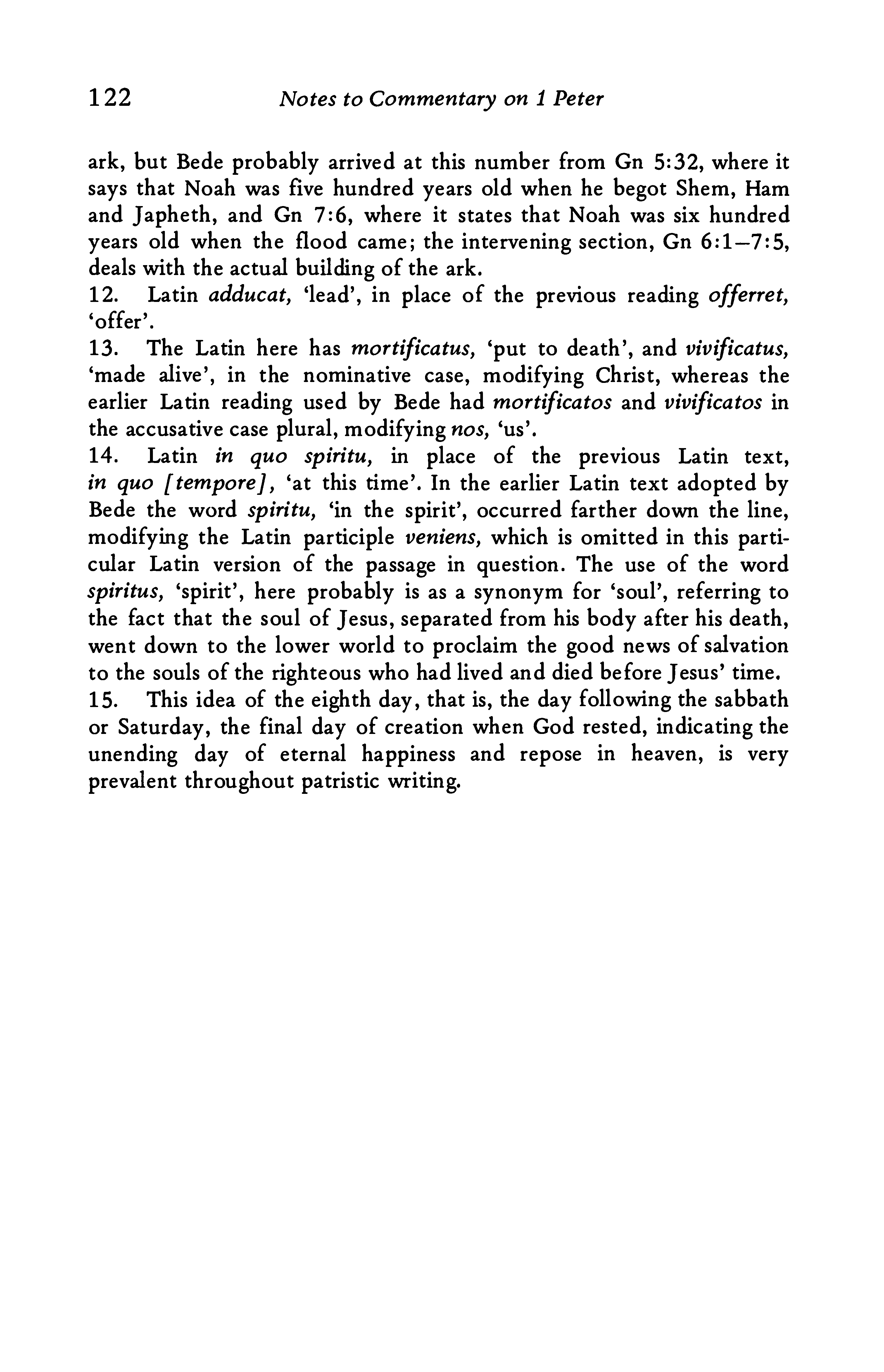
Notes to Commentary on 1 Peter ark, but Bede probably arrived at this number from Gn 5:32, where it says that Noah was five hundred years old when he begot Shem, Ham and Japheth, and Gn 7:6, where it states that Noah was six hundred years old when the flood came; the intervening section, Gn 6:1—7:5, deals with the actual building of the ark.
12.
Latin adducat, 'lead', in place of the previous reading offerret, 'offer'.
13.
The Latin here has mortificatus, 'put to death', and vivificatus, 'made alive', in the nominative case, modifying Christ, whereas the earlier Latin reading used by Bede had mortificatos and vivificatos in the accusative case plural, modifying nos, 'us'.
14.
Latin in quo spiritu, in place of the previous Latin text, in quo [tempore], 'at this time'. In the earlier Latin text adopted by Bede the word spiritu, 'in the spirit', occurred farther down the line, modifying the Latin participle veniens, which is omitted in this parti cular Latin version of the passage in question. The use of the word spiritus, 'spirit', here probably is as a synonym for 'soul', referring to the fact that the soul of Jesus, separated from his body after his death, went down to the lower world to proclaim the good news of salvation to the souls of the righteous who had lived and died before Jesus' time.
15.
This idea of the eighth day, that is, the day following the sabbath or Saturday, the final day of creation when God rested, indicating the unending day of eternal happiness and repose in heaven, is very prevalent throughout patristic writing.