Bede the Venerable: Commentary on the Seven Catholic Epistles
CISTERCIAN STUDIES SERIES : NUMBER EIGHTY-TWO
BEDE THE V E N E R A B L E
(673-735)
ON THE SEVEN
CATHOLIC EPISTLES

THE COMMENTARY
ON THE
SEVEN CATHOLIC EPISTLES
CISTERCIAN STUDIES SERIES : NUMBER EIGHTY-TWO
BEDE THE VENERABLE
Translated by
DAVID HURST
Monk of Portsmouth Abbey
CISTERCIAN PUBLICATIONS
Kalamazoo, Michigan
© Copyright, Cistercian Publications, 1985 This translation has been made from the critical Latin edition prepared by David Hurst, OSB, and published in the series Corpus Christianorum,
Series Latina, 121: Bedae Venerabilis Opera, pars II : Opera exegetica (Turnhout: Brepols, 1983) Published by Cistercian Publications WMU Kalamazoo, Michigan 49008 Available in Britain and Europe from A.R. Mowbray & Co Ltd St Thomas House Becket Street Oxford OX1 1SJ The work of Cistercian Publications is made possible in part by support from Western Michigan University
Library of Congress Cataloguing in Publication Data:
Bede, the Venerable, Saint, 673-735.
The commentary on the seven Catholic Epistles of Bede the Venerable.
(Cistercian studies series ; no. 82) Translation of: In epistolas VII Catholicas.
I.Bible. N.T. Catholic Epistles—Commentaries.
I. Hurst, David, OSB. II. Title. III. Series.
BS2777.B4213 1985 227'.907
84-7755
ISBN 0-87907-882-0
Printed in the United States of America Typeset by Gale Akins, Kalamazoo
I pray you, noble Jesus, that as you have graciously granted me joyfully to imbibe the words of your knowledge, so of your gracious goodness you will also allow me to come at length to you, the fount of all wisdom, and in your presence to dwell forever.
From A History of the English Church and People V

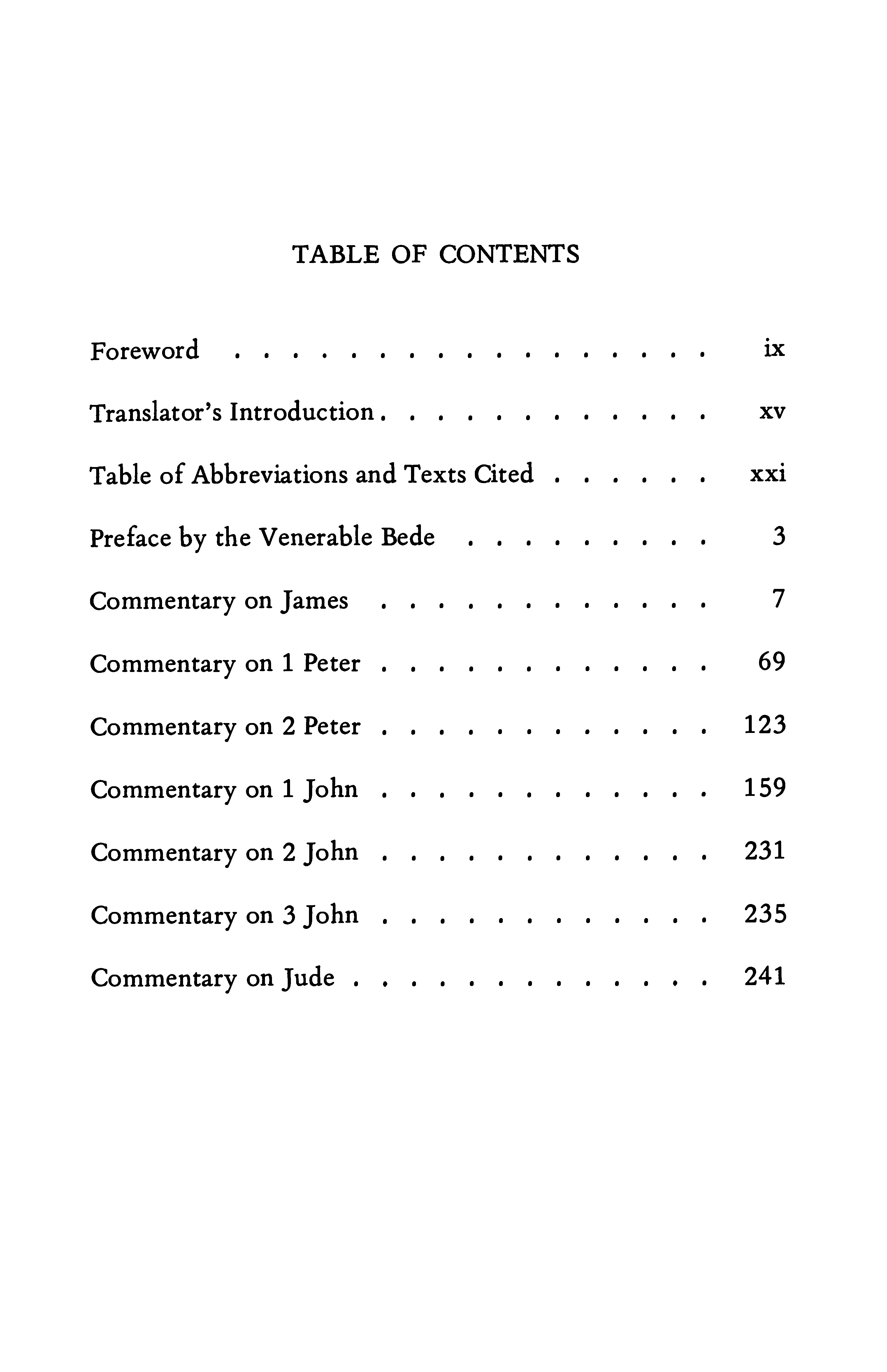
TABLE OF CONTENTS
Foreword ix Translator's Introduction xv Table of Abbreviations and Texts Cited xxi Preface by the Venerable Bede
Commentary on James
Commentary on 1 Peter
Commentary on 2 Peter
Commentary on 1 John
Commentary on 2 John
Commentary on 3 John
Commentary on Jude

FOREWORD H A R D L Y A N Y PLACE in the Christian world was farther from Rome in the late seventh century than recently-converted Northumbria, the northernmost kingdom o f what today is known as England. Yet neither the great distance nor the tremendous difficulties of travel at that time prevented Benedict Biscop from making several trips to Rome, as well as to centers of monastic culture on the conti nent. On these journeys Benedict Biscop developed a concep tion o f the monastic life that was largely based on the Rule of St Benedict, and he also brought back to Northumbria stone masons, glass makers, and even a singing master—John the Chanter, who had been Archchanter of St Peter's—to teach the monks of the far north to sing in the roman style. Then, too, Benedict Biscop brought back things: sacred vessels, vestments, religious paintings, relics, and a great many books, dealing especially with biblical and theological subjects. All of these ideas, talents, and goods, especially the books,
Benedict Biscop put to use in founding, in about 674, a monastery at Wearmouth (modern Monkwearmouth in the county of Durham), which was to become one of the great centers of monastic learning of the late seventh and eighth centuries.
In about 679, upon Benedict Biscop's return to Wearmouth from one of his roman journeys, a boy of seven was presented by his family to the monastery as an oblate. The lad's name was Bede, and he spent the rest o f his life as a monk, at first at Wearmouth, and later at a second house established by Benedict Biscop at Jarrow, five miles away.
Bede made use of the great library assembled by Benedict ix
X Foreword Biscop to become, in the words of Dom David Knowles, 'the most learned man in Western Europe'.
1 He read, and wrote, in a wide variety of fields—natural science, mathematics and astronomy (applied to vexed questions o f the day concerning the calendar), grammar, rhetoric, geography, history, hagiography, theology, and above all interpretation of the Scrip tures. Bede's earliest scriptural commentaries were devoted to the book of Revelation, the Acts of the Apostles, and the catholic epistles. He later wrote commentaries on the gospels of Luke and Mark, along with a collection of gospel homilies, and commentaries on Genesis, Proverbs, Tobit, the Song of Songs, as well as works on various historical books of the Old Testament.
How the title 'Venerable' first came to be attached to Bede's name is a matter of pious legend, but already in 835, a hundred years after Bede's death, the council o f Aachen described him as 'verierchilis et modernis temporibus doctor admirabilis Beda'. There was a local cult of Bede in the north of England throughout the Middle Ages, though it was not until 1899 that Leo XIII decreed that May 27th should be observed as the feast of the Venerable Bede, given the title
Doctor of the Church, 2 the only Englishman to be awarded this title, and the only Englishman we meet in Dante's
Paradiso.
Bede combined his great learning with sanctity and a personal charm which still shines through his writings, though he speaks but little of himself in his works. He saw himself always as a learner and a teacher, and in the conclusion o f his well-known History of the English Church and People, he tells us:
I have spent all my life in this monastery, applying myself entirely to the study of the Scriptures; and, amid the observances o f the discipline of the Rule and the daily task of singing in the church, it has always been my delight to learn or to teach or to write.
Foreword xi Bede's words here show the importance he attached to his study of the Scriptures, and of his works listed just following this passage, over eighty percent are exegetical. Although today Bede is remembered chiefly for his historical works
(and generally speaking only these have previously been translated), during the Middle Ages his reputation was founded mainly on his scriptural commentaries, which were read and copied in monastic centers throughout Europe.
Cyril Smetana has recently shown the great importance that Bede's commentaries and exegetical homilies had in the col lection of homiletic materials assembled by Paul the Deacon as part of the carolingian liturgical reform. Bede's contribu tion forms almost a quarter of the entire anthology, exceed ing even the number of selections taken from Augustine,
Jerome, or Gregory the Great. Smetana attributes this dominance o f Bede's work in Paul the Deacon's homiliary to the theological depth and thorough orthodoxy of Bede's ideas and to the admirable clarity of Bede's style.
4 (Pre sumably Bede, a native speaker of Old English, developed this Latin style from the books that Benedict Biscop had collected, but Bede's style often seems to have greater clarity and precision than that of his patristic models.) In addition to these factors, one might suggest another cause of Bede's popularity with medieval readers, namely, his balanced concern with both the historical sense o f the Scriptures and with deeper, allegorical meanings contained beneath the literal sense. Bede emphasized the necessity o f basing his interpretations solidly on the historical sense
(Commentary on Genesis; CC 118A: 3, 29/31), but at the same time he felt the need o f going beyond the literal sense o f a passage, of 'stripping off the bark of the letter to find a deeper and more sacred meaning in the pith o f the spiritual sense'
(Preface to his Commentary on Ezra and Nehemiah; CC 119A: 237, 13/15). Furthermore, in reading Bede's com mentaries, one is aware of being guided by a teacher who always has a marvelously sane and practical concern with his
xii Foreword readers' efforts to grow in the spiritual life. This concern is perhaps especially evident in the commentary here translated, since the catholic epistles so often lend themselves to pastoral and spiritual interpretation.
It is fitting that this first volume of Bede's scriptural commentaries made available in English should be the work of Dom David Hurst, who has devoted much o f his fruitful scholarly career to Bede's commentaries and exegetical homilies. The long-needed critical editions o f these works have now nearly all been published in the Corpus Christianorum series, and the majority of these texts were edited by David Hurst—from his edition of Bede's Homilies on the Gospels (CC 122), published in 1955, to his just-published edition of the text here translated (CC 121). The many years that Father David has spent in such close association with Bede's commentaries and homilies, first as an editor and now as a translator, have given him an unrivaled knowledge of Bede's thought on the scriptures and on Bede's relationship to his sources, as well as an admirable feel for Bede's style.
Lawrence T. Martin The University of Akron
NOTES TO THE FOREWORD
David Knowles, Saints and Scholars (Cambridge: Cambridge Univ. Press, 1962) p. 14.
Herbert Thurston, 'Bede,' in The Catholic Encyclopedia (New York: Robert Appleton Co., 1907) Vol. 2, p. 385.
Bede's Ecclesiastical History V, 24, ed. Bertram Colgrave and R.A.B. Mynors (Oxford: Clarendon Press, 1969) p. 567.
Cyril L. Smetana, 'Paul the Deacon's Patristic Anthology/ in The Old English Homily and its Backgrounds, ed. Paul E, Szarmach and Bernard F. Huppe (Albany: State University of New York Press,
1978) pp. 79-80.

INTRODUCTION
T HE SEVEN BRIEF LETTERS of James, 1 and
Peter, 1, 2 and 3 John, and Jude, usually given at the end o f the New Testament just before the book of Revelation, have never received the same attention from exegetes as has been given to the four Gospels and the Letters of Paul. Throughout the christian centuries commentaries on them have been, comparatively, rate. During the early patristic period, Augustine, bishop o f Hippo in North
Africa, composed a commentary on 1 John. Given the deep theological content of this Letter, it is understandable why Augustine must have chosen it for exposition.
For some reason now difficult to fathom Bede chose the final part of the New Testament, the book of Acts, these seven Letters, and the book of Revelation, when he first began his attempts at written exegesis of the books of sacred scripture early in the eighth century.
1 For the Letters of Paul he was content to piece together extracts from the writings of Augustine to form a lengthy commentary. Eventually
Bede was to expound the meaning of a number o f the books of the Bible. But these first efforts of his were unique in that he was more inclined then than later to follow a literal inter pretation o f the text. The heavily allegorical meaning that he was to adopt later on in explaining the various books of scrip ture is not nearly so noticeable in his early commentaries.
Here allegory and symbolism which are to be found in practically all the exegetical writings of scriptural com mentators before Bede's time are employed, but not to the extent that Bede was to make use of later on when he had become a more experienced elucidator of the meaning of the sacred texts.
xvi Introduction Bede's reputation as a scripture scholar, in fact, has gen erally been that o f a clever compiler of the insights of pre vious exegetes rather than that of a thinker o f any original ity. To some extent this is true. Bede's commentaries have the appearance of being nothing more than a kind of collage of passages gleaned from preceding writers. In his exegesis of these seven Letters from the New Testament this quality of his work can be seen particularly in his exposition of 1 John, where he has borrowed extensively from Augustine's work.
An examination o f the content of the material contained in the interpretation of the other six Letters will reveal occa sional passages—sometimes with no indication given o f the author, a standard practice of the time—from other writers,
Cyprian, Ambrose, Jerome, and Gregory the Great. The practical and pastoral nature of Bede's approach to the books of the Bible is, however, always apparent. In the ninth cen tury the Englishman Boniface was sending letters back to his native land asking for copies o f Bede's commentaries to use in his mission of converting the Germans to Christianity.
And the simple, catechetical nature o f Bede's explications, very much suited to a people to whom he refers several times as uneducated and but recently exposed to christian teaching, is obvious to one reading the examination o f the meaning and application of the biblical message.
The need for a synthesis of what has been formerly thought out, not only in matters affecting religion but in all branches o f human knowledge, makes itself felt from time to time. Cicero was successful in condensing the diffuse philosophical writings of Plato and making them usable for the practical roman mind of the West. Jerome also made much of the work o f Origen available to those whose principal language was Latin, not only through translation but also by simplifying and condensing Origen's theological ideas. In fact, these seven scriptural Letters themselves, prescinding from any commentary on them, relied heavily on the Old
Testament and on preceding New Testament books and
Introduction xvii sought to make former religious thought pertinent to a new and changed external situation. This midrashic mode of religious thinking is built into the canon o f the Bible, as is the quality of paideia, instruction by the example of admirable individuals or groups who had lived earlier. Bede often uses as models of proper conduct characters mentioned in the Letters and other persons cited in the scriptures.
We should also note that there is a distinctive humane approach to matters regarding religion distinguishable in the writings of Bede. He is quite insistent, for instance, that in the life to come after death God will be an exacting, though fair and just, judge of the actions o f every human being; still he states time and again that mankind cannot live a com pletely sinless existence here on earth, that sins and faults, even serious ones, will be committed, but that the effect of these failures can be mitigated by sincere confession, pen ance, and acts of charity and forgiveness towards others. The rewards of striving to live a blameless life here and now, and especially the inexpressible happiness that awaits the good person in the after life, he stresses far more than fear of punishment for wrongdoing. This positive and joyful attitude is also apparent in later cistercian writers such as Bernard of Clairvaux and Aelred o f Rievaulx. All of their writings have a particularly benevolent character. There should be no reason for surprise, then, that the first Cistercians, who were very conscious of this human aspect o f religion, were aware o f the importance o f the scriptural commentaries of Bede.
In the twelfth century, manuscript copies of this work of Bede were in the libraries of Citeaux and Clairvaux (and are still preserved respectively in the Public Libraries of Dijon and Troyes in France) and at the Cistercian houses of Beaupres and Vaucelles (now respectively at the Bibliotheque
Nationale in Paris and the Bibliotheque Publique of Cambrai).
3 Despite differences of national and regional castes of thought that emphasize this or that aspect of religion, there is a remarkable continuity in the development of religious
xviii Introduction thought. Perhaps an english translation of one o f the earliest of Bede's scriptural commentaries will help manifest this continuity.
The english translation of this work has been made from a new Latin edition of the commentary on these seven Letters from the New Testament prepared for the series, Corpus
Chris tianorum.
D.H.
NOTES TO INTRODUCTION
For the dates of the composition of these earliest biblical com mentaries of Bede see M. L. W. Laistner, Expositio Actuum Apostolorum et Retractatio (Cambridge, Massachusetts: The Mediaeval Academy of America, 1939) xiii-xvii; >4 Hand-List of Bede Manuscripts (Ithaca,
New York: Cornell University Press, 1943) 20-31.
MGH Epistolae III. English translation in E. Emerton, The Letters of Saint Boniface (New York: Columbia University Press,
1940) 133-34, 167-68.
The shelf-numbers of these manuscripts are given by Laistner, Hand-List, 31-36. xix

ABBREVIATIONS
EDITIONS CITED
c c Corpus Christianorum CSEL Corpus Scriptorum Ecclesiasticorum Latinorum GCS Die Griechischen Christlichen Schriftsteller der ersten
Jahrhunderte MGH Monumenta Germaniae Historica PL Patrologia Latin a TU Texte und Untersuchungen zur Geschichte der altchristlichen Literatur
Scriptural citations have been given according to the enumeration and nomenclature of The Jerusalem Bible. Psalm citations are given by Hebrew enumeration with Vulgate enumeration in parentheses.
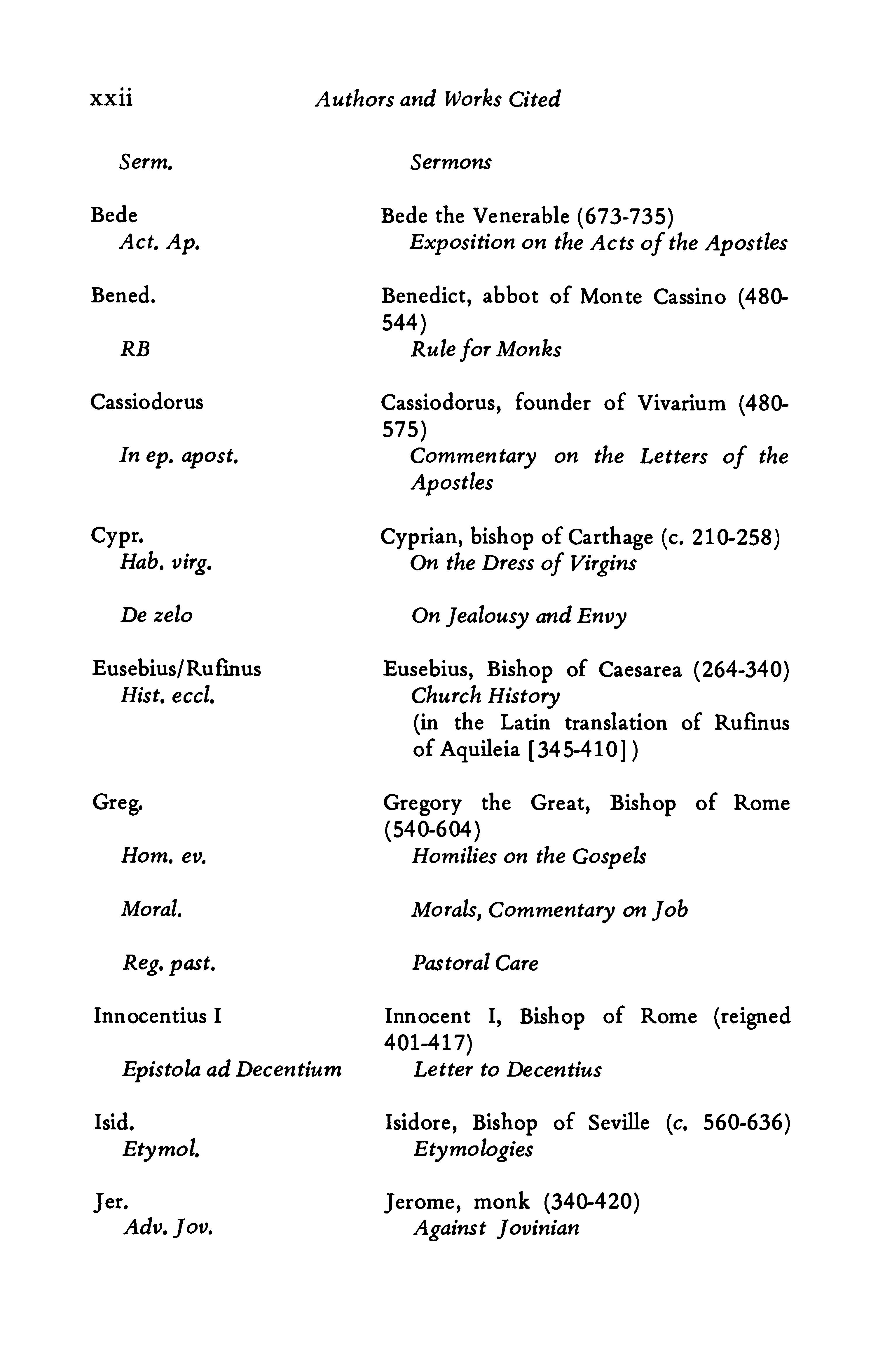
AUTHORS AND WORKS CITED
Ambrose, Bishop of Milan (340-397) Ambr.
Commentary on the Gospel according to Luke Exp. Luc.
De fide On Faith De paen.
On Repentance De spir.
On the Holy Spirit Augustine, Bishop of Hippo (354-430) Aug.
Civ. Dei The City of God Enarr. in ps.
Commentary on the Psalms Ep(p).
Letter (s) In Ioh. ep.
Commentary on the First Letter of John xxi
X X I I Authors and Works Cited Serm.
Sermons Bede Bede the Venerable (673-735) Act. Ap.
Exposition on the Acts of the Apostles Bened.
Benedict, abbot of Monte Cassino (480544) Rule for Monks RB Cassiodorus Cassiodorus, founder of Vivarium (480575) Commentary on the Letters of the Apostles In ep. apost.
Cypr.
Cyprian, bishop of Carthage (c 210-258) Hab. virg.
On the Dress of Virgins De zelo On Jealousy and Envy Eusebius/ Rufinus Eusebius, Bishop of Caesarea (264-340) Hist, eccl.
Church History (in the Latin translation of Rufinus of Aquileia [345-410]) Greg.
Gregory the Great, Bishop of Rome (540-604) Horn. ev.
Homilies on the Gospels Moral.
Morals, Commentary on Job Reg. past Pastoral Care Innocentius I Innocent I, Bishop of Rome (reigned 401-417) Letter to Decentius Epistola ad Decentium Isid, Isidore, Bishop of Seville (c 560-636) Etymol.
Etymologies Jerome, monk (340-420) Jer, Adv. Jov.
Against Jovinian
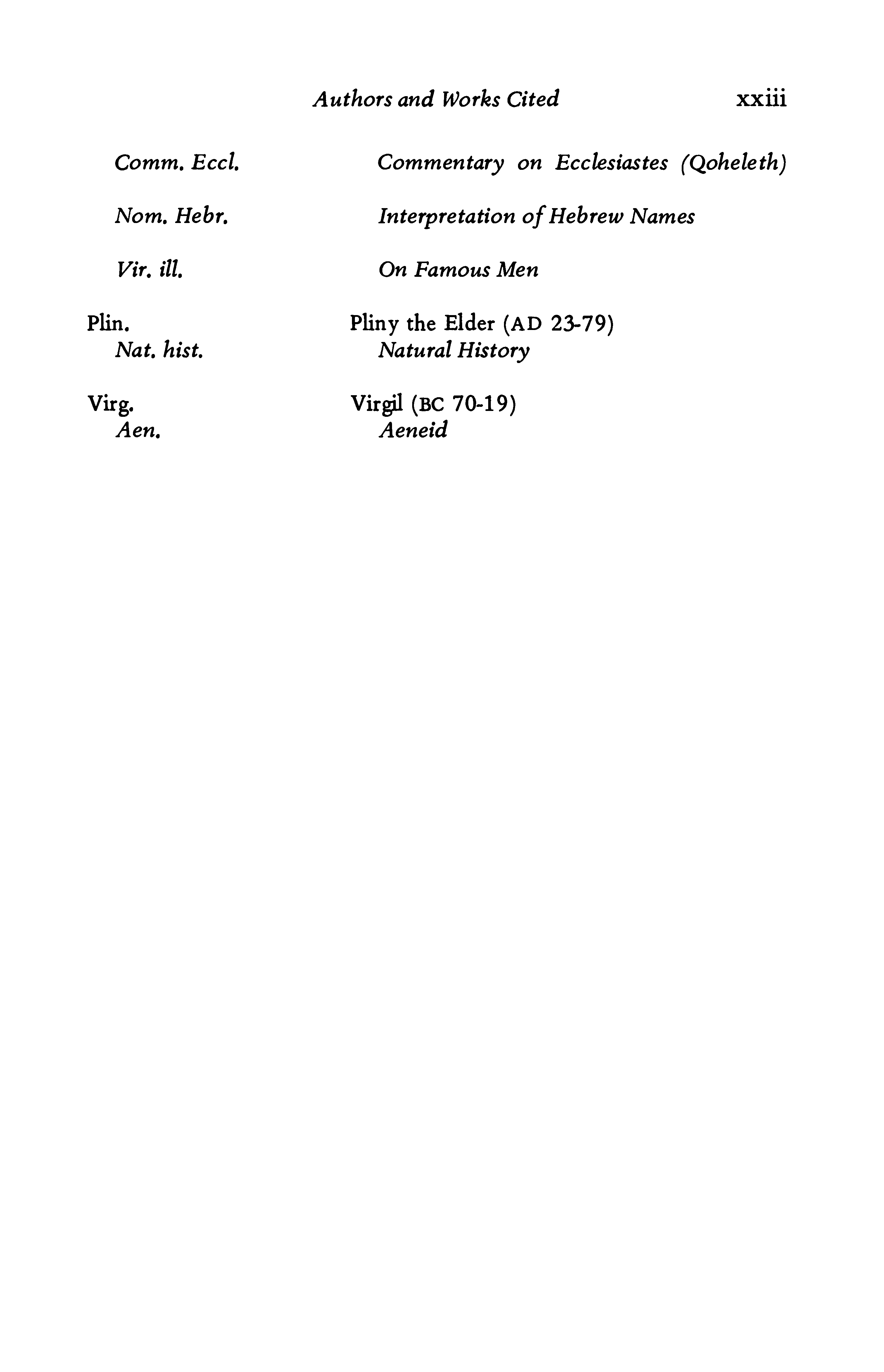
Authors and Works Cited xxiii Comm. Eccl.
Commentary on Ecclesiastes (Qpheleth) Nom. Hebr.
Interpretation of Hebrew Names Vir. ill.
On Famous Men Plin.
Pliny the Elder (AD 23-79) Nat. hist.
Natural History Virg.
Virgil (BC 70-19) Aen.
Aeneid

B E D E T H E
V E N E R A B L E
COMMENTARY ON THE SEVEN CATHOLIC EPISTLES

PREFACE J AMES,
PETER, JOHN, JUDE
wrote seven Letters which church tradition calls catholic, that is, universal.
Although in the list of the apostles Peter and John are accustomed to be ranked as more important, the Letter of James is placed first among these for the reason that he received the government of the church o f Jerusalem,!
1] from where the source and beginning of the preaching of the Gospel took place and spread throughout the entire world.
The apostle Paul also shows respect for this see when in naming him he says, James, Cephas, and John, who appeared
2] because he sent his Letter to the twelve tribes of Israel who were the first to become believers, this one rightly ought to have been placed first.
Rightly were the Letters of Peter placed second, because he wrote to the elect newcomers, to be pillars.
Or at least[ 2 who in Greek are called converts,[ 3] that is, he wrote to those who were converted from paganism to Judaism and from Judaism to the grace of gospel election. Rightly were the Letters of John placed third, because he wrote to those who came to believe from the gentiles, since neither by race nor by belief had they been Jews. Accordingly, many church writers, among whom is Saint Athanasius, head of the church of Alexandria, assert that his first Letter was written to the Parthians.[
4] The Letter of Jude rightly has been placed last, because although this also was an important tribe, [ 5] nevertheless he is of lesser importance than the aforesaid apostles; or because the Letter o f James was written first, then Peter's, after them John's, therefore up to now they retain the order
[ l] refers to backnotes 1. Ga 2:9
2. 1 P 1:1
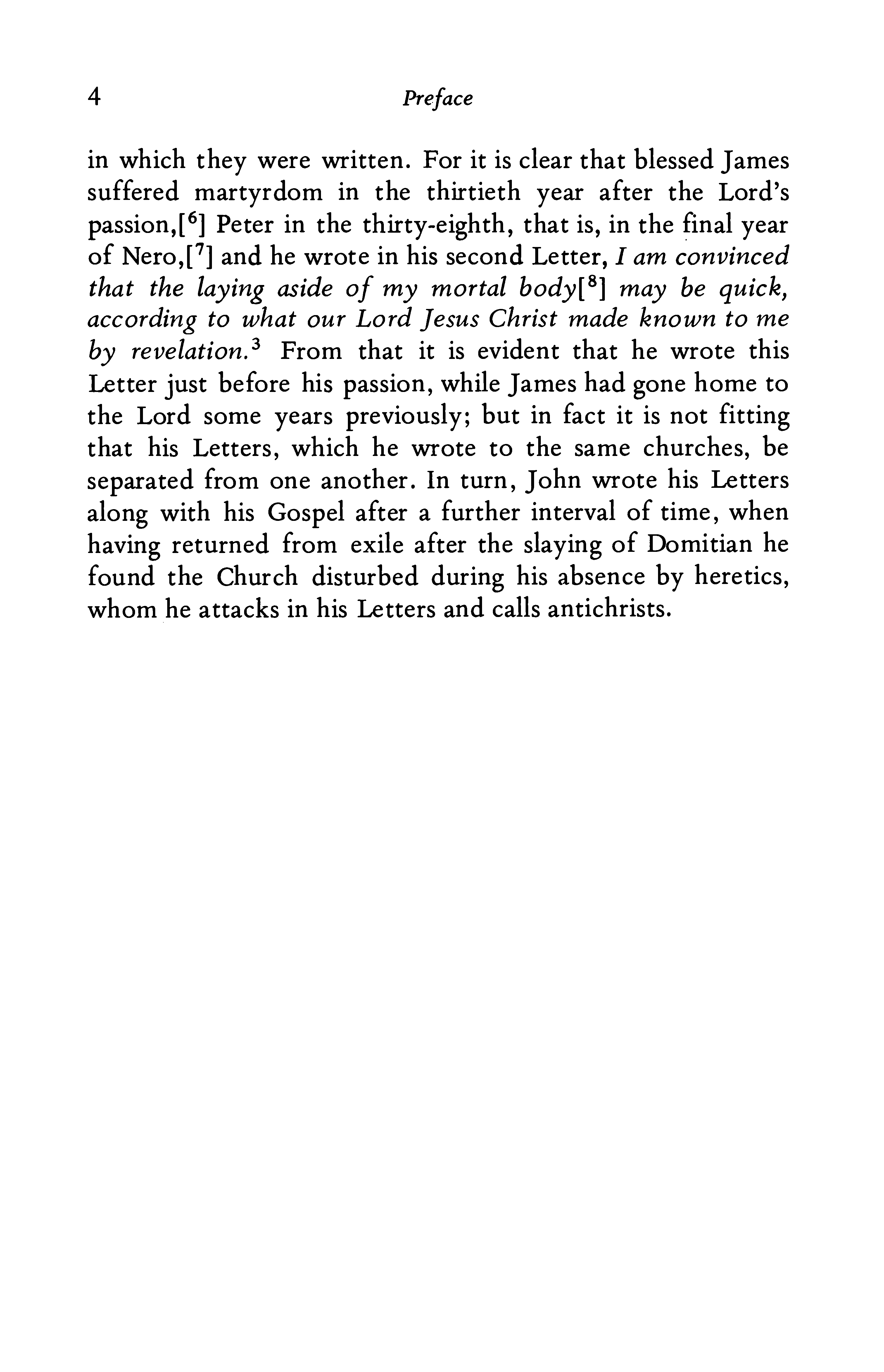
Preface in which they were written. For it is clear that blessed James suffered martyrdom in the thirtieth year after the Lord's passion,[ 6] Peter in the thirty-eighth, that is, in the final year of Nero,[ 7] and he wrote in his second Letter, I am convinced that the laying aside of my mortal body[ s] may be quick, according to what our Lord Jesus Christ made known to me
From that it is evident that he wrote this Letter just before his passion, while James had gone home to the Lord some years previously; but in fact it is not fitting that his Letters, which he wrote to the same churches, be separated from one another. In turn, John wrote his Letters along with his Gospel after a further interval of time, when having returned from exile after the slaying of Domitian he found the Church disturbed during his absence by heretics, whom he attacks in his Letters and calls antichrists. by revelation.
NOTES TO PREFACE
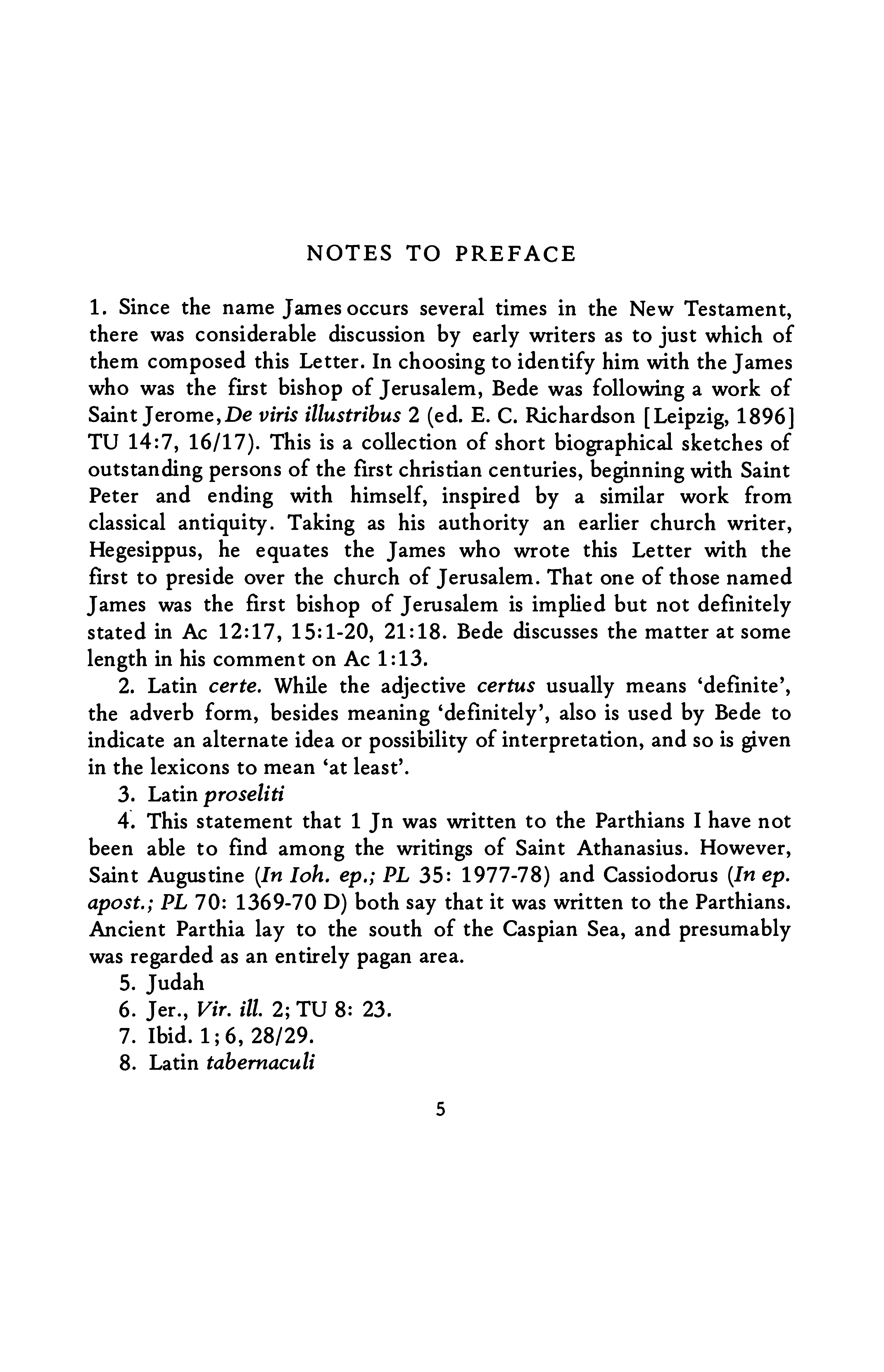
1. Since the name James occurs several times in the New Testament, there was considerable discussion by early writers as to just which of them composed this Letter. In choosing to identify him with the James who was the first bishop of Jerusalem, Bede was following a work of Saint Jerome,De viris illustrious 2 (ed. E. C. Richardson [Leipzig, 1896]
TU 14:7, 16/17). This is a collection of short biographical sketches of outstanding persons of the first christian centuries, beginning with Saint
Peter and ending with himself, inspired by a similar work from classical antiquity. Taking as his authority an earlier church writer,
Hegesippus, he equates the James who wrote this Letter with the first to preside over the church of Jerusalem. That one of those named
James was the first bishop of Jerusalem is implied but not definitely stated in Ac 12:17, 15:1-20, 21:18. Bede discusses the matter at some length in his comment on Ac 1:13.
2. Latin certe. While the adjective certus usually means 'definite', the adverb form, besides meaning 'definitely', also is used by Bede to indicate an alternate idea or possibility of interpretation, and so is given in the lexicons to mean 'at least'.
3. Latin proseliti 4. This statement that 1 Jn was written to the Parthians I have not been able to find among the writings of Saint Athanasius. However,
Saint Augustine (In loh. ep.; PL 35: 1977-78) and Cassiodorus (In ep. apost.; PL 70: 1369-70 D) both say that it was written to the Parthians.
Ancient Parthia lay to the south of the Caspian Sea, and presumably was regarded as an entirely pagan area.
5. Judah 6. Jer., Kir. ill 2; TU 8: 23.
7. Ibid. 1;6, 28/29.
8. Latin tabernaculi