
SERMON XXXI
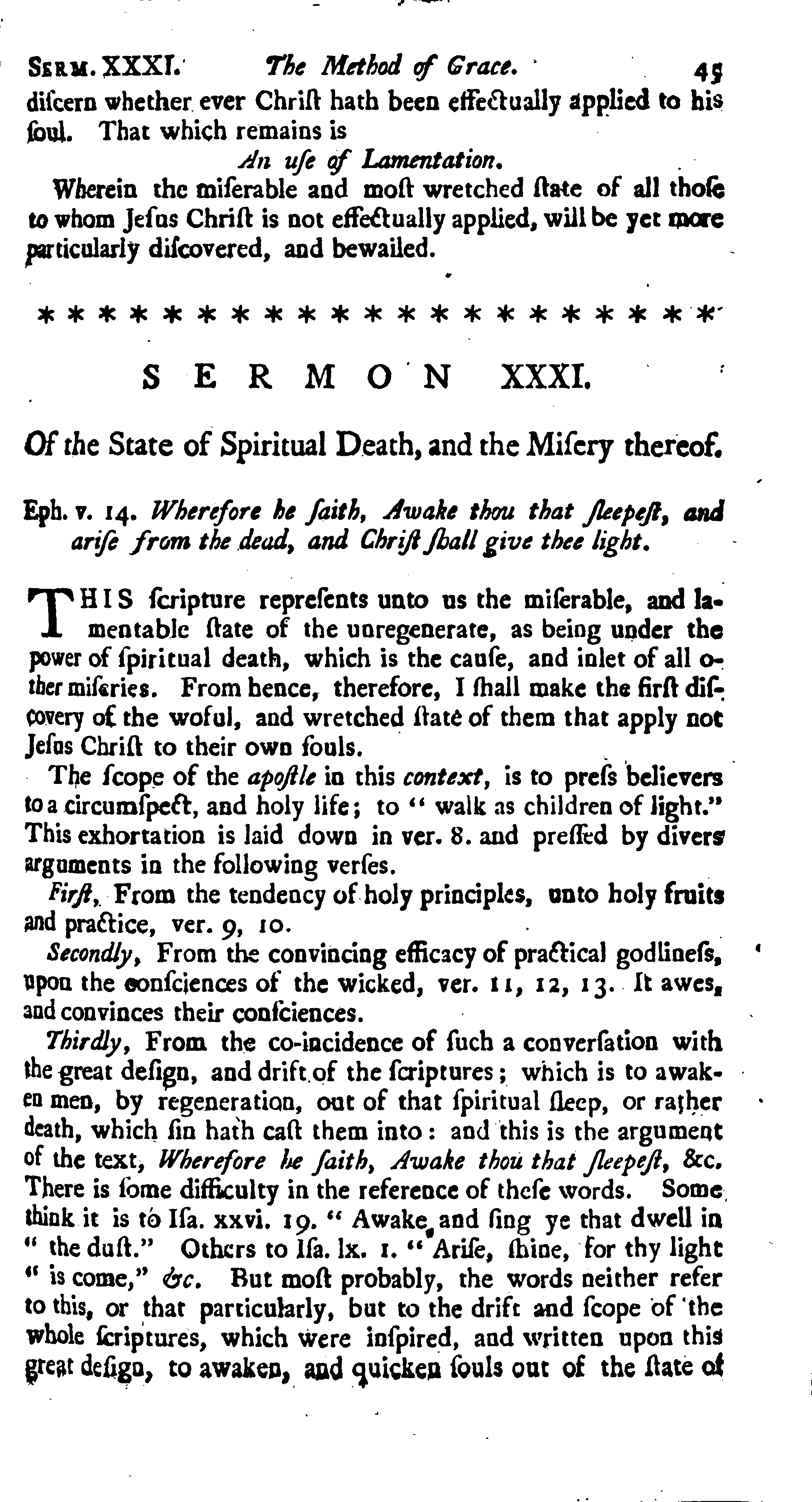
SERM . XXXI.
The Method of Grace.
difcernwhether ever Christ hath been effectually applied to his soul.
That which remains is An use of Lamentation.
Wherein the miserable and most wretched state of all those to whom Jesus Christ is not effectually applied,will be yet more particularly discovered, andbewailed.
** SERMON XXXI.
Of the State of Spiritual Death, andtheMifery thereof.
Eph. v. 14. Wherefore he faith, Awake thou that fleepest, and arise from the dead, and Christshallgive thee light.
TH HIS scripture represents unto us the miserable, and lamentable state of the unregenerate, as being under the power of spiritual death, which is the cause, and inlet of all other miseries . From hence, therefore, I shall make the first discovery of the woful, and wretched stateofthem that apply not
Jesus Christ to their own souls.
The scope of the apostle in this context, is to press believers toa circumspect, and holy life; to " walk as children of light."
This exhortation is laid down inver. 8. and pressed by divers arguments in the following verses.
First, From the tendency of holy principles, unto holy fruits and practice, ver. 9, 10.
Secondly, From the convincing efficacy of practical godliness, upon the consciences of the wicked, ver. 11 , 12, 13. It awes,
and convinces their consciences.
Thirdly, From the co-incidence of such a conversation with thegreatdesign, and drift of the scriptures ; which is to awakenmen, by regeneration, out of that spiritual sleep, or rather death, which finhath cast them into: and this is the argument of the text, Wherefore he faith, Awake thou that fleepest, &c.
There is some difficulty in the reference of these words.
Some think it is to Ifa. xxvi. 19."Awake and sing ye that dwell in " the dust."
Others to Ifa. lx. 1. " Arise, shine, for thy light " is come," &c.
But most probably, the words neither refer to this, or that particularly, but to the drift and scope of the whole scriptures, which were inspired, and written upon this great design, to awaken, and quicken fouls out of the state of
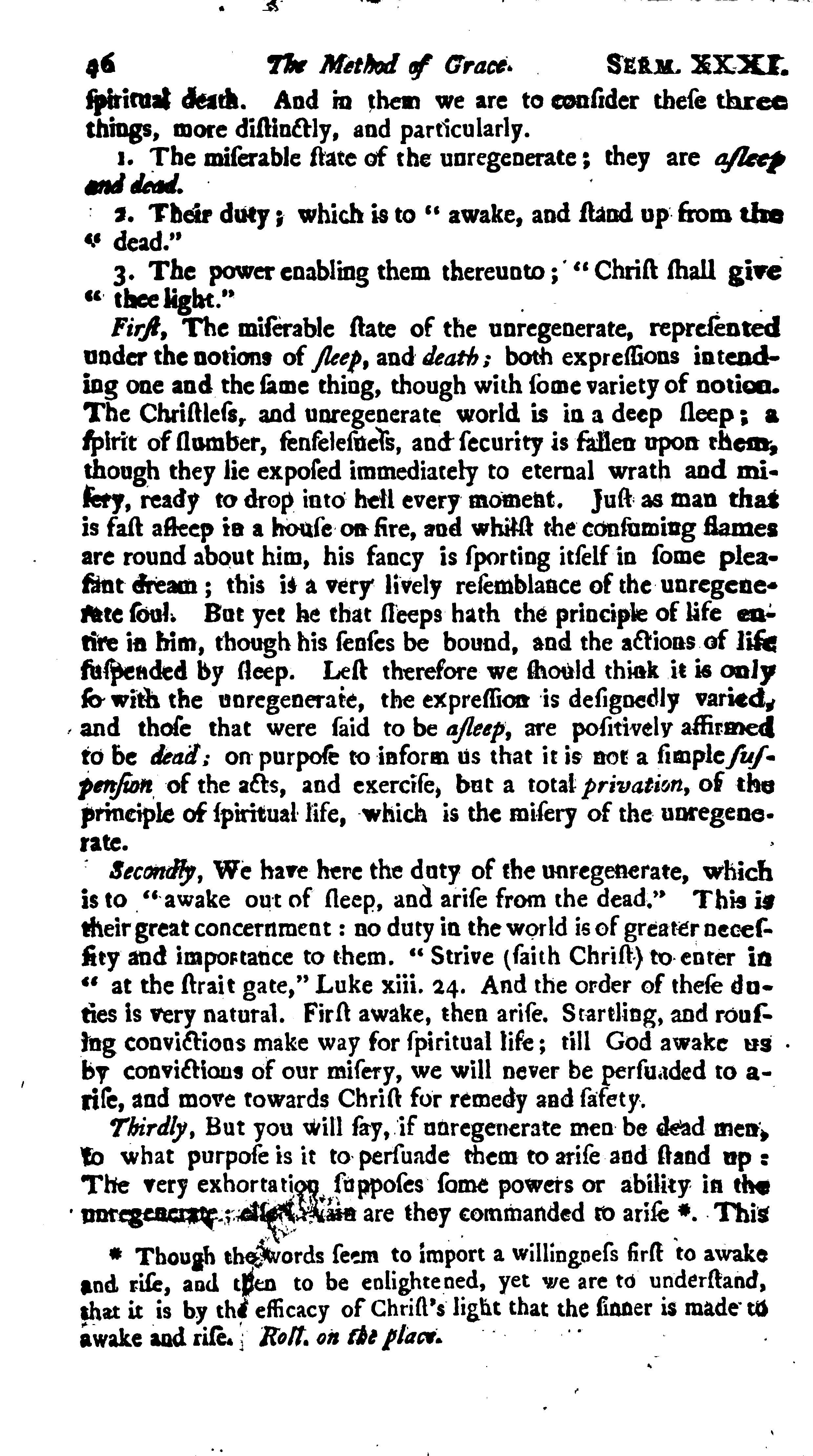
SERM. XXXI.
The Method of Grace. spiritual death. And in them we are toconfider these three things, more distinctly, and particularly.
1. The miserable state of the unregenerate ; they are asleep and dead.
: 2. Their duty; which is to " awake, and standup from the "dead."
3. The power enabling them thereunto; " Christ shall give " thee light."
First, The miserable state of the unregenerate, represented underthenotions offleep, and death; both expressions intending one and the same thing, though with some varietyofnotion.
The Christless, and unregenerate world is in a deep sleep ; a spirit of slumber, fenfelesness, and security is fallen upon them, though they lie exposed immediately to eternal wrath and misery, ready to drop into hell every moment.
Just as man that is fast asleep in a house on fire, and whilst the consuming flames are round about him, his fancy is sporting itself in some pleafantdream; this is a very lively resemblance of the unregeneratefoul. But yet he that sleeps hath the principle of life entire in him, though his senses be bound, and the actions of life fufpendedby sleep.
Lest therefore we should think it is only so with the unregenerate, the expression is designedly varied, and those that were said to be asleep, are positively affirmed to be dead; on purpose to inform us that it is not a fimplefufpension of the acts, and exercise, but a total privation, of the principle of spiritual life, which is the misery of the unregene. rate.
: Secondly, We have here the duty oftheunregenerate, which is to " awake out of sleep, and arise from the dead."
This is theirgreatconcernment : no duty in the world is ofgreaternecefsityand importance to them. " Strive (faith Christ)to enter in " at the strait gate," Luke xiii. 24. And the order of these duties is very natural. First awake, then arise. Starthng, and roufingconvictions make way for spiritual life; till God awake us by convictions of our misery, we will never be persuaded to arise, and move towards Christ for remedyandfafety.
Thirdly, But you will say, if unregeneratemenbe dead men, to what purpose is it to persuade them to arise and stand up :
The very exhortation supposes some powers or ability in the unregenerate ; elle vain are they commanded to arise *. This
* Though the words seem to import a willingness first to awake and rife, and then to be enlightened, yet we are to understand, that it is by the efficacy of Christ's light that the sinner is made to awake and rife.
Roll. on the place.
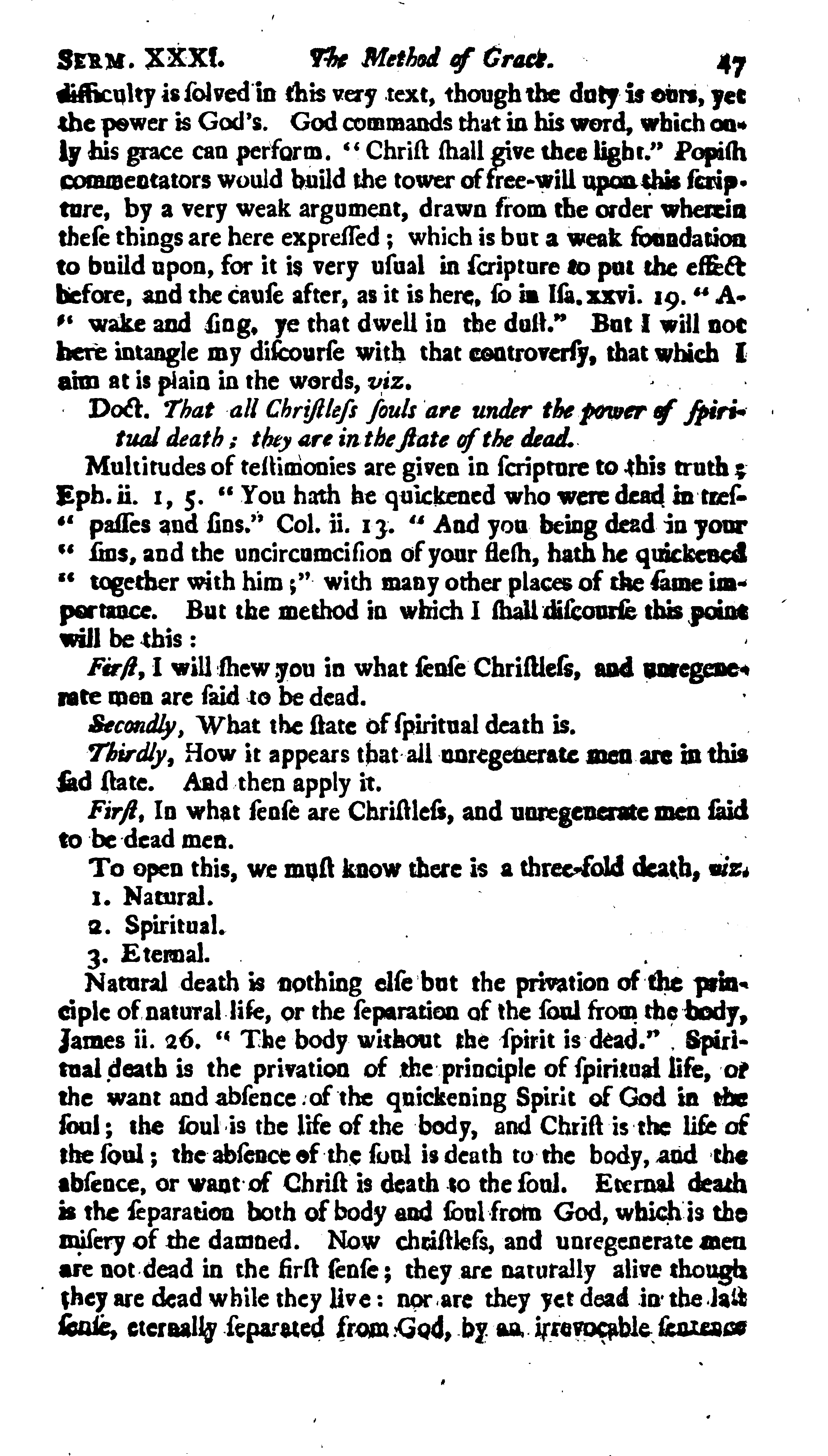
SERM . XXXI.
The Method of Grace.
difficulty is solved in this very text, thoughtheduty is ours, yet the power is God's. God commands that in his word, whichonlyhisgrace can perform. " Christ shall give thee light." Popish commentatorswould build the tower of free-will upon this scrip. ture, by a very weak argument, drawn from the order wherein these things are here expressed ; which is but a weak foundation to build upon, for it is very usual in scripture to put the effect before, and the cause after, as it is here, so in Isa,xxvi. 19. "A- " wake and sing, yethatdwellin the dust." But I will not here in tangle my discourse with that controversy, that which I aim at is plain in the words, viz.
Doct. That all Christless fouls are under the power of fpiritualdeath ; they areinthestate of the dead.
Multitudes of testimonies are given in scripture to this truth; Eph. ii. 1, 5. "You hath he quickenedwhoweredead intref- " passes and fins." Col. ii. 13. "And you being dead in your
" sins, and the uncircumcifion of your flesh, hath he quickened " together with him ;" with manyotherplaces of the fame importance. But the method in which I shall discourse this point will be this :
First, I willshewyou in what sense Christless, and unregeneratemen are said to be dead.
Secondly, What the state ofspiritualdeath is.
Thirdly, How it appears that all unregeneratemen are in this fad state.
And then apply it.
First, In what sense are Christless, andunregeneratemen said to be dead men.
To open this, we must know there is a three-fold death, viz.
1. Natural.
2. Spiritual.
3. Eternal.
Natural death is nothing else but the privationof the principle of natural life, or the separationofthefoulfromthe body,
James ii. 26. " The body without the spirit is dead."
Spiritual death is the privation of the principle of spiritual life, or the want and absence of the quickening Spirit of God in the soul; the soul is the life of the body, and Christ is the life of the soul; the absence of the foul is death to the body, and the absence, or want of Christ is death to the soul.
Eternal death is the separation bothofbodyand foul from God, which is the misery of the damned. Now christless, and unregeneratemen are not dead in the first sense; they are naturally alive though theyaredeadwhile they live : nor are they yet dead in the last sense, eternally separated from God, by an irrevocable sentence
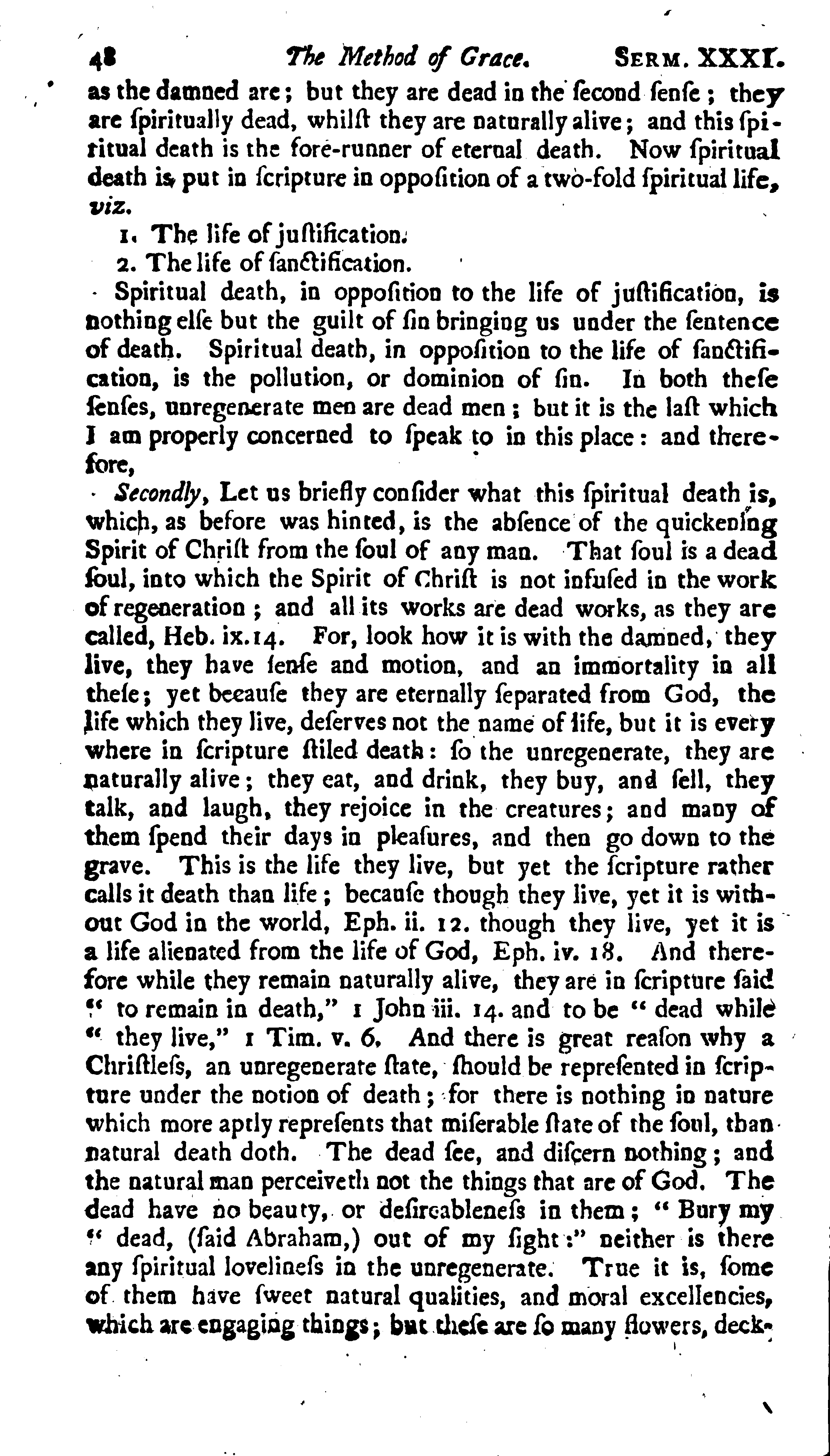
The Method of Grace.
SERM . XXXI.
as the damned are; but they are dead in the second sense ; they are spiritually dead, whilst they are naturally alive; and this spiritual death is the fore-runner of eternal death. Now spiritual death is put in fcriptureinoppositionofatwo-fold spiritual life, viz.
1. The life of justification.
2. The life ofsanctification.
Spiritual death, in opposition to the life of justification, is nothingelsebut the guilt of finbringing us under the sentence of death.
Spiritual death, in opposition to the life of sanctification, is the pollution, or dominion of fin.
In both these senses, unregenerate men are dead men; but it is the last which I am properly concerned to speak to in this place : and therefore,
• Secondly, Let us briefly confider what this spiritual death is, which, as before was hinted, is the absence of the quickening
Spirit of Christ from the foul of anyman.
That foul is a dead foul, into which the Spirit of Christ is not infused in the work of regeneration ; and all its works are dead works, as they are called, Heb . ix.14.
For, look how it is with the damned, they live, they have sense and motion, and an immortality in all these; yet because they are eternally separated from God, the life which they live, deserves not the name of life, but it is every where in scripture stiled death: so the unregenerate, they are naturally alive ; they eat, and drink, they buy, and fell, they talk, and laugh, they rejoice in the creatures; and many of them spend their days in pleasures, and then godown to the grave.
This is the life they live, but yet the scripture rather calls it death than life; because though they live, yet it iswithoutGod in the world, Eph. ii. 12. though they live, yet it is a life alienated from the life of God, Eph. iv. 18.
And therefore while they remain naturally alive, they are in scripture said " to remain in death," I John iii. 14. and to be " dead while
" they live,"
I Tim. v. 6. And there is great reason why a Christless, anunregenerate state, should be represented in scripture under the notion of death; for there is nothing in nature which more aptlyrepresents that miserable stateofthefoul, than natural death doth.
The dead fee, anddifcern nothing ; and thenaturalmanperceiveth not the things that are of God. The dead have no beauty, or defireableness in them ; "Bury my
" dead, (said Abraham,) out of my fight:" neither is there any spiritual loveliness in the unregenerate. True it is, some of them have sweet natural qualities, and moral excellencies, which are engaging things; but these are so many flowers,deck
SERM . XXXÍ
The Method of Grace.
ing andadorning adeadcorpse. The dead are objects of pity, and great lamentation : men use to mourn for the dead, Eccl. xii. 5. "Man goeth to his long home, and the mournersgo a- " bout the streets." But unregenerate, and Christless souls, are much more the objects of pity and lamentation. How are all the people of God (especially those that are naturally related to them) concerned to mourn over them, and for them, as Abraham did for Ishmael, Gen. xvii. 18. " O that Ishmael might
" live before thee." Upon these, and many other accounts, the state of unregeneracy is represented to us in the notion of death.
Thirdly, And that this is the state ofallChristless, and unfanctified persons, will, undeniably, appear two ways.
1. The causes of spiritual life have not wrought upon them .
2. The effects and signs of spiritual life, do not appear in them; and therefore they are in the state, and under the power, of spiritual death .
First, The causes of spiritual life have not wrought upon them.
There are two causes of spiritual life, 1. Principal, and internal.
2. Subordinate, and external.
The principal, internal cause of spiritual life, is the regenerating Spirit of Christ, Rom. viii. 2. " The law of the Spirit of " life in ChriftJefus, hath made me free from the law off in and death."
It is the Spirit, as a regenerating Spirit, that unites us with Christ, in whom all spiritual life originally is, John v.
25, 26. " Verily, I say unto you, that the hour is coming, and " now is, when the dead shall hear the voice of the Son of God :
" and they that hear, shall live : For as the Father hath life in " himself, so hath he given to the Son to have life in himself."
As all the members of the natural body receive animation, sense, and motion, by their union with their natural head ; so all believers, the members of Christ, receive spiritual life and animation by their union with Christ their mystical head, Eph . iv.
15, 16.
Except we come to him, and be united with him in the way of faith, we can have no life in us, John. v. 40. " Ye
" will not come unto me that ye may have life." Now the Spirit of God hath yet exertednoregenerating, quickening influences, nor begotten any special saving faith in natural, unfanctified men; whatever he hath done for them in the way of natural, or spiritual common gifts, yet he hath not quickened them with the life of Christ. And as for thefubordinate external means of life, viz. the preaching of the gospel, which is the in
VOL. III.
The Method of Grace.
SERM. XXXI,
strument of the Spirit in this glorious work, and is therefore called, The word of life, Phil. ii. 16.
This word hath not yet been made a regenerating quickening word to their souls.
Possibly it hath enlightened them, and convinced them: it hath wrought upon their minds in the way of common illumination, and upon their consciences, in the way of conviction, but not upon their hearts and wills, by way of effectual conversion.
To this day the Lord hath not given them an heart opening itself, in the way of faith, to receive Jesus Christ .
Secondly, The effects and signs of spiritual life, do not appear in them : For, First, They have no feeling, or sense of misery, and danger.
I mean, no such sense as throughlyawakens them toapplyChrift their remedy.
That spiritual judgment lies upon them, Isa. vi.
9, 10. " And he said, Go and tell this people, Hear ye indeed, " but understand not; and see ye indeed, but perceive not ;
" make the heart of this people fat, and their ears heavy, and " shut their eyes."
Secondly, They have no spiritual motions towards Christ, or after things that are spiritual; all the arguments in the world cannot persuade their wills to move one step towards Christ in thewayoffaith, John v. 40. Ye will not come unto me : Were there a principle of spiritual life in their souls, they would move
Christ-ward and heaven-ward, John iv. 14.
It would be in them a well of water springing up into eternal life. The natural tendency of the spiritual life is upward.
Thirdly, The unregenerate have no appetite unto spiritual food; they favour not things that are spiritual ; they can go from week to week, and from year to year, all their life-time, without any communion betwixt God and their souls, and feel no need of it, nor anyhungerings nor thirstings after it; which could never be, ifa principle of spiritual life were in them ; for then they would" esteem the words of God's mouth more than
" their necessary food," Job xxx. 12 .
Fourthly, They have no heat, or spiritual warmth, in their affections to God, and things above ; their hearts are as cold as a stone to spiritual objects. They are heated, indeed, by their lusts, and affections to the world, and the things of the world : but O how cold, and dead are they towards Jesus Christ, and spiritual excellencies.
Fifthly, They breathe not spiritually, therefore they live not spiritually : were there a spiritual principleoflife in them, their souls would breathe after God in spiritual prayer, Acts ix. 11.
" Behold he prayeth." The lips of the unregenerate may
SERM . XXXI.
The Method of Grace. move in prayer, but their hearts and defiresdonot breathe and pantafterGod.
Sixthly, They have no cares, or fears, for self-preservation, which is always the effect of life; the poorest flie, or silliest worm, will shundanger: the wrath of God hangs over them in the threatenings, but they tremble not at it: hell is but a little before them; they are upon the very precipice of eternal ruin, yet will use no means to avoid it. How plain, therefore, is this sad case, which I have undertaken here to demonstrate, viz. thatChristless and unregenerate fouls are dead fouls ? The uses follow.
Infer. 1. If all Christless and unregenerate foulsbedeadfouls, then how little pleasure can Christians take in the society of the unregenerate?
Certainly, it is no pleasure for the living to converse among the dead.
It was a cruel torment, invented by Mezentius the tyrant, to tie a dead and living man together. The pleasure of society arises from the harmony of spirits, and the hopes of mutual enjoyment in the world to come; neither of which can sweeten the society of thegodlywith the wicked in this world *.
It is true, there is a necessary civil converse which we must have with the ungodly here ; or else, (as the apostle speaks), we must goout of the world.
There are also duties of relation, which must be faithfully and tenderly paid, even to the unregenerate : but certainly, where we have ourfreeelection, we shall be much wanting both to our duty and comfort, if we make not the people of God our chosen companions.
Excellently to this purpose speaks a modern author t, "Art thou agodly master ?
"when thou takest a servant into thine house, chuse for God, "
" as well as thyself. A godly servant is a greater blessing than we think on: he can work, and set God on work also for his
" master'sgood, Gen. xxiv. 12. " O Lord God of my master A- " bra ham, I pray thee, send me good speed this day, and thew
" kindness unto my master." And sure he did his master as much " service by his prayer, as by his prudence, in that journey.Holy David observed, while he was at Saul's court, the mif- " chief of having wicked and ungodly servants,(for with such
G2 * As diseases bred in one part of the body, use to spread their pernicious influence to the other members which are near to that part; so the vices of the wicked use to infect those that have intercourse with them.
Tertullian against Valentine.
† Gurnal's ChriftianArmour, part 2. p. 256, 257-
SERM . XXXI.
The Method of Grace.
66 was that unhappy king so compassed, thatDavid compares " his court to the prophane and barbarous Heathens, among " whom there was scarce more wickedness to be found, Psal,
" cxx. 6. " Wo is me, that I sojourn, inMeshech, that I dwell " in the tents of Kedar ;" i. e. among those who were as pro.
" digiously wicked as any there); and no doubt, but this made " this gracious man, in his banishment, before he came to the " crown, (having seen the evil ofa disordered house), to resolve
"what he would do when God should make him the head of " such a royal family, Psal. ci. 7. " Hethatworkethdeceit, shall
" not dwell within my house; he that telleth lies, shall not tarry in my fight."
"Art thougodly ? shew thyself so in the choice of husband " or wife.
I am sure, if some, (and those godly ones), could " bring no other testimonials for their godliness, than the care
" they have taken in this particular, it might justly be called in- " to question, both by themselves and others.
There is no one " thing that gracious persons, (even those recorded in scripture " as well as others), have shewn their weakness, yea, given of " fence and scandal more in, than in this particular, "The sons
" ofGodfaw that the daughters ofmenwere fair, " Gen, vi . 2 , "One would have thought, that the sons of God should have
" looked for grace in the heart, rather than beauty in the face; " but we fee, even they sometimes turn in at the fairest sign,
" without much enquiring what grace is to be found dwelling " within." Look to the rule, O Christian, if thou wiltkeep the power of holiness, that is clear as a fun-beam written in the scripture, " Be not unequally yoked together with unbelievers,"
2Cor. vi. 14.
Infer. 2. How great and wholly supernatural, marvellous and wonderful is that change which regeneration makes upon thefouls of men ! It is a change from death to life, Luke xv. 24. "This
" my son was dead and is alive again."
Regeneration is life from the dead; the most excellent life from the most terrible death: it is the life of God re-inspired into a soul alienated from it by the power of fin, Eph. iv. 18. There are two stupenduous changesmadeuponthefoulsofmen, whichjustlychallengehighest admiration, viz.
1. That from fin to grace.
2. From grace to glory.
The change from grace to glory is acknowledged by all, and that justly, tobeawonderful change for God totakeapoorcreatureoutofthefociety of finfulmen; yea, from under thebur: denofmany sinful infirmities, which made him groan from day
SERM. XXXI.
The Method of Grace.
today in this world; and in a moment to make him a complete and perfect foul, shining in the beauties of holiness, and filling him, as a vessel of glory,with the unspeakable and unconceivable joys of his presence; to turn his groanings into triumphs, his fighings into songs of praise; this, I say, is marvellous, and yet the former change, from fin to grace, is no way inferior to it, nay, in some respect, beyond it; for the change which glory makes upon the regenerate is but a gradual change, but the change which regeneration makes upon the ungodly is a specifical change. Great and admirable is this work of God ; and let it for ever be marvellous in our eyes, Infer. 3. If unregenerate fouls be deadfouls, what a fatal ftrokedoth death give to the bodies of all unregenerate men?
Afouldead in fin, and a body dead by virtue of the curse for fin, and both foul and body remaining for ever under the pow. er of eternal death, is so full and perfect a misery, as that nothing can be added to make it more miserable : it is the comfort of a Christian, that he can say, when death comes, Non omnis moriar, I shall not wholly die; there is a life I live, which death cannot touch. Rom. viii. 13. " The body is dead
" because off in; but the spirit is life,because of righteousness."
Blessed and holy i she, that hath part in the first resurrection : on such the second death hath no power. As death takes the believer from amidst many sorrows and troubles, and brings him to the visionofGod, to the general assembly of all the per. fectedsaints, toast ate of complete freedom and full satisfaction; so it drags the unregenerate from all his sensitive delights and comforts, to the place of torment : it buries the dead foul out of the presence of God for ever: it is the king of terrors, a serpent with a deadly sting, to every man that is out of Christ .
Infer. 4. If every unregeneratefoulbe a dead foul, howfad is thecaseofhypocrites and temporary believers, who are twice dead?
These are those cursed trees, of which the apostle Jude speaks, Jude ver. 12. " Trees whose fruit withereth, without fruit,
" twice dead, plucked up by the roots."
The apostle alludes unto dying trees; trees that are dying, the first time, in the spring, then they fade, decay, and cast of their leaves, when other trees are fragrant and flourishing: but from this first death they are sometimes recovered, by pruning, dressing, or watering the roots ; but if in autumn, theydecay again, which is the critical and climacterical times of trees, to discover whether their disease be mortal or not; ifthenthey wither anddecaythe second time, the fault is ab intra, the root is rotten, there is no hope
The Method of Grace.
SERM . XXXI.
of it; thehusbandmanbestows no more labour about it, except it be to root it up, for fewel to the fire.
Just thus stands the case with false and hypocritical professors,who though they were still under the power of spiritual death, yet, in the beginning of their profession, theyseemedtobealive; they shewed the world the fragrant leaves of a fair profession, many hopeful buddings, of affection towards spiritual things were seen in them, but, wanting arootofregeneration, they quickly began to wither and cast their untimely fruit.
However, by the help of ordinances, or some rouzing and awakening providences, they seem to recover themselves again ; but all will not do, the fault is ab intra, from the want of a good root, and therefore, at last, they who were always once dead, for want of a principle of regeneration, are now become twice dead, by the withering and decayof their vain profession.
Such trees are prepared for the severest flames in hell, Matth. xxiv. 51. their portion is the saddest portion allotted for any of the sons of death.
Therefore the apostle Peter tells us, 2 Pet. ii. 20, 21. " For if, after they have
" escaped the pollutions of the world, through the knowledge " of the Lord and Saviour Jesus Christ, they are again entang- " led therein, and overcome; the latter end is worse with them
" than the beginning. For it had been better for them not to " have known the way of righteousness, than after they have
" known it, to turn from the holy commandment delivered unto " them."
Double measures of wrath seem to be prepared for them that die this double death.
Infer. 5. If this be so, then unregenerate persons deserve the greatest lamentations. And were this truth heartily believed, we could not but mourn over them, with the most tender compassion, and hearty sorrow.
If our husbands, wives, or chil. drenaredying a natural death,how are our hearts rent in pieces, with pity and sorrow for them? What cries, tears, and wringing of hands, discover the deep sense we have of their misery !
O Christians, is all the love you have for your relations spent upon their bodies ? Are their souls of no value in your eyes ?
Is spiritual death no misery ? Doth it not deserve a tear ? The Lord open your eyes, and duly affect our hearts with spiritual death, and foul miseries.
Confider, my friends, and let it moveyourbowels, (if there be bowels of affection in you),whilst they remain spiritually dead, they are useless,and wholly unserviceable unto God in the world, as to any special and acceptable service unto him, 2 Tim. ii. 21, they are incapable of all spiritual comforts from God ; they cannot taste the least sweetness in Christ, in duties, or in promises,