
9, 10, 11 " And when he had opened the fifth seal,
A Treatise of the Soul of Man.
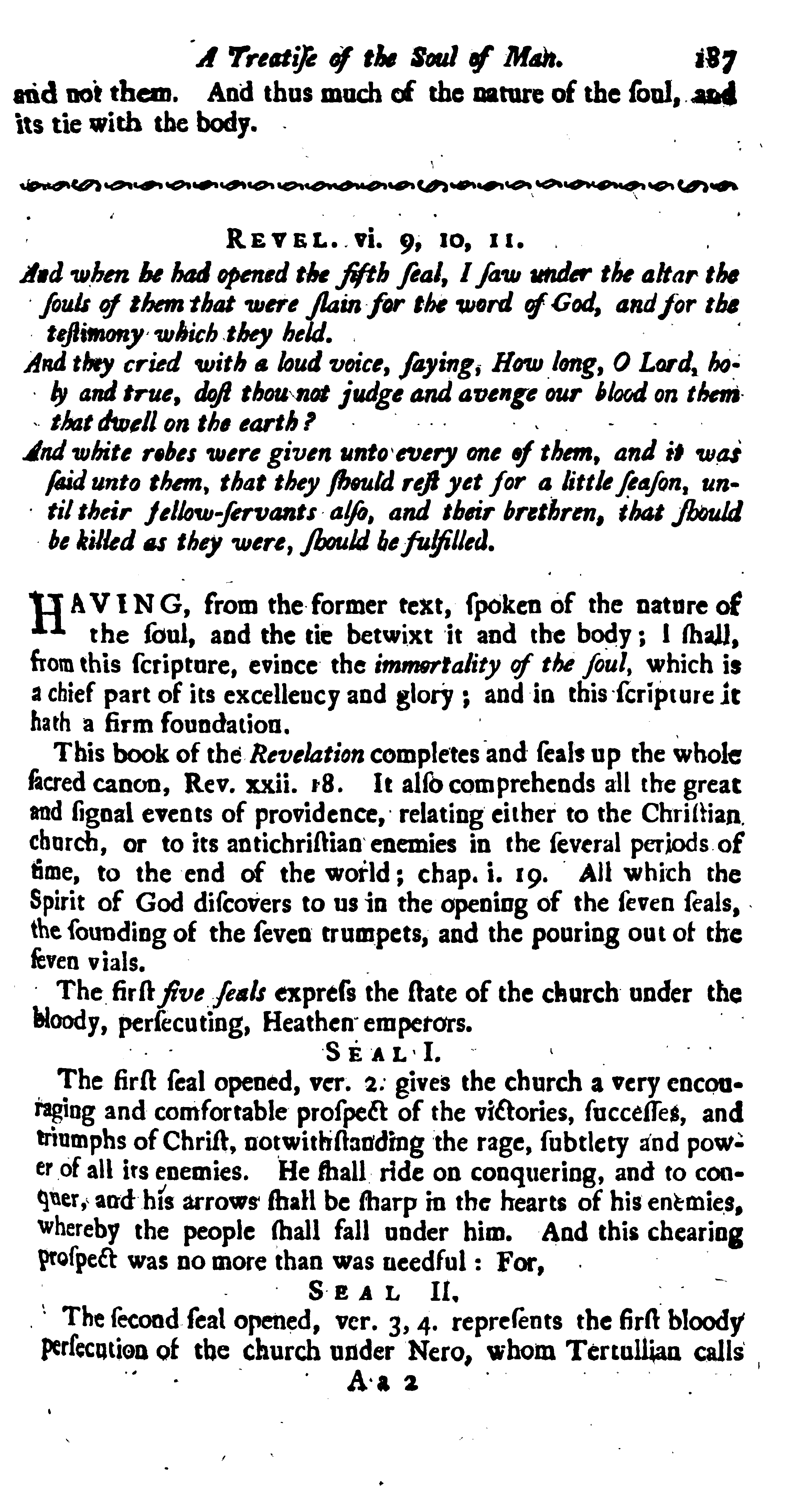
and not them.
And thus much of the nature of the soul, and its tie with the body.
399999999999999
REVEL . VI . 9, 10, 11 .
Andwhenhehadopened the fifthfeal, I saw under the altar the fouls of them that were flainfor the word of God, and for the testimony which they held.
And they cried with a loud voice, saying, How long, OLord, holy and true, dost thou not judgeandavenge our blood on them that dwell on the earth?
And white robes were given unto every one of them, and it was faidunto them, that they should reftyet for a little season, until their fellow-servants also, and their brethren, that should be killed as they were, should be fulfilled.
HAVING, from the former text, spoken of the nature of the soul, and the tie betwixt it and the body ; I shall, from this scripture, evince the immortality of the soul, which is a chief part of its excellency and glory; and in this scripture it hath a firm foundation.
This book of the Revelation completes and seals up the whole sacredcanon, Rev. xxii. 18.
It also comprehends all the great and signal events of providence, relating either to the Christian church, or to its antichristian enemies in the several periods of time, to the end of the world; chap. i. 19.
All which the Spirit of God difscovers to us in the opening of the seven seals, the founding of the seven trumpets, and the pouring out of the fevenvials.
The first five seals express the state of the church under the bloody, persecuting, Heathen emperors.
SEAL I.
The first seal opened, ver. 2. gives the church avery encouraging and comfortable prospect of the victories, successes, and triumphs of Christ, notwithstanding the rage, subtlety and power of all its enemies. He shall rideonconquering, and to conquer, and his arrows shall be sharp in the hearts of his enemies, whereby the people shall fall under him. And this chearing prospect was no more than was needful : For,
SEAL II, Thesecondfeal opened, ver. 3,4. represents the first bloody perfecutionof the church under Nero, whom Tertullian calls
Aa2
A Treatise of the Soul of Man.
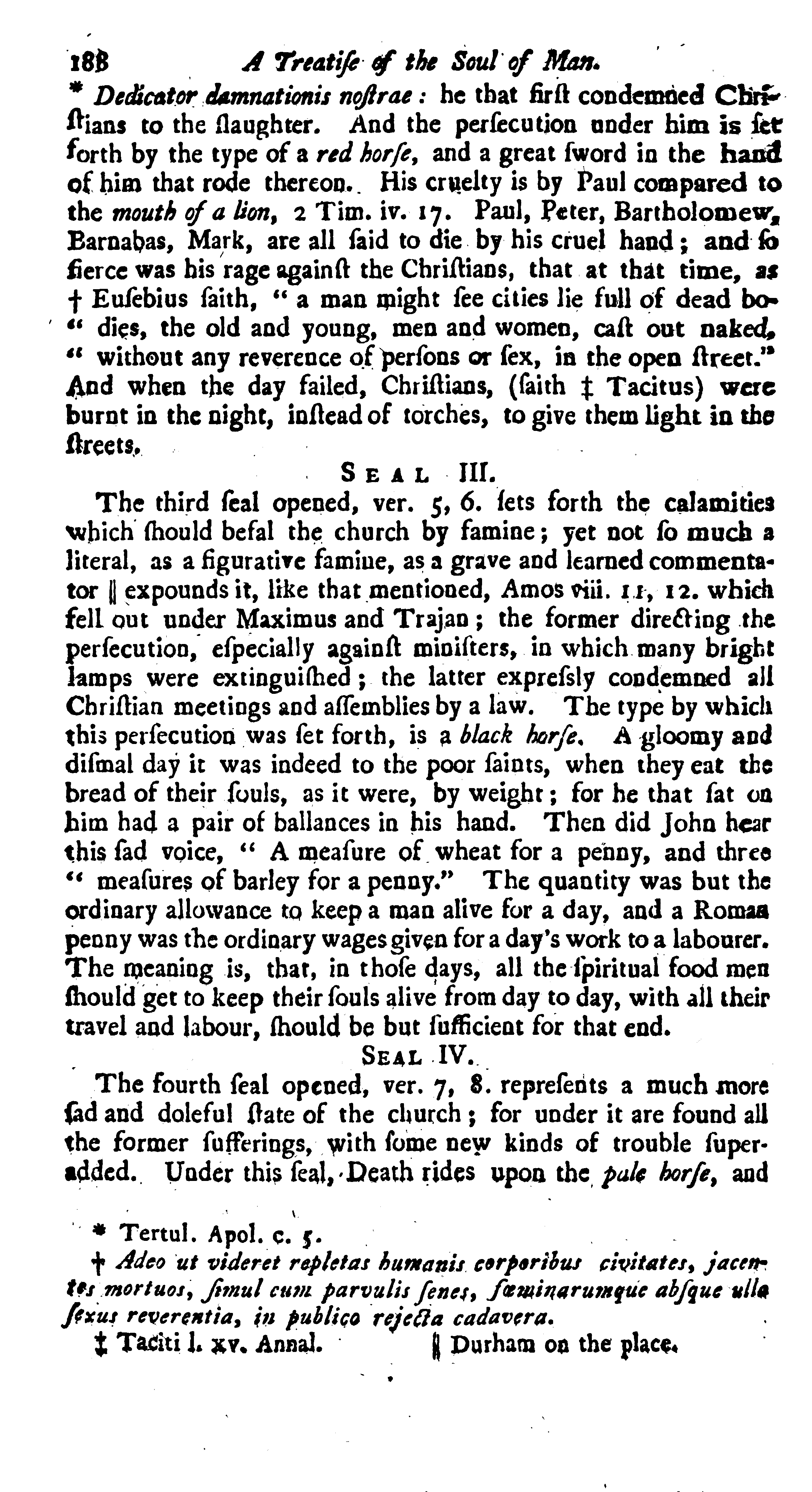
* Dedicator damnation is noftrae : he that first condemned Christians to the slaughter. And the persecution under him is set forth by the type of a red horse, and a great sword in the hand of him that rode thereon. His cruelty is by Paul compared to the mouth of a lion, 2 Tim. iv. 17.
Paul, Peter, Bartholomew, Barnabas , Mark, are all said to die by his cruel hand; and fo fierce was his rage against the Christians, that at that time, as + Eufebius faith, " a man might fee cities lie full of dead bo- " dies, the old and young, men and women, cast out naked,
" without any reverence of persons or sex, in the open street."
And when the day failed, Christians, (faith † Tacitus) were burnt in the night, instead of torches, to give them light in the streets.
SEAL III .
The third seal opened, ver. 5, 6. sets forth the calamities which should befal the church by famine; yet not so much a literal, as a figurative famine, as a grave and learned commentator|| expounds it, like that mentioned,Amos viii. 11, 12. which fell out under Maximus and Trajan ; the former directing the persecution, especially against ministers, in which many bright lamps were extinguished; the latter expressly condemned all
Christian meetings and assemblies by a law.
The type by which this persecution was set forth, is a black horse. A gloomy and dismal day it was indeed to the poor saints, when they eat the bread of their souls, as it were, by weight ; for he that fat on him had a pair of ballances in his hand. Then did John hear this fad voice, " A measure of wheat for a penny, and three
" measures of barley for a penny."
The quantity was but the ordinary allowance to keep a man alive for a day, and a Romana penny was the ordinarywagesgiven for a day's worktoalabourer.
The meaning is, that, in those days, all the spiritual food men should get to keep their souls alive from day today, with all their travel and labour, should be but sufficient for that end.
SEAL IV.
The fourth feal opened, ver. 7, 8. represents a much more sad and doleful state of the church ; for under it are found all the former sufferings, with some new kinds of trouble super added.
Under this feal, Death rides upon the pule horse, and * Tertul . Apol. c. 5.
Adeo ut videret repletas human is corporibus civitates, jacentes mortuos, fimul cum parvulisfenes, fæminarumque absque ulla fexus reverentia, in publico reject a cadaver a.
‡ Taciti 1. xv. Annal.
Durham on the place.
A Treatise of the Soul of Man
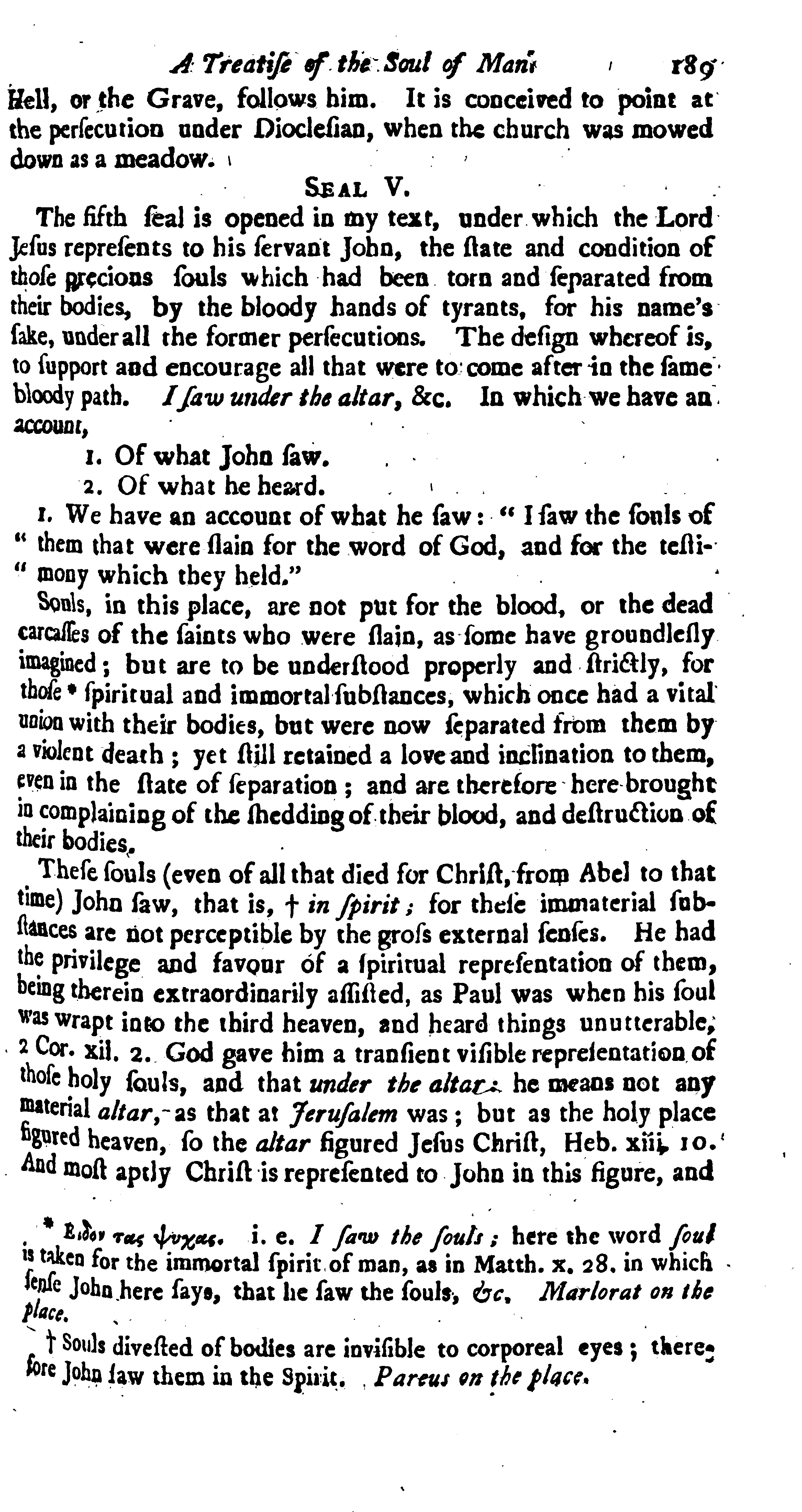
Hell, or the Grave, follows him.
It is conceived to point at theperfecution under Dioclesian, when the church was mowed down as a meadow.
SEAL V.
The fifth feal is opened in my text, under which the Lord Jesus represents to his servant John, the state and condition of those precious souls which had been torn and separated from their bodies, by the bloody hands of tyrants, for his name's fake, under all the former perfecutions.
The design whereof is, to support and encourage all that were to come after in the fame bloody path. Ifaw under the altar, &c. Inwhichwehave an account, 1. Of what John saw.
2. Of what he heard.
1. We have an account of what he saw : " I saw the souls of " them that were slain for the word of God, and for the tefti- " mony which they held."
Souls, in this place, are not put for the blood, or the dead carcasses of the faints who were slain, as some have groundlefly imagined; but are to be understood properly and strictly, for those spiritual and immortal substances,which once had a vital union with their bodies, but were now separated from them by aviolentdeath ; yet still retained a love and inclinationtothem, even in the stateoffeparation; and are therefore here brought incomplainingofthe sheddingoftheirblood,and destruction of their bodies.
These souls (evenofallthat died for Christ, from Abel to that time) John saw, that is, † in spirit ; for these immaterial substances are notperceptibleby the gross external senses. He had the privilege and favour of a spiritual representation of them, being therein extraordinarily assisted, as Paulwas when his soul waswrapt into the third heaven, andheardthings unutterable,
2Cor.xil. 2. God gave him a tranfientvisiblerepresentation of those holy fouls, and that under the altar: he means not any material altar, as that at Jerusalem was ; but as the holy place figured heaven, so the altar figured Jesus Christ, Heb. xiii, 10.
Andmostaptly Christ is represented to John in this figure, and * Ειδον τας ψυχας. i. e. I saw the souls; here the word foul is taken for the immortal spirit of man, asinMatth.x. 28, in which sense John here says, that he saw the souls, &c,
Marlorat on the place.
† Souls divested of bodies are invisible to corporeal eyes; there foreJohnfawthem in the Spirit.
Pareus on the place.
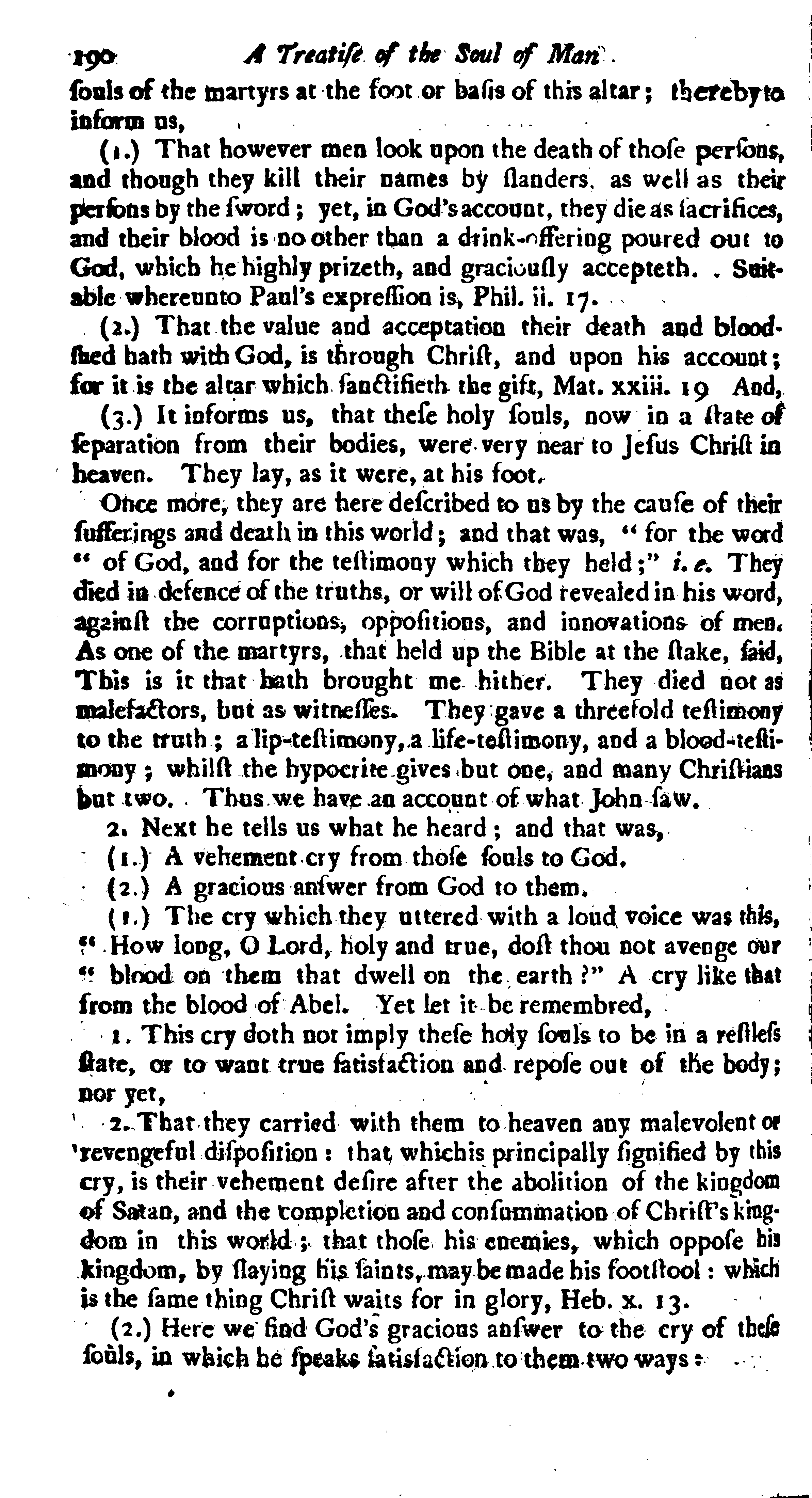
A Treatise of the Soul of Man foulsofthe martyrs at the foot or basis of this altar ; thereby to inform us, (1.) That however menlookupon the death of those persons, and though they kill their names by slanders, as well as their perfonsbythe sword; yet, in God's account, theydieas sacrifices, and their blood is no other than a drink-offering poured out to God, which he highly prizeth, and graciously accepteth.. Suitable whereunto Paul's expression is, Phil. ii. 17.
(2.) That the value and acceptation their death andbloodshedhathwithGod, is through Christ, and upon his account; for it is the altar which sanctifieth the gift,Mat. xxiii. 19 And,
(3.) It informs us, that these holy fouls, now in a fstate of separation from their bodies, were very near to Jesus Christ in heaven.
They lay, as it were, at his foot.
Once more, they are here described to us by the cause of their sufferings and death in this world; and that was, " for the word
" of God, and for the testimony which they held;" i.e. They died in defenceofthe truths, or will of God revealed in his word, against the corruptions, oppofitions, and innovations of men.
As one of the martyrs, that held up the Bible at the stake, said, This is it that hath brought me hither.
They died not as malefactors, but as witnesses. They gave a threefold testimony to the truth ; a lip-testimony,a life-testimony, and a blood-testimony ; whilst the hypocrite gives but one, and many Christians but two.
Thus we have an account ofwhatJohnfaw.
2. Next he tells us what he heard; and that was, (1.) A vehement cry from those fouls to God,
(2.) A gracious answer from God to them.
(1.) The cry which they uttered with a loud voice was this, " How long, OLord, holy and true,dost thou not avenge our
" blood on them that dwell on the earth ?" A cry like that from the blood of Abel.
Yet let it be remembred, 1. This cry doth notimply these holy fouls to be in a reffless state, or to want true satisfaction and repose out of the body; nor yet, 12.That they carried with them to heaven any malevolent or revengeful disposition: that which is principally signified by this cry, is their vehement desire after the abolition of the kingdom of Sat an,and the completionandconfummation of Christ'skingdom in this world; that those his enemies, which oppose his kingdom, by flaying his saints,maybemadehis footstool : which is the samething Christ waits for in glory, Heb . x. 13 .
(2.)Here we find God'sgracious answer to the cry of these fouls, in which he speaks satisfaction to them two ways
A Treatise of the Soul of Man.
1. By somewhat given them for present.
2. By somewhat promised them hereafter.
1. That which he gives them in hand ; "White robes were " given to everyone of them."
It is generally agreed, that these white robes given them, denote heavenly glory, the fame which is promised to all sincere and faithful ones,who preserve themselves pure from the corruptions, and defilements of the world,
Rev iii. 4. And it is as much as if God should have said to them, Although the time be not come to satisfy your desires, in the final ruin and overthrow of Sat an's tyrannical kingdom in the world, and Christ's consummate conquest of all his enemies, yet it shall be well with you in the mean time; you shall walk with me in white, and enjoy your glory in heaven.
2.And this is not all; but the very things they cry for shall be given them also after a little season; q.d. wait but a little while, till the rest that are to follow, in the same suffering path, begot through the red sea of martyrdom, as you are, and then you shall fee the foot of Christ upon the necks of all his enemies, and justice shall fullyavengetheprecious, innocent blood of all the saints, which in all ages hath been shed for my sake; from the blood ofAbel,to the last that shall ever suffer for righteousness sake in the world.
From all which, this conclusion is most fair and obvious ; Doct. That the souls of men perish not with their bodies, but do certainly over-live them, and fubfift in a state offeparationfrom them.
Mat.x. 28. " Fear not them that kill the " body, but are not able to kill the soul."
The bodies of these martyrs of Jesus were destroyed by divers forts of torments, but their souls were out of the reach of all those cruel engines; they were in safety under the altar, and in glory, cloathed with their white robes, when their bodies, they lately inhabited on earth,were turned to ashes, and torn to pieces by wild beasts.
The point I am to discourse from this scripture, is the immortality of the soul.
For the better understanding whereof, letitbenoted that there is a twofold immortality.
I. Simple, and absolute in its own nature.
II. Derived, dependent, and from the pleasure of God.
In the former sense,Godonlyhathimmortality,as theapoftle speaks, 1 Tim. vi. 16. Our souls have it as a gift from him.
He that created our souls out of nothing, can, if he please, reduce them to nothing again ; but he hath bestowed immortality upon them, and produced them in a nature suitable to that his appointment, fitted for an everlasting life. So that though
A Treatise of the Soul of Man.
God by his absolute power can, yet he never will annihilate them, but they shall, and must live for ever in endless blessedness or misery ; death must destroy these mortal bodies, but it cannot destroy our souls. And the certainty of this assertion is grounded upon these reasons, and will be cleared by these following arguments.
Arg. 1. The first argument for proof of the foul's immortality, may be taken from the simplicity, spirituality, and uncompoundedness of its nature ; it is apure, simple, unmixed being.
*Death is the dissolution of things compounded ; where therefore no composition or mixture is found, no death or dissolution can follow.
Death is the great divider, but it is of things that are divisible.
The more simple, pure, and refined any material thing is, by so much the more permanent and durable it is found to be.
The nearer it approacheth to the nature of spirits, the farther it is removed from the power of death : but that which is not material, or mixed at all, is wholly exempt from the stroke and power of death.
It is from the contrariant qualities, and jarring humours, in mixed bodies, that they come under the law and power of dissolution.
Matter, and mixture, are the doors at which death enters naturally upon the creatures.
But the soul of man is a simple, spiritual, immaterial, and unmixed being, not compounded of matter and form, as other creatures are, but void of matter, and altogether spiritual ; as may appear in the vast capacity of its understanding faculty, which cannot be straitned by receiving multitudes of truths into it.
It need not empty itself of what it had received before, tomakeway for more truth; nor doth it find itself clogged or burdened by the greatest multitudes or varieties of truths ; but the more it knows, the more it still desires to know.
Its capacity and appetite are found to enlarge themselves, according to the increase of knowledge.
So that, to speak, as the matter is, If the knowledge of all arts, sciences, and mysteries of nature, could be gathered into the mind of one man, yet that mind would thirst, and even burn with desire after more knowledge, and find more room for it thanitdid when it first sipt, and relished the sweetness of truth. Knowledge, as knowledge, never burdens or cloys the mind; but like fire increases and enlarges, as it finds more matter to work upon. Now this could never be, if the soul were a material being. Take the * Death is a separation, dissolving, or tearing asunder of parts. that had beenjoinedbysome union.
Tullius.
A Treatise of the Soul of Man.
largest vessel, and you shall find that the more you pour into it, the less room is still left for more ; and when it is full, you cannetpour in one drop more, except you let out what was in it before *.
But the soul is no such vessel, it can retain all it had, and be still receptive of more ; so that nothing can fill it, and satisfy it, but that which is infinite and perfect.
The natural appetite after food is sometimes sharp and eager, but then there is a stint and measure, beyond which it craves not; but the appetite of the mind is more eager and unlimited ; it never faith tillitcome to rest in God, it is enough †, because the faculty which produceth it, is more active, spiritual, and immaterial.
All matter has its limits, bounds, and just measures, beyond which it cannot be extended.
But the foui is boundless, and its appetitions infinite; it rests not, but in the spiritual and infinite Being, God alone being its adequated object, and able to satisfy its desires ; which plainly proves it to be a spiritual, immaterial, and simple being. And being so, two things necessarily follow therefrom.
1. That it is void of any principle of corruption in itself.
2. That it is not liable to any stroke of death, by any adverse power without itself.
1. It cannot be liable to death, from any feeds or principles of corruption within itself; for where there is no composition, there is no dissolution: the spirituality, and simplicity of the soul admits of no corruption.
2. Nor is it liable to death, by any adverse power without itself; no sword can touch it, no instrumentofdeath can reach it : it is above the reach of all adversaries, Matth. x. 28. " Fear not " them that kill the body, butcannotkillthefoul." The bounds and limits of creature-power are here fixed by Jesus Christ, beyond which theycannotgo.
They can wound, torment, anddeItroy the body, when God permits them : but the soul is out of their reach : a sword can no more hurt or wound it, than it can woundorhurt the light; and consequently it is,and must needs be of an immortal nature.
Object. But there seems to be adecay upon our souls in cur old age, and decays argue and imply corruption, and are fo manystepsandtendencies towards the death anddifssolutionthere- * Intus exiftens prohibet alienum. i. e. What is alrea 'vwithin, refuses access to what is without.
+Appetitus finis est infinitus.
There is no end ofdefiring, till we come at the desired end,which is God.
VOL. III .
A Treatise of the Soul of Man. of. The experience of the whole world shews us how theapprehenfions,judgments, wit, and memoryofold men fail, even to that degree, that they become children again, in respect of the abilities of their minds: their souls only serving, as it were, to salt their bodies, and keep them from putrefaction for a few longer.
Sol. It is agreatmistake, there is not the least decayupon the soul, no time makes any change upon the essence of the soul : all the alteration that is made, is upon the organs and instruments of the body, which decay in time, and become inapt and unserviceable to the soul.
The soul, like an expert skilful musician, is as able as ever it was,but the body, its instrument, is out of tune : and the ablest artiftcanmakeno pleasing melody upon an instrument whose strings are broken, or fo relaxed that they cannot be screwed up to their due height.
LetHippocrates, the prince of physicians, decide this matter for us.
" The soul (faith he) cannot be changed or altered as 66 to its essence, by the access of meat or drink, or any other
" thing whatsoever; but all the alterations that are made, must " be referred either to the spirits with which it mixeth itself,
" or to the vessels and organs through which it streameth ‡."
So that this proves not its corruptibility, and being neither corruptible in itself nor vulnerable by any creature without itself; nor feeingman cannot, and God will not destroy it, the conclusion s strongly inferred, That therefore it is immortal.
ARGUMENT II .
The immortality of the souls of men maybe concluded from the promises of everlasting blessedness, and the threatnings of everlasting miseries, respectively made in the scriptures of truth, to the godly and ungodly, after this life; which promises and threatningshad been altogether vain and delufory, if our souls perish with our bodies.
1. Godhasmade many everlasting promises of blessedness, yea, he hath established an everlasting covenant betwixt himself and the souls of the righteous, promising to be their God for ever, and to bestow endless blessedness upon them in the world to come.
Such a promise is that, John viii. 28. " I give unto † Anima nostra quoad effentiam mutari non poteft, aut alterari, five cibi, fivepotus, five cujuscunque rei alter i us acceffu: referenda
: eft enim omnium alterationum caufa, aut ad Spirit us, quibusse immifcet, aut ad vasa, five organ a quæper meat.
Hippocrat. lib.de diaeta.
A Treatise of the Soul of Man.
them eternal life, and they shall never perish."
And John iv.
14. " Whosoever drinketh of the water that I shall give him, " shall never thirst ; but the water that I shall give him, thall
"be in him awellofwater, springing up into everlasting life."
And again, John xi. 26. " Whosoever liveth and believeth in 66 me, shall never die." And once more, Rom. ii . 7. " Το
" them who by patientcontinuanceinwell-doing, seek for glory " and honour, and immortality, eternal life;" with multitudes more of like nature.
Now if these be no vainanddelusory promises, (as to be sure they are not, being the words of the true and faithful God) then those souls to whom they are made, must live for ever : for if the subject of the promises fail,consequently the performance of the promises must fail too. For howthall they be made good, when those to whom they are made, are perished ?
Let it not be objected here, That the bodies of believers are concerned in the promises as well as their fouis, and yet their bodies perish notwithstanding.
For we say, though theirbodiesdie, yet they shall live again, and enjoy the fruit of the promises in eternal glory ; and whilst their bodies lie in the grave, theirfouls are with God, enjoying the covenanted blessedness in heaven, Rom. viii. 10, 11. andfo the covenant-bond is not loosed betwixt them and God,by death, which it must needs be, in case the soul perish when the body doth. And upon this hypothesis, that argument of Christ is built, Matth. xxii. 32. proving the resurrection from the covenant God made with Abraham, Isaac and Jacob ; " I am the "GodofAbraham, and the God of Isaac, and the God of Ja- "cob: God isnottheGodofthedead, but of the living," q. d.
If Abraham, Isaac andJacob,be perishedinfoul as well as in body, how then is God their God; what is become of the promise and covenant-relation ? for ifonecorrelate fail, the relation necessarily fails with it.
If God be their God, then certainly they are in being; " for God is not the God of the dead," i. e. of those that are utterly perished.
Therefore it must needs be, that though their bodies be naturally dead, yet their souls still live; and their bodies must live again at the resurrection by virtue of the fame promise.
On the contrary, many threatnings of eternal misery, after this life, are found in the scriptures of truth, against ungodly and wicked persons.
Such is that in 2 Theff. i. 7, 8, 9. " The " Lord Jesus shall be revealed from heaven in flaming fire, to " render vengeance on them thatknownotGod, and that obey
Bb 2
A Treatise of the Soul of Man.
" not the gospel of our LordJesusChrist,who shall be punished " with everlasting destruction, from the presence of the Lord,
" and the glory of his power." And speaking of the torments of the damned, Christ thus expresseth the misery of such wretched fouls in hell, Mark ix. 44. " Where their worm dieth not, and " the fire is not quenched."
But how shall the wicked be punished with everlasting destruction, if their fouls have not an everlasting duration ? or how can it be said, Their worm (viz. the remorse and anguish of their conscience) dieth not, if their fouls die ? Punishment can endure no longer than its subject endureth.
If the being of the foul cease, its pains and punishments must have an end.
You see then, there are everlasting promises,andthreatenings to be fulfilled, both upon the godly and ungodly, "He that " believeth on the Son, hath everlasting life, and he that believ
" eth not the Son, shall not see life, but the wrath of God a bid- " eth on him," John iii. 36. The believer shall never fee spiritual death, viz. the separation of his foulfromGod; andtheun believer shall never see life, viz. the blessed fruition of God; but the wrath of God shall abide on him.
If wrath must abide on him, he must abide also as the wretched subject thereof, which is another argument of the immortality of fouls.
ARGUMENT III .
The immortality of the soul is a truth asserted and attested by the universal consentofallnations and ages of the world.
" We give much (said|| Seneca)to the presumption ofallmen," and that justly ; for it would be hard to think that an error should obtain the general consent of mankind, or that God would suffer all the world, in all ages of it, to bow down under an universal deception.
This doctrine sticks close to the natureofman; it springs up easily, and without force from his conscience.
It hath been allowed as an unquestionable thing, not only among Christians, who havetheoracles of God to teach and confirm this doctrine, but among Heathens also, who had no other light, but that of pature, to guide them into the knowledge and belief of it.
Learned Zanchius * cites out of Cicero an excellent passage to ||Multum darefolemus præfumptioni omnium hominum : cum deanimææternitatedisserimus, non levemomentum apud nos habet consensus hominum aut timentium inferos, aut colentium.
Senec.
Ep. 17.
* In omni re confenfioomniumgentium lex nature putenda eft: coque instar mille demonftrationum calis confenfio apud bonos effe debet, Zanchius de immortalitate animarum, p. 644.
A Treatise of the Soul of Man.
this purpose. " In every thing, faith he, the consent of all na- " tions is to be accounted the law of nature; and therefore,
" with all good men, it should be intteadofathousanddemon- " it rations ; and to resist it, (as he there adds), what is it, but *to resist the voice of God ?" and how much more, when, with his consent, the word ofGoddoth also consent ? As for the consent of nations, in this point, the learned author last mentioned, hath industriously gathered many great and famous testimonies from the ancient Chaldeans, Grecians, Pythagoreans, Stoics, Platonists, &c. which evidentlyshewthey made no doubt of the immortality of their souls. How plain is that of
Phocylides ? ψυχη δε αθανατος και αγηρος ζη δια παντος. Speaking of the soul, in opposition tothebody, which must be resolved intoduft, he faith, "But for the soul, that is immortal, and " never grows old, but lives for ever." And Trismegistus, the famous and celebrated philosopher †, gives this accountofman,
"That he consists of two parts, being mortal in respect of his " body, but immortal in respect of his soul, which is his best
" and principal part."
Plato † not only asserts the immortality of the souls of men, but disputes for it; and, among other arguments, he urges this : "That if it were not fo,
" wicked men would certainly have the advantage of righteous " and good men, who, after they have committed all manner
" of evils, should suffer none."
But what speak I of philosophers ? the most barbarous nations in the world constantly believe it || . The Turks acknowledge it in their Alcoran ; and though theygrosly mistake the nature of heaven, infancying it to be a paradifeofsensual pleasures, as well as the way thither, by their impostor Mahomet; yet it is plain they believe the soul's immortality, and that it lives in painorpleafure after this life.
The very savage and illiterate Indians are so fully persuaded of the soul's immortality, that wives cast themselves chearfully
† Ανθρωπος δύπλες, δια το σωμα θνητος , αθανατος ἢδια ψυχην, του έσιωδη ανθρωπον .
† Ει μεν γαρ, &c. Si enim mors dissolutio effet utriusque(corporis fc. etanima) lucrum foret malis cum moriuntur.
Plato in Epift.
Why do I speak of the Turks, Tartars, Muscovites, Indians, Persians, and all other nations which are at this day barbarous ?
None is so barbarous and wicked, but he is convinced, that, after death, there are places in which fouls are either punished for their bad actions, or rewarded and blest with delights for their good actions. Zanch.
Treatise of the Soul of Man. into the flames to attend the souls of their husbands; and subjects, to attend the foulsoftheir kings into the other world.
Two things are objected against this argument.
1. That some particular persons have denied this doctrine, asEpicurus, &c. and by argument maintained the contrary.
To which I answer, That though they have done so, yet, (1.) This no way shakes the argument from the confentof nations, because some few persons have denied it: we truly say, the earth is spherical, though there be many hills and risings in it.
IfDemocritus put out his own eyes, mustwetherefore fay all the world is blind ?
(2.) It is worth thinking on, whether they that have questioned the immortality of the soul, have not rather made it the matter of their option and desire, than of their faith and persuasion.
We distinguish Atheists into three classes, such as are so in practice, in desire, or in judgment; but of the former forts there maybe found multitudes, to one that is so in his settled judgment. If you think it strange that anyman should with his soul to be mortal, Hierocles * gives us the true reason of it:
" Awickedman (faith he) is afraid of his Judge; and there- " forewishes his soul and body may perish together by death,
" ratherthanthat it should come to God's tribunal.** Object. 2. Nor can the strength of the argument be eluded by saying, "All this maybe but an universal tradition," one nation receiving it from another.
Sol. For as this is neither true in itself, nor possible to be made good, fo if it were, it would not invalidate the argument: for ifitwerenota truth agreeable to the light of nature, and so easily received by all men upon the proposal of it, it were impossible that all the nations in the world should embrace it fo readily, and hold it so tenaciously as they do.
ARGUMENT IV.
The immortality of the soul maybe evinced from the everlasting habits which are subjected, and inherent in it.
If these habits abide for ever, certainly so must the souls in which they are planted.
The souls of good men are the good ground, in which the feedofgrace is sown by the Spirit, Mat. xiii. 23. i. e. the subjects in which gracious properties and affections do inhere and dwell, (which is the formal notion ofa substance) and these implanted graces are everlasting things.
So John iv. 14. " It shall * Ο κακός αθανατον ειναι την αυτό ψυχην ίνα μη υπομένη τιμωρέμενος, και φθανετον έκει δικαςηνι Hieroc.
A Treatise of the Soul of Man.
" be in him a well of water, springing up into everlasling life," i. e. the graces of the Spirit shall be in believers, permanent habits, fixed principles, which shall never decay. And therefore that feed of grace, which is cast into their souls at their regeneration, is in 1 Pet. i. 23. called " incorruptible feed, which liv- " eth and abideth'for ever :" and it is incorruptible, not only considered abstractly, in its own simple nature, but concretely, as it is in the sanctified foul, its subject : for it is said, i John iii. 9. " The feed of God remaineth in him."
It abideth for ever in the soul.
If then these two things be clear to us, viz.
1. That the habits of grace be everlasting; 2. That they are inseparable from sanctified fouls ;
It must needs follow, That the soul, their subject, is fotoo, an everlasting and immortal soul. And how plainly do both these propositions lie before us in the scriptures? As for the immortal and indeterminable nature of saving grace, it is plain to him that confiders,notonlywhatthe fore-cited scriptures speak about it, calling it incorruptiblefeed, a well ofwaterspringing up into everlasting life; but add to these, what is said of these divine qualities, in 2Pet. i. 4. where they are called the divinė nature; and Eph. iv. 18. the life of God, noting the perpetuity of these principles in believers, as well as their resemblance of Godinholiness, who are endowed with them.
I know it is a great question among divines, An gratia in renatisfit naturaet effentiafua interminabilis ? Whether these principles of grace in the regenerate, be everlasting and interminable, in their own nature and essence ? For my own part,
I think that God only is naturally, essentially, and absolutely interminable and immortal. But these gracious habits, planted by him in the soul, are so by virtue of God's appointment, promise, and covenant. And sure it is, that by reason hereofthey are in terminate, which is enough for my purpose, if they be not essentially interminable. Though grace be but a creature, and therefore hath a posse mori, yet it is a creature begotten by the Word, and Spirit of God, which live and abide for ever, and a creature within the promise and covenant of God, by reason whereof it can never actually die.
And then as for the inseparableness ofthesegraces from the souls in whom they are planted, how clear is this from John ii. 27. where sanctifying grace is compared to anunction, and this unction is said to abide in them ? And I John iii. 9. it is called the feed of God, which remaineth in the soul.
All our natural and moral excellencies and endowments go away when we die; Job iv. 21. " Doth not their excellency that is in them
A Treatise of the Soul of Man. go away ?" Men may outhve their acquired gifts, but not their supernatural graces.
These stick by the soul, as Ruth to Naomi, and where it goes theygo too: so that when the soul isdislodgedbydeath, all its graces ascend up with it into glory ; it carries away all its faith, love, delightinGod, all its comfortable experiences, and fruits of communion with God, along with it to heaven.
For death is so far from divesting the soul of its graces, that it perfects in a moment all that was defective in them; 1 Cor. xiii . 10. " When that which is perfect shall
" come, then that which is in part shall be done away," as the twilightisdone awaywhenthe fun is up, and at its zenith. So then, grace never dieth, and this never dying grace is inseparable from its subject; by which it is plain to him that confiders, that as graces, so souls abide for ever.
Object.But thisonlyproves theimmortalityofregeneratefouls.
Sol. Itdothfo.
But then confider, as there be gracious habits in the regenerate that never die, so there are vicious habits in the unregenerate that can never be separated from them in the world to come.
Hence John viii. 24. they are said to " die " in their fins ;" and Job xx. 11. " Their iniquities lie down
" with them in the dust ;" and Ezek. xxiv. 13. " They shall " never be purged."
Remarkable is that place, Rev. xxii. 11.
" Let him that is filthy, be filthy still."
And if guilt sticks fo fast, and finbe so deeply engraven inimpenitent fouls, they also must remain for ever, to bear the punishment of them.
ARGUMENT V.
The immortality of the soul of man may be evinced from the dignityofman above all other creatures, (angels only excepted) and his dominion over them all..
In this, the scriptures are clear, that man is the master-piece of all God's other works ; Psal. viii. 5, 6. " For thou hast made
" him a little lower than the angels, and haftcrowned him with gloryandhonour.
Thou hast made him to have dominion over the works of thy hand, thou hast put all things under " his feet." Other creatures were made for his service, and he is crowned king over them all.
One man is of more worth than all the inferior creatures.
But wherein is his dignity andexcellencyabove all other creatures, if not in respect of the capacity and immortality of his soul ? Sure it can be found no where else; for as to the body, many of the creatures excel man in the perfections of sense, greatness of strength, agility of members, &c.
Nos a per auditu praecellit, aranea tactu, Vultur odoratu, lynx visu, fimia gustu..
A Treatise of the Soul of Man.
And for beauty, Solomon in allhisglorywas not arrayed like one of the lilies of the field.
The beasts and fowls enjoy more pleasure, and live divested of all those cares and cumbers which perplex and wear out the lives of men.
It cannot be, in respect of bodily perfections or pleasures, that man excels other creatures .
If you fay, He excels them all in respect of that noble endowment of reason, which is peculiar to man, and his singular excellency above them all.
It is true, this is his glory : but if you deprive the reasonable foul of immortality, you despoil it of all, both of its glory and comfort, and put the reasonable into a worse condition than the unreasonable and brutish creatures.
For if the soul may die with the body, and man perish as the beast, happier is the life of the beast, which is perplexed with no cares nor fears about futurities ; our reason serves to little other purpose but to be an engine of torture, a mere rack to our souls .
Certainly, the privilege of man doth not consist in reason, as abstracted from immortality.
But in this it properly consists, that he enjoys not only a reasonable, but also rejoiceth in an immortal soul, which shall overlive the world, and subsist separate from the body, and abide for ever, when all other fouls, being but a material form, perish with that matter on which they depend.
This is the proper dignity of man, above the beast that perisheth ; and to deprive him of immortality, and leave him his reason, is but to leave him a more miserable and wretched creature than any that God hath put under his feet.
For man is a prospecting creature, and raiseth up to himself vast hopes and fears from the world to come: by these he is restrained from the sensual pleasures, which other creatures freely enjoy, and exercised with ten thousand cares, which they are unacquainted with ; and to fail at last of all his hopes and expectations of happiness, in the world to come, is to fall many degrees lower than the lowest creature shall fall ; even so much lower as his expectations and hopes had lifted him higher.
ARGUMENT VI .
The souls of men must be immortal, or else the desires of immortality are planted intheirfouls in vain.
That there are desires of immortality found in the hearts of all men, is a truth too evident to be denied or doubted *. Man
* I beseech men, for God'sfake,that if at anytime there arise in them adefire, or a wish that othersshouldfpeak well of them rather
VOL . III.
than Cc
A Treatise of the Soul of Man. cannotboundand terminate his desires within the narrow limits of this world, and the time that measures it. Nothing that can be measured by time is commensurate to the desires of man's foul. No motto better suits it than this, Non est mortale quod opto; I seek for that which will not die, Rom. ii. 7. And his great relief against death lies in this, Non omnis moriar; That he shall not totally perish.
Yea, we find in allmen, even in those thatfeem to be most drowned, and lost in the love and delights of this present world, a natural desire to continue their names and memories to posterity after death. Hence it is said,
Psal. xlix. 11. " Their inward thought is, that their houses shall " continue for ever, and their dwelling places to all generations ;
" they call their lands after their own names."
And hence is the desire of children, which is, as one faith, nodosa aeternitas, aknotty eternity ; when our threed is spun out and cut off, their threed is knit to it; and fo we dream of a continued succession inournameand family.
Abfalomhadnochildren to continue his memory ; to supply which defect, he reared up a pillar, 2 Sam. xviii. 18. Now it cannot be imagined that God shouldplantthe desire of immortality in those souls, that are incapable of it; not yet can we give a rational account how these apprehenfions of immortality should come into the fouls of men, except they themselvesbeofan immortal nature.
For, either these notions and apprehenfions of immortality are impressed upon our souls by God, or do naturally spring out of the souls of men : If God impress them, those impressions are made in vain, if there be no such thing as immortality to be enjoyed; and if they spring and rife naturally out of our souls, that is a fufficientevidenceoftheir immortality.
For we can no more conceive, and form to ourselves, ideas and notions of immortality, if our fouls be mortal, than the brutes which arevoidofreason,can form to themselves notions andconceptions ofrationality. So then the very apprehenfions and desires thatarefoundin menshearts of immortality, do plainly speak them to be of an immortal nature than evil after their death, then at that time they would seriously confider whether these motions are not from some spirit, to continue a spirit after it leaves its earthly habitation, rather than from an earthly spirit, avapour, which cannot act, or imagine, or desire, or fear things beyond its continuance.
Hale de anima, p. 72.
* It forms conceptions of things spiritual and abstract from matter, anddifcerns objects which have no dimensions, figure, colour, or affection of matter.
If the foul itself is the fountain or idea of of
A Treatise of the Soul of Man.
ARGUMENT VII.
Moreover, theaccountgivenus in scripture of the return of several fouls into their own bodies again after death, and real separation from them, thews us that the soul subsists, and lives in a separate state after death, and peritheth not by the stroke of death: For if it were annihilated or destroyed by death, the fame foul could never be restored again to the same body. A deadbodymay indeed be acted by an assisting form, which may move and carry it from place to place: So the devil hath acted the dead bodies of many; but they cannot be said to live again by their own fouls, after a real separation by death, unless those fouls overlivedthe bodies they forsook at death, and had their abode in another place and state. You have divers unquestionable examples of the souls return into the body, recorded in scripture: As that of the Shunamite's son, 2Kings iv. 18, 19, 20, 32, 33, 34, 35, 36, 37.
That of the ruler's daughter, Mat. ix. 18, 23, 24, 25.
That of the widows son, Luke vii. 12, 13, 14, 15. And that of Lazarus, John xi. 39,
40,41, 42, 43, 44, 45. " These are no other f but the " very same souls, their own souls which returned to them a- " gain; which, as Chryfoftom well observes, is a great proof
" of their immortality, against them that think the foul is anni- " hilated after the deathofthebody."
It is true, the scripture gives us no account of any sense, or apprehension they retained after their re-union of the place or statetheywere in, during their separation.
There seemed to be a perfect αμνησία, forgetfulness of all that they saw or felt in the stateofseparation. And indeed it was necessary it should be to, that our faith might be built rather upon the sure promises of God, than such reports and narratives of them that came to us from the dead, Luke xvi. 31. And if we believe not the word, neitherwouldwe believe if onecamefrom the dead.
ARGUMENT VIII,
Moreover, Eighthly, The supposition of the soul's perishing with the body, is fubversiveofthe Christian religion in the principal doctrines and duties thereof: takeaway the immortality of
Cc2 immortality, it must be immortal; because what is momentary, cannot form an idea of an immortal nature, for the soul which is void of reason cannot form a conception of rationality.
Stern on death, p. 198.
+ Non aliam, fed ipfam priorem animam corpori mortuo reftitutam esse, contra eos qui putaveruntet bodieputant animam post anartem corporis nibil effe.
A Treatise of the Soul of Man. the soul, and all religion falls to the ground. I will instance in,
1. The doctrines 2. The duties } of religion.
First, It overthrows the main principles and doctrines of the Christian religion, upon which both our faith and comfort is founded; and consequently, itundoes, and ruins us, as to all solid hope and true joy. The doctrines or principles it overthrows, are, amongmanyother, such as follow.
1. It nullifics and makes void the great design and end of God's eternal election.
The scriptures tells us, That from all eternity God hath chosen a certain number in Christ Jesus, to eternal life, and to the means by which they shall attain it, out of his mere good pleasure, and for the praise of his grace. This was ( 1. ) an eternal act of God, Eph. i. 4. long before we had our being, Rom. ix. 11.
(2.) This choice of God, or his purpose to fave some, is immutable, 2 Tim. ii. 19. James i. 17.
(3.) This choice he made in Christ, Eph. i. 4.
Not that Christ is the cause of God's chusing us : For we were not elected because we were, but that we might be in Christ.
Christ was ordained to be the Medium of the execution of this decree.
And all the mercies which were purposed, and ordained for us, were to be purchased by the blood of Christ.
He was not the cause of the decree, but the purchaser of the mercies decreed for us. (4.) This choice was ofa certain number of persons, who are all known to God, 2 Tim. ii. 19. and all given to Christ in the covenant of redemption, John xvii. 2, 6. So that no elect person can be are probate, no reprobate an elect person. (5.)This number was chosen to salvation, I Thes. v. 9. No less did God design for them than glory and happiness, and that for ever. (6.)
The fame persons that are appointed to salvation as the end, are also appointed to sanctification as the way and means by which they shall attain that end, I Pet. i. 1, 2. 2 Thes. ii. 13, 14. (7.)
The impulsive cause of this choice was the mere good pleasure of his will, 2 Tim. i. 9. Rom. ix. 15, 16. Eph. i. 9.
(8.)The end of all this is, the praise of his glorious grace, Eph. i. 5,6. to make a glorious manifestation of the riches of his grace for ever.
This is the account the scripture gives us of God's eter nal choice.
But if our souls be mortal, and perish with our bodies, all this is a mistake, and we are imposed upon, and our understandings are abused by this doctrine : For to what purpose are all these decrees and contrivances of God from everlasting, if our souls perish with our bodies? Certainly, if it be so, he loses all the
A Treatise of the Soul of Mani
thoughts and counsels of his heart about us; and that counsel of his will, which is so much celebrated in the scriptures, and ad-. miredbyhispeople, comes to nought.
For this is evident to everyman's consideration, that if the foul (which is the object about which all those counsels and thoughts of God were employed and laid out) fail in its being, all those thoughts and counsels that have been employed about it, and spent on it, must necessarily fail andcometonothingwith it.
The thoughts of his heart cannot stand fast, as it is said, Psal. xxxiii. 11. if the foul slide, about which they are conversant.
In that day the elect foul perisheth, the eternal consultations and purposes of God's heart perish with it.
Keckerman tells us, that " *Alber- " tusMagnus, with abundance of art, and the study of thirty years, made a vocal statue in the form of am an. It was a rare
" contrivance, and much admired ; the cunning Artist hadfo " framed it, that by wheels and other machines placedwithinit,
" it could pronounce words articularly."
Aquinas being fur prized to hear the statue speak, was affrighted at it, and brake it all to pieces ; upon which Albert us told him he had atone blow destroyed the work of thirty years.
Such a blow would the death of the soul give to the counsels and thoughts, not of man, but of God, nat of thirty years, but from everlasting.
If the souls of men perish at death, either God never did appoint any fouls to salvation, as the scriptures testify he did,
1Thef. v. 9. or else the foundation of God slands not sure, as his word tells us it doth, 2 Tim. ii. 19.
So then this supposition overturns the eternal decrees and counsels of God, which is the first thing.
2. It overthrows the covenant of redemption betwixt the Father and the Son, before this world was made.
There was a federal transaction betwixt the Father and the Son from eternity, about our salvation, 2Tim. i. 9. Zech. vi. 13.
In that covenant Christ engaged to redeem the elect by his blood ; and the Father promised him a reward of those his sufferings, Isa. liii. 12.
Accordingly he hath poured out his foul to death for them, finished the work, John xvii. 4. and is now in heaven, expecting the full reward and fruits of his sufferings, which consist not in his own personal glory, which he there enjoys, but in thecompleteness and fulness of his mystical body, John xvii. 24.
* Albert us Magnusftatuamhominis conftruxit, quæ cum libramentis quibufdam, rot is atque aliis machinis intra latentibus peritiffime compofitis, linguam quadam ratione etdifciplinamoventibus, articulata verba pronunciaret.
A Treatise of the Soul of Man.
But certainly, if our fouls perishwithourbodies,Christ would begreatlydisappointed: Norcanthatpromisebeevermadegood to him; fa. liii. 11. "He shall fee of the travail of his soul and " be satisfied."
He hath done his work, but where is his reward? See how this supposition strikes at the justice of God, and wounds his faithfulness in his covenant with his Son.
He hath as much comfort and reward from the travail of his soul, as a mother that is delivered after many sharp pangs of a child that dies almost as soon born .
3. It overthrows the doctrines of Christ's incarnation, death, resurrection, ascension, and interceffion in heaven for us. And these are the main pillars both of our faith and comfort.
Take away these, and take away our lives too, for these are the springs of all joy and comfort to the people of God, Rom. viii.
34.
His incarnation was necessary to capacitate him for his mediatorial work: It was not only a part of it, but such a part, without which he could discharge no other part of it.
This was the wonder of men and angels, Tim. iii. 16. A God incarnate is the world'swonder ; nocondescension like this, Phil. ii. 6, 7.
The death of Christ hath the nature and respect ofa ransom, or equivalent price laid down to the justice of God for our redemption, Matth. xx. 28. Acts xx. 28.
It brought our souls from under the curse, andpurchasedforthem everlastingblessedness, Gal. iv. 4, 5.
The resurrection of Christ from the dead hath the nature both of a testimony of his finithing the work of our redemption, and the Father's full satisfaction therein, John vi. 10. and ofa principle of our resurrection to eternal life, 1 Cor. xv. 20.
The ascension of Christ into heaven was in the capacity and relation of a fore-runner, Heb. vi. 20. it was to prepare places for the redeemed, who were to come after him to glory in their several generations, Johnxiv. 2, 3 .
The interceffion of Christ in heaven, is for the security of our purchased inheritance to us, and to prevent any new breaches which might be made by our fins, whereby it might be forfeited, andwedivested of it again, I John ii. 1, 2.
All these jointly make up the foundation of our faith, and hope of glory : But if our souls perish, or be annihilated at death, our faith, hope, and comforts, are all delusions, vain dreams, which do but amuse our fond imaginations.
For, (1.) It was not worth so great a stoop and abasement of the blessed God, as he submited to in his incarnation, when he
A Treatise of the Soul of Man.
appeared in flesh, yea, in the likeness of finfal flesh, Rom. viii. 3. and made himself of no reputation, Phil. ii. 7. An act that is, and ever will be admired by men and angels : I fay, it was not worth fo great a miracle as this, to procure for us the vanishing comfort ofa few years, and that short-lived comfort no other than a deluding dream, or mocking phantasm : For seeing it consists in hope and expectation from the world to come, as the scriptures every where speak, I Thef. v. 8. and 2Cor. iii. 12. Rom. v. 3, 4, 5. if there be no such enjoyments for us there (as most certainly there are not, if our fouls perish) it is but a vanity, a thing of nought, that was the errand upon which the Son of God came from the Father's bosom, to procure for us.
(2.) And for what, think you, was the blood of God upon the cross ? What was so vast and inconceivable a treasure expended to purchase ? What ! the flattering and vain hopes of a few years, of which we may say, as it was said of the Roman confulship, unius anni volaticum gaudium ; the fugitive joy of a year :
Yea, not only short-livedandvainhopes in themselves, but such for the sake whereof we abridge ourselves of the pleasures and desires of the flesh, 1 John iii. 3. and submit ourselves to the greatest sufferings in the world, Rom. viii. 18.
For the hope of Israel am I bound with this chain, &c. Acts xxviii. 20.
Was this the purchase of his blood ? Was this it for which he sweat, andgroaned, and bled, and died ? Was that precious blood no more worth than such a trifle as this?
(3. ) To what purpose did Christ rise again from the dead?
Was it not to be the first-fruits of them thatfleep ? Did he not rife as thecommonhead of believers, to give us assurance we shall not perish, and be utterly lost in the grave ? Col. i. 18.
But if our souls perish at death, there can be no resurrection; and if none, then Christ died and rose in vain, we are yet in our fins, and all those absurdities are unavoidable, with which the apostle loads this supposition, 1 Cor. xv. 13, &c.
(4.) And to as little purpose was his triumphant ascension into heaven, if we can have no benefit by it. The professed end of his ascension was " to prepare a place for us," Johnxiv.
2.But to what purpose are those mansions in the heavens pre. pared, if the inhabitants for whom they are prepared be utterly lost? And why is he called theforerunner, if there be none to follow him ? as surely there are not, if our fouls perich with our bodies.
Those heavenlymanfions, that city prepared by God, must sland void for ever if this be fo.
(5.) To conclude; in vain is the interceffion of Christ in
A Treatise of the Soul of Man. heaven for us, if this be so.
They that shall never come thither, have no business there to be transacted by their advocate for them.
So that the whole doctrine of redemption by Christ is utterly subverted by this one supposition.
4. As it fubverts the doctrine of redemption by Christ, and all the hopes and comforts we build thereon, so it utterly destroys all the works of the spirit, upon the hearts of believers, and makes them vanish into nothing.
There are divers acts and offices of the Spirit of God about, and upon our souls; I will only single out three, viz. his fanctifying,sealing, and comforting work : all things of great weight with believers.
(1.) Hisfanctifying work, whereby he alters the frames and tempers of our souls, 2Cor.v. 17. " Old things are passed away,
" behold all things are become new."
The declared and direct end of this work of the Spirit upon our souls, is to attemper and dispose them for heaven, Col. i. 12.
For seeing " nothing that is uncleancanenterintotheholyplace,"
Rev. xxi. 27. " and without holiness no man shall see the Lord,"
Heb. xii. 14. it is necessary that all those that have this hope in them, should expect to be partakers of their hopes in the way of purification, 1 John iii. 3. And this is the ground upon which thepeopleofGoddomortify their lusts, and take so much pains with their own hearts, Mat. xviii. 8. counting it better (as their
Lord tells them) " to enter into lifehaltor maimed, than having " two eyes or hands to be cast into hell." But to what purpose is all this self-denial, all these heart-searchings, heart-humblings, cries, and tears, upon the account off in, and for an heart suited to the will of God, if there be no such life to be enjoyed with God, after this animal life is finished ?
Object. If you say there is a present advantage resulting to us in this world, from our abstinence and self-denial ; we have the truer and longer enjoyment of ourcomfortsonearth by it : debauchery and licentiousness do not only flat the appetite, and debase and alloy the comforts of this world, but cut short our lives by the exorbitances and abuses of them.
Solut. Though there be a truth in this worth our noting, yet (1.) morality could have done all this without fanctification; there was no need for the pouring out of the spirit, for so low an use and purpose as this.
(2.) And therefore as the wisdom ofGodwouldbe censured and impeached, in sending his Spirit for an end which could as well be attained without it; so the veracityofGod must needs be affrontedby it, who, asyouheard
A Treatise of the Soul of Man.
before, hath declared our salvation to be the end of our sanctification .
* (2.) His sealing, witnessing, and assuring work. We have a full account in the scriptures, of these offices and works of the spirit, and some spiritual sense and feeling of them upon our own hearts, which are too good assurances that there are such things as his bearing witness with our spirit, Rom. viii. 16,
" his sealing us to the day of redemption, " Eph. iv. 30. " his " earnests given into our hearts," 2 Cor. i. 22.
All which acts, and works of the spirit have a direct and clear aspect upon the life to come, and the happiness of our souls in the full enjoyment of God to eternity ; for it is to that life we are now sealed ; and of the full sum of that glory, that these are the pledges and earnests. But if our souls perish by death, these witnesses of the spirit are delusions, and his earnests are given us but injest .
(3.) His comforting work is a sweet fruit and effect sensibly felt and tasted by believers in this world.
He is from this office stiled the Comforter, John xvi. 7. fignatur, et eminenter :
He so comforts, as none other doth, or can. And what is the matter of his comforts, but theblessedness to come, the joys of the coming world ? Johu xvi. 13. " Eye hath not seen," &c.
Upon the account of these unseen things, he enableth believers to glory in tribulation, Rom. v. 4. to despise present things, whether the smiles or the frowns of the world, Heb. xi. 24. and ver. 26.
But if the being of our souls fail at death, these are but the fantasticjoys of men in a dream, and the experiences of all God's people are foundbutfo many fond conceits, and gross mistakes.
5. This supposition overthrows the doctrine of the resurrection, which is the consolation of Christians. We believe, according to the scripture, that after death hath divorced our souls and bodies for a time, they shall meet again, and be re-united, and that the joy at their re-union will be to all that are in Christ, greater than the sorrows they felt at parting.
This seems not incredible to us, whatever natural improbabilities and carnal reasons may be against it, Acts xxvi. 8. and that because the almighty power, which is able to subdue all things to himself, undertakes this task, Phil. iii. 21 .
We believe this very fame numerical body shall rise again, Job xxi . 27. by the return of the fame foul into it, which now dwelleth in it; and that we shall be the fame persons that now we are: the remunerative justice of God requiring it to be so.
VOL . III.
A Treatise of the Soul of Man.
We believe the souls of the righteous shall be much better accommodated, and have a more comfortable habitation in their bodies than now they have, 1 Cor. xv. 42, 43. seeing they shall be made like unto Christ's glorious body, Phil. iii. 22. and that then we shall live after the manner of angels, Luke xx. 36. without the necessities of this animal life.
These are the things we look for according to promise; and this expectation is our great relief against ( 1.) The fears of death, 1 Cor. xv. 55.
(2.)Against the death of our friends and relations, I Thes. iv.
14.
(3.) Against all the pressures and afflictions of this life, Job xix. 25, 26, 27.
But if the being ofourfouls fail at death, all hopes and comforts from the resurrection fail with it; for it is not imaginable that the body should rife till it be revived, nor how it should be revived, but by the re-union of the soul with it: and if it be not the fame foul that now inhabits it, we cannot be the fame persons in the resurrection we are now; and consequently, thissuppositionfubverts notonlythedoctrineoftherefurrection, but, 6. It overthrows also the faith of the judgment to come.
For if the foul perish, the body cannot rife; or if it rise by a new created foul, the person raised is another, and not the fame that lived and died in this world; and consequently, the rewards and punishments to be bestowed and awarded to all men in that day, cannot be just and equal : for we believe, according to the scriptures, that,
(1.) The actions which men perform in this life, are not transient, but are filed to their account in the world to come;
Gal. vi. 7. " here we sow, and there we reap."
Actions done in this world are two ways considerable, viz . physically, or morally; in the first consideration they are transient, in the last, permanent and everlasting. A word is spoken, or an act done, in a moment, but though it be past and gone, and perhaps by us quite forgotten,God registers it in his book, in order to the dayofaccount.
(2.) We believe that God hath appointed a day in which all men shall appear before his judgment-seat, to give an account of all they have done in the body, whether it be good or evil,
2 Cor. v. 10.
(3.) And that in orderhereunto, the very fame persons shall be restored by the resurrection, and appear before God, the very fame bodies and fouls,which didgoodor evilinthisworld :
Shall not the Judge of all the earth do right ? Justice requires that the rewards and punishments be then distributed to the
A Treatise of the Soul of Man.
famepersonsthatdidgood or evil in this world: which strongly infers the immortality of the soul, and that it certainly over lives the body, and must come back from the respective places of their abode, to be again united to them, in order to their great account.
By all which you see the clearest proof of the soul's immortality, and how the contrary supposition overthrows our faith, duties, and comforts.
Yet notwithstanding all this, how apt are we to suspect this doctrine, and remain still dissatisfied and doubting about it, when all is said ? Which comes to pass partly from the subtlety of Sat an, who knows he can never persuade men to live the life of beasts, till he first persuade them to think they shall die as the beasts do.
(2.) And partly from the influence of sense, and reason upon us, whereby we dotoomuch suffer ourselves to be swayed, and imposed upon in matters of thegreatestmoment in religion. For these being proper arbiters, and judges, in other matters within their sphere, they are arrogant, and we easy enough to admit them to be arbiters also in things that are quiteabovethem. Hencecomesuch plausible objections as these :
Object. 1. The soul seems to vanish and die, when it leaves the body: for when it hath struggled as long as it can keep its possession in the body, and, at last, is forced to depart, we can perceive nothingbutapuffofbreath, which immediately vanishes into air, and is loft.
Solut. We can perceive, therefore it is nothing but what we do and can perceive, viz. a puff of vanishing breath. By this argument, the being of the foul in the body is as questionable, as after its departure out of the body; for we cannotdifcern it by fight in the body: yea, by this argument, we may as well deny the existence ofGodandangels, as of the soul; for it is a spiritual and invisible being, as they are; our gross senses are incapable ofdifcerning spirits, which are immaterial, and invisible substances .
Object. 2. But you allow the soul to have arise and beginning, it is not eternal a parte ante; and it is certain, whatever had a beginning, must have an end.
Solut. Every thing which hadabeginningmayhave an end, and what once was nothing, may by the power that created it, be reduced to nothing again. But though we allow it may be so, by the absolute power of God, we deny the consequence, that therefore it shall, and must be so. Angels had a beginning, but shall never have an end. And indeed, their immortality,
Dd2
A Treatise of the Soul of Man. as well as ours, flows not so much from the nature of either, as from the will and pleasure of God, who hath appointed them to be fo.
He can, but never will, annihilate them.
Object. 3. But the fouldependsupon matter in all its operations, nothing is in the understanding which was not first in the senses; ituseth the natural spirits, as its servants and tools, in all its operations, and therefore how can it either subsist or act ina state of separation ?
Solut. 1. The hypothesis is not only uncertain, but certainly false.
There are acts performed by the soul, even whilst it is in the body, wherein it makes no use at all of the body.
Such are the acts of self-intuition, and self-reflection : and what will you say of its acts, in raptures and extasies, such as that of Paul,
2Cor. xii. 2. and John, Rev. xxi. 10. what use did their souls make of the bodily senses or natural spirits then ?
Solut. 2. And though in its ordinary actions in this life, it doth use the body as its tool or instrument in working, doth it thence follow that it can neither subsist or act separate from them in the other world ? Whilst a man is on horse-back in his journey, he useth the help and service of his horse, and is moved according to the motion of his horse ; but doth it thence follow, he cannot stand nor walk alone, when dismountedat his journey's end ? We know angels both live and act, without the ministry of bodies, and our souls are spiritual substances as well as they.
Object. 4. But many scriptures seem to favour the total cefsationofthe foul's actions, if not of its being also, after separation, as that in 2 Sam. xiv. 14. We must needs die, and are as water spilt upon the ground which cannot be gathered up; and Psal . lxxxviii. 10, 11, 12. with Isa. xxxviii. 18, 19. The dead cannot praise thee.
Solut. These words of the woman of Tekoah are not to be understood absolutely, but respectively : and the meaning is, that the foul is in the body as some precious liquor in a brittle glass, whichbeingbrokenbydeath, the soul is irrecoverablygone, as the water spilt on the ground, which by no human power or artofman can be recovered again. All the means in the world cannot fetch it back into the body again.
She speaks not of the resurrection, or what shall be done in the world to come,by the Almighty Power of God, but of what is impossible to be done in this world by all the skill and power of man.
And for the expressions of Heman and Hezekiah, they only respect, and relate unto those services their souls were now imployed about for the praise of God, with respect to the conver
A Treatise of the Soul of Man.
fion or edification of others, as Psal. xxx. 8, 9. or at most, to that mediate service and worship, which they give God, in and by their attendance upon his ordinances in this world, and not of that immediate service, and praise, that is performed and given him in heaven by the spirits of just men made perfect; fuchwas the sweetness they had found in these ordinances and duties, that they express themselves as loth to leave them.
The same answer solves also the objections grounded upon other mistaken scriptures, as that ofPfal. Ixxviii. 39. where man is called a wind, that passeth away, and cometh not again.
It is only expressive of the frailty and vanity of the present animal life we live in this world, to which we shall return no more after death ; it denies not life to departed fouls, but the end of this animal life at death : the life we live in the other world, is of a different nature.
Infer. 1. Is the soul immortal ? Then it is impossible for fouls to find full rest and contentment in any enjoyments on this side heaven. All temporary things are inadequate, and therefore unsatisfying to our souls. What gives the soul rest and satisfaction, must be as durable as the soul is ; for if we could possibly find in this world a condition and fiate of things most agreeable in all other respects to our desires and wishes, yet if the soul be conscious to itself, that it shall, and must over-live and leave them all behind it, it can never reach true contentment,, in the greatest affluence and confluence of them. Man being an immortal, is therefore a prospecting creature, and can never be satisfied with this, that it is well with him at present, except he can be satisfied that it shall be so for ever. The thoughts of leaving our delightful and pleasant enjoyments, imbitters them all to us whilst we have them.
All outward things are in fluxu continuo, passing away as the waters, 1 Cor. vii. 31. Riches are uncertain, 1 Tim. vi. 17. " They fly away as an eagle to- " wards heaven, and with wings of their own making," Prov. xxiii. 5. (i. e.) As the feathers that enable a bird to fly from us, grow out of his own substance, so doth that vanity that carries away all earthly enjoyments.
This alone will spoil all contentment.
Infer. 2. Then see the ground and reason of Sat an's envy and enmity against the soul, and his restless designs and endeavours to destroy it.
It grates that spirit of envy, to find himself, who is by nature immortal, funk everlastingly and irrecoverably into misery, and the souls of men appointed to fill up those vacant places in heaven from which the angels fell. No creature but man is envied by Satan, and the soul of man much more than
A Treatise of the Soul of Man. hisbody: it is true, he afflicts the bodies of men when God permits him, but he ever aims at the foul when he wounds the body. Heb.x. 37. This roaring lion is continually going about,
66 seeking whom he may devour," I Pet. v. 8.
It is the preci ous foul he hunts after; that is the Morfus diaboli, the bit he gapes for, as the wolf tears the fleece to come at the flesh.
All the pleasure those miserable creatures find, is the success of their temptations upon the souls of men.
It is a kindofdelight to them to plunge fouls into the fame condemnation and misery with themselves.
This is the trade theyhavebeendriving ever since their fall.
By destroying fouls, he at once exercises his revenge against God, and his envy against man, which is all the relief his miserable condition allows him.
Infer. 3. Do the fouls of men out-live their bodies ? Then it is the height of madness and spiritual infatuation, to destroy the foul for the body's fake; to cast away an immortal soul for the gratificationofperishing flesh; to ruin the precious soul for ever, for the pleasures of finwhich are but for a moment : yet this is the madness of millions of men.
They will drown their own souls in everlasting perdition, to procure unneceffarythings for the body, 1 Tim. vi. 9. " They that will be rich," &c.
Every cheat and circumvention in dealing, every lie, every act of oppression, is a wound given the immortal foul, for the procuring fomeaccommodations tothebody.
Owhat foul-undoing bargains do some make with the devil!
Some fell their souls out-right for the gratification of their lusts, 1 Kings xxi. 20.
Many pawn their souls to Satan inaconditionalbargain, so do all that venture upon fin, upon aprefumptionofpardonand repentance. The devil is a great trader for fouls, he hath all forts of commodities to suit all mens humours that will deal with him. He hath profits for the covetous, honours for the ambitious, pleasures for the voluptuous : but a soul is the price at which he fells them; only he will be content to feli at a day, and not require present pay; so that it be paid on a death-bed, in a dying hour, he is satisfied.
But oh! what an undoingbargaindo sinners make, to part with atrea- "for sure for a trifle ! Mat. xvi. 26. the precious soul for ever,
" the pleasures of fin, which are but for season !" Heb. xi. 25.
We are charmed with the present pleasure and sweetness there is in fin ; but how bitter will the after-fruits thereof be ! See the texts in the Prov. xx. 17.
Prov. xxiii.
31, 32. Job
XX. 12, 13 .
Jam. i. 15. margin : you will say hereafter as Jonathan did, 1 Sam . xiv. 31. "I tasted but a little honey,and...
" I must die."
A Treatise of the Soul of Man.
Infer. 4. Then the exposing of the body to danger,yea, to certain destruction, for the preservation of the soul, is the dictate of Spiritual wisdom, and that which every Christian is bound to chufe and practise, when both interests come in full opposition, Heb. xi.
35. Dan. iii. 28. Rev. xii. 11. No promises of preferment, no threatsoftorments, have been able to prevail with the people of God to give the least wound, or do the least wrong to their own souls. WhenSecundus was commanded to deliver his bible, he answered, Christianusfum, non traditor : I am a Christian, I will not deliver it: then they desired him to deliver aliquam ecvolam, a chip, a straw, any thing that came to his hand in lieu of it: he refused to redeem his life by delivering the least trifle on that account to save it.
That is a great word of our Lord's, Luke ix. 24. "He that " will fave his life, shall lose it and he thatloseth it for my sake
" Chall find it."
Christians, this is your duty and wisdom, and must be your resolution and practice in the dayoftempration, to yield your bodies to preserve your souls, as we offer our arm to defend the head. Oh ! better thybody had never beengiventhee, than that it should bea spare to thy soul, and the instrument of casting it away for ever. Oh! how dear are some persons like to pay for their tenderness and indulgence to the flesh, when the hour of temptation shall come! mortify your irregular affections to the body, and never hazard your precious immortal souls for their fakes.
It is the character of an hypocrite tochuse sin rather than affliction, Job xxxvi. 21.
But i fever thou hast been in the deeps of spiritual troubles for fin, if God have opened thine eyes to see the evil of fin, the immenseweightandvalueofthy foul, and of eternity, " Thou wilt
" notcountthy life dear to thee, to finish thy course with joy,"
Acts xx. 24.
Inference 5. Ifthefoulbe animmortalbeing,that shall have no end, Then it is the great concern of all men to strive to the utmost for the salvation of their souls, whatever become of all lesser temporary interests in this world, Luke xiii. 24.
There is a gate, i. e. an introductive means of life and salvation: This gate is strait, i. e. there are a world of difficulties to be encountered in the way of salvation: but he that values and loves his never-dying foul, must, and will be diligent and constant in the use of all those means that have a tendency to salvation, be they never so difficult or unpleasant to fieth and blood.
There be difficulties from within ourselves, such as mortification, self-denial, contempt of the world, parting with all at the call of Christ; and difficulties from without, the re-
A Treatise of the Soul of Man. proaches, perfecutions, and sufferings for Christ, which would not be fo great as they are, were it not for our unmortified lusts within; but be they what they will, we are bound to strive through them all, for the salvation of our precious and immortal souls .
(1.) For it is the greatest concernmentofthe foul, yea, of our own souls ; we are bound to do much for the saving of another's foul, 2 Tim. ii. 10. much more for our own ; this is our darling,
Psal. xxii. our only one.
(2.) Others have done and suffered much for the saving of their souls ; and are not ours, or ought they not to be, as dear to us, as the souls of any others have been to them ? Matth. xxi.
32.
(3.) The utmost diligence is little enough to fave them. Do all that you can do, and suffer all that you can suffer, and deny yourselves as deeply as ever any did, yet you shall find all this little enough to secure them, 1 Pet. iv. 18. The righteous themselves are scarcely saved, 1 Cor. ix. 24.
(4.) The time to strive for salvation is very short and uncertain, Luke xiii. 25. John xii. 35. It will be to no purpose, when the seasons and opportunitiesofsalvation are once over.
There is no striving in hell, a death-pang of despair hath seized them, hope is extinguished, andendeavours fail.
(5.) Doth not reason dictate and direct you to do now, whilst you are in the way, as you will wish you had done, and repent with rage, and self-indignation, because you did it not, when you come to the end, and behold the final issues of things ?
Suppose but thyself now either, (1.) Upon a death-bed, launching into eternity ; (2.) Or at the bar of Christ ; (3 ) Or in view of heaven; (4.) Or in the fight and hearing of the damned : what think you ? will you not then wish, Oh ! that I had spent every moment in the world that could possibly be redeemed from the pure necessities of life, in prayer, in hearing, in striving for salvation.
From a prospect of this it was, that one spent many hoursdailyon his knees to the macerating of his body ; and being admonishedofthedanger of health, and advised to relax, he answered, I must die, I must die.
Objection 1. Do not say, you have many incumbrances, and other employments in the world: for (1.) " One thing is necef- " sary," Luke x. 42.
Those are conveniences, but this is of absolute necessity.
(2.) They will thrive the better for this, Mat. vi. 33. " Seek this, and they shall be added."
(3.)Do but redeem the time that can be redeemed to this purpose; let not so much precious time run waste asdailydoth.
A Treatise of the Soul of Man.
Objection 2.Say not, no mancansavehis foul by his own striving, and therefore it is to little purpose; for " it is not of him
" that willeth, nor of him thatrunneth,but of God that shew- " eth mercy, " Rom. ix. 16.
True, this in itself cannot save you; but what then ? must we oppose those things which God hath fubordinated ? Bring this home to your natural or civil actions, eating, drinking, ploughing, or sowing, and fee how the consequence will look.
Objection 3. Say not, it is a mercenary doctrine, and disparages free grace; for, are not all the enjoyments and comforts of this life confefsedly from free grace, thoughGodhathdispensed them to you in the way of your diligence and industry.
Objection 4. To conclude ; Say not, the difficulties of salvation are infuperable; it is so hard to watch every motion of the heart, to deny every lust, to resist a suitable temptation, to suffer the loss of all for Christ, that there is no hope for overcoming them.
For (1.)God can, and doth make difficult things easy to his people, who work in the strength of Christ, Phil. iv. 13.
(2.) These same difficulties are before all others that are before you, yet it discourageth not them, Phil. iii, 11.
Others strive to the uttermoft .
There are extremes found in this matter : some work for salvation, as an hireling for his wages, so the Papists ; thesedifparage grace, and cry up works. Others cry down obedience as legal, as the Antinomians, and cry up grace to the disparagement of duties. Avoid both these, and see that you strive: But ( 1.) Think not heaven to be the price of your striving, Rom. iv. 3.
(2.) Strive, but not for a spurt ; let this care and diligence run throughout your lives ; whilst you are living, be you still striving : your souls are worth it; and infinitely more than all this amounts to.
Infer. 6. Doth the soul out-live the body, and abide for ever ?
Then it is a great evil and folly to be excessively careful for the mortal body, and neglective of the immortal inhabitant.
In a too much indulged body, there ever dwells a too much neglected foul.
The body is but a vile thing, Phil. iii. 21. the soul more valuable than the whole world, Matth. xvi. 26. To spend time, care, and pains for a vile body, whilst little or no regard is had to the precious immortal soul, is an unwarrantable folly and . madness .
To have a clear and washed body, and a foul allfilth, (as one speaks) a body neatly cloathedand dressed, with a foul all naked and unready ; a body fed, and a foullarved; a body full
VOL. III .
A Treatise of the Soul of Man. of the creature, and a foul empty of Christ ; these are poor souls indeed.
We finile at little children, who in a kind of laborious idleness take a great deal of pains to make and trim their babies, or build their little houses of sticks and straws : And what are theybutchildren ofa bigger size, that keep such ado about the body, a house of clay, a weak pile, that must perish in a few days.
It is admirable, and very convictive of most Christians, what we read in a Heathen. " I confess (faith * Seneca) there is
" a love to the body implanted in us all ; we have the tutelage " and charge of it; we may be kind and indulgent to it, but " must not serve it; but he that serves it, is a servant to many
" cares, fears, and passions. Let us have a diligent care of it, yet so as when reason requires, when our dignity or faith re- " quires it, we commit it to the fire."
It is true, the body is beloved of the soul, and God requires, that it moderately care for the necessities and conveniences of it; but to be fond, indulgent, and constantly folicitous about it, is both the fin and snare of the soul.
One of the fathers being invited to dine with a lady, and waiting some hours till she was dressed, and fit to come down ; when he saw her, he fella weeping; and being demanded why he wept, Oh ! faith he, 1 am troubled that you should spend so many hours this morning in pinning and trimming your body, when I have not spent half the time in praying, repenting, and caring for my own soul. Two things a master commits to his servant's care, (faith one) the child, and the child's cloaths : It will be but a poor excuse for the servant to say, at his master's return, Sir, here are all the child's cloaths neat and clean, but the child is lost.
Much fo will be the account that many will give to God of their souls, and bodies, at the great day, Lord, here is mybody, I was very careful for it, I neglected nothing that belonged to its content and welfare : But for my soul, that is lost and cast away for ever, I took little care and thought about it.
It is remarkable whattheapostle faith, Rom. viii. 12. We owe nothing to the flesh, we are not in its debt, we have given it all, more than all
* Fate or in fit am esse nobis corporis nostri charitatem.
Fate or noshujus gerere tutelam, nec ego indulgendum ill i, ferviendum. nego.
Multis enimferviet qui corpori ferviet, qui pro illo nimium timet, qui ad illud omnia refert ; hujus nos nimius amor timoribus in quiet at, folicitudinibus one rat, contumeliis objicit : honeftumei vile eft cui corpus nimis charum eft : agatur ejus diligentiffime cura : ita tamen ut cum exiget ratio, cum dignitas, cum fides, mittendum in ignemfit.
Senec.Ep. 14. P. 545.
A Treatise of the Soul of Man.
that belongs to it : But we owe many an hour, many a care, manyadeep thought to our souls, which we have defrauded it of for the vile body's fake. You have robbed your fouls to pay your flesh .
This is madness .
Infer. 7. How great a blessing is the gospel, which brings life and immortality to light, the most desirable mercies to immortal souls! This is the great benefit we receive by it, as the apostle speaks, 2 Tim. i. 10. " Christ hath abolished death, and brought
" life and immortality to light by the gospel,"
Life and immortality by a εν δια δυοιν, is put for immortal life, the thing which all immortal souls desire and long for.
These desires are found in souls that enjoy not the gospel-light; for, as I said before, they naturally spring out of the very nature of all immortal souls : But how and where it is to be obtained, that is a secret for which we are entirely beholden to the gospel-discovery.
It lay hid in the womb of God's purpose, till by the light of gospel-revelation it was made manifest.
But now all men may see what are the gracious thoughts and purposes of God con. cerningmen, and what that is he hath designed for their im. mortal fouls, even an immortal life; and this life is to be obtained by Christ, than which no tidings can be more welcome, sweet or acceptable to us.
Oh therefore study the Gospel .
" This is life eternal, to " know thee the only true God, and Jesus Christ whom thou
" hast sent," John xvii. 3. And fee that you prize the gospel above all earthly treasures.
It is afaithfulsaying, and worthy of all acceptation.
You have two inestimable benefits and blessings by it.
(1.) It manifests and reveals eternal life to you, which you could never have come to the knowledge of any other way; those that are without it, are groping or feeling after God in the dark, Acts xvii. 27.
Poor souls are conscious to themselves, that there is a just and terrible God, and that their fins offend and provoke him; but how to atone the offended
Deity they know not, Micah vi. 6, 7.
But the way of reconciliation and life is clearly discovered to us by the gospel.
(2.) As it manifests and reveals eternal life to us, so it frames and moulds our hearts, as God's sanctifyinginstrument, for the enjoyment of it.
It is not only the instrument of revelation, but of salvation, the word of life, as well as the word of light,
Phil. ii. 16.
It can open your hearts, as well as your eyes, and is therefore to be entertained as that which is the first rank of blessings, a peerless and inestimable blessing.
Infer. 8. I four fouls be immortal, certainly our enemies are Ec 2
A Treatise of the Soul of Man. not fo formidable as we are apt, by our sinful fears, to represent them.
They may, when God permits them, destroy your bodies, they cannot touch or destroy your souls, Mat. x. 28.
As to your bodies, no enemy can touch them till there be leave and permission given them by God, Job i. 10. The bodies of the saints, as well as their souls, are within the line or hedge of Divine Providence : They are securely fenced, sometimes mediately by the ministry of angels, Psal. xxxiv. 7. and sometimes immediately by his own hand and power, Zech. ii. 5. As to their souls,whatever power enemies mayhaveupon them, (when divine permission opens a gap in the hedge of providence for them) yet they cannot reach their souls to hurt them, or destroy them, but by their own consent. They can destroy our perishing flesh, it is obnoxious to their malice and rage; they cannot reach home to the soul : No sword can cut asunder the bandofunion between them and Christ; they would be dreadful enemies indeed if they could do so. Why then do we tremble and fear at this rate, as if soul and body were at their mercy, and in their power and hand? The souls of those martyrs were in safety under the altar in heaven, they were cloathed with white robes, when their bodies were given to be meat to the fowls of heaven, and beasts of the earth.
The devil drives but a poor trade by the persecution of the saints; he tears the nest, but the bird escapes; he cracks the shell, but loseth the kernel. Two things make a powerful defensative against our fears : ( 1. ) That all our enemies are in the hand of providence.
(2.) That all providences are steered by that promise, Rom . viii . 28 .
Infer. 9. If fouls be immortal, Then there must needs be a vast difference betwixt the aspects and influences of death upon the godly and ungodly.
Oh! if fouls would but seriously confider what an alteration death will make upon their condition, for evil or for good, how useful would such meditations be to them! (1.) They must be disseized and turned out of these houses of clay, and live in a state of separation from them ; of this there is an inevitable necessity, Eccl. viii. 8. It is vain to say, I am not ready; ready or unready, they must depart when their lease is out.
It is as vain to fay, I am not willing; for willing or unwilling, they must be gone; there is no hanging back, and begging, Lord, let death take another at this time, and spare me; for noman dies by a proxy.
(2.) The time of our souls departure is at hand, 2 Pet. i. 13, 14. Job. xvi. 22.
The most firm and well built bodycau stand but afewdays ; but our ruinous tabernacles give
A Treatise of the Soul of Man.
our souls warning, that the day of their departure is at hand.
The lamp of life is almost burnt down, the glass of time is almost run; yet a few, a very few days and nights more, and then time, nights and days shall be no more .
(3.) When that most certainandnear-approaching time is come, wonderful alterations will be made on the state of allfouls, godly, and ungodly.
(1.) Amarvellous alteration will then be made on the souls of the godly.
For, (1.) No sooner is the dividing stroke given by death, and the parting pull over, but they shall find themselves in the arms of angels, mounting them through the upper regions in a few moments, far above all the aspect able heavens, Luke xvi. 22. The airy region is, indeed, the place wheredevilsinhabit,and have theirhauntsandwalks; but angels are the saints convoy through Satan's territories, from the arms of mourning friends, into the welcome arms of officious and benevolent angels.
(2.) From the fight and converses of men, to the fight of God, Christ, and the general assembly of blessed and finless spirits. The soul takes its leave of all men at death, Ifa. xxxviii. 1 1.
Farewel vain world, with all the mixed and imperfect comforts of it, and welcome the more sweet, suitable, and satisfying companyofFather, Son, and Spirit, holy angels, and perfected saints, Heb. xii. 23.
(3.) From the bondage of corruption, to perfect liberty, and everlasting freedom ; fo much is implied, Heb. xii. 23. " The spiritsofjustmen made perfect."
(4.) From all fears, doubtings, and questionings of our conditions, and anxious debates of our title to Christ, to the clearest, fullest, and most satisfying assurance; for what am an fees, how can he doubt of it? (5.) From all burdens of affliction, inward and outward, under which we have groaned all our days, to everlasting rest and ease, 2 Cor. v. 1, 2, 3.
Oh what a blessed change to the righteous must this be !
(2.) Amarvellous change will also be then made upon the foulsof the ungodly, who shall then part from ( 1.) All their comforts and pleasant enjoyments in the world; for here they had their consolation; Luke xvi. 25. here was all their portion,
Psal. xvii. 14. and, in a moment, find themselves arrested and seized by Satan, as God's goaler, hurrying them away to the prison of hell, 1 Pet. iii. 19. " there to be reserved to thejudg- " ment of the great day," Jude 6. (2.) From under the means of grace, life, and salvation, toa state perfectly void of all means, instruments, and opportunities of salvation, John ix . 4. Eccl. ix. 10. never to hearthejoyful found of preaching or praying any more; never to hear the wooing voice of the blessed bridegroom, saying, Come unto me, come unto me, any more.