
CONTENTS
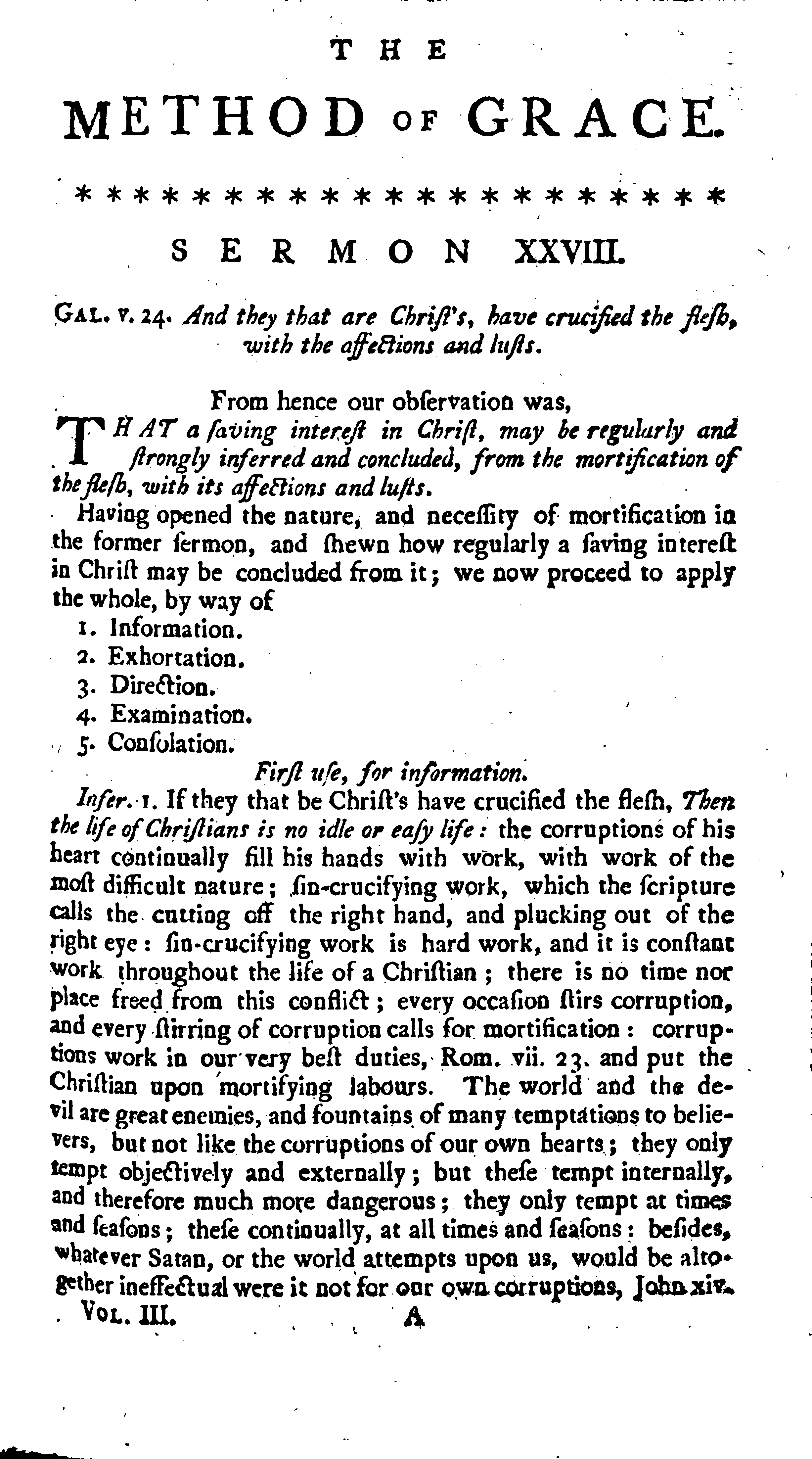
THE
METHOD OF GRACE.
** * SERMON XXVIII.
GAL.V.24. And they that are Christ's, have crucified theflesb, with the affections andlufts.
From hence our observation was, HAT afaving interest in Christ, may be regularly and theflesb, with its affections andlufts.
Havingopenedthe nature, and necessity of mortification in the former sermon, and shewn how regularly a saving interest in Christ may be concluded from it; we now proceed to apply the whole, byway of 1. Information .
2. Exhortation .
3. Direction.
4. Examination.
5. Consolation.
First use, for information.
Infer. 1. If they that be Christ's have crucified the flesh, Then the lifeofChristians is no idle or easy life : the corruptions of his heart continually fill his hands with work, with work of the most difficult nature; fin-crucifying work, which the scripture calls the cutting off therighthand, and plucking out of the right eye : fin-crucifying work is hard work, and it is constant work throughout the life of a Christian; there is no time nor place freed from this conflict ; every occasion stirs corruption, and every stirringofcorruptioncalls for mortification : corruptions work in our very best duties, Rom. vii. 23. and put the Christian upon mortifying labours. The world and the devil aregreatenemies, and fountains ofmanytemptationstobelievers, but not like the corruptions of our own hearts; they only tempt objectively and externally ; but these tempt internally, and therefore much more dangerous; they only tempt at times and seasons; these continually,at all times and seasons: besides, whatever Satan, or the world attempts upon us, would be alto. getherineffectualwere it not for our owncorruptions, Johnxiv.
VOL. III.
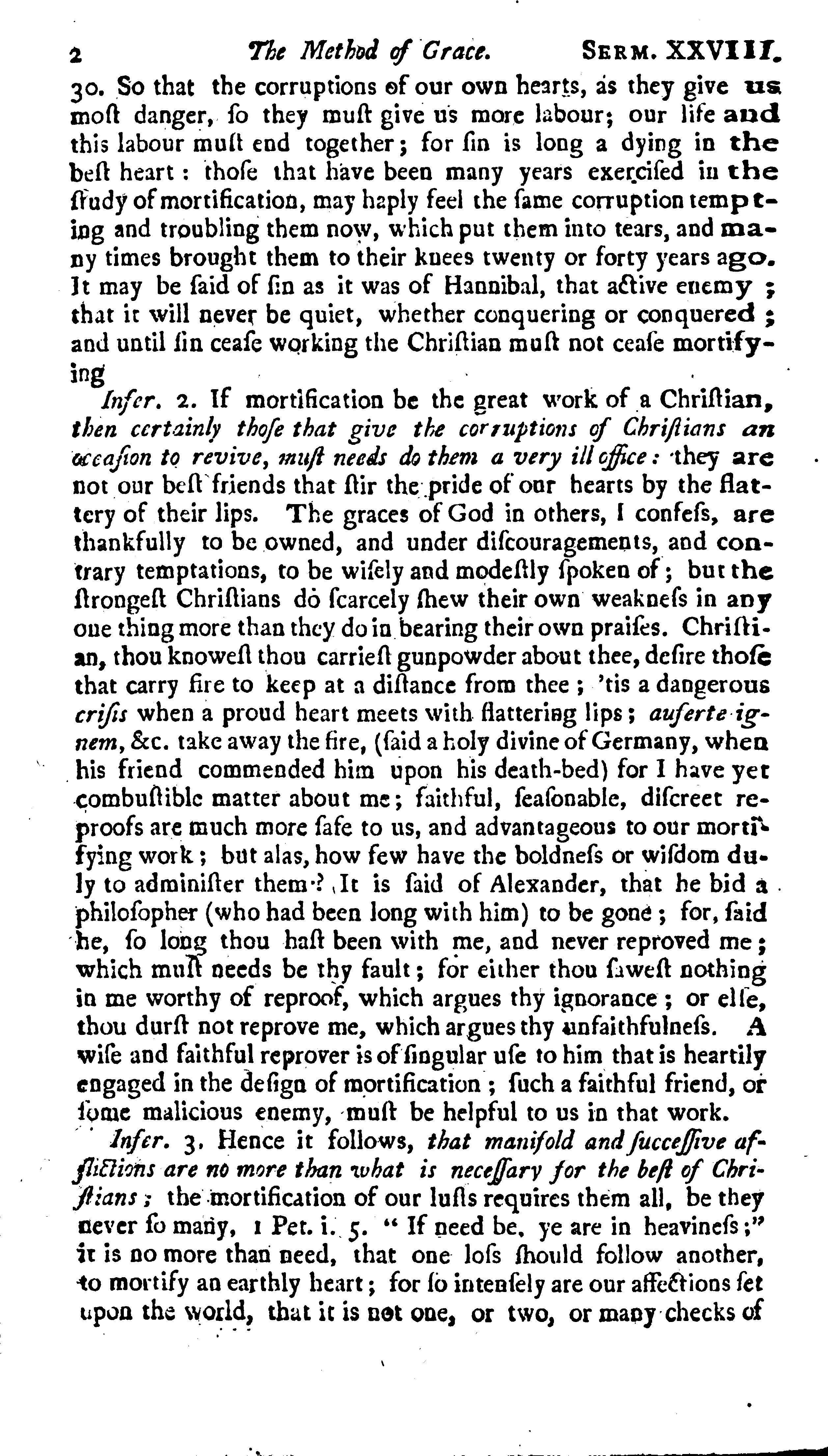
The Method of Grace.
SERM . XXVIII.
30. So that the corruptions of our own hearts, as they give us most danger, fo they must give us more labour; our life and this labour must end together; for fin is long a dying in the best heart : those that have been many years exercised in the frudyofmortification, mayhaply feel the fame corruption tempting and troublingthemnow, whichputthem into tears, and many times brought them to their knees twenty or forty years ago.
It may be said of fin as it was of Hannibal, that active enemy ; that it will never be quiet, whether conquering or conquered ; and until fin cease working the Christian must not cease mortifying
Infer. 2. If mortificationbe the great work of a Christian, then certainly those that give the corruptions of Christians an occasion to revive, must needs do them a very ill office : they are not our best friends that stir the pride of our hearts by the flattery of their lips.
The graces of God in others, I confess, are thankfully to be owned, and under discouragements, and contrary temptations, to be wisely and modestly spoken of; but the strongest Christians do scarcely shew their own weakness in any onethingmorethan they do in bearing their own praises. Christian, thouknowestthou carriestgunpowder about thee,defirethose that carry fire to keep at a distance from thee ; ' tis a dangerous crisis when a proud heart meets with flattering lips ; auferte ignem,&c. take away the fire, (said a holy divineofGermany,when his friend commended him upon his death-bed) for I have yet combustible matter about me; faithful, seasonable, discreet reproofs are much more safe to us, and advantageous to our morti fying work; but alas, how few have the boldness or wisdom duly to administer them? It is said of Alexander, that he bid a philosopher (whohadbeenlongwithhim) to be gone ; for, said the, so long thou hast been with me, and never reproved me; which must needs be thy fault; for either thou fawest nothing in me worthy of reproof, which argues thy ignorance ; or else, thoudurft notreprove me, whicharguesthy unfaithfulness. A wife and faithful reproveris offingular use to him that is heartily engagedinthedesign ofmortification; such a faithful friend, or some malicious enemy, must be helpful to us in that work.
Infer. 3. Hence it follows, that manifold andfucceffive afflictions are no more than what is necessary for the best of Chritians; the mortification of our lusts requires them all, be they never fo many, 1 Pet. i. 5. " If need be, ye are in heaviness ;" itisnomore than need, that one loss should follow another, tomortifyanearthly heart; for so intensely are our affections set upon the world, that it is not one, or two, or many checks of
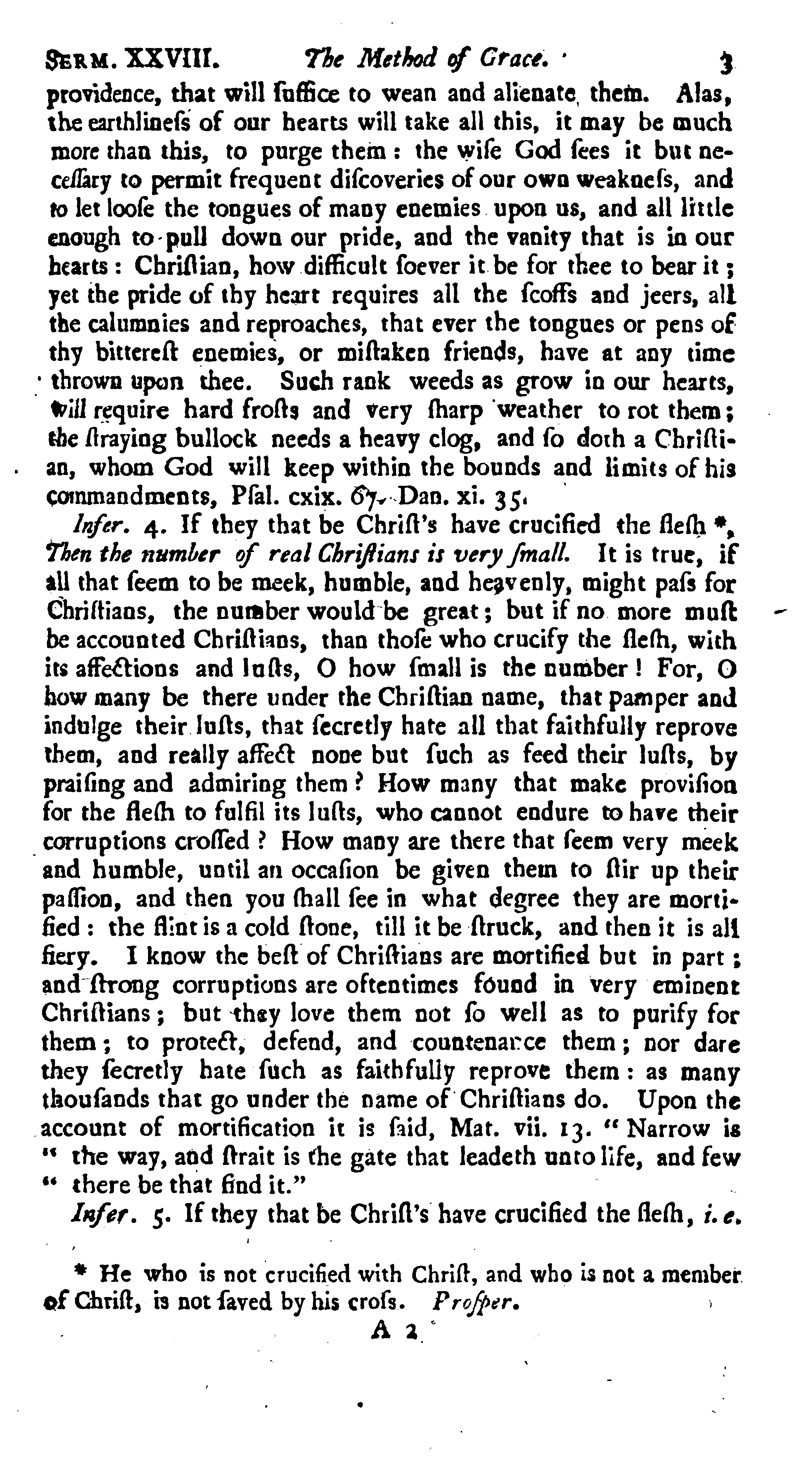
SERM . XXVIII.
The Method of Grace.
providence, that will suffice to wean and alienate them.
Alas , theearthliness of our hearts will take all this, it may be much more than this, to purge them: the wife God fees it but necessary to permit frequent discoveries of our own weakness, and toletloose the tongues of many enemies upon us, and all little enough to pull down our pride, and the vanity that is in our hearts : Christian,how difficult soever it be for thee to bear it ; yet the pride of thy heart requires all the scoffs and jeers, all thecalumnies and reproaches, that ever the tongues or pens of thy bitterest enemies, or mistaken friends, have at any time thrown upon thee.
Such rank weeds as grow in our hearts, will require hard frosts and very sharp weather to rot them; the straying bullock needs a heavy clog, and so doth a Christian, whom God will keep within the bounds and limits of his commandments, Psal. cxix. 67. Dan. xi . 35.
Infer. 4. If they that be Christ's have crucified the flesh *, Then the number of real Christians is very small.
It is true, if all that seem to be meek, humble, and heavenly, might pass for Christians, the number would be great; but if no more must be accounted Christians, than those who crucify the flesh, with its affections and lusts, O how small is the number! For, O how many be there under the Christian name, that pamper and indulge their lusts, that secretly hate all that faithfully reprove them, and really affect none but such as feed their lusts, by praising and admiring them ? How many that make provision for the flesh to fulfil its lusts, who cannot endure to have their corruptions crossed ? How many are there that seem very meek and humble, until an occasion be given them to stir up their passion, and then you shall fee in what degree they are mortified: the flint is a cold stone, till it be struck, and then it is all fiery.
I know the best of Christians are mortified but in part ; and strong corruptions are oftentimes found in very eminent
Christians; but they love them not so well as to purify for them ; to protect, defend, and countenarce them; nor dare they secretly hate such as faithfully reprove them: as many thousands thatgo under the name of Christians do.
Upon the account of mortification it is said, Mat. vii. 13. "Narrow is " the way, and strait is the gate that leadeth unto life, and few
" there be that find it."
Infer. 5. If they that be Christ's have crucified the flesh, i. e.
* He who is not crucified with Christ , and who is not a member of Christ, is not saved by his cross.
Prosper.
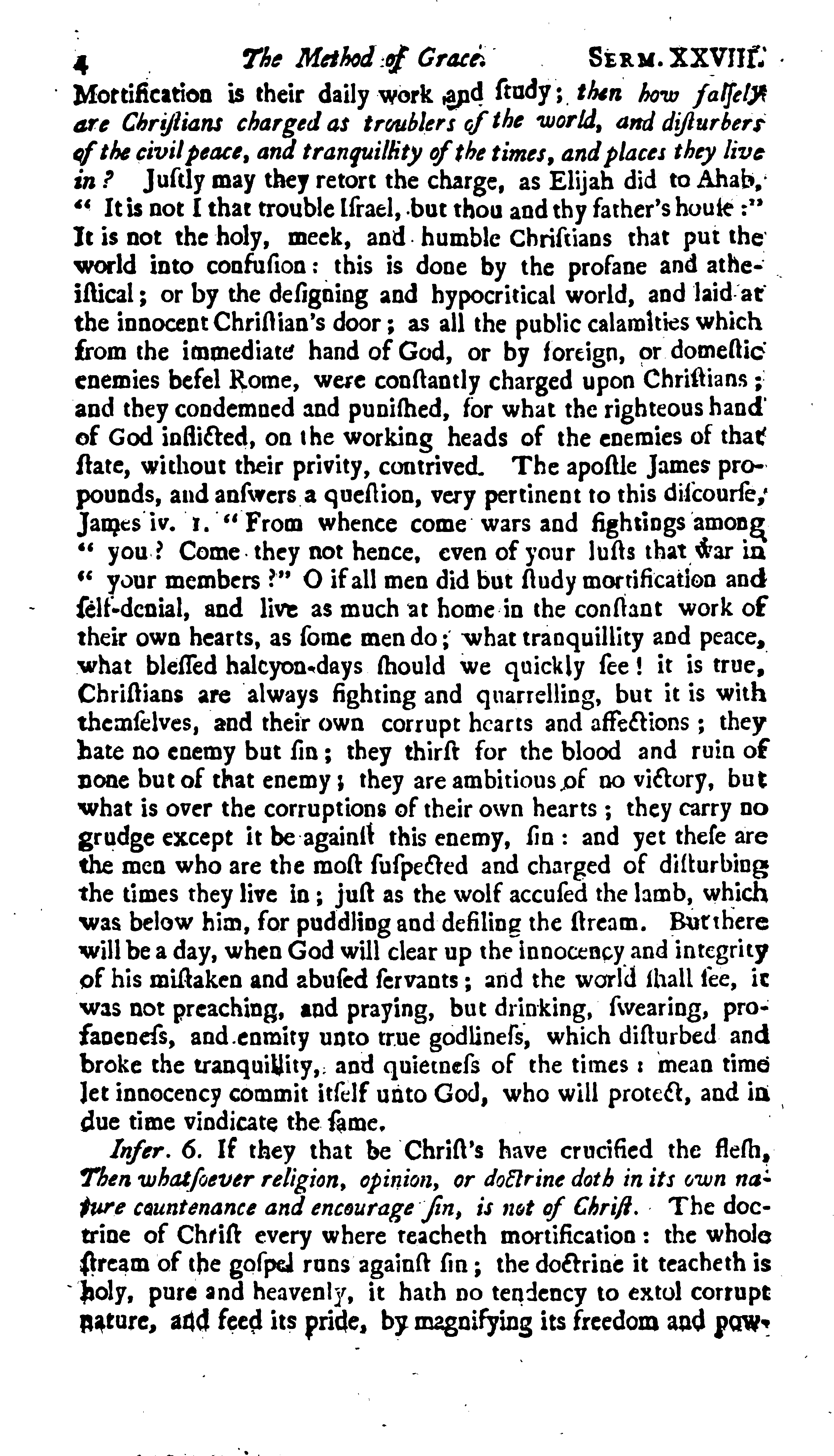
SERM . XXVIII.
The Method of Grace.
Mortification is their daily work and study; then how falsely are Christians charged as troublers of the world, anddisturbers of the civil peace, and tranquillity of the times, and places they live in?
Justlymaythey retort the charge, as Elijah did toAhab, " It is not I that trouble Israel, but thou and thy father'shouse :"
It is not the holy, meek, and humble Christians that put the world into confusion: this is done by the profane and atheiftical; or by the designing and hypocritical world, and laid at the innocent Christian's door ; as all the public calamities which from the immediate hand of God, or by foreign, or domestic enemies befel Rome, were constantly charged upon Christians ; andtheycondemnedandpunished, for what therighteoushand of God inflicted, on the working heads of the enemies of that state, without their privity, contrived.
The apostle James propounds, and answers a question, very pertinent to this discourse,
James iv. 1. " From whence come wars and sightings among 66 you ? Come they not hence, even of your lusts that war in " your members ?" O if all mendidbut studymortification and self-denial, and live as much at home in the constant work of their own hearts, as some men do; what tranquillity and peace, what blessed halcyon-days should we quickly see! it is true,
Christians are always fighting and quarrelling, but it is with themselves, and their own corrupt hearts and affections ; they hate no enemy but fin ; they thirst for the blood and ruin of none but of that enemy ; they are ambitious of no victory, but what is over the corruptions of their own hearts ; they carry no grudge except it be against this enemy, fin: and yet these are the men who are the most suspected and charged of disturbing the times they live in; just as the wolf accused the lamb, which was below him, for puddling and defiling the stream. But there willbeaday, when God will clear up the innocencyand integrity of his mistaken and abused servants ; and the world shall fee, it was not preaching, and praying, but drinking, swearing, profaneness, and enmity unto true godliness, which disturbed and broke the tranquillity, and quietness of the times : meantime letinnocencycommit itselfuntoGod, who will protect, and in due time vindicate the fame .
Infer. 6. If they that be Christ's have crucified the flesh, Then whatsoever religion, opinion, or doctrine doth in its own nasure countenance and encouragefin, is not of Christ.
The doctrine of Christ every where teacheth mortification : the whole stream of the gospel runs against sin; the doctrine it teacheth is holy, pure and heavenly, it hath no tendency to extol corrupt nature, and feed its pride, by magnifying its freedom andpow
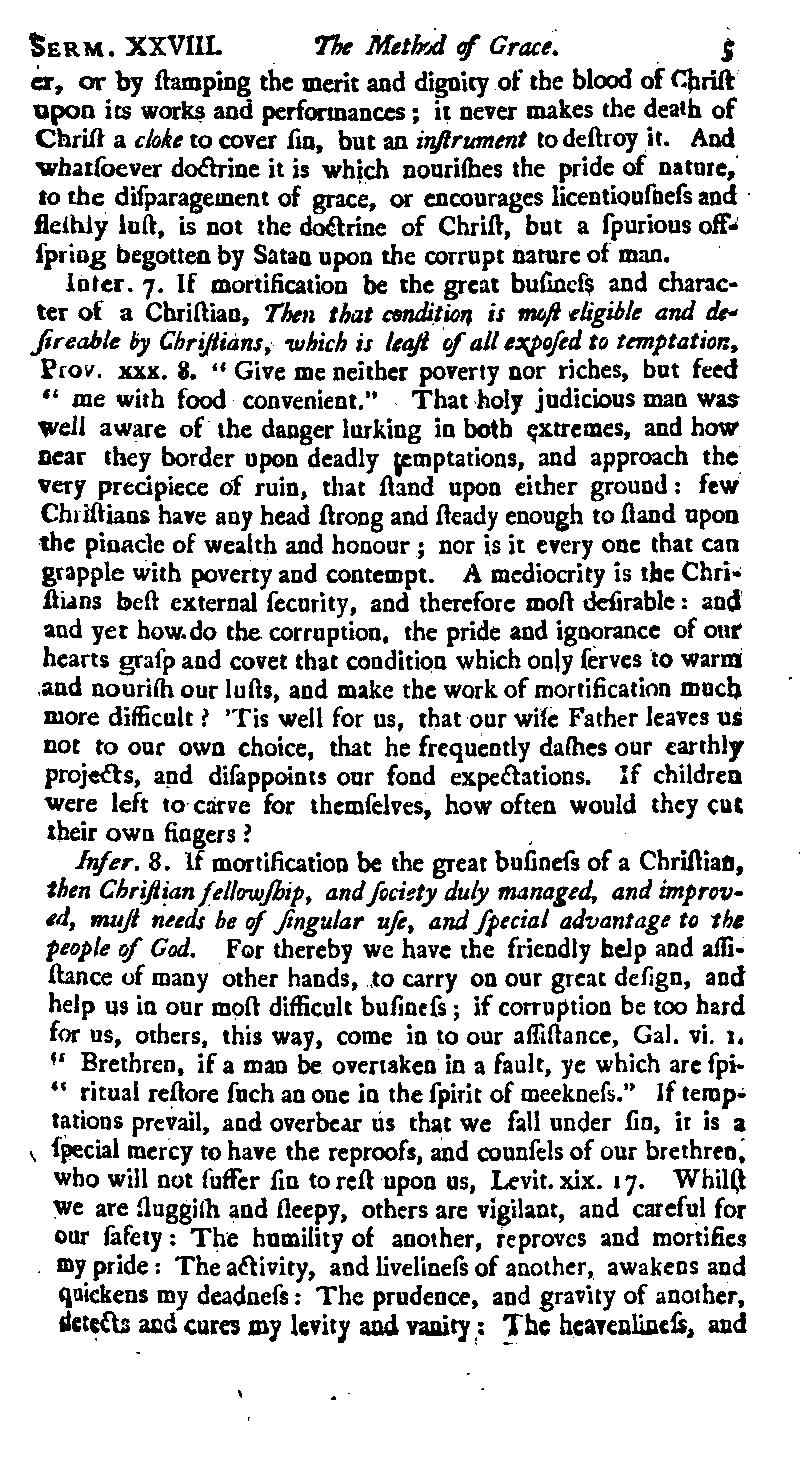
SERM . XXVIII.
The Method of Grace. er, or by stamping the merit and dignity of the bloodofChrift upon its works and performances; it never makes the death of Christ a cloke to cover sin, but an instrument to destroy it. And whatsoever doctrine it is which nourishes the pride of nature, to the disparagement of grace, or encourages licentiousnessand flethly lust, is not the doctrine of Christ, but a spurious offspring begotten by Satanuponthe corrupt natureofman.
Inter. 7. If mortification be the great business and character of a Christian, Then that condition is most eligible and defireable by Christians, which is least ofallexposedto temptation,
Prov. xxx. 8. " Give me neither poverty nor riches, but feed " me with food convenient."
That holy judicious man was well aware of the danger lurking in both extremes, and how near they border upon deadly temptations, and approach the very precipiece of ruin, that stand upon either ground : few
Christians have any head strong and steady enough to stand upon the pinacle of wealth and honour; nor is it every one that can grapple with poverty and contempt. A mediocrity is the Christians best external security, and therefore most desirable : and andyethowdo the corruption, the pride and ignorance of our hearts grafpand covetthat condition which only serves to warm and nourish our lusts, and make the work of mortification much more difficult ?
'Tis well for us, that our wife Father leaves us not to our own choice, that he frequently dashes our earthly projects, and disappoints our fond expectations.
If children were left to carve for themselves, how often would they cut their own fingers ?
Infer. 8. If mortificationbe the great business of a Christian, then Chriftianfellowship, andsocietydulymanaged, and improved, must needs be offingular use, and special advantage to the people of God.
For thereby we have the friendly help and assistance of many other hands, to carry on our great design, and help us in our most difficult business; if corruption be too hard for us, others, this way, come into our assistance, Gal. vi. 1 .
" Brethren, if am an be overtaken in a fault, ye which are spi- " ritual restore such an one in the spirit ofmeekness."
If temptations prevail, and overbear us that we fall under fin, it is a special mercy to have the reproofs, and counsels of our brethren, who will not suffer fin to rest upon us, Levit.xix. 17.
Whilst we are sluggish and sleepy, others are vigilant, and careful for our safety : The humility of another, reproves and mortifies my pride : The activity, and liveliness of another, awakens and quickens mydeadness: The prudence, and gravity of another, detects and cures mylevityandvanity: The heavenliness, and
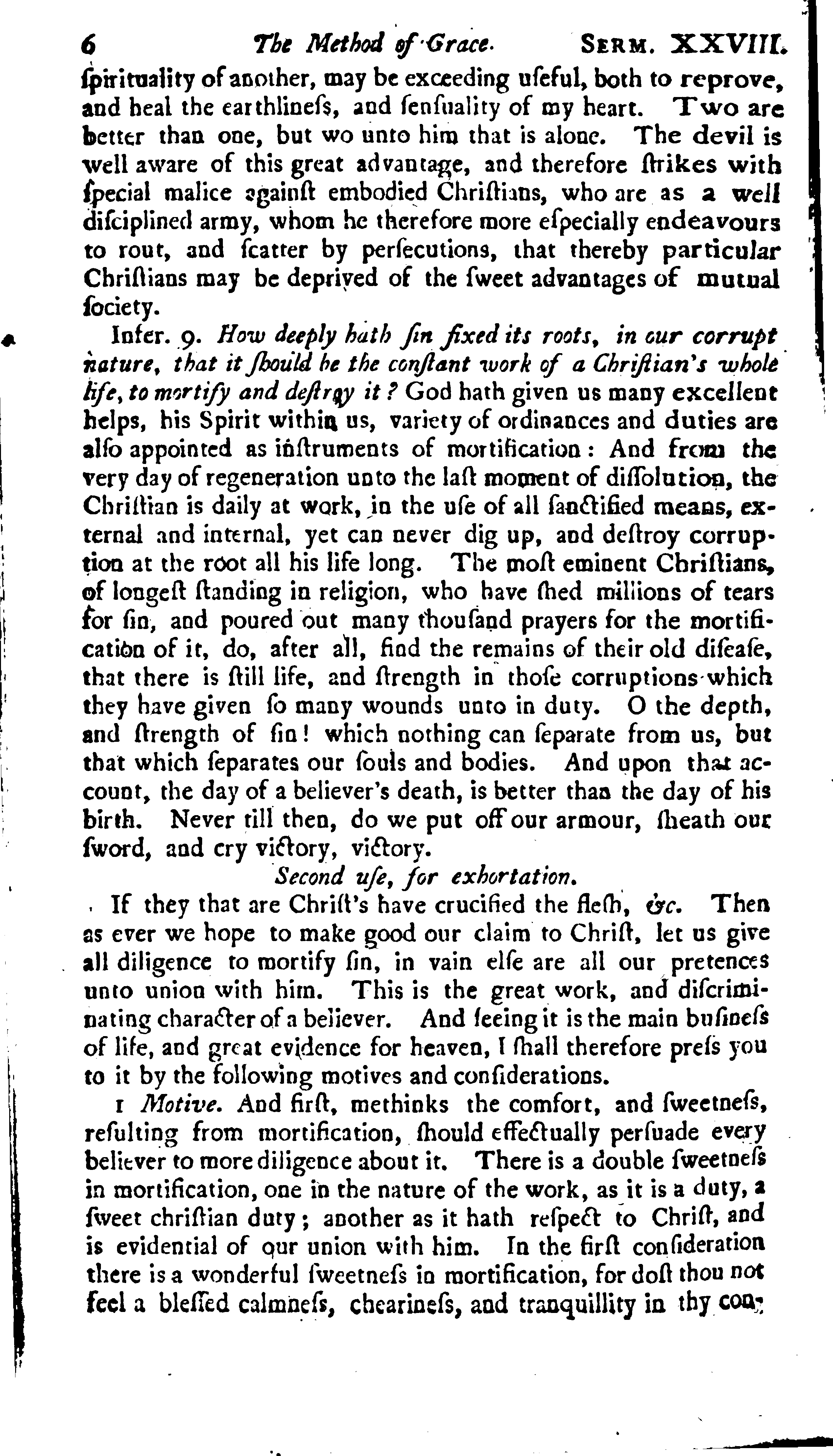
SERM . XXVIII.
The Method of Grace. spirituality of another, maybe exceeding useful,both to reprove, and heal the earthliness, and sensuality of my heart. Two are better than one, but wo unto him that is alone. The devil is well aware of this great advantage, and therefore strikes with special malice against embodied Christians, who are as a well disciplined army, whom he therefore more especially endeavours to rout, and scatter by perfecutions, that thereby particular
Christians may be deprived of the sweet advantages of mutual society.
Infer. 9. How deeply hath fin fixed its roots, in our corrupt nature, that it should be the constant work of a Christian's whole life, tomortify and destroy it ?Godhathgiven us many excellent helps, his Spirit within us, variety of ordinances and duties are also appointed as instruments of mortification: And from the verydayofregeneration unto the last momentofdiffolution, the Christian is daily at work, in the use of all sanctified means, external and internal, yet can never dig up, and destroy corruption at the root all his life long.
The most eminent Christians, of longest standing in religion, who have shed millions of tears i for fin, and poured out many thousand prayers for the mortification of it, do, after all, find the remains of their old disease, that there is still life, and strength in those corruptions which they have given so many wounds unto in duty. O the depth, and strength of fin! which nothing can separate from us, but that which separates our souls and bodies. And upon that account, the day of a believer's death, is better than the day of his birth. Never till then, do we put of four armour, sheath our sword, and cry victory, victory.
Second use, for exhortation.
If they that are Christ's have crucified the flesh , &c.
Then as ever we hope to make good our claim to Christ, let us give all diligence to mortify sin, in vain else are all our pretences unto union with him.
This is the great work, and discriminating characterofabeliever. Andfeeingit isthemainbusiness of life, and great evidence for heaven, I shall therefore press you to it by the following motives and considerations.
I Motive. And first, methinks the comfort, and sweetness, resulting from mortification, should effectually persuade every believer tomorediligence about it.
There is a double sweetness inmortification,one in the nature of the work, as it is a duty, a sweet christian duty; another as it hath respect to Christ, and is evidential of our union with him.
In the first consideration there is a wonderful sweetness in mortification, for dost thou not feel a blessed calmness, cheariness, and tranquillity in thy con,
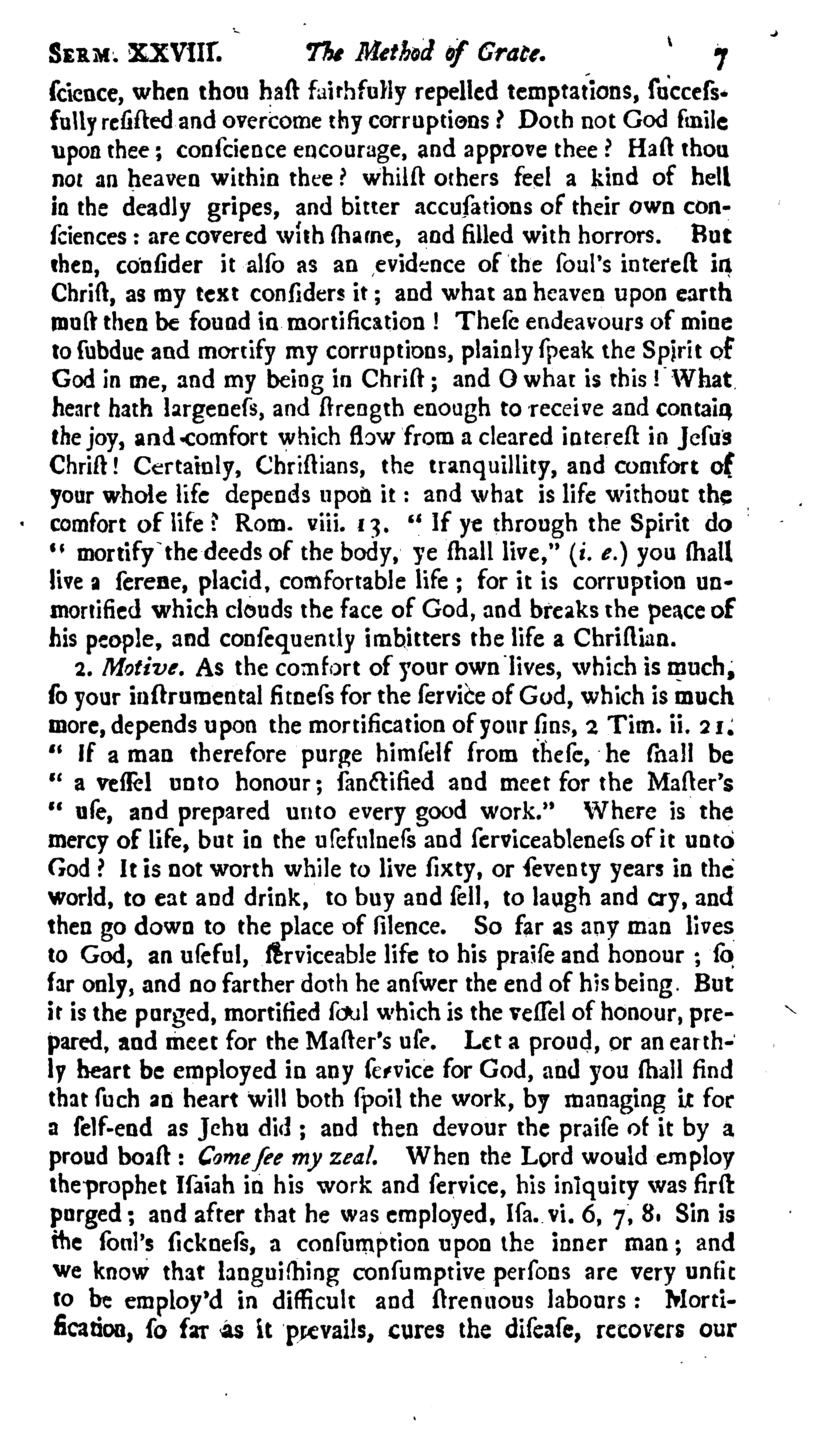
SERM . XXVIII.
The Method of Grace.
science, when thou hast faithfully repelled temptations, fuccessfullyrefiftedandovercomethy corruptions ? Doth not God fimile upon thee; conscience encourage, and approve thee ? Hast thou not an heaven within thee ? whilst others feel a kind of hell in the deadly gripes, and bitter accusations of their own consciences : a recovered with shame, and filled with horrors.
But then, confider it also as an evidence of the soul's interest in Christ, as my text confiders it; and what an heaven upon earth mustthenbe found in mortification ! These endeavours of mine tofubdueandmortifymy corruptions, plainly speak the Spirit of God in me, and my being in Christ; an dO what is this ! What heart hath largeness, and strength enough to receive and contain the joy, and comfort which flow from a cleared interest in Jesus
Christ ! Certainly, Christians, the tranquillity, and comfort of your whole life depends upon it: and what is life without the comfort of life ? Rom. viii. 13. " Ifye through the Spirit do
" mortify the deeds ofthebody, ye shall live," (i. e.) you shall live a serene, placid, comfortable life; for it is corruption unmortified which cloudstheface of God, and breaks the peace of his people, and consequently imbitters the life a Christian.
2. Motive. As the comfort of your own lives, which is much, so your instrumental fitness for the service of God, which is much more,depends upon the mortification of your fins, 2 Tim. ii. 21 .
" If am an therefore purge himself from these, he snall be a vessel unto honour ; sanctified and meet for the Master's
" use, and prepared unto every good work."
Where is the mercy of life, but in the usefulness and serviceableness of it unto God? It is not worth while to live sixty, or seventy years in the world, to eat and drink, to buy and fell, to laugh and cry, and thengodown to the place of silence. So far as any man lives to God, an useful, serviceable life to his praise and honour ; fo far only, and no farther doth he answer the end of his being . But it is the purged, mortified foul which is the vessel ofhonour, prepared, and meet for the Master's use.
Leta proud, or an earthly heart be employed in any service for God, and you shall find that such an heart will both spoil the work, by managing it for a self-end as Jehu did; and then devour the praise of it by a proud boast : Come fee my zeal.
When the Lord would employ the prophet Ifaiah in his work and service, his iniquity was first purged; and after that he was employed, Ifa. vi . 6, 7, 8. Sin is the soul's sickness, a consumption upon the inner man ; and we know that languishing confumptive persons are very unfit to be employ'd in difficult and strenuous labours :
Mortification, fo far as it prevails, cures the disease, recovers our
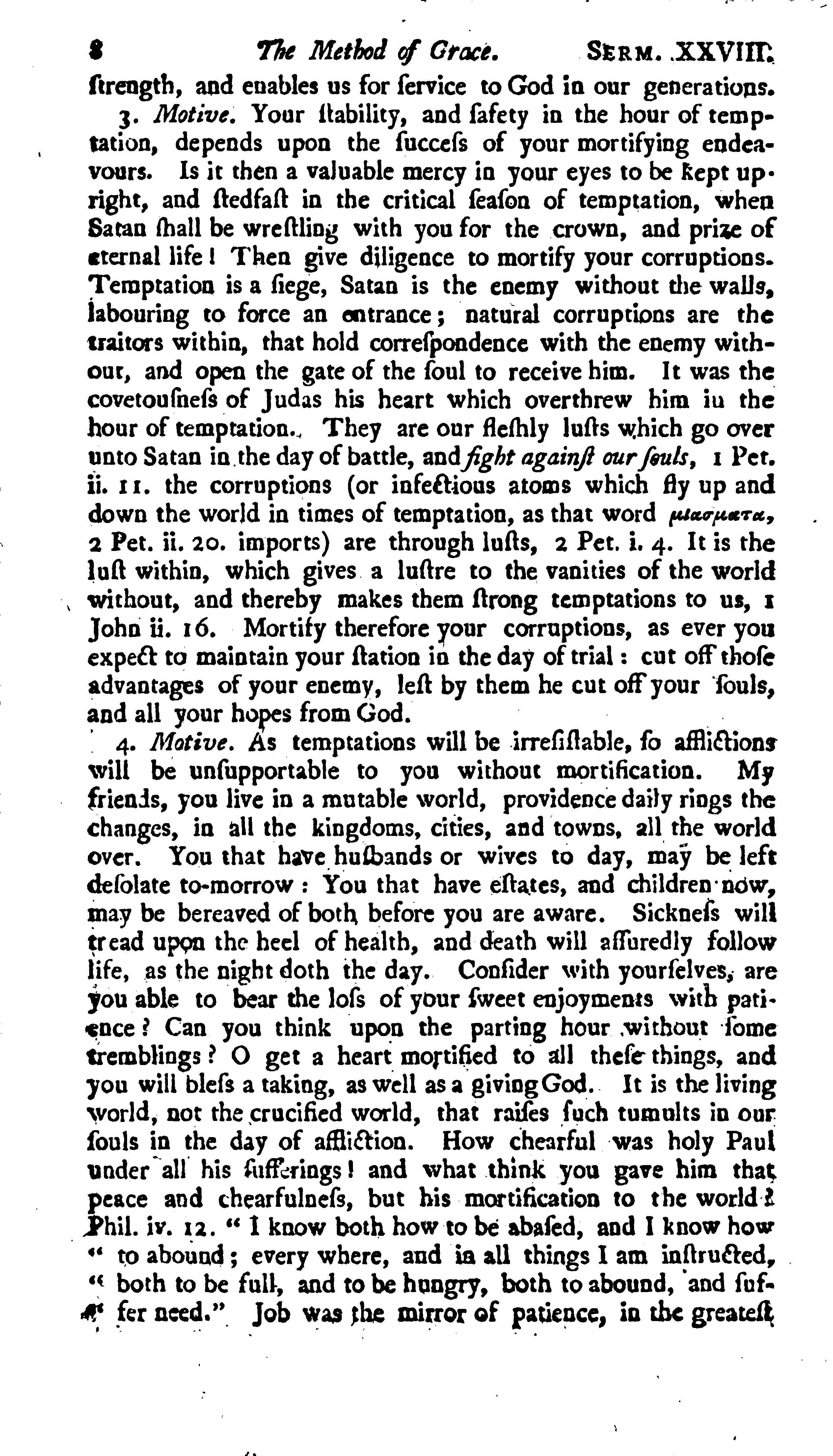
SERM . XXVIII.
The Method of Grace. strength, and enables us for service to God in our generations.
3. Motive. Your stability, and safety in the hour of temptation, depends upon the success of your mortifying endeavours.
Is it then a valuable mercy in your eyes to be kept up . right, and stedfast in the critical season of temptation, when
Satan shall be wresthng with you for the crown, and prize of eternal life ! Then give diligence to mortify your corruptions.
Temptation is a siege, Satan is the enemy without the walls, labouring to force an entrance; natural corruptions are the traitors within, that hold correspondence with the enemy without, and open the gate of the soul to receive him.
It was the covetousness of Judas his heart which overthrew him iu the houroftemptation. They are our fleshly lusts which go over untoSatan in the day of battle, and fight against ourfouls, I Pet. ii. 11. the corruptions (or infectious atoms which fly up and down the world in times of temptation, as that word μιασματα,
2 Pet. ii. 20. imports) are through lusts, 2 Pet. i. 4. It is the lust within, which gives a lustre to the vanities of the world without, and thereby makes them strong temptations to us, I John ii . 16.
Mortify therefore your corruptions, as ever you expect to maintain your station in the day of trial : cut off those advantages of your enemy, lestby them he cut off your fouls, and all your hopes from God.
4. Motive. As temptations will be irresistable, fo afflictions will be unsupportable to you without mortification.
My friends, you live in amutable world, providence daily rings the changes, in all the kingdoms, cities, and towns, all the world over.
You that have husbands or wives to day, may be left desolate to-morrow : You that have estates, and children now, maybe bereaved of both before you are aware .
Sickness will tread upon the heel of health, and death will assuredly follow life, as the night doth the day.
Confider with yourselves, are you able to bear the loss of your sweetenjoyments with patience ? Can you think upon the parting hour without some tremblings ? O get a heart mortified to all these things, and you will bless a taking, as well as a giving God.
It is the living world, not the crucified world, that raises such tumults in our souls in the day of affliction. How chearful was holy Paul under all his sufferings ! and what think you gave him that peace and chearfulness, but his mortification to the world?
Phil. iv. 12. " I know both how to be abased, and I know how to abound; every where, and in all things I am instructed,
"both to be full, and to be hungry, both to abound, and fuf- " fer need."
Job was the mirror of patience, in the greatest
SERM . XXVIII.
The Method of Grace. shock of calamity, and what made him so, but the mortifiedness of his heart, in the fullest enjoyment of all earthly things ? Job xxxi. 25.
5. Motive. The reputation, and honour of religion, is deeply concerned in the mortification of the professors of it: For unmortified professors will, first or last, be the scandals, and reproaches of it.
The profession of religion may give credit to you, but to be sure you will never bring credit to it. All the scandals, and reproaches that fall upon the name of Christ in this world, flow from the fountain of unmortifiedcorruption.
Judas and Demas, Hymeneus and Philetus, Ananias and Saphiraruined themselves, and became rocks of of fence to others, by this means.
If ever you will keep religion sweet, labour to keep your hearts mortified and pure.
6. Motive. To conclude, what hard work will you have in your dying hour, except yougetaheart inortified to this world, and all that is in it ? Your parting hour is like to be a dreadful hour, without the help of mortification.
Your corruptions, like glew, fasten your affections to the world, and how hard will it be for such am an to be separated by death ? O what a bitter, and doleful parting have carnal hearts from carnal things ! whereas the mortified foul can receive the messengers of death
without trouble, and as chearfully put off the body at death, as am an doth his cloaths at night : Death need not pullandhale ; such a mangoes half way to meet it, Phil. i. 23. " I desire to " be dissolved, and to be with Christ, which is far better."
Christian, wouldst thou havethydeath-bed foftandeasy ; wouldst thou have an ευθανασια, as the philosopher desired for himself, an easy death, without pain or terror ; then get a mortified heart : the chirurgeon's knife is scarce felt, when it cuts off a mortified member.
Third use, for direction.
Are you convinced, and fully satisfied of the excellency and necessity of mortification, and inquisitive after the means, in the use whereof, it may be attained? then, for your help and encouragement, I will, in the next place, offer my best assistance, in laying down the rules for this work.
Rule 1. I fever you will succeed, and prosper in the work of mortification, then get, and daily exercise more faith.
Faith is the great instrument of mortification : "This is the victory, (or " sword by which the victory is won, the instrument) by which " you overcome the world, even your faith," 1 John v. 4.
By faith alone eternal things are discovered to your souls, in
VOL . III.
The Method of Grace.
SERM . XXVIIL
their reality and excelling glory, and these are the preponderating things, for the sake whereof, self-denial and mortification becomes easy to believers; by opposing things eternal to things temporal, we resist Satan, 1 Pet. v. 8.
This is the shield by which we quench the fiery darts of the wicked one, Eph. vi. 16.
Rule 2. Walk in daily communion with God, if ever you will mortify the corruptions of nature; that is the apostle'sownprescription, Gal. i. 16. " This I say then, walk in the Spirit,
" and ye shall not fulfil the lusts of the flesh."
Spiritual and frequent communion with God, gives manifold advantages for the mortification of fin : as it is a bright glass wherein the ho liness of God, and the exceeding finfulness of fin, as it is opposite thereunto, are most clearly and sensibly discovered, than which, scarce anything can set akeeneredge of indignation upon the spirit ofamanagainst sin.
Besides, all communion with God is assimilating,and transformative of the soul into his image; it leaves also a heavenly relish and savour upon the soul ; itdarkens the lustre and glory of all earthly things, by presenting to the soul a glory which excelleth : it marvellously improves,and more deeply radicates sanctification in the soul; by all which means it becomes fingularlyuseful and successful in the work of mortification .
Rule 3. Keep your consciences under the awe and in the fear of God continually, as ever you hope to be successful in the mortification of fin. The fearofGod is the great preservative from fin, without which all the external rules and helps in the world signify nothing: " By the fear of the Lord, men depart from " evil," Prov. xvi. 6. Not only from external and more open evils, which the fear of men, as well as the fear of God, may prevent, but from the most secret and inward evils, which is a special part of mortification, Lev. xix. 14.
It keeps men from those evils, which no eye nor ear of man can possibly discover.
The fear of the Lord breaks temptations,baited with pleasure, with profit, and with secrecy.
In a word, i fever you be cleanfedfrom allfilthiness of flesh and spirit, it must be by the fear of God, 2 Cor. vii. 1.
* Rule 4. Study the vanity of the creature, and labour to get true notions of the emptiness and tranfitoriness thereof; if * Readers, if ever you would have a true fight of the emptiness and vanity of the creature, and get a mortified heart to the world, now is the time ; for at this day the providence of God hath withered all the fading flowers of earthly delights, and shewed you the world'sback parts, as it is departing from you.
SERM . XXVIII.
The Method of Grace. rf ever you will attain to the mortification of your affections to. wards it.
It is the false picture and image of the world, in our fancy, that crucifies us with somanycares,fears and sollicitudes about it: and it is the true picture and image of the world, represented to us, in the glass of the word, which greatly helps to crucify our affections to the world. O if we did but know and believe three things about the world, we should never be so fond of it as we are, viz. the fading, defiling, and destroying nature of it.
The best and sweetest enjoyments of the world, are but fading flowers and withered grass, Ifa. xiv. 6. James is
10, 11. yea, it is ofa defiling, as well as a fading nature, i John v. 19. it lies in wickedness, it spreads universal infection among all mankind, 2Pet. i. 4. yea, it destroys, as well as defiles multitudes of fouls, drowning men inperdition, I Tim. vi. 9. Millions of fouls will wish, to eternity, they had never known the riches, pleasures, or honours of it.
Were this believed, how would men flacken their pace, and cool themselves in the violent and eager pursuit of the world ! This greatly tends to promote mortification.
Rule 5. Be careful to cutoff all the occasions of fin, and keep at the greatest distance from temptations, if ever you will mortify the deeds of the body: The success, and prevalency of fin, mainly depends upon the wiles, and stratagems it makes use of, to ensnare the incautious foul ; therefore the apostle bids us keep off, at the greatest distance.
1 Thef. v. 22. "Abstain " from all appearances of evil." Prov. viii. 8. " Come not nigh
" unto the door of her house."
He that dares venture to the very brink of fin, discovers but little light in his understanding, and less tenderness in his conscience ; he neither knows fin, nor fears it, as he ought to do: And it isusualwithGod to chastise self-confidence, by shameful lapses into fin.
Rule 6. If you will successfully mortify the corruptions of your nature, never engage against them in your own single strength, Eph. vi. 10. When the apostle draws forth Christians into the field, against sin, he bids them " be strong in the " Lord, and in the power of his might." O remember what a mere feather thou art, in the gusts of temptation; call to mind the height of Peter's confidence, " though allmen forsake thee,
" yet will not I;" and the depth of his fall, shame and sorrow.
A weak Christian,tremblinginhimself, depending by faith, upon God, and graciously assisted by him, shall be able to stand, against the shock of temptation, when the bold, and confident
The Method of Grace.
SERM . XXVIIY,
resolutions of others (like Pendleton in our English story) shall melt away, as wax before the flames .
Rule 7. Set in with the mortifying design of God, in the day of thine affliction; sanctified afflictions are ordered, and prescribed in heaven, for the purging of our corruptions. Ifa. xxvii.
9. " By this, therefore, shall the iniquity of Jacob be purged, " and this is all the fruit, to take away his fin."
It is a fair. glass to represent the evil of fin, and the vanity of the creature, to imbitter the world, and disgust thy affections toward it : Fall in, therefore, with the gracious design of God ; follow every affliction with prayer, that God would follow it with his bletfing. God kills thy comforts, out of no other design but to kill thy corruptions with them ; wants are ordainedtokillwantonness, poverty is appointed to kill pride, reproaches are permitted to pull down ambition : Happy is the man who understands, approves, and heartily sets in with thedesignofGod, in such afflicting providences.
Rule 8. Bend the strength of your duties, and endeavours, against your proper, and special sin ; it is in vain tolop off branches, whilst this root of bitterness remains untouched : This was David's practice, Psal. xviii. 23. " I was, also, upright be- " fore him, and I kept myself from mine iniquity."
We observe, in natural men, that one faculty is more vigorous than another ; we find, in nature, thatone foil suits with some forts of feed, rather than another : And every believer may find his nature, and constitution, inclining him to one fin, rather than another : As graces, socorruptions exceed one another, even in the regenerate.
The power of special corruptions arises from our constitutions, education, company, custom, callings, and such likeoccafions ; but from whencefoever it comes, this is the sin that most endangers us, most easily besets us ; and, according to the progress of mortification in that sin,we may safely estimate the degrees of mortification in other fins : Strike, therefore, at the life, and root of your own iniquity.
Rule 9. Study the nature, and great importance of those things which are to be won, or loft, according to the success, and issue of this conflict : Your life is a race, eternal glory is the prize, grace and corruption are the antagonists, and, accordingly as either finally prevails, eternal life is won, or loft .
1 Cor. ix. 24. "Know ye not that they which run in a race, run all, " but one receiveth the prize ? So run that ye may obtain."
This condition will make mortification appear the most rational, and necessary thing to you, in the whole world.
Shall I lose heaven for indulging the flesh, and humouring a wanton appe
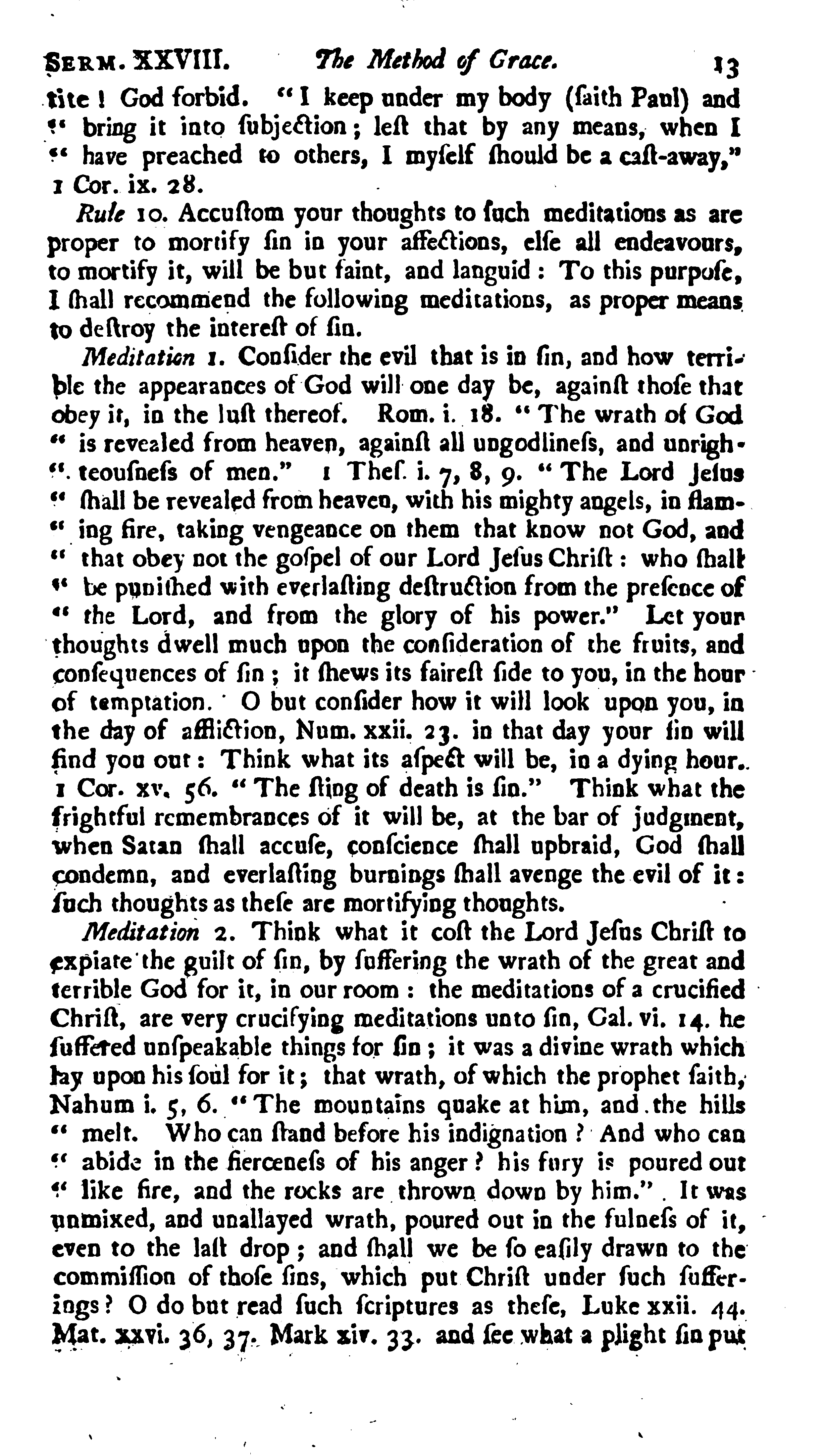
SERM. XXVIII.
The Method of Grace. tite! God forbid.
" I keep under my body (faith Paul) and " bring it into subjection; left that by any means, when I " have preached to others, I myself should be a cast-away,"
1 Cor . ix. 28.
Rule 10. Accustom your thoughts to such meditations as are proper to mortify sin in your affections, else all endeavours, tomortify it, will be but faint, and languid : To this purpose,
I shall recommend the following meditations, as proper means to destroy the interest of fin.
Meditation 1. Consider the evil that is in fin, and how terrible the appearances of God will one day be, against those that obey it, in the lust thereof.
Rom. i. 18. " The wrath of God " is revealed from heaven, against all ungodliness, and unrigh .
". teousness of men."
1 Thef. i. 7, 8 , 9. " The Lord Jesus " shall be revealedfromheaven, with his mighty angels, in flaming fire, taking vengeance on them that know not God, and " that obey not the gospel of our Lord Jesus Christ : who shall
" be punished with everlasting destruction from the presence of " the Lord, and from the glory of his power."
Let your thoughts dwell much upon the consideration of the fruits, and confequencesof fin; it shews its fairest side to you, in the hour of temptation. O but confider how it will look upon you, in the day of affliction, Num. xxii. 23. in that day your fin will find you out : Think what its aspect will be, ina dying hour..
1 Cor. xv. 56. " The sting of death is sin."
Think what the frightful remembrances of it will be, at the bar of judginent, when Satan shall accuse, conscience shall upbraid, God shall condemn, and everlasting burnings shall avenge the evil of it : such thoughts as these are mortifying thoughts.
Meditation 2. Think what it cost the Lord Jesus Christ to expiate the guilt of fin,by suffering the wrath of the great and terrible God for it, in our room : the meditations ofa crucified
Christ, are very crucifying meditations unto sin,Gal. vi. 14. he suffered unspeakable things for fin ; it was a divine wrath which layuponhisfoul for it; that wrath, of which the prophet faith,
Nahum i. 5, 6. " The mountains quake at him, and the hills " melt. Who can stand before his indignation ? And who can
" abide in the fierceness of his anger ? his fury is poured out " like fire, and the rocks are thrown down by him.". It was unmixed, and unallayed wrath, poured out in the fulness of it, even to the last drop; and shall we be so easily drawn to the commission of those sins, which put Christ under such sufferings ? O do but read such scriptures as these, Luke xxii. 44.
Mat. xxvi. 36, 37. Mark xiv. 33. and seewhata plight finput
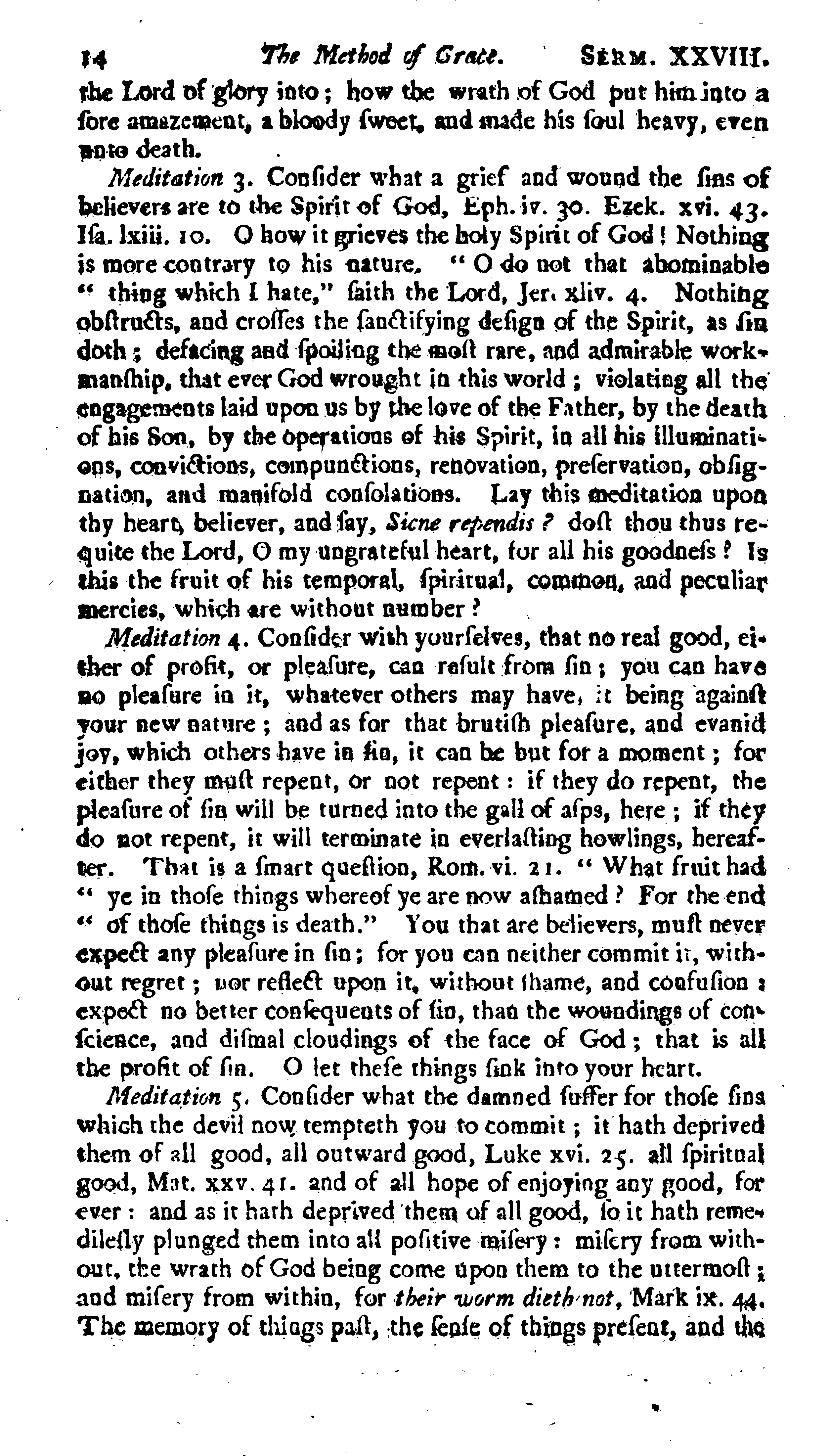
SERM . XXVIII.
The Method of Grace. the Lordofglory into; how the wrath of God puthimintoa fore amazement, a bloody sweet, and made his soul heavy, even unto death.
Meditation 3. Confider what a grief and wound the sins of believers are to the Spirit of God, Eph.iv. 30. Ezek. xvi . 43 .
Ifa. Ixiii. 10. O howitgrieves the holy Spirit of God ! Nothing is more contrary to his nature, " O do not that abominable
" thing which I hate," saith the Lord, Jer.xliv. 4.
Nothing obstructs, and crosses the fanctifying design of the Spirit, as fin doth; defacing and spoiling the most rare, and admirable workmanship, that everGodwrought in this world ; violating all the engagements laid upon us by the love of the Father, by the death of his Son, by the operations of his Spirit, in all his illuminations, convictions, compunctions, renovation, preservation, obfignation, and manifold confolations.
Lay this meditation upon thy heart, believer, and say, Sicne rependis ? dost thou thus requite the Lord, Omy ungrateful heart, for all his goodness ? Is this the fruit of his temporal, spiritual, common, and peculiar mercies, which are without number ?
Meditation 4. Consider with yourselves, that no real good, either of profit, or pleasure, can result from fin ; you can have no pleasure in it, whatever others may have, it being against yournewnature; and as for that brutith pleasure, and evanid joy, which others have in fin, it can be but for a moment ; for either they must repent,or not repent: if they do repent, the pleasure of finwill be turned into the gallofafps, here ; if they do not repent, it will terminate in everlasting howhngs, hereafter.
That is a smart question, Rom. vi. 21. " What fruit had ye in those things whereofyeare now ashamed ? For the end
" of those things is death."
You that are believers, must never expect any pleasure in sin; for you can neither commit it, without regret ; nor reflect upon it, withoutthame, and confusion : expect no betterconsequents of fin, than the woundings of con science, and dismal cloudings of the face of God ; that is all the profit off in. O let these things fink into your heart.
Meditation 5. Consider what the damned suffer for those fins which the devil nowtempteth you to commit; it hath deprived them of all good, all outward good, Luke xvi. 25. all spiritual good, Mat. xxv . 41. and of all hope of enjoying any good, for ever: and as it hath deprived them of all good, so it hath remedileslyplungedthem into all positive misery : misery from without, the wrath of God being come upon them to theuttermost ; and misery from within, for their worm dieth not, Mark ix. 44.
The memory of things past, the sense ofthingspresent, and the
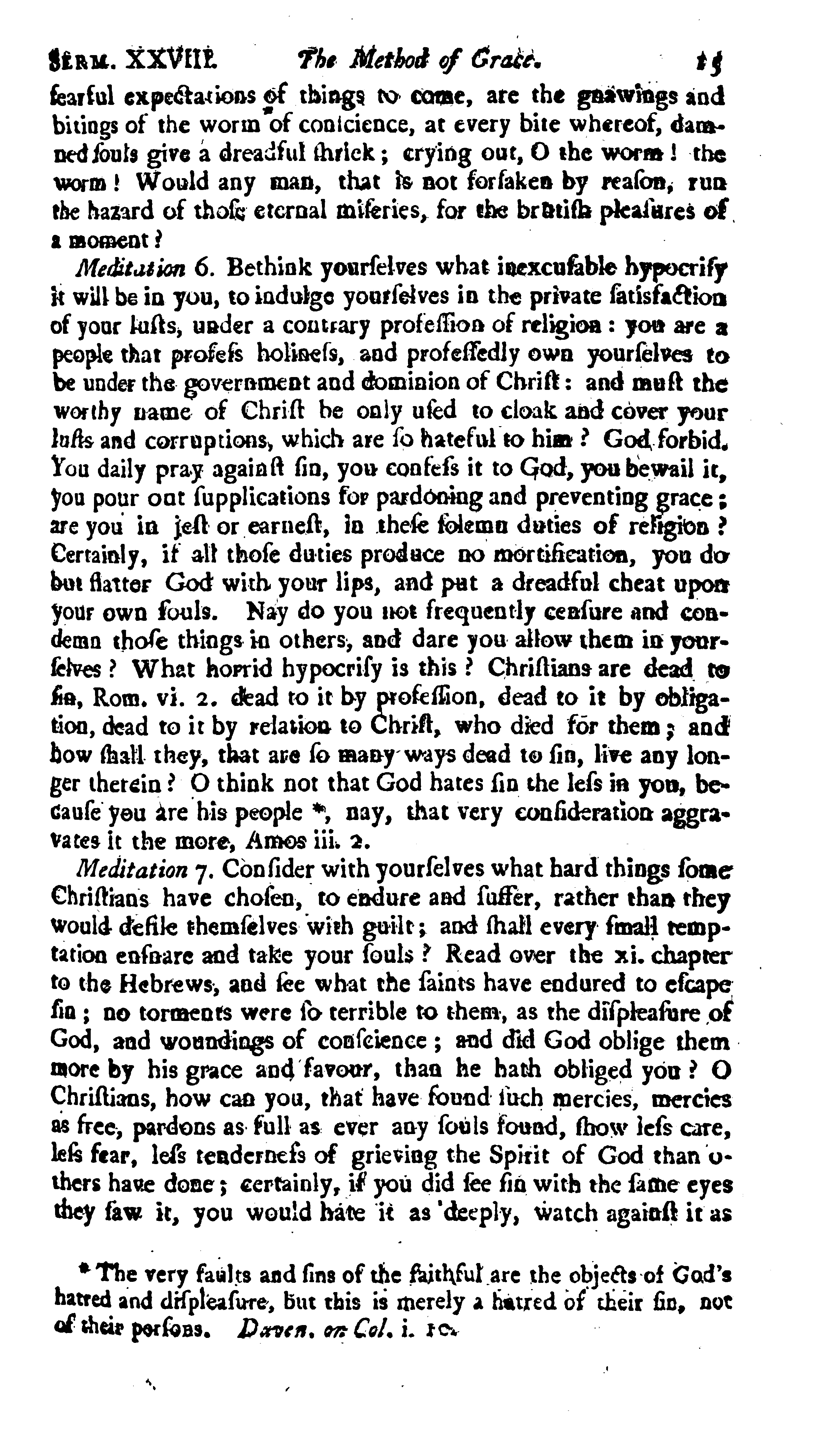
SERM . XXVIII.
The Method of Grace. fearful expectations of things to come, are the gnawings and bitings of the worn of conscience, at every bite whereof, damnedfouls give a dreadful thriek; crying out,O the worm ! the worm! Would any man, that is not forsaken by reason, run the hazard of those eternal miseries,for thebratish pleasures of a moment?
Meditation 6. Bethink yourselves what inexcusable hypocrisy it will be in you, to indulge yourselves in the private satisfaction of your lusts, under a contrary profession of religion : you are a people that profess holiness, and professedlyown yourselves to be under the governmentanddominion of Christ: and must the worthy name of Christ be only used to cloak and cover your lusts and corruptions, which are so hateful to him ? God forbid.
You daily pray against fin,you confess it to God,youbewail it, you pour out fupplications for pardoningand preventing grace; are you in jest or earnest, in these folemuduties of religion ?
Certainly, if all those duties produce no mortification, you do but flatter God with your lips, and put a dreadful cheat upon your own souls.
Naydo you notfrequentlycensure and condemn those things in others, and dare you allow them inyourselves ? What horrid hypocrisy is this ? Christians are dead to fin, Rom. vi. 2. dead to it by profession,dead to it by obligation,dead to it by relation to Christ, who died for them; and how shall they, that are so manywaysdead to fin, live any longer therein ? O think not that God hates fin the less in you, because you are his people *, nay, that very consideration aggravates it the more, Amos iii. 2.
Meditation 7. Confider withyourselves what hard things some Christians have chosen, to endure and suffer, rather than they would defile themselves with guilt; and shall every small temptation enfnareand take your souls ? Read over the xi. chapter to the Hebrews, and fee what the saints have endured to escape fin; no torments were so terrible to them, as the displeasure of God, and woundings of conscience; and did God oblige them more by his grace and favour, than he hath obliged you ? O
Christians, how can you, that have found such mercies, mercies as free, pardons as full as ever any fouls found, show less care, less fear, less tenderness of grieving the Spirit of God than othershavedone; certainly, if you did fee fin with the fame eyes they saw it, you would hate it as'deeply, watch against it as
*The very faults and fins of the faithful are the objects of God's hatredanddifpleasure, but this is merelyahatred of their fin, not of their persons.
Daven, or Col. i. to
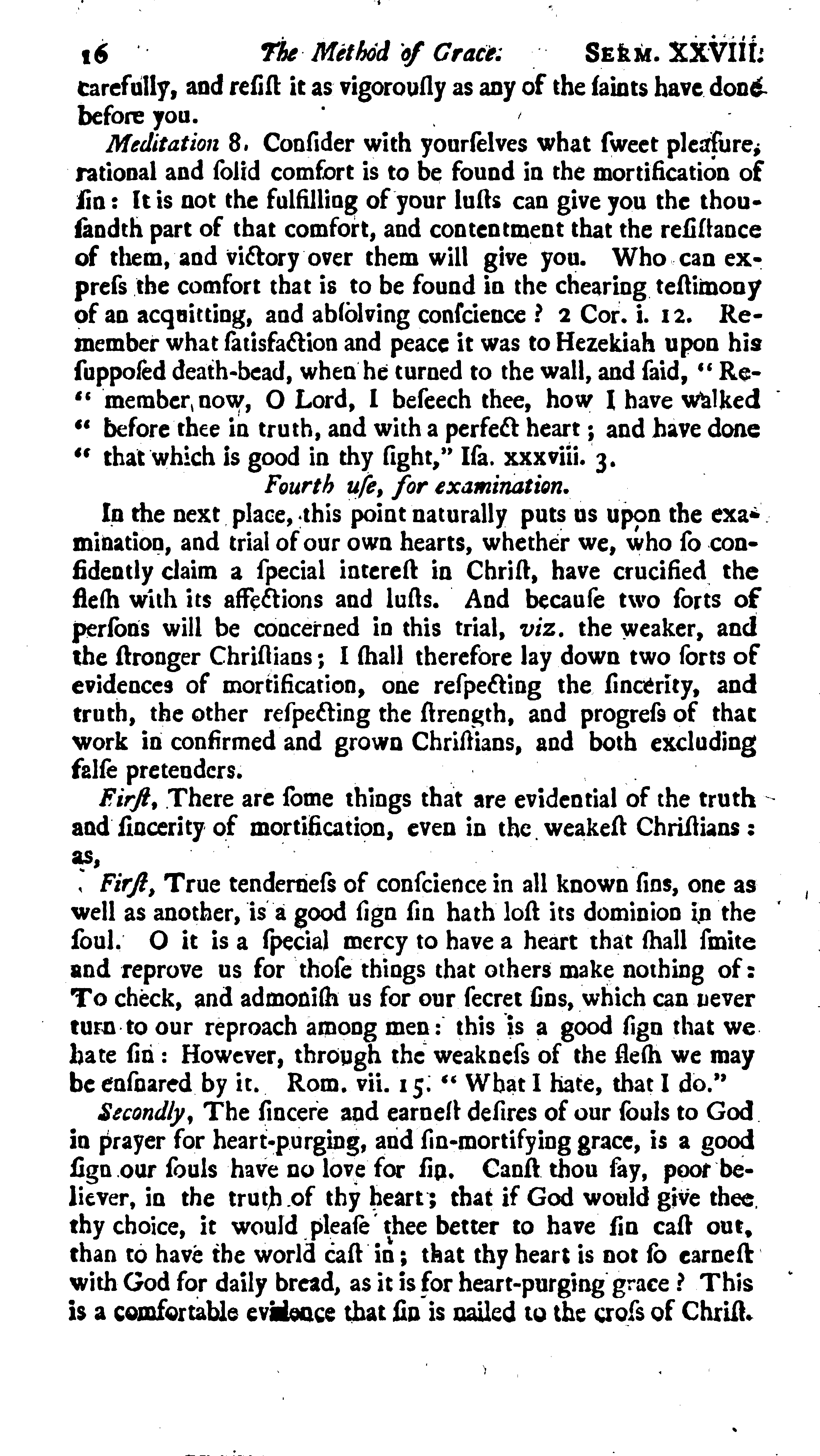
SERM. XXVIII.
The Method of Grace. carefully, and resist it as vigorouslyasanyofthefaintshavedone before you.
Meditation 8. Confider with yourselves what sweet pleasure, rational and solid comfort is to be found in the mortification of fin: It is not the fulfilling of your lusts cangiveyou the thousandth part of that comfort, and contentment that the resistance of them, and victory over them will give you. Who can express the comfort that is to be found in the chearing testimony of an acquitting, and absolving conscience ? 2 Cor. i. 12. Remember what fatisfactionand peace it was toHezekiah upon his supposed death-bead, when he turned to the wall, and said, " Re- " member now, O Lord, I beseech thee, how I have walked
" before thee in truth, and with a perfect heart ; and have done " that which is good in thy fight," Isa. xxxviii. 3 .
Fourth use, for examination.
In the next place, this point naturally puts us upon the exa mination, and trial of our own hearts, whether we, who so confidently claim a special interest in Christ, have crucified the flesh with its affections and lusts. And because two forts of persons will be concerned in this trial, viz . the weaker, and the stronger Christians ; I shall therefore lay down two forts of evidences of mortification, one respecting the sincerity, and truth, the other respecting the strength, and progress of that work in confirmed and grown Christians, and both excluding false pretenders.
First, There are some things that are evidential of the truth and sincerity of mortification, even in the weakest Christians : as, First, True tenderness of conscience in all known fins, one as well as another, is a good sign sin hath lost its dominion in the soul. O it is a special mercy to have a heart that shall smite and reprove us for those things that others make nothing of:
To check, and admonish us for our secret sins, which can never turn to our reproach among men: this is a good sign that we hate fin: However, through the weakness of the flesh we may be ensnared by it. Rom. vii. 15. " What I hate, that I do."
Secondly, The sincere and earnest desires of our souls to God in prayer for heart-purging,and fin-mortifying grace, is a good fignour fouls have no love for sip.
Canst thou fay, poor believer, in the truth of thy heart; that if God would give thee, thy choice, it would please thee better to have fin cast out, than to have the world cast in; that thy heart is not so earnest with God for daily bread, as it is for heart-purging grace ? This is a comfortable evidence that fin is nailed to the cross of Christ.
SERM . XXVIII .
The Method of Grace.
Thirdly, Do you make conscience of guarding against the occasions of fin ? Do you keep a daily watch over your hearts and senses, according to 1 John v. 18. Job xxxi. 1.
This speaks at rue design and purpose ofmortification also.
Fourthly, Do you rejoice, and bleisGod from your hearts, when the providence of God orders any means for the prevention of fin ? Thus did David, I Sam . xxv. 33. "And David
" said to Abigail, Blessed be the Lord God of Israel which sent " thee this day to meet me, and blessed be thy advice, and blef- " fed be thou which hast kept me this day from coming to " shed blood, and from avenging myself with my own hand."
Fifthly, In a word, though the thoughts of death maybe terrible in themselves, yet if the expectation, and hope of your deliverance from sin thereby,do sweeten the thoughts of it to your souls, it will turn unto you for a testimony, that you are not the servants and friends of fin. And so much briefly of the first fort of evidences.
Secondly, There are other signs, of a more deep and thorough mortification of fin, in more grown and confirmed believers, and such are these.
First, The more submissive and quiet any man is under the will of God, in smart and afflicting providences, the more that man'she art is mortified unto fin, Psal. cxix. 67, 71. Col. i. 11 .
Secondly, The more able any one is to bear the reproaches, and rebukes of his fin, the more mortification there is in that man, Psal . cxli . 5 .
Thirdly, The more easily any man can resign, and give up his dearest earthly comforts, at the call and command of God, the more progress thatman hath made in the work ofmortification,
Heb. xi. 17. 2 Sam. xv. 25.
Fourthly, The more power any man hath to resist sin in the first motions of it, and stifle it in the birth ; the greater degree ofmortification thatmanhath attained, Rom. vii . 23, 24.
Fifthly, If great changes, upon our outward condition, make no change for the worse upon our spirits, but we can bearprof. perous, and adverse providenceswith an equal mind; then mortification is advanced far in our souls, Phil. iv. 11, 12 .
Sixtoly, The more fixed, and steady our hearts are with God in duty, and the less they are infested with wandering thoughts, and earthly interpofitions ; the more mortification there is in that foul. And so much briefly of the evidences of mortification.g
VOL. III.