
Introductory
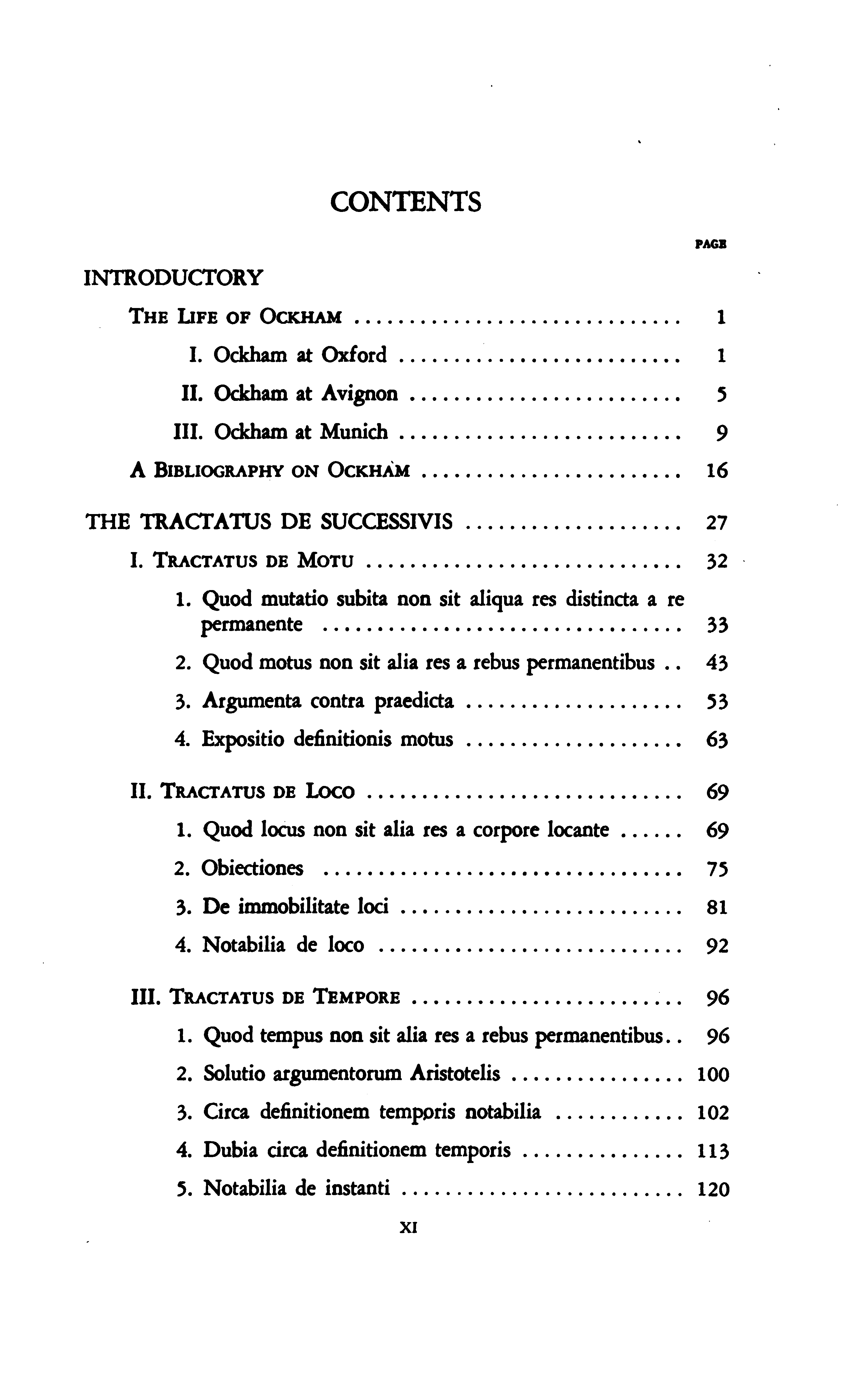
CONTENTS PAGE
INTRODUCTORY
THE LIFE OF OCKHAM
I. Ockham at Oxford
II. Ockham at Avignon
...
III. Ockham at Munich
A BIBLIOGRAPHY ON OCKHÀM ..
THE TRACTATUS DE SUCCESSIVIS
I. TRACTATUS DE MOTU
1. Quod mutatio subita non sit aliqua res distincta a re permanente 33333 2. Quod motus non sit alia res a rebus permanentibus ..
3. Argumenta contra praedicta
Expositio definitionis motus
II. TRACTATUS DE LOCO
1. Quod locus non sit alia res a corpore locante 2. Obiectiones
3. De immobilitate loci
4. Notabilia de loco
III. TRACTATUS DE TEMPORE
1. Quod tempus non sit alia res a rebus permanentibus ..
2. Solutio argumentorum Aristotelis
3. Circa definitionem temporis notabilia
...
4. Dubia circa definitionem temporis
5. Notabilia de instanti

INTRODUCTORY

INTRODUCTORY
THE LIFE OF OCKHAM
'HE starting point and basis for our study of the life of Ockham THE is the excellent article of Hofer¹ published some thirty years ago.
Using the sources then available, Hofer collected many details and discussed many problems. In so doing, he was able to eliminate many falsehoods and legends, and to prepare a safe ground for further research.
During the last thirty years, more details concerning Ockham's life have been discovered, though we are still far from complete or even satisfactory knowledge.
In all these studies, however, one source seems unfortunately to have been neglected, viz., the manuscripts of Ockham's works. For that reason, in this short biographical study we pay particular attention to evidences found there. The study of his works has forced us, as will become clear in the following pages, to abandon Hofer's opinion concerning the earlier life of Ockham.
I. ОСКНАМ AT OXFORD
In the Liber Conformitatum of Bartholomaeus of Pisa (13351390) there occur these words :
"Frater Guilielmus Occham, bachalarius Oxoniae...."2 This phrase contains two statements :
(a) Ockham was a student at Oxford — and, we may add, there is no record of Ockham's attendance at Paris or elsewhere. All evidences show that he belonged exclusively to the University of Oxford.
There is, for example, the record of Ockham's accusation by John Luterell, the Chancellor of the University of Oxford
(1312-1322) .
This confirms an old tradition .
(b) Ockham was not a "Magister regens" at Oxford . A Friar in Oxford at that time was obliged to attend theological lectures for five years. After the fifth year he was allowed to give cursory lectures on the Bible for two years. Then he could begin to lecture on the Sentences of Peter Lombard for two more years. Having thus spent four years in lecturing, he became a " Baccalaureus formatus" ; and, as such, was not 1. Hofer, Joh., C. Ss. R., "Biographische Studien über Wilhelm von Ockham,
O. F. M.," in Archivum Franciscanum Historicum, 6 ( 1913 ) , pp. 209-233 ; 439465; 654-669.
2. "Bartholomaeus a Pisa, Liber de conformitate vitae beati Francisci ad vitam Domini Jesu," in Analecta Franciscana (Quaracchi, 1904) , t. 4, p. 339.
TRACTATUS DE SUCCESSIVIS
allowed to teach for four years, but could preach and dispute. After that time he received his license, was admitted to the so-called "Principium" and became a "Magister." Once such a friar resumed teaching he was called a "Magister (actu ) regens."3
There can be no doubt today that Ockham did not become a "Magister regens," and consequently did not teach after his promotion.
This is proved, not only by the remark of Bartholomaeus, but also by the fact that he does not appear in any list of Masters of Oxford or elsewhere, and finally by his title "Venerabilis Inceptor."
"Inceptor,"
"incipere," and "inceptio" were technical terms used at Oxford, but they had two different meanings. In a broader sense, " Inceptor" designated a student who was preparing the lectures, etc., necessary to obtain his doctorate ; in the strict sense, an "Inceptor" was a "Magister" who had just fulfilled the last requirement for the doctorate, i . e., who had held his "Principium."4
According to Hofer, Ockham was only a "Baccalaureus formatus in sacra pagina" ; according to Ehrle, Ockham was called "Inceptor" in the wider sense of that title ; according to Pelster, Ockham was an "Inceptor" or "Doctor" in the strict sense, and therefore not yet a "Magister regens."5
Which of these authorities is right? It is a pity Hofer did not consult the " Explicits" of some manuscripts of Ockham dating from before his death. In these we find Ockham called not only "Inceptor" but also "Doctor" and even "Magister" a fact which compels us to take "Inceptor" in the strict sense.
In the light of this, we can give their exact meaning to all the different titles found in the documents.
Thus, Bartholomaeus called Ockham "Baccalaureus formatus" because he was not a "Magister actu regens."
For the same reason Ockham might be called a " Magister (sc., non regens") , because he was an "Inceptor" who had completed his career but not yet begun to function as "Magister regens." The title " Doctor" is more general and presents no difficulty. We believe that the most exact title of Ockham is to be found in the MS Erfurt Amploniana Q 259 : "Explicit summa supra totam logicam compilata a ven. inceptore theologie magistro Guillermo Okam. Anglico fratre Ordinis minorum fratrum. completa
3. Cf. Little-Pelster, Oxford Theology and Theologians c . A. D. 1282-1302 (Oxford, 1934) , pp. 43ss.
Cf. also Hastings, Rashdall, The Universities of Europe in the Middle Ages (new ed ., Powicke and Emden, Oxford, 1936) , pp. 49ss.; esp. 66ss. and 158ss.
4. Cf. Pelster, S. J., "Roger Marston (+1303 ) , ein englischer Vertreter des Augustinismus," in Scholastik, 3 ( 1928 ) , p . 543. Roger Marston was also an "Inceptor." Cf. also Ehrle, S. J., "Der Sentenzenkommentar Peters von Candia," in Franziskanische Studien, Beiheft 9 (Münster i. W., 1925 ) pp. 81ss.
5. Cf. Hofer. art. cit., p . 222s ; Ehrle and Pelster, 1. c.