
Search this journal
View original page
The Lutheran Church in Africa: Thirty Years of Growth
Mission occurs where the Word is faithfully proclaimed and God calls, gathers, enlightens and sanctifies through the power of the Holy Spirit.
The Lutheran church bodies that form the collectively named Lutheran Church in Africa have as a whole experienced rapid growth in the last thirty years, not only as widely acknowledged in numbers, but also capacity in mission effort and theological acumen. The emergence of Africa-initiated Lutheran church bodies brings a new growth addition to those planted primarily through western mission societies.
Introduction
When one speaks of growth, the primary focus may be assumed to be that of numerical growth. That is certainly important, as its opposite is decline. Africa now has some of the numerically largest Lutheran church bodies in the world. However, growth may occur in other ways that are not as readily quantifiable but also contribute to the overall growth picture of those who identify as both African and Lutheran on the continent.
It must be noted that reference to the Lutheran Church in Africa does not refer to a single entity or unified structure. Lutheran church bodies on the continent were each formed through national and ethnic histories, the motivations and methods of founders and influences of church bodies outside of Africa. The result is a multitude of forms for church polity and governance, as well as practice and approaches to theology that resist categorizing.
Looking at the larger picture of growth among Lutherans in Africa, the author’s own limited perspective is acknowledged. Africa as a geographical whole is three and a half times the area of the continental United States divided into 54 nations and containing over 3,000 ethnic groups. No matter how long or where one lives and serves on the continent, there is much that one will not know and data that is not widely available. Thus any discussion on growth will tend to be exploratory rather than definitive. The author apologizes to those church bodies, groups and institutions whose growth realities may be equally important as those mentioned but are not discussed in this paper. This was not by intention rather by limitation.
God’s mission
View original page
The growth of Lutheran church bodies and membership in Africa is astounding and can only be understood in light of previous generations of Lutheran Christians around the world participating in God’s mission. This understanding of mission sees God as the initiator of mission — the Father sends the Son;1 Father and Son send the Spirit;2 Father, Son and Spirit send the people of God, or the Church, into the world.3 It is reflected in the term missio dei. We acknowledge that any accomplishment in mission is God’s, not ours, a theological concept foundational to the formation of the Lutheran Church. Luther wrote, “For God has always been accustomed to collect a church for Himself even among the heathen,”4 and, “Therefore God gathered a church in the world not only from the one family of the 102 patriarchs but from all nations to which the Word made its way.”5 While the Church as the people of God may be the instrument, mission occurs where the Word makes its way. This is certainly the case in Africa where the details of each church body vary through different timelines and relationships. Ultimately, where the Word is faithfully proclaimed, God calls, gathers, enlightens and sanctifies through the power of the Holy Spirit.
The role of mother tongue Bible translation Translation of the Bible and other materials into mother tongues has created a foundation and played a huge role in the growth of the Lutheran Church in Africa. African mission thinker and theologian Kwame Bediako claimed, “There is probably no more important single explanation for the massive presence of Christianity on the African continent than the availability of the Scriptures in many African languages. By rejecting the notion of a sacred language for the Bible, Christianity makes every translation of its Scriptures substantially and equally the Word of God.”6
Leaders of the Ethiopian Evangelical Church Mekane Yesus (EECMY) acknowledge the translation effort of such partners as the Summer Institute of Linguistics as foundational to outreach of the Church and write, “The Church [EECMY] believes that every person and every community have [sic] the grace to hear the message of the gospel in the language of their heart and cultural context.”7 The EECMY currently facilitates thirteen different mother tongue projects with its partners.
New and emerging Lutheran church bodies find themselves earlier in the mother tongue evangelism process. Pastor John Bundor of Christ Evangelical Lutheran Church in Sierra Leone (where the completed Kisi Bible was dedicated in 2014) writes, “People that depended on others to read the Scriptures for them have now become independent readers. They are now reading scriptures in their mother tongue and they are also preaching to others in the mother tongue.”8 One notes that the availability of Scripture in one’s language opens up a whole new audience for the Word.
Translation of Scripture into the mother tongues of African peoples not only has facilitated numerical growth of the Church in Africa, it has inhibited the growth of such as Islam. Islam spreads on the basis of its untranslatable Scripture9 and where God’s Word is not available through one’s mother tongue, local beliefs, including Christianity, are easily subsumed. The engulfing by Islam of the once vibrant early Church in northern Africa is often attributed to a lack of Scripture in the mother tongue (Berber) of those in churches where leadership and church life was accomplished in Latin. Where translations exist — Ge’hez in Ethiopia and Coptic in Egypt — the Church remains to this day.10 Such remains the situation where God’s Word, translatable and purposeful in meaning, reaches out to Africans through their own languages and related conceptual constructs.
Thirty years of growing
When one looks at the journeys of each Lutheran church body in Africa from beginning to end, the details threaten to overwhelm. National history, ethnic history, mission history and numbers interact to form widely varying forms of Lutheran Christianity in formation, practice and theological identity.
To explore the growth of the last three decades, it is tempting to think primarily of numbers. That is certainly one aspect but Lutheran church bodies in Africa are growing in other ways, most especially in the ability to provide training for church leaders and in the manner in which churches are initiated. Thus this paper additionally looks at growth apart from membership numbers.
Assessing growth
View original page
It is helpful to understand the context within which Lutheran churches in Africa are growing if one wishes to assess growth and its meanings. An initial approach toward assessing the growth and maturity of foreign 103 mission results is attributed to Henry Venn, head of the Anglican Church Mission Society from 1841–1872, and Rufus Anderson, head of the American Board of Commissioners for Foreign Missions from 1832–1866. These nineteenth-century mission administrators saw the weaknesses of dependence resulting from western mission method of the times. Though not living in close to proximity to either each other or the foreign mission context, they came to mutual conclusions and proposed criteria toward assessing an independent indigenous church as the goal of church-planting. The results became known as the three-self principles, i.e., that a true indigenous church should be self-governing, self-propagating and self-supporting.11 These early criteria both informed and reflected the worldview of Western mission thinkers of the time and allowed them to assess their mission-daughter church bodies.
The “three-selfs” quickly come into question in the light of today’s context in Africa. Indigenous independence itself is an expectation assigned from abroad. Western mission societies of the past tended to transplant the familiar forms of their own more resource-rich contexts into Africa. Imported forms and structures required more to maintain than available in the local context. This created an expectation toward self-support while at the same time subtly encouraged the emerging church to depend upon others to maintain the inherited structures. Self-propagation is an important marker but not necessarily a sign of independence when one notes indigenous churches in other parts of the world in decline and debatably in need of assistance from others to revive. Self-governance as applied on the African continent is not solely of local mandate. Even as individual church bodies may operate within systems mandated by government, constitution and by-laws, functional governance is shared among church leaders of different bodies in a consultation and consensus process.
In the end, Venn and Anderson’s approach and resulting expectation for indigenous independence clashes with African values where reliance on community is valued and independence is discouraged.12 Exclusivity and independence is not the objective of most individual church bodies or their members. Mutually beneficial relationships are expected to continue as long as relationships are conducive to both. The overall result in Africa is that of interdependence between Lutheran church bodies as partners in governance, propagation and support rather than that of self-reliance. However, the principles themselves remain important markers through which to observe the collective growth of Lutherans on the continent in the last thirty years.
It can be noted that another marker, self-theologizing,13 has made its appearance in the years after Venn and Anderson. Similar to the previous three-self principle markers, it is not helpful with independence as its object, but its ability illustrates the growing capacity of Lutherans in Africa and will be discussed later in this paper.
Growing in numbers
It is difficult to provide exact numbers in the African context where numbers often don’t matter as much as presence. Newer church bodies do not have the management capacity to count membership — the need for numbers many times overwhelmed by other priorities. Results from self-reporting can depend upon who is being asked. Thus for many of the new and emerging church bodies, there are only estimates that may have wide variance. The data available in Wikipedia makes an attempt and provides a count of 20,752,23214 Lutherans for Africa. However, the specific country numbers in the same data differ in other sources exhibiting that even arriving at such a precise number is the result of varying entries. What is clear is that many Lutheran bodies on the continent are trending upward in membership growth.
View original page
The importance of each individual mission effort cannot be over-emphasized. Four of the largest Lutheran Church bodies in the world now are on the continent of Africa. The EECMY (Ethiopia) grew from an estimated 20,000 in 1959 to 7,280,622 in 2014.15 The Evangelical 104 Lutheran Church of Tanzania (ELCT) reported membership of 6,139,879 in 2012 compared to 5,825,312 in 2011 and 5,601,217 in 2010.16 The FLM (Madagascar) established in 1950 with 180,000 members, now has an estimated 3–4,000,000.17 The Lutheran Church of Christ in Nigeria reports 2.2 million.18 Others are collectively impressive. The result of each mission effort forms a numerical piece of the big picture, some smaller and some larger19 and feeds the overall number.
Growing in mission
How and where new church bodies are formed provides another marker to growth.
When those from Western Lutheran churches think about African mission, many picture churches planted in the nineteenth and twentieth centuries by foreign missionaries sent from the mission boards/societies of Western church bodies. This is certainly one way through which many in Africa trace their histories. But advancements in the last three decades in communication and ease of travel have encouraged different methods of Christian witness into Africa. New ways of relationship for mission have developed.
First, it is easier for Western church members who have never lived in the African context to directly discover and define mission opportunity from their own contexts. This has resulted in a bloom of visitors on what have been called short-term mission trips.
Second, it is easier for African immigrants or those who study abroad to maintain closer relationship and ties in their homelands than in the past. Many find homes in Lutheran church bodies in their new homes and present direct-mission opportunities outside of previously established church structures, mission boards and societies.
The result has been widely varying relationships and methods for mission in Africa, diffuse rather than focused, with those identifying themselves as Lutheran and African having a wide perception of what that might mean. Many understand themselves as Lutheran through their history with other Lutherans rather than because of an intentional theological identity. Church bodies have been formed in multiple ways that for the purposes of this paper are broadly categorized into three: Western mission-daughter, Africa-initiated and direct-mission short-term method.
Western mission-daughter Lu theran church bodies
View original page
Many Lutheran church bodies in Africa, especially the older ones, point to their beginnings as the result of missionaries sent from mission boards/societies in Europe or North America.20 The Ethiopian Evangelical Church Mekane Yesus21 is a good example. The EECMY formed in 1959 through a merger of Western mission society efforts into four semi-autonomous synods with a membership of around 20,00022 and adopted Scripture and the Unaltered Augsburg Confession as their doctrinal basis in the constitution.23 In 2014, the EECMY reported an 8 percent 105 overall growth rate in their 28 synods consisting of 8,093 congregations; 3,703 preaching places; 3,226 pastors and 7,280,622 members, figures that make it a candidate for the largest Lutheran church body in the world. Such growth is attributed to the spiritual life of its members rather than programs and strategy and one must note that even within the EECMY, growth is uneven with some synods reporting negative growth while one synod reported a 33 percent increase in members.24
Other large church bodies in east and central Africa have similar beginnings found in the merger of the results of western mission societies. These include the Evangelical Lutheran Church in Tanzania (ELCT), and the Malagasy Lutheran Church (FLM) in Madagascar. They are organized similarly and have experienced tremendous growth in the past few years.
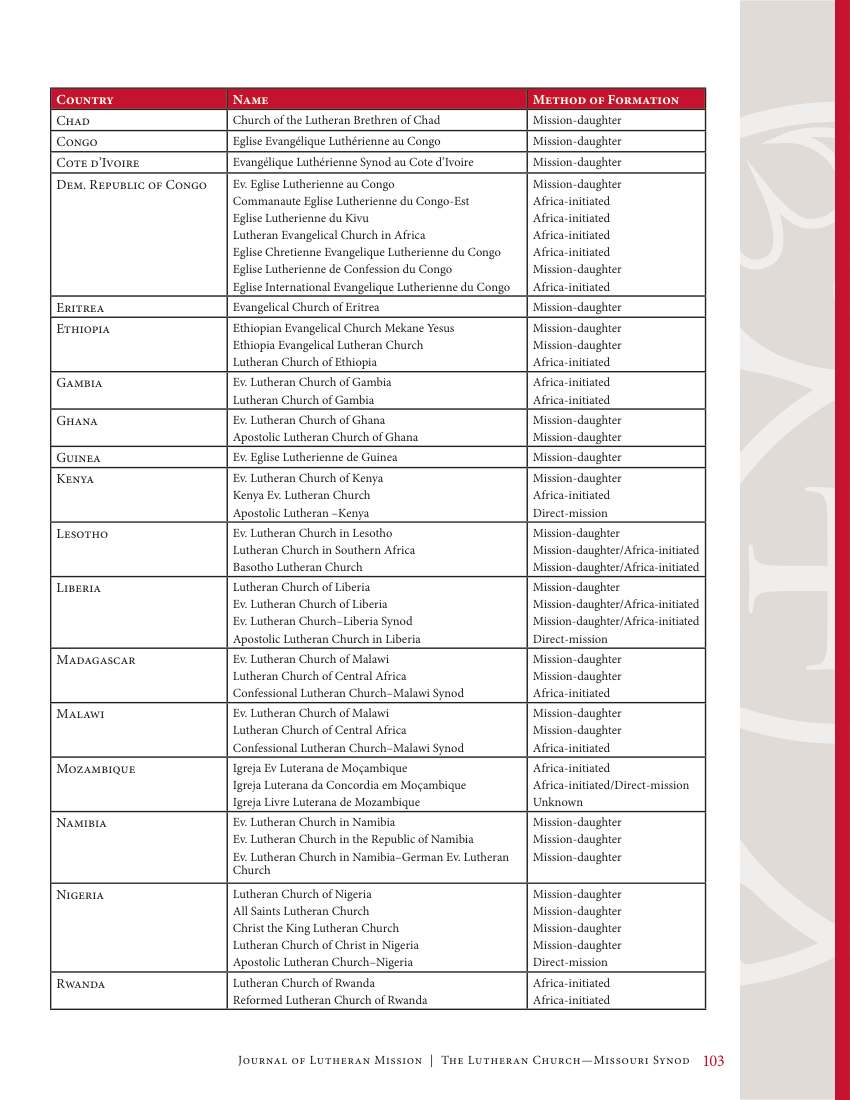
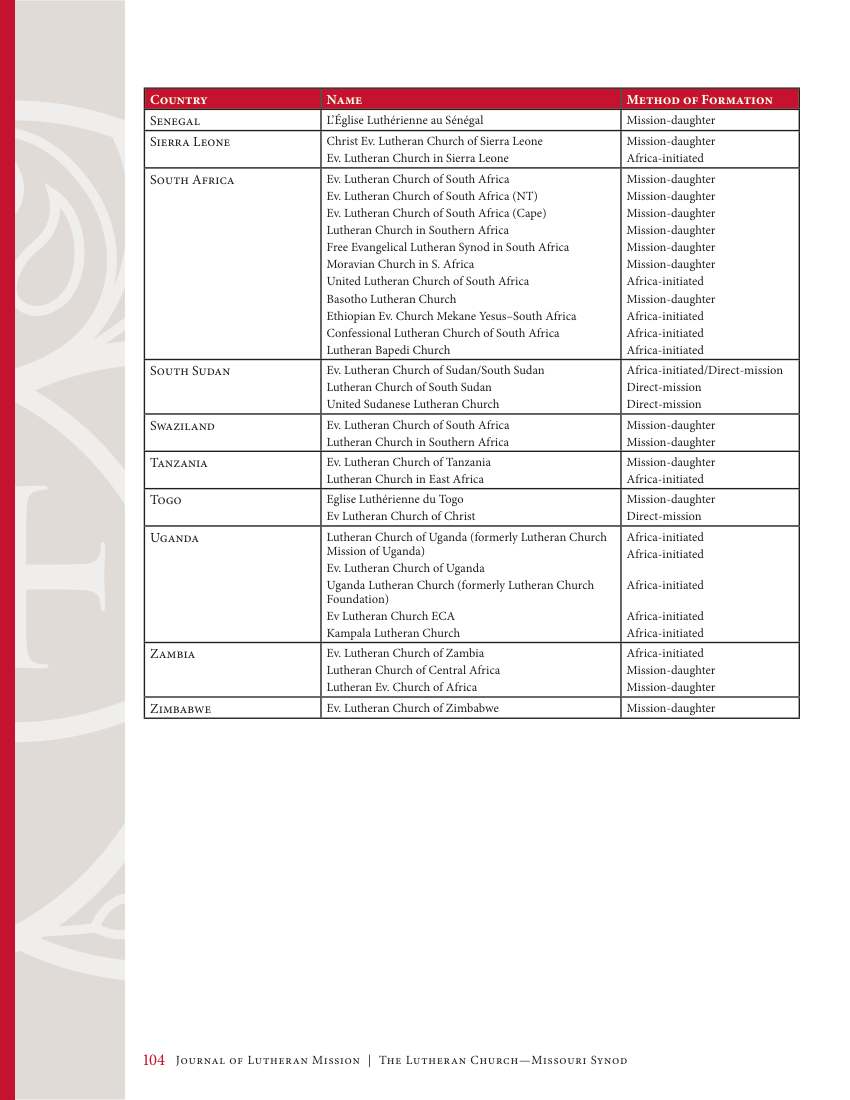
Others, smaller and too many to list exhaustively (see appendix A), also trace their beginnings to the coming of western missionaries. Individually they continue to develop within various stages of growth or stagnation, but the overall picture of western mission-daughter church bodies on the African continent is one of membership growth.
Africa-initiated Lutheran church bodies (AiLCs)
In recent years, a number of emerging Lutheran church bodies can be identified as Africa-initiated. AiLCs are newer generation Lutheran churches established primarily through the efforts of Africans rather than foreign missionaries sent through western mission boards. The Commanaute Evangelique Lutherienne au Congo-est (CELCE), the Eglise Lutherienne du Kivu (ELKI), and Eglise Chretienne Evangelique Lutherienne du Congo (ECELCo, formerly Church of Congo) were each founded by men who studied Lutheran theology in Tanzania and then returned to the eastern part of the Democratic Republic of Congo. The founding of the CELCE is typical, its founder ordained by a bishop of the ELCT in Tanzania. Upon returning to the DRC in 1977, this pastor registered a church and mentored and ordained nine additional pastors. By 2010, there were ten Lutheran congregations with an estimated 10,000 members and headquarters near Luvungi.25
Another new and emerging Lutheran church body, the Eglise Evangelique Lutherienne au Burundi (EELBu) ,was initiated by the bishop of the The Eglise Evangélique Luthérienne du Congo (EELCo) — Kivu-Maniema diocese, circa 2008. The bishop visited across the border and gathered members in the early 2000s. In 2010, there were three preaching stations with 1800 members led by ten lay evangelists. These evangelists were ordained in 2011.26 Another example of an emerging church body is the Lutheran Church of Uganda (previously the Lutheran Church Mission in Uganda). This body was initiated in 1993 when five lay leaders met a pastor from the Evangelical Lutheran Church in Ghana studying in Kenya. The bishop of the ELCG visited Uganda and later sent two evangelists supported by the ELCG and LCMS27 World Mission funding. Currently there are 16 pastors, 128 congregations with about 20,000 members. Only about 10 percent of members speak languages of wider communication in rural areas. Ground-breaking for a new seminary occurred in February 2014.28
The stories of the formation of Africa-initiated Lutheran church bodies are as varied as they are numerous — the common thread being that they were established primarily by African Lutherans with minimal outside assistance.
Direct mission29 — short-term method
Again in recent years, a number of Lutheran church bodies have been formed from opportunities met by those who do not live on the continent. This includes returning refugees and sometimes immigrants who became a part of Lutheran congregations in other countries before returning to their homes on visits. It also includes foreign visitors on short-term trips.
View original page
As conflict or economic hardship dispersed peoples from Africa, refugees and/or immigrants settled and incorporated into Lutheran church bodies in their new homes off the African continent. They sometimes found interest and presented new friends with needs from their homelands. Those returning used their ethnic relation 106 ships as a natural bridge to provide development and/ or proclaim the Gospel. The objects of these mission efforts may or may not have been previously introduced to Christianity but often there has been the introduction of a Lutheran church into the community through those visiting.
A second form of direct-mission effort occurs when members of Lutheran churches in the West are presented with opportunity in the African context by African visitors to their context. This may also happen as a response to Internet pleas for assistance. As relationships are formed and needs presented, Lutherans have formed themselves into direct-mission efforts, including visits to Africa. Eventually a Lutheran church may be formed where previously there was none, sometimes in an unreached area but also sometimes resulting in a change of identity for a non-Lutheran church.
An example of a mix of methods can be found in South Sudan. The beginnings of the Evangelical Lutheran Church in Sudan/South Sudan (ELCS/SS) occurred when an Anglican priest directly contacted LCMS Lutherans and was introduced to Lutheran theology through short-term visitors. Together they established a center in Yambio among the Zande ethnic group. Around the same time, refugee immigrants within the LCMS in Nebraska in the United States formed the Sudanese Lutheran Mission Society. They returned on short-term visits, establishing Lutheran activity among the Nuer people. Eventually the results of the two groups agreed to merge with the former Anglican pastor serving as the first bishop until he passed away in 2009. The Archbishop of the Lutheran Church of Nigeria consecrated a new bishop in 2011. The new bishop of the ELCS/SS had been ordained after studying Lutheran theology in Tanzania as a refugee. Membership of the ELCS/SS at the time was claimed as an estimated 15–20,000 members with 27 ordained pastors trained through varying institutions and/or methods and 80 evangelists.30
Summary
A complete list of bodies and/or groups of Lutherans who have been formed through the various mission efforts in Africa is elusive and such groups continue to emerge to audiences of wider communication. Wikipedia lists twenty-one separate Lutheran church bodies within the Lutheran World Federation, the International Lutheran Council or as unaffiliated. However, anyone conversant with the continent and Lutheran mission as a whole, can bring others to mind. Appendix A provides a list of 86 different Lutheran church bodies/groups that have emerged, and this author acknowledges that there may be any number that did not make the list.
Growing in theological capacity
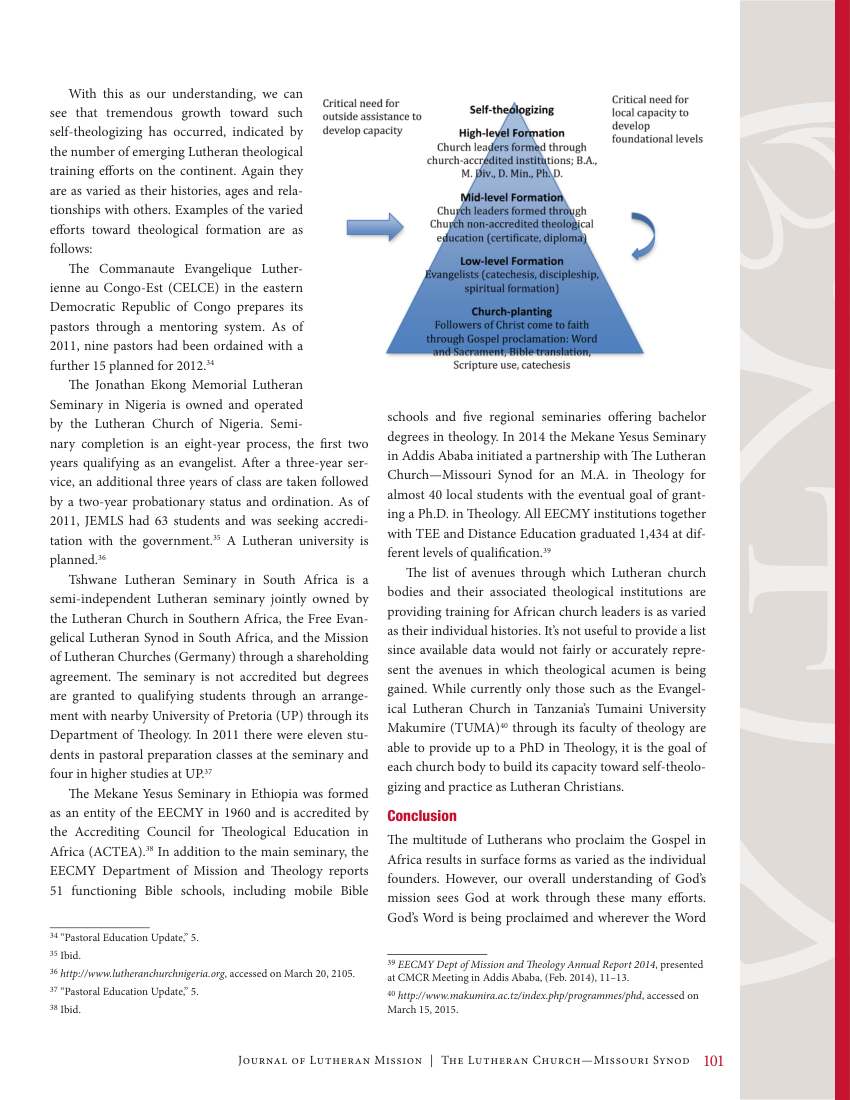
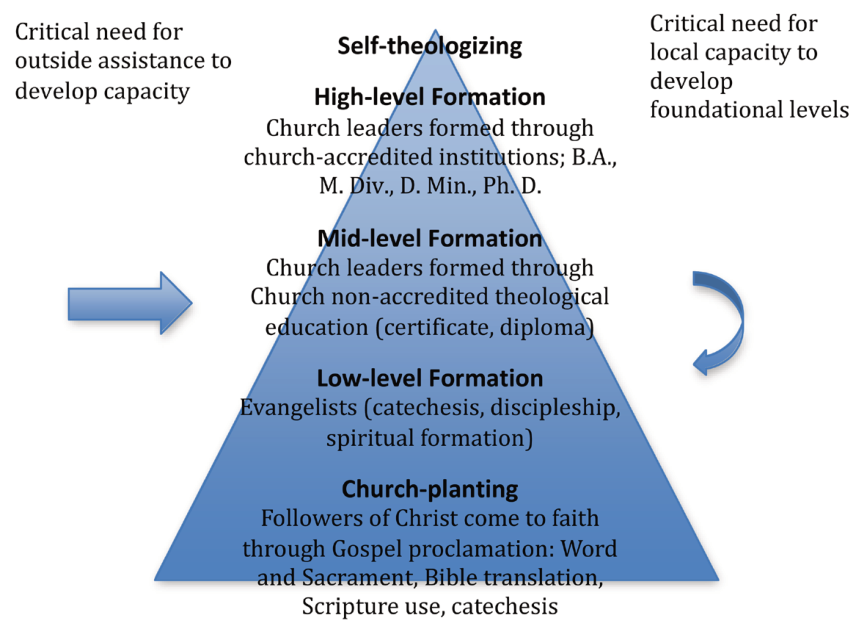
The ability for self-theologizing31 is an important marker when one observes capacity growth on the content. Self-theologizing can be defined as working out the theological truths of God’s unchanging Word as applied to one’s own context. This capacity is highly desired if African Lutherans are to wrestle with the questions formed by the African context rather than adopting the formulations of others without thought. For example, Africans have been challenged to respond biblically to western Lutheran church bodies’ resolutions on same-sex issues.32 Ntsimane notes that confessional African Lutherans find themselves struggling with closed altar practice in a context where “barring a hungry person from partaking of a meal goes against the core values of African hospitality.”33 While the results of such self-theologizing will be debated, the emerging of such debate onto the wider world stage is the result of the growing number of avenues that prepare church workers to wrestle with the questions of being Lutheran. From the introduction of the Gospel message to the ability to wrestle with identity as Lutheran Christians in Africa, the process toward creating theological acumen does not come without outside assistance — such assistance tending to “retreat up the ladder” as the local church and institutions gain their own capacity.
This is illustrated in the following diagram noting growth in theological acumen. Outside assistance, whether from foreign missionaries, study abroad or short-term visits, results in new local capacity. Local capacity then takes over roles previously accomplished through outside assistance, making the need for that assistance less critical (i.e., it “retreats up the ladder”). While foreign assistance may continue at all levels, the actual need becomes no longer critical. The end result is a growing ability to engage in theology and practice consistent within Lutheran identity.
View original page
With this as our understanding, we can see that tremendous growth toward such self-theologizing has occurred, indicated by the number of emerging Lutheran theological training efforts on the continent. Again they are as varied as their histories, ages and relationships with others. Examples of the varied efforts toward theological formation are as follows:
The Commanaute Evangelique Lutherienne au Congo-Est (CELCE) in the eastern Democratic Republic of Congo prepares its pastors through a mentoring system. As of 2011, nine pastors had been ordained with a further 15 planned for 2012.34
The Jonathan Ekong Memorial Lutheran Seminary in Nigeria is owned and operated by the Lutheran Church of Nigeria. Seminary completion is an eight-year process, the first two years qualifying as an evangelist. After a three-year service, an additional three years of class are taken followed by a two-year probationary status and ordination. As of 2011, JEMLS had 63 students and was seeking accreditation with the government.35 A Lutheran university is planned.36
Tshwane Lutheran Seminary in South Africa is a semi-independent Lutheran seminary jointly owned by the Lutheran Church in Southern Africa, the Free Evangelical Lutheran Synod in South Africa, and the Mission of Lutheran Churches (Germany) through a shareholding agreement. The seminary is not accredited but degrees are granted to qualifying students through an arrangement with nearby University of Pretoria (UP) through its Department of Theology. In 2011 there were eleven students in pastoral preparation classes at the seminary and four in higher studies at UP.37
The Mekane Yesus Seminary in Ethiopia was formed as an entity of the EECMY in 1960 and is accredited by the Accrediting Council for Theological Education in Africa (ACTEA).38 In addition to the main seminary, the EECMY Department of Mission and Theology reports 51 functioning Bible schools, including mobile Bible schools and five regional seminaries offering bachelor degrees in theology. In 2014 the Mekane Yesus Seminary in Addis Ababa initiated a partnership with The Lutheran Church—Missouri Synod for an M.A. in Theology for almost 40 local students with the eventual goal of granting a Ph.D. in Theology. All EECMY institutions together with TEE and Distance Education graduated 1,434 at different levels of qualification.39
The list of avenues through which Lutheran church bodies and their associated theological institutions are providing training for African church leaders is as varied as their individual histories. It’s not useful to provide a list since available data would not fairly or accurately represent the avenues in which theological acumen is being gained. While currently only those such as the Evangelical Lutheran Church in Tanzania’s Tumaini University Makumire (TUMA)40 through its faculty of theology are able to provide up to a PhD in Theology, it is the goal of each church body to build its capacity toward self-theologizing and practice as Lutheran Christians.
Conclusion
View original page
The multitude of Lutherans who proclaim the Gospel in Africa results in surface forms as varied as the individual founders. However, our overall understanding of God’s mission sees God at work through these many efforts. God’s Word is being proclaimed and wherever the Word 108 makes its way through His people in Africa, the Word comes back with fruit.
The Lutheran Church in Africa has grown in three distinct ways in the last thirty years — numerically, in its capacity for training its members in Lutheran theology and in its methods toward establishing new church bodies.
It has been an exciting three decades for me personally, seeing how God uses His people so others are called to Him through His Word. Together, we observe with joy the many who participate in His mission on the continent that others might also hear and be called through the Word wherever they may be in Africa.
The Rev. Dr. Mike Rodewald is executive director of Lutheran Bible Translators.
Works Consulted
Bosch, David. Transforming Mission: Paradigm Shifts in the Theology of Mission. Orbis: Maryknoll, NY, 1991.
Bediako, Kwame. Christianity in Africa. Edinburgh University Press: Edinburgh, 1995.
Bundor, John. “Zealous for Evangelism.” LBT Literacy Report (September 2013).
The EECMY Department for Mission and Theology Annual Report 2014. Presented at CMCR meeting in Addis Ababa, February 2014.
Gutaa, Magarsaa. From a Humble Beginning to Advanced Standing: A History of Mekane Yesus Seminary [1960– 2010]. Mekane Yesus Seminary: Addis Ababa, 2011.
Hiebert, Paul. Anthropological Insights for Missionaries. Baker: Grand Rapids, 1985.
Luther’s Works (American Edition). Edited by J. Pelikan and H. Lehman. Concordia Publishing House: St. Louis, 1955ff.
Noss, Philip. “Bible Translation in History and into the Future.” Lausanne World Pulse Archives (September 2009), http://www.lausanneworldpulse.com/themedarticles-php/1197/09-2009, accessed on 11 March 2015.
Ntsimane, Radikobo. “The fragile identity of being Lutheran and African: the vulnerability of confessional Lutheran seminaries in Africa today.” Studia Historiae Ecclesiasticae 36:2 (October 2010): 219–235.
“Pastoral Education Update.” Lutheran Church—Missouri Synod Office of International Mission Africa Management Team Report (June 2011).
Rodewald, Mike. “Islam and Christian Mission in Africa.” LBT e-Journal of Mission Studies 3:3 (September 2008): 20-42.
Rodewald, Mike, “Uganda Brief.” LCMS Office of International Mission Report (March 2014).
Sanneh, Lamin. Whose Religion is Christianity: The Gospel beyond the West. Eerdmans: Grand Rapids, 2003.
| Country | Name | Method of Formation |
|---|---|---|
| Angola | Igreja Ev Luterana de Angola Igreja Luterana Confessional em Anglola | Mission-daughter Africa-initiated |
| Benin | Eglise Evangélique Luthérienne du Benin Eglise Lutherrienne Afrique–Synode du Benin | Mission-daughter Africa-initiated |
| Botswana | Evangelical Lutheran Church of Botswana Lutheran Church in Southern Africa Evangelical Lutheran Church of South Africa | Mission-daughter Mission-daughter Mission-daughter |
| Burkina Faso | Eglise Evangélique Luthérienne du Burkina Faso | Africa-initiated |
| Burundi | Eglise Evangélique Luthérienne au Burundi | Africa-initiated |
| Cameroon | L’Eglise Evangélique Luthérienne au Cameroun Lutheran Church of Cameroon Church of the Lutheran Brethren of Cameroon | Mission-daughter Mission-daughter Mission-daughter |
| Central African Republic | Evangelical Lutheran Church of the Central African Republic | Mission-daughter |
View original page
| Country | Name | Method of Formation |
|---|---|---|
| Chad | Church of the Lutheran Brethren of Chad | Mission-daughter |
| Congo | Eglise Evangélique Luthérienne au Congo | Mission-daughter |
| Cote d’Ivoire | Evangélique Luthérienne Synod au Cote d’Ivoire | Mission-daughter |
| Dem. Republic of Congo | Ev. Eglise Lutherienne au Congo Commanaute Eglise Lutherienne du Congo-Est Eglise Lutherienne du Kivu Lutheran Evangelical Church in Africa Eglise Chretienne Evangelique Lutherienne du Congo Eglise Lutherienne de Confession du Congo Eglise International Evangelique Lutherienne du Congo | Mission-daughter Africa-initiated Africa-initiated Africa-initiated Africa-initiated Mission-daughter Africa-initiated |
| Eritrea | Evangelical Church of Eritrea | Mission-daughter |
| Ethiopia | Ethiopian Evangelical Church Mekane Yesus Ethiopia Evangelical Lutheran Church Lutheran Church of Ethiopia | Mission-daughter Mission-daughter Africa-initiated |
| Gambia | Ev. Lutheran Church of Gambia Lutheran Church of Gambia | Africa-initiated Africa-initiated |
| Ghana | Ev. Lutheran Church of Ghana Apostolic Lutheran Church of Ghana | Mission-daughter Mission-daughter |
| Guinea | Ev. Eglise Lutherienne de Guinea | Mission-daughter |
| Kenya | Ev. Lutheran Church of Kenya Kenya Ev. Lutheran Church Apostolic Lutheran –Kenya | Mission-daughter Africa-initiated Direct-mission |
| Lesotho | Ev. Lutheran Church in Lesotho Lutheran Church in Southern Africa Basotho Lutheran Church | Mission-daughter Mission-daughter/Africa-initiated Mission-daughter/Africa-initiated |
| Liberia | Lutheran Church of Liberia Ev. Lutheran Church of Liberia Ev. Lutheran Church–Liberia Synod Apostolic Lutheran Church in Liberia | Mission-daughter Mission-daughter/Africa-initiated Mission-daughter/Africa-initiated Direct-mission |
| Madagascar | Ev. Lutheran Church of Malawi Lutheran Church of Central Africa Confessional Lutheran Church–Malawi Synod | Mission-daughter Mission-daughter Africa-initiated |
| Malawi | Ev. Lutheran Church of Malawi Lutheran Church of Central Africa Confessional Lutheran Church–Malawi Synod | Mission-daughter Mission-daughter Africa-initiated |
| Mozambique | Igreja Ev Luterana de Moçambique Igreja Luterana da Concordia em Moçambique Igreja Livre Luterana de Mozambique | Africa-initiated Africa-initiated/Direct-mission Unknown |
| Namibia | Ev. Lutheran Church in Namibia Ev. Lutheran Church in the Republic of Namibia Ev. Lutheran Church in Namibia–German Ev. Lutheran Church | Mission-daughter Mission-daughter Mission-daughter |
| Nigeria | Lutheran Church of Nigeria All Saints Lutheran Church Christ the King Lutheran Church Lutheran Church of Christ in Nigeria Apostolic Lutheran Church–Nigeria | Mission-daughter Mission-daughter Mission-daughter Mission-daughter Direct-mission |
| Rwanda | Lutheran Church of Rwanda Reformed Lutheran Church of Rwanda | Africa-initiated Africa-initiated |
View original page
| Country | Name | Method of Formation |
|---|---|---|
| Senegal | L’Église Luthérienne au Sénégal | Mission-daughter |
| Sierra Leone | Christ Ev. Lutheran Church of Sierra Leone Ev. Lutheran Church in Sierra Leone | Mission-daughter Africa-initiated |
| South Africa | Ev. Lutheran Church of South Africa Ev. Lutheran Church of South Africa (NT) Ev. Lutheran Church of South Africa (Cape) Lutheran Church in Southern Africa Free Evangelical Lutheran Synod in South Africa Moravian Church in S. Africa United Lutheran Church of South Africa Basotho Lutheran Church Ethiopian Ev. Church Mekane Yesus–South Africa Confessional Lutheran Church of South Africa Lutheran Bapedi Church | Mission-daughter Mission-daughter Mission-daughter Mission-daughter Mission-daughter Mission-daughter Africa-initiated Mission-daughter Africa-initiated Africa-initiated Africa-initiated |
| South Sudan | Ev. Lutheran Church of Sudan/South Sudan Lutheran Church of South Sudan United Sudanese Lutheran Church | Africa-initiated/Direct-mission Direct-mission Direct-mission |
| Swaziland | Ev. Lutheran Church of South Africa Lutheran Church in Southern Africa | Mission-daughter Mission-daughter |
| Tanzania | Ev. Lutheran Church of Tanzania Lutheran Church in East Africa | Mission-daughter Africa-initiated |
| Togo | Eglise Luthérienne du Togo Ev Lutheran Church of Christ | Mission-daughter Direct-mission |
| Uganda | Lutheran Church of Uganda (formerly Lutheran Church Mission of Uganda) Ev. Lutheran Church of Uganda Uganda Lutheran Church (formerly Lutheran Church Foundation) Ev Lutheran Church ECA Kampala Lutheran Church | Africa-initiated Africa-initiated Africa-initiated Africa-initiated Africa-initiated |
| Zambia | Ev. Lutheran Church of Zambia Lutheran Church of Central Africa Lutheran Ev. Church of Africa | Africa-initiated Mission-daughter Mission-daughter |
| Zimbabwe | Ev. Lutheran Church of Zimbabwe | Mission-daughter |
Notes
- John 10:15; 17:18, 21. ↩
- John 14:26; 15:26, Luke 24:49. ↩
- John 17:18–23; 20:21. ↩
- Luther’s Works (American Edition), ed. J. Pelikan and H. Lehman, (St. Louis: Concordia Publishing House, 1955ff), 8:135, hereafter referred to as AE. ↩
- AE 6:227. ↩
- Kwame Bediako. Christianity in Africa, (Edinburgh: Edinburgh University Press, 1995), 62. ↩
- The EECMY Department for Mission and Theology Annual Report 2014, CMCR meeting in Addis Ababa, Feb. 2014, 23. ↩
- John Bundor, “Zealous for Evangelism,” LBT Literacy Report (September 2013). ↩
- Lamin Sanneh, Whose Religion is Christianity: The Gospel beyond the West, (Grand Rapids: Eerdmans, 2003), 120. ↩
- Mike Rodewald, “Islam and Christian Mission in Africa” LBT e-Journal of Mission Studies Vol. 3 #3 (Sep, 2008), 32. Also Philip Noss, “Bible Translation in History and into the Future” Lausanne World Pulse Archives (Sept. 2009), http://www.lausanneworldpulse.com/ themedarticles-php/1197/09-2009, accessed on 11 March 2015. ↩
- David Bosch, Transforming Mission: Paradigm Shifts in the Theology of Mission. (Maryknoll NY: Orbis, 1991), 331 ↩
- Philip Ntsimane, “The fragile identity of being Lutheran and African,” Studia Historieae Ecclesiasticae, (Oct. 2010): 5–6. ↩
- Bosch, 451–452. ↩
- http://en.wikipedia.org/wiki/Lutheranism_by_region, accessed on March 15, 2015. ↩
- The EECMY reported 7,280,622 members from The EECMY Department for Mission and Theology Annual Report 2014, presented at CMCR meeting in Addis Ababa, Feb. 2014. ↩
- “ELCT Press Release,” (Feb. 2013) accessed at http://www.elct.org/ news/2013.02.005.html on March 11, 2013. ↩
- The LWF page reports 3,000,000 at https://www.lutheranworld.org/ content/malagasy-lutheran-church; Wikipedia reports 4,000,000 at http://en.wikipedia.org/wiki/Malagasy_Lutheran_Church both accessed on March 14, 2015. ↩
- http://www.lutheranworld.org/country/nigeria, accessed on March 14, 2015. ↩
- For example the estimated membership of mission-daughter churches of the LCMS synodical mission church-planting efforts in Africa are as follows: Lutheran Church of Nigeria (est. 100–150,000), Ev. Lutheran Church of Ghana (est. 35–40,000), Ev. Lutheran Church (and Synod) in Liberia (est. 10–12,000), Eglise Ev. Lutherienne au Guinea (est. 2,000), Eglise Ev. Lutherienne du Benin (est. 600), Eglise Lutherienne du Togo (7–8,000), Evangelique Lutherienne Synode au Cote d’Ivoire (est. 3–4,000). Christ Evangelical Lutheran Church of Sierra Leone (est. 3–4,000). ↩
- Some African Lutheran church bodies can point to being Africa-initiated by virtue of extending invitations to western Lutheran mission boards or societies to send missionaries to plant churches on the continent. This in contrast to those discussed later as Africa-initiated formed primarily through local African effort. ↩
- During discussion by the Founding Assembly, “Lutheran” was left out of the new name for the merged church, the agreement being that Luther had warned against such practice. This caused those congregations planted by the SBVM (Swedish Lutheran Mission — Bible True Friends) to pull out of the agreement and establish an independent church body in Dire Dawa, now consisting of [an estimated 20,000 members in] six synods collectively known as the Ethiopian Evangelical Lutheran Church. http://www. ethiopianevangelicallutheran.org, accessed on March 11, 2015. ↩
- Magarsaa Gutaa. From a Humble Beginning to Advanced Standing: A History of Mekane Yesus Seminary [1960-2010], Addis Ababa: Mekane Yesus Seminary (2011), 10–19. ↩
- Ibid., 15. ↩
- The EECMY Department for Mission and Theology Annual Report 2014. Presented at CMCR meeting in Addis Ababa (Feb. 2014), 41. ↩
- https://lcmsinafrica.wordpress.com/central-africa, accessed on 8 March 2015. Also “Pastoral Education Update — Africa,” (The Lutheran Church—Missouri Synod Office of International Mission Africa Management Team Report, June 2011), 5. ↩
- Ibid. ↩
- The Lutheran Church—Missouri Synod ↩
- Mike Rodewald, “Uganda Brief,” (LCMS Office of International Mission, March 2014). ↩
- Direct-mission is defined as mission effort that occurs outside of previously existing mission structures either by virtue of individual efforts or the forming of a new organization with specific mission purpose. ↩
- “Pastoral Education Update,” 7. ↩
- Bosch, 451–452. ↩
- See such as the Dodoma Statement of the Evangelical Lutheran Church in Tanzania (2010) http://www.elct.org/news/2010.04.004.html, accessed on March 12, 2015. ↩
- Ntsimane, 15. ↩
- “Pastoral Education Update,” 5. ↩
- Ibid. ↩
- http://www.lutheranchurchnigeria.org, accessed on March 20, 2105. ↩
- “Pastoral Education Update,” 5. ↩
- Ibid. ↩
- EECMY Dept of Mission and Theology Annual Report 2014, presented at CMCR Meeting in Addis Ababa, (Feb. 2014), 11–13. ↩
- http://www.makumira.ac.tz/index.php/programmes/phd, accessed on March 15, 2015. ↩
Tip: use the ← and → keys to move between sections. Share any page with index.html?p=<page>.