
Search this journal
View original page
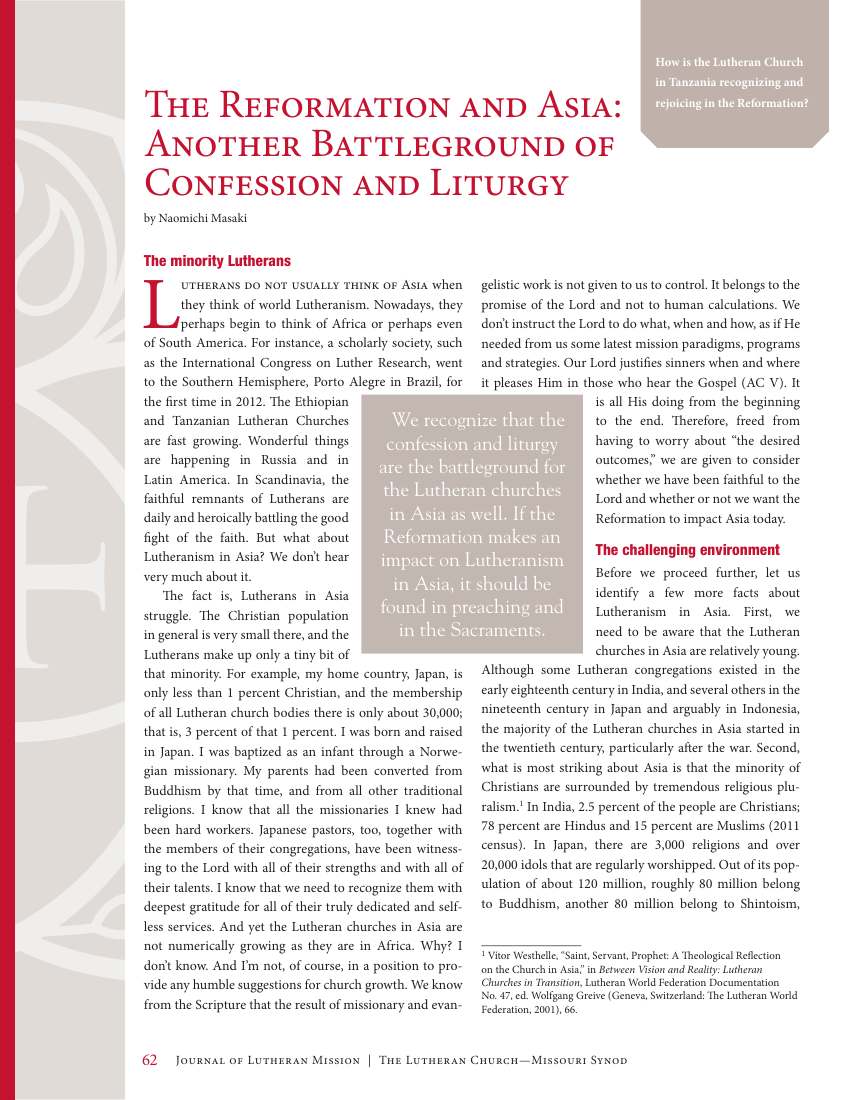
The Reformation and Asia: Another Battleground of Confession and Liturgy
How is the Lutheran Church in Tanzania recognizing and rejoicing in the Reformation?
The minority Lutherans
Lutherans do not usually think of Asia when they think of world Lutheranism. Nowadays, they perhaps begin to think of Africa or perhaps even of South America. For instance, a scholarly society, such as the International Congress on Luther Research, went to the Southern Hemisphere, Porto Alegre in Brazil, for the first time in 2012. The Ethiopian and Tanzanian Lutheran Churches are fast growing. Wonderful things are happening in Russia and in Latin America. In Scandinavia, the faithful remnants of Lutherans are daily and heroically battling the good fight of the faith. But what about Lutheranism in Asia? We don’t hear very much about it.
The fact is, Lutherans in Asia struggle. The Christian population in general is very small there, and the Lutherans make up only a tiny bit of that minority. For example, my home country, Japan, is only less than 1 percent Christian, and the membership of all Lutheran church bodies there is only about 30,000; that is, 3 percent of that 1 percent. I was born and raised in Japan. I was baptized as an infant through a Norwegian missionary. My parents had been converted from Buddhism by that time, and from all other traditional religions. I know that all the missionaries I knew had been hard workers. Japanese pastors, too, together with the members of their congregations, have been witnessing to the Lord with all of their strengths and with all of their talents. I know that we need to recognize them with deepest gratitude for all of their truly dedicated and selfless services. And yet the Lutheran churches in Asia are not numerically growing as they are in Africa. Why? I don’t know. And I’m not, of course, in a position to provide any humble suggestions for church growth. We know from the Scripture that the result of missionary and evangelistic work is not given to us to control. It belongs to the promise of the Lord and not to human calculations. We don’t instruct the Lord to do what, when and how, as if He needed from us some latest mission paradigms, programs and strategies. Our Lord justifies sinners when and where it pleases Him in those who hear the Gospel (AC V). It is all His doing from the beginning to the end. Therefore, freed from having to worry about “the desired outcomes,” we are given to consider whether we have been faithful to the Lord and whether or not we want the Reformation to impact Asia today.
The challenging environment
View original page
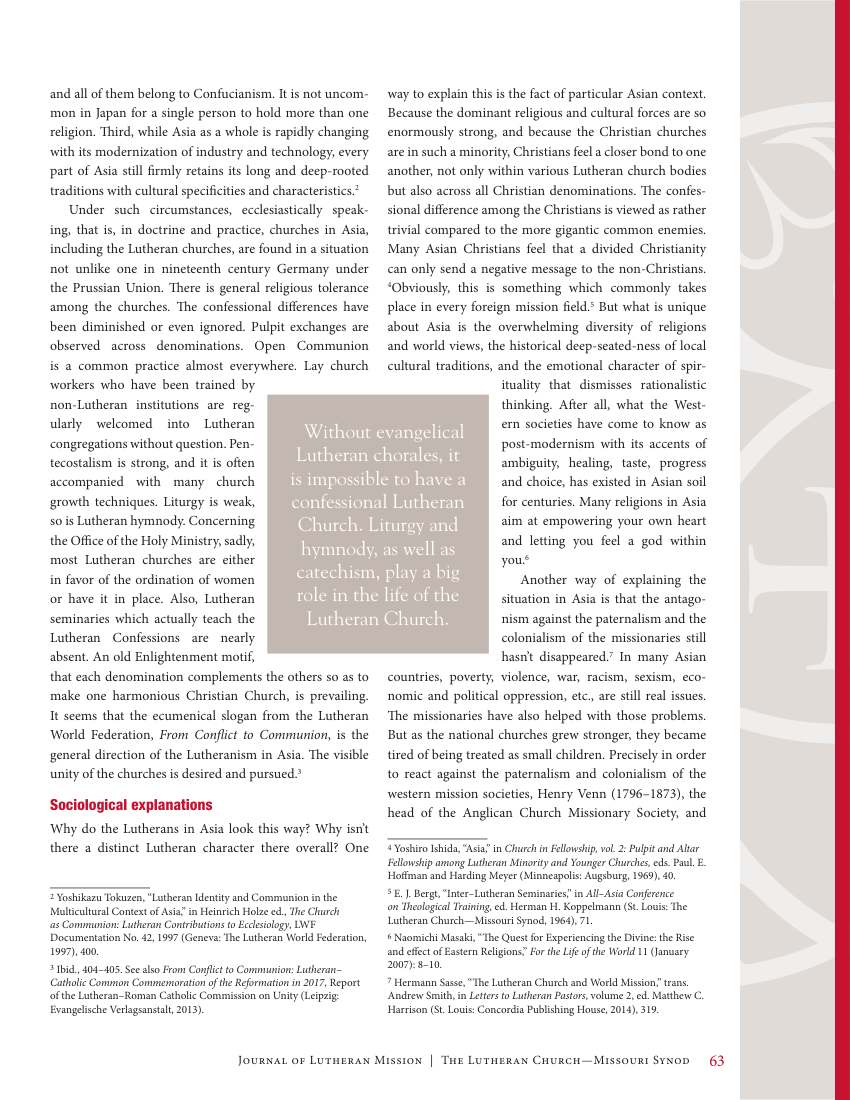
Before we proceed further, let us identify a few more facts about Lutheranism in Asia. First, we need to be aware that the Lutheran churches in Asia are relatively young. Although some Lutheran congregations existed in the early eighteenth century in India, and several others in the nineteenth century in Japan and arguably in Indonesia, the majority of the Lutheran churches in Asia started in the twentieth century, particularly after the war. Second, what is most striking about Asia is that the minority of Christians are surrounded by tremendous religious pluralism.1 In India, 2.5 percent of the people are Christians; 78 percent are Hindus and 15 percent are Muslims (2011 census). In Japan, there are 3,000 religions and over 20,000 idols that are regularly worshipped. Out of its population of about 120 million, roughly 80 million belong to Buddhism, another 80 million belong to Shintoism, 69 and all of them belong to Confucianism. It is not uncommon in Japan for a single person to hold more than one religion. Third, while Asia as a whole is rapidly changing with its modernization of industry and technology, every part of Asia still firmly retains its long and deep-rooted traditions with cultural specificities and characteristics.2 Under such circumstances, ecclesiastically speaking, that is, in doctrine and practice, churches in Asia, including the Lutheran churches, are found in a situation not unlike one in nineteenth century Germany under the Prussian Union. There is general religious tolerance among the churches. The confessional differences have been diminished or even ignored. Pulpit exchanges are observed across denominations. Open Communion is a common practice almost everywhere. Lay church workers who have been trained by non-Lutheran institutions are regularly welcomed into Lutheran congregations without question. Pentecostalism is strong, and it is often accompanied with many church growth techniques. Liturgy is weak, so is Lutheran hymnody. Concerning the Office of the Holy Ministry, sadly, most Lutheran churches are either in favor of the ordination of women or have it in place. Also, Lutheran seminaries which actually teach the Lutheran Confessions are nearly absent. An old Enlightenment motif, that each denomination complements the others so as to make one harmonious Christian Church, is prevailing. It seems that the ecumenical slogan from the Lutheran World Federation, From Conflict to Communion, is the general direction of the Lutheranism in Asia. The visible unity of the churches is desired and pursued.3
Sociological explanations
Why do the Lutherans in Asia look this way? Why isn’t there a distinct Lutheran character there overall? One way to explain this is the fact of particular Asian context. Because the dominant religious and cultural forces are so enormously strong, and because the Christian churches are in such a minority, Christians feel a closer bond to one another, not only within various Lutheran church bodies but also across all Christian denominations. The confessional difference among the Christians is viewed as rather trivial compared to the more gigantic common enemies. Many Asian Christians feel that a divided Christianity can only send a negative message to the non-Christians. 4Obviously, this is something which commonly takes place in every foreign mission field.5 But what is unique about Asia is the overwhelming diversity of religions and world views, the historical deep-seated-ness of local cultural traditions, and the emotional character of spirituality that dismisses rationalistic thinking. After all, what the Western societies have come to know as post-modernism with its accents of ambiguity, healing, taste, progress and choice, has existed in Asian soil for centuries. Many religions in Asia aim at empowering your own heart and letting you feel a god within you.6
View original page
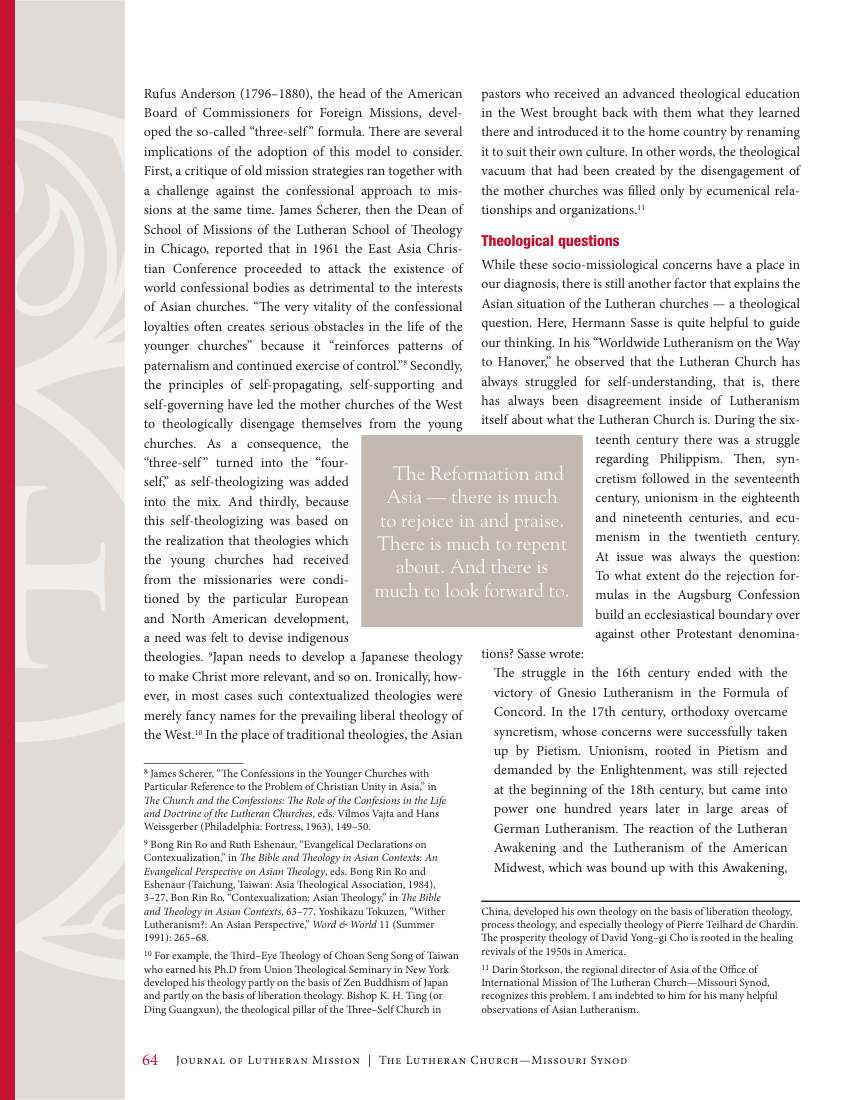
Another way of explaining the situation in Asia is that the antagonism against the paternalism and the colonialism of the missionaries still hasn’t disappeared.7 In many Asian countries, poverty, violence, war, racism, sexism, economic and political oppression, etc., are still real issues. The missionaries have also helped with those problems. But as the national churches grew stronger, they became tired of being treated as small children. Precisely in order to react against the paternalism and colonialism of the western mission societies, Henry Venn (1796–1873), the head of the Anglican Church Missionary Society, and 70 Rufus Anderson (1796–1880), the head of the American Board of Commissioners for Foreign Missions, developed the so-called “three-self” formula. There are several implications of the adoption of this model to consider. First, a critique of old mission strategies ran together with a challenge against the confessional approach to missions at the same time. James Scherer, then the Dean of School of Missions of the Lutheran School of Theology in Chicago, reported that in 1961 the East Asia Christian Conference proceeded to attack the existence of world confessional bodies as detrimental to the interests of Asian churches. “The very vitality of the confessional loyalties often creates serious obstacles in the life of the younger churches” because it “reinforces patterns of paternalism and continued exercise of control.”8 Secondly, the principles of self-propagating, self-supporting and self-governing have led the mother churches of the West to theologically disengage themselves from the young churches. As a consequence, the “three-self” turned into the “four-self,” as self-theologizing was added into the mix. And thirdly, because this self-theologizing was based on the realization that theologies which the young churches had received from the missionaries were conditioned by the particular European and North American development, a need was felt to devise indigenous theologies. 9Japan needs to develop a Japanese theology to make Christ more relevant, and so on. Ironically, however, in most cases such contextualized theologies were merely fancy names for the prevailing liberal theology of the West.10 In the place of traditional theologies, the Asian pastors who received an advanced theological education in the West brought back with them what they learned there and introduced it to the home country by renaming it to suit their own culture. In other words, the theological vacuum that had been created by the disengagement of the mother churches was filled only by ecumenical relationships and organizations.11
Theological questions
While these socio-missiological concerns have a place in our diagnosis, there is still another factor that explains the Asian situation of the Lutheran churches — a theological question. Here, Hermann Sasse is quite helpful to guide our thinking. In his “Worldwide Lutheranism on the Way to Hanover,” he observed that the Lutheran Church has always struggled for self-understanding, that is, there has always been disagreement inside of Lutheranism itself about what the Lutheran Church is. During the sixteenth century there was a struggle regarding Philippism. Then, syncretism followed in the seventeenth century, unionism in the eighteenth and nineteenth centuries, and ecumenism in the twentieth century. At issue was always the question: To what extent do the rejection formulas in the Augsburg Confession build an ecclesiastical boundary over against other Protestant denominations? Sasse wrote:
The struggle in the 16th century ended with the victory of Gnesio Lutheranism in the Formula of Concord. In the 17th century, orthodoxy overcame syncretism, whose concerns were successfully taken up by Pietism. Unionism, rooted in Pietism and demanded by the Enlightenment, was still rejected at the beginning of the 18th century, but came into power one hundred years later in large areas of German Lutheranism. The reaction of the Lutheran Awakening and the Lutheranism of the American Midwest, which was bound up with this Awakening,
View original page
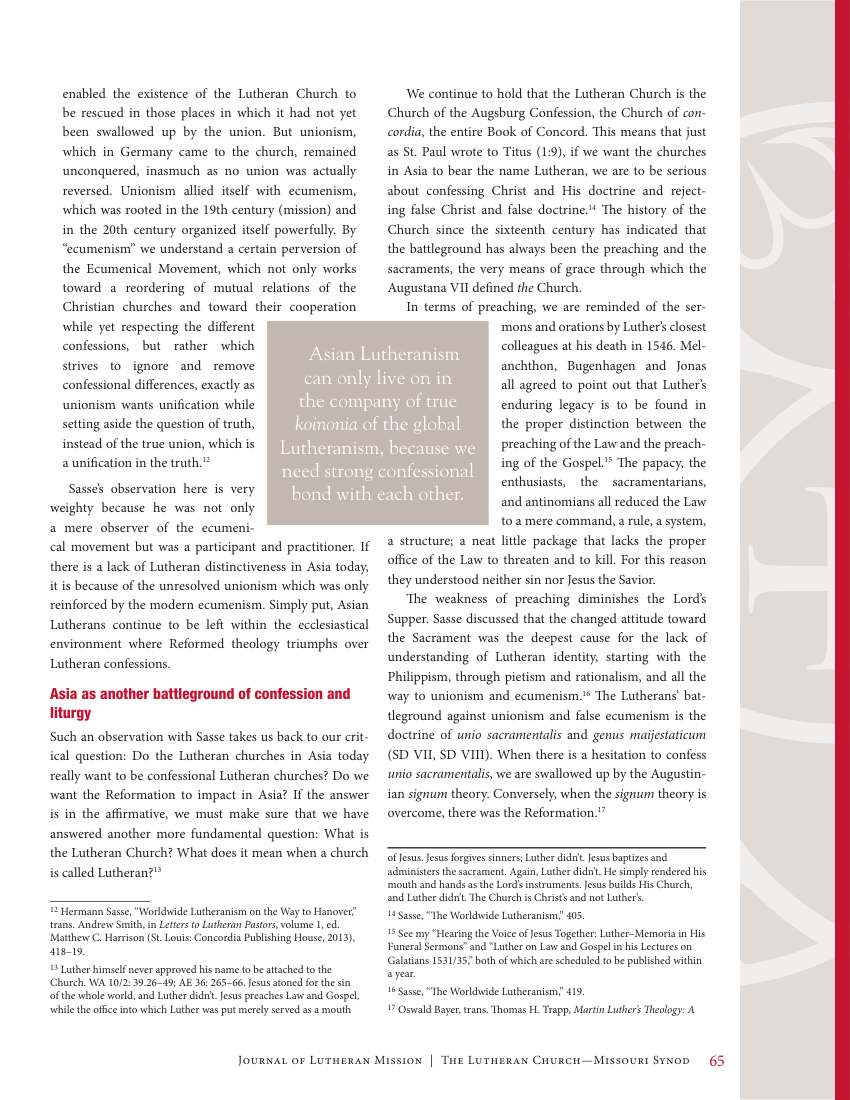
enabled the existence of the Lutheran Church to be rescued in those places in which it had not yet been swallowed up by the union. But unionism, which in Germany came to the church, remained unconquered, inasmuch as no union was actually reversed. Unionism allied itself with ecumenism, which was rooted in the 19th century (mission) and in the 20th century organized itself powerfully. By “ecumenism” we understand a certain perversion of the Ecumenical Movement, which not only works toward a reordering of mutual relations of the Christian churches and toward their cooperation while yet respecting the different confessions, but rather which strives to ignore and remove confessional differences, exactly as unionism wants unification while setting aside the question of truth, instead of the true union, which is a unification in the truth.12
Sasse’s observation here is very weighty because he was not only a mere observer of the ecumenical movement but was a participant and practitioner. If there is a lack of Lutheran distinctiveness in Asia today, it is because of the unresolved unionism which was only reinforced by the modern ecumenism. Simply put, Asian Lutherans continue to be left within the ecclesiastical environment where Reformed theology triumphs over Lutheran confessions.
Asia as another battleground of confession and liturgy
Such an observation with Sasse takes us back to our critical question: Do the Lutheran churches in Asia today really want to be confessional Lutheran churches? Do we want the Reformation to impact in Asia? If the answer is in the affirmative, we must make sure that we have answered another more fundamental question: What is the Lutheran Church? What does it mean when a church is called Lutheran?13
We continue to hold that the Lutheran Church is the Church of the Augsburg Confession, the Church of concordia, the entire Book of Concord. This means that just as St. Paul wrote to Titus (1:9), if we want the churches in Asia to bear the name Lutheran, we are to be serious about confessing Christ and His doctrine and rejecting false Christ and false doctrine.14 The history of the Church since the sixteenth century has indicated that the battleground has always been the preaching and the sacraments, the very means of grace through which the Augustana VII defined the Church.
In terms of preaching, we are reminded of the sermons and orations by Luther’s closest colleagues at his death in 1546. Melanchthon, Bugenhagen and Jonas all agreed to point out that Luther’s enduring legacy is to be found in the proper distinction between the preaching of the Law and the preaching of the Gospel.15 The papacy, the enthusiasts, the sacramentarians, and antinomians all reduced the Law to a mere command, a rule, a system, a structure; a neat little package that lacks the proper office of the Law to threaten and to kill. For this reason they understood neither sin nor Jesus the Savior.
The weakness of preaching diminishes the Lord’s Supper. Sasse discussed that the changed attitude toward the Sacrament was the deepest cause for the lack of understanding of Lutheran identity, starting with the Philippism, through pietism and rationalism, and all the way to unionism and ecumenism.16 The Lutherans’ battleground against unionism and false ecumenism is the doctrine of unio sacramentalis and genus maijestaticum (SD VII, SD VIII). When there is a hesitation to confess unio sacramentalis, we are swallowed up by the Augustinian signum theory. Conversely, when the signum theory is overcome, there was the Reformation.17
View original page
The consecrated bread that a pastor holds in his hands and puts on the lips of the communicants is the body of Christ. The consecrated cup that a pastor holds in his hands and distributes to the communicants is the blood of Christ. The Lord’s Supper is a particular location where Jesus seeks to find His people in order to comfort them. In Him the fullness of deity dwells bodily (Col. 2:9). Apart from this man Jesus in His Body and Blood there is no God. The Formula of Concord emphasizes that in this way, Jesus wants to be with us, dwell, work and be effective in us in the Lord’s Supper (SD VIII, 76–79). We are given no other God than Jesus who forgives our sin in the externum verbum (AC V, SA III, VIII). The Lord’s Supper is at the center of the life of His Church. Lutherans cannot live without it, simply because the Holy Communion is the Gospel. Doctrine and liturgy belong inseparably together. When the great missiologist, Friedrich Wilhelm Hopf of Blackmar mission said: “Lutherische Kirche treibt Lutherische Mission,” or “The Lutheran Church can only do Lutheran mission, and Lutheran mission can be done only by a Lutheran Church,” he meant that the Lutheran Church that results from the Lutheran mission is precisely the place where Jesus deals with us by preaching Law and Gospel and by bestowing His body and blood for us to eat and to drink.18 The Lutheran Church is the means of grace church. The Lutheran mission is the means of grace mission. Lutheran pastors are the means of grace pastors.
What does this all mean for Asian Lutheranism? It means that we recognize that the confession and liturgy are the battleground for the Lutheran churches in Asia as well. If the Reformation makes an impact on Lutheranism in Asia, it should be found in preaching and in the Sacraments. Without evangelical Lutheran chorales, it is impossible to have a confessional Lutheran Church. Liturgy and hymnody, as well as catechism, play a big role in the life of the Lutheran Church.
The Reformation and Asia — there is much to rejoice in and praise. There is much to repent about. And there is much to look forward to. Asian Lutheranism can only live on in the company of true koinonia of the global Lutheranism, because we need strong confessional bond with each other. Lutherans struggle in Asia. They are a minority in society. They are also surrounded by incredibly strong anti-Christian religious and cultural forces. Despite these challenges, the Lord’s promise never changes. Jesus will be with the Church today, tomorrow and forever, precisely in the means of grace!
The Rev. Dr. Naomichi Masaki is associate professor of Systematic Theology and director of the S. T. M. program at Concordia Theological Seminary, Fort Wayne, Ind.
Notes
- Vítor Westhelle, “Saint, Servant, Prophet: A Theological Reflection on the Church in Asia,” in Between Vision and Reality: Lutheran Churches in Transition, Lutheran World Federation Documentation No. 47, ed. Wolfgang Greive (Geneva, Switzerland: The Lutheran World Federation, 2001), 66. ↩
- Yoshikazu Tokuzen, “Lutheran Identity and Communion in the Multicultural Context of Asia,” in Heinrich Holze ed., The Church as Communion: Lutheran Contributions to Ecclesiology, LWF Documentation No. 42, 1997 (Geneva: The Lutheran World Federation, 1997), 400. ↩
- Ibid., 404–405. See also From Conflict to Communion: Lutheran– Catholic Common Commemoration of the Reformation in 2017, Report of the Lutheran–Roman Catholic Commission on Unity (Leipzig: Evangelische Verlagsanstalt, 2013). ↩
- Yoshiro Ishida, “Asia,” in Church in Fellowship, vol. 2: Pulpit and Altar Fellowship among Lutheran Minority and Younger Churches, eds. Paul. E. Hoffman and Harding Meyer (Minneapolis: Augsburg, 1969), 40. ↩
- E. J. Bergt, “Inter–Lutheran Seminaries,” in All–Asia Conference on Theological Training, ed. Herman H. Koppelmann (St. Louis: The Lutheran Church—Missouri Synod, 1964), 71. ↩
- Naomichi Masaki, “The Quest for Experiencing the Divine: the Rise and effect of Eastern Religions,” For the Life of the World 11 (January 2007): 8–10. ↩
- Hermann Sasse, “The Lutheran Church and World Mission,” trans. Andrew Smith, in Letters to Lutheran Pastors, volume 2, ed. Matthew C. Harrison (St. Louis: Concordia Publishing House, 2014), 319. ↩
- James Scherer, “The Confessions in the Younger Churches with Particular Reference to the Problem of Christian Unity in Asia,” in The Church and the Confessions: The Role of the Confesions in the Life and Doctrine of the Lutheran Churches, eds. Vilmos Vajta and Hans Weissgerber (Philadelphia: Fortress, 1963), 149–50. ↩
- Bong Rin Ro and Ruth Eshenaur, “Evangelical Declarations on Contexualization,” in The Bible and Theology in Asian Contexts: An Evangelical Perspective on Asian Theology, eds. Bong Rin Ro and Eshenaur (Taichung, Taiwan: Asia Theological Association, 1984), 3–27, Bon Rin Ro, “Contexualization: Asian Theology,” in The Bible and Theology in Asian Contexts, 63–77. Yoshikazu Tokuzen, “Wither Lutheranism?: An Asian Perspective,” Word & World 11 (Summer 1991): 265–68. ↩
- For example, the Third–Eye Theology of Choan Seng Song of Taiwan who earned his Ph.D from Union Theological Seminary in New York developed his theology partly on the basis of Zen Buddhism of Japan and partly on the basis of liberation theology. Bishop K. H. Ting (or Ding Guangxun), the theological pillar of the Three–Self Church in China, developed his own theology on the basis of liberation theology, process theology, and especially theology of Pierre Teilhard de Chardin. The prosperity theology of David Yong–gi Cho is rooted in the healing revivals of the 1950s in America. ↩
- Darin Storkson, the regional director of Asia of the Office of International Mission of The Lutheran Church—Missouri Synod, recognizes this problem. I am indebted to him for his many helpful observations of Asian Lutheranism. ↩
- Hermann Sasse, “Worldwide Lutheranism on the Way to Hanover,” trans. Andrew Smith, in Letters to Lutheran Pastors, volume 1, ed. Matthew C. Harrison (St. Louis: Concordia Publishing House, 2013), 418–19. ↩
- Luther himself never approved his name to be attached to the Church. WA 10/2: 39.26–49; AE 36: 265–66. Jesus atoned for the sin of the whole world, and Luther didn’t. Jesus preaches Law and Gospel, while the office into which Luther was put merely served as a mouth of Jesus. Jesus forgives sinners; Luther didn’t. Jesus baptizes and administers the sacrament. Again, Luther didn’t. He simply rendered his mouth and hands as the Lord’s instruments. Jesus builds His Church, and Luther didn’t. The Church is Christ’s and not Luther’s. ↩
- Sasse, “The Worldwide Lutheranism,” 405. ↩
- See my “Hearing the Voice of Jesus Together: Luther–Memoria in His Funeral Sermons” and “Luther on Law and Gospel in his Lectures on Galatians 1531/35,” both of which are scheduled to be published within a year. ↩
- Sasse, “The Worldwide Lutheranism,” 419. ↩
- Oswald Bayer, trans. Thomas H. Trapp, Martin Luther’s Theology: A Contemporary Interpretation (Grand Rapids, MI: Eerdmans, 2008), 52. Signum theory was prominent not only in sacramentarians of Luther’s life time, but also in the second sacramentarian controversy of the Formula of Concord Era through the Consensus Tigrinus of 1549. How this theory is useful to obscure what is concrete in doctrine is demonstrated by Minna Hietamäki in her ecumenical understanding of church and ministry. Minna Hietamäki, “The Ecumenical relevance of the Marks of the Church,” in One Holy, Catholic and Apostolic Church: Some Lutheran and Ecumenical Perspectives, LWF Studies 2009, ed. Hans–Peter Grosshans (Geneva: The Lutheran World Federation, 2009), 49–64. ↩
- Friedrich Wilhelm Hopf, “Lutherische Kirche treibt Lutherische Mission,” in Lutherische Kirche Treibt Lutherische Mission: Festschrift zum 75 jähringen Jubiläum der Bleckmarer Mission, 1982, 14 Juni, 1967, ed. Friedrich Wilhelm Hopf (Blackmar über Soltau [Hannover]: Mission Evangelisch–Lutherischer Freikirchen, 1967), 13–47. This essay was recently translated by Rachel Mumme with Matthew C. Harrison and published in Journal of Lutheran Mission (April 2015), 6–28. ↩
Tip: use the ← and → keys to move between sections. Share any page with index.html?p=<page>.