
Search this journal
View original page
Reformation Jubilees: Is There Cause for Celebration in 2017?
Is there any reason to celebrate the Reformation in 2017?
What should we celebrate in 2017? Should we “celebrate” at all? Would it not be more appropriate to observe a Reformation “commemoration”? That would at least be an indication of the fact that the ongoing division within Western Christianity is no cause for jubilation. But the question that generally arises is whether the objectives laid out by Wolfgang Huber in 2008 for the Luther Decade1 go far and deep enough, or rather whether the more deeply rooted and ultimately biblical-theological motifs can actually be received into Church and society. The former President of the Evangelical Church in Germany names the Lutheran- themes as being those of “hopelessnesses of life,” “afflictions of faith,” “God’s hiddenness” and “the theology of the cross.” He points out that, according to Martin Luther, “man is in and of himself unfree, a prisoner of sin” and that freedom should, above all, be understood to be “a departure from the inversion of human existence, as salvation from the disorientations of life, as deliverance from the shackles of sin and death.” According to Huber, the basis of this freedom lies in that “God bestows on every human the ability to walk upright” so that, consequentially, “every human is able to bow his knees.” The soteriological focal point of biblical Lutheran theology reflects this aspect with its assertion that “it is only God who, through the belief in Christ, awards freedom and dignity to every human,” consequently deducing an unmediated equality of all humankind before God that is experienced on an individual basis. This Church concept is reduced to the “metaphor of a Christian fellowship,” a “fellowship of equals” that “also provides socio-political impetus.”
View original page
This conglomeration of ideas gives the Luther Decade project the additional appearance of a political project that requires Luther to serve as a prompting source of inspiration to pose the question of meaning, to reclaim an educational-historical relevance,2 which admittedly points to Melanchton rather than Luther,3 as well as an impact on scientific history, which does not remain undisputed,4 or indeed a cultural-historical relevance and to proclaim an ethicizing Christianity; such a disposition 33 could — in a derivative way — be called “Modern Culture Protestantism.”5 It is also questionable whether the rather sweeping claim “of the Reformation” for “enlightenment and democracy, individuality and human dignity, religious plurality and tolerance”6 can be brought in line with historical reality.7 This gives rise to justified criticism as far as the implications of this observance regarding tourism policy are concerned.8
It is, however, not surprising that during the run-up to the commemoration of the Reformation that has been scheduled for 2017, in spite of the problematic nature of the historical facts, their historiographic classification as well as their interpretation;9 this date is bound up with greatly diverging expectations.10 In any event, and in view of the Luther celebrations through the centuries, the undeniable conclusion can, on the whole, be reached that: “All previous Luther jubilees during the past centuries were highly politicised.”11 And it is indeed necessary to point out that the Reformation is not merely an event of Protestant Church history and German history in general, but rather a process of Christianity, therefore elevating it to an event of world-historical significance.12 From a Roman Catholic point of view, and even with greater ecumenical open-mindedness and “approaches to the person of Martin Luther,” the “fact” of the “schism within the Western Church” remains, posing an ecumenical challenge.13 Nevertheless, in the context of more recent Roman Catholic Luther and Reformation research, it seems possible to locate “Luther’s reform objective in the historically more encompassing domain of Lutheran confessionalisation,” opening up the possibility of “revisiting Martin Luther and the Reformation in a new, Catholic way,”14 and even of an “ecumenical reception” of Luther.15
View original page
In my opinion the very strong reactions that the document of the Evangelical Church in Germany on “Justification and Freedom”16 has elicited from some Roman Catholic quarters suggest that, as far as the question as to what should be commemorated or even “celebrated” is concerned, it is apparent that there remain a number of larger ecumenical stumbling blocks that still need to be processed, if not removed altogether. The statement alone that “this jubilee is, for the first time, being jointly prepared by all Protestant Churches in Germany” is a rather bold one, but can be explained by a conception of “Evangelical Church,” based on the Leuenberg Agreement, which holds out Church unity as a possibility.17 It is there 34 fore not surprising that the jubilee of 1817 is interpreted as being the date of a “rapprochement of the two great confessional wings of the Reformation.”18 These days, references are made under the heading of a “legitimate pluralisation due to its Scriptural conformity”19 in order to counter the term “schism.”20
Many aspects of the attempts of this fundamental text to revisit the “central theme of the Reformation” for modern contemporaries can be described as being successful; for instance, the emphasis on the exclusive particles (solus Christus, solo verbo, sola scriptura, sola gratia, sola fide) and the interpretation of these with the aid of the keywords “‘love,’ ‘recognition and appreciation,’ ‘forgiveness’ and ‘freedom.’”21 It has to be stated nonetheless, that the repression of the motif of sacrifice in the description of Christ’s work is cause for concern.22 The concept of freedom, even given the differences in perception of this concept between Reformation and modern times,23 is still understood to be freedom toward the other and is consequently used in an equivocal sense.24 Accordingly, and despite protestations to the contrary, Luther’s appearance in Worms is being invoked for the “fundamental value of universal freedom of conscience” so that “Luther’s fundamental belief” corresponds to “the modern framework of the constitution of the democratic state.”25 Then it may also be expected that “the jubilee … should become a celebration of society as a whole, and of the secular state.”26 Furthermore, defining the relationship between congregation\church and ecclesiastical ministry appears to be particularly questionable to me, seeing that the latter should apparently only exist “for the sake of order.”27
Wolfgang Thönissen, the executive director of the Johann-Adam-Möhler Institute in Paderborn, has — albeit with unusual vehemence but with some justification — described “this Protestant programme” as not being compatible “with the ecumenical programme.”28 Thomas Söding, a Roman Catholic New Testament scholar in Bochum, has, from his critique that the fundamental text also fell short of offering “a base for a serious discussion with Catholic theology,” concluded that an “ecumenism of profiles,” as called for in 2005 by Wolfgang Huber, the former president of the Council of the Evangelical Church in Germany (EKD), should rather be replaced with the model of an “ecumenism of strengths.”29 The Erfurt Luther Symposium, hosted by the Johan-Adam-Möhler Institute and the Faculty of Catholic Theology at the University of Erfurt, paid tribute to Martin Luther as being a “Reform Catholic.”30 It seems to me that here, too, lie the beginnings for a Reformation commemoration with Concord-Lutheran ecumenical intent.
View original page
Originally a denotation imposed by others, the term “Lutheran” becomes one of self-designation, also in the sense of an inter-Christian differentiation. But what is the greatness of “Lutheranism”? During the confessionalisation processes of the sixteenth and seventeenth centuries,31 an emergence of varying church-institutional forms can already be discerned, despite the homogenisation tendencies effected by the Formula of Concord,32 if one only looks at the Holy Roman Empire of the German Nation in various territorial church developments.33 Standing outside of this are national churches in Scandinavia, for instance, but also groups and minorities of Lutheran orientation that are 35 under pressure.
The notion that “Protestantism” has brought forth the formation of the modern-day scientific approach or has affected it in a particular way has come under fire of late as being “a Protestant-Lutheran master narrative.”34 It should anyway be borne in mind that the term “Protestantism” carries with it the risk of a hasty unification where differences as to theology, confession, denomination or types of devotion are concerned.35 By contrast, claims as to the impact on scientific history in the sphere of influence of Calvin and Calvinism continue to be made, 36not least for the early period of the Netherlands.37 The “Protestant Reformation” has been used in order to serve at least as a general framework for the development of natural philosophy, medicine and astronomy.38
Amongst the “ingrained interpretive paradigms of European history” is also the assertion “that Calvinism is said to have effected the promotion of democracy, while Lutheranism is said to have strengthened the belief in authority.”39 This view needs to be modified at the very least, since the “doctrine of the three estates” (Drei-Stände-Lehre) of Lutheranism led to the restriction of authority, and the “resistance debate” in the Reich “did not break off”40 after the Peace of Augsburg. It has been proven for quite some time that particular subservience to authority does not apply to the Lutheran court chaplains, at least not to those of the first few generations.41 It must be emphasised in this regard that “the more recent right to resist was ‘invented’ and first propagated by Lutheranism in the middle of the 16th century” so that Lutheranism cannot simply be defamed as being a “doctrine of subservient subordination.”42
View original page
The question as to whether more valuable insights can be gained with the concept of a “Lutheran Confession Culture” might be raised;43 the concept does at least achieve the identification of “confession as [being] Lutheran” practise, thereby representing an open process. However, the determination of a Lutheran identity does thereby tend to remain underexposed. One can nonetheless discern a specific impact of Reformation theology on the fine arts, for instance the thematisation around the Lutheran basic formula of “Law and Gospel.”44 It is and remains undisputed that the Bible and hymnal, in the way that they 36 have become determinants for piety and worship during the Lutheran Reformation, have, “during the subsequent period, defined Christian culture as a whole, and across all confessional boundaries at that;” this is exemplified by the names of Paul Gerhardt and Johann Sebastian Bach.45 Where constitutional law pertaining to the Church and State is concerned, the Peace of Westphalia of 1648, constituting the first large-scale attempt at a European framework for peace,46 initially safeguarded the unity of the Reich, characterised by the dissimulation which codified the relative legal validity of multi-confessionality.47 During the further course of European history,48 but especially in the Holy Roman Empire of the German Nation and its territories, this religious plurality played a determining role in the shaping of diverse and also collective mentalities and regional identities.49
Luther interpretations up to the twentieth century — an outline
View original page
Early historical receptions of Luther in the sixteenth century already reflect historical-theological interpretations, for instance when Luther is portrayed as being a prophet, teacher or hero,50 partly in a mythological mold, partly in a kind of confessional canonisation as witnessed in the Corpora Doctrinae, and absolutely in competition with Phillip Melanchthon.51 Luther’s authority is defended in the Apology of the Formula of Concord (1584) over objections from Crypto-Philippistic quarters; for their part, the Calvinists accordingly dispute Martin Luther’s prophetic and apostolic “office.” Such stylisations result in a development of tendencies towards a monumentalisation and stereotyping of Martin Luther, which super-elevate and paralyze the historical Luther.52 Pietism and Enlightenment are, for the most part, not interested in Martin Luther as teacher of the Church in terms of a Lutheranism informed by the Formula of Concord, even though Philipp Jakob Spener and the first-generation Lutheran Pietists laid legitimatory claim to Luther.53 For the self-assurance of the Lutheran territories, their elites and — at least in parts — their people, and even before the Thirty Years’ War as well as after it, significance was afforded to the Reformation jubilees; they reveal in each case the church and religious position(s) that were in need of legitimatory strengthening. The centenary of the Reformation was interpreted in the light of “Heilsgeschichte.”54 Luther is assigned a “salvific over-dimensional quality,” by virtue of which the Reformer from Wittenberg is said to have rehabilitated Scriptures, brought the Doctrine of Justification to light again and corrected sacramental theology.55 By way of response to the Roman Catholic Church’s contestation of Luther’s legitimisation, a virtually direct calling to the position of Reformer was assigned to him by the opposite side,56 since it was not least a matter of “safeguarding the dogmatic claim to truth of German Protestantism.”57 As the Wittenberg speeches and sermons of 1617 show, it was about nothing less than the “legitimisation through history,” in which Wittenberg styles itself as being “Salem,”58 or Strasbourg 37 where — contrary to its own Reformation history and by way of profiling itself against the newly-founded and imperially privileged Jesuit College in Molsheim — expedited “its solidarity with Saxon Lutheranism.”59
One to one-and-a-half centuries later the historical-theological interpretation of the Reformation was still very present in its objection of and opposition to the papacy, which was still being portrayed as the “apocalyptic world tyrant,” as well as partly in a coalition with Lutheran-Enlightened elements;60 the image of Luther was in accordance with this, where his person was interpreted as being the fulfilment of the prophesy in Revelation,61 or rather as being the “sun” of “religious enlightenment.”62 Within the ranks of the last representatives of Lutheran Orthodoxy, the Reformation Jubilee of 1717 was utilised to once again “demonstrate the unity of Lutheranism.”63 However, one also comes across laments about “a desolate condition of the Evangelical Church,” especially in Electoral Saxony, together with this contradicting appeal to adhere to the traditional Lutheran faith; the latter were to no small degree topical, since the Elector had converted to Catholicism twenty years previously, and the Electoral Prince had changed his confession very recently.64
Pietism “historicises” Luther “as well as his doctrine” and predominantly perceives him as being “homo religious,” who was “undoubtedly one of a kind,” beyond whom history admittedly extended and who, in the consciousness of the development of piety, “is recording something new and seminal into the annals of history.”65 By referring to Luther’s preface to the Epistle to the Romans, by emphasising the priesthood of all believers or by referring to Luther’s preface to the German Mass, the Lutheran Pietists were, at least in the beginning, admittedly striving to maintain continuity with the Wittenberg Reformation, especially where the Doctrine of Justification was concerned; however, the theological-existential concern shifted towards a “regeneration of the justified,” or rather than toward implementing and safeguarding the existential turning point.66 Studies were now geared toward practical relevance “within the framework of a holistic practise of piety.”67
View original page
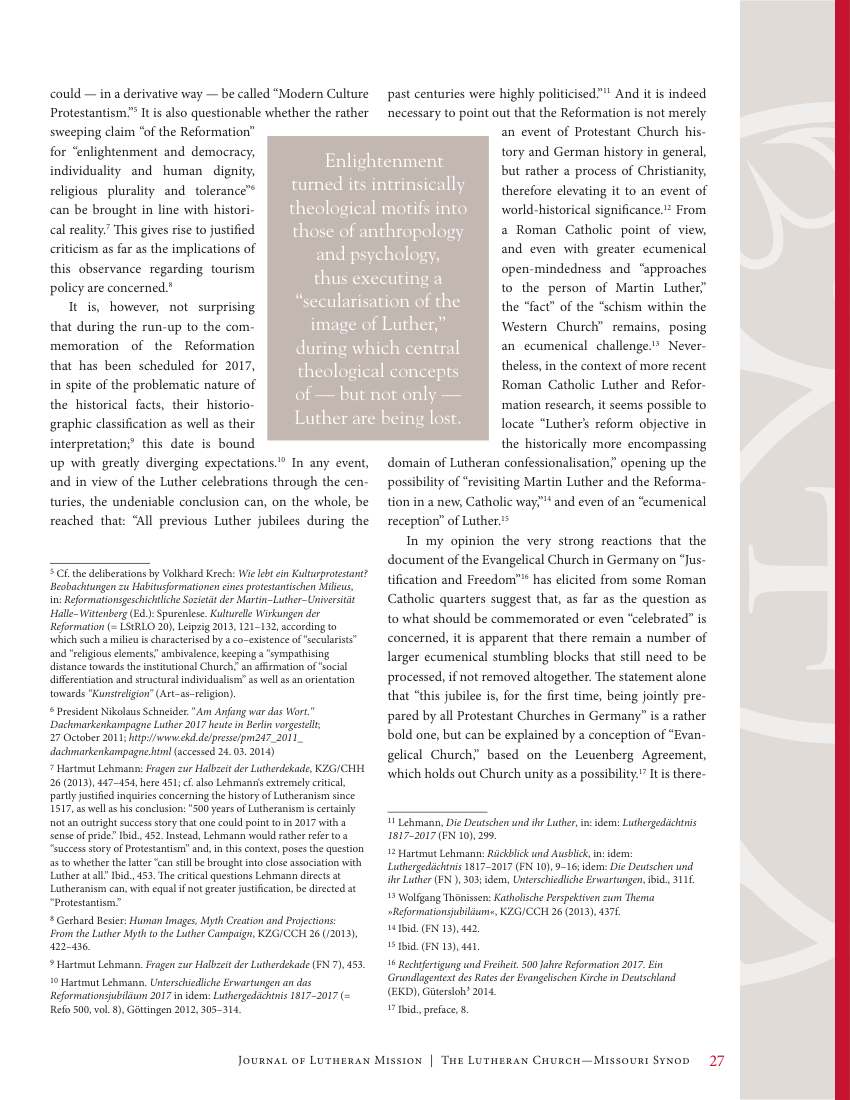
Enlightenment turned its intrinsically theological motifs into those of anthropology and psychology,68 thus executing a “secularisation of the image of Luther,” during which central theological concepts of — but not only — Luther are being lost; humanity and ideal, nation and people are the guiding interests that supersede theology and church.69 Accompanying this is a change of the view of Luther toward 38 “the interdenominational.” A paradigm shift occurred in the writing of Church history that now had a “science specific association with the past,” inasmuch as the “Protestant theologians were compelled, to some extent, to develop new legitimisation interpretations for the Reformation which had to prevail before the judgement seat of reason.”70 Enlightenment is, according to the “teleology of progress,” consequently “the driving force behind an improvement of religion and science that extends beyond the Reformation.”71 This was consistent with an increased emphasis on practical relevance in progressive concepts of theological studies, albeit — as opposed to Pietism — sustained by a “solid, intellectual education.”72 These concepts comprise “a stronger individualisation, subjectivisation and above all hermeneutical humility in the sense of religious tolerance,” while simultaneously exceeding “former confessional self-limitation.” A separation of Christian and “secular educationnal contexts” subsequently tends to occur.73
In North America, during the eighteenth century, the Lutherans were mostly in the minority but were facing greater difficulties where the (re-)organisation of the church was concerned, not least because of the new geographical, societal, governmental and religion-political contexts. On the one hand, the North American pathos of liberty and a new beginning served them as a guiding principle for a new contextualisation; its legitimacy was however underpinned by its close historical ties to Luther and the Reformation.74 For the Lutherans of predominantly German origin the Reformation jubilee of 1817, a “minority phenomenon” in the United States,75 acted as an orientation within the new context, but with varying outcomes. It became either an expression of the ability to connect “with other Protestants,” or emphasis was placed on “Lutheranism as an autonomous denomination in a Protestant environment” while “simultaneously stressing linguistic and religious autonomy.”76 The latter still applied in the middle of the nineteenth century to the Saxon emigrants who subsequently formed the Missouri Synod.77
View original page
View original page
In the nineteenth century,78 and originating from Herder, the “German Luther”79 increasingly turns into an icon of not only national but nationalistic self-assurance, the incense of which is burnt as offering to this idol in 1817, 1883, 1917 and 1933. Thus Leopold von Ranke portrays Luther “as an organ of a higher office and executor of a transpersonal mandate;”80 he becomes “the embodiment of national mission and national spirit.”81 This “ideologisation of the image of Luther”82 is consolidated by linking it to the commemoration of the Battle of Nations and the posting of the theses (1817) and, with Luther’s 400th birthday in 1883, by interpreting the Reformation as being the pivotal factor in setting the course for the founding of the German Empire in 1871, according to Heinrich von Treitschke, who extols Luther as being the “leader of the nation.”83 Some of the Reformation sermons held at the 300-year anniversary celebrations at the beginning of the nineteenth century already bear the signature of at least posited “liberty,” “progress” and “tolerance,” but also “free will,” “civic virtue” and “immortality,” so that this kind of “Protestant” theology regresses, especially theologically, 39 to pre-Reformation positions.84 On the Roman Catholic side, by contrast, the Reformation was, despite certain ecumenical attunements, “on the whole, due to its divisive nature, not perceived as being beneficial.”85 It is noteworthy that in Frankfurt/Main, for instance, there is a predominance of “patriotic and domestic virtues” in prayers.86 A new “Protestant” self-awareness also began arising within this context. The third secular celebration of the Reformation already has national overtones, not least due to a suggestion by Goethe to observe this commemoration as a feast “of all Germans;” even so, and probably as far as the state was concerned, “confession-political facilitation was still advised in 1817.”87 Moreover, a pluralistic reference to and utilisation of Luther, depending on the theological position, can now be discerned.88 The secular celebration of the Confessio Augustana in 1830 effected the already existing respective theological orientations — the “post-Kantian rationalism” but also the “revivalist movement and Neo-Lutheranism” — to “experience a culminating intensification,” but always with “legitimising back reference” — be it that they viewed Luther as being the “archetype of Enlightenment” or that they regarded the theology of the Augsburg Confession as legitimisation for the “experience of sin and grace” of the revival movement, or that they utilised him in his “confessional identity-giving role” for “Neo-Lutheranism.”89 In 1883 and by imperial decree, all Evangelical Churches were compelled to hold Luther celebrations; however, the jubilee, “with its attempt at elevating Luther to the great integration and identification figure of all Germans [remained] full of uncertainties and ambiguities.”90 As far as Heinrich von Treitschke was concerned, Luther constituted “the eternal German.”91 In 1883 in North America, on the other hand, Luther was, transdenominationally speaking, rather considered to be a trailblazer for the modern age, a viewpoint that should change radically before 1917.92 Towards the end of the nineteenth century and “within a ‘saturated nation,’”93 Luther serves as the “classical representation of the German spirit and German morality,” where his religiosity is viewed as being a genuine expression of just such Germanness, which is, as such, absolutely in competition with Catholicism and celebrated by a more “Protestant bourgeoisie,” despite the inherent tensions in this milieu.94 The Luther Jubilee of 1917 took place amid the seemingly unending and undecided First World War.95 These celebrations were marked by an emphasis on nationality and by championing an ethos orientated towards a “German Luther,” imbued with heroism.96 Being almost naturally different, 40 that is to say not focused on nationalism, the Reformation commemoration of the Reformed Church took place during the penultimate year of the War.97
Luther Renaissance and Luther jubilees during the first half of the twentieth century
A new academic reflection on the Reformer from Wittenberg only begins with the “Luther Renaissance,” justifiably assessed as being “the other departure” after the First World War, alongside the dialectic theology.98 Contrasting as yet with cultural Protestant interpretations99 that, like Ernst Troeltsch,100 emphasize Martin Luther’s “championing of the individual,” or, like Reinhold Seeberg, interpret the relationship with God as being “personal, spiritual, divine,” accordingly, the “Reformation is … the German understanding of Christianity,”101 the Luther Renaissance begins to develop new approaches. According to Karl Holl, “religion,” as taught by Luther, turns into “conscience religion in the most pronounced sense of the wordrooted in God’s actions of love and wrath, which “are inaccessible to human reason”102 but which are consolidated in the “encounter with God.”103 Holl significantly views the experience of Germany’s defeat in the First World War as being a judgement of God.104 According to Rudolf Herrmann, justification is articulated by faith as basis for its certainty, which is being expressed as simul iustus et peccator within the context of self-awareness. He takes up the Lutheran distinction between Law and Gospel or rather between person and conduct in such a way that the believer’s feelings of inadequacy concerning his or her own conduct under the threat of the Law is converted into the lamentation that remains focused on God.105
The Swedish Luther Renaissance constitutes its own “encompassing awakening,” “similar to the dialectic theology on the continent, but without being as radical in its renunciation of problems pertaining to previous epochs.”106 A rejection of a “nationalistic Luther interpretation”107 can be observed, coupled with a “national church” (Volkskirche) model, admittedly with national connotations. Nathan Söderblom famously gained relevance with his concept of “evangelical catholicity” to which he deemed Lutheranism to be particularly obligated,108 and at the core of which he regards “the indefensible personal relation to God,” by which he admittedly risks voicing his opposition to “the non-institutional mediation of the Church.”109 The impact of Billing and Söderblom on Swedish theology cannot be underestimated; the common feature of this Luther interpretation and reception is the “dualistic” reading of Luther’s theology.110 In Norway, a prime example of a critical, resistant reclamation of Luther’s “Two Kingdom doctrine” is finally provided by Eivind Berggrav, who affirms the safeguarding of the sanctity of the Law against the demonic distortion of political power, thereby making it seem possible to “save the honour of the political theology of Lutheranism.”111 It cannot be overlooked, however, that in Sweden, too, the various Reformation jubilees were exploited for the purpose of a Swedish “separate path,” to wit, with regards to ecumenical as well as political objectives.112
That this occurred after the onset of National Socialist rule in Germany under the sign “Deutscher Luthertag 1933” (German Luther Day) constituted a deliberate orchestration, but did ultimately not prevent the failure of this venture to send out the “signal of an Evangelical awakening and solidarity;” the Sportpalast-rally under the motto: “Die völkische Sendung Luthers” (Luther’s national mission) virtually drove ecclesiastical conflicts in the struggle between church and state in Germany.113
View original page
The Luther Day in Dresden114 may serve as a good example: it was initially postponed due to upcoming elections in order to avoid any confession-political prevalence where the Evangelical section of the population was concerned; it was adjourned yet again as a reaction to the Sportpalast-rally and downgraded to serve merely as a platform for the inauguration of the new bishop. The event nevertheless availed itself of Luther for National Socialist purposes.115 A blending takes place of “national consciousness and ethnic thinking,” order of creation theology and race theory, as well as a theological legitimisation of war.116
It is interesting to note that the Lutheran publication organs in the United States of America, both of German and Scandinavian provenance, were clearly inclined to defend the National Socialist state against attacks from the “liberal press” in the United States.117 By contrast, reactions from Roman Catholic quarters remained the exception.118
At the University of Halle-Wittenberg, in the context of the Reformation celebrations that were held annually between 1927 and 1941, and under the terms of the Weimar Republic, Luther Renaissance and Max Weber’s theses of economic theory are reflected, whereas a prevalence of German Christian mediation attempts during the first years of National Socialist rule and anti-Roman Catholic and nationalist tones in the later years can be discerned.119 A similar exploitation of Luther was also involved in the name-giving for the University of Halle-Wittenberg, not least against the background of the “Dehn case;”120 in this instance Luther’s name was used “for a German-national, ethnic, anti-Western and at the same time anti-democratic tradition.”121 This also includes an attempt by the Church to legitimise the National Socialist accession to power with a comparison of “Luther and Hitler,”122 or, up to the annexations of 1938/39 and the start of World War II, to utilise the Reformer as the “crown witness for Hitler.”123
The Luther image in the literature of the twentieth century
View original page
It would be highly interesting to trace the Luther-image in the German literature of the nineteenth and twentieth centuries.124 Suffice it to say that Nietzsche’s Luther image is ambivalent; on the one hand the Reformer from Wittenberg appears as a “representative of German culture,”125 but on the other as a “reactionary revolutionary,”126 since the Reformation has apparently “destroyed the precious elements of the Renaissance.”127 In later years Nietzsche rejects Martin Luther as being a “dogmatist who does not share a scepticism in finding the truth, something that is of crucial value to Nietzsche;”128 it is merely Luther’s achievement in translating the Bible that he still regards as being exemplary.129 A long-term effect of this approach 42 can be detected, amongst others, in the work of Stefan Zweig and Thomas Mann. Where Zweig is concerned, Luther is the “fantastic man of action,” totally caught up in his black-and-white thinking, almost a “werewolf, possessed by a tremendous fury, uninhibited by deference or righteousness,”130 a kind of “blood and soil Luther”131 as it were. According to Zweig’s self-identification, Luther’s antitype is Erasmus, who is a “representative of the intellectual in an era characterised by mass hysteria;” by comparison Martin Luther is being attributed with downright “Hitlerian” traits.132 With regard to Thomas Mann, who rejects this antithesis, the Luther-image does however remain an ambivalent one; he is the embodiment of Mann’s beloved “German” after all, the progenitor of “German inwardness”133 towards which he makes a virtual “declaration of love,” while he does precisely not discern a (German) alternative in an Erasmus-oriented humanism134 even though he does observe, within the “Lutheran” features of German history — albeit not necessarily so — the existence of “the pathogen” that leads to perdition,135 that is to say misdirected special gifts, since a connection from Luther to the western European idea of freedom in the political sense could not be attained.136 A more radical stance is taken by the critics of the twentieth century who consider Martin Luther to be the forerunner of German fascism, like Erich Fromm for instance, who misconstrues Luther’s concept of faith as having “much in common … with the principle of complete submission by the individual to state and ‘Führer.’”137
From a Marxist point of view138 the Reformer was, for an extended period of time, construed as being a “prince’s servant” who had betrayed the peasants and their revolution. Only in the late phase of the GDR and in the context of the “heritage” discussion was Luther reintegrated as one of the “traditions that shaped national identity;” in doing so, Luther’s Reformation was viewed as a “platform” which allowed the “pre-Reformation popular movements, insurrections and conspiracies … to consolidate into a broad movement.”139 The “popular movement” did, however, take on a life of its own, even though “Luther’s Reformation” had laid the “key foundations.”140 Thus the Reformation becomes the catalyst for an “epoch of early bourgeois revolution”141 with a definite religious base; a “new understanding of the relationship between God and Man”142 was said to have “initiated a progressive development.”143 In view of the Marxist Luther-image one can thus justifiably speak of a “dual, grotesque exploitation of Luther.”144
Luther jubilees during the second half of the twentieth century
View original page
A distinct feature of the 450th Reformation Jubilee in 1967 was that it “reclaimed and reinterpreted Luther as heritage,” admittedly without “political actualisation” for the most part and at least where “the voices of the Church in East and West” were concerned, and can, at the same time, be regarded “as a huge media event,” as an “ecumenical reminder due to the Catholic discovery of Luther” and “as a German-German jubilee” and even as “celebrations of church and state in the GDR.”145 A genuine encounter between church historians and Marxist historical research did however not take place.146 The latter did, however, begin to appreciate the “global significance” of Luther’s Reformation, which constituted “an important contribution by the German people towards the history of Europe and mankind.”147 The SED (Socialist Unity Party of Germany) and churches in the GDR “pursued 43 opposing, sometimes conflicting objectives concerning the Reformation Jubilee;”148 the same held true for “interpretational sovereignty” and “organisational sovereignty” with regards to events, particularly in view of the fact that the commemoration of the Reformation was approximately at the same time as the 50th anniversary of the October Revolution.149 From a theological point of view the failure to reformulate the theological core message of justification during the Fourth Assembly of the Lutheran World Federation cast a shadow on the festivities.150 The theme of renewal pervaded many comments, reflecting the respective mood, especially in sections of West German society on the eve of 1968.151 For the Federal Republic of Germany (before 1989) it can be argued that, after World War II, an endorsement of democratic principles prevailed amongst Lutheran theologians, too, who had knowledge of the boundaries of the state, the significance of the separation of powers and the political responsibility of Christians, even though they were still hoping for a “re-Christianisation of German society” during the first post-war years.152 It was only later, with the paradigm of the Church’s “public contract,” that a change in position towards society and state took place.153 As far as the GDR was concerned, system-critical concepts and those that transcended practical politics wrestled with one another in defining the Church’s position, to the point of the “repudiation of the institutional self-interest of the Church.”154
Special attention should be awarded to the fact that the Roman Catholic public and media studies now also began to pay tribute to Luther, something which would admittedly have been “inconceivable without the (Second Vatican) Council.”155 Thus Hubert Jedin was able to “acknowledge all that is great in Luther,” even though he still considered the Reformation of the sixteenth century to be “illegitimate.”156 Others, however, sought to understand him as a Reform Catholic157 and, even more so in the light of the (Second Vatican) Council, to “closely align the desire for renewal with efforts towards church unity.”158 Thus, within the context of Martin Luther’s 500th birthday, this led to first beginnings towards an “ecumenical interpretation” of the Reformer from Wittenberg: Luther was “an immensely strong impetus to be experienced, and ecumenical stagnation to be overcome in key areas.”159 The fundamental confession of the Lutheran Reformation, the Confessio Augustana from 1530, had previously been acknowledged in Lutheran/Roman Catholic discussions as being the “confession of the one faith”160 and, as a consequence, Pope John Paul II spoke of a “consensus in central fundamental truths.”161 Peter Manns even dared to refer to Luther as a “father in faith” even though he played Luther off against Melanchton and the confessionalisation in his wake.162 This is merely an indication of the fact that it was not only the Roman Catholics who had changed their view on Martin Luther, at least amongst a section of those who had studied theology,163 but rather that, as documented by the study “Lehrverurteilungen–kirchentrennend” (The Condemnations of the Reformation Era, Do They Still Divide?),164 an entirely “new hermeneutic method: differentiated consensus” emerged.165
View original page
On the Protestant side, the Luther celebrations of 1983 44 were characterised by an all-Protestant, even all-German state of mind; the relatively high attention afforded by the political sector to ecclesiastical processes in East and West and the cooperation of state- and church representatives is remarkable. In a sense the churches acted as a “Protestant fellowship of remembrance.”166 This occurred, despite efforts by the SED to prevent schedule conflicts of party and Church events,167 in some cases also against the “historical-political” intentions of the GDR leadership, which busied itself with an “almost martial exploitation of Luther in the domestic and foreign policy objectives of the GDR … in order to gain international recognition for the GDR, especially in the countries of the Western world;”168 these ambitions did however, for the most part, end in “failure,” since even the transformed image of the Reformation was accepted neither by the people of the GDR nor by the SED cadres.169 The churches in the GDR, on the other hand, strove for “establishing identity and strengthening the faith of the congregations;” they were obliged, however, to endure the “balancing act between a battle for self-preservation against the usurpation attempts by the State party … and a struggle for their own authenticity.”170 They did not always succeed, seeing that there existed an “increasing willingness to adapt on behalf of the Evangelical Churches” in view of the power structures and decline in membership that seemed to suggest this, and seeing that Karl Barth — admittedly not necessarily a Lutheran — had, with his “Letter to a Pastor in the GDR” in 1958, bestowed a virtually theological consecration on the minority situation.171 This was accompanied by a “socialism-related” positioning within many member churches of the World Council of Churches,172 which favoured a climate in which the churches in the Soviet domain were able to function with a certain latitude.173
What is Lutheranism’s viability in the light of modern issues?
View original page
The “Morphologie des Luthertums” by Werner Elert174 probably constitutes the most consequential — if not entirely unproblematic — attempt to “advance from the periphery of impact to a theological approach to church organisations” in an interconfessional manner; he executes this by making a fundamental “distinction between dynamis and form.”175 For Elert, Lutheranism is not “a once-configured and concluded variable, but rather one that finds itself living out its history.”176 Interdenominationally, the “confessional dynamis” is in “independent competition with ‘extracanonical motifs’” which, “in the course of enlightenment,” is threatened by the “loss of the Evangelical approach.”177 He goes on to say that it was only in the nineteenth century that a “Lutheran restoration” occurred, inducing the “Evangelical approach” to “generate entirely new forms of expression,” right up to “sociology and ideology.”178 Notger Slenczka has concluded that, “for Elert, it is not only a question of depicting Lutheranism’s dogmatic, Lutheran, ideological and social forms of realisation emanating from its religious centre, but rather that this depiction is shared by an interest to reach the Modern Era by means of a positive determination of the relationship between Lutheranism and its centre, the Doctrine of Justification, in such a way that this centre itself becomes an entity of critique of the Modern Era.”179 According to Elert, an “indissoluble fusion of the historical form of Lutheranism with German culture” initially occurs, but also “with other nationalities,”180 as he tries to demonstrate with Hungary,181 the Slavonic182 and Baltic183 peoples, 45 Finland184 and the Scandinavian nations.185 In this context even the “development of German Enlightenment towards German Idealism via the German national literature” should be seen as “a phase in the history of Lutheranism. It is the history of its secularisation.”186 This point of view culminates in the statement that “Germany’s intellectual history is, on the whole, a long-distance effect of Lutheranism.”187 According to Elert, the Doctrine of Justification thus fulfils a “generative function … for the worldview of Lutheranism”188 in which the “facts” of what Elert calls “natural knowledge of the world are [sc. not] negated,”189 but in such a way that “natural world orientation is affirmed by objecting to it”190 seeing that it is defined as being the “antithesis of the God-experience of the Gospel.”191 An inconsistency in Elert’s concept can thereby neither be overlooked nor cleared up, namely that “the construal of mankind’s natural situation within the inescapable antithetics of the … claim to liberty and heteronomy as an experience of God is only made possible by the Gospel.”192 This, according to Elert, also applies to the field of social ethics, seeing that the Church, “in being faithful to its mission, proclaims the Gospel in antithesis to all worldliness and all ethical contentedness.”193
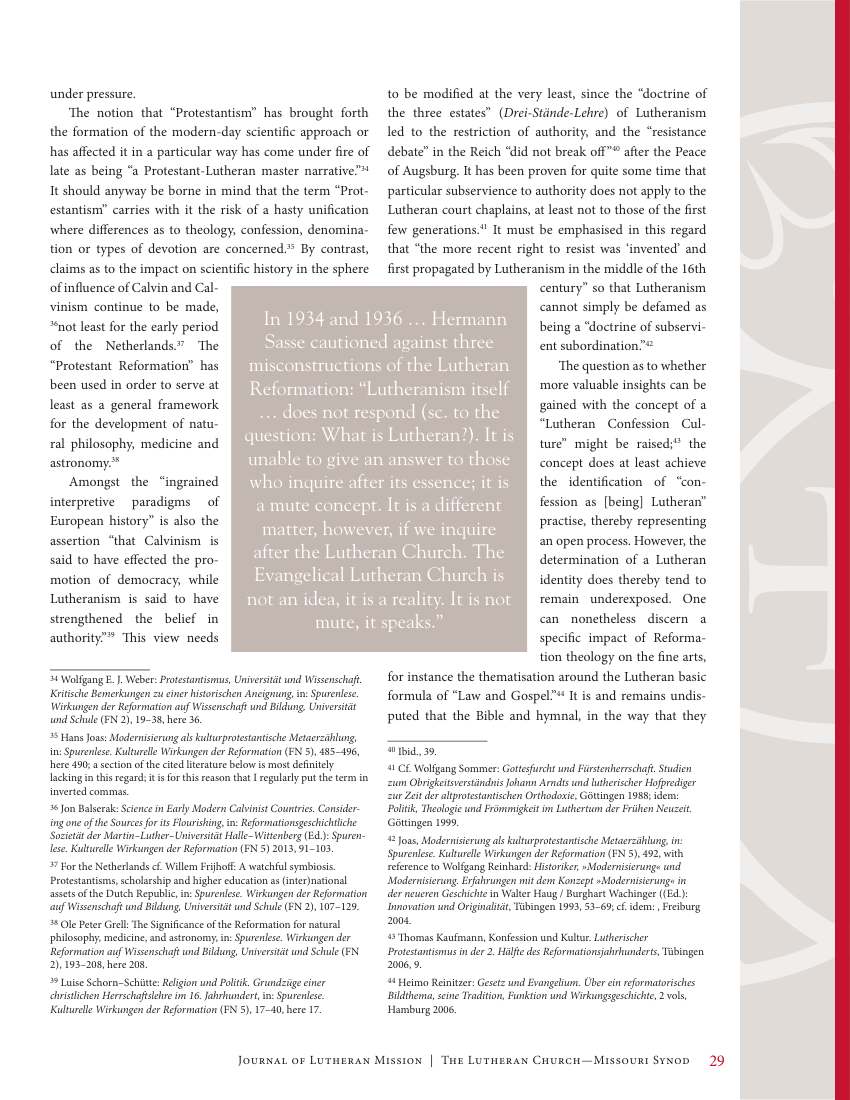
In 1934 and 1936, and in clear contrast to his colleague in Erlangen, Hermann Sasse cautioned against three misconstructions of the Lutheran Reformation:194 “Lutheranism itself … does not respond (sc. to the question: What is Lutheran?). It is unable to give an answer to those who inquire after its essence; it is a mute concept. It is a different matter, however, if we inquire after the Lutheran Church. The Evangelical Lutheran Church is not an idea, it is a reality. It is not mute, it speaks.”195 He further states that the heroic misconstruance culminates in hero-worship and apotheosis of Luther, which does indeed extend right into the Luther Renaissance and during which a personalistic view of the Reformation prevails. The person of Luther does, however, recede into the background soon after the first generation, only to be heroically exaggerated in the nineteenth century as being the “hero from Worms” or “God’s man-at-arms.”196 According to Goethe, who understood the Reformation to be a liberation and advancement of culture, historical-cultural misunderstanding construes the Reformation as constituting a date of intellectual history in general. Luther on the other hand, according to Sasse, poses an obstacle to the “modern” sense of self.197 This national misconstruance apparently sees Martin Luther as being the “protest of Nordic man against the piety and the ecclesiastical system of Roman Catholicism” and aims at a German national church, which had arisen during the “Third Reich.” To Sasse this is one of “the most dangerous heterodoxies.”198 In this respect the Reformation and the theology of Martin Luther are deemed to be universally and ecumenically relevant, even where resistance of his doctrine is concerned. The latter, in the form of the Doctrine of Justification, constituted “the renewal of the Church through rediscovery and renewed proclamation of the pure doctrine of the gospel of the forgiveness of sins.”199
View original page
Notger Slenczka, in his critical reception of Elert and others, has attempted to determine the relationship of “Lutheranism and the Modern Era.” In doing so, he identifies “Justification” as constituting “an imposition on a new understanding of self.” This included “the profiling of this Lutheran understanding of subjectivity against the modern concept of the subject,”200 since it was a matter of nothing less than “a new determination of identity and the subject’s understanding of self.” Slenczka calls this the “modern foreignness of the Lutheran Doctrine of Justification;”201 the connective according to Slenczka lies “in understanding the subject’s indefensibility pertaining to its prevailing certainty of truth on the one hand, and in embracing and acquiring salvation on the other.”202 Slenczka thereby ascribes enduring validity to “Justification” 46 as being “a purely external declaration of righteousness of man before God that remains external,” in the sense of an “imputative doctrine of reconciliation and justification”203 but admittedly also, in this interpretation, to the basic difference of the Reformation’s “fundamental insights … from the Modern Era.”204
In relation and relevance to the modern day generation, and in my assessment, Oswald Bayer’s view of Luther and Lutheran Reformation lends itself to be sketched into this relationship picture that is filled with such tension.205 In his view Luther remains the theologian who, “in the light of his own indigence,” proceeds to “gain open space” from the “inexhaustible abundance of Scripture.”206 The Word of God, consolidated in the assurance of absolution, embarks on a “course of church- and world-history,”207 not without being challenged but ultimately triumphant. For therein lies the presence of God, who looks after us and administers to our needs, so that we are “constituted” in the Word of God.208 God the Holy Spirit has sovereignly bound Himself thereto and, to wit, to “the spoken language and literal Word in the book” of Holy Scripture.209 We are therefore being expounded in our existence, and precisely therein lies the “idiosyncratic passivity of our experience of faith,”210 which culminates in the Christ-experience pro me: “the communicative Being of Jesus Christ itself, in which the Triune God assigns and gives Himself in the ‘incarnate Word’ with the sacraments of Baptism and Holy Communion, as well as with every sermon that is in accord with these sacraments,”211 creating an “excentrical way of being” for a Christian because the Gospel, as “the second, decisive, conclusive Word of God,” speaks “for me.”212 Bayer dodges the subject of freedom in its temporal dimensionality in such a way that he conceives of that which is specifically Christian in the concept of freedom as being the “liberation from the iniquities of the past and the fear of the future;”213 he presumes a characteristic of modernism to be “the coherent subject that is in control of itself” and that can escalate itself to a “pathos of individuality and omnipotence.”214 He identifies “the feeling of a dissipated individuality” as a characteristic of postmodernism, combined with the risk of a “misrecognition and relinquishment of responsibility and accountability.”215 He does nonetheless refrain from accusing modernism of an ill-considered identification of subjectivity and self-assuredness, and from hastily accusing postmodernism of “relativistic arbitrariness.”216 Ultimately, however, he is of the opinion that “the individualistic antinomism of modernism and postmodernism will, in turn, find a canonical conclusion.”217 And “The generally asserted Gospel of Freedom compels a person, due to his innate characteristic, to redeem and actualise it himself.” Thus (post)modern man is “condemned to freedom.”218
By contrast, Bayer understands and posits the Gospel from a Lutheran perspective, and strictly as a “categorical gift” for which there exists “no human disposition:” “Gospel means: God speaks for me in the fragmentation of the time and dissipation of identities.”219 Christologically formulated this means that only “on the strength of the incarnation of Jesus Christ my identity is reassigned to me,” which I have while existing “within a persistent stranger.” Bayer perceives this to be in fundamental contradiction not only with “modern metaphysics of substance but also with modern metaphysics of subject;” he thereby identifies the “crucial point of contention in the conflict between Reformation theology and modern and postmodern thought.”220 On the other hand, he considers an attitude whereby “one receives a new — excentrical — identity,” which occurs “in faith that is founded on the authoritative Word of the Gospel” to be helpful and salutary.221
View original page
Culturally influential or critical of contemporane ity — an (apparent) alternative?
What fundamental insights can Lutheran theology and Church provide as genuine contribution toward ecumenical Christianity, and how can these insights be communicated to our time?222 Appertaining to this, absolutely and unconditionally, is the theme of (Christian) freedom, as put back on the agenda by Luther in 1520. Spelled out in the Lutheran way it appears as response to the question as to how I can exist before God, thus constituting the “key question of our existence.”223
Christianity is thereby under an obligation to be critical of contemporaneity. The Church and its members can, after all, not escape contemporaneity, neither can it be denied that its members are influenced and imperceptibly governed by “trends” and tendencies of a world and society that is not only “all around them,” but in which they live themselves and that consequently also has an effect on their being. And even in the rejection of contemporary developments where the Church or its individual members, based on their Christian responsibility, are of the opinion that they ought to be met with disapproval, such positioning proves itself to be contemporary in nature.
For the Church to manage its contemporaneity in a critical manner therefore means, first and foremost, that it becomes aware of its own interwovenness with the times in which it exists. It will therefore first take to heart that which it voices in a critical manner to the world outside itself, if it wants to ensure the credibility of its declaration and message. Thus the Church itself will always have to answer to the question as to whether and to what extent the Church, together with its members, holds itself to those divine standards that it feels compelled to address. And it will be obliged to confess and admit to many a transgression against divine standards, both on behalf of its members and also of itself in its aggregate. But it is exactly this stance that will not affect its credibility but rather strengthen it, provided that it is spoken, not from a position of hubris, but from one of befitting humility and informed by the knowledge of its own failings with regards to the divine standard when it speaks from its conscience in this manner. In that case a confession of guilt by the Church does have its place and is meaningful.
The insight of an unchurched contemporary has possibly been obstructed so that he, when he seeks the source of freedom, not in God but within himself — as do all those for whom God does not constitute the origin of their freedom, is condemned to actualise it in a frantic and pathological manner. However, in Man’s attempt to assert his freedom he simultaneously forfeits it. Into and against this situation of what is still “modern” man, the call of God and the Church goes out towards freedom,224 but what freedom?225
An ecclesiastical “canonical” Luther
In this context it should be noted226 that, where the authors of the Lutheran Confessions are concerned, Luther is regarded as being the authoritative, hermeneutic frame of reference for the proper understanding of especially the Confessio Augustana.227 They explicitly follow this Luther in determining the relation between the Word of God in the Holy Scriptures and the subordinate Confessions of the early Church as well as the Lutheran Reformation, so that Holy Scripture alone is the “one true guiding principle, according to which all teachers and teaching are to be judged and evaluated.”228 Holy Scripture is and remains exclusively canon, whereas the Confessions take up a witness function,229 admittedly with the claim to truth.230 By contrast, the theologians of one’s own camp are at least on principle not denied the capability to err.231 During the second half of the sixteenth century and with this “canonisation” of Luther, Melanchthon’s scholars, who understood themselves to be Luther’s heirs, have attempted to reconstitute and safeguard the tension-filled unity and polar harmony of Lutheran theology and Church.
View original page
For the Lutheran Church, it is that Luther who became instrumental, with his catechisms, in presenting the Christian community with an introduction to a life guided by God.232 He thereby points out that Holy Baptism is God’s salutary self-communication, which brings to us “God’ grace, the entire Christ, and the Holy Ghost with his gifts;”233 just as the Sacrament of the Altar, which he views as “this great a treasure, which is daily administered and distributed among Christians,” provides the new human being with constant fortification in his battle against Satan, death and sin;234 and just as the Lord’s Prayer invokes God’s irrefutable willingness for mercy in just such a battle, a battle that becomes inevitable for a Christian precisely by partaking in God’s self-giving and self-revelation, a Christian who, in the battle of the Gospel for the Gospel, takes on his enemies.235 Luther is perceived and presumed as being the one who construes the Credo for us, thereby gratefully accepting “what God does for us and gives to us”236 and the implementation thereof in the reality of Christ’s liberation act, since Christ “has brought us from the devil to God, from death to life, from sin to righteousness, and keeps us there.”237 It is that Luther who substantiates the identity of Christianity and Church as being Trinitarian, and who identifies the Christocentric aspect as being a distinctive feature of Christendom and Christianity, compared to all other forms of religiosity (and a-religiosity) that are not based on Christ or inspired by the Holy Spirit.238 It is the Luther who is able to discern Law and Gospel as being God’s immanent manner of speaking and acting239 in which the gradient from the “extrinsic” to the “actual” work of God proceeds in such a way240 that the Church must never be found wanting in proclaiming the declaration of forgiveness and the salvation in Christ, seeing that it is a matter of “comforting and consoling” those that are frightened and “fainthearted.”241
View original page
It is precisely this Luther who delineates God’s Commandments in the context of faith as a directive for everyone to make them “a matter of daily practice in all circumstances, in all activities and dealings”242 and to serve as an instruction manual for a Christian life of human sympathy that is pleasing to God. It is this Luther who places the Gospel in its forms of implementation, proclamation, baptism, Eucharist and confessional penitence as the “third sacrament,”243 at the centre of an encompassing Christian understanding of a worship service.244 It is the Luther for whom the wording of the Sacrament’s Words of Institution in their literal sense was so immovably fixed that he could not back down in this regard whenever the real presence of the body and blood of Christ in the celebratory worship of precisely this testament of Christ was called into question245 and is therefore being invoked against the Crypto-Philippistic deviances of the second-generation theologians in Wittenberg.246 It is the Luther who, with his Christological deliberations on the conceptual conceivability of the universal presence of the human nature in Christ even after Easter and Ascension, as well as on the promised sacramental presence of Christ sacrificed, has played a crucial role in the formation of the Lutheran profile concerning Eucharistic doctrine and Christology during the internal reformatory disputes of the sixteenth century.247 It is the Luther who, by the differentiation of the two realms,248 the release of secularism from clerical paternalism, as well as the theological facilitation of the differentiation between “penultimate” and “ultimate” (D. Bonhoeffer), thereby paving the way for the separation of Church and State (even if the Reformation churches in the Reich existed as state churches for centuries); yet without ever having relinquished God’s reign of power over all ages, nations, people and spheres of life.249 It is the Luther who urged the Christian community of solidarity to bear in mind that we “must all indeed help us 49 to believe, to love, to pray, and to fight against the devil,”250 meaning the elementary and fundamental day-to-day life of a Christian existence, advising us to engage in the lifelong practice of being a Christian.
Would it not be prudent to place the emphasis — also ecumenically — in such a way that the various churches try to call people back into the fellowship that God grants with Himself and, in doing so, into the freedom that God bestows on those that believe? In this sense the biblical-reformatory Doctrine of Justification is at the same time “the doctrine of Christian freedom” and as such the “chief article of the Gospel,” the preservation of which is paramount.251 In the context of the reality and effectiveness of the Gospel, the believers subsequently live in a liberated self-circumscribed environment, albeit by means of the Will of God, the “law.”252 In this sense, human freedom in the context of Christian faith and thus Church proclamation means response,253 the grateful response of the human being who has been liberated towards freedom by God Himself through the sacrificial, death-defying commitment of His Son (Gal. 5:1). The call to return to God, the call to responsibility before God that it is the duty of a Christian to convey is indeed nothing but the call to freedom, the freedom of the children of God.
The Rev. Dr. Werner Klän is professor of systematic theology at Lutheran Theological Seminary, Oberursel, Germany.
Notes
- Wolfgang Huber: Festrede zur Eröffnung der Lutherdekade in der Schlosskirche zu Wittenberg, 21.09.2008. ↩
- Nevertheless, and at least since World War II, it has been said about both German states, albeit amidst different parameters, differing conceptions and diverging consequences on both sides, that the education sector has reached a point of “an almost complete loss of a historically meaningful structure,” with “confessionality” being taken as such; cf. Heinz–Elmar Tenorth: Konfessionalität in Bildungspolitik, Bildungssystem und pädagogischer Reflexion in beiden deutschen Staaten nach 1945. Oder: Der Bedeutungsverlust einer historisch bedeutsamen Struktur, in: Reformationsgeschichtliche Sozietät der Martin–Luther– Universität Halle–Wittenberg (Ed.): Spurenlese. Wirkungen der Reformation auf Wissenschaft und Bildung, Universität und Schule, (= LStRLO 22), Leipzig 2014, 241–245. Nevertheless, a “cautious, yet in cases of uncertainty nonetheless constantly vigilant, democracy– oriented mindfulness” can for instance be discerned regarding the debates of religious education in the Federal Republic of Germany; it would, however, require further evidence for the derivation to be made that “the Evangelical Church can be described as being an institutional, impetus–initialising factor for German democracy”, cf. Thomas Schlag: Protestantische Bildungsprogramme in der Bundesrepublik Deutschland zwischen 1949 und 1990, ibid., 255–279, here 278. As far as the former GDR is concerned, particular mention should be made of the singularity of Evangelical adult education in the sense of a “church as learning community” with its specific approaches, cf. Aribert Rothe: Herausforderungen: protestantische Bildung und Atheismus seit 1945. Protestantische Erwachsenenbildung in der DDR, ibid., 281–294. ↩
- Cf. Die Reformation als Bildungskatastrophe. Luthers Pädagogik zwischen Mangel und Utopie, in: Spurenlese. Wirkungen der Reformation auf Wissenschaft und Bildung, Universität und Schule (FN 2), 69–89; Konrad Fees: Protestantische Wertekonzepte in Bildung und Wissenschaft, ibid., 307–329. Friedrich Schweizer draws attention to the tensions between the implications of a “Protestant educational heritage” for the present, amid a difficult mix of a “religious and ideological pluralism” to which “Reformation thinking” was “not attuned” in Protestantisches Bildungserbe? Fragen evangelischer Bildungsverantwortung heute, in: Spurenlese. Wirkungen der Reformation auf Wissenschaft und Bildung, Universität und Schule (FN 2), 331–347. ↩
- Cf. the aggravated stance taken towards Protestant monopoly claims on modernism: “The thesis of a ‘protestant principle’ having founded modern science and education faces the same dilemma as Max Weber’s thesis on Calvinism or rather a specific Calvinistic school of thought having founded Capitalism. It can, in certain respects, lay claim to a historically selective plausibility, but is, on the whole, certainly not convincing.” Weber, Protestantismus, Universität und Wissenschaft (see Comment XX), 38. ↩
- Cf. the deliberations by Volkhard Krech: Wie lebt ein Kulturprotestant? Beobachtungen zu Habitusformationen eines protestantischen Milieus, in: Reformationsgeschichtliche Sozietät der Martin–Luther–Universität Halle–Wittenberg (Ed.): Spurenlese. Kulturelle Wirkungen der Reformation (= LStRLO 20), Leipzig 2013, 121–132, according to which such a milieu is characterised by a co–existence of “secularists” and “religious elements,” ambivalence, keeping a “sympathising distance towards the institutional Church,” an affirmation of “social differentiation and structural individualism” as well as an orientation towards “Kunstreligion” (Art–as–religion). ↩
- President Nikolaus Schneider. “Am Anfang war das Wort.“ Dachmarkenkampagne Luther 2017 heute in Berlin vorgestellt; 27 October 2011; http://www.ekd.de/presse/pm247_2011_ dachmarkenkampagne.html (accessed 24. 03. 2014) ↩
- Hartmut Lehmann: Fragen zur Halbzeit der Lutherdekade, KZG/CHH 26 (2013), 447–454, here 451; cf. also Lehmann‘s extremely critical, partly justified inquiries concerning the history of Lutheranism since 1517, as well as his conclusion: “500 years of Lutheranism is certainly not an outright success story that one could point to in 2017 with a sense of pride.” Ibid., 452. Instead, Lehmann would rather refer to a “success story of Protestantism” and, in this context, poses the question as to whether the latter “can still be brought into close association with Luther at all.” Ibid., 453. The critical questions Lehmann directs at Lutheranism can, with equal if not greater justification, be directed at “Protestantism.” ↩
- Gerhard Besier: Human Images, Myth Creation and Projections: From the Luther Myth to the Luther Campaign, KZG/CCH 26 (/2013), 422–436. ↩
- Hartmut Lehmann. Fragen zur Halbzeit der Lutherdekade (FN 7), 453. ↩
- Hartmut Lehmann. Unterschiedliche Erwartungen an das Reformationsjubiläum 2017 in idem: Luthergedächtnis 1817–2017 (= Refo 500, vol. 8), Göttingen 2012, 305–314. ↩
- Lehmann, Die Deutschen und ihr Luther, in: idem: Luthergedächtnis 1817–2017 (FN 10), 299. ↩
- Hartmut Lehmann: Rückblick und Ausblick, in: idem: Luthergedächtnis 1817–2017 (FN 10), 9–16; idem: Die Deutschen und ihr Luther (FN ), 303; idem, Unterschiedliche Erwartungen, ibid., 311f. ↩
- Wolfgang Thönissen: Katholische Perspektiven zum Thema »Reformationsjubiläum«, KZG/CCH 26 (2013), 437f. ↩
- Ibid. (FN 13), 442. ↩
- Ibid. (FN 13), 441. ↩
- Rechtfertigung und Freiheit. 500 Jahre Reformation 2017. Ein Grundlagentext des Rates der Evangelischen Kirche in Deutschland (EKD), Gütersloh³ 2014. ↩
- Ibid., preface, 8. ↩
- Ibid., 17. ↩
- Ibid., 99. ↩
- Ibid., 21f. ↩
- Ibid., 29, cf. the implementation, 44–93, also 98. ↩
- Ibid., 37; 62. ↩
- Ibid., 13, 33. ↩
- Ibid., 65 ↩
- Ibid., 102. ↩
- Ibid., 105. ↩
- Ibid., 91. ↩
- Ökumenische Information 28, 8. July 2014, 3. ↩
- Thomas Söding: 500 Jahre Reformation–der Versuch einer Rechtfertigung, in: Christ in der Gegenwart 31/ 3. August 2014,353f. ↩
- Ökumenische Information 37, 9. September 2014, 3. ↩
- Cf. Heinz Schilling: (Ed.): Die reformierte Konfessionalisierung in Deutschland – Das Problem der »Zweiten Reformation« (= SVRG 195), Gütersloh 1986; Hans–Christoph Rublack (Ed.): Die lutherische Konfessionalisierung in Deutschland. Wissenschaftliches Symposion des Vereins für Reformationsgeschichte (= SVRG 197), Gütersloh 1992; where the Roman Catholic Church is concerned, cf. Heinz Schilling (Ed.) Katholische Konfessionalisierung. Wissenschaftliches Symposion der Gesellschaft zur Herausgabe des Corpus Catholicorum und des Vereins für Reformationsgeschichte, (= SVRG 198), Gütersloh/Münster 1995. ↩
- Cf. Robert Kolb: Die Konkordienformel. Eine Einführung in ihre Geschichte und Theologie (= OUH.E 8), Göttingen 2011 ↩
- Martin Heckel: Deutschland im konfessionellen Zeitalter (Deutsche Geschichte 5), Göttingen 1983; Ernst Koch: Das konfessionelle Zeitalter– Katholizismus, Luthertum, Calvinismus (1563–1675) (= KGE II/8), Leipzig 2000. ↩
- Wolfgang E. J. Weber: Protestantismus, Universität und Wissenschaft. Kritische Bemerkungen zu einer historischen Aneignung, in: Spurenlese. Wirkungen der Reformation auf Wissenschaft und Bildung, Universität und Schule (FN 2), 19–38, here 36. ↩
- Hans Joas: Modernisierung als kulturprotestantische Metaerzählung, in: Spurenlese. Kulturelle Wirkungen der Reformation (FN 5), 485–496, here 490; a section of the cited literature below is most definitely lacking in this regard; it is for this reason that I regularly put the term in inverted commas. ↩
- Jon Balserak: Science in Early Modern Calvinist Countries. Considering one of the Sources for its Flourishing, in: Reformationsgeschichtliche Sozietät der Martin–Luther–Universität Halle–Wittenberg (Ed.): Spurenlese. Kulturelle Wirkungen der Reformation (FN 5) 2013, 91–103. ↩
- For the Netherlands cf. Willem Frijhoff: A watchful symbiosis. Protestantisms, scholarship and higher education as (inter)national assets of the Dutch Republic, in: Spurenlese. Wirkungen der Reformation auf Wissenschaft und Bildung, Universität und Schule (FN 2), 107–129. ↩
- Ole Peter Grell: The Significance of the Reformation for natural philosophy, medicine, and astronomy, in: Spurenlese. Wirkungen der Reformation auf Wissenschaft und Bildung, Universität und Schule (FN 2), 193–208, here 208. ↩
- Luise Schorn–Schütte: Religion und Politik. Grundzüge einer christlichen Herrschaftslehre im 16. Jahrhundert, in: Spurenlese. Kulturelle Wirkungen der Reformation (FN 5), 17–40, here 17. ↩
- Ibid., 39. ↩
- Cf. Wolfgang Sommer: Gottesfurcht und Fürstenherrschaft. Studien zum Obrigkeitsverständnis Johann Arndts und lutherischer Hofprediger zur Zeit der altprotestantischen Orthodoxie, Göttingen 1988; idem: Politik, Theologie und Frömmigkeit im Luthertum der Frühen Neuzeit. Göttingen 1999. ↩
- Joas, Modernisierung als kulturprotestantische Metaerzählung, in: Spurenlese. Kulturelle Wirkungen der Reformation (FN 5), 492, with reference to Wolfgang Reinhard: Historiker, »Modernisierung« und Modernisierung. Erfahrungen mit dem Konzept »Modernisierung« in der neueren Geschichte in Walter Haug / Burghart Wachinger ((Ed.): Innovation und Originalität, Tübingen 1993, 53–69; cf. idem: , Freiburg 2004. ↩
- Thomas Kaufmann, Konfession und Kultur. Lutherischer Protestantismus in der 2. Hälfte des Reformationsjahrhunderts, Tübingen 2006, 9. ↩
- Heimo Reinitzer: Gesetz und Evangelium. Über ein reformatorisches Bildthema, seine Tradition, Funktion und Wirkungsgeschichte, 2 vols, Hamburg 2006. ↩
- Christoph Wolff: Musik aus dem Geist der Reformation. Bibel und Gesangbuch in der Musik Johann Sebastian Bachs, in: Spurenlese, Kulturelle Wirkungen der Reformation (FN 5), 350–362, here 350. ↩
- Klaus Bußmann / Heinz Schilling: 1648 – Krieg und Frieden in Europa, Katalogband und zwei Textbände, [Dokumentation der Europaratsausstellung zum 350–jährigen Jubiläum des Westfälischen Friedens in Münster und Osnabrück] Münster /Osnabrück 1998; Fritz Dickmann: Der Westfälische Frieden. Münster, Münster 1997. ↩
- Koch, Das konfessionelle Zeitalter (FN 33), 328–332. ↩
- Not taken into account in this portrayal is the impact of the Wittenberg Reformation beyond Europe’s borders, and the development of Lutheranism in Africa, say, or Asia and Latin America; cf. however Frieder Ludwig: Luther–Wahrnehmungen in Afrika, Asien und Lateinamerika, in: Spurenlese. Kulturelle Wirkungen der Reformation (see Comment XX), 279–307; Ludwig draws attention to the question as to “when and by way of which transmission belts certain Lutheran images were imparted, and how these were transformed via various processes of appropriation and interaction”, ibid., 282; for North America cf. Hermann Wellenreuther: Zivilisation, Mission und Kirchenverständnis. Europäische protestantische und indigene Kirchen in Nordamerika, in: Spurenlese. Kulturelle Wirkungen der Reformation (see Comment XX), 309–330. ↩
- Heinz Schilling: Die neue Zeit. Vom Christenheitseuropa zum Europa der Staaten. 1250 bis 1750 (= Siedler Geschichte Europas, vol. 3) Berlin 1999; idem: Konfessionalisierung und Staatsinteressen. Internationale Beziehungen 1559–1660 (= Handbuch der Geschichte der internationalen Beziehungen, publ. by Heinz Duchhardt and Franz Knipping, vol. 2), Paderborn 2007. ↩
- Robert Kolb, Martin Luther as Prophet, Teacher and Hero: Images of the Reformer, 1520–1620, Grand Rapids, 1999.Paderborn 2007. ↩
- Koch, Das konfessionelle Zeitalter (FN 33), 211–218. ↩
- Kolb, Martin Luther (see Comment X), 114f. ↩
- Martin Brecht: Philipp Jakob Spener, sein Programm und dessen Auswirkungen, in: idem (Ed.): Der Pietismus vom siebzehnten bis zum frühen achtzehnten Jahrhundert (= idem. / Klaus Deppermann / Ulrich Gäbler [Ed.]: Geschichte des Pietismus vol. 1), 281–389, here 293, 373; idem: August Hermann Francke und der Hallesche Pietismus, ibid., 439–539, here 469. ↩
- Hans–Jürgen Schönstädt: Antichrist, Weltheilsgeschehen und Gottes Werkzeug. Römische Kirche, Reformation und Luther im Spiegel des Reformationsjubiläums 1617 (= VIEG, 80), Wiesbaden 1978; slightly abridged, idem: Das Reformationsjubiläum 1617, ZKG 93 (1982), 5–57. ↩
- Ibid., 47–49. ↩
- Ibid., 55. ↩
- Ibid., 57. ↩
- Annina Ligniez: Legitimation durch Geschichte. Das erste Reformationsjubiläum 1617 in Wittenberg, in: Klaus Tanner (ed.), Konstruktion von Geschichte. Jubelrede–Predigt–protestantische Historiograhie (LStRLO 18), Leipzig 2013, 53–66. ↩
- Silvio Reichelt: Die Akademische Reformationsjubelfeier in Straßburg 1617, in: Tanner, Konstruktion von Geschichte (FN 58), 67–87, here 87. ↩
- Hans–Jürgen Schönstädt: Das Reformationsjubiläum 1717, ZKG 93 (1982), 58–118, here 108; cf. concerning the anti–Roman Catholic positionings in 1755 cf. Stefan W. Römmelt: Kalter Konfessions– Krieg auf Kanzel und Katheder? Die 200–Jahrfeiern des Augsburger Religionsfriedens von 1755 an den Universitäten Wittenberg, Leipzig und Halle , in: Tanner, Konstruktion von Geschichte (FN 58), 141–177. ↩
- Schönstädt, 1717 (FN 60), 114. ↩
- Römmelt, Kalter Konfessions–Krieg? (FN 60), 174. ↩
- Harm Cordes: Cyprian als Chronist des Reformationsjubiläums von 1717, in: Tanner, Konstruktion von Geschichte (FN 58), 89–103. ↩
- Annina Ligniez: »[…] BEY IETZIGEN GEFÄHRLICHEN UND BETRÜBTEN ZEITEN […]«. Zeitdiagnosen in Reformationsjubiläumspredigten 1717 in Wittenberg, in: Klaus Tanner / Jörg Ulrich (Ed.): Spurenlese. Reformationsvergegenwärtigung als Standortbestimmung (1717–1983), (= LStRLO 17), Leipzig 2012, 37–70, here 42f. ↩
- Claudia Drese: Zur Geschichtsschreibung im kirchlichen Pietismus, in: Tanner, Konstruktion von Geschichte (FN 58), 105–116, here 114f. ↩
- Brecht, Spener (see Comment XX), 374–378; id., Francke (see Comment XX), 463. ↩
- Wischmeyer, Leitbilder des protestantischen Theologiestudiums (see Comment XX), 50–58, here 50. ↩
- Hartmut Lehmann: Die Deutschen und ihr Luther. Im Jahr2017 jährt sich zum fünfhundertsten Mal der Beginn der Reformation. Jubiliert wurde schon oft, in: id.: Luthergedächtnis 1817–2017 (FN 10), 297–304, here 297f. ↩
- Dieter Hensing: Der Bilder eigner Geist. Das schwierige Verhältnis der Lutherbilder zu ihrem Gegenstand, in: Ferdinand van Ingen / Gerd Labroisse (Ed.): Luther–Bilder im 20. Jahrhundert, (= Amsterdamer Beiträge zur neueren Germanistik, vol. 19), Amsterdam 1984, 1–25, here 2–4. ↩
- Dirk Fleischer: Protestantische Kirchengeschichtsschreibung in der Aufklärung in: Tanner, Konstruktion von Geschichte (FN 58), 117–139, here 125f. ↩
- Fleischer Protestantische Kirchengeschichtsschreibung (see Comment XX), 137f. ↩
- Johannes Wischmeyer: Leitbilder des protestantischen Theologiestudiums. Programmatische Diskussion und institutioneller Wandel vom 16. Bis ins 20. Jahrhundert, in: Spurenlese. Wirkungen der Reformation auf Wissenschaft und Bildung, Universität und Schule (FN 2), 59–63, here 59. ↩
- Markus Wriedt: Erleuchtete Pietas–fromme Erudition. Zum Wandel des theologischen Bildungsverständnisses im Zeitalter der Aufklärung, in: Spurenlese. Wirkungen der Reformation auf Wissenschaft und Bildung, Universität und Schule (FN 2), 159–191, here 167, 189. ↩
- Wolfgang Flügel: Das Beste aus zwei Welten. Geschichtskonstrukte lutherischer Pastoren im Pennsylvania des 18. Jahrhunderts, in: Tanner, Konstruktion von Geschichte (FN 58), 179–211; similar sentiments were still held in the nineteenth century by the Saxon emigrants, who went on to form the Missouri Synod; ↩
- Wolfgang Flügel: Deutsche Lutheraner? Amerikanische Protestanten? Die Selbstdarstellung deutscher Einwanderer im Reformationsjubiläum 1817, in: Tanner / Ulrich, Spurenlese. Reformationsvergegenwärtigung als Standortbestimmung (FN 64), 71–99, here 71. ↩
- Wolfgang Flügel, Deutsche Lutheraner? Amerikanische Protestanten? Die Selbstdarstellung deutscher Einwanderer im Refomrationsjubiläum 1817, in: Spurenlese. Vergegenwärtigung als Standortbestimmung (FN 64), 99. ↩
- Cf. the historicising and assuring title of a portrayal dating from the middle of the twentieth century, Walter O. Forster: Zion on the Mississippi: The Settlement of the Saxon Lutherans in Missouri 1839–1841, St. Louis 1953, but also the instructive study by Christoph Barnbrock: Die Predigten C. F. W. Walthers im Kontext deutscher Auswanderergemeinden in den USA. Hintergründe–Analysen– Perspektiven, Hamburg 2003. ↩
- Dorothea Wendebourg: Die Reformationsjubiläen des 19. Jahrhunderts, ZThK 108 (2011), 270–335. ↩
- Hensing, Lutherbilder (FN 69), 7–9. ↩
- Ibid. ↩
- Ibid. ↩
- Hensing, Der Bilder eigner Geist (FN 69), 8. ↩
- Ibid., 9. ↩
- Wichmann von Meding: Jubel ohne Glauben? Das Reformationsjubiläum 1817 in Württemberg, in ZKG 93 (1982), 119–160, here 144f. ↩
- Hans Wolter: Das Reformationsjubiläum von 1817 in der Freien Stadt Frankfurt am Main, in: ZKG 93 (1982), 161–176, here 173. ↩
- Ibid., 171. ↩
- Hartmut Lehmann: Martin Luther und der 31. Oktober 1517, in id.: Luthergedächtnis 1817–2017 (FN 10),17–34, here 23. ↩
- Ibid., 24; on Karl von Hase and the “historical image of a Reformation open to modernism” cf. Johannes Wischmeyer: Reformation als Epoche und Strukturmoment. Protestantismustheorie und Historismus bei Karl von Hase und der Jenaer freisinnigen Theologie, in: Tanner, Konstruktion von Geschichte (FN 58), 277–306, here 304. ↩
- Johannes Hund: Das Augustana–Jubiläum von 1830 als Kulminationspunkt der Ausbildung moderner theologischer Positionen während der Vormärzzeit, in: Tanner, Konstruktion von Geschichte (FN 58), 105–116, 237–253, here 252f. ↩
- Hartmut Lehmann: Das Lutherjubiläum 1883, in: id.: Luthergedächtnis 1817–2017 (FN 10), 59–77, here 76. ↩
- Cf. Hartmut Lehmann: „Er ist wir selber: der ewige Deutsche. Zur langanhaltenden Wirkung der Lutherdeutung von Henrich von Treitschke, in id. Luthergedächtnis 1817–2017 (FN 10), 126–137. ↩
- Hartmut Lehmann: Die Lutherjubiläen 18883 und 1917 in Amerika, “, in id.: Luthergedächtnis 1817–2017 (FN 10),78–93; cf. id. “The Luther Statues in Washington D.C., and Baltimore” in id.: Luthergedächtnis 1817–2017 (FN 10), 94–109. ↩
- Sebastian Kranich: Das Dresdner Lutherjubiläum 1883, in: Tanner / Ulrich, Spurenlese. Reformationsvergegenwärtigung als Standortbestimmung (FN 64), 101–143, here 143. ↩
- Cf. Werner Klän: Von der Reichsgründung bis zu den Reformationsjubiläen 1883, in: Helmut Edelmann / Niels Hasselmann (Ed.): Nation im Widerspruch. Aspekte und Perspektiven aus lutherischer Sicht heute. Eine Studie des Ökumenischen Studienausschusses der VELKD und des DNK/LWB, Gütersloh 1999, 145–151; cf. for the local history of Dresden, the summary in Kranich, Das Dresdner Lutherjubiläum 1883 (see Comment XX), 140f. ↩
- Gottfried Maron: Luther 1917. Beobachtungen zur Literatur des 400. Reformationsjubiläums, ZKG 93 (1982), 1–46. ↩
- Cf. for instance Ralph Hennings: Die Reformationsjubiläen 1817 und 1917 in Oldenburg (Oldb.), KZG/CCH 26 (2013), 217–237. ↩
- Hans–Georg Ulrichs: Eine »Gelegenheit, mit den unbekannten Vätern der reformierten Kirche bekannt zu machen«. Das Reformationsjubiläum 1917 in Emden und bei den Reformierten in Deutschland, KZG/CCH 26 (2013), 238–261. ↩
- Heinrich Assel: Der andere Aufbruch. Die Lutherrenaissance, Göttingen 1994. ↩
- Cf. Ulrich Gäbler: Drei Typen theologischer Lutherdeutung um 1920: Ernst Troeltsch, Reinhold Seeberg, Karl Holl, in: van Ingen / Labroisse, Luther–Bilder im 20. Jahrhundert (FN 69), 187–197. ↩
- Ibid., 189. ↩
- Ibid., 193. ↩
- Ibid., 195. ↩
- Ibid., 196. ↩
- Christine Svinth–Værge Pöder: Die Lutherrenaissance im Kontext des Reformationsjubiläums. Gericht und Rechtfertigung bei Karl Holl, 1917–1921, KZG/CCH 26 (2013), 191–200. ↩
- Assel, Der andere Aufbruch (FN 98), 483–486. ↩
- Dietz Lange: Eine andere Luther–Renaissance, in: Notger Slenczka / Walter Sparn (Ed.): Luthers Erben. Studien zur Rezeptionsgeschichte der reformatorischen Theologie Luthers. Festschrift für Jörg Baur zum 75. Geburtstag, Tübingen 2005, 245–274, here 246. ↩
- Ibid., 264. ↩
- Ibid., 265 ↩
- Ibid., 268. ↩
- Ibid., 270f. ↩
- Quoted from Lange, Luther–Renaissance (see Comment XX), 273. ↩
- Anders Jarlert: Politische Inszenierung und Instrumentalisierung von Hundertjahrfeier zur Reformation im 20. Jahrhundert in Schweden, KZG/CCH 26 (2013), 262–271. ↩
- Hansjörg Buss: Der Deutsche Luthertag 1933 und die Deutschen Christen, KZG/CCH 26 (2013), 272–288. ↩
- Nicola Willenberg: »Mit Luther und Hitler für Glauben und Volkstum«. Der Luthertag 1933 in Dresden, in: Tanner / Ulrich, Spurenlese. Reformationsvergegenwärtigung als Standortbestimmung (FN64), 195–237. ↩
- Hartmut Lehmann: »Muss Luther nach Nürnberg?«. Deutsche Schuld im Lichte der Lutherliteratur 1946/47, in: id.: Luthergedächtnis 1817–2017 (FN 10), 176–188. ↩
- Gotthard Jasper: Vom christlichen Obrigkeitsstaat zur säkularen Demokratie. Von den Schwierigkeiten der deutschen Lutheraner im 20. Jahrhundert, die Politik zu verstehen, in: Spurenlese. Kulturelle Wirkungen der Reformation (FN 5), 379–396, here 383, 385f. ↩
- Robert P. Ericksen: The Luther Anniversary and the Year 1933 in the Mirror of U.S. Church Press Reports, KZG/CCH 26 (2013), 319–334. ↩
- Josef Pilvousek: Katholische Reaktionen auf das Luthergedenken im Jahr der Machtergreifung, KZG/CCH 26 (2013), 335–346. ↩
- Silvio Reichelt: Martin Luther als evangelischer Schutzheiliger. Die Reformationsfeiern an der Universität Halle–Wittenberg 1927–1941, Teil 1: Die Feiern, in: Tanner / Ulrich, Spurenlese. Reformationsvergegenwärtigung als Standortbestimmung (FN 64), 145– 169; Sebastian Kranich: Martin Luther als evangelischer Schutzheiliger. Die Reformationsfeiern an der Universität Halle–Wittenberg 1927–1941, Teil 2: Redner und Reden, ibid., 171–193. ↩
- Raimund Hoenen: Günther Dehn (1882–1970)–Außenseiter für Frieden, in: Arno Sames (Ed.): 500 Jahre Theologie in Wittenberg und Halle 1502–2002. Beiträge aus der Theologischen Fakultät der Martin– Luther–Universität Halle–Wittenberg zum Universitätsjubiläum 2002. LStRLO 6, Leipzig 2003, 161–180. ↩
- Friedemann Stengel: Die Universität und ihr Name–Martin Luther. Kontexte der Verleihung 1933, KZG/CCH 26 (2013), 289–318; this is being disputed by Reichelt, Martin Luther als evangelischer Schutzheiliger 1 (FN 119), 154–158,168. ↩
- Hans Preuß: Luther und Hitler. And, as covermount: Luther und die Frauen, Erlangen 1933; on that point Hartmut Lehmann: Hans Preuß 1933 über “Luther und Hitler”, in: ibid.: Luthergedächtnis 1817–2017 (FN 10), 151–159. ↩
- Hartmut Lehmann: Luther als Kronzeuge für Hitler. Anmerkungen zu Otto Scheels Lutherverständnis in den 1930er Jahren, in: ibid.: Luthergedächtnis 1817–2017 (FN 10), 160–175; cf. the critical analysis of the hypothesis that Luther paved the way for Hitler, see Uwe Siemon– Netto: Luther Als Wegbereiter Hitlers? Zur Geschichte eines Vorurteils, Gütersloh 1993. ↩
- Cf. Kurt Aland: Martin Luther in der modernen Literatur, Witten 1973; Hartmut Laufhütte: Martin Luther in der deutschen Literatur des 19. und 20. Jahrhunderts, in: van Ingen / Labroisse, Luther–Bilder im 20. Jahrhundert (FN 69), 27–57. ↩
- Elrud Ibsch: Nietzsches Luther–Bild, in: van Ingen / Labroisse, Luther–Bilder im 20. Jahrhundert (FN 69), 79–90, here 80. ↩
- Ibid., 81. ↩
- Ibid., 82. ↩
- Ibid., 83. ↩
- Ibid., 84. ↩
- Ferdinand van Ingen: Die Erasmus–Luther–Konstellation bei Stefan Zweig und Thomas Mann, in: van Ingen / Labroisse, Luther–Bilder im 20. Jahrhundert (FN 69), 91–118, here 101. ↩
- Ibid., FN 130, 99. ↩
- Ibid., FN 69, 95; ; cf. Lehmann, Luther Statues (see Comment XX), 100–109. ↩
- Ibid., FN 69, 105. ↩
- Ibid., FN 69, 108. ↩
- Ibid., FN 69, 106. ↩
- Eberhard Mannack: Luther–ein ‚geistiger Ahnherr Hitlers’?, in: van Ingen / Labroisse, Luther–Bilder im 20. Jahrhundert (FN 69), 167–185, here 170. ↩
- Ibid., FN 135, 179. ↩
- Hartmut Lehmann: Das marxistische Lutherbild von Engels bis Honecker, in: id.: Luthergedächtnis 1817–2017 (FN 10), 257–270 ↩
- Adolf Laube: Martin Luthers Reformation–Teil der deutschen frühbürgerlichen Revolution, in: Martin Luther und seine Zeit, Sonderausstellung des Museums für Deutsche Geschichte / Martin Luther Ehrung 1983 der DDR, 2–5, here 4. ↩
- Laube, Martin Luthers Reformation (see Comment XX), 5. ↩
- Cornelis Augustijn: Das marxistische Lutherbild 1983, in: van Ingen / Labroisse, Luther–Bilder im 20. Jahrhundert (wie Anm. XX), 223–23238, here 225. ↩
- Ibid., 227. ↩
- Ibid., 228. ↩
- Ibid., 268; cf. Hartmut Lehmann: Das marxistische Lutherbild von Engels bis Honecker, in: Peer Schmidt: (ed,.) Luther zwischen den Kulturen Zeitgenossenschaft – Weltwirkung, Göttingen 2004, 501–514. ↩
- Gerhard Ringshausen: Das 450. Reformationsjubiläum in West und Ost, KZG/CCH 26 (2013), 373–399, here 373. ↩
- Ibid., 385. ↩
- Quotations cf. Ibid., 450. 394. ↩
- Wolfgang Flügel: Konkurrenz um Reformation und Luther. Die Konfessionsjubiläen der Kirchen und der SED in den Jahren 1967 und 1983, , in: Tanner / Ulrich, Spurenlese. Reformationsvergegenwärtigung als Standortbestimmung (FN 64),239–285, here 249. ↩
- Ibid., 257f. ↩
- Ringshausen, (FN 145), 380–382. ↩
- Ibid., 385–389. ↩
- Jasper, Vom christlichen Obrigkeitsstaat zur säkularen Demokratie (FN 116), 388–393. ↩
- Ibid., 394f. ↩
- Detlef Pollack / Hedwig Richter: Widerstand und Ergebung. Theologische Wurzeln politischer Standortbestimmungen in den evangelischen Kirchen in der DDR, in: Spurenlese. Kulturelle Wirkungen der Reformation (see Comment XX), 397–427, here 406. ↩
- Barbara Henze: Ohne das Konzil undenkbar. Das Reformationsgedenken 1967 in den katholischen Bistumszeitungen, KZG/ CCH 26 (2013), 347–372. ↩
- Quotations see ibid., 353f. ↩
- Lehmann, Martin Luther und der 31. Oktober 1517 (FN 87), 30–32. ↩
- Henze, Ohne das Konzil nicht denkbar (FN 155), 371, cf. 358. ↩
- Peter Manns / Harding Meyer: Ökumenische Erschließung Martin Luthers. Referate und Ergebnisse einer internationalen Theologenkonsultation, Paderborn / Frankfurt/M., 1983, here 13. ↩
- Harding Meyer and Heinz Schütte (Hg.): Confessio Augustana. Bekenntnis des einen Glaubens. Gemeinsame Untersuchung lutherischer und katholischer Theologen, Paderborn–Frankfurt/M. 1980. ↩
- Quotation see Johanna Rahner: Luther ´83 und die Folgen. Eine römisch–katholische Perspektive, KZG/CCH 26 (2013), 400–411. ↩
- Peter Manns: Martin Luther, Ketzer oder Vater im Glauben? Hannover 1980; Peter Manns (text); Helmuth Nils Loose (photos): Martin Luther, Freiburg im Breisgau / Basel / Wien / Lahr 1982, 219; Peter Manns: Martin Luther: der unbekannte Reformator; ein Lebensbild. Freiburg im Breisgau / Basel / Wien 1985; cf. Thönissen, Katholische Perspektiven (FN 13), 437–446, here 442. ↩
- Cf. Otto Hermann Pesch: Martin Luther im katholischen Urteil. Zwischen Verteufelung und dankbarer Aneignung, in: Spurenlese. Kulturelle Wirkungen der Reformation (FN 5), 449–483. ↩
- Karl Lehmann / Wolfhart Pannenberg: Lehrverurteilungen – kirchentrennend?, vol. 1: Rechtfertigung, Sakramente und Amt im Zeitalter der Reformation und heute, Freiburg 1988. ↩
- Johanna Rahner: Luther ´83 und die Folgen (FN 161), 404. ↩
- Claudia Lepp: Luther in »besonderer Gemeinschaft«. Die Evangelische Kirche in Deutschland, der Bund der Evangelischen Kirchen in der DDR und das Lutherjubiläum 1983, KZG 26 (2013), 412–421. ↩
- Flügel, Konkurrenz um Reformation und Luther (FN 148), 267. ↩
- Hartmut Lehmann: Zur Entstehung der 15 Thesen über Martin Luther in der DDR im Jahre 1983, in: id.: Luthergedächtnis 1817–2017 (FN 10), 232–256; id.: The Rehabilitation of Martin Luther in the GDR; or, why Thomas Müntzer failed to stabilize the moorings of socialist ideology, ibid, 271–280. ↩
- Flügel, Konkurrenz um Reformation und Luther (FN 148), 284. ↩
- Ibid., 268, 275. ↩
- Pollack and Richter: Widerstand und Ergebung (FN 154), 418f. ↩
- Ibid., 423. ↩
- Robert F. Goeckel: Political an Institutional Issues of Lutheran churches in Communist Systems. The Legacy of Luther with Particular Reference to the GDR Churches, in: reformationsgeschichtliche Sozietät der Martin–Luther–Universität Halle–Wittenberg: Spurenlese. Kulturelle Wirkungen der Reformation (FN 5) 429–445. ↩
- Werner Elert: Morphologie des Luthertums. Theologie und Weltanschauung des Luthertums hauptsächlich im 16. und 17. Jahrhundert; München 1931 (19653); vol. 2: Soziallehren u. Sozialwirkungen des Luthertums; München 1932 (19653); [English: The Shaping of Lutheranism]; the quotations follow the German edition. ↩
- Ibid., V. ↩
- Notger Slenczka, Selbstkonstitution und Gotteserfahrung. W. Elerts Deutung der neuzeitlichen Subjektivität im Kontext der Erlanger Theologie. Studien zur Erlanger Theologie II, Göttingen 1999, 148. ↩
- Slenczka, Elert, 149. ↩
- Elert, in Slenczka, Elert, 150. ↩
- Slenczka, Elert, 153. ↩
- Elert, Morphologie 2 (FN 174), 131. ↩
- Ibid., 169–189. ↩
- Ibid., 190–208. ↩
- Ibid., 208–214. ↩
- Ibid., 214–223. ↩
- Ibid., 226–250. ↩
- Elert, in Slenczka, Elert (FN 176) 227. ↩
- Ibid., 227. ↩
- Ibid., 244. ↩
- Ibid., 244. ↩
- Ibid. ↩
- Ibid., 246. ↩
- Ibid., 351. ↩
- Elert, Morphologie 2 (FN 174), 465. ↩
- Hermann Sasse, Was heißt lutherisch?, München 1934, 21936. ↩
- Ibid., 12. ↩
- Ibid., 31–36. ↩
- Ibid., 36–48. ↩
- Ibid., 49–60, here 49. ↩
- Ibid., 71. ↩
- Notger Slenczka: Luthertum und Neuzeit. Bemerkungen zum ambivalenten Verhältnis von Rechtfertigungsglauben und neuzeitlicher Subjektivität, in. Reinhard Rittner (Ed.): Was heißt hier lutherisch!, Aktuelle Perspektiven aus Theologie und Kirche, Hannover 2004, 164–192, here 188. ↩
- Ibid., 190. ↩
- Ibid., 181. ↩
- Ibid., 183f. ↩
- Ibid., 192. ↩
- Oswald Bayer: Martin Luthers Theologie. Eine Vergegenwärtigung, Tübingen 2004. ↩
- Ibid., 66. ↩
- Ibid., 69. ↩
- Ibid., 77. ↩
- Quotation ibid., 84. ↩
- Ibid., 150. ↩
- Ibid., 151. ↩
- Ibid., 152. ↩
- Oswald Bayer: Mit Luther in der Gegenwart. Die diagnostische Kraft reformatorischer Theologie, in: Notger Slenczka / Walther Sparn (ed.): Luthers Erben. Studien zur Rezeptionsgeschichte der reformatorischen Theologie. Festschrift Jörg Baur, Tübingen 2005, 297–310, here 297. ↩
- Ibid., 299. ↩
- Ibid., 300. ↩
- Ibid. ↩
- Ibid., 303. ↩
- Alluding to Jean–Paul Sarte, ibid., 304. ↩
- Ibid., 307. ↩
- Ibid., 308. ↩
- Ibid., 309. ↩
- Joachim Track: Die lutherische Stimme in der Ökumene, in: Reinhard Rittner (ed.): Was heißt hier Lutherisch!. Aktuelle Perspektiven aus Theologie und kirche,.Hannover 2004, 234–275. ↩
- Michael Beintker: Freiheit aus Glauben – Freiheitssuche des Menschen von heute. Gemeinsamkeiten und Konflikte, in: ibid.: Rechtfertigung in der neuzeitlichen Lebenswelt. Theologische Erkundungen, Tübingen 1998, 66–79. ↩
- Oswald Bayer: Freiheit als Antwort. Zur theologischen Ethik, Tübingen 1995, 89–93. ↩
- Martin Brecht: Die Rezeption von Luthers Freiheitsverständnis in der frühen Neuzeit, LJ 62 (1995), 121–151. ↩
- Cf. Werner Klän: Was machen wir aus Luther?, in: Karl–Hermann Kandler (Ed.): Das Bekenntnis der Kirche zu Fragen von Ehe und Kirche. Die Vorträge der lutherischen Tage 2009 und 2010, (= Lutherisch glauben 6), Neuendettelsau 2011, 90–117, esp. 113–117. ↩
- FC SD VII 41, in Robert Kolb / Timothy Wengert (ed.): The Book of Concord. The Confessions of the Evangelical Lutheran Church, Minneapolis, Fortress Press, 2000, 601. ↩
- FC SD, Binding Summary 3, Kolb/Wengert, 527. ↩
- FC SD, Binding Summary 12, Kolb/Wengert, 529. ↩
- FC SD, Binding Summary, Ibid. ↩
- FC SD, Antitheses 19, Kolb/Wengert, 529–531. ↩
- Cf. Werner Klän: Anleitung zu einem Gott–gelenkten Leben. Die innere Systematik der Katechismen Luthers, LuThK 29 (2005), 18–35. ↩
- Large Catechism, Holy Baptism 41, Kolb/Wengert, 461. ↩
- Large Catechism, The Sacrament of the Altar 39, Kolb/Wengert, 470f. ↩
- Large Catechism, The Lord’s Prayer, Third Petition, 65–67, Kolb/ Wengert, 448f.; Fourth Petition, 80–81, Kolb/Wengert, 451. ↩
- Large Catechism, The Creed, Third Article 67, Kolb/Wengert, 440. ↩
- Large Catechism, The Creed, Third Article 31, Kolb/Wengert, 434. ↩
- Large Catechism, The Creed, Third Article 66, Kolb/Wengert, 440. ↩
- Cf. the citations from Luther Luther’s exegesis of Luke 5, 1–11 in the summer homily of 1544, in FC SD V 12, Kolb/Wengert, 583f. ↩
- FC SD V 23, Kolb/Wengert, 585f.. ↩
- FC SD V, 12, Kolb/Wengert, 584. ↩
- Large Catechism, 332, Kolb/Wengert, 431. ↩
- Large Catechism, Holy Baptism 74, Kolb/Wengert, 465. ↩
- Smalcald Articles III, 4, Concerning the Gospel, Kolb/Wengert, 319. ↩
- Large Catechism, The Sacrament of the Altar, 8–14, Kolb/Wengert, 467f. ↩
- Cf. e.g. FC SD VIII 41–43, Kolb/Wengert, 623f.. ↩
- Cf. the citations from Luther, Large Confession concerning the Holy Supper (1528) in FC SD VII 92–103, Kolb/Wengert, 609f. ↩
- Large Catechism, Fourth Commandment, 150ff; 158ff, Kolb/ Wengert, 407f. ↩
- Large Catechism, First Commandment 26, Kolb/Wengert, 389; Large Catechism, The Lord’s Prayer, Fourth Petition 76–79, Kolb/ Wengert, 451. ↩
- Large Catechism, The Sacrament of the Altar, 87, Kolb/Wengert, 476. ↩
- “For it is necessary to retain the teaching of Christian freeedom in the churches … It is necessary to retain the chief article of the Gospel / Necesse est enim in ecclesiis retineri doctrinam de libertate christiana … Necesse est retineri praecipuum evangelii locum” (AC XXVIII 51f., Kolb/ Wengert 99). ↩
- In this context Peters speaks of the “breathing space of Christ’s everlasting grace” cf. Albrecht Peters, Gesetz und Evangelium (= HST 2). Gütersloh 1981, 1994², 54. ↩
- Bayer, Freiheit als Antwort (FN 224), 74. ↩
Tip: use the ← and → keys to move between sections. Share any page with index.html?p=<page>.