
Letter 138 (373)
A ilments and Deaths
BASIL TO ANTIPATER, LETTER 137 (373)
It is now, it seems, that I most resent the price I have to pay for being sick. A man of your quality governs our country, and I am forced to be absent for taking care of my body. For a whole month I have been sitting for treatment at the thermal springs, as if I could be helped by it! But it looks as if I were exerting myself for naught, and unto most people it looks like a joke that I seem to ignore the proverb that "heat is no use for the dead." . ..
BASIL TO EUSEBIUS, BISHOP OF SAMOSATA,
LETTER 138 (373)
What do you think I had in mind when I received the letter of Your Piety? Considering what you exposed in writing, I should have rushed to Syria right away; but considering the bodily weakness that tied me down, I could not possibly rush toward you, unable as I was even to turn on my bed! I had been sick for fifty days when our dear and most zealous brother Elpidios, our "associate in God's service" [ouvr:acXKovoC;], arrived. I was all consumed by fever.
For lack of matter upon which it might feed, the fever, winding around the dried up flesh of mine as around a burnt wick, resulted in exhaustion and a protracted illness.
Thereupon myoId plague, the liver, taking over, prevented me from taking nourishment, chased the sleep from mine eyes and held me on the confines of life and death, leaving me just enough life to suffer the discomfort it brought about.
That is why I had recourse to the natural hot springs, on some advice from the doctors. But that fierce sickness defeated everything; maybe another would endure it, but if it
THE FATHERS SPEAK
befalls one unexpectedly. nobody, even if he is of steel, will ever resist. Tortured by it for a long time, I have never been so afflicted as now, because it hinders me from enjoying your true charity [ecyaTnl]. I certainly feel how much I am deprived of such bliss, for last year we were not able to taste, even from the tip of a finger, the most sweet honey of your Church.
EusebillS, bishop of Samosata in Syria, was traversing Cappadocia 011 his way to Thrace, whereto an order oj
Emperor Valens had commanded him deported. Gregory of NazianZllS deplores' not being able to see him on his passage.
GREGORY OF NAZLANZUS TO EUSEBIUS, LETTER 64
(374) When Your Piety was passing through OUf region, I was not even able to peep out of my room, for I was sick to the utmost. What saddened me was not so much the illness which made me fear to be at the extremity. but to be deprived of your holy and precious company ....
BASIL TO EUSEBruS OF SAMOSATA, LETTER 162 (374)
The reasons for which I am not already with you are
Ailments and Deaths
not easy to tell, not only because I am hindered by my present weakness, but because I never had the ability to describe an illness so varied and changeable. Only that from the day of Pascha to this day, fever, diarrhea, and abdominal colics, like waves breaking over me, do not let me rise over them ....
BASIL TO MELETIOS, ARCH-PHYSICIAN, LETTER 193
(375) It is not possible for us to flee the hardships of winter like the cranes; and as for predicting the future, maybe we are not worse off than the cranes but for independence of life.
We are left behind the birds when it comes to a short flight away from the harassment of winter. First, some hindrance from business weighed my life down. Then, uninterrupted violent fevers have so well mined my body that something thinner than me appeared: and it was I myself! Afterwards, attacks of quartan fever took over more than twenty times.
Now I seem to be delivered from the fevers, but I am so weak, for that matter, that I could not hold my own against a spider. This is why all traveling is forbidden to me, and the lightest puff of wind brings about more danger than mighty waves to the seafarers. So we keep snug at home and wait for springtime, if we last till that season, if in the meantime we are not fooled by the disease that has settled in our bowels! If the Lord keeps us in life by His mighty hand, we shall most gladly get to your retreat and most gladly embrace you, our dear head. Only pray that our life be governed profitably to our soul.
THE FATHERS SP EAK
Gregory of NazianZlis, mourning the death of his brother Caesarios, a physician of renown in Constantinopie, begs
Sophronios, a highly placed official, to use his authority for restraining some impudent heirs of Caesarios from grabbing whatever they can of the estate.
GREGORY OF NAZlANZUS TO SOPHRONIOS, LETTER 29
(End of 369) Not so long ago among other noble persons was your dear Caesarios, my own brother; if I am not prejudiced, he was among the illustrious ones, renowned for his science, before many others the "perfect gentleman," prominent amidst his many friends, ahead of whom he placed yourself and your noble forebears. All his excellence has convinced us. But now it is all over! You may add, on your own, many other qualities to give him honor as by a funeral oration [em-r6:qllOV] granting to the departed more than men receive by nature. But do not just cast a glance upon these my words and stay there, tear less; indeed do shed tears, but let these tears achieve something good and useful. Here lies Caesarios, dead, without a friend, abandoned, pitiful, honored with a little myrrh-if at all-and with the poor coverings of the dead-if even he has that much! His enemies, so I understand, fall upon his estate, one here, one there, with full license; some plunder, some are waiting. What impudence, what inhumanity! Nobody to stop them! The most human of those fellows does us just one favor: he appeals to the laws! To tell it in short, we have become a fable unto those people, we who were thought to be happy! Let not all this appear bearable to you; sympathize with us, share our indignation to dead Caesarios; yea, in the name of friendship itself and of all that is dear to you and the object of your hope, Thus you shaH show yourself true and faithful to the de-
A ilments and Deaths
parted, and you will do a great favor to the living and give them hope. You do not fear it is about moneys we are grieving, do you? What is most intolerable to us in this sad affair is that Caesarios, alone amongst all men, could be thought to have had no friends, he who thought he had so many! Now, such is my request. As for helping us, how, in which way, in which manner, circumstances will show, and your prudence shall decide.
GREGORY OF NAZIANZUS TO GREGORY OF NYSSA,
LETTER 76 (Early in 379; Basil had died on the first of January) It was still reserved to my wretched life to learn of Basil's death and the demise of this holy soul which has left us for the mansions of the Lord after a life~long preparation. And I, among other things, due to my present condition or illness and to my critical state of health, am deprived of embracing his holy remains, of being with you in the frame of mind of a Christian philosopher and of consoling our common friends! As for the spectacle of desolation of his Church
[the metropolitan see of Caesaraea], cut off from her glory and devoid of her crown, it is a thing which no sensible man can bear contemplating with his eyes, or hear being told.
You seem to have many friends and to hear many consoling words, yet nothing will console you better than yourself and the remembrance of him. To others you have been an example of Christian philosophy and, as it were, of spiritual moderation for better or for worse, since two things are taught by philosophy: treat good fortune with equanimity and bear adversity with grace. This is our message to Your
Excellency. But will I find consolation in time or wordssafe in your presence and your companionship? May the blessed Saint bequeath these to us in place of everything else,
THE FATHERS SPEAK
so that, contemplating him in yourself as in a beautiful and clear mirror, we may think that we own him still.
Gregory was mourning the passing of his father, the bishop of NazianZlls (374). Shortly thereafter, Amphilochios junior, a second cOllsin of Gregory, was recommended as bishop of /coniwn, (0 the dismay of Amphilochios senior, who grieved at the prospect oj his son leaving for a distant bishopric and who complained that Gregory had engineered this nomination behind his back. Gregory sets the record straight in a letter of embittered irony.
GREGORY OF NAZIANZUS TO AMPHILOCHIOS THE ELDER,
HIS COUSIN, LETTER 63 (374)
You grieve, you weep! Of course I am supposed to be delighted! As you see, I am in a festive mood and pride myself on what is happening! Do you mourn because your son, for his own merits, was taken from you and given honors? You regret that he is no longer with you to take care of your old age and render to you, as is fitting, his good offices? And what about me? Am I not grieved by my father having left us for the last journey from which he shall not return nor show himself to us? Yet we do not accuse you, we do not require from you the consolation which is due to us, because we know that personal bereavements do not leave time to worry about the troubles of others. No one is so affectionate and so much of a "philosopher" that he is able to place himself above whatever disturbs the soul, and to console others when he is himself in need of consolation. But to this blow you add another blow in
A ilments and Deaths
charging us, so I understand, believing that we have de~ serted your son who is indeed my "prather," or that we have betrayed him, which is worse. Do you think that we do not realize that all of you, his friends and relatives, have felt a loss? What about me? 1 have lost more than anyone else, for I had placed in your son the hope of my life; he alone was my supporter, my good adviser, my companion in the practice of devotion .... It is on account of earlier afflic~ tions that I was unable to come again to you, because of my mourning and my duty to render to my father the honor due to him-for nothing else can pass before that. My grief was recent and it would have been not only ungodly, but also contrary to all propriety, to play the "philosopher" out of season. beyond what is normal for a human being.
And then we thought that the events had outdistanced us and already found their achievement as it seemed good to Him who ordains our fate. And that is that! But now lay aside this grief which seems to me most unreasonable. If you mean something else, let us know, lest we would grieve each other and lest you add to the trouble, much over against Your Nobility, by accusing us instead of accusing others; for we did not do anything wrongly and, to tell the truth, we had to bear the same tyranny, both on the part of common friends and of those whom you regarded only as officious persons.
GREGORY OF NAZIANZUS TO GREGORY OF NYSSA,
LETTER 197 (in the writer's later years) I had started in haste to go to you and had arrived at Euphemiades [a locality not far from Nazianzus], but I was prevented from taking part in the assembly which you hold in memory of the Holy Martyrs; I could not on account of my sickness, and anyway I would have been importunate
THE FATHERS SPEAK
by arriving late. I had set out in order both to visit yOll after so long a time, and also to admire your steadfastness and the philosophy which you show forth-so I hear-in the passing of our saintly and blessed "sister"; your behavior is of a good man and a godly leader who has the knowledge of things divine and human better than none; a man who regards as endurable that which is most distressing to others in similar circumstances, namely to have been united to such a person, and to have let her go to the tomb and to have her placed in the safe mansions like "a sheaf of grain is gathered in due season," to speak as the Divine Scriptures
[Jb 5:26], after she has shared in the charms of life but escaped its sad moments, because her life span had been duly measured, before she would have to mourn your death, but after she had received the funeral honors due to saintly persons. I also wish, know it well, to leave this life. if not in the same time as you-that would be much to say-at least right after you. But what shall be our feelings toward that law of God which has prevailed of old and which now bears on my Theosebia? I call her "mine," because she has lived according to God, for spiritual kinship excels over blood kinship; Theosebia, the glory of the Church, the jewel of Christ, the pride of our age, the honor of women; Theosebia, most glorious and most illustrious among her excellent brothers; Theosebia, a saint and the wife of a priest (Gregory's wife] equally honored and worthy of the sublime mysteries; Theosebia, whom the age to come shaH receive, being placed on the memorial stelae of the immortals, in the hearts of aU who have known her and of all who shan come later. Do not wonder if I repeat her name often. My delight is in remembering her, the blessed. This is, on our part, an epitaphion saying much in a few words and, for you, a word of consolation, as you are able to offer similar consolations to others through your philosophy in al1 things. As for meeting with you-and do we desire it-we have been prevented for the reasons I told you, but we vow for ourselves, if we are still on earth, that the common end to which we draw near shall not separate us. We shaH bear
Ailments and Deaths
with all things, for we will not have either to rejoice or to mourn for a very long time.
Sakerdos, a priest ordained by Gregory, had died recently. His name is the transcription in Greek letters of the Latin sacerdos, corresponding to le.pe.uC;,
11:pe.a~0'(e.poC;.
Thekla is most probably the wife of Sakerdos, his 11:pe.a~u TEpa. Gregory, addressing Thekla, calls Sakerdos "your blessed brother." "Brother" and "sister" are often said of persons who belong in the Christian community, without being blood relatives.
GREGORY OF NAZIANZUS TO THEKLA, LETTER 222
(in Gregory's later years) I was making ready to go to Your Piety, even in the condition of weakness of my body, wishing to visit you and also to praise the steadfastness which you show as a Christian philosopher on the passing of your blessed brother; about this there is no doubt. But since I was prevented by some circumstances, I have to resort to letters and philosophize with you briefly on your problems. From where did the excellent Sakerdos come to us, this noble assistant to God, now as yesterday? From God! And where is Sakerdos now? With God, having escaped the jealousy and the deceits of the evil one, and not without a struggle; that I know! And from where do we come? Is it not from where he came? And where do we tend to? Is it not toward the same Master? May we go to Him with an equal assurance! Worshipers of the same God, we were placed on earth and from it shall be removed, having suffered a few
THE FATHERS SPEAK
ills: a small thing indeed, when compared with the object of our hope, that we may value the reward after whatever we had to endure. The father, mother, and brother who were before us, what were they? A number of praiseworthy travelers! After a Ettie while TbekJa will join them, the maid-servant of God, the first fruit of excellent people, who shall tarry a little so as to honor them by her own stead. fastness, and to be for many a model of philosophy in these matters. Let us then praise this same power and receive its dispensation, which is loftier than most humans conceive. For the moment, receive this letter instead of our person, and meditate on these reflections, even though you may find better ones by yourself. But if we were judged worthy to see you face to face and to meet with the persons of your circle, our gratefulness to the divine Benefactor would be greater still.
Once allowance is made for the style of fourth century hagiography, the relation of Saint Macrina's death and funeral is a moving testimony to the affection of Saint
Gregory of Nyssa for his older sister; as an eyewitness report of such antiquity, it is all the more precious.
GREGORY OF NYSSA, THE DEATH OF SAINT MACRINA
(Sources Chritiennes, vol. 178, Paris, 1971) ... She made the sign of the cross on her eyes, her mouth, and her heart. Little by little her tongue, burnt away by the fever, could no longer speak distinctly, her voice weakened, and it is only from the motion of her lips and of her hands that we realized she was praying. Then,
Ailments and Deaths
at nightfall, someone brought in a lamp; Macrina opened her eyes and looked toward it, indicating she would pray the thanksgiving prayer for the light. ["Glory to Thee who hast shown us the light!" Exclamation of the priest at Sunday Matins.] . . . She raised her hand to cross herself, having finished the prayer, breathed a long, deep sigh, and it was the end of her praying and of her life .. .. After we had prepared her body as well as we could, the deaconess
[~ !:HO::KOVOC;] said it was not fitting that she should be adorned like a bride in the sight of the maidens [-rGJV n:ap9Evcuv]; "but I have kept a cloak of a dark color
[a ryassa?] from your mother [Emmelia] and I think it would be proper to cover her with it, for a gaudy garment would not enhance the beauty of holiness." .. . When the day declined, the space all around was not enough to contain the crowd. The bishop of the place [Ibora in Pontus],
Araxios-he was there with all his clergy-suggested that the funeral procession should start slowly, seeing that the distance was great and that the crowd slowed down the march .... It was like a liturgical procession [~UOLlK~
1tOttTt~], the psalms being sung in unison [viz. not antiphonally]. ... There was a distance of seven or eight stadia from this secluded spot to the church [oIKOC;] of the Holy Martyrs, where the bodies of our parents rest.
Epilogue If the aim of the present essay had been to prove a thesis, it would now be time for me to come to a coneiusion, bllt I had no point to make nor axe to grind. All 1 wanted was to acquaint readers with the personality of three greal
Cappadocians: Basil, the stern hlgoumenos and archbishop of Caesaraea; his friend Gregory of Nazianzus, elevatedreluctantly-to the see, of Constantinople; and Gregory of Nyssa, Basil's younger brother, the philosopher and mystic.
He had not been born to be an ecclesiastical martinet nor the ideal church leader Basil had wished he would become.
Basil always regarded his little brother as an enfant terrible not to be trusted; he could not forget the aDair of the old uncle and some country bishops implicated in deals that smacked of simony, and whom Gregory tried to excuse
... by means of forged letters! (See above, ch. 6). As a matter of fact, Gregory did not attain his full spiritual stature until after Basil's death.
The contribution of our three Cappadocians to the development of the Christian dogma was not my primary objective. I have tried rather to enter into the intimate life, day by day as it were, of St Basil, St Gregory of Nazianzus, and St Gregory of Nyssa: the warmth of their affection for one another, their problems in the chaotic situation stirred up by heretics and politicoes courting the favor of the Basileus, their interventions in favor of little people, their foundations for the sick, the poor, the travelers, their spiri~ tuai pieces of advice, their Hellenic culture, their Athenian witticisms, the most intimate details oj their ffllgality (cab~ bages, but not twice a day), and bulletins on their state of health-generally poor! They were giants in the midst oj
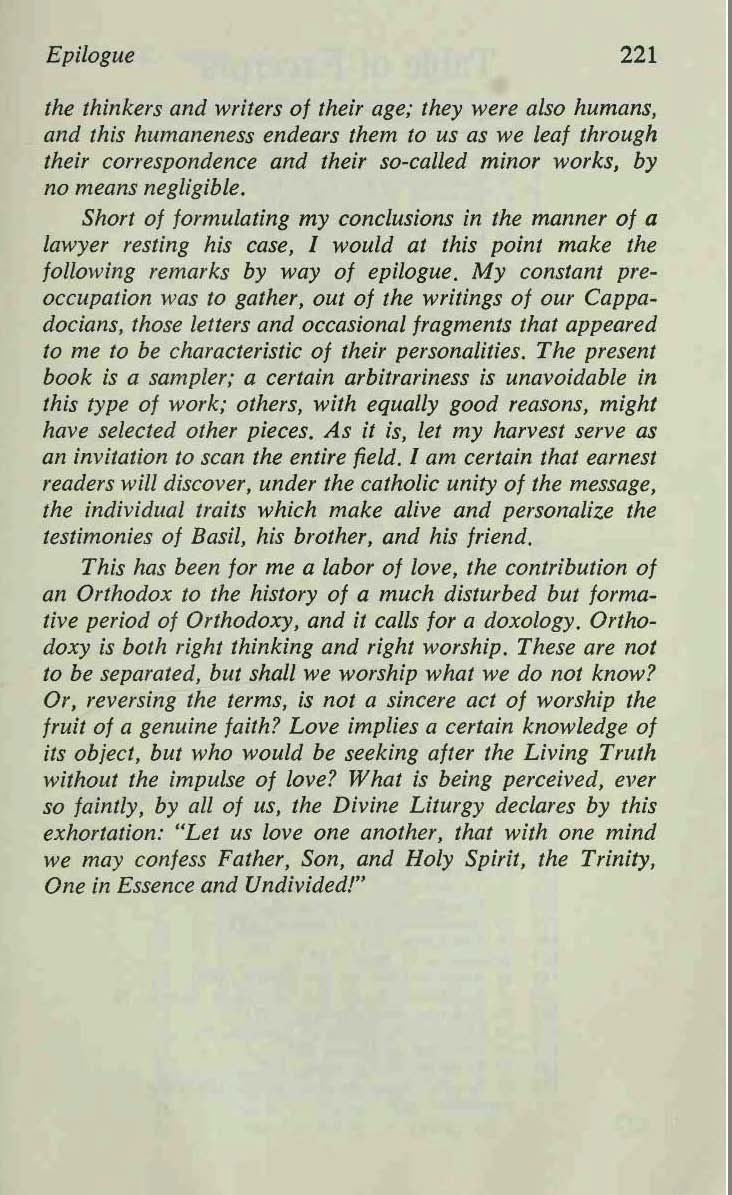
Epilogue
the thinkers and writers of their age; they were also humans, and this humaneness endears them to us as we leaf through their correspondence and their so-called minor works, by no means negligible.
Short of formulating my conclusions in the manner of a lawyer resting his case, I would at this point make the following remarks by way of epilogue. My constant preoccupation was to gather, out of the writings of our Cappadocians, those letters and occasional fragments that appeared to me to be characteristic of their personalities. The present book is a sampler; a certain arbitrariness is unavoidable in this type of work; others, with equally good reasons, might have selected other pieces. As it is, let my harvest serve as an invitation to scan the entire field. I am certain that earnest readers will discover, under the catholic unity of the message, the individual traits which make alive and personalize the testimonies of Basil, his brother, and his friend,
This has been for me a labor of love, the contribution of an Orthodox to the history of a much disturbed but formative period of Orthodoxy, and it calls for a doxology. Orthodoxy is both right thinking and right worship, These are not to be separated, but shall we worship what we do not know?
Or, reversing the terms, is nol a sincere act of worship the fruit of a genuine faith? Love implies a certain knowledge of its object, but who would be seeking after the Living Truth without the impulse of love? What is being perceived, ever so faintly, by all of liS, the Divine Liturgy declares by this exhortation: "Let us love one another, that with one mind we may confess Father, Son, and Holy Spirit, the Trinity,
One in Essence and Undivided!"
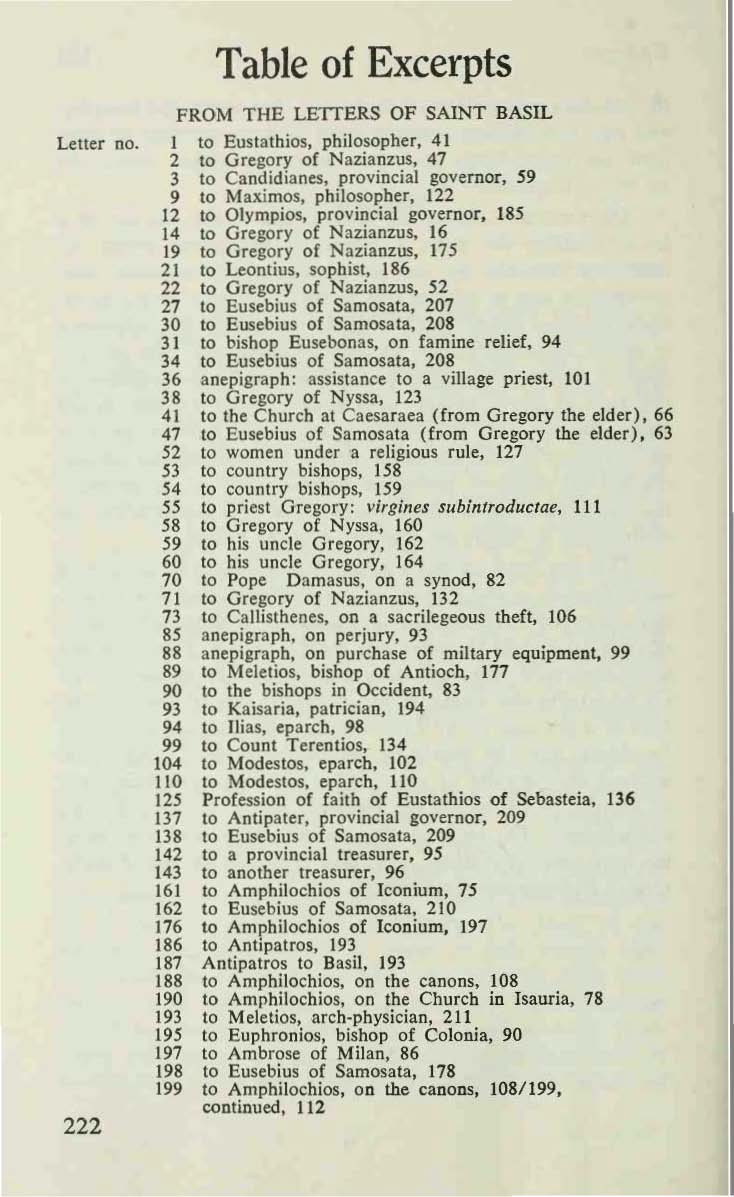
Table of Excerpts
FROM THE LETrERS OF SAINT BASIL
Letter no.
I to Eustathios, philosopher, 41
3 ,
58 ,.
to Gregory of Nnianzus, 47 to Candidianes. provincial governor, 59 to Maximos, philosopher, 122 to Olympios, provincial governor, 185 to Gregory of Narianzus, 16 to Gregory of Nazianzus, 175 to Leonlius, sophist, 186 to Gregory of Nazianzus, 52 to Eusebius of Samosala, 207 to Eusebius of Samosala, 208 to bishop Eusebonas, on famine relief, 94 to Eusebius of Samosata, 208 anepigraph: assistance to a village priest, 101 to Gregory of Nyssa, 123 to the Church al Caesaraea (from Gregory the elder) , 66 to Eusebius of Samosata (from Gregory the elder) , 63 to women under a religious rule, 127 to country bishops, 158 to country bishops, 159 to priest Gregory: virgines slIbinfroductae, I I I to Gregory of Nyssa, 160 to his uncle Gregory, 162 to his uncle Gregory, 164 to Pope Damasus, on a synod, 82 to Gregory of Nazianzus, 132 to Callisthenes, on a sacrilegeous theft, 106 anepigraph. on perjury, 93 anepigraph. on purchase of miliary equipment, 99 to Meletios, bishop of Antioch, 177 to the bishops in Occident, 83 to Kaisaria, patrician, 194 10 lIias, eparch, 98 10 Count Terentio$, 134 to Modestos. eparch, 102 to Modestos. eparch. 110
Profession of faith of Euslathios of Sebasleia, 136 10 Antipater, provincial governor, 209 to Eusebius of Samosata, 209 10 a provincial treasurer, 95 to another treasurer, 96 to Amphilochios of Iconium, 75 to Eusebius of Samosala, 210 to Amphilochios of lconium, 197 to Anllpatros, 193 Antipatros to Basil. 193 to Amphiiochios, on the canons, 108 to Amphilochios, on the Church in Isauria, 78 to M eietios, arch'physician, 2 11 to Euphronios, bishop of Colonia, 90 to Ambrose of Milan, 86 to Eusebius of Samosala, 118 to Amphilochios, on the canons, 108/ 199, conlinued, 112
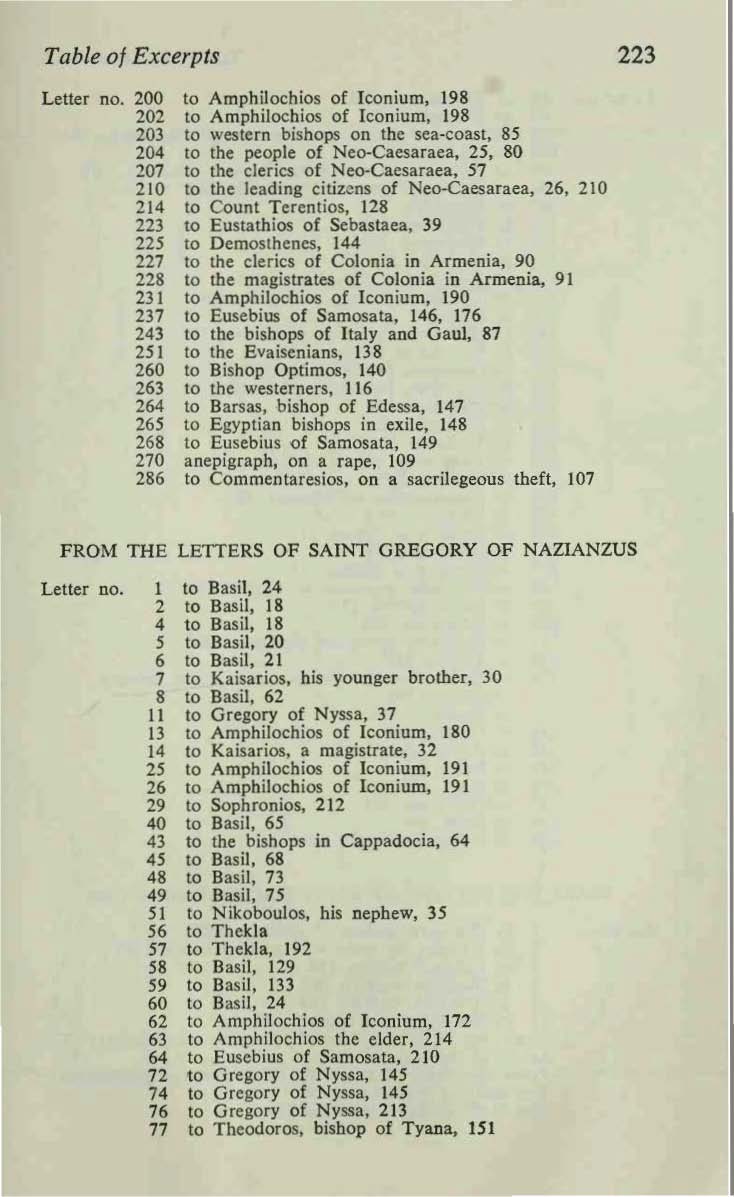
Table of Excerpts to Amphilochios of Iconium, 198 Letter no. 200
21'
2.3
to AmphiJochios of Iconium, 198 to western bishops on the sea-coast, 85 to the people of Neo-Caesaraea, 25, 80 to the clerics of Neo-Caesaraea, 57 to the leading citizens of Neo-Caesaraea, 26, 210 to Count Terentios, 128 to Euslathi05 of Sebastaea, 39 to Demoslhenes, 144 to the clerics of Colonia in Armenia, 90 to the magistrates of Colonia in Armenia., 91 to Amphilochi05 of Iconium, 190 10 Eusebius of Sam05ata, 146, 176 to the bishops of Italy and Gaul, 87 10 the EVaisenians, 138 10 Bishop Optim05, 140 10 the westerners, 116 to Barsas, bishop of Edessa, 147 10 Egyptian bishops in exile, 148 to Eusebius of Sam05ata, 149 anepigraph, on a rape, 109 to Commenlaresios. on a sacrilegeous tbeft, 107
FROM THE LEI IERS OF SAINT GREGORY OF NAZIANZUS
Letter no.
I to Basil, 24
to Basil, 18
to Basil, 18
10 Basil, 20
to Basil, 21
to Kaisari05, his younger brother, 30
to Basil, 62 II 10 Gregory of Nyssa, 37
10 Amphilochi05 of Iconium, 180
to Kaisari05, a magistrate, 32
10 Amphilochi05 of !conium, 191 26 to Ampbilochi05 of lconium, 191
to Sophronio$, 212 40 to Basil, 65
to the bishops in Cappadocia, 64
to Basil, 68
10 Basil, 73
to Basil, 75
to Nikoboul05. his nephew, 35
10 Thekla
to Thekla, 192
to Basil, 129
to Basil, 133 60 to Basil, 24
to Amphilochios of Iconium, 172
to Amphiloehios the elder, 214
to Eusebiu! of Samosata, 210
10 Gregory of Nyssa, 145
to Gregory of Nyssa, 145 76 to Gregory of Nyssa, 213
to Theodoros. bisbop of Tyana., lSI
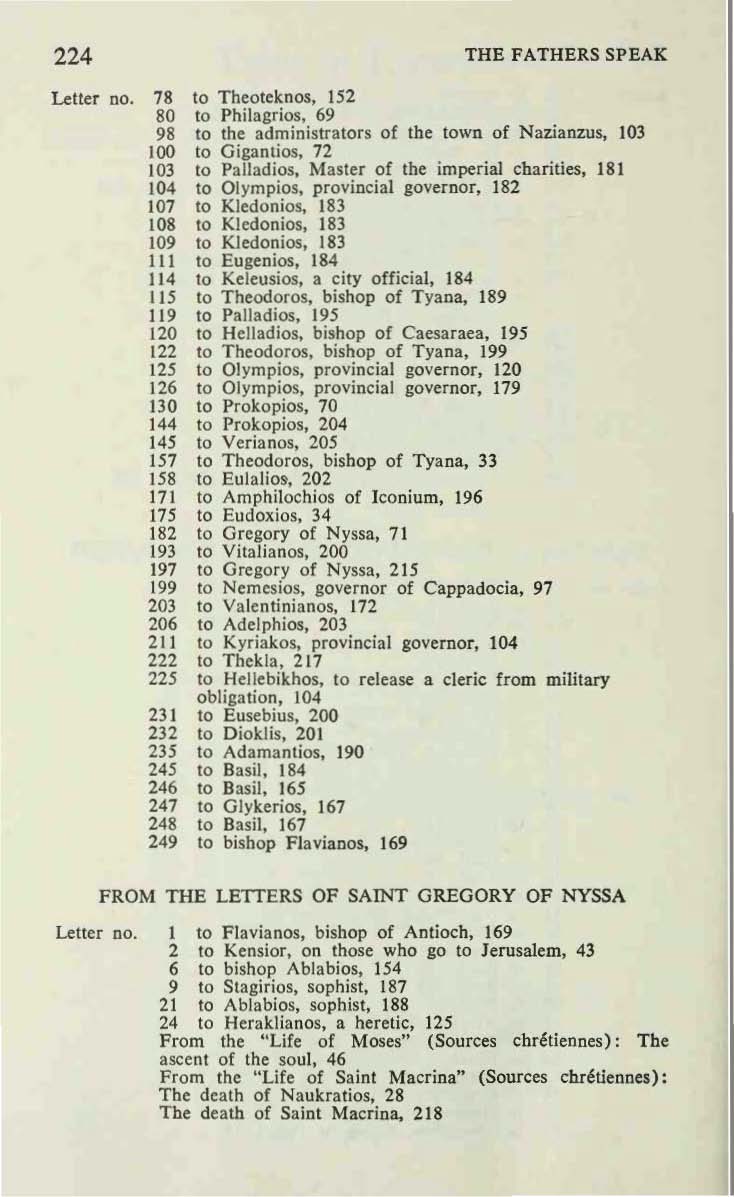
THE FATHERS SPEAK
to Theoteknos, 152 Letter no.
'00
.03 to Philagrios, 69 10 the administrators of the town of Nazianzus. 103 to Gigantios, 72 10 Palladios. Master of the imperial charities. 181 to Olympias. provincial governor, 182 to Kledonios, 183 to Kledonios. 183 to Kledonios, 183 to Eugenios, 184 10 Keleusios. a city official. J 84 10 Theodora$. bishop of Tyana, 189 10 Palladios, 195 to Helladios. bishop of Caesaraea, 195 to Theodoros, bishop of Tyana, 199 to Olympios, provincial governor, 120 10 Olympios, provincial governor, 179 to Prokopios, 70 to Prokopios. 204 to Verianos. 205 to Theodoros, bishop of Tyana, 33 10 EuJaliO!t. 202 to Amphilochio$ of Jconium, 196
.07
.08
.0' "' "'
.19
.20
.22
.25
.2.
17 '
'99
20.
to Eudoxios, 34 to Gregory of Nyssa, 71 to Vitalianos, 200 to Gregory of Nyssa, 215 to Nemesios, governor of Cappadocia, 97 to Vaientinianos, 172 to Adeiphios, 203 10 Kyriakos, provincial governor, 104 10 Thekla, 217 to HeJlebikhos, 10 release a cleric from military obligation, 104 to Eusebius, 200 10 Dioklis, 201 to Adamanlios, I?O 10 Basil, 184 to Basil, 165 to Glykerios, 167 to Basil, 167 10 bishop Flaviano$, 169
24.
FROM TIlE LEITERS OF SAINT GREGORY OF NYSSA
Letter no.
I 10 Flavianos, bishop of Antioch, 169 2 to Kensior. on those who go to Jerusalem, 43
6 to bishop Abiabios, 154 9 to Slagirios, sophist, 187
to Ablabios, sophist, 188
to Heraklianos, a heretic. 125
From the "Life of Moses" (Sources chrEtiennes): The ascent of the soul, 46 From the "Ufe of Saint Macrina" (Sources chrEtiennes):
The death of Naukratios, 28 The death of Saint Macrina, 218
• I, f.
! , • • .I .Z • • , • - < • • • • •
, • ..
~ , • , '.
• • • • --~ , ..
• a.'mln • < " . , • :l • < , .!
, - • u " , • • ~ • • , 0 • • 0'
, 0 • "
• • • :ij Z ., - • '" "
• , • "
• - "
• • • • - ~ , <.
• • , "
• , • • z , • u • - '0
.~ • "'
, • ~ ;"-.
; • - - < ,
~ e ", < - ~j ~ - - , - ~ "
, -
<i - ,
,< E < I < !
• • "
• -




TUB FATHERS SPEAK
- "
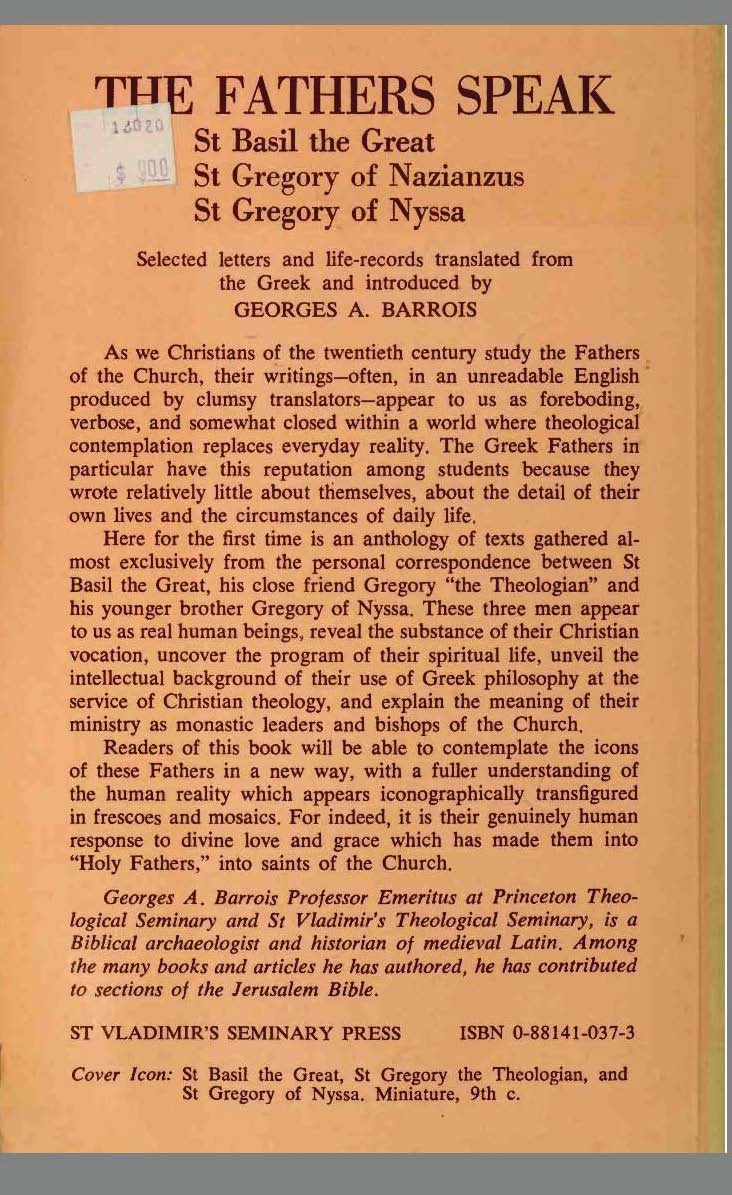
St Basil the Great St Gregory of Nazianzus St Gregory of Nyssa Selected letters and life-records translated from the Greek and introduced by
GEORGES A. BARROIS
As we Christians of the twentieth century study the Fathers of the Church, their writings-often, in an unreadable English produced by clumsy translators-appear to us as foreboding, verbose, and somewhat closed within a world where theological contemplation replaces everyday reality. The Greek Fathers in particular have this reputation among students because they wrote relatively little about tliemselves, about the detail of their own lives and the circumstances of daily life.
Here for the first time is an anthology of texts gathered almost exclusively from the personal correspondence between SI
Basil the Great, his close friend Gregory "the Theologian" and his younger brother Gregory of Nyssa. These three men appear to us as real human beings, reveal the substance of their Christian vocation, uncover the program of their spiritual life, unveil the intellectual background of their use of Greek philosophy at the service of Christian theology, and explain the meaning of their ministry as monastic leaders and bishops of the Church.
Readers of this book will be able to contemplate the icons of these Fathers in a new way, with a fuller understanding of the human reality which appears iconographically transfigured in frescoes and mosaics. For indeed, it is their genuinely human response to divine love and grace which has made them into "Holy Fathers," into saints of the Church.
Georges A. Barrois Professor Emerittls at Princeton Theological Seminary and St Vladimir's Theological Seminary, is a Biblical archaeologist and historian of medieval Latin. Among the many books and articles he has authored, he has contributed to sections of the Jerusalem Bible.
ST VLADIMIR'S SEMINARY PRESS
ISBN 0-88141-037-3
Cover Icon: St Basil the Great, St Gregory the Theologian, and St Gregory of Nyssa. Miniature, 9th c.