
Letter 199 (375)
THE FATHERS SPEAK
fers which may be of interest to twentieth-century Americans, confronted as they are with unsavory social and ethical problems.
BASIL TO AMPHILOCHIOS, ON THE CANONS.
LETTER 188 (374)
... The woman who destroys voluntarily a fetus incurs the pain of murder. There is with us no inquiring whether the fetus was formed or not. In these matters, justice is demanded not only for the child that was to be born, but also against her who has schemed against herself, since most of the time women die in these circumstances. To this is added the destruction of the fetus, just another murder, in the intention of those who dare to commit this sin. However the penance of these women should not be drawn out until their death, but they must accept the stated term of ten years. The healing is not a matter of time, but according to the manner of their repentance.
BASIL TO AMPHILOCHIOS, ON THE CANONS.
LETTER 199 (375)
... Those who have acquired their wives by rape, if they were abducted after having been already promised to others, those men [the rapists] must not be admitted [into the church] until the woman has been taken away and brought back under the authority of him to whom she
Priests and Hierarchs: Shepherds of Sheep
had been first betrothed, whether he is willing to receive her or repudiates her ....
If anyone takes for his wife a woman who is not free. she should be abducted and brought back to her relatives, either her parents or her brothers or any other natural protectors of the girl. If they agree to give her to the suitor, let the marriage take place; but if they refuse, they should not be forced.
As for the one who has seduced a woman, whether stealthily or by violence, he must be submitted to the penalty stated for fornicators. The penance fixed for fornicators is four years: during the first year they are rejected from the prayers of the church and must mourn before the entrance door; the second year they may be admitted to hear the lessons [of Scripture]; the third year, to penitence; the fourth year, they are allowed to consort with the people, but may not take part in the oblation [Ttpocr<J>opa]. Only afterwards can they be admitted to the full communion of the "holy gift," the Eucharist [KoLvcuv(a 'toO aya900].
Letter 270, whose addressee seems 10 be a local priest or the village archon, shows Basil's vigorous implementation of the principles exposed in the letters to Amphilochios of Iconium on the disciplinary canons. The crime of rape seems to have been a rather common occurrence.
BASIL, LETTER 270,
an epigraph (after 375) I am most saddened by finding you not in anger, either overlooking what is forbidden or showing yourself incapa-
THE FATHERS SPEAK
ble of realizing that the present case is a crime against human life itself and against humanity, as well as an outrage to free men, I am SUfe that if you had all been of this opinion, nothing would have hindered this sort of evildoing to be uprooted from our parts. So then, display in the present case a truly Christian zeal and act in proportion to the injury. The girl-no matter where you find her-use aU your energy to have her seized and brought back to her parents. As for that fellow, exclude him from the common prayers and publicly banish him. His accomplices-exclude them too from the prayers with all their household for three years, according to ancient canons. The village that has received the seduced girl and kept her, even without forcibly confining her---'exclude it altogether from the prayers, in order that all learn to regard the abductor as a serpent or any other wild beast to be chased, while his victim is to be rescued.
A fetter of Basil, addressed in the early years of his episcopacy to an unidentified priest, Gregory by name, gives
Basil's own views on the problem of the virgines subintroductae. This priest lived under the same roof with a woman servant, perhaps a female relative or some "yaung niece," in violation ot a canon at the Council ot Nicaea prohibiting the "introduction" at sllch persons into priestly hOllseholds, as had been customary in the early Syrian Church. See
Danieloll and Marrou, The Christian Centuries: The First Six Hundred Years. NelV York (1964), p. 216.
III Priests and Hierarchs: Shepherds of Sheep
BASIL TO GREGORY, A PRIEST. LETTER 55
(From the early years of his episcopacy) I have most patiently read your letters, and I wonder: you could plead your cause with us succinctly and easily by your acts, but you admit to continue in what is charged against you, and you try to heal with long words that which is incurable. We were not the first nor the only one, 0 Gregory, to decree that women should not dwell together with men. Read the disciplinary canon edicted by our holy fathers at the synod of Nicaea, which prohibits clearly that there be among us "introduced women" [auvElaaK,,[ouc;, virgines subintroductae]. Thus, if someone professes celibacy in words, yet acts as married men living together with their wives, it is clear that while he pursues the honor of a professed virginity he does not forsake an amenity which in his case is improper. You should therefore yield to our request, all the more easily that you say you are free from every carnal passion. I do not believe that a seventy-year-old man bUrns of passion for a woman, nor is it because of any impropriety that we have decided what we have decided, but because we have learned from the Apostle not "to put a stumbling block or hindrance in the way of a brother" [Rm 14: 13]. We know that for some it leads to nothing objectionable, but it leads others to sin.
Here is why we have ordered you, according to the decree of the holy fathers: separate yourself from this woman!
And why do you accuse the chorepiskopos, remembering an ancient enmity? Why do you accuse us of having ears always ready to hear calumnies, instead of accusing yourself of not being able to deprive yourself of that woman's company? Drive her out of your house and place her in a nunnery, that she may be among virgins, and that your service be done by men, "lest the name of God be blasphemed because of you" [Rm 2:24]. As long as yOll continue acting as YOll did, the thousand and one things which YOll write in your letters will not help YOll, but yOll will die
THE FATHERS SPEAK
empty and shall have to render account of your emptiness to the Lord. And if you persist without correcting yourself, you shall be anathema to all the people, and all who receive you shaH be excommunicated from the entire Church.
Several points of church law regarding matrimony are treated in Basil's letters to Amphilochios "on the canons."
Successive bigamy (the remarriage of a widower who has lost his wife, or of a widow who has lost her husband) is to be tolerated, though it is generally inadvisable; a third
IInion, though not invalid, lVould expose the spOllses to a severe penance.
We close this chapter with another point of church law that can be of interest for a study 0/ the notion of "economy," OLKOVO!l(O:. Basil esteems that positive church rilles should not apply retrospectively to the activities of converted heretics or of catechumens prior to their being united with the Orthodox Church, subject to a decision of the hierarchy.
BASIL. LETTER 199, ON THE CANONS (375)
.. . The women who were in the heresy and had professed virginity, while being in heresy, and later chose to marry-I do not think they are to be condemned. Whatever the Law says, it says it to those who are "under the Law"
[Rm 3: 19]. Now those who were not yet subject to the yoke of Christ were not aware of the rules of the Master. But now they are acceptable to the Church and obtain by their faith in Christ the remission of their sins, in addition to being pardoned for the previous violations of His rules.
Priests and Hierarchs: Shepherds of Sheep
Generally no account should be demanded from the cate· chumens for their past activities. But, of course, the Church does not receive them without baptism; the prerogatives of "birth according to the Spirit" are most necessary for them.

Priests and Hierarchs:
Upholders of Orthodoxy Saint A thanasius and the Church fathers who were gathered at Nicaea (325) had laid down the foundations 0/ the catholic dogma, which the major treatises written by the Three Hierarchs brought to completion in its structural integrity. But it is not these major treatises that are the object of the present chapter. They have been analyzed, scrutinized, and commented upon by successive generations of patristic scholars and theologians. We would rather scan the correspondence and personal testimony of our Hierarchs, as they invented and tested a theological language suitable for expressing in human terms the ineffable mystery 0/ the Triune God.
The gradual elaboration of the dogma had as its complement the refutation of heretical theories, old and new, unremittingly reborn like the heads of some monstrous
Hydra. Thus, in the wake of Arianism which had made deep inroads into the two halves of Christendom, heretical movements threatened the peace, as they were being exploited by political schemers eager to capture the favor of the basileus and his representatives. It is worth noting that Basil remained personally untouchable, so great was his popularity as archbishop of Caesaraea. A distinctive feature is that Basil thought it necessary to explain theological matters to non-theologians as well; he adapted his instruction to the capacity of his correspondents: piolls women,
THE FATHERS SPEAK
cultivated laymen, imperial functionaries, rhetors, and philosophers.
Witl! Basil's letter 263, to the Westerners, we enter into the quick of the subject: the exposition of Orthodox Faith alld the refutation of heresies.
BASIL, TO THE WESTERNERS, LETTER 263 (377)
May the Lord our God, in whom we have hoped, favor you with the object of that hope and grant to everyone of you a grace as great as the joy with which you have filled our hearts, a joy you gave us by the letters you sent through our most desired fellow priests and by sympathizing with us in our ordeals, for your compassion has made you
"put on for us bowels of mercy," as those men have reported unto us. If our wounds remain the same, it gives us some relief to have physicians ready who could, given the occasion, bring a prompt remedy to our ills .... The impudence and shamelessness of the Arian heretics, after they had torn themselves openly from the body of the Church, continues but causes us little damage because their impiety is obvious to all. As for those who wrap themselves in sheeps' clothing, hiding behind a semblance of gentleness while in reality they tear pitilessly the flock of Christ, those people,
I say, who come from among us, inflict easy damage to simple souls . ... It is they who are dangerous and to be feared .... It is necessary to mention them by name, so that you know those who foment disorder among us, and that you denounce them clearly to your Churches. Our word is suspect to many, as if we were assuming an attitude of meanness on account of personal differences. You will obtain all the more credit in the eyes of those people, that your homes are further away; moreover, the grace of God will prompt you to care for those who are worn out, and
Priests and Hierarchs: Upholders of Orthodoxy
if you are numerous enough to reach a decision by common accord, it is evident that your majority shall dispose every· body to adopt your conclusions without discussion.
Here is what could be done if you were willing to write to aU the Churches in the East: if these forgers amend themselves, they could be admitted in our fellowship, but if they persist stubbornly in their novelties, we should sepa· rate ourselves from them. We do recognize that if we had been able to sit with you in your wisdom, we could have taken in common right decisions in these matters. But the time did not permit it, and to delay would be harmful, because the harm done by those impious men would have taken root. So we had to send to you some of our brethren as messengers; they will inform you of whatever we may have omitted in writing, and they will exhort Your Graces to procure to the Churches of God the assistance they are seeking.
Having pointed to the necessity of mentioning by name those who limped between heresy and strict Nicene ortho· doxy, Basil was not long to pass to the act and named three of them: Eustathios of Sebastaea (Sivas) in Lesser Armenia,
Apollinarios of Laodicaea (Latakia) in Syria, and Paulinus, a successor of Melelios on the throne of Antioch. Basil re· garded them as questionable, for a variety of reasons.
Eustathios had been at first a disciple of Arius. Can· verted to the Orthodox faith, he was ordained a priest by bishop Hermogenes of Caesaraea, after whose death he was received by Eusebius of Caesaraea, an ardent defender of Orthodoxy. During his catholic phase, Eustathios, notable for his ascetic way of life, had become an intimate friend of Basil, who was soon to deplore Eustathios' fluctuations.
Relapsing into heresy, Eustathios managed to conceal his "ungodly convictions." Imprudently promoted to the rank of bishop, he turned his coat once more and appeared to be the author of a pamphlet against the doctrine of can·
THE FATHERS SPEAK
substantiality. Deposed from office, he maneuvered to be restored in his charge by a local council held at Tyana, in the Cappadocia Secunda.
Apollinarios was less 0/ a chameleon. Basil had at first looked af him without disfavor, but was soon disillusioned.
Apollinarios had found an expeditious way to cut short the discussions with the Arian leaders, but did away by the same token with the arguments of Nicene theology on the relation 0/ the Persons to the divine Essence. In fact this tended to revive the old heresy 0/ Sahellius interpreting the names of the three Persons in the Trinity as arbitrary designations of the Absolute Deity. But Apollinarios was a jast talker: "He writes too much," says Basil. Endowed with great facility, he was apt to state any thesis, and "he has filled the Universe with his lucubrations," heedless of the advice of one who said: "Beware of making many books!"
The third suspect denounced by Basil is Paulinus, who indeed professed the Nicene dogma still in its incipient stage of development. But Basil disapproved of his sympathy for the doubtful speculations of Marcellos of Ancyra (Ankara), for whom the Son did not exist in his own hypostasis nor the Holy Spirit in his particular one.
Of the three characters, Apollinarios fared the worst in Basil's eyes, who concluded his letter "to the Westerners" as follows:
Ap011inarios has composed on the Resurrection some fabricated treatises, rather Judaizing, in which he says that we should return to the cult of the Law, again be circumcised, observe the sabbath and the dietary laws, sacrifice victims to God, worship in the Temple of Jerusalem; in short, from Christians we shall be turned into Jews. Is there not anything more ridiculous, or rather more alien to the doctrine of the Evangel?
Priests alld Hierarchs: Upholders of Orthodoxy
Alrtady in 375, after reminding the leading citizens of Neo-Caesaraea of his ancestral roots in the city, Basil had warned them against any attempts at reviving the error of Sabellianism. Here is the doctrinal part of letter 210, the beginning of which we have given in chapter 2, "Biographicals."
BASIL TO THE LEADING CITIZENS OF
NEO-CAESARAEA: LETTER 210 (375)
There are some among you who exert themselves at distorting the faith out of hatred for the dogma of the Apostles and of the Gospel, or of hatred for that truly great man Gregory [the Wonderworker] and his successors down to the blessed Mousonios [a bishop of Neo-Caesaraea], whose teaching is still ringing in your ears.
The error which Sabellius let loose and which the Fathers put down some people undertake to revive today and, for lack of proofs, forge dreams against us. Do part from these heads heavy with wine and vapors arising from drunkenness, pregnant with visions! We keep watch, for fear of God, we cannot keep silent. Learn from us, then, the damage which such people inflict upon you: Sabellianism is Judaism, and it infiltrates itself under the guise of Christianism into the proclamation of the Gospel. For he who says that the Father, the Son, and the Holy Spirit are one single reality under several persons [gv TrPayllav TrOAUTrp6oUYTro] and professes only one hypostasis common to the three, what else does he do but deny the pre-existence of the Only-Begotten before all ages? He rejects also His sojourn and conversing with men, the descent into Hades, the Resurrection, the Judgment, and he denies the distinctive operation of the Spirit [-rae; tf.llal:ouoae; tv£pY£lae;
-raG Trv£ulla"[oe;].
THE FATHERS SPEAK
GREGORY OF NAZIANZUS. LETTER 125, TO
THE PREFECT OLYMPIOS (382)
(written shortly after Gregory's return from Constantinople) Even a white head has to be taught, for old age, it seems to me, is no proof of wisdom. At any rate I know better than anyone else the intrigues and the impiety of the ApoIlinarists; I have seen that their folly is unbearable, but I thought that with patience it might still be possible to tame them and to soften them little by little. It appears that I had unwittingly made them worse and that I had harmed the Church by my untimely philosophy of moderation, for it has failed to put the wicked to shame. For the time being, if I had been able to inform you personally of these things,
I would not have been slow in coming, know it well; however, it was beyond my own power to bow down before Your Excellency. But illness has driven me beyond that point and the doctors prescribed a cure at the thermal springs of Xanxaris [possibly Kara-pllnar, the "black springs"J, so I send this letter instead. They have dared, these "wretches who will wretchedly perish" [Mt 21 :41J, above their other mischiefs, to call in bishops deposed by every synod in the East or in the West, and use the occasion of their passage, exactly what for I cannot tell. They have rebelled against all the imperial constitutions and against your decrees, and they have bestowed the name of bishop upon one of them, an impious fake. They have been thus far encouraged, I think, by my "deadness," speaking literally. Now if this is bearable unto Your Constancy, we too shall bcar with it, as we had to do so often! But if it is intolerable to our most pious basileus, then proceed against them; your rigor will not possibly be equal to their folly.
Priests and Hierarchs: Upholders of Orthodoxy
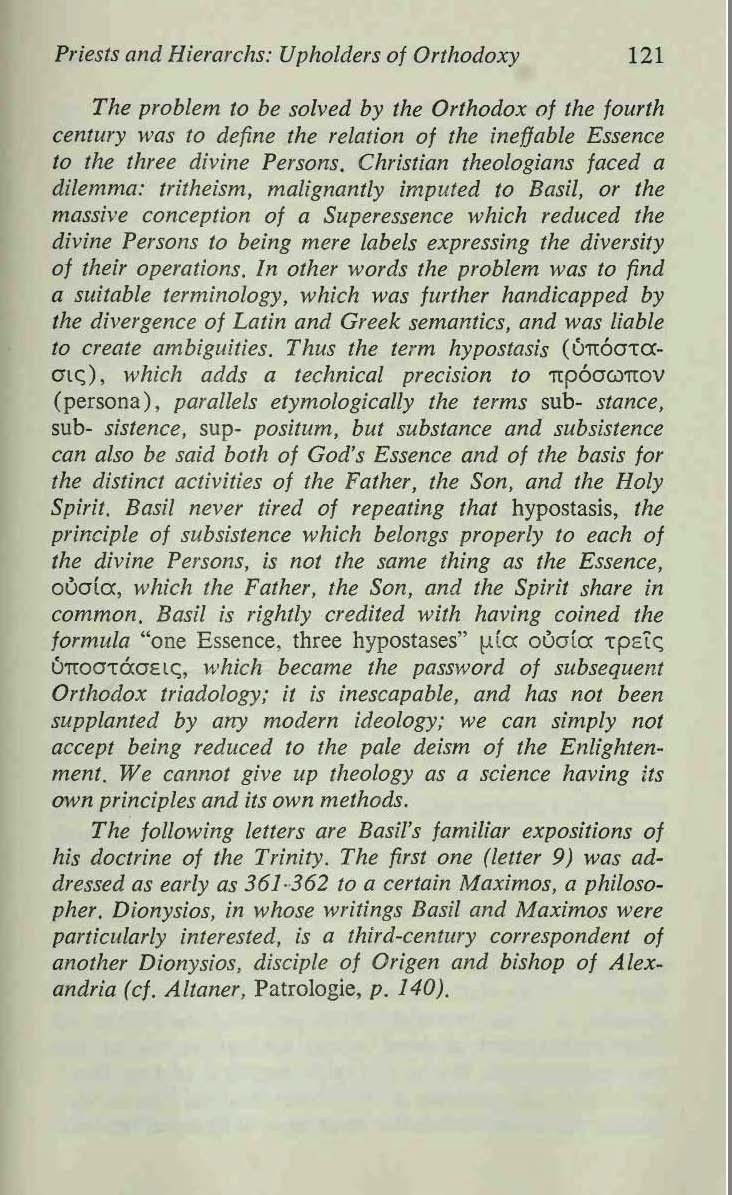
The problem to be solved by the Orthodox of the fourth century was to define the relation of the ineffable Essence to the three divine Persons. Christian theologians faced a dilemma: tritheism, malignantly imputed 10 Basil, or the massive conception of a Superessence which reduced the divine Persons to being mere labels expressing the diversity of their operations. In other words the problem was to find a suitable terminology, which was further handicapped by the divergence of Latin and Greek semantics, and was liable to create ambiguities. Thus the term hypostasis (Ll1t6ol"crate;) , which adds a technical precision to 11:p6oc.mov
(persona). parallels etymologically the terms substance, subsistence, suppositum, but substance and subsistence can also be said both of God's Essence and of the basis for the distinct activities of the Father, the Son, and the Holy
Spirit, Basil never tired of repeating that hypostasis, the principle of subsistence which belongs properly to each of the divine Persons, is not the same thing as the Essence, auoia, which the Father, the Son, and the Spirit share in common. Basil is rightly credited with having coined the formula "one Essence, three hypostases" t-tta ouota tpEte; urroO'l"aOElC;, which became the password of subsequent
Orthodox triadology; it is inescapable, and has not been supplanted by any modern ideology; we can simply not accept being reduced to the pale deism of the Enlightenment. We cannot give up theology as a science having its own principles and its own methods.
The following letters are Basil's familiar expositions of his doctrine of the Trinity. The first one (letter 9) was addressed as early as 361 .. 362 to a certain Maximos, a philosopher. Dionysios, in whose writings Basil and Maximos were particularly interested, is a third-century correspondent of another Dionysios, disciple of Origen and bishop of Alexandria (cf. Altaner, Patrologie, p. 140).
THE FATHERS SPEAK
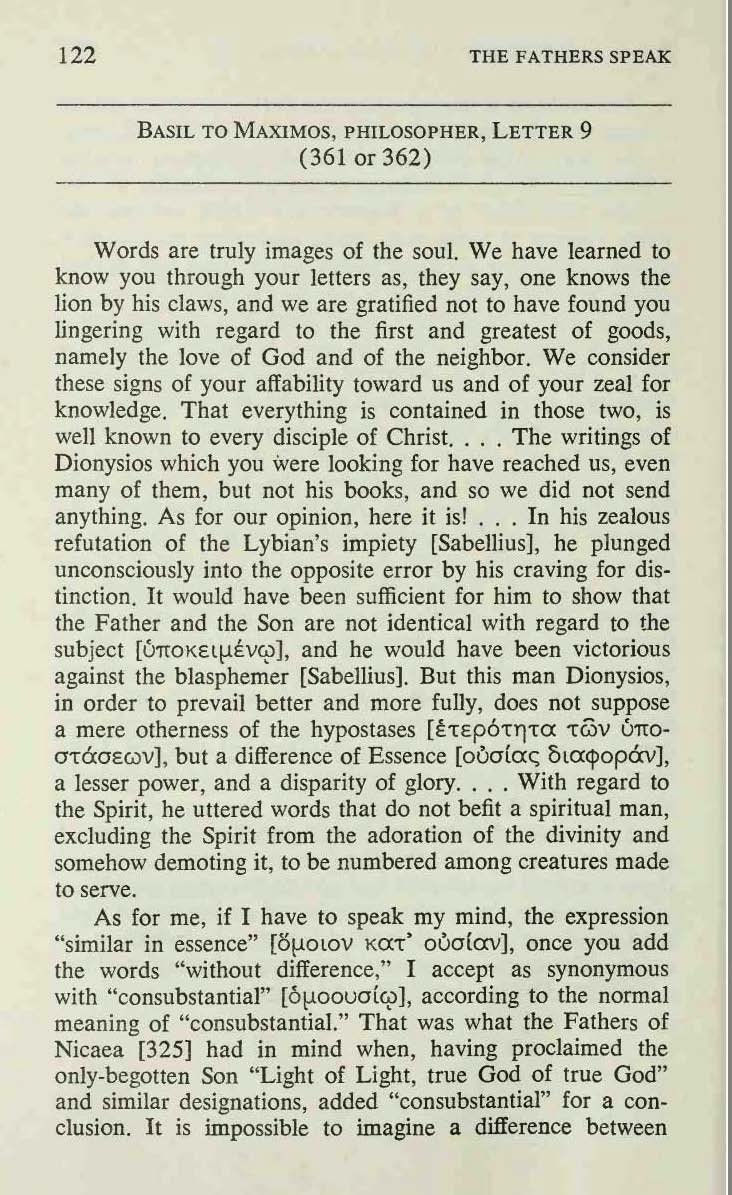
BASIL TO MAXlMOS, PHILOSOPHER, LETTER 9
(361 or 362) Words are truly images of the soul. We have learned to know you through your letters as, they say, one knows the lion by his claws, and we are gratified not to have found you lingering with regard to the first and greatest of goods, namely the love of God and of the neighbor. We consider these signs of your affability toward us and of your zeal for knowledge, That everything is contained in those two, is well known to every disciple of Christ .... The writings of Dionysios which you were looking for have reached us, even many of them, but not his books, and so we did not send anything. As for our opinion, here it is! ... In his zealous refutation of the Lybian's impiety [Sabellius), he plunged unconsciously into the opposite error by his craving for distinction. It would have been sufficient for him to show that the Father and the Son are not identical with regard to the subject [lntOKEqlEV<t>], and he would have been victorious against the blasphemer [Sabellius]. But this man Dionysios, in order to prevail better and more fully, does not suppose a mere otherness of the hypostases [t"[Ep6"nl'ra "[QV UTCOO"[6:0E(J.w], but a difference of Essence [ouaLac; fHaq>opav], a lesser power, and a disparity of glory .... With regard to the Spirit, he uttered words that do not befit a spiritual man, excluding the Spirit from the adoration of the divinity and somehow demoting it, to be numbered among creatures made to serve.
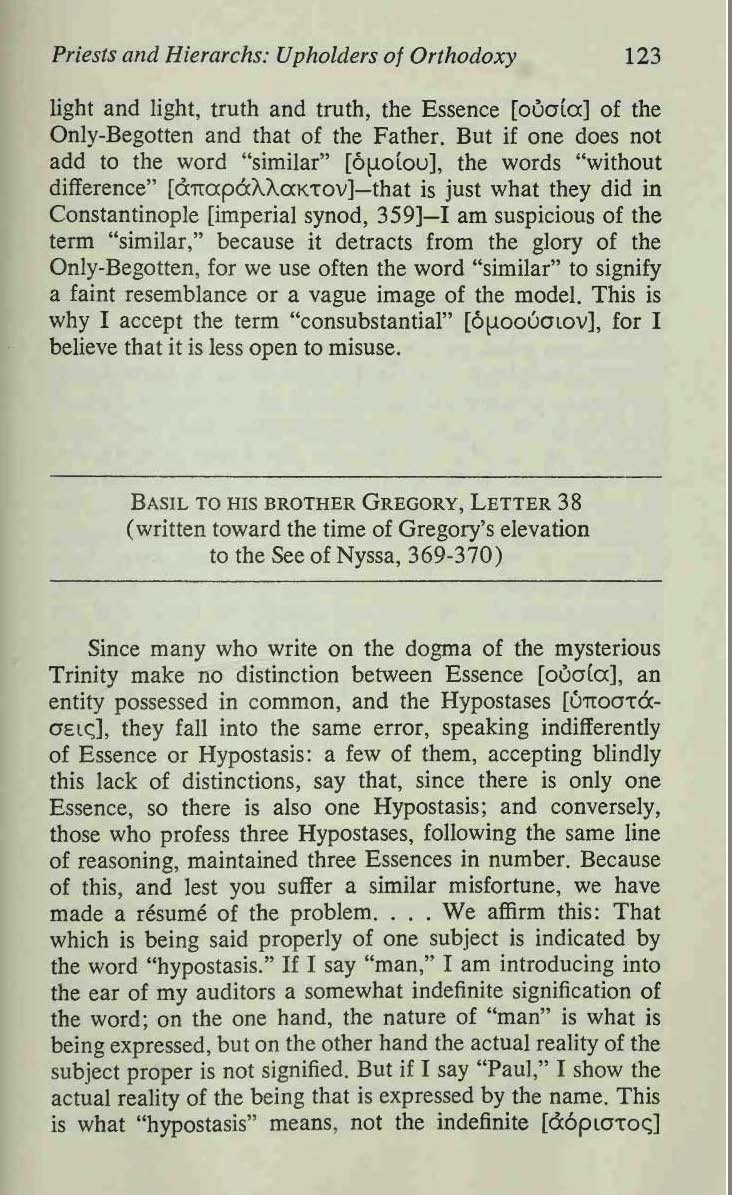
As for me, if I have to speak my mind, the expression "similar in essence" [O~OloV Kat"' oua(av], once you add the words "without difference," I accept as synonymous with "consubstantial" [olloouO(<t>], according to the normal meaning of "consubstantia1." That was what the Fathers of Nicaea [325] had in mind when, having proclaimed the only-begotten Son "Light of Light, true God of true God" and similar designations, added "consubstantial" for a conclusion. It is impossible to imagine a difference between
Priests and Hierarchs: Upholders of Orthodoxy
light and light, truth and truth, the Essence [060[0:] of the Only-Begotten and that of the Father. But if one does not add to the word "similar" [6~0[ou], the words "without difference" [O::l1o:p6:AAO:K'rov]-that is just what they did in Constantinople [imperial synod, 359]-1 am suspicious of the term "similar," because it detracts from the glory of the Only-Begotten, for we use often the word "similar" to signify a faint resemblance or a vague image of the model. This is why 1 accept the term "consubstantial" [6floOUOLOV], for 1 believe that it is less open to misuse.
BASIL TO HIS BROTHER GREGORY, LETTER 38
(written toward the time of Gregory's elevation to the See of Nyssa, 369-370) Since many who write on the dogma of the mysterious
Trinity make no distinction between Essence [060(0:], an entity possessed in common, and the Hypostases [U1tOOT<XOElC;], they fall into the same error, speaking indifferently of Essence or Hypostasis: a few of them, accepting blindly this lack of distinctions, say that, since there is only one
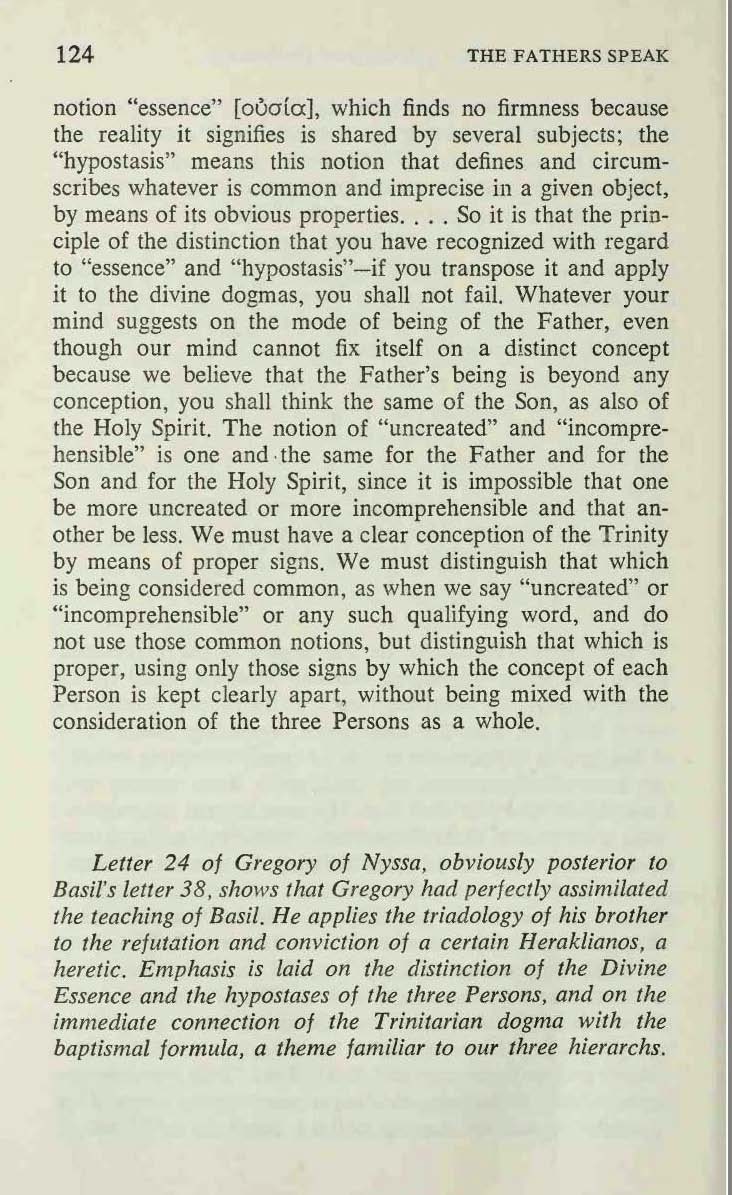
Essence, so there is also one Hypostasis; and conversely, those who profess three Hypostases, following the same line of reasoning, maintained three Essences in number. Because of this, and lest you suffer a similar misfortune, we have made a resume of the problem .... We affirm this: That which is being said properly of one subject is indicated by the word "hypostasis." If 1 say "man," 1 am introducing into the ear of my auditors a somewhat indefinite signification of the word; on the one hand, the nature of "man" is what is being expressed, but on the other hand the actual reality of the subject proper is not signified. But if I say "Paul," I show the actual reality of the being that is expressed by the name. This is what "hypostasis" means, not the indefinite [6::6PlOTOC;]
THE FATHERS SPEAK
notion "essence" [ouola], which finds no firmness because the reality it signifies is shared by several subjects; the "hypostasis" means this notion that defines and circumscribes whatever is common and imprecise in a given object. by means of its obvious properties ... . So it is that the principle of the distinction that you have recognized with regard to "essence" and "hypostasis"-if you transpose it and apply it to the divine dogmas, you shall not fail. Whatever your mind suggests on the mode of being of the Father, even though our mind cannot fix itself on a distinct concept because we believe that the Father's being is beyond any conception, yOll shall think the same of the Son, as also of the Holy Spirit. The notion of "un created" and "incomprehensible" is one and · the same for the Father and for the Son and for the Holy Spirit, since it is impossible that one be more uncreated or more incomprehensible and that another be less. We must have a clear conception of the Trinity by means of proper signs. We must distinguish that which is being considered cornman, as when we say "uncreated" or "incomprehensible" or any such qualifying word, and do not use those common notions, but distinguish that which is proper, using only those signs by which the concept of each
Person is kept clearly apart, without being mixed with the consideration of the three Persons as a whole.
Letter 24 of Gregory of Nyssa, obviously posterior to Basil's letter 38, shows that Gregory had perfectly assimilated the teaching of Basil. He applies the triadology of his brother to the refutation and conviction of a certain Heraklianos, a heretic. Emphasis is laid on the distinction of the Divine
Essence and tlte hypostases of the three Persons, and on tlte immediate connection of the Trinitarian dogma with the baptismal formula, a theme familiar to our three hierarchs.