
1 How Do You Solve aProblem Like Young Adults? ARuthlessly Honest Snapshot of the State of Today’s Young Adult Ministry
1
How Do You Solve a Problem Like
Young Adults?
A Ruthlessly Honest Snapshot of the State of Today’s Young Adult Ministry
The lowest ebb is the turn of the tide.
There is always a well-known solution to every human problem—neat, plausible, and wrong.
There’s little doubt that the American church’s ministry to young adults has reached an all-time low. The next generation is in a mass exodus from the church.
An avalanche of worrisome statistics has begun to feel normal:
“The ages of eighteen to twenty-nine are the black hole of church attendance; this age segment is ‘missing in action’ from most congregations. . . . These numbers represent about eight million twentysomethings who were active churchgoers as teenagers but who will no longer be particularly engaged in a church by their thirtieth birthday.”
Seventy percent of eighteen- to thirty-year-olds “who went to church regularly in high school said they quit attending by age 23.”
Only 20 percent of twenty-somethings report that they “have maintained a level of spiritual activity consistent with their teenage experiences.” Another 19 percent “were never significantly reached by a Christian community of faith during their teen” years.
While the number of Americans who say they have “no religion” has more than doubled since 1990, “a third of adults under 30 . . . are religiously unaffiliated today, the highest percentages ever in Pew Research Center polling.”
Two-thirds (67 percent) of young adults who were raised unaffiliated are still unaffiliated, a higher retention rate than most other major religious groups—and much higher than for older generations of “nones.”
The average church today has demonstrated clearly that it is ill-equipped to engage this generation and leverage its leadership in the life of the church. Though the challenges of reaching eighteen- to thirty-year-olds (college students and young adults) isn’t a new topic for the church, the challenge of reaching young adults—eighteen- to thirty-year-olds of this generation—is something new.
In his book You Lost Me, David Kinnaman quotes an entrepreneur who works with young adults: “This next generation is not just slightly different from the past. I believe they are discontinuously different than anything we have seen before.”
Sure, there’s a certain sameness about the challenges of ministry. It’s been difficult in the past and will be difficult in the future. But now many people are realizing that this generation is unlike any that has come before.
It shouldn’t be surprising, then, that churches (those that haven’t given up) are struggling desperately to crack the code on engaging and retaining young adults. With few of the old tricks working, the old rules don’t seem to apply. This population has fundamentally different assumptions, worldviews, and paradoxes from previous generations.
Getting Beyond Normal
Don’t get me wrong: churches and ministry leaders are having lots of fine discussions about young adults. Typically, not a week goes by without a report somewhere about the topic of “Christianity and young adults,” the first generation raised from the technological cradle.
A longtime associate pastor at a large church offers this picture of how churches can easily spend many hours, sometimes years, in passionate conversation about young adults without doing much of anything:
I remember sitting in a church staff meeting recently with fifteen otherwise very intelligent people, eight of whom had master’s or doctorates. We spent 30 or so minutes, with five or six of them dissecting with articulate passion the question of why young adults don’t come to church and what “the church” should do about it.
The crazy thing is, no one at the table, no one, had any positional responsibility to actually do anything. Eventually, I couldn’t take it anymore.
I asked, “I’m just wondering, is there anyone around the table who’s going to do anything about the problems we’ve been discussing? How about we answer that question, and if the answer is no, can we talk about something we’ll actually do something about?”
If you’ve been around many church meetings, you know what happened next. I had just volunteered (happily by the way) to prepare a proposal for young adult ministry.
Today’s “normal” in the church is talking about young adult ministry and trying harder at doing what hasn’t worked. Blogs, tweets, status updates, online videos, and books all seem to have coalesced into a great ecclesial handwringing. Expert prognostication abounds for why young adults and the church aren’t getting along. Everyone seems to have a theory:
Maybe it’s our worship style. We’re too boring.
We’re just not deep enough.
We’re failing at reaching them with their language—technology.
Arguments rage about whether we’re catering to young adults too much or not enough. Sound bites, statistics, and talk-show blurbs all generate interesting conversation but not much else. Talking may be all that most churches are doing to reach young adults. And, like my friend in his staff meeting, I don’t find these discussions particularly helpful.
Though solid studies of young adult ministry are pretty hard to find, the available ones indicate that fewer than 10 percent of churches place significant emphasis on young adult ministry at all. In fact, when we contacted denominational offices about what they’re doing with young adults, it wasn’t uncommon to hear responses such as “We don’t have those stats right now. We’re working on mapping campus ministries and young adult ministries but are still in the process of collecting that data.”
Although most churches are avoiding young adults altogether, a few are working hard to crack the young adult code, and that’s good news. Sort of.
Unfortunately, like blind ferrets, these ministries are typified by reactive, frantic programming with little in the way of a proven plan. Desperate to win back this lagging generation, these churches throw money, staff, facilities, almost anything against the wall in hopes that something will stick—and quickly.
Better logos, social media strategies, and a new service project or worship style are often desperate, disconnected reactions to the problem of young adults. Sadly, frantic and desperate is almost never the quickest route to the desired results.
Thinking beyond the local church for a second, we must acknowledge that a huge cost comes with our normal way of doing young adult ministry:
We miss out on the largest generation in history.
We miss out on a generation with the potential to breathe life and vitality into waning congregations.
We pass up an unparalleled opportunity to work with this generation to demonstrate the kingdom of God.
Most conversations portray young adults as the harbinger of the church’s downfall, but I’m crazy enough to suggest instead that today’s young adults might be the harbinger of hope for the church.
Everywhere we look, young adults are thinking about and living into ways of bettering the world. Even the way they eat is better for the environment. Young Christians are eager to engage with Christ and community. And non-Christians in the young adult ranks are acutely interested in spiritual conversations and in partnering with communities that make the world a better place.
This book is based on one bit of good news we’re absolutely convinced is true: building a thriving, sustainable young adult ministry is completely possible, and it might just change the world.
But not if we choose to remain “normal.”
Seven Simple Steps to Failure
While working with churches in their young adult ministries throughout the years, we’ve noticed commonalities. Here’s the process they’ve almost all experienced before deciding to do something to reach young adults (see if it sounds familiar):
Step 1: People start to notice “Our church is aging.”
Step 2: People start to wonder, “Why do our high-school students graduate and never come back?”
Step 3: People realize that without young adults the church will be out of business in a generation or so.
Step 4: People rail against the problems they see in the young adults they know: “They don’t value the church.” “They don’t want to volunteer.” “They don’t tithe.” “We just can’t count on them!”
Step 5: An advice-fest ensues, with suggestions almost always beginning with “If we just . . .”
If we just have more young adults on Sundays . . .
If we just get our college students to come back when they graduate . . .
If we just reach out to the local college campus . . .
If we just change our worship style . . .
If we just have pizza after the service . . .
Step 6: Once the outcry becomes great enough to reach the ears of the senior pastor or leadership team, the decision is made: “We have to do something to reach young adults.”
Step 7: The church or senior pastor acts. They look for someone who has the most influence and skill dealing with this demographic. They bring in the church’s youth worker (or former youth worker or someone who looks like a youth worker) to begin something like a “college and career” program, usually in addition to their full-time job.
This isn’t the only possibility, of course. A wide variety of other poorly thought out, oversimplified approaches exist. But this, by far, is my favorite—and the one I’ve seen most often.
Can we all agree it’s time to get off the conveyor belt of what “normal” churches have always done? The solution to the young adult problem is not another meeting.
Few approaches are more common in young adult ministry than creating a study, a fellowship group, or an event that older adults believe will appeal to young adults. Seldom are these attempts more than polishing up youth group programming—a Sunday morning class, a small group, a trip here or there, maybe even a worship service of their own. We assume we’re being innovative by arranging focus groups to ask young adults what kinds of programs they’d like the church to have for them!
The results prove that this approach is misdirected and misinformed. Doing what comes naturally, what feels normal, just won’t work for creating a thriving young adult ministry.
Unless we fundamentally change our approach, the average church will work harder and harder, invest more and more dollars, yet have little or nothing to show for its efforts. We’ve discovered that the typical church makes many very predictable mistakes when attempting to build a young adult ministry.
These mistakes are so common because they seem good and logical. They aren’t too complex and are often easy to implement. And they aren’t far from the kind of ministry we already know how to do. Honestly, if it weren’t so tragic, it would be entertaining.
The next six chapters introduce these mistakes. By the time you read them, hopefully you’ll agree that none of these mistakes holds the key to building a thriving young adult ministry.
Six Young Adult Ministry Mistakes
Mistake 1. Learn about young adults. Young adults today are unique enough from previous generations that it’s almost as if they speak a different language. We won’t get anywhere if we start our thinking with “when I was their age . . .” It’s vitally important to take time to understand the demographic we’re attempting to reach. However, churches make the mistake of simply learning about young adults by reading books, blog posts, and survey results without building any significant relationships with young adults. This generation is filled with paradox and unpredictability. The only chance we have to really understand young adults is to tilt the balance dramatically in favor of getting to know them personally, not simply learning about them abstractly.
Mistake 2. Change the worship style. Perhaps the most common and obvious mistake in building a ministry to young adults is launching a brand-new (often called “contemporary”) worship service. This is a terrible place to start. The process usually involves a church spending more money than it has but less than it needs to create a third-rate imitation of churches that have had this kind of worship in their DNA from the start. It’s true that in most cities young adults flock to a church or two (usually those less than ten years old) with excellent contemporary worship. But it’s a massive mistake for the average, established church to start a new service while assuming that such a change will make young adults flock to it.
Mistake 3. Expect the youth director to do it. Youth workers are great people. They’re also typically extraordinarily busy. It’s misdirected and seldom effective to assume that working with teenagers is the same as working with young adults. This approach may seem simple and economical, but it’s the quickest way to underresource a ministry that almost always requires a concentrated strategy to succeed. If you want to do ministry “on the cheap,” go ahead and start with the youth worker. If you want to establish a long-lasting ministry with young adults, start someplace else.
Mistake 4. Start by creating a young adult program. Young adults everywhere are asking for depth, diversity, impact, and authentic faith. What they aren’t looking for is a group of baby boomers to plan their social events and offer spiritually focused lessons and speeches. Creating age-segregated, consumer-based experiences and calling it a young adult program is sure to keep your church in a spin cycle of disappointment. Young adults possess deep passion and are ready to engage the church and community. On a related note, asking young adults to sit in a room with other young adults and answer questions about what programs they’d like the church to provide almost never works.
Mistake 5. Wait until they’re ready. Most churches place young adults in a leadership holding tank, expecting them to wait until they’ve paid their dues (translation: sat in the pew for a decade or more). We give lots of lip service to the need for developing emerging leaders, but frankly, most churches have absolutely no process (and no ideas) for integrating young adults into the fabric of the church, let alone into its leadership. Meanwhile, young adults lead in our culture with unprecedented entrepreneurial zeal. Most have stopped wondering why the church won’t give them a seat at the grown-ups table and instead have found places to invest outside the church.
Mistake 6: Give up too soon. When it comes to designing and developing ministry for this generation, the church is just getting started. As a whole, we’re still in the season of experimentation and discovery, and too many churches have already called it quits. Stymied and mystified by the challenges of this generation, the church is equally paralyzed by the requirement of change that might feel too painful to endure. After a few reactive attempts, many churches sit back and declare “We simply can’t do it.” And so they do nothing. But as for a woman in labor, new life comes with contractions and pain.
A Matter of Priorities
When young adult ministry does work, it can be a huge win for the church. The Hartford Institute for Religion Research and Leadership Network reports the more intentional a church is about young adults, the bigger the percentage of young adults will be in the church (see 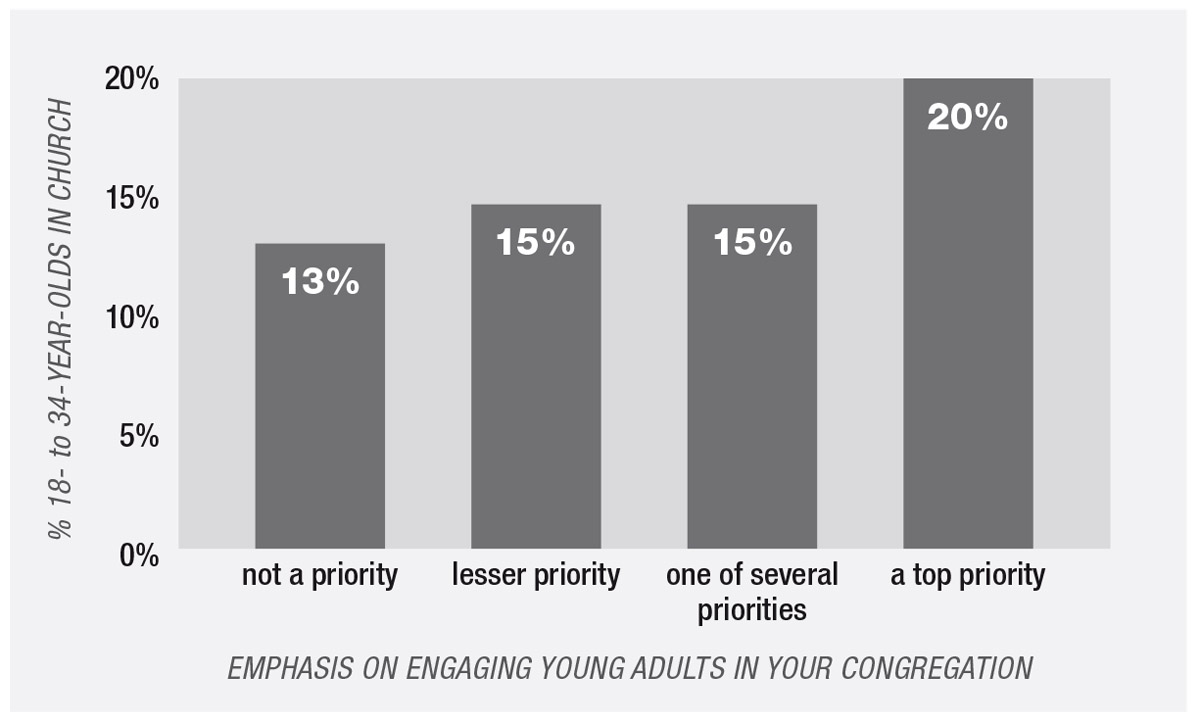
Figure 1.1. Increasing the percentage of young adults in church. Source: 2015 Megachurch Survey by Hartford Institute for Religion Research and Leadership Network.
It all starts with deciding that ministry to this generation is a priority. Research shows that the more emphasis churches put on young adults, the more young adults they reach. It’s not that young adults are unreachable but that they haven’t been anywhere near the top of the priority list for most churches. The correlation between the church’s emphasis on this generation and their participation in the church can’t be ignored.
And so the next generation has become a crisis on the church’s doorstep. We’re confused by them, confounded by them, frustrated by them, and too often willing to give up on them.
Princeton University professor Robert Wuthnow offers the church this challenge: “My view is that congregations can survive, but only if religious leaders roll up their sleeves and pay considerably more attention to young adults than they have been.” Paying attention requires that we treat young adults as they are, not as we wish them to be. It requires an investment not simply of time, money, and energy but also of experimentation and adaptation of our current models to faithfully steward the gift of young adults to our congregations today and for the future.
This book offers a measured, systems-based approach to reaching the generation that’s staying away from the church in record numbers. I know: when you read “a measured, systems-based approach,” you want to hit the snooze bar, right? Here’s why you shouldn’t.
Every single church has a calling to reach this generation. But working haphazardly, working normally won’t cut it. It’s time for a game plan that works not just for the isolated megachurch or new church plant but for the average, everyday, garden-variety church—the kind that’s anything but trendy and hip.
A measured, systems-based approach to reaching young adults may at first seem uninspiring in the same way blocking and tackling drills are boring for football players, the way scales are boring for musicians, the way running and weight training are boring for athletes. But if churches are willing to work a clear, deliberate process, the end game can be nothing short of staggering in its impact.
The help churches stop making the most common, most damaging mistakes simply by naming them and unmasking why these approaches almost never work. turns the corner to what the church can do. Then we’ll walk through the process of building a long-term, thriving, sustainable young adult ministry in your own context.
George Bernard Shaw said, “Few people think more than two or three times a year; I have made an international reputation for myself by thinking once or twice a week.”
This book is an invitation for churches to stop reacting and begin thinking in deeper, more intentional ways about this “problem” generation, pointing instead to the gifts young adults offer. Just maybe, with them, we can overcome some of the deepest challenges facing today’s church.
Now let’s get started.