
58 (44). To Gregory, His Brother
SAINT BASIL
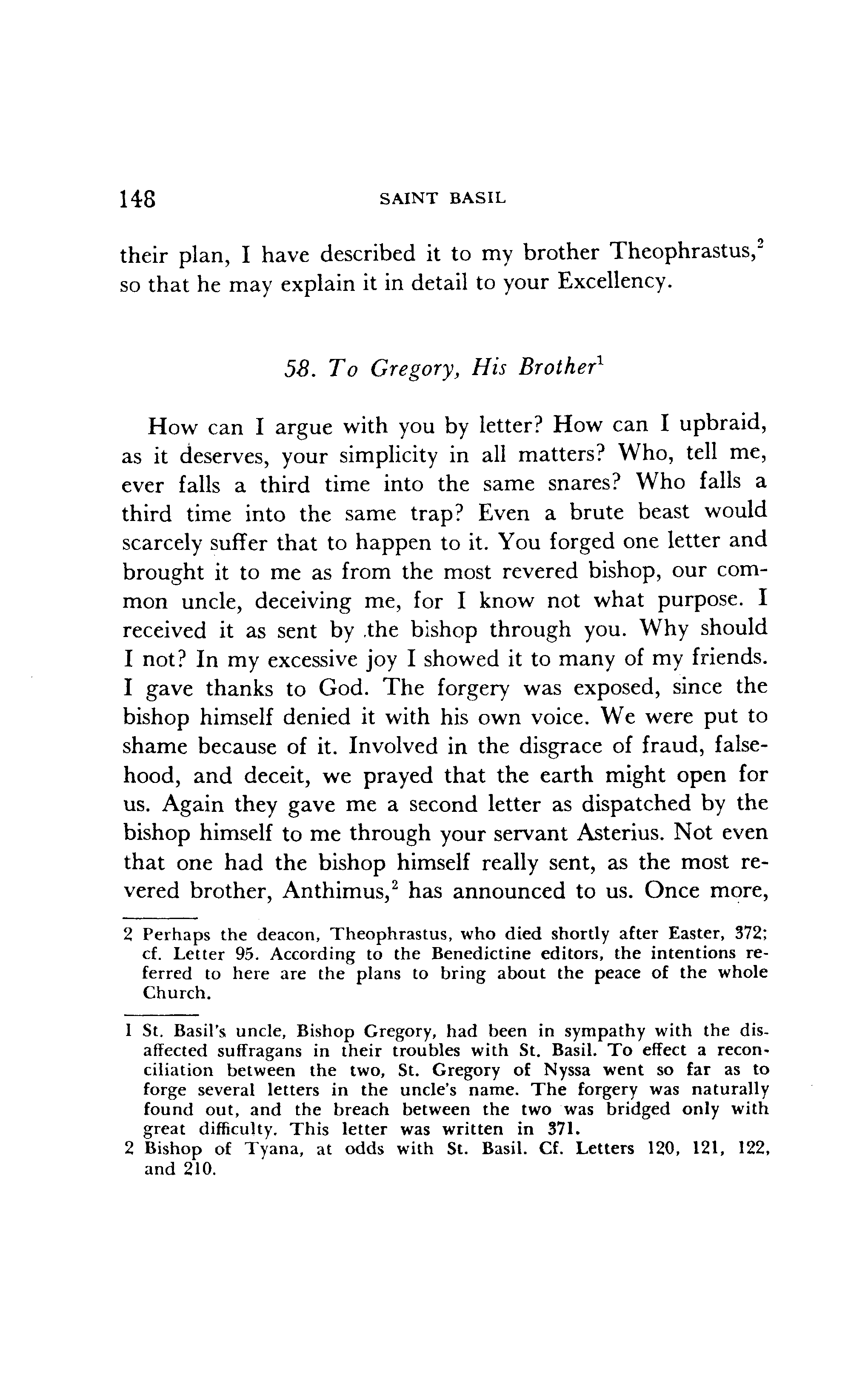
their plan, I have described it to my brother Theophrastus,2 so that he may explain it in detail to your Excellency.
58. To Gregory, His Brother!
How can I argue with you by letter? How can I upbraid, as it deserves, your simplicity in all matters? Who, tell me, ever falls a third time into the same snares? Who falls a third time into the same trap? Even a brute beast would scarcely suffer that to happen to it. You forged one letter and brought it to me as from the most revered bishop, our common uncle, deceiving me, for I know not what purpose. I received it as sent by .the bishop through you. Why should
I not? In my excessive joy I showed it to many of my friends.
I gave thanks to God. The forgery was exposed, since the bishop himself denied it with his own voice. We were put to shame because of it. Involved in the disgrace of fraud, falsehood, and deceit, we prayed that the earth might open for us. Again they gave me a second letter as dispatched by the bishop himself to me through your servant Asterius. Not even that one had the bishop himself really sent, as the most revered brother, Anthimus,2 has announced to us. Once more,
2 Perhaps the deacon, Theophrastus, who died shortly after Easter, 372; d. Letter 95. According to the Benedictine editors, the intentions reo ferred to here are the plans to bring about the peace of the whole
Church.
St. Basil's uncle, Bishop Gregory, had been in sympathy with the dis. affected suffragans in their troubles with St. Basil. To effect a recon· ciliation between the two, St. Gregory of Nyssa went so far as to forge several letters in the uncle's name. The forgery was naturally found out, and the breach between the two was bridged only with great difficulty. This letter was written in 371.
2 Bishop of Tyana, at odds with St. Basil. Cf. Letters 120, 121, 122, and 210.
LETTERS
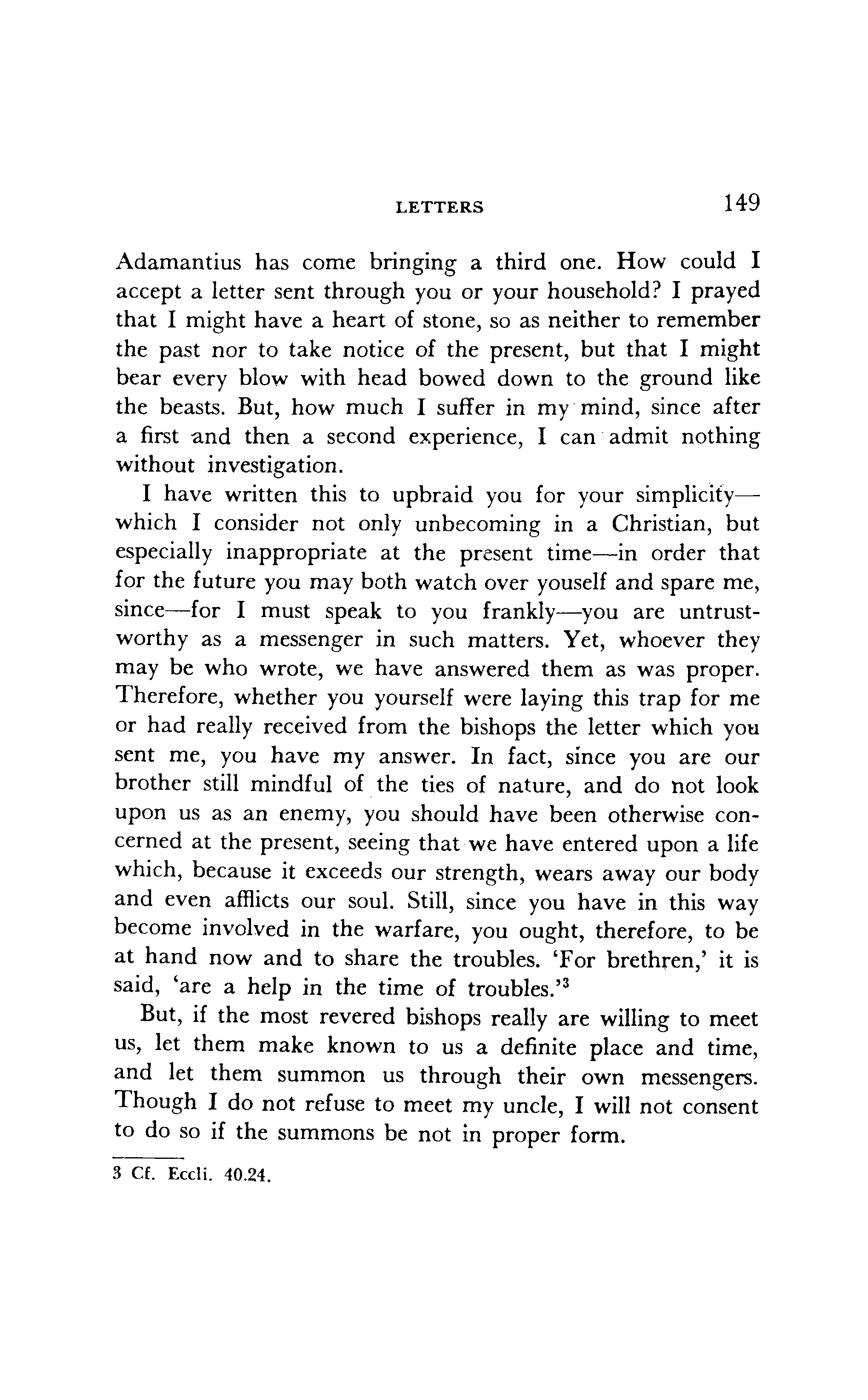
Adamantius has come bringing a third one. How could I accept a letter sent through you or your household? I prayed that I might have a heart of stone, so as neither to remember the past nor to take notice of the present, but that I might bear every blow with head bowed down to the ground like the beasts. But, how much I suffer in my mind, since after a first and then a second experience, I can admit nothing without investigation.
I have written this to upbraid you for your simplicitywhich I consider not only unbecoming in a Christian, but especially inappropriate at the present time-in order that for the future you may both watch over youself and spare me, since-for I must speak to you frankly-you are untrustworthy as a messenger in such matters. Yet, whoever they may be who wrote, we have answered them as was proper.
Therefore, whether you yourself were laying this trap for me or had really received from the bishops the letter which you sent me, you have my answer. In fact, since you are our brother still mindful of the ties of nature, and do not look upon us as an enemy, you should have been otherwise concerned at the present, seeing that we have entered upon a life which, because it exceeds our strength, wears away our body and even afflicts our soul. Still, since you have in this way become involved in the warfare, you ought, therefore, to be at hand now and to share the troubles. 'For brethren,' it is said, 'are a help in the time of troubles.'3
But, if the most revered bishops really are willing to meet us, let them make known to us a definite place and time, and let them summon us through their own messengers.
Though I do not refuse to meet my uncle, I will not consent to do so if the summons be not in proper form.
3 Cf. EcC\i. 40.24.