Contents
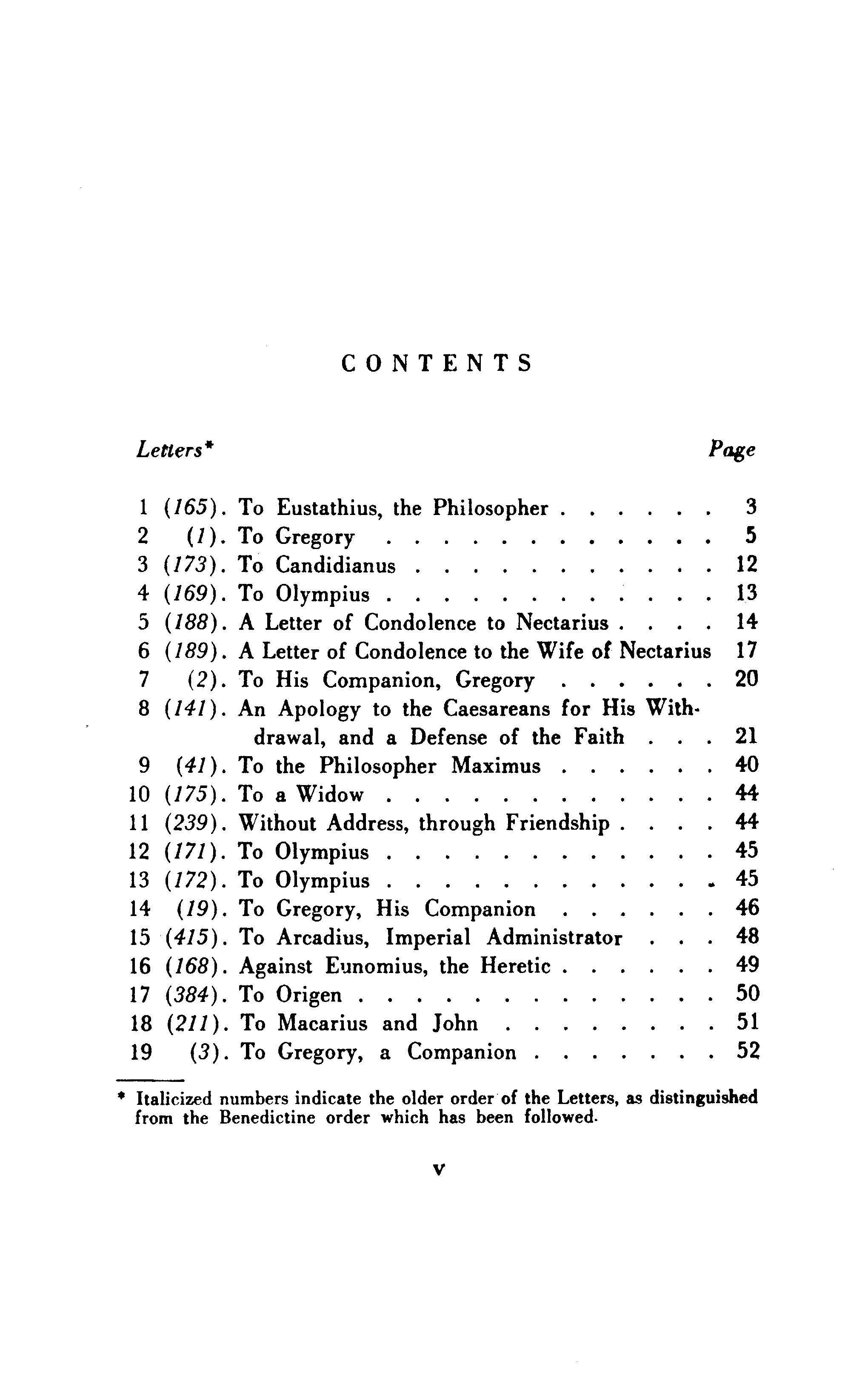
CONTENTS Letters * Page 1 (165). To Eustathius, the Philosopher.
(1). To Gregory 3 (173). To Candidianus .
4 (169). To Olympius . .
5 (J88). A Letter of Condolence to Nectarius .
6 (189). A Letter of Condolence to the Wife ot Nectarius
(2). To His Companion, Gregory . . . . • . 20
8 (141). An Apology to the Caesareans for His With· drawal, and a Defense of the Faith
(41). To the Philosopher Maximus . . .
10 (175). To a Widow . .
11 (239). Without Address, through Friendship.
12 (171). To Olympius . .
13 (172). To Olympius . .
(19). To Gregory, His Companion 15 (415). To Arcadius, Imperial Administrator 16 (168). Against Eunomius, the Heretic 17 (384). To Origen .
18 (211). To Macarius and John
(3). To Gregory, a Companion
4444-
• 45
• Italicized numbers indicate the older order of the Letters, as distinguished from the Benedictine order which has been followed. v
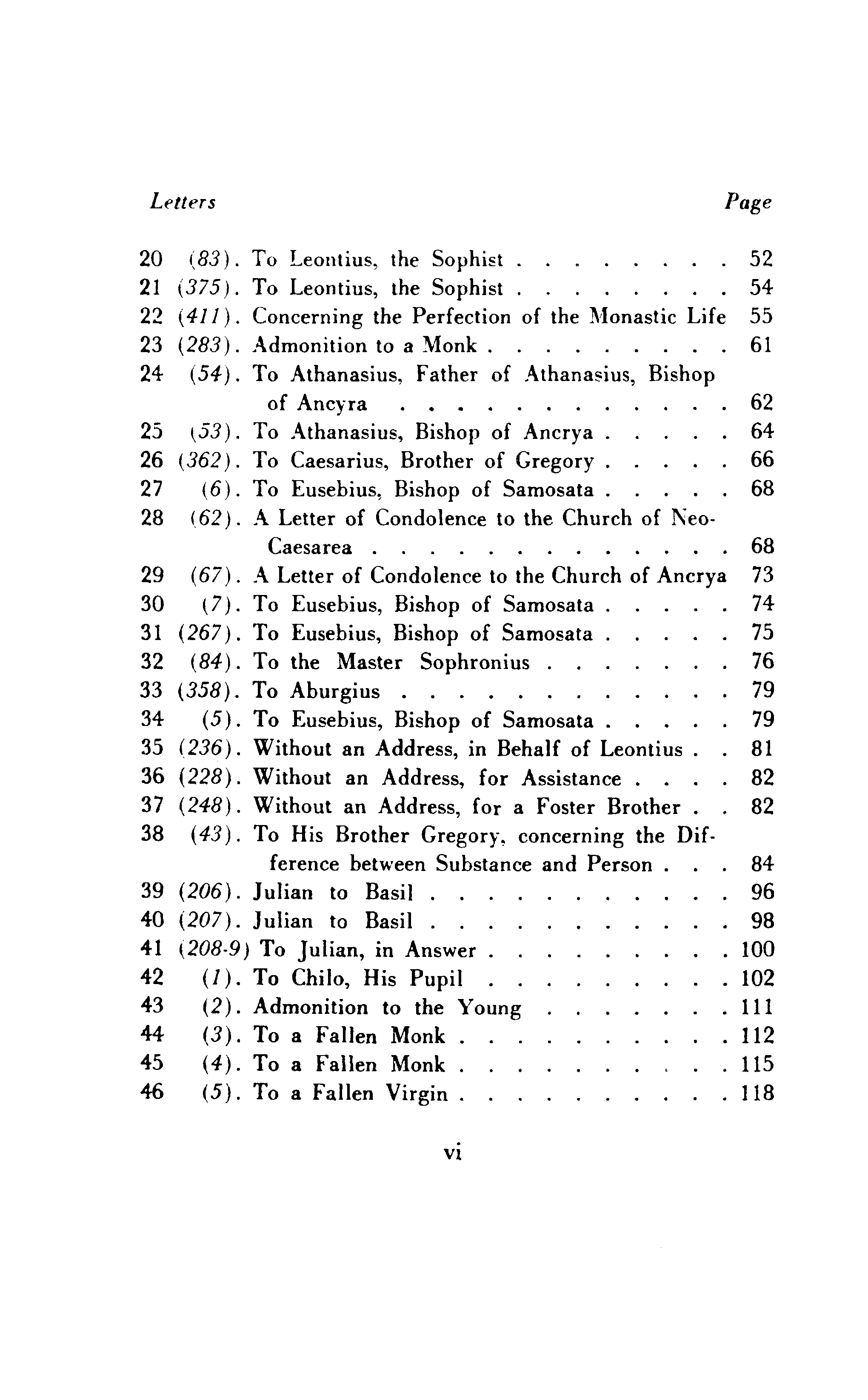
Letters Page
(83). To Leontius, the Sophist.
21 (375). To Leontius, the Sophist.
22 (411). Concerning the Perfection of the Monastic Life 55 23 (283). Admonition to a Monk.
(54). To Athanasius, Father of Athanasius, Bishop of Ancyra ••
~53). To Athanasius, Bishop of Ancrya .
26 (362). To Caesarius, Brother of Gregory.
(6). To Eusebius, Bishop of Samosata .
<.62). A Letter of Condolence to the Church of NeoCaesarea
(67). A Letter of Condolence to the Church of Ancrya
(7). To Eusebius, Bishop of Samosata .
31 (267). To Eusebius, Bishop of Samosata
(84). To the Master Sophronius
33 (358). To Aburgius
(5). To Eusebius, Bishop of Samosata .
35 (236). Without an Address, in Behalf of Leontius .
36 (228). Without an Address, for Assistance..
37 (248). Without an Address, for a Foster Brother.
(43). To His Brother Gregory, concerning the Difference between Substance and Person .
39 (206). Julian to Basil
40 (207). Julian to Basil
41 (208-9) To Julian, in Answer.
(1). To Chilo, His Pupil
(2). Admonition to the Young
(3). To a Fallen Monk .
(4). To a Fallen Monk.
(5). To a Fallen Virgin.
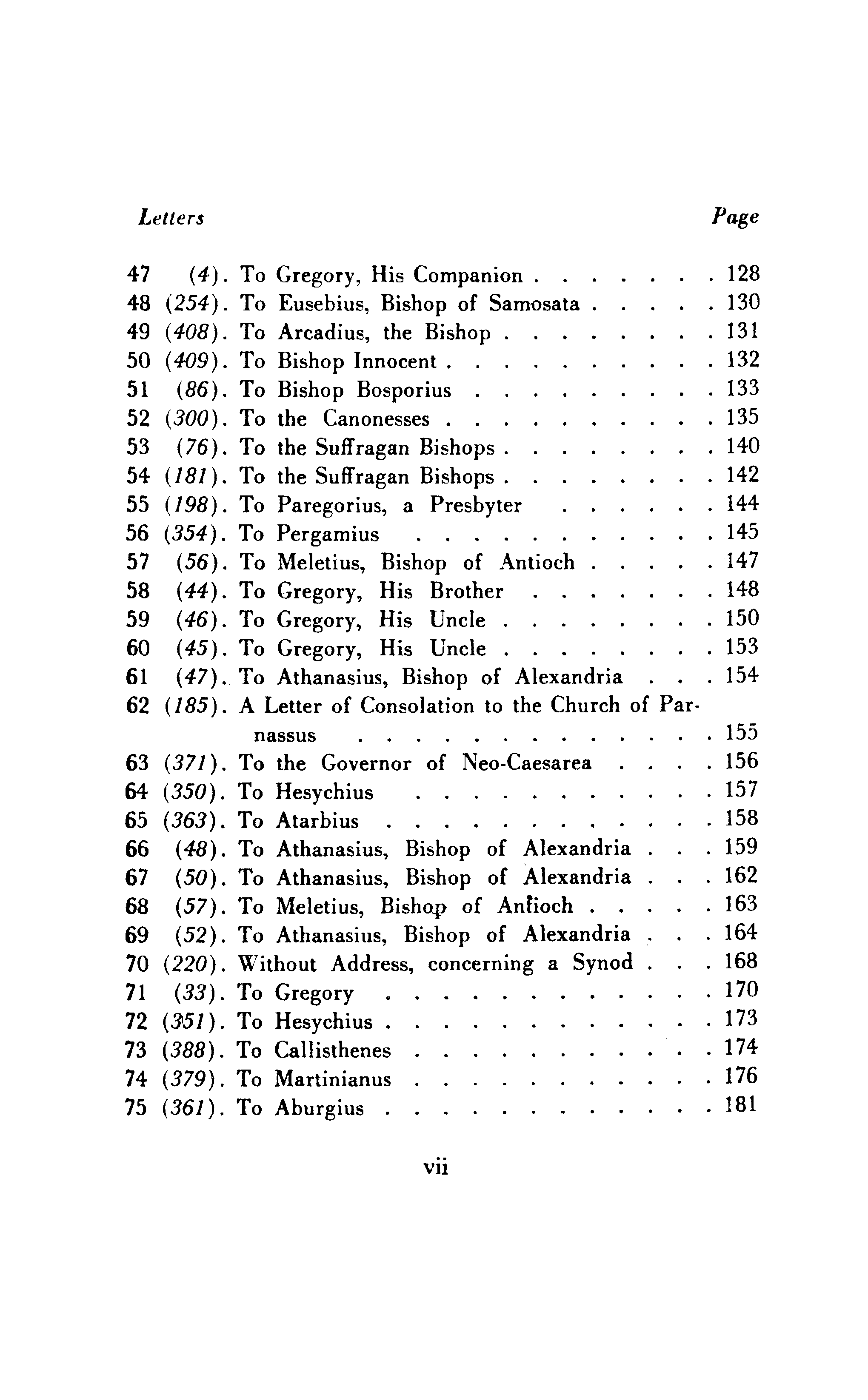
Letters Page
(4). To Gregory, His Companion. .
48 (254). To Eusebius, Bishop of Samosata .
49 (408). To Arcadius, the Bishop
50 (409). To Bishop Innocent.
(86). To Bishop Bosporius .
52 (300). To the Canonesses .
(76). To the Suffragan Bishops.
54 (J 81). To the Suffragan Bishops .
55 (198). To Paregorius, a Presbyter
56 (354). To Pergamius .. .
. .
(56). To Meletius, Bishop of Antioch
(44). To Gregory, His Brother
(46). To Gregory, His Uncle . . .
(45). To Gregory, His Uncle . . .
(47). To Athanasius, Bishop of Alexandria
62 (l85). A Letter of Consolation to the Church of Par· nassus .........
63 (371). To the Governor of Neo-Caesarea
64 (350). To Hesychius
65 (363). To Atarbius
(48). To Athanasius, Bishop of Alexandria
(50). To Athanasius, Bishop of Alexandria
(57). To Meletius, Bishop of Anfioch . .
(52). To Athanasills, Bishop of Alexandria
70 (220). Without Address, concerning a Synod
(33). To Gregory
72 (3'51). To Hesychius .
73 (388). To Callisthenes
74 (379). To Martinianlls
75 (361). To Aburgius .
VII
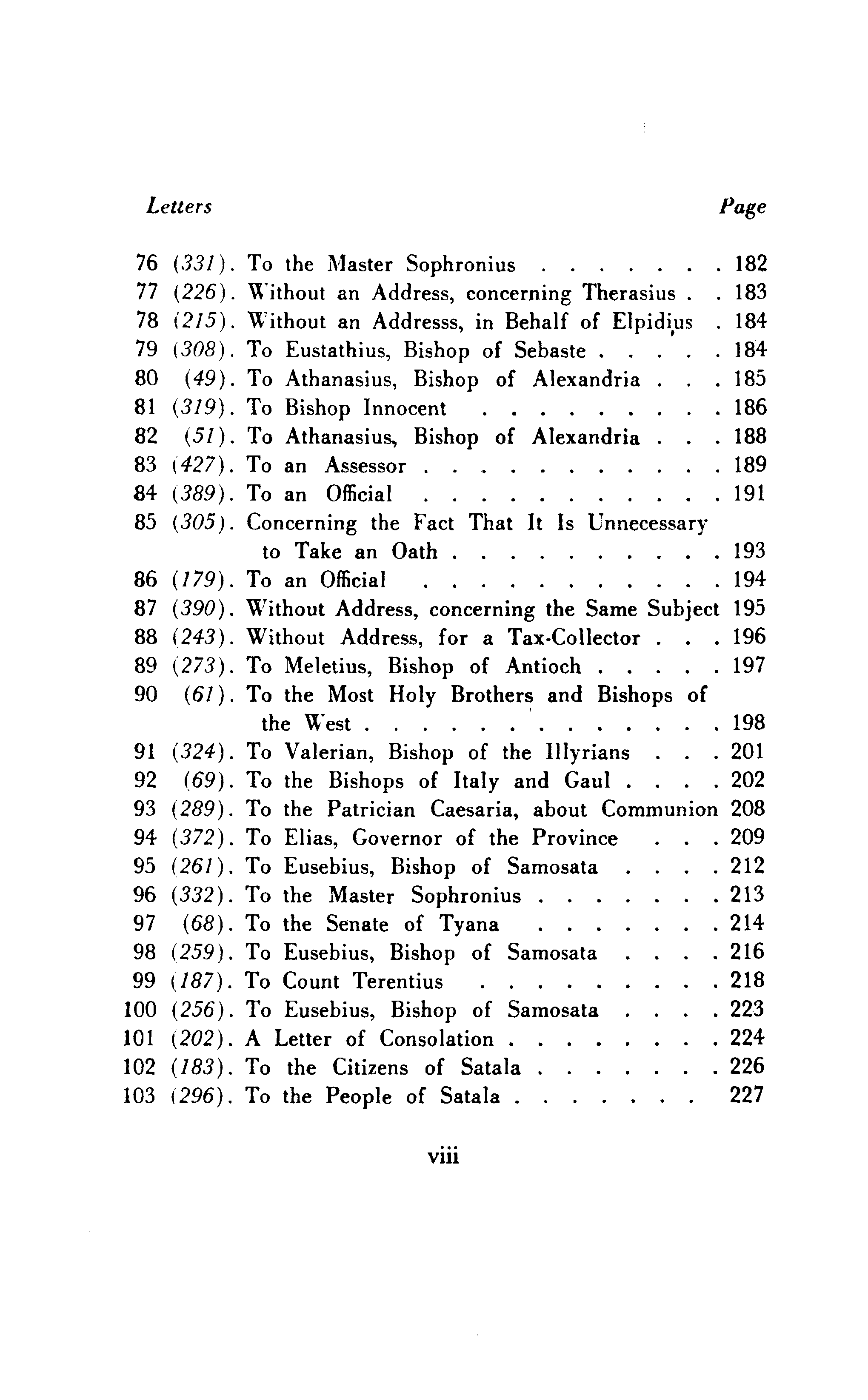
Letters Page 76 (331). To the Master Sophronius . . . . ..
77 (226). 'Without an Address, concerning Therasius .
78 (215). Without an Addresss, in Behalf of Elpidi,us
79 (308). To Eustathius, Bishop of Sebaste. .
(49). To Athanasius, Bishop of Alexandria
81 (319). To Bishop Innocent . . . .
(51). To Athanasius, Bishop of Alexandria
83 (427). To an Assessor. "
84 (389). To an Official . . . .
85 (305). Concerning the Fact That It Is Unnecessary to Take an Oath. . . . . . . . . . 193
86 (/79). To an Official ........... 194
87 (390). Without Address, concerning the Same Subject 195 88 (243). Without Address, for a Tax·Collector. . . 196
89 (273). To Meletius, Bishop of Antioch . . . . . 197
(61). To the Most Holy Brothers and Bishops of the West. . . . . .'. . • .
91 (324). To Valerian, Bishop of the IIIyrians . . . 201
(69). To the Bishops of Italy and Gaul. . . . 202
93 (289). To the Patrician Caesaria, about Communion 208 94 (372). To Elias, Governor of the Province
. 209
95 (261). To Eusebius, Bishop of Samosata . 212
96 (332). To the Master Sophronius . . .
. 213
(68). To the Senate of Tyana . 214
98 (259). To Eusebius, Bishop of Samosata . 216
99 U87). To Count Terentius ....
. 218
100 (256). To Eusebius, Bishop of Samosata . 223
101 (202). A Letter of Consolation . 224
102 (183). To the Citizens of Satala . 226
103 (296). To the People of Satala
viii
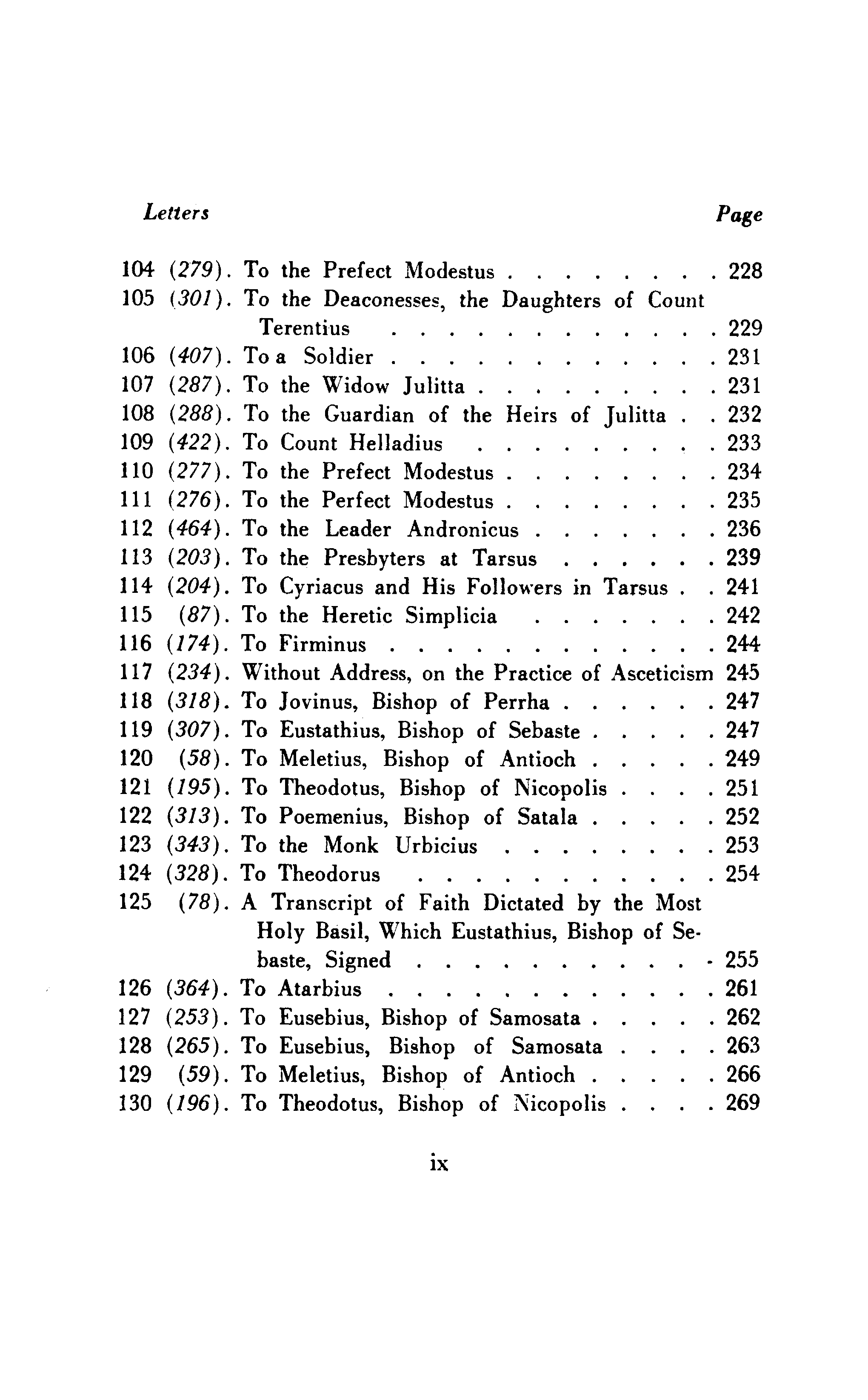
Letters Page 104 (279). To the Prefect Modestus.
. .
105 (301). To the Deaconesses, the Daughters of Count Terentius 106 (407). To a Soldier .
. .
. .
. .
107 (287). To the Widow Juliua. . . . .
108 (288). To the Guardian of the Heirs of Juliua 109 (422). To Count Helladius 110 (277). To the Prefect Modestus 111 (276). To the Perfect Modestus 112 (464). To the Leader Andronicus 113 (203). To the Presbyters at Tarsus
· 231 · 231
114 (204). To Cyriacus and His Followers in Tarsus.
(87). To the Heretic Simplicia ...... 242
116 (174). To Firminus . . .
. . . . . . .,
117 (234). Without Address, on the Practice of Asceticism 245 118 (318). To Jovinus, Bishop of Perrha .
119 (307). To Eustathius, Bishop of Sebaste .
. 247
(58). To Meletius, Bishop of Antioch .
. 249
121 (195). To Theodotus, Bishop of Nicopolis 122 (313). To Poemenius, Bishop of Satala
123 (343). To the Monk Urbicius . . . .
124 (328). To Theodorus ...... .
(78). A Transcript of Faith Dictated by the Most
· 252
Holy Basil, Which Eustathius, Bishop of Sebaste, Signed . . .
. . . .
126 (364). To Atarbius . . .
. . . .
127 (253). To Eusebius, Bishop of Samosata .
128 (265). To Eusebius, Bishop of Samosata
(59). To Meletius, Bishop of Antioch .
130 (196). To Theodotus, Bishop of Nicopolis
· 261 · 262 · 263 · 266 .269
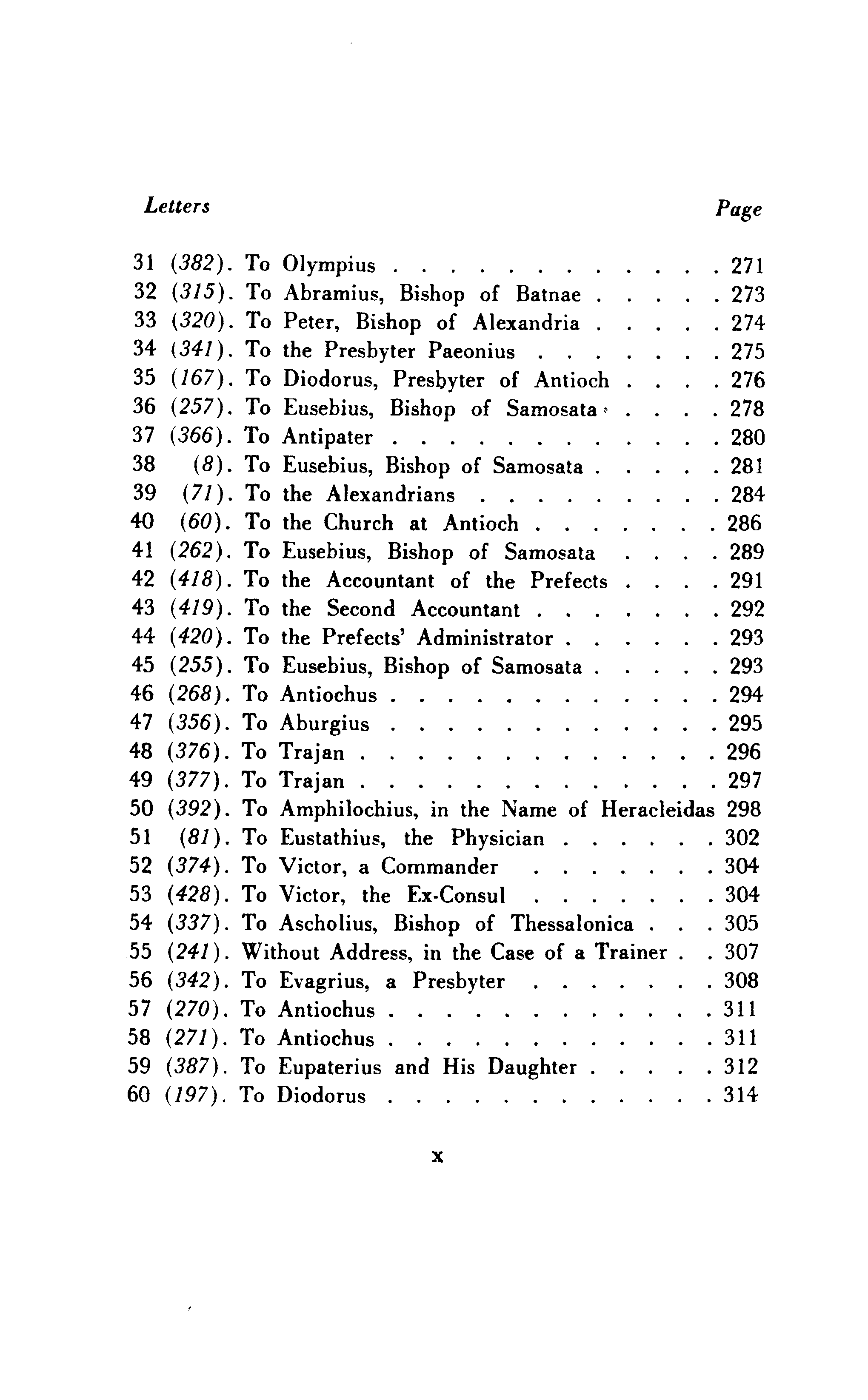
Letters Page 31 (382). To Olympius . . . . .
. .
32 (315). To Abramius, Bishop of Batnae
33 (320). To Peter, Bishop of Alexandria
34 (341). To the Presbyter Paeonius . .
35 (167). To Diodorus, Presbyter of Antioch . 276
36 (257). To Eusebius, Bishop of Samosata'
. 278
37 (366). To Antipater . . .
. . .
. .
(8). To Eusebius, Bishop of Samosata .
. 281
(71). To the Alexandrians .
. . . .
. 284
(60). To the Church at Antioch .
. .
. 286
41 (262). To Eusebius, Bishop of Samosata . 289
42 (418). To the Accountant of the Prefects . 291
43 (419). To the Second Accountant. .
. 292
44 (420). To the Prefects' Administrator. .
. 293
45 (255). To Eusebius, Bishop of Samosata .
. 293
46 (268). To Antiochus . 294
47 (356). To Aburgius . 295
48 (376). To Trajan .
. 296
49 (377). To Trajan .
. 297
50 (392). To Amphilochius, in the Name of Heracleidas 298
(81). To Eustathius, the Physician . 302
52 (374). To Victor, a Commander .
. ..
. 304
53 (428). To Victor, the Ex·Consul . . ..
. 304
54 (337). To Ascholius, Bishop of Thessalonica . 305
55 (241). Without Address, in the Case of a Trainer. . 307
56 (342). To Evagrius, a Presbyter . 308
57 (270). To Antiochus. . .
. . . .
.311
58 (271). To Antiochus. .
. . .
. .
. 311
59 (387). To Eupaterius and His Daughter . 312
60 (197). To Diodorus .
....
. 314 x
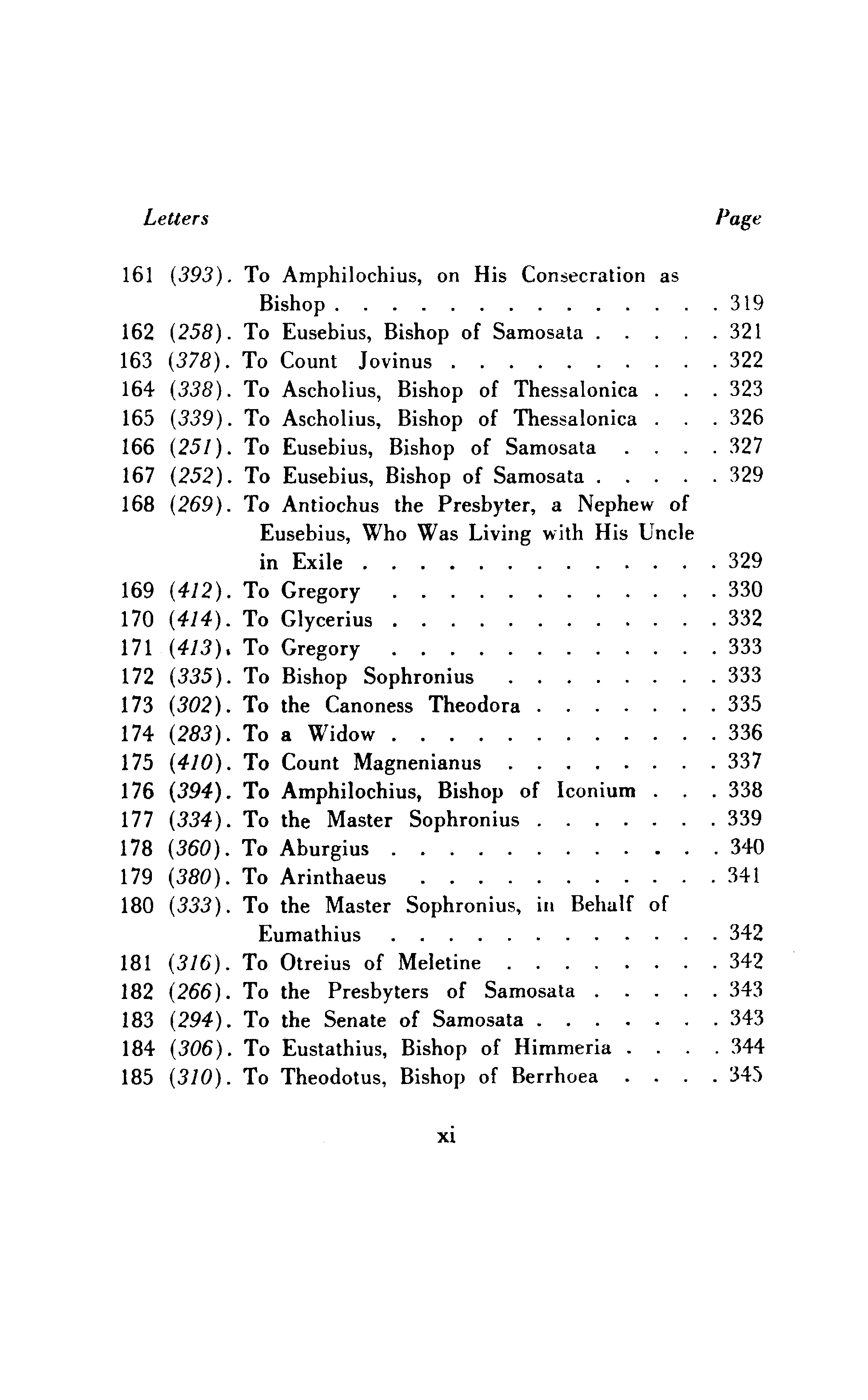
Letters Page 161 (393). To Amphilochius, on His Consecration as Bishop.
162 (258). To Eusebius, Bishop of Samosata .
163 (378). To Count lovinus
164 (338). To Ascholius, Bishop of Thessalonica
165 (339). To Ascholius, Bishop of Thessalonica
166 (251). To Eusebius, Bishop of Samosata
167 (252). To Eusebius, Bishop of Samosata .
168 (269). To Antiochus the Presbyter, a Nephew of Eusebius, Who Was Living with His Uncle in Exile
169 (412). To Gregory
170 (414). To Glycerius
171 (413). To Gregory
172 (335). To Bishop Sophronius . 333
173 (302). To the Canoness Theodora . 335
174 (283). To a Widow . 336
175 (410). To Count Magnenianus . 337
176 (394). To Amphilochius, Bishop of Iconium . 338
177 (334). To the Master Sophronius . 339
178 (360). To Aburgius . 340
179 (380). To Arinthaeus .341
180 (333). To the Master Sophronius, 111 Behalf of Eumathius . 342
181 (316). To Otreius of Meletine . 342
182 (266). To the Presbyters of Samosata . 343
183 (294). To the Senate of Samosata .
. 343
184 (306). To Eustathius, Bishop of Himmeria . 344
185 (310). To Theodotus, Bishop of Berrhoea . 34:'> Xl

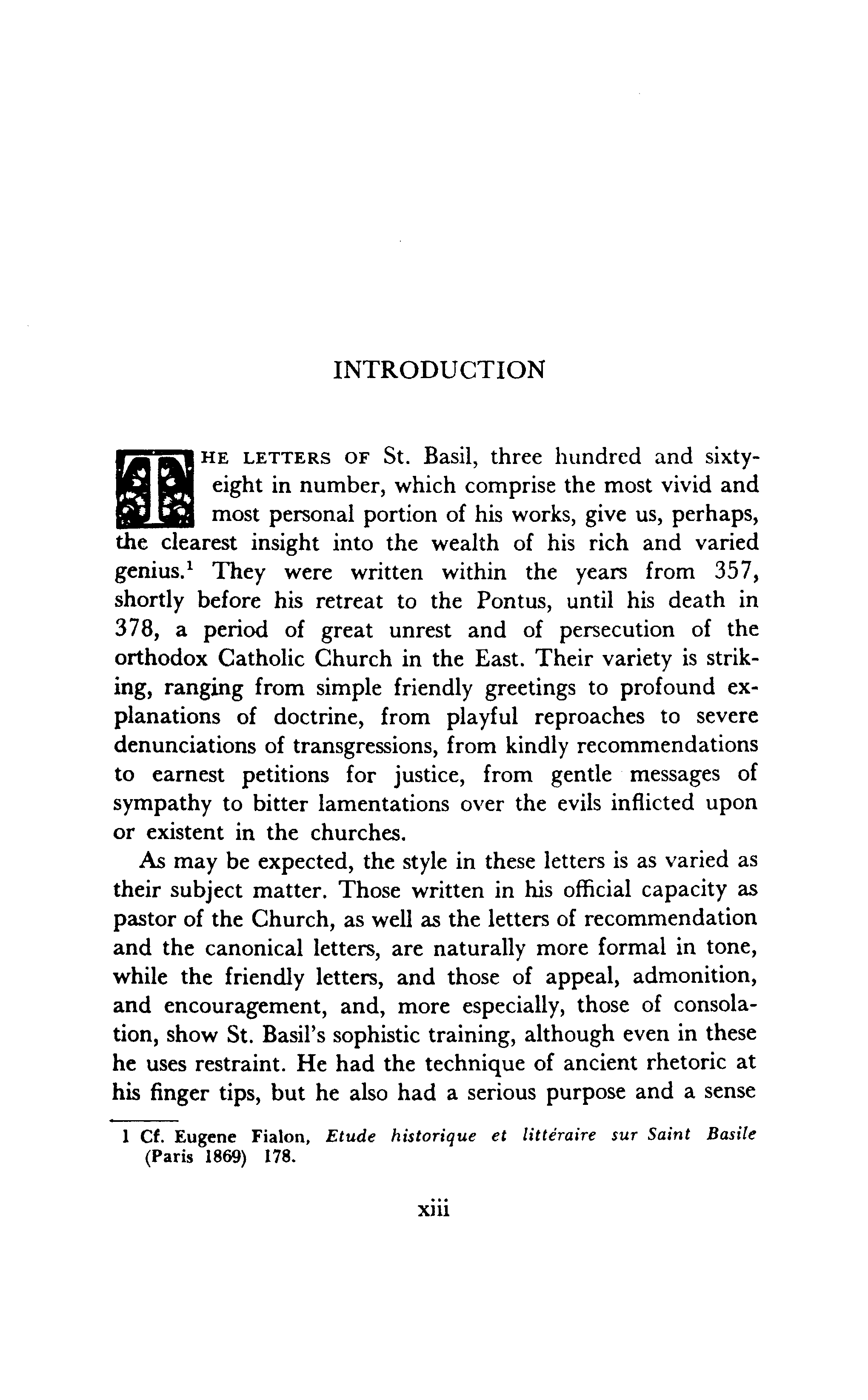
INTRODUCTION
II HE LETTERS OF St. Basil, three hundred and sixtyeight in number, which comprise the most vivid and most personal portion of his works, give us, perhaps, the clearest insight into the wealth of his rich and varied genius. 1 They were written within the years from 357, shortly before his retreat to the Pontus, until his death in 378, a period of great unrest and of persecution of the orthodox Catholic Church in the East. Their variety is striking, ranging from simple friendly greetings to profound explanations of doctrine, from playful reproaches to severe denunciations of transgressions, from kindly recommendations to earnest petitions for justice, from gentle messages of sympathy to bitter lamentations over the evils inflicted upon or existent in the churches.
As may be expected, the style in these letters is as varied as their subject matter. Those written in his official capacity as pastor of the Church, as well as the letters of recommendation and the canonical letters, are naturally more formal in tone, while the friendly letters, and those of appeal, admonition, and encouragement, and, more especially, those of consolation, show St. Basil's sophistic training, although even in these he uses restraint. He had the technique of ancient rhetoric at his finger tips, but he also had a serious purpose and a sense
1 Cf. Eugene Fialon, Etude historique et litteraire sur Saint Basile (Paris 1869) 178.
Xlll
xiv
SAINT BASIL
of fitness of things. To St. Basil's letters can be ascribed the qualities he attributed to the heartily approved book written by Diodorus,2 which qualities may be summed up as fullness of thought, clearness, simplicity, and naturalness of style. He himself disapproved of a too ornate style and carefully avoided it. His early education, however, had trained him for the use of rich diction and varied and charming figures, and when the occasion warranted it he proved himself a master in their use. 3
Whether we look at them from an historical, an ecclesiastical, or a theological point of view, the letters are an important contribution. They acquaint us intimately with St. Basil himself, the. tireless scholar following his master from country to countryj 4 the ascetic, withdrawn from the world, with his mind and heart fixed firmly on God, disregarding wealth, pleasures, and companionship of the world j 5 the kindly advocate and friend of all in need, always ready to plead for justice and mercy, or for assistance and support j6 the stern spiritual father, tempering his denunciations of vice with loving appeals for repentance j 7 and the inflexible ruler of the Church and champion of orthodoxy, voicing his opposition even to emperors in his ardent defense of true doctrine. In the letters, too, we come to know his nobility of character, enhanced by the humility and sufferings of the man, who attributed to his sins the afflictions he endured in body and soul, for he was a sickly man,s continually beseiged by illness2 Cf. Letter 135.
3 Cf. Sister Agnes Clare Way. The Language and Style of the Letters Of St. Basil (Washington. D.C. 1927) 176-204.
4 Cf. Letter I.
5 Cf. Letter 2.
6 Cf. Letter 32. et passim.
7 Cf. Letter 44.
8 Cf. Letters 1!16 and 138.
INTRODUCTION
xv es which brought him to the brink of the grave. Besides, he was beset by suspicions of heresy roused up against him, and by misunderstandings and deliberate opposition to his labors for the Church. The Scriptural quotations throughout the letters testify to St. Basil's intimate knowledge of the Bible and the exact application of that knowledge to every situation in life. He depended entirely on the Holy Scriptures for the guidance of his conduct and that of his monks.
He gives us a glimpse of Cappadocia and its people in several letters telling of the famine gripping the region and of the winters during which the country was buried in snow and people were forced to remain hidden in their houses for months at a time. A description of the peculiar customs of the Magusaeans, who had settled in Cappadocia, coming from Babylon years before and never intermingling with the people of the country, is an interesting revelation of the depravity in which a pagan people lived even when surrounded by Christian influence. 9 Enlightening pictures of social customs, such as that depicted in the story of Glycerius, are contained in Letters 169, 170, and 171. RamseylO regards this episode as an example of the practice in the early Church of substituting a Christian festival for a pagan one, with Christian hymns taking the place of pagan songs, and with modest singing and dancing replacing the license of pagan festivals.
St. Basil's letters are used by ecclesiastical historians such as Tillemont, Fleury, and de Broglie,ll as a sure source for the period from about 357 to 378. In fact, Tillemont has devoted almost half of the ninth volume of his Ecclesiastical
9 Cf. Letter 258.
10 W. M. Ramsey, The Church in the Roman Empire (New York 189~) 448.462.
11 Cf. Fialon. op. cit. 180.
XVI
SAINT BASIL
History to St. Basil, on almost every page of which he refers to the letters as his source 'of information. A casual reading of the letters will reveal the reason for this. They reflect the conditions existing -in the whole Church of the East at the time: the rise and spread of heresy, the attacks of the heretics, the artifices used by them, the exiling of orthodox prelates, the seizure of orthodox sees by Arian bishops, the suspicions and consequent accusations and abuses among the prelates within the fold of the Church, and the r.elations between Eastern and Western Church.
The letters make very apparent the difference in this age in the conditions existent in the East and West. St. Basil made frequent appeals to the Western bishops for assistance and support in the struggles of the Eastern Church. He insisted that, because of unity of belief, they should be near to each other despite the long distance separating them, and that, moreover, as the head had need of the feet, so the West had need of the East.12 His appeals must have been answered, for in Letter 263, to the Westerners, he thanks them for the happiness which the Eastern Church has received from their letter and from the sympathy they had extended.
To the student of theology St. Basil's letters offer some interesting moments. Many of his letters are really treatises explaining difficult passages of Scriptures, as Letter 260, concerning the much debated quotation, 'Whoever shall kill
Cain shall discharge seven times the things to be expiated.'
St. Basil gives a briefer and then a more elaborate explanation of this passage, pointing out that the guilt of Cain's sin was sevenfold, and consequently that seven expiations would be effected by the death of Cain. In some instances he expounds the doctrine of the Church. Letter 38, in which he
12 Cf. Letter 245.
INTRODUCTION
xvu discusses the doctrine of the Blessed Trinity, and Letter 125, which contains a transcript of faith dictated by St. Basil and subscribed by Eustathius, Bishop of Sebaste, are examplo of this type. Other letters give us the laws and regulations of the Church. Several of these, called Canonical Letters,
188, 199, and 217, were placed by the Council of Chalcedon among the .Canons of the Church.13
Other English translations of St. Basil's Letters are those of Dr. Roy J. Deferrari in the Loeb Classical Library, and of B. Jackson in the Nicene and Post-Nicene Fathers. The present translation has been based on the Gamier and Maran edition and the modern critical edition by Roy J. Deferrari.
The chronology of the letters and their order and arrangement into three classes according to the Benedictine editors have been retained. In the arrangement the first class includes all the letters adjudged by them to have been written before St. Basil's episcopate, in the years from 357 until 370,
Letters numbered 1 to 46; the second, those written during his episcopate, from 370 until 378, Letters 47 to 291; and the third, letters of uncertain date, doubtful letters, and those clearly spurious, numbered Letters 292 to 365. Thre~ more,
Letter 366, included by Mai and also by Migne in their editions, and Letters 367 and 368, lately discovered by Mercati, have been added in the translation.
13 Cf. Fialon, op. cit. 180.
SELECT BIBLIOGRAPHY
Texts and T~anslations:
Garnier and Maran, Basilii Caesareae Cappadociae Archiepiscopi Opera Omnia (Paris 1839).
J. P. Migne. S. P. N. Basilii Opera Omnia (Patrologia Graeca 32, Paris 1886).
B. Jackson, The Letters of St. Basil the Great (Select Ubrary of Nicene and Post.Nicene Fathers 8, New York 1895).
R. J. Deferrari, St. Basil. The Letters (Loeb Classical Library, 4 vols., London 1926·1934).
Secondary Works:
J. Bessieres, 'La Tradition manuscrite de la correspondance de Saint Basile; Journal of Theological Studies 21 (1919); also separately published (Oxford 1923).
E. Fialon, Etude historique et litteraire sur Saint Basile (Paris 1861).
F. Loofs, Eustathius von Sebaste und die Chronologie der Basilius. briefe (Halle 1898).
Pr. Maran, Vita S. Basilii M. (Patrologia Graeca 29, Paris 1886).
W. M. Ramsey, 'Basil of Caesarea; The Expositor 3 (1896).
J. Schiifer, Basilius des Grossen Beziehungen zum A bendlande (Munster 1909).
M. Tillemont, Me,lIoires jJOur servir a [,histoire ecclesiaslique des six premiers sihles 9 (Paris 1693-1712).
XVlll
LETTERS 1 .. 185
Translated by
SISTER AGNES CLARE WAY, CD.P. Ph.D.
Our Lady of the Lake College with notes by
ROY J. DEFERRARI, Ph.D.
The Catholic Unit1ersity of America