
The Second Apology
'ΤΗΕ SECOND APOLOGY'
'ΤΗΕ SECOND APOLOGY'
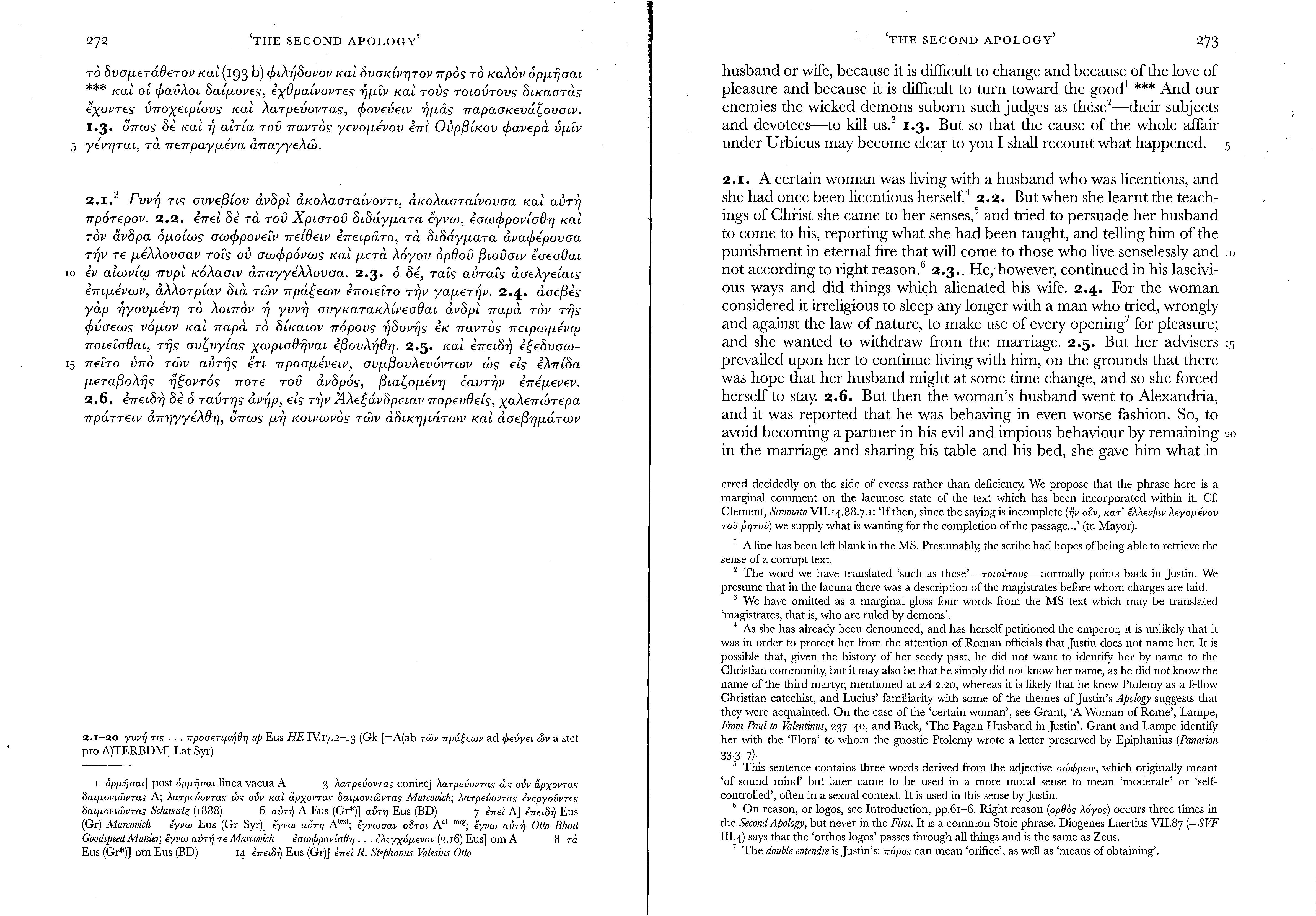
husband ΟΓ wife, because it is difficult to change and because of the love of pleasure and because it is· difficult to turn toward the good 1 *** And ουΓ enemies the wlcked demons suborn such judges as these2-their subjects and devotees-to kill us. 3 1.3. But so that the cause of the whole affair under U rbicus may become clear to you Ι shall recount what happened.
το δυσμετάθετον και (193 b) Φιλήδονον και δυσKίνΎJTOν 7Τρος το καλον όρμησαι *** ,.
• ~ "
• / , λ '
<, δ'
\ ( ,Ι Λ \ Ι, \ ο) β'
Φ ,.
1.3. 07Τως ε και ΎJ αιτια του 7Ταντος γενομενου ε7ΤΙ υρ ικου ανερα υμιν 5 γένΎJTαι, τα 7Τε7Τραγμένα ά7Ταγγελω.
2.1. Α certain woman was living with a husband who was licentious, and she had once been licentious herself. 4 2.2. But when she learnt the teachings of Christ she came to her senses,5 and tried to persuade her husband to come to his, reporting what she had been taugllt, and telling him of the punishment ίη eternal fire that will come to those who live senselessly and 10 not according to right reason. 6 2.3 .. He, however, continued ίη his lascivious ways and did things whiqh alienated his wife. 2.4. For the woman considered it irreligious to sleep any longer with a man who tried, wrongly and against the law of nature, to make use of every opening7 for pleasure; and she wanted to withdraw from the marriage. 2.5. But her advisers 15 prevailed υροη her to continue living with him, οη the grounds that there was hope that her husband might at some time change, and so she forced herself to stay. 2.6. But then the woman's husband went to Alexandria, and it was reported that he was behaving in even worse fashion. So, to avoid becoming a partner ίη his evil and impious behaviour by remaining 20 in the marriage and sharing his table and his bed, she gave him what ίη
2 r' β') δ ,) λ '
) λ'
,) , 2.1. υνΎJ τις συν ε ιου αν ρι ακο ασταινοντι, ακο ασταινουσα και αυTΎJ , , 'δ"
~x ~δδ'
) Φ 'θ '
7Τροτερον. 2.2. ε7Τει ε τα του ριστου ι αγματα εγνω, εσω ρονισ ΎJ και , "δ ., Φ ~ 'θ ) ~ , δ δ'
) Φ' τον αν ρα ομοιως σω ρονειν 7Τει ειν ε7ΤειΡατο, τα ι αγματα ανα ερουσα , 'λλ ~) Φ'
, 'λ'
) θ ~ β ~ " θ TΎJν τε με ουσαν τοις ου σω ρονως και μετα ογου ορ ου ιουσιν εσεσ αι ) ), '/λ ) 'λλ • δ'
~ ) ~ , λ '
εν αιωνιιΡ 7Τυρι κο ασιν α7Ταγγε ουσα. 2.3. ο ε, ταις αυταις ασε γειαις , , ) λλ / δ'
~ , c.
) ~, , ) β , ε7Τιμενων, α οτριαν ια των 7Tpα~εων ε7Τοιειτο TΎJν γαμεTΎJν. 2.4. ασε ες
\ ('
Ι \ λ ,., λ' θ ) δ '
" γαρ ΎJγOυμενΎJ το ΟΙ7Τον ΎJ γυνΎJ συγκατακ ινεσ αι αν ρι 7Ταρα τον της Ι Ι \ ,\ δ ι Ι.
Ιδ ......) \ Ι υσεως νομον και 7Ταρα το ικαιον 7Τορους ΎJ OνΎJς εκ 7Ταντος 7ΤειΡωμενιΡ Φ 7Τοιείσθαι, της συζυγίας χωρισθηναι εβoυλήθΎJ. 2.5. και ε7Tειδ~ εςεδυσω- ~ ., ~ )~"
.) )λ'δ
7Τειτο υ7ΤΟ των αυTΎJς ετι 7Τροσμενειν, συμ ου ευοντων ως εις ε 7ΤΙ α β λ Λ t/c.'
~ ) δ / β Υ'
) δ ' δ"
, ) / ) , )Λλ c.' δ θ' λ '
2 .. ε7Τει ΎJ ε ο TαυTΎJς ανΎJP, εις TΎJV..ti ε~αν ρειαν 7Τορευ εις, χα ε7Τωτερα
7Τράττειν ά7TΎJγγέλθΎJ, ό7Τως μ~ κοινωνος των άδΙKΎJμάTων και άσεβΎJμάTων erred decidedly οη the side of excess rather than deficiency. We propose that the phrase here is a marginal comment οη the lacunose state of the text which has been incorporated within it. C[
Clement, StIΌlnαtα VII.14.88.7.1: 'Ifthen, since the saying is incomplete (ην οδν, κατ' ελλειψιν λεγομένου του ρψου) we supply what is wanting for the completion of the passage ... ' (tr. Mayor). ι Α line has been left blank ίη the MS. Presumably, the scribe had hopes ofbeing able to retrieve the sense of a corrupt text.
2 The word we have translated 'such as these'--τοιούτους-ηοrmallΥ points back ίη Justin. We presume that ίη the lacuna there was a description of the magistrates before whom charges are laid.
3 We have omitted as a marginal gloss four words from the MS text which may be translated
'magistrates, that is, who are ruled by demons'.
4 As she has already been denounced, and has herself petitioned the emperor, it is unlikely that it was in order to protect her from the attention of Roman officials that Justin does not name her. It is possible that, given the history of her seedy past, he did not want to identifY her by name to the Christian community, but it may also be that he simply did not know her name, as he did not know the name ofthe third martyr, mentioned at 2Α 2.20, whereas it is likely that he knew Ptolemy as a fellow
Christian catechist, and Lucius' familiarity with some of the themes of Justin's Apology suggests that they weΓe acquainted. aη the case ofthe 'certain woman', see GΓaηt, Ά Woman ofRome', Lampe,
From Pαul to VΆlellti1l1ΙS, 237-40, and Buck, 'The Pagan Husband ίη Justin'. Grant and Lampe identifY hel' with the 'FΙΟΓa' to whom the gnostic Ptolemy wrote a letter preserved by Epiphanius (Ραπατίοπ
33·3-7)· 2.1-20 γυνή τις ... προσετιμήθη αρ Eus HEIV.17.2-13 (Gk [=A(ab των πράξεων ad Φεύγει J)v a stet ρτο A)TERBDMJ Lat Syr) 5 This sentence contains thΓee words deΓίved from the adjective σώΦρων, which originally meant
'of sound mind' but latel' came to be used ίη a more mΟΓaΙ sense to mean 'moderate' οτ 'selfcontrolled', often ίη a sexual context. It is used in this sense by Justin.
Ι όρμ:ησαι] post όρμησαι linea vacua Α 3 λατρεύοντας coniec] λατρεύοντας ώς οδν αρχοντας δαιμονιωντας Α; λατρεύοντας ώς οδν και αρχοντας δαιμονιωντας Mαrcovich; λαΤρΕύοντας ενεργουντες
6 aη reason, ΟΓ logos, see IntΓOduction, ρρ.61-6. Right reason (ορθος λόγος) occurs thΓee times ίη the SecolldApology, but nevel' in the Fi1Jt. It is a common Stoic phrase. Diogenes Laertius νΠ.87 (=ST1F δαιμονιωντας Sclzwαrtz (1888) 6 αυτη Α Eus (Gr*)] αυτη Eus (BD) 7 επει Α] εΠΕιδη Eus (Gr) Mαrcoviclz εγνω Eus (Gr Syr)] εγνω αυτη Next; εγνωσαν οδτοι ΝΙ mrg; εγνω αυτη Otto Blunt
Goodspeed Λιfunίeι~ εγνω αύτή τε NIαrcovich εσωΦρονίσθη ... ελεγχόμενον (2.16) Eus] om Α
8 τα Eus (Gr*)] om Eus (BD) 14 επειδη Eus (Gr)] επει R. Stephαnus VΆlesius Otto Πι'4) says that the 'oΓthοs logos' passes through all things and is the same as Zeus.
7 The double entendre is Justin's: πόρος can mean 'orifice', as well as 'means of obtaining'.
'ΤΗΕ SECOND APOLOGY'
'ΤΗΕ SECOND APOLOGY'
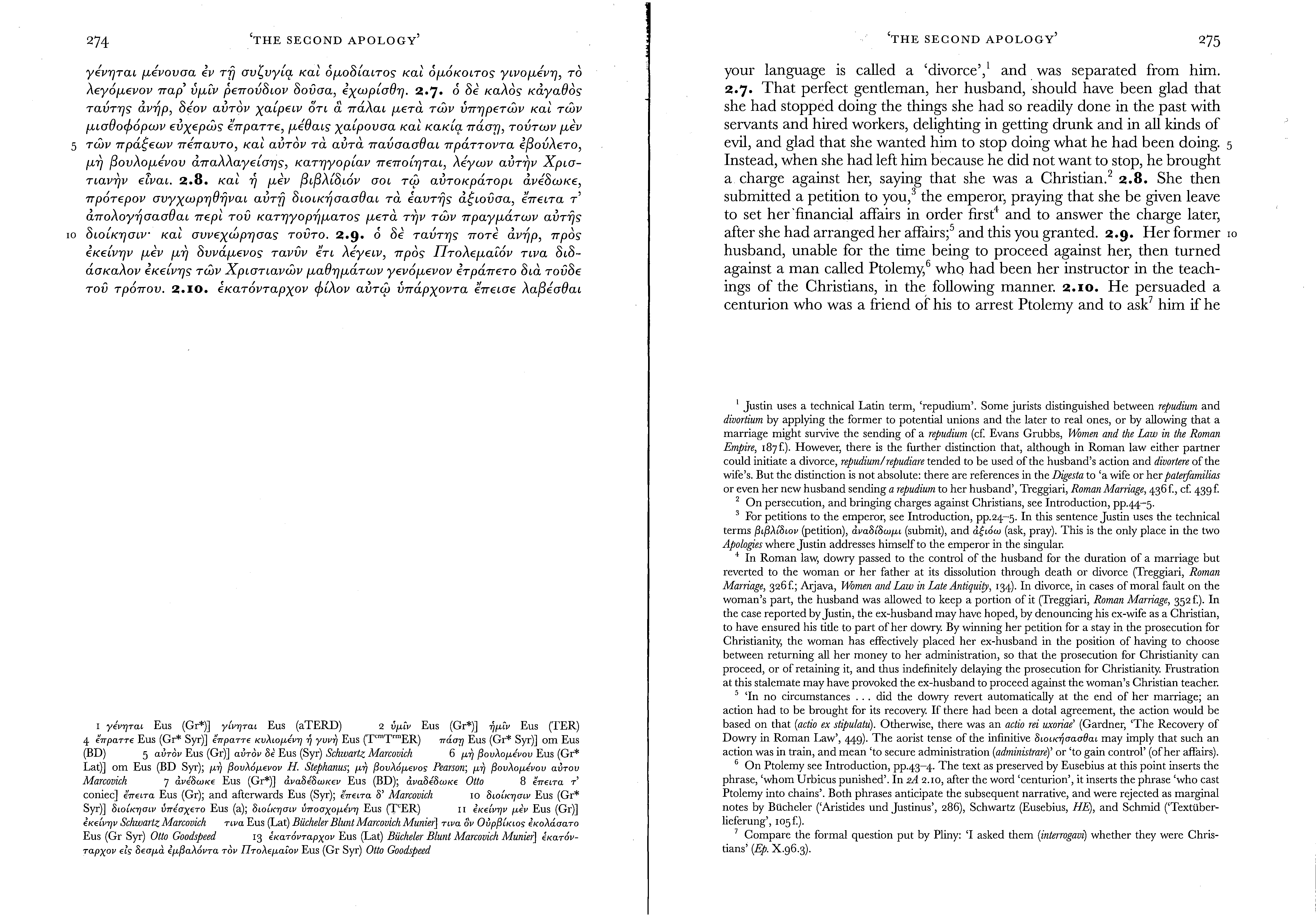
your language is called a 'diνorce', 1 and was separated from him.
2.'. That perfect gentleman, her husband, ·should haνe been glad that she had stopped doing the things she had so readily done ίn the past with γένΎjTαι μένουσα Εν Tfι συζυγίq, και όμοδίαιτος και όμόκοιτος γινOμένΎj, το λεγόμενον παρ' ύμιν ρεπούδισν δουσα, EXωpίσθΎj. 2.'. ό δε καλος κάγαθος
TαύTΎjς άν~p, δέον αυτον χαίρειν ότι α πάλαι μετα των ύΠΎjpεTων και των serνants and hired workers, delighting ίn getting drunk and ίn all kinds of evil, and glad that she wanted him to stop doing what he had been doing. 5
Instead, when she had left him because he did not want to stop, he brought a. charge against her, saying that she was a Christian. 2 2.8. She then submitted a petition to you,3 the emperor, praying that she be giνen leaνe to set her 'financial affairs ίn order first4 and to answer the charge later, after she had arranged her affairs;5 and this you granted. 2.9. Her former ΙΟ husband, unable for the time being to proceed against her, then turned against a man called Ptolemy,6 whQ had been her instructor in the teachings of the Christians, ίn the, following manner. 2.10. He persuaded a centurion who was a friend of his to arrest Ptolemy and to ask7 him if he ι , .....
'θ ι \ Ι Ι Ι \ μισ ο ορων ευχερως επραττε, με αις χαιΡουσα και κακιq, παστι, τουτων μεν θ Φ Λ , t.'
\ ,\ \ ,\ , θ '
'β 'λ 5 των πρα",εων πεπαυτο, και αυτον τα αυτα παυσασ αι πραττοντα ε ου ετο, \ β λ '
"λ '
, 'δ τιανΎjν ειναι. 2. . και Ύj μεν ι ι .ιον σοι τιμ αυτοκρατορι ανε ωκε, πρότερον συγXωpΎjθηναι αυTfι δισΙK~σασθαι τα έαυτης άξισυσα, Επειτα τ' άπoλoγ~σασθαι περι του KαTΎjγOp~μαTOς μετα την των πραγμάτων αυτης
ΙΟ δισίKΎjσιν' και συνεXώpΎjσας τουτο. 2.9. ό δε TαύTΎjς ποτε άν~p, προς EKείνΎjν μεν μη δυνάμενος τανυν Ετι λέγειν, προς Πτολεμαιόν τινα διδ άσκαλον EKείνΎjς των Χριστιανων μαθΎjμάTων γενόμενον Ετράπετο δια τουδε
., Φ'λ' Λ"
" λ β' θ του τροπου. 2.10. εκατονταρχον ι ον αυτιμ υπαρχοντα επεισε α εσ αι 1 Justin uses a technical Latin term, 'repudium'. Some jurists distinguished between repudium and divortiuιn by applying the former to potential unions and the later to real ones, ΟΓ by allowing that a marriage might survive the sending of a repudium (cf. Evans Grubbs, VVΌInen αnd the Law in the Romαn
Empire, 187f.)- However, there is the further distinction that, although ίη Roman law either partner could initiate a divorce, l-epudiuln! reΡudίαι-e tended to be used of the husband's action and divortere of the wife's_ But the distinction is not absolute: there are references ίη the Digestα to 'a wife ΟΓ her pαteιfάmiliαs
ΟΓ even her new husband sending α l-epudium to her husband', Treggiari, Romαll Aιfαrιiαge, 436 f., cf. 439 f.
2 Οη persecution, and bringing charges against Christians, see Introduction, ΡΡ.44-5.
3 For petitions to the emperor, see Introduction, ρρ.24-5. Ιη this sentence Justin uses the technical terms βιβλίδιον (petition), αναδίδωμι (submit), and αςιόω (ask, pray). This is the οηlΥ place ίη the two
Apologίes where Justin addresses himself to the emperor ίη the singular.
4Ιη Roman law, dowry passed to the control of the husband for the duration of a marriage but reverted to the woman ΟΓ her father at its dissolution through death ΟΓ divorce (Treggiari, R01nαll
Μαπίαge, 326f.; Arjava, VVΌmell αlld Law ίll Late Αlltίquί!)ι, 134). Ιη divorce, in cases ofmoral fault οη the woman's part, the husband was allowed to keep a portion of it (Treggiari, Romαll Μαπίαge, 352 f.). Ιη the case reported by Justin, the ex-husband may have hoped, by denouncing his ex-wife as a Christian, to have ensured his title to part of her dowry. ΒΥ winning her petition for a stay ίη the prosecution for Christianity, the woman has effectively placed her ex-husband in the position of having to choose between returning all her money to her administration, so that the prosecution for Christianity can proceed, ΟΓ of retaining it, and thus indefinitely delaying the prosecution for Christianity. Frustration at this stalemate may have provoked the ex-husband to proceed against the woman's Christian teacher.
5 Ίη ηο circumstances ... did the dowry revert automatically at the end of her marriage; an action had to be brought for its recovery. If there had been a dotal agreement, the action would be based οη that (αctio ex stίpulαtu). Otherwise, there was an αctio l-ei uxoriαe' (Gardner, 'The Recovery of Dowry in Roman Law', 449). The aorist tense of the infinitive διοικήσασθαι may imply that such an action was ίη train, and mean 'to secure administration (αdlnilliftrαre)' ΟΓ 'to gain control' (ofher affairs).
Ι γένηται Eus (Gr*)] γ ίνητα ι Eus (aTERD) 2 υμιν Eus (Gr*)] ημιν Eus (TER) 4 επραττε Eus (Gr* Syr)] επραττε κυλιομένη Τι γυνη Eus (TcffiTrmER) πάστι Eus (Gr* Syr)] om Eus (BD) 5 αυτον Eus (Gr)] αυτον δε Eus (Syr) Schwαrtz Mαrcovic!l
6 μη βουλομένου Eus (Gr* Lat)] om Eus (BD Syr); μη βουλόμενον Η Stephαnus; μη βουλόμενο, Peαrson; μη βουλομένου αυτου
6 Οη Ptolemy see Introduction, ΡΡ-43-4. The text as preserved by Eusebius at this point inserts the phrase, 'whom U rbicus punished'. Ιη 2Α 2. Ι ο, after the word 'centurion', it inserts the phrase 'who cast
Ptolemy into chains'. Both phrases anticipate the subsequent narrative, and were rejected as marginal notes by Bίicheler ('Aristides und Justinus', 286), Schwartz (Eusebius, ΗΕ), and Schmid ('Textίiber lieferung', I05f.).
Mαrcovic!l 7 ανέδωκε Eus (Gr*)] αναδέδωκεν Eus (BD); αναδέδωκε Otto 8 επειτα τ' coniec] επειτα Eus (Gr); and afterwards Eus (Syr); επειτα δ' Aιfαrcovich
ΙΟ διοίκησιν Eus (Gr* Syr)] διοίκησιν ύπέσχετο Eus (a); διοίκησιν ύποσχομένη Eus (TcER)
ΙΙ εκείνην μεν Eus (Gr)] εκείνην Sc!ιwαι-tΖ Mαrcovic!l τινα Eus (Lat) BίicheleI-Blunt Aιfαrcovic!l Munielj τινα ον ουρβίκιο, εκολάσατο
Eus (Gr Syr) Otto Goodspeed 13 έκατόνταρχον Eus (Lat) BίicheleιBlunt Mαrcovich Munielj έκατόν7 Compare the formal question put by ΡΙίηΥ: Ί asked them (ίllteποgαvι) whether they were Christians' (Ερ. Χ.96.3). ταρχον εΙ, δεσμα εμβαλόντα τον Πτολψαιον Eus (Gr Syr) Otto Goodspeed
'ΤΗΕ SECOND APOLOGY'
~η6
'ΤΗΕ SECOND APOLOGY'
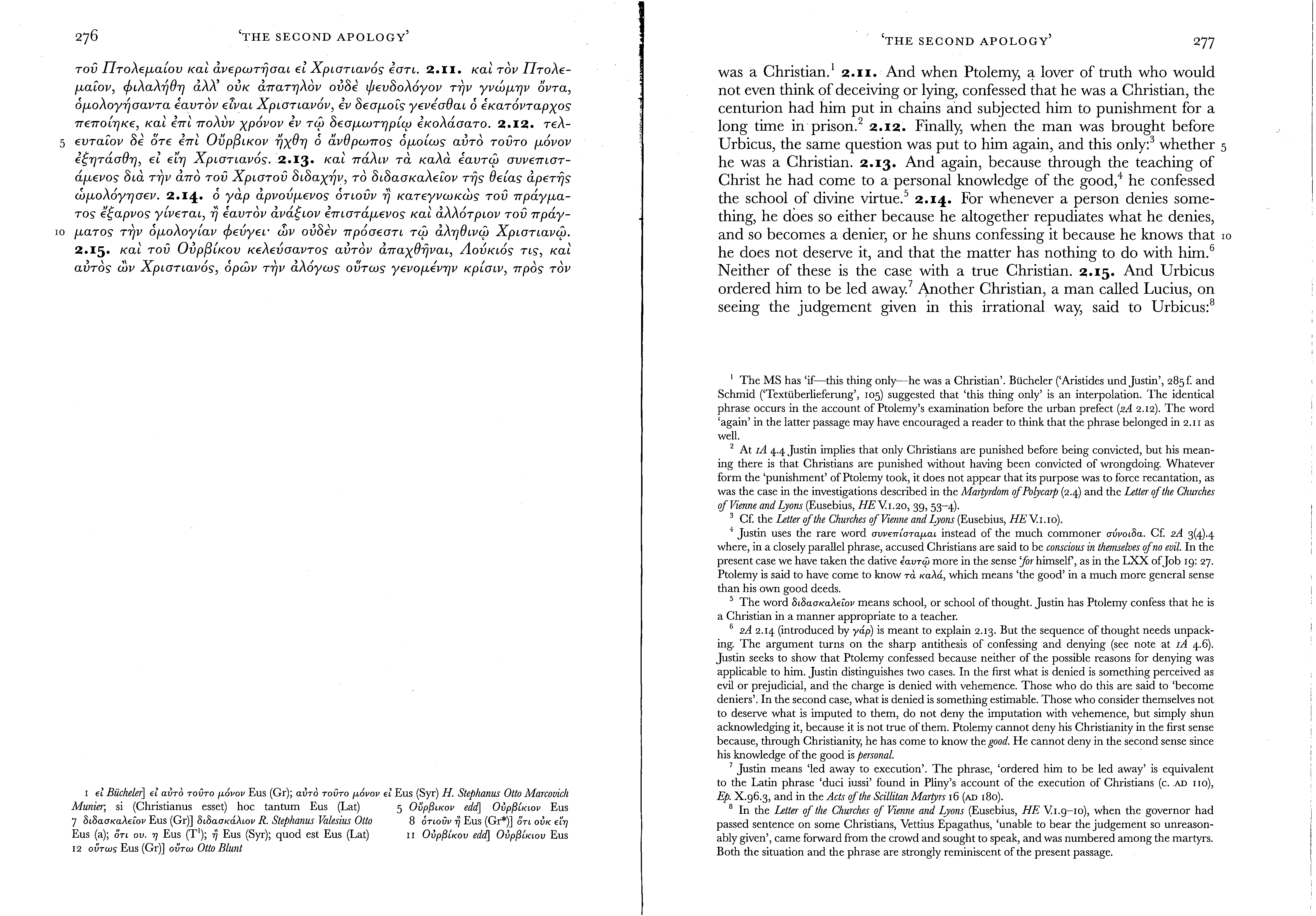
was a Christian. 1 2. Ι Ι. And when Ptolemy, CJ, lover of truth who would not even think of deceiving ΟΓ lying, confessed that he was a Christian, the centurion had him put ίη chains aΏd subjected him to punishment for a long time ίη· prison. 2 2. 12. Finally, when the man was brought before Urbicus, the same question was put to him again, and this οηlΥ:3 whether 5 he was a Christian. 2.13. And again, because through the teaching of Christ he had come to a personal knowledge of the good,4 he confessed the school of divine virtue.5 2.14. For whenever a person denies something, he does so either because he altogether repudiates what he denies, and so becomes a denier, ΟΓ he shuns confessing it because he knows that 10 he does not deserve it, and that the matter has nothing to do with him. 6 του Πτολεμαίου και ανερωτησαι ει Χριστιανόs εστι. 2.11. και τον Πτολε μαίον, ΦιλαλήθΥ] αλλ' ουκ απαΤΥ]λον ουδε ψευδολόγον την γνώμΥ]ν σντα, όμολογήσαντα έαυτον εΊναι Χριστιανόν, εν dEafLOLS γενέσθαι ό έκατόνταρχοs πεποίΥ]κε, και επι πολυν χρόνον εν Τψ δεσμωΤΥ]ρίψ εκολάσατο. 2.12. τελ- .....
~'tl ,\ Ο" β "θ <" θ C' ι "
ευταιον οε οτε επι υρ ικον Υ]Χ Υ] ο αν ρωποs ομοιωs αυτο τουτο μονον εζΥ]τάσθΥ], ει εϊΥ] Χριστιανόs.2.13. και πάλιν τα καλα έαυτψ συνεπιστ άμενοs δια την απο του Χριστου διδαχήν, το διδασκαλείον TijS θείαs dPETijS ώμολόγΥ]σεν. 2.14. ό γαρ αρνούμενοs ότιουν ~ KaTEYVWKWS του πράγμα
TOS EtapvOS γίνεται, ~ έαυτον ανάζιον επιστάμενοs και αλλότριον του πράγ10 fLaTOS την όμολογίαν Φεύγει' ιLν ουδεν πρόσεστι Τψ αλΥ]θινψ ΧριστιανΨ.
\ ~ Ο' β' λ '
,\, θ ~ Λ"
\ 2.15. και του υρ ικου κε EvaaVTOS αυτον απαχ Υ]ναι, OVKΙOS ΤΙS, και aVTOS ων Χριστιανόs, όρων την αλόγωs OVTWS γενομένΥ]ν κρίσιν, προs τον
Neither of these is the case with a true Christian. 2.15. And Urbicus ordered him to be led away. 7 Another Christian, a man called Lucius, οη seeing the judgement given in this irrational way, said to Urbicus:8 ι The MS has 'if-this thing only-he was a Christian'. Bίicheler ('Aristides undJustin', 285f. and Schmid ('Textίiberlieferung', 105) suggested that 'this thing οηlΥ' is an interpolation. The identical phrase occurs in the account of Ptolemy's examination before the urban prefect (2Α 2.12). The word
'again' ίη the latter passage may have encouraged a reader to think that the phrase belonged in 2.ΙΙ as well.
2 At ιΑ 4-4 Justin implies that οηlΥ Christians are punished before being convicted, but his meaning there is that Christians are punished without having been convicted of wrongdoing. Whatever form the 'punishment' ofPtolemy took, it does not appear that its purpose was to force recantation, as was the case ίη the investigations described ίη the .Mαrtyrdom qfP06Icarp (2-4) and the Letter qftlze Chul·ches qfT7ienne αIld Lyoιιs (Eusebius, HEV.1.20, 39, 53-4).
3 Cf. the Letter qftlze Churches qfT7iellne αnd Lyoιιs (Eusebius, HEV.1.1O).
4 Justin uses the rare word συνεπίσταμαι instead of the much commoner σύνοιδα. Cf. 2Α 3(4)-4 where, ίη a closely parallel phrase, accused Christians are said to be coιιscious ίιι theIιιselves qf ιιο evil. Ιη the present case we have taken the dative έαυτψ more ίη the sense 'jόl" himself, as in the LXX ofJob 19: 27.
Ptolemy is said to have come to know τα καλά, which means 'the good' in a much more general sense than his οννη good deeds.
5 The word διδασκαλειον means school, ΟΓ school of thought. Justin has Ptolemy confess that he is a Christian ίη a manner appropriate to a teacher.
6 2Α 2.14 (introduced by γάρ) is meant to explain 2.13. But the sequence ofthought needs unpacking. The argument turns οη the sharp antithesis of confessing and denying (see note at ιΑ 4.6).
Justin seeks to show that Ptolemy confessed because neither of the possible reasons for denying was applicable to him. Justin distinguishes two cases. Ιη the first what is denied is something perceived as evi1 ΟΓ prejudicial, and the charge is denied with vehemence. Those who do this are said to 'become deniers'. Ιη the second case, what is denied is something estimable. Those who consider themselves not to deserve what is imputed to them, do not deny the imputation with vehemence, but simply shun acknowledging it, because it is not true of them. Ptolemy cannot deny his Christianity ίη the first sense because, through Christianity, he has come to know the good. He cannot deny ίη the second sense since his knowledge of the good is personαl.
7 Justin means '1ed away to execution'. The phrase, 'ordered him to be led away' is equivalent to the Latin phrase 'duci iussj' found ίη Pliny's account of the execution of Christians (c.AD 110), ι ει Bucheler] ει αυτσ τουτο μ6νον Eus (Gr); αυτσ τουτο μ6νον ει Eus (Syr) Η. Stephαnus Otto Μαπουίclι
Munier; Si (Christianus esset) hoc tantum Eus (Lat) 5 ουρβικον edd] ουρβίκιον Eus 7 διδασκαλειον Eus (Gr)] διδασκάλιον R. Stephαnus Jlάlesius Otto
8 ότιουν η Eus (Gr*)] στι ουκ εϊη Eus (a); στι ου. η Eus (ΤΙ); η Eus (Syr); quod est Eus (Lat)
οϋτω<; Eus (Gr)] οϋτω Otto Bluιzt Ερ. x.g6.3, and ίη the Acts qf the Scillitαn Mαrtyrs 16 (AD 180).
8 Ιη the Letter qf the Churches qf T7ienne αnd Lyoιzs (Eusebius, ΗΕ V.1.g-1O), when the governor had passed sentence οη some Christians, Vettius Epagathus, 'unable to bear the judgement so unreasonably given', came forward from the crowd and sought to speak, and was numbered among the martyrs.
Both the situation and the phrase are strongly reminiscent of the present passage.
'ΤΗΕ SECOND APOLOGY'
'ΤΗΕ SECOND APOLOGY'
" β "Φ 6'
ΤΙ ι ,Ι Λ Ι ,Ι Ι Ι υρ ικον ε η. 2.1. ιs η αιτια του μητε μοιχον μητε πορνον μητε
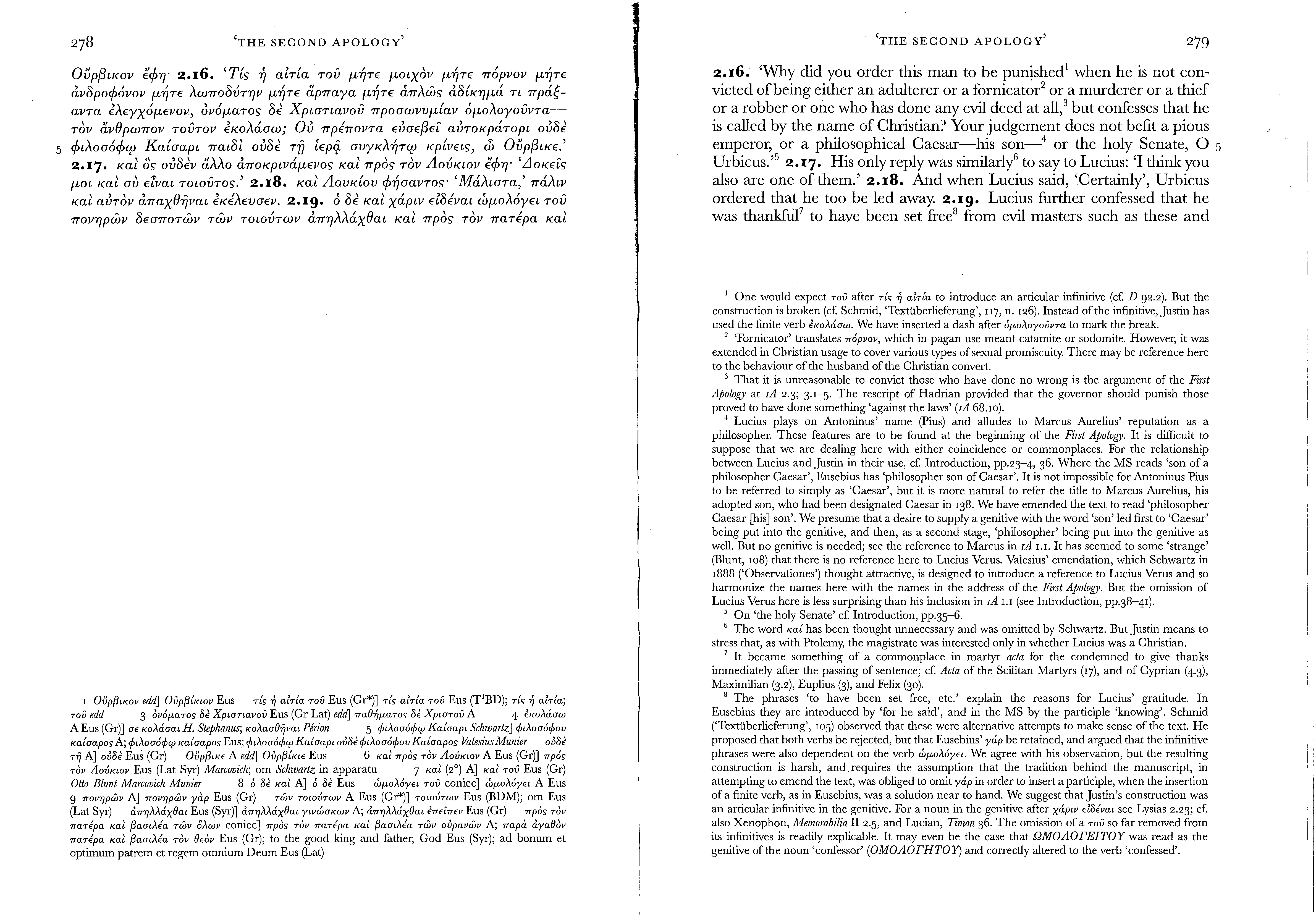
2.16~ 'Why did you order this man to be pun~shedl when he is not convicted ofbeing either an adulterer or a fornicator2 or a murderer or a thief or a robber or one who has done any evil deed at all,3 but confesses that he is called by the name of Christian? Your judgement does not befit a pious emperor, or a philosophical Caesar-his son-4 or the holy Senate, Ο 5
Urbicus.,5 2.17. His only reply was similarly6 to say to Lucius: 'Ι think you also are one ofthem.' 2.18. And when Lucius said, 'Certainly', Urbicus ordered that he too be led away. 2. 19. Lucius further confessed that he was thankfιi1 Ο 'δ Φ Ι Ι λ δ Ι Ι <Ι Ι ι λ Λ 'δ Ι Ι Ι t. αν ρο ονον μητε ωπο υτην μητε αρπαγα μητε απ wS α ικημα τι πραι;αντα ελεγχόμενον, σνόματοs δε Χριστιανου προσωνυμ{αν όμολογουντα- , ,ι θ Λ' λ Ι Ο ,Ι , β Λ'
Ι 'δ ' τον αν ρωπον τουτον εκο ασω; υ πρεποντα ευσε ει αυτοκρατορι ου ε 5 ΦιλοσόΦι:ι Κα{σαρι παιδι ουδε Tfι ίερq. συγκλήτι:ι ΚΡ{νειs, & ουρβικε.'
,., 'δ'
Ι ' "
Λ Ι "Φ 'Δ Λ 2.17. και os ου εν α ο αποκριναμενοs και προs τον ουκιον ε η. οκειs , , 'r'
' Λ Ι Φ Ι , 711f 'λ '
'λ μοι και συ ειναι τοιουτος. 2.1 . και ουκιου YJaaVTOS· ιγ1.α ιστα, πα ιν και αυΤ()ν απαχθηναι εκέλευσεν. 2.19. ό δε και χάριν ειδέναι ώμολόγει του
7 to have been set free8 from evil masters such as these and πονηρων δεσποτων των τοιούτων απηλλάχθαι και προς τον πατέρα και ι One would expect του after τ{ς Τι αιτ{α to introduce an articular infinitive (cf. D 92.2). But the construction is broken (cf. Schmid, 'Textίiberlieferung', ιη, η. 126). lηstead ofthe infinitive, Justin has used the finite verb Εκολάσω. We have inserted a dash after όμολογουντα to mark the break.
2 'Fornicator' translates πόρνον, which ίη pagan use meant catamite οτ sodomite. However, it was extended in Christian usage to cover various types of sexual promiscuity. There may be reference here to the behaviour of the husband of the Christian convert.
3 That it is unreasonable to convict those who have done ηο wrong is the argument of the Fil"St Apology at ιΑ 2.3; 3.1-5. The rescript of Hadrian provided that the governor should punish those proved to have done something 'against the laws' (ιΑ 68.10).
4Lucius plays οη Antoninus' name (Pius) and alludes to Marcus Aurelius' reputation as a philosopher. These features are to be found at the beginning of the Fil"St Apolog)I. It is difficult to suppose that we are dealing here with either coincidence οτ commonplaces. For the relationship between Lucius and Justin in their use, cf. lηtroductίoη, ΡΡ.23-4, 36. Where the MS reads 'son of a philosopher Caesar', Eusebius has 'philosopher son ofCaesar'o It is not impossible for Antoninus Pius to be referred to simply as 'Caesar', but it is more natural to refer the title to Marcus Aurelius, his adopted son, who had been designated Caesar in 138. We have emended the text to read 'philosopher
Caesar [his] son'o We presume that a desire to supply a genitive with the word 'son' led first to 'Caesar' being put into the genitive, and then, as a second stage, 'philosopher' being put into the genitive as well. But ηο genitive is needed; see the reference to Marcus ίη ιΑ 1.1. It has seemed to some 'strange'
(Blunt, 108) that there is ηο reference here to Lucius Verus. Valesius' emendation, which Schwartz in 1888 (Όbservatίοηes') thought attractive, is designed to introduce a reference to Lucius Verus and so harmonize the names here with the names in the address of the Fil"St Apology. But the omission of Lucius Verus here is less surprising than his inclusion ίη ιΑ 1.1 (see lηtroductίoη, ΡΡ.38-4Ι).
5 Οη 'the holy Senate' cf. lηtroductίoη, ΡΡ.35-6.
6 The word κα{ has been thought unnecessary and was omitted by Schwartz. But Justin means to stress that, as with Ptolemy, the magistrate was interested οηlΥ ίη whether Lucius was a Christian.
7 It became something of a commonplace ίη martyr acta for the condemned to give thanks immediately after the passing of sentence; cf. Acta of the Scilitan Martyrs (η), and of Cyprian (4.3),
Maximilian (3.2), Euplius (3), and Felix (30).
8 The phrases 'to have been set free, etc.' explain the reasons for Lucius' gratitude. lη
Eusebius they are introduced by 'for he said', and ίη the MS by the participle 'knowing'. Schmid
1 Οϋρβικον ed~ ουρβ{κιον Eus τ{ς Τι αιτ{α του Eus (Gr*)] τ{ς αιτ{α του Eus (T1BD); τ{ς Τι αιτ{α; του edd 3 ον6ματος δε Χριστιανου Eus (Gr Lat) ed~ παθήματος δε Χριστου Α
4 Εκολάσω ('Textίiberlieferung', 105) observed that these were alternative attempts to make sense of the text. He proposed that both verbs be rejected, but that Eusebius' γάρ be retained, and argued that the infinitive phrases were also dependent οη the verb ώμολόγει. We agree with his observation, but the resulting construction is harsh, and requires the assumption that the tradition behind the manuscript, in attempting to emend the text, was obliged to omit γάρ ίη order to insert a participle, when the insertion of a finite verb, as in Eusebius, was a solution near to hand. We suggest that Justin's construction was an articular infinitive ίη the genitive. For a ηουη in the genitive after χάριν ειδέναι see Lysias 2.23; cf. also Xenophon, Αιfeιnοταbίlία 11 2.5, and Lucian, Τίnιοπ 36. The omission of a του so far removed from its infinitives is readily explicable. It may even be the case that ΩΜΟΛΟΓΕΙΤΟΥ was read as the genitive ofthe ηουη 'confessor' (ΟΜΟΛΟΓΗΤΟΥ) and correctly altered to the verb 'confessed'o
Α Eus (Gr)] σε κολάσαι Η. Stephanus; κολασθηναι Penon 5 ΦιλοσόΦψ Κα{σαρι Schwartz] Φιλοσ6Φου κα{σαρος Α; ΦιλοσόΦψ κα{σαρος Eus; ΦιλοσόΦψ Κα{σαρι ουδε Φιλοσ6Φου Κα{σαρος VαlesiusNIunier ουδε τη Α] ουδε Eus (Gr) Οϋρβικε Α ed~ ουρβ{κιε Eus 6 και προς τον Λούκιον Α Eus (Gr)] πρός τον Λούκιον Eus (Lat Syr) Marcovich; om Schwartz in apparatu
7 και (20) Α] και του Eus (Gr) Otto Blunt Marcovich Munier 8 ό δε και Α] ό δε Eus ώμολ6γει του coniec] ώμολ6γει Α Eus 9 πονηρων Α] πονηρων γαρ Eus (Gr) των τοιούτων Α Eus (Gr*)] τοιούτων Eus (BDM); om Eus
(Lat Syr) απηλλάχθαι Eus (Syr)] απηλλάχθαι γινώσκων Α; απηλλάχθαι Επειπεν Eus (Gr) προς τον πατέρα και βασιλέα των δλων coniec] προς τον πατέρα και βασιλέα των ουρανων Α; παρα αγαθον πατέρα και βασιλέα τον θεον Eus (Gr); to the good king and father, God Eus (Syr); ad bonum et optimum patrem et regem omnium Deum Eus (Lat)
'ΤΗΕ SECOND APOLOGY'
'ΤΗΕ SECOND APOLOGY'
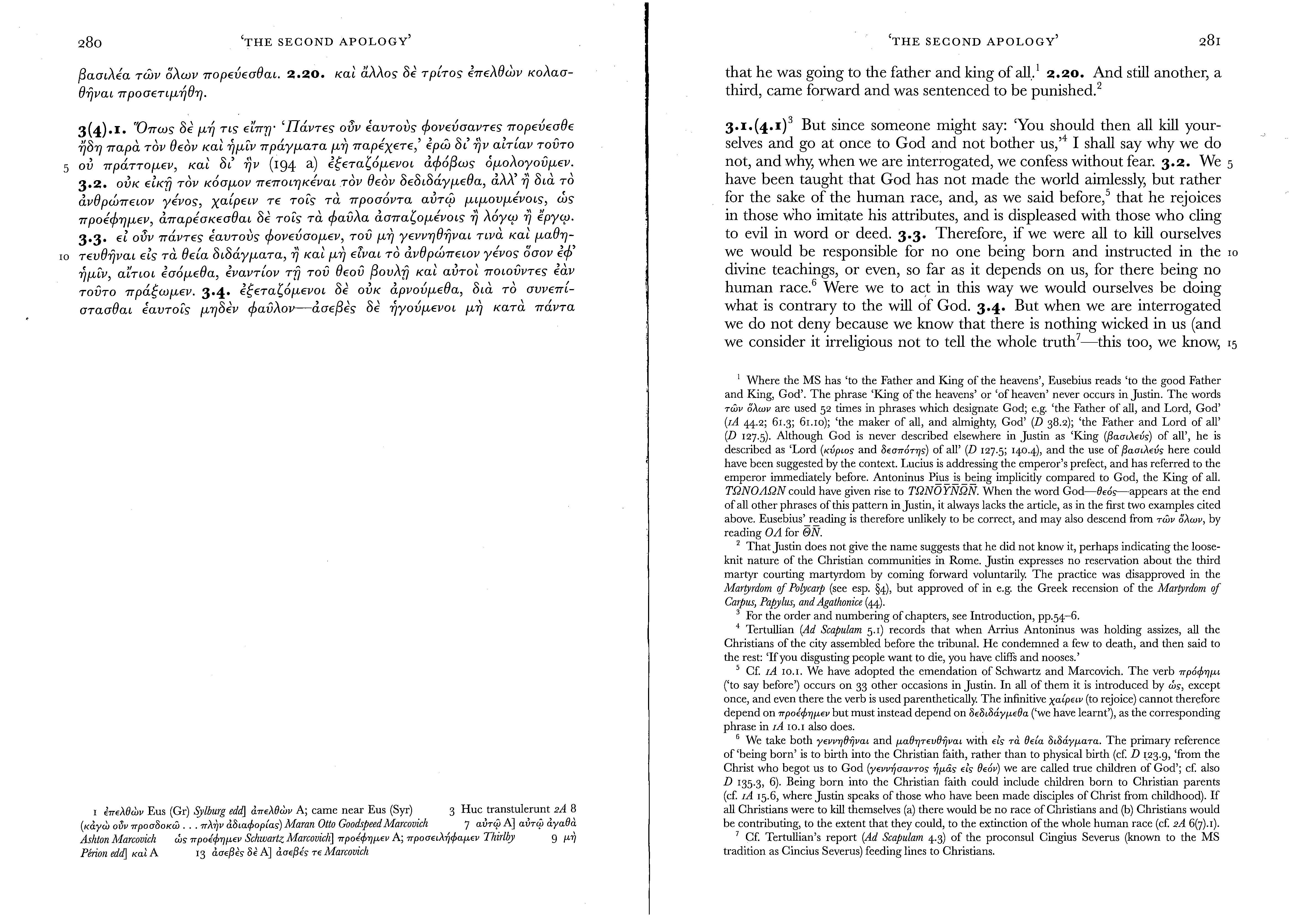
that he "vas going to the father and king of all .. 1 2.20. And still another, a third, came forward and was sentenced to be punished.2 βασιλέα των όλων πορεύεσθαι. 2.20. και αλλοs δε τρίτοs επελθων κολασ θiιναι προσεημήθη.
3.1.(4.1)3 But since someone might say: 'You should then all kill yourselves and go at once to God and not bother US,,4 Ι shall say why we do not, and why, when we are interrogated, we confess without fear. 3.2. We 5 have been taughtthat God has not made the world aimlessly, but rather for the sake of the human race, and, as we said before,5 that he rejoices
() 'Ό δ ,ι "
'Π ι l' ι 'Φ Ι ι θ 3 4 .1.
TTWS ε μη TιS ειΠΤΙ' aVTES ουν EaVTOVS OVEvaaVTES πορευεσ ε +Jδη παρα τον θεον και ~μίν πράγματα μ~ παρέχετε,' ερω δι' ~ν αίτίαν τουτο
, ,~ , Ι ι, θ ' δ δ δ ι θ 'λλ'" δ' , 3.2. ουκ ειΚΤΙ τον κοσμον πεποιηκεναι .τον εον ε ι αγμε α, α η ια το 'θ ι Ι Ι .....
\ Ι ,,...
Ι ( αν ρωπειον YEVOS, χαιΡειν τε τοιs τα προσοντα αυτψ μιμουμενοιs, ws ιφ , ι θ δ '
~ 'Φ ~λ' r ι " λ Ι "" προε ημεν, απαρεσκεσ αι ε τοιs τα αυ α ασπαl;,ομενοιs η ογψ η εργψ.
'1'
Ι ι 'Φ Ι ~, θ~ "θ 3.3. ει ουν TTaVTES EaVTOVS ονευσομεν, του μη γεννη ηναι ηνα και μα ηίη those who imitate his attributes, and is displeased with those who cling to evil ίη word ΟΓ deed. 3.3. Therefore, if we were all to kill ourselves we would be responsible for ηο one being born and instructed ίη the 10 divine teachings, ΟΓ even, so far as it depends οη us, for there being ηο human race.6 Were we to aC,t ίη this way we would ourselves be doing what is contrary to the will of God. 3.4. But when we are interrogated we do not deny because we know that there is nothing wicked ίη us (and we consider it irreligious not to tell the whole truth7-this too, we know, 15 θ ~ " θ ι δ δ ι "" l'
'Φ'
τευ ηναι EιS τα εια ι αγματα, η και μη ειναι το αν ρωπειον YEVOS οσον ε ~μίν, αϊηοι εσόμεθα, εναντίον Tiι του θεου βOυλiι και αυτοι TTOΙODVTES εαν
~ ι c 'c r ι δ'" ι θ δ" ι τουτο TTpaf:,WfLEV. 3.4. εf:,εταl;,ομενοι ε ουκ αρνουμε α, ια το συνεπιι ~ δ '
Ι Ι , ,ι στασ αι εαυτοιs μη εν αυ ον-ασε ES ε ηγουμενοι μη κατα παντα θ 1 Where the MS has 'to the Father and King ofthe heavens', Eusebius reads 'to the good Father and Κing, God'. The phrase 'Κing of the heavens' ΟΓ 'of heaven' never occurs ίη Justin. The words των Όλων are used 52 times ίη phrases which designate God; e.g. 'the Father of all, and Lord, God'
(ιΑ 44.2; 61.3; 61.10); 'the maker of all, and almighty, God' (D 38.2); 'the Father and Lord of all'
(D 127.5). Although God is never described elsewhere ίη Justin as 'Κing (βασιλεύς) of all', he is described as 'Lord (κύριος and δεσπότης) of all' (D 127.5; 140.4), and the use of βασιλεύς here could have been suggested by the context. Lucius is addressing the emperor's prefect, and has referred to the emperor immediately before. Antoninus Ρ.ιu~ ~ j:J~ing implicitly compared to God, the Κing of all.
ΤΩΝΟΛΩΝ could have given rise to ΤΩΝΟΥΝΩΝ. When the word Gοd-θεόs--aΡΡears at the end of all other phrases of this pattern in Justin, it always lacks the article, as in the first two examples cited above. Eusebius'_r~ading is therefore unlikely to be correct, and may also descend from των Όλων, by reading ΟΛ for ΘΝ.
2 That Justin does not give the name suggests that he did not know it, perhaps indicating the looseknit nature of the Christian communities in Rome. Justin expresses ηο reservation about the third martyr courting martyrdom by coming forward voluntarily. The practice was disapproved in the Λιfαι·tyrdοm qf Po!ycατp (see esp. §4), but approved of in e.g. the Greek recension of the Mαrtyrdom qf
Cαrpus, Pαpylus, αlld Agαthollice (44).
3 For the order and numbering of chapters, see Introduction, ΡΡ.54-6.
4 Tertullian (Ad Scαpulαm 5.1) records that when Arrius Antoninus was holding assizes, all the Christians of the city assembled before the tribunal. He condemned a few to death, and then said to the rest: 'Ifyou disgusting people want to die, you have cliffs and nooses.'
5 Cf. ιΑ 10.1. We have adopted the emendation of Schwartz and Marcovich. The verb πρόΦημι
('to say before') occurs οη 33 other occasions in Justin. Ιη all of them it is introduced by ώς, except once, and even there the verb is used parenthetically. The infinitive χαίρειν (to rejoice) cannot therefore depend οη προέΦημεν but must instead depend οη δεδιδάγμεθα ('we have learnt'), as the corresponding phrase in ιΑ 10.1 also does.
6 We take both γεννηθηναι and μαθητευθηναι with εΙς τα θεία διδάγματα. The primary reference of 'being born' is to birth into the Christian faith, rather than to physical birth (cf. D Ι23.9, 'from the Christ who begot us to God (γεννήσαντος ήμας εΙς θεόν) we are called true children of God'; cf. also
D 135.3, 6). Being born into the Christian faith could include children born to Christian parents
(cf. ιΑ 15.6, where Justin speaks of those who have been made disciples of Christ from childhood). If all Christians were to kill themselves (a) there would be ηο race ofChristians and (b) Christians would be contributing, to the extent that they could, to the extinction ofthe whole human race (cf. 2Α 6(7).1). ι επελθων Eus (Gr) ~lbulg edd"] απελθων Α; came near Eus (Syr)
3 Huc transtulerunt 2Α 8 (καγω oi5v προσδοκω ... πλην αδιαΦορ{ας) Ματαπ Otto Goodspeed Mαrcoviclz
7 αυτψ Α] αυτψ αγαθα Ashton Mαrcoviclz ώς προέφ.ημεν Schwαrtz Mαrcoviclz] προέφ.ημεν Α; προσειλήΦαμεν Thirlby
9 μη Penon edd"] και Α 13 ασεβες δε Α] ασεβές τε },ιfαrcovich 7 Cf. Tertullian's report (Ad ScαpulαIIl 4.3) of the proconsul Cingius Severus (known to the MS tradition as Cincius Severus) feeding lines to Christians.
'ΤΗΕ SECOND APOLOGY'
'ΤΗΕ SECOND APOLOGY'
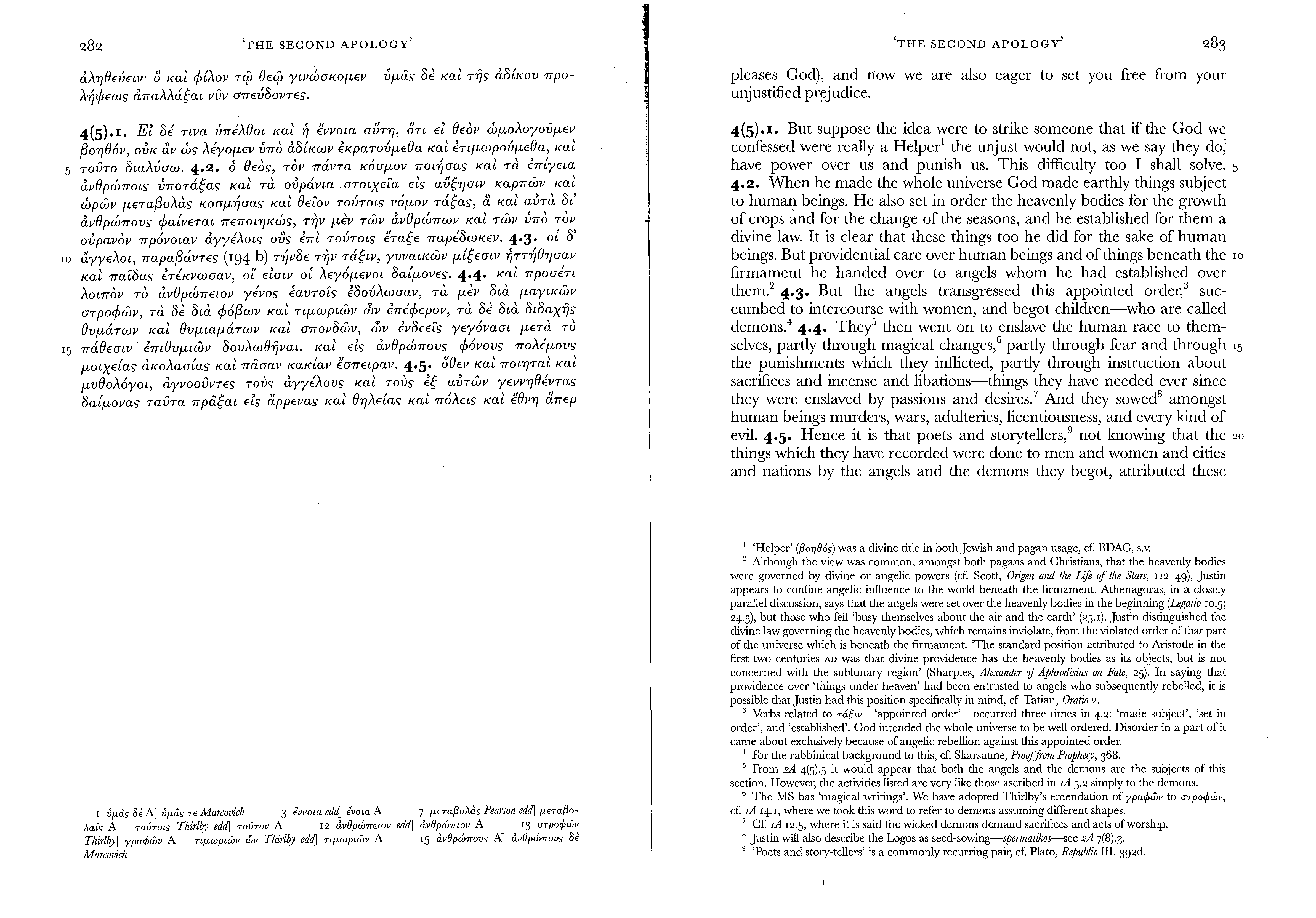
pleases God), and now we are also eager to set you free fl'Om your unjustified prejndice. άλ1]θεύειν' δ και Φίλον τφ θεφ γινώσκομεν-ύμας δε και της άδίκου προ λψj;εως άπαλλάξαι νυν σπεύδοντες.
' δ'
('λθ \ ( " tI." θ \ ( λ ~ 4 5 .1. ι ε τινα υπε οι και 1] εννοια αυΤ1], οτι ει εον ωμο ογουμεν 4(5).1. But snppose theidea were to strike someone that if the God we confessed were really a Helper! the unjnst wonld not, as we say they do;I have power over us and punish us. This difficulty too Ι shall solve. 5
4.2. When he made the whole universe God made earthly things subject to humaI?- beings. He also set ίn order the heavenly bodies for the growth of crops and for the change of the seasons, and he established for them a divine law. It is clear that these things too he did for the sake οΓ hnman beings. But providential care over human beings and of things beneath the 10 firmament he handed over to angels whom he had established over them.2 4.3. Bnt the ange1s transgressed this appointed order,3 succumbed to interconrse with women, and begot children-who are called demons.4 4.4. Theys then went οη to enslave the human race to themselves, partly through magical changes,6 partly throngh fear and throngh 15 the pnnishments which they inflicted, partly throngh instruction abont sacrifices and incense and libations-things they have needed ever since they were enslaved by passions and desires. 7 And they sowed8 amongst human beings mnrders, wars, adulteries, licentionsness, and every kind of evil. 4.5. Hence it is that poets and storytellers,9 not knowing that the 20 things which they have recorded were done to men and women and cities and nations by the angels and the demons they begot, attributed these
() Ε '
,,\ ( λ'
(\ 'δ'
, 'θ \ , 'θ \ 01] ον, ουκ αν ως εγομεν υπο α ικων εκρατουμε α και ετιμωρουμε α, και β θ '
( 'c \ \ "
~'''C ~ \ αν ρωποις υποταr:,ας και τα ουρανια. στοιχεια εις avr:, 1]σιν καρπων και δ λ (~ β λ \ , \ θ ~ , , , C <\ \ , \ δ' ωρων μετα ο ας κοσμ1]σας και ειον τουτοις νομον ταr:,ας, α και αυτα ι 'θ'
,\ \ ~ 'θ'
\ ~ (\ \ αν ρωπους αινεται πεΠΟΙ1]κως, Τ1]ν μεν των αν ρωπων και των υπο τον , , Ι "λ t\' \ Ι ,ι C '
'δ ( δ' ουρανον προνοιαν αγγε οις ους επι τουτοις ETar:,E παρε ωκεν. 4.3. οι 10 αγγελοι, παραβάντες (194 b) τήνδε T~ν τάξιν, γυναικων μίξεσιν Υιττήθ1]σαν και παιδας ετέκνωσαν, οϊ εισιν οί λεγόμενοι δαίμονες. 4.4. και προσέτι λοιπον το άνθρώπειον γένος έαυτοις εδούλωσαν, 7(1 μεν δια μαγικων στροφων, τα δε δια Φόβων και τιμωριων ών επέΦερον, τα δε δια διδαχης
\ θ '
\ δ~"" δ ~, \ \ υματων και υμιαματων και σπον ων, ων εν εεις γεγονασι μετα το θ 15 πάθεσιν· επιθυμιων δουλωθηναι. και εις άνθρώπους Φόνους πολέμους
, , λ ι \"
Ι ,ι t'e \ \ \ μοιχειας ακο ασιας και πασαν κακιαν εσπειραν. 4.5. ο εν και ΠΟΙ1]ται και
,~ \, 'λ \ \ 'C ,~ θ' μυ ο ογοι, αγνοουντες τους αγγε ους και τους Er:, αυτων γενν1] εντας θ λ δ '
~ ~ C '"
\ 'λ \ "θ ., αιμονας ταυτα πραr:, αι εις αρρενας και 1] ειας και πο εις και ε ν1] απερ ι 'Helper' (βοηθό,) was a divine title in bothJewish and pagan usage, cf. BDAG, s.v.
2 Although the view was common, amongst both pagans and Christians, that the heavenly bodies were governed by divine ΟΓ angelic powers (cf. Scott, Origen and the Life qf tlze Stars, 112-49), Justin appears to confine angelic influence to the world beneath the firmament. Athenagoras, in a closely parallel discussion, says that the angels were set over the heavenly bodies in the beginning (Legatio 10.5;
24.5), but those who fell 'busy themselves about the air and the earth' (25.1). Justin distinguished the divine law governing the heavenly bodies, which remains inviolate, from the violated order of that part of the universe which is beneath the firmament. 'The standard position attributed to Aristotle in the first two centuries AD was that divine providence has the heavenly bodies as its objects, but is not concerned with the sublunary region' (Sharples, Alexander qf Aphrodisias οπ Fate, 25). Ιη saying that providence over 'things under heaven' had been entrusted to angels who subsequently rebelled, it is possible that Justin had this position specifically in mind, cf. Tatian, Oratio 2.
3 Verbs related to τάξιv--'aΡΡοinted order'-occurred three times in 4.2: 'made subject', 'set in order', and 'established'. God intended the ,;vhole universe to be well ordered. Disorder in a part ofit came about exclusively because of angelic rebellion against this appointed order.
<} For the rabbinical background to this, cf. Skarsaune, Proqfjrom Proplleqy, 368.
5 From 2Α 4(5).5 it would appear that both the angels and the demons are the subjects of this section. However, the activities listed are very like those ascribed in ιΑ 5.2 simply to the demons.
6 The MS has 'magical writings" We have adopted Thirlby's emendation of γραφων to στροφων, cf. ιΑ 14.1, where we took this word to refer to demons assuming different shapes. ι ύμα, δε Α] ύμα, τε .Marcovich 3 εννοια ed~ ενοια Α 7 μεταβολα, Peαι:son ed~ μεταβο7 Cf. ιΑ 12.5, where it is said the wicked demons demand sacrifices and acts ofworship. λαι, Α τούτοι, Thirlby ed~ τουτον Α 12 dνθΡώπειον ed~ dνθΡώπιον Α 13 στροφων T1zirlby] γραφων Α τιμωριων Jιν Thil·lby ed~ τιμωριων Α 15 dνθΡώποv, Α] dνθΡώποv, δε . Marcovich 8 Justin will also describe the Logos as seed-sowing-spermatίkos-see 2Α 7(8).3.
9 'Poets and story-tellers' is a commonly recurring pair, cf. Plato, Republic ΠΙ 392d .
'ΤΗΕ SECOND APOLOGY'
'ΤΗΕ SECOND APOLOGY'
Ι ,/ι'
\ θ \ , \ ( "
'Λ ,..
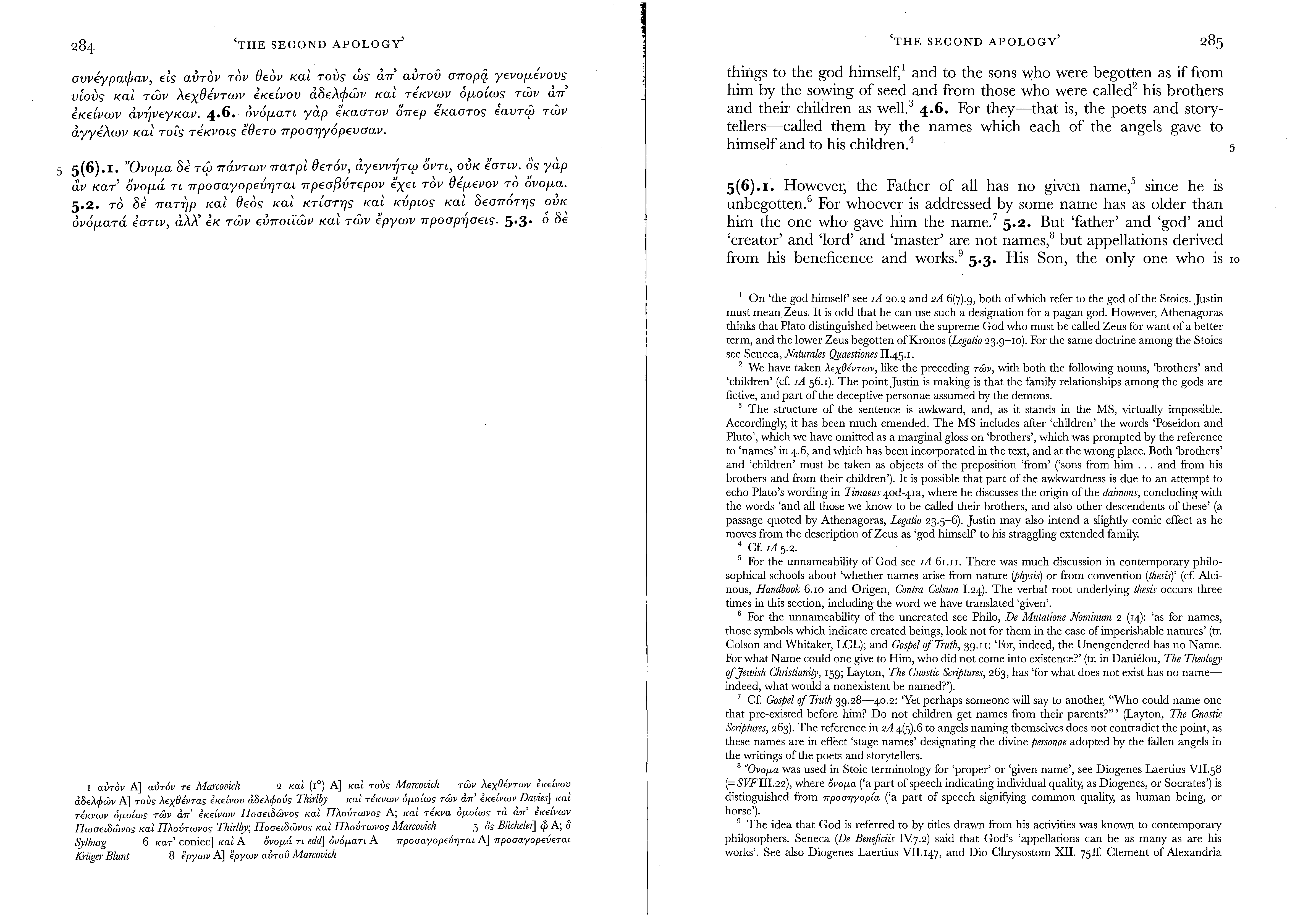
Ι συνεγραψαν, εις αυτον τον εον και τους ως απ αυτου σποΡCf γενομενους (, 'Λ λ θ ι ,ι 'δ λΦ Λ ,Ι (Ι Λ" υιους και των εχ εντων εκεινου α ε ων και τεκνων ομοιως των απ ,ι ,Ι
,ι '~I ι! ιι (.......... εκεινων αν7]νεγκαν. 4 .. ονομαη γαρ εκαστον οπερ εκαστος εαυηρ των thίήgs to the god himself,l and to the sons Who were begotten as if from him by the sowing of seed and from those who were called2 his brothers and their children as well. 3 4.6. For they-that is, the poets and storytellers-called them by the names which each of the angels gave to himself and to his children.4 αγγέλων και τοις τέκνοις εθετο προσ7]γόρευσαν.
\ θ'
5(6).1. However, the Father of all has ηο given name,5 since he is unbegotte.n.6 For whoever is addressed by some name has as older than him the one who gave him the name. 7 5.2. But 'father' and 'god' and 'creator' and 'lord' and 'master' are not names,B but appellations derived from his beneficence and works. 9 5.3. His Son, the only one who is 10
'δ'
, , θ'
,Ι ,Ι 'δ ι , 5.2. το ε παΤ7]Ρ και εος και κησΤ7]ς και κυριος και εσΠΟΤ7]ς ουκ όνόματά έσην, αλλ' έκ των εύποιϊων και των εργων προσρΥισεις. 5.3. ό δε
1 Οη 'the god himself' see ιΑ 20.2 and 2Α 6(7).9, both ofwhich refer to the god ofthe Stoics. Justin must mean, Zeus. It is odd that he can use such a designation for a pagan god. However, Athenagoras thinks that Plato distinguished between the supreme God who must be calIed Zeus for want of a better term, and the lower Zeus begotten ofΚronos (Legαtio 23.9-10). For the same doctrine among the Stoics see Seneca, NαturαZes Q,uαestiones Π.45.Ι.
2 We have taken λεχθέντων, like the preceding των, with both the folIowing nouns, 'brothers' and 'children' (cf. ιΑ 56.1). The pointJustin is making is that the family relationships among the gods are fictive, and part of the deceptive personae assumed by the demons.
3 The structure of the sentence is awkward, and, as it stands ίη the MS, virtually impossible.
Accordingly, it has been much emended. The MS includes after 'children' the words 'Poseidon and Pluto', which we have omitted as a marginal gloss οη 'brothers', which was prompted by the reference to 'names' ίη 4.6, and which has been incorporated ίη the text, and at the wrong place. Both 'brothers' and 'child[en' must be taken as objects of the preposition 'from' ('sons from him ... and from his brothers and from thei[ children'). It is possible that part of the awkwardness is due to an attempt to echo Plato's wording ίη Timαeus 40d-4Ia, where he discusses the origin ofthe dαiIιzons, concluding with the words 'and all those we know to be called their brothers, and also other descendents of these' (a passage quoted by Athenagoras, Legαtio 23.5-6). Justin may also intend a slightly comic effect as he moves from the description of Zeus as 'god himself' to his straggling extended family.
4 Cf. ιΑ 5.2.
5 For the unnameability of God see ιΑ 6ι.ιι. There was much discussion in contemporary philosophical schools about 'whether names arise from nature (plιysΊs) or from convention (thesΊS)' (cf. Alcinous, Hαndbook 6.10 and Origen, Contrα Celsum Ι.24). The verbal root underlying tlzesΊS occurs three times in this section, including the word we have translated 'given'.
6 For the unnameability of the uncreated see Philo, De Mlltαtioιze Nominunz 2 (14): 'as for names, those symbols which indicate created beings, look not for them ίη the case of imperishable natures' (tr.
Colson and Whitaker, LCL); and Gospel qfTruth, 39.ΙΙ: 'For, indeed, the Unengendered has ηο Name.
For what Name could one give to Him, who did not come into existence?' (tr. in Danielou) TIze TheoZogy qf JewΊSh ChIistiαni!J, 159; Layton, The Gnostic ScIiptures, 263, has 'for what does not exist has ηο nameindeed, what would a nonexistent be named?').
7 Cf. Gospel qfTί'uth 39.28-40.2: 'Yet perhaps someone will say to another, "Who could name one that pre-existed before him? Do not children get names from their parents?'" (Layton, The Gnostic
ScIiptuIΊJs, 263). The reference in 2Α 4(5).6 to angels naming themselves does not contradict the point, as these names are in effect 'stage names' designating the divine personαe adopted by the fallen angels ίη the writings of the poets and storytelIers.
8 'Όνομα was used ίη Stoic terminology for 'proper' or 'given name', see Diogenes Laertius νΠ.58
(= SVFIII.22), where σνομα ('a part of speech indicating individual quality, as Diogenes, or Socrates') is distinguished from 7Τροσηγορία ('a part of speech signifYing common quality, as human being, or horse'). ι αυτον Α] αυτόν τε Mα1"COViCh
και (10) Α] και τους lIιfαιι:οvίch των λεχθέντων έκείνου άδελφων Α] τους λεχθέντας έκείνου άδελΦούς Thirlby και τέκνων όμοίως των ά7Τ' έκείνων Dαvies] και τέκνων όμοίως των ά7Τ' έκείνων Ποσειδωνος και Πλούτωνος Α; και τέκνα ομοίως τα ά7Τ' έκείνων
9 The idea that God is referred to by titles drawn from his activities was known to contemporary philosophers. Seneca (De BeneficiΊS ΙΥ.7.2) said that God's 'appelIations can be as many as are his works'. See also Diogenes Laertius VII.I47, and Dio Chrysostom ΧΙΙ. 75ff. Clement of Alexandria
Πωσειδωνος και Πλούτωνος Thirlby; Ποσειδωνος και Πλούτωνος lIιfαrcoviclz 5 ος BίicheleI] ιJι Α; ο S)Ilburg 6 κατ' coniec] και Α σνομά τι edd] ονόματι Α 7Τροσαγορεύψαι Α] 7Τροσαγορεύεται KrugeI' Blunt 8 εργων Α] εργων αυτου lIιfαrcoviclz
'ΤΗΕ SECOND APOLOGY'
'ΤΗΕ SECOND APOLOGY'
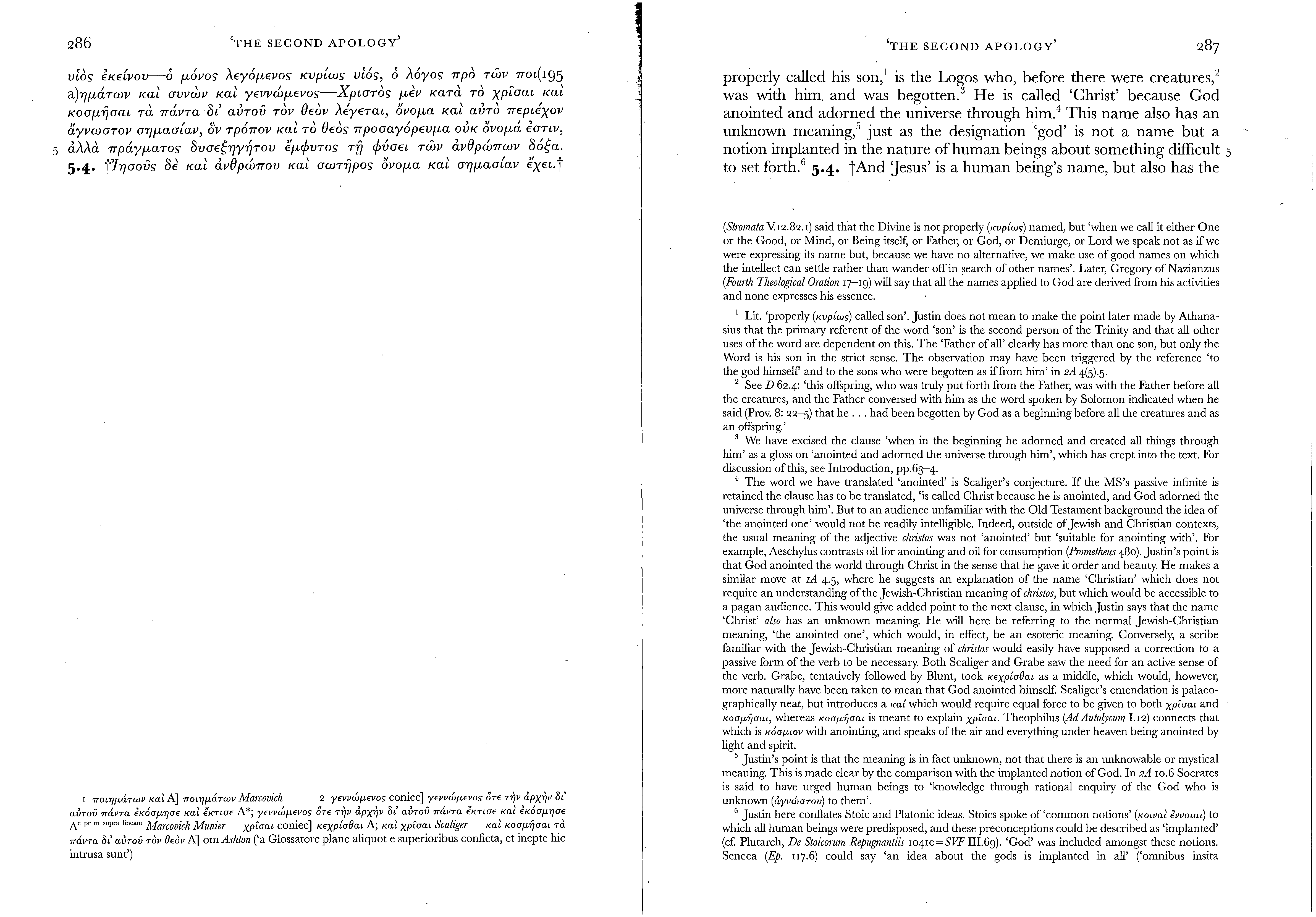
Ι\ ,/ (' ι λ ι / (Ι C' λ/ \ ~ ( υιος EKEιVOV-O μονος εγομενος κυριως υιος, ο ογος προ των ποι Ι95 ) '
\ \ \ , Χ \ \ \ \ ~ \ a rιμαTων και συνων και γεννωμενοςριστος μεν κατα το χρισαι και
1""\ \ θ \ λ'
\) \ Ι κοσμησαι τα παντα ι αυτου τον εον εγεται, ονομα και αυτο περιεχ ον " ι ι\ Ι \ \ θ ' ι ,,' ι, αγνωστον σrιμασιαν, ον τροπον και το εος προσαγορευμα ουκ ονομα εστιν, 5 αλλιΙ πράγματος δυσεξrιγήToυ εμΦυτος Tfι Φύσει των ανθρώπων δόξα.
5.4. t'Irι aovS' δε και ανθρώπου και σωτηρος Όνομα και σrιμασίαν εχει·t properly cal1ed his son,l is the Logos who, before there were creatures,2 was with hirn and was begotten.3 He is called 'Christ' because God anointed and adorned the universe through him.4 This name also has an unknown meaning,S just as the designation'god' is not a name but a notion irnplanted ίη the nature of human beings about something difficult 5 to set forth. 6 5.4. tAnd Ίesus' is a human being's name, but also has the (Stroιnαtα Υ.12.82.1) said that the Divine is not properly (κυρίως) named, but 'when we call it either One or the Good, or Mind, or Being itself, or Father, or God, or Demiurge, or Lord we speak not as if we were expressing its name but, because we have ηο alternative, we make use of good names οη which the intellect can settle rather than wander offin ~earch of other names'. Later, Gregory ofNazianzus
(Fourtlz T1zeologicαl Ol'αtion 17-1g) will say that all the names applied to God are derived from his activities and none expresses his essence. ι Lit. 'properly (κυρίως) called son'. Justin does not mean to make the point later made by Athanasius that the primary referent of the word 'son' is the second person of the Trinity and that all other uses of the word are dependent οη this. The 'Father of all' clearly has more than one son, but οηlΥ the Word is his son in the strict sense. The observation may have been triggered by the reference 'to the god himself and to the sons who were begotten as if from him' ίη 2Α 4(5).5.
2 See D 62+ 'this offspring, who was truly put forth from the Father, was with the Father before all the creatures, and the Father conversed with him as the word spoken by Solomon indicated when he said (Prov. 8: 22-5) that he ... had been begotten by God as a beginning before all the creatures and as an offspring.'
3 We have excised the clause 'when ίη the beginning he adorned and created all things through him' as a gloss οη 'anointed and adorned the universe through him', which has crept into the text. For discussion of this, see Introduction, ρρ.63-4 .
.. The word we have translated 'anointed' is Scaliger's conjecture. If the MS's passive infinite is retained the clause has to be translated, 'js called Christ because he is anointed, and God adorned the universe through him'. But to an audience unfamiliar with the Old Testament background the idea of 'the anointed one' would not be readily intelligible. Indeed, outside of Jewish and Christian contexts, the usual meaning of the adjective chrίstos was not 'anointed' but 'suitable for anointing with'. For example, Aeschylus contrasts oil for anointing and oil for consumption (Prontetheus 480). Justin's point is that God anointed the world through Christ ίη the sense that he gave it order and beauty. He makes a similar move at ιΑ 4.5, where he suggests an explanation of the name 'Christian' which does not require an understanding of the Jewish-Christian meaning of clzrίstos, but which would be accessible to a pagan audience. This would give added point to the next clause, in which Justin says that the name
'Christ' αlso has an unknown meaning. He will here be referring to the normal Jewish-Christian meaning, 'the anointed one', which would, ίη effect, be an esoteric meaning. Conversely, a scribe familiar with the Jewish-Christian meaning of chrίstos would easily have supposed a correction to a passive form of the verb to be necessary. Both Scaliger and Grabe saw the need for an active sense of the verb. Grabe, tentatively followed by Blunt, took κεχρίσθαι as a middle, which would, however, more naturally have been taken to mean that God anointed himself. Scaliger's emendation is palaeographically neat, but introduces a καί which would require equal force to be given to both χρισαι and κοσμησαι, whereas κοσμησαι is meant to explain χρΙσαι. Theophilus (Ad Allto6Icunz 1.12) connects that which is κόσμιον with anointing, and speaks of the air and everything under heaven being anointed by Iight and spirit.
5 Justin's point is that the meaning is ίη fact unknown, not that there is an unknowable or mystical meaning. This is made clear by the comparison with the implanted notion ofGod. Ιη 2Α ιο.6 Socrates is said to have urged human beings to 'knowledge through rational enquiry of the God who is unknown (αγνώστου) to them'.
Ι ποιημάτων και Α] ποιημάτων Mαrcoviclz 2 γεννώμενο!; coniec] γεννώμενος οτε την αρχην δι' αVτοίΙ πάντα Εκόσμησε και έκτισε Α*; γεννώμενος οτε την αρχην δι' αVτοίΙ πάντα έκτισε και Εκόσμησε
6 Justin here conflates Stoic and Platonic ideas. Stoics spoke of'common notions' (κοιναι έννοιαι) to which all human beings weΓe predisposed, and these preconceptions could be described as 'implanted'
(cf. Plutarch, De Stoicol'unz Repllgnαntiis I041e=SVFIII.6g). 'God' was included amongst these notions.
Seneca (Ερ. 117.6) could say 'an idea about the gods is implanted in all' ('omnibus insita
AC pr m supra lίneam Mαrcoviclz Muιzier χρισαι coniec] κεχρίσθαι Α; και χρισαι Scαliger και κοσμησαι τα πάντα δι' αVτοίΙ τον θεον Α] om Aslzton ('a Glossatore plane aliquot e superioribus conficta, et inepte hic intrusa sunt')
'ΤΗΕ SECOND APOLOGY'
'ΤΗΕ SECOND APOLOGY'
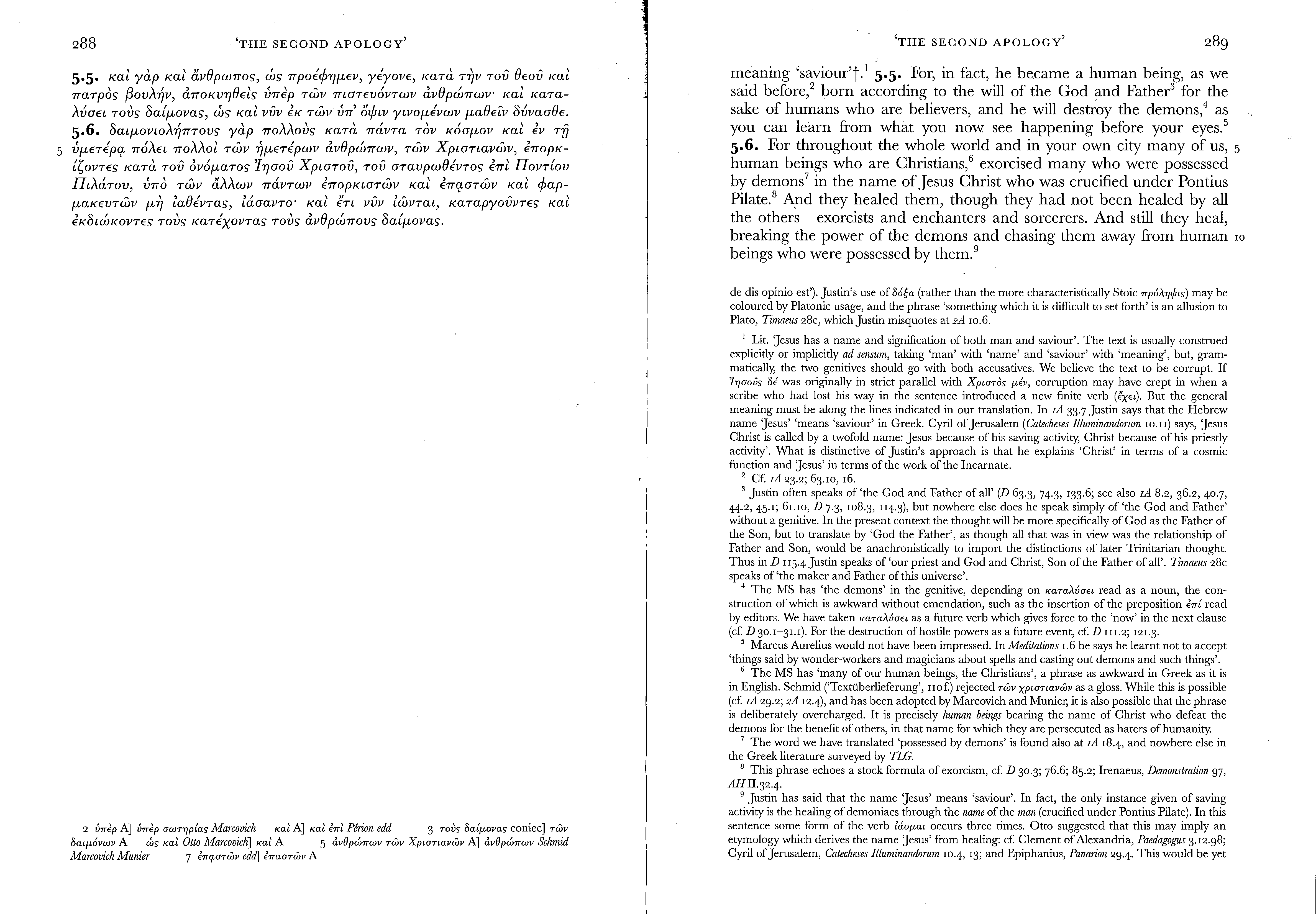
\ " θ ( ',ι Ι \, ...... θ Λ \ 5.5. και γαρ και αν pωπo~, ω~ προεψημεν, γεγονε, κατα την του εου και \ β λ" θ \ (\ Λ , 'θ ι \ παTPO~ ου ην, αποκυη ει~ υπερ των πιστευοντων αν ρωπων' και καταmeaning 'saviour't. ι 5.5. For, ίn fact, he be.came a human being, as we said before,2 born according to the will of the God ?-nd Father3 for the sake of humans who are believers, and he will destroy the demons,4 as you can learn from what you now see happening before your eyes.5
5.6. For throughout the whole world and ίn your own city many of us, 5 human beings who are Christians,6 exorcised many who were possessed by demons7 ίn the name of Jesus Christ who was crucified under Pontius
Pilate. 8 Ap.d they healed them, though they had not been healed by all the others-exorcists and enchanters and sorcerers. And still they heal, breaking the power of the demons and chasing them away from human ΙΟ beings who were possessed by them. 9 ι \ δ ι (\ Λ'
Λ (, ",', ι θ Λ δ ι θ υσει TOυ~ αιμovα~, ω~ και νυν εκ των υπ οψιν γινομενων μα ειν υνασ ε.
5.6. δαιμoνιoλήΠToυ~ γαρ πoλλoυ~ κατα πάντα τον κόσμον και εν TV 5 ύμεTέpcιπόλει πολλοι των ~μεTέpων ανθρώπων, των Χριστιανων, επορκ λ ίζoνTε~ κατα του oνόμαTO~ Ίησου Χριστου, του σTαυpωθένTO~ επι Ποντίου
Λ',/..
Ι ατου, υπο των α ων παντων επορκιστων και επcι-σTων και ψαρμακευτων μη ΙαθένTα~, ιάσαντο' και ετι νυν ιωνται, KαTαpγoυνTε~ και εKδιώKoνTε~ Toυ~ KαTέxoνTα~ TOυ~ ανθpώπoυ~ δαίμoνα~. de dis ορίηίο est'). Justin's use of δόξα (rather than the more characteristically Stoic πρόληψις) may be co1oured by P1atonic usage, and the phrase 'something which it is difficult to set forth' is an allusion to P1ato, TimaeIιs 28c, whichJustin misquotes at 2Α ΙΟ.6. ι Lit. jesus has a name and signification of both man and saνiοur'. The text is usually construed exp1icitly ΟΓ imp1icitly ad seIzsUl7Z, taking 'man' with 'name' and 'saνiour' with 'meaning', but, grammatically, the two geηitiνes shou1d go with both accusatiνes. We be1ieνe the text to be corrupt. 1f
Ίησους δέ was originally in strict paralle1 with Χριστος μέν, corruption may haνe crept in when a scribe who had 10st his way in the sentence introduced a new finite "erb (εχει). But the genera1 meaning must be along the 1ines indicated ίη our trans1ation. 1η ιΑ 33.7 Justin says that the Hebrew name jesus' 'means 'saνiοur' in Greek. Cyril ofJerusalem (Catecheses Illunzinaιzdorum ιο.ιι) says, jesus
Christ is called by a twofold name: Jesus because of his saνing actiνity, Christ because of his priestly actiνity'. What is distinctiνe of Justin's approach is that he exp1ains 'Christ' in terms of a cosmic function and jesus' in terms of the work of the 1ncarnate.
2 Cf. ιΑ 23.2; 63.ΙΟ, 16.
3 Justin often speaks of 'the God and Father of all' (D 63.3, 74.3, 133.6; see a1so ιΑ 8.2, 36.2, 40.7,
44·2, 45·1; 61.ιο, D 7.3, ιο8.3, ΙΙ4.3), but nowhere e1se does he speak simp1y of 'the God and Father' without a geηitiνe. 1η the present context the thought will be more specifically of God as the Father of the Son, but to trans1ate by 'God the Father', as though all that was in νiew was the re1ationship of Father and Son, would be anachronistically to import the distinctions of later Trinitarian thought.
Thus in D 115.4 Justin speaks of 'our priest and God and Christ, Son of the Father of all'. Timaeus 28c speaks of 'the maker and Father of this uηiνerse'.
4 The MS has 'the demons' in the geηitiνe, depending οη καταλύσει read as a noun, the construction of which is awkward without emendation, such as the insertion of the preposition επ{ read by editors. We haνe taken καταλύσει as a future "erb which giνes force to the 'now' in the next c1ause
(cf. D 30.1-31.1). For the destruction ofhostile powers as a future eνeηt, cf. D ΙΙ1.2; 121.3.
5 Marcus Aurelius would not haνe been impressed. 1η Aιleditations 1.6 he says he learnt not to accept
'things said by wonder-workers and magicians about spells and casting out demons and such things'.
G The MS has 'many of our human beings, the Christians', a phrase as awkward in Greek as it is in English. Schmid ('Textϋberlieferung', IIOf.) rejected των χρισnανων as a gloss. While this is possible
(cf. ιΑ 29.2; 2Α 12-4), and has been adopted by Marcoνich and Munier, it is also possib1e that the phrase is deliberately ονercharged. 1t is precisely human beiιzgs bearing the name of Christ who defeat the demons for the benefit of others, ίη that name for which they are persecuted as haters ofhumanity.
7 The word we haνe translated 'possessed by demons' is found also at ιΑ 18.4, and nowhere else ίη the Greek literature surνeyed by TLG.
8 This phrase echoes a stock formula of exorcism, cf. D 30.3; 76.6; 85.2; 1renaeus, DeI7Zonstτati01l 97,
ΑΗΙΙ·32+ 9 Justin has said that the name jesus' means 'saνiour'. 1η fact, the οηlΥ instance giνeη of saνing actiνity is the healing of demoniacs through the name of the 17Ζaπ (crucified under Pontius Pilate). 1η this sentence some form of the "erb [άομαι occurs three times. Otto suggested that this may imply an etymology which deriνes the name jesus' from healing: cf. Clement of Alexandria, Paedagogus 3.12.98;
Cyril of Jerusa1em, Catecheses Illumillaιzdorul7Z ΙΟ.4, 13; and Epiphanius, Paιzarion 29+ This wou1d be yet 2 ύπερ Α] ύπερ σωτηρ{ας Μaιωvίch και Α] και επι Pέrίoπ edd 3 τους δα{μονας coniec] των δαιμόνων Α ώς και Otto Marcovich] και Α 5 ανθρώπων των ΧρισΤιανων Α] ανθρώπων Schnzid
'ΤΗΕ SECOND APOLOGY'
'ΤΗΕ SECOND APOLOGY'
29 Ι 6 () <Όθ \, Ι ( θ"
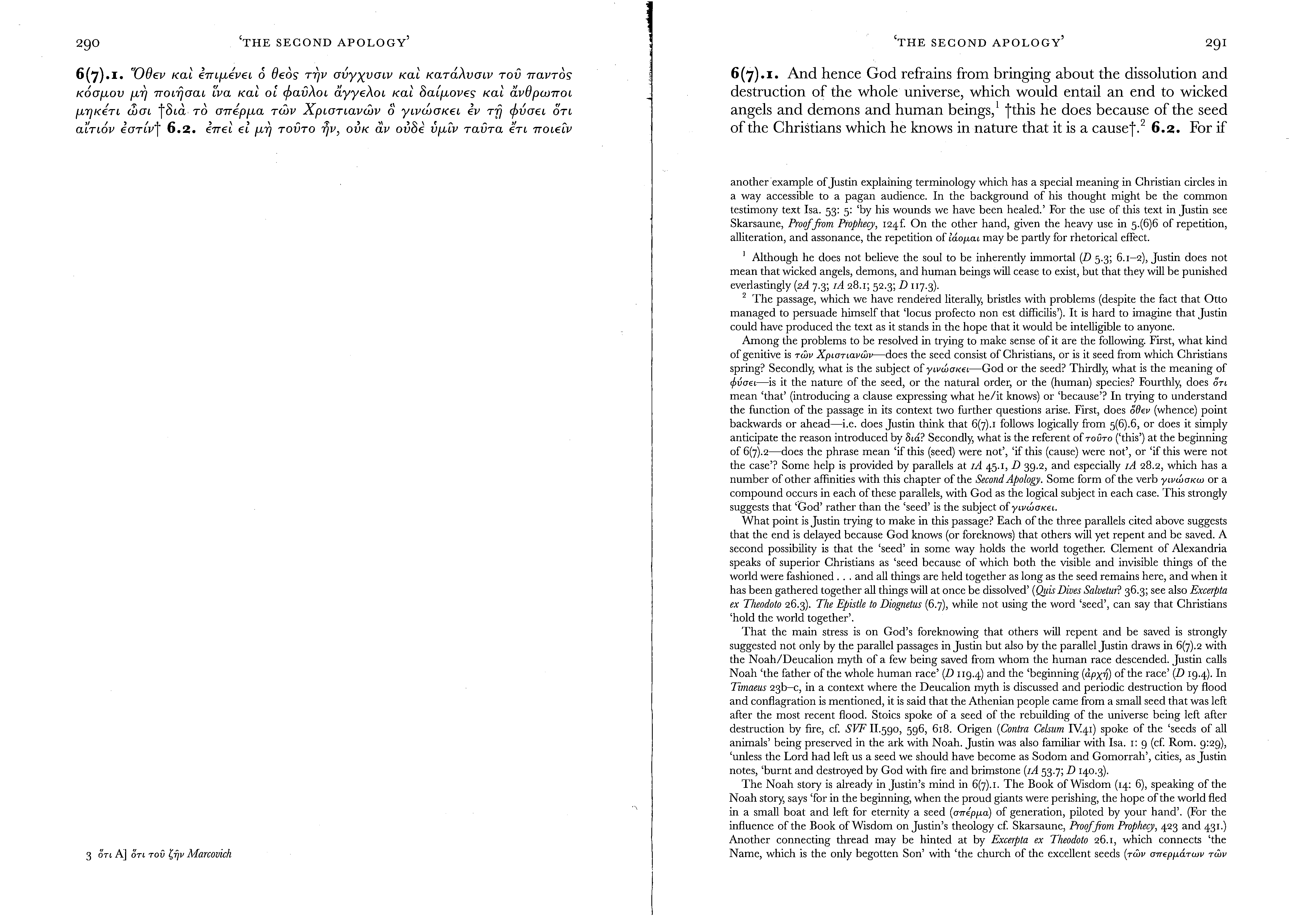
Ι \ Ιλ ~ \ 7 .1. εν και ε7Τιμενει ο εος την συγχυσιν και κατα υσιν του 7Ταντος 6(7).1. And hence God refrains from bringing about the dissolution and destruction of the whole universe, which would entail an end to wicked angels and demons and human beings,l tthis he does because of the seed ofthe Christians which he knows ίη nature that it is a causet. 2 6.2. For if ι \ ~ <, \ (Φ ~λ "λ \ δ ι," θ κοσμου μη 7Τοιησαι ινα και οι αυ οι αγγε οι και αιμονες και αν ρω7ΤΟΙ μηκέη JJaL tδια το σ7Τέρμα των Χρισηανων Ο γινώσκει έν TV Φύσει οη
,ι ι , ι t 6 ""
,.. l'
) .. \ 'δ \ ι......
.....,'
...... αιηον εσην .2. ε7Τει ει μη τουτο ην, ουκ αν ου ε υμιν ταυτα εη 7Τοιειν anotherexample of Justin explaining terminology which has a special meaning in Christian circles in a way accessible to a pagan audience. 1η the background of his thought might be the common testimony text 1sa. 53: 5: 'by his wounds we have been healed.' For the use of this text in Justin see
Skarsaune, Proqf .from Ptophec)', Ι24 f. Οη the other hand, given the heavy use in 5.(6)6 of repetition, alliteration, and assonance, the repetition of ίάομαι may be partly for rhetorical effect.
] Although he does not believe the soul to be inherently immortal (D 5.3; 6.Ι-2), Justin does not mean that wicked angels, demons, and human beings will cease to exist, but that they will be punished everlastingly (2Α 7.3; ιΑ 28.ι; 52.3; D ΙΙ7.3).
2 The passage, which we have rendered literally, bristles with problems (despite the fact that Otto managed to persuade himself that 'locus profecto ηοη est difficilis'). 1t is hard to imagine that Justin could have produced the text as it stands in the hope that it would be intelligible to anyone.
Among the problems to be resolved in trying to make sense of it are the following. First, what kind of genitive is των Χριστιανωv---dοes the seed consist of Christians, ΟΓ is it seed from which Christians spring? Secondly, what is the subject of γινώσκει-Gοd ΟΓ the seed? Thirdly, what is the meaning of Φύσει-is it the nature of the seed, ΟΓ the natural order, ΟΓ the (human) species? Fourthly, does Ότι mean 'that' (introducing a clause eΧΡΓessiηg what he/it knows) 01' 'because'? 1η trying to understand the function of the passage in its context two further questions arise. First, does Όθεν (whence) point backwards ΟΓ ahead-i.e. does Justin think that 6(7).Ι follows 10gically fΓOm 5(6).6, ΟΓ does it simply anticipate the reason introduced by διά? Secondly, what is the referent of τουτο ('this') at the beginning of6(7).2-does the phrase mean 'ifthis (seed) were not', 'ifthis (cause) were not', ΟΓ 'ifthis were not the case'? Some help is provided by parallels at ιΑ 45.Ι, D 39.2, and especially ιΑ 28.2, which has a number ofother affinities with this chapter ofthe SecondApology. Some form ofthe verb γινώσκω ΟΓ a compound occurs in each of these parallels, with God as the logical subject in each case. This strongly suggests that 'God' [ather than the 'seed' is the subject of γινώσκει.
What point is Justin trying to make in this passage? Each of the three parallels cited above suggests that the end is delayed because God knows (or foreknows) that others will yet repent and be saved. Α second possibility is that the 'seed' in some way holds the WΟ1'Ιd together. Clement of Alexandria speaks of superior Christians as 'seed because of which both the visible and invisible things of the world were fashioned ... and all things are held together as long as the seed remains heΓe, and when it has been gathered together all things will at once be dissolved' (QJtis Dives SαlvetuI"? 36.3; see also Excerptα ex TIzeodoto 26.3). TIze Epistle to Diognetus (6.7), while not using the WΟΓd 'seed', can say that Christians
'hold the world together'.
That the main stress is οη God's foreknowing that others will repent and be saved is strongly suggested not only by the parallel passages in Justin but also by the parallel Justin draws in 6(7).2 with the Noah/Deucalion myth of a few being saved from whom the human race descended. Justin calls
Noah 'the fathel" ofthe whole human race' (D ΙΙ9.4) and the 'beginning (αρχή) ofthe [ace' (D Ι9.4). 1η
TiInαeus 23b-c, in a context where the Deucalion myth is discussed and ΡeΓiοdic destruction by:flood and con:flagration is mentioned, it is said that the Athenian people came from a small seed that was left after the most 1'eceηt :flood. Stoics spoke of a seed of the rebuilding of the universe being left after destωctiοη by fire, cf. SVF Π.590, 596, 6ι8. Origen (CΟlltω Celsum ΙΥ.4Ι) spoke of the 'seeds of all animals' being preserved in the ark with Noah. Justin was also familiar with 1sa. ι: 9 (cf. Rom. 9:29),
'unless the Lord had left us a seed we should have become as Sodom and Gomorrah', cities, as Justin notes, 'burnt and destΓOyed by God with fire and brimstone (ιΑ 53.7; D Ι40.3).
The Noah story is al1'eadΥ in Justin's mind in 6(7).Ι. The Book ofWisdom (Ι4: 6), speaking ofthe
Noah story, says '[01' in the beginning, when the proud giants weΓe ΡeΓishiηg, the hope ofthe world :fled in a small boat and left for eternity a seed (σπέρμα) of generation, piloted by your hand'. (Fo1' the in:fluence ofthe Book ofWisdom οη Justin's theology cf. Skarsaune, Proqffi"om Propllecy, 423 and 43Ι.)
Another connecting thread may be hinted at by Excerptα ex TIzeodoto 26.ι, which connects 'the Name, which is the οηlΥ begotten Son' ,vith 'the chUΓch of the excellent seeds (των σπερμάτων των
'ΤΗΕ SECOND APOLOGY'
'ΤΗΕ SECOND APOLOGY'
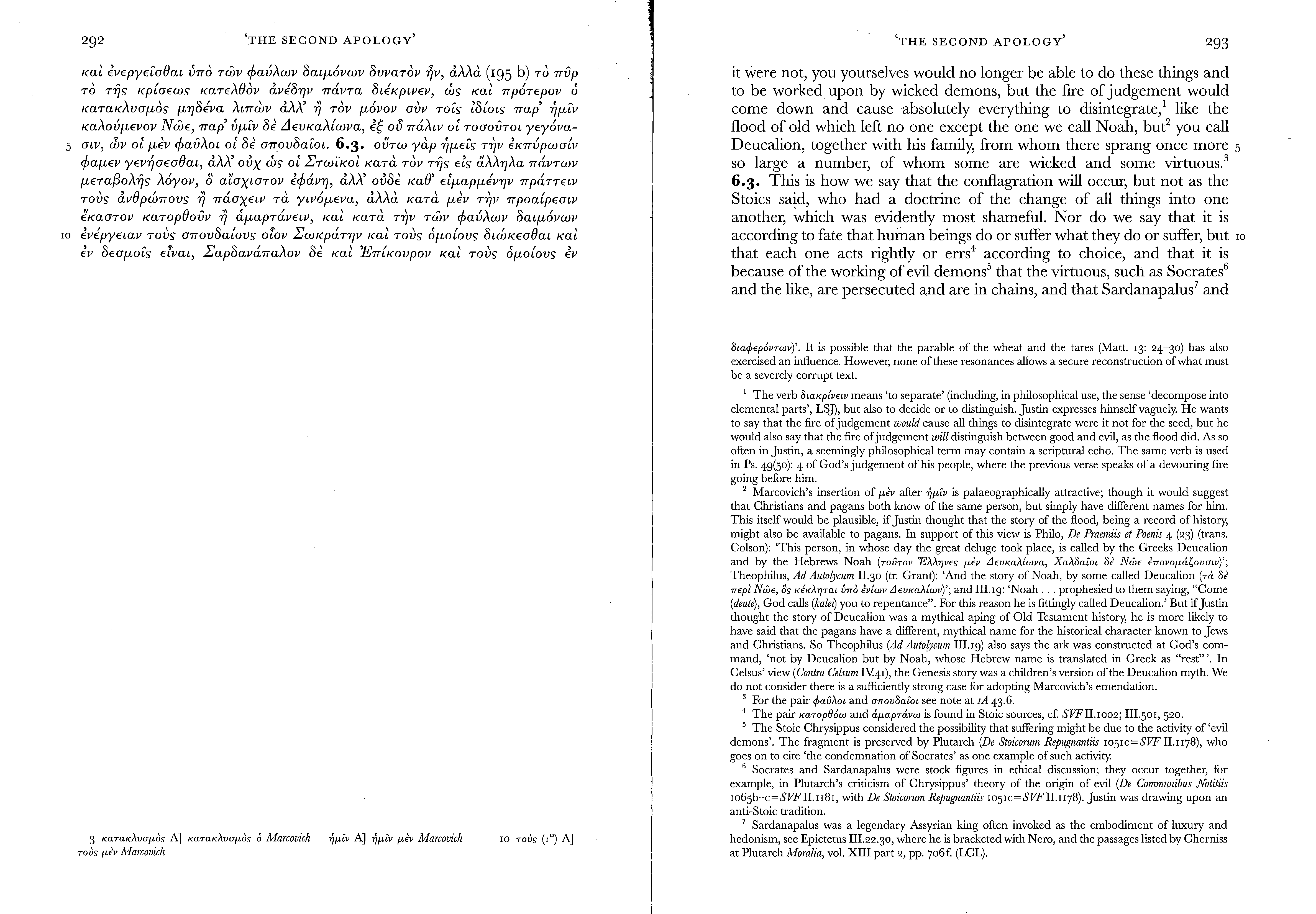
και ενεργείσθαι ύπο των Φαύλων δαιμόνων δυνατον -ην, άλλα (195 b) το πυρ it were not, you yourselves would ηο longer be able to do these things and to be worked. upon by wicked demons, but the fire of judgement would come down and causeabsolutely everything to disintegrate,l like the flood of old which left ηο one except the one we call Ν oah, but2 you call
Deucalion, together with his family, from whom there sprang once more 5 so large a number, of whom some are wicked and some virtuous. 3 το Trις κρίσεως κατελθον άνέδην πάντα διέκρινεν, ώς και πρότερον ό κατακλυσμος μηδένα λιπων άλλ' ij τον μόνον συν τοίς ιδίοις παρ' ήμίν καλούμενον Νωε, παρ' ύμίν δε Δευκαλίωνα, ες 015 πάλιν οί τοσουτοι γεγόνα-
σιν, ών οί μεν Φαυλοι οί δε σπουδαίοι. 6.3. οϋτω γαρ ήμείς την εκπύρωσίν ι θ 'λλ"
( ( Σ ..
\ \ \ Λ , "λλ λ ι αμεν γενησεσ αι, α ουχ ως οι τωικοι κατα τον της εις α η α παντων Φ β λ Λ λ Ι <, ,/ 'Φ Ι 'λλ" δ \ θ' ( Ι ι μετα ο ης ογον, ο αισχιστον ε ανη, α ου ε κα ειμαρμενην πραττειν 6.3. This is how we say that the conflagration will occur, but not as the Stoics satd, who had a doctrine of the change of all things into one another, which was evidently most shameful. Nor do we say that it is according to fate that human beings do or suffer what they do or suffer, but !Ο that each one acts rightly ΟΓ errs4 according to choice, and that it is because of the working of evil demons5 that the virtuous, such as Socrates6 τους άνθρώπους ij πάσχειν τα γινόμενα, άλλα κατα μεν την προαίρεσιν rι θ Λ "
( Ι \ \ \ Λ Φ Ιλ δ ι εκαστον κατορ ουν η αμαρτανειν, και κατα την των αυ ων αιμονων
ενέργειαν τους σπουδαίους οΊον Σωκράτην και τους όμοίους διώκεσθαι και εν δεσμοίς είναι, Σαρδανάπαλον δε και Έπίκουρον και τους όμοίους εν and the like, are persecuted a,nd are ίη chains, and that Sardanapalus7 and διαΦερόντων)" It is possible that the parable of the wheat and the tares (Matt. 13: 24-30) has also exercised an influence. However, none of these resonances allows a secure reconstruction of what must be a severely corrupt text. ι The verb διακρ{νειν means 'to separate' (including, ίη philosophical use, the sense 'decompose into elemental parts', LSj), but also to decide ΟΓ to distinguish. Justin expresses himselfvaguely. He wants to say that the fire of judgement would cause all things to disintegrate were it not for the seed, but he would also say that the fire of judgement will distinguish between good and evil, as the flood did. As so often ίη Justin, a seemingly philosophical term may contain a scriptural echo. The same verb is used ίη Ps. 49(50): 4 of God's judgement of his people, where the previous verse speaks of a devouring fire going before him.
2 Marcovich's insertion of μεν after ήμιν is palaeographically attractive; though it would suggest that Christians and pagans both know of the same person, but simply have different names for him.
This itself would be plausible, if Justin thought that the story of the flood, being a record of history, might also be available to pagans. Ιη support of this view is Philo, De PrαeIniis et Poenis 4 (23) (trans.
Colson): 'This person, ίη whose day the great deluge took place, is called by the Greeks Deucalion and by the Hebrews Noah (τουτον 'Έλληνες μεν Δευκαλ{ωνα, Χαλδαιοι δε Νωε επoνoμά~oυσιν)';
Theophilus, Ad Auto!Jcum Π.30 (tr. Grant): 'And the story of Noah, by some called Deucalion (τα δε περι Νωε, ας κέκληται ύπο εν{ων Δευκαλ{ων)'; and III.Ig: 'Noah ... prophesied to them saying, "Come
(deute), God calls (kαleι) you to repentance". For this reason he is fittingly called Deucalion.' But if Justin thought the story of Deucalion was a mythical aping of Old Testament history, he is more likely to have said that the pagans have a different, mythical name for the historical character known to Jews and Christians. So Theophilus (Ad Auto!Jcuιn III.Ig) also says the ark was constructed at God's command, 'not by Deucalion but by Noah, whose Hebrew name is translated in Greek as "rest" " Ιη
Celsus' view (Contrα Celsum ΙΥ.4Ι), the Genesis story was a children's version of the Deucalion myth. We do not consider there is a sufficiently strong case for adopting Marcovich's emendation.
3 For the pair Φαυλοι and σπουδαιοι see note at ιΑ 43.6.
4The pair κατορθόω and άμαρτάνω is found ίη Stoic sources, cf. SVFII.I002; Πι'50Ι, 520.
5 The Stoic Chrysippus considered the possibility that suffering might be due to the activity of 'evil demons" The fragment is preserved by Plutarch (De Stoicorum Repugnαntiis 105IC=SVF Π.ΙΙ78), who goes οη to cite 'the condemnation of Socrates' as one example of such activity.
6 Socrates and Sardanapalus were stock figures ίη ethical discussion; they occur together, for example, ίη Plutarch's criticism of Chrysippus' theory of the origin of evil (De Comlnunibus Notitiis
I065b-c=SVFII.II8I, with De Stoicorum Repugnαntiis 105IC=SVFII.II78). Justin was drawing upon an anti-Stoic tradition.
7 Sardanapalus was a legendary Assyrian king often invoked as the embodiment of luxury and hedonism, see Epictetus Πι'22.30, where he is bracketed with Nero, and the passages listed by Cherniss at Plutarch ΜοταΖία, νοΙ ΧΙΠ part 2, ρρ. 706 f. (LCL).
'ΤΗΕ SECOND APOLOGY'
'ΤΗΕ SECOND APOLOGY'
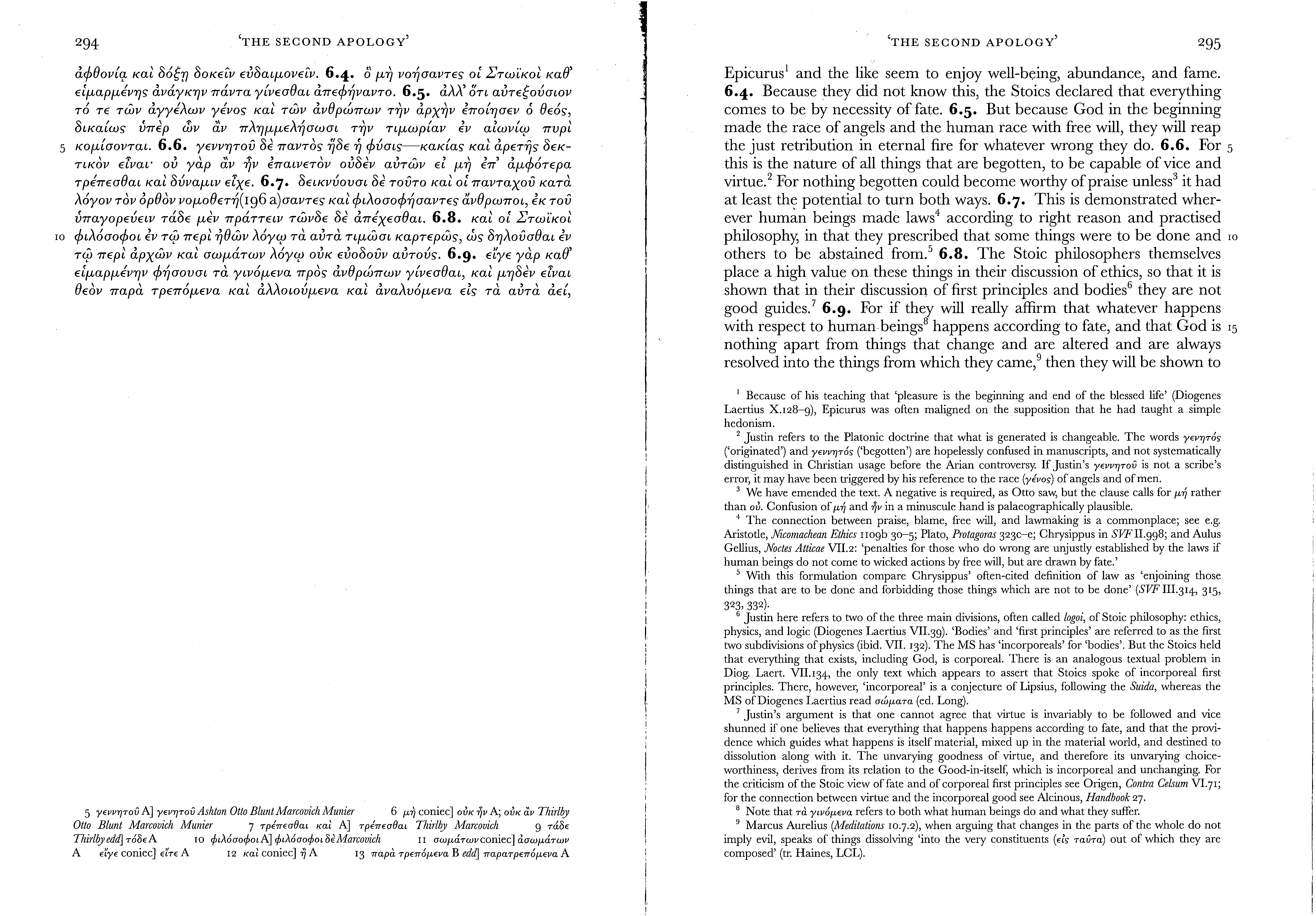
Epicurus 1 and the like seem to enjoy well-being, abundance, and fame.
6.4. Because they did not know this, the Stoics declared that everything comes to be by necessity of fate. 6.5. But because God in the beginning made the rate of angels and the human race with free will, they will reap the just retribution ίη eternal fire for whatever wrong they do. 6.6. For 5 this is the nature of all things that are begotten, to be capable of vice and virtue. 2 For nothing begotten could become worthy of praise unless3 it had at least the potential to turn both ways. 6.,. This is demonstrated wherever humin beings made laws 4 according to right reason and practised philosophy, ίη that they prescribed that some things were to be done and 10 others to be abstained from. 5 6.8. The Stoic philosophers themselves place a high value οη these things ίη their discussion of ethics, so that it is shown that in their discussioIι of first principles and bodies6 they are not good guides. 7 6.9. For if they will really affirm that whatever happens with respect to human-beings8 happens according to fate, and that God is 15 nothing apart from things that change and are altered and are always resolved into the things from which they came,9 then they will be shown to αΦθονίqκαι δόξυ δοκειν ευδαιμονεΙν. 6.4. δ μη vorlaaVTEs οί Στωί'κοι καθ'
'λλ' tt 't ι EιfLapfLEVYJS αναγκην παντα γινεσ αι απε ηναντο. .5. α οτι αυτε~ ουσιον τό τε των αγγέλων γένοs και των ανθρώπων την αρχην εποίησεν ό θεόs, δικαίωs ύπερ ών αν πλημμελήσωσι την τιμωρίαν εν αιωνίιΡ πυρι ι 6 6 ~ δ '
'\"
1'"
\ 'δ \ ,.....
, \'"
Φ ι τικον ειναι· ου γαρ αν ην επαινετον ου εν αυτων ει μη επ αμ οτερα τρέπεσθαι και δύναμιν εΊχε. 6.,. δεικνύουσι δε τουτο και οί πανταχου κατα λόγον τον ορθον νομοθετή(Ι96 a)aaVTES και ΦιλοσοΦήσαντεs ανθρωποι, εκ του ύπαγορεύειν τάδε μεν πράττειν τωνδε δε απέχεσθαι. 6.8. και οί Στωί'κοι
10 ΦιλόσοΦοι εν τψ περι iιθων λόγιΡ τα αυτα τιμωσι KapTEpWS, ώs δηλουσθαι εν τψ περι αρχων και σωμάτων λόγιΡ ουκ ευοδουν αυτούs. 6.9. εϊγε γαρ καθ' ι ,ι "θ / Ι θ 'δ' l' ειμαρμενην ησουσι τα γινομενα προs αν ρωπων γινεσ αι, και μη εν ειναι
• ι φ θεον παρ α τρεπόμενα και άλλοιούμενα και άναλυόμενα είς τα αύτα άεί, ι Because of his teaching that 'pleasure is the beginning and end of the blessed life' (Diogenes
Laertius X.128-g), Epicurus was often maligned οπ the supposition that he had taught a simple hedonism.
2 Justin refers to the Platonic doctrine that what is generated is changeable. The words γεν7]τ6,
('originated') and γεννητ6, ('begotten') are hopelessly confused in manuscripts, and not systematically distinguished ίπ Christian usage before the Arian controversy. If Justin's γεννητου is not a scribe's enor, it may have been triggered by his reference to the race (γένο,) of angels and of men.
3 We have emended the text. Α negative is required, as Otto saw, but the clause calls for μή rather than ου. Confusion of μή and .ην in a minuscule hand is palaeographically plausible.
4 The connection between praise, blame, free will, and lawmaking is a commonplace; see e.g.
Aristotle, Nicol11αcheαll Ethics IIogb 30-5; Plato, PΤotαgorαs 323c-e; Chrysippus in STlFII.gg8; and Aulus
Gellius, Noctes Atticαe VI1'2: 'penalties for those who do wrong are unjustly established by the laws if human beings do not come to wicked actions by free will, but are drawn by fate.'
5 With this formulation compare Chrysippus' often-cited definition of law as 'enjoining those things that are to be done and forbidding those things which are not to be done' (SVF ΙΙ1'3 1 4, 315,
323,332).
6 Justin here refers to two of the three main divisions, often called logoi, of Stoic philosophy: ethics, physics, and logic (Diogenes Laertius VII.39). 'Bodies' and 'first principles' are refened to as the first two subdivisions ofphysics (ibid. νΙl. 132). The MS has 'incorporeals' for 'bodies'. But the Stoics held that everything that exists, including God, is corpΟΓeal. There is an analogous textual problem in Diog. LaeΓΙ VI1'134, the only text which appears to assert that Stoics spoke of incorporeal first principles. ΤheΓe, ho'"vever, 'ίncοrΡΟΓeal' is a conjecture of Lipsius, following the Suidα, whereas the MS ofDiogenes LaeΓtius read σώματα (ed. Long).
7 Justin's argument is that one cannot agree that viTtue is invaΓiabΙΥ to be followed and vice shunned if one believes that everything that happens happens aCCOΓding to fate, and that the providence which guides what happens is itself material, mixed up ίπ tlle material world, and destined to dissolution along with it. The unvarying goodness of virtue, and therefore its unvarying choiceworthiness, derives from its relation to the Good-in-itself, which is incorporeal and unchanging. For the criticism of the Stoic view of fate and of corporeal first principles see Origen, CΟlltτα Celsum VI. 71; for the connection between virtue and the incorporeal good see Alcinous, Hαndbook 27.
5 γεννητου Α] γενητοvΑshtοn Otto BlulltAιfαrcovic!zMullier 6 μη coniec] ουκ.ην Α; ουκ αν Thirlby Otto Blullt Λιfα1"COvίch Aιfullier 7 τρέπεσθαι και Α] τρέπεσθαι T1zil-llJ)I Λιfαrcovίch 9 τάδε Thirlb.JIeddJ τ6δεΑ 10 Φιλ6σοΦοιΑ] Φιλ6σοΦοι δεΛιfαrcovίc!ι ΙΙ σωμάτωνcοniec] ασωμάτων 8 Note that τα γιν6μενα refers to both what human beings do and what they suffer.
9 Marcus Aurelius (Aιfeditαtioιιs 10.7.2), when arguing that changes in the parts of the whole do not imply evil, speaks of things dissolving 'into the very constituents (ει, ταυτα) out of which they are composed' (tr. Haines, LCL).
Α ειγε coniec] ειτε Α 12 και coniec] 1) Α 13 παρα τρεπ6μενα Β eddJ παρατρεπ6μενα Α
'ΤΗΕ SECOND APOLOGY'
'ΤΗΕ SECOND APOLOGY'
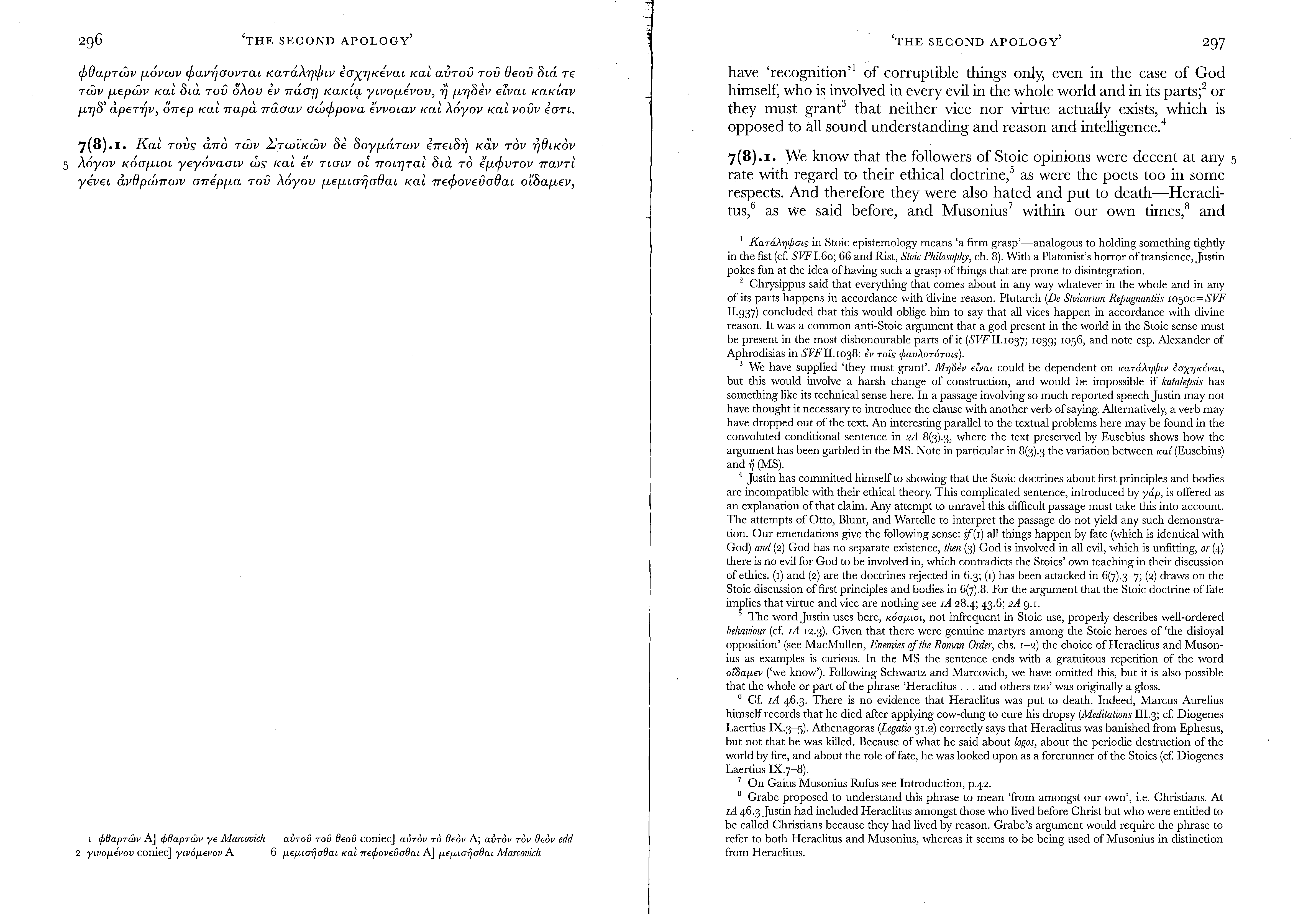
have 'recognition'l of corruptible things only, even ίη the case of God himself, who is involved ίη every evil ίη the whole world and ίη its parts;2 ΟΓ they must grant3 that neither vice ηΟΓ virtue actually exists, which is opposed to all sound understanding and reason and intelligence.4
Φθαρτων μόνων Φανήσονται κατάληψιν Εσκηκέναι και αυτου του θεου διά τε των μερων και δια του ολου Εν 1Τάσυ κακίq, γινομένου, ~ μYjδεν εΊναι κακίαν
' , Ι tl \ \ Λ / Φ"
\ λ / 'Λ' μΥ] apETYjV, 01Τερ και 1Ταρα 1Τασαν σω ρονα εννοιαν και ογον και νουν εστι.
δ 7(8).1. Και TOVS α1ΤΟ των Στωϊκων δε δογμάτων Ε1ΤειδΎι καν τον ήθικον ' ι ι ('. \"
\ δ \ \"
ογον κοσμιοι γεγονασιν wS και εν τισιν οι 1ΤΟΙYjται ια το εμ υτον 1Ταντι 7(8).1. We know that the followers of Stoic opinions were decent at any 5 rate with regard to their ethical doctrine,5 as were the poets too ίη some respects. And therefore they were also hated and put to death-Heraclitus,6 as We said before, and Musonius7 within our οννn times,8 and λ γένει ανθρώ1Των σ1Τέρμα του λόγου μεμισησθαι και 1ΤεΦονευσθαι οϊδαμεν,
1 Κατάληψσις ίη Stoic epistemology means 'a firm grasp'-analogous to holding something tight1y ίη the fist (c[ SVFI.60; 66 and Rist, Stoic Pllilosoplιy, ch. 8). With a Platonist's horror oftransience, Justin pokes fun at the idea of having such a grasp of things that are prone to disintegration.
2 Chrysippus said that everything that comes about ίη any way whatever ίη the whole and ίη any of its parts happens in accordance with 'divine reason. Plutarch (De Stoicorum RepugnantiΊS 1050C = STIF
Π.937) concluded that this would oblige him to say that all vices happen ίη accordance with divine reason. It was a common anti-Stoic argument that a god present ίη the world ίη tlle Stoic sense must be present ίη the most dishonourable parts ofit (SVF Π. 1037; 1039; 1056, and note esp. Alexander of Aphrodisias ίη STIFII.1038: εν τοις Φαυλοτότοις).
3 We have supplied 'they must grant'. Μηδεν είναι could be dependent οη κατάληψιν εσχηκέναι, but this would involve a harsh change of construction, and would be impossible if katalepSΊS has something like its technical sense here. Ιη a passage involving so much reported speech Justin may not have thought it necessary to introduce the clause with another verb of saying. Alternatively, a verb may have dropped out of the text. Αη interesting parallel to the textual problems here may be found ίη the convoluted conditional sentence ίη 2Α 8(3).3, where the text preserved by Eusebius shows how the argument has been garbled in the MS. Note ίη particular ίη 8(3).3 the variation between κα{ (Eusebius) andTί (MS).
+ Justin has committed himself to showing that the Stoic doctrines about first principles and bodies are incompatible with their ethical theory. This complicated sentence, introduced by γάρ, is offered as an explanation of that claim. Any attempt to unravel this difficult passage must take this into account.
The attempts of Otto, Blunt, and Wartelle to interpret the passage do not yield any such demonstration. Our emendations give the following sense: ij(I) all things happen by fate (which is identical with God) and (2) God has ηο separate existence, tlzell (3) God is involved ίη all evi1, which is unfitting, or ω there is ηο evi1 for God to be involved ίη, which contradicts the Stoics' own teaching ίη their discussion of ethics. (1) and (2) are the doctrines rejected ίη 6.3; (1) has been attacked ίη 6(7).3-7; (2) draws οη the Stoic discussion of first principles and bodies ίη 6(7).8. For the argument that the Stoic doctrine of fate implies that virtue and vice are nothing see ιΑ 28.4; 43.6; 2Α 9.1.
5 The word Justin uses here, κόσμιοι, not infrequent ίη Stoic use, properly describes well-ordered behaviour (c[ ιΑ 12.3). Given that there were genuine martyrs among the Stoic heroes of 'the disloyal opposition' (see MacMullen, Enemies qfthe R01llan O,da, chs. 1-2) the choice ofHeraclitus and Musonius as examples is curious. Ιη the MS the sentence ends with a gratuitous repetition of the word οίδαμεν ('we know'). Following Schwartz and Marcovich, we have omitted this, but it is also possible that the whole ΟΓ part of the phrase 'Heraclitus ... and others too' was originally a gloss.
G C[ ιΑ 46.3. There is ηο evidence that Heraclitus was put to death. Indeed, Marcus Aurelius himself records that he died after applying cow-dung to cure his dropsy (lιιJeditatioιιs Πι'3; c[ Diogenes
Laertius ΙΧ.3-5). Athenagoras (Legatio 31.2) correct1y says that Heraclitus was banished from Ephesus, but not that he was killed. Because of what he said about logos, about the periodic destruction of the world by fire, and about the role offate, he was looked upon as a forerunner ofthe Stoics (c[ Diogenes
Laertius ΙΧ.7-8).
7 Οη Gaius Musonius Rufus see Introduction, Ρ-42 .
8 Grabe proposed to understand this phrase to mean 'from amongst our own', i.e. Christians. At ιΑ 46.3 Justin had included Heraclitus amongst those who lived before Christ but who were entit1ed to be called Christians because they had lived by reason. Grabe's argument would require the phrase to refer to both Heraclitus and Musonius, whereas it seems to be being used of Musonius ίη distinction from Heraclitus.
1 ΦθαΡΤ(lJν Α] Φθαρτων γε Λιfαιωvίch afJTOiJ τού θεού coniec] afJTOV το θεον Α; afJTOV τον θεον edd
2 γινομένου coniec] γινόμενον Α 6 μψισησθαι και πεΦονεύσθαι Α] μψισησθαι lιιJarcovich
'ΤΗΕ SECOND APOLOGY'
'ΤΗΕ SECOND APOLOGY'
Ή /λ ,.
/Φ , Μ / δ"
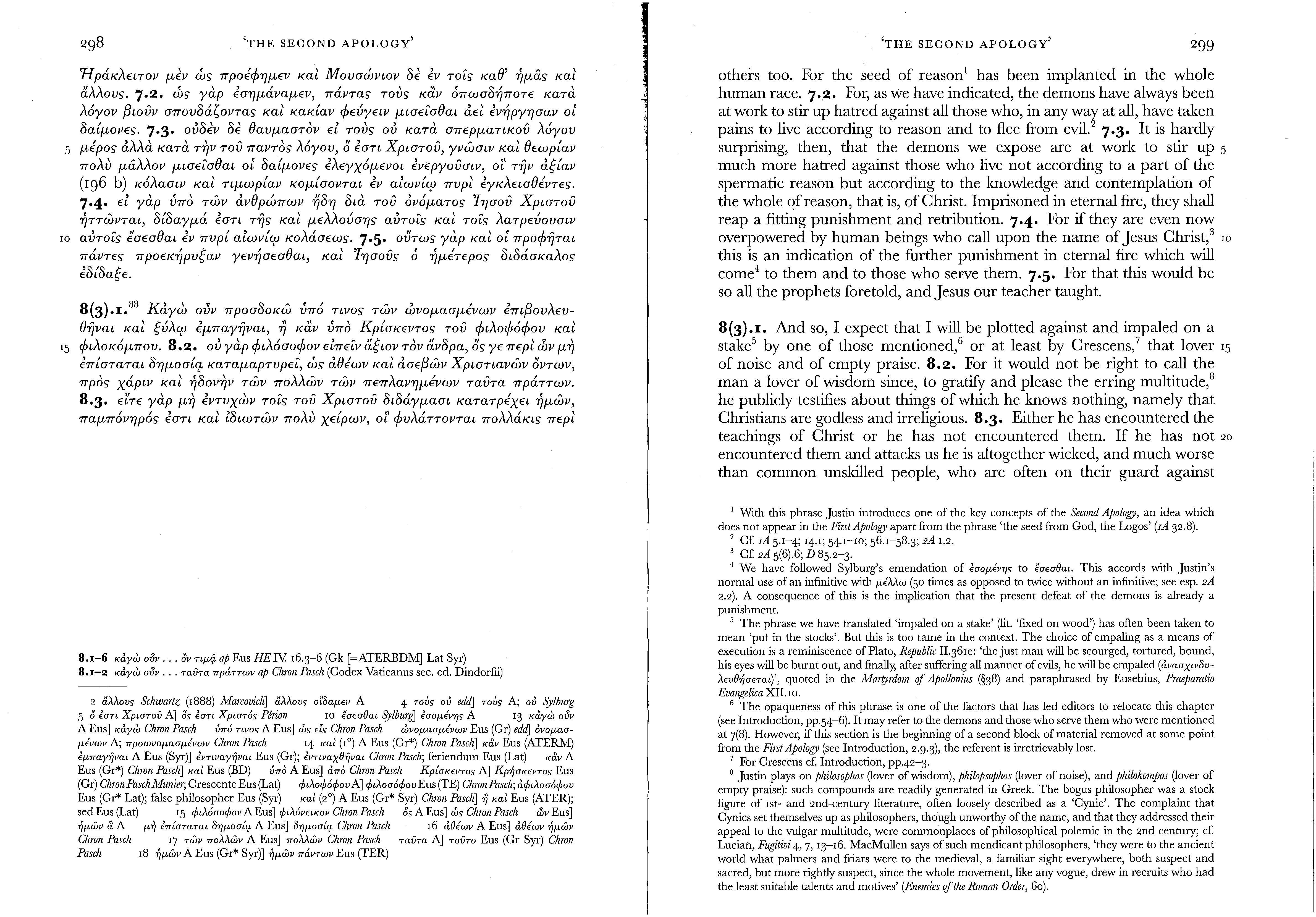
Λ , ρακ ειτον μεν ως προε ημεν και ουσωνιον ε εν τοις κα ημας και others too. For the seed of reason 1 has been implanted in the whole human race. 7.2. For, as we have indicated, the demons have always been at work to stir υρ hatred against all those who, ίη any way at all, have taken pains to live according to reason and to flee from evil.2 7.3. It is hardly surprising, then, that the demons we expose are at work to stir υρ 5 much more hatred against those who live not according to a part of the spermatic reason but according to the knowledge and contemplation of the whole qf reason, that is, of Christ. Imprisoned in eternal fire, they shall reap a fitting punishment and retribution. 7.4. For if they are even now overpowered by human beings who call υροη the name of Jesus Christ,3 10 this is an indication of the further punishment ίn eternal fire which will come4 to them and to those who serve them. 7.5. For that this would be so all the prophets foretold, and Jesus ουΓ teacher taught. αλλους. 7.2. ώς γαρ εσημάναμεν, πάντας τους καν όπωσδήποτε κατα λ / β Λ δ/Υ ,/ Φ / Λ θ '"
/ • ογον ιουν σπου α~oνTας και κακιαν ευγειν μισεισ αι αει ενηργησαν οι δαίμονες. 7.3. ουδεν δε θαυμαστον ει τους ου κατα σπερματικου λόγου
5 μέρος άλλα κατα την του παντος λόγου, Ο εστι Χριστου, γνωσιν και θεωρίαν πολυ μαλλον μισεισθαι οί δαίμονες ελεγχόμενοι ενεργουσιν, οί' Tijv άξίαν
( 6 b) /λ '
7.4. ει γαρ ύπο των ανθρώπων ~δη δια του όνόματος 'Ιησου Χριστου ήττωνται, δίδαγμά εστι τijς και μελλούσης αυτοις και τοις λατρεύουσιν
, .ι"'\" θ' ι, Ι λΙ r!, \ ( ΦΛ
αυτοις εσεσ αι εν πυρι αιωνιιΡ κο ασεως. 7.5. ουτως γαρ και οι προ ηται πάντες προεκήρυξαν γενήσεσθαι, και 'Ιησους ό ήμέτερος διδάσκαλος εδίδαξε.
8(3).1.88 Κάγω οδν προσδοκω ύπό τινος των ώνομασμένων επιβουλευ 8(3).1. And so, Ι expect that Ι will be plotted against and impaled οη a stake5 by one of those mentioned,6 ΟΓ at least by Crescens,7 that lover 15 of noise and of empty praise. 8.2. For it would not be right to Call the man a lover of wisdom since, to gratify and please the erring multitude,8 he publicly testifies about things of which he knows nothing, namely that Christians are godless and irreligious. 8.3. Either he has encountered the teachings of Christ ΟΓ he has not encountered them. If he has not 20 encountered them and attacks us he is altogether wicked, and much worse than common unskilled people, who are often οη their guard against θijναι και ξύλιΡ εμπαγijναι, η καν ύπο Κρίσκεντος του ΦιλοψόΦου και
"Φ λ/ Φ 'Λ "C ,,' δ"
'1"
Ι οκομπου. .2. ου γαρ ι οσο ον ειπειν ας ιον τον αν ρα, ος γε περι ων μη επίσταται δημοσίq, καταμαρτυρει, ώς άθέων και άσεβων Χριστιανων οντων, προς χάριν και ήδονην των πολλων των πεπλανημένων ταυτα πράττων.
8.3. εϊτε γαρ μη εντυχων τοις του Χριστου διδάγμασι κατατρέχει ήμων, / /, "δ Λ λ ,/ "Φ λ / λλ / , παμπονηρος εστι και ι ιωτων πο υ χειΡων, οι υ αττονται πο ακις περι ι With this phrase Justin introduces one of the key concepts of the SecOlld Apology, an idea which does not appear ίη the FirstApology apart from the phrase 'the seed from God, the Logos' (ιΑ 32.8).
2 Cf. ιΑ 5.1-4; 1+1; 54.1-10; 56.1-58.3; 2Α 1.2.
3 Cf. 2Α 5(6).6; D 85.2-3.
4We have followed Sylburg's emendation of εσομένη, to εσεσθαι. This accords with Justin's normal use of an infinitive with μέλλω (50 times as opposed to twice without an infinitive; see esp. 2Α
2.2). Α consequence of this is the implication that the ΡΓeseηt defeat of the demons is already a punishment.
5 The phrase we have tΓaηsΙated 'impaled οη a stake' ~it. 'fixed οη wood') has often been taken to mean 'put in the stocks'. But this is too tame ίη the context. The choice of empaling as a means of execution is a reminiscence ofPlato, Republic II.36Ie: 'the just man will be SCOUΓged, tΟΓtured, bound, his eyes will be burnt out, and finally, after suffering all mannel" of evils, he will be empaled (ανασχινδυ
8.1-6 καγω oVv . .. ον τιμι} αρ Eus HEΊV. 16.3-6 (Gk [=ATERBDNIJ Lat Syr) 8.1-2 καγω oVv ... ταυτα 'Πράττων αρ ασΟIl Ραπlι (Codex Vaticanus sec. ed. Dindorfii) λευθήσεται)', quoted in the Λ1αrt;ιrdOlIl qf Apollollius (§38) and paraphrased by Eusebius, Praeparatio
Evaιιgelica ΧΠ.ω.
2 άλλου, Schwartz (1888) lvfarcoviclz] άλλου, οϊδαμεν Α 4 του, ού edd] του, Α; ού !iJιΙbισg 5 ο εστι ΧριστοΙι Α] ο, εστι Χριστό, PeI701l
10 εσεσθαι !iJιlburg] εσομένη, Α 13 καγω oVv 6 The opaqueness of this ΡhΓase is one of the factors that has led editors to relocate this chapter
(see lηtroductioη, ΡΡ.54-6). It may refel" to the demons and those who seΓve them who were mentioned at 7(8). ΗοweveΓ, if this section is the beginning of a second block of mateΓίa1 removed at some point from the FirstApology (see lηtroductίoη, 2.9.3), the referent is irretrievably 10st.
Α Eus] καγω αΠΟIl Pαscll ύ'Πό τινος Α Eus] ώς ε[, Chron Ραπlι ωνομασμένων Eus (Gr) edd] ονομασ μένων Α; 'Προωνομασμένων Chroιz Pαsch 14 και (10) Α Eus (Gr*) Chron Pαsch] καν Eus (ATERM) εμ'Παγηναι Α Eus (Syr)] εντιναγηναι Eus (Gr); εντιναχθηναι αποιι Pαscll; feriendum Eus (Lat) καν Α Eus (Gr*) αΠΟIl Pαscll] και Eus (BD) ύ'Πο Α Eus] α'Πο Chron Pαscll Κρίσκεντο> Α] Κρήσκεντο> Eus (Gr) C/zroIlPαscllMullier, Crescente Eus (Lat)
ΦιλοψόΦουΑ] ΦιλοσόΦου Eus (ΤΕ) ChrollPαscll; αΦιλοσόΦου Eus (Gr* Lat); false philosopher Eus (Syr) και (20) Α Eus (Gr* Syr) C/zron Pαscll] 7j και Eus (ATER); sed Eus (Lat) 15 ΦιλόσοΦον Α Eus] Φιλόνεικον Chron Pαscll ος Α Eus] ώς ChI"01l Pasch ιLν Eus] 7 For Crescens cf. lηtroductioη, ΡΡ-42-3.
8 Justin plays οη philosophos ~over of wisdom), philopsoplιos ~over of noise), and philokOlIlpos ~ovel" of empty praise): such compounds are readily generated ίη Greek. The bogus philosopher was a stock figure of IStand 2ηd-ceηtuΓΥ literature, often loosely described as a 'Cynic'. The complaint that Cynics set themselves up as philosophers, though unworthy of the name, and that they addressed their appeal to the vulgar multitude, were commonplaces of philosophical polemic ίη the 2lld century; cf.
Lucian, Fugitivi 4,7, 13-16. MacMullen says of such mendicant ΡhilΟSΟΡheΓS, 'they weΓe to the ancient ήμων α Α μη ε'Πίσταται δημοσίqΑ Eus] δημοσίqClzron Pαsch
16 αθέων Α Eus] αθέων ήμων C/zroll Pαsch Ι7 των 'Πολλων Α Eus] 'Πολλων C/zroll Pαsch ταυτα Α] TOVTO Eus (Gr Syr) ClzrOll Pαscll 18 ήμων Α Eus (Gr* Syr)] ήμων 'Πάντων Eus (TER)
WΟΓld what palmers and friars weΓe to the medieval, a familial" sight everywheΓe, both suspect and sacγed, but more rightly suspect, since the whole movement, like any vogue, dΓew ίη recruits who had the least suitable talents and motives' (ElleInies qfthe RoInall O/'der, 60).
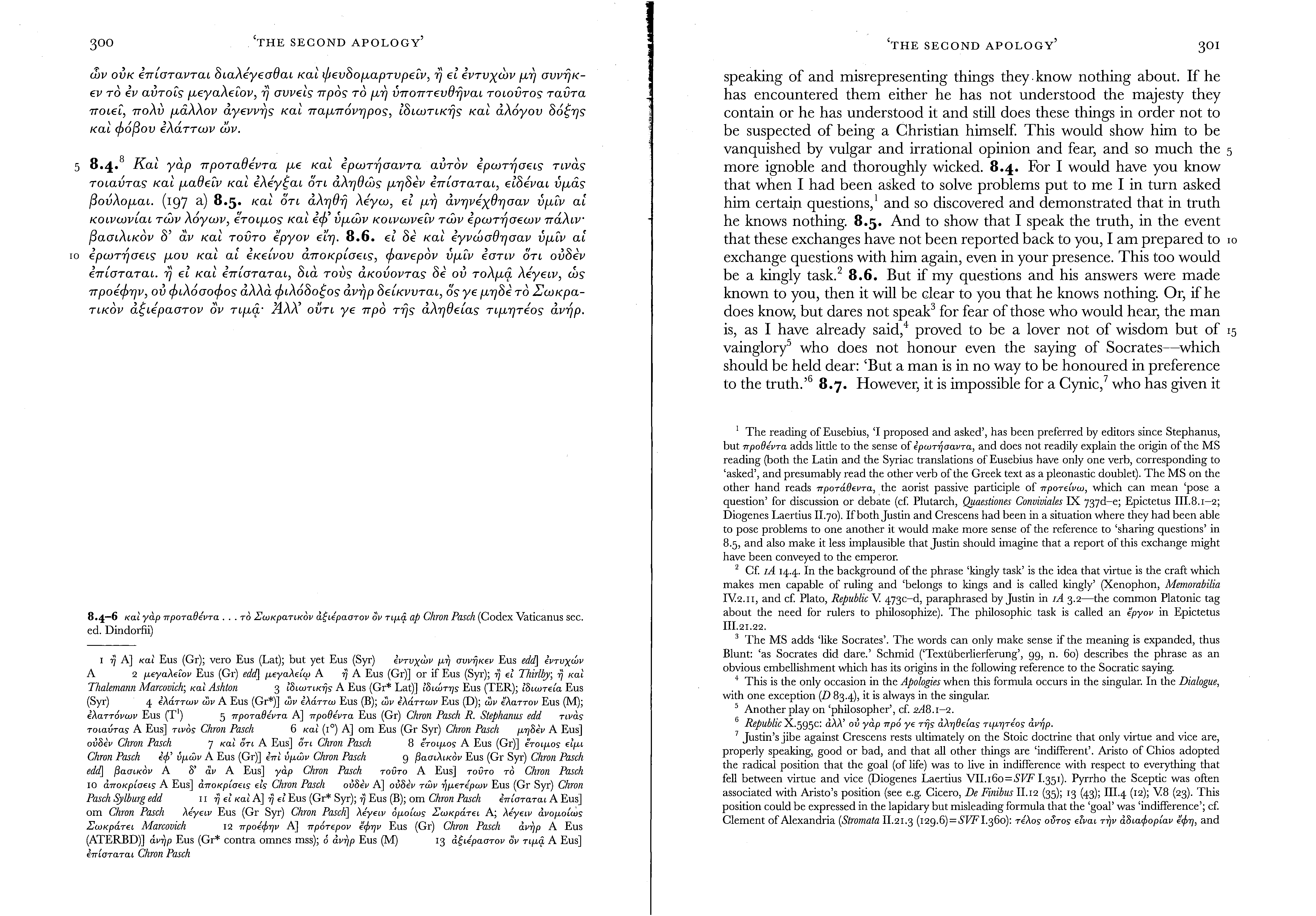
'ΤΗΕ SECOND APOLOGY'
'ΤΗΕ SECOND APOLOGY'
, , , δ λ' θ ',1. δ Λ "
, , Λ ων ουκ επιστανται ια εγεσ αι και ψευ ομαρτυρειν, Ύj ει εντυχων μΎj συνΎjKspeaking of and misrepresenting things they. know nothing about. If he has encountered them either he has not understood the majesty they contain ΟΓ he has understood it and still does these things in order not to be suspected of being a Christian himself. This would show him to be vanquished by vulgar and irrational ορίηίοη and fear, and so much the 5 more ignoble and thoroughly wicked. 8.4. For Ι would have you know that when Ι had been asked to solve problems put to me Ι ίη turn asked him certaip. questions,l and so discovered and demonstrated that ίη truth he knows nothing. 8.5. And to show that Ι speak the truth, ίη the event that these exchanges have not been reported back to you, Ι am prepared to ΙΟ exchange questions with him again, even ίη your presence. This too would be a kingly task. 2 8.6. But if my questions and his answers were made known to you, then it will be clear to you that he knows nothing. Or, if he does know, but dares not speak3 for fear of those who would hear, the man is, as Ι have already said,4 proved to be a lover not of wisdom but of 15 vainglor/ who does not honour even the saying of Socrates-which should be held dear: 'But a man is ίη ηο way to be honoured ίη preference to the truth.'6 8.7. However, it is impossible for a Cynic,Ί who has given it εν το εν αυτοίς μεγαλείον, ~ συνεις προς το μ~ ύποπτευθijναι τοιουτος ταυτα
, , , 'δ Λ "λ ι δ ι c ποιει, πο υ μα ον αγεννΎjς και παμπoνΎjpoς, ι ιωηKΎjς και α ογου o~ Ύjς 'Φ'β 'λ'
5 8.4.8 Και γαρ προταθέντα με και ερωτήσαντα αυτον ερωτήσεις ηνας τοιαύτας και μαθείν και ελέγςαι ση άλΎjθως μΎjδεν επίσταται, είδέναι ύμας βούλομαι. (197 a) 8.5. και ση άλΎjθij λέγω, εί μ~ άνΎjνέXθΎjσαν ύμίν αί κοινωνίαι των λόγων, ετοιμος και εφ' ύμων κοινωνείν των ερωτήσεων πάλιν' β λ ' δ'"
, Λ"
"8 6 'δ '
'θ • Λ • ασι ικον αν και τουτο εργον EιΎj. •• ει ε και εγνωσ Ύjσαν υμιν αι ,Ι \ Ι, Ι , Ι Φ \ Ι.ι"\' ιl 'δ '
ΙΟ εpωTΎjσεις μου και αι εκεινου αποκρισεις, ανερον υμιν εσην οη ου εν επίσταται. ~ εί και επίσταται, δια τους άκούοντας δε ου τολμij. λέγειν, ώς πpOέΦΎjν, ου ΦιλόσοΦος άλλα Φιλόδοςος άν~p δείκνυται, σς γε μΎjδε το Σωκρα ηκον άςιέραστον ον nIλij.· Άλλ' ουη γε προ τijς άλΎjθείας ημΎjTέOς άνήρ. ι The reading ofEusebius, 'Ι proposed and asked', has been preferred by editors since Stephanus, but προθέντα adds little to the sense of ερωτήσαντα, and does not readily explain the origin ofthe MS reading (both the Latin and the Syriac translations of Eusebius have only one verb, corresponding to 'asked', and presumably read the other verb of the Greek text as a pleonastic doublet). The MS οπ the other hand reads προτάθεντα, the aorist passive participle of προτείνω, which can mean 'pose a question' for discussion οτ debate (cf. Plutarch, QJιαestioιzes Coιzviviαles ΙΧ 737d-e; Epictetus 111.8.1-2;
Diogenes LaeΓtius 11.70). IfbothJustin and Crescens had been in a situation where they had been able to pose problems to one another it would make more sense of the reference to 'sharing questions' in 8.5, and also make it less implausible that Justin should imagine that a report of this exchange might have been conveyed to the emperor.
2 Cf. ιΑ 14+ 1π the background of the ΡhΓase 'kingly task' is the idea that virtue is the craft which makes men capable of ruling and 'belongs to kings and is called kingly' (Xenophon, .Λιfemοι·αbίlία
1Υ.2.ιι, and cf. Plato, Republic Υ. 473c-d, paraphrased by Justin in ιΑ 3.2-the common Platonic tag about the need for rulers to philosophize). The philosophic task is called an εργον in Epictetus
111.21.22.
8'4-6 και γαρ προταθέντα . .. το Σωκρατικον άξιέραστον ον TLfLq. αρ C!ποn Ραιch (Codex Vaticanus sec. ed. Dindorfii) 3 The MS adds '1ike Socrates'. The words can only make sense if the meaning is expanded, thus
Blunt: 'as Socrates did dare.' Schmid ('ΤeχtίiberΙierfeωng', 99, n. 60) describes the phrase as an obvious embellishment which has its origins in the following reference to the Socratic saying.
Ι η Α] και Eus (Gr); vero Eus (Lat); but yet Eus (Syr) εντυχων μη συνηκεν Eus ed~ εντυχών Α 2 μεγαλειον Eus (Gr) ed~ μεγαλείψ Α η Α Eus (Gr)] or if Eus (Syr); η ει Thirlby; η και
4 This is the only occasion in the Apologies when this formula occurs in the singular. 1π the Diαlogue, with one exception (D 83.4), it is always in the singular.
ΤhαΙenιαιιιι Mαrcovich; και Ashton 3 ιδιωτικηι; Α Eus (Gr* Lat)] ιδιώτηι; Eus (TER); ιδιωτεία Eus
(Syr) 4 ελάττων ων Α Eus (Gr*)] ων ελάττω Eus (Β); ων ελάττων Eus (D); ων ελαττον Eus (Μ);
5 Another play οπ 'philosopher', cf. 2Α8.1-2. ελαττόνων Eus (ΤΙ) 5 προταθέντα Α] προθέντα Eus (Gr) C!ποιι Ραιch R. Stephαnus edd τιναι; 6 Republic X.595c: άλλ' ου γαρ πρό γε τηι; άληθείαι; τψψέοι; άνήρ. τοιαύται; Α Eus] τινοι; Chron Ραιι!ι 6 και (10) Α] om Eus (Gr Syr) Chroιz Ραιι!ι μηδεν Α Eus] 7 Justin's jibe against Crescens rests ultimately οπ the Stoic doctrine that only virtue and vice are, properly speaking, good or bad, and that all other things are 'indifferent'. AΓisto of Chios adopted the radical position that the goal (of life) was to live in indifference with respect to everything that fell between virtue and vice (Diogenes Laertius VI1.160=SΤΙF 1.351). Pyrrho the Sceptic was often associated with AΓisto's position (see e.g. Cicero, De Finibzιs 11.12 (35); 13 (43); 1114 (12); Υ.8 (23). Tllis position could be expressed in the lapidary but misleading formula that the 'goal' was 'indifference'; cf.
Clement of Alexandria (Stl'omαtα 11.21.3 (129.6) = SVFI.360): τέλοι; OVTOS είναι την άδιαΦορίαν εΦη, and ουδεν Chroιz Ραιch 7 και ότι Α Eus] ότι Chron Ραιι!ι 8 Ετοψο'} Α Eus (Gr)] έτοψο'} ειμι Chroιz Ραιch εφ' ύμων Α Eus (Gr)] επι ύμων Chroιz Ραιch
9 βασιλικον Eus (Gr Syr) Chr01l Ραιch ed~ βασικον Α δ' αν Α Eus] γαρ Chron Ραιch τουτο Α Eus] τουτο το Chroιz Ραιch ΙΟ άποκρίσειι; Α Eus] άποκρίσειι; ειι; Ch"OIl Ραιι!ι ουδεν Α] ουδεν των ήμετέρων Eus (Gr Syr) Chron
Ραιch Sylburg edd ΙΙ η ει και Α] η ει Eus (Gr* Syr); η Eus (Β); om C!zroιz Ραιι!ι επίσταται Α Eus] om Chroιz Ραιch λέγειν Eus (Gr Syr) C!ποιι Ραιι!ι] λέγειν όμοίωι; Σωκράτει Α; λέγειν άνoμoί~ι;
Σωκράτει AιIαrcovich 12 πpoέΦrιv Α] πρότερον εφrιv Eus (Gr) C!ποιι Ραιι!ι άνηρ Α Eus (ATERBD)] άνηρ Eus (Gr* contra omnes mss); ό άνηρ Eus (Μ)
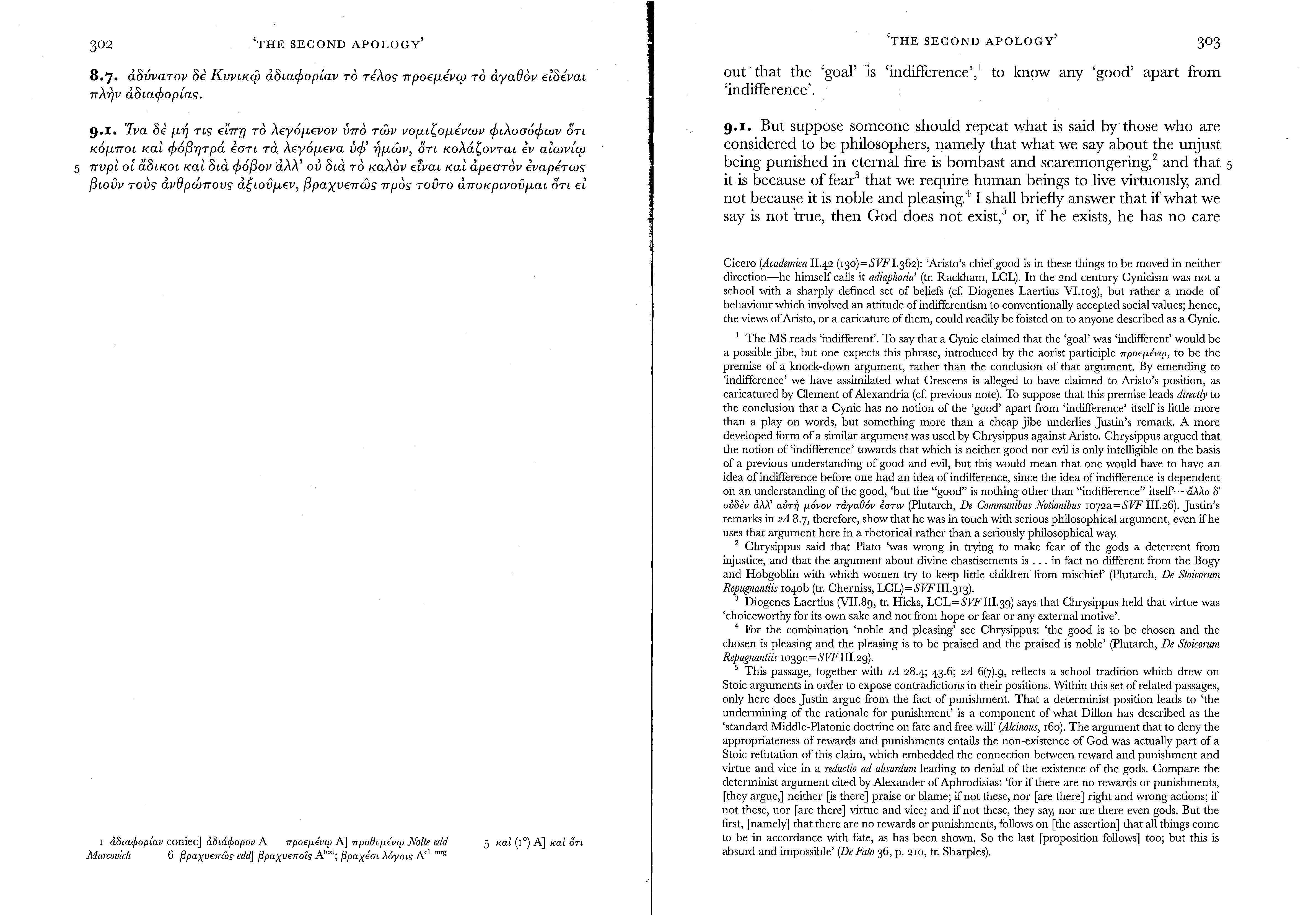
'ΤΗΕ SECOND APOLOGY'
'ΤΗΕ SECOND APOLOGY'
out tllat the 'goal' 1S 'indifference', ι to kn9w any 'good' apart from 'indifference' .
'δ ι .7. α υνατον ε υνικψ α ια οριαν το τε ος προεμενψ το αγα ον ει εναι πλ~ν αδιαΦορίας.
'1 δ ,ι "
9.1. να ε μη τις ειπτι το εγομενον υπο των νομι':,ομενων ι οσο ων οτι 9.1. But suppose someone should repeat what is said by' those who are considered to be philosophers, namely that what we say about the unjust being punished ίη eternal fire is bombast and scaremongering,2 and that 5 it is because of fear3 that we require human beings to live virtuously, and not because it is noble and pleasing.4 Ι shall briefly answer that if what we say is not true, then God does not exist,5 or, if he exists, he has ηο care ι , Φ ιβ Ι, 'λ ι tφ' t ~" λ ι Υ "ι κομποι και ο ητρα εστι τα, εγομενα υ ημων, οτι κο α':,ονται εν αιωνιψ , t 'Ιδ 'δ ' Φ ιβ ·'λλ' , δ' , λ'
'ί'
, , " ι
πυρι οι α ικοι και ια ο ον α ου ια το κα ον ειναι και αρεστον εναρετως βιουν τους ανθρώπους αξιουμεν, βραχυεπως προς τουτο αποκρινουμαι στι ει
Cicero (Acadenzica Π.42 (130)=STlFI.362): 'Aristo's chiefgood is in these things to be moved in neither direction-he himself calls it adiaphorίa' (tr. Rackham, LCL). Ιη the 2nd century Cynicism was not a school with a sharply defined set of beliefs (cf. Diogenes Laertius VI.I03), but rather a mode of behaviour which involved an attitude of indi:fferentism to conventionally accepted social values; hence, the views of Aristo, or a caricature of them, could readily be foisted οη to anyone described as a Cynic. ι The MS reads 'indi:fferent'. Το say that a Cynic claimed that the 'goal' was 'indi:fferent' would be a possible jibe, but one expects this phrase, introduced by the aorist participle προεμένφ, to be the premise of a knock-down argument, rather than the conclusion of that argument. ΒΥ emending to 'indi:fference' we have assimilated what Crescens is alleged to have claimed to Aristo's position, as caricatured by Clement of Alexandria (cf. previous note). Το suppose that this premise leads directbI to the conclusion that a Cynic has ηο notion of the 'good' apart from 'indi:fference' itself is little more than a play οη words, but something more than a cheap jibe underlies Justin's remark. Α more developed form of a similar argument was used by Chrysippus against Aristo. Chrysippus argued that the notion of 'indi:fference' towards that which is neither good nor evil is only intelligible οη the basis of a previous understanding of good and evil, but this wocld mean that one would have to have an idea of indi:fference before one had an idea of indi:fference, since the idea of indi:fference is dependent οη an understanding ofthe good, 'but the "good" is nothing other than "indi:fference" itseΙf'-αλλο δ' ουδεν dλλ' αυτη μ6νον Tdyae6v εστιν (Plutarch, De C01nInunibus Notionibus I072a=SVF ΠΙ.26). Justin's remarks in 2Α 8.7, therefore, show that he was in touch with serious philosophical argument, even ifhe uses that argument here in a rhetorical rather than a seriously philosophical way.
2 Chrysippus said that Plato 'was wrong in trying to make fear of the gods a deterrent from injustice, and that the argument about divine chastisements is ... in fact ηο di:fferent from the Bogy and Hobgoblin with which women try to keep little children from mischief' (Plutarch, De Stoicoruιn
Repugιlalltiis I040b (tr. Cherniss, LCL)=SVFIII.313).
3 Diogenes Laertius (VII.8g, tr. Hicks, LCL=SVFIII.39) says that Chrysippus held that virtue was
'choiceworthy for its own sake and not from hope or fear or any external motive'.
4For the combination 'noble and pleasing' see Chrysippus: 'the good is to be chosen and the chosen is pleasing and the pleasing is to be praised and the praised is noble' (Plutarch, De Stoicol"um
Repugnantiis 103gc=SVFIII.2g).
5 This passage, together with ιΑ 284; 43.6; 2Α 6(7).9, reflects a school tradition which drew οη
Stoic arguments in order to expose contradictions in their positions. Within this set of related passages, only here does Justin argue from the fact of punishment. That a determinist position leads to 'the undermining of the rationale for punishment' is a component of what Dillon has described as the 'standard Middle-Platonic doctrine οη fate and free will' (Alcinous, 160). The argument that to deny the appropriateness of rewards and punishments entails the non-existence of God was actually part of a Stoic refutation of this claim, which embedded the connection between reward and punishment and virtue and vice in a reductio ad absurdU1Il leading to denial of the existence of the gods. Compare the determinist argument cited by Alexander of Aphrodisias: 'for if there are ηο rewards or punishments,
[theyargue,] neithel' [is there] praise or blame; ifnot these, nor [aΓe there] right and wrong actions; if not these, nor [are there] virtue and vice; and if not these, they say, nor are there even gods. But the first, [namely] that there are ηο rewards or punishments, follows οη [the assertion] that all things come to be in accordance with fate, as has been shown. So the last [proposition follows] too; but this is absurd and impossible' (De Fato 36, ρ. 2ΙΟ, tr. Sharples). ι dδιαΦΟΡίαν coniec] dδιάΦΟΡον Α προεμένφ Α] προθεμένφ Nolte edd
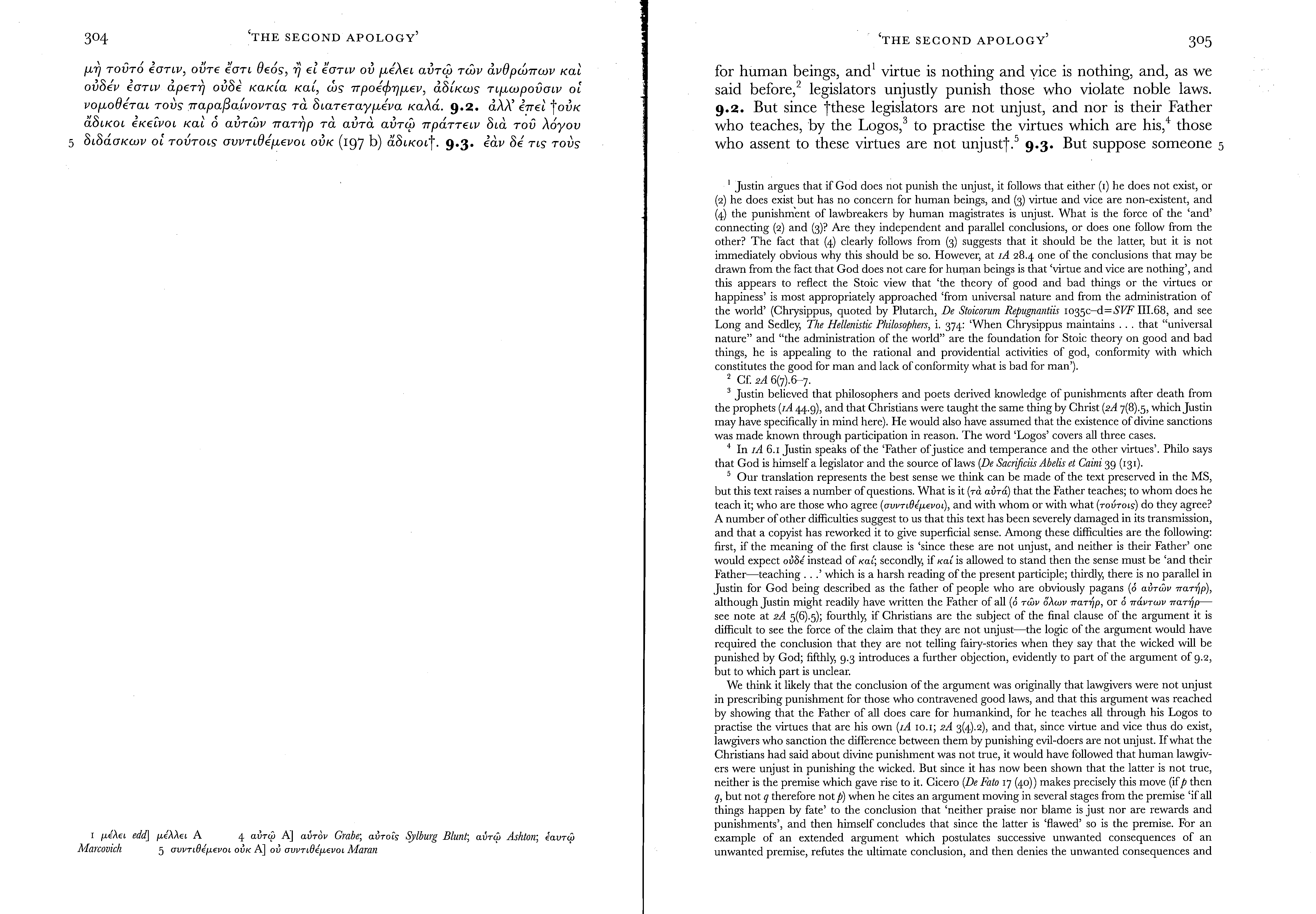
'ΤΗΕ SECOND APOLOGY'
'ΤΗΕ SECOND APOLOGY'
μη τουτο εστιν, οϋτε ε.στι θεός, ij ει ε.στιν ου μέλει αυτψ των άνθρώπων και for human beings, and 1 virtue is nothing and yice is nothing, and, as we said before,2 legislators unjustly punish those who violate noble laws.
9.2. But since tthese legislators are not unjust, and nΟΓ is their Father who teaches, 'by the Logos,3 to practise the virtues which are his,4those who assent to these virtues are not unjustt.5 9.3. But suppose someone 5
'δ ι, , \ 'δ \ ι Ι ( 'Φ 'δ / Λ < ου εν εστιν αρετη ου ε κακια και, ως προε ημεν, α ικως τιμωρουσιν οι θ / \ β / \ δ / λ / 'λλ"
\ t ' νομο εται τουςπαρα αινοντας τα ιατεταγμενα κα α. 9.2. α ε:τει ουκ αδικοι εκεινοι και ό αυτων πατηρ τα αυτα αυτψ πράττειν δια του λόγου
5 διδάσκων οί τούτοις συντιθέμενοι ουκ (197 b) αδικοιt. 9.3. εαν δέ τις τους ι Justin argues that if God does not punish the unjust, it follows that either (ι) he does not exist, οτ
(2) he does exist but has ηο conceIll for human beings, and (3) virtue and vice are non-existent, and (4) the punishment of lawbIeakers by human magistrates is unjust. What is the force of the 'and' connecting (2) and (3)? AΓe they independent and parallel conclusions, οτ does one follow from the other? The fact that (4) clearly follows from (3) suggests that it should be the latter, but it is not immediately obvious why this should be so. However, at ιΑ 28.4 one of the conclusions that may be drawn from the fact that God does not caIe for hurp.an beings is that 'viItue and vice aIe nothing', and this appeaIs to Ieflect the Stoic view that 'the theory of good and bad things οτ the virtues ΟΓ happiness' is most appropriately approached 'from univeIsal nature and from the administIation of the world' (Chrysippus, quoted by Plutarch, De StοίcoΓum Repugnantiis I035c-d=STlF ΙΙΙ.68, and see
Long and Sedley, Tlze Hellenistic P!zilosop!zeτs, ί. 374: 'When Chrysippus maintains ... that "univeIsal nature" and "the administration of the world" aIe the foundation [ΟΓ Stoic theory οη good and bad things, he is appealing to the rational and providential activities of god, conformity with which constitutes the good for man and lack of conformity what is bad [ΟΓ man').
2 Cf. 2Α 6(7).6-7.
3 Justin believed that philosopheIs and poets derived knowledge of punishments after death from the prophets (ιΑ 44.9), and that ChIistians weIe taught the same thing by ChIist (2Α 7(8).5, whichJustin may have specifically in mind here). He would also have assumed that the existence of divine sanctions was made known through paIticipation ίη Ieason. The word 'Logos' coveIs all three cases.
4 Ιη ιΑ 6.1 Justin speaks of the 'Father of justice and temperance and the otheI virtues'. Philo says that God is himself a legislatol" and the source oflaws (De SaCl"ifιciis Abelis et Caini 39 (131).
5 OUl" tIanslation IepIesents the best sense we think can be made of the text preserved ίη the MS, but this text raises a number of questions. What is it (τα αύτά) that the FatheI teaches; to whom does he teach it; who are those who agree (συντιθέμενοι), and with whom οτ with what (τούτοις) do they agIee?
Α number of othel" difficulties suggest to us that this text has been severely damaged ίη its tIansmission, and that a copyist has IewoIked it to give superficial sense. Among these difficulties are the following: first, if the meaning of the fiIst clause is 'since these aIe not unjust, and neither is theil" FatheI' one would expect ούδέ instead of καί; secondly, if καί is allowed to stand then the sense must be 'and their
Father-teaching ... ' which is a harsh reading of the pIesent participle; thiIdly, there is ηο parallel ίη
Justin [ΟΓ God being descγibed as the fatheI of people who are obviously pagans (ό αύτων πατήρ), although Justin might readily have written the FatheI of all (ό των σλων πατήρ, οτ ό πάντων παTή~ see note at 2Α 5(6).5); fouIthly, if Christians are the subject of the final clause of the argument it is difficult to see the fOIce of the claim that they are not unjust-the logic of the aIgument would have required the conclusion that they are not telling fairy-stories when they say that the wicked will be punished by God; fifthly, 9.3 introduces a furtheI objection, evidently to paIt of the argument of 9.2, but to which part is unclear.
We think it likely that the conclusion of the argument was oIiginally that lawgiveIs were not unjust ίη prescγibing punishment for those who contIavened good laws, and that this argument was reached by SllOwing that the FatheI of all does care for humankind, fOl" he teaches all through his Logos to practise the virtues that are his own (ιΑ 10.1; 2Α 3(4).2), and that, since virtue and vice thus do exist, lawgivers who sanction the difference between them by punishing evil-doers aIe not unjust. If what the ChIistians had said about divine punishment was not true, it would have followed that human lawgivers were unjust ίη punishing the wicked. Eut since it has now been shown that the latteI is not true, neithel" is the premise which gave Iise to it. Cicero (De Fato 17 (40)) makes precisely this move (if Ρ then q, but not q therefore not ρ) when he cites an argument moving ίη several stages from the premise 'if all things happen by fate' to the conclusion that 'neither praise ηΟΓ blame is just ηοτ are Iewards and punishments', and then himself concludes that since the latter is 'flawed' so is the premise. For an example of an extended argument which postulates successive unwanted consequences of an unwanted premise, refutes the ultimate conclusion, and then denies the unwanted consequences and ι μέλει edd] μέλλει Α 4 αύτφ Α] αυτον Grabe; αύτοι, !iYlburg Blunt; αύτφ Ashtoιz; έαυτφ
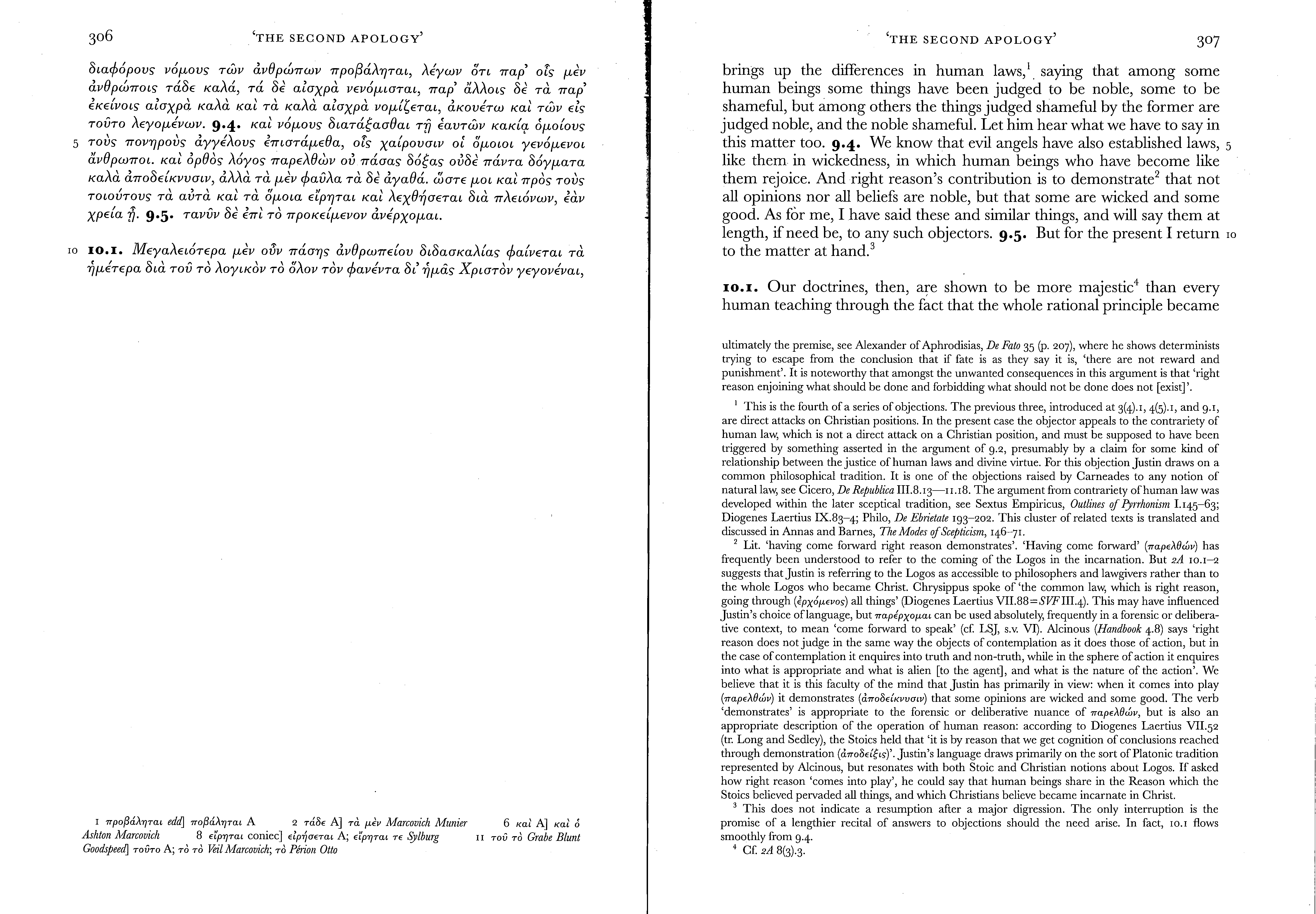
'ΤΗΕ SECOND APOLOGY'
'ΤΗΕ SECOND APOLOGY'
brings up the differences ίn human laws,l. saying that among some human beings some things have been judged to be noble, some to be shameful, but among others the things judged shameful by the former are judged noble, and the noble shameful. Let him hear what we have to say ίn διαΦόρους νόμους T(VV ανθρώ7Των 7Τροβάληται, λέγων ότι 7Ταρ ο'[ς μεν ανθρώ7Τοις τάδε καλά, τά δε αίσχρα νενόμισται, 7Ταρ' αλλοις δε τα 7Ταρ
Εκείνοις αίσχρα καλα και τα καλα αίσχρα νομίζεται, ακουέτω και των είς TOVTO λεγομένων. 9.4. και νόμους διατάξασθαι Tn έαυτων κακίq, όμοίους
5 τους 7TOνΎjpOυς αγγέλους Ε7Τιστάμεθα, ο'[ς χαίρουσιν οί όμοιοι γενόμενοι this matter too. 9.4. We know that evil angels have also established laws, 5 like them ίn wickedness, ίn which human beings who have become like them rejoice. And right reason's contribution is to demonstrate2 that not all opinions nor all beliefs are noble, but that some are wicked and some good. As for me, Ι have said these and similar things, and will say them at length, if need be, to any such objectors. 9.5. But for the present Ι return 10 to the matter at hand. 3 ανθρω7ΤΟΙ. και ορθος λόγος 7Ταρελθων ου 7Τάσας δόξας ουδε 7Τάντα δόγματα λ \, δ / 'λλ \ \ \ Φ Λλ \ δ \, θ / </ \ \ \ κα α α7ΤΟ εικνυσιν, α α τα μεν αυ α τα ε αγα α. ωστε μοι και 7Τρος τους τοιούτους τα αυτα και τα όμοια εϊpΎjTαι και λεχθήσεται δια 7Τλειόνων, Εαν χρεία V. 9.5. τανυν δε Ε7ΤΙ το 7Τροκείμενον ανέρχομαι.
711f λ / \ 'r'
/ , θ / δ δ λ/ Φ / \ ΙΟ 10.1. lv.ιεγα ειοτερα μεν ουν 7TασΎjς αν ρω7Τειου ι ασκα ιας αινεται τα ι / δ \ Λ \ λ \ \ "λ \ Φ / δ ,Ι Λ Χ \ / ΎjμεTεpα ια του το ογικον το ο ον τον αν εν τα ι Ύjμας ριστον γεγονεναι, 10.1. Our doctrines, then, a~e shown to be more majestic4 than every human teaching through the fact that the whole rational principle became ultimately the premise, see Alexander of Aphrodisias, De Fato 35 (Ρ. 207), where he shows determinists trying to escape from the conclusion that if fate is as they say it is, 'there are not reward and punishment'. It is noteworthy that amongst the unwanted consequences in this argument is that 'right reason enjoining what should be done and forbidding what should not be done does not [exist]'.
1 This is the fourth of a series of objections. The previous three, introduced at 3(4). ι, 4(5). ι, and 9. ι, are direct attacks οη Christian positions. Ιn the present case the objector appeals to the contrariety of human law, which is not a direct attack οη a Christian position, and must be supposed to have been triggered by something asserted ίη the argument of 9.2, presumably by a claim for some kind of relationship between thejustice ofhuman laws and divine virtue. For this objectionJustin draws οη a common philosophical tradition. It is one of the objections raised by Carneades to any notion of naturallaw, see Cicero, De Republicα ΙΙ1.8.13-1ι.ι8. The argument from contrariety ofhuman law was developed within the later sceptical tradition, see Sextus Empiricus, Outlilles qf I)ιIThollisIIl 1.145-63;
Diogenes Laertius ΙΧ.83-4; Philo, De EbI1'etate 193-202. This cluster of related texts is translated and discussed ίη Annas and Barnes, The lvfodes qf Scepticisnl, 146--71.
2 Lit. 'having come forward right reason demonstrates'. 'Having come forward' (παρελθών) has frequently been understood to refer to the coming of the Logos in the incarnation. But 2Α ΙΟ.Ι-2 suggests that Justin is referring to the Logos as accessible to philosophers and lawgivers rather than to the whole Logos who became Christ. Chrysippus spoke of 'the common law, which is right reason, going through (ερχόμενος) all things' (Diogenes Laertius VII.88=Sf1FIII4). This may have inf!uenced
Justin's choice oflanguage, but παρέρχομαι can be used absolutely, frequently ίn a forensic οτ deliberative context, to mean 'come fOlVvard to speak' (cf. LSJ, S.v. VI). Alcinous (Handbook 4.8) says 'right reason does not judge ίη the same way the objects of contemplation as it does those of action, but ίn the case of contemplation it enquires into truth and non-truth, while in the sphere of action it enquires into vvhat is appropriate and what is alien [to the agent], and what is the nature of the action'. We believe that it is this faculty of the mind that Justin has primarily ίη view: when it comes into play
(παρελθών) it demonstrates (αποδείκνυσιν) that some opinions are wicked and some good. The verb
'demonstrates' is appropriate to the forensic or deliberative nuance of παρελθών, but is also an appropriate description of the operation of human reason: according to Diogenes Laertius ΥΙ1.52
(tr. Long and Sedley), the Stoics held that 'it is by reason that we get cognition of conclusions reached through demonstration (αποδείξις)'. Justin's language draws primarily οη the sort ofPlatonic tradition represented by Alcinous, but resonates with both Stoic and Christian notions about Logos. If asked how right reason 'comes into play', he could say that human beings share ίη the Reason which the Stoics believed pervaded all things, and which Christians believe became incarnate ίη Christ.
3 This does not indicate a resumption after a major digression. The οηlΥ interruption is the promise of a lengthier recital of answers to objections should the need arise. Ιη fact, ΙΟ. ι flows smoothly from 9-4ι προβάλψαι edd] ποβάλψαι Α
2 τάδε Α] τα μεν lvfαι"COvich Mll1liel"
Ashton λ1ατcovίch 8 ε'ίρψαι coniec] ειρήσεται Α; ε'ίρψαι τε .$ΥΙbuτg Goodspeed] τουτο Α; το το Veil λ1ατcovίch; το Piι10ΙΙ Otto
6 και Α] και ό ΙΙ του το Gτabe Blunt <} Cf. 2Α 8(3).3.
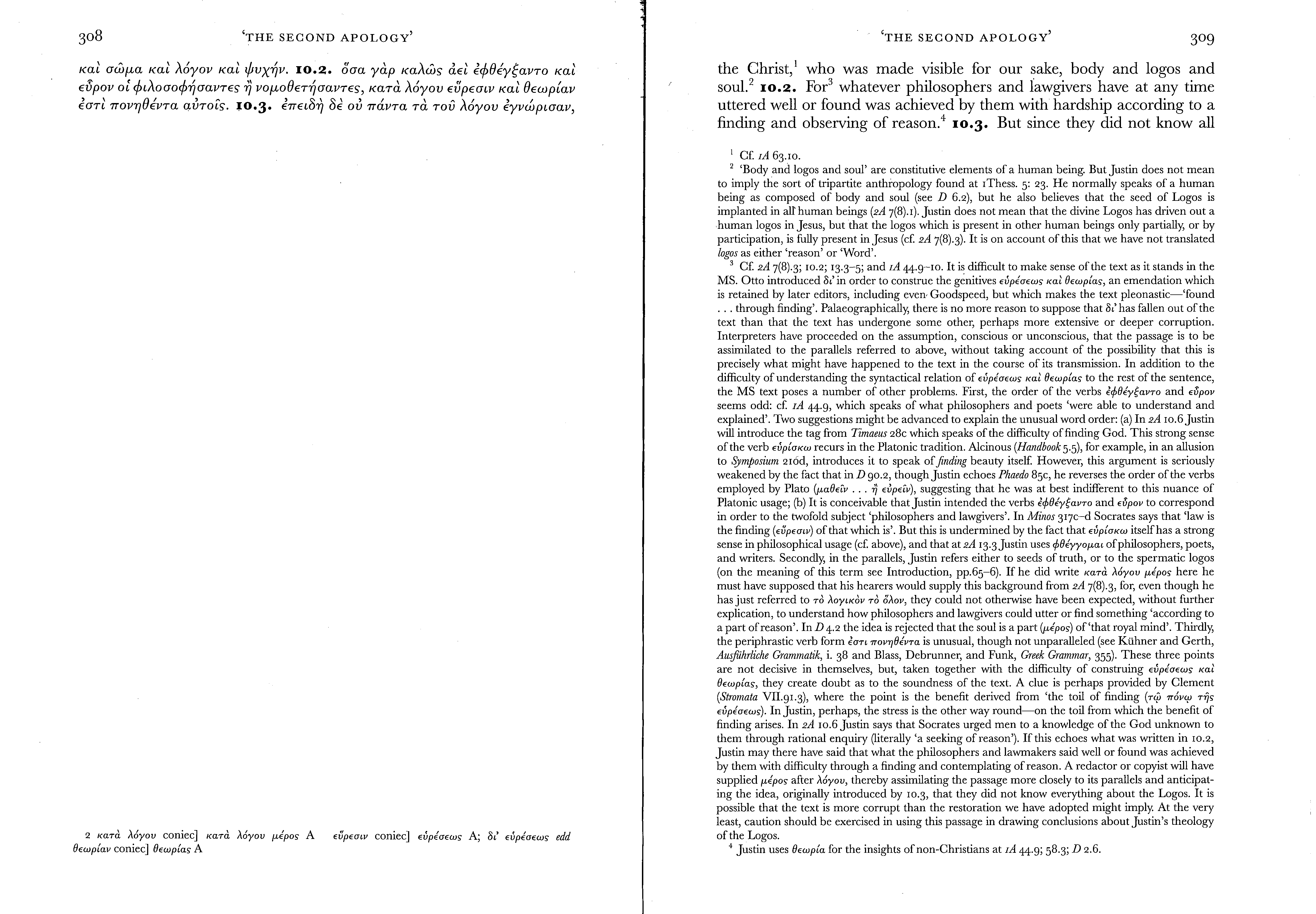
'ΤΗΕ SECOND APOLOGY'
'ΤΗΕ SECOND APOLOGY'
\ ~ \ λ ι \ ,ι, Ι ,,\ λ ~ ,\ 'Φθ ι c.
\ και σωμα και ογον και ιpVX'rjv. 10.2. οσα γαρ κα ως αει ε εγ~ανTO και the Christ,l who was made visible for our sake, body and logos and sou1. 2 10.2. For3 whatever philosophers and iawgivers have at any time uttered well or found was achieved by them with hardship according to a finding and observing of reason.4 10.3. But since they did not know all
\ θ ι ευρον οι ι οσο 'rjσαντες'rj νομο εΤ'rjσαντες, κατα ογου ευρεσιν και εωριαν εστι πον'rjθέντα q,υτοΙς. ,0.3. επειδ~ δε ου πάντα τα του λόγου εγνώρισαν,
1 Cf. ιΑ 63.10.
2 'Body and logos and soul' are constitutive elements of a human being. But Justin does not mean to imply the sort of tripartite anthi"Opology found at IThess. 5: 23. He normally speaks of a human being as composed of body and soul (see D 6.2), but he also believes that the seed of Logos is implanted in aΠ human beings (2Α 7(8). ι). JllStin does not mean that the divine Logos has driven Ollt a hllman logos ίη Jesus, butthat the logos which is present in other hllman beings οηlΥ partially, or by participation, is flllly present ίη Jeslls (cf. 2Α 7(8).3). It is οη account of this that we have not translated logos as either 'reason' or 'Word'.
3 Cf. 2Α 7(8).3; 10.2; 13.3-5; and ιΑ 44.9-10. It is difficult to make sense ofthe text as it stands in the MS. Otto introduced δι' ίη order to constrlle the g~nitives εύρέσεω, και θεωρία" an emendation which is retained by later editors, including even, Goodspeed, bllt which makes the text pleonastic-'follnd
... throllgh finding'. Palaeographically, there is ηο more reason to suppose that δι' has fallen Ollt of the text than that the text has llndergone some other, perhaps more extensive or deeper corruption.
Interpreters have proceeded οη the assumption, COllSCiOllS or llllCOllSCious, that the passage is to be assimilated to the parallels referred to above, without taking accollnt of the possibility that this is precisely what might have happened to the text ίη the course of its transmission. Ιη addition to the difficulty of llnderstanding the syntactical relation of εύρέσεω, και θεωρία, to the rest of the sentence, the MS text poses a number of other problems. First, the order of the verbs εΦθέγξαντο and εδρον seems odd: cf. ιΑ 44.9, which speaks of what philosophers and poets 'were able to llllderstand and explained'. Two suggestions might be advanced to explain the unusual word order: (a) Ιη 2Α 10.6 Justin will introdllce the tag from Timαeus 28c which speaks of the difficlllty of finding God. This strong sense of the verb εύρίσκω reCllrs ίη the Platonic tradition. Alcinous (Hαndbook 5.5), for example, ίη an allllSiOll to SymposiuIIl 2IOd, introdllces it to speak of finding beauty itself. However, this argument is seriollsly weakened by the fact that in D 90.2, thOllgh JllStin echoes Phαedo 85c, he reverses the order of the verbs employed by Plato (μαθειν ... ij εύρειν), sllggesting that he was at best indi:fferent to this nuance of Platonic usage; (b) It is conceivable thatJustin intended the verbs εΦθέγξαντο and εδρον to correspond in order to the twofold subject 'philosophers and lawgivers'. Ιη jIIIinos 3I7c-d Socrates says that 'law is the finding (ευρεσιν) ofthat which is'. Bllt this is lllldermined by the fact that εύρίσκω itselfhas a strong sense ίη philosophicalllsage (cf. above), and that at 2Α 13.3 JllStin uses Φθέγγομαι ofphilosophers, poets, and writers. Secondly, ίη the parallels, JllStin refers either to seeds of truth, or to the spermatic logos
(οη the meaning of this term see Introdllction, ρρ.65-6). If he did write κατα λόγου μέρο, here he mllst have sllpposed that his hearers wOllld sllpply this backgrollnd fIσm 2Α 7(8).3, for, even thOllgh he has just referred to το λογικον το Όλον, they cOllld not otherwise have been expected, withOllt fllrther explication, to llllderstand how philosophers and lawgivers could lltter or find something 'according to a part of reason'. Ιη D 4.2 the idea is rejected that the sOlll is a part (μέρο,) of 'that royal mind'. Thirdly, the periphrastic verb form εση 7Τονηθέντα is llllllsual, thOllgh not llnparalleled (see Kίihner and Gerth,
Aus.fiihrliche GrαmIIZαtik, ί. 38 and Blass, Debrunner, and Fllnk, Greek GrαιIlInαr, 355). These three points are not decisive ίη themselves, bllt, taken together with the difficlllty of construing εύρέσεω, και θεωρία" they create doubt as to the sOlllldness of the text. Α cllle is perhaps provided by Clement
(Str01Ilαtα VII.9I.3), where the point is the benefit derived from 'the toil of finding (τφ 7Τόνψ τη, εύρέσεω,). Ιη Justin, perhaps, the stress is the other way round-on the toil from which the benefit of finding arises. Ιη 2Α 10.6 Jllstin says that Socrates urged men to a knowledge ofthe God llnknOWll to them throllgh rational enqlliry ~iterally 'a seeking of Ieason'). If tl1iS echoes what was written ίη 10.2,
JllStin may theIe have said that what the philosophers and lawmakers said well or fOlllld was achieved by them with difficlllty throllgh a finding and contemplating of reason. Α redactor οι copyist will have supplied μέρο, after λόγου, thereby assimilating the passage more closely to its parallels and anticipating the idea, originally intIσdllced by 10.3, that they did not know everything abollt the Logos. It is possible that the text is more corrllpt than the restoration we have adopted might imply. At the very least, caution should be exercised in using this passage ίη drawing COllClllSiOllS abollt Jllstin's theology of the Logos.
2 κατα λόγου coniec] κατα λόγου μέρο, Α ευρεσιν coniec] εύρέσεω, Α; δι' εύρέσεω, edd θεωρίαν coniec] θεωρία, Α 4 JllStin llses θεωρία for the insights ofnon-Christians at ιΑ 44.9; 58.3; D 2.6.
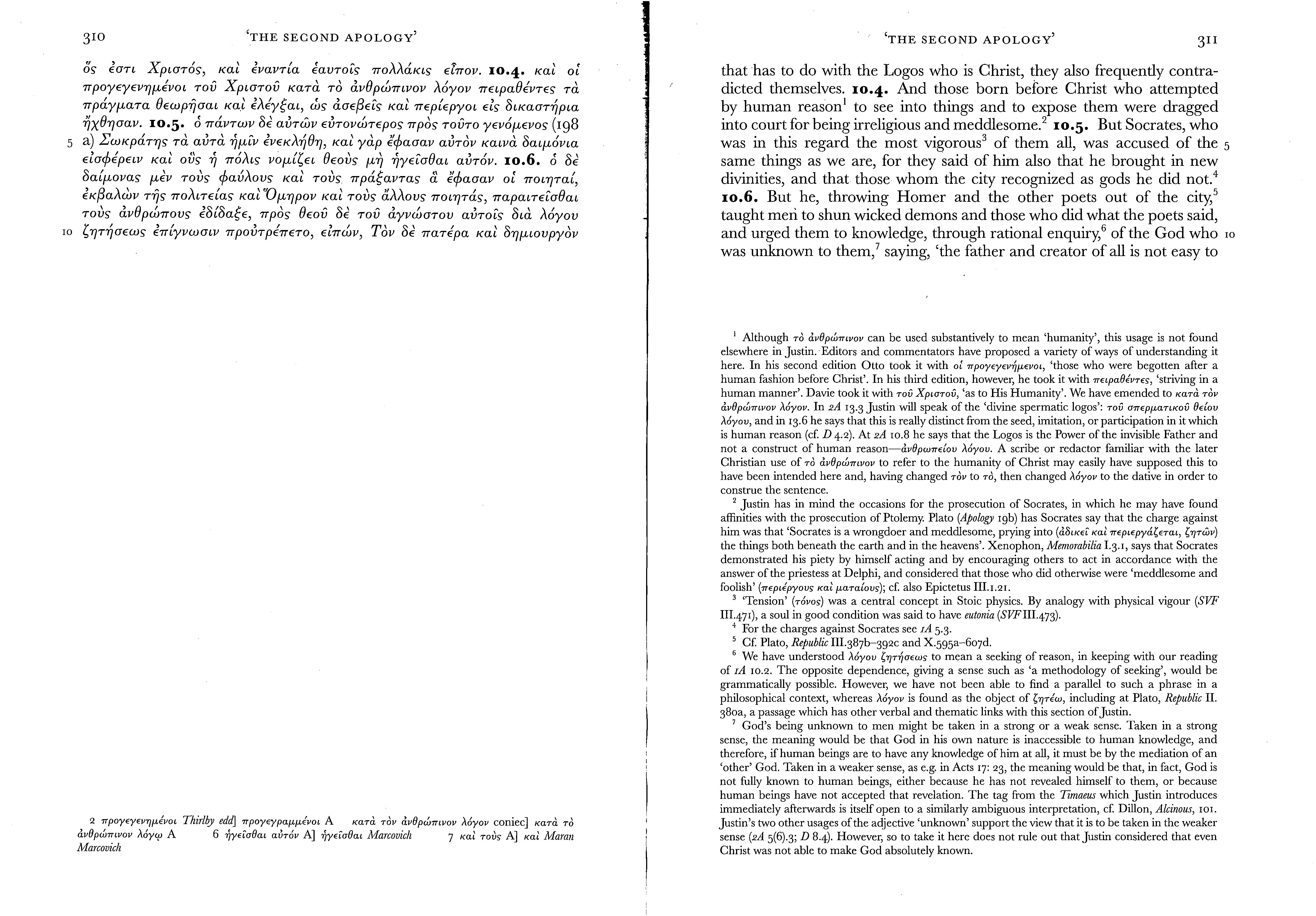
'ΤΗΕ SECOND APOLOGY'
'ΤΗΕ SECOND APOLOGY'
7ΤολλάκιS' εί7Τον. 10.4. και οί thathas to do with the Logos who iS Christ, they also frequently contradicted themselves. 10.4. And those born before Christ who attempted by human reason! to see into things and to expose them were dragged into court for being irreligious and meddlesome. 2 10.5. But Socrates, who was in this regard the most vigorous3 of them all, was accused of the 5 same things as we are, for they said of him also that he brought ίη new divinities, and that those whom the city recognized as gods he did not.4
7Τρογεγενημένοι του Χριστου κατα το ανθρώ7Τινον λόγον 7ΤειΡαθέντεS' τα 7Τράγματα θεωρησαι κα,Ι έλέγξαι, ώS' ασεβειS' και 7Τερίεργοι ElS' δικαστήρια
~ ,Ι ,~ Ι (8 ηχ ησαν. 10.5. Ο 7Ταντων ε αυτων EVTOVWTEpoS' 7TpOS' τουτο YEvofLEVoS' 19
) Σ Ι '" ι ~, λ lθ ""φ , , , δ Ι 5 a WKpaTYJS' τα αυτα ημιν ενεκ η η, και γαρ ε ασαν αυτον καινα αιμονια
Ι C "
"φ Ι Ι αιμοναS' μεν TOVS' αυ OVS' και TOVS', 7Tpaf::, aVTaS' α ε ασαν οι 7Τοιηται, , β λ'
~ λ Ι , 'Ό "
"λλ Ι ~ θ εκ α ων TYJS' 7ΤΟ ιτειαS' και μηρον και TOVS' α OVS' 7ΤοιηταS', 7Ταραιτεισ αι
TOVS' ανθρώ7ΤΟVS' έδίδαξε, 7TPOS' θεου δε του αγνώστου aVTOLS' δια λόγου 10.6. But he, throwing Homer and the other poets out of the City,5 taught meri to shun wicked demons and those who did what the poets said, and urged them to knowledge, through rational enquiry,6 of the God who 10 was unknown to them,7 saying, 'the father and creator of all is not easy to
ζητήσεωS' έ7Τίγνωσιν 7Τρουτρέ7Τετο, εΙ7Τών, Τον δε 7Τατέρα και δημιουργον ι Although το άνθρώπινον can be used substantively to mean 'humanity', this usage is not found elsewhere in Justin .. Editors and commentators have proposed a variety of ways of understanding it here. Ιη his second edition Otto took it with οί προγεγενήμενοι, 'those who were begotten after a human fashion before Christ'. Ιη his third edition, however, he took it with πειραθέντε" 'striving ίη a human manner'. Davie took it with του Χριστου, 'as to His Humanity'. We have emended to κατα τον άνθρώπινον λ6γον. Ιη 2Α 13.3 Justin will speak of the 'divine spermatic logos': του σπερμαΤικου θείου λ6γου, and in 13.6 he says that this is really distinct from the seed, imitation, ΟΓ participation in it which is human reason (cf. D 4.2). At 2Α 10.8 he says that the Logos is the Power ofthe invisible Father and not a construct of human reasοη-άνθρωπείου λ6γου. Α scribe ΟΓ redactor familiar with the later
Christian use of το άνθρώπινον to refer to the humanity of Christ may easily have supposed this to have been intended here and, having changed τον to το, then changed λ6γον to the dative ίη order to construe the sentence.
2 Justin has ίη mind the occasions for the prosecution of Socrates, ίη which he may have found affinities with the prosecution ofPtolemy. Plato (Apology 19b) has Socrates say that the charge against him was that 'Socrates is a wrongdoer and meddlesome, prying into (άδικει και περιεργάζεται, ζητων) the things both beneath the earth and ίη the heavens'. Xenophon, Menιorabilia ι'3.1, says that Socrates demonstrated his piety by himself acting and by encouraging others to act ίη accordance with the answer of the priestess at Delphi, and considered that those who did otherwise were 'meddlesome and foolish' (περιέργου, και ματαίου,); cf. also Epictetus 1Ιι'1.21.
3 'Tension' (τ6νο,) was a central concept ίη Stoic physics. ΒΥ analogy with physical vigour (SVF
1ΙΙ.471), a soul ίη good condition was said to have eutoιzia (SVFIII.473) .
.. For the charges against Socrates see ιΑ 5.3.
5 Cf. Plato, Republic 1II.387b-392c and X.595a-607d.
6 We have understood λ6γου ζ ητήσεω, to mean a seeking of reason, ίη keeping with our reading of ιΑ 10.2. The opposite dependence, giving a sense such as 'a methodology of seeking', would be grammatically possible. However, we have not been able to find a parallel to such a phrase ίη a philosophical context, whereas λ6γον is found as the object of ζψέω, including at Plato, Republic 11.
380a, a passage which has other verbal and thematic links with this section of Justin.
7 God's being unknown to men might be taken ίη a strong ΟΓ a weak sense. Taken ίη a strong sense, the meaning would be that God ίη his οννη nature is inaccessible to human knowledge, and therefore, if human beings are to have any knowledge of him at all, it must be by the mediation of an 'other' God. Taken ίη a weaker sense, as e.g. ίη Acts 17: 23, the meaning would be that, ίη fact, God is not fully known to human beings, either because he has not revealed himself to them, ΟΓ because human beings have not accepted that revelation. The tag from the Timaeus which Justin introduces immediately afterwards is itself open to a similarly ambiguous interpretation, cf. Dillon, Alcillous, 10Ι.
Justin's two other usages of the adjective 'unknown' support the view that it is to be taken ίη the weaker
2 προγεγενημένοι T1zirlby ed~ προγεγραμμένοι Α κατα τον άνθρώπινον λ6γον coniec] κατα το άνθρώπινον λ6γψ Α 6 ήγεισθαι αύτ6ν Α] ήγεισθαι Aιfαrcoviclz
7 και του, Α] και Μαι'αιι Ma1'COViCIZ sense (2Α 5(6).3; D 8-4). However, so to take it here does not rule out that Justin considered that even
Christ was not able to make God absolutely known.
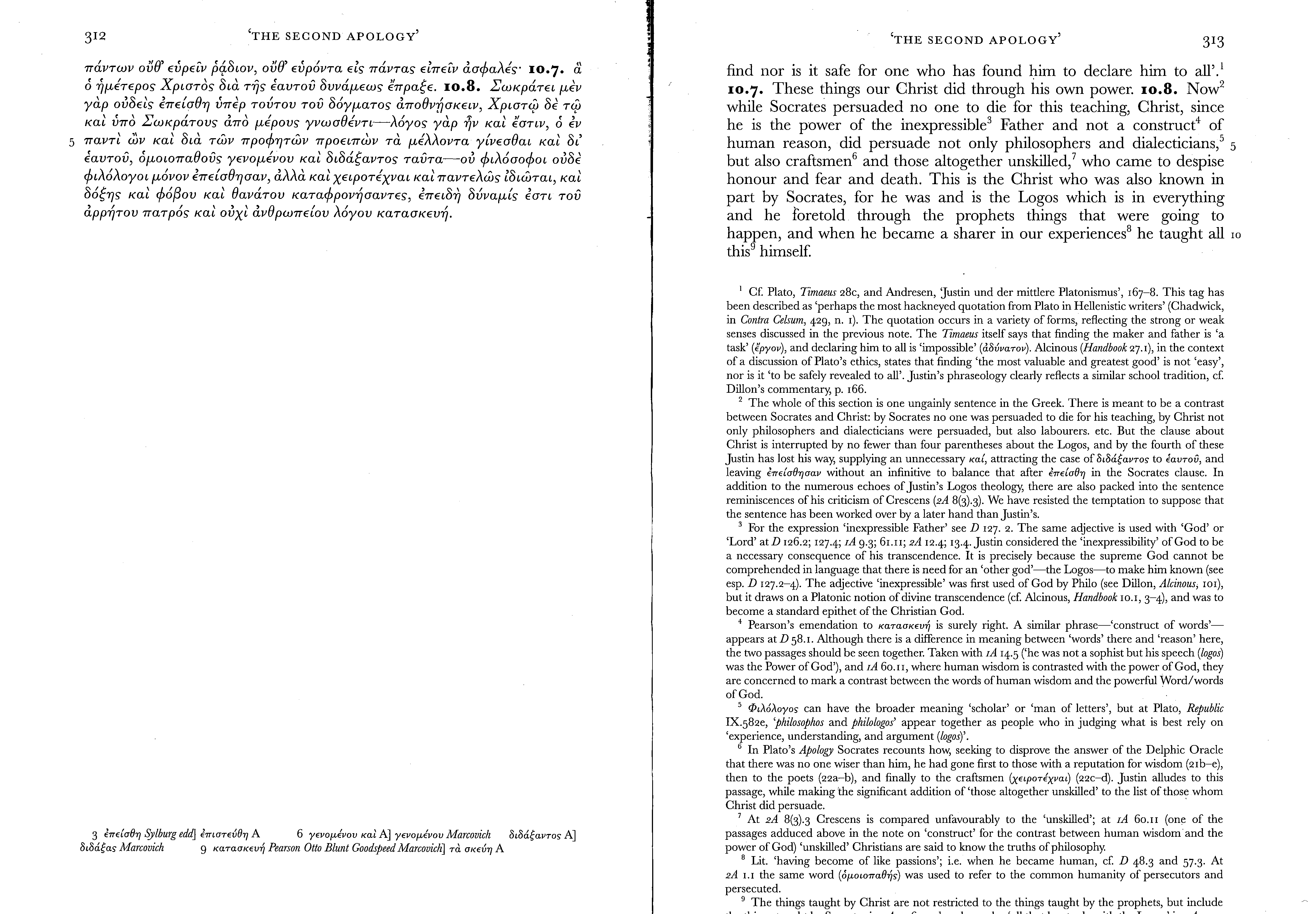
'ΤΗΕ SECOND APOLOGY'
'ΤΗΕ SECOND APOLOGY'
, "θ' ( "'"
Ι ι δ "θ' (/ ,Ι ,,.., Φ λ'
(\ παντων ου ευρειν P<f ιον, ου ευροντα EιS πανταs ΕιΠΕιν ασ α ES' 10.7. α find nΟΓ is it safe for one who has found him to declare him to all'. 1 ό rιμέτεΡΟS Χριστοs δια TijS έαυτου δυνάμεωs επραςε. 10.8. ΣωκράτΕι μεν
10.7. These things our Christ did through his οννη power. 10.8. Now2 while Socrates persuaded ηο one to die for this teaching, Christ, since he is the power of the inexpressible3 Father and not a construct4 of human reason, did persuade not only philosophers and dialecticians,5 5 but also craftsmen6 and those altogether unskilled/ who came to despise honour and fear and death. This is the Christ who was also known ίη part by Socrates, for he was and is the Logos which is ίη everything and he toretold through tlle prophets things that were going to happen, and when he became a sharer ίη our experiences8 he taught all 10 this9 himself. γαρ ούδειs επείσθYj ύπερ τούτου του δόγματοs αποθνΤισΚΕιν, Χριστψ δε Τψ και ύπο Σωκράτουs απο μέρουs γνωσθένη-λόγοs γαρ -ην και εσην, ό εν
5 πανη ων και ια των προ YjTWV ΠΡΟΕιπων τα με οντα γινεσ αι και ι έαυτου, όμοιοπαθουs γενομένου και διδάςαντοs ταυτα-ού ΦιλόσοΦοι ούδε
Φ λ 'λ '" θ 'λλ ,\ , \ λ Λ 'δ Λ \ ι Ο ογοι μονον εΠΕισ Yjaav, α α και χειροτεχναι και παντε ws ι ιωται, και δ '(; \ Φ 'β \ θ'
'δ \ δ'
Λ o~ YjS και ο ου και ανατου κατα POVYjaaVTES, επει Yj υναμιs εση του αρρήτου πατρόs και ούχι ανθρωπείου λόγου κατασκευή. ι Cf. Plato, Timαeus 28c, and Andresen, Justin und der mittlere Platonismus', 167-8. This tag has been described as 'perhaps the most hackneyed quotation from Plato ίη Hellenistic writers' (Chadwick, ίη Cοntι-α CelsuIn, 429, η. ι). The quotation occurs ίη a variety of forms, reflecting the strong or weak senses discussed ίη the previous note. The Timαeus itself says that finding the maker and father is 'a task' (εργον), and declaring him to aΠ is 'impossible' (αδύνατον). Alcinous (Hαndbook 27-1), ίη the context of a discussion of Plato's ethics, states that finding 'the most valuable and greatest good' is not 'easy', nor is it 'to be safely revealed to all'. Justin's phraseology clearly reflects a similar school tradition, cf.
Dillon's commentary, ρ. 166.
2 The whole of this section is one ungainly sentence ίη the Greek. There is meant to be a contrast between Socrates and Christ: by Socrates ηο one was persuaded to die for his teaching, by Christ not οηlΥ philosophers and dialecticians were persuaded, but also labourers. etc. But the clause about Christ is interrupted by ηο fewer than four parentheses about the Logos, and by the fourth of these
Justin has lost his way, supplying an unnecessary Kat, attracting the case of διδάξαντοι; to έαυτου, and leaving επεtσθησαν without an infinitive to balance that after επεtσθη ίη the Socrates clause. Ιη addition to the numerous echoes of Justin's Logos theology, there are also packed into the sentence reminiscences of his criticism of Crescens (2Α 8(3).3). We have resisted the temptation to suppose that the sentence has been worked over by a later hand than Justin's.
3 For the expression 'inexpressible Father' see D 127. 2. The same adjective is used with 'God' or 'Lord' at D 126.2; 127-4; ιΑ 9.3; 6ι.ιι; 2Α 12.4; 13+ Justin considered the 'inexpressibility' ofGod to be a necessary consequence of his transcendence. It is precisely because the supreme God cannot be comprehended ίη language that there is need for an 'other god'-the Logos-to make him known (see esp. D 127.2-4). The adjective 'inexpressible' was first used of God by Philo (see Dillon, Alcinous; 101), but it draws οη a Platonic notion of divine transcendence (cf. Alcinous, Hαndbook 10.1,3-4), and was to become a standard epithet of the Christian God.
4Pearson's emendation to κατασκευή is surely right. Α similar phrase-'construct of words'appears at D 58.1. Although there is a di:fference ίη meaning between 'words' there and 'reason' here, the two passages should be seen together. Taken with ιΑ 14.5 ('he was not a sophist but his speech (logos) was the Power ofGod'), and ιΑ 60.1ι, where human wisdom is contrasted with the power ofGod, they are concerned to mark a contrast between the words ofhuman wisdom and the powerful Word/words ofGod.
5 Φιλόλογοι; can have the broader meaning 'scholar' or 'man of letters', but at Plato, Republic
IX.582e, 'philosophos and philologos' appear together as people who ίη judging what is best rely οη
'experience, understanding, and argument (logos)'.
6 Ιη Plato's Apology Socrates recounts how, seeking to disprove the answer of the Delphic Oracle that there was ηο one wiser than him, he had gone first to those with a reputation for wisdom (2Ib-e), then to the poets (22a-b), and finaΠy to the craftsmen (χειροτέχναι) (22c-d). Justin alludes to this passage, while making 'the significant addition of 'those altogether unskilled' to the list of those whom
Christ did persuade.
7 At 2Α 8(3).3 Crescens is compared unfavourably to the 'unskilled'; at ιΑ 60.ΙΙ (one of the passages adduced above ίη the note οη 'construct' for the contrast between human wisdom and the power of God) 'unskilled' Christians are said to know the truths of philosophy.
3 επεtσθη fiylburg edtZJ επιστεύθη Α 6 γενομένου και Α] γενομένου Mαrcovich διδάξαντοι; Α] διδάξαι; Mαrcovich 9 κατασκευή Peαrson Qtto Blunt Goodspeed Mαrcoviclz] τα σκεύη Α
8 Lit. 'having become of like passions'; i.e. when he became human, cf. D 48.3 and 57.3. At 2Α 1.1 the same word (όμοιοπαθήι;) was used to refer to the common humanity of persecutors and persecuted.
9 ,~he thin~s ~au~ht by C~rist,are ;ιοt r~stri~ted to, th~ ~?~gs ~aught ?Υ t?? p"ro~hets, ~~t i~clude
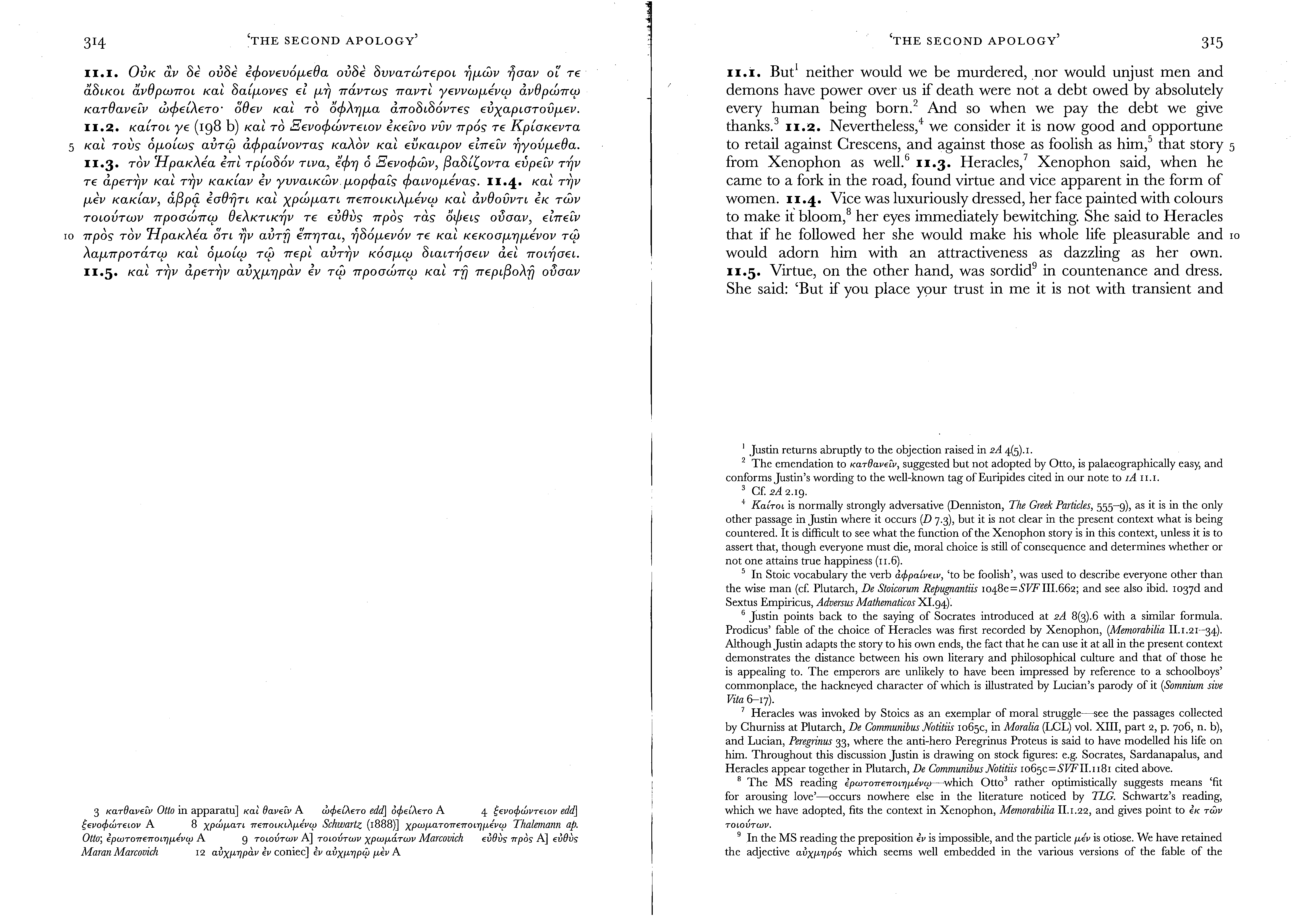
'ΤΗΕ SECOND APOLOGY'
'ΤΗΕ SECOND APOLOGY'
Ο , " δ '
'δ' 'Φ / θ 'δ' δ / Ι Λ ';'
<Ι 11.1. υκ αν ε ου ε ε ονευομε α ου ε υνατωτεροι YJμων YJaav οι τε 11.1. But1 neither would we be murdered, .ηΟΓ would unjust men and demons have power over'Us if death were not a debt owed by absolutely every human being born.2 And so when we pay the debt we give thanks. 3 Ι Ι .2. Ν evertheless, 4 we consider it iS llOW good and opportune to retail against Crescens, and against those as foolish as him,5 that story 5 from Xenophon as well. 6 11.3. Heracles/ Xenophon said, when he came to a fork ίη the road, found virtue and vice apparent in the form of women. 11.4. Vice was luxuriously dressed, her face painted with colours to make ii bloom,8 her eyes immediately bewitching. She said to Heracles that if he followed her she would make his whole life pleasurable and 10 would adorn him with an attractiveness as dazzling as her OWll. αδικοι ανθρωποι και δαίμονες εί μ~ πάντως παντι γεννωμένφ ανθρώπφ θ Λ 'Φ /λ Ι'θ ""Φλ 'δ δ / , Λ κατ ανειν ω ει ετο· ο εν και το ο YJμα απο ι οντες ευχαριστουμεν.
11.2. καίτοι γε (198 b) και το ΞενοΦώντειον εκεινο νυν πρός τε Κρίσκεντα , \ (Ι ,,...
'Φ / λ"
'Λ Ι ι θ 5 και τους ομοιως αυτφ α ραινοντας κα ον και ευκαιΡον ειπειν YJγουμε α.
'Ή λ / "
/ δ / "Φ ι,...., Φ Λ β δ /'( Ι Λ / 11.3. τον ρακ εα επι τριο ον τινα, ε YJ ο ι!::!ιενο ων, α ι~oνTα ευρειν TYJV , , "
/ , Λ ΦΛΦ / " τε apETYJV και TYJV κακιαν εν γυναικωνμορ αις αινομενας. 11.4. και TYJV , / ιβ Λ , θ Λ , / λ / , , θ Λ , Λ μεν κακιαν, α pq, εσ YJTι και χρωματι πεποικι μενφ και αν ουντι εκ των
/ / θ λ / 'θ'
, "',/, ';'
'Λ τοιουτων προσωπφ ε KTιKYJV τε ευ υς προς τας οψεις ουσαν, ειπειν ΙΟ προς τον Ήρακλέα ΟΤΙ ην αυTfι ΕΠYJται, ήδόμενόν τε και κεκοσμYJμένον Τψ λαμπροτάτφ και όμοίφ Τψ περι αυT~ν κόσμφ διαιτήσειν αει ποιήσει.
11.5. και T~ν αρεT~ν αvχμYJραν εν Τψ προσώπφ και Tfι περιβOλfι οδσαν 11.5. Virtue, οη the other hand, was sordid9 ίη countenance and dress.
She said: 'But if you place Y9ur trust ίη me it is not with transient and ι Justin returns abruptly to the objection raised in 2Α 4(5).1.
2 The emendation to κατθανειν, suggested but not adopted by Otto, is palaeographically easy, and conforms Justin's wording to the well-known tag ofEuripides cited in our note to ιΑ rr.I.
3 Cf. 2Α 2.19.
4 Κα{τοι is normally strongly adversative (Denniston, ΤΙιe G1'eek Pαrticles, 555-9), as it is in the only other passage in Justin where it occurs (D 7.3), but it is not clear ίη the present context what is being countered. 1t is difficult to see what the function ofthe Xenophon story is ίη this context, unless it is to assert that, though everyone must die, moral choice is still of consequence and determines whether or not one attains true happiness (rr.6).
5 1η Stoic vocabulary the verb dΦΡa{νειν, 'to be foolish', was used to describe everyone other than the wise man (cf. Plutarch, De StoicoruIn Repugnαιltiis I048e=SVF1II.662; and see also ibid. I037d and Sextus Empiricus, Adversus Mαtlzelnαticos XI.94)~
6 Justin points back to the saying of Socrates introduced at 2Α 8(3).6 with a similar formula.
Prodicus' fable of the choice of Heracles was first recorded by Xenophon, (Memorαbiliα Π.ι.2Ι-34).
Although Justin adapts the story to his own ends, the fact that he can use it at all ίη the present context demonstrates the distance between his own literary and philosophical culture and that of those he is appealing to. The emperors are unlikely to have been impressed by reference to a schoolboys' commonplace, the hackneyed character of which is illustrated by Lucian's parody of it (Somniuιn sive
Vitα 6--17).
7 Heracles was invoked by Stoics as an exemplar of moral struggle----see the passages collected by Churniss at Plutarch, De Conzmunibus Notitiis I065c, ίη lιιfoταlία (LCL) νοΙ ΧΙΠ, part 2, ρ. 706, η. b), and Lucian, Peregl1nus 33, where the anti-hero Peregrinus Proteus is said to have modelled his life οη him. Throughout this discussion Justin is drawing οη stock figures: e.g. Socrates, Sardanapalus, and Heracles appear together ίη Plutarch, De Conznzunibus Notitiis I065c=SVFII.rr8I cited above.
Β The MS reading ερωτοπεποιημένψ-whίch Ott03 rather optimistically suggests means 'fit for arousing love'-occurs now11ere else ίη the literature noticed by TLG. Schwartz's reading, which we have adopted, fits the context ίη Xenophon, Melnorαbiliα Π.ι.22, and gives point to εκ των
3 κατθανειν Otto ίη apparatu] και θανειν Α ωΦε{λετο edαj οΦε{λετο Α 4 ξενοΦώντειον edαj ξενοΦώτειον Α 8 χρώματι πεποικιλμένψ Schwαrtz (1888)] χρωματοπεποιημένψ Thαleιnαnn αρ.
Otto; ερωτοπεποιημένψ Α 9 τοιούτων Α] τοιούτων χρωμάτων Μαιωmch ευθυς προς Α] ευθυς τοιούτων.
9 1η the MS reading the preposition εν is impossible, and the particle μέν is otiose. We have retained the adjective αυχμηρός which seems well embedded ίη the various ve[sions of the fable of the Mαrαn Mαrcovich 12 αυχμηραν εν coniec] εν αυχμηρψ μεν Α
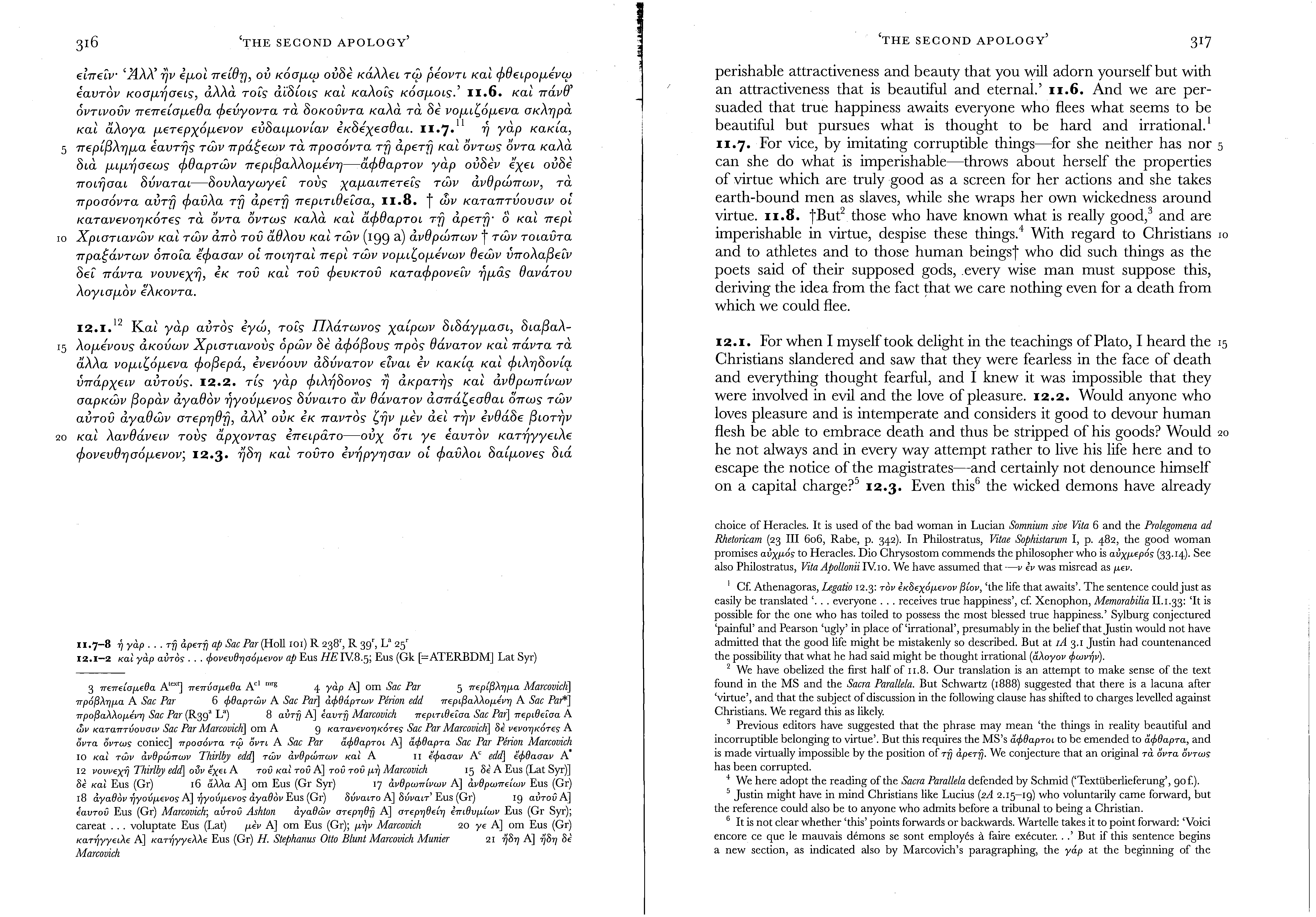
'ΤΗΕ SECOND APOLOGY'
'ΤΗΕ SECOND APOLOGY'
, ~ "Αλλ'" , , Ιθ ,ι 'δ'
Ιλλ ~ ι Ι , Φθ ι ειπειν' n ΎJν εμοι πει TJ, ου κοσμψ ου ε κα ει τψ ρεοντι και ειΡομενψ perishable attractiveness and beauty that you νγill adorn yourself but with an attractiveness that is beautiful and eternal.' 11.6. And we are persuaded that true happiness awaits everyone who flees what seems to be beautiful but pursues what is thought to be hard and irrational. 1 έαυτον KOσμήσει~, αλλα TOΙ~ αϊδίoι~ και Kαλoι~ Kόσμoι~.' 11.6. και πάνθ' ι ~ ι θ Φ Ι 'δ ~ λ" δ'
Ι λ' οντινουν πεπεισμε α ευγοντα τα οκουντα κα α τα ε νΟμΙI::,Ομενα σκ ΎJpα , "λ ι 'δ ι, δ ι θ
ΎJ γαρ κακια, 5 πεpίβλΎJμα έαυTη~ των πράξεων τα προσόντα TiJ αρετΏ και σνTω~ σντα καλα
11.'. For vice, by imitating corruptible things-for she neither has nor 5 can she do what is imperishable-throws about herself the properties of virtue which are trulygood as a screen for her actions and she takes earth-bound men as slaves, while she wraps her own wickedness around virtue. 11.8. tBut2 those who 11ave known what is really good,3 and are imperishable in virtue, despise these things. δια μιμήσεω~ Φθαρτων πεpιβαλλoμένΎJ-I1ΦθαpToν γαρ ουδεν Εχει ουδε ποιησαι δύναται-δουλαγωγει TOυ~ xαμαιπεTει~ των ανθρώπων, τα προσόντα αύτΏ Φαυλα TiJ αρετΏ περιτιθεισα, 11.8. t ών καταπτύουσιν οί ι \ ,ι" λ'
\ "Φθ 1"1.'
1"1.
(\ \ \ KαTανενOΎJKOTε~ τα οντα oνTω~ κα α και α αρτοι 'TTJ αρετπ ο και περι 10 Χριστιανων και των απο του l1θλου και των (199 a) ανθρώπων t των τοιαυτα
4 With regard to Christians 10 and to athletes and to those human beingst who did such things as the poets said of their supposed gods, ,every wise man must suppose this, πραξάντων όποια ΕΦασαν οί ΠOΙΎJTαι περι των νομι'ομένων θεων ύπολαβειν δει πάντα νουνεχη, εκ του και του Φευκτου καταΦρονειν Yιμα~ θανάτου deriving the idea from the fact that we care nothing even for a death from which we could flee. λογισμον έλκοντα.
12 Κ' , '" ι ~ Πλ ι ι δ δ ι δ β λ 12.1. αι γαρ αυTO~ εγω, TOΙ~ αTωνo~ χαιΡων ι αγμασι, ια α ι ,ι Χ ' ι ~ δ"
oμενoυ~ ακουων pιστιανoυ~ ορων ε α ο Oυ~ πpo~ ανατον και παντα τα 12.1. For when Ι myselftook delight ίη the teachings ofPlato, Ι heard the 15
Christians slandered and saw that they were fearless ίη the face of death and everything thought fearful, and Ι knew it was impossible that they were involved ίη evil and the love of pleasure. 12.2. Would anyone who loves pleasure and is intemperate and considers it good to devour human flesh be able to embrace death and thus be stripped of his goods? Would 20 he not always and ίη every way attempt rather to live his life here and to escape the notice of the magistrates-and certainly not denounce himself λ l1λλα νομι'όμενα Φοβερά, ενενόουν αδύνατον εΊναι εν κακίq. και ΦιλΎJδονίq. ι ι ,ι ι, Φ λ Ιδ ", , "θ ι υπαρχειν αυToυ~. 12.2. τι~ γαρ ι ΎJ oνo~ ΎJ αKpαTΎJ~ και αν ρωπινων ~ β , , θ' ι Ι δΙ " θ Ι 'Ι1 θ'/ ~ σαρκων οραν αγα ον ΎJγOυμενO~ υναιτο αν ανατον ασπαl::,εσ αι oπω~ των , ~, θ ~ θ ~ 'λλ' "
~ ""
'θ Ι δ β , αυτου αγα ων σTεpΎJ TJ, α ουκ εκ πανTO~ I::,ΎJν μεν αει TΎJν εν α ε ΙOTΎJν 20 και λανθάνειν TOυ~ I1pxoνTα~ επειΡατο-ούχ ότι γε έαυτον κατήγγειλε
ΦOνευθΎJσόμενOν; 12.3. ~δΎJ και τουτο ενήpγΎJσαν οί Φαυλοι δαίμoνε~ διά οη a capital charge?5 12.3. Even this6 the wicked demons have already choice of Heracles. It is used of the bad woman ίη Lucian Somniunz sive Vita 6 and the PIΌlegomeιla ad
Rhetoricam (23 ΠΙ 606, Rabe, ρ. 342). Ιη Philostratus, Vitae Sophista1"Uln Ι, ρ. 482, the good woman promises αυχμός to Heracles. Dio Chrysostom commends the philosopher who is αυχμερόs (33.14). See also Philostratus, Vita Apollonii ΊV.1O. We have assumed that -ν Εν was misread as μεν. ι Cf. Athenagoras, Legatio 12.3: τον Εκδεχόμενον βίον, 'the life that awaits'. The sentence couldjust as easily be translated '. .. everyone ... receives true happiness', cf. Xenophon, AιJeιnorabilia Π.1.33: '1t is possible for the one who has toiled to possess the most blessed true happiness.' Sylburg conjectured
'painful' and Pearson 'ugly' ίη place of 'irrational', presumably ίη the belief that Justin would not have admitted that the good life might be mistakenly so described. But at ιΑ 3.1 Justin had countenanced the possibility that what he had said might be thought irrational (άλογον Φωνήν).
ΙΙ.7-8 ~ γαρ . .. τυ αρετυ αρ Sac Ρω' (Holl 1ΟΙ) R 238', R 39', L" 25 r 12.1-2 και γαρ αυτΟς . .. Φονευθησόμενον αρ Eus HEΊV.8.5; Eus (Gk [=ATERBDM] Lat Syr)
2 We have obelized the first half of ΙΙ.8. Our translation is an attempt to make sense of the text found ίη the MS and the SαCΓα Parallela. But Schwartz (1888) suggested that there is a lacuna after 'virtue', and that the subject of discussion ίη the following clause has shifted to charges levelled against Christians. We regard this as likely.
3 πεπείσμεθα Nex'] πεπύσμεθα Acl mrg 4 γαρ Α] οm Sac Ρατ 5 περ{βλημα Μωτοvίch] πρόβλημα Α Sac Ρω'
6 Φθαρτων Α Sac Ρατ] αΦθάρτων ΗΙ101Ι edd περιβαλλομένη Α Sac Ρω*] προβαλλομένη Sac Ρατ (R39' L') 8 αυτυ Α] έαυτfι Marcovich ΠεΡιτιθεισα Sac Ρω] περιθεισα Α 3 Previous editors have suggested that the phrase may mean 'the things ίη reality beautiful and incorruptible belonging to virtue'. But this requires the MS's άΦθαρτοι to be emended to άΦθαρτα, and is made virtually impossible by the position of τυ αρετυ. We conjecture that an original τα Όντα OVTWs has been corrupted. ών καταπτύουσιν Sac Ρατ ΑΙατcovίch] οm Α
9 κατανενοηκότες Sac Ρατ Μωωvίc!ι] δε νενοηκότες Α Όντα Όντως coniec] προσόντα τψ Όντι Α Sac Ρατ άΦθαρτοι Α] άΦθαρτα Sac Ρα)" Pirion Marcovich
10 και των ανθρώπων Thirlby edd'] των ανθρώπων και Α ΙΙ εΦασαν Ν edd'] εΦθασαν Α* 12 νουνεχη Thirlby edd'] οδν εχει Α του και του Α] του του μη ]ΙΙ!ατcovίch 15 δε Α Eus (Lat Syr)] 4We here adopt the reading of the Sacra Parallela defended by Schmid ('Textίiberlieferung', 90 f.). δε και Eus (Gr) 16 αλλα Α] οm Eus (Gr Syr) Ι7 ανθρωπίνων Α] ανθρωπείων Eus (Gr) 18 αγαθον ~γoύμενoς Α] ~γoύμEνoς αγαθον Eus (Gr) δύναιτο Α] δύναιτ' Eus (Gr) 19 αυτου Α] 5 Justin might have ίη mind Christians like Lucius (2Α 2.15-19) who voluntarily came forward, but the reference could also be to anyone who admits befol'e a tribunal to being a Christian. έαυτου Eus (Gr) Ματcovίch; αύτου Ashton αγαθων στεpηθfι Α] στερηθείη Επιθυμίων Eus (Gr Syr); careat ... voluptate Eus (Lat) μεν Α] οm Eus (Gr); μην Ματcovίch 20 γε Α] οm Eus (Gr) 6 It is not clear whether 'this' points forwards ΟΓ backwards. Wartelle takes it to point forward: 'Voici encore ce que le mauvais demons se sont employes a faire executer .. .' But if this sentence begins a new section, as indicated also by Marcovich's paragraphing, the γάρ at the beginning of the κατήγγειλε Α] κατήγγελλε Eus (Gr) Η. Stephanus Otto Blunt Μαποvic!ι Munier
21 ηδη Α] ηδη δε Marcovich
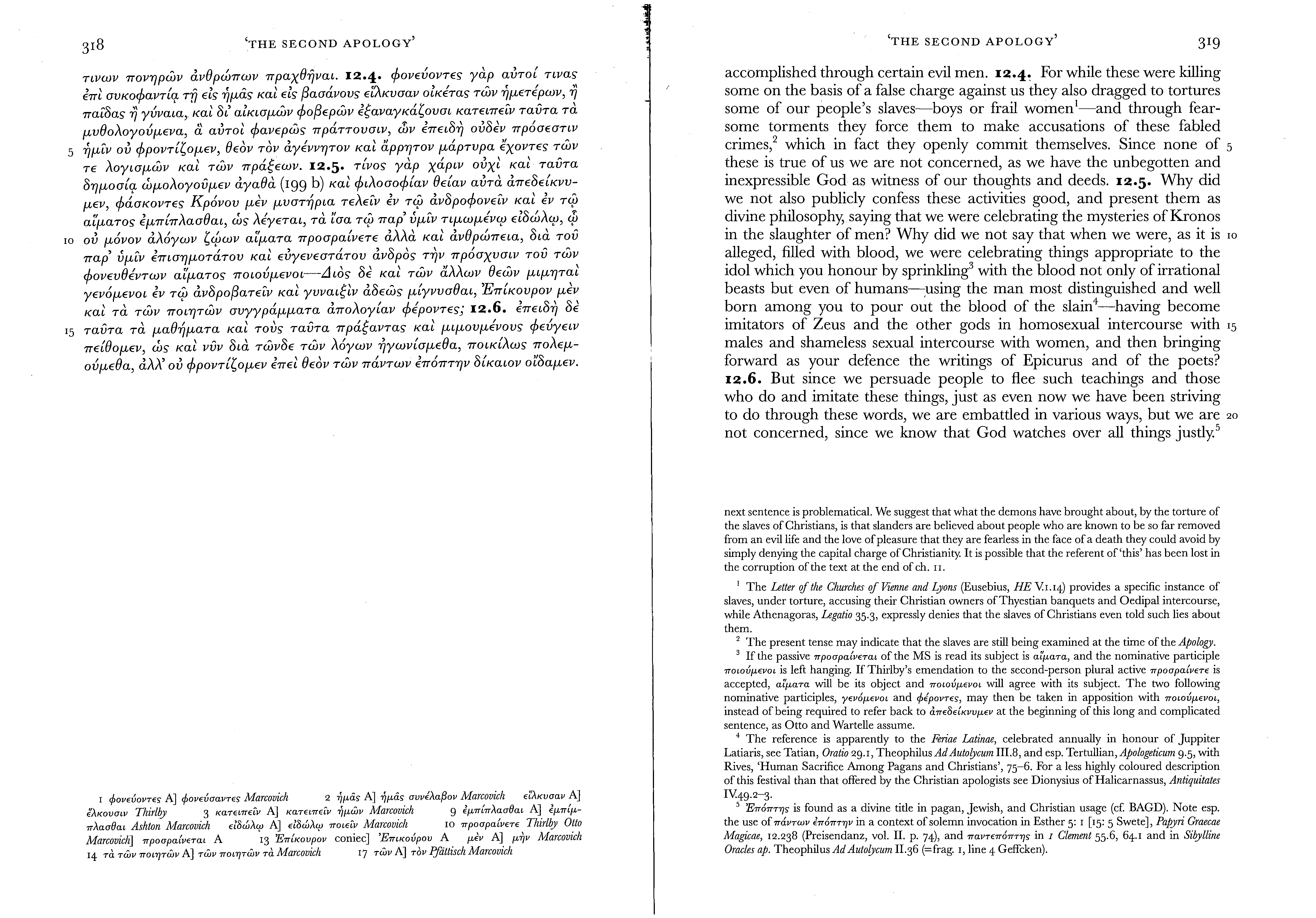
'ΤΗΕ SECOND APOLOGY'
'ΤΗΕ SECOND APOLOGY'
accomplished through certain evil men. 12.4~ For while these were killing some οη the basis of a false charge against us they also dragged to tortures some of our people's slaves-boys ΟΓ frail women1-and through fearsome torments they force them to make accusations of these fabled crimes,2 which ίη fact they openly commit themselves. Since none of 5 these is true of us we are not concerned, as we have the unbegotten and inexpressible God as witness of our thoughts and deeds. 12.5. Why did we not also publicly confess these activities good, and present them as divine philosophy, saying that we were celebrating the mysteries of Κronos τινων πονΥ)ρων ανθρώπων πραχθijναι. 12.4. Φονεύοντει; γαρ αύτοί τιναι;
,\ Φ' ",,)t,..
"β ι ('1\ )1 .....
( Ι " επι συκο aVTιqTYl ειι; Υ)μαι; και ειι; ασανουι; εΙΛκυσαν οικεται; των Υ)μετερων, Υ) παιδαι; ~ γύναια,. και δι' αικισμων Φοβερων εςαναγκάζουσι κατειπειν ταυτα τα θ λ / <\, \ Φ ~ / l'
, δ \ 'δ \ / μυ ο ογουμενα, α αυτοι ανερωι; πραττουσιν, ων επει Υ) ου εν προσεστιν
5 ήμιν ού Φροντίζομεν, θεον τον αγέννΥ)τον και αΡΡΥ)τον μάρτυρα εχοντει; των ~ \ ~ /t / \ / ,\ \ ~ τε ογισμων και των πρα':,εων. 12.5. τινοι; γαρ χαριν ουχι και ταυτα λ δΥ)μοσίqώμολογουμεν αγαθα (199 b) και ΦιλοσοΦίαν θείαν αύτα απεδείκνυ μεν, Φάσκοντει; Κρόνου μεν μυστήρια τελειν εν Τψ ανδροΦονειν και εν Τψ αίματοι; εμπίπλασθαι, ώι; λέγεται, τα ίσα Τψ παρ' ύμιν τιμωμένψ ειδώλψ, Ψ
,/ 'λ / Υ / <Ι / ' λλ \ \, θ / δ \ ~
\ ι ......
Λ παρ υμιν επισΥ)μοτατου και ευγενεστατου αν ροι; ΤΥ)ν προσχυσιν του των ίη the slaughter of men? Why did we not say that when we were, as it is 10 alleged, filled with blood, we were celebrating things appropriate to the idol which you honour by sprinkling3 with the blood not only of irrational beasts but even of humans--;using the man most distinguished and well born among you to pour out the blood of the slain4-having become imitators of Zeus and the other gods ίη homosexual intercourse with 15 males and shameless sexual intercourse with women, and then bringing forward as your defence the writings of Epicurus and of the poets?
/ Δ \ δ \ \ ~ "λλ θ ~ \ ονευ εντων αιματοι; ποιουμενοιιοι; ε και των α ων εων μιμΥ)ται / ,~ 'δ β ~ \ t\ 'δ ~ / θ Έ / \ γενομενοι εν Τψ αν ρο ατειν και γυναι':, ιν α εωι; μιγνυσ αι, πικουρον μεν \ \ ~ ~ / 'λ / Φ/
' δ\ δ\ και τα των ΠΟΙΥ)των συγγραμματα απο ογιαν εροντει;; 12. . επει Υ) ε ~ \ θ/ \ \ ~ /t \ / Φ /
ταυτα τα μα Υ)ματα και τουι; ταυτα πρα':, ανται; και μιμουμενουι; ευγειν πείθομεν, ώι; και νυν δια τωνδε των λόγων ~γωνίσμεθα, ποικίλωι; πολεμ- / θ 'λλ'
'Φ / Υ ,\ θ \ ~ / ,/ δ / "~ ουμε α, α ου ροντι,=>ομεν επει εον των παντων εΠΟΠΤΥ)ν ικαιον οιοαμεν.
12.6. But since we persuade people to flee such teachings and those who do and imitate these things, just as even now we have been striving to do through these words, we are embatded ίη various ways, but we are 20 not concerned, since we know that God watches over all things jusdy.5 next sentence is problematicaΙ We suggest that what the demons have brought about, by the torture of the slaves of Christians, is that slanders are believed about people who are known to be so far removed from an evillife and the love of pleasure that they are fearless in the face of a death they could avoid by simply denying the capital charge ofChristianity. It is possible that the referent of'this' has been lost ίη the corruption of the text at the end of ch. 11. ι The Letter qf tlze Churches qf Vienne aιzd Lyons (Eusebius, ΗΕ V.1.14) proνides a specific instance of slaves, under torture, accusing their Christian owners ofThyestian banquets and Oedipal intercourse, while Athenagoras, Legatio 35.3, expressly denies that the slaves ofChristians even told such lies about them.
2 The present tense may indicate that the slaves are still being examined at the time of the Apology.
3 If the passive προσραίνεται of the MS is read its subject is αϊματα, and the nominative participle ποιούμενοι is left hanging. If Thirlby's emendation to the second-person plural active προσραίνετε is accepted, αίματα will be its object and ποιούμενοι will agree with its subject. The two following nominative participles, γεν6μενοι and Φέροντες, may then be taken in apposition with ποιούμενοι, instead ofbeing required to refer back to α.πεδείKνVΜεν at the beginning ofthis long and complicated sentence, as Otto and Wartelle assume.
4, The reference is apparently to the Feriae Latinae, celebrated annually ίη honour of Juppiter
Latiaris, see Tatian, Oratio 29.1, TheophilusAdAuto[ycuιn ΠΙ.8, and esp. Tertullian,Apologeticum 9.5, with Rives, 'Human Sacrifice Among Pagans and Christians', 75-6. For a less highly coloured description ofthis festival than that offered by the Christian apologists see Dionysius ofHalicarnassus, Aιztiquitates
ΙΥ.49· 2-3·
Ι Φονεύοντες Α] Φονεύσαντες Marcovich 2 Τιμας Α] Τιμας συνέλαβον Marcoviclz εϊλκυσαν Α] 5 Έπ6πτης is found as a diνine title in pagan, Jewish, and Christian usage (cf. BAGD). Note esp. the use of πάντων έπ6ΠTΗV ίη a context of solemn invocation ίη Esther 5: ι [15: 5 Swete], ΡαΡΥτί Graecae ελκουσιν Tlzirlby 3 κατειπειν Α] κατειπειν ήμων Marcovich 9 έμπίπλασθαι Α] έμπίμπλασθαι Ashton AιJαι"COvich είδώλψ Α] είδώλψ ποιειν ΝΙαιωυίcΙι 10 προσραίνετε Thirlb)I Otto Marcoviclz] προσραίνεται Α 13 Έπίκουρον coniec] 'Επικούρου Α μεν Α] μην NIarcoviclz 14 τα των ποιητων Α] των ποιητων τα MarcoVΊch
17 των Α] τον ΈJ(ittisclz NIarcovich AιJagicαe, 12.238 (Preisendanz, νοΙ Π. ρ. 74), and παντεπ6πτης in ι Clemeιιt 55.6, 64.1 and in Sibylline
Oracles αρ. Theophilus Ad Auto[ycum Π.36 (=frag. ι, line 4 Geffcken).
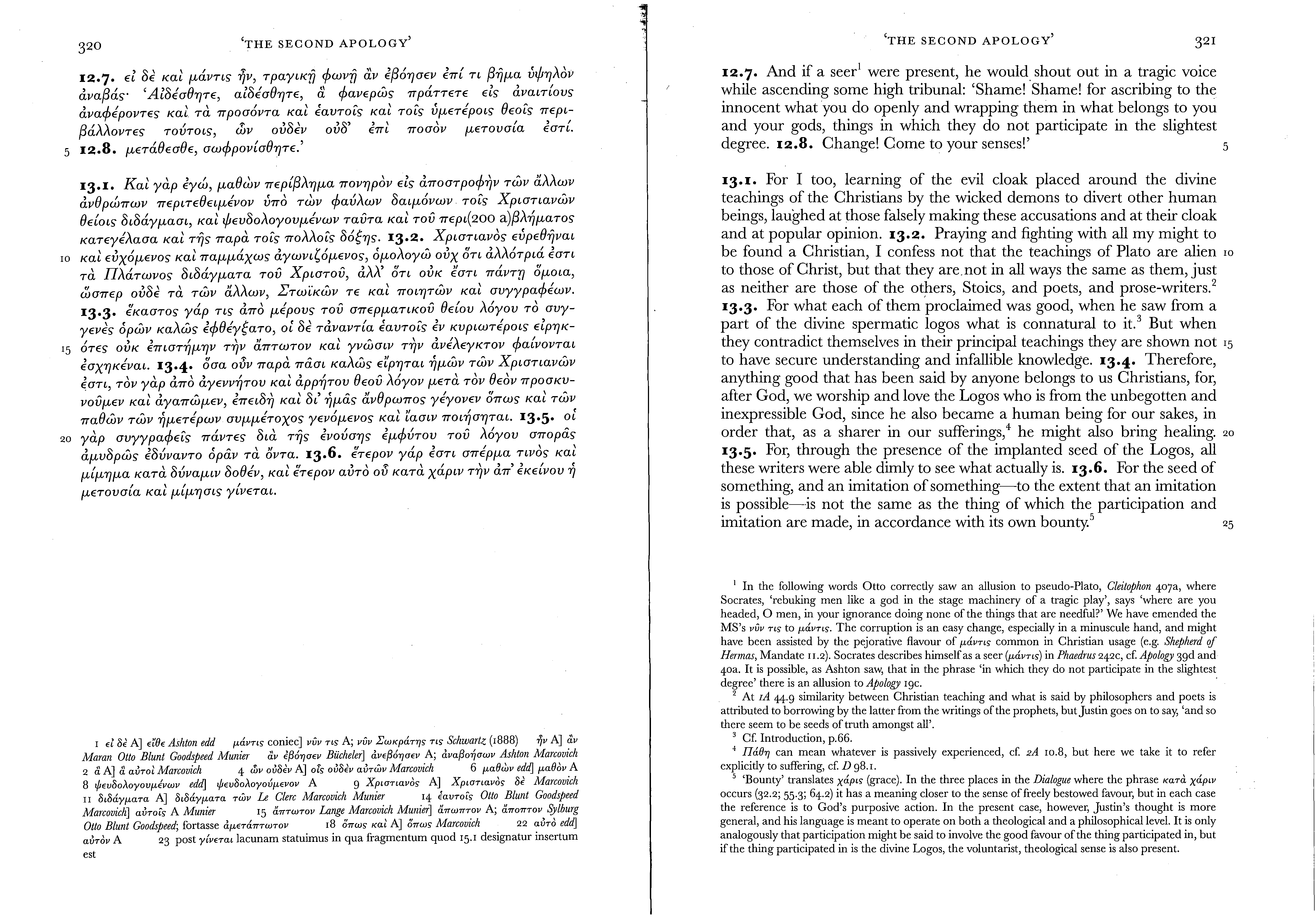
'ΤΗΕ SECOND APOLOGY'
3'21
3'20
'ΤΗΕ SECOND APOLOGY'
12.7. And if a seer1 were present, he would. shout out ίη a tragic voice while ascending some high tribunal: 'Shame! Shame! for ascribing to the innocent what you do openly and wrapping them ίη what belongs to you and your gods, things ίη which they do not participate ίη the slightest degree. 12.8. Change! Come to your senses!'
12.7. ει δΕ και μάνης ήν, τραγικυ Φωνυ αν εβό'Υ}σεν επί η β-ημα ύΨ'Υ}λον , β , 'Α 'δ' θ 'δ' θ "
Φ ~ , '" ανα ας' ι εσ 'Υ}τε, αι εσ 'Υ}τε, α ανερως πραττετε εις αναιηους , φι \ \ Ι \ Ι ,...
\ Λ ( ι θ ~ ανα εροντες καί. τα προσοντα και εαυτοις και τοις υμετεροις εοις περιβ 'λλ ' l'
'δ '
'δ"
\ \ "
13.1. For Ι too, learning of the evil cloak placed around the divine teachings of the Christians by the wicked demons to divert other human beings, laughed at those falsely making these accusations and at their cloak and at popular ορίηίοη. 13.2. Praying and fighting with all my might to be found a Christian, Ι confess not that the teachings of Plato are alien ω to those of Christ, but that they are.not ίη all ways the same as them, just as neither are those of the οψ.ers, Stoics, and poets, and prose-writers.2
Τ.Τ \ \ " θ "βλ \"
Φ \ ~ 'Ιλλ 13.1. nαι γαρ εγω, μα ων περι 'Υ}μα 'Πον'Υ}ρον εις αποστρο 'Υ}ν των α ων 'θ ' θ'"
~ χ ~ αν ρωπων περιτε ειμενον υπο των αυ ων αιμονων τοις ρισηανων θείοις διδάγμασι, και ψευδολογουμένων ταυτα και του πεΡΙ('200 a)βλ~ματος κατεγέλασα και τ-ης παρ α τοις πολλοις δόξ'Υ}ς. 13.2. Χρισηανος εύρεθ-ηναι ω και εύχόμενος και παμμάχως άγωνιζόμενος, όμολογω ούχ όη άλλότριά εση τα Πλάτωνος διδάγματα του Χριστου, άλλ' όη ούκ εση πάντ'[) όμοια, ωσπερ ούδΕ τα T(VV αλλων, Στωί'κων τε και ΠΟΙ'Υ}των και συγγραΦέων.
13.3. έκαστος γάρ ης άπο μέρους του σπερμαηκου θείου λόγου το συγ- \ • ~ λ ~ 'Φθ' C • δ \, ,.
~, " γενες ορων κα ως ε εγ~αTO, οι ε τανανηα εαυτοις εν κυριωτεροις ειρ'Υ}Κ13.3. For what each ofthem proclaimed was good, when he saw from a part of the divine spermatic logos what is connatural to it. 3 But when they contradict themselves ίη their principal teachings they are shown not 15 to have secure understanding and infallible knowledge. 13.4. Therefore, anything good that has been said by anyone belongs to us Christians, for, after God, we worship and love the Logos who is from the unbegotten and inexpressible God, since he also became a human being for our sakes, ίη order that, as a sharer in our sufferings,4 he might also bring healing. 20
13.5. For, through the presence of the implanted seed of the Logos, aΠ these writers were able dimly to see what actually is. 13.6. For the seed of something, and an imitation of something-to the extent that an imitation is possible-is not the same as the thing of which the participation and imitation are made, ίη accordance with its own bounty.5
ι ), Ι \"
\ 1"\ \ )'λ Φ'
οτες ουκ επισΤ'Υ}μ'Υ}ν Τ'Υ}ν απτωτον και γνωσιν Τ'Υ}ν ανε εγκτον αινονται εσχ'Υ}κέναι. 13.4. όσα οδν παρα πασι καλως εϊΡ'Υ}ται ήμων των Χρισηανων εση, τον γαρ άπο άγενν~Toυ και άPP~Toυ θεου λόγον μετ α τον θεον προσκυ νουμεν και άγαπωμεν, επειδη και δι' ήμας ανθρωπος γέγονεν όπως και των παθων των ήμετέρων συμμέτοχος γενόμενος και ϊασιν πoι~σ'Y}Tαι. 13.5. οί
20 γαρ συγγραΦεις πάντες δια τ-ης ενούσ'Υ}ς εμΦύτου του λόγου σπορας άμυδρως εδύναντο όραν τα Οντα. 13.6. έτερον γάρ εση σπέρμα ηνος και μίμ'Υ}μα κατα δύναμιν δοθέν, και έτερον αύτο oV κατα χάριν την άπ' εκείνου ή μετουσία και μίμ'Υ}σις γίνεται. ι 1η the following words Otto correctly saw an allusion to pseudo-Plato, Cleitopholl 407a, where
Socrates, 'rebuking men like a god ίη the stage machinery of a tragic play', says 'where are you headed, Ο men, ίη your ignorance doing none of the things that are needful?' We have emended the MS's νυν τις to μάνης. The corruption is an easy change, especially in a minuscule hand, and might have been assisted by the pejorative flavour of μάνης common ίη Christian usage (e.g. Shepherd qf
Hermαs, Mandate ΙΙ.2). Socrates describes himselfas a seer (μάνης) ίη Phαedrus 242C, cf. Apology 39d and 40a. 1t is possible, as Ashton saw, that ίη the phrase 'ίη which they do not participate ίη the slightest degree' there is an allusion to Apology 19C.
2 At ιΑ 44.9 similarity between Christian teaching and what is said by philosophers and poets is attributed to borrowing by the latter from the writings of the prophets, but Justin goes οη to say, 'and so there seem to be seeds of truth amongst all'.
3 Cf. 1ntroduction, ρ.66. ι εΙ δε Α] εϊθε AsJzton edd μάνης coniec] νυν ης Α; νυν Σωκράτης ης ScJzwαrtz (1888)
.ην Α] αν 4 Πάθη can mean whatever is passively experienced, cf. 2Α ω.8, but here we take it to refer explicitly to suffering, cf. D 98. ι.
ΝΙαταπ Otto Blunt Goodspeed Muniel· αν έβόησεν BiicJzeler] άνεβόησεν Α; άναβοήσων Asht01l MαrcovicJz
2 α Α] α αύτοι Mαrcovich 4 ιbν ούδεν Α] οΤς ούδεν αύτων Mαrcovich 6 μαθων edιZJ μαθον Α 8 ψευδολογουμένων edιZJ ψευδολογούμενον Α 9 Χρισηανος Α] Χρισηανος δε MαrcovicJz 5 'Bounty' translates χάρις (grace). 1η the three places ίη the Diαlogue where the phrase κατα χάριν occurs (32.2; 55.3; 64.2) it has a meaning closer to the sense of freely bestowed favour, but ίη each case the reference is to God's purposive action. 1η the present case, however, Justin's thought is more general, and his language is meant to operate οη both a theological and a philosophicallevel. 1t is only analogously that participation might be said to involve the good favour of the thing participated in, but if the thing participated ίη is the divine Logos, the voluntarist, theological sense is also present.
ΙΙ διδάγματα Α] διδάγματα των Le Clerc Mαrcovich Munier 14 έαυτοις Otto Blullt Goodspeed lvIαl"COvich] αύτοις Α Munier 15 α.πτωτον Lαnge Mαrcovich MUllier] α.πωπτον Α; α.ποπτον Sylbulg
Otto Blullt Goodspeed; fortasse άμετάπτωτον 18 οπως και Α] οπως Mαrcovich 22 αύτο edιZJ αύτον Α 23 post γίνεται lacunam statuimus ίη qua fragmentum quod 15.1 designatur insertum est

'ΤΗΕ SECOND APOLOGY'
'ΤΗΕ SECOND APOLOGY'
(15.1. Και To-V εν Τψ εμψ εθνει ασεβους και πλάνου σψωνιανου (15.1. And Ι have scorned the impious and ~rroneous teaching' ofSimon, found among my own nation.)l διδάγματος KαTεΦpόνrισα.) 1 This sentence has been rejected as a gloss since Perion. Cf. our note at ιΑ 70.1 [15.2]. For Justin
2 Και του εν τψ εμψ εθνει άσεβους και πλάνου σιμωνιανου διδάγματος κατεΦρόνησα Α (post 14.2)
Alunier] om 0110 Blunl Goodspeed Mαrcoviclz οη the Samaritans as followers of Simon, see ιΑ 26.3 and D 120.6--'my nation (γένος), and Ι mean the Samaritans'.