
Introduction
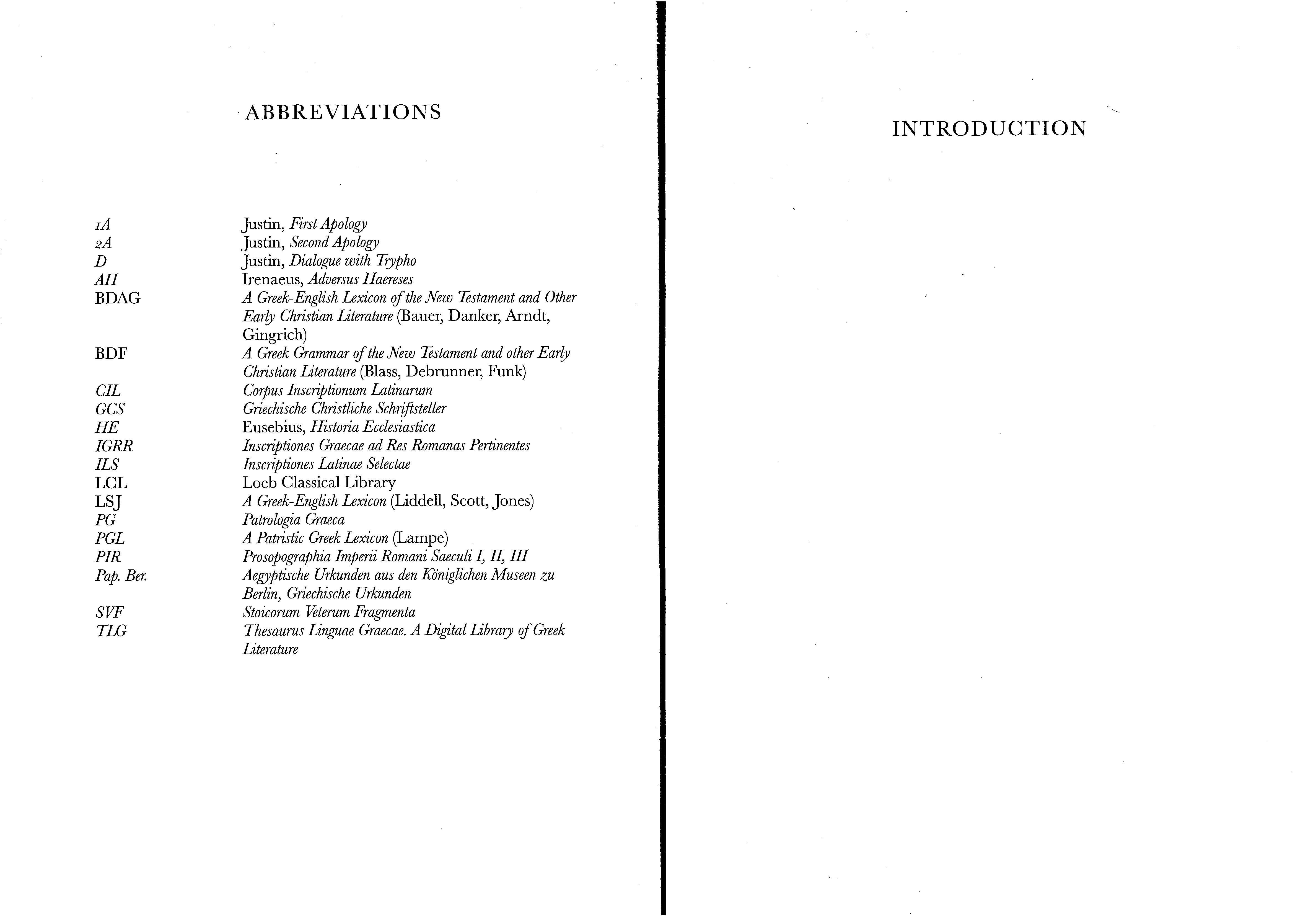
. ABBREVIATIONS
INTRODUCTION
Justin, First Apology Justin, Second Apology Justin, Diαlogue with Trypho ιΑ 2Α D Irenaeus, Adversus Hαereses ΑΗ Α Greek-English Lexicon qf the New Testαment αnd Other
BDAG Eαr1y Christiαn Literαture (Bauer, Danker, Arndt, Gingrich) Α Greek Grαmmαr qf the New Testαment αnd other Eαr1y
BDF Christiαn Literαture (Blass, Debrunner, Funk) Corpus 1nscriptionum Lαtinαrum Griechische Christliche Schrijtsteller Eusebius, Historiα Ecclesiαsticα 1nscriptiones Grαecαe αd Res Romαnαs Pertinentes
1nscriptiones Lαtinαe Selectαe Loeb Classical Library C1L GCS ΗΕ 1GRR 1LS LCL LSJ PG PGL P1R Α Greek-English Lexicon (Liddell, Scott, Jones)
Pαtrologiα Grαecα Α Pαtristic Greek Lexicon (Lampe) Prosopogrαphiα 1mperii Romαni Sαeculi 1, 11, 111
Aegyptische Urkunden αus den ΚOniglichen Museen zu Berlin, Griechische Urkunden Stoicorum veterum Frαgmentα Ραρ. Ber.
SVF Thesαurus Linguαe Grαecαe. Α Digitαl Librαry qf Greek TLG Literαture
jUSTIN'S TEXT(S): ΤΗΕ TRADITION
. ΙΝ MANUSCRIPT AND PRINT
The title of this book promises an edition of the Apologies of Justin Martyr.
But it is far from self-evident how many of them there are. That is ίη fact one of the more hoary of the problems with which any editor of Justin must deal-it has been an item οη the agenda since at least Grabe's great edition of 1700. But it turns out to be quite an important question as well.
Much more is involved than a simple literary puzzle: it crucially affects our whole picture of what Justin the apologist was trying to do, and migh t even have some light to shed οη the way Justin the philosopher and teacher operated ίη mid-second-century Rome.
The question has usually been approached solely ίη literary terms, but we must consider as well what is knowable of the history of the text. We therefore turn first to the manuscripts.
ΤΗΕ MANUSCRIPT TRADITION
Three manuscripts come into the reckoning: Parisinus graecus 450, Phillίpicus 3081, and Ottobonianus graecus 274, which we, following the usage established by Otto, will call Α, Β, and C. 1
Parisinus graecus 450=Α The οηlΥ one of these of independent value-and therefore the manuscript οη which rests the whole tradition of Justin's authentic works-is Parisinus grαecus 450.2 1t comprises 467 paper folios measuring
28.5Χ21.5 cm, and was completed, according to the colophon, οη ii September 1364 (fo1. 461 a). Unfortunately, the scribe does not give his name, and attempts to identifY him are inconclusive. 3 The hand is regular
1 Ott03, νοΙ ι, part ι, ρρ. xxi-xxviii. Οη some other, late collections of extracts, see η. 40 below.
2 For descriptions see Otto3, ρρ. ΧΧί-ΧΧίίί; Archambault, Diαlogue, νοΙ ι, ρρ. xii-xxxviii; Marcovich,
Apologiαe, 5-6; Marcovich, Diαlogus, 1-4; and Bobichon, 'Oeuvres', 158-g.
3 See Marcovich, Apologiαe, 5, η. 9 (rejecting a suggested identification with Manuel Tzykandyles);
Marcovich, Diαlogus, 3 (reporting a proposal ofE. Lamberz and Claus Vetten that he was an unnamed stablemate of Tzykandyles who worked with him οη Mαrciαllus gr. 146; Marcovich returns a Scotch verdict οη the proposal); and Bobichon, 'Oeuvres', 159, η. 7 (tentatively putting forward the unnamed scribe ofFlorence, Lαur. Plut. 9, 9).
JUSTIN'S TEXT(S)
INTRODUCTION
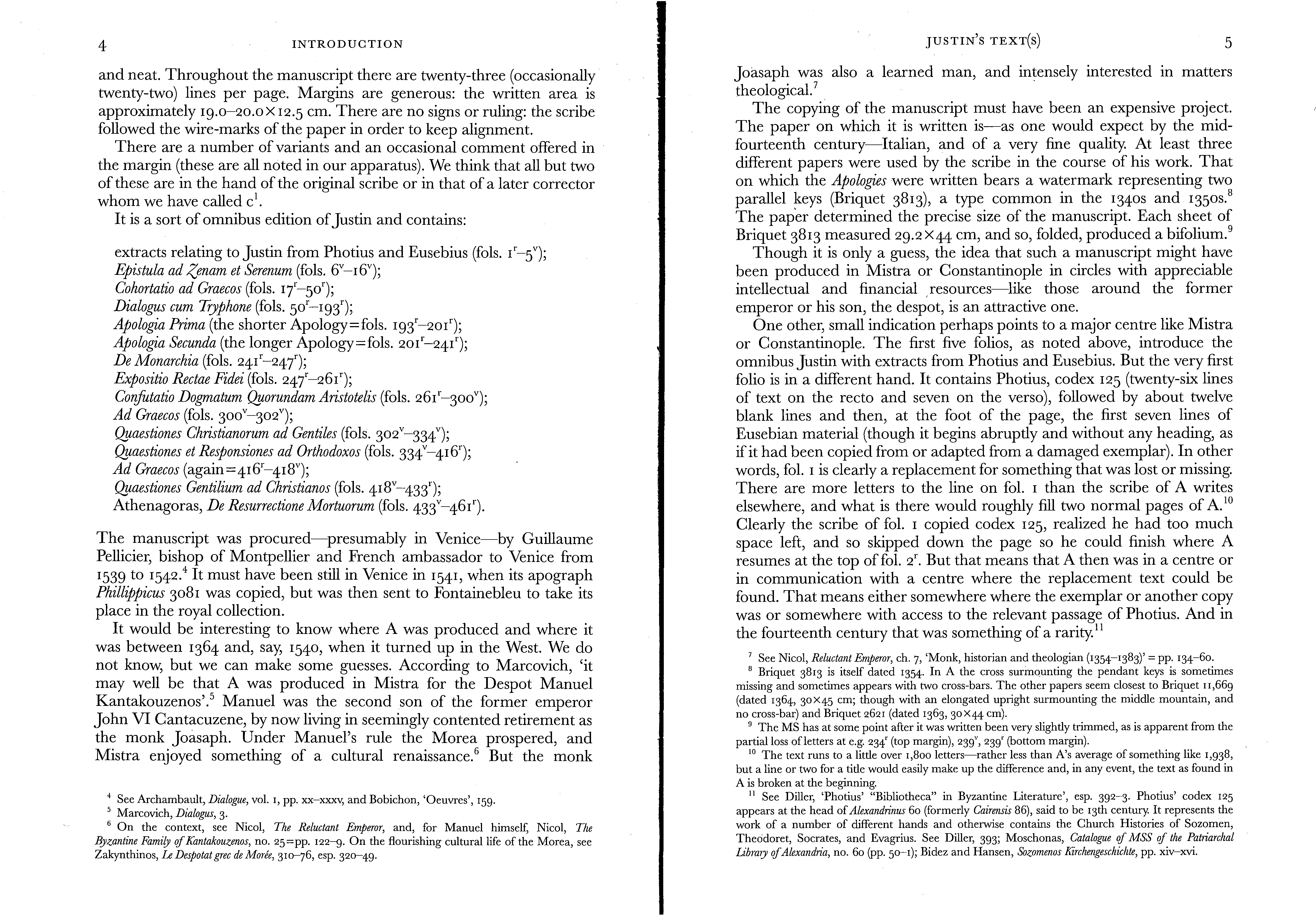
Joasaph was a1so a 1earned man, and in~ense1y interested ίη matters and neat. Throughout the manuscript there are twenty-three (occasionally twenty-two) 1ines per page. Margins are generous: the written area is approximate1y Ι9.0-20.0Χ 12.5 cm. There are ηο signs or ru1ing: the scribe followed the wire-marks of the paper ίη order to keep a1ignment. theo1ogica1. 7
The copying of the manuscript must have been an expensive project.
The paper οη which it is written is-as one wou1d expect by the midfourteenth century-Ita1ian, and of a very fine qua1ity. At 1east three different papers were used by the scribe ίη the course of his work. That There are a number of variants and an occasiona1 comment offered ίη the margin (these are all noted ίη our apparatus). We think that all but two of these are ίη the hand of the origina1 scribe or ίη that of a 1ater corrector whom we have called c1• οη which the Apologieswere written bears a watermark representing two paralle1 keys (Briquet 3813), a type common ίη the 1340S and I350s.8
The paper determined the precise size of the manuscript. Each sheet of Briquet 3813 measured 29.2Χ44 cm, and so, fo1ded, produced a bifo1ium.
It is a sort of omnibus edition of Justin and contains:
extracts re1ating to Justin from Photius and Eusebius (fo1s. ι Though it is οη1Υ a guess, the idea that such a manuscript might have been produced ίη Mistra or Constantinop1e ίη circ1es with appreciab1e intellectua1 and financia1 ,resources-1ike those around the former emperor or his son, the despot, is an attractive one.
Γ-5"); Epistula ad Zenam et Serenum (fo1s. 6"-16"); Cohortatio ad Graecos (fo1s. ηΓ-50Γ); Dialogus cum Tryphone (fo1s. 50Γ-Ι93Γ); Apologia Prima (the shorter Apo1ogy=fo1s. Ι93Γ-20ιΓ);
Apologia Secunda (the 10nger Apo1ogy= fo1s. 20IΓ-24ιΓ); De Monarchia (fo1s. 24ιΓ-247Γ); Expositio Rectae Fidei (fo1s. 247Γ-26ιΓ);
One other, small indication perhaps points to a major centre 1ike Mistra or Constantinop1e. The first five fo1ios, as noted above, introduce the omnibus Justin with extracts from Photius and Eusebius. But the very first
[ο1ίο is ίη a different hand. It contains Photius, codex 125 (twenty-six 1ines of text οη the recto and seven οη the verso), followed by about twe1ve b1ank 1ines and then, at the foot of the page, the first seven lines of Eusebian materia1 (though it begins abruptly and without any heading, as if it had been copied from or adapted from a damaged exemp1ar). Ιη other words, fo1. ι is clear1y a rep1acement for something that was 10st or missing.
There are more 1etters to the 1ine οη fo1. ι than the scribe of Α writes e1sewhere, and what is there would rough1y fill two normal pages of Α. 10
Clearly the scribe of fo1. ι copied codex 125, rea1ized he had too much space 1eft, and so skipped down the page so he could finish where Α resumes at the top of fo1. 2
CorifUtatio Dogmatum QJtorundam Aristotelis (fo1s. 26ιΓ-300"); Ad Graecos (fo1s. 300"-302"); QJtaestiones Christianorum ad Gentiles (fo1s. 302"-334");
QJtaestiones et Responsiones ad Orthodoxos (fo1s. 334"-4ι6Γ); Ad Graecos (agaln=4I6r-4I8"); QJtaestiones Gentilium ad Christianos (fo1s. 418"-433Γ);
Athenagoras, De Resurrectione Mortuorum (fo1s. 433"-46ιΓ).
The manuscript was procured-presumab1y ίη Venice-by Guillaume Pellicier, bishop of Montpellier and French ambassador to Venice from 1539 to 1542.4 It must have been still ίη Venice ίη 1541, when its apograph
Phillippicus 3081 was copied, but was then sent to Fontaineb1eu to take its p1ace ίη the roya1 collection.
. But that means that Α then was ίη a centre or Γ ίη communication with a centre where the rep1acement text could be found. That means either somewhere where the exemp1ar or another copy was or somewhere with access to the re1evant passage of Photius. And ίη the fourteenth century that was something of a rarity. 11
It wou1d be interesting to know where Α was produced and where it was between 1364 and, say, 1540, when it turned up ίη the West. We do not knσw, but we can make some guesses. According to Marcovich, 'it may well be that Α was produced ίη Mistra for the Despot Manue1
Kantakouzenos,,5 Manue1 was the second son of the former emperor John VI Cantacuzene, by now 1iving ίη seeming1y contented retirement as 7 See Nicol, Reluctαnt Εnψerοr, ch. 7, 'Monk, historian and theologian (1354-1383)' = ρρ. 134-60.
8 Briquet 3813 is itself dated 1354. lη Α the cross surmQunting the pendant keys is sometimes missing and sometimes appears with two cross-bars. The other papers seem closest to Briquet 11,669
(dated 1364, 30Χ45 cm; though with an elongated upright surmounting the middle mountain, and ηο cross-bar) and Briquet 2621 (dated 1363, 30Χ44 cm).
9 The MS has at some point after it was written been very slightly trimmed, as is apparent from the partialloss ofletters at e.g. 234 the monk Joasaph. Under Manue1's ru1e the Morea prospered, and Mistra enjoyed something of a cu1tura1 renaissance. 6 But the monk r (top margin), 239", 239 r (bottom margin).
\Ο The text runs to a little over 1,800 letters-rather less than A's average of something like 1,938, but a line or two for a title would easily make υρ the difference and, ίη any event, the text as found in Α is broken at the beginning.
11 See Diller, 'Photius' "Bibliotheca" in Byzantine Literature', esp. 392-3. Photius' codex 125 appears at the head of Alexαndrinus 60 (formerly CαirelιsΊS 86), said to be 13th century. It represents the work of a number of different hands and otherwise contains the Church Histories of Sozomen,
Theodoret, Socrates, and Evagrius. See Diller, 393; Moschonas, Cαtαlogue qf MSS qf the Pαtliαrcllαl
<[ See Archambault, Diαlogue, νοΙ ι, ρρ. χχ-χχχν, and Bobichon, 'Oeuvres', 159.
5 Marcovich, Diαlogus, 3.
6 Οη the context, see Nicol, The Reluctαnt Elnperor, and, for Manuel himself, Nicol, The Byzαntine Fαmily qf Kαntαkouzenos, ηο. 25 =ρρ. 122-g. Οη the flourishing culturallife of the Morea, see
Zakynthinos, Le Despotαt grec de Moree, 310-76, esp. 320-49.
LίbΠl1Υ qf Alexαndriα, no. 60 (Ρρ. 50-Ι); Bidez and Hansen, Sozomenos Kirchengesclzichte, ρρ. χίν-xvi.
JUSTIN'S TEXT(S)
INTRODUCTION
independent of Α, ΟΓ is it, like Β, simply a copy, direct ΟΓ indirect?
Harnack thought it was independent of Α,20 though, as we sha11 ~ee, he had an axe to grind. Blunt thought that it 'seems to rep~esent a dΠ:ereηt tradition to that of Α', without appearing to be much 1llteres.ted Ι? the matter while Marcovich and. Munier content themselves W1th slffiply
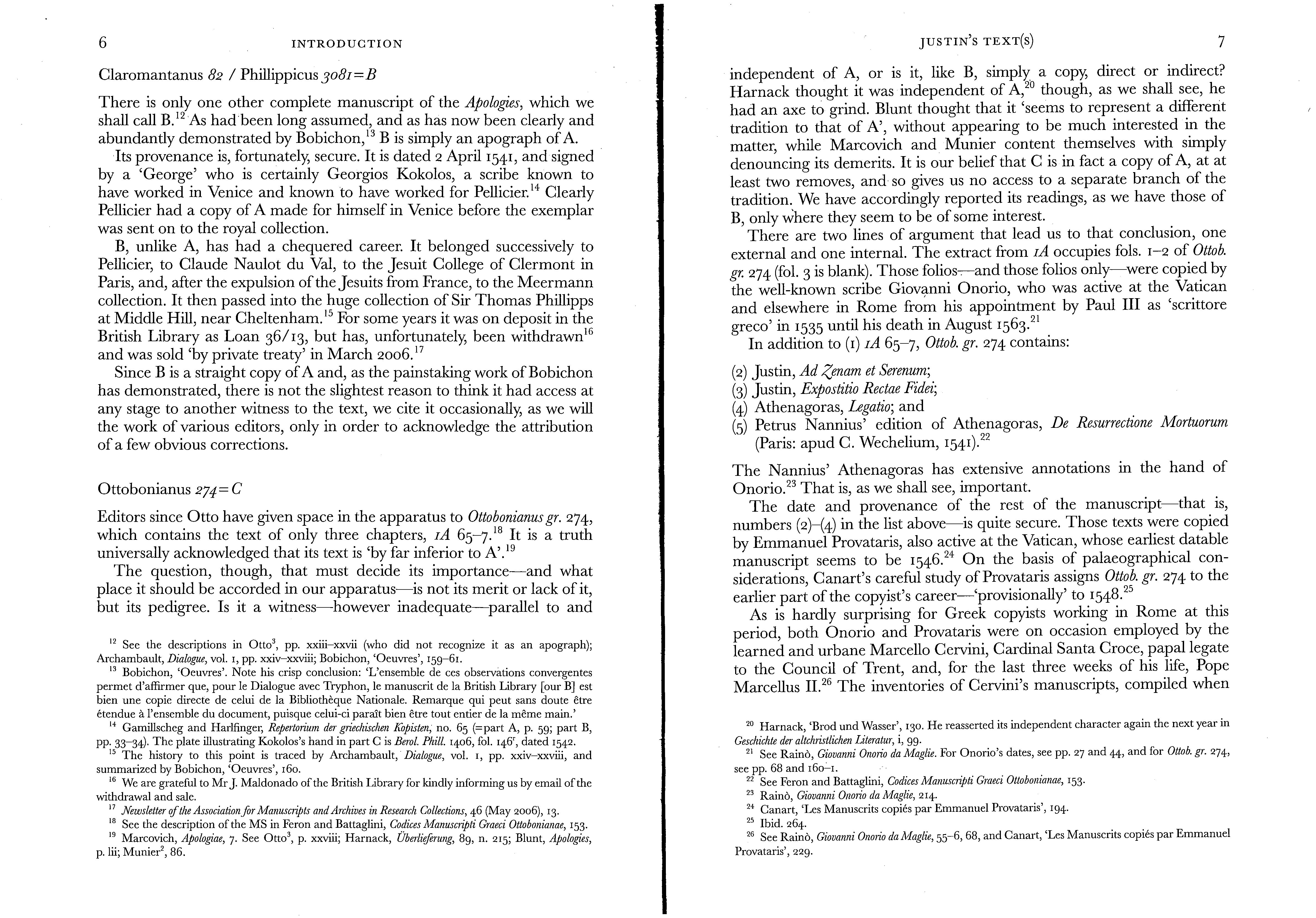
Claromantanus 82 / Phillippicus 308ι=Β There is οηlΥ one other complete manuscript of the Apologies, which we sha11 cal1 B. 12 As had'been long assumed, and as has now been clearly and abundantly demonstrated by Bobichon,13 Β is simply an apograph of Α.
Its provenance is, fortunately, secure. It is dated 2 April 1541, and signed by a 'George' who is certainly Georgios Kokolos, a scribe known to have worked ίη Venice and knownto have worked for Pe11icier. 14 Clearly
Pe11icier had a copy of Α made for himself in Venice before the exemplar was sent οη to the royal co11ection. denou~cing its demerits. It is our belief that C is ίη fact a copy of Α, at at least two removes, and so gives us ηο access to a separate branch of the tradition. We have accordingly reported its readings, as we have those of Β, only where they seem to be of some interest.
There are two lines of argument that lead us to that cOllC1USlOll, one external and one internaΙ The extract from ιΑ occupies fols. 1-2 of Ottob. gr. 274 (foΙ 3 is blank). Those folios-.-and those folios only-were copie~ by Β, unlike Α, has had a chequered career. It belonged successively to Pe11icier, to Claude Ν aulot du Val, to the Jesuit Co11ege of Clermont ίη
Paris, and, after the expulsion of the Jesuits from France, to the Meermann co11ection. It then passed into the huge collection of Sir Thomas Phillipps at Middle Hill, near Cheltenham. 1s For some years it was οη deposit in the British Library as Loan 36/13, but has, unfortunately, been withdrawn16 the well-known scribe Giovanni ΟηΟΓίο, who was actlve at the VatIcan and elsewhere ίη Rome [Γo~ his appointment by Paul ΠΙ as 'scrittore greco' in 1535 until his death ίη August 1563·21 .
Ιη addition to (ι) ιΑ 65-7, Ottob. gr. 274 conta1ns: and was sold 'by private treaty' ίη March 2006.17
(2) Justin, Ad Zenαm et Serenum; (3) Justin, Expostitio Rectαe Fidei; (4) Athenagoras, Legαtio; and (5) Petrus Nannius' edition of Athenagoras, De Resurrectione Mortuorum
Since Β is a straight copy of Α and, as the painstaking work ofBobichon has demonstrated, there is not the slightest reason to think it had access at any stage to another witness to the text, we cite it occasiona11y, as we will the work of various editors, οηlΥ ίη order to acknowledge the attribution of a few obvious corrections.
(Paris: apud C. Wechelium, 1541).22
The Nannius' Athenagoras has extensive annotations in the hand of Ottobonianus 274 = C 23 That is, as we shall see, important.
. , The date and provenance of the rest of the manuscnpt-that. lS, numbers (2)-(4) in the list above-is quite secu~e. Those texts ,;ere cOp1ed by Emmanuel Provataris, also active at the Vat1can, whose earl1est datable manuscript seems to be 1546.24 Οη the ba~is o~ palaeographical considerations, Canart's careful study ofProvatans ass1gns Ottob. gr. 274 to the . , ,.. 11' t 8 2S earlier part of the COPY1St s careerprov1sl~na Υ 0.154.·
As is hardly surprising for Greek COPY1StS wor~ng m Rome at th1S period, both ΟηΟΓίο and Provataris were οη occaSlOll employed by the learned and urbane Marcello Cervini, Cardinal Santa Croce, papallegate to the Council of Trent, and, for the last three weeks of his life, Pope
Marce11us π. 26 The inventories of Cervinj's manuscripts, compiled when ΟηΟΓίο.
Editors since Otto have given space in the apparatus to Ottoboniαnus gr. 274, which contains the text of οηlΥ three chapters, ιΑ 65-7.18 It is a truth universa11y acknowledged that its text is 'by far inferior to Α' .19
The question, though, that must decide its importance-and what place it should be accorded ίη our apparatus-is not its merit ΟΓ lack of it, but its pedigree. Is it a witness-however inadequate-para11el to and 12 See the descriptions ίη Ott03, ρρ. xxiii-xxvii (who did not recognize it as an apograph);
Archambault, Diαlogue, νοΙ ι, ρρ. xxiv-xxviii; Bobichon, 'Oeuvres', 159-61.
13 Bobichon, 'Oeuvres'. Note his crisp conc1usion: 'L'ensemb1e de ces observations convergentes permet d'affirmer que, pour 1e Dialogue avec Tryphon, le manuscrit de la British Library [our Β] est bien une copie directe de ce1ui de 1a Bibliotheque Nationa1e. Remarque qui peut sans doute etre etendue a l' ensemb1e du document, puisque ce1ui-ci paralt bien etre tout entier de la meme main.'
20 Harnack, 'Brod und Wasser', 130. He Γeasserted its independent character again the next year in Gesclzichte der αltchI-ίstlichen LiteI'αtur, ί, 99·
14 Gamillscheg and Harlfinger, RepcI"toriuιn del' gI1eclzisclzen Kopisten; no. 65 (=part Α, ρ. 59; part Β, ρρ. 33-34). The plate illustrating Kok010s's hand ίn part C is Berol. Phill. 1406, foΙ 146r, dated 1542.
21 See RainQ, Giovαnni ΟΙΙ0110 dα Mαglie. For Onorio's dates, see ρρ. 27 and 44, and for Ottob. gr. 274, see ρρ. 68 and 16a-:.-1.
15 The history to this point is traced by Archambau1t, Diαlogue, νοΙ ι, ρρ. xxiv-xxviii, and summarized by Bobichon, 'Oeuvres', 160.
16 We are grateful to Mr J. Maldonado of the British Library for kindly informing us by email of the withdrawal and sale.
22 See Feron and Battag1ini, Codices jjιJαllUSC11ptl GTαecz OttoboIlla1lαe, 153·
23 RainQ GiOVa1llli ΟΙΙ0110 dα jjιJαglie, 214.
Η Cana:t, 'Les Manuscrits copies par Emmanue1 PΓOvataris', 194· 17 Newsletter qf tlze Associαtion jότ Mαnuscripts αnd Arclzives ίπ Reseαrclz Collections, 46 (May 2006), 13.
25 Ibid. 264.
. , 18 See the description of the MS ίη Feron and Battaglini, CO.4ices jjιJαnuscI1pti GTαeci Ottob01liαnαe, 153.
26 See Raino, GiOVα1l1li ΟΙΙ0110 dα Nlαglie, 55-6, 68, and Canart, 'Les Manuscnts copres par Emmanue1
19 Marcovich, Apologiαe, 7. See Otto3, ρ. ΧΧνίίί; Harnack, UberliijeI'ung, 89, Ώ. 215; B1unt, Apologies,
PΓOvataris', 229. ρ. 1ii; Munier\ 86.
INTRODUCTION
JUSTIN'S TEXT(S)
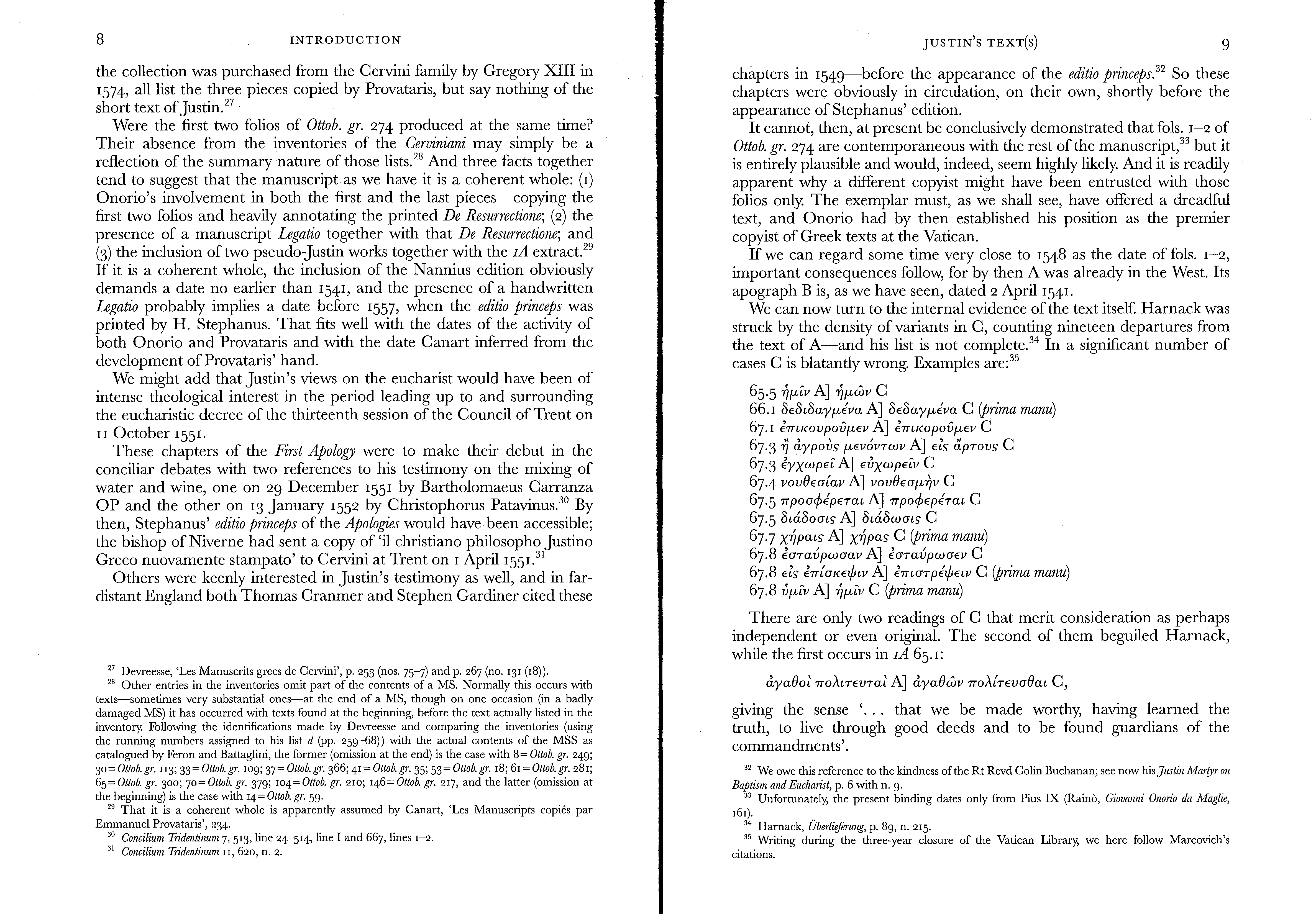
the collection was purchased from the Cervini family by Gregory ΧΙΙΙ in 1574, alllist the three pieces copied by Provataris, but say nothing of the short text of Justin. 27 : chapters ίη 1549-before the appearance of the editio princeps.32 So these chapters were obviously ίη circulation, οη their οννη, shortly before the appearance of Stephanus' edition.
Were the first two folios of Ottob. gr. 274 produced at the same time?
Their absence from the inventories of the Cerviniαni may simply be a reflection of the summary nature of those lists. 28 And three facts together tend to suggest that the manuscriptas we have it is a coherent whole: (ι)
Onorio's involvement ίη both the first and the last pieces-copying the first two folios and heavily annotating the printed De Resurrectione; (2) the presence of a manuscript Legαtio together with that De Resurrectione; and (3) the inclusion of two pseudo:Justin works together with the ιΑ extract. 29
If it is a coherent whole, the inclusion of the Ν annius edition obviously demands a date ηο earlier than 1541, and the presence of a handwritten
It cannot, then, at present be conclusively demonstrated that fols. 1-20f Ottob. gr. 274 are contemporaneous with the rest ofthe manuscript,33 but it is entirely plausible and would, indeed, seem highly likely. And it is readily apparent why a different copyist might have been entrusted with those folios οηl,Υ. The exemplar must, as we shall see, have offered a dreadful text, and Onorio had by then established his position as the premier copyist of Greek texts at the Vatican.
If we can regard some time very close to 1548 as the date of fols. 1-2, important consequences follow, for by then Α was already ίη the West. Its apograph Β is, as we have seen, dated 2 April 1541.
Legαtio probably implies a date before 1557, when the editio princeps was printed by Η. Stephanus. That fits well with the dates of the activity of both Onorio and Provataris and with the date Canart inferred from the development ofProvataris' hand.
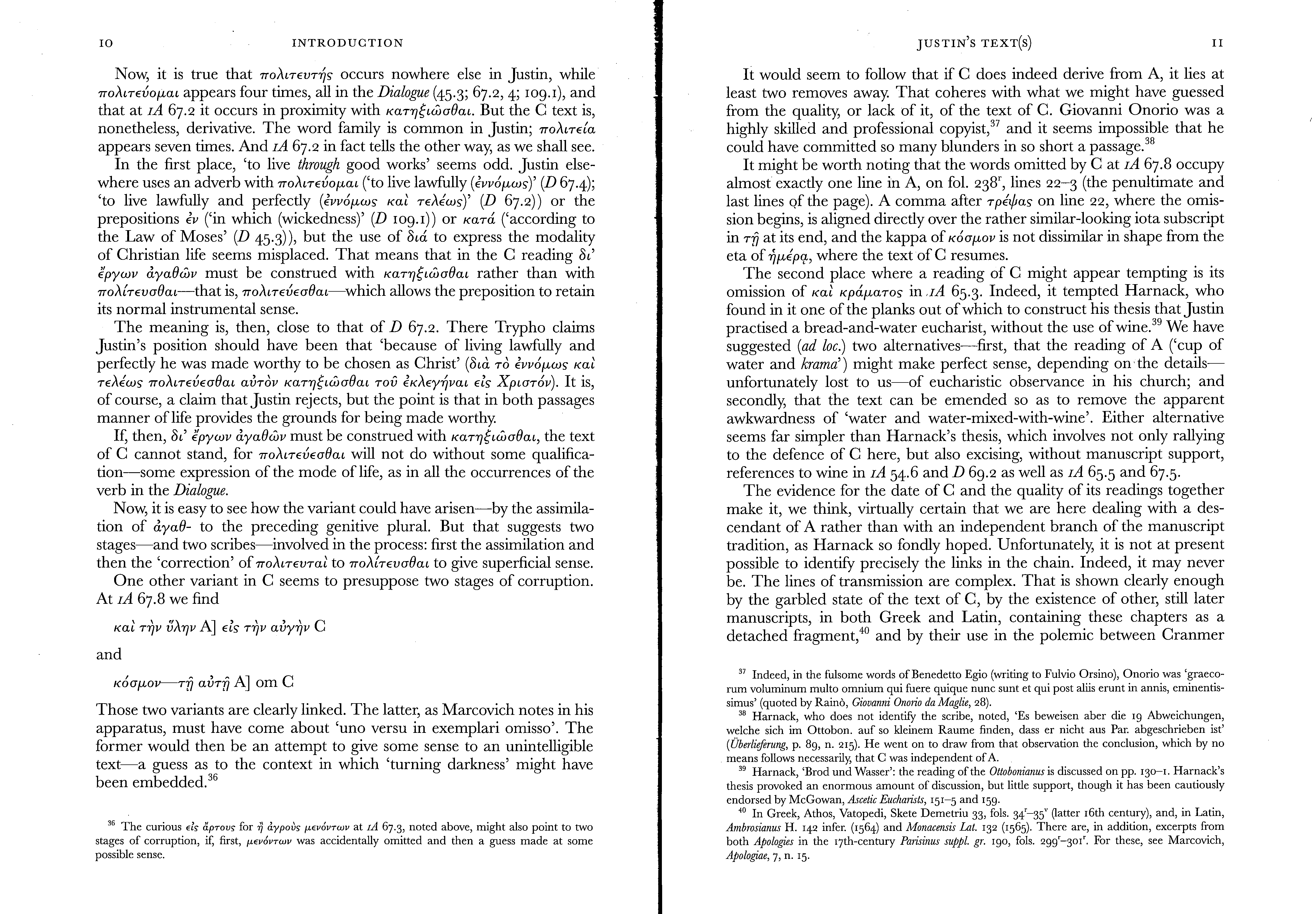
We can ηονν turn to the internal evidence of the text itself. Harnack was struck by the density ofvariants ίη C, counting nineteen departures from the text of A-and his list is not complete.34 Ιη a significant number of cases C is blatantly wrong. Examples are:35
We might add that Justin's views οη the eucharist would have been of intense theological interest ίη the period leading up to and surrounding the eucharistic decree of the thirteenth session of the Council of Trent οη
65.5 ήμιν Α] ήμων C 66.1 δεδιδαγμένα Α] δεδαγμένα C (primα mαnu) 67.1 Επικουρουμεν Α] Επικορουμεν C 67.3 ~dypoυs μενόντων Α] Els IlPTOVS C 67.3 Εγχωρει Α] ευχωρειν C 67-4 νουθεσ{αν Α] νουθεσμ-ην C 67.5 προσΦέρεται Α] προΦερέται C 67.5 διάδοσιs Α] διάδωσιs C 67.7 χ~ραιs Α] X~pas C (primα mαnu) 67.8 Εσταύρωσαν Α] Εσταύρωσεν C 67.8 Els Επ{σκεψιν Α] Επιστρέψειν C (primα mαnu)
67.8 ύμιν Α] ήμιν C (primα mαnu) 11 October 1551.
These chapters of the First Apology were to make their debut ίη the conciliar debates with two references to his testimony οη the mixing of water and wine, one οη 29 December 1551 by Bartholomaeus Carranza
ΟΡ and the other οη 13 January 1552 by Christophorus Patavinus.30 ΒΥ then, Stephanus' editio princeps of the Apologies would havebeen accessible; the bishop of Niverne had sent a copy of 'il christiano philosopho Justino
Greco nuovamente stampato' to Cervini at Trent οη ι April 1551.31
Others were keenly interested ίη Justin's testimony as well, and ίη fardistant England both Thomas Cranmer and Stephen Gardiner cited these
There are οηlΥ two readings of C that merit consideration as perhaps independent or even original. The second of them beguiled Harnack, while the first occurs ίη ιΑ 65.1:
27 Devreesse, 'Les Manuscrits grecs de Cervini', ρ. 253 (nos. 75-7) and ρ. 267 (ηο. 131 (18)). αγαθοι πολιτευται Α] αγαθων πολ{τευσθαι C,
28 Other entries ίη the inventories omit part of the contents of a MS. Normally this occurs with texts-sometimes very substantial ones-at the end of a MS, though οη one occasion (ίη a badly damaged MS) it has occuned with texts found at the beginning, before the text actually listed ίη the inventory. Following the identifications made by Devreesse and comparing the inventories (using the running numbers assigned to his list d (Ρρ. 259-68)) with the actual contents of the MSS as catalogued by Feron and Battaglini, the former (omission at the end) is the case with 8= Ottob. gr. 249;
30= Ottob.gr. ΙΙ3; 33= Ottob.gr. 109; 37= Ottob. g1". 366; 41= Ottob.gl" 35; 53= Ottob. g1". 18; 61= Ottob.gr. 281;
65= Ottob. gr. 300; 70= Ottob. gl .. 379; 104= Ottob. gr. 210; 146= Ottob. gr. 217, and the latter (omission at the beginning) is the case with 14= Ottob. g1". 59. giving the sense '... that we be made worthy, having learned the truth, to live through good deeds and to be found guardians of the commandments' .
32 We owe this reference to the kindness of the Rt Revd Οοlίη Buchanan; see now his Justin Aιfar!)!r οπ
Baptίsm and EuchaTist, ρ. 6 with n. 9.
33 Unfortunately, the present binding dates only from Pius ΙΧ (Raino, Giovallni Onorio da Maglie,
161).
29 That it is a coherent whole is apparently assumed by Canart, 'Les Manuscripts copies par
Emmanuel Provataris', 234.
34Harnack, ϋbeτlίqeτung, ρ. 89, n. 215.
30 Concilium Tridentil1um 7,513, line 24-514, line Ι and 667, lines 1-2.
35 Writing during the three-year closure of the Vatican Library, we here follow Marcovich's citations.
31 Concilium Tίidentinuιn ΙΙ, 620, n. 2.
1NTRODUCT10N
JUs T1N'S TEXT(S)
ΙΙ It would seem to follow that if C does indeed derive from Α, it lies at least two remQves away. That coheres with what we might have guessed from the quality, or lack of it, of the text of C. Giovanni Onorio was a highly skilled and professional copyist,37 and it seems impossible that he could have committed so many blunders ίη so short a passage.38
Νονν; it is true that πολιτευτήι; occurs nowhere else in Justin, while πολιτεύομαι appears four times, all ίη the Diαlogue (45.3; 67.2,4; 109.1), and that at ιΑ 67.2 it occurs ίη proximity with KαTΎjςιωσθαι. But the C text is, nonetheless, derivative. The word family is common ίη Justin; πολιτεία appears seven times. And ιΑ 67.2 ίη fact tells the other way, as we shall see.
Ιη the first place, 'to live through good works' seems odd. Justin elsewhere uses an adverb with πολιτεύομαι ('to live lawfully (εννόμωι;)' (D 67-4);
It might be worth noting that the words omitted by C at ιΑ 67.8 occupy almost exactly one line ίη Α, οη [οΙ 238r, lines 22-3 (the penultimate and last lines Qf the page). Α comma after τρέψαι; οη line 22, where the omisSiOll begins, iS aligned directly over the rather similar-looking iota subscript in Tn at its end, and the kappa of κόσμον iS not dissimilar in shape from the eta of rιμέΡq" where the text of C resumes.
'to live lawfully and perfectly (εννόμωι; και τελέωι;) , (D 67.2)) or the prepositions εν ('ίη which (wickedness), (D 109.1)) or κατά ('according to the Law of Moses' (D 45.3)), but the use of διά to express the modality of Christian life seems misplaced. That means that ίη the C reading δι' εργων άγαθων must be construed with KαTΎjςιωσθαι rather than with The second place where a reading of C might appear tempting iS its omission of και κράματοι; ίη ,ιΑ 65.3. Indeed, it tempted Harnack, who found ίη it one of the planks out of which to construct his thesis that Justin practised a bread-and-water eucharist, without the use of wine. 39 We have suggested (αd loc.) two alternatives-first, that the reading of Α ('cup of water and krαmα') might make perfect sense, depending οη' the detailsunfortunately lost to us-of eucharistic observance ίη his church; and secondly, that the text can be emended so as to remove the apparent awkwardness of 'water and water-mixed-with-wine'. Either alternative seems far simpler than Harnack's thesis, which involves not οηlΥ rallying to the defence of C here, but also excising, without manuscript support, references to wine ίη ιΑ 54.6 and D 69.2 as well as ιΑ 65·5 and 67.5. πολίτεvσθαι-that is, πολιτεύεσθαι-whίch allows the preposition to retain its normal instrumental sense.
The meaning is, then, close to that of D 67.2. There Trypho claims Justin's position should have been that 'because of living lawfully and perfectly he was made worthy to be chosen as Christ' (δια το εννόμωι; και τελέωι; πολιτεύεσθαι αύτον KαTΎjςιωσθαι τού εκλεγήναι ειι; Χριστόν). It is, of course, a claim that Justin rejects, but the point is that ίη both passages manner of life provides the grounds for being made worthy.
ΙΕ, then, δι' εργων άγαθων must be construed with KαTΎjςιωσθαι, the text of C cannot stand, for πολιτεύεσθαι will not do without some qualification-some expression of the mode of life, as ίη all the occurrences of the verb ίη the Diαlogue.
The evidence for the date of C and the quality of its readings together make it, we think, virtually certain that we are here dealing with a descendant of Α rather than with an independent branch of the manuscript tradition, as Harnack so fondly hoped. Unfortunately, it is not at present possible to identif)r precisely the links ίn the chain. Indeed, it may never be. The lines of transmission are complex. That is shown clearly enough by the garbled state of the text of C, by the existence of other, still later manuscripts, ίn both Greek and Latin, containing these chapters as a detached fragment,40 and by their use ίn the polemic between Cranmer
Νονν, it is easy to see how the variant could have arisen-by the assimilation of άγαθto the preceding genitive pluraΙ But that suggests two stages-and two scribes-involved ίη the process: first the assimilation and then the 'correction' of πολιτευται to πολίτευσθαι to give superficial sense.
One other variant ίη C seems to presuppose two stages of corruption.
At ιΑ 67.8 we find \ \ "λ Α] , \ ,\ C και TΎjν V Ύjν ειι; TΎjν αυγΎjν and κόσμΟν--τn aVTn AJ om C 37 Indeed, ίη the fulsome words ofBenedetto Egio (writing to Fulvio Orsino), ΟηΟΓίο was 'graecorum voluminum multo omnium qui fuere quique nunc sunt et qui post aliis erunt in annis, eminentissimus' (quoted by RainQ, Giovanlli On01io da Maglie, 28).
Those two variants are clearly linked. The latter, as Marcovich notes ίη his apparatus, must have come about 'uno versu ίη exemplari omisso" The former would then be an attempt to give some sense to an unintelligible text-a guess as to the context in which 'turning darkness' might have been embedded.36
38 Harnack, who does not identif)r the scribe, noted, 'Es beweisen aber die 19 Abweichungen, welche sich im Ottobon. auf so kleinem Raume finden, dass er nicht aus Par. abgeschrieben ist'
(ϋbeτΙiefiτung, ρ. 89, η. 215). He went οη to draw from that observation the conclusion, which by ηο means follows necessarily, that C was independent of Α.
39 Harnack, 'Brod und Wasser': the reading ofthe OttoboιziαIlus is discussed οη ρρ. 130-1. Harnack's thesis provoked an enormous amount of discussion, but little support, though it has been cautiously endorsed by McGowan, Ascetic Eucllalists, 151-5 and 159.
40 Ιη Greek, Athos, Vatopedi, Skete Demetriu 33, fols. 34r-35" ~atter 16th century), and, in Latin,
AIllbTOSianus Η. 142 infer. (1564) and MOllacensis Lαt. 132 (1565). There are, ίη addition, excerpts from both Apologies ίη the IJth-century PαIisillus suppl. gT. 190, fols. 299r-301Ό For these, see Marcovich,
Apologiae, 7, η. 15· 36 The curious εΙς αρτους for ij αγρους μενόντων at ιΑ 67.3, noted above, might also point to two stages of corruption, if, first, μενόντων was accidentally omitted and then a guess made at some possible sense.
JUSTIN'S TEXT(S)
INTRODUCTION
Sacra Parallela and Gardiner. It would be a story well worth pursuing, and one to which we hope some day to return, but a story which, we suggest, will have much more to contribute 'to sixteenth-century eucharistic theology than to the restoration of the text of Justin.
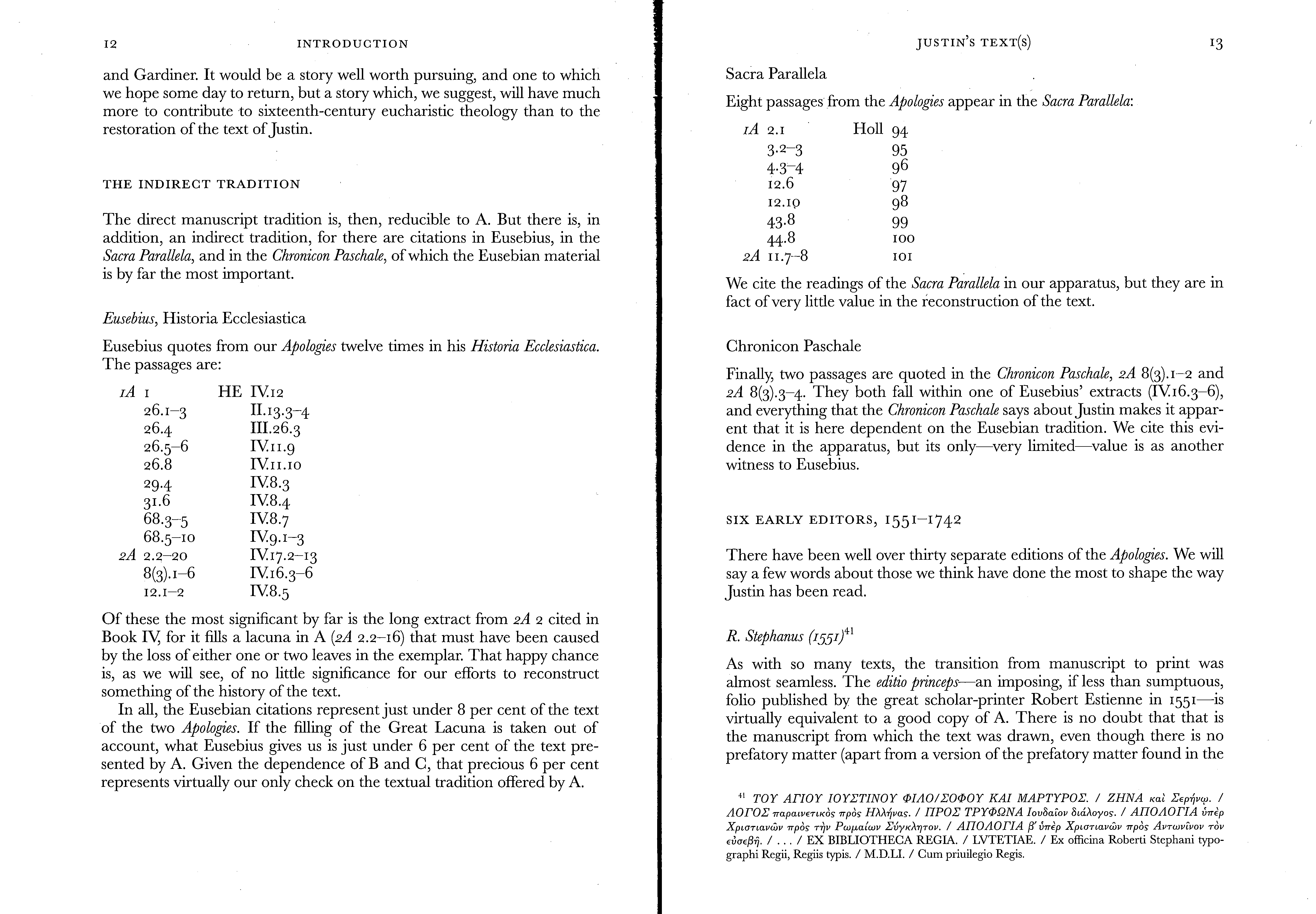
Eight passagesfrom the Apologies appear ίη the Sacra Parallela: ιΑ 2.Ι ΗοΠ 94 3·2-3
4·3c-4
Ι2.6
ΤΗΕ 1ND1RECT TRAD1T10N
Ι2.Ι9
43·8
44.8 ιοο The direct manuscript tradition is, then, reducible to Α. But there is, ίη addition, an indirect tradition, for there are citations ίη Eusebius, ίη the Sacra Parallela, and ίη the Chronicon Paschale, of which the Eusebian material is by far the most important.
2Α ΙΙ.7-8
ιοι We cite the readings of the Sacra Pa'rallela ίη our apparatus, but they are ίη fact of very litde value ίη the reconstruction of the text.
Eusebius, Historia Ecclesiastica Eusebius quotes from our Apologies twelve times ίη his Historia Ecclesiαsticα.
The passages are:
Chronicon Paschale Finally, two passages are quoted ίη the Chronicon Paschale, 2Α 8(3).Ι-2 and 2Α 8(3).3-4. They both fall within one of Eusebius' extracts (ΙΥ.ι6.3-6), and everything that the Chronicon Pαschale says about Justin makes it apparent that it is here dependent οη the Eusebian tradition. We cite this evidence ίn the apparatus, but its only-very limited-value is as another witness to Eusebius. ιΑ Ι ΗΕ ΙΥ.Ι2 26.Ι-3 26·4 26·5-6 26.8
29-4 Π.Ι3·3-4 ΠΙ.26·3 IVII·9 ΙΥ.ΙΙ.ΙΟ ΙΥ.8·3 IV8·4 IV8·7 3 ι . 6
68·3-5
S1X EARLY ED1TORS, 1551-1742
68·5-ΙΟ
ΙΥ.9· Ι-3
There have been well over thirty separate editions of the Apologies. We will say a few words about those we think have done the most to shape the way
Justin has been read.
2Α 2.2-20
8(3)·ι-6 ΙΥ.ι6·3-6 ΙΥ.8·5 Ι2.Ι-2 Of these the most significant by far is the 10ng extract from 2Α 2 cited ίη
Book ΙΥ, for it fills a lacuna ίη Α (2Α 2.2-ι6) that must have been caused by the 10ss of either one ΟΓ two leaves ίη the exemplar. That happy chance is, as we will see, of ηο litde significance for our efforts to reconstruct something of the history of the text.
R. Stephanus {I55I/1 As with so many texts, the transltlOll from manuscript to print was almost seamless. The editio princeps-an imposing, if less than sumptuous,
[οlίο published by the great scholar-printer Robert Estienne ίn I55I-iS virtually equivalent to a good copy of Α. There is ηο doubt that that is the manuscript from which the text was drawn, even though there is ηο prefatory matter (apart from a version of the prefatory matter found in the Ιη all, the Eusebian citations represent just under 8 per cent of the text of the two Apologies. If the filling of the Great Lacuna is taken out of account, what Eusebius gives us is just under 6 per cent of the text presented by Α. Given the dependence of Β and C, that precious 6 per cent represents virtually our οηlΥ check οη the textual tradition offered by Α.
ΛΟΓΟΣ παραινετικο') προ,> Ηλλήναs. / ΠΡΟ Σ ΤΡΥΦΩΝΑ Ιουδαιον διάλογοs. / ΑΠΟΛΟΓΙΑ ύπερ
Χριστιανων προ,> την Ρωμαίων ΣύγκλΤ)τον. / ΑΠΟΛΟΓΙΑ β' ύπερ Χριστιανων προ,> Αντωνινον τον εύσεβη. / ... / ΕΧ BIBLIOTHECA REGIA. / LVTETIAE. / Εχ officina Roberti Stephani typographi Regii, Regiis typis. / M.D.LI. / Cum priuilegio Regis.
JUST1N'S TEXT(S)
1NTRODUCT10N
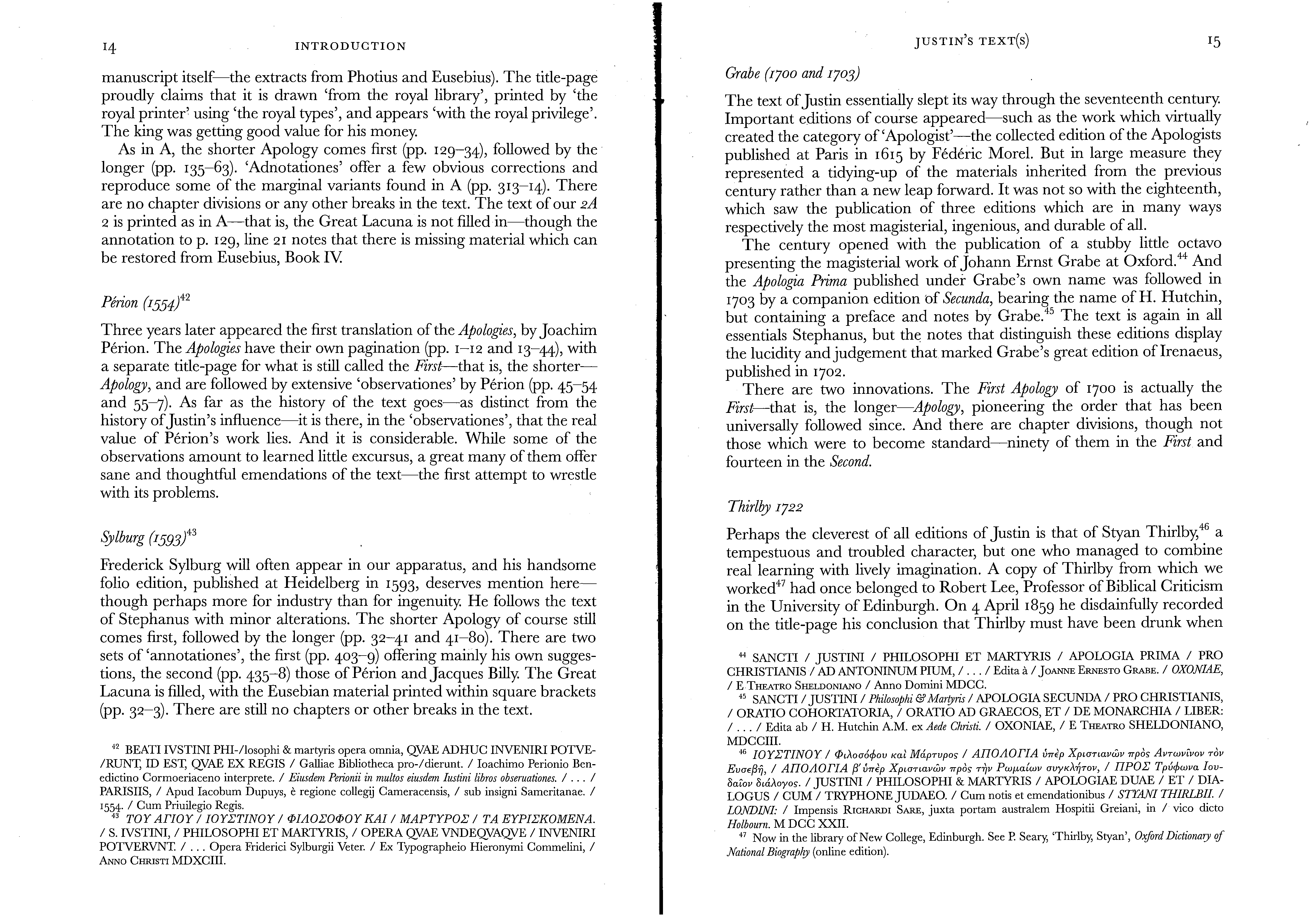
manuscript itself-the extracts from Photius and Eusebius). The title-page proudly claims that it is drawn 'from the royal library', printed by 'the royal printer~ using 'the royal types', and appears 'with the royal privilege'.
The king was getting good value for his money.
Grαbe (Ι700 αnd Ι703) The text of Justin essentially slept its way through the seventeenth century.
Important editions of course appeared-such as the work which virtu~lly created the category of 'Apologist' -the collected edition of the Apolog1sts published at Paris ίη 1615 by Federic Morel. But in large measure they represented a tidying-up of the materials inherited from the previous century rather than a new leap forward. It was not so with the eighteenth, which saw the publication of three editions which are in many ways respectively the most magisterial, ingenious, and durable of all.
As ίη Α, the shorter Apology comes first (Ρρ. 129-34), followed by the longer (Ρρ. 135-63). 'Adnotationes' offer a few obvious corrections and reproduce some of the marginal variants found ίη Α (ρρ. 313-14). There are ηο chapter divisions or any other breaks ίη the text. The text of our 2Α
2 is printed as ίη A-that is, the Great Lacuna is not filledin-though the annotation to ρ. 129, line 21 notes that there is missing material which can be restored from Eusebius, Book IV The century opened with the publication of a stubby little octavo presenting the magisterial work of Johann Ernst Grabe at Oxford. 44 ~d the Apologiα Primα published under Grabe's own name was followed .1η η03 by a companion edition bf Secundα, bearin~5the name ~fH. J:Iut.Ch1ll, but containing a preface and notes by Grabe. The text lS aga1ll m aΠ essentials Stephanus, but the notes that distinguish these editions display the lucidity andjudgement that marked Grabe's great edition oflrenaeus, published ίη η02.
There are two innovations. The First Apology of ηοο lS actually the First-that is, the longer-Apology, pioneering the order that has been
Perion (Ι554/
Three years later appeared the first translation of the Apologies, by Joachim Perion. The Apologies have their own pagination (ρρ. 1-12 and 13-44), with a separate title-page for what is still called the First-that is, the shorterApology, and are followed by extensive 'observationes' by Perion (Ρρ. 45-54 and 55-7). As far as the history of the text goes-as distinct from the history of Justin's influence-it is there, ίη the 'observationes', that the real value of Perion's work lies. And it is considerable. While some of the observations amount to learned little excursus, a great many ofthem offer sane and thoughtful emendations of the text-the first attempt to wrestle with its problems. universaΠy followed since. And there are chapter divisions, though not those which were to become standard-ninety of them ίη the First and fourteen ίη the Second.
Thirlby Ι722 Perhaps the cleverest of all editions of Justin is that of Styan Thirlby,46 a tempestuous and troubled character, but one who n:anaged to co.mbine real learning with lively imagination. Α copy of Th1rlby from Wh1Ch we worked47 had once belonged to Robert Lee, Professor of Biblical Criticism
Sylburg (ι 593/3 Frederick Sylburg will often appear ίη our apparatus, and his handsome folio edition, published at Heidelberg in 1593, deserves mention herethough perhaps more for industry than for ingenuity. He follows the text of Stephanus with minor alterations. The shorter Apology of course still comes first, followed by the longer (Ρρ. 32-41 and 41-80). There are two sets of 'annotationes', the first (Ρρ. 403-9) offering mainly his own suggestions, the second (Ρρ. 435-8) those of Perion and Jacques Billy. The Great
Lacuna is filled, with the Eusebian material printed within square brackets ίη the University of Edinburgh. Οη 4 April 1859 he disdainfully recorded οη the title-page his conclusion that Thirlby must have been drunk when
44 SANCTI / jUSTINI / PHILOSOPHI ΕΤ MARTYRIS / APOLOGIA PRIMA / PRO
CHRISTIANIS / AD ANTONlNUM PIUM, / ... / Edita a / jOANNE ERNESTO GRABE. / ΟΧΟΝΙΑΕ,
/ ETHEATRO SHELDONIANO / Αηηο Domini MDCC.
45 SANCTI / JUSTINI / Philosophi & Mar!JJJ"is / APOLOGIA SECUNDA / PRO CHRISTIANIS,
/ ORATIO COHORTATORIA, / ORATIO AD GRAECOS, ΕΤ / DE MONARCHIA / LIBER:
/ ... / Edita ab / Η. Hutchin Α.Μ. ex Aede Christi. / ΟΧΟΝΙΑΕ, / Ε THEATRO SHELDONIANO,
MDCCIII.
(ρρ. 32-3). There are still ηο chapters or other breaks in the text.
42 ΒΕΑΤΙ IVSTINI PHI-/losophi & martyris opera omnia, QVAE ADHUC INVENIRI POTVE- /RUNT, ID EST, QVAE ΕΧ REGIS / Galliae Bibliotheca pro-/dierunt. / Ioachimo Perionio Benedictino Cormoeriaceno interprete. / Eizιsde17l Pel10nii ίπ nzultos eiusdem 1ustini libros obscI·uationes. / . . . /
PARISIIS, / Apud Iacobum Dupuys, e regione collegij Cameracensis, / sub insigni Sameritanae. /
1554. / Cum Priuilegio Regis.
46 10 ΥΣΤΙΝΟ Υ / ΦιλοσόΦου Kal Μάρτυρο, / ΑΠΟΛΟΓΙΑ ύπερ Χριστιανων προ, Αντωνινον τον
Ευ σεβiι , / ΑΠΟΛΟΓΙΑ β' ύπερ Χριστιανων προ, την Ρωμαίων συγκλήτον, / ΠΡΟΣ ΤρύΦωνα Ιου δαιον διάλογο,. / JUSTINI / PHILOSOPHI & MARTYRIS / APOLOGIAE DUAE / ΕΤ / DIALOGUS / CUM / TRYPHONE jUDAEo. / Cum notis et emendationibus / STYAN1 TH1RLBIl /
LONDI.NL· / Impensis R1CHARDI SARE, juxta portam australem Hospitii Greiani, in / vico dicto
Holbourll. Μ DCC ΧΧΙΙ.
/ S. IVSTINI, / PHILOSOPHI ΕΤ MARTYRIS, / OPERA QVAE VNDEQVAQVE / INVENIRI
POTVERVNT. / ... Opera Friderici Sylburgii Veter. / Εχ Typographeio Hieronymi Commelini, /
47 Now ίη the library ofNew College, Edinburgh. See Ρ. Seary, 'Thirlby, Styan', O;ifόrd DίctiοnωΥ qf
Natiollal Biograplιy (online edition).
ΆΝΝο CHRIST1 MDXCIII.
INTRODUCTION
JUSTIN'S TEXT(S)
he wrote the Dedicatory Epistle-which, given what is known of his personal habits, is not at all unlikely. The text is still Stephanus, and there are
Blunt Our next 'ed.'· is Alfred Blunt, whose very useful edition of the Apologies was published ίη Ι9ΙΙ. Blunt was born ίη 1879 and, though ίη his twenties he had been ·a Fellow of Exeter College, Oxford, his career was to be ίη the Church ofEngland. He was bishop of~radfor? from 1931 to I95~. .. ηο chapter divisions. The edition marks the first time that the three works we recognize as the authentic Justin, and οηlΥ those three, were edited together, but it is the emendations that make Thirlby such a good companion to the text.
Blunt's edition has been deservedly ιnfluentlal because of the JUdlClOUS balance and level-headed judgement of his notes, which show a rare ability to disentangle the complexities of a difficult passage.49 But he presents οηlΥ a very select apparatus, and his text is based οη Κruger's once widely used hand edition,50 which was itself based οη OttO.51 ΒΙι:ιηt also took over from Κruger the division of chapters into sections, WhlCh has since become standard.
Mαrαn 1742 The third of the eighteenth-century editions we wish to single out still casts a scholarly shadow. 1t is the Maurist edition, published ίη a sumptuous [οlίο ίη 1742 and edited by Prudentius Maran.48 Maran had access to both of our manuscripts Α and Β. The text is Stephanus.
What has given the edition such a long shelf-life is, first, the fact that it introduced the chapter divisions which were to become standard, and secondly, Migne's decision to reprint Maran ίη the Pαtrologiα (PG 6 (1857)).
Goodspeed Three years later Edgar Goodspeed published his handy collected ed~tion of the A~ologists, which ,;as destine~2 to be perh.aps th: most wldely cited JUStlll for the next eιghty years.
The text lS heavily, not to say slavisWy, based οη Α, from which it seldom departs ίη anything more than orthography. The apparatus carefully records the readings of Α, C, and the indirect tradition (Eusebius and the Sαcrα Pαrαllelα) , but there are otherwise ηο critical notes.
FIVE MODERN EDITORS (OUR EDD) 1876-2006
Finally, we come to the five modern-or modernish-editions whose readings we have tried systematically to report and whose agreement we have represented by the siglum edd.
Goodspeed was, then, ίη one sense a throwback to the cen~uries when Stephanus' textus receptus-itself, originally, little mor~ than a l~g?tly corrected transcript of A-was the dominant text. But unlike the edltlOns of the seventeenth and eighteenth centuries, Goodspeed's version lacks the support of the notes accumulated from multiple hands that in most editions offered the reader a plethora of choices.
Otto J. C. Τ νοη Otto published his first edition ίη 1842 and the definitive, third, ίη 1876. The text finally cuts loose from what had been for nearly three centuries the textus receptus of Stephanus, though Otto stilllooks back ίη other ways to older editorial habits. His abundant annotations, for example, include an accumulation of 'variorum' notes, and he often proposes alternatives to or even expresses dissent from his own text. Otto can all too easily be criticized for inaccuracy or misjudgement, but his edition remains invaluable for the sheer quantity and range of material collected, and, as we shall see, its posterity emphatically lives οη. 1η both its strengths and its weaknesses, Otto belongs with other monumental editions from the dawn ofthe modern critical era, like Oehler's Tertullian (1851-3), editions which laid the foundation for all future critical work.
Mαrcovich The situation was dramatically changed ίη 1994, when Miroslav Marcovich published his critical edition of the Apologies,53 to be follow~d by a companion edition ofthe Diαlogue in 1997. Marcovich emends heavily, as will be readily apparent from our citation of his readings ίη our apparatus.
What we find problematic, though, is not necessarily the number of 49 Indeed, many of them continue to have wide currency as reincarnated ίη the notes of Barnard
(The Fint αιιd Second Apologies) and Wartelle (Apologies).
50 Krίiger, Die Apologieen. We have used the 2nd and 3rd editions; Blunt used the 3rd• He llsts 28 readings where he diverges from Krίiger (Blunt, Apologies, ρ. lviii).
51 'Unserer Ausgabe liegt der Text der Ottoschen Zu Grunde' (Κrίiger Apolog;ιeen (1896)), ρ. XV1.
Α. / S. Ρ. Ν. JUSTINI PHILOSOPHI ΕΤ MARTYRIS / OPERA /
QUAE EXSTANT ΟΜΝΙΑ / ... / Opera & studio unius ex Monachis Congregationis S. Mauri. /
PARISIIS, / Sumptibus CAROU OSMONT, via San-Jacobaea. / Μ DCC XLII. / CUM
APPROBATIONE ΕΤ PRIVILEGIO REGIS.
52 Die iiltesten Apologeten.
53 We reviewed Marcovich's edition, together with Munierl, ίη ]OUΙ'παl qf Theolog;ιcαl Studzes, NS 52
(2001), 349~53.
1NTRODUCT10N
JUST1N'S TEXT(S)
emendations, but their character. Many are stylistic improvements where it is hard to fathom any cause, accidental or deliberate, for the corruption postulated by MarcQvich. His text is undoubtedly better Greek than A's, but it may also be better Greek than Justin's. Other emendations of Marcovich, though, have the great merit of drawing attention to real problems ίη the structure of a sentence or the flow of an argument.
Perhaps the most valuable feature of the edition is the comprehensive register of sources and parallels at the foot of each page, which often amounts to a virtual commentary οη the text. It remains an important and distinguished edition.
We have surveyed the witnesses to the text and traced something of the way that evidence has been handled in major editions. What are we left with? What sort of a textual tradition are we dealing with?
Ορίηίοη is very divided, and the two most rec~llt edit?rs hold str?ng~y polarized views. Οη the· textual right, as it were, 1S Mun1er, who nails h1S colours firmly to the mast of Α, arguing that its text ~s .essen~ially sound.
He believes that the work of van Winden (An Early Chrιstzan Phzlosopher) and Bobichon οη the Dialogue: ont permis de etablir que le manuscrit de Paris ne merite pas les jugements, plus que severes, emis a son sujet par certains philologues de lafln du XIX~ siecle ~t des premieres decennies du xxe• Une etude attentive du texte.de ΙΆΡοl~gιe convalncra le lecteur que les prejuges entretenus contre le manuscnt de Pans ne sont que tres rarement justifies.
. Les choses etant ce qu'elles sont, notre edition se fonde essentlellement sur le texte de Α.
Munier At the very end of 1996, as the climax of years of work οη Justin, Charles
Munier published a critical edition ίη the Sources Chretiennes series (Munier2), together with a companion volume offering further comment οη the French text (Munier3). He had already produced, ίη 1995, a sort of editio minor of the Greek text with facing French translation and light annotation (Munier1).
One of the 'philologues' of whom Munier complains is c~ea~ly Wolf~~ng Schmid, who ίη 1941 launched a powerful attack οη the re11abil1ty of Α as a part of his work toward a projected edition which, unfortunately, never came to fruition. Marcovich belongs to that school of thought, οη the opposite flank from Munier.
For Marcovich, Α 'is plagued with marked and h1dden textual gaps, scribal errors and intrusive glosses,,56 'The neat and pleasant hand ... is deceptive while concealing huge textual gaps, heavy corruptions, dislocation of text, and intrusive marginal glosses. ,57
The strong point of Munier's text and commentary is probably his extensive discussion of the theological and philosophical context. But the text of the Sources Chretiennes edition rarely departs from that of the editio minor, which was itself based οη Blunt. The convictions about the state of the text that lead Munier to this position will be considered ίn a moment. Here we may simply note that this means that our edition is, we hope, ίn a sense complementary to his, for our commentary is focused οη textual problems, which Munier rarely engages with.
How can reputable scholars be led to such disparate conclusions? The view for which we shall argue is that the scribe of Α itself, or of an exemplar, has made the best of a very bad job-that he was working from a very badly damaged manuscript, from which he managed. to produce throughout surface sense. He has, ίη other words, covered h1S tracks, so that his text reads smoothly, but often hides serious corruption. We hope that that case will be supported by the commentary we attach to our text.
At this point, though, we would like briefly to draw atte~ti?~ to three preliminary considerations that might at least open the poss1bil1ty of such corruption being present.
The first is Harnack's well-known claim that the Apologtes and Dzalogue may be supposed to contain some two or three hundred more er~ors than a text of the tenth century would have. He reached that cOllClUSlOll from an examination of three of the pseudo-Justiniana ίη. Α which are also transmitted by the Arethas codex (Parisinus graecus 451) of 913-914.58
Looking over the history of the printed text as a whole, we can see that the textus receptus-and so the text of A-enjoyed some three centuries of virtual monopoly ίn the editions themselves, whatever choices were proliferating in the annotations of various editors. And that has been followed by over a century-and-a-half ηονν when the tradition flowing from Otto has, οη the whole, been dominant, and the line running from Otto to Κrίiger to Blunt to Munier continues to be highly influential. But other voices are also heard. For most of the twentieth century an almost unadulterated Α text was widely cited ίn scholarly discussion as a result of the prestige of Goodspeed's edition, and at the end of the century
Marcovich's fresh look at the text produced an invaluable alternative οη the opposite wing of the editorial spectrum. It is, we think, a healthy diversity.
54 l\tIunier2, 93-4.
55 Schmid, 'Textίiberlieferung'.
56 Marcoνich, Apologiαe, 6.
57 Marcoνich, DiαlogllS, 4.
58 Harnack, ϋbeτΙί'!frrll1ιg, 79, n. 190.
INTRODUCTION
JUSTIN'S TEXT(S)
Our second preliminary consideration derives from a comparison of the Eusebian extracts with the corresponding passages ίη Α. We have chosen to follow Eusebius twenty-one times against Α. If we exclude three orthographical variants and the seams at the beginning and end of the Great Lacuna, we are still left with sixteen readings. And the overlap between Eusebius and Α is, as we have seen, just under 6 per cent of the whole. to fill ίη holes, ironing out discontinuities or b~eaks in syntax. 1η general it must be true that editorsshould be encouraged, ίη Munier's phrase, 'to restrict as much as possible conjectures that pretend to "improve" the text'.
But we are not here dealing with texts ίη general, but with a particular text, transmitted ίη one particular manuscript, the exemplar of which was patently faulty.
Here too, of course, difference of ορίηίοη is possible. Munier, for example, is quite dismissive of the Eusebian text: 'si l' οη excepte quelques additions de son cru, aisement reperables, force est de reconnaitre que, dans le ensemble, son texte η' est pas meilleur que celui de Α et qu'il η'Υ a pas lieu de le privilegier systematiquement. ,59 We must again leave it to the reader to decide οη a case-by-case basis.
ΤΗΕ NUMBER OFAPOLOGIES
The Great Lacuna, which we have just been considering, might help us tackle the thorny and hoary problem ofhow many apologies there are, for it gives us precious access to ,one stage ίη the history of the text-a key stage, if the leaf-shedding manuscript was indeed badly damaged and ίη need of serious scribal attention. We will look first at the three by now traditional and well-entrenched positions οη the number of apologies; then, secondly, turn to the leaf-shedding manuscript; and finally propose a possible solution-the theory that seems to us the most probable among a number ofpossible optionS.61
Our third preliminary consideration is perhaps the most significant, and will be important for our subsequent discussion-the manicuring of the ends of the Great Lacuna. 1f the loss of text ίη 2.2-16 is indeed caused by the loss of one or two folios, the scribe was confronted by two jagged edges. At the beginning of the lacuna he has added αϋTΎj to supply a subject,60 and at the end he has changed όνόμ,ατοs to παθήμ,ατοs to give some sort of superficial sense.
1f that was all we had-if Eusebius had not happened to quote the passage ίη full-we would know something was wrong, but not know what.
We would be confronted by a text that read:
How Many Apologies?
There are three venerable theories. There are those who think there are indeed two apologies-two separate works; there are those who think there is only one, continuous text, unfortunately and inappropriately divided ίη the manuscript tradition; and there are those who split the difference and argue for one-and-a-half Α certain woman was living with a licentious man, being herself formerly licentious as well. But when she came to know the teachings of Christ and of the passion of Christ ... 'You punished this man confessing a name. Your judgements, Ο Urbicus, do not befit a pious ruler ηΟΓ the son of a philosopher Caesar ηΟΓ the holy Senate.' And he, making ηο other answer, said also to Lucius, 'You too seem to me to be such.' And when he said, 'Certainly', he again bid him too to be led away.
Two?
The advantages of the theory that we are indeed dealing with two separate apologies are that that is, after all, the way they are presented ίη the manuscript, and that the discourse of the Second Apology is in so many ways different from the discourse of the First.
We would probably suspect a (short?) lacuna in the wrong place, assume that the direct address to U rbicus was spoken by the unnamed woman, and guess that 'this man' who was punished was her converted husband.
The scribe's tidying-up has not managed to put things right, but would have managed to put us fairly firmly off course.
1t is, ίη the first place, clear at least that Parίsinus graecus 450 believes there to be two. What it calls the Second Apology is what has been known since
Grabe as .the First, while what it calls simply Apology on Beha!f qf Chrίstians to the Roman Senate is the text we always call the Second.
1t is our hypothesis that the scribe has often done the same elsewhere, guessing at the restoration of damaged or illegible text with the help of words and phrases he could make out, borrowing words from the context
Secondly, the tone of those two works is quite distinct. While the First is full of quotations from scripture-especially the prophets and the 59 Munier2, 88. He adds: 'C'est la conclusion logique de la precedente constatation: elle devrait encourager les editeurs a lirniter le plus possible les conjectures qui pretendraient "ameliorer" le texte de Α' (Ρ. 88, η. 3).
61 We have approached these problems elsewhere. See in particular Ρ. Parvis, 'The Textual Tradition of Justin's Apologies' and Justin, Philosopher and Martyr', to which we refer for more detailed discussion of some of the points to be considered briefly here.
60 Ιη the margin someone we believe to be the corrector labelled c1 has hazarded the guess that we should turn both subject and verb into plurals.
INTRODUCTION
JUSTIN'S TEXT(S)
'memoirs of the apostles', the Second has not a sing1e scriptura1 citation.
And it is, in the words of Robert Grant, 'more favourab1e to philosophy than the ear1ier one-,-there is hard1y any Christian theo1ogy, in fact'. 62
That iriιp1ies a definition of Christian theo1ogy from which we wou1d wish to demur, but the point he was making is va1id. The logos spermatikos appears οη1Υ in the Second; it is οη1Υ there that we encounter Justin engaged in debate with his pagan rivals ίη the form of the Cynic Crescens.
One~and-a-Ha1j?
So a th~rd option is to compromise66 and argue for one apo1ogy with an app. endIX. That theory was put forward by Grabe in 1703 67 and received
~he ,:eig~ty ~l~ssing of Harnack.68 Goodspeed he1ped to' popu1arize the ldea rn hlS edltlOll of 1914 by actually entitling the two texts 'Apo10gia' and '~ppendix'. And Marcovich insisted enthusiastically that 'all difficulties dlsappear.as soon as we recognize that 2Α is οηlΥ an Appendix, Supp1ement
But the disadvantage of the two-apo1ogy theory is that we are then 1eft with a very insubstantia1 text for the Second. It is very short, the beginning is abrupt, and what we have consists main1y of an exp1anation of the occasion for writing (the story of γυνή Tι~ and her marita1 troub1es in Chapter 2) and the answers to three iriιagined objections (posed at 3(4).1,
4(5).1, and 9·1).
ΟΓ Postscnpt (Nachschrijt, Anhang, Begleitschreiben) to ιΑ'. 69
Some difficu1ties disappear~ but not all. The compromise theory does have the advantage that lt takes away part of the objection to the character of the Second Apology, which is not then meant to be a text capa~le of standin~ οη its οννη tWo feet. The disadvantage, though, is that lt becomes dlfficu1t to see what we are real1y talking about. Ν ο matter h?w many ~abels .are piled up (supp1ement, postscript, Nachschrijt, and t~e .like), ~hat lS the 11terary reality? If it is an appendix ΟΓ a postscript, why lS lt not rntroduced as such? If the story of the woman's marita1 troub1es ~nd t~eir consequences is meant to be an update, why does he not One?
So a second theory is to say that there is really only one Apo1ogy,63 and that ιΑ and 2Α shou1d siriιp1y be read together. The case was put by Boll sa~ ~he sltuatlOll has a~tually deteriorated? If it was the trigger for the wntrng of the Apo1ogy ιη the first p1ace, why does Justin οη1Υ think to tell us ηονν?
' we over a century-an -a-ha1f ago.
His strongest arguments are that we then have a nice inclusio between the references to piety and philosophy at the beginning ofthe First (in ι; 2.1, 2; 3.1) and those at the end ofthe Second, and that there are a number ofback references ίη 2Α, introduced by 'as we said before', that can οη1Υ be taken as referring to things that are actually said in ιΑ.
Α . feat~re of the Second Apology that bears upon the question of the re1atlOnshιp of the Apologies is that in his 1ittle speech to the urban prefect
(2Α 2.26) the Christian martyr Lucius addresses Urbicus in terms that are very reminiscent of the centra1 argument, petition, and even address of the FirstApology, and that seem to take up the content ofthe rescript of Hadrian. He asks why Pto1emy shou1d be condemned when he has not d?ne any evil deed, and says that Urbicus' judgement does not befit a Οη the other hand, a disadvantage of the one-continuous-text theory is that the structure of that text is then quite odd. It builds up to an apparent c1imax with the citation of what Justin takes to be 1ega1 precedent ίη the form of Hadrian's rescript to Minicius Fundanus (IΑ 68.5-10), but then adds, a1most as an afterthought, an account of the occasion for writing in the first p1ace,65 and stragg1es οη with the appended answers to iriιagined objections. And a second argument against is that we then have to say that the scribe who chopped the text in two did his work uncannily well, for, as we have just seen, the tone of the Second Apology is so different from that of the First. plO~S emperor, ΟΓ a philosophica1 Caesar, his son, ΟΓ the ho1y Senate. If .
Justrn reports the substance of what Lucius actually said to Urbicus and has not siriιp1y. invented it, the question arises of the re1ationship ofthis speech to the FzrstApology. It is un1ike1y that these punning references to the names of the ru1ers were commonplaces among the Christians of Rome.
Therefore, either Lucius must be dependent οη the First Apology ΟΓ it must be dependent οη Lucius. Ιη the former case, enough tiriιe must be allowed for Lucius to have read the FirstApology before addressing Urbicus, and the Second Apology cannot originally have been of one piece with the first. 70
62 Grant, 'Forms and Occasions ofthe GreekApologists', 216.
63 Divided, perhaps, by an over-enthusiastic scribe who had read in Eusebius that Justin wrote two apologies (so .. Schwartz, in Eusebius, Die Κi/"cheιzgeschichte, νοΙ 3, ρρ. clvi-clvii).
6+ Boll, 'Uber das Verhaltnis der beiden Apologien Justins'. The one-apology theory is that maintained by Munier. Munier1 actually printed one continuous text and numbered the chapters consecutively. Munier2 abandons the renumbering, but not the theory (see his outline of the structure,
66 'Kompromiss' is Schwartz's word: Κίπheιιgeschίchte νοΙ 3, ρ. cliv, η. 2.
67 Grabe's Preface to Hutchin, ApoZogία Secunda, ρ. a [21.
68 Harnack, Ch/"011ologίe, 274.
ΡΡ·34-8).
65 Boll thought this was an argument for his theory, The train of thought would be that while
69 NIarcovich, Apologίae, ro. Grabe's term was 'quαsi Postscriptum (ut vulgo dici solet)'.
H~drian had, as Justin understands him, forbidden prosecution simply for the name, that safeguard is belllg flagrantly violated by Urbicus in Rome. But if Justin is trying to make the point that Urbicus' procedure runs counter to Hadrian's norms, he fails to say so explicitly.
• 7~ Unl~ss Justin was simply inept, this would also follow if Justin had simply invented the speech. For hlS mventlOll would be exposed if he included in the Fi/"st Apology a speech of someone else which was clearly dependent οη it.
INTRODUCTION
JUs TIN'S TEXT(S)
Dependence of Lucius οη Justin must mean that the Second Apology is, at the very least, an appendix to the First. But if Justin wrote the First Apology after learning of Lucius' speech, and incorporated elements of it into his own much longer address, ηο consequence can be drawn for the relationship of the two Apologies. The material of the Second might originally have been included in the First, or Justin might have reprised οη a later occasion the words of Lucius that had helped to shape the First. pasted together and posted Up ίη a public place, where the petitionerand others interested ίη collecting legal precedent-could examine it and copy ίι
The normal Greel( equivalent for libellus iS βιβλίδιον. Το 'subscribe' is subscribere=ύπογΡάΦειν. And to post up (the answer) is ΡrοΡοnerelΠΡοθεΙναι.
And that is precisely the terminology we find Justin using ίη 2Α 14. Ι:
'And so we ask you to subscribe what seems good to you and to post up this petition. '
So ίη the First Apology we are clearly dealing with a petltlOll-an abnormally long one, to be sure, but still recognizably a petition.
What Justin has done is to adopt the conventions of a normal libellus, but greatly to expand it by the. insertion of catechetical and other explanatory material. And ίη ,so doing he has managed to h~ack a normal piece of Roman administrative procedure and turn it into a device for getting his message, literally and symbolically, to the heart of the Roman world.
So aΠ the theories have their advantages, and all have disadvantages. Is there a way forward?
One consideration that can help us is the increasingly clear recognition over the last few decades of the fact that the First Apology packages itself as a petition, a libellus, addressed to the emperor. 71 That is, it makes use of a normal Roman administrative procedure which aΠowed ordinary folk to submit a request to a governor or other official. These libelli survive ίη their hundreds ίη the papyri, while the best example of one addressed to the emperor himself is the inscription recording a request made by the villagers of Scaptopara ίη Thrace to Gordian ΠΙ ίη 238 as well as the impatiently abrupt answer of 'the divine autocrat'. 72 They follow a well-set pattern. They begin with an address of the petitioner ίη the nominative to the recipient ίη the dative, set out a problem, go οη to make a specific request-for administrative intervention, redress of grievance, a legal ruling-and often end with the citation of legal precedent. That is just what we find in the First Apology. Justin begins with his address to Antoninus Pius and his adopted sons (ιΑ Ι), complains of the anomaly of the way Christians are treated, and goes οη in ιΑ 7 -4 to make his request
(using the normal verb in a Greek petition, αξιούν), asking that 'the deeds of all who have been denounced to you be examined, so that anyone who is found worthy of reproach might be punished as a wrongdoer, but not as a Christian, while if anyone is seen to be irreproachable, he might be released, as a Christian who has done ηο wrong'. And the First Apology reaches its climax with the citation of Hadrian's rescript to Minicius
Fundanus.
We need to remember the extent to which Justin and his fellow believers were outsiders, and how difficult it was for them to get a wider hearing ίη that smug, self-satisfied world. Nearly half-a-century later Tertullian still laments that 'ηο one comes to our books unless he is already a Christian'
(De Testimonio Animαe ι).
But this still does not solve all our problems. If the First Apology is a libellus, what is the Second? The request to 'subscribe ... and post up this petition' t~at we have just looked at occurs at the end of the Second Apology, not the Fzrst. And yet the Second is not ίη itself a petition. Not only does it not begin with the normal address, but, even more importantly, it asks for absolutely nothing. The only request ίη the whole document is that it be answered.
Ιη fact, as we can see from the earlier discussion of the three rival theories, the problem of how many Apologies there are is really reducible to the problem of what kind of text the so-called Second Apology is. Just what are we dealing with?
TWO PROPOSALS
The official would answer a petition by sub-scribing it, literally-he would write his answer at the bottom. Α clutch of such answers would be
We would like to offer two suggestions. It is the second of these which we ourselves favour, but either is, we think, possible. We can call them the 'covering speech' theory and the 'clippings from the cutting-room floor' theory.
71 See e.g. Grant, 'Forms and Occasions of the Greek Apologists', 215-16; Schoedel, 'Apologetic
Literature and Ambassadorial Activities', 76; Κinzig, 'Der "Sitz im Leben" der Apologie ίη der alten
Κirche', 291-317.
72 Edited in lIιscriptίones Graecae ίπ Bu1garia Repertae, νοΙ rv, no. 2236=ρρ. 198-229, supplemented by 7.3. Οη the vexed question of whether αΖΙ imperial responses were publicly posted up see Hauken,
Ί Hauken, Petίtion and Respoιιse, 74-139. See also Millar, The EmperOl· ίιι the Roman World, 247 and 543-4Petztιon and Response, 305-17.
1NTRODUCT10N
JUST1N'S TEXT(S)
The Covering Speech inn0.vation~h~s rev:olutionary idea, if you wiμ-had been to appropriate a ~out1ne adm1n1strat1ve pro~edure and use it as a way of making his case1s it possible that the First Apology is designed as an actual petition, while the Second is either mtending or pretending to be a little speech accompanying its presentation? 1η that case, the reference to 'this petition'
~nd:ed, ,as a w~y of present1ng the Gospel-to those who otherwise had ηο 1I~Cl1natlO~'to 11sten. But the Second Apology would then be something quite different, 11ttle more than an exercise ίη make-believe. ίη 2Α 14. Ι would be deictic and would mean something like 'this petition ίη my hand' or 'to which Ι am pointing'.
That might go some way to explaining both the brevity and the odd contents of the Second Apology. We could then see it as telling the story of the troubles that occasioned the petition and answering three presupposed objections as a way of dispelling the hostility and gaining the favour of the imperial auditor. 74
The 'Cutting-Room Floor' . Theory Accordingly, while we believe the '~overing speech' theory tobe possible, we ourselves favour another poss1ble solution. Wehave ίη the edition taken the fairly radical decision to move the last two chapters of the Second
Apology (14. and 15~ t~ the end of .the First, where we thinkthey fit quite well. We will expla1n 1η a mοφent the codicological considerations that led us to make that move in the first place and which we hope make it less temerarious than might at first appear.
, Menander Rhetor gives rules for the composition of crown speeches and ambassador's speeches which are meant to accompany the presenta- . tion of a decree from a city council to the emperor and which conclude with a request (αξιώσεις) that the decree be read ΟΓ that the emperor receive it.75 But those .speeches are part of a world to which Justin did not belong and to which he had ηο access. The upper echelons of society could approach the emperor ίη person, by letter ΟΓ delegation. But for a man like Justin there was only the humble petition. Α quarter-of-a-century later Athenagoras recasts much of the content of Justin's Apology as an Ί'ha~ leav~s the Second Apology as a series of disconnected fragments, w~ηch.~s pr~~lsely what we belie~e it .to be. Justin, we think, kept tinkering
W1th h1S ong1nal apology, adapt1ng 1t and perhaps expanding ίι And he would have kept notes-perhaps a notebook-of materials excised and resources that could be deployed ίη street-corner or bathhouse debateprecisely the. sort ?f deb.ate described ίη the Second Apology itself inthe account of h1S dealrn~s W1th the Cynic Crescens (2Α 8(3) ).
Embαssy (Presbeiα), as if the Church had the public standing to approach the emperor as a public body would-a shift that speaks volumes for the changing position of Christians and Christianity ίη the years between 150 and 180.76
That co~ld expla1n ,;hy the Second Apology seems so disjointed. 1t c~uld explarn why t~ere lS so much overlap with and repetition from the Fzr~t. 1t c~uld exp~a1n w~y so much of the Second has an eye οη hostile, philosoph1cally m1nded 1nterlocutors. And it could perhaps explain the presence of the tale of the unnamed woman and her m~Tital troubles.
That story-so precious to us and, fortunately, to Eusebius-may have come to seem dated once the dust had settled. That would mean that Ν ow it is clear that individuals, even individuals of humble standing, could and did present petitions to the emperor in person. Mter all, 'when it was so firmly and so long established that one important function of the emperor was to give ear to his subjects, it was natural that he should be judged partly οη how approachable he was'. 77 But would there be any
~stead of. being a postscript, 2Α actually contains some eαrlier material d1splaced 1η later reworking(s) of the original Apology, as well as notes accumulated for use ίη debate. Justin, after all, must have continued to reason for an ordinary petitioner to hope ΟΓ expect that he would be given the floor long enough to deliver a speech the length of the Second Apology?
The answer is basically no, despite some (rather meagre) anecdotal evidence of personal exchanges between emperor and petitioner. 78 tea~~ and debate for another ten ΟΓ twelve years between the first compos1tlOn of the Apology and his martyrdom.
That means that ifwe endorse the 'covering speech' theory, we have to say that Justin has here descended into the realms of grandiose fantasy. His
At. s~me point t~e material was gathered up and published, perhaps by d1scιples after h1S death, as a monument to Justin 'philosopher and martyr'.
74 Grabe, somewhat similarly, saw his supposed postscript as a text 'in which he set forth the occasion of writing it [that is, the Apology as a whole] and tried to make the Emperor, Senate, and Roman people minded to read it' (in Hutchin, Apologία Secunda, ρ. a [2'].
We ~ave so ~ar not dealt with the vexed question of how many Apologιes Euseb1us thought there were. 1t is a question we have dealt with elsew~ere, and here we will simply say that we think he regarded both
?ur . Fzrst and our Second as belonging to one work, the work he called 75 Menander Rhetor, 'Treatise 11', xii-xiii (Ρρ. 178-81).
76 See S. Parvis, Justin Martyr and the Apologetic Tradition', 123-5.
77 Millar, The EInpeI'or ίπ the Roman World, 467, and see esp. 475. Birley, however, assumes that 'the Apology of Justin ... would have been handed in to one of the imperial secretariats' (Aιfarcus AUI'elius, the former. apology for our doctrine, to Antoninus' (ΗΕ Π.13. 2 ). But at the same tnne he may acknowledge some sort of internal division ΟΓ articulation within that one work when he speaks of its logoi ίη the plural
ΙΙ2).
78 See Ρ. Parvis, Justin, Philosopher and Martyr', 27, with the references at ρ. 174, n.21.
INTRODUCTION
JUSTIN'S TEXT(S)
(ΗΕ ry.II.II).79 Similarly, the Sαcrα Pαrαllelα speaks of one Apology, but presents a passage from our 2Α ΙΙ as coming from 'the second part (μέ.ρος) ofthat Apology' {Holl 101). All that would fit quite well with the idea of a rounded-off work being published with various fragments rescued from Justin's notebook.
,., .
Such is the theory that we propose. But the covenng speech theory lS just possible, and is the best we can suggest for those who think our proafόremeηtίοηed ecclesiastical ... ' Clearly at least the word ίστορίας is missing and probably a subject as welΙ And the title and opening of the first text ίη Α, Ίό Zenαs· αnd Serenus, are missIng.81 Ν ονν the scribe-the normal scribe of A-has left the equivalent of just under two pages Gust over forty-two lines) blank from fols. 5v to 6'', And a marginal note οη 5v, we think ίη a corrector's hand, notes that 'here a [οlίο is wanting'. Obviouslya gap like that cannot be used to calculate [οlίο length, but because the scribt( presumably left it in the hope of someday being able to supply what was missing, it should bear some relation to the size of his exemplar.
Twenty-one lines of Α is much, much closer to the larger format than it is to the smaller, though the corrector's note may be ηο more than an inference. posal to relocate 2Α 14-15 overbold. 1η explanation of that move, we can, however, advance some codicological considerations.
ΤΗΕ LEAF-SHEDDING MANUSCRIPT AGAIN
Folio ι Γ and ν must also have been left blank, since, as we have seen, a second hand has filled in the missing text from Photius and the beginning of Eusebius. From the top of [οΙ 2 We have spoken of the leaf-shedding manuscript which gave rise to the Great Lacuna ίη 2Α 2.2-16 by dropping either one or two folios. 1t is important to bear ίη mind that we are not here deali~g wi~h a hypothetical construct, but with an object that must once have eXlsted ιη th.e real wo~ld.
, where the normal hand of Α resumes, to [οΙ 5 Γ v , line 16, where the text abruptly breaks off, there are 177 lines of text. That would be equivalent to 6.82 of our smaller folios, including the glosses, or 6.98, excluding them. 1t may well be that ίη the same leaf-shedding manuscript two folios were lost at the beginning, seven preserved, and another one lost. Plainly we cannot know, since we cannot
ΒΥ the simple, if tedious, expedient of C?Ulltin~ the letters ιη ~he ~~g Eusebius supplies, we can calculate the slze of lts pages. What lS mtsstng amounts to either 2,186 or 2,137 letters, depending οη whether two phrases ίη the Eusebian text, widely recognized as glosses,80 are included or not. (Clearly we cannot know at what point between ~he autograph and Eusebius they were added, nor can we know when the lm~ of desce.llt that leads to Α parted company with that of whatever manuscnpt Euseblus was using.) be certain that the leaf-shedding manuscript of the Second Apology also contained the prefatory matter from Photius and Eusebius or Zenαs αnd
Serenus, but we will suggest at the end of this chapter that there is perhaps some reason for thinking that likely. 82
Now let us return to 2Α 14 and 15. Our text contains 1,069 letters; the text as transmitted (if the obviously intrusive 15.1 is excluded (it weighs
Does that represent one leaf or two? Either is palaeogra~hically possi1;>le for almost any conceivable period when the leaf-sheddmg manuscrιpt could have been produced. (With the glosses, the missing text wo~ld fill
51.9 ofA's lines, without them 50.7, whereas Α has twenty-three llnes to the page or forty-six per [οlίο.) ., .
One observation, while far from conclustve, mtght tend sltghdy to favour the larger format-that is, 50.7 or 51.9 of A's lines to t?e [οlίο rather than to the bifolium. The prefatory matter from Eusebtus breaks off abruptly with the words: 'Lo, it has clearly been made plain from the ίη at sixty-five letters)) comes to 1,093. As it happens, 1,093 is precisely the figure we have been working with for [οlίο size if the two glosses are counted ίη; 1,068.5 is the figure we have been working with if they are excluded.
Our hypothesis, then, is that what are now numbered as 2Α 14 and 15 filled exactly one [οlίο at the end of the First Apology. That they should fill exactly two pages is a coincidence. That they should have begun at the top of a new [οlίο is not, for they would, οη this theory, have been immediately preceded by Hadrian's rescript to Minicius Fundanus, and at that point there has obviously been dislocation of the text. Eusebius claims that his text of Justin transmitted the Lαtin of the rescript and that he translated it into Greek himself (ΗΕ 1Υ.8.8).83 But what is transmitted ίη Α is Eusebius'
Greek version and ηο Latin. So if Eusebius is telling the truth-and there 79 Οη the whole problem see Ρ. Parvis, Justin, Philosopher and Martyr', 29-31. The one remark that can be taken to mean he thought our Second Apology was a separ!;lte work is a perhaps deliberately ambiguous phrase ίη ΗΕ ΙΥ.16.2. We there foll~w Harnack's vie.w (Uberliife1:ung, 1?4-45, es~. 144), that the ambiguity arises from the dilemma Eu~eblus cre~ted for ~llmself by hts des~e to claιm that .the encounter with Crescens (2Α 8(3)) had a dιrect beanng οη hts martyrdom, while at the same tιme realizing that a number of years must have elapsed between the writing of the apology to which he thought that passage belonged andJustin's death..
. .
81 It picks up with the words Εκ παρασκευτι> (= Otto3, νοΙ 3, Operα Subditiciα, part ι, ρ. 68, lines 9-10).
82 There are of course other, significant lacunae in Justin, the size of which we have ηο way of guessing. It has, for example, been recognized since Lange ίη 1565 that there is a lacuna in D 76, which must be quite extensive. See Marcovich, Diαlogus, 5-6.
80 Ιη 2Α 2.9 and 2.10, both excised by Bίicheler, Schwartz (ιη .ap~.), Blunt, MarcoV1~~, and Μuη.ιe;.
For the system οη which these counts were made, see Ρ. Parvιs, The Textual TradttlOll of Justιn s
83 Οη this whole question, see Minns, 'The Rescript ofHadrian', 38-49, esp. 42.
Apologίes', esp. 55.
JUSTIN'S TEXT(S)
INTRODUCTION
the scribe of'1364 whom we have to thank or.whom we may blamefor the state of thetext. It iS a question we cannot answer with any certainty. And seems ηο reason to doubt him here-the Latin of Justin's original text was at some point removed and replaced by the Greek version from the Historia ίη a real sense it does not matter. What iS important for the history of the text iS that such a stage occurred, and the number of intermediate links ίη the chain .iS largely beside the ροίηι Ecclesiasticα; 1t would hardly be surprising if a scribe, eager to find and insert the Greek text, had skipped over to the top of a fresh leaf. 84
That leaf was detached, either accidentally or deliberately, and shifted to the end ,of the Second Apology. Α deliberate move is perhaps the more likely, since at some point a vocative 'ORomans' was inserted into the first sentence of 2Α to give it some sort of beginning.
It would, though,seem likely that Α was not the first omnibus edition of Justin. The presence of Photius codex 125 at the beginning of the 85 Thus what we have taken to be clippings from the cutting-room floor or outtakes from the final version of the Apology together with an assemblage of miscellaneous thirteentl?-century Alexandrinus 60 (CairensΊS 86) seems odd, unless ίι had already been fished out of Photius to adorn some sort of edition-presumably a collected edition-of Justin. And if it is true that lacunae at the beginning of Α (evidenced by the replacement fo1. ι and the gap at 5 v -6 notes was topped and tailed and became a Second Apology.
V ) may be explicable by the same leaf-shedding manuscript, then it would appear that the losses were ll.ot anterior to the compilation of the original omnibus.
It will be apparent that if this theory is correct, the text of the bulk of .2Α, from the end of the Great Lacuna to the end of Chapter 13, must be roughly commensurate with the [οlίο size of our leaf-shedding manuscript.
Onour reckoning that block oftext runs to 12,932 letters.
86 Our figure of 1,093 letters for a [οlίο of the leaf-shedding manuscript, with the glosses counted, yields a total for the block of text of ιι.83 folios; the figure of 1,068.5, without the glosses, makes that equivalent to 12.10 folios-results that are far from disappointing oversuch an. extended span. And there is,
. ofcourse, always the possibility that if the text ended very near the foot. of More than that we cannot say, save that we owe an enormous debt to a scribe who must always remain unknown but whose labours οη what was clearly a very badly damaged exemplar managed to preserve, by the thinnest of threads, a document invaluable for the study of the second century and, indeed, for the whole history of Christian thought . a page, a couple of lines would have been left blank rather than plunglng ίη to the title of a new work.
We do not wish to invoke the leaf-shedding manuscript as a' panacea for all the ills of Justin's text. There were not improbably a number of seriously corrupt links ίη the chain. Nor are we oblivious to the fact that identicalletter totals would of course ηοΙ have been found οη every page of that manuscript. But the figures with which we have been working do give us some purchase οη a stage ίη the transmission of the text when serious damage clearly occurred, and they do give us a handle οη an actual manuscript which we know must once have existed.
The final, small question which we will raise here is whether Α was copied directly from the leaf-shedding manuscript and it is therefore
84And at some stage there was further dis10cation in the text, when the 1etters purporting to be from Antoninus to the koiιzoιz of Asia and from Marcus Aure1ius οη the rain mirac1e worked through the prayers of Christian soldiers (edited in appendices by Marcovich, Apologίαe, 161-8) were added. That stage was c1ear1y post-Eusebian, for he knows a different text ofthe 1etter of Antoninus (ΗΕ ΊV. 1 3· 1-7) and he does not have a text ofthe supposed letter ofMarcus, as is apparent from ΗΕΥ.5. 6 . But in Α, where our Secoιzd Apology comes before the FiTst and the FiTst ends with the rescript to Minicius
Fundanus, the two supposititious 1etters follow immediate1y after it (fo1s. 23gT242T).
85 The two words have been recognized as intrusive since Boll in 1842. The rest of 2Α is c1ear1y addressed to the imperial presence; already in 2Α 2.8 'you the autocrat' is addressed in the singular.
86 That total is reached by a combination of (numbing1y tedious) actua1 counts and, for fo1s. Ig6
T - 200v, working οη the basis of an average derived from actua1 counts of 10 fo1ios (20 pages) throughout the Apologίes. The scribe disp1ays an a1most metronomic consistency wherever the count has been made.
ΤΗΕ ΜΑΝ AND HIS WORK
Eusebius attaches his notice to a reference to Crescens and the persecution he stirred up; while the Chronicon Pαschale says that the martyrdom occurred
'not long after' Justin submitted a book to Marcus and Verus.
ΤΗΕ ΜΑΝ AND HIS WORK
Even more uncertain is the date and the place of Justin's conversion to Christianity. Ιη the Dialogue with Trypho, Trypho introduces himself as 'a Hebrew of the circumcision, a refugee from the recent war' (D 1.3). It is generally supposed that this refers to the Jewish revolt against Rome led by Simon bar Kokhba between 132 and 135, to which Justin refers more expressly as a recent event at ιΑ 31.6. The Dialogue itself cannot have been composed until some decades later than the Jewish War, for it refers to the First Apolog)! (D 120.6), for which we suggest 153 as a possible, approximate date. Justin was already established as a philosopher of Platonist bent when he was attracted by the fearlessness with which Christians faced suffering and death (2Α 12.1). It is likely that he had been a Christian for more than thirty years at the time of his οννη death, and that he was then
LIFE Justin, we learn from the beginning of his First Apology, came from Flavia Ν eapolis, modern Ν ablus, ίη what was then Syria Palaestina. Flavia
Ν eapolis had been founded by Vespasian οη the site of the village of Mamortha near the ancient sanctuary of Shechem. The original population of the city is assumed to have been Samaritan, as 'the early coin types avoid pagan associations'. 1 Α new coin-type was issued there under ίη at least his sixth ΟΓ seventh decade.
Aπtoninus Pius, 'showing mount Gerizim crowned with a pagan temple'.2
Justin described himself as being of the Samaritan race,3 but he did not belong to the ethnic/ religious group which worshipped the God of Israel at Shechem. At the beginning of his Dialogue with Trypho the ]ew he is recognized and addressed as a philosopher by Trypho οη account of his gown.4 It is widely assumed that this Justin is identical with the teacher executed at Rome for the profession of Christianity, together with several other Christians, after being tried by Quintus Iunius Rusticus, who was urban prefect between 163 and 168. Απ account of this trial survives ίη three Greek recensions that are presumed to be based upon an official verbatim record of the trial ίη Latin.5 The date of the execution of Justin and his companions cannot be determined more precisely. Eusebius'
Chronicon, in the version of Jerome, records Justin's martyrdom at the year 154 (Aπtoninus Pius 17).6 The Chronicon Paschale records it at the year
WRITINGS Eusebius of Caesarea tells us that Justin wrote a book ίη defence of the faith addressed to Aπtoninus Pius, his sons, and the Roman Senate, another defence to the successor of Aπtoninus, Marcus Aurelius, a book against the Greeks, another book against the Greeks entitled Elenchos
(Rifutation), another treatise οη the sole rule of God, a treatise entitled Psaltes (Harpist), another οη the soul, and a Dialogue Against the ]ews. 8
Eusebius also mentions a work (sungramma) against Marcion, but then quotes from the First Apology as though he were quoting from this work. 9
Immediately following the section quoted, Justin tells us that he has written a work (suntagma) against 'all the heresies that have arisen'.lO At D 120.6
Justin says he had presented a written address to the emperor, ίη which he 165 (Marcus and Verus 6).7 But neither pretends that this is a hard date. referred to Simon Magus (cf ιΑ 26.2-3 and 2Α 15.1).
Τννο of the pseudonymous works contained in the Paris manuscript (those entitled Exhortation to the Pagans and Οπ the Sole Rule qf God), and a third ίη another manuscript (Against the Pagans, ίη Argentoratensis graecus g-now lost), might correspond to works listed by Eusebius, in which case they must have been added to the corpus of Justin's writing at a relatively early date, before the publication of the Ecclesiαstical History at about the beginning of the fourth century. However, it is perhaps more likely that it ι Jones, Cities, 278. Bagatti, 'S. Giustino e la sua patria', 319, claims that it was founded for vetera::ιs of the Roman conquest of Judaea, that Justin's grandfather was such a veteran, and that the family had Roman citizenship. According to Isaac (Limits qfEmpire, 430-1), the Legion ΧΙΙ Fulminata, or part of it, was 'almost certainly' based at Neapolis ίη IIS-17 or 132-S. The city did not become a colony until the middle of the 3rd century (LiInits qf Etnpire, 363, n. 189)·
2 Jones, Cities, 279.
3 D 120.6, cf 2Α 1S.1.
4 'The philosopher was a familiar figure, distinguished from his fel10wmen by his beard and the rough cloak (tribon) which had first been adopted by the Cynics but came to be the characteristic garb of al1 philosophers, the uniform, one might cal1 it, of their profession', Clarke, Higlzer Educαtion, 77-8.
5 See Bisbee, Pre-Deciαn Acts qf Mαrf:Jrs αlld Conzmeιιtarii, 9S-II8: 'it is probable that the Acts qf Justill are ultimately derived from the commelltαrius of Justin's trial ... ', ρ. 1I8. But 'both recensions [Α & Β] have been edited to a greater or lesser extent throughout', ρ. 117·
8 ΗΕΝ.18.1-6.
9 HEN.II.8-g, quoting ιΑ 26.s-6.
6 Eusebius, C1lTOlliCOll, ρ. 203, lines 13-18 (Helm).
10 Eusebius quotes Irenaeus referring to a S)'lltαgmα against Marcion at ΗΕ Ν.18.8, cf. ΑΗΝ.6.2.
7 Ch1"01liCOll Pαschαle, 1.482 (Βοηη).
INTRODUCTION
ΤΗΕ ΜΑΝ AND HIS WORK
Eusebius, HEIV.12 to ... Antoninus Pius Caesar Augustus and to Verissimus his son, philosopher and to Lucius of (the) philosopher Caesar son by nature and of Pius by adoption. was Eusebius' list that prompted the ascription of these pseudepigraphal works to Justin. 11
Pαris. gr. 450 to ... Antoninus Pius Augustus Caesar and to Verissimus his son, philosopher and to Lucius, philosopher, of Caesar ,son by nature and of Pius by adoption The Publicαtion of ]ustin)s Writings There can be ηο doubt that Justin thought of the three writings that have come down to us as literary cοmροsίtiοήs. He speaks ίη the First Apology of an 'address and petition' (ιΑ ι) ΟΓ 'address and exposition' (ιΑ 68.3), and ίη the Second of a 'discourse' (2Α 1.1). Although he seems to think that if the emperor subscribes and promulgates his petition this will enable it to be
'brought to the attention of all' (ιΑ 70.1 [15.2]), we have ηο means of knowing if the text as we have it derives from publication in such a manner. As the inscription from Scaptopara shows,12 a positive subscription by the emperor was not an essential prerequisite for the publication of a petition. If Justin ever did succeed ίη handing ίη his petition, it is most unlikely that our text derives from that exemplar. Justin is likely to have kept a copy of his work. But it is unlikely that multiple copies would have been made of the text ίη his own lifetime. Initially, at least, further publication is likely to have taken the form of public reading. 13 His work is very unlikely to have been professionally copied for the purpose of dissemination. The text we have may well descend, then, from a manuscript
The manuscript includes 'the holy Senate and the whole People of the Romans' amongst those to whom the Apology was addressed, but we consider this to be an early editorial addition, for the following reasons. 'The holy Senate' was commonly found οη bronze coins minted ίη Asia ΜίηΟΓ,15 and in inscriptions is often coupled with the imperial household οη the one hand, and the Roman People οη the other. Α few examples:
(Vespasian) 'and his whole house and the holy Senate and the People of the Romans (την ίεραν σύνκλητον και T(JV δημον τον Ρωμα{ων) (Rhodes; IGRR rv,
1I2g); (Trajan) 'and his whole house and the holy Senate and People of the Romans
(ίερας συνκλήτου και δήμου Ρωμα{ων) (Cyrenae; IGRR Ι-Π, 1037); ίη Justin's possession at the time of his arrest. That manuscript may have been ίη an untidy state, with marginal jottings and later expansions of the material for cl;!techetical ΟΓ controversial purposes, ΟΓ for apologetic purposes different ίη kind from those that originally inspired the composition of the work. Ιη other words, some of the difficulties ίη the text may go back to the unfinished, untidy state of Justin's works when they were hastily snatched from his desk οη the day he and some of his colleagues
(Μ. Aurelius and L. Verus) 'and (their) whole house and most holy Senate and People of the Romans (ίερωτάτης βουλης τε και δήμου του Ρωμα{ων)' (Serdica:
IGRR Ι-Π, 1452);
(Septimius Seνerus, Caracalla, Geta, Julia Domna) 'and their whole house and the holy Senate and People of the Romans and the holy armies (ίερας συνκλήτου και δήμου του 'Ρωμα{ων και ίερων στρατευμάτων)' (Pizum ίn Thrace; IGRR Ι-Π, 766);
ΟΓ students were arrested. But far worse was to befall Justin's text ίη the 1,200 years that elapsed between that day and 11 September 1364,14 when the scribe finished transcribing Pαrisinus grαecus 450.
(Septimius Seνerus and family) 'and the whole house of the Augusti and holy Senate and People of the Romans (ίερας συνκλήτου και δήμου του Ρωμα{ων)'
(Tacina in Asia; IGRR rv, 881). 16
The fact remains, however, that neither Senate ηΟΓ People is at home ίη the address of a petition, for, as we have seen, these were a way of approaching emperors ΟΓ governors. Schwartz deleted Ό Romans' from the beginning of the Second Apology οη the ground that one would have to be mad to address the whole Roman People ίη a petition to the Caesars.
He nevertheless allowed that it was fitting for the Senate and People of the Romans to bejoined with the Caesars at ιΑ 56.3.17 But ifJustin referred to
ADDRESSEES OF ΤΗΕ APOLOGIES
The First Apology is addressed to Antoninus Pius, Verissimus, and Lucius.
There are a number of variations between the Paris manuscript and Eusebius respecting their names, titles, and relationships. Thus:
15 Talbert, Senate qf Imperial R01ne, 96.
11 Cf. Riedweg, 'Iustinus Martyr Π', col. 850, and Harnack, ϋberlίΦrung, 155-8.
16 So also IGRR ι-π, 613,705,718,1478; πι, 40, 287, 1353; Ν, 1352.
17 Schwartz, 'Obserνationes', 12. It is not clear whether Schwartz thought Justin had included the Senate and People at the beginning of the First Apology. Speaking of ιΑ 56.2 he says, 'uno loco et singulari quadam occasione oblata ηοη Romanos alloquitur, sed, quod unice aptum erat, Caesaribus adnectit senatum populumque Romanum'.
12 See aboνe, ρ. 24.
13 Cf. Harris, Ancient Literacy, 224f.
14 Marcoνich giνes 1363 as the date (Apologia pro Christianis, 5-6; Dialogus, 1). Bobichon, 'Oeuνres de
Justin Martyr', 158, correcdy calculates the year as 1364.
ΤΗΕ ΜΑΝ AND HIS WORK
INTRODUCTION
Hadrian, nephew of deified Trajan Parthicl,ls, great-nephew of deified Nerva, Titus Aelius Hadrian Antoninus Augustus PiUS. 19 It will be seen that Justin has the names more or less in the correct order, except that he has 'Caesar' after 'Augustus' (ίη the manuscript text) and 'Pius' after 'Antoninus'. Given that he tells us whose sons Verissimus and Lucius were, it may seem odd that he does not include the familial relations of Antoninus, but not toomuch should be made of this. Justin would not have wan~ed to refer to the deification of Antoninus' relatives, and to mention the relationships but omit this detail would not have been a very tactful way to begin a petition. Justin had particular reasons for referring to the relatives of Verissimus and Lucius. lt is possible that the two transpositions ίη Antoninus' name were made ίη the course of transmission by scribes more familiar witP_ 'Augustus Caesar' and 'Antoninus Pius'.
Marcovich adopts Sylburg's proposal to take 'Caesar' to be a title of Verissimus rather than of Antoninus. This is palaeographically plausible, and would be historically accurate if the Apology had been written at any time between 139 when Marcus took this title, and the death of Antoninus the Senate and People at the beginning of his petition he betrays a dire ignorance of the legal procedure οη which he pins so much. At ιΑ 56.3
Justin petitions the emperor and his adopted sons to receive 'the holy Senate and the Roman People' as joint adjudicators with them of his petition. This would be odd if they had been included amongst those addressed at the beginning of the petition as a whole. The word we translate by 'joint-adjudicators' (συνΕπιγνώμονας) occurs nowhere else ίη all the literature noticed by TLG. This might be an argument ίη favour of Justin's authorship of this passage, pointing to his own awareness of the unparalleled, even bizarre, nature of his request. Munier18 argues, οη the basis of Cicero, De Legibus, that the setting-up or annulling of a public cult ίη Rome required the consent of the Senate and People. But while De
Legibus 11.8 (19) prohibits new or alien gods which are not recognized by the state (publice αdscitos), Senate and People are mentioned here (20) οηlΥ ίη connection with the authorization of soothsayers and prophets. Justin may well have believed that Simon was honoured as a god by an official act of the Senate and People, and may, for this reason, have petitioned for them to be received as joint-adjudicators} but his stated purpose ίη petitioning for this is that any who have been persuaded to follow the teachings of Simon may learn the truth, and be released from this burden. The petition for the inclusion of Senate and People may therefore have been a rhetorical flourish, not expected to be acted upon, but designed to alert the wider Roman populace to the danger Simon posed. ίη 161. ButJustin does not give a formal, official nomenclature for Marcus, and the name and title he does give him may have been determined by rhetorical intent.
Verissimus 'Verissimus' was a nickname given to Marcus Aurelius, according to Dio
Cassius (69.21.2) and the Historiα Augustα (Mαrcus Antoninus 1.10; IV.I), by Hadrian. His original name had been Marcus Annius Verus, which was changed οη his adoption by Antoninus Pius οη 25 February 138 to Marcus
Ae1ius Aurelius Verus. Marcus was born οη 26 April 121. He was made quaestor in 139, and given the name 'Caesar'. lη 140 he was consul for the first time, ίη 145 consul for a second time, and in December 147 he received the tribuniciα potestαs. Οη the death of Antoninus, 7 March 161, he became
Imperator Caesar Marcus Aurelius Antoninus Augustus. Although a nickname, 'Verissimus' occurs οη coins and an inscription.20 Some have dated the First Apology to 138/9 οη the grounds that Marcus ceased to be known as Verissimus after his adoption, and is not here addressed as Caesar. But the name would have appealed to Justin for the same reason as the title
'philosopher' (cf 'lover of truth' in ιΑ 2. ι), and, as Blunt points out, a nickname might have clung to him throughout his life, as 'Pius' did to AntoninuS. 21
We consider that the reference to the holy Senate and the whole People of the Romans ίη the address of the Apology is an early editorial addition, imported from ιΑ 56.3-an addition facilitated, ηο doubt, by the frequent practice of associating the holy Senate and the Roman People ίη dedications to the imperial family. It is possible that the primary reference to the Senate as 'holy' occurs ίη the speech of Lucius to Urbicus at 2Α 2.16.
Lucius' use of the adjective, and perhaps even the reference to the Senate itself, was elicited by the mismatch between the unjust treatment of Ptolemy by Urbicus οη the one hand, and the piety of Antoninus, the philosophy of Marcus, and the holiness of the Senate οη the other. It is an open question whether Lucius drew upon, and added to, the descriptions of the rulers ίη the address of the First Apology, or whether Justin drew upon the words of Lucius when addressing his Apology to them.
Antoninus Pius Antoninus Pius became emperor οη the death ofHadrian ίη 138 and died ίη 161. His original name was Titus Aurelius Fulvus Boionius Arrius
Antoninus. His official name was Imperator Caesar, son of deified 19 Cf. Hammond, AntoniIle Monαrchy, 62.
20 Cf. Birley, Mαι-cus Aut-elius, 38 and 270, n. 24.
21 Blunt, ρρ. x1νiii-xlix.
INTRODUCTION
ΤΗΕ ΜΑΝ AND HIS WORK
All that could really be said about Lucius ~s that he was ,the '(adopted) son of AntoiΊinus Pius'-as ίη IGRR Ι-Π, 120, cited above, ΟΓ ILS 358, a dedication toLucius from Rome ίn the year of his (first) consulshippossibly the very year ίη which Justin present:d his petition: L. Ae~io Aure~io,
Aug. j,Commodo, cos., d.d. And that is essent1ally what we find 1η JUSt1ll, Lucius The inclusion of Lucius among those to whom the petition is addressed is odd though not so odd as the inclusion of the Senate and the Roman
Peo~le. Some scholars have removed all ~ention of hi~ fr?m the text. 22
Lucius Ceionius Commodus was born 1η 130 and d1ed 1η January 169.
His natural father was also originally named Lucius Ceionius Commodus, but took the cognomen 'Caesar' when he was adopted by Hadrian ίη 136, the first 'son' of an Augustus to be so known. His sonLucius wa.s adop~ed by Antoninus at the same time as Marcus, and became LUC1US Aelιus
Aurelius Commodus. Until co-opted to power by Marcus οη the death of Antoninus ίη 161, when he became Imperator Caesar Lucius Aurelius
Verus Augustus, he had ηο reallegal standing. In~eed, '~t the ~?e of.three and twenty', as the Historia Augusta says, 'he was still ~ pr:vate c1t1zen 1η the imperial household'. 23But at the age of 23-that 1S, 1η I53-he at last became quaestor, and consul the following year. though instead of the full titulature of Antoninus, as ίη IGRR Ι-Π, 120, ΟΓ simplyAug., as ίn ILS 358, we have the 'Pius' (Ευσεβ . .. ) which serves both asa name and as a descriptor.
Anothe~ factor bearing upon the original form of the description ο{ Lucius is the close parallel between the address of the Apology and the speech ascribed to the martyr Lucius ίη 2Α 2.16. I~ that spee~h there~re οηlΥ two figures involved, the pious. emperor and h1S s~n. A?a1~, there 1~ a variant: in Α the latter is 'son, of a philosopher Caesar , while III Euseb1us he is 'philosopher son of Caesar'. We have argued (ad loc.) for Sch,:artz's emendation-'philosopher Caesar, his son'. The reference must, 1η any case, be to Marcus. And if Schwartz's reading (or Eusebius') is adopted, we have both ίη the address of ιΑ and ίη 2Α 2. ι 6 a balanced contrast between the piety ofthe Autokrator and the philosophy ofhis son (Marcus).
Nevertheless, after his adoption by Antoninus he was a member of the imperial household. He is, οη coins and inscriptions, occasionally-and wrongly-called 'Caesar'. And an inscr~ption ~rom Rome.' for example, refers to the Imperator Caesar Anton1llUS P1US; the deified Faust1na;
Faustina, the wife of Μ. Aurelius; Μ. Aurelius himself (Μ. Aurelius Caesar); and lastly our Lucius-'L. Aelius Aurelius Commodus, son of the Imperator Caesar Τ Aelius Hadrianus Antoninus Augustus Pius'.24
The same two categories appear immediately after the address, at. the beginning ofJustin's argument ίη ιΑ 2.1. There he says that logosprescnbes that those who are truly pious (ευσεβείs) and philosophers (φιλοσόφους) should honour and hold ίη affection the truth alone. The next sentence, offered as some sort of explanation (with a γάρ), asserts that, ίη fact, what reason prescribes is not only not following those who do ΟΓ thi~~ anything unjust (Tois αδίκως τι πράςασιν ij δογματίσασιν), but-pos1t1vely-the lover oftruth (φιλαλήθYJ) must speak and do what isjust (τα δ~Kαια λέγει~ τε
Particularly at the time of his 'coming out' ίη 153 ΟΓ 154, it might not have seemed' unreasonable-it might even have seemed prudent-to include him among the addressees of a petition such as Justin's.
But how would he be described? Should we read 'philosopher son of Caesar' (with Α) ΟΓ 'son of philosopher Caesar', with Eusebius? T.he evidence for philosophical attainment οη the part of the younger LUC1US is tenuous;25 οη the part of his father, non-existent. Οη the othe: han~, there is quite reasonable evidence of interest and even some p~'Ofic1ency III rhetoric and public speaking οη the part of the son-certa1nly enough to justify the epithet 'lover of paideia', especially if taken ίη ~h~ slig~tly apologetic sense that phrase bears ίη Plutarch, Marcellus 1.2. Pazdeza, Wh1~h we have translated 'learning', has been aptly described as 'the Platon1c word for mental culture and accomplishments, fairly equivalent to the Latin humanitas'.26 We agree with Grabe's suggestion that Justin used the word as a lower title of dignity than 'philosopher' to describe Lucius as a lover of lesser literature, namely rhetoric and poetry. και πράττειν), even at peril of death. Ιη that las~ cl~use there:s a~other 11llk with the drama recounted in 2Α 2, where LUC1US outburst lS tnggered by the treatment ofPtolemy, who, being a lover oftruth (φιλαλήθYJ), confesses that he is a Christian (2Α 2. ιι). Acting justly, then, is a consequence ΟΓ concomitant of piety and philosophy, and truth is a sort of middle term linking the two: reason demands that the. pi~u~ and philosop~ers love truth,}Or those who love truth act justly (Wh1Ch 1t lS assumed the plOUS and philosophers do).
The next section (ιΑ 2.2) draws a conclusion: 'so (ογν), y~u hear .οη .all sides people calling you pious and philosophers and guar?lanS of Just1ce
(φύλακες δικαιοσύνYJS) and lovers of paideia-but whether 1η fact you are remains to be seen.' The truth of these claims will be put to the test by the justice of your conduct towards us.
The claims supposedly bruited about everywhere clearly echo the address of the Apology. 'You' collectively-in the plural-are said to ~e pious, as the emperor is. You are said to be philos~phers-as M~rcus lS.
And you are said to be guardians of justi~e, as entailed ~y your p1ety and philosophy. And then, finally, another claιm-you are sa1d to be lovers of 22 Volkrnar, 'Die Zeit Justins des Martyrers', 234ff.; Schwartz, Eusebius JίVιιl*e, Il.3, ρ. Cuv, nO.3,
Marcovich, Apologiα.
23 Hist011α Augustα, Vel·US, 2. ΙΙ.
24 IGRR Ι-Π, 120; the inscription is dated between December 149 and December 150.
25 Hist011α Augustα, Verus, 2.5.
26 Blunt, ad loc.; cf. Wartelle and Barnard, ad loc.
INTRODUCTION
ΤΗΕ ΜΑΝ AND HIS WORK
paideia, as Lucius is. This general claim to humanity and culture is almost part of the imperial titulature-as it is an adjective, though of course
Justin systematically plays οη the latter sense.For example, the Historίa an afterthought-a sort of add-on to piety, philosophy, and the justice that ensues from them-just as Lucius, the member of the imperial family without portfolio, as it were, is a sort of add-on in the address.
Augusta can refer simply to 'his father Caesar' (ίη the phrase mortuoque patre Caesare, ~rus Π.ι).
If, then, justice flows from the first two, we have three primary descriptors, here applied collectivelyto the imperial family but applied to them individually ίη the address. This suggests that philosophy actually has ηο place ίη the description of Lucius, and we have excised it as a gloss. But if this is correct, why was it added, and ίη what form-as a gloss οη 'Lucius'
(as ίη Α), ΟΓ as a gloss οη 'Caesar' (as ίη Eusebius)?
For Justin to designate Lucius' adoptive father as 'Pius' of course suits his rhetorical strategy very well. For him to refer to Lucius' natural father at all would not seem to add much to his argument, but ηΟΓ does it detract from it at all, and it might serve slightly to inflate Lucius' status and perhaps help to justify his slightly awkward inclusion in the imperial threesome.
We have already suggested that the original form of the address has been altered by the importation of 'the holy Senate and whole people of the Romans' from ιΑ 56.3. This was presumably done by someone who wished to make the address rather more grandiloquent-and someone quite familiar with Justin's text. We suggest that the same process and probably the same hand led to the importation into the address of the First Apology of the dative ΦιλοσόΦψ from 2Α 2.r6-the two phrases are quite similar ίη structure and content, even though the former refers to Lucius and the latter to Marcus. Corruption of an original ΦιλοσόΦψ to ΦιλοσόΦου would be quite easy, perhaps motivated by nothing more than half-conscious assimilation.
When referring to the addressees of the Apologies we have called them 'the emperors'. Το speak strictly, οηlΥ Antoninus Pius was Imperator at this time; the first joint-emperors were Marcus Aurelius and Lucius Verus, after the death of Antoninus. Grant describes Marcus as 'virtually coemperor' with Antoninus from 146/7 until the death of AntonillUS.29 This seems to reflect contemporary usage. Ιη an oration dated January 153,
Aelius Aristides says '1etters came to me from the emperors, the Imperator himself and his son (παρα των βασιλέων του τε αυτοκράτορος αυτου και
~ δ ι )' 30 του παι ος • If, then, we read simply 'Lucius, natural son of Caesar and adopted son of Pius, lover of paideia', we are spared the embarrassment of having to inflate the rather tenuous claims to philosophical expertise by the young
Lucius that can be extracted from the Historίa Augusta, and spared as well the even more difficult task of claiming the elder Lucius Verus as a philosopher. Mter all, according to his biography,27 the elder Lucius' main contribution to human good was the invention of a bed of rose petals ίη which he could dally with his mistresses-not something which, ίη the unlikely event it were true,28 would have struckJustin as the mark of a true philosopher.
OTHER PERSONS NAMED ΙΝ ΤΗΕ APOLOGIES
Hadrίan (1Α 68.3-5) Publius Aelius Hadrianus was born ίη 76, succeeded Trajan as emperor ίη
117, and died ίη 138.
Antinous (1Α 294) Antinous was a favourite ofHadrian, who drowned ίη the Nile ίη October
130. He was greatly mourned by the emperor, who founded Antin06polis in his honour.
The disadvantage of this argument is that it does away with a seemingly neat contrast between the piety of the adoptive father and the supposed philosophy of the natural father. But there is οηlΥ a neat contrast if Eusebius' reading (ΦιλοσόΦου Κα{σαρος) is adopted-not, as our explanation would entail, if the earlier reading is that of A-that is, if it is
Lucius and not his natural father Caesar who was claimed to be the philosopher.
Minicius Fundanus (ιΑ 68.5) Minicius Fundanus was a friend of ΡΙίηΥ (Ερ. 1.9, VI6; ν1.6), Tacitus
(ΡΙίηΥ, Ερ. IVI5), and Plutarch (De Tranquilitate Animi 464e). He was suffect consul ίη 107, and οη the basis of the rescript of Hadrian addressed to him is thought to have succeeded Silvanus Granianus as governor of Asia.
Moreover, the designation of Lucius' natural father simply as Caesar and his adoptive father as Pius is not as harsh as it might at first seem.
'Caesar' is still more a name than a title, and 'Pius' is as much a name-as 31 The MSS ofJustin and Eusebius call him Minucius.
27 Histona Augusta, Aelius V. 7.
29 Grant, The Ant01zines, 24.
30 Sacred Tαles, Ιν.75 (Ρ. 339 Jebb).
28 The life is thought to be 'mainly fictional' (Birley, Hadlian, 4).
31 PIR 11 Μ 612; Waddington, Fαstes des provinces αsiatiques, 197-9.
1NTRODUCT10N
ΤΗΕ ΜΑΝ AND H1S WORK
Silvanus Granianus (1Α 68.6) up a plot against him'. But what Tatian actιιaΙΙΥ says is that Crescens,
'though he recommended contempt of death, was himself so fearful .of death as to busy himself with encompassing both ]ustin and myself Wlth death as an evil, because while preaching the truth he convicted the philosophers of being lewd and fallacious'. Tatian must mean that Crescens' hypocrisyhas brought all philosophers into disrepute. Though he preached the truth, 'he excelled everyone ίη pederasty and was greatly attached to the love. of money'. This rhetorical exaggeration hardly amounts to plotting the death of ]ustin, much less to a claim that, as Eusebius supposed, the plot succeeded. If it did? Tatian might be expe.ct~~ to have explained how he escaped the plot h1mself. Moreover, EuseblUs 1llference would require that the Second Apology 'was written οηlΥ a little before ]ustin's death, and thus after the Dialogue, and long after the First Apology.
Quintus Licinius Silvanus Granianus Qua~ronius Pro~ulu~ was suffect consul ίη 106, and οη the basis of the rescnpt of Hadnan, lS thought to have preceded Minicius Fundanus as governor of Asia. 32
Felix) Governor qf Egypt (1Α 29.2) Lucius Munatius Felix was prefect ofEgyρt between 150 and 154.33
Qyintus Lollius Urbicus (2Α 1.1) 3; 2.12-18) Quintus Lollius Urbicus had been a legate of Hadrian in the ]ud~e~ll expedition, 133-5, governor oflower Germa~y 136-8, governor ofBnta1ll
139-42, and urban prefect from 146 to 160..
His su~cessor ί~ th~5 office, perhaps his immediate successor, was QU1lltu~ IUll1US RUS~lC~S, . who, according to the Acta of ]ustin's martyrdom, pres1ded over ]USt1ll s tnal and sentenced him to death. 36
Marcion (1Α 26.5; 58.1) Marcion was a Christian heretic, originally from Pontus. Οη the basis of comments by Tertullian, Harnack dated his definitive break with the church ίη Rome to the second half of ]uly 144.38 He taught that the God whom ]esus called 'Father' had previously been unknown, and was ~o.t to be identified with the God of the Old Testament. Most of the ongιnal followers of ]esus had muddled his Gospel by confusing the Father with the God of the Old Testament, and this confusion is evident in the gospels they wrote. ΟηΙΥ Paul clearly saw the radical newness of the Good Ν ews proclaimed by ]esus, but even his letters had been adulterated by references to the God of the Old Testament, his works, and his servants.
Marcion's scripture consisted οηlΥ of radical revisions of the letters of Paul and of the Gospel of Luke.
Musonius Rufus (2Α 7(8).1) Gaius Musonius Rufus was an aristocratic, fashionable, and influential
Stoic philosopher, who suffered for his philosophical ~ctivity; but there is ηο serious reason to think he was put to death, as ]USt1ll alleges. He was banished from Rome by both Nero and Vespasian, and Tacitus speaks of his being ridiculed and ill-used by soldiers he sought to advise with 'untimely wisdom' (Histories ΙΙΙ.8.1). The Suida (s.v. Ko?ν~ύTO~, Ε 20.98) incorrectly reports that he was killed by Ν ero. MUSOll1US philosoph1Cal interests were largely ethical. 37
Ptolemy (2Α 2.9J!.) Crescens (2Α 86).1)' ιι.2) This Ptolemy has sometimes been identified with the second-century
Gnostic theologian οη the grounds that both taught ίη Rome; that both reflect the higher levels of Roman education; that both dealt with upperclass Roman women, and advised about divorce; and that the name is unusual at Rome, and among early Christians. 39 This seems to us possible, but far from compelling. Ιη D 35.6 'Valentinians' appear in a list of sectarians. If the martyr Ptolemy was indeed the Valentinian theologian, then ]ustin must have formed his negative impression of the school ίη the Crescens is known οηlΥ from the Second Apology; from Tatian, Oratio 19, which is dependent οη it; and from Eusebius, ΗΕ Ιν.16.1, which is dependent οη both. Eusebius infers from what. Tatian says that ]ust~ll was
'adorned with divine martyrdom when the philosopher Crescens st1tched
32 PIR 11 L 170.
33 PIR V Μ 723.
34 PIR V L 327.
35 Birley, Mαrcus Aurelius, Ι14, says Rusticus became prefect ίη 160, though PIR IV Q814, places hlS appointment between 162 ('fortasse') and c.168.
36 Rusticus is not mentioned in the Apologίes. He was a StOlC senator, descnbed by BIrley as probably the greatest influence οη Marcus Aurelius' philosophical formation. 'His νery name was almost a political philosophy or programme in itself, for he was a desc~ndant, probably the grandson, of o?e ~f the martyrs to the tyranny ofDomitian', Birley, MαrC1ΙS Aurelzus, 94. Marcus speaks warmly ofhlillln the Meditαtions (1.7).
38 Harnack, Mαrcion, Beilage, Ι, ρ. 18*; CΙιronologίe, 306-7.
39 Cf. Lίidemann, 'Zur Geschichte des altesten Christentums ίn Rom', 101; Grant, Ά Woman of Rome', 469; Lampe, From Pαul to Vαlentinus, 239f.
37 The fragments ofMusonius are edited by Ο. Hense, Musonll Rufi Relzquzαe (Leιpzlg, 1905).
ΤΗΕ ΜΑΝ AND HIS WORK
INTRODUCTION
suggests that the situation of Christians ίn. the Roman empire had not changed since the time of Pliny's correspondence with Trajan ίn the year ι ι ι ΟΓ thereabouts. There was ηο formal legislation against Christianity. But if a governor or the urban prefect considered the practice of Christianity to be prejudicial to good order, or to the good of the empire, he could act against it, by exercise of coercitio.43 He did not need tohave, or to show that he had, good reason for his poor ορίηίοη of Christians: ,that, after aΠ' was something that he shared with most of his fellow citizens. very few years that supervened between the composition of the Second
Apology and the composition of the Dialogue.
ΤΗΕ DATE OF ΤΗΕ APOLOGIES
Α remark of Justin at ιΑ 46. ι suggests that he thought that Christ was born 150 years previously. Harnack considered that this should not be regarded as a 'round number', but that ηο more than three or four years above or below this figure should be allowed, which would place the date of the Apologies between 147 and 154.40 We take the prominence given to Lucius ίη the address of the First Apology to point to a date shortly after Lucius' quaestorship ίη 153. This would be compatible with all the other possible dates yielded by the other persons named ίη the Apologies.41
ΡΙίnΥ said that real Christians could not be forced to join ίη an act of pagan worship or to curse Christ. 44 He may also have been aware that any
Christian who did do so was likely to be permanently ostracized by other Christians. Accordingly, he released anyone he was able to persuade to deny Christ and prove this by cursing him and by worshipping the gods or the emperor's image. Of course, if he had found any evidence of criminal acts he would have prosecuted those proved guilty of them. Despite the hesitation which led him to seek Trajan's advice, his own practice suggests that he considered that, if there was ηο evidence of other crimes, it was the name of 'Christian' that he should prosecute. If the accused abandoned that name, the prosecution lapsed. Trajan agreed with him: a lapsed Christian iS to be pardoned because of his 'repentance', even though he had been suspect. 45
ΤΗΕ RESCRIPT OF HADRIAN ΤΟ MINICIUS FUNDANUS
The authenticity of the rescript attached to the First Apology and quoted by Eusebius has often been questioned. 42 We believe that the rescript is genuine, and that ίη it Hadrian is doing ηο more than ruling against the admission of clamorous and vexatious denunciations of Christians.
Minicius Fundanus is directed to identifY an accuser and hold him accountable for calumnious accusation should he find ηο cause to answer.
The rescript does not advance the legal position of cηrίstίans beyond Trajan's rescript to Pliny. Its utility for Justin lay ίη the looseness of the phrase 'something against the laws'. For Hadrian or his governors this might include being a Christian, when and if Christians were the occasion of social unrest. For Justin it meant, not necessarily something ίη breach of statute-law, but something really wrong, and thus not, as he has gone to such lengths to explain, the profession of the name of Christ.
This iS the situation that Justin considers to be so unfair. Α murderer is not set free for simply denying that he is such, or for admitting that he was but promising not to do it again, yet that is how the 'crime' ofChristianity is treated by the Roman judicial system. Justin believed that the rescript of Hadrian to Minicius Fundanus supported his position, supposing that it provided that Christians should not be prosecuted unless it could be shown that they had done something 'contrary to the laws'. But there was a wide chasm between the way that phrase was understood by Justin and the way it was understood by its author, and by those to whose attention Justin drew ίι We consider that the text of the rescript as found ίη the manuscript is a copy of Eusebius' translation for his Ecclesiastical History, and that the Latin text provided by Rufinus in his translation of the Ecclesiasticαl History is a translation of Eusebius' Greek, and not the original Latin.
FURTHER PURPOSES OF ΤΗΕ APOLOGIES
Justin's primary purpose was, then, to petition for the relief of what he thought was unjust prosecution of Christians by the state authorities. If it could not be shown that accused Christians had done anything wrong,
ΤΗΕ PROXIMATE OCCASIONS OF ΤΗΕ APOLOGIES
Justin's primary purpose ίn making his petition is to obtain relief from what he believes to be the unjust practice of the Roman government ίn executing those who will not renounce their aΠegiance to Christ. This
43 For the legal basis of the persecution of Christians ίη the 2nd century see Barnes, 'Legislation
Against the Christians'; de Ste Croix, 'Why Were the Early Christians Persecuted?'; Sherwin-White,
'The Early Persecutions and Roman Law Again'; Robinson, 'The Repression of Christians in the Pre-Decian Period'; Engberg, Impulsore C!ιresto.
Chronologίe, 277.
41 Cf. Harnack, Chronologίe, 227.
44 ΡΙίηΥ, Ερ. Χ. 96.5.
45 Ibid.97.
42 See e.g. Nesselhauf, 'Hadrians Reskript', 348.
INTRODUCTION
ΤΗΕ ΜΑΝ AND HIS WORK
they should not be punished. As he says himself, he might have left the matter there (ιΑ 12.11). Though ίη the remainder of the First Apology
Justin addresses and cόunters some of the accusations brought against win the favour of those who were being addressed, but Justin says expressly that it is not his purpose to flatter the emperors,but rather to discover if they deserve their favourable descriptions as 'pious' and 'philosopher'.
There follows the nαrrαtio or statement of fact, ίη this case, the burden of the petition (C). The vast bulk of the Apology is taken up by the confirmαtio and rifutαtio, which are not clearly distinguished from one another (D-H).
Justin then concludes with a straightforward perorαtio (1).
Christians-that they are atheists (ιΑ 13.1-4), that they do not honour the emperor (ιΑ 17.1-3), that they are sexually promiscuous ίη their religious rites (ιΑ 26-7-27.5; 29.1-3)-a chiefpurpose in this, by far the bulkier part of the work, is to persuade his readers of the rationality, virtue, and attractiveness of the Christian way of life. For this reason, the Apology might have continued to prove a useful tool ίη gaining and catechizing converts to Christianity.
We have, called the first part of the confirmαtio the 'Elaboration of the Petition'. Here Justin deals first with the unreasonableness of prosecuting
Christians simply for being called Christians (D.I), and then with possible grounds for supposing that Christians are up to ηο gO?~: th~y are not atheists (D.2), even if their worship of the one true God dlstlngulshes them from the worship of pagan gods (D.4), and they are good members of the civil community (D.5). This sequence of thought is interrupted by the statement and refutation of two possible objections, which are not objections to the argument Justin is developing, but to the making of the petition itself (D.3).
Justin himself signals a change of direction after the ElaboratlOn. Mter concluding this with a claim that the truth of Christ's teachings is proved from the fulfilment of his prophecies (Ε), he says he might have stopped here, but what he will go οη to say will have the purpose of persuαding his
ΤΗΕ PLAN OF ΤΗΕ APOLOGIES
The First Apology Justin's organization of his material has often received adverse comment.
Blunt, for example, says 'his reasoning is sometimes rambling and fanciful, abounding ίη digressions, repetitions, and parentheses, which confuse the argument'.46 Such judgements are not groundless, and they may be at least pardy due to Justin's use and adaptation of materials originally composed, by himself or by others, for other purposes. But account also needs to be taken of the possibility that, after its initial composition, Justin's work was used by him and by others as an apologetic and catechetical tool, and that it may have been expanded and rearranged to these ends. It iS certain, also that the text that has come down to uS iS lacunose, even if the extent
, of the damage the text has undergone ίη this way cannot be fully or definitely known. It iS also highly probable that the text as we have it contains later glosses, and accidental transpositions of material. Eν~η taking into account the likelihood that such exist in the text as we have lt, the First Apology exhibits a discernible plan, and a logical progression of the line of thought. audien~e to accept the truth (ιΑ 12. Ι ι). This protreptic part of the Apology has three main parts: the teachings of Jesus (F), the prooffrom prophecy (G), and the 'rational' worship of Christians (Η).
We have postulated a lacuna at the beginning of this new direction (Ε. ι). The discussion about prophecy ίη ιΑ 12.9-10 is part o~ the Γ?-ίssίng argument, and is not direcdy related to the subseque~t dlscusslOn of prophecy which begins at ιΑ 23.3. The development ofthlS first part ofthe protreptic is interrupted by digressions.
The second part ofthe protreptic is the lengthy and complicated 'Demonstration from Prophecy'. Bousset proposed that Justin had carelessly incorporated into his text in ιΑ 3 Ι-53 material from another source which originally served purposes that are sometimes different from those which Justin says he is pursuing here.48 The fact that the same or similar
Ιη classical antiquity a speech, or oration, which iS what the First Apology iS, was typically composed of five parts: the exordium or introduction; the nαrrαtio, or statement of fact; the confirmαtio or proof; the rifutαtio, or discrediting of opposing views; and the perorαtio, or conclusion.47 sequences of proof-texts are found ίη Irenaeus's Demonstrαtion, where they do seem to be related to the argument Irenaeus is advancing, strongly suggests that Bousset is right ίη his view that Justin is using, and carelessly adapting, an earlier collection of proof-texts. Bousset does ~ot rule out the possibility that Justin himself was the author of that collectlOn, though he inclines to the view that the material Justin made use of was not an actual literary work, but a proof from scripture which was put together ίη e~rly
Christian schools, such as Justin's OWll, and which underwent expanslOn ΑΠ of these features are to be found ίη the Apology, most of them ίη the right place, framed by two features that are formulaic for petitions-a~ ~he beginning the identification of the recipients and author of the petltlOn
(Α), and at the end a request for the petition to be subscribed, posted up, and promulgated (Κ). The function ofthe exordium (Β) was usually to try to 46 Apologίes, ρ. Χί; cf. also Pautigny, Apologίes, ρ. xvif.; Skarsaune, Proqf.from Prophef)l, 135.
47 Corbett and Connors, Clαssicαl Rlιetoric, 256. Ιη what follows, the bracketed letters and numbers refer to the sections set out in the 'Plan of the Fil:st Apology' below.
48 Bousset, Jίidisclz-christlicher Schulbetlieb, 301-8.
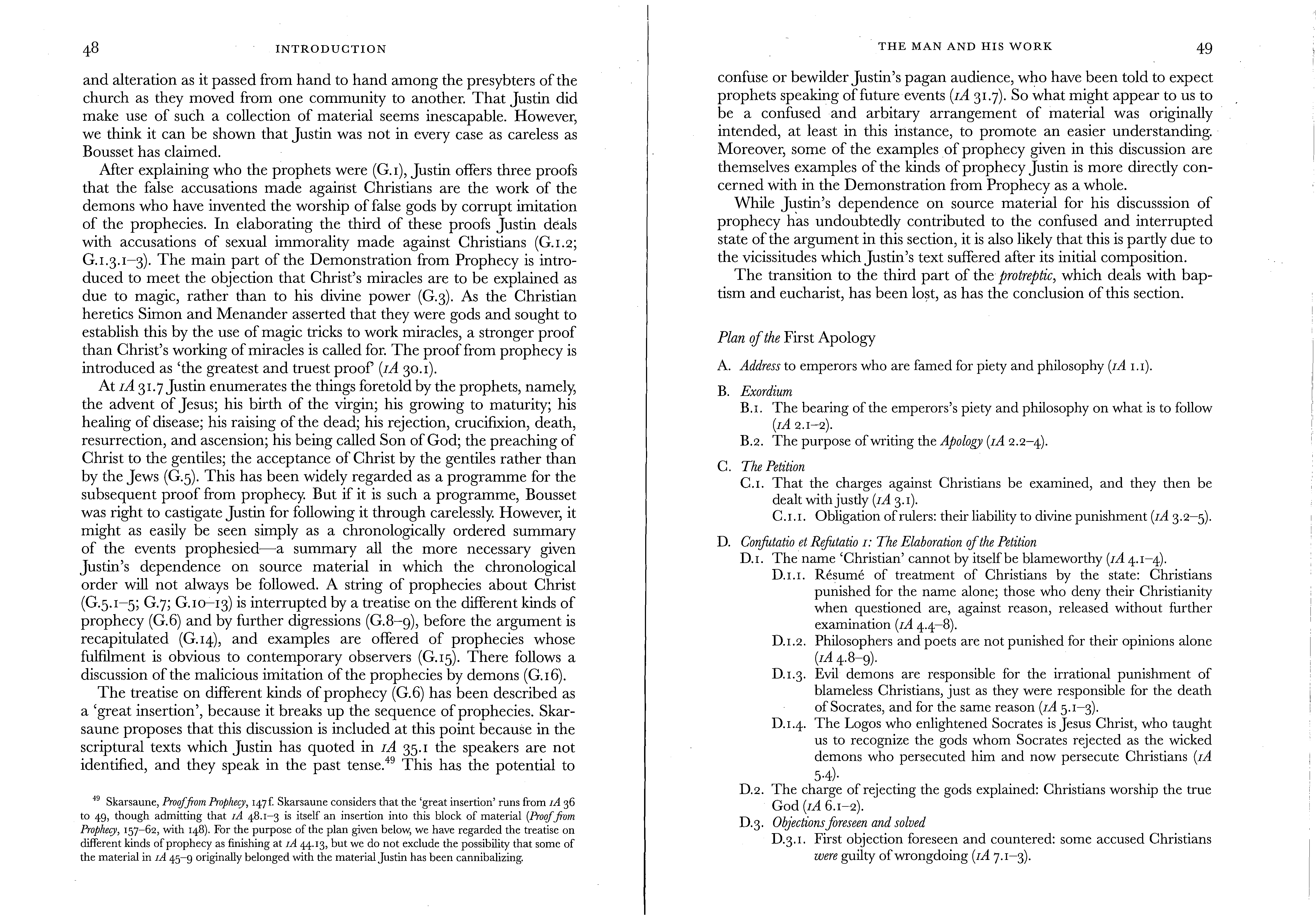
ΤΗΕ ΜΑΝ AND HIS WORK
INTRODUCTION
confuse ΟΓ bewilder Justin's pagan audience, wl?-o have been told to expect prop11ets speaking offutureevents (ιΑ 31.7). So what might appear to us to be a confusedand arbitary arrangement of material was originally intended, at least ίη this instance, to promote an easier understanding.
Moreover, some of the examples of prophecy given ίη this discussion are themselves examples of the kinds of prophecy Justin is more directly concerned with ίη the Demonstration from Prophecy as a whole. and alteration as it passed from hand to hand among the presybters of the church as they moved from one community to another. That Justin did make use of such a collection of material seems inescapable. However, we think it can be shown that Justin was not ίη every case as careless as Bousset has claimed.
Mter explaining who the prophets were (G.I), Justin offers three proofs that the false accusations made agairist Christians are the work of the demons who have invented the worship of false gods by corrupt imitation of the prophecies. Ιη elaborating the third of these proofs Justin deals with accusations of sexual immorality made against Christians (G.I.2;
G.I.3.I-3). The main part of the Demonstration from Prophecy is introduced to meet the objection that Christ's miracles are to be explained as due to magic, rather than to his divine power (G.3). As the Christian heretics Simon and Menander asserted that they were gods and sought to establish this by the use of magic tricks to work miracles, a stronger proof than Christ's working of miracles is caΠed for. The proof from prophecy is introduced as 'the greatest and truest proof (ιΑ 30.1).
While Justin's dependence οη source material for his discusssion of prophecy has undoubtedly contributed to the confused and interrupted state of the argument ίη this section, it is also likely that this is partly due to the vicissitudes which Justin's text suffered after its initial composition.
The transition to the third part of the protreptic, which deals with baptism and eucharist, has been lo~t, as has the conclusion of this section.
Plαn oJ the First Apology Α. Address to emperors who are famed for piety and philosophy (ιΑ 1.1).
At ιΑ 3 1.7 Justin enumerates the things foretold by the prophets, namely, the advent of Jesus; his birth of the virgin; his growing to maturity; his healing of disease; his raising of the dead; his rejection, crucifixion, death, resurrection, and ascension; his being called Son of God; the preaching of Christ to the gentiles; the acceptance of Christ by the gentiles rather than by the Jews (G.5). This has been widely regarded as a programme for the subsequent proof from prophecy. But if it is such a programme, Bousset was right to castigate Justin for following it through carelessly. However, it might as easily be seen simply as a chronologically ordered summary of the events prophesied-a summary aΠ the more necessary given
Justin's dependence οη source material ίη which the chronological Β. Exordium Β.Ι. The bearing ofthe emperors's piety and philosophy οη what is to follow
(ιΑ 2.1-2).
Β.2. The purpose ofwriting the Apology (ιΑ 2.2-4).
C. The Petition C. ι. That the charges against Christians be examined, and they then be dealt withjustly (ιΑ 3.1).
C.I.I. Obligation ofrulers: their liability to divine punishment (ιΑ 3.2-5).
Corifutαtio et Rifiιtαtio ι: The Elαborαtion qf the Petition D.I. The name 'Christian' cannot by itselfbe blameworthy (ιΑ 4.1-4).
D.I.I. Resume of treatment of Christians by the state: Christians order will not always be followed. Α string of prophecies about Christ
(G.5.I-5; G.7; G.I~I3) is interrupted by a treatise οη the different kinds of prophecy (G.6) and by further digressions (G.8-9), before the argument is recapitulated (G.I4), and examples are offered of prophecies whose fulfilment is obvious to contemporary observers (G.I5). There follows a discussion ofthe malicious imitation ofthe prophecies by demons (G.I6). punished for the name alone; those who deny their Christianity when questioned are, against reason, released without further examination (ιΑ 4.4-8).
D.I.2. Philosophers and poets are not punished for their opinions alone (ιΑ 4.8-9), D.I.3. Evil demons are responsible for the irrational punishment of blameless Christians, just as they were responsible for the death ofSocrates, and for the same reason (ιΑ 5.1-3).
D. Ι .4. The Logos who enlightened Socrates is Jesus Christ, who taught The treatise οη different kinds of prophecy (G.6) has been described as a 'great insertion', because it breaks up the sequence of prophecies. Skarsaune proposes that this discussion is included at this point because ίη the scriptural texts which Justin has quoted ίη ιΑ 35.1 the speakers are not identified, and they speak ίη the past tense.49 This has the potential to us to recognize the gods whom Socrates rejected as the wicked demons who persecuted him and ηονν persecute Christians (ιΑ
5·4)· D.2. The charge of rejecting the gods explained: Christians worship the true
49 Skarsaune, Proqf.froιn PΙ-oplleC)I, I47f Skarsaune considers that the 'great insertion' runs from ιΑ 36 to 49, though admitting that ιΑ 48.Ι-3 is itself an insertion into this block of material (Proqf jιΌ1Π
Propllecy, Ι57-62, with Ι48). For the purpose of the plan given below, we have regarded the treatise οη different kinds ofprophecy as finishing at ιΑ 44.Ι3, but we do not exclude the possibility that some of the material in ιΑ 45-9 originally belonged with the material Justin has been cannibalizing.
God (ιΑ 6.1-2).
D.3.
Ob.iectionsJόreseen αnd solved D.3.I. First objection foreseen and countered: some accused Christians were guilty ofwrongdoing (ιΑ 7.1-3).
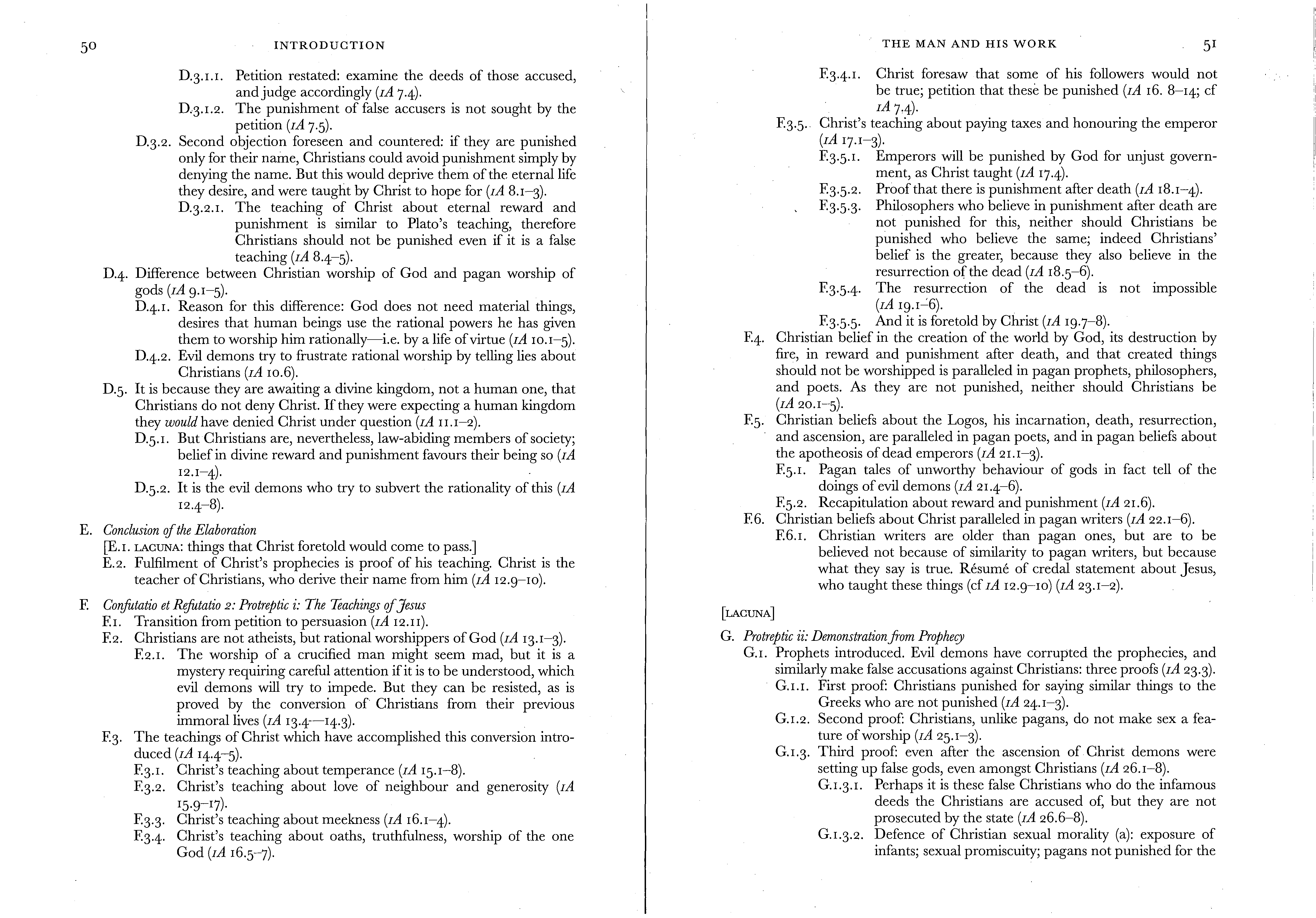
ΤΗΕ ΜΑΝ AND H1S WORK
1NTRODUCT10N
F.3.4.1.
Christ foresaw that some of his followers would not be true; petition that these be punished (ιΑ 16. 8-14; cf
D.3.1.1. Petition restated: examine the deeds of those accused, andjudge accordingly (ιΑ 7.4).
D.3.1.2. The punishment of false accusers is not sought by the ιΑ 7,4).
F.3.5.· Christ's teaching about paying taxes and honouring the emperor petition (ιΑ 7.5).
D.3.2. Second objection foreseen and countered: if they are punished (ιΑ 17.1-3).
F.3.5.1.
Emperors will be punished by God for unjust government, as Christ taught (ιΑ 17-4).
F.3.5.2.
Proofthat there is punishment after death (ιΑ 18.1-4).
F.3.5.3.
Philosophers who believe ίn punishment after death are not punished for this, neither should Christians be punished who believe the same; indeed Christians' belief is the greater, because they also believe ίn the resurrection of the dead (ιΑ 18'5-6).
F.3.5-4.
The resurrection of the dead is not impossible only for their naine, Christians could avoid punishment simply by denying the name. But this would deprive them of the eternallife they desire, and were tauglit by Christ to hope for (ιΑ 8.1-3).
D.3.2.1. The teaching of Christ about eternal reward and punishment is similar to Plato's teaching, therefore
Christians should not be punished even if it is a false teaching (ιΑ 8.4-5).
D-4. Di:fference between Christian worship of God and pagan worship of gods (ιΑ 9.1-5).
D-4. 1. Reason for this di:fference: God does not need material things, (ιΑ 19.1--':6).
F.3.5.5.
And it is foretold by Christ (ιΑ 19-7-8).
F.4. Christian belief ίn the creation of the world by God, its destruction by desires that human beings use the rational powers he has given them to worship him rationally-i.e. by a life of virtue (ιΑ 10.1-5).
D.4.2. Evil demons try to frustrate rational worship by telling lies about fire, ίn reward and punishment after death, and that created things should not be worshipped is paralleled ίn pagan prophets, philosophers, and poets. As they are not punished, neither should Christians be
Christians (ιΑ 10.6).
D.5. It is because they are awaiting a divine kingdom, not a human one, that (ιΑ 20.1-5).
F.5. Christian beliefs about the Logos, his incarnation, death, resurrection, Christians do not deny Christ. If they were expecting a human kingdom they wouldhave denied Christ under question (ιΑ ιι.I-2).
D.5.l. But Christians are, nevertheless, law-abiding members of society; and ascension, are paralleled ίn pagan poets, and ίn pagan beliefs about the apotheosis of dead emperors (ιΑ 21.1-3).
F.5.1. Pagan tales of unworthy behaviour of gods ίn fact tell of the belief ίn divine reward and punishment favours their being so (ιΑ
12.1-4)· D.5.2. It is the evil demons who try to subvert the rationality of this (ιΑ doings of evil demons (ιΑ 21.4-6).
F.5.2. Recapitulation about reward and punishment (ιΑ 21.6).
F.6. Christian beliefs about Christ paralleled ίn pagan writers (ιΑ 22.1-6).
12·4-8).
Ε. Conclusion qf the Elαborαtion F.6.1. Christian writers are older than pagan ones, but are to be
[Ε. 1. LACUNA: things that Christ foretold would come to pass.] believed not because of similarity to pagan writers, but because what they say is true. Resume of credal statement about Jesus, who taught these things (cf ιΑ 12.9-10) (ιΑ 23.1-2).
Ε.2. Fulfilment of Christ's prophecies is proof of his teaching. Christ is the teacher ofChristians, who derive their name from him (ιΑ 12.9-10).
CorifUtαtio et Rifutαtio 2: Protreptic ί: The Teαchings qf Jesus F.I. Transition from petition to persuasion (ιΑ 12.ιι).
F.2. Christians are not atheists, but rational worshippers ofGod (ιΑ 13.1-3).
[LACUNA] G. Protreptic ίί: Demonstrαtion ftom Prophecy G.I. Prophets introduced. Evil demons have corrupted the prophecies, and F.2.1. The worship of a crucified man might seem mad, but it is a similarly make false accusations against Christians: three proofs (ιΑ 23.3).
G. ι. ι. First proof: Christians punished for saying similar things to the mystery requiring careful attention if it is to be understood, which evil demons will try to impede. But they can be resisted, as is proved by the conversion οΕ Christians from their previous immorallives (ιΑ 13.4-14.3).
F.3. The teachings of Christ which have accomplished this conversion introGreeks who are not punished (ιΑ 24.1-3).
G.I.2. Second proof: Christians, unlike pagans, do not make sex a feature ofworship (ιΑ 25.1-3).
G.I.3. Third proof: even after the ascension of Christ demons were duced (ιΑ 14.4-5).
F.3.1. Christ's teaching about temperance (ιΑ 15.1-8).
F.3.2. Christ's teaching about love of neighbour and generosity (ιΑ setting up false gods, even amongst Christians (ιΑ 26.1-8).
G.I.3.1. Perhaps it is these false Christians who do the infamous deeds the Christians are accused of, but they are not prosecuted by the state (ιΑ 26.6-8).
G.I.3.2. Defence of Christian sexual morality (a): exposure of 15·9-17)· F.3.3. Christ's teaching about meekness (ιΑ 16.1-4).
F.3+ Christ's teaching about oaths, truthfulness, worship of the one infants; sexual promiscuity; pagans not punished for the God (ιΑ 16.5-7).
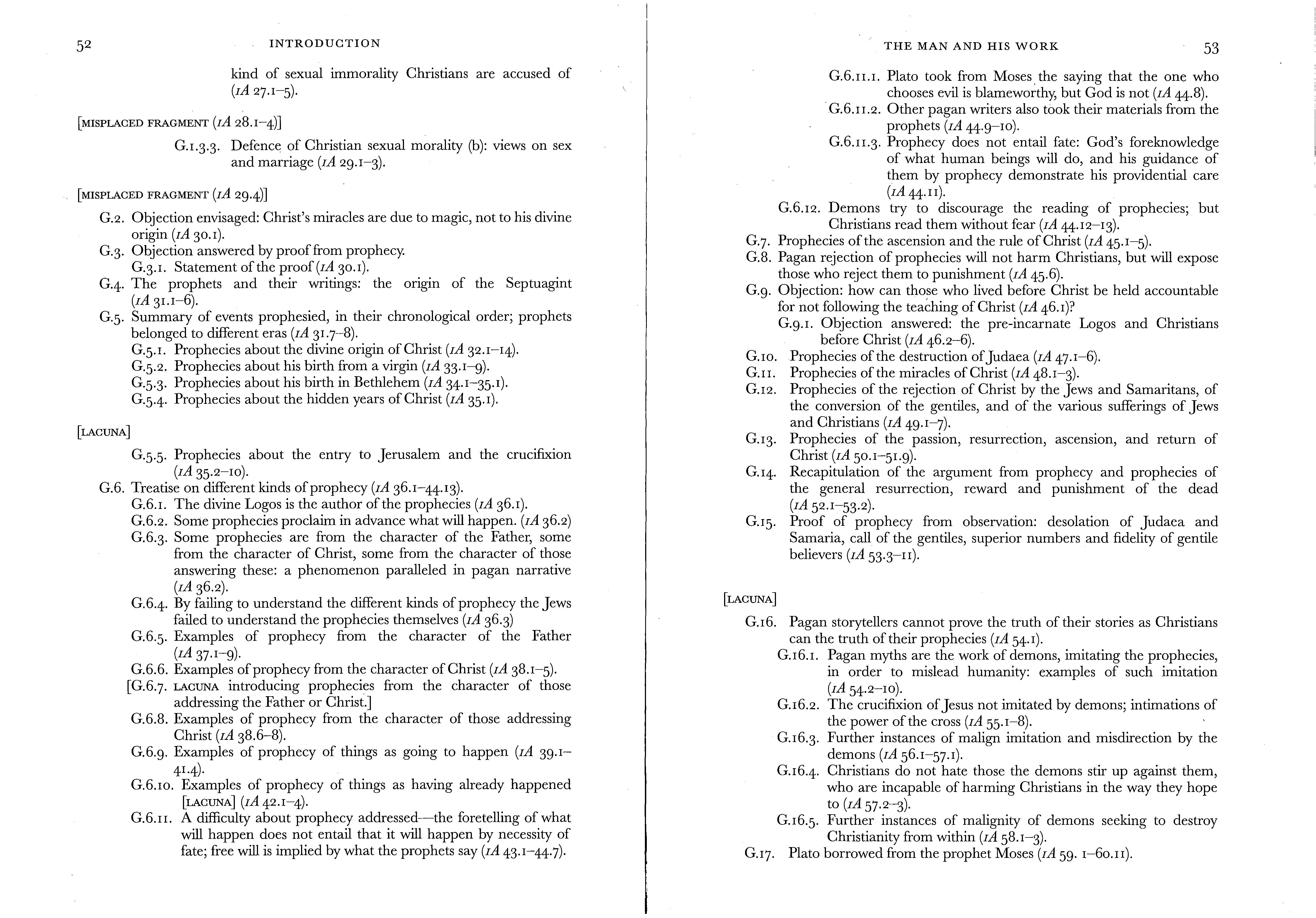
INTRODUCTION
ΤΗΕ ΜΑΝ AND HIS WORK
kind of sexual immorality Christians are accused of G.6.II.I. Plato took from Moses, the saying that the one who (ιΑ 27.1-5). chooses evil is blameworthy, but God is not (ιΑ 44.8).
G.6.II.2. Other pagan writers also took their materials from the
[M1SPLACED FRAGMENT (ιΑ 28.1-4)]
prophets (ιΑ 44.9-10).
G.6.II.3. Prophecy does not entail fate: God's foreknowledge G.I.3.3. Defence of Christian sexual morality (b): views οη sex of what human beings will do, and his guidance of them by prophecy demonstrate his providential care and marriage (ιΑ 29.1-3).
[MISPLACED FRAGMENT (ιΑ 29-4)]
(ιΑ 44.ΙΙ).
G.6.I2. Demons try to discourage the reading of prophecies; but G.2. Objection envisaged: Christ's miracles are due to magic, not to his divine
Christians read them without fear (ιΑ 44.12-13).
G.7. Prophecies ofthe ascension and the rule ofChrist (ιΑ 45.1-5).
G.8. Pagan rejection of prophecies will not harm Christians, but will expose origin (ιΑ 30.1).
G.3. Objection answered by proof from prophecy.
G.3.I. Statement ofthe proof(IA 30.1).
G.4. The prophets and their writings: the origin of the Septuagint those who reject them to punishment (ιΑ 45.6).
G.9. Objection: how can those who lived before Christ be held accountable (ιΑ 31.1-6).
G.5. Summary of events prophesied, ίη their chronological order; prophets for not following the tea~hing ofChrist (ιΑ 46.ι)?
G.9. ι. Objection answered: the pre-incarnate Logos and Christians belonged to different eras (ιΑ 31.7-8). before Christ (ιΑ 46.2-6).
G.IO. Prophecies ofthe destruction ofJudaea (ιΑ 47.1-6).
G.II.
Prophecies ofthe miracles ofChrist (ιΑ 48.1-3).
G.I2. Prophecies of the rejection of Christ by the Jews and Samaritans, of G.5.I. Prophecies about the divine origin ofChrist (ιΑ 32.1-14).
G.5.2. Prophecies about his birth from a virgin (ιΑ 33.I-g).
G.5.3. Prophecies about his birth ίη Bethlehem (ιΑ 34.1-35.1).
G.5.4. Prophecies about the hidden years ofChrist (ιΑ 35.1). the conversion of the gentiles, and of the various sufferings of Jews and Christians (ιΑ 49.1-7).
G.I3. Prophecies of the passion, resurrection, ascension, and return of [LACUNA] G.5.5. Prophecies about the entry to Jerusalem and the crucifixion
Christ (ιΑ 50.1-51.9).
G.I4. Recapitulation of the argument from prophecy and prophecies of (ιΑ 35.2-ΙΟ).
G.6. Treatise οη different kinds ofprophecy (ιΑ 36.1-44.13). the general resurrection, reward and punishment of the dead
G.6.I. The divine Logos is the author ofthe prophecies (ιΑ 36.1).
G.6.2. SOIIie prophecies proclaim ίη advance what will happen. (ιΑ 36.2) G.6.3. Some prophecies are from the character of the Father, some
(ιΑ 52.1-53.2).
G.I5. Proof of prophecy from observation: desolation of Judaea and Samaria, call of the gentiles, superior numbers and fidelity of gentile believers (ιΑ 53.3-ΙΙ). from the character of Christ, some from the character of those answering these: a phenomenon paralleled ίη pagan narrative
(ιΑ 36.2).
G.6-4. ΒΥ failing to understand the different kinds ofprophecy the Jews [LACUNA] failed to understand the prophecies themselves (ιΑ 36.3)
G.6.5. Examples of prophecy from the character of the Father G.I6. Pagan storytellers cannot prove the truth oftheir stories as Christians can the truth oftheir prophecies (ιΑ 54.1).
G. Ι 6. ι. Pagan myths are the work of demons, imitating the prophecies, (ιΑ 37.I-g).
G.6.6. Examples ofprophecy from the character ofChrist (ιΑ 38.1-5).
[G.6.7. LACUNA introducing prophecies from the character of those ίη order to mislead humanity: examples of such imitation
(ιΑ 54.2-10).
G.I6.2. The crucifixion of Jesus not imitated by demons; intimations of addressing the Father ΟΓ Christ.] G.6.8. Examples of prophecy from the character of those addressing the power of the cross (ιΑ 55.1-8).
G.I6.3. Further instances of malign imitation and misdirection by the Christ (ιΑ 38.6-8).
G.6.9. Examples of prophecy of things as going to happen (ιΑ 39.1demons (ιΑ 56.1-57.1).
G.I6+ Christians do not hate those the demons stir up against them, 41·4)· G.6.IO. Examples of prophecy of things as having already happened who are incapable of harming Christians ίη the way they hope to (ιΑ 57.2-3).
G.I6.5. Further instances of malignity of demons seeking to destroy
[LACUNA] (ιΑ 42.1-4).
G.6.II. Α difficulty about prophecy addressed-the foretelling ofwhat will happen does not entail that it will happen by necessity of fate; free will is implied by what the prophets say (ιΑ 43.1-44.7).
Christianity from within (ιΑ 58.1-3).
G.!7. Plato borrowed from the prophet Moses (ιΑ 59. ι-60.ιι).
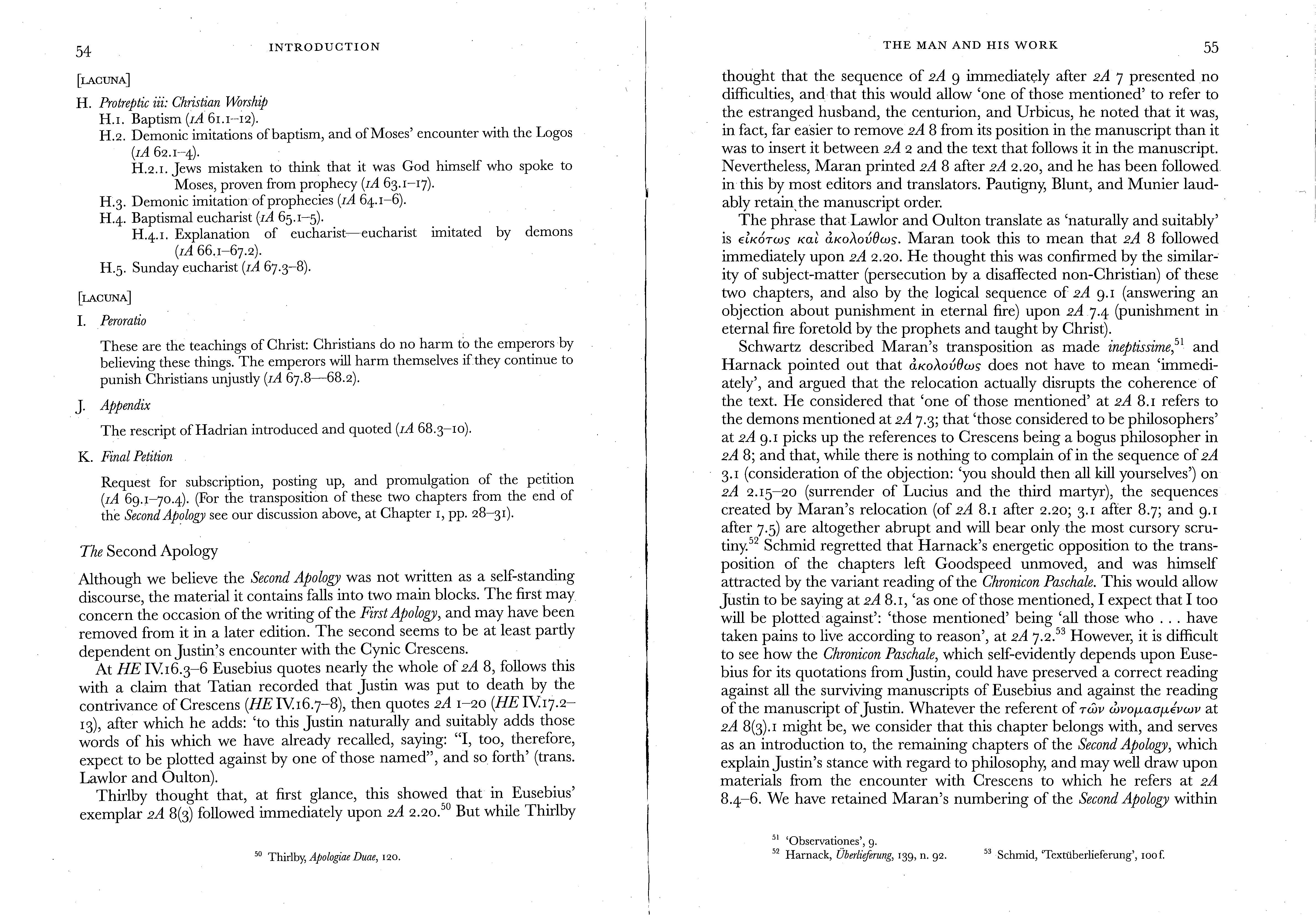
ΤΗΕ ΜΑΝ AND HIS WORK
INTRODUCTION
thoιight that the sequence of 2Α 9 immediate1y after 2Α 7 prescnted ηο difficulties, and that this would allow 'one of those mentioned' to refer to the estranged husband, the centurion, and Urbicus, he noted that it was, in fact, far ea·sier to remove 2Α 8 from its position ίη the manuscript than it was to insert it between 2Α 2 and the text that follows it ίη the manuscript.
Nevertheless, Maran printed 2Α 8 after 2Α 2.20, and he has been followed.
[LACUNA] Η. Protreptic ίίί: Christiαn Worship Η.Ι. Baptism (ιΑ 61.1-12).
Η.2. Demonic imitations ofbaptism, and ofMoses' encounter W1th the Logos (ιΑ 62.1-4).
Η.2.1. Jews mistaken to think that it was God himself who spoke to ίn this by most editors and translators. Pautigny, Blunt, and Munier laudably retain, the manuscript order.
Moses, proven from prophecy (ιΑ 63.1-17).
Η.3. Demonic imitationofprophecies (ιΑ 64·1-6).
Η-4. Baptismal eucharist (ιΑ 65·1-5)· The phrase thatLawlor and Oulton translate as 'naturally and suitably' is εικότως και ακολούθως. Maran took this to mean that 2Α 8 followed immediately upon 2Α 2.20. He thought this was confirmed by the similarity of subject-matter (persecution by a disaffected non-Christian) of these two chapters, and also by the. logical sequence of 2Α 9.1 (answering an objection about punishment ίη eternal fire) upon 2Α7.4 (punishment ίη eternal fire foretold by the prophets and taught by Christ).
Η-4. I . Explanation of eucharist-eucharist imitated by demons (ιΑ 66.1-67.2).
Η.5. Sunday eucharist (ιΑ 67'3-8).
[LACUNA] 1.
Perorαtio These are the teachings of Christ: Christians do ηο harm t6 the emperorsby believing these things. The emperors will harm themselves ifthey continue to punish Christians unjustly (ιΑ 67.8-68.2).
Schwartz described Maran's transposition as made ineptissime,51 and Harnack pointed out that ακολούθως does not have to mean 'immediately', and argued that the relocation actually disrupts the coherence of the text. He considered that 'one of those mentioned' at 2Α 8.1 refers to the demons mentioned at 2Α 7.3; that 'those considered to be philosophers' at 2Α 9.1 picks up the references to Crescens being a bogus philosopher ίη
J. Appendix The rescript ofHadrian introduced and quoted (ιΑ 68·3-10).
2Α 8; and that, while there is nothing to complain of ίη the sequence of 2Α 3.1 (consideration ofthe objection: 'you should thenall kill yourselves') οη
Κ. Finαl Petition Request for subscription, posting up, and promulgation of the petition
2Α 2.15-20 (surrender of Lucius and the third martyr) , the sequences created by Maran's relocation (of 2Α 8.1 after 2.20; 3.1 after 8.7; and 9.1 after 7.5) are altogether abrupt and will bear onlythe most cursory scrutiny.52 Schmid regretted that Harnack's energetic opposition to the transposition of the chapters left Goodspeed unmoved, and was himself attracted by the variant reading of the Chronicon Pαschale. This would allow
Justin to be saying at 2Α 8.1, 'as one ofthose mentioned, Ι expect that Ι too (ιΑ 69.1-70.4). (For the transposition of these two chapters from the end of the Second AP?logy see our discussion above, at Chapter ι, ρρ. 28-31)'
The Second Apology Although we believe the Second Apology was not written as a self-standing discourse, the material it contains falls into two main blocks. The first may concern the occasion of the writing of the First Apology, and may have been removed from it in a later edition. The second seems to be at least partly dependent οη Justin's encounter with the Cynic Crescens.
At ΗΕ 1V.16.3-6 Eusebius quotes nearly the whole of 2Α 8, follows thlS with a claim that Tatian recorded that Justin was put to death by the will be plotted against': 'those mentioned' being 'all those who ... have taken pains to live according to reason', at 2Α 7.2.53 However, it is difficult to see how the Chronicon Paschale, which self-evidently depends upon Eusebius for its quotations from Justin, could have preserved a correct reading against all the surviving manuscripts of Eusebius and against the reading of the manuscript of Justin. Whatever the referent of των ωνομασμένων at contrivance of Crescens (ΗΕ 1V.16-7-8), then quotes 2Α 1-20 (ΗΕ 1V.IΊ·213) after which he adds: 'to this Justin naturally and suitably adds those wo~ds of his which we have already recalled, saying: "Ι, too, therefore, expect to be plotted against by one of those named", and so forth' (trans.
Lawlor and Oulton).
2Α 8(3).1 might be, we consider that this chapter belongs with, and serves as an introduction to, the remaining chapters of the Second Apology, which explain Justin's stance with regard to philosophy, and may well draw upon materials from the encounter with Crescens to which he refers at 2Α
8.4-6. We have retained Maran's numbering of the Second Apology within Thirlby thought that, at first glance, this showe1o that ίη. Euse1;>ius' exemplar 2Α 8(3) followed immediately upon 2Α 2.20. But while Thrrlby
51 'ObservationeS',9.
52 Harnack, ϋberlίrjerung, 139, n. 92.
53 Schmid, 'Texruberlieferung', IOOf.
50 Thirlby, Apologiae Duαe, 120.
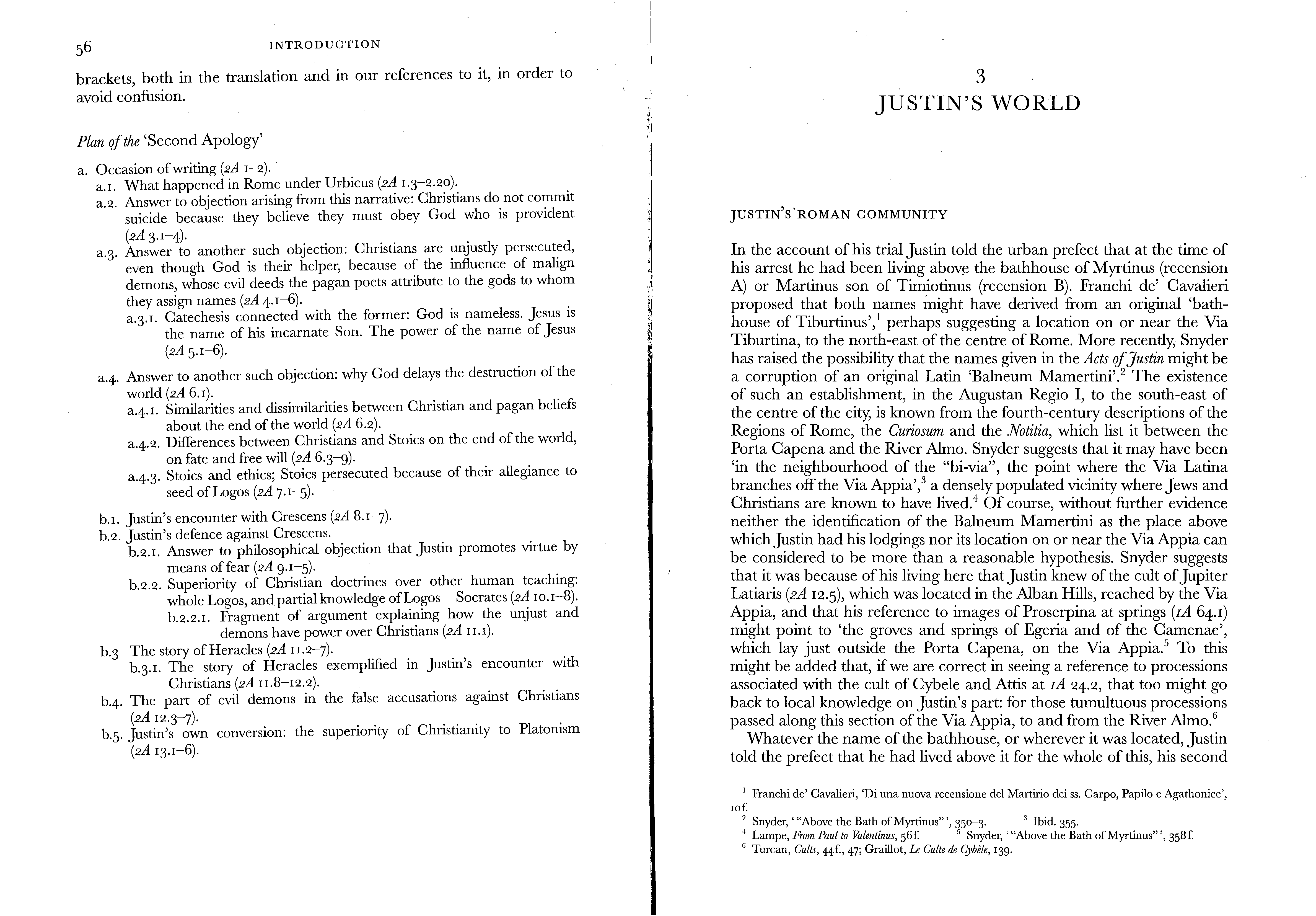
INTRODUCTION
]USTIN'S WORLD
brackets, both in the translation and ίη our references to it, ίη order to avoid confusion.
Plαn qf the 'Second Apology' a. Occasion ofwriting (2Α 1-2). a.I. What happened ίη Rome under Ur"?icus (2~ Ι.3-2 . 2 ?)..
. a.2. Answer to objection arising from thlS narratlve: ChnstIans do. not co~mlt
JUSTIN'S 'ROMAN COMMUNITY
suicide because they believe they must obey God who lS provιdent
(2Α 3.1-4).
.., .
. a.3. Answer to another such obJectlOn: ChnstIans are ~llJustly persecut~d, Ιη the account of his trial Justin told the urban prefect that at the time of his arrest he had been living abov~ the bathhouse ofMyrtinus (recension even though God is their helper, because o~ the lllfluence of mallgn demons, whose evil deeds the pagan poets attnbute to the gods to whom they assign names (2Α 4.1-6).
. a.3.I. Catechesis connected with the former: God lS nameless. Jesus lS
Α) or Martinus son of Timiotinus (recension Β). Franchi de' Cavalieri proposed that both names might 11ave derived from an original 'bathhouse of Tiburtinus', 1 perhaps suggesting a location οη or near the Via
Tiburtina, to the north-east of the centre of Rome. More recently, Snyder has raised the possibility that the names given ίη the Acts qf Justin might be a corruption of an original Latin 'Balneum Mamertinj'. 2 The existence of such an establishment, in the Augustan Regio Ι, to the south-east of the centre of the city, is known from the fourth-century descriptions of the Regions of Rome, the Curiosum and the Notitiα, which list it between the Porta Capena and the River Almo. Snyder suggests that it may have been
'in the neighbourhood of the "bi-via", the point where the Via Latina branches off the Via Appia', 3 a densely populated vicinity where Jews and Christians are known to have lived.4Of course, without further evidence neither the identification of the Balneum Mamertini as the place above which Justin had his lodgings nor its location οη or near the Via Appia can be considered to be more than a reasonable hypothesis. Snyder suggests that it was because of his living here that Justin knew of the cult of Jupiter
Latiaris (2Α 12.5), which was located ίη the Alban Hills, reached by the Via Appia, and that his reference to images of Proserpina at springs (ιΑ 64.1) might point to 'the groves and springs of Egeria and of the Camenae', which lay just outside the Porta Capena, οη the Via Appia.5 Το this might be added that, if we are correct in seeing a reference to processions associated with the cult of Cybele and Attis at ιΑ 24.2, that too might go back to local knowledge οη Justin's part: for those tumultuous processions passed along this section of the Via Appia, to and from the River Almo.6 the name of his incarnate Son. The power of the name of Jesus
(2Α 5.1-6).
a+ Answer to another such objection: why God delays the destruction of the world (2Α 6.1).
. .
. a.4. ι. Similarities and dissimilarities between ChnstIan and pagan bellefs about the end ofthe world (2Α 6.2). a.4.2. Di:fferences between Christians and Stoics οη the end ofthe world, οη fate and free will (2Α 6·3-9)· a.4.3. Stoics and ethics; Stoics persecuted because of their allegiance to seed ofLogos (2Α 7·1-5)· b.I. Justin's encounter with Crescens (2Α 8.1-7)· b.2. Justin's defence against Crescens..
. b.2.I. Answer to philosophical obJectlOll that Justlll promotes vιrtue by means offear (2Α 9.1-5)· . b.2.2. Superiority of Christian doctrines over other human teachIng: whole Logos, and partial knowledge ofLogos-Socrates (2~ 10.1-8). b.2.2.I. Fragment of argument explaining how the unJust and demons have power over Christians (2Α ιι.ι). b.3 The story ofHeracles (2Α ιι.2-7)· b.3.I. The story of Heracles exemplified ίη Justin's encounter with Christians (2Α ιι.8-Ι2.2).
. . , . b.4. The part of eνil demons ίη the false accusatlOns agalnst ChnstIans
(2Α 12.3-7).
b.5. Justin's own conversion: the superiority of Christianity to Platonism Whatever the name of the bathhouse, or wherever it was located, Justin told the prefect that he had lived above it for the whole of this, his second
(2Α 13.1-6).
ι Franchi de' Cavalieri, 'Di una nuova recensione del Martirio dei ss. Carpo, Papilo e Agathonice', rof.
2 Snyder, "Άbοve the Bath ofMyrtinus"', 350-3.
3 Ibid. 355.
4 Lampe, From Pαul to VΑlentinus,56f.
5 Snyder, "Άbοve the Bath ofMyrtinus"', 358f.
6 TUIcan, Cults, 44f., 47; Graillot, Le Culte de Cybele, Ι39.
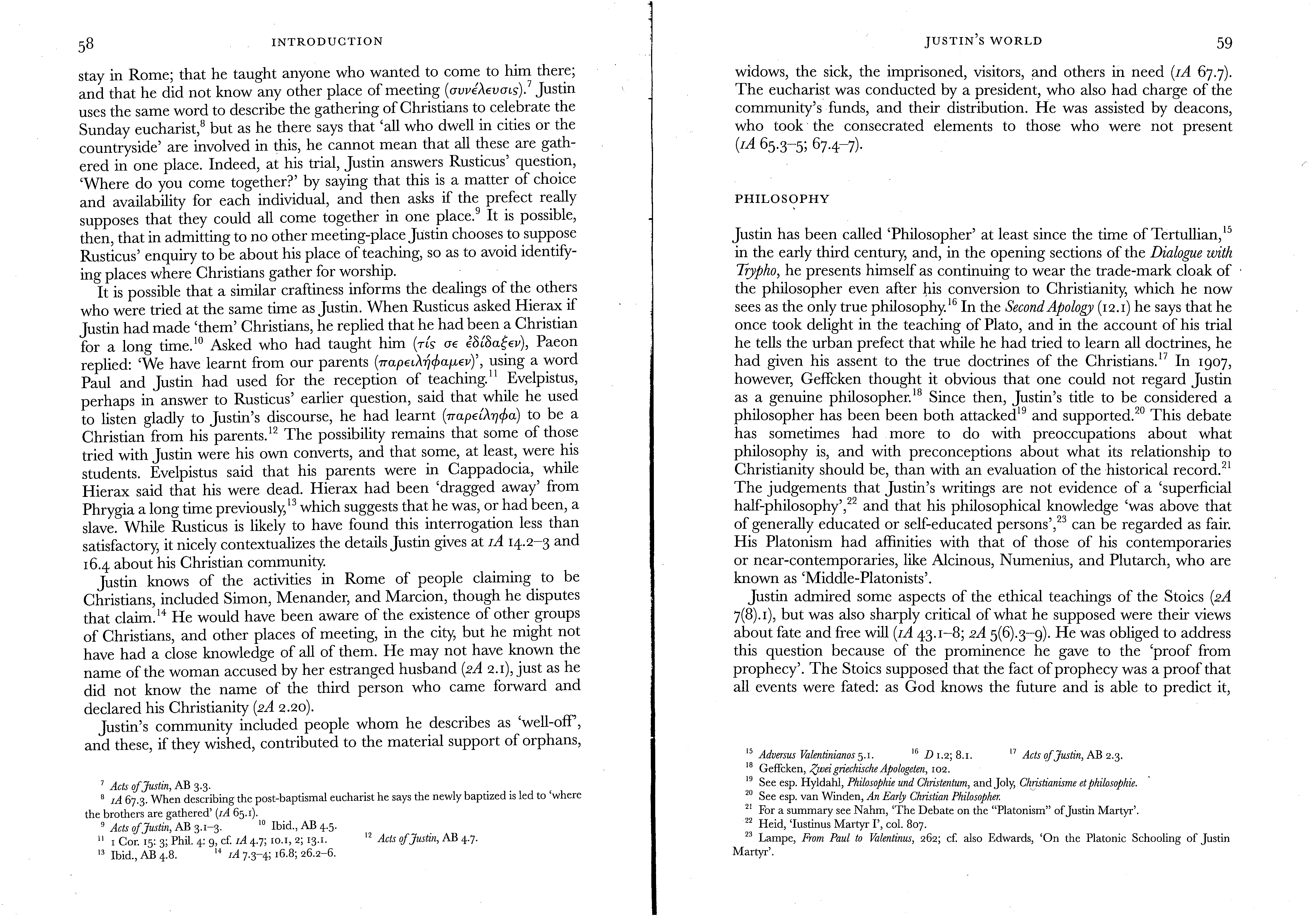
JUSTIN'S WORLD
INTRODUCTION
widows, the sick, the imprisoned, visitors, ~nd others ίη need (ιΑ 67.7).
The eucharist was conducted by a president, who also had charge of the community's ·funds, and their distribution. He was assisted by deacons, who took· the consecrated elements to those who were not present stay ίη Rome; that he taught anyone who wanted. to com<; to h~ ther:; and that he did not know any other place ofmeetmg (συνελευσις). Justln uses the same word to describe the gathering of Christians to celebrate the Sunday eucharist,8 but as he there says that 'all who dwell ίη cities ΟΓ the countryside' are involved ίη this, he cannot mean that aΠ these are gathered ίη one place. 1ndeed, at his trial, Justin answers Rusticus' questi~n,
'Where do you come together?' by saying that this is a matter of chOlce and availability for each individual, and then asks if the prefect really supposes that they could all come together ίη one place.9 1t is possible, then that ίη admitting to ηο other meeting-place Justin chooses to suppose
Rusticus' enquiry to be about his place of teaching, so as to avoid identifying places where Christians gather for worship.
1t is possible that a similar craftiness .informs the d:alings of the. othe:s who were tried at the same time as Justm. When RuStlcuS asked Hlerax if Justin had made 'them' Christians, he replied that he had been a Christian
(ιΑ 65·3-5; 67·4-7)·
PHILOSOPHY
Justin has been called 'Philosopher' at least since the time of Tertullian, 1S ίη the early third century, and, in the opening sections of the Diαlogue with Trypho, he presents himself as continuing to wear the trade-mark cloak of . the philosopher even after ~is conversion to Christianity, which he ηονν sees as the only true philosophy. 16 1η the Second Apology (ι 2. ι) he says that he once took delight ίη the teaching of Plato, and ίη the account of his trial he tells the urban prefect that while he had tried to learn all doctrines, he had given his assent to the true doctrines of the Christians. 17 1η 1907, however, Geffcken thought it obvious that one could not regard Justin as a genuine philosopher. 18 Since then, Justin's title to be considered a philosopher has been been both attacked19 and supported.20 This debate has sometimes had more to do with preoccupations about what philosophy is, and with preconceptions about what its relationship to Christianity should be, than with an evaluation of thehistorical record. 21 for a long time. 1O Asked who had taught him (τίς σε εδίδαςεν), Paeon replied: 'We have learnt from our parents \παpειλήΦαμε~)', ~sing a ~ord
Paul and Justin had used for the recepuon of teachlng.
Evelplstus, perhaps ίη answer to Rusticus' earlier question, said that while he used to listen gladly to Justin's discourse, he had learnt (παpείλrιΦα) to be a Christian from his parents. 12 The possibility remains that some of thos.e tried with Justin were his οννη converts, and that some, at least, were hlS students. Evelpistus said that his parents were in Cappadocia, while
Hierax said that his were dead. Hierax had been 'dragged away' from Phrygia a long time previously, 13 which suggests t~a~ he was, o~ had been, a slave. While Rusticus is likely to have found thlS lnterrogatlOn less than satisfactory, it nicely contextualizes the details Justin gives at ιΑ 14.2-3 and 16.4 about his Christian community.
Justin knows of the activities ίη Rome of ~eople claiming. to be Christians, included Simon, Menander, and MarclOn, though he dlsputes that claim. 14 He would have been aware of the existence of other groups of Christians, and other places of meeting, in the city, but he might not have had a close knowledge of all of them. He may not have known the name ofthe woman accused by her estranged husband (2Α 2.1), just as he did not know the name of the third person who came forward and declared his Christianity (2Α 2.20).
The judgements that Justin's writings are not evidence of a 'superficial half-philosophy' ,22 and that his philosophical knowledge 'was above that of generally educated ΟΓ self-educated persons', 23 can be regarded as fair.
His Platonism had affinities with that of those of his contemporaries ΟΓ near-contemporaries, like Alcinous, Numenius, and Plutarch, who are known as 'Middle-Platonists'.
Justin admired some aspects of the ethical teachings of the Stoics (2Α 7(8).1), but was also sharply critical ofwhat he supposed were their views about fate and free will (ιΑ 43.1-8; 2Α 5(6).3-9). He was obliged to address this question because of the prominence he gave to the 'proof from prophecy'. The Stoics supposed that the fact of prophecy was a proof that all events were fated: as God knows the future and is able to predict it,
Justin's community included people whom he describes as 'well-off', and these, if they wished, contributed to the material support of orphans,
15 Adversus Vαleιιtiιziαnos 5.1.
16 D 1.2; 8.1.
17 Acts qfJustin, ΑΒ 2.3.
ΙΒ Geffcken, Ζωεί griechische Apologeteιl, 102.
19 See esp. Hyldahl, Philosophie uιzd Chlistelltum, andJoly, CIl!Jstiαιzisme et philosophie.
7 Acts qf]ustin, ΑΒ 3.3.
20 See esp. van Winden, An Εατ1Υ Chlistiaιz Philosopher.
Β ιΑ 67.3. When describing the post-baptismal eucharist he says the newly baptized is led to 'where the brothers are gathered' (ιΑ 65.1).
21 For a summary see Nahm, 'The Debate οη the "Platonism" ofJustin Martyr'.
22 Heid, 'Iustinus Martyr Γ, col. 807.
9 Acts qf]ustiιz, ΑΒ 3.1-3. ιο Ibid., ΑΒ 4.5· ii Ι Cor. 15: 3; Phil. 4: 9, cf. ιΑ 4.7; 10.1,2; 13.1.
12 Acts qfJustin, ΑΒ 4·7· 23 Lampe, From Pαul to Vαleιιtiιzus, 262; cf. also Edwards, 'Οη the Platonic Schooling of Justin
Martyr'.
13 Ibid., ΑΒ 4.8.
14 ιΑ 7.3-4; 16.8; 26.2-6.
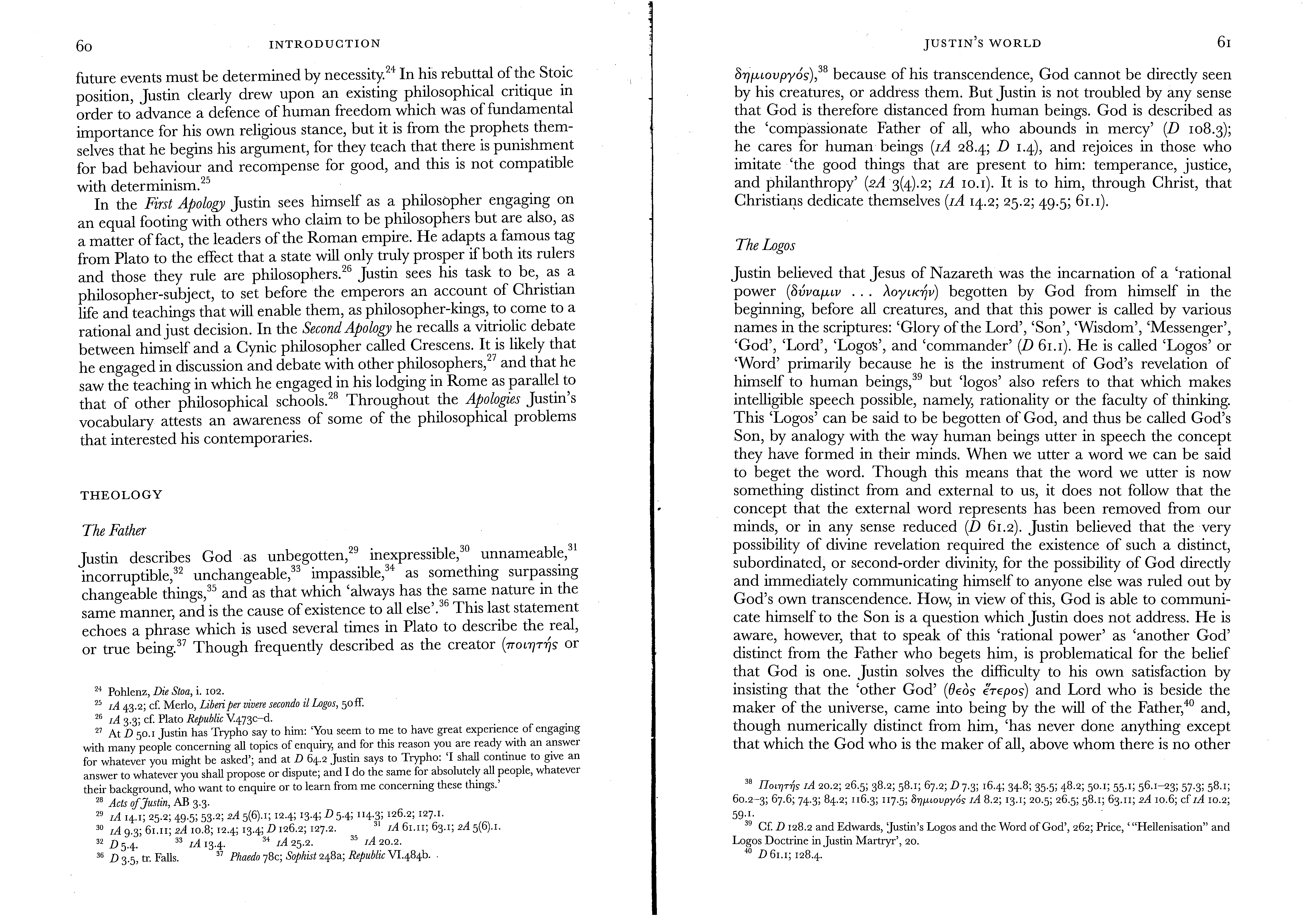
JUSTIN'S WORLD
INTRODUCTION
δημιουργός),38 because ofhis transcendence, God cannot be directly seen by his creatures, or address them. But Justin iS not troubled by any sense that God iS therefore distanced from human beings. God iS described as the 'compassionate Father of all, who abounds ίη mercy' (D 108.3); he cares for human beings (ιΑ 28-4; D 1-4), and rejoices in those who imitate 'the good things that are present to him: temperance, justice, and phi1anthropy' (2Α3(4).2; ιΑ 10.1). It is to him, through Christ, that Christiaqs dedicate themselves (ιΑ 14.2; 25.2; 49.5; 61.1). future events must be determined by necessity.24 Ιη his rebuttal ofthe Stoic position, Justin clearly drew upon an existing p~ilosophical critique ίη order to advance a defence of human freedom Wh1Ch was of fundamental importance for his own religious stance, but it is from the p~"Ophe~s themselves that he begins his argument, for they teach that ~h~re lS pun1sh~ent for bad behaviour and recompense for good, and th1S lS not compat1ble with determinism.25
Ιη the First Apology Justin sees himself as a philosbpher engaging οη an equal footing with others who claim to be philosophers but are also, as a matter of fact the leaders of the Roman empire. He adapts a famous tag from Plato to the effect that a state wi11 only truly prosper if both its rulers
The Logos and those they rule are phi10S0phers.26 Justin sees his task to be,. a~ a phi1osopher-subject, to set before the emper?rs an acc~unt of Chnst1an life and teachings that will enable them, as phi1osopher-kings.' t? c.ome to a rational andjust decision. Ιη the Second Apology he recalls a V1t~101:c debate between himself and a Cynic phi1osopher called Crescens. It lS likely that he engaged ίη discussion and debate with other phi10S0phers,27 and that he saw the teaching in which he engaged ίη his lodging ίη Rome as parallel to Justin believed that Jesus of Ν azareth was the incarnation of a 'rational power (δύναμιν ... λoγΙK~ν) begotten by God from himself in the beginning, before all creatures, and that this power is called by various names ίη the scriptures: 'Glory ofthe Lord', 'Son', 'Wisdom', 'Messenger',
'God', 'Lord', 'Logo~', and 'commander' (D 61.1). He is called 'Logos' or 'Word' primari1y because he is the instrument of God's revelation of himself to human beings,39 but 'logos' also refers to that which makes intelligible speech possible, namely, rationality or the faculty of thinking.
This 'Logos' can be said to be begotten of God, and thus be called God's Son, by analogy with the way human beings utter ίη speech the concept they have formed ίη their minds. When we utter a word we can be said to beget the word. Though this means that the word we utter is ηονν something distinct from and external to us, it does not [οΠονν that the concept that the external word represents has been removed from our minds, or ίη any sense reduced (D 61.2). Justin believed that thevery possibi1ity of divine revelation required the existence of such a distinct, subordinated, or second-order divinity, for the possibi1ity of God directly and immediately communicating himself to anyone else was ruled out by God's οννη transcendence. Ηονν, in view of this, God is able to communicate himself to the Son is a question which Justin does not address. He is aware, however, that to speak of this 'rational power' as 'another God' distinct from the Father who begets him, is problematical for the belief that God is one. Justin solves the difficulty to his οννη satisfaction by insisting that the 'other God' (θεΌς έτερος) and Lord who is beside the maker of the universe, came into being by the will of the Father,40 and, though numerically distinct from him, 'has never done anything except that which the God who is the maker of all, above whom there is ηο other
h Α l . J ., that of other phi1osophical schools.
Throughout t e Ρο ogzes ustm s vocabulary attests an awareness of some of the phi1osophical problems that interested his contemporaries.
THEOLOGY The Fαther 29 .
'bl 30 bl 31 Justin describes God· as unbegotten, 1nexpress1 e, unnamea e,
Ι 33 .
'bl 34 h'
. incorruptible, unchangeab e, lffipass1 e, as somet 1ng surp~sslng changeable things,35 and as that which 'always has the same nature 1η the same manner, and is the cause of existence to all else'. 36 This last statement echoes a phrase which is used several times ίη Plato to describe the real, or true being.37 Though frequently described as the creator ('ΠoιηT~ς or 24 Pohlenz, Die Stoa, ί. ΙΟ2.
25 ιΑ 43.2; cf. Merlo, Liberi per vivere secoιzdo ίl Logos, 50ff.
26 ιΑ 3.3; cf. Plato Republic Y.473c-d.
. '
27 At D 50.1 Justin has Trypho say to hirn: 'You seem to m.e to have great expenenc~ of engagιng with many people concerning all topics of enquiry, and for thlS reason you are ready :mth an a.nswel" for whatever you might be asked'; and at D 64.2 Justin says to Trypho: Ί shall cont1nue to gιve an answer to whatever you shall propose or dispute; and Ι do the same for absolutely all people, whatever their background, who want to enquire or to learn from me concerning these things.'
38 ΠοιψΤι, ιΑ 20.2; 26.5; 38.2; 58.1; 67.2; D 7.3; 16.4; 34·8; 35·5; 48.2; 5D.I; 55.1; 56.1-23; 57.3; 58.1;
60.2-3; 67·6; 74·3; 84.2; ιι6·3; ΙΙ7·5; δrιι-ιιoυpγ6, ιΑ 8.2; 13.1; 20.5; 26.5; 58.1; 63.Π; 2Α 10.6; cf ιΑ ΙΟ.2;
59·1.
28 Acts qfJustin, ΑΒ 3.3.
29 ιΑ ιμ; 25.2; 49.5; 53.2; 2Α 5(6).1; 12-4; 13-4; D 5·4; ΙΙ4·3; 126.2; 127·1.
39 Cf. D 128.2 and ΕdwaΓds, Justin's Logos and the Word of God', 262; Price, '''Hellenisation'' and Logos Doctrine in Justin Martryr', 20.
30 ιΑ 9.3; 6ι.ιι; 2Α ιο.8; 12-4; 13.4; D 126.2; 127.2.
3\ ιΑ 6ι.π; 63·1; 2Α 5(6).1.
32 D 5+ 33 ιΑ 13+ 34 ιΑ 25.2.
35 ιΑ 20.2.
40 D 6Ι.Ι; 128+
36 D 3.5, tr. Falls.
37 Pllaedo 78c; Sophist 248a; Republic VI·484b ..
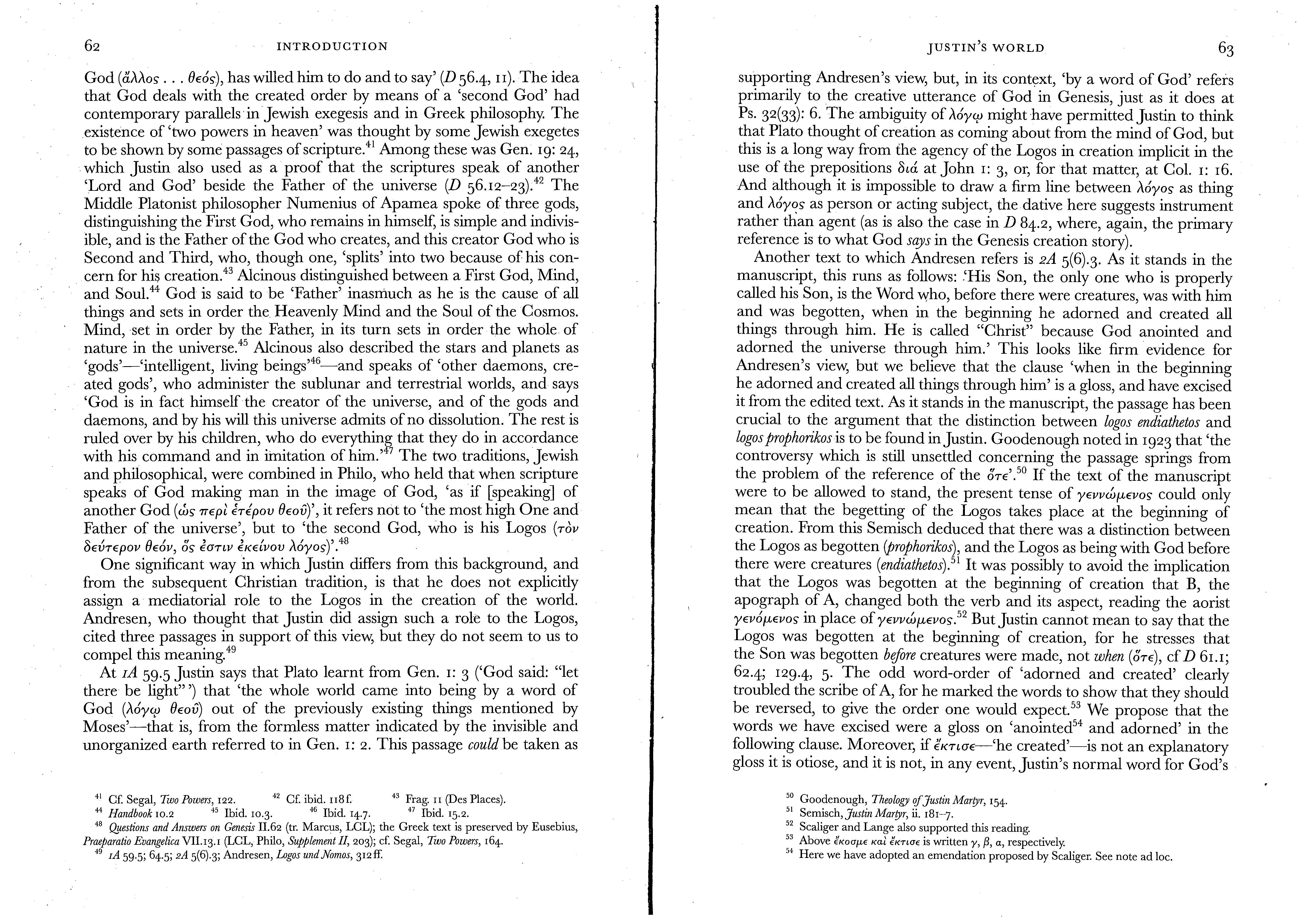
INTRODUCTION
JUSTIN'S WORLD
God (&λλος . .. θεός), has willed him to do and to say' (D 56.4, ιι). The idea that God deals with the created order by means of a 'second God' had contemporary parallels' ίη Jewish exegesis and ίη Greek philosophy. The existence of 'two powers ίη heaven' was thought by some Jewish exegetes to be shown by some passages ofscripture.41 Among these was Gen. 19: 24, which Justin also used as a proof thatthe scriptures speak of another supporting Andresen's view, but, ίη its cont<;xt, 'by a word of God' refers primarily tothe creative utterance of God in Genesis, just as it does at Ps. 32(33): 6. The ambiguity of λόγψ might 'have permitted Justin to think that Plato thought of creation as coming about from the mind of God, but this is a long way from the agency of the Logos in creation implicit in the use of the prepositions διά at John Ι: 3, or, for that matter, at Col. Ι: 16.
And although it is impossible to draw a firm line between λόγος as thing 'Lord and God' beside the Father of the universe (D 56.12-23).42 The Middle Platonist philosopher Numenius of Apamea spoke of three gods, distinguishing the First God, who remains ίη himself, is simple and indivisible, and is the Father of the God who creates, and this creator God who is
Second and Third, who, though one, 'splits' into two because of his concern for hi~ creation.43 Alcinous distinguished between a First God, Mind, and SOU1.44 God iS said to be 'Father' inasrήuch as he iS the cause of aΠ things and sets ίη order the Heavenly Mind and the Soul of theCosmos.
Mind,set ίη order by the Father, ίη its turn sets ίη order the whole of nature ίη the universe.45 Alcinous also described the stars and planets as 'gods'-'intelligent, living beings,46-and speaks of 'other daemons, created gods', who administer the sublunar and terrestrial worlds, and says
'God iS ίη fact himselfthe creator of the universe, and of the gods and daemons, and by his will this universe admits of ηο dissolution. The rest iS ruled over by his children, who do everything that they do ίη accordance with his command and ίη imitation of him. ,47 The two traditions, Jewish and philosophical, were combined ίη Philo, who held that when scripture speaks of God making man ίη the image of God, 'as if [speaking] of another God (ώς 7Τερι έτέρου θεου)', it refers not to 'the most high One and Father of the universe', but to 'the second God, who iS his Logos (τον and λόγ<?ς as person οτ acting subject, the, dative here suggests instrument rather than agent (as is also the case ίη D 84.2, where, again, the primary reference is to what God sqys ίη the Genesis creation story).
Another text to which Andresen refers is 2Α 5(6),3. As it stands ίη the manuscript, this runs as follows: .Ήίs Son, the only one who is properly caΠed his Son, is the Word vyho, before there were creatures, was with him and was begotten, when ίη the beginning he adorned and created aΠ things through him. He is called "Christ" because God anointed and adorned the universe through him.' This looks like firm evidence for Andresen's view, but we believe that the clause 'when ίη the beginning he adorned and created aΠ things through him' is a gloss, and have excised it from the edited text. As it stands ίη the manuscript, the passage has been crucial to the argument that the distinction between logos endiαthetos and logos prophorίkosis to be found inJustin. Goodenough noted ίη 1923 that 'the controversy which is still unsettled concerning the passage springs from the problem of the reference of the Οτε'.50 If the text of the manuscript were to be allowed to stand, the present tense of γεννώμενος could only mean that the begetting of the Logos takes place at the beginning of creation. From this Semisch deduced that there was a distinction between the Logos as begotten (prophorίkos), and the Logos as being with God before there were creatures (endiαthetos).51 It was possibly to avoid the implication that the Logos was begotten at the beginning of creation that Β, the apograph of Α, changed both the verb and its aspect, reading the aorist ι θ ι '"
One significant way ίη which Justin differs from this background, and from the subsequent Christian tradition, iS that he does not explicitly assign a mediatorial role to the Logos ίη the creation of the world.
Andresen, who thought that Justin did assign such a role to the Logos, cited three passages ίη support of this view, but they do not seem to us to δ γενόμενος in place of γεννώμενος.52 ButJustin cannot mean to say that the Logos was begotten at the beginning of creation, for he stresses that the Son was begotten bifόre creatures were made, not when (οτε), cf D 61.1;
62·4; 129·4, 5· The odd word-order of 'adorned and created' clearly troubled the scribe of Α, for he marked the words to show that they should be reversed, to give the order one would expect. 53 We propose that the words we have excised were a gloss οη 'anointed54 and adorned' in the following clanse. Moreover, if EKTιaE-'he created'-is not an explanatory gloss it is otiose, and it is not, in any event, Justin's normal word for God's
1 h· .
compe t IS meanlng.
At ιΑ 59.5 Justin says that Plato learnt from Gen. Ι: 3 ('God said: "let there be light" ') that 'the whole world came into being by a word of God (λόγψ θεου) out of the previously existing things mentioned by Moses'-that is, from the formless matter indicated by the invisible and unorganized earth referred to ίη Gen. Ι: 2. This passage could be taken as +1 Cf. Segal, Τωο Powers, 122.
+2 Cf. ibid. II8f.
+3 Frag. ΙΙ (Des Places).
« Handbook 10.2
+5 Ibid. 10.3.
+6 Ibid. 14.7.
+7 Ibid. 15.2.
50 Goodenough, Theology qfJustin ΛιfαψΤ, 154.
51 Semisch, Justill Ματ{Υτ, ii. 181-7.
QJιestίons and Aιιswers on Genesis Π.62 (tr. Marcus, LCL); the Greek text iS preserved by Eusebius,
Praeparatio Evangelica VII.13.1 (LCL, Philo, Supplemellt 1Ι, 203); cf. Segal, Τωο Powers, 164.
52 Scaliger and Lange also supported this reading.
53 Aboνe εκοσμε και εκτισε is written γ, β, α, respectiνely.
+9 ιΑ 59.5; 64-5; 2Α 5(6).3; Andresen, Logos ulldN01IlOS, 312ff.
5+ Here we haνe adopted an emendation proposed by Scaliger. See note ad loc.
INTRODUCTION
JUSTIN'S WORLD
about ascribing a direcdy mediatorial role tq the Logos or Son ίη the work of creation, especially whenset beside the fact that it is from God as creator that Justin habitually distinguishes the Logos or Son,56 suggests that he was chary of the idea-perhaps suspecting that it would proνide comfort for gnostic heretics who sought to disparage creation and to deny that it was the work of God. creatiνe actlVlty: it occurs οηlΥ four other times in his works, three of which are Septuagint quotations. The glossator has picked up the phrase δι' αυτου, like the words κοσμέω and πάντα, from the text he is explaining, but, as it happens, Justin nowhere else speaks of God creating things through him, or through the Son, or through the Logos. Whereas he does say that the Father teaches us through the Word (2Α 9.2), or through his Son (D 105.5), and that he will raise us up through his Christ (D 46.7) and make judgement throughJesus Christ (D 58.1).
The Logos Spermatikos If the scriptural 'Word of God' is the primary and fundamental context of Justin's Logos-doctrine, it cannot be denied thatJustin was attracted by the Α third text cited by Andresen is ιΑ 64.5, where Justin claims that the demons 'knew that God made the world, of which he formed a notion through the Logos (εννΟYjθέντα τον θεον δια λόγου τον κόσμον ποιήσαι resonances of Logos ίη the usage of contemporary pagan philosophy.
When he told the emperOl;s what 'reason' or 'sound reason' prescribes or counsels (ιΑ 2.1; 3.1), he could be confident of being understood by them, eνen if the word had a deeper meaning for him, which he would εγνωσαν)'. Many translators haνe assumed that Justin does here assert that God created the world through the Logos,55 but we belieνe they haνe done so too readily. While the idea of God creating the world through the Logos might be thought to be so commonplace as to be unaνoidable for Justin, he does not, as we haνe seen, refer to it at all ίη any other place, eνentually reνeal to them (ιΑ 12.6).
As well as being identical with the Word through whom God reνealed himself ίη the theophanies described ίη the Old Testament, and in those scriptures themselνes, the Logos whom Justin belieνes has become incarnate ίη Jesus of Nazareth57 also has an affinity with the principle by means ofwhich human beings are able to think rationally (2Α 7(8).1). Οη account of this, pagans who liνed according to reason, like Socrates and Heraclitus, are entided to be called Christians, just as are those 'among the barbarians' to whom the Word of God was reνealed (ιΑ 46.2-3). At and, ίη the present passage, the meaning of the Greek is much better caught by Hardy and by Wartelle: 'God designed the creation of the world by the Word'; 'Dieu aνait cοης:u dans son intelligence la creation du monde.' The words εννΟYjθέντα ... δια λόγου τον κόσμον should be taken together, with the emphasis falling not οη λόγου but οη εννΟYjθέντα, topicalized by its position at the beginning of the clause. This suggests that the strongest sense that can be giνen to the statement that the world is created λόγψ θεου at ιΑ 59.5 is that God creates the world purposively.
At D 114.3 editors since Maran haνe replaced the manuscript's TCVV 2Α 7(8).3 and 13.3 Justin refers to the (diνine) spermatic logos. The meaning of this term and its antecedents ίη Greek philosophy haνe been the subject of long-standing and νoluminous discussion.58 1η Stoic philosophy the term is employed, usually ίη the plural, to refer to 'the λόγων with the singular, to giνe either 'when he says, "Ι shall see the heaνens, the work of your fingers" (Ps. 8: 4), unless Ι comprehend the operation of his Word, Ι shall not understand the passage' (trans. Falls, cf. Otto, Goodspeed, Marcovich); or ' ... unless Ι understand the Word to be his operation ... ' (Maran). But Bobichon correcdy restores the manuscript's plural. The meaning is that 'fingers' is to be taken as figuraactiνe principles of deνelopment of all things'.59 But Philo, while he describes the diνine Logos as 'jnνisible and spermatic and skilful' in deνeloping the mind, the power of speech, the senses, and the body,60 also speaks of circumstances in which the spermatic logos and the right reason that is generatiνe of all good things become useless to the soul,61 and the term has undergone a similar transference in Justin from its orginal physical context to an intellectual or moral one.62 But, for Justin, the spermatic logos is not itself to be found ίη the human mind. As Holte noted, the adjectiνe is actiνe in meaning, and describes the diνine Logos tiνe of the words by which God creates according to the narratiνe of Genesis ι. This does not exclude a reference to the Logos, as Bobichon himself notes. But,here again, Justin does not assign to the Logos the personal, direcdy mediatorial role ίη the creation of the world that editors and commentators would like to find ίη his writings.
There can, of course, be ηο question but that Justin belieνed that the Logos or Son existed from before the creation. His remarkable coyness
56 e.g. D 55.1; 56.1; 60.2; ιΑ 58.1.
57 2Α 10.1.
55 Thus Otto: 'mundum a deo, postquam cogitavit, per logon conditum esse'; Davie: 'God, by his
Word, conceived and made the world'; Dods: 'God conceived and made the world by the Word'; Veil:
'Gott, nachdem er nachgedacht, die Welt durch (den) Vernunftgeist erschaffen hatte'; Pautigny: 'Dieu avait d'abord cοnς:u dans sa pensee le monde qu'il fit par son Verbe'; Barnard: 'God conceived and made the world through the logos'; Munier: 'Dieu a cree par son Logos le monde, qu'il avait d'abord
58 See esp. Andresen, Justin und der mittlere Platonismus', Ι]0-8; Waszink, 'Bemerkungen zu
Justins Lehre vom Logos Spermatikos'; Holte, 'Logos Spermatikos"
59 Bardy, 'SaintJustin et la philosophie stοϊcίenne', 39f.
60 Qyis Rerum Divinarum Hcι"es ΙΙ9; cf. Holte, 'Logos Spermatikos', 123.
61 Legum Allegorίa Πι'5Ι. 150, cf. Bardy, 'Saint Justin et la philosophie stοϊcίenne', 39.
62 Pohlenz, Die Stoa, ί. 412; Andresen, Justin und der mittlere Platonismus', 170. cοnς:u dans sa pensee"
INTRODUCTION
JUSTIN'S WORLD
sowing seeds of reason in the minds of human beings, perhaps under the influence of the gospel-parable of the sower (Mt 13.4-9).63 Though
'the seed of reason planted ίη the whole human race' (2Α 7(8), or 'the implanted seed of logos' (2Α 13.5) may be described as a 'part of the spermatic logos' (2Α 7(8).3; 13.3), it is not to be understood as being ίη any sense identical with the Logos itself, nor is it to be understood as possessing a seed-like ability to develop.64 The reference is simply to human rationality, which can, with effort, attain to some knowledge of divine and ethical truth, but not to that fullness which is revealed ίη the incarnation of the whole Logos ίη Christ (2Α 7(8).3). Justin distinguishes between 'the seed of something and an imitation of something' οη the one hand, and 'the thing of which the imitation and participation are made' his preferred word for the books of the Old Testament being 'compositίοηs'-συγγράμματα (ιΑ 62.4; 63.6; 67.3).67 This is presumably because he thinks that the Jewish and Christian usage of 'scripture' will be unfamiliar to his ίηteήded audience. Συγγράμματα is used for the works of Epicurus and the poets at 2Α 12.5, andJustin uses the cognate words συγγραφεύς and συγγράφω ('writer', Ί write') when referring to pagan writers and their activity (ιΑ 18.5; 21.2; 22.1; 23.1; 31.2; 36.2; 44·8; 54·5; 59·1; 2Α 4(5)·5; 12·5;
13.2, 5). ~t is significant that the οηlΥ time the writings of the prophets are referred to as συγγράμματα ίη the Diαlogue is at D 7.2, where the old man tells the still-pagan Justin about them.
When introducing the sayings of Jesus in the First Apology Justin refers to 'logoi' (ιΑ 14.5). He gives ηο indication where these sayings are to be found written down, though when quoting the words of institution οη the other (2Α 13.6). Thus, whenJustin says ofpagan writers that 'what each of them proclaimed was good, when he saw from a part of the divine spermatic logos what is connatural to it' (2Α 13.3), he means that human rationality enabled them to perceive, though οηlΥ dimly, truths or realities
(ιΑ 66.3) and when describing the Sunday eucharist (ιΑ 67.3) he refers to 'the memoirs' (απομνημονεύματα) of the apostles. He uses the cognate verb when referring to 'those who recorded (οί απομνημονεύσαντες) everything concerning our saviour Jesus Christ' (ιΑ 33.5).
(τα σντα, 2Α 13.5) that are connatural with the LogoS.65
When introducing his readers to the Old Testament prophets Justin gives an account of how the prophetic Spirit proclaimed ahead of time, through the prophets, what was going to happen; of how the prophets themselves put these prophecies together ίη rolls, which were looked after by the rulers of the Jews; and of how these Hebrew texts were translated into Greek for Κing Ptolemy (ιΑ 31.1-4). Thereafter, particular prophecies are introduced by such phrases as 'Moses spoke thus, ίη these very words' (ιΑ 32.1), 'as it was said before through Moses, by the divine, holy, prophetic Spirit' (ιΑ 32.2), 'hear how another prophet, Micah, foretold.
And he spoke thus' (ιΑ 34.1), and so οη.
The spirίt Justin ranks the Spirit, which he frequently refers to as the prophetic Spirit, ίη third place after the Father and the Word (ιΑ 13.3; cf. 60.7). At ιΑ 6.2
Justin seems to rank the Spirit after 'the other good angels' who follow the Son, and are like him, and at ιΑ 33.6 he seems to identify the Logos with the Spirit who overshadowed the virgin at the annunciation. It is possible, however, that he thinks the Logos can be appropirately described as 'Spirit', just as at Lam. 4: 20 'the Spirit before our face' is 'Christ the Lord'
(ιΑ 55.5), and he certainly distinguishes regularly between the Spirit who prophesies about Christ, and Christ himself.
Old Testαment Christians are baptized 'at the name of the Father of all and Lord God and of our Saviour Jesus Christ and of holy Spirit' (ιΑ 61.3), and at the eucharist the president offers praise and glory 'to the Father of all through the name ofhis Son and ofthe holy Spirit' (ιΑ 65.3; cf. 67.2).
Justin's knowledge of the Old Testament was acquired from two kinds of written source. He used Christian compilations of 'proof-texts', which contained both quotations from the Old Testament and some exegetical comment οη them, and also whole books of the Old Testament, probably ίη the form of rolls, and probably written by Jewish, rather than Christian, scribes.68 Skarsaune proposes that Justin 'seems to have had permanent or occasional access to complete scrolls of . . . the historical books from Genesis through Joshua; Isaiah, Jeremiah, Ezekiel, and the Twelve
Prophets; and Psalms, Proverbs, and Daniel,,69 It should be borne ίη mind,
SCRIPTURE
The terms 'scripture' and 'scriptures' are common ίη the Diαlogue with Trypho, where they always refer to the writings of the Old Testament. Ιη the Apologies Justin refers οηlΥ once to the 'writings of Moses' (ιΑ 60.2),66
63 Holte, 'Logos Spermatikos', 137, 127.
64Ibid. 142.
67 It is possible that at ιΑ 28.1 the word includes a reference to New Testament writings; cf. Hill,
'Was John's Gospel Among Justin's Apostolic Memoirs?', 89.
65 Cf. Waszink, 'Bemerkungen Ζυ Justins Lehre vom Logos Spermatikos', 385 f.
66 The MS refers to 'writings' at ιΑ 24.2 and 2Α 4(5)+ Ιη both places we have emended the text, as have others. But the reference would not be to 'scriptures' even ifthe MS readings were correct.
68 Skarsaune, Justin and his Bible', 56; Proqf.from Prophecy, 43f.
69 Skarsaune, Justin and his Bible', 58.
JUST1N'S WORLD
1NTRODUCT10N
proved that Jesus is the monogenes of the Father, 'begotten of him ίη a peculiar manner as Word and Power, and later having become man through the virgin, as we have learned from the memoirs',77 shows that the Gospel of John must be included among the memoirs known to him. however, that this conclusion is drawn from a study of the Diαlogue as well as the FirstApology, and it is possible that it was only after he had completed the Apologies that Justin had access to some of these scrolls.70 Οη the other hand, Justin felt himself obliged ίη the Diαlogue to use a scriptural text which his Jewish interlocutors would accept (D 71.2), whereas, as Skarsaune shows, the testimony-sources had great authority for him, as it was from them that he learnt his exegesis. 71
Other New Testαment Writings Of the o,ther boo~s now included ίη the New Testament Justin certainly knew the RevelatlOn of John (D 81.4). He nowhere refers to the Pauline letters by name, but Skarsaune argues convincingly that he was familiar with them, especially Romans and Galatians, and that they supplied him with 'important scriptural quotations, and guidance as to the meaning of these texts'. 78
That so many things about Christ were foretold so long ago, and have turned out to happen just as it was foretold they would, is, for Justin, proof of the truth of Christian claims, and of the reasonableness of Christianity.
Prophecy is thus central to his understanding of Christianity, and it is unsurprising that it should bulk so large ίη the First Apology. Ιη themselves, the prophetic utterances are opaque, ΟΓ enigmatic-they cannot be understood apart from their fulfilment ίη Christ (ιΑ 32.2).
Justin believed that Plato and other pagan writers had access to the Hebrew scriptures, and derived from them a confused understanding of Christian truths (ιΑ 5g.1-6g.II). Because they took their 'starting points' from the prophets, 'there seem to be seeds of truth amongst all', but their contradictions show that they did not accurately understand what they read there (ιΑ 44.9-1Ο).
DEMONS Especially in view of Justin's claim to be a philosopher, the modern reader cannot fail to be struck by the frequency with which he makes reference to 'wicked demons' (δαίμοvεs Φαύλοι). Paradoxically, it is precisely because he is a philosopher that he does this. The demons are brought ίη to explain how it is that things go wrong in a world designed by a good and rational creator. They cause human beings to prefer what is irrational to what
1 79
lS ratlOna, good people to be persecuted, and lifeless gods to be worshipped.81 They spread lies about Christian behaviour,82 provoke
New Testαment: Gospels As we have seen, Justin refers ίη the First Apology to the 'memoirs of the aposdes'. The same term is found some thirteen times ίη the Diαlogue. At Christians to heresy, 83 and seek to deflect people from understanding the truth of the prophecies by inventing myths about the pagan gods that have superficial similarities to Christian doctrines and practices.84 They are the result of sexual union between women and angels to whom God assigned the providential care of human beings and 'things beneath the firmament'.85 The origin of this seems to be Jewish speculation based upon G
86 J .,. b d . en. : 1-4. ust1n s Vlews a out emons m1ght not have been universally scorned by his pagan contemporaries. According to Plutarch (De Stoicorum ιΑ 66.3 Justin says that these memoirs are called 'Gospels'. 72 Bellinzoni shows that the collection of sayings of Jesus at ιΑ 15.1-17.4 is drawn from an already-existing compilation, possibly made for catechetical purposes, and not from the text of the Gospels themselves,73 and it is likely that other
Gospel materials ίη the First Apology are also derived from intermediate sources, such as texts which presented Old Testament prophecies and then showed these to have been fulfilled ίη the life of Jesus. 74 Although these testimonies drew chiefly upon the Synoptics, most frequendy Matthew but 'often harmonized with Luke', they also made use of the Gospel of John. 75 Skarsaune proposes that ίη the section of the Diαlogue where most
Repugnαntiis 1051C=SVFII.1178), Chrysippus had also considered the possibility that it was because of wicked demons (δαιμονία Φαύλα) that evil befell good human beings. of the references to the 'memoirs' occur, Justin is making direct use of the canonical Gospels.76 Hill argues that Justin's claim at D 105.1 that he has
77 Tr. Hill, 'Was John's Gospel Among Justin's Apostolic Jl.ιfemoirs?', 89.
78 Skarsaune, Justin and his Bible', 74.
79 ιΑ 5.'2; 10.6; lμ; 54-1; 5].Ι; 58.3; 2Α 4(5)0480 ιΑ 5.3; 1'2.5; 63.10; 2Α 1.'2; 6(7).3; 7(8).'2.
81 ιΑ 9.1; 1'2.5; '2Ι.5; '25.3; 41.1.
70 Cf. Skarsaune, Proqf.from Prophecy, '28, 38f., 50,8'2.
71 Ibid. 90f.
82 2Α 1'2.3.
83 ιΑ '26.'2, 5; 56.1; 58.1.
84ιΑ '23.3; '26.1; 44.1'2; 54.3; 6'2.1-'2; 64.1; 66+ 72 At D 100.1 Justin speaks of something being 'written ίη the Gospel'; cf. D 10.'2, where Trypho refers to 'the commands ίη the so-called Gospel'.
85 2Α 4(5).'2-3.
86 Cf. Josephus, Antiquities 1.73 and ι Enoch 19: ι (Charlesworth, Old Testαιnent Pseudepigrapha 1), with Skarsaune, PlvqfJιvm Prophecy, 368f.
73 Bellinzoni, The Sf9!ings qfJesus, 49-100.
7+ Skarsaune, Justin and his Bible', 65 f.
75 Ibid. 67 f.
76 lbid. 66.
INTRODUCTION
JUSTIN'S ACHIEVEMENT ΙΝ ΤΗΕ APOLOGIES
ΤΗΕ APPARATUS CRITICUS
Whetheror ηοΙ Justin's defence of the Christians ever found its way into the hands of those to whom it was addressed is unknown. If it did, it clearly failed in its purpose. Nevertheless, Eusebius' claim that Justin's works had been thought wotthy of regard to the intervening generations of Christians is borne out, not οηlΥ by the citation ίη Irenaeus to which Eusebius refers,87 but also by the obvious influence of Justin οη Tatian,
Athenagoras, and Tertullian.88 If Andresen is correct ίη identifYing Justin as the object of Celsus' attack ίη Alethes Logos,89 then Justin succeeded ίη engaging the sustained attention, though not the admiration, of a pagan critic. Moreover, ίη this way Justin is indirectly responsible for Origen's far more detailed and sophisticated defence of Christianity ίη Contrα Celsum.
The apparatus aims to set out the direct evidence of Α, and very occasionally of its apograph Β, and of its descendant C, with the indirect evidence of the citations ίη Eusebius, the Sαcrα Pαrαllelα, and the Chronicon
Pαschαle. We have argued above that οηlΥ Α and Eusebius are of value for the constitution of the text, aρd their evidence is, accordingly, set out fully.
We mark every variant ίη our text from Α, where the variant has to do with the letter-string. We add iota subscripts, which the manuscript does not consistently have. We do not mark variation of accent, breathing, or punctuation, except where this might serve a particular purpose. For the presence or absence of ν movables we have followed the reading of Α, or, for the lacuna where Α does not exist, Schwartz's edition of Eusebius.
Christianity ίη Rome would never again know such intellectual vitality and diversity as it enjoyed ίη the second and third centuries. That some elements of this ferment were unwelcome to some Roman Christians we know from Justin himself. It is likely that it is to Justin that we owe the very category of 'heresiology'. 90 If this is so, it might be said that ηο other
Christian writer after the Ν ew Testament had so large and enduring an impact οη the shaping of Christian discourse. But Justin's achievement deserves to be seen ίη more positive terms than this. For, however one judges his allegiance to or knowledge of Greek philosophy, Justin
Nominα sαcrα have been silently expanded, except where appropriate ίη the apparatus. For the spelling of the proper name Moses we have employed the form Μουσthroughout, but have noted all variants ίη Α. 'Μ.' is employed when the name occurs ίη variants cited from other editors, whatever spelling they employ. remained a philosopher ίη the proper sense of one who tries, at least, to argue rationally and with discrimination for what he or she considers to be true. Ιη this way Justin avoided the excesses of gnostic contemporaries and of radical Christians like Marcion οη the one hand, and of pious enthusiasts like Hermas οη the other, so as to set a pattern for mainstream
Christians of offering a defence (α.πολογίαν) to anyone who asked for an account (λόγον) ofthe hope that they held (cf. ι Pet. 3: 15), The pathJustin cut through the thickets of contemporary speculation, Jewish, pagan, and Christian, was to become, from shortly after his death until the present, the broad highway of Christian theology.
With the exceptions just noted, we aim to report fully minor orthographical variants ίη Α, as well as its marginal readings, despite our view that the latter have οηlΥ the value of conjectures. The orthographical evidence is, however, of some interest in helping us estimate the nature of the text we are dealing with: it was one of the pieces of evidence which led us earlier to suggest that we are dealing with the handiwork of a scholarly
Byzantine compiler.
Ιη addition to a full report of the citations from Eusebius, we present the readings of Sαcrα Pαrαllelα, and Chronicon Pαschαle, despite their limited value.
We feel that it is important to give a comprehensive presentation of the Eusebian evidence ίη particular. Accordingly, intra-Eusebian variants are recorded, even when they would appear to be fairly clearly secondary, ίη order to avoid the possible circularity of reconstructing the text of Justin with the help of a text of Eusebius that was itself reconstructed with one eye οη Justin.
We have cited the Greek of the Historiα Ec'clesiαsticα from the magisterial edition by Eduard Schwartz; Rufinus' Latin from Mommsen's text that accompanied the Schwartz edition; and the Syriac directly from the edition of Wright and McLean. The system we have adopted for citing
87 HEΊV.I8.9, citing Irenaeus, AHV.6.2.
88 C[ S. Parvis, Justin Martyr and the Apologetic Tradition"
89 Logos und Nomos, 308 ff.
90 Le Boulluec, La Notion d'!zenfsie, ί. 35 [
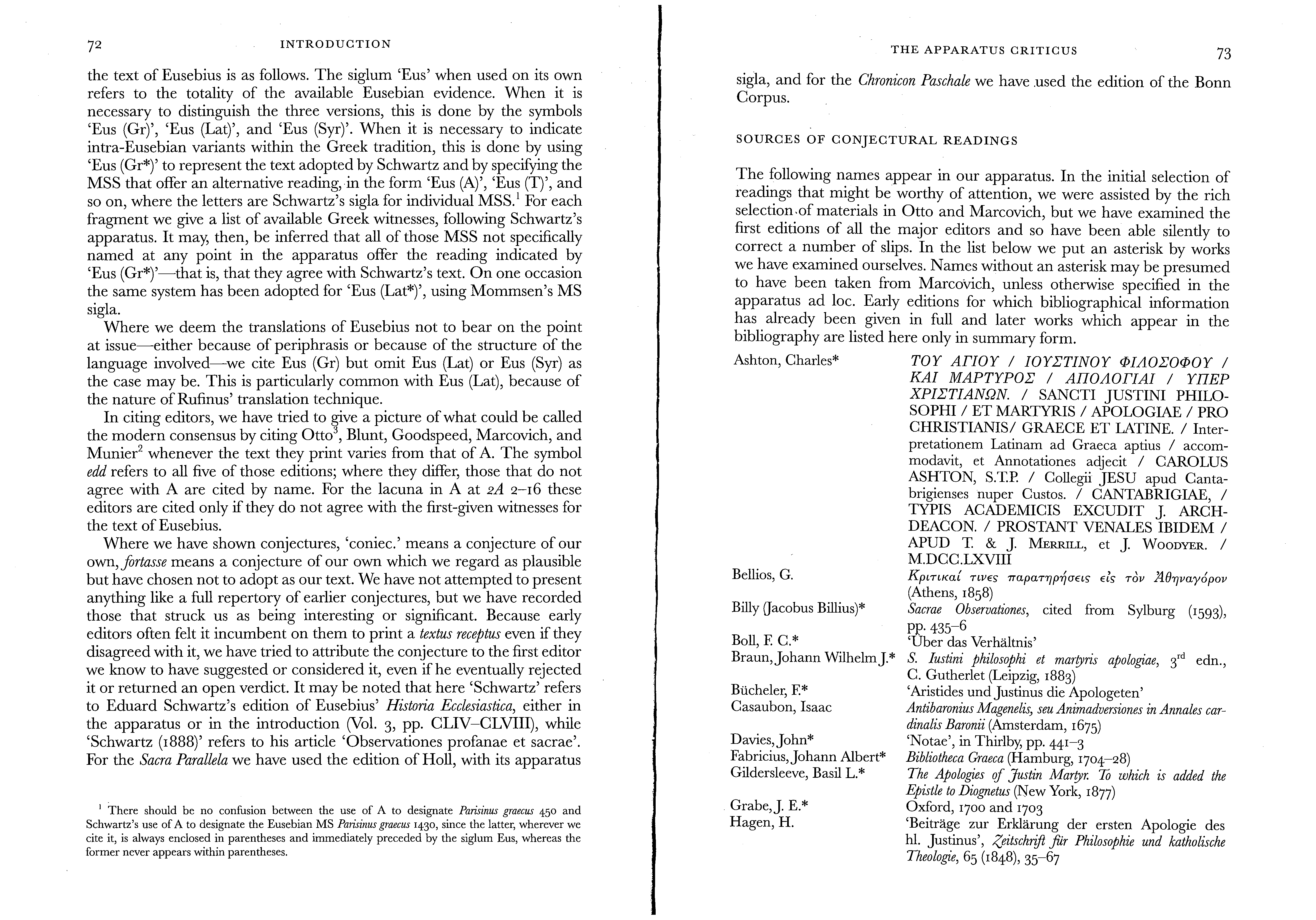
1NTRODUCT10N
ΤΗΕ APPARATUS CR1T1CUS
the text of Eusebius is as follows. The siglum 'Eus' when used οη its own refers to the totality of the available Eusebian evidence. When it is necessary to distinguish the three versions, this is done by the symbols
'Eus (Gr) , , 'Eus (Lat) , , and 'Eus (Syr)" When it is necessary to indicate intra-Eusebian variants within the Greek tradition, this is done by using sigla, and for the Chronicon Pαschαle we have .used the edition of the Βοηη
Corpus.
SOURCES OF CONJECTURAL READINGS
'Eus (Gr*)' to represent the text adopted by Schwartz and by specifying the MSS that offer an alternative reading,in the form 'Eus (Α)', 'Eus (Τ)', and so οη, where the letters are Schwartz's sigla for individual MSS. 1 For each fragment we give a list of available Greek witnesses, following Schwartz's
The following names appear ίη our apparatus. Ιη the initial selection of readir,ιgs that mig~t b~ worthy of attention, we were assisted by the rich selectlOll.of matenals ιη Otto and Marcovich but we have examined the first editions of all the. major edit?rs and s; have been able silendy to correct a nu~ber of slιps. Ιη the lIst below we put an asterisk by works we have examIned ourselves. Ν ames without an asterisk may be presumed to have been taken from Marcovich, unless otherwise specified ίη the apparatus ad loc. Early editions for which bibliographical information apparatus. It may, then, be inferred that all of those MSS not specifically named at any point ίη the apparatus offer the reading indicated by 'Eus (Gr*)'-that is, that they agree with Schwartz's text. Οη one occasion the same system has been adopted for 'Eus (Lat*)', using Mommsen's MS sigla. h~s . already bee~ given ίη full and later works which appear ίη the blbllOgraphy are lIsted here οηlΥ ίη summary form.
Where we deem the translations of Eusebius not to bear οη the point at issue-either because of periphrasis or because of the structure of the language involved-we cite Eus (Gr) but omit Eus (Lat) or Eus (Syr) as the case may be. This is particularly common with Eus (Lat), because of the nature ofRufinus' translation technique.
Ashton, Charles*
ΧΡΙΣΤΙΑΝΩΝ. / SANCTI JUSTINI PHILO-
SOPHI / ΕΤ MARTYRIS / APOLOGIAE / PRO
CHRISTIANIS/ GRAECE ΕΤ LATINE. / Inter-
pretationem Latinam ad Graeca aptius / accommodavit, et Annotationes adjecit / CAROLUS
ASHTON, S.T.P. / Collegii JESU apud Cantabrigienses nuper Custos. / CANTABRIGIAE, /
TYPIS ACADEMICIS EXCUDIT J. ARCH-
DEACON. / PROSTANT VENALES IBIDEM /
APUD
Τ. & J. MERRILL, et J. WOODYER. /
Ιη citing editors, we have tried to give a picture of what could be called the modern consensus by citing Ott03, Blunt, Goodspeed, Marcovich, and Munier2 whenever the text they print varies from that of Α. The symbol edd refers to all five of those editions; where they differ, those that do not agree with Α are cited by name. For the lacuna ίη Α at 2Α 2-16 these editors are cited οηlΥ if they do not agree with the first -given witnesses for the text of Eusebius.
Where we have shown conjectures, 'coniec.' means a conjecture of our
M.DCC.LXVIII
OWll, Jortαsse means a conjecture of our own which we regard as plausible but have chosen not to adopt as our text. We have not attempted to present anything like a full repertory of earlier conjectures, but we have recorded those that struck us as being interesting or significant. Because early editors often felt it incumbent οη them to print a textus receptus even if they disagreed with it, we have tried to attribute the conjecture to the first editor we know to have suggested or considered it, even if he eventually rejected it or returned an open verdict. It may be noted that here 'Schwartz' refers to Eduard Schwartz's edition of Eusebius' Historiα Ecclesiαsticα, either in the apparatus or in the introduction (ΥοΙ 3, ρρ. CLIV-CLVIII), while
'Schwartz (1888)' refers to his article 'Observationes profanae et sacrae"
For the Sαcrα Pαrαllelα we have used the edition of Holl, with its apparatus Bellios, G.
Κριτικα{ TιVES παραΤ7jρήσειs Eis τον Άθ7jναγόρον (Athens, 1858) Billy Gacobus Billius)* Sαcrαe Observαtiones, cited from Sylburg (1593),
ΡΡ·435-6 'Uber das Verhaltnis'
S. Iustini philosophi et mαr!)!ris αpologiαe, 3rd edn., C. Gutherlet (Leipzig, 1883) 'Aristides und Justinus die Apologeten'
Boll, F. C.* Braun,Johann WilhelmJ.* Bucheler, F.* Casaubon, Isaac Antibαronius Mαgenelis) seu Animαdversiones in Annαles cαr dinαlis Bαronii (Amsterdam, 1675) 'Notae', ίn Thirlby, ρρ. 441-3 Davies, John* Fabricius,Johann Albert* Gildersleeve, Basil L. * Bibliothecα Grαecα (Hamburg, 1704-28) The Apologies qf Justin Mαr!)!r. Το which is αdded the Epistle to Diognetus (New York, 1877) Oxford, 1700 and 1703 'Beitrage zur Erklarung der ersten Apologie des hl. Justinus', Zeitschri.fl.fiir Philosophie und kαtholische
Grabe,J. Ε.* Hagen, Η.
1 There should be ηο confusion between the use of Α to designate Pαrisinus grαecus 450 and Schwartz's use of Α to designate the Eusebian MS Pαlisinus g1Ίlecus 1430, since the latter, wherever we cite it, is always enclosed ίη parentheses and immediately preceded by the siglum Eus, whereas the former never appears within parentheses.
TheologI:e, 65 (1848), 35-67
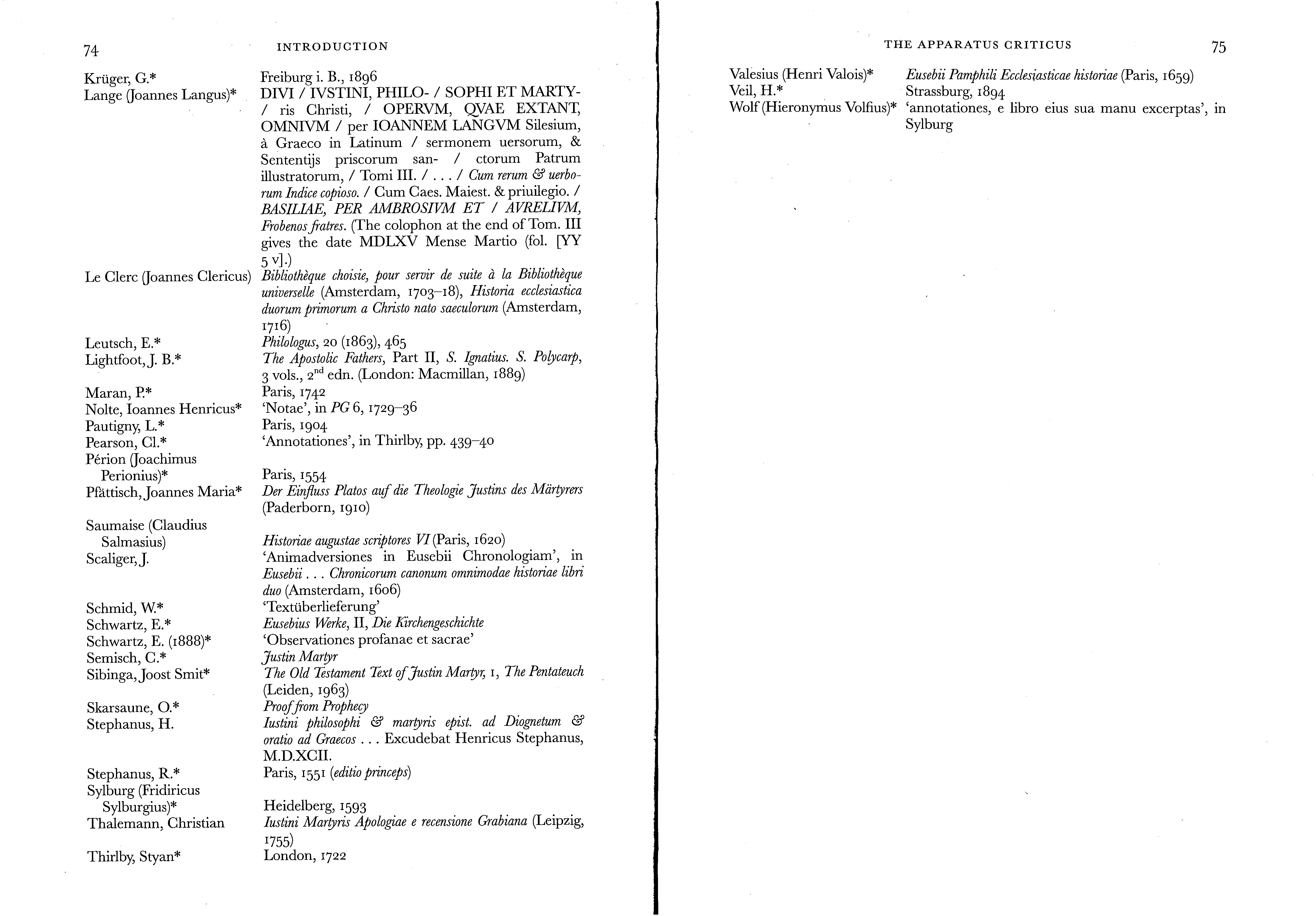
ΤΗΕ APPARATUS CRITICUS
INTRODUCTION
Valesius (Henri Valois)* Veil, Η.* Wolf (Hieronymus Volfius)* Eusebii Pamphili Ecclesiasticαe historiae (Paris, 1659)
Strassburg, 1894 'annotationes, e libro eius sua manu excerptas', ίn Sylburg Freiburg ί. Β., 1896
DIVI / IVSTINI, PHILO- / SOPHI ΕΤ MARTY-
Κrίiger, G. * Lange Goannes Langus)* / ris Christi, / OPERVM, QVAE ΕΧΤΑΝΤ, ΟΜΝΙΥΜ / per ΙΟΑΝΝΕΜ LANGVM Silesium, a Graeco ίn Latinum / sermonem uersorum, &
Sentent~s priscorum san- / ctorum Patrum illustratorum, / Tomi ΠΙ / ... / Cum rerum & uerborum Indice copioso. / Cum Caes. Maiest. & priuilegio. /
BASIL1AE, PER AMBROSIVM ΕΤ / AVRELIVM,
Frobenos.fratres. (The colophon at the end ofTom. ΠΙ gives the date MDLXV Mense Martio (foΙ [ΥΥ
5 ν].) Bibliotheque choisie, pour servir de suite α Ζα Bibliotheque universelle (Amsterdam, 1703-18), Historia ecclesiαsticα duorum primorum α Christo nato saeculorum (Amsterdam,
1716) Philologus, 20 (1863),465 Le Clerc Goannes Clericus) Leutsch, Ε.* Lightfoot,J. Β.* The Apostolic Fathers, Part Π, S. Ignatius. S. Ρο lycαrp ,
3 vols., 2nd edn. (London: Macmillan, 1889) Paris, 1742 'Notae', ίn PG 6, 1729-36 Paris, 1904 'Annotationes', ίn Thirlby, ρρ. 439-40 Maran, Ρ.* Nolte, Ioannes Henricus* Pautigny, L. * Pearson, CΙ * Perion Goachimus Paris, 1554 Der Einjluss Platos αιq die Theologie ]ustins des Mαrtyrers
Perionius )* Pfattisch,Joannes Maria* (Paderborn, 1910) Saumaise (Claudius Historiae augustae scriptores VI (Paris, 1620)
'Animadversiones in Eusebii Chronologiam', ίn Eusebii . . . Chronicorum cαnonum omnimodae historiae libri duo (Amsterdam, 1606) Salmasius) Scaliger, J.
Schmid, W* Schwartz, Ε.* Schwartz, Ε. (1888)* Semisch, C. * Sibinga,Joost Smit* 'Textϋberlieferung'
Eusebius Werke, Π, Die Kirchengeschichte 'Observationes profanae et sacrae'
]ustin Martyr The Old Testament Text qf]ustin Martyr, ι, The Pentateuch (Leiden, 1963) Proqf .from Prophecy Iustini philosophi & martyris epist. ad Diognetum & oratio ad Graecos ... Excudebat Henricus Stephanus,
M.D.XCII.
Paris, 1551 (editio princeps) Skarsaune, Ο. * Stephanus, Η.
Stephanus, R. * Sylburg (Fridiricus Heidelberg, 1593 Iustini Martyris Apologiae e recensione Grabiana (Leipzig,
1755) London, 1722 Sylburgius )* Thalemann, Christian Thirlby, Styan*
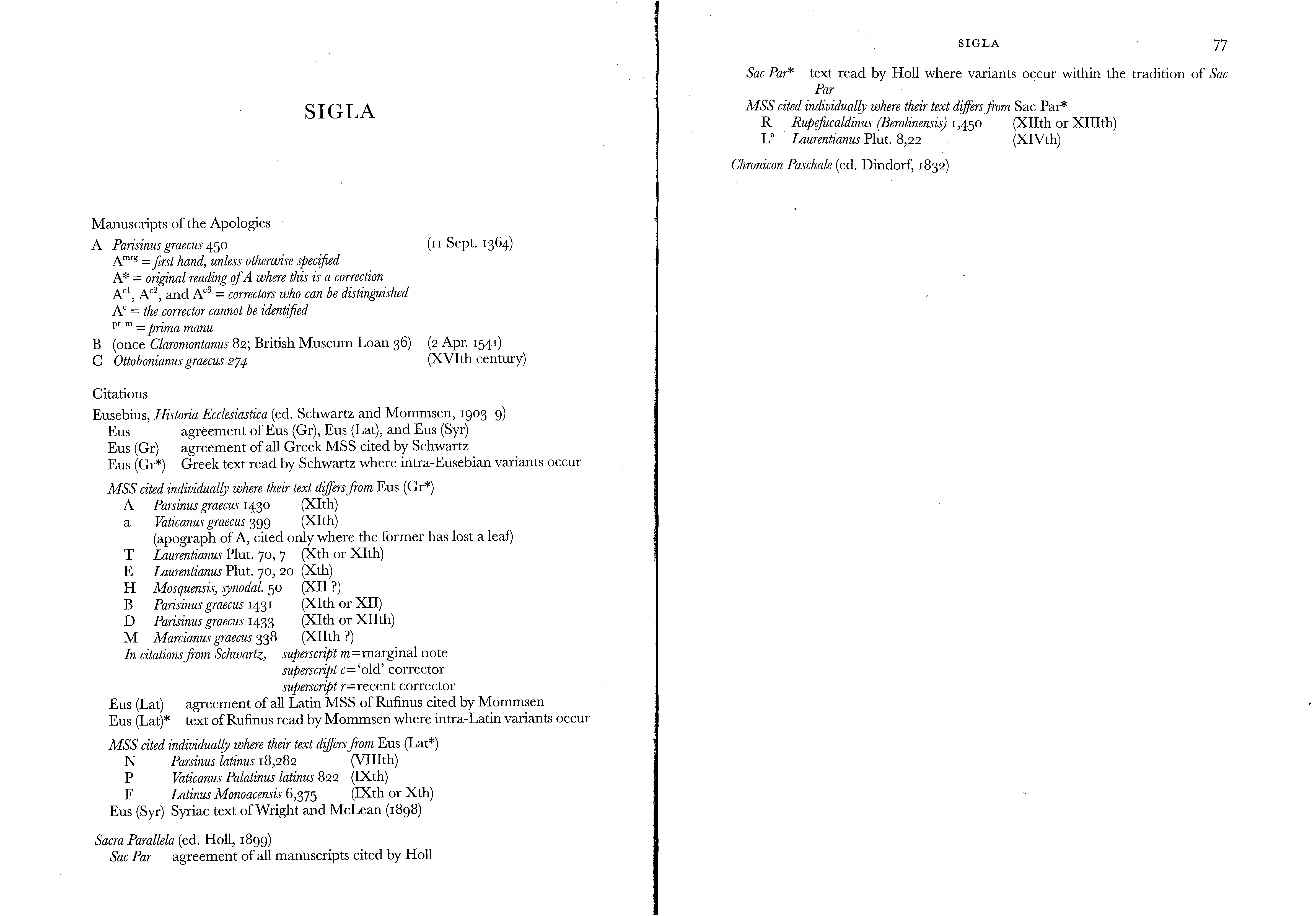
SIGLA
Sac Par* text read by Holl where variants occur within the tradition of Sac Par .
MSS cited individually where their text dijfers fι-om Sac Par* SIGLA R RupifUcαldinus (Berolinensis) 1,450 (XIIth or XIIIth) La Lαurentianus Plut. 8,22 (XIVth) Chronicon Pαschale (ed. Dindorf, 1832) M,!nuscripts of the Apologies Α Parisinus graecus 450
Α mrg = first handJ unless otherwise specifιed Α * = original reading qf Α where thΊS Ίs α coTTection
ACt, Ac2, and Ac3 = correctors who cαn be dΊStinguΊShed AC = the corrector cαnnot be identifιed pr m = prima manu (2 Apr. 1541) (XVIth century) Β (once Claromontanus 82; British Museum Loan 36)
C Ottobonianus graecus 274 Citations Eusebius, Historia Ecclesiasticα (ed. Schwartz and Mommsen, 1903-9)
Eus agreement of Eus (Gr), Eus (Lat), and Eus (Syr) Eus (Gr) agreement of all Greek MSS cited by Schwartz
Eus (Gr*) Greek text read by Schwartz where intra-Eusebian variants occur MSS cited individually where their text dijfers.from Eus (Gr*)
Α Parsinus graecus 1430 (XIth) a Vαticαnus graecus 399 (XIth) (apograph of Α, cited only where the former has lost a leaf)
Τ Lαurentianus Plut. 70, 7 (Xth or XIth) Ε Lαurentianus Plut. 70, 20 (Xth) Η MosquensΊSJ synodal. 50
(ΧΙΙ ?) Β Parisinus graecus 1431 (XIth or ΧΙ!) D Parίsinus graecus 1433 (XIth or XIIth) Μ Marcianus graecus 338 (XIIth ?) ln citations .from SchwartZJ superscript m = marginal note superscript c= 'old' corrector superscript r= recent corrector Eus (Lat) agreement of all Latin MSS of Rufinus cited by Mommsen
Eus (Lat)* text ofRufinus read by Mommsen where intra-Latin variants occur MSS cited individually where their text dijfers .from Eus (Lat*)
Ν Parsinus latinus 18,282 (VIIIth) Ρ Vαticαnus Palatinus latinus 822 (IXth) F Lαtinus Monoacensis 6,375 (IXth or Xth) Eus (Syr) Syriac text ofWright and McLean (1898)
Sacra Parallela (ed. Holl, 1899) Sac Par agreement of all manuscripts cited by Holl

TEXTS AND TRANSLATIONS
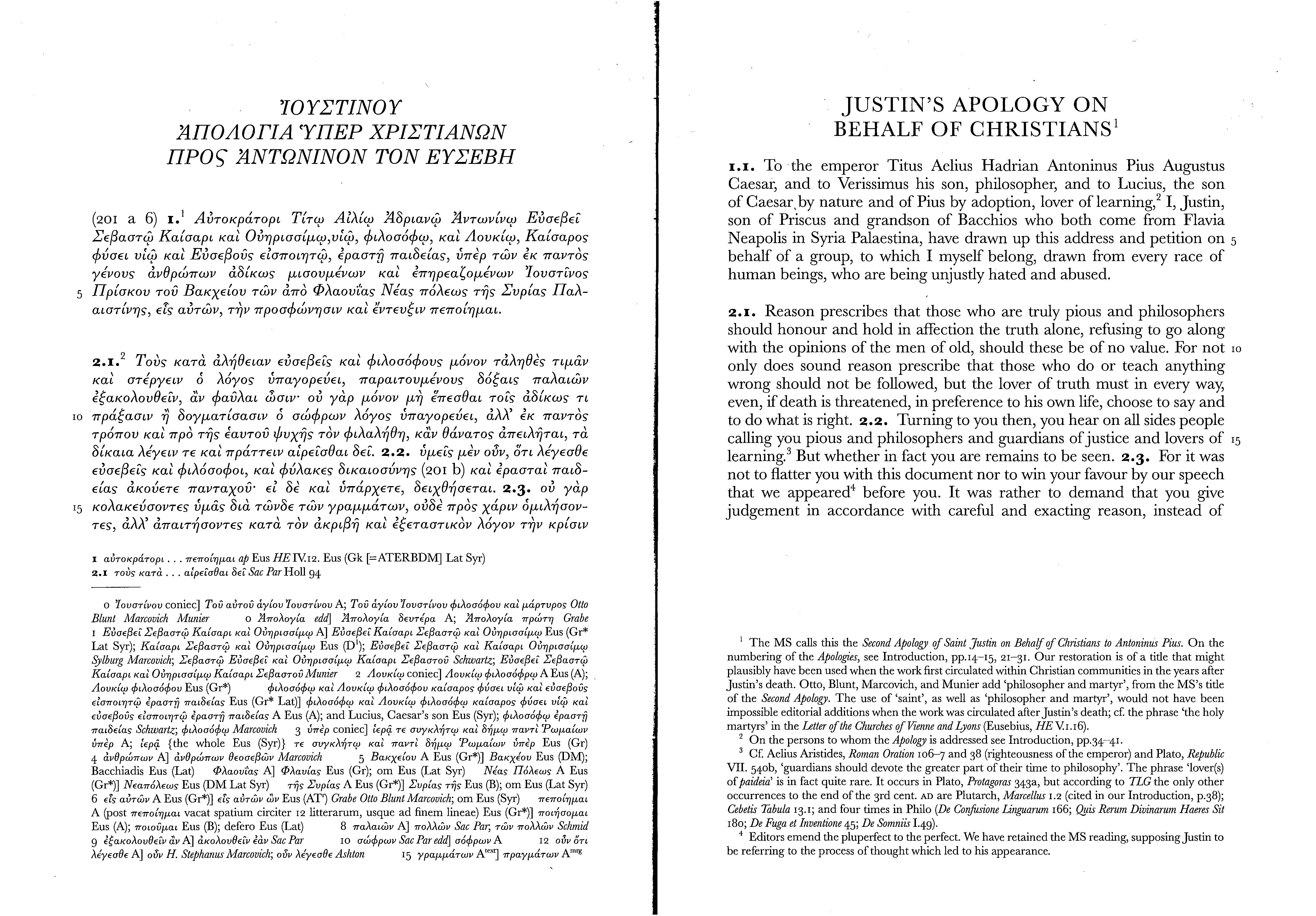
]US'IIN'S APOLOGY ΟΝ
BEHALF OF CHRISTIANS 1
προς ΆΝΤΩΝΙΝΟΝ ΤΟΝ ΕΥΣΕΒΉ ι.ι. Tothe emperor Titus Aelius Hadrian Antoninus Pius Augustus
Caesar, and to Verissimus his son, philosopher, and to Lucius, the son of Caesar, by nature and of Pius by adoption, lover of learning,2 Ι, Justin, son of Priscus and grandson of Bacchios who both come from Flavia
Ν eapolis ίη Syria Palaestina, have drawn up this address and petition οη 5 behalf of a group, to which Ι myself belong, drawn from every race of human beings, who are being unjustly hated and abused.
(201 a 6) ι.
Ι Αυτοκράτορι Τίτψ Αιλίψ Άδpιανιj) Άντωνίνψ Ευσεβει ΣεβασTιj) Καίσαρι και Oυηpισσίμψ,υίιj), ΦιλοσόΦψ, και Λουκίψ, Καίσαρος
Φύσει υίιj) και Ευσεβούς εισΠOιηTιj), EpaaTn παιδείας, ύπερ των εκ παντος γένους άνθρώπων άδίκως μισουμένων και επηρεαζομένων 'Ιουστινος ι 1') 1"\ \ Φ / \ ,ι C ι αιστινης, εις αυτων, την προσ ωνησιν και ενTευ~ ιν πεποιημαι.
5 Πρίσκου τού Βακχείου των άπο Φλαουίας Νέας πόλεως τΤις Συρίας Παλ2.Ι. Reason prescribes that those who are truly pious and philosophers should honour and hold ίη affection the truth alone, refusing to go along with the opinions of the men of old, should these be of ηο value. For not !Ο
2.ι.
2 τους κατα άλήθειαν ευσεβεις και ΦιλοσόΦους μόνον τάληθες τιμαν οηlΥ does sound reason prescribe that those who do ΟΓ teach anything wrong should not be followed, but the lover of truth must ίη every way, even, if death is threatened, ίη preference to his own life, choose to say and to do what is right. 2.2. Turning to you then, you hear οη all sides people calling you pious and philosophers and guardians of justice and lovers of 15 learning.3 But whether ίη fact you are remains to be seen. 2.3. For it was not to flatter you with this document ηΟΓ to win your favour by our speech that we appeared4 before you. It was rather to demand that you give judgement ίη accordance with careful and exacting reason, instead of και στέργειν ό λόγος υπαγορεύει, παραιτουμένους δόςαις παλαιων εςακολουθειν, αν Φαύλαι ώσιν' ου γαρ μόνον μη Επεσθαι τοις άδίκως τι ι t.
πpα~ ασιν η ογματισασιν ο σω ρων ογος υπαγορευει, α εκ παντος τρόπου και προ τΤις έαυτού ψυχΤις τον Φιλαλήθη, καν θάνατος άπειλΤιται, τα δίκαια λέγειν τε και πράττειν αίρεισθαι δει. 2.2. ύμεις μεν οδν, ότι λέγεσθε ευσεβεις και ΦιλόσοΦοι, και Φύλακες δικαιοσύνης (201 b) και ερασται παιδ είας άκούετε πανταχού' ει δε και υπάρχετε, δειχθήσεται. 2.3. ου γαρ
κολακεύσοντες ύμας δια τωνδε των γραμμάτων, ουδε προς χάριν όμιλήσον- 'λλ' ,ι \ \ , β ~ \, t.
\ λ ι \ ι τες, α απαιτησοντες κατα τον ακρι η και ε~εTασΤΙKoν ογον την κρισιν Ι αυτοκράτορι ... πεποίημαι αρ Eus HEΊV.12. Eus (Gk [=ATERBDMJ Lat Syr)
2.1 τους κατα ... αίρεισθαι δει SaC Ρατ Holl 94 ο 10υστίνου coniec] του αύτου άγίου 10υστίνου Α; του άγίου 10υστίνου ΦιλοσόΦου και μάρτυρος Otto
Blunt Aιfarcovich Aιfuniel" ο Άπολογία edd] Άπολογία δευτέρα Α; Άπολογία πρώτη Grabe
1 Ευσεβει Σεβαστψ Καίσαρι και ουηρισσίμψ Α] Ευσεβει Καίσαρ ι Σεβαστψ και ουηρισσίμψ Eus (Gr* Lat Syr); Καίσαρι Σεβαστψ και ουηρισσίμψ Eus (Dl); Ευσεβει Σεβαστψ και Καίσαρι ουηρισσίμψ
Sylburg Marcovich; Σεβαστψ Ευσεβει και ουηρισσίμψ Καίσαρι Σεβαστου Schwartz; Ευσεβει Σεβαστψ
1 The MS calls this the Secol1d Apology oJ Saillt ]ustin 01l Beha1f oJ Christialls to AntollillUs Pius. Οη the numbering of the Apologies, see Introduction, ρρ.14-15, 21-31. Our restoration is of a title that might plausibly have been used when the work first circulated within Christian communities ίη the years after Justin's death. Otto, Blunt, NIarcovich, and Munier add 'philosopher and martyr', from the MS's title
Καίσαρι και ουηρισσίμψ Καίσαρι Σεβαστου MUllier 2 Λουκίψ coniec] Λουκίψ ΦιλοσόΦρψ Α Eus (Α);
Λουκίψ ΦιλοσόΦου Eus (Gr*) ΦιλοσόΦψ και Λουκίψ ΦιλοσόΦου καίσαρος Φύσει υίψ και ευσεβους of the Secol1d Apology. The use of 'saint', as well as 'philosopher and martyr', would not have been impossible editorial additions when the work was circulated after Justin's death; cf. the phrase 'the holy martyrs' ίη the Letter oJthe Churches oJVielllle alld Lyol1S (Eusebius, HEV.I.I6). εισποιψψ EpaaTi! παιδείας Eus (Gr* Lat)] ΦιλοσόΦψ και Λουκίψ ΦιλοσόΦψ καίσαρος Φύσει υίψ και ευσεβους εισποιψψ EpaaTi! παιδείας Α Eus (Α); and Lucius, Caesar's son Eus (Syr); ΦιλοσόΦψ EpaaTi! παιδείας Schwαι-tΖ; ΦιλοσόΦψ Nfarcovich 3 ύπερ coniec] ίεΡi!- τε συγκλήτψ και δήμψ παντι 'Ρωμαίων
2 Οη the persons to whom the Apology is addressed see Introduction, ΡΡ.34-41. ύπερ Α; ίεΡi!- {the whole Eus (Syr)} τε συγκλήτψ και παντι δήμψ 'Ρωμαίων ύπερ Eus (Gr)
4 ανθρώπων Α] ανθρώπων θεοσεβων Marcoviclz 5 Βακχείου Α Eus (Gr*)] Βακχέου Eus (DM);
Bacchiadis Eus (Lat) ΦλαουL"ας Α] Φλαυίας Eus (Gr); om Eus (Lat Syr) Νέας Πόλεως Α Eus (Gr*)] Νεαπόλεως Eus (DM Lat Syr) Tijς Συρίας Α Eus (Gr*)] Συρίας Tijς Eus (Β); om Eus (Lat Syr)
6 εΙς αύτων Α Eus (Gr*)] εις αυτων ων Eus (ΑΤ) Grabe Otto Blullt Mal"COvich; om Eus (Syr) πεποίημαι 3 Cf. Aelius Aristides, R01I1α1l OratiOll 106-7 and 38 (righteousness of the emperor) and Plato, Republic
ΥΙΙ. 540b, 'guardians should devote the gl'eatel' part of their time to philosophy'. The phrase 'lover(s) of paideia' is ίη fact quite rare. It occurs in Plato, PΓotagorαs 343a, but according to TLG the only other occurrences to the end ofthe 3rd cent. AD are Plutal'ch, Μαι-ceΙΙus 1.2 (cited in our Introduction, Ρ.38);
Cebetis Tαbula 13.1; and four times ίη Philo (De CorifUsi01le Lίιιguαι-um 166; QJtis ReΙ-U/ll DiVillα1"Unz Hael"es Sit
Α (post πεποίημαι vacat spatium circiter 12 litterarum, usque ad finem lineae) Eus (Gr*)] ποιήσομαι
Eus (Α); ποιουμαι Eus (Β); defero Eus (Lat) 8 παλαιων Α] πολλων Sac Ρατ, των πολλων Sclzmid
9 εξακολουθειν αν Α] ακολουθειν εαν Sac Ραι- !Ο σώΦρων Sac Ρατ edd] σόΦρων Α 12 οδν στι 180; De Fuga et 11lvelltione 45; De Solnlliis Ι.49).
4Editol's emend the plupeΓfect to the pel'fect. We have retained the MS reading, supposing Justin to be referring to the process of thought which led to his appeal'ance. λέγεσθε Α] οδν Η. Stephanus Marcoviclz; οδν λέγεσθε Ashtoll
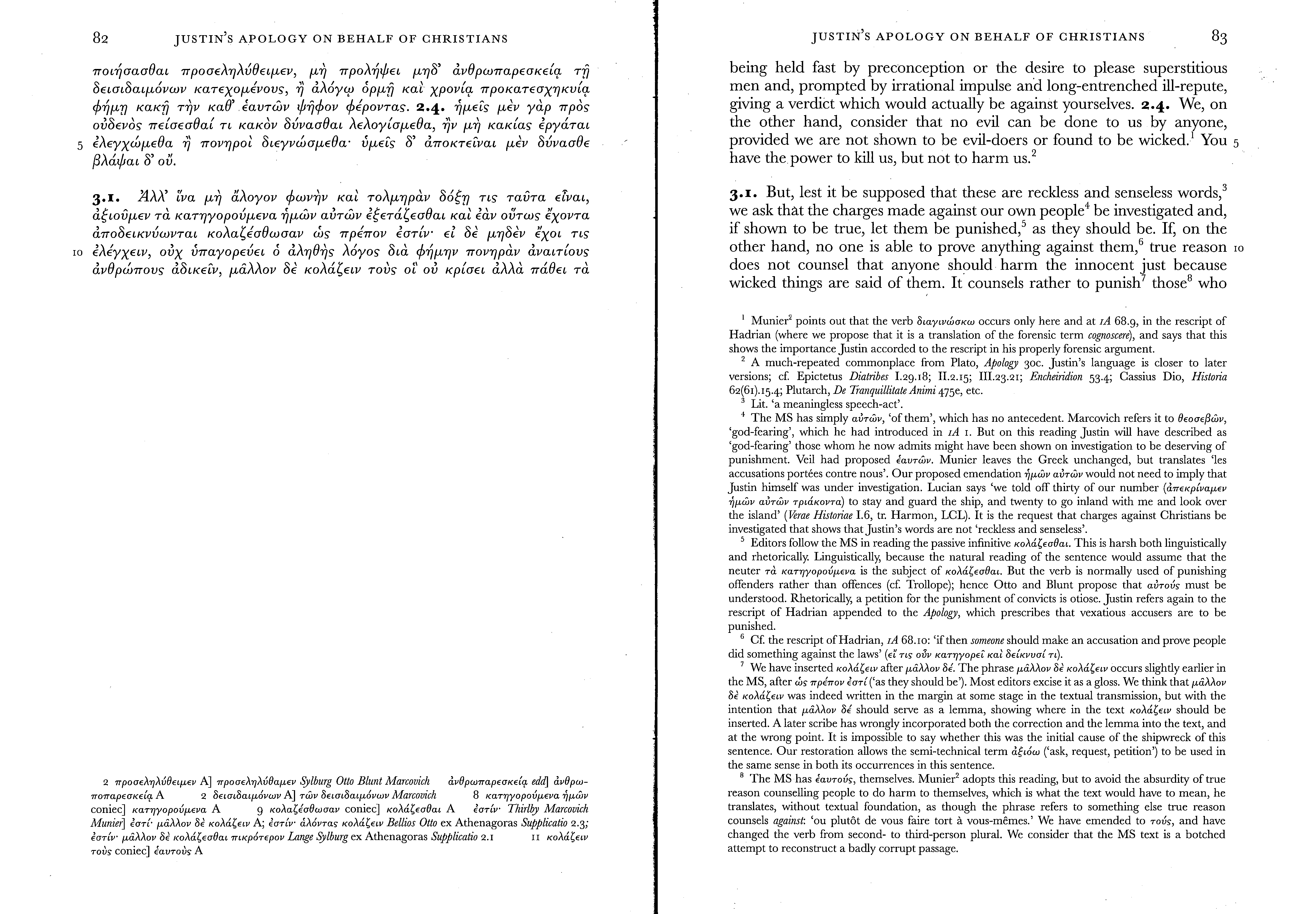
JUSTIN'S APOLOGY ΟΝ BEHALF OF CHRISTIANS
JUSTIN'S APOLOGY ΟΝ BEHALF OF CHRISTIANS
being held fast by preconception or the desire to please superstitiouS men and, prompted by irrational impulse an'd long-entrenched ill-repute, giving a verdict which would actually be against yourselves. 2.4. We,on the other hand, consider that ηο evil can be done to us by anyone, provided we are not shown to be evil-doers or found to be wicked} You 5 have the power to kill us, but not to harm us. 2 ποιήσασθαι προσεληλύθειμεν, μη προλήψει μηδ' άvθρωπαΡεσκε{q, TiJ δεισιδαιμόνων κατεχομένους, ~ άλόγιΡ όρμiJ και XpOV{q, προκατεσχηκv{q,
Φ'ήμτι KaKiJ την καθ'. έαυτων ψηΦον Φέροντας. 2.4. rιμεις μεν γαρ προς ουδενος πε{σεσθα{ Τι κακον δύνασθαι λελογ{σμεθα, ~ν μη κακ{ας εργάται
5 ελεγχώμεθα ~ πονηροι διεγνώσμεθα· ύμεις δ' άποκτειναι μεν δύνασθε βλάψαι δ' ου.
3.1. But, lest it be supposed that these are reckless and senseless words,3 we ask that the charges made against our own people 4 be investigated and, if shown to be true, let them be punished,S as they should be. If, οη the other hand, ηο one is able to prove anything against them,6 true reason 10 does not counsel that anyone sh9u1d harm the innocent just because wicked things are said of th~m. It counsels rather to punish7 those8 who 3.1.
Άλλ' ίνα μη αλογον Φωνην και τολμηραν δόςτι Τις ταυτα εΊναι, άςιουμεν τα κατηγορούμενα rιμων αυτων εςετάζεσθαι και εαν ούτως εχοντα άποδεικνύωνται κολαζέσθωσαν ώς πρέπον εστ{ν· ει δε μηδεν εχοι Τις
ε εγχειν, ουχ υπαγορευει ο α η ης ογος ια ημην πονηραν αναιτιους άνθρώπους άδικειν, μαλλον δε κολάζειν τους οί' ου κρ{σει άλλα πάθει τα ι Munier2 points out that the verb διαγινώσκω occurs only here and at ιΑ 68.9, ίπ the rescript of Hadrian (where we propose that it is a translation of the forensic term cognoscere), and says that this shows the importance Justin accorded to the rescript in his properly forensic argument.
2 Α much-repeated commonplace from Plato, Apology 30c. Justin's language is closer to later versions; cf. Epictetus Diαtribes ι'29.18; Π.2.15; Πι'23.21; Ellcheiridion 534; Cassius Dio, Historiα
62(61).154; Plutarch, De Trαllquillitαte Allimi 475e, etc.
3 Lit. 'a meaningless speech-act'.
+ The MS has simply αυτων, 'ofthem', which has πο antecedent. Marcovich refers it to θεοσεβων,
'god-fearing', which he had introduced ίπ ιΑ ι. But οπ this reading Justin will have described as 'god-fearing' those whom he now admits might have been shown οπ investigation to be deserving of punishment. Veil had proposed έαυτων. Munier leaves the Greek unchanged, but translates 'les accusations portees contre nous'. Our proposed emendation ήμων αυτων would not need to imply that Justin himself was under investigation. Lucian says 'we told off thirty of our number (απεκρ{ναμεν ήμων αυτων τριάκοντα) to stay and guard the ship, and twenty to go inland with me and look over the island' (Tirαe Historiαe Ι.6, tr. Harmon, LCL). 1t is the request that charges against ChΓίstίans be investigated that shows thatJustin's WΟΓds are not 'reckless and senseless'.
5 Editors follow the MS ίπ [eading the passive infinitive κολάζεσθαι. This is harsh both linguistically and rhetorically. Linguistically, because the natural reading of the sentence would assume that the neuter τα κατηγορούμενα is the subject of κολάζεσθαι. But the veΓb is normally used of punishing offenders rathel" than offences (cf. Trollope); hence Otto and Blunt propose that αυτού, must be understood. Rhetorically, a petition for the punishment of convicts is otiose. Justin refers again to the [escγipt of Hadrian appended to the Apology, which prescribes that vexatious accuseΓS are to be punished.
6 Cf. the rescript ofHadrian, ιΑ 68.10: 'ifthen SOllleOne should make an accusation and prove people did something against the laws' (εϊ τι, οδν κατηγορει και δε{κνυσί τι).
7 We have inserted κολάζειν after μιiλλoν δΙ The phrase μιiλλoν δε κολάζειν occurs slightly earlier in the MS, after ώς πρέπον έστί ('as they should be'). Most editors excise it as a gloss. We think that μιiλλoν δε κολάζειν was indeed WΓίtten ίπ the margin at some stage ίπ the textual transmission, but with the intention that μιiλλoν δέ should serve as a lemma, showing where ίη the text κολάζειν should be inserted. Α later scribe has wrongly incorporated both the correction and the lemma into the text, and at the wrong point. 1t is impossible to say whether this was the initial cause of the shίΡWΓeck of this sentence. Our restoration allows the semi-technical term αξιόω ('ask, request, petition') to be used ίπ the same sense ίπ both its occurrences in this sentence.
8 The MS has έαυτού" themselves. ΜunίeΓ 2 adopts this reading, but to avoid the absurdity of true
[eason counselling people to do harm to themselves, which is what the text would have to mean, he translates, without textual foundation, as though the phrase refers to something else true reason counsels αgαinst: 'ou plutot de vous faίΓe tort a vous-memes.' We have emended to τούς, and have changed the verb from secondto third-person plural. We consider that the MS text is a botched attempt to reconstruct a badly corrupt passage.
2 προσεληλύθειμεν Α] προσεληλύθαμεν /iylburg Otto Blunt !vfαιωvίch ανθρωπαρεσκείq. edd] ανθρωποπαρεσκείq. Α
2 δεισιδαιμόνων Α] των δεισιδαιμόνων Μαιωvίch 8 κατηγορούμενα ήμων coniec] κατηγορούμενα Α 9 κολαζέσθωσαν coniec] κολάζεσθαι Α έστίν' ThiTlby MαTcovich MunieI] έστί' μιiλλoν δε κολάζειν Α; έστίν' άλόντα, κολάζειν Bellios Otto ex Athenagoras Supplicαtio 2.3; έστίν' μιiλλoν δε κολάζεσθαι πικρότερον Lαnge /iylbuTg ex Athenagoras Supplicαtio 2.1
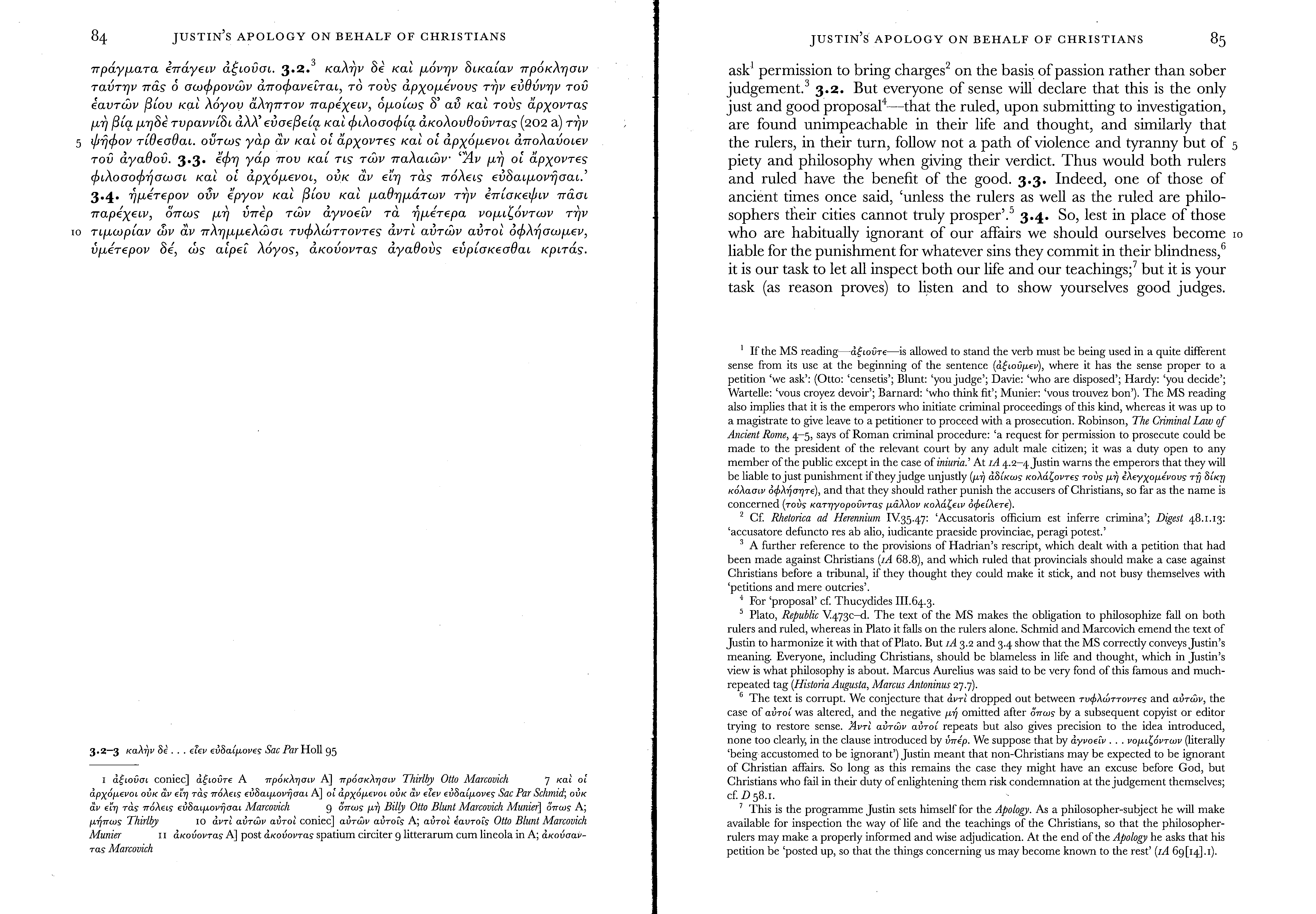
JUSTIN'S APOLOGY ΟΝ BEHALF OF CHRISTIANS
JUSTIN'S APOLOGY ΟΝ BEHALF OF CHRISTIANS
, "
'c ~
, λ πραγματα επαγειν α~ιoυσι. 3.2. κα ην ε και μονην ικαιαν προκ ησιν ask1 permission to bring charges2 οη the basis. of passion rather than sober judgement.3 3.2. But everyone of sense will declare that this is the οηlΥ just and good proposa14-that the ruled, upon submitting to investigation, ταύτην παs ό σωΦρονων αποΦανειται, το TOVS αρχομένους την ευθύνην του ι ~ β , ι λ '''λ ,ι , δ'
';'
\ \ " εαυτων ιου κ().ι ογου α ηπτον παρεχειν, ομοιωs αυ και τους apXOVTaS μη βίq. μηδε τυραννίδι αλλ' ευσεβείq. και ΦιλοσοΦίq. ακολουθουνταs (202 a) την are found unimpeachable ίη their life and thought, and similarly that the rulers, ίη their turn, follow not a path of violence and tyranny but of 5 piety and philosophy when giving their verdict. Thus would both rulers and ruled have the benefit of the good. 3.3. Indeed, one of those of ancient times once said, 'unless the rulers as well as the ruled are philosophers their cities cannot truly prosper'.5 3.4. So, lest ίη place of those who are habitually ignorant of our affairs we should ourselves become ΙΟ liable for the punishment for whatever sins they commit ίη their blindness,6 it is our task to let all inspect both our life and our teachings; 7 but it is your task (as reason proves) to l~sten and to show yourselves good judges.
,Ι. ~Φ 'θ θ "
1'\ Ι Ι"
'λ'
ψη ον τι εσ αι. OVTWS γαρ αν και οι apXOVTES και οι αρχομενοι απο αυοιεν του αγαθου. 3.3. εΦη γάρ που καί τιs των παλαιων' ''f1v μη οί llpxoVTEs
"\,, Ι 'λ 'δ ~ , ι οσο ησωσι και οι αρχομενοι, ουκ αν ειη TaS πο ειs ευ αιμονησαι.
3.4. -ήμέτερον ογν εργον και βίου και μαθημάτων την Επίσκεψιν πασι παρέχειν, οπωs μη ύπερ των αγνοειν τα -ήμέτερα νομιζόντων την
, 'i'
, Ι ,~ , ι 'Φλ'
ΙΟ τιμωριαν ων αν π ημμε ωσι τυ WTTOVTES αντι αυτων αυτοι ο ησωμεν, ύμέτερον δέ, ώs αίρει λόγοs, ακούοντας αγαθοvs εύρίσκεσθαι ΚΡιτάs.
1 If the MS readiηg-αςιοvτε-ίs allowed to stand the νerb must be being used ίη a quite di:fferent sense from its use at the beginning of the sentence (αξιουμεν), where it has the sense proper to a petition 'we ask': (Otto: 'censetis'; Blunt: 'youjudge'; Daνie: 'who are disposed'; Hardy: 'you decide';
Wartelle: 'vous croyez deνoir'; Barnard: 'who think fit'; Munier: 'vous trouνez bon'). The MS reading also irnplies that it is the emperors who initiate criminal proceedings of this kind, whereas it was υρ to a magistrate to giνe leave to a petitioner to proceed with a prosecution. Robinson, The Crimillαl Lαw Q/
Aιzcieιzt R01ne, 4-5, says of Roman cτiminal procedure: 'a request for permission to prosecute could be made to the president of the relevant CΟU1't by any adult male citizen; it was a duty open to any membe1' of the public except ίη the case of iιziuriα.' At ιΑ 4-2-4 Justin waΓΠS the emΡero1'S that they will be liable to just punishment ifthey judge unjustly (μη αδίκως κολάζοντες τους μη έλεγχομένου, Tn δίκτι κόλασιν σΦλήσητε), and that they should rather punish the accuse1'S of Ch1'ίstίaηs, so far as the name is cοηceΓΠed (τους κατηγορουντας μαλλον κολάζειν σΦείλετε).
2 Cf. Rhetoricα αd HerelZlZiuιn IV35-47: 'ΑccusatΟ1'ίs ofllcium est infene cτirnina'; Dίgest 48.Ι.Ι3:
'accusatΟ1'e defuncto res ab alio, iudicante Ρ1'aesίde proνinciae, peragi potest.'
3 Α further reference to the proνisions of Hadrian's rescript, which dealt with a petition that had been made against Christians (ιΑ 68.8), and which ruled that provincials should make a case against Christians before a tribunal, if they thought they could make it stick, and not busy themselves with 'petitions and mere outcries'.
4 For 'proposal' cf. Thucydides ΙΙΙ. 64.3.
5 Plato, Republic V473c-d. The text of the MS makes the obligation to philosophize fall οη both rulers and ruled, whereas in Plato it falls οη the rulers alone. Schmid and Marcoνich emend the text of Justin to harmonize it with that ofPlato. But ιΑ 3.2 and 3-4 show that the MS conectly conνeys Justin's meaning. Everyone, including Christians, should be blameless ίη life and thought, which ίη Justin's νiew is what philosophy is about. Marcus Aurelius was said to be very fond of this famous and muchrepeated tag (Historiα Augustα, Λι[αrcus Aιztoιzinus 27.7).
6 The text is conupt. We conjecture that αντι dropped out between τυΦλώττοντε, and αυτων, the case of αυτοί was altered, and the negative μή omitted after σπως by a subsequent copyist οτ editor trying to restore sense. Άντι αυτων αυτοί repeats but also gives precision to the idea introduced, none too clearly, in the clause introduced by ύπέρ. We suppose that by αγνοειν ... νομιζόντων σίteraΙΙΥ
'being accustomed to be ignorant') Justin meant that non-Christians may be expected to be ίgnΟ1'aηt of Ch1'ίstίaη affairs. So long as this 1'emaίηs the case they might have an excuse befΟ1'e God, but Christians who fail ίη their duty of enlightening them 1'ίsk condemnation at the judgement themselves; cf. D 58.1.
3.2-3 καλην δε ... εΤεν ευδαίμονες Sαc Ρατ Ho1l95 ι αςιουσι coniec] αςιουτε Α πρόκλησιν Α] πρόσκλησιν Thirlby Otto Mαι"COvich
7 και οί αρχόμενοι ουκ αν ειη τας πόλεις ευδαψονησαι Α] οί αρχόμενο ι ουκ αν εΤεν ευδαίμονες Sαc Ρατ Scll1nid; ουκ αν ειη τας πόλεις ευδαψονησαι ΜατcoυίcΙι
9 σπως μη ΒίΖ/Υ Otto Blunt Mαι"COvich MUllierJ σπως Α; 7 This is the Ρrog1'amme Justin sets hirnself [Ο1' the Apology. As a ΡhilΟSΟΡhe1'-subject he will make available for inspection the way of life and the teachings of the ChΓistians, so that the ΡhilΟSΟΡhe1' μήπως Thirlby ΙΟ αντι αυτων αυτοι coniec] αυτων αυτοι, Α; αυτοι έαυτοις Otto BlUllt ΜατcoυίcΙι
MUllier ΙΙ ακούοντας Α] post ακούοντας spatium circiter 91itterarum cum lineola ίη Α; ακούσαν ωΙe1'S may make a ΡΓΟΡe1'ΙΥ infΟ1'med and wise adjudication. At the end of the Apology he asks that his petition be 'posted up, so that the things cοηceΓΠίηg us may become known to the rest' (ιΑ 69[14].1). τα, MαTcovich
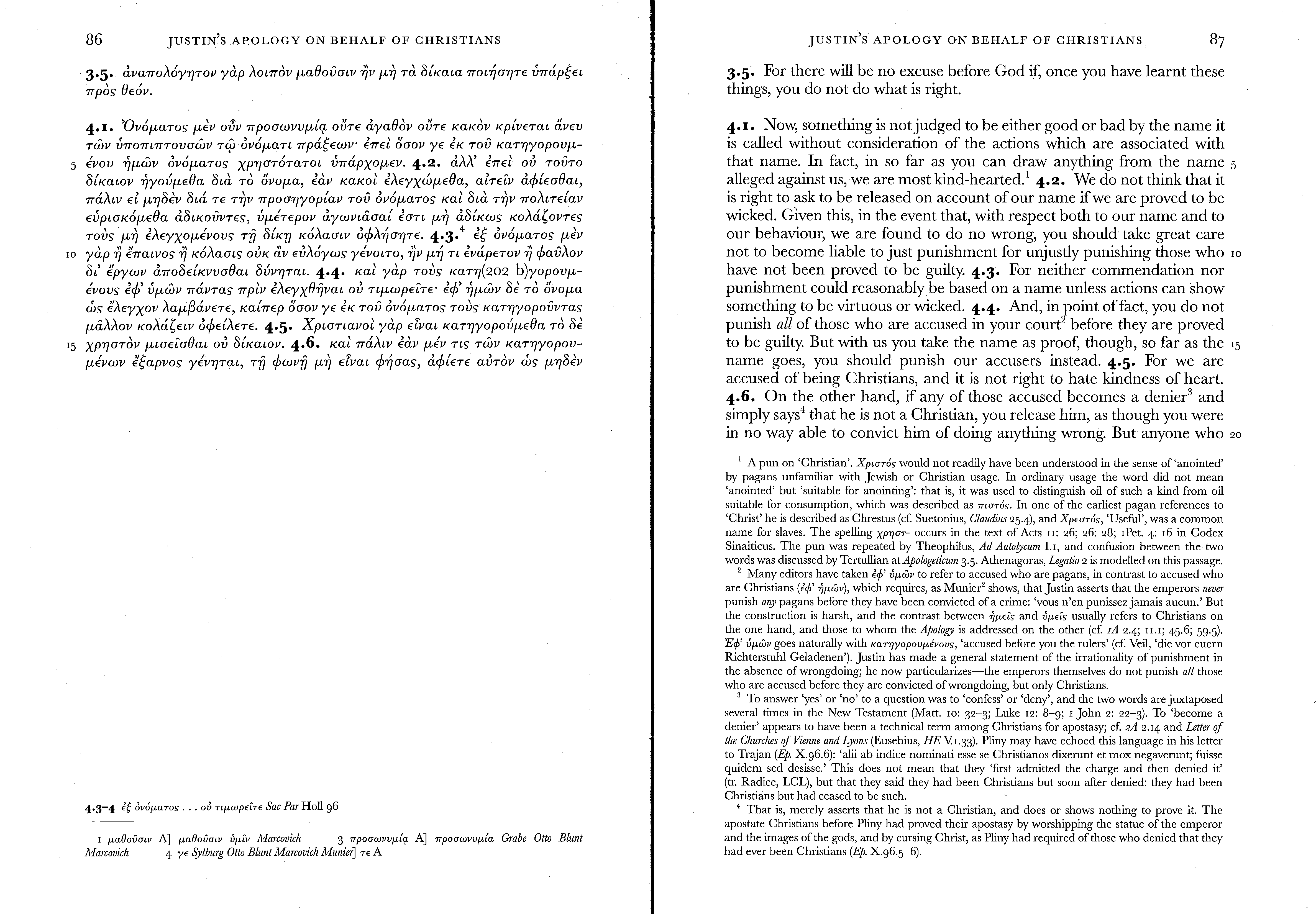
JUSTIN'S APOLOGY ΟΝ BEHALF OF CHRISTIANS
JUSTIN'S APOLOGY ΟΝ BEHALF OF CHRISTIANS.
3.5. For there will be ηο excuse before God if, once you have learnt these things, you do not do what is right.
3.5. άνα7ΤολόΥητον γαρ λΟΙ7Τον μαθουσιν ~ν μ~ τα δ{καια 7Τοιήσητε ύ7Τάρξει 7Τρος θεόν.
4.1. Now, something is notjudged to be either good ΟΓ bad by the name it is called without consideration of the actions which are associated with that name. Ιη fact, in so far as you can draw anything from the name 5 alleged against us, we are most kind-hearted. 1 4.2. We do not think that it is right to ~sk to be released οη account of our name if we are proved to be wicked. Given this, ίη the event that, with respect both to our name and to our behaviour, we are found to do ηο wrong, you should take great care not to become liable to just punishment for unjustly punishing those who ΙΟ have not been proved to be guilty. 4.3. For neither commendation nΟΓ punishment could reasonably,be based οη a name unless actions can show something to be virtuous ΟΓ wicked. 4.4. And, in point offact, you do not punish all of those who are accused ίη your court2 before they are proved to be guilty. But with us you take the name as proof, though, so far as the 15 name goes, you should punish our accusers instead. 4.5. For we are accused of being Christians, and it is not right to hate kindness of heart.
4.6. Οη the other hand, if any of those accused becomes a denier3 and simply says 4 that he is not a Christian, you release him, as though you were
4.1. 'Ονόματος μεν οδν 7Τροσωνυμ{Cf οϋτε άγαθον οϋτε κακον κρ{νεται ανευ των ύ7ΤΟ7ΤΙ7Ττουσων τψονόματι 7Τράξεων' ε7Τει σσον γε εκ του κατηγορουμ5 ένου ήμων ονόματος χρηστότατοι ύ7Τάρχομεν. 4.2. άλλ' ε7Τει ού τουτο ι • ι θ δ' ,,'
"λ ι θ 'Λ ',ι.. Ι θ ικαιον ηγουμε α ια το ονομα, εαν κακοι ε εγχωμε α, αιτειν αψιεσ αι, δ 7Τάλιν ει μηδεν διά τε T~ν 7Τροσηγορ{αν του ονόματος και δια T~ν 7Τολιτε{αν εύρισκόμεθα άδικουντες, ύμέτερον άγωνιάσα{ εστι μ~ άδ{κως κολάζοντες
, C ' ι , τους μη ε εγχομενους ΤΤΙ ικτι κο ασιν Οψ ησητε. 4.3. ε~ ονοματος μεν ΙΟ γαρ ~ ε7Ταινος ~ κόλασις ούκ αν εύλόγως γένοιτο, ~ν μή τι ενάρετον ~ φαυλον δι' εργων ά7Τοδε{κνυσθαι δύνηται. 4.4. και γαρ τους κατη(202 b)γΟΡουμι
,,1.."
Λ Ι "λ θ Λ , Λ ,,1.."
Λ δ' ,,' ενους εψ υμων 7Ταντας 7Τριν ε εγχ ηναι ου τιμωρειτε' εψ ημων ε το ονομα ώς ελεγχον λαμβάνετε, κα{7Τερ σσον γε εκ του ονόματος τους κατηγορουντας μάλλον κολάζειν οφε{λετε. 4.5. Χριστιανοι γαρ εΊναι κατηγορούμεθα το δε
χρηστονμισεισθαι ού δ{καιον. 4.6. και 7Τάλιν εαν μέν τις των κατηγορου μένων εξαρνος γένηται, Tiι φωνiι μ~ εΊναι φήσας, άφ{ετε αύτον ώς μηδεν ίn ηο way able to convict him of doing anything wrong. But anyone who 20
1 Α pun οη 'Christian'. XpLaT6s would not readily have been understood in the sense of 'anointed' by pagans unfamiliar with Jewish οτ Christian usage. Ιη ordinary usage the word did not mean
'anointed' but 'suitable for anointing': that is, it was used to distinguish oil of such a kind from oil suitable for consumption, which was described as πιστ6s. Ιη one of the earliest pagan references to 'Christ' he is described as Chrestus (CL Suetonius, Claudius 25-4), and XpEaT6s, 'Useful', was a common name for slaves. The spelling χρηστoccurs in the text of Acts ΙΙ: 26; 26: 28; IPet. 4: 16 ίη Codex
Sinaiticus. The pun was repeated by Theophilus, Ad Auto!Jιcum ι'ι, and confusion between the two words was discussed by Tertullian atApologeticuln 3.5. Athenagoras, Legatio 2 is modelled οη this passage.
2 Many editors have taken εφ' ύμων to refer to accused who are pagans, ίη contrast to accused who are Christians (εφ' ήμων), which requires, as Munier2 shows, thatJustin asserts that the emperors never punish αι!:Υ pagans before they have been convicted of a crime: 'vous n'en punissez jamais aucun.' But the construction is harsh, and the contrast between TιfLELs and ύμειs usually refers to Christians οη the one hand, and those to whom the Apology is addressed οη the other (cf. ιΑ 2-4; ΙΙ.Ι; 45·6; 59.5).
ΈΦ' ύμων goes naturally with κατηγορουμένουs, 'accused before you the rulers' (cf. Veil, 'die νοτ euern
Richterstuhl Geladenen'). Justin has made a general statement of the irrationality of punishment in the absence of wrongdoing; he now particularizes-the emperors themselves do not punish all those who are accused before they are convicted of wrongdoing, but οηlΥ Christians.
3 Το answer 'yes' οτ 'ηο' to a question was to 'confess' οτ 'deny', and the two words arejuxtaposed several times ίη the New Testament (Matt. ΙΟ: 32-3; Luke 12: 8-9; ι John 2: 22-3). Το 'become a denier' appears to have been a technical term among Christians for apostasy; cf. 2Α 2.14 and Letter qf t!ze C!zurches qfVienne and Lyons (Eusebius, ΗΕΥ.Ι.33). ΡΙίηΥ may have echoed this language ίη his letter to ΤΓajaη (Ερ. Χ.96.6): 'alii ab indice nominati esse se Christianos dixerunt et mox negaverunt; fuisse quidem sed desisse.' This does not mean that they 'first admitted the charge and then denied it'
(tr. Radice, LCL), but that they said they had been Christians but soon after denied: they had been
Christians but had ceased to be such.
4.3-4 ες ov6fLUTOS ... ου τιμωρεΙΤε Sac Ρατ Holl 96 + That is, merely asserts that he is not a ChΓίstίaη, and does οτ shows nothing to prove it. The apostate Christians before ΡΙίηΥ had proved their apostasy by worshipping the statue of the emperor and the images of the gods, and by cursing ChΓίst, as ΡΙίηΥ had required of those who denied that they had ever been ChΓίstίaηs (Ερ. Χ.96.5-6). ι μαθουσιν Α] μαθουσιν ύμιν Marcomch 3 προσωνυμ{q. Α] προσωνυμ{α Grabe Otto Blunt
Marcovich 4 γε ~lburg Otto Blunt Aιfarcovic!z Munier] τε Α
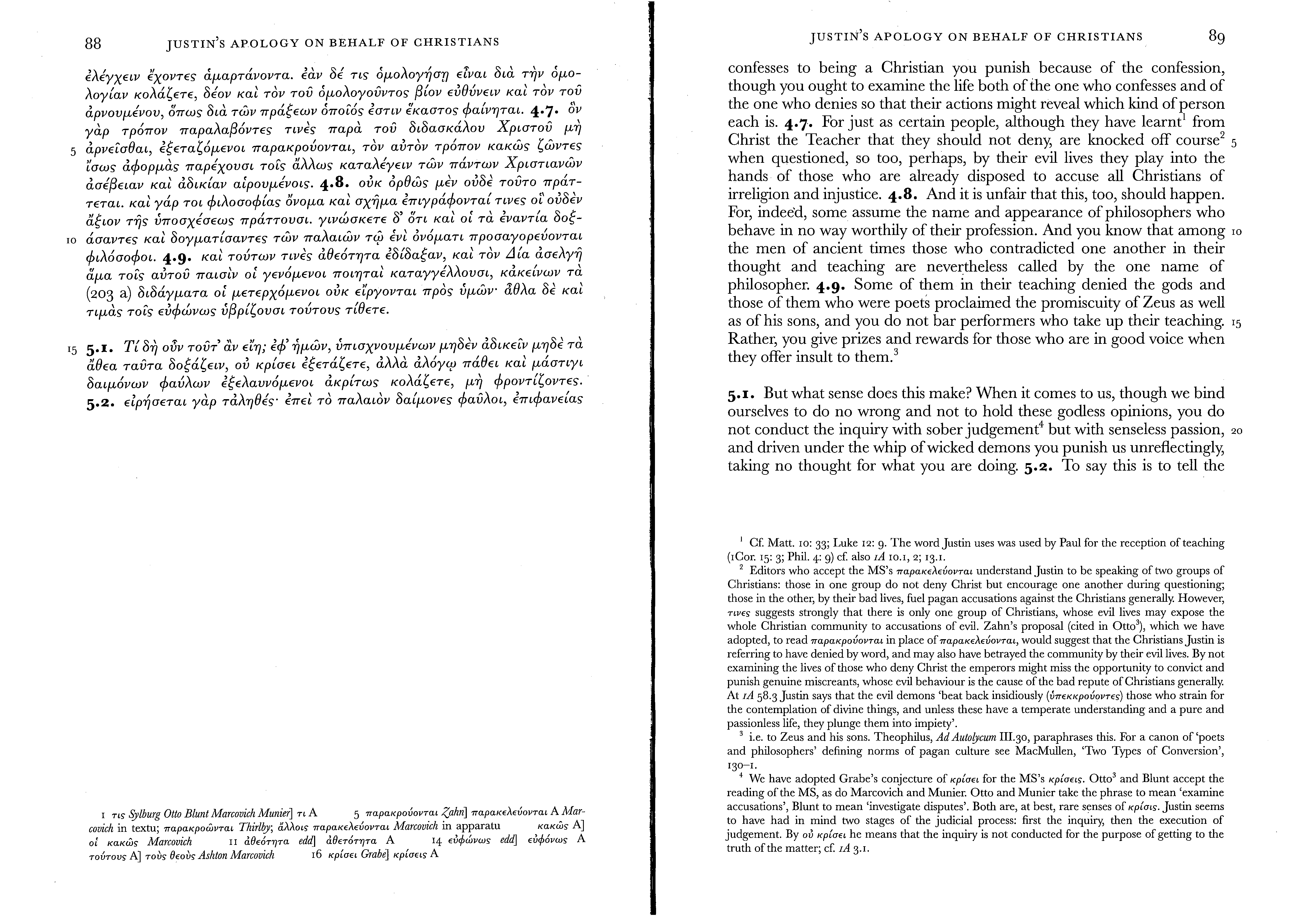
JUSTIN'S APOLOGY ΟΝ BEHALF OF CHRISTIANS
JUSTIN'S APOLOGY ΟΝ BEHALF OF CHRISTIANS
confesses to being a Christian you punish because of the confession, though you ought to examine the life both of the one who confesses and of the one who denies so that their actions might reveal which kind of person each is. 4.". For just as certain people, although they have learntl from Christ the Teacher that they should not deny, are lmocked οΗ' course2 5 when questioned, so too, perhaps, by their evil lives they play into the hands of those who are already disposed to accuse a11 Christians of έλέγχειν εχοντες άμαρτάνοντα. έαν δέ τις όμOλOγrιστι εΊναι δια την όμοι λ ι Υ δ ι \ \ ~ ι λ ~ β ι 'θ ι \ \ ~ ογιαν κο α,::>ετε, εον και τον του ομο ογουντος ιον ευ υνειν και τον του , ι fl δ \.....
'(; (,.../' fl Φ Ι " αρνουμενου,οπως ια των πρα""εων οποιος εστιν εκαστος αινηται. 4.7. ον \ ι λ β Ι \ \ ~ δ δ Ιλ Χ ~ \ γαρ τροπον παρα α οντες τινες παρα του ι ασκα ου ριστου μη λ 5 αρνεισθαι, έξεταζόμενοι παρακρούονται, τον αυτον τρόπον κακως ζωντες ϊσως αφορμας παρέχουσι τοις αλλως καταλέγειν των πάντων Χριστιανων
, ιβ \ 'δ ι ι ι 8" θ ~ \ 'δ \ ~ Ι ασε ειαν και α ικιαν αιΡουμενοις. 4. . ουκ ορ ως μεν ου ε τουτο πρατirrel~gion and injustice. 4.8. And it is unfair that this, too, should happen.
For, lnd:e'd, some assume the name and appearance of philosophers who behave rn ηο W3:Y wo~thily of their profession. And you lmow that among 10 the men of anClent tlmes those who contradicted one another ίη their thought and teaching are neve~theless ca11ed by the one name of philosopher. 4.9. Some of t~em ίη their teaching denied the gods and those ~f them who were poets proclaimed the promiscuity of Zeus as we11 as of hlS sons,. and ~ou do not bar performers who take up their teaching. 15
Rather, you glve pnzes and rewards for those who are ίη good voice when they offer insult to them. 3
\ ~ , ιφ ι "'δ \ τεται. και γαρ τοι ι οσο ιας ονομα και σχημα επιγρα ονται τινες οι ου εν αξιον τijς ύποσχέσεως πράττουσι. γινώσκετε δ' ΟΤΙ και οί τα έναντ{α δοξ10 άσαντες και δογματ{σαντες των παλαιων Τψ ένι ονόματι προσαγορεύονται
ΦιλόσοΦοι. 4.9. και τούτων τινες αθεότητα έδ{δαξαν, και τον Δ {α ασελγij αμα τοις αυτου παισιν οί γενόμενοι ποιηται καταγγέλλουσι, κακε{νων τα
(203 a) διδάγματα οί μετερχόμενοι ουκ εϊργονται προς ύμων' άθλα δε και \ ~ 'Φ ι ιβ ΙΥ ι Ιθ τιμας τοις ευ ωνως υ ρι,::>ουσι τουτους τι ετε.
Ι δ \ -;- ~ ,,'
,ι 'Φ' ι ~ Ι ι δ \ 'δ ~ δ \ \ 15 5.1. ι yj ουν τουτ αν ειη; ε ημων, υπισχνουμενων μη εν α ικειν μη ε τα
Τ αθεα ταυτα δοξάζειν, ου κρ{σει έξετάζετε, αλλα αλόγψ πάθει και μάστιγι δαιμόνων Φαύλων έξελαυνόμενοι ακρ{τως κολάζετε, μη Φροντ{ζοντες.·
5.1. But what sense does this make? When it comes to us, though we bind ourselves to do ηο wrong and not to hold these godless opinions, you do not conduct the inquiry with sober judgement4 but with senseless passion, 20
, Ι \ , λ θ ι , \ \ λ \ δ ι Φ ~λ 'Φ ι 5.2. ειρησεται γαρ τα yj ες' επει το πα αιον αιμονες αυ οι, επι ανειας an~ driven under the whip of wicked demons you punish us unreflectingly, taking ηο thought for what you are doing. 5.2. Το say this is to te11 the 1 Cf Matt. 10: 33; Luke 12: 9. The wordJustin uses was used by Paul for the reception ofteaching
(ICor. 15: 3; Phil. 4: 9) cf also ιΑ 10.1, 2; 13·1.
2 .E?itors who ~ccept the MS's παρακελεύσνται understandJustin to be speaking oftwo groups of Chns~Ians: those ιn one. group .do not deny Christ but encourage one another during questioning; those ω the other, by thelr bad llves, fuel pagan accusations against the Christians generally. However, τινες suggests strongly that there is only one group of Christians, whose evil lives may expose the whole Christian community to accusations of evil. Zahn's proposal (cited ίn Ott03), which we have adopt~d, to read παP~KpσύσνTαι ίn place of παρακελεύσνται, would suggest that the Christians Justin is referr~n? to hav~ deΠled by word, and may also have betrayed the community by their evillives. ΒΥ not exar:nnlng t~e llV~S of those who deny Christ the emperors might miss the opportunity to convict and punlsh genuIΠ~ mlscreants, whose evil behaviour is the cause of the bad repute of Christians generally.
At ιΑ 58.3 JustIΠ says that the evil demons 'beat back insidiously (ύπεκκρσύσντες) those who strain for the ~ontem~lation of divine things, and unless these have a temperate understanding and a pure and passlOnless life, they plunge them into impiety'.
3 i.e .. to Zeus a~d his ~ons. Theophilus, Ad Auto!Jcum Πι'30, paraphrases this. For a canon of 'poets and philosophers definIΠg norms of pagan culture see MacMullen, 'Two Types of Conversion',
130-1.
4 ~e have adopted Grabe's conjecture of κρίσει for the MS's κρίσεις. Otto3 and Blunt accept the readlng of the MS, as do Marcovich and Munier. Otto and Munier take the phrase to mean 'examine accusations', ~lunt.to mean 'investigate disputes'. Both are, at best, rare senses of κρίσις. Justin seems
Ι τις Sylburg Otto Blunt Mαrcovich Munier] τι Α 5 παρακρούονται Zαhn] παρακελεύονται Α lvfαrcomch ίn textu; παρακροωνται Thirlby; άλλοις παρακελεύονται Mαrcoviclι ίn apparatu κακως Α] ~o have had ιn mIΠd two stages of the judicial process: first the inquiry, then the execution of Judgement. ΒΥ συ κρίσει he means that the inquiry is not conducted for the purpose of getting to the οί κακως Mαrcovich ι ι dθεότψα edd] dθετότψα Α 14 ευΦώνως edd] ευΦόνως Α truth ofthe matter; cf ιΑ 3.1. τούτους Α] τους θεους Aslιton Mαrcoviclι