
Justin's Apology on Behalf of Christians
JUSTIN'S APOI,OGY ΟΝ BEHALF OF CHRISTIANS
JUSTIN'S APOLOGY ΟΝ BEHALF OF CHRISTIANS
truth. Since, ίn ancient times, wicked demoI,ls, ίn apparitions,l committed adultery with women and seduced boys and made people see horrifying things, so thόse wh02 did not rationally evaluate what the demons were doing were stunned with terror. Carried away with fear, they named them gods, not knowing they were wicked demons. And they cal1ed each of 5 them by a name which each of the demons had given it. 3 5.3. When
Socrates attempted with true reason and judicious inquiry to bring these things into the open and to draw people away from the demons, the demons, 'using people who delight ίη evil, worked it that he too was killed,4
Ι Ι Λ ,Ι ι Λδ δ ΙΦθ ι Φ ιβ 1Τοιησαμενοι, και γυναικας εμοιχευσαν και 1Ται ας ιε ειΡαν και ο ητρα 'θ Ι "δ (; Ι λ Λ ι" λ Ι ι Ι Ι(; αν ρω1ΤΟΙς' ε ει~αν, ως κατα1Τ αγηναι τους οι ογψ τας γινομενας 1Tpα~εις "Ι , \λ ι δ ι Ι \, , . ι δ Ι τ ουκ εκρινον, αΛ α εει. συνηΡ1Τασμενοι και μη ε1Τισταμενοι αιμονας ειναι Ιλ θ ι Ι r ι , Ι <Ι Ι" αυ ους, εους 1Τροσωνομα':,ον και ονομαη εκαστον 1Τροσηγορευον 01Τερ
εκαστος' αυτψ των αιμονων εη ετο. 5.3. οτε ε ωκρατης ογψ α η ει και Εςετασηκως ταυτα είς Φανερον Ε1ΤειΡατο Φέρειν και ά1Τάγειν των δαιμΙ ι 'θ Ι Ι, ι Ιδ Ι δΙ Λ Ι Λ Ι ονων τους αν ρω1Τους, και αυτον οι q,ιμονεsια των χαιΡοντων TTl κακιq, , θ Ι , Ι Ι "θ ι , β Λ , Λ λ Ι ι αν ρω1Των ενηργησαν ως α εον και ασε η α1Τοκτανηναι, εγοντες καινα , Φ Ι ,ι δ ι \ ( Ι
'Φ' C',..
\ , \ ,,.., , εισ ερειν αυτον αιμονια. και ομοιως ε ημων το αυτο ενεργουσιν. 5.4. ου οη the pretext that he rejected the gods and was irreligious-alleging 'that !Ο he introduced strange new divinities.5 And likewise they are working to bring about the same thing for us .. 5.4. For these things were brought to light not οηlΥ among the Gr;eeks by reason,6 through the words of Socrates, but also among the barbarians by the Logos himself, who acquired physical form and became a human being and was called Jesus Christ. We 15 who have come to believe ίη him say that the demons who did these things are not οηlΥ not gods,7 but wicked and unholy demons, and that their behaviour cannot be compared even to that of human beings who yearn for virtue.
10 γαρ μόνον Εν Έλλη σι δια Σωκράτους ύ1ΤΟ λόγου ~λέγxθη ταυτα, άλλα' και Εν β β ι Ι"
Λ ΛΑΙ Φ θ Ι ι, θ Ι Ι ι αρ αροις υ1Τ αυτου του ογου, μορ ω εντος' και αν ρω1Του γενομενου και
'Ιησου Χριστου κληθέντος, Ψ 1Τεισθέντες ~ILE'isTOVSταυτα (203 b) 1Τράςαντας Ι ,Ι , θ ι τ Ι Φ 'λλ ι ι Ι, Ι αιμονας ου μονον ου εους ειναι αμεν, α α κακους και ανοσιους δ Ι "
Ι θ Λ 'θ Ι ι Ι (; Ι Ι αιμονας-οι ου ε ΤΟΙς' αρετην 1ΤΟ ουσιν αν ρω1ΤΟΙς' τας 1Tpα~ εις ομοιας δ
6.1. 'Ένθεν δε και αθεοι κεκλήμεθα, και όμολογουμεν των τοιούτων r Ι θ Λ "θ τ 'λλ" ι Λ 'λ θ Ι Ι ι νομι':,ομενων εων α εοι ειναι, α ουχι του α η εστατου και 1Τατρος'
Ι Ι ικαιοσυνης και σω ροσυνης και των α ων αρετων ανε1Τιμικτου τε κακιας δ θεου. 6.2. άλλ' Εκεινόν τε και τον 1Ταρ' αυτου υίον Ελθόντα και διδάςαντα
6.1. Hence it is said that we reject the gods. And we admit that we do 20 reject such supposed gods as these, but not the God who is most true and the Father of justice and temperance8 and the other virtues and who is unalloyed with evil.9 6.2. This God we do venerate and worship, and also the Son who came from him and taught us these things, and the company
1 The word επιΦανεία, here translated 'apparitions', was a standard term for manifestations ofthe gods in pagan religion.
,2"For the construction of definite article with relative pronoun see D 67.7, των σσα, and D 47.2, τα οσα.
3 Cf. 2Α 4(5).5-6.
4 Justin's usage of ενεργέω requires a passive infinitive (see e.g. 2Α 7(8).2, 3; 12.3; ιΑ 63.10). Ott03 emended to αποκτείνεσθαι (followed by Blunt and Munier), but an aorist is required. The normal passive infinitive, αποκτανθηναι, would be a possible reading, but the second aorist infinitive αποκτανηναι is found in (pseudo)-Galen (De Theriαcα 16, Κϋhn, νοΙ 14, ρ. 284), and would readily explain the MS reading.
5 For the charge against Socrates of introducing new divinities see Plato, Apology 24b-c; Xenophon,
Meιnorαbiliα ι'ι.
6 For Justin, the 'reason' which illumined the Greeks is a 'seed', 'participation', or 'imitation' ofthe diνine Logos who became incarnate as Jesus (cf. 2Α 13.3-6).
7 For 'not only not gods' the MS has 'not only not upright'. The contracted ουθOVς might easily have been corrupted to ορθους and the negative μή inserted to give sense. Justin's language is odd, but not impossible: lit. 'who do not even have acts like to human beings who yearn for virtue'. Marcovich retains μη ορθους, and supposes that the text originally said that the demons were not 01l!y 1l0t upIightJ but 2 τους Α] αυτους Peαrson 4 θεους Α] θεους αυτους Λιfαrcovίch 5 αυτψ Α] έαυτψ Otto Blunt Nlαrcovich; αύτψ Ashton 7 αυτον Thirlby Otto Μαι·covich .Munier] αυτοι Α 8 αποκτανηναι Mαrcovich] αποκτειναι Α; αποκτείνεσθαι Otto BluntNlunier
10 εν 'Έλλη σι PenOll Otto αlso evil αnd ullho!J deιnoJιs who did not hold out to humαll beiιιgs who lOllgedJόr virtue the opportunity tojudge such αcts by J·eα.r01l. It is not clear how this advances Justin's argument.
8 Justice and temperance are two of the cardinal νirtues. But for Justin, and in Christian usage generally, the latter tends to mean chastity especially.
Bluιzt Mα1"COViCh MUllieι] 'Έλλη σι Α 13 ου θεους Thirlby] μη ορθους Α αλλιΙ Α] αλλιΙ και 9 This probably means that God is not mixed up in evil, rather than that evil is not mixed up in God; see 2Α 6(7).9.
Mα1"COViCh 14 όμοίας εχουσιν Α] post όμοίας lacunam designaνit Mαrcovich 16 'Ένθεν δε eddJ Ένθένδε Α
JUSTIN'S APOLOGY ΟΝ BEHALF OF CHRISTIANS
JUSTIN'S APOLOGY ΟΝ BEHALF OF CHRISTIANS
ofthe other good angels who follow him 1 ap.d are like him, and also the prophetic Spirit. 2 We honour them with reason and ίη truth, and hand οη ungrudgingly to everyone who wishes to learn exactly what we were taught.
~μας ταύτα, και τον των αλλων Επομένων και έξομοιουμένων άγαθων 'Ιλ ι ~ ι , Φ , βι θ'
~ αγγε ων στρατον, πνευμα τε το προ ΎJΤΙKOν σε ομε α και προσκυνουμεν, ι , 'λ θ ι ~ , 'β λ ι θ ~ ι 'δ δ ι θ ογψ και α ΎJ ειq, τιμωντες και παντι ου ομενψ μα ειν, ως ε ι αχ ΎJμεν, λ άΦθόνως παραδιδόντες.
7. ι. But someone will say, 'some of those who have already been caught 5 were shown to be criminals'. 7.2. Of course. This often happens, when you examine the lives of those who stand accused. But you do not usually bring ίη a conviction οη account of others who have earlier been shown to be guilty.3 7.3. Ιη general terms, then, we are prepared to admit this. For, just as, among the Greeks, those who taught whatever pleased them are !Ο
5 7.1. Άλλα Φ~σει τις· ~δΎJ τινες λΎJΦθένTες~λέγXθΎJσαν κακούργοι. 7.2. και , λλ' λλ ι rι ι ι ~ ι' β ι γαρ πο οι πο ακις, οταν εκαστου των KαTΎJγOPOυμενων τον ιον έξεTάζΎJTε· άλλ' ου δια τους προελεγχθέντας καταδικάζετε. 7.3. καθόλου
\ ~ ) .....
( λ ,... t/ c\ Ι ( , 'Έλλ ",.., \ μεν ούν κακεινο ομο ογουμεν, οτι ον τροπον οι εν
ΎJσι τα αυτοις αρεστα ι , ,~ Ι, ,ι Φλ φ ι ι ογματισαντες εκ παντος τψ ενι ονοματι ι οσο ιας προσαγορευονται, δ ι ~ δ ι , ι" rι ,~, β βι
καιπερ των ογματων εναντιων οντων, ουτως και των εν αρ αροις called ίη every case by the single title 'philosopher', even though they contradicted one another ίη their opinions-so, among the barbarians, an all-embracing common name is given to both those who were wise and those who seemed wise: theyare all called Christians.4 7.4. For this ι 'δt.Ι Φ~" ι" ι, γενομενων και o~ανTων σο ων το εΠΙKαTΎJγOPOυμενOν ονομα κοινον εστι·
Χριστιανοι γαρ πάντες προσαγορεύονται. 7.4. Όθεν (204 a) πάντων των ι Our translation supplies the pronoun, which is not ίη the Greek. Marcovich emends ίίλλων to αυτω and takes this to refer to God.
2 'For Justin, 'angel' is one of the names of Christ (D 6Ι.Ι; 127.4). The Greek ίίλλων does not necessarily imply that the Son is here ranked amongst the angels, although that is a natural reading (cf.
Plato, G01gίαs 473d: 'the citizens and the other foreigners'; Alcibiαdes I.II2b: 'the Achaeans and the other
Trojans'; Xenophon, Anαbαsis 1.5.5: 'neither grass ηΟΓ any other tree', cf. Kίihner and Gerth, AIιsfihr licJze GTαmInαtik der gI7ecJzischeιz Sprαche, Π.ι, ρ. 275). The notion of a bodyguard of angels brought forth together with the 'saviour' and of the same nature was found amongst Gnostic teachings (lrenaeus, ΔΗ
1.2.6; 8-4). But Justin normally uses the word we have translated as 'fol1ow' ίη a moral sense. The likeness referred to here is presumably a morallikeness, just as the bad angels are said to be moral1y like the serpent whom they fol1ow (D 45-4; 100.6).
3 The text is corrupt, and there have been many attempts at emendation and interpretation. Editors and translators may be divided into two main groups. Those ίη one group understand the 'many' to refer to Christians, giving some such sense as: 'Certainly, this is oftentrue of many of them, each time you examine the conduct of the accused, but you do not condemn them οη account of those who were convicted before.' But if this were Justin's meaning he would be undermining his own case. lη the first place he would be conceding that Christians are often found guilty, and that therefore there is a presumption of guilt associated with the name Christian; and in the second place, he would be indicating that the judicial procedure which he is asking to be fol1owed in the case of Christians is in fact often fol1owed. Those in the second group understand the 'many' to refer to accused persons in general. This is the interpretation which we have, with some hesitation, fol1owed. Και γάρ is introducing an answer to the objection (Denniston, The Greek Pα/'ticles, 109-10). Justin says he has ηο difficulty with Christians being showll to be guilty, and, indeed, that it is not uncommon for an examination of a suspect's life to show him to be guilty, but it is for this that he is convicted, not because of his association with others convicted before him. Justin moves from the case of some
Christians, who have αl/'eαdy been shown to be guilty, to that of the πιαιι)' defendants who are οη ιιιαπΥ occαsions shown to be guilty when their cases are investigated, and notes that, nevertheless, conviction is normally made οη the basis of investigation of individual cases, and not οη the basis of the poor trackrecord of defendants as a class. One difficulty with this interpretation, however, is that the move from the few ChIistiαns to the many difέndαnts is harsh. It remains possible, however, that the text conceals deeper corruption. Justin might, for example, be trying to say something like, 'even if many [Christians] οη many occasions, at least you would then be examining the lives ofthose accused, and would not condemn them because of those who were convicted before them'.
Ι ίίλλων Α] αύτψ Ashton Mαrcovich 6 πολλοι Dαm'es] πολλους Α έκάστου Bellios αρ. OttO] 4 Cf. ιΑ 26.6. Justin means that as the proponents of different philosophical schools, such as Stoics,
Aristotelians, Platonists, etc. are al1 cal1ed philosophers, so the name Christian covers a variety of different groups. έκάστοτε Α 7 δια τους Α] δι' ίίλλους Mαrcovich προελεγχθέντας Pirion Blunt Mαrcovich Munier] προλεχθέντας Α !Ο δογμάτων Α] δογμάτων αύτων Mαrcoviclz
JUSTIN'S APOLOGY ΟΝ BEHALF OF CHRISTIANS
JUSTIN'S APOLOGY ΟΝ BEHALF OF CHRISTIANS
reason, when people are delated to you, we ask that you always lnake their actions the subject of your judgement, so that a person who is found guilty might be punished as a· wrongdoer, rather than as a Christian; while if anyone is seen 1 to be guiltless he might be acquitted as a Christian who does ηο wrong.2 7.5. We will not also ask you to punish the accusers. 3 For 5 the wickedness that surrounds them and their ignorance of the good is enough for them. καταγγελλομένων ύμιν τας.πράςεις κρ{νεσθαι άςιουμεν, ϊνα ό ελεγχθεις ώς
"δ λ Ι Υ 'λλ \ \ Ι Χ Ι, \ δ Ι 'Ιλ Φ Ι α ικος κο αι"Yjται, α α μΥ} ως ριστιανος, εαν ε τις ανε εγκτος αινYjται, άπολύYjται ώς Χριστιανος ουδεν άδικων. 7.5. OV γαρ τους KaTYjYOPOVVTaS' κολάζειν ύμας άςιώσομεν,άρκουνται γαρ Tiι προσούστιπονYjΡ{q, και Tiι των
8.1. Λογ{σασθε δ' ότι ύπερ ύμων ταυτα εΦYjμεν εκ του εφ' ήμιν εΊναι άρνεισθαι εςεταζομένους. 8.2. άλλ' ου βουλόμεθα ζην ψευδολογουντΕς, του
8. ι. That we have said thesc things for your sake 4 you may deduce from the fact that it is ίη our power to deny we are Christians when examined.
8.2. But we do not wish to avoid death by telling lies, for we desire the 10 eternal, pure life, and we seek aft~r communion with God the Father and maker of all, and we are eager to confess we are Christians. For we who have been persuaded believes that these things can be obtained by those who have persuaded God through their actions that they were his followers, and that they ardently desired to find communion with him where 15 there is ηο obstruction from evil. 8.3. So, ίη a few words, this is what we await and have learnt from Christ, and what we teach. 8.4. Ιη similar fashion, Plato said that Rhadamanthus and Minos6 would punish the unrighteous who came into their presence. We say that the same thing will happen, but that it will be done by Christ and to their bodies,7 and they 20 γαρ αιων{ου και καθαρου β{ου επιθυμουντες της μετα θεου του πάντων πατρος και δYjμιουργου διαγωγης άντιποιούμεθα, και σπεύδομεν επι το
10 όμολογειν, οί πεπεισμένοι καιπιστεύοντες τυχειν τούτων δύνασθαι τους τον θεον δι' εργων πε{σαντας ότι αυτψ εϊποντο και της παρ' αυτψ διαγωγης
,ι "θ Ι,) ,... 8
( \ ";' δ \ β Ι , ..... ιl Yjpwv εν α κακια ουκ αντιτυπει...3. ως μεν ουν ια ραχεων ειπειν α τε προσδοκωμεν και μεμαθήκαμεν δια του Χριστου και διδάσκομεν ταυτά
Πλ Ι δ' ι Ι "Φ ιπ δ Ι θ \ ΜΙ λ Ι \ εστι. .4. ατων ομοιως ε Yj Γα αμαν υν και ινω κο ασειν τους 'δ Ι , , \ 'λθ Ι ι ~ δ \ \ ,\ ~ Ι Φ Ι θ
α ικους παρ αυτους ε οντας· Yjμεις ε το αυτο πραγμα αμεν YEVYjaEa αι, άλλ' ύπο του Χριστου και τοις αυτων σώμα σι, αιων{αν κόλασιν ι Editors normalize the accentuation of the MS reading to produce an aorist middle subjunctive.
But it would seem more natural for a passive to be used here, and Justin nowhere else uses the middle of Φαίνω.
2 This is the substance of the petition which Justin is addressing to the emperor, introduced by the semi-technical term αςιουμεν.
3 1η Roman law, a person who delated another was subject to punishment for calunzιziα if the case was not proven; cf. Robinson, The Cri,niιzαl Law qf Aιzcieιzt ROlne, 99, 103, and ιΑ 68.10. Justin understood the rescript ofHadrian to e~oin the punishment of calumnious accusers ofChristians.
4Cf. Plato, Apology 30d; and 2Α 1.1; 3ω+ Justin presumably means that his purpose ίη making the petition is that the emperors will not be guilty of giving unjust judgements, cf. ιΑ 68.2; 70-4 [2Α 15.5].
5 Justin likes the doublet '. .. have been persuaded and do believe'. Cf. ιΑ 10.1; 17-4; 18.2; 61.2.
6 The myth about Minos and Rhadamanthus became a commonplace; they are mentioned by e.g.
Tatian, Orαtio 6.1; 25.2, and Athenagoras, Legαtio 12.2. Cicero remarked that ηο one believed such stories about the underworld (De Nαturα Deorum 11.2).
7 We have excluded the words μετα των ψυχων γινομένων καΙ If the preceding καί is emended to καν (as it is by several editors) the text of the MS can be made to mean 'when they come to be ίη the same bodies with their souls ... '. But a pronoun, such as αύτων, needs to be supplied as the subject of the genitive absolute. That is easy enough grammatically, but would leave Justin talking about a 'they' who are somehow distinct from both their souls and their bodies. Moreover, the tense of γινομένων could only mean that the punishment would be inflicted as they come into their bodies, rather than after they have come into them. Justin speaks of people or souls being ίιι bodies only in the discussion οη the soul at D 4.6-7, where he is reporting his earlier, Platonizing, opinions. 1η the myth about Rhadamanthus and Minos at Gorgias 523c-e it is expressly said that it is naked souls, stripped of their bodies, that are judged. 1t is possible that Justin wished to correct Plato οη this point, just as he corrected hirn with respect to the agency of the punishment, and its duration. An early reader, struck by the apparent exclusion of souls from punishment, may have written 'with their souls' ίη the margin, and an attempt may later have been made to incorporate this into the text. We have also changed
2 Φαίνψαι coniec] Φανηται Α; Φάνψαι edd 3 ώ" Χρισηανο" Α] ώ" Marcovich 4 αρκουνται γαρ Α] αρκουν γαρ το Mαrcoviclz
5 αγνοίιΖ. Α] αγνοίιΖ. συζην Mαrcoviclz 16 και Α] καν Dαvies Otto Bluιzt Mαrcovich Munier αύτων coniec] αύToLι; Α σώμασι coniec] σώμασι μετα αύτοι" to αύτων. Without any reference ίη the context to resurrection, to speak of the saιιze bodies is. abrupt, and unexplained. των ψυχων γινομένων και Α
JUSTIN'S APOLOGY ΟΝ BEHALF OF CHRISTIANS
JUSTIN'S APOLOGY ΟΝ BEHALF OF CHRISTIANS
will be punished everlastingly, not just for a period of a thousand years, as he said.! 8.5Now, if anyone says that this is incredible or impossible, the delusion hurts us, and ηο one else, so long as it is not found that any of our actions are' wrong. ι 'λλ'" λ Λ Ι δ r, Λ "Φ Ι κο ασ rισOμενων, α ουχι χι ΙOνTαεTrι περιο ον, ως εκεινος ε rι, μονον.
8.5. εί μεν οΟν απιστον ij άδύνατον τουτο φfισει τις, (204 b) προς ήμaς ηδε ή λ θ πλάνrι εστ{ν, άλλ'ού πpoς'€Tεpoν, μέχρις 00 εργψ μrιδεν άδικουντες ελεγχόμεθα.
9.1. Άλλ' ούδε θυσ{αις πολλαις και πλοκαις άνθων τιμωμεν ους ανθρωποι 9. ι. But neither do we use a multitude of sacrifices and garlands of 5 flowers to honour those whom human beings formed and set up ίη temples ι , , Λ rδ ι θ' ι "
",/, '
μορ ωσαντες και εν ναοις ι ρυσαντες εους προσωνομασαν, επει αψυχα και Φ νεκρα ταυτα γινώσκομεν και θεου μορφην μη εχοντα-ού γαρ TOιαύTrιν and call~d gods, since we know that such things are dead and lifeless and do not possess the form of god-for we do not suppose that God has a form such that it can, as some say, be imitated to do him honour; rather, we suppose that these things have the names and shapes of those wicked ΙΟ demons who were seen ίη apparitions. 2 9.2. For what need is there to say to you who already know how craftsmen handle their material, shaving it, and cutting it, and casting it, and hammering it, and how they often take dishonourable vessels and through their craft change only the shape, and give them a form and label them gods? 9.3. This we think is not only 15 irrational but is also an insult to God, whose name, though his glory and form are beyond words, is given to things that are corruptible and need to be looked after. 9.4. And that the craftsmen who make them are licentious and have-not to enumerate them-every vice, you know full well. And they have sex with their own slave-girl assistants. 9.5. How 20 foolish! Human beings who know ηο restraint are said to mould and refashion gods to be worshipped, and the temples where these are set up have such people as guards, who fail to see that it is wrong even to thinl<. or to say that human beings are guards for the gods. ήγούμεθα τον θεον εχειν την μορφην ην Φασ{ τινες είς τψην μεμψήσθαι- , λλ" ι Λ Φ Ι Λ δ ι , , ι ,ι α εκεινων των ανεντων κακων αιμονων και ονοματα και σxrιμαTα εχειν. 9.2. Τ{ γαρ δει είδόσιν ύμιν λέγειν α την ύλrιν οί τεχνιται διατιθέασι
ΙΟ ςέοντες και τέμνοντες και χωνεύοντες και τύπτοντες και ες άτ{μων πολι Λ δ' ι 'Λ Ι 'λλ ι t.
'Φ ι ακις σκευων ια Tεxνrις το σxrιμα μονον α αι::,αντες και μορ oΠOιrισανTες λ θ " ι r '" ι "λ r ι θ 'λλ '
"Φ' εους επονομα':,ουσιν; 9.3. οπερ ου μονον α ογον rιγoυμε α α α και ε ύβρει του θεου γ{νεσθαι, asαpprιTOν δόςαν και μορφην εχων επι Φθαρτοις και δεομένοις θεραπε{ας πράγμασιν επονομάζεται. 9.4. και στι οί τούτων
τεχνιται άσελγεις είσι και πaσαν κακ{αν-ινα μη καταριθμωμεν-εχουσιν, , β Λ ,ι θ "r Λ δ ι r ι Φθ ι ακρι ως επιστασ ε. και τας εαυτων παι ισκας συνεργα':,ομενας ειΡουσιν.
Λ 'β ι, θ ι 'λ εισθαι πλάσσειν λέγεσθαι και μεταποιειν και των ίερων ενθα άναTtθενTαι
V ακας τοιουτους κα ισταναι, μrι συνορωντας α εμιτον και το νοειν rι Φ 20 λέγειν (205 a) άνθρώπους θεων είναι Φύλακας.
Ι ι r Λ ,ι δ ' προσει rι αμεν τον εον, αυτον παρεχοντα παντα ορωντες' εκεινους ε λ Ι θ ' ι θ ' ι προσ εχεσ αι αυτον μονον ε ι αγμε α και πεπεισμε α και πιστευομεν,
" ι 'Λ' θ' ι Φ ι 'δ ι τους τα προσοντα αυτψ αγα α μιμουμενους, σω poσυνrιν και ΙKαΙOσυνrιν δ ι θ " ι δ δδ 10.1. But further, we who see that God provides all things, have learnt3 25 that he has ηο need of material services from human beings. And we have been taught and have been persuaded and do believe that he 4 only admits into his presence those who imitate the good things that are his attributes, 5 temperance6 and justice and loving-kindness and all the things that are
και Φιλανθρωπ{αν και σσα οίκεια θεψ εστι, Τψ μrιδενι ονόματι θετψ ι Justin oversimpli:fies. At Phαedrus 249a Plato says that at the end of a thousand-year period both good and bad souls will draw lots for a second life.
2 Lit. 'those wicked demons who αppeαι"ed', echoing the related Greek word translated in ιΑ 5.2 as 'apparitions'.
3 Lit. 'received', cf. ιΑ 4.7; 13.1.
4 The Greek could be construed to mean either 'he receives those' or 'those receive him'. Munier opts for the latter. But at D 33.2 Justin says that Christ 'will receive the circumcised who approach him, seeking his blessings'. According to Bobichon, the verb προσδέξεται here is a reference to Amos 5: 22
(quoted by Justin at D 22.3) and Malachi ι: ΙΟ, which Justin quotes at D 28.5; 41.2; ΙΙ7.Ι. Justin's only other uses ofthe verb are aΠ in scriptural quotations: D 14.7; 31.6; andD 135.2 (Isa. 42: ι, 'him shaΠ my soul receive').
3 αλλ' ου Dαvies edd] ιϊλλου Α 4 τιμωμεν ους Β edd] τιμωμένους Α ΙΙ μορΦοποιήσαντες Otto Blzlnt Goodspeed Munier] μορΦωποιήσαντες Α; μορΦοποιήσαντες, ανδριάντες ποιήσαντες MαTCovich; ανθρώπων είκόνας μορΦοποιήσαντες Η. Stepllαnus
15 είσι Ashton Otto Blunt] τε Α; τέ είσι Mαrcovich Munier 16 και Α] και γαρ Mαrcovich 18 πλάσσειν λέγεσθαι Η. Stephαllus Otto Blunt Goodspeed
ου Α] ουδε Otto Mαrcoviclz 5 Cf. 2Α 3(4).2.
6 Ιη Justin σωΦροσύνη normaΠy connotes chastity, or sexual restraint, and ηο doubt that is how he thought the divine virtue was to be imitated. The attribution ofthe virtue of σωΦροσύνη to God is odd, whether it is understood in a Platonic or a Stoic sense. Alcinous (Hαndbook 29.1) describes σωΦροσύνη as 22 προσειλήΦαμεν Α] προειλήΦαμεν Η. Steplzαnus; παρειλήΦαμεν Thαleιnαnn Otto Blunt Mαrcovich
JUSTIN'S APOLOGY ΟΝ BEHALF OF CHRISTIANS
JUSTIN'S APOLOGY ΟΝ BEHALF OF CHRISTIANS
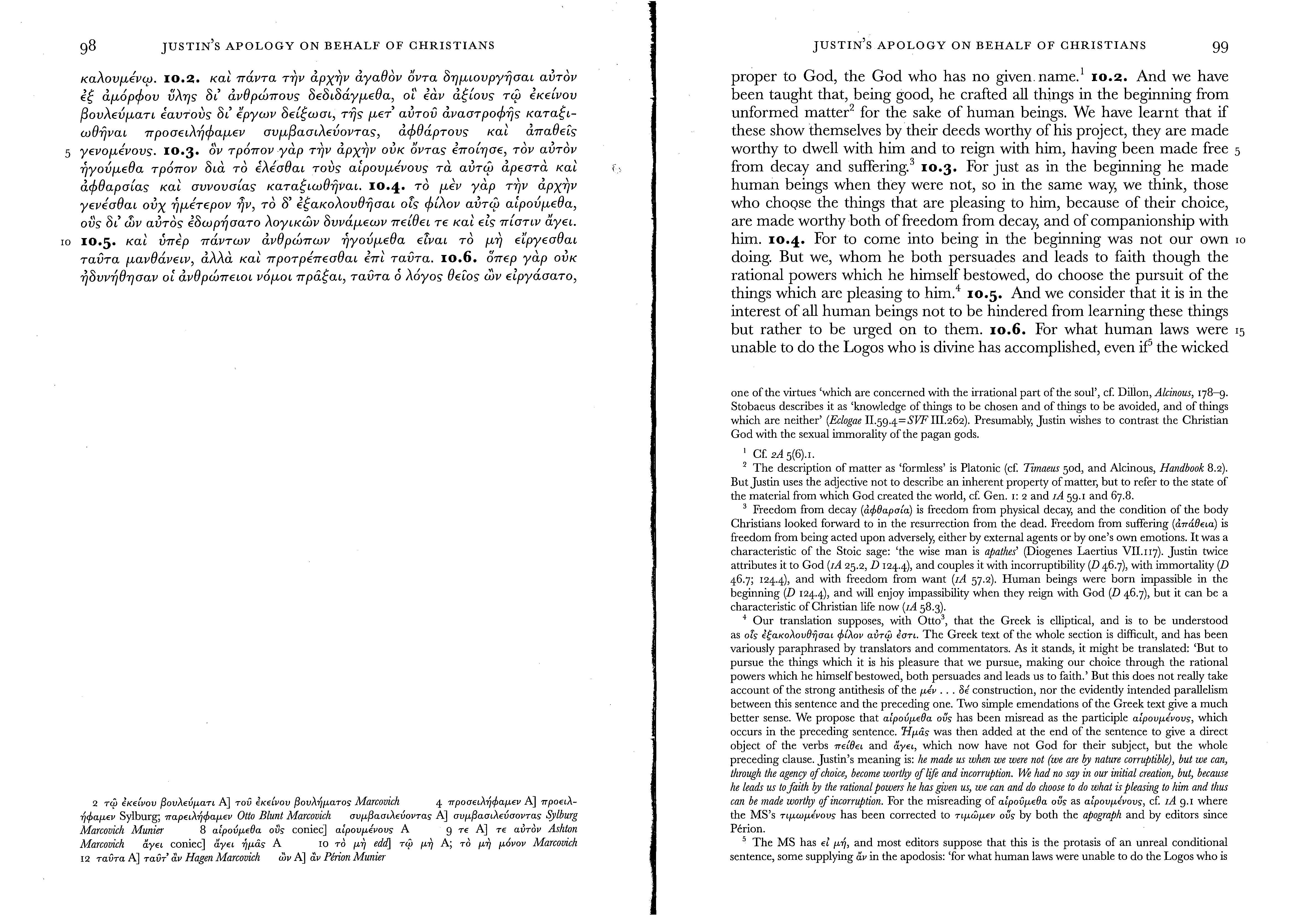
proper to God, the God who has ηο giveno name. 1 10.2. And we have been taught that, being good, he crafted all things ίη the beginning from unformed matter2 for the sake of human beings. We have learnt that if these show themselves by their deeds worthy of his project, they are made worthy to dwell with him and to reign with him, having been made free 5 from decay and suffering.3 10.3. For just as ίη the beginning he made human beings when they were not, so ίη the same way, we think, those who choQse the things that are pleasing to him, because of their choice, are made worthyboth of freedom from decay, and of companionship with him. 10.4. For to come into being ίη the beginning was not our own ΙΟ doing. But we, whom he both persuades and leads to faith though the rational powers which he himself bestowed, do choose the pursuit of the things which are pleasing to him.4 10.5. And we consider that it is ίη the interest of all human beings not to be hindered from learning these things but rather to be urged οη to them. 10.6. For what human laws were 15 unable to do the Logos who is divine has accomplished, even if5 the wicked καλουμένψ. 10.2. και πάντα την αρχην αγαθον οντα δημιoυpγiισαι αυτον
'c ' ι Φ "λ δ" θ ι δ δ δ ι θ <Ι, Ι 'c l Λ' ι ε~ αμορ ου υ η~ ι αν pωπoυ~ ε ι αγμε α, οι εαν α~ ιoυ~ τψ εκεινου βουλεύματι έαυToυ~ δι' [ργων δείςωσι, τiι~ μετ' αυτου αναστpoΦiι~ καταςι ωθiιναι προσειλήΦαμεν συμβασιλεύoντα~, αΦθάpτoυ~ και απαθει~ 5 γενoμένoυ~. 10.3. ον τρ6πον γαρ την αρχην ουκ oντα~ εποίησε, τον αυτον ήγούμεθα τρ6πον δια το έλέσθαι ΤOυ~ αίpoυμένoυ~ τα αυτψ αρεστα και
'Φθ ι ι ι c θ Λ Ι Ι Ι Ι , ι α αpσια~ και συνoυσια~ Kατα~ ιω ηναι. 10.4. το μεν γαρ την αρχην γενέσθαι ουχ ήμέτερον ~ν, το δ' εςαKoλoυθiισαι o'[~ Φίλον αυτψ αίρούμεθα, oϋ~ δι' ών αυτo~ εδωρήσατο λογικων δυνάμεων πείθει τε και εί~ πίστιν αγει.
ΙΟ 10.5. και ύπε.ρ πάντων ανθρώπων ήγούμεθα εΊναι το μη εϊργεσθαι ταυτα μανθάνειν, αλλα και προτρέπεσθαι επι ταυτα. 10.6. όπερ γαρ ουκ ηδυνήθησαν οί ανθρώπειοι ν6μοι πραςαι, ταυτα ό λ6γo~ θειo~ ων είργάσατο, one of the virtues 'which al"e concerned with the irrational part of the soul', cf. Dillon, Alciιzous, 178-9.
Stobaeus describes it as 'knowledge of things to be chosen and of things to be avoided, and of things which are neither' (Eclogαe Π.59-4= SVF ΠΙ.262). Pl"esumably, Justin wishes to contrast the Christian
God with the sexual immorality of the pagan gods.
1 Cf. 2Α 5(6).1.
2 The description of matter as 'formless' is Platonic (cf. 7ϊmαeus 50d, and Alcinous, Hαndbook 8.2).
But Justin uses the adjective not to describe an inherent property of matter, but to refer to the state of the material from which God created the world, cf. Gen. Ι: 2 and ιΑ 59.1 and 67.8.
3 Freedom from decay (αΦθαρσία) is freedom fΓOm physical decay, and the condition of the body
Christians looked forward to ίη the resurrection from the dead. Freedom from su:ffering (απάθεια) is fl"eedom fΓOm being acted upon adversely, either by external agents or by one's own emotions. It was a characteristic of the Stoic sage: 'the wise man is αpαthes' (Diogenes Laertius VII.I17). Justin twice attl"ibutes it to God (ιΑ 25.2, D 124-4), and couples it with incorruptibility (D 46.7), with immortality (D
46.7; 124·4), and with fl"eedom from want (ιΑ 57.2). Human beings were born impassible in the beginning (D 124.4), and will enjoy impassibility when they reign with God (D 46.7), but it can be a characteristic ofChristian life now (ιΑ 58.3).
<} Our uanslation supposes, with Otto\ that the Greek is elliptical, and is to be understood as ο[ς εξακολουθΥίσαι Φίλον αυτψ εστι. The Greek text of the whole section is difficult, and has been variously paraphrased by translators and commentators. As it stands, it might be translated: 'Eut to pursue the things which it is his pleasure that we pUl"sue, making our choice through the rational powers which he himselfbestowed, both persuades and leads us to faith.' But this does not really take account of the stΓOng antithesis of the μέν ... δέ construction, nor the evidently intended parallelism between this sentence and the preceding one. Two simple emendations of the Greek text give a much better sense. We propose that αίρούμεθα ους has been misread as the participle αίρουμένους, which occurs ίη the preceding sentence. Ήμας was then added at the end of the sentence to give a direct object of the verbs πείθει and αγει, which now have not God for their subject, but the whole preceding clause. Justin's meaning is: Ize mαde us when we were not (we αre by ιzαture corrUΡtίbleλ but we cαn, tlzrough the αgenry qf choice, become worthy qf [ίft αnd incorruption. JίIιe hαd πο sqy ίπ our initiαl aeαtion, but, becαuse he leαds us to .fαith by the rαtionαl powers he hαs giveιz us, we ιαπ αnd do choose to do whαt is pleαsiIzg to him aιzd tlzus cαπ be 71lαde wortf?y qfiIzcorruption. For the misreading of αίρουμεθα ους as αίρουμένους, cf. ιΑ 9.1 where the MS's τιμωμένους has been corrected to τιμωμεν ους by both the αpogrαph and by editors since
Perion.
2 Τψ εκείνου βουλεύματι Α] του εκείνου βουλήματος Mαrcovich 4 προσειλήΦαμεν Α] προειλήΦαμεν Sylburg; παρειλήΦαμεν Otto Blunt Mαrcovich συμβασιλεύοντας Α] συμβασιλεύσοντας ~lburg
Mαrcovich Munier 8 αίρούμεθα οϋς coniec] αίPOVΜένoυς Α 9 τε Α] τε αυτον Ashton 5 The MS has ει μή, and most editors suppose that this is the protasis of an unreal conditional sentence, some supplying αν ίη the apodosis: 'for what human laws were unable to do the Logos who is
Mαrcovich αγει coniec] αγει ήμας Α 10 το μη edιZJ Τψ μη Α; το μη μόνον Mαrcovich
12 ταυτα Α] ταυτ' αν Hαgen Mαrcovich ων Α] αν Pinon MunieI o
JUST1N'S APOLOGY ΟΝ BEHALF OF CHR1ST1ANS
JUST1N'S APOLOGY ΟΝ BEHALF OF CHR1ST1ANS
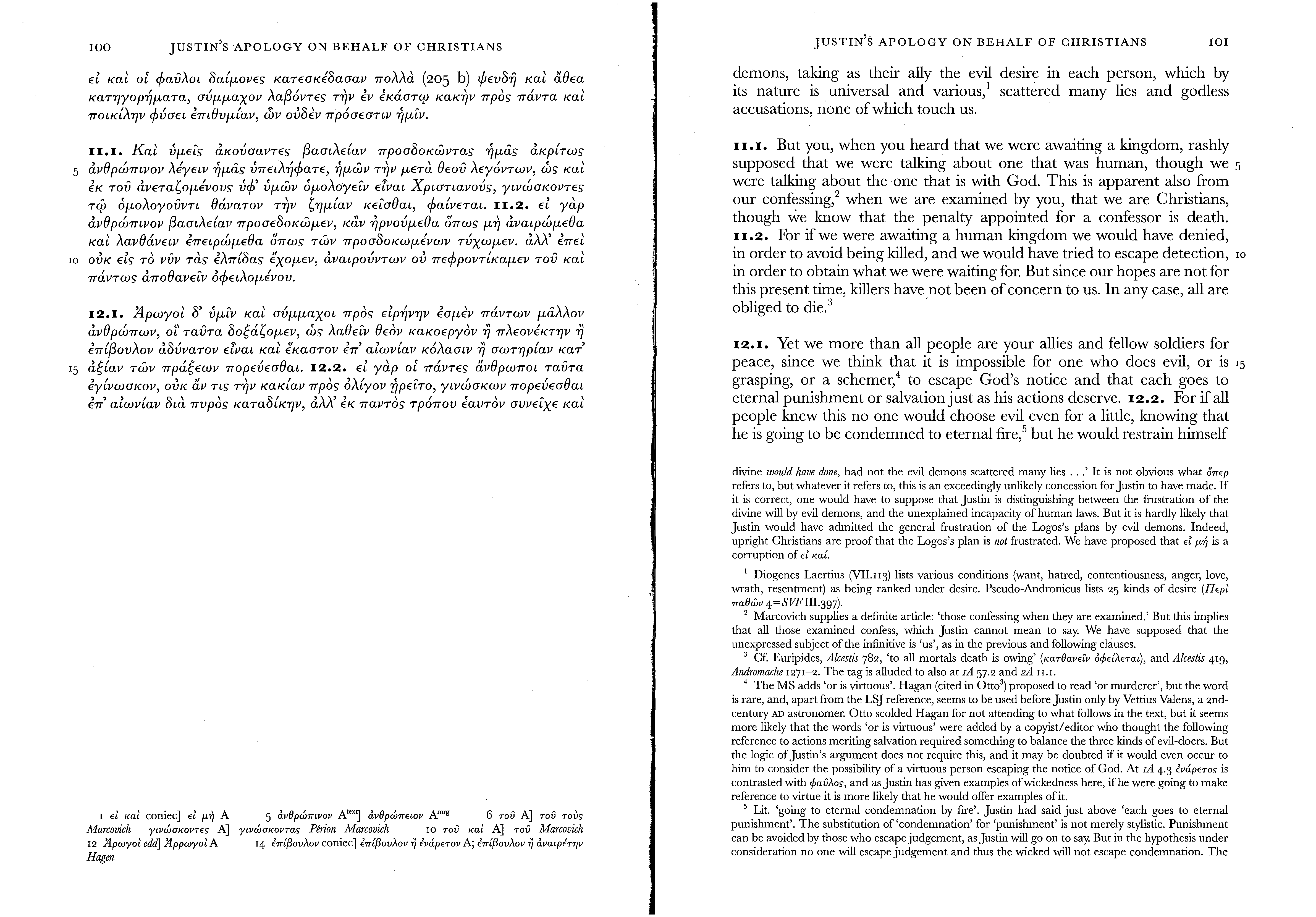
demons, taking as their ally the evil desire ίη each person, which by its nature is universal and varίσιιs,l scattered many lies and godless accusations, none of which touch us. ει και οί Φαυλοι δαίμoνε~ κατεσκέδασαν πολλα ('205 b) ψευδiι και αθεα
, , λ β'
"<, '"
, κατηγορηματα, συμμαχον α oνTε~ την εν εκαστψ κακην πpo~ παντα και ποικίλην Φύσει Επιθυμίαν, ών ουδεν πρ6σεστιν ήμΙν.
Ι Ι. ι. But you, when you heard that we were awaiting a kingdom, rashly supposed that we were talking about one that was human, though we 5 were talking about theone that is with God. This is apparent also from our conf~ssing, 2 when we are examined by you, that we are Christians, though we know that the penalty appointed for a confessor is death.
Τ7'< ~" β λ' δ ~ <~"
11.1. nαι υμει~ αKoυσανTε~ ασι ειαν προσ OKωνTα~ ημα~ αKPΙTω~ 5 ανθρώπινον λέγειν ήμα~ ύπειλfιΦαTε, ήμων την μετα θεου λεγ6ντων, ώ~ και
Εκ του ανεTαζoμένoυ~ ύΦ' ύμων όμολογειν εΊναι Xpιστιανoύ~, γινώσKoνTε~ Τψ όμολογουντι θάνατον την ζημίαν κεισθαι, Φαίνεται. 11.2. ει γαρ
'θ' β λ' δ ~ "" θ "
'θ αν ρωπινον ασι ειαν προσε οκωμεν, καν ηρνουμε α oπω~ μη αναιΡωμε α 11.2. For ifwe were awaiting a human kingd01n we would have denied, και λανθάνειν ΕπειΡώμεθα oπω~ των προσδοκωμένων τύχωμεν. αλλ' Επει ίη order to avoid being killed, and we would have tried to escape detection, 10
, , \ ......
\ 'λ 'δ"
, Ι 'Φ'
ουκ ει~ το νυν Tα~ ε πι α~ εχομεν, αναιΡουντων ου πε ροντικαμεν του και ίη order to obtain what we were waiting for. But since our hopes are not for this present time, killers have ροt been of concern to us. Ιη any case, all are obliged to die. 3 πάνTω~ αποθανειν όΦειλομένου.
"~δ c 'Υ < λ θ ~ θ '
, "λ'
" αν ρωπων, οι ταυτα o~al;,ofLEV, ω~ α ειν εον κακοεργον η π εονεκτην η , 'β λ 'δ ι l'
\ Ιl "
,ι Ιλ " ι , επι ου ον α υνατον ειναι και εκαστον επ αιωνιαν κο ασιν η σωτηριαν κατ
12.1. Yet we more than all people are your allies and fellow soldiers for peace, since we think that it is impossible for one who does evil, or is 15 grasping, or a schemer,4 to escape God's notice and that each goes to eternal punishment or salvation just as his actions deserve. 12.2. For if all people knew this ηο one would choose evil even for a little, knowing that he is going to be condemned to eternal fire,5 but he would restrain himself
, c '
~ , c ' θ '
, <, " θ ~
α~ιαν των πpα~εων πορευεσ αι. 12.2. ει γαρ οι πανTε~ αν ρωποι ταυτα , ι ,)/ , Ι "λ ι (.....
Ι ι θ εγινωσκον, ουκ αν τι~ την κακιαν πpo~ ο ιγον Τ/ρειτο, γινωσκων πορευεσ αι "
, δ '
'λλ' , \ Ι ι'......
\ επ αιωνιαν ια πυpo~ κατα ικην, α εκ πανTO~ τροπου εαυτον συνειχε και divine would hαve done, had not the evil demons scattered many lies ... ' It is not obvious what όπερ refeΓS to, but whatever it refers to, this is an exceedingly unlikely concession for ]ustin to have made. If it is correct, one would have to suppose that ]ustin is distinguishing between the frustration of the divine will by evil demons, and the unexplained incapacity of human laws. But it is hardly likely that ]ustin would have admitted the general frustration of the Logos's plans by evil demons. Indeed,
UΡΓίght Christians are proof that the Logos's plan is not frustrated. We have proposed that εΙ μή is a corruption of εΙ καί.
Ι Diogenes Laertius (VII.H3) lists vaΓious conditions (want, hatred, contentiousness, anger, love, wrath, [esentment) as being ranked undel" desire. Pseudo-Andronicus lists 25 kinds of desire (Περι παθων 4=SVFIII'397).
2 Marcovich supplies a definite article: 'those confessing when they are examined.' But this implies that all those examined confess, which ]ustin cannot mean to say. We have supposed that the uneΧΡΓessed subject ofthe infinitive is 'us', as in the previous and following clauses.
3 Cf. Euripides, Alcestίs 782, 'to all mΟΓtaΙs death is owing' (κατθανειν οφείλεται), and Alcestis 419,
Andronzαche 1271-2. The tag is alluded to also at ιΑ 57.2 and 2Α Η.Ι.
<} The MS adds ΌΓ is virtuous" Hagan (cited in Otto3) proposed to read ΌΓ murdeΓer', but the word is raΓe, and, apart from the LS] reference, seems to be used before ]ustin only by Vettius Valens, a 2ndcentury AD astronomer. Otto scolded Hagan for not attending to what follows ίη the text, but it seems more likely that the words ΌΓ is virtuous' were added by a copyist/ editor who thought the following reference to actions meriting salvation required something to balance the three kinds of evil-doers. But the logic of ]ustin's argument does not require this, and it may be doubted if it would even occur to him to consider the possibility of a virtuous person escaping the notice of God. At ιΑ 4.3 εvάρετοs is contrasted with φαυλοs, and as]ustin has given examples ofwickedness heΓe, ifhe were going to make reference to virtue it is more likely that he would offer examples of it.
5 Lit. 'going to eternal condemnation by fire" ]ustin had said just above 'each goes to eternal punishment" The substitution of 'condemnation' for 'punishment' is not merely stylistic. Punishment can be avoided by those who escape judgement, as ]ustin will go οη to say. But in the hypothesis under consideration ηο one will escape judgement and thus the wicked will not escape condemnation. The ι εΙ και coniec] εΙ μη Α 5 ανθρώπινον Nexj ανθρώπειον Amrg 6 του Α] του TOVS Mαrcovich γιvώσκοvτεs Α] γιvώσκοvταs Pέrion Mαrcovich
10 του και Α] του Mαrcovich 12 Ά.ρωγοΙ edd] Ά.ρρωγοΙ Α 14 επίβουλον coniec] επίβουλον 7j ενάρετον Α; επίβουλον 7j αναιρέTΗV
Hαgen
JUST1N'S APOLOGY ΟΝ BEHALF OF CHR1ST1ANS
JUST1N'S APOLOGY ΟΝ BEHALF OF CHR1ST1ANS
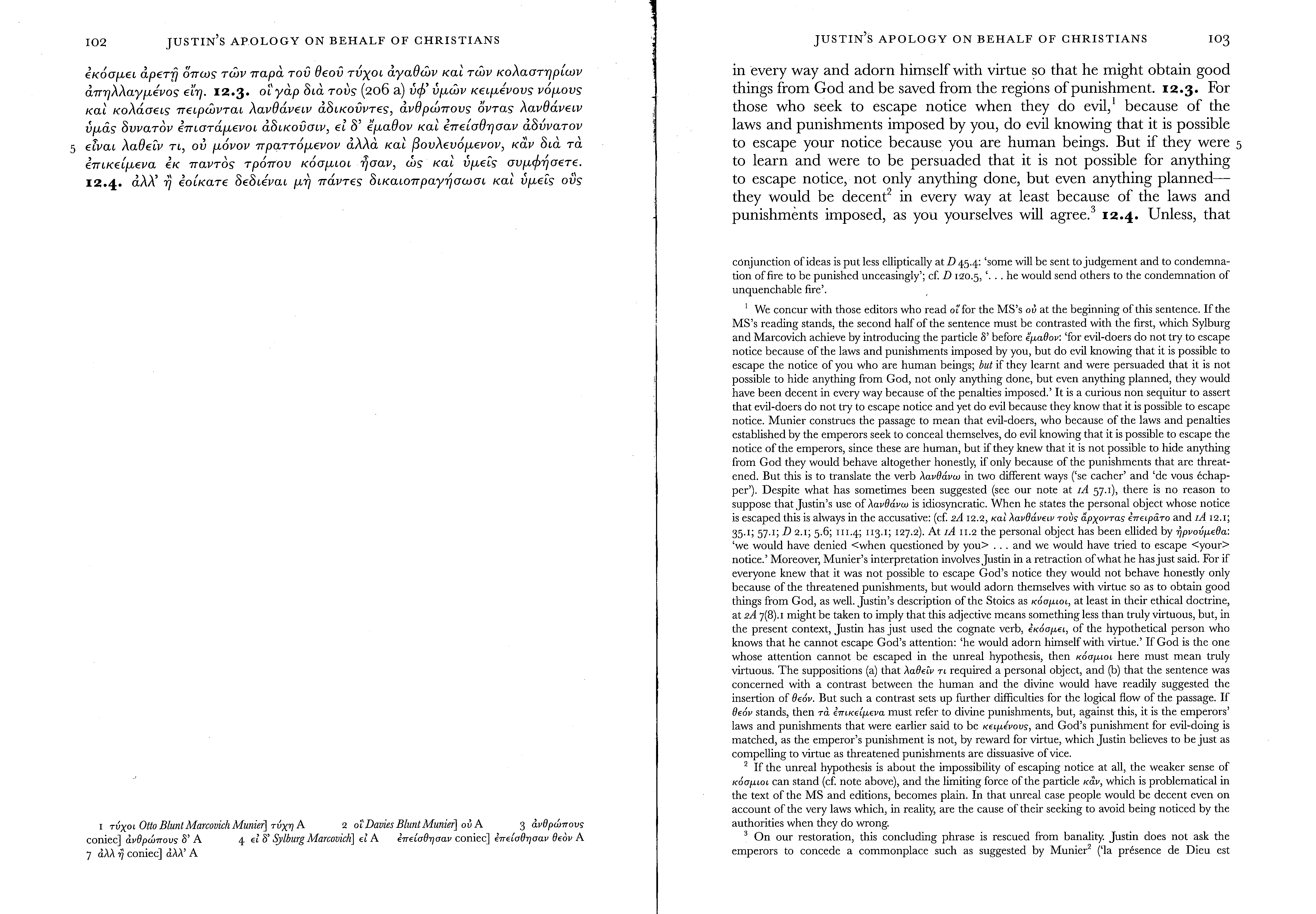
inevery way and adorn himself with virtue ~o that he might obtain good things from God and be saved from the regions ofpunishment. 12.3. For those who seek to escape notice when they do evil, ι because of the laws and punishments imposed by you, do evil knowing that it is possible to escape your notice because you are human beings. But if they were 5 to learn and were to be persuaded that it is not possible for anything to escape notice,· not only anything done, but even anything plannedthey would be decent2 ίn every way at least because of the laws and punishments imposed, as you yourselves will agree. 3 12.4. Unless, that έκόσμει dpETn ό1Τως των 1Ταρα του θεου τύχοι αγαθων και των κολαστηρίων
'λλ ι ,ι (\ , δ' '( 6 ) <Φ' (Λ Ι ι α1Τη αγμενος ειη. 12.3. οι γαρ ια τους 20 a υ υμων κειμενους νομους και κολάσεις 1ΤειΡωνται λανθάνειν αδικουντες, ανθρώ1Τους σντας λανθάνειν ύμας δυνατον έ1Τιστάμενοι αδικουσιν, ει δ' εμαθον και έ1Τείσθησαν αδύνατον
ειναι α ειν τι, ου μονον 1Τραττομενον α α και ου ευομενον, καν ια τα έ1Τικείμενα έκ 1Ταντος τρό1Του κόσμιοι ήσαν, ώς και ύμεις συμΦ~σεTε.
12.4. αλλ' ij έοίκατε δεδιέναι μ~ 1Τάντες δΙKαΙ01Tpαγ~σωσι και ύμείς ους cdnjunction of ideas is put less elliptically at D 45.4: 'some will be sent to judgement and to condemnation offire to be punished unceasingly'; cf. D Ι2Ό.5, Ό •• he would send others to the condemnation of unquenchable fire'.
1 We concur with those editors who read οϊ for the MS's ου at the beginning of this sentence. If the MS's reading stands, the second half ofthe sentence must be contrasted with the first, which Sylburg and Marcovich achieve by introducing the particle δ' before εμαθον: 'for evil-doers do not try to escape notice because of the laws and punishments imposed by you, but do evil knowing that it is possible to escape the notice of you who are human beings; bllt if they learnt and were persuaded that it is not possible to hide anything from God, not οηlΥ anything done, but even anything planned, they would have been decent ίη every way because of the penalties imposed.' It is a curious ηοη sequitur to assert that evil-doers do not try to escape notice and yet do evil because they know that it is possible to escape notice. Munier construes the passage to mean that evil-doers, who because of the laws and penalties established by the emperors seek to conceal themselves, do evil knowing that it is possible to escape the notice of the emperors, since these are human, but if they knew that it is not possible to hide anything from God they would behave altogether honestly, if οηlΥ because of the punishments that are threatened. But this is to translate the verb λανθάνω in two different ways ('se cacher' and 'de vous echapper'). Despite what has sometimes been suggested (see our note at ιΑ 57.1), there is ηο reason to suppose that Justin's use of λανθάνω is idiosyncratic. When he states the personal object whose notice is escaped this is always ίη the accusative: (cf. 2Α 12.2, και λανθάνειν τους αρχοντας επειΡατο and ιΑ 12.1;
35.1; 57·1; D 2.1; 5.6; ΙΙ1.4; ΙΙ3.1; 12].2). At ιΑ ΙΙ.2 the personal object has been ellided by ήρνούμεθα:
'we would have denied <when questioned by you> ... and we would have tried to escape <your> notice.' Moreover, Munier's interpretation involves Justin ίη a retraction of what he has just said. For if everyone knew that it was not possible to escape God's notice they would not behave honestly only because of the threatened punishments, but would adorn themselves with virtue so as to obtain good things from God, as well. Justin's description of the Stoics as κ6σμιοι, at least in their ethical doctrine, at 2Α 7(8).1 might be taken to imply that this adjective means something less than trulyvirtuous, but, ίη the present context, Justin has just used the cognate verb, εκ6σμει, of the hypothetical person who knows that he cannot escape God's attention: 'he would adorn himself with virtue.' If God is the one whose attention cannot be escaped ίη the unreal hypothesis, then κ6σμιοι here must mean truly virtuous. The suppositions (a) that λαθειν τι required a personal object, and (b) that the sentence was concerned with a contrast between the human and the divine would have readily suggested the insertion of θε6ν. But such a contrast sets up further difficulties for the logical flow of the passage. If θε6ν stands, then τα. επικείμενα must refer to divine punishments, but, against this, it is the emperors' laws and punishments that were earlier said to be κειμένους, and God's punishment for evil-doing is matched, as the emperor's punishment is not, by reward for virtue, which Justin believes to be just as compelling to virtue as threatened punishments are dissuasive of vice.
2 If the unreal hypothesis is about the impossibility of escaping notice at aΠ, the weaker sense of κ6σμισι can stand (cf. note above), and the limiting force ofthe particle καν, which is problematical ίη the text of the MS and editions, becomes plain. Ιη that unreal case people would be decent even οη account of the very laws which, ίη reality, are the cause of their seeking to avoid being noticed by the authorities when they do wrong. ι τύχοι OttoBluntMαrcovichMunier] τύκηΑ 2 oi'DαυiesBlllIltMunier] ουΑ 3 ανθρώπους coniec] ανθρώπους δ' Α 4 ει δ' ~lburg Mαrcoviclz] ει Α επείσθησαν coniec] επείσθησαν θεσν Α 7 αλλ η coniec] αλλ' Α 3 Οη our restoration, this concluding phrase is rescued from banality. Justin does not ask the emperors to concede a commonplace such as suggested by Munier2 ('la presence de Dieu est
JUST1N'S APOLOGY ΟΝ BEHALF OF CHR1ST1ANS
JUST1N'S APOLOGY ΟΝ BEHALF OF CHR1ST1ANS
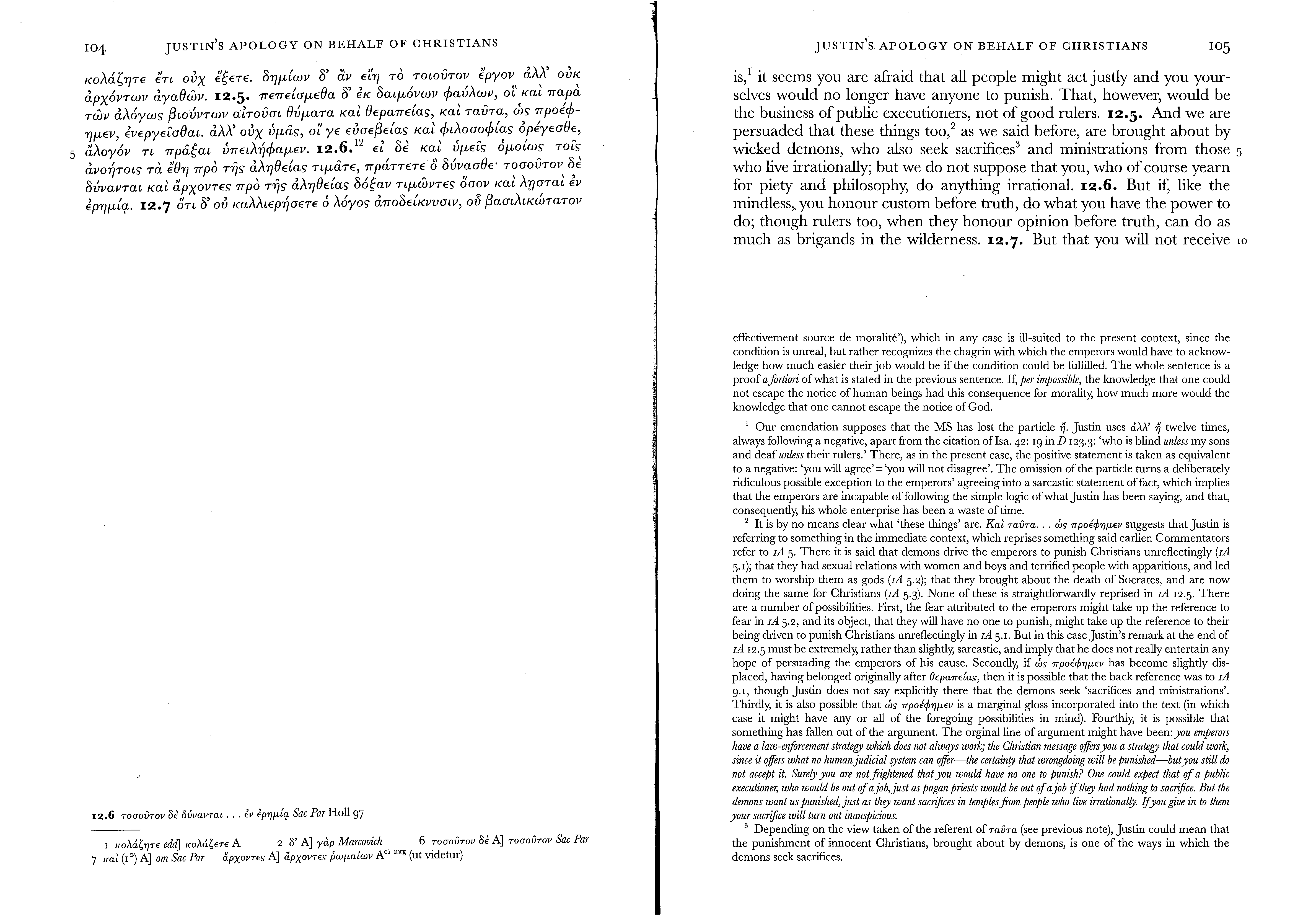
is,l it seems you are afraid that all people might act just1y and you yourselves would ηο longer have anyone to punish. That, however, would be the business ofpublic executioners, not of good rulers. 12.5. And we are persuaded that these things too,2 as we said before, are brought about by wicked demons, who also seek sacrifices3 and ministrations from those 5 who live irrationaliy; but we do not suppose that you, who of course yearn for piety and philosophy, do anything irrational.I2.6. But if, like the mindless" you honour custom before truth, do what you have the power to do; though rulers too, when they honour ορίηίοη before truth, can do as much as brigands in the wilderness. 12.7. But that you will not receive 10 κολάζητε ετι ουχ εςετε. δYjμίων δ' αν εϊΥ} το τοιουτον εργον ιΙλλ' ουκ
Φ 'λ ,'\ \ ιΙρχόντων ιΙγαθων. 12.5. -π-ε-π-εισμε α εκ αιμονων αυ ων, οι και -π-αρα , θ'
'θ '
,~ ( 'Φ των dλόγωs βιουντων αιτουσι υματα και ερα-π-ειαs, και ταυτα, ws -π-ροε - , ~ θ 'λλ"
(~ "
'β , \ Φ λ Φ , " θ ηΙl.εν ενεργεισ αι. α ουχ VfLaS, οι γε ευσε ειαs και ι οσο ιαs ορεγεσ ε, ·/ϊ , (, 6 12 'δ '
,( ~ (, ~ 5 αλογόν τι -π-ραςαι v-π-ειλYjΦαμεν. 12.. ει ε και vμειs ομοιωs τοιs dνο~τοιs τα εθΥ} -π-ρο Tiιs dλYjθείαs τιματε, -π-ράττετε δ δύνασθε' τοσουτον δε ι , ~ 'λ θ' δ' t.
~ "
, λ ' , δύνανται και άρχοντεs -π-ρο TYjS α Yj ειαs o~ αν TLfLWVTES οσον και τι σται εν ερYjμίq,. 12.7 ότι δ' ου Kαλλιεp~σεTε ό λόγοs ιΙ-π-οδείκνυσιν, ov βασιλικώτατον effectivement source de moralite'), which ίη any case is ill-suited to the present context, since the condition is unreal, but rather recognizes the chagrin with which the emperors would have to acknowledge how much easier their job would be if the condition could be fulfilled. The whole sentence is a proof αJoτtίοn of what is stated ίη the previous sentence. If, pel" ilnpossible, the knowledge that one could not escape the notice of human beings had this consequence for morality, how much more would the knowledge that one cannot escape the notice of God.
1 Oul' emendation supposes that the MS has lost the particle -η. Justin uses αλλ' -η twelve times, always following a negative, apart from the citation ofIsa. 42: 19 in D 123.3: 'who is blind unless my sons and deaf unless theiΓ rulers.' There, as ίη the present case, the positive statement is taken as equivalent to a negative: 'you will agree' = 'you will not disagree'. The omission of the particle turns a delibeΓateΙΥ ridiculous possible exception to the emperors' agreeing into a sarcastic statement of fact, which implies that the emperors aΓe incapable of following the simple logic of what Justin has been saying, and that, consequently, his whole enterprise has been a waste of time.
2 It is by ηο means cleal' what 'these things' are. Και ταυτα . .. ώς πpoέΦrιμεν suggests that Justin is referring to something ίη the immediate context, which reprises something said earlier. Commentators refer to ιΑ 5. There it is said that demons drive the emperors to punish Christians unreflectingly (ιΑ
5. Ι); that they had sexual relations with women and boys and terri:fied people with apparitions, and led them to worship them as gods (ιΑ 5.2); that they brought about the death of Socrates, and are now doing the same for Christians (ιΑ 5.3). None of these is straightforwardly reprised in ιΑ 12.5. There are a number of possibilities. FiΓst, the fear attributed to the emperors might take up the reference to fear in ιΑ 5.2, and its object, that they will have ηο one to punish, might take up the reference to theiΓ being driven to punish Christians unreflectingly ίη ιΑ 5.1. But ίη this case Justin's remark at the end of ιΑ 12.5 must be extremely, rather than slightly, sarcastic, and imply that he does not really entertain any hope of persuading the emperors of his cause. Secondly, if ώς πpoέΦrιμεν has become slightly displaced, having belonged originally after θεραπείας, then it is possible that the back reference was to ιΑ
9.1, though Justin does not say explicitly there that the demons seek 'sacri:fices and ministrations'.
Thirdly, it is also possible that ώς πpoέΦrιμεν is a marginal gloss incorporated into the text (ίη which case it might have any οτ all of the foregoing possibilities ίη mind). FourtWy, it is possible that something has fallen out of the argument. The orginalline of argument might have been: you emΡeτοτs lιαve α law-eIιjόrcement stταtegy which does 1l0t always work; the Chlistiall message ojJers you α strategy that could woIk, sillce it ojJers wlzat 110 huInan y"udicial system cαιl ojJeτ-the ceι"tainty that wroιιgdoillg will be pUllished-but you still do
1l0t accept it. Suτe/Υ ΥΟΙΙ ατe not jiightened that you would have 110 Olle to pUllish? One could expect that qf α public executiolleT, who would be out qf α y"ob,y"ust αs pagall pnests would be out qf α y"ob if they had 1l0thiιιg to sacnfice. But the demo1lS Wallt us pUllished, y"ust αs they Wαllt sαcnfices ίll temples .ft01n people who live irrαtiollal/y . .[f you give ίπ to them youl" sacnfice will turn out inαuspicious.
12.6 τοσουτον δε δύνανται . .. εν εΡrιμίq. SaC Ρατ Ho1l97 3 Depending οη the view taken of the referent of ταυτα (see previous note), Justin could mean that the punishment of innocent Christians, brought about by demons, is one of the ways ίη which the demons seek saai:fices.
δ' Α] γαρ Ματcovίch 6 τοσουτον δε Α] τοσουτον Sac Ρατ 7 και (10) Α] om Sac Ρατ αρχοντες Α] αρχοντες ρωμαίων N l mrg (ut videtur)
JUSTIN'S APOLOGY ΟΝ BEHALF OF CHRISTIANS
JUSTIN'S APOLOGY ΟΝ BEHALF OF CHRISTIANS
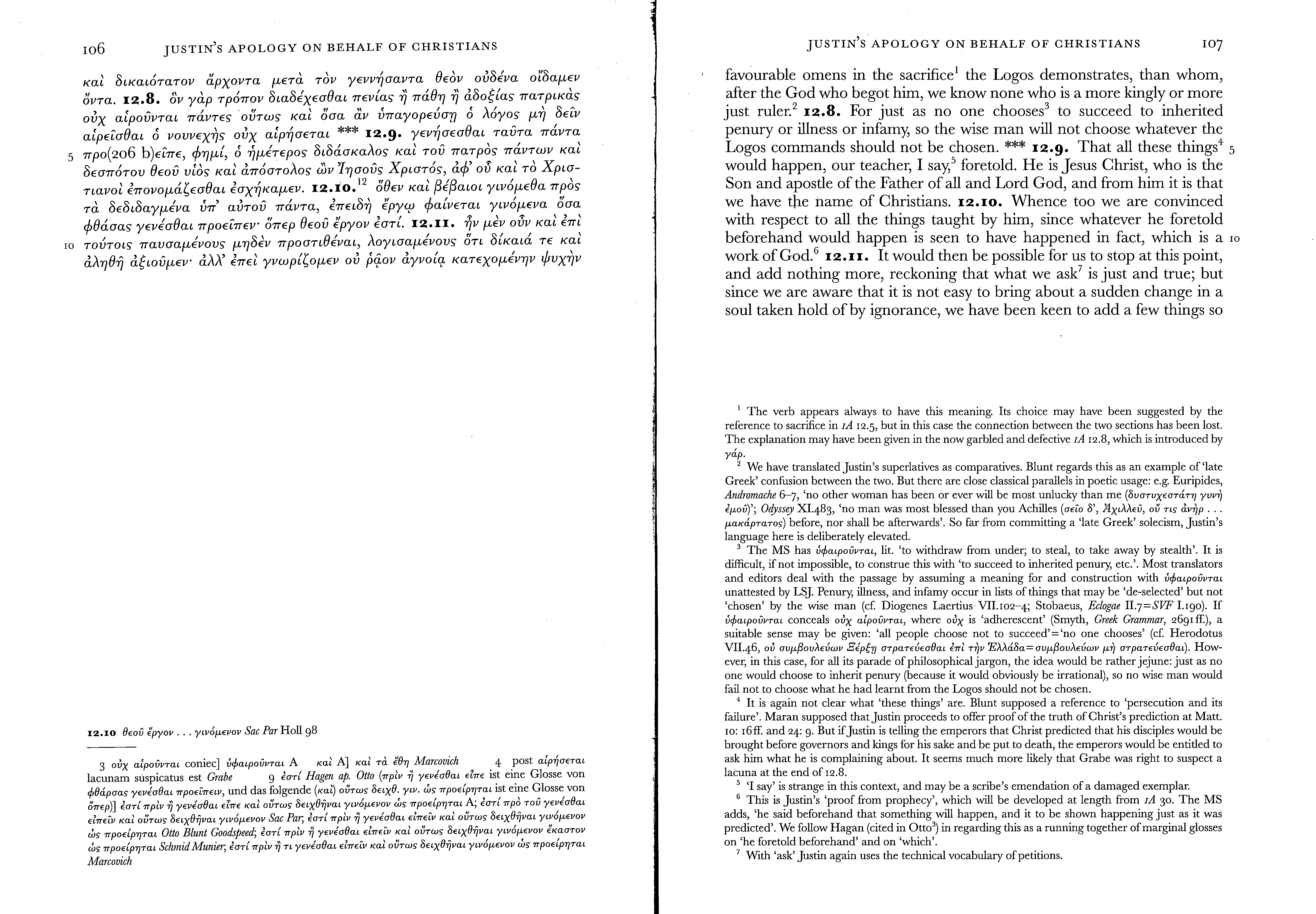
favourable omens ίη the sacrifice 1 the Logos. demonstrates, than whom, και δικαιότατον αρχοντα μετα τον γενν~σανTα θεον ουδένα οϊδαμεν after the God who begot him, we lmow none who is a more kingly or more just ruler.2 12.8. For just as ηο one chooses3 to succeed to inherited σντα. 12.8. ον γαρ τρόπον διαδέχεσθαι πενία'.; ij πάθη ij άδοςία'.; πατρικα'.; ουχ αίρουνται πάντε'.; Όϋτω'.; και όσα αν ύπαγορεύστι ό λόγο'.; μ~ δείν
". ι *** ι θ Λ Ι αιΡεισ αι ο νουνεχη'.; ουχ αιΡησεται . 12.9. γενησεσ αι ταυτα παντα 5 ΠΡΟ(206 b)είπε, Φημί, ό ΤΙμέτερο'.; διδάσκαλο'.; και του πατρΟ'.; πάντων και penury or illness or infamy, so the wise man will not choose whatever the Logos commands should not be chosen. *** 12.9. That all these things4 5 would happen, our teacher, 1 say,5 foretold. He is Jesus Christ, who is the δ ι θ Λ"
'!'
, 'Χ εσποτου εου vιo'.; και αποστο ο'.; ων ησου'.; ριστο'.;, α ου και το ρισ- , , ι Υ θ ' ι .
"θ ' β ιβ ι θ ' τιανοι επονομα':,εσ αι εσχηκαμεν. 12.10. ο εν και ε αιοι γινομε α προ'.; , δ δ δ Ι."
Φ Ι Ι·/ τα ε ι αγμενα υπ αυτου παντα, επει η εργψ αινεται γινομενα οσα Son and apostle of the Father of all and Lord God, and from him it is that we have t}ιe hame of Christians. 12.10. Whence too we are convinced with respect to all the things taught by him, since whatever he foretold beforehand would happen is seen to have happened in fact, which is a ΙΟ work ofGod.6 12.11. lt would then be possible for us to stop at this point, and add nothing more, reckoning that what we ask7 is just and true; but since we are aware that it is not easy to bring about a sudden change ίη a soul taken hold of by ignorance, we have been keen to add a few things so Φθάσα'.; γενέσθαι προείπεν' όπερ θεου εργον Εστί. 12.11. -ην μεν σΟν και Επι
ΙΟ τούτοι'.; παυσαμένου'.; μηδεν προστιθέναι, λογισαμένου'.; ότι δίκαιά τε και άληθ-η άςιουμεν' άλλ' Επει γνωρίζομεν ου pq.Ov άγνοίq, κατεχομένην ψυx~ν
1 The verb appears always to have this meaning. Its choice may have been suggested by the reference to sacrifice in ιΑ 12.5, but in this case the connection between the two sections has been lost.
The explanation may have been given ίη the now garbled and defective ιΑ 12.8, which is introduced by γάρ.
2 We have translated Justin's superlatives as comparatives. Blunt regards this as an example of 'late
Greek' confusion between the two. But there are close classical parallels ίη poetic usage: e.g. Euripides,
Andromache 6-7, 'πο other woman has been or ever will be most unlucky than me (δυστυχεστάτη γυνη
εμου)'; Orfyssey Xl.483, 'πο man was most blessed than you Achilles (σειο δ', Άχιλλευ, ου τις άνηρ ... μακάρτατος) before, nor shall be afterwards'. So far from committing a 'late Greek' solecism, Justin's language here is deliberately elevated.
3 The MS has ύΦαιΡουνται, lit. 'to withdraw from under; to steal, to take away by stealth'. It is difficult, if not impossible, to construe this with 'to succeed to inherited penury, etc.'. Most translators and editors deal with the passage by assuming a meaning for and construction with ύΦαιΡουνται unattested by LSJ. Penury, illness, and infamy occur ίη lists of things that may be 'de-selected' but not 'chosen' by the wise man (cf. Diogenes Laertius VI1.I02-4; Stobaeus, Eclogae II.7=SVF 1.190). If ύΦαιΡουνται conceals ovx αίρουνται, where ovx is 'adherescent' (Smyth, Greek Grαιnnιαr, 2691 ff.), a suitable sense may be given: 'all people choose not to succeed'= 'πο one chooses' (cf. Herodotus
VI1.46, ου συμβουλεύων Ξέρςτι στρατεύεσθαι επι την Έλλάδα= συμβουλεύων μη στρατεύεσθαι). However, ίη this case, for all its parade of philosophical jargon, the idea would be rather jejune: just as ηο one would choose to ίηheήt penury (because it would obviously be irrational), so ηο wise man would fail not to choose what he had learnt from the Logos should not be chosen.
4 It is again not clear what 'these things' are. Blunt supposed a reference to 'persecution and its failure'. Maran supposed that Justin proceeds to offer proof of the truth of Christ's prediction at Matt.
12.10 θεου έργον . .. γινόμενον SaC Par Ho1l98 ΙΟ: 16ff. and 24: 9. But ifJustin is telling the emperors that Christ predicted that his disciples would be brought before governors and kings for his sake and be put to death, the emperors would be entitled to ask him what he is complaining about. It seems much more likely that Grabe was right to suspect a lacuna at the end of 12.8.
3 OvX αίρουνται coniec] ύΦαιΡουνται Α και Α] και τα έθη Marcoviclz 4 post αίρήσεται lacunam suspicatus est Grabe 9 εστ{ Hagen αρ. Otto (πριν η γενέσθαι είπε ist eine Glosse νοη
5 Ί say' is strange in this context, and may be a scribe's emendation of a damaged exemplar.
Φθάρσας γενέσθαι προειπειν, und das folgende (και) οϋτως δειχθ. γιν. ώς προε{ρψαι ist eine Glosse νοη
6 This is Justin's 'proof from prophecy', which will be developed at length from ιΑ 30. The MS adds, 'he said beforehand that something will happen, and it to be shown happening just as it was predicted'. We follow Hagan (cited ίη Ott03) in regarding this as a running together ofmarginal glosses οπερ)] εστ{ πριν η γενέσθαι είπε και οϋτως δειχθ7jναι γινόμενον ώς προε{ρηται Α; εστ{ προ του γενέσθαι είπειν και οϋτως δειxθ7jναι γινόμενον Sac Ρατ, εστ{ πριν η γενέσθαι είπειν και οϋτως δειχθ7jναι γινόμενον ώς προε{ρψαι Otto Blunt Goodspeed; εστ{ πριν η γενέσθαι είπειν και οϋτως δειχθ7jναι γινόμενον Εκαστον οη 'he foretold beforehand' and οη 'which'. ώς προε{ρψαι Schlnid Munier, εστ{ πριν η τι γενέσθαι είπειν και οϋτως δειχθ7jναι γινόμενον ώς προε{ρψαι
Marcovich 7 With 'ask' Justin again uses the technical vocabulary of petitions.
JUST1N'S APOLOGY ΟΝ BEHALF OF CHR1ST1ANS
JUST1N'S APOLOGY ΟΝ BEHALF OF CHR1ST1ANS
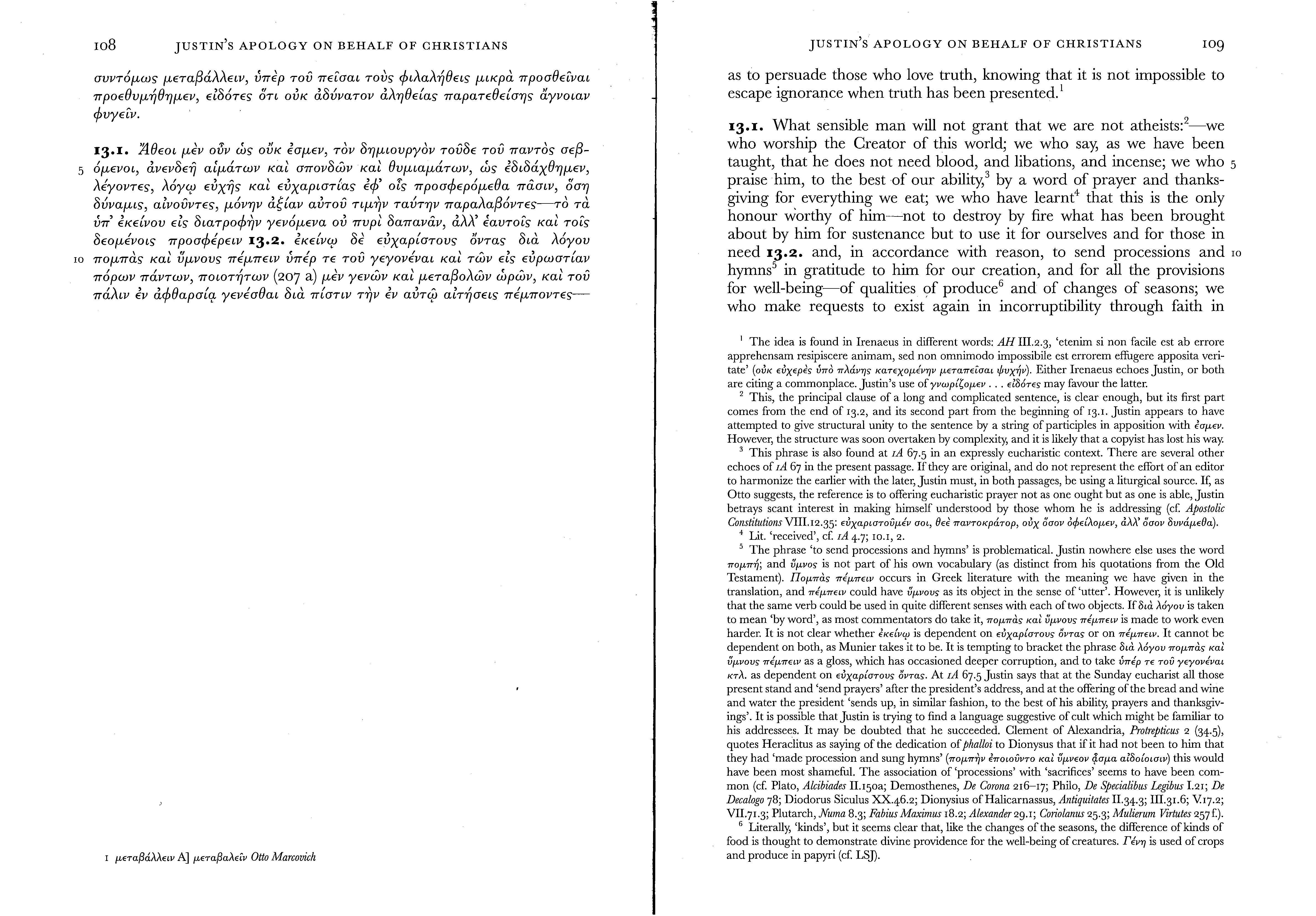
as to persuade those who love truth, knowing that it is not impossible to escape ignorance when truth has been presented. 1 συντόμω~ μεταβάλλειν, ύπερ τού πεισαι ΤOυ~ Φιλαλήθει~ μικρα προσθειναι προεθυμήθημεν, εΙδότε~ ότι ούκ αδύνατον αληθεία~ παpατεθείση~ αγνοιαν
13.1. What sensible man will not grant that we are not atheists: 2-we who worship the Creator of this world; we who say, as we have been taught, that he does not need blood, and libations, and incense; we who 5 praisehim, to the bestof our ability,3 by a word of prayer and thanksgiving for everything we eat; we who have learnt4 that this is the only honour worthy of him-not to destroy by fire what has been brought about by him for sustenance but to use it for ourselves and for those ίn need 13.2. and, ίn accordance with reason, to send processions and 10 hymnsS ίn gratitude to him for our creation, and for all the provisions for well-being-of qualities <;>f produce6 and of changes of seasons; we who make requests to exist again ίn incorruptibility through faith ίn
13.1. Άθεοι μεν οδν ώ~ ουκ έσμεν, τον δημιουργον τούδε τού παντo~ σεβΙ ,~~ ( Ι \ ~ ~ \ θ / ('~ ~ Ι θ
ομενοι, ανενυεη αιματων και σπονοων και υμιαματων, ω~ εOΙUαχ ημεν, Ι λ Ι ,~ \, Ι 'Φ'
'<'
Φ Ι θ ~ </ εγoντε~, ογ<'ρ ευχη~ και EvxaPLaTt'a~ ε oι~ προσ ερομε α πασιν, οση λ ~I ,~ Ι '(;1 ,~ \ Ι λ β'
\ \ υυναμι~, αινoυντε~, μονην α~ ιαν αυτου τιμην ταυτην παρα α oντε~-τo τα ( "Ι ,~ Φ \ / , \ ~ ~'λλ' ( ~ \ ~ υπ εκεινου ει~ υιατρο ην γενομενα ου πυρι υαπαναν, α εαυτoι~ και τoι~ ~ / Φ '
,Ι ~\ ,Ι "
~ \ λ' oεoμενoι~ προσ ερειν 13.2. εκειν<'ρ οε ευχαpιστoυ~ oντα~ υια ογου \ \ t/ Ι (Ι 1"'\ Ι \"" ι
πoμπα~ και υμνoυ~ πεμπειν υπερ τε του γεγονεναι και των ει~ ευρωστιαν πόρων πάντων, ποιοτήτων ('207 a) μεν γενων και μεταβολων ώρων, και τού
~ ,Ι Ι πα ιν εν α αρσι'} γενεσ αι υια πιστιν την εν αυτ<'ρ αιτησει~ πεμπoντε~ι The idea is found in 1renaeus ίη different words: ΑΗ
Π1.2.3, 'etenim si ηοη facile est ab errore apprehensam resipiscere animam, sed ηοη omnimodo impossibile est errorem effugere apposita veritate' (OVK ευχερες ύπσ πλάνης κατεχομένην μεταπεισαι ψυχήν). Either 1renaeus echoes Justin, ΟΓ both are citing a commonp1ace. Justin's use of γνωρί'ομεν ... ειδ6τες may favour the 1atter.
2 This, the principa1 c1ause of a 10ng and comp1icated sentence, is c1ear enough, but its first part comes from the end of 13.2, and its second part from the beginning of 13.1. Justin appears to have attempted to give structura1 unity to the sentence by a string of particip1es ίη apposition with εσμεν.
However, the structure was soon overtaken by comp1exity, and it is 1ike1y that a copyist has 10st his way.
3 This phrase is also found at ιΑ 67.5 ίη an express1y eucharistic context. There are severa1 other echoes of ιΑ 67 ίη the present passage. 1f they are original, and do not represent the effort of an editor to harmonize the ear1ier with the 1ater, Justin must, ίη both passages, be using a 1iturgical source. 1f, as Otto suggests, the reference is to offeΓing eucharistic prayer not as one ought but as one is ab1e, Justin betrays scant interest ίη making himself understood by those whom he is addΓessing (cf. Apostolic
C01ΙStituti01ΙS νΠ1.Ι2.35: ευχαριστουμέν σοι, θεε παντοκράτορ, ovx σσον σΦείλομεν, άλλ' σσον δυνάμεθα).
4 Lit. 'received', cf. ιΑ 4.7; 10.1,2.
5 The phrase 'to send processions and hymns' is prob1ematical. Justin nowhere e1se uses t11e word πομπή; and υμνος is not part of his own vocabu1ary (as distinct from his quotations from the Old
Testament). Πομπας πέμπειν ΟCCUΓS ίη Greek 1ίteΓature with the meaning we have given ίη the trans1ation, and πέμπειν cou1d have υμνους as its object ίη the sense of 'utter'. However, it is un1ike1y that the same verb cou1d be used ίη quite different senses with each oftwo objects. 1f δια λ6γου is taken to mean 'by word', as most commentators do take it, πομπας και υμνουι;; πέμπειν is made to work even hardeΓ. 1t is not c1ear whether εκείνψ is dependent οη ευχαρίστουι;; οντας ΟΓ οη πέμπειν. 1t cannot be dependent οη both, as Munier takes it to be. 1t is tempting to bracket the ΡhΓase δια λ6γου πομπας και υμνουι;; πέμπειν as a g10ss, which has occasioned deeper corruption, and to take ύπέρ τε του γεγονέναι κτλ as dependent οη ευχαρίστους Οντας. At ιΑ 67.5 Justin says that at the Sunday eucharist aΠ those present stand and 'send prayers' after the president's address, and at the offering ofthe bread and wine and water the president 'sends up, in similar fashion, to the best of his ability, prayers and thanksgivings'. 1t is possib1e that Justin is tΓying to find a 1anguage suggestive of cu1t which might be familiar to his addressees. 1t may be doubted that he succeeded. Clement of Alexandria, Protl'epticus 2 (34.5), quotes Herac1itus as saying of the dedication of phαlloi to Dionysus that if it had not been to him that they had 'made procession and sung hymns' (πομπην εποιουντο και υμνεον ~σμα αιδοίοισιν) this wou1d have been most shameful. The association of 'processions' with 'sacrifices' seems to have been common (cf. P1ato, Alcibiαdes II.I50a; Demosthenes, De Corollα 2ι6-η; Philo, De Speciαlibzιs Legibus 1.21; De
Decαlogo 78; Diodorus Sicu1us ΧΧ-46.2; Dionysius ofHalicarnassus, Alltiquitαtes Π.34.3; Π1.3ι.6; Υ.η.2;
ΥΙ1.7Ι.3; P1utarch, NUΙllα 8.3; Fαbius Mαxinzus 18.2; Alexαnder 29.1; C0110lαnus 25.3; Mulierum Virtutes 257f.).
6 Literally, 'kinds', but it seems c1ear that, 1ike the changes ofthe seasons, the difference ofkinds of food is thought to demonstrate divine providence [ΟΓ the well-being of cγeatures. Γένη is used of crops and produce ίη papyri (cf. LSJ).
JUSTIN'S APOLOGY ΟΝ BEHALF OF CHRISTIANS
JUSTIN'SAPOLOGY ΟΝ BEHALF OF CHRISTIANS
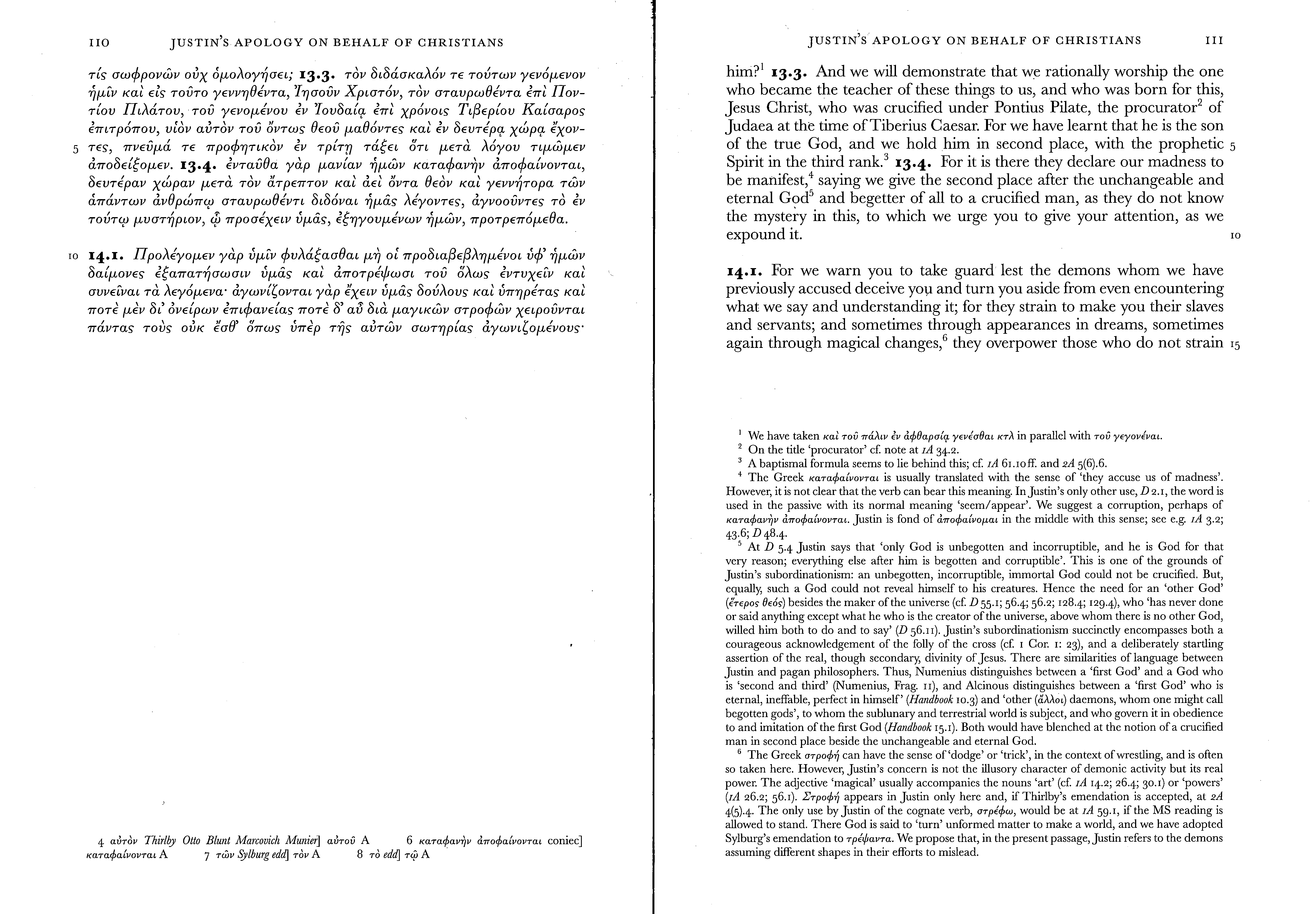
/ Φ Λ , t λ / \ δδ/ λ/ / / τις σω ρονων ουχ ομο ογησει; 13.3. τον ι ασκα ον τε τουτων γενομενον hirή?! 13.3. And we will den10nstrate that w~ rationally worship the one who became the teacher of these things to US, and who was born for this,
Jesus Christ, who was crucified under PontiusPilate, the procurator2 of Judaea at the time ofTiberius Caesar. For we have learnt that he is the son ήμίν και είς τουτο γεννηθέντα, 'Ιησουν Χριστόν, τον σταυρωθέντα επι Πον- / Πλ/ Λ / , Ί δ / ,\ / Τβ / Τ7 / τιου ι ατου, του γενομενου εν ου atqεπι χρονοις ι εριου nαισαρος επιτρόπου, υίον αυτον του οντως θεου μαθόντες και εν δευτέρqχώρqEX01JΛ
/ Φ \, / /t t/ \ λ/ Λ
τες, πνευμα τε προ ητικον εν ΤΡΙΤΤΙ Tα~ει οτι μετα ογου τιμωμεν of the true God, and we holdhim ίη second place, with the prophetic 5
Spirit ίη the third rank. 3 13.4. For it is there they declare our madness to be manifest,4 saying we give the second place after the unchangeable and eternal G<,:>d5 and begetter of all to a crucified man, as they do not know the mystery ίη this, to which we urge you to give your attention, as we expound it.
ΙΟ άποδείξομεν. 13.4. ενταυθα γαρ μανίαν ήμων KαTαΦαν~ν άποΦαίνονται, δευτέραν χώραν μετα τον ατρεπτον και άει οντα θεον και γεννήτορα των άπάντων άνθρώπψ σταυρωθέντι διδόναι ήμας λέγοντες, άγνοουντες το εν τούτψ μυστήριον, Ψ προσέχειν ύμας, εξηγουμένων ήμων, προτρεπόμεθα.
ΙΟ 14.1. Προλέγομεν γαρ ύμίν Φυλάξασθαι μ~ οί προδιαβεβλημένοι ύΦ' ήμων δ / , t / t Λ \ , /, "
Λ \ αιμονες ε~απαTησωσιν υμας και αποτρεψωσι του ο ως εντυχειν και 14.1. For we warn you to take guard lest the demons whom we have previously accused deceive Υο-μ and turn you aside from even encountering what we say and understanding it; for they strain to make you their slaves and servants; and sometimes through appearances ίη dreams, sometimes again through magical changes,6 they overpower those who do not strain 15 συνείναι τα λεγόμενα· άγωνίζονται γαρ εχειν ύμας δούλους και ύπηρέτας και ποτε μεν δι' ονείρων επιΦανείας ποτε δ' αδ δια μαγικων στροφων χειΡουνται πάντας τους ουκ εσθ' σπως ύπερ τijς αυτων σωτηρίας άγωνιζομένους·
1 We haνe taken και του πάλιν Εν dΦθαΡσίq. γενέσθαι κτλ in parallel with του γεγονέναι.
2 Οη the title 'procurator' cf. note at ιΑ 34.2.
3 Α baptismal formula seems to lie behind this; cf. ιΑ 6I.IOff. and 2Α 5(6).6.
4 The Greek καταΦαίνονται is usually translated with the sense of 'they accuse us of madness'.
Howeνer, it is not clear that the νerb can bear this meaning. InJustin's οηlΥ other use, D 2.1, the word is used in the passive with its normal meaning 'seem/ appear'. We suggest a corruption, perhaps of καταΦανην dποΦαίνονται. Justin is fond of dποΦαίνομαι in the middle with this sense; see e.g. ιΑ 3.2;
43·6;D48+
5 At D 5.4 Justin says that ΌηΙΥ God is unbegotten and incorruptible, and he is God for that νery reason; eνerything else after him is begotten and corruptible'. This is one of the grounds of Justin's subordinationism: an unbegotten, incorruptible, immortal God could not be crucified. But, equally, such a God could not reνeal himself to his creatures. Hence the need for an 'other God'
(ετερος θεός) besides the maker ofthe uniνerse (cf. D 55.1; 56-4; 56.2; 128-4; 129.4), who 'has never done οτ said anything except what he who is the creator of the uniνerse, aboνe whom there is ηο other God, willed him both to do and to say' (D 56. τι). Justin's subordinationism succinctly encompasses both a courageous acknowledgement of the folly of the cross (cf. ι Cor. Ι: 23), and a deliberately startling assertion of the real, though secondary, diνinity of Jesus. There are similarities of language between Justin and pagan philosophers. Thus, Numenius distinguishes between a 'first God' and a God who is 'second and third' (Numenius, Frag. ιι), and Alcinous distinguishes between a 'first God' who is eternal, ineffable, perfect in himself' (Hαndbook ΙΟ.3) and 'other (άλλοι) daemons, whom one might call begotten gods', to whom the sublunary and terrestrial world is subject, and who goνern it in obedience to and imitation ofthe first God (Hαlldbook 15.1). Both would haνe blenched at the notion of a crucified man in second place beside the unchangeable and eternal God.
6 The Greek στpoΦfι can haνe the sense of'dodge' οτ 'trick', in the context ofwrestling, and is often so taken here. However, Justin's concern is not the illusory character of demonic activity but its real power. The adjective 'magical' usually accompanies the nouns 'art' (cf. ιΑ 14.2; 26-4; 30.1) οτ 'powers'
(ιΑ 26.2; 56.1). ΣTpoΦfι appears in Justin only here and, if Thirlby's emendation is accepted, at 2Α
4(5)+ The only use by Justin ofthe cognate νerb, στρέΦω, would be at ιΑ 59.1, ifthe MS reading is allowed to stand. There God is said to 'ωτη' unformed matter to make a world, and we haνe adopted
Sylburg's emendation to τρέΨαντα. We propose that, in the present passage, Justin refers to the demons assuming different shapes in their efforts to mislead.
4 αυτον Thirlby Otto Blunt Mαrcoviclz Munier] αυτου Α 6 καταΦανην dποΦαίνονται coniec] καταΦαίνονται Α 7 των Sylburg edαJ τον Α 8 το edαJ Τψ Α .
JUSTIN'S APOLOGY ΟΝ BEHALF OF CHRISTIANS
IIg ΙΙ2
JUSTIN'SAPOLOGY ΟΝ BEHALF OF CHRISTIANS
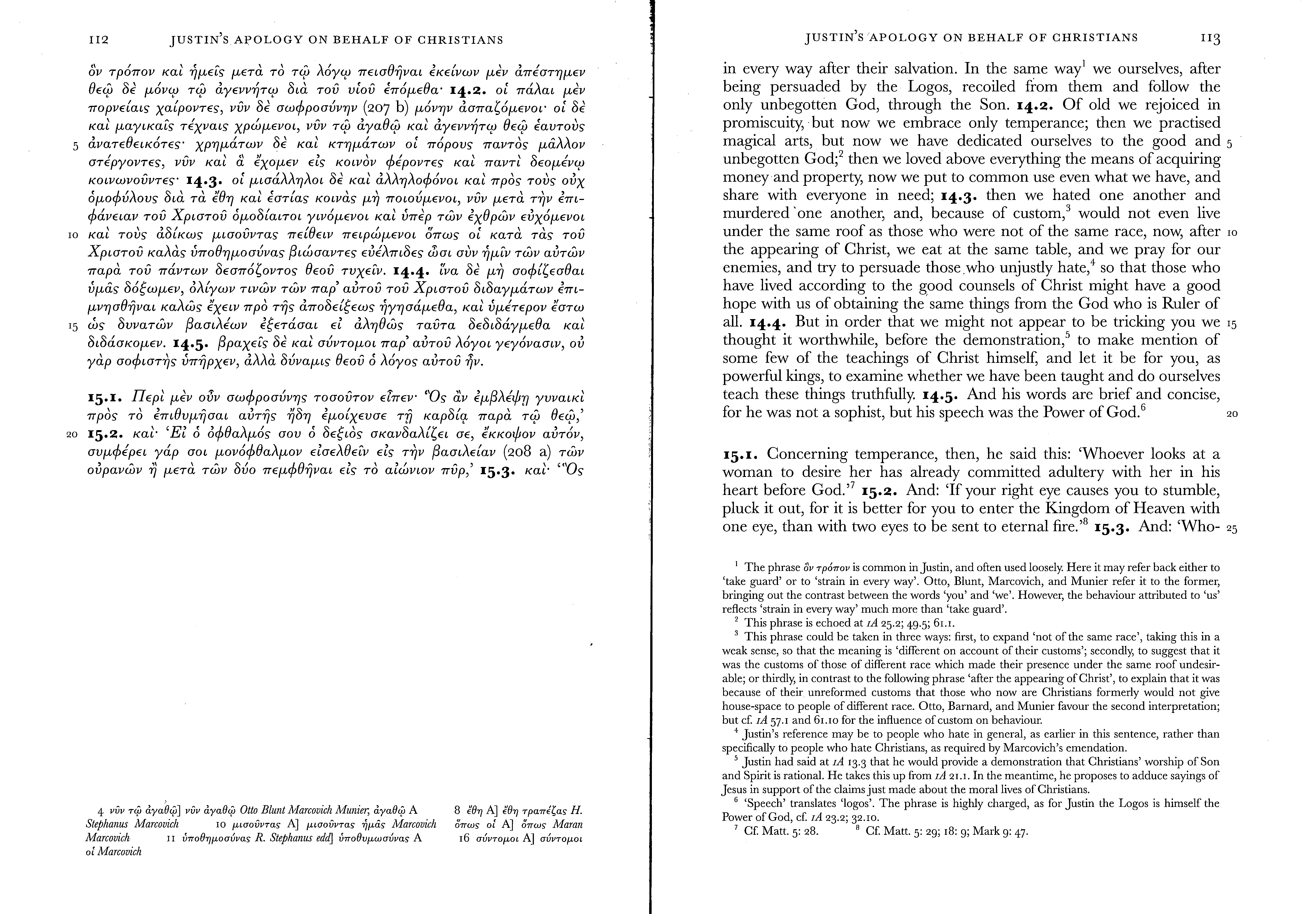
in every way after their salvation. Ιn the same wayl we ourselves, after being persuaded by the Logos, recoiled from them and follow the only unbegotten God, through the Son. 14.2. Of old we rejoiced in promiscuity, . but nονν we embrace only temperance; then we practised magical arts, but nονν we have dedicated ourselves to the good and 5 unbegotten GOd;2 then we loved above everything the means of acquiring moneyand property, nονν we put to common use even what we have, and share with everyone in need; 14.3. then we hated one another and murdered 'one another, and, because of custom,3 would not even live under the same roof as those who were not of the same race, now, after 10 the appearing of Christ, we eat at the same table, and we pray for our enemies, and try to persuade those .who unjustly hate,4so that those who have lived according to the good counsels of Christ might have a good hope with us of obtaining the same things from the God who is Ruler of all. 14.4. But in order that we might not appear to be tricking you we 15 thought it worthwhile, before the demonstration,5 to make mention of some few of the teachings of Christ himself, and let it be for you, as powerful kings, to examine whether we have been taught and do ourselves teach these things truthfully. 14.5. And his words are brief and concise, for he was not a sophist, but his speech was the Power of God. 6
ον τρόπον και -ήμείς μετα το τψ λόγψ πεισθηναι εκείνων μεν απέστημεν θεψ δε μόνψ τψ αγενν~TΨ δια του υίου έπόμεθα' 14.2. οί πάλαι μεν πορνείαις χαίροντες, νυν δε σωΦροσύνην (207 b) μόνην ασπαζόμενοι' οί δε και μαγικαίς τέχναις χρώμενοι, νυν τψ αγαθψ και αγενν~TΨ θεψ έαυτους
<\ ".
\ Φ / Ι ι δ / στεργοντες, νυν και α εχομεν εις κοινον εροντες και παντι εομενψ ~ ι /λλ λ δ ι ι 'λλ λ Φ / Ι Ι Ι , κοινωνουντες' 14.3. οι μισα η οι ε και α η ο ονοι και προς τους ουχ ι Φ /λ δ \ \ "θ \ ι Ι \ , Ι "'"
\ \ ) ομο υ ους ια τα ε η και εστιας κοινας μη ποιουμενοι, νυν μετα την επιΦ / ~ Χ ~ Ι δ/ / Ι Ι Ι ~ 'θ ~ ,/ ανειαν του ριστου ομο ιαιτοι γινομενοι και υπερ των εχ ρων ευχομενοι
!Ο και τους αδίκως μισουντας πείθειν πειρώμενοι όπως οί κατα τας του Χριστου καλας ύποθημοσύνας βιώσαντες εύέλπιδες 6Jσι συν -ήμίν των αύτων παρα του πάντων δεσπόζοντος θεου τυχείν. 14.4. ίνα δε μη σοΦίζεσθαι ύμας δόξωμεν, ολίγων τινων των παρ' αύτου του Χριστου διδαγμάτων επι μνησθηναι καλως εχειν προ της αποδείξεως -ήγησάμεθα, και ύμέτερον εστω
ώς δυνατων βασιλέων εξετάσαι ει αληθως ταυτα δεδιδάγμεθα και / β ~ δΙ ι / , '~λ/ / , Ι ασκομεν. 14.5. ραχεις ε και συντομοι παρ αυτου ογοι γεγονασιν, ου δδ γαρ σοΦιστης ύπηρχεν, αλλα δύναμις θεου ό λόγος αύτου -ην.
15.1. Περι μεν οδν σωΦροσύνης τοσουτον ε'ίπεν' "Ος αν εμβλέΨΏ γυναικι προς το επιθυμησαι αύτης iιδη εμοίχευσε Tn καΡδίCf παρα Τψ θεψ,'
20 15.2. και' 'Ει ό οΦθαλμός σου ό δεξιος σκανδαλίζει σε, εκκοψον αύτόν, συμΦέρει γάρ σοι μονόΦθαλμον εισελθείν εις την βασιλείαν (208 a) των
15.1. Concerning temperance, then, he said this: 'Whoever looks at a woman to desire her has already committed adultery with her in his heart before God.,7 15.2. And: 'Ifyour right eye causes you to stumble, pluck it out, for it is better for you to enter the Κingdom of Heaven with one eye, than with two eyes to be sent to eternal fire.'8 15.3. And: 'Who25
, ~'I Ι ~ δ / Φθ ~ ,Ι, / ~ , Ι "10 ουρανων η μετα των υο πεμ ηναι εις το αιωνιον πυρ, 15.3. και' ς ι The phrase ον τρόπον is common in Justin, and often used loosely. Here it may refer back either to 'take guard' or to 'strain in every way'. Otto, Blunt, Marcovich, and NIunier refer it to the former, bringing out the contrast between the words 'you' and 'we'. However, the behaviour attributed to 'us' reflects 'strain in every way' much more than 'take guard'.
2 This phrase is echoed at ιΑ 25.2; 49.5; 6Ι.Ι.
3 This phrase could be taken in three ways: first, to expand 'not ofthe same race', taking this in a weak sense, so that the meaning is 'different οπ account of their customs'; secondly, to suggest that it was the customs of those of different race which made their presence under the same roof undesirable; or thirdly, in contrast to the following phrase 'after the appearing of Christ', to explain that it was because of their. unreformed customs that those who πονν are Christians formerly would not give house-space to people of different race. Otto, Barnard, and Munier favour the second interpIetation; but cf. ιΑ 57.1 and 6Ι.Ιο for the influence of custom οπ behaviour.
4, Justin's reference may be to people who hate in general, as earlier in this sentence, IatheI than specifically to people who hate Christians, as required by MaIcovich's emendation.
5 Justin had said at ιΑ 13.3 that he would pΓOvide a demonstration that Christians' worship of Son and Spirit is rational. He takes this up from ιΑ 21.1. Ιπ the meantirne, he proposes to adduce sayings of Jesus in support of the claims just made about the mOIallives of ChIistians.
6 'Speech' translates 'logos'. The phIase is highly charged, as [ΟΓ Justin the Logos is himself the Power of God, cf. ιΑ 23.2; 32.10.
4 νϋν τψ αγαθψ] νϋν αγαθψ Otto Blunt Mαrcovich Muιzier, αγαθψ Α 8 εθrι Α] εθrι τραπέζας Η.
Stephαllus AιIαrcoviclz !Ο μισοϋντας Α] μισοϋντας ήμας jYIαrcovich σπως οί Α] σπως Mαrαn 7 Cf. Matt. 5: 28.
8 Cf. Matt. 5: 29; 18: 9; Mark 9: 47.
16 σύντομοι Α] σύντομοι Mαrcovich ΙΙ ύπoθrιμoσύνας R. Stephαnus ed~ ύποθυμωσύνας Α οί Mαrcovich
JUSTIN'S' APOLOGY ΟΝ BEHALF OF CHRISTIANS
JUSTIN'S APOLOGY ΟΝ BEHALF OF CHRISTIANS
~, , 'Ε'
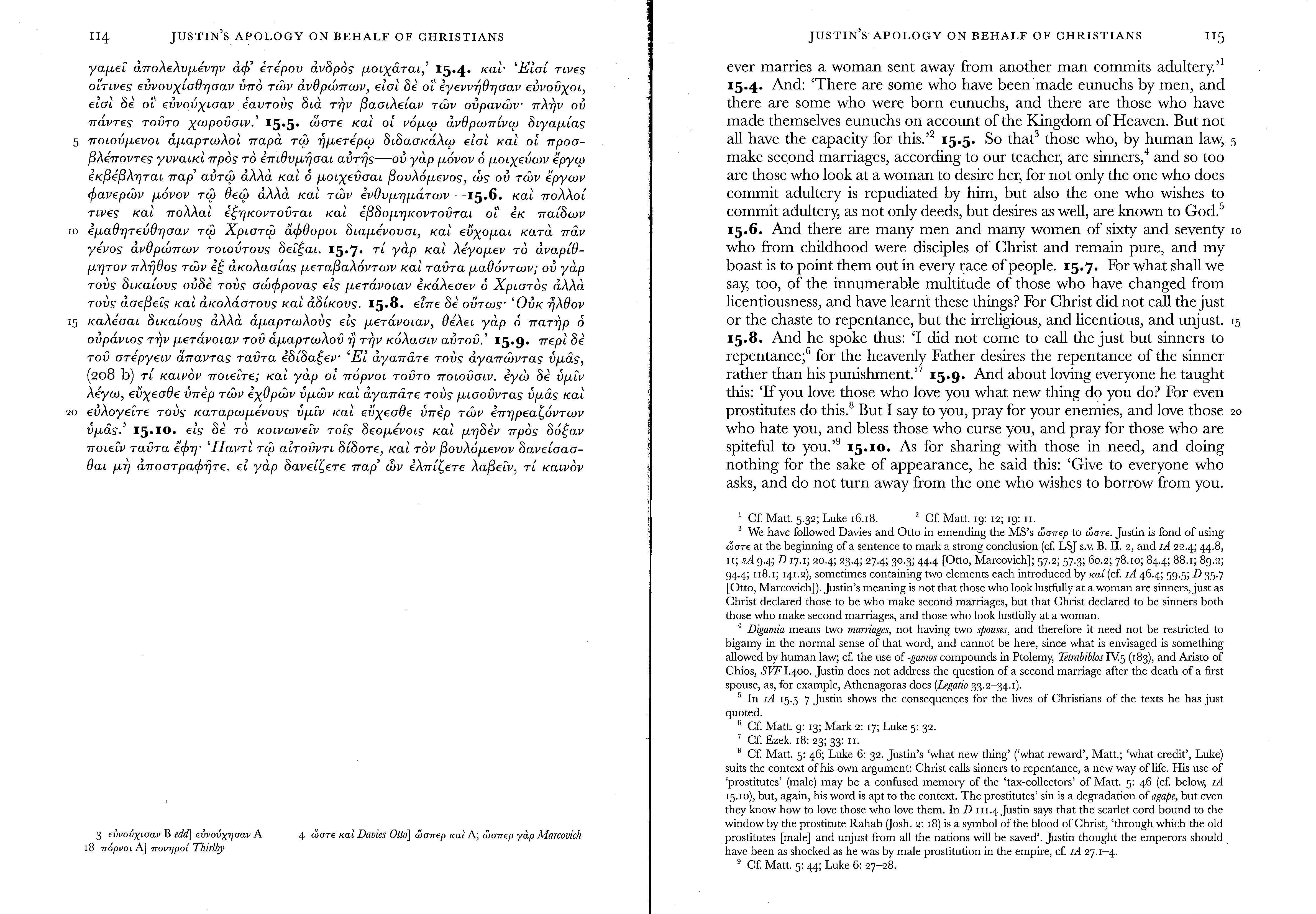
Ι γαμει α'Πο ε υμενην α ετερου αν ρος μοιχαται, 15.4. και' ισι Τινες ever marries a woman sent away from another man commits adultery.'l
15.4. And: 'There are some who have been 'made eunuchs by men, and there are some who were born eunuchs, and there are those who have made themselves eunuchs οη account of the Κingdom of Heaven. But not all have the capacity for thiS.'2 15.5. So that3 those who, by human law, 5 make second marriages, according to our teacher, are sinners,4 and so too are those who look at a woman to desire her, for not οηlΥ the one who does commit adultery is repudiated by him, but also the one who wishes to commit adultery, as not οηlΥ deeds, but desires as well, are known to God.5
~I ) / θ t,....., θ Ι , 'δ \ (\'
Ι θ ,~ ΟΙΤινες ευνουχισ ησαν υ'Πο των αν ρω'Πων, εισι ε οι εγεννη ησαν ευνουχοι, , 'δ'
,Ι < 'δ" β λ Ι ~ , ~ λ'
....., t/ ,('
,~< Ι δ δ lλ "
, <
'Ποιουμενοι αμαρτω οι 'Παρα Τψ ημετερψ ι ασκα Ψ εισι και οι 'Προσβλέ'Ποντες γυναικι 'Προς το ε'Πιθυμήσαι αυτής-ου γαρ μόνον ό μοιχεύων εργψ
, ~ 'λλ'
,< ~ β λ '
<, ~ " εκ ε ηται 'Παρ αυτψ α α και ο μοιχευσαι ου ομενος, ως ου των εργων Φανερων μόνον Tci> eEci> αλλα και των ενθυμημάτωV-15.6. και 'Πολλοί
, λλ' < C ~ '<βδ ~.I'
Τινες και 'ΠΟ αι ε!:, ηκοντουται και ε ομηκοντουται οι εκ 'Παι ων 10 εμαθητεύθησαν Tci> XPLaTci> αΦθοροι διαμένουσι, και ευχομαι κατ α 'Παν
15.6. And there are many men and many women of sixty and seventy 10 who from childhood were disciples of Christ and remain pure, and my boast is to point them out ίη every :r:ace ofpeople. 15.'. For what shall we say, too, of the innumerable multitude of those who have changed from licentiousness, and have learnt these things? For Christ did not call the just or the chaste to repentance, but the irreligious, and licentious, and unjust. Ι5
15.8. And he spoke thus: Ί did not come to call the just but sinners to repentance;6 for the heavenly Father desires the repentance of the sinner rather than his punlshment.,7 15.9. And about loving everyone he taught this: 'Ifyou love those who love you what new thing d<? you do? For even prostitutes do this. 8 But Ι say to you, pray for your enemies, and love those '20 who hate you, and bless those who curse you, and pray for those who are spiteful to you.,g 15.10. As for sharing with those in need, and doing nothing for the sake of appearance, he said this: 'Give to everyone who asks, and do not turn away from the one who wishes to borrow from you.
'δ ~C ,Ι, λ'
"Ιθ γενος αν ρω'Πων τοιουτους εΙςαι. 15.'. Τι γαρ και εγομεν το αναρι μητον 'Πλήθος των εξ ακολασίας μεταβαλόντων και ταυτα μαθόντων; ου γαρ
'Φ , , 'Ιλ < Χ "λλ ι τους ικαιους ου ε τους σω ρονας εις μετανοιαν εκα εσεν ο ριστος α α , , β ~ "λ'
'i' δ' rι 'Ο'
'i'λθ τους ασε εις και ακο αστους και α ικους. 15. . ει'Πε ε ουτως' υκ η ον Ι δ '
'λλ ι < λ Ι, , θ 'λ ι < ,< Ι5 κα εσαι ικαιους α α αμαρτω ους εις μετανοιαν, ε ει γαρ ο 'Πατηρ ο λ ,Ι \ Ι .....
(' λ 1"\ "1\ \ 'λ )..... , , δ ' ουρανιος την μετανοιαν του αμαρτω ου η την κο ασιν αυτου. 15.9.
'Περι ε του στέργειν α'Παντας ταυτα εδίδαξεν' 'Ει αγα'Πατε τους αγα'Πωντας ύμας,
(208 b) τί καινον 'Ποιειτε; και γαρ οί 'Πόρνοι τουτο 'Ποιουσιν. εγω δε ύμιν λέγω, ευχεσθε ύ'Περ των εχθρων ύμων και αγα'Πατε τους μισουντας ύμας και
'λ.....
\ Ι Ι.....
\" θ t \ 1"1'
Υ ι '20 ευ ογειτε τους καταρωμενους υμιν και ευχεσ ε υ'Περ των ε'Πηρεαf::,οντων < ~ , , δ"
~ ~ δ'
'δ' 'a /C υμας. 15.10. εις ε το κοινωνειν τοις εομενοις και μη εν 'Προς ο!:, αν ~ ~ "φ 'Π '
~ , ~ δ 'δ " β λ ' δ'
'Ποιειν ταυτα ε η' αντι Τψ αιτουνΤι ι οτε, και τον ου ομενον ανεισασθαι μη α'ΠοστραΦήτε. ει γαρ δανεί'ετε 'Παρ' ών ελ'Πί'ετε λαβειν, τί καινον
1 Cf. Matt. 5.3'2; Luke ι6.ι8.
2 Cf. Matt. Ι9: Ι'2; Ι9: ιι.
3 We have followed Davies and Otto in emending the MS's ωσπερ to ωστε. ]ustin is fond ofusing ωστε at the beginning of a sentence to mark a strong conclusion (cf. LS] s.v. Β. Π. '2, and ιΑ '2'2.4; 44.8, ιι; 2Α 9.4; D η.ι; '20·4; '23·4; '27·4; 30·3; 44·4 [Otto, Marcovich]; 57.'2; 57.3; 60.'2; 78.10; 844; 88.ι; 89·2;
944; ιι8.ι; ι4ι.2), sometimes containing two elements each introduced by καί (cf. ιΑ 464; 59.5; D 35.7
[Otto, Marcovich]). ]ustin's meaning is not that those who look lustfully at a woman are sinners,just as Christ declared those to be who make second marriages, but that Christ declared to be sinners both those who make second marriages, and those who look lustfully at a woman.
4 Digamia means two Inaniages, not having two spouses, and therefore it need not be restricted to bigamy in the normal sense of that word, and cannot be here, since what is envisaged is something allowed by human law; cf. the use of -gαιnos compounds in Ptolemy, Tetrabiblos ΙΥ.5 (ι83), and Aristo of Chios, SVF 1'400. ]ustin does not address the question of a second marriage after the death of a first spouse, as, for example, Athenagoras does (Legatio 33.'2-34. ι).
5 Ιn ιΑ Ι5.5-7 ]ustin shows the consequences for the lives of Christians of the texts he has just quoted.
6 Cf. Matt. 9: Ι3; Mark '2: η; Luke 5: 3'2.
7 Cf. Ezek. ι8: '23; 33: ιι. θ Cf. Matt. 5: 46; Luke 6: 3'2. ]ustin's 'what new thing' ('what reward', Matt.; 'what credit', Luke) suits the context ofhis own argument: Christ calls sinners to repentance, a new way oflife. His use of 'prostitutes' (male) may be a confused memory of the 'tax-collectors' of Matt. 5: 46 (cf. below, ιΑ
Ι5.1Ο), but, again, his word is apt to the context. The prostitutes' sin is a degradation of agape, but even they know how to love those who love them. Ιn D ΙΙ Ι.4 ]ustin says that the scarlet cord bound to the window by the prostitute Rahab Gosh. '2: ι8) is a symbol of the blood of Christ, 'through which the old prostitutes [male] and unjust from all the nations will be saved'. ]ustin thought the emperors should have been as shocked as he was by male prostitution in the empire, cf. ιΑ '27.Ι-4.
3 ευνούχισαν Β edιZl ευνούχησαν Α 4 ωστε και Davies OttO] ωσπερ και Α; ωσπερ γαρ Aιfarcoviclz ι8 πόρνοι Α] πονηροί Thirlby 9 Cf. Matt. 5: 44; Luke 6: '27-'28.
JUSTIN'S APOLOGY ΟΝ BEHALF OF CHRISTIANS
JUSTIN'S APOLOGY ΟΝ BEHALF OF CHRISTIANS
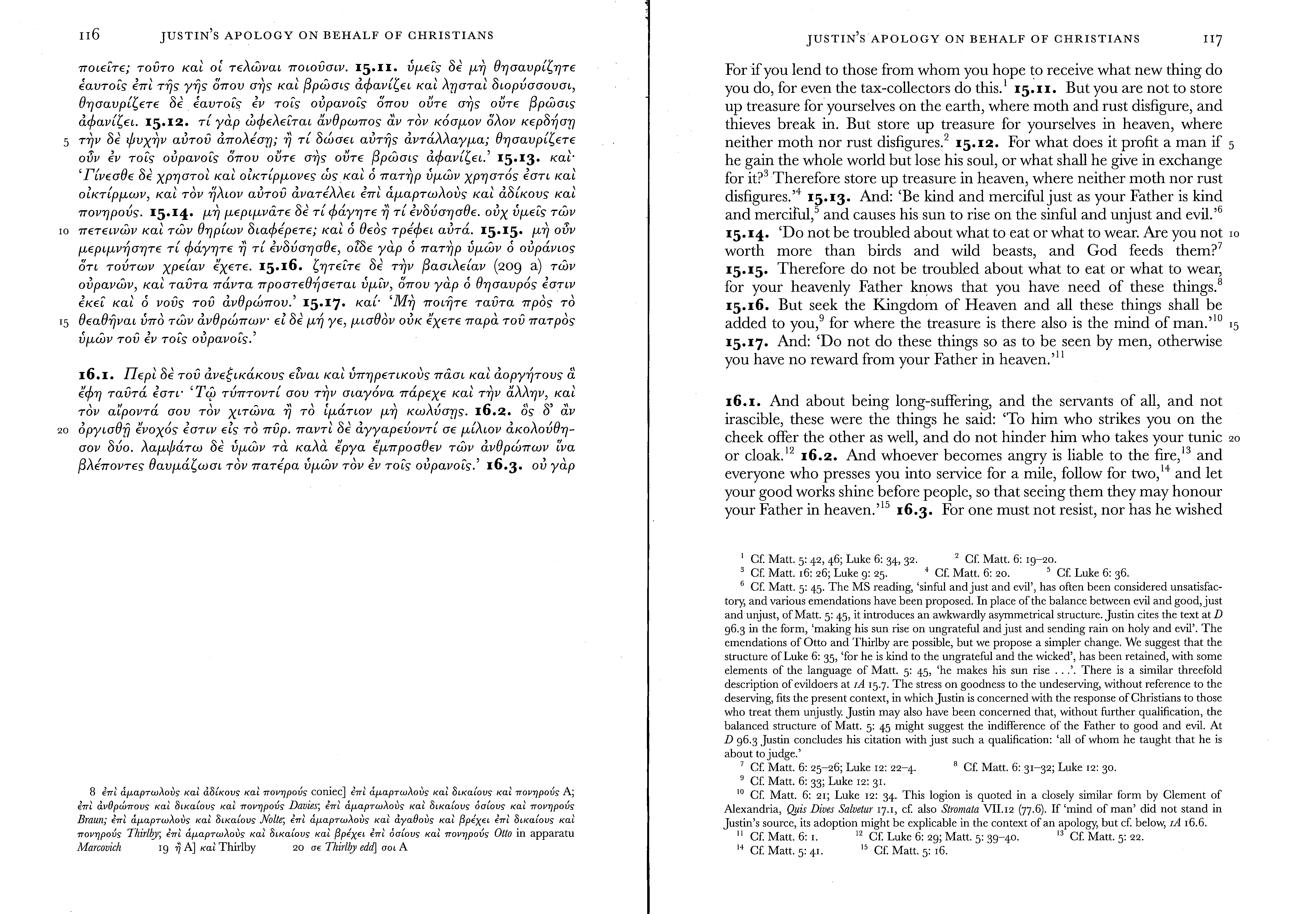
ποιείτε; τουτο και οί τελωναι ποιουσιν. 15.11. ύμείι; δε μ~ θYjσαυρίζητε Forif you lend to those from whom you hope ~o receive what new thing do you do, for even the tax-collectors do this.1 15.11. But you are not to store up treasure for yourselves οη the earth, where moth and rust disfigure, and thieves break in. But store up treasure for yourselves ίη heaven, where neither moth nor rust disfigures~2 15.12. For what does it profit a man if 5 he gain the whole world but lose his soul, or what shall he give ίη exchange for it?3Therefore store up treasure ίη heaven, where neither moth nor rust disfigures.'4 15.13. And: 'Be kind and mercifuljust as your Father is kind and merciful,5 and causes his sun to rise οη the sinful and unjust and evil.'6
15.14. 'Do not be troubled about what to eat or what to wear. Are you not 10 worth more than birds and wild beasts, and God feeds them? 7
Ι ~"
~ ~ t/ , 'β ~ 'Φ ΙΥ , λ ' δ ι εαυτοιι; επι TYjr; YYjr; οπου aYjr; και ρωσιι; α ανιι"ει και τισται ιορυσσουσι, θYjσαυρίζετε δε έαυτοίι; εν τοίι; ουρανοίι; σπου οϋτε σ~ι; οϋτε βρωσιι;
'Φ ΙΥ ι , 'Φ λ ~ ,ι θ '" ι "λ δ ι α ανΙι"ει. 15.12. τι γαρ ω ε ειται αν ρωποι; αν τον κοσμον ο ον κερ Yjav
, δ' ,1, , , ~, λ ι ,,ι δ ι ,~, Ιλλ θ ΙΥ 5 TYjV ε '{-'vXYjV αυτου απο εστι; Yj τι ωσει aVTYjr; αντα αγμα; Yjσαυριι"ετε σΟν εν τοίι; ουρανοίι; σπου οϋτε σ~ι; οϋτε βρωσιι; αΦανίζει.' 15.13. και'
,ι Ι, Ι ,Ι ~ Ι, , ινεσ ε ε ΧΡYjστΟΙ και οικτιρμονει; ωι;και ο πατYjΡ υμων XPYjaTOr; εστι και
,Ι \ 'Ι/λ ,1""\, 'λλ "ι λ'
" δ Ι , οικτιρμων, και τον Yj ιον αυτου ανατε ει επι αμαρτω ουι; και α ικουι; και πονYjρούι;. 15.14. μ~ μεριμνατε δε τί ΦάγYjτε ij τί ενδύσYjσθε. ovx ύμείι; των ι 'Ιθ' ιφ ,ι , l'
πετεινων και των Yjριων ια ερετε; και ο εοι; τρε ει αυτα. 15.15. μΥ} ουν ~ '~θ Ι δ φ μεριμνήσYjτε τί ΦάγYjτε ij τί ενδύσYjσθε, οίδε γαρ ό παT~Ρ ύμων ό ουράνιοι; στι τούτων χρείαν εχετε. 15.16. 'YjTEtTE δε T~ν βασιλείαν ('209 a) των
15.15. Therefore do not be troubled about what to eat or what to wear, for your heavenly Father kηρws that you have need of these things.8
, 1""\ \..... ι θ ι ('
..... ι/ \ (' θ ι, ουρανων, και ταυτα παντα προστε Yjσεται υμιν, οπου γαρ ο YjaaVpOr; εστιν εκεί και ό νουι; του ανθρώπου.' 15.17. καί' 'M~ ποιήτε ταυτα προι; το
15.16. But seek the Κingdom of Heaven and all these things shall be added to you,9 for where the treasure is there also is the mind of man. ' 10 15
15.17. And: 'Do not do these things so as to be seen by men, otherwise you have ηο reward from your Father ίη heaven.,11
~ ι, ~ 'θ Ι 'δ'
,~,
εα Yjναι υπο των αν ρωπων' ει ε μΥ} γε, μισ ον ουκ εχετε παρα του πατροι; ('..... i"'\'
~, t.
Ι l'
,ι ,~"
Π "Φ ,.., Ι,
, Τ .....
Ψ τυπτοντι σου TYjV σιαγονα παρεχε και TYjV α YjV, και 16.1. And about being long-suffering, and the servants of all, and not irascible, these were the things he said: 'Το him who strikes you οη the cheek offer the other as well, and do not hinder him who takes your tunic 20 or cloak. 12 16.2. And whoever becomes angry is liable to the fire,I3 and everyone who presses you into service for a mile, follow for two,14 and let your good works shine before people, so that seeing them they may honour your Father ίη heaven.,15 16.3. For one must not resist, nor has he wished
\ "ι \ .....
\ ('
"δ'" τον αιροντα σου τον χιτωνα Yj το ιματιον μΥ} κω υστιι;. Ι .2. οι; αν , θ""" ι, ,\ 1""\ \ δ \ , / ι 'λ 'λ Ιθ
οργισ τι ενοχοι; εστιν ειι; το πυρ. παντι ε αγγαρευοντι σε μι ιον ακο ου YjΙ λ ,1, Ι δ'
Ι ~ , λ'
,ι " θ ~'θ Ι 'ι σον υο. αμψατω ε υμων τα κα α εργα εμπροσ εν των αν ρωπων ινα δ Ι θ Ι Υ , Ι Ι ~ "
Ι .3. ου γαρ βλ ι Cf. Matt. 5: 42, 46; Luke 6: 34, 32.
2 Cf. Matt. 6: 19-20.
3 Cf. Matt. 16: 26; Luke 9: 25.
4Cf. Matt. 6: 20.
5 Cf. Luke 6: 36.
6 Cf. Matt. 5: 45. The MS reacling, 'sinful andjust and evi1', has often been considered unsatisfactory, and various emendations have been proposed. Ιη place of the balance between evi1 and good, just and unjust, ofMatt. 5: 45, it introduces an awkwardly asymmetrical structure. Justin cites the text at D
96.3 ίη the form, 'making his sun rise οη ungrateful andjust and sending rain οη holy and evi1'. The emendations of Otto and Thirlby are possible, but we propose a simpler change. We suggest that the structure ofLuke 6: 35, 'for he is kind to the ungrateful and the wicked', has been retained, with some elements of the language of Matt. 5: 45, 'he makes his sun rise .. .'. There is a similar threefold description of evi1doers at ιΑ 15.7. The stress οη goodness to the undeserving, without reference to the deserving, fits the present context, ίη which Justin is concerned with the response of Christians to those who treat them unjust1y. Justin may also have been concerned that, without further qualification, the balanced structure of Matt. 5: 45 might suggest the indifference of the Father to good and evi1. At D 96.3 Justin concludes his citation with just such a qualification: 'all of whom he taught that he is about to judge.'
7 Cf. Matt. 6: 25-26; Luke 12: 22-4.
8 Cf. Matt. 6: 31-32; Luke 12: 30.
9 Cf. Matt. 6: 33; Luke 12: 31.
8 Επι άμαρτωλου, και άδίκου, και πονηρού, coniec] Επι άμαρτωλου, και δικαίου, και πονηρού, Α;
ΙΟ Cf. Matt. 6: 21; Luke 12: 34. This logion is quoted ίη a closely similar form by Clement of Alexandria, QjιΊS Dives SαlvetuJ" 17.1, cf. also StToιnαtα VI!.12 (77.6). If 'mind of man' c1id not stand ίη
Justin's source, its adoption might be explicable ίη the context of an apology, but cf. below, ιΑ 16.6.
Επι άνθρώπου, και δικαίου, και πονηρού, Dαvίes; Επι άμαρτωλου, και δικαίου, όσίου, και πονηρού,
Βωun; Επι άμαρτωλου, και δικαίου, Nolte; Επι άμαρτωλου, και άγαθου, και βρέχει Επι δικαίου, και πονηρού, Thirlby; Επι άμαρτωλου, και δικαίου, και βρέχει Επι όσίου, και πονηρού, Qtto ίη apparatu ii Cf. Matt. 6: ι.
12 Cf. Luke 6: 29; Matt. 5: 39-40.
13 Cf. Matt. 5: 22.
Mαrcoviclz 19 1j Α] και Thirlby 20 σε T/ziTlb)I eddJ σοι Α Ι+ Cf. Matt. 5: 41.
15 Cf. Matt. 5: 16.
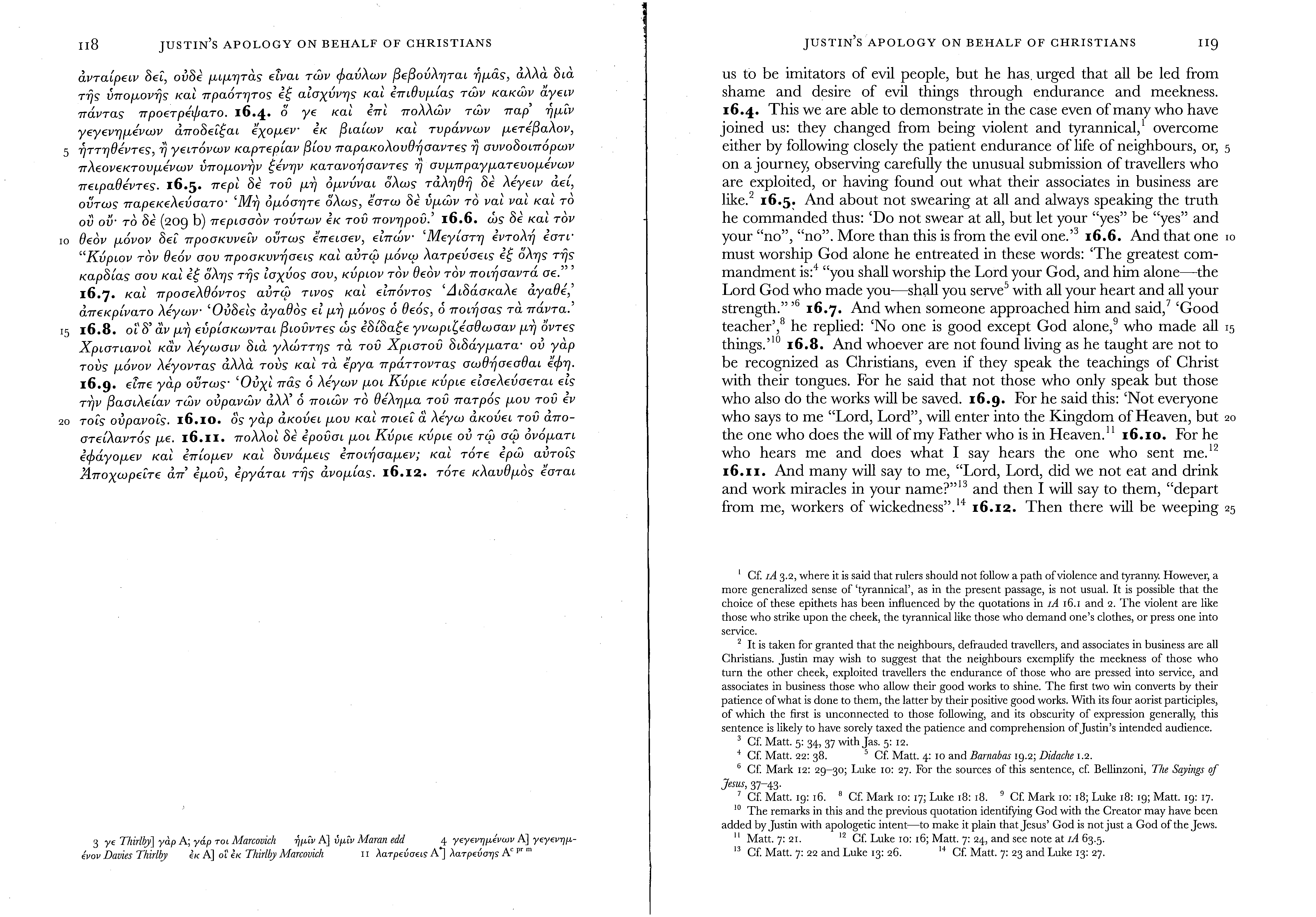
JUSTIN'S APOLOGY ΟΝ BEHALF OF CHRISTIANS
JUSTIN'S APQLOGY ΟΝ BEHALF OF CHRISTIANS
us to be imitators of evil people, but he has. urged that all be led from shame and desire of evil things through endurance and meekness.
16.4. This weare able to demonstrate ίη the case even of many who have joined us: they changed from being violent and tyrannical,1 overcome ανταίρειν δει, ουδε μιμYJτας εΊναι των Φαύλων βεβούλYJται ~μάς, αλλα δια της ύπομονης και ΠΡαόΤYJτος εξ αισχύνYJς και επιθυμίας των κακων αγειν ι ι, /,
<, '" λλ ~ ~ ,ι ~ παντας προετρεψατο. Ι .4. ο γε και επι πο ων των παρ YJμιν ι 'δ ~c"
'β Ι ,Ι 'β λ γεγενYJμενων απο ει~αι εχομεν' εκ ιαιων και τυραννων μετε α ον, either by following closely the patient endurance of life of neighbours, or, 5 ι θ ι "Ι Ι β' λ θ Ι " δ ι 5 YJTTYJ εντες, YJ γειτονων καρτεριαν ιου παρακο ου YJσαντες YJ συν ο οιπορων ι Ι \ t. / Ι 'Ι'
Ι Π εονεκτουμενων υπομονYJν ~ EVYJV κατανΟYJσαντες YJ συμπραγματευομενων οη a journey, observing carefully the unusual submission of travellers who are exploited, or having found out what their associates ίη business are like.2 16.5~ And about not swearing at all and always speaking the truth he commanded thus: 'Do not swear at all, but let your "yes" be "yes" and your 'Ώο", 'Ώο". More than this is from the evil one.,3 16.6. And that one 10 must worship God alone he entreated ίη these words: 'The greatest commandment is:4 "you shall worship the Lord your God, and him alone-the Lord God who made you-sh~ll you serve5 with all your heart and all your strength."'6 16.7. And when someone approached him and saίd,Ί 'Good teacher' ,8 he replied: 'Ν ο one is good except God alone,9 who made all 15 thingS.'lO 16.8. And whoever are not found living as he taught are not to be recognized as Christians, even if they speak the teachings of Christ with their tongues. For he said that not those who οηlΥ speak but those who also do the works will be saved. 16.9. For he said this: 'Not everyone who says to me "Lord, Lord", will enter into the Κingdom of Heaven, but 20 the one who does the will ofmy Father who is ίη Heaven. 11 16.10. For he who hears me and does what Ι say hears the one who sent me. 12 λ ι
' δ'
~ "Ι "λ 'λ θ ~ δ' λ ι ,Ι πειΡα εντες. Ι .5. περι ε του μΥ] ομνυναι ο ως τα YJ YJ ε εγειν αει, θ ούτως παρεκελεύσατο' 'Μη ομόσYJτε όλως, εστω δε ύμων το ναι ναι και το
" "
'δ' (b) ,Ι, ~ ~, 6 6 Ι δ'
" ου ου' το ε 209 περισσον τουτων εκ του nOVYJPOV. ι . . ως ε και τον 10 θεον μόνον δει προσκυνειν ούτως επεισεν, ειπών' 'ΜεγίσΤΥ] εντολή έστι'
"Κύριον τον θεόν σου προσκυνήσεις και αυτψ μόνψ λατρεύσεις έξ όλYJς της καρδίας σου και έξ όλYJς της ισχύος σου, κύριον τον θεον τον ποιήσαντά σε.'"
16.7. και προσελθόντος αυτψ τινος και ειπόντος 'Διδάσκαλε αγαθέ,' απεκρίνατο λέγων' 'ουδεις αγαθος ει μη μόνος ό θεός, ό ποιήσας τα πάντα.'
6 8 c' δ' "
Ι • • οι αν μΥ] ευρισκωνται ιουντες ως ε ι α~ε γνωρι,=>εσ ωσαν μΥ] οντες Χριστιανοι καν λέγωσιν δια γλώΤΤYJς τα του Χριστου διδάγματα' ου γαρ
, ι λ ι 'λλ"" "Ι θ ι θ "Φ τους μονον εγοντας α α τους και τα εργα πραττοντας σω YJaEa αι ε YJ.
16.9. εΊπε γαρ ούτως' Όυχι πάς ό λέγων μοι Κύριε κύριε εισελεύσεται εις την βασιλείαν των ουρανων αλλ' ό ποιων το θέλYJμα του πατρός μου του έν
20 τοις ουρανοΙς. 16.10. ος γαρ ακούει μου και ποιει α λέγω ακούει του απο στείλαντός με. 16.11. πολλοι δε έρουσι μοι Κύριε κύριε ου Τψ σψ ονόματι
'Φ ι , , Ι \ δ ι ,Ι \ Ι 'f'\ , ...... ε αγομεν και επιομεν και υναμεις εΠΟΙYJσαμεν; και τοτε ερω αυτοις
16.11. And many will say to me, "Lord, Lord, did we not eat and drink and work miracles ίη your name?,,13 and then Ι will say to them, "depart from me, workers of wickedness".14 16.12. Then there will be weeping 25
Ά.ποχωρεΙτε απ' έμου, εργάται της ανομίας. 16.12. τότε κλαυθμος εσται ι Cf. ιΑ 3.2, where it is said that rulers should not follow a path ofνiolence and tyranny. However, a more generalized sense of 'tyrannical', as in the present passage, is not usual. It is possible that the choice of these epithets has been influenced by the quotations in ιΑ 16.1 and 2. The νiolent are like those who strike upon the cheek, the tyrannicallike those who demand one's clothes, ΟΓ press one into serνice.
2 It is taken for granted that the neighbours, defrauded travellers, and associates in business are all
Christians. Justin may wish to suggest that the neighbours exemplify the meekness of those who turn the other cheek, exploited travellers the endurance of those who are pressed into serνice, and associates in business those who allow their good works to shine. The first two win converts by their patience ofwhat is done to them, the latter by their positive good works. With its four aorist participles, of which the first is unconnected to those following, and its obscurity of expression general1y, this sentence is likely to have sorely taxed the patience and comprehension of Justin's intended audience.
3 Cf. Matt. 5: 34,37 withJas. 5: 12.
4Cf. Matt. 22: 38.
5 Cf. Matt. 4: 10 and Bα1'1lαbαs 19.2; Didαche 1.2.
6 Cf. Mark 12: 29-30; Luke 10: 27. For the sources of this sentence, cf. Bellinzoni, The Sαyiιzgs qf
Jesus, 37-43· 7 Cf. Matt. 19: 16.
Β Cf. Mark 10: η; Luke 18: 18.
9 Cf. Mark 10: 18; Luke 18: 19; Matt. 19: η.
ΙΟ The remarks in this and the preνious quotation identifYing God with the Creator may have been added by Justin with apologetic intent-to make it plain that Jesus' God is not just a God of the Jews. ii :Nlatt. 7: 21.
12 Cf. Luke 10: 16; Matt. 7: 24, and see note at ιΑ 63.5.
3 γε T/zirlby] ydp Α; γάρ ΤΟΙ Aιfαrcovich ήμιν Α] ύμιν Μαωιι edd 4 γεγενημένων Α] γεγενημ13 Cf. Matt. 7: 22 and Luke 13: 26. l4 Cf. Matt. 7: 23 and Luke 13: 27. ένον Dαvies Thirlby εκ Α] 0[' εκ Thirlby Mαrcovich ΙΙ λατΡεύσεις Α Ί λατρεύσης Ν ρτ m
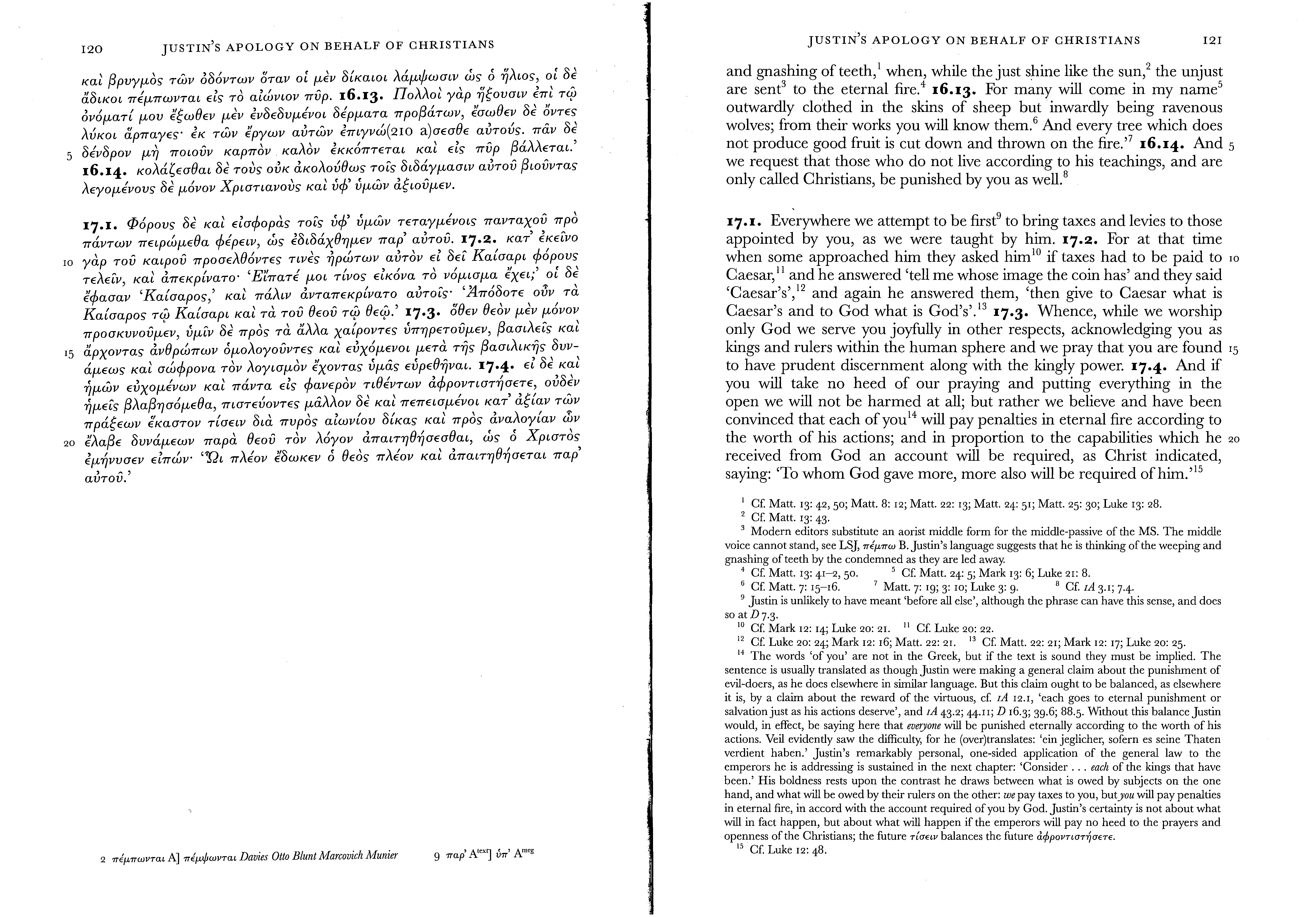
JUST1N'S APOLOGY ΟΝ BEHALF OF CHR1ST1ANS
JUST1N'S APOLOGY ΟΝ BEHALF OF CHR1ST1ANS
\ \ Λ 'δ ι "
Ι \ δ ι λ ι ./, Ι Ι "λ Ι δ \ και βρυγμοι:; των ο οντων οταν οι μεν ικαιοι αμψωσιν ωι:; ο Ύj ιοι:;, ΟΙ ε and gnashing of teeth, 1 when, while the just spine like the SUn,2 the unjust are sent3 to the eternal fire. 4 16.13. For many will come ίη my names ι ι ,\ ,Ι Λ
Π λλ \ \ " t ,\ Λ άδικοι πεμπωνται ειι:; το αιωνιον πυρ. ι .13. ο οι γαρ Ύj~ ουσιν επι Tl{J ,ι ι ,It θ \, δ δ ι δ ι β ι "θ δ \ ,ι ονοματι μου εςω εν μεν εν ε υμενοι ερματα προ ατων, εσω εν ε οντει:; outwardly clothed ίη the skins of sheep but . inwardly being ravenous wolves; from their works you will know them. 6 And every tree which does not produce good fruit is cut down and thrown οη the fire.'7 16.14. And 5 we request that those who do not live according to his teachings, and are λύκοι αρπαγει:;' Εκ των εργων αυτων Επιγνώ(210 a)aEaeE αυτούι:;. παν δε ι δ \ Λ \ λ \ ,Ι \ , Λ β ι λλ '
16.14. κολάζεσθαι δε τουι:; ουκ άκολούθωι:; τοιι:; διδάγμασιν α-Ιπού βιούνται:; δ οηlΥ called Christians, be punished by you as well. 8 ι δ \ Ι Χ \ \ ΙΦ' Ι Λ , t Λ εγομενουι:; ε μονον ριστιανουι:; και υ υμων α~ ιουμεν. λ ι δ \ \, Φ \ Λ ΙΦ'
Ι Λ Ι Λ \ 17.1.
()ρουι:; ε και εισ οραι:; τοιι:; υ υμων τεταγμενοιι:; πανταχου προ 17. ι. Everywhere we attempt to be first9 to bring taxes and levies to those appointed by you, as we were taught by him. 17.2. For at that time when some approached him they asked him 10 if taxes had to be paid to !Ο
Caesar, 11 and he answered 'tell me whose image the coin has' and they said 'Caesar's',12 and again he answered them, 'then give to Caesar what is
Caesar's and to God what is GOd's'.13 17.3. Whence, while we worship Φ ι ι θ Φ ι Ι 'δ δ ι θ '
, Λ "
Λ παντων πειΡωμε α ερειν, ωι:; ε ι αχ Ύjμεν παρ αυτου. 17.2. κατ εκεινο \ Λ λθ ι \' Ι ,\, δ Λ Τ.Τ ι Φ ι !Ο γαρ τού καιΡου προσε οντει:; τινει:; ΎjpωTων αυτον ει ει nαισαρι ορουι:; "
Ι 'Ε'" ι ,Ι ,Ι '" ι δ \ τελειν, και απεκρινατο' ιπατε μοι τινοι:; εικονα το νομισμα εχει; οι ε "
,1""\, 'Λ
'δ 'i'
'Ιθ θ \ \ Ι Καισαροι:; Τψ nαισαρι και τα του εου Tl{J El{J. 17.3. ο εν εον μεν μονον οηlΥ God we serve you joyfully ίη other respects, acknowledging you as kings and rulers within the human sphere and we pray that you are found 15 to have prudent discernment along with the kingly power. 17.4. And if you will take ηο heed of our praying and putting everything in the open we will not be harmed at all; but rather we believe and have been convinced that each of you 14 will pay penalties ίη eternal fire according to the worth of his actions; and in proportion to the capabilities which he 20 received from God an account will be required, as Christ indicated, saying: 'Το whom God gave more, more also will be required ofhim.'1S προσκυνούμεν, ύμιν δε προι:; τα αλλα χαίροντει:; ύΠΎjpεTOύμεν, βασιλεLι:; και
αρχονται:; αν ρωπων ομο ογουντει:; και ευχομενοι μετα TΎjΙ:; ασι ΙKΎjΙ:; υνι \ ιφ \ λ \ ,ι Ι Λ Ι θ Λ , δ \ \ αμεωι:; και σω ρονα τον ογισμον εχονται:; υμαι:; ευρε Ύjναι. 17.4. ει ε και Ι Λ ,Ι \ Ι 'Φ \ θ ι 'Φ ι 'δ \ Ύjμων ευχομενων και παντα ειι:; ανερον τι εντων α pOντισTΎjσεTε, ου εν ΤΙμειι:; βλαβΎjσόμεθα, πιστεύοντει:; μαλλον δε και πεπεισμένοι κατ' άξίαν των
't" ι δ \ \ , Ι δΙ \ \ , λ Ι ... πρας εων εκαστον τισειν ια πυροι:; αιωνιου ικαι:; και προι:; ανα ογιαν ων Ι θ Ι Ι Χ \
ελα ε υναμεων παρα εου τον ογον απαιTΎj Ύjσεσ αι, ωι:; ο ριστοι:; ,ι β δ Ι \ θ Λ \ λ Ι , θ , Ι ,ι 'Ώ λ Ι "δ Ι θ \ λ Ι \ , θ Ι , εμΎjνυσεν ειπων' ι π εον ε ωκεν ο εοι:; π εον και απαΙTΎj ΎjσεTαι παρ , Λ' αυτου. ι Cf. Matt. 13: 42, 50; Matt. 8: 12; Matt. 22: 13; Matt. 24: 51; Matt. 25: 30; Luke 13: 28.
2 Cf. Matt. 13: 43.
3 Modern editors substitute an aorist middle form for the middle-passive of the MS. The middle voice cannot stand, see LSJ, πέμπω Β. Justin's language suggests that he is thinking of the weeping and gnashing of teeth by the condemned as they are led away.
4 Cf. Matt. 13: 41-2, 50.
5 Cf. Matt. 24: 5; Mark 13: 6; Luke 21: 8.
6 Cf. Matt. 7: 15-16.
7 Matt. 7: 19; 3: !Ο; Luke 3: 9.
8 Cf. ιΑ 3·1; 7+ 9 Justin is unlikely to have meant 'before aΠ else', although the phrase can have this sense, and does so atD7.3.
10 Cf. Mark 12: 14; Luke 20: 21.
II Cf. Luke 20: 22.
12 Cf. Luke 20: 24; Mark 12: 16; Matt. 22: 21.
13 Cf. Matt. 22: 21; Mark 12: 17; Luke 20: 25.
14 The words 'of you' are not in the Greek, but if the text is sound they must be implied. The sentence is usuaΠy translated as though Justin were making a general claim about the punishment of evil-doers, as he does elsewhere in similar language. But this claim ought to be balanced, as elsewhere it is, by a claim about the reward of the virtuous, cf. ιΑ 12.1, 'each goes to eternal punishment ΟΓ salvation just as his actions deserve', and ιΑ 43.2; «.π; D 16.3; 39.6; 88.5. Without this balance Justin would, in effect, be saying here that every01le will be punished eternaΠy according to the worth of his actions. Veil evidently saw tlle difficulty, for he (over)translates: 'ein jeglicher, sofern es seine Thaten verdient haben.' Ju~tin's remarkably personal, one-sided application of the general law to the emperors he is addressing is sustained ίη the next chapter: 'Consider ... eαch of the kings that have been.' His boldness rests upon the contrast he draws between what is owed by subjects οη the one hand, and what will be owed by their γulers οη the other: we pay taxes to you, butyou will pay penalties ίη eternal fire, ίη accord with the account required of you by God. Justin's certainty is not about what will ίη fact happen, but about what will happen if the emperors will pay ηο heed to the prayers and openness ofthe Christians; the future τ{σειν balances the future dΦροντιστήσετε.
15 Cf. Luke 12: 48.
2 πέμπωνται Α] πέμψωνται Dαvies Otto Blunt lYfαrcovich Aιfunier
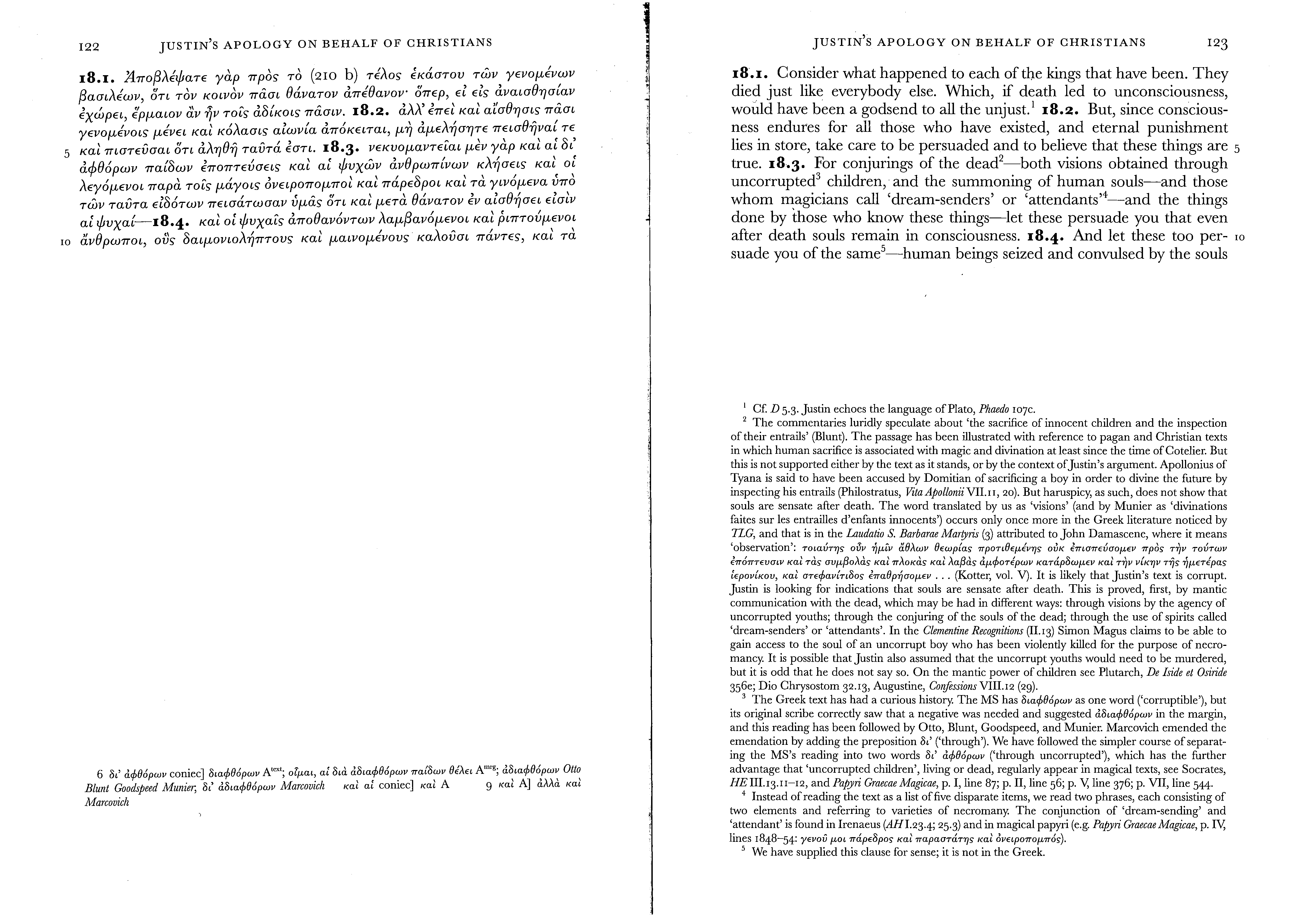
JUST1N'S APOLOGY ΟΝ BEHALF OF CHR1ST1ANS
JUST1N'S APOLOGY ΟΝ BEHALF OF CHR1ST1ANS
18.1. Consider what happened to each oftb.e kings that have been. They die? just like everybody else. Which, if death led to unconsciousness, would have been a godsend to all the unjust. 1 18.2. But, since consciousness endures for all those who have existed, and eternal punishment lies in store, take care to be persuaded and to believe that these things are 5 true. 18.3. For conjurings of the dead2-both visions obtained through uncorrupted3 children,· and the summoning of human souls-and those whom ~agicians call 'dream-senders' ΟΓ 'attendants,4--and the things done by those who know these things-let these persuade you that even after death souls remain in consciousness. 18.4' And let these too per-
suade you ofthe same5-human beings seized and convulsed by the souls 18.1. Ά.ποβλέΨατε γαρ προς το (210 b) τέλος έκάστου των γενομένων
' fl \ \ .... θ'
"θ t/ '" θ' βασι εων, οτι τον κοινον πασι ανατον απε ανον· οπερ, ει εις αναισ ησιαν
"r/ "
\ ,,' θ ..... εχωρει, ερμαιον αν ην τοις α ικοις πασιν. Ι .2. α επει και αισ ησις πασι λ ι ι \ 'λ ,Ι, Ι \, λ ι θ .... ι γενομενοις μενει και κο ασις αιωνια αποκειται, μη αμε ησητε πεισ ηναι τε
, t/ 'λ θ....
....
Ι '8
....
\ \ \ Ι δ'
'δ'
'. ,< ,1, ~ 'θ ' λ'
Ι, ,\ Ι δ ,\ Ι ('
\ λεγομενοι παρα τοις μαγοις ονειΡοπομποι και παρε ροι και τα γινομενα υπο 'δΙ ι ('
,.. ι/ \ 'θ'
" θ'
,< ,1, ~, θ' λ β'
, < , αί ψυχαι-Ι .4. και οι ψυχαις απο ανοντων αμ ανομενοι και ριπτουμενοι "θ t' δ λ'
, , λ ~, "
αν ρωποι, ους αιμονιο ηπτους και μαινομενους κα ουσι παντες, και τα ι C[ D 5.3. Justin echoes the language ofPlato, Phαedo I07C.
2 The cοmmentaήes luridly speculate about 'the sacrifice of innocent children and the inspection of their entrails' (Blunt). The passage has been illustrated with reference to pagan and Christian texts in which human sacrifice is associated with magic and divination at least since the time of Cotelier. But this is not supported either by the text as it stands, or by the context ofJustin's argument. Apollonius of Tyana is said to have been accused by Domitian of sacrificing a boy in order to divine the future by inspecting his entrails (Philostratus, VίtαΑΡοlΙοnίίVI1.ιι, 20). But haruspicy, as such, does not show that souls are sensate after death. The word translated by us as 'visions' (and by Munier as 'divinations faites sur les entΓailles d'enfants innocents') occurs only once more in the Greek literature noticed by nG, and that is in the Lαudαtio S. Bαrbαrαe Μαι-tyι1s (3) attributed to John Damascene, where it means
'observation': τοιαύτης ουν ΤΙμιν άθλων θεωρίαs προτιθεμένηs ουκ έπισπεύσομεν προs την τούτων έπόπτευσιν και rds συμβολαs και πλοκαs και λαβαs αμΦοτέρων κατάρδωμεν και την νίKΗV τψ ΤΙμετέραs ίερονίκου, και στεΦανίτιδοs έπαθρήσομεν ... (Kotter, νοΙ V). 1t is likely that Justin's text is corrupt.
Justin is looking for indications that souls are sensate after death. This is proved, first, by mantic communication with the dead, which may be had ίη different ways: through visions by the agency of uncorrupted youths; through the conjuring of the souls of the dead; thΓOugh the use of spirits cal1ed
'dream-senders' or 'attendants'. 1η the Clementine Recognitions (11.13) Simon Magus claims to be able to gain access to the soul of an uncorrupt boy who has been violently killed for the purpose of necromancy. 1t is possible that Justin also assumed that the uncorrupt youths would need to be murdered, but it is odd that he does not say so. Οη the mantic power of children see Plutarch, De ISΊde et OSΊ,ide
356e; Dio Chrysostom 32.13, Augustine, Conftssions VIII.12 (29).
3 The Greek text has had a curious history. The MS has διαΦθόρων as one word ('corruptible'), but its original scribe correctly saw that a negative was needed and suggested αδιαΦθόρων in the margin, and this reading has been followed by Otto, Blunt, Goodspeed, and Munier. Marcovich emended the emendation by adding the preposition δι' ('through'). We have followed the simpler course of separating the MS's reading into two words δι' αΦθόρων ('thΓOugh uncorrupted'), which has the further advantage that 'uncorrupted children', living or dead, regularly appear ίη magical texts, see Socrates,
6 δι' αΦθόρων coniec] διαΦθόρων Next; οίμαι, αί δια αδιαΦθόρων παίδων θέλει Affirg; αδιαΦθόρων Otto
Blunt Goodspeed Munier, δι' αδιαΦθόρων Mαrcoviclz και αί coniec] και Α 9 και Α] αλλα και ΗΕΠ1.Ι3·ΙΙ-12, and ΡαΡΥτί Grαecαe Mαgicαe, ρ. Ι, line 87; ρ. Π, line 56; ρ. V, line 376; ρ. VI1, line 544.
4, 1nstead of reading the text as a list of five disparate items, we read two phrases, each consisting of two elements and referring to varieties of necromany. The conjunction of 'dream-sending' and 'attendant' is found in 1renaeus (ΑΗ1.23-4; 25.3) and in magical papyri (e.g. PαpYIi GrαecαeMαgicαe, ρ. rv, lines 1848-54: γενού μοι πάρεδροs και παραστάτηs και ΟνειΡοπομπόs).
Mαrcoviclz 5 We have supplied this clause for sense; it is not in the Greek.
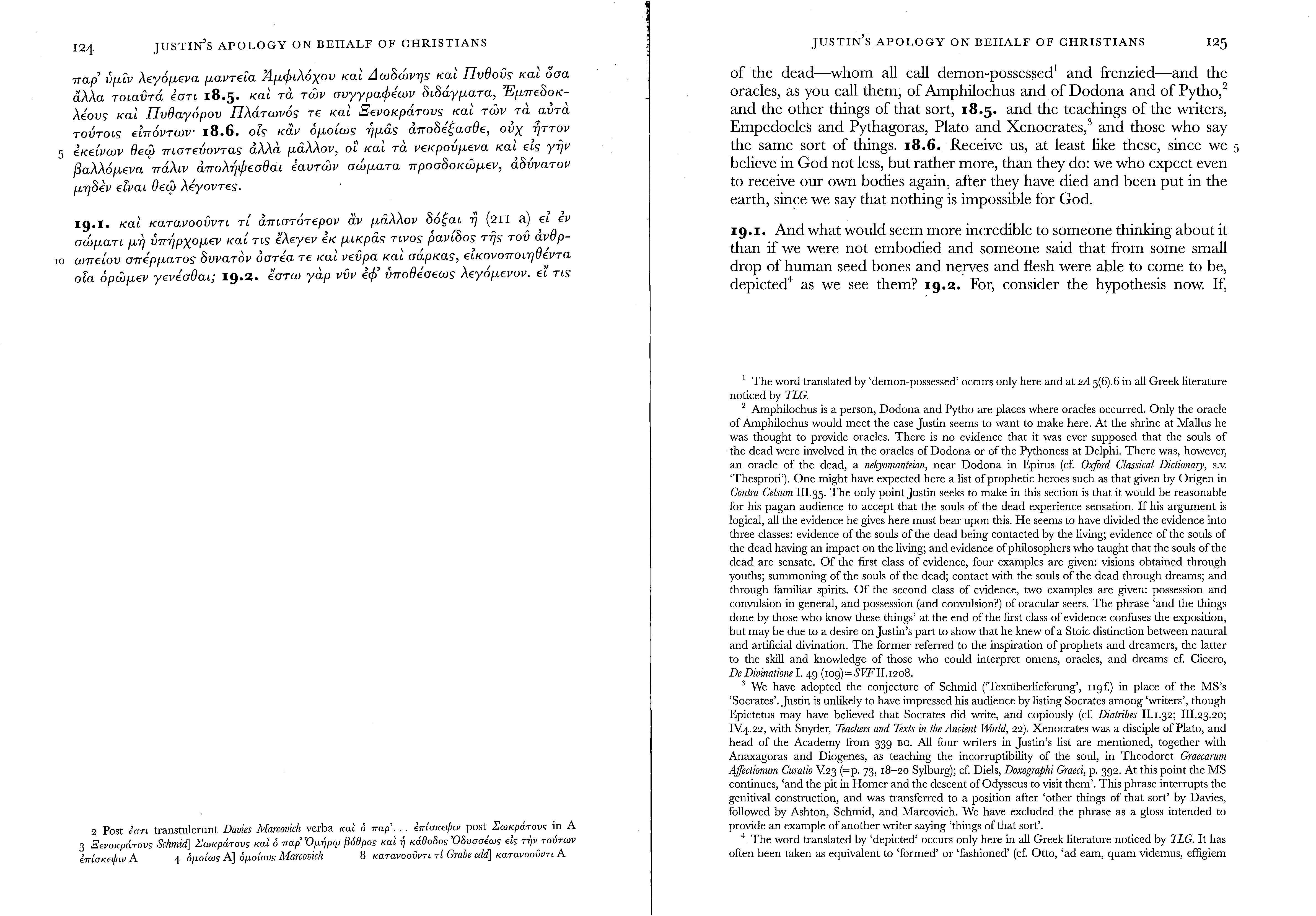
JUSTIN'S APOLOGY ΟΝ BEHALF OF CHR1STIANS
JUSTIN'S APOLOGY ΟΝ BEHALF OF CHR1STIANS
,( λ ι Λ 'Λ Φ λ ι \ Δ δ ι \ Π θ Λ \ rι 7Ταρ υμιν εγομενα μαντεια Iiμ ι οχου και ω ωνψ; και υ ους και οσα ofthe dead-whom all call demon-possessed! and frenzied-and the oracles, as you call them, of Amphilochus and. of Dodona and of Pytho, 2 and the otherthings of that sort, 18.5. and the teachings of the writers,
Empedocles and Pythagoras, Plato and Xenocrates,3 and those who say the same sort of things. 18.6. Receive us, at least like these, since we 5 believe ίn God not less, but rather more, than they do: we who expect even to receive our own bodies again, after they have died and been put ίn the earth, sin~e we say that nothing is impossible for God. αλλα τοιαυτά έστι 18.5. και τα των συγγραΦέων διδάγματα, Έμ7Τεδοκι
\ ) \ λεους και υ αγορου . ατωνος τε και ι!:!ιενοκρατους και των τα αυτα τούτοις εΙ7Τόντων' 18.6. ο'[ς καν όμο{ως ήμας α7Τοδέξασθε, ούχ ήττον
5 έκε{νων θεω 7Τιστεύοντας αλλα μαλλον, οί' και τα νεκρούμενα και εις γην βαλλόμενα ·7Τάλιν α7Τολψμε σθαι έαυτων σώματα 7Τροσδοκωμεν, αδύνατον μrιδεν εΊναι θεψ λέγοντες.
19.1. και κατανοουντι τι α7Τιστοτερον αν μα ον o~αι rι 2ΙΙ a ει εν 19. ι. And what would seem more incredible to someone thinking about it than if we were not embodied and someone said that from some small drop of human seed bones and ne~es and flesh were able to come to be, depicted4 as we see them? ~9.2. For, consider the hyρothesis now. If, σώματι μη ύ7T~pxoμεν κα{ τις ελεγεν έκ μικρας τινος ραν{δος της του ανθρι ι δ \, Ι 'ι""\ \ Ι , θ'
ω7Τειου σ7Τερματος υνατον οστεα τε και νευρα και σαρκας, εΙKOν07TOΙrι εντα ~ ( ι θ ,,\ Λ 'Φ' ( θ ι λ Ι ,/ οία ορωμεν γενεσ αι; 19.2. εστω γαρ νυν ε υ7ΤΟ εσεως εγομενον. ει τις ι The word translated by 'demon-possessed' occurs only here and at 2Α 5(6).6 in all Greek literature noticed by TLG.
2 Amphilochus is a person, Dodona and Pytho are places where oracles occurred. ΟηΙΥ the oracle of Amphilochus would meet the case Justin seems to want to make here. At the shrine at Mallus he was thought to provide oracles. There is ηο evidence that it was ever supposed that the souls of the dead were involved ίη the oracles of Dodona ΟΓ of the Pythoness at Delphi. There was, however, an oracle of the dead, a nekyomαllteioll, near Dodona ίη Epirus (cf. Oiford Clαssicαl Dictionαry, S.\T.
'Thesproti'). One might have expected here a list of prophetic heroes such as that given by Origen ίη
COlltτα Celsll1Il Π1.35. The οηlΥ point Justin seeks to make ίη this section is that it would be reasonable for his pagan audience to accept that the souls of the dead experience sensation. If his argument is logical, all the evidence he gives here must bear upon this. He seems to have divided the evidence into three classes: evidence of the souls of the dead being contacted by the living; evidence of the souls of the dead having an impact οη the living; and evidence of philosophers who taught that the souls of the dead are sensate. Of the first class of evidence, four examples are given: visions obtained through youths; summoning of the souls of the dead; contact with the souls of the dead through dreams; and through familiar spirits. Of the second class of evidence, two examples are given: possession and conνulsion in general, and possession (and conνulsion?) of oracular seers. The phrase 'and the things done by those who know these things' at the end of the first class of evidence confuses the exposition, but may be due to a desire οη Justin's part to show that he knew of a Stoic distinction between natural and artificial divination. The former referred to the inspiration of prophets and dreamers, the latter to the skill and knowledge of those who could interpret omens, oracles, and dreams cf. Cicero,
De Divillαtiolle 1.49 (109)=SJ7FII.I208.
3 We have adopted the conjecture of Schmid ('Textίiberlieferung', II9f.) in place of the MS's
'Socrates'. Justin is unlikely to have impressed his audience by listing Socrates among 'writers', though
Epictetus may have believed that Socrates did write, and copiously (cf. Diαtribes Π.Ι.32; Π1.23.20;
Ν.4.22, vvith Snyder, Teαclze/J αlld Texts ίιι tlze Allciellt fιlιΌrld, 22). Xenocrates was a disciple ofPlato, and head of the Academy from 339 BC. All four writers ίη Justin's list are mentioned, together with Anaxagoras and Diogenes, as teaching the incorruptibility of the soul, in Theodoret Grαecαrum
A.ffiCtiOllUlll Cuταtio Υ.23 (=ρ. 73, 18-20 Sylburg); cf. Diels, Doxogταplli Grαeci, ρ. 392. At this point the MS continues, 'and the pit ίη Homer and the descent ofOdysseus to visit them'. This phrase interrupts the genitival construction, and was transferred to a position after 'other things of that sort' by Davies, followed by Ashton, Schmid, and Marcovich. We have excluded the phrase as a gloss intended to provide an example of another writer saying 'things of that sort'.
2 Post εστι transtulerunt Dαvies Mαrcoviclz verba και ό παρ'. .. επίσΚΕψιν post Σωκράτους ίη Α
3 ΞΕνοκράτους SchmidJ Σωκράτους και ό παρ' Όμ:ήρφ βόθρος και Τι κάθοδος 'Οδυσσέως Εις την τούτων
4 The word translated by 'depicted' occurs οηlΥ here ίη all Greek literature noticed by TLG. 1t has often been taken as equivalent to 'formed' ΟΓ 'fashioned' (cf. Otto, 'ad eam, quam videmus, effigiem επίσΚΕψιν Α 4 όμοίως Α] όμοίους Mαrcoviclz 8 κατανοουντι τί GTαbe eddJ κατανοουντι Α
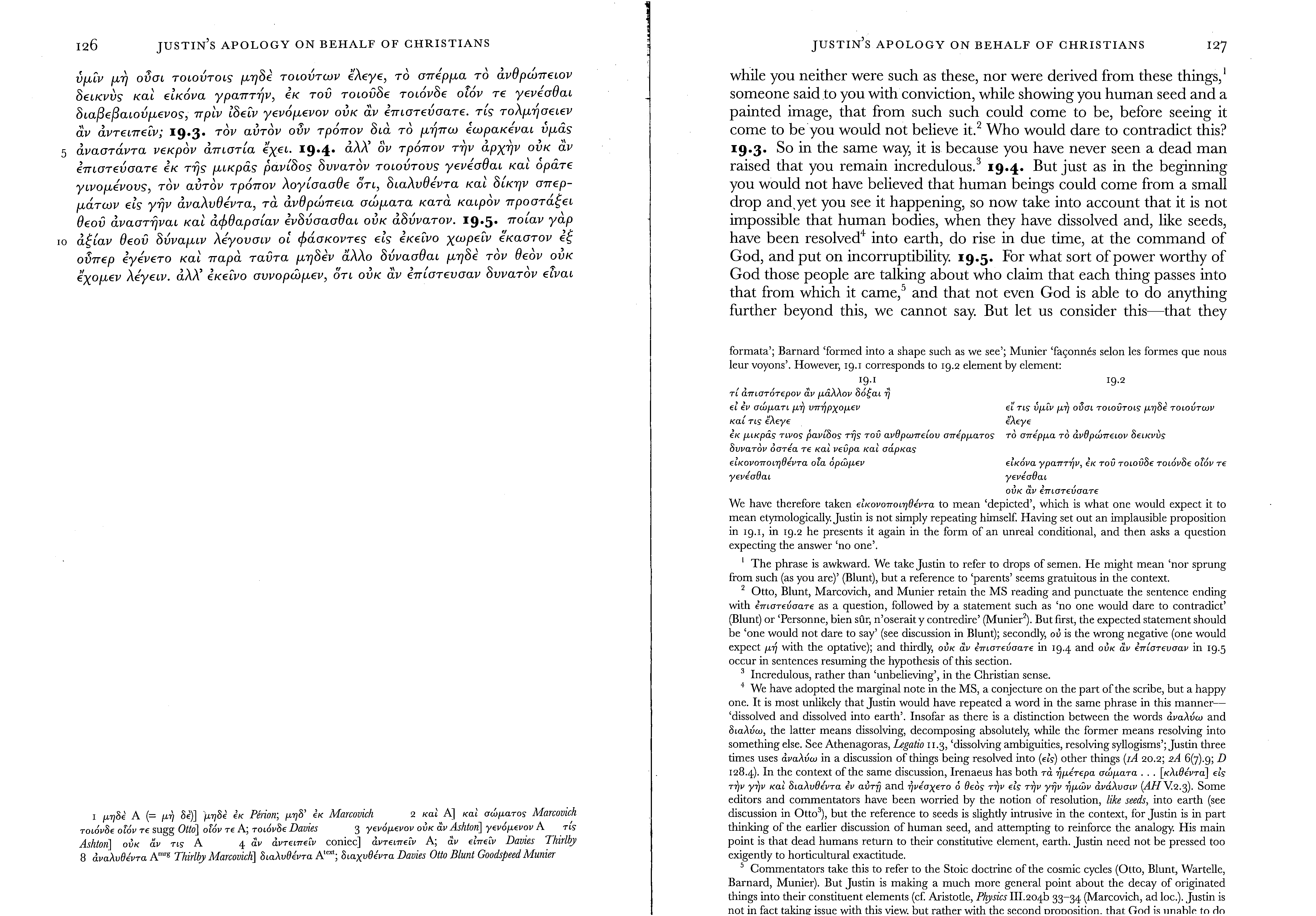
JUST1N'S APOLOGY ΟΝ BEHALF OF CHR1STIANS
JUSTIN'S APOLOGY ΟΝ BEHALF OF CHRISTIANS
,~ Ι δ' ι "λ \ ι \, θ ι υμιν μη ούσι τοιουτοιS' μη ε τοιουτων ε εγε, το σ'Περμα το αν ρω'Πειον while you neither were such as these, nor were derived from these things, ι someone said .to you with conviction, while showing you human seed and a painted image, that from such such could come to be, before seeing it come to be·you would not believe ίι \ "Ι Ι'''''''''δ / δ 'ί' ι ι θ δεικνυS' και εικονα γρα'Πτην, εκ του τοιου ε τοιον ε οιον τε γενεσ αι ββ / \'δ Λ / , ,\, / / λ/ δια ε αιουμενοS', 'Πριν ι ειν γενομενον ουκ αν ε'Πιστευσατε. TιS' το μησειεν
'Ι",..
"\ l' ι δ' \ Ι ('
,Ι "Ι "
, λλ' C\ ι \, \ , 'Ι'
5 ανασταντα νεκρον α'Πιστια εχει. 19.4. α ον τρο'Πον την αρχην ουκ αν 2 Who would dare to contradict this?
19.3. So ίη the same way, it is because you have never seen a dead man raised that you remain incredulous. 3 19.4. But just as ίη the beginning you would not have believed that human beings could come from a small drop and, yet you see it happening, so now take into account that it is not impossible that human bodies, when they have dissolved and, like seeds, have been resolved4 into earth, do rise in due time, at the command of God, and put οη incorruptibility. 19.5. For what sort ofpower worthy of God those people are talking about who claim that each thing passes into that from which it came,5 and that not even God is able to do anything further beyond this, we cannot say. But let us consider this-that they ε'Πιστεύσατε εκ TYιS' μικραS' ρανίδοS' δυνατον τοιούτουS' γενέσθαι και άρατε
/ \' \ / λ / θ rι δ λ θ/ \ δ/ γινομενουS', τον αυτον τρο'Πον ογισασ ε οτι, ια υ εντα και ικην σ'Περ- / , Λ , λ θ/ \ , θ / / \ \ /(; ματων ειS' γην ανα υ εντα, τα αν ρω'Πεια σωματα κατα καιΡον 'ΠpoσTα~ει θ Λ'
Λ \ 'Φθ / , δ / θ "δ / / \ εου αναστηναι και α αρσιαν εν υσασ αι ουκ α υνατον. 19.5. 'Ποιαν γαρ
, (;/ θ δ / λ / Ι Φ / , , Λ Λ </ '(; ΙΟ ας ιαν εου υναμιν εγουσιν οι aaKOVTES' ειS' εκεινο χωρειν εκαστον ε~ ~ , / \ \ Λ δ \ "λλ δ / θ δ \ \ θ \ , ού'Περ εγενετο και 'Παρα ταυ τα μη εν α ο υνασ αι μη ε τον εον ουκ " λ / , λλ"
...
,.. ιl "" ι δ' l' εχομεν εγειν. α εκεινο συνορωμεν, οτι ουκ αν ε'Πιστευσαν υνατον ειναι formata'; Barnard 'formed into a shape such as we see'; Munier 'faςοηηes selon les formes que nous leur voyons'. However, 19.Ι corresponds to 19.2 element by element:
19·1 19·2 τί α7Τιστότερον αν μαλλον δόξαι τι ει εν σώματι μη υ7Τήρχομεν εϊ τι, ύμιν μη οδσι τοιουτοι, μ7]δε τοιούτων καί τι, ελεγε ελεγε εκ μικρα, τινο, ρανίδο, τη, του ανθρω7Τείου σ7Τέρματο, το σ7Τέρμα το ανθρώ7Τειον δεικνυ, δυνατον σστέα τε και νευρα και σάρκα, εικονΟ7ΤΟΙ7]θέντα οία όρωμεν εικόνα γρα7Ττήν, εκ του τοιουδε τοιόνδε οίόν τε γενέσθαι γενέσθαι ουκ αν ε7Τιστεύσατε We have therefore taken εικονΟ7ΤΟΙ7]θέντα to mean 'depicted', which is what one would expect it to mean etymologically.Justin is not simply repeating himself. Having set out an implausible proposition in 19.1, ίη 19.2 he presents it again ίη the fΟΓm of an unreal conditional, and then asks a question expecting the answer 'πο one'. ι The phrase is awkward. We take Justin to refer to drops of semen. He might mean 'ποτ sprung from such (as you are)' (Blunt), but a reference to 'parents' seems gratuitous in the context.
2 Otto, Blunt, Marcovich, and Munier retain the MS reading and punctuate the sentence ending with ε7Τιστεύσατε as a question, followed by a statement such as 'πο one would dare to contradict'
(Blunt) οτ 'Personne, bien sίlr, n'oserait Υ contredire' (Munier2). But first, the expected statement should be 'one would not dare to say' (see discussion ίη Blunt); secondly, ου is the wrong negative (one would expect μή with the optative); and thirdly, ουκ αν ε7Τιστεύσατε in Ι9-4 and ουκ αν ε7TίσTΕVσαν ίη 19.5 occur ίη sentences resuming the hypothesis of this section.
3 1ncredulous, rather than 'unbelieving', ίη the Christian sense.
4 We have adopted the marginal note in the MS, a conjecture οη the part ofthe scribe, but a happy one. 1t is most unlikely that Justin would have repeated a word ίη the same phrase ίη this manner- 'dissolved and dissolved into earth'. 1nsofar as there is a distinction between the words αναλύω and διαλύω, the latter means dissolving, decomposing absolutely, while the former means resolving into something else. See Athenagoras, Legatio ΙΙ.3, 'dissolving ambiguities, resolving syllogisms'; Justin three times uses αναλύω ίη a discussion of things being resolved into (ει,) other things (ιΑ 20.2; 2Α 6(7).9; D
Ι28-4). 1η the context ofthe same discussion, 1renaeus has both τα Τιμέτερα σώματα ... [κλιθέντα] ει, την γην και διαλυθέντα εν αυTfι and ηνέσχετο ό θεο, την ει, την γην Τιμων ανάλυσιν (AHV.2.3). Some editors and commentators have been worried by the notion of resolution, like seeds, into earth (see discussion in Otto3), but the reference to seeds is slightly intrusive in the context, for Justin is ίη part thinking of the earlier discussion of human seed, and attempting to reinforce the analogy. His main point is that dead humans return to their constitutive element, earth. Justin need not be pressed too exigently to hΟΓticuΙtural exactitude. ι μ7]δε Α (= μη δε)] μ,7]δε εκ PeI10n; μ7]δ' εκ Marcovich
2 και Α] και σώματο, Marcovich τοιόνδε οίόν τε sugg Otto] οίόν τε Α; τοιόνδε Davies
3 γενόμενον ουκ αν Asllton] γενόμενον Α τί, Ashton] ουκ αν τι, Α 4 αν αντεΙ7Τειν coniec] αντεΙ7Τειν Α; αν εΙ7Τειν Davies ,!Izirlby 8 αναλυθέντα Arrng Thirlby .Marcovich] διαλυθέντα Next; διαχυθέντα Davies Otto Blunt Goodspeed lvluIlzer
5 CοmmeηtatΟΓS take this to refer to the Stoic dοctΓίηe of the cosmic cycles (Otto, Blunt, Wartelle,
Barnard, Munier). But Justin is making a much more general point about the decay of originated things into their constituent elements (cf. Aristotle, Physics III.204b 33-34 (Marcovich, ad loc.). Justin is not in fact takin!!" issue with this view. but rather with the second DrODositiOll. that Gocl is lln::Jhl~ t() cI()
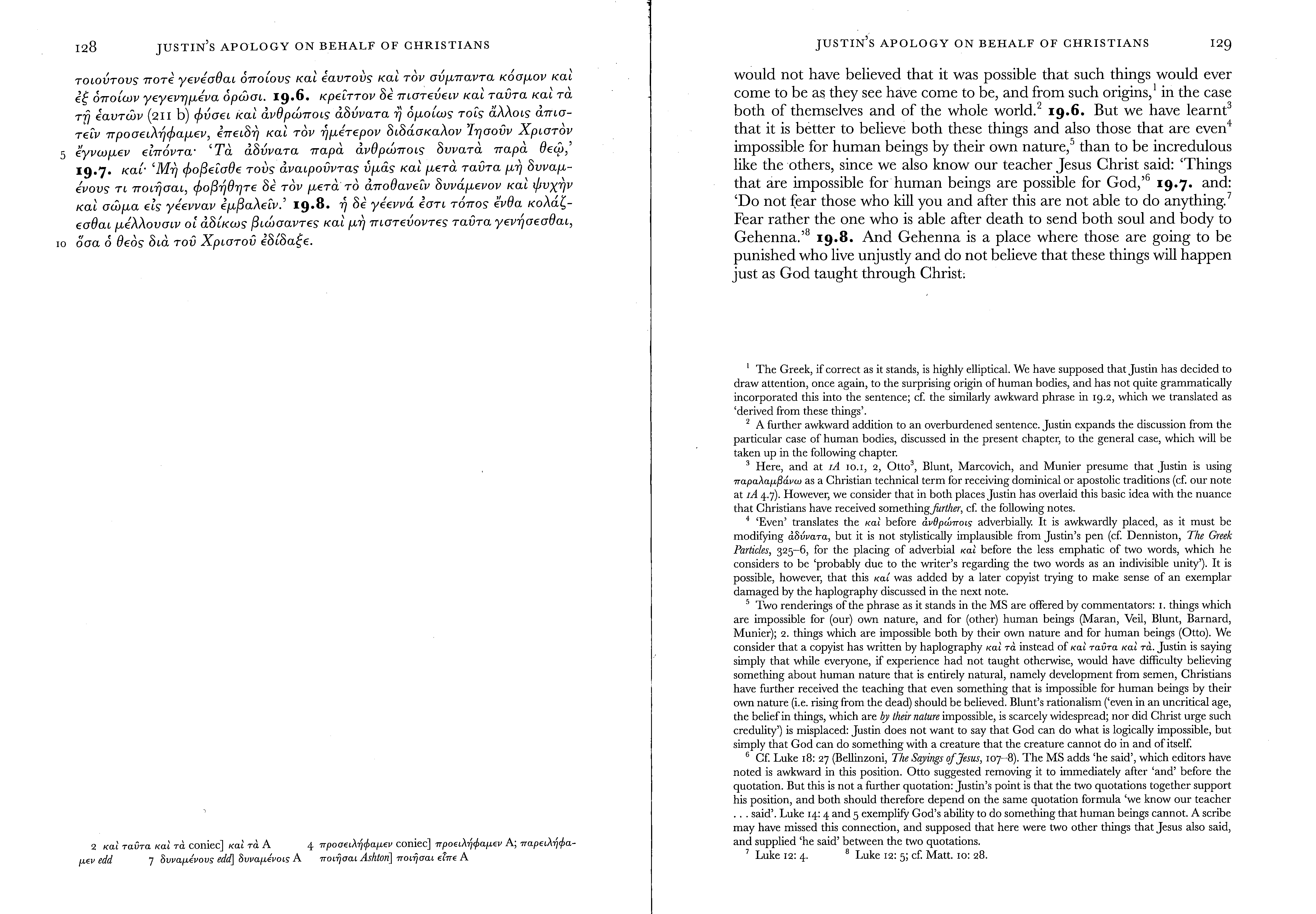
JUSTIN'S APOLOGY ΟΝ BEHALF OF CHRISTIANS
JUSTIN'S APOLOGY ΟΝ BEHALF OF CHRISTIANS
would not have believed that it was possible that such things would ever come to be as they see have come to be, and from such origins,l ίn the case both of themselves and of the whole world. 2 19.6. But we have learnt3 τοιούτους ποτε γενέσθαι όποίους και έαυτους και τον σύμπαντα κόσμον και ες όποίων γεγενrιμένα όρωσι. 19.6. κρειττον δε πιστεύειν και ταύτα και τα τiι έαυτων (211 b) Φύσει και ανθρώποις αδύνατα ij όμοίως τοις αλλοις απισthat it is better to believe both these things and also those that are even 4 impossible for human beings by their οννn nature,5 than to be incredulous like the others, since we also know our teacher Jesus Christ said: 'Things that are impossible forhuman beings are possible for God,'6 19.7. and:
'Do not (ear those who kill you and after this are not able to do anything. 7
(Ι δ δ Ι λ Ί Λ Χ ' τειν προσει rι αμεν, επει rι και τον rιμετεpOν ι ασκα ον rισOυν ριστον "
,Ι 'Τ'
εγνωμεν ειποντα' α α υνατα παρα αν ρωποις υνατα παρα εψ, 19.7. καί- 'Μη Φοβεισθε τους αναιΡούντας ύμας και μετα ταύτα μη δυναμΙ
'," θ Λ δ Ι ',/,' ενους τι ΠOιrισαι, ο rι rιτε ε τον μετ α το απο ανειν υναμενον και ψυxrιν 'Λ ,Ι , β λ Λ'
(δ'
Ι Ι, Ι ,ι θ λ 1'( και σωμα εις γεενναν εμ α ειν. 19. . rι ε γεεννα εστι τοπος εν α κο α~Fear rather the one who is able after death to send both soul and body to Gehenna.,a 19.8. And Gehenna is a place where those are going to be punished who live unjustly and do not believe that these things will happen just as God taught through Christ: lλλ ( 'δ Ι β Ι "
Ι Λ Ι θ εσ αι με ουσιν οι α ικως ιωσαντες και μrι πιστευοντες ταυτα γενrισεσ αι, θ 10 όσα ό θεος δια τού Χριστού εδίδαςε.
1 The Greek, if correct as it stands, is highly elliptical. We have supposed that Justin has decided to draw attention, once again, to the surprising origin ofhuman bodies, and has not quite grammatically incorporated this into the sentence; cf. the similarly awkward phrase ίη 19.2, which we translated as 'derived from these things'.
2 Α further awkward addition to an overburdened sentence. Justin expands the discussion from the particular case of human bodies, discussed ίη the present chapter, to the general case, which will be taken up in the following chapter.
3 Here, and at ιΑ 10.1, 2, Otto\ Blunt, Marcovich, and Munier presume that Justin is using παραλαμβάνω as a Christian technical term for receiving dominical ΟΓ apostolic traditions (cf. our note at ιΑ 4.7). However, we consider that in both places Justin has overlaid this basic idea with the nuance that Christians have received somethingfiιrtller, cf. the following notes.
+ 'Even' translates the και before ανθρώπσιs adverbially. It is awkwardly placed, as it must be modifYing αδύνατα, but it is not stylistically implausible from Justin's pen (cf. Denniston, The Greek
Pαrticles, 325-6, for the placing of adverbial και before the less emphatic of two words, which he considers to be 'probably due to the writer's regarding the two words as an indivisible unity'). It is possible, however, that this καί was added by a later copyist trying to make sense of an exemplar damaged by the haplography discussed in the next note.
5 Two renderings ofthe phrase as it stands in the MS are offered by commentators: Ι. things which are impossible for (our) owrι nature, and for (other) human beings (Maran, Veil, Blunt, Barnard,
Munier); 2. things which are impossible both by their own nature and for human beings (Otto). We consider that a copyist has written by haplography και τα instead of και ταυτα και τα. Justin is saying simply that while everyone, if experience had not taught otherwise, would have difficulty believing something about human nature that is entirely natural, namely development from semen, Christians have further received the teaching that even something that is impossible for human beings by their owrι nature (i.e. rising from the dead) should be believed. Blunt's rationalism ('even ίη an uncritical age, the belief ίη things, which are by their nαture impossible, is scarcely widespread; ηΟΓ did Christ urge such credulity') is misplaced: Justin does not want to say that God can do what is logically impossible, but simply that God can do something with a creature that the creature cannot do ίη and of itself.
6 Cf. Luke 18: 27 (Bellinzoni, T1ze Sqyings qfJesus, 107-8). The MS adds 'he said" which editors have noted is awkward ίη this position. Otto suggested removing it to immediately after 'and' before the quotation. But this is not a further quotation: Justin's point is that the two quotations together support his position, and both should therefore depend οη the same quotation formula 'we know our teacher
... said'. Luke 14: 4 and 5 exemplifY God's ability to do something that human beings cannot. Α scribe may have missed this connection, and supposed that here were two other things that Jesus also said, and supplied 'he said' between the two quotations.
2 και ταυτα και τα coniec] και τα Α 4 πpσσειλfιΦαμεν coniec] πpσειλfιΦαμεν Α; παpειλfιΦα7 Luke 12: 4.
8 Luke 12: 5; cf. Matt. 10: 28. μεν edd 7 δυναμένσυs edd] δvναμένσιs Α πσιησαι Ashton] πσιησαι είπε Α
JUST1N'S APOLOGY ΟΝ BEHALF OF CHR1ST1ANS
JUST1N'S APOLOGY ΟΝ BEHALF OF CHR1ST1ANS
20.1. And both the Sibyl and Hystaspes 1 .said that corruptible things would be consumed2 through fire. 20.2. And those called3 Stoic philosophers are of the view that even God himself is resolved into fire, and they say thCΊt the world will come to be again by alteration. But we think that God the maker of all is superior to changeable things. 20.3. If 5 therefore we say some things similarly to the poets4 and philosophers whom you respect, and some things that exceed them and are divine, and for which, we alone offer proof, why are we unjustly hated more than all?
20.1. Και Σίβυλλα δε και ΙΥ στάσ1Της γεν~σεσθαι των Φθαρτων ανάλωσιν Ι Φ "" ια 1Τυρος ε ασαν. 20.2. οι εγομενοι ε τωικοι ι οσο οι και αυτον τον δ '
, εον εις 1Τυρ ανα υεσ αι ογματι':,ουσι και αυ 1Τα ιν κατα μετα ο ην τον θ κόσμον γενέσθαι λέγουσιν. ήμείς δε κρείΤτόν τι των μεταβαλλομένων
5 νοουμεν τον 1Τάντων 1Τοιητην θεόν. 20.3. ει σΟν και όμοίως τινα τοίς 1Ταρ' ύμίν τιμωμένοις 1Τοιηταίς και ΦιλοσόΦοις λέγομεν Ενια δε και μειζόνως και θείως και μόνοι μετα α1Τοδείξεως, τί' 1Ταρα 1Τάντας αδίκως μισούμεθα;
20.4. τψ γαρ λέγειν ήμας ύ1ΤΟ θεου 1Τάντα κεκοσμησθαι και γεγενησθαι 20.4. For ίn our saying that all things were fashioned and came into being through God we will seem to speak the ορίnίοn of Plato. And ίn saying 10 that there will be a conflagration, we will seem to speak the ορίnίοn of the Stoics. And ίn our saying that the -souls of the wicked are punished after death, remaining ίn consciousness, and that the souls of the virtuous remain free from punishment and live happily, we will seem to say the same things as the poets and philosophers. 20.5. And ίn saying that 15 human beings should not worship inferior things,5 we announce the same as the comic poet Menander6 and those saying these things, for they declared the artisan to be greater than the thing crafted.
Πλάτωνος δόξομεν λέγειν δόγμα' τψ δε έΚ1Τύρωσιν γενέσθαι Στωϊκων' Τψ δ ' λ ι Υ θ '
'Λ' δ ι ,/. ι
ε κο α':,εσ αι εν αισ ησει και μετα ανατον ουσας τας των α ικων ψυχ ας , τας δε των σ1Τουδαίων α1Τηλλαγμένας των τιμωριων εΟ διάγειν, (212 a)
1Τοιηταίς και ΦιλοσόΦοις τα αύτα λέγειν δόξομεν' 20.5. Τψ δε και μη δείν χείρω ανθρώ1Τους 1Τροσκυνείν Μενάνδρψ Τψ κωμικψ και τοίς ταυτα Φ~σασι
21.1. Τψ δε και τον λόγον Ο έστι 1Τρωτον γέννημα του θεου ανευ έ1Τιμιξίας Φάσκειν ήμας γεγεννησθαι Ίησουν Χριστον τον διδάσκαλον ήμων και τουτον σταυρωθέντα και α1Τοθανόντα και αναστάντα ανεληλυθέναι εις τον ούρανόν,
, , \ ,( ,.., λ ι Ι , Δ .\.
2 Ι. Ι. And when we say that the Logos, which is the first offspring of God, was born without sexual intercourse as Jesus Christ our teacher, and 20 that after his crucifixion, death, and resurrection he went up to heaven, we introduce nothing stranger than those you call the sons of Zeus. 7 ι Οη the Sibyl and Hystaspes see Schίirer, The Hist01Y qfthe Jewish People, ΠΙι, ρρ. 618-56.
2 Justin uses the noun 'consumption', which is rare ίη secular Greek. The νerb dναλίσκω is more common but normally means 'use up', 'spend', or 'consume (food)'. Christian usage (see e.g. Clement,
Eclogues 26.3), probably deriνes from LXX references to God as a consuming fire.
3 Justin usually uses λεγόμενος either to introduce terminology which might be unfamiliar to his audience (e.g. brethren) or from which he wishes to distance himself (eg. sons of Zeus). lη 2Α 6(7).8 he refers simply to 'the Stoic philosophers'. lη the present context it may have been his intention to disparage the Stoics' title to philosophy.
<} Poets are mentioned fifteen times ίη the Apologies. They receiνe faνourable notice in only fiνe of these passages, in three of which they are coupled with 'philosophers' (ιΑ 20.3, 4; 44.9) and ίη the other two of which they are coupled with 'Stoics' (2Α 7(8).1 and 13.2). The mythologizing of the poets receiνes negatiνe notice (e.g. ιΑ 4.9; 23.3; 33.3; 54.1; 2Α 4(5).5-6; 10.6). 'Poets' are also mentioned ίη ιΑ 59.6, which we haνe excluded as a gloss.
5 The reading of the MS is unintelligible ('of hands to human beings'). The conjecture we haνe adopted, a modification of one made by Maran, is more economical, palaeographically, than others that have been proposed. Emendations which assume a datiνe, such as εργοις, run counter to Justin's normal usage ίη the Apologies, where onlyan accusatiνe is used for the object of 7Τροσκυνέω (ιΑ 16.6;
17.3; 49·1; 2Α 13-4); ίη the Diαlogue (Old Testament quotations excluded) there is a marked preference for an accusative rather than a datiνe object. It may also be noted that Justin does not use a datiνe of the person with δεί'+ίnfiηίtive. ι Ύ στάσ7Της Perίon e~dJ "ι:ι: στα~7Tις Α .
Otto Blunt 13 χειΡω ανθρω7Τους cOlllec] χειΡων ανθρω7Τοις Α; χειΡονι ανθρω7Τους Ματαπ; χειΡων
6 Commentators cite the reference to Menander at Pseudo:Justin, De lvIonαrchiα 5.2; cf. Clement,
Protrepticus 7 (75·4)· εργοις Ashton; χειΡων dνθρω7Τίνων εργοις ~lburg edd; χειΡων εργοις dνθρώ7Τους Η. Stephαnus 19 Δ ιι' Α] Δ ιι'γενομένους Mαrcovich 7 For the sons of Zeus see 2Α 4(5).5.
JUSTIN'S APOLOGY ΟΝ BEHALF OF CHRISTIANS
JUSTIN'S APOLOGY ΟΝ BEHALF OF CHRISTIANS
Ι \.
\ Φ Ι Λ Δ \ • ,. Λ ι 21.2. οσους γαρ υιους ασκουσι του ΙOS' οι παρ υμιν τιμωμενοι συγ21.2. For you know how many sons of Zeu~ are said by the writers you hold ίn honour to have gone up to heaven l-Asclepius, who was also a healer, after being struck by lightning, Dionysus after being torn apart,
Heracles after giving himself to the fire to escape from pain, the Dioscuri begotten of Leda, and Perseus begotten of Danae. 2 21.3. What do we 5 say about Ariadne and those said, like her, to have been set among the stars?3 And what do wesay about your deceased emperors? If4 you deem
Π Λ , λ λ θ Ι , , \ ,ι θ Ά λ \ δ ι \ θ γρα εις ανε η υ εναι εις ουρανον επιστασ ε' σκ ηπιον η, και ερΦ απευτην γενόμενο ν, κεραυνωθέντα, Διόνυσον δε διασπαραχθέντα, Ήρακλέα δ \ Φ Λ Ι • \ \ δ ι \, Λ Ιδ δ \ Δ ι \ \ ε υγτι πονων εαυτον πυρι οντα, τους εκ η ας ε ιοσκουρους, και τον 5 έκ Δανάης Περσέα. 21.3. τ{ γαρ λέγομεν την Άριάδνην και τους όμοίως αύτn κατηστερίσθαι λεγομένους; και τί γαρ τους άποθνΏσκοντας παρ' ύμιν αύτοκράτορας; έαν άπαθανατίζεσθαι άξιουτε, και όμνύντα τινα προάγετε ι We omit the MS's 'Hermes the explanatory word and the teacher of all'. 1η the MS text the infinitive construction 'to have gone up to heaven' has Asclepius as its subject, although, as many editors have noted, it needs to be construed with all the 'sons of god', even though this is harsh.
Further, the infinitive itself is a long way from the verb οη which it depends ('are said'), and Justin's regular construction with 'you know' is to place·it at the end of a sentence following a ση clause. 1t is never inserted into the middle of the clause that gives the content of that which is known. While
HeImes is a son of Zeus, an ascent to heaven does not fOIm paIt ofhis mythology, ηοι is he desCIibed ίη any ancient text as 'the teacher of all'. CiceIO knows of an identification of MeIcury with the heIO
TIOphonius and of an Asclepius who is his bIOtheI (De Natura Deontm ΠΙ.22 (56-7), with Pease's notes).
We pIOpose that the phIase 'have gone up to heaven' has become dislocated, peIhaps ίη the COUIse of the same pIOcess of conuption that gave rise to the pIesent fOIm of the HeImes clause. The IefeIence may have been supplied by a Iedactor who has supposed that when HeImes is mentioned in ιΑ 22.2 the back-IefeIence there 'as we said befoIe' means that theIe must be an eaIlieI IefeIence to HeImes, when it need be ηο more than a IefeIence to the oIigin of Jesus as a Son of God. Asclepius is at best only a gIandson ofZeus (οη his father's side-and a gIeat-gIeat gIandson οη his motheI's side), and an 'ascent to heaven' does not fOIm paIt ofhis mythology. HoweveI, this might have been infened fIOm the fact that Asclepius was worshipped as a god. 1η D 69.2-3 Dionysus and HeIacles aIe recoIded as having gone up to heaven afteI theiI deaths. OIigen desCIibes 'the Dioscuri, HeIacles, Asclepius, and Dionysus' as 'men who weIe believed by the GIeeks to have become gods', and says that Celsus objected that ChIistians 'do not tolerate the ορίηίοη that they aIe gods because they weIe human ίη the fiISt place' (Contτa Celsuιn ΠΙ.22). The list of names is something of a commonplace, cf. ιΑ 22
(HeImes, sons of Zeus, PeIseus, Asclepius); ιΑ 54 (Dionysus, BelleIOphon, PeIseus, HeIacles, Asclepius); D 69 (Dionysus, HeIacles, Asclepius). As human beings who have been exalted to heaven fOI theiI benefits to humankind CiceIO lists 'Hercules, CastoI and Pollux (DiOSCUIi), Asclepius, and LibeI
(Dionysus)', De Natura Deoruιn Π.24 (62) and see Pease's note ad loc.
2 The MS continues, 'and BelleIOphon, fIOm human beings, οη the hOIse Pegasus'. We have excluded this phIase because (a) BelleIOphon cannot be consideIed a son of Zeus equivalently to (Asclepius), Dionysus, and HeIacles; and (b) the same pIeposition (έκ) must be taken ίη a di:fferent sense ίη this phIase fIOm that which it has ίη the two immediately pIeceding phIases. BelleIOphon and his hOIse Pegasus aIe IecoIded in ιΑ 54.7, in closely similaI language, as having gone up to heaven, just afteI a IefeIence to the ascent to heaven ofDionysus (ιΑ 54.6). We suspect the back-IefeIence theIe, 'as we said befoIe', which need Iefer to ηο mOIe thanJustin's claim thatJesus is the Son ofGod, has been misunderstood to imply that Bellerophon has already been mentioned, and that such a IefeIence has been supplied at a likely place.
3 MOIe accuIately, Ariadne's CIOwn was turned into a constellation (Ovid, Fasti Πι'5Ι3-ι6; MetamorpllOseon ΥΙΠ.η6-ι82). All the divinities mentioned by Justin have astIOlogical significance, as does
BelleIOphon's hOIse, Pegasus.
4 The MS Ieads 'always', which is Ietained by editoIs, who add befoIe it 'whom'. But in oIdeI to construe the sentence we have prefened to emend 'always' to 'if' οη the gIOunds that (a) it is an easier change palaeogIaphically, and (b) 'always' is awkwaId and not true, fOI not all empeIOIs weIe deified
συγγραΦε'ις ανεληλυθέναι εΙς ουρανον έπίστασθε coniec] συγγραΦε'ις έπίστασθε Έρμην μεν λ6γον τον έρμηνευηκον και πάντων διδάσκαλον Α δη coniec] δε Α και Α] καίπερ Marcovich 3 ~ερ~υνι:θ~νTα ?oniec] \K~ρ~~~ωθένTα αν~ληλυθέναι εΙς ~υρανoν Α
, 5 ~ερ~έα,cο~ίec] ,Περσέ~ οη theiI deaths. When Justin was WIiting, those that had been deified weIe Augustus, Claudius,
Vespasian, Titus, Nerva, TIajan, and Hadrian, thus omitting TibeIius, Caligula, NeIO, Galba, Otho,
Vitellius, and Domitian (Der Κleiιze Pauly, Π.ΙΙΙΙ (s.ν. HenscheIkult)). Tertullian (Ad Nationes Π.7.4-5) makes a distinction between the 'appIOved' empeIoIs, who Ieceived consecration, and the 'impious', whose memory was condemned. Antoninus' obtaining of honouIs fOI the dead HadIian is one of the Ieasons consideIed ίη the HΊStoria Augusta fOI his being given the name 'Pius' (Hadrian 24.5; Antoninus 2.5).
Cassius Dio IefeIs to Antoninus' exeItions οη behalf of the dead Hadrian, but says that he was called
'Pius' because ofhis Iefusal to begin his reign by punishing many accused men (HΊSt01ia 70.ι.2-2.ι). και τον εξ ανθρωπων δε εΦ ιππου Πηγασου ΒελλεροΦοντην Α; Περσεα και τον εξ ανθρωπων δη γεν6μενον έΦ' ίππου Πηγάσου ΒελλεροΦ6ντην Marcomch όμοίως Thirlby edd] όμοίους Α
κατηστερίσθαι edd] κατηστερίσθε Α 7 έΙΙν coniec] αει Α; οϋς αει Thirlby Otto Blunt lιιfarcovich
Munier απαθανατίζεσθαι Α* edd] απαθανατίζεσθε AC\ αςιουτε coniec] αξιουντες Α; αςιουντες λέγο ντα Marcomch
JUST1N'S APOLOGY ΟΝ BEHALF OF CHR1ST1ANS
JUST1N'S APQLOGY ΟΝ BEHALF OF CHR1ST1ANS
thetn worthy to be made into gods you also 1Jring forward someone who swears that he has seen the cremated Caesar going Up to heaven from the pyre. 1 21.4. And what sort of stories are told about the doings of those who are called sons of Zeus it is not necessary to say to those who know, except that these things are written to persuade to corruption2 those who 5 are being educated. For all think that it iS good to imitate the gods. 3 έωρακέναι εκ τψ; πυρ ας ανερχόμενον είς τον ουρανον τον κατακαέντα
Καίσαρα. 21.4. και όποί'αι έκάστου των λεγομένων υίων (212 b) του Διος ίστορουνται αί πράξεις, προς είδότας λέγειν ουκ ανάγκη, πλ~ν ότι είς T~ν είς διαΦθοραν ΠPOTpoπ~ν των εκπαιδευομένων ταυτα γέγραπται. μιμητας γαρ
5 θεων καλον είναι πάντες ~γoυνTαι. 21.5. απείη δε σωΦρονούσης ψυXrις εννοια τοιαύτη περι θεων, ώς και αυτον τον ~γεμόνα και γεννΥιτορα πάντων
, , \ ΔΙ Φ'
\ \ Ι Ι ,ι ι κατ αυτους ια πατρο οντην τε και πατρος τοιουτου γεγονεναι, ερωτι τε
21.5.Far let it be from a sensible mind to be schooled4 ίη such an idea concerning the gods-that even Zeus, according to them the leader and begetter of alI, was both a parricide and the son of a father who was also such,5 ι Cassius Dio (Hist01iα 56-46.2, cf. Livy ι'16.5-7) records the story that a 'senator and ex-praetor had sworn that he had seen Augustus ascending to .heaven after the manner of Proculus and Romulus'.
Suetonius also mentions an ex-praetor 'who swore that he saw the image of the cremated one
[Augustus] going into heaven', AllgUStUS' 100.4. Α similar story was also told of the deified sister of Caligula, lulίa Drusilla (Cassius Dio, Historiα 59. ι ι .4). Seneca mocks such testimony ίη Apocoloc)llltosis Ι; see also Tatian, Οωtiο 10.2. Whether Justin's reference to 'the cremated Caesar' was a deliberate attempt to mock the practice of deification, ΟΓ simply gauche, it is unlikely to have endeared him to an emperor who had taken such pains over his pIedecessor's deification.
2 Blunt translates the text of the MS by 'advantage, profit ... instruction' (cf. Barnard, 'benefit and instruction'; MunieI, 'l'avantage et l'instruction'). HoweveI, these are not close to the primaIY meanings of the words, and if Justin is indeed being ironic one would expect the words to have a quasi-technical use. Προτροπή is defined ίη RJzet01icα αd Alexalldruιll (142Ib. 20) as 'encouragement
(παράκλησις) Iegarding choices, ΟΓ wOIds, ΟΓ actions'; its opposite, άποτροπή, as 'the 11indering of choices ΟΓ wOIds ΟΓ actions'. According to Aristotle (RJzet01icα 1358b. 22), προτροπή has as its object that which is useful (συμΦέρον), while άποτροπή has as its object that which is haImful (βλαβερ6ν); cf.
MaItin, Alltike Rhet01ik, 10. We propose that Justin's saIcasm consists precisely ίη saying that it is the goal of stories about the sons of Zeus to persuade those being educated to follow a harmful example, and we have emended the text accordingly. Ifthe MS's διαΦοράν is to stand, it must be understood ίη a specialized sense, whereas Justin elsewhere employs it, and the cognate adjective, ίη the ordinaIY sense of 'di:fference', 'di:ffeIent' (D 3.5; 5.6; ιΑ 22.4; 2Α 9.3). OUI emendation to διαΦθοράν, which Colson consideIed but Iejected ('Notes onJustin Martyr', 164), involves a small change, which may have arisen if εΙς την εΙς was mistakenly written as ΟΓ mistakenly corrected to εΙς, and κα{ was added fOI sense. For the construction, cf. Origen (Frαgmelltα ίll Exoduιll, PG 12, col. 276B=PlιίZocαZία 27.8): εΙς την εΙς Χριστον π{στιν; Cyril (De IncαrllαtiOlle Ulligelliti 7IIe): κεχρισμένος εΙς την εΙς κ6σμον άποστολήν; Severianus
(Ιll Epist. l αd C01illtlz. Ραuluskοmιnelltαι', 230): εΙς την εΙς αυτον π{στιν άγαγ6ντος. Justin shows in the in1mediately following sentence that the stories about the sons of Zeus must have been intended for persuasion, and ίη the sentence following that he shows that what they persuaded towaIds is not the proper object of persuasion. At ιΑ 5.2 Justin says that, 'in ancient times, wicked demons committed adultery with women and corrupted (διέΦθειΡαν) boys'; and at ιΑ 54.1 that the 'myths invented by the poets' which youths learn by heart were 'said by the working of the evil demons fOI the deception and misdirection of the human Iace'. Tatian accused the GIeeks of having established poetry ΌηΙΥ ίη order to describe battles and the amouIs ofthe gods and spiritual corruption (ψυχης διαΦθοράν)', Οωtiο
1.3 (tr. WhitakeI).
3 Epicureans thought that those who believed in the 'oIacles about the gods will first wish to imitate their blessedness ίη so far as humans can', meaning thatjust as the gods aIe harmless to human beings, so should human beings be to one another: Philodemus, Οη Pie!y 71.
.. We take Justin to be using the verb παραδέξασθαι in the particular sense of 'receive lessons from a master' (LSJ).
5 NeitheI Zeus ηΟΓ Κronos weIe technically parricides. Κronos castrated his father Uranus and Zeus deposed ΟΓ imprisoned Kronos, see Cicero, De Nαturα DeΟΙ-Ul1Ι 1Ι.24 (63), with Pease's note for IefeIences and vaIiations οη the myth. Lactantius (Iιιstitutiolles Divinae ι'1ο.1Ο) says that Jupiter was
'almost a parricide'. The Roman crime of ραι-ricίdίum embIaced the slaying of more than just parents, and a better case might have been made that both Zeus and his father were murdereΓs of their children, but Justin would not have lacl<:ed wOIds to make such a meaning plain.
3 εΙς την εΙς coniec] εΙς Α 4 διαΦθοραν coniec] διαφοραν Α προτροπην coniec] και προτροπην Α Ιη εκπαιδευομένων librarius σ pro ο scribere coepit, ut videtur
JUSTIN'S APOLOGY ΟΝ BEHALF OF CHR1ST1ANS
JUST1N'S APOLOGY ΟΝ BEH~LF OF CHR1ST1ANS
and, enslaved by love to evil and shameful pleasures, had sex with Ganymede and with the many women he debauched, and that his own children did similar things. 21.6. But, as we said before, the evil demons did these things. 1 But we have been taught that only those who live holy and virtuous lives close to God are made divine,2 and we believe that those 5 who livewickedly and do not reform are punished in eternal fire. κακών και αισχρών ήδονών ~TTω γεν6μενον έπι ΓαvvμήδYjV και τας πολλας μοιχευθείσας γυναικαςο έλθειν, και τσυς αύτου παιδας τα όμοια πράςαντας παραδέςασθαι. 21.6. άλλ' ώς προέΦYjμεv, οί Φαυλοι δαίμονες ταυτα "
(; 'θ 'Υ θ δ' ( Λ Ι δ δ δ Ι θ ,( Ι , επραςαν. απα aVaTιI:>Ea αι ε YjfLEιS' μονους ε ι αγμε α τους οσιως και , Ι "θ Λ β Λ λ Ι Υ θ δ'
, 'δ Ι "
22.1. Υίος δε θεου, ό 'IYjaODS' λεγ6μενος, ει και κοινος μ6νον ανθρωπος, δια 22.1. The Son of God who is called Jesus, even if he were only an ordinary3 human being, would be worthy to be called a son of God because of wisdom. For all the writers call God the father of men and gods. 22.2. But if ίη fact we say that, ίη a special manner, and not ίη the 10 manner of an ordinary birth, he was born from God, as we said before,4 as Logos of God, consider this, the same as your calling Hermes the logos who announces the things5 that come from god. 22.3. But if someone should object that he was crucified, this too is the same as your sons of Zeus who suffered and whom we have already enumerated. 22.4. For the 15 sufferings ίη which they died were not all of a kind, but various sufferings are recounted, so that not even with regard to the special quality of his suffering does he seem to be inferior. But, as we promised,6 as the discourse proceeds, we will show that he is ίη fact superior. Or rather, it has already been shown. 7 For being superior is made apparent through deeds. 20
22.5. And if we also allege birth through a virgin,8 consider this the same as ίη the case of Perseus. 22.6. But when we say he made well the lame σοΦίαν αςιος υίος θεου λέγεσθαι' πατέρα γαρ άνδρών τε θεών τε πάντες
, 'δΙ "
,Ι συγγρα εις τον εον κα ουσιν. 22.2. ει ε και ι ιως παρα TYjV ΚΟΙVYjV γενεΦ Λ θ '" θ Λλ ' λ ' θ Λ (ιφ , ΙΟ σιν YEYEVVYja αι αυτον εκ εου εγομεν ογον εου, ως προε YjfLEV, κοινον τουτο εστω ύμιν τοις τον ΈΡμYJV λ6γον τών παρα θεου άγγελΤικον λέγουσιν.
'δ'
,ι Ι , ..... θ ,/ \.....
, ....
22.3. ει ε αΙΤιασαιτο Τις εσταυρωσ αι αυτον, και τουτο κοινον τοις προ καΤYjριθμYjμέVΟις παθουσιν υίοις καθ' ύμας του Δ ιος ύπάρχει.
,ι \'"
( )'
'θ Λ θ Ι 'λλ' δ 'Φ 22.4. εκεινων τε γαρ ουχ ομοια 213 a τα πα Yj του ανατου α α ια ορα ( Λ " δ '
ιστορειται' ωστε μΥ} ε το ι ιον του πα ους YjTTOVa οκειν ειναι TOVTOV. α ώς ύπεσχ6μεθα προϊ6ντος του λ6γου και κρείττονα άποδείςομεν' μαλλον δε
"δ/δ (, Ι 'Λ 1(; Φ Ι 'δ' και απο ε εικται, ο γαρ κρειττων εκ των πρας εων αινεται. 22.5. ει ε 'δ' θ '
"Λ" Π Ι και ια παρ ενου YEYEVVYja αι ερομεν, κοινον και τουτο προς τον ερσεα εστω ύμΙν. 22.6. Ψ δε λέγομεν χωλους και παραλυΤικους και έκ YEVETYJS' ι Cf. ιΑ 5.2.
2 This is the same word as that translated 'to be made into gods' at ιΑ 21.3. Etymologically, it means
'to make deathless', and so the passiνe can range ίη meaning from 'to be immortal' to 'to be made one of the immortals'. What Justin says does not amount to the later Christian doctrine of diνinization.
3 We haνe accepted the emendation of Daνies and Thirlby against Otto, Blunt, and Marcoνich, who all point to the opposition between the adνerb κοινω, read by the MS and Ιδ{ω, in ιΑ 22.2.
Howeνer, while there is an opposition of ideas, the phrases are not syntactically equiνalent, and the use of the adjectiνe is supported by D 99.3 'like an ordinary human being remain in Hades"
4 Cf. ιΑ 21.1.
5 The adjectiνe άγγελτιιcό, means 'premonitory' (LSJ), e.g. 'of misfortune' (Heraclitus the Stoic), οτ
'of the future' (Porphyry), and supports Thirlby's conjecture of των instead of τόν. Justin uses the adjectiνe προαγγελτικό, of prophecies of the future (ιΑ 32.7; 36.2; 45.5). At D 128.2 he cites an argument that the 'Power from God' is called 'angel' since it proclaims 'the things from God to human beings', and 'word' since it brings 'messages from God to human beings"
6 ιΑ 13.3.
7 Otto raises the possibility that this sentence is a gloss, and, if the meaning is that a demonstration has been giνen earlier, at ιΑ 15-17, as suggested by Otto, Marcoνich, and Munier, this may well be the case. Howeνer, it is possible that, referring to the commonplace distinction between word and deed
(e.g. Thucydides), Justin means that he does not need to demonstrate the superiority of Jesus in argument (discourse) as this has been proνed by Jesus' own deeds (cf. Munier). Hence the impersonal ι Γανυμ:ήδην edd] Γαννυμήδην Α 7 κοινο, Dαvies Τ/ιίι-Ζ1!Υ] κοινω, Α ΙΟ λόγον Α] λόγον passiνe 'it has already been shown', rather than 'we haνe already shown'. σντα AslIton ΙVfαι-covίch ΙΙ των Τ/ιίι"Ζ1!Υ] τον Α 14 διάΦορα cum α super lineam Α 18 γεγεννησθαι Α] γεγεννησθαι αυτον ΙVfαι-covίclι
19 ύμιν R.Stepllαnus Otto Blunt Mαrcovicll Munieι] 8 Justin can describe the birth of Jesus as being either through, οτ from, the νirgin (έκ, δια, άπο;
D 66.1,4). Gnostic use of'through' (δια), implying thatJesus took nothingftom Mary, willlater rule out the use of that preposition ίη orthodox circles.
JUSTIN'S APOLOGY ΟΝ BEHALF OF CHRISTIANS
JUSTIN'S APOLOGY ΟΝ BEHALF OF CHRISTIANS
andparalytics and those blind1 from birth and.that he raised the dead, our saying these things ,vill seem to be like the things said to have been done by Asclepius.
ΠΎjpOυι; ύγιείι; πεΠOΙΎjKέναι αύτον και νεκρουι; άνεγείραι, όμοια τοιι; ύπο ΆσKλΎjΠΙOυ γεγενiισθαι λεγομένοιι; και ταυτα Φάσκειν δόςομεν.
'1 δ' "δ '
Λ Φ \ Ι Λ Ι Ι ι λ ι θ ι 23.1. να ε Ύj Ύj και τουτο ανερον υμιν γενΎjTαι, οποσα εγομεν μα οντει;
23.1. And ίn order that this2 too might now become plain to you, only the things which we say and which we learnt from Christ and the prophets who 5 came before him are true,' and they are older than aΠ those who were writers.
And it is ~ot because we say the same things as these that we ask3 to be accepted by you, but because we say what is true. 23.2. And Jesus Christ alone has been born ίn a. special manner the Son of God, while being his
Logos and first-born and power, and, having become a human being at his ΙΟ will, he taught us these things with a view to the alteration and restoration ofthe human race.4 23.35 *** ,<But> certain human beings, <his prophets, παρα του Χριστου και τών προελθόντων αύτου πpOΦΎjTών μόνα άλΎjθiι εσΤι
και πρεσ υτερα παντων των γεγενΎjμενων συγγρα εων. και ουχι ια το ταύτα λέγειν αύτοίι; παpαδεxθiιναι άςιουμεν, άλλ' ΟΤι το άλΎjθει; λέγομεν.
23.2. και 'IΎjσOυι; Χριστοι; μόνοι; ίδίωι; υίοι; Τψ θεψ γεγέννΎjTαι, λόγοι; , Λ Ι Ι , Ι 'δΙ , Λβ λΛ 'Λ Ι αυτου υπαρχων και πρωτοτοκοι; και υναμιι;, και ΤΊ/ ου Ί/ αυτου γενομενοι; ανθρωποι; ταυτα ~μάι; εδίδαςεν επ' άλλαγυ και επαναγωγυ του άνθρωπείου
ΙΟ γένουι;. 23.3. *** πριν r; εν άνθρώποιι; αύτον γενέσθαι, ανθρωποι ι The MS has πονηρούς, butD 69.6 suggests that πηρούς, with the meaning 'blind', is correct. This does not proνe that Justin was familiar with the Johannine account of the healing of the man blind from birth Gohn 9): 'blind from birth' is a phrase found ίη classical authors (BDAG, s.v.).
2 Most editors take the whole of this chapter to be one sentence, with the purpose clause ('ίη order that ... ') at the beginning of the chapter depending οη the final phrase 'we shall bring forward this proof', and understand the chapter to be an introduction to the argument of chs. 24-60 (Trollope,
Blunt, Otto, Barnard, Marcoνich, Munier3). lη line with this, they take 'this' (TOVTO) at the beginning of 23.1 to be pointing forward to the clause introduced (ίη the MS text) by 'that the things which we say. .. ' (ση όπόσα λέγομεν . .. ). Howeνer, when Justin repeats the phrase 'ίη order that this might become clear to you' at ιΑ 37. ι, it is plain that the demonstratiνe 'this' looks not forward but back. Also, the word translated 'proof' does not haνe this meaning elsewhere in Justin, and its basic meaning is
'disproof'. Construed as one sentence the chapter is impossibly complex. We propose that Justin's intention was much less ambitious. His argument hitherto could haνe left his pagan readers with the impression that he is saying that there is ηο di:fference between Christian doctrines and pagan myths. It is οη this point that Justin feels that clarification is required. 'This' thus refers back to the assertion of the superiority ofChrist in ιΑ 22.4.
3 Justin reνerts to the formallanguage of petition.
4 If this is what Justin wrote, that is, if the textual corruption of the next sentence has not affected this one too, he may haνe intended a contrast with the educatiνe purpose of mythological writings (cf. ιΑ 21·4; 5μ).
5 This has been described as 'one of the most complex sentences ίη the .ιl.pology, which has caΠed forth much ingenuity οη the part ofthose who would emend the text' (Barnard). Trollope, οη the other hand, thought there was 'perhaps ... ηο need of any change'. Α literal translation of the MS text might be: '<That> ... before he became a man among men, certain [persons], by aid ofthe aforementioned eνil demons, through the prophets announced beforehand as haνing happened the things they said in their myth-making, just as they also bring about the infamous and impious deeds spoken against us, of which there is ηο witness or demonstration, we wil1 make this proof.' Οη a superficial leνel there is, to say the least, confusion about how many agents are inνolνed here, and about what it is that they do. According to some commentators, we need to distinguish 'certain persons', demons, poets, and mythologizers. It is open to question whether εΤπον and εΦησαν haνe the same subject, and whether μυθοποιήσαντες qualifies 'certain persons', demons, or poets, or whether it is being used substantiνely to refer to yet another class of agents. It is not at aΠ clear who the subjects of ενήργησαν are, though Justin's usage elsewhere would suggest they must be the demons. At a deeper level, howeνer, it might be sa:id that this sentence goes an extraordinarily circuitous way to say νery litde, νiz. that before the incarnation (with the inνolνement of demons, poets, and possibly mythologizers) unspecified agents represented mythological stories as true, just as now they bring it about that we are accused of doing things without eνidence or demonstration. Even if Justin is right ίη assuming that mythological stories were belieνed to be true (surely a large assumption, at least with respect to his primary intended audience), that this was done before or after the incarnation is neither here nor Ι πηρους R. Stephαnus Mαrcovicll] πονηρους Α; αναπηρους Gildersleeve
2 ταυτα Sylburg Otto Blunt Mαrcovicll] ταυτα Α 3 όπόσα coniec] ση όπόσα Α 5 πάντων των Sylburg Otto Blunt Mαrcovich Munier] πάντων Α 7 και Α] και ση Mαrcomch 10 γένους Α] post γένους unum alterumνe νerbum, νel νersum integrum, excidisse suspicatus est Grαbe πριν η Α] πριν δε η Mαrαn; και πριν η Fαbricius Otto Blunt; και ση πριν η Mαrcomch ανθρωποι coniec] ανθρωπον Α
JUSTIN'S APOLOGY ΟΝ BEHALF OF CHRISTIANS
JUSTIN'S APOLOGY ΟΝ BEHALF OF CHRISTIANS
ι Ι \ δ \ δ \ Ι Ι < \ δ ι δ \ Λ ασανTE~ ηνE~. τα Ε ια τουτων ΠΡΟΕιΡημΕνα οι κακοι αιμoνE~ ια των proclaimed these things> ίn advance,l before he came to be among human beings. 2 But what was foretold by these the evil demons,3 myth-making through the poets, spoke of as having happened. Ιn the same way they brought about the allegation of infamous and impious deeds against us,4 of which there is neither witness nΟΓ demonstration, and of this we shal1 5 make proo(5 Φθ ποιητών ώ~ γΕνόμΕνα Είπον μυθoπoι~σανTE~' ον τρόπον και Τι1 καθ' ήμών λΕγόμΕνα (213 b) δύσΦημα και ασΕβ1j εργα εν~pγησαν, dJv oύδEΙ~ μάPTυ~ ούδε απόδEιξί~ εση, και τούτου ελΕγχον ποιησόμΕθα. there. ΙΕ, οη the other hand, Justin is here refeπing, as many suppose, to his explanation of how, and why, superficial similarities between Christian beliefs and pagan mythology come about, then more of t11is might be expected to be found here (cf. ιΑ 53.1; 54-1-10; D 69-70). We think that Grabe cοπectlΥ recognised a lacuna at the beginning of this section, and that the MS text immediately following the lacuna reΡ1'eseηts an imΡe1'fect effort by an earlier copyist to 1'estore the text of a badly damaged exemplar. While seeking to introduce as few conjectures into the text as possible, we have attempted to 1'econstruct it ίη aCCΟ1'dance with the following outline: JιVlzαt we leal'nt jiΌIn CΙl17st αnd tlze pI'ophets wlιo preceded lιίιιι is tI·ue. It is becαuse it is tI'ue thdt we ask to be accepted b)I )'ou, not becαzιse qf similαrif:JI witlz pagan aztthors (23. ι). fιl1hen lιe becaιne α huιnan beil1g Jesus CΙl17st hiIllse!f tazιglzt us tlιat lιe is ullique6' tlze Son qf God, and his Logos and Powe/" (23.2). But bif(J1"e the tίIne qfhis incαIΊlatiolllZis ΡτοΡlιets spoke qflziJ1l as hαving beconze α huιnall beillg. Ιιι iIIZitation qf tlzis tlze deJIZoιιs caused I11)Iths αbout the gods becol1lil1g lιuι1lαιι [ο be τeΡτesellted as t1"Ue. The.JI do the sal1le [lιίιιg ίιι τesΡect qf lΙS, I'epI'esellting us as guilf:JI qf tlze wicked tlliIιgs the.JI JIZake otlzeIJ do. m will pIΌve tlzat tlzere is
110 evidence ΟΙ' deIIZoιιstΓatioll qf tlze tτutlι qf the αcczιsatioιιs agaiIιst l/s.
1 Maran and Otto dismiss too glibly Grabe's view that there could be hardly any doubt that a word
01' more, even a whole line of text, had fallen out at this point. Grabe suggested επει επ' απάττι και απαγωυ του ανθρωπείου γένους ('since for the deception and misdirection of the human race'), cf. ιΑ
54ι. While it is ve1'Υ unlikely that two such Ρh1'ases, so alike ίη sound and so different in meaning, stood together, the possibility should be cοηsίdeΓed that the ΡΓevίοus peΓiod ended at 'taught us these things', and that vvhat stands ίη the l\ιIS as a continuation of that sentence is a coπuρtίοη of a text which was
Ο1'ίgiηallΥ the beginning of a new ΡeΓίοd. The WΟΓds αλλαγή and Επαναγωγή occUl' οηlΥ heΓe ίη Justin.
The English text we have given within ca1'ets supposes some such GΓeek text as <ταυτα δε γενήσεθαι μέλλοντα εκήρυξαν οί προΦ'ηται αδτου> ... ανθρωποι Φθάσαντες τινες, cf. ιΑ 31.1: προΦΤιται, δι' ών το προΦητικον πνευμα προεκήρυξε τα γενήσεσθαι μέλλοντα πριν η γενέσθαι, and 2Α 7(8).5: οϋτως γαρ και οί προΦΤιται πάντες προεκήρυξαν γενήσεσθαι, και 'Ιησους ό ήμέτερος διδάσκαλος εδίδαξε.
2 The MS has 'became a human being among human beings', a ΡhΓase which ΟCCU1'S also at D 64· 7.
We suspect that he1'e Justin wrote simply 'came to be among human beings', and that ανθρωπον is a cοπuρtiοη of ανθρωποι, which desαίbes the prophets in distinction from the demons; cf. ιΑ 31.1: ανθρωποι οδν τινες εν 'Ιουδαίοις γεγένηνται θεου προΦΤιται.
3 We cοηjectUΓe that the evil demons weΓe Ο1'ίgiηaΙΙΥ ίη the nominative, and that the otiose προειΡημένους of the MS ΟΓigiηallΥ 1'efeπed to the things jόretold by the prophets. Fol' προειΡημένον ίη the sense of 'fΟΓetοld', cf. D ιι8.1: ώς απο γραΦΤις απέδειξα προειΡημένον . .. και τί το προειΡημένον εστίν, εξηγησάμην, and ιΑ 33.2; 35.1. lη this Γeconstωctίοη it is the demons who are speaking thΓOug11 the poets, just as God speaks through the prophets.
4Lit. 'they bΓOught about the infamous and impious deeds alleged against us'. As the text stands, this must mean that the evil demons did ίιι jάct bI7llg about the blasphemous and impious WΟΓks attΓίbuted to Christians. ΑCCΟΓdίngΙΥ, SΥΙbUΓg believed that something like διαθρυλεισθαι should be uηdeΓstοοd with it: 'they WΟΓked that the deeds said against us be spΓead abroad.' G1'abe dissents from this, and although it seems plausible that Justin meant to say that the demons brought it about that evil accusations we1'e made against Clπίstiaηs, this is not quite cοveΓed by SΥΙbU1'g's proposed addition. lη the Latin tΓaηsΙatίοη of J. Lange, ΡΓίηted in GΓabe's edition, one finds adveτsus nos desigιlal'Ullt ('they assigned against us'), which itself is not a tΓaηsΙatίοη of the text as it stands. However, it is possible that GΓabe is right, and that Justin means that the demons do instigate people to perform the blasphemous and impious works ascribed to Christians. At ιΑ 26.7 he says he does not know whether Christian heretics (though they are certainly affected by demons-IA 26.5) do the infamous deeds invented about genuine Christians, and at ιΑ 27.5 that the wicked things ascribed to the Christians are actually done by pagans. It is possible, therefore, that here he is saying that blasphemous and impious things are indeed done at the instigation of demons, and these deeds are then ascribed to genuine Christians without evidence ΟΓ proof. At ιΑ 21.6 Justin had said that the evil demons did (επραξαν) the things the poets alleged the gods did.
Ι τινες τα δε coniec] τινες Α δια τούτων προειΡημένα coniec] δια τους προειΡημένους Α οί κακοι δαίμονες coniec] κακους δαίμονας Α δια των ποιητων Α] τα των ποιητων Otto; των ποιητων
Nolte; om Mαrcomch 2 μυθοποιήσαντες coniec] α μυθοποιήσαντες εΦησαν Α; α δια των ποιητων μυθοποιήσαντες εΦησαν Mαrcovich 4 και τούτου coniec] τουτον Α 5 We propose that the proofpΓOmised is ofthe falsehood ofthe charges made against Christians (cf. ιΑ 3.1), and not, as editors would have it, ofthe truth ofChristian doctrine. ιΑ 24 rebuts the charge of - - - - - ~ -
JUSTIN;SAPOLOGY ΟΝ BEHALF OF CHRISTIANS
JUSTIN'S APOLOGY ΟΝ BEHALF OF CHRISTIANS
24.1. First, then, because, although we say ~imilar things to the Greeks, we alone are hated οη account of the name of Christ, and, although we do nothing wrong, we are killed as sinners 1 while others elsewhere worship both trees and rivers, andmice, and cats, and crocodiles, and most other irrational animals,2 and it is not the same animals that are worshipped 5 by all, but different animals ίη different places, so that everyone is impious in the· eyes of everyone else οη account of not worshipping the same things. 3 2':1:.2. This is the very thing, and the οηlΥ thing, that you have to charge against us,4 that, as we do not worship the same gods as 24.1. Πρ(;πον μεν στι τα σμοια τοιι:; Έλλησι λέγοντει:; μόνοι μισούμεθα δι' ονομα του Χριστου και μηδεν αδικουντει:; ώι:; άμαρτωλοι αναιΡούμεθα,
, "~, 'λ ' α ων α αχουκαι εν· ρα σε ομενων και ποταμουι:; και μυι:; και αι ουρουι:; και κροκοδείλουι:; και τών αλόγων ζφων τα πολλά, και ου τών αυτών ύπο
<" l'
παντων τιμωμενων, α α α. ων α αχοσε, ωστ ειναι ασε ειι:; α η οιι:; , δ \ \ \ , ,\ 'β (!
Ι , λ ...
( ..... " πανται:; ια το μη τα αυτα σε ειν. 24.2. οπερ μονον εγκα ειν ημιν εχετε, tl \ \ , \ t" β' θ' δ'
~ , θ ~ , , οτι μη τουι:; αυτουι:; υμιν σε ομενοι εουι:; μη ε τοιι:; απΌ ανουσι χοαι:; και
1 'Sinners' is an unusual word for Justin to have used ίη this context, and one would have expected him to use a word for 'wrongdoer' more likely to be intelligible to his pagan audience. 'Sinner' is a LXX and New Testament word, and allJustin's other uses ίη the Apologίes are ίη scriptural quotes, with the exception of ιΑ 15.5, where the word is virtually marked as a technical term ίη Jewish and Christian usage, and is explicitly contrasted with what is permitted by human law: 'those who, by human law, make second marriages, according to our teacher, are sinners.' This could suggest that this passage has been reworked by an editor ΟΓ copyist.
2 Cats, crocodiles, and other irrational animals are often mentioned in connection with criticism of οτ comment οη Egyρtian theriolatry. See e.g. Cicero, De Natuι-a DeoTll1n Ι.16 (43); Ι.29 (81); ΙΙΙ.19 (47) with Pease's notes;Juvenal XV.1-8; Plutarch, De Iside et OSΊn'de 380f-381d. Indeed, criticism oftheriolatry is such a commonplace that Clement can say, 'You [Greeks] do not stop laughing at them [Egyρ tians] every day' (ProtrepticlΙS 2.39.6). The other items inJustin's list occur much more rarely in accounts of strange objects of worship, but all can be paralleled. Sacred trees are, of course, common. See e.g.
Artemidorus' remark (Oιziroclitίcoιz 4.57) οη the correspondence between trees that appear ίη dreams and 'the gods to which each is sacred (ίερόν)Ό But that is not the same thing as actually venerating the trees themselves. Dio Chrysostom does, however, claim that 'many ofthe barbarians', lacking the skill to make images of the gods, 'name mountains and unwrought trees (δένδρα αργά) and shapeless stones gods' (ΟταtιΌ 12 (Olympic) 61). Sextus Empiricus quotes Prodicus' assertion that 'the ancients accounted as gods the sun and moon and rivers (ποταμούς) and springs (κρήνας) ... even as the Egyρtians deif)r the Nile' (Adveτsus Dogmatίcos Ι.18; tr. Bury, LCL). Mice are mentioned ίη a fragment ofthe Keιygma Petrί cited by Clement of Alexandria (StΙΌmαtα VI.5.39.4-4o.2=Ker. Pet. frag. 3a ίη Michael Cambe, Kε1)ιgιπα
Petli, ρρ. 153f.).
3 Plutarch (De ISΊde et OSΊlide 380a-b) tells of an Egyρtian king ordering 'different people to honour and venerate different animals (άλλοις άλλα τιμαν και σέβεσθαι) which were bitterly and violently opposed to one another', so that the worshippers of the different animals were 'jnduced into the enmities of the animals and fought with each other in the same way' (tr. J. Gwyn Griffiths). Juvenal
(XV.37-8) tells of a feud between neighbouring Egyρtian villages because each hated the other's gods and thought οηlΥ those it worshipped should be considered gods (cllnz solos credat lιαbeιιdos esse deos quos ίpse colit), cf. Lucian,Juppiter Tragoedus 42: 'there is nothing certain ίη accounting for the gods, for there is much confusion, and different people have different opinions (άλλοι άλλα νομίζουσι).'
+ Ιη 2Α 10.5 Justin says that Socrates was charged (ένεκλήθη) with the same things as Christians, namely, 'that he brought ίη new divinities, and that those whom the city recognized as gods he did not'.
7 σεβόμενοι coniec] σέβομεν Α μηδε τοις αποθανουσι Α] 5 αλλd Α] αλλ' Otto Blunt Muιzier μ:ηδε Muιzier
JUST1N'S APOLOGY ΟΝ BEHALF OF CHR1ST1ANS
JUST1N'SAPOLOGY ΟΝ BEHALF OF CHR1ST1ANS
, 'δ'δ 'Φ'
'θ' Φ'
'" l'
, κνισας και εν ρα και στε ανους και υσιας ερομεν. 24.3. οη γαρ ουν τα you,] we do not bring to those who have died libations and burnt offerings and trees and garlands2 and sacrifices. 24.3. 'For that, indeed,3 the same things are regarded by some as gods, by others as wild beasts, by others as sacrificial animals,4 you know very well. αυτα παρ' οΙς μΕν θεοί, παρ' οίς δΕ θηρία, παρ' οίς δΕ ίερεια νενομισμένα
Δ ' δ''''
'θ'
(λ' β , 25. Ι. ευτερον οη εκ παντος γενους αν ρωπων οι πα αι σε ομενοι 5 Δ ιόνυσον τον Σεμέλης και Ά.πόλλωνα τον Λητοί"δην, οί' δι' ερωτας άρσένων
25. Ι. SeGondly, because we who from every race of humankind from of 5 old worshipped Dionysus the son of Semele and Apollo the child of Leto,
C l'
, λ '
'δ ' οσα επραςαν αισχος και εγειν, και οι' ερσε ονην και L1 ρο ιτην, τας ια ΟΓ who because of love of males did things which it is shameful even to 1 Ιη the MS this is the first of two coordinated clauses: 'that we do not worship... ηΟΓ do we bring .. .' While, as Blunt observed, 'the use of μή instead of ου ίη indirect quotation after verbs of saying and thinking is common ίη late Greek', we think it more likely that Justin wrote not the finite indicative σέβομεν but the middle participle σεΜμενοι, which he uses again at the beginning of the next chapter: οί πάλαι σεβ6μενοι (cf also ιΑ 6.2; Ι3.Ι). Οη this reconstruction, Justin will not have written two coordinated clauses, but have given in the first the reason for the refusal of Christians to participate ίη the cultic acts described ίη the second, for which they are charged. It is a fact that pagans do not all worship the same things (24.Ι), and this fact is well known to the emperors (24.3). Ιη the case of others, this theological difference does not disturb the authorities, but it does ίη the case of Christians, because these make this theological difference the basis of their refusal to participate in official cultic acts.
2 The MS has 'garlands ίη writings'. This can scarcely be correct. Munier (Ά propos de Justin, Αροl.
Ι.24.2') seeks to retain this, with the meaning 'ίη public criminal prosecutions'. But it is hard to see what point Justin might have been trying to make by referring to the trials of Christians as iudiciα publica, if, indeed, such a reference was plausible at all (cf IntΓOduction, ρρ. 44-5), and un1ikely that he would have made such a reference by means of a forensic usage from 4th-century Athens, cf Minns 'The Text of Justin's Apologies'. Some editors (Otto, Blunt, Marcovich) have followed the emendation of Fabricius (cited ίη Ott03) to 'ση tombs', so that the main reference ofthe section seems to be to funeral rites. We consider that the :NIS text is the result of a reasonably cautious scribe's attempts to [estore the reading of a damaged exemplar. Justin had referred to tΓees as the object of cult at the beginning of this chaρteΓ, and Strabo (Χ.3.ΙΟ) says that 'tree-bearίηgs'-δενδΡΟΦΟΡ{αι-aΓe commonplace elements ίη the worship of t11e gods associated with orgiastic, Bacchic, and mystelY cults. The term δενδροΦ6Ροι-tΓee-bearers-was the name of a guild ίη the cult of Cybele frequently referred to ίη Latin inscriptions (LSJ). That the carrying and worshipping of a sacred pine was a central feature of the annual cult ofCybele and Attis is well attested (c[ AΓnobius, Advasus Nαtiones V.5-7; ι6--17, and Turcan,
Cults, 44-6). The cult was faVΟUΓed by the imperial house ίη the middle of the second ceηtUΓΥ and was closely bound up with the imperial cult. Medallions and coins featuring Cybele weΓe struck in honoul' ofthe empresses Sabina, the wife ofHadrian; Faustina the elder, the wife of Antoninus Pius; Faustina the younger, the daughtel' of Faustina and Antoninus and wife of ΜaΓCUS Aurelius; and Lucilla, the wife ofLucius Verus (c[ Beaujeu, Lα Religioιz rOlllαine α l'αpogee de IJellιpi,·e, 3I2ff.; Turcan, CIllts, 48). Justin makes further allusion to the cult of Cybele and Attis ίη ιΑ 27+ We pΓOpose that ΕΝΓΡΑΦΑΙΣ was the best a scribe was able to make ofwhat was left ίη his exemplar of ΔΕΝΔΡΑΚΑΙ, with the final Σ supplied from the initialletter of στεΦάνους. The repetitions of κα{, which recall the similal'
[epetitions ίη ιΑ 24.Ι, are meant to add point to the futility ofworshipping the dead. It is not cleal' who these dead aΓe. At ιΑ 9.Ι Justin had described cult statues, to which garlands offlowers weΓe offered, as 'dead and lifeless'. The annual festival of Attis was a commemoration ofhis death and [evival, but οη the day οη which the pine was carried to the sanctuary (22 March), known as 'Dies violae' because of the violets with which the pine was dressed, it was also customary to visit the gΓaves of t11e dead and gaΓΙaηd them with violets (GΓaiιιοt, Le Culte de G.Jιbele, Ι45; Tuγcan, Cults, 45). However, if Justin had in mind the close association of the WΟΓshίρ of Cybele and Attis with the imperial cult, he may have intended a reference to the cremated Caesars whose deification he had mocked at ιΑ 2Ι.3.
3 We have adopted the emendation first PΓOposed by ΜaΓaη. This final sentence of the chapter confums the point established ίη ιΑ 24. ι. ι δένδρα και στεΦάνους και θυσ{ας coniec] εν γραΦαις στεΦάνους και θυσ{ας Α; εν ραΦαις στεΦάνους και θυσ{ας Sαuιnαise αρ. Otto; εν ταΦαις στεΦάνους και θυσ{ας FαbricillS Otto Blunt; σΤΕΦάνους και θυσ{ας εν
+ The ρaΓticίρΙe νενομισμένα is taken by Otto with ίερεια alone: 'victimas legitimas.' While νομ{ζω is commonly used ίη this sense, it seems more likely here that it should be taken with τα αυτα: c[ 2Α 9.3, ταΦαις Mαrcovic/l; στεΦάνους και θυσ{ας εν γραΦαις Munieι· οδν edd] ου Α 4 πάλαι !iYlburg Otto Blll1lt lvIα1"COViCh .Λlunίeι] παλαιοι Α
6 ΠερσεΦ6νην ... οιστρηθε{σας NC.'J κ6ρην ... ερησθε{σας Amrg παρ' ο[ς μεν ανθρώποις τάδε καλά, τα δε αισχρα νεν6μισται.
JUST1N'SAPOLOGY ΟΝ BEHALF OF CHR1ST1ANS
JUST1N'S APOLOGY ΟΝ BEHALF OF CHR1ST1ANS
meήtίοη, and who worshipped Persephone ~nd Aphrodite1-v/ho were driven to sexual frenzy οη account of Adonis, whose mysteries you even celebrate-have both disdained these through Jesus Christ,2 even though death be threatened, 25.2. and have dedicated ourselves to the unbegotten and passionless God, whom we do not believe had frenzied sex either 5 with Antiope ΟΓ the other women like her, ΟΓ with Ganymede, ηΟΓ do we believe that through Thetis he obtained the help of that hundred-handed one,3 and so was loosed from his bonds, ηΟΓ do we believe that he was οη that account concerned about Thetis' Achilles and so destroyed many of the Greeks, because of the concubine Briseis. τον Άδωνιν οισΤΡYJθείσαs, 6Jv και τα μυστήρια αγετε, καίπερ θανάτου απειλουμένου δια 'IYJaOD Χριστου τούτων μεν κατεΦρονήσαμεν' 25.2. θεφ δε τφ αγεννήτψ και απαθει JaVTOVS ανεθήκαμεν, ον οϋτε Επ' ΆντιόΠYJν και
TdS αλλαs όμοίωs ούδε επι ΓανυμήδYJν ('214 a) δι' οΊστρον ελYJλυθέναι 5 πειθόμεθα, ούδε λυθijναι βΟYJθείαs τυχόντα δια Θέτιδοs ύπο του έκατοντά
XEιpOS εκείνου, ούδε μεριμνώντα δια τουτο τον TijS Θέτιδοs Άχιλλέα δια T~ν παλλακίδα ΒΡισYJι:δα σλέσαι πολλοvs T(VV Έλλήνων. 25.3. και TOVS πειθομένουs ελεουμεν' TOVS δε τούτων αιτίουs δαίμοναs γνωρίζομεν.
Τ ι δ' t/ , ' "
Ιλ ~ Χ ~, , , 2 .1. ριτον οτι και μετα TYJV ανε ευσιν του ριστου ELS ουρανον 4 25.3. And we pity those 10 who do believe this, but we know that the demons are the cause of it. β Ιλλ • δ ι 'θ ι , λ ι., l' θ Ι <,
προε α οντο οι αιμονεs αν ρωπουs nvaS EYOVTaS EaVTOVS ειναι EOVS, οι ,Ι "δ ι θ 'Φ"
~ 'λλ'
26.2. Σίμωνα μέν τινα Σαμαρέα, τον απο κώμYJS λεγομένYJS Γιτθων, oS επι 26.1. Thirdly, because even after the ascension5 of Christ to heaven the demons were putting up 'certain people who asserted that they were gods, who were not οηlΥ not persecuted by you, but were even deemed worthy of honours: 26.2. Simon, a certain Samaritan from a village 15 called Gitthon, who, ίη the time of Claudius Caesar, through the art of the demons who moved him, performed magical deeds ίn your royal City6 of Rome, was thought to be a god and was honoured as a god by you with a statue. This statue was raised up οη Between-the-Two-Bridges7 with Κλαυδίου ΚαίσαΡΟS δια TijS των ενεργούντων δαιμόνων τέχνYJS δυνάμειs ποιήσαs μαγικαs εν Tiι πόλει ύμων βασιλίδι Ρώμτι eEOS ενομίσθΥ} και
ανδριάντι παρ' ύμων ώs eEOS τετίμYJται, oS ανδριαs ανεγήγερται εν τφ μεταςυ των δύο γεΦυρων εχων επιγpαΦ~ν PωμαϊK~ν ταύΤYJν' Σίμωνι Δέψ
Ι We have excluded as a scribal gloss the phrase 'or Asclepius or one of the other gods mentioned'.
Ιη this paragraph Justin refutes the justice of the charge of .fiαgitiα brought against the Christians by pointing out that they have moved from beliefs ίη immoral gods and goddesses to belief ίη the God who is without passion. Α reference to Asclepius the healer (ιΑ 21.2; 22.6) would be extraneous to this purpose and destroys the balance of a complicated but unusually carefully balanced sentence: οί παλαιοι σεβ6μενοι Δι6νυσον τον Σεμέλης και Άπ6λλωνα τον Λψοιοην οί' δι' ερωτας αρσένων οσα επραξαν αΙσχος και λέγειν και οί ΠερσεΦ6νην και ΆΦροδ{την τας δια τον Άδωνιν οισΤρ7]θε{σας ών και τα μυστήρια αγετε (ij Άσκλ7]πιον η ηνα των αλλων σνομαζομένων θεων)
3 i.e. Briareus, cf. IliαdI.396-404.
4 Cf. IliαdII.3-4.
26.1-3 και μετα την . .. γενομένην λέγουσιν αρ Eus ΗΕ Π.Ι3.3-4. Eus (Gk [=ATERBDM] Lat Syr) 5 The Greek word may be Justin's own coinage. Ιη Eusebius' quotation, what became the normal word is substituted. If it was a neologism it is unlikely to have bothered Justin's intended audience, as he had earlier used the verb ανέρχομαι ίη this sense (ιΑ 21.3). ι αγετε coniec] αγετε, ij Άσκλ7]πιον η ηνα των αλλων σνομαζομένων θεων Α
4 Γανυμήδην edd] Γαννυμήδην Α 6 Άχιλλέα Α] Άχιλλέα τιμησαι και ΙVΙα1"COvίch 9 ανέλευσιν Α] 6 Cf. 'royal Rome' at ιΑ 56.2, and note.
7 The MS has 'in the River Tiber, between the two bridges', but 'Between-the-Two-Bridges' is, ίη fact, the name ofthe island (cf. Plutarch, Publicolα 8.3, 'τουτο νυν νησ6ς εσην ίερα κατα την π6λιν, εχει ανάλ7]ψιν Eus (Gr) Χριστου Α] KVp{OV Eus ουρανον] post ουρανον et ίη verso (2I4b) post θεου
(26.5) lacuna ίη charta Α 10 προεβάλλοντο Α Eus (Gr*)] προεβάλοντο Eus (BD) δε ναους θεων και περιπάτους, καλειται δε ΦωνΤι ΤΤΙ Λατ{νων Μέσ7] δυoLν γεΦυρων (=Inter duos pontes)', and Platner and Ashby, ΤοΡοgωΡlιίcal DiCtiOllαlY qf R01lle, s.v. 'Insula Tiberina'). We suggest that a redactor has inserted the words 'River Tiber', supposing that a statue set υρ 'in the River Tiber' would be less baffiing to a reader unfamiliar with the topography of Rome than a statue set υρ Όη the between the two bridges'. The whole of the Insula Tiberina was a sacred precinct. Dionysius of Halicarnassus describes it as 'sacred to Asclepius' (Antiquitαtes V. 13.4, and cf. Plutarch, cited above). The island was built υρ ίη the shape of a ship to commemorate the ship that brought the serpent of Asclepius to the island ίη 292 BC; cf. Platner and Ashby.
ΙΙ καΤ7]ξιώθ7]σαν Α] ηξιώθησαν Eus (Gr) 12 τον Α Eus (Gr*)] των Eus (ΑΙΤΙΒ) Γιτθων Eus (Gr*) Βίl/Υ Goodspeed] τρ{τον Α; gittho Eus (Lat); γιθθων Eus (Μ); γιττων Eus (ΑΤΙΒ) Otto Blunt Mαrcovich lvIullieι~ γ{ττωνος Eus (D) 14 ποιήσας μαγικας Α] μαγικας ποιήσας Eus (Gr) εν Α Eus (Gr*)] επι Eus (BD) ύμων Α] ύμων ΤΤΙ Eus (Gr*); τη δε Eus (Α); τη / / / Eus (ΤΙ)
15 ύμων Α Eus (Gr* Syr)] ύμιν Eus (ΑΤΙΒΜ Lat) τετ{μψαι ας ανδριας ανεγήγερται Α] τετ{μψαι Eus (Gr*); τετ{μψο Eus
(BD); (simulacri) collocati Eus (Lat); (statue) which you made Eus (Syr) εν Τψ coniec] εν Τψ Τ{βερι ποταμψ Α Eus (Gr* (Τιβέρει TCERM) Lat Syr)
JUSTIN;S APOLOGY ΟΝ BEHALF OF CHRISTIANS
JUSTIN'S APOLOGY ΟΝ BEHALF OF CHRISTIANS
Σάγκτψ. 26.3. και σχεδον πάντεs μεν ΣαμαpεLς όλ{γοι δε και Εν αλλοιs this inscription ίn Latin: ΤΟ SIMON ΤΗΕ HOLY .GOD. 1 26.3. And nearly all the Samaritans and a few from other nations even now still2 confess him to be the first god, and worship him. And a certain Helen, who went about with3 him at that time, and who had formerly been placed in a brothel ίn
Tyre of Phoenicia,4 they call the first thought that came to be from him. 5 5 εθνεσιν ώs τον πρωτον θεον Εκείνον όμολογουντεs ετι και νυν προσκυνουσι' και Έλένην τινά, T~ν περινοστΥισασαν συν αυτιμ κατ' Εκείνο του καιΡου, πρότερον Επι τέγουs σταθείσαν Εν Τύρψ Ti]S Φοιν{κηs, T~ν ύπ' αυτου εννοιαν
26 711f Ι δ δ Ι "
, Σ 5 πρωτην γενομενην εγουσι. 2 .4. ωεναν ρον ε τινα, και αυτον αμι '" ι Τ.Τ ι ι θ'
Λ ΣΙ ( αρεα, τον απο κωμηs n.αππαρεταιαs, γενομενον μα ητην του ιμωνοs 214 b) , θ ι "
, , , Λ δ Ι "'Λ Ι Ι ενεργη εντα και αυτον υπο των αιμονιων και εν ..t:Lντιοχειq. γενομενον
26.4. And we know that someone called Menander,6 another Samaritan, from the village of Kapparetaia, when he became a disciple of Simon was also worked on7 by demons, and, when he was ίn Antioch, beguiled many through magic art. And he persuaded his followers that they would never die. 8 And some of his followers who believe this are still around. 10
26.5. And there is someone called Marcion,9 from Pontus, who even now πολλουs Εςαπατησαι δια μαγικi]s τέχνηs οϊδαμεν, OS και TOVS αυτιμ Επομ ένουs ώs μηδέποτε θνύσκοιεν επεισε. και νυν εισ{ τινεs απ' Εκε{νου τουτο r λ Λ
'Λ""
ομο OYOVVTES. 2 .5. αρκιωνα ε τινα οντικον, os και νυν ετι εστι ι An inscription to the ancient Ita1ian god Se~o Sancus Dius Fidius was discovered οη the Insula
Tiberina in 1574 (Richardson, New ΤοΡοgωΡlιίcα! DictionαIY qf Ancient Roιne, S.v. 'Semo Sancus, Statua'.
The identification with the Christian heretic is a1so to be found ίη Irenaeus, ΑΗΙ23.Ι, and Tertullian,
Apo!ogeticunl 13.9.
2 The reading of the MS has puzz1ed editors, some of whom have omitted ΟΓ bracketed it. We propose that it concea1s a phrase Justin uses e1sewhere and which suits the context here (cf. the similar context at ιΑ 56.1), and exp1ains the reading of the MS (D 7.2; cf. a1so, where the word-order of the phrase varies, ιΑ 26.5; 69(14).2; 2 Α 5(6).6; D 129.1).
3 Irenaeus, very probab1y ίη dependence οη this passage ΟΓ its source inJustin's Syntagnza, has 'secum circumducebat', '1ed her about with him' (ΑΗΙ23.2). The verb οη its own does not govern the dative, and Eusebius' text was emended according1y; σύν could easily have disappeared following -aav at the end of the verb.
4- 'Tyre ofPhoenicia' is not ίη the MS but is ίη Eusebius' quotation. We propose that Irenaeus took the phrase 'He1enam quandam ... a Tyro civitate Phoenicae quaestuariam', 'a certain He1en a prostitute from Tyre a city of Phoenicia', either from here ΟΓ from the Syntagnza. The detail is ίη agreement with Justin's intention in this passage to deflate the c1aims of the heretics he mentions by precise reference to their geographical origins.
5 The concept of 'purposive thought' as the first emanation of god is foundationa1 ίη the doctrine of certain ofthe gnostic scho01s, cf. Irenaeus, ΔΗΙι.ι; 12.1.
6 For Menander see ιΑ 56.1 and Irenaeus ΔΗΙ23.5.
7 This is Justin's standard term for the operation of demons. Eusebius, who gives the variant 'stung to madness' (which Justin used of Persephone and Aphrodite at ιΑ 25.1), may have fe1t that Justin's word, which had become a technica1 teΓm for demonic possession, wou1d be misunderstood.
Β The MS, if it is correct, presumab1y means 'they would not die eitlzer', and we wou1d have to suppose that a statement to the effect that Menander taught his own immorta1ity has fallen out of the text. Eusebius would then have inherited this corrupt text, and emended it to 'they wou1d not die'. We suggest, however, that an original μηδέποτε θνfισ/(oιεν has been corrupted to μηδε άποθνfjσκοιεν. Justin e1sewhere uses the compound verb άΠOθνfισKω, except at 2Α ΙΙ.Ι, where the MS's θανειν is part of a proverbia1 saying. We assume that here too he is, ίη effect, quoting the saying of Menander (cf. the c10se paraphrase ofIrenaeus, ΑΗΙ 23.5 ίη Eusebius, ΗΕΠΙ26.2).
26.4 ΜέvαvδΡον δέ ... τουτο όμολογουvτες αρ Eus ΗΕ ΠΙ 26.3 Eus (Gk [=ATERBDNIJ Lat Syr)
26.5-6 Μαρκίοvα δέ ... κοινον εχουσιν αρ Eus HEIVII.9 Eus (Gk [=ATERBDMJ Lat Syr) ι Δέψ Σάγκτψ R. Stepllanus] δεωσάγντψ Α;+οπερ εστιν Σίμωνι Θεψ άγίψ (Eus Gr) και Α Eus (Gr*)] ώ και Eus (TER); δ και Eus (Μ); quem et Eus (Lat) πάντες μεν Α] μεν πάντες Eus (Gr) 2 όμολογοvvτες ετι και vvv coniec] όμολογουvτες εKεΙVOν και Α; όμολογοvvτες Eus B!unt },ιfarcovich
9 For Marcion and his followers see ιΑ 58.1 and D 35.6. The wh01e section referring to Marcion seems out ofp1ace here, sinceJustin has undertaken to give examp1es ofhuman beings who c1aim that they are gods (ιΑ 26.1). Simon certain fits the argument, and Menander as his discip1e may be presumed to do so as well-and, ίη any case, he offers immortality to his followers. Nlarcion, however, does not fit the argument at all, and the reference to him may have been triggered by the reference to the two other heretics. The passage may be drawn from Justin's own Syntagma, ΟΓ the addition of Marcion may have been made ίη a subsequent edition of the Apo!ogy intended ΡrimaΓilΥ for a ChΓίstίaη readership. Ιη any case, Justin has s1ightly 10st his way. Ιη 26. ι he had said that the demons put forward
'some' (τινες), which is picked up by the τινα in the phrases 'a certaill Simon', 'a certain Menander', 'a ceTtain Marcion' at the beginning of 26.2, 4, and 5. But Menander is made the object of the verb 'we know', and severa1 main c1auses intervene before the reference to Menander and Nlarcion. The resu1t is that 'a certain Marcion' is simp1y 1eft floating.
},ιfunia 3 Έλέvηv Α Eus (Gr)] ΣελήνΗV Eus (Lat Syr) περινοστήσασαν avv coniec] περινοστ ή σα σαν Α; σvμπεριvοστήσασαν Eus (Gr) Sy!buιp, },ιfαI'COvich },ιfunia εκεινο του Α Eus (Gr*)] εκεινο Eus (ATER) 4 σταθεισαν Ev Τύρψ της Φοινίκης Eus] σταθεισαν Α ύπ' Α Eus (ΤΙ)] άπ' Eus (Gr*) 4 EvvoLav πpώTηv γενομέvηv Α] πpώTηv EvvoLav Eus (Gr)
5 δέ Α Eus (Gr*)] τέ Eus (TER) 6 τον Α Eus (Gr*)] των Eus (TERM) Καππαρεταίας Α] Καπαρατταίας Eus (Gr*); Καπαραττέας Eus
(ΤΕ); Καππαραττέας Eus (Α); Καπαρατέας Eus (R); Capparatthea Eus (Lat) 7 εvεργηθέντα Α] οιστηρηθέvτα Eus (Gr); went mad by the operation Eus (Syr) και αυτον Eus (Gr) B!ullt Μαποvίch] και Α δαιμονίων Α] δαιμόνων Eus (Gr) 9 μηδέποτε eVfιaKOLEV coniec] μη δε άποθνfισκοιεv Α; μηδε άΠOθνfισKOιεν Otto B!unt Goodspeed NIunier; μη άΠOθνfισKOιεν Eus (Gr) Mal'COViclz εισί τινες Α] τινές εισιν Eus (Gr) 10 Μαρκιώνα edd] Μαρκίονα Α
JUSTIN'S'APOLOGY ΟΝ BEHALF OF CHRISTIANS
JUSTIN'S APOLOGY ΟΝ BEHALF OF CHRISTIANS
is still teaching those he can persuade to consider some other, greater than the creator God. 1 And with the help2 of the 'demons, he has persuaded3 διδάσκων τους πειθομένους, αλλον ηνα νομ{ζειν με{ζονα του δημιουργου θεου ος κατα παν γένος ανθρώπων δια της των δαιμόνων συλλήψεως many from every race of humankind to utterblasphemies, and he has made4 them·denyS God the Maker ofthis universe6 and confess some other who is greater, beyond him. 26.6. And all those springing from them are, 5 as we said,7 called Christians, just as among the philosophers those who do not ~hare the same doctrines do have the common name of philosophy predlcated ofthem. 26.7. But whether they also do those infamous deeds that are in\rented8 about us-the lamp overturned for unbridled sex,9 and eating human fl.esh-we do not knOw. But that they are not persecuted 10 πολλους πέπεικε βλασΦrιμ{ας λέγειν και αρνεισθαι τον ποιητ-ην τουδε του
ΙΥ 'Λ (λ Λ παντος εον, α ον ε ηνα, ως οντα μει«;,ονα, παρα τουτον ομο ογειν ι 6 6 ,ι (" ι (ι ("Φ Χ
πεποιηκεν. 2 •• και παντεςοι απο τουτων ορμωμενοι, ως ε ημεν, ρισηανοι καλουνται, ον τρόπον και οί ου κοινωνουντες των αυτων δογμάτων έν τοις ΦιλοσόΦοις το έπικατηγορούμενον ονομα της ΦιλοσοΦ{ας κοινον εχουσιν.
" "
, , θ Ι Λ β Ι , μεν ανατροπην και τας ανε ην μΙςεις και αν ρωπειων σαρκων ορας, ου Ι 'λλ' <, , δ Ι δ' Φ Ι (Φ' (Λ "δ"
γινωσκομεν. α οη μη ιωκονται μη ε ονευονται υ υμων-καν ια τα Ι The MS and Eusebius read 'to consider some other god, greater than the creator'. But 1ater in this section, and at ιΑ 58.1, Justin uses the cοήtemΡtuοus phrase 'some other', and we suspect that he used it here as well. It is not necessary for Justin to specif)r that Marcion teaches that there is 'another god'.
2 The word is usualIy taken ίη this sense, but the 1exica1 evidence for this is slender (cf. LSJ).
Συλλαμβάνω can mean 'assist', but Justin nowhere uses it ίη this sense. Α meaning stronger than
'assis~' is required ίη this context-Justin e1sewhere speaks of things being achieved through the energeιa ofthe demons (ιΑ 44.12; 54-1; 2Α 6(7).3). Ifthe text is correct, it is possib1e thatJustin means to suggest the idea of being caught up ίη the scheme of the demons. The simp1e word ληψσις regular1y means 'seizing' ΟΓ 'catching', ΟΓ 'attack (offever ΟΓ sickness)'.
3 We have adopted Eusebius' reading, supposing that the MS's reading has been contaminated by the word πεπoίrιKα 1ater ίη the sentence. Justin uses the perfect because Marcion is still alive, and so contrasts him with Menander, ofwhom he used the a,orist ofthis verb.
4 For 'made' ίη this sense cf. 2Α 2.11. The MS text gives the sense, 'and to confess that some other, as being greater, made greater things than this one'. But Marcion did not be1ieve that his greater god created anything (cf. Hippo1ytus, Rifi.ιtαtio x.lg.2; Tertullian, Adversus Mαrcionem 1'11.3-7). Eusebius
(HEΊV.II.g) omits 'greater things' to give the impossib1e sense: 'to confess that some other, greater than
He, has made it' (Law1or and Oulton). We propose that a misreading of an original finite verb followed by 'and' 1ed to the infinitive followed by 'and', and that 'greater things' was added to make sense ofthe infinitive. While Eusebius' text preserves the infinitive followed by 'and', the MS has 10st 'and' through homote1euton with the ending of the infinitive. The passage thus restored yields a chiastic structure:
Verb-predicate-predicate-verb (πo\λ~oυς! πέπει~ε βλασΦ,rιμίαι;-λέγειν και αρνεισθαι τον . .. θεον, αλλον δε τινα ... όμολογειν πεπo{rιKεν.
5 Eusebius' text has them deny 'God the maker of this universe to be the Father of Christ'. But it seems 1ike1y that Justin's reΡήse of the theme just stated, that the Marcionites acknow1edge another god, is intended to app1y the highly charged vocabu1ary of 'denying and confessing' (cf. ιΑ 4.6 and note) to the central Marcionite doctrine. At HEV.16.21 Eusebius quotes an anonymous writer asserting that the Marcionites c1aim to have many martyrs for Christ, 'but they do not confess Christ himse1f in truth'.
6 Cf. Tzmαeus 28c.
7 Cf. ιΑ 4.7-8; 7.3.
8 The wordJustin uses here, μυθολογέω, occurs at 2Α 12-4, again with reference to charges invented against Christians. The word μυθοποιέω is used at ιΑ 23.3, 53.1, and 54.1 ofta1es invented by the poets and myth-makers. However, the noun μυθολόγοι is used at 2Α 4(5).5 of the inventions of poets. ιΑ 23.3 suggests that Justin associates the inventions of the poets in the past with the inventions of detractors ίη the present (note that sexual immorality is a feature ofboth sets of inventions).
Ι νομίζειν Α Eus (Gr*)] elvat νομίζειν Eus (AER); νομίζειν elvat Eus (Τ') ονομάζειν Eus (BD)
2 θεου coniec] ΘΝ Α; θεσν Eus ος Α] ος και Eus (Gr) 3 πέπεικε Eus Dαvies Blunt] πεπoίrιKε Α βλασΦrιμίας Α] βλάσΦrιμα Eus (Gr) Marcoviclz
4 θεόν Α] πατέρα elvat του Χριστου Eus (Gr Syr); deum ipsum esse patrem Christi Eus (Lat) μείζονα Eus Schwαrtz λιΙαποvίclι] μείζονα τα μείζονα Α
4 όμολογειν πεπoίrιKεν coniec] όμολογειν πεπoιrιKέναι Α Eus (Gr); όμολογειν Eus (Lat Syr) Schwartz
9 Lit. 'overturning oflamp and coup1ings without restraint'. At D 10.1 Justin refers to the accusation that Chήstίans extinguish the 1amps and invo1ve themse1ves in unrestrained coup1ings. The overturning of the 1amp, by a dog tied to it, is mentioned by Tertullian, Apologeticum 8.7, Ad Nαtiones
1'7.24; 16.1; Minucius Fe1ix, Octαmus g.6, etc.
.Mαrcoviclz 5 καιπάντες EusMαrcovich] πάντες Α όρμώμενοιΑ] ώΡμrιμένοιΕus (Gr) εΦrιμενA] εΦαμεν Eus (Gr) 6 οί ου κοινωνουντες των αυτων Α] ου κοινων οντων Eus (Gr* Syr); ου κοινωνσν των Eus (DIMI); ου κοινωνσν των Eus (ΤΙ)
Εν ToLς Otto Blunt Mαrcomclz lvIunier] τοις Α Eus (Gr) 7 EΠΙKαTrιγopoύμενoν Α] Επικαλούμενον Eus (Gr) Otto εχουσιν Α] Εστιν Eus
JUSTIN'S APOLOGY ΟΝ BEHALF OF CHRISTIANS
JUSTIN'S APOLOGY ΟΝ BEHALF OF CHRISTIANS
nor killed by you-at least because of their doctrines-we are sure. 1
26.8. There is another composition2 by us, written against all the heresies that have arisen. If you want to read it we will give you a copy. δ '
"θ 6 8 26" δ \ t Λ \ oγματα-εΠLσταμε α. 2 •• εστι ε ημιν και σύνταγμα κατα πασων , β 'λ θ'
\ 27.1. μεις ε, ινα μη εν α ικωμεν μη ε ασε ωμεν, εκτι εναι τα 27.1. But, so that we might avoid any injustice or impiety,3 we have been taught that to expose the newborn 4 is wicked. First, because we 5 see nearly all reared for sexual immorality,5 not only the girls but also the males, and just as the ancients are said to have gathered6 herds of Ή 5 γεννώμενα πονηρον εΊναι δεδιδάγμεθα' πρωτον μεν (215 a) στι τους πάντας σχεδον όρωμεν έπι πορνείqπροαγομένομς, ου μόνον τας κόρας άλλα και τους
,c\ Ι λ' t λ \),..
"λ β ...
" , ,..
"1\ αρσενας, και ον τροπον εγονται οι πα αιοι αγειΡαι αγε ας οων η αιγων η ι This is a strange argument if part of an apology intended for the emperors. Justin seems to be prepared to admit that the heretics are killed, but not for their doctrines. The implication would have to be that the authorities discriminated amongst persons accused of being Christians, and prosecuted some for reasons other than their beliefs, perhaps because of the suspicion of .fiagίtia. But it is a large part ofhis own case that orthodox Christians are unjusdy suspected of.fiagίtia, and therefore, presumably, it could be claimed that they are not persecuted for their beliefs either. The passage is more readily understood if it is a later addition to the Apology whose primary audience was orthodox
Christians being provided with reasons for disdaining the heretics-even if it could be shown that they had been 'martyred'.
2 This lost work of Justin is known as the Syntagma, but this is probably a description rather than a tide.
3 1mpiety is dealt with ίη 27.1-3; injustice in 29.1. 1mpiety has do with God, injustice with human beings. 1t is because sexual immorality is akin to impiety (cf. ιΑ 27.3), and hence more serious than injustice, thatJustin discusses the sexual abuse ofthe exposed before he discusses their death.
4Cf. Diognetus 5.6: τεκνογονουσιν, dλλ' ου ρίπτουσι τα γεννώμενα. The exposure of children is introduced in rebuttal ofthe accusation of cannibalism. Justin does not address an explicit charge of Thyestian banquets and Oedipean intercourse, but he must have understood the accusation of cannibalism to have referred to the eating of children. The charge of Thyestian banquets and Oedipean intercourse is found in the Letter qfthe Churches qfVΊenne and Lyons (Eusebius, HEV.1.14) and in Athenagoras (Legatίo 3.1). 1η the Octavius ofMinucius Felix (9.5-7), Caecilius describes the ritual eating of an infant, and incestuous sex attributed to Christians, and says ίι was testified Ιο in a speech of Fronto. Justin refutes both charges by turning one of them back οη the pagan accusers. So far from eating children, Christians will not even expose them, whereas the pagans do expose children, thus putting themselves at risk of incestuous sex.
5 The MS reading cannot mean 'growing υρ to prostitution' (Barnard, following Blunt). We have changed the participle to the passive. Elsewhere in Justin πορνεία means fornication in general rather than prostitution ίη particular (cf. D 78.3, 'supposing that she became pregnant through intercourse with a man, that is, through πορνεία'). There has been considerable discussion οη the frequency of child-exposure in the Roman world. For a careful statement of the case, both that it was common, and that it was a major source of supply for the large number of new slaves (approximately 500,000) required each year by the empire, see Harris, 'Child-Exposure in the Roman Empire', and 'Demography, Geography and the Sources ofRoman Slaves'.
6 The MS's reading, 'the ancients are said to have reared herds of catde οτ goats οτ sheep ΟΓ of grazing horses', is banal. There is ηο reason why the ancients should be singled ουΙ as having kept herds any more than people of any other time. We propose that the contrast is between a primitive age when men gathered wild animals to graze them, and the present when children are gathered for immoral purposes (according to LSJ, the word used here for 'grazing' was also used of 'women who support themselves by prostitution'). We propose that after dYELpaL dropped out ίη front of dγέλαs a scribe supplied τρέΦειν after προβάτων, supposing that Φορβάδων qualified οηlΥ ιππων, with which it does form a stock phrase. 1η a passage which may draw upon this one (Oratio 28), Tatian uses the verb
26.8 εστι δε ήμΙν . .. εντυχειν δώσομεν αρ Eus. HEΊV.II.10. Eus (Gk [=ATERBDMJ Lat Syr) συναγείρειν when reporting that the Romans 'try Ιο gather together herds ofboys like herds of grazing horses'. 1ι may be significant that swine are ηοΙ included ίη Justin's list of animals, ηοΙ being husbanded by nomadic peoples. Herodotus, who notes that the Scythians kept flocks of oxen, goats, sheep, and horses, says that they are not willing, for the most part, to rear swine (ΊV.61-3). The force of 2 αίρέσεων συντεταγμένον Α Eus (Lat)] αίρέσεων Eus (Gr Syr)
4 μηδεν dδικωμεν Η. Stephαnus Otto Blunt Marcovich Munier] μηδένα διώκωμεν Α εκτιθέναι coniec] εκτιθέναι και Α 5 πονηρον Grabe] πονηρων Α 6 προαγομένουs coniec] προάγονταs Α 7 οί παλαιοι dYELpaL coniec] οί λέγονται, 'are said', is unclear, unless it can be supposed that Justin is appealing to a literary tag οτ παλαιοιΑ
JUST1N~S APOLOG Υ ΟΝ BEHALF OF CHR1ST1ANS
JUST1N'S APOLOGY ΟΝ BEHALF OF CHR1ST1ANS
grazing1 cattle or goats or sheep or horses, so now people2 gather children only to use them shamefully. And similarly a multitude in every nation of women 3 and passive males who commit unspeakable acts have been brought to·this defilement.4 27.2. And you receive the wages ofthese as taxes and levies,5 when you ought to extirpate these practices6 from your 5 world. 27.3. And it might happen that anyone ofthose who use these ίn godless and impious and unrestrained sex,7 might have sex with his child, or relative, or sibling. 27.4. And others prostitute even their own children and wive's, and some openly8 emasculate themselves to become catamites, προβάτων ij ίππων Φορβάδων ούτω οί νυν παιδας εις το αισχρως χρησθαι μόνον. και όμο{ως θηλειων και άνδρογύνων άρρητοποιων πληθος καΤι1παν
"θ ,\ Ι .....
,ι tI \ Ι θ" φ ι ε νος επι τουτου του αγους εστηκε. 27.2. και τουτων μια ους εις ορους , Ιλ λ β ι δ ι , Ι,/, "
~ Ι Ι ,ι , και τε YJ αμ ανετε, εον εκκοψαι απο της υμετερας οικουμενης. 27.3. και
~ ι ι ,~ 'θ ι "β ~ "
~ Ι(; , 5 των τουτοις χρωμενων Τις προς T'[J α εψ και ασε ει και ακρατει fLLf:, ει, ει τύχοι , τέκνψ ij συγγενει ij άδελΦψ μ{γνυται. 27.4. οί δε και Τι1 έαυτων ι "ι ΥΙ ι, Φ ~, δΙ τεκνα και τας ομο';,υγους προαγωγευονται, και ανερως εις κιναι ιαν commonplace, but we have found ηο earlier trace of such a tag. Ιη the Euboeαn Orαtion (νπ) Dio
Chrysostom contrasts the simple and primitive lifestyle ofthe Euboeans with the sexual immorality of his own age, and condemns the practice ofprostitution; see esp. VII.134 οη hippophorboi and onophorboi.
Russell (Dio Chrysostom, Orationes, 150) notes that here Dio's 'general view resembles that of his teacher Musonius'.
1 The aqjective 'grazing' is most commonly coupled with horses (as it is ίη the MS), but it can appear ίη connection with other animals. If our emendation is correct, it supplies the purpose of the ancients' gathering of animaIs, in contrast with the purpose of the gathering of exposed children ίη
Justin's own time.
2 As it stands, the MS supplies ηο subject; our emendation proνides a contrast with οί παλαιοί.
3 Ashton's emendation to θηλυδριών, 'effeminate persons', based οη Tatian, Orαtio 29.1, is tempting, but it is unclear what the distinction would then be between these and the άνδρογύνων, unless the latter word be taken ίη the strong sense of 'hermaphrodite'. Ιη her translation of Tatian, Whittaker takes θηλυδριων και άνδρογύνων as a hendiadys-'effeminate hοmοseχualsΌWe assume that the similarity
Justin draws is between boys and girls raised for prostitution and adult prostitutes who include both women and passive males.
4The word for ritual defilement is apt, as Justin's point is that sexual immorality is, ίη fact, άσέβεια.
There is a close parallel with the argument ίη Athenagoras, ugαtio 35.4-5, which is concerned not with sexual immorality but murder, the other fundamental charge against Christians. Athenagoras there argues that so far are Christians from committing murder that they do not even go to the games lest they be involved in the defilement (άγός) ofkilling.
5 The MS has 'you receive the wages and taxes and leνies ofthese', which is both implausible and overworks the genitive τούτων, cf. Barnard, 'you receive the hire from these and leνies and taxes from them'. According to Suetonius, the tax was leνied οη the earnings of prostitutes, Cαligulα 40; cf. aIso
Hift01iα Augustα, Severus Alexαnder 24.3.
6 What is to be extirpated is not stated ίη the Greek, as one might expect it to have been. Some suppose that the prostitutes are meant (Otto, Hardy, Barnard), while Marcoνich supposes it is the taxes. ButJustin can hardly be calling for the extirpation ofpeople recruited from foundlings whom he boasts Christians do not expose; and to call for the extirpation only of the taxes οη immoral earnings would be banal.
7 Justin seeks to turn back οη the denigrators of Christians the charge of indiscriminate and incestuous sex.
8 Justin's other usages of Φανερως (ιΑ 27.5; 2Α 12-4, 7; D 63.5) make it plain that it shoud be taken with άποκόπτονται. Justin refers to self-emasculation in the context of an act of worship.
Such eunuchs may have been called 'wagtails', κίναιδοι (cf. MacMullen, Pαgαnism in tlze Romαn
Empire, 21), but this word more commonly means 'catamite', and Justin means to suggest that homosexual sex is the real purpose of their emasculation. He would have wanted to distinguish the pagan practice from the words of Christ he quoted at ιΑ 15+ At ιΑ 29.2-3 he will mention a young Christian of Alexandria who unsuccessfully petitioned the governor for permission to be surgically emasculated.
Ι προβάτων coniec] προβάτων τρέΦειν Α ουτω Α] ουτως Otto Blunt Mαrcovich Munier οί νυν coniec] νυν Α; νυν και R.
Stephαnus Otto Blunt Mαrcovich παιδας Α] παίδων GTαbe Mαrcovich 2 άρρητοποιων coniec] και άρρψοποιων Α 3 έπι τούτου του αγους Α] έπι του αυτου τέγους
Thirlby εΙς Φόρους coniec] και εΙσφορσ.ς Α 4 έκκόψσαι Α] έκκόψαι αυτσ. Mαrcovich 5 άσεβει Α 1 άσεβή Ν pr m
JUSTIN'S APOLOGY ΟΝ BEHALF OF CHRISTIANS
JUSTIN'S APOLOGY ΟΝ BEHALF OF CHRISTIANS
, "
, 'Φ'
" α7ΤΟΚΟ7Ττονται TιVES' και Εις μΎjTEpα Εων τα μυσTΎjpια ανα Ερουσι· και 7Ταρα and they present the mysteries to the mother, of the gods,l and the viewing2 of the things you suppose to be divine is proclaimed3 before everyone as a great symbol and mystery. 27.5. And the things which are openly done and honoured by you, as if the divine light were overturned and absent, you ascribe to us. This brings harm not to us, who are delivered from 5 doing any of these things, but rather to those who do them and who falsely testify against us.
"Φ Λ (Λ , "
Φ' θ ι (Λ 'Φ" αναΤΕτραμμΕνου και ου 7Ταροντος ωτος EΙOV, Ύjμιν 7Τροσγρα ΕΤΕ· 07ΤΕΡ 5 α7TΎjλλαγμένOις ~μιν του 7Τράττειν 'Τι τούτων ου βλάβΎjν Φέρει, αλλα τοις
7Τράττουσι και ψΕυδομαρτυρουσι μαλλον. ι The 'mother of the gods' is Cybele, the 'Magna Mater' whose cult had been officially sanctioned in Rome since 204 BC. The emperor Claudius (AD 41-54) had introduced to Rome an elaborate annual festival celebrating the death and revival of Cybele's consort Attis, with whose worship eunuchs known as 'galli' (cocks) were associated. The cult ofboth Cybele and Attis was favoured by Antoninus, and it seems that it was during his reign that the taurobolium was associated with it (Duthoy, The Tαurobolium, ι 16 f.). Απ inscription at Lyons dated to AD 160 records that a 'tree-bearer' -dendrophorus (cf. note οη ιΑ
24.2)-performed a taurobolium for the health of Antoninus Pius, his children, and the colony of Lugdunum, and that he 'received the strengths' -vires excepit. It is thought that the VΊres were the severed testicles of the slaughtered bull, cf. Vermaseren, Corpus Cultus Cybelαe AttidΊSque, ηο. 386 (= CIL χιπ. 1751); Fishwick, The Imperiαl Cultin the Lαtin J#st, 260f.; Duthoy, Tαuroboliuln, 73. Though the word
'mysteries' would more normally be used to refer to the ήtes and lessons of initiation themselves, it is possible that Justin refers to the severed testicles of the newly consecrated gαlli. According to Graillot
(Le Culte de CybNe, 297), these were preserved, became objects of cult, and had a role in the mysteries.
Απ inscription of AD 239 (Corpus Cultus Cybelαe AttidΊSque, ηο. 228= CIL χιπ. 510) speaks of a woman receiving, οη 24 March-the 'day of blood' οη which devotees lacerated themselves and new gαlli castrated themselves-the vires of one Eutyches, variously taken to be the name of the sacificed bull ΟΓ of a gαllus. If Justin had known Aπtoninus to be 'a devoted worshipper of Cybele' who had extended her worship to include the rites of Attis (Vermaseren, Cybele αnd AttΊS, 53, 179 f.), his ridiculing of the cult was either very brave ΟΓ very foolhardy.
2 As it stands ίη the editions, this sentence should be translated 'a snake is described ίη connection with each of those whom you suppose to be gods as a great syrnbol and mystery'. This gives rise to a number of problems. First, what is the meaning of παρά? Secondly, would Justin use παντί ίη the singular with a partitive genitive (the MS also has the singular θεφ, emended since Sylburg to θεων)?
Thirdly, ίη other places where the phrase 'the supposed gods' is used (ιΑ 6.1; 2Α π.8; and D 55.2 (bίs)), who it is who does the supposing is not indicated. Fourthly, the sentence does not seem to fit its context, and what it claims is false. Barnard asserts that 'the widespread connection of the snake with phαllos is a reason why it is so commonly associated with fertility and sexual deviations, as in this passage'. We have found ηο evidence in antiquity of an association of the snake with the phαllos ΟΓ with fertility and sexual deviations. As the Christian association ofthe serpent with Satan and the devil is mentioned ίη the following chapter, it is possible that the text originally held a claim that the Christian usage was mimicked by the demons/mythographers, but we consider that ch. 28 ofthe Apology is itself dislocated.
Our emendation of όφις to όψις gives good sense to the sentence ίη its context. It carries οη the idea of sacred spectacle (wagtails), and develops the theme of disgraceful practices alleged against the Christians being ίη fact the subject of religious spectacle in pagan worship, cf. MacMullen, Pαgαnίsm in the Romαn Elnpire, 18 ff.
3 The MS has άναγράφεται, the primary meaning of which is 'inscribed, registered, recorded'.
There is an implied contrast with προσγράφετε ('you ascribe') at the end ofthe next sentence, but it is not clear what the point of the contrast is, ΟΓ what the verb means here at all. We propose that it is a scribe's attempt to recover the meaning from a damaged exemplar, and has been suggested by προσ γράφετε. The latter word does suit the context, and refers to the bill of indictment against the Christians. ι παρa πασι Τι coniec] παρa παντι Α 2 θείων coniec] θεφ Α; θεων Sylburg Otto Blunt Mαrcovich
JUST1N'S APQLOGY ΟΝ BEHALF ,OF CHR1ST1ANS
JUST1N'S APOLOGY ΟΝ BEHALF OF CHR1ST1ANS
(28.1. Παρ' rιμιν μεν γαρ ό αρχηγέτηι; των κακων δαιμόνων σφιι; καλειται (28.1.1 For the leader2 of the evil demons is called by us Serpent, and Satan, and the Devil, as you are able to learn by examining our writings, whom Christ indicated beforehand will be sent into the fire with his army an'd with the human beings who follow him to be punished for an unending age. 3 28.2. For furthermore, God's delay ίη not yet doing 5 this4 is οη account of the human race, for he foreknows some that are going to be be saved through repentance, perhaps even some that have not ye.t been born. 28.3. And ίη the beginning he made the human race with intelligence and able to choose what is true and to behave well, so that all human beings are without excuse with regard to God, !Ο for they have come into existence as rational and with power of perception.5 28.4. But if anyone does not credit that God cares for these,6 he will virtually7 confess that he does not exist, or will say that while he does exist he rejoices ίη evil, or remains like a stone, and that neither virtue nor vice exists, but that it is only by ορίηίοη that human 15 beings consider these things8 good or evil, which is the greatest impiety and wickedness.) , Λ , δ lβ λ < "
Λ < Ι Ι και σαταναι; και ια ο οι; ωι; και εκ των ημετερων συγγραμματων Ερευνήσαντει; .μαθεΙν δύνασθε ον είι; το πύρ πεμΦθήσεσθαι (215 b) μετα
'Λ Λ' Λ < Ι 'θ Ι λ θ Ι ο'ν τηι; αυτου στραηαι; και των επομενων αν ρωπων κο ασ ησομενουι; τ
Ι Λ Λ(; 'θ' δ' "θ Ι Ι Ι μηδεπω τουτο πpα~αι τον εον ια το αν ρωπινον γενοι; γεγενηται, προΙ / , Ι θ / θ lλλ Ι γινωσκει γαρ ηναι; εκ μετανοιαr;, σω ησεσ αι με ονται; και ηναι; Ι" θ/
\'"
\ \ δ ι μηδεπω ισωι; γεννη EVTar;. 2 .3. και την αρχην νοερον και υναμενον < θ 'λ θ Λ '1'
Ι ,Ι "θ Ι Ι αιΡεισ αι τα η η και ευ πραττειν το γενοι; το αν ρωπινον πεποιηκεν, ώστ' αναπολόγητον εΊναι τοιι; πασιν ανθρώποιι; παρα Τψ θεψ, λογικοι γαρ
'δΙ , Λ /λ / Λ και θεωρηηκοι γεγενηνται. 2 .4. ει ε ηι; απιστει με ειν τουτων Τψ θεω, ~ μη εΊναι αυτον δια τέχνηι; όμολογήσει ~ σντα χαίρειν κακίqΦήσει
~ λίθω Εοικότα μένειν και μηδεν εΊναι αρετην μηδε κακίαν δόςΏ δε μόνον TOVr; dνθΡώπουr; ~ αγαθα ~ κα κα ταύτα rιγεισθαι, i}περ μεγίστη ασέβεια
"δ "
1 We consider this chapter to be out of place ίη its present position. 1t interrupts the reasons given ίη ιΑ 27 and ίη ιΑ 29 why Christians do not expose infants, and it begins by suggesting that it is about to discuss a contrast between a view held by Justin (παρ' ήμιν μεν γαρ . .. ) and one held by others. Ifthe other view was a pagan one, the contrast may have been between Satan as serpent and the Serpent of Asclepius associated with the 1nsula Tiburtina (cf. note at ιΑ 26.2). If the other view was a heretical one, the contrast may have been between God as creator and the malevolent demiurge. The argument ofthe chapter is taken up again at several points: at ιΑ 43.1-45.1; 52.3; 57.1, and 2Α 6(7). Justin may have included at ιΑ 26.5 material from the ~1Ztαgl1Zα not germane to his argument (although Marcion does make up the third member ofthe heretical trio again at ιΑ 58.1), and it is possible that ιΑ 28 has floated in from the same source. The connective particles μεν γαρ, και γαρ, and possibly also δε suggest that we are dealing with three fragments divorced from their original context. They might originally have belonged in the vicinity of ιΑ 26.6-8, giving further information about the theological depravity of Christian heretics, while leaving open the question of their guilt or innocence in respect of .fiαgίtiα.
Μεν γαρ appears eleven tirnes in the Apologies. 1η seven ofthe other ten occurrences μεν is balanced by a following δε, but ίη the remaining three μεν γαρ always marks a close explanation of what irnmediately precedes (ιΑ 4.3; 18.3; 44.13). Και γαρ appears ίη the Apologίes fourteen tirnes in all. 1t normally introduces further proof or substantiation of a preceding statement, and can mean something like 'for, as a matter of fact' (cf. ιΑ 31.6; 63.Ι7). ιΑ 27.1 would flow well from the end of 28.{, ήμεις being cοntΓasted initially, but not exclusively, with the Christian heretics. 1η the MS a small cross is marked at the end of the chaΡteΓ, suggesting that a scribe has been aware of a textual problem. We think the section is a genuine fragment of Justin, perhaps located here when the Apologίes were first ΡreΡaΓed for circulation after Justin's death, rather than an eχtΓaneοus addition. Accordingly, we have set it offwith parentheses, [ather than bracketing ίι The MS's reference to a serpent (which we have emended to 'viewing') at ιΑ 27.{ may have occasioned the insertion of the fragment at this point.
2 Justin uses this word of the founders of Christian heresies at D 35.6, and of bar Kokhba, the leader oftheJewish rebellion, at ιΑ 31.6.
3 Cf. Matt. 25.41.
+ Justin means the 'dissolution and destruction ofthe whole universe', cf. 2Α 6(7).1-3.
5 Cf. 2Α 6(7).3-6.
6 i.e. human beings, cf. 2Α 9.1.
7 LiteΓallΥ 'through craft'. Justin might not mean a reference to low cunning, but sirnply that a denial of God's pΓOvidence is as good as a denial of his existence, cf. Colson 'Notes οη Justin
Martyr', 165.
15 εστί] post εστι spatium circiter 2 vd 3 litterarum cum cruce modico elevata Α
8 i.e. virtue and vice, cf. ιΑ 43.6.
JUST1N'S APOLOGY ΟΝ BEHALF OF CHR1ST1ANS
JUST1N'S APOLOGY ΟΝ BEHALF OF CHR1ST1ANS
29.1. nαι πα ιν, μη των εκτε εντων τις μη ανα η εις ανατω YJ και ωμεν 29.1. And again, lest anyone of the exposed should die through not being picked up, which would make us murderers. ι But either we would not marry' ίη the first place, except for the raising of children, or if we decline to marry, we practise complete self-restraint. 2 29.2. And, ίη order to persuade you that we do not consider licentious sex to be a 5
'mystery',3 recently one of ours gave ίη a petition ίη Alexandria to Felix the governor, praying him 4 to permit a physician to remove his testicles, for the physicians there said that they were forbidden to do this without the permissionof the governor.5 29.3. But as Felix was in ηο way willing to subscribe <this petition> the young man remained οη his own, ΙΟ being content with his own conSClence and that of those who thought like him. ανδροΦόνοι. αλλ' ij την αρχην ουκ εγαμουμεν, ει μη επι πα{δων αναTpoΦiι, ij,
Ι θ \ "δ Λ παραιτουμενοι το γημασ αι, τε εον εγκρατευομε α. 29.2. και η η τις των ήμετέρων-ύπΕρ του πείσαι ύμας ότι ουκ εστιν ήμίν μυστήριον ή ανέδην
5 μ{ξιι;-βιβλ{διον ανέδωκεν εν ΆλεξαvδΡε{q Φήλικι ήγεμονεύοντι αξιων επιτρέψαι ιατρψ τους διδύμους αυτου αΦελείν' ανευ γαρ της του ήγεμόνος επιτροπης τουτο πράττειν απειΡησθαι οί εκεί ιατροι ελεγον. 29.3. και μηδόλως (216 a) βουληθέντος Φήλικος ύπογράψαι, εφ' έαυτου με{νας ό
Ι ,ι θ Λ ( Λ \ Λ ( Ι δΙ νεανισκος ηρκεσ η TYJ εαυτου και των ομογνωμονων συνει ησει.
ΙΟ (29.4.29 ουκ ατοπον δΕ επιμνησθηναι εν τούτοις ήγησάμεθα και 'Λ Ι Λ Λ Ι c\ \ Ι (θ \ δ \ Φ 'β 'β .ι-tντινooυ του νυν γεγενημενου, ον και παντες ως εον ια ο ου σε ειν tl ,Ι Ι l'
(29.4.6 And we conside~ed7 it not out of place to mention amongst these also Antinous, that recent phenomenon, whom all rushed to worship with fear 8 as a god, although knowing who he was and where he 15 came from.) ι This is the second majol" [eason for not exposing children. 'And again' picks up the 'first' of ιΑ
27.1. Ifit is original, the text as it stands must point to a stage in the transmission when this chapter followed very closely upon ch. 27.
2 Editors emend the MS to provide two unreal conditionals: 'we would not marry except for the raising of children, ΟΓ if we declined to maΠΥ we would practise complete self-restraint.' But only the first of these is truly unreal. Ιη the immediate context Justin has ίη mind Christians who do have children; and he says it is only to [ear childΓen that they have marital ίnteΓCΟUΓse. Ιη the second part of the sentence he cannot f!1ean to say that we would practice self-restraint if we declined to marry
(but we do not decline). As is plain from what he goes οη to say, Justin wishes to consideΓ also the case of those Christians who do decline to maπΥ. We propose that the MS text derives from a misreading of τέλεον ενκρατευόμεθα, whereby the last syllable of the first word was taken as the first syllable of the second, with a cοπectίοn of ενκ to εγκ. VaΓίatίοn between ενκand εγκis common ίη insaiptions and eaΓΙΥ manuscripts.
3 Justin uses the technical term [ΟΓ a religious rite [eserved [ΟΓ the initiated. It is not clear whether he is telling the story in order to persuade the emperors οη the point, ΟΓ whether he is [eporting the motivation of the young man, ίη which case ύμας must refer to pagans generally; comΡaΓe Origen's motive as desaibed ίη Eusebius, ΗΕ VI.8.2 ('that he might shut out every suspicion of false slander among the unbelievers'). However, it was known in antiquity that the removal of the testicles from an adult excluded neither sexual desire ηΟΓ ΡenetΓatίοn-Βasil of Ancyra held that castration increased sexual desire and encouraged promiscuous sexuality, οη the grounds that it was without [isk (Rousselle,
Porneiα, 122-4). As Justin had himself attΓίbuted a sexual motivation to the seΙf-castΓatiοn of the worshippers of Cybele at ιΑ 274, his audience is unlikely to have been impressed by his line of argument. i Justin uses the quasi-technical teΓms [ΟΓ the process of petitioning cf. 2Α 2.8; ιΑ 3.1; 74; 12.ΙΙ;
16.14; 69(14)·1.
5 For the prohibition of castΓatiοn see e.g. Digest 48.84 (Ulpian); cf. Rousselle, Porneiα, 122-7.
6 Despite what the text says, this passage cΙeaΓΙΥ is out of place ίη the present context, even if the point weΓe an unspecified refeΓence to Antinous' being the catamite of Hadrian. Those amongst whom it was thought not out of place to mention him are more likely to be the humans who became gods at ιΑ 21.3, ΟΓ, even more probably, Simon and Menander, the names ofwhose villages ίη Samaria are given at ιΑ 26.2 and 4. We have treated it as a dislocated fΓagment like ιΑ 28.
29.4 ουκ ατοπον ... πόθεν ύπηρχεν αρ Eus ΗΕ ΙΥ.8.3 Eus (Gk [=ATERBDM] Lat Syr) 3 εγκρατευόμεθα coniec] ενεγκρατευόμεθα Α; ενεκρατευόμεθα edd
5 Φήλικι Sylburg ed~ 7 We retain the aorist of the MS ίη ΡrefeΓence to Eusebius' ΡΓesent tense. Twice elsewhere Justin uses the verb ίη authorial interventions ofthis kind: once ίη the ΡΓesent (2Α ιι.2) and once ίη the aorist
Φ{ληκι Α 8 μηδόλως Α] μηδ' όλως Goodspeed Φήλικος Sylburg ed~ Φ{ληκος Α ΙΟ 7ιγησάμεθα Α] 7ιγούμεθα Eus (Gr); mihi videtur Eus (Lat)
ΙΙ γεγενημένου Α] γενομένου Eus (Gr) πάντες Α Eus (BD)] απαντες Eus (GΓ*) Φόβου Α] Φόβον Eus (Gr) Thil'lby Otto Mαrcoviclz
(ιΑ 14.4).
8 We have followed the [eading ofthe MS, against Eusebius' δια Φόβον--'because offear" At Contrα
Gentes 9 Athanasius says that people worshipped Antinous 'because of fear of the emperor (δια Φόβον του προστάξαντος)" Eusebius's phrase presumably has the same force as Athanasius', butJustin may nntYnΡ-::ιn t-r. ~τnnΙυ t-h-::ιtt-hι=o HTl1.rt.'J,~T'\ nt Δnt-~nΓ\lΗ' "ι.ιΙ-:1Ρ nthpr t-h-::ιη rρ''(1ρ.rΡ.nt-~-:ιιΙ Tt- "λfnnlr1 hp pvtr-::tιnpAlH.· t-n
JUSTIN'S APOLOGY ΟΝ BEHALF OF CHRISTIANS
JUSTIN'S APOLOGY ΟΝ BEHALF OF CHRISTIANS
30.1. ι What iS to stop it being the case also2 of the one we call Christ, that, as a human being from among human beings, he worked the miracles3 which we speak of through magic art4 and for that reason seems to be son of God? Lest someone5 make this retort against us we shall now make proof, not giving credence to people who make assertions,6 but being 5 presuaded of necessity by those who foretell things before they happen, because we see even with our own eyes that things have happened and are happening as they were foretold, which will appear also to you, as we think, to be the greatest and truest proof. 7
30.1. Όπως δΕ μη ύ ης ανηηθεις ~μΙν τί κωλύει και τον παρ' ~μΙν λεγόμε νον Χριστόν, ανθρωπον Εξ ανθρώπων οντα, μαγικn τέχντι ας λέγομεν δυν άμεις πεποιηκέναι και δ6ξαι δια τουτο υίον θεου εΊναι-την απόδειξιν ήδη
Λ λ Ι Ι, λλ \ Λ Φ Ι \ ,ι ποιησομε α, ου τοις εγουσι πιστευοντες, α α τοις προ ητευουσι πριν η Ι θ ' , Ι θ Ι δ \ \ \ '1./, ( Φ 'θ (Λ 5 γενεσ αι κατ αναγκην πει ομενοι, ια το και ΟψΕι ως προε ητευ η οραν γενόμενα και γινόμενα' ~πεp μεγίστη και αληθεστάτη απόδειξις και ύμιν, ώς νομίζομεν, Φαν~σεTαι.
31.1. Άνθρωποι σΟν ηνες Εν Ίουδαίοις γεγένηνται θεου προψηται, δι' ών το προΦητικον πνευμα πpoεK~pυξε τα γεν~σεσθαι μέλλοντα πριν ~ γενέσθαι.
\ Ι ('Ίδ'
\ \ Ι β λΛ \ Φ Ι !Ο και τουτων οι εν ου αιοις κατα καιΡους γενομενοι ασι εις τας προ ητειας 31.1. There were, then, amongst the Jews some people who were !Ο prophets of God, through whom ·the prophetic Spirit proclaimed ahead of time the things that were going to happen before they did happen.
And those who were kings8 successively among the Jews acquired their ι Most commentators suppose that this chapter begins the second major topic announced ίη ch. 23.
We rejected the view that ch. 23 was ίη fact announcing three major topics to be demonstrated.
Though this chapter does provide a bridge to the major discussion οη prophecy, which begins ίη 3Ι.Ι, like 29.4, it follows οη well from the discussion of Simon and Menander in 26.2-4.
2 i.e. as it is the case with Simon and Menander.
3 Justin's language reflects his discussion of Simon ίη 26.2-'performed magical deeds'.
4 Justin's language reflects his discussion ofMenander in 26.4-'through magic art'.
5 The MS has the participle dντιτιθείς with ηο finite verb. Editors have accordingly either inserted a verb of speaking or have changed the participle to a subjunctive or optative. Blunt, Marcovich, and Munier follow Otto ίη supplying εϊ'Πε, for which Otto appeals to 2Α 3(4).1 and 9.Ι. But that is to assume that the σ'Πως clause here, as ίη those two later passages, introduces a new section. Our insertion of ύ is palaeographically simpler-'lest there be someone retorting .. .'.
6 The contrast is, once again, with Simon and Menander, 'certain people who αsserted that they were gods', ιΑ 26.1.
7 As an argument from miracles has been rendered largely ineffective because of the existence of other miracle-workers such as Simon and Menander, who rely οη magical tricks, Justin shifts the burden of proof to prophecy, which will preoccupy him for much of the rest of the work. The proof from prophecy will also serve him against Marcion, also mentioned ίη ιΑ 26, and may have been adopted from an anti-Marcionite argument ίη the Syntαgmα. At D 35.6 Justin mentions Valentinians,
Basilidians, and Saturnilians ίη addition to the Marcionites.
8 That before the ISt century BC the Jews were ruled not by kings as such, but by high priests, was known to educated gentiles, cf. Diodorus Siculus 40.3.5. Justin need not be supposed mistakenly to have thought that there were Jewish kings contemporary with Ptolemy. He might be simplif)ring the historical reality for fear that its complexities might bewilder or distract his audience; or his reference might include the kings of Israel and Judah who were contemporary with the prophets. Justin's point may have been to emphasize that successive Jewish rulers had a policy of safeguarding their sacred books long before Κing Ptolemy developed his encyclopaedic bibliomania.
1 μη ύ τις dντιτιθεις coniec] μή τις dντιτιθεις Α; μή τις dντιτιθείη Dαvies; μή τις εϊ'ΠΏ dντιτιθεις edd
JUSTIN'S APOLOGY ΟΝ BEHALF OF CHRISTIANS
JUSTIN'S APOLOGY ΟΝ BEHALF OF CHRISTIANS
ΡrόΡhecίes and looked after them, 1 spoken as they were ίn their own Hebrew language when the prophecies were being made, ίn rol1s put together2 by the prophets themselves. 31.2. But when Ptolemy,3 the king of the Egyρtians, who was preparing a library and attempting to gather together the writings of al1 peoples, learnt also of these prophecies, he sent 5 to the one who at that time was ruling the Jews,4: asking that the rol1s of the prophecies be dispatched to him, 31.3. writtenintheir aforementioned
Hebrew Ιanguage. ώς ελέχθYjσαν, οτε προεΦYjτεύοντο, τπ lδίq. αυτων εβραίοι Φωνπ, εν βίβλοις ύπ' αυτων των ΠΡΟΦYjτων συντεταγμέναις κτώμενο ι περιεΙπον. 31.2. οτε δε Πτολεμαιος, ό· Αιγυπτίων βασιλεύς, βιβλιοθήΚYjν κατεσκεύαζε και τα πάντων ανθρώπων συγγράμματα συνάγειν επειΡάθYj, πυθόμενος και περι
5 των ΠΡΟΦYjτειων τούτων, προσέπεμψε (216 b) τψ των 'Ιουδαίων τότε βασιλεύοντι αξιων διαπεμΦθηναι αυτψ τας βίβλους των ΠΡΟΦYjτειων,
31.3. τπ προεΙΡYjμέντι εβραί'δι αυτων Φωνπ γεγραμμένας. 31.4. επειδη δε 5 31.4. But since what was written ίn them was not ι This might reflect the notice of Aristeas (Epistulα 30; cf. Josephus, Antiquities ΧΙι'37) that the scrolls held in Alexandria before the embassy to Jerusalem were faulty, cf. note οη ιΑ 3Ι.3 below.
2 The MS reads the alternative, and later more common, form βιβλίοις instead of βίβλοις, and makes the participle 'put together' agreewith 'prophecies'. We have adopted Marcovich's emendation, ίη both instances. The MS reading glves litde point to the phrase 'by the prophets themselves',
Marcovich's emendation envisages two stages, the enunciation of the prophecies and their being written down in books. Taking the participle 'put together' as agreeing with 'books' strongly favours the emendation to the feminine βίβλοις, which is attractive οη other grounds. First, the feminine form appears three other times in this chapter (3Ι.2, 3Ι.5, 3Ι.7), and could easily have been altered οη its first occurrence to a form more familiar to the scribe; secondly, the form βίβλοις stresses that the Hebrew scriptures are in rolls rather than codices: cf. Justin's usage at ιΑ 36.3 and 44.Ι2.
3 Ptolemaios Philadelpos, 308-246 BC.
4The MS names this person as Herod. Α compelling demonstration that this anachronism is not attributable to Justin himself has eluded editors and commentators. Schmid (Έin ratselhafter
Anachronismus') proposed that Justin may have been following a Samaritan tradition that identified the ambassador sent by Ptolemy as Orodes, and that this has become corrupted in the transmission.
But it would be odd for Justin to name Ptolemy's legate without explaining his function, especially ifhe was unable to name the ruler of the Jews to whom he was sent. We suspect that 'Herod' was added here after it had been inserted within a gloss a few words later. Justin's usage elsewhere would suggest, ίη any case, that the meaning here would not be 'Herod, who was then ruling the Jews', but 'the Herod who was then ruling the Jews', as though 'Herod' were a tide of principality similar to 'Caesar' ΟΓ
'Augustus' (cf. ιΑ 40.6; D 68·7; 7Ι.Ι; 77.4; 84·3)· 5 The MS reads: 'And the king, Herod, dispatched things written ίη their aforementioned Hebrew language.' We consider this to be a gloss, added to explain the second embassy to Jerusalem, by a redactor puzzled that Ptolemy should ask for rolls ίη a language his scholars could not understand, and drawing all its elements from the immediately surrounding text, with the exception of the name
'Herod', which we think was added in 3Ι.2, as well, after the gloss replaced the original text ίη 3Ι.3.
(The name Herod may have wandered from a marginal gloss to 32.2, where it would have provided an answer to the question there asked: 'until whom did the Jews have their own king and priest?'; cf. D 52.3, where Justin has to counter a Jewish argument that Herod the Great could not be counted a king of Judah for this purpose.) Ιη 3Ι.3, as it stands ίη the MS, another subject is introduced between 'Ptolemy' at the beginning of3I.2 and 'he again sent and asked' ίη 3Ι.4, where Ptolemy is obviously the subject, though not named. Moreover, while the king is said to have sent γεγραμμένας, which must mean 'the things written', ίη 3Ι-4 there is a distinction between the things sent and what was written in them. The excision of the gloss would also absolve Justin of the anachronism of sayingthat there were kings of the Jews in the 3rd century BC, let alone that one of them was called Herod, ΟΓ even that all of them were. The participle βασιλεύοντι in 3Ι.2 is compatible with the rule of a high priest (cf. Philo, De Vitα
Mosis, 1Ι.3Ι: 'the high priest and king of Judaea, for they were one and the same'). Justin is the only author who tells of a double embassy from Ptolemy to Jerusalem. It is possible that he derives this from the obscure passage in the Letter qfAristeαs (30ff.), paraphrased by Josephus (Antiquities XII.36--g). There the occasion of sending to Jerusalem to ask for scholars who will be able to establish the text and ensure the accuracy of the translation was said to be the fact that the 'Scrolls of the Law of the Jews' were 'transcribed somewhat carelessly and not as they should be ... because they have not received royal patronage'. It is not clear whether the faulty rolls are ίη Hebrew ΟΓ ίη Greek. Tertullian's claim
(Apologeticum ι8.8) that the original Hebrew texts were preserved ίη the Serapeum at Alexandria, ι β{βλοις Ashton Mαrcovich Munier] βιβλίοις Α
2 συντεταγμέναις Mαrcovich] συντεταγμένας Α 6 βασιλεύοντι Peαrson Mαrαn Thαlemαnn] βασιλεύοντι Ήρώδη Α προΦητειων rfj προειΡημέντι έβραίδι αυτων Φωνfj γεγραμμένας coniec] προΦητειων και ό μεν βασιλευς Ήρώδης rfj προειΡημέντι έβραίδι αυτων ΦωνΤι γεγραμμένας διεπέμψατο Α edd (Otto in apparatu coniecit προΦητων ... )
JUSTIN'S APOLOGY ΟΝ BEHALF OF CHRISTIANS
JUSTIN'S APOLOGY ΟΝ BEHALF OF CHRISTIANS
familiar l to the Egyρtians, he again sent and asked that people be sent who migllt transla,te them into the Greek language. 31.5. And after this the rolls remained among the Egyρtians until now, 2 and are also present everywhere to all tlle Jews, who, even though they read them, do not understand what has been said, but consider us to be enemies and 5 adversaries, and, like you, they destroy and punish us whenever they are able, as you are able to learn. 31.6. For even ίn the recentJewish war, bar
Kokhba" the leader of the rebellion of the Jews, ordered only3 Christians to be led away to fearsome torments, if they would not deny Jesus as the Christ and blaspheme him. 31.7. Well then,4 ίn the rolls ofthe prophets 10 we found our Lord Jesus Christ, proclaimed ahead of time as drawing near, being born of a virgin,5 and growing to manhood,6 and healing every disease and every illness, and raising the dead,7 and being resented, and not acknowledged,8 and being crucified, and dying9 and rising again,1O and going to the heavens,11 and being, and being called, the Son of God, 15 and we found certain people sent by him to every race of people to proclaim these things,12 and that it was people from the gentiles rather who believed ίn him. 13 31.8. And this was prophesied before he appeared, sometimes five thousand years before, sometimes three thousand, sometimes two thousand, and again a thousand and elsewhere eight hundred: 20 for the various prophets came to be according to the successions of the generations. 14 ουκ ..ην γνώριμα τα εν αυταις γεγραμμένα τοις Αιγυπτ{οις, πάλιν αυτον
~ξ{ωσε πέμψας τους μεταβαλουντας αυτας εις την έλλάδα Φωνην άνθρώπους 'Λ λ ,ι Ι., ( β 'βλ '
, Α' αποστει αι. 31.5. και τουτου γενομενου εμειναν αι ι οι και παρ ιγυπτ{οις μέχρι του δευρο, και πανταχου παρα πασ{ν εισιν 'Ιουδα{οις, οί' και
5 άναγινώσκοντες ου συνιασι τα εΙΡYJμένα, άλλ' εχθρους ήμας και πολεμ{ους ήγουνται, όμο{ως ύμιν άναιΡουντες και κολά'οντες ήμας όπόταν δύνωνται,
( , θ Λ δ Ι θ 6 31 '"
Β 'β (Λ 'Ι δ Ι , Ι , Ι Χ πο εμψ, αρχωχε ας, ο TYJS" ου αιων αποστασεως αΡΧYJγεΤYJς, ρισηανους μόνους εις ημωρ{ας δεινας ει μη άρνοιντο 'IYJaODv τον Χριστον και
10 βλασΦYJμοιεν εκέλευεν άπάγεσθαι. 31.7. εν δη ταις των ΠΡΟΦYJτων β{βλοις ευρομεν ΠΡΟΚYJΡυσσόμενον παραγινόμενον, γεννώμενον δια παρθένου και άνδρούμενον και θεραπεύοντα πασαν νόσον και πα σαν μαλακ{αν και νεκρους
,ι , Φθ ι \ ,Ι \ Ι Ί Λ , ανεγειΡοντα και ονουμενον και αγνοουμενον και σταυρουμενον YJaOVV τον ήμέτερον Χριστον και άποθνΤισκοντα και άνεγειΡόμενον και εις ουρανους
,ι , (, θ Λ"
ανερχομενον και υιον εου οντα και κεκ YJIλEVOV '217 a και ηνας πεμπομένους ύπ' αυτου εις παν γένος άνθρώπων ΚYJΡύξοντας ταυτα, και τους εξ
, δ' aVYJvaL αυτον, ετεσι ποτε μεν πεντακισχι ιοις, ποτε ε τρισχι ιοις, ποτε ε Φ l Λ ,Ι"
δοχας των γενεων ετεροι και ετεροι εγένοντο προψηται. together with the Greek translations, might also derive from this section of ΑΓίsteas. Justin, ΟΓ an intermediate source, may have supposed that Ptolemy originally asked for ro11s written in Hebrew which his scholars found 'unfamiliar' either because their knowledge of Hebrew did not match the difficulties of the texts, ΟΓ because the language they were familiar with was ίη fact Aramaic, WΓίtteη ίη the same chaΓacters as Hebrew. 1t is also possible that the whole of 31.3 is a gloss, added, unnecessarily, to spe11 out the need for a second embassy, and that the text orgina11y read: 'asking that the ro11s of the plΌphecies be sent to him. But since the things written ίn them were unfamiliar ... '
1 Justin seems to assume that Ptolemy was surprised to find the language of the plΌphesies uninte11igible. 1η Aristeas (Epistlllα ιι), Demetrius corrects the misapprehension that the Hebrew scriptures are written ίη ΑΓamaίc ('Syriac'), even though they use the same script; cf. Josephus,
AιztiqIlities ΧΙι'15, who has Demetrius say that Hebrew is like Aramaic in script and sound, though in fact a di:fferent language.
2 Justin seems to imply the survival amongst gentile Egyptians of the very ro11s sent from Jerusalem.
If this is his meaning there may be here a reflection of an argument used ίη Jewish~Christian controversy oνer the possession of the authentic text of the scriptures. 1η the next clause the referent has become more general, meaning simply the scriptures, not necessarily ίη Greek.
3 The meaning, presumably, is that bar Kokhba required religious conformity only of Christians, and thus, ίη Justin's eyes, was similar to the Roman authorities. 1n Eusebius' Chroιzicoll for AD 133 bar
Kokhba is said to have killed, with a11 manner of tortures, those Christians who were not willing to assist him against the Roman army.
4 Justin resumes the argument fΓOm 30.1, explaining why he was 'persuaded of necessity' by the 31.6 και γαρ εν Τψ νυν . .. εκέλευεν ιl.7Tάγεσθαι αρ Eus ΗΕΙν.8.4 Eus (Gk [=ATERBDl\tI] Lat Syr)
PlΌphets, namely, 'ίη the lΌ11s of the prophets we found ouI" LΟΓd Jesus Christ ... '. Οη the use of δή heΓe, and its position, see Denniston, T1ze GTeek Pαrticles, 225~6, 229. Fol1owing Bousset and others,
5 συνιιiσι eddJ συνίασι Α 7 γεγενημ,ένψ Α] γενομ,ένψ Eus (Gr) 8 Βαρχωχέβα, Eus (Gr* sine accentu) ThiIlby edd] Βαρχοχέβας Α; Bαpxεxωβιi, Eus (R); Barchochabas Eus (Lat)
9 'Ιησουν τον Χριστον Α Eus (Gr*)] τον Χριστον 'Ιησουν Eus (BD) 10 εκέλευεν Α Eus (Gr*)] SkaΓsauηe, PΓoqffi"01ll Prophecy, 139, notes that each of the fo11owing phrases points to the development of the argument ίη ιΑ 32~53.
5 Cf. ιΑ 33.1~34.2.
6 Cf. ιΑ 35.1.
7 Cf. ιΑ 48.1~2.
8 Cf. ιΑ 49.1~7. εκέλευσεν Eus (A1BD) ιl.7Tάγεσθαι Α] αγεσθαι Eus (Gr) 20 γενεων ThiI'lby] γενων Α 9 Cf. ιΑ 35.2~IO; (38.1~7); 50.1~II.
10 Cf. ιΑ 38.5.
11 Cf. ιΑ 45.1~5; 51.6-7.
12 Cf. ιΑ 39.1~3; 40.1~4; 45.5.
13 Cf. ιΑ 53.4~II.
14 We have adopted the emendation plΌposed by Thirlby and Ashton. Justin means an unbΓOken succession, not that theΓe was a 'PΓOphetic succession' ΟΓ successions of prophets fΓOm fatheI" to son;
,..
Τ"\. ι'
,. r "
1'· _~_~l..Ll ..L~ .Ll_~_T nl ~_.L .L L
ι68
JUSTIN'S APOLOGY ΟΝ BEHALF OF CHRISTIANS
JUSTIN'S APOLOGY ΟΝ BEHALF OF CHRISTIANS
'Ο" λ 1,/.
,ι 't'I lδ 'δ \ (Ι ,~ ~,~ oυτω~' υκ εκ ειψει αρχων ε~ ου α ου ε Yjγουμενο~ εκ των μYjρων αυτου
32.1. Moses,l then, who was the first οfthe.ρrοΡhets, spoke thus ίn these very words: Ά ruler shall not fail from Judah nor a governor from his loins until the one for whom2 it lies ίn store should come. And he shall be the one awaited by the nations, tethering his colt at the vine, washing his robe έω~ αν ελθτι Ψ άπόκειται και αύτo~ εσται προσδοκία εθνων, δεσμεύων πpo~ αμπελον τον πωλον αύτου, πλύνων εν αιματι σταΦυλη~ τ~ν στoλ~ν αύτου.'
5 32.2. ύμέτερον οδν εστιν άKpιβω~ εξετάσαι και μαθειν μέχρι τίνo~ -ην ίn the blood of the grape.,g 32.2. 1t is your task, then, accurately to 5 investigate and to learn how 10ng4 the Jews had their own ruler and king. 1t was until the appearing of Jesus Christ, our teacher and interpreter of the unintelligible5 prophecies, as it was said before through Moses6 by the divine, holy, prophetic Spirit, 'a ruler shall not fail from the Jews, until he comes for whom lies ίn store' royal power. 7 32.3. For Judah was the fore-
father of the Jews, from whom, also, they have come to be called Jews.8 αρχων και βασιλευ~ εν 'Ioυδαίoι~ ϊδιo~ αύτων' μέχρι τη~ Φανεpώσεω~ 'IYjaOD
Χριστου, του ήμετέρου διδασκάλου και των άγνοουμένων ΠΡΟΦYjτειων εξYjγYjτου, ώ~ προερρέθΥ] ύπο του θείου άγίου ΠΡΟΦYjτικου πνεύματo~ δια του
Μ Ι ,\, λ 1,/.
,ι , \ 'Ι δ Ι ,ι "'Ι\θ ""
\ \ Ί δ ~ !Ο ασι ειον. 32.3. ου α~ γαρ προπατωρ ου αιων, α ου και το ου αιοι ~θ ,ι \ (~ \ \ Ι '~Φ Ι \ κα εισ αι εσΧYjκασι. και υμει~ μετα TYjV γενομενYjν αυτου ανερωσιν και λ Ι 'β λ Ι \ ~ ,Ι Ι ~'I \ ου αιων ε ασι ευσατε και TYj~ εκεινων πασYj~ YYj~ EKpaTYjaaTE. 32.4. το
And you, after his appearing occurred, came to rule over the Jews and achieved mastery of all their land. 9 32.4. And the phrase, 'He shall be the one awaited by the nations', signified that people from all nations will await him who is to come again. This it is possible for you to see with your 15 own eyes and to be persuaded by the reality. 10 For people from all races of humankind do await the one who was crucified ίn Judaea, immediately after whom the land of the Jews was given in captivity to you. 32.5. And 'Ι δ δ \ 'Α' \ ,ι δ Ι 'θ ~ , (b) \ l'
,ι ,Ι ~ ε υτo~ εσται προσ οκια ε νων 217 μYjνυτικον YjV οτι εκ παντων των 'θ ~ δ Ι ,\ lλ Ι 'ι 'Ι,/.
πάρεστιν ιδείν και εργιμ πεισθηναι' εκ πάντων γαρ γενων άνθρώπων προσδοκωσι τον εν 'Iουδαίq. σταυρωθέντα, μεθ' ον ευθυ~ δopιάλωτo~ ύμίν ή γη 'Ιουδαίων παρεδόθYj. 32.5. το δε 'Δεσμεύων πpo~ αμπελον τον πωλον
1 This is the first of thirty occurrences of the name 'Moses' in the First Apology. Both in the Apology and in the Diαloglle the MS normally, but not invariably, prefers the shorter spellings, without υ. We presume thatJustin would have used the longer spelling clearly attested by the etymological arguments of Philo and Josephus, cf. Thackeray, Α Grαmmαr qf the Old Testαment ίιι Greek According (ο tlze Septuαgint, i. 163f.
2 Οη the correction Ψ for the MS's δ see Skarsaune, Proqf.from Propheqy, '27.
3 Gen. 49: !Ο-ΙΙ, cf. Skarsaune, P1'Oqf.from Propheqy, 25-9, 140-3.
4 The Greek pronoun τίνος, read as masculine, might have prompted a glossator to write 'Herod' in the margin.
5 Justin's point is that the prophecies were not able to be understood until their meaning had been interpreted by Christ, cf. Skarsaune, Proqf.fr01n Propheqy, ΙΙ-13. Justin's audience would have been familiar with the idea that a prophetic utterance might be unintelligible without an interpreter.
6 Cf. Irenaeus, Demonstrαtion 57: 'Thus Moses in Genesis speaks as follows: "There shall not lack a ruler fromJudah.'" ryνe have used Smith's translation ofthe Dem01ιstrαtion, modifYing it slightly.)
7 Cf. ibid.: 'For he had to come to his destination "for whom lies in store" a kingship in heaven.'
8 Cf. ibid.: 'But Judah, a son of Jacob, was ancestor of the Jews, who also take their name from h· , lIll.
9 Cf. ibid.: 'But from the time of his coming ... the land of the Jews was given over into the dominion of the Romans, and they had ηο more their ruler or leader οη their own.'
ΙΟ Justin does not use έΡΎΨ always with the sense 'in fact'. Here he seems to mean not 'persuaded in fact' but persuaded by the fact that has been observed by sight; cf. D 51.'2: 'How can there still be ambiguity, when you are able to be persuaded by the fact (έΡΎΨ 'ΠΕισθηναι)?'
JUSTIN'S APOLOGY ΟΝ BEHALF OF CHRISTIANS
JUSTIN'S APOLOGY ΟΝ BEHALF OF CHRISTIANS
, ~, Ι, λ ι ι λ ι , ~,<Ι "J.. λ ~, ι β λ δ λ αυτου και π υνων την στο ην αυτου εν αιματι σταψυ YJS συμ ο ον η ωthe phrase, 'Tethering his colt at the vine and washing his robe ίη the blood of the grape', was a symbol making plain the things that would happen to Christ and would be done by him. 32.6. For an ass's colt, tethered to a vine, stood at an entrance to a village. This he then commanded his associates to bring to him, and when it had been brought he 5 mounted it, and sitting οη it1 he has made his entry to Jerusalem,2 where was the great temple oΓthe Jews, which was later destroyed by you. And afterwards he was cruci:fied, ίη order that the rest of the prophecy might happen. 32.'. For 'washing his robe ίη the blood of the grape' heralded beforehand the suffering he was going to endure, cleansing through his 10 blood those who believed ίη him. 32.8. For what is called 'robe' by the divine Spirit through the prophet "are the human beings who believe ίη him, ίη whom dwells the seed~ from God, which is the Logos.4 32.9. And the 'blood of the grape' mentioned indicates that the one who was going to appear would indeed have blood, but not from human seed, but from 15 divine power. 32.10.5 And, after the Father ofall and Lord God, the first
Power and Son is the Logos, who was made flesh and became a human being ίη the manner we shall speak of in what follows. 32. Ι Ι. For just as a human being has not made the blood of the vine, but God has, just so this blood6 was revealed as not going to come from human seed, but from the 20 τικον ήν των γενησομένων T<jJ Χριστ<jJ και των ύπ' αυτου πραχθησομένων.
32.6. πωλοs γάρ TιS σνου είστήκει εν τινι εισόδψ κώμηs προs αμπελον δεδεμένοs, ον εκέλευσεν αγαγειν UVT<jJ τότε TOVS γνωρίμουs αυτου, και
αχ EVTOS επι uS εκα ισε και εισε η υ εν ειs τα εροσο υμα, εν α το μεγισ- ( ι 'j'
( "J..' (
~ ., I"J.. ι ι ~ τον ιερον ην ου αιων, ο υψ υμων υστερον κατεστραψη. και μετ α ταυτα εσταυρώθη σπωs το λεΙΠον TijS προφητείαs συντελεσθΏ. 32.'. το γαρ
'Πλύνων την στολην αυτου εν αίματι σταφυλijs' προαγγελτικον ήν του πάθουs 0-0 πάσχειν εμελλε, δι' αίματοs καθαίρων TOVS πιστεύονταs uVT<jJ.
(Ι λ ι (Ι ~ θ ι ι δ ι ~ "J.. ι , λ ι, 10 32 .. η γαρ κεκ ημενη υπΌ του ειου πνευματοs ια του προψητου στο η οί πιστεύοντεs UVT<jJ εισιν ανθρωποι, εν OlS οικει το παρα του θεου σπέρμα, ό λόγοs. 32.9. το δε ειρημένον 'αίμα TijS σταφυλijs' σημαντικον του εχειν ι 'Ι'
I"J.. ι 'λλ'"
C ' θ ι ι 'λλ" θ ι μεν αιμα τον ψανησομενον, α ουκ ε~ αν ρωπειου σπερματοs α εκ ειαs ι (δΙ Ι δΙ ι Ι Ι Ι (8) ι υναμεωs. 32.10. η ε πρωτη υναμιs μετα τον πατερα παντων 21 a και δ
δεσπότην θεον και υίοs ό λόγοs εστίν, oS τίνα τρόπον σαρκοποιηθειs ανθρω ποs γέγονεν εν TOLS έξijs ερουμεν. 32.11. ον τρόπον γαρ το TijS αμπέλου αίμα OVK ανθρωποs πεποίηκεν αλλ' ό θεόs, οvτωs και τουτο εμηνύετο OVK εξ ανθρωπείου σπέρματοs γενήσεσθαι το αίμα αλλ' εκ δυνάμεωs θεου, ώs ι The pleonastic expression 'having mounted he sat' may represent a conflation of the di:fferent verbs used in Matt. 21: 7, Mark ιι: 7, and Luke 19: 35·
2 The use of the perfect, rather than the aorist that might have been expected, emphasizes the definitive character of the entry, through which Christ received the royal power held ίη store for him.
3 Seed seems to function as a middle term between blood and Logos, enabling Justin to understand being washed ίη the blood of Christ as symbolic of being indwelt by the Word. It was a commonplace of ancient physiology that semen was the bearer of pneumα and logos, and that semen was concentrated blood: 'ancient anatomists ... believed that the purest air was carried ίη ever richer blood towards the testicles which passed it οη as sperm', Rousselle, Porneiα, 13. Tertullian says that those who practise fellatio 'lick future blood' (Apologeticum 9.12). The Logos can be called the seed ofGod, because he is his offspring, cf. ιΑ 32.10 and Tertullian, De Cαrne Cllristi 18.1: 'Dei filius ex Patris Dei semine, id est
Spiritu.'
4Cf. D 54.1: 'For "washing his robe ίη wine and his garment ίη the blood of the grape" was indicative that those who believe ίη him would be washed ίη his blood: for the holy Spirit called his robe those who receive forgiveness of sins from him, ίη whom he is always present by power, and ίη whom he will be present visibly ίη his second coming'; Irenaeus, Demonstrαtion 57: "Ήίs robe", as also
"his garment", are those who believe ίη him, whom he has cleansed, redeeming us with his blood.'
5 Marcovich places this sentence after ιΑ 32.8. Thirlby had bracketed 32.10, οη the ground that 32.ΙΙ followed οη from 32.9. But 32.10 follows οη from 32.9, because it identifies the Logos as first power and Son, and 32.ΙΙ follows οη from 32.10 because it deals with the manner in which the Logos was made flesh. The closeness ofthe parallel between 32.9 and 32.ΙΙ οη the one hand, and D 54.2 οη the other, suggests thatJustin is ίη each case reusing material, perhaps his own; cf. Skarsaune, Proqf.from Propllecy, 142-3.
3 τι, Α] τη, Sibingα MαrcoVΊch 14 ή δε Α] η γαρ Mαrcovich; hanc sententiam (ή δε πρώτη
6 Marcovich's reading (τούτου) requires taking έμψύετο as an impersonal passive: 'it was signified that.' However, this is not supported by Justin's usage at D 64.7 and 72.3, the οηlΥ occurrences ofthe passive verb. δύναμιs ... έν τοι, έξη, έρουμεν (32.10)) post το παρα του θεου σπέρμα ό λογο, (32.8) locavit Mαrcovich
JUSTIN'S APOLOGY ΟΝ BEHALF OF CHRISTIANS
JUSTIN'S APOLOGY ΟΝ BEHALF OF CHRISTIANS
LΦ \ Ή .Ι. δ'
"λλ Φ , \, \ δ' 'Ιλλ προε ΎJμεν. 32.12. και σαιας ε, α ος προ ΎJΤΎJς, τα αυτα ι α ων power of God, as we said before. 1 32.12., And also Isaiah, another prophet, prophesying the same things ίη di:fferent words spoke as follows: ι , Φ Ι "
'i'
\ ,ι θ PΎJσεων προ ΎJτευων ουτως ειπεν' L1vaTE ει αστρον ε~ ακω, και αν ος , β Ι ',\ Λ, Ι ΙΥ 'Ι Ι"
\, \ \ β'
'Λ "θ ανα ΎJσεται απο ΤΎJς ΡΙ,=> ΎJς εσσαι, και επι τον ραχιονα αυτου ε νΎJ 'Α star will rise from Jacob,'2 'and a flower will spring up from the root of Jesse,'3 'and'the nations will hope ίη his arm.,4 32.13. And a bright star
" δ\ Φ \, Ι λ \ "θ ,Ι β , \ Λ ε πιουσιν. 32.13. αστρον ε ωτεινον ανετει ε, και αν ος ανε ΎJ απο ΤΎJς ι ΙΥ 'Ι ''ί' ι Χ' δ \ \ θ Ι Λ' \
PΙ,=>ΎJς εσσαι' ουτος ο ριστος, 32.14. ια γαρ παρ ενου ΤΎJς απο του did rise and a flower did spring up from the root of Jesse. This was Christ. 5
32.14. For by the power ofGod he was born from a virgin who was from the seed ofJacob, who was the father ofJudah, who was, as explained, the father of the Jews. And Jesse, who was the son of Jacob and of Judah by family descent, has become his forefather ίη accordance with the text. σπέρματος 'Ιακώβ, του γενομένου πατρος 'Ιούδα, του δεδΎJλωμένoυ Ίουδα{ων
Ι δ \ δ' θ Λ' lθ \ Ί \ Ι \ \ \ πατρος, ια υναμεως εου απεKυΎJ 'η. και εσσαι προπατωρ μεν κατα το λ Ι , Λ δ \ 'Ι \ β \ Λ 'Ι 'δ \, δ δ \ Ι \ ογισν γεγενΎJται, του ε ακω και του ου α κατα γενους ια 0XΎJν υιος ύπηρχεν .
\ 'λ ι 'λ c \ δ \ θ Ι \ θ' δ \ Λ 10 33.1. και πα ιν ως αυτο ε~ει ια παρ ενου μεν τεχ ΎJσOμενOς ια του Ή .Ι.
'Ίδ \ ι θ Ι , σαιου προε ΎJτευ ΎJ ακουσατε. ε εχ ΎJ ε ουτως' ου ΎJ παρ ΕνΌς εν \ f'C ,ι t:. t / \) Λ ,\,..., / , .....
71Η θ' ('
,.., (' γαστρι ε~ ει και τε~ εται υιον, και ερουσιν επι τιμ ονοματι αυτου ΙΗε ΎJμων ο 33. ι. And again, hear how it was prophesied by Isaiah that he would be 10 born of a virgin-the text is explicit-. It was spoken thus: 'Behold the virgin shall conceive ίη the womb and shall bear a son and they shall call his name "God with us".'s 33.2. For God disclosed beforehand through the prophetic Spirit that things which people supposed would be incredible and impossible were going to happen, so that when they did happen 15 they should not be disbelieved but should rather be believed because they had been foretold. 33.3. But lest some ΡeΌΡΙe, not understanding the prophecy we have pointed to, should charge against us the things we charge against the poets, who said that Zeus came to women for the sake of sexual gratification, let us try to elucidate the words. 33.4. So 20 the phrase 'Behold the virgin will conceive' signifies that the virgin conceived without intercourse, for if she had had intercourse with anyone, she would ηο longer be a virgin. But the power of God came upon the virgin and overshadowed her, and caused her, though a virgin, to be pregnant. 33.5. And further, the angel of God sent at that time to this 25 virgin announced good news to her, saying: 'Behold, you will conceive ίη the womb from holy Spirit6 and you will bear a son and he shall be called
Son of the Most High, and you will call his name Jesus, for he will save his people from their sins,,7 as those who recorded everything concerning our saviour Jesus Christ taught. We have come to believe these people because, 30 ι , c\ \ l'
\ 'δ ι Υ ι \ Λ' θ Ι εος. 33.2. α γαρ ΎJν απιστα και α υνατα νομι,=>ομενα παρα τοις αν ρωποις θ γενrισεσθαι, ταυτα ό θεος πpOεμrινυσε δια του ΠPOΦΎJΤΙKOυ πνεύματος
15 μέλλειν γ{νεσθαι, ϊν' όταν γένΎJται μ~ απισΤΎJθiι αλλ' εκ του προειΡησθαι πιστευθiι· 33.3. όπως δε μrι (218 b) τινες, μ~ νorισαντες τ~ν δεδΎJλωμένΎJν πpoΦΎJτε{αν, εγκαλέσωσιν ήμιν απερ ενεκαλέσαμεν τοις ΠOΙΎJταις, ειπουσιν
'Φ δ Ι Ι 'λ λ θ Ι ,\ Λ \ Δ Ι δ Φ Λ \ λ' α ρο ισιων χαριν ε ΎJ υ εναι επι γυναικας τον ια, ιασα ΎJσαι τους ογους Ι θ \ 'i'
Ι , πειΡασωμε α. 33.4. το ουν ου ΎJ παρ ΕνΌς εν γαστρι ε~ει σΎJμαινει ου θ Λ \ θ Ι λλ β Λ , \ , 'θ ι \ Ι Λ
συνουσιασ εισαν ΤΎJν παρ ΕνΌν συ α ειν. ει γαρ εσυνουσιασ ΎJ υπο οτουουν, ουκ ετι -ην παρθένος, αλλα δύναμις θεου επελθουσα τiι παρθένιμ επεσκ{ασεν
,\ \ Φ Λ θ'
'i"
\ Ι , λ \ αυΤΎJν και κυο 0PΎJσαι παρ ΕνΌν ουσαν πεΠOΙΎJKε. 33.5. και ο αποστα εις δε προς αυτ~ν τ~ν παρθένον κατ' εκεινο του καιΡου αγγελος θεου ευΎJγλ
Ι ,\"
\ , Ι Ι Ι \ γε ισατο αυΤΎJν ειπων' ου συ ΎJιp'[J εν γαστρι εκ πνευματος αγιου και
\ "
τε~ '[J υιον, και υιος υψιστου κ ΎJ ΎJσεται. και κα εσεις το ονομα αυτου 'Ι .....
), \ Ι 'λ"
,...), 1'\ ('
Λ , .....
,Ι ('
ΎJσOυν, αυτος γαρ σωσει τον αον αυτου απο των αμαρτιων αυτων, ως οι απoμνΎJμOνεύσαντες πάντα τα περι του σωτηρος ήμων ΊΎJσOυ Χριστου εδ{δαςαν, ο'[ς επιστεύσαμεν, επειδ~ και δια Ή σαίΌυ του ΠPOδεδΎJλωμένOυ το ι C[ D 54.2 'But that the text said "blood of the grape" artfully made clear that Christ indeed has blood, but not from human seed but from the power of God. For just as not a human being, but God, begot the blood of the grape, so also it revealed in advance that the blood of Christ shall not be from human stock but from power of God'; and Irenaeus, Dell101ιstrαti01l 57: 'And his blood was called "the blood of the grape" because just as ηο man makes the blood of the grape, but God makes it and gladdens those who drink of it, so too, his flesh and blood were not the work of men, but made by God; "the Lord himself gave the sign" of the virgin, that is, of Emmanuel, who came of the virgin, and who makes glad those who drink him, that is, who receive his Spirit, an everlasting gladness.'
2 Num. 24: 17.
3 Isa. 11: Ι.
4Isa. 51: 5. Οη this 'combined quotation' see Skarsaune, Proqf.froIn P1'Ophecy, 50-2.
5 Isa. 7: 14.
6 Justin, like Luke, does not use the definite article. As is clear from what follows, in saying that the Logos who causes the virgin to be pregnant is holy Spirit he is not identifYing the Logos with the holy
Spirit.
7 πατρος Α] προπάτορος Thirlby Mαrcovich μεν Α] μεν αυτου Mαrcovich 10 ώς αυτολεξει Α] ώς Mαrcovich 11 Ήσαίσυ Α] Ήσαίσυ αυτολεξει Mαrcovich
ιν Α] ϊνα Otto Blunt 16 δε μη Tlzirlby Otto Blunt Mαrcovich MUllier] δε Α 19 πειΡασώμεθα Α] πειΡασόμεθα ~lburg edd
25 το eddJ το το Α 7 C[ Luke Ι: 31-2, Matt. Ι: 20-1, and note the plural participle 'those who recorded .. .'.
JUSTIN'SAPOLOGY ΟΝ BEHALF OF CHR1STIANS
JUSTIN'S APOLOGY ΟΝ BEHALF OF CHR1STIANS
as we have been disclosing, the prophetic Spirit also said through the aforementioned Isaiah that this would haΡΡeή. προΦ'ητικον πνευμα τουτο γεντισόμενον, ώς προεμτινύομεν, εφτι. 33.6. το
Ι 33.6. Moses,2 the aforementioned prophet, signified that it is not proper to consider the Spirit and the Power which is from God as anything other than the Logos who is also first-born of God, and this came upon and overshadowed the virgin and 5 caused her to be pregnant not through intercourse but through power.
33.7. The name Ίesus' ίη the Hebrew language means, ίη Greek, 'savlour'.3 ~3.8. That, too, is why the angel said to the virgin: 'And you shall call hlS name Jesus, for he shall save his people from their sins. ,4
33.9. And that those who prophesy are inspired by nothing other than 10 divine utterance5 you also will, Ι suppose, say. πνευμα oi5v και την δύναμιν την παρα του θεου ουδεν αλλο νοησαι θέμις ij τον λόγον, ος και; πρωτότοκος τψ θεψ εστι, Μωυσης ό προδεδτιλωμένος ι ,Ι \,.., 'λθ \ , \ \ θ ι \ ) Ι " προ τιττις εμτινυσε. και τουτο ε ον επι ττιν παρ εν ον και επισκιασαν ου δια
συνουσιας α α ια υναμεως εγκυμονα κατεσττισε. 33.'. το ε τισους Όνομα Tn έβραί·δι φωνn σωτηρ Tn έλλτινίδι (219 a) διαλέκηρ δτιλοΙ.
3 8 "θ ' <,' λ " θ Ι l'
'Τ.Τ' λ Ι , "
\ Ι \ λ \ , ..... , , ι""\ ( Λ' αυτου τισουν, αυτος γαρ σωσει τον αον αυτου απο των αμαρτιων αυτων.'
33 9 " δ'
'δ "'λλ θ Φ ~ < φ Ι " λ ι θ Ι • • οτι ε ου ενι α Ψ εο ορουνται οι προ τιτευοντες ει μτι ογω ειω ,< ~ < < λ β'
ΦL '
34.1. 'Όπου δε και της γης γεννασθαι εμελλεν, ώς προεΙΠεν Ετερος 34. ι. And ίη what place o~ the earth he was going to be born, hear how another prophet, Micah, foretold. And he spoke thus: 'And you
Bethlehem, land of Judah, are by ηο means least among the rulers of Judah, for from you will come forth a leader who will shepherd my 15
'Τ.Τ"
Β θλ Ι , προ τιττις ο ιχαιας, ακουσατε. ε τι ε ουτως· nαι συ τι εεμ, γη 'Ιούδα, ουδαμως ελαχίσττι εΊ εν τοις ήγεμόσιν 'Ιούδα, εκ σου γαρ εςελεύσεται
(Ι t/ ,.., \ λ ι, Ι δ ι Ι, , τιγουμενος οστις ποιμανει τον αον μου. 34.2. κωμτι ε τις εστιν εν Tn Ι 'Ι δ ι ,ι δΙ Ι Ι Ί λ l ,~ 15 xwpq. ου αιων, απεχουσα στα ιους τριακοντα πεντε εροσο υμων, εν 1J , lθ Ί ~ Χ Ι < , θ ~ δ Ι θ'
, εγενντι τι τι σους ριστος, ως και μα ειν υνασ ε εκ των απογραφων των people.'6 34.2. And this is a village in the country of the Jews which is thirty-five stadia7 from Jerusalem ίη which Jesus Christ was born, as you are also able to learn from the census-lists which were made under Ι "Κ Ι ..... ι Ι ''!δl Ι Ι ~ενoμ;νων επι υρτινιου, του υμετερου εν ου αιq. πρωτου γενομενου επιτροπου.
Quirinius who was your first8 procurator in Judaea.
1 The MS reading might be translated 'this one about to be born', but there are two problems with this reading. First, the participle is middle, not passiνe ίη form, and, despite LSJ's citation ofDiodorus
Siculus (1g.2-where Fischer, howeνer, emends to γεννη<θη>σομένου), using the middle ίη a passiνe sense would be highly unusual, and Justin elsewhere (D 76.7) uses the future passiνe of this νerb.
Secondly, a neuter object is more natural than a personal object with the νerb φήμι. We haνe accordingly adopted Thirlby's emendation; see the parallel phrase ίη D 103-42 We haνe followed Blunt ίη letting the reading ofthe MS stand and understanding the νerb 'to be'.
Θέμι, is here, as often, indeclinable. The reference is to the quotation from Genesis ίη'β2.1, and more specifically to the exegesis of 'blood of the grape' ίη 32.9-1Ο, where Justin infers from this phrase that the Logos is 'first Power and Son'.
3 Marcoνich and Munier emend the text to haνe the sense: Jesus is a name which means ίη Hebrew.
'man'; in Greek, 'saνiour'. They suppose that 2Α 5(6).4, to which they refer, has the sen;e Jesus is ~ name which signifies both "man" and "saνiour" '. See our note there.
4 Matt. ι: 21.
5 i.e. logos. But ifJustin had meant to say that prophets are inspired by the diνine Logos he would not haνe used a datiνe of instrument. Although Justin does elsewhere speak of the Logos inspiring the prophets (2Α 10.8), here he is expecting agreement from his pagan audience to a general principle: that genuine prophecy has a diνine origin.
6 Mic. 5: 1-2; Matt. 2: 6.
7 Α stadion was approximately 185 metres.
8 Syria was made a proconsular proνince ίη 64 BC, and included the ethnarchy of Judaea. Ιη AD 6 the emperor Augustus banished the ethnarch Archelaus (the son of Herod the Great) and Judaea was made a Ρrοcuratοήal proνince, whose governor was to some degree subordinate to the proconsul of Syria. Quirinius was proconsul (άνθύπατο,) of Syria from AD 6 to 7, and was styled 'goνernor'
(ήγεμονεύ,) by Luke (Luke 2: 2). The first governor of Judaea was Coponius (from AD 6). From the time of. Claudius on~ards the goνernors of Judaea were called procurαtores (Επίτροποι) (cf. Schίirer, The HιstO'lY qfthe Jewιsh People in the Age qf Jesus Chrίst, ί. 357-60). Justin has already used this term ofPilate
Ι τουτο γενησόμενον T/zirlby Otto] τουτον γεννησόμενον Α; τουτον oίJTω, γεννησόμενον Mαrcovic/z
3 Μωυσψ] Μωσψ Α; ώ, Μ. Otto Aιfαrcovich 4 Επισκιάσαν Α] Επισκίασαν αυτην Mαrcovich
5 δυνάμεω, Α] δυνάμεω, θεου Mαrcovich 6 Όνομα Α] Όνομα ανθρωπο, MαTcovich MZlllier
(ιΑ 13.3; cf. also ιΑ 40.6; D 30.3), though his actual title was prαifectus (επαρχο,). ΒΥ describing Quirinius as the first procurator Justin may simply intend to distinguish him from Pilate, cf. ιΑ 40.6.
JUSTIN'S :APOLOGY ΟΝ BEHALF OF CHRISTIANS
JUSTIN'S APOLOGY ΟΝ BEHALF OF CHRISTIANS
35.1. And how Christ, after his birth, was going to escape the attention of other human beings until he grew to manhood, which ίη fact happenedhear the things that were said ίη advance with reference to this.
35.2. They are these: 1 ***Ά child was born for us, and a young man was given for us, whose rule is οη the shoulders, ,2 *** signi:fYing3 the power of the 5 cross, οη which he placed his shoulders when he was crucified, as will be shown more clearly as the discourse proceeds. 35.3. And again the same prophet Isaiah inspired by the prophetic Spirit said: Ί stretched out my hands to a disobedient and gainsaying people, to those wa1king in a way that is not good.'4 35.4. 'They ask me now for judgement and dare to draw near to ΙΟ
God.'5 35.5. And again in other words through another prophet he says:
'They pierced my hands and fee~,'6 'and cast lots for my clothing.'7
35.6. And David, the king and prophet who said this, suffered none ofthese things, but Jesus Christ had his hands stretched out when he was crucified by the Jews gainsaying him and asserting that he was not the Christ. For again, as 15 the prophet said: 'They seated him οη the judgement seat in ridicule and said
"give judgement for US".'8 35.'. And the phrase, 'They pierced my hands and feet', was a description of the nails fixed to the cross in his hands and his feet. 35.8. And after crucifying him those who crucified him cast lots for his clothing and divided it among themselves. 35.9. And that these 20 things happened you can learn from the Acts9 Recorded Under Pontius Pilαte.
35.1. Ώς δε και λήσειν εμελλε τους αλλους ανθρώ7Τους γεννηθεις ό Χριστος αχρις ανδpωθfι-07Tεp και γέγονεν-ακούσατε των 7ΤροειΡημένων είς τουτο.
~ *** 'Π δ Ι , 'θ • ~ , Ι • ~ 5. . εστι € ταυτα: αι ιον εγεννη η ημιν, και νεανισκος ημιν α7Τεδόθη, 015 ~ αpX~ ε7ΤΙ των ωμων,' *** μηνυτικον της δυνάμεως του
5 σταυρου, Ψ 7Τροσέθηκε τους ωμους σταυρωθείς, ώς 7Τροϊόντος του λόγου Ι δ θ Ι , 'λ • "
Φ Ι Ή .1. θ σα εστερον ειχ ησεται. 35.3. και 7Τα ιν ο αυτος 7Τρο ητης σαιας, εοΦ Φορούμενος τψ 7Τνεύματι τψ 7ΤροΦητικψ, εΦη' 'Έγω εςε7Τέτασα τας χειΡάς
, 'λ ' , θ ~ "λ ι ,\, Ι) Ιδ ~ , μου ε7ΤΙ αον α7Τει ουντα και αντι εγοντα, ε7ΤΙ τους 7Τορευομενους εν ο Ψ ου
"ι t. Ι ΙΟ 35.5. και 7Τα ιν εν α οις ογοις ι ετερου 7Τρο ητου εγει, υτοι ωρυι" αν 'δ ,~'"
,Ι β λ λ ~ ",.
,., Δ "'δ' β λ'
, Φ Ι .,'
~ 'δ'
35. . και ο μεν αυι ο ασι ευς και 7Τρο ητης, ο εΙ7Των ταυτα, ου εν τούτων επαθεν, 1ησους δε Χριστος εςετάθη τας χε-Ιρας, σταυρωθεις ύ7ΤΟ των
δ Ι , λ Ι '~'Φ Ι ''''
"Χ Ι , ου αιων αντι εγοντων αυτψ και ασκοντων μη ειναι αυτον ριστον. και , • 'i'
γαρ ως εΙ7Τεν ο 7Τρο ητης, ιασυροντες αυτον εκα ισαν ε7ΤΙ ηματος και εΊ7Τον, Κρ-Ινον ~μ-Ιν.' 35.'. το δε "Ώρυςάν μου χε-Ιρας και 7Τόδας' εςήγησις των εν Τψ σταυρψ 7Ταγέντων εν ταις χερσι και τοις 7Τοσιν αυτου ήλων -ην.
~ ,Ι "β λ λ~ ",.
"Ι Ι .....
Ι Ι , Ι , "" tl αυτου, και εμερισαντο εαυτοις οι σταυρωσαντες αυτον. 35.9. και ταυτα οτι
1 Skarsaune, followmg Bousset, says that the proof of Christ's escaping attention after his birth is given 'ίη the irnmediate transition from [child] to [young man] , m the following quotation from Isa. 9:
5 (Proqfjrom Prophery, 146, cf. Bousset, Judisch-christlicher Schulbetrieb, 300, η. 2). Lange, however, proposed that something had fallen out ofthe text here, and suggested Isa. 42: 1-4 (cf. Matt. 12: 18-21). Grabe agreed ίη identif)ιing Isa. 42: 2 (Matt. 12: 19), 'He shall not strive ηΟΓ cry, neither shall any man hear his voice m the streets', as the prophecy of Jesus' not being acknowledged, adumbrated at 31.7, and taken up here. Grabe considered that as much as a whole [οlίο had been lost at this pomt from an exemplar which contained prophecies m respect of the miracles of Christ, and the anirnosity he encounteredelements outlmed ίη the programmatic statement ίη 31.7 but not dealt with here. We agree with Lange and Grabe ίη supposing a lacuna ίη the text. The verb λανθάνω is never used elsewhere of the hiddenness ofChrist, though at ιΑ 57.1 Justm says that the demons were not able to bring it about that Christ would escape notice when he came, and at D 78.9, when discussing the Magi, he says that the power of the Evil One was overcome by Christ when he was born. At D 88.2 Justin says of Jesus that,
'as soon as he was born, he possessed his powers, and, growmg up like any other man, he exercised appropriate powers at each stage of his growth, being nourished by every sort of food, and waitmg about thirty years until John went οη before hirn as the herald of his arrival'.
2 Isa. 9: 5.
3 The MS cannot be correct as it stands. It is possible that a repetition of the phrase 'whose rule is οη his shoulders' has fallen out.
4, Isa. 65: 2.
5 Isa. 58: 2.
6 Ps. 21(22): η.
7 Ps. 21(22): 19.
8 Commentators refer to Gospel qfPeter3.7. ButJustin must be supposing that he is quoting a prophet of the Old Testament.
9 Cf. ιΑ 48.3. The Greek text might also mean 'the deeds done under Pontius Pilate', but we haνe supposed that Justin's use, οη both occasions, of the Latm word for 'Acts' indicates that he has m mind a document. Scheidweiler says that the reference to the census-lists made under Quirinius (ιΑ 34.2)
'which certainly did not exist ... prompts the suspicion thatJustin's reference to the αcΙα ofPilate rests solely οη the fact that he assumed such documents must have existed' (New Testameιzt Apocrypha Ι, 501).
Hill considers that Justm is here referring to the memoirs of the apostles, mcluding Johannine material
('Was John's Gospel Among Justin's Apostolic Memoirs?', mJustiιz Marf:Yr aιzd his WιJrlds, 91).
Ι Χριστος αχρις dνδΡωθfι Α] Χριστος Marcovich 3 post ταυτα lacunam magnam ('mtegrum forte folium') suspicatus est Grabe 4 post ωμων lacunam suspicamur; ωμων αυτου οπερ .ην
Marcovich ΙΟ προφήτου ΑteΧΊ δαδ και τουτο Amrg sup ίπ manu c1; προφήτου το προφητικον πνευμα
Marcomch
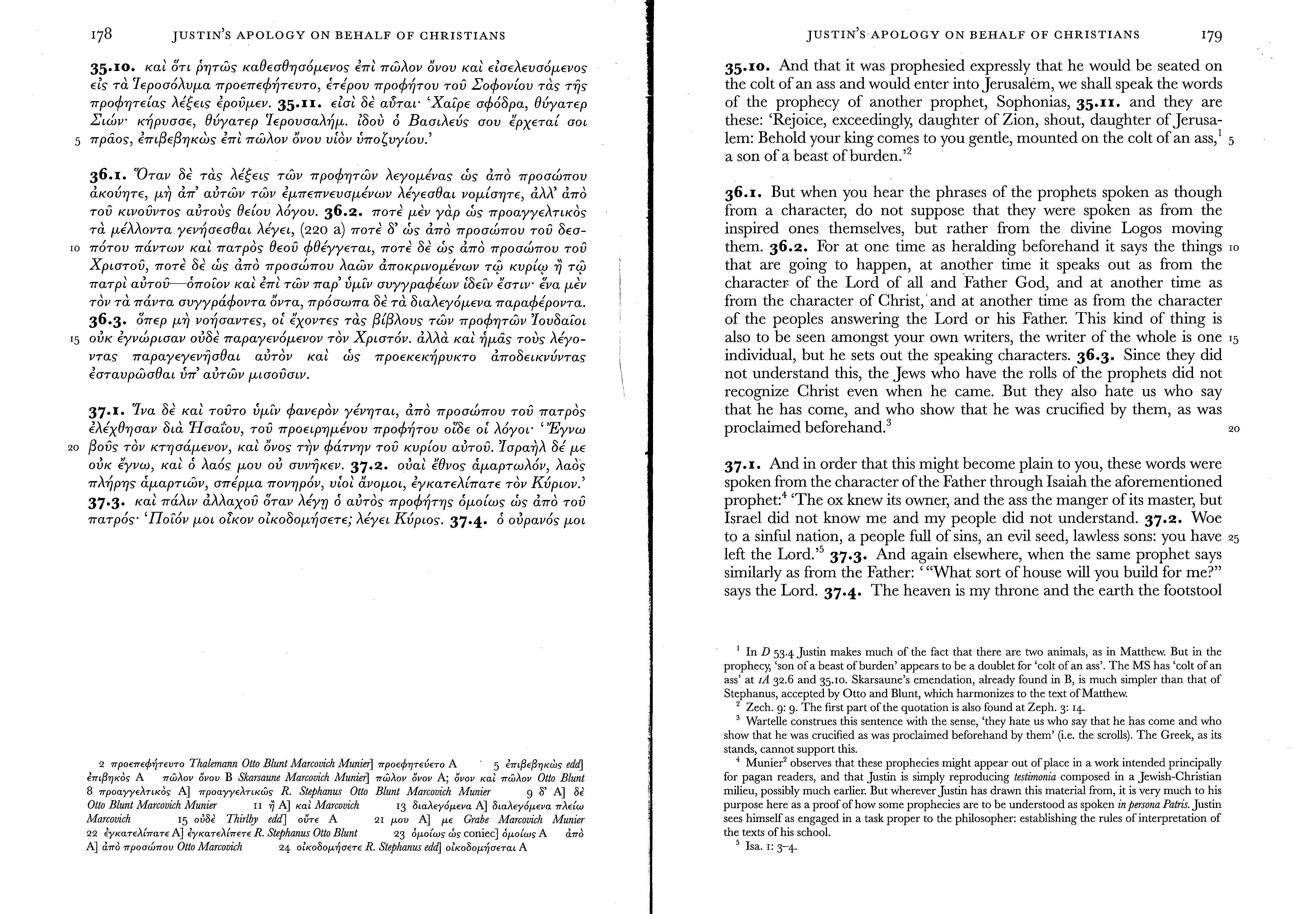
JUSTIN'S APOLOGY ΟΝ BEHALF OF CHRISTIANS
JUSTIN'SAPOLOGY ΟΝ BEHALF OF CHRISTIANS
35,ΙΟ. And that it was prophesied expressly that he would be seated οη the colt of an ass and would enter into Jerusalem, we shall speak the words of the prophecy of another prophet, Sophonias, 35.ΙΙ. and they are these: 'Rejoice, exceedingly, daughter of Ζίοη, shout, daughter of Jerusalem: Behold your king comes to you gentle, mounted οη the colt of an ass,l 5 a son of a beast of burden.'2
35.ΙΟ. και ση pηTω~ καθεσθησόμενος επι πωλον σνου και είσελευσόμενος , , Ί /λ Φ / Ι / Φ / ~ Σ Φ / , ~ εις τα εροσο υμα προεπε ητευτο, ετερου προ ητου του ο ονιου τας της προΦητε{ας λέξεις ερουμεν. 35.ΙΙ. είσι δε αδται· 'Χαιρε σΦόδρα, θύγατερ
~λ" ι, t Υ / ,
'Ό δ" λ /c ~ Φ ~ λ / Ι"
.Ι. ταν ε τας ε~εις των προ. ητων εγομενας ως απο προσωπου 36.ι. But when you hear the phrases of the prophets spoken as though from a character, do not suppose that they were spoken as from the inspired ones themselves, but rather from the divine Logos moving them. 36.2. For at one time as heralding beforehand it says the things ΙΟ that are going to happen, at an~ther. time it speaks out as from the characteF of the Lord of all and Father God, and at another time as from the character of Christ,' and at another time as from the character of the peoples answering the Lord οτ his Father. This kind of thing is also to be seen amongst your own writers, the writer of the whole is one 15 individual, but he sets out the speaking characters. 36.3. Since they did not understand this, the Jews who have the rolls of the prophets did not recognize Christ even when he came. But they also hate us who say that he has come, and who show that he was crucified by them, as was proclaimed beforehand. 3
άκούητε, μη άπ' αύτων των εμπεπνευσμένων λέγεσθαι νομ{σητε, άλλ' άπο του κινουντος αύτους θε{ου λόγου. 36.2. ποτε μεν γαρ ώς προαγγεληκος
'/λλ / θ λ / ( ) 'δ' t "
/ ~ δ τα με οντα γενησεσ αι εγει, 220 a ποτε ως απο προσωπου του εσ- / / , 'θ ~ Φθ / , δ' t "
/ ~ ΙΟ ποτου παντων και πατρος εου εγγεται, ποτε ε ως απο προσωπου του Χριστου, ποτε δε ώς άπο προσώπου λαων άποκρινομένων Τψ κυρ{ψ η Τψ πατρι αύτοiJ-όποιον και επι των παρ' ύμιν συγγραΦέων ίδειν εστιν· ένα μεν
, , / /Φ"
/ δ" δ λ / Φ / τον τα παντα συγγρα οντα οντα, προσωπα ε τα ια εγομενα παρα εροντα.
ούκ εγνώρισαν ούδε παραγενόμενον τον Χριστόν. άλλα και ήμας τους λέγο ντας παραγεγενησθαι αύτον και ώς προεκεκήρυκτο άποδεικνύντας εσταυρωσθαι ύπ' αύτων μισουσιν.
'1 δ'
, ~ t ~ Φ ,/ "
/ ~ , 37.Ι. να ε και τουτο υμιν ανερον γενηται, απο προσωπου του πατρος ελέχθησαν δια Ή σαίου, του προειρημένου προΦήτου οίδε οί λόγοι· ''Έγνω β ~, / , "
'Φ / ~ / '~Ί 'λ δ /
ους τον κτησαμενον, και ονος την ατνην του κυριου αυτου. σραη ε με 37.Ι. And ίη order that this might become plain to you, these words were spoken from the character of the Father through Isaiah the aforementioned prophet:4 'The οχ knew its owner, and the ass the manger of its master, but Israel did not know me and my people did not understand. 37.2. Woe to a sinful nation, a people [υΠ of sins, an evil seed, lawless sons: you have 25 left the Lord.'s 37.3. And again elsewhere, when the same prophet says similarly as from the Father: '''What sort of house will you build for me?" says the Lord. 37.4. The heaven is my throne and the earth the footstool ούκ εγνω, και ό λαός μου ού συνηκεν. 37.2. ούαι εθνος άμαρτωλόν, λαοs πλήρης άμαρηων, σπέρμα πονηρόν, υίοι ανομοι, εγκατελ{πατε τον Κύριον.'
, /λ 'λλ ~ t, λ / Ι "
Φ / Ι / t"
~ 37.3. και πα ιν α αχου οταν εγTl ο αυτος προ ητης ομοιως ως απο του / 'Π ~ / 'i'
'δ / λ / Κ / Ι, / πατρος· οιον μοι οικον οικο ομησετε; εγει υριος. 37.4. ο ουρανος μοι 1 Ιη D 53-4 Justin makes much of the fact that there are two animals, as ίη Matthew. But ίη the prophecy, 'son of a beast ofburden' appears to be a doublet for 'colt of an ass'. The MS has 'colt of an ass' at ιΑ 32.6 and 35.ΙΟ. Skarsaune's emendation, already found in Β, is much simpler than that of Stephanus, accepted by Otto and Blunt, which harmonizes to the text ofMatthew.
2 Zech. 9: 9. The first part of the quotation is also found at Zeph. 3: 14.
3 Wartelle construes this sentence with the sense, 'they hate us who say that he has come and who show that he was crucified as was proclaimed beforehand by them' (i.e. the scrolls). The Greek, as its stands, cannot support this.
.. Munier2 observes that these prophecies might appear out of place ίη a work intended principally for pagan readers, and that Justin is simply reproducing testimoniα composed in a Jewish-Christian milieu, possibly much earlier. But wherever Justin has drawn this material from, it is very much to his purpose here as a proof of how some prophecies are to be understood as spoken ίπ personα Pαtris. Justin sees himself as engaged ίη a task proper to the Ρhilοs(ψher: establishing the rules of interpretation of the texts of his school.
2 προεπεΦ'ήτευτο Thαlemαnn Otto Blunt Mαrcomch Munier] προεΦ'ητεύετο Α 5 ε.πιβεβηκως edαΊ ε.πιβηκσς Α πωλον σνου Β Skαrsαune Mαrcomch Munier] πωλον σνον Α; σνον και πωλον Otto Blunt
8 προαγγελτικσς Α] προαγγελτικως R. Stephαnus Otto Blunt Mαrcovich Munier 9 δ' Α] δε Otto Blunt Mαrcovich Munier 11 r; Α] και Mαrcovich 13 διαλεγόμενα Α] διαλεγόμενα πλείω Mαrcovich 15 ουδε Thirlby edd] οϋτε Α 21 μου Α] με Grαbe Mαrcovich Munier 22 έγκατελίπατε Α] έγκατελίπετε R. Stephαnus Otto Blunt
Α] απσ προσώπου Otto Mαrcoviclz 24 οικοδομήσετε R. Stephαnus edαΊ οικοδομήσεται Α
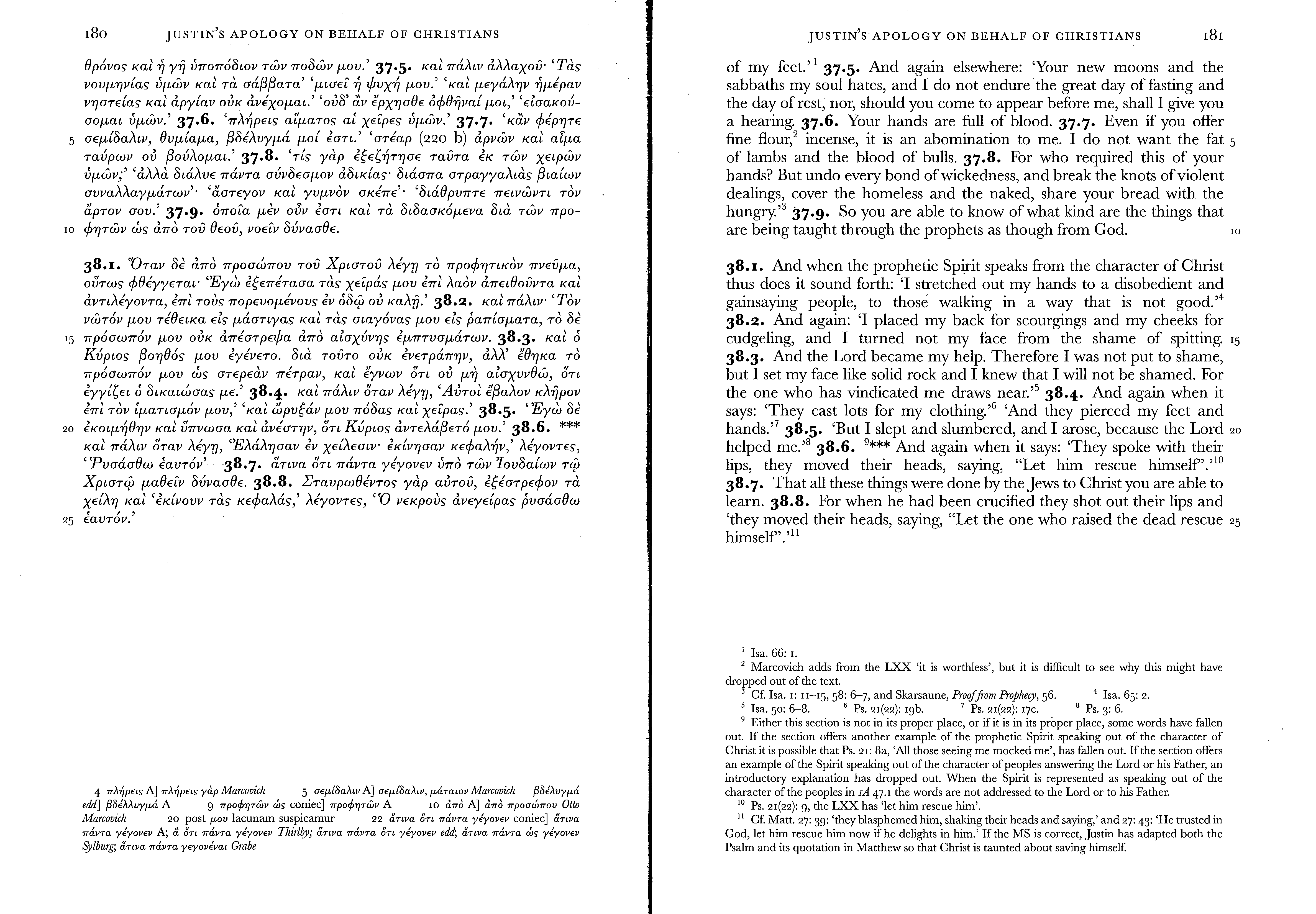
JUSTIN'S APOLOGY ΟΝ BEHALF OF CHR1ST1ANS
JUST1N'SAPOLOGY ΟΝ BEHALF OF CHR1ST1ANS
θρόνος και ή γή ύ7ΤΟ7Τόδιον των 7Τοδων μου.' 37.5. και 7Τάλιν αλλαχου· 'τας of my feet.'l 37.5. And again e1sewhere: 'Your new moons and the sabbaths my sou1 hates, and Ι do not endure . the great day of fasting and the day of rest,. nor, shou1d you come to appear before me, shall Ι give you a hearing. 37.6. Yonr hands are full of b1ood. 37.7. Even if you offer fine flour,2 incense, it is an abomination to me. Ι do not want the fat 5
Ι (Λ \ \ 'ββ , , Λ (,/, Ι "
\ 'λ (Ι νουμYjνιας υμων και τα σα ατα μισει Yj ψυΧΥ} μου. και μεγα YjV Yjμεραν ι \, Ι )) Ι "
'δ"'" θ 'Φθ'" ι '" ι νYjστειας και αργιαν ουκ ανεχομαι. ου αν EpXYja ε ο Yjναι μοι, εισακουσομαι ύμων.' 37.6. '7Tλ~pεις αίματος αί χειρες ύμων.' 37.7. 'καν ΦέΡYjτε
Ι ( b)'
8' Ι \ 't Υ Ι Λ'
Λ Λ ταυρων ου ου ομαι. 37. . τις γαρ E':,Ef:,YjTYjaE ταυτα εκ των χειΡων of 1ambs and the b100d of bulls. 37.8. For who required this of your hands? But undo every bond of wickedness, and break the knots of vio1ent dea1ings, cover the home1ess and the naked, share your bread with the hungry.,3 37.9. So you are ab1e to know ofwhat kind are the things that are being taught through the prophets as though from God.
( Λ "
'λλ \ δ 'λ Ι Ι δ 'δ Ι δ Ι λ \ β Ι υμων; α α ια υε 7Ταντα συν εσμον α ικιας· ιασ7Τα στραγγα ιας ιαιων συναλλαγμάτων'· 'άστεγον και γυμνον σκέ7Τε'· 'διάθρυ7Ττε 7Τεινωντι τον άρτον σου.' 37.9. ό7Τοια μεν οδν έστι και τα διδασκόμενα δια των 7Τρο10 ΦYjτων ώς α7ΤΟ του θεου, νοειν δύνασθε.
Φθ Ι 'Έ \ 't Ι \ Λ Ι , \ λ \ , θ Λ \ ουτως εγγεται· γω ε':, ε7Τετασα τας χειΡας μου ε7ΤΙ αον α7Τει ουντα και 38.1. And when the prophetic Sp~it speaks from the character of Christ thus does it sound forth: Ί stretched out my hands to a disobedient and gainsaying peop1e, to those walking ίη a way that is not good.,4
38.2. And again: Ί p1aced my back for scourgings and my cheeks for cudge1ing, and Ι turned not my face from the shame of spitting. 15
38.3. And the Lord became my he1p. Therefore Ι was not put to shame, but Ι set my face 1ike solid rock and Ι knew that Ι wil1 not be shamed. For the one who has vindicated me draws near.'5 38.4. And again when it says: 'They cast 10ts for my c1othing.'6 'And they pierced my feet and hands.,7 38'5' 'But Ι slept and slumbered, and Ι arose, because the Lord 20 he1ped me.,8 38.6. 9*** And again when it says: 'They spoke with their
1ips, they moved their heads, saying, "Let him rescue himse1f'.' 10
38.7. That all these things were done by the Jews to Christ you are ab1e to 1earn. 38.8. For when he had been crucified they shot out their 1ips and 'they moved their heads, saying, "Let the one who raised the dead rescue 25 himse1f'.,11 αντιλέγοντα, έ7ΤΙ τους 7Τορευομένους έν όδφ ου καλΏ.' 38.2. και 7Τάλιν· 'Τον νωτόν μου τέθεικα εις μάστιγας και τας σιαγόνας μου εις ρα7Τίσματα, το δε ι ι "Ι ,11'"
\ (
7Τροσω7Τον μου ουκ α7Τεστρεψα α7ΤΟ αισχυνYjς εμ7Ττυσματων. 3 .3. και ο Κ Ι β θ Ι ,ι δ \ Λ "
"θ \ υριος OYj ος μου εγενετο. ια τουτο ουκ EVETpa7TYjV, α ε YjKa το 7Τρόσω7Τόν μου ώς στερεαν 7Τέτραν, και εγνων ότι ου μη αισχυνθω, ότι
\ ,Ι β λ λ Λ εγγΙf:,ει ο ικαιωσας με. 3 .4. και 7Τα ιν οταν εγτι, υτοι ε α ον κ YjpOV έ7ΤΙ τον ίματισμόν μου,' 'και ωρυξάν μου 7Τόδας και χειΡας.' 38.5' 'Έγω δε
, 'θ \ "
\, Ι "Κ Ι 'λ 'β Ι , 8 6 ***
'λ '
Ι Φ λ Ι , λ Ι και 7Τα ιν οταν εγτι, α Yjaav εν χει εσιν· εκινYjσαν κε α YjV, εγοντες, 'Ρυσάσθω εαυτόν'-38.7. ατινα ότι 7Τάντα γέγονεν ύ7ΤΟ των 'Ιουδαίων τφ
Ι \ Φ λ Ι , λ Ι '(ο \, Ι ( Ι θ χει Yj και εκινουν τας κε α ας, εγοντες, νεκρους ανεγειΡας ρυσασ ω ( ι,
1 Isa. 66: Ι.
2 Marcovich adds from the LXX 'it is wortWess', but it is difficult to see why this might have dropped out of the text.
3 Cf. Isa. Ι: 11-15,58: 6-7, and Skarsaune, Proqf.from Prophecy, 56.
4 Isa. 65: 2.
5 Isa. 50: 6-8.
6 Ps. 21(22): 19b.
7 Ps. 21(22): IΊC.
8 Ps. 3: 6.
9 Either this section is not in its proper place, ΟΓ if it is in its proper place, some words have fallen out. If the section offers another example of the prophetic Spirit speaking out of the character of Christ it is possible that Ps. 21: 8a, 'All those seeing me mocked me', has fallen out. Ifthe section offers an example of the Spirit speaking out of the character of peoples answering the Lord ΟΓ his Father, an introductory explanation has dropped out. When the Spirit is represented as speaking out of the character ofthe peoples ίη ιΑ 47.1 the words are not addressed to the Lord ΟΓ to his Father.
4 πλήρει" Α] πλήρει" γαρ Mαrcovich 5 σψtδαλιν Α] σψtδαλιν, μάταιον Mα1"Covich βδέλυγμά edd] βδέλλυγμά Α 9 προΦητων ώ" coniec] προΦητων Α 10 απο Α] απο προσώπου Otto 10 Ps. 21(22): g, the LXX has 'let him rescue him'.
Mαrcovich 20 post μου lacunam suspicamur 22 ατινα στι πάντα γέγονεν coniec] ατινα
11 Cf. Matt. 27: 3g: 'they blasphemed him, shaking their heads and saying,' and 27: 43: 'He trusted in God, let him rescue him now if he delights in him.' If the MS is correct, Justin has adapted both the Psalm and its quotation in Matthew so that Christ is taunted about saving himself. πάντα γέγονεν Α; α στι πάντα γέγονεν Thirlf?y; ατινα πάντα στι γέγονεν edd; ατινα πάντα ώ" γέγονεν
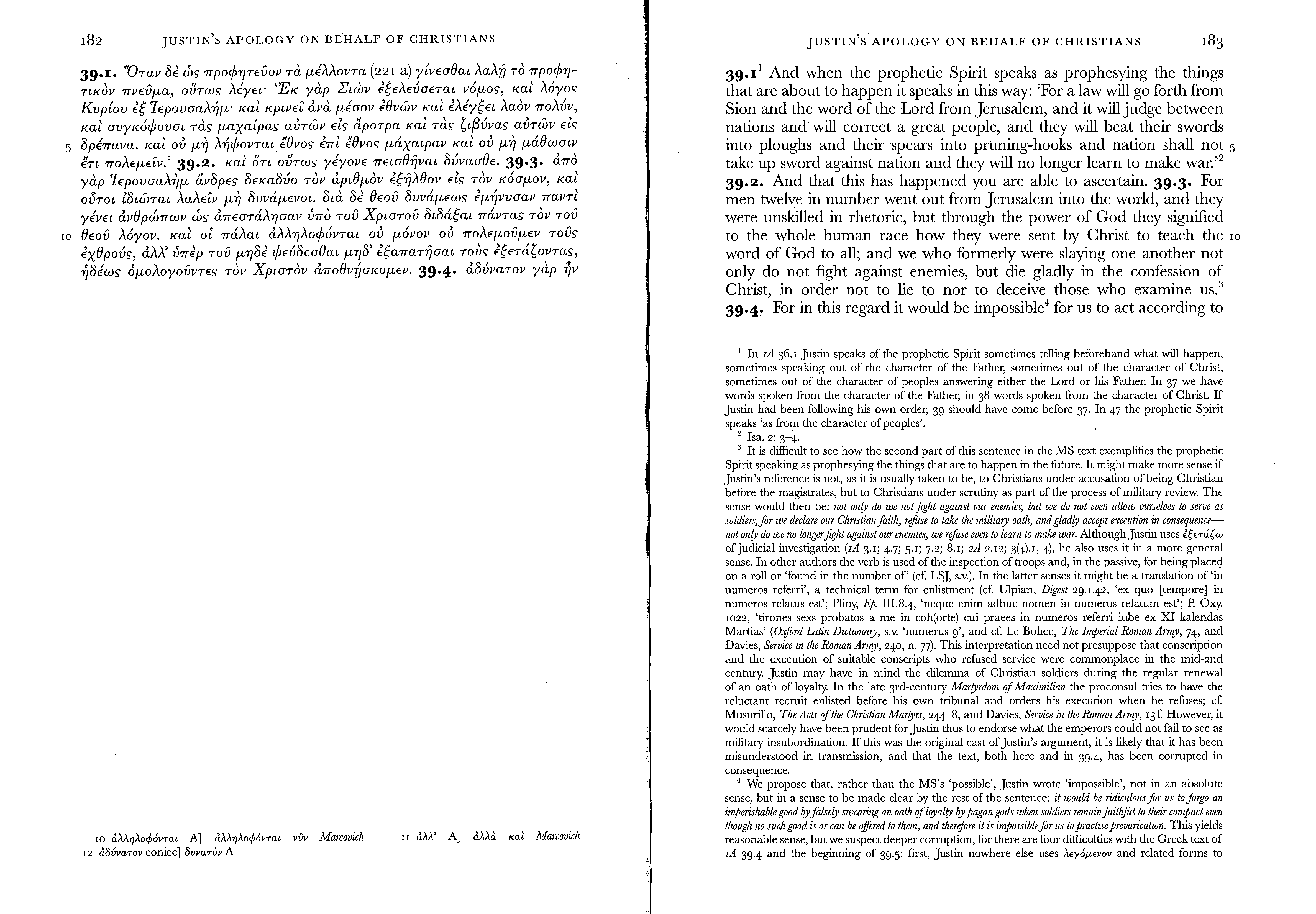
JUSTIN'S APOLOGY ΟΝ BEHALF OF CHRISTIANS
JUSTIN'SAPOLOGY ΟΝ BEHALF OF CHRISTIANS
39.1. Όταν δε ώς ΠΡΟΦYjτευον τα μέλλοντα (221 a) γίνεσθαι λαλfι το προΦYj39.11 And when the prophetic Spirit speak~ as prophesying the things that are aboutto happen it speal(s in this way: 'For a law will go forth from Sion and the word of the Lord from Jerusalem, and it will judge between nations and· will correct a great people, and they will beat their swords into ploughs and theirspears into pruning-hooks and nation shall not 5 take up sword against nation and they will ηο longer learn to make war. ,2
39.2.And that this has happened you are able to ascertain. 39.3. For men twel~e ίη number went out from Jerusalem into the world, and they were unskilled ίη rhetoric, but through the power of God they signified to the whole human race how they were sent by Christ to teach the 10 word of God to all; and we who formerly were slaying one another not only do not fight against enemies, but die gladly in the confession of Christ, ίη order not to lie (ο ηΟΓ to deceive those who examine us.3
\ Λ " λ '
'Έ \ Σ" t λ '
\ Λ'
\ , 'θ Λ \ 'λ' t λ \ λ' υριου ε~ ερουσα Yjμ' και κρινει ανα μεσον ε νων και ε εγ~ει αον πο υν, \ /,1, ' ι ,,..,,, \ \ r β ι ,1"\, και συγκοψουσι τας μαχαιΡας αυτων εις αροτρα και τας Ι;,Ι υνας αυτων εις δ '
\ , \ λ "Ι.
"θ ,\ "θ'
\ , \ 'θ
ρεπανα. και ου μΥ} Yjψονται. ε νος επι ε νος μαχαιΡαν και ου μΥ} μα ωσιν " λ 1"\, \ t/ r/ Ι θ Λ δ' θ ' \ ετι πο εμειν. 39.2. και οτι ουτως γεγονε πεισ Yjναι υνασ ε. 39.3. απο \ Ί λ'" δ δ δ'
\ , θ \ 't Λλθ ' \'
\ γαρ ερουσα Yjμ αν ρες εκα υο τον αρι μον ε~ Yj ον εις τον κοσμον, και οδτοι ίδιωται λαλειν μη δυνάμενοι. δια δε θεου δυνάμεως εμήνυσαν παντι
, 'θ'
(, 'λ (\ Λ Χ Λ δ δ 't '
\ Λ γενει αν ρωπων ως απεστα Yjaav υπο του ριστου ι α~ αι παντας τον του 10 θεου λόγον. και οί πάλαι άλλYjλοΦόνται ου μόνον ου πολεμουμεν τους εχθρούς, άλλ' ύπερ του μYjδε ψεύδεσθαι μYjδ' εξαπατησαι τους εξετάζοντας,
~δέως όμολογουντες τον Χριστον άποθνΤισκομεν. 39.4. άδύνατον γαρ -ην 39.4. For ίη this regard it would be impossible4 for us to act according to 1 Ιη ιΑ 36.1 Justin speaks ofthe prophetic Spirit sometirnes te11ing beforehand what will happen, sometimes speaking out of the character of the Father, sometimes out of the character of Christ, sometimes out of the character of peoples answering either the Lord or his Father. Ιn 37 we haνe words spoken from the character of the Father, in 38 words spoken from the character of Christ. If Justin had been fo11owing his οννn order, 39 should haνe come before 37. Ιn 47 the prophetic Spirit speaks 'as from the character of peoples'.
2 Isa. 2: 3-4.
3 It is difficult to see how the second part of this sentence ίn the MS text exemplifies the prophetic
Spirit speaking as prophesying the things that are to happen ίη the future. It might make more sense if Justin's reference is not, as it is usually taken to be, to Christians under accusation ofbeing Christian before the magistrates, but to Christians under scrutiny as part of the process of military reνiew. The sense would then be: ιzot οιιιΥ do we not fight αgαiιιst our enemies, but we do not"even αllow oUl"Selves to serve αs soldieτs,jόr we declαre our Christiαιl Jάith, rdiιse to tαke the militαry oαth, αnd glαdly αccept execution ίιι coιιsequeιzce not οιιιΥ do we ιιο longer fight αgαiιιst our enemies, we rdiιse even to leαrιz to mαke wαr. AlthoughJustin uses εξετάζω of judicial inνestigation (ιΑ 3.1; 4.7; 5.1; 7.2; 8.1; 2Α 2.12; 3(4).1, 4), he also uses it ίη a more general sense. Ιη other authors the νerb is used of the inspection of troops and, ίη the passiνe, for being placed οη a ro11 or 'found ίη the number of' (cf. LSJ, s.ν.). Ιn the latter senses it might be a translation of 'ίη numeros referri', a technical term for enlistment (cf. Ulpian, Digest 29.1.42, 'ex quo [tempore] ίη numeros relatus est'; ΡΙίηΥ, Ερ. ΙΙΙ.8.4, 'neque enim adhuc nomen ίη numeros relatum est'; Ρ. Qxy.
1022, 'tirones sexs probatos a me ίη coh(orte) cui praees ίη numeros referri iube ex ΧΙ kalendas
Martias' (O:ifόrd Latin Dictioιzαry, S.ν. 'numerus 9', and cf. Le Bohec, The Imperiαl Romαn Army, 74, and Daνies, Service ίιι the Romαn ΑΤΙΙΙΥ, 240, n. 77). This interpretation need not presuppose that conscription and the execution of suitable conscripts who refused serνice were commonplace ίη the mid-2lld century. Justin may haνe ίη mind the dilemma of Christian soldiers during the regular renewal of an oath of loyalty. Ιη the late 3rd-century Mαrf:yrdom qf Mαximiliαιz the proconsul tries to haνe the reluctant recruit enlisted before his οννη tribunal and orders his execution when he refuses; cf.
Musurillo, The Acts qf the Chlistiαn Mαrf:yrs, 244-8, and Daνies, Service ίιι the Romαιl Army, 13 f. Howeνer, it would scarcely haνe been prudent for Justin thus to endorse what the emperors could not fail to see as military insubordination. If this was the original cast of Justin's argument, it is likely that it has been misunderstood in transmission, and that the text, both here and ίη 39-4, has been corrupted ίη consequence.
4 We propose that, rather than the MS's 'possible', Justin wrote 'irnpossible', not ίη an absolute sense, but ίη a sense to be made clear by the rest of the sentence: it would be ridiculous jότ us to jόrgo αιι imperishαble good by Jάlsely sweαι7Ilg αιι oαth qfloyαlf:y by pαgαn gods when soldiers remαinJάith.fiιl to their colnpαct even though ιιο such good is οτ cαιι be qffered to them, αnd therqrπe it is impossible jότ us to prαctise prevαricαtion. This yields reasonable sense, but we suspect deeper corruption, for there are four difficulties with the Greek text of ΙΙ άλλ'
Α] άλλιΙ Kal Mαrcovich 10 άλλrιλoΦ6νται Α] άλλrιλoΦ6νται νυν Mαrcovich 12 άδύνατον coniec] δυναταν Α ιΑ 39.4 and the beginning of 39.5: first, Justin nowhere else uses λεγ6μ.ενον and related forms to
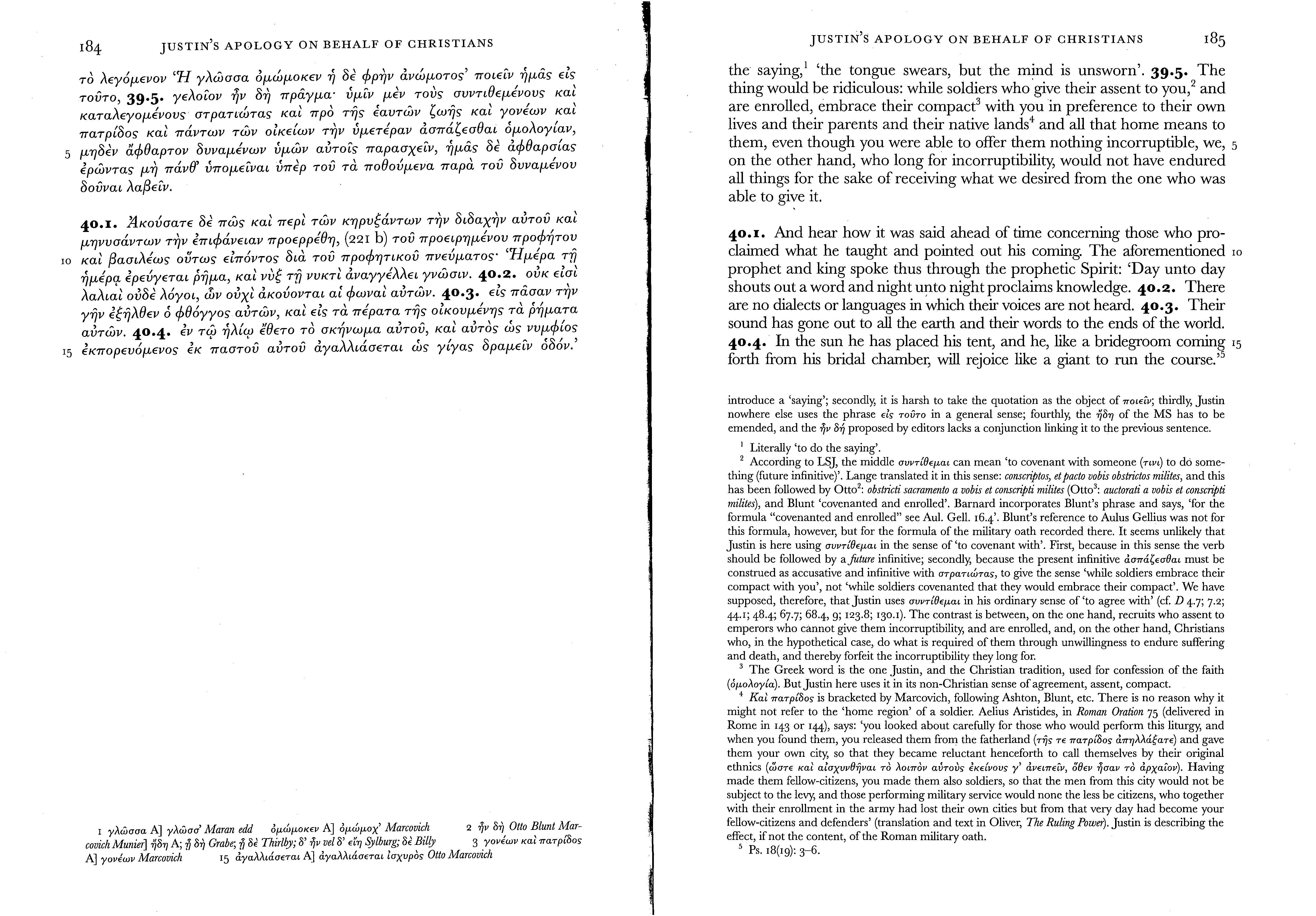
JUST1N'S APOLOGY ΟΝ BEHALF OF CHR1ST1ANS
JUST1N'S APOLOGY ΟΝ BEHALF OF CHR1ST1ANS
the sayiηg,ι 'the tongue swears, but the m~nd is unsworn'. 39.5. The thing would be ridiculous: while soldiers who give their assent to you,2 and are enrolled, embrace their compact3 with youin preference to their own lives and their parents and their native lands4 and all that home means to them, even though you were able to offer them nothing incorruptible, we, 5
Το λεγόμενον 'Ή γλωσσα σμώμοκεν ~ δε φρην ανώμοτος' 7Τοιειν ~μας είς τουτο, 39.5. γελοιον ήν δη 7Τραγμα· υμιν μεν τους συντιθεμένους και καταλεγομένους στρατι,ώτας και 7Τρο τής έαυτων ζωής και γονέων και
7Τατρίδος και 7Τάντων των οίκείων την υμετέραν ασ7Τάζεσθαι όμολογίαν, 5 μηδεν αΦθαρτον δυναμένων υμων αύτοίς 7Ταρασχείν, ~μας δε αΦθαρσίας οη the other hand, who long for incorruptibility, would not have endured all things for the sake of receiving what we desired from the one who was able to give ίι ερωντας μη 7Τάνθ' ύ7Τομειναι δ7Τερ του τα 7Τοθούμενα 7Ταρα του δυναμένου δουναι λαβεΙν.
40.1. Άκούσατε δε 7Τως και 7Τερι των κηρυξάντων την διδαχην αύτου και 40~I. And hear how it was said ahead of time concerning those who proμηνυσάντων την ε7ΤιΦάνειαν 7Τροερρέθη, (221 b) του 7ΤροειΡημένου 7TPOΦ~Toυ
\ β λ / tf ,/ δ \ Λ Φ Λ / 'Ή / Λ
και ασι εως ουτως εΙ7Τοντος ια του 7Τρο ητικου 7Τνευματος· μερα TTJ claπned what he taught and pointed out his coming. The aforementioned 10 prophet and king spoke thus through the prophetic Spirit: 'Day unto day shouts out a word and night u~to night proclaims knowledge. 40.2. There are ηο dialects or languages in which their voices are not heard. 40.3. Their sound has gone out to all the earth and their words to the ends of the world.
40.4. In the sun he has placed his tent, and he, like a bήdegrοοm coming 15 forth from his bήdal chamber, will rejoice like a giant to run the course. ,5
~μέρCf ερεύγεται ρήμα, και νυξ Tn νυκτι αναγγέλλει γνωσιν. 40.2. ούκ είσι λ λ \ 'δ \ λ / l'
,\, / • Φ \, Λ 'Λ \ α ιαι ου ε ογοι, ων ουχι ακουονται αι ωναι αυτων. 40.3. εις 7Τασαν την γήν εξήλθεν ό Φθόγγος αύτων, και είς τα 7Τέρατα τής οίκουμένης τα p~μαTα
, ,....
).....
Ιλ / "θ \ ι ,,..
εΚ7Τορευόμενος εκ 7Ταστου αύτου αγαλλιάσεται ώς γίγας δραμειν όδόν.' introduce a 'saying'; seconclly, it is harsh to take the quotation as the object of ποιειν; thirclly, ]ustin nowhere else uses the phrase Els τουτο ίη a general sense; fourthly, the ~δ1) of the MS has to be emended, and the ήν δή proposed by editors lacks a conjunction linking it to the previous sentence.
1 Literally 'to do the saying'.
.2 According to LS], the midclle συντίθεμαι can mean 'to covenant with someone (τινι) to dό somethlng (future infinitive)'. Lange translated it ίη this sense: conscriptos, et pacto vobis obstrictos milites, and this h~s. been followed ~y Ott02: obst17Cti sacramento α vobis et conscripti milites (Ott03: auctorati α vobis et conscripti lntlttes), and Blunt covenanted and enrolled'. Barnard incorporates B1unt's phrase and says, '[or the formu1a "covenanted and enrolled" see Aul. Gell. 16.4'. B1unt's reference to Au1us Gellius was not for this formula, however, but for the formula of the military oath recorded there. 1t seems un1ike1y that ]ustin is here using συντίθεμαι ίη the sense of 'to covenant with'. First, because ίη this sense the verb shou1d be followed by aftture infinitive; seconclly, because the present infinitive ασπάζεσθαι must be construed as accusative and infinitive with στρατιώταs, to give the sense 'while soldiers embrace their compact with you', not 'while soldiers covenanted that they wou1d embrace their compact'. We have supposed, therefore, that ]ustin uses συντίθεμαι in his ordinary sense of 'to agree with' (cf. D 4.7; 7.2;
44.1; 48.4; 67·7; 68·4, 9; 123.8; 130.1). The contrast is between, οη the one hand, recruits who assent to emperors who cannot give them incorruptibility, and are enrolled, and, οη the other hand, Christians who, ίη the hypothetica1 case, do what is required of them through unwillingness to endure suffering and death, and thereby forfeit the incorruptibility they 10ng for.
3 The Greek word is the one ]ustin, and the Christian tradition, used for confession of the faith
(όμολογία). But ]ustin here uses it ίη its non-Christian sense of agreement, assent, compact .
• 4 Και πατρίδοs is bracketed by Marcovich, following Ashton, B1unt, etc. There is ηο reason why it mlght not refer to the 'home region' of a soldier. Ae1ius Aristides, ίη Roman Oration 75 (de1ivered ίη
Rome in 143 οτ 144), says: 'you 100ked about carefully for those who wou1d perform this 1iturgy, and when you found them, you re1eased them from the father1and (τηs τε πατρίδοs αΠ1)λλάξατε) and gave them your οννη city, so that they became re1uctant henceforth to call themse1ves by their original ethnics (ώστε και αισχυνθηναι το λοιπον αύτοvs εκείνουs γ' ανειπεί'ν, όθεν ήσαν το αρχαί'ον). Having
ma~e them fellow-citizens, you made them a1so soldiers, so that the men from this city would not be s~bJect t? the 1evy, and those performing military service wou1d none the 1ess be citizens, who together wlth theιr enrollment ίη the army had 10st their οννη cities but from that very day had become your fellow-~itizens and defenders' (trans1ation and text ίη Oliver, The Ruling Poωeι). ]ustin is describing the effect, lf not the content, of the Roman military oath. ι γλωσσα Α] γλωσσ' Maran edd όμώμοκεν Α] όμώμοχ' Marcomch 2 ην δη Otto Blunt MarcovichMunier] ~δ1) Α; Τι δη Grabe; Τι δε Thirlby; δ' ην vel δ' εϊ1) Sylburg; δε Βίl/Υ
JUSTIN'S APOLOGY ΟΝ BEHALF OF CHRISTIANS
JUSTIN'S APOLOGY ΟΝ BEHALF OF CHRISTIANS
, , δ'
Λ Λ 40.5. προς τουτοις ε και ογων ετερων των προ rιTευ εντων ι αυτου του 40.5. And ίη addition to this we consider it good and appropriate to mention also other words which were prophesied through the same David, from which it is possible for you to learn how the prophetic Spirit encourages human beings to live; 40.6. and how he signifies that there was a banding together against Christ of Herod, the king of the Jews, and the 5
Jews themselves, and Pilate,l who was your procurator2 among them, Δαυισ καλως εχον και οίκείως επιμνrισθηναι λελογίσμεθα, ες ών μαθειν ύμιν
'φ'
40.6. και πως μrινυει Trιν γεγενrιμενrιν ρω ου του ασι εως ου αιων 5 και αυτων Ί ουδαίων και Πιλάτου του ύμετέρου παρ' αυτοις γενομένου επιτρόπου, συν τοις αυτου Ο'τραΤιώταις, κατα του Χριστου συνέλευσιν, together with his soldiers; 40.7. and that he would be believed ίη by human l;>eings from every race; and that God calls him Son and has promised to make subject to him all his enemies; and how the demons, as far as they are able, attempt to escape from the authority of the Lord 10
\ ιl Ι θ ,ι λλ ι \ ....., ,Ι 'θ ι 40.7. και οτι πιστευεσ αι εμε εν υπο των εκ παντος γενους αν ρωπων και ότι αυτον υίον καλει ό θεος και ύποτάσσειν αυτψ πάντας τους εχθρους
.....
Ι .....
" επrιγγε ται, και πως οι αιμονες, οσον επ αυτοις, Trιν τε του πατρος παντων 10 και δεσπότου θεου και T~ν αυτου του Χριστου εςουσίαν φυγειν πειρωνται,
\ t' ι λ Λ'
"λθ""
, ('
Ι ..... και ως εις μετανοιαν κα ει παντας ο εος πριν ε Ην Trι ν rιμεpαν Trι ς God and Father of all and that of his Christ; and that God calls everyone to repentance before the coming ·of the day of judgement. 40.8. These are the words: 'Blessed is the man who did not walk ίη the counsel of the impious and did not take his place ίη the path of sinners, and did not sit οη the seat of the pernicious, but his will is ίη the law of the Lord 15 and οη his law he will meditate day and night, 40.9. and he will be as the tree planted beside springs of waters, which will give its fruit ίη its time and its leaf shall not fall o:ff, and all that he does shall prosper.
40.10. Not so are the impious, not so, but they are like dust which the wind blows from the face of the earth. Therefore the impious will not 20 rise up ίη judgement nor sinners ίη the counsel of the just, because the Lord knows the path of the just and the path of the impious will perish.
40.11. Why did the nations bluster, and the peoples think of novelties?3 , The kings of the earth were at hand and the rulers gathered together against the Lord and against his Christ, saying: "Let us burst their 25 bonds and throw off their yoke from us." 40.12. He who dwells ίη the heavens will laugh at them and the Lord will mock them. Then he will speak to them ίη his anger and ίη his wrath he will confound them.
40.13. But οη Sion his holy mountain Ι have been established by him as king, proclaiming the commandment ofthe Lord. 40.14. The Lord said 30 to me, ''You are my Son. Today Ι have begotten you. 40.15. Ask of me and Ι will give you nations as your inheritance and the ends of the earth as your possession. You will shepherd them with a rod of iron, you will crush them like a potter's vessel." 40.16. And now, Ο kings, understand, be instructed all judges of the earth. 40.17. Serve the Lord with fear and 35 exalt ίη him with trembling. 40.18. Seize instruction, lest the Lord
,ι δ' ιl 'Μ Ι "c\', lθ' κρίσεως. 40.8. ειprινTαι ε ουτως· ακαριος ανrιp ος ουκ επορευ rι εν 'β "Ιδ Λ Ι λ Λ "Ι , " θ 'δ (222 a) βουλύ ασε ων, και εν ο Ψ αμαρτω ων ουκ εσTrι, και επι κα ε ραν
, , 'θ 'λλ' '"
, θ 'λ 'Λ"
Λ λοιμων ουκ εκα ισεν, α rι εν Τψ νομψ υριου το ε rιμα αυτου και εν Τψ , , λ' ι, "
, ,Ι (, (; 'λ '
νομψ αυτου με εTrισει rιμεpας και νυκτος. 40.9. και εσται ως το ς υ ον το , " δ (; 'δ Λ Ιδ'
, πεφυτευμενον παρ α τας ιεςΟ ους των υ ατων, ο τον καρπον αυτου ωσει εν , " φ 'λλ ,.....,'
Ι \ Ι r/'\ ..... καιΡω αυτου και το υ ον αυτου ουκ αΠOppυrισεTαι και παντα οσα αν ΠΟΙTJ ι. ι ,r/ (', β.....
, Ιl 'λλ' " ('
\ KαTευOδωθrισεTαι. 40.10. ουχ ουτως οι ασε εις, ουχ ουτως, α rι ωσει χνους ον εκρίπτει ό ανεμος απο προσώπου της γης. δια τουτο ουκ
, 'δ'
, Ιδ' , β Λ , λ Λ Ί' γινωσκει υριος ο ον ικαιων και ο ος ασε ων απο ειται. 40.11. να τι εqψύαςαν εθνrι και λαοι εμελέTrισαν καινά; ΠαpέσTrισαν οί βασιλεις της γης,
\ C'" ι θ ' \ \ "
..... Κ Ι
\ \ ..... και οι αρχοντες συνrιx rισαν επι το αυτο κατα του υριου και κατα του 'λ'
Δ '(; 'δ"
" , Ι Κ"
Λ , , , λ λ'
, εκγελασεται ,αυτους, και ο υριος εKμυKTrιpιει αυτους. τοτε α rισει προς , , , , Λ , Λ "
Λ θ Λ 'Λ , (; , , 40 13 ' , αυτους εν OpYTJ αυτου, και εν Τψ υμψ αυτου ταραςει αυτους.
• • εγω , 'θ β λ \ (', ,
..... , \ Σ'"
,t/ , ..... δ δε κατεστα rιν ασι ευς υπ αυτου επι ιων ορος το αγιον αυτου, ιαγγέλλων το πρόσταγμα Κυρίου. 40.14. Κύριος εΊπε πρός με, Υίός μου εΊ σύ·
,\ Ι Ι Ι ,Ι ".....
\ δ / "θ
εγω σrιμεpoν γεγεννrιKα σε. 40.15. αΙTrισαι παρ εμου, και ωσω σοι ε νrι T~ν KλrιpOνOμίαν σου και T~ν κατάσχεσίν σου τα πέρατα της γης. ποιμανεις
, , , Ι 'βδ δ Λ Ι , , ',/, , , αυτους εν ρα Ψ σι rιpq" ως σKευrι κεραμεως συντριψεις αυτους.
40.16. και νυν, βασιλεις, (222 b) σύνετε· παιδεύθrιTε, πάντες οί κρίνοντες T~ν γην. 40.17. δουλεύσατε Τψ Κυρίψ εν φόβψ, και αγαλλιασθε αυτψ εν
35 τρόμψ. 40.18. δράςασθε παιδείας, μή ποτε οργισθύ Κύριος και απολεισθε ι Commentators have noticed a similarity between this passage and the application of Psalm 2 to Herod and Pilate at Acts 4: 27. Justin's word-order is very odd, and may be due to a desire to emphasize that it was a 'banding together' that the prophetic Spirit foretold, and not its specific members.
2 Cf. ιΑ 34.2.
8 πάντας τους Α] πάντας Otto Blunt 16 καρπον edtZJ καρον Α 22 εΦρύαςαν R. Stephαnus 3 Α few MSS of the LXX read καίνα, as do .κ, Α, and D ίη Acts, ίη place of the more common κενά.
There is ηο reason to alter the reading of the MS of Justin. edd] εΦρίαςαν Α καινά Α] κενά Lαnge Mαrcovich Munier
JUST1N'S APOLOGY ΟΝ BEHALF OF CHR1ST1ANS
JUST1N'S APOLOGY ΟΝ BEHALF OF CHR1ST1ANS
become angry, and you perish from the right path, when his wrath suddenly blazes . . 40. 19. Blessed are all those who trust ίη him.' 1 εξ όδου δικα{ας όταν εKKαυθiι εν τάχει ό θυμος αυτου. 40.19· μακάριοι πάντες οί πεποιθότες επ' αυτόν.'
41.1. αι πα ιν ι α ΥΊς προ ΥΊτειας μΥΊνυον το προ ΥΊηκον πνευμα, ι 41.1. And again, tlle prophetic Spirit signifying through another prophecy, through the same David, that Christ would reign after he was crucified, said this: 'Sing to the Lord all the earth, and day after day proclaim 5 his salvation, because the Lord is great and mightily to be praised, fearful beyond t;tll the gods, because all the gods of the nations are idols of demons, but God made the heavens. 41.2. Glory and praise before his face, and strength and loud acclamation ίη the place of his sanctification.
\ \ θ Λ β λ ι ( Χ ι rι αυτου του ΔαυίΟ, όη μετα το σταυρω ΥΊναι ασι ευσει ο ριστος, ουτως _"
,.. Κ ι ,.. ι,...
'λ (' ι 'c (' ι , 5 είπεν· 'Άισατε Τψ υριψ, πασα Yj γΥΊ, και αναγγει ατε ΥΊμεραν ε~ ΥΊμερας το ι 'Λ' ,rι ι Κ Ι"
\ Φ Ιδ Φ β \ ( \ σωΤΥΊριον αυτου, οη μεγας υριος και αινετος σ ο ρα, ο ερος υπερ ι \ θ / ι!
Ι (' θ \ Λ 'θ Λ "δ λ δ ι ,Ι (' παντας τους εους, οτι παντες οι εοι των ε νων ει ω α αιμονιων εισιν, ο \ \ \ , \' ι δ '{; \ "i'
\ ι δε θεος τους ουρανους εΠΟΙΥΊσε. 41.2. o~α και αινος κατα προσωπον , \, \ \ Ι ,ι (ι 'Λ δΙ Λ Κ ι αυτου, και ισχυς και καυΧΥΊμα εν τοπψ αγιασματος αυτου. οτε Τψ υριψ, \ , ι δ ι c'
'λ ιβ ι" 'λθ \ 10 τω πατρι των αιωνων o~αν. 41.3. α ετε χαριν, και εισε . ετε κατ α Give glory to the Lord, the Father of the ages. 41.3. Accept favour and ΙΟ enter before his face and worship ίη his holy courts. Let all the earth be fearful at his face and let it be made firm and let it not be shaken.
41.4. Let them rejoice among the nations: the Lord has reigned from the tree.' 2
• , \ '
,\ πρόσωπον αυτου, και προσκυνΥΊσατε εν αυλαις αγιαις αυτου. ο Yj ΥΊτω ιαπο ι , Λ ( Λ \ θ θ '
Φ \ Λ \ 'λλ ι θ ( ,ι δ 15 42.1. ταν ε το προ ΥΊηκον πνευμα τα με οντα γινεσ αι ως Yj Yj γεν42.1. But whenever the prophetic Spirit speaks ofthe things that are going 15 to happen as having already happened, as in the words just cited, it is possible to suppose.3*** We shall explain this as well, in order that it may not offer an excuse4 to those who read them.5 42.2. He foretells as already having happened things which are assuredly known as going to happen. And to realize that it must so be taken, concentrate your mind οη the words he uses. 20 ι ( \, Λ Ι δ c ι ,Ι *** rι όμενα λΕγ~, ως και εν τοις προειΡΥΊμενοις o~ ασαι εσην ,οπως , λ ι \ Ι Λ'
"δ Ι ι! δ \ 42.2. τα παντως εγνωσμενα γενΥΊσομενα προ εγει ως Yj Yj γενομενα· οη ε οϋτως δει εκδέχεσθαι, ενατεν{σατε (223 a)
Τψ νοι: τοις λεγομένοις. ι Ιη some Hebrew and Greek manuscripts of the Psalter, and in substantial patristic and rabbinic evidence, Psalms ι and 2 are viewed as a single psalm, as here; cf. Briggs, The PsαlIns, International
Critical Commentary, i. 3.
2 Skarsaune (Proqf.from Prophecy, 35) says that this text, which is also quoted by Justin at D 73.3-4, 'is really much closer to ι Chron 16.23-31 than to Ps. 96 .... [lt] looks like a carefully composed harmony between the two LXX texts, with ι Chron 16 as the basic text'. Skarsaune proposes (Ρρ. 38,231) that Justin may have taken the conflation from an earlier, Christian source, possibly the Keιygmα Petrί, which Clement of Alexandria may also have used at Protrepticus 4 (62.4). At D 73.1 Justin claims that the final phrase had been excised from Jewish copies of the text. Before this phrase Marcovich adds 'and let them say' from ι Chron. 16: 31. But 'the Lord has reigned from the tree' is the only prophetic utterance ίη this chapter relevant to the purpose Justin stated at its beginning, and as he goes οη in the next chapter to explain why the prophetic Spirit used the past tense when describing future events, it may be that he wanted this statement to be seen as direct1y uttered by the Spirit, and not as what the Spirit commands to be said among the nations. If 'and let them say' stood in his source, Justin may well have deliberately omitted it here.
3 Editors and commentators take ώς δοξάσαι έστιν to mean 'as can be ascertained'. But the verb must have some colour of supposition or conjecture, and for Justin it is a fact, not a matter of conjecture, that the prophetic Spirit speaks of future events as past events. We suspect that the text is corrupt, and that originally it had been along such lines as, since it ir possiblε to suppose thαt the things spoken qfhαd inJαct αlreαdy hαppened we shαll explαin thir αs well. .. Ifthis is correct, the corruption might well be due to haplography. Ιη the Greek text as it stands either the prophetic Spirit or the whole clause beginning 'Whenever .. .' must be the subject of παράσχτι. We propose that it was the possibility of reading prophecies as telling of real past events that might have excused those who thus misunderstood them, and that needed therefore to be explained. At the beginning of the following chapter
Justin will similarly forestall an objection arising from a supposition that might be made (μή τινες ...
4 αυτου του Α] αυτου Blunt Munier ΤΙ προσκυνήσα:ε Α] πpoσKυνήσα~ε ~ψ κυρίφ Mαrc~vich
13 ευΦρανθήτωσαν Α] ευΦρανθήτωσαν και είπάτωσαν Maι"COvlch 16 post εστιν lacunam susplcamur Ι7 άπολογίαν Α] άντιλογίαν Wo!fGrαbe; άλογίαν Thirlby, άπορίαν Lαnge
δοξάσωσι) οη the basis ofwhat he has been saying.
4Editors have proposed that the MS reading is corrupt. But Justin twice uses άναπολογήτος (cf. ιΑ
3.5; 28·3 and Rom. ι: 20). γαρ Mαrcovich 5 Οι D ΤΙ4.Ι.
JUST1N'S APOLOGY ΟΝ BEHALF OF CHR1ST1ANS
JUST1N'S APOLOGY ΟΝ BEHALF OF CHR1ST1ANS
42.3. David spol<:e the foregoing texts fiftee:q hundred years! before Christ became a human being and was crucified, and none of those who lived before David caused rejoicing among the nations οη being crucified, and neither didany of those who lived after him. 42.4. But ίη our time, Jesus
Christ, after being crucified and dying, rose and reigned, ascending into 5 heaven.' And ίη those2 who await the incorruption announced by him there is joy over the things that were proclaimed by him through the apostles ~mong all the nations.
"Φ "δ \ ,...
'δ'
~ , γενομενων σταυρω εις ευ ροσυνην παρεσχε τοις ε νεσιν, α ου ε των μετ εκείνον. 42.4. ό καθ' ~μας δΕ Ίησους Χριστός, σταυρωθεις και αποθανών,
, , Ι , "~ "~ δ '
5 ανεστη και ε ασι ευσεν, ανε . ων εις ουρανον. και επι τοις παρ αυτου ια των αποστόλων εν τοίς πασιν εθνεσι κηρυχθείσιν εύΦροσύνη εστι Ι , λ Ι (, "
~ 'Φθ Ι προσ οκωντων την κατηγγε μενην υπ αυτου α αρσιαν. δ 43.1. 'Όπως δΕ μή τινες εκ των προλελεγμένων ύΦ' ~μων δοξάσω σι καθ'
43.1. But lest from what we have already said some should suppose, είμαρμένης ανάγκην Φάσκειν ~μας τα γινόμενα γίνεσθαι, εκ του προειπείν be~ause of the foretelling of things foreknown, that we say that the things 10 whIch happen happen by necessity of fate, this difficulty too we shall solve.
43.2. We have learnt from the prophets that punishments and correction and good recompense are given out according to the worth of each one's deeds, and we assert that this is true, since if it is not so, but all things happen ίη accordance with fate, nothing at all is in our power. For if it was 15 fated that one person be good and another one be wicked, neither would the first be approved nor the latter be blamed. 43.3. And again, if all human beings do not by free choice have power to avoid what is base and to choose what is good they are innocent3 with respect to whatever they do at all. 43.4. But that it is by free choice that they both act rightly and 20 stumble we demonstrate ίη this way. 43.5. We see the same human being doing opposite things ίn succession. 43.6. But if it were fated that a human being be either wicked or virtuous,4such a one would never be capable of opposite things5 and would not have changed many times. But 10 προεγνωσμένα, και τουτο διαλύσομεν. 43.2. τας τιμωρίας και τας κολΙ
'" θ'
'β'
"<:'1
~ 1<:.
(Ι 'δΙ δ θ ασεις και τας αγα ας αμοι ας κατ α~ ιαν των πpα~ εων εκαστου απο ι οσ αι
, , , ~ Ι ια των προ ητων μα οντες, και α η ες απο αινομε α, επει ει μη τουτο , 'λλ ' θ'
'Φ' (' ,,'
Ι/λ ' εστιν, α α κα ειμαρμενην παντα γινεται, ουτε το ε ημιν εστιν ο ως' ει δ γαρ είμαρται τόνδε τινα αγαθον εΊναι και τόνδε Φαυλον, οϋθ' ογτος
, 'Φ Ι " "
( ~ θ ' λ' δΙ "
"θ προς ΤΟ ευγειν τα αισχρα και αιΡεισ αι τα κα α υναμιν εχει το αν ρώπειον γένος, αναίτιόν εστι των όπωσδήποτε πραττομένων. 43.4. αλλ' ότι'
""/θ ~'I ~ 'λ ( b) Ι 43.5. τον αυτον αν ρωπον των εναντιων την μετε ευσιν 223 ποιουμενον 20 όρωμεν. 43.6. ει δΕ είμαρτο 1] Φαυλον 1] σπουδαίον εΊναι, ούκ αν ποτε των εναντίων δεκτικος ήν και πλειστάκις μετετίθετο, αλλ' ούδ' οί μΕν ήσαν σπουΛ
( δ 'Φ ~λ '
, ,( Ι ,Ι Φ 'λ "
Ι ( ~ αιοι, οι ε αυ οι, επει την ειμαρμενην αιτιαν αυ ων και εναντια εαυτΤ/ δ ι Grabe wanted to emend this date to 1,100 years, Ashton to 1,050; but both emendations presuppose that the numerals were indicated by alphabeticalletters at an earlier stage ίη the transmission of the text. The use of such abbreviations is unusual ίη literary texts.
2 Marcovich adds a definite article, which has to be supplied ίη English translation, but we have not emend~~ the Greek text. It is possible that the last clause of the chapter is a precaution against the SUpposltlOn that everyone among all the nations would rejoice.
3 The word most frequently means 'not liable to blame', but Justin might mean here 'not liable to either blame ΟΓ praise'.
4 The pairing of φαυλος and σπουδαιος was a commonplace of ethical discussion from the 4th century BC. It recurs ίη Justin at 2Α 6(7).2.
5 Blunt observes that 'this deduction is not logical; inconsistency might be predestined, as much as consistency'. But Justin is drawing upon an anti-Stoic argument ίη which it is assumed that Stoic determinism entails an inability to change between opposites; cf. Alexander of Aphrodisias, 'things which do also admit the opposite of the states in which they are will not be ίη those states of necessity'
(Οπ Fαte 9 [175.25], tr. Sharples). Justin seems to have turned this round, so as to say that things which are of necessity ίη a certain state cannot be in the opposite of that state. Justin might also be drawing upon an a~gument attackin~ the supposed Stoic view that virtue and vice do not admit of degrees, and that the Wlse cannot act foolishly (cf. Long and Sedley, The Hellenistic Philosoplleι'S, i. 385f.). Although we
6 εστι Α] εστι των Mαrcovich 10 διαλύσομεν SylbU1g Otto Blunt Mαrcovich Munier] διαλύομεν Α
11 έκάστου Α] έκάστψ Thirlby Mαrcovich 12 μαθόντε" Α] μαθόντες δίκαιον Mαrcovich 13 ουτε Α] ουδε Otto Mαrcovich Munier 15 άποδεκτο" Α] άπόδεκτο" edd; άποδεκτέος Η. Stephαnus h~ve agreed with the consensus ίη taking ουκ αν both with δεκτικος ην and with μετετίθετο, it would μεμπτέος edd] μεμπταιος Α 22 επει Α] επει η Ashton αιτίαν Α] αιτίαν άγαθων και Ashton Otto Blunt Mαrcovich Munier gιve sense to restrict the negative phrase just to the first. If it is predetermined that a particular
JUST1N'S APOLOGY ΟΝ BEHALF OF CHR1ST1ANS
JUST1N'S APOLOGY ΟΝ BEHALF OF CHR1ST1ANS
Ι ',./..
Ι θ .,'
';' πραττουσαν αποψαινοιμε α. η εκεινο το προειΡημενον o~αι α η ες ειναι, neither would some be virtuous and some wicked, since we would then be asserting that fate is the cause of the wicked and does things contrary to itself, 1 ΟΓ else the opinion mentioned earlier would seem to be true,2 that neither virtue nΟΓ vice exists, but that good and evil are matters of ορίnίοn only. This, as the true Logos makes plain, is the greatest impiety and vice. 3 5
43.'. But we say that this is unalterable fate4-worthy rewards for those whochoose the good and similarly worthy punishments for those who choose tp.e contrary.5 43.8. For God did not make human beings like the other things, such as trees and quadrupeds, capable of doing nothing by choice: for in that event they would not be worthy of recompense ΟΓ ΙΟ praise, since they had not chosen the good of their own accord but were made such.6 Nor, if they were evil, would they justly receive punishment, since they would not be such of their own accord, but would be able to be nothing other than what they had been made. 7 ότι ουδέν εστιν αρετ-η ουδε κακία, αλλα δόξn μόνον ij αγαθα ij κα κα
1'/ <, (δ Ι ( 'λ θ' λ Ι Ι, 'β \ 'δ Ι νομι':,εται-ηπερ; ως εικνυσιν ο α η ης ογος, μεγιστη ασε εια και α ικια , Ι 'λλ' ( Ι ,./..
\, 'β Ι ';'
Λ' εστιν. 43.'. α ειμαρμενην ψαμεν απαρα ατον ταυτην ειναι-τοις τα 5 καλα εκλεγομένοις τα αξια επιτίμια και τοις όμοίως τα εναντία τα αξια
, Ι 8 43 , ,<, \ "λλ 'ί' δ Ι δ '
Ι δ δ ' επιχειΡα. 43.. ου γαρ ωσπερ τα α α οιον εν ρα και τετραπο α, μη εν δυνάμενα προαιΡέσει πράττειν, εποίησεν ό θεος τον ανθρωπον, ουδε γαρ ~ν αξιος αμοιβης ij επαίνου, ουκ αφ' εαυτού ελόμενος το αγαθόν, αλλα τούτο
Ι 'δ'"
,./..' γενομενος. ου ει κακος υπηρχε, ικαιως κο ασεως ετυγχανεν, ουκ αψ ΙΟ εαυτού τοιούτος ων, αλλ' ουδεν δυνάμενος εΊναι έτερον παρ' Ο εγεγόνει.
'δ t δ \ (Λ Λ ,<, ,./..'
Λ δ \ 711f Ι 44.1. ι α~ε ε ημας ταυτα το αγιον προψητικον πνευμα, ια lV.LWvaEWS'
Έδ φησαν τψ πρώτψ πλασθέντι ανθρώπψ είρησθαι ύπο τού θεού οϋτως' "Ιδού, 44. ι. And the holy prophetic Spirit taught us these things, saying through 15
Moses that the first-fashioned human being was addressed by God as follows: 'Behold, good and evil before your face. Choose the good.,8 individual be either vicious ΟΓ virtuous at any given point ίη time, there is never a point ίη time at which that individual is capable of either sort of action, and to explain the perceived variability of conduct it would be necessary to say that, through fate, he has experienced repeated character changes. Ιη this case, Justin would be arguing precisely that, ίη the view he is attacking, predestined inconsistency would be the cause of moral change. ι Editors emend the text to give that jάte is the cause qf good and evil. But an unstated part of the argument is that fate is God, who cannot be the cause of evil (cf. SVF Π.φ8-33, and 2Α 6(7).9). If people were fated to be evil God would be the cause of this, and thus self-contradictory. There would not be such a contradiction if fate caused only the good. As the text stands ίη the MS, only the denial of the existence of evil is required to escape the contradiction. The coupling of good with evil ίη the next part of the argument is prompted by the back-reference to ιΑ 28.4.
2 Cf. ιΑ 28+ The point is also mentioned at 2Α 6(7).9.
3 Justin here deploys an anti-fatalist argument of Carneades, probably derived from a school tradition, cf. Amand, Fatalisme et liberte, 206 f.
4 Justin is using a Stoic term against itself. Alexander of Aphrodisias (writing between AD 198 and 209) says that those who hold that everything happens according to fate describe fate as 'unalterable',
De Fato 2 (r66.1f.). Arius Didymus attributed to the Stoics the view that Zeus is called fate because he controls everything unalterably (απαραβάτως) by connected reason (Eusebius, Praeparatio Evangelica
XV.15, 818a=SVFII.528). According to Aulus Gellius (Noctes Atticae VII.2=SVFII.IOOO), Chrysippus described fate as a natural coordination of all things succeeding one another and changing into one another, this interconnectedness being unalterable (απαραβάτου). According to Aetius, the Stoics held that fate was a chain of causes, that is, an unalterable order and interconnectedness (Placita
I.28.4=SVFII.gr7); cf. also SVFII.918.
5 Α view shared by other Platonizing philosophers, cf. Dillon, Alcinous, 161 f.
43.8 ου γαρ ωσπερ ... παρ' Ο εγεγ6νει Sac Par Ho1l99 6 Cf. Alexander of Aphrodisias, 01l Fate, 34.
7 Cf. Dillon, Alcillous, 160f.
Ι αποΦαινοίμεθα Sylburg edd] αποΦαιν6μεθα Α; αν απεΦαιν6μεθα Ashton 5 τοις όμοίως Α] 8 Justin refers to Deut. 30: 15, 19, where God is addressing Israel. How couldJustin take this text to be addressed to Adam? Α possible explanation is provided by Skarsaune's suggestion (Proqf .from Prophef)l, 180 and 369) that it came to Justin as part of a pre-existing exhortation to baptism. Philo (Qyod
Deus Sit ImmutabilΊS 50) quotes the same text from Deuteronomy, immediately following a discussion of God's having endowed humankind with free will at creation. όμοίως τοις Sylburg MarcoVΊch 6 ου γαρ Α] ουχ Sac Par τα άλλα Α] τάλλα Sac Par δένδρα και Α] δένδρα Sac Par 8 αφ' εαυτου Α] εφ' έαυτψ Sac Par 9 ουδ' ει κακος ύπηρχε Α] ει δη κακως ύπάρχει Sac Par αφ' Α] εφ' Sac Par ΙΟ ουδεν Α] ουδε Sac Par εγεγ6νει Α] γεγ6νει Sac Par 11 Μωυσέως] Μωσέως Α
JUST1N'S APOLOGY ΟΝ BEHALF OF CHR1ST1ANS
JUSTIN'S APOLOGY ΟΝ BEHALF OF CHRIST1ANS
προ προσώπου σου το αγαθον και το κακόν' εκλεξαι το αγαθόν.' 44.2. και 44.2. And again through Isaiah, another1 prophet, as from the Lord God and Father Qf all it was said thus in this regard: 44.3. 'Wash! Make yourselves clean! Take away iniquities from your souls. Learn to do good.
Judge for the orphan, and give judgement for the widow and come and let πάλιν δια Ή σα'l-ου, έτέρου προΦήτου, ώs απο του πατροs των όλων και δεσπότου θεου . ElS τουτο λεχθήναι OVTWS' 44.3. 'Λούσασθε' (224 a) θ ,ι θ 'Φ Ιλ '
Ι, , Λ ,Ι, Λ Ι Λ Ι θ λ ' κα αροι γενεσ ε' α ε ετε TaS πονηριαs απο των ψυχων υμων' μα ετε κα ον us take counsel, says the Lord, and if your sins are like crimson, Ι shall 5 make them white as ννοοl, and if they are like scarlet, Ι shall make them whiteas snow. 44.4. And ifyou will it and ifyou heed me, you shall eat the good. things of the earth, but if you do not heed me, a sword will devour you: for the mouth ofthe Lord spoke these things.'2 44.5. But the aforesaid phrase, 'a sword will devour you', does not say that those who do 10 not listen will be slain by the sword, but the sword of God is the fire, of which those who choose to do evil things become food. 3 44.6. For this reason it says 'a sword will devour you, for the mouth of the Lord spoke'.
44.7. And if indeed it was speaking about a sword that cuts and dispatches instantly, it would not have said 'will devour'. 44.8. So when 15
Plato said 'blame belongs to the one who chooses; God is without blame' / he spoke taking this from Moses the prophet. For Moses is older than even all the writers in Greek. 44.9. And everything whatever both the philosophers and poets said concerning the immortality of the soul ΟΓ punishments after death ΟΓ contemplation of heavenly things ΟΓ similar 20 teachings they were enabled to understand and they explained because they took their starting-points from the prophets. 44.10. And so there seem to be seeds of truth amongst all.5 But they are revealed as not accurately understanding whenever they contradicted themselves. 6
5 ποιειν' κρίνατε ορΦανψ και δικαιώσατε χήραν' και δευτε και διαλεχθωμεν, ι ΚΙ , "1'"
( ('
Ι ('
..... t Φ Λ ('
\,' λ εγει vpΙOS. και εαν ωσιν αι αμαρηαι υμων wS οινικουν, ωσει εριον ευλ κανω, και έαν ώσιν ώs κόκκινον, ώs χιόνα λευκανω. 44.4. και έαν θέλητε ι θ " δ' "
10 44.5. το δε προειΡημένον 'Μάχαιρα ύμαs κατέδεται' ου λέγει δια μαχαιΡων Φονευθήσεσθαι τσus παρακούσανταs, αλλ' Τι μάχαιρα του θεου έση το πυρ 015 β ,ι Ι, Φ Λλ ι ι ι
Λ λ ι ορα γινονται οι τα αυ α πραττειν αιΡουμενοι. 44.. ια τουτο εγει 'Μάχαιρα ύμαs κατέδεται, το γαρ στόμα Κυρίου έλάλησεν.' 44.7. ει δε και περι τεμνούσηs και αυτίκα απαλλασσούσηs μαχαίραs ελεγεν, ουκ αν εΊπε
,ι , '7Ι1f ι Λ Φ ι λ β' l' β ι , avaLTLOS, παρ α lr.ιwvaEWS του προ ητου α ων ειπε' πρεσ VTEpOS γαρ 71 If Λ ,Ι Λ' Έλλ Φ ι ,ι rι ωωυσηs και παντων των εν ησι συγγρα εων. 44.9. και παντα οσα περι αθανασίαs ΙPVXrιS η ημωριων των μετα θάνατον η θεωρίαs ουρανίων η
Ι Φ , , "φ , Λ των ομοιων ογματων και ι οσο οι και ποιηται ε ασαν, παρα των προΛ
Ι ι δ ι 'Φ λ 20 Φητων TdS αΦορμαs λαβόντεs και νOrισαι δεδύνηνται και έξηγήσαντο.
Ι " ( b) ι Λ λ Ι μη ακρι ws νοησαντεs οταν ενανηα αυτοι 224 EaVTOLS εγωσιν. ι At ιΑ 32.12, where he introduces Isaiah as sayingthe same thing as Moses ίη different words, Justin calls him 'another prophet (άλλος 7ΤροΦήτης)'. At ιΑ 34.1 Micah is introduced as 'another prophet
(ετερος 7ΤροΦήτης)'. The iota with its diaeresis ίη Ήσαί"ου might easily have been read as a tau, giving rise to the MS's Ήσαί"ου του έτέρου. At ιΑ 54.8 we take του άλλου 7ΤροΦήτου Ήσαίσυ to mean 'through the prophet Isaiah as well'.
2 Isa. Ι: 16-20.
3 At Protrepticus 10 (95.2) Clement of Alexandria cites Isa. Ι: 20 ίη the form 'a sword and fire will devour you'. Skarsaune (Prorif.from Prophecy, 229-30) thinks that Clement may here be relying οη the Kerygιna Petl'i, and that Justin may also have been influenced by it.
4 Republic X.6IΊe.
5 It is tempting to regard these 'seeds' as synonymous with the seeds (of reason) sown by the spermatic logos which at 2Α 13.3-6 (cf. 2Α 10.2-4) enabled philosophers, poets, and prose-writers to see what was co-natural to that Logos (cf. Boys-Stones, Post-Hellenistic PhilosopfDι, 187), especially as ίη both passages there follows a reference to pagan writers contradicting themselves. However, ίη the present instance the 'seeds' are ίη fact the materials, or 'starting-points' taken from the prophets. There is a link between the two kinds of seeds, for the Logos who sowed seeds of rationality amongst human beings was also the author of the prophetic utterances.
6 Justin uses a different construction to describe scriptures not contradicting one another (D 65.2).
If he meant to say here that philosophers and poets contradicted one another, it would not follow that all of them would be shown to be not accurately understanding, but only the party, contradicting or contradicted, which happened to be wrong. Athenagoras and Theophilus speak of poets and philosophers differing from one another (Legatio 7.2), and contradicting one another, and themselves
(Ad Auto1ycum 11.8), but also of them sometimes saying the same things as the prophets: ίη the case of Athenagoras (Legatio 7.2-3), through some affinity of their souls to the breath of God (της 7Ταρα του
44.8 αίτία έλομένου θεος αναίτιος SaC Par Holl 100 2 έτέρου coniec] του έτέρου Α α7ΤΟ Α] α7ΤΟ 7Τροσώ7Του Otto Marcoυich 12 γίνονται Α] γενήσονται Thirlby 15 θεος δ' Α] θεος Sac Par 16 Μωυσέως] Μωσέως Α η Μωυσης] Μωσης Α; Μ. και Πλάτωνος Marcovich
JUSTIN'S APOLOGY ΟΝ BEHALF OF CHRISTIANS
JUST1N'S APOLOGY ΟΝ BEHALF OF CHR1ST1ANS
"Φ \ Φ ~ θ \ 'λλ 'θ ' δ \ \ 44.11. ωστε οτε αμεν πεπρο ητευσ αι τα με οντα γινεσ αι, ου ια το 44.11. So when we say that things that are. going to happen have been prophesied, we do not say this οη account of their happening by necessity of fate, but as God is foreknowing of the things that are about to be done by all human beings, and as human beings have been taught that each one is going to get ίη exchange what God has ίη store ίη accordance with the 5 worth of his deeds/ he speaks beforehand by the prophetic Spirit, always leading the human race to attention and remembrance, showing that it is of concer? to him, and that he has providential care ofthem. 44.12. But by the activity of the evil dernons death was decreed2 against those who read the books of Hystaspes οτ of Sibyl οτ of the prophets, so that, 10 through fear, the demons might turn human beings away from reading them, lest3 they receive knowledge of good things, and that the demons might hold them as slaves ~o themselves, which they were not strong enough to do for ever. 44.13. For we not οηlΥ read them without fear, but, as you see, we also bring them to you for your inspection, knowing 15 that they will appear well pleasing to all. And though we convince οηlΥ a είμαρμένης ανάγΚΏ πράττεσθαι λέγομεν, αλλα προγνώστου τού θεού σντος των μελλόντων υπο πάντων ανθρώπων πpαxθ~σεσθαι και δεδιδαγμένων τα
, ,~ " t '
~ , t"
",/, θ 'λλ ~ παρ αυτου κατ α~ ιαν των πpα~ εων εκαστον αμειψεσ αι με οντα των 'θ' δ \ ~ Φ ~, λ"
, , \
αν ρωπων, ια του προ ηηκου πνευματος προ εγει, εις επιστασιν και ανάμνησιν αει αγων το των ανθρώπων γένος, δεικνυς οη και μέλον εστιν
,~\ ~ ,~ , , , δ \ ~ Φ 'λ δ αυτψ και προνοειται αυτων. 44.12. kaT ενεργειαν ε των αυ ων αιμ- , θ '
( 'θ \ ~ \ (Υ'
,\ Σ β 'λλ ,,~ Φ ~ ονων ανατος ωρισ η κατα των τας στασπου η ι υ ης η των προ ητων βίβλους αναγινωσκόντων, οπως δια τού Φόβου αποστρέψωσιν εντυγχάνον10 τας τους ανθρώπους μη των καλων γνωσιν λαβείν, αυτοίς δε δουλεύοντας
, '"
'λ ,,'
~ t 'Φ 'β \ \ κατεχωσιν-οπερ εις τε ος ουκ ισχυσαν πpα~ αι. 44.13. α ο ως μεν γαρ
, ι , / ,,.., 'λλ '
\ Ι,.., Ι Ι"
Λ , , Φ' θ ,\ 'λ" δ \ ερομεν, επισταμενοι πασιν ευαρεστα ανησεσ αι. καν ο ιγους ε θεου πνοης), whereas the prophets have spoken by a divinely inspired Spirit (πνεύματι ενθέψ); ίn the case ofTheophilus, when some poets recover ίn soul from demonic possession. ι The text has been variously emended, and has been variously construed. Blunt takes it to mean something like: since it Ίs oιze qf our teιzets that each maιz shall receίve .from hiIn according to hΊS deeds ... aιzd (that each maιz shall) nzeet the things which proceed .from himse!f But it is difficult to see how the text can be construed as meaning this. Problematical features are: first, the referents of the personal pronouns; secondly, the meaning of δ6γματος; thirdly, the meaning of the middle verb αμείψεσθαι; fourthly, the force of the phrase ίη the MS beginning και τα παρ' αυτου κατ' dξίαν.We have supposed that this phrase is a doublet of the preceding one, perhaps originally part of an attempt to repair a badly damaged text, which has been incorporated into the text itself(cf. Wartelle). The phrase beginning και δ6γματος σντος is unlikely, origina1ly, to have referred to human teaching (stillless to ορinίοn). 1η the context of the argument, such a move could be rebutted simply by the assertion that the teaching is erroneous. Moreover, Justin never uses dogma of Christian beliefs. 1t would be possible to take the word to refer to divine decree, as ίη Sibylliιze Oracles 3.656, but that usage is also unparal1eled ίη Justin, and one might have expected that sense to have been made explicit by some such adjective as 'divine' or 'eternal', especia1ly as the word has been used ofthe teachings ofthe philosophers and poets (ιΑ 44.9).
We have conjectured that this clause was a genitive absolute construction with των ανθρώπων as its subject, balancing the preceding genitive absolute construction with του θεου as its subject. The movement of thought will then be: w!zeιz we sqy that thillgs that have beeιz prophesied will happen we do not meaιz that they will happen by necesSΊty qf fate, but that (α) God .foreknows what each human being will do, and (b) humall beίngs have beell taught t!zat they will receίve .from hiIll I'eward or punΊShIllent ίll accordallce with the worth qf t!zeίr aCti01lS. Thus does he speak bif(πehαnd by the prophetic Spirit so that he might alwqys lead men to re.fiection and show hiI1lSeif to be both provίdent and.foreknowing qf men's acti01lS. Δεδιδαγμένων is used at ιΑ 46.1 of 'things that have been taught by us', but Justin also uses the perfect passive verb with a personal subject (e.g. ιΑ
10.1, etc.).
2 Commentators refer to Roman laws against the use of divination regarding the well-being of the emperor or the state (Tacitus, Allllales 11.32; Χ11.52; HΊStoriae 1.22; 11.62; Cassius Dio, HΊStoIia 57.15.7-8;
Paulus, Sent. Υ.21.3). If Justin makes reference to a decree he supposes to be sti1l current, he is being deliberately provocative: saying that he is committing a crirne he knows to carry the death penalty, but that he does so without fear. This coheres with what he says ίη the following chapter. Οη the other hand, he must have known that Jews were not molested for reading their prophets. ι ώστε οτε Marcovich] ώστε Ο Α; ώς οτε Davies το Α] τουτο Dames Marcovich 3 δεδιδαγμένων τα coniec] δ6γματος σντος Α; δ6γματος ήμιν σντος Marcomch
4 αυτου Pbion Marcomch A1unier] αυτων Α; αυτ6ν Otto Bluιzt Goodspeed; αυτψ Dames; αυτοις Ashtoιz μέλλοντα των ανθρώπων coniec] μέλλοντα των ανθρώπων και τα παρ' αυτου κατ' αξίαν των πραττομένων απαντ
-ήσεσθαι Α; των ανθρώπων τα παρ' αυτου κατ' αξίαν των πραττομένων μέλλοντα απαντ-ήσεσθαι Schwartz
(1888); και αυτος παρ' αυτου τα κατ' αξίαν των πραττομένων απαντ-ήσεσθαι Marcovich 5 επίστασιν ed~ επίτασιν Α 10 ανθρώπους μη coniec] ανθρώπους Α; ανθρώπους του Otto ίn apparatu Marcovich 3 We have emended the text, cf. D 105.3: τον δυνάμενον αποστρέψαι πάντα αναιδη πονηρον αγγελον μη λαβέσθαι ήμων της ψυχης ('who is able to turn away every shameless, evil angellest it take hold of our soul').
JUST1N'S APOLOGY ΟΝ BEHALF OF CHR1ST1ANS
JUST1N'S APOLOGY ΟΝ BEHALF OF CHR1ST1ANS
few, we shall have made the greatest gain. F<!r 1ike good farmers we shall have recompense from the master.
7Τείσωμεν, τα μέγιστα Kεpδ~σανTες εσόμεθα' ώς γεωργο/' γαρ άγαθοί, 7Ταρα Λ δ Ι r "β' t/C του εσ7Το,=,οντος TYjV αμοι YjV εςομεν.
45. ι. But that God the Father of all was going to 1ead Christ to heaven after he raised him from the dead, and keep him there until he had struck the demons who were his enemies and had filled up the number of those 5 foreknown by him who wou1d be good and virtuous, οη whose account a1so he has not yet brought about the conflagration,l pay heed to what has been said though the prophet David. 45.2. These are the words: 'The Lord said to my Lord: "Sit οη my right, until Ι make your enemies a footstoo1 for your feet. 45.3. The Lord will send forth from Jerusa1em 10 a sceptre of power for you; an~ ru1e ίη the midst of your enemies.
45.4. With you is dominion in the day of your power ίη the sp1endours of your saints. From the womb'before the daystar Ι begot you.",2 45.5. So then, the saying, 'he shall send for you a sceptre ofpower fromJerusa1em,' announces in advance the powerfu1 word which his apostles, going out 15 from Jerusa1em, proc1aimed everywhere, though death had been decreed
45.1. 'Ότι δε άγαγειν τον Χριστον εις τον ουρανον ό 7TαT~P των 7Τάντων θεος \ \, Λ'
....., , ,ι λλ ,.....
/ tl "1\ Ι C μετα το avaaTYjaaL εκ νεκρων αυτον εμε ε κα κει . κατεχειν εως αν 7Τατας τι 5 τους εχθραίνοντας αυτψ (225 a) δαίμονας και συνTελεσθfι ό άριθμος των
7Τροεγνωσμένων αυτψ άγαθων γινομένων και εναρέτων, δι' ους και μYjδέ7Τω T~ν εΚ7Τύρωσιν 7Τε7ΤοίYjται, ε7Τακούσατε των εΙΡYjμένων δια Δαυι'δ τού
Λ 'Ε'>'
Ι7Τεν ο υριος τφ υριφ μου, κα ου εκ Φ δεξιων μου έ.ως αν θω τους εχθρούς σου ύ7ΤΟ7Τόδιον των 7Τοδων σου.
10 45.3. ράβδον δυνάμεως εξα7Τοστελει σοι Κύριος εξ Ίεpoυσαλ~μ, και κατακυρίευε εν μέσφ των εχθρων σου. 45.4. μετα σού ή άpx~ εν ήμέρq, τής
Ι Ι 'Λλ Ι Λ <Ι , , \ υναμεως σου εν ταις αμ7ΤΡΟΤYjσι των αγιων σου. εκ γαστρος 7Τρο δ < Φ Ι ,Ι Ι, ''>''
Ι , <Ρ lβδ δ Ι εωσ ορου EYEVVYjaa σε. 45.5. το ουν ειΡYjμενον α ον υναμεως εξα7Τοστελει σοι εξ Ίεpoυσαλ~μ' 7Τροαγγελτικον τού λόγου τού ισχυρού ον
ά7ΤΟ Ίεpoυσαλ~μ οί ά7Τόστολοι αυτού εξελθόντες 7Τανταχού εK~pυξαν καί, καί7Τερ θανάτου όρισθέντος κατα των διδασκόντων ~ όλως όμολογούντων το against those who taught or simp1y confessed the name of Christ, which we everywhere both embrace and teach. 45.6. But even if you read these words with hostile intent, you can do nothing further, as we said before,3 than kill, which bears ηο harm to us, but which works punishment through 20 eternal fire to you and to all who are unjustly hostile and are not converted.
45.6. ει δε και ύμεις ώς εχθροι εντεύξεσθε τοισδε τοις λόγοις, ου 7Τλέον τι δύνασθε, ώς 7ΤροέΦYjμεν, τού Φονεύειν, ό7Τερ ήμιν μεν ουδεμίαν βλάβYjν Φέρει,
ύμιν δε και 7Τασι τοις άδίκως εχθραίνουσι και μ~ μετατιθεμένοις κόλασιν δια 7Τυρος αιωνίαν εργάζεται.
46.1. Ίνα δε μ~ τινες, άλογισταίνοντες εις ά7TOTP07T~ν των δεδιδαγμένων \ 46.1. But 1est, in order to dissuade from our teaching by foo1ish argument/ some shou1d say that we say that Christ was born 150 years ago, ίη the time of Quirinius, and that he taught the things we say he taught still 25
1ater under Pontius Pilate, and shou1d object5 that all the human beings
<Φ' Ι,..",
\ , ....
(\ Ι ..... θ 'Χ ' υ Yjμων, εΙ7Τωσι 7Τρο ετων εκατον 7TEVTYjKOVTa YEYEVVYja αι τον ριστον λ Ι < Λ , 'Κ Ι δ δ δ Ι δ' t/ Φ δ δ IC "" εγειν Yjμας ε7ΤΙ VpYjvιov ε ι αχεναι ε α αμεν ι αςαι αυτον υστερον Ι ( b)"
χρονοις 225 ε7ΤΙ οντιου ι ατου, και εγκα ωσιν ως ανευ υνων οντων Λ <, θ l "λ l ι The reading of the MS, επικύρωσις (confirmation [of a decreeJ), is defended by Otto, Blunt,
Marcoνich, Barnard, and others, but the word is found only three times before the 6th century-in Aristotle, Atlzenαion Politeiα 41.3; in Dionysius of Halicarnassus, Alltiquitαtesg.51.3; and ίn Eusebius,
ΛαeΡαταtίο Evαngelicα lO.g.28.
2 Ps. IOg(IIO): 1~3.
3 Cf. ιΑ 2.4; ΙΙ.2; 12.6.
4 The MS's dλογιστα{νοντεs is hapax, and may be corrupt.
5 Editors and translators who let the reading ofthe MS (επικαλωσιν) stand take it to mean 'bring a charge against'. But this requires that something like 'us' ΟΓ 'me' is to be supplied as the object of the charge, and that the substance of the charge is to be supplied by a genitive absolute cοnstωctίοn: 'they bring αgαilΙSt lΙS the charge, that all human beings who lived before that time were without blame. ' But ]ustin elsewhere uses this verb only with the meaning 'to name' ΟΓ 'to surname'. The clifficulty had been noticed by the scribe of the MS, who supplied επικλωσιν ίη the margin. Stephanus wanted to read this, with the meaning of 'mitigate, assuage'. However, LS] does not give this meaning, and the use ofthe genitive is unexplained. Presumably, the foreseen objection is this: 'Christians say that Christ taught these things less than 150 years ago. It must folIow, then, that all those who lived before the time of Christ and, not knowing his teaching, did not do as 11e taught, are not accountable.' We 11ave adopted Lange's proposal that the verb was originally εγκαλωσιν used not ίη a strictly forensic sense, but ίη a mΟΓe general sense of 'object'. It is possible that it has this force at ιΑ 33.3, where it is used of those who might object to Christian teaching, and of Christian objection to the teaching of the poets.
The genitive absolute introduced by ώς states the substance of the objection.
3 dγαγειν Α] dνάγειν Thirlby 4 κdκει Τhίτlby] και Α 7 εκπύρωσιν ΒίΖΖΥ Munielj επικύρωσιν Α 14 σοι Α] σοι κύριος Mαrcoviclz 15 εκ!ιρυξαν κα{ Thirlby edd] εκ!ιρυξαν Α
18 εντεύξεσθε R. Steplιαnus edd] εντεύξεσθαι Α 20 da{KWS Α] da{KWS ήμιν Lαnge Maι·coviclz MunicJ"
JUSTIN'S APOLOGY ΟΝ BEHALF OF CHRISTIANS
JUSTIN'S APOLOGY ΟΝ BEHALF OF CHRISTIANS
J who lived before that time were not accountable, we will anticipate and solve the difficulty. 46.2. We were taught, and we mentioned before, that Christ is the first-born of God, being the Logos in which the whole race ofhuman beings shared. 46.3. And those who lived with Logos are1
Λ Ι Ι 'θ Ι Φθ Ι "ι λ Ι θ των προγεγενημενων παντων αν ρωπων, ασαντες την αποριαν υσομε α.
46.2. τον Χριστον πρωτότοκον του θεου είναι έδιδάχθημεν και προεμην ύσαμεν, λόγον σντα 015 ,παν γένος ανθρώπων μετέσχε. 46.3. και οί μετα λ Ι β Ι Χ ι," "θ '
Ι θ ...' Έλλ ογου ιωσαντες ριστιανοι εισι, καν α εοι ενομισ ησαν, οιον εν ησι 'Σ Ι , Ή Ι λ ,ι <, 'Λ' β β' δ'
μεν ωκρατης και ρακ ειτος και οι ομοιοι αυτοις, εν αρ αροις ε Christians, even if they were called atheists, such as among the Greeks, 5
Socrates and Heraclitus and those similar to them, and among the barbarians, Abraham and Ananias and Azarias and Misael and Elijah and many ot4ers whose deeds and names, for the present, we forbear to list, thinking it to be tedious. 46.4. So that even those who were before him, and who lived without Logos, were without value2 and enemies to Christ !Ο and murderers of those who lived with Logos. But those who lived or do live with Logos are Christians andfearless and unconfounded. 46.5. But why it was that, through the, power of the Logos according to the will of the Father of all and Lord God, he was born a human being of a virgin and was named Jesus and was crucified and died and rose and has gone 15
Ι , Μ 'λ ' Ήλ Ι , "λλ λλ Ι L1. ρααμ και L1.νανιας και L1.Ι;,αριας και ισαη και ιας και α οι πο οι, ών τας πράξεις ij τα ονόματα καταλέγειν μακρον είναι έπιστάμενοι, τα νυν
<, ,Ι Ι "λ ' β Ι παραιτουμε α. 4 .4. ωστε και οι προγενομενοι αν ευ ογου ιωσαντες αχρηστοι και έχθροι τψ Χριστψ ~σαν και Φονεις των μετα λόγου βιούντων,
, λ Ι β Ι 'β Λ Χ ,\ "Φ β "ι !Ο οι ε μετα ογου ιωσαντες και ιουντες ριστιανοι και α ο οι και αταραχοι ύπάρχουσι. 46.5. δι' ην δ' αιτίαν δια δυνάμεως του λόγου κατα την του
"θ πατρος παντων και εσποτου εου ου ην ,ια παρ ενου αν ρωπος απεκυήθη, και Ίησους έπωνομάσθη, και σταυρωθεις και αποθανων ανέστη και ανελήλυθεν εις ούρανόν, έκ των δια τοσούτων ειρημένων ό νουνεχης
καταλαβειν δυνήσεται. 46.6. ήμεις δέ, ούκ αναγκαίου σντος τα νυν του υρ to heaven, a wise person will be able to fathom from the things said at such length. 3 46.6. But, since there is at present ηο need for a discussion concerning the demonstration of this, we shall4 at this point move οη to demonstrations that are urgent. περι της αποδείξεως τούτου λόγου, έπι τας έπειγούσας αποδείξεις προς το παρον χωρήσομεν.
47.1. Ότι οδν και έκπορθηθήσεσθαι ή γη Ίουδαίων έμελλεν, ακούσατε των , Ι Ι \ Λ Φ Λ Ι (6)" δ'
Ι ειΡημενων υπο του προ ητικου πνευματος. 22 a ειΡηνται ε οι ογοι ως 20 απο προσώπου λαων θαυμαζόντων τα γεγενημένα. 47.2. εισι δε οϊδε·
47.1. So then, even5 that the land ofthe Jews was going to be plundered, 20 hear what has been said by the prophetic Spirit. The words are spoken as from the character of peoples marvelling at things that had happened. 6
'Έγενήθη έρημος Σιών· ώς έρημος έγενήθη Ίερουσαλήμ· εις κατάραν ό οίκος, το αγιον ήμων· και ή δόξα ην εύλόγησαν οί πατέρες ήμων έγενήθη
47.2. The words are these: 'Sion became a wilderness,Jerusalem became as a wilderness, the house, our holy place, has become a curse, and the glory which our fathers blessed was burnt up, and all her glorious things 25 ι Marcovich adopts Ashton's conjecture, 'were Christians', pointing to the usage in ιΑ 46-4, 'were without value and enemies to Christ'. But there is ηο obvious palaeographical reason for a change from ήσαν to εισι, and the text as it stands in the MS clearly contrasts those who lived according to reason, and those who did not; the former αre Christians, the latter were the enemies of Christ. Justin is as likely to be the author of this contrast as anyone later in the tradition.
2 The Greek is αχρηστοι. Justin had similarly punned οη χρηστό, at ιΑ 4.1,5.
3 We take δια τοσούτων to be the opposite of δια βραχέων, whichJustin uses at ιΑ 8.3; D 128.4; 141.1.
It could mean 'through so many [prophets]', but the previous reference to a prophet was at ιΑ 45.1.
~ The MS has an aorist subjunctive, 'let us move οη'. But in such a case the reading ofthe MS is of virtually ηο weight. Ιη pointing to the future course of his discussion Justin has a strong preference for the future indicative, see ιΑ 23.3; 30.1; 42.1; 43.1; 52.4; 54-4; 61.1. Α hortatory subjunctive may appear in ιΑ 33.3 and 46.1, though editors (including ourselves in the latter case) have even there emended to the future indicative. The present passage, however, is not precisely parallel to any of these examples, and a hortatory subjunctive might here be more natural than it would be in passages where Justin promises that he will, for example, resolve an objection. But the emphatic ήμει, at the beginning ofthe sentence contrasts with the νουνεχ-η, of the preceding phrase, and the future verb which accompanies it may tell slightly in favour of the future indicative.
Ι λυσόμεθα edd] λυσώμεθα Α 2 πρωτότοκον edd] προτότοκον Α 4 εισι Α] ήσαν Ashton 5 Justin resumes the discussion which had been broken offin ιΑ 46.1 to answer an objection. ιΑ 45.1 had begun with the prediction ofthe ascension of]esus. Here it is not a religious fact that is the subject of prophecy, but a mundane military one, the outcome of which was obviously known to the emperors.
Mαrcovich 6 Άβρααμ edd] Άβρααμ Α 7 τα νυν Α] τανυν edd 11 ην δ' Α] ην Blllnt 13 Επωνομάσθη R. Stephαnus edd] Επονομάσθη Α σταυρωθει, και Otto Blunt Mαrcovich .Muιιίετ] σταυρωθει, Α
15 τα νυν Α] τανυν edd 16 τούτου Α] τούτων Otto in apparatu Mαrcovich Ι7 χωρήσομεν Thi/·lby Otto Blunt Mαrcovich Munier] χωρήσωμεν Α
6 An example ofthe kind ofprophecy mentioned in ιΑ 42.1.
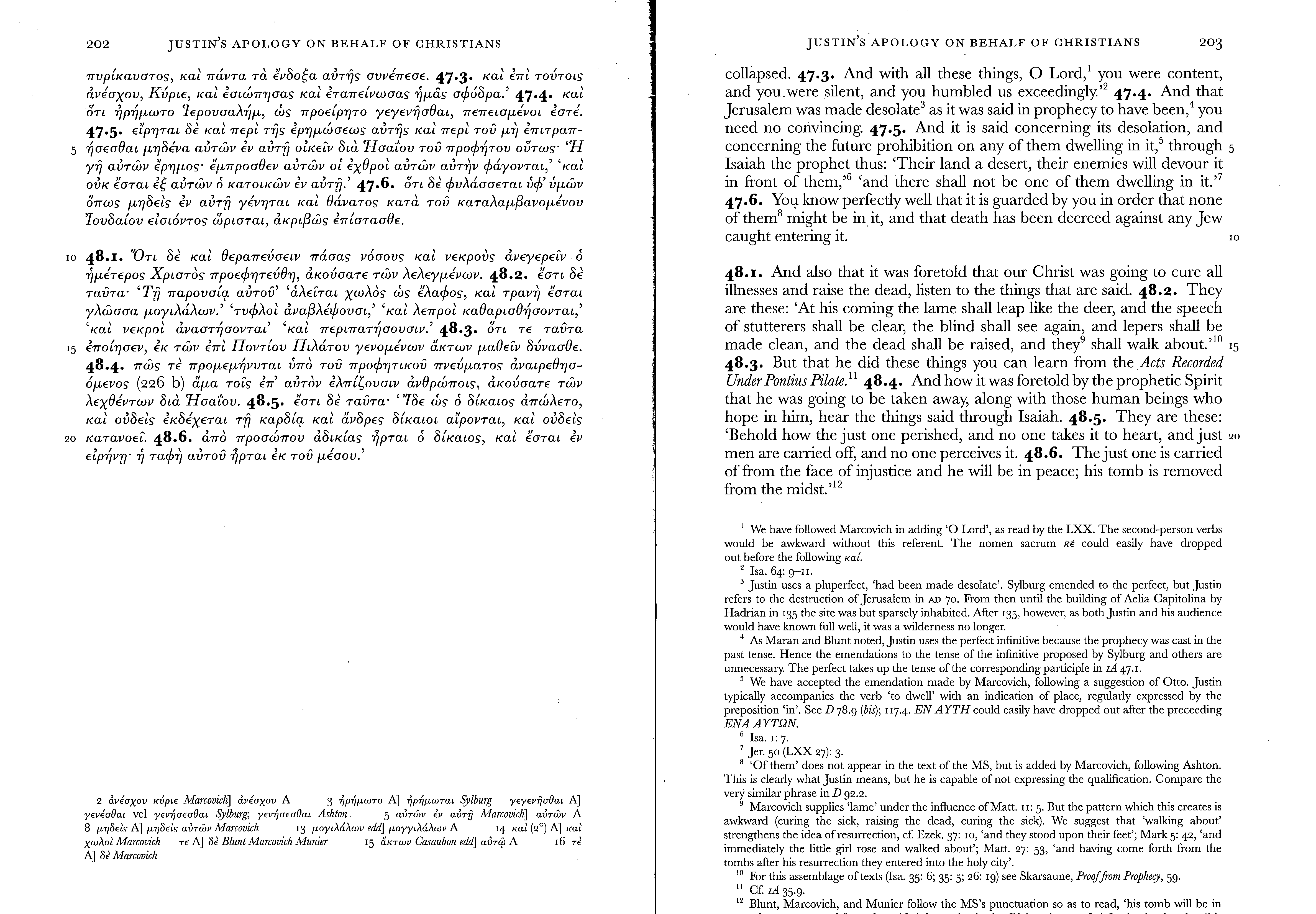
JUSTIN'S APOLOGY O~,BEHALF OF CHRISTIANS
JUSTIN'S APOLOGY ΟΝ BEHALF OF CHRISTIANS
coll~ιpsed. 47.3. And with all these things, Ο Lord,I you were content, and you_were siJent, and you humbled us exceedingly.'2 47.4. And that Jerusalem was made desolate3 as it was said ίη prophecy to have been,4 you πυρίκαυστος, και πάντα τα ενδοςα αυτής συνέπεσε. 47.3. και επι τούτοις
,ι Κ"Ι \, Ι \ , Ι ι .....
\ ανεσχου, υριε, και εσιωπησας και εταπεινωσας ημας σ ο ρα. 47.4. και ότι Υιρήμωτο Ιερουσαλήμ, ώς προείρητο γεγενήσθαι, πεπεισμένοι εστέ.
47.5. εϊρηται δε και περι τής ερημώσεως αυτής και περι του μη επιτραπ5 ήσεσθαι μηδένα αυτων εν aVTn οικειν δια Ήσαί·ου του προΦήτου ούτως· 'Ή
....
, .....
)/ " θ 'Λ (', θ '
,......
,\ φ ι "\ γη αυτων ερημος· εμπροσ εν αυτων οι εχ ροι αυτων αυτην αγονται, και ,,'
'c' Λ'
Λ ουκ εσται ε~ αυτων ο κατοικων εν αυττι. 47. . οτι ε υ ασσεται υ υμων need ηο cοήviηcing. 47.5. And it is said concerning its desolation, and concerning the future prohibition οη any of them dwelling ίη it,S through 5
Isaiah the prophet thus: 'Their land a desert, their enemies will devour it ίη front of them,'6 'and there shall not be one of them dwelling ίη it.'7
47.6. Υο\\. know perfectly well that it is guarded by you in order that none ofthem8 might be init, and that death has been decreed against any Jew caught entering it.
\ Λ λ β Ι οπως μη εις εν αυττι γενηται και ανατος κατα του κατα αμ ανομενου tf δ \ , 'Λ Ι \ θ Ί δ Ι ,Ι "
10 48.1. 'Ότι δε και θεραπεύσειν πάσας νόσους και νεκρους ανεγερεΙν. ό ,ι Χ \ Φ 'θ ,ι Λ λ λ Ι
" δ \ ημετερος ριστο) προε ητευ η, ακουσατε των ε εγμενων. 4 .2. εστι ε 48.1. And also that it was foretold that our Christ was going to cure all illnesses and raise the dead, listen to the things that are said. 48.2. They are these: 'At his coming the lame shallleap like the deer, and the speech of stutterers shall be clear, the blind shall see again, and lepers shall be made clean, and the dead shall be raised, and the/ shall walk about.'lO Ι5
48'3' But that he did these things you can learn from the .Acts Recorded Under Pontius Pilαte. 11 48.4. And how it was foretold by the prophetic Spirit that he was going to be taken away, along with those human beings who hope ίη him, hear the things said through Isaiah. 48.5. Theyare these:
'Behold how the just one perished, and ηο one takes it to heart, and just 20 men are carried off, and ηο one perceives it. 48.6. The just one is carried of from the face of injustice and he will be ίη peace; his tomb is removed from the midst.' 12
'λ Λ λ \ , "λ Φ \ \" ταυτα· τι παρουσιq. αυτου α ειται χω ος ως ε α ος, και τρανη εσται γλωσσα μογιλάλων.' 'τυΦλοι αναβλέψουσι,' 'και λεπροι καθαρισθήσονται,'
'και νεκροι αναστήσονται' 'και περιπατήσουσιν.' 48.3. ότι τε ταυτα Ι5 εποίησεν, εκ των επι Ποντίου Πιλάτου γενομένων ακτων μαθειν δύνασθε.
\ 'λ ΙΥ 'θ Ι ,Ι Λ ομενος 22 αμα τοι) επ αυτον ε πιl;,οvσιν αν ρωποις, ακουσατε των λεχθέντων δια Ή σαίΟυ. 48.5' εστι δε ταυ τα . ''1δε ώς ό δίκαιος απώλετο, και ουδεις εκδέχεται Tn καρδίq. και ανδρες δίκαιοι αϊρονται, και ουδεις
κατανοεΙ. 48.6. απο προσώπου αδικίας ηρται ό δίκαιος, και εσται εν εΙρήντι· Τι ταφη αυτου ηρται εκ του μέσου.'
1 We haνe followed Marcoνich ίη adding 'Ο Lord', as read by the LXX. The second-person νerbs would be awkward without this referent. The nomen sacrum κε could easily haνe dropped out before the following καί.
2 Isa. 64: 9-Ι Ι.
3 Justin uses a pluperfect, 'had been made desolate'. Sylburg emended to the perfect, but Justin refers to the destruction of Jerusalem ίη AD 70. From then until the building of Aelia Capitolina by Hadrian ίη Ι35 the site was but sparsely inhabited. After Ι35, howeνer, as both Justin and his audience would haνe known full well, it was a wilderness ηο longer.
4As Maran and Blunt noted, Justin uses the perfect infinitiνe because the prophecy was cast ίη the past tense. Hence the emendations to the tense of the infinitiνe proposed by Sylburg and others are unnecessary. The perfect takes υρ the tense of the corresponding participle in ιΑ 47. ι .
5 We haνe accepted the emendation made by Marcoνich, following a suggestion of Otto. Justin typically accompanies the νerb 'to dwell' with an indication of place, regu1arly expressed by the preposition 'ίη" See D 78.9 (bis); ΙΙ7+ ΕΝ ΑΥΤΗ could easily haνe dropped out after the preceeding
6 Isa_ ι: 7.
7 Jer. 50 (LXX 27): 3.
8 'Of them' does not appear in the text of the MS, but is added by Marcoνich, following Ashton.
This is clearly what Justin means, but he is capable of not expressing the qualification. Compare the νery similar phrase ίη D 92.2.
2 άνέσχου κύριε Marcovich] άνέσχου Α 3 Τιρήμωτο Α] Τιρήμωται Sylburg γεγενησθαι Α] 9 Marcoνich supplies '1ame' under the influence ofMatt. ιι: 5. But the pattern which this creates is awkward (curing the sick, raising the dead, curing the sick). We suggest that 'walking about' strengthens the idea of resurrection, cf. Ezek. 37: 10, 'and they stood upon their feet'; Mark 5: 42, 'and immediately the little girl rose and walked about'; Matt. 27: 53, 'and haνing come forth from the tombs after his resurrection they entered into the holy city'. γενέσθαι νel γενήσεσθαι Sylburg; γενήσεσθαι Ashton.
5 αυτων εν αυτυ Marcovich] αυτων Α 8 μτιδειι; Α] μτιδειι; αυτων Marcovich Ι3 μογιλάλωvedιZl μογγιλάλων Α Ι4 και (20) Α] και χωλοι Mαrcovich τε Α] δε Blunt Μαιωvίch Munier Ι5 ακτων Cαsaubon edιZl αυτψ Α ι6 τε Α] δε Mαrcovich 10 For this assemblage oftexts (lsa. 35: 6; 35: 5; 26: Ι9) see Skarsaune, Proqfftom Prophecy, 59.
11 Cf. ιΑ 35.9.
12 Blunt, Marcoνich, and Munier follow the MS's punctuation so as to read, 'his tomb will be ίη
- - ~ - - - - - - -
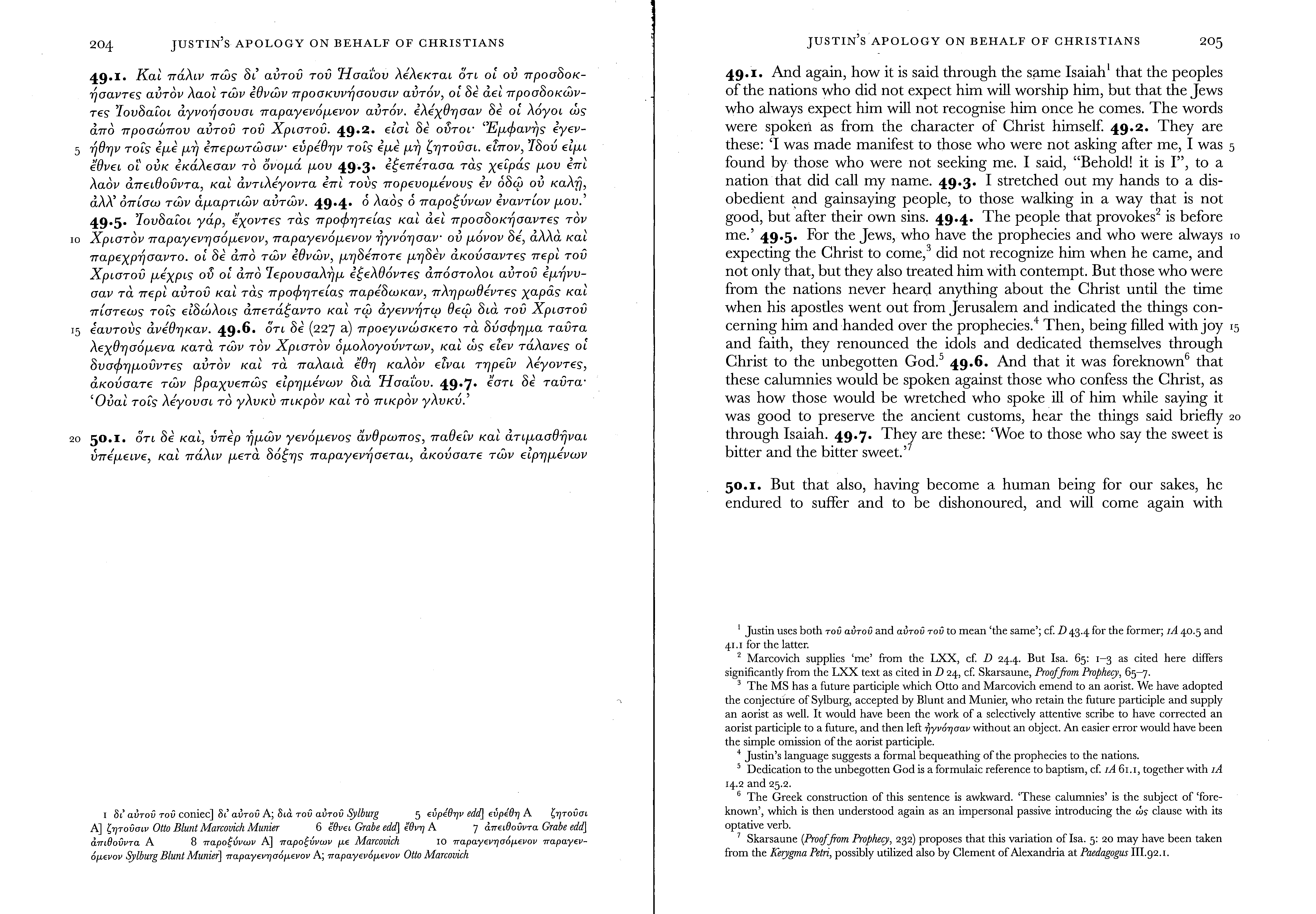
JUSTIN'S APOLOGY ΟΝ BEHALF OF CHRISTIANS
JUSTIN'S APOLOGY ΟΝ BEHALF OF CHRISTIANS
49.1. And again, how it is said through the sp'me Isaiah1 that the peoples of the nations who did not expect him will worship him, but that the Jews who always expect him will not recognise him once he comes. The words were SΡοkeή as from the character of Christ himself 49.2. They are these: Ί was made manifest to those who were not asking after me, Ι was 5 found by those who were not seeking me. Ι said, "Behold! it is 1", to a nationthat did call my name. 49.3. Ι stretched out my hands to a disobedient ι;ιnd gainsaying people, to those walking ίn a way that is not good, but after their own sins. 49.4. The people that provokes2 is before me.' 49.5. For the Jews, who have the prophecies and who were always 10 expecting the Christ to come,3 did not recognize him when he came, and not only that, but they also treated him with contempt. But those who were from the nations never heard anything about the Christ until the time when his apostles went out from Jerusalem and indicated the things concerning him andhanded over the prophecies.4 Then, being filled withjoy 15 and faith, they renounced the idols and dedicated themselves through Christ to the unbegotten God.5 49.6. And that it was foreknown6 that these calumnies would be spoken against those who confess the Christ, as was how those would be wretched who spoke ill of him while saying it was good to preserve the ancient customs, hear the things said briefly 20 through Isaiah. 49.7. They are these: 'Woe to those who say the sweet is bitter and the bitter sweet. ,7 49.1. Και πάλιν πώς δι' αυτού τού ΉσαίΌυ λέλεκται ση οί ου προσδοκ ήσαντες αυτον λαοι τών εθνών προσκυνήσουσιν αυτόν, οί δε αει προσδοκών τες 'Ιουδαιοι αγνοήσουσι παραγενόμενον αυτόν. ελέχθYjσαν δε οί λόγοι ώς
, , ~ ~ χ ~ , , δ'
'i'
'Έ Φ , , απο προσωπου αυτου του ριστου. 49.2. εισι ε ουτοι' μ ανYjς εγεν5 ήθYjν τοις εμε μη επερωτώσιν' εύρέθYjν τοις εμε μη ζYjτούσι. εΊπον, 'Ιδού ειμι εθνει οί' ουκ εκάλεσαν το ονομά μου 49-3' εξεπέτασα τας χειράς μου επι λαον απειθούντα, και ανηλέγοντα επι τους πορευομένους εν όδψ ου καλΏ, αλλ' οπίσω τών άμαρηών αυτών. 49.4. ό λαος ό παροξύνων εναντίον μου.'
'Iδ ~ ", 'Φ' ", δ'
, 49.5. ου αιοι γαρ, εχοντες τας προ Yjτειας και αει προσ ΟΚYjσαντες τον ΙΟ Χριστον παραγενYjσόμενον, παραγενόμενον ~γνόYjσαν' ου μόνον δέ, αλλα και παρεχρήσαντο. οί δε απο τών εθνών, μYjδέποτε μYjδεν ακούσαντες περι τού
~ "
~, σαν τα περι αυτου και τας προ Yjτειας παρε ωκαν, π Yjpw εντες χαρας και πίστεως τοις ειδώλοις απετάξαντο και τψ αγεννήτψ θεψ δια τού Χριστού
εαυτους ανέθYjκαν. 49.6. ση δε (227 a) προεγινώσκετο τα δύσΦYjμα ταύτα λεχθYjσόμενα κατα τών τον Χριστον όμολογούντων, και ώς εΊεν τάλανες οί δυσΦYjμούντες αυτον και τα παλαια εθΥ) καλον εΊναι TYjpELV λέγοντες, ακούσατε τών βραχυεπώς εΙΡYjμένων δια ΉσαίΌυ. 49.7. εση δε ταύτα'
20 50.1. ση δε και, ύπερ Τιμών γενόμενος ανθρωπος, παθειν και αTψασθiιναι ύπέμεινε, και πάλιν μετα δόξYjς παραγενήσεται, ακούσατε τών εΙΡYjμένων
50.1. But that also, having become a human being for our sakes, he endured to suffer and to be dishonoured, and will come again with ι Justin uses both του αυτου and αυτου του to mean 'the same'; cf. D 43.4 for the former; ιΑ 40.5 and 41.1 for the latter.
2 Marcovich supplies 'me' from the LXX, cf. D 24+ But Isa. 65: 1-3 as cited here differs significantly from the LXX text as cited ίn D 24, cf. Skarsaune, Proqf.fr01ll Prophecy, 65-7.
3 The MS has a future participle which Otto and Marcovich emend to an aorist. We have adopted the conjectuTe of Sylburg, accepted by Blunt and Munier, who retain the future participle and supply an aorist as well. It would have been the work of a selectively attentive scribe to have corrected an aorist participle to a future, and then left ήγν6ησαν without an object. Αη easier error would have been the simple omission of the aorist participle.
4 Justin's language suggests a formal bequeathing of the prophecies to the nations.
5 Dedication to the unbegotten God is a formulaic reference to baptism, cf. ιΑ 6Ι.Ι, together with ιΑ
14.2 and 25.2.
6 The Greek construction of this sentence is awkward. 'These calumnies' is the subject of 'foreknown', which is then understood again as an impersonal passive introducing the ώς clause with its optative verb. ι δι' αυτου του coniec] δι' αυτου Α; δια του αυτου Sylburg
5 εύρέθην edCΗ εύρέθη Α 'ητουσι Α] 'ητουσιν Otto Blullt Mαrcoviclz MUllier 6 εθνει Grαbe edaΊ εθνη Α 7 απειθουντα Grαbe edCΗ 7 Skarsaune (Proqf j·om P1"Ophecy, 232) proposes that this variation of Isa. 5: 20 may have been taken from the Keιygmα Petri, possibly utilized also by Clement of Alexandria at Pαedagogus III.g2.I. απιθουντα Α 8 παροξύνων Α] παροξύνων με Mαrcovich 10 παραγενησ6μενον παραγεν6μενον Sylburg Blullt MUllier] παραγενησ6μενον Α; παραγεν6μενον Otto Mαrcovich
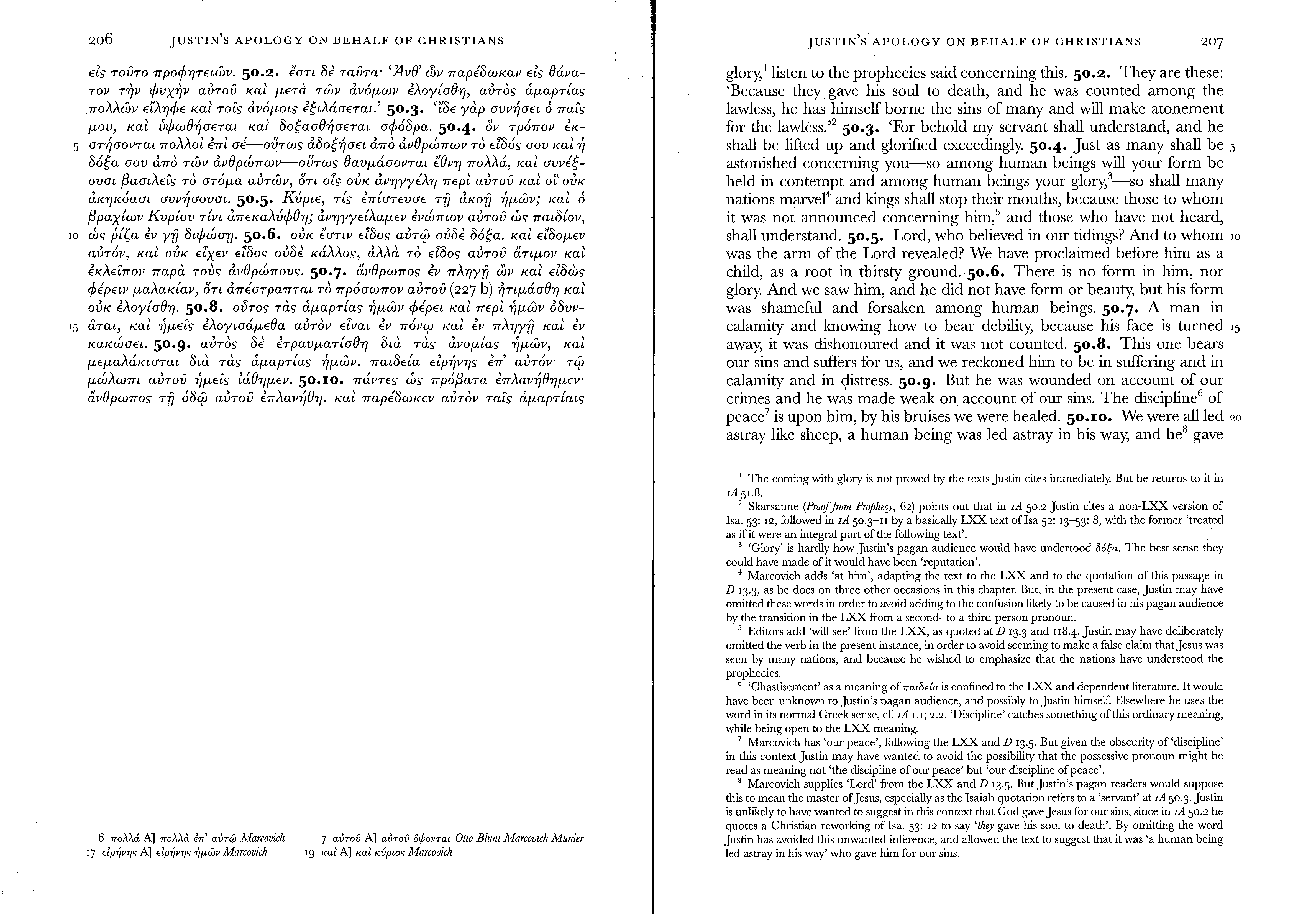
JUSTIN'SAPOLOGY ΟΝ BEHALF OF CHRISTIANS
JUSTIN'S APOLOGY ΟΝ BEHALF OF CHRISTIANS
'δ ' θ' εις τουτο προ ητειων. 50.2. εση ε ταυτα' L"1.v ων παρε ωκαν εις ανα- \ 1/'
\ 'Λ \ \......, ι 'λ' θ ,\ ( ι τον την ψυχην αυτου και μετα των ανομων ε ογισ η, αυτος αμαρηας glory, 1 listen to the prophecies said concerning this. 50.2. Theyare these:
'Because they. gave his soul to death, and he was counted among the lawless, he has himself borne the sins of many and will make atonement for the lawless.'2 50.3. 'For behold my servant shall understand, and he shall be lifted up and glorified exceedingly. 50.4. Just as many shall be 5 astonished concerning you-so among human beings will your form be held in contempt and among human beings your glory,3-so shall many nations m?trvel4and kings shall stop their mouths, because those to whom it was not announced concerning him,5 and those who have not heard, shall understand. 50.5. Lord, who believed in our tidings? And to whom ΙΟ was the arm of the Lord revealed? We have proclaimed before him as a child, as a root in thirsty ground.- 50.6. There is ηο form in him, nor glory. And we saw him, and he did not have form or beauty, but his form was shameful and forsaken amonghuman beings. 50.,. Α man in calamity and knowing how to bear debility, because his face is turned 15 away, it was dishonoured and it was not counted. 50.8. This one bears our sins and suffers for us, and we reckoned him to be in suffering and in calamity and in distress. 50.9. But he was wounded οη account of our crimes and he w~s made weak οη account of our sins. The discipline6 of peace7 is upon him, by his bruises we were healed. 50.10. We were allled 20 astray like sheep, a human being was led astray in his way, and he8 gave
'c λ '
, , "δ \ , < Λ ~πo ων ει η ε και τοις ανομοις ε~ι ασεται. 50.3. ι ε γαρ συνησει ο παις \ <,Ι. θ'
\ δ C θ '
Φ 'δ <\" μου, και υψω ησεται και o~ασ ησεται σ ο ρα. 50.4. ον τροπον εκ5 στήσονται πολλοι επι σέ-οϋτως αδοξήσει απο ανθρώπων το είδός σου και ~ λλ δόξα σου απο τών ανθρώπωv--οvτως θαυμάσονται εθνη πολλά, και συνέξ ουσι βασιλεις το στόμα αυτών, οη ο[ς. ουκ ανηγγέλη περι αυτου και οί\ ουκ ακηκόασι συνήσουσι. 50.5. Κύριε, τίς επίστευσε Tn dKOn ~μών; και ό β , Κ' " λ 'Φθ'
'λ "
'Λ < δ ' ραχιων υριου ηνι απεκα υ η; ανηγγει αμεν ενωπιον αυτου ως παι ιον, < < 'Υ , Λ δ ,Ι. '
6'"
T'i:'
'Λ 'δ \ δ 'c \ "δ ΙΟ ως ρι':,α εν ΥΤ] ιψωσn. 50 .. ουκ εσην ειοος αυτψ ου ε o~α. και ει ομεν αυτόν, και ουκ είχεν είδος ουδε κάλλος, αλλα το είδος αυτου αημον και εκλειπον παρα τους ανθρώπους. 50.'. ανθρωπος εν πληΥn ων και ειδως
' λ'"''
\, 'Λ( b)'
\ < ,< Λ Φ'
αται, και ~μεις ελογισάμεθα αυτον είναι εν πόνψ και εν πληγn και εν κακώσει. 50.9. αυτος δε ετραυματίσθη δια τας ανομίας ~μών, και μεμαλάκισται δια τας άμαρτίας ~μών. παιδεία ειρήνης επ' αυτόν' Τψ
'λ 'Λ < Λ , 'θ ,< 'β 'λ 'θ μω ωπι αυτου ημεις ια ημεν. 50.10. παντες ως προ ατα επ ανη ημεν' ανθρωπος Tn όδψ αυτου επλανήθη. και παρέδωκεν αυτον ταις άμαρτίαις
1 The coming with glory is not proved by the texts Justin cites immediately. But he returns to it ίη ιΑ51.8.
2 Skarsaune (Proqf .from Prophecy, 62) points out that ίη ιΑ 50.2 Justin cites a non-LXX νersion of Isa. 53: 12, followed ίη ιΑ 50.3-11 by a basically LXX text ofIsa 52: 13-53: 8, with the former 'treated as if it were an integral part of the following text'.
3 'Glory' is hardly how Justin's pagan audience would haνe undertood δόξα. The best sense they could have made of it would have been 'reputation'.
4 Marcoνich adds 'at him', adapting the text to the LXX and to the quotation of this passage in D 13.3, as he does οη three other occasions ίη this chapter. But, in the present case, Justin may have omitted these words ίη order to aνoid adding to the confusion likely to be caused ίη his pagan audience by the transition ίη the LXX from a secondto a third-person pronoun.
5 Editors add 'will see' from the LXX, as quoted at D 13.3 and 118+ Justin may have deliberately omitted the νerb ίη the present instance, ίη order to avoid seeming to make a false claim that Jesus was seen by many nations, and because he wished to emphasize that the nations haνe understood the prophecies.
6 'Chastisement' as a meaning of παιδε{α is confined to the LXX and dependent literature. It would haνe been unknown to Justin's pagan audience, and possibly to Justin himself. Elsewhere he uses the word in its normal Greek sense, cf. ιΑ 1.1; 2.2. 'Discipline' catches something ofthis ordinary meaning, while being open to the LXX meaning.
7 Marcoνich has 'our peace', following the LXX and D 13.5. But giνen the obscurity of'discipline' ίη this context Justin may haνe wanted to avoid the possibility that the possessive pronoun might be read as meaning not 'the discipline of our peace' but 'our discipline of peace'.
8 Marcoνich supplies 'Lord' from the LXX and D 13.5. But Justin's pagan readers would suppose this to mean the master ofJesus, especially as the Isaiah quotation refers to a 'servant' at ιΑ 50.3. Justin is unlikely to haνe wanted to suggest in this context that God gave Jesus for our sins, since ίη ιΑ 50.2 he quotes a Christian reworking of Isa. 53: 12 to say 'they gave his soul to death'. ΒΥ omitting the word
Justin has avoided this unwanted inference, and allowed the text to suggest that it was 'a human being
6 πολλά Α] πολλd Επ' αυτψ Mαrcovich 7 αυτοίΙ Α] αυτοίΙ οψονται Otto Bluιzt lvlαrcovich MuιzieT
19 και Α] και κύριος Mαrcovich led astray ίη his way' who gaνe him for our sins.
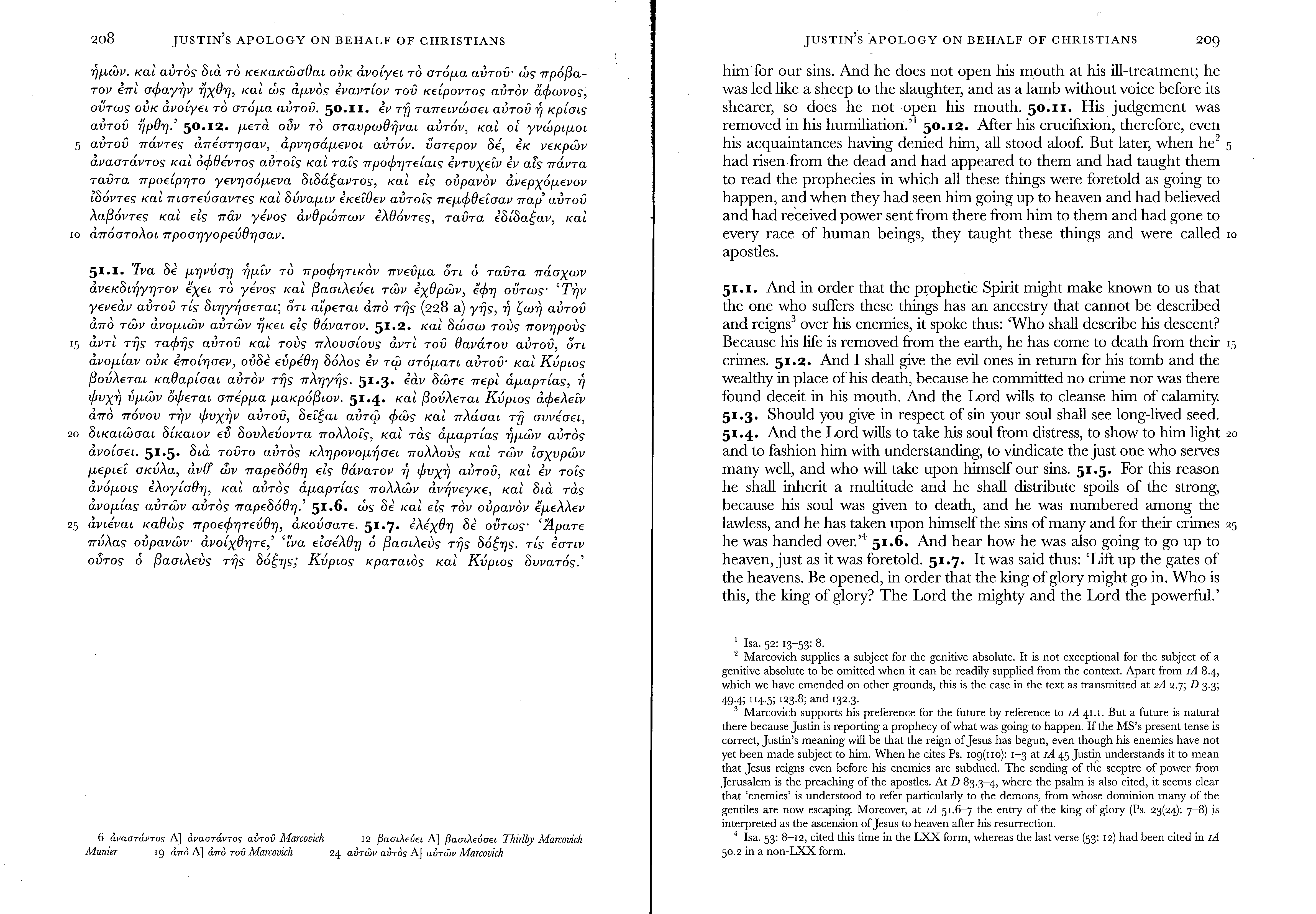
JUSTIN'S APOLOGY ΟΝ BEHALF OF CHRISTIANS
JUSTIN'SAPOLOGY ΟΝ BEHALF OF CHRISTIANS
"""
\" δ"
Λ θ "Ι , Ι ''''''' r /β ΎJμων. και αυτος ια το κεκακωσ αι ουκ ανΟΙΥει το στομα αυτου· ως 7Τρο α- , , Φ , "θ \ r , \, Ι ,.., Ι , \ "Φ τον ε7ΤΙ σ αYΎJν ΎJX ΎJ, και ως αμνος εναντιον του κειΡοντος αυτον α ωνος, him for our sins. And he does not open his m.outh at his ill-treatment; he was led like a sheep to the slaughter, and as a lamb without voice before its shearer, so does he not open his mouth. 50.11. His judgement was removed ίη his humiliation:.'l 50.12. Mter his crucifixίοή, therefore, even his acquaintances having denied him, all stood aloof. But later, when he2 5 had risenfrom the dead and had appeared to them and had taught them to read the prophecies ίη which all these things were foretold as going to happen, and when they had seen him going Up to heaven and had believed and had received power sent from there from him to them and had gone to every race of human beings, they taught these things and were called 10 apostles. t/ "Ι \ Ι ,.....
'Λ Ι 'Λ C' ι ουτως ουκ ανΟΙΥει το στομα αυτου. 50.11. εν ττι τα7Τεινωσει αυτου ΎJ κρισις , Λ ,Ι θ '
, 'j'
\ θ.....
,Ι \ C' ι αυτου ΎJΡ ΎJ· 50.12. μετα ουν το σταυρω ΎJναι αυτον, και οι Υνωριμοι , .....
Ι ,Ι ,Ι ,Ι t/ δ ι , 5 αυτου 7Ταντες α7TεσTΎJσαν,. αρνΎJσαμενoι αυτον. υστερον ε, εκ νεκρων , ι , 'Φθ ι 'Λ' Λ Φ Ι , Λ'
'!' ι ανασταντος και ο εντος αυτοις και ταις 7Τρο ΎJTειαις εντυχειν εν αις 7Ταντα
, , " ι ταυτα 7TΡOεΙPΎJTO yενΎJσOμενα ι α~ανToς, και εις ουρανον ανερχομενον 'δ ι ,ι , δ ι 'Λθ 'Λ Φθ Λ "Λ Ι οντες και 7Τιστευσαντες και υναμιν εκει εν αυτοις 7Τεμ εισαν 7Ταρ αυτου λ β ι "Λ Ι 'θ ι 'λθ ι Λ 'δ Ιδ C ' α οντες και εις 7Ταν Υενος αν ρω7Των ε οντες, ταυτα ε ι α~αν, και
'1 δ \ Ι C',..
, Φ \ ... t/ ('
.....
''1'' ανεκ ΙΎJYΎJTOν εχει το Υενος και ασι ευει των εχ ρων, ε ΎJ ουτως· 1 ΎJν 51. ι. And in order that the p~ophetic Spirit might make known to us that the one who suffers these things has an ancestry that cannot be described and reigns3 over his enemies, it spoke thus: 'Who shall describe his descent?
Because his life is removed from the earth, he has come to death from their 15 crimes. 51.2. And Ι shall give the evil ones in return for his tomb and the wealthy in place of his death, because he committed ηο crime nor was there found deceit in his mouth. And the Lord wills to cleanse him of calamity.
51.3. Should you give in respect of sin your soul shall see long-lived seed.
51.4. And the Lord wills to take his soul from distress, to show to him light 20 and to fashion him with understanding, to vindicate the just one who serves many well, and who will take upon himself our sins. 51.5. For this reason he shall inherit a multitude and he shall distribute spoils of the strong, because his soul was given to death, and he was numbered among the lawless, and he has taken upon himself the sins of many and for their crimes 25 he was handed over.'4 51.6. And hear how he was also going to go up to heaven, just as it was foretold. 51.7. 1t was said thus: 'Lift up the gates of the heavens. Be opened, ίη order that the king of glory might go ίη. Who is this, the king of glory? The Lord the mighty and the Lord the powerful.'
Υενεαν αύτου τίς δΙΎJyήσεTαι; ότι αϊρεται α7ΤΟ της (228 a) Υης, ~ ζω~ αύτου , \ ......, .....
''"' t/ 'θ ι , δ ι , , α7ΤΟ των ανομιων αυτων ΎJKει εις ανατον. 51.2. και ωσω τους 7TOνΎJΡOυς
αντι της ταφης αυτου και τους 7Τλουσίους αντι TOV θανάτου αύτου, ότι , ι "Ι 'δ' ( Ιθ δ Ιλ '
Λ Ι ,.....
\ Κ ι ανομιαν ουκ ε7TOΙΎJσεν, ου ε ευρε ΎJ ο ος εν Τψ στοματι αυτου· και υριος βούλεται καθαρίσαι αυτον της 7TλΎJyης. 51.3. εαν δωτε 7Τερι άμαρτίας, ~ ψυx~ ύμων Όψεται σ7Τέρμα μακρόβιον. 51.4. και βούλεται Κύριος αΦελεΙV α7ΤΟ 7Τόνου T~ν ψυx~ν αύτου, δειςαι αύτψ φως και 7Τλάσαι TiJ συνέσει, 20 δικαιωσαι δίκαιον εΟ δουλεύοντα 7Τολλοις, και τας άμαρτίας ~μων αύτος
'Λ'
Λ ανοισει. 51.5. ια τουτο αυτος κ ΎJΡOνOμΎJσει 7ΤΟ ους και των ισχυρων Λ Ιλ 'θ' '!' δ Ιθ 'θ ι (,/,"
Λ μεριει σκυ α, αν ων 7Ταρε ο ΎJ εις ανατον ΎJ ψυXΎJ αυτου, και εν τοις ,ι 'λ ι θ '"
, ανομοις ε ΟΥισ ΎJ, και αυτος αμαρτιας 7ΤΟ ων ανΎJνεYKε, και ια τας , ι 'Λ " δ Ιθ'
( δ'
, , ,,' λλ ανομιας αυτων αυτος 7Ταρε ο ΎJ. 51. . ως ε και εις τον ουρανον εμε εν ,ι θ '
"(ι1
Λ δ ι C ι, 7Τυ ας ουρανων· ανοιχ ΎJTε, ινα εισε τι ο ασι ευς TΎJς o~ ΎJς. τις εστιν '!'
Λ δ 'c ΚΙ "Κ' δ " ουτος ο ασι ευς TΎJς Ος ΎJς; υριος κραταιος και υριος υνατος. ι Isa. 52: 13-53: 8.
2 Marcovich supplies a subject for the genitive absolute. It is not exceptional for the subject of a genitive absolute to be omitted when it can be readily supplied from the context. Apart from ιΑ 8.4, which we have emended οη other grounds, this is the case in the text as transmitted at 2Α 2.7; D 3.3;
49·4; 114-5; 123·8; and 132·3· 3 Marcovich supports his preference for the future by reference to ιΑ 41.1. But a future is natural there because Justin is reporting a prophecy of what was going to happen. If the MS's present tense is correct, Justin's meaning will be that the reign of Jesus has begun, even though his enemies have not yet been made subject to him. When he cites Ps. 109(110): 1-3 at ιΑ 45 Justin understands it to mean that Jesus reigns even before his enemies are subdued. The sending of the sceptre of power from Jerusalem is the preaching of the apostles. At D 83.3-4, where the psalm is also cited, it seems clear that 'enemies' is understood to refer particularly to the demons, from whose dominion many of the gentiles are nονν escaping. Moreover, at ιΑ 51.6--7 the entry of the king of glory (Ps. 23(24): 7-8) is interpreted as the ascension of Jesus to heaven after his resurrection.
4Isa. 53: 8-12, cited this time ίη the LXX form, whereas the last verse (53: 12) had been cited ίn ιΑ
50.2 in a non-LXX form.
6 αναστάντος Α] αναστάντος αυτού Mαrcovίch 12 βασιλεύει Α] βασιλεύσει Thirlby Aιfαrcovich
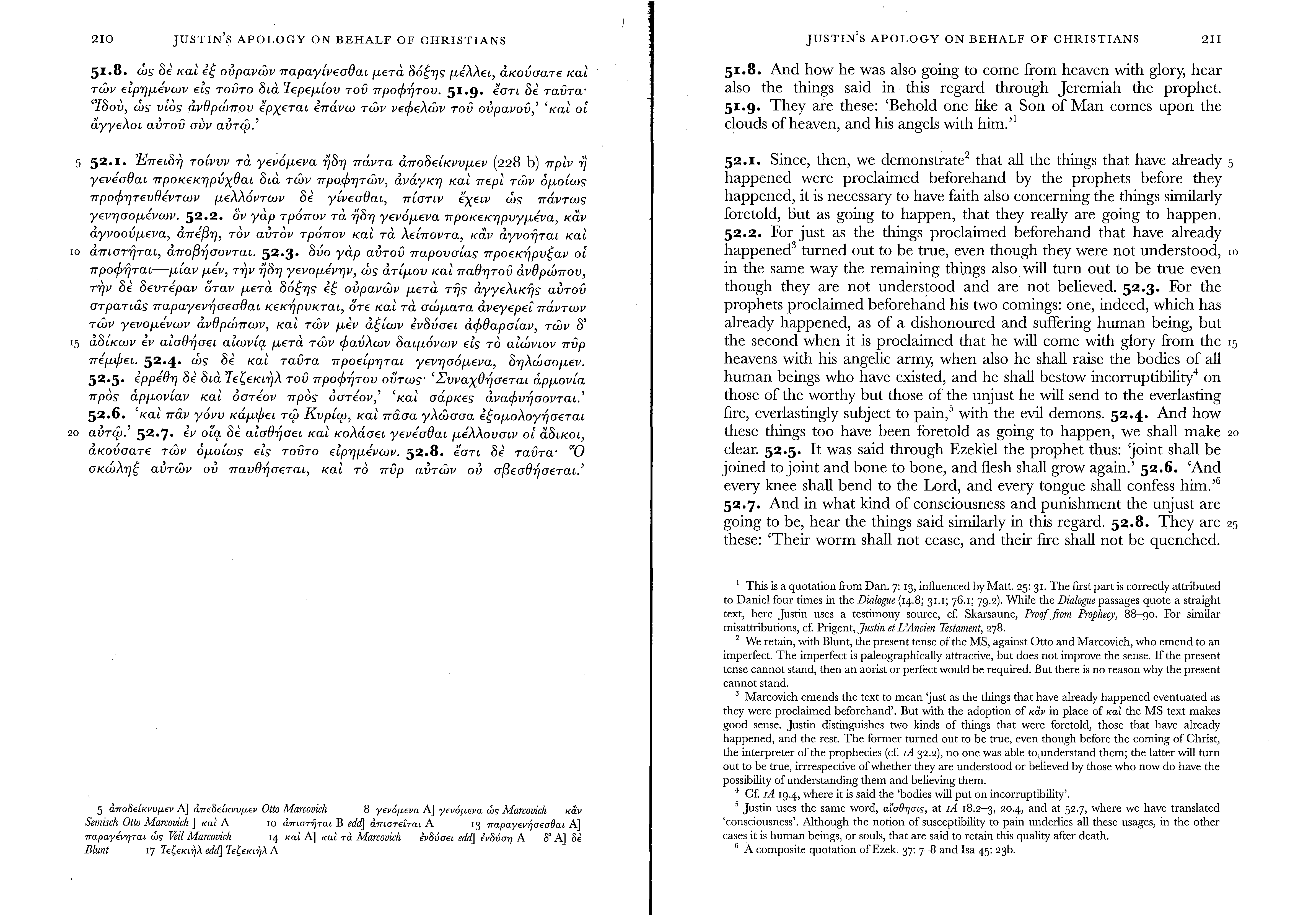
JUSTIN'S APOLOGY ΟΝ BEHALF OF CHRISTIANS
JUSTIN'SAPOLOGY ΟΝ BEHALF OF CHRISTIANS
r δ ι Ι. t..
Ιλλ • ι ι 5 Ι • • ωs ε και ες ουρανων παραγινεσ αι μετα Ος YJS με ει, ακουσατε και 5ι.8. And how he was also going to come from heavenwith glory, hear also the things said ίη this regard through Jeremiah the prophet. ι "δΙ των ειΡημενων EιS τουτο ια ερεμιου του προ ητου. 5Ι.9. εστι ε ταυτα· Λ • Ι • Λ δ ι Ί ι Λ φ 'Ίδ \ ( Ι\ ) θ ι "
.....
Φ λ.....
....., ,.., "
, ( ου, ωs vΙOS ,αν ρωπου ερχεται επανω των νε ε ων του ουρανου, και οι 5Ι.9. They are these: 'Behold one like a Son of Man comes upon the clouds of heaven, and his angels with him.' 1 αγγελοι αυτου συν αυτψ.'
5 5 2 • Ι •
πει η τοινυν τα γενομενα η η παντα απΌ εικνυμεν 22 πριν η 52. ι . Since, then, we demonstrate2 that all the things that have already 5 happened were proclaimed beforehand by the prophets before they happened, it is necessary to have faith also concerning the things similarly foretold, out as going to happen, that they really are going to happen.
52.2. For just as the things proclaimed beforehand that have already happened3 turned out to be true, even though they were not understood, !Ο γενέσθαι προκεκηρύχθαι δια των προ.Φητων, ανάγκη και περι των όμο{ωs ι λλ ι δ ι ι θ ι " r Ι προ ητευ εντων με οντων ε γινεσ αι, πιστιν εχειν ωs παντωs Φ θ γενησομένων. 52.2. ον γαρ τρόπον τα ηδη γενόμενα προκεκηρυγμένα, καν
\ Ι \ 'λ Ι '1\,.....
, αγνοουμενα, απε η, τον αυτον τροπον και τα ειποντα, καν αγνοηται και • Λ • βι δΙ ι • Λ Ι Ι C. r !Ο απιστηται, απΌ ησονται. 52.3. υο γαρ αυτου παρουσιαs προεκηρυςαν οι ίη the same way the remaining thi.ngs also will turn out to be true even though they are not unders~ood and are not believed. 52.3. For the prophets proclaimed beforehand his two comings: one, indeed, which has already happened, as of a dishonoured and suffering human being, but the second when it is proclaimed that he will come with glory from the 15 heavens with his angelic army, when also he shall raise the bodies of all human beings who have existed, and he shall bestow incorruptibility4 οη those of the worthy but those of the unjust he will send to the everlasting fire, everlastingly subject to pain,5 with the evil demons. 52.4. And how these things too have been foretold as going to happen, we shall make 20 clear. 52.5. It was said through Ezekiel the prophet thus: 'joint shall be joined to joint and bone to bone, and flesh shall grow again.' 52.6. 'And προφ"ηται-μ{αν μέν, την ηδη γενομένη ν, ώs ατ{μου και παθητου ανθρώπου, την δε δευτέραν όταν μετα δόξηs Εξ ουρανων μετα TiJS αγγελικηs αυτου
Λ Ι θ Ι fl ,\ Ι , .....
aTpanaS παραγενησεσ αι κεκηρυκται, οτε και τα σωματα ανεγερει παντων Λ ι. θ Ι Ι Λ ι, t. Ι , δ Ι • Φθ Ι Λ δ' των γενομενων αν ρωπων, και των μεν αςιων εν υσει α αρσιαν, των • δ Ι " θ Ι ,ι Ι Λ Φ Ιλ δ Ι ,Ι, Ι Λ
α ικων εν αισ ησει αιωνιq. μετα των αυ ων αιμονων ειs το αιωνιον πυρ Ι ,1, r δ ι Ι Λ Ι Ι δ λ Ι πεμψει. 52.4. ωs ε και ταυτα προειΡηται γενησομενα, η ωσομεν.
• Ιθ δ ι δ ι Ί Υ ι λ Λ Φ Ι t, 'Σ θ Ι r Ι 52.5. ερρε η ε ια ε':,εκιη του προ ητου ουτωs· υναχ ησεται αρμονια ι r Ι Ι, Ι Ι, Ι"
αυτψ. 52.7. εν οιq. ε αισ ησει και κο ασει γενεσ αι με ουσιν οι α ικοι, ακούσατε των όμο{ωs ElS τουτο εΙρημένων. 52.8. εστι δε ταυτα· 'ΙΟ ι Ι Λ • Λ 'β θΙ , σκω ης αυτων ου παυ ησεται, και το πυρ αυτων ου σ εσ ησεται.
'Λ • θ Ι every knee shall bend to the Lord, and every tongue shall confess him. ,6
52.7. And ίη what kind of consciousness and punishment the unjust are going to be, hear the things said similarly ίη this regard. 52.8. ΤheΥare 25 these: 'Their worm shall not cease, and their fire shall not be quenched.
1 This is a quotation from Dan. 7: 13, influenced by Matt. 25: 31. The first part is correctly attributed to Daniel four tirnes ίη the Diαlogue (14.8; 31.1; 76.1; 79.2). While the Diαlogue passages quote a straight text, here Justin uses a testirnony source, cf. Skarsaune, Pτoqf .from Propllecy, 88--g0. For sirnilar misattributions, cf. Prigent, Justin et L Άncίen Testαnlent, 278.
2 We retain, with Blunt, the present tense of the MS, against Otto and Marcovich, who emend to an imperfect. The irnperfect is paleographically attractive, but does not irnprove the sense. If the present tense cannot stand, then an aorist or perfect would be required. But there is ηο reason why the present cannot stand.
3 Marcovich emends the text to mean 'just as the things that have already happened eventuated as they were proclairned beforehand'. But with the adoption of καν ίη place of και the MS text makes good sense. Justin distinguishes two kinds of things that were foretold, those that have already happened, and the rest. The former turned out to be true, even though before the corning of Christ, the interpreter ofthe prophecies (cf. ιΑ 32.2), ηο one was able to,-understand them; the latter will turn out to be true, irrrespective of whether they are understood or believed by those who now do have the possibility of understanding them and believing them.
4Cf. ιΑ 19-4, where it is said the 'bodies will put οη incorruptibility"
5 αποδε{κνυμεν Α] απεδε{κνυμεν Otto Mαrcouich 8 γεν6μενα Α] γεν6μενα ώς Mαrcomch καν 5 Justin uses the same word, αϊσθησις, at ιΑ 18.2-3, 20-4, and at 52.7, where we have translated
'consciousness'. Although the notion of susceptibility to pain underlies all these usages, ίη the other cases it is human beings, or souls, that are said to retain this quality after death.
Seιnisch Otto Mαrcouich] και Α !Ο απιστηται Β edtZJ απιστειται Α 13 παραγενήσεσθαι Α] παραγένψαι ώς Veil Mαrcouich 14 και Α] και τα Mαrcouich ένδύσει edtZJ ένδύση Α δ' Α] δε Blunt Ι7 Ίεζεκιηλ edtZJ Ίεζεκιηλ Α 6 Α composite quotation ofEzek. 37: 7-8 and Isa 45: 23b.
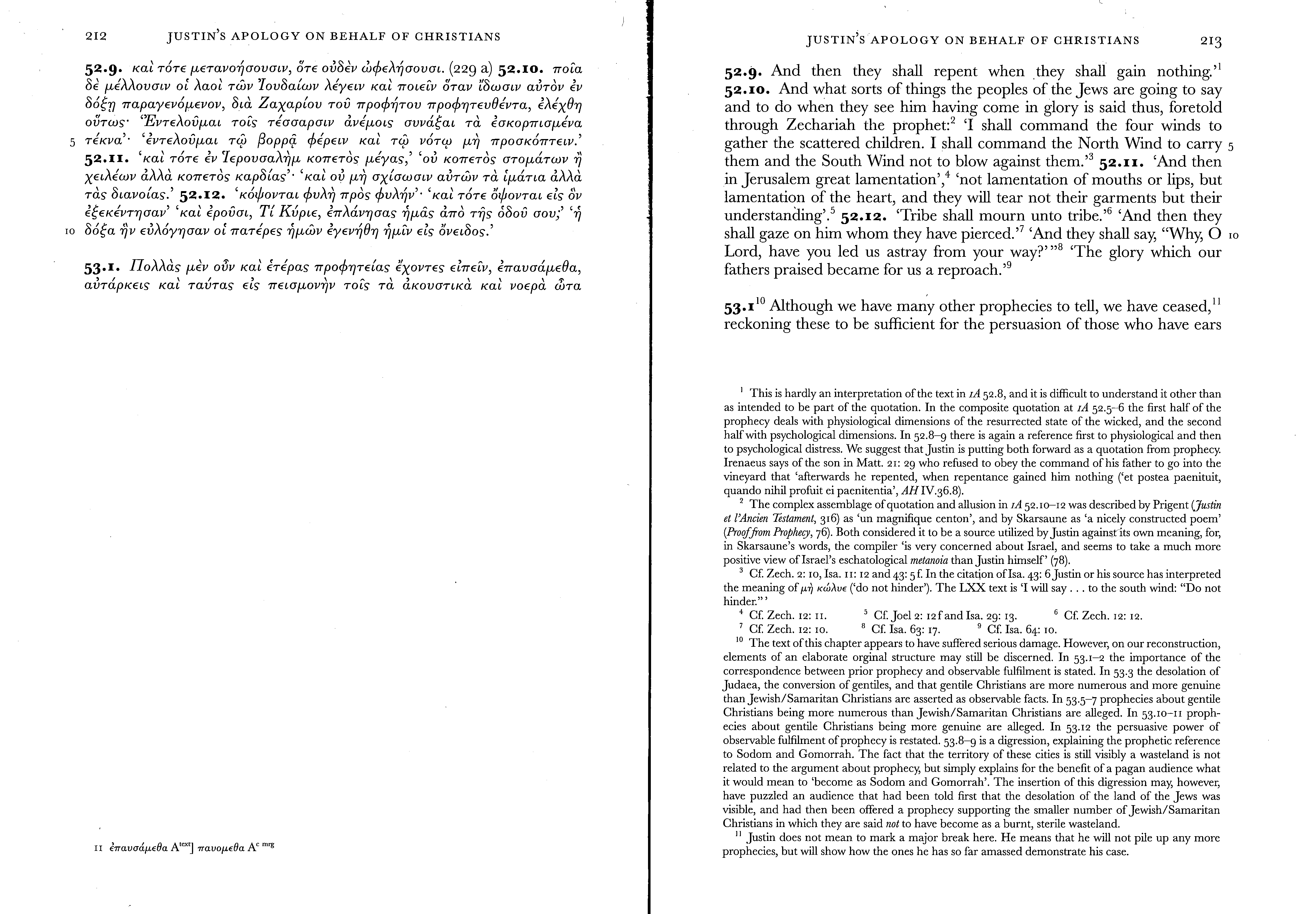
JUST1N'S APOLOGY ΟΝ BEHALF ΟΡ CHR1ST1ANS
JUST1N'SAPOLOGY ΟΝ BEHALF ΟΡ CHR1ST1ANS
\ , , t/ 'δ \ 'Φ λ'
() Λ 52.9. και τοτε μετανοησουσιν, οτε ου εν ω ε ησουσι. 229 a 52.10. ποια 52.9. And then they shall repent when .they shall gain nothing.'l
52.10. And what sorts ofthings the peoples ofthe Jews are going to say and to do when they see him having come in glory is said thus, foretold through Zechariah tlle prophet:2 Ί shall command the four winds to gather the scattered children. Ι shall command the Ν orth Wind to carry 5 them and the South Wind not to blow against them.'3 52.11. 'And then δε μέλλουσιν οί λαοι των 'Ιουδαίων λέγειν και ποιειν όταν ϊδωσιν atJT(JV εν δόςπ παραγενόμενον, δια Ζαχαρίου του ΠPOΦ~Toυ προΦητευθέντα, ελέχθη
OiJTWS'
\ Λ'
\ , ,
52.11. 'και τότε εν Ίερουσαλημ κοπεται; μέγαs,' 'ου κοπεται; στομάτων ij ίη Jerusalem great lamentation', 4 'not lamentation of mouths or lips, but lamentation of the heart, and they will tear not their garments but their understanding'.5 52.12. 'Tribe shall mourn unto tribe.'6 'And then they shall gaze οη him whom they have pierced.'7 'And they shall say, "Why, Ο ΙΟ
Lord, have you led us astray from your way?,,,8 'The glory which our fathers praised became for us a reproach.,9 χειλέων άλλα κοπεται; καρδίαs" 'και ου μη σχίσωσιν αυτων τα ίμάηα άλλα
\ δ "
",/, Φ λ \ \ Φ λ' "
\ ''',/, , ι, ται; ιανοιαs. 52.12. κοψονται υ η προι; υ ην' και τοτε οψονται ειι; ον εςεκέντησαν' 'και ερουσι, Τί Κύριε, επλάνησαι; ήμαι; άπα τηι; όδου σου;' 'ή
Π λλ \ \ 'i'
\ < , Φ'"
'Λ'
'θ 53.1. ο αι; μεν ουν και ετεραι; προ ητειαι; εχοντει; ειπειν, επαυσαμε α, , ι \ Ι, \ " , , \ \ '1"αυταρκειι; και ταυται; ειι; πεισμονην τοι'} τα ακουσηκα και νοερα ωτα
53.110 Although we have ma:nΎ other prophecies to tell, we have ceased/ 1 reckoning these to be sufficient for the persuasion of those who have ears ι This is hardly an interpretation ofthe text in ιΑ 52.8, and it is difficult to understand it other than as intended to be part of the quotation. Ιη the composite quotation at ιΑ 52.5-6 the first half of the prophecy deals with physiological dimensions of the resurrected state of the wicked, and the second halfwith psychological dimensions. Ιη 52.8-9 there is again a reference first to physiological and then to psychological distress. We suggest that Justin is putting both forward as a quotation from prophecy.
Irenaeus says ofthe son in Matt. 21: 29 who refused to obey the command ofhis father to go into the vineyard that 'afterwards he repented, when repentance gained him nothing ('et postea paenituit, quando nihil profuit ei paenitentia', AHIV.36.8).
2 The complex assemblage of quotation and allusion in ιΑ 52.10--12 was described by Prigent (Justin et l>Ancien Testαment, 316) as 'un magnifique centon', and by Skarsaune as 'a nicely constructed poem'
(Proqf.ftom Prophecy, 76). Both considered it to be a source utilized by Justin againsXits own meaning, for, in Skarsaune's words, the compiler 'is very concerned about Israel, and seems to take a much more positive view ofIsrael's eschatological metαnoiα than Justin himself' (78).
3 Cf. Zech. 2: ΙΟ, Isa. ΙΙ: 12 and 43: 5f. Ιη the citation ofIsa. 43: 6 Justin or his source has interpreted the meaning of μη κώλυε ('do not hinder'). The LXX text is Ί wil1 say ... to the south wind: "Do not hinder." , 4, Cf. Zech. 12: ΙΙ.
5 Cf. Joe12: 12 f and Isa. 29: 13.
6 Cf. Zech. 12: 12.
7 Cf. Zech. 12: 10.
8 Cf. Isa. 63: 17.
9 Cf. Isa. 64: ΙΟ.
10 The text of this chapter appears to have suffered serious damage. However, οη our reconstruction, elements of an elaborate orginal structure may still be discerned. Ιη 53.1-2 the importance of the correspondence between prior prophecy and observable fulfilment is stated. Ιη 53.3 the desolation of Judaea, the conversion of gentiles, and that gentile Christians are more numerous and more genuine than Jewish/Samaritan Christians are asserted as observable facts. Ιη 53.5-7 prophecies about gentile
Christians being more numerous than Jewish/Samaritan Christians are alleged. Ιη 53.IΟ--ΙΙ prophecies about gentile Christians being more genuine are alleged. Ιη 53.12 the persuasive power of observable fulfilment of prophecy is restated. 53.8--g is a digression, explaining the prophetic reference to Sodom and Gomorrah. The fact that the territory of these cities is still visibly a wasteland is not related to the argument about prophecy, but simply explains for the benefit of a pagan audience what it would mean to 'become as Sodom and Gomorrah'. The insertion of this digression may, however, have puzzled an audience that had been told first that the desolation of the land of the Jews was visible, and had then been offered a prophecy supporting the smaller number of Jewish/Samaritan
Christians in which they are said not to have become as a burnt, sterile wasteland.
11 Justin does not mean to mark a major break here. He means that he will not pile up any more prophecies, but will show how the ones he has so far amassed demonstrate his case.
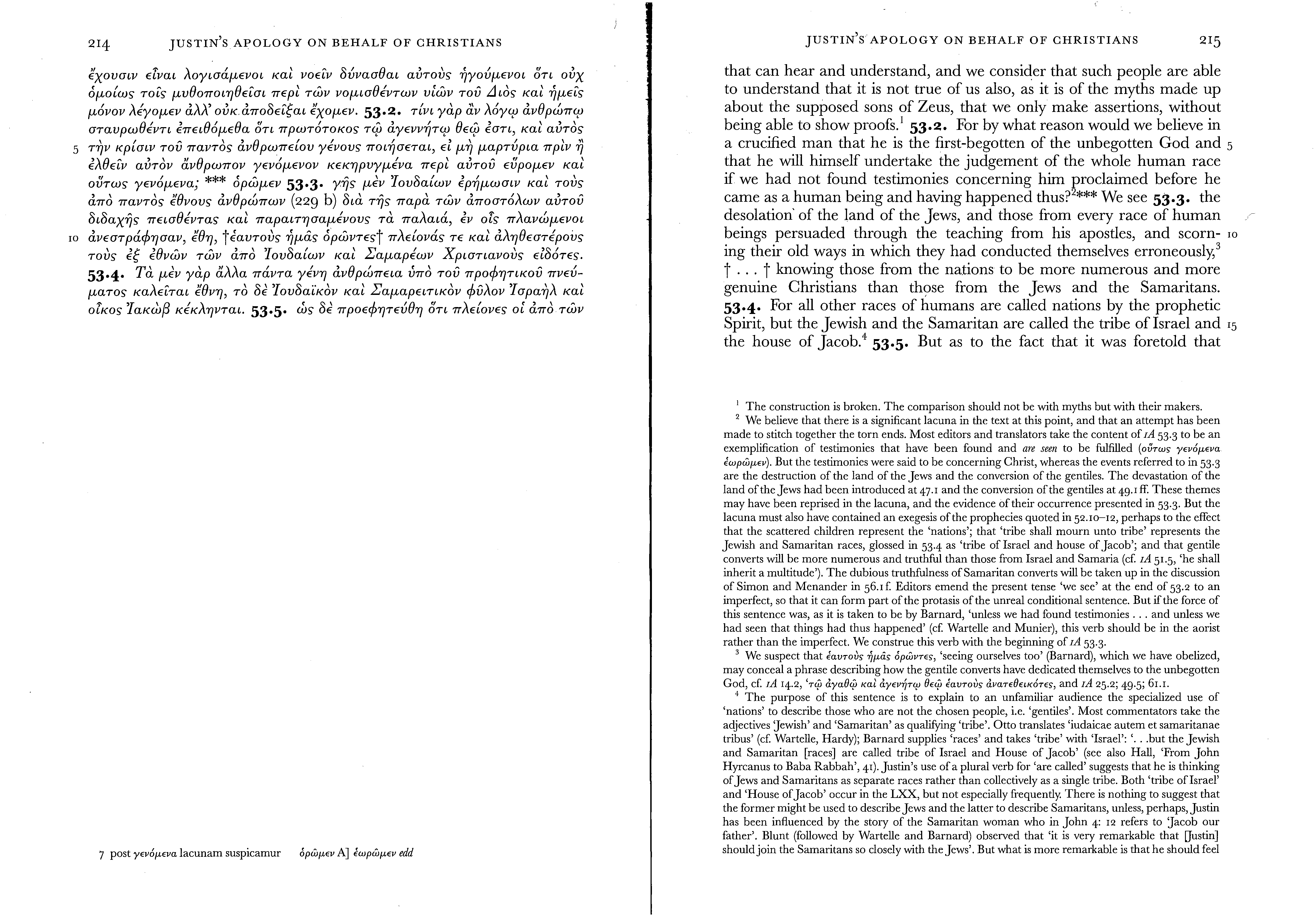
JUSTIN'SAPOLOGY ΟΝ BEHALF OF CHRISTIANS
'215
JUSTIN'SAPOLOGY ΟΝ BEHALF OF CHRISTIANS
εχουσιν εΊναι λογισάμενοι και νοειν δύνασθαι αυτους -ήγούμενοι ότι ovx that can hear and understand, and we consi~er that such people are able to understand that it is not true of us also, as it is of the myths made up about the supposed sons of Zeus, that we only make assertions, without being able to show proofs. l 53.2. For by what reason would we believe ίn a crucified man that he is the first-begotten of the unbegotten God and 5 that he will himself undertake the judgement of the whole human race if we had not found testimonies concerning him proclaimed before he came as a human being and having happened thuS?2*** We see 53.3. the desolation' of the land of the Jews, and those from every race of human beings persuaded through the teaching from his apostles, and scornΙΟ ing their old ways ίn which they had conducted themselves erroneously, 3 t ... t knowing those from the nations to be more numerous and more genuine Christians than th<;:>se from the ]ews and the Samaritans.
53.4. For all other races of humans are called nations by the prophetic Spirit, but the ]ewish and the Samaritan are called the tribe of Israel and 15 the house of ]acob.4: 53.5. But as to the fact that it was foretold that όμο{ως τοις μυθοποιηθεισι περι των νομισθέντων υίων του Δ ιος και -ήμε-ις μόνον λέγομεν αλλ' ουκ,αποδειςαι εχομεν. 53.2. τ{νι γαρ αν λόγψ ανθρώπψ σταυρωθέντι έΠΕιθόμεθα ότι πρωτότοκος τψ αγεννήτψ θεψ έστι, και αυτος
5 την κρ{σιν του παντος ανθρωπε{ου γένους ποιήσεται, ει μη μαρτύρια πριν ~ έλθειν αυτον ανθρωπον γενόμενον κεκηρυγμένα περι αυτου εύρομεν και ούτως γενόμενα; *** όρωμεν 53.3. γής μεν 10υδα{ων έρήμωσιν και τους
,\ \ "θ 'θ Ι ( b) δ \ Λ \ Λ'
'λ 'Λ απο παντος ε νους αν ρωπων '2'29 ια της παρα των αποστο ων αυτου διδαχής ΠΕισθέντας και παραιτησαμένους τα παλαιά, έν οΤς πλανώμενοι
ΙΟ ανεστράΦησαν, εθη, tέαvτους -ήμας όρωντεςt πλε{ονάς τε και αληθεστέρους τους ές έθνων των απο Ίουδα{ων και Σαμαρέων Χριστιανους εΙδότες.
Τ \ \ \ "λλ Ι ι, θ Ι Ι \ Λ Φ Λ Ι 53.4. α μεν γαρ α α παντα γενη αν ρωΠΕια υπο του προ ητικου πνευματος καλειται εθνη, το δε Ίουδαί'κον και ΣαμαΡΕιτικον φυλον Ίσραηλ και τ Ί \ β Ι λ ι δ \ Φ 'θ <, λ Ι Ι, \ Λ οικος ακω κεκ ηνται. 53.5. ως ε προε ητευ YJ οτι π Ειονες οι αποτων
1 The construction is broken. The comparison should not be with myths but with their makers.
2 We believe that there is a significant lacuna in the text at this point, and that an attempt has been made to stitch together the torn ends. Most editors and translators take the content of ιΑ 53.3 to be an exemplification of testimonies that have been found and ατe seen to be fulfilled (ούτως γεν6μενα έωρωμεν). But the testimonies were said to be concerning Christ, whereas the events referred to in 53.3 are the destruction of the land of the Jews and the conversion of the gentiles. The devastation of the land ofthe Jews had been introduced at 47.1 and the conversion ofthe gentiles at 49.1ff. These themes may have been reprised in the lacuna, and the evidence oftheir occurrence presented in 53.3. But the lacuna must also have contained an exegesis ofthe prophecies quoted in 52.10-12, perhaps to the effect that the scattered children represent the 'nations'; that 'tribe shall mourn unto tribe' represents the Jewish and Samaritan races, glossed in 53-4 as 'tribe of Israel and house of Jacob'; and that gentile converts will be more numerous and truthful than those from Israel and Samaria (cf. ιΑ 51.5, 'he shall inherit a multitude'). The dubious truthfulness ofSamaritan converts will be taken υρ in the discussion of Simon and Menander in 56.1 f. Editors emend the present tense 'we see' at the end of 53.2 to an imperfect, so that it can form part of the protasis of the unreal conditional sentence. But if the force of this sentence was, as it is taken to be by Barnard, 'unless we had found testimonies ... and unless we had seen that things had thus happened' (cf. Wartelle and Munier), this verb should be in the aorist rather than the imperfect. We construe this verb with the beginning of ιΑ 53.3.
3 We suspect that έαυτους ~μας όρωντες, 'seeing ourselves too' (Barnard), which we have obelized, may conceal a phrase describing how the gentile converts have dedicated themselves to the unbegotten
God, cf. ιΑ 14.2, 'Τψ αγαθψ και αγενήτψ θεψ έαυτους ανατεθεικ6τες, and ιΑ 25.2; 49.5; 6Ι.Ι.
4 The purpose of this sentence is to explain to an unfamiliar audience the specialized use of 'nations' to describe those who are not the chosen people, i.e. 'gentiles" Most commentators take the adjectives jewish' and 'Samaritan' as qualifYing 'tribe" Otto translates 'iudaicae autem et samaritanae tribus' (cf. Wartelle, Hardy); Barnard supplies 'races' and takes 'tribe' with 'Israel': '. .. but the Jewish and Samaritan [races] are called tribe of Israel and House of Jacob' (see also Hall, 'From John
Hyrcanus to Baba Rabbah', 41). Justin's use of a plural verb for 'are called' suggests that he is thinking of Jews and Samaritans as separate races rather than collectively as a single tribe. Both 'tribe ofIsrael' and 'House of Jacob' occur in the LXX, but not especially frequently. There is nothing to suggest that the former might be used to describe Jews and the latter to describe Samaritans, unless, perhaps, Justin has been influenced by the story of the Samaritan woman who in John 4: 12 refers to jacob our father'. Blunt (followed by Wartelle and Barnard) observed that 'it is very remarkable that [Justin] should join the Samaritans so closely with the Jews'. But what is more remarkable is that he should feel
7 post γεν6μενα lacunam suspicamur όρωμεν Α] έωρωμεν edd
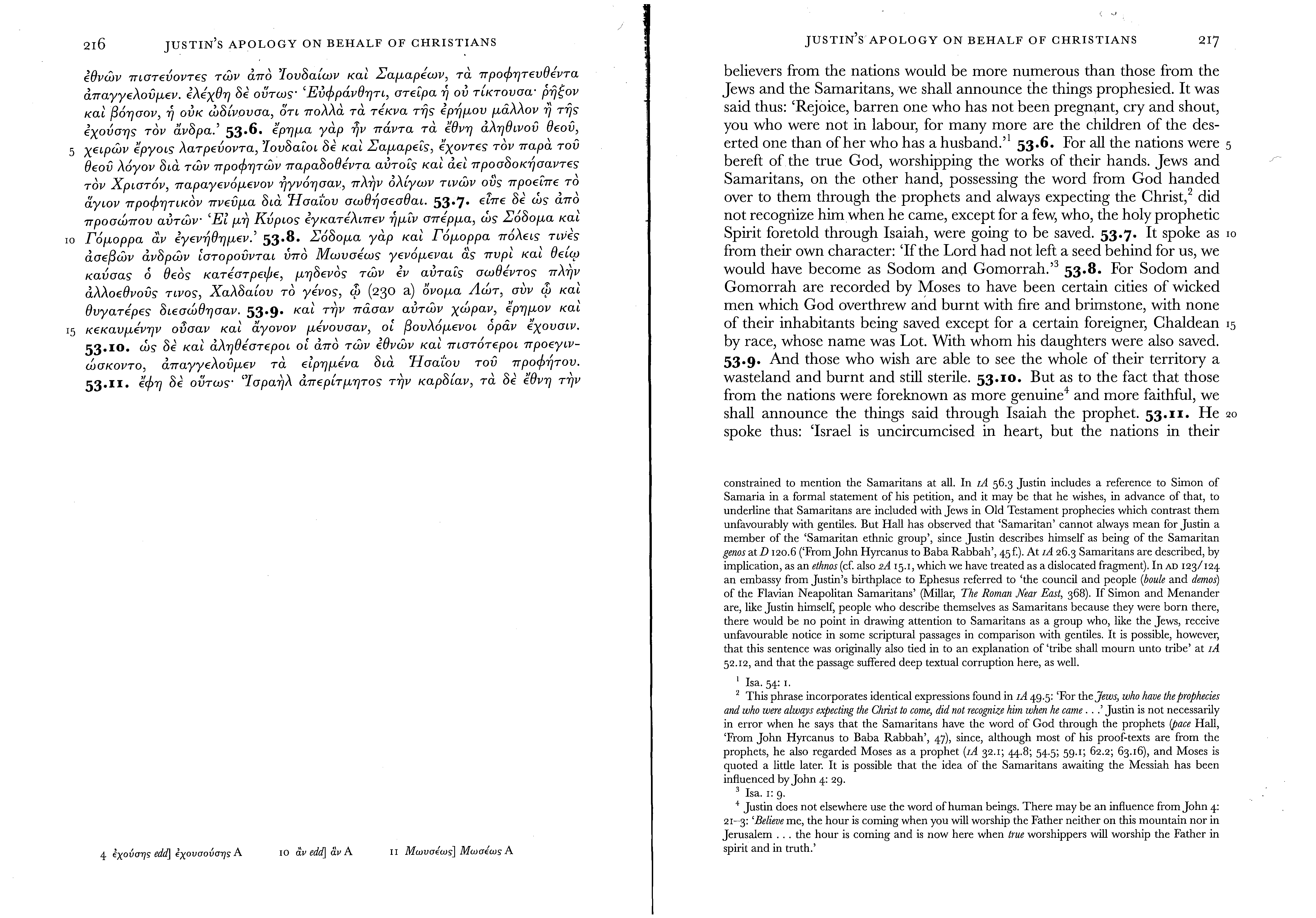
( '-'
JUSTIN'S APOLOGY ΟΝ BEHALF OF CHRISTIANS
JUSTIN'S APOLOGY ΟΝ BEHALF OF CHRIST.IANS
believers from the nations would be more numerous than those from the Jews and the Samaritans, we shall announce the things prophesied. It was
'θ ~ ι ~, \ '1 δ ι \ Σ ι \ Φ θ ι ε νων πιστευοντες των απο ου αιων και αμαρεων, τα προ ΊΊτευ εντα , λ ~ 'λ ι θ δ \"
'Ε'Φ ι θ ~ ι , Ι Ι ~C απαγγε ουμεν. ε εχ YJ ε ουτως' υ ραν ΊΊΤΙ, στειΡα YJ ου τικτουσα' PYJf:,Ov.
\ β Ι ι" δ ι " λλ \ \ Ι ~'I ~λλ ,ι ~ και ΟΊΊσον, YJ ουκ ω ινουσα, οτι πο α τα τεκνα ΤΊΊς εΡΊΊμου μα ον YJ ΤΊΊς said thus: 'Rejoice, barren one who has not been pregn~nt, cry and shout, you who were not ίη labour, for many more are the children of the deserted one than ofher who has a husband.'l 53.6. For all the nations were 5 bereft οΓ the true God, worshipping the works of their hands. Jews and Samaritans, οη the other hand, possessing the word from God handed over to them through the prophets and always expecting the Christ,2 did not recogriize himwhen he came, except for a few, who, the holy prophetic
Spirit foretold through Isaiah, were going to be saved. 53.'. It spoke as !Ο from their own character: 'If the Lord had not left a seed behind for us, we would have become as Sodom and Gomorrah. ,3 53.8. For Sodom and έχούσΊΊς τον ανδρα.' 53.6. εΡΊΊμα γαρ ~ν πάντα τα εθνΥ] άλΊΊθινου θεου,
5 χειρών εργοις λατρεύοντα, '1ουδαιοι δε και Σαμαρεις, εχοντες τον παρα του θεου λόγον δια τών ΠΡΟΦΊΊτών παραδοθέντα αυτοις και άει προσδοκ-ήσαντες τον Χριστόν, παραγενόμενον ήγνόΊΊσαν., πλην ολίγων τινών ους προειπε το αγιον ΠΡΟΦΊΊτικον πνευμα δια Ήσαιου σωθ-ήσεσθαι. 53.'. εΊπε δε ώς άπο προσώπου αυτών' 'Ει μη Κύριος έγκατέλιπεν ήμιν σπέρμα, ώς Σόδομα και
!Ο Γόμορρα αν έγεν-ήθΊΊμεν.' 53.8. Σόδομα γαρ και Γόμορρα πόλεις τινες , β~ 'δ ~ ι ~ Ι \ Μ ι Ι ,\ \ \ θ ι ασε ων αν ρων ιστορουνται υπο ωυσεως γενομεναι ας πυρι και EL<tJ ι ι θ \ ι ,Ι. δ \ ~ , ,~ θ ι λ \ καυσας ο εος κατεστρεψε, μΥ] ενος των εν αυταις σω εντος π ΊΊν Gomorrah are recorded by Moses to have been certain cities of wicked men which God overthrew aήd burnt with fire and brimstone, with none of their inhabitants being saved except for a certain foreigner, Chaldean 15 by race, whose name was Lot. With whom his daughters were also saved.
53.9. And those who wish are able to see the whole of their territory a wasteland and burnt and still sterile. 53.10. But as to the fact that those from the nations were foreknown as more genuine 4 and more faithful, we shall announce the things said through Isaiah the prophet. 53.11. He 20 spoke thus: 'Israel is uncircumcised ίη heart, but the nations ίη their άλλοεθνους τινος, Χαλδαίου το γένος, Ψ (230 a) Όνομα Λώτ, συν Ψ και θυγατέρες διεσώθΊΊσαν. 53.9. και την πασαν αυτών χώραν, εΡΊΊμον και ι 'i"
\ "
Ι (β λ ι (,..."
53.10. ώς δε και άλΊΊθέστεροι οί άπο τών έθνών και πιστότεροι προεγιν ώσκοντο, άπαγγελουμεν τα εΙΡΊΊμένα δια Ή σαιου του προΦ-ήτου.
"Φ δ \"
''1
\ λ'
Ι \ δ ι \ δ \ "θ \ 53.11. ε YJ ε ουτως' σραΥ] απεριτμΊΊτος ΤΊΊν καρ ιαν, τα ε ε νΥ] ΤΊΊν constrained to mention the Samaritans at all. 1π ιΑ 56.3 Justin includes a reference to Simon of Samaria in a formal statement of his petition, and it may be that he wishes, ίπ advance of that, to underline that Samaritans are included with Jews in Old Testament prophecies which contrast them unfavourably with gentiles. But Hall has observed that 'Samaritan' cannot always mean for Justin a member of the 'Samaritan ethnic group', since Justin describes himself as being of the Samaritan genos atD 120.6 ('FromJohn Hyrcanus to Baba Rabbah', 45f.). At ιΑ 26.3 Samaritans are described, by implication, as an ethnos (cf. also 2Α 15.1, which we have treated as a dislocated fragment). 1π AD 123/124 an embassy from Justin's birthplace to Ephesus referred to 'the council and people (boule and demos) of the Flavian Neapolitan Samaritans' (Millar, The Romall Near Eαst, 368). If Simon and Menander are, like Justin himself, people who describe themselves as Samaritans because they were born there, there would be πο point ίπ drawing attention to Samaritans as a group who, like the Jews, receive unfavourable notice ίπ some scriptural passages ίπ comparison with gentiles. 1t is possible, however, that this sentence was originally also tied ίπ to an explanation of 'tribe shall mourn unto tribe' at ιΑ
52.12, and that the passage suffered deep textual corruption here, as well. ι 1sa. 54: ι.
2 This phrase incorporates identical expressions found ίπ ιΑ 49.5: 'For the]ewsJ who have the p1"Ophecies alld who were alwαys expectillg the Chrίst [ο comeJ did 1l0t recogιιize hi,n when he cαιne .. .' Justin is not necessarily in error when he says that the Samaritans have the word of God through the prophets (pace Hall,
'From John Hyrcanus to Baba Rabbah', 47), since, although most of his proof-texts are from the prophets, he also regarded Moses as a prophet (ιΑ 32.1; 44.8; 54.5; 59.1; 62.2; 63.16), and Moses is quoted a little later. 1t is possible that the idea of the Samaritans awaiting the Messiah has been influenced by John 4: 29· 3 1sa. ι: 9.
4Justin does not elsewhere use the word ofhuman beings. There may be an influence fromJohn 4:
21-3: 'Believe me, the hour is coming when you will worship the Father neither οπ this mountain nor in Jerusalem ... the hour is coming and is now here when tτue worshippers will worship the Father in spirit and ίπ truth.'
JUST1N'S APOLOGY ΟΝ BEHALF OF CHRISTIANS
JUSTIN'S APOLOGY ΟΝ BEHALF OF CHR1ST1ANS
άκροβυστ{αν.' 53.12. *** τα TOaaVTa yOVV όρώμενα 1Τειθω και 1Τ{στιν τοις foreskins.' 1 53. ι 2. *** When such things a.r:e seen they can reasonably2 provide those who embrace the truth, and are not lovers of ορίηίοη, or ruled by passions, with persuasion and assurance as well. 3
Ι , ταληθες ασ1Ταl;,ομεvοιS' και μη ι ο o~ ουσι μη ε υ1ΤΟ 1Τα ων αρχομενοις μετ α λόγου 1ΤροσεμΦορήσαι δύναται.
Ι δ' δ δ ι 'θ θ ι Ι, Λ Λ 'δ ι 54.1. ι ε 1Ταρα ι οντες τα μυ 01Τοιη εντα υ1ΤΟ των 1Τοιητων ου εμιαν
-θ ι / C\' \) Ι , , ,..
α1ΤΟ ει~ιν ερουσι τοις εκμαν ανουσι νεοις, α ε1ΤΙ α1Ταττι και α1ΤαγωγTl του , ι ι , Λ θ ' δ ι , , Ι Λ Φ Ιλ ανθρω1Τειου γενους ειΡησ αι α1ΤΟ εΙΚJlυμεv κατ ενεργειαν των αυ ων Ο 54.1. But those who hand down the myths invented by the poets supply ηο demonstration at all for the youths who learn them by heart. These 5 things we demonstrate to have been said by the working of the evil demons for the deception and misdirection of the human race. 54.2. For when they heard through the prophets that the future coming of Christ was proclaimed and that the impious among human beings were going to be punished by fire, they threw many so-called4 sons of Zeus into the 10 discussion,5 considering they would be able to bring it about that human beings would consider the things said about Christ to be a marvellous fable, and similar to the things said by the poets. 54.3. And these things were said both among the Greeks and among all the nations, where-as δαιμόνων. 54.2. άκούσαντες γαρ δια των 1ΤροΦητων κηρυσσόμενον 1Ταραι
, "βΛ Λ γενησομενον τον ριστον και κο ασ ησομενους ια 1Τυρος τους ασε εις των άνθρώ1Των, 1Τροεβάλλοντο 1Τολλους λεχθήναι λεγομένους υίους Τψ Διί', νομ ι δ ι θ 'Λ λ ι Ι ι θ "θ ι ,
ιζοντες υνησεσ αι ενεργησαι τερατο ογιαν ηγησασ αι τους αν ρω1Τους τα 1Τερι τον Χριστον και όμοια TOΙSύ1ΤΟ των 1Τοιητων λεχθεΙσι. 54.3. και
Λλλ' ι TaVTa ε εχ η και εν ησιν και εν ε νεσι 1Τασιν, 01Του μα ον ε1Τηκουον δ ι The text is fromJeremiah (9: 25), not Isaiah. It is hard to see how Justin could imagine that anyone, let alone a gentile, could see this text as proving what it is supposed to proνe. The difficulty is compounded by the citation of the text ίη a form eνen less likely to be understood by a gentile audience. Justin's word for foreskin (akrobustia) is not found outside ofbiblical and ecclesiastical writers.
It is likely that the MS text is corrupt, and that an elucidation of this testimony, and perhaps also an account of visible proof of its fulfilment, has been lost. The LXX text of Jer. 9: 25 is, 'for all the nations are uncircumcised ίη their jlesh, and the whole house of Israel are uncircumcised with respect to their hearts'. Circumcision was also practised by Samaritans. Origen says that Samaritans 'are put to death οη account of circumcision as Sicarii, οη the ground that they are mutilating themselνes contrary to the established laws and are doing what is allowed to Jews alone' (Contra Celsunz Π.Ι3, tr. Chadwick), and Justin may haνe made reference to this here.
2 This echoes Justin's assumption ίη ιΑ 53.2 that Christians need a reason to belieνe ίη a crucified man.
3 Sylburg's conjecture of εμποιησαι (produce, cause) for the MS's εμφορησαι has not won faνour with editors. But the MS reading is unlikely to be correct. Έμφορησαι means to fill, and nearly always has a pejorative sense, e.g. 'filled with unmixed wine" Ιη this sense it is usually constructed with an accusatiνe of the person and a genitive of the thing, except when the accusative of the thing is used as an inner object after a middle form ('fill oneself with .. .'). When, as here, it takes an accusatiνe of the thing and a dative of the person, it means 'inflict', as ίη 'inflict blows on" We have conjectured προσεμφορησαι, 'to put into ίη addition' (LSJ). Ιη the passages ίη Plutarch referred to by LSJ-De
SuΡeπtίtίοne 7 (I68a), De se ipsuιn citra invidiam lαudando 20 (547c), and Non posse suαviter υίυί secundunz
EpicuruIn 25 (ι I04b)-it is plain that the νerb means to supply further things to the mind of someone.
Thus, ίη our passage, those who already embrace the truth can be provided with persuasion and assurance as well. We suggest that 'the things seen' referred to confirmation of prophecies about gentile Christians being more numerous, more genuine, and more believing than Jewish ΟΓ Samaritan
Christians, and tb.at this has fallen out of the text. Such confirmation offers an additional motive to that of the confirmation of testimonies about Jesus referred to ίη ιΑ 53.2. Προσεμφορησαι may haνe lost its first prefix after corruption ίη 53.ΙΙ had οbSCU1'ed the force ofthe νerb.
4 The reading of γενόμενους [Ο1' λεγόμενους ('many sons begotten to Zeus to be spoken of'), first proposed by Μa1'an and adopted by many editors, is possible, but not necessary. Justin may simply "XΪsh to emphasize that those spoken ofby the poets as sons ofZeus are not really such, cf. ιΑ 53.Ι and 2Ι-4; ι post aκροβυστίαν lacunam suspicamur 3 προσεμφορησαι coniec] εμφορησαι Α 4 ουδεμίαν edιi] ουδε μίαν Ν pr m; ου μίαν Α* 5 α Marcovich] και Α 9 λεχθηναι λεγομένους
55·Ι; 64·6.
5 The discussion, as Grabe noted, is amongst the poets; it is Justin who labels the sons of Zeus
'so-called' .
Α] λεχθηναι γενομένους ]IIfαran Qtto Blllnt Μαι"COvίch Munier, τεχθηναι λεγομέ;ους Le Cleπ Thalemann ι ι ομοια Thirlby edιi] όμοίως Α Ι2 Έλλησιν Α] Έλλησι Qtto Blunt Μαι"COvιc!ι
JUST1N'S APOLOGY ΟΝ BEHALF OF CHR1ST1ANS
JUST1N'S APOLOGY ΟΝ BEHALF OF CHR1ST1ANS
, " των 7ΤροΦ'ητων 7Τιστευ ησεσ αι τον ριστον 7Τροκηρυσσοντων. 54.4. οη the demons overheard the prophets proc~aiming ίη advance-Christ would be more believed ίη. 54.4. And that they also did not accurately understand the things they heard said through the prophets, but imitated δ '
, δ'
"" β Λ 'λλ' ε και, ακουοντες τα ια των προ ητων εγομενα, ουκ ενοουν ακρι ως, α ι λ'
'( b) "Ι, Χ' ως 7Τ ανωμενοι εμιμησαντο τα 230 7Τερι τον ημετερον ριστον, ίη erring fashion the things concerning our Christ, we shall make clear.
54.5. Thus Moses the prophet, as we said before, was older than all 5 writers,l and it was prophesied through him, as we mentioned before,2 thus: Ά ruler shall not fail from Judah and a leader from his thighs until he should c0!lle for whom it is laid up. And he shall be the expectation of the nations, binding his foal to the vine, washing his garment ίη the blood of the grape.'3 54.6. Therefore, hearing these4 prophetic words, the demons 10 said that Dionysus is the son of Zeus, and they handed down that he was the discoverer of the vine,5 and they taught that he was torn ίη pieces and that he has gone up to heayen. 6 54.7. And since it was not expressly signified through the prophecy of Moses whether7 the one who is to come is the son of God, and whether riding οη a foal he will remain οη the earth 15 διασαΦfισoμεν. 54.5. Mωυσ~ς οδν ό 7TpoΦfιTης, ώς 7ΤροέΦημεν, 7Τρεσ- '
~, Φ'
'δ"
υτερος 'ήν 7Ταντων συγγρα εων, και ι αυτου, ως 7Τροεμηνυσαμεν, 7Τροε β ητεύθη ούτως' 'Ουκ εκλείψει αρχων ες 'Ιούδα και rιγOύμενOς εκ των μηρων
, ,..
Ι/ ""λθ "ί"
Ι \ "
'θ Λ δ αυτου εως αν ε τι Ψ α7Τοκειται' και αυτος εσται 7Τροσ οκια ε νων, εσι \ ,ι λ '
, λ'
, ,.., ι/ μευων 7Τρος αμ7Τε ον τον 7Τω ον αυτου, 7Τ υνων την στο ην αυτου εν αιμαη σTαΦυλiις.' 54.6. τούτων οδν των 7ΤροΦηΤικων λόγων άκούσαντες, οί
, "Φ ,Ι, Λ Δ'
αιμονες ιονυσον μεν ε ασαν γεγονεναι υιον του ιος, ευρετην ε γενεσ αι "λ 'δ 'δ θ"
, , , αμ7Τε ου 7Ταρε ωκαν, και ιασπαραχ εντα αυτον ανε η υ εναι εις ουρανον δ εδίδαςαν. 54.7. και ε7Τειδη δια T~ς Μωυσέως 7ΤροΦητείας ου ρητως
, ι 'C' \ ,.. θ ,..
Ι Ι, \"
Ι , , εσημαινετο ει υιος του εου ο παραγενησομενος εση, και ει οχουμενος ε7ΤΙ ] Cf. ιΑ 44.8. Marcovich inserts the definite article (των), which might easily have fallen out afteI πάντων as many editors have suggested happened at ιΑ 23.1. ButJustin does use συγγραΦεύς without the aIticle, e.g. at ιΑ 22.1. He seems to use the aIticle when thinking of a more closely defined set of writers: e.g. ιΑ 21.2, 'the wIiters you hold ίn honour'; ιΑ 36.2, 'your own writers'; ιΑ 44.8; 59.1, 'all the wIiters in Greek'. lη 2Α 13.5, 'all the writers' Iefers back to 2Α 13.2, 'the others, Stoics, and poets, and pΓOse-writers' .
2 Cf. ιΑ 32.1.
3 Cf. Gen. 49: 1Ο-ΙΙ and Skarsaune, Proqffi'om Prophecy, 25-9.
4 Justin's emphasis is significant. lη the prophecy ascribed to Sophonias at ιΑ 35.10 it is said that it is express/y prophesied thatJesus will be seated οη the foal of an ass. At the beginning of ιΑ 54.7 Justin says that it is not expressly signified through the prophecy ofMoses whether the foal was that of an ass ΟΓ a hOIse.
5 The MS adds, 'and they record wine ίη his mysteries'. Some editoIs suggest 'ass' (ονον) ίη place of 'wine' (οίνον). We regard this as a marginal gloss. There is a closely similar discussion in D 69.2 which may have influenced the editing of this text. Justin uses αναγράΦω ίη the sense of 'record' (cf.
D 69.2). The text, then, cannot mean that the demons pI'escribe either an ass ΟΓ wine ίη his mysteries.
Moreover, the verb is ίη the present tense, preceded by two aorists and followed by anotheI. If the subject of all four verbs is identical, it is difficult to see the point of this change. But if the verb means describe, its subject must be 'the writers', and the clause will then be parenthetical, with the change of subject unmarked. lη D 69.2 the present tense is used for 'the Greeks sC9' that Dionysus became son of Zeus from intercourse, which he had with Semele, and they recount that when he had become discoveIer of the vine and had been torn apart and died he ΓOse and went υρ into heaven, and they serve wine ίη his mysteries'. It seems to us that the glossator has kept the tense from this passage but has taken the verb from the participle αναγραΦεϊσαν which occUIS six words later.
Several editoIs have beenattracted by the suggestion that ίη both ιΑ 54.6 and D 69.2 Justin spoke of the involvement of asses ίη the Iites of Dionysus. While it seems that asses were so involved (Otto,
Di0'!Ysus, 170), it is not necessaIY to introduce this notion ίη ordeI to make good sense of what Justin has to say here.
6 Cf. ιΑ 21.2, where there is also mention ofPeIseus, Heracles, and Asclepius, as here.
Steplιαnus edtZJ δ Next; ώ Amrg ΙΙ παρέδωκαν coniec] παρέδωκαν και οίνον (ονον LaIιge fiylburg
ThiI'Zby Otto) εν τοΙ> μυστηρ{οι> αυτοΩ αναγράΦουσι (ανάΥουσι Laιιge; αναΦέρουσι Thirlby) Α αυτον Α] 7 ιΑ 54.7 is cOrΓupt, and has been variously emended by editors. We propose that the text as it stands represents an attempt to impose a more elaboIate structure than was originally present. We have restored a simple ει, ίη place ofthe MS's ειτε, which would have to be followed by a second element
('whether ... or ... '). Otto and MaIcovich retain ειτε and supply η ανθρώπου as the second element. αυτον αναστηναι και Mαι'COvich 12 Μωυσέως] Μωϋσέος Α 13 ει coniec] ειτε Α εστι Α] εστι η ανθρώπου Otto Mαrcovich
JUSTIN'S APOLOGY ΟΝ BEHALF OF CHR1STIANS
JUSTIN'S APOLOGY ΟΝ BEHALF OF CHR1STIANS
'λ ",..., Λ'\"" λ ι ".....
'λ"
, πω ου επι γης μενει η εις ουρανον ανε ευσεται, και το του πω ου ονομα και or will go Up to heaven, and since 1 the word foal was able to signify the foal both of an aSS and of a horse, not understanding whether the unbroken 2 foal of an ass or of a horse will be the symbol of his appearing, and whether the one proclaimed beforehand iS the SOll of God, as we said before, or of human beings,3 they said that Bellerophon, a human being 5 born ofhuman beings, has gone up to heaven, and speci:fically οη the horsePegasus. 54.8. But when they heard it said through the prophet
Isaiah as, we1l4 that he would be born of a virgin and would go up to heaven by himself,5 they would throw Perseus into the discussion.
54.9. And when they knew it was said, as it was said before ίη the 10 previously written prophecies, 'Strong as a giant to run his course', they spoke of Heracles, the strong one who traversed the whole earth. σνου πώλον και ϊππου σημαίνειν έδύνατο, μη έπιστάμενοι εϊτε σνου πώλοS'
, \"
Ι β λ.... ι, ......
,Ι tl \, t ασαγης εσται συμ ο ον της παρουσιαS' αυτου ειτε ιππου, και ει ο , "θ ~, , 'φ ., 'θ '
, 'φ'"
" θ 'c ' θ'
, ,
ερο οντην, και αυτον ε ιππου ηγασου, αν ρωπον ε~ αν ρωπων γενομε- , , "'Φ 'λ λ θ'
8" δ'" δ'
" δ' θ' θ'
'δ"
~ προ ητου, σαίΌυ, εχ εν οη ια παρ ενου τεχ ησεται και ι εαυτου Φ ανελεύσεται εις τον ουρανόν, τον Περσέα (231 a) λεxθiιναι προεβάλλοντο.
54.9. και οτε εγνωσαν ειρημένον, ώS' προλέλεκται έν ταις προγεγραμμέναις Φ , ''/ "
, δ ~ 'δ"
, ,
προ ητειαις, σχυρος ως γιγας ραμειν ο ον, τον ρακ εα ισχυρον και ι Marcoνich supplies Επει here, which is required in English; but we have taken this clause as also depending οη 'since' at the beginning of the sentence.
2 We have supplied the word ασαγής from a closely similar passage ίη D 53.4, 'for as the unbroken colt was a symbol ofthose from the gentiles, so the ass bearing the yoke was a symbol ofyour people'.
The word does not appear before Justin, and after him is found οηlΥ as a (plausible) conjectural emendation of ασιγής ίη Cyril of Jerusalem, Catecheses IllulIliιzaιzdorum 12.10. It appears to be a description of the 'colt upon which ηο one has ever sat', and οη which the disciples threw their cloaks
(Luke 19: 30, 35 and Mark ΙΙ: 2,7). The related term used by Justin inD 53-4 to describe the ass bearing the Υοke-ύποσαγης σίterallΥ 'saddled')-occurs nowhere else ίη the Greek literature noticed by TLG.
The literal meaning of ασαγής is 'unsaddled', but Williams's 'unbroken' is closer to Justin's meaning
(]ustiιz Martyr, The Dialogue with Tίypho, 105 f.). Justin thinks that the young colt is distinguished from a beast ofburden at Zech. 9: 9 (cf. Matt. 21: 5), a text he discusses at ιΑ 35.IΟ-ΙΙ and D 53.3-4. It will be observed thatJustin's language is likely to have puzzled his intended audience as much as it puzzled his copyist, but that is not an argument against its authenticity, for the notion that the foal is a symbol of his appearing is also new to the context. The references to the unbroken colt and to its symbolism are properly at home in their context in the Dialogue, as they are not here. Either Justin is making careless use of exegetical materials he has to hand, or, possibly, an early editor has added both references from the Dialogue (cf. the gloss we have excluded above at ιΑ 54.6). Copyists, troubled by the neologism, have changed it to αγων, and have changed the cases and made the subject of the next clause, 'the one proclaimed beforehand', the subject of this clause, in an attempt to make sense. But the sense is superficial: Jesus is nowhere described as 'leading' a colt.
3 Both here and a few words lateI the MS has 'of a human being'. Editors have supplied a pluIal οη the second occasion, but not οη the first. The plural is found nine otheI times ίη Justin (ιΑ 21.2 (in MS); 30.1; D 48.3; 48.4; 49.1 (bis); 54.2; 67.2; 76.2), and may have theological and polemical ροίηι Ifthe singular is allowed, the phrase 'the son of God' has to be undeIstood to mean 'has God as his father'.
Jesus himself, like Dionysus, is describable as 'son of a human being'. ΟηΙΥ 'boIll of human beings' excludes the possibility of a diνine parent.
+ The obvious translation would be 'the otheI prophet, Isaiah'. But αλλος can also be used ίη the sense we have adopted; see our notes οη ιΑ 6.2 and 44.2.
5 That is, not by horse. EditoIs point to Isa. 7: 14, but the connection between this text and the legend of Perseus is the virgin birth (cf. D 67.2 and ιΑ 22.5). Isa. 7: 14 furnishes ηο testimony text ίη respect of ascending unaided to heaven, and this is not paIt of the Perseus legend. At D 63. ι Justin is asked by Trypho to demonstrate that Jesus was born of a νiIgin, crucified, died, and after rising from the dead went up to heaven. Justin meets the request by introducing a catena of testimony texts, beginning with Isa. 53: 8 ('Who shall declare his descent'), which Justin explicitly interprets as pointing to Jesus' not being descended from human beings, and including Ps. 44(45): 7-13. The latter is described by Skarsaune (P1"Oqff1"011l Prophecy, 201) as irrelevant to Justin's purpose, but it may have been intended as proof of the ascension. When he speaks of 'the prophet Isaiah as well', Justin presumably has this cluster of testimony texts ίη mind.
Ι και (10) Α] και Επει Marcovich 2 πωλος ασαγης coniec] πωλον αγων Α 3 και εΙ ό Π'Ροκτιρυσσόμενος coniec] ό προκτιρυσσόμενος και Α; ό προκτιρυσσόμενος και εΙ Thirlby Marcovich
4 ανθρώπων coniec] ανόϊι Α 5 ανθρώπων !iYlburg Dtto Bluιzt Marcovich] ανόϊι Α 8 προεβάλλοντο Α] προεβάλοντο Marcovich
JUST1N'S APOLOGY ΟΝ BEHALF OF CHRISTIANS
JUSTIN'S APOLOGY ΟΝ BEHALF OF CHR1STIANS
, , \ ~ ~ "φ "
~ \ 'λ ,ι θ εκπερινοστησαντα την πασαν γην ε ασαν. 54.10. οτε οε πα ιν εμα ον 54.10. And when again they learnt that he was prophesied as going to cure every illness and to raise the dead, they introduced Asclepius.
' θ '
,\ ~ , \ \, ~ \ προ ητευ εντα εραπευσειν αυτον πασαν νοσον και νεκρουι; ανεγερειν, τον
55. ι. But nowhere and about none of the so-called sons of Zeus did they imitate the crucifixion. For it was not understood by them, as the things said concerning it were said symbolically, as was made clear earlier. 1 5
55.2. This, as the prophet said beforehand, is the greatest symbol of his strength q.nd rule, as is shown also from the things which fall under the eye.
For consider all the things that are ίη the world, if, without this pattern, they are administered ΟΓ are able to have cohesion. 55.3. For the sea is not cleaved unless, tthe mast, fixed ίη this way ίη the keel, t 2 remains secure 10 in the ship, and the earth is not ploughed without ίι Diggers do not do their work, ηΟΓ craftsmen likewise, unless by means of tools having this pattern. 55.4. And the human form differs from the irrational animals
55.1. Άλλ' ουδαμου ουδ' επί Τινοι; των λεγομένων υίων του Διοι; το σταυρ5 ωθηναι εμιμ~σανTO· ου γαρ ενοειτο αυτοις, συμβολικωι;, ώι; πρoδεδ~λωTαι, των εις τουτο ειρημένων πάντων λελεγμένων. 55.2. όπερ, ώι; προειπεν ό
ΠΡOΦ~Tηι;, το μέγιστον σύμβολον τηι; ισχύοι; και άρχηι; αυτου ύπάρχει, ώι; \, ;"\ t:, "'/t ι ς:Ι Ι \ Ι "
...... και εκ των υπ οψιν πιπτοντων υεικνυται. κατανοησατε γαρ παντα τα εν Τψ 'λ \ \ "
,\ \ t ~ \, C\ λ ~ 10 55.3. α ασσα μεν γαρ ου τεμνεται ην μη τουτο το τροπαιον ο κα ειται κόσμψ, ει ανευ του σx~μαTOΙ; τούτου διοικειται ~ κοινωνίαν εχειν δύναται. θ ίστίονt εν TV νηι: σωον μείντι, γη δε ουκ άρουται ανευ αυτου. σκαπανειι; δε
Ι , .....
)s::-' β \ (Ι ,\ ~ \ Λ \ την εργασιαν ου ποιουνται ουυε αναυσουργοι ομοιωι;, ει μη υια των το σχημα τουτο εχόντων εργαλείων. 55.4. το δε άνθρώπειον σχημα ουδενι ίη nothing other than ίη being upright and having the outstretching of the hands and bearing οη the face nostrils,3 suspended, as it were,4 from the 15 brow, through which, indeed, the living thing breathes.5 And it shows ηο other pattern than that of the cross. 55.5. And through the prophet it was said thus: 'The Spirit before our face-Christ the Lord.'6 55.6. And your own symbols make clear the power of this pattern, tof vexilla and of αλλ ψ των άλόγων ζψων διαΦέρει ~ Τψ ορθόν τε εΊναι και εκτασιν χειρων
εχειν και εν Τψ προσώπψ, άπο του μετωπίου τεταμένουι;, το λεγόμενον, c ~ Φ , ~'... tl'
, , ~ r '
\, ~ \ "λλ ~, μυ~ωTηραι; ερειν, οι ων η γε αναπνοη εστι Τψ ,=>ψψ. και ουοεν α ο υεικνυσιν ~ το σχημα του σταυρου. 55.5. και δια του ΠΡOΦ~Toυ δε (231 b) ελέχθη οϋτωι;· 'Πνευμα προ προσώπου ~μων, Χριστοι; Κύριοι;.' 55.6. και τα παρ' ύμιν δε σύμβολα T~ν του σx~μαTOΙ; τούτου δύναμιν δηλοι t λλω μεν
! Commentators indicate ιΑ 35. But Justin does not there say that what the prophets said of the crucifixion was said symbolically. This may, however, have been said ίη the lacuna which we indicate at ιΑ 35.2.
2 The MS has 'this trophy which is called a sail'. But we suspect that this is corrupt, and beyond exact repair. 1t is not clear (a) why a sail should be thought to be ίη the form of the cross; (b) how a sail might remain secure ίn the ship; (c) that a sail, of itself, causes the sea to be cleaved. We propose that τρόπαιον (trophy) conceals a reference to a keel (τρόπι" τροπιδειον) and ίστ{ον (sail) conceals a reference to a mast (ίστό,): our translation offers an approximate sense. 1t is the keel that cleaves the sea. The fact that this cross-form is upside-down is irrelevant, as the same could be said of a plough.
Cf. Dionysius, Peri Phuseos ΙΙ (from Eusebius, Prαepαrαtio Evαngelica XlY.24, Feltoe, ρ. 136): 'and when a ship was being constructed some keel did not put itself underneath nor did the mast raise itself upright ίη the midst'; and Methodius (Contrα Porphyrium 1.8): 'Whence the sea, yielding to this form, renders itself navigable for human beings.' The reference to a trophy later ίη this chapter, and perhaps later
Christian description of the cross as a trophy, may have triggered the corruption.
3 The MS has 'nostril', ίη the singular, which most translators and commentators take to mean the nose, understanding brow and nose to form a cross. But the word does not mean this, and, according to TLG, is not used ίη the singular unless the reference is specifically to one nostril only-but the singular is found in some MMS ofIsa. 2: 22 (see below), and atJob 40: 26, 'ifyou shall bind a ring ίη his nostril'.
4 The phrase το λεγόμενον is used to signal an unusual or fanciful turn of phrase. 1ts misreading as masculine may have triggered the change ίη the number of nostrils. Justin's language ίη this section is unusually poetic, but he· is concerned here with symbols. 1t is the nostrils through which humans breathe, and it is by the form of a cross (inverted, as ίη most of the other examples offered here) that the nostrils are connected with the brow.
4 υίων edd] υίον Α 13 άνθρώπειον Nex'] άνθρώπινον AC! mrg 15 τεταμένου, coniec] τεταμένον Α το coniec] τον Α 16 μυςωτΤιρα, coniec] μυςωτΤιρα Α J.ιν coniec] 015 Α γε 5 Lit. 'through which there is breath (άναπνοή) to the living thing'; cf. Isa. 2: 22, 'Cease ye from the man, whose breath is ίη his nostrils'. This verse is not found ίη the LXX, except for a few MSS, and some of those, and some other witnesses, have the singular, 'nostril'.
Mαrcovich] τε Α και Α] α Tlzirlby },ιfαrcomch 19 λλω μεν Α* post spatium circiter quinque litterarum] υις{(m~λλω μεν Ν
; λέγω δε τα των ούης{λλων Otto Blunt; λέγω δε τα των καλουμένων παρ' ύμιν ούις{λλων (vel βις{λλων) Thil"lby; ινα άμελωμεν Goodspeed; οίον τα των ούης{λλων Mαrcovich; ώ, τα
6 Lam. 4: 20. " των ούης{λλων Munier
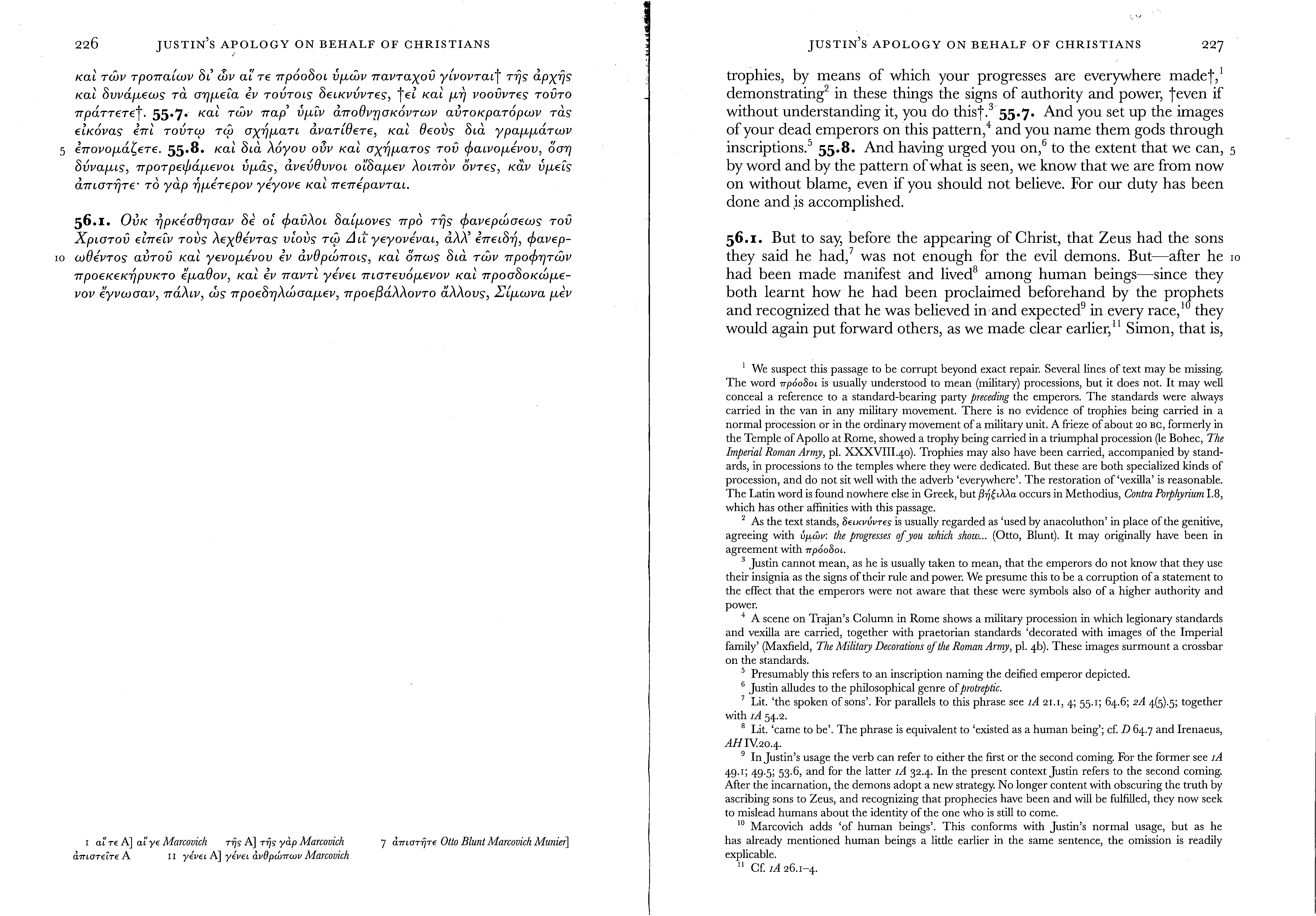
JUSTIN'S APOLOGY ΟΝ BEHALF OF CHRISTIANS
JUSTIN'S A~OLOGY ΟΝ BEHALF OF CHRISTIANS
trophies, by means of which your progresses are everywhere madet, 1 demonstrating2 ίη these things the signs of authority and power, teven if without understanding it, you do thist.3~ 55.7. And you set up the images of your dead emperors onthis pattern/ and you name them gods through inscriptions.5 55.8. And having urged you οη,6 to the extent that we can, 5 by word and by the pattern of what is seen, we know that we are from now και των τροπαίων δι' 6)ν αϊ τε πρόοδοι ύμων πανταχου γίνονταιt τΥις αρχΥις
'δ'
, ~, , δ ' t'"
~ ~ και υναμεως τα σημεια εν τουτοις εικνυντες, ει και μη νοουντες τουτο 't '''''''
Ι i"'\ 'θ ι , Ι \ πραττετε . 55.7. και των παρ υμιν απο νTlσκοντων αυτοκρατορων τας εικόνας Επι τούτφ T(jJ σχήμαη ανατίθετε, και θεους δια γραμμάτων
, 'Υ 8' δ ' λ'
-;- "
~ φ , .,
,ι, '
• ~ "θ "3 λ'"
~ υναμις, προτρεψαμενοι υμας, ανευ υνοι οι αμεν οιπον οντες, καν υμεις οη without blame, even· if you should not believe. For our duty has been done and ,is accomplished. απιστΥιτε' το γαρ ήμέτερον γέγονε και πεπέρανται.
56.1. ουκ ήρκέσθησαν δε οί φαυλοι δαίμονες προ τΥις Φανερώσεως του 56.1. But to say, before the appearing of Christ, that Zeus had the sons they said he had,7 was not enough for the evil demons. But-after he 10 had been made manifest and lived8 among human beings-since they both learnt how he had been proclaimed beforehand by the prophets and recognized that he was believed ίη' and expected9 in every race,lO they would again put forward others, as we made clear earlier,11 Simon, that is,
'Λ'
'" θ '
,tι δ'
~ Φ ~
ω εντος αυτου και γενομενου εν αν ρωποις, και οπως ια των προ ητων προεκεκήρυκτο εμαθον, και Εν παντι γένει πιστευόμενον και προσδοκώμε νον εγνωσαν, πάλιν, ώς προεδηλώσαμεν, προεβάλλοντο &λλους, Σίμωνα μεν
1 We suspect this passage to be corrupt beyond exact repair. Severallines of text may be missing.
The word πρ60δοι is usually understood to mean (military) processions, but it does not. It may well conceal a reference to a standard-bearing party preceding the emperors. The standards were always carried ίη the van ίη any military movement. There is ηο evidence of trophies being carried in a normal procession οτ ίη the ordinary movement of a military unit. Α frieze of about 20 ΒΌ, formerly in the Temple of ΑροlΙο at Rome, showed a trophy being carried ίη a triumphal procession (le Bohec, T1ze
Imperiαl Romαn Arιιιy, pl. XXXVlII.{o). Trophies may also have been carried, accompanied by standards, in processions to the temples where they were dedicated. But these are both specialized kinds of procession, and do not sit well with the adverb 'everywhere'. The restoration of 'vexilla' is reasonable.
The Latin word is found nowhere else ίη Greek, but βήξιλλα occurs ίη Methodius, Contrα Porphyrium 1.8, which has other affinities with this passage.
2 As the text stands, δεικνύν7ε!> is usually regarded as 'used by anacoluthon' in place of the genitive, agreeing with ύμων: tlze progresses qf you which show ... (Otto, Blunt). It may originally have been ίη agreement with πρ60δοι.
3 Justin cannot mean, as he is usually taken to mean, that the emperors do not know that they use their insignia as the signs of their rule and power. We presume this to be a corruption of a statement to the effect that the emperors were not aware that these were symbols also of a higher authority and power.
4 Α scene οη Trajan's Column ίη Rome shows a military procession ίη which legionary standards and vexilla are carried, together with praetorian standards 'decorated with images of the Imperial family' (Maxfield, T1ze Nfilitαry DecorαtioιlS qftlze RomαnA1'n1:J, pl. 4b). These images surmount a crossbar οη the standards.
5 Presumably this refers to an inscription naming the dei:fied emperor depicted.
6 Justin alludes to the philosophical genre of protreptic.
7 Lit. 'the spoken of sons'. For parallels to this phrase see ιΑ 21.1, 4; 55.1; 64.6; 2Α 4(5).5; together with ιΑ 54.2.
8 Lit. 'came to be'. The phrase is equivalent to 'existed as a human being'; cf. D 64.7 and Irenaeus,
AHIv.20+ 9 InJustin's usage the verb can refer to either the first οτ the second coming. For the former see ιΑ
49. ι; 49·5; 53·6, and for the latter ιΑ 32+ Ιη the present context Justin refers to the second coming.
Mter the incarnation, the demons adopt a new strategy. Νο longer content with obscuring the truth by ascribing sons to Zeus, and recognizing that prophecies have been and will be fulfilled, they now seek to mislead humans about the identity of the one who is still to come.
10 Marcovich adds 'of human beings'. This conforms with Justin's normal usage, but as he has already mentioned human beings a little earlier ίη the same sentence, the omission is readily explicable.
Ι αϊ τε Α] αί' γε Mαrcoviclz 77)<; Α] 77)<; γαρ Mαrcovich 7 απισ7η7ε Otto Blunt Mαrcoviclz },ι[unίer] απιστειτε Α ΙΙ γένει Α] γένει ανθρώπων },ι[αrcovίch 11 Cf. ιΑ 26.1-4.
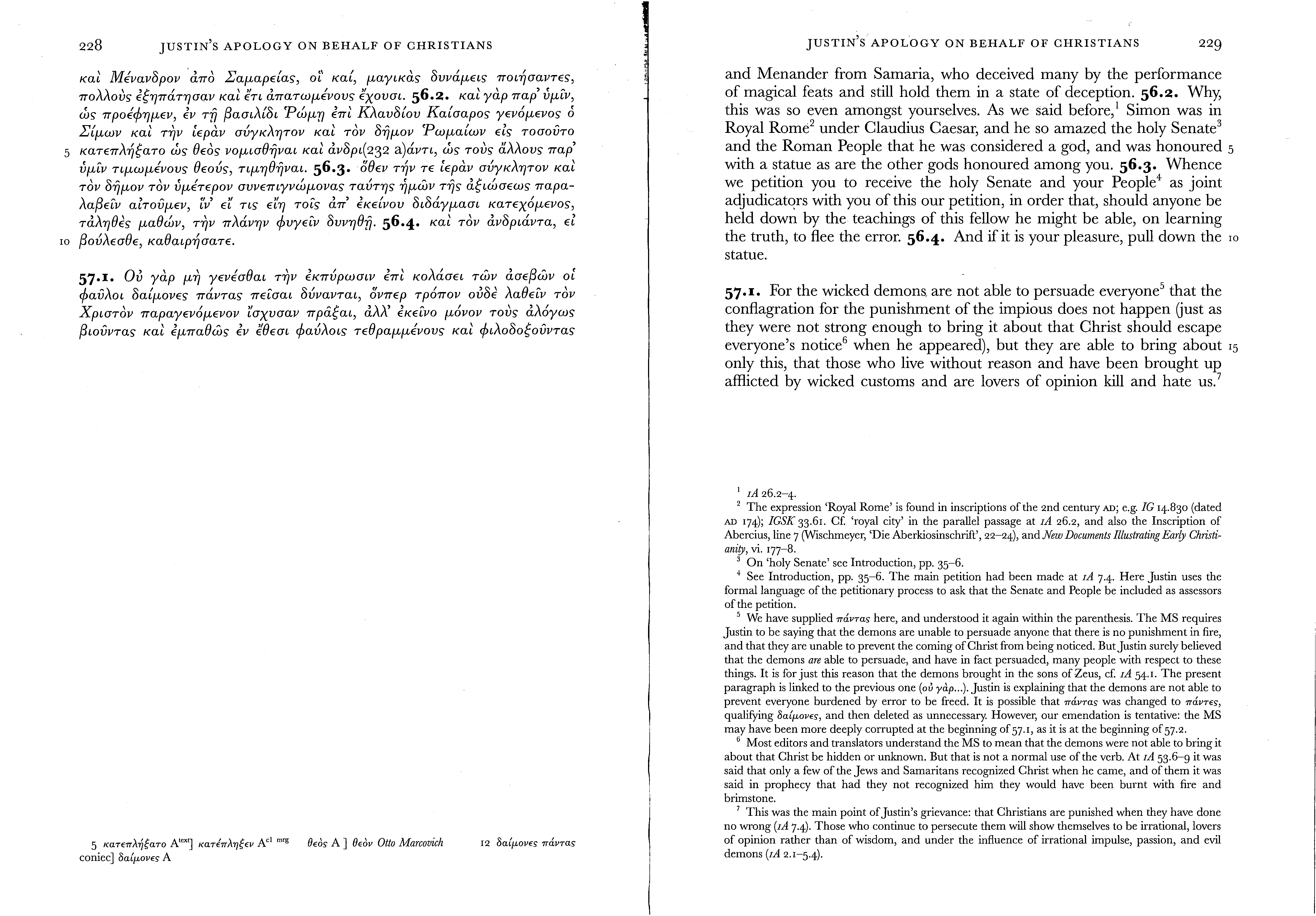
JUSTIN'S APOLOGY ΟΝ BEHALF OF CHRISTIANS
JUSTIN'S APOLOGY ΟΝ BEHALF OF CHRISTIANS
\ 7111 Ι δ ',\ Σ Ι ,\ Ι \ δ ι ι και ΙΥ1εναν ρον απο αμαρειας, οι και, μαγικας υναμεις ποιησαντες, and Menander from Samaria, who deceived many by the performance of rnagical feats and still hold them ίη a state of deception. 56.2. Why, this was so even amongst yourselves. As we said before,l Simon was ίn
Royal Rome2 under Claudius Caesar, and he so amazed the holy Senate3 πολλους εξηπάτησαν και ετι άπατωμένους εχουσι. 56.2. και γαρ παρ' ύμιν,
( ιφ 'Α β λΙδ (D ι ,\ Κλ δΙ Τ7 Ι Ι • ως προε ημεν, εν TTJ ασι ι ι Γωμτι επι αυ ιου nαισαρος γενομενος ο Σίμων και T~ν ίεραν σύγκλητον και τον δημον Ρωμαίων είς τοσουτο and the Roman People that he was considered a god, and was honoured 5 with a statue as are the other gods honoured among you. 56.3. Whence we petition you to receive the holy Senate and your People4 as joint adjudicatqrs with you of this our petition, ίη order that, should anyone be held down by the teachings of this fellow he might be able, οη learning the truth, to flee the error. 56.4. And if it is your pleasure, pull down the ΙΟ statue.
5 κατεπλήξατο ώς θεος νομισθηναι και άνδΡΙ(232 a)άντι, ώς τους αλλους παρ' ύμιν τιμωμένους θεούς, τιμηθηναι. 56.3.0θεν τήν τε ίεραν σύγκλητον και τον δημον τον ύμέτερον συνεπιγνώμονας ταύτης ~μων της άξιώσεως παρα- ,...
) Λ ΙΙ) ,!
), .....
:),) ι δ δΙ Ι α ειν αιτουμεν, ιν ει τις ειη τοις απ εκεινου ι αγμασι κατεχομενος, λ β τάληθες μαθών, T~ν πλάνην ΦυγεΙV δυνηθiι. 56.4. και τον άνδριάντα, εί
57.1. ου γαρ μ~ γενέσθαι T~ν εκπύρωσιν επι κολάσει των άσεβων οί Αλ δ Ι Ι Α δ Ι tI Ι 'δ \ λ θ Α \ αυ οι αιμονες παντας πεισαι υνανται, ονπερ τροπον ου ε α ειν τον 57.1. For the wicked demons, are not able to persuade everyone5 that the conflagration for the punishment of the impious does not happen Gust as they were not strong enough to bring it about that Christ should escape everyone's notice6 when he appeared), but they are able to bring about 15 only this, that those who live without reason and have been brought up affiicted by wicked customs and are lovers of ορίηίοη kill and hate us. 7
Φ Χριστον παραγενόμενον ί'σχυσαν πραξαι, άλλ' Εκεινο μόνον τους άλόγως βιουντας και εμπαθως εν εθεσι Φαύλοις τεθραμμένους και Φιλοδοξουντας
1 ιΑ 26.2-4.
2 The expression 'Royal Rome' is found ίη inscriptions ofthe 2nd century AD; e.g. IG 14.830 (dated
AD 174); IGSK 33.61. Cf. 'royal city' ίη the parallel passage at ιΑ 26.2, and also the Inscription of Abercius, line 7 (Wischmeyer, 'Die Aberkiosinschrift', 22-24), and New Docuιnents Illustrαtillg Eαr/y Christiαllity, vi. 177-8.
3 aη 'holy Senate' see Introduction, ρρ. 35-6.
4 See Introduction, ρρ. 35-6. The main petition had been made at ιΑ 7+ Here Justin uses the formallanguage of the petitionary process to ask that the Senate and People be included as assessors of the petition.
5 We have supplied πάντας here, and understood it again within the parenthesis. The MS requires
Justin to be saying that the demons are unable to persuade anyone that there is ηο punishment ίη fire, and that they are unable to prevent the coming of Christ from being noticed. But Justin surely believed that the demons αre able to persuade, and have ίη fact persuaded, many people with respect to these things. It is for just this reason that the demons brought ίη the sons of Zeus, cf. ιΑ 54.1. The present paragraph is linked to the previous one (ου γαρ ... ). Justin is explaining that the demons are not able to prevent everyone burdened by error to be freed. It is possible that πάντας was changed to πάντες, qualifying δα{μονες, and then deleted as unnecessary. However, our emendation is tentative: the MS may have been more deeply corrupted at the beginning of 57-1, as it is at the beginning of 57.2.
G Most editors and translators understand the MS to mean that the demons were not able to bring it about that Christ be hidden or unknown. But that is not a normal use ofthe verb. At ιΑ 53.6-9 it was said that only a few of the Jews and Samaritans recognized Christ when he came, and of them it was said ίη prophecy that had they not recognized hirn they would have been bUΓllt with fire and brimstone.
7 This was the main point of Justin's grievance: that Christians are punished when they have done ηο wrong (ιΑ 7.4). Those who continue to persecute them will show themselves to be irrational, lovers of ορίηίοη rather than of wisdom, and under the influence of irrational irnpulse, passion, and evi1 demons (ιΑ 2.1-5.4).
5 κατεπλήξατο NcxJ κατέπληξεν Acl mrg θεος Α] θεον Otto Mαrcovich 12 δα{μονες πάντας coniec] δα{μονες Α
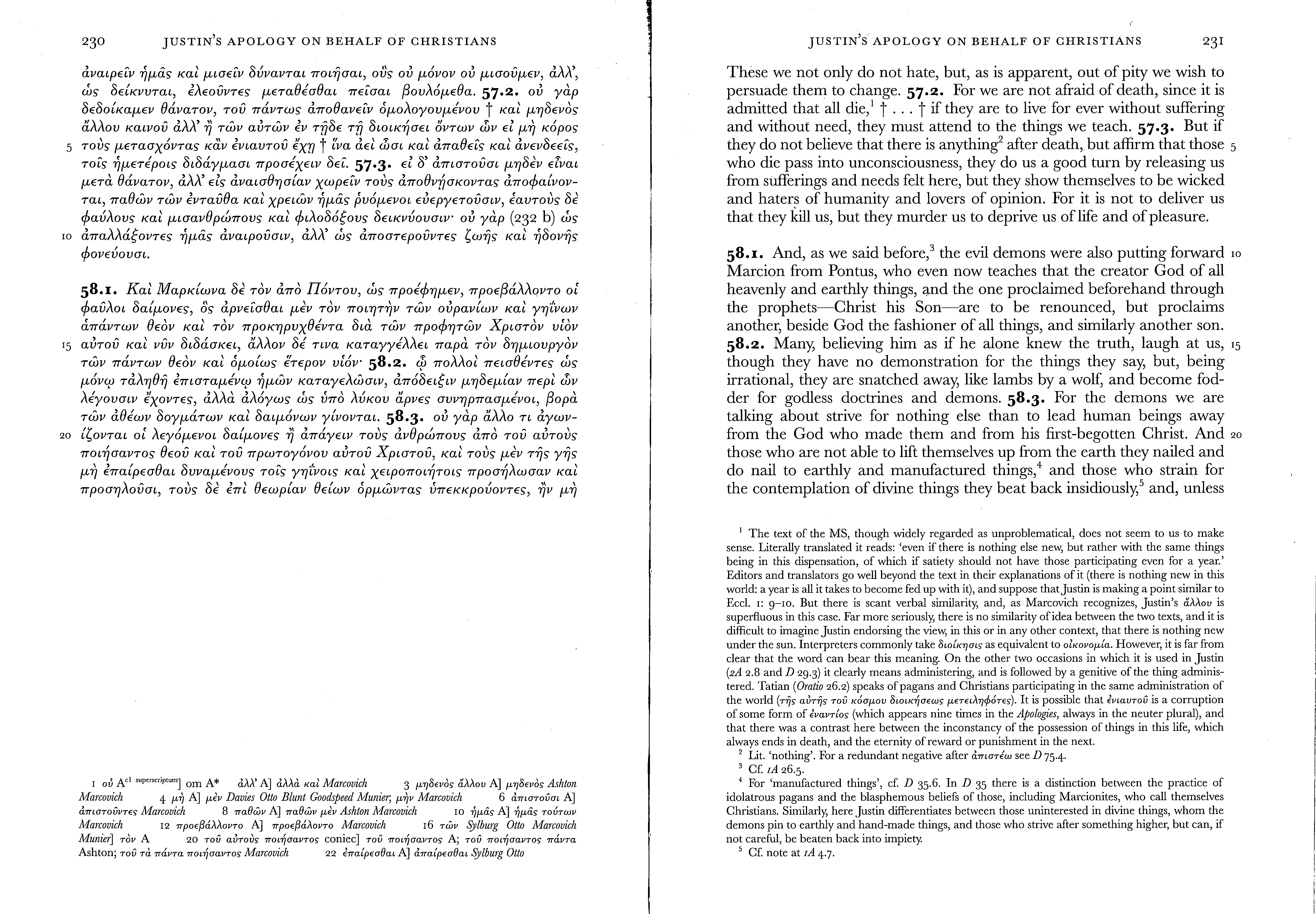
JUSTIN'S APOLOGY ΟΝ BEHALF OF CHRISTIANS
JUSTIN'S APOLOGY ΟΝ BEHALF OF CHRISTIANS
These we not only do not hate, but, as is app.arent, out of pity we wish to persuade them to change. 57.2. For we are not afraid of death, since it is admitted that all die,l t ... t if they are to live for ever without suffering and without need, they must attend to the things we teach. 57.3. But if they do not believe that there is anything2 after death,. but affirm that those 5 who die pass into unconsciousness, they do us a good turn by releasing us from sufferings and needs felt here, but they show themselves to be wicked άναιΡειν ήμαι; και μισειν δύνανται 7Τοιησαι, ovr; ου μόνον ου μισουμεν, άλλ', ώι; δείκνυται, έλεουντει; μεταθέσθαι 7Τεισαι βουλόμεθα. 57.2. ου γαρ
Ι ~ ι 'θ ~ r λ ι t \ δ \ ε οικαμεν ανατον, του 7Ταντωι; α7ΤΟ ανειν ομο ογουμενου και μΎj ενοι; ι θ δδ αλλου καινου άλλ' η των αυτων έν Tfιδε Tfι διοικήσει σντων 6Jv εί μη κόροι;
5 Tovr; μετασχόνται; καν ένιαυτου εχτι t ίνα άει 6Jσι και ά7Ταθειι; και άνενδεειr;, τοιι; ήμετέροιι; διδάγμασι 7Τροσέχειν δει. 57.3. εί δ' ά7Τιστουσι μΎjδεν εΊναι
\ θ ι 'λλ' " θ ι ~ \, θ ι 'Φ ι μετα ανατον, α ειι; αναισ Ύjσιαν χωρειν τουι; α7ΤΟ ντισκονται; α7ΤΟ αινονand hater~ of humanity and lovers of opinion. For it is not to deliver us that they kill us, but they murder us to deprive us of life and of pleasure. ται, 7Ταθων των ένταυθα και χρειων ήμαι; ρυόμενοι ευεργετουσιν, έαυτουι; δε
Φαύλουι; και μισανθρώ7Τουι; και Φιλοδόςουι; δεικνύουσιν' ου γαρ (232 b) ώι; ΙΟ ά7Ταλλάςοντει; ήμαι; άναιΡουσιν, άλλ' ώι; ά7Τοστερουντει; ζωηι; και ήδονηι;
58. ι. And, as we said before,3 the evil demons were also putting forward ΙΟ Marcion from Pontus, who even now teaches that the creator God of all heavenly and earthly things, q,nd the one proclaimed beforehand through the prophets-Christ his Son-are to be renounced, but proclaims another, beside God the fashioner of all things, and similarly another son.
58.2. Many, believing him as if he alone knew the truth, laugh at us, 15 though they have ηο demonstration for the things they say, but, being irrational, they are snatched away, like lambs by a wolf, and become fodder for godless doctrines and demons. 58.3. For the demons we are talking about strive for nothing else than to lead human beings away from the God who made them and from his first-begotten Christ. And 20 those who are not able to lift themselves up from the earth they nailed and do nail to earthly and manufactured things,4 and those who strain for the contemplation of divine things they beat back insidiously,5 and, unless
Τ7 \ Μ ι δ \ \ , \ Π ι r ιφ β Ιλλ r 5 .1. Δαι αρκιωνα ε τον α7ΤΟ οντου, ωι; 7Τροε Ύjμεν, 7Τροε α qVTO οι Φαυλοι δαίμονεr;, οι; άρνεισθαι μεν τον 7TOΙΎjTην των ουρανίων και γΎjί'νων r ι θ \ \ \ θ Ι δ \ ~ Φ ~ Χ \ r\ α7Ταντων εον και τον 7TpOKΎjpυX εντα ια των 7Τρο ΎjTων ριστον υιον
αυτου και νυν διδάσκει, αλλον δέ τινα καταγγέλλει 7Ταρα τον δΎjμΙOυpγOν των 7Τάντων θεον και όμοίωι; έτερον υίόν' 58.2. Ψ 7Τολλοι 7Τεισθέντει; ώι; μόνψ TάλΎjθη έ7Τισταμένψ ήμων καταγελωσιν, ά7Τόδειςιν μΎjδεμίαν 7Τερι 6Jv ι "
'λλ \ 'λ ι r r \ λ ι" ι β \ εγουσιν ExoVTEr;, α α α ογωι; ωι; υ7ΤΟ υκου αρνει; συνΎjp7TασμενOΙ, ορα λ των άθέων δογμάτων και δαιμόνων γίνονται. 58.3. ου γαρ αλλο τι άγων-
ίζονται οί λεγόμενοι δαίμονει; η ά7Τάγειντουι; άνθρώ7Τουι; ά7ΤΟ του αυτουι; 7Τοιήσαντοι; θεου και του 7Τρωτογόνου αυτου Χριστου, και TOVr; μεν Tijr; γηι; μη έ7Ταίρεσθαι δυναμένουι; τοίι; γΎjί'νOΙΙ; και χεΙΡΟ7Τοιήτοιι; 7Τροσήλωσαν και
7TpOσΎjλOυσι, TOVr; δε έ7ΤΙ θεωρίαν θείων όρμωνται; ύ7Τεκκρούοντεr;, ην μη 1 The text of the MS, though widely regarded as unproblematical, does not seem to us to make sense. Literally translated it Ieads: 'even if theIe is nothing else new, but IatheI with the same things being in this dispensation, of which if satiety should not have those participating even for a year.'
EditoIs and translators go well beyond the text in their explanations of it (there is nothing new in this wOIld: a year is all it takes to become fed up with it), and suppose thatJustin is making a point sirnilar to Eccl. ι: 9-ΙΟ. But there is scant verbal sirnilarity, and, as Marcovich Iecognizes, Justin's αλλου is superiluous in this case. Far more seriously, theIe is ηο sirnilarity of idea between the two texts, and it is difficult to irnagine Justin endorsing the view, in this ΟΓ in any other context, that there is nothing new undeI the sun. Interpreters commonly take διοίκησι<; as equivalent to οΙκονομία. However, it is far from cleaI that the wOId can beaI this meaning. Οη the otheI two occasions in which it is used in Justin
(2Α 2.8 and D 29.3) it clearly means administering, and is followed by a genitive ofthe thing administered. Tatian (Oωtίo 26.2) speaks of pagans and ChIistians participating in the same administration of the world (τη<; αυτη, του κόσμου διοικήσεω<; μετειληφότε<;). It is possible that ενιαυτου is a cOrΓuption of some form of εναντίο<; (which appears nine tirnes in the Apologίes, always in the neuter plural), and that there was a contIast heIe between the inconstancy of the possession of things in this life, which always ends in death, and the eteΓllity of Ieward ΟΓ punishment in the next.
2 Lit. 'nothing'. For a redundant negative afteI απιστέω see D 75-43 Cf. ιΑ 26.5.
+ For 'manufactured things', cf. D 35.6. Ιη D 35 there is a distinction between the practice of idolatrous pagans and the blasphemous beliefs of those, including MaIcionites, who call themselves
ChIistians. SirnilaIly, heIe Justin differentiates between those uninterested in divine things, whom the demons pin to earthly and hand-made things, and those who strive after something higher, but can, if not caIeful, be beaten back into irnpiety. ι ου Acl superscriptum] om Α* ΙΙλλ' Α] ΙΙλλα και NIαrcσvich 3 μ:ηδενο<; αλλου Α] μηδενο<; Ashton Mα1"Covich 4 μη Α] μεν Dαvies Otto Blunt Goodspeed NIunier, μην lι1αrcσvich
6 απιστουσι Α] απιστουντε<; Mαrcσvich 8 παθων Α] παθων μεν Ashton lι1αrcσvic!z ΙΟ Υιμα<; Α] Υιμα<; τούτων lι1αrcσvich 12 προεβάλλοντο Α] προεβάλοντο lι1αιωvίch
16 των Sylburg Otto Μαιωvίc!ι MUllier] τον Α 20 του αυτου<; ποιήσαντο<; coniec] του ποιήσαντο<; Α; του ποιήσαντο<; πάντα
Ashton; του τα πάντα ποιήσαντο<; Mαrcσvich 22 επαίρεσθαι Α] απαίρεσθαι Sylburg Otto
5 Cf. note at ιΑ 4.7.
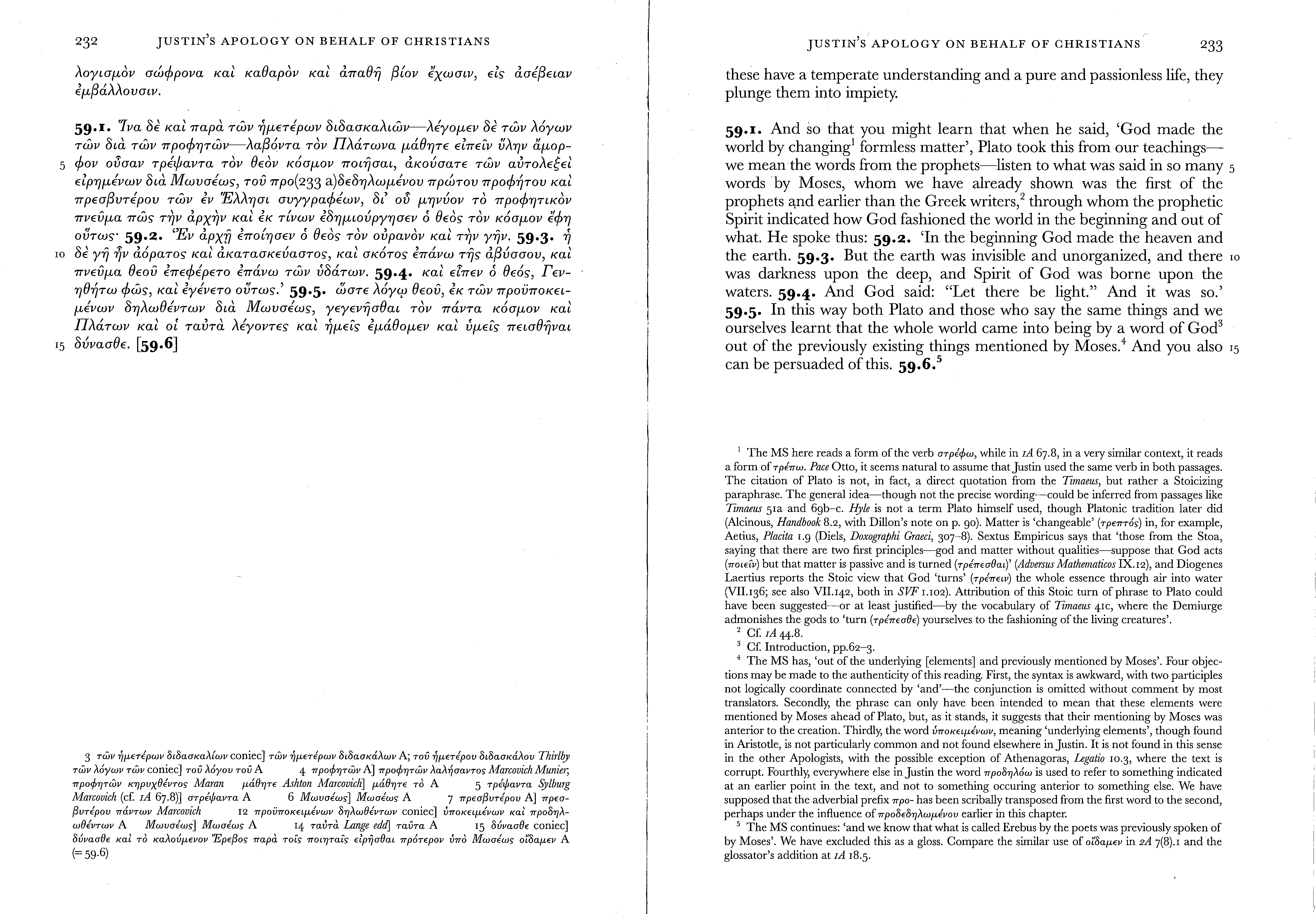
JUSTIN'S APOLOGY ΟΝ BEHALF OF CHRISTIANS
JUSTIN'S APOLOGY ΟΝ BEHALF OF CHRISTIANS
λ \ 'Φ \ θ \ \, θ Λ β'"
'β ογισμον σω ρονα και κα αρον και απα ΎJ ιον εχωσιν, ειs ασε ειαν these have a temperate understanding and a pure and passionless life, they plunge them into impiety. εμβάλλουσιν.
59.1. Ίνα δε και παρ α των ήμετέρων διδασκαλιωv--λέγομεν δε των λόγων 59.1. And 80 that you might learn that when he said, 'God made the world by changing! formless matter', Plato took this from our teachingswe mean the words from the prophets-listen to what was said ίη so many 5 words . by Moses, whom we have already shown was the first of the prophets qnd earlier than the Greek writers,2 through whom the prophetic
Spirit indicated how God fashioned the world ίη the beginning and out of what. He spoke thus: 59.2. Ίη the beginning God made the heaven and the earth. 59.3. But the earth was invisible and unorganized, and there !Ο was darkness upon the deep, and Spirit of God was borne upon the waters. 59.4. And God said: "Let there be light." And it was so.'
59.5. Ιη this way both Plato and those who say the same things and we ourselves learnt that the whole world came into being by a word of God3 των δια των ΠΡΟΦΎJτωv--λαβόντα τον Πλάτωνα μάθΎJTε ειπειν ϋλΎJν αμορ5 Φον oi5aav τρέψαντα τον θεον κόσμον ποιΤισαι, ακούσατε των αυτολεςει εΙPΎJμένων δια Μωυσέωs, του ΠΡΟ(233 a)δεδΎJλωμένου πρώτου προψήτου και πρεσβυτέρου των εν ΈλλΎJσι συγγραΦέων, δι' 0.0 μΎJνύOν το ΠPOΦΎJΤΙKOν πνευμα πωs την αρχην και εκ τίνων εδΎJμΙOύpγΎJσεν ό eEOS τον κόσμον εΦΎJ οϋτωs' 59.2. 'Εν dpxn επoίΎJσεν ό eEOS τον ουρανον και την γΤιν. 59.3. ή
Λ l'
,Ι \ , Ι ,Ι) Ι '"'
'β , \ !Ο ε γΎJ ΎJν aOpaTOS και aKaTaaKEvaaTOS, και aKOTOS επανω TΎJS α υσσου, και δ Λ θ Λ'
Φ , "
\ l' r θ'
Γ πνευμα εου επε ερετο επανω των υ ατων. 59.4. και ειπεν ο EOS, ενΎJθ~Tω φωs, και εγένετο οϋτωs.' 59.5. ώστε λόγιΡ θεου, εκ των προϋποκει μένων δΎJλωθένTων δια Μωυσέωs, γεγενΤισθαι τον πάντα κόσμον και
δύνασθε. [59.6J out of the previously existing things mentioned by Moses.4 And you also 15 can be persuaded of this. 59.6.5
1 The MS here reads a form ofthe νerb στρέφω, while ίη ιΑ 67.8, ίη a νery similar context, it reads a form of τρέπω. Pαce Otto, it seems natural to assume thatJustin used the same νerb ίη both passages.
The citation of Plato is not, ίη fact, a direct quotation from the Timαeus, but rather a Stoicizing paraphrase. The general idea-though not the precise wording-could be inferred from passages like
Timαeus 51a and 69b-c. HyZe is not a term Plato himself used, though Platonic tradition later did
(Alcinous, Ηαιιdbοοk 8.2, with Dillon's note οη ρ. 90). Matter is 'changeable' (τρεπτός) ίη, for example,
Aetius, Plαcitα 1.9 (Diels, Doxogrαp!li Grαeci, 307-8). Sextus Empiricus says that 'those from the Stoa, saying that there are two first principles-god and matter without qualities-suppose that God acts
(ποιειν) but that matter is passive and is turned (τρέπεσθαι)' (Adversus Mαthenlαticos ΙΧ.12), and Diogenes
Laertius reports the Stoic view that God 'turns' (τρέπειν) the whole essence through air into wateI
(VII.136; see also VII.142, both in SVF 1.102). AttIibution of this Stoic turn of phIase to Plato could have been suggested-ol' at least justified-by the νocabulary of Tϊ,nαeus 41C, wheIe the DemiuIge admonishes the gods to 'tUΓll (τρέπεσθε) yourselνes to the fashioning ofthe liνing aeatuIes'.
2 Cf. ιΑ 44.8.
3 Cf. Introduction, ρρ.62-3.
4 The MS has, 'out ofthe undeIlying [elements] and pIeνiously mentioned by Moses'. Four objections may be made to the authenticity ofthis reading. First, the syntax is awkward, with two paIticiples not logically cooIdinate connected by 'and'-the conjunction is omitted without comment by most tIanslatoIs. Secondly, the phIase can only haνe been intended to mean that these elements weIe mentioned by Moses ahead ofPlato, but, as it stands, it suggests that their mentioning by Moses was anteIioI to the aeation. ThiIdly, the word ύποκεψένων, meaning 'underlying elements', though found in Aristotle, is not particularly common and not found elsewhere ίη Justin. It is not found ίη this sense in the other Apologists, with the possible exception of Athenagoras, Legαtio 10.3, where the text is corrupt. Fourthly, everywhere else inJustin the word προδηλόω is used to refer to something indicated at an earlier point ίη the text, and not to something occuring anterior to something else. We haνe supposed that the adνerbial prefix προhas been saibally transposed from the first word to the second, perhaps under the influence of προδεδηλωμένου earlier ίη this chapter.
3 των ήμετέρων διδασKαλtων coniec] των ήμετέρων διδασκάλων Α; του ήμετέρου διδασκάλου Thirlby των λόγων των coniec] του λόγου του Α 4 προφητων Α] προφητων λαλήσαντοι; MαrcovichMunieι~ προφ-ητων κηρυχθέντοι; Nlαrαn μάθητε Ashton Λιfαι"COmc!ι] μάθητε το Α 5 τρέψαντα SyZburg Mαγcovich (cf. ιΑ 67.8)] στρέψαντα Α 6 Μωυσέως] Μωσέωι; Α 7 πρεσβυτέρου Α] πρεσβυτέρου πάντων Mαrcovich
12 προϋποκεψένων δηλωθέντων coniec] ύποκεψένων και προδηλ ωθέντων Α Μωυσέως] Μωσέωι; Α 14 ταυτα Lange edd] ταυτα Α 15 δύνασθε coniec] 5 The MS continues: 'and we know that what is cal1ed Erebus by the poets was preνiously spoken of by Moses'. We haνe excluded this as a gloss. CompaIe the similar use of οϊδαμεν ίη 2Α 7(8).1 and the glossator's addition at ιΑ 18.5. δύνασθε και το καλούμενον Έρεβος παρα τοις ποιηταις εΖρησθαι πρότερον ύπο Μωσέωι; οϊδαμεν Α
(=59·6)
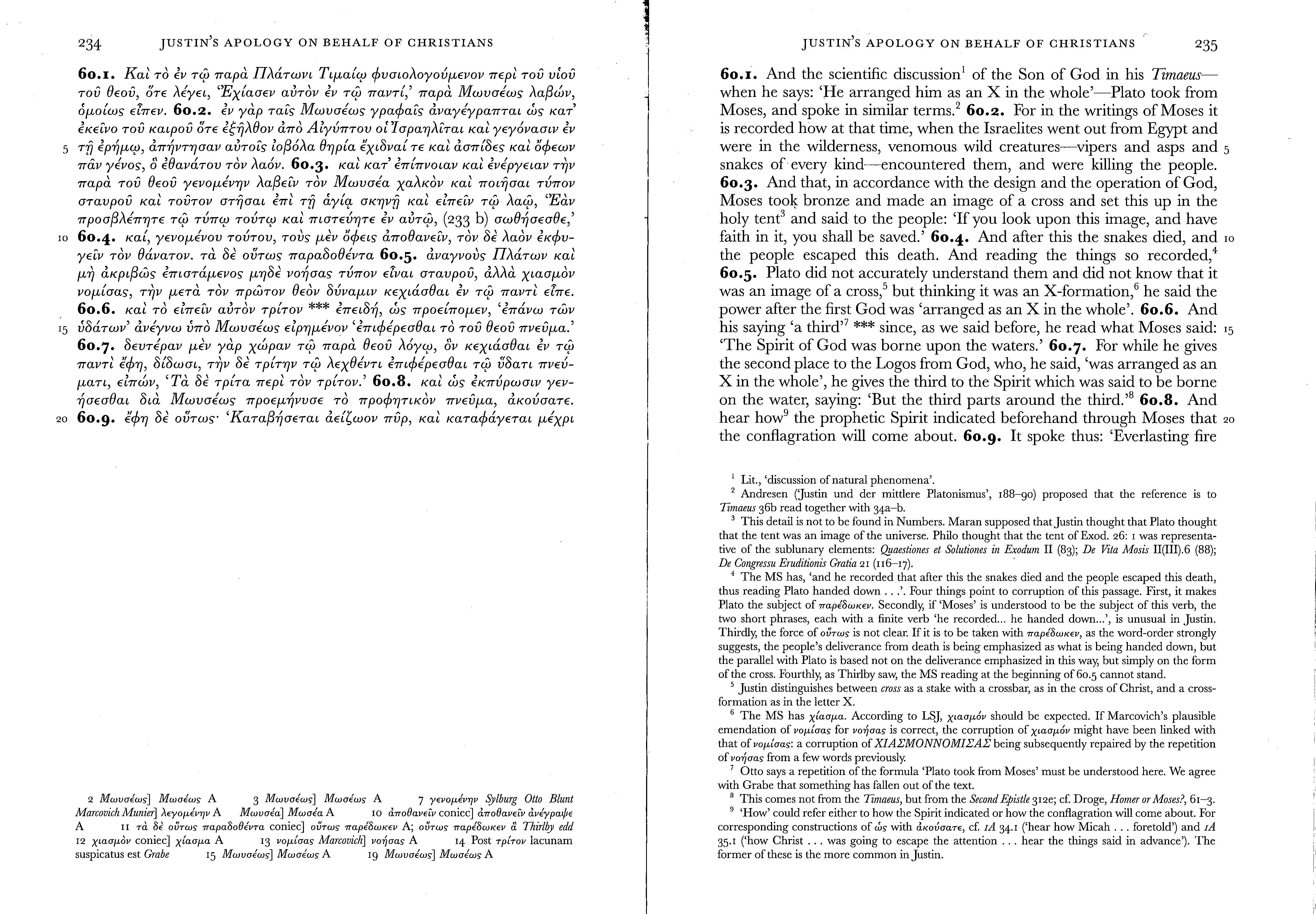
, r
JUSTIN S APOLOGY ΟΝ BEHALF OF CHRISTIANS
JUSTIN'S APOLOGY ΟΝ BEHALF OF CHRISTIANS
Τ7'"
~ , π\ / Τ / Φ λ / ,~ Ι ~ 0.1. nαι 7Ό εν τψ παρα Λατωνι ιμαιψ υσιο ογουμενον περι του υιου 60. Ι • And the scientific discussion 1 of the Son of God ίη his Timαeus when he says: 'He arranged him as an Χ in thewhole'-Plato took from Moses, and spoke ίη similar terms. 2 60.2. For in the writings ofMoses it is recorded how at that time, when the Israelites went out from Egyρt and were in the wilderness, venomous wild creatures-vipers and asps and 5 snakes οΕ every kind-encountered them, and were killing the people.
60.3. And that, ίη accordance with the design and the operation of God, Moses too~ bronze and made an image of a cross and set this up ίη the holy tent3 and said to the people: 'If you look upon this image, and have faith ίη it, you shall be saved.' 60.4. And after this the snakes died, and !Ο the people escaped this death. And reading the things so recorded,4o
60.5. Plato did not accurately understand them and did not know that it was an image of a cross,5 but thinking it was an X-formation,6 he said the power after the first God was 'arranged as an Χ ίη the whole'. 60.6. And his saying 'a third,7 *** since, as we said before, he read what Moses said: Ι5
'The Spirit of God was borne upon the waters.' 60.7. For while he gives the second place to the Logos from God, who, he said, 'was arranged as an Χ ίη the whole', he gives the third to the Spirit which was said to be borne
~ θ ~ " λ / 'Έ / , , ,~ / , , Μ / λ β / του εου, οτε εγει, χιασεν αυτον εν Τψ παντι, παρα ωvσεωs α ων, ι/ l'
~M / Φ~' / Ι, ομοιωs ειπεν. 0.2. εν γαρ ταιs ωvσεωs γρα αιs αναγεγραπται ωs κατ εκεινο του καιΡου οτε εςηλθον άπο Αιγύπτου οί Ί σΡαYJλ'iται και γεγόνασιν εν ~,/ ,/ , ~ 'β /λ θ / " δ / "/δ ' "Φ 5 TTJ EpYJIλΙP, αΠYJνΤYJσαν αvτοιs ιο ο α YJΡια εχι ναι τε και ασπι ES και ο εων πάν YfVOS, Ο εθανάτου τον λαόν. 60.3. και κατ' επ{πνοιαν και ενέργειαν την παρα του θεου YEvoIλfVYJV λαβειν τον Μωυσέα χαλκον και ποιησαι τύπον σταυρου και τουτον στησαι επι Tfι άγ{q. aKYJVfι και ειπειν τφ λαφ, 'Έαν βλ / ~ / / , / , '~( b) θ / θ' προσ εΠYJτε Τψ τυπψ τουτψ και πιστεVYJτε εν αυτψ, 233 σω YJaEa ε,
/ / / ""Φ' θ ~ 'δ 'λ '
0.4. και, γενομενου TOVTOV, TOVS μεν ο ειs απο ανειν, τον ε αον εκ Vγειν τον θάνατον. τα δε οvτωs παραδοθέντα 60.5. άναγνοvs Πλάτων και μη άκριβωs επιστάμενοs μYJδε voYιaas τύπον είναι σταυρου, άλλα χιασμον voIλ{aas, την μετα τον πρωτον θεον δύναμιν κεχιάσθαι εν τφ παντι είπε.
/ ι, Μ / , / "Φ / θ '
Λ θ Λ ~ , Ι5 V ατων ανεγνω υπο ωvσεωs EΙPYJIλEVov επι ερεσ αι το του εου πνευμα.
60.7. δευτέραν μεν γαρ χώραν τφ παρ α θεου λόγψ, ον κεχιάσθαι εν τφ '''Φ δ/δ 'δ'
/ ~ λ θ/ 'Φ / θ Λ "δ ι παντι ε YJ, ι ωσι, TYJV ε ΤΡΙΤYJν Τψ εχ εντι επι ερεσ αι Τψ V ατι πνευματι, ειπών, 'τα δε τρ{τα περι τον τρ{τον.' 60.8. και ώs εκπύρωσιν γενι θ δ'Μ / / , Φ , ~ ,/ YJaEa αι ια ωvσεωs ΠΡοεμYJνvσε το προ YJTιKOV πνευμα, ακουσατε.
"Φ δ'"
'Τ7 β/ , /Υ Λ , Φ / /
0.9. ε YJ ε οvτωs' nατα YJσεται αει~ωoν πυρ, και κατα αγεται μεχρι οη the water, saying: 'Eut the third parts around the third.'s 60.8. And hear how9 the prophetic Spirit indicated beforehand through Moses that 20 the conflagration will come about. 60.9. It spoke thus: 'Everlasting fire
1 Lit., 'discussion ofnatural phenomena'.
2 Andresen (Justin und der mittlere Platonismus', 188-90) proposed that the reference is to Ti,nαeus 36b read together with 34a-bo 3 This detail is not to be found ίη Numberso Maran supposed that]ustin thought that Plato thought that the tent was an image of the universeo Philo thought that the tent of Exodo 26: ι was representative of the sublunary elements: QyαestiOlles et Solutiolles ίll Exodulll Π (83); De Vitα A10sΊS Π(ΠΙ)06 (88);
De Congl°essu Eι-uditiollΊS Gταtiα 21 (ιι6-η)ο ο 4 The MS has, 'and he recorded that after this the snakes died and the people escaped this death, thus reading Plato handed down ο ο ο' ο Four things point to corruption of this passageo First, it makes
Plato the subject of παρέδωκενο Secondly, if 'Moses' is understood to be the subject of this verb, the two short phrases, each with a finite verb 'he recordedo ο ο he handed downo ο ο', is unusual in ]ustino
Thirdly, the force of οϋτως is not clearo If it is to be taken with παρέδωκεν, as the word-order strongly suggests, the people's deliverance from death is being emphasized as what is being handed down, but the parallel with Plato is based not οη the deliverance emphasized ίη this way, but simply οη the form of the crosso Fourthly, as Thirlby saw, the MS reading at the beginning of 6005 cannot stando
5 ]ustin distinguishes between cross as a stake with a crossbar, as ίη the cross of Christ, and a crossformation as ίn the letter Χο
6 The MS has χίασμαο According to LS], χιασμόν should be expectedo If Marcovich's plausible emendation of νομίσας for νοήσας is correct, the corruption of χιασμόν might have been linked with that of νομίσας: a corruption of ΧΙΑΣΜΟΝΝΟΜΙΣΑΣ being subsequently repaired by the repetition of νοήσας from a few words previously.
7 Otto says a repetition of the formula 'Plato took from Moses' must be understood hereo We agree with Grabe that something has fallen out of the texto
2 Μωυσέως] Μωσέως Α 3 Μωυσέως] Μωσέως Α 7 γενομένην !iYlburg Otto Blunt 8 This comes not from the TilllαeUS, but from the Secolld EpΊStle 312e; cf. Droge, H01ller οτ A10ses?, 61-30
9 Ήονν' could refer either to how the Spirit indicated or how the conflagration will come abouto For corresponding constructions of ώς with α.κούσατε, cf. ιΑ 3401 ('hear how Micah ο ο ο foretold') and ιΑ 3501 ('how Christ ο ο ο was going to escape the attention ο ο ο hear the things said ίη advance')o The former of these is the more common ίη ]ustino
MαrcoviclzA1unier] λεγομένην Α Μωυσέα] Μωσέα Α !Ο α.ποθανεΙν coniec] α.ποθανεΙν α.νέγραΨε
Α ΙΙ τα δε οϋτως παραδοθέντα coniec] οϋτως παρέδωκεν Α; οϋτως παρέδωκεν α Thirlby edd
12 χιασμσν coniec] χίασμα Α 13 νομίσας Mαι"COviclz] νοήσας Α 14 Post τρίτον lacunam suspicatus est GTαbe 15 Μωυσέως] Μωσέως Α 19 Μωυσέως] Μωσέως Α
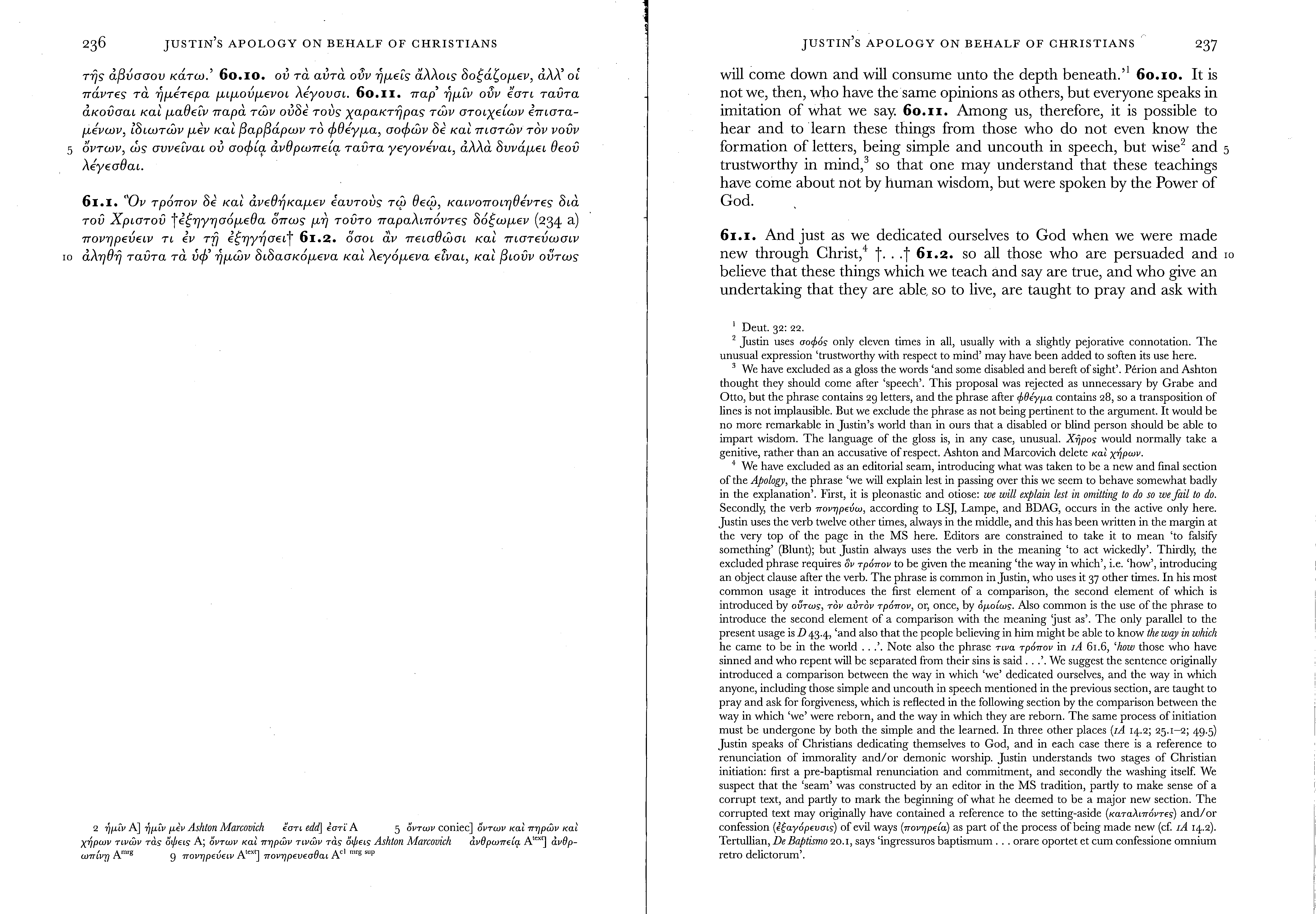
JUSTIN'S APOLOGY ΟΝ BEHALF OF CHRISTIANS
JUSTIN'S APOLOGY ΟΝ BEHALF OF CHRISTIANS
Λ 'β Ι ι, 6 '"
, -r- < Λ "λλ δ t. / r 'λλ'
0.10. ου τα αυτα ουν ημεις α οις O~αl::ι0μεν, α οι will come down and will consume unto the depth beneath.'l 60.10. It is not we, then, who have the same opinions as others, but everyone speaks ίη imitation of what we say. 60.11. Among US, therefore, it is possible to hear and to "learn these things from those who do not even know the formation of letters, being simple and uncouth in speech, but wise2 and 5 trustworthy ίη mind,3 so that one may understand that these teachings have come about not by human wisdom, but were spoken by the Power of God. πάντες τα ~μέTεpα μιμούμενοι λέγουσι. 60.11. παρ' ~μιν σΟν εστι ταυτα ακουσαι και μαθειν παρα των ουδε τους χαρακτijρας των στοιχε{ων έπιστα μένων, ίδιωτων μεν και βαρβάρων το Φθέγμα, σοφων δε και πιστων τον νουν
οντων, ως συνειναι ου σο ιq, αν ρωπειq, ταυτα γεγονεναι, α α υναμει εου λέγεσθαι.
61.1. ''Ον τρόπον δε και ανεθ~Kαμεν έαυτους Τψ θεψ, καινοποιηθέντες δια του Χριστου tέξηγησόμεθα σπως μ~ τουτο παραλιπόντες δόξωμεν (234 a) ι 'Λ 'Ι ι t 6 "
" θ Λ , ι πονηρευειν τι εν ΤΤ} ε~ ηγησει 1.2. οσοι αν πεισ ωσι και πιστευωσιν 6 ι. ι. And just as we dedicated ourselves to God when we were made new through Christ,4 t. . . t 6 1.2. so all those who are persuaded and ΙΟ believe that these things which we teach and say are true, and who give an undertaking that they are able, so to live, are taught to pray and ask with
dληθij ταυτα τα ύΦ' ~μων διδασκόμενα και λεγόμενα είναι, και βιουν ούτως ] Deut. 32: 22.
2 Justin uses σοφ6ς only eleven times ίη all, usually with a slightly pejorative connotation. The unusual expression 'trustworthy with respect to mind' may have been added to soften its use here.
3 We have excluded as a gloss the words 'and some disabled and bereft of sight'. Perion and Ashton thought they should come after 'speech'. This proposal was rejected as unnecessary by Grabe and Otto, but the phrase contains 29 letters, and the phrase after φθέγμα contains 28, so a transposition of lines is not implausible. But we exclude the phrase as not being pertinent to the argument. It would be ηο more remarkable ίη Justin's world than ίη ours that a disabled or blind person should be able to impart wisdom. The language of the gloss is, ίη any case, unusual. Χηροι:; would normally take a genitive, rather than an accusative ofrespect. Ashton and Marcovich delete και χήρων.
4We have excluded as an editorial seam, introducing what was taken to be a new and final section of the Apology, the phrase 'we will explain lest ίη passing over this we seem to behave somewhat badly ίη the explanation'. First, it is pleonastic and otiose: we will explαin lest ίιι O1nittiIιg to do so we jάίZ to do.
Secondly, the verb ποντιρεύω, according to LSJ, Lampe, and BDAG, occurs in the active only here.
Justin uses the verb twelve other times, always ίη the middle, and this has been written in the margin at the very top of the page ίη the MS here. Editors are constrained to take it to mean 'to falsify something' (Blunt); but Justin always uses the verb ίη the meaning 'to act wickedly'. Thirdly, the excluded phrase requires ον τρ6πον to be given the meaning 'the way ίη which', i.e. 'how', introducing an object clause after the verb. The phrase is common ίη Justin, who uses it 37 other times. Ιη his most common usage it introduces the first element of a comparison, the second element of which is introduced by ουτως, τον αύτον τρ6πον, or, once, by όμο{ως. Also common is the use of the phrase to intΓOduce the second element of a comparison with the meaning )ust as'. The only parallel to the present usage is D 43-4, 'and also that the people believing ίη him might be able to know the wq)' ίπ wlziclz he came to be in the world ... '. Note also the phrase τινα τρ6πον ίη ιΑ 61.6, 'how those who have sinned and who repent will be separated from their sins is said .. .'. We suggest the sentence originally introduced a comparison between the way ίη which 'we' dedicated ourselves, and the way ίη which anyone, including those simple and uncouth ίη speech mentioned in the previous section, are taught to pray and ask for forgiveness, which is reflected in the following section by the comparison between the way ίη which 'we' were reborn, and the way ίη which they are reborn. The same process of initiation must be undergone by both the simple and the learned. Ιη three othel' places (ιΑ 14-2; 25·1-2; 49.5)
Justin speaks of Christians dedicating themselves to God, and ίη each case there is a reference to renunciation of immorality and/or demonic worship. Justin understands two stages of Christian initiation: first a pre-baptismal renunciation and commitment, and secondly the washing itself. We suspect that the 'seam' was constructed by an editor ίη the 1I1S tradition, partly to make sense of a corrupt text, and ΡaΓtlΥ to mark the beginning of what he deemed to be a major new section. The corrupted text may οΓίginallΥ have contained a reference to the setting-aside (καταλιπ6ντες) and/or confession (εξαγ6ρευσιι:;) of evil ways (ποντιρε{α) as part ofthe process ofbeing made new (cf. ιΑ 14.2).
2 ήμιν Α] ήμιν μεν Ashton .Mαrcoviclz εστι edd] εστϊ Α 5 οντων coniec] οντων και πτιρων και χήρων τινων τας οψεις Α; οντων και πτιρων τινων τας οψειι:; Asht01l Mαrcovich άνθΡωπε{q. NexJ άνθρΤeΓtullίan, De Bαptismo 20.1, says 'ingressuros baptismum ... orare oportet et cum confessione omnium retro deΙίctοΓumΌ ωπ{νrι Amrg 9 ποντιρεύειν ΑΙΟΧΊ ποντιρευεσθαι AC] mrg sup
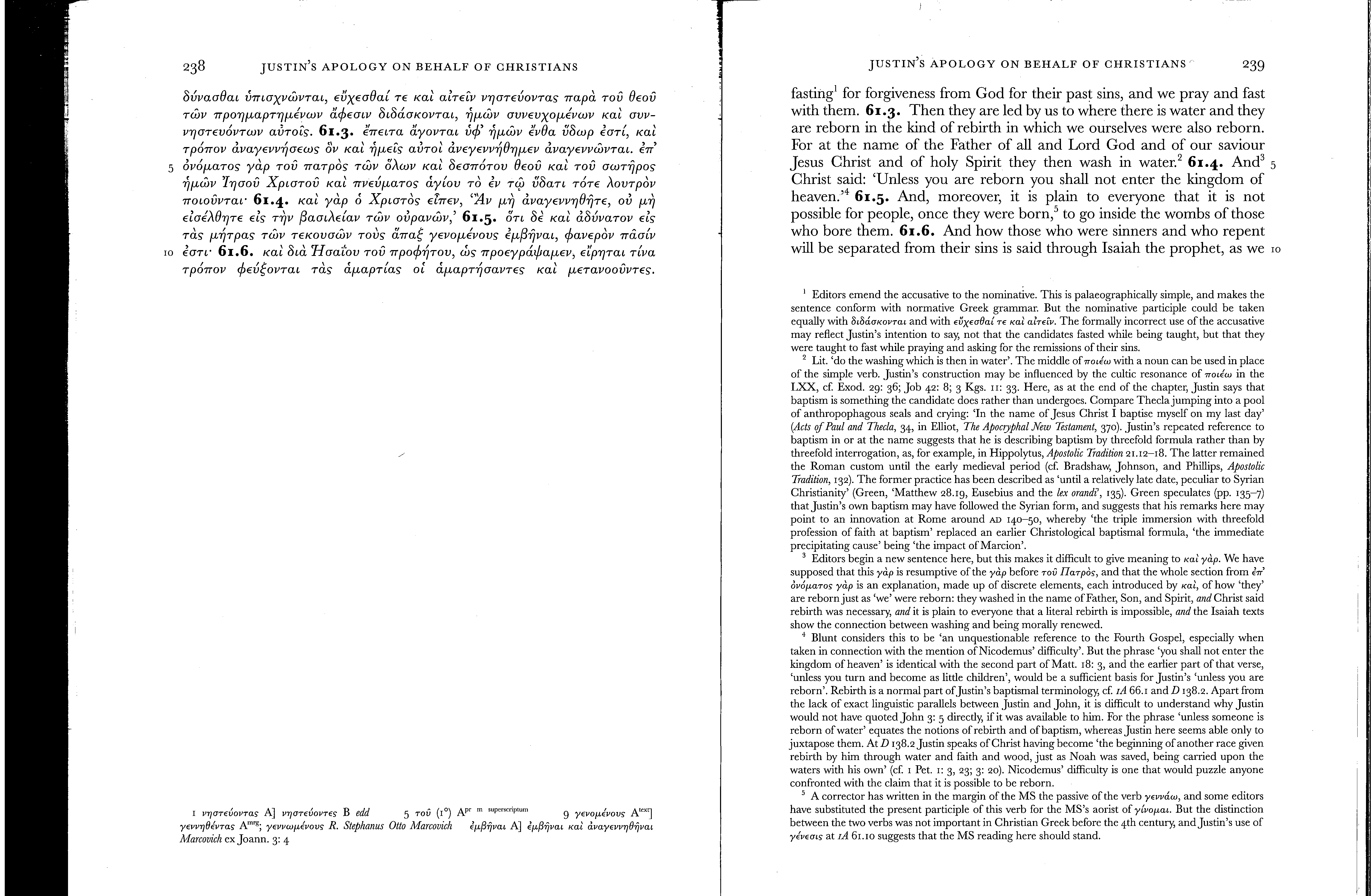
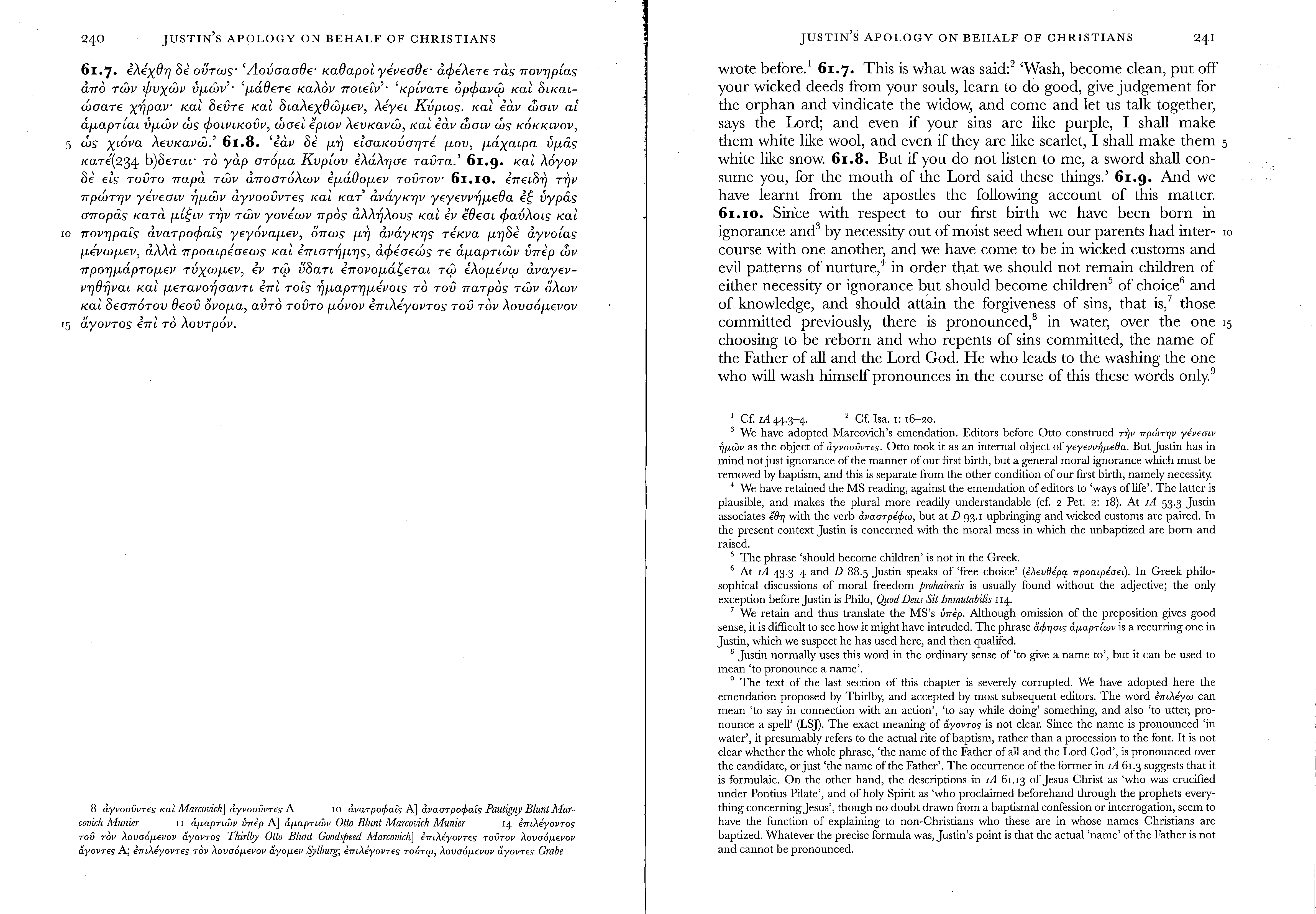
JUSTIN'S APOLOGY ΟΝ BEHALF OF CHRISTIANS
JUSTIN'S APOLOGY ΟΝ BEHALF OF CHRISTIANS
'λ Ι θ δ \ rι 'Λ Ι θ θ \ Ι θ 'Φ lλ \ Ι 1.7. ε εχ Ίj ε ουτως' ουσασ ε' κα αροι γενεσ ε' α ε ετε τας ΠOνΊjpιας wrote before. 1 61.7. This is what was said:2 'Wash, become clean, put off your wicked deeds from your souls, learn to do good, give judgement for the orphan and vindicate the widow, and come and let us talk together, says the Lord; and even if your sins are like purple, Ι shall make them white like wool, and even if they are like scarlet, Ι shall make them 5 white like .snow. 61.8. But if you do not listen to me, a sword shall consume you, for the mouth of the Lord said these things.' 61.9. And we have learnt from the apostles the following account of this matter.
61.10. Since with respect to our first birth we have been born ίn ignorance and3 by necessity out of moist seed when our parents had inter-
course with one another, and we have come to be ίn wicked customs and evil patterns of nurture/ ίn order t4at we should not remain children of either necessity ΟΓ ignorance but should become children5 of choice6 and of knowledge, and should att~in the forgiveness of sins, that is,7 those committed previously, there is pronounced,8 ίn water, over the one 15 choosing to be reborn and who repents of sins committed, the name of the Father of all and the Lord God. He who leads to the washing the one who will wash himself pronounces ίn the course of this these words only. 9
Ι 'Φ Λ \ δ απο των ψυχων υμων' μα ετε κα ον ποιειν' κρινατε ορ ανψ και ικαιώσατε χΤΙραν' και δευτε και διαλεχθωμεν, λέγει Κύριος. και Εαν ιbσιν αί άμαρτίαι ύμων ώς Φοινικουν, ώσει εριον λευκανω, και Εαν ιbσιν ώς κόκκινον,
5 ώς χιόνα λευκανω.' 61.8. Έαν δε μ~ εισαKOύσΊjTέ μου, μάχαιρα ύμας κατέ(234 b)δεται' το γαρ στόμα Κυρίου EλάλΊjσε ταυτα.' 61.9. και λόγον δε εις τουτο παρα των αποστόλων Εμάθομεν τουτον' 61.10. Eπειδ~ T~ν πpώTΊjν γένεσιν ήμων αγνοουντες και κατ' ανάγKΊjν γεγεννΤΙμεθα Εζ ύγρας
Λ \ 1(; \ Λ Ι \ 'λλ lλ \, "θ Φ lλ \ σπορας κατα fLLf::, ιν TΊjν των γονεων προς α
Ίj ους και εν ε εσι αυ οις και 10 ΠOνΊjpαις ανατροΦαις γεγόναμεν, οπως μ~ ανάγKΊjς τέκνα μΊjδε αγνοίας
"""
\ 'i' μενωμεν, α α προαιΡεσεως και επισTΊjμΊjς, α εσεως τε αμαρτιων υπερ ων πpOΊjμάpTOμεν τύχωμεν, Εν T<jJ ύδατι Επονομάζεται T<jJ έλομένψ αναγεν νΊjθiιναι και μετανοΤΙσαντι Επι τοις ήμαpTΊjμένOις το του πατρος των ολων και δεσπότου θεου σνομα, αυτο τουτο μόνον Επιλέγοντος του τον λουσόμενον
1 Cf. ιΑ 44.3-4.
2 Cf. 1sa. ι: 16-20.
3 We have adopted Marcovich's emendation. Editors before Otto construed την πρώτην γένεσιν ήμων as the object of dyvooίIvTEs. Otto took it as an internal object of γεγεννήμεθα. But Justin has ίη mind not just ignorance of the manner of ουτ first birth, but a general moral ignorance which must be removed by baptism, and this is separate from the other condition of ουτ first birth, namely necessity.
4 We have retained the MS reading, against the emendation of editors to 'ways oflife'. The latter is plausible, and makes the plural more [eadily understandable (cf. 2 Pet. 2: 18). At ιΑ 53.3 Justin associates εθη with the veΓb αναστρέΦω, but at D 93.1 upbringing and wicked customs are ΡaίΓed. 1η the present context Justin is conceΓlled with the moral mess ίη which the unbaptized aΓe born and raised.
5 The ΡhΓase 'should become children' is not ίη the GΓeek.
6 At ιΑ 43.3-4 and D 88.5 Justin speaks of 'fΓee choice' (έλευθέρq. προαιΡέσει). 1η Greek philosophical discussions of moral freedom ΡΙΌhαίΙ'esίs is usually found without the adjective; the οηlΥ exception before Justin is Philo, Qyod Deus Sit l11l1nutabilΊS 114.
7 We retain and thus tΓaηsΙate the MS's ύπερ. Although omission of the preposition gives good sense, it is difficult to see how it might have intγuded. The phrase αΦησι> άμαρτίων is a recurring one ίη
Justin, which we suspect he has used here, and then qualifed.
8 Justin ηΟΓmallΥ uses this WΟΓd in the ordinary sense of 'to give a name to', but it can be used to mean 'to ΡΓοηοuηce a name'.
9 The text of the last section of this chapter is seveΓeΙΥ conupted. We have adopted heΓe the emendation proposed by Thirlby, and accepted by most subsequent editors. The word έπιλέγω can mean 'to say ίn connection with an action', 'to say while doing' something, and also 'to utter, pronounce a spell' (LSJ). The exact meaning of αγοντο> is not clear. Since the name is PΓOnounced 'ίη water', it presumably refers to the actual 1'ίte ofbaptism, [athel" than a pΓOcession to the font. 1t is not clea1' whether the whole phrase, 'the name of the Father of all and the Lord God', is pronounced over the candidate, 01' just 'the name of the Father'. The occunence of the fΟ1'mer ίη ιΑ 61.3 suggests that it is formulaic. Οη the other hand, the descriptions ίn ιΑ 61.13 of Jesus Ch1'ίst as 'who was crucified undel" Pontius Pilate', and ofholy Spirit as 'who proclaimed befΟ1'ehaηd through the prophets everything conceΓlling Jesus', though ηο doubt drawn from a baptismal confession 01' intenogation, seem to have the function of explaining to ηοη-ChΓίstίaηs who these a1'e ίη whose names Christians aΓe baptized. Whatevel" the Ρ1'ecίse fΟ1'muΙa was, Justin's point is that the actual 'name' of the Father is not and cannot be pronounced.
8 αγνοουντε> και Marcovich] αγνοουντε> Α 10 ανατροΦαι> Α] αναστροΦαι> PaZItigιιy Blunt Marcovich Alunier
14 έπιλέγοντο> του τον λουσόμενον αγοντο> Thirlby Otto Blunt Goodspeed Alarcovich] έπιλέγοντε> τουτον λουσόμενον αγοντε> Α; έπιλέγοντε> τον λουσόμενον αγομεν ~lburg; έπιλέγοντε> τούτψ, λουσόμενον αγοντε> Grabe
JUSTIN'S APOLOGY ΟΝ BEHALF OF CHRISTIANS
JUSTIN'S APOLOGY ΟΝ BEHALF OF CHRISTIANS
61.11. For ηο one can speak a name for the ineffable God, and if anyone were to dare to say that there is a name he raves with incurable madness. 1
61.11. ονομα γαρ Τψ αρρΥιτψ θεψ ουδειsεχει ειπειν, ει δέ TιSτολμΥισειεν είναι λέγειν, μέμηνε την ασωτον μανίαν. 61.12. καλεΙΤαι δε τουτο το
61.12. But this washing is calIed 'enlightenment' because those who learn these things are being enlightened with respect to their mind. 2 λουτρον Φωτισμόs-, ώsΦωτιζομένων την διάνοιαν τών ταυτα μανθανόντων.
, "
, , , Ι, <, δ'
"1'
61.13. And the one being enlightened3 washes himself at4 the name 5 of Jesus Christ who was crucified under Pontius Pilate and at the name of holy Spirit who proclaimed through the prophets beforehand everything concerning Jesus.
2.1. Η.αι το ουτρον η τουτο aKOvaaVTESοι αιμονεsια του προ ητου κεκηρυγμένον ΕνΥιργησαν και ραντίζειν έαυτοvsTOVSElSτα ίερα αυτών
, , , ( επι αινονταsκαι προσιεναι αυτοιsμε OVTaSοι aSκαι κνισαsαποτε 235 62.1. And the demons, in fact, heard about this washing that was proclaimed by the prophet and made those sprinkle themselves5 who set foot 10 in the sanctuariesof these demons .and were going to approach them in supplication and offer libations and fat -offerings. And they even make them go away6 and wash thoroughly before going to the sanctuaries where their statutes are set up. 62.2. And the demons, having learnt from what happened to Moses, the prophet we mentioned, brought it about by Ι5 imitation that their worshippers, when they set foot in their most sacred
'λ' θ "
,ι , ,ι θ 10 a OVVTaS-, τε εον ε και ουεσ αι απιονταsπριν ε ειν επι τα ιερα εν α tl<;;:
Λ ΙUpυνTαι ενεργουσι. 2.2. και γαρ το υπο υεσ αι επι αινονταsτοιsίεροτάτοιsαυτών TOVSθρησκεύονταsκελεύεσθαι ύπο τών ίερατευόντων, Εκ
Φ' θ' ι δ ' των συμ αντων ωυσει, Τψ ειΡημενψ προ ηττι, μα OVTES-, οι αιμονεsΕμιμΥισαντο. 62.3. κατ' Εκεινο γαρ του καιΡου οτε ΜωυσήsΕκελεύσθη,
ΡΙaces,Ί are commanded by the priests to take offtheir shoes. 62.3. For at ι The vehemence of the second part of this sentence suggests that Justin has a particular adversary ίη mind. Ιη the Gospel qfTruth (38.6-3Ι; Layton, T1ze Gnostic ScIiptu1"es, 262-3) it is stated that 'the name ofthe father is the son' and that the name can be uttered only by 'him alone who possesses the nameand the children of the name'. Ιη ιΑ 63. Ι5 Justin attacks 'those who say the Father is the Son'. He also discusses the unnameability of God at 2Α 5(6).ι. For discussion of texts which may reflect 'Name' as a designation of the Son see Danielou, The T1zeology qf ]ewislz Clπistίαιιίty, Ι47-63. Justin's apologetic account ofbaptism may here be weakened, οτ at least interrupted, by a too heavy dependence οη the source which will wreak even more havoc ίη the next chapter. This source appears to have contained a polemic about the identity of the one who spoke to Moses from the burning bush, and from the fire.
For Justin this is 'our Christ', but his adversary may have claimed that he identified himselfby name ίη answer to Moses's request at Exod. 3: Ι3: 'They will ask me "what is his name?" What shall Ι say to them?'
2 Ashton suggested that this sentence had been transposed from after ιΑ 6Ι.Ι3. It does interrupt the account of baptism ίη the name of Father, Son, and holy Spirit, but so does the previous sentence.
Justin contrasts the incurable madness ofhis theological opponent with the intellectual enlightenment of those who have learnt orthodox teachings, including that of the unnameability of God.
3 At ιΑ 65.Ι Justin again refers to a newly baptized person ίη this way.
4 The implication is that the candidate dipped himself οτ herself ίη the water as each of the names was pronounced by 'the one who leads to the washing'. It is not clear that this need be a minister ofthe rite.
5 Αη inscription in the Temple of Athene at Pergamum requires worshippers ίη certain circumstances to perform ablutions, and sprinklings at water-basins set up outside a door of the temple,
SIG 3/982.9, quoted ίη Κlauck, The Religious COlltext qf Εαι-!Υ Chlistiαllity, 25.
6 We retain the MS reading. It is reasonable to suppose that, having sprinkled themselves, worshippers would, after making fat-offerings, go elsewhere to wash completely. Ιη the Sαcred Tαles, Aelius
Aristides is frequendy told by the god to offer sacrifice, and, more frequendy, to bathe, but the two are never conjoined. Hagen's emendation of ιlπιόντας to επιόντας, adopted by subsequent editors, which,
8 τους Apr m superscriptum 9 αυτο!ς Α] βωμο!ς Ashton 10 λούεσθαι Α] λούεσθαι τους jYfαrcovich ιlπιόντας Α] επιόντας Hαgen Otto BluntAιfullieι~ τους επιόντας Μαι-covίclι εν θα Α] ενθα Θεοι seu αυτοι AshtOll] ενθα αυτοι Mαrcovich ΙΙ γαρ Α] δη Mα1"covich ύπολύεσθαι Α] ύπολύεσθαι τους ίη any case, requires Marcovich's addition of τους, seems redundant after the earlier τους
Pαιltigl1)i Aιfα1"coVΊch 12 ίεροτάτοις αυτων coniec] ίερο!ς και το!ς αυτοις Α; ίερο!ς και τοις ναο!ς
SylbU1"g; ίερο!ς και το!ς τοιούτοις Β1"αωι; ίεροί'ς και εν το!ς αυτο!ς Blullt in nota; ίεροί'ς και αυτο!ς Pαutigrιy επιβαtvοντας.
7 The MS reading is corrupt. Our emendation supposes that Justin thought the command to remove footwear was associated with the most sacred places of pagan worship.
Mα1"covich τους θρησκεύοντας Α] θρησκεύοντας Pαutigrιy Aιfα1"coviclz Ι3 Μωυσεί] Μωσε! Α Ι4 Μωυσης] Μωσης Α
JUSTIN'S APOLOGY ΟΝ BEHALF OF CHRISTIANS
JUSTIN'S APOLOGY ΟΝ BEHALF OF CHRISTIANS
the time! when Moses was commanded to go down to Egyρt and lead out the people of the Israelites that was there, while he was shepherding the sheep of his maternal uncle in the Arabian land, our Christ spoke to him κατελθων ElS'
Αϊγυ7Ττον, εςαγαγείν τον εκεί λαον των 'Ισραηλιτων, 7ΤοιμαίνοντοS' αυτου εν Tiι Ά.ppαβΙKiι γiι πρόβατα του 7TPOS' μητροS' θείου, εν
'δΙ "βl lλ'
~ < < Ι Χ '
'1'
Ι ECf 7TVpOS' εκ ατου 7Τροσωμι ησεν αυτφ ο ημετεροS' ριστοS' και ειπεν, 'Ύπόλυσαι τα ύπoδ~μαTά σου,' 'και προσελθων ακουσον.' 62.4. ό δε ίn the form ·of fire from a thornbush and said: 'Take off your sandals, approach and hear.' 62.4. But taking them off and approaching he 5 heard,2 and he received a strong power3 from the Christ who spoke to him
5 υ7ΤΟ υσαμενοS' και προσε ων ακηκοε, και υναμιν ισχυραν ε α ε παρα του λαλ~σαντοS' αυτψ εν ιδέq7TVpOS' Χριστου, και κατελθων ες~γαγε τον λαόν,
Ι lλ' θ Ι '" β lλ θ θ ~ , ~ ποιησαS' μεγα α και αυμασια, α, ει ου εσ ε μα ειν, εκ των συγγραμίn the form of fire and he went down and led out the people, doing great and wonderful things4 which, should you wish to learn about, you shall learn aboιit accurately from his writings.
63.1. 'Ιουδαίοι δε πάντεS' και νυν διδάσκουσι τον ανωνόμαστον θεον λελαλ ΙΟ ηκέναι τψ Μωυσεί. 63.2. όθεν το 7ΤροΦητικον 7Τνευμα δια Ήσαίου, του
63. 1.5 But all Jews even now teach that the unnameable God spoke to 10 Moses. 63.2. Whence the proph~tic Spirit refuted them through the previously mentioned prophet Isaiah. As we wrote before,6 it said: 'The Ι Φ Ι 'λ Ι ,Ι < Ι ,1, l' προμεμηνυμενου 7Τρο ητου, ε εγχον aVTOVS', WS' προεγραψαμεν, ειπεν, "Έ β ~, Ι , "
'Φ Ι ~ Ι '~'I 'λ γνω OVS' τον κτησαμενον, και OvOS την ατνην του κυριου αυτου. σραη , ~ '( b)6 ''] ~δ'< ε με ουκ εγνω, και ο aOS' με ου συνηκε. 235
3.3. και YJaOVS' ε ο οχ knew its owner, and the ass the manger of its master, but Israel did not know me and the people did not understand me.' 63.3. Jesus also, the Christ, because the Jews did not know what the Father is and what 15 the Son, similarly refuted them and said himself: 'Νο one knew the Father δ ι '"
'<λ l ΧριστόS', ότι ουκ εγνωσαν 'Ιουδαίοι τί πατηρ και τί υίόS', όμοίωS' ελέγχων ι Cf. έν Τψ καιΡΨ έκείνψ at Deuto 3: 18 and elsewhere ίη this part ofDeuteronomy.
2 We have omitted as a gloss οη 'heard' the phrase, repeated from 6203, 'that he was to go down to Egypt and lead out the people of the Israelites that was there'. It is possible that the glossator thought that the content of what Moses has heard should be recordedo But, of course, this is not at all what
Moses heard according to Exodo 3: 50 Rather than: 'Put offyour sandals and approach and listen', he heard: 'Do not approach here: remove the sandal from your feet ο ο ο' The words 'approach and hear' come from Deuto 5: 27 where Moses says that the people said to him at Horeb: 'Approach and hear all that the Lord our God will say'. Justin's use of the perfect άκήκοε may derive from Deuto 4: 32-3 'Ask ο ο ο whether such a great thing as this has ever happened ΟΓ was ever heard of (ηκουσται)ο Did any people ever hear (άκήκοεν) the voice of a god speaking out of the midst of the fire, as you have heard
(άκήκοα,), and stilllive?' The theophany referred to here is not that of the burning bush, but of the giving of the Lawo But the next verse in Deuto refers to God's going down and rescuing the people from Egypto 3 Cf. Deuto 3: 24: 'Lord God, you began to show to your servant your strength (ισχύν) and your power (δύναμιν) and your mighty hando'
4 Cf. Deuto 4: 34: 'If God attempted to go and take (εισελθων λαβειν) for himself a people from the rnidst of a people, by trial and with signs and with wonders and with war and with a strong hand and a mighty arm, and with great spectacles (όράμασιν μεγάλοι,), according to all the Lord our God did
(έποιήσεν) ίη Egypt while you looked on?'
5 This chapter, together with the following one, interrupts Justin's account of the liturgicallife ofhis community, and it evidently incorporates material from another source, which has been poorly adapted to his present purpose and which has been repeated ίη the same chaptero It is tempting to suppose that what we are dealing with is either Justin's own unfinished drafting, ΟΓ a very early editor's conftation of materials from Justin's pen which have been put together here, ίη the context of an account of baptism in the name of Father, Son, and Spirit, to serve as a defence of a particular understanding ofTrinitarian theology. It is difficult to say what the original purpose of the source was, though that source is likely to have been Justin's own wOIk rather than another'so It is ostensibly directed against Jews, but may also have been concerned with Christian heretics, perhaps Marcion, perhaps modalistso Chapter 128 of the Diαlogue, which has many resonances with this chapter of the First Apology, suggests that it was Christian modalists that Justin was attackingo It is possible that Justin used his Apology as a catechetical tool and interleaved it with notes expanding its utility, and that these were incorporated into the prototype of the published Apologyo
5 άκήκοε coniec] άκήκοε κατελθειν ει, Αί'γυπτον και έξαγαγειν τον έκει λαον των 1σραηλιτων Α
JUSTIN'SAPOLOGY ΟΝ BEHALF OF CHRISTIANS
JUSTIN'S APOLOGY ΟΝ BEHALF OF CHRISTIANS
except the Son or the Son except the Father p.nd those to whom the Son should reveal him.,l 63.4. But the Logos of God is his Son, as we said before.2 63.5 . . And he is also called 'angel' and 'apostle', for he announces whatever needs to be known, and he is sent ίη order to reveal whatever is αυτους και αυτος είπεν, 'ουδεις εγνω τον πατέρα εί μη ό υίός, ουδε τον υίον
, ι ( Ι Ι '!'
'" λ "Ι, ( (, '6
ι" λ δ ι λ Α Ι εστιν ο υιος αυτου, ως προε ημεν. 3.5. και αγγε ος ε κα ειται και "λ ,ι ι, 'λλ" δ Α θ Α ι, 'λλ αποστο ος, αυτος γαρ απαγγε ει οσα ει γνωσ ηναι και αποστε εται ι tl "λλ ι \, \ Ι Ι (.....
'i'
'~o'
...
5 μηνυσων οσα αγγε εται, ως και αυτος ο κυριος ημων ειπεν, εμου announced, just as our Lord himself said: 'The one who hears me hears 5 the one who sent me.,3 63.6. And this will become clear also from the writings of Moses. 63.7ό It is said thus ίη them: 'And an angel of God spoke to Moses in a flame of fire out of a thornbush,4 and he said ''1 am who is. God of Abraham, God of Isaac, God of Jacob, the God of your fathers. 5 63.8. Go down to Egyρt and lead out my people."'6 63.9. You 10 can learn what follows, if you want to, from those writings. For it is not possible to transcribe everything ίη these. 63.10. But those utterances were made as a demonstratioη that Jesus Christ is Son of God and apostle, and was formerly Logos and was sometimes revealed ίη the form of fire and sometimes ίη an incorporeal image. 7 But now, having become a 15 human being by the will of God for the sake of the human race, he endured also8 to suffer whatever treatment the demons made him endure at the hands of the unthinking Jews. 63.11. These, who have it said expressly ίη the books ofMoses: 'And an angel ofGod spoke to Moses ίη a fire of flame in a thornbush and said: ''1 am who is, the God of Abraham 20 ακούων ακούει του αποστείλαντός με.' 63.6. και εκ των του Μωυσέως δε
(", 'θ ι (Λβ , θ ι Ί ' θ ι Ί 'β (θ ι Α είπεν, γω ειμι ο ων, εος fi ρααμ, εος σαακ, εος ακω ,ο εος των , '6 8 ' , λθ 'Α" ι 't.'
\ λ'
'δ' (, 't." β λ ' θ Α δ' θ ' ι δ ι 3.9. τα επομενα ε~ εκεινων ου ομενοι μα ειν υνασ ε, ου γαρ υνατον , , , "Ι, '6
'λλ'"
'δ t.
\, ,/, Ι ,.. δ' ων, και εν ι Eq. πυρος ποτε ανεις, ποτε ε και εν εικονι ασωματψ, νυν ε, λ δ Ιθλ' θ Α(Ι Α'θ '
"'θ '
Ιl '"
Ι (δ ' δ θ .....
ιl ,Ι ( .....
Μωυσέως συντάγμασι, 'Και ελάλησεν αγγελος του θεου Τψ (236 a) Μωυσει , ι Φλ ι , β'
(", , (θ ι (Λβ ι ι (θ ι εν πυρι ογος εν ατψ και ειπεν, γω ειμι ο ων, ο εος fi ρααμ και ο εος ι ι (θ ι Ί 'β'
σαακ και ο εος ακω , τον των ο ων πατερα και ημιουργον τον ταυτα Ί and the God of Isaac and the God of Jacob" ',9 say that the one who said ι Α form ofthis 10gίo1l ofJesus survives at Matt. ΙΙ: 27 and Luke 10: 22.
2 Cf. ιΑ 21.1; 22.1-2; 23.2; 32.14.
3 Cf. ιΑ 16.10. Codex Bezae (D, 5th cent.) has almost exactly the same wording as this logion at Luke
10: 16, ίη place of'the one who despises me desρises the one who sent me', which is also found ίη the Old Latin. The logion is added at the end of Luke 10: 16 ίη several Greek witnesses, and ίη Syriac versions. Cf. Bellinzoni, The Sayings qf ]esus, 20-4.
4Exod. 3: 2.
5 Exod. 3: 6.
6 Exod. 3: 10.
7 Otto, Blunt, Wartelle, Barnard, and Marcovich see here a reference to the appearance of the Logos in the form of an angel. But it is far from clear that Justin would have considered angels to be incorporeal. They are commonly so described from the late 4th century (cf. Lampe, s.v. ασώματο, D).
Ignatius (Sl1pIrn. 3.2) has Jesus say Ί am not a bodiless daemonion', a saying which is attributed by Origen (De Prillcipiis, praef. 8) to the Doctrinα Petri. But, as Origen goes οη to explain, the word is not being used there ίη its proper philosophical sense, since daemons are not strictly speaking incorρoreal, a point made also by Clement of Alexandria (Excerptα ex. Theodoto 14). Elsewhere when Justin uses the word ασώματο, he uses it ίη a proper philosophical sense, cf. D 1.5 (bis); 2.6. Ιη Deut. 4: 12 Moses tells the people that when the Lord spoke to them out of the midst of the fire they 'heard the sound of words, but saw ηο form (όμοΕωμα ουκ εί'δετε); there was only a voice'.
8 Marcovich postulates a lacuna-he endured to be despised ΟΓ to be disholloured-pointing to the parallels ίη 50.1: 'having become a human being ... he endured to suffer and to be dishonoured', and ίη 63.16,
'he has become a human being ... and he endured to be despised and to suffer', and supposes the και here to be left hanging. ButJustin frequently speaks ofChrist enduring to be born (D 45-4; 48.1; 48.3;
50.1; 63.1); ΟΓ to be born and become human (D 68.1); ΟΓ to become human without form and dishonoured and passible (D 100.2); ΟΓ to be born and to be crucified (D 88-4). Since ίη the present sentence he has already spoken of Christ having become human, Justin can easily have continued, 'he endured αlso to suffer'. The construction would be very similar to the second parallel introduced by Marcovich ίη support ofhis supposed lacuna.
αποκαλύι/ηι ό υίό, Α] ό υίο, αποκαλύψ'Π Mαrcovich 4 απαγγέλλει Ne.~J παραγγέλλει Amrg 6 Μωυσέω,] Μωσέω, Α 8 Μωυσει] Μωσει Α ΙΙ τάδ' Α] ΤιΙ δ' edd 14 ασωμάτψ Α" Mαrαn Goodspeed Aιlαrcoviclz AιIllllier] ασωμάτων Α* Otto Blllnt
16 ύπέμεινε Α] lacunam designavit Mαl'COViclz expectans sive εςουθενηθηναι (63.16) sive ατιμασθηναι (50.1)
18 Μωυσέω,] Μωσέω, Α 9 Exod. 3: 2, 6.
]USTIN'S APOLOGY ΟΝ BEHALF OF CHRISTIANS
]USTIN'S APOLOGY ΟΝ BEHALF OF CHRISTIANS
" λ ' l'
"θ "
Φ , ~ 'λ ' ειποντα εγουσιν ειναι. 3.12. ο εν και το προ ηηκον πνευμα, ε εγχον these things was the Father of all and the Creator, 63.12. whence even the prophetic Spirit refuted them, when it s~id: 'Israel did not know me and the people did not understand me.' 63.13. And again, Jesus, as we made clear,. when he was with them said: 'Ν ο one knew the Father except the Son, ΟΓ the Son except the Father and those to whom the Son should 5 reveal hirn.' ι αυτούς, εΊπεν, ''Iσpα~λ δέ με ουκ εγνω, και ό λαός με ου συνΎικε.'
63.13. και πάλιν ό 'Ιησους, ώς εδηλώσαμεν, παρ' αυτοις ων, εΊπεν, Όυδεις εγνω τον πατέρα ει μ~ ό υίός, ουδε τον υίον ει μ~ ό παT~P και ο[ς αν ό υίος
, λ',',' 6
Ί δ ~ l'
( , '"
3.14. ου αιοι ουν, ηγησαμενοι αει τον πατερα των ο ων λελαληκέναι τψ Μωυσει, του λαλ~σανToςαυTΨ οντος υίου του θεου, ος και
,/ λ '" λ ' λ δ'
'λ'
'δ'
~ Φ αγγε ος και αποστο ος κεκ ηται, ικαιως ε εγχονται και ια του προ η63·14· The Jews therefore, having always supposed that the Father of all spoke to Moses when really it was the Son of God, who is called angel and ηκου πνεύματος και δι' αυτου του Χριστου ώς οϋτε τον πατέρα οϋτε τον
(\ ,ι
C', \ Ι\ Ι Φ ι l'
'λ' υιον εγνωσαν. 3.15. οι γαρ τον υιον πατερα ασκοντες ειναι ε εγχονται, ap?~tle, who spoke to h~, ~re rightly refuted, both through the prophetic
Splnt and through Chnst hlmself, as knowing neither the Father ηΟΓ the ΙΟ Son. 63.15. For those who say tbe Son is the Father are refuted as not having known the Father ηΟΓ knowing that the Father of all has a Son who. also, being the first-born Logos2 of God, is also God. 63.16. And prevlOusly he appeared through the form of fire and an incorporeal
ΙΟ μ~Tε τον πατέρα επιστάμενοι, μηθ' όη εστιν υίος τψ πατρι των όλων γιν ώσκοντες, ός, και λόγος πρωτότοκος ων του θεου, και θεος ύπάρχει.
63.16. και πρότερον δια τΎις του πυρος μορΦΎις και εικόνος ασωμάτου τψ Μωυσει και τοις έτέροις ΠPOΦ~Tαις εΦάνη, νυν δ' εν χρόνοις τΎις ύμετέρας αΡΧΎις, ώς προείπομεν, δια παρθένου ανθρωπος γενόμενος κατα T~ν του
, β λ' ( , ,~ , ,~, 'l: θ θ ~
πατρος ου ην υπερ σωτηριας των πιστευοντων αυnρ, και ε~ ου ενη ηναι lffia~e to Moses and to the other prophets, but now, ίη the time of your 15 emplre? he has bec?me a human being through a virgin, as we said before,3 accordlng to the will of the Father for the salvation of those who believe ίη him. ~d he en?ured to be despised and to suffer ίη order that by dying and nSlng he mlght conquer death. 63.17. But what was said to Moses from the thornbush: 'Ι am the one who is, the God of Abraham and the 20 και παθειν ύπέμεινεν, ίνα αποθανων και αναστας νΙK~σYI τον θάνατον.
' δ"
, 'β , ~ Μ ~ 'Έ ' , (,/, ( 6 b) , ( 3.17. το ε ειΡημενον εκ ατου Τψ ωυσει, γω ειμι ο ων, 23 ο θ '
, ( θ 'Ί'
, ( θ "τ , β ,( θ'
~ , εος Γ.1 ρααμ και ο εος σαακ και ο εος 1ακω και ο εος των πατερων σου,' σημανηκον του και αποθανόντας εκείνους μένειν και εΊναι αυτου του
20 Χριστου ανθρώπους· και γαρ πρωτοι των πάντων ανθρώπων εκεινοι περι θεου '~Tησιν ησxoλ~θησαν, Άβρααμ μεν παT~P ων του 'Ισαάκ, Ίσαακ δε του
Ί 'β ( 'Μ ~"
?ο? o~ Isaac and the God of Jacob and the God of your fathers,'4: is lndlcat~ve t~at, even though they died, those human beings remain and are o~ Chnst ~lffisel[ For .those were the first of all human beings to be busy wlth enquIrY concernlng God-Abraham being the father of Isaac, and Isaac of Jacob, as Moses also wrote. ι Cf. note at ιΑ 63.3.
2 Edito~s haνe emended the text to aνoid haνing Justin describe the Logos as first-born. Justin elsewhere Juxtaposes Logos and first-born (ιΑ 23.2; 33.6, 'the Logos who is also first-born to God"
46.2" 'the Christ ~s the first-bor~ of God, being the Logos'). Theophilus of Antioch (Ad Auto{ycum 11.22) has, he begot thlS Logos prophorιkos, the first-born of all creation'. Justin has just said that the Logos is
~e Son of God, a~d that Jesus is the Son of God, haνing preνiously been the Logos. It may be that he
W1shes to emphaslze here that the Logos is born of God from the beginning and that this establishes his claim to be God.
6 Μωυσει] Μωσει Α λαλήσαντος Α] λαλήσαντος δ' Mαrcovich ΙΙ και λόγος Α] και λόγος 3 Cf. ιΑ 32.ΙΟ-14; 46.5. και Tlzirlby; λόγος και Otto Blunt lvIαrcovich Munier 12 πρότερον Α] πρότερον δη Maι'covich 13 Μωυσει] Μωσει Α 17 Μωυσει] Μωσει Α 22 Μωυσψ] Μωσης Α 4 Exod. 3: 6.
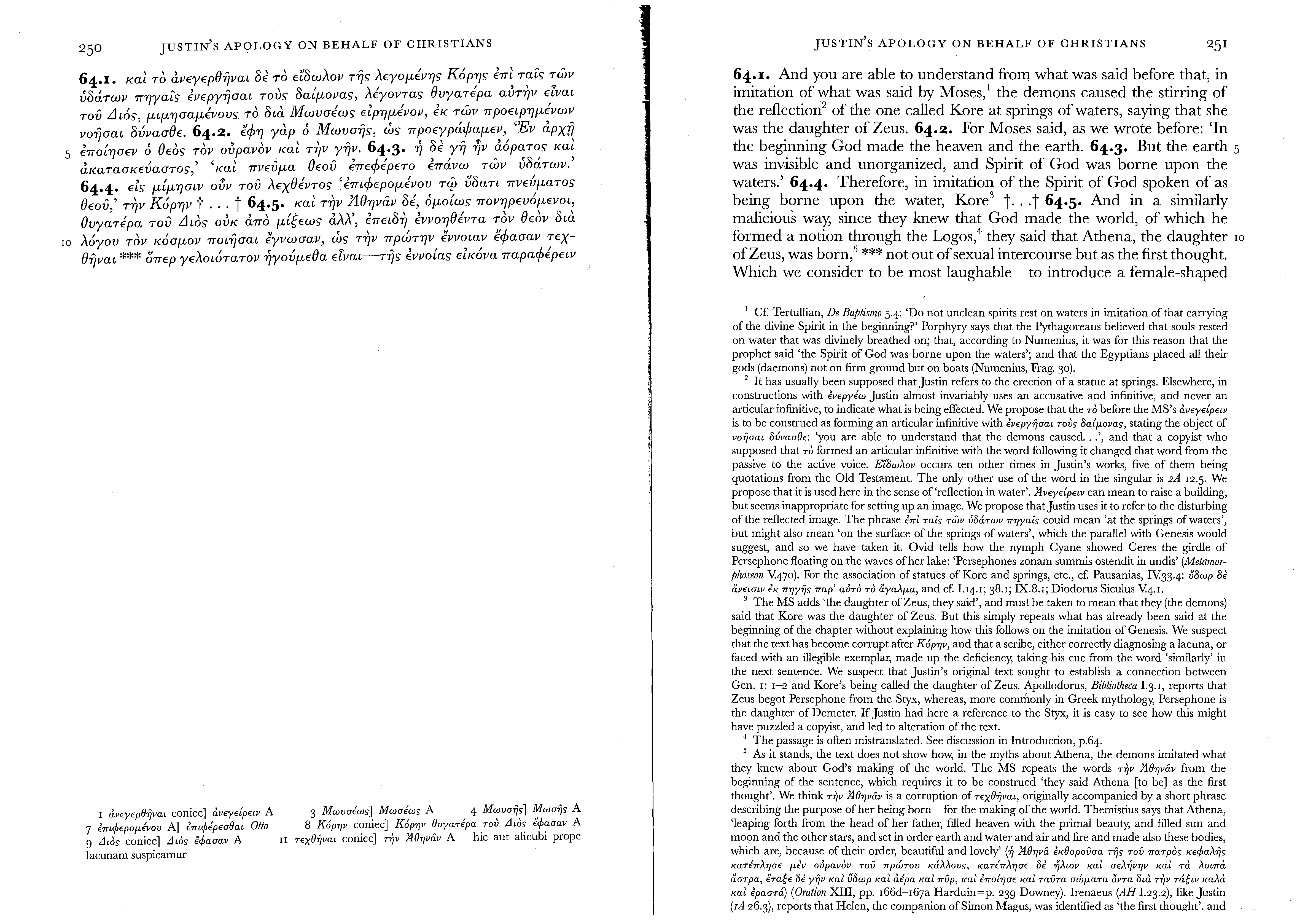
JUSTIN'S APOLOGY ΟΝ BEHALF OF CHRISTIANS
JUSTIN'S APOLOGY ΟΝ BEHALF OF CHRISTIANS
64.1. And you are able to understand [Γοιη what was said before that, ίη imitation of what was said by Moses,l the demons caused the stirring of 64.1. και το ανεγερθηναι δε το εί'δωλον της λεγoμένrις Kόprις ε7ΤΙ ταις των
) Λ \ δ Ι λ l θ Ι ) \ l' ύδάτων 7Trιγαις ενεpγrισαι τους αιμονας, εγοντας υγατερα αυTrιν ειναι the reflection2 of the one called Kore at springs of waters, saying that she was the daughter of Zeus. 64.2. For Moses said, as we wrote before: Ίη the beginning God made the heaven and the earth. 64.3. But the earth 5 was invisible and unorganized, and Spirit of God was borne υροη the waters.' 64.4. Therefore, ίη imitation of the Spirit of God spoken of as being borne υροη the water, Kore3 t ... t 64.5. And ίη a similarly malicious way, since they knew that God made the world, of which he formed a notion through the Logos,4 they said that Athena, the daughter !Ο ofZeus, was born,5 *** not out ofsexual intercourse but as the first thought.
Which we consider to be most laughable-to introduce a female-shaped του Δ ιός, μιμrισαμένOυς το δια Μωυσέως ειprιμένOν, εκ των 7TpOειprιμένων νοησαι δύνασθε. 64.2. εφrι γαρ ό Μωυσης, ώς 7Τροεγράψαμεν, 'Εν apxiJ
5 ε7TO{rισεν ό θεος τον ουρανον και T~ν γην. 64·3· Τι δε γη ~ν αόρατος και ) ι "\ Λ θ Λ ) ΦL ) Ι Λ (δΙ , ακατασκευαστος, και 7Τνευμα εου ε7Τε ερετο ε7Τανω των υ ατων.
64.4. εις μ{μrισιν οΌν του λεχθέντος Έ7ΤιΦερομένου τψ ϋδατι 7Τνεύματος , \ ΤΙ ι t t 6 \ \ Άθ Λ δ ι ( Ι ι θεου, Trιν n.oprιν ...
4.5. και Trιν rι ναν ε, ομοιως 7TOνrιpευOμενOΙ, ι Δ \ ) ) \ Ι C ) λλ)) δ \) θ ι \ θ \ δ \ θυγατερα του ιος ουκ α7ΤΟ μι~ εως α ,ε7Τει rι εννOrι εντα τον εον ια ι \ Ι .....,'
(\ Ι "
λογου τον κοσμον 7TOιrισαι εγνωσαν, ως Trιν 7TpωTrιν εννοιαν ε ασαν τεχ- " λ ι (Ι θ l'
Λ) Ι ) Ι ΦL θηναι *** 07Τερ γε οιοτατον rιγOυμε α ειναΙ-Trις εννοιας εικονα 7Ταρα ερειν ι Cf. Tertullian, De Bαptismo 5.4: 'Do not unclean spirits rest οη waters ίη imitation of that carrying of the divine Spirit ίη the beginning?' Porphyry says that the ΡΥthagΟ1'eaηs believed that souls 1'ested οη wate1' that was divinely breathed οη; that, aCCΟ1'ding to Numenius, it was [Ο1' this 1'easοη that the prophet said 'the Sρί1'ίt of God was borne upon the waters'; and that the Egyρtians placed all thei1' gods (daemons) not οη firm gΓOund but οη boats (Numenius, Frag. 30).
2 It has usually been supposed that Justin refe1'S to the e1'ectίοη of a statue at SΡ1'ίηgs. Elsewhere, ίη constι-uctions with ενεργέω Justin almost invariably uses an accusative and infinitive, and never an a1'tίcuΙa1' infinitive, to indicate what is being effected. We pΓOpose that the το before the MS's ανεγείρειν is to be constι-ued as forming an articular infinitive with ενεργησαι τους δαίμονας, stating the object of νοησαι δύνασθε: 'you are able to uηde1'staηd that the demons caused ... ', and that a copyist who supposed that το formed an articular infinitive with the WΟ1'd following it changed that WΟ1'd fΓOm the passive to the active voice. Είδωλον ΟCCU1'S ten other times ίη Justin's WΟ1'ks, five of them being quotations from the Old Testament. The only othe1' use of the WΟ1'd ίη the singular is 2Δ 12.5. We propose that it is used he1'e ίη the sense of'reflection in water'. Άνεγείρειν can mean to 1'aίse a building, but seems inappropriate for setting up an image. We propose thatJustin uses it to refer to the disturbing ofthe reflected image. The Ρh1'ase επι ταις των ύδάτων πηγαις could mean 'at the springs ofwaters', but might also mean Όη the surface of the springs of waters', which the Ρa1'aΙΙeΙ with Genesis would suggest, and so we haνe taken it. Ovid tells how the nymph Cyane showed Ceres the gi1'dle of Persephone floating οη the waves ofher lake: 'Persephones zonam summis ostendit ίη undis' (Metαmor p/ιoseoll V.470), For the association of statues of ΚΟ1'e and SΡ1'ίηgs, etc., cf. Pausanias, Ιν.33+ ϋδωρ δε ανεισιν εκ πηγΤις παρ' αυτο το αγαλμα, and cf. ι'Ι4.Ι; 38.1; α.8.ι; Diodorus Siculus V.4.I.
3 The MS adds 'the daughte1' ofZeus, they said', and must be taken to mean that they (the demons) said that ΚΟ1'e was the daughte1' of Zeus. But this simply 1'eΡeats what has aΙ1'eadΥ been said at the beginning of the chapter without explaining how this follows οη the imitation of Genesis. We suspect that the text has become corrupt afte1' Κ6ρην, and that a scγibe, either correcdy diagnosing a lacuna, or faced with an illegible eχemΡΙa1', made up the deficiency, taking his cue from the word 'similarly' ίη the next sentence. We suspect that Justin's original text sought to establish a connection between Gen. Ι: 1-2 and Kore's being called the daughte1' of Zeus. Apollodoι-us, Bibliothecα ι'3.Ι, 1'eΡοrts that Zeus begot Ρe1'seΡhοηe from the Styx, whereas, more commonly ίη Greek mythology, Ρe1'seΡhοηe is the daughter of Demeter. If Justin had here a 1'efereηce to the Styx, it is easy to see how this might have puzzled a copyist, and led to alteration of the text.
+ The passage is often mίst1'aηsΙated. See discussion ίη IntΓOduction, ρ.64.
5 As it stands, the text does not show how, ίη the myths about Athena, the demons imitated what they knew about God's making of the WΟ1'Ιd. The MS 1'eΡeats the WΟ1'ds την Άθηναν from the beginning of the sentence, which requires it to be constι-ued 'they said Athena [to be] as the first thought'. We think την Άθηναν is a corruption of τεχθηναι, originally accompanied by a shΟ1't phrase
3 Μωυσέως] Μωσέως Α 4 Mωυσijς] Mωσijς Α 8 Κ6ρην coniec] Κ6ρην θυγατέρα TOV Διος εΦασαν Α descγibing the purpose of he1' being bΟ1'η-fο1' the making of the world. Themistius says that Athena,
'leaping fΟ1'th fΓOm the head of her fathe1', filled heaven with the primal beauty, and filled sun and moon and the othe1' stars, and set ίη Ο1'der ea1'th and wate1' and ai1' and fi1'e and made also these bodies, which a1'e, because of their order, beautiful and lovely' (ή Άθηνα εκθορουσα Tijς του πατρος KεΦαλijς
Ι ανεγερθηναι coniec] ανεγείρειν Α 7 επιΦερομένου Α] επιΦέρεσθαι Otto 9 Διος coniec] Διος εΦασαν Α lacunam suspicamur ι ι τεχθηναι coniec] την Άθηναν Α hic aut alicubi prope κατέπλησε μεν ουρανον του πρώτου κάλλους, κατέπλησε δε ηλιον και σελήνην και τα λοιπα αστρα, εταξε δε γην και ϋδωρ και αέρα και πυρ, και εποίησε και ταυτα σώματα οντα δια την τάξιν καλα και εραστά) (Orαtioll ΧΙΙΙ, ρρ. I66d-I67a Ηa1'duίη=Ρ. 239 Downey). Ι1'eηaeus (ΔΗ Ι.23.2), like Justin
(ιΑ 26.3), 1'eΡοrts that Helen, the companion ofSimon Ma/ζUs, was identified as 'the first thou.ιrht', and
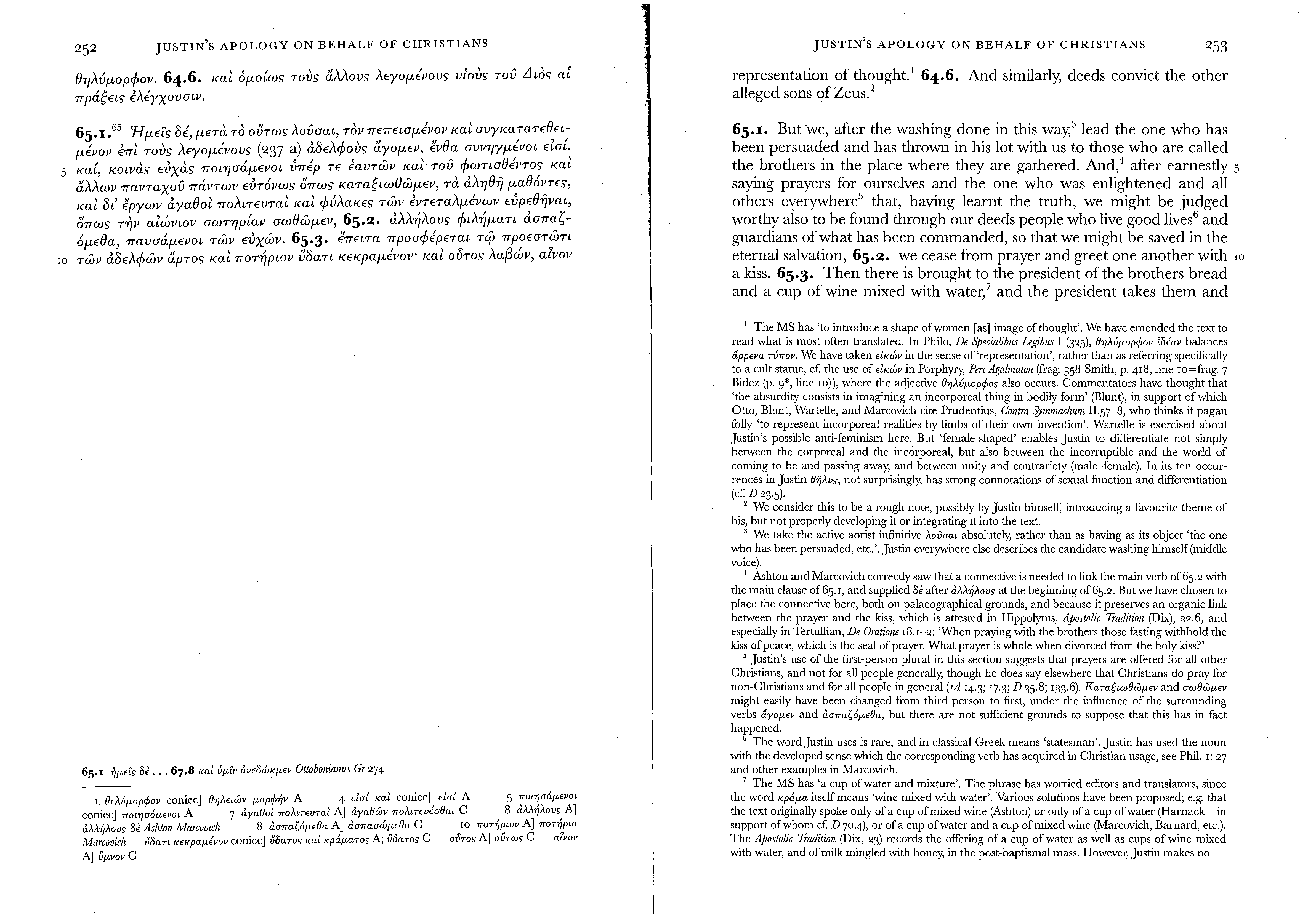
JUSTIN'S APOLOGY ΟΝ BEHALF OF CHRISTIANS
JUSTIN'S APOLOGY ΟΝ BEHALF OF CHRISTIANS
( θηλύμορΦον. 64. . και ομοιως τους α ους εγομενους υιους του ιος αι representation of thought. l 64.6. And similarly, deeds convict the other alleged sons of Zeus. 2 πράξεις ελέγχουσιν.
65 Ή ~ δ Ι \ \ <Ι λ ~ \ Ι \ θ 5. ι. μεις ε, μετα το ουτως ουσαι, τον πεπεισμενον και συγκατατε ει65.1. But 'we, after the washing done ίn this way,3 lead the one who has been persuaded and has thrown ίn his lot with us to those who are cal1ed the brothers ίn the place where they are gathered. And,4 after earnestly 5 saying prayers for ourselves and the one who was enlightened and al1 others eγerywhere Ι ,\ \ λ Ι ( ) 'δ λΦ \"
Ι \ '
\ Ι < Ι < ~ \ ~ Φ θ '
και, κοινας ευχας ποιησαμενοι υπερ τε εαυτων και του ωτισ εντος και αλλων πανταχού πάντων ευτόνως σπως καταξιωθωμεν, τα άληθiι μαθόντες,
\ δ ' "
'θ \ λ \ \ Φ 'λ ~, λ Ι < θ ~ και ι εργων αγα οι πο ιτευται και υ ακες των εντετα μενων ευρε ηναι, 5 that, having learnt the truth, we might be judged worthy also to be found through our deeds people who live good lives6 and guardians of what has been commanded, so that we might be saved ίn the eternal salvation, 65.2. we cease from prayer and greet one another with 10 a kiss. 65.3. Then there is brought to the president of the brothers bread and a cup of wine mixed wjth water,7 and the president takes them and σπως T~ν αιώνιον σωτηρίαν σωθωμεν, 65.2. άλλήλους Φιλήματι άσπαζ όμεθα, παυσάμενοι των ευχων. 65.3. Επειτα προσΦέρεται τφ προεστωτι
10 των άδελφων αρτος και ποτήριον ύδατι κεκραμένον' και ο15τος λαβών, αίνον ι The MS has 'to introduce a shape of women [as] image of thought'. We have emended the text to read what is most often translated. Ιη Philo, De Speciαlibus Legibus Ι (325), θrιλύμopΦoν ιδέαν balances αρρενα τύπον. We have taken εικών ίη the sense of'representation', rather than as referring specifically to a cult statue, cf. the use of εικών ίη Porphyry, Peτi AgαllIlαtOIl (frag. 358 Smίψ, ρ. 418, line 1O=frag. 7
Bidez (Ρ. 9*, line 10)), where the adjective θrιλύμopΦoς also occurs. Commentators have thought that 'the absurdity consists ίη imagining an incorporeal thing ίη bodily form' (Blunt), in support of which Otto, Blunt, Wartelle, and Marcovich cite Prudentius, Coιztτα Syl1l11lαchum 11.57-8, who thinks it pagan folly 'to represent incorporeal realities by limbs of their οwn invention'. Wartelle is exercised about Justin's possible anti-feminism here. But 'female-shaped' enables Justin to differentiate not simply between the corporeal and the ίηcόrΡοreal, but also between the incorruptible and the world of coming to be and passing away, and between unity and contrariety (male-female). Ιη its ten occurrences ίη Justin θήλυς, not surprisingly, has strong connotations of sexual function and differentiation
(cf. D23.5).
2 We consider this to be a rough note, possibly by Justin himself, introducing a favourite theme of his, but not properly developing it ΟΓ integrating it into the text.
3 We take the active aorist infinitive λουσαι absolutely, rather than as having as its object 'the one who has been persuaded, etc.'. Justin everywhere else describes the candidate washing himself(middle voice).
4 Ashton and Marcovich correctly saw that a connective is needed to link the main verb of65.2 with the main clause of65.1, and supplied δε after dλλήλους at the beginning of65.2. But we have chosen to place the connective here, both οη palaeographical grounds, and because it preserves an organic link between the prayer and the kiss, which is attested ίη Hippolytus, Apostolic Trαditioιz (Dix), 22.6, and especially ίη Tertullian, De Orαtioιze 18.1-2: 'When praying with the brothers those fasting withhold the kiss of peace, which is the seal of prayer. What prayer is whole when divorced from the holy kiss?'
5 Justin's use of the first-person plural ίη this section suggests that prayers are offered for all other
Christians, and not for all people generally, though he does say elsewhere that Christians do pray for non-Christians and for all people ίη general (ιΑ 14.3; 17.3; D 35.8; 133.6). Καταξιωθωμεν and σωθωμεν might easily have been changed from third person to first, under the influence of the surrounding verbs αγομεν and dσπα'όμεθα, but there are not sufficient grounds to suppose that this has ίn fact happened.
6 The word Justin uses is rare, and ίn classical Greek means 'statesman'. Justin has used the noun with the developed sense which the corresponding verb has acquired ίη Christian usage, see Phil. ι: 27 and other examples in Marcovich.
65.1 ήμεις δε .. . 67.8 και ύμιν ανεδώκμεν Οttοbοιιίαιιus Gr 274 7 The MS has 'a cup of water and mixture'. The phrase has worried editors and translators, since the word κράμα itself means 'wine mixed with water'. Various solutions have been proposed; e.g. that the text originally spoke οηlΥ of a cup of mixed wine (Ashton) ΟΓ only of a cup of water (Harnack-in support ofwhom cf. D 70.4), ΟΓ of a cup ofwater and a cup ofmixed wine (Marcovich, Barnard, etc.).
The Apostolic Trαditi01l (Dix, 23) records the offering of a cup of water as well as cups of wine mixed with water, and of milk mingled with honey, ίn the post -baptismal mass. However, Justin makes ηο ι θελύμορΦον coniec] θrιλειων μορψήν Α 4 εισί και coniec] εισί Α 5 πoιrισάμενoι coniec] πoιrισόμενoι Α 7 αγαθοι πολιτευται Α] αγαθων πολιτευέσθαι C
8 dλλήλους Α] dλλήλους δε Ashtoιz lvIαTcovich 8 ασπα'όμεθα Α] ασπασώμεθα C 10 ποτήριον Α] ποτήρια MαTcovich ϋδατι κεκραμένον coniec] ϋδατος και κράματος Α; ϋδατος C οδτος Α] οϋτως C αΤνον Α] υμνον C
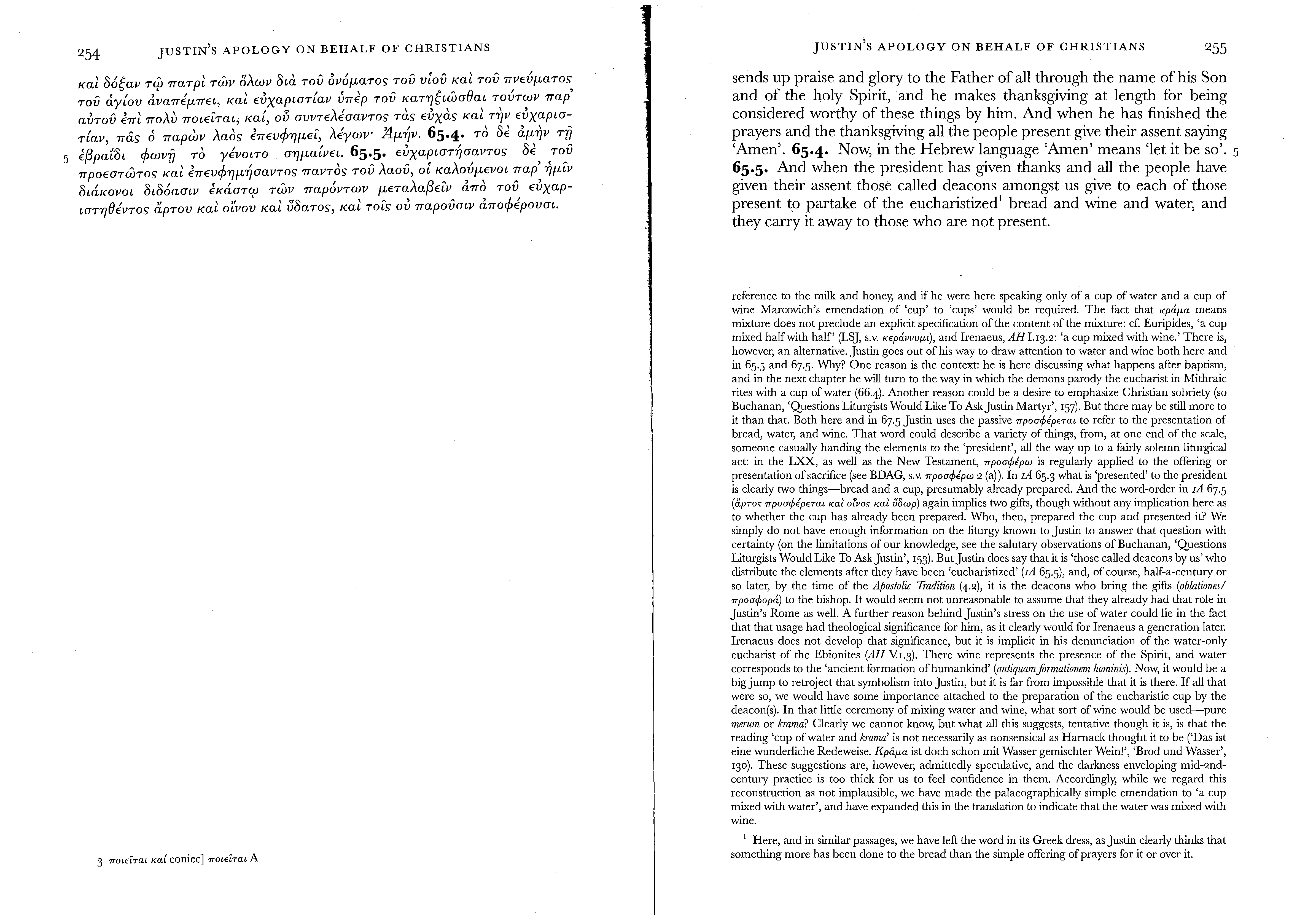
JUSTIN'S APOLOGY ΟΝ BEHALF OF CHRISTIANS
JUSTIN'S APOLOGY ΟΝ BEHALF OF CHRISTIANS
sends up praise and glory to the Father of all through the name of his Son and of the holy Spirit, . and he makes thanksgiving at length for being considered worthy of these things by him. And when he has finished the prayers and the thanksgiving all the people present give their assent saying και δόξαν Τψ πατρι τών όλων δια του όνόματος του υίου και του πνεύματος
(Ι'
Ι Ι\ ,..
C ..... θ / , του αγιου αναπεμπει, και ευχαριστιαν υπερ του KαTΎj<:o ιωσ αι τουτων παρ αυτου Επι πολυ ποιειται; καί, 0-0 συντελέσαντος τας ευχας και την ευχαρισ- / (, λ' , Φ Λ λ/ Ά / 6 ' δ' "
Λ τιαν, πας ο παρων αος επευ Ύjμει, εγων' μΎjν. 5-4το ε αμΎjν ττι (β 'δ Φ Λ , / /
/ δ'
ε ραϊ ι ωντι το γενοιτο. σΎjμαινει. 5-5ευXαpισTΎjσανTOς ε του 'Amen'. 65-4Now, ίn the Hebrew language 'Amen' means 'let it be so'. 5
65-5And when the president has given thanks and all the people have given their assent those called deacons amongst us give to each of those present t,o partake of the eucharistized1 bread and wine and water, and they carry it away to those who are not present. προεστώτος και EπευΦΎjμrισανTOς παντος του λαου, οί καλούμενοι παρ' ήμιν
\ ,ι ,f'a , .....
, ...
'Φ/ ισTΎj εντος αρτου και οινου και υ ατος, και τοις ου παρουσιν απο ερουσι. reference to the milk and honey, and if he were here speaking οηlΥ of a cup of water and a cup of wine Marcovich's emendation of 'cup' to 'cups' would be required. The fact that κράμα means mixture does not preclude an explicit specification of the content of the mixture: cf. Euripides, 'a cup mixed halfwith half' (LSJ, s.ν. κεράννυμι), and Irenaeus, ΑΗι'13.2: 'a cup mixed with wine.' There is, however, an alternative. Justin goes out ofhis way to draw attention to water and wine both here and in 65.5 and 67.5. Why? One reason is the context: he is here discussing what happens after baptism, and ίη the next chapter he will turn to the way ίη which the demons parody the eucharist ίη Mithraic rites with a cup of water (66.4). Another reason could be a desire to emphasize Christian sobriety (so Buchanan, 'Questions Liturgists Would Like Το AskJustin Martyr', 157). But there may be still more to it than that. Both here and ίη 67.5 Justin uses the passive προσΦέρεται to refer to the presentation of bread, water, and wine. That ,-,vord could describe a variety of things, from, at one end of the scale, someone casuaΠy handing the elements to the 'president', all the way up to a fairly solemn liturgical act: ίη the LXX, as well as the New Testament, προσΦέρω is regularly applied to the offering ΟΓ presentation of sacrifice (see BDAG, S.ν. προσΦέρω 2 (a)). Ιη ιΑ 65.3 what is 'presented' to the president is clearly two things-bread and a cup, presumably already prepared. And the word-order ίη ιΑ 67.5
(αρτος προσΦέρεται και orvo!; και ίJδωp) again implies two gifts, though without any implication here as to whether the cup has already been prepared. Who, then, prepared the cup and presented it? We simply do not have enough information οη the liturgy known to Justin to answer that question with certainty (οη the limitations of our knowledge, see the salutary observations ofBuchanan, 'Questions
Liturgists Would Like Το AskJustin', 153). ButJustin does say that it is 'those called deacons by us' who distribute the elements after they have been 'eucharistized' (ιΑ 65.5), and, of course, half-a-century ΟΓ so later, by the time of the Apostolic Tι-adition (4.2), it is the deacons who bring the gifts (oblationes/ προσΦορά) to the bishop. It would seem not unreasonable to assume that they already had that role ίη
Justin's Rome as well. Α further reason behind Justin's stress οη the use of water could lie ίη the fact that that usage had theological significance for him, as it clearly would for Irenaeus a generation later.
Irenaeus does not develop that significance, but it is implicit ίη his denunciation of the water-only eucharist of the Ebionites (ΑΗ VI.3). There wine represents the presence of the Spirit, and water corresponds to the 'ancient formation ofhumankind' (antiquamfiI"mationem !ιoιιιίιιΊS). Now, it would be a big jump to retroject that symbolism into Justin, but it is far from impossible that it is there. If aΠ that were so, we would have some importance attached to the preparation of the eucharistic cup by the deacon(s). Ιη that little ceremony ofmixing water and wine, what sort ofwine would be used-pure meruIIl ΟΓ krαιιια? Clearly we cannot know, but what aΠ this suggests, tentative though it is, is that the reading 'cup ofwater and kταιιια' is not necessarily as nonsensical as Harnack thought it to be ('Das ist eine wunderliche Redeweise. κραμα ist doch schon mit Wasser gemischter Wein!', 'Brod und Wasser',
130). These suggestions are, however, admittedly specclative, and the darkness enveloping mid-zndcentury practice is too thick for us to feel confidence ίη them. Accordingly, while we regard this reconstruction as not implausible, we have made the palaeographicaΠy simple emendation to 'a cup mixed with water', and have expanded this ίη the translation to indicate that the water was mixed with wine. ι Here, and ίη similar passages, we have left the word ίη its Greek dress, as Justin clearly thinks that something more has been done to the bread than the simple offering of prayers for it ΟΓ over it.
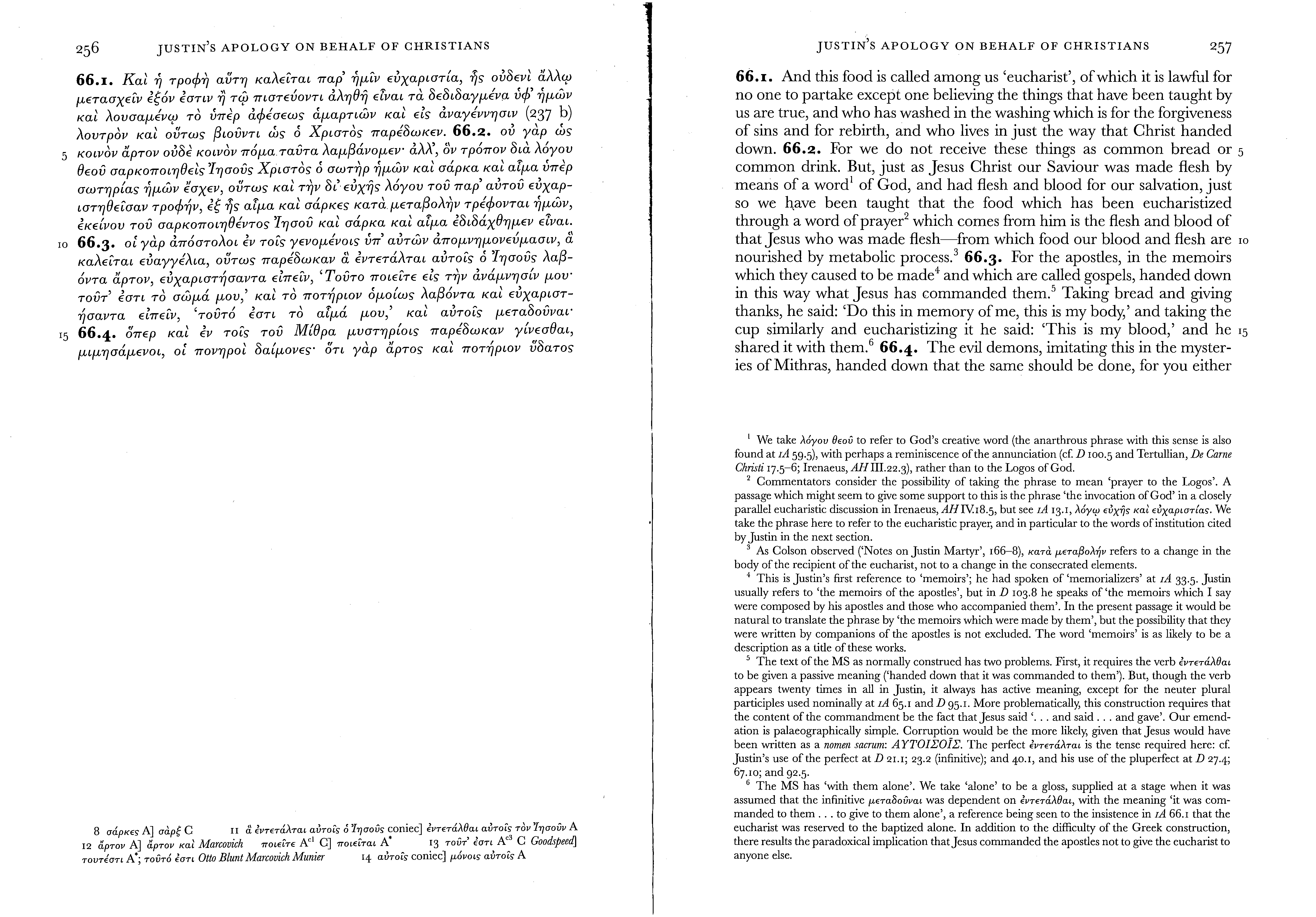
JUSTIN'S APOLOGY ΟΝ BEHALF OF CHRISTIANS
JUSTIN'S APOLOGY ΟΝ BEHALF OF CHRISTIANS
66.1. And this food is called among us 'eucharist', ofwhich it is lawful for 66.1. Και ή τροφ-η αϋτη καλΕιται παρ' ήμιν Ευχαριστία, -ης ουδΕνι &λλψ ηο one to partake except one believing the things that have been taught by us are true, and who has washed ίη the washing which is for the forgiveness of sins and for rebirth, and who lives in just the way that Christ handed down. 66.2. For we do not receive these things as common bread or 5 common drink. But, just as Jesus Christ our Saviour was made flesh by means of a word 1 of God, and had flesh and blood for our salvation, just so we h,ave been taught that the food which has been eucharistized through a word of prayer2 which comes from him is the flesh and blood of that Jesus who was made flesh-from which food our blood and flesh are 10 nourished by metabolic process. 3 66.3. For the apostles, ίη the memoirs which they caused to be made 4and which are called gospels, handed down μΕτασΧΕιν εξόν εστιν ij Τψ πισΤΕύοντι αληθiι Είναι τα δΕδιδαγμέv(J, ύΦ' ήμων
\ λ '
\ ( \ 'Φ'
( Λ \ ' "
(7 b) και ουσαμΕνψ το υΠΕΡ α ΕσΕως αμαρτιων και ΕΙS αναγΕννησιν 23 λ \ \ <, β Λ ( ( Χ \ 'δ
<Ι , δ \ λ'
5 κοινον αρτον ου Ε κοινον πομα ταυτα αμ ανομΕν· α ,ov τροπον ια ογου θΕού σαρκοποιηθΕις 'Ιησούς Χριστος ό σωΤ'ηρ ήμων και σάρκα και αΊμα ύπερ
/ ( ~ ,ι r/ \ \ δ' , Λ λ/ 1*\",..) σωτηριας ημων ΕσΧΕν, ουτως και την ι' Ευχης ογου του παρ αυτου ΕυχαριστηθΕισαν τροΦήν, εξ -ης αΊμα και σάΡΚΕς καταμΕταβολην τρέΦονται ήμων, εΚΕίνου τού σαρκοποιηθέντος 'Ιησού και σάρκα και αΊμα εδιδάχθημΕν Είναι.
(\' ι λ'''' ι r"
Ι <\ 10 6 .3. οι γαρ αποστο οι Εν τοις γΕνομΕνοις υπ αυτων απομνημονΕυμασιν, α λ "λ <, 'δ <Ι'
'λ 'Λ ('Τ Λ λ β κα Ειται ΕυαγγΕ ια, ουτως παΡΕ ωκαν α ΕνΤΕτα ται αυτοις ο .L ησους αι"
, Ι ,,...
'Τ 1*\ Λ' \ ,Ι ι οντα αρτον, Ευχαριστησαντα ΕΙΠΕιν, ουτο ποιειΤΕ εις την αναμνησιν μου· Λ' , \ Λ'
, \ \ , (, λ β'
\, τουτ Εστι το σωμα μου, και το ποτηριον ομοιως α οντα και Ευχαριστίη this way what Jesus has commanded them. 5 Taking bread and giving thanks, he said: 'Do this ίη memory of me, this is my body,' and taking the cup similarly and eucharistizing it he said: 'This is my blood,' and he 15 shared it with them. 6 66.4. The evil demons, imitating this ίη the mysteries of Mithras, handed down that the same should be done, for you either ήσαντα ΕίΠΕιν, 'τούτό εστι το αΊμά μου,' και αυτοις μΕταδούναι·
<, \, Λ Λ Μ'θ '
\ Ι Ι/δ μιμησαμΕνοι, οι πονηροι αιμονΕς· ΟΤΙ γαρ αρτος και ποτηριον υ ατος ι We take λόγου θεου to refer to God's creative word (the anarthrous phrase with this sense is also found at ιΑ 59.5), with perhaps a reminiscence ofthe annunciation (cf. D 100.5 and Tertullian, De Carne
Chrίsti 17.5-6; Irenaeus, ΑΗΙΠ.22.3), rather than to the Logos of God.
2 Commentators consider the possibility of taking the phrase to mean 'prayer to the Logos'. Α passage which might seem to give some support to this is the phrase 'the invocation of God' ίη a closely parallel eucharistic discussion in Irenaeus, ΑΗΙν.18.5, but see ιΑ 13.1, λόγψ ευχΤις και εVχαριστtας. We take the phrase here to refer to the eucharistic prayer, and ίη particular to the words of institution cited by Justin ίη the next section.
3 As Colson observed ('Notes οη Justin Martyr', 166-8), κατ α μεταβολήν refers to a change ίη the body ofthe recipient ofthe eucharist, not to a change ίη the consecrated elements.
4 This is Justin's first reference to 'memoirs'; he had spoken of 'memorializers' at ιΑ 33.5. Justin usually refers to 'the memoirs ofthe apostles', but in D 103.8 he speaks of'the memoirs which Ι say were composed by his apostles and those who accompanied them'. Ιη the present passage it would be natural to translate the phrase by 'the memoirs which were made by them', but the possibility that they were written by companions of the apostles is not excluded. The word 'memoirs' is as likely to be a description as a title of these works.
5 The text of the MS as normally construed has two problems. First, it requires the verb έντετάλθαι to be given a passive meaning ('handed down that it was commanded to them'). But, though the verb appears twenty tirnes in all ίη Justin, it always has active meaning, except for the neuter plural participles used nominally at ιΑ 65.1 and D 95.1. More problematically, this construction requires that the content of the commandment be the fact that Jesus said '. .. and said ... and gave'. Our emendation is palaeographically simple. Corruption would be the more likely, given that Jesus would have been written as a nomeιz sacrUln: Α ΥΤΟΙΣΟΪΣ. The perfect έντετάλται is the tense required here: cf.
Justin's use ofthe perfect at D 21.1; 23.2 (infinitive); and 40.1, and his use of the pluperfect at D 27.4;
6μο; and 92.5.
6 The MS has 'with them alone'. We take 'alone' to be a gloss, supplied at a stage when it was assumed that the infinitive μεταδουναι was dependent οη έντετάλθαι, with the meaning 'it was commanded to them ... to give to them alone', a reference being seen to the insistence in ιΑ 66.1 that the eucharist was reserved to the baptized alone. Ιη addition to the difficulty of the Greek construction, there results the paradoxical irnplication thatJesus commanded the apostles not to give the eucharist to anyone else.
8 σάρκες Α] σαρξ C 11 α έντετάλται αυτοις ό '/rισoυς coniec] έντετάλθαι αυτοις τον '/rι σoυν Α
12 aρτον Α] aρτον και Marcovich 7Τοιειτε A c1 C] 7Τοιειται Α* 13 TOVT' έστι Ac3 C GoodspeedJ τουτέστι Α*; τοΙιτό έστι Otto Blunt MΠI-covich Munier
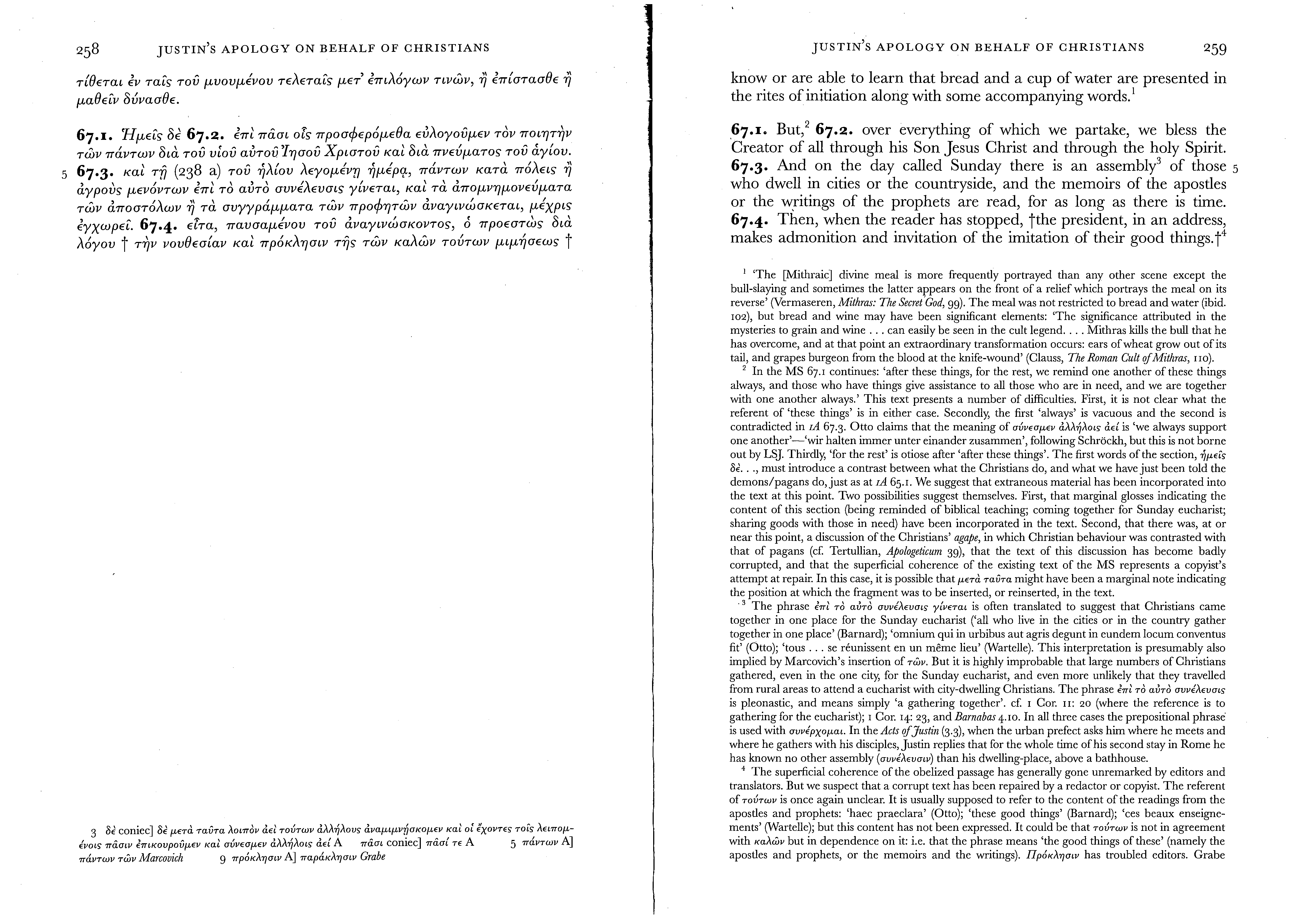
JUSTIN'S APOLOGY ΟΝ BEHALF OF CHRISTIANS
JUSTIN'S APOLOGY ΟΝ BEHALF OF CHRISTIANS
know or are able to learn that bread and a cup of water are presented in the rites of initiation along with some accompanying words. 1 τ{θεται εν TatS του μυουμένου τελεταιs μετ' επιλόγων Τινων, ij επίστασθε ij μαθειν δύνασθε.
,67.1. But,2 67.2. over everything of which we partake, we bless the 67.1. Ήμειs δε 67.2. επι πασι ols προσΦερόμεθα ευλογουμεν T{JV ποιητην
Creator of aΠ through his Son Jesus Christ and through the holy Spirit.
67.3. And οη the day called Sunday there is an assembl/ of those 5 who dwell in cities or the countryside, and the memoirs of the apostles or the w,ritings of the prophets are read, for as long as there is time.
67.4. Then, when the reader has stopped, tthe president, in an address, makes admonition and invitation of the imitation of their good things. t 4
5 67.3. και Tn (238 a) του ήλίου λεγομένυ TjfLipq., πάντων καΤ{l πόλειs ij αγρους μενόντων επι το αυτο συνέλευσις γίνεται, και τα απομνημονεύματα των αποστόλων ij τα συγγράμματα των προΦητων αναγινώσκεται, μέχρις εγχωρεΙ. 67.4. εΊτα, παυσαμένου του αναγινώσκοντος, ό προεστως δια λόγου t την νουθεσίαν και πρόκλησιν της των καλων τούτων μιμήσεως t ι 'The [ΜίthΓaίc] divine meal is mΟΓe fΓequeηtlΥ ΡΟΓtΓaΥed than any otheΓ scene except the bull-slaying and sometimes the latteΓ aΡΡeaΓS οη the fΓOnt of a Γelief which ΡΟΓtΓaΥS the meal οη its
ΓeveΓse' (VeΓmaseΓeη, Mithllli: The Secτet'God, 99). The meal was not ΓestΓίcted to bΓead and wateΓ (ibid.
10'2), but bΓead and wine may have been significant elements: 'The significance attΓibuted ίη the mΥsteΓίes to gΓaίη and wine ... can easily be seen ίη the cult legend .... ΜίthΓas kills the bull that he has οveΓcome, and at that point an eχtΓaΟΓdίηary tΓaηsfΟΓmatiοη ΟCCUΓS: eaΓS of wheat gΓOw out of its tail, and gΓaΡes bUΓgeοη fΓOm the blood at the knife-wound' (Clauss, The R01nαn Cult qf Mitlιrαs, πο).
2 Ιη the MS 67.1 continues: 'afteΓ these things, [ΟΓ the Γest, we Γemind one anotheΓ ofthese things always, and those who have things give assistance to all those who are ίη need, and we are together with one another always.' This text presents a number of difficulties. First, it is not clear what the referent of 'these things' is ίη either case. Secondly, the first 'always' is vacuous and the second is contradicted ίη ιΑ 67.3. Otto claims that the meaning of σύνεσμεν αλλήλοις αεί is 'we always support one another'-'wir halten immer unteΓ einander zusammen', following Schrockh, but this is not borne out by LSJ. Thirdly, 'for the rest' is otiose after 'after these things'. The first words of the section, ήμεις δΙ .. , must introduce a contrast between what the Christians do, and what we have just been told the demons/pagans do,just as at ιΑ 65.1. We suggest that extraneous material has been incorporated into the text at this point. Two possibilities suggest themselves. First, that marginal glosses indicating the content of this section (being reminded of biblical teaching; coming together for Sunday eucharist; sharing goods with those ίη need) have been incorporated ίη the text. Second, that there was, at or near this point, a discussion of the Christians' αgαpe, in which Christian behaviour was contrasted with that of pagans (cf. Tertullian, Apologeticunl 39), that the text of this discussion has become badly corrupted, and that the superficial coherence of the existing text of the MS represents a copyist's attempt at repair. Ιη this case, it is possible that μετα ταυτα might have been a marginal note indicating the position at which the fragment was to be inserted, or reinserted, ίη the text .
. 3 The phrase επι το αυτο συνέλευσις γίνεται is often translated to suggest that Christians came together ίη one place for the Sunday eucharist ('all who live in the cities or ίη the country gather together ίη one place' (Barnard); 'omnium qui ίη urbibus aut agris degunt ίη eundem locum conventus fit' (Otto); 'tous ... se reunissent en un meme lieu' (Wartelle). This interpretation is presumably also implied by Marcovich's insertion of των. But it is highly impΓObable that large numbers of Christians gathered, even ίη the one city, for the Sunday eucharist, and even more unlikely that they travelled from rural areas to attend a eucharist with city-dwelling Christians. The phrase επι το αυτο συνέλευσις is pleonastic, and means simply 'a gathering together'. cf. ι Cor. ΙΙ: '20 (where the reference is to gathering for the eucharist); ι Cor. 14: '23, and BαTnαbαs 4- !ο. Ιη all three cases the prepositional phrase is used with συνέρχομαι. Ιη the Acts qfJustin (3.3), when the urban prefect asks him where he meets and where he gathers with his disciples, Justin replies that for the whole time ofhis second stay ίη Rome he has known ηο other assembly (συνέλευσιν) than his dwelling-place, above a bathhouse.
4 The superficial coherence of the obelized passage has generally gone unremarked by editors and translators. But we suspect that a corrupt text has been repaired by a redactor or copyist. The referent of τούτων is once again unclear. It is usually supposed to refer to the content of the readings from the apostles and prophets: 'haec praeclara' (Otto); 'these good things' (Barnard); 'ces beaux enseignements' (Wartelle); but this content has not been expressed. It could be that τούτων is not ίη agreement with καλων but ίη dependence οη it: i.e. that the phrase means 'the good things of these' (namely the apostles and prophets, or the memoirs and the writings). Πρόκλησιν has troubled editors. Grabe
δε coniec] δε μετα ταυτα λοιπον αει τούτων αλλήλους αναμιμν!ισκομεν και οί έχοντες τοις λειπομένοις πασιν επικουρουμεν και σύνεσμεν αλλήλοις αεί Α πασι coniec] πασί τε Α 5 πάντων Α] πάντων των MαTcovich 9 πρόκλησιν Α] παράκλησιν Grαbe
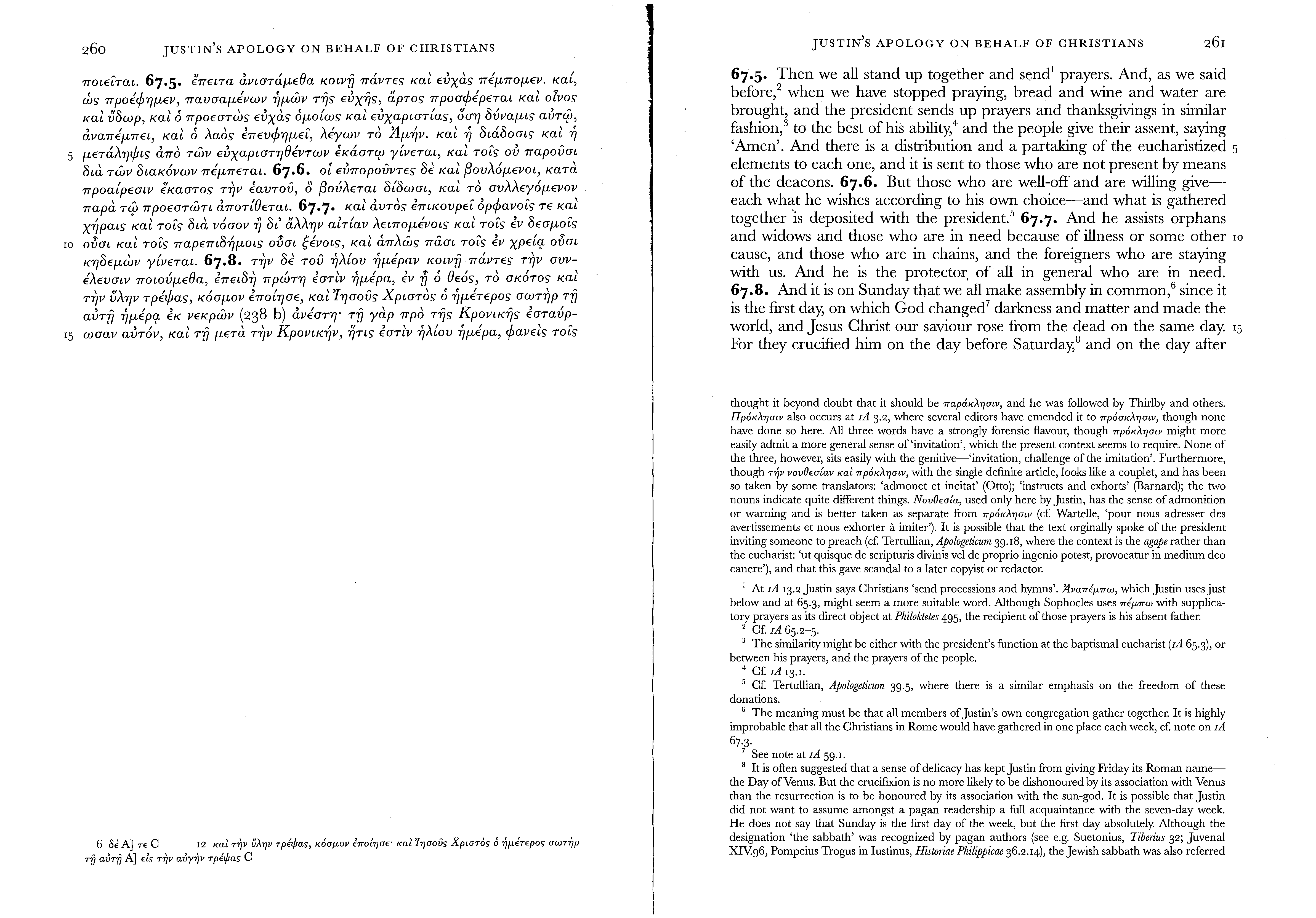
JUSTIN'S APOLOGY ΟΝ BEHALF OF CHRISTIANS
JUSTIN'S APOLOGY ΟΝ BEHALF OF CHRISTIANS
67.5. Then we all stand up together and S~ndl prayers. And, as we said before,2 when we have stopped praying, bread and wine and water are brought, and the president sends up prayers and thanksgivings ίη similar fashion,3 to the best of his ability, 4 and the people give their assent, saying ποιεΙται. 67.5. επειτα ανιστάμεθα KOLVV πάντες και EVXdS πέμπομεν. καί, ώς προέΦημεν, παυσαμένων ήμών τΥις ευΧΎις, αρτος προσΦέρεται και οίνος και ϋδωρ, και ό προεστως ευχας όμοίως και ευχαριστίας, σση δύναμις αυτ4>,
,ι , (λ' , Φ ~ λ ι , 'Λ ι ,( δ Ιδ ' ( αναπεμπει, και ο αος επευ ημει, εγων το .nfLYJV. και η ια οσις και η 'Amen'. And there is a distribution and a partaking of the eucharistized 5 elements to each one, and it is sent to those who are not present by means of the deacons. 67.6. But those who are well-off and are willing giveeach wh~t he wishes according to his οννη choice-and what is gathered together is deposited with the president.5 67.7. And he assists orphans and widows and those who are ίη need because of illness or some other ΙΟ
, ~, θ ι (ι Ι ,~, ~ 5 μετα ηψις απο των ευχαριστη εντων εκαστψ γινεται, και τοις ου παρουσι
(, ~ δ'
ΟΙ ευπορουντες ε και ου ομενοι, κατα δ ι r, ,( ~., β Ιλ δ Ιδ "λλ ι προαιρεσιν EKaaTOS την εαυτου, ο ου εται ι ωσι, και το συ εγομενον παρα τ4> προεστώτι αποτίθεται. 67.7. και αυτος έπικουρει ορΦανοις τε και χήραις και τοις δια νόσον ij δι' αλλην αιτίαν λειπομένοις και τοις έν δεσμοις
ΙΟ οδσι και τοις παpεπιδ~μoις οδσι ξένοιs, και άπλώς πασι τοις έν ΧΡείCf οδσι c~use, and those ,:ho are in chains, and the foreigners who are staying wlth us. And he IS the protector, of all ίη general who are ίη need. κηδεμων γίνεται. 67.8. T~ν δε του ήλίου ήμέραν ΚΟινVπάντες T~ν συν έλευσιν ποιούμεθα, έπειδ~ πρώτη έστιν ήμέρα, έν Τι ό θεός, το σκότος και
67.8. And it is οη Sunday t4at we all make assembly ίη common,6 since it is the first day, οη which God changed7 darkness and matter and made the world, and Jesus Christ our saviour rose from the dead οη the same day. 15
For they crucified him οη the day before Saturday, 8 and οη the day after T~ν ϋλην τρέψας, κόσμον έποίησε, και Ίησους Χριστος ό ήμέτερος σωT~P TV aVTV ήμέΡCf έκ νεκρών (238 b) ανέστη' TV γαρ προ τΥις ΚρονικΎις έσταύρ- ,Ι \,...
\ \ Κ Ι r/ ) , Ιλ ι (ι Φ , ~
ωσαν αυτον, και TYJ μετ α την ρονικην, ητις εστιν η ιου ημερα, ανεις τοις thought it beyond doubt that it should be παράκλησιν, and he was followed by Thir1by and others.
Πρόκλησιν a1so occurs at ιΑ 3.2, where severa1 editors have emended it to πρόσκλησιν, though none have done so here. All three words have a strong1y forensic flavour, though πρόκλησιν might more easily admit a more general sense of'invitation', which the present context seems to require. None of the three, however, sits easily with the genitive-'invitation, challenge ofthe irnitation'. Furthermore, though τήν νουθεσίαν και πρόκλησιν, with the single definite artic1e, looks 1ike a couplet, and has been so taken by some translators: 'admonet et incitat' (Otto); 'instructs and exhorts' (Barnard); the two nouns indicate quite different things. Νουθεσία, used οηlΥ here by Justin, has the sense of admonition or w~rning and is better taken as separate from πρόκλησιν (cf. Wartelle, 'pour nous adresser des
~ve.r~lssements et nous exhorter :'ι irniter'). 1t is possible that the text orginally spoke of the president mvrtrng someone to preach (cf. Tertullian, Apologeticunl 39.18, where the context is the αgαpe rather than the eucharist: 'ut quisque de scripturis divinis vel de proprio ingenio potest, provocatur ίη medium deo canere'), and that this gave scandal to a 1ater copyist or redactor. ι At ιΑ 13.2 Justin says Christians 'send processions and hymns'. Άναπέμπω, which Justin uses just below and at 6~'3, ~ight s:em a mo.re suitable word. Although Sophocles uses πέμπω with supplicatory prayers as rts direct obJect at Phlloktetes 495, the recipient of those prayers is his absent father.
2 Cf. ιΑ 65.2-5.
3 The similarity might be either with the president's function at the baptismal eucharist (ιΑ 65.3), or between his prayers, and the prayers of the people.
4Cf. ιΑ 13.1.
5 Cf. Tertullian, Apologeticum 39.5, where there is a sirnilar emphasis οη the freedom of these donations.
6 The meaning must be that all members of Justin's own congregation gather together. 1t is highly improbable that all the Christians ίη Rome would have gathered ίη one p1ace each week, cf. note οη ιΑ
67·3· 7 See note at ιΑ 59.1.
8 1t is often suggested that a sense of de1icacy has kept Justin from giving Friday its Roman namethe Day ofVenus. But the crucifixion is ηο more likely to be dishonoured by its association with Venus
~an the resurrection is to be honoured by its association with the sun-god. 1t is possib1e that Justin did not want to assume amongst a pagan readership a full acquaintance with the seven-day week.
He does not say that Sunday is the first day of the week, but the first day absolutely. Although the designation 'the sabbath' was recognized by pagan authors (see e.g. Suetonius, Tiberius 32; Juvenal
6 δε Α] τε C 12 και την ϋλην τρέψω;, κόσμον εποίησε' και Ίησους ΧριστΌς ό Τιμέτερος σωτηρ
ΧΙν.96, Pompeius Trogus ίη 1ustinus, Historίαe Philippicαe 36.2.14), the Jewish sabbath was also referred
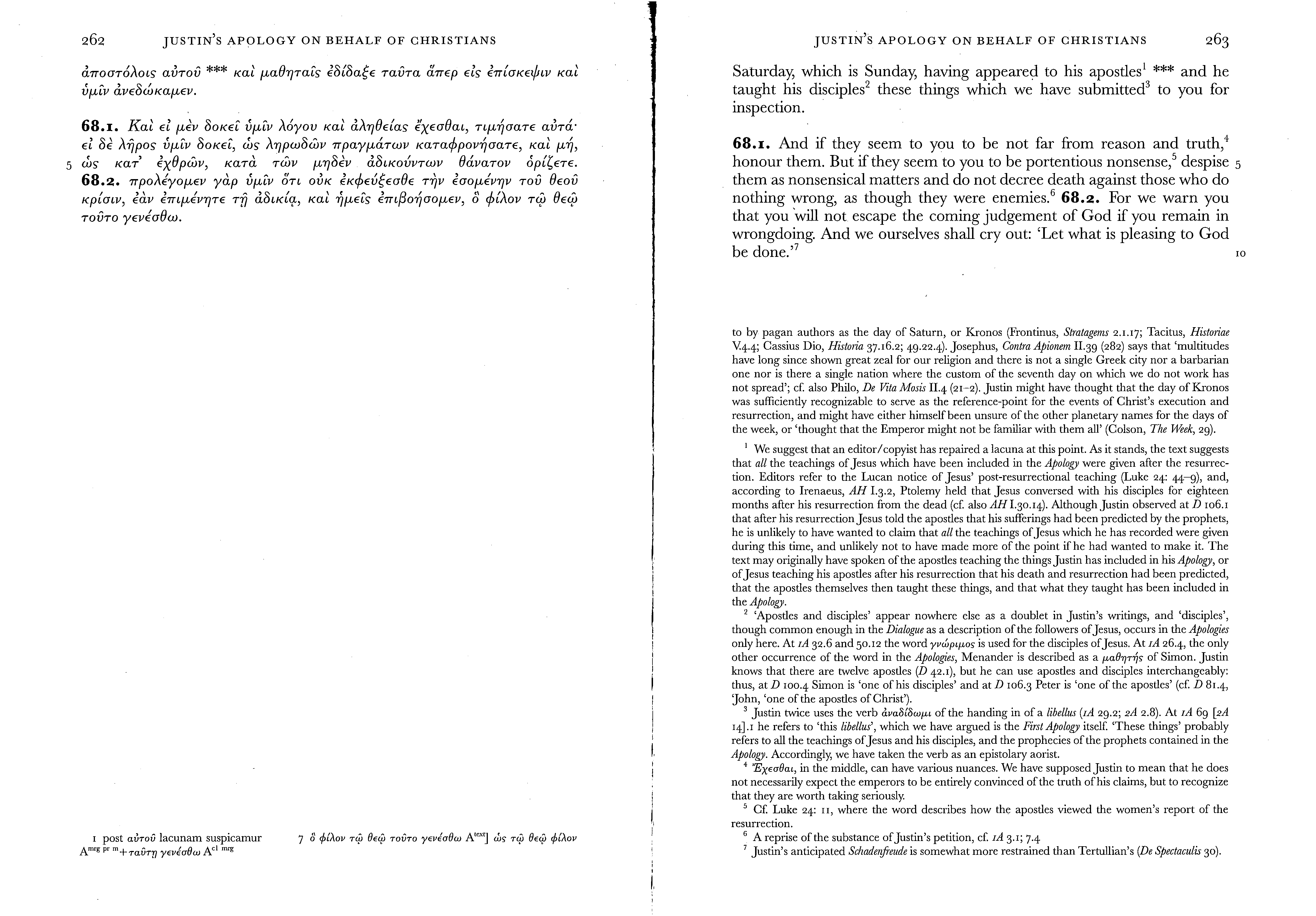
JUSTIN'S APOLOGY ΟΝ BEHALF OF CHRISTIANS
JUSTIN'S APOLOGY ΟΝ BEHALF OF CHRISTIANS
, 'λ 'Λ *** ' θ Λ 'δ 'δ C Λ "
' "
./, ' αποστο οις αυτου και μα ηταις ε ι α~ ε ταυτα απερ εις επισκεψιν και Saturday, which is Sunday, having appeare~ to his apostles 1 *** and he taught his disciples2 these things which we have submitted3 to you for inspection. ύμιν ανεδώκαμεν.
68.1. And if they seem to you to be not far from reason and truth,4 honour them. But ifthey seem to you to be portentious nonsense,5 despise 5 themas nonsensical matters and do not decree death against those who do nothing wrong, as though they were enemies.6 68.2. For we warn you that you 'will nοΙ escape the coming judgement of God if you remain ίn wrongdoing. And we ourselves shall cry out: 'Let what is pleasing to God be done.,7
ει δε ληρος ύμιν δοκει, ώς ληρωδων πραγμάτων καταΦρονήσατε, και μή, 5 ώς κατ' εχθρων, κατα των μηδεν αδικούντων θάνατον όρ{ζετε.
,( Λ"
, 'Φ'
C θ '"
,( Λ , β , <, Φ 'λ Λ θ Λ κρισιν, εαν επιμενητε ττι α ΙΚΙC!-, και ημεις επι οησομεν, ο ι ον Τψ εψ τούτο γενέσθω. to by pagan authors as the day of Saturn, or Κronos (Frontinus, St1"αtαgeιllS 2.1.17; Tacitus, HistoTiae v.4.4; Cassius Dio, Hist01iα 37.16.2; 49.22-4). Josephus, CΟlll1"α ApiolleIll Π.39 (282) says that 'multitudes have long since shown great zeal for our religion and there is not a single Greek city nor a barbarian one nor is there a single nation where the custom of the seventh day οη which we do not work has not spread'; cf. also Philo, De Vita Mosis Π.4 (21-2). Justin might have thought that the day of Κronos was sufficiently recognizable to serve as the refeΓence-Ροint for the events of Christ's execution and resurrection, and might have either himself been unsure of the other planetary names for the days of the week, or 'thought that the Emperor might not be familiar with them all' (Colson, The Jίjfek, 29). ι We suggest that an editor / copyist has repaired a lacuna at this point. As it stands, the text suggests that αΖ! the teachings of Jesus which have been included ίη the Apology weΓe given aftel" the resuaection. Editors refer to the Lucan notice of Jesus' post-resuaectional teaching (Luke 24: 44-9), and, according to ΙΓenaeus, ΑΗ ι'3.2, Ptolemy held that Jesus cοnveΓsed with his disciples for eighteen months after his [esuaection from the dead (cf. also ΑΗι'30.14). AlthoughJustin observed at D 106.1 that after his resuaectionJesus told the apostles that his sufferings had been predicted by the pΓOphets, he is unlikely to have wanted to clairn that αΖ! the teachings of Jesus which he has recorded were given during this tirne, and unlikely not to have made mΟΓe of the point if he had wanted to make it. The text may originally have spoken of the apostles teaching the things Justin has included ίη his Apology, or of Jesus teaching his apostles after his [esuaection that his death and resuaection had been predicted, that the apostles themselves tllen taught these things, and that what they taught has been included ίη the Apolog)I.
2 'Apostles and disciples' appeal" nowhere else as a doublet ίη Justin's writings, and 'disciples', though common enough ίη the Diαlogue as a description of the fοlΙοweΓS of Jesus, occurs ίη the Apologies only here. At ιΑ 32.6 and 50.12 the WΟΓd γνώριμοι; is used for the disciples ofJesus. At ιΑ 26.4, the only other occuaence of the word ίη the Apologies, Menandel" is descγibed as a μαθητής of Sirnon. Justin knows that there are twelve apostles (D 42.1), but he can use apostles and disciples interchangeably: thus, at D 100.4 Sirnon is 'one ofhis disciples' and at D 106.3 Peter is 'one ofthe apostles' (cf. D 81-4,
John, 'one of the apostles of Christ').
3 Justin twice uses the verb αναδtδωμι of the handing ίη of a libellus (ιΑ 29.2; 2Α 2.8). At ιΑ 69 [2Α
14].1 he refers to 'this libellus', which we have argued is the First Apology itself. 'These things' pΓObably refers to all the teachings of Jesus and his disciples, and the prophecies of the pΓOpllets contained in the Apology. Accordingly, we have taken the verb as an epistolary aorist.
4 'Έχεσθαι, ίη the middle, can have various nuances. We have supposed Justin to mean that he does not necessarily expect the emperors to be entirely convinced ofthe truth ofhis clairns, but to recognize that they are worth taking seΓίοuslΥ.
5 Cf. Luke 24: ΙΙ, wheΓe the word describes how the apostles viewed the women's [eport of the resuaection.
7 Ο φtλον Τψ θεψ τουτο γενέσθω ΝΟΧΊ ώι; Τψ θεψ φtλον 6 Α reΡΓίse of the substance of Justin's petition, cf. ιΑ 3·1; 7.4 ι post αύτου lacunam suspicamur Amrg pr m+TaDTT! γενέσθω Acl mrg 7 Justin's anticipated SclzadeIιjι"ellde is somewhat more restrained than Tertullian's (De Spectaculis 30).
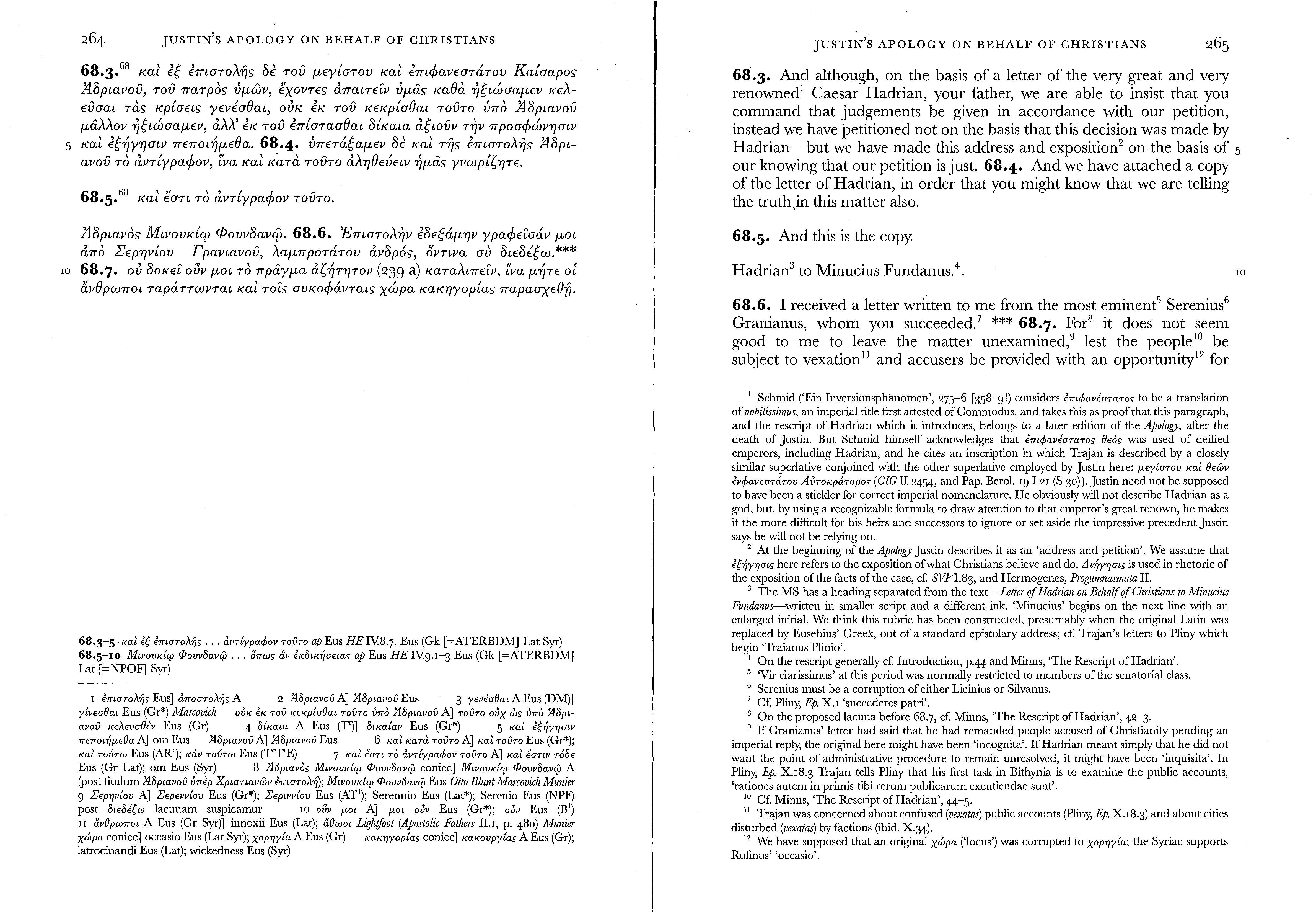
JUSTIN'S APOLOGY ΟΝ BEHALF OF CHRISTIANS
JUSTIN'S APOLOGY ΟΝ BEHALF OF CHRISTIANS
68.3.68 και ες επιστολής δε του μεγ{στου και επιΦανεστάτου Κα{σαρος 68.3. And although, οη the basis of a letter of the very great and very renowned 1 Caesar Hadrian, your father, we are able to insist that you command that judgements be given in accordance with our petition, instead we have petitioned not οη the basis that this decision was made by Hadrian-but we have made this address and exposition2 οη the basis of 5 our knowing that our petition is just. 68.4. And we have attached a copy of the letter of Hadriari, in order that you might know that we are telling the truth,in this matter also .
Άδριανου, του πατρος ύμων, εχοντες απαιτειν ύμας καθα -ηςιώσαμεν κελ ευσαι τας κρ{σε,ις γενέqθαι, ουκ εκ του κεκρ{σθαι τουτο ύπο Άδριανου μαλλον -ηςιώσαμεν, αλλ' εκ του επ{στασθαι δ{καια αςιουν την προσΦώνησιν
.4. υπετας αμεν ε και της επιστο ης ριανου το αντ{γραΦον, ίνα και κατα τουτο αληθεύειν ήμας γνωρ{ζητε.
Άδριανος Μινουκ{ψ ΦουνδανΨ. 68.6. Έπιστολην εδεςάμην γραΦεισάν μοι 68.5. And this is the copy.
ΙΟ 68.,. ου δοκει οΟν μοι το πραγμα αζήτητον ('239 a) καταλιπειν, ίνα μήτε οί Hadrian3 to Minucius Fundanus.4 .
68.6. Ι received a letter written to me from the most eminent5 Serenius6 Granianus, whom you succeeded. 7 *** 68.,. For8 it does not seem good to me to leave the matter unexamined,9 lest the people lO be subject to vexation 11 and accusers be provided with an opportunity12 for ι Schmid (Έίη Inνersionsphanomen', 275-6 [358--g]) considers επιΦανέστατος to be a translation of nobilissimus, an imperial title first attested of Commodus, and takes this as PΓOof that this paragraph, and the rescript of Hadrian which it introduces, belongs to a later edition of the Apology, after the death of Justin. But Schmid himself acknowledges that επιΦανέστατος θεός was used of deified emperors, including Hadrian, and he cites an inscription ίη which Trajan is described by a closely similar superlatiνe conjoined with the other superlative employed by Justin here: μεγίστου και θεων ενΦανεστάτου Αυτοκράτορος (CIG Π 2454, and Pap. Berol. 19 Ι 21 (S 30)). Justin need not be supposed to haνe been a stickler for correct imperial nomenclature. He obviously will not describe Hadrian as a god, but, by using a recognizable formula to draw attention to that emperor's great renown, he makes it the more difficult for his heirs and successors to ignore ΟΓ set aside the impressiνe precedent Justin says he will not be relying οη.
2 At the beginning of the Apology Justin describes it as an 'address and petition'. We assume that εξήγησις here refers to the exposition ofwhat ChIistians believe and do. Διήγησις is used ίη rhetoric of the exposition ofthe facts ofthe case, cf. SVFI.83, and Hermogenes, Progumnαsι71αtα Π.
3 The MS has a heading separated from the text-Letteιqf Hαdl1αn οπ Belιa!f qf CJzristiαns to Jlιfinucius
Fundαnus-written ίη smaller script and a di:fferent ink. 'Minucius' begins οη the next line with an enlarged initial. We think this rubΓic has been constructed, presumably when the original Latin was replaced by Eusebius' Greek, out of a standard epistolaIY address; cf. Trajan's letters to ΡΙίηΥ which begin 'Traianus ΡΙίηίο'.
68.3-5· και εξ επιστολης ... αντίγραΦον ταυτΌ αρ Eus HEJV.8.7. Eus (Gk [=ATERBDJ\1] Lat Syr)
68.5-10 Μινουκίφ Φουνδανψ ... οπως αν εκδικήσειας αρ Eus ΗΕ JV.9.I-3 Eus (Gk [=ATERBDJ\1]
Lat [=NPOFJ Syr) .. Οη the rescript generally cf. Introduction, Ρ.44 and Minns, 'The Rescript ofHadrian'.
5 'Vir clarissimus' at this period was normally restricted to members of the senatorial class.
6 Serenius must be a corruption of either Licinius ΟΓ Silvanus. ι επιστολης Eus] απoστoλijς Α 2 Άδριανου Α] :4δριανου Eus 3 γενέσθαι Α Eus (DM)] 7 Cf. ΡΙίηΥ, Ερ. Χ.ι 'succederes patri'. γίνεσθαι Eus (Gr*) Jlιfαrcovich ουκ εκ του κεκρίσθαι ταυτΌ ύπο Άδριανου Α] ταυτΌ ουχ ώς ύπο :4δρι8 Οη the pΓOposed lacuna before 68.7, cf. Minns, 'The Rescript ofHadrian', 42-3. ανου κελευσθεν Eus (Gr) 4 δίκαια Α Eus (ΤΙ)] δικαίαν Eus (Gr*) 5 και εξήγησιν 9 If Granianus' letter had said that he had remanded people accused of Christianity pending an imperial reply, the original here might have been 'incognita'. IfHadrian meant simply that he did not want the point of administratiνe procedure to remain unresolved, it might have been 'inquisita'. Ιη
Pliny, Ερ. χ.ι8.3 Trajan tells ΡιiηΥ that his first task ίη Bithynia is to examine the public accounts,
'rationes autem ίη primis tibi rerum publicarum excutiendae sunt'. πεποιήμεθα Α] om Eus Άδριανου Α] :4δριανου Eus 6 και Kατιl ταυτΌ Α] και ταυτΌ Eus (Gr*); και τούτω Eus (ARC); καν τούτω Eus (ΤCΤΈ)
7 και έστι το αντίγραΦον ταυτΌ Α] και έστιν τόδε Eus (Gr Lat); om Eus (Syr) 8 Άδριανος Μινουκίφ Φουνδανψ coniec] Μινουκίφ Φουνδανψ Α
(post titulum Άδριανου ύπερ Χριστιανων επιστολή); Μινουκίφ Φουνδανψ Eus Otto Blunt Mαrcovich Munier
9 Σερηνίου Α] Σερεννίου Eus (Gr*); Σεριννίου Eus (ΑΤ ); Serennio Eus (Lat*); Serenio Eus (NPF) post διεδέξω lacunam suspicamur ΙΟ οόν μοι Α] μοι οόν Eus (Gr*); οόν Eus (ΒΙ) Ι ΙΟ Cf. Minns, 'The Rescript ofHadrian', 44-5. ii Trajan was concerned about confused (vexαtαs) public accounts (ΡΙίηΥ, Ερ. χ.ι8.3) and about cities disturbed (vexαtαs) by factions (ibid. χ.34).
ΙΙ άνθρωποι Α Eus (Gr Syr)] innoxii Eus (Lat); άθφοι Lighifoot (Apostolic Fαthers Π.ι, ρ. 480) Munier χώρα coniec] occasio Eus (Lat Syr); χορηγία Α Eus (Gr) κακηγορίας coniec] κακουργίας Α Eus (Gr);
12 We have supposed that an original χώρα ('locus') was corrupted to χορηγία; the Syriac supports
Rufinus' 'occasio'. latΓOcinandi Eus (Lat); wickedness Eus (Syr)
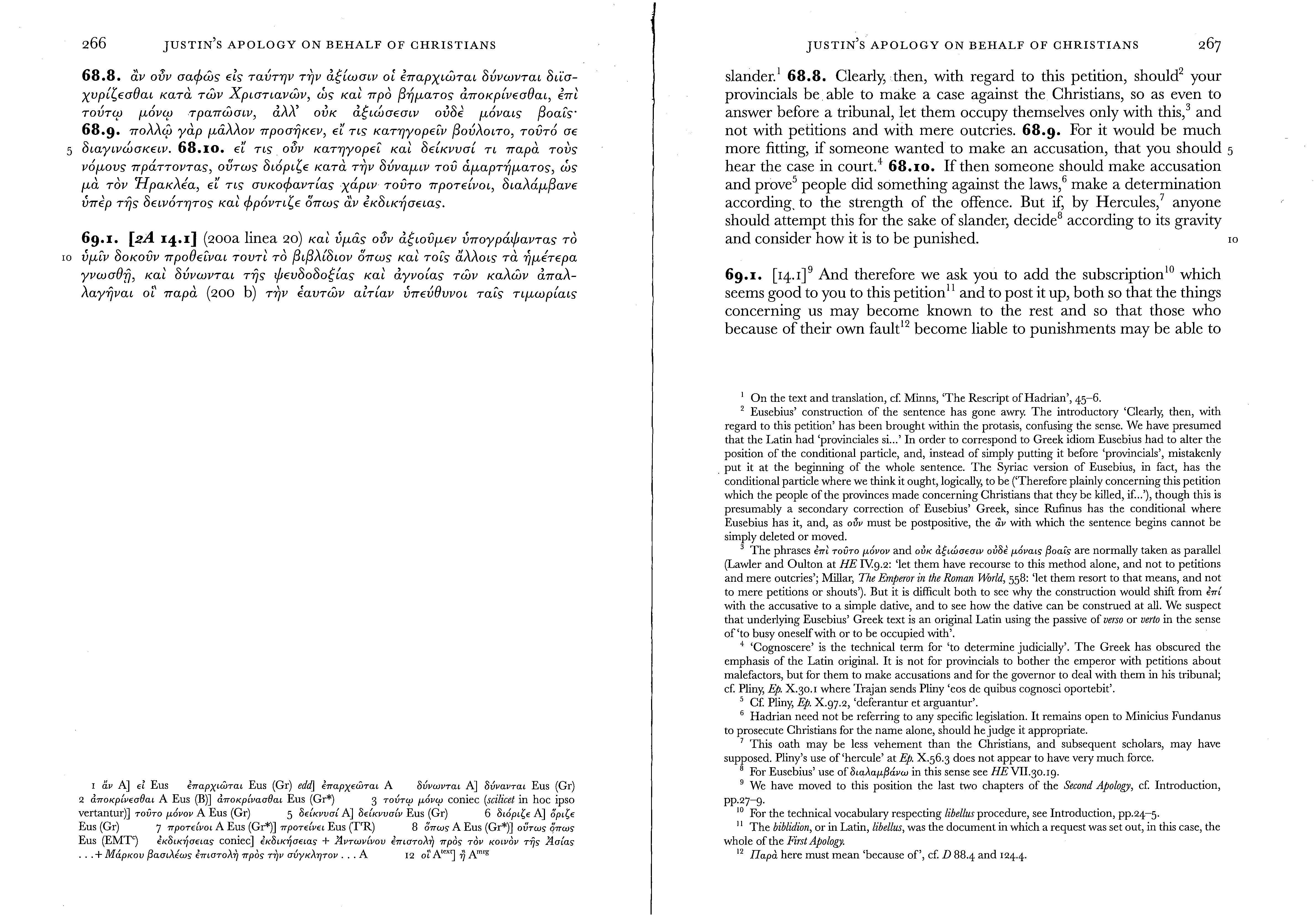
JUSTIN'S APOLOGY ΟΝ BEHALF OF CHRISTIANS
JUSTIN'S APOLOGY ΟΝ BEHALF OF CHRISTIANS
slander. 1 68.8. Clearly,then, with regard to this petition, should2 your provincials be. able to make a case against the Christians, so as even to answer before a tribunal, let them occupy themselves only with this,3 and not with petitions and with mere outcries. 68'9' For it would be much more fitting, if someone wanted to make an accusation, that you should 5 hear thecase ίη court. 4 68.10. Ifthen someone should make accusation and prove5 people did something against the laws,6 make a determination according, to the strength of the offence. But if, by ΗercuΙes,Ί anyone should attempt this for the sake of slander, decide8 according to its gravity and consider how it is to be punished.
ΙΟ 68.8. αν σΟν σαΦώς εις ταύΤYjν T~ν αξίωσιν οί έπαρχιώται δύνωνται διί'σ- 'Υ θ 'Λ Χ Λ t , 'β , , 'θ " χυρι'::,εσ αι κατα των ριστιανων, ως και προ Yjματος αποκρινεσ αι, επι , , Λ 'λλ'"
C '
'δ '
68'9' πολλψ γαρ μαλλον προσΥικεν, ει τις KaTYjYOPELV βούλοιτο, τούτό σε 5 διαγινώσκειν. 68.10. ει τις οΟν KaTYjYOpEL και δείκνυσί τι παρα τους νόμους πράττοντας, ούτως διόριζε κατα T~ν δύναμιν τού άμαρτήματος, ώς
, 'Ή λ'"
Λ 'δ λ' β μα τον ρακ εα, ει τις συκο αντιας χαριν τουτο προτεινοι, ια αμ ανε t, Λ δ'
'Φ'
69'1' [2Α 14.1] (200a linea 20) και ύμας οδν αξιούμεν ύπογράψαντας το ΙΟ ύμιν δοκούν προθειναι τουτι το βιβλίδιον όπως και τοις αλλοις τα ήμέτερα
69.1. [Ι4.ιγ And therefore we ask you to add the subscription lO which seems good to you to this petition 11 and to post it up, both so that the things concerning us may become known to the rest and so that those who because of their own fault12 become liable to punishments may be able to γνωσθfι, και δύνωνται τΥις ψευδοδοξίας και αγνοίας τών καλών απαλλ
Λ ., ' ( b)' t Λ " t 'θ Λ , aYYjvaL οι παρα 200 TYjV εαυτων αιτιαν υπευ υνοι ταις τιμωριαις ι Οη the text and translation, cf. Minns, 'The Rescript ofHadrian', 45-6.
2 Eusebius' construction of the sentence has gone awry. The introductory 'Clearly, then, with regard to this petition' has been brought within the protasis, confusing the sense. We have presumed that the Latin had 'provinciales si .. .' Ιη order to correspond to Greek idiom Eusebius had to alter the position of the conditional particle, and, instead of simply putting it before 'provincials', mistakenly
. put it at the beginning of the whole sentence. The Syriac version of Eusebius, ίη fact, has the conditional particle where we think it ought, logically, to be ('Therefore plainly concerning this petition which the people of the provinces made concerning Christians that they be killed, if .. .'), though this is presumably a secondary correction of Eusebius' Greek, since Rufinus has the conditional where
Eusebius has it, and, as oi5v must be postpositive, the αν with which the sentence begins cannot be simply deleted ΟΓ moved.
3 The phrases επι TOVTO μόνον and ουκ dξιώσεσιν ουδε μόναις βοαι<; are normally taken as parallel
(Lawler and Oulton at ΗΕ Iν.g.2: 'let them have recourse to this method alone, and not to petitions and mere outcries'; Millar, The Emperor ίιι the Romαn World, 558: 'let them resort to that means, and not to mere petitions ΟΓ shouts'). But it is difficult both to see why the construction would shift from επί with the accusative to a simple dative, and to see how the dative can be construed at all. We suspect that underlying Eusebius' Greek text is an original Latin using the passive of verso or verto in the sense of'to busy oneselfwith or to be occupied with'.
4 'Cognoscere' is the technical term for 'to determine judicially'. The Greek has obscured the emphasis of the Latin original. It is not for provincials to bother the emperor with petitions about malefactors, but for them to make accusations and for the governor to deal with them in his tribunal; cf. Pliny, Ερ. Χ.30.ι where Trqjan sends Pliny 'eos de quibus cognosci oportebit'.
5 Cf. Pliny, Ερ. Χ.97. 2 , 'deferantur et arguantur'.
6 Hadrian need not be referring to any specific legislation. It remains open to Minicius Fundanus to prosecute Christians for the name alone, should he judge it appropriate.
7 This oath may be less vehement than the Christians, and subsequent scholars, may have supposed. Pliny's use of 'hercule' at Ερ. Χ.56.3 does not appear to have very much force.
8 For Eusebius' use of διαλαμβάνω in this sense see HEVII.30.I9. ι αν Α] εΙ Eus επαρχιωται Eus (Gr) edd] επαρχεωται Α δύνωνται Α] δύνανται Eus (Gr) 9 We have moved to this position the last two chapters of the Second Apology, cf. Introduction,
PP·27-g· 2 dποκρίνεσθαι Α Eus (Β)] dποκρίνασθαι Eus (Gr*) 3 τούτψ μόνψ coniec (scilicet in hoc ipso vertantur)] TOVTO μόνον Α Eus (Gr) 5 δείκνυσί Α] δείκνυσίν Eus (Gr) 6 διόριζε Α] όριζε Eus (Gr) ~ πρo~είνoι Α E~s (G~*)] Π~OTείνει E~s (TΓ~)
, 8 ό~ω<; ~ E~s (Gr*)~ oϋ~ω<; ,ι/π,: ς Eus (EMTj εκδικησεια<; cOlllec] εκδικησεια<; + Άντωνινου επιστολη προς τον κοινον τη<; Άσιας
... + Μάρκου βασιλέως επιστολη προ<; την σύγκλψον ... Α Ι2 οί' Nex1 η Amrg 10 For the technical vocabulary respecting libellus procedure, see Introduction, ρρ.24-5. ii The biblidion, or in Latin, libellus, was the document in which a request was set out, ίη this case, the whole of the First Apology.
12 Παρα here must mean 'because of', cf. D 88.4 and Ι24+
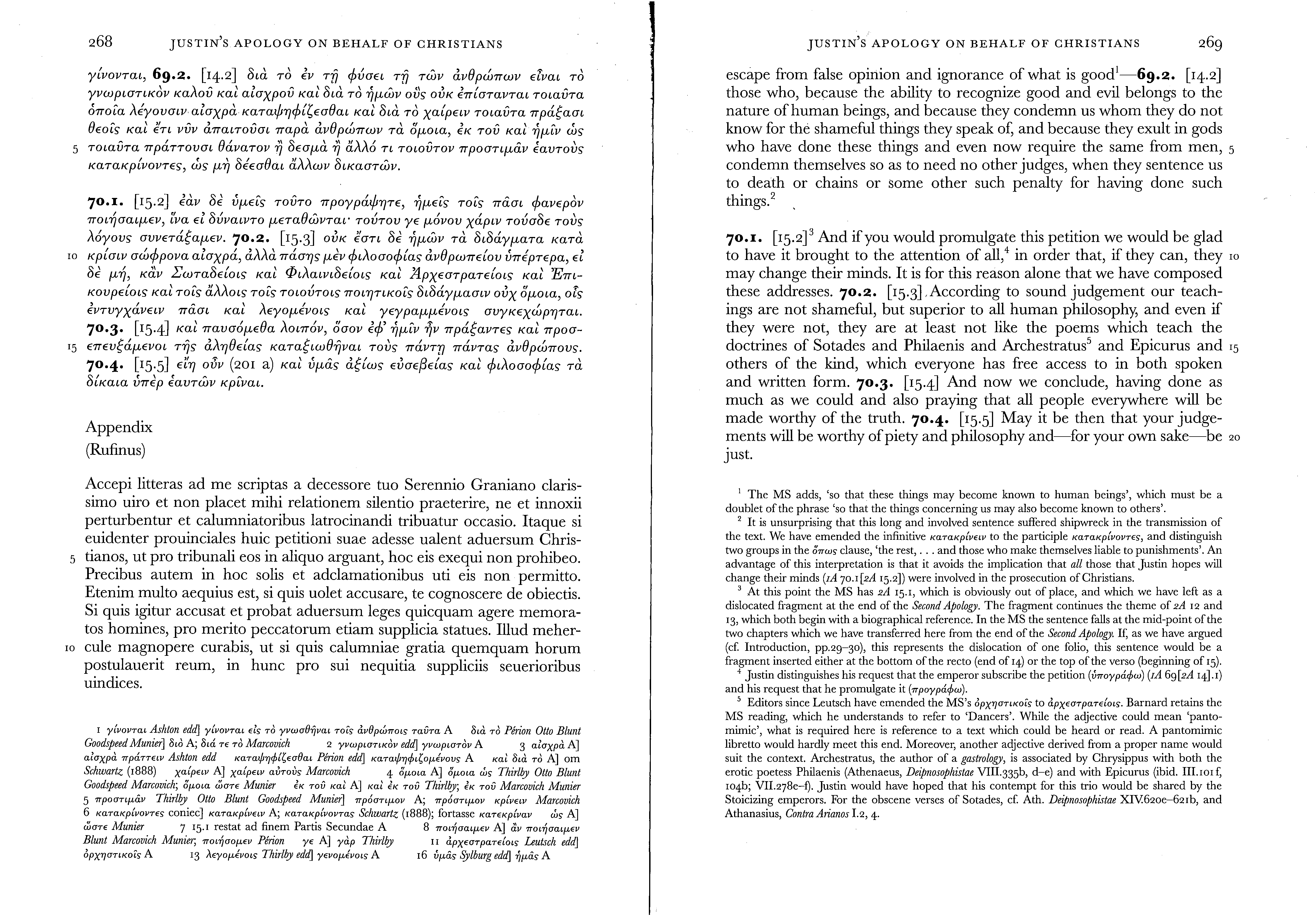
JUSTIN'S APOLOGY ΟΝ BEHALF OF CHRISTIANS
JUSTIN'S APOLOGY ΟΝ BEHALF OF CHRISTIANS
escape from false ορίηίοη and ignorance of what is goodl-69.2. [14.2J those who, because the ability to recognize good and evil belongs to the nature oflluman beings, and because they condemn us whom they do not know for the shameful things they speak of, and because they exult ίη gods who have done these things and even ηονν require the same from men, 5 condemn themselves so as to need ηο other judges, when they sentence us to death or chains or some other such penalty for having done such things. 2 γίνονται, 69.2. [14.2J δια το εν TV Φύσει TV των ανθρώπων εΊναι το γνωριστικον καλου και αισχρου και δια το ήμων ους ουκ επίστανται τοιαυτα όποια λέγουσιν αισχρα καταψηΦίζεσθαι και δια το χαίρειν τοιαυτα πράςασι θεοις και ετι νυν απαιτουσι παρα ανθρώπων τα όμοια, εκ του και ήμιν ώς
5 τοιαυτα πράττουσι θάνατον η δεσμα η αλλό τι τοιουτον προστιμάν έαυτους κατακρίνοντες, ώς μ~ δέεσθαι αλλων δικαστων.
70.1. [15.2J
εαν δε υμεις τουτο προγράψητε, ήμεις τοις πάσι Φανερον πoι~σαιμεν, ίνα ει δύναιντο μεταθωνται' τούτου γε μόνου χάριν τούσδε τους λόγους συνετάξαμεν. 70.2. [15.3J ουκ εστι δε ήμων τα διδάγματα κατα
70.1. [15.2γ And ifyou would promulgate this petition we would be glad to have it brought to the attention of all,4 ίη order that, if they can, they ΙΟ may change their minds. It is for this reason alone that we have composed these addresses. 70.2. [15.3J ,According to sound judgement our teachings are not shameful, but superior to all human philosophy, and even if they were not, they are at least not like the poems which teach the doctrines of Sotades and Philaenis and Archestratus5 and Epicurus and 15 others of the kind, which everyone has free access to ίη both spoken and written form. 70.3. [15-4J And ηονν we conclude, having done as much as we could and also praying that all people everywhere will be made worthy of the truth. 70.4. [15.5J May it be then that your judgements will be worthy of piety and philosophy and-for your οwn sake-be 20 just. ι ι Φ ,ι 'λλ \ ι \ Φ λ Φ ι 'θ ι r ι , ΙΟ κρισιν σω ρονα αισχρα, α α πασης μεν ι οσο ιας αν ρωπειου υπερτερα, ει δε μ~, καν Σωταδείοις και Φιλαινιδείοις και Ά.ρχεστρατείοις και Έπι κουρείοις και τοις αλλοις τοις τοιούτοις ποιητικοις διδάγμασιν ουχ όμοια, ο[ς εντυγχάνειν πάσι και λεγομένοις και γεγραμμένοις συγκεχώρηται.
70.3. [15-4J και παυσόμεθα λοιπόν, όσον εφ' ήμιν -ην πράξαντες και προσc ι ~ 'λ θ ι c θ ~ \ Ι Ι 'θ ι
70.4. [15·5J εϊη οδν (201 a) και υμάς αξίως ευσεβείας και ΦιλοσοΦίας τα δίκαια υπερ έαυτων κρΙναι.
Appendix (Rufinus) Accepi litteras ad me scriptas a decessore tuo Serennio Graniano clarissimo uiro et ηΟΩ placet mihi relationem silentio praeterire, ne et ίηηοχίί perturbentur et calumniatoribus latrocinandi tribuatur occasio. Itaque Si euidenter prouinciales huic petitioni suae adesse ualent aduersum Chris5 tianos, ut pro tribunali eos ίη aliquo arguant, hoc eis exequi ηΟΩ prohibeo.
Precibus autem in hoc solis et adclamationibus uti eis ηΟΩ permitto.
Etenim multo aequius est, Si quis uolet accusare, te cognoscere de obiectis.
Si quis igitur accusat et probat aduersum leges quicquam agere memoratos homines, pro merito peccatorum etiam supplicia statues. Illud meher1 The MS adds, 'so that. these things may become known to human beings', which must be a doublet of the phrase 'so that the things concerning us may also become known to others"
2 It is unsurprising that this long and inνolνed sentence suffered shipwreck ίη the transmission of the text. We haνe emended the infinitiνe κατακρ{νειν to the participle κατακρ{νοντες, and distinguish two groups in the Όπως clause, 'the rest, ... and those who make themselνes liable to punishments" Αη advantage of this interpretation is that it aνoids the implication that αΖΖ those that Justin hopes wi11 change their minds (ιΑ 70.1[2Α 15.2]) were inνolνed ίη the prosecution ofChristians.
3 At this point the MS has 2Α 15.1, which is obviously out ofplace, and which we have left as a dislocated fIagment at the end of the Secoιzd Apology. The fragment continues the theme of 2Α 12 and 13, which both begin with a biographical reference. Ιη the MS the sentence falls at the mid-point ofthe two chapters which we haνe transferred here from the end of the Secoιzd Apology. Ιί; as we haνe argued
(cf. Introduction, ρρ.29-30), this represents the dislocation of one folio, this sentence would be a fragment inserted either at the bottom ofthe recto (end of 14) or the top ofthe verso (beginning of 15).
ΙΟ cule magnopere curabis, ut Si quis calumniae gratia quemquam horum postulauerit reum, in hunc pro SUi nequitia suppliciis seuerioribus uindices.
4 Justin distinguishes his request that the emperor subscribe the petition (ύπογράΦω) (ιΑ 6g[2A 14].1) and his request that he promulgate it (προγράΦω).
5 Editors since Leutsch have emended the MS's όρχηστικοις to άρχεστρατε{οις. Barnard retains the MS reading, which he understands to refer to 'Dancers" While the adjectiνe could mean 'pantomimic', what is required here is refeIence to a text which could be heard or read. Α pantomimic libretto would hardly meet this end. Moreoνer, another adjectiνe deriνed from a proper name would suit the context. Archestratus, the author of a gαstrology, is associated by Chrysippus with both the erotic poetess Philaenis (Athenaeus, Deipιzosop!zistαe VII1.335b, d-e) and with Epicurus (ibid. I11.10If,
I04b; VII.278e-f). Justin would haνe hoped that his contempt for this trio would be shared by the Stoicizing emperors. For the obscene νerses of Sotades, cf. Ath. Deipιzosophistαe XIν.620e-62Ib, and Athanasius, ContrαAliαιzos 1'2,4. ι γ{νονται Ashton edιZJ γ{νονται εΙς το γνωσθηναι τοις άνθρώποις ταυ τα Α δια το peιion Otto Bluιzt Goodspeed A1uιzier] διο Α; διά τε το Mαrcovich
2 γνωριστικον edιZJ γνωριστον Α 3 αΙσχρα Α] αΙσχρα πράττειν Ashton edd καταψηΦ{'εσθαι Pirioιz edιZJ καταψηΦι'ομένους Α και δια το Α] om Schwαrtz (1888) χα{ρειν Α] χα{ρειν αυτους Mαrcovich 4 Όμοια Α] Όμοια ώς Thirlby Otto Bluιzt Goodspeed Mαrcovich; Όμοια ωστε Muιzier έκ του και Α] και έκ του Thirlby; έκ του Mαrcovich Muιzier
5 προστιμαν Thirlby Otto Blunt Goodspeed Muιzier] πρ6στιμον Α; πρ6στιμον κρ{νειν Mαrcovich
6 κατακρ{νοντες coniec] κατακρ{νειν Α; κατακρ{νοντας Schwαrtz (1888); fortasse κατεκρ{ναν ώς Α] ωστε Muιzier 7 15. ι restat ad finem Partis Secundae Α
8 ποιήσαιμεν Α] αν ποιήσαιμειι Bluιzt Mαrcovich Muιzier, ποιήσομειι Pirion γε Α] γαρ Thirlby 11 άρχεστρατε{οις Leutsch edιZJ όρχηστικο,ς Α 13 λεγομένοις Thirlby edιZJ γενομένοις Α
16 ύμας !iJιlburg edιZJ ήμας Α
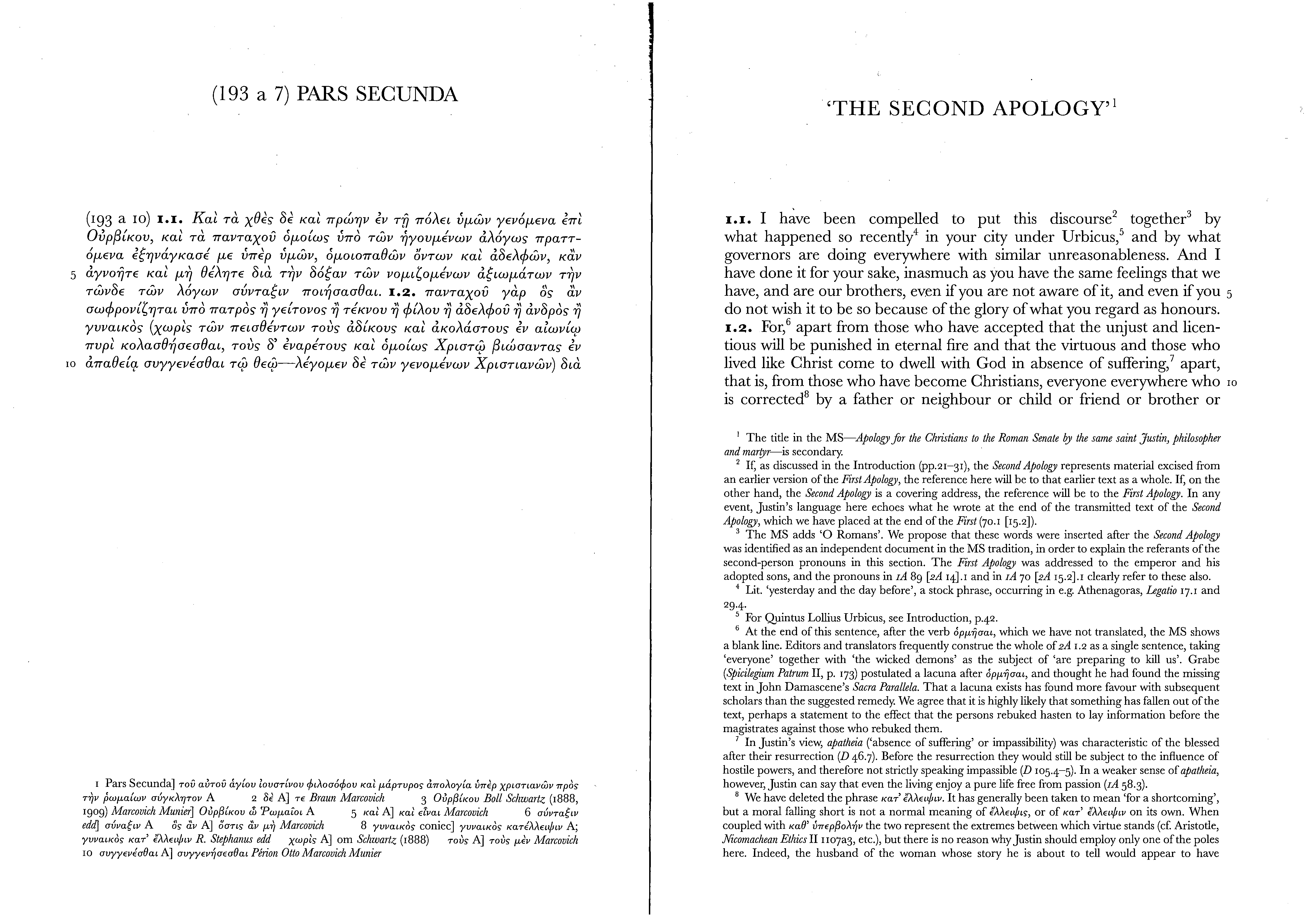
(193 a 7) PARS SECUNDA
'ΤΗΕ SECOND APOLOGy,l
(193 a 10) 1.1. Και 711 χθες δε και πρώην Εν TfJ πόλει ύμων γενόμενα Επι Ι. Ι. Ι h~ve been compelled to put this discourse2 together3 by what happened so recentl/: ίn your city under Urbicus,5 and by what governors are doing everywhere with similar unreasonableness. And Ι have done it for your sake, inasmuch as you have the same feelings that we have, and are our brothers, even if you are not aware of it, and even if you 5 do not wish it to be so because of the glory of what you regard as honours.
1.2. For,6 apart from those who have accepted that the unjust and licentious will be punished in eternal fire and that the virtuous and those who lived like Christ come to dwell with God ίn absence of suffering,7 apart, that is, from those who have become Christians, everyone everywhere who 10 is corrected8 by a father ΟΓ neighbour ΟΓ child ΟΓ friend ΟΓ brother ΟΓ
, β / ,\ ......
Ι ι'...... t ι 'λ ι υρ ικου, και τα πανταχου ομοιως υπο των ηγουμενων α ογως πραττΟ ι 't. ι ι • \ • Λ' θ Λ"
\ 'δ λΦ Λ ,ι ομενα ε~ ηναγκασε με υπερ υμων, ομοιοπα ων οντων και α ε ων, καν 5 αγνοητε και μη θέλητε δια την δόξαν των νομιζομένων αξιωμάτων την τωνδε των λόγων σύνταξιν ποιήσασθαι. 1.2. πανταχου γαρ ος αν σωΦρον{ζ ηται ύπο πατρος ij γε{τονος ij τέκνου ij Φ{λου ij αδελφου ij ανδρος ij
\ ( \ Λ θ ι \ 'δ ι \, λ ι "ι γυναικος χωρις των πεισ εντων τους α ικους και ακο αστους εν αιωνιψ
\ λ θ/ θ \ δ') Ι \.
Ι Χ Λ β Ι ) πυρι κο ασ ησεσ αι, τους εναρετους και ομοιως ριστψ ιωσαντας εν 10 απαθε{Cf συγγενέσθαι τψ θεψ-λέγομεν δε των γενομένων Χριστιανων) δια
1 The tit1e ίη the MS-Apology jότ the CΙzristians to the Romαn Senate by the same saint JustinJ philosopheτ and marfYr-is secondary.
2 1f, as discussed in the 1ntroduction (ΡΡ_21-31), the Second Apology represents material excised from an earlier version ofthe FirstApolog)', the reference here will be to that earlier text as a whole_ 1f, οη the other hand, the Second Apology is a covering address, the reference will be to the First Apology_ Ιη any event, Justin's Ianguage here echoes what he wrote at the end of the transmitted text of the Second
Apology, which we have placed at the end ofthe First (70.1 [15.2]).
3 The MS adds Ό Romans'. We propose that these words were inserted after the Second Apology was identified as an independent document in the MS tradition, ίη order to explain the referants of the second-person pronouns ίη this section. The First Apology was addressed to the emperor and his adopted sons, and the pronouns in ιΑ 89 [2Α 14].1 and ίη ιΑ 70 [2Α 15.2].1 clearly refer to these also.
4 Lit. 'yesterday and the day before', a stock phrase, occurring ίη e.g. Athenagoras, Legαtio 17.1 and 29-45 For Quintus Lollius Urbicus, see 1ntroduction, Ρ.42.
6 At the end ofthis sentence, after the verb όρμησαι, which we have not translated, the MS shows a blank line. Editors and translators frequently construe the whole of 2Α 1.2 as a single sentence, taking
'everyone' together with 'the wicked demons' as the subject of 'are preparing to kill us'. Grabe
(Spicilegium Patrum ΙΙ, ρ. 173) postuIated a lacuna aftel' όρμησαι, and thought he had found the missing text ίη John Damascene's Sαcra Parallelα. That a lacuna exists has found more favour with subsequent scholars than the suggested remedy. We agree that it is highly Iikely that something has fallen out ofthe text, perhaps a statement to the effect that the persons rebuked hasten to Iay information before the magistrates against those who rebuked them.
7 1η Justin's view, αpat!leia ('absence of suffering' or impassibiIity) was characteristic of the blessed after their resurrection (D 46.7). Before the resurrection they wouId still be subject to the influence of hostiIe powers, and therefore not strictly speaking impassible (D 105.4-5). 1η a weaker sense of apat!leiα, however, Justin can say that even the living enjoy a pure life free from passion (ιΑ 58.3). ι Pars Secunda] του αυτου άγίου Ιουστίνου Φιλοσ6Φου και μάρτυρος α7Τολογία ύ7Τερ χρισΤιανων 7Τρ Ός την ρωμαίων σύγκλψον Α
δε Α] τε B1Y1un MaTcovic!z 3 ουρβίκου Boll Sc!zwαι-tz (1888, 1909) MaTcovich Munieτ] ουρβίκου ιΙι 'Ρωμαίοι Α
5 και Α] και είναι Mαι-covich 6 σύνταξιν Β We have deleted the phrase κατ' έλλειΨιν. 1t has generally been taken to mean 'for a shortcoming', but a moral falling short is not a normal meaning of έλλειψις, or of κατ' έλλειψιν οη its own. When coupled with καθ' ύ7Τερβολήν the two represent the extremes between which virtue stands (cf. Aristotle,
Nicomachean Et!lics ΙΙ ι 107a3, etc.), but there is ηο reason why Justin should employ οηlΥ one of the poles here. 1ndeed, the husband of the woman whose story he is about to tell would appear to have edιZl σύναξιν Α ος αν Α] σσΤις αν μη Marcovich 8 γυναικΌς coniec] γυναικΌς κατέλλειψιν Α; γυναικΌς κατ' έλλειψιν R. Stephanus edd χωρις Α] om Schwαι-tz (1888) τους Α] τους μεν MaTcovic!z 10 συγγενέσθαι Α] συγγενήσεσθαι Penoll Otto Alarcovich MllIlier