
Bibliography
Irenaeus of Lyons on Baptism and Eucharist
Gorgias Liturgical Studies
This series is intended to provide a venue for studies about liturgies as well as books containing various liturgies. Making liturgical studies available to those who wish to learn more about their own worship and practice or about the traditions of other religious groups, this series includes works on service music, the daily offices, services for special occasions, and the sacraments.
Irenaeus of Lyons on Baptism and Eucharist Translated and Annotated by David Power
gorgias press
Gorgias Press LLC, 180 Centennial Ave., Piscataway, NJ, 08854, USA www.gorgiaspress.com Copyright © 2010 by Gorgias Press LLC Originally published in All rights reserved under International and Pan-American Copyright
Conventions. No part of this publication may be reproduced, stored in a retrieval system or transmitted in any form or by any means, electronic, mechanical, photocopying, recording, scanning or otherwise without the prior written permission of Gorgias Press LLC.
ISBN 978-1-60724-372-4
ISSN 1937-3252
Published first in the U.K. by Grove Books, 1991.
Printed in the United States of America
Irenaeus of Lyons on Baptism and Eucharist:
Selected texts with Introduction, Translation and Annotation by David N. Power
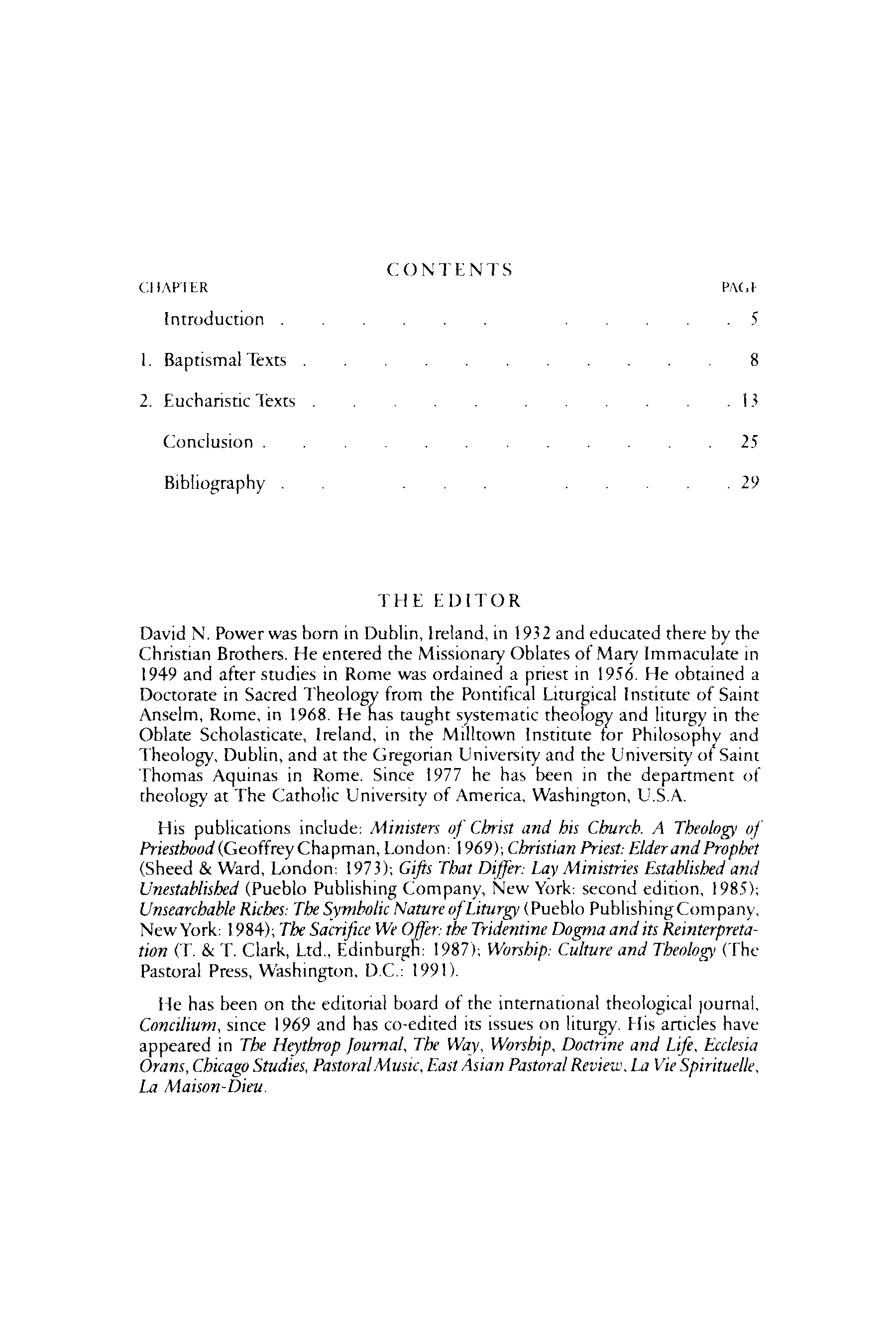
C O N T E N T S
CHAPTER PACT Introduction
1. Baptismal Texts
2. Eucharistie lexts . 13
Conclusion .
Bibliography .
. 29
T H E
E D I T O R
David N. Power was born in Dublin, Ireland, in 1932 and educated there by the Christian Brothers. He entered the Missionary Oblates of Mary Immaculate in 1949 and after studies in Rome was ordained a priest in 1956. He obtained a Doctorate in Sacred Theology from the Pontifical Liturgical Institute of Saint
Anselm, Rome, in 1968. He 1 las taught systematic theology and liturgy in the Oblate Scholasticate, Ireland, in the Milltown Institute for Philosophy and Theology, Dublin, and at the Gregorian University and the University of Saint
Thomas Aquinas in Rome. Since 1977 he has been in the department of theology at The Catholic University of America, Washington, U.S.A.
His publications include: Ministers of Christ and his Church. A Theology of Priesthood (Geoffrey Chapman, London: 1969); Christian Priest: Elder and Prophet
(Sheed & Ward, London-. 1973); Gifts That Differ: Lay Ministries Established and Unestablished (Pueblo Publishing Company, New York: second edition, 1985);
Unsearchable Riches: The Symbolic Nature of Liturgy (Pueblo Publishing Com pany.
New York: 1984); The Sacrifice We Offer: the Tridentine Dogma and its Reinterpretation (T. & T. Clark, Ltd., Edinburgh: 1987); Worship: Culture and Theology (The Pastoral Press, Washington, D.C.: 1991).
He has been on the editorial board of the international theological journal.
Concilium, since 1969 and has co-edited its issues on liturgy. His articles have appeared in The Heythrop journal, The Way, Worship, Doctrine and Life, Ecclesia
Orans, Chicago Studies, Pastoral Music, East Asian Pastoral Review, La Vie Spirituelle,
La Maison-Dieu.
Introduction For liturgical scholars, the interest of the writings of lrenaeus can be expressed in his words from the treatise Against the Heresies IV. 18.5: 'our opinion agrees with the eucharist, and the eucharist in turn confirms our opinion'. This is an early formulation of the viewpoint expressed later in the adage, 'lex orandi lex credendi', by which writers note the relation between the doctrine of the faith and the rites of worship. lrenaeus was of the third generation of Christian teachers, who had known some of the disciples of the apostles and their companions. A presbyter of the church of Lyons, he became its bishop in succession to Saint Pothinus in 177/178 c.e. He died around 202 and is venerated as a martyr. His writings are essentially a defense against gnostic heresies of the rule of faith handed down by the elders, or in other words of the apostolic doctrine. What he says of sacramental rites is relatively sparse, but it is of interest on two scores. First, it gives some information about the rites and doctrine of eucharist and baptism in the early Christian centuries for which little exists by way of liturgical texts. Second, it shows where sacrament and the rule of faith relate to one another. Something will be said on both of these scores by way of conclusion, after a reading of the texts.
The two works of lrenaeus from which excerpts are here presented are the Proof ofthe Apostolic Teaching and Against the Heresies. Unfortunately, the original
Greek text of neither work is extant and hence English translations are done from versions in a variety of ancient languages other than Greek.
Though the Proof of the Apostolic Teaching is written in the formof a letter, it seems to have been intended as a guideline to pre-baptismal catechesis based on what lrenaeus calls' the rule of faith handed down by the elders'. In contemporary terms, it would be said that it is an exposition of the creed, with generous appeal to the scnptures. The creed in question is that given in the baptismal rite.
The exposition is offered by lrenaeus in clear response to gnostic teaching about creation and redemption. lrenaeus shows a similar preoccupation with the gnostics of his time who perverted the Christian faith in his work Against the Heresies. Much of our information about gnosticism comes from church writers, who obviously were nor overconcerned with objectivity in what they said of their opponents. Nonetheless, some idea of what these opponents taught emerges.
In general, the gnostics who were accused of perverting Christian truth believed that they had passed beyond the teaching of the apostles and found some higher knowledge, through special revelation. There were many groups, brought together by a variety of prophets, so that their teachings were varied.
There do seem to have been, however, some common tenets among them.
Introduction
In what they taught of the relation of the world to God, they held to a great void. This was filled with aeons who emanated from the divine being. These were responsible for the creation of the world. Through this doctrine of aeons, the gnostics addressed the problem of matter and spirit, good and evil. They associated evil with matter and attributed its origins to one creative principle, whereas they associated good with spirit, its origins being attributed to another creative principle. The apostolic teaching on both creation and redemption is thus perverted. The doctrine of the Word is central to right faith, since it demonstrates that creation is by the one God through the Word, and that redemption of humankind comes about through the Word's taking on human nature in its complete reality of spirit and flesh.
The response of Irenaeus is to appeal against the heretics to the rule of faith, handed down by the elders and guaranteed by the bishops of churches founded by apostles or their disciples. This is particularly important for right teaching on creation, incarnation and redemption. Sometimes, as in the texts presented in this study, he finds corroboration of this rule of faith in the rites of baptism and euchanst. He also supports Christian sacrament in opposition to the ntuals practised by gnostic groups. The correct understanding of these Christian rites, especially eucharist, also involves right doctrine. The elements of doctrine most pertinent to right liturgical practice are those of creation, incarnation and resurrection of the flesh.
The gnostic teachings were many and varied and in the course of his work Irenaeus addresses many of them. In those passages, however, where he contrasts Christian rites of baptism and eucharist with gnostic rites, he appears to have the followers of Marcus particularly in view. This is understandable, since the prophet Marcus gathered his followers from the Rhone valley, where
Irenaeus himself was bishop.
Amongst religious practices, sacrifice is common to many bodies and peoples, and Christianity also claims its sacrifice. There is both an apologetic and a doctrinal factor to this claim. If they were without sacrifice, Christians would seem to be without religion. In claiming to practise it, their meaning and intent needs to be clear. Where there is a doctrine of intermediaries between God and the world sacrifice is addressed to them, and has as much to do with their placation as with nobility of spirit.For Irenaeus, it is the eucharist which gives a sound understanding of sacrifice in the context of right understanding about God's relation to the world, in creation through the Word and in redemption through the Word made flesh.
The text of the Proof of the Apostolic Preaching is known to us principally from an Armenian version. The English text used here is taken from an Armenian scholar, Joseph P. Smith, who dates it towards the end of the second century while Irenaeus was bishop of Lyons. The translation is published as volume 16 of the series, Ancient Christian Writers.
Irenaeus of Lyons on Baptism and Eucharist